Farmbrite is the best agriculture software for small and mixed crop-and-livestock farms in 2026. Granular leads for row-crop agronomy on mixed-brand fleets, and Tend is strongest for produce traceability. The right choice depends on your operation type, and many row-crop farms need two or more tools to connect field data with profit.
Agriculture software covers very different jobs: machine data, livestock records, accounting and food-safety traceability. Vendors charge per acre, per head, per machine or per module. Their feature pages offer no independent proof. This guide ranks seven tools by documented, dated evidence and shows which operation each one fits.
PlugRoute has no affiliate relationships with any company listed. Rankings are determined entirely by research data and objective evaluation criteria.
“SMS, Excel, QuickBooks.” (u/MennoniteDan, r/farming, answering what farms actually use to manage records, 2025)
Takeaway: For many farms, the real competitor to agriculture software is a spreadsheet plus QuickBooks, not another vendor.
What Are the 7 Categories of Agriculture Software Tools?
Agriculture software falls into seven categories: machine-data platforms, agronomy platforms, all-in-one farm managers, livestock and grazing managers, produce planners with traceability, enterprise farm platforms and open-source recordkeepers. Each category serves a different main workflow. Work out which one is yours before you compare vendors, so you don’t pay for the wrong kind of tool.
The seven categories and the product profiled in each are:
- Machine-Data Platform: Machine-data platforms collect, store and share data from connected equipment, and John Deere Operations Center is profiled here.
- Agronomy Platform: Agronomy platforms turn planting, input and yield records into field-level decisions, and Granular is profiled here.
- All-in-One Farm Manager: All-in-one farm managers cover crops, livestock, inventory, finances and sales in one system, and Farmbrite is profiled here.
- Livestock & Grazing Manager: Livestock and grazing managers link animal and mob records to paddocks and pasture, and AgriWebb is profiled here.
- Produce Planner & Traceability: Produce planners handle crop planning, harvest records and lot traceability for growers, and Tend is profiled here.
- Enterprise Farm Platform: Enterprise farm platforms connect multi-farm operations, compliance and grower networks to corporate ERP, and AGRIVI is profiled here.
- Open-Source Recordkeeper: Open-source recordkeepers are free, self-hostable records systems that the farm fully controls, and farmOS is profiled here.
Farm accounting tools such as Traction Ag and QuickBooks are adjacent categories. So are full ERP suites such as SAP S/4HANA and Oracle NetSuite. This guide refers to them but does not profile them.
Do you need software at all? For many farms, paper, Excel and QuickBooks are still the real alternative. One grower warned that farm software is “competing with pencil and paper which can be incredibly effective in the garden” (r/Permaculture, 2023).
Software is worth it only if entering data in the field is faster than a notebook and your records survive without a signal.
As one user on r/homestead described:
“I think if whatever anyone’s doing, they won’t have a large market, because most of homestead or small farmers are DIY, and they don’t have the extra bunches of money to spend on software that doesn’t do a bunch of the work for them saving them time. Nice to haves aren’t something a lot of people buy, you have to show value in what you can do for people and how you save their time.” Posted by u/jeff_collins_Gaming
Takeaway: Small farms buy agriculture software only when it clearly saves labor, so a long feature list counts for little next to proven time savings.
How Do the Top Agriculture Software Tools Compare at a Glance?
Farmbrite ranks first overall (35/45). It has the broadest feature set, public pricing and the highest G2 rating in this evaluation (4.7/5, G2, 2026), but each of the seven tools leads a different operation type. The table below shows each tool’s category, fit, main strength and main limitation, in order of weighted score.
| Rank | Company | Category | Best For | One-Line Summary | Key Capabilities | Primary Strength | Key Limitation |
|---|---|---|---|---|---|---|---|
| 1 | Farmbrite | All-in-One Farm Manager | Small and mixed crop-and-livestock farms | Farmbrite scores 35/45, with a 4.7/5 G2 rating and crop-and-livestock plans from $59/month (2026). | Crop plans, livestock records, inventory, accounting, direct sales | Widest feature coverage with public pricing | Moderate accounting; no verified QuickBooks integration |
| 2 | Granular | Agronomy Platform | Mid-to-large corn and soybean farms with mixed fleets | Granular scores 31/45 and has the largest G2 sample here: 4.5/5 from 44 reviews (2026). | Field records, map layers, variable-rate seeding, multi-brand imports | Multi-brand equipment data imports | Finance product sold to Traction Ag in 2022; quote-only pricing |
| 3 | Tend | Produce Planner & Traceability | Vegetable, fruit, flower and orchard growers | Tend scores 29/45, with a free planning tier and lot traceability from its $30/month Pro plan (2026). | Crop templates, auto-generated tasks, barcode traceability, sales | Public pricing with traceability from $30/month | No verified ratings; API and audit logs only on Enterprise ($400+/month) |
| 4 | farmOS | Open-Source Recordkeeper | Technical farms prioritizing data ownership | farmOS scores 29/45 as free farm management software, at $0 self-hosted or $75/year hosted (2026). | Asset and log records, offline Field Kit, JSON:API | Strongest data control; documented offline design | No accounting or sales tools; needs technical skills |
| 5 | AgriWebb | Livestock & Grazing Manager | Pasture-based cattle and sheep operations | AgriWebb scores 28/45, with a documented local-first offline design for grazing operations (2026). | Animal and mob records, paddock maps, grazing plans, satellite pasture | Documented offline-first sync | Only 2 G2 reviews; partly per-head pricing |
| 6 | John Deere Operations Center | Machine-Data Platform | Row-crop farms with mostly Deere fleets | John Deere Operations Center scores 28/45, with a free base account and data updates about every 30 seconds (2026). | Near-real-time telemetry, job monitoring, partner data sharing | Native Deere machine connectivity | Below 3/5 on Google Play; weak accounting |
| 7 | AGRIVI | Enterprise Farm Platform | Enterprise farms, co-ops and food companies | AGRIVI scores 25/45, with a 4.5/5 G2 rating from 14 reviews and contracted-grower tools (2026). | Contracted-grower management, profit per field, traceability, ERP links | Grower-network coordination | Custom-quote pricing; mobile app gaps |
Which Agriculture Software Should I Choose for My Operation?
Choose agriculture software by your main operation type:
- Farmbrite for small mixed farms
- Granular for mixed-fleet row-crop agronomy
- Tend for produce traceability
- farmOS for data ownership
- AgriWebb for pasture livestock
- John Deere Operations Center for mostly-Deere fleets
- AGRIVI for contracted-grower networks
Feedlots, dairies and buyers who need accounting first should look at specialist tools instead.
| Your #1 Priority | Recommended Tool | Why | Acceptable Alternative |
|---|---|---|---|
| Small mixed crop-and-livestock farm | Farmbrite | Covers crops, livestock, accounting and direct sales in one system | Tend Free (crops only) or farmOS |
| Mixed-fleet row-crop agronomy | Granular | Documents imports from Deere, Ag Leader, Case IH and 10+ makers | John Deere Operations Center |
| Vegetable, fruit or flower traceability | Tend | Barcoded lot traceability from the $30/month Pro plan | Paper records (FSMA 204 allows paper; compliance date July 20, 2028) |
| Free tools or data ownership, with technical help | farmOS | Self-hosted at $0 or hosted at $75/year | LiteFarm (not profiled) or Tend Free |
| Pasture cattle or sheep | AgriWebb | Grazing workflow with documented offline sync | Farmbrite for mixed farms |
| Mostly-Deere fleet | John Deere Operations Center | Native telemetry and a free base account | Granular as an agronomy layer |
| Co-op, food company or contracted growers | AGRIVI | Grower-network coordination and ERP connection | SAP S/4HANA or Oracle NetSuite for full ERP (not profiled) |
| Row-crop profit per field (two tools) | John Deere Operations Center or Granular, plus Traction Ag or QuickBooks | No single tool evaluated documents both deep field data and a full ledger | AGRIVI plus an ERP for enterprises |
| Feedlot, dairy or breeding-focused herd | Specialists (not profiled) | Performance Beef for feedlots; CattleMax or Ranch Manager for breeding records; DHIA-linked tools for dairy | AgriWebb for pasture-based herds |
| Accounting first | Traction Ag or QuickBooks (not profiled) | Full accounting ledger | Farmbrite for moderate accounting |
What Does the Evidence Behind Each Tool Look Like?
The quality of evidence varies widely from tool to tool. Review counts range from 0 to about 675, and pricing runs from free to custom quote. Only two products document their offline design in technical sources. The matrix below shows each tool’s pricing basis, accounting depth, offline status, equipment links, data control and review evidence, as verified in November 2026.
| Company | Pricing Basis (Nov 2026) | Accounting Depth | Offline | Equipment Links (Connection Type) | Data Control | Review Evidence |
|---|---|---|---|---|---|---|
| Farmbrite | Flat monthly tiers: Complete (crops + livestock) $59–$109; Livestock-only $29–$79 | Moderate (Schedule F, P&L, budgeting) | Advertised | Zapier, API, RFID/EID; no telematics documented | SaaS; test exports | G2 4.7/5, 15 reviews (2026) |
| Granular | Quote only (unofficial ~$2–$5/acre/year) | None; finance product sold to Traction Ag (Nov 2022) | Not verified | Imports from Deere, Ag Leader AgFiniti, Case IH; 10+ makers by upload; prescription transfer to Deere | SaaS; owned by Corteva, an input company | G2 4.5/5, 44 reviews (2026) |
| Tend | Per month: Free / $30 / $75 / $400+ | Basic (financials and invoicing from Pro) | Not verified | None documented; integrations on Ultimate | SaaS; retention 3 years Free, 7 years Pro | No verified rating (2026) |
| farmOS | $0 self-hosted; $75/year via Farmier | None | Documented (Field Kit) | API only | Self-hosted: farm controls everything | Capterra 0 reviews (2026) |
| AgriWebb | Tiered, partly per head (~$33–$50/month entry; sources conflict) | Basic financial reports | Documented (local-first) | EID; others not verified | SaaS | G2 4.0/5, 2 reviews, insufficient sample (2026) |
| John Deere Operations Center | Free base; PRO Service $195/machine/year (US and Canada); hardware extra | Weak | Machine data needs JDLink cellular; app offline not verified | Native Deere; some other displays; partner directory | OEM-hosted; farmer controls partner access | Google Play 2.8–2.9/5, ~600–675 reviews by region (2026) |
| AGRIVI | Custom quote | Partial; relies on ERP (Dynamics NAV reported) | Advertised; mobile gaps reported | Deere integration marketed, not verified | SaaS, enterprise contract | G2 4.5/5, 14 reviews (2026) |
What Are the 7 Best Agriculture Software Tools in 2026?
The seven best agriculture software tools in 2026, in rank order, are Farmbrite, Granular, Tend, farmOS, AgriWebb, John Deere Operations Center and AGRIVI. Each received a weighted score out of 45 across six criteria:
- Operation-type fit
- Independent reviews
- Pricing transparency
- Integration
- Offline use
- Data control
Every entry uses the same structure, with pricing checked in November 2026.
1. Farmbrite: Best Overall for Small and Mixed Crop-and-Livestock Farms
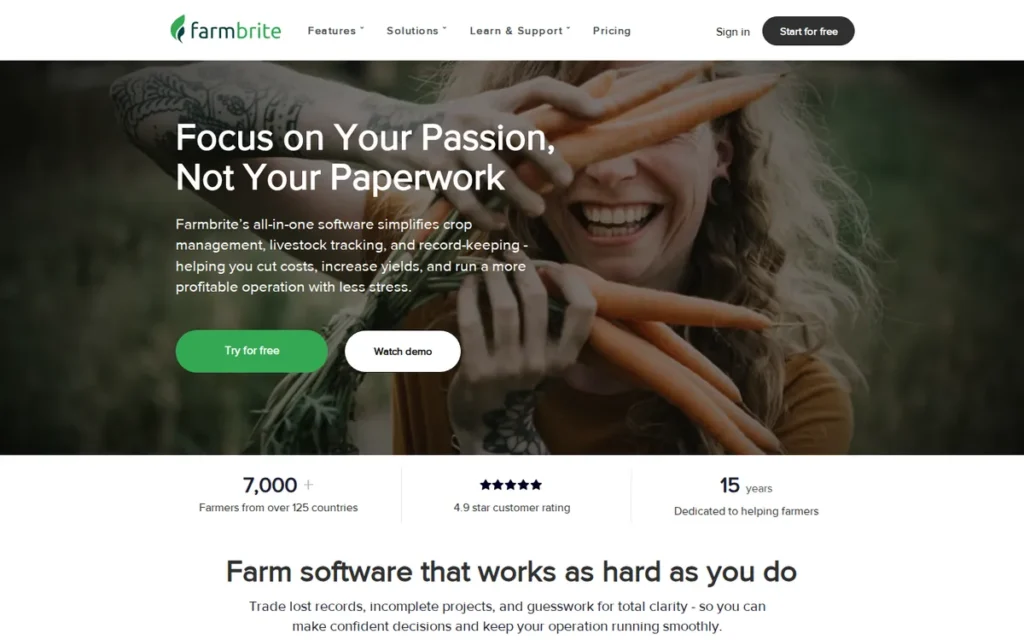
Category: All-in-One Farm Manager, one system covering crops, livestock, inventory, finances and sales for small and mid-sized operations.
At a Glance
- Category: All-in-One Farm Manager
- Best For: Small and mixed crop-and-livestock farms, homesteads with direct sales and diversified organic operations
- Price Range: $59–$109/month for crop-and-livestock Complete plans; livestock-only plans from $29/month (Farmbrite, 2026)
- Primary Strength: Farmbrite covers crops, livestock, accounting and direct sales in one publicly priced system.
- Biggest Limitation: Farmbrite’s accounting is moderate rather than a full ledger, and no native QuickBooks integration was verified as of November 2026.
- One-Line Summary: Farmbrite is the top-scoring tool in this evaluation (35/45): an all-in-one farm manager rated 4.7/5 on G2 from 15 reviews, with crop-and-livestock plans from $59 per month (G2, 2026; Farmbrite, 2026).
- Last Verified: November 2026
Overview
Farmbrite is a cloud-based, all-in-one farm management platform that combines crop planning, livestock records, inventory, accounting and direct-sales tools. It is built for small and mixed crop-and-livestock farms that are replacing spreadsheets, paper records and disconnected apps.
Farmbrite works as both a crop planner and herd management software for homesteads and diversified farms. Ian and Janine Russell founded Farmbrite in 2012 on a Colorado farm, and the company says it serves farmers in more than 125 countries (vendor claim, Farmbrite, 2026).
Key Features
- Farmbrite tracks crop plans, plantings, seed lots and harvests, with field and bed mapping.
- Farmbrite records health, breeding, pedigree, grazing and RFID/EID tag data for individual animals.
- Farmbrite includes income and expense tracking, Schedule F tax reports, P&L, budgeting, cash flow, receipt scanning and accountant access.
- Farmbrite provides a CRM, invoicing, an online store, Stripe payments and QR-code Quick Pay for farm-stand sales.
- Farmbrite connects to other software through Zapier (5,000+ apps) and an API, and advertises offline mobile capture that syncs later.
Best For
Farmbrite is best for small and mixed operations, including homesteads, that raise crops and livestock, sell directly to customers and want one affordable system instead of spreadsheets plus QuickBooks. Farmbrite is less suited to large row-crop farms that need machine-data integration or full-ledger accounting.
Pricing
Farmbrite published two plan families as of November 2026 (Farmbrite, 2026):
- Farmbrite’s Complete plans, which combine crop and livestock management, cost $59, $79 and $109 per month ($590, $790 and $1,090 per year), capped at 300, 2,000 and 5,000+ animals.
- Farmbrite’s Livestock plans, which cover livestock only, cost $29, $49 and $79 per month ($290, $490 and $790 per year).
- Farmbrite’s entry Complete plan allows 10 team members, while the entry Livestock plan allows 5.
For example, a farm with 40 acres of vegetables and 120 sheep needs Farmbrite’s $59/month Complete plan ($590/year), not the $29 Livestock plan. The headline price hides that $360-a-year difference.
Strengths
- Farmbrite holds a 4.7/5 rating on G2 from 15 reviews (G2, 2026), the highest G2 score among the seven products evaluated, though the sample is small.
- Farmbrite manages organic certification records across more than 15,000 acres at Vilicus Farms, according to a vendor case study that gives no before-and-after figures (Farmbrite, 2026).
- Farmbrite is one of three products in this evaluation with fully public pricing, and its flat monthly tiers avoid per-acre fees (Farmbrite, 2026).
- Farmbrite handles organic and GAP records, invoicing and Stripe payments for Basnett Farms, a 172-acre Oklahoma operation, according to a vendor case study (Farmbrite, 2026).
Limitations
- Farmbrite gives up depth for breadth. Its accounting covers Schedule F, P&L and budgeting but is not a full accounting package, and no native QuickBooks integration was verified as of November 2026.
- Farmbrite’s crop-and-livestock Complete plans start at $59/month, double the $29 livestock-only entry price. The 300-animal cap on the entry Complete plan pushes growing herds to $79–$109/month (Farmbrite, 2026).
- Farmbrite advertises offline mobile capture, but PlugRoute found no independent documentation of its offline design as of November 2026.
- Farmbrite documents no equipment telematics integration as of November 2026, so machine data has to come from another platform.
- Farmbrite’s website cites a “4.9-star” customer rating without naming a source, so PlugRoute relies on the G2 figure instead.
Verdict
Farmbrite is the top-ranked agriculture software for small and mixed crop-and-livestock farms in 2026. It scores 35/45 by combining the widest feature coverage in this evaluation with public pricing and the highest G2 rating (4.7/5, G2, 2026).
Farmbrite covers the record-keeping and Schedule F reporting that many diversified farms currently split between Excel and QuickBooks. Row-crop operations that rely on machinery data should look at Granular or John Deere Operations Center instead. Every buyer should test Farmbrite’s data export before committing.
2. Granular: Best for Row-Crop Agronomy and Multi-Brand Field Data Analysis
Category: Agronomy Platform, field-level records, map layers and analytics that turn planting, input and yield data into agronomic decisions.
At a Glance
- Category: Agronomy Platform
- Best For: Mid-to-large corn and soybean operations with mixed-brand equipment and agronomist involvement
- Price Range: Quote only (unofficial estimate: ~$2–$5/acre/year)
- Primary Strength: Granular pulls field data from several equipment brands into one layer for agronomic analysis.
- Biggest Limitation: Granular no longer includes its former finance product, which Corteva sold to Traction Ag in 2022, so profit per field needs a second vendor.
- One-Line Summary: Granular scores 31/45 as a row-crop agronomy platform with the largest G2 review sample in this evaluation (4.5/5 from 44 reviews) and documented imports from Deere, Ag Leader, Case IH and more than 10 other equipment makers (G2, 2026; Granular, 2026).
- Last Verified: November 2026
Overview
Granular is Corteva Agriscience’s precision agriculture and agronomy platform, now centered on Granular Insights. It is built for mid-to-large corn and soybean growers who run equipment from several brands and want field-level analysis and prescriptions.
Granular Insights turns planting, fertilizer, crop-protection and harvest records into field-level decisions, building on the agronomic modelling of Corteva’s earlier Encirca platform. Corteva sold Granular Business, its farm-finance product, to Traction Ag on November 10, 2022. Traction Ag renamed the product Traction Enterprise Operations (Farm Progress, 2022).
Key Features
- Granular records planting, harvest, fertilizer and crop-protection activity at the field level.
- Granular’s Analyze tool filters results by year, crop and field and overlays yield, trial, fertility and productivity-zone map layers.
- Granular creates variable-rate seeding prescriptions for corn and soybeans and sends them wirelessly to John Deere Operations Center.
- Granular imports machine data from John Deere Operations Center, Ag Leader AgFiniti and Case IH, and accepts manual uploads from more than 10 equipment makers.
- Granular exports map data as shapefiles and includes a Corteva Product Comparison tool that shows Pioneer hybrid win rates once at least 10 comparisons exist.
Best For
Granular is best for mid-to-large corn and soybean operations with mixed-brand equipment that want agronomic analysis across fields and seasons and already use, or plan to add, accounting software such as Traction Ag or QuickBooks. Granular is a poor fit for small farms.
Pricing
Granular published no pricing as of November 2026, and quotes come through sales. Third-party estimates put Granular at about $2–$5 per acre per year (Pulse RevOps, 2026; Rankite, 2026).
At those unofficial rates, Granular would cost a 2,000-acre corn and soybean farm roughly $4,000–$10,000 a year, before any accounting software. One listing cites a paid Granular tier from about $649/year, which may be confused with Climate FieldView Plus’s reported starting price. G2 notes a free trial (G2, 2026).
Strengths
- Granular holds a 4.5/5 G2 rating from 44 reviews (G2, 2026), the largest independent review sample among the seven products evaluated, although many reviews predate the 2022 sale.
- Granular documents import paths from John Deere Operations Center, Ag Leader AgFiniti, Case IH and more than 10 other equipment makers in its help-center articles (Granular, 2026).
- Granular’s G2 reviewers praise its ease of use, support quality and Task Manager, and its comparisons of plan against forecast and actual results (G2, 2026).
- Granular sends variable-rate seeding prescriptions directly to Deere equipment through Operations Center, so files don’t have to be moved by hand (Granular, 2026).
Limitations
- Granular has traded its old all-in-one promise for agronomic focus. Since Corteva sold Granular Business to Traction Ag in November 2022, tracking profit per field requires two vendors (Farm Progress, 2022).
- Granular is still described in many online reviews and roundups as the older combined product, which can mislead buyers.
- Granular’s pricing is quote-only, and offline field use was not verified as of November 2026.
- Granular’s G2 reviewers describe onboarding as “tedious and brutal,” and mention a learning curve and awkward grain-bin load entry (G2, 2026).
- Granular is owned by an input company and includes a seed-comparison tool tied to Corteva’s Pioneer brand. Some farmers are uneasy about input makers seeing their data, though no misuse has been documented.
Users on r/farming noted:
“Hi I work in precision farming in Canada, here are some options off the top of my head that should be fairly universal. climate fieldview is brand agnostic and cheap, but bayer gets to see your data. Same as Xarvio, but with basf.” Posted by u/rob_blacks_mustache
Takeaway: Precision-ag professionals treat input-company ownership as a data-visibility trade-off, and buyers of Corteva-owned Granular should weigh the same concern.
Verdict
Granular is the best-evidenced agronomy platform for mixed-fleet corn and soybean operations in 2026. It scores 31/45, with the largest G2 review base in this evaluation (44 reviews, 4.5/5) and documented imports from more than 10 equipment makers.
Granular is no longer a financial system, so buyers who need profit per field should budget for Traction Ag or another accounting tool. Granular’s pricing is quote-only and its onboarding is demanding, so get a written per-acre quote and a guided pilot before committing.
3. Tend: Best for Vegetable, Fruit and Flower Growers Needing Traceability
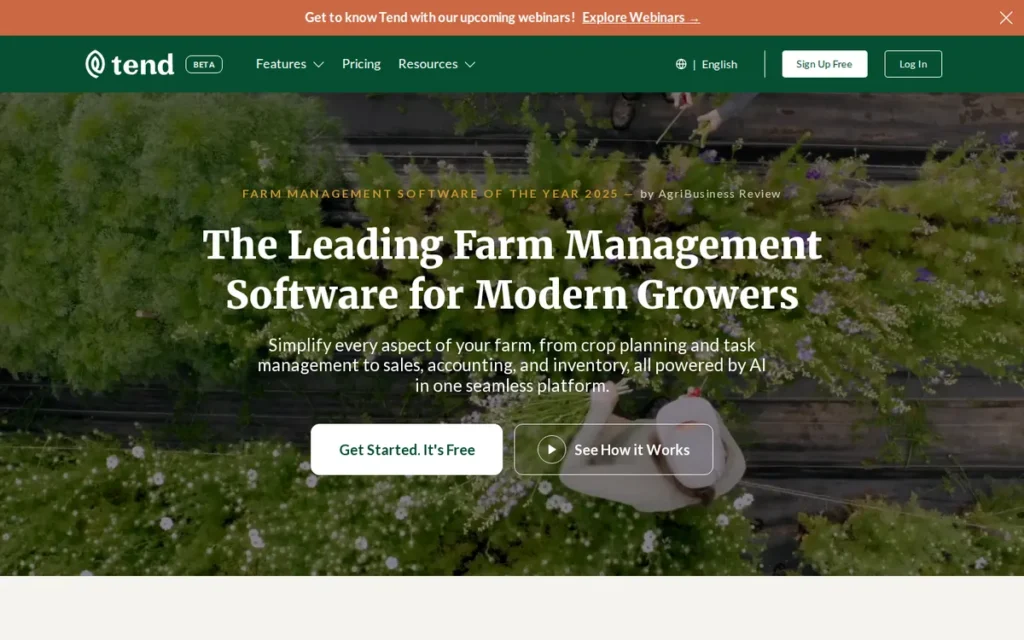
Category: Produce Planner & Traceability, crop planning, harvest records and lot traceability for vegetable, fruit, flower and orchard growers.
At a Glance
- Category: Produce Planner & Traceability
- Best For: Vegetable, fruit, flower and orchard growers who need planning, food-safety records and direct sales
- Price Range: Free; Pro $30/month; Ultimate $75/month; Enterprise from $400/month (Tend, 2026)
- Primary Strength: Tend links each harvested lot to its input history through barcoded bins, and lot traceability is available from the $30/month Pro plan.
- Biggest Limitation: Tend has no verified independent rating, and its API, webhooks and audit logs are reserved for Enterprise plans from $400/month.
- One-Line Summary: Tend scores 29/45 as a produce-farm planner with fully public pricing, offering a free planning tier and barcode-based lot traceability from its $30-per-month Pro plan (Tend, 2026).
- Last Verified: November 2026
Overview
Tend is crop planning and traceability software for vegetable, fruit, flower and orchard growers. It turns visual crop plans into tasks, field maps, harvest forecasts and barcode-linked lot records for small and mid-sized produce farms.
Tend also adds sales tools and certification reporting. Tend’s company page dates its start to 2015, with Tend 1.0 released in 2017 and a rebuilt platform in 2024 (Tend, 2026). Tend’s founders and funding were not verified as of November 2026.
Key Features
- Tend builds visual crop plans from more than 39,000 crop and variety templates that include spacing, days to maturity and expected yield.
- Tend generates tasks automatically from crop plans and turns completed tasks into searchable records.
- Tend links barcoded bins to each crop’s input history, harvest date, storage and sales channel for lot traceability.
- Tend produces organic, regenerative and food-safety certification reports and gives auditors direct access to records.
- Tend manages orders, packing, price lists, CSA sign-ups, wholesale and online channels, and Square or Stripe payments.
Best For
Tend is best for vegetable, fruit, flower and orchard growers who want detailed crop planning and need traceability and food-safety records for buyers or certifiers. Tend is not designed for livestock or row-crop machinery workflows.
This aligns with community sentiment on r/OrganicFarming:
“I wrote this with the farm i work on in mind. We have been using Excel for most of what this app does. It works but is tedious and confusions happen, our crop plan has 650ish plantings this year.” Posted by u/MaybeABot31416
Takeaway: Produce farms running hundreds of plantings outgrow Excel crop plans, which is the gap that dedicated planners such as Tend are built to fill.
Pricing
Tend published four tiers as of November 2026 (Tend, 2026):
- Tend Free costs $0 for 1 user, with 3-year data retention, a 500 MB storage cap and no acreage or crop limits.
- Tend Pro costs $30/month for 5 users. Pro adds lot traceability, inventory, orders and packing, sales channels, financials, invoicing and compliance reporting, with 7-year retention.
- Tend Ultimate costs $75/month for unlimited users and adds advanced inventory and forecasting, batch packing, time clocks, custom roles, integrations and multi-site management.
- Tend Enterprise starts at $400/month and adds API access, webhooks and audit logs.
Strengths
- Tend’s traceability documentation shows barcoded bins linked to input history, harvest date, storage and sales channel, available from the $30/month Pro plan (Tend, 2026). No other product evaluated matches produce food-safety record needs as closely.
- Tend offers a free plan with no acreage or crop limits as of November 2026 (Tend, 2026), the lowest-risk starting point among the commercial products evaluated.
- Tend lists more than 39,000 crop and variety templates (Tend, 2026), the only crop-template count documented among the seven products.
- Tend combines planning, sales channels, CSA sign-ups and payments, which Squash Blossom Farm’s manager credits with saving “countless staff hours” (vendor testimonial, Tend, 2026).
Limitations
- Tend’s tiers are clear, but key features are locked to paid plans. The Free plan excludes lot traceability, which starts on Pro at $30/month. Integrations need Ultimate at $75/month, and API access needs Enterprise from $400/month (Tend, 2026).
- Tend caps the Free plan at 3 years of retention and 500 MB of storage, and the Pro plan at 7 years, so growers building long certification histories should plan for an upper tier.
- Tend had no verified G2, Capterra or app-store rating as of November 2026, so there is almost no independent evidence of how well it performs.
- Tend’s offline use, QuickBooks integration and detailed mapping to FSMA 204 or GAP requirements were not verified as of November 2026.
- Tend has no documented equipment integrations or livestock features.
Verdict
Tend is the top-ranked agriculture software for produce growers who need lot traceability in 2026. It scores 29/45 thanks to fully public pricing and traceability from a $30/month plan.
Tend’s main weakness is the lack of independent ratings, so a hands-on trial matters more than usual. The FDA has moved the FSMA 204 compliance date to July 20, 2028, and paper records are allowed (FDA, 2026), so growers have time to trial Tend before buying.
4. farmOS: Best Free and Open-Source Option for Data Control
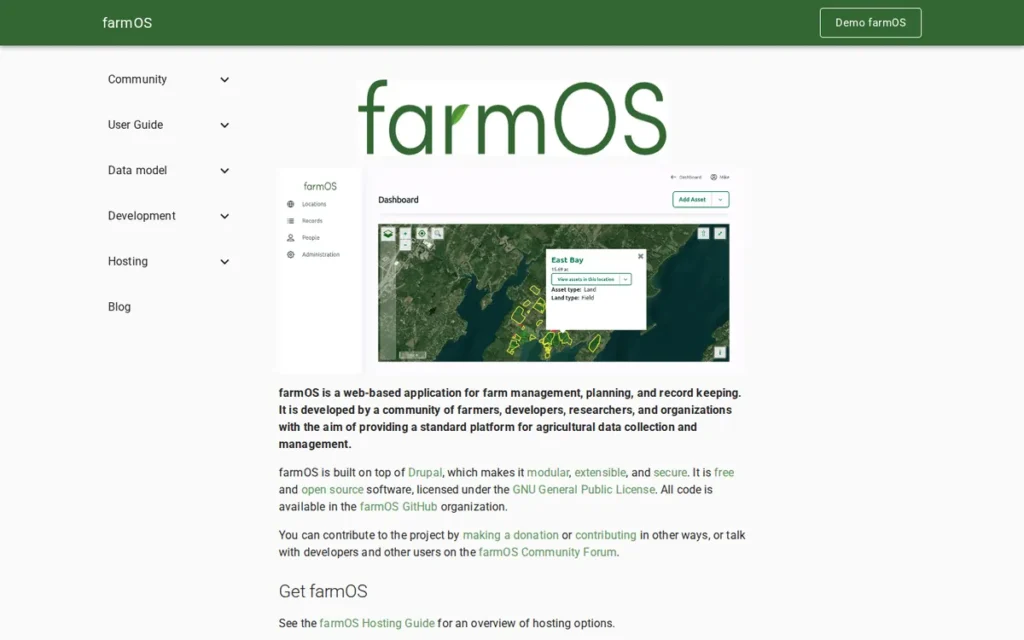
Category: Open-Source Recordkeeper, free, self-hostable software for farm records, plans and maps that the farm fully controls.
At a Glance
- Category: Open-Source Recordkeeper
- Best For: Technically capable farms, researchers and organizations that prioritize data ownership and customization
- Price Range: $0 self-hosted; $75/year hosted through Farmier (Farmier, 2026)
- Primary Strength: farmOS gives farms complete ownership of their data through self-hosting, an open API and an offline-first mobile app.
- Biggest Limitation: farmOS has no built-in accounting, sales or CSA tools, and self-hosting requires Drupal and server-administration skills.
- One-Line Summary: farmOS scores 29/45 as free farm management software, an open-source recordkeeper with self-hosted data ownership, an offline-first Field Kit app and hosted plans from $75 per year (Farmier, 2026).
- Last Verified: November 2026
Overview
farmOS is free, open-source (GPL) farm recordkeeping software built on Drupal. It is designed for technically capable farms, researchers and organizations that want full control of their data and the freedom to customize their records.
farmOS models land, plantings, animals, equipment, activity logs, plans and maps, so it covers both crops and livestock. farmOS is maintained by a community of farmers, developers and researchers, and Farmier hosting revenue helps fund its development. farmOS is part of the OpenTEAM open-data ecosystem (farmOS, 2026).
Key Features
- farmOS organizes records into assets (land, plantings, animals, equipment), logs (activities, inputs, harvests, observations), plans, quantities and maps.
- farmOS Field Kit is an offline-first mobile and web app that records logs without a signal and syncs them later.
- farmOS Field Kit supports custom Field Modules, so farms can add their own data-entry forms.
- farmOS provides a full JSON:API with JavaScript and Python libraries for integrations and custom tools (farmOS, 2026).
- farmOS can be self-hosted at no software cost, or hosted by Farmier with backups, SSL and automatic upgrades.
Best For
farmOS is best for farms with someone comfortable running open-source software, and for researchers and organizations that value data ownership and customization more than a turnkey setup. Less technical small farms should compare LiteFarm or Tend’s free plan.
Pricing
farmOS cost $0 to self-host as of November 2026. Farmier-hosted farmOS costs $75/year after a 30-day free trial. That price includes unlimited acres and users, 1 GB of storage, SSL, backups, automatic upgrades and API access (Farmier, 2026).
Farmier’s pricing page contradicts itself on extra farmOS storage, listing it both as $1/GB/year and as $5 per 5-GB block. For a farm without technical help, the $75/year hosted plan usually costs less than self-hosting once you count server time, security work and major-version migrations.
Strengths
- farmOS Field Kit is documented as an offline-first app that records logs without a signal and syncs later (farmOS, 2026), making farmOS one of two products here with documented offline architecture.
- farmOS offers hosted plans at $75/year through Farmier as of November 2026 (Farmier, 2026), the lowest paid entry price in this evaluation, with unlimited acres and users.
- farmOS gives the strongest data control in this evaluation, because farms that self-host control the server, database, backups and upgrade timing.
- farmOS is described by comparison sites as the most mature open-source farm software option, with a strong API (Oaken, 2026; Young Agrarians, 2026).
Limitations
- farmOS gives up convenience for control. It has no built-in accounting, sales, point-of-sale or CSA tools, so farms need separate software for finances and sales.
- farmOS requires Drupal, PHP, Composer and server-administration skills to self-host.
- farmOS had zero Capterra reviews and no verified G2 data as of November 2026 (Capterra, 2026), so there is almost no independent evidence of how well it performs.
- farmOS’s data model takes time to learn, and Field Kit has historically been less polished than commercial apps.
- farmOS upgrades between major versions require migration work, a hidden cost that the “free” price doesn’t show.
Verdict
farmOS is the top-ranked free, open-source agriculture software for farms that put data ownership first in 2026. It scores 29/45, with the highest offline and data-control scores in this evaluation.
farmOS suits operations that have technical help or are willing to pay $75/year for Farmier hosting. Farms that need accounting, sales or an easy setup should look at Farmbrite, Tend’s free plan or LiteFarm instead of farmOS.
5. AgriWebb: Best for Pasture-Based Cattle and Sheep Operations
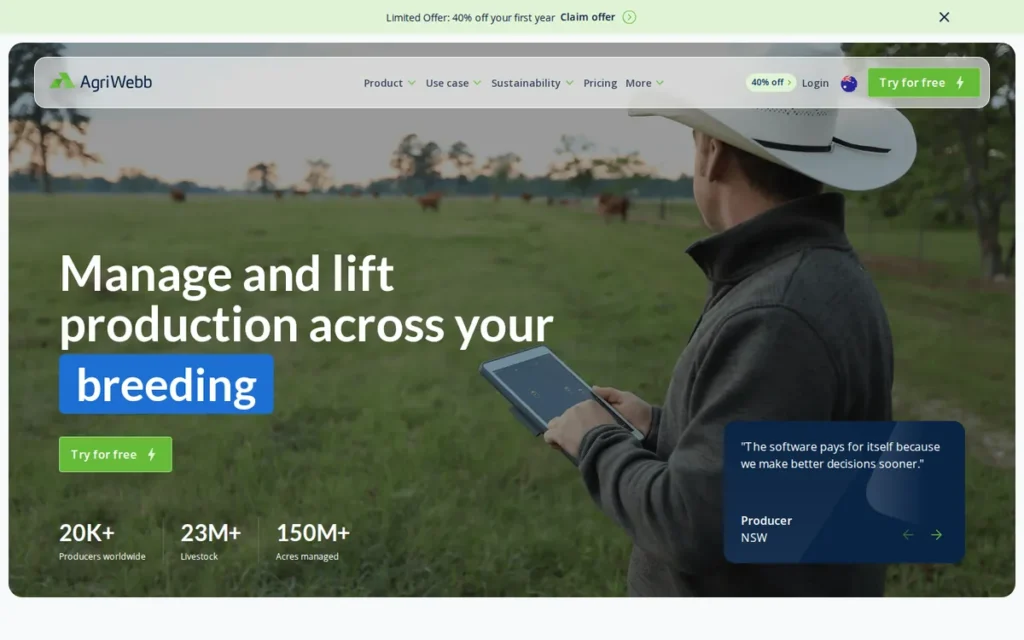
Category: Livestock & Grazing Manager, software for individual-animal and mob records linked to paddocks, pasture and grazing plans.
At a Glance
- Category: Livestock & Grazing Manager
- Best For: Pasture-based beef cattle and sheep operations, especially remote ranches with weak connectivity
- Price Range: From ~$33–$50/month, partly per head; G2 lists from $50 per feature per month (sources conflict); Grazing Planning add-on extra
- Primary Strength: AgriWebb links animals, mobs, paddocks and pasture growth in an offline-first mobile app.
- Biggest Limitation: AgriWebb has only 2 G2 reviews, and its head-based pricing can become expensive for large herds.
- One-Line Summary: AgriWebb scores 28/45 as grazing-focused ranch management software, with a documented local-first offline design and use on operations as large as 1 million hectares and 60,000 cattle (AgriWebb, 2026).
- Last Verified: November 2026
Overview
AgriWebb is ranch and herd management software built around grazing. It links individual-animal and mob records to paddock maps, pasture measurements and grazing plans for pasture-based cow-calf, beef and sheep producers, including remote ranches that need reliable offline use.
AgriWebb began after a 2014 generational handover at co-founder Justin Webb’s family farm in Australia, and Kevin Baum is CEO (AgriWebb, 2026). Australia’s Clean Energy Finance Corporation has invested A$6M in AgriWebb’s methane and carbon-tracking tools (CEFC, 2026).
Key Features
- AgriWebb tracks individual animals by EID or tag, including treatments, weights, joining, pregnancy scans and condition scores.
- AgriWebb lets managers move mobs by drag and drop on paddock maps and keeps audit-ready movement records.
- AgriWebb’s Grazing Planning add-on models feed on offer, rest periods and grazing days for each paddock.
- AgriWebb uses a local-first offline sync design, so records can be captured without a signal and synced later.
- AgriWebb estimates feed on offer from satellite pasture measurements and supports carbon and methane tracking.
Best For
AgriWebb is best for pasture-based beef and sheep operations that manage animals in mobs across paddocks and need field records that work without connectivity. AgriWebb is less suited to feedlots, to cow-calf operations focused on breeding records, and to dairies.
Pricing
AgriWebb’s pricing was tiered and partly based on head count as of November 2026. G2 lists a Basic edition from $50 per feature per month with a 14-day free trial (G2, 2026), and other listings report plans from about $33/month (SoftwareSuggest, 2026).
AgriWebb’s official page mentions a $300/year item on Performance plans, but PlugRoute could not confirm the full tier table (AgriWebb, 2026). Grazing Planning costs extra. Renewal increases have been reported but not quantified, so ask for a written multi-year quote for your herd size.
Strengths
- AgriWebb’s R&D team describes its offline design as “offline synchronisation with local-first software” (AgriWebb, 2026), making it one of only two products here with documented offline architecture.
- AgriWebb told Australia’s Clean Energy Finance Corporation that customers in Australia and the UK report a 7.5% productivity improvement, plus fewer deaths and lower diesel and chemical use (CEFC, 2026). This figure is company-reported, not an independent study.
- AgriWebb runs at Gunn Agri Partners / Cunningham Cattle Company, which uses it for investor reporting across more than 1 million hectares and 60,000+ cattle (vendor customer story, AgriWebb, 2026).
- AgriWebb led the four-year Foragecaster machine-learning project with Food Agility CRC, UTS and QUT to forecast pasture and livestock growth (AgriWebb, 2026).
Limitations
- AgriWebb gives up breadth for grazing depth. CattleMax and Ranch Manager go deeper on breeding and individual-animal history, and Performance Beef is stronger for feedlots (Farmsflo, 2026).
- AgriWebb’s head-based pricing can get expensive for large herds, and its entry prices conflict between $33 and $50 per month across sources.
- AgriWebb has only 2 G2 reviews (4.0/5, G2, 2026), too few to be meaningful, and one G2 reviewer cites limited financial-analysis features.
- AgriWebb’s support for compliance schemes (NLIS, LPA, BQA) and for Xero or QuickBooks integration was not verified as of November 2026.
- AgriWebb’s scale claims conflict. The media kit cites 22 million+ animals managed, while a research blog post cites 60 million livestock across 14,000 producers (AgriWebb, 2026).
Verdict
AgriWebb is the top-ranked agriculture software for pasture-based cattle and sheep operations in 2026. Of the seven tools evaluated, it documents the most complete grazing workflow and pairs it with offline-first sync, for a score of 28/45.
AgriWebb’s main risks are head-based pricing at scale and thin independent review data. Ranchers should get a written multi-year AgriWebb quote for their herd size and confirm their compliance scheme is supported before signing. Dairies and feedlots should compare specialist tools first.
6. John Deere Operations Center: Best for Row-Crop Operations Running Mostly John Deere Equipment
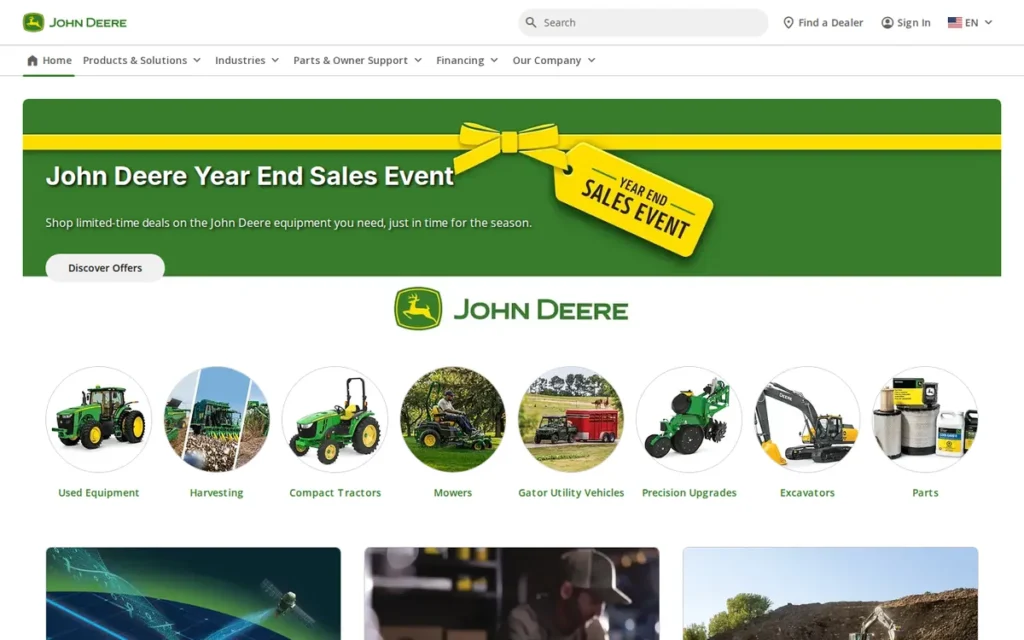
Category: Machine-Data Platform, software that collects, stores and shares the data produced by connected farm equipment.
At a Glance
- Category: Machine-Data Platform
- Best For: Row-crop operations whose fleet is mostly John Deere equipment
- Price Range: Free base account; PRO Service from $195/machine/year (US and Canada); hardware and precision licences extra
- Primary Strength: John Deere Operations Center streams machine, yield and job-quality data from connected Deere equipment about every 30 seconds.
- Biggest Limitation: John Deere Operations Center has weak accounting features, and its mobile app is rated below 3/5 on Google Play (2.8–2.9/5 from roughly 600–675 reviews, depending on regional listing).
- One-Line Summary: John Deere Operations Center scores 28/45 as a machine-data platform for Deere-equipped row-crop farms, with a free base account and data updates about every 30 seconds, though its mobile app rates below 3/5 on Google Play (Deere, 2026; Google Play, 2026).
- Last Verified: November 2026
Overview
John Deere Operations Center is a cloud farm-data platform for web, tablet and phone that connects fields, machines, operators and agronomic data. It is built for row-crop operations running mostly Deere equipment that want to plan work, monitor job quality and review completed passes.
John Deere Operations Center is a machine-data and field-operations platform, not an accounting or ERP system. Deere’s corporate goal is 1.5 million connected machines and 500 million engaged acres by 2026 (Deere, 2026). These are targets, not confirmed installed-base figures.
Key Features
- John Deere Operations Center updates acres remaining, equipment location, yield, moisture and variety data about every 30 seconds on JDLink-connected machines.
- John Deere Operations Center stores as-applied and yield-monitor data and provides tools for planning work, monitoring job quality and reviewing completed passes.
- John Deere Operations Center shares data with outside soil, water, crop-management, prescription and imagery software through a connected-partner directory.
- John Deere Operations Center lets farmers decide which connected partners can access their data.
- John Deere Operations Center PRO Service adds diagnostics, calibration and reprogramming tools for an annual fee per machine.
Best For
John Deere Operations Center is best for row-crop farms whose fleet is mostly Deere and that want machine, yield and job data in one place at no base cost. Farms with mixed brands should also compare brand-neutral options such as Climate FieldView or PTx Trimble.
Users on r/OrganicFarming shared their experience:
“Worth taking a look at! Basically includes everything you are doing but with lots of added precision in terms of product varieties, amount of grains seeded, gas consumption, time spent in field etc..” Posted by u/Correct_Attempt4964
Takeaway: John Deere Operations Center’s main draw is the operational detail it captures from the machine itself, such as seeding rates, fuel use and field time, which manual crop-planning tools can’t match.
Pricing
John Deere Operations Center offered a free base account as of November 2026. JDLink connected service is free to activate but needs a working cellular connection on the machine (Deere, 2026).
John Deere Operations Center PRO Service starts at $195 per machine per year in the US and Canada (Deere, 2025), so a four-machine fleet pays at least $780 a year. Deere doesn’t publish prices for StarFire receivers, precision-ag licences or Premium features.
Strengths
- John Deere Operations Center updates field data about every 30 seconds on JDLink-connected machines, according to Deere’s features page (Deere, 2026), the most real-time machine data in this evaluation.
- John Deere Operations Center has a free base account and free JDLink activation (Deere, 2026), the lowest software entry cost among the commercial row-crop tools evaluated.
- John Deere Operations Center lets farmers control partner access, and one Reddit user reports that it “reads data from almost any display made in the last decade” (r/farming, 2024).
- John Deere Operations Center earned this summary from another Reddit farmer: “It works well and links to about everything” (r/farming, 2025).
Limitations
- John Deere Operations Center works best on Deere machines. It supports some mixed fleets, but brand-neutral platforms are designed for them.
- John Deere Operations Center’s “free” entry can hide the cost of displays, receivers, licences and per-machine PRO Service.
- John Deere Operations Center’s accounting features are weak, so profit per field needs a separate tool.
- John Deere Operations Center’s mobile app is rated 2.8–2.9/5 on Google Play. Reviewers say it is useful for tracking fields, equipment and work history, but that the desktop version is better for setup and editing (Google Play, 2026).
- Deere agreed in a July 8, 2026 settlement with the FTC and five states (Michigan, Wisconsin, Arizona, Illinois and Minnesota) to give farmers and independent repair shops dealer-equivalent repair tools for 10 years (FTC, 2026). Buyers should check how the per-machine PRO Service fee fits alongside those obligations.
Verdict
John Deere Operations Center is the top-ranked machine-data platform for row-crop operations running mostly Deere equipment in 2026. It scores 28/45, with the highest integration score in this evaluation and a free base account.
John Deere Operations Center is not a farm accounting or ERP system, so most farms will pair it with an agronomy layer such as Granular and a separate accounting tool. Buyers with mixed fleets should test imports from their non-Deere displays before relying on John Deere Operations Center.
7. AGRIVI: Best for Enterprise Farms, Co-ops and Food Companies Managing Contracted Growers
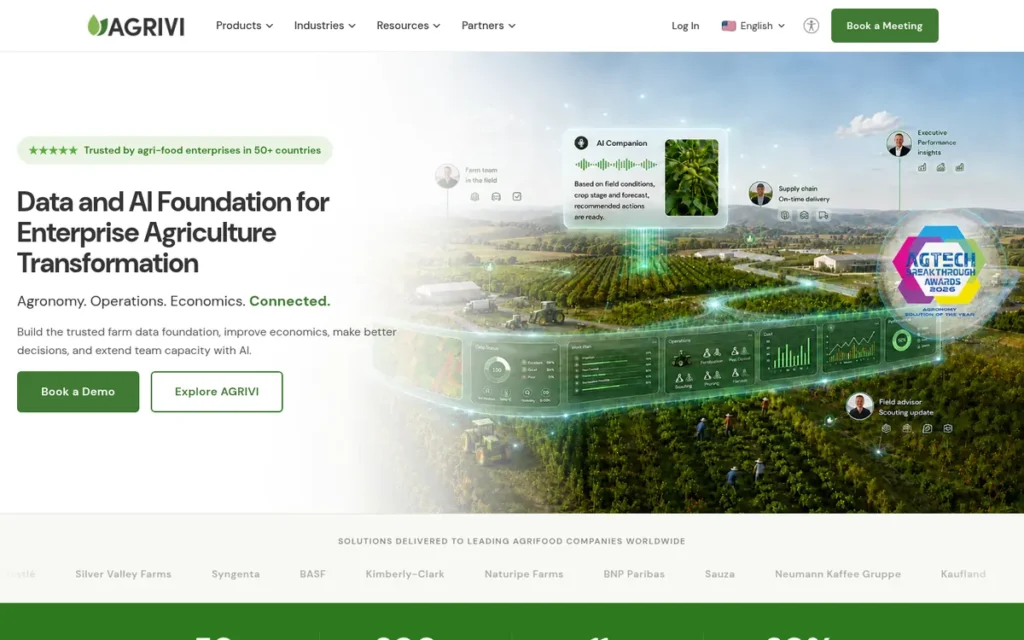
Category: Enterprise Farm Platform, multi-farm and supply-chain software that connects field operations, compliance and grower networks to corporate ERP.
At a Glance
- Category: Enterprise Farm Platform
- Best For: Enterprise farms, cooperatives and food companies sourcing from contracted growers
- Price Range: Custom quote only (based on scope, land size, users and implementation); IoT and weather add-ons extra
- Primary Strength: AGRIVI manages networks of contracted growers with traceability and connects field data to corporate ERP systems.
- Biggest Limitation: AGRIVI publishes no pricing, and reviewers say it is hard for beginners and that the mobile app lacks many desktop features.
- One-Line Summary: AGRIVI scores 25/45 as a mid-market enterprise and supply-chain farm platform, rated 4.5/5 on G2 from 14 reviews. Vendor case studies show it coordinating networks of 200 to 4,000+ growers (G2, 2026; AGRIVI, 2026).
- Last Verified: November 2026
Overview
AGRIVI is an enterprise farm-management and agri-supply-chain platform. It is aimed at large farms, cooperatives, food companies and agri-lenders that need to coordinate contracted growers and connect field data to corporate systems.
AGRIVI combines field planning, activity records, inventory, cost and profit per field, and traceability. Matija Zulj founded AGRIVI in Croatia in 2013, and the company raised a €4M Series A from investors including South Central Ventures (AGRIVI, 2026). AGRIVI says it is used across 50+ countries (vendor claim).
Key Features
- AGRIVI 360 Farm Management covers crop and field planning, activity records, input and inventory management, and cost and profit per field.
- AGRIVI provides traceability and GlobalG.A.P.-style compliance records with dashboards for management reporting.
- AGRIVI Engage uses AI-assisted tools to help food companies, cooperatives, banks and governments coordinate outside growers.
- AGRIVI connects to ERP systems, and a Capterra reviewer reports a Microsoft Dynamics NAV integration that books financial data automatically (Capterra, 2026).
- AGRIVI advertises offline mobile capture for field teams and markets a John Deere integration, though PlugRoute did not verify the scope of that integration.
Best For
AGRIVI is best for enterprise farms, cooperatives and food companies that manage contracted growers, need to feed field data into an existing ERP, and fall between sub-$100/month tools and SAP S/4HANA or Oracle NetSuite. AGRIVI is a poor fit for small farms and livestock or dairy operations.
Pricing
AGRIVI pricing was a custom quote based on scope, features, land size, users and implementation as of November 2026. No public price amounts were returned (AGRIVI, 2026).
Directories list inconsistent AGRIVI starting and per-user prices (SoftwareConnect, 2026). Reviewers note that weather and IoT integrations cost extra and call AGRIVI “not a cheap solution” (Capterra, 2026). Ask for a quote that includes implementation.
Strengths
- AGRIVI holds a 4.5/5 G2 rating from 14 reviews (G2, 2026), with users praising its dashboards, inventory, real-time insights and supply-chain uses such as contract farming.
- AGRIVI’s vendor case studies describe a tropical-fruit customer managing 200+ contracted growers and a Helvetas rice program tracing 4,000+ smallholder farmers in Myanmar (AGRIVI, 2026).
- AGRIVI reports that Brazilian winery Vinicola Guaspari increased average yield per hectare by 66%, and overall yield by 89%, over two harvests after moving off paper (vendor case study, AGRIVI, 2026). The cause has not been independently verified.
- AGRIVI ranked 39th in the Deloitte Technology Fast 50 Central Europe 2020 for revenue growth (Deloitte, 2020), and it names Nestlé and Driscoll’s as customers (vendor-listed, AGRIVI, 2026).
Limitations
- AGRIVI gives up accessibility for enterprise scope. Pricing is custom-quote only, and weather and IoT integrations cost extra.
- AGRIVI is described by reviewers as hard for beginners, with occasional bugs, freezing and slow support (G2, 2026).
- AGRIVI’s mobile app lacks many desktop features, its accounting is incomplete and it depends on an ERP connection. One reviewer called it “not ideal for Italian tax requirements” (Capterra, 2026).
- AGRIVI has about 14 reviews on each platform, so its ratings may not be stable, and its “up to 11× return” claim is vendor marketing.
- AGRIVI was described by a Reddit farm manager as fine for crops, but “for dairy is harder” (r/farming, 2019).
Verdict
AGRIVI is the top-ranked agriculture software for enterprise farms, cooperatives and food companies managing contracted-grower networks in 2026. It fills the gap between small-farm tools and full ERP suites, although its custom-quote-only pricing holds its score to 25/45.
AGRIVI’s custom pricing and learning curve mean buyers should run a scoped pilot that includes ERP sync and a data-export test before signing an enterprise contract. Smaller single-site farms will get better value from Farmbrite or Tend than from AGRIVI.
Will Agriculture Software Work With My John Deere or Mixed-Brand Equipment?
Compatibility with John Deere and mixed-brand equipment varies widely. John Deere Operations Center connects natively to Deere machines and reads some other displays. Granular documents imports from Deere, Ag Leader, Case IH and more than 10 other makers. Most other tools evaluated document no telematics links.
In a 2025 study of farmer adoption, 36% of respondents reported limited or nonexistent interoperability between digital tools (Bio-based and Applied Economics, 2025). Equipment “connections” come in three types:
- Read-only access: Read-only access lets software view machine data without sending anything back to the equipment.
- Prescription transfer: Prescription transfer lets software send files to the machine, as Granular does when it sends variable-rate seeding maps to John Deere Operations Center.
- Two-way sync: Two-way sync keeps records updated in both systems as changes are made.
Climate FieldView and PTx Trimble are brand-neutral alternatives that are not profiled here. Climate FieldView collects data across brands with its own FieldView Drive hardware, and PTx Trimble markets itself as brand-neutral (AgriERP, 2026; Rankite, 2026).
Which Agriculture Software Works Offline?
Only AgriWebb and farmOS document their offline design in technical sources. AgriWebb describes local-first synchronisation, and farmOS Field Kit records logs offline and syncs later. Farmbrite and AGRIVI advertise offline capture without independent documentation. Offline use was not verified for Granular, Tend or the John Deere Operations Center app as of November 2026.
An offline claim on a feature page is a promise; an offline-first architecture in technical documentation is evidence. Only two of the seven tools evaluated offer the second.
Offline support matters because 85% of farms have internet access, but only 55% use broadband and 74% connect through a cellular plan (USDA, 2025). Offline status by product:
- AgriWebb’s offline design is documented by its R&D team.
- farmOS Field Kit’s offline-first design is documented on GitHub.
- Farmbrite’s offline mobile capture is advertised but not independently documented.
- AGRIVI’s offline capture is advertised, and reviewers report gaps in its mobile app.
- John Deere Operations Center’s machine data depends on JDLink cellular connectivity, and app-level offline use was not verified.
- Granular’s and Tend’s offline use was not verified as of November 2026.
“the only problems I have with my current paid for app is it is 100% online” (u/testmonkey987, r/Permaculture, 2023)
Takeaway: Growers reject online-only apps, so documented offline sync is a must-have for field data entry.
How Do I Track Profit per Field With Agriculture Software?
Most farms need two tools to track profit per field. None of the seven products evaluated documents both deep machine and agronomy data and a full accounting ledger. Corteva sold Granular’s finance product to Traction Ag in 2022, John Deere Operations Center’s accounting is weak, and AGRIVI relies on an ERP connection for complete accounting.
In 2026, profit per field is a stack, not a product: field data from one tool, costs from another, and a reconciliation step the buyer owns.
Common ways to get profit per field include:
- Row-crop farms can pair John Deere Operations Center or Granular with Traction Ag or QuickBooks for accounting.
- Small mixed farms can use Farmbrite’s Schedule F, P&L and budgeting tools, though Farmbrite is not a full accounting package.
- Enterprise operations can use AGRIVI’s cost and profit per field together with an ERP such as Microsoft Dynamics NAV.
- AgriWebb users should expect basic financial reports only, because a G2 reviewer cites limited financial analysis (G2, 2026).
- farmOS users need separate accounting software, because farmOS has no built-in accounting.
What Red Flags Should I Watch For When Evaluating Agriculture Software?
The six biggest red flags in agriculture software are:
- Pricing that hides year-three costs
- Key features locked to higher tiers
- Reviews of products that have since changed
- Offline claims without documentation
- Data retention limits tied to your plan
- Vendor-only results with no independent source
Each flag below draws on evidence from this November 2026 evaluation.
Red Flag #1: Pricing That Hides the Real Year-Three Cost A “free” account or quote-only price can hide hardware, per-machine and renewal costs until you’ve already committed. John Deere Operations Center’s base account is free, but PRO Service on four machines starts at $780 a year (Deere, 2025).
Granular and AGRIVI publish no prices, and AgriWebb renewal increases have been reported but not quantified. Ask every vendor for written three-year terms.
Red Flag #2: Key Features Locked Behind Higher Tiers The entry price rarely shows what the features you actually need will cost. Tend’s Free plan excludes lot traceability, which starts on Pro at $30/month, and API access requires Enterprise at $400+/month (Tend, 2026).
Farmbrite’s crop-and-livestock plans start at $59 rather than the $29 livestock-only price, and AgriWebb charges extra for Grazing Planning.
Red Flag #3: Reviews Describing a Product That No Longer Exists Older reviews can describe features a vendor has since sold or split off. Many Granular reviews predate Corteva’s November 2022 sale of Granular Business, Granular’s former farm-finance product, to Traction Ag, which renamed it Traction Enterprise Operations (Farm Progress, 2022).
Those reviews describe field-to-profit features that today’s Granular Insights doesn’t include.
Red Flag #4: Offline Support That Is Advertised but Not Documented An “offline mode” claim on a feature page doesn’t show how much of the app works without a signal or how sync conflicts are resolved. Only AgriWebb and farmOS Field Kit documented offline-first designs in technical sources as of November 2026, so test every other tool in your weakest-coverage field.
Red Flag #5: Data Retention or Export Tied to Your Plan Some vendors limit how long records are kept, depending on what you pay. Tend keeps data for 3 years on Free (with a 500 MB cap) and 7 years on Pro (Tend, 2026). Confirm retention periods and export formats in writing before you build up years of certification records.
Red Flag #6: Vendor Results With No Independent Source Results that vendors publish are marketing evidence, not independent proof. AGRIVI’s 66% yield increase, AgriWebb’s 7.5% productivity gain and Farmbrite’s reported 15% cut in daily labor time all come from customers the vendors chose. PlugRoute found no independently measured ROI study for any of the seven products as of November 2026.
What Questions Should I Ask Before Choosing Agriculture Software?
Before choosing agriculture software, confirm seven things:
- Your main workflow
- The type of equipment connection
- Offline reliability
- How you will get profit per field
- The year-three cost at your size
- Your data-export rights
- Whether the tool beats your current paper or spreadsheet process in a one-week test
These seven questions rule out most mismatched tools before a trial starts.
Question #1: What is my main workflow: machines, agronomy, livestock, produce, accounting or supply chain? Your main workflow decides which of the seven software categories to shortlist. Farms with more than one main workflow should check whether one all-in-one tool such as Farmbrite covers them in enough depth, or whether two specialized tools will serve them better.
Question #2: Is the equipment connection read-only, prescription transfer or two-way sync, and does it cover my non-Deere displays? The connection type decides how much manual file handling remains. Granular documents prescription transfer to John Deere Operations Center, while most other tools here document read-only imports or none. Ask the vendor to show live imports from your actual displays, not logos from a partner directory.
Question #3: Does field data entry work with no signal, and how are conflicts resolved when several users sync? Offline reliability decides whether your crew will actually use the app or go back to paper. Only AgriWebb and farmOS Field Kit document offline-first sync among the seven tools evaluated. Test any tool in your weakest-coverage field with two users editing the same record.
Question #4: How will I get profit per field, and which second tool will I need? Profit per field usually needs an accounting tool alongside field software, because none of the seven products documents both deep field data and a full ledger. Map the full stack, including Traction Ag, QuickBooks or an ERP, and price the combination rather than one product.
Question #5: What is the pricing basis, and what will year three cost at my acreage or herd size? Pricing based on acres, head, machines or users scales differently as an operation grows. At an unofficial $2–$5 per acre, a 2,000-acre farm could pay $4,000–$10,000 a year for agronomy software alone. Ask for a written three-year quote at your projected size.
Question #6: Can I export all my data in standard formats, and who else, including the parent company, can access it? Export rights and access controls decide whether you can leave a vendor without losing your records. Ask for the export formats, such as CSV and shapefile, in writing. Also ask whether the parent company or connected partners can see your farm data.
Question #7: Does this beat my current paper, Excel and QuickBooks setup in a real one-week test? A one-week side-by-side test shows whether agriculture software saves time in practice. If entering data takes longer than your notebook, the tool is unlikely to stick, however many features it has.
Users on r/farming noted:
“While this is useful for recording, it doesn’t help you be pro-active. For that you need some kind of organizer software. Alas, all the organizer software work on hard dates.” Posted by u/Canuck_Voyageur
Takeaway: Spreadsheets handle farm recordkeeping well enough, and the gap farm software still has to fill is planning that adapts to weather instead of fixed dates.
Before your trial ends, complete these four checks:
- Log one real field pass with no signal and confirm that it syncs correctly.
- Export all records to CSV or shapefile and open them in another program.
- Have two users edit the same record and check how the conflict is resolved.
- Price year three at your projected acreage or herd size, including add-ons.
How Did We Rank These Agriculture Software Tools?
PlugRoute scored each tool from 1 to 5 on six criteria, using dated evidence collected in November 2026. The three primary criteria count double, for a maximum of 45 points. The overall rank reflects evidence strength across all six criteria, but the operation-type label on each entry should drive your choice.
The six ranking criteria are:
- Operation-Type Fit and Functional Depth (C1, primary, ×2): Operation-type fit matters because a tool must cover your main workflow without gaps you have to fill elsewhere.
- Independent Review Evidence (C2, primary, ×2): Review evidence matters because G2, Capterra and app-store ratings with visible sample sizes are the closest thing to independent validation in this category.
- Pricing Transparency and Value (C3, primary, ×2): Pricing transparency matters because per-acre, per-head, per-machine and per-module pricing hides real costs.
- Integration and Interoperability (C4, secondary): Integration matters because 36% of farmers in a 2025 study reported limited or nonexistent interoperability (Bio-based and Applied Economics, 2025).
- Offline and Field Usability (C5, secondary): Offline usability matters because only 55% of farms use broadband (USDA, 2025).
- Data Control and Portability (C6, secondary): Data control matters because buyers need to know who can see their data and whether they can export it and leave.
| Product | C1 Fit (×2) | C2 Reviews (×2) | C3 Pricing (×2) | C4 Integration | C5 Offline | C6 Data Control | Weighted Total (/45) |
|---|---|---|---|---|---|---|---|
| Farmbrite | 5 | 4 | 4 | 3 | 3 | 3 | 35 |
| Granular | 4 | 5 | 2 | 5 | 2 | 2 | 31 |
| Tend | 5 | 1 | 5 | 2 | 2 | 3 | 29 |
| farmOS | 3 | 1 | 4 | 3 | 5 | 5 | 29 |
| AgriWebb | 5 | 1 | 3 | 2 | 5 | 3 | 28 |
| John Deere Operations Center | 4 | 2 | 3 | 5 | 3 | 2 | 28 |
| AGRIVI | 4 | 4 | 1 | 3 | 2 | 2 | 25 |
These scoring rules apply to every product:
- PlugRoute breaks ties by C1 (operation-type fit), then by C2, which places Tend above farmOS and AgriWebb above John Deere Operations Center.
- A product with fewer than 10 reviews on every platform scores 1 on C2, so AgriWebb (2 G2 reviews), Tend (no verified rating) and farmOS (0 Capterra reviews) score the same.
- farmOS’s top scores on offline use and data control offset its lack of independent reviews.
- AGRIVI’s custom-quote-only pricing (C3 = 1) is the single largest deduction in the evaluation.
- Readers who weigh offline use and data control most heavily will see farmOS and AgriWebb move up, while readers who weigh independent reviews most will see Granular and Farmbrite lead.
The evidence has limits, and readers should know them:
- Review samples are small across the category, with G2 counts of 2 to 44.
- Results that vendors publish are labeled as vendor claims and received no extra credit.
- PlugRoute re-checked every price against live vendor pages in November 2026. Where an earlier extract conflicted, for example Farmbrite’s two plan families or Tend’s traceability tier, the verified figure is reported.
- Reddit discussion of specific products was thin, so community quotes come mostly from wider farming threads and carry their posting year.
PlugRoute has no affiliate relationships with any company listed. Rankings are determined entirely by research data and objective evaluation criteria.
These products were considered but not profiled:
- Agworld, Croptracker, Conservis and FarmERP were not profiled because verified review or pricing data was insufficient.
- Climate FieldView was not profiled because it largely overlaps with John Deere Operations Center and Granular.
- Traction Ag and Local Line were not profiled because they belong to the adjacent accounting and direct-sales categories.
- CattleMax was not profiled because it is a livestock specialist focused on breeding records.
- LiteFarm was not profiled because comparable verified data was not gathered, though it is cited as an easier free alternative to farmOS.
What Do Buyers Most Often Ask About Agriculture Software?
Buyers most often ask three things: which agriculture software suits small farms running both crops and livestock, whether good free options exist, and how independent rankings are produced. The answers below give a direct reply first, using pricing and ratings verified by PlugRoute in November 2026.
What’s the best agriculture software for small farms that manage both crops and livestock?
Farmbrite is the best agriculture software for most small farms managing both crops and livestock in 2026. Farmbrite is rated 4.7/5 on G2 from 15 reviews, with crop-and-livestock Complete plans from $59/month and livestock-only plans from $29/month (G2, 2026; Farmbrite, 2026). Small produce growers should compare Tend’s free plan.
Is there good free or open-source agriculture software, and does farmOS work offline?
farmOS is the most mature free, open-source agriculture software, according to Oaken and Young Agrarians (2026), and farmOS does work offline. farmOS Field Kit records logs without a signal and syncs later (farmOS, 2026), despite some AI answers saying otherwise. farmOS costs $0 self-hosted or $75/year hosted, but includes no accounting tools.
How does PlugRoute determine its agriculture software rankings?
PlugRoute scores each product from 1 to 5 on six criteria: operation-type fit, independent reviews, pricing transparency, integration, offline usability and data control. The three primary criteria count double, for a maximum of 45 points. Every rating and price is dated, vendor results are labeled as vendor claims, and the full score table is published.
What Do Key Agriculture Software Terms Mean?
Agriculture software terms describe how products charge, connect, store and protect farm data. The definitions below cover the pricing, technical and compliance terms buyers meet most often when comparing vendors. Each one explains why the term matters to a purchasing decision.
Per-acre pricing: Per-acre pricing charges a fee for each acre managed in the software, usually billed every year. Per-acre pricing matters because costs grow directly with land, so large operations should model costs at their full acreage.
Per-head pricing: Per-head pricing ties the subscription cost to the number of animals tracked. Per-head pricing matters to growing herds, because a plan that is affordable at 300 head can become expensive at 3,000.
Telematics: Telematics is the automatic transfer of location, performance and job data from connected machines to software over a cellular network. Telematics matters because it removes manual data entry, but it often needs specific hardware and a working signal.
Variable-rate prescription: A variable-rate prescription is a digital map that tells equipment to apply different seed or input rates across zones of a field. Variable-rate prescriptions matter because they turn agronomic analysis into machine instructions without moving files by hand.
Shapefile: A shapefile is a standard geographic file format for field boundaries and map layers. Shapefile export matters because it lets buyers move map data between systems and reduces lock-in.
Offline-first (local-first) design: Offline-first design means an app saves records on the device first and syncs them to the cloud when a connection returns. Offline-first design matters on farms with weak coverage, where cloud-only apps fail in the field.
Lot traceability: Lot traceability links each harvested batch to its inputs, harvest date, storage and buyer. Lot traceability matters for food-safety audits and recalls, because it lets a grower find affected product quickly.
FSMA 204: FSMA 204 is the US Food Traceability Rule, with compliance now due July 20, 2028. It applies to foods on FDA’s Food Traceability List and requires key data elements for critical tracking events, retrievable within 24 hours of an FDA request (FDA, 2026). FSMA 204 allows paper records, so growers don’t need software just to comply.
Schedule F: Schedule F is the US federal tax form farmers use to report farm income and expenses. Schedule F reporting matters because software that produces it can make tax preparation easier without a separate accounting package.
API (application programming interface): An API is a documented way for other software to read and write a product’s data. An open API matters because it makes custom integrations, automation and full data export possible.
Self-hosting: Self-hosting means running software on a server the farm controls rather than on the vendor’s cloud. Self-hosting matters because it gives the strongest data ownership, but it adds server, security and upgrade costs.
Which Agriculture Software Tool Is Right for You?
Key Insights
The right agriculture software depends on your operation type, not on overall rank. Farmbrite fits small mixed farms, Granular or John Deere Operations Center fit row crops, and AgriWebb fits pasture livestock. Tend fits produce, AGRIVI fits grower networks and farmOS fits data ownership. Test offline entry and data export before you commit.
- No single agriculture software tool wins for every operation, so operation type should drive your shortlist more than overall rank.
- Most row-crop farms need two or three tools to track profit per field, because none of the seven products documents both deep machine data and full accounting.
- Only AgriWebb and farmOS documented their offline design in technical sources as of November 2026.
- Independent review samples are small across the category, with G2 counts of 2 to 44 reviews (G2, 2026).
- The FSMA 204 compliance date is now July 20, 2028, and paper records are allowed (FDA, 2026), so produce growers can trial tools without urgency.
- Testing data export before committing is the most reliable protection against lock-in for any agriculture software buyer.
The right agriculture software is the one that beats your notebook in your worst-coverage field. Everything else is a feature list.
Start your shortlist with the tool that matches your operation:
- Small mixed farms should start with Farmbrite.
- Mixed-fleet row-crop farms should consider Granular plus an accounting tool.
- Produce growers should trial Tend, starting on the free plan.
- Farms with technical help that value data ownership should consider farmOS.
- Pasture ranchers should trial AgriWebb.
- Mostly-Deere fleets should start with John Deere Operations Center.
- Cooperatives and food companies managing growers should pilot AGRIVI.
Consolidation and brand-neutral data sharing are reshaping agriculture software, so expect pricing models and integrations to keep changing. Check both again before every renewal.
Read PlugRoute’s full methodology and our other independent farm and agribusiness software reviews. Upcoming PlugRoute guides include:
- PlugRoute’s profit-per-field guide will explain common two-tool software stacks.
- PlugRoute’s equipment guide will cover compatibility and farm data ownership.
- PlugRoute’s livestock guide will compare software by operation type.
- PlugRoute’s FSMA 204 guide will cover traceability for produce growers.
- PlugRoute’s free-software guide will compare open-source farm tools.
We update this guide quarterly. Last updated: November 2026.