John Deere Operations Center is the best connected agriculture software for Deere-centered fleets, Climate FieldView is best for capturing mixed-brand row-crop data, Bushel Farm is best for linking field records to profit, and Farmbrite is best for livestock and ranches. No single platform connects every brand, sensor and farm office, so fit matters more than rank.
Most farm decision-makers face the same problems. Data sits in brand-locked systems, and vendors rarely say which machines and sensors they support. Cloud sync often sits behind a paid tier. Independent evidence is thin: only four of these seven products have a Capterra score, and most samples are small.
PlugRoute has no affiliate relationships with any company listed. Rankings are determined entirely by research data and objective evaluation criteria.
“Every company has their own proprietary software systems, John deer is just the one in media the most.” (u/Isuckatnamessohi (Reddit r/DieselTechs, 2025; User-reported))
Takeaway: Lock-in happens across the whole industry, so this ranking judges every platform on how openly it moves data across brands.
What Are the 4 Categories of Connected Agriculture Software?
Connected agriculture software falls into four categories: machine-data hubs, farm business and records layers, livestock and diversified farm managers, and sensor and irrigation platforms. Each one solves a different problem. Most mid-size to large farms need at least two, usually one hub plus one specialist or records layer.
Most readers already produce machine data. Guidance autosteering is used on 70% of large and 52% of midsize US crop farms (USDA ERS, 2024; Third-party). The open question is where that data goes.
As one user on r/farming described:
“We have 2 sprayers and 2 tankers with various operators receiving various tank mixes, fields etc. It’s becoming a burden to keep up with all of these scraps of paper or text messages and summarize it on paper to make sense as this all falls on me.” Posted by u/KeyCandle6826
Takeaway: Even an 8,500-acre row-crop operation can still run its spray records on paper and text messages, which shows that the gap in connected agriculture software is getting field data into one system, not producing it.
- Machine-Data Hub (Hub): A machine-data hub collects machine and agronomic data from connected equipment and sends jobs and prescriptions back to the cab. John Deere Operations Center, Climate FieldView and PTx Trimble are machine-data hubs.
- Farm Business & Records Layer (Records): A records layer turns machine and field records into plans, budgets, profit-and-loss views and marketing positions. Bushel Farm and Agworld are records layers.
- Livestock & Diversified Farm Manager (Livestock): A livestock and diversified manager keeps herd, crop, inventory and accounting records in one system and connects to scanners and accounting software rather than tractors. Farmbrite is the livestock manager in this ranking.
- Sensor & Irrigation Platform (Sensors): A sensor and irrigation platform combines in-field soil sensors with weather and satellite data to recommend irrigation and nutrient decisions. CropX is the sensor and irrigation platform in this ranking.
How Do the Top 7 Connected Agriculture Platforms Compare?
The top seven connected agriculture platforms differ most in how data moves and which equipment brands they support. PlugRoute’s comparison table lists each platform’s category, data-flow method, primary strength and key limitation. That lets a buyer match a tool to their fleet before reading the full entries.
| Rank | Company | Category | Best For | One-Line Summary | Key Capabilities | Primary Strength | Key Limitation |
|---|---|---|---|---|---|---|---|
| 1 | John Deere Operations Center | Hub | Mostly-Deere row-crop fleets | John Deere Operations Center is the best-documented free machine-data hub for Deere-centered farms. | JDLink cellular sync, field data about every 30 s; two-way via Work Planner | $0 core platform with published add-on prices | No model-level list of compatible non-Deere equipment |
| 2 | Climate FieldView | Hub | Mixed-brand row crops | Climate FieldView is the lowest published-cost brand-agnostic way to capture row-crop machine data automatically. | Drive 2.0 on CAN port, Bluetooth to cab app to cloud; wireless seed scripts | Works with most brands; Plus $649/yr plus $299 starter kit | CloudSync and API access are not in the free tier |
| 3 | Bushel Farm | Records | Grain farms focused on margins | Bushel Farm is the only researched platform that combines automatic machine records, per-field P&L and elevator-network contract import. | Cloud-to-cloud import from Deere and FieldView via $999/yr Machine Data Connections add-on; automatic grain-contract import | Published plans from $75/yr; per-field P&L | Machine-data import is a $999/yr add-on; no general ledger or payroll |
| 4 | Farmbrite | Livestock | Ranches and diversified farms | Farmbrite is the best-reviewed livestock and diversified-farm manager in this ranking. | Cloud records; RFID/EID scanners, QuickBooks, Xero, REST API; no machine-data flow | 4.8/5 from 63 Capterra reviews | No tractor, telematics or precision-ag integration |
| 5 | PTx Trimble | Hub | Mixed fleets needing documented file and API exchange | PTx Trimble offers the best-documented mixed-brand data exchange researched. | AutoSync/Direct Send from GFX displays with modem and license; ISOXML, Deere and CNH files; CNH FieldOps API | Most specific published cross-brand compatibility | US pricing by dealer quote only; no review scores |
| 6 | Agworld | Records | Agronomist–grower collaboration | Agworld is the strongest researched platform for planned-versus-actual budgeting with advisors. | Shared cloud record; Semios sensor data, Pinion, Power BI; machine-data import unconfirmed | 4.5/5 from 44 Capterra reviews; flat USD pricing | Machine-data integrations not confirmed |
| 7 | CropX | Sensors | Irrigation-led operations | CropX is the only soil-sensor and irrigation specialist in this ranking. | Wireless multi-depth soil sensors; two-way Deere Operations Center link | Documented two-way Deere integration | No official pricing; outcomes are vendor case studies |
Which Connected Agriculture Software Should I Choose for My Operation?
Choose connected agriculture software by your top priority, not by overall rank. A mostly-Deere fleet points to John Deere Operations Center. Mixed brands point to Climate FieldView or PTx Trimble, and livestock points to Farmbrite. Profit, planning and irrigation needs usually add Bushel Farm, Agworld or CropX on top of a hub.
| Your #1 Priority | Recommended Tool | Why | Acceptable Alternative |
|---|---|---|---|
| Mostly Deere fleet | John Deere Operations Center | Free core platform with documented automatic two-way sync | Climate FieldView |
| Mixed-brand row crops on a published budget | Climate FieldView | $299 Drive logger works with most brands; Plus is $649/yr | PTx Trimble |
| Mixed brands needing documented file/API exchange or retrofit | PTx Trimble | Compatibility page lists ISOXML, Deere data, CNH files and a CNH FieldOps API | Climate FieldView |
| Field-to-profit and grain contracts | Bushel Farm, on top of a Deere or FieldView hub | Machine records feed per-field P&L; contracts import from network buyers | Agworld |
| Agronomist collaboration and budgets | Agworld | Shared plan-to-budget record with flat published USD pricing | Bushel Farm |
| Livestock, ranch or diversified | Farmbrite | Strongest review evidence; lowest entry price among livestock-capable platforms researched | Agworld (crop-side records only) |
| Irrigation and soil sensors | CropX, alongside a hub | Multi-depth sensors with two-way Deere integration | Climate FieldView (field records only) |
These were the trial options at research time (vendor pricing pages, 2026; Vendor-reported):
- Bushel Farm offers a 30-day free trial of its Lite plan.
- Farmbrite offers a 14-day free trial.
- Agworld offers a 7-day trial.
- John Deere Operations Center and Climate FieldView Basic are free accounts, so no trial is needed.
- PTx Trimble and CropX are evaluated through a dealer or sales demo.
What Are the Best Connected Agriculture Software Platforms in 2026?
The best connected agriculture software platforms in 2026 are John Deere Operations Center for Deere-centered fleets and Climate FieldView for mixed-brand row crops, based on PlugRoute’s weighted score across six criteria. Ranks #2 through #6 fall within 0.35 points, so fit with your fleet and operation matters more than position.
- John Deere Operations Center scores 3.40 and fits Deere-centered fleets.
- Climate FieldView scores 3.35 and fits mixed-brand row-crop data capture.
- Bushel Farm scores 3.30 and fits farms linking field records to profit and grain marketing.
- Farmbrite scores 3.20 and fits livestock, ranch and diversified operations.
- PTx Trimble scores 3.05 and fits mixed fleets that need documented file and API exchange.
- Agworld scores 3.00 and fits agronomist–grower collaboration and budgeting.
- CropX scores 2.65 and fits irrigation- and soil-sensor-led operations.
1. John Deere Operations Center: Best Overall for Deere-Centered Fleets
Category: Machine-Data Hub, collects machine and agronomic data from connected equipment and sends jobs and prescriptions back to the cab.
At a Glance
- Category: Machine-Data Hub
- Best For: Mid-size to large row-crop operations running mostly John Deere tractors, combines, sprayers and displays
- Price Range: Free core platform; paid add-ons from $195/machine/year to $28,000/year; mixed-fleet JDLink Connect by dealer quote (verified November 2026)
- Primary Strength: John Deere Operations Center moves machine and field data wirelessly through JDLink, with field data updating about every 30 seconds and no USB transfer.
- Biggest Limitation: John Deere Operations Center integrates most deeply with Deere machines, and Deere publishes no model-level compatibility list for non-Deere equipment.
- One-Line Summary: John Deere Operations Center is the best-documented free machine-data hub for Deere-centered farms, but non-Deere support must be checked machine by machine.
- Last Verified: November 2026
Overview
John Deere Operations Center is Deere’s free cloud platform that collects machine, field and agronomic data from JDLink-connected equipment and sends work plans back to compatible displays. It is built for row-crop operations running mostly Deere tractors, combines and sprayers.
John Deere Operations Center markets mixed-fleet support (“John Deere or not”) through JDLink Connect and ISOBUS/ISOXML. Results depend on the other brand’s modem and firmware (John Deere, 2026; Vendor-reported).
Key Features
- John Deere Operations Center receives setup, prescription, coverage, yield, moisture, location, hours, fuel and diagnostic data wirelessly through JDLink (John Deere, 2026; Vendor-reported).
- John Deere Operations Center Work Planner sends planned jobs to compatible displays, so prescriptions move from office to cab without a thumb drive (John Deere, 2026; Vendor-reported).
- John Deere Operations Center Field Analyzer compares seeding, application, harvest and tillage layers for the same field (John Deere, 2026; Vendor-reported).
- John Deere Operations Center Remote Display Access lets an office user or advisor view an operator’s display to support them remotely (John Deere, 2026; Vendor-reported).
- John Deere Operations Center Connections lets approved third-party software read account data, with permission controls for dealers and advisors (John Deere, 2026; Vendor-reported).
Best For
John Deere Operations Center is best for mid-size to large row-crop operations where most machines and displays are Deere and the farm wants automatic fleet and field tracking at no platform cost. Mixed-brand farms should shortlist John Deere Operations Center only after a dealer confirms JDLink Connect support for each non-Deere machine.
Pricing
John Deere Operations Center accounts cost $0, and JDLink connectivity on supported Deere equipment costs $0 (John Deere, 2026; Vendor-reported). The free price covers the hub, not every precision feature. Deere publishes these add-on prices:
- Deere’s Precision Essentials bundle starts at $2,650, and Operations Center PRO Service starts at $195 per machine per year.
- Deere’s See & Spray Unlimited costs $28,000 per year, and the See & Spray Variable Rate license costs $10,000.
- Deere prices Gen4 activations and JDLink Connect for mixed fleets by dealer quote only.
Strengths
- John Deere Operations Center documents field-data updates about every 30 seconds through JDLink. It is the only platform in this ranking for which PlugRoute found a published sync speed (John Deere, 2026; Vendor-reported).
- John Deere Operations Center is listed as Ag Data Transparent certified, which means a third party has reviewed its disclosures on data ownership, use and portability (Ag Data Transparent, 2026; Third-party).
- John Deere Operations Center charges $0 for the core platform, and Deere publishes its add-on prices (John Deere, 2026; Vendor-reported).
- John Deere Operations Center users praise equipment and field tracking, historical field layers and Remote Display Access (Google Play, 2026; User-reported).
Limitations
- John Deere Operations Center trades a free, deeply integrated Deere experience for ecosystem dependence. Deere publishes no list of compatible non-Deere models and prices JDLink Connect by dealer quote only.
- John Deere Operations Center sits in an ecosystem under regulatory scrutiny. The FTC sued Deere over repair restrictions in January 2025, and Deere denied the allegations (FTC, 2025; Third-party).
- John Deere Operations Center’s parent filed a stipulated settlement with the FTC and five states on July 8, 2026. It would require 10 years of dealer-equivalent repair resources for farmers and independent repairers. The case was still pending court approval as of November 10, 2026 (FTC, 2026; Third-party).
- John Deere Operations Center data terms drew criticism in 2026, when a critic alleged that Deere’s repair-tool terms grant broad rights over machine data. This is an allegation, not an established finding (WVIK, 2026; Third-party).
- John Deere Operations Center Mobile holds a 3.0/5 rating from 585 Google Play reviews. Users cite awkward handling of seasons that span calendar years and slow loading after updates (Google Play, 2026; User-reported).
Verdict
John Deere Operations Center is the strongest free machine-data hub for farms that run mostly Deere equipment, because it documents automatic two-way sync between office and cab.
John Deere Operations Center’s lead over Climate FieldView is narrow, at 3.40 to 3.35. Mixed-fleet farms should have a dealer demonstrate JDLink Connect on their own non-Deere machines before relying on it.
2. Climate FieldView: Best for Mixed-Brand Row-Crop Data Capture
Category: Machine-Data Hub, collects machine and agronomic data from connected equipment and sends jobs and prescriptions back to the cab.
At a Glance
- Category: Machine-Data Hub
- Best For: Mixed-brand row-crop operations that want automatic planting, application and harvest records without replacing existing displays
- Price Range: Free Basic; Plus $649/year plus a $299 Drive starter kit (verified November 2026)
- Primary Strength: Climate FieldView captures data from most equipment brands through the FieldView Drive 2.0 logger, which plugs into the CAN port and uploads over Bluetooth.
- Biggest Limitation: Climate FieldView keeps CloudSync, external API connectivity and yield analysis out of the free Basic tier, and its Capterra rating rests on only three reviews.
- One-Line Summary: Climate FieldView is the lowest published-cost brand-agnostic way to capture row-crop machine data automatically, at about $948 in year one for Plus with one Drive.
- Last Verified: November 2026
Overview
Climate FieldView is Bayer’s row-crop data platform that captures planting, application and harvest data from most equipment brands through a plug-in Drive logger. It is built for mixed-fleet farms that want automatic field records and yield analysis without replacing their displays.
Climate FieldView splits its features between the free Basic tier and the paid Plus tier, so buyers should check which tier includes cloud sync and API access (Climate, 2026; Vendor-reported). Prime appears as a no-cost account option but is not listed as a plan on the current US pricing page.
Key Features
- Climate FieldView Drive 2.0 connects to a machine’s CAN diagnostic port and sends data over Bluetooth to the FieldView Cab app and then to the cloud (Climate, 2026; Vendor-reported).
- Climate FieldView sends seed scripts to the cab wirelessly through Drive 2.0, without a thumb drive (Climate, 2026; Vendor-reported).
- Climate FieldView Data Inbox imports files from several equipment brands, though some formats are listed as beta (Climate, 2026; Vendor-reported).
- Climate FieldView Plus adds CloudSync, external API connectivity, yield analysis and RemoteView, none of which are included in Basic (Climate, 2025; Vendor-reported).
- Climate FieldView connects with John Deere data and, since 2024, with Precision Planting SeedSense 20/20 (Climate, 2024; Vendor-reported).
Best For
Climate FieldView is best for row-crop farms running several equipment brands that want automatic field records and agronomic maps at a published cost. Climate FieldView is a poor fit for livestock operations, and it is not a full fleet-maintenance or telematics system.
Pricing
Climate FieldView Basic costs $0, and Climate FieldView Plus costs $649 per year, billed annually (Climate, 2026; Vendor-reported). Hardware is priced separately:
- Climate FieldView’s Drive starter kit costs $299.
- Each additional Climate FieldView Drive costs $249.
- Climate FieldView Plus with one starter kit costs about $948 in year one.
Canadian and per-acre pricing for Climate FieldView were not found.
Strengths
- Climate FieldView publishes a tier structure that shows which features need a paid plan, including CloudSync and API access (Climate, 2025; Vendor-reported).
- Climate FieldView Drive 2.0 brings automatic data capture to most equipment brands for a $299 starter kit, with no new displays needed (Climate, 2026; Vendor-reported).
- Climate FieldView is listed as Ag Data Transparent certified, which means a third party has reviewed its data-use disclosures (Ag Data Transparent, 2026; Third-party).
- Climate FieldView users value detailed planter-pass records and automatic upload, though that comes from a Capterra sample of only three reviews (Capterra, 2026; User-reported).
Users on r/farming shared their experience:
“We also use Fieldview, we started with a simple map-anything kit on a tractor that didn’t have any GPS to track our fertilizer applications. The next year we upgraded to a Wheelman Pro autosteer kit. It’s easy to track what went where on what date.” Posted by u/eric_ness
Takeaway: Climate FieldView gives farms an affordable way to start recording applications on older tractors without GPS, and it keeps working as they add guidance hardware.
Limitations
- Climate FieldView trades low-cost, brand-agnostic capture for tier gating, because CloudSync, API access and yield analysis all require a paid plan.
- Climate FieldView hardware carries continuity risk. Drive 1 support is winding down, and each Drive 2.0 is tied to one account, so moving a Drive can reset it and lose data that hasn’t been offloaded (Climate, 2026; Vendor-reported).
- Climate FieldView users own their data but grant Bayer a non-exclusive license to use it. Seed Scripts recommendations also come from inside Bayer’s seed business. That creates a perceived conflict of interest, though PlugRoute found no evidence of actual bias (AgriERP, 2026; Third-party).
- Climate FieldView is described by third-party reviewers as glitchy, with data that sometimes fails to load and duplicate records when field names don’t match (AgriERP, 2026; Third-party).
Verdict
Climate FieldView is the most practical brand-agnostic option for capturing row-crop machine data automatically, because a $299 Drive logger works with most equipment brands and its tiers are publicly priced.
Climate FieldView nearly ties John Deere Operations Center, at 3.35 to 3.40. Buyers should budget for Plus, check Data Inbox for beta formats and read the data-license terms before committing.
3. Bushel Farm: Best for Linking Field Records to Profit and Grain Marketing
Category: Farm Business & Records Layer, turns machine and field records into plans, budgets, profit-and-loss views and marketing positions.
At a Glance
- Category: Farm Business & Records Layer
- Best For: Row-crop and grain operations up to 20,000 acres that want field records tied to per-field P&L and grain contracts
- Price Range: $75–$599/year for farms up to 20,000 acres; Machine Data Connections add-on $999/year; custom pricing above 20,000 acres (verified November 2026)
- Primary Strength: Bushel Farm automatically creates field activity records from John Deere Operations Center and Climate FieldView and imports grain contracts from Bushel Network buyers.
- Biggest Limitation: Bushel Farm charges $999/year for the add-on that imports Deere and FieldView machine records, and it has no general ledger or payroll.
- One-Line Summary: Bushel Farm is the only researched platform that combines automatic machine records, per-field P&L and grain-contract import from an elevator network.
- Last Verified: November 2026
Overview
Bushel Farm, formerly FarmLogs, is a row-crop farm-management app that pulls field activities from John Deere Operations Center and Climate FieldView, imports grain contracts and builds per-field profit views. It is built for grain farms focused on margins.
Bushel Farm relies on John Deere Operations Center and Climate FieldView for machine data, so Bushel Farm sits on top of an existing hub rather than replacing one. Bushel and FarmLogs joined forces in 2021 (Bushel, 2021; Vendor-reported).
Key Features
- Bushel Farm creates field activities and input records automatically through its Deere and FieldView connections, which require the Machine Data Connections add-on (Bushel, 2026; Vendor-reported).
- Bushel Farm builds profit-and-loss views by acre, field, crop and farm from those records (Bushel, 2026; Vendor-reported).
- Bushel Farm imports grain contracts automatically from buyers on the Bushel Network, while contracts from outside buyers must be entered by hand (Bushel, 2026; Vendor-reported).
- Bushel Farm Essentials adds automatic marketing-position views (Bushel, 2026; Vendor-reported).
- Bushel Farm connects to Bushel Wallet, which offers an interest-bearing account, payments and access to credit lines (Bushel, 2025; Vendor-reported).
Best For
Bushel Farm is best for row-crop and grain operations already using John Deere Operations Center or Climate FieldView that want per-field profit and grain-contract tracking without re-entering data. Bushel Farm is not designed for livestock, irrigation management or full accounting.
Pricing
Bushel Farm costs $75/year for Rainfall, $199/year for Lite and $599/year for Essentials, plus $999/year for Machine Data Connections, for farms up to 20,000 acres (Bushel, 2026; Vendor-reported).
Bushel Farm Essentials with Machine Data Connections costs about $1,598 per year. Farms above 20,000 acres get custom pricing, and Bushel Farm Lite comes with a 30-day free trial (Bushel, 2026; Vendor-reported).
Strengths
- Bushel Farm imports grain contracts from a network that Bushel says includes more than 3,500 grain and ag-retail facilities. An older Bushel page states 2,600+ (Bushel, 2025; Vendor-reported).
- Bushel Farm generates field records automatically from John Deere Operations Center and Climate FieldView, linking machine data to per-field P&L once the add-on is active (Bushel, 2026; Vendor-reported).
- Bushel Farm users rate it 4.8/5 from 20 Capterra reviews and call it “super easy to use,” though the listing predates the rebrand (Capterra, 2026; User-reported).
- Bushel Farm grain tickets appeared in the app about five minutes after delivery for farmer Kevin Harstad of Stanley, North Dakota (Onyx Newsroom, date not stated; User-reported).
Limitations
- Bushel Farm trades a strong grain-and-profit workflow for dependence on other platforms. Bushel Farm collects no machine data itself, and CNH integration was not confirmed.
- Bushel Farm’s automatic field-to-profit workflow costs about $1,598/year with Essentials and the $999 add-on. Users are also frustrated that features became paid after the FarmLogs transition (SoftwareConnect, 2026; User-reported).
- Bushel Farm iPad users reported that the app crashed whenever an activity date was changed, for more than a month (SoftwareConnect, 2026; User-reported).
- Bushel Farm has no general ledger or payroll, so farms still need separate accounting software. Bushel’s scale figures also differ from one page to another.
Verdict
Bushel Farm is the strongest researched tool for turning John Deere Operations Center and Climate FieldView records into per-field profit and automatic grain-contract tracking.
Bushel Farm’s #3 rank reflects newly published pricing and broad field-to-office coverage. Bushel Farm works as a layer on top of a hub, so buyers should budget for the $999/year add-on and separate accounting software.
4. Farmbrite: Best for Livestock, Ranch and Diversified Operations
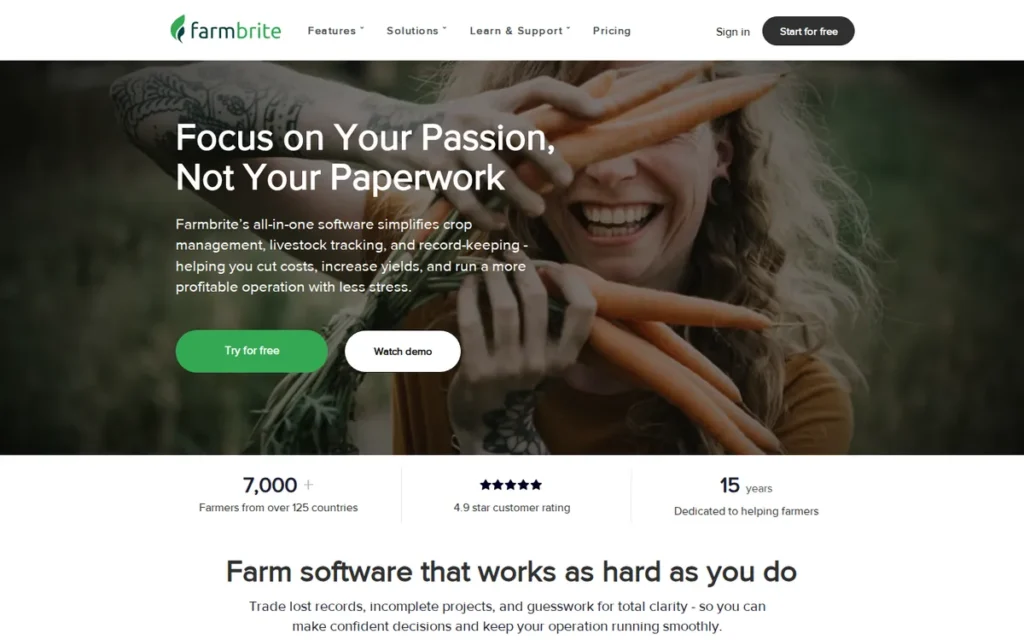
Category: Livestock & Diversified Farm Manager, manages herd, crop, inventory and accounting records in one system and connects to scanners and accounting software rather than tractors.
At a Glance
- Category: Livestock & Diversified Farm Manager
- Best For: Small-to-mid ranches and diversified crop-and-livestock operations that need herd records and accounting in one system
- Price Range: $29–$109/month or $290–$1,090/year by plan; Accounting Only $119/year per Capterra (verified November 2026)
- Primary Strength: Farmbrite has the strongest independent review evidence in this ranking, at 4.8/5 from 63 Capterra reviews.
- Biggest Limitation: Farmbrite has no tractor, telematics or precision-ag integration, so it cannot collect machine data from any equipment brand.
- One-Line Summary: Farmbrite is the best-reviewed livestock and diversified-farm manager in this ranking, but it connects to scanners and accounting software, not to tractors or displays.
- Last Verified: November 2026
Overview
Farmbrite is a cloud farm-management system that keeps herd management, crop, inventory, sales and accounting records in one place. It is built for ranches and diversified operations rather than for row-crop farms that run on machine data.
Farmbrite supports cattle, sheep, goats, pigs, poultry and bees in its livestock records (AgriERP, 2026; Third-party). Farmbrite connects through EID tag scanners and accounting tools, so row-crop operations will need a separate machine-data hub alongside it.
Key Features
- Farmbrite tracks livestock genealogy, breeding, health, weights, grazing, pasture and animal movements (AgriERP, 2026; Third-party).
- Farmbrite includes crop planning with more than 200 crop templates and harvest traceability (Capterra, 2026; Third-party).
- Farmbrite offers built-in farm accounting and reported integrations with QuickBooks and Xero (AgriERP, 2026; Third-party).
- Farmbrite supports RFID/EID scanners, a REST API and Zapier, though which tiers include each integration was not confirmed (AgriERP, 2026; Third-party).
- Farmbrite includes an online store, point of sale and CRM for operations that sell direct (AgriERP, 2026; Third-party).
Best For
Farmbrite is best for small-to-mid livestock, ranch and diversified operations that want herd, crop, inventory and accounting records in one affordable system. Farmbrite is not suited to large row-crop farms that need automatic machine data.
Pricing
Farmbrite Livestock, Crop Grower and Complete plans start at $29, $29 and $59 per month, or $290, $290 and $590 per year (Farmbrite, 2026; Vendor-reported). Farmbrite offers a 14-day free trial.
Farmbrite’s Capterra listing shows the higher-tier prices (Capterra, 2026; Third-party):
- Farmbrite Livestock Performance and Complete cost $49 and $79 per month.
- Farmbrite Crop Grower Performance and Premium cost $39 and $59 per month.
- Farmbrite Complete Performance and Premium cost $79 and $109 per month, or $790 and $1,090 per year.
- Farmbrite Accounting Only is listed at $119 per year on Capterra only.
An older G2 listing shows an outdated set of Farmbrite tiers (G2, 2026; Third-party).
Strengths
- Farmbrite holds 4.8/5 from 63 Capterra reviews, the largest sample of strong ratings in this ranking, plus about 4.7/5 from about 15 G2 reviews (Capterra, 2026; User-reported) (G2, 2026; User-reported).
- Farmbrite’s paid plans start at $29/month or $290/year for Livestock Essentials, the lowest entry price among the livestock-capable platforms researched (Farmbrite, 2026; Vendor-reported).
- Farmbrite is described by one Capterra reviewer as meeting “all of my recordkeeping needs from financial to herd health to sales” (Capterra, 2026; User-reported).
- Farmbrite covers livestock, crops and accounting in one system, which cuts the number of dashboards a diversified farm has to manage.
Users on r/farming noted:
“Did just begin a free trial with farmbrite and so far it’s pretty good and has been easy to use. I’m just looking for a little bit more traceability back to the soil or growing medium used. I’m working towards organic verification and being able to easily pinpoint these details upon inspection is pretty important.” Posted by u/DG_CP_Gardens
Takeaway: Farmbrite makes a good first impression on ease of use, but growers working toward organic certification may find its input-level traceability falls short of what an inspection requires.
Limitations
- Farmbrite trades affordability and livestock depth for zero machine connectivity, so mixed-enterprise farms with row crops will need a second platform for machine data.
- Farmbrite offline mode is still in beta, which matters for pasture work where cell coverage is weak (AgriERP, 2026; Third-party).
- Farmbrite draws G2 criticism for cumbersome navigation and for invoicing that sits separately from accounting (G2, 2026; User-reported).
- Farmbrite has not confirmed which tiers include QuickBooks, Xero, RFID/EID and API access, so a farm may need a higher plan to get the integration it wants. Farmbrite also publishes no user totals.
Verdict
Farmbrite is the best-reviewed option for livestock, ranch and diversified operations, with a 4.8/5 Capterra rating from 63 reviews, but it does not connect to tractors or displays.
Farmbrite’s #4 rank reflects review evidence, pricing transparency and records coverage, not machine connectivity. Crop-heavy farms should pair Farmbrite with a machine-data hub and confirm which tier includes RFID/EID and accounting integrations.
5. PTx Trimble: Best for Documented Mixed-Fleet Data Exchange and Retrofit
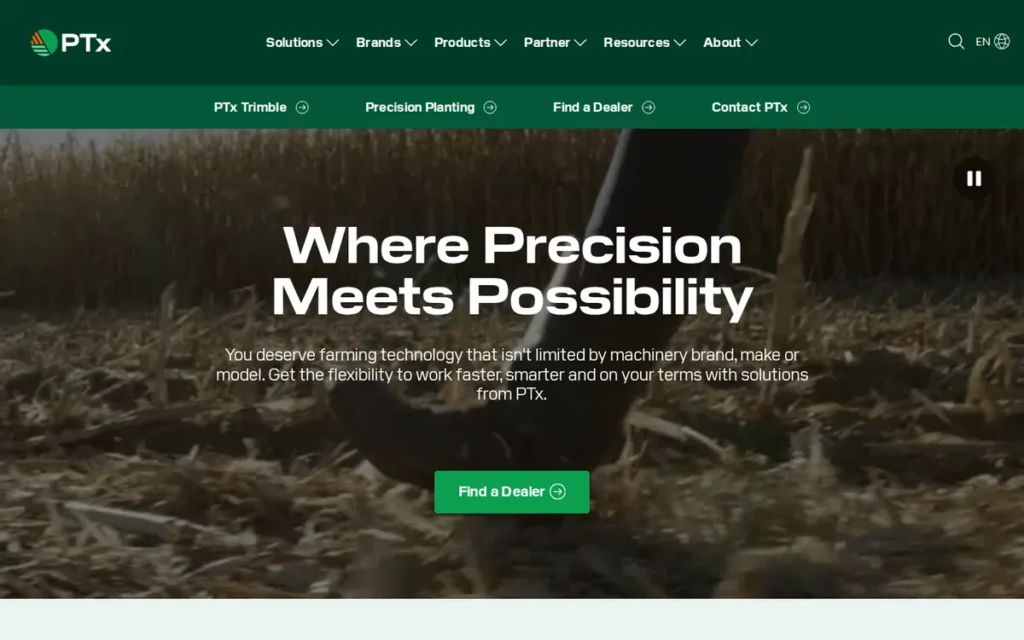
Category: Machine-Data Hub, collects machine and agronomic data from connected equipment and sends jobs and prescriptions back to the cab.
At a Glance
- Category: Machine-Data Hub
- Best For: Mixed-brand fleets that need documented file and API exchange across Trimble, Deere and CNH data, plus guidance and retrofit autonomy
- Price Range: Dealer quote in the US; one year of Ag Software–Data included with new GFX-1060/1260 displays (verified November 2026)
- Primary Strength: PTx Trimble publishes the clearest mixed-brand compatibility documentation researched, including a CNH FieldOps API connection.
- Biggest Limitation: PTx Trimble publishes no US software prices and has no verified G2, Capterra or app-store ratings.
- One-Line Summary: PTx Trimble offers the best-documented mixed-brand data exchange researched, but US pricing is quote-only and no independent review scores exist.
- Last Verified: November 2026
Overview
PTx Trimble Ag Software, with its FarmENGAGE mixed-fleet data platform, is the AGCO–Trimble joint venture’s suite for guidance, field data, job dispatch and as-applied records. It is built for operations running several equipment brands that need documented cross-brand exchange.
PTx Trimble product names have changed over time. Trimble Ag Software and FarmENGAGE now sit under the PTx Trimble brand, which AGCO says was unified in 2025 (AGCO, 2025; Vendor-reported). This review uses “PTx Trimble” throughout.
Key Features
- PTx Trimble FarmENGAGE lists compatibility with PTx/Trimble data, ISOXML files, John Deere data and CNH .cn1 files, plus an API connection to CNH FieldOps (PTx, 2026; Vendor-reported).
- PTx Trimble AutoSync and Direct Send push display data to the cloud wirelessly from GFX-750, 1060 and 1260 displays that have a modem and license (PTx, 2024; Vendor-reported).
- PTx Trimble Ag Software–Data moves jobs between office and displays, tracks equipment and job progress, and collects as-applied records (PTx, 2024; Vendor-reported).
- PTx Trimble CenterPoint RTX delivers up to 2.5 cm repeatable guidance accuracy, with convergence under 2 minutes using RTX Fast (PTx, 2026; Vendor-reported, hardware spec).
- PTx Trimble OutRun retrofits autonomy, starting with grain carts, onto Deere 8R/8RX/9R/9RX and Fendt 800/900/1000 tractors (PTx, 2026; Vendor-reported).
Best For
PTx Trimble is best for mixed-brand operations, especially fleets combining Trimble, Deere and CNH data, that want to check cross-brand support in published documentation before buying. PTx Trimble also suits farms planning to retrofit guidance or autonomy onto tractors they already own.
Pricing
PTx Trimble US prices for Farmer Core, Farmer Pro, the Data and Operations licenses, and RTX are not public and come through a dealer quote (PTx, 2026; Vendor-reported). These are the documented price points:
- PTx Trimble’s UK promotional CenterPoint RTX subscription costs £399 per year.
- New PTx Trimble GFX-1060 and GFX-1260 displays include one year of Ag Software–Data.
- PTx Trimble NAV-900 receivers include one year of RTX.
Buyers should get a written PTx Trimble quote that covers the display, modem, license and year-two renewal.
Strengths
- PTx Trimble’s FarmENGAGE compatibility page lists named file formats and a CNH FieldOps API connection, the most specific mixed-brand documentation researched (PTx, 2026; Vendor-reported).
- PTx Trimble appears in Leaf Agriculture’s interoperability API alongside Deere, FieldView and CNH FieldOps, which places it inside the cross-brand data ecosystem (Leaf Agriculture, 2026; Third-party).
- PTx Trimble OutRun won the Davidson Prize. PTx describes the prize as recognizing the first commercial autonomous retrofit grain-cart solution (PTx, 2026; Vendor-reported).
- PTx Trimble CenterPoint RTX offers up to 2.5 cm repeatable accuracy, though this is a hardware spec, not a farm result (PTx, 2026; Vendor-reported).
Limitations
- PTx Trimble trades the best mixed-brand documentation for the least price transparency in this ranking. PTx Trimble’s C3 and C4 scores of 1 cost it 0.60 weighted points compared with a product scoring 3 on both.
- PTx Trimble automatic sync requires a specific GFX display, a modem or hotspot, and a paid license, so older displays may not qualify.
- PTx Trimble has no sourced user reviews on G2, Capterra, the App Store or Google Play (November 2026), so PlugRoute could not independently assess its real-world reliability. Trimble was not found in the current Ag Data Transparent listings (Ag Data Transparent, 2026; Third-party).
- PTx Trimble has been through brand consolidation: the joint venture formed in 2024, and PTx was unified in 2025. Product names keep changing, and users of the legacy Farm Works desktop software face migration risk (AGCO, 2025; Vendor-reported).
Verdict
PTx Trimble offers the best-documented mixed-brand data exchange of any connected agriculture platform researched, but its US pricing is quote-only and it has no independent review scores.
PTx Trimble should be a lead candidate, despite its #5 rank, for buyers whose top priority is cross-brand file and API support. Those buyers should confirm each direction of transfer on their own machines and get a written quote that includes license renewal.
6. Agworld: Best for Agronomist–Grower Collaboration and Budgeting
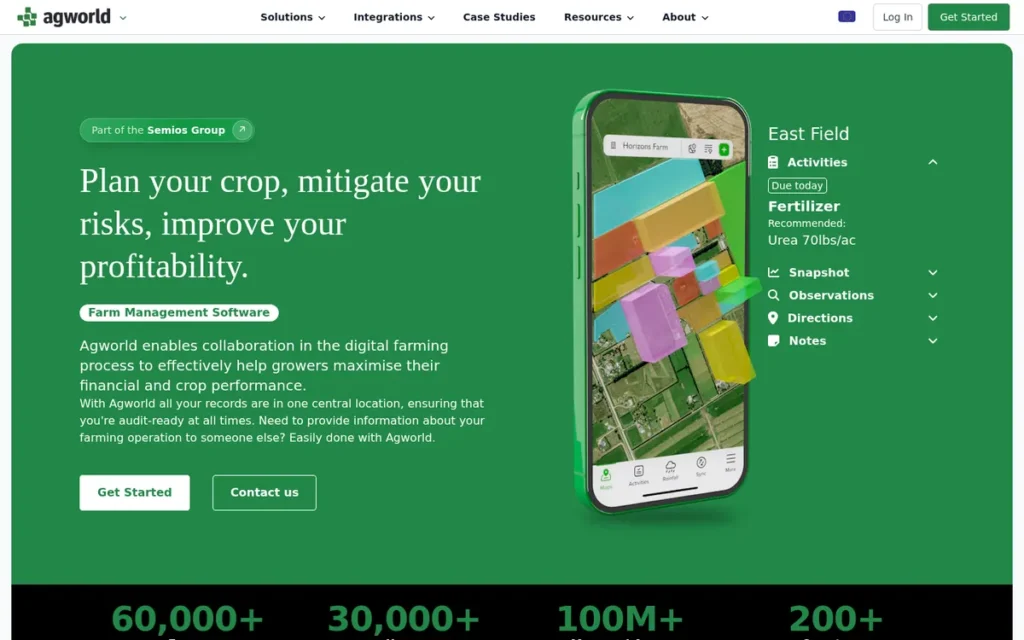
Category: Farm Business & Records Layer, turns machine and field records into plans, budgets, profit-and-loss views and marketing positions.
At a Glance
- Category: Farm Business & Records Layer
- Best For: Growers who plan, record and budget jointly with agronomists, retailers and contractors, including specialty-crop operations
- Price Range: Free; Basic $1,495, Plus $2,495, Pro $3,995 per year, flat rate in USD (verified November 2026)
- Primary Strength: Agworld gives growers, agronomists and contractors one shared record of plans, recommendations, work orders and budgets, rated 4.5/5 from 44 Capterra reviews.
- Biggest Limitation: Agworld’s machine-data integrations with Deere, CNH, FieldView and Trimble could not be confirmed, and one reviewer called it “not a strong GIS tool.”
- One-Line Summary: Agworld is the strongest researched platform for agronomist–grower collaboration and planned-versus-actual budgeting, but it is not a machine-data hub.
- Last Verified: November 2026
Overview
Agworld is a Semios-owned collaborative farm-management platform where growers, agronomists, staff and contractors share plans, recommendations, work orders, inventory and budgets. It is built for operations that make planned-versus-actual decisions with outside advisors across more than 200 crop types.
Agworld was founded in 2009 in Perth, Australia, and Semios acquired it in 2022 (Agworld, 2022; Vendor-reported). Agworld’s documented connections are Semios sensors, Pinion finance and Power BI, so buyers should test machine-data imports with their own files.
Key Features
- Agworld keeps plans, recommendations, work orders, activity records, inventory and budgets in one record shared by growers, agronomists and contractors (Agworld, 2026; Vendor-reported).
- Agworld compares planned against actual results at field, crop and farm level, which links field work to profitability (Agworld, 2026; Vendor-reported).
- Agworld shows Semios weather stations, forecasts, insect-trap counts and degree days in its maps, which requires a Semios account (Semios, 2026; Vendor-reported).
- Agworld integrates with Pinion for finance and Microsoft Power BI for reporting (Agworld, 2026; Vendor-reported).
- Agworld supports more than 200 crop types in more than five countries (Capterra UK, 2026; Third-party).
Best For
Agworld is best for operations that work closely with agronomists, retailers or contractors and want one shared plan-to-budget record, including specialty-crop growers. Agworld is not suited to farms whose main need is automatic machine-data capture or livestock management.
Pricing
Agworld’s US pricing page lists flat annual rates in US dollars, not per-acre pricing, with a 7-day trial (Agworld, 2026; Vendor-reported):
- Agworld Free costs $0.
- Agworld Basic costs $1,495 per year.
- Agworld Plus costs $2,495 per year.
- Agworld Pro costs $3,995 per year.
Agworld does not publish advisor pricing, so buyers should confirm which tier includes the integrations they need.
Strengths
- Agworld holds a 4.5/5 Capterra rating from 44 reviews, with ease of use rated 4.3/5. That is the second-largest G2/Capterra sample in this ranking, after Farmbrite (Capterra, 2026; User-reported).
- Agworld publishes flat annual pricing from $0 to $3,995, among the clearest pricing in the category (Agworld, 2026; Vendor-reported).
- Agworld customer FMSWA moved chemical-inventory reconciliation from once or twice a year to an ongoing process, and Midcap Farms improved its reporting to the bank (Agworld, 2026; Vendor-reported, qualitative case studies).
- Agworld’s planned-versus-actual loop links field operations to budgets at field, crop and farm level.
This aligns with community sentiment on r/farming:
“We use agworld for the whole farm, integrates with spray recs from agronomists, can be updated by individual users, run reports, etc. Costs a bit more, but can track the whole season from planting through harvest.” Posted by u/Acute_Chicanery
Takeaway: Agworld earns its higher price for farms that want agronomist recommendations and operator records in one season-long system, but cost-sensitive buyers should weigh that premium.
Limitations
- Agworld trades collaboration and budgeting strength for weak documented machine connectivity. Agworld’s C1 and C2 scores of 2 reflect unconfirmed Deere, CNH, FieldView and Trimble data flows, not confirmed absence. A documented integration would raise those scores.
- Agworld was called “not a strong GIS tool” for uploading yield data and comparing trials by a Capterra reviewer (Capterra, 2026; User-reported).
- Agworld has a confirmed initial learning curve (Agworld Caledonia case study, 2026; Vendor-reported). Agworld’s livestock support is limited, and offline sync was not verified.
- Agworld’s case studies report no numeric results, so buyers cannot size the time or cost savings in advance.
Verdict
Agworld is the strongest researched platform for growers who plan and budget together with agronomists, with a 4.5/5 rating from 44 Capterra reviews and flat published pricing.
Agworld is a records-and-collaboration layer, not a machine-data hub. Buyers should test their own Deere, CNH or FieldView files during Agworld’s 7-day trial before choosing a tier.
7. CropX: Best for Irrigation- and Soil-Sensor-Led Operations
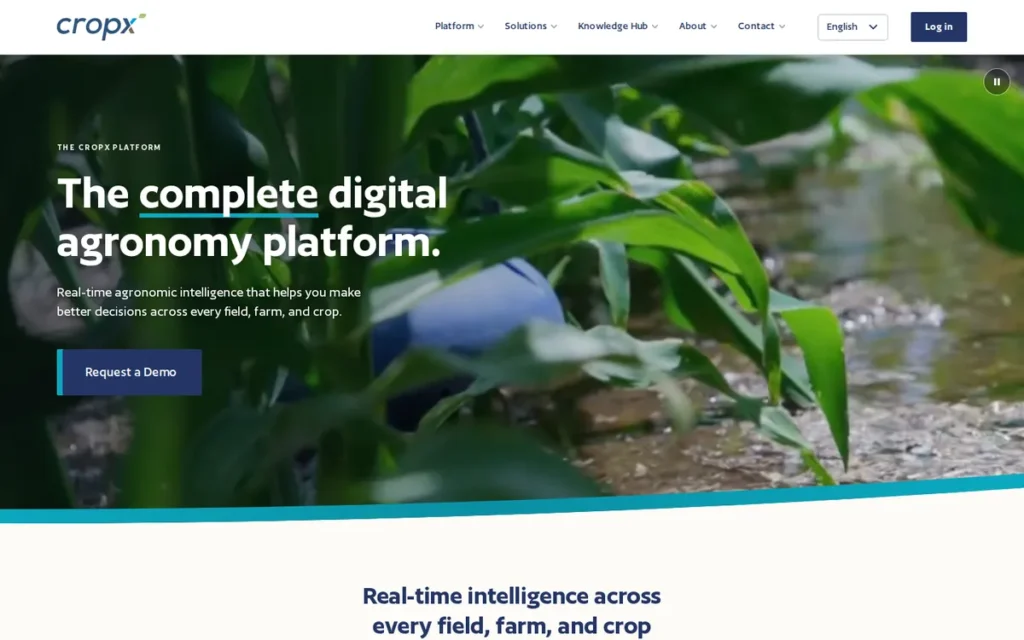
Category: Sensor & Irrigation Platform, combines in-field soil sensors with weather and satellite data to recommend irrigation and nutrient decisions.
At a Glance
- Category: Sensor & Irrigation Platform
- Best For: Irrigated row-crop, specialty and dairy operations that need soil-moisture data and irrigation scheduling linked to Deere Operations Center
- Price Range: Not officially published; third-party and dealer listings show about $695 per sensor plus $250–$500 per sensor per year (verified November 2026)
- Primary Strength: CropX sends soil-sensor data into John Deere Operations Center and imports field data back, a documented two-way integration.
- Biggest Limitation: CropX’s published results are vendor case studies without controls, and it has no verified G2, Capterra or app-store ratings.
- One-Line Summary: CropX is the only soil-sensor and irrigation specialist in this ranking, pairing wireless soil sensors with irrigation recommendations and two-way Deere integration, though its pricing and outcomes are not independently verified.
- Last Verified: November 2026
Overview
CropX is a soil-sensing and agronomic platform that combines wireless multi-depth soil sensors with weather, satellite and evapotranspiration data to recommend irrigation, nitrogen and effluent decisions. It is built for irrigated row-crop, specialty and dairy operations.
CropX works alongside a machine-data hub rather than replacing one. Buyers should budget CropX deployments for sensors, gateways and installation labor (CropX, 2026; Vendor-reported).
Key Features
- CropX spiral wireless sensors measure soil moisture, temperature and electrical conductivity at several depths (CropX, 2026; Vendor-reported).
- CropX combines sensor readings with weather, satellite and evapotranspiration data to recommend irrigation and nitrogen decisions (CropX, 2026; Vendor-reported).
- CropX integrates two ways with John Deere Operations Center and also lists Reinke, FieldView and Talgil connections (CropX, 2026; Vendor-reported).
- CropX offers livestock and dairy effluent management modules (CropX, 2026; Vendor-reported).
- CropX reports more than 15,000 sensor deployments and more than 2,000 farm deployments (Rankite, 2026; Third-party).
Best For
CropX is best for irrigated operations, including center-pivot fields, where water and nitrogen decisions drive margins and soil-moisture data needs to sit next to Deere machine data. CropX is a weak fit for dryland farms with no irrigation decisions, and CropX does not manage fleets, profit records or herds.
Pricing
CropX publishes no price list and describes an “all-inclusive annual subscription” (CropX, 2026; Vendor-reported). Third-party and dealer listings show about $695 per Vertex V4 sensor plus about $250–$500 per sensor per year, most often about $300 (Roberts Irrigation, b2bsalestools and softwr, 2026; Third-party).
At those prices, 20 CropX sensors cost about $13,900 in hardware plus about $6,000 per year in subscriptions, before gateways and installation. A CropX quote should cover these items:
- The CropX quote should state the number of sensors needed per field.
- The CropX quote should include the gateways that relay sensor data to the cloud.
- The CropX quote should include installation and labor costs.
Strengths
- CropX documents a two-way John Deere Operations Center integration, so soil data appears in Operations Center and field data imports into CropX (CropX, 2026; Vendor-reported).
- CropX expanded in 2025 by acquiring Acclym, formerly Agritask, which brought enterprise customers including AB InBev, Nestlé, General Mills and McCain (CropX, 2025; Vendor-reported).
- CropX reports a Colorado case that cut irrigation by about one-third, though this is a vendor case study with no published controls (CropX, 2026; Vendor-reported).
- CropX users praise data transmission and sensor accuracy in aggregated feedback (rfp.wiki, 2026; Third-party).
Limitations
- CropX trades specialist irrigation depth for narrow scope, so most buyers will run CropX alongside a separate machine-data hub and farm-office system.
- CropX costs scale with sensor count, not acres, so large or variable fields can push subscription costs well above a single-sensor estimate.
- CropX’s other published outcomes are also vendor case studies without controls, including South Georgia yields up to 60% above state averages and 20–30 bu/acre gains reported by Hoffman Irrigation (CropX, 2026; Vendor-reported).
- CropX users report labor-intensive installation, limited setup help, rural connectivity problems and stale data. Support for Valley and Lindsay FieldNET pivots was not confirmed (softwarefinder, 2026; Third-party).
Verdict
CropX is the only soil-sensor and irrigation specialist in this ranking, pairing multi-depth wireless sensors with irrigation recommendations and a documented two-way John Deere Operations Center integration.
CropX’s #7 rank at 2.65 reflects missing official pricing and review data. It also reflects a comparison against hubs CropX does not compete with directly. Buyers should confirm support for their pivot or controller brand and get an all-in deployment quote.
Will Connected Agriculture Software Work With My Mixed-Brand Equipment?
Connected agriculture software usually works with mixed-brand equipment to some degree, but none of the seven products researched publishes a verified model-by-model compatibility list. PTx Trimble documents the most specific cross-brand file and API support, and Climate FieldView documents a logger that works with most brands. Every mixed-fleet claim still needs a pilot.
The three hubs handle mixed fleets in different ways:
- John Deere Operations Center markets non-Deere support through JDLink Connect and ISOBUS/ISOXML, priced by dealer quote (John Deere, 2026; Vendor-reported).
- Climate FieldView uses the Drive 2.0 logger on the CAN port and says it works with most equipment brands (Climate, 2026; Vendor-reported).
- PTx Trimble lists ISOXML, John Deere data, CNH .cn1 files and a CNH FieldOps API connection (PTx, 2026; Vendor-reported).
Leaf Agriculture’s API connects all three hubs plus CNH FieldOps (Leaf Agriculture, 2026; Third-party). That middleware exists because moving data between brands is still not seamless.
Users on r/farming noted:
“New hollands my plm and john deeres op centre have that pretty tied up. There are some platforms that can read both systems quite well. I use agworld as a stand alone system.” Posted by u/FewEntertainment3108
Takeaway: John Deere Operations Center and New Holland’s MyPLM keep data inside their own brand ecosystems, so mixed-fleet farms end up relying on a third-party platform that can read both.
Buyers should ask whether each machine’s display supports ISOBUS Task Controller functions and which modem and firmware versions the vendor has tested.
In connected agriculture, “compatible” is a claim to test, not a feature to trust: none of the seven platforms researched publishes a verified model-by-model compatibility list.
Do I Need More Than One Connected Agriculture Platform?
Most mid-size to large farms will need more than one connected agriculture platform. No product researched covers row crops, irrigation, livestock and accounting in a single system. The practical pattern is a machine-data hub plus one specialist or records layer, with the two linked through documented integrations.
The research supports these common stacks:
- A John Deere Operations Center or Climate FieldView hub plus Bushel Farm covers per-field profit and grain contracts.
- A John Deere Operations Center hub plus CropX covers irrigation and soil-moisture decisions.
- Any machine-data hub plus Farmbrite covers mixed crop-and-livestock operations.
- Any machine-data hub plus Agworld covers agronomist-led planning and budgets.
For most farms, the realistic connected setup is two tools: one hub that collects machine data and one layer that turns it into decisions about profit, herds or water.
What Will Connected Agriculture Software Cost a Mixed-Brand Farm in Year One?
A mixed-brand row-crop farm should expect to spend between $0 and about $3,300 on connected software in year one, before dealer-quoted items, depending on its stack. Hardware loggers, per-machine fees and add-ons drive most of the bill, not the core platform. The worked example below uses four machines from three brands.
| Stack Component | What It Covers | Year-One Cost |
|---|---|---|
| Climate FieldView Plus | Paid tier with CloudSync and API access | $649 |
| Climate FieldView Drive starter kit | First machine | $299 |
| Three additional Climate FieldView Drives | Machines two through four | $747 |
| Climate FieldView subtotal | Mixed-brand capture | $1,695 |
| Bushel Farm Essentials | Per-field P&L and marketing positions | $599 |
| Bushel Farm Machine Data Connections | Deere and FieldView record import | $999 |
| Bushel Farm subtotal | Field-to-profit layer | $1,598 |
| John Deere Operations Center | Hub for Deere machines | $0, plus dealer quote for JDLink Connect on non-Deere units |
The Climate FieldView plus Bushel Farm stack costs about $3,293 in year one (Climate, 2026; Vendor-reported) (Bushel, 2026; Vendor-reported).
A free platform does not mean a free connected workflow. Bushel Farm looks like a $599 decision, but automatic machine-data import brings it to about $1,598 per year.
What Red Flags Should I Watch For When Evaluating Connected Agriculture Software?
The main red flags when evaluating connected agriculture software are untested compatibility claims, connectivity locked behind paid tiers or add-ons, quote-only pricing, fragile hardware, broad data licenses and ROI claims without controls. Each red flag below draws on documented patterns from several vendors, not from one brand.
Red Flag #1: Compatibility Claims Without a Model List or Data Direction
A partner count or “compatible” label is not evidence that data syncs automatically in both directions on your machines. No vendor researched publishes a verified model list.
- Third parties report CropX at more than 180 integrations, with no list underneath (Rankite, 2026; Third-party).
- Deere publishes no partner count or compatible-model list for John Deere Operations Center (John Deere, 2026; Vendor-reported).
- Records layers such as Agworld and Bushel Farm depend on connections whose direction buyers must confirm.
Red Flag #2: Cloud Sync and Machine Data Locked in Paid Tiers or Add-Ons
Free tiers and base plans often leave out the connectivity features farms actually need. Check which plan or add-on unlocks automatic data flow before you budget.
- Climate FieldView Basic excludes CloudSync and external API access (Climate, 2025; Vendor-reported).
- Bushel Farm charges $999/year for the Machine Data Connections add-on that imports Deere and FieldView records (Bushel, 2026; Vendor-reported).
Red Flag #3: Quote-Only Pricing With No Written Scope
Quote-only pricing makes it hard to estimate year-one cost or compare vendors. Cost is already a major barrier: 52% of North American farmers cite high cost when deciding whether to adopt (McKinsey, 2024; Third-party).
- PTx Trimble US software subscriptions have no public prices (PTx, 2026; Vendor-reported).
- Deere JDLink Connect for mixed fleets is priced by dealer quote (John Deere, 2026; Vendor-reported).
- CropX publishes no official subscription price (CropX, 2026; Vendor-reported).
Red Flag #4: Hardware Tied to One Account, One Display or an Aging Product Line
Loggers, displays and desktop software can go obsolete, become bound to a single account or need a costly upgrade. Ask what happens to your data when hardware changes hands or reaches end of support.
- Climate FieldView Drive 1 support is winding down, and each Drive 2.0 is tied to one account (Climate, 2026; Vendor-reported).
- PTx Trimble automatic sync needs a specific GFX display, a modem and a license, and Farm Works desktop users face migration risk (PTx, 2024; Vendor-reported).
Red Flag #5: Broad Data-Use Licenses
Owning your data does not stop a vendor from using it. Ag Data Transparent certification is one comparable signal, and certification status varies across this ranking.
- John Deere Operations Center and Climate FieldView are listed as Ag Data Transparent certified. Agworld, Bushel and Trimble were not found in the current listings (Ag Data Transparent, 2026; Third-party).
- Climate FieldView users grant Bayer a non-exclusive license to use their data (AgriERP, 2026; Third-party).
- A 2026 critic alleged that Deere’s repair-tool terms grant broad data rights. That is an allegation, not a finding (WVIK, 2026; Third-party).
Red Flag #6: ROI Claims Without Controls
Yield and savings figures in vendor case studies rarely include control fields or a published method. Farmers expect a return of roughly 3:1 before adopting, so uncontrolled claims deserve extra scrutiny (McKinsey, 2024; Third-party).
- CropX yield and water-savings claims are vendor case studies without published controls (CropX, 2026; Vendor-reported).
- A claim of 15% input-cost savings for Climate FieldView has no documented method (geo.sig.ai, 2026; Third-party).
What Questions Should I Ask Before Choosing Connected Agriculture Software?
Before choosing connected agriculture software, ask about exact equipment compatibility, data direction and speed, full year-one cost, tier gating, data export, offline behavior and who provides support. Vendors that answer in writing and with specifics, not with partner counts, give you evidence you can test in a pilot.
Question #1: Which exact tractor models, displays and firmware versions are supported?
A good answer names specific models and firmware versions, not brands. Ask the vendor to show a working connection on at least one of your machines from a different brand before you sign any contract or move any records.
Question #2: Does data move automatically, in which direction, and how fast?
A good answer states the transport (cellular, Bluetooth or a cloud API), whether data flows one way or both ways, and a sync interval. John Deere Operations Center is the only product researched with a published speed: about 30 seconds (John Deere, 2026; Vendor-reported).
Question #3: What will year one cost, including hardware, licenses and per-machine fees?
A good answer is an itemized written quote covering software, loggers or modems, displays, per-machine fees, installation and year-two renewal. Dealers name farm income as the top barrier to precision-ag adoption, cited by 55% (CropLife/Purdue, 2025; Third-party).
Question #4: Which tier or add-on includes cloud sync, machine data and API access?
A good answer maps each connectivity feature to a named tier or add-on with a price. Accounting links matter too. One UK farmer pointed to Xero integration as a key requirement when comparing farm software (Reddit r/FarmingUK, 2026; User-reported).
Question #5: How do I export all my data if I leave?
A good answer names export formats, such as ISOXML or shapefiles, and confirms bulk export of history, prescriptions and financial records. Recent consolidation raises switching costs. Examples include the AGCO–Trimble PTx joint venture (2024), Semios buying Agworld (2022) and Traction Ag buying Granular Business (2022).
Question #6: What works offline when cell coverage drops?
A good answer lists which records can be created offline and how they sync later. Farmbrite offline mode is in beta (AgriERP, 2026; Third-party), and CropX users report rural connectivity problems (softwarefinder and rfp.wiki, 2026; Third-party).
Question #7: Who provides support, the dealer or the vendor?
A good answer names who handles setup, sync failures and hardware faults, with response times. CropX users report limited setup help (softwarefinder, 2026; Third-party). Technicians who work in the Deere ecosystem criticize its diagnostic software (Reddit r/DieselTechs, 2025; User-reported).
How Should I Pilot Connected Agriculture Software Before Buying?
Pilot connected agriculture software by running one season of your own files and one live field pass through the platform during a free trial or demo. A five-step pilot tests import, two-way transfer, offline behavior and export, the four areas where vendor claims most often fall short of what a farm needs.
- Export one season of files from every display you run, across every brand you own.
- Import those files into the platform during its free trial and check that fields, passes and yields line up.
- Send one prescription back to each brand’s display and confirm that it loads in the cab.
- Run one field pass with the cab offline, then check that the record syncs once coverage returns.
- Export all your data from the platform and confirm that the formats open in another tool.
How Did We Rank These Connected Agriculture Software Platforms?
PlugRoute scored seven connected agriculture platforms from 1 to 5 on six weighted criteria, using only dated, source-labeled research. Data flow and mixed-brand interoperability carry the most weight because they match the reader’s top pain points. Ranks #2 through #6 fall within 0.35 points, so segment fit matters more than position.
Ranking criteria and weights:
- C1 Documented Automatic Data Flow (25%): This criterion matters because manual USB transfers waste time and two-way job dispatch saves trips to the cab.
- C2 Mixed-Brand Interoperability Evidence (20%): This criterion matters because most readers run more than one brand and worry about lock-in. Partner counts without a list earn no credit.
- C3 Pricing Transparency (15%): This criterion matters because tier gating and quote-only items make year-one cost unpredictable.
- C4 Independent Review Evidence (15%): This criterion matters because ratings mean little without sample size. A score of 5 requires a rating of 4.5 or higher from 50 or more reviews.
- C5 Field-to-Office Coverage (15%): This criterion matters because readers need to link field work to P&L, accounting, livestock and irrigation records.
- C6 Lock-In and Vendor Risk (10%): This criterion matters because data licenses, regulatory actions, hardware sunsets and rebrands all affect long-term cost.
| Product | C1 | C2 | C3 | C4 | C5 | C6 | Weighted Total |
|---|---|---|---|---|---|---|---|
| John Deere Operations Center | 5 | 3 | 4 | 2 | 3 | 2 | 3.40 |
| Climate FieldView | 4 | 4 | 4 | 2 | 3 | 2 | 3.35 |
| Bushel Farm | 3 | 3 | 3 | 3 | 5 | 3 | 3.30 |
| Farmbrite | 2 | 1 | 4 | 5 | 5 | 4 | 3.20 |
| PTx Trimble | 4 | 5 | 1 | 1 | 3 | 3 | 3.05 |
| Agworld | 2 | 2 | 4 | 4 | 4 | 3 | 3.00 |
| CropX | 4 | 3 | 2 | 1 | 2 | 3 | 2.65 |
Score changes after November 2026 verification:
- Bushel Farm’s C3 score rose from 2 to 3 after Bushel published annual pricing for Rainfall ($75), Lite ($199) and Essentials ($599), moving Bushel Farm from #4 to #3.
- CropX’s C3 score rose from 1 to 2 after several third-party and dealer listings agreed on per-sensor pricing.
John Deere Operations Center and Climate FieldView both earn a C4 score of 2. Deere has volume but a weak 3.0/5 rating, and FieldView’s 4.3/5 comes from only three reviews.
If interoperability (C2) were weighted at 25% and automatic data flow (C1) at 20%, Climate FieldView (3.35) would edge John Deere Operations Center (3.30). That shows how narrow the top of this category is.
Evidence labels: PlugRoute labels every claim with one of these four tags:
- Vendor-reported
- Third-party
- User-reported
- Unverified
A lack of independent data counts as low evidence, not as a judgment that the product is bad. Reddit discussion of software in this category was thin for all seven products, and one large Agworld result could not be read.
Products we considered but didn’t rank:
- PlugRoute found no public pricing or verified review data at research time (November 2026) for AgriWebb, Traction Ag, CNH FieldOps, AGCO FarmerCore, Ag Leader AgFiniti, Raven Slingshot, Conservis, Harvest Profit and Farmers Edge.
- Granular was excluded because Traction Ag acquired Granular Business in November 2022, while Granular Insights stayed with Corteva, so the product line is split (Traction Ag, 2022; Vendor-reported).
- Leaf Agriculture was excluded because it is an API layer, not an end-user product.
PlugRoute has no affiliate relationships with any company listed. Rankings are determined entirely by research data and objective evaluation criteria.
Frequently Asked Questions About Connected Agriculture Software
What is the best connected agriculture software for livestock and ranches?
Farmbrite is the best-reviewed connected agriculture software for livestock and ranches in this ranking, with a 4.8/5 rating from 63 Capterra reviews (Capterra, 2026; User-reported). Paid plans start at $29 per month (Farmbrite, 2026; Vendor-reported). Farmbrite tracks herd health, breeding and grazing, but mixed crop farms need a separate machine-data hub.
How do I choose connected agriculture software for irrigation sensors?
Choose connected agriculture software for irrigation sensors by checking sensor depth, pivot and controller support, and per-sensor cost. CropX, the only sensor specialist ranked, uses multi-depth wireless sensors and a two-way John Deere Operations Center link (CropX, 2026; Vendor-reported). Confirm support for Valley or Lindsay FieldNET pivots, and price every sensor and gateway.
How does PlugRoute determine rankings?
PlugRoute ranks products by scoring each one from 1 to 5 on six weighted criteria: data flow, mixed-brand interoperability, pricing transparency, review evidence, field-to-office coverage and lock-in risk. Every score relies on dated, labeled sources. Missing independent data counts as low evidence, not as a negative verdict. Every weighted total and score change is published.
What Do Key Connected Agriculture Software Terms Mean?
Connected agriculture software uses technical terms for data formats, connectivity and pricing that vendors rarely define. This glossary explains twelve terms a buyer meets when comparing these platforms, with a note on why each one matters before you sign a contract or switch workflows.
Telematics: Telematics is the wireless transmission of machine location, hours, fuel and diagnostic data from equipment to the cloud. Telematics decides whether fleet data arrives automatically or has to be collected by hand.
CAN Port: A CAN port is a machine’s diagnostic connector, which carries data from the tractor’s internal network. Plug-in loggers use the CAN port to capture data from equipment that has no built-in modem.
ISOBUS: ISOBUS is an industry standard that lets tractors, displays and implements from different manufacturers communicate. ISOBUS support is a baseline requirement for running mixed-brand equipment together.
ISOXML: ISOXML is a standard file format for exchanging task, prescription and as-applied data between farm software and displays. A platform that reads and writes ISOXML is less likely to trap your data.
Cloud-to-Cloud Sync: Cloud-to-cloud sync is an automatic data transfer between two software platforms through an API, with no file uploads. Cloud-to-cloud sync removes manual steps but is often available only on paid tiers or add-ons.
API (Application Programming Interface): An API is a documented connection that lets one software system read or write data in another. API access shows how easily a farm can add accounting, analytics or other tools later.
Prescription (Variable-Rate): A prescription is a map that tells a machine to apply different rates of seed, fertilizer or chemical across a field. Two-way platforms send prescriptions to the cab without a thumb drive.
As-Applied Data: As-applied data is the record of what a machine actually planted, sprayed or spread, and where. As-applied data is the basis for compliance records, input costing and per-field profit analysis.
RTK/RTX Correction: RTK and RTX are correction services that make GPS guidance accurate to within a few centimeters. Correction services are usually sold as annual subscriptions, which adds a recurring cost.
Evapotranspiration (ET): Evapotranspiration is the water lost from soil and plants to the air. Irrigation platforms combine evapotranspiration with soil-moisture readings to decide when and how much to water.
Data-Use License: A data-use license is the contract term that defines what a vendor may do with farm data you upload. A farm can own its data and still grant the vendor broad rights to use it.
Planned-Versus-Actual: Planned-versus-actual is a comparison of budgeted inputs and operations against what was actually done in the field. Planned-versus-actual reporting links agronomic decisions to profit at the field and farm level.
Which Connected Agriculture Software Is Right for You?
Key Insights
The right connected agriculture software depends on fleet mix and operation type, not overall rank. John Deere Operations Center suits mostly-Deere fleets, and Climate FieldView and PTx Trimble suit mixed brands. Bushel Farm and Agworld add profit and planning, while Farmbrite and CropX cover livestock and irrigation. Most mid-size to large farms will run two tools.
- The connected agriculture software rankings are tight: ranks #2 through #6 fall within 0.35 points, so fit with your operation matters more than position.
- John Deere Operations Center is the strongest free hub for mostly-Deere fleets because it documents automatic two-way sync between office and cab.
- Climate FieldView is the lowest published-cost way to capture data across brands, and PTx Trimble publishes the most specific cross-brand file and API documentation.
- Bushel Farm moved to #3 after publishing its prices, but its automatic field-to-profit workflow requires a $999/year machine-data add-on.
- Specialists such as Farmbrite for livestock and CropX for irrigation solve different problems from machine-data hubs, and they score low on machine connectivity by design.
- No vendor researched publishes a verified model-level compatibility list, so a pilot with your own files and machines is the most reliable test available.
Start with the tool that matches your operation:
- A mostly Deere fleet should start with John Deere Operations Center.
- A mixed fleet should compare Climate FieldView and PTx Trimble on its own machines.
- A farm focused on profit and grain marketing should add Bushel Farm to its hub.
- A livestock or ranch operation should start with Farmbrite.
- A farm whose margins depend on irrigation should add CropX to its hub.
Interoperability, data terms and pricing in this category keep changing as vendors consolidate. Read PlugRoute’s full scoring methodology and our other independent farm software reviews before you commit to a platform.
We update this guide quarterly. Last updated: November 2026.