The best camp management software in 2026 is CampMinder for medium-to-large overnight camps, CampDoc for health records and medication tracking, ACTIVE Camp & Class Manager for day camps needing automated waitlists, and Jumbula for small day camps on a budget. The right pick depends on your camp’s type and size.
Choosing is hard for two reasons. Most vendor feature lists sound alike, and most vendors quote custom prices instead of publishing them. Directors also have to finish setup, health forms, and payment rules before registration opens, so the wrong system can cost a full season.
As one parent on r/Delaware described:
“Every SINGLE day camp (at least a dozen) I tried was full this time last year. I didn’t know at rhe time, but apparently, that’s the norm around here. I was able to get my daughter in for 4 random weeks this summer at Caravel because that’s all they had left in February. The other places I looked to fill in the gaps were full back then.” Posted by u/NoNoSoupForYou
Takeaway: Day camps routinely fill months before summer begins, so the registration window, and the camp management software that runs it, is one of the most important periods of a camp director’s year.
PlugRoute has no affiliate relationships with any company listed, and rankings are determined entirely by research data and objective evaluation criteria.
This guide ranks seven platforms by a weighted evidence score. Every claim is labeled by evidence type, and each entry states what PlugRoute could not verify about that vendor. The goal is to help camp directors build a demo shortlist of two or three tools before the next registration season.
What Are the 5 Categories of Camp Management Software?
Camp management software falls into five categories, and each one is built around a different camp model. The list below shows which category each of the seven ranked platforms belongs to. Start with the category that matches your camp’s biggest daily workload, then compare the platforms within it.
- All-in-One Camp Suite: All-in-one camp suites run registration, bunking, health, staff, transportation, and parent communication in one database. CampMinder, ACTIVE Camp & Class Manager (formerly CampSite), and CampBrain are in this category.
- Health-First Platform: Health-first platforms provide camp-specific electronic health records and medication administration, with registration as an optional add-on. CampDoc is in this category.
- Configurable Registration Platform: Configurable registration platforms are built around flexible registration, form, and payment-plan logic, with operations modules added on top. UltraCamp is in this category.
- Multi-Program Registration Tool: Multi-program registration tools handle registration, billing, and attendance for day camps, classes, and after-school programs on low-cost monthly plans. Jumbula is in this category.
- Camp + Retreat Center Suite: Camp and retreat-center suites combine camper registration with guest-group calendars, lodging inventory, and conference bookings. CircuiTree is in this category.
Scoping note: camp software vs. campground software. Youth and summer camp software is built around the child, the session, the cabin, the health record, and the counselor roster. RV park and campground software is built around the site, the vehicle, and the nightly rate.
Campground operators should look at campground reservation systems, such as Campspot, instead. Campspot is named here only to help readers find the right category. It is not ranked.
How Do the Top Camp Management Software Platforms Compare at a Glance?
CampMinder leads overall with a weighted evidence score of 4.33 out of 5. CampDoc is close behind at 4.15 and has the strongest health-record tools. Each of the other five platforms fits a narrower camp segment. Choose from the Best For column, because rank order alone won’t match every camp.
| Rank | Company | Category | Best For | One-Line Summary | Key Capabilities | Primary Strength | Key Limitation |
|---|---|---|---|---|---|---|---|
| 1 | CampMinder | All-in-One Camp Suite | Medium-to-large overnight camps | CampMinder is the most complete all-in-one platform for medium-to-large overnight camps, rated 4.7/5 from 256 Capterra reviews (November 2026). | Online camp registration, billing, health center, bunk and cabin assignment, staffing, transportation, parent app, API | Broadest documented overnight coverage in one database | Dated interface and hard-to-learn reporting; quote-only pricing |
| 2 | CampDoc | Health-First Platform | Nurse-heavy and medically complex camps | CampDoc is the highest-rated platform in this ranking, at 4.8/5 from 191 Capterra reviews (November 2026), and the only health-first design among the seven. | Health histories, immunizations, allergy alerts, medication records, incident logs, optional registration | Deepest health and medication workflows | No documented bunking, transportation, or staff scheduling |
| 3 | ACTIVE Camp & Class Manager | All-in-One Camp Suite | Day camps and recreation programs | ACTIVE Camp & Class Manager combines automated waitlists and payment plans with CampSite-lineage bunking and medical tools, rated 4.5/5 from 108 Software Advice reviews (November 2026). | Timed waitlists, payment plans, bunk and cabin assignment boards, medical records, cashless camp store/POS, SMS/email | Registration automation at scale | Conflicting, unconfirmed pricing and unpublished fees |
| 4 | CampBrain | All-in-One Camp Suite | Multi-program organizations in the US and Canada | CampBrain is a long-running platform used by about 1,700 camps, rated 4.7/5 from 45 Capterra reviews (November 2026). | Registration, staff hiring, attendance, accommodation booking, allergy-linked meal planning | Guided registration setup plus lodging tools | No dedicated mobile app; slowdowns at peak load |
| 5 | UltraCamp | Configurable Registration Platform | Camps with complex registration rules | UltraCamp is the most customizable registration platform with published fees in this ranking, rated 4.7/5 from 23 Capterra reviews (November 2026). | Conditional questions, waivers, payment plans, health records, donors, POS | Most configurable logic; published revenue-share fees | Steep learning curve and dated admin interface |
| 6 | Jumbula | Multi-Program Registration Tool | Small day camps and multi-program providers | Jumbula has the lowest published entry price among the seven ranked platforms ($15/month), rated 4.5/5 from 127 Capterra reviews (November 2026). | Custom forms, automated billing, attendance and dismissal app, parent app | Lowest and most complete published pricing | No bunking, cabin assignment, or deep medication tracking |
| 7 | CircuiTree | Camp + Retreat Center Suite | Camps with retreat or conference centers | CircuiTree is a modular platform for organizations that run both youth camps and guest-group lodging, rated 3.9/5 from 16 Capterra reviews (November 2026). | Guest-group calendars, automatic cabin assignment, health center, HR, transportation, POS | Strongest documented retreat and conference-center fit | Lowest verified rating in set (3.9/5, 16 reviews); confusing back end |
Which Camp Management Software Should I Choose for My Camp Type?
Match the platform to your camp’s most important need:
- Large overnight camps: CampMinder.
- Medically complex camps: CampDoc.
- Small day camps: Jumbula.
- Unusual registration rules: UltraCamp.
- Camps with a retreat center: CircuiTree or CampBrain.
Start demos with the recommended tool in the table below, and keep its listed alternative on your shortlist.
| Your #1 Priority | Recommended Tool | Why | Acceptable Alternative |
|---|---|---|---|
| Running a medium-to-large overnight camp (1,000+ campers) | CampMinder | Broadest documented single-database overnight coverage | ACTIVE Camp & Class Manager |
| Running a mid-size overnight camp | CampBrain | Guided setup and broad operations | UltraCamp or CampMinder |
| Medication tracking and health-center workflows | CampDoc (alone or alongside a registration system) | Only health-first platform in the set | CampMinder (health center module) |
| Low cost for a small or seasonal day camp (under about 500 children) | Jumbula | Plans from $15/month; free first month on Pay-As-You-Go | UltraCamp Basic tier (about 500 people included) |
| YMCA, parks and rec, or multi-program operations | ACTIVE Camp & Class Manager | Waitlists, payment plans, class support | Jumbula or CampDoc |
| A retreat or conference center, or a faith-based ministry camp | CircuiTree | Guest-group calendars and automatic cabin assignment | CampBrain |
| Unusual registration or payment-plan rules | UltraCamp | Most configurable forms and payment logic | ACTIVE Camp & Class Manager |
| An RV park or campground | Not this category | Built around sites and nightly rates | Campground reservation software such as Campspot |
What Are the 7 Best Camp Management Software Platforms in 2026?
In ranked order, the seven best camp management platforms in 2026 are:
- CampMinder
- CampDoc
- ACTIVE Camp & Class Manager
- CampBrain
- UltraCamp
- Jumbula
- CircuiTree
Every entry below uses the same structure and the same three evidence labels, and each one states what we could not verify. Pricing details for all seven vendors appear in the cost section after the entries.
1. CampMinder: Best Overall for Medium-to-Large Overnight Camps
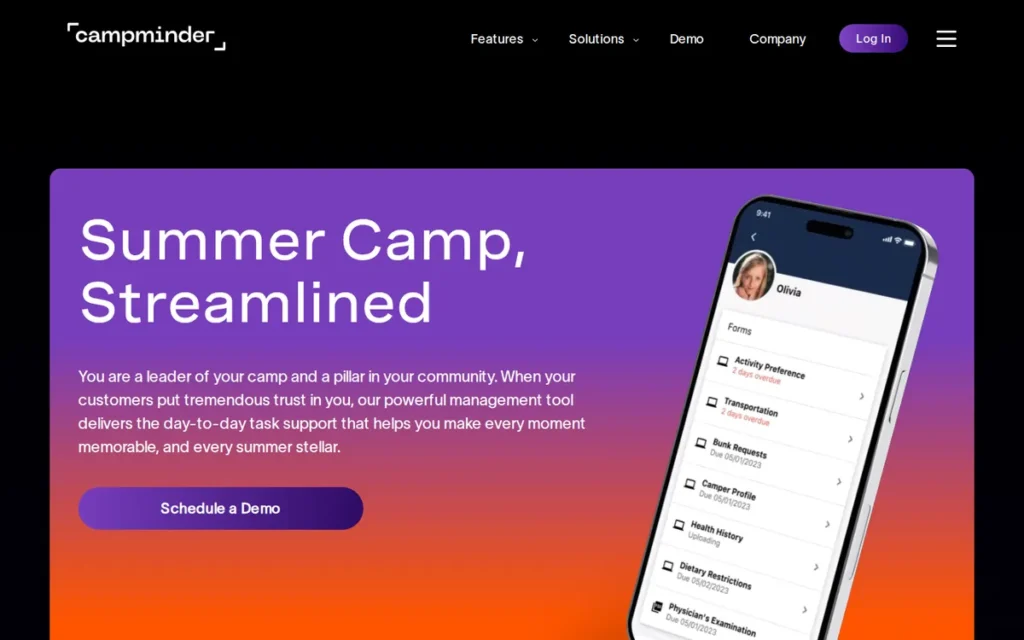
Category: All-in-One Camp Suite, runs registration, bunking, health, staff, transportation, and parent communication in one database.
At a Glance
- Category: All-in-One Camp Suite
- Best For: Medium-to-large overnight and residential camps (roughly 100 to 5,000 campers) that want one system for most daily operations
- Price Range: Quote-only; about $9–$31 per camper (Third-Party Estimate; Rankite, Stratilyze, November 2026)
- Primary Strength: CampMinder documents more overnight-camp workflows in one database than any other platform in this ranking.
- Biggest Limitation: Reviewers repeatedly describe CampMinder’s interface and reporting tools as dated and hard to learn.
- One-Line Summary: CampMinder is the most complete all-in-one platform for medium-to-large overnight camps and has the largest Capterra review base in this ranking, but its pricing is not published, so buyers must request a quote.
- Last Verified: November 2026
Overview
CampMinder is a cloud-based camp management suite for medium-to-large overnight camps that want one database for most daily operations. It combines online camp registration, billing, a health center, bunk and cabin assignment, staffing, transportation, and family communication, and it is priced by the number of enrolled campers.
CampMinder advertises “20+ camp-specific tools” sold in two suites (Vendor-Claimed; CampMinder, November 2026). Third-party reviewers position CampMinder for medium-to-large overnight camps and suggest that day camps also look at ACTIVE Camp & Class Manager (formerly CampSite) (Third-Party Estimate; GeeksFramework, November 2026).
Key Features
- CampMinder handles online camp registration, billing, and payments in the same database as camper health and bunking records.
- CampMinder includes a health center module with digital medication and medical-history tracking, which Camp Minikani used to replace binders and spreadsheets (Vendor-Claimed; CampMinder case study, accessed November 2026).
- CampMinder provides bunk and cabin assignment, staffing, and transportation tools, including real-time bus lists and text alerts for departures and arrivals.
- CampMinder’s Campanion parent app delivers forms, camp photos, and push notifications to families.
- CampMinder offers an API for exporting enrollment and staff data, though API access is reportedly limited to the higher Professional tier (Third-Party Estimate; Rankite, PulseRevOps, November 2026).
Best For
CampMinder is best for established overnight and residential camps with 100 or more campers. It fits camps that want bunking, health, transportation, staffing, and parent communication in one system and can budget for quote-based pricing.
Strengths
- CampMinder holds 4.7/5 from 256 Capterra reviews, the largest review base in this ranking, with sub-scores of 4.5/5 for ease of use and 4.9/5 for customer service (Verified; Capterra, November 2026).
- CampMinder’s G2 comparison page shows a 9.4/10 support score from a small 16-review sample. Capterra reviewers praise having “registrations, applications, payments and medical treatment in one database” (Verified; G2, Capterra, November 2026).
- CampMinder case studies document two results. Camp Minikani replaced nine manually built daily attendance rosters with real-time bus lists. Camp Airy & Louise synced data to Google Sheets through the API (Vendor-Claimed; CampMinder case studies, accessed November 2026).
- CampMinder documents bunking, transportation, health, staffing, and parent communication in one database (Vendor-Claimed; CampMinder, November 2026).
Limitations
- CampMinder trades usability for breadth. Capterra reviewers cite a dated interface, reporting tools that are hard to learn, and forms that are hard to configure (Verified; Capterra, November 2026).
- CampMinder’s G2 ease-of-use score of 7.9/10 trails its 9.4/10 support score (Verified; G2, November 2026). That sample has only 16 reviews, and the larger Capterra sample rates ease of use at 4.5/5.
- CampMinder reviewers describe “buggy” photo uploads and communication tools that feel “very outdated.” One reviewer said the financial module does not connect to QuickBooks (Verified; Capterra, November 2026).
- CampMinder’s quote-only pricing and tier-limited API mean buyers can’t compare cost or data-export flexibility until they are in the sales process.
- CampMinder’s case studies report operational changes without quantified time savings, and PlugRoute could not publicly verify its SOC 2 or PCI documentation as of November 2026.
Verdict
CampMinder is the strongest overall camp management platform for medium-to-large overnight camps in 2026, combining the broadest documented single-database feature set with the largest Capterra review base in this ranking.
CampMinder ranks #1 because it scored highest on operational breadth (C2: 5.0) and near the top on reviews and health tools (C1 and C3: 4.5). It lost points on pricing transparency (C4: 2.5) and usability (C6: 3.5).
CampMinder’s 4.33 total is only 0.18 points ahead of CampDoc on PlugRoute’s 5-point weighted scale. CampMinder buyers should budget time for staff training on reports and forms, and should get a written quote that shows per-camper cost, processing fees, and API tier.
2. CampDoc (DocNetwork): Best for Health Records and Medication Tracking
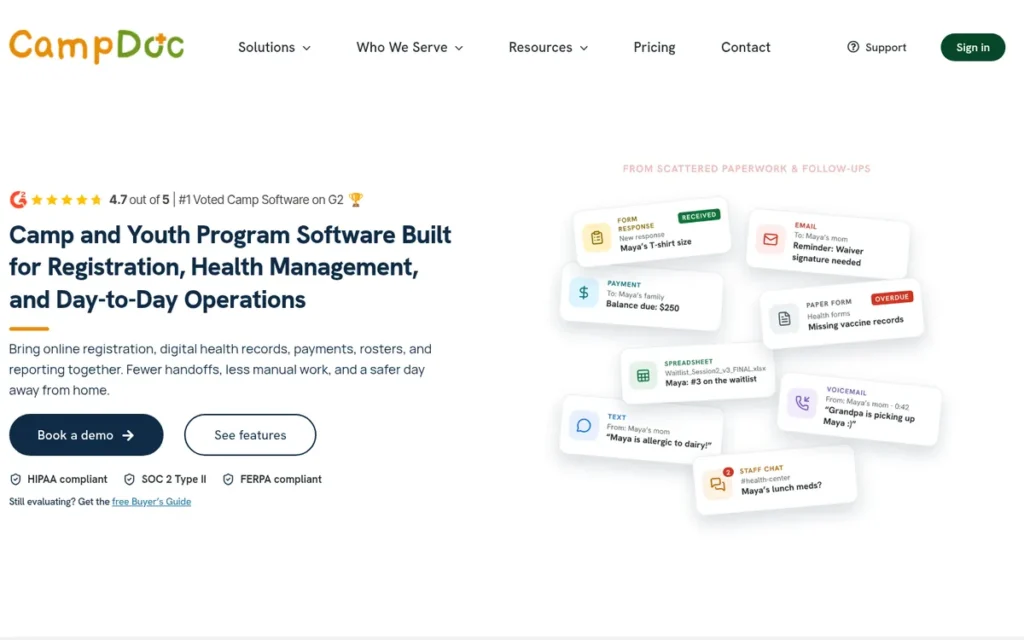
Category: Health-First Platform, camp-specific electronic health records and medication administration, with registration as an optional add-on.
At a Glance
- Category: Health-First Platform
- Best For: Nurse-heavy or medically complex camps, and parks and rec or university programs that need digital health forms and medication tracking
- Price Range: From $355/month (Verified; CampDoc pricing page, November 2026); registration module and per-camper rates not published
- Primary Strength: CampDoc offers the deepest health-record, medication-administration, and incident-reporting workflows of any platform in this ranking.
- Biggest Limitation: CampDoc does not publicly document bunking, transportation, or staff-scheduling tools, so overnight camps may need a second system.
- One-Line Summary: CampDoc is the highest-rated platform in this ranking, at 4.8/5 from 191 Capterra reviews, and the only health-first design among the seven, with a published $355/month starting price.
- Last Verified: November 2026
Overview
CampDoc is an electronic health record platform built for camps by DocNetwork. It covers health histories, immunizations, allergy alerts, medication administration, and incident logs. It is aimed at nurse-heavy overnight camps, day camps, and parks and recreation programs that put medical workflows first and registration second.
CampDoc offers an optional registration module, and many camps run CampDoc alongside a separate registration system. CampDoc says more than 1,250 camps and youth programs trust it (Vendor-Claimed; CampDoc, November 2026).
Key Features
- CampDoc stores health histories, physicals, immunizations, allergies, and medical alerts in a camp-specific electronic health record.
- CampDoc provides eMAR-style medication administration records plus illness, injury, incident, and behavior logs for the camp nurse.
- CampDoc tracks which families have completed their forms and lets staff email families whose forms are incomplete.
- CampDoc’s optional registration module adds deposits, payment plans, discounts, donations, add-ons, attendance, and camper check-in and check-out.
- CampDoc advertises integration and API options for syncing records. PlugRoute did not confirm specific native integrations with CampMinder or UltraCamp.
Best For
CampDoc is best for camps where the health center drives the software decision. Examples include medically complex camps, camps with a full-time nurse, and parks and rec or university youth programs moving off paper health forms.
Strengths
- CampDoc holds 4.8/5 from 191 Capterra reviews and 4.7/5 from about 158 G2 reviews, the strongest combined review record in this ranking (Verified; Capterra, G2, November 2026).
- CampDoc case studies report two results. UCLA Recreation cut its follow-up list from about 30 families to 5. Merrimack Parks & Recreation replaced paper for immunizations, physicals, incidents, and behavior records (Vendor-Claimed; CampDoc case studies, accessed November 2026).
- CampDoc is described as “designed by camp doctors, nurses and directors,” and one reviewer said CampDoc “saves me hours of time each day” (Verified; Capterra, November 2026).
- CampDoc states it is HIPAA and FERPA compliant and SOC 2 Type II certified, the most extensive compliance claim in this ranking (Vendor-Claimed; CampDoc, November 2026).
- CampDoc publishes a $355/month starting price that includes onboarding and support by phone, email, and chat. CampMinder, ACTIVE Camp & Class Manager, and CampBrain publish no prices.
Limitations
- CampDoc trades operational breadth for health depth. Its public materials do not document bunk assignment, transportation, or staff scheduling.
- CampDoc users at many overnight camps run it alongside another system, which means a second vendor and possible data-sync work.
- CampDoc reviewers report login and browser problems, and say parents with several children “had to log in twice” (Verified; Capterra, November 2026).
- CampDoc reviewers cite a steep learning curve at setup, confusing form creation, and reports and groups that are complicated to build (Verified; G2, November 2026).
- One CampDoc reviewer reported paying more than $3,000 for a single season, mainly to collect camper data, and another complained about changes to the pricing structure (Verified; Capterra, November 2026).
- CampDoc’s compliance claims are self-reported. Buyers should request the SOC 2 Type II report scope and, where relevant, a Business Associate Agreement.
Verdict
CampDoc is the best camp management software for health records and medication tracking in 2026, with the highest combined review ratings in this ranking and the only health-first design among the seven platforms evaluated.
CampDoc ranks #2 because it scored highest in the set on reviews (C1: 5.0) and health records (C3: 5.0). It scored lower on operational breadth (C2: 3.0) because it doesn’t document bunking, transportation, or staff tools.
CampDoc’s 4.15 total is close enough that health-first camps may reasonably prefer CampDoc to CampMinder. CampDoc buyers at overnight camps should confirm in a demo whether they need a second system for bunking and transportation, and should bring the camp nurse to that demo.
3. ACTIVE Camp & Class Manager (CampSite): Best for Day Camps Needing Automated Waitlists
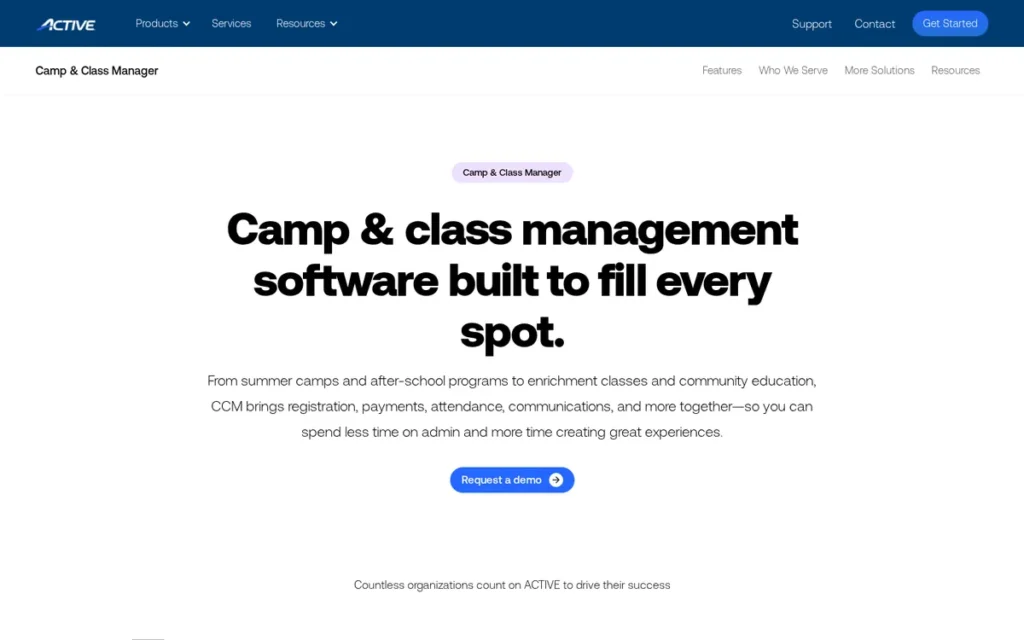
Category: All-in-One Camp Suite, runs registration, bunking, health, staff, transportation, and parent communication in one database.
At a Glance
- Category: All-in-One Camp Suite
- Best For: Day camps, recreation programs, and camps that also run classes and need automated waitlists and payment plans
- Price Range: Quote-based; about $1,000–$4,000/year (Third-Party Estimate; VendorPick, Rankite, November 2026), not confirmed by the vendor
- Primary Strength: ACTIVE Camp & Class Manager combines automated waitlists and payment plans with CampSite’s bunking, medical, and staff tools.
- Biggest Limitation: ACTIVE Camp & Class Manager’s pricing figures conflict and are unconfirmed, and its processing and parent-side fees are not published.
- One-Line Summary: ACTIVE Camp & Class Manager (formerly CampSite) is a broad camp and class platform from ACTIVE Network, strongest for camps that need automated waitlists and payment plans, but its full cost requires a detailed quote.
- Last Verified: November 2026
Overview
ACTIVE Camp & Class Manager (formerly CampSite) is a cloud camp registration and operations platform from ACTIVE Network, a Global Payments company. It serves day camps, overnight camps, and recreation programs that need automated waitlists, payment plans, bunking boards, medical records, and a parent portal in one system.
ACTIVE Camp & Class Manager reviews are split between ACTIVE and CampSite listings, so review counts differ by listing. ACTIVE Camp & Class Manager may also give camps exposure on the ACTIVE.com marketplace (Third-Party Estimate; Software Advice, November 2026).
Key Features
- ACTIVE Camp & Class Manager runs automated waitlists with timed acceptance windows, so open spots are offered and filled without manual follow-up.
- ACTIVE Camp & Class Manager supports reusable family profiles, payment plans, auto-billing, and discounts for complex registration rules.
- ACTIVE Camp & Class Manager includes CampSite-lineage bunk and cabin assignment boards, medical records, and staff management for overnight operations.
- ACTIVE Camp & Class Manager offers a parent dashboard, SMS and email campaigns, and photo and video blogging for family communication.
- ACTIVE Camp & Class Manager provides reporting, forecasting, and cashless camp store/POS tools.
Best For
ACTIVE Camp & Class Manager is best for day camps, recreation programs, and camps that also run classes, especially where waitlist automation and payment-plan logic are the main pain points.
Strengths
- ACTIVE Camp & Class Manager’s DCEF case study reports more than 9,000 student registrations handled by two staff members (Vendor-Claimed; ACTIVE Network product blog, accessed November 2026).
- ACTIVE Camp & Class Manager’s Go Girls! case study reports more than 180 participants served each year from 2021 to 2024 (Vendor-Claimed; ACTIVE Network case study, accessed November 2026).
- ACTIVE Camp & Class Manager holds 4.5/5 from 108 Software Advice reviews, and G2’s listing shows about 14 reviews at 4.5/5 (Verified; Software Advice, G2, November 2026).
- ACTIVE Camp & Class Manager belongs to ACTIVE Network, whose communities and sports divisions Global Payments acquired for about $1.2 billion in a deal completed in September 2017 (Verified; Global Payments press release, September 2017).
- ACTIVE Camp & Class Manager reviewers describe a customizable system backed by a full-time support and training team (Verified; GetApp, November 2026).
Limitations
- ACTIVE Camp & Class Manager trades pricing clarity for ecosystem scale. Pricing estimates conflict widely, and processing and parent-side fees are not published.
- ACTIVE Network is owned by Global Payments, a payments processor, so buyers should ask for processing and parent-side fee terms in writing along with the software quote.
- ACTIVE Camp & Class Manager reviewers say the broad feature set takes real configuration effort and that costs are unclear (Verified; GetApp, November 2026).
- ACTIVE Camp & Class Manager’s public materials list medical records but say less about medication workflows than CampDoc does, so confirm health-center depth in a demo.
- PlugRoute found no attributable verbatim customer quote for ACTIVE Camp & Class Manager, and could not verify its CampSite acquisition date, PCI attestation, or security certifications.
Verdict
ACTIVE Camp & Class Manager is the strongest choice in 2026 for day camps and recreation programs that need automated waitlists and payment plans. It combines CampSite-lineage bunking, medical, and staff tools with ACTIVE Network’s registration automation.
ACTIVE Camp & Class Manager ranks #3 with a 3.83 total. It scored 4.5 on operational breadth (C2) and 4.0 on reviews and documented results (C1, C5). It scored 3.5 on health depth (C3) and 2.5 on pricing transparency (C4).
ACTIVE Network’s DCEF case study reports 9,000+ registrations handled by two staff members (Vendor-Claimed). ACTIVE Camp & Class Manager buyers should get a written quote and a simulated parent checkout, and should ask every other finalist for the same.
4. CampBrain: Best for Established Multi-Program Camp Organizations Across the US and Canada
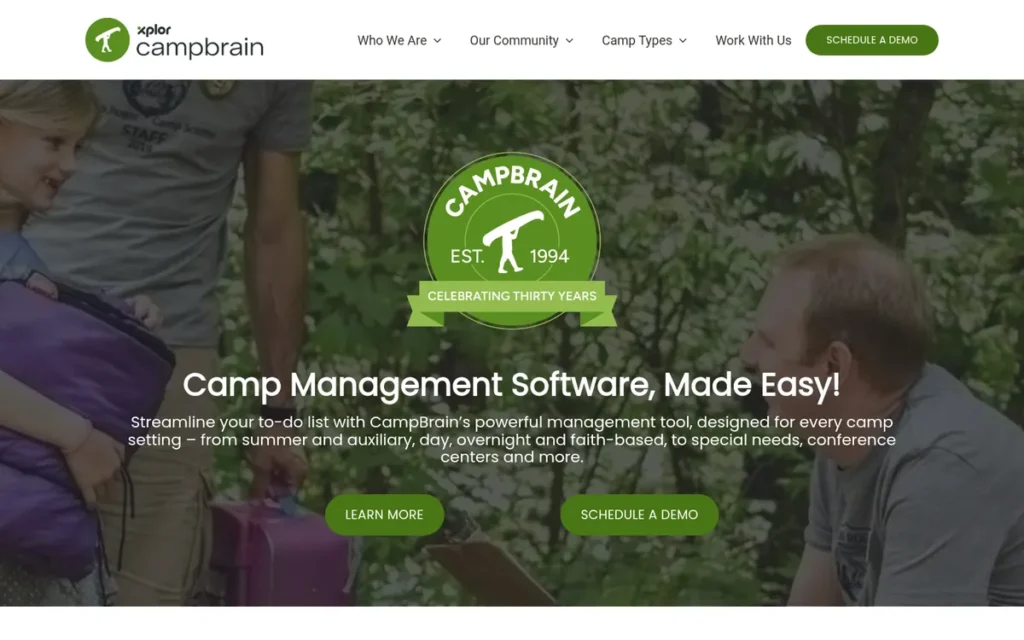
Category: All-in-One Camp Suite, runs registration, bunking, health, staff, transportation, and parent communication in one database.
At a Glance
- Category: All-in-One Camp Suite
- Best For: Established day and overnight camps, YMCAs, faith-based camps, and camps with conference centers in the US and Canada
- Price Range: Quote-only; about $1,500–$6,000/year (Third-Party Estimate; Stratilyze, November 2026), not confirmed by the vendor
- Primary Strength: CampBrain pairs step-by-step registration setup with accommodation booking and allergy-linked meal planning.
- Biggest Limitation: CampBrain has no dedicated mobile app, and reviewers say many reports run poorly on mobile and the system slows down at peak registration.
- One-Line Summary: CampBrain is a long-running platform used by about 1,700 camps and well suited to multi-program and conference-center organizations, though it has no mobile app and pricing is by quote only.
- Last Verified: November 2026
Overview
CampBrain is a Toronto-founded camp management platform, now owned by Vermont Systems. It handles registration, payments, staff hiring and onboarding, attendance, allergy and dietary tracking, and accommodation booking for day camps, overnight camps, YMCAs, faith-based camps, and conference centers across the US and Canada.
CampBrain was founded in 1994. Vermont Systems, a Clubessential Holdings company, acquired it in May 2023 (Verified; Xplor press release, May 2023). CampBrain buyers should ask how the roadmap and pricing have changed since the acquisition.
Key Features
- CampBrain guides administrators step by step through building registration seasons and forms, a feature reviewers specifically praise.
- CampBrain’s accommodation calendar tracks booking statuses, such as on hold or awaiting deposit, and allocates rooms or cabins by day, week, or month.
- CampBrain includes meal planning linked to allergy and dietary tracking.
- CampBrain covers staffing and hiring, fundraising, and camp store operations in the same platform.
- CampBrain’s attendance module tracks campers and students from tablets and phones.
Best For
CampBrain is best for established camp organizations that run several program types and want guided registration setup and strong vendor support. Examples include organizations running both day and overnight sessions, YMCA or faith-based programs, and camps with a conference center.
Strengths
- CampBrain served about 1,700 camps in the US and Canada at its 2023 acquisition (Verified; Xplor press release, May 2023), and it reports more than 1 million campers registered (Vendor-Claimed; G2 vendor profile, November 2026).
- CampBrain holds 4.7/5 from 45 Capterra reviews, and reviewers praise “excellent customer service” and custom reports built on request (Verified; Capterra, November 2026).
- CampBrain’s GetApp listings back up its Capterra rating at 4.6/5 from 32 reviews and 4.7/5 from 43 reviews (Verified; GetApp, November 2026).
- CampBrain reviewers call its registration builder a “great step-by-step system” for building seasons and forms (Verified; Capterra, November 2026).
- CampBrain reports about 50,000 conference-center bookings a year across 49 US states and all 10 Canadian provinces (Vendor-Claimed; G2 vendor profile, November 2026).
Limitations
- CampBrain trades modern mobile access for a mature desktop workflow. It has no dedicated mobile app, and many reports run poorly on mobile (Verified; Capterra, November 2026).
- CampBrain reviewers report slowdowns when many users log in at the start of the first session (Verified; Capterra, November 2026).
- CampBrain reviewers cite a steep learning curve for ad hoc reports, filters, and the auto-emailer, along with little report automation (Verified; Capterra, GetApp, November 2026).
- CampBrain reviewers describe household-account setup as cumbersome, say some parents struggle to upload documents, and in one case report no integration with the camp’s other systems (Verified; Capterra, November 2026).
- CampBrain’s G2 score of 3.8/5 comes from only 8 reviews. CampBrain itself has not confirmed third-party claims of Canadian data residency and PCI DSS compliance (Third-Party Estimate; SaaSKart, November 2026).
- CampBrain has no named customer case study with before-and-after metrics in its public materials (November 2026).
Verdict
CampBrain is a well-established choice in 2026 for multi-program camp organizations. It was used by about 1,700 camps at its 2023 acquisition and offers guided registration setup and conference-center booking tools.
CampBrain ranks #4 with a 3.55 total. Its operational breadth score (C2: 4.5) is among the highest in the set. Quote-only pricing (C4: 2.0) and reviewer reports of no mobile app and peak-load slowdowns (C6: 3.0) pulled it below ACTIVE Camp & Class Manager.
CampBrain buyers should test mobile use and peak-load performance in a demo, ideally by simulating opening-day traffic. They should also confirm how deep the health-center tools go beyond allergy and dietary tracking.
5. UltraCamp: Best for Custom Registration Rules with Published Pricing
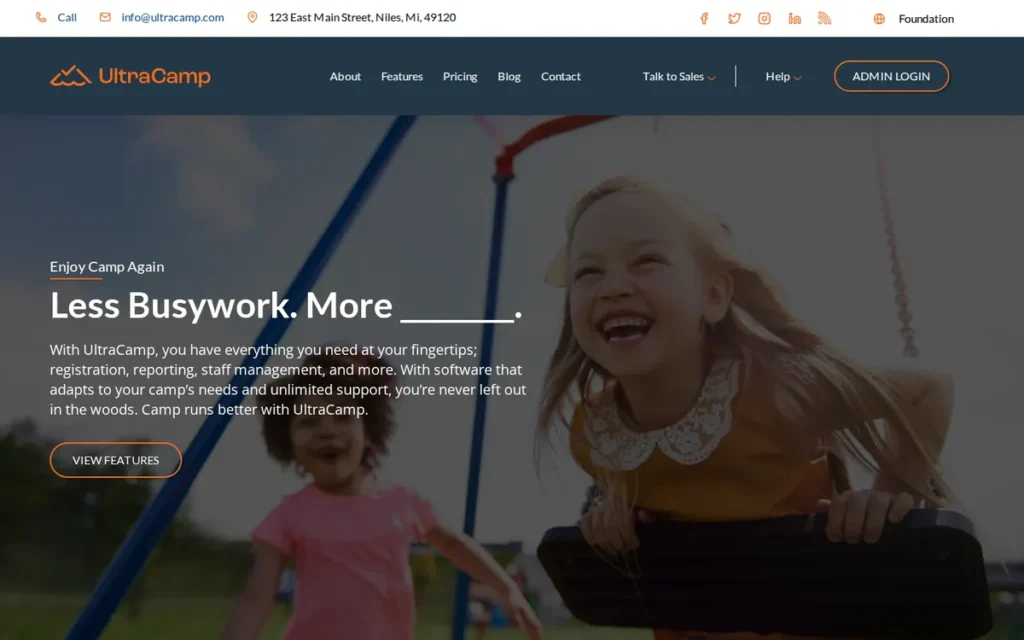
Category: Configurable Registration Platform, built around flexible registration, form, and payment-plan logic, with operations modules layered on.
At a Glance
- Category: Configurable Registration Platform
- Best For: Camps with unusual registration, waiver, or payment-plan rules that want published pricing, including faith-based and YMCA camps
- Price Range: Tiers reported at $275–$975/month plus per-person overage (Third-Party Estimate; StatWharf, Business-Software.com, November 2026); confirm the current schedule
- Primary Strength: UltraCamp offers the most configurable registration and payment-plan logic in this ranking, and it publishes its fee percentages.
- Biggest Limitation: UltraCamp’s flexibility comes with a steep learning curve, a dated admin interface, and session setup that takes too many steps.
- One-Line Summary: UltraCamp is the most customizable camp registration platform with published fees in this ranking, best for camps with complex rules that can invest time in setup.
- Last Verified: November 2026
Overview
UltraCamp is a registration-first camp management platform with conditional questions, custom forms, waivers, payment plans, health and medication records, and donor tools. It is built for camps with unusual registration rules that want published pricing instead of a quote-only sales process.
UltraCamp reviewers describe the system as “limitless” once learned, and several warn that learning UltraCamp takes real time (Verified; Capterra, G2, November 2026).
Key Features
- UltraCamp supports conditional registration questions and custom forms for online camp registration rules that don’t fit standard templates.
- UltraCamp handles waivers and e-signatures, plus payment plans with deposit and non-refundable-fee rules.
- UltraCamp stores health and medication records within family accounts.
- UltraCamp includes donor management, POS, an online store, and photo-gallery sales.
- UltraCamp provides reporting tools, though reviewers say custom reports are hard to build.
Best For
UltraCamp is best for camps whose registration rules don’t fit standard templates, such as complex deposit and refund policies. It suits camps that want to see pricing before talking to sales.
Strengths
- UltraCamp publishes its revenue-share percentages, at 3% of online store sales, 30% of photo-gallery sales, and 0% of donations (Verified; UltraCamp pricing page, November 2026). Together with its publicly reported tiers, that makes it the most cost-transparent full camp platform ranked.
- UltraCamp holds 4.7/5 from 23 Capterra/Software Advice reviews, and one reviewer cites “phenomenal customer service” over three years (Verified; Capterra, November 2026).
- G2 and Capterra reviewers consistently describe UltraCamp as the most customizable option for unusual registration rules (Verified; G2, Capterra, November 2026).
- UltraCamp-hosted documents name customers including Big Lake Youth Camp, LifeSeeds Summer Camp, and a YMCA of Houston camp. These references come from 2017 documents and may not reflect current customers (Vendor-Claimed; UltraCamp documents, 2017).
Limitations
- UltraCamp trades simplicity for configurability. It is the clearest example in this ranking of a flexible system that needs significant setup.
- UltraCamp reviewers describe a clunky or dated admin interface, session setup with too many steps and options, and custom reports that are hard to build (Verified; G2, Third-Party Estimate; GeeksFramework, November 2026).
- UltraCamp’s 23 reviews are a small sample, and PlugRoute found no quantified case studies.
- UltraCamp’s public materials did not confirm bunk and cabin assignment capability as of November 2026.
- UltraCamp’s 30% cut of photo-gallery sales can add up for photo-heavy camps. Pricing sources also conflict, likely because some cite old price sheets and others cite new ones.
Verdict
UltraCamp is the best camp management software in 2026 for camps with complex registration rules that want published pricing, offering the most configurable forms and payment plans in this ranking.
UltraCamp ranks #5 with a 3.45 total. It scored 4.5 on pricing transparency (C4), the highest of any full camp platform. It scored 2.0 on documented results (C5) because PlugRoute found no quantified case studies, and 3.5 on reviews (C1) because the sample is only 23 reviews.
UltraCamp buyers should plan for a real setup and training period before registration opens. They should also test their hardest registration scenario and their bunk-assignment needs in a demo.
6. Jumbula: Best for Small Day Camps and Multi-Program Providers on a Budget
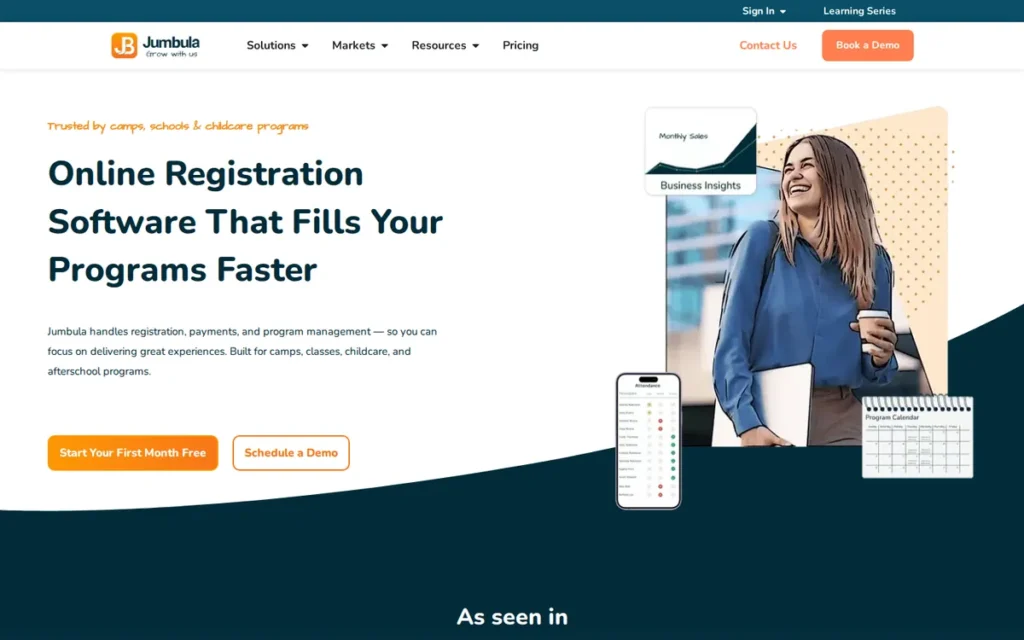
Category: Multi-Program Registration Tool, registration, billing, and attendance for day camps, classes, and after-school programs on low-cost monthly plans.
At a Glance
- Category: Multi-Program Registration Tool
- Best For: Small or seasonal day camps (under about 500 children) and providers running camps alongside classes, after-school programs, or childcare
- Price Range: $15–$285/month published (Verified; Jumbula pricing page, November 2026); Enterprise on request; processing fees extra
- Primary Strength: Jumbula publishes the lowest entry price and the most complete price list of any platform in this ranking.
- Biggest Limitation: Jumbula has no documented bunking, cabin assignment, or deep medication tracking, so it is not designed for overnight camps.
- One-Line Summary: Jumbula is the best-value camp registration software in this ranking for small day camps and multi-program providers, with published plans from $15/month and 4.5/5 from 127 Capterra reviews.
- Last Verified: November 2026
Overview
Jumbula is a registration and payments platform for day camps, classes, after-school programs, and childcare providers. It offers custom forms, automated billing, and attendance and dismissal apps, with monthly plans starting at $15 per month for small or seasonal operators.
Jumbula is not designed for overnight operations, which reflects its scope rather than its quality. Jumbula was founded in 2013 (Verified; Jumbula About page, November 2026).
Key Features
- Jumbula provides custom registration forms and waivers that are stored in each child’s record.
- Jumbula automates billing, including recurring charges and late-pickup fees.
- Jumbula’s “Jumbula for Business” app handles attendance, dismissal, camper check-in and check-out, and incident reports from staff devices.
- Jumbula’s “My Jumbula” parent app lets families message staff and manage their accounts from a phone.
- Jumbula offers email and text campaigns and WebConnect, which embeds registration in a camp’s website, on its higher tiers.
Best For
Jumbula is best for small or seasonal day camps, after-school providers, enrichment programs, and childcare operators. It fits operators that need affordable registration, billing, and attendance and don’t need overnight features.
Strengths
- Jumbula publishes a full tier list from $15 to $285/month, the most complete public pricing in this ranking (Verified; Jumbula pricing page, November 2026).
- Jumbula holds 4.5/5 from 127 Capterra reviews and rates highly for likelihood to recommend (Verified; Capterra, November 2026).
- Jumbula reviewers on G2 praise responsive support and say setting up classes is “a breeze” (Verified; G2, November 2026).
- Jumbula offers a free first month on its Pay-As-You-Go plan, and its plans can be canceled anytime (Verified; Capterra, Jumbula, November 2026).
- Jumbula lists PCI DSS, SOC 2, and HIPAA compliance on its pricing page, with unverified audit scope (Vendor-Claimed; Jumbula, November 2026).
Limitations
- Jumbula trades overnight depth for low cost. No public evidence shows bunking, cabin assignment, transportation, or deep medication tracking, so overnight and medically complex camps will likely outgrow it.
- Jumbula reviewers on G2 report cumbersome setup, a learning curve, and somewhat limited customization (Verified; G2, November 2026).
- Jumbula reviewers also say there are too few FAQs, which leaves users waiting on support (Verified; G2, November 2026).
- Jumbula’s only published customer example is an unnamed performing-arts provider that moved about 200 pre-K to 8th-grade students off spreadsheets. It has no named camp case studies (Vendor-Claimed; Jumbula, accessed November 2026).
- Jumbula’s compliance claims are self-reported. Buyers should request the SOC 2 report scope and PCI attestation.
Verdict
Jumbula is the best-value camp management software for small day camps and multi-program providers in 2026, combining the lowest published entry price among the seven ranked platforms with a 4.5/5 rating from 127 Capterra reviews.
Jumbula ranks #6 with a 3.08 total, 0.10 points ahead of CircuiTree. It scored a perfect 5.0 on pricing transparency (C4) and 4.0 on reviews (C1). It scored 2.5 on operational breadth (C2) and 2.0 on health records (C3) because it isn’t built for overnight camps.
Jumbula buyers should start with the free first month and model processing fees on a full season of enrollments before committing.
7. CircuiTree: Best for Camps That Also Run Retreat or Conference Centers

Category: Camp + Retreat Center Suite, combines camper registration with guest-group calendars, lodging inventory, and conference bookings.
At a Glance
- Category: Camp + Retreat Center Suite
- Best For: Camps that also operate retreat, guest-group, or conference centers, including large faith-based ministry camps
- Price Range: Quote-only after a demo; modular pricing (Verified; CircuiTree, November 2026)
- Primary Strength: CircuiTree combines camper registration, guest-group calendars, and automatic cabin assignment in one database.
- Biggest Limitation: CircuiTree has the lowest verified rating in this ranking (3.9/5 from 16 Capterra reviews, November 2026), and reviewers report a confusing back end and slow bug fixes.
- One-Line Summary: CircuiTree is a modular camp and retreat-center platform for organizations that run both youth camps and guest-group lodging, though pricing is quote-only and its 3.9/5 Capterra rating is the lowest in this ranking.
- Last Verified: November 2026
Overview
CircuiTree is a modular camp and retreat management platform for camps that also operate retreat or conference centers. In one database, it runs camper registration, guest-group calendars, lodging with automatic cabin assignment, a health center, staff, transportation, donors, and a camp store.
CircuiTree describes itself as “born at a real camp,” with more than 25 years of development. Capterra says one of the largest camps in the country created it (Vendor-Claimed; CircuiTree, Capterra, November 2026).
Key Features
- CircuiTree manages lodging inventory with automatic cabin assignment.
- CircuiTree runs retreat and guest-group calendars in the same database as camper registration.
- CircuiTree includes a health center, staff and HR with staff onboarding, transportation, and donor management.
- CircuiTree offers a cashless camp store with inventory and POS, plus “hundreds of reports.”
- CircuiTree connects to Bunk1 for parent engagement, including news, texts, bunk notes, check-in, and store accounts.
Best For
CircuiTree is best for camp organizations that also run retreats, guest groups, or conference centers. Large faith-based ministry camps with an operations lead who can manage a complex back end are a particularly good fit.
Strengths
- CircuiTree is the only ranked platform whose features page documents both guest-group calendars and automatic cabin assignment (Verified; CircuiTree features page, November 2026).
- CircuiTree reviewers praise having “HR, Registration, Transportation, Donors and Camp Store all in one place” and “everything you need out of the box” (Verified; Capterra, November 2026).
- CircuiTree testimonials come from John Hughes, former CFO of Hume Lake Christian Camp; Jonathon Bradford, IT manager at T Bar M Camps; and Suzanne Herman, controller at Camp Woodward (Vendor-Claimed, qualitative only; CircuiTree, November 2026).
- CircuiTree reviewers describe support as “personal and friendly” (Verified; Capterra, November 2026).
Limitations
- CircuiTree trades ease of use for depth. Reviewers describe a tricky, confusing back end that is “not easy to use” (Verified; Capterra, G2, November 2026).
- CircuiTree reviewers report an outdated mass-email tool and difficult activity scheduling (Verified; Capterra, G2, November 2026).
- CircuiTree reviewers say support calls go to voicemail or tickets, and that bugs can take months to fix because the development team is small (Verified; Capterra, G2, November 2026).
- CircuiTree’s public registration site has limited customization, which can force camps to duplicate content on their own website (Verified; GetApp, November 2026).
- CircuiTree’s 3.9/5 Capterra rating from 16 reviews is the lowest verified rating in this ranking (November 2026). PlugRoute could not verify its founding date, ownership, or PCI status.
Verdict
CircuiTree is the most specialized camp management platform in 2026 for organizations that run both youth camps and retreat or conference centers, combining guest-group lodging and camper registration in one database.
CircuiTree ranks #7 with a 2.98 total. Its 3.9/5 Capterra rating from 16 reviews (C1: 2.0) and quote-only pricing (C4: 1.5) offset an operational breadth score tied for second-highest in the set (C2: 4.5).
CircuiTree buyers should ask for reference calls with similar camps, and should test back-end usability and support response times before signing.
How Much Does Camp Management Software Cost in 2026?
Published camp management software prices run from $15 per month (Jumbula’s entry tier) to about $975 per month (UltraCamp’s top reported tier). CampMinder, ACTIVE Camp & Class Manager (formerly CampSite), CampBrain, and CircuiTree quote custom prices instead. Payment processing fees can exceed the software subscription, so compare full-season totals.
Camp management vendors use four main pricing models:
- Per-camper pricing: CampMinder prices by enrolled campers, with estimates of $9–$31 per camper (Third-Party Estimate; Rankite, Stratilyze, November 2026). At those rates, a 400-camper overnight camp would pay about $3,600–$12,400 a season.
- Tiered pricing with overage: UltraCamp’s reported tiers include a set number of people and charge $2–$6 for each extra person. A camp serving 800 people would pay about $5,100 a year on Basic ($3,300 plus 300 × $6) versus $5,700 on Advanced. Basic stays cheaper up to about 900 people.
- Monthly plans: Jumbula ($15–$285/month) and CampDoc (from $355/month) publish monthly pricing (Verified; Jumbula, CampDoc, November 2026).
- Quote-only pricing: CampMinder, ACTIVE Camp & Class Manager, CampBrain, and CircuiTree require a sales conversation.
Pricing transparency varies widely across the seven ranked platforms:
| Transparency Rank | Platform | What Is Published (November 2026) | Evidence Label |
|---|---|---|---|
| 1 | Jumbula | Full tier list with dollar amounts ($15–$285/month) | Verified |
| 2 | UltraCamp | Official revenue-share percentages; reported tiers (sources conflict) | Verified (fees) / Third-Party Estimate (tiers) |
| 3 | CampDoc | Starting price only ($355/month); Capterra listing shows $250/month | Verified |
| 4 | ACTIVE Camp & Class Manager | Quote-based; conflicting third-party estimates | Third-Party Estimate |
| 5 | CampMinder | Quote-only; per-camper estimates | Third-Party Estimate |
| 5 | CampBrain | Quote-only; one annual estimate | Third-Party Estimate |
| 5 | CircuiTree | Quote-only after demo; no estimate found | Not verified |
Here is what PlugRoute found about each vendor’s pricing:
- CampMinder: CampMinder quotes per enrolled camper across two suites. PlugRoute could not verify implementation fees, processing rates, or the cost of the Campanion app and API add-ons.
- CampDoc: CampDoc’s official page lists “starting at $355/month,” with onboarding included (Verified; CampDoc, November 2026). An older vendor page said $340 and Capterra still shows $250, so get the price in a written quote.
- ACTIVE Camp & Class Manager: Estimates for ACTIVE Camp & Class Manager conflict. They include about $1,000–$4,000/year, about $249/month, about $1,200–$3,500/year, and a minimum of roughly $1,200 a year (Third-Party Estimate; VendorPick, Rankite, November 2026).
- CampBrain: CampBrain deployments are estimated at about $1,500–$6,000/year (Third-Party Estimate; Stratilyze, November 2026). Ask how pricing has changed since the May 2023 acquisition.
- UltraCamp: UltraCamp tiers are reported at $275, $475, and $975/month, covering about 500, 1,250, or 3,500 people and subject to a minimum fee (Third-Party Estimate; StatWharf, Business-Software.com, November 2026). Another source cites about $4 per camper (Third-Party Estimate; Rankite, November 2026).
- Jumbula: Jumbula’s published tiers are below (Verified; Jumbula, November 2026). Processing fees cost extra at rates PlugRoute could not verify.
- Pay-As-You-Go: $15/month, includes 10 enrollments.
- Rise: $150/month, unlimited enrollments.
- Ascend: $285/month.
- Enterprise: priced on request.
- CircuiTree: CircuiTree quotes modular pricing after a demo. The “$49/month” figure on Software Advice belongs to a different product, and one Capterra reviewer called CircuiTree “extremely expensive compared to other competitors” (Verified; Software Advice, Capterra, November 2026).
These hidden costs often decide the real price:
- Processing fees: A day camp at the 2018 American Camp Association median revenue of about $387,000 would pay about $12,400 a year at a 3.2% processing rate. That is more than three times Jumbula’s top published plan ($3,420 a year). An overnight camp at the $1 million median would pay about $32,000 (Verified; ACA Business of Camp, 2018).
- Parent-paid convenience fees: Some alternatives, such as Sawyer, offer a $0 platform-fee option where parents pay booking fees instead (Third-Party Estimate; VendorPick, November 2026).
- Revenue-share fees: UltraCamp takes 3% of online store sales and 30% of photo-gallery sales (Verified; UltraCamp, November 2026).
- Implementation and data-migration fees: No ranked vendor publishes setup or migration fees, so ask for them in every quote.
- Unpublished processing rates: No vendor in this ranking clearly publishes its processing rates (November 2026).
The global camp management software market is estimated at about $150.1 million in 2026 (Third-Party Estimate; Grand View Research, accessed November 2026). The market is fragmented. U.S. overnight camps averaged 71.2% occupancy in 2022, and 48% of camps reported revenue of $100,000–$499,000 (Verified; ACA CampCounts, 2022).
Model three years of total cost of ownership, including processing, before signing. PlugRoute’s camp software pricing guide covers this modeling in more detail.
Does Camp Management Software Need to Be HIPAA Compliant?
HIPAA does not automatically apply to camps. It applies when a camp is a covered health-care entity or works with one. For most camps, ACA accreditation standards and state camp licensing set the actual requirements for health histories, medication administration, and record keeping. Confirm with counsel which rules apply to your camp. This section is general guidance, not legal advice.
A health question on a registration form tells you a camper takes medication. An eMAR proves who gave which dose, and when.
Buyers comparing health features should check three things:
- A health form field is not an eMAR. A medical question on a registration form does not log each dose, its time, and the staff member who gave it the way a medication administration record does. Ask the camp nurse to test this.
- Allergy alerts and incident logs matter. Confirm that allergy alerts, illness reports, injury reports, and incident reports are stored with the camper record.
- Form-completion tracking reduces follow-up. CampDoc’s UCLA Recreation case study reports that the follow-up list fell from about 30 families to 5 (Vendor-Claimed; CampDoc case study, accessed November 2026).
As of November 2026, PlugRoute had not independently confirmed any security certification for the seven ranked vendors:
| Platform | Security or Compliance Claim | Status |
|---|---|---|
| CampMinder | No SOC 2 or PCI documentation found publicly | Not verified |
| CampDoc | HIPAA, FERPA, SOC 2 Type II (claimed) | Vendor-Claimed |
| ACTIVE Camp & Class Manager | No PCI attestation found publicly | Not verified |
| CampBrain | PCI DSS and Canadian data residency (third-party listing) | Not confirmed by vendor |
| UltraCamp | PCI level not found | Not verified |
| Jumbula | PCI DSS, SOC 2, HIPAA (claimed) | Vendor-Claimed |
| CircuiTree | PCI status not found | Not verified |
Request these documents before signing:
- The vendor’s SOC 2 Type II report, including its scope and date.
- The vendor’s PCI DSS attestation of compliance.
- A Business Associate Agreement (BAA), if your camp works with a HIPAA-covered entity.
PlugRoute’s camp health-records compliance guide explains these documents in more detail.
Which Other Camp Management Platforms Did PlugRoute Consider?
PlugRoute also reviewed five other camp platforms:
- Sawyer
- Regpack
- Campwise
- iCampPro
- Amilia SmartRec
None of them was fully ranked because camp-specific review evidence was too limited as of November 2026. Any of the five may be fully ranked in a future refresh if more evidence becomes available.
| Product | Known Pricing (November 2026) | Why Not Fully Ranked |
|---|---|---|
| Sawyer | About $71–$399/month, or a $0 platform-fee option where parents pay booking fees (Third-Party Estimate; VendorPick, November 2026) | Limited camp-specific review volume |
| Regpack | About $99–$125/month; processing reportedly as low as 1.5% (Third-Party Estimate; Business-Software.com, November 2026) | Limited camp-specific review volume |
| Campwise | Custom pricing | No review-platform data found |
| iCampPro | About $199/month according to AI answer engines; not independently verified | Limited review evidence |
| Amilia SmartRec | Not verified | Fits recreation programs; limited camp-specific review evidence. An AI answer engine cited a February 2026 CampDoc integration announcement, which PlugRoute did not independently verify |
What Red Flags Should I Watch For When Evaluating Camp Management Software?
The three biggest red flags in camp management software are hidden fees, weak health records, and security claims with no documents behind them. Other warning signs are configuration that takes weeks, data export locked to higher tiers, and no clear plan for peak-season support. Each red flag below is numbered so you can check it during demos.
Red Flag #1: Quote-Only Pricing With No Written Processing Rates Quote-only pricing without written processing rates hides what is often the largest cost in a camp’s software budget. No vendor in this ranking clearly publishes its processing rates (November 2026). Ask every finalist for all fees in writing. The cost section above shows how processing alone can exceed a subscription.
Red Flag #2: A Health Field Marketed as a Health Record A health question on a registration form is not a health record or an electronic medication administration record (eMAR). A real eMAR logs each dose, the time it was given, and the staff member who gave it. Ask every vendor to demonstrate dose-by-dose medication logging, allergy alerts, and incident reports live, with your camp nurse in the demo.
Red Flag #3: Self-Claimed Security Certifications Without Documents A self-claimed security certification is not proof of compliance until a buyer sees the underlying report. In this ranking, CampDoc and Jumbula both state SOC 2 and HIPAA compliance on their own websites, and PlugRoute had not independently verified either claim as of November 2026. Ask each finalist for the actual SOC 2 report.
Red Flag #4: Flexibility That Requires Weeks of Configuration Flexibility that requires weeks of configuration can push back the date registration opens. PlugRoute reviewed Capterra and G2 feedback in November 2026 and found a learning curve or setup burden among the recurring criticisms for all seven ranked platforms. It was most pronounced for the most configurable systems, such as UltraCamp and CircuiTree.
Red Flag #5: API or Data Export Limited to Higher Tiers API or data-export access limited to higher pricing tiers can lock a camp into one vendor when it later wants to switch. CampMinder’s API is reportedly limited to its Professional tier (Third-Party Estimate; Rankite, PulseRevOps, November 2026), so confirm export rights in writing with every finalist before signing.
Red Flag #6: Revenue-Share Fees on Store and Photo Sales Revenue-share fees on store and photo sales grow as a camp’s sales grow, so they are easy to underestimate at signing. UltraCamp takes 30% of photo-gallery sales and 3% of online store sales (Verified; UltraCamp pricing page, November 2026). That can add up for photo-heavy camps, so ask every vendor about revenue shares.
Red Flag #7: No Answer on Peak-Season Support and Performance A vendor with no clear answer on peak-season support and performance is a risk during opening week, when registration and check-in traffic spikes. CampBrain reviewers report slowdowns at the first session, and CircuiTree reviewers report support calls going to voicemail (Verified; Capterra, November 2026). Ask each vendor what its support response times are in July.
Users on r/summercamp shared their experience:
“For both, I do it the day registration opens; the prices tend to mean the spaces go fast. The regular summer camp usually takes a couple weeks to sell out, but the backpacking camp sells out within 5 minutes of registration opening – my kid got waitlisted last summer because my laptop froze 1 minute before registration opened.” Posted by u/Shadow_Shrugged
Takeaway: Popular camp sessions can sell out within minutes of registration opening, so any camp registration system has to hold up under opening-day traffic and handle waitlists fairly.
What Questions Should I Ask Before Choosing Camp Management Software?
Before choosing camp management software, get a written full-season cost from each vendor and watch a live demo of your own real scenarios. Then ask about security documents, data-export terms, onboarding timelines, ownership changes, and references. These seven questions show how a platform handles daily work better than a feature list does.
Question #1: What will a full season cost, including processing and parent-paid fees, in writing? A written full-season quote should list every cost the camp will pay:
- Software fees.
- Payment-processing rates.
- Parent-paid convenience fees.
- Revenue shares.
- Setup or migration fees.
Ask each vendor for a simulated checkout that shows the parent’s final total, so every quote can be compared on the same basis.
Question #2: Can you run our real scenario live? A live scenario demo shows how a camp management platform handles real daily work better than any feature list. Ask each vendor to run the same six scenarios from your own camp, using your forms and rules, so finalists are compared on identical tasks:
- Ask the vendor to process a camper’s bunkmate request live.
- Ask the vendor to flag an incomplete medical form and email the family.
- Ask the vendor to build a medication schedule and log a single dose.
- Ask the vendor to set up a payment plan with a deposit and a non-refundable fee.
- Ask the vendor to make a last-minute cabin change and show what updates automatically.
- Ask the vendor to log in as a parent with several children and complete forms for each child.
Score each finalist from 1 to 5 on these six scenarios. Have your camp nurse and registrar score the health and payment-plan scenarios.
Question #3: Can you share your SOC 2 report scope, PCI attestation, and a BAA if needed? Security documents separate verified compliance from marketing claims. PlugRoute had not independently verified any of the seven ranked vendors’ certifications as of November 2026. A vendor that cannot share its reports has given a camp no evidence that its security claims are true. Request these documents from every finalist:
- The SOC 2 Type II report, with its date and scope.
- The PCI DSS attestation of compliance.
- A signed Business Associate Agreement, if your camp works with a HIPAA-covered entity.
Question #4: How do we export all our data if we leave, and which tier includes API access? Clear data-export terms protect a camp from vendor lock-in if it switches systems. Ask each vendor:
- Which pricing tier includes API access.
- What file formats a full export uses.
- Whether the export includes health records and payment history.
Get the answers in writing before signing, because CampMinder’s API is reportedly tier-limited (Third-Party Estimate; Rankite, PulseRevOps, November 2026).
Question #5: What does onboarding include, and how long until registration can open? A good onboarding answer names a contact person and describes the training sessions, the data migration, and a realistic go-live date for a camp of your size. CampDoc’s published plan includes dedicated onboarding and training (Verified; CampDoc pricing page, November 2026). Ask every vendor for its typical go-live time, and work backward from your registration opening date.
Question #6: Has ownership changed recently, and how has that affected pricing and the roadmap? Ownership changes can shift a platform’s pricing, product roadmap, and support model. Vermont Systems, a Clubessential Holdings company, acquired CampBrain in May 2023 (Verified; Xplor press release, May 2023). Global Payments completed its acquisition of ACTIVE Network in September 2017 (Verified; Global Payments press release, September 2017). PlugRoute could not verify ownership for the other five ranked vendors, so ask each one directly.
Question #7: Can we speak with directors of two camps like ours? Reference calls with directors of two camps like yours fill a real evidence gap in this category. PlugRoute’s seven Reddit searches found no relevant discussion of these vendors (November 2026), so talking with peers is among the best ways to get real-world feedback. Ask each reference director these three questions:
- What broke during your first opening week?
- How long did support take to respond in July?
- What would you configure differently?
How Did We Rank These Camp Management Software Platforms?
PlugRoute scored each camp management platform from 1 to 5 on six weighted criteria, using only dated, sourced evidence. Every claim is labeled Verified, Vendor-Claimed, or Third-Party Estimate. The overall order is a weighted evidence score and a research snapshot as of November 2026. PlugRoute refreshes it quarterly and before each registration season.
The six ranking criteria and their weights are:
- C1, Verified Review Ratings and Review Volume (25%): Ratings from many verified reviewers are the best independent signal of how a platform performs during a real season.
- C2, Operational Breadth in One Database (25%): One connected system cuts re-entry and errors across bunking, staff, transportation, and check-in.
- C3, Health Records, Medication Administration, and Compliance Posture (20%): Health records are a camp’s biggest liability, so the depth of health tools and the documentation behind security claims both matter.
- C4, Pricing Transparency and Value Predictability (10%): Published pricing lets directors compare the cost of a full season.
- C5, Documented Results and Named Customers (10%): Named camps and measurable outcomes show how software performs in daily work.
- C6, Usability, Setup Burden, and Support Quality (10%): Onboarding effort and peak-season support affect whether registration opens on time.
| Rank | Platform | C1 | C2 | C3 | C4 | C5 | C6 | Weighted Total |
|---|---|---|---|---|---|---|---|---|
| 1 | CampMinder | 4.5 | 5.0 | 4.5 | 2.5 | 4.5 | 3.5 | 4.33 |
| 2 | CampDoc | 5.0 | 3.0 | 5.0 | 3.5 | 4.5 | 3.5 | 4.15 |
| 3 | ACTIVE Camp & Class Manager | 4.0 | 4.5 | 3.5 | 2.5 | 4.0 | 3.5 | 3.83 |
| 4 | CampBrain | 3.5 | 4.5 | 3.5 | 2.0 | 3.5 | 3.0 | 3.55 |
| 5 | UltraCamp | 3.5 | 3.5 | 3.5 | 4.5 | 2.0 | 3.5 | 3.45 |
| 6 | Jumbula | 4.0 | 2.5 | 2.0 | 5.0 | 2.0 | 3.5 | 3.08 |
| 7 | CircuiTree | 2.0 | 4.5 | 3.5 | 1.5 | 2.5 | 2.5 | 2.98 |
The gap between #1 and #2 is 0.18 points, and the gap between #6 and #7 is 0.10. Both are small enough that a camp’s own priorities should outweigh rank order. At a C1 score of 2.5, CircuiTree would total 3.10 and pass Jumbula. PlugRoute applied 2.0 under its rule that discounts ratings based on fewer than 20 reviews.
PlugRoute applied the same evidence rules to every vendor:
- Verified: A review-platform figure or quote, a published vendor price page, or a press release, checked in November 2026.
- Vendor-Claimed: A statement from vendor marketing or case studies that PlugRoute did not independently confirm.
- Third-Party Estimate: A figure or assessment from a comparison site that the vendor has not confirmed.
- Small-sample discount: Ratings from fewer than 20 reviews are discounted, which affects CircuiTree (16 reviews) and CampBrain’s G2 score (8 reviews).
- Missing evidence: Missing evidence was scored as missing, not as a negative finding. Unverified security certifications were treated the same way for all seven vendors.
- Conflicting figures: Where sources disagree, the article shows the figures as sourced ranges.
No vendor in this ranking had its security certifications independently verified. Every vendor is held to the same rule: a certification counts only when the buyer sees the report.
PlugRoute selected products as follows:
- PlugRoute ranked the seven products with the most review-platform evidence.
- Campwise was excluded because PlugRoute found no review data for it.
- Sawyer and Regpack were excluded because their camp-specific review volume was low.
- Seven Reddit searches found no relevant vendor threads, so the rankings rely on review-platform quotes.
PlugRoute has no affiliate relationships with any company listed, and rankings are determined entirely by research data and objective evaluation criteria.
What Are the Most Common Questions About Camp Management Software?
Camp directors most often ask three things:
- Which platform fits overnight camps (CampMinder), small day camps (Jumbula), and health-heavy camps (CampDoc).
- How the leading all-in-one suites compare.
- How PlugRoute’s rankings are determined.
The short answers below are meant to help you build a demo shortlist.
Which camp management software is best for overnight, small day, and health-heavy camps?
CampMinder fits medium-to-large overnight camps best and holds 4.7/5 from 256 Capterra reviews. Jumbula fits small day camps, with published plans from $15/month. CampDoc fits health-heavy camps and holds 4.8/5 from 191 Capterra reviews (Verified; Capterra, Jumbula, November 2026). Demo at least two platforms before choosing.
What is the difference between CampMinder and ACTIVE Camp & Class Manager?
CampMinder is better documented for medium-to-large overnight camps. ACTIVE Camp & Class Manager (formerly CampSite) is stronger for day camps that need automated waitlists and payment plans. CampMinder has the larger review base, at 256 Capterra reviews (Verified; Capterra, November 2026). Neither vendor publishes pricing, so request written full-season quotes from both.
How does PlugRoute determine rankings?
PlugRoute scores each platform from 1 to 5 on six weighted criteria, labels every claim by evidence type, and refreshes the rankings quarterly. The weights are:
- Review ratings and volume: 25%.
- Operational breadth: 25%.
- Health records and compliance: 20%.
- Pricing transparency: 10%.
- Documented results: 10%.
- Usability and support: 10%.
What Do Key Camp Management Software Terms Mean?
The camp management software terms that matter most to buyers are eMAR, EHR, per-camper pricing, overage fee, processing fee, revenue share, SOC 2 report, PCI DSS, and BAA. These terms determine what a quote really costs and whether a vendor’s health and security claims are backed by documents.
eMAR (Electronic Medication Administration Record): An eMAR is a digital log of each medication dose given, including the time, the amount, and the staff member who gave it. An eMAR matters because a simple health question on a form cannot show that medication was given correctly.
Electronic Health Record (EHR): An EHR is a digital file that holds a camper’s health history, immunizations, allergies, and health-center visits. A camp-specific EHR replaces paper binders and keeps records in one secure place.
Per-Camper Pricing: Per-camper pricing charges a fee for each enrolled camper per season. Buyers should model costs at their expected enrollment, because the total rises as the camp grows.
Overage Fee: An overage fee is a charge for each person above the number a pricing tier includes. Overage fees can push a camp’s real cost above the advertised tier price.
Processing Fee: A processing fee is the percentage charged on each card or bank payment. For camps with high tuition revenue, processing fees can exceed the software subscription.
Convenience Fee: A convenience fee is a charge paid by parents at checkout instead of by the camp. Convenience fees lower the camp’s software cost but raise the family’s total, so buyers should see the parent’s final price.
Revenue Share: A revenue share is the percentage of sales a vendor keeps, such as from camp store or photo sales. Revenue shares grow with sales, so photo-heavy or store-heavy camps should calculate them carefully.
SOC 2 Report: A SOC 2 report is an independent audit of how a vendor protects customer data, and a Type II report tests those controls over a period of time. Buyers should check the report’s scope and date.
PCI DSS: PCI DSS is the security standard for companies that handle card payments. A vendor’s attestation of compliance shows whether it handles payment data under that standard.
Business Associate Agreement (BAA): A BAA is a contract that sets out how a vendor protects health information under HIPAA. Camps that work with HIPAA-covered entities may need a BAA from their software vendor.
Timed Waitlist: A timed waitlist offers an open spot to the next family and gives them a set window to accept it. Timed waitlists fill cancellations without staff having to make follow-up calls.
API (Application Programming Interface): An API lets other software read data from the camp system, or send data to it, automatically. API access matters for data export and integrations, and some vendors include it only in higher tiers.
Which Camp Management Software Is Right for You?
Key Insights
The right camp management software depends on your camp’s type, size, and health needs. CampMinder leads overall for overnight camps, CampDoc leads for health records, and Jumbula is the best value for small day camps. Processing fees and unverified security claims affect every vendor, so check both before signing.
- CampMinder leads overall (4.33) because it documents the most overnight workflows in one database, and it holds 4.7/5 from 256 Capterra reviews (November 2026).
- CampDoc is the strongest choice for health records and medication tracking and has the best combined review record in this ranking: Capterra 4.8/5 and G2 4.7/5 (November 2026).
- Jumbula is the best-value pick for small day camps, with published plans from $15/month (November 2026).
- UltraCamp has the most transparent pricing among full camp platforms. CircuiTree and CampBrain are the best fits for camps with retreat or conference centers.
- Payment processing fees can exceed software fees, and no vendor in this ranking clearly publishes its processing rates (November 2026).
- PlugRoute could not independently verify any ranked vendor’s security certifications, so request SOC 2, PCI, and BAA documents from every finalist.
Where to start demos:
- A large overnight camp should start demos with CampMinder and ACTIVE Camp & Class Manager.
- A camp whose health center drives the decision should start with CampDoc.
- A small day camp should start with Jumbula’s free first month.
- A camp with a retreat or conference center should start with CircuiTree and CampBrain.
- A camp with complex registration rules should start with UltraCamp.
A selection timeline that works for most camps:
- Weeks 1–2: Research and shortlist two or three platforms using the camp-type decision table in “Which Camp Management Software Should I Choose for My Camp Type?”
- Weeks 3–5: Run the same scenario demos with each finalist.
- Week 6: Hold reference calls and collect written full-season quotes.
- After week 6: Sign and migrate, leaving each vendor’s typical go-live time before registration opens.
Read PlugRoute’s full methodology, and use PlugRoute’s guides to camp software pricing and camp health-records compliance to prepare for your demos. We update this guide quarterly. Last updated: November 12, 2026.