ROLLER, CenterEdge Advantage and Parafait by Semnox are the top-ranked amusement park management software platforms in 2026. ROLLER is best for single-site and mid-market venues, CenterEdge Advantage for arcade-heavy FECs wanting published pricing, and Parafait by Semnox for RFID cashless operations. No single platform fits every park, so size, attraction mix and hardware should drive the choice.
Most park operators share the same three problems:
- Ticketing, gates, point of sale (POS), waivers and memberships run on separate tools, so there is no single guest record.
- Pricing is hidden behind quotes, so total cost cannot be compared.
- Systems may fail on peak days or when the venue’s internet drops.
As one arcade worker on r/arcade described:
“If the wifi hiccups, it can take the entire arcade offline, too. At one point, the company that ran the system at the arcade where I worked experienced an outage, and it took out every arcade that used their card system for a brief time. So that was…exciting.” Posted by u/Schmadam83
Takeaway: In networked venue systems, one vendor-side outage can take down the game floor at every client venue at once, so park operators need to treat resilience as a core selection criterion.
PlugRoute has no affiliate relationships with any company listed. Rankings are determined entirely by research data and objective evaluation criteria.
This guide scores seven platforms against six weighted criteria, using evidence captured in November 2026. Every claim is labelled by source type, so you can see what has been verified independently and what comes from the vendor.
What Are the 4 Categories of Amusement Park Management Software?
Amusement park management software falls into four categories. Each is defined by what the system is built around: one guest record, one RFID credential, complex enterprise admissions or reseller distribution. Pick your category first. That narrows a shortlist faster than rank order, because each category solves a different core problem.
- All-in-One Venue Platform: One system runs ticketing, POS, memberships and guest data under a single guest record. ROLLER and CenterEdge Advantage are the All-in-One Venue Platforms in this ranking.
- RFID and Cashless Platform: A guest credential (card or wristband) drives entry, spending, lockers and play across the venue. Parafait by Semnox and Sacoa Cashless System are the RFID and Cashless Platforms in this ranking.
- Enterprise Admissions and Revenue Suite: A configurable platform handles high-volume, multi-venue ticketing, entitlements and revenue management. Galaxy by Gateway Ticketing Systems and accesso are the Enterprise Admissions and Revenue Suites in this ranking.
- Distribution-Led Ticketing Platform: Online reservations and ticketing are built around selling through resellers, tour desks and online travel agencies (OTAs). Booking Boss is the Distribution-Led Ticketing Platform in this ranking.
The weighted scores sit close together. ROLLER and CenterEdge Advantage are separated by only 0.25 points, mostly because of review volume. Sacoa Cashless System and Booking Boss are 0.12 points apart.
Parafait by Semnox, Galaxy by Gateway Ticketing Systems and accesso span 0.55 points. Your park’s size and needs should count for more than rank order. A multi-park enterprise operator may reasonably shortlist Galaxy by Gateway Ticketing Systems or accesso ahead of ROLLER.
For market context, the global amusement park market is estimated at roughly $40B–$110B in 2025. It is growing about 4–6% a year, depending on each firm’s definition (Fortune Business Insights, Straits Research and IMARC, 2025–2026; third-party market research). No credible standalone figure exists for the software segment alone.
How Do the Top Amusement Park Management Software Platforms Compare?
We scored seven platforms in November 2026. ROLLER leads at 4.20/5, followed by CenterEdge Advantage (3.95) and Parafait by Semnox (3.55). The table below compares each platform’s category, best-fit park type, primary strength and key limitation, so you can shortlist by segment rather than by rank alone.
| Rank | Company | Category | Best For | One-Line Summary | Key Capabilities | Primary Strength | Key Limitation |
|---|---|---|---|---|---|---|---|
| 1 (4.20/5) | ROLLER | All-in-One Venue Platform | Single-site and mid-market parks, water parks, FECs | ROLLER is the top-scoring choice for single-site and mid-market parks that want cloud ticketing, POS, memberships and waivers on one guest record. | Ticketing, POS, kiosks, memberships, native waivers, cashless wallets, RFID, Alvarado gates | Largest independent review sample (150 Capterra, 59 G2) | No dollar pricing; offline scope undocumented |
| 2 (3.95/5) | CenterEdge Advantage | All-in-One Venue Platform | Arcade- and redemption-heavy FECs | CenterEdge Advantage fits arcade-heavy FECs that want published software pricing and compatibility with existing game-card systems. | Admissions, POS, parties, memberships, F&B, capacity, time clock, CenterEdge Play | Published tiers from $300 to $800/month (bundled with CenterEdge Payments) | Dated interface; 12 Capterra reviews |
| 3 (3.55/5) | Parafait by Semnox | RFID and Cashless Platform | RFID-led water parks, FECs, multi-site operators | Parafait by Semnox fits venues that want one RFID credential for entry, lockers, cashless spending and arcade play. | RFID credentials, lockers, kiosks, arcade readers, POS, CRM, card roaming | Native RFID lockers plus multi-venue card roaming | Quote-only pricing; web app not mobile-friendly |
| 4 (3.30/5) | Galaxy by Gateway Ticketing Systems | Enterprise Admissions and Revenue Suite | Large parks with complex entitlements | Galaxy by Gateway Ticketing Systems fits large parks whose admissions depend on complex tickets, passes and entitlement rules. | Gate-first admissions, timed entry, group sales, eGalaxy, Galaxy Connect, POS | Configurable gate-first admissions; 500+ reported clients since 1988 | Quote-only; learning curve; native RFID unconfirmed |
| 5 (3.00/5) | accesso | Enterprise Admissions and Revenue Suite | Large destination parks needing virtual queuing | accesso fits large destination parks that need high-volume online ticketing, season passes and enterprise virtual queuing. | Passport e-commerce, LoQueue, Freedom POS, Siriusware | Only mature enterprise virtual queuing in this ranking | No verified review scores for core park products |
| 6 (2.65/5) | Sacoa Cashless System | RFID and Cashless Platform | Arcade-heavy venues replacing tokens | Sacoa Cashless System is a dedicated cashless game-floor layer for arcade venues that keep a separate ticketing platform. | Cards and wristbands, game readers, kiosks, redemption, Time Tracker | Reported 2,700+ centres in 70 countries | Not a full ticketing suite; no review-platform presence |
| 7 (2.53/5) | Booking Boss | Distribution-Led Ticketing Platform | Tourism-driven attractions selling via OTAs | Booking Boss is the lowest-priced published option for OTA-driven attractions, but it is not a full park operations platform. | Channel manager, agent portal, sessions, barcode scanning, memberships | Lowest published entry price (US$44/month) | No confirmed RFID, cashless or kiosks |
Which Amusement Park Management Software Should I Choose for My Use Case?
Choose by your park’s top priority:
- ROLLER fits small and mid-size venues that want one connected system.
- CenterEdge Advantage fits arcade-heavy FECs.
- Parafait by Semnox fits RFID-led water parks.
- Galaxy by Gateway Ticketing Systems fits complex enterprise admissions.
- accesso fits virtual queuing at scale.
- Sacoa Cashless System fits token replacement.
- Booking Boss fits OTA-driven attractions.
| Your #1 Priority | Recommended Tool | Why | Acceptable Alternative |
|---|---|---|---|
| One connected system for a small or mid-size venue | ROLLER | Broadest native module set among mid-market platforms, a 14-day trial and the largest review base | CenterEdge Advantage |
| Small single-site park on a tight budget | CenterEdge Advantage | $300/month published software tier for 1–3 workstations | ROLLER (14-day trial); Booking Boss if admissions-only |
| Arcade, redemption and party operations | CenterEdge Advantage | Published pricing plus Sacoa, Embed and Intercard integration | Parafait by Semnox |
| Keeping an existing Sacoa, Embed or Intercard card system | CenterEdge Advantage | Named integrations with all three card systems | Sacoa Cashless System |
| RFID across entry, lockers and spending | Parafait by Semnox | Native RFID lockers, kiosks, readers and card roaming | ROLLER with an Alvarado RFID setup |
| Complex passes and multi-venue entitlements | Galaxy by Gateway Ticketing Systems | Configurable gate-first admission control | accesso |
| Virtual queuing at destination-park scale | accesso | LoQueue is the only mature enterprise virtual-queuing product in this ranking | Galaxy by Gateway Ticketing Systems |
| Replacing tokens on an arcade floor | Sacoa Cashless System | Purpose-built cashless readers and kiosks | Parafait by Semnox |
| Selling through OTAs and resellers on a budget | Booking Boss | Built-in channel manager from US$44/month | Galaxy by Gateway Ticketing Systems (Galaxy Connect) |
What Are the Best Amusement Park Management Software Platforms in 2026?
The seven top-scoring platforms in 2026, in ranked order, are ROLLER, CenterEdge Advantage, Parafait by Semnox, Galaxy by Gateway Ticketing Systems, accesso, Sacoa Cashless System and Booking Boss. Each one holds a specific “best for” position, because the weighted scores show that no single platform wins for every park size and attraction mix.
Every entry below uses the same structure, with the same fields in the same order. Pricing sits in each At a Glance block and in the cost section, because four of the seven vendors publish no pricing.
1. ROLLER: Best Overall for Single-Site and Mid-Market Parks
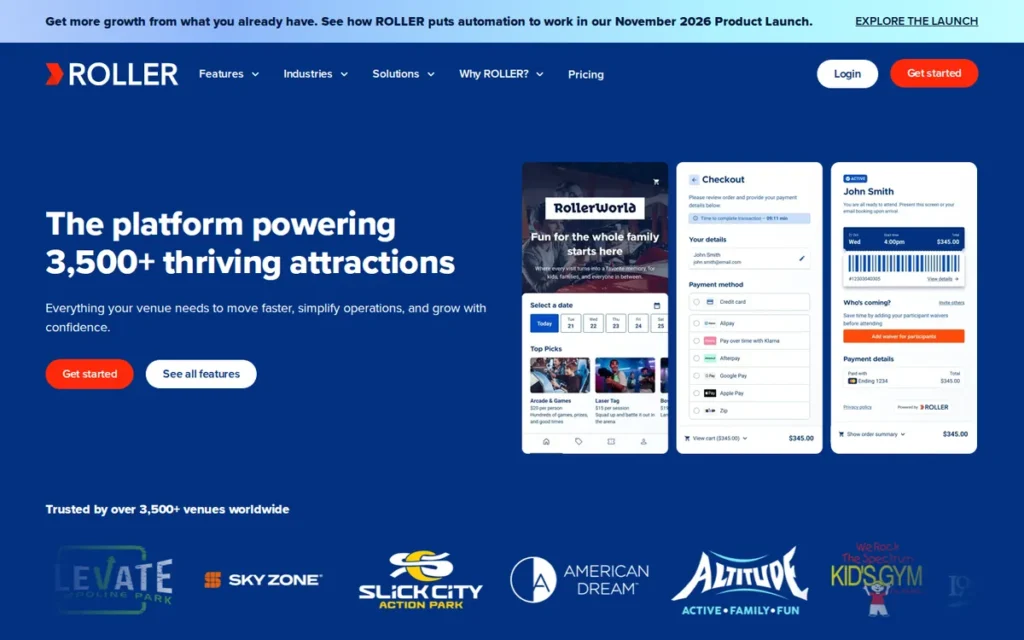
Category: All-in-One Venue Platform, one system runs ticketing, POS, memberships and guest data under a single guest record.
At a Glance
- Category: All-in-One Venue Platform
- Best For: Single-site and mid-market amusement parks, water parks and FECs that want cloud ticketing, POS, memberships and waivers in one system
- Price Range: Pricing on request; tiered by 2, 6, 10 or unlimited POS/kiosk devices, plus usage fees and separate processing fees; 14-day free trial
- Primary Strength: ROLLER shares the highest breadth score (5/5) with accesso and has the broadest native module set among mid-market platforms. It also has the largest independent review base in this ranking.
- Biggest Limitation: ROLLER does not publish dollar pricing or document how its offline mode works, and reviewers cite reporting and invoicing gaps.
- One-Line Summary: ROLLER is the top-scoring choice for single-site and mid-market parks that want cloud ticketing, POS, memberships and waivers on one guest record, and it has the category’s largest independent review sample.
- Last Verified: November 2026
Overview
ROLLER is a cloud-native venue management platform for single-site and mid-market amusement parks, water parks and family entertainment centers. It puts ticketing, POS, kiosks, memberships, waivers and cashless wallets on one guest record, with no local servers to maintain.
ROLLER reports serving 3,500+ attractions and venues (ROLLER, 2026; Vendor-Reported). That is the largest disclosed customer count among the mid-market platforms reviewed.
ROLLER’s founding date, funding and headcount: No verified source. ROLLER was a finalist in the Australian Financial Review 2026 Best Places to Work Awards (ROLLER, 2026; Vendor-Reported). The award recognises ROLLER as an employer, not product performance.
Key Features
- ROLLER sells online and in-venue tickets, memberships, gift cards and party and group bookings from one cloud system.
- ROLLER includes native digital waivers and cashless wallets, so guests can sign and spend without a third-party add-on.
- ROLLER supports RFID wristbands and integrates with Alvarado access gates for automated entry (ROLLER, 2026; Vendor-Reported).
- ROLLER offers self-service kiosks and an integrated payments product, ROLLER Payments, licensed by device-count tier.
- ROLLER provides guest-experience analytics and an API that reviewers say supports data-driven decisions (Capterra, 2026; Independently Verified).
Best For
ROLLER fits single-site and mid-market venues that are replacing disconnected ticketing and POS tools, especially operators who want a 14-day trial before committing. ROLLER is less suited to large multi-park operators that need enterprise entitlement rules or mature virtual queuing.
Strengths
- ROLLER holds 4.2/5 from 150 Capterra reviews and 4.3/5 from 59 G2 reviews (Capterra and G2, 2026; Independently Verified). An aggregator lists a conflicting 4.6/5 from 51 reviews.
- ROLLER’s 2026 Benchmark Report found that members visited about 4.9 times a year versus 1.3 for non-members, and mobile F&B orders were 3.3× larger than POS orders. The sample covers ROLLER customers only (ROLLER, 2026; Vendor-Reported).
- ROLLER customers Chipmunks Playland & Café and Jago Town report about 40% less party-booking effort and about 100 hours saved per week (ROLLER, 2026; Vendor-Reported).
- ROLLER reviewers repeatedly praise its ease of use, support and implementation (G2, 2026; Independently Verified).
- ROLLER publishes more of its fee structure than any quote-only vendor in this ranking (ROLLER pricing page, 2026; Vendor-Reported).
Limitations
ROLLER trades pricing clarity for flexibility. Its mix of device tiers, usage fees and processing fees means the total cost only becomes clear after a quote.
- ROLLER is described as having offline access in third-party listings (Capterra, 2026; Independently Verified). However, ROLLER does not publicly document which POS functions work offline, for how long, or how data syncs back.
- ROLLER reviewers report that reporting “could be more advanced” and that invoicing “did not meet all requirements” (G2, 2026; Independently Verified).
- ROLLER was called “basic” by one Capterra reviewer, who said funds-receivable totals could be inaccurate (Capterra, 2026; Independently Verified).
Verdict
ROLLER is our top-ranked amusement park management software for single-site and mid-market venues in 2026. It pairs the broadest native module set among mid-market platforms with the category’s largest independent review base.
ROLLER scores 4.20/5. It earns 5/5 on both primary criteria but loses points on Pricing Transparency (3/5) and Offline Resilience (3/5). CenterEdge Advantage sits 0.25 points behind.
Buyers should test ROLLER’s offline behaviour, get usage and processing fees in writing, and check end-of-day reconciliation during the trial.
2. CenterEdge Advantage: Best for Arcade- and Redemption-Heavy FECs
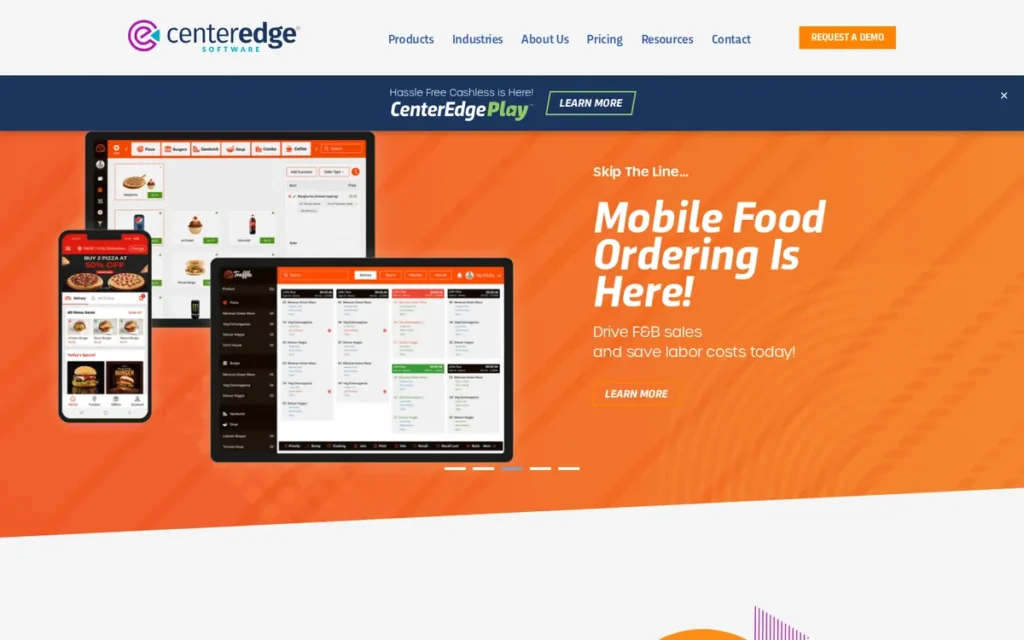
Category: All-in-One Venue Platform, one system runs ticketing, POS, memberships and guest data under a single guest record.
At a Glance
- Category: All-in-One Venue Platform
- Best For: North American FECs and multi-attraction parks with arcade, redemption, party and F&B operations
- Price Range: $300–$800/month by workstation count (1–15) when bundled with CenterEdge Payments, plus add-ons from $50/month; hardware, servers, processing and implementation quoted separately
- Primary Strength: CenterEdge Advantage publishes the clearest software pricing in the category and integrates with existing Sacoa, Embed and Intercard game-card systems.
- Biggest Limitation: CenterEdge Advantage has a small independent review sample, and reviewers describe a dated interface with a steep learning curve.
- One-Line Summary: CenterEdge Advantage fits arcade- and redemption-heavy FECs and multi-attraction parks that want published software pricing and compatibility with existing game-card systems.
- Last Verified: November 2026
Overview
CenterEdge Advantage is a North American operations suite from CenterEdge Software for family entertainment centers and multi-attraction parks. It handles admissions, online sales, POS, parties, memberships, F&B, capacity and time clock in one system.
CenterEdge Advantage runs on what third-party sources describe as a local Windows core with cloud modules (OmniPlay, 2026; Competitor-Authored). CenterEdge Software was founded in 2004 in Roxboro, North Carolina, and had 75+ staff by December 2024 (CenterEdge, 2024; Vendor-Reported).
Key Features
- CenterEdge Advantage combines Advantage Sales, Events and Console to manage admissions, online sales and reservations, POS, parties, memberships and F&B.
- CenterEdge Advantage includes capacity management, cash controls, reporting and a staff time clock in the core suite.
- CenterEdge Advantage pairs with CenterEdge Play for cashless games, with redemption priced as a $100/month add-on.
- CenterEdge Advantage integrates with the Sacoa, Embed and Intercard cashless systems, plus accounting, kitchen automation and marketing tools.
- CenterEdge Advantage processes payments through CenterEdge Payments, which is included in its bundles.
Best For
CenterEdge Advantage fits FECs and multi-attraction parks that run arcade, redemption, party and F&B operations and want to budget software from published prices. CenterEdge Advantage also suits operators who want to keep an existing Sacoa, Embed or Intercard game-card system.
Strengths
- CenterEdge Advantage publishes software tiers of $300/month (1–3 workstations), $550/month (4–9) and $800/month (10–15), plus add-on prices (CenterEdge pricing page, 2026; Vendor-Reported). That is the most transparent software pricing in this ranking.
- CenterEdge Advantage holds 4.4/5 from 12 Capterra reviews, and reviewers describe it as dependable and well supported (Capterra, 2026; Independently Verified).
- CenterEdge Advantage’s 2024 year-end CEO letter names Andretti’s, Five Star and Launch Entertainment as customers or growth partners (CenterEdge, 2024; Vendor-Reported).
- CenterEdge Advantage integrates with Sacoa, Embed and Intercard, so operators can keep their existing game-card hardware (CenterEdge Partners page, 2026; Vendor-Reported).
- CenterEdge Advantage bundles include training and support, and third-party comparisons note 24/7/365 US-based live support (MakerStack, 2026; Aggregator).
Limitations
CenterEdge Advantage trades modern usability for operational depth. Its published rates also apply only when bundled with CenterEdge Payments (CenterEdge, 2026; Vendor-Reported), so processing may be the bigger cost variable.
- CenterEdge Advantage’s Windows core is described as dated, and its interface as clunky with a steep learning curve (MakerStack and BMI Leisure, 2026; Aggregator and Competitor-Authored). Treat this as a lead to test in a demo.
- CenterEdge Advantage’s local-server architecture may keep venues running during outages, but it adds on-site IT, hardware and patching overhead. This is described by third-party sources, including a competitor, so confirm it with the vendor.
- CenterEdge Advantage has thin independent review evidence: 12 Capterra reviews, plus a G2 score of about 3.9 from a secondary source that has not been confirmed on G2’s own page.
- CenterEdge Advantage’s public case studies contain no quantified outcomes that we could retrieve (CenterEdge, 2026; Vendor-Reported).
Verdict
CenterEdge Advantage is our top-ranked option for arcade- and redemption-heavy FECs in 2026. It pairs the most transparent published software pricing in this ranking with integrations for existing Sacoa, Embed and Intercard game-card systems.
CenterEdge Advantage scores 3.95/5. It leads on Pricing Transparency (5/5) and scores 4.5/5 on breadth. It sits 0.25 points below ROLLER mainly because of review evidence: 12 Capterra reviews versus ROLLER’s 150.
Buyers should price servers, hardware and CenterEdge Payments processing alongside the published subscription tiers.
3. Parafait by Semnox: Best for RFID-Led Water Parks and Multi-Site Operators
Category: RFID and Cashless Platform, a guest credential (card or wristband) drives entry, spending, lockers and play across the venue.
At a Glance
- Category: RFID and Cashless Platform
- Best For: Water parks, FECs and multi-site operators that want one RFID credential for entry, lockers, cashless spending and arcade play
- Price Range: Pricing on request; the quote covers licensing, readers, kiosks, cards and wristbands, installation and support
- Primary Strength: Parafait by Semnox is one of two platforms in this ranking (with Sacoa Cashless System) that score 5/5 on hardware integration. It is the only one that combines native RFID lockers with multi-venue card roaming.
- Biggest Limitation: Parafait by Semnox publishes no pricing, and reviewers describe a dated interface and a web app that is not mobile-friendly.
- One-Line Summary: Parafait by Semnox fits water parks, FECs and multi-site operators that want a single RFID credential for entry, lockers, cashless spending and arcade play.
- Last Verified: November 2026
Overview
Parafait by Semnox is an integrated software-and-hardware platform for water parks, FECs and multi-site operators. It uses RFID cards and wristbands to drive ticketing, access control, cashless stored value, lockers, kiosks, POS and arcade play.
Parafait by Semnox is developed by Semnox Solutions, which was founded in 2008 and is headquartered in Mangalore, India (G2, 2026; Independently Verified). Semnox Solutions’ founders, team size and US entity status: No verified source.
Key Features
- Parafait by Semnox supports RFID cards and wristbands, plus barcode, QR and fingerprint credentials, for entry and spending.
- Parafait by Semnox includes RFID lockers, all-in-one kiosks and arcade game readers (Beam, Lumin) in one ecosystem.
- Parafait by Semnox runs POS, F&B, redemption, party bookings, inventory, CRM and reporting alongside its cashless layer.
- Parafait by Semnox offers card roaming, so one guest credential works across several venues.
- Parafait by Semnox uses a hybrid deployment that combines on-premise hardware with cloud components.
Best For
Parafait by Semnox fits water parks and FECs that want RFID wristbands to handle entry, lockers, cashless food and arcade play in one guest account. Parafait by Semnox also suits multi-site operators that want loyalty and balances to carry across locations.
Strengths
- Parafait by Semnox holds 4.7/5 from 14 reviews on its G2 product page, and Semnox Solutions holds 4.6/5 from 20 seller reviews (G2, 2026; Independently Verified). An aggregator lists 4.5/5 from 16 reviews.
- Parafait by Semnox’s case study for The DockX in Jeddah reports that kiosks handled about 65% of transactions and about 55% of redemptions, and that upsells rose 14% in the first 30 days (Parafait, 2026; Vendor-Reported).
- Parafait by Semnox is described by one Capterra reviewer as “dependable for more than 10 years,” with responsive support (Capterra, 2026; Independently Verified).
- Parafait by Semnox publishes a testimonial from Roger Cardinale, then president of Chuck E. Cheese Entertainment, about its RFID Play Pass upgrade (Parafait, 2026; Vendor-Reported). An r/arcade thread makes the same claim (Reddit, 2026; Community Forum).
Limitations
Parafait by Semnox trades price visibility for hardware depth. Pricing is entirely quote-based, so buyers cannot compare total cost until every reader, kiosk and credential is itemised.
- Parafait by Semnox reviewers note a web app that is “not very mobile-friendly,” a UI that could be updated, and “occasional glitches” (Capterra, 2026; Independently Verified).
- Parafait by Semnox does not publicly document how its hybrid architecture behaves offline or how it syncs data back, based on our November 2026 review.
- Parafait by Semnox may have fewer native North American payment and accounting integrations (BMI Leisure, 2026; Competitor-Authored). Test QuickBooks or ERP feeds directly.
Verdict
Parafait by Semnox is our top-ranked option for RFID cashless payments in 2026. It links entry, lockers, spending and arcade play to one credential that can roam across venues.
Parafait by Semnox scores 3.55/5. It earns 5/5 on Hardware, RFID and Cashless Integration, but quote-only pricing (1/5) keeps it 0.40 points behind CenterEdge Advantage.
Buyers should request itemised quotes from Parafait by Semnox, pilot its offline behaviour and confirm local accounting integrations before committing.
4. Galaxy by Gateway Ticketing Systems: Best for Complex Enterprise Admissions
Category: Enterprise Admissions and Revenue Suite, a configurable platform for high-volume, multi-venue ticketing, entitlements and revenue management.
At a Glance
- Category: Enterprise Admissions and Revenue Suite
- Best For: Large theme parks, aquariums and multi-venue operators with complex pass, membership and entitlement rules
- Price Range: Pricing on request; an enterprise quote covering license or subscription, implementation, hardware, integrations and support
- Primary Strength: Galaxy by Gateway Ticketing Systems offers gate-first admission control that Capterra reviewers describe as “fast, customizable.” The vendor has 38 years in business and 500+ reported clients.
- Biggest Limitation: Galaxy by Gateway Ticketing Systems has quote-only enterprise pricing, a dated interface and a learning curve that reviewers repeatedly flag.
- One-Line Summary: Galaxy by Gateway Ticketing Systems fits large parks and multi-venue operators whose admissions depend on complex tickets, passes and entitlement rules.
- Last Verified: November 2026
Overview
Galaxy by Gateway Ticketing Systems is an enterprise admissions suite for large theme parks, aquariums and multi-venue operators. It covers ticketing, gate-first admission control, POS, memberships, timed entry, group sales and CRM, all configurable for complex ticket and entitlement rules.
Gateway Ticketing Systems was incorporated in Boyertown, Pennsylvania, on July 8, 1988, by Peter Grumblatt. It began as a division of Merion Software Associates and is now headquartered in Gilbertsville, Pennsylvania (Gateway, 2026; Vendor-Reported).
Key Features
- Galaxy by Gateway Ticketing Systems handles ticketing, timed entry and capacity, group sales and resource management in one configurable suite.
- Galaxy by Gateway Ticketing Systems supports Alvarado turnstiles and admission devices for gate-first admission control.
- Galaxy by Gateway Ticketing Systems includes the eGalaxy web store with Apple Wallet support for online sales.
- Galaxy by Gateway Ticketing Systems distributes inventory to OTAs and partners through Galaxy Connect.
- Galaxy by Gateway Ticketing Systems runs retail and F&B POS, memberships, passes, donor management, CRM and reporting.
Best For
Galaxy by Gateway Ticketing Systems fits large parks, aquariums and multi-venue groups whose admissions involve complex passes, entitlements and partner distribution. Galaxy by Gateway Ticketing Systems is more system than most small single-site venues need.
Strengths
- Galaxy by Gateway Ticketing Systems reports 500+ clients worldwide (Gateway, 2026; Vendor-Reported). Blooloop separately reports 450+ venues across six continents (Blooloop, 2026; Independently Verified).
- Galaxy by Gateway Ticketing Systems holds 4.1/5 from 17 Capterra reviews, and reviewers praise a “single sales platform” (Capterra, 2026; Independently Verified).
- Galaxy by Gateway Ticketing Systems runs across 26 children’s entertainment venues for Prologic First in Saudi Arabia (Gateway, 2026; Vendor-Reported).
- Galaxy by Gateway Ticketing Systems supports CRM, reporting, POS and Galaxy Connect at Johnny Morris’ Wonders of Wildlife National Museum & Aquarium (Blooloop, 2026; Independently Verified).
- Galaxy by Gateway Ticketing Systems has the longest track record among the full ticketing suites reviewed, dating back to 1988 (Gateway, 2026; Vendor-Reported).
Limitations
Galaxy by Gateway Ticketing Systems trades simplicity for configurability. Its pricing is fully quote-based, with no published ranges.
- Galaxy by Gateway Ticketing Systems reviewers say the UI looks “a little outdated,” with “twenty different routes” to the same place (Capterra, 2026; Independently Verified).
- Galaxy by Gateway Ticketing Systems reviewers report cumbersome searches for old tickets, reservations that are harder than POS, and a learning curve (Capterra, 2026; Independently Verified).
- Galaxy by Gateway Ticketing Systems reviewers also report difficulty integrating multiple platforms (Capterra, 2026; Independently Verified).
- Galaxy by Gateway Ticketing Systems has no publicly confirmed native RFID support, and Galaxy Cloud’s offline gate-validation behaviour is not documented.
Verdict
Galaxy by Gateway Ticketing Systems is our top-ranked enterprise admissions platform in 2026 for large parks and multi-venue operators. Its gate-first admission control can be configured for complex ticket, pass and entitlement rules.
Galaxy by Gateway Ticketing Systems scores 3.30/5. It earns 4.5/5 on breadth and 4/5 on viability. Quote-only pricing (1/5) and unconfirmed native RFID (3.5/5) place it below Parafait by Semnox, while its verified review presence places it above accesso.
Buyers should budget for a multi-month implementation and get Galaxy by Gateway Ticketing Systems’ RFID support and offline gate behaviour confirmed in writing.
5. accesso: Best for Large Destination Parks Needing Virtual Queuing

Category: Enterprise Admissions and Revenue Suite, a configurable platform for high-volume, multi-venue ticketing, entitlements and revenue management.
At a Glance
- Category: Enterprise Admissions and Revenue Suite
- Best For: Large destination theme parks and multi-property operators needing high-volume e-commerce, season passes and virtual queuing
- Price Range: Pricing on request; a mix of transaction-based, platform, license and maintenance fees
- Primary Strength: accesso is the only vendor in this ranking with a mature enterprise virtual-queuing product, LoQueue, alongside high-volume Passport e-commerce.
- Biggest Limitation: accesso’s core park products have no verified review-platform scores, and Siriusware reviewers report outages that stopped sales.
- One-Line Summary: accesso fits large destination parks and multi-property operators that need high-volume online ticketing, season passes and enterprise virtual queuing.
- Last Verified: November 2026
Overview
accesso is an LSE AIM-listed enterprise portfolio for large destination theme parks and multi-property operators that need high-volume e-commerce, season passes and virtual queues. The portfolio combines Passport ticketing, Siriusware ticketing and POS, LoQueue virtual queuing and Freedom mobile ordering.
accesso reported FY2025 revenue of $155.1 million (accesso FY2025 results, 2026; Independently Verified). accesso is the only vendor reviewed that publishes audited financials, so its financial trends are visible in a way the privately held vendors’ trends are not.
Key Features
- accesso Passport handles cloud ticketing for dated admission, season passes, memberships, groups, add-ons, capacity and waivers.
- accesso LoQueue provides virtual queuing and paid queue access.
- accesso Freedom delivers cloud POS and mobile F&B ordering.
- accesso Siriusware covers ticketing, guest management and POS, with particular strength in ski and attraction operations.
- accesso Passport includes LLM-based multilingual support for guest-facing e-commerce.
Best For
accesso fits large destination parks whose revenue depends on high-volume online sales, season passes and virtual queues. accesso is a poor fit for small parks that need predictable costs, because its transaction-linked fees scale with volume.
Strengths
- accesso Passport is Six Flags’ exclusive online ticketing provider across 42 North American parks under a five-year agreement that began January 1, 2026. Six Flags has a one-time early-termination option at December 31, 2027 (accesso, 2025; Vendor-Reported).
- accesso LoQueue generated about $25.7 million in virtual-queuing transaction revenue in 2024 (accesso 2024 Annual Report, 2025; Independently Verified).
- accesso Freedom mobile ordering increased F&B order sizes by 20%+ at Iron Mountain Hot Springs (accesso 2024 Annual Report, 2025; Vendor-Reported).
- accesso grew ticketing and distribution revenue 8.6% in H1 2026, and revenue excluding virtual queuing rose 7.1% (accesso H1 2026 results, 2026; Independently Verified).
- accesso Siriusware reviewers praise its ease of use, ticketing and scheduling, reporting and guest data (G2, 2026; Independently Verified).
Limitations
accesso trades independent verifiability for enterprise scale. Passport, LoQueue and Freedom have no verified G2 or Capterra scores, and the 4.6 Capterra rating of accesso’s separate ShoWare product does not apply to them.
- accesso Siriusware reviewers report system crashes, outages that “temporarily stopped sales,” and limited membership functionality (G2, 2026; Independently Verified).
- accesso’s 99.998% uptime figure is a platform claim (accesso, 2026; Vendor-Reported). It does not prove a venue keeps running if its own internet fails.
- accesso reported H1 2026 revenue of $67.8 million, down 0.2%, and guided FY2026 revenue to about $146 million. Headcount fell to about 605 after 45 roles were cut in January 2026 (accesso results, 2026; Independently Verified).
- accesso’s flat total revenue, alongside 7.1% growth excluding virtual queuing, implies lower LoQueue revenue, so ask about LoQueue’s client base and roadmap.
Verdict
accesso is our top-ranked option in 2026 for large destination parks that need virtual queuing, because LoQueue is the only mature enterprise virtual-queuing product in this ranking.
accesso scores 3.00/5. It shares the top breadth score (5/5) and earns 4/5 on viability after a deduction for its FY2026 guidance. No verified review score (1.5/5) and Siriusware outage reports (2.5/5 on resilience) pull its total down.
Buyers should get accesso’s transaction fees, roadmap commitments and support capacity in writing.
6. Sacoa Cashless System: Best Cashless Game-Floor Layer for Arcade Venues
Category: RFID and Cashless Platform, a guest credential (card or wristband) drives entry, spending, lockers and play across the venue.
At a Glance
- Category: RFID and Cashless Platform
- Best For: Arcade-heavy FECs and amusement venues replacing tokens with cards or wristbands, usually alongside a separate ticketing suite
- Price Range: Pricing on request; an aggregator gives an indicative mid-size setup cost of about $15,000–$45,000 (not an official quote)
- Primary Strength: Sacoa Cashless System has run cashless game floors since its Playcard launch in 1993 and is reported in 2,700+ centres across 70 countries.
- Biggest Limitation: Sacoa Cashless System is not a full ticketing and membership suite and has no verified review-platform ratings.
- One-Line Summary: Sacoa Cashless System is a dedicated cashless game-floor layer for arcade-heavy venues that want to replace tokens while keeping a separate ticketing platform.
- Last Verified: November 2026
Overview
Sacoa Cashless System is a card-and-wristband cashless platform for arcade-heavy FECs and amusement venues that are replacing tokens. It provides game readers, kiosks, POS, prize redemption, timed-attraction tracking and access control, usually alongside a separate ticketing suite.
Sacoa Cashless System traces back to the Mochkovsky family’s first FEC, opened in Mar del Plata, Argentina, in 1969, and to the Playcard launch in 1993 (Replay Magazine, 2017; Independently Verified). The commonly cited “founded 1985” date is not supported by sources.
Key Features
- Sacoa Cashless System supports magnetic, RFID and NFC cards and wristbands across PlayCard, Spark and mReader game readers.
- Sacoa Cashless System includes K4, K5 and EZ self-service kiosks, plus KwikPay for loading cards.
- Sacoa Cashless System manages e-ticket redemption, prize inventory and Time Tracker for timed attractions.
- Sacoa Cashless System offers access control, waivers, online sales, party booking, CRM and loyalty tools.
- Sacoa Cashless System integrates with CenterEdge Advantage, so cards can be sold and reloaded at CenterEdge terminals.
Best For
Sacoa Cashless System fits arcade- and game-heavy venues moving from tokens to cards, especially operators who already run, or plan to run, a separate ticketing suite. Sacoa Cashless System is not the right standalone choice for parks that need deep online ticketing and memberships.
Strengths
- Sacoa Cashless System is reported in 2,700+ centres across 70 countries, up from 1,500+ in 60+ countries in 2017 (Replay Magazine, 2025 and 2017; Independently Verified).
- Sacoa Cashless System’s first Playcard installation, in 1993, raised collections by 30% (Replay Magazine, 2017; Independently Verified).
- Sacoa Cashless System equipped Mega City in Slough, UK, with 150 Spark readers, 6 kiosks and 2 POS stations (Replay Magazine, n.d.; Independently Verified).
- Sacoa Cashless System integrates with CenterEdge Advantage and has a partnership with Revention (Vending Times, 2016; Independently Verified).
- Sacoa Cashless System testimonials cite help-desk fixes in under 15 minutes and sales up 30%+ (Sacoa, 2026; Vendor-Reported).
Limitations
Sacoa Cashless System trades breadth for game-floor specialism. It usually needs a separate platform for deep ticketing, memberships and online booking, which adds integration work.
- Sacoa Cashless System has no verified G2, Capterra or Software Advice presence, so its strongest outcome figures come from vendor testimonials.
- Sacoa Cashless System was replaced by Intercard at some Australian venues, according to an r/arcade post (Reddit, 2026; Community Forum).
- Sacoa Cashless System’s reporting is described as less mature than Embed’s (Sunflower Amusements, 2026; Aggregator).
Users on r/arcade noted:
“That was a HUGE problem with Sacoa at one point. You had to guard your jackpots as any new card swiped during a ticket payout would get the rest of the tickets.
The timeout is adjustable by the operator but most sites don’t tweak them per game the way they should.” Posted by u/the_faded_memories
Takeaway: Sacoa Cashless System has a history of ticket-payout sniping, and venues still have to tune reader timeouts game by game to keep guests’ winnings safe.
Verdict
Sacoa Cashless System is our top-ranked dedicated cashless game-floor system in 2026 for arcade-heavy venues. It combines purpose-built readers and kiosks with a reported install base of 2,700+ centres.
Sacoa Cashless System scores 2.65/5. It earns 5/5 on hardware integration and 4/5 on install base. However, it is not a full ticketing suite (2.5/5 on breadth) and has no review-platform presence (1/5). Hardware depth puts it 0.12 points above Booking Boss.
Buyers should pair Sacoa Cashless System with a full ticketing suite, check regional support coverage and get an itemised quote based on reader count.
7. Booking Boss: Best for Tourism-Driven Attractions Selling Through OTAs
Category: Distribution-Led Ticketing Platform, online reservations and ticketing built around selling through resellers, tour desks and OTAs.
At a Glance
- Category: Distribution-Led Ticketing Platform
- Best For: Tourism-driven attractions and smaller parks that sell heavily through OTAs, resellers and tour desks and do not need RFID or cashless
- Price Range: From US$44/month (up to 600 contacts) to US$639/month (up to 12,000 contacts); Memberships and Annual Passes module US$495/month
- Primary Strength: Booking Boss combines the lowest published entry price in this ranking with a built-in channel manager connected to major OTAs.
- Biggest Limitation: Booking Boss has no confirmed native RFID, cashless or kiosk support, and too few reviews for a verified rating.
- One-Line Summary: Booking Boss is the lowest-priced published option for tourism-driven attractions that sell through OTAs and resellers, but it is not a full park operations platform.
- Last Verified: November 2026
Overview
Booking Boss is a cloud reservations and ticketing platform for tourism-driven attractions that sell heavily through OTAs, resellers and tour desks. It offers a built-in channel manager, an agent portal, timed sessions, barcode gate scanning, memberships and EFTPOS-integrated POS.
Booking Boss launched in 2013 and has Australian origins (Booking Boss, 2026; Vendor-Reported). Booking Boss’s headquarters address and headcount: No verified source.
Key Features
- Booking Boss connects directly to Expedia, Viator, Tripadvisor, GetYourGuide, Livn, TXA and RedBalloon through its built-in channel manager.
- Booking Boss provides an agent portal with net and commission rates and no extra agent fees.
- Booking Boss manages online booking, capacity and sessions, barcode tickets and gate scanning.
- Booking Boss offers memberships and annual passes with photo ID and renewals as a separately priced module.
- Booking Boss sends SMS and email reminders to reduce no-shows.
Best For
Booking Boss fits tourism-driven attractions and smaller admission-focused parks whose sales depend on resellers, tour desks and OTAs. Booking Boss is a poor fit for parks that need RFID, cashless spending or deep F&B and retail POS.
Strengths
- Booking Boss publishes USD pricing from US$44/month, with onboarding, unlimited support and unlimited users included (Booking Boss pricing page, 2026; Vendor-Reported). That is the lowest published entry price in this ranking.
- Booking Boss connects directly to major OTAs through what it calls a “world-first” built-in channel manager (Booking Boss, 2026; Vendor-Reported).
- Booking Boss is credited by Sally Bradley, Visitor Services Manager at the National Zoo & Aquarium, with saving “hundreds of hours” of admin (Booking Boss, 2026; Vendor-Reported).
- Booking Boss reviewers in a small G2 sample say it “solved all our messy scheduling issues” and that 48-hour SMS reminders reduced no-shows (G2, 2026; Independently Verified).
Limitations
Booking Boss trades operational breadth for distribution strength and low cost. No native RFID, cashless or kiosk support has been confirmed, and its F&B and retail POS depth is unclear, so it cannot run a full park on its own.
- Booking Boss relies on a Smartwaiver integration for waivers (Smartwaiver help centre, 2026; Vendor-Reported).
- Booking Boss has too few G2 reviews for G2 to give buying insight (G2, 2026; Independently Verified).
- Booking Boss’s Memberships module costs US$495/month, more than eleven times the US$44 entry plan, and contact-based tiers rise to US$639/month at 12,000 contacts (Booking Boss, 2026; Vendor-Reported).
- Booking Boss has limited on-site guest-flow reporting and some configuration overhead for multi-venue setups (Axiobench, 2026; Aggregator).
Verdict
Booking Boss is our top-ranked option in 2026 for tourism-driven attractions that depend on OTA and reseller distribution. It pairs a built-in channel manager with the lowest published entry price in this ranking.
Booking Boss scores 2.53/5, up from 2.45 after its USD pricing was confirmed. It earns 5/5 on pricing transparency. No confirmed RFID, cashless or kiosk support (1.5/5) and limited breadth (2.5/5) mean it covers the least of a full park’s operations.
Buyers should confirm Booking Boss’s POS depth and contact-tier thresholds before shortlisting.
Which Amusement Park Software Supports RFID Cashless Payments?
Parafait by Semnox and Sacoa Cashless System offer the deepest native RFID cashless capability in this ranking, and both score 5/5 on hardware integration. ROLLER and CenterEdge Advantage support RFID through native features and named partners. Galaxy by Gateway Ticketing Systems and Booking Boss have no publicly confirmed native RFID support.
- ROLLER supports RFID wristbands and integrates with Alvarado gates (ROLLER, 2026; Vendor-Reported).
- CenterEdge Advantage offers CenterEdge Play and integrates with Sacoa, Embed and Intercard (CenterEdge, 2026; Vendor-Reported).
- Galaxy by Gateway Ticketing Systems supports Alvarado turnstiles, but its native RFID support is not publicly confirmed.
- Booking Boss uses barcode gate scanning and has no confirmed RFID or cashless capability.
| Platform | Native vs Partner RFID | Architecture | Offline Scope Documented? | Waivers | Virtual Queuing | Pricing Published? | Review Sample (Nov 2026) |
|---|---|---|---|---|---|---|---|
| ROLLER | Native RFID; Alvarado gates | Cloud-native | Not documented | Native | Not documented | Structure only | 150 Capterra, 59 G2 |
| CenterEdge Advantage | CenterEdge Play; Sacoa, Embed, Intercard | Local core plus cloud (third-party described) | Not documented | No verified source | Not documented | Yes, USD tiers | 12 Capterra |
| Parafait by Semnox | Native RFID, lockers, readers | Hybrid | Not documented | No verified source | Not documented | Quote only | 14 G2 (4.7), 8 Capterra |
| Galaxy by Gateway Ticketing Systems | Not confirmed; Alvarado turnstiles | On-premise or Galaxy Cloud | Not documented | No verified source | Not documented | Quote only | 17 Capterra |
| accesso | No verified source | Cloud (Passport, Freedom) | Not documented | Native (Passport) | LoQueue | Quote only | No verified score |
| Sacoa Cashless System | Native magnetic, RFID, NFC | Hardware-led | Not documented | Native (BMI Leisure, 2026; Competitor-Authored) | Not documented | Quote only | No verified presence |
| Booking Boss | Not confirmed | Cloud-native | Not documented | Smartwaiver integration | Not documented | Yes, USD tiers | Too few to rate |
Guest attitudes matter in any cashless decision. Operators and guests in a 2026 r/arcade thread described the trade-off from both sides.
“Many locations with 10+ machines will either be on a card system, or the operator is thinking about it. From the operators perspective it’s 1000x better than tokens.” Posted by u/rannox, r/arcade (Reddit, 2026; Community Forum)
Takeaway: Operators running 10 or more machines broadly prefer card systems over tokens for lower handling costs and more flexible pricing.
“I gotta say this kind of thing is a total scam, I have 50 cents that I will never use…” Posted by u/Clean_Bed_4334, r/arcade (Reddit, 2026; Community Forum)
Takeaway: Before launch, ask every cashless vendor how guests can get unused balances refunded, transferred or used at other venues.
How Much Does Amusement Park Management Software Cost?
Amusement park management software ranges from US$44/month (Booking Boss entry plan) and $300–$800/month (CenterEdge Advantage software tiers) up to custom enterprise quotes for Galaxy by Gateway Ticketing Systems and accesso. Hardware, processing, implementation and RFID credentials are usually billed separately (vendor pricing pages, 2026; Vendor-Reported).
Published and indicative price points, verified November 2026:
- Booking Boss charges from US$44/month (600 contacts) to US$639/month (12,000 contacts), with the Memberships module at US$495/month.
- CenterEdge Advantage charges $300, $550 or $800/month by workstation tier when bundled with CenterEdge Payments, and add-ons cost $50–$100/month.
- ROLLER publishes its tier structure but no dollar amounts. Its usage fees are billed monthly in arrears, separately from processing, and ROLLER offers Capital financing.
- Parafait by Semnox quotes every deployment, and basic RFID wristbands start around $0.53 each (BMI Leisure, 2026; Competitor-Authored).
- Sacoa Cashless System setups for mid-size venues are estimated at $15,000–$45,000 (Sunflower Amusements, 2026; Aggregator).
- Galaxy by Gateway Ticketing Systems is sold as a custom enterprise project, not a monthly subscription.
- accesso’s H1 2025 accounts show platform fees ($1.113M), recurring licenses ($1.346M) and maintenance and support ($5.803M) alongside transaction fees (accesso H1 2025 results, 2025; Independently Verified).
This aligns with community sentiment on r/coinop:
“Depends on the company. I’m researching now. For a setup with 30 card readers, 1 kiosk, and a POS setup at the redemption counter, here are some rough Numbers:
Sacoa 35k, no monthly fees, in house server
Rfpay 15,000 up front, in house server, and optional annual payment for customer support (works out to $150-$300 a month for customer service)
Amusement connect 25-30k up front, $300 a month, more depending on how many card readers you have.
Intercard, 30k or so, $300 a month for continued service .” Posted by u/ibprofen98
Takeaway: Operator-gathered quotes put a 30-reader Sacoa Cashless System at roughly $35,000 up front with no monthly fees, inside the aggregator’s range, but the in-house server is a cost and maintenance burden that subscription rivals avoid.
Small parks should be careful with enterprise suites. Galaxy by Gateway Ticketing Systems is priced as a custom project, and accesso’s transaction-linked fees are hard to predict at low volume.
Use this total-cost checklist with every vendor:
- Ask for the subscription or license fee by device, workstation or contact tier.
- Ask for usage or per-ticket fees in writing.
- Ask for merchant-processing rates, and whether in-house processing is mandatory.
- Ask for hardware costs covering readers, gates, kiosks and wristbands.
- Ask for implementation and data-migration fees.
- Ask for the cost of integrations with accounting, ERP and marketing tools.
- Ask for the support SLA, including peak-day coverage.
- Ask for contract length and termination terms.
- Ask for confirmation that stored payment tokens can be transferred.
How Long Does It Take to Implement Amusement Park Management Software?
Ticketing and POS can typically go live within one off-season, while RFID hardware may be phased in over a full season (PulseRevOps, 2026; Aggregator). Plan to migrate memberships, season passes and gift-card balances before go-live, and finish staff training before peak season.
- Migrate members, season-pass holders and stored-value balances first, because those records carry guest money and entitlements.
- Confirm payment-token portability with your current processor before cancelling it, so pass holders do not have to re-enter their cards.
- Run the new system on a low-attendance day before peak season to test gate scans, POS and end-of-day reconciliation.
- Train seasonal staff on POS and gate flows before opening, because reviewers flag learning curves for Galaxy by Gateway Ticketing Systems and CenterEdge Advantage (Capterra, 2026; Independently Verified).
Enterprise suites take longer. Galaxy by Gateway Ticketing Systems is sold as a custom project with a multi-month implementation (Software Advice, 2026; Independently Verified). Cloud platforms with trials, such as ROLLER, can usually be evaluated within weeks.
What Red Flags Should I Watch For When Evaluating Amusement Park Management Software?
There are six red flags to watch for:
- Uptime claims with no offline documentation
- Fees split across several bills
- Mandatory payment processing with no token portability
- “Independent” comparisons written by rival vendors
- Ratings shown without review counts
- Vague RFID claims
Each red flag hides a real risk to your total cost, your peak-day reliability or your ability to make an informed choice.
Red Flag #1: Uptime Claims With No Offline Documentation A platform uptime claim does not prove your venue keeps selling when its own internet drops. A 99.998% uptime figure allows about 10 minutes of platform downtime a year. It says nothing about a park whose fibre line is cut at noon on July 4th.
We found no public documentation from any of the seven vendors that details offline scope (PlugRoute review, November 2026).
A 30-year operator who has run Embed, Intercard and Sacoa systems described on r/arcade:
“One of my biggest issues with the card systems, its on a network, some use internet or LAN through it’s own server, but also ties into the internet and credit card, etc, and that causes all sorts of issues to shut down the entire gameroom, especially after a power outage. Coin arcade, as you turn the power on, you can start putting coins in most games. Even if you get it to boot, the amount of time it takes to reset is 10 to 45 minutes.” Posted by u/Derek5Letters
Takeaway: Veteran operators say networked cashless systems like Embed, Intercard and Sacoa can take a whole game room down after a power or network failure for up to 45 minutes, so recovery time belongs in every vendor’s offline documentation.
Red Flag #2: Fees Split Across Subscription, Usage and Processing Software tiers can look affordable while usage fees and merchant-processing fees are billed separately. CenterEdge Advantage’s $300/month rate applies only when bundled with CenterEdge Payments, so the processing rate may matter more than the subscription. Ask for all three costs in one written quote.
Red Flag #3: Mandatory In-House Payment Processing With No Token Portability Mandatory in-house payment processing is a red flag when stored guest payment tokens cannot be transferred. Without portability, members and pass holders would have to re-enter their cards after a switch, which makes leaving the vendor costly. Ask every vendor to confirm token portability in the contract.
Red Flag #4: “Independent” Comparisons Written by Competitors Much of the “independent” amusement park software comparison content online is published by rival vendors, including Aluvii, BMI Leisure, OmniPlay and Wakesys (PlugRoute source review, November 2026). Check who wrote a comparison before trusting it, and treat competitor claims as leads to verify.
Red Flag #5: Ratings Shown Without Review Counts A star rating means little without the review count behind it. One aggregator shows ROLLER at 4.6/5 from 51 reviews, while Capterra shows 4.2/5 from 150 (Capterra and aggregator listing, November 2026). Always ask for the platform, the review count and the date.
Small samples move fast. A single one-star review would cut Parafait by Semnox’s 14-review G2 score by more than ten one-star reviews would cut ROLLER’s 150-review Capterra score.
Red Flag #6: RFID Support Described Only as “Via Partner” With No Named Hardware Generic claims of RFID support often hide integration work or hardware you will have to replace. Named partners, such as Alvarado gates or Sacoa, Embed and Intercard card systems, are stronger evidence. Ask the vendor to name the readers, gates and lockers it supports.
What Questions Should I Ask Before Choosing Amusement Park Management Software?
Ask every vendor seven questions before choosing a platform. The seven questions cover offline behaviour, itemised total cost, hardware compatibility, a single guest record, contract and token terms, peak-day support and stranded balances. Get the answers in writing and test them in a live demo, because vendor marketing rarely covers these points in detail.
Question #1: Which functions keep working if our internet drops, for how long, and how does data sync back? Look for a function-by-function answer that covers POS, gate scanning and cashless spending, plus how conflicts are resolved when data syncs. A vendor that cites only platform uptime has not answered the question. Ask to see an outage simulated in the demo.
Question #2: Can you give an itemised quote for software, usage or per-ticket fees, processing, hardware, implementation and support? A credible vendor will list every cost line separately so you can compare total cost across your shortlist. Watch for bundling conditions, such as subscription rates that apply only with in-house payment processing. Ask for the quote to cover a peak month as well as an average month.
Question #3: Will our existing turnstiles, wristbands and game-card system work, and will you confirm that in writing? Named hardware partners are stronger evidence than general compatibility claims. Examples in this ranking include Alvarado gates and the Sacoa, Embed and Intercard card systems. Ask for the model numbers, and get compatibility written into the contract so you are not forced to replace hardware later.
Question #4: Can you demonstrate one guest going from online purchase to gate scan, F&B purchase, refund and end-of-day report on a single record? This one demo shows whether a “unified” platform really keeps one guest record and whether its numbers reconcile. Finance leads should check that the end-of-day totals match the individual transactions. Reviewers have flagged reporting and reconciliation gaps in this category.
Question #5: What are the contract length, termination terms and payment-token portability? Long terms combined with tokens you cannot transfer make a future migration expensive and slow. Ask for the notice period, any early-termination fees and written confirmation that guest payment tokens can move to a new processor. These terms matter most for parks with large member bases.
Question #6: What is your support coverage on our peak days? Ask for named support hours, response-time commitments and escalation paths for weekends, holidays and summer peaks. Ask for these commitments in the SLA, not in sales materials. A vendor with recent headcount cuts should also explain how support capacity is protected.
Question #7: How can guests get unused cashless balances back? Ask whether stored balances can be refunded, transferred between cards or used at other venues. Guests on r/arcade describe stranded balances as a reason for resentment (Reddit, 2026; Community Forum). A clear balance policy protects your reputation when you move to cashless.
How Did We Rank These Amusement Park Management Software Platforms?
PlugRoute scored seven amusement park management software platforms against six weighted criteria on a 1–5 scale, using dated evidence captured in November 2026. Every claim carries a source label. Platforms were ranked by total weighted score, and where no verified data existed we scored conservatively instead of estimating.
Ranking criteria:
- Unified Platform Breadth (25%) measures native modules across 10 park functions, with half credit for partner integrations. It matters because separate tools leave parks without a single guest record.
- Independent Review Evidence (20%) measures ratings weighted by review count across G2, Capterra and Software Advice, capped at 3/5 below 20 reviews. It matters because most information in this category comes from vendors.
- Pricing Transparency (15%) scores published dollar tiers at 5/5 and quote-only pricing at 1/5. It matters because buyers cannot compare total cost when pricing is hidden.
- Hardware, RFID and Cashless Integration (15%) measures native RFID, named gate partners, support for third-party card systems, lockers, kiosks and credential roaming. It matters because parks need to know whether their existing hardware will work.
- Peak-Day and Offline Resilience Evidence (10%) measures offline documentation, architecture and verified stability reports on a compressed 2.5–4 range. It matters because outages on busy days cost revenue.
- Vendor Scale, Viability and Documented Outcomes (15%) measures install base, years operating, audited financials and quantified outcomes, with deductions for negative trends. It matters because long contracts make vendor stability a real risk.
Source labels used:
- Independently Verified claims come from review platforms, audited filings and trade press.
- Vendor-Reported claims come from company websites, testimonials and vendor case studies.
- Aggregator claims come from third-party listing sites whose scoring methods are unclear.
- Competitor-Authored claims come from rival vendors’ comparison pages and do not raise or lower a score on their own.
- Community Forum claims come from Reddit threads and are treated as unverified signals.
A low score on a criterion that depends on public data can mean the vendor publishes less information, not that the product is worse.
| Platform | C1 Breadth (25%) | C2 Reviews (20%) | C3 Pricing (15%) | C4 Hardware (15%) | C5 Resilience (10%) | C6 Viability (15%) | Weighted Total |
|---|---|---|---|---|---|---|---|
| ROLLER | 5 | 5 | 3 | 4 | 3 | 4 | 4.20 |
| CenterEdge Advantage | 4.5 | 3 | 5 | 4 | 3.5 | 3.5 | 3.95 |
| Parafait by Semnox | 4.5 | 3.5 | 1 | 5 | 3 | 3.5 | 3.55 |
| Galaxy by Gateway Ticketing Systems | 4.5 | 3 | 1 | 3.5 | 3 | 4 | 3.30 |
| accesso | 5 | 1.5 | 1 | 3 | 2.5 | 4 | 3.00 |
| Sacoa Cashless System | 2.5 | 1 | 1.5 | 5 | 2.5 | 4 | 2.65 |
| Booking Boss | 2.5 | 1.5 | 5 | 1.5 | 2.5 | 2.5 | 2.53 |
Two scores changed this cycle under the published rules:
- Booking Boss’s Pricing Transparency score rose from 4.5 to 5 after its pricing page confirmed USD, moving its total from 2.45 to 2.53.
- accesso’s Viability score fell from 4.5 to 4 under the negative-trend rule after its FY2026 revenue guidance, moving its total from 3.08 to 3.00.
Neither change moved a rank.
PlugRoute has no affiliate relationships with any company listed. Rankings are determined entirely by research data and objective evaluation criteria.
Platforms We Didn’t Rank (Yet): AI answer engines also mention Clubspeed, Aluvii, Centaman, Parkstack and Tixera. We did not verify these platforms to the same evidence standard in this cycle, so they are queued for our next refresh. AI answers describe Tixera as a Semnox product.
What Do Buyers Most Often Ask About Amusement Park Management Software?
Buyers most often ask three things: which platform fits a small park, which platforms support RFID cashless payments, and how PlugRoute decides its rankings. The answers below are short and dated. Cost and implementation questions are answered in their own sections above.
What is the best amusement park management software for small parks?
ROLLER is the strongest default for small single-site parks. It combines cloud ticketing, POS, memberships and waivers with a 14-day trial and the category’s largest review base (150 Capterra reviews, November 2026). CenterEdge Advantage starts at $300/month for arcade-heavy venues. Booking Boss starts at US$44/month for OTA-driven attractions that don’t need RFID. Avoid enterprise suites unless you need complex entitlements.
Which amusement park management software supports RFID cashless payments?
Parafait by Semnox and Sacoa Cashless System offer the deepest native RFID cashless capability in this ranking. Parafait by Semnox links entry, lockers, spending and arcade play to one roaming credential, while Sacoa Cashless System focuses on the game floor. ROLLER supports RFID wristbands, and CenterEdge Advantage integrates with the Sacoa, Embed and Intercard card systems.
How does PlugRoute determine its amusement park software rankings?
PlugRoute scores every platform against six weighted criteria on a 1–5 scale: breadth, independent reviews, pricing transparency, hardware integration, offline resilience and vendor viability. Every claim is dated and labelled by source type. Competitor-authored claims do not change a score on their own, and gaps are marked “No verified source” rather than estimated. Full weights appear in our methodology.
What Do Key Amusement Park Management Software Terms Mean?
These are the twelve terms buyers meet most often when comparing amusement park platforms, from pricing units to technical concepts. Each definition explains what the term means and why it matters to your shortlist, total cost or peak-day reliability.
RFID (Radio-Frequency Identification): RFID is a contactless technology that lets gates, lockers and readers read wristbands or cards. RFID matters because it can tie entry, spending and play to one guest credential.
Cashless Stored Value: Cashless stored value is a balance that guests load onto a card or wristband and spend across the venue. Cashless stored value matters because it replaces tokens and cash, but stranded balances can frustrate guests.
Access Control: Access control is the system that validates tickets or credentials at gates and turnstiles. Access control matters because hardware compatibility decides whether your existing gates can stay.
Timed Entry and Capacity Management: Timed entry sells admission by session and caps attendance per slot. Timed entry matters because it spreads peak-day crowds and protects the guest experience.
Dynamic Pricing: Dynamic pricing changes ticket prices based on date, demand or how far ahead guests book. Dynamic pricing matters because it can lift revenue on busy days and fill quieter ones.
Virtual Queuing: Virtual queuing lets guests hold a place in a ride line from their phone instead of standing in it. Virtual queuing matters because it shortens visible queues and can be sold as a paid upgrade.
Channel Manager: A channel manager syncs ticket inventory and rates with OTAs and resellers in real time. A channel manager matters to tourism-driven attractions because it prevents overselling across sales channels.
Merchant Processing Fees: Merchant processing fees are the per-transaction charges for handling card payments. Merchant processing fees matter because they are often billed separately from software fees and can be a large share of total cost.
Usage Fees: Usage fees are charges tied to transaction or booking volume on top of a subscription. Usage fees matter because they make the true monthly cost rise with attendance.
Payment Token Portability: Payment token portability is the ability to move stored guest card tokens to a new payment provider. Payment token portability matters because without it, switching vendors can mean members and pass holders lose their saved payment methods.
Offline Mode: Offline mode is the set of functions that keep working when the venue’s internet connection fails. Offline mode matters because undocumented offline behaviour is a major peak-day risk.
PCI DSS Compliance: PCI DSS is the card industry’s security standard for handling payment data. PCI DSS compliance matters because a vendor’s compliance does not remove the operator’s own obligations.
Which Amusement Park Management Software Is Right for You?
Key Insights
- ROLLER ranks #1 at 4.20/5. It pairs the broadest native module set among mid-market platforms with the category’s largest independent review sample: 150 Capterra reviews and 59 G2 reviews, captured November 2026.
- ROLLER is the only amusement park platform reviewed with more than 60 reviews on a single review platform. Every other platform has fewer than 20 per listing or no verified score.
- CenterEdge Advantage and Booking Boss are the only platforms in this ranking that publish dollar pricing. The other five are wholly or partly quote-based.
- Parafait by Semnox and Sacoa Cashless System both score 5/5 on RFID and cashless hardware integration, but neither publishes pricing.
- accesso is the only vendor in this ranking with a mature enterprise virtual-queuing product, though its core park products have no verified review scores.
- We found no public documentation from any of the seven vendors that details offline scope, so every buyer should test outage behaviour in a demo.
Rank order matters less than fit with your segment. Start from your park’s profile:
- If you run a small or mid-size venue and want one connected system, start with ROLLER or CenterEdge Advantage.
- If RFID drives your guest experience, pilot Parafait by Semnox, or pair Sacoa Cashless System with a full ticketing suite.
- If you operate several venues with complex entitlements, compare Galaxy by Gateway Ticketing Systems and accesso side by side.
- If you sell mainly through OTAs and resellers, shortlist Booking Boss.
Read our full scoring methodology and browse more PlugRoute independent reviews before you build your shortlist. We update this guide quarterly. Last updated: November 2026.