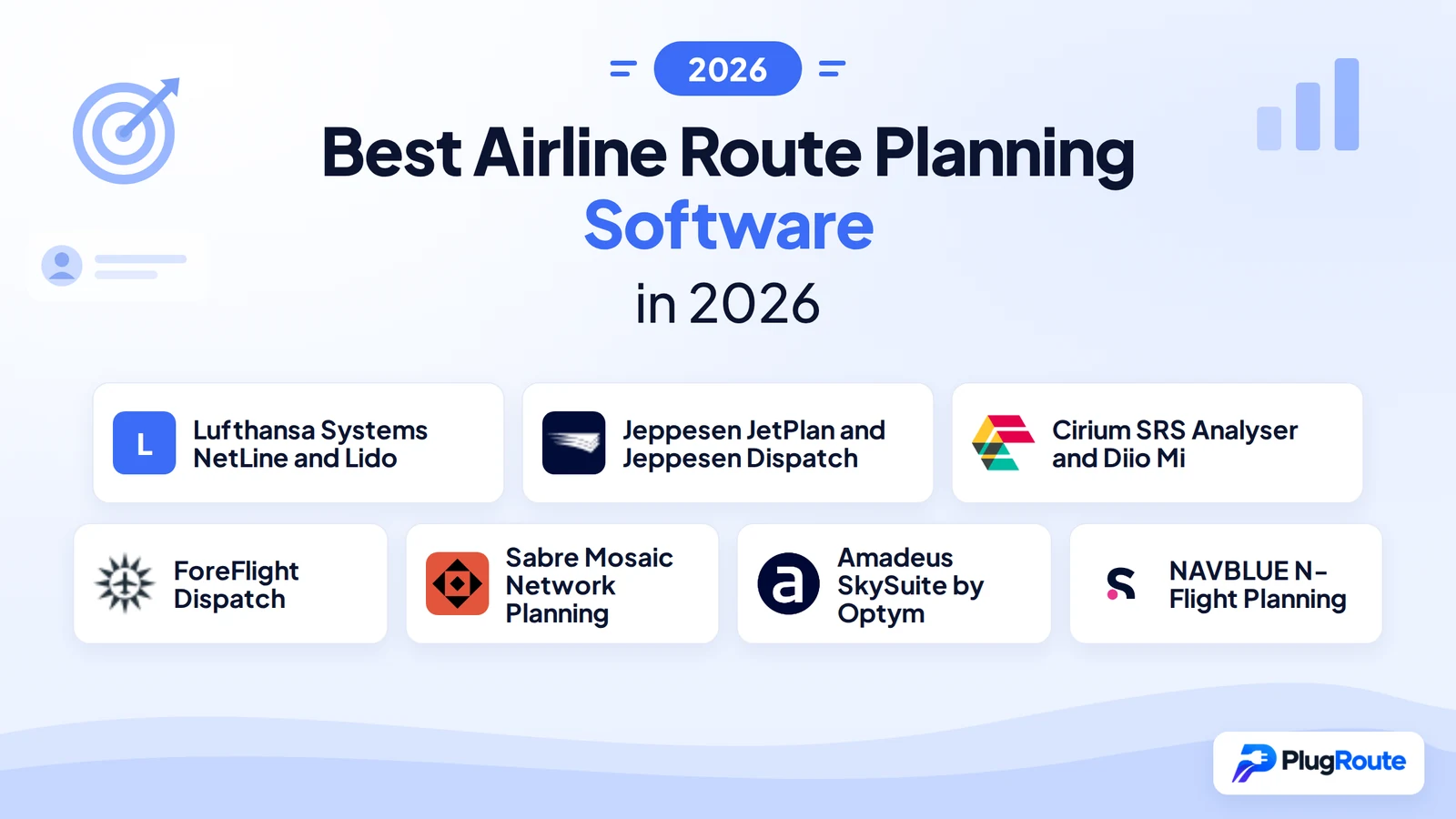
The best airline route planning software in 2026 is Lufthansa Systems (35/45) for one vendor from network plan to flight plan, Jeppesen JetPlan (34/45) for airline dispatch, and Cirium (33/45) for judging whether a route will make money. “Route planning” covers three different kinds of software, so picking the right layer matters more than picking the right vendor.
Buyers often evaluate the wrong type of tool, because “route planning” can mean network design or daily dispatch. Independent benchmarks and public pricing are rare. Every ROI figure we found during our November 2026 research came from vendors. This guide sorts seven products by planning layer and labels every claim by its evidence type.
PlugRoute has no affiliate relationships with any company listed, and rankings are determined entirely by research data and objective evaluation criteria.
“There are companies maintaining aviation databases that have such data, but they sell this info to airlines/airports at a pretty hefty fee.” (r/Flights practitioner comment [Source: Reddit, accessed November 2026])
Takeaway: Route-planning data and software are expensive professional purchases with little public pricing, so buyers need evidence before they commit.
What Are the 3 Categories of Airline Route Planning Software?
Airline route planning software falls into three layers. Market Intelligence answers “should we fly this route?” A Network Optimizer answers “how often, when and with which aircraft?” A Dispatch Planner answers “how does this flight get from A to B today?” Lufthansa Systems is the only vendor here covering optimization and dispatch, so it is labeled Full-Stack Suite.
The seven ranked products map to these layers as follows:
- Market Intelligence: Cirium SRS Analyser and Diio Mi supply schedules, fares and modeled demand data. Cirium’s tools do not optimize schedules or fleets.
- Network Optimizer: Sabre Mosaic Network Planning and Amadeus SkySuite by Optym design markets, frequencies, schedules and fleet assignments.
- Dispatch Planner: Jeppesen JetPlan, NAVBLUE N-Flight Planning and ForeFlight Dispatch build operational flight plans from aircraft performance, weather, NOTAMs and airspace constraints.
- Full-Stack Suite: Lufthansa Systems covers network planning and schedule building (NetLine/Plan, NetLine/Sched) and operational flight planning (Lido Flight 4D).
The three layers work in sequence. Here is how a regional carrier would use them to assess a new route:
- Step 1: The carrier uses Cirium Diio FM Traffic to estimate origin-and-destination demand and competitor fares.
- Step 2: The carrier models frequency and aircraft choice in a network optimizer such as NetLine/Plan or Sabre Mosaic, or in a spreadsheet.
- Step 3: Once the route launches, the carrier’s dispatchers file each day’s flight plan in Jeppesen, Lido or NAVBLUE.
A carrier that buys only the Step 3 tool still cannot answer the Step 1 question.
How does route planning differ from flight planning? Strategic route planning is a commercial decision made months ahead. It produces a seasonal schedule. Operational flight planning is a regulatory and fuel decision made hours ahead. It produces an operational flight plan (OFP) and a dispatch release. Most airlines need both, often from different vendors.
The two types differ in their inputs and their users:
- Strategic network planning inputs include demand forecasts, passenger choice, spill and recapture, frequency, fleet assignment, hubs, codeshares and slots.
- Operational flight planning inputs include aircraft performance, winds, weather, NOTAMs, airspace restrictions, ETOPS/EDTO rules, cost index and fuel.
- Network planning and commercial strategy teams use the strategic tools.
- Dispatchers, operations control centers (OCCs) and flight crews use the operational tools.
“The dispatch game is pretty different, no operational control and most airlines have a very limited scope of flight monitoring. It’s not regulated like the US.” (u/logular [Source: r/FlightDispatch practitioner comment, accessed November 2026])
Takeaway: EASA-regulated airlines often need less flight-monitoring functionality than US Part 121 carriers. Write your dispatch requirements against your own regulator’s rules, not a vendor’s default feature list.
In airline route planning, choosing the wrong layer of software is a bigger and more expensive mistake than choosing the wrong vendor within the right layer.
How Do the Top Airline Route Planning Software Tools Compare at a Glance?
The seven tools in this review fall into three layers. Cirium supplies market intelligence. Sabre Mosaic and Amadeus SkySuite optimize networks and schedules. Jeppesen, NAVBLUE and ForeFlight Dispatch build operational flight plans. Lufthansa Systems is the only vendor covering both network optimization and dispatch, which is the main reason it scores highest at 35/45.
| Rank | Company | Category | Best For | One-Line Summary | Key Capabilities | Primary Strength | Key Limitation |
|---|---|---|---|---|---|---|---|
| 1 (35/45) | Lufthansa Systems (NetLine, Lido Flight 4D) | Full-Stack Suite | Airlines wanting one vendor across both layers | Lufthansa Systems has the broadest planning scope of the seven products in this review. | O&D network model, schedule building, slots, 4D flight planning | Most openly documented demand model; Lido used by 125+ airline operators | Reported October 2026 sale review creates ownership uncertainty |
| 2 (34/45) | Jeppesen JetPlan / Jeppesen Dispatch | Dispatch Planner | Part 121 airlines and Part 135 operators | Jeppesen JetPlan has the largest customer count and strongest independent validation of any operational engine in this review. | Fuel, time and overflight optimization; owned nav data; ARINC 633 FliteLink | QICP-qualified weather service and deep engine that practitioners rate highly | Learning curve; no published long-term JetPlan engine roadmap since October 2025 |
| 3 (33/45) | Cirium SRS Analyser / Diio Mi | Market Intelligence | Route viability and airport air-service development | Cirium SRS Analyser and Diio Mi are route-development data tools from a company serving 1,600+ organizations. | Schedules, fares, modeled O&D demand | Broadest documented adoption in this review | No schedule or fleet optimization |
| 4 (27/45) | ForeFlight Dispatch | Dispatch Planner | Business aviation, charter, Part 135/91K | ForeFlight Dispatch is the best fit in this review for business aviation and charter flight planning. | Global route engine, ETP/ETOPS, AFTN, API | Published per-tail pricing model and companion plan prices | Not built for airline operations control |
| 5 (25/45) | Sabre Mosaic Network Planning | Network Optimizer | Airlines already on Sabre | Sabre Mosaic Network Planning has the largest named strategic installed base in this review, with 100+ airlines. | Schedule, profitability, fleet, slot, hub and codeshare managers | 100th-airline milestone announced February 2025 | Least public methodology documentation |
| 6 (24/45) | Amadeus SkySuite by Optym | Network Optimizer | Clean-sheet schedule design | Amadeus SkySuite by Optym is a clean-sheet schedule optimizer used by Southwest under a 10-year agreement. | Joint time, fleet and routing optimization; reliability digital twin | SkySYM tests reliability before publication | Few public references; non-Amadeus PSS integration undocumented |
| 7 (24/45) | NAVBLUE N-Flight Planning | Dispatch Planner | Start-up, regional and Airbus-heavy airlines | NAVBLUE N-Flight Planning is Airbus’s cloud flight-planning product, sold within a single-supplier operations bundle. | Cloud flight planning, tracking, ops control, certified charts, EFB | One supplier from flight plan to cockpit | No independent fuel validation; portfolio-level adoption figures |
Which Airline Route Planning Software Should I Choose for My Use Case?
Choose airline route planning software by the question you need answered. Use Cirium to test whether a route will make money. Use Lufthansa Systems NetLine/Plan, Sabre Mosaic or Amadeus SkySuite to set frequencies and schedules. Use Jeppesen JetPlan, Lido Flight 4D or NAVBLUE to plan daily airline flights, and ForeFlight Dispatch for charter.
| Your #1 Priority | Recommended Tool | Why | Acceptable Alternative |
|---|---|---|---|
| “Will this route make money?” | Cirium SRS Analyser / Diio Mi | Supplies demand, fares and competitor schedule data | OAG Schedules / Traffic Analyser |
| “How often should we fly, and with which aircraft?” | Lufthansa Systems NetLine/Plan | Openly documented O&D and spill/recapture model | Sabre Mosaic or Amadeus SkySuite |
| One vendor from network plan to flight plan | Lufthansa Systems | Only vendor here covering both layers | Sabre Mosaic plus a separate dispatch vendor |
| Airline dispatch with maximum engine depth | Jeppesen JetPlan | Highly rated engine, owned nav data, QICP-qualified weather | Lufthansa Systems Lido Flight 4D |
| Start-up or regional Airbus operator, operational side | NAVBLUE N-Flight Planning | Single-supplier bundle with a Breeze Airways reference | Jeppesen managed dispatch service |
| Regional airline, strategic side | Cirium or OAG data plus spreadsheets | Lower entry cost before committing to an enterprise suite | Sabre Mosaic once the network grows |
| Already on Sabre for PSS or revenue management | Sabre Mosaic Network Planning | Shares a data model with Sabre’s commercial stack | Lufthansa Systems NetLine/Plan |
| Clean-sheet schedule plus reliability testing | Amadeus SkySuite by Optym | Joint optimization plus the SkySYM digital twin | Lufthansa Systems NetLine/Sched |
| Charter, Part 135/91K or business aviation | ForeFlight Dispatch | Per-tail pricing and ForeFlight Mobile handoff | Jeppesen JetPlan |
| Airport air-service development | Cirium SRS Analyser / Diio Mi | Used by 700+ airports, the most of any product reviewed | OAG Traffic Analyser |
What Are the 7 Best Airline Route Planning Software Tools in 2026?
By weighted evidence score, the seven best airline route planning software tools in 2026 are Lufthansa Systems (35/45), Jeppesen JetPlan (34), Cirium (33), ForeFlight Dispatch (27), Sabre Mosaic (25), Amadeus SkySuite (24) and NAVBLUE N-Flight Planning (24). The scores measure how strong the public evidence is. They do not show which product does every job best.
1. Lufthansa Systems NetLine and Lido: Best Overall for One-Vendor Network-to-Flight Planning

Category: Full-Stack Suite, spans strategic network optimization and operational flight planning from a single vendor. Weighted score: 35/45. Ranked #1 Network Optimizer and #1 Dispatch Planner on one suite-level score.
At a Glance
- Category: Full-Stack Suite (Network Optimizer + Dispatch Planner)
- Best For: Scheduled airlines, from regional carriers to global network carriers, that want one vendor from network plan to filed flight plan
- Price Range: Pricing on request (quote-only as of November 2026)
- Primary Strength: Lufthansa Systems is the only vendor profiled here that publicly documents its O&D demand methodology and also covers both strategic and operational planning.
- Biggest Limitation: Lufthansa Systems faces ownership uncertainty after October 2026 reports that Lufthansa is exploring a sale of its Lido and NetLine software assets at an indicative value near €1B.
- One-Line Summary: Lufthansa Systems has the broadest planning scope of the seven products in this review, pairing NetLine’s openly documented network-planning model with Lido Flight 4D, which 125+ airline operators use for operational flight planning.
- Last Verified: November 2026
Overview
Lufthansa Systems NetLine and Lido is a suite of airline planning software for strategic network planning, schedule building and operational flight planning. Lufthansa Systems built it for scheduled airlines, from regional carriers to global network carriers, that want one vendor across both planning layers.
Lufthansa Systems reports that 125+ airline operators with 7,700+ aircraft use Lido Flight 4D [Source: Lufthansa Systems Lido Flight 4D product sheet, 2026]. Lufthansa Systems says more than 20 airlines and aircraft manufacturers use NetLine/Plan [Source: Lufthansa Systems, accessed November 2026].
Lufthansa Systems was scored as a single suite. Lido Flight 4D’s Dispatch layer rank reuses that suite score, so it includes credit for NetLine’s network-planning scope. Lido Flight 4D was not scored on its own.
Key Features
- Lufthansa Systems NetLine/Plan evaluates networks with an origin-and-destination model that combines nested-logit passenger choice, connection building, spill/recapture, and cost and revenue models [Source: Lufthansa Systems NetLine/Plan product sheet, February 2025].
- Lufthansa Systems claims NetLine/Plan evaluates a full network in under 30 seconds across up to 250,000 markets. No one has independently benchmarked this vendor claim [Source: Lufthansa Systems, February 2025].
- Lufthansa Systems NetLine/Sched handles schedule building, aircraft rotations, feasibility and robustness checks, and slot handling through SSIM Chapter 6 messages [Source: Lufthansa Systems NetLine/Sched product information, October 2021].
- Lufthansa Systems Lido Flight 4D optimizes each flight’s lateral route, vertical profile and speed/time profile, and it uses NOTAMs and airspace restrictions as planning inputs [Source: Lufthansa Systems Lido Flight 4D product sheet, 2026].
- Lufthansa Systems sells Strategic Fleet Assignment and HubDesigner as NetLine/Plan add-ons for fleet and hub wave-structure decisions.
Best For
Lufthansa Systems fits scheduled airlines that want one vendor accountable from network design to the operational flight plan. Lufthansa Systems is especially strong with EASA-regulated carriers, where Lido is widely used.
Strengths
- Lufthansa Systems Lido Flight 4D’s 125+ airline operators is the largest airline-scoped adoption figure for any flight-planning product in this review [Source: Lufthansa Systems, 2026].
- Lufthansa Systems publishes its NetLine/Plan methodology, including nested-logit choice and spill/recapture, which gives buyers a concrete basis for a proof of concept [Source: Lufthansa Systems, February 2025].
- Lufthansa Systems gained named references when TAP Air Portugal became the 10th Star Alliance carrier on NetLine/Plan [Source: Lufthansa Systems, March 2025] and China Airlines selected NetLine/Plan and renewed Lido Flight 4D [Source: Routesonline, 2025].
- Lufthansa Systems Lido is named by r/FlightDispatch users as the dispatch system at their carriers and at UPS [Source: r/FlightDispatch practitioner comment, accessed November 2026].
Takeaway: Lido is widely used at airlines, but this practitioner evidence came through search and has not been verified as a survey.
Limitations
Lufthansa Systems trades suite breadth for ownership uncertainty. Lufthansa was reported to be exploring a sale of Lido and NetLine, possibly including Sirax, and talks were at an early stage with no buyer announced as of November 2026 [Source: CorpDev.org, October 2026; Business Post, accessed November 2026].
- Lufthansa Systems gives little public detail on Lido’s ETOPS/EDTO depth and NOTAM-filtering logic, so buyers must check both in a demo.
- Lufthansa Systems Lido was called “a dispatch product” next to JetPlan’s “more powerful engine” in a single practitioner comment [Source: r/FlightDispatch, accessed November 2026].
- Lufthansa Systems’ separate Lido mPilot chart app drew one App Store review complaining about crashes and weak weather layers [Source: Apple App Store, accessed November 2026].
Verdict
Lufthansa Systems is the strongest overall choice for airlines that want strategic network planning and operational flight planning from one vendor, backed by the most openly documented demand model in this review.
The reported sale is the main risk to price into contracts. Buyers should test NetLine/Plan’s speed and accuracy claims against their own historical network data.
2. Jeppesen JetPlan and Jeppesen Dispatch: Best for Airline Operational Flight Planning
Category: Dispatch Planner, builds and optimizes operational flight plans using aircraft performance, weather, NOTAMs and airspace constraints. Weighted score: 34/45. Ranked #2 Dispatch Planner.
At a Glance
- Category: Dispatch Planner
- Best For: Part 121 airlines and Part 135 operators that need a deep flight-planning engine, owned nav data and an optional managed dispatch service
- Price Range: Pricing on request (quote-only as of November 2026)
- Primary Strength: Jeppesen JetPlan combines a flight-planning engine that practitioners rate highly with Jeppesen-owned navigation data and a QICP-qualified weather service.
- Biggest Limitation: Jeppesen JetPlan’s command-line heritage creates a learning curve, and Jeppesen has published no long-term JetPlan engine roadmap since the October 2025 ownership change.
- One-Line Summary: Jeppesen JetPlan has the largest customer count (nearly 1,000 commercial, business and military customers) and the strongest independent validation of any operational flight-planning engine in this review.
- Last Verified: November 2026
Overview
Jeppesen JetPlan and Jeppesen Dispatch form an operational flight-planning stack that optimizes routes for fuel, time and overflight charges. Jeppesen built the stack for Part 121 airlines, Part 135 operators and military users that need a deep engine and owned navigation data.
Jeppesen’s stack also includes JetPlanner Pro, FliteBrief and the FliteDeck Pro cockpit EFB. Thoma Bravo completed its purchase on October 31, 2025, and the business launched as Jeppesen ForeFlight on November 3, 2025 [Source: Thoma Bravo, November 2025].
Jeppesen trails Lufthansa Systems by one point. Lufthansa Systems leads on methodology (C2) and scope (C3) by 4 weighted points. Jeppesen leads on validation (C5) and stability (C6) by 3 points. Within the dispatch layer, the two are effectively tied.
Key Features
- Jeppesen JetPlan and JetPlanner Pro generate flight plans optimized for fuel, time or overflight charges.
- Jeppesen Dispatch gives dispatchers a dashboard with alerts and policy checks on airports and alternates.
- Jeppesen Ops Control performance tools cover 200+ aircraft/engine combinations [Source: Jeppesen flight-planning ebook, October 2021].
- Jeppesen FliteLink accepts flight folders from Lido, NAVBLUE, PPS and Flightkeys and outputs them in ARINC 633 format [Source: Jeppesen FliteLink, accessed November 2026].
- Jeppesen offers a managed dispatch service staffed by FAA-certificated dispatchers.
Best For
Jeppesen JetPlan fits airlines and Part 135 operators whose dispatchers need maximum engine depth and certified data. Jeppesen’s managed dispatch service also suits start-up and regional carriers without in-house dispatch staff.
Strengths
- Jeppesen’s web-delivered weather service holds FAA QICP status, which allows Part 121 and Part 135 operators to use it for operational flights [Source: Jeppesen JetPlanner documentation, accessed November 2026].
- Jeppesen reports nearly 1,000 flight-planning and dispatch customers across commercial, business and military aviation [Source: Jeppesen flight-planning ebook, October 2021]. Corendon Airlines uses Jeppesen Dispatch, and IndiGo uses Jeppesen Ops Control.
- Jeppesen ForeFlight released Jeppesen Dispatch v2026-2, which added event-based automation and management-by-exception dashboards [Source: Jeppesen, April 2026].
- Jeppesen JetPlan was called “a more powerful engine” than Lido and “more forgiving” than earlier tools [Source: r/FlightDispatch practitioner comments, accessed November 2026].
Takeaway: Experienced dispatchers value JetPlan’s engine depth, but buyers should test onboarding time for new hires in a trial.
Limitations
Jeppesen trades engine depth for a learning curve and roadmap uncertainty. JetPlan’s command-line heritage suits experienced dispatchers but is harder for new hires. Jeppesen has published no long-term JetPlan engine roadmap since October 2025.
- Jeppesen’s fuel-saving figures (0.5–1% per flight from Dispatch Analytics, 1.5–2.0% cruise fuel from FliteDeck Pro) are vendor claims not tied to named airlines [Source: Jeppesen, accessed November 2026].
- Jeppesen documents its ETOPS/EDTO and NOTAM-filtering depth only thinly in public, so buyers must check both in a demo.
- Jeppesen’s nearly 1,000 figure counts customers of all types, not airlines, so it cannot be compared directly with Lido’s airline count.
Verdict
Jeppesen JetPlan is the best-validated operational flight-planning engine in this review for airlines and Part 135 operators, combining nearly 1,000 customers, Jeppesen-owned navigation data and a QICP-qualified weather service.
Jeppesen is the right pick when engine power matters more than easy onboarding. Buyers should secure contract guarantees on support duration, API access and end-of-life notice.
3. Cirium SRS Analyser and Diio Mi: Best for Route Viability and Air-Service Development
Category: Market Intelligence, schedules, fares and modeled demand data that show whether a route is worth flying, without optimization. Weighted score: 33/45. Ranked #1 Market Intelligence.
At a Glance
- Category: Market Intelligence
- Best For: Airline network teams and airport air-service development teams testing whether a route is commercially viable
- Price Range: Pricing on request; unofficial third-party estimate of ~$15,000–$150,000/year for Diio Mi (low credibility, 2026)
- Primary Strength: Cirium has the broadest documented adoption in this review, serving 1,600+ organizations including a majority of the world’s top 100 airlines and 700+ airports.
- Biggest Limitation: Cirium SRS Analyser and Diio Mi do not optimize schedules or fleets, so airlines still need a separate network-planning tool to act on what the data shows.
- One-Line Summary: Cirium SRS Analyser and Diio Mi are route-development data tools from a company serving 1,600+ organizations, giving airlines and airports the demand, fares and schedule data needed to judge a route before scheduling it.
- Last Verified: November 2026
Overview
Cirium SRS Analyser and Diio Mi make up a route-development and market-intelligence platform that combines schedules, fares and modeled origin-and-destination demand. Cirium built SRS Analyser and Diio Mi for airline network teams and airport air service development (ASD) teams.
Cirium is part of LexisNexis Risk Solutions (RELX) and publishes the annual On-Time Performance Review [Source: Cirium, accessed November 2026]. Cirium is a data layer, not an optimizer.
Cirium’s #3 overall rank does not mean Cirium competes with Jeppesen or Lufthansa Systems. The rank means the public evidence for Cirium is strong within its own layer.
Key Features
- Cirium SRS Analyser provides international schedule and route analysis and was built by Diio with FlightGlobal and IATA.
- Cirium Diio Mi combines schedules, fares and traffic data and is strongest for North American markets.
- Cirium Diio FM Traffic estimates O&D demand, including “behind, beyond and bridge” flows that show connecting potential.
- Cirium fares data blends OTA web fares, historical GDS ticket data and US DOT data, and uses regression modeling to fill gaps [Source: Cirium help desk, accessed November 2026].
Best For
Cirium SRS Analyser and Diio Mi fit airline commercial teams and airports that need demand and fares data to answer “will this route make money?” Cirium is also a realistic first purchase for regional and start-up carriers not yet ready for an enterprise suite.
Strengths
- Cirium reports serving 1,600+ organizations, including a majority of the top 100 airlines, 700+ airports and a majority of the top 100 lessors [Source: Cirium, accessed November 2026]. The figure spans all Cirium products.
- Cirium advises customers to check its O&D estimates against primary airline or airport data [Source: Cirium help desk, accessed November 2026]. We found no comparable published accuracy caveat from the other six vendors.
- Cirium Diio FM Traffic is used by Avinor, which runs 44 airports, to find unserved and underserved routes, though Avinor has disclosed no route wins [Source: Cirium, accessed November 2026].
- Cirium is described by Reddit users as “the largest commercial aviation database” [Source: r/Flights practitioner comment, accessed November 2026].
Takeaway: Practitioners see Cirium as the default aviation data source, but one priced for professional network and airport teams rather than small operators.
Limitations
Cirium trades data breadth for decision-making power. SRS Analyser and Diio Mi do no frequency, schedule or fleet optimization, so airlines must pair Cirium with an optimizer or spreadsheets.
- Cirium’s modeled O&D demand is an estimate, not a passenger count, and Cirium says so itself.
- Cirium subscriptions were described by Reddit users as a “pretty hefty fee” that small buyers struggle to justify [Source: r/Flights, accessed November 2026].
- Cirium fares data refreshes monthly and excludes taxes, so it can lag fast-moving fare changes [Source: Cirium help desk, accessed November 2026].
Users on r/datasets noted:
“Looking to avoid having to pay outrageous amounts of money for OAG or Cirium flight schedule data that should really be fully public.
I don’t need super up-to-date data. Only need it updated once a month or so.” Posted by u/youareman
Takeaway: Smaller buyers who only need monthly schedule data see Cirium’s pricing as outsized for their needs, which supports treating Cirium as an enterprise purchase rather than a lightweight starter tool.
Verdict
Cirium SRS Analyser and Diio Mi are the best starting point in this review for judging whether a new airline route will make money, because they supply the demand, fares and schedule data that network optimizers depend on.
Cirium is a data source, not an optimizer. Buyers should compare it with OAG and validate its estimates against their own booking data.
4. ForeFlight Dispatch: Best for Business Aviation, Charter and Part 135/91K Operators
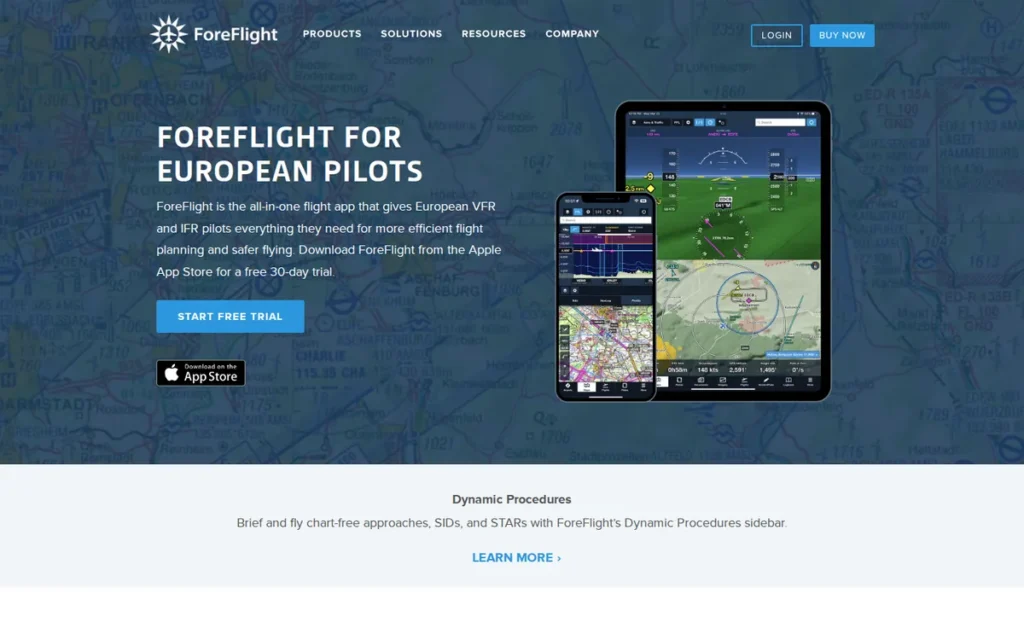
Category: Dispatch Planner, builds and optimizes operational flight plans using aircraft performance, weather, NOTAMs and airspace constraints. Weighted score: 27/45. Ranked #3 Dispatch Planner (business aviation only).
At a Glance
- Category: Dispatch Planner (Business Aviation)
- Best For: Business aviation flight departments, charter operators and Part 135/91K fleets
- Price Range: Dispatch priced per aircraft tail per year through sales (no public figure); companion plans $260–$390/year for pilots and $280–$400/year per license for business, with a two-license minimum (ForeFlight, November 2026)
- Primary Strength: ForeFlight Dispatch publishes a per-tail pricing model alongside list prices for companion plans and connects dispatch directly to the ForeFlight Mobile app pilots already use.
- Biggest Limitation: ForeFlight Dispatch is built for business aviation, not airline-scale operations control, and its total cost rises with paid add-ons such as performance profiles and Fuel Advisor.
- One-Line Summary: ForeFlight Dispatch is the best-fit flight-planning platform in this review for business aviation and charter operators, combining a global route engine and ETP/ETOPS calculations with handoff to ForeFlight Mobile.
- Last Verified: November 2026
Overview
ForeFlight Dispatch is a multi-user flight planning and operations platform with a global route engine, custom aircraft performance profiles and ETP/ETOPS calculations. ForeFlight Dispatch is built for business aviation flight departments, charter operators and Part 135/91K fleets, not airline-scale operations control.
ForeFlight was founded in Houston in 2007. ForeFlight Dispatch has shared an owner with Jeppesen since Thoma Bravo’s purchase closed on October 31, 2025 [Source: Thoma Bravo, November 2025].
ForeFlight Dispatch ranks #4 because its pricing and validation evidence is stronger, not because it replaces airline network optimizers. It scores 3 on every primary criterion. ForeFlight Dispatch also received less dedicated research than the other six products (one dedicated query instead of two).
Key Features
- ForeFlight Dispatch includes a global route engine that applies route constraints and custom aircraft performance profiles.
- ForeFlight Dispatch calculates equal-time points (ETP) and ETOPS for overwater and remote operations.
- ForeFlight Dispatch supports direct AFTN addressing and custom navlogs.
- ForeFlight Dispatch offers Fuel Advisor as a paid add-on with fuel prices for North America, Europe and Central America.
- ForeFlight Dispatch provides an API for scheduling systems and hands schedules off to ForeFlight Mobile.
Best For
ForeFlight Dispatch fits charter, fractional and corporate flight departments that value service flexibility and crew workflow over cutting fuel cost. ForeFlight Dispatch is not designed for Part 121 airline operations control.
“At 135/91 ops you’ll make decisions based on owner convenience, not saving the company money (owners cover the fuel bills etc).” (u/Otherwise_Tradition9 [Source: r/FlightDispatch practitioner comment, accessed November 2026])
Takeaway: Business-aviation buyers should give workflow and schedule flexibility more weight than fuel-optimization depth when they evaluate ForeFlight Dispatch.
Strengths
- ForeFlight Dispatch customer Northern Jet started on Business Performance in 2020 with a couple of aircraft and expanded to its whole fleet, including Dispatch and Runway Analysis [Source: ForeFlight customer announcement, accessed November 2026].
- ForeFlight Dispatch added Airflow-powered Trip Feasibility and Ops Briefing agents in a vendor announcement [Source: AIN, October 2026].
- ForeFlight Dispatch counts Flexjet (its first Dispatch customer), Comlux and Gama Aviation as named business-aviation references.
- ForeFlight as a brand rates 4.4/5 on G2, though most reviewers are pilots using ForeFlight Mobile [Source: G2, November 2026].
Limitations
ForeFlight Dispatch trades airline-grade engine depth for workflow simplicity. Airline-background dispatchers describe ForeFlight Dispatch as more of a document “drop box” than a JetPlan-class engine [Source: r/FlightDispatch, accessed November 2026].
- ForeFlight Dispatch costs grow with add-ons, because performance data and W&B profiles are bought separately and business plans require at least two licenses [Source: ForeFlight, accessed November 2026].
- ForeFlight Dispatch has no quantified fuel or time savings, and nobody has verified how deeply it integrates with FL3XX, Avinode or Leon.
- ForeFlight Dispatch shares an owner with Jeppesen, so the same questions about the post-acquisition roadmap apply.
Verdict
ForeFlight Dispatch is the best-fit flight-planning platform in this review for business aviation and charter operators in 2026, with a published per-tail pricing model and direct handoff to ForeFlight Mobile.
Buyers should cost out add-ons before signing. Airlines should look at Jeppesen, Lido or NAVBLUE instead.
5. Sabre Mosaic Network Planning: Best for Airlines Already on Sabre’s Commercial Stack
Category: Network Optimizer, designs markets, frequencies, schedules, fleet assignment, hubs and slots. Weighted score: 25/45. Ranked #2 Network Optimizer.
At a Glance
- Category: Network Optimizer
- Best For: Scheduled airlines already using Sabre for distribution or revenue management that want integrated strategic planning
- Price Range: Pricing on request (quote-only as of November 2026)
- Primary Strength: Sabre Mosaic Network Planning has the largest named installed base among strategic planning suites, with Air India Express announced as its 100th airline in February 2025.
- Biggest Limitation: Sabre Mosaic Network Planning publishes less about its demand and spill/recapture methodology than competing suites, so buyers must request validation documents directly.
- One-Line Summary: Sabre Mosaic Network Planning (formerly Sabre AirVision) has the largest named strategic installed base in this review, with 100+ airlines and the tightest integration with Sabre’s commercial systems.
- Last Verified: November 2026
Overview
Sabre Mosaic Network Planning (formerly Sabre AirVision) is an integrated strategic suite covering schedules, profitability, fleet, slots, hubs and codeshares. Sabre Mosaic is built for scheduled airlines that want to test profitability scenarios before committing capacity, especially airlines already on Sabre.
Sabre Mosaic is a rebrand of the AirVision products, not a sale. Sabre Corporation grew out of the reservation system that American Airlines and IBM built in the 1960s, and it is publicly traded [Source: Sabre, accessed November 2026].
Sabre Mosaic’s C1 score equals Lufthansa Systems’. Documentation gaps cost Sabre Mosaic 6 weighted points on C2 and 1 point on C5. That reflects missing public evidence, not a proven weakness in the product.
Key Features
- Sabre Mosaic Schedule Manager supports schedule design and scenario testing before capacity is committed.
- Sabre Mosaic Profitability Manager links demand forecasting to route and network profitability analysis.
- Sabre Mosaic Fleet Manager and Slot Manager cover fleet planning and airport slot management.
- Sabre Mosaic Network Manager handles hub and codeshare planning, and Sabre Mosaic Market Intelligence supplies market data.
- Sabre Mosaic integrates with Sabre’s revenue management, distribution, offer optimization and marketplace data.
Best For
Sabre Mosaic Network Planning fits airlines already running Sabre’s commercial stack that want planning, revenue management and distribution on one vendor’s data model. Sabre Mosaic also has references among fast-growing carriers such as Air India Express.
Strengths
- Sabre announced Air India Express as the 100th airline to choose its network-planning software, supporting growth to 200+ routes [Source: Sabre, February 2025].
- Sabre Mosaic’s named references include Wizz Air, Vietnam Airlines (routes across 18 countries) and AirBorneo/MASWings.
- Sabre Mosaic let Vietnam Airlines add network planning to an existing Sabre distribution relationship. Its Deputy General Director said the tools “will help us pinpoint profitable routes,” a vendor-published quote about expected benefits [Source: Sabre, accessed November 2026].
- Sabre claims its planning solutions deliver “up to 9% incremental operating profit” and “up to 12% productivity improvement” for airlines generally, not for Wizz Air specifically [Source: Sabre Wizz Air announcement, December 2019; vendor claim].
Limitations
Sabre Mosaic trades ecosystem integration for lock-in and opacity. Sabre Mosaic delivers the most value to airlines already on Sabre, so airlines with mixed-vendor stacks face lock-in risk.
- Sabre Mosaic’s public sources do not confirm its passenger-choice model, its spill/recapture logic or the scope of its Google AI work.
- Sabre Mosaic has no product-specific G2, Capterra or Gartner Peer Insights rating [Source: G2, November 2026].
- Sabre’s marketing claim that about 80% of airlines use it for network planning conflicts with the 100-airline figure, so buyers should treat it as unverified.
Verdict
Sabre Mosaic Network Planning has the largest named installed base among strategic network-planning suites in this review, and it is the default shortlist pick for carriers already running Sabre commercial systems.
Its fifth-place rank reflects thin public methodology, not a proven product weakness. A benchmark on the buyer’s own network closes that evidence gap.
6. Amadeus SkySuite by Optym: Best for Clean-Sheet Schedule Optimization

Category: Network Optimizer, designs markets, frequencies, schedules, fleet assignment, hubs and slots. Weighted score: 24/45. Ranked #3 Network Optimizer.
At a Glance
- Category: Network Optimizer
- Best For: Scheduled airlines that want clean-sheet schedule design and reliability testing before publication
- Price Range: Pricing on request (quote-only as of November 2026)
- Primary Strength: Amadeus SkySuite optimizes departure times, fleet types and aircraft routings together and tests schedule reliability in a digital twin before publication.
- Biggest Limitation: Amadeus SkySuite has few public airline references, and Amadeus has not documented how it integrates with non-Amadeus passenger service systems.
- One-Line Summary: Amadeus SkySuite by Optym is a clean-sheet airline schedule optimizer used by Southwest Airlines under a 10-year agreement signed in October 2018, and its SkySYM reliability digital twin sets it apart.
- Last Verified: November 2026
Overview
Amadeus SkySuite by Optym is a strategic schedule-optimization suite that optimizes departure times, fleet types and aircraft routings together and simulates schedule reliability before publication. Amadeus SkySuite is built for airlines that want clean-sheet schedule design.
Amadeus bought SkySuite from Optym on January 31, 2020, for €36.2M and is folding it into the Amadeus Airline Platform [Source: Amadeus, January 2020].
Amadeus SkySuite sits one point behind Sabre Mosaic. Fewer verified references (C1) and a narrower scope (C3) cost it 6 weighted points. Its stronger methodology documentation (C2) and validation (C5) win back 5.
Key Features
- Amadeus SkySuite SkyMAX performs clean-sheet schedule optimization, solving departure times, fleet types and aircraft routings together.
- Amadeus SkySuite SkySYM acts as a digital twin that simulates schedule reliability before the schedule is published.
- Amadeus SkySuite SkyCAST forecasts demand using passenger-choice modeling.
- Amadeus SkySuite SkyPLAN optimizes flight frequencies while accounting for connecting itineraries.
- Amadeus SkySuite SkyWORKS provides schedule editing [Source: Amadeus SkySuite product sheet, accessed November 2026].
Best For
Amadeus SkySuite fits airlines, particularly high-frequency point-to-point and low-cost carriers, that want to rebuild schedules from scratch and stress-test reliability. Amadeus SkySuite suits Amadeus-hosted airlines best until Amadeus documents integration with other PSS platforms.
Strengths
- Amadeus SkySuite has been used by Southwest Airlines since 2015, and Southwest signed a 10-year full-suite agreement covering thousands of daily flights [Source: Amadeus customer announcement, October 2018].
- Amadeus SkySuite was chosen by LATAM Airlines Group in a multiyear SkyMAX and SkySYM agreement [Source: Amadeus customer announcement, May 2019].
- Amadeus SkySuite counted easyJet as a joint Amadeus–Optym customer before the 2020 acquisition [Source: Amadeus, January 2020].
- Amadeus SkySuite’s SkySYM digital twin tests schedule reliability before publication, which is unusual among strategic tools. Optym credits its Southwest partnership with “hundreds of millions of dollars in annual value,” an unaudited vendor claim [Source: Optym, accessed November 2026].
Limitations
Amadeus SkySuite trades optimization sophistication for thin public evidence. Southwest, LATAM and easyJet are its only three verified public references, and other claimed customers could not be confirmed.
- Amadeus SkySuite has no public documentation on integrating with non-Amadeus passenger service systems.
- Amadeus SkySuite focuses on schedule optimization rather than full route-economics, slot or codeshare workflows.
- Amadeus SkySuite’s only review signal, Optym’s 3.5/5 on G2, may reflect Optym’s trucking and rail products [Source: G2, November 2026].
Verdict
Amadeus SkySuite by Optym is the strongest choice in this review for airlines that want clean-sheet schedule optimization with reliability tested before publication, as Southwest’s 10-year agreement shows.
Its sixth-place rank reflects few public references. Buyers outside the Amadeus ecosystem should make proof of integration a condition of any contract.
7. NAVBLUE N-Flight Planning: Best for Start-Up and Regional Airbus Operators
Category: Dispatch Planner, builds and optimizes operational flight plans using aircraft performance, weather, NOTAMs and airspace constraints. Weighted score: 24/45. Ranked #4 Dispatch Planner.
At a Glance
- Category: Dispatch Planner
- Best For: Start-up, regional and Airbus-heavy airlines that want flight planning, tracking, charts and EFB from one supplier
- Price Range: Pricing on request (quote-only as of November 2026)
- Primary Strength: NAVBLUE N-Flight Planning bundles cloud flight planning with tracking, operations control, certified charts and the Airbus FlySmart+ EFB from a single Airbus-owned supplier.
- Biggest Limitation: NAVBLUE N-Flight Planning has no independently verified fuel-savings data or review-platform presence, and its fit for mixed or Boeing-heavy fleets is less proven.
- One-Line Summary: NAVBLUE N-Flight Planning is Airbus’s cloud-hosted flight-planning product, best suited in 2026 to start-up, regional and Airbus-heavy airlines such as Breeze Airways that want a single-supplier operations bundle.
- Last Verified: November 2026
Overview
NAVBLUE N-Flight Planning is Airbus’s cloud-hosted flight-planning product for start-up, regional and Airbus-heavy airlines that want one supplier. NAVBLUE N-Flight Planning optimizes for fuel, time or total cost using payload, aircraft performance, weather and ATC constraints.
NAVBLUE launched in July 2016 by combining Navtech (founded in 1987 in Waterloo, Ontario), Airbus ProSky and Airbus flight-ops assets [Source: Skies Magazine, accessed November 2026].
NAVBLUE N-Flight Planning ties Amadeus SkySuite at 24/45. Amadeus ranks higher on the published C2 tiebreak. NAVBLUE’s C5 score of 2 credits its EASA/FAA-certified Navigation+ data, the same rule that credits Jeppesen’s QICP status.
Key Features
- NAVBLUE N-Flight Planning is cloud-hosted and optimizes flight plans for fuel, time or total cost.
- NAVBLUE N-Tracking adds flight following and alerts alongside N-Flight Planning.
- NAVBLUE N-Ops & Crew extends the bundle into operations control and crew management.
- NAVBLUE Navigation+ provides EASA/FAA-certified charts and navigation data used by 250+ customers [Source: Airbus, February 2022].
- NAVBLUE FlySmart+ delivers the Airbus performance EFB to the cockpit.
Best For
NAVBLUE N-Flight Planning fits start-up and regional carriers flying mostly Airbus aircraft that want one supplier for flight planning, tracking, operations control and EFB. NAVBLUE N-Flight Planning’s Breeze Airways deployment is a useful reference for new airlines.
Strengths
- NAVBLUE N-Flight Planning was selected by start-up Breeze Airways as part of its flight-operations suite [Source: Airbus customer announcement, November 2020].
- NAVBLUE supplied broader operations-control and EFB suites to Pelita Air [Source: Airbus, May 2023] and to all-Airbus flyadeal [Source: Aerospace Tech Review, April 2023].
- NAVBLUE counts Hong Kong Air Cargo as a named operational customer [Source: Skywise, accessed November 2026].
- NAVBLUE N-Flight Planning has a public customer list on AppsRunTheWorld that buyers can use for reference checks.
Limitations
NAVBLUE N-Flight Planning trades single-supplier convenience for thinner proof. It has no independently verified fuel-savings figure, and its 600+ customer figure covers NAVBLUE’s whole portfolio [Source: RocketReach, accessed November 2026].
- NAVBLUE N-Flight Planning’s native integration with Airbus Skywise is not publicly documented and should be written into the contract.
- NAVBLUE N-Flight Planning may fit mixed or Boeing-heavy fleets less well, according to trade analysis and a low-credibility Scribd comparison citing “significant” integration effort [Source: Scribd, accessed November 2026].
- NAVBLUE’s Pelita Air and flyadeal announcements do not name N-Flight Planning specifically.
Verdict
NAVBLUE N-Flight Planning is the most practical single-supplier flight-planning bundle in this review for start-up and regional airlines flying Airbus fleets, led by Breeze Airways’ 2020 selection.
Its seventh-place rank reflects portfolio-level adoption figures, not a documented weakness. Mixed-fleet operators should test Boeing performance coverage in a demo.
Other Tools Mentioned Elsewhere (Not Ranked)
Several tools appear in AI answer engines or practitioner discussions, but we did not verify them in depth during this research cycle. They are listed here for completeness, not as recommendations.
Leaving a tool off the ranking reflects the limits of our research coverage, not a judgment of its quality.
- OAG Schedules Analyser and Traffic Analyser (oag.com) is Cirium’s closest competitor in market intelligence and narrowly missed the ranking.
- Flightkeys is a challenger dispatch vendor whose Flightkeys 5D platform was handling nearly 4,500 Southwest Airlines flights per day by October 2024 [Source: Aircraft IT, 2024].
- PPS and Aviobook are flight-planning alternatives that we noted but did not research in depth.
- FL3XX and Leon are business-aviation operations tools, and ForeFlight Dispatch buyers should check how well each integrates.
- ICF NetWorks, AirSched, AIMS, Airpas, RocketRoute and skybook appear in AI answers, but we did not verify them independently.
- Optifly appears in AI answers. Its Opty AI layer is announced for January 2027, so Opty is a roadmap item, not a shipped product.
Who Owns Airline Route Planning Software Vendors in 2026?
Thoma Bravo has owned Jeppesen and ForeFlight since completing a $10.55B purchase from Boeing on October 31, 2025. The Lufthansa Group owns Lufthansa Systems and was reported in October 2026 to be weighing a sale of Lido and NetLine. Amadeus owns SkySuite, Airbus owns NAVBLUE, RELX owns Cirium, and Sabre is publicly traded.
The ownership events buyers should know about are:
- Jeppesen and ForeFlight: Boeing sold Jeppesen, ForeFlight, AerData and OzRunways to Thoma Bravo in an all-cash deal, and the business launched as Jeppesen ForeFlight on November 3, 2025 [Source: Thoma Bravo, November 2025].
- Lufthansa Systems: Lufthansa is reportedly exploring a sale of its Lido and NetLine software assets at an indicative value near €1B, with talks at an early stage [Source: CorpDev.org, October 2026].
- Amadeus SkySuite: Amadeus completed its purchase of SkySuite from Optym on January 31, 2020, for €36.2M [Source: Amadeus, January 2020].
- Stable owners: Cirium belongs to LexisNexis Risk Solutions (RELX), Airbus owns NAVBLUE, and Sabre Corporation is publicly traded.
Three of the seven products in this review have changed owners or face a reported sale since 2025, so change-of-control clauses belong in every 2026 airline software contract.
How Big Is the Airline Route Planning Software Market in 2026?
Airline route planning software sits inside a global aviation software market worth about $12.5B in 2026, projected to reach $22.5B by 2033 [Source: Grand View Research, 2026]. No standalone figure exists for route planning alone. Airlines spent about $36B on IT in 2025, and 46% are upgrading their flight-operations systems [Source: SITA, 2025].
The main market signals are:
- Global aviation software is growing at an 8.8% CAGR from $11.8B in 2025 [Source: Grand View Research, 2026].
- Flight planning makes up about $1.0B (43.9%) of the aircraft-navigation software market [Source: Epignosis Insights, 2025].
- Airline IT spending equals about 3.6% of airline revenue [Source: SITA, 2025].
- About 49% of airlines name data integration and consistency as the main barrier to getting value from IT investment [Source: SITA, 2025].
What Red Flags Should I Watch For When Evaluating Airline Route Planning Software?
The biggest red flags are buying the wrong planning layer, accepting unlabeled vendor ROI figures, and signing without change-of-control protection. Jeppesen, ForeFlight Dispatch and Lufthansa Systems have been affected by ownership changes or a reported sale, and every ROI figure we found came from vendors.
Red Flag #1: Wrong Layer Buying a dispatch tool to answer a network question, or a network optimizer to run dispatch, is the most common mistake in this category. Confirm whether your problem is market intelligence, network optimization or flight planning before you invite vendors.
Red Flag #2: Unlabeled ROI Claims Vendor figures such as Sabre’s “up to 9% incremental operating profit” or Jeppesen’s 0.5–2% fuel savings are not independently audited. Treat any ROI number without a named airline and a stated method as a vendor claim.
Red Flag #3: Inflated Adoption Scope Jeppesen’s “nearly 1,000 customers” and Lido Flight 4D’s “125+ airlines” are not comparable, because Jeppesen’s figure includes business and military customers. Ask every vendor to report adoption in the same unit for the specific product.
Red Flag #4: No Change-of-Control Protection Contracts without change-of-control clauses leave buyers exposed. Jeppesen and ForeFlight changed owners in October 2025, and Lufthansa Systems’ Lido and NetLine were reported to be under sale review in October 2026.
Red Flag #5: Unproven Integrations or Roadmap Features Undocumented integrations and announced features are not live capabilities. Amadeus SkySuite’s non-Amadeus PSS integration and NAVBLUE’s Skywise integration are undocumented, and Optifly’s Opty is announced for January 2027, so require written proof and live demonstrations.
Red Flag #6: Add-On Cost Creep Base prices often leave out essential modules. ForeFlight Dispatch performance profiles, Fuel Advisor and Runway Analysis are sold separately, and enterprise suites price navigation data, EFB and interfaces as extras.
As one user on r/aviation described:
“The next tier is $90/mo, and has 333k requests/mo and 2 years availability. Again, you’ll be heavily limited with your region, depending on how far back you want to go.
The third tier they offer is $900/mo, and has unlimited requests and all available historical data. This is obviously what you want, but may be cost prohibitive for a school project.” Posted by u/PuddlesRex
Takeaway: Aviation data products commonly reserve full historical coverage for their most expensive tier, so buyers should price the tier their route analysis actually needs, not the advertised entry tier.
What Questions Should I Ask Before Choosing Airline Route Planning Software?
The most important question to ask before choosing airline route planning software is whether the vendor will run a proof of concept on your own historical data. None of the seven vendors reviewed publishes independently audited accuracy or ROI results as of November 2026, so your own back-test is the most reliable check.
Question #1: Will you run a proof of concept on our own historical network data? Give the vendor two historical seasons and withhold the actual results for the second. Then compare the vendor’s forecast passengers, load factors and route revenue with what actually happened, using the same dataset for every finalist.
Question #2: Can you provide model-validation documentation for your demand and spill/recapture logic? A strong answer documents the passenger-choice model, the spill/recapture method and known limits. Lufthansa Systems publishes this detail, Cirium publishes accuracy caveats, and Sabre does not document it publicly.
Question #3: Which ETOPS/EDTO, NOTAM-filtering and regulatory approvals are live today for our regulator? Operational buyers should ask for evidence of current approvals, not general statements. Public documentation of ETOPS/EDTO and NOTAM-filtering depth is thin for Lido, NAVBLUE and Jeppesen, so check them in a scripted demo.
Question #4: What are the line-item costs for licenses, data feeds, EFB, interfaces, hosting, support and exit? A complete answer separates every cost so quotes can be compared. Six of the seven products here are quote-only as of November 2026, which makes line-item comparison the only practical way to compare total cost.
Question #5: What contract guarantees cover roadmap, support duration, API access and data portability if ownership changes? Vendors should commit in writing to support timelines, notice before end-of-life, and data export. This matters most for Jeppesen, ForeFlight Dispatch and Lufthansa Systems, given the ownership events of 2025–2026.
Users on r/aviation noted:
“Their TOS forbids building your own database based on their data.
Actually, most services providing this kind of data do.
I’ve been trying to (legally) get the same data for months but except for Lufthansa Group schedules, I have not yet found any source that allows their data to be permanently stored.” Posted by u/Sensi1093
Takeaway: Aviation flight-data providers routinely forbid permanent storage of their data, so data portability and retention rights must be negotiated into the contract rather than assumed.
Question #6: What is the realistic implementation timeline for an operator of our size? Ask for references from operators of similar size and the timelines they actually achieved. The industry patterns below are not sourced benchmarks:
- Charter or business aviation operators on hosted SaaS typically implement in weeks to a few months.
- Regional airlines replacing a dispatch system typically take about 6–18 months.
- Airlines replacing a network-planning or integrated suite typically take 12–24+ months.
A defensible shortlist has 2–3 vendors from the same planning layer, at least one reference customer of similar fleet size for each vendor, and a written answer from each vendor to all six questions.
How Did We Rank These Airline Route Planning Software Tools?
PlugRoute ranked these tools with a weighted evidence score. Each product was scored 1–5 on six criteria, and the three primary criteria counted double, for a maximum of 45 points. Every score is tied to a dated source and an evidence label. The total measures the strength of public evidence, not proven performance.
The ranking criteria are:
- C1 Documented Adoption (primary): Named, dated deployments are the strongest public signal that a tool works at a buyer’s scale.
- C2 Methodology Transparency (primary): Published methodology lets buyers design proofs of concept that mean something.
- C3 Planning Scope and Segment Coverage (primary): Scope addresses the top pain point, which is buying the wrong type of software.
- C4 Pricing Transparency (secondary): C4 credits published prices for the ranked product itself, so smaller operators can check budget fit early.
- C5 Independent Validation (secondary): Regulatory certifications, product-specific reviews and practitioner comments help separate marketing from capability.
- C6 Vendor Stability and Integration Openness (secondary): Ownership changes and long implementations make roadmap risk and interoperability important.
| Rank | Product | C1 (×2) | C2 (×2) | C3 (×2) | C4 | C5 | C6 | Total /45 |
|---|---|---|---|---|---|---|---|---|
| 1 | Lufthansa Systems | 5 | 5 | 5 | 1 | 2 | 2 | 35 |
| 2 | Jeppesen JetPlan / Dispatch | 5 | 4 | 4 | 1 | 4 | 3 | 34 |
| 3 | Cirium SRS Analyser / Diio Mi | 5 | 4 | 3 | 2 | 3 | 4 | 33 |
| 4 | ForeFlight Dispatch | 3 | 3 | 3 | 3 | 3 | 3 | 27 |
| 5 | Sabre Mosaic Network Planning | 5 | 2 | 3 | 1 | 1 | 3 | 25 |
| 6 | Amadeus SkySuite by Optym | 3 | 4 | 2 | 1 | 2 | 3 | 24 |
| 7 | NAVBLUE N-Flight Planning | 3 | 3 | 3 | 1 | 2 | 3 | 24 |
When totals tie, the higher C1 score ranks first, then the higher C2 score. The layer rankings are:
- Cirium SRS Analyser and Diio Mi rank #1 of 1 in the Market Intelligence layer with 33/45.
- In the Network Optimizer layer, Lufthansa Systems NetLine/Plan ranks first (35/45, suite-level score), followed by Sabre Mosaic (25) and Amadeus SkySuite (24).
- In the Dispatch Planner layer, Lufthansa Systems Lido Flight 4D ranks first on its suite-level score (35), followed by Jeppesen (34), ForeFlight Dispatch (27, business aviation only) and NAVBLUE (24).
Every cited figure carries one of five evidence labels:
- A Vendor Claim is a figure the vendor published without independent audit.
- A Customer Announcement is a named, dated deployment announced by the vendor or the customer.
- An Independent/Third-Party source is a certification, a review platform or an analyst.
- A Practitioner Comment is a forum post that may not be fully verified.
- A Low-Credibility Estimate is an unofficial figure from a source such as PulseRevOps, FindAlternatives or Scribd.
As of November 2026, every ROI figure we found came from a vendor, and G2’s Airline Route Planning category held just 3 reviews averaging 2.8/5 [Source: G2, November 2026]. A buyer’s own back-test is the only independent benchmark available today.
Sabre’s low C2 and C5 scores reflect gaps in its public documentation, not a proven weakness. ForeFlight Dispatch received less dedicated research than the other six products.
PlugRoute has no affiliate relationships with any company listed, and rankings are determined entirely by research data and objective evaluation criteria.
Frequently Asked Questions
Which airline network planning software is best for route profitability?
For route profitability, airlines typically pair a market-intelligence tool with a network optimizer. Cirium SRS Analyser and Diio Mi estimate demand and fares for a proposed route. Lufthansa Systems NetLine/Plan or Sabre Mosaic Profitability Manager then models network profitability, including spill and recapture. None of these vendors publishes audited profitability accuracy.
What is the best airline route planning software for regional airlines?
Regional airlines usually do best with a staged approach rather than one enterprise suite. They can start with Cirium or OAG data plus spreadsheets for strategic decisions. On the operational side, NAVBLUE N-Flight Planning or Jeppesen’s managed dispatch service fit well. Once the network grows, consider Sabre Mosaic and ask Air India Express for a reference.
How does PlugRoute determine rankings?
PlugRoute scores each product 1–5 on six published criteria, counts the three primary criteria double and caps the total at 45 points. Every score is tied to a dated source with an evidence label, such as Vendor Claim or Practitioner Comment. The score measures the strength of public evidence, not audited performance.
What Do Key Airline Route Planning Software Terms Mean?
Origin-and-Destination (O&D) demand: The number of passengers who want to travel between a true starting point and a final destination, whatever their connections. Route profitability depends on total O&D flows, not just nonstop traffic.
Nested-logit passenger choice model: A statistical model that predicts how travelers choose between competing itineraries based on time, connections and airline. A documented choice model lets buyers judge how realistic a vendor’s demand forecasts are.
Spill and recapture: Spill is the demand an airline loses when a flight is full. Recapture is the share of that demand the airline wins back on another of its own flights. Modeling both correctly is central to frequency and aircraft-size decisions.
Clean-sheet schedule optimization: Building a schedule from scratch instead of adjusting last season’s version. Clean-sheet optimization can find larger gains but needs more data and more change management.
SSIM Chapter 6: The IATA standard message format for airport slot requests and allocations. Support for SSIM Chapter 6 matters to airlines flying into slot-coordinated airports.
ARINC 633: An industry standard format for exchanging flight-plan data between planning systems and cockpit devices. ARINC 633 support reduces lock-in, because airlines can mix planning engines and EFB tools.
ETOPS/EDTO: Rules that let twin-engine aircraft fly routes far from diversion airports under specific planning and equipment requirements. Operators flying overwater or remote routes need verified ETOPS/EDTO support in their software.
Equal-Time Point (ETP): The point on a route where flying on to a diversion airport takes the same time as turning back. ETP calculation is a core safety function for long-range and overwater planning.
NOTAM: A Notice to Air Missions that warns of temporary hazards, closures or restrictions. Good NOTAM filtering stops dispatchers from missing critical notices buried among routine ones.
FAA QICP: The FAA’s Qualified Internet Communications Provider status, which qualifies an internet service that delivers weather information. QICP status lets Part 121 and Part 135 operators use that delivered weather for operational flights.
Part 121, Part 135 and Part 91K: US regulatory categories for scheduled airlines, on-demand and charter operators, and fractional ownership programs. The operator category determines which dispatch and flight-planning requirements software must meet.
Operational Flight Plan (OFP): The approved document listing route, fuel, altitudes and timings for a specific flight. The OFP is the main output of dispatch software and the basis for the dispatch release.
Which Airline Route Planning Software Is Right for You?
Key Insights
The right airline route planning software depends first on your planning layer. Choose Cirium for route-viability data, Lufthansa Systems, Sabre Mosaic or Amadeus SkySuite for network and schedule optimization, and Jeppesen, Lido or NAVBLUE for airline dispatch. Choose ForeFlight Dispatch for business aviation. Then test every finalist on your own historical data.
- Airline route planning buyers should identify their layer first, because products in different layers do not replace one another.
- Lufthansa Systems leads overall with 35/45 as the only vendor covering network plan to flight plan, but its reported sale review means buyers need change-of-control protection.
- Jeppesen JetPlan is the best-validated airline dispatch engine in this review, backed by a QICP-qualified weather service and nearly 1,000 customers.
- Cirium SRS Analyser and Diio Mi are the starting point for deciding whether a new route will make money.
- Smaller and regional operators should usually follow a staged path, from data plus spreadsheets to specialized tools and then to an enterprise suite.
- None of the seven vendors reviewed publishes independently audited ROI or accuracy results as of November 2026, so a proof of concept on your own data is essential.
Use this shortlist by layer:
- For route viability, shortlist Cirium and compare it with OAG.
- For network and schedule optimization, shortlist Lufthansa Systems NetLine/Plan, Sabre Mosaic and Amadeus SkySuite.
- For airline dispatch, shortlist Jeppesen JetPlan, Lufthansa Systems Lido Flight 4D and NAVBLUE N-Flight Planning.
- For business aviation dispatch, shortlist ForeFlight Dispatch.
Over the next 30 days, identify your layer, shortlist 2–3 vendors within it, and ask each one for a back-test on two historical seasons. Read our full scoring methodology, or sign up for PlugRoute alerts when we re-verify this ranking.
PlugRoute last verified these rankings in November 2026 and will re-verify them sooner if the Lufthansa Systems sale status changes. We update this guide quarterly. Last updated: November 2026.