Amadeus Altéa PSS is the best-evidenced airline reservations software for full-service and alliance carriers. Navitaire New Skies leads for high-volume low-cost carriers, and Sabre offers full-service and low-cost systems under one relationship. The right passenger service system depends on your operating model. Smaller carriers should shortlist IBS iFly Res, Hitit Crane, Videcom VRS or AeroCRS.
In this guide, “airline reservations software” means the airline’s own passenger service system (PSS). The PSS controls inventory, reservations, ticketing and departure control. Agency tools, corporate tools such as Navan, and GDSs are out of scope (Tripgic, accessed November 2026; Navan, accessed November 2026). Pricing is opaque and independent reviews are thin, so every claim carries a dated source.
As one user on r/sysadmin described:
“The problem is the industry is a zero downtime industry with no maintenance windows and airlines like southwest and delta use completely custom inhouse solutions that were carefully tailored to their needs at the time and likely not designed with adaptability in mind.” Posted by u/Lost_Term_8080
Takeaway: Airline reservations software is hard to replace because the industry has no maintenance windows, so choosing the right PSS up front matters more than in most software categories.
PlugRoute has no affiliate relationships with any company listed, and rankings are determined entirely by research data and objective evaluation criteria.
- Verified: A Verified claim comes from a regulator, an audited filing, an IATA document or an independent third party.
- Vendor-reported: A Vendor-reported claim comes from a vendor’s own report, case study or press release.
- Unverified: An Unverified claim could not be confirmed in the public sources reviewed in November 2026.
What Are the 4 Categories of Airline Reservations Software?
Airline reservations software falls into four categories, defined by the type of carrier each serves. Two serve large carriers, one serves mid-market modernizers and one serves small operators. Each category balances functional depth against cost and speed differently, so buyers should find their category before comparing individual vendors.
- Enterprise Network PSS: An Enterprise Network PSS is a full-scope system for full-service, network and alliance carriers with complex fares, codeshares and interline partners. Amadeus Altéa PSS and Sabre (SabreSonic, with Radixx for LCCs) are in this category.
- LCC and Hybrid Retailing PSS: An LCC and Hybrid Retailing PSS is a ticketless, segment-based system built for direct, ancillary-heavy sales that can still take GDS and interline bookings. Navitaire New Skies / Stratos is in this category.
- Modern Challenger Suite: A Modern Challenger Suite is a newer or mid-market system that is either built on offers and orders from the start or sold as an all-in-one suite. IBS Software iFly Res and Hitit Crane PSS are in this category.
- Regional and Small-Carrier PSS: A Regional and Small-Carrier PSS is a hosted system with lower entry costs and simple GDS reach. Videcom VRS and AeroCRS (GO7) are in this category.
How Do the Best Airline Reservations Systems Compare?
Amadeus Altéa PSS scores highest at 37 of 45 points. Navitaire New Skies follows with 36 and Sabre with 34. IBS Software iFly Res (30) and Hitit Crane PSS (29) lead the challengers, and Videcom VRS and AeroCRS tie at 23. The table shows each platform’s category, best-fit buyer, strongest evidence and main trade-off.
| Rank | Company | Category | Best For | One-Line Summary | Key Capabilities | Primary Strength | Key Limitation |
|---|---|---|---|---|---|---|---|
| 1 | Amadeus Altéa PSS (37/45) | Enterprise Network PSS | Full-service and alliance carriers | Amadeus Altéa PSS is the most widely evidenced PSS for full-service and alliance airlines. | Reservations, inventory, ticketing, DCS, NDC, Nevio offers/orders | Interline interoperability recognized by the European Commission (2016) | Complex and costly (European Commission, 2016); global check-in outage in 2017 |
| 2 | Navitaire New Skies / Stratos (36/45) | LCC and Hybrid Retailing PSS | High-volume LCCs, ULCCs and hybrids | Navitaire New Skies is the reference PSS for high-volume low-cost carriers. | Ticketless PSS, GoNow DCS, NDC Gateway, SkyLedger | Ryanair renewal in May 2025 at 200M+ passengers a year (Navitaire, 2025) | Shared-platform outages (2010, 2026) |
| 3 | Sabre (SabreSonic / Radixx / SabreMosaic) (34/45) | Enterprise Network PSS | Airlines wanting full-service and LCC systems from one relationship | Sabre offers full-service and LCC passenger service systems under one vendor relationship. | SabreSonic, Radixx, SabreMosaic AI retailing | Dual IATA NDC Level 3 (AltexSoft, accessed November 2026) | $4.35B debt (Sabre 10-K, 2025); outages in 2013 and 2021 |
| 4 | IBS Software iFly Res (30/45) | Modern Challenger Suite | Startups and offer/order modernizers | IBS Software iFly Res is an offer/order-native cloud PSS with fast documented go-lives. | PSS, DCS, NDC, ONE Order, dynamic pricing | 5-month Fly Gangwon go-live (IBS, accessed November 2026; Vendor-reported) | Far behind the leaders in PSS share (EC estimate, 2014) |
| 5 | Hitit Crane PSS (29/45) | Modern Challenger Suite | Mid-size and emerging-market carriers | Hitit Crane PSS is an all-in-one suite used by 72 airlines in 50 countries. | PSS, DCS, weight and balance, loyalty, accounting | Migrations away from Sabre (2018) and Amadeus (2021) | Revenue management described as “under development” (Hitit, 2025) |
| 6 | Videcom VRS (23/45) | Regional and Small-Carrier PSS | Regional and seasonal carriers | Videcom VRS is a hosted PSS with integrated DCS and no licence fee. | Reservations, IBE, DCS, 4 GDS connections | Usage-based pricing with no licence fee (Videcom, accessed November 2026) | Outage on 8–10 April 2026 affecting up to 50 airlines |
| 7 | AeroCRS (GO7) (23/45) | Regional and Small-Carrier PSS | Very small regional and charter operators | AeroCRS is an entry-level cloud PSS with a published $99/month starting price. | Inventory, IBE, B2B agent platform, Hahn Air GDS reach | Only published price in the category (Capterra, 2026) | DCS depth undocumented; current controlling owner unclear |
Which Airline Reservations Software Should I Choose for My Use Case?
Choose airline reservations software by operating model first. Full-service carriers should shortlist Amadeus Altéa PSS and high-volume LCCs Navitaire New Skies. Fast-launching startups should look at IBS iFly Res, mid-size consolidators Hitit Crane, seasonal regionals Videcom VRS and very small charter operators AeroCRS. The overall rank measures depth of evidence, not fit.
| Your #1 Priority | Recommended Tool | Why | Acceptable Alternative |
|---|---|---|---|
| Full-service or alliance operations | Amadeus Altéa PSS | Interline interoperability recognized by the European Commission (2016) | SabreSonic |
| High-volume LCC or ULCC | Navitaire New Skies | Ryanair renewed in May 2025 at 200M+ passengers a year (Navitaire, 2025) | Sabre Radixx |
| Hybrid: ticketless direct sales plus interline | Navitaire New Skies | Case-study airline with 8 GDSs and 70+ interline partners (Navitaire, accessed November 2026) | Sabre (SabreSonic or Radixx) |
| One vendor relationship across full-service and LCC models | Sabre | SabreSonic and Radixx under one contract, with dual NDC Level 3 (AltexSoft, accessed November 2026) | Amadeus Altéa PSS with Navitaire |
| Startup wanting a fast launch and modern retailing | IBS Software iFly Res | 5-month Fly Gangwon go-live (IBS, accessed November 2026; Vendor-reported) | Sabre Radixx |
| Mid-size carrier wanting one suite | Hitit Crane PSS | PSS, DCS, loyalty and accounting from one vendor (Hitit, 2025) | IBS Software iFly Res |
| Regional or seasonal carrier wanting usage-based pricing | Videcom VRS | No licence fee and usage-based charges (Videcom, accessed November 2026) | AeroCRS |
| Very small charter or air-taxi operator | AeroCRS | $99/month starting price (Capterra, 2026) | Videcom VRS |
1. Amadeus Altéa PSS: Best Overall for Full-Service and Alliance Carriers
Category: Enterprise Network PSS, a full-scope passenger service system for full-service, network and alliance carriers.
At a Glance
- Category: Enterprise Network PSS
- Best For: Full-service, network and alliance carriers with complex fares, codeshares and interline partnerships
- Price Range: Pricing on request (negotiated contracts; fees appear linked to passengers boarded)
- Primary Strength: Amadeus Altéa PSS covers every core PSS module scored in this review, and the European Commission recognized its interline interoperability (European Commission, 2016).
- Biggest Limitation: The European Commission found Amadeus Altéa PSS complex and costly (2016), and the system had a global check-in outage on 28 September 2017.
- One-Line Summary: Amadeus Altéa PSS is the most widely evidenced passenger service system for full-service and alliance airlines. It combines reservations, inventory, ticketing and departure control, and Amadeus Nevio adds offer-and-order modernization.
- Last Verified: November 2026
Overview
Amadeus Altéa PSS is an integrated passenger service system covering reservations, inventory, ticketing, departure control and digital tools. It is built for full-service, network and alliance carriers that manage complex fares, codeshares and interline partnerships across many sales channels.
Amadeus Altéa PSS runs on a multi-tenant hosted platform that combines Amadeus’s own data centers with Azure and Google Cloud. Air France, Iberia, Lufthansa and SAS founded Amadeus in 1987 (Amadeus Global Report, 2025). Amadeus says Altéa powers “hundreds” of airlines (Amadeus, accessed November 2026; Vendor-reported).
Key Features
- Amadeus Altéa PSS combines reservations, inventory, ticketing and departure control in one hosted platform (Amadeus, accessed November 2026; Vendor-reported).
- Amadeus says Altéa NDC is certified under IATA’s Airline Retailing Maturity (ARM) framework and that it links NDC sales to existing inventory, interline and servicing workflows (Amadeus, accessed November 2026; Vendor-reported).
- Amadeus Nevio is the company’s offer and order management platform. Altéa airlines can use it to replace PNR-, ticket- and EMD-based retailing one module at a time, and Saudia and Finnair have committed to it (Amadeus, accessed November 2026; Vendor-reported).
- Amadeus Altéa PSS connects well with other airlines’ systems, and the European Commission said this makes it well suited to alliance carriers (European Commission, 2016; Verified).
- Amadeus Altéa modules can be bought separately, as AirSial did with Altéa DCS (Amadeus, 2025; Vendor-reported).
Best For
Amadeus Altéa PSS is best for full-service, network and alliance carriers that need deep interline, codeshare and multi-channel distribution. Amadeus Altéa PSS also suits startups that can absorb enterprise complexity, as Sun PhuQuoc Airways’ 2025 selection shows.
Strengths
- Amadeus Altéa PSS has deployment scale confirmed by audited accounts. Air IT Solutions revenue reached €2,345.9M in 2025, up 6.4%, and the accounts confirm Vietnam Airlines’ April 2024 migration (Amadeus audited accounts, 2025; Verified). The underlying passengers-boarded figures include Navitaire airlines.
- Amadeus Altéa PSS took part in a 2020 IATA ONE Order pilot. In the pilot, Vueling rebooked disrupted British Airways passengers “in three clicks and under three minutes” (IATA, 2021; Verified).
- Amadeus, the parent company of Altéa, spent €1.4B on R&D in 2025, about 22% of €6.517B revenue. This is a company-wide figure that includes Navitaire (Amadeus Global Report, 2025; Verified).
- Amadeus Altéa PSS is not limited to legacy flag carriers: startup Sun PhuQuoc Airways selected Altéa ahead of its late-2025 launch (Amadeus, 2025; Vendor-reported).
Limitations
Amadeus Altéa PSS trades simplicity for depth. The European Commission described it as highly functional but complex and costly (European Commission, 2016; Verified). That complexity raises total cost of ownership for carriers without experienced in-house teams.
- Amadeus Altéa PSS had a network-related outage on 28 September 2017 that disrupted check-in at airports worldwide for airlines including British Airways, Lufthansa and Qantas. Service was restored the same day (Fortune, 2017; NPR, 2017).
- Amadeus Altéa PSS migrations involve a “significant learning curve” and need experienced teams, according to Amadeus’s own migration material (Amadeus migration brochure, accessed November 2026; Vendor-reported).
- Amadeus Altéa PSS has no verified G2, Capterra or Gartner Peer Insights listing. The only reputation evidence available is vendor-selected testimonials from Norwegian and Etihad (Amadeus, accessed November 2026; vendor-selected).
Verdict
Amadeus Altéa PSS is the best-evidenced passenger service system for full-service, network and alliance carriers in 2026. It scores 37 of 45 and earns 5 on all three primary criteria even after a deduction for its 2017 outage. Low-cost carriers should weigh its complexity against faster alternatives. Buyers should ask Vietnam Airlines about migration staffing.
2. Navitaire New Skies / Stratos: Best for High-Volume Low-Cost and Hybrid Carriers
Category: LCC and Hybrid Retailing PSS, a ticketless, segment-based passenger service system built for direct, ancillary-heavy sales.
At a Glance
- Category: LCC and Hybrid Retailing PSS
- Best For: High-volume LCCs, ULCCs and hybrid carriers that sell mostly direct and earn high ancillary revenue
- Price Range: Pricing on request (quote-based enterprise pricing)
- Primary Strength: Navitaire New Skies has the strongest scale evidence in the LCC segment. It is anchored by Ryanair’s May 2025 renewal, made as the airline passed 200 million passengers a year.
- Biggest Limitation: Navitaire New Skies has a documented record of shared-platform outages, including the 2010 Virgin Blue failure and a February 2026 outage in India.
- One-Line Summary: Navitaire New Skies is the reference passenger service system for high-volume low-cost carriers, and Navitaire’s Stratos cloud platform extends it toward offer-and-order retailing.
- Last Verified: November 2026
Overview
Navitaire New Skies is a ticketless, segment-based passenger service system owned by Amadeus. It is built for low-cost and hybrid airlines that rely on direct digital sales, ancillary revenue and fast day-of-departure processing, and carriers including Ryanair, IndiGo and Vueling use it.
Navitaire New Skies runs as a multi-tenant platform on Microsoft Azure, and more than 60 airlines had moved there by 2023 (AviationTechRadar, accessed November 2026). Navitaire Stratos is the next-generation cloud platform for offer and order management, and it builds on Navitaire New Skies rather than replacing it.
Key Features
- Navitaire New Skies pairs reservations and inventory with GoNow, which handles check-in, kiosk, mobile and agent workflows on the day of departure.
- Navitaire New Skies includes an NDC Gateway, ancillary optimization, dynamic pricing and SkyLedger revenue accounting.
- Navitaire NDC Gateway achieved IATA NDC Capable Level 4 in 2021, and Navitaire New Skies was certified ONE Order Capable in 2020 (Navitaire, 2021; Navitaire, 2020; Vendor-reported).
- Navitaire New Skies can sell e-tickets to GDS and interline partners while staying ticketless for direct sales (Navitaire case study, accessed November 2026; Vendor-reported).
- Navitaire Stratos is a cloud platform for offers, orders and travelers. TUI Airline became its launch customer in late 2025, and Volotea has reportedly selected it (Amadeus Global Report, 2025; Vendor-reported).
Best For
Navitaire New Skies is best for high-volume LCCs and ULCCs focused on direct sales and ancillaries. Navitaire New Skies also suits hybrid carriers that need GDS, interline and codeshare distribution alongside ticketless direct retail.
Strengths
- Navitaire New Skies has the strongest scale proof in the LCC segment. Ryanair renewed with Navitaire in May 2025, marking 25 years of partnership, as the airline passed 200 million passengers a year (Navitaire, 2025; Ryanair Annual Report, 2025; Verified).
- Navitaire moved Jazeera Airways to the latest New Skies release in about 100 days (Amadeus Global Report, 2025; Vendor-reported).
- Navitaire New Skies supports hybrid models: one Americas-based airline on the platform added 8 GDSs, 70+ interline partners and 15 codeshare partners (Navitaire case study, accessed November 2026; Vendor-reported).
- Navitaire New Skies took part in a 2020 IATA ONE Order pilot in which Vueling rebooked disrupted British Airways passengers in under three minutes (IATA, 2021; Verified).
Limitations
Navitaire New Skies gets its efficiency from a shared platform optimized for LCCs. The trade-off is concentration risk, because one failure can stop check-in at several airlines at once.
- Navitaire New Skies had an infrastructure failure in 2010, when Navitaire was an Accenture subsidiary, that stopped Virgin Blue’s reservations and check-in (ZDNet, 2010; iTnews, 2010).
- On 19 February 2026, a Navitaire outage of about 90 minutes forced manual check-in at IndiGo, Akasa Air, Air India Express and SpiceJet. Navitaire attributed it to network instability after planned maintenance (Aviation Business News, 2026).
- Navitaire New Skies has no verified G2, Capterra or Gartner Peer Insights listing, so no independent customer feedback is available.
- Navitaire is owned by Amadeus, and the European Commission estimated the two together held 50–60% of the PSS market in 2014 (European Commission, 2016). Two of the top three platforms in this ranking therefore belong to the same company.
Users on r/sysadmin noted:
“I’ve used Navitaire, SITA horizons and new horizons, TravelSky, Avantik/Bravo, IBS and a few others.
They’re all varying degrees of awful. If I could choose one I had to use (and didn’t need to goto rfp) it’d be navitaire for capabilities and easy of administration” Posted by u/Turdsindakitchensink
Takeaway: Navitaire New Skies wins a multi-platform practitioner’s preference on capabilities and ease of administration, even though the same user rates every PSS he has run, Navitaire included, as some degree of awful.
Verdict
Navitaire New Skies is the best-evidenced passenger service system for high-volume low-cost and ultra-low-cost carriers in 2026. It scores 36 of 45 on deployment at Ryanair’s scale, fast upgrades and IATA NDC Level 4 connectivity. Buyers should negotiate outage SLAs, recovery time objectives and manual-fallback terms.
3. Sabre (SabreSonic CSS, Radixx and SabreMosaic): Best for Full-Service and LCC Options Under One Relationship
Category: Enterprise Network PSS, a full-scope passenger service system for full-service and network carriers, with Radixx covering LCCs.
At a Glance
- Category: Enterprise Network PSS
- Best For: Network and hybrid carriers (SabreSonic) and growing LCC, hybrid or startup carriers (Radixx) that want AI-driven retailing
- Price Range: Pricing on request (transaction- and usage-based, plus module and implementation fees)
- Primary Strength: Sabre sells separate full-service (SabreSonic) and LCC (Radixx) passenger service systems under one Sabre relationship, backed by dual IATA NDC Level 3 certification.
- Biggest Limitation: Sabre reported $4.35B of debt at the end of 2025 and has documented multi-airline outages in 2013 and 2021, so both belong in contract diligence.
- One-Line Summary: Sabre offers SabreSonic for full-service carriers, Radixx for low-cost and hybrid airlines and SabreMosaic for AI-based offer and order retailing. Airlines get both operating models through one vendor relationship.
- Last Verified: November 2026
Overview
Sabre is an airline technology vendor with two passenger service systems: SabreSonic for full-service carriers and Radixx for low-cost, hybrid and growing airlines. It also sells SabreMosaic, a modular, AI-driven offer and order management layer that runs on Google Cloud.
SabreMosaic adds retailing on top of a PSS rather than replacing one, so buyers should confirm which Sabre product line is being quoted. The Amadeus group offers a comparable split through Amadeus Altéa PSS and its Navitaire subsidiary.
Key Features
- Sabre’s SabreSonic covers reservations, inventory, sales, servicing and partner-carrier functions for full-service and network airlines.
- Sabre’s Radixx is a lower-cost, web-based PSS for LCC, hybrid and growing airlines that supports both ticketed and ticketless sales (Sabre, accessed November 2026; Vendor-reported).
- Sabre’s SabreMosaic adds Air Price IQ, Ancillary IQ and Upgrade IQ on Google Cloud, and Virgin Australia is the first adopter of Concierge IQ (Sabre, 2025; Vendor-reported).
- Sabre holds dual IATA NDC Level 3 certification, as an aggregator and as an IT provider (AltexSoft, accessed November 2026; Verified).
Best For
Sabre is best for network and hybrid carriers that want one vendor relationship across full-service and LCC models, and for growing LCCs and startups considering Radixx. Sabre also suits airlines that put AI-driven pricing and ancillary optimization first.
Strengths
- Sabre’s SabreSonic still runs at one of the world’s largest carriers: American Airlines renewed its multi-year SabreSonic PSS partnership on 10 December 2024 (Sabre and American Airlines, 2024; Verified).
- Sabre’s Radixx has recent named deployments, including BermudAir (April 2025), Avelo, SalamAir and Vietravel Airlines (Sabre, 2025; Vendor-reported).
- Sabre’s dual IATA NDC Level 3 certification is one of the clearest third-party-documented connectivity credentials in this review (AltexSoft, accessed November 2026; Verified).
- Sabre’s SabreSonic Res has a 4.1/5 rating from 13 Capterra reviews, and reviewers praise its reservation and inventory depth (Capterra, 2026; Verified).
Limitations
Sabre gives buyers breadth across operating models at the cost of financial and operational simplicity. Sabre reported $4.35B of debt (carrying value; about $4.53B face value) at 31 December 2025, after its $1.1B Hospitality Solutions sale closed in July 2025 (Sabre 10-K, 2025).
- Sabre’s airline systems have had documented outages. An August 2013 outage was reported to affect up to 400 airlines, and a May 2021 PSS outage hit American, Alaska, JetBlue and Hawaiian (Business Insider, 2021).
- Sabre’s Radixx Res suffered an April 2021 malware incident that disrupted bookings at about 20 airlines, although Radixx stated that SabreSonic was not affected (Radixx, 2021).
- Sabre’s SabreSonic draws Capterra criticism for its complexity, its dependence on specialists, and its workflows and user interface (Capterra, 2026).
- Sabre lost Pakistan International Airlines to Hitit Crane PSS in a migration completed in September 2018 (Hitit, 2018; Vendor-reported), and Sabre publishes no customer count for SabreSonic or SabreMosaic.
Verdict
Sabre is a strong single-relationship choice for airlines that need passenger service systems spanning full-service and low-cost models, pairing SabreSonic and Radixx with dual IATA NDC Level 3 certification. Sabre scores 34 of 45. Buyers should call recent Radixx airlines such as BermudAir and review Sabre’s debt in contract diligence.
4. IBS Software iFly Res: Best for Startups and Offer/Order-Native Modernizers
Category: Modern Challenger Suite, a newer PSS built on offers and orders from the start, for startups, modernizers and hybrids.
At a Glance
- Category: Modern Challenger Suite
- Best For: Startup airlines, relaunching carriers and hybrids that want offer/order-native retailing and a fast go-live
- Price Range: Pricing on request (enterprise SaaS)
- Primary Strength: IBS Software iFly Res has the strongest documented fast-launch record in this review, including Fly Gangwon’s 5-month replacement of SITA’s PSS.
- Biggest Limitation: IBS Software iFly Res has a much smaller installed base than the market leaders, so there are fewer peer airlines and a thinner specialist ecosystem.
- One-Line Summary: IBS Software iFly Res is a cloud passenger service system and departure control system built natively on offers and orders, with documented fast go-lives for startup and relaunching airlines.
- Last Verified: November 2026
Overview
IBS Software iFly Res is a cloud passenger service system with integrated departure control, built natively around IATA offers and orders. It is designed for startup, relaunching and hybrid airlines that want modern retailing alongside GDS, interline and codeshare distribution from day one.
IBS Software iFly Res has been in production since SunExpress went live in March 2017 (IATA, 2018; Verified). IBS says the platform runs on AWS (IBS Software, accessed November 2026; Vendor-reported).
Key Features
- IBS Software iFly Res combines reservations, servicing, retailing and integrated departure control in one cloud platform.
- IBS Software iFly Res is built natively around offer and order management, so it supports NDC and ONE Order without translating them from a PNR core.
- IBS Software iFly Res also handles GDS, interline and codeshare distribution for carriers that use traditional channels.
- IBS Software iFly Res includes dynamic pricing for seats and ancillaries.
- IBS Software iFly Res supports both ticketed and ticketless environments (IBS Software, accessed November 2026; Vendor-reported).
Best For
IBS Software iFly Res is best for startup and relaunching airlines that need to go live quickly. IBS Software iFly Res also suits hybrid carriers that want an offer/order-native core rather than a retailing layer added to a legacy PSS.
Strengths
- IBS Software iFly Res took Fly Gangwon live in five months, one month ahead of schedule, after the airline replaced SITA’s PSS. Bamboo Airways went “from start-up to 1 million passengers in just 6 months” on the platform (IBS case studies, accessed November 2026; Vendor-reported).
- IBS Software iFly Res earned IATA NDC Capable Level 3 status in 2016, then the highest level (IBS Software, 2016; IATA NDC ID card, 2018; Verified).
- IBS Software iFly Res completed SkyUp’s migration in January 2025 for the airline’s restart (PR Newswire, 2025; Vendor-reported).
- IBS Software iFly Res references include Jin Air, T’way, Blue Panorama, TUI fly Belgium, Fuji Dream and a relaunched Flybe. Flybe’s CEO cited its “flexibility, retail capability, modern technology” (IBS Software, accessed November 2026; vendor-selected).
Limitations
IBS Software iFly Res gives buyers a modern architecture at the cost of ecosystem depth. The European Commission placed IBS far behind Amadeus, Navitaire and Sabre in 2014 PSS market share, so buyers will find fewer peer airlines and experienced integrators (European Commission, 2016).
- IBS Software iFly Res has no G2 or Capterra listing. The Gartner listing found is for iCargo, a different IBS product, and the 4.0/5 Glassdoor score rates IBS as an employer, not the product (Glassdoor, 2026).
- IBS Software’s own e-book admits there are still gaps between interline and ONE Order standards, which affects iFly Res partner workflows (IBS Software, accessed November 2026).
- IBS Software’s ownership details, including reported Blackstone and Apax involvement, were not confirmed for this review (Unverified).
- No outage was found for IBS Software iFly Res in verification (November 2026), which does not prove reliability.
Verdict
IBS Software iFly Res has the best-documented fast-launch record in 2026 for startup and relaunching airlines that want an offer/order-native passenger service system. It scores 30 of 45, edging out Hitit Crane PSS on go-live evidence. Buyers should call Fly Gangwon or SkyUp and test interline workflows with their own partners.
5. Hitit Crane PSS: Best All-in-One Suite for Mid-Size and Emerging-Market Carriers
Category: Modern Challenger Suite, an all-in-one mid-market PSS for carriers that want fewer vendors.
At a Glance
- Category: Modern Challenger Suite
- Best For: Mid-size and emerging-market carriers that want one suite covering PSS, DCS, loyalty and accounting
- Price Range: Pricing on request (SaaS and hosting plus implementation, maintenance and training)
- Primary Strength: Hitit Crane PSS has the broadest single-vendor module scope among the challengers and has documented migrations away from both Sabre and Amadeus.
- Biggest Limitation: Hitit Crane PSS has a smaller installed base of 72 airlines and almost no independent reviews, and Hitit has described its revenue management modules as under development.
- One-Line Summary: Hitit Crane PSS is a modular, all-in-one passenger service suite used by 72 airlines in 50 countries, best suited to mid-size carriers that want to consolidate vendors.
- Last Verified: November 2026
Overview
Hitit Crane PSS is a modular passenger service suite from Istanbul-based Hitit. It covers everything from reservations through departure control, weight and balance, and loyalty, and is built for mid-size and emerging-market carriers that want fewer vendors.
Hitit Crane PSS is delivered as SaaS and served 72 airline partners in 50 countries as of Q2 2025 (Hitit Annual Report, 2024; Vendor-reported). Hitit Crane PSS modules can be bought separately.
Key Features
- Hitit Crane PSS includes PAX for reservations, inventory and ticketing, plus IBE web booking and MA mobile modules.
- Hitit Crane PSS includes departure control, weight and balance, and baggage reconciliation as native modules.
- Hitit Crane PSS adds allotments, a loyalty layer and customer care, and Hitit also sells revenue and financial accounting.
- Hitit Crane NDC was granted IATA NDC Level 4 in May 2019 and certified on schema 20.1 in 2020 (Hitit, 2019; Hitit, 2020; Vendor-reported).
- Hitit Crane PSS runs on a service-oriented architecture, so an airline can adopt modules in stages.
Best For
Hitit Crane PSS is best for mid-size, national and emerging-market carriers that want one vendor for the PSS, airport operations, loyalty and accounting.
Strengths
- Hitit Crane PSS completed Pakistan International Airlines’ full cutover from Sabre in September 2018. The cutover covered reservations, inventory, ticketing, check-in and revenue management (Hitit, 2018; Vendor-reported).
- Hitit, the publicly listed company behind Hitit Crane PSS, reported 2024 revenue of US$34.2M, up 34% (Hitit Annual Report, 2024; Verified).
- Hitit Crane PSS began Royal Brunei Airlines’ migration from Amadeus in 2021 (Hitit IPO prospectus, 2024; Vendor-reported).
- Hitit holds ISO 27001, SSAE 16 and PCI DSS certifications for Hitit Crane PSS operations, and its 2024 wins included Drukair, TezJet, Sunrise Airways and FlyLili (Hitit Annual Report, 2025; Vendor-reported).
Limitations
Hitit Crane PSS trades scale and independent validation for breadth of modules. The 72-airline base of Hitit Crane PSS is far smaller than Amadeus’s or Sabre’s, so buyers have fewer peer references to call.
- Hitit described Hitit Crane PSS revenue management and dynamic pricing as “under development” (Hitit H1 results presentation, 2025), so buyers must confirm general availability.
- Hitit Crane PSS has no G2, Capterra or Gartner listing and no Reddit discussion, and Hitit’s prospectus lists customer non-renewal as a risk factor (Hitit IPO prospectus, 2024).
- Hitit Crane PSS customer names that circulate online, such as Air Europa and SunExpress, were not confirmed, and SunExpress is documented as an IBS customer (Unverified).
- No outage was found for Hitit Crane PSS in verification (November 2026), which does not prove reliability.
Verdict
Hitit Crane PSS is the best-evidenced all-in-one passenger service suite for mid-size and emerging-market carriers in 2026, with documented migrations away from both Sabre and Amadeus. It scores 29 of 45. Buyers should get written confirmation that revenue management is generally available and should ask PIA for a reference call.
6. Videcom VRS: Best for Regional and Seasonal Carriers Wanting Usage-Based Pricing
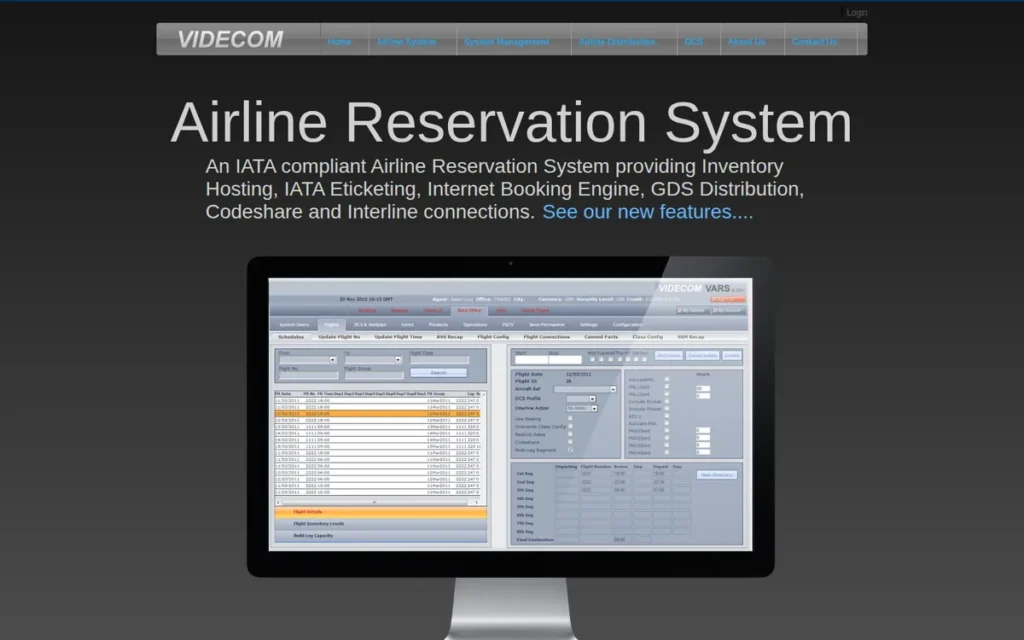
Category: Regional and Small-Carrier PSS, a hosted PSS for regional, charter, seasonal and small airlines.
At a Glance
- Category: Regional and Small-Carrier PSS
- Best For: Regional, seasonal, startup and charter carriers that want usage-based pricing and an integrated DCS
- Price Range: No licence fee; usage-based after implementation (no dollar figures published, 2026)
- Primary Strength: Videcom VRS combines usage-based pricing and no licence fee with an integrated departure control system, a good fit for low-volume and seasonal carriers.
- Biggest Limitation: Videcom VRS had an outage from 8 to 10 April 2026 that affected up to 50 airlines. It is the longest multi-airline outage documented in this review.
- One-Line Summary: Videcom VRS is a hosted passenger service system with integrated departure control and usage-based pricing with no licence fee, used by regional carriers such as Loganair.
- Last Verified: November 2026
Overview
Videcom VRS is a hosted passenger service system from UK-based Videcom International. It covers reservations, inventory, fares, ticketing, an internet booking engine and integrated departure control, and is built for regional, seasonal, startup and charter carriers that need GDS reach without enterprise pricing.
Videcom VRS runs on a Videcom-hosted Microsoft SQL Server and Windows stack and is accessed over a standard internet connection. Videcom was founded in 1972, although one Videcom page says 1971 (Videcom, accessed November 2026).
Key Features
- Videcom VRS covers reservations, inventory, fares, ticketing and an internet booking engine in one hosted system.
- Videcom VRS includes an integrated departure control system, plus passenger profiles and CRM (Videcom, accessed November 2026; Vendor-reported).
- Videcom VRS connects to the Amadeus, Sabre, Worldspan and Galileo GDSs (Videcom, accessed November 2026; Vendor-reported).
- Videcom VRS handles SSIM schedule files and ATPCO fare data, the industry standards for exchanging schedules and published fares.
- Videcom VRS works over a standard internet connection rather than leased lines, which suits small and remote stations.
Best For
Videcom VRS is best for regional, island, seasonal and charter carriers with low or uneven volumes that want predictable usage-based costs with check-in included, as Loganair’s Scottish network shows.
Strengths
- Videcom VRS has run Loganair’s reservations since 2020, including Scottish Air Discount Scheme bookings, and Fastjet South Africa adopted it in 2023 (AppsRunTheWorld, accessed November 2026; Verified).
- Videcom VRS has the most transparent pricing model of the six vendors that publish no price. Videcom offers no licence fee, usage-based charges and “no high monthly minimums or maintenance fees” (Videcom, accessed November 2026; Vendor-reported).
- Videcom VRS connects to four major GDSs, so regional carriers can reach travel agents without a separate distribution vendor (Videcom, accessed November 2026; Vendor-reported).
- Videcom VRS includes an integrated DCS, so small carriers don’t need a separate check-in vendor (Videcom, accessed November 2026; Vendor-reported).
Limitations
Videcom VRS keeps costs low through a shared hosted platform, and its record shows the risk in that trade-off. A Videcom outage from 8 to 10 April 2026 disrupted bookings, changes and online check-in at up to 50 airlines, including Loganair and Fastjet (Aviation Business News, 2026; Loganair, 2026).
- Videcom VRS has an older user interface and a smaller ecosystem, according to a third-party comparison (Rankite, accessed November 2026).
- Videcom states that VRS is IATA-compliant but publishes no IATA NDC level (Videcom, accessed November 2026).
- Videcom VRS has no G2, Capterra or Trustpilot listing, and Videcom’s claim of “100’s of airlines” is unaudited (Unverified).
Verdict
Videcom VRS is the best fit in 2026 for regional and seasonal carriers that want a passenger service system with integrated departure control and usage-based pricing with no licence fee. It scores 23 of 45, and its April 2026 outage is reflected in a reliability score of 1. Buyers should negotiate firm outage SLAs.
7. AeroCRS (GO7): Best Entry-Level PSS for Very Small Regional and Charter Operators
Category: Regional and Small-Carrier PSS, a hosted PSS for regional, charter, seasonal and very small airlines.
At a Glance
- Category: Regional and Small-Carrier PSS
- Best For: Very small regional, air-taxi and charter operators moving off spreadsheets
- Price Range: From $99/month listed on Capterra (2026); transaction, distribution and implementation fees not published
- Primary Strength: AeroCRS is the only airline PSS in this review with a published starting price, and it reaches 9 GDSs through Hahn Air’s H1 code.
- Biggest Limitation: AeroCRS has undocumented DCS depth, self-reported customer figures, only two Capterra reviews and an unclear current controlling owner.
- One-Line Summary: AeroCRS is an entry-level cloud passenger service system for very small regional and charter airlines, offering a published $99/month starting price and GDS distribution through Hahn Air.
- Last Verified: November 2026
Overview
AeroCRS is a cloud passenger service system, part of GO7 since 2023. It provides inventory, an internet booking engine, NDC integration, an open API and a B2B agent platform for regional and charter airlines that are too complex for spreadsheets but too small for enterprise PSS vendors.
AeroCRS was founded in 2006 by Meir Hadassi Turner. Investment firm 777 Partners acquired it in May 2022, and in February 2023 it became part of GO7 alongside WorldTicket and Air Black Box (PR Newswire, 2023).
Key Features
- AeroCRS provides cloud inventory, an internet booking engine, NDC integration and an open API.
- AeroCRS includes a B2B agent platform, frequent-flyer features, coupons and marketing automation.
- AeroCRS distributes through Hahn Air’s H1 code to 9 GDSs (Amadeus, Sabre, Galileo, Apollo, Axess, Infini, Worldspan, Sirena and Abacus) and to OTAs such as Kayak and eDreams.
- AeroCRS supports codeshares such as one in which Kenya Airways sells Safarilink-operated flights on a single ticket.
- AeroCRS lists scheduling, operations and gate control on Capterra, but the depth of its DCS is not documented.
Best For
AeroCRS is best for very small regional, air-taxi and charter operators that need affordable booking, agent distribution and GDS reach without an enterprise implementation.
Strengths
- AeroCRS is the only airline PSS in this review with a published price: $99/month to start, plus a free trial (Capterra, 2026; Verified).
- AeroCRS gives small carriers access to 9 GDSs and OTAs through Hahn Air’s H1 code without their own GDS participation (AeroCRS, accessed November 2026; Vendor-reported).
- AeroCRS set up a one-way codeshare in which Kenya Airways sells Safarilink-operated flights, which shows a small carrier can use it to join partner networks (AeroCRS, accessed November 2026; Vendor-reported).
- AeroCRS customers include Safarilink, Auric Air, Skippers, Sky Alps, Helvetic and Sharp Airlines, and AeroCRS reported serving “more than 85 airlines” in 2021 (AeroCRS, 2021; Vendor-reported).
Limitations
AeroCRS keeps entry cost and complexity low at the price of documented depth and scale. AeroCRS has not documented the depth of its departure control system or its full interline scope, including BSP settlement, prorates and through check-in.
- AeroCRS’s customer count, NPS of 47 and 97.2% satisfaction figure are self-reported on the founder’s LinkedIn profile (LinkedIn, accessed November 2026; Vendor-reported).
- AeroCRS’s Capterra rating of 4.5/5 comes from only 2 reviews, and one reviewer complained that ads disrupted navigation (Capterra, 2026).
- AeroCRS’s scalability can suffer under heavy traffic if the system is configured poorly, according to a directory listing (SoftwareSuggest, accessed November 2026).
- AeroCRS’s 2022 acquirer, 777 Partners, was placed in limited receivership in August 2025. The public sources reviewed do not establish who currently controls GO7 (Unverified).
- No outage was found for AeroCRS in verification (November 2026), which does not prove reliability.
Verdict
AeroCRS is the lowest-barrier passenger service system in 2026 for very small regional and charter airlines, combining a published $99/month starting price with access to 9 GDSs through Hahn Air. It scores 23 of 45 and loses the tiebreak with Videcom VRS. Buyers should get the full fee schedule and confirm GO7’s ownership.
How Do NDC Credentials, Hosting and Commercial Models Compare?
Five of the seven vendors hold an IATA-granted NDC or retailing credential: Sabre and IBS at Level 3, Navitaire and Hitit at Level 4, and Amadeus under IATA’s Airline Retailing Maturity framework. Videcom and AeroCRS publish no IATA level. AeroCRS is the only vendor that publishes a price. Amadeus, Sabre, Navitaire and Videcom all have documented multi-airline outages.
This aligns with community sentiment on r/sysadmin:
“Compatibility and interoperation is huge. Your system must talk to every other airline and booking agency through the reservation system standard.” Posted by u/Cormacolinde
Takeaway: Connectivity credentials are a core buying criterion for airline reservations software, because a PSS that can’t work with partner airlines and agencies limits the carrier’s whole distribution model.
| Company | NDC Credential (verification label) | GDS Reach | Hosting | Commercial Model | Documented Outages |
|---|---|---|---|---|---|
| Amadeus Altéa PSS | Certified under IATA ARM framework (Amadeus; Vendor-reported) | Multi-channel, interline-heavy | Hybrid: own data centers, Azure, Google Cloud | Negotiated; appears linked to passengers boarded | Global check-in outage, 28 Sep 2017 (restored same day) |
| Navitaire New Skies | NDC Gateway IATA Level 4 (2021); ONE Order Capable (2020) (Navitaire; Vendor-reported) | 8 GDSs at one case-study airline | Microsoft Azure | Quote-based | Virgin Blue, 2010; India, 19 Feb 2026 (~90 min) |
| Sabre | Dual NDC Level 3 (AltexSoft; Verified) | Sabre GDS ecosystem | Google Cloud (SabreMosaic) | Transaction- and usage-based plus modules | Aug 2013 (reported up to 400 airlines); May 2021 PSS outage; Radixx malware, Apr 2021 (~20 airlines) |
| IBS Software iFly Res | NDC Capable Level 3, 2016 (IATA; Verified) | GDS, interline, codeshare | AWS (vendor claim) | Quote-based enterprise SaaS | None found in verification (does not prove reliability) |
| Hitit Crane PSS | IATA NDC Level 4 (2019; schema 20.1, 2020) (Hitit; Vendor-reported) | Not quantified in sources | SaaS | SaaS, hosting, implementation, training | None found in verification (does not prove reliability) |
| Videcom VRS | No public IATA level found (2026) | Amadeus, Sabre, Worldspan, Galileo | Videcom-hosted | No licence fee; usage-based | 8–10 Apr 2026, up to 50 airlines |
| AeroCRS | NDC integration; no public IATA level found (2026) | 9 GDSs via Hahn Air H1 | AeroCRS-hosted cloud | From $99/month (Capterra, 2026) | None found in verification (does not prove reliability) |
How Is Airline Reservations Software Priced?
Airline reservations software is almost always priced on request. AeroCRS is the only vendor with a published price ($99/month starting price; Capterra, 2026). Videcom is the only vendor that describes its fee structure on its public website, while Amadeus and Hitit disclose their revenue models only in investor filings.
Enterprise vendors negotiate fees tied to passenger volume, transactions and modules, so total cost of ownership depends heavily on the contract. The commercial models by vendor, as of November 2026, are:
- Amadeus Altéa PSS: Amadeus Altéa PSS contracts are negotiated and appear linked to passengers boarded, because Amadeus reports revenue per passenger boarded (Amadeus, 2025).
- Navitaire New Skies: Navitaire New Skies uses quote-based enterprise pricing.
- Sabre: Sabre charges transaction- and usage-based fees plus module and implementation fees.
- IBS Software iFly Res: IBS Software iFly Res uses quote-based enterprise SaaS pricing.
- Hitit Crane PSS: Hitit Crane PSS revenue comes from SaaS and hosting plus implementation, maintenance and training (Hitit Annual Report, 2025).
- Videcom VRS: Videcom VRS charges no licence fee and bills on usage after implementation.
- AeroCRS: AeroCRS starts at $99/month on Capterra, and its other fees are not published.
Some AI answer engines quote PSS pricing of “$85–$180 per month” (Perplexity, 2026), but PlugRoute found no PSS vendor source for that range. For indirect sales, GDS fees of about $4–6 per segment are a more useful reference point (AltexSoft, accessed November 2026).
The main drivers of total cost of ownership are:
- Implementation and migration services are usually the largest one-time cost of a PSS change.
- Hosting and per-passenger or per-transaction fees make recurring PSS costs scale with traffic.
- Add-on modules such as DCS, loyalty and revenue management can each carry separate fees.
- Training and the learning curve add staff cost, especially on enterprise platforms.
- GDS and distribution fees apply to every indirect booking.
A $99/month starting price and a per-passenger-boarded contract are measured in different units. Airlines can’t compare PSS costs until every vendor prices the same five-year traffic forecast. PlugRoute does not publish the unsourced per-passenger and first-year budget figures that circulate online.
How Should a Small or Regional Airline Choose Reservations Software?
A small or regional airline should choose a hosted passenger service system with these four traits:
- integrated departure control
- pricing that scales with its volume
- GDS reach without its own GDS participation
- outage protection written into the contract
Videcom VRS and AeroCRS are built for this segment. IBS iFly Res and Sabre Radixx suit startups planning rapid growth.
Implementation benchmarks give a planning baseline (Rankite, accessed November 2026; third-party estimate):
- Startup airlines typically take 1–4 months to implement a new PSS.
- Established regional airlines typically take 6–15 months to implement a new PSS.
- Network carriers typically take 18–36+ months to implement a new PSS.
Dated go-lives give buyers reference points for migration risk:
- Fly Gangwon went live on IBS Software iFly Res in five months (IBS, accessed November 2026; Vendor-reported).
- Pakistan International Airlines completed its cutover to Hitit Crane PSS in September 2018 (Hitit, 2018; Vendor-reported).
- Vietnam Airlines migrated to Amadeus Altéa PSS in April 2024 (Amadeus audited accounts, 2025; Verified).
Users on r/sysadmin shared their experience:
“Several (all?) of the big US airlines have started and abandoned projects based on putting their reservations systems on non mainframe setups. Or re-writing them to get rid of 20 year old code that is now full of shims.” Posted by u/LRS_David
Takeaway: PSS migration is high-risk even for the largest airlines, which is why dated, named go-lives are the most useful evidence a buyer can collect.
Small-carrier checks to make during evaluation:
- GDS reach: Hahn Air’s H1 code, which AeroCRS uses, gives a small airline access to 9 GDSs without joining a GDS itself.
- Pricing fit: Usage-based pricing (Videcom VRS) suits seasonal volumes, while a flat subscription (AeroCRS) suits carriers that need a predictable minimum cost.
- Integrated DCS: A PSS with documented check-in and boarding saves a small airline the cost of a second vendor.
- Outage exposure: Shared platforms can fail for many airlines at once, as Videcom’s April 2026 outage affecting up to 50 carriers showed.
In PlugRoute’s editorial view, a carrier has outgrown an entry-level PSS when it needs capabilities its vendor can’t document:
- BSP settlement becomes essential once a carrier sells heavily through IATA travel agents.
- Interline prorates become essential once a carrier sells tickets that combine its flights with partners’ flights.
- Through check-in becomes essential once passengers regularly connect to partner flights.
- IATA-certified NDC becomes essential once indirect channels demand richer offers.
- Proven peak-load performance becomes essential once traffic surges seasonally or during fare sales.
What Red Flags Should I Watch For When Evaluating Airline Reservations Software?
These six red flags hide cost or operating risk until after you sign:
- no uptime commitments
- revenue-uplift claims with no independent source
- modules still under development
- NDC levels missing from IATA records
- entry prices that leave out transaction fees
- vendors that can’t name a live peer airline
Red Flag #1: No Published Uptime or SLA History Four of the seven vendors in this review have documented multi-airline outages: Amadeus, Sabre, Navitaire and Videcom. Yet PlugRoute found no published uptime or SLA data from any vendor (November 2026). The real question is what recovery terms each vendor will sign into the contract.
On 28 September 2017, a single Amadeus network issue disrupted check-in at airports worldwide. On 19 February 2026, a 90-minute Navitaire outage sent four Indian carriers back to manual check-in (Fortune, 2017; Aviation Business News, 2026).
As one user on r/sysadmin described:
“The problem in practice with that is if the employees don’t know the back end of DCS/PRS for their system, a commercial outage turns into an operational outage.
I currently work at an airline, and we no longer train new hires front line employees on the mainframe, so when the fancy cloud based GUIs stop working because of AWS or whatever other reason there could be, the mainframe is just happy as a clam chugging away, and the few frontline workers who know how to use it can continue like nothing is happening.” Posted by u/travelingtylerj
Takeaway: PSS outages turn into operational shutdowns when front-line staff lack fallback training, so manual-fallback procedures matter as much as a vendor’s uptime commitments.
Red Flag #2: Revenue-Uplift Claims With No Independent Source “Up to” uplift figures are vendor-reported upper bounds, not typical results. Sabre’s claims of “up to 3%” revenue and “up to 10%” ancillary uplift for SabreMosaic are examples (Sabre, accessed November 2026). Ask for named-airline data and measurement methods before using any uplift figure in a business case.
Red Flag #3: Modules Described as Under Development A module described as “under development” may not be available when you go live. Hitit described Hitit Crane PSS revenue management and dynamic pricing that way (Hitit H1 results presentation, 2025). Get written confirmation that each module is generally available before signing any PSS contract.
Red Flag #4: NDC Certification You Can’t Find in IATA Records NDC claims range from IATA-documented levels to vendor statements with no level at all. Navitaire (Level 4, 2021), Hitit (Level 4, 2019) and IBS (Level 3, 2016) cite IATA awards, while Videcom publishes no level. Ask every vendor for the IATA reference behind its claim.
Red Flag #5: Entry Prices That Exclude Transaction and Distribution Fees A low monthly starting price, such as AeroCRS’s $99/month on Capterra (2026), rarely shows the full cost of running an airline. Ask for every transaction, distribution, implementation and support fee in writing before comparing PSS vendors on price.
Red Flag #6: No Peer-Airline References With Your Operating Model Independent reviews of airline PSS platforms are extremely thin: there are about 15 Capterra reviews across the seven vendors here. Reference calls with similar airlines are therefore the best evidence available. Be wary of any vendor that can’t name a live customer with your model, size and distribution mix.
What Questions Should I Ask Before Choosing Airline Reservations Software?
Before choosing airline reservations software, send each shortlisted vendor the seven questions below as a request for information. The first questions cover the evidence vendors most often lack: recent go-lives at peer airlines and contract terms that protect operations during an outage. The answers give you a shortlist you can defend.
Question #1: Which named airlines with my operating model went live in the last 24 months, and can I call them? Strong answers name dated go-lives, such as SkyUp on IBS Software iFly Res in January 2025, and offer direct reference contacts. Weak answers rely on aggregate counts like “hundreds of airlines” with no names, which a buyer cannot check in a reference call.
Question #2: What uptime, disaster-recovery and manual-fallback terms will you commit to in the contract? Strong answers include measurable uptime targets, a defined recovery time objective (RTO) and service credits. Documented outages at Amadeus (2017), Sabre (2013, 2021), Navitaire (2010, 2026) and Videcom (2026) show why these terms belong in the contract, not just in a sales presentation.
Question #3: How does your fee scale with passengers boarded, segments or transactions over 5 years? Ask every shortlisted vendor for a five-year cost model built on the same growth forecast. Volume-linked fees can change total cost sharply as an airline grows. Public benchmarks are not reliable enough to replace a written model from each vendor.
Question #4: What NDC level do you hold, and how deep is your interline support (BSP settlement, prorates, through check-in)? Strong answers cite a dated IATA NDC level and name live interline partners. Navitaire’s case-study airline with 70+ interline partners and Hitit’s 2019 IATA Level 4 award are examples of the documented proof buyers should request.
Question #5: Which modules are native, which come from partners, and which are generally available today? Ask for a written module list that labels each item native, partner-supplied or roadmap. Every partner module adds a contract and integration work. Roadmap modules may not be ready at go-live, such as the revenue management Hitit described as under development.
Question #6: Who owns the company, and what is its financial position over a 10-year contract? Strong answers include audited filings and a clear ownership structure. Sabre’s $4.35B debt (Sabre 10-K, 2025) shows why solvency matters. So does the August 2025 receivership of 777 Partners, which acquired AeroCRS in 2022, and that matters even for a $99/month contract.
Question #7: Can you demonstrate refunds, disruption rebooking, check-in and partner distribution using our own scenarios? A scripted demo built on your own workflows, including irregular operations (IROPS) rebooking, reveals far more than a standard sales demo. In a 2020 IATA ONE Order pilot, Vueling rebooked disrupted British Airways passengers in under three minutes, a measurable benchmark worth testing (IATA, 2021).
How Did We Rank These Airline Reservations Software Platforms?
PlugRoute scored each vendor from 1 to 5 on six published criteria, using only dated public evidence. Three primary criteria count double and three secondary criteria count once, for a maximum of 45 points. The score measures how much evidence exists for each platform, not how well it fits a particular airline.
The evidence base includes six source types:
- Audited financial filings supply verified revenue, debt and customer figures.
- Regulator decisions, chiefly European Commission Case M.7802, supply independent findings on market share and interoperability.
- IATA certification and pilot documents supply connectivity credentials.
- Named, dated customer deployments supply proof of scale and migration.
- Documented outages from press coverage supply the reliability record.
- Capterra review data supplies the limited customer feedback available.
Primary criteria (×2):
- C1: Documented deployment scale and named customers. C1 matters because peer airlines and an experienced talent pool reduce risk. Self-reported counts are capped at 2 unless named customers support them.
- C2: Integrated module scope. C2 matters because every missing module adds a vendor, integration work and cost. Modules “under development” earn partial credit.
- C3: Distribution and connectivity credentials. C3 matters because GDS reach, NDC and interline support determine whether hybrid and partner-heavy models are possible.
Secondary criteria (×1):
- C4: Implementation and migration proof. C4 matters because migration risk is a top buyer concern, and a documented customer loss counts against a vendor.
- C5: Independent validation and reliability record. C5 matters because one shared-platform failure can halt check-in at dozens of airlines. Any documented multi-airline outage costs points, and a missing record scores neutral.
- C6: Commercial transparency and accessibility for smaller carriers. C6 matters because public pricing lets buyers qualify vendors before an RFP. Quote-only pricing scores 1.
| Rank | Company | C1 | C2 | C3 | C4 | C5 | C6 | Weighted Total (/45) |
|---|---|---|---|---|---|---|---|---|
| 1 | Amadeus Altéa PSS | 5 | 5 | 5 | 4 | 2 | 1 | 37 |
| 2 | Navitaire New Skies / Stratos | 5 | 4 | 5 | 5 | 2 | 1 | 36 |
| 3 | Sabre | 4 | 5 | 5 | 3 | 2 | 1 | 34 |
| 4 | IBS Software iFly Res | 3 | 4 | 4 | 5 | 2 | 1 | 30 |
| 5 | Hitit Crane PSS | 3 | 4 | 4 | 4 | 2 | 1 | 29 |
| 6 | Videcom VRS | 2 | 3 | 3 | 2 | 1 | 4 | 23 |
| 7 | AeroCRS (GO7) | 2 | 2 | 3 | 2 | 2 | 5 | 23 |
Close calls and tiebreaks:
- Amadeus Altéa PSS (37) edges Navitaire New Skies (36) on integrated module scope (C2: 5 vs 4).
- Navitaire New Skies (36) ranks above Sabre (34) on deployment scale (C1: 5 vs 4) and migration proof (C4: 5 vs 3). Sabre leads on module breadth (C2: 5 vs 4).
- IBS Software iFly Res (30) edges Hitit Crane PSS (29) on go-live evidence (C4: 5 vs 4).
- Videcom VRS wins its 23-point tie with AeroCRS on primary criteria (8 vs 7), because its integrated DCS is documented.
- PlugRoute recalculated all scores in November 2026. Verification had added documented outages for Amadeus (2017) and Sabre (2013, 2021) and IATA NDC Level 4 records for Navitaire and Hitit.
Evidence rules:
- A claim is labeled Verified when it comes from a regulator, an audited filing, IATA or an independent second party. Vendor reports and press releases are labeled Vendor-reported.
- In C3, every vendor’s IATA-granted credential is scored at the same evidence tier, even when the vendor announced it.
- “No documented outage” means no evidence was found, not that a system is proven reliable.
- Independent review data is very thin, with about 15 Capterra reviews across all seven vendors and no usable practitioner discussion on Reddit.
Scope decisions:
- Radixx is covered inside the Sabre entry so that one vendor is not counted twice.
- Avantik/Bravo was dropped because its owner and official domain could not be confirmed in 2026.
- Takeflite, KIU, TTI Zenith, InteliSys amelia, JR Technologies AirVision, TravelSky and SITA were considered but had less evidence.
PlugRoute has no affiliate relationships with any company listed, and rankings are determined entirely by research data and objective evaluation criteria.
What Do Buyers Ask Most Often About Airline Reservations Software?
Navitaire New Skies is the best-evidenced choice for low-cost carriers, Videcom VRS for regional and seasonal airlines, and AeroCRS for very small charter operators. Every vendor except AeroCRS prices on request. Implementation runs from about 1–4 months for startups to 18–36+ months for network carriers (Rankite, accessed November 2026).
What is the best airline reservations software for low-cost carriers?
Navitaire New Skies is the best-evidenced airline reservations software for high-volume low-cost carriers. Ryanair renewed with Navitaire in May 2025, marking 25 years of partnership, as it passed 200 million passengers a year (Navitaire, 2025). Sabre’s Radixx is the main alternative for growing LCCs. IBS Software iFly Res suits LCC startups that need a fast launch.
What is the best airline reservations software for regional airlines in 2026?
Videcom VRS is the best fit in 2026 for regional and seasonal airlines that want integrated departure control and usage-based pricing with no licence fee. Loganair has used it since 2020. AeroCRS suits very small charter operators, from $99/month (Capterra, 2026). Buyers of either should negotiate outage SLAs, given Videcom’s April 2026 incident.
How does PlugRoute determine rankings?
PlugRoute scores each vendor from 1 to 5 on six published criteria, weighted to a maximum of 45 points. Evidence comes from dated public sources, including audited filings, regulator decisions, IATA documents, named deployments and documented outages. Each claim is labeled Verified, Vendor-reported or Unverified, and the full score matrix appears in the methodology section.
What Do Key Airline Reservations Software Terms Mean?
The key airline reservations software terms are:
- PSS: the airline’s own inventory and booking system
- GDS: the agency network a PSS sells through
- NDC and ONE Order: IATA’s offer and order standards
- DCS: check-in and boarding
- interline and codeshare: selling with partner airlines
Knowing these terms lets buyers compare vendor proposals on the same scope.
Passenger Service System (PSS): A PSS is the airline’s core software for inventory, reservations, ticketing and departure control. It controls seat availability, which is why it is the main object of this kind of procurement.
Global Distribution System (GDS): A GDS is a network that travel agencies use to search and book airline content. A PSS must connect to GDSs to sell through indirect channels, and those bookings usually carry per-segment fees.
New Distribution Capability (NDC): NDC is an IATA data standard that lets airlines send richer offers, such as bundles and ancillaries, to sellers. Certification levels show how fully a vendor supports it, so buyers should check them against IATA records.
Airline Retailing Maturity (ARM): ARM is an IATA framework that assesses how far an airline or IT provider has adopted modern offer and order retailing. Some vendors now cite ARM status instead of a numbered NDC level, so buyers should ask what each credential covers.
ONE Order: ONE Order is an IATA standard that replaces separate booking, ticket and ancillary records with a single customer order. It matters because the industry is moving toward offers and orders, and platforms support this transition to different degrees.
Passenger Name Record (PNR): A PNR is the traditional booking record holding a passenger’s itinerary and contact details. Systems built around PNRs often add offer and order capability as a separate layer rather than at the core.
Departure Control System (DCS): A DCS manages check-in, boarding and related airport processes on the day of departure. Buyers should confirm whether it is native to the PSS or a separate product with its own contract.
Interline: Interline is an agreement that lets passengers travel on several airlines on one ticket. Interline depth, including settlement and prorates, decides whether a carrier can grow a partner-heavy network.
Codeshare: A codeshare is an arrangement in which one airline sells seats on a flight operated by another airline under its own flight number. PSS support for codeshares affects network reach and partner revenue.
BSP Settlement: BSP settlement is IATA’s process for collecting and distributing payments between airlines and travel agents. Buyers that rely on agents or interline partners should confirm the PSS supports it fully.
ATPCO: ATPCO is the industry organization that collects airline fare and rule data and distributes it to GDSs and booking channels. A PSS that handles ATPCO fare data lets a carrier publish fares to travel agents worldwide.
Passengers Boarded Fee: A passengers boarded fee is a pricing unit in which the vendor charges for each passenger flown. It makes PSS costs scale with traffic, which affects total cost of ownership as an airline grows.
Which Airline Reservations Software Is Right for You?
Key Insights
The right airline reservations software depends more on operating model than on overall rank. Amadeus Altéa PSS leads for full-service and alliance carriers, Navitaire New Skies for high-volume low-cost carriers, and Sabre for carriers that want both models from one relationship. Startups, mid-size carriers and regionals should shortlist IBS iFly Res, Hitit Crane, Videcom VRS or AeroCRS.
- Amadeus Altéa PSS leads overall at 37 of 45 on audited deployment scale, module breadth and interline interoperability recognized by a regulator, even after a deduction for its 2017 outage.
- Navitaire New Skies ranks second at 36 of 45 and has the strongest segment-specific evidence for low-cost carriers.
- PlugRoute found no published uptime or SLA data from any vendor in this review (November 2026), so outage terms must be negotiated in every PSS contract.
- Independent customer reviews are extremely thin, with about 15 Capterra reviews across all seven vendors, so peer-airline reference calls are the most valuable evidence buyers can collect.
Network carriers should compare Amadeus Altéa PSS and SabreSonic, weighing complexity against vendor financial health. Startups should compare IBS Software iFly Res and Sabre Radixx on documented go-live timelines. Regional and charter operators should compare Videcom VRS and AeroCRS on full fee schedules, DCS depth and outage protection.
Next steps for your procurement team:
- Step 1: A procurement team should shortlist two or three PSS vendors by operating model using the Quick Decision Framework.
- Step 2: A procurement team should send the seven evaluation questions to every shortlisted vendor as a request for information.
- Step 3: A procurement team should run scripted demos covering refunds, IROPS rebooking and check-in using its own scenarios.
- Step 4: A procurement team should compare five-year total cost of ownership models that every vendor builds from the same traffic forecast.
For the evidence behind these scores, read PlugRoute’s full PSS evaluation methodology and our other independent airline technology reviews. We update this guide quarterly. Last updated: November 2026.