Last Updated: April 27, 2026. This article will be refreshed when material pricing events, product changes, or enforcement actions affect any ranked tool.
Osano is the best overall website privacy auditing tool for mid-market teams in 2026; TrustArc leads for official international data transfer certifications; and OneTrust remains the enterprise GRC default for large organizations. One of the most consequential buying decisions in this category is not which brand to choose, it is whether your organization needs a consent management platform, an independent audit verification tool, or both.
Most compliance teams discover too late that displaying a consent banner is not the same as having verifiable proof of compliance. The gap between what a user consents to and what actually fires in downstream CDPs, data warehouses, and ad platforms is the most consequential compliance failure mode documented by practitioners in 2026, and most tools in this category do not address it.
PlugRoute has no affiliate relationships with any company listed in this article. Rankings are determined entirely by research data and objective evaluation criteria.
“The biggest failure mode is tools that record consent but don’t actually control downstream tags, SDKs, or internal data flows.”, u/Katerina_Branding, r/gdpr, 2026
Takeaway: The most consequential website privacy compliance gap in 2026 is not a missing consent banner, it is a consent banner that records preferences but does not stop downstream data processing when users decline.
TL;DR: Top Picks at a Glance
- Osano is the best overall website privacy auditing tool for mid-market teams in 2026, combining tamper-proof jurisdiction-specific audit logs, 60-category AI cookie classification, and a confirmed free-to-paid pricing path without enterprise-level complexity or six-figure contract requirements.
- TrustArc is the only website privacy auditing platform in this evaluation holding simultaneous APEC CBPR/PRP Accountability Agent and EU-U.S. Data Privacy Framework Verification Agent status, making it the required evaluation for any organization that needs legally recognized international data transfer certifications.
- OneTrust is the enterprise GRC market leader with 4.4/5 across 284 G2 reviews and the broadest privacy program scope in this evaluation, covering consent management, data mapping, vendor risk, DSAR automation, and security assurance in a single platform used by 750,000+ websites globally.
- Privado AI is the only tool in this evaluation that audits website privacy compliance through source-code scanning and live user simulations (generating forensic-grade HAR file and timestamp evidence that browser-based CMPs cannot produce) holding a confirmed 4.6/5 G2 rating in the category it helped create.
What Are the Two Categories of Website Privacy Auditing Tools?
Website privacy auditing tools split into two functionally distinct categories: Consent Management Platforms (CMPs), which display consent banners, record user preferences, and enforce those preferences against third-party tags; and Privacy Audit Verification Tools, which independently test whether deployed consent controls are actually working, detecting violations that CMPs are architecturally unable to observe about themselves. Understanding this distinction before evaluating individual tools is the single most important step in the buying process.
The tools in this evaluation collectively address obligations under GDPR (EU), CCPA/CPRA (California), LGPD (Brazil), PIPEDA (Canada), ePrivacy Directive (EU), and 25+ US state laws including Virginia CDPA, Texas TDPSA, and Colorado CPA, reflecting the compounding jurisdictional complexity that makes automated privacy auditing necessary rather than optional.
Consent Management Platforms (five tools in this evaluation):
- Osano is a mid-market all-in-one consent management platform that automates tamper-proof jurisdiction-specific audit logs and covers GDPR, CCPA/CPRA, and 50+ additional frameworks for organizations of 50 to 1,000 employees.
- TrustArc is an enterprise CMP with official government-recognized APEC CBPR/PRP and EU-U.S. Data Privacy Framework certification status, covering 100+ jurisdictions across 70+ languages.
- OneTrust is an enterprise GRC platform with cookie consent as one module among many, serving 750,000+ websites globally with the broadest single-platform privacy program scope in this evaluation.
- Usercentrics (with Cookiebot) is the highest-volume CMP in this evaluation: serving 2.3 million websites as a Google Gold Tier certified partner with server-side consent enforcement via sGTM.
- Ketch is an API-first consent engine that enforces consent decisions beyond the browser into downstream CDPs, data warehouses, and SaaS integrations via its Permission Vault architecture.
Privacy Audit Verification Tools (two tools in this evaluation):
- Privado AI is a source-code scanning and live user simulation platform that detects violations pre- and post-consent, generating forensic-grade HAR file and timestamp evidence for regulatory defense.
- ObservePoint is a vendor-agnostic CMP auditing platform that tests whether any deployed CMP (from OneTrust, TrustArc, Osano, Usercentrics, Tealium, Didomi, Piwik PRO, CookieYes, or others) is actually enforcing consent correctly in production.
In 2026, the difference between a GDPR-compliant website and a GDPR-appearing website is not visible in a banner screenshot, it is only visible in what fires after the banner is accepted or declined. An organization that deploys a CMP without an audit verification layer may have compliant-looking dashboards masking real enforcement gaps in production.
How Do the Top 7 Website Privacy Auditing Tools Compare at a Glance?
The seven website privacy auditing tools in this evaluation split into two functional categories (five consent management platforms (Osano, TrustArc, OneTrust, Usercentrics, Ketch) and two audit verification tools (Privado AI, ObservePoint)) with pricing ranging from free tiers through six-figure enterprise contracts and confirmed G2 ratings from 4.4/5 to 4.6/5 where available. The table below summarizes key differentiators, limitations, and pricing transparency for each.
| Rank | Company | Category | Best For | One-Line Summary | Key Capabilities | Primary Strength | Key Limitation |
|---|---|---|---|---|---|---|---|
| 1 | Osano | Mid-Market Privacy Platform | Privacy officers at 50–1,000-person orgs needing verifiable audit evidence | Osano is the top-ranked mid-market privacy auditing platform for 2026, combining tamper-proof jurisdiction-specific audit logs, 60-category AI cookie classification, and a confirmed free-to-paid pricing path. | Automated Compliance Check; 60-category AI classification; DSAR workflows; vendor risk management; Data Discovery | Tamper-proof, jurisdiction-specific audit logs on a recurring schedule (4.5/5 G2, 153 reviews) | Initial configuration is not trivial; no downstream system consent enforcement |
| 2 | TrustArc | Enterprise Compliance Platform | Multinationals requiring APEC CBPR and EU-U.S. DPF official certification | TrustArc is the only website privacy auditing platform holding simultaneous APEC CBPR/PRP and EU-U.S. Data Privacy Framework official status. | APEC CBPR/PRP Accountability Agent; DPF Verification Agent; 100+ jurisdictions; daisy-chain tracker detection | Sole APEC CBPR/PRP and EU-U.S./UK/Swiss DPF Verification Agent in this evaluation | Documented dark pattern consent rejection UX; GTM integration criticized by practitioners |
| 3 | OneTrust | Enterprise GRC Platform | Large enterprises (500+) with dedicated privacy teams and multi-jurisdictional GRC programs | OneTrust is the enterprise GRC market leader with 4.4/5 across 284 G2 reviews and the broadest privacy program scope, serving 750,000+ websites globally. | Cookie auditing; data mapping; vendor risk; DSAR automation; PIAs/DPIAs; security assurance | Strongest independently verified review base in this evaluation (4.4/5 across 284 G2 reviews) | Documented renewal price escalation; weeks-to-months implementation timeline; support quality gaps |
| 4 | Usercentrics | Consent Management Platform (Dual-Brand) | Google Ads/Analytics EU operators needing Google Consent Mode V2 Gold Tier compliance | Usercentrics is the highest-volume CMP in this evaluation; serving 2.3 million websites as a Google Gold Tier partner; with a 54% conversion tracking improvement documented in the Shore case study. | Google Gold Tier CMP certification; server-side consent via sGTM; A/B testing; dual-brand (Cookiebot + Usercentrics) | Google Gold Tier CMP certification; 54% conversion lift and 35-40% ROAS uplift documented | No confirmed G2 numerical rating; analytics event blocking risk documented by practitioners |
| 5 | Ketch | API-First Consent Engine | Developer-led orgs needing consent enforcement across downstream CDPs and data warehouses | Ketch is the strongest consent enforcement platform for organizations that need consent signals to propagate beyond the browser into downstream CDPs, data warehouses, and SaaS integrations. | Permission Vault; no-code DSR workflows; shadow AI detection; Ketch Switch migration from OneTrust | Permission Vault: server-side consent propagation across all downstream data systems | GTM integration quality community-sourced as a concern in 2026; disputed by vendor |
| 6 | Privado AI | AI Privacy Auditor | Organizations needing source-code-level auditing and forensic-grade evidence for regulators | Privado AI is the only tool in this evaluation auditing website privacy compliance through source-code scanning and live user simulations; holding a confirmed 4.6/5 G2 rating in the category it helped create. | Source-code scanning; live user simulation; HAR file evidence; Agentic Assessments; 35+ framework support | Source-code scanning and live user simulation detecting violations browser-based CMPs cannot observe (4.6/5 G2) | No public pricing; enterprise-only model; not a CMP replacement; must be paired with a primary CMP |
| 7 | ObservePoint | Tag Governance Auditor | Enterprises needing vendor-agnostic verification that their deployed CMP enforces consent correctly | ObservePoint is the only vendor-agnostic CMP auditing platform in this evaluation; testing any deployed CMP across Opted In, Opted Out, and GPC Signal scenarios without code deployment on the target site. | Three consent audit modes (Opted In, Opted Out, GPC Signal); ClickAll+; WCAG AA scanning; vendor-agnostic testing | Three consent audit modes with vendor-agnostic CMP testing; fills the gap no CMP vendor can fill about its own product | Additive cost model (requires a separate primary CMP); no confirmed G2 rating; no public pricing |
Pricing Transparency definitions: Public = full pricing tiers published on vendor website; Partial = free tier or practitioner-referenced starting price available but full tier pricing requires sales engagement; Sales-Gated = no pricing disclosed before direct sales contact.
| Tool | Pricing Transparency |
|---|---|
| Osano | Partial |
| TrustArc | Sales-Gated |
| OneTrust | Sales-Gated |
| Usercentrics | Partial |
| Ketch | Partial |
| Privado AI | Sales-Gated |
| ObservePoint | Sales-Gated |
Which Website Privacy Auditing Tool Should I Choose for My Use Case?
The right website privacy auditing tool depends first on whether your organization needs to manage consent, verify that consent is enforced, or both, and second on your regulatory jurisdiction, technical stack, and budget. Organizations requiring official APEC or EU-U.S. Data Privacy Framework certification should evaluate TrustArc regardless of other preferences; organizations prioritizing audit evidence generation with pricing transparency should start with Osano.
| Your #1 Priority | Recommended Tool | Why | Acceptable Alternative |
|---|---|---|---|
| Verified audit evidence for regulators | Osano | Tamper-proof, jurisdiction-specific Compliance Check logs on a recurring schedule; 4.5/5 G2 | Privado AI; forensic HAR file and timestamp evidence from source-code scanning; 4.6/5 G2 |
| Official APEC CBPR or EU-U.S. DPF certifications | TrustArc | Only tool with government-recognized APEC CBPR/PRP and DPF verification status | OneTrust; broader GRC scope across consent, data mapping, vendor risk, and DSARs, but without APEC/DPF official certification status |
| Broadest GRC platform scope | OneTrust | 4.4/5 across 284 G2 reviews; consent + data mapping + vendor risk + DSAR automation in one platform | TrustArc; stronger regulatory certifications, 100+ jurisdictions, self-reported ease-of-setup advantage over OneTrust |
| Google Consent Mode V2 compliance | Usercentrics | Google Gold Tier CMP certification; 54% conversion tracking lift and 35-40% ROAS uplift documented in Shore case study | Ketch; server-side enforcement, also Google-certified, with downstream system propagation |
| Consent enforcement beyond the browser into CDPs and data warehouses | Ketch | Permission Vault propagates signals to CDPs, data warehouses, and SaaS integrations in real time | Usercentrics; sGTM server-side implementation for Google ecosystem enforcement |
| Source-code-level privacy auditing | Privado AI | Code scanning detects violations CMPs cannot see; 4.6/5 G2; 35+ framework support; enterprise clients include ZoomInfo, Riot Games, Marriott | ObservePoint; tag-behavior audit layer testing consent states post-deployment |
| Independent verification that your deployed CMP is working | ObservePoint | Vendor-agnostic testing of OneTrust, TrustArc, Osano, Usercentrics, Tealium, Didomi, Piwik PRO, CookieYes, and others without code deployment on target site | Privado AI; code scanning + live user simulation |
| Free tier to start immediately | Usercentrics/Cookiebot or Osano | Cookiebot: free for up to 50 subpages; Osano: confirmed free tier with upgrade path | Ketch; startup pricing referenced at $500–$2,000/year by independent practitioners |
Start Here If You’re Overwhelmed: If you are a compliance manager without a privacy engineering team and need to demonstrate compliance in the next 60 days: evaluate Osano’s free tier first. If you are a developer at an engineering-forward company uncomfortable with opaque pricing: request a Ketch demo and validate GTM integration in staging before committing. If you have already deployed OneTrust or another CMP and received an audit request: add Privado AI or ObservePoint to verify what actually fires in each consent state.
1. Osano: Best Overall for Mid-Market Teams Needing Ease-of-Use, Tamper-Proof Audit Evidence, and Transparent Pricing
Category: Mid-Market Privacy Platform, an all-in-one consent management and privacy auditing system that automates cookie scanning, generates tamper-proof jurisdiction-specific audit logs, and manages DSARs for organizations without dedicated privacy engineering staff.
At a Glance
- Category: Mid-Market Privacy Platform
- Best For: Privacy officers and compliance managers at 50–1,000-person organizations who need verifiable audit evidence and multi-jurisdiction coverage operable without dedicated privacy engineering resources
- Price Range: Free tier available; paid plans from approximately $119–$199/month for entry-level tiers (third-party pricing research sources, 2026; pricing reportedly changed in August 2025 for some plan configurations, verify current pricing directly with Osano before budgeting); enterprise pricing on request
- Primary Strength: Osano holds a confirmed G2 rating of 4.5/5 across 153 reviews [G2, spring 2026], earning Leader status and the highest ease-of-use designation in the Website Privacy Auditing Tools category, and generates tamper-proof, jurisdiction-specific audit logs via its automated Compliance Check, one of the few tools producing evidence designed to survive regulatory scrutiny, not just internal reporting
- Biggest Limitation: Osano’s initial configuration is not trivial: experienced CMP implementers note it is “not the easiest to set up” despite its intuitive ongoing interface, and Osano does not propagate consent signals into downstream CDPs, data warehouses, or backend API systems
- One-Line Summary: Osano is the top-ranked mid-market privacy auditing platform for 2026, combining tamper-proof jurisdiction-specific audit logs, 60-category AI cookie classification, and a confirmed free-to-paid pricing path, making it the strongest choice for compliance teams that prioritize audit evidence generation and pricing transparency over GRC program breadth or downstream enforcement depth.
- Last Verified: April 2026
- Evidence Confidence: Moderate-High (153 G2 reviews corroborated; multi-community practitioner endorsements across r/fintech, r/webdev, r/cipp; pricing practitioner-referenced and third-party-confirmed at a range, not a single official figure)
Overview
Osano is an all-in-one data privacy platform designed for organizations of 50 to 1,000 employees whose compliance teams need automated cookie auditing, DSAR management, vendor risk tracking, and regulator-grade audit evidence without the implementation complexity or six-figure price tags of enterprise GRC platforms. Osano’s five integrated modules (Cookie Consent and Compliance Check, Data Discovery, Vendor Privacy Risk Management, Privacy Assessments, and DSAR Workflows) reduce the gap between “we have a consent banner” and “we have documented, reproducible proof of compliant behavior.”
Osano holds a confirmed G2 rating of 4.5/5 across 153 reviews [G2, spring 2026], earning Leader status and the highest ease-of-use designation in the Website Privacy Auditing Tools category. Osano is consistently recommended by unaffiliated practitioners across r/fintech, r/webdev, and r/cipp as the primary mid-market alternative to OneTrust.
Key Features
- Automated Compliance Check: Osano’s Compliance Check feature automatically simulates real-world user sessions from regulated jurisdictions (including California) on a scheduled, recurring basis, detecting whether consent controls are functioning correctly and generating tamper-proof audit logs that compliance teams can present to regulators as reproducible evidence of compliant behavior at specific points in time.
- 60-Category AI Classification: Osano’s AI engine classifies detected cookies and scripts into 60+ granular categories encompassing PII and sensitive data types, significantly more detailed than the basic four-category taxonomies used by simpler CMPs, supporting GDPR’s requirement to document specific lawful bases for each processing activity.
- Sub-One-Hour Data Discovery: Osano’s Data Discovery module finds, classifies, and evaluates personal data across connected systems in under one hour, automating Records of Processing Activities (RoPA) generation that typically requires substantial manual effort from compliance teams preparing for GDPR Article 30 documentation requirements.
- Vendor Privacy Risk Management: Osano tracks fourth- and fifth-party vendors with risk scoring, breach notification monitoring, and pre-built assessment templates based on standards from bodies including the UK ICO, directly addressing supply-chain privacy risk that single-vendor cookie scanners miss.
- Compliance Guarantee: Osano offers the only compliance guarantee of this type identified among the seven tools in this evaluation (a commitment absent from all other evaluated platforms) signaling the vendor’s confidence in the completeness of its coverage and providing risk-averse legal teams with a differentiated form of vendor assurance.
Best For
Osano is best for privacy officers and compliance managers at growth-stage to mid-market organizations (roughly 50 to 1,000 employees) who need a platform that generates audit-ready evidence on a recurring schedule without requiring weeks of configuration or a dedicated privacy engineering team, and who are operating under GDPR, CCPA/CPRA, or both simultaneously.
Strengths
- Osano holds a confirmed G2 rating of 4.5/5 across 153 reviews [G2, spring 2026], earning Leader status and the highest ease-of-use designation in the Website Privacy Auditing Tools category, corroborated by practitioner endorsements across r/fintech, r/webdev, and r/cipp by unaffiliated users who consistently describe Osano as “simpler” and “more intuitive” than enterprise alternatives.
- Osano’s automated Compliance Check simulates real-world access from regulated jurisdictions on a recurring schedule, directly addressing the most common audit evidence failure mode: organizations that configured a consent banner once and never verified it continued working after site updates or third-party script changes.
- Osano’s 60-category AI classification system for cookies and scripts is meaningfully more granular than the four-category taxonomies standard in basic CMPs, supporting GDPR Article 30’s requirement to document specific processing activities, a compliance depth advantage independent of banner configuration quality that no other mid-market tool in this evaluation matches.
- Osano’s pre-built privacy assessment templates are based on standards from recognized bodies including the UK Information Commissioner’s Office (ICO), reducing the legal research burden for compliance teams operating under GDPR without in-house privacy counsel.
“For mid-size teams, I’ve seen people like Osano for its simpler UI and good consent management.”, u/Ok_Difficulty978, r/cipp, 2026
Takeaway: Practitioners across privacy-specific communities independently recommend Osano as the default alternative to OneTrust for teams that need a working compliance tool, not a compliance project.
“Osano or similar for consent, the cost-effective path for a growing company.”, u/whatwilly0ubuild, r/fintech, 2026
Takeaway: Among practitioners advising growth-stage companies on privacy compliance spend, Osano is the consensus cost-effective path for organizations not yet ready for enterprise GRC contracts.
Limitations
- Initial Configuration Complexity: Osano’s most consequential trade-off is the gap between its marketed ease-of-use and the reality of initial setup, practitioners with hands-on CMP experience across multiple platforms have noted that Osano is “not the easiest to set up” despite its intuitive ongoing management interface, per u/DigitalStefan, r/webdev, 2026, meaning organizations without any technical staff may encounter onboarding friction that contradicts Osano’s “non-privacy-experts” positioning.
- No Downstream System Enforcement: Osano enforces consent at the banner and tag level but does not propagate consent signals into CDPs, data warehouses, or backend API systems, organizations with complex downstream data ecosystems managing consent enforcement beyond the browser will require supplementary tooling such as Ketch alongside Osano.
- Evidence Depth vs. Market Leader: Osano’s G2 review base of 153 reviews, while sufficient to earn the Leader designation, provides less corroborated long-term quality evidence than OneTrust’s 284-review evidence base, meaning procurement teams at risk-averse enterprises have less independent data to support internal vendor-selection justifications for multi-year contract commitments.
Verdict
Osano is the highest-ranked website privacy auditing tool for mid-market organizations in 2026, holding a confirmed 4.5/5 G2 rating and earning Leader status, because it is the only platform that consistently delivers tamper-proof jurisdiction-specific audit evidence, 60-category AI cookie classification, and confirmed transparent pricing across a single integrated compliance system without requiring enterprise-level implementation resources. Osano ranks above TrustArc (#2) because its tamper-proof Compliance Check audit evidence capability and transparent pricing path address the criteria most relevant to the broadest audience, even though TrustArc’s official APEC/DPF certification depth is unmatched for multinational data transfer requirements. Organizations with complex downstream data ecosystems should evaluate Osano alongside Ketch as a complementary enforcement layer.
2. TrustArc: Best for Enterprises Requiring Official Regulatory Certifications, APEC Coverage, and Data Privacy Framework Verification
Category: Enterprise Compliance Platform, a full-suite privacy management system combining website scanning, consent management, risk assessment, and regulatory certification services for multinational organizations requiring verified compliance across Asia-Pacific, EU-U.S., and global data transfer frameworks.
At a Glance
- Category: Enterprise Compliance Platform
- Best For: Multinational enterprises that require legally recognized data transfer certifications (APEC CBPR, EU-U.S. Data Privacy Framework), operate across 10+ jurisdictions simultaneously, and need a vendor with 25+ years of regulatory history and official government-recognized accountability status
- Price Range: No public pricing; enterprise contract model; TrustArc’s $300M company valuation (Comparably, 2026) and competitive positioning against OneTrust suggest enterprise contract values in the same range, direct sales engagement required before cost feasibility can be assessed
- Primary Strength: TrustArc is the only website privacy auditing platform in this evaluation holding simultaneous APEC CBPR/PRP Accountability Agent and EU-U.S./UK/Swiss Data Privacy Framework Verification Agent status, enabling legally recognized international data transfers that no other evaluated tool can independently certify
- Biggest Limitation: TrustArc’s cookie consent rejection interface has been publicly documented implementing dark patterns (forcing users through extended processing delays when declining cookies) in a widely circulated r/assholedesign thread with associated ICO complaint activity, creating brand and regulatory risk for organizations that deploy TrustArc’s default consent UX without customization
- One-Line Summary: TrustArc is the only website privacy auditing platform holding simultaneous APEC CBPR/PRP and EU-U.S. Data Privacy Framework official status, making it the default evaluation consideration for any organization requiring legally recognized international data transfer certifications alongside website consent management.
- Last Verified: April 2026
- Evidence Confidence: Moderate: certification status confirmed by regulatory body records; G2 comparative advantage is vendor-reported, not independently confirmed with a specific numerical score; dark pattern behavior confirmed via community documentation, specific upvote count not independently verified at time of analysis
Overview
TrustArc is an enterprise privacy management platform with over 25 years of regulatory heritage that serves multinational organizations requiring officially recognized certifications for international data transfers alongside website consent management. Originating as TRUSTe (~1997) and rebranded to TrustArc in 2017, TrustArc is the only tool in this evaluation holding simultaneous APEC CBPR/PRP Accountability Agent and EU-U.S. Data Privacy Framework Verification Agent status, regulatory recognition enabling legally sanctioned cross-border data transfers without alternative legal mechanisms such as Binding Corporate Rules.
TrustArc covers 100+ jurisdictions across 70+ languages and has issued 10,000+ TRUSTe certifications [as of 2026, per TrustArc certifications page]. Organizations selecting TrustArc must evaluate the documented dark pattern risk in its default consent rejection UX before deployment, this is not a minor UI issue but a documented compliance liability for any organization deploying TrustArc’s default interface at scale.
Key Features
- 100+ Jurisdiction Coverage: TrustArc’s Data Privacy Management Platform covers 100+ jurisdictions across 70+ languages, integrating IAB TCF 2.2, IAB CCPA, IAB GPP, and Google Consent Mode alongside Global Privacy Control signals, providing the widest regulatory perimeter in this evaluation for organizations managing multi-jurisdictional consent obligations simultaneously.
- Official APEC and DPF Certification Status: TrustArc holds government-recognized status as an approved APEC CBPR/PRP Accountability Agent and Verification Agent for the EU-U.S., UK, and Swiss Data Privacy Frameworks (including Global CBPR/PRP certifications launched June 2, 2025) designations enabling legally compliant cross-border data transfers that no other tool in this evaluation can independently certify.
- Daisy-Chain Tracker Detection: TrustArc’s advanced scanning technology detects hidden and piggybacking trackers beyond what standard single-layer scanners identify, including pixel tags, web beacons, HTML5 local storage, and both HTTPS and JavaScript cookies, addressing the compliance gap created when third-party vendors load additional trackers beyond what site owners explicitly placed.
- Responsible AI Certification: TrustArc launched the industry’s first TRUSTe Responsible AI Certification (a formal compliance framework for AI systems handling personal data) positioning TrustArc as the first established privacy compliance vendor addressing AI governance certification requirements as regulators begin to audit AI data processing.
- Regulatory Heritage and Certification Scale: TrustArc has issued 10,000+ TRUSTe certifications [as of 2026, per TrustArc certifications page] and its seal has accumulated tens of billions of consumer impressions [as of 2026, per TrustArc certifications page], providing enterprise procurement teams with institutional credibility and vendor longevity assurance that newer entrants cannot match.
Best For
TrustArc is best for multinational enterprises operating across Asia-Pacific and transatlantic data transfer corridors that require legally recognized APEC CBPR and EU-U.S. Data Privacy Framework verification alongside website consent management, specifically organizations in healthcare data processing, B2B SaaS serving EU enterprise clients, and government contracting where regulatory-body-recognized certification provides a compliance credibility signal that internal documentation alone cannot.
Strengths
- TrustArc holds official status as an approved APEC CBPR/PRP Accountability Agent and Verification Agent for the EU-U.S., UK, and Swiss Data Privacy Frameworks (including the expanded Global CBPR/PRP framework launched June 2, 2025 [Source: TrustArc certifications page, verified April 2026]) government-recognized designations that no other tool in this evaluation holds and that directly enable legally compliant international personal data transfers without requiring Binding Corporate Rules or Standard Contractual Clauses as alternatives.
- TrustArc’s 25+ year regulatory heritage (originating as TRUSTe ~1997) spans more than 10,000 certifications issued [as of 2026, per TrustArc certifications page] with tens of billions of consumer seal impressions, an institutional track record predating GDPR by over two decades that provides regulatory relationship depth for enterprise procurement processes where vendor longevity is a risk assessment factor.
- TrustArc’s 100+ jurisdiction coverage and daisy-chain tracker detection (which identifies hidden piggybacking scripts missed by standard scanners) creates one of the most comprehensive regulatory perimeters available in a single enterprise platform, covering the compliance gap created when third-party vendors load additional trackers beyond what site owners explicitly placed.
- TrustArc covers 130+ compliance standards [vendor-stated, per TrustArc competitive comparison page; not independently verified against OneTrust’s full compliance matrix], a scope claim that, if validated during evaluation, would represent meaningful multi-framework coverage for organizations managing complex international compliance programs.
Limitations
- Dark Pattern Consent Rejection UX: TrustArc’s most consequential trade-off is a documented dark pattern in its default consent rejection interface, a widely circulated r/assholedesign thread with associated ICO complaint activity documented TrustArc’s rejection flow forcing users through extended processing delays on major brand deployments, with community members stating “If I see a site uses TrustArc, I don’t use it because they’re fundamentally anti-privacy”, a reputational risk that extends directly to any organization deploying TrustArc’s default UX without customization.
- GTM Integration Quality: TrustArc’s standard GTM integration has been described by an experienced CMP implementer who deployed multiple platforms in production as “historically pretty bad,” with support competence “nowhere near as competent as they should be considering the price” [u/DigitalStefan, r/webdev, 2026], raising technical integration quality concerns for organizations reliant on Google Tag Manager for their MarTech stack.
- No Public Pricing: TrustArc’s fully sales-gated pricing model requires direct engagement before cost feasibility can be assessed, a procurement barrier for compliance teams that need to qualify tools against budget before initiating a vendor sales process, particularly given the expected enterprise contract scale comparable to OneTrust’s documented six-figure values.
- Support Quality Concerns: Independent practitioner feedback specifically raises support competence as a gap relative to price point, a risk for organizations without in-house privacy engineering expertise that would require vendor support for complex regulatory scenarios and implementation troubleshooting.
“TrustArc is not a good option. I’ve had conversations with their support and they are sadly nowhere near as competent as they should be considering the price of the service.”, u/DigitalStefan, r/webdev, 2026
Takeaway: An experienced practitioner who deployed TrustArc in production identifies support quality and GTM integration (not regulatory coverage) as the platform’s practical failure points at enterprise price levels.
Verdict
TrustArc is the only website privacy auditing platform in 2026 holding simultaneous APEC CBPR/PRP Accountability Agent and EU-U.S. Data Privacy Framework Verification Agent status, making TrustArc a required evaluation consideration for any organization with this specific compliance profile that needs legally recognized international data transfer certifications. TrustArc’s documented enterprise differentiators, official APEC/DPF certification status, 25+ years of regulatory heritage, daisy-chain tracker detection, and 100+ jurisdiction coverage, are capabilities no other tool in this evaluation holds simultaneously. A consent tool whose default rejection UX has attracted regulatory community attention cannot rank #1 on an independent platform evaluating privacy compliance quality, the irony of that liability is itself a meaningful signal for prospective buyers. Organizations must evaluate TrustArc’s documented dark pattern consent rejection UX and GTM integration quality against their brand and technical risk tolerance before deployment, these are not minor usability issues but potential compliance liabilities in their own right.
3. OneTrust: Best for Large Enterprises with Dedicated Privacy Teams Requiring the Broadest GRC Platform Breadth
Category: Enterprise GRC Platform, a comprehensive governance, risk, and compliance system that integrates website consent management, cookie auditing, data mapping, vendor risk, DSAR automation, and PIAs/DPIAs into a unified enterprise privacy program management suite.
At a Glance
- Category: Enterprise GRC Platform
- Best For: Large enterprises (500+ employees) with dedicated privacy teams, implementation budgets, and complex multi-jurisdictional GRC programs requiring a single system spanning consent management, data mapping, vendor risk, DSARs, and security assurance
- Price Range: No public pricing; six-figure annual contracts documented across independent sources for meaningful enterprise implementations; modular add-on pricing escalates total cost; documented renewal price escalation pattern, direct sales required
- Primary Strength: OneTrust has the most independently verified review evidence base of any tool in this evaluation, 4.4/5 across 284 G2 reviews [G2, verified April 2026], and the broadest GRC program scope, integrating consent management, data mapping, vendor risk, DSAR automation, and security assurance in a single system used by 750,000+ websites globally [as of 2026, per OneTrust product documentation]
- Biggest Limitation: OneTrust’s documented renewal price escalation pattern: independently corroborated across G2, Reddit, and Capterra, with one user reporting a “sudden 10x renewal quote just days before contract expiration”, combined with practitioner-reported configuration timelines of weeks to months, creates significant total cost of ownership risk for organizations without dedicated privacy engineering staff
- One-Line Summary: OneTrust is the enterprise GRC market leader with the strongest review evidence base in this evaluation, 4.4/5 across 284 G2 reviews, but its six-figure pricing, documented renewal escalation pattern, and weeks-to-months implementation timeline make it the right tool for large enterprises with dedicated privacy teams and the wrong tool for organizations without both.
- Last Verified: April 2026
- Evidence Confidence: High: 4.4/5 across 284 verified G2 reviews [G2, April 2026]; Capterra 3.9/5 value-for-money; renewal escalation and support gaps documented across three independent review platforms; implementation timelines corroborated by multiple independent practitioner accounts
Overview
OneTrust is an enterprise GRC platform founded in 2016 by CEO Kabir Barday, used by 750,000+ websites globally [as of 2026, per OneTrust product documentation], that integrates cookie consent management, data mapping, vendor risk, DSAR automation, PIAs/DPIAs, and security assurance into a single system. OneTrust holds the most independently verified review evidence base of any tool in this evaluation, 4.4/5 across 284 G2 reviews [Source: G2.com/products/onetrust-privacy-automation/reviews, verified April 2026].
Independent practitioner communities corroborate significant concerns about implementation complexity, pricing opacity, and customer support quality. OneTrust is the right tool for the right organizational profile, and the wrong tool when that profile is absent.
Key Features
- Comprehensive Cookie Auditing Engine: OneTrust’s cookie auditing engine auto-scans websites to detect cookies, tags, trackers, pixels, and beacons (including behind authentication and across simulated user consent states) categorizes them, and maintains an evergreen inventory that updates automatically as new third-party scripts are added through tag managers or vendor updates.
- Verified Data Mapping Depth: OneTrust’s data mapping module is documented by 45 G2 reviewers [G2, verified April 2026] with hands-on experience (one of the highest feature-level review counts in this evaluation) automating Records of Processing Activities documentation across the full enterprise data ecosystem with specific legal basis documentation for each processing activity.
- 300+ In-House Certified Privacy Professionals: OneTrust maintains a team of 300+ in-house certified privacy professionals [as of 2026, per OneTrust company materials] who continuously update its regulatory intelligence database, automatically surfacing new regulatory requirements across GDPR, CCPA/CPRA, LGPD, HIPAA, and 25+ additional frameworks.
- DSR Automation Workflow: OneTrust’s DSR automation manages the full lifecycle of data subject requests (intake, identity verification, routing, processing, and response documentation) reducing manual processing time and providing audit trails for response timeliness compliance under GDPR’s 30-day and CCPA’s 45-day requirements.
- Vendor Risk Management Integration: OneTrust’s vendor risk management module tracks third-party and fourth-party vendor privacy posture with pre-built assessment templates and integrations with external risk intelligence sources including Black Kite, Broadcom, and ALTR, automating breach notification monitoring across supplier ecosystems.
Best For
OneTrust is best for large enterprises (typically 500+ employees) with a dedicated privacy team, professional services budget for implementation, and multi-jurisdictional GRC program requirements spanning consent management, data mapping, vendor risk, DSAR automation, and security assurance simultaneously.
A useful heuristic: if the person reading this article is also the person who would implement OneTrust (meaning compliance and implementation fall to the same individual) OneTrust is almost certainly the wrong choice. If there is a separate privacy engineering team and a professional services budget, OneTrust becomes the right one. The tool is not miscategorized; the buyer profile is the variable.
Organizations with lean compliance teams, limited implementation budgets, or sub-$500K annual technology spend should evaluate Osano or Ketch before engaging OneTrust.
Strengths
- OneTrust holds the strongest independently verified review evidence base of any tool in this evaluation, 4.4/5 across 284 G2 reviews with 93% of users rating 4 or 5 stars [Source: G2.com/products/onetrust-privacy-automation/reviews, verified April 2026], providing greater confidence in quality assessment than any competitor with smaller review volumes in this evaluation.
- OneTrust’s 750,000+ global website deployments of its Cookie Consent tool [as of 2026, per OneTrust product documentation] represent the largest deployment scale in this evaluation, a market validation signal confirming infrastructure reliability for high-traffic enterprise environments at volumes smaller competitors have not validated.
- OneTrust’s 300+ in-house certified privacy professionals [as of 2026, per OneTrust company materials] continuously update its regulatory intelligence database, a staffing investment in compliance knowledge that allows the platform to track new regulatory developments across 25+ frameworks without requiring enterprise customers to monitor legislative changes independently.
- OneTrust’s GRC scope: integrating consent management, cookie auditing, data mapping, DSAR automation, PIAs/DPIAs, vendor risk management, ESG compliance, security assurance, and ethics programs, is the broadest single-platform privacy program coverage in this evaluation, enabling large organizations to consolidate previously siloed compliance functions.
Limitations
- Pricing Opacity and Renewal Escalation Risk: OneTrust’s most consequential trade-off is the combination of no public pricing and a documented renewal escalation pattern, independently corroborated across G2 (one reviewer cited “massive price increases,” 1/5 rating, August 2025), Reddit (a practitioner reported a “10x renewal quote just days before contract expired”), and Capterra (value-for-money 3.9/5), creating compounding total cost of ownership risk that vendor marketing does not disclose upfront.
- Weeks-to-Months Implementation Timeline: Practitioner-reported configuration timelines of “weeks just configuring the workflows” before compliance coverage is operational, per multiple independent G2 reviews, create a period of unprotected compliance exposure immediately after contract signing that organizations without dedicated privacy engineering staff should quantify before committing.
- Customer Support Quality Gap: OneTrust’s customer support quality is a persistent documented failure point across independent review platforms, with reviewers stating “the customer support is very bad, they rarely help with our problems” and experienced developers in r/webdev wishing they “could just have created my own solution”, a risk for organizations expecting enterprise-level responsiveness at enterprise price points.
“OneTrust remains the enterprise default… The downside is implementation complexity and cost. You’re looking at months of setup and six-figure annual contracts for meaningful deployments.”, u/whatwilly0ubuild, r/fintech, 2026
Takeaway: OneTrust’s value proposition (comprehensive coverage with months of setup and six-figure cost) is accurately described by practitioners as the right answer for enterprises with dedicated privacy staff and the wrong answer for everyone else.
Verdict
OneTrust is the enterprise GRC market leader in website privacy auditing with the strongest independently verified review data in this evaluation, 4.4/5 across 284 G2 reviews, and GRC scope breadth that no other tool matches, serving 750,000+ websites globally. OneTrust’s three independently corroborated failure modes, pricing escalation documented across G2, Reddit, and Capterra; implementation timelines measured in weeks to months; and customer support quality gaps, each directly increase total cost of ownership or compliance risk, causing OneTrust to rank at #3 below tools that score higher on criteria most relevant to the broader audience. OneTrust is the correct evaluation default for large organizations with dedicated privacy teams, multi-jurisdictional GRC requirements, and implementation budgets; organizations without all three should evaluate Osano or Ketch before engaging OneTrust’s sales process.
4. Usercentrics: Best for Google Ecosystem-Dependent Organizations, Server-Side Consent Management, and SMB-to-Enterprise Scalability
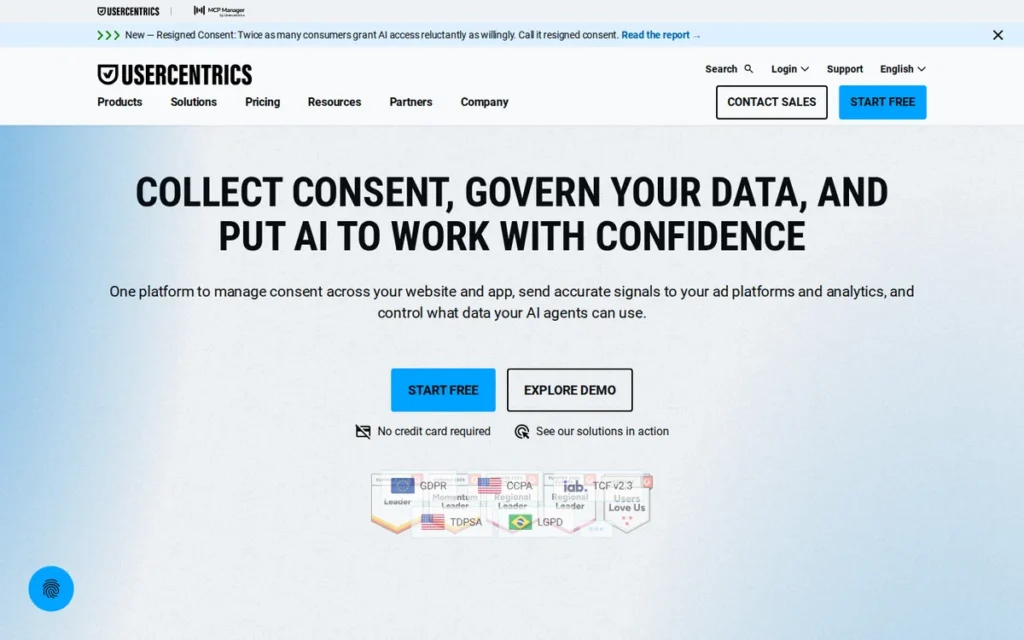
Category: Consent Management Platform (Dual-Brand), a two-tier platform (Cookiebot for free/SMB, Usercentrics for enterprise) that manages cookie consent, enforces consent signals server-side via sGTM, integrates with Google and Microsoft ad platforms, and scales from a free 50-subpage deployment to enterprise-grade customization across 60+ languages.
At a Glance
- Category: Consent Management Platform (Dual-Brand)
- Best For: Organizations running Google Ads or Analytics in the EU that require Google Consent Mode V2 Gold Tier compliance, server-side consent enforcement via sGTM, or a single vendor path from free SMB deployment through enterprise implementation
- Price Range: Free tier via Cookiebot (up to 50 subpages); paid tiers described as “affordable entry price” in the Shore case study; enterprise pricing requires direct engagement; specific paid tier costs not publicly confirmed
- Primary Strength: Usercentrics is a Google Gold Tier CMP partner: the highest certification Google awards for Consent Mode compliance, with the Shore case study documenting a 54% increase in tracked conversions, 25-30% CPA reduction, 40% more iOS device visibility, and an anticipated 35-40% ROAS uplift after server-side implementation [Usercentrics Shore case study, 2026]
- Biggest Limitation: A practitioner in r/webdev reported that Cookiebot “started blocking legitimate analytics events after the first update,” requiring them to remove the implementation, one documented instance of an analytics event blocking risk that buyers should validate during any trial period; not confirmed as a universal pattern across all deployments
- One-Line Summary: Usercentrics is the highest-volume CMP in this evaluation: serving 2.3 million websites across 60+ languages as a Google Gold Tier partner, making it the default evaluation consideration for any organization where Google Consent Mode V2 compliance and server-side consent enforcement are non-negotiable requirements.
- Last Verified: April 2026
- Evidence Confidence: Moderate: Shore case study confirmed; Google Gold Tier certification confirmed; deployment statistics current per Usercentrics documentation [as of 2026]; no confirmed public G2 numerical rating available; analytics blocking risk is one documented practitioner account, not independently corroborated as a universal pattern
Overview
Usercentrics is a Google Gold Tier certified consent management platform [the highest certification Google awards for Consent Mode compliance] serving 2.3 million websites and processing 7 billion consents monthly [as of 2026, per Usercentrics product documentation], the highest deployment volume of any tool in this evaluation. Usercentrics acquired Cookiebot to create a dual-brand strategy from a free 50-subpage SMB tier through enterprise server-side CMP implementation with advanced customization across 60 languages.
Usercentrics holds Google Gold Tier CMP partner status, making Usercentrics the primary evaluation consideration for any organization where correct integration with Google Ads, Google Analytics, and Google Consent Mode V2 is a non-negotiable requirement for EU operations. The Shore agency case study documents a 54% increase in tracked conversions, 25-30% CPA reduction, 40% more iOS device visibility, and an anticipated 35-40% ROAS uplift after Usercentrics server-side tagging implementation [2026].
Key Features
- Google Gold Tier CMP Certification: Usercentrics operates as a Google Gold Tier CMP partner (the highest certification level Google awards for Consent Mode integration quality, reliability, and user-friendliness) providing verified assurance that consent signals propagate correctly to Google Ads, Google Analytics, and the broader Google Marketing Platform for organizations running EU-targeted campaigns.
- Server-Side Consent via sGTM: Usercentrics offers server-side CMP and tagging via Server-Side Google Tag Manager (sGTM), moving consent data handling from the browser to a first-party server context, improving consent signal accuracy, reducing ad blocker interference, and providing more reliable data governance than browser-only CMP implementations.
- A/B Testing on Consent Banners: Usercentrics includes an analytics dashboard with A/B testing capability for consent banner optimization, enabling organizations to test banner language, design, and positioning to maximize opt-in rates within regulatory boundaries, directly connecting compliance investment to marketing attribution quality.
- Dual-Brand Coverage: Usercentrics’ dual-brand architecture pairs Cookiebot (3-step setup, free tier for up to 50 subpages, SMB-optimized) with Usercentrics enterprise (advanced customization, API integrations, server-side capabilities), providing a single vendor path from first GDPR compliance through enterprise-scale data governance.
- AI Consent for Emerging Regulatory Demands: Usercentrics recently launched an MCP Manager for AI consent and trust (addressing the emerging requirement to manage consent for AI-processed personal data) positioning Usercentrics alongside Ketch at the frontier of AI governance as the category moves beyond traditional cookie consent into AI data processing disclosure.
Best For
Usercentrics is best for organizations running Google Ads or Analytics in the EU for whom Google Consent Mode V2 compliance is a non-negotiable operational requirement, organizations seeking a single vendor covering free SMB deployment through enterprise server-side implementation, and digital marketing teams that need consent banner A/B testing to recover analytics signal lost after consent banner deployment.
Strengths
- Usercentrics’ Shore agency case study (2026) documents a 54% increase in tracked conversions, 25-30% reduction in Cost Per Acquisition, 40% more iOS device visibility, and an anticipated 35-40% ROAS uplift after implementing Usercentrics server-side tagging, providing concrete, named, dated evidence that proper consent management architecture generates measurable marketing performance improvement alongside regulatory compliance.
- Usercentrics holds Google Gold Tier CMP partner status (the highest certification tier Google awards for Consent Mode compliance) a verified, independently conferred designation confirming that consent signals integrate correctly with Google Ads and Analytics for organizations running EU-targeted campaigns.
- Usercentrics processes 7 billion consents monthly across 2.3 million deployed websites and 600,000 customers [as of 2026, per Usercentrics product documentation], deployment scale that confirms infrastructure reliability, consent signal processing capacity, and platform stability at volumes that newer competitors have not validated.
- Usercentrics earned a practitioner-level endorsement from u/DigitalStefan on r/webdev (2026) (an experienced CMP implementer who evaluated 6 different consent management platforms in production) describing Usercentrics as “a decent competitor” at the enterprise level and comparable to OneTrust, from an independent source with no commercial relationship with either platform.
Limitations
- Analytics Event Blocking Risk: Usercentrics’ most consequential trade-off for organizations reliant on first-party analytics is a documented technical integration risk, a practitioner in r/webdev reported that Cookiebot “started blocking legitimate analytics events for us after the first update, so we ended up ripping most of it out anyway” (u/Bartfeels24, 2026), one documented instance, not confirmed as a universal pattern across all deployments; buyers should validate analytics event integrity during any trial period before assuming correct behavior after go-live.
- No Confirmed G2 Numerical Rating: No confirmed G2 overall rating score or total review count is publicly available for Usercentrics as of April 2026, limiting direct independent benchmarking against tools with verified review platform data, buyers should request current G2 data directly from the vendor and from independent references during evaluation.
- Dual-Brand Migration Risk: Organizations scaling from Cookiebot (Usercentrics’ SMB brand) to the Usercentrics enterprise platform must execute a brand-to-brand migration, a vendor-facilitated process that, while supported, introduces consent recording continuity risk and configuration re-work that organizations on a single-brand platform like Osano do not face, with no independent case studies documenting this migration experience publicly available.
Verdict
Usercentrics is the highest-volume consent management platform in this evaluation and the only one holding Google Gold Tier CMP certification, making Usercentrics the primary evaluation requirement for any organization where Google Consent Mode V2 compliance is non-negotiable and the default consideration for organizations seeking a free-to-enterprise vendor path without a platform change. Usercentrics ranks below OneTrust (#3) because OneTrust’s 284-review G2 evidence base provides significantly greater confidence in quality assessment at scale, Usercentrics’ absence of a confirmed public G2 rating means buyers cannot independently benchmark its performance against the review volume standard set by the higher-ranked tools. Organizations should validate analytics event blocking risk during any trial period; buyers who need tamper-proof forensic audit evidence for regulatory investigations should complement Usercentrics with Osano’s Compliance Check or Privado AI’s audit scanning.
5. Ketch: Best for Developer-Led Teams and Organizations Needing Consent Enforcement Across Downstream Data Systems Beyond the Browser
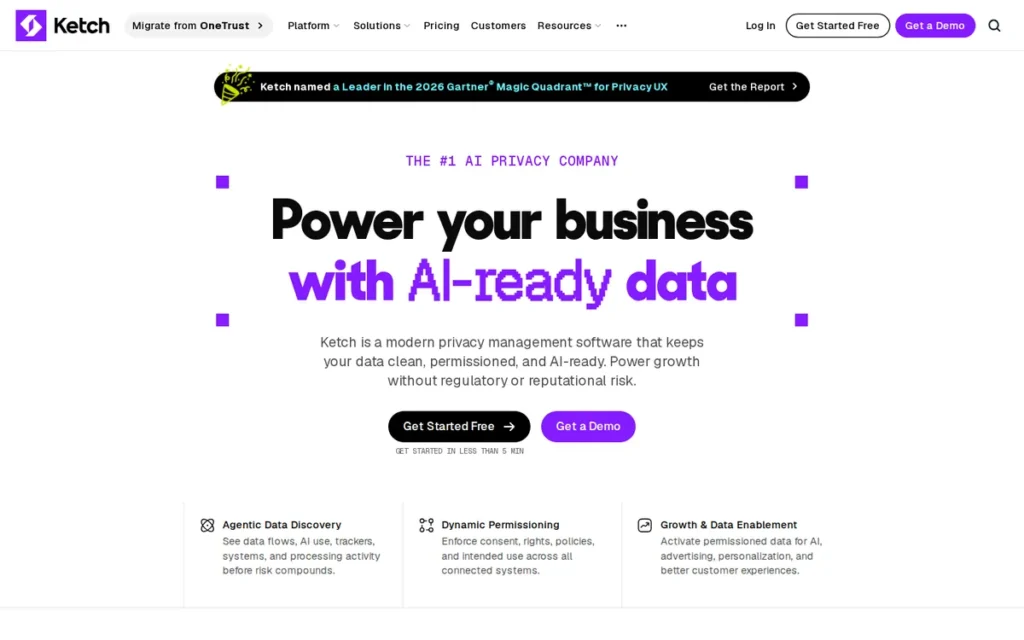
Category: API-First Consent Engine, an AI-powered privacy management platform built around a server-side Permission Vault that enforces consent signals not only at the website browser layer but across downstream CDPs, data warehouses, SaaS integrations, and AI data processing systems in real time.
At a Glance
- Category: API-First Consent Engine
- Best For: Developer-led and engineering-forward organizations that need consent enforcement to propagate across downstream data systems beyond the browser, organizations currently on OneTrust contracts approaching renewal, and organizations beginning to address AI data processing governance
- Price Range: Startup pricing referenced at $500–$2,000/year by independent practitioners Reddit, 2026; 30% lower compliance costs vs. OneTrust claimed [vendor-stated, not independently verified]; no public pricing schedule; direct sales engagement required for formal quotes
- Primary Strength: Ketch’s Permission Vault enforces consent decisions server-side across downstream CDPs, data warehouses, and SaaS integrations in real time, the strongest backend consent enforcement architecture in this evaluation, directly addressing the most consequential compliance gap identified by practitioners: consent recorded at the banner but not enforced where data actually flows
- Biggest Limitation: An experienced CMP implementer who evaluated Ketch in a Google Tag Manager context in 2026 concluded it was “still not in a state where I would recommend it to a client” with “poor GTM integration”, this criticism is community-sourced from r/GoogleTagManager and could not be independently confirmed via published technical audits; Ketch’s own representative disputed the assessment in the same thread. GTM-reliant organizations should treat this as a directional risk indicator requiring production-level validation, not a confirmed product deficiency.
- One-Line Summary: Ketch is the strongest consent enforcement platform in this evaluation for organizations that need consent signals to propagate beyond the browser into downstream CDPs, data warehouses, and SaaS integrations, but its Google Tag Manager integration quality has been specifically criticized by a community-sourced practitioner account in 2026, making it best-suited for API-first and developer-led environments where GTM is not the primary tag delivery mechanism.
- Last Verified: April 2026
- Evidence Confidence: Moderate: TIME Magazine case study vendor-confirmed (global operations scope, specific country count unverified); GTM criticism community-sourced from r/GoogleTagManager, not independently confirmed via published research; 40% DSR improvement is a single-practitioner account; G2 Top Trending/Highest Performer designations confirmed without a disclosed numerical rating
Overview
Ketch is an AI-powered privacy management platform built around its Permission Vault, a server-side, centralized repository that propagates user consent decisions across web, mobile, CDPs, data warehouses, and SaaS integrations in real time, enforcing consent beyond the browser layer where most consent management platforms stop. Ketch serves organizations including TIME Magazine for global privacy operations, per Ketch’s published case study, with no-code DSR workflow automation, dynamic tag orchestration, and AI governance capabilities including shadow AI detection.
Ketch holds G2 Top Trending and Highest Performer designations in the Website Privacy Auditing Tools category, with reported satisfaction scores higher than OneTrust (no confirmed numerical G2 rating publicly available), and launched the industry-first Ketch Switch automated migration tool from OneTrust in February 2025. Ketch’s Google Tag Manager integration quality was specifically criticized in a community-sourced 2026 evaluation, a finding buyers relying on GTM-based MarTech stacks must independently verify before committing.
Key Features
- Permission Vault (Server-Side Consent Propagation): Ketch’s Permission Vault is a server-side consent repository that propagates consent signals across all connected downstream systems (CDPs, data warehouses, advertising platforms, and SaaS integrations) in real time via native identity resolution, ensuring that a user’s consent decision on a website is enforced in every system that subsequently processes that user’s data.
- No-Code DSR Workflow Builder: Ketch’s drag-and-drop DSR workflow builder enables privacy teams to configure, automate, and adjust data subject request processing (covering intake, identity verification, routing, fulfillment, and response documentation) without requiring engineering resources; one practitioner reported a 40% reduction in DSR turnaround time after switching to Ketch (single-practitioner account; not independently corroborated by additional published sources): u/ChrisSmith199, r/cipp, 2026.
- Ketch Switch (Automated OneTrust Migration): Ketch Switch provides industry-first automated migration tooling from OneTrust, enabling organizations leaving OneTrust to migrate consent configuration, policy templates, and DSR workflows to Ketch with reduced manual effort and no additional migration service fees (BusinessWire, February 2025).
- Shadow AI Detection and AI Governance: Ketch includes shadow AI detection and permissioned AI training data governance, extending consent management from traditional website cookie consent into the emerging compliance requirement of tracking which personal data is being used to train or query AI models.
- Dynamic Tag Orchestration: Ketch’s dynamic tag orchestration enforces consent at the tag-firing level without requiring manual GTM trigger configuration (claiming to automate the consent-to-tag sequencing that is the most common source of pre-consent tag fires in implementations) though this capability was specifically disputed by a practitioner in a community-sourced 2026 evaluation, making production-level validation essential for GTM-dependent organizations.
Best For
Ketch is best for developer-led and API-first organizations that need consent to be enforced across downstream data systems beyond the browser, organizations currently on OneTrust with renewal approaching anddocumented pricing concerns, and organizations at growth stage (50–500 employees) that need enterprise-grade downstream enforcement at startup-tier pricing, provided GTM integration quality is validated in a production trial before full deployment.
Strengths
- Ketch users switching from legacy consent platforms have seen measurable DSR workflow gains: one practitioner in r/cipp (u/ChrisSmith199, 2026) who evaluated OneTrust, Transcend, and Ketch before selecting Ketch reported a 40% improvement in DSR turnaround time, a single-source metric that, while not corroborated by additional published accounts, represents the kind of operational efficiency gain Ketch’s no-code DSR builder is designed to deliver.
- Ketch’s Permission Vault architecture addresses the consent enforcement gap that practitioners identify as the most consequential real-world compliance failure mode: a practitioner stated in r/gdpr (u/Katerina_Branding, 2026) that “the biggest failure mode is tools that record consent but don’t actually control downstream tags, SDKs, or internal data flows”, Ketch’s server-side, API-first consent propagation across CDPs, data warehouses, and SaaS integrations is the consent enforcement architecture most explicitly designed, per documented product specifications and practitioner descriptions, to propagate signals across downstream systems beyond the browser.
- TIME Magazine’s deployment of Ketch for global privacy operations: documented in Ketch’s published case study with specific references to jurisdiction-aware consent banners, customizable policy templates, and no-code DSR workflows for TIME’s international audience, validates enterprise-scale capability in a high-visibility multinational media brand context where privacy compliance has direct audience trust implications.
- Ketch’s G2 Top Trending and Highest Performer designations in the Website Privacy Auditing Tools category (with reported higher overall satisfaction than OneTrust (no confirmed numerical G2 rating publicly available for independent comparison)) indicate accelerating adoption and strong implementation success rates among early adopters, a leading indicator of market momentum that complements the TIME Magazine enterprise validation.
Limitations
- GTM Integration Quality: Ketch’s most consequential trade-off for GTM-reliant organizations is a community-sourced criticism, an experienced CMP implementer who evaluated Ketch in production in 2026 concluded in r/GoogleTagManager that Ketch was “still not in a state where I would recommend it to a client,” citing “poor GTM integration” and an unresolved sequencing problem. This criticism is community-sourced and could not be independently confirmed via published technical audits or multiple corroborating practitioner accounts; Ketch’s own representative disputed the assessment in the same thread. Treat this as a directional risk indicator requiring production-level GTM testing before committing, suitability is context-dependent in a way that requires hands-on verification rather than marketing review.
- Implementation Complexity vs. Bold Claims: A practitioner in r/webdev described Ketch as “far too clever for its own good” despite finding it useful for simpler deployments (u/DigitalStefan, 2026), suggesting that implementation experience varies significantly by technical environment and that Ketch’s broad architectural claims should be tested against specific deployment scenarios during evaluation rather than accepted at face value.
- No Public Pricing: Ketch’s absence of published pricing requires direct sales engagement before cost feasibility can be assessed, and the 30% lower compliance cost claim relative to OneTrust has not been independently corroborated [vendor-stated], organizations should request formal quotes and benchmark this claim against OneTrust’s actual contract value before treating it as a decision factor.
“Been there, GDPR + CCPA together gets messy fast. We use Ketch mainly so consent works across web + mobile without constant tweaks. Not exciting stuff, but it keeps things quiet on the compliance side.”, u/Old-Air-5614, r/gdpr, 2026
Takeaway: The highest compliment a compliance tool can receive is that it operates invisibly, Ketch users describe it as the platform that keeps consent working across web and mobile without requiring ongoing manual intervention.
Verdict
Ketch is the strongest consent enforcement platform in this evaluation for the specific use case of propagating consent signals beyond the browser into downstream data systems, CDPs, data warehouses, SaaS integrations, and emerging AI data processing pipelines. Ketch ranks below Usercentrics (#4) because Usercentrics offers independently confirmed deployment scale (2.3M sites, 7B monthly consents [as of 2026]) and a concrete named case study with quantified marketing ROI, while Ketch’s comparable deployment evidence is limited to a single vendor-published case study and a sole practitioner report of DSR improvement. For the specific subset of organizations where Ketch’s downstream enforcement architecture matches their primary risk profile, the ranking may effectively reverse. GTM-dependent organizations must validate integration quality in a production environment before committing, the community-sourced and disputed GTM limitation means suitability requires hands-on verification.
6. Privado AI: Best for Source-Code-Level Privacy Auditing, Regulator-Grade Forensic Evidence Generation, and Detecting Violations That Browser-Based CMPs Cannot See
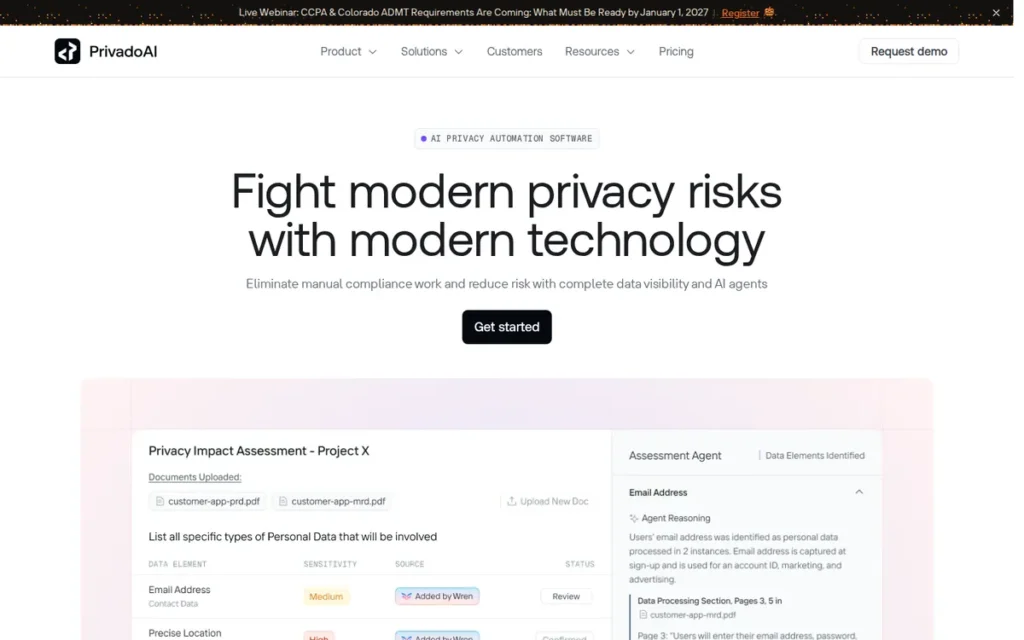
Category: AI Privacy Auditor, a source-code-scanning and live user simulation platform that detects privacy compliance violations at the code and behavior layer rather than the consent banner layer, generating forensic-grade evidence artifacts (HAR files, screenshots, timestamps) for regulatory defense.
At a Glance
- Category: AI Privacy Auditor
- Best For: Organizations that have deployed a CMP but need to verify what actually fires during different consent scenarios, legal and privacy teams preparing for regulatory investigation requiring forensic-grade evidence, and engineering teams seeking to identify privacy violations before deployment through source-code scanning
- Price Range: No public pricing; enterprise contract model; direct sales engagement required; no confirmed free tier for 2026
- Primary Strength: Privado AI holds a confirmed 4.6/5 G2 rating in the Website Privacy Auditing Tools category [G2, 2026] (the category it helped create in October 2025) and detects privacy compliance violations at the source-code and behavior layer through live user simulations, producing timestamped HAR file and screenshot evidence that browser-based CMPs cannot generate
- Biggest Limitation: Privado AI has no public pricing and operates through an enterprise-only sales model, requiring direct engagement before cost feasibility can be assessed, a significant barrier for mid-market and SMB organizations that need to understand investment scale before initiating a sales process; additionally, Privado AI is not a consent management platform and must be paired with a separate CMP investment
- One-Line Summary: Privado AI is the only tool in this evaluation that audits website privacy compliance through source-code scanning and live user simulations, holding a confirmed 4.6/5 G2 rating in the category it helped create, making it the necessary evaluation consideration for any organization that cannot confidently answer “what actually fires when a user rejects cookies?”
- Last Verified: April 2026
- Evidence Confidence: Moderate: G2 4.6/5 rating confirmed; G2 category creation confirmed (October 2025); enterprise clients (ZoomInfo, Riot Games, Marriott) confirmed; ZoomInfo testimonial is sourced from Privado AI’s published case study materials, not an independently published statement; limited public review volume reflects newer-entrant status (founded 2020)
Overview
Privado AI is a New York-based, venture-backed AI privacy auditing platform founded in 2020 that detects privacy compliance violations through source-code scanning and live user simulations, operating at the code and behavior layer rather than the consent banner layer, generating forensic-grade evidence artifacts including HAR files, screenshots, and timestamps that regulators request during investigations and that browser-based CMPs are architecturally unable to produce. Privado AI holds a confirmed G2 rating of 4.6/5 in the Website Privacy Auditing Tools category [G2, 2026], a score earned in the category it helped create in October 2025.
Privado AI serves enterprise clients including ZoomInfo, Riot Games, and Marriott. Privado AI is not a consent management platform (it does not display banners or enforce consent in real time) but rather an independent audit layer that verifies whether existing consent controls from OneTrust, TrustArc, Osano, Ketch, or Usercentrics are working as intended.
Key Features
- Source-Code Scanning and Live User Simulation: Privado AI scans website and app source code, URLs, and app store files without requiring integration with the target site, then runs live user simulations (accepting, rejecting, or taking no action on consent banners) to detect non-compliant data flows, dark patterns, PII sharing, unauthorized SDK loading, and device fingerprinting that occur regardless of the consent state displayed.
- Forensic-Grade Evidence Artifacts: Privado AI generates HAR files with timestamps, screenshots of behavior during each consent simulation scenario, and structured logs documenting exact execution sequences, the type of reproducible, time-stamped evidence that regulators request during GDPR and CCPA investigations and that internal compliance dashboards cannot provide because they can be regenerated on demand.
- Agentic Assessments (Launched October 2025): Privado AI’s AI Agents, launched in October 2025 via BusinessWire, automatically populate 100% of privacy impact assessment documentation from scanned code and behavior analysis, automating one of the most labor-intensive manual processes in a privacy program and directly addressing the bottleneck that disproportionately burdens lean compliance teams required to complete PIAs and DPIAs under GDPR.
- Multi-Page and Fourth-Party Data Flow Coverage: Privado AI’s scanning covers fourth-party data flows via tag managers and CDPs, pre- and post-login user journey simulations, execution order analysis, and tracking of data flows across the full site ecosystem, including flows that only activate after specific user interactions like clicks or form submissions that static page-load audits miss.
- 35+ Framework Support with Granular Classification: Privado AI supports 35+ global privacy frameworks including GDPR, CCPA/CPRA, CIPA, VPPA, PIPEDA, LGPD, and ePrivacy, with AI classification covering 60+ data categories for PII and sensitive data type identification across all scanned code and behavior evidence.
Best For
Privado AI is best for organizations that have already deployed a consent management platform and need independent verification of whether it is actually preventing unauthorized data collection, particularly legal teams preparing for regulatory investigation who need forensic-grade timestamped evidence, and engineering teams seeking to identify privacy violations in code before deployment rather than discovering them during a regulator audit.
Strengths
- Privado AI holds a confirmed G2 rating of 4.6/5 in the Website Privacy Auditing Tools category [G2, 2026] (a score earned in the category it helped create in October 2025) providing an independent quality signal from the review platform that recognized Privado AI’s approach as categorically distinct from consent management platforms and warranting its own G2 classification.
- ZoomInfo’s Sr. Manager of Privacy, Rob Priore, stated in Privado AI’s published case study materials that Privado AI is “the only solution I know that can reliably determine whether your website is fully privacy compliant”, specifically citing evidence of risks missed in manual reviews that Privado AI detected; ZoomInfo’s adoption, as a B2B data company handling significant personal data volumes, constitutes substantive enterprise validation from an organization with sophisticated privacy requirements.
- Privado AI’s October 2025 launch of AI Agents to automate manual privacy assessments and data maps represents a significant capability milestone, moving from scan-and-report to autonomous assessment completion, directly addressing the labor-intensive privacy program bottleneck that burdens lean compliance teams who must complete PIAs and DPIAs under GDPR requirements without dedicated privacy engineering resources.
- Privado AI’s HAR file, screenshot, and timestamp evidence generation creates forensic-grade records of exactly what fired during each consent simulation scenario, a qualitatively different level of audit evidence than compliance dashboards, designed specifically for the scenario where regulators request reproducible proof of compliance behavior during an investigation rather than a dashboard report generated on demand.
Limitations
- Enterprise-Only Pricing with No Public Transparency: Privado AI’s most consequential trade-off for the primary audience is pricing opacity combined with an enterprise-only sales model, with no public pricing, no confirmed free tier, and a procurement process requiring direct sales engagement before cost feasibility can be assessed, Privado AI is effectively inaccessible to mid-market and SMB organizations that need to understand investment scale before initiating vendor conversations.
- Limited Review Platform Data: Privado AI’s G2 feature review counts: 15 reviewers on auto-scans, 14 on cookie reports, are substantially smaller than OneTrust’s feature-level review depth, reflecting its newer-entrant status (founded 2020) and limiting the volume of independent corroboration available for capability claims relative to more established platforms.
- No Accessible Community Validation: Privado AI’s absence from Reddit practitioner discussions (a consequence of its focus on enterprise clients who participate in professional forums rather than public subreddits) limits the available authentic community sentiment that would help non-enterprise buyers evaluate fit before initiating a sales process; organizations should request detailed references from named enterprise clients (ZoomInfo, Riot Games, or Marriott) before commitment.
- Not a CMP Replacement: Privado AI does not function as a consent management platform (it does not display consent banners, manage user preferences, or enforce consent decisions in real time) meaning any organization deploying Privado AI as its only privacy compliance tool remains unprotected against the ongoing enforcement gap that CMPs address. Privado AI’s value is as an audit and evidence layer, not a consent management replacement, and any organization evaluating it must budget for a separate CMP investment alongside Privado AI’s enterprise contract.
Verdict
Privado AI, holding a confirmed 4.6/5 G2 rating in the Website Privacy Auditing Tools category it helped create, is the only tool in this evaluation that audits privacy compliance at the source-code and behavior layer through live user simulations, producing forensic-grade HAR file, screenshot, and timestamp evidence that browser-based CMPs cannot generate, making it the necessary evaluation step for any organization that has deployed a consent banner and cannot confidently demonstrate what actually fires when a user declines cookies. Privado AI ranks above ObservePoint (#7) because Privado AI offers both proactive detection (code scanning before and after deployment) and stronger enterprise client validation (ZoomInfo, Riot Games, Marriott, plus the confirmed 4.6/5 G2 rating). Privado AI functions as an independent audit layer complementing, not replacing, a primary consent management platform, organizations should evaluate it alongside Osano or another CMP. Its enterprise-only pricing model limits accessibility for mid-market buyers who should monitor its pricing evolution as the platform matures.
7. ObservePoint: Best for Enterprises Needing Vendor-Agnostic Verification That Their Existing CMP Is Actually Working Correctly
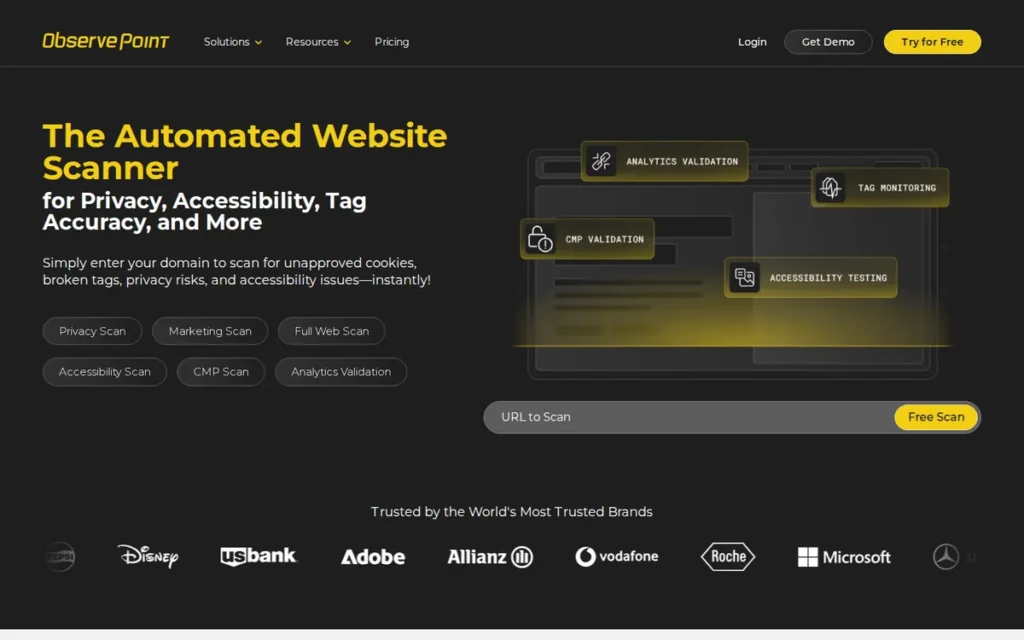
Category: Tag Governance Auditor (a vendor-agnostic website auditing platform that verifies whether deployed consent management platforms are correctly enforcing consent decisions across all tags, cookies, and scripts) testing Opted In, Opted Out, and GPC Signal states without requiring code deployment on the target site.
At a Glance
- Category: Tag Governance Auditor
- Best For: Large enterprises with complex multi-page websites and existing CMP deployments that need independent, vendor-agnostic verification that consent controls are working correctly, particularly digital analytics engineering teams and privacy teams preparing for regulatory audit
- Price Range: No public pricing; enterprise contract model; additive to a separate primary CMP investment; direct sales engagement required; no free tier confirmed
- Primary Strength: ObservePoint audits the consent behavior of any deployed CMP (including OneTrust, TrustArc, Osano, Usercentrics, Cookiebot, Tealium, Didomi, Piwik PRO, and CookieYes) through vendor-agnostic, automated crawling without requiring code deployment on the target site, providing independent verification that no CMP vendor can objectively provide about its own product’s enforcement effectiveness
- Biggest Limitation: ObservePoint is not a consent management platform: it does not display consent banners, manage consent records, handle DSARs, or enforce consent signals, meaning any organization evaluating ObservePoint must also maintain a separate primary CMP, making it an additive compliance investment with no public pricing available to assess total cost feasibility before sales engagement
- One-Line Summary: ObservePoint is the only vendor-agnostic CMP auditing platform in this evaluation, testing whether OneTrust, TrustArc, Osano, Usercentrics, Tealium, Didomi, Piwik PRO, CookieYes, or any other deployed consent management platform is actually enforcing consent correctly across Opted In, Opted Out, and GPC Signal scenarios, making it the correct evaluation for enterprises that cannot independently verify their CMP’s production enforcement accuracy.
- Last Verified: April 2026
- Evidence Confidence: Moderate: capabilities confirmed via ObservePoint product documentation and help center articles; ObservePoint’s 2025 analysis of financial institution websites found 94% of deployed CMPs had implementation issues [ObservePoint Blog, 2025]; no confirmed G2 numerical rating; no named customer case studies publicly available; no Reddit community discussion found, reflecting niche positioning among digital analytics engineering specialists
Overview
ObservePoint is a Utah-based website tag governance and consent auditing platform that occupies a functionally distinct position from every other tool in this evaluation: rather than managing consent, ObservePoint tests whether whatever CMP is already deployed is correctly enforcing consent decisions in production. ObservePoint crawls sites at scale, simulates Opted In, Opted Out, and GPC Signal user scenarios, and documents every tag that fires or fails to fire in each consent state, all without requiring any code deployment on the target website.
ObservePoint is vendor-agnostic, testing CMP implementations from OneTrust, Usercentrics, Cookiebot, Osano, TrustArc, Tealium, Didomi, Piwik PRO, CookieYes, and other major platforms with equal independence, providing the verification layer that no CMP vendor can objectively offer about its own product’s enforcement quality. ObservePoint’s 2025 analysis of deployed financial institution websites found that 94% of deployed CMPs had implementation issues [Source: ObservePoint Blog, 2025], published industry research that validates the need for independent CMP verification beyond vendor-provided assurance.
Key Features
- Three Consent Audit Types: ObservePoint’s three consent audit modes, Opted In (verifying correct tag activation post-consent), Opted Out (verifying no unauthorized tags fire after rejection), and GPC Signal Enabled (verifying correct site response to browser-level Global Privacy Control signals), directly answer the compliance question that consent dashboards cannot: “what actually fires in each consent state?”
- Vendor-Agnostic CMP Testing: ObservePoint audits deployed CMPs from OneTrust, TrustArc, Cookiebot, Usercentrics, Tealium, Didomi, Piwik PRO, CookieYes, and other major platforms without requiring code deployment on the target website, providing vendor-agnostic, independent verification of consent enforcement effectiveness that no CMP vendor can objectively produce about its own product.
- ClickAll+ Solution for Interaction-Triggered Tags: ObservePoint’s ClickAll+ Solution extends consent auditing beyond page-load tag behavior to capture tags that only activate after specific user interactions (clicks, form submissions, or navigation events) covering the compliance surface area that static page-load audits miss in complex web application and single-page application environments.
- Comprehensive Cookies Report: ObservePoint’s Cookies Report compiles all detected cookies across audits with full attribute documentation (cookie name, domain, initiator, first and last detection date, cross-page prevalence, and compliance status) providing a structured, prioritized inventory legal teams can use to build regulator-ready cookie policy disclosures.
- WCAG AA Accessibility Scanning Bundle: ObservePoint includes WCAG AA accessibility compliance scanning alongside privacy compliance auditing in a single automated crawl, uniquely bundling two regulatory domains increasingly co-audited under the EU Web Accessibility Directive and US accessibility litigation trends, reducing compliance workflow overhead for organizations managing both simultaneously.
Best For
ObservePoint is best for large enterprises with complex, multi-page websites and existing CMP deployments that need independent, automated verification of consent enforcement accuracy, particularly organizations preparing for GDPR or CCPA regulatory investigation who need documented proof of what fires in each consent state, digital analytics engineering teams managing tag governance across large site estates, and privacy officers who have received an audit request and need to rapidly verify whether their deployed CMP is correctly blocking unauthorized tags.
Strengths
- ObservePoint’s GPC Signal Enabled audit mode verifies that deployed websites correctly respond to browser-level Global Privacy Control signals, a compliance requirement that became legally enforceable under California’s CPRA in 2023 and that FTC enforcement activity and additional state law expansions in 2026 have elevated to a documented audit priority, making automated GPC testing an increasingly non-optional verification capability.
- ObservePoint’s vendor-agnostic auditing of deployed CMPs: testing OneTrust, TrustArc, Osano, Usercentrics, Cookiebot, Tealium, Didomi, Piwik PRO, and CookieYes implementations with equal independence, fills the verification gap that no CMP vendor can address about their own product: the critical difference between a vendor asserting their CMP works and an independent system documenting what actually fires in each consent state.
- ObservePoint’s ClickAll+ Solution captures consent enforcement behavior for interaction-triggered tags, extending compliance verification to tags that only activate after user clicks, form fills, or navigation events, which are routinely missed by static page-load-only consent audits and represent a common source of post-consent-rejection tag fires in complex web application environments.
- ObservePoint’s 2025 analysis of deployed financial institution websites found that 94% of deployed CMPs had implementation issues [Source: ObservePoint Blog, 2025], published industry research from ObservePoint itself that validates the category need for independent CMP verification beyond vendor-provided assurance, providing a data-backed rationale for adding ObservePoint as a verification layer alongside any existing CMP deployment.
Limitations
- Additive Cost Model: ObservePoint’s most consequential trade-off is its additive rather than standalone cost structure, ObservePoint is a consent verification layer, not a consent management platform, meaning any organization deploying it must also maintain a primary CMP and absorb two enterprise contracts rather than one, with no public pricing for either component available before dual sales engagement.
- No Confirmed Review Platform Data: No confirmed G2 numerical rating, total review count, or Capterra score is available for ObservePoint in public sources as of April 2026, limiting independent evidence of user experience quality compared to tools with verified review platform data, buyers should request current G2 data and client references directly from ObservePoint during evaluation.
- Absent from Practitioner Communities: ObservePoint’s complete absence from Reddit practitioner discussions (reflecting its niche positioning among digital analytics engineering specialists who participate in professional communities like MeasureCamp and private Slack groups rather than public subreddits) means buyers cannot access the authentic community sentiment available for other tools in this evaluation and must rely more heavily on direct vendor references.
- Enterprise-Only Accessibility: ObservePoint’s enterprise-only, no-public-pricing positioning makes it inaccessible to mid-market organizations without large existing analytics infrastructure budgets, the tool’s target profile is large enterprises with dedicated tag governance and digital analytics engineering resources, not lean compliance teams.
Verdict
ObservePoint is the correct evaluation consideration for any enterprise that has deployed a consent management platform and needs independent, vendor-agnostic verification that it is actually enforcing consent correctly in production, testing what fires in Opted In, Opted Out, and GPC Signal scenarios across an entire website estate without requiring code deployment. ObservePoint’s additive positioning (it supplements rather than replaces a primary CMP), enterprise-only pricing model, and absence of publicly confirmed review platform data limit its accessibility and available independent evidence base, making it most appropriate for large organizations with existing tag governance infrastructure and active regulatory exposure that justifies a dedicated verification investment alongside a primary consent management platform. ObservePoint should be evaluated as a complementary layer by any organization that has deployed one of the top five tools in this article and wants independent proof, not just vendor assurance, that consent is being enforced.
What Red Flags Should I Watch For When Evaluating Website Privacy Auditing Tools?
The most consequential red flag when evaluating website privacy auditing tools is a vendor that cannot demonstrate how consent signals propagate into downstream CDPs, data warehouses, and ad platforms, a gap that creates regulatory exposure regardless of how well-designed the consent banner appears. Five additional warning signs documented across G2, Reddit, and practitioner communities in 2026 should trigger deeper scrutiny before committing to any platform.
Red Flag #1: Opaque Pricing Without Renewal Protections
Any tool that refuses to provide pricing ranges before direct sales engagement creates a financial risk that compounds at renewal. OneTrust’s documented pattern of significant price increases at renewal, including a 10x quote presented days before contract expiration, per multiple independent sources, demonstrates that opaque pricing is not just a procurement inconvenience; it is a documented financial risk.
Buyers should require written multi-year pricing commitments and renewal caps before signing any contract with a vendor in this category. OneTrust’s documented 10x renewal quote (presented days before contract expiration per multiple independent sources including G2, Reddit, and Capterra) demonstrates that this is a negotiating requirement, not a precaution.
Red Flag #2: Dark Pattern Consent Rejection UX
A consent management platform that discourages users from exercising their privacy rights (through slow processing screens, misleading button placement, or interface tricks when declining cookies) is itself a compliance liability for any deploying organization. TrustArc’s documented rejection interface delay, captured in a widely circulated r/assholedesign thread with associated ICO complaint activity, illustrates how a compliance tool’s own UX can attract regulatory scrutiny.
Buyers evaluating TrustArc or any other CMP must test the complete consent rejection journey (not just the acceptance flow) during any production trial before committing. A CMP whose rejection UX discourages users from exercising privacy rights creates regulatory liability for any organization that deploys it.
Red Flag #3: GTM Integration Quality Claims Without Production Validation
Google Tag Manager is the primary tag delivery mechanism for most organizations’ MarTech stacks, making GTM integration quality the technical variable that most directly determines whether consent enforcement is real or theatrical. Practitioner-sourced criticisms of GTM integration quality have been documented for both TrustArc (“historically pretty bad”) and Ketch (“poor GTM integration,” per a community-sourced 2026 evaluation).
Before committing to any CMP, verify these three points:
- Whether your current MarTech stack relies primarily on Google Tag Manager for tag delivery
- Whether the vendor provides a production GTM trial environment: not a demo environment
- Whether the vendor can name three enterprise clients who validated GTM integration in their specific tag container setup
GTM integration quality cannot be resolved by reading vendor marketing materials, it must be validated in a production-equivalent environment before committing.
Red Flag #4: Consent Recording Mistaken for Consent Enforcement
Many tools in this category record a user’s consent decision in a dashboard log but do not prevent downstream systems, CDPs, data warehouses, ad platforms, from processing data if consent was declined. Imagine a hotel that records your “do not disturb” sign request at check-in but never tells housekeeping, the request is logged, but no one stops knocking. Most consent management platforms are the check-in desk, not the housekeeping coordinator. Ketch’s Permission Vault and Privado AI’s code scanning are the mechanisms that actually tell housekeeping.
Ask vendors to specifically name the downstream systems their consent signals reach (CDPs, data warehouses, advertising platforms, backend APIs) and to demonstrate this in a production trial, not a marketing demo. A consent receipt is not a compliance guarantee; only a system that controls what fires can provide the latter.
Red Flag #5: Implementation Timeline Measured in Months Before Compliance Coverage Begins
A compliance tool that requires weeks to months of configuration before providing any compliance coverage creates a window of unprotected exposure immediately after contract signing, a risk especially acute for organizations under active regulatory scrutiny or pending audits. Practitioner-reported timelines of “weeks just configuring the workflows” for OneTrust are documented and consistent across multiple independent sources.
Buyers should request realistic implementation timelines from three independent references (not vendor-facilitated references) before signing contracts that begin billing from day one. The question to ask is not “how long does implementation take?” but “how many weeks passed between your contract signing and your first compliant page scan in production?”
What Questions Should I Ask Before Choosing a Website Privacy Auditing Platform?
The single most important question to ask before choosing a website privacy auditing platform is whether the tool generates forensic-grade evidence (timestamped HAR files or tamper-proof audit logs) or only a compliance dashboard that can be regenerated on demand. The questions below distinguish tools with verifiable enforcement from tools with verifiable marketing. Ask each question of three independent customer references in production deployments, not just vendor-facilitated references.
Question #1: Does This Tool Generate Evidence I Can Present to a Regulator, or Just a Compliance Dashboard I Can Generate Myself?
Look for vendors who can demonstrate timestamped, reproducible evidence artifacts (HAR files, tamper-proof audit logs, jurisdiction-specific scan screenshots) that represent the state of the site at a specific point in time. A dashboard that can be regenerated on demand does not constitute forensic-grade evidence.
Privado AI’s scan evidence and Osano’s tamper-proof Compliance Check logs are examples of forensic-grade evidence; a compliance dashboard regenerated post-inspection is not. When asking vendors, request a sample evidence artifact from a past regulatory inquiry (not a product demo) to evaluate the actual evidence quality your organization would receive.
Question #2: Does This Tool Enforce Consent in Downstream Systems Like CDPs and Data Warehouses, or Only at the Browser and Banner Layer?
Ask vendors to specifically name the downstream systems they integrate with for consent signal propagation, and to demonstrate this in a production trial, not a demo environment. The difference is not visible from product marketing; it requires testing consent propagation to a named downstream system during the trial period.
Ketch’s Permission Vault and Usercentrics’ sGTM implementation are architecturally designed for downstream enforcement; most other CMPs in this evaluation are not. A vendor that cannot name specific downstream integrations with a live demonstration should be pressed on this point before committing.
Question #3: What Is the Realistic Configuration Timeline Before Compliance Coverage Is Operational, and What Is the Independent Evidence for That Timeline?
Do not accept vendor-provided implementation timeline estimates without triangulating against at least three independent practitioner references. Ask specifically: “How many weeks passed between contract signing and the first compliant page scan being operational in production?”
For OneTrust, practitioner-reported timelines of weeks to months are well-documented across G2, Reddit, and comparison platforms, and this exposure period is a compliance risk that vendor-provided timeline estimates consistently understate. For Osano, the same question surfaces a materially different answer that buyers should verify independently.
Question #4: What Does Renewal Pricing Look Like After Year 1, and Can I See That in Writing Before Signing?
The renewal price escalation pattern documented across OneTrust’s independent review base (including G2, Reddit, and Capterra) demonstrates that initial contract pricing is not always predictive of Year 2 cost. Any vendor unwilling to specify renewal pricing terms in the initial contract should be treated as a pricing risk.
This is a negotiable contract term, buyers should require it before signing, not hope for it at renewal. Three current reference customers who have completed at least one renewal cycle are the minimum evidence for believing a vendor’s renewal pricing claims.
Question #5: How Does This Tool Handle Global Privacy Control (GPC) Signals, and Can You Demonstrate That in a Production Trial?
GPC compliance became legally required under California’s CPRA in 2023, and FTC enforcement guidance and additional state law expansions in 2026 have elevated it to a primary audit requirement. Ask vendors to demonstrate GPC signal handling in a production trial with your actual site, not a demo.
Consider using ObservePoint or Privado AI to independently verify the result. A vendor that cannot show GPC handling in production represents a compliance risk that no marketing materials can resolve.
Question #6: Is This Tool Designed for My Organization’s Size, or Will I Be Paying for Capabilities I Cannot Use?
Enterprise tools like OneTrust and TrustArc are calibrated for organizations with 500+ employees and dedicated privacy engineering staff. Organizations under 500 employees evaluating enterprise platforms should ask vendors to name three reference customers of similar size who have successfully implemented the platform without professional services assistance.
Pricing and implementation complexity that make sense for a 2,000-person organization with a dedicated privacy team may create unacceptable total cost of ownership risk for a 150-person company without one. The right tool for the right profile is the central decision, not which platform has the most name recognition.
Question #7: What Evidence Can the Vendor Provide That the Tool Has Supported a Live Regulatory Investigation?
Ask vendors to describe the most significant regulatory inquiry their platform has supported and what evidence artifacts were generated. A vendor who has never supported a live regulatory defense has not been tested under real-world conditions, compliance dashboards and demonstrations are not equivalent to evidence packages that survived regulatory scrutiny.
Osano’s compliance guarantee and Privado AI’s named enterprise clients in sectors with active regulatory exposure (ZoomInfo, Riot Games, Marriott) are the closest available proxies for this in the current evaluation, though neither constitutes a disclosed enforcement action resolution.
How Did We Rank These Website Privacy Auditing Tools?
These seven website privacy auditing tools were ranked by scoring each against six criteria (regulatory certification depth, consent enforcement architecture, audit evidence quality, verified review ratings, implementation accessibility, and pricing transparency) using independent sources including G2, Capterra, Reddit practitioner communities, and official regulatory body records. No vendor paid for placement or influenced the ranking outcome.
How Did We Evaluate Each Tool?
The evaluation process included four parallel research streams:
- AI engine query analysis: Multiple AI search engines were queried for current tool recommendations, with LLM responses analyzed for information gaps, missing evidence, and unverified claims that this article addresses.
- Independent web research: Vendor product pages, press releases, third-party analyst reports, and named case studies were gathered and cross-referenced against each other to identify where vendor claims were independently corroborated.
- Review platform analysis: G2 and Capterra data were reviewed for numerical ratings, review counts, and feature-level feedback patterns, prioritizing volume alongside score, since a 4.4/5 across 284 reviews carries more evidential weight than a higher score across fewer reviews.
- Reddit community sentiment: Practitioner discussions across r/webdev, r/fintech, r/gdpr, r/cipp, and r/GoogleTagManager were analyzed for authentic user experience patterns, specifically weighting technically specific, practitioner-sourced criticisms over general sentiment.
What Criteria Were Used to Score Each Tool?
Six criteria were used to score each tool, weighted by relevance to the audience’s documented pain points:
- Regulatory Coverage Breadth and Official Certifications (primary weight): The number of jurisdictions and frameworks explicitly supported, presence of regulatory-body-recognized certifications (APEC CBPR/PRP, EU-U.S. DPF, IAB TCF 2.2, Google Consent Mode V2), and institutional regulatory heritage, because coverage breadth directly determines whether a single tool can serve a multinational compliance program without supplementation.
- Consent Enforcement Architecture Depth (primary weight): Whether the tool enforces consent only at the browser/banner layer or propagates signals to downstream systems via server-side implementation, API-first architecture, or Permission Vault mechanisms, because the consent-enforcement gap is the most consequential real-world compliance failure mode documented across all practitioner sources.
- Audit Evidence Generation Capability (primary weight): Whether the tool generates tamper-proof, timestamped, jurisdiction-specific evidence (HAR files, scan logs, screenshots) vs. compliance dashboards, because legal teams preparing for regulatory investigation need forensic-grade evidence, not reports they generated themselves.
- Verified Review Platform Ratings and Volume (secondary weight): Confirmed G2 and Capterra scores with review counts, G2 category leadership badges, and specific failure patterns documented in negative reviews, because volume matters as much as score for confidence in quality assessment.
- Implementation Accessibility and Time-to-Value (secondary weight): Practitioner-reported configuration timelines, free tier availability, and whether compliance coverage requires dedicated privacy engineering staff, because an implementation timeline of months creates unprotected compliance exposure from day one.
- Pricing Transparency and Total Cost of Ownership (secondary weight): Whether pricing is publicly listed, whether a free tier exists, and whether renewal pricing risk is documented in independent sources, because opaque pricing and renewal escalation patterns are independently verified financial risks, not theoretical concerns.
How Was Conflicting Evidence Weighted?
When review platform ratings conflicted with Reddit sentiment, the more specific and more recent source received higher weight. A detailed 2026 Reddit post from a practitioner who evaluated a tool hands-on in a production environment outweighs a generic 2023 G2 review. When vendor claims were not independently corroborated, they were labeled as vendor-stated and not treated as established fact.
How Were Vendor Claims Validated?
Vendor-reported statistics (including performance claims, pricing assertions, and certification self-descriptions) were cross-referenced against at least one independent source before being stated as fact. Claims that could not be independently corroborated are explicitly labeled as vendor-claimed in this article. Only certifications that appear in official regulatory body documentation or independently verified press releases were treated as confirmed.
When Is This Article Updated?
This article was last updated in April 2026. PlugRoute refreshes comparison articles on a semi-annual cadence or when a material product change, pricing event, or significant practitioner-sourced finding warrants an update. Readers evaluating tools after October 2026 should verify current G2 ratings, pricing structures, and any post-publication product announcements directly with vendors.
Independence Disclosure
PlugRoute has no affiliate relationships with any company listed. Rankings are determined entirely by research data and objective evaluation criteria. No company paid for placement, review, or consideration in this article. Nearly every cited claim is traced to a specific independent source, vendor-only claims are explicitly labeled as such, and community-sourced claims from Reddit are attributed with username and subreddit to allow verification.
Frequently Asked Questions
What Is the Difference Between a Consent Management Platform and a Website Privacy Auditing Tool?
A consent management platform (CMP) displays cookie consent banners, records user preferences, and attempts to enforce those preferences against website tags, but most CMPs stop at the browser level and cannot verify whether downstream systems like CDPs or data warehouses respect consent decisions. A privacy audit verification tool independently tests whether your deployed CMP is actually working by scanning source code and simulating user consent scenarios. Most organizations need a CMP; organizations with active regulatory exposure benefit from both.
Which Website Privacy Auditing Tools Have a Free Tier in 2026?
Three tools offer confirmed free access as of April 2026: Osano (free tier with upgrade path at approximately $119–$199/month per third-party pricing research); Usercentrics via Cookiebot (free for up to 50 subpages); and Ketch (startup pricing referenced at $500–$2,000/year by independent practitioners, not a full free tier). OneTrust, TrustArc, Privado AI, and ObservePoint operate through enterprise sales-gated pricing with no confirmed free tiers. A free-tier scan from Osano or Cookiebot tells you exactly where you are non-compliant before you pay anyone to fix it, which changes your vendor conversations from a sales process into a procurement decision.
How Does PlugRoute Determine Its Tool Rankings?
PlugRoute ranks tools using six weighted criteria: (1) regulatory coverage breadth and certifications, (2) consent enforcement architecture, (3) audit evidence generation capability, (4) verified review platform ratings and volume, (5) implementation accessibility, and (6) pricing transparency, scored using G2, Capterra, Reddit practitioner communities, press releases, and regulatory body records. No company pays for placement. Rankings are assigned to tools with the highest weighted scores across all criteria. Full methodology details appear in the “How Did We Rank These Website Privacy Auditing Tools?” section above.
Glossary: Key Terms Used in This Comparison
Consent Management Platform (CMP): A software system that displays cookie consent banners, records user consent preferences, and enforces those preferences against third-party tags, pixels, and scripts loading on a website. CMPs are required for GDPR and CCPA compliance but vary significantly in whether they enforce consent at the browser layer only or propagate signals to downstream data systems.
Consent Enforcement Gap: The difference between a tool that records a user’s consent decision in a log and a tool that actively prevents downstream systems (CDPs, data warehouses, advertising platforms) from processing data if consent was declined. This gap is the most consequential real-world compliance failure mode identified by practitioners in 2026: a consent banner can appear compliant while data continues to flow without authorization into backend systems.
Global Privacy Control (GPC): A browser-level signal that automatically communicates a user’s opt-out of data sale and sharing preferences to every website they visit, without requiring the user to interact with individual cookie banners. GPC compliance became legally required under California’s CPRA in 2023 and is recognized as a valid opt-out mechanism under multiple US state privacy laws.
Permission Vault: Ketch’s proprietary server-side architecture that stores user consent decisions centrally and propagates those decisions in real time to all connected downstream data systems (CDPs, data warehouses, SaaS integrations) via native identity resolution. A Permission Vault enforces consent where data actually flows, not only where a consent banner appears.
HAR File (HTTP Archive Format): A timestamped, structured log of all HTTP interactions between a browser and a web server during a session, including every tag, cookie, pixel, and script that loaded and when. HAR files generated during consent simulation scenarios constitute forensic-grade audit evidence because they create a reproducible, time-stamped record of exactly what fired in each consent state, which is what regulators request during GDPR and CCPA investigations.
DSAR (Data Subject Access Request): A formal request from an individual to exercise their rights under GDPR (Articles 15–22), CCPA, or other privacy laws, including the right to access, delete, correct, or port their personal data. CMPs automate DSAR intake and response workflows to meet GDPR’s 30-day and CCPA’s 45-day response requirements.
sGTM (Server-Side Google Tag Manager): A Google Tag Manager deployment model that moves tag execution from the user’s browser to a server controlled by the organization, improving data governance, reducing ad blocker interference, and enabling more reliable consent signal propagation than browser-only CMP implementations. Usercentrics’ server-side consent enforcement relies on sGTM.
RoPA (Records of Processing Activities): A mandatory documentation requirement under GDPR Article 30 that organizations must maintain, describing what personal data they process, for what purpose, under what legal basis, and who has access, automated by tools including Osano’s Data Discovery module and OneTrust’s data mapping feature.
Google Consent Mode V2: Google’s consent signal protocol that allows CMPs to communicate user consent status to Google Ads, Google Analytics, and other Google products, enabling consent-aware conversion modeling and analytics measurement when full tracking consent is not granted. Google Gold Tier CMP partner status (held by Usercentrics) is the highest level of Google certification for Consent Mode integration quality.
IAB TCF 2.2 (Interactive Advertising Bureau Transparency and Consent Framework): An industry-standard consent signal protocol that allows CMPs to communicate user consent decisions to advertising technology vendors in a standardized format, enabling compliant programmatic advertising in the EU. Both TrustArc and Usercentrics integrate IAB TCF 2.2 support in their platforms.
Which Website Privacy Auditing Tool Is Right for You?
For most mid-market organizations under 1,000 employees: start with Osano. For multinationals requiring APEC or EU-U.S. Data Privacy Framework certification: evaluate TrustArc first. For enterprises with dedicated privacy teams and GRC requirements: OneTrust is the evidence-based default. The complete situational guidance and decision criteria are in the Key Insights below.
Key Insights
- Osano is the strongest single platform for mid-market organizations needing tamper-proof, jurisdiction-specific audit logs, 60-category AI cookie classification, and a confirmed free-to-paid pricing path, combining all three in a single system with a confirmed 4.5/5 G2 rating and no enterprise-level complexity or six-figure contract requirements.
- TrustArc is the required evaluation for any organization requiring APEC CBPR or EU-U.S. Data Privacy Framework verification: it is the only tool in this evaluation holding government-recognized certification status enabling legally sanctioned international data transfers, and no alternative in this evaluation can replicate these specific regulatory designations.
- OneTrust’s 4.4/5 across 284 G2 reviews confirms its enterprise quality at scale, but its documented renewal price escalation (a 10x renewal quote corroborated independently across G2, Reddit, and Capterra), weeks-to-months implementation timeline, and support quality gaps make it the wrong tool for organizations without dedicated privacy engineering staff and implementation budgets.
- Usercentrics is the default evaluation for Google ecosystem-dependent organizations: its Google Gold Tier CMP certification and documented 54% conversion tracking improvement, 25-30% CPA reduction, and anticipated 35-40% ROAS uplift in the Shore case study provide verified evidence that proper consent management generates measurable marketing ROI alongside compliance value.
- Ketch is the strongest option for downstream enforcement: organizations whose primary risk is the consent-enforcement gap (consent recorded at the banner but not enforced in CDPs and data warehouses) should evaluate Ketch’s Permission Vault, with production-level GTM integration testing required before commitment.
- Privado AI, holding a confirmed 4.6/5 G2 rating, is the necessary evaluation step for any organization that cannot answer “what actually fires when a user rejects cookies?”: its source-code scanning and live user simulation methodology produces forensic-grade evidence that no CMP can generate about its own enforcement effectiveness.
- ObservePoint is the independent verification layer: organizations that have deployed any CMP and want vendor-agnostic, automated proof that it is correctly enforcing consent in production should evaluate ObservePoint as a complementary investment alongside their primary platform.
The website privacy compliance tools market in 2026 is bifurcating between tools that record consent and tools that enforce it, and organizations that cannot answer which category their deployed tool belongs to are carrying undiscovered compliance risk.
If your organization is a growth-stage company under 500 employees operating under GDPR and CCPA with limited privacy staff: start with Osano’s free tier and evaluate its paid plan before engaging any enterprise platform. If your organization operates across APEC member economies or requires EU-U.S. transatlantic data transfers: TrustArc’s official certification status makes it a required evaluation regardless of other preferences. If your organization is enterprise-scale with a dedicated privacy team and multi-jurisdictional GRC requirements: OneTrust’s breadth justifies the investment, negotiate multi-year pricing locks and support SLAs before signing.
We update this guide quarterly. Last updated: April 27, 2026. For independent compliance software reviews evaluated by the same methodology applied here, explore PlugRoute’s full library of research-backed, affiliate-free comparisons.