OneTrust leads for large enterprises requiring the broadest privacy automation ecosystem. DataGrail is the strongest DSAR-specialist alternative, 2,500+ integrations, patented identity verification, and IDC MarketScape Leader recognition. MineOS is the fastest no-code option for SMBs needing automated RoPA and PIPL coverage. The right platform depends on organizational scale, regulatory footprint, and dedicated privacy staff headcount.
GDPR Article 15 enforcement has generated approximately €103 million in fines across 280+ documented actions as of January 2026 (GDPR Enforcement Tracker; DLA Piper, January 2026). Manual DSAR processing costs approximately $1,524 per request, a Gartner benchmark cited by multiple industry sources including DataGrail and TrustArc (2026). At 100 annual requests, that total reaches $152,400 in avoided labor through automation.
PlugRoute has no affiliate relationships with any company listed; rankings are determined entirely by research data and objective evaluation criteria.
As one practitioner on r/fintech described the operational reality in April 2026:
“Where things break down is DSAR handling. Requests come in sporadically, there’s no defined owner, and someone ends up manually hunting through six systems trying to piece together a response within 30 days. The tools mentioned (OneTrust, Transcend, DataGrail) handle this well but are priced for teams with dedicated privacy staff. For growing companies that aren’t there yet, the options are roughly: Build a basic workflow in Notion/Jira, which works until volume picks up, especially since sending responses is split from those project management tools. Use a focused DSAR + ROPA tool rather than a full privacy suite, cheaper, faster to implement, and no months-long onboarding. Many people will try to get you into a full privacy suite like one trust, but it’s likely going to be a mistake unless you can afford entire teams to manage the integration.” Posted by u/SpiritualAnywhere778
Takeaway: The most common DSAR failure mode is organizational (requests arriving with no defined owner and no structured process) a problem that software alone cannot fix, validating this article’s emphasis on matching platform tier to actual staff capacity before signing any contract.
“OneTrust remains the enterprise default. Comprehensive coverage across consent, data mapping, DSARs, and vendor management. The downside is implementation complexity and cost. You’re looking at months of setup and six-figure annual contracts for meaningful deployments. If you’re a large organization with dedicated privacy staff, it works. For growing companies it’s often overkill.” (u/whatwilly0ubuild, r/fintech, February 2026)
Takeaway: The most credentialed practitioners converge on a consistent verdict, OneTrust is justified at enterprise scale with dedicated privacy staff, but its implementation complexity actively works against organizations below that operational threshold.
TL;DR: Top Picks at a Glance
For buyers who need a quick match before reading full entries:
- Large enterprise or multi-national: OneTrust (#1) for broadest DSAR features (350+ patents, IDC MarketScape Leader); TrustArc (#2) for widest regulatory coverage (50+ jurisdictions, 28 years of institutional expertise)
- Mid-to-large enterprise, DSAR-focused: DataGrail (#3): 2,500+ integrations, patented Smart Verification, IDC MarketScape Leader alongside OneTrust (November 2025)
- Legal operations overlap / AI-native: Exterro (#5) for unified DSAR + e-discovery in one defensible workflow; Securiti.ai (#4) for AI-native privacy operations with UK G-Cloud certification
- SMB or growth-stage: MineOS (#6) for fast no-code DSAR with PIPL support and AI-automated RoPA; Ketch (#7) for startup-accessible pricing (~$500–$2K/year), independent legal due diligence required before signing
What Are the Three Categories of DSAR Software Platforms in 2026?
DSAR software platforms in 2026 fall into three categories: Full-Suite Privacy Platforms for large enterprises (OneTrust, TrustArc), Specialist and AI-Native Platforms for focused technical depth (DataGrail, Securiti.ai, Exterro), and Growth-Stage and SMB Platforms for fast no-code deployment without dedicated privacy engineering (MineOS, Ketch). Category determines implementation complexity, pricing structure, and compliance scope before any individual vendor is evaluated.
Category 1: Full-Suite Privacy Platforms manage DSAR as one workflow within a broader consent, data governance, and multi-regulation compliance ecosystem, designed for large enterprises with dedicated privacy teams:
- OneTrust (#1): broadest feature set; 350+ granted patents; IDC MarketScape Leader (November 2025)
- TrustArc (#2): widest regulatory jurisdiction depth; 28+ years of institutional expertise; 50+ jurisdictions
Category 2: Specialist and AI-Native Platforms deliver deep technical capability in focused dimensions, targeting specific operational requirements:
- DataGrail (#3): purpose-built DSAR specialist with patented data discovery and frictionless identity verification; IDC MarketScape Leader (November 2025)
- Securiti.ai (#4): AI-native PrivacyOps platform with privacy-safe People Data Graph discovery; no secondary PII copies created
- Exterro (#5): the only platform in this evaluation explicitly positioning DSAR management within a unified e-discovery, digital forensics, and litigation hold workflow
Category 3: Growth-Stage and SMB Platforms deploy no-code, fast, and without dedicated privacy engineering resources:
- MineOS (#6): AI-automated RoPA; explicit PIPL support; Fast Company 2025 Top 10 Enterprise recognition
- Ketch (#7): programmatic privacy orchestration at startup-accessible pricing (~$500–$2K/year); independent legal due diligence required before signing
How Do the 7 DSAR Platforms Compare at a Glance?
Seven platforms are ranked by scoring against six objective criteria, DSAR workflow completeness, data discovery breadth, multi-jurisdiction coverage, independent validation, identity verification quality, and deployment speed. Primary criteria are double-weighted. The table below enables direct platform comparison across all eight dimensions before reading individual entries.
| Rank | Company | Category | Best For | One-Line Summary | Key Capabilities | Primary Strength | Key Limitation |
|---|---|---|---|---|---|---|---|
| 1 | OneTrust | Full-Suite Privacy Platform | Large enterprises with dedicated privacy teams managing high-volume, multi-regulation DSAR | Most feature-complete DSAR and privacy automation platform for large enterprises, recognized as IDC MarketScape Leader (November 2025) and backed by 350+ granted patents | AI NLP/OCR redaction; Databricks/Snowflake integration; 50+ language templates | 350+ granted patents (IDC MarketScape, November 2025); IDC MarketScape Leader | Months-long implementation; six-figure contracts; requires dedicated privacy staff |
| 2 | TrustArc | Full-Suite Privacy Platform | Multi-national enterprises managing DSAR across 50+ regulatory jurisdictions | Longest-tenured data privacy platform (founded as TRUSTe, 1997), consistently G2 top-ranked through Winter 2026, covering 50+ jurisdictions across 125 compliance standards | 300+ connectors; MFA + AI fraud detection; 22,000+ compliance controls | G2 top-ranked through Winter 2026; 28+ years institutional expertise; 125 compliance standards | Enterprise pricing; documented GTM integration issues; AI Analyzer not yet available (April 2026) |
| 3 | DataGrail | DSAR-Specialist Platform | Mid-to-large enterprises needing focused DSAR with maximum SaaS integration breadth | DSAR-specialist with 2,500+ pre-built integrations and two U.S. patents, recognized alongside OneTrust as IDC MarketScape Leader in November 2025 | Live Data Map (Patent No. 11,526,627); Smart Verification (Patent No. 11,829,507); policy-as-code jurisdiction updates | Two U.S. patents; 2,500+ SSO integrations (IDC, November 2025); IDC MarketScape Leader | Narrower regulatory scope than full-suite platforms; no consent or vendor risk modules |
| 4 | Securiti.ai | AI-Native Privacy Operations Platform | Enterprises with AI systems at scale; UK public sector requiring G-Cloud DSAR software | AI-native privacy operations via People Data Graph, discovering data across 1,000+ systems without secondary PII copies, certified for UK G-Cloud | People Data Graph (no-copy discovery); PrivacyOps with Auti robotic automation; UK G-Cloud certification | Privacy-safe no-copy data discovery; UK G-Cloud certified; estimated $75M Series B (Crunchbase estimate) | Limited community practitioner visibility; no published independent case studies with quantified DSAR outcomes |
| 5 | Exterro | Legal-Unified Data Governance Platform | Fortune 500 GC offices where DSAR intersects with e-discovery and litigation hold | Only platform explicitly unifying DSAR, e-discovery, digital forensics, and legal hold in one defensible workflow; company-reported 50% Fortune 100 adoption (vendor-stated) | OptiX360 live data map; Exterro Assist agentic AI (75% gains, vendor-stated); unified legal + DSAR | Only unified DSAR + e-discovery + forensics platform; 20+ years legal technology heritage | 30+ connectors far narrower than DataGrail’s 2,500+; excessive without active e-discovery obligations |
| 6 | MineOS | SMB-Specialist Privacy Platform | SMBs and mid-market organizations needing fast no-code DSAR with automated RoPA and PIPL | AI-native privacy platform; Fast Company 2025 Top 10 Enterprise; published case study showing 80% DSAR time reduction; only tool with explicit PIPL support in this evaluation | AI Agent automated RoPA; 95% discovery claim (company-stated); PIPL + GDPR + CCPA + LGPD | Only platform with explicit PIPL support; Fast Company 2025 Top 10 Enterprise; ZOE case study | Smallest funding base (~$9.5M estimated); limited practitioner community validation |
| 7 | Ketch | Programmatic Privacy Orchestration Platform | Developer-led growth-stage teams; HIPAA/PCI DSS compliance at startup-accessible pricing | Developer-first platform with Permission Vault architecture, 1,000+ integrations, community-reported startup pricing (~$500–$2K/year), and a claimed 3-week deployment timeline | Permission Vault real-time consent synchronization; no-code rights automation builder; HIPAA/PCI DSS/GDPR/CCPA | Permission Vault programmatic synchronization; most accessible pricing; HIPAA/PCI DSS coverage | Unverified litigation signal (r/cipp, March 2026) requires legal due diligence; mixed credentialed practitioner reviews |
Which DSAR Tool Should I Choose for My Use Case?
| Your #1 Priority | Recommended Tool | Why | Acceptable Alternative |
|---|---|---|---|
| Broadest enterprise feature set | OneTrust | 350+ granted patents; AI-powered workflow; 14,000+ customers; IDC MarketScape Leader (November 2025) | TrustArc |
| Widest regulatory jurisdiction coverage | TrustArc | 50+ jurisdictions; 125+ compliance standards; 28 years institutional depth | OneTrust |
| Most integrations + frictionless identity verification | DataGrail | 2,500+ SSO integrations (IDC, November 2025); Smart Verification U.S. Patent No. 11,829,507; IDC MarketScape Leader | OneTrust |
| AI-native privacy infrastructure without secondary PII copies | Securiti.ai | People Data Graph; PrivacyOps robotic automation; UK G-Cloud certified | DataGrail |
| E-discovery + DSAR in one defensible system | Exterro | Unified DSAR + e-discovery + forensics; 20+ years legal heritage | OneTrust |
| Fast SMB deployment + automated RoPA + PIPL support | MineOS | AI Agent; PIPL coverage; Fast Company 2025 Top 10 Enterprise; ZOE case study | Ketch |
| Developer-friendly + startup pricing (legal due diligence required before signing) | Ketch | Permission Vault; 3-week deployment claim; ~$500–$2K community-reported entry tier | MineOS |
1. OneTrust: Best Overall: Most Feature-Complete Enterprise DSAR Platform
Category: Full-Suite Privacy Platform, an end-to-end privacy automation suite managing DSAR workflows as one module within a broader consent, data governance, and multi-regulation compliance ecosystem.
At a Glance
- Category: Full-Suite Privacy Platform
- Best For: Large enterprises with dedicated privacy teams managing high-volume DSAR across multiple regulations, cloud environments, and global jurisdictions
- Price Range: Enterprise custom; no public tiers; community-reported minimum ~$25,000/year; six-figure annual contracts for full deployments (Reddit r/fintech, r/cipp, 2025–2026); all figures require direct vendor confirmation
- Primary Strength: OneTrust holds 350+ granted patents covering AI-powered DSAR automation, NLP/OCR redaction, and native cloud data governance integration, confirmed by the IDC MarketScape November 2025 report (doc US53068725)
- Biggest Limitation: OneTrust requires months-long implementation and dedicated privacy staff to operationalize effectively, disproportionately complex and expensive for organizations below enterprise scale
- One-Line Summary: OneTrust is the most feature-complete DSAR and privacy automation platform for large enterprises, recognized as an IDC MarketScape Leader in November 2025 and backed by 350+ granted patents.
- Last Verified: April 2026
Overview
OneTrust is an enterprise privacy automation platform managing the complete DSAR lifecycle (intake, identity verification, AI-powered data discovery, automated redaction, and encrypted delivery) designed for large organizations with dedicated privacy teams handling requests across multiple regulations and global jurisdictions.
OneTrust was founded in 2016 and serves 14,000+ customers globally, reaching a $5.3 billion valuation at its 2021 Series C led by TCV and General Atlantic.
OneTrust’s primary limitation is implementation complexity: community practitioners consistently document months-long setup timelines and six-figure annual contracts that create disproportionate overhead for organizations without dedicated privacy infrastructure.
Key Features
- End-to-End DSAR Lifecycle Automation: OneTrust automates the complete DSAR process (intake, identity verification, AI-powered data discovery using NLP and OCR across structured and unstructured files, case management, AI-assisted redaction, and encrypted secure response delivery) in a single unified workflow (OneTrust DSR Automation page).
- Cloud-Native Data Governance Integration: OneTrust’s Privacy Automation Discovery engine integrates natively with Databricks Unity Catalog and Snowflake, enabling real-time column masking and row filtering for DSAR fulfillment within modern cloud data infrastructure without requiring data export to a separate system (OneTrust Fall 2025 release notes).
- Multi-Language and Multi-Regulation Templates: OneTrust supports 50+ languages with built-in templates covering GDPR, CCPA, LGPD, and other frameworks, enabling a single platform instance to manage global DSAR obligations without duplicating workflow configuration per jurisdiction.
- AI-Powered Unstructured Document Classification: OneTrust’s Fall 2025 release extended AI-powered document classification to unstructured data sources (email archives, file repositories, and document stores) deepening automated personal data detection beyond structured databases (Dark Reading, 2025).
- Regulator-Ready Audit Trail Generation: OneTrust provides comprehensive audit trail documentation across every DSAR workflow stage, producing records that support GDPR Article 5(2) accountability obligations and supervisory authority inquiry responses.
Best For
OneTrust is best suited for large enterprises and Fortune 500-tier organizations with dedicated privacy staff, complex multi-cloud data environments, high annual DSAR volumes, and legal or compliance budgets that can absorb enterprise contract structures and months-long implementation timelines without extending compliance exposure.
Strengths
- IDC MarketScape Leader Recognition, November 2025: OneTrust was named an IDC MarketScape Leader in the 2025 Worldwide Data Privacy Compliance Software report (November 2025, doc US53068725), with IDC Research Director Ryan O’Leary stating that “OneTrust continues to innovate rapidly, expanding its strengths in privacy and consent to AI governance and automation.”
- First Large-Scale DSAR Automation Benchmark: OneTrust automated over 10,000 DSAR requests within the first two weeks of GDPR enforcement in May–June 2018, establishing the first real-world enterprise-scale DSAR automation benchmark on record (PRNewswire, June 2018).
- 350+ Granted Patent Portfolio: OneTrust holds 350+ granted patents covering data-driven redaction, AI governance, and NLP-assisted personal data classification (IDC MarketScape, November 2025), a portfolio no other platform in this evaluation approaches in scope or volume.
- 14,000+ Global Customer Base: OneTrust’s 14,000+ global customers represent the broadest documented customer base in the DSAR software category, with community practitioners consistently naming OneTrust as the enterprise default for large privacy programs (Wifitalents, 2026).
Limitations
- Implementation Complexity and Cost: OneTrust’s most consequential trade-off is the inverse relationship between capability breadth and operational accessibility, the same platform depth that makes OneTrust the most powerful option at enterprise scale makes it actively counterproductive for organizations without dedicated privacy staff, with practitioners documenting “months of setup and six-figure annual contracts for meaningful deployments” (u/whatwilly0ubuild, r/fintech, February 2026).
- Support Quality Gap: OneTrust’s customer support has drawn specific criticism from credentialed practitioners, described as exhibiting “flakey-ness and generally unresponsive” behavior with issues reverting in production, while OneTrust’s sales process is independently documented as prioritizing lock-in over needs discovery (u/Chongulator, r/gdpr).
- Renewal Pricing Risk: OneTrust’s renewal pricing is documented in r/cipp and IAPP community forums as generating “sudden 10x renewal quotes just days before contracts expire”, requiring buyers to negotiate explicit multi-year rate-lock provisions in initial contract negotiations, not at renewal time.
- Data Discovery Ceiling: OneTrust does not exempt organizations from the requirement for human verification of discovered data, no DSAR platform in this evaluation fully automates data mapping, and “someone still has to manually verify and maintain the map” (u/whatwilly0ubuild, r/fintech, February 2026).
Verdict
OneTrust is the most defensible choice for large enterprises requiring the broadest DSAR and privacy automation capability, recognized as an IDC MarketScape Leader in November 2025 and validated by 350+ granted patents and a 14,000+ customer base as of April 2026. OneTrust’s AI-powered end-to-end workflow (from intake through encrypted delivery) is the most technically comprehensive in this evaluation. Buyers must weigh its enterprise pricing floor and months-long implementation timeline against organizational readiness: OneTrust delivers full value only when operated by dedicated privacy staff within a structured implementation program.
2. TrustArc: Best for Multi-Jurisdiction Regulatory Depth: 50+ Jurisdictions and 28 Years of Institutional Privacy Expertise
Category: Full-Suite Privacy Platform, an enterprise-grade privacy management suite with DSAR as a core module within a broader regulatory intelligence, consent, and compliance operations platform built on 28 years of institutional privacy infrastructure.
At a Glance
- Category: Full-Suite Privacy Platform
- Best For: Multi-national enterprises managing DSAR across 50+ regulatory jurisdictions with overlapping compliance obligations
- Price Range: Enterprise custom; no public tiers; contact required; community-described as comparable to OneTrust in pricing structure, “priced for legal teams to justify the cost internally, not for founders to actually use” ([u/Legitimate_Key8501, r/webdev, February 2026]); direct vendor confirmation required
- Primary Strength: TrustArc is consistently ranked #1 in G2’s Data Privacy Management category (confirmed through Winter 2026) backed by 28+ years of institutional regulatory expertise spanning 50+ jurisdictions and 125 compliance standards
- Biggest Limitation: Enterprise pricing and documented GTM integration issues limit accessibility below large-enterprise scale; AI Analyzer not yet generally available as of April 2026
- One-Line Summary: TrustArc is the longest-tenured data privacy management platform in the market (founded as TRUSTe in 1997) consistently G2 top-ranked through Winter 2026 and supporting DSAR automation across 50+ regulatory jurisdictions with 125 compliance standards.
- Last Verified: April 2026
Overview
TrustArc is a multi-national enterprise privacy management platform (founded as TRUSTe in 1997 and operating for 28+ years) that automates DSAR workflows across 50+ regulatory jurisdictions through its Individual Rights Manager, serving large organizations with complex overlapping obligations across GDPR, CCPA, LGPD, and emerging frameworks.
TrustArc has maintained the top ranking for Data Privacy Management on G2 through the Winter 2026 report, with 92% of verified users rating 4 or 5 stars (TrustArc G2 resource page). TrustArc self-reports 11 consecutive quarters of top G2 ranking (TrustArc integrations page, self-reported, April 2026); independently confirmed consecutive quarter count is 4 as of an independently issued press release (Spring 2024), with continued leadership confirmed through Winter 2026.
TrustArc’s enterprise pricing structure limits accessibility below large-enterprise scale, with community practitioners describing it as “priced for legal teams to justify the cost internally, not for founders to actually use” ([u/Legitimate_Key8501, r/webdev, February 2026]).
Key Features
- Individual Rights Manager: TrustArc’s Individual Rights Manager automates end-to-end DSAR workflows (access, deletion, correction, portability, and restriction requests) across 50+ regulatory jurisdictions using 300+ pre-built connectors and a no-code Rapid API for automated data retrieval from connected systems (TrustArc DSAR solution).
- MFA and AI-Powered Fraud Detection: TrustArc includes multi-factor authentication and AI-powered fraud detection to verify requestor identity at volume, addressing the specific risk of fraudulent DSARs submitted at scale to extract personal data about third parties, a documented operational threat at enterprise request volumes.
- 22,000-Control Compliance Template Library: TrustArc’s compliance template library spans 125 standards covering 22,000+ controls, enabling privacy teams to configure DSAR response workflows against specific regulatory obligations without building response logic from scratch for each jurisdiction.
- Upcoming AI Analyzer (Not Yet Generally Available): TrustArc’s AI Analyzer: in development and not yet generally available as of April 2026, will scan compliance evidence, evaluate control effectiveness against its 22,000-control library, and issue tailored gap recommendations automatically (TrustArc AI momentum press release, 2025).
- Automated Data Mapping: TrustArc provides automated data mapping through AI-driven discovery that the company states reduces manual effort by up to 80% across enterprise systems, third parties, and business processes (vendor-stated figure, April 2026).
Best For
TrustArc is best suited for multi-national enterprises operating across the widest regulatory footprint (particularly organizations in regulated industries such as financial services, healthcare, and global retail where GDPR, CCPA, LGPD, and emerging frameworks overlap) that prioritize regulatory template depth and institutional compliance credibility over cutting-edge AI architecture.
Strengths
- G2 Top-Ranked Through Winter 2026: TrustArc has maintained the #1 ranking for Data Privacy Management on G2 through the Winter 2026 report, with 92% of verified users rating 4 or 5 stars (TrustArc G2 resource page, 2026), the longest sustained G2 leadership signal of any platform in this evaluation.
- 28+ Years of Institutional Regulatory Expertise: TrustArc’s history: founded as TRUSTe in 1997, provides a regulatory template depth spanning 50+ jurisdictions and 125+ compliance standards that venture-funded entrants cannot replicate through product development alone.
- 300+ Pre-Built Connectors With No-Code Rapid API: TrustArc’s 300+ pre-built connectors and no-code Rapid API enable organizations to connect DSAR workflows to existing CRM, HR, cloud, and on-premise data sources without requiring custom engineering work.
- AI-Powered Fraud Detection at Enterprise Scale: TrustArc’s MFA and AI-powered fraud detection system addresses the specific enforcement risk of fraudulent DSAR submissions (a documented operational threat at enterprise request volumes) natively without requiring third-party verification tools.
This aligns with practitioner experience on r/fintech:
“Osano is fast for cookie+basic DSR; TrustArc is strong on assessments and RoPA. If you need deeper connectors and API-first workflows, Transcend or DataGrail have worked better for us. We ran Tealium for consent and DataGrail for DSR, and DreamFactory exposed internal DBs and S3 as RBAC’d APIs so DSR jobs could query and write audit logs.” Posted by u/smarkman19
Takeaway: Practitioners running live multi-system DSAR deployments confirm TrustArc’s differentiated institutional strength sits in compliance assessments and RoPA documentation, not connector depth, where purpose-built platforms like DataGrail outperform.
Limitations
- Enterprise Complexity and Pricing: TrustArc’s most consequential trade-off is that its institutional depth creates institutional complexity, a platform built over 28 years for multi-national enterprises is not optimized for organizations without dedicated compliance teams, and community practitioners consistently describe pricing “priced for legal teams to justify the cost internally, not for founders to actually use” ([u/Legitimate_Key8501, r/webdev, February 2026]).
- GTM Integration Reliability: A self-described CMP implementation specialist with documented hands-on experience across multiple platforms identified TrustArc’s standard Google Tag Manager integration as “historically pretty bad” and customer support as “nowhere near as competent as they should be considering the price” ([u/DigitalStefan, r/webdev, February 2026]), a technically specific, credentialed criticism that organizations relying on GTM should investigate before signing.
- AI Analyzer Not Yet Available for Live Demonstration: TrustArc’s AI Analyzer: its most differentiated upcoming capability, covering 22,000+ controls across 125 standards, was not yet generally available as of April 2026, meaning buyers cannot assess this feature in live demonstrations at the time of this review; procurement decisions weighting the AI Analyzer should treat it as forward-looking capability, not current functionality.
- Data Discovery Ceiling: TrustArc does not exempt organizations from the requirement for human verification of discovered data, the cross-category practitioner consensus applies: “no tool fully automates data mapping, someone still has to manually verify and maintain the map” (u/whatwilly0ubuild, r/fintech, February 2026).
Verdict
TrustArc is the strongest choice for multi-national enterprises requiring the broadest regulatory jurisdiction coverage in a single platform, combining 28 years of institutional privacy expertise with consistent G2 top-ranked status through Winter 2026 and native support for 50+ jurisdictions across 125 compliance standards as of April 2026. TrustArc’s regulatory template depth is without peer among the seven platforms evaluated for compliance-scope breadth. Buyers who need sustained regulatory coverage across evolving international frameworks (and have the enterprise budget and dedicated privacy staff to operate it) will find TrustArc’s institutional depth unmatched; organizations needing faster deployment or transparent pricing should evaluate DataGrail or Ketch.
3. DataGrail: Best DSAR-Specialist Platform: Patented Smart Verification, 2,500+ Integrations, and IDC MarketScape Recognition
Category: DSAR-Specialist Platform, a purpose-built data subject request automation platform focused exclusively on DSAR fulfillment, automated data mapping, and privacy rights management, rather than a broader full-suite compliance ecosystem.
At a Glance
- Category: DSAR-Specialist Platform
- Best For: Mid-to-large enterprises needing focused DSAR automation with maximum SaaS integration breadth and a documented OneTrust migration path
- Price Range: Enterprise custom; no public tiers; contact required; positions as lower total cost of ownership than OneTrust; offered $20,000 migration support for OneTrust transitions (r/cipp, attributed to DataGrail employee, October 2025); all figures require direct vendor confirmation
- Primary Strength: DataGrail holds two U.S. patents covering automated data discovery (Patent No. 11,526,627) and frictionless identity verification (Patent No. 11,829,507), with 2,500+ pre-built integrations confirmed by the IDC MarketScape November 2025 report
- Biggest Limitation: Narrower regulatory jurisdiction coverage than full-suite platforms; no consent management or vendor risk modules included
- One-Line Summary: DataGrail is a DSAR-specialist platform with 2,500+ pre-built integrations and two U.S. patents, recognized alongside OneTrust as an IDC MarketScape Leader in November 2025.
- Last Verified: April 2026
Overview
DataGrail is a purpose-built DSAR automation platform for mid-to-large enterprises, combining two U.S. patents, Live Data Map (Patent No. 11,526,627) for automated data discovery and Smart Verification (Patent No. 11,829,507) for frictionless identity verification, with 2,500+ pre-built integrations confirmed by the IDC MarketScape November 2025 report (doc US53068725).
DataGrail was recognized as an IDC MarketScape Leader in the same November 2025 report alongside OneTrust, confirming DataGrail’s standing as the category’s leading DSAR specialist alongside the full-suite market leader. Named customers include Salesforce, Instacart, New Balance, and Overstock.
DataGrail’s DSAR-specialist scope covers fewer regulatory jurisdictions than full-suite platforms, making it insufficient as a standalone choice for organizations requiring comprehensive consent management, vendor risk, or broader privacy governance alongside DSAR automation.
Key Features
- Live Data Map (U.S. Patent No. 11,526,627): DataGrail’s Live Data Map automatically discovers and maps personal data across connected systems via SSO (including Shadow IT systems never formally inventoried) claiming to find 50% more PII than manual mapping methods (company-stated figure, April 2026; DataGrail Live Data Map page).
- Smart Verification (U.S. Patent No. 11,829,507): DataGrail’s Smart Verification authenticates DSAR requestor identity against pre-existing customer data (without requiring government ID uploads, passport scans, or selfie verification) reducing legitimate requestor abandonment while maintaining fraud protection through a patent-protected approach with no equivalent patent-backed method documented among other platforms in this evaluation (April 2026).
- 2,500+ SSO-Discoverable Integrations: DataGrail’s 2,500+ pre-built integrations connect via SSO with automatic system detection, enabling DSAR workflows to reach data across fragmented SaaS ecosystems, cloud environments, and on-premise databases without manual connector configuration, confirmed by the IDC MarketScape November 2025 report as the largest documented integration count in this evaluation.
- Policy-as-Code Jurisdiction Updates: DataGrail treats jurisdiction compliance rules as centrally configurable policies that update automatically when regulations change, with automatic jurisdiction detection routing each incoming request to the correct regulatory workflow, eliminating manual reconfiguration when laws evolve (DataGrail 2026 DSAR guide).
- Industry-First Managed Services for DSAR Operations: DataGrail offers the industry’s first managed services layer for DSAR operations, pairing its software platform with expert privacy operational support for organizations that have compliance budget but insufficient internal privacy staff to operate the platform independently (DataGrail managed services announcement).
Best For
DataGrail is best suited for mid-to-large enterprises operating across SaaS-heavy, fragmented data environments that need DSAR automation prioritizing integration breadth and frictionless identity verification, and particularly for organizations evaluating alternatives to OneTrust that want lower implementation complexity without sacrificing enterprise-grade DSAR functionality.
Strengths
- IDC MarketScape Leader, November 2025: Alongside OneTrust: DataGrail was recognized as an IDC MarketScape Leader in the 2025 Worldwide Data Privacy Compliance Software report (November 2025, doc US53068725), receiving the same analyst designation as OneTrust in the same report, which validates DataGrail’s specialist depth alongside the category’s full-suite market leader.
- Named Enterprise Customer Validation at Scale: DataGrail reports: via a self-identified company employee on Reddit (r/cipp, October 2025), that over 60% of its customers have migrated from OneTrust, with named enterprise customers including Salesforce, Instacart, New Balance, and Overstock confirming credible mid-to-large enterprise deployment.
- Patent-Protected Frictionless Identity Verification: DataGrail’s Smart Verification (U.S. Patent No. 11,829,507) eliminates the friction of government ID uploads and selfie verification (the most common legitimate requestor abandonment trigger in DSAR workflows) by authenticating identity against pre-existing customer data, with no equivalent patent-backed method documented among other platforms in this evaluation (April 2026).
- Industry-First Managed Services: DataGrail’s managed services offering is the only one in this evaluation explicitly pairing DSAR software with expert privacy operational support, addressing organizations that have compliance budget but lack internal staff to run DSAR operations independently (DataGrail managed services).
Limitations
- Narrower Regulatory Scope: DataGrail’s most consequential trade-off is deliberate specialization, as a DSAR-focused platform, DataGrail covers fewer regulatory jurisdictions than TrustArc’s 50+ and does not include consent management, vendor risk, or broader privacy program modules that OneTrust bundles; organizations whose compliance obligations expand beyond pure DSAR automation will find DataGrail’s scope insufficient without supplementary tooling.
- No Full Privacy Suite Capabilities: DataGrail’s specialist scope means organizations that eventually need consent management, DPIA workflows, or vendor risk assessments must source those modules separately, creating integration complexity as privacy programs mature beyond DSAR automation.
Users on r/dataengineering noted:
“I know this is significantly past when you originally posted, but if you still need insight (or for anyone that runs across this in the future): I do prefer Transcend over datagrail or OneTrust. I find that their platform is easier to maintain and there’s much more automation and tracking I’m able to do. Plus, the product seems to be continuing to move to a place of automating as much as possible, so more useful features keep coming out quickly, which I appreciate. (I’ve been in the GRC landscape for a bit, have worked with a different kind of GRC software as well (holistic GRC management), so I’m familiar with all of these companies on a deeper level, too)” Posted by u/nandolando4
Takeaway: GRC practitioners with cross-platform experience have found DataGrail’s day-to-day operational maintenance burden higher than some specialist competitors, a trade-off buyers should probe directly in proof-of-concept evaluations before committing.
- Pricing Opacity Without Verified Benchmarks: Despite positioning as a lower-TCO alternative to OneTrust, DataGrail has no documented community-sourced price floor beyond the $20,000 migration support offer, meaning buyers cannot independently verify the cost advantage before initiating the sales process; all pricing requires direct vendor confirmation.
- Data Discovery Ceiling: DataGrail does not exempt organizations from the requirement for human verification of discovered data, the cross-category practitioner consensus applies equally: no DSAR platform fully automates data mapping, and “someone still has to manually verify and maintain the map” (u/whatwilly0ubuild, r/fintech, February 2026).
Verdict
DataGrail is the strongest DSAR-specialist platform for mid-to-large enterprises that need the widest integration coverage and the most frictionless identity verification in the market, recognized as an IDC MarketScape Leader in November 2025 alongside OneTrust and validated by named enterprise customers including Salesforce and Instacart. DataGrail’s two U.S. patents and industry-first managed services offering distinguish it from every other platform on the dimensions most directly responsible for DSAR fulfillment failures. Organizations choosing between DataGrail and OneTrust should prioritize DataGrail when DSAR automation is the primary requirement and full-suite privacy governance is not yet a program need.
4. Securiti.ai: Best for AI-Native Privacy Operations: People Data Graph and PrivacyOps Framework
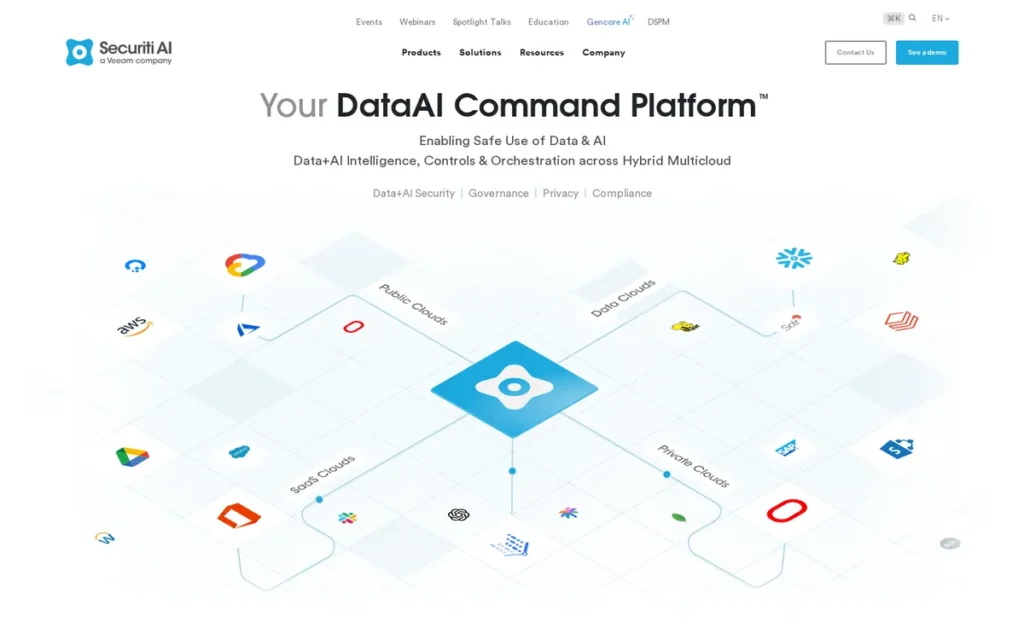
Category: AI-Native Privacy Operations Platform, a privacy automation platform built on an AI-first architecture treating continuous automated discovery and orchestrated operations as the core design principle, with DSAR fulfillment as one output of a broader PrivacyOps framework.
At a Glance
- Category: AI-Native Privacy Operations Platform
- Best For: Enterprises deploying AI systems at scale; UK public sector organizations requiring G-Cloud-eligible DSAR software
- Price Range: Enterprise custom; no public tiers; quote required; UK G-Cloud listed for public sector procurement, no community-reported price ranges confirmed in sources reviewed (April 2026); direct vendor confirmation required
- Primary Strength: Securiti.ai’s People Data Graph discovers personal data across 1,000+ systems without creating secondary PII copies; UK G-Cloud certified; estimated $75M Series B (Crunchbase estimate, not independently confirmed, April 2026)
- Biggest Limitation: Limited community practitioner visibility; no published independent case studies with quantified DSAR outcome data available in sources reviewed
- One-Line Summary: Securiti.ai delivers AI-native privacy operations via its People Data Graph, discovering data across 1,000+ systems without secondary PII copies, certified for UK G-Cloud procurement and backed by an estimated $75M Series B (Crunchbase estimate, April 2026).
- Last Verified: April 2026
Overview
Securiti.ai is an AI-native privacy operations platform for enterprises deploying AI systems at scale, built around its proprietary People Data Graph (which discovers and correlates personal data across 1,000+ systems using NLP, pattern matching, and image recognition without creating secondary PII copies) positioning Securiti.ai at the intersection of privacy compliance and AI governance.
Securiti.ai is the only platform in this evaluation certified for UK government procurement via the Crown Commercial Service G-Cloud marketplace (Crown Commercial Service, 2026).
Securiti.ai’s limited presence in practitioner community forums creates a practical limitation for buyers: independent third-party practitioner validation outside formal analyst reports is thin, requiring greater reliance on direct vendor reference calls than for community-present competitors.
Key Features
- People Data Graph: Privacy-Safe Discovery: Securiti.ai’s People Data Graph automatically discovers, classifies, and correlates personal data across 1,000+ connected systems using NLP, pattern matching, image recognition, and hashed indexing, without copying or storing PII, eliminating secondary data exposure risk that arises when tools replicate data for analysis (Securiti.ai People Data Graph page).
- PrivacyOps Framework With Auti Robotic Automation: Securiti.ai’s PrivacyOps framework includes Auti, a robotic automation assistant that executes routine privacy operations (data mapping updates, vendor assessments, and breach notification workflows) autonomously without human initiation, operationalizing continuous privacy compliance as a background process.
- Built-In Identity Verification and Encrypted Delivery: Securiti.ai includes built-in identity verification options (including third-party integrations), predefined task collaboration workflows, encrypted report delivery, and comprehensive compliance records as standard DSAR fulfillment capabilities (Securiti.ai DSR Automation page).
- UK Government G-Cloud Certification: Securiti.ai is certified on the UK Government G-Cloud marketplace via the Crown Commercial Service, enabling direct procurement by UK public sector organizations without a separate tender process, the only government-certified DSAR vendor in this evaluation (Crown Commercial Service, 2026).
- AI Governance and GDPR Article 22 Alignment: Securiti.ai is recognized by SoftwareReviews as offering “the industry’s first AI-powered privacy solution” at the intersection of AI governance and privacy compliance (SoftwareReviews), making it the strongest evaluated option for organizations with GDPR Article 22 automated decision-making obligations or emerging EU AI Act compliance requirements.
Best For
Securiti.ai is best suited for enterprises deploying AI systems at scale where privacy compliance must be embedded into data infrastructure rather than managed as a separate overlay (particularly those with GDPR Article 22 or EU AI Act obligations) and for UK public sector organizations requiring G-Cloud-eligible DSAR software.
Strengths
- UK Government Procurement Certification: Securiti.ai is verified on the UK Government Digital Marketplace (G-Cloud, Crown Commercial Service, 2026) as an approved cloud privacy management service, the only platform in this evaluation with documented government procurement certification, providing independent standards validation for public sector and regulated-sector buyers.
- Estimated Series B Institutional Validation: Securiti.ai’s estimated $75M Series B in 2021 (Crunchbase estimate; not independently confirmed in primary sources, April 2026) reflects institutional investor confidence in its AI-native approach, a funding foundation larger than Ketch’s estimated $20M Series A and MineOS’s estimated $9.5M among the platforms evaluated.
- Privacy-Safe No-Copy Data Discovery Architecture: Securiti.ai’s People Data Graph is the only data discovery architecture in this evaluation that finds and correlates personal data without creating secondary PII copies, addressing the regulatory risk where tools that replicate data to analyze it can themselves generate a separate compliance obligation.
- AI-Privacy Intersection Positioning: SoftwareReviews designated Securiti.ai as offering “the industry’s first AI-powered privacy solution” at the intersection of AI governance and privacy compliance (SoftwareReviews), a positioning that gains strategic importance as GDPR Article 22 enforcement and EU AI Act compliance obligations accelerate.
Limitations
- Limited Community Practitioner Validation: Securiti.ai’s most consequential trade-off is the gap between its technical depth and community visibility, Securiti.ai is the least discussed platform in this evaluation across r/gdpr, r/cipp, r/fintech, r/webdev, and r/privacy threads (2025–2026, as of April 2026), appearing only as a single brief, un-elaborated mention, making independent due diligence harder than for community-present competitors.
- Independent Case Study Gap: Independent case studies confirming specific operational DSAR outcomes were not available in sources reviewed for this evaluation, meaning Securiti.ai’s performance claims rest primarily on architecture descriptions and analyst designations rather than quantified client outcomes, a meaningful gap versus DataGrail’s managed services evidence or MineOS’s publicly available ZOE case study.
- Enterprise-Direct Sales Motion: Securiti.ai operates through enterprise-direct channels without meaningful community presence or self-service evaluation paths, meaning buyers must initiate full sales cycles to access pricing, implementation details, or reference customers, a higher friction evaluation process than most competitors in this evaluation.
- Data Discovery Ceiling: Securiti.ai does not eliminate the requirement for human verification of discovered data, no DSAR platform in this evaluation fully automates data mapping, and the cross-category practitioner consensus applies equally: “someone still has to manually verify and maintain the map” (u/whatwilly0ubuild, r/fintech, February 2026).
Verdict
Securiti.ai is the most technically differentiated AI-native option in this evaluation for enterprises that need privacy compliance embedded into complex data infrastructure, particularly those with AI systems subject to GDPR Article 22 or emerging EU AI Act requirements. Securiti.ai’s People Data Graph privacy-safe discovery architecture, PrivacyOps robotic automation, and UK G-Cloud certification provide credible technical and institutional validation. Buyers should supplement available public evidence with direct customer references before committing, given the limited independent practitioner review data currently available for this platform.
5. Exterro: Best for Legal-Driven Enterprise: Unified DSAR and E-Discovery in a Single Defensible Platform
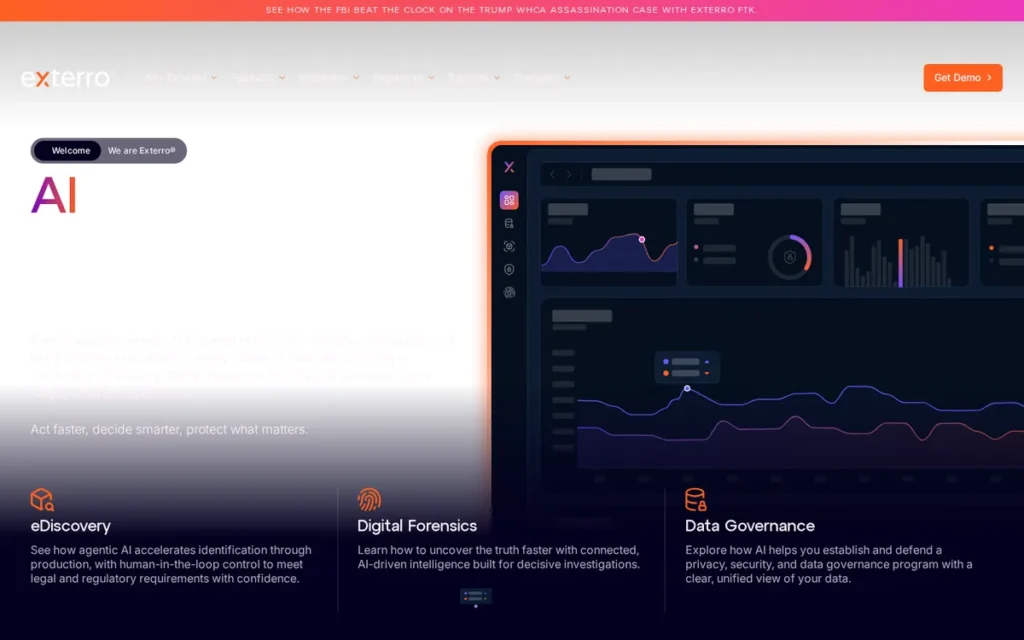
Category: Legal-Unified Data Governance Platform, a unified legal operations and data governance platform where DSAR management is integrated with e-discovery, digital forensics, litigation hold, and records governance in a single defensible chain-of-custody system.
At a Glance
- Category: Legal-Unified Data Governance Platform
- Best For: Fortune 500 GC offices and eDiscovery teams where DSAR obligations intersect with e-discovery and litigation hold
- Price Range: Enterprise custom; no public tiers; contact required; TCO typically calculated across displaced point solutions (e-discovery + DSAR + governance); no community-reported price ranges confirmed in sources reviewed (April 2026)
- Primary Strength: Exterro is the only platform in this evaluation explicitly positioning DSAR management within a unified e-discovery, digital forensics, and litigation hold workflow (based on published product pages reviewed April 2026), with 20+ years of legal technology heritage and company-reported adoption by 50% of Fortune 100 organizations (vendor-stated)
- Biggest Limitation: 30+ connectors far narrower than DataGrail’s 2,500+; adds operational complexity without active e-discovery or litigation obligations
- One-Line Summary: Exterro is the only platform in this evaluation unifying DSAR management with e-discovery and legal hold in one defensible workflow, with company-reported adoption by 50% of Fortune 100 organizations (vendor-stated; requires independent verification) and 20+ years of legal technology heritage.
- Last Verified: April 2026
Overview
Exterro is a unified legal operations and data governance platform for Fortune 500 organizations where DSAR fulfillment obligations intersect with e-discovery, litigation hold, and records governance, the only tool in this evaluation integrating all four capabilities in a single defensible chain-of-custody workflow, based on published product pages reviewed as of April 2026.
Exterro reports adoption by 50% of Fortune 100 companies for legal, privacy, and e-discovery operations (vendor-stated; Exterro “Why Exterro” privacy page, April 2026), buyers should request named reference customers before weighting this claim in procurement decisions.
Exterro’s unified scope is its most consequential trade-off for organizations without active e-discovery obligations: it adds operational complexity for teams that need DSAR automation without legal operations integration.
Key Features
- Unified DSAR and E-Discovery Workflow: Exterro’s unified platform integrates DSAR management, e-discovery, digital forensics, and litigation hold in a single defensible workflow, enabling legal teams to manage data subject access obligations and data preservation from the same system of record, a capability unique among all seven platforms evaluated (Exterro privacy compliance automation page).
- OptiX360 Live Data Map: Exterro’s OptiX360 live data map syncs in real time across connected data sources, feeding both DSAR discovery and e-discovery workflows with a shared, continuously updated data inventory, eliminating the synchronization problem between separate privacy and legal data systems.
- Exterro Assist Agentic AI: Exterro Assist automates data searching and workflow execution with a company-stated 75% productivity gain (vendor-stated figure, April 2026), providing “defensible automation” with secure audit logs maintained throughout the process (Exterro resources page).
- Comprehensive GDPR and Legal Documentation Coverage: Exterro covers GDPR, CCPA/CPRA, Records of Processing Activities (RoPA) generation, and Data Protection Impact Assessment (DPIA) workflows natively, enabling privacy and legal teams to manage all major GDPR documentation obligations alongside litigation data management (Exterro GDPR solutions page).
- Legally Defensible Audit Trail: Exterro’s 20+ years of legal-sector heritage means its audit trail, data preservation, and chain-of-custody architectures meet evidentiary standards required in actual litigation and regulatory investigation contexts, not solely routine compliance documentation.
Best For
Exterro is best suited for General Counsel offices and eDiscovery teams at Fortune 500 organizations where incoming DSARs must be managed alongside active litigation holds, regulatory investigations, or complex data governance obligations, and where the defensibility of automated DSAR responses is subject to legal scrutiny.
Strengths
- Company-Claimed Fortune 100 Adoption: Exterro reports adoption by 50% of Fortune 100 companies for legal, privacy, and e-discovery operations (Exterro “Why Exterro” privacy page, April 2026), a vendor-stated claim that, if independently verified with named references, would represent successful deployment in the highest-complexity data environments in existence; buyers should request named reference customers before weighting this figure in procurement decisions.
- Defensible Automation Architecture: Exterro Assist’s agentic AI is the only robotic automation layer in this evaluation explicitly designed for “defensible automation”, meaning automated decisions in DSAR and e-discovery workflows are architected to withstand regulatory and legal scrutiny, not merely operational review (vendor-stated; Exterro resources, 2025).
- 20+ Year Legal Technology Heritage: Exterro’s two-decade history of legal technology development means its chain-of-custody architecture, data preservation protocols, and audit trail standards have been validated in actual litigation and regulatory investigation contexts, providing a level of legal defensibility that newer privacy-first tools have not yet accumulated.
- Jordan Lawrence Acquisition Capabilities: Exterro’s Jordan Lawrence acquisition (year to be confirmed with vendor directly; referenced in SourceForge comparison, April 2026) added established information governance and data mapping capabilities extending DSAR discovery functionality to complex legacy data environments that cloud-native platforms may not reliably reach.
Limitations
- Narrow Integration Breadth: Exterro’s most consequential trade-off for modern SaaS environments is connector breadth, its 30+ deep connectors are far narrower than DataGrail’s 2,500+ integrations, meaning organizations with fragmented cloud-based data stacks will encounter significant gaps in automated DSAR discovery when evaluated against a SaaS-heavy enterprise tech stack.
- Excessive for Non-Legal-Ops Organizations: Exterro is purpose-built for organizations where legal operations and privacy compliance are managed by the same team or tightly integrated, and Exterro actively adds complexity for organizations without this overlap, its unified scope is a compelling differentiator for F500 GC offices and a genuine operational burden for standalone privacy teams.
- No Community Practitioner Validation: Exterro was not mentioned in any of the primary Reddit DSAR or privacy management community threads analyzed (r/gdpr, r/cipp, r/fintech, r/webdev, 2025–2026, as of April 2026), reflecting its enterprise-direct sales motion but meaning independent practitioner reviews are unavailable, requiring more intensive customer reference investigation than for community-present competitors.
- Data Discovery Ceiling: Exterro does not eliminate the requirement for human verification of discovered data, the cross-category practitioner consensus applies: no DSAR platform fully automates data mapping, and “someone still has to manually verify and maintain the map” (u/whatwilly0ubuild, r/fintech, February 2026).
Verdict
Exterro is the strongest-fit choice for Fortune 500 legal and compliance teams managing DSAR obligations alongside e-discovery, litigation hold, and records governance in an integrated workflow, the only platform in this evaluation with 20+ years of legal defensibility heritage and company-reported adoption by 50% of Fortune 100 organizations (vendor-stated; requires independent verification with named references). Exterro’s OptiX360 live data map and Exterro Assist defensible automation provide genuinely differentiated capabilities for legal-driven data governance. Organizations should prioritize Exterro when DSAR fulfillment and e-discovery share a data chain of custody, and should evaluate DataGrail or OneTrust when DSAR is managed independently of legal operations.
6. MineOS: Best for SMB and Mid-Market: AI-Automated RoPA, Fast No-Code Deployment, and Unique PIPL Support
Category: SMB-Specialist Privacy Automation Platform, a no-code privacy automation platform optimized for SMBs and mid-market organizations needing fast deployment, AI-powered data discovery, automated RoPA maintenance, and consumer-facing self-service privacy portals without dedicated privacy engineering resources.
At a Glance
- Category: SMB-Specialist Privacy Automation Platform
- Best For: SMBs and mid-market organizations needing fast no-code DSAR deployment with automated RoPA and PIPL coverage
- Price Range: Contact required; SMB-accessible positioning; no public pricing tiers; Capterra UK and GetApp listed with pricing on request (Capterra UK; GetApp); direct vendor confirmation required
- Primary Strength: MineOS’s AI Agent automates Records of Processing Activities generation from live data (described as an industry first) and is the only platform in this evaluation with explicit PIPL support confirmed in product documentation (April 2026); Fast Company 2025 Top 10 Enterprise recognition; ZOE case study documenting 80% DSAR time reduction
- Biggest Limitation: Smallest estimated funding base in this evaluation (~$9.5M); limited community practitioner validation across major privacy forums as of April 2026
- One-Line Summary: MineOS is an AI-native privacy platform recognized by Fast Company as a Top 10 Enterprise innovator in 2025, with a published case study showing 80% DSAR time reduction and the only tool in this evaluation with explicit PIPL support confirmed in product documentation reviewed as of April 2026.
- Last Verified: April 2026
Overview
MineOS is an AI-native privacy automation platform for SMBs and growth-stage mid-market organizations, offering fast no-code DSAR deployment, automated Records of Processing Activities generation via its AI Agent, and explicit PIPL support, making MineOS the only tool in this evaluation covering China’s Personal Information Protection Law for the world’s fastest-growing DSAR market region (Asia-Pacific represents 23% of global DSAR software demand per SNS Insider, 2025).
MineOS was recognized by Fast Company as one of its Most Innovative Companies of 2025, ranking Top 10 in the Enterprise category (PRNewswire, March 2025; confirmed via aijourn.com, March 2025). The ZOE case study documents an 80% reduction in DSAR handling time and a 95% reduction in manual work (MineOS ZOE case study, 2025).
MineOS’s estimated $9.5M total funding base is the smallest in this evaluation, creating vendor maturity considerations for organizations making multi-year platform commitments.
Key Features
- AI Agent for Automated RoPA Generation: MineOS’s AI Agent automatically builds and maintains Records of Processing Activities (RoPAs) from live data, converting what is typically a quarterly manual GDPR Article 30 exercise into a continuously updated, audit-ready compliance record, described by the company as an industry first in automated RoPA generation (PRNewswire, March 2025).
- AI-Powered Data Discovery (95% Coverage Claimed): MineOS uses machine learning-powered discovery claiming to detect and classify up to 95% of a company’s data systems in real time across structured and unstructured sources, the highest claimed discovery rate in this evaluation (company-stated figure, supported by the ZOE case study; not independently replicated in third-party research reviewed for this evaluation, April 2026).
- No-Code Integration Builder: MineOS’s no-code Integration Builder connects business systems and routes DSAR requests without requiring technical resources, enabling privacy teams to configure and operate the platform without engineering dependencies, a critical capability for SMBs without dedicated privacy engineering staff.
- PIPL, GDPR, CCPA/CPRA, and LGPD Coverage: MineOS supports geography-specific DSAR workflows across GDPR, CCPA/CPRA, LGPD, and PIPL (China’s Personal Information Protection Law) with built-in de-identification and pseudonymization, the only tool in this evaluation explicitly confirming PIPL support in product documentation reviewed as of April 2026; other platforms may have added PIPL coverage since this review, so verify directly with each vendor (MineOS DSAR hub).
- Consumer-Facing Privacy Portal: MineOS provides a consumer-facing Privacy Portal giving data subjects direct self-service access to submit and track their own privacy requests, reducing inbound support burden and improving requestor experience in line with GDPR Article 12 transparency requirements.
Best For
MineOS is best suited for SMBs and growth-stage mid-market organizations that need fast no-code DSAR deployment, automated RoPA maintenance without dedicated privacy engineering, and multi-jurisdiction coverage including PIPL for organizations with Chinese data subject populations.
Strengths
- Published Case Study With Quantified Client Outcomes: MineOS’s ZOE case study (publicly available PDF, 2025) documents an 80% reduction in DSAR handling time and a 95% reduction in manual work, the strongest quantified, named-client outcome figures of any platform in this evaluation, and publicly available for independent buyer review.
- Fast Company Most Innovative Company, 2025: Top 10 Enterprise: Fast Company recognized MineOS as one of its Most Innovative Companies of 2025, ranking it Top 10 in the Enterprise category (PRNewswire, March 2025; confirmed via aijourn.com, March 2025), an independent editorial designation with a competitive, non-paid selection process.
- AI Agent for Automated RoPA, Industry-First Claim: MineOS’s AI Agent directly addresses one of the most labor-intensive recurring GDPR obligations, Article 30 Records of Processing Activities, by converting periodic manual surveys into a continuously maintained, audit-ready record; MineOS describes this continuous live-data RoPA generation as an industry first (Corporate Compliance Insights, 2025).
- Only Tool With Explicit PIPL Support in This Evaluation: MineOS explicitly supports PIPL (China’s Personal Information Protection Law) in product documentation reviewed as of April 2026 (the only platform in this evaluation to do so) addressing the fastest-growing DSAR regulatory obligation by regional market (SNS Insider, 2025).
Limitations
- Vendor Maturity and Funding Stage: MineOS’s most consequential trade-off is vendor maturity, with an estimated $9.5M in total funding compared to OneTrust’s $920M+, Securiti.ai’s estimated $75M, and DataGrail’s estimated $45M, MineOS carries higher long-term vendor viability risk for organizations committing to multi-year privacy program infrastructure; enterprises should request financial stability documentation and contract continuity provisions before signing.
- Limited Community Practitioner Validation: MineOS’s absence from practitioner forums (no significant mentions across r/gdpr, r/cipp, r/fintech, or r/webdev through April 2026) means independent third-party practitioner validation is thin, requiring buyers to rely more heavily on direct customer references than for community-present competitors.
- Discovery and Marketing Claims Require Independent Verification: The 95% data discovery rate, vendor-stated automation figures, MineOS’s self-described “#1 customer-rated” G2 designation, and AI Agent “industry first” claim are all drawn from company marketing materials or a single named case study, none have been independently replicated in third-party research reviewed for this evaluation (April 2026); buyers should verify MineOS’s current G2 score at g2.com/products/mineos/reviews and request independent confirmation of the “industry first” designation during vendor evaluation.
- Data Discovery Ceiling: MineOS does not exempt organizations from the requirement for human verification of discovered data, no DSAR platform fully automates data mapping despite vendor claims, and “someone still has to manually verify and maintain the map” even at MineOS’s claimed 95% discovery rate (u/whatwilly0ubuild, r/fintech, February 2026).
Verdict
MineOS is the strongest choice for SMBs and mid-market organizations seeking fast no-code DSAR deployment with AI-automated RoPA maintenance and PIPL coverage, validated by a published case study showing 80% DSAR time reduction and Fast Company’s 2025 Top 10 Enterprise recognition. MineOS’s innovation-to-funding ratio is the highest in this evaluation. Enterprise buyers should weigh its funding stage and limited community validation against its documented outcomes and unique PIPL capability before committing to multi-year contracts; organizations that outgrow MineOS should evaluate DataGrail or OneTrust as natural upgrade paths.
7. Ketch: Best for Developer-Friendly Growth-Stage Organizations: Programmatic Privacy Orchestration With Startup-Accessible Pricing
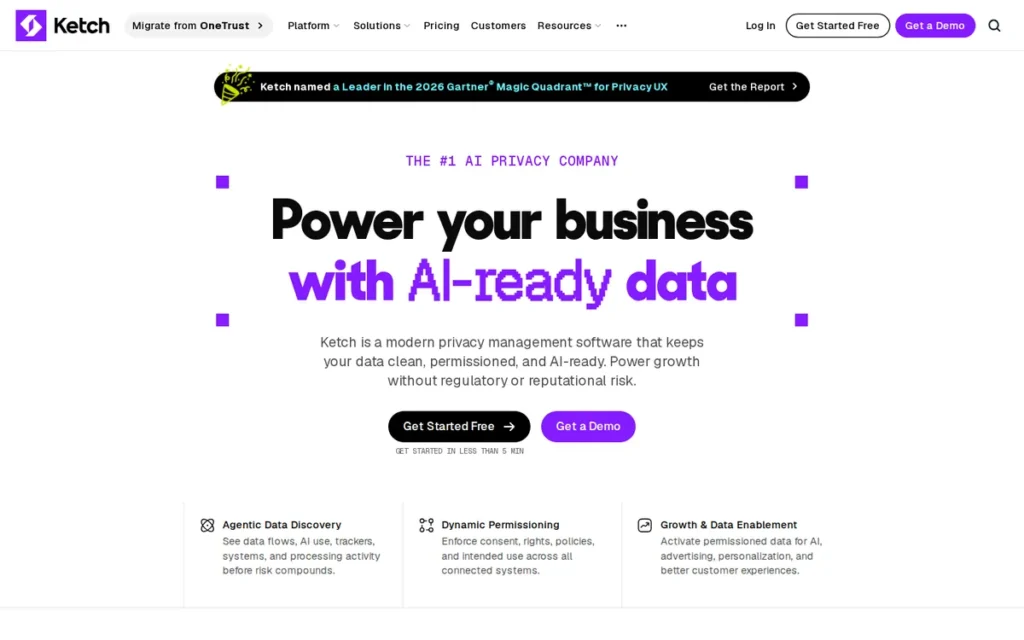
Category: Programmatic Privacy Orchestration Platform, a developer-friendly privacy platform that synchronizes consent and DSAR workflows programmatically across connected systems, designed for organizations seeking API-first control over privacy operations without dedicated enterprise implementation infrastructure.
At a Glance
- Category: Programmatic Privacy Orchestration Platform
- Best For: Developer-led growth-stage teams requiring fast no-code DSAR deployment with programmatic consent synchronization; healthcare or financial services organizations needing HIPAA and PCI DSS coverage at startup-accessible pricing
- Price Range: Most accessible in evaluation; community-reported entry tier ~$500–$2K/year for startup deployments ([u/Beginning_Driver7602, u/Wild_Occasion_5707, r/webdev, February 2026]); enterprise tiers available; all figures are community-reported and require direct vendor confirmation
- Primary Strength: Ketch’s Permission Vault programmatically synchronizes consent state into data systems in real time; claimed 3-week deployment timeline; 1,000+ integrations; HIPAA, PCI DSS, GDPR, CCPA, and ISO multi-framework coverage
- Biggest Limitation: Unverified litigation signal from r/cipp (March 2026): requiring independent legal due diligence before contract execution, is a non-optional step for any platform used to demonstrate privacy compliance
- One-Line Summary: Ketch is a developer-first programmatic privacy platform with a Permission Vault architecture, 1,000+ integrations, community-reported startup pricing (~$500–$2K/year), and a claimed 3-week deployment timeline.
- Last Verified: April 2026
Overview
Ketch is a developer-first programmatic privacy platform for growth-stage organizations, built on a Permission Vault architecture that synchronizes consent state into data systems in real time, meaning DSAR deletion requests automatically propagate to consent-linked data stores without a separate synchronization step.
Ketch raised an estimated $20M Series A in 2021 (Crunchbase estimate; not independently confirmed in primary sources, April 2026), and community practitioners report startup-tier pricing at approximately $500–$2,000/year for entry-level deployments, the most price-accessible tool in this evaluation.
Buyers must conduct independent legal due diligence regarding an unverified litigation signal reported in r/cipp (March 2026, referencing IAPP community discussions) before signing contracts with Ketch, a non-optional step for any platform used to demonstrate privacy compliance.
Key Features
- Permission Vault: Real-Time Consent Synchronization: Ketch’s Permission Vault centrally unifies consent signals across all systems, devices, and channels and synchronizes consent state programmatically into data systems themselves, meaning DSAR deletion requests automatically propagate to consent-linked data stores in real time without a separate manual synchronization step (Ketch DSR Automation page).
- No-Code Rights Automation Builder: Ketch’s no-code rights automation builder enables privacy teams to design and deploy DSAR workflows through drag-and-drop configuration across 1,000+ data systems, with Ketch claiming a deployment timeline as short as 3 weeks (MartechEdge, 2024).
- HIPAA and PCI DSS Multi-Framework Coverage: Ketch supports compliance with GDPR, CCPA, HIPAA, PCI DSS, and ISO standards, one of the broader multi-framework tools in this evaluation and one of few explicitly confirmed for healthcare (HIPAA) and payment (PCI DSS) contexts at startup-accessible pricing (Ketch DSR Automation page).
- 400+ Frontend Customizations: Ketch offers 400+ frontend customizations for consent banners and preference centers via a no-code visual interface, enabling organizations to deploy regulator-compliant consent experiences without engineering dependencies (BusinessWire, June 2024).
- API-First Architecture for Developer Integration: Ketch’s API-first architecture enables technical privacy teams to embed programmatic privacy controls directly into existing application infrastructure, confirmed by community practitioners as “more developer-friendly with API-first architecture” for teams preferring code-level control over GUI-only configuration (u/whatwilly0ubuild, r/fintech, February 2026).
Best For
Ketch is best suited for developer-led or technically mature growth-stage organizations that want programmatic control over privacy operations without enterprise-tier implementation complexity, and for healthcare or financial services organizations needing HIPAA and PCI DSS coverage alongside GDPR/CCPA DSAR functionality at startup-range pricing.
Strengths
- Permission Vault as a Genuine Architectural Differentiator: Ketch’s Permission Vault is the only architecture in this evaluation that programmatically synchronizes consent state into data systems in real time, confirmed by independent third-party trade press coverage (BusinessWire, June 2024; MartechEdge, 2024).
- Most Accessible Pricing in the Evaluation: Community practitioners describe Ketch as “the middle ground (not free, not enterprise heavy, just enough to stay compliant without burning cash” ([u/Wild_Occasion_5707, r/webdev, February 2026])) the community-reported $500–$2K entry tier is the lowest documented price point for growth-stage compliance automation in this evaluation.
- Developer-Friendly API-First Architecture: Community practitioners specifically identify Ketch as gaining traction because it allows engineering teams to “integrate privacy controls into existing systems rather than bolting on a separate platform” (u/whatwilly0ubuild, r/fintech, February 2026), a genuine differentiator for technically mature teams preferring programmatic control.
- HIPAA/PCI DSS Multi-Framework Coverage at Growth-Stage Pricing: Ketch’s HIPAA and PCI DSS coverage combined with GDPR, CCPA, and ISO standards addresses healthcare and financial services compliance obligations typically served only by more expensive enterprise platforms, making Ketch uniquely positioned at the growth-stage pricing tier.
Limitations
- Unverified Litigation Signal Requires Legal Due Diligence: Ketch’s most consequential limitation is an unverified risk signal requiring investigation before signing, a credentialed community member in r/cipp (March 2026) reported that law firm Tauler Smith had initiated privacy lawsuits against Ketch users, referencing IAPP discussions as corroboration; this claim is unconfirmed and must be treated as such, but given that Ketch is used specifically to demonstrate privacy compliance, direct legal due diligence (including a written inquiry to Ketch’s legal team and review by the buyer’s own counsel) is required before contract execution.
- Mixed Credentialed Practitioner Feedback: A self-described CMP implementation specialist with documented hands-on platform experience described Ketch as “far too clever for its own good” ([u/DigitalStefan, r/webdev, February 2026]), suggesting architectural sophistication may create deployment complexity contradicting its “no-code” marketing in edge-case configurations, a risk buyers should probe in proof-of-concept demonstrations.
- Vendor-Affiliated Community Promotion Pattern: Multiple positive community mentions of Ketch cluster around accounts with limited posting histories and cross-thread promotion patterns consistent with vendor-affiliated activity, requiring buyers to weight Ketch’s community advocacy with appropriate skepticism relative to platforms with more organically diverse review bases.
- Data Discovery Ceiling: Ketch’s 1,000+ drag-and-drop connections are less technically deep than DataGrail’s patented SSO discovery or MineOS’s AI-powered engine, and the cross-category practitioner consensus applies equally: no DSAR platform fully automates data mapping, and “someone still has to manually verify and maintain the map” (u/whatwilly0ubuild, r/fintech, February 2026).
Verdict
Ketch is the most accessible programmatic privacy platform for developer-led growth-stage organizations needing DSAR automation with no-code deployment and startup-range pricing, described by community practitioners as the “middle ground” between free consent tools and enterprise platforms. Ketch’s Permission Vault architecture is genuinely innovative, and its HIPAA and PCI DSS multi-framework coverage addresses a real compliance gap at the growth-stage pricing tier. The unverified litigation signal documented in r/cipp (March 2026) is non-optional due diligence for any organization using this platform to manage privacy compliance obligations, buyers must verify litigation status directly with Ketch’s legal team and their own counsel before signing.
What Red Flags Should I Watch For When Evaluating DSAR Software?
Six material red flags emerge consistently from practitioner community research and market analysis when evaluating DSAR software in 2026. Every platform in this evaluation is affected by at least one, knowing them before entering vendor conversations prevents common procurement errors documented repeatedly by credentialed practitioners.
Red Flag #1: Vendor Claims Full Automation of Data Discovery
No platform in this evaluation fully automates data mapping, human verification remains necessary regardless of marketing claims. The practitioner consensus is explicit and consistent: “The data mapping piece is where most platforms oversell and underdeliver. They’ll discover some data sources automatically but the reality is someone still has to manually verify and maintain the map. No tool fully automates this” (u/whatwilly0ubuild, r/fintech, February 2026). When evaluating any platform, require a live demonstration against your actual tech stack, not a pre-configured demo environment.
This perspective is reinforced by a practitioner on r/cipp with direct F500 privacy program experience:
“Have run global privacy at two F500 companies and a couple well known, large internet platforms doing compliance, data inventory, DSAR and other functions at scale. OneTrust customer several times over as well as some of the competition. If you’re doing a high volume of DSAR, 10-100k plus/yr, you’ll know what tools to buy, where OneTrust falls apart and when it’s time to roll your own, but 9 times out of 10 Id rather have an ambitious privacy analyst skilled with excel or Google sheets and some good email templates in the can.” Posted by u/jrandomslacker
Takeaway: Senior privacy leaders with direct F500 DSAR program experience consistently find that operational clarity and skilled human execution outperform software platforms until request volumes scale beyond what structured manual processes can reliably handle.
Red Flag #2: Pricing Opacity Combined With Aggressive Renewal Tactics
Pricing opacity in DSAR software creates documented downstream risk: multiple community members in r/cipp and IAPP forums specifically report “sudden 10x renewal quotes just days before contracts expire” for OneTrust, a pattern that exists categorically when buyers have no published anchor for negotiation. Every platform in this evaluation uses enterprise-custom, contact-required pricing with no public tiers. When signing any multi-year agreement, negotiate rate caps and renewal terms in the contract before execution, not at renewal time.
Red Flag #3: Unverified Community Litigation Signals
A credentialed community member in r/cipp (March 2026) reported that law firm Tauler Smith had initiated privacy lawsuits against Ketch users, referencing IAPP community discussions as corroboration. This claim is unverified and must be treated as unconfirmed. For a platform used specifically to demonstrate privacy compliance, any reported litigation involving that platform’s own privacy practices requires independent legal investigation before contract signing. Buyers should ask every DSAR vendor: “Are you currently subject to any active privacy-related litigation?” and review responses with their own legal counsel.
Red Flag #4: Vendor-Affiliated Review Activity in Community Forums
Multiple positive community mentions of Ketch in r/cipp and r/webdev threads cluster around accounts with limited posting histories and cross-thread promotion patterns consistent with vendor-affiliated activity. This is a category-wide risk: compliance software decisions carry regulatory stakes, making affiliate-incentivized or vendor-planted community reviews materially misleading. Cross-reference community recommendations against accounts with established posting histories and named professional credentials before treating any recommendation as organic.
Red Flag #5: Equating Integration Count With Data Discovery Accuracy
All platforms in this evaluation cite integration counts as a proxy for data discovery completeness. Integration count reflects the number of systems a platform can connect to, not the accuracy or completeness of data found within those systems. These are distinct capabilities that vendors routinely conflate. When evaluating any platform, ask specifically for documented discovery accuracy rates against your particular tech stack, not against a vendor-controlled benchmark environment.
Red Flag #6: Buying Full-Suite When a DSAR Specialist Suffices, or Vice Versa
Full-suite platforms (OneTrust, TrustArc) include DSAR as one module within a larger compliance ecosystem. DSAR-specialist platforms (DataGrail) are purpose-built for request management without broader modules. Purchasing a full-suite platform when only DSAR is needed generates unnecessary complexity, cost, and implementation time, the most common buyer error documented across community discussions. Define your actual compliance program scope before entering any vendor conversation.
What Questions Should I Ask Before Choosing DSAR Software?
Five questions are the most operationally consequential for DSAR software procurement decisions in 2026, drawn from regulatory enforcement data, cost economics, and practitioner community intelligence. Answering them before entering vendor conversations ensures platform selection matches actual compliance scope rather than vendor-defined feature sets.
Question #1: How Many DSARs Do You Receive Annually, and What Is Your Projected Volume in 24 Months?
Annual DSAR volume is the most important input for platform selection. At fewer than 50 annual requests, manual processing or lightweight tools may be cost-positive over enterprise licensing. At 100+ requests, the approximately $1,524 per-request manual processing cost (Gartner benchmark, cited by DataGrail and TrustArc, 2026) begins to justify automation investment at any price tier in this evaluation.
As a starting benchmark for platform tier selection:
- Fewer than 50 annual DSARs: manual or lightweight tools; evaluate Ketch or MineOS only if regulatory scope demands automation
- 50–200 requests: mid-market platforms (Ketch, MineOS) typically cost-positive
- 200–500 requests: specialist platforms (DataGrail) or mid-range enterprise justified
- 500+ requests: full-suite enterprise (OneTrust, TrustArc) typically cost-justified
These thresholds shift significantly based on regulatory jurisdiction count and dedicated privacy staff headcount.
Question #2: Does Your DSAR Obligation Overlap With Active Litigation Holds or E-Discovery Requirements?
If DSARs must be coordinated with litigation holds or e-discovery responses (where the same data must simultaneously be preserved for legal purposes and made accessible for deletion under GDPR) only Exterro in this evaluation provides a unified, defensible chain-of-custody workflow for both obligations.
Most organizations discover this overlap at the worst possible moment: a DSAR arrives during active litigation. The requestor has an absolute right to their data within 30 days; litigation hold prevents deletion of the same data. Evaluate Exterro first if your organization has active litigation or regulatory investigation.
Question #3: How Many Regulatory Jurisdictions Must Your DSAR Workflow Cover Today, and Which Regulations Are You Anticipating in the Next 18 Months?
GDPR-only organizations have fundamentally different requirements from those managing simultaneous GDPR, CCPA/CPRA, LGPD, and PIPL obligations. Key coverage map for this evaluation:
- GDPR + CCPA only: all seven platforms qualify
- GDPR + CCPA + LGPD: TrustArc (50+ jurisdictions), MineOS (explicit LGPD), OneTrust, confirmed
- GDPR + CCPA + PIPL (China): MineOS only: explicit confirmation in product documentation reviewed April 2026; verify all others directly with vendors
TrustArc’s 50+ jurisdiction support is the broadest among full-suite platforms. Organizations anticipating Asia-Pacific expansion should select a platform with PIPL coverage at initial procurement, not after expansion has occurred and compliance gaps have materialized.
Question #4: What Is Your Dedicated Privacy Staff Headcount, and What Implementation Timeline Can You Absorb Without Extending Compliance Exposure?
OneTrust and TrustArc require dedicated privacy staff and document months-long implementation timelines. Ketch claims 3-week deployment; MineOS offers no-code setup for organizations without privacy engineering. As a practical guide:
- OneTrust and TrustArc: 3–6 months to first automated DSAR (community-documented)
- DataGrail and Securiti.ai: 4–8 weeks for initial deployment
- Ketch: company-claimed 3 weeks with no-code configuration
- MineOS: no-code, comparable to Ketch timeline
- Exterro: 3–6 months, mirrors OneTrust/TrustArc timeline given legal-ops complexity
Organizations under immediate compliance pressure following a breach notification or supervisory inquiry cannot absorb enterprise implementation timelines and should prioritize Ketch, MineOS, or DataGrail’s managed services offering instead.
Question #5: Have You Confirmed With Legal Counsel Whether Any Platform You Are Evaluating Has Active Privacy-Related Litigation?
This question applies specifically to Ketch given the r/cipp (March 2026) unverified litigation signal, but should be asked of every DSAR software vendor as standard procurement due diligence. A platform used to manage privacy compliance obligations must itself be free of active privacy-related legal disputes. Ask directly, document the vendor’s written response, and review it with your own legal counsel before signing any contract.
How Did We Rank These 7 DSAR Software Platforms?
These 7 DSAR platforms are ranked by scoring each against six criteria: DSAR Workflow Completeness, Data Discovery Breadth, Multi-Jurisdiction Coverage, and Independent Validation (each double-weighted as primary criteria) plus Identity Verification Quality and Deployment Speed at standard weight. Every data point is traced to a named source with a publication year. No company paid for placement.
How Was Research Collected?
This evaluation combined four parallel research streams executed in April 2026:
- AI Response Gap Analysis: Perplexity and ChatGPT were queried using the article’s target search queries to identify what current LLM responses miss, those gaps become the content this article explicitly fills.
- Independent Web Research: Product documentation, press releases, patent filings (USPTO), analyst recognitions, and government certification records were gathered directly from vendor websites and verified third-party sources.
- Review Platform Analysis: G2, Capterra, GetApp, SoftwareAdvice, and Wifitalents profiles were analyzed for ratings, review counts, category placements, and leadership designations.
- Practitioner Community Analysis: Reddit threads across r/gdpr, r/cipp, r/fintech, r/webdev, and r/privacy (2025–2026) were analyzed for attributed practitioner sentiment, with poster credentials, post histories, and cross-thread patterns evaluated for authenticity signals.
What Did Each Criterion Measure?
Primary Criteria (double-weighted):
- C1: DSAR Workflow Completeness and Automation Depth: Workflow stages automated natively; AI/ML capabilities deployed; patent-protected automation innovations; vendor-stated and case-study-verified automation rates. Matters because GDPR Article 12 requires response within 30 days, manual workflow gaps create direct fine risk, evidenced by approximately €103 million in Article 15 enforcement fines across 280+ cases (GDPR Enforcement Tracker; DLA Piper, January 2026).
- C2: Data Discovery Accuracy and Integration Breadth: Documented pre-built integration count with named source and date; discovery technology architecture; shadow IT detection; patent-protected discovery innovations; community-reported accuracy caveats. Matters because incomplete DSAR responses are the primary trigger for Article 15 enforcement actions.
- C3: Multi-Jurisdiction Regulatory Coverage: Documented jurisdiction count with named sources; specific regulations beyond GDPR/CCPA; automated regulation-update mechanisms; pre-configured compliance templates. Matters because Asia-Pacific is the fastest-growing DSAR market region, and PIPL and India DPDP coverage are increasingly required for globally operating organizations.
- C4: Independent Validation and Customer Evidence: G2 Leader designations; independent analyst recognitions (IDC MarketScape November 2025, doc US53068725) with named analyst and year; named enterprise customer references; published case studies with quantified outcomes; government certifications; community practitioner sentiment with role context. Matters because privacy professionals require decision-grade evidence, vendor claims alone are insufficient for procurement justification.
Secondary Criteria (standard weight):
- C5: Identity Verification Quality and Requestor Friction: Methods supported; friction level for legitimate requestors; fraud prevention architecture; patent protection. Matters because GDPR Article 12(6) permits identity confirmation but requires proportionality, excessive friction creates separate regulatory exposure.
- C6: Deployment Speed and Implementation Feasibility: Vendor-stated timelines with community validation; no-code vs. engineering-required configuration; dedicated privacy staff requirements. Matters because organizations under immediate compliance pressure cannot absorb months-long implementations without extending the very exposure they are trying to eliminate.
How Were Conflicting Sources Handled?
When review platform ratings conflict with Reddit community sentiment, this evaluation weights specificity and recency: a detailed 2025–2026 post from a credentialed practitioner (CIPP-certified, named implementation specialist with documented hands-on experience) outweighs a generic undated review aggregate.
Vendor-stated performance claims are explicitly labeled and never presented as independently verified facts throughout this article.
How Were Vendor Claims Validated?
Only claims corroborated by at least one independent source (analyst recognition, government certification, named case study, or credentialed community practitioner) are stated as established fact. Key corrections applied throughout this article: IDC’s November 2025 MarketScape (doc US53068725) confirms both OneTrust’s and DataGrail’s Leader designation in the same report; OneTrust’s patent count is 350+ per IDC, not 300+; DataGrail’s integration count is 2,500+ per IDC, not 2,000+. The $1,524 manual processing cost benchmark traces to Gartner research, cited across multiple industry sources including DataGrail and TrustArc (2026).
When Will This Article Be Updated?
This article is reviewed quarterly. Rankings, pricing data, and community sentiment are revised as new information becomes available. Significant vendor capability changes, new analyst placements, updated enforcement data, and new community intelligence trigger interim revisions between scheduled reviews.
PlugRoute has no affiliate relationships with any company listed; rankings are determined entirely by research data and objective evaluation criteria.
What Do Privacy Officers Most Often Ask About DSAR Software?
Privacy officers most frequently ask about three things when evaluating DSAR software in 2026: which platform fits their organization’s size, what distinguishes specialist from full-suite tools, and how independent rankings are determined. Each question below is answered with direct, source-attributed guidance applicable to active procurement decisions.
What is the best DSAR software for small businesses in 2026?
MineOS is the strongest DSAR option for small businesses in 2026, fast no-code deployment, AI-automated RoPA, and explicit PIPL and GDPR coverage without dedicated privacy engineering. Fast Company’s 2025 Top 10 Enterprise recognition and the published ZOE case study (80% DSAR time reduction) provide independent validation at this tier. Ketch is an acceptable alternative at community-reported ~$500–$2,000/year; independent legal due diligence is required before signing.
What is the difference between OneTrust and DataGrail for DSAR management?
OneTrust is a full-suite platform, DSAR is one module within a broader consent, governance, and multi-regulation compliance ecosystem for large enterprises with dedicated privacy teams. DataGrail is a DSAR-specialist with 2,500+ integrations and patented Smart Verification (U.S. Patent No. 11,829,507) designed for mid-to-large enterprises. Both received IDC MarketScape Leader recognition in November 2025; choose DataGrail when DSAR is your primary need and full-suite governance is not yet required.
How does PlugRoute determine its DSAR software rankings?
PlugRoute ranks DSAR software against six objective criteria (Workflow Completeness, Data Discovery Accuracy, Multi-Jurisdiction Coverage, Independent Validation, Identity Verification Quality, and Deployment Speed) with primary criteria double-weighted. Every data point is traced to a named source with a publication year. No company pays for placement or receives preferential treatment. Community sentiment is drawn from attributed practitioner discussions in r/gdpr, r/cipp, r/fintech, and r/webdev.
What Key DSAR Terms Should I Understand Before Evaluating Software?
Five technical terms in this comparison are most likely unfamiliar to non-specialist buyers evaluating DSAR software for the first time. Understanding each term prevents common misinterpretations of vendor integration counts, regulatory coverage claims, and automation rate statistics.
Data Subject Access Request (DSAR): A formal request submitted by an individual to an organization to access, correct, delete, or restrict the processing of personal data held about them, a right established under GDPR Article 15, CCPA, and equivalent privacy regulations. Organizations are legally required to respond within specified timeframes: 30 days under GDPR (extendable to 3 months for complex cases), with failure to comply generating enforcement fines under Article 12.
Records of Processing Activities (RoPA): A mandatory documentation requirement under GDPR Article 30 describing all personal data processing activities, including purposes, data categories, retention periods, and data transfers. RoPAs are traditionally maintained manually on a periodic basis; MineOS’s AI Agent is described by the company as the industry’s first tool to automate continuous RoPA generation from live data, replacing quarterly manual survey cycles.
Smart Verification: A patented identity verification method (U.S. Patent No. 11,829,507, held by DataGrail) that authenticates a DSAR requestor’s identity against pre-existing customer data held by the organization, without requiring government ID uploads, passport scans, or selfie verification. Smart Verification is designed to reduce legitimate requestor abandonment while maintaining fraud protection under the proportionality requirements of GDPR Article 12(6).
PrivacyOps: A privacy operations methodology developed by Securiti.ai combining continuous automated data discovery, cross-functional workflow orchestration, and robotic automation to manage privacy compliance as an ongoing operational discipline. Securiti.ai’s PrivacyOps framework includes Auti, a robotic assistant that executes routine privacy tasks (DSAR routing, data mapping updates, breach notifications) autonomously without human initiation.
Permission Vault: Ketch’s proprietary architecture that centrally stores and programmatically synchronizes consent signals across all connected systems, devices, and channels in real time. When a DSAR deletion request is received, the Permission Vault automatically propagates the deletion instruction to all consent-linked data stores, eliminating the need for a separate manual synchronization step across disparate systems.
Glossary: Key Terms Used in This Comparison
Data Subject Access Request (DSAR): A formal request submitted by an individual to an organization to access, correct, delete, or restrict the processing of personal data held about them, as established under GDPR Article 15, CCPA, and equivalent privacy regulations. Organizations must respond within legally mandated timeframes (30 days under GDPR, extendable to three months for complex cases) with non-compliance generating documented enforcement fines.
Records of Processing Activities (RoPA): A mandatory documentation requirement under GDPR Article 30 describing all personal data processing activities an organization conducts, including purposes, data categories, retention periods, and data transfers. RoPAs are traditionally maintained through periodic manual surveys, though platforms such as MineOS claim to automate their continuous generation from live data.
PrivacyOps: A privacy operations methodology, developed and branded by Securiti.ai, that combines continuous automated data discovery, cross-functional workflow orchestration, and robotic automation to manage privacy compliance as an ongoing operational discipline rather than a periodic manual exercise. Securiti.ai’s implementation includes Auti, a robotic assistant that executes routine privacy tasks autonomously without human initiation.
Permission Vault: Ketch’s proprietary architecture that centrally stores and programmatically synchronizes consent signals across all connected systems, devices, and channels in real time. When a DSAR deletion request is received, the Permission Vault automatically propagates the deletion instruction to all consent-linked data stores, eliminating the need for a separate manual synchronization step across disparate systems.
Smart Verification: A patented identity verification method (U.S. Patent No. 11,829,507, held by DataGrail) that authenticates a DSAR requestor’s identity against pre-existing customer data held by the organization, without requiring government ID uploads, passport scans, or selfie verification. It is designed to reduce legitimate requestor abandonment while maintaining fraud protection under the proportionality requirements of GDPR Article 12(6).
Which DSAR Software Is Right for Your Organization?
Key Insights
- GDPR Article 15 fines have reached approximately €103 million across 280+ enforcement actions: DSAR non-compliance is a quantified, documented financial risk, not a theoretical one (GDPR Enforcement Tracker; DLA Piper, January 2026).
- Manual DSAR processing costs approximately $1,524 per request: a Gartner benchmark cited across multiple industry sources, making automation cost-positive for most organizations receiving 50+ requests annually (Gartner research, cited by DataGrail and TrustArc, 2026).
- No platform in this evaluation fully automates data mapping: every tool narrows the haystack, but a human still confirms the needle; organizations that budget for automation software without budgeting for the human verification step typically discover compliance gaps, not eliminate them (u/whatwilly0ubuild, r/fintech, February 2026).
- OneTrust leads for large enterprises with dedicated privacy teams but requires months of implementation and six-figure contract commitments, it is actively counterproductive for organizations below that organizational threshold.
- DataGrail and OneTrust both hold IDC MarketScape Leader recognition (November 2025): shared in the same report, with DataGrail’s two U.S. patents covering the two most critical DSAR failure points: data discovery and identity verification.
- MineOS is the only platform in this evaluation with explicit PIPL support for China, the fastest-growing DSAR regulatory market, with Asia-Pacific representing 23% of global demand and growing faster than any other region (SNS Insider, 2025).
- Ketch requires independent legal due diligence before signing due to an unverified litigation signal documented in r/cipp (March 2026), a non-optional step for any platform used to demonstrate privacy compliance.
For organizations with dedicated privacy teams and enterprise budgets, OneTrust (broadest capabilities) and TrustArc (widest jurisdiction coverage) are the defensible enterprise defaults. For mid-to-large enterprises seeking focused DSAR automation with the best integration story and a documented OneTrust migration path, DataGrail’s IDC MarketScape validation, patented Smart Verification, and managed services option make it the strongest specialist alternative. Enterprises at the intersection of legal operations and privacy compliance should evaluate Exterro first. SMBs and mid-market organizations needing fast no-code deployment, automated RoPA, and PIPL coverage should start with MineOS. Developer-led growth-stage teams with HIPAA or PCI DSS obligations and constrained budgets should evaluate Ketch: after completing the legal due diligence detailed in this review.
This article is reviewed quarterly. Rankings, pricing data, and community sentiment are updated as new information becomes available. Last reviewed: April 2026. For additional independent compliance software reviews, visit PlugRoute.