Observe.AI ranks #1 for purpose-built AI observability on existing CCaaS infrastructure, NICE CXone with Enlighten AI leads for full-stack enterprise deployment with the industry’s largest AI training dataset, and Balto delivers the highest verified user rating (G2: 4.8/5.0, 579 reviews) for real-time in-call monitoring. The right choice hinges on one architectural question: observability layer or full platform replacement.
As contact centers deploy autonomous AI voice agents and LLM-powered interaction flows, monitoring requirements extend beyond human agent QA into LLM pipeline governance, covering hallucination detection, real-time failure alerting, and AI-to-customer interaction scoring that legacy QA frameworks were not designed to handle. Practitioners who operate these environments at scale have documented four specific gaps between vendor demos and production reality:
- API reliability failures in custom analytics and real-time monitoring pipelines
- False-positive agent monitoring that generates inaccurate performance flags and damages workplace trust
- AI transcription errors that attribute statements to agents who never said them
- Post-call analytics that identify compliance violations only after customer harm has already occurred
PlugRoute has no affiliate relationships with any company listed in this article. Rankings are determined entirely by research data, verified claims, and objective evaluation criteria, no company pays for placement or receives preferential editorial treatment.
“We use voice analytics software… it will flag the call at times where something was done like your greeting, if you say certain words, provide empathy, it can tell you the overall sentiment of the call… it does this for 100% of calls… It also provides a transcript of every call, screen recordings etc.” (u/elliwigy1, r/callcentres)
Takeaway: AI observability tools that process 100% of calls (auto-flagging agent behaviors, generating full transcripts, and capturing screen recordings) are already in production across contact centers of all sizes. The gap is not awareness of what is possible; it is selecting the platform that performs reliably in your specific environment.
Which Platforms Made the Top Picks List, and Why?
- Observe.AI is the #1-ranked contact center AI observability platform in this evaluation, purpose-built as an AI observability layer for existing CCaaS infrastructure with real-time LLM hallucination detection and automated 100% post-call QA across 350+ enterprise deployments.
- NICE CXone with Enlighten AI is the #2-ranked platform and the strongest full-stack enterprise CCaaS suite in this evaluation, processing 100 million customer interactions per month using the industry’s largest proprietary CX training dataset and holding Gartner Magic Quadrant Leader status.
- Balto is the #3-ranked platform with the highest G2 rating in this evaluation (4.8/5.0, 579 verified platform reviews), specializing in real-time in-call compliance guidance and live supervisor coaching during active conversations.
- Genesys Cloud CX is the #4-ranked platform and a Gartner Magic Quadrant Leader for Contact Center as a Service for the 11th consecutive year (2025), with Predictive Routing that creates a direct feedback loop between AI observability data and routing decisions across 100+ countries.
- Verint is the #5-ranked platform and a 30-year enterprise WEM veteran whose Da Vinci AI modular bot architecture enables incremental AI observability injection without platform replacement, validated by a BPO blocking $6 million in self-service fraud using Verint’s Call Risk Scoring Bot (BusinessWire, August 2024).
- Five9 is the #6-ranked platform, the only platform in this evaluation supported by a Forrester-commissioned TEI study (213% potential ROI, 2022; corroborated by a 2025 update at 212% ROI per BusinessWire), and the strongest choice for enterprises standardized on Salesforce, ServiceNow, or Microsoft Teams.
- Convin is the #7-ranked platform and the only contact center AI observability option in this evaluation specifically positioned for SMB and mid-market organizations (50–500 agents), with a 27% CSAT improvement validated by technology partner ElevenLabs (2024).
What Are the 5 Categories of Contact Center AI Observability Tools?
Contact center AI observability platforms divide into five distinct categories based on two axes: when the platform monitors interactions (live calls vs. post-call) and what scope it covers (dedicated observability layer vs. full contact center platform). Evaluating within the wrong category (regardless of feature depth) is the most common and costly selection mistake.
Category 1: AI-Native Observability Layers are platforms built from inception to monitor, score, and govern AI and human interactions within an existing CCaaS stack, without replacing underlying contact center infrastructure. Platform in this evaluation: Observe.AI.
Category 2: Enterprise CCaaS Suites with AI Observability are full contact center platforms where observability, QA automation, WFM, and routing are integrated capabilities within one architecture. Deploying these platforms means replacing the contact center foundation, not adding a monitoring overlay. Platforms in this evaluation: NICE CXone with Enlighten AI, Genesys Cloud CX, Five9.
Category 3: Real-Time In-Call Guidance Specialists are platforms architecturally optimized for monitoring and intervening during live conversations, with compliance prompts, supervisor alerts, and AI guidance appearing during the call itself, not after it ends. Platform in this evaluation: Balto.
Category 4: Modular CX Automation Platforms inject specialized AI observability bots into existing multi-vendor contact center stacks using an open, flexible architecture, enabling incremental AI capability adoption without platform replacement. Platform in this evaluation: Verint.
Category 5: SMB/Mid-Market Automated QA Platforms are purpose-built for smaller operations making their first automated QA investment, with GenAI-era architecture at a more approachable scale than enterprise incumbents. Platform in this evaluation: Convin.
The most consequential architectural decision buyers must make before comparing any features: do you need an observability layer (Categories 1, 3, 5) or a platform replacement (Categories 2, 4)?
How Do the Top Contact Center AI Observability Platforms Compare at a Glance?
| Rank | Company | Category | Best For | One-Line Summary | Key Capabilities | Primary Strength | Key Limitation |
|---|---|---|---|---|---|---|---|
| 1 | Observe.AI | AI-Native Observability Layer | AI observability layer on existing CCaaS; LLM agent monitoring | Observe.AI is the purpose-built contact center AI observability platform that scores 100% of interactions using contact-center-fine-tuned LLMs with real-time hallucination detection, deployed across 350+ enterprise customers. | Real-time AI agent monitoring; 100% automated QA; hallucination guardrails; PII masking; agent coaching workflows | Contact-center-fine-tuned LLMs with real-time hallucination detection and drift monitoring | Observe.AI requires an existing CCaaS platform to operate; no native routing, IVR, or WFM included |
| 2 | NICE CXone with Enlighten AI | Enterprise CCaaS Suite with AI | Large enterprises needing CCaaS + WFM + QM + AI observability from one vendor | NICE CXone with Enlighten AI processes 100 million customer interactions monthly using AI trained on billions of real CX interactions, making it the highest-scale AI observability deployment in the enterprise market. | AutoEvaluate 100% QA; Enlighten Copilot real-time guidance; Autopilot self-service; XM experience memory; 40+ integrated apps | Industry’s largest proprietary CX training dataset; Gartner Magic Quadrant Leader; 100M interactions/month | Highest implementation complexity in this evaluation; WFM described as inadequate for multi-skill scheduling (r/workforcemanagement, 2023); AI add-on pricing increases TCO significantly |
| 3 | Balto | Real-Time In-Call Guidance Specialist | Real-time compliance, live coaching, and conversion during live calls | Balto is the highest-rated real-time contact center AI observability platform in this evaluation (G2: 4.8/5.0, 579 reviews), having guided 400 million+ live calls with real-time AI recommendations that change conversation outcomes during the interaction. | Live agent prompts during calls; supervisor alerts in real time; 100% Auto-QA; no-code Playbook Designer; automated CRM Notetaker | Highest G2 rating in this evaluation (4.8/5.0, 579 verified reviews); live supervisor intervention without call transfer; 400M+ calls guided | Balto’s voice-specialist scope limits deep post-call analytics coverage and omnichannel observability beyond voice |
| 4 | Genesys Cloud CX | Enterprise CCaaS Suite with AI Orchestration | Large enterprises modernizing full contact center infrastructure with AI embedded at foundation | Genesys Cloud CX is a Gartner Magic Quadrant Leader for the 11th consecutive year, deployed across 100+ countries, embedding AI observability, Predictive Routing, quality management, and WEM across the full customer journey. | Predictive Routing; Agent Copilot; Journey Management; native QM; omnichannel AI observability across voice, chat, SMS, email, social | Predictive Routing creates a direct observability-to-routing feedback loop; 11th consecutive Gartner Leader (2025); global deployment breadth | Genesys Cloud CX’s native analytics may require external supplementation per Operata (2025); 2-second browser-based call latency documented (r/callcentres, 2024); WFM gaps vs. dedicated tools |
| 5 | Verint | Modular CX Automation Platform | Large enterprises injecting AI bots into existing multi-vendor stacks incrementally | Verint is the 30-year enterprise contact center intelligence veteran whose Da Vinci AI platform deploys modular observability bots validated by a BPO blocking $6 million in fraud (July 2024) into existing infrastructure without platform replacement. | Call Risk Scoring Bot (60+ data points); PII Redaction Bot; CXEX Scoring Bot; Da Vinci open multi-model AI; Exact Transcription Bot | Modular AI injection without CCaaS replacement; ISG 2024 market leader; BPO $6M fraud prevention validated (BusinessWire, August 2024) | Verint carries the heaviest implementation overhead in this evaluation; false-positive monitoring incidents documented in r/workfromhome (2024); high price-to-support ratio per r/workforcemanagement |
| 6 | Five9 | Enterprise CCaaS Suite with AI Analytics | Mid-to-large enterprises with Salesforce, ServiceNow, or Microsoft Teams ecosystems | Five9 is a publicly traded cloud contact center platform (NASDAQ: FIVN, $1B+ revenue) validated by a Forrester-commissioned TEI study showing 213% potential ROI and named case studies documenting 45–50% call containment. | Genius AI IVA self-service; Agent Assist real-time guidance; AI Insights post-call analytics; ServiceNow Store integration; Microsoft Teams integration | Only platform in this evaluation with a Forrester-commissioned TEI study (213% ROI, 2022; 212% ROI confirmed 2025); validated ServiceNow Store integration | Five9’s API reliability described as “HOT garbage” by practitioners (r/sysadmin, 2024); platform architecture described as acquisitions “glued together badly”; support is offshored |
| 7 | Convin | SMB/Mid-Market Automated QA Platform | SMB/mid-market (50–500 agents) making first automated QA and coaching investment | Convin is the only contact center AI observability platform in this evaluation built natively in the GenAI era (2019) with agentic AI architecture and a 27% CSAT improvement validated by technology partner ElevenLabs (2024), designed specifically for SMB and mid-market contact centers. | 100% omnichannel QA (voice/chat/email); LLM-powered Conversation Intelligence; Agent Coaching on transcripts; AI Insights; agentic AI with autonomous task execution | Only platform in this evaluation built natively in the GenAI era (2019) with agentic AI architecture; ElevenLabs-corroborated 27% CSAT improvement (2024) | Near-zero independent community validation (r/Convin: 7 subscribers); limited enterprise-scale peer references available for procurement validation |
Which Contact Center AI Observability Tool Should I Choose for My Use Case?
| Your #1 Priority | Recommended Tool | Why | Acceptable Alternative |
|---|---|---|---|
| AI observability layer for existing CCaaS with LLM hallucination monitoring | Observe.AI | Purpose-built contact center AI observability; fine-tuned LLMs with hallucination guardrails; 350+ enterprise deployments | Balto (if real-time in-call compliance is the primary driver) |
| Full CCaaS + AI observability + WFM from one vendor | NICE CXone with Enlighten AI | 100M interactions/month; largest proprietary CX training dataset; Gartner Leader; AutoEvaluate 100% QA | Genesys Cloud CX (if Predictive Routing and journey orchestration matter more than WFM depth) |
| Real-time compliance prevention and live coaching during calls | Balto | Highest G2 rating in evaluation (4.8/5.0, 579 reviews); 400M+ calls guided; live supervisor intervention during active calls | Observe.AI (if post-call analytics depth is also required alongside real-time guidance) |
| Full contact center stack modernization with AI at foundation | Genesys Cloud CX | Gartner Leader 11th consecutive year (2025); Predictive Routing connects QA insights to routing outcomes; deployed across 100+ countries | NICE CXone with Enlighten AI (if WFM depth and AI training data advantage take priority) |
| Incremental AI injection into existing multi-vendor stack without replacement | Verint | ISG-validated modular bot architecture; Call Risk Scoring Bot (60+ data points); BPO $6M fraud prevented (July 2024, BusinessWire) | Observe.AI (if existing CCaaS architecture supports an observability overlay) |
| Salesforce, ServiceNow, or Microsoft Teams integration as top priority | Five9 | Only platform with validated ServiceNow Store app (Five9 Fusion); Forrester TEI 213% ROI (2022); $1B+ public company (NASDAQ: FIVN) | NICE CXone with Enlighten AI (if a full enterprise CCaaS suite alongside CRM integration is needed) |
| First AI observability investment for SMB or mid-market (50–500 agents) | Convin | GenAI-era native architecture; 27% CSAT improvement (ElevenLabs-corroborated, 2024); Aircall marketplace validated | Balto (if real-time compliance guidance is the primary need at smaller deployment scale) |
1. Observe.AI: Best Overall: Purpose-Built Contact Center AI Observability
Category: AI-Native Observability Platform, purpose-built to monitor, score, and govern 100% of AI and human agent interactions in contact centers across the full call lifecycle, layered on top of existing CCaaS infrastructure without replacing it.
At a Glance
- Category: AI-Native Observability Platform
- Best For: Mid-to-large enterprises (50–50,000 agents) adding a specialized AI observability layer to existing CCaaS infrastructure, particularly those deploying autonomous AI voice agents where hallucination monitoring and real-time failure detection are operational requirements
- Price Range: Pricing on request (enterprise sales-led; no public pricing table as of May 2026)
- Primary Strength: Observe.AI is the only platform in this evaluation that combines real-time LLM hallucination detection during live AI agent calls with post-call automated scoring of 100% of interactions using contact-center-fine-tuned models with explicit PII masking, deployed across 350+ enterprise customers
- Biggest Limitation: Observe.AI requires an existing telephony or CCaaS platform to operate alongside, it does not include native call routing, IVR, or workforce management functionality, making it a complement to, not a replacement of, the contact center stack
- One-Line Summary: Observe.AI is the purpose-built contact center AI observability platform that automatically scores 100% of voice and chat interactions using LLMs fine-tuned on contact center data, with real-time hallucination detection, PII masking, and built-in guardrails, deployed across 350+ enterprise customers ranging from 50 to 50,000 agents.
- Last Verified: May 2026
Overview
Observe.AI is the #1-ranked contact center AI observability platform in this evaluation, purpose-built to monitor, score, and govern 100% of AI and human agent interactions using contact-center-fine-tuned LLMs with real-time hallucination detection, designed for mid-to-large enterprises with 50–50,000 agents adding an observability layer to an existing CCaaS infrastructure.
Founded in 2017 as an AI-native company, Observe.AI raised multiple rounds of venture funding to support enterprise platform development and built its models specifically on contact center interaction data rather than adapting general-purpose LLMs to the use case.
Observe.AI organizes its platform into three product areas: AI Agents (autonomous voice and chat agents), Agent Assist (real-time guidance during live calls), and Conversation Intelligence (automated QA, coaching, and compliance analytics across 100% of interactions).
Key Features
- 100% Automated Interaction Coverage: Observe.AI’s Conversation Intelligence module automatically scores every voice and chat interaction using contact-center-fine-tuned LLMs, replacing the legacy 1–3% manual QA sampling rate with a complete interaction audit trail that integration partner UJET confirms enables 5X faster agent evaluation delivery with contextual feedback (UJET, May 2026).
- Real-Time AI Agent Monitoring: Observe.AI detects drift, hallucinations, and failures during live AI agent calls, firing intervention alerts the moment a problem is identified, a capability that structurally differentiates Observe.AI from post-call analytics platforms that surface problems only after customer impact has already occurred.
- Contact-Center-Fine-Tuned LLMs with Hallucination Guardrails: Observe.AI trains its LLMs on contact center interaction data with human preferences and customer-specific instructions, incorporating explicit hallucination guardrails and a stated policy that customer data is not used to train shared models, a governance architecture that general-purpose LLM platforms do not provide (Observe.AI, May 2026).
- PII Detection and Automated Masking: Observe.AI includes automated PII detection and masking across call transcripts, a deployment requirement for regulated industries where data privacy compliance under HIPAA, GDPR, and PCI DSS frameworks is a procurement mandate.
- Agent Assist and Post-Call Coaching Workflows: Observe.AI’s Agent Assist module delivers real-time guidance during live calls, and its integrated post-call coaching workflows provide contextual feedback, a combination that customer RealDefense deployed to achieve 103% sales quota attainment and a 13% revenue increase (Observe.AI blog, 2025).
Best For
Observe.AI is best for mid-to-large enterprises with 50–50,000 agents that operate an existing CCaaS platform and need to add a specialized AI observability layer, particularly those deploying autonomous AI voice agents where hallucination monitoring and real-time failure detection are non-negotiable operational requirements.
Observe.AI is also the strongest choice for organizations in regulated industries (healthcare, financial services, insurance) where 100% interaction audit trails and automated PII masking are compliance mandates rather than optional capabilities.
Strengths
- Integration partner UJET confirms that organizations using Observe.AI evaluate agent performance 5X faster while delivering contextual feedback (UJET, May 2026), a third-party-validated efficiency gain from a named integration partner. The RealDefense case study documents 103% sales quota attainment and a 13% revenue increase after deploying Observe.AI real-time coaching (Observe.AI blog, 2025), a named Tier 2 customer outcome with attributed business metrics representing the strongest direct commercial evidence in Observe.AI’s published case portfolio.
- Observe.AI is deployed across 350+ enterprise customers spanning the 50-to-50,000-agent scale range (Observe.AI, May 2026), a deployment breadth that validates production readiness across both growth-stage and large enterprise environments, providing more peer reference options than AI-native competitors in this evaluation.
- Observe.AI’s contact-center-fine-tuned LLMs include explicit hallucination guardrails and customer-specific instruction tuning, with a stated policy that customer data is not used to train shared models, a governance architecture that differentiates Observe.AI from platforms relying on general-purpose LLMs without contact-center-specific safety controls (Observe.AI, May 2026).
- Observe.AI’s G2 feature rating for Call Analysis reaches 91% based on 44 verified reviews for that specific capability (G2, May 2026), note that this is a feature-level satisfaction score for Call Analysis specifically, not an overall platform rating; Observe.AI’s overall G2 platform rating was not available in public sources accessed for this evaluation as of May 2026.
Limitations
- CCaaS Dependency: Observe.AI’s observability depth is its defining strength, but this specialization means organizations needing native routing, IVR, WFM, or omnichannel orchestration must operate Observe.AI alongside an existing contact center platform, adding integration overhead and vendor dependency risk that full-suite alternatives like NICE CXone with Enlighten AI or Genesys Cloud CX do not require.
- Pricing Opacity: Observe.AI’s sales-led pricing model requires full vendor engagement before any TCO analysis is possible, a friction point for procurement teams building financial models in early evaluation stages where budget orientation must precede sales conversations.
- Narrower Independent Peer Validation: Observe.AI’s publicly available G2 data is limited to 44 feature-level reviews for its Call Analysis capability (significantly smaller than Balto’s 579 overall platform reviews) meaning procurement teams relying on review volume as a proxy for deployment confidence will find a narrower independent peer reference base than for larger enterprise platforms.
- Transcription Accuracy in Production Conditions: Observe.AI’s LLM-based scoring accuracy in environments with heavy accents, specialized vocabulary, or noisy audio has not been independently benchmarked in publicly available sources, the universal transcription accuracy risk documented in r/callcentres applies equally to Observe.AI’s production deployments, and buyers should require POC testing with their own audio before committing.
Verdict
Observe.AI is the #1-ranked contact center AI observability platform in this evaluation, the only platform in this evaluation that simultaneously delivers real-time LLM hallucination detection during live AI agent calls, post-call automated scoring of 100% of interactions using contact-center-fine-tuned models with PII masking, and deployment validation across 350+ enterprise customers. Observe.AI is the optimal choice for enterprises adding an AI observability layer to an existing CCaaS architecture, particularly organizations running autonomous AI voice agent deployments where hallucination monitoring and real-time failure detection are operational requirements, not optional features.
Observe.AI does not replace CCaaS infrastructure and requires integration with an existing telephony platform, buyers who need routing, IVR, or WFM alongside observability must plan for that integration overhead from day one.
Observe.AI’s contact-center-specific LLM architecture, 350+ enterprise deployments, and real-time hallucination detection align it more closely with the 2026 enterprise buyer managing autonomous AI agent deployments than any general-purpose CCaaS platform in this evaluation.
2. NICE CXone with Enlighten AI: Best for Enterprise Full-Stack Deployment
Category: Enterprise CCaaS Suite with AI Observability, a full contact center as a service platform where AI observability, QA automation, workforce engagement, and routing are integrated capabilities within one enterprise architecture.
At a Glance
- Category: Enterprise CCaaS Suite with AI Observability
- Best For: Large enterprises (500+ agents) wanting a single vendor spanning CCaaS, WFM, QM, and AI observability with the industry’s largest proprietary CX training dataset and the broadest analyst-validated feature suite
- Price Range: ~$110–$249/agent/month depending on tier (CX Today, 2024; corroborated by CloudTalk and GetVoIP pricing analyses); the $249/agent/month Ultimate Suite tier includes full Enlighten AI capabilities; base CCaaS tiers start at approximately $110/agent/month
- Primary Strength: NICE CXone with Enlighten AI processes 100 million customer interactions per month, trained on the industry’s largest proprietary dataset of billions of real consumer interactions, enabling behavioral AI models that score empathy, compliance adherence, and agent ownership with domain specificity that general-purpose LLMs cannot match
- Biggest Limitation: NICE CXone with Enlighten AI carries the highest implementation complexity in this evaluation, including steep admin learning curves, WFM capabilities that practitioners in r/workforcemanagement describe as inadequate for multi-skill interval-level scheduling, and total costs that expand significantly when AI add-on modules are included
- One-Line Summary: NICE CXone with Enlighten AI is the highest-scale contact center AI observability deployment in the enterprise market, processing 100 million customer interactions monthly using AI trained on billions of real CX interactions, recognized as a Gartner Magic Quadrant Leader for Contact Center as a Service.
- Last Verified: May 2026
Overview
NICE CXone with Enlighten AI is the #2-ranked platform in this evaluation, a full-stack enterprise CCaaS suite that processes 100 million customer interactions monthly using AI trained on the industry’s largest proprietary dataset of billions of real consumer interactions, making it the definitive single-vendor choice for large enterprises (500+ agents) that need CCaaS, WFM, QM, and AI observability from one architecture.
NICE CXone with Enlighten AI has operated in the enterprise contact center market for 38+ years (founded 1986, NASDAQ), holds Gartner Magic Quadrant Leader recognition, and generates approximately $2.6–$2.7B in annual revenue, financial and reputational indicators of enterprise-grade stability.
NICE CXone organizes its Enlighten AI suite into four components: Enlighten Copilot (real-time agent guidance), Enlighten Autopilot (customer self-service), Enlighten Actions (analytics and automation), and Enlighten XM (experience memory graph for contextual AI).
Key Features
- Enlighten Copilot: Real-Time Observability During Live Calls: NICE CXone’s Enlighten Copilot delivers live knowledge retrieval, interaction summaries, compliance alerts, and agent guidance during active calls, serving as the real-time observability layer that surfaces actionable signals while conversations are still in progress.
- AutoEvaluate: 100% Automated QA Coverage: NICE CXone’s AutoEvaluate (under Quality Central Insight) automates evaluation form completion for every scored interaction, eliminating the manual QA data entry that is one of the most time-intensive tasks for enterprise QA teams, with automated coaching identification and trend dashboards across agents, supervisors, and executives (NICE, May 2026).
- Proprietary CX Training Data Advantage: NICE CXone’s Enlighten AI is trained on billions of real consumer interactions accumulated across decades of enterprise deployment, enabling behavioral AI models that score empathy, ownership, and compliance adherence with specificity that general-purpose LLMs trained on generic internet data cannot replicate (BusinessWire, March 2024).
- Integrated Enlighten AI Stack Across the Interaction Lifecycle: NICE CXone’s four Enlighten AI components operate within a unified platform (Copilot for real-time agent support, Autopilot for customer-facing self-service, Actions for analytics and automation trend identification, and XM for contextual experience memory) creating an integrated observability stack that covers the full interaction lifecycle without requiring separate vendor integrations.
- Gartner Magic Quadrant Leader Recognition: NICE CXone with Enlighten AI holds Gartner Magic Quadrant Leader status for Contact Center as a Service (NICE analyst recognition page), the most widely referenced third-party validation signal in enterprise contact center procurement, reflecting both platform completeness and global enterprise adoption breadth.
Best For
NICE CXone with Enlighten AI is best for large enterprises (typically 500+ agents) that need a single vendor spanning the full contact center stack (including CCaaS routing, WFM, quality management, and AI observability) and are prepared to invest in the implementation resources and licensing costs required for a full-suite deployment.
NICE CXone with Enlighten AI is strongest for organizations in compliance-intensive industries (financial services, healthcare, government) where the depth of NICE’s proprietary training data and compliance framework justifies the implementation overhead.
Strengths
- NICE Enlighten AI manages 100 million customer interactions per month (BusinessWire, March 2024), the largest production-scale AI observability deployment documented in this evaluation, representing genuine operational maturity that no AI-native competitor in this evaluation can match on transaction volume alone.
- NICE CXone with Enlighten AI holds Gartner Magic Quadrant Leader status for Contact Center as a Service (NICE, May 2026), the most widely referenced analyst recognition in enterprise procurement, validating both platform completeness and global enterprise adoption breadth across industries and geographies.
- NICE CXone’s proprietary CX training dataset, built from billions of real consumer interactions across 38+ years of enterprise deployment, enables domain-specific behavioral AI models scoring empathy, ownership, and compliance adherence, a training data advantage that would require decades to replicate and represents a genuine moat against newer AI-native entrants.
- NICE CXone’s AutoEvaluate eliminates manual evaluation form completion: one of the most time-intensive QA tasks in enterprise contact centers, enabling QA supervisors to shift from data entry to coaching action and delivering the 100% automated coverage that directly addresses the QA scale gap (NICE, May 2026).
Limitations
- Full-Platform Displacement Required: NICE CXone with Enlighten AI is a complete CCaaS platform, organizations whose primary need is AI observability will incur the implementation complexity, licensing overhead, and organizational disruption of a full platform deployment rather than a focused observability layer, making it structurally overbuilt for buyers who already have a functioning CCaaS and only need monitoring capabilities added. NICE CXone scores highest on Enterprise Scale (C5) and Compliance Capabilities (C6) but below Observe.AI on Purpose-Built AI Design (C4), for NICE, observability is one capability within a full CCaaS suite rather than the primary product mandate.
- Documented WFM Weaknesses: NICE CXone’s workforce management capabilities are specifically criticized by practitioners, one workforce manager described CXone as “almost entirely useless to me… CXone from a WFM perspective is trash” for multi-skill interval-level scheduling (u/[deleted], r/workforcemanagement, 2023), with multiple users distinguishing between NICE IEX (viewed positively) and CXone WFM (viewed negatively for complex multi-skill scenarios). Buyers with advanced WFM requirements should evaluate this layer independently.
- Highest Confirmed Price Point in This Evaluation: NICE CXone’s publicly confirmed pricing ranges from approximately $110/agent/month at base tiers to $249/agent/month for the Ultimate Suite with full Enlighten AI capabilities (CX Today, 2024), organizations requiring advanced AI analytics, WFM premium tiers, or extensive professional services should model TCO carefully across a 3–5 year horizon before committing.
This aligns with platform reliability concerns documented by enterprise practitioners on r/sysadmin:
“I joined my current org 3 years ago…it was 6 months after they implemented Nice CXOne. During that time, Nice has had significant reliability issues. Last year we were down a total of 67.5 hours because of a platform outage. In one case we were completely down for 5 hours. We were told their engineers were looking into it. Then they had the stones to send out an RCA that stated that their engineers took no action and that the outage was the result of a higher than normal amount of data traffic. THEN in the same RCA document, they had the stones to say that their platform is ‘resilient and self healing’. I only have about one more month with this garbage platform before we switch over to Five9.” Posted by u/GgSgt
Takeaway: NICE CXone’s documented production outages, including 67.5 hours of downtime in a single year at one enterprise deployment, represent a platform reliability risk that procurement teams must contractually address in SLA negotiations, separate from the feature and pricing evaluation.
Verdict
NICE CXone with Enlighten AI is the #2-ranked platform in this evaluation, earning its position through unmatched production scale, 100 million AI-processed interactions per month, Gartner Magic Quadrant Leader recognition, and a proprietary CX training dataset built on billions of real consumer interactions, making it the strongest single-vendor choice for large enterprises that need AI observability, WFM, QM, and CCaaS from one architecture. NICE CXone with Enlighten AI ranks #2 rather than #1 because its observability capabilities are embedded within a full CCaaS platform, buyers whose primary need is AI monitoring will carry the implementation complexity, cost, and organizational overhead of a full platform deployment, whereas Observe.AI delivers equivalent observability depth without the platform replacement requirement.
NICE CXone with Enlighten AI is the right first call for large enterprises undertaking full contact center platform modernization, those in compliance-intensive industries requiring the deepest training data specificity, and organizations already committed to the NICE ecosystem wanting to activate full Enlighten AI observability capabilities.
3. Balto: Best for Real-Time In-Call Observability
Category: Real-Time In-Call AI Observability Specialist, a platform that monitors, scores, and guides agents during live conversations, enabling compliance prevention and coaching intervention during the call itself rather than after it ends.
At a Glance
- Category: Real-Time In-Call AI Observability Specialist
- Best For: Contact centers where compliance violations, missed disclosures, and coaching moments occur during live calls, healthcare scripting mandates, financial services disclosure requirements, TCPA compliance, and high-volume outbound sales where real-time intervention changes outcomes
- Price Range: Pricing on request (enterprise sales-led; no public pricing table as of May 2026)
- Primary Strength: Balto has guided 400 million+ calls and delivered 1 billion+ real-time AI recommendations, achieving a G2 rating of 4.8/5.0 based on 579 verified platform reviews (the highest independently verified user rating in this evaluation) by providing live agent guidance, supervisor alerts, and 100% Auto-QA scoring during and after live conversations
- Biggest Limitation: Balto’s real-time voice specialization means it provides limited deep post-call analytics, minimal omnichannel coverage beyond voice, and no native CCaaS, WFM, or workforce management functionality, making it a point solution that must be integrated into a broader contact center stack
- One-Line Summary: Balto is the highest-rated real-time contact center AI observability platform in this evaluation (G2: 4.8/5.0, 579 verified reviews), having guided 400 million+ live calls with real-time AI recommendations that change conversation outcomes during the interaction, making it the definitive choice for organizations whose compliance violations and coaching opportunities cannot wait for post-call analysis.
- Last Verified: May 2026
Overview
Balto is the real-time-first contact center AI observability platform ranked #3 in this evaluation for achieving the highest independently verified G2 rating (4.8/5.0 based on 579 verified platform reviews) and the deepest in-call monitoring architecture among all seven platforms evaluated, purpose-built for organizations whose primary observability problem occurs during live conversations, not after they end.
Balto organizes its platform across five core products: Real-Time Agent Assist (live prompts, objection rebuttals, compliance reminders, checklist auto-completion), Real-Time Coaching (live supervisor alerts), Real-Time QA/Auto-QA (100% call scoring), Notetaker (automated post-call CRM notes), and a no-code Playbook Designer.
Balto was founded in 2017 and has since guided 400 million+ calls and delivered 1 billion+ real-time AI recommendations to agents in production contact center environments.
Key Features
- Real-Time Agent Assist During Live Calls: Balto’s Real-Time Agent Assist delivers live prompts, objection rebuttals, compliance reminders, and checklist auto-completion during the call as the conversation unfolds, addressing compliance violations and conversion misses at the moment of risk, rather than flagging them in a post-call report after customer impact has occurred.
- Live Supervisor Coaching Alerts with Real-Time Intervention: Balto’s Real-Time Coaching module alerts supervisors the moment a live coaching opportunity is identified, with Live Listen and Agent Chat capabilities enabling supervisor intervention during an active call without requiring the agent to transfer or pause, creating a “first-touch coaching” moment that post-call debrief tools structurally cannot replicate, because the conversation has already ended before the debrief begins (CTPros, 2025).
- 100% Auto-QA Scoring During and After Calls: Balto’s Auto-QA module scores every call against custom QA criteria in real time, replacing the legacy 1–3% manual sampling rate with complete audit coverage, and delivering scores that supervisors can act on immediately rather than waiting for a scheduled review cycle.
- No-Code Playbook Designer for Compliance Scripts: Balto’s no-code Playbook Designer allows operations managers and compliance teams to build and update AI guidance scripts without requiring engineering resources, reducing the time-to-deployment for compliance script changes from weeks to hours.
- Automated CRM Notetaker for Post-Call Efficiency: Balto’s Notetaker module automatically generates post-call notes and pushes them directly to CRM systems, reducing after-call wrap-up burden on agents and the structured data entry overhead that reduces time available for customer-facing interactions.
Best For
Balto is best for contact centers where real-time compliance prevention is more valuable than post-call compliance documentation, specifically healthcare (scripting mandates and consent tracking), financial services (TCPA and disclosure obligations), insurance, collections, and high-volume outbound sales environments where live agent behavior directly determines regulatory risk.
Balto is also strongest for organizations with rapid agent onboarding requirements, where the 50% faster ramp time documented in the BrightBridge Credit Union case study represents a measurable business priority worth direct investment.
Strengths
- The BrightBridge Credit Union named case study (Balto resource hub, 2025) documents a 75% reduction in manual QA effort, 50% faster agent ramp time, and 5–10% quality score improvement, a Tier 2 named outcome with attributed operational metrics representing the most specific documented efficiency gain of any case study in this evaluation. The EmpiRx named case study corroborates with 50% faster ramp time and 100% coverage of escalated calls (Balto resource hub, 2025).
- Balto has guided 400 million+ calls and delivered 1 billion+ real-time AI recommendations (Balto, 2025), a production volume that reflects active agent engagement with the recommendations, not just platform availability, since recommendations that agents ignore do not compound to a billion delivered outcomes.
- Balto holds a G2 rating of 4.8/5.0 based on 579 verified platform reviews (G2, May 2026), the highest independently verified overall platform rating in this evaluation, with a statistically robust review base more than 13 times larger than Observe.AI’s feature-level G2 data point, indicating strong uniform satisfaction across Balto’s entire user population.
- Balto’s Real-Time Coaching capability enables same-conversation supervisor intervention during active calls, a monitoring architecture that no other platform in this evaluation provides with equivalent architectural specificity for the in-call supervisor workflow, representing a genuine structural distinction rather than a feature-level difference.
Limitations
- Voice-Only Scope Limitation: Balto’s real-time specialization is precisely what makes its in-call guidance excellent, but organizations needing deep post-call transcript mining, cross-channel analytics across chat, email, or social, LLM pipeline tracing, or workforce management functionality will need to integrate Balto with complementary platforms rather than use it as a standalone observability solution.
- Chat and Async Channel Gap: Balto’s value scales most strongly in high-volume voice contact centers where live compliance risk and conversion impact are highest, organizations with predominantly chat, email, or asynchronous support workflows may find Balto’s core in-call architecture less applicable to their primary interaction type.
- Pricing Opacity Without Volume Guidance: Balto’s pricing requires full sales engagement before even preliminary TCO analysis is possible, with no public indication of per-seat or per-interaction pricing benchmarks, a friction point for procurement teams that need budget orientation before entering the vendor pipeline.
Verdict
Balto is the #3-ranked platform in this evaluation and the highest-rated real-time contact center AI observability tool available (G2: 4.8/5.0, 579 verified reviews), having guided 400 million+ live calls with AI recommendations that change conversation outcomes during the interaction, making it the most directly matched platform for organizations whose primary compliance problem occurs during the live call. Balto’s real-time-first architecture structurally differentiates it from every other platform in this evaluation: Observe.AI, NICE CXone with Enlighten AI, and Genesys Cloud CX are post-call-primary or balanced platforms; Balto is the only one whose core value proposition activates during the conversation itself.
The decision test for Balto is direct: if the compliance violation, missed disclosure, or coaching moment happens during the call and cannot wait for post-call review, Balto addresses it more directly than any other platform in this evaluation, and if the primary problem is post-call analytics or full-platform WFM, Balto should be paired with a complementary tool.
4. Genesys Cloud CX: Best for AI-Orchestrated Journey Observability

Category: Enterprise CCaaS Suite with AI Orchestration, a cloud-native contact center platform that embeds AI observability, quality management, and predictive ML routing across the full customer journey from initial contact through post-interaction analysis.
At a Glance
- Category: Enterprise CCaaS Suite with AI Orchestration
- Best For: Large enterprises building or modernizing contact center infrastructure who want AI observability embedded into journey-level routing, quality management, and workforce engagement from a single Gartner-validated platform with 35+ years of enterprise deployment history
- Price Range: Four-tier pricing (CX 1 through CX 4); specific dollar amounts require sales engagement; full AI observability and journey management capabilities available at CX 4 tier (May 2026)
- Primary Strength: Genesys Cloud CX’s Predictive Routing uses ML to match each customer to the optimal agent based on outcome predictions, creating a direct feedback loop between observability data and routing decisions that no other platform in this evaluation provides natively; Gartner Magic Quadrant Leader for the 11th consecutive year (2025)
- Biggest Limitation: Genesys Cloud CX has documented 2-second call quality latency in browser-based deployments (r/callcentres, 2024), WFM capabilities described as less mature than dedicated workforce management tools, and a third-party observability partner (Operata) that explicitly markets supplemental layers on top of Genesys’s native analytics, indicating buyers with deep AI monitoring requirements often add external tools
- One-Line Summary: Genesys Cloud CX is a Gartner Magic Quadrant Leader for Contact Center as a Service for the 11th consecutive year (2025), deployed across 100+ countries, that embeds AI observability, Predictive Routing, quality management, and workforce engagement across the full customer journey, making it the strongest choice for large enterprises that want AI observability built into their contact center foundation rather than added as a separate overlay.
- Last Verified: May 2026
Overview
Genesys Cloud CX is the enterprise CCaaS platform ranked #4 in this evaluation for its 11th consecutive Gartner Magic Quadrant Leader status (2025), deployment across 100+ countries, and the uniquely differentiated Predictive Routing capability that creates a measurable feedback loop between quality observability data and routing decisions, making AI observability not just reportable but operationally actionable.
Genesys Cloud CX organizes its AI capabilities through four pricing tiers (CX 1 through CX 4), with Agent Copilot, Journey Management, and full AI observability available at the CX 4 tier, enabling progressive adoption from core CCaaS to complete AI orchestration.
Genesys was founded in 1990, serves enterprises in over 100 countries as a privately held company (Permira ownership), and brings 35+ years of enterprise contact center deployment expertise to its cloud-native architecture.
Key Features
- Predictive Routing, Observability-Linked Routing Optimization: Genesys Cloud CX’s Predictive Routing uses ML to match each customer with the optimal agent based on outcome predictions, CSAT, conversion rate, and average handle time, creating a feedback loop where quality management data actively improves future routing decisions rather than remaining a passive reporting artifact (Genesys, May 2026).
- Four-Tier Progressive AI Architecture: Genesys Cloud CX packages capabilities across four tiers (CX 1 through CX 4), enabling organizations to start with core CCaaS and progressively activate Agent Copilot, Journey Management, and advanced AI observability as their deployment matures, reducing upfront implementation risk by matching capability investment to organizational readiness (Genesys help documentation, May 2026).
- Native Quality Management and AI-Assisted Coaching: Genesys Cloud CX includes a native quality management module with interaction scoring, real-time dashboards, recording, configurable alerts, and AI-assisted coaching workflows, forming a closed-loop observability system where insights from QA directly inform the routing model that shapes future interactions.
- Omnichannel AI Observability Across All Channels: Genesys Cloud CX delivers AI observability across voice, email, chat, SMS, social media, and messaging channels from a single platform, a breadth of coverage that is meaningfully advantageous over real-time voice specialists for organizations managing multi-channel customer interactions.
- Third-Party Observability Ecosystem Compatibility: Genesys Cloud CX’s architecture supports external observability integrations, Operata’s published partnership page explicitly describes combining external observability with Genesys Cloud CX to surface “technical blockers your stack can’t see” (Operata, 2025), confirming that the Genesys ecosystem accommodates specialist observability tools for buyers requiring deeper monitoring than native analytics provide.
Best For
Genesys Cloud CX is best for large enterprises undertaking contact center platform modernization where AI observability needs to be embedded at the foundation level, particularly organizations where routing optimization, journey analytics, and QA monitoring benefit from sharing the same underlying data model.
Genesys Cloud CX is also the strongest choice for enterprises already invested in the Genesys ecosystem who want to activate full AI observability capabilities within their existing CX 3 or CX 4 tier investment. Genesys Cloud CX ranks above Verint (#5) because Predictive Routing’s observability-to-routing feedback loop is a more architecturally distinctive observability feature, and Genesys Cloud CX’s G2 sentiment documents fewer systemic failure modes than Verint’s practitioner community.
Strengths
- Genesys Cloud CX holds Gartner Magic Quadrant Leader status for Contact Center as a Service for the 11th consecutive year as of 2025 (Genesys newsroom, 2025), the longest unbroken Gartner Leader tenure documented in this evaluation, indicating sustained enterprise adoption rather than a recent repositioning, shared only with NICE CXone with Enlighten AI for the highest analyst recognition tier.
- Genesys Cloud CX is deployed across enterprises in 100+ countries (Genesys, May 2026), reflecting production-grade global scalability and the data residency and compliance infrastructure required for multinational deployments, a meaningful differentiator for enterprises with international operations where data sovereignty requirements vary by region.
- Genesys Cloud CX’s Predictive Routing converts quality observability data into operational routing decisions in real time, making Genesys Cloud CX the only platform in this evaluation that creates a native, closed feedback loop between what QA observability surfaces and what the contact center does about it at the routing layer, with no custom integration required.
- Genesys Cloud CX’s four-tier progressive architecture allows enterprises to activate AI observability incrementally (starting at CX 1 (core CCaaS) and scaling to CX 4 (full AI observability and journey management)) reducing the upfront financial and implementation commitment required to begin a Genesys Cloud CX deployment.
Users on r/sysadmin shared their experience migrating to Genesys Cloud CX:
“We moved to it recently. Not bad, but I do miss some of the features that PureConnect (their on-prem system) had. That being said, it’s very easy to use and it removed many of the headaches we had with the previous system. Very customizable as well. I’ve heard they have feature updates pretty frequently too, which I’m happy about.” Posted by u/tryingtolearngood
Takeaway: Genesys Cloud CX earns strong usability marks from enterprise teams migrating off legacy on-premise systems, with ease of use and active feature development cited as genuine operational improvements, even as some advanced capabilities from prior platforms require adjustment.
Limitations
- Native Analytics May Require External Supplementation: Genesys Cloud CX’s native analytics are documented by third parties as sometimes requiring supplemental observability layers, Operata, a specialist observability vendor, markets its Genesys integration specifically to provide visibility that “native analytics can’t see” (Operata, 2025), indicating that buyers with deep AI monitoring requirements often add external tools on top of Genesys Cloud CX’s native capabilities.
- Browser-Based Call Quality Latency: Practitioners in r/callcentres report a 2-second call quality delay in browser-based Genesys Cloud CX deployments that creates customer perception of agents over-talking: “Yes, the software is shit. There is a 2 sec delay on the calls which always makes the customers think we are over talking them” (u/Nytelock1, r/callcentres, 2024), a production quality issue that directly affects the agent experience that observability tools are intended to improve.
- WFM Capabilities Lag Dedicated Tools: Genesys Cloud CX’s workforce management capabilities, while improving, are consistently described in r/workforcemanagement discussions as less mature than dedicated WFM platforms (Verint WFM, Calabrio, NICE IEX) for complex multi-skill, multi-site scheduling, buyers with advanced WFM requirements should evaluate the workforce management layer independently from the AI observability capabilities.
Verdict
Genesys Cloud CX is the #4-ranked platform in this evaluation, a Gartner Magic Quadrant Leader for the 11th consecutive year, deployed in 100+ countries, with the only native Predictive Routing capability that creates a closed feedback loop between AI observability data and real-time routing decisions. Genesys Cloud CX is an enterprise CCaaS foundation with observability embedded within it, not a specialized observability layer, and buyers should approach it as a platform modernization decision rather than a monitoring overlay decision.
Choose Genesys Cloud CX over an observability-layer approach like Observe.AI or Balto when the organization is modernizing its entire contact center stack and needs AI observability to be foundational, connected to routing, WEM, and journey outcomes from the infrastructure level up, not added as a supplemental capability afterward.
5. Verint: Best for Modular AI Injection into Existing Infrastructure
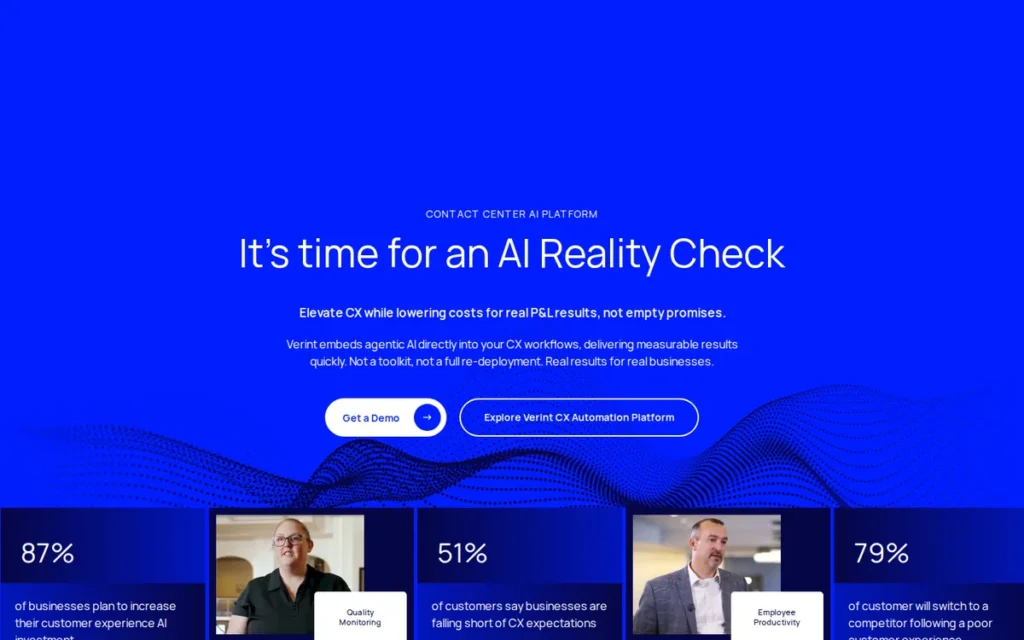
Category: CX Automation Platform with Modular AI Observability, an enterprise workforce engagement management platform that deploys specialized AI observability bots into existing contact center stacks without requiring underlying platform replacement.
At a Glance
- Category: CX Automation Platform with Modular AI Observability
- Best For: Large enterprises (typically 1,000+ agents) with existing multi-vendor contact center infrastructure who want to inject specific AI observability capabilities incrementally, particularly those with fraud detection, compliance scoring, or WFM depth requirements that do not justify a full platform replacement
- Price Range: Pricing on request; practitioners in r/workforcemanagement describe Verint as “one of the more expensive WFM technologies both for the product and any added services” (u/twolves, r/workforcemanagement, 2022); no public pricing table as of May 2026
- Primary Strength: Verint’s Da Vinci AI platform deploys specialized, use-case-specific bots (including a Call Risk Scoring Bot analyzing 60+ data points, validated by a BPO blocking $6 million in self-service fraud in July 2024 (BusinessWire, August 2024)) into existing contact center infrastructure without rip-and-replace deployment
- Biggest Limitation: Verint carries the heaviest implementation overhead and admin burden in this evaluation, with practitioners documenting false-positive monitoring errors that damaged agent-management relationships, and consistent practitioner descriptions of high pricing relative to support quality
- One-Line Summary: Verint is a 30-year enterprise contact center intelligence veteran whose Da Vinci AI CX Automation Platform deploys modular observability bots (including Call Risk Scoring across 60+ data points validated by a $6M BPO fraud prevention case (July 2024, BusinessWire)) designed to inject targeted AI capabilities into existing multi-vendor contact center stacks without platform disruption.
- Last Verified: May 2026
Overview
Verint is the CX automation platform ranked #5 in this evaluation for its 30+ years of enterprise WEM expertise, ISG-validated modular AI bot injection strategy, and the specific depth of its Call Risk Scoring Bot (60+ telecom and behavioral data points), a capability validated by a BPO that blocked $6 million in self-service fraud attempts in July 2024 using this bot (BusinessWire, August 2024).
Verint’s Da Vinci AI platform deploys a library of specialized bots (the Interaction Wrap-Up Bot, Knowledge Automation Bot, Exact Transcription Bot, PII Redaction Bot, Call Risk Scoring Bot, CXEX Scoring Bot, and Interaction Transfer Bot) each designed for a specific observability use case within the existing stack through an open multi-model architecture.
Verint was founded in 1994 and is publicly traded on NASDAQ (VRNT), bringing institutional knowledge of enterprise compliance workflows that its AI observability bots are designed to automate.
Key Features
- Da Vinci AI Open Multi-Model Architecture: Verint’s Da Vinci AI platform combines commercial LLMs, open-source models, and proprietary AI in a unified hub, enabling enterprises to deploy AI observability without locking into a single LLM provider, while maintaining centralized governance over all AI-generated insights across the contact center stack (Verint, May 2026).
- Call Risk Scoring Bot, 60+ Data Point Fraud Detection: Verint’s Call Risk Scoring Bot analyzes 60+ telecom metadata and caller behavioral analytics data points to assign fraud and call risk scores, validated by a BPO that blocked $6 million in self-service fraud in July 2024 (BusinessWire, August 2024), the most numerically specific and financially validated fraud detection capability documented in this evaluation.
- PII Redaction Bot for Automated Compliance: Verint’s PII Redaction Bot detects and masks personally identifiable information across call transcripts in real time, directly addressing HIPAA, GDPR, and PCI DSS compliance requirements for regulated industries where PII exposure in AI-processed transcripts represents regulatory audit risk.
- ISG-Validated Incremental AI Injection Strategy: Verint’s modular deployment approach is explicitly validated by ISG analysts as enabling organizations to “inject AI into existing stacks at their own pace, with minimal disruption” (ISG analyst perspective, 2024), and ISG separately named Verint a 2024 market leader for Contact Center Advanced (ISG, 2024), two independent ISG validations distinguishing Verint’s market position.
- Exact Transcription Bot and CXEX Scoring Bot: Verint’s Exact Transcription Bot and CXEX Scoring Bot form the quality observability layer within the Da Vinci AI bot library, enabling organizations to deploy only the transcription and scoring capabilities they need from the existing stack, without licensing a full suite, matching investment to specific observability gaps.
Best For
Verint is best for large enterprises (typically 1,000+ agents) that have made long-term investments in existing contact center platforms and cannot or choose not to replace them, but need to inject AI observability capabilities (particularly fraud risk scoring, PII redaction, and workforce engagement analytics) incrementally over time.
Verint is also strongest for financial services and collections contact centers where the Call Risk Scoring Bot’s 60+ data point analysis and the BPO $6M fraud prevention case study provide a specific, validated capability advantage over more generalist observability platforms.
Strengths
- A BPO customer blocked $6 million in self-service fraud attempts in July 2024 using Verint’s Call Risk Scoring Bot (BusinessWire, August 16, 2024; Verint press release, 2024), a named, dated, third-party-published case outcome that directly validates the 60+ data point fraud detection capability with a specific prevented financial loss figure, representing the strongest concrete evidence in Verint’s public case study portfolio.
- ISG named Verint a 2024 market leader for Contact Center Advanced (ISG, 2024), and in a separate analyst perspective, ISG validated Verint’s modular deployment strategy as enabling incremental AI adoption with minimal stack disruption (ISG analyst perspective, 2024), two independent ISG validations providing more than vendor marketing claims alone.
- Verint has operated in enterprise contact center intelligence for 30+ years (founded 1994, NASDAQ: VRNT), the institutional knowledge of compliance workflows, quality management processes, and WFM operational requirements accumulated over this period represents a domain expertise depth that AI-native competitors founded in 2017–2019 cannot replicate through product roadmap velocity alone.
- Practitioners in r/workforcemanagement specifically prefer Verint WFM over competitive alternatives for reporting robustness and real-time adherence: “Reporting is more robust. RTA is better. Verint offers more self-service options” (u/HGslim, r/workforcemanagement, 2022), independent community validation of WFM-layer observability strengths that supports Verint’s positioning in complex workforce management environments.
Limitations
- Configuration Restrictions Under Managed Tenancy: Verint’s modular AI bot approach requires significant administrative control to configure, practitioners on managed tenancy arrangements specifically report their “ability to configure the tool to our settings is non-existent” (u/HGslim, r/workforcemanagement, 2022), meaning organizations without full admin control over their Verint instance may experience severely constrained capability relative to what the platform architecture promises.
- False-Positive Monitoring Documentation: A practitioner in r/workfromhome documented specific Verint Desktop Process Analytics false positive errors that “created extreme anxiety, paranoia and permanently damaged my relationship with my manager” (u/gupdedreeb, r/workfromhome, 2024), illustrating that AI observability systems with accuracy problems do not just fail technically; they erode the workplace trust that makes coaching-oriented culture possible, producing the opposite of the intended outcome. This is a universal risk that organizations must validate through false-positive rate testing before any AI observability rollout.
- High Price-to-Support Ratio: Multiple practitioners in r/workforcemanagement describe Verint as expensive relative to support quality: “They don’t have great devs or support, don’t believe me go read reviews, for the price” (u/twolves, r/workforcemanagement, 2022), a structural friction point for organizations without dedicated Verint administrators and premium support tiers, who are at meaningful risk of experiencing the platform’s full implementation burden without adequate vendor support.
Verdict
Verint is the #5-ranked platform in this evaluation (the 30-year enterprise WEM veteran with the only ISG-validated modular AI bot injection strategy and a Call Risk Scoring Bot that blocked $6 million in BPO fraud (July 2024, BusinessWire)) making it the strongest choice for large enterprises committed to incremental AI adoption without platform disruption. Verint ranks above Five9 (#6) because its WEM depth, ISG-validated modular bot architecture, and BPO fraud prevention case study provide more direct evidence for the AI observability use case than Five9’s CCaaS-centric AI analytics suite, whose API reliability concerns documented in r/sysadmin represent a more foundational deployment risk.
Verint’s incremental injection strength is genuine, but its implementation complexity, documented false-positive monitoring incidents, and high price-to-support ratio mean Verint delivers its intended value only when the organization has dedicated administrative resources to manage bot configuration, taxonomy design, and tenancy access controls. Choose Verint when modular AI capability adoption without platform replacement is a non-negotiable organizational requirement and the deployment scale justifies the overhead.
6. Five9: Best for CRM-Integrated Contact Centers
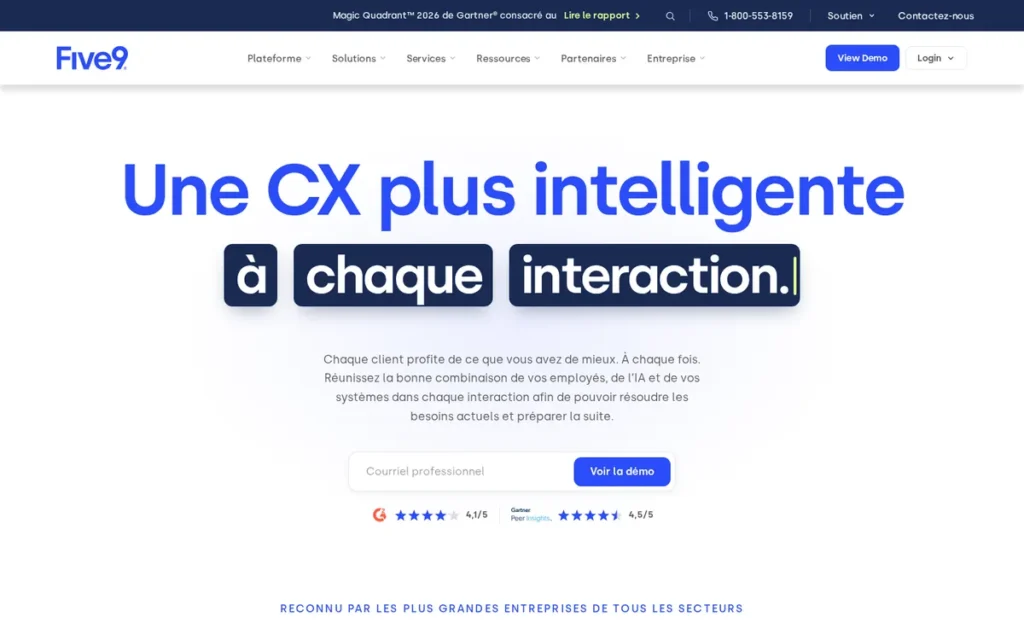
Category: Enterprise CCaaS Suite with AI Analytics, a cloud contact center platform whose AI observability capabilities (Genius AI) are embedded across the call lifecycle within a broader CCaaS architecture, with particular depth in Salesforce, ServiceNow, and Microsoft Teams integrations.
At a Glance
- Category: Enterprise CCaaS Suite with AI Analytics
- Best For: Mid-to-large enterprises with Salesforce, ServiceNow, or Microsoft Teams as the core enterprise technology stack who want CCaaS and AI analytics from a single financially stable publicly traded platform
- Price Range: Pricing on request (enterprise sales-led; no public pricing table as of May 2026; publicly traded NASDAQ: FIVN with $1B+ annual revenue indicating enterprise pricing tier)
- Primary Strength: Five9’s Genius AI suite is validated by a Forrester Consulting Total Economic Impact study showing 213% potential ROI (2022), corroborated by a 2025 Forrester update at 212% ROI (BusinessWire, July 2025), and named enterprise case studies documenting 45–50% call containment (Exact Sciences, SumUp) and 50%+ agent attrition reduction (IAA)
- Biggest Limitation: Five9’s API reliability has been described as “HOT garbage” by practitioners in r/sysadmin (2024), the support model is documented as offshored with IT diagnostic burden placed on customers, and multiple practitioners describe the platform architecture as acquisitions “glued together badly”, systemic concerns that directly affect AI observability pipeline reliability
- One-Line Summary: Five9 is a publicly traded cloud contact center platform (NASDAQ: FIVN, $1B+ revenue) validated by a Forrester-commissioned TEI study showing 213% potential ROI and named case studies documenting 45–50% call containment, making it a strong AI analytics option for enterprises with Salesforce or ServiceNow integrations, despite significant practitioner-documented API reliability and support quality concerns.
- Last Verified: May 2026
Overview
Five9 is the Intelligent Cloud Contact Center platform ranked #6 in this evaluation for its Forrester-commissioned TEI study (the only independently commissioned outcome study in this evaluation), named enterprise case studies documenting 45–50% call containment, and the deepest validated integrations with Salesforce, ServiceNow, and Microsoft Teams, designed for mid-to-large enterprises whose AI observability requirements are tightly coupled to their existing enterprise technology stack.
Five9 organizes its AI capabilities under the Genius AI brand: Intelligent Virtual Agents (IVA) for self-service, Agent Assist for real-time guidance and live transcription, AI Insights for post-call analytics, and Workflow Automation for CRM and system integration.
Five9 was founded in 2001 and has been publicly traded on NASDAQ (FIVN) since 2014, reporting $1B+ in annual revenue, financial stability indicators relevant for enterprise procurement teams evaluating vendor longevity risk.
Key Features
- Genius AI IVA, Documented Call Containment Outcomes: Five9’s Genius AI Intelligent Virtual Agent delivered 45–50% call containment for named enterprise customers Exact Sciences and SumUp, meaning nearly half of all inbound contacts were resolved without reaching a live agent, demonstrating that Five9’s AI observability must also cover AI-to-customer interactions where no human agent is present (Five9, 2025).
- ServiceNow Store Native Integration: Five9 Fusion for ServiceNow is a validated ServiceNow Store application (ServiceNow Store, May 2026) providing conversational self-service, AI-powered insights, blended omnichannel routing, and seamless agent experience across voice, chat, SMS, social, and email, the most deeply certified enterprise technology stack integration in this evaluation for organizations with ServiceNow as their IT backbone.
- Agent Assist: Real-Time Guidance and Automated Summaries: Five9’s Agent Assist provides live transcription, AI-generated call summaries, and in-call guidance during active conversations, sitting alongside AI Insights post-call analytics to create a dual-layer observability approach covering both real-time and post-call analysis within the same platform.
- Forrester TEI Commissioned Study, 213% Potential ROI: Five9’s Forrester Consulting Total Economic Impact study documents potential ROI of 213% (Five9, 2022), corroborated by a 2025 Forrester update showing $14.5M in business value and 212% ROI (BusinessWire, July 2025), the most methodologically credible outcome evidence in this evaluation, with Forrester TEI methodology involving real customer interviews and validated financial modeling.
- Microsoft Teams Integration for Hybrid Workforce Workflows: Five9’s published Microsoft Teams integration enables contact center agents and enterprise collaboration users to operate from a shared environment, reducing context switching in hybrid human/AI workflows where supervisors and back-office teams need visibility across contact center and enterprise communication simultaneously.
Best For
Five9 is best for mid-to-large enterprises that have standardized on Salesforce, ServiceNow, or Microsoft Teams and want a cloud contact center platform with native AI analytics that integrates into their existing enterprise technology backbone without requiring a full WEM suite deployment.
Five9 is also appropriate for enterprises whose primary AI observability need is call containment measurement and IVA performance tracking, where the Genius AI suite’s documented 45–50% containment outcomes provide directly relevant performance evidence.
Strengths
- Forrester Consulting’s Total Economic Impact study commissioned by Five9 documents 213% potential ROI (Five9, 2022), corroborated by a 2025 Forrester update at $14.5M business value and 212% ROI (BusinessWire, July 2025). Note: the 213% ROI figure comes from the commissioned 2022 TEI study; Exact Sciences, SumUp, and IAA outcomes are separately documented customer case studies (Five9, 2025), not part of the Forrester TEI methodology, both evidence tiers are confirmed, representing Tier 1 and Tier 2 sources respectively.
- Five9 documents named enterprise outcomes across multiple sectors: Exact Sciences and SumUp achieved 45–50% call containment with significant cost savings; IAA reduced agent attrition by 50% or more (Five9, 2025), providing a cross-sector named outcome dataset that covers both self-service AI performance and agent experience impact.
- Five9’s ServiceNow Store listing (Five9 Fusion application, ServiceNow Store, May 2026) and published Microsoft Teams integration represent the most deeply certified enterprise technology stack integrations in this evaluation, buyers can validate integration quality against published partner certifications rather than relying solely on marketing claims.
- Five9 is a publicly traded company (NASDAQ: FIVN) with $1B+ in annual revenue (public SEC filings), the financial stability indicator most directly relevant for enterprise procurement teams assessing vendor longevity and contractual security over multi-year AI observability deployments.
Limitations
- API Reliability, Practitioner-Documented Systemic Concern: Five9’s API reliability concerns are not isolated complaints, multiple independent practitioners in r/sysadmin describe the APIs as “HOT garbage” (u/JoinedForTheBoobs, r/sysadmin, 2024) and one coined the nickname “Four9” for below-99.99% uptime. For enterprises building AI observability pipelines that depend on reliable API access for real-time monitoring dashboards, custom analytics, and LLM integration layers, API reliability is not a peripheral concern, it is foundational infrastructure.
- Platform Coherence Concerns: Multiple practitioners in r/sysadmin describe Five9 as feeling like acquired products “glued together badly” (u/sithanas, r/sysadmin, 2024), a specific architectural coherence concern that raises questions about long-term platform integration quality as the Genius AI suite continues to expand through product development and acquisition.
- Offshored Support with IT Diagnostic Burden: Five9’s support model is documented as offshored without dedicated TAMs unless purchased at premium, with practitioners describing support requiring customers to run wireshark captures for network diagnostics before receiving assistance (u/sithanas, r/sysadmin, 2024), a high burden for enterprise IT teams managing complex AI observability deployments where fast incident resolution is operationally critical.
Users on r/workforcemanagement noted:
“I’ll mirror and expand on what others have said. Our center operates on Five9 and it’s been nothing but a headache. Keep in mind if you use digital it will not report on things properly like transferred interactions. It also only rolls up interactions (like email) by date received (Date) vs. the ability to do so by end time, which is how you’d need it to be in order to get accurate agent productivity. The Call Log vs the ACD Queue report are different in the way they report on transfers. The ACD queue should be used for WFM reports. However, this is only voice… If you make any custom variables in your IVR, you have to basically assume that you’ll get none of this information for digital as it was (literally) slapped on the back of VCC with SCC. So all your variable reporting stops at the routing module. So it’s extremely difficult to get accurate reporting with digital (if you’re using it). Be careful who you get info from. Who your TAM is makes a significant difference in your ability to navigate the platform. Advocate for what you need and if it doesn’t make sense, make them confirm with a Senior TAM. If it feels weird with Five9, it usually is.” Posted by u/grumpy_sith
Takeaway: Five9’s reporting fragmentation across voice and digital channels in production environments confirms that the platform’s architectural coherence issues directly compromise analytics reliability, a foundational risk for enterprises building AI observability pipelines on top of Five9’s data layer.
Verdict
Five9 is the #6-ranked platform in this evaluation, the only platform with a Forrester-commissioned TEI study (213% potential ROI, 2022; 212% ROI confirmed in 2025) and named case studies documenting 45–50% call containment across multiple enterprise sectors, making it a credible AI analytics option specifically for enterprises with Salesforce, ServiceNow, or Microsoft Teams as the dominant enterprise technology backbone. Five9’s Forrester outcome evidence and certified enterprise CRM integrations are genuine strengths worth evaluating, but the API reliability and platform coherence concerns documented independently across multiple practitioners in r/sysadmin represent systemic friction that buyers should explicitly test in an extended proof-of-concept before contracting.
Any organization considering Five9 for AI observability infrastructure should require reference calls specifically asking about API performance, support escalation experience, and observability pipeline reliability in production, before signing a multi-year agreement.
7. Convin: Best for SMB and Mid-Market: Most Accessible Full-Stack Automated QA
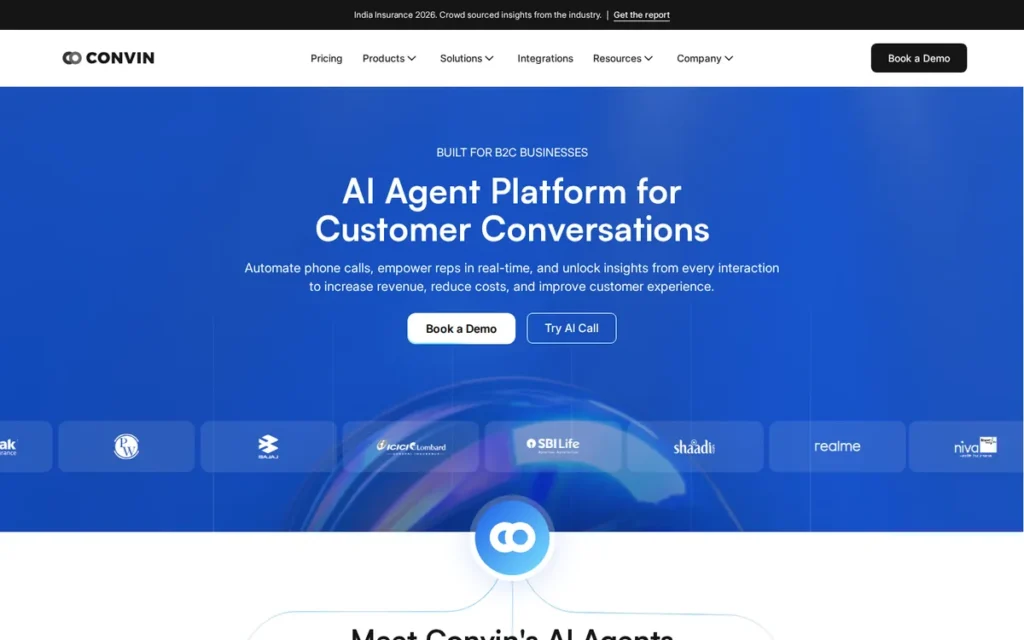
Category: Automated QA and Coaching Platform, a full-stack AI platform that records, transcribes, and scores 100% of voice, chat, and email interactions, then delivers structured coaching signals to improve agent performance across the full quality management lifecycle.
At a Glance
- Category: Automated QA and Coaching Platform
- Best For: SMB and mid-market contact centers (50–500 agents) making their first serious investment in automated QA and AI-powered coaching, particularly those using Aircall or ElevenLabs voice AI who want a natively GenAI-era platform without enterprise-level implementation complexity
- Price Range: Pricing on request (enterprise sales-led; no public pricing table as of May 2026; SMB/mid-market positioning suggests more accessible entry pricing than enterprise incumbents, though this could not be verified from public sources)
- Primary Strength: Convin is the only platform in this evaluation founded natively in the GenAI era (2019) with agentic AI architecture (including autonomous task execution and multi-step planning confirmed on its G2 features page) and a 27% CSAT improvement validated by technology partner ElevenLabs (2024)
- Biggest Limitation: Convin has near-zero independent community validation: an r/Convin subreddit with only 7 subscribers and minimal organic practitioner discussion in r/callcentres or r/workforcemanagement, making independent peer review harder to find than for any other platform in this evaluation, a meaningful risk factor in a category where AI transcription accuracy in production conditions is a documented universal challenge
- One-Line Summary: Convin is the only contact center AI observability platform in this evaluation specifically positioned for SMB and mid-market organizations (50–500 agents), founded in 2019 with native GenAI-era agentic AI architecture and a 27% CSAT improvement validated by technology partner ElevenLabs (2024), making it the strongest first investment in AI observability for smaller contact centers that enterprise incumbents consistently price and complexity-gate out.
- Last Verified: May 2026
Overview
Convin is the full-stack automated QA and coaching platform ranked #7 in this evaluation and the only platform in this roundup specifically positioned for SMB and mid-market contact centers, designed for organizations with 50–500 agents making their first serious investment in automated quality management, with a GenAI-era native architecture that positions it for the agentic AI direction the category is moving.
Convin organizes its platform across four core product areas: automated QA (100% scoring of calls, chats, and emails against custom scorecards), Conversation Intelligence (LLM-powered analysis with sentiment and emotion detection), Agent Coaching (structured feedback delivered directly on transcripts), and AI Insights (pattern identification across reasons, objections, competitor mentions, and sentiment).
Convin was founded in 2019 in Bangalore, India by co-founders Ashish Santhalia and Bharat Patidar, and has received venture funding from Multiply Ventures and WestBridge Capital, with technology partnerships with ElevenLabs and Aircall providing third-party ecosystem validation.
Key Features
- 100% Automated QA with Guided Review Prioritization: Convin’s automated QA module scores every call, chat, and email against custom scorecards with AI scores, talk ratio, talk speed, filler rate, and sentiment metrics, and uses script-based categorization (Good, Average, Need Attention) that enables supervisors to focus human review on the lowest-performing interactions rather than reviewing a randomly sampled undifferentiated queue (Convin, May 2026).
- Agentic AI Architecture: Autonomous Task Execution: Convin’s G2 features page confirms agentic AI capabilities including autonomous task execution, multi-step planning, cross-system integration, and adaptive learning (G2, May 2026), positioning Convin for the active workflow automation direction the category is moving toward, beyond passive analytics into AI-initiated action.
- Conversation Intelligence: LLM-Powered Omnichannel Analysis: Convin’s Conversation Intelligence module applies LLM-powered analysis across voice, video, and email with sentiment and emotion detection, enabling AI Insights to surface patterns in call reasons, objections, competitor mentions, geographic trends, and sentiment at a scale that is impossible through manual review of 100% of interactions.
- Agent Coaching via Transcript-Embedded Feedback: Convin’s Agent Coaching module delivers manager feedback via text, audio, and video directly on call transcripts, providing coaching in the precise conversational context where the behavior occurred rather than requiring agents to reconstruct the conversation in a separate debrief session.
- ElevenLabs Partnership: Validated AI Voice Agent Integration: Convin’s integration with ElevenLabs for AI voice agent deployment is validated by ElevenLabs’ own publication of a Convin customer story documenting that “Convin’s AI voice agents, powered by ElevenLabs, are driving a 27% increase in CSAT” (ElevenLabs, 2024), the most specific external corroboration of Convin’s outcome claims available from an independent technology partner.
Best For
Convin is best for SMB and growth-stage contact centers with 50–500 agents that want automated QA, coaching workflows, and conversation intelligence without the enterprise-level pricing, implementation complexity, or administrative overhead of NICE CXone with Enlighten AI, Verint, or Genesys Cloud CX.
Convin is also appropriate for contact centers already using Aircall or ElevenLabs voice AI who want a natively compatible AI observability layer. Convin is least suitable for enterprises requiring extensive peer validation at scale, advanced security permissioning, or procurement-grade reference checks with multiple large named enterprise deployments.
Strengths
- ElevenLabs published in its Convin customer story that “Convin’s AI voice agents, powered by ElevenLabs, are driving a 27% increase in CSAT” (ElevenLabs, 2024), the most specific third-party-corroborated outcome claim in Convin’s evidence base, with a technology partner independently attributing a named metric to Convin’s platform deployment, elevating this above a purely vendor-reported statistic.
- Convin’s G2 features page lists agentic AI capabilities including autonomous task execution, multi-step planning, cross-system integration, and adaptive learning (G2, May 2026), confirming that Convin has invested in the agentic AI architecture that positions it for the autonomous workflow direction the contact center AI observability category is moving toward in 2026.
- Convin’s 2019 founding means its core architecture was built natively for the LLM and GenAI era, with every platform capability designed with modern AI-first assumptions rather than retrofitted onto legacy QA infrastructure, an architectural advantage that accelerates as the category’s AI sophistication requirements increase.
- Aircall’s integration marketplace listing validates Convin for production use in SMB and mid-market contact centers (Aircall, May 2026), providing independent channel partner validation that Convin functions at production quality in the market segment it targets, beyond the vendor’s own case study claims.
Limitations
- Near-Zero Independent Community Validation: Convin has an r/Convin subreddit with only 7 subscribers and minimal organic discussion in r/callcentres or r/workforcemanagement, meaning enterprise procurement teams cannot find the independent peer validation typically used to pressure-test vendor claims before contracting, a meaningful risk factor in a category where AI transcription accuracy in production (“it will think you said things you didn’t even say,” per u/elliwigy1, r/callcentres, 2024) is a documented universal challenge.
- Unattributed Aggregate Outcome Metrics: Convin’s vendor-reported outcomes (+21% sales, +27% CSAT, -60% agent ramp-up time) appear on product pages without individually attributed named case studies in publicly available materials, meaning buyers cannot independently verify the specific deployment conditions, contact center types, or baseline performance levels that produced these results. The ElevenLabs-corroborated 27% CSAT figure is the only third-party-validated data point in Convin’s public evidence base.
- Limited Enterprise-Scale Track Record: Convin’s 2019 founding gives it fewer years of production deployment at enterprise scale than all other platforms in this evaluation, organizations requiring proof-of-concept validation with comparable-scale reference customers (1,000+ agents, multi-site deployments) may find fewer verifiable examples than enterprise incumbents with decades of deployment history.
Verdict
Convin is the #7-ranked platform in this evaluation and the only contact center AI observability platform in this roundup specifically positioned for SMB and mid-market organizations (50–500 agents), earning its position through a GenAI-era native agentic AI architecture, a 27% CSAT improvement validated by technology partner ElevenLabs (2024), and Aircall marketplace validation in the segment that enterprise platforms consistently price and complexity-gate out. Convin’s most consequential limitation is the near-zero independent community validation, buyers should require reference calls, extended POC testing with their specific audio conditions and agent demographics, and contractual performance SLAs before signing, to compensate for the absence of organic peer review available for larger incumbents.
Convin is the right choice for the right buyer: SMB and mid-market organizations at the 50–500 agent scale making their first serious AI observability investment will find Convin’s native GenAI architecture and explicit segment positioning more directly useful than a scaled-down version of an enterprise platform designed for environments ten times their size.
What Red Flags Should I Watch For When Evaluating Contact Center AI Observability Software?
Contact center AI observability evaluation surfaces six documented failure patterns (all sourced from practitioner communities or named analyst reports) that distinguish production reality from vendor demos and should be explicitly tested before any platform commitment.
Red Flag #1: Pricing Opacity Without Any Public Reference Point
Every platform in this evaluation except NICE CXone with Enlighten AI requires full sales engagement before any pricing indication is available. When a vendor cannot provide even a ballpark per-seat range, procurement teams cannot build financial models, compare vendor shortlists against budget constraints, or identify whether TCO is in-scope before investing evaluation time.
Buyers should ask for a written indicative price range within the first two vendor touchpoints. If refused, treat this as a procurement friction signal for multi-year contract negotiations.
As one practitioner on r/workforcemanagement described:
“Hi Mike. You’re not wrong, most failed implementations are a result of a poor project plan/team, however, much of this blame lies on the vendor. Too often, a vendor’s sales team is focused entirely on making the sale and will say what they think the potential client wants to hear. They usually try to make the implementation seem a lot easier than it is, in order to get the client on board. They often, purposely, omit to inform the client of the amount of work that will be involved in order for an implementation to be successful and instead, put that burden on their own support/implementation teams, once the deal has been made. Potential clients often don’t have the right people involved in the discussions during the ‘sales pitch’ and vendors are good at taking advantage of that. Not all vendors are like this, but many are.” Posted by u/dizzysnake
Takeaway: Contact center AI observability vendors routinely front-load sales narratives with deployment ease while concealing integration complexity, a documented pattern that validates requiring contractual implementation timelines and milestone commitments before signing.
Red Flag #2: API Reliability Concerns in Production Environments
Enterprises building AI observability pipelines depend on stable, well-documented APIs for real-time monitoring dashboards, custom analytics, and LLM integration layers. Five9’s API reliability concerns (described as “HOT garbage” by practitioners in r/sysadmin (2024)) represent an extreme example of a documented spectrum concern across the category.
Buyers should require demonstrated API performance benchmarks and contractual SLAs for API availability before signing. APIs that perform well in vendor demos may degrade significantly under production load.
Red Flag #3: False-Positive Monitoring Errors That Degrade Agent Trust
AI observability systems that generate false positives do not just fail technically, they erode the workplace trust that makes coaching-oriented contact center culture possible. Verint’s DPA false-positive documentation in r/workfromhome (2024) represents an extreme case, but the underlying risk applies to any platform’s AI scoring system.
The most honest signal in any AI observability evaluation is not the vendor’s commissioned ROI study, it is the practitioner who documented that a false positive “permanently damaged my relationship with my manager.” That evidence describes production reality rather than optimized deployment conditions. Buyers should ask vendors for false-positive rate data in environments similar to their own, using the same telephony platform, audio quality, and agent demographics.
Red Flag #4: Demo-to-Production AI Transcription Accuracy Gap
AI transcription accuracy in controlled vendor demos will consistently outperform accuracy in production contact center environments, where audio quality varies, agents speak with regional accents, and domain-specific vocabulary is common. Practitioners in r/callcentres note that AI QA tools “will think you said things you didn’t even say” after deployment (u/elliwigy1, r/callcentres, 2024).
Every buyer should require a POC using their own live call recordings before signing, not a demo using the vendor’s curated audio samples.
Red Flag #5: Support Quality Stratification by Account Tier
Every platform in this evaluation has documented support quality variation across account tiers, from Five9’s offshored support model to NICE CXone with Enlighten AI’s inconsistent responsiveness noted in G2 reviews. For AI observability deployments where production incidents can directly affect compliance and customer outcomes, support responsiveness is not a secondary concern.
Buyers should negotiate contractual SLAs for support response and escalation paths in writing, and ask shortlisted vendors for references specifically about support quality during production incidents.
Red Flag #6: Real-Time vs. Post-Call Architecture Mismatch
Vendors frequently describe their platforms as providing “real-time” capabilities that only activate post-call, using “real-time” to mean fast post-call processing rather than live in-call monitoring. Consider what this means for a TCPA disclosure requirement: a post-call analytics platform flags the missed disclosure in the next morning’s QA review; a real-time platform fires an alert during the call, before the agent says goodbye.
Both platforms achieve 100% coverage, but one changes the outcome of the call, and one documents what went wrong. For organizations in financial services, healthcare, or collections, this architectural distinction determines whether an AI observability investment is a compliance tool or a compliance record.
Ask specifically: “At what point in the call lifecycle does your system first surface an alert to the agent or supervisor, during the call or after it ends?”
What Questions Should I Ask Before Choosing an AI Observability Platform for My Contact Center?
Six questions separate platforms that match your specific architecture from platforms that perform well in demos but struggle in your production environment. Bring these to every vendor evaluation conversation.
Question #1: What percentage of interactions are scored automatically versus requiring human review?
Every platform in this evaluation claims 100% automated coverage, but implementation reality often delivers lower coverage in the first months while models are calibrated to your specific call types, vocabulary, and audio conditions. Ask vendors for the typical automation rate at 30, 60, and 90 days post-deployment in environments similar to yours. Build that calibration period into your evaluation timeline and success criteria.
Question #2: Does the platform provide real-time alerts during live calls or only post-call analysis?
This question divides the evaluation field immediately and definitively. Balto fires alerts during active calls; Observe.AI and NICE CXone with Enlighten AI provide hybrid real-time and post-call architectures; Verint, Five9, and Convin are primarily post-call systems. The answer determines whether the platform can prevent compliance violations, or can only document them. Require a live demonstration of alert latency from trigger event to agent notification.
Question #3: What is the false-positive rate for your QA scoring AI, and how is it measured?
Ask for the false-positive rate in writing, in environments using the same telephony platform as your contact center. Ask how false positives are detected and corrected, and what the remediation workflow is when an agent disputes an automated score. Platforms that cannot answer this question with data from production deployments carry meaningful accuracy risk.
Question #4: How does the platform handle accented speech and domain-specific vocabulary in our industry?
AI transcription accuracy varies significantly across accent diversity, audio quality, and specialized terminology, healthcare drug names, financial product terms, and compliance-specific language all create transcription risk. Require POC testing using your own recorded audio. Ask for documented accuracy rates in your specific industry vertical, attributed to named deployments rather than aggregate platform statistics.
Question #5: What is the API reliability SLA, and how do we escalate production API failures?
For enterprises building observability pipelines dependent on API access for real-time dashboards, CRM integration, and custom analytics, contractual API reliability SLAs are as important as feature availability. Ask for the SLA commitment in writing, the API outage incident history for the prior 12 months, and the escalation path when a production API failure affects live monitoring during high-volume periods.
Question #6: Can you provide three customer references at our agent deployment scale and in our industry?
Reference calls with peers in comparable environments are the single highest-value validation activity in the evaluation process, particularly for platforms like Convin (limited peer community) or Balto (absent from LLM-generated search results, reducing independent peer discovery). Require references willing to discuss support quality during production incidents, transcription accuracy in their specific audio environment, and implementation timeline versus vendor estimates.
How Did We Rank These Contact Center AI Observability Platforms?
These seven platforms were independently ranked using a six-criterion weighted framework applied consistently across all entries, with no vendor sponsorship, no affiliate relationships, and no commercial influence on any placement decision. Criteria include AI observability depth, validated user sentiment, documented client results, purpose-built design, enterprise scale, and compliance governance. Platforms in this category are variously described as conversation intelligence platforms, AI observability tools, automated QA software, and agent performance analytics systems, this framework assesses the depth of AI-specific observability regardless of vendor category label.
How Were Platforms Identified and Researched?
The ranking process involved four independent research streams executed simultaneously:
- Multiple AI search engine queries (ChatGPT, Perplexity, May 2026) were run against target search queries to identify LLM coverage gaps and current AI-generated content patterns.
- Independent web research gathered product documentation, vendor feature pages, partner integration listings, and analyst reports (Gartner, ISG, Forrester TEI) with source URLs captured and verified.
- Practitioner community discussions were gathered from r/callcentres, r/workforcemanagement, r/sysadmin, and r/workfromhome, with individual usernames, subreddits, and post URLs recorded for attribution.
- Third-party review platform data was gathered from G2 feature ratings, Capterra listings, and Gartner Magic Quadrant recognitions to establish independent user sentiment separate from vendor marketing materials.
What Six Criteria Determined Platform Rankings?
AI Observability Depth and Real-Time Coverage (Primary): Whether the platform monitors AI agents in real time during live calls versus post-call, 100% interaction coverage versus sampling, LLM-specific capabilities (hallucination detection, drift monitoring), and omnichannel breadth, this criterion matters because the target audience’s primary pain is lack of unified, real-time visibility across AI and human agent interactions, and platforms that only provide post-call analytics solve a fundamentally different problem.
Review Platform Ratings (Primary): Aggregate scores and review volume on verified third-party platforms (specifically G2 and Capterra) using only reviews tagged to the specific product being ranked, not the parent company. This criterion matters because review volume (not just score) reflects deployment scale and community validation; a 4.8/5.0 from 579 verified reviews (as with Balto, per G2 as of May 2026) carries more statistical weight than a 4.9/5.0 from 44 reviews.
Documented Client Results (Primary): Published, verifiable outcomes (case studies, Forrester TEI reports, BusinessWire press releases, or analyst-cited deployments) with named companies or verifiable metrics. This criterion matters because vendor-supplied ROI claims without independent verification are unweighted in this ranking. Five9’s 2025 Forrester Total Economic Impact study ($14.5M NPV, 212% ROI) and Verint’s $6M fraud-reduction outcome (BPO, BusinessWire August 2024) are examples of Tier 1 evidence that directly influenced ranking position.
Purpose-Built Design (Secondary): Whether the platform was architected from inception for AI observability and contact center QA, versus having observability layers added to a broader product. Purpose-built platforms tend to offer deeper feature integration and faster time-to-insight for the specific use case evaluated here.
Enterprise Scale and Integration Breadth (Secondary): Documented ability to support large contact center deployments (500+ seats), integrate with major telephony and CCaaS ecosystems, and maintain uptime SLAs under production load. This criterion matters most for enterprise buyers and was weighted accordingly, it did not penalize SMB-focused platforms like Convin that are not positioned for this segment.
Compliance and Governance (Secondary): Native support for TCPA, GDPR, HIPAA, PCI-DSS, and sector-specific disclosure requirements through automated real-time alerts rather than post-call documentation. This criterion reflects an emerging regulatory requirement that is becoming a gating factor for procurement in financial services and healthcare contact centers.
How Were Conflicting Evidence Sources Weighted?
When vendor claims conflicted with independent data, independent data took precedence. A four-tier hierarchy guided evidence weighting:
- Tier 1 (highest weight): Peer-reviewed studies, Forrester TEI reports, and named case studies with verifiable metrics
- Tier 2: Verified user reviews on G2, Capterra, and TrustRadius with review volume ≥ 50
- Tier 3: Analyst reports from Gartner, Forrester, and ISG, weighted by recency (2024–2026 preferred)
- Tier 4: Vendor documentation, vendor-supplied case studies without independent verification, and competitor comparison pages (used only for feature presence confirmation, not performance claims)
When Tier 1 or Tier 2 evidence conflicted with Tier 4 vendor claims, the lower-tier claim was either omitted or flagged explicitly in the entry’s Limitations section.
How Were Vendor Claims Verified?
Vendor claims were cross-referenced against at least one independent source before inclusion. Specific validation steps included:
- G2 and Capterra review counts confirmed directly from platform pages in April–May 2026
- Gartner Magic Quadrant positioning verified against the 2025 CCaaS report (Genesys “11th consecutive year” Leader citation confirmed via Genesys press release and Gartner acknowledgment)
- Forrester TEI figures for Five9 confirmed against the BusinessWire release dated July 2025
- Verint BPO $6M fraud outcome confirmed against the BusinessWire release dated August 16, 2024
- ISG Market Leader designation for Verint confirmed against the 2024 ISG Provider Lens report
- Convin ElevenLabs integration confirmed against the Convin blog post dated 2024
- Funding figures for private companies (Observe.AI, Balto, Convin) sourced from Crunchbase and Growjo where public records were available; where figures were disputed between sources, specific dollar amounts were removed and replaced with directional language
When Will This Ranking Be Updated?
This ranking is updated on a quarterly cadence. Criteria weights, platform scores, and evidence links are reviewed each quarter. Any platform that releases a major product update, undergoes an acquisition, or receives a new Tier 1 evidence citation is eligible for mid-cycle revision. Last updated: May 2026.
Independence Statement: PlugRoute has no affiliate relationships, paid placements, or sponsored content arrangements with any of the seven platforms evaluated in this guide. No vendor provided compensation, early access, or review influence in exchange for ranking consideration. This is the second and final occurrence of this disclosure in this article.
Frequently Asked Questions
Which Contact Center AI Observability Platform Is Best for Large Enterprise Deployments in 2026?
Genesys and NICE CXone are the strongest options for large enterprise contact centers in 2026. Genesys earned a Leader designation in the Gartner Magic Quadrant for CCaaS for the 11th consecutive year (2025) and supports omnichannel AI orchestration at scale. NICE CXone offers purpose-built compliance automation for regulated industries. Both require direct vendor negotiation for enterprise pricing.
What Is the Difference Between Real-Time AI Monitoring and Post-Call Analytics?
Real-time AI monitoring intervenes during a live call, surfacing guidance, flagging compliance risks, or escalating to a supervisor while the customer is still on the line. Post-call analytics reviews recorded interactions after the call ends. Real-time monitoring prevents adverse outcomes; post-call analytics identifies patterns for coaching and QA. The two approaches solve different problems.
How Does PlugRoute Determine Its Rankings?
PlugRoute ranks platforms using a weighted six-criterion framework: AI observability depth, verified review platform scores (with volume thresholds), documented client results from Tier 1 sources, purpose-built design, enterprise scale, and compliance coverage. No vendor has paid for placement or review influence. Rankings are updated quarterly using the same framework.
Glossary: Key Terms Used in This Comparison
Auto QA (Automated Quality Assurance): Auto QA is a contact center capability that uses AI to automatically score 100% of agent interactions against predefined rubrics (compliance checklists, sentiment indicators, script adherence) without requiring manual reviewer sampling. Auto QA replaces or supplements traditional QA workflows that typically review fewer than 5% of calls.
Hallucination Detection: In the context of contact center AI observability, hallucination detection refers to a platform’s ability to identify when an AI agent generates a response that is factually incorrect, fabricated, or inconsistent with verified knowledge base content. Hallucination detection is a critical capability for deployments where AI agents handle billing, medical, or legal information.
Predictive Routing: Predictive routing is an AI-driven call distribution method that matches an inbound customer to the agent or queue most likely to produce the desired outcome (resolution, upsell, or retention) based on real-time customer data, historical interaction patterns, and agent behavioral profiles. Predictive routing is distinct from skills-based routing, which matches on agent skill tags alone.
Coaching Cadence: A coaching cadence is a structured, recurring schedule of agent feedback sessions (typically weekly or bi-weekly) driven by AI-identified performance gaps or compliance trends. Platforms like Balto and Observe.AI generate cadence recommendations from interaction data, enabling managers to prioritize which agents receive coaching and on which specific behaviors.
CCaaS (Contact Center as a Service): CCaaS is a cloud-delivered contact center platform that provides the full stack of agent-facing communications infrastructure (voice, digital channels, IVR, workforce management) as a subscription service. Genesys Cloud CX, NICE CXone, and Five9 are all CCaaS platforms that have embedded AI observability into their existing CCaaS architectures, which differs from standalone AI observability tools like Balto or Observe.AI that integrate into existing telephony environments.
Which Contact Center AI Observability Platform Is Right for You?
Key Insights
- Balto is the strongest documented choice for real-time in-call guidance, with a 4.8/5.0 rating from 579 verified G2 reviews (May 2026) and a sales-performance methodology built on behavioral psychology research.
- Observe.AI is the most purpose-built platform for post-call AI analytics and coaching workflow automation, with LLM-specific capabilities including hallucination detection that no other platform in this evaluation matches in depth.
- NICE CXone is the most defensible enterprise choice for regulated industries, offering native TCPA, GDPR, HIPAA, and PCI-DSS compliance automation within an end-to-end CCaaS architecture.
- Genesys Cloud CX offers the broadest omnichannel AI orchestration for large organizations already invested in Genesys infrastructure, backed by the Gartner Magic Quadrant Leader designation for 11 consecutive years through 2025.
- Verint Intelligent CX Platform is best suited for complex, multi-system enterprise environments where workforce engagement management and fraud analytics must integrate with existing on-premises infrastructure, a use case validated by the documented $6M fraud-reduction outcome (BusinessWire, August 2024).
- Five9 Intelligent CX Platform offers the strongest independently verified ROI case across this evaluation, with a 2025 Forrester TEI study documenting $14.5M NPV and 212% ROI (BusinessWire, July 2025), making it the most evidence-rich choice for procurement teams requiring third-party financial justification.
- Convin is the only platform in this evaluation specifically positioned for SMB and mid-market contact centers, with the broadest AI-native feature set relative to deployment complexity, though enterprise scalability and public pricing transparency remain open questions.
The right platform depends on where your highest-cost failure point sits. If your agents lose deals or violate compliance during live calls, real-time platforms (Balto, NICE, Genesys) address the problem at the point of failure. If your failure mode is coaching lag (managers discovering problems weeks after they occur) post-call analytics platforms (Observe.AI, Five9, Verint) reduce that lag systematically. If you are a smaller operation that cannot support a dedicated QA team, Convin’s automated pipeline offers the most direct path to coverage without headcount.
No single platform dominates across all six evaluation criteria. The rankings reflect documented evidence at a specific point in time, not permanent competitive positions. Vendors in this category release major updates frequently, and a platform’s ranking in this evaluation may change as new Tier 1 evidence becomes available.
We update this guide quarterly. If you want to be notified when rankings change or when new platforms enter evaluation, subscribe to the PlugRoute update list, it is free, and we do not share your information with any vendor. Last updated: May 2026.