Intercom is the best conversational support software for SaaS and PLG teams seeking autonomous AI resolution, with Fin AI Agent averaging approximately 67% ticket deflection without human involvement (MyAskAI, December 2025). Zendesk leads for enterprise omnichannel governance across 11+ channels. Freshdesk delivers the strongest SMB value at $44/agent/month for AI-enabled workflows. Every vendor claims omnichannel and AI, but platforms differ dramatically in AI architecture, pricing, and use-case fit in ways that only surface after deployment.
Support managers evaluating these platforms face a feature-parity illusion: autonomous AI resolution, assistive copilot, and keyword-matching bots are all sold as “AI.” The cost difference between $44/agent for a fully AI-enabled Freshdesk configuration and $225+/agent for an equivalent Zendesk stack exceeds $18,000 annually for a 10-agent team, a gap invisible in demos but consequential at invoice time.
As one commenter on r/SaaS observed:
“Tool hopping is one of the biggest time sinks for small teams and most people way overbuy on features they’ll never touch. The AI chatbot point is spot on too. Our clients who’ve tried them almost always rip them out within six months because customers get pissed when they just want a human to answer a simple question. The technology isn’t bad but people’s tolerance for talking to robots when they have a real problem is damn near zero.” Posted by u/erickrealz
Takeaway: Teams that deploy low-quality keyword-matching chatbots (marketed as “AI”) face a predictable six-month abandonment cycle, making AI architecture classification the single most consequential decision in any conversational support platform evaluation.
PlugRoute has no affiliate relationships with any company listed. Rankings are determined entirely by research data and objective evaluation criteria.
Three platforms in this evaluation (Zoho Desk, Front, and Help Scout) are absent from all AI-generated comparison lists analyzed for this article, despite credible review scores and distinct buyer segments not served by the top-ranked platforms.
TL;DR: Top Picks at a Glance
- Intercom earns the top ranking through Fin AI Agent’s documented ~67% average autonomous resolution rate across 8,000+ customers (MyAskAI, December 2025), the highest independently benchmarked autonomous AI performance in this seven-platform evaluation.
- Zendesk is the strongest enterprise choice, pre-trained on 18+ billion customer interactions with 11+ native channels and outcome-based AI pricing verified per confirmed resolution, the deepest operational governance in this comparison.
- Freshdesk delivers AI-enabled omnichannel support at approximately $44/agent/month total (Growth plan + Freddy Copilot) as the only Nasdaq-listed platform in this evaluation, the best value for budget-conscious SMBs needing full channel coverage.
- Zoho Desk provides enterprise-grade omnichannel coverage and Blueprint governance at approximately $40/user/month annual Enterprise, the strongest enterprise-feature-to-price ratio in this evaluation, absent from all AI-generated comparisons analyzed for this article.
What Are the Main Categories of Conversational Support Software?
Conversational support software in 2026 falls into three categories based on AI architecture and primary use case: AI-First Autonomous Platforms, Value Omnichannel Help Desks, and Specialist Platforms. Identifying the right category before individual platform evaluation eliminates half the shortlist and prevents costly mismatches between platform design and team requirements.
Category 1: AI-First Autonomous Platforms
AI-First Autonomous Platforms treat AI as the primary customer-facing contact point, not a triage layer behind a human queue. These platforms use retrieval-augmented generation (RAG) to ground AI responses in live knowledge sources, executing workflow actions, API calls, and form completions before any human agent involvement.
The key performance metric is autonomous resolution rate, the percentage of queries fully handled by AI without human handoff, distinct from “volume handled” which includes conversations where AI participates before escalating.
- Intercom: messenger-first autonomous resolver; Fin AI Agent handles multi-channel queries end-to-end at $0.99/successful resolution
- Zendesk: tiered autonomous resolver; Essential and Advanced AI Agents with outcome-based Automated Resolution pricing charged per confirmed AI resolution
Category 2: Value Omnichannel Help Desks
Value Omnichannel Help Desks deliver full channel coverage (including WhatsApp, voice, and social) with AI assistance layers at significantly lower total cost than AI-First platforms. These platforms prioritize pricing predictability and accessible entry tiers over maximum autonomous resolution depth.
- Freshdesk: genuine free tier, Freddy AI Copilot at $29/agent add-on, the only Nasdaq-listed platform in this evaluation
- Zoho Desk: Blueprint governance, Zia Actions AI workflow automation, approximately $40/user Enterprise maximum from a founder-owned private company
Category 3: Specialist Platforms
Specialist Platforms are each purpose-built for a specific buyer segment where they outperform general-purpose alternatives, but are not the right choice for buyers outside that defined segment.
- Front: B2B collaborative shared inbox where support, sales, and account management converge on shared customer threads
- HubSpot Service Hub: CRM-native service for teams already operating HubSpot Sales Hub or Marketing Hub
- Help Scout: email-first human-relationship support for SMBs prioritizing conversation quality over automation throughput
Conversational Support Software Comparison: 7 Platforms, May 2026
| Rank | Company | Category | Best For | One-Line Summary | Key Capabilities | Primary Strength | Key Limitation |
|---|---|---|---|---|---|---|---|
| 1 | Intercom | AI-First Conversational Platform | SaaS and PLG teams seeking autonomous AI resolution | Intercom is the leading AI-first conversational support platform for SaaS teams, with Fin AI Agent averaging ~67% autonomous resolution across 8,000+ customers (MyAskAI, December 2025). | Fin AI Agent, AI Copilot, 100% CSAT coverage, natural-language behavior configuration, Early Stage startup program | ~67% average autonomous resolution; the highest independently benchmarked figure in this seven-platform evaluation | Multi-variable billing (per-seat + per-resolution + channel fees) creates unpredictable cost escalation at scale |
| 2 | Zendesk | Enterprise Resolution Platform | Enterprise and mid-market teams managing 200+ daily tickets across 5+ channels | Zendesk is the enterprise omnichannel resolution platform pre-trained on 18+ billion customer interactions, with the broadest channel coverage and deepest AI governance in this evaluation. | Unified Agent Workspace (11+ channels), tiered AI Agents, 2026 knowledge connectors (incl. Confluence), Copilot, outcome-based Automated Resolution pricing | Broadest native channel coverage in this evaluation; AI pre-trained on 18+ billion real support interactions | Add-on pricing stacks Copilot ($50/agent), QA ($35/agent), and WFM ($25/agent) on top of a $115/agent/month base plan |
| 3 | Freshdesk | Value Omnichannel Help Desk | SMBs and mid-market teams needing AI-enabled omnichannel at lowest total cost | Freshdesk is the best-value AI-enabled omnichannel help desk in the SMB segment, delivering WhatsApp, voice, and AI assistance at $44/agent/month as the only Nasdaq-listed platform in this evaluation. | Freddy AI Copilot, genuine free tier, omnichannel inbox (WhatsApp + voice), 1,000+ integrations, 35+ language certification | Lowest total cost for AI-enabled omnichannel; $44/agent/month; with Nasdaq-listed vendor financial transparency | Freddy AI cannot ingest external documentation from Confluence or Google Drive |
| 4 | Zoho Desk | Budget Enterprise Help Desk | Budget-constrained teams needing enterprise features without enterprise pricing | Zoho Desk delivers enterprise-tier omnichannel coverage and Blueprint governance at approximately $40/user/month annual Enterprise; the strongest enterprise-feature-to-price ratio in this evaluation. | Blueprint governance, Zia Actions AI automation, full omnichannel (incl. WhatsApp), native Zoho ecosystem integration, free-to-Enterprise upgrade path | Enterprise-grade capability at ~$40/user/month annual from a founder-owned company with three decades of pricing stability | Zia AI is less mature than Intercom or Zendesk for high-volume autonomous resolution; configuration complexity is above average |
| 5 | Front | Collaborative Customer Operations | B2B companies where support, sales, and account management share customer communication | Front is the highest-rated platform on Capterra in this evaluation (4.7/5.0, 286 reviews), purpose-built for B2B collaborative shared inbox workflows with AI Autopilot at $0.70/resolution. | Collaborative shared inbox, AI Autopilot ($0.70/resolution), Smart CSAT (100% coverage), Smart QA, AI Translate, AI Topics | Highest Capterra rating in this evaluation (4.7/5.0); most cost-competitive per-resolution AI pricing ($0.70 vs. $0.99 for Intercom) | No native voice or telephony; AI resolution depth lags Intercom for high-volume autonomous deflection |
| 6 | HubSpot Service Hub | CRM-Native Support Hub | Teams already operating HubSpot CRM needing support integrated with sales and marketing | HubSpot Service Hub is the only platform sharing support tickets, sales deals, and marketing data on one native CRM database; the unambiguous choice for HubSpot-ecosystem teams. | Native CRM data integration, Breeze AI (introduced 2024–2025), Conversations Inbox, NPS/CSAT tools, SLA management | Unique native CRM integration; support tickets and deal history in the same record without any sync configuration | Breeze AI is newer and less mature for autonomous resolution; full value is conditional on the HubSpot CRM ecosystem |
| 7 | Help Scout | Email-First Human-Relationship Platform | Email-native SaaS SMBs prioritizing conversation quality over automation depth | Help Scout delivers proactive self-service deflection via Beacon and a clean email-native shared inbox at $25/user/month; the clearest choice for human-first, email-primary SMBs. | Beacon deflection widget, email-native collaborative inbox, AI Assist/Drafts/Summarize, Docs knowledge base, 100+ integrations | Beacon widget proactively deflects tickets before routing to agents; bootstrapped single-product R&D focus on support depth | No native WhatsApp or voice; AI is assistive only with no autonomous customer-facing resolution |
Which Platform Matches My Situation?
Find your primary requirement in the left column to identify the recommended tool. Each entry below the table provides the specific evidence (verified pricing, AI architecture classification, and practitioner-sourced limitations) needed to confirm whether the recommendation fits your context.
| Your #1 Priority | Recommended Tool | Why | Acceptable Alternative |
|---|---|---|---|
| AI automation ROI for a SaaS startup with a well-structured knowledge base | Intercom | Fin AI Agent averages ~67% autonomous resolution (MyAskAI, December 2025); Early Stage program offers 90% discount in year one | Front at $0.70/resolution if B2B shared inbox is also required |
| Enterprise omnichannel governance (200+ tickets/day, 5+ channels, SLA enforcement) | Zendesk | Broadest verified channel coverage; AI pre-trained on 18+ billion interactions; deepest enterprise governance stack | Intercom if conversational AI resolution is the primary metric over governance depth |
| AI-enabled omnichannel at lowest SMB total cost | Freshdesk | $44/agent/month total (Growth + Freddy Copilot); genuine free tier; only Nasdaq-listed platform in this evaluation | Zoho Desk if Blueprint governance or Zoho ecosystem integration is a priority |
| Enterprise features without enterprise pricing | Zoho Desk | ~$40/user/month annual Enterprise delivers full omnichannel and Blueprint governance; roughly 4× cheaper than Zendesk Enterprise | Freshdesk if a larger app marketplace (1,000+ integrations) or Nasdaq vendor transparency is required |
| B2B cross-functional shared inbox (support + sales + account management on same threads) | Front | Highest Capterra rating in this evaluation (4.7/5.0); $0.70/resolution AI Autopilot; Smart CSAT across 100% of conversations | Help Scout if email-only collaboration and simplicity are the primary requirements |
| Support integrated natively with HubSpot CRM sales and marketing data | HubSpot Service Hub | Only platform with native shared CRM database; support tickets and deal history in the same record, zero sync configuration | Zendesk or Freshdesk with HubSpot connector if evaluating Service Hub independently of CRM value |
| Email-first team (5–30 agents) prioritizing conversation quality over automation | Help Scout | Fastest onboarding; Beacon proactive deflection; no billing surprises; $25/user/month Standard | Freshdesk if WhatsApp or voice support is required within 12 months |
1. Intercom: Best Overall for AI-First Conversational Support
Category: AI-First Conversational Support Platform, a messaging-centric platform where an autonomous AI agent serves as the primary customer-facing contact point, executing workflow actions and real-time knowledge retrieval across multiple channels before escalating to human agents.
At a Glance
- Category: AI-First Conversational Support Platform
- Best For: SaaS companies, product-led growth teams, and startups with high inbound query volume and well-structured knowledge bases seeking measurable ticket deflection through autonomous AI
- Price Range: Essential $29/seat/month: Expert $132/seat/month (annual); Fin AI Agent $0.99/successful resolution; Early Stage startup program available
- Primary Strength: Intercom’s Fin AI Agent averages approximately 67% autonomous resolution rate across 8,000+ customers, with some teams reporting over 80%, the highest independently benchmarked autonomous AI performance figure in this seven-platform evaluation (MyAskAI, December 2025)
- Biggest Limitation: Intercom’s multi-variable billing: per-seat costs, per-resolution Fin AI fees, per-channel WhatsApp and SMS charges, and proactive messaging add-ons, compounds unpredictably and has generated documented billing surprises at the six-month mark for teams that did not model total cost before signing
- One-Line Summary: Intercom is the leading AI-first conversational support platform for SaaS and product-led growth teams, with Fin AI Agent delivering approximately 67% average autonomous resolution rate, the highest independently documented autonomous AI performance in this seven-platform evaluation (MyAskAI, December 2025).
- Last Verified: May 2026
Overview
Intercom is an AI-first conversational customer support platform purpose-built for SaaS companies, product-led growth teams, and startups that want autonomous AI to handle the majority of customer queries end-to-end, as the primary resolution engine, not a triage layer behind a human queue.
Intercom’s Fin AI Agent supports email, live chat, phone, and messaging at $0.99 per successful resolution, with an Early Stage program providing 90% off year one plus one year of Fin AI at no additional cost for eligible startups.
Intercom holds 4.5/5.0 ratings on both G2 and Capterra across thousands of reviews as of May 2026, among the highest combined review scores in this evaluation.
Key Features
- Fin AI Agent Autonomous Resolution: Intercom’s Fin AI Agent handles queries across email, live chat, phone, and messaging by executing workflow actions (searches, form completions, and API calls) rather than returning static FAQ links, enabling genuine end-to-end resolution without human handoff for qualifying queries.
- AI Copilot for Human Agents: Intercom’s Copilot provides AI-assisted reply drafting using full conversation history context, topic and sentiment labeling, and natural-language behavior rule configuration, available on paid plans with a limited free monthly volume before usage fees apply, per Sparrowdesk’s pricing analysis.
- 100% Conversation CSAT Measurement: Intercom’s AI-generated CSAT measures customer satisfaction across every conversation using automated scoring, eliminating the survivor bias of traditional post-interaction surveys that typically achieve only 5–15% voluntary response rates (Intercom Fin 2 keynote documentation, 2025).
- Natural-Language Behavior Configuration: Intercom’s Fin AI Agent supports natural-language instruction for routing rules, AI-powered category detection, and automated workflow triggering, enabling support teams to configure escalation logic without custom code.
- Early Stage Startup Program: Intercom’s Early Stage program provides eligible startups with 90% off in year one plus one year of Fin AI Agent at no additional cost, making enterprise-grade autonomous AI resolution accessible before growth-stage pricing applies, per FeatureBase pricing analysis.
Best For
Intercom is best for SaaS companies and product-led growth teams with high inbound query volumes and well-structured, maintained knowledge bases that need to measurably reduce human agent workload through autonomous AI resolution, and that are prepared to model usage-based billing in detail before signing to avoid billing surprises documented at the six-month mark.
Pricing
As of May 2026: Essential $29/seat/month (annual) or $39 monthly; Advanced $85/seat/month (annual); Expert $132/seat/month (annual). Fin AI Agent billed at $0.99 per successful resolution. WhatsApp conversations approximately $0.03–$0.10/conversation; SMS approximately $0.04–$0.18/message. Proactive Support add-on $99/month (includes 500 messages). Per Intercom’s pricing page and Sparrowdesk analysis.
A 10-agent team on Advanced ($85 × 10 = $850/month) with 400 Fin AI resolutions/month ($396 at $0.99 each) will spend approximately $1,246/month before WhatsApp or SMS channel fees. Model your specific resolution volume at $0.99 each before budgeting. Verify current pricing directly with Intercom before purchasing.
Strengths
- Intercom’s Fin AI Agent averages approximately 67% autonomous resolution rate across 8,000+ customers per MyAskAI’s Intercom Fin guide (December 2025). Gamma CEO Grant Lee provides a verified 2025 account: “Our AI Agent [Fin] resolves over 80% of our inbound volume, and we’ve been able to scale massively without adding headcount”, a figure that includes conversations Fin participates in before escalating as well as those it fully closes without human involvement.
- Intercom holds 4.5/5.0 ratings on both G2 and Capterra across thousands of reviews, with consistent praise for messenger UX quality, Fin AI resolution accuracy, and unified inbox performance across independent review aggregators (2025–2026 review data).
- Intercom’s AI-generated CSAT captures satisfaction data across 100% of conversations (versus the 5–15% response rates typical of traditional post-interaction surveys) giving support leaders unfiltered sentiment data without survivor bias, per Intercom’s Fin 2 keynote documentation (2025).
- Intercom’s Fin AI Agent product line reached approximately $100M ARR in 2025: a product-level milestone confirming that per-resolution autonomous AI pricing is commercially viable at scale, per GTM Newsletter and GetLatka (2025). Intercom’s company-wide revenue exceeds this figure.
Limitations
- Billing Complexity: Intercom’s multi-variable billing model: combining per-seat plan costs, $0.99/resolution Fin AI fees, per-channel usage charges for WhatsApp and SMS, and proactive messaging add-ons, creates compounding cost escalation that consistently produces billing surprises for teams that modeled only the base seat cost.
“The first time we moved to Intercom, we were a 12-person team with about 8 support agents. The initial sticker price looked reasonable. Six months later the bill had climbed because of seat additions, the AI resolution charges, and a couple of add-ons we didn’t realize were optional at signing.” (u/TigerAnxious9161, r/SaaS, 2025)
Takeaway: Request a written total cost model from Intercom using your actual monthly query volume and channel mix before signing any contract.
- Enterprise Workflow Depth: Intercom’s complex SLA management, formal escalation governance, and enterprise-scale reporting lag Zendesk and Freshdesk for teams with structured operational requirements, practitioners note that “if you have complex workflows, detailed reporting needs, or very large ticket volumes, it can feel limited compared to Zendesk/Freshdesk” (u/GetNachoNacho, r/SaaS, 2025).
- Knowledge Base Prerequisites: Intercom’s Fin AI resolution rates require well-structured, maintained knowledge bases to achieve, teams with outdated or fragmented documentation should budget for knowledge preparation work before expecting published resolution rate benchmarks.
- Entry-Level AI Gap: Intercom’s Essential plan at $29/seat/month provides meaningful live chat capability, but meaningful autonomous AI resolution via Fin requires the Advanced tier at $85/seat/month, making the base entry price misleading for buyers expecting autonomous AI at the starter tier.
Verdict
Intercom is the highest-performing autonomous AI resolution platform in this seven-platform evaluation, with the most independently documented resolution rates and a messenger-first architecture purpose-built for SaaS customer interactions. Intercom earns the #1 ranking on AI automation depth and combined review platform performance, and is the strongest choice for SaaS teams, PLG companies, and startups with well-structured knowledge bases seeking measurable human workload reduction through autonomous resolution. The pricing model’s unpredictability is a genuine operational risk requiring proactive cost modeling before purchase, and teams with complex SLA governance or enterprise-scale reporting requirements should evaluate Zendesk’s operational depth before committing.
2. Zendesk: Best for Enterprise-Scale Omnichannel Support Governance
Category: Enterprise Resolution Platform, a ticket-centric omnichannel help desk with tiered AI agent layers, an agent Copilot productivity tool, and outcome-based pricing designed for high-volume enterprise and mid-market support operations requiring formal governance and SLA enforcement.
At a Glance
- Category: Enterprise Resolution Platform
- Best For: Enterprise and mid-market support teams managing 200+ daily tickets across five or more channels who need deep SLA governance, distributed knowledge ingestion, and AI that scales with formal operational accountability requirements
- Price Range: Suite Team ~$55/agent/month; Suite Professional ~$115/agent/month; Suite Enterprise ~$169/agent/month (annual); Copilot +$50/agent/month; QA +$35/agent/month; WFM +$25/agent/month
- Primary Strength: Zendesk provides the broadest verified omnichannel coverage in this evaluation (email, chat, SMS, voice, WhatsApp, Facebook Messenger, Instagram, LINE, WeChat, X/Twitter, and Slack) with AI pre-trained on 18+ billion real customer interactions and 2026 knowledge connectors supporting SharePoint, Google Drive, Notion, Confluence, Guru, Contentful, and Document360
- Biggest Limitation: Zendesk’s add-on pricing architecture: where Copilot, QA scoring, and WFM are each purchased separately on top of an already expensive Suite base, means a fully equipped enterprise team routinely spends $2,000+/month for 10 agents before any outcome-based AI resolution fees
- One-Line Summary: Zendesk is the enterprise omnichannel resolution platform with the broadest channel coverage and deepest AI governance in this evaluation (pre-trained on 18+ billion customer interactions) though its add-on pricing structure is the most complex and expensive to operate at full capability.
- Last Verified: May 2026
Overview
Zendesk is the enterprise customer support platform, repositioned in 2025–2026 as a “Resolution Platform” combining AI agents, distributed knowledge connectors, agent Copilot, and outcome-based pricing into a unified service delivery system pre-trained on over 18 billion real customer interactions, per Diginomica’s Zendesk Relate 2026 coverage.
Zendesk serves enterprise and mid-market support teams that need to consolidate high ticket volumes across every major communication channel in a single agent workspace with AI governance, SLA enforcement, and advanced reporting configurable to complex operational requirements.
Zendesk is the deepest operational platform in this evaluation, though its add-on stacking pricing architecture and spam filter limitations represent material challenges for buyers evaluating total cost of ownership.
Key Features
- Unified Omnichannel Agent Workspace: Zendesk’s unified Agent Workspace consolidates email, web chat, SMS, voice, WhatsApp, Facebook Messenger, Instagram, LINE, WeChat, X/Twitter, and Slack into a single interface with full conversation history, the broadest native channel consolidation in this evaluation, per eesel.ai’s Zendesk review.
- Tiered AI Agent Architecture: Zendesk’s AI Agents operate on two tiers: Essential (generative knowledge-base responses, tone customization, escalation logic) included with all Suite plans, and Advanced (custom conversation flow builder, hybrid scripted and generative interactions) available as an additional capability tier.
- 2026 Knowledge Connector Expansion: Zendesk’s 2026 knowledge connectors allow AI agents to pull accurate answers from SharePoint, Google Drive, Notion, Confluence, Guru, Contentful, and Document360, enabling AI resolution without requiring teams to migrate distributed documentation into Zendesk’s native knowledge base, per Diginomica’s Relate 2026 report.
- Outcome-Based Automated Resolution Pricing: Zendesk’s Automated Resolution pricing charges per verified AI resolution confirmed by both the AI agent and an independent LLM evaluation model, excluding spam and routine exchanges from billable counts and aligning AI cost with confirmed value delivered.
- Copilot Human-Agent Productivity Layer: Zendesk’s Copilot provides AI-assisted reply suggestions, routing recommendations, response rephrasing, and admin workflow configuration for human agents, positioned as an agent-productivity tool for escalation handling rather than autonomous front-line resolution, per Twig’s Zendesk Advanced AI guide.
Best For
Zendesk is best for enterprise and mid-market support teams managing high daily ticket volumes across five or more channels, organizations requiring formal SLA enforcement and governance-grade reporting, teams whose knowledge is distributed across SharePoint, Notion, Google Drive, or Confluence, and operations that need discrete AI governance add-ons (QA, WFM, Copilot) configurable to specific operational maturity levels.
Pricing
As of May 2026: Suite Team ~$55/agent/month (annual); Suite Professional ~$115/agent/month; Suite Enterprise ~$169/agent/month. Add-ons stack on top: AI Copilot $50/agent/month; QA $35/agent/month; WFM $25/agent/month (or $50 bundle). Essential AI Agents included with all Suite plans. Per Twig’s pricing breakdown and eesel.ai’s Zendesk review.
A 10-agent team on Suite Professional with Copilot and QA will spend approximately $2,000+/month before outcome-based Automated Resolution usage fees. Verify current pricing and AR fee structure directly with Zendesk before purchasing.
Strengths
- Zendesk’s Resolution Platform is pre-trained on 18+ billion real customer support interactions (the largest disclosed training dataset of any platform in this evaluation) per Zendesk’s Relate 2026 announcement confirmed by both Diginomica (May 2026) and PR Newswire.
- Zendesk holds a 4.3/5.0 G2 rating, 4.5/5.0 Capterra rating, and 8.7/10 TrustRadius score across thousands of independent reviews, consistently praised for reliable multi-channel consolidation, ticket management under high volume, and reporting depth, per Hiver’s multi-platform review compilation (2025).
- Zendesk’s 2026 knowledge connector expansion to SharePoint, Google Drive, Notion, Confluence, Guru, Contentful, and Document360 enables AI to answer accurately from distributed organizational knowledge, directly addressing the external knowledge gap that limits Freshdesk’s Freddy AI, which cannot ingest Confluence or Google Drive documentation as of May 2026.
- Zendesk was founded in 2007 and acquired in a $10.2 billion private equity transaction led by Hellman & Friedman and Permira in November 2022, per Permira’s press release and Zendesk’s acquisition announcement, confirming enterprise-grade platform maturity and commercial scale.
Limitations
- Add-On Cost Stacking: Zendesk’s Suite Professional base plan at ~$115/agent/month delivers powerful omnichannel capability, but AI Copilot ($50/agent), QA ($35/agent), and WFM ($25/agent) are gated behind separate purchases, creating $225+/agent/month for a fully equipped enterprise configuration.
“Depending on the size of your business, it can get VERY expensive VERY fast. We went with our solution for 7 brands and the cost quickly grew exponentially over the competition.” (u/PillowDrool, r/Zendesk)
Takeaway: Request a written total cost projection (base seats plus all add-ons) for your specific team size and brand configuration before signing.
- Spam Filter Opacity: Zendesk’s spam filter operates on proprietary rules without user-configurable controls, a documented operational pain point where valid tickets are incorrectly suspended, forcing agents to spend significant time manually auditing the suspended tickets queue.
“You have no control over spam filters, so you have to spend ungodly amounts of time on the ‘suspended tickets’ page manually searching through spam for valid tickets that were improperly filtered by mysterious rules that only Zendesk knows.” (u/One_Specific220, r/Zendesk)
Takeaway: Ask Zendesk account representatives explicitly about spam filter configuration options and ticket recovery workflows before signing any contract.
- AI Setup Timeline: Zendesk AI setup requires 1–2 weeks with well-organized knowledge base content and 4+ weeks without, a critical implementation reality for teams expecting immediate AI performance after purchase, per Twig’s benchmark review.
- SMB Budget Barrier: Zendesk’s pricing architecture: starting at ~$55/agent/month for Suite Team and $115/agent/month for Suite Professional, places even entry enterprise tiers beyond the budget of most SMB teams, who can achieve comparable omnichannel coverage from Freshdesk or Zoho Desk at 60–80% lower total cost.
Verdict
Zendesk is the most operationally mature and omnichannel-complete platform in this evaluation, making it the definitive choice for enterprise and mid-market teams consolidating high ticket volumes across every major communication channel with formal SLA governance. Zendesk ranks #2 behind Intercom specifically because Intercom’s Fin AI documents superior autonomous resolution performance for the primary conversational first-contact use case, but for teams with formal enterprise operations requiring channel breadth, governance depth, and distributed knowledge ingestion across SharePoint, Confluence, and Notion, Zendesk’s capabilities are unmatched in this comparison. Teams should model total cost including all add-ons and request explicit documentation of spam filter behavior from their account representative before signing.
3. Freshdesk: Best Value for SMB and Mid-Market AI-Enabled Omnichannel Support
Category: Value Omnichannel Help Desk, a ticket-centric support platform with native AI assistance layers, full channel coverage including WhatsApp and voice, and a genuine free entry tier optimized for SMB and mid-market teams prioritizing total cost of ownership over autonomous resolution depth.
At a Glance
- Category: Value Omnichannel Help Desk
- Best For: SMBs, mid-market teams, and growing companies needing reliable omnichannel ticketing with AI assistance across WhatsApp and voice, a free-to-paid upgrade path without billing unpredictability, and the financial transparency of a publicly-listed vendor
- Price Range: Free $0; Growth $15/agent/month; Pro $49/agent/month; Enterprise $79/agent/month (annual); Freddy Copilot +$29/agent/month; Freddy AI Agent $100/1,000 sessions
- Primary Strength: Freshdesk delivers the lowest total cost of ownership for AI-enabled omnichannel support among platforms with comparable channel coverage ($44/agent/month total with Freddy Copilot enabled) as the only publicly-traded platform in this evaluation (Nasdaq: FRSH since September 2021)
- Biggest Limitation: Freshdesk’s Freddy AI Copilot cannot ingest external documentation from Confluence or Google Drive, limiting AI answer accuracy for teams whose knowledge is distributed outside Freshdesk’s native knowledge base, a capability gap directly contrasted with Zendesk’s 2026 knowledge connector expansion to both tools
- One-Line Summary: Freshdesk is the best-value AI-enabled omnichannel help desk in the SMB and mid-market segment, delivering full channel coverage including WhatsApp and voice, a genuine free entry tier, and AI-assisted workflows at $44/agent/month as the only publicly-traded platform in this evaluation (Nasdaq: FRSH).
- Last Verified: May 2026
Overview
Freshdesk is Freshworks’ customer support platform built for SMBs, mid-market teams, and growing companies that need reliable omnichannel ticketing, native AI assistance, and a transparent upgrade path from free to enterprise without usage-based billing complexity.
Freshdesk unifies support across email, live chat, voice, WhatsApp, Facebook, Instagram, and web forms with Freddy AI embedded natively as Copilot (agent assist), Agents (autonomous resolution), and Insights (analytics), sharing data context across the Freshworks product family without additional connector configuration.
Freshdesk is the only publicly-listed company in this seven-platform evaluation (Nasdaq: FRSH since September 2021, $1.03B IPO), providing procurement teams with SEC filings and formal compliance documentation unavailable from private competitors.
Key Features
- Freddy AI Copilot Native Layer: Freshdesk’s Freddy AI Copilot provides reply drafting, ticket and thread summarization, multilingual translation across 35+ languages, tone adjustment, and next-best-action suggestions as a native platform layer, sharing customer context with Freshsales, Freshservice, and Freshchat without additional connector configuration, per Freshdesk’s Freddy AI documentation.
- Genuine Operational Free Tier: Freshdesk’s free plan provides operationally useful ticketing, email-to-ticket conversion, shared inbox, SLA management, and basic automation, making it the most accessible entry point among all seven evaluated platforms. A community report in April 2026 flagged a possible restriction of the free plan to 6 months for new accounts, verify current free tier terms directly with Freshdesk before building any plan that depends on sustained free access.
- Full Omnichannel Coverage: Freshdesk’s omnichannel inbox consolidates email, live chat, voice, WhatsApp, Facebook Messenger, Instagram, and web forms in a unified agent workspace, covering the channel breadth required by most SMB and mid-market support operations without separate channel fees.
- 1,000+ Marketplace Integrations: Freshdesk’s marketplace provides 1,000+ app integrations covering CRM, ecommerce, communication, and analytics tools, reducing workflow gaps for teams embedded in non-Freshworks tech stacks, per Freshworks’ marketplace.
- Nasdaq-Listed Vendor Transparency: Freshdesk is the only publicly-traded platform in this evaluation (Nasdaq: FRSH since September 2021), providing quarterly SEC filings, public financial statements, and formal compliance certifications that represent a procurement advantage for regulated-industry buyers requiring vendor financial due diligence unavailable through equivalent SEC-mandated public disclosure from private competitors.
Best For
Freshdesk is best for SMB and mid-market support teams of 5–50 agents that need full omnichannel coverage including WhatsApp and voice, want AI agent assistance without the billing unpredictability of per-resolution pricing models, require a genuine free entry tier to pilot before committing, and value the financial accountability of a publicly-listed vendor for compliance-sensitive procurement.
Pricing
As of May 2026: Free $0 (verify current free tier terms directly with Freshdesk, a community report in April 2026 flagged a possible restriction to 6 months for new accounts); Growth $15/agent/month (annual); Pro $49/agent/month; Enterprise $79/agent/month. Freddy AI Copilot $29/agent/month add-on. Freddy AI Agent $100 per 1,000 sessions. Per eesel.ai’s Freddy pricing guide and SaaSworthy analysis.
A 10-agent team on Growth with Freddy Copilot enabled = $440/month, materially lower than Intercom Advanced ($850+) or Zendesk Suite Professional ($1,150). Verify current pricing and free tier conditions directly with Freshdesk before purchasing.
Strengths
- Freshdesk is the only publicly-traded platform in this evaluation (Nasdaq: FRSH since September 2021), providing quarterly SEC filings and formal compliance documentation confirmed by Freshworks’ $1.03B IPO (Baird and Renaissance Capital filings, 2021) and continued Nasdaq listing as of May 2026, giving regulated-industry buyers verifiable vendor financial due diligence unavailable through equivalent SEC-mandated disclosure from private competitors.
- Freshdesk holds a 4.4/5.0 G2 rating and 4.5/5.0 Capterra rating across thousands of reviews, with consistent recognition for intuitive ticketing workflows, automation depth, and Freddy AI integration value, per G2 and Capterra data (2025–2026).
- Freshdesk serves enterprise organizations across manufacturing, logistics, technology, and education sectors per Freshworks’ customer page (freshworks.com/freshdesk/customers, May 2026). Cisco is independently confirmed as an enterprise customer (InfoClutch, 2025); additional enterprise deployments are documented by independent market research.
- Freshdesk’s Freddy AI Copilot is certified across 35+ languages with built-in translation capabilities, making Freshdesk the strongest platform in this evaluation for global support operations managing multilingual query volumes without requiring separate translation tooling.
Limitations
- External Knowledge Gap: Freshdesk’s Freddy AI Copilot cannot ingest documentation from Confluence or Google Drive, leaving AI agents with an incomplete knowledge picture for teams maintaining support content outside Freshdesk’s native knowledge base, documented by a third-party reviewer in 2025. Zendesk’s 2026 knowledge connectors now natively support both Confluence and Google Drive, making this gap directly relevant for teams choosing between the two platforms.
- Free Tier Continuity Uncertainty: A community report in April 2026 flagged a possible restriction of Freshdesk’s free plan to 6 months for new accounts, verify current free tier terms directly with Freshdesk before building any deployment plan that depends on sustained free access, since this change would eliminate the most compelling entry-point advantage for SMBs evaluating this platform.
- Bot Sophistication Ceiling: Freshdesk’s AI bot has been characterized as “too keyword driven” for high-volume seasonal spikes, prompting practitioners to layer third-party AI tools on top of Freddy rather than rely on native automation alone for peak demand (u/signalpath_mapper, r/smallbusiness, 2024). Takeaway: Test Freddy AI against your actual peak-volume query types, not demo scenarios, before committing.
- Vendor Support Quality Inconsistency: Freshworks’ own customer support responsiveness is a recurring documented concern, community accounts describe unresolved account issues across multiple open tickets: “I opened about 5 tickets regarding this issue, but I got no answer so far” (u/Minimum_Log3067, r/smallbusiness, 2024). Takeaway: Ask specifically about support response time and channel access at your plan tier before purchasing.
Verdict
Freshdesk is the strongest value proposition in this evaluation for SMB and mid-market support teams, delivering full omnichannel coverage, AI-assisted workflows, and a genuine free entry tier at $44/agent/month total for AI-enabled configurations, significantly below Intercom’s $85 or Zendesk’s $115+ entry tier. Freshdesk earns #3 behind platforms with stronger AI autonomous resolution documentation and broader external knowledge ingestion, but for budget-conscious teams that need reliable omnichannel ticketing with AI assistance, transparent per-seat pricing, and the financial accountability of a publicly-listed vendor, Freshdesk is the clearest value choice in the SMB and mid-market segment.
4. Zoho Desk: Best Budget Full-Feature Platform for Enterprise Capability Without Enterprise Pricing
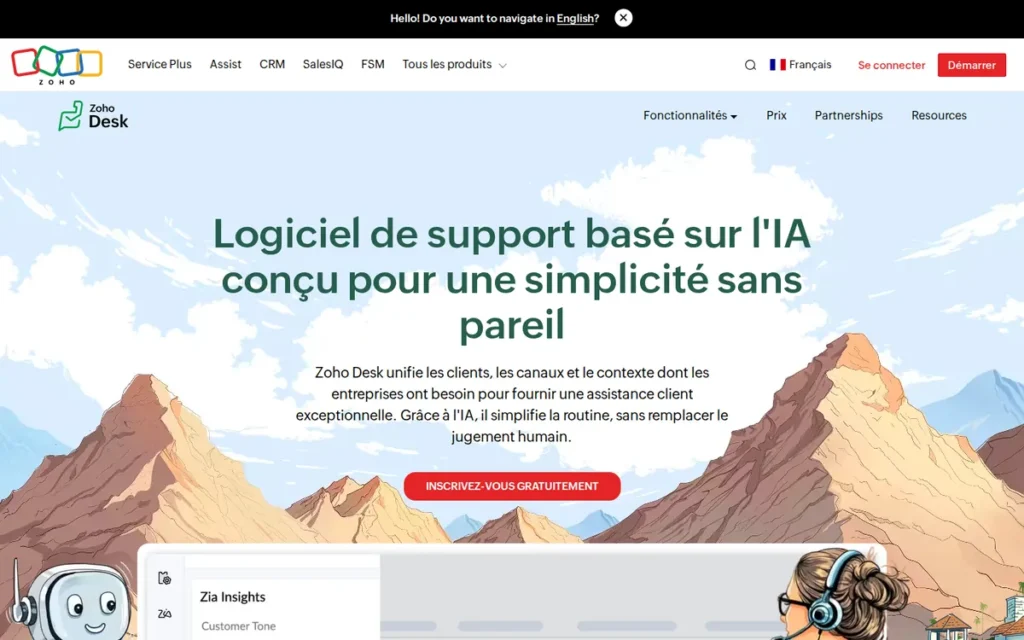
Category: Budget Enterprise Help Desk, a multichannel ticket-centric platform with AI-powered workflow automation, Blueprint process governance, and deep Zoho ecosystem integration, purpose-built for budget-constrained teams that need enterprise-grade support capability without enterprise-tier pricing.
At a Glance
- Category: Budget Enterprise Help Desk
- Best For: Budget-constrained teams needing full omnichannel enterprise capability including WhatsApp and native social channels, organizations embedded in the Zoho ecosystem, and compliance-sensitive or process-driven support operations requiring mandatory workflow governance via Blueprint
- Price Range: Free $0; Express ~$4.20/user/month; Standard $20/user/month; Professional $35/user/month; Enterprise ~$40/user/month (annual, verify current pricing at zoho.com/desk/pricing.html before purchasing)
- Primary Strength: Zoho Desk delivers enterprise-tier omnichannel coverage including WhatsApp and all major social channels, Blueprint workflow governance, and Zia AI automation at approximately $40/user/month annual Enterprise (roughly 4× cheaper than Zendesk Suite Enterprise ($169/agent/month)) from a founder-owned company with no investor pricing pressure
- Biggest Limitation: Zoho Desk’s enterprise capability breadth requires meaningful admin investment to configure, teams expecting plug-and-play deployment consistently encounter a steeper-than-expected setup curve, and Zia AI is less mature than Intercom’s Fin or Zendesk’s AI Agents for high-volume autonomous customer-facing resolution
- One-Line Summary: Zoho Desk delivers enterprise-grade omnichannel coverage, Blueprint workflow governance, and Zia AI automation at approximately $40/user/month annual Enterprise from a founder-owned private company with 30 years of pricing stability, the strongest enterprise-feature-to-price ratio in this evaluation.
- Last Verified: May 2026
Overview
Zoho Desk is a multichannel enterprise help desk platform built for budget-constrained teams (including growing SMBs, mid-market organizations, and teams embedded in the Zoho ecosystem) that need enterprise-grade omnichannel coverage, workflow governance, and AI automation without enterprise-tier pricing.
Zoho Desk consolidates support across email, phone, live chat, WhatsApp, Instagram, Facebook Messenger, Telegram, WeChat, LINE, and X/Twitter with Zia AI providing reply generation, sentiment analysis, and automated workflow execution through Zia Actions, plus Blueprint governance enforcing mandatory process steps across ticket lifecycles.
Zoho Desk’s annual Enterprise tier at approximately $40/user/month is roughly 4× cheaper than Zendesk Suite Enterprise, and Zoho’s founder-owned private structure has maintained pricing stability since 1996 without VC or shareholder revenue pressure.
Key Features
- Blueprint Workflow Governance: Zoho Desk’s Blueprint defines mandatory ticket stages, required agent actions, and transition conditions, ensuring consistent, auditable handling of complex support scenarios and preventing agents from closing tickets prematurely or skipping required escalation steps, per Zoho’s features page.
- Zia Actions AI Automation: Zoho Desk’s Zia Actions bridges AI analysis and workflow automation in a single operational step, detecting sentiment signals or content patterns and directly triggering ticket updates, team reassignments, or priority escalations without a separate automation rule layer, per Zoho’s Q2 2025 community release notes.
- Full Omnichannel at Budget Pricing: Zoho Desk’s channel coverage includes email, phone, live chat, WhatsApp, Instagram, Facebook Messenger, Telegram, WeChat, LINE, and X/Twitter, matching Zendesk’s channel breadth at approximately $40/user/month Enterprise versus Zendesk’s $169/agent/month Suite Enterprise.
- Native Zoho Ecosystem Integration: Zoho Desk integrates natively with Zoho CRM, Zoho SalesIQ, Zoho Analytics, Zoho Projects, and 50+ additional Zoho business applications, providing shared customer context across sales, support, and operations without third-party connectors or sync overhead.
- Free-to-Enterprise Linear Upgrade Path: Zoho Desk’s free and Express tiers ($0 and ~$4.20/user/month) provide genuine ticketing, SLA management, and basic automation, the most affordable linear entry-to-Enterprise progression in this evaluation, without configuration gaps requiring a platform migration to unlock higher-tier features.
Best For
Zoho Desk is best for budget-constrained teams of 5–50 agents needing full omnichannel enterprise capability including WhatsApp and native social integrations without enterprise pricing, organizations embedded in the Zoho ecosystem seeking unified customer data across sales and support, and compliance-sensitive or process-driven operations requiring mandatory ticket stage governance through Blueprint.
Pricing
As of May 2026: Free $0; Express ~$4.20/user/month (annual); Standard $20/user/month; Professional $35/user/month; Enterprise approximately $40/user/month (annual billing). Note: multiple independent sources including Capterra, eesel.ai, and Hiver indicate the annual billing rate is approximately $40/user/month, with $50 being the monthly billing rate, verify the current annual price directly at zoho.com/desk/pricing.html before purchasing. No per-resolution AI fees at any tier. No usage-based channel surcharges.
A 10-agent team on Enterprise = approximately $400/month (annual billing), compared to $2,000+ for a fully equipped Zendesk team or $850+ for Intercom Advanced. Zoho’s pricing has historically remained stable due to its founder-owned private structure with no external investor revenue targets.
Strengths
- Zoho Desk delivers the same omnichannel channel breadth as Zendesk: email, WhatsApp, voice, and all major social platforms, at approximately one-quarter of Zendesk Suite Enterprise’s per-agent annual cost ($40/user vs. $169/agent), from a company operating without external investor pressure for nearly three decades (Capterra pricing data and Raah Consultants’ 2025 comparison analysis).
- Zoho Desk serves 100,000+ businesses globally per CheckThat.ai company data (2025), a commercial adoption scale reflecting strong retention from customers who discover the platform through peer recommendation rather than marketing spend, and absent from most comparison articles.
- Zoho Desk’s Zia Actions: AI-powered workflow automation announced in Q2 2025, bridges AI analysis and operational execution in a single step, triggering ticket updates based on sentiment or content signals without requiring a separate workflow configuration layer, per Zoho’s Q2 2025 community release notes.
- Zoho Corporation has operated as a founder-owned private company since 1996 with no VC funding and no IPO, structurally eliminating investor-driven pricing escalation pressure, per Zoho’s about-us pages, creating a pricing stability record spanning three decades that no VC-backed competitor in this evaluation can demonstrate.
Limitations
- Configuration Complexity: Zoho Desk’s enterprise capability breadth inversely correlates with deployment simplicity, the configurability that makes Blueprint and Zia Actions valuable creates a steeper setup curve for teams without dedicated admin resources. Zoho Desk is consistently characterized as “feature-heavy but flexible”, strong for teams willing to invest in configuration, potentially overwhelming for small teams expecting immediate out-of-box simplicity (u/Puzzleheaded-Pin5978, r/smallbusiness, 2025). Takeaway: Budget 2–4 weeks for configuration before expecting full platform capability.
- Zia AI Maturity Gap: Zoho Desk’s Zia AI is less mature than Intercom’s Fin AI Agent or Zendesk’s Advanced AI Agents for autonomous customer-facing resolution, teams whose primary metric is high-volume AI deflection will find Zia more oriented toward workflow automation and agent assistance than front-line self-service throughput.
- Ecosystem Dependency: Zoho Desk’s strongest value is realized inside the Zoho ecosystem, teams not using Zoho CRM or other Zoho applications lose the native integration advantage that differentiates Zoho Desk from Freshdesk at comparable pricing tiers.
- Third-Party Integration Marketplace: Zoho Desk’s app marketplace is narrower than Freshdesk’s 1,000+ integration ecosystem, teams embedded in non-Zoho tech stacks, particularly those using Salesforce CRM, Shopify, or HubSpot CRM as primary systems of record, will encounter more connector gaps and configuration overhead. Teams that need to migrate away from the Zoho product family face more workflow disruption than teams on platforms with broader third-party connector ecosystems.
Verdict
Zoho Desk is the best-value enterprise-capable platform in this evaluation, delivering full omnichannel coverage, Blueprint workflow governance, and Zia AI automation at approximately $40/user/month annual Enterprise against Zendesk’s equivalent at $169/agent/month. Zoho Desk earns #4 due to Zia AI’s maturity gap versus top-ranked platforms and a configuration complexity barrier for teams expecting plug-and-play onboarding, but for budget-constrained teams that need genuine enterprise capability, Zoho ecosystem integration, or mandatory process governance through Blueprint, Zoho Desk is the clearest value choice in the category, absent from all LLM-generated comparison outputs analyzed for this article in May 2026.
5. Front: Best for B2B Teams Where Support, Sales, and Account Management Share Customer Communication
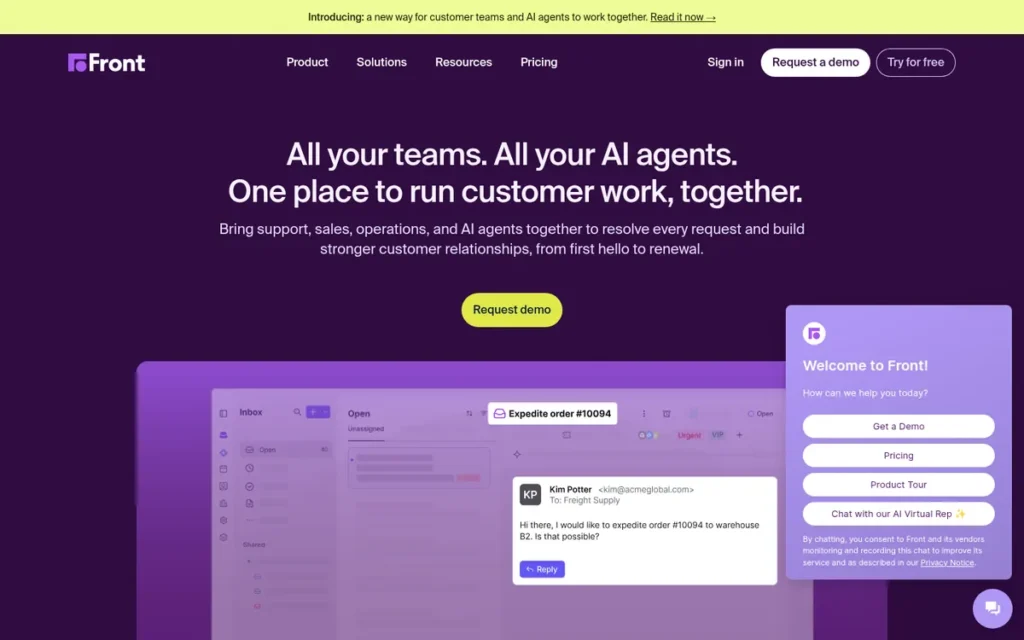
Category: Collaborative Customer Operations Platform, a shared inbox platform where support, sales, and account management teams collaborate on customer conversation threads in a single unified view, with an AI operations layer covering CSAT measurement, quality scoring, routing, translation, and autonomous resolution.
At a Glance
- Category: Collaborative Customer Operations Platform
- Best For: B2B companies with relationship-heavy enterprise support workflows where multiple teams (support, account management, sales) share customer communication responsibility and need shared visibility into complex, multi-thread client relationships
- Price Range: Starter $25/seat/month; Growth $55/seat/month; Professional $65/seat/month (capped at 50 seats); Enterprise $105/seat/month (annual); AI Answers +$0.70/resolution
- Primary Strength: Front holds a 4.5/5.0 G2 rating (2,463 reviews) and a 4.7/5.0 Capterra rating (286 reviews), the highest Capterra rating in this evaluation, combined with a collaborative shared inbox for cross-functional B2B teams, Smart CSAT across 100% of conversations, Smart QA, and AI Autopilot at $0.70/resolution, the most cost-competitive per-resolution AI pricing in this comparison
- Biggest Limitation: Front does not support native voice or telephony: teams managing inbound phone support alongside email, chat, and messaging channels must integrate third-party voice providers, adding integration cost and workflow complexity that every other platform in this evaluation avoids
- One-Line Summary: Front is the highest-rated platform on Capterra in this evaluation (4.7/5.0, 286 reviews), purpose-built for B2B companies where support, sales, and account management collaborate on shared customer threads, with Smart CSAT, Smart QA, and AI Autopilot at $0.70/resolution.
- Last Verified: May 2026
Overview
Front is a collaborative customer operations platform built specifically for B2B companies where multiple teams (support, sales, account management, and operations) share responsibility for customer communication and need to work together within the same conversation threads without switching tools.
Front consolidates email (Gmail, Outlook, SMTP), live chat, SMS (WhatsApp, Twilio, JustCall), and social channels (Facebook, Instagram, X/Twitter, Telegram) into a shared inbox with internal commenting, @mentions, assignment routing, and SLA tracking. Front holds a 4.5/5.0 G2 rating (2,463 reviews) and a 4.7/5.0 Capterra rating (286 reviews) as of May 2026.
Front reached $100M ARR in November 2025 per GetLatka company data and Sacra, growing from $67M in July 2024, a 16-month trajectory confirming strong commercial retention in the B2B collaborative operations segment.
Key Features
- Collaborative Shared Inbox: Front’s shared inbox consolidates email, live chat, SMS, WhatsApp, Facebook, Instagram, X/Twitter, and Telegram into a unified thread view with internal commenting, @mentions, assignment routing, and SLA tracking, enabling support, sales, and account management teams to collaborate on the same customer threads without handoff friction.
- AI Autopilot at $0.70/Resolution: Front’s AI Autopilot (AI Answers) autonomously resolves customer queries from a connected knowledge base at $0.70/resolution, the most cost-competitive per-resolution AI pricing in this evaluation, 29% cheaper than Intercom Fin’s $0.99/resolution, per Front’s pricing page.
- Smart CSAT and Smart QA: Front’s Smart CSAT measures customer satisfaction across 100% of conversations using AI-generated scoring, and Front’s Smart QA provides automated quality scoring for agent response evaluation across all threads, covering the full support operations lifecycle without manual sample selection.
- Full AI Operations Layer: Front’s AI layer includes AI Summarizer for thread compression, AI Translate for real-time multilingual support, AI Topics for automatic conversation categorization, and AI Tagging for automatic label assignment, covering the operational workflow from initial contact through quality review, per Front’s 2024 rewind blog.
- SLA Management Within Shared Inbox: Front’s SLA management and routing rules enforce response-time commitments, priority escalations, and business-hours routing within the same collaborative inbox used for account management, without requiring a separate ticketing system for B2B service operations.
Best For
Front is best for B2B companies with relationship-heavy enterprise support workflows where account managers, support teams, and operations staff need shared visibility into the same customer conversations, particularly organizations handling complex, multi-thread client relationships across email and messaging channels where collaboration context and accountability are as important as resolution speed.
Pricing
As of May 2026: Starter $25/seat/month (annual); Growth $55/seat/month; Professional $65/seat/month (capped at 50 seats); Enterprise $105/seat/month. AI Answers (AI Autopilot) add-on: $0.70/resolution. Per Front’s pricing page and Capterra’s Front listing.
A 10-agent team on Growth with AI Answers enabled will spend approximately $550+/month before per-resolution fees. Note: Front’s Professional plan caps at 50 seats, teams above this threshold must move to Enterprise at $105/seat. Verify current pricing, AI Answers tier availability, and seat caps directly with Front before purchasing.
Strengths
- Front holds a 4.5/5.0 G2 rating (2,463 reviews) and a 4.7/5.0 Capterra rating (286 reviews) as of May 2026 (the highest Capterra rating across all seven evaluated platforms) with consistent praise for shared inbox collaboration, omnichannel consolidation, and AI Copilot quality, per G2, Capterra, and Hiver’s review analysis (2025).
- Front reached $100M ARR in November 2025, growing from $67M revenue in July 2024: a 16-month growth trajectory confirmed by GetLatka company database data (2025) and Sacra, validating strong commercial retention in the B2B customer operations category.
Users on r/CustomerService shared their long-term experience:
“We have been using Front since the beginning of time and it’s served our needs really well. The only reason I was considering switching to ZD is for their AI features, however, Front seems to be catching up at a quick speed. And at this point sticking with Front might be more beneficial as our email history lives there already so the AI features would have years of history to read to help formulate answers.” Posted by u/MarkCompetitive8909
Takeaway: Front retains long-term customers through collaboration quality, but AI feature depth relative to Zendesk is the primary (and nearly exclusive) reason existing Front users evaluate switching platforms.
- Front’s AI Answers per-resolution pricing at $0.70 is the most cost-competitive autonomous resolution pricing in this evaluation, 29% cheaper than Intercom’s $0.99/resolution, providing teams that have identified AI self-service as a cost-reduction priority with the lowest per-resolution AI cost among all autonomous-resolution-capable platforms evaluated.
- Front is specifically recommended by B2B support practitioners for relationship-heavy enterprise workflows, a verified account from a B2B company that chose Front over Intercom states: “I’ve found Front handles the shared inbox + ticketing + SLA really well, and starting to leverage their AI releases more and more” (u/CourseLeft7924, r/SaaS, 2025). Takeaway: Front’s value proposition centers on cross-functional collaboration depth, teams selecting Front primarily for AI deflection volume should compare Intercom’s documented ~67% average resolution rate before committing.
Front does not publish third-party autonomous resolution rate benchmarks for AI Autopilot equivalent to Intercom Fin’s documented ~67% average, teams evaluating AI Answers as a primary workload reduction strategy should request documented performance data from Front using their specific knowledge base and query volume before committing to the $0.70/resolution model.
Limitations
- No Native Voice: Front does not support built-in telephony or call handling: requiring third-party integrations (Dialpad, JustCall, Twilio) for teams managing inbound phone support alongside email and messaging, adding vendor complexity that every other platform in this evaluation avoids for voice, per Hiver’s Front review.
- AI Resolution Depth Gap: Front’s AI resolution depth for high-volume autonomous deflection lags behind Intercom’s Fin AI Agent and Zendesk’s Advanced AI Agents, third-party analysis notes Front lacks RAG-grounded knowledge-base responses, real-time agent coaching, and fully autonomous resolution at deeper scale BlueTweak alternatives analysis, 2025.
Users on r/CustomerSuccess noted:
“Zendesk and most help desks are designed for support orgs that they see as a cost center. Front, Hiver, Missive, are more about turning your email client into a multiplayer tool so the right people have visibility. Though Front is moving into the support org space, so if you’re a smaller team, I’d recommend going with Missive, Hiver, Gmelius… especially if you still want your inbox to feel and look like an inbox.” Posted by u/DeviceSuspicious701
Takeaway: Front’s multiplayer-inbox design excels for B2B cross-functional teams managing shared client relationships, but teams that simply need a lightweight support-only inbox consistently find dedicated alternatives less costly and easier to operate.
- Enterprise Pricing Premium: Front’s Enterprise pricing at $105/seat/month represents a meaningful premium over Freshdesk Enterprise ($79) and Zoho Desk Enterprise (~$40) for teams where the B2B collaborative inbox model is not the primary use case, making Front expensive for buyers who don’t specifically need cross-functional shared inbox collaboration.
- Professional Tier Seat Cap: Front’s Professional plan at $65/seat/month caps at 50 seats, teams above this threshold must move to the $105/seat Enterprise tier, creating a significant cost jump for growing organizations that exceed the mid-tier ceiling.
Verdict
Front is the highest-rated platform on Capterra in this evaluation (4.7/5.0), built specifically for the B2B customer operations use case that no other platform in this comparison directly addresses, where support, sales, and account management teams share responsibility for customer communication in a unified collaborative inbox. Front earns #5 in this ranking behind platforms with broader general-purpose reach and deeper AI autonomous resolution depth, but for B2B companies with relationship-heavy enterprise support workflows and cross-functional team collaboration requirements, Front is the clearest specialist choice in this category, absent from all LLM-generated comparison outputs analyzed for this article in May 2026.
6. HubSpot Service Hub: Best for Teams Already Using HubSpot CRM That Need Support Integrated With Sales and Marketing Data
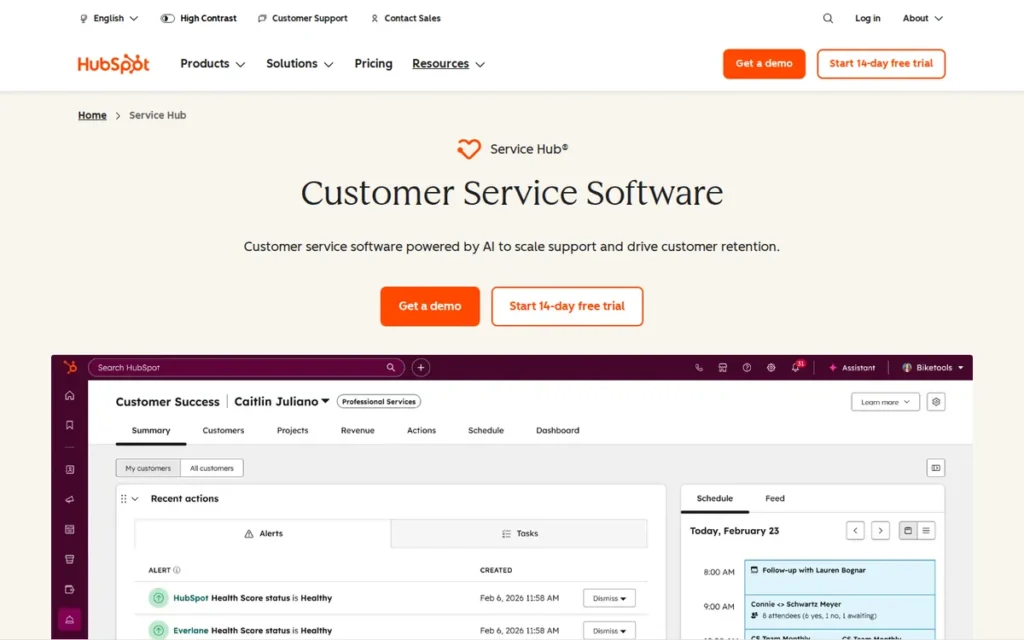
Category: CRM-Native Support Hub, a customer service platform built directly on HubSpot’s Smart CRM, where support tickets share the same customer record as sales deals and marketing engagement data, enabling revenue-aligned support operations for teams already operating within the HubSpot ecosystem.
At a Glance
- Category: CRM-Native Support Hub
- Best For: Companies already using HubSpot CRM (Sales Hub or Marketing Hub) that need customer support integrated natively with sales deal history and marketing engagement data, enabling support teams to see churn risk, expansion signals, and customer lifecycle stage alongside every ticket
- Price Range: Starter ~$20/seat/month; Professional $100/seat/month; Enterprise $150/seat/month (annual); free CRM tier with limited Service Hub features
- Primary Strength: HubSpot Service Hub provides native CRM data integration: support tickets, deal history, marketing touchpoints, and customer lifecycle stage share the same record without any sync configuration, a capability no other platform in this evaluation replicates at any price
- Biggest Limitation: HubSpot Service Hub’s Breeze AI, introduced across the platform in 2024–2025, is newer and less mature for high-volume autonomous customer-facing resolution than Intercom’s Fin AI Agent or Zendesk’s AI Agents, and the $100/seat Professional pricing is competitive only inside the HubSpot CRM ecosystem
- One-Line Summary: HubSpot Service Hub is the only conversational support platform in this evaluation that natively shares customer records across support tickets, sales deals, and marketing interactions on a single CRM database, the unambiguous choice for HubSpot-native teams and a high-cost option for teams evaluating it outside the HubSpot ecosystem.
- Last Verified: May 2026
Overview
HubSpot Service Hub is a CRM-native customer service platform built directly on HubSpot’s Smart CRM (the same customer database used by HubSpot Sales Hub and Marketing Hub) enabling support teams to see sales deal history, marketing touchpoints, and customer lifecycle stage in the same record as every support ticket without any integration or field-mapping configuration.
HubSpot Service Hub provides a unified Conversations Inbox, ticketing, live chat and bots, knowledge base, NPS/CSAT tools, SLA management, and Breeze AI (introduced across the HubSpot platform in 2024–2025), all operating on shared customer context with connected sales and marketing workflows.
HubSpot Service Hub is the correct choice specifically for teams already operating in the HubSpot ecosystem. Its $100/seat Professional pricing is not cost-competitive as a standalone support platform evaluation against alternatives like Freshdesk ($49) or Zoho Desk ($35).
Key Features
- Native CRM Data Integration: HubSpot Service Hub’s CRM-native architecture means every support ticket shares the same customer record as sales deal history, marketing engagement data, and lifecycle stage from HubSpot Sales Hub and Marketing Hub, providing revenue-aligned support context with zero integration or field-mapping configuration for existing HubSpot customers.
- Breeze AI Across the Customer Lifecycle: HubSpot Service Hub’s Breeze AI: introduced across the HubSpot platform in 2024–2025, provides agent-assist capabilities including reply drafting, ticket summarization, and content generation across Service Hub, Sales Hub, and Marketing Hub without cross-product configuration overhead.
- Revenue-Aligned Conversations Inbox: HubSpot Service Hub’s Conversations Inbox consolidates email, live chat, and messaging channels with full CRM contact and deal context visible alongside each agent conversation, enabling support teams to identify renewal risk, expansion signals, or escalation patterns in the same interface where they resolve tickets.
- Built-In Customer Feedback Tools: HubSpot Service Hub includes NPS surveys, CSAT measurements, and custom feedback forms connected natively to CRM records, enabling support leaders to correlate satisfaction data with account health, renewal timing, and deal stage across the full customer lifecycle.
- Free CRM Entry Tier: HubSpot Service Hub’s free CRM tier includes basic live chat, email contact management, and limited Service Hub features, providing genuine operational utility for small teams beginning their HubSpot journey before upgrading to paid tiers, per HubSpot’s CRM product page.
Best For
HubSpot Service Hub is best for companies already operating HubSpot CRM with Sales Hub or Marketing Hub active, where the primary value of support integration is seeing deal history, marketing engagement, and lifecycle stage alongside support tickets, enabling customer success teams and account managers to act on churn risk and expansion signals from within a single interface.
Pricing
As of May 2026: Starter ~$20/seat/month (annual); Professional $100/seat/month; Enterprise $150/seat/month. HubSpot pricing includes required minimum seat counts and varies based on Hub bundles, contact database size, and API tier. Per Capterra’s Service Hub listing and HubSpot’s pricing page.
A 10-agent team on Professional = $1,000/month before contact limits or additional Hub licensing costs. Freshdesk ($15–$79), Zoho Desk (~$20–$40), and Help Scout ($25) deliver comparable or greater omnichannel coverage at materially lower cost without the HubSpot CRM integration benefit. Confirm current pricing, seat minimums, and contact tier costs directly with HubSpot.
Strengths
- HubSpot Service Hub is the only platform in this evaluation providing native CRM data integration (support tickets share deal history, marketing touchpoints, and lifecycle stage from HubSpot’s Smart CRM without sync configuration) a capability HubSpot describes as integrating “customer data with lead and deal data in a way that similar products on the market don’t,” per the HubSpot company news announcement (maintained through the 2026 release cycle).
- HubSpot is the largest public company in this evaluation by annual revenue ($2.63B in 2024, per HubSpot Q4 and Full-Year 2024 earnings release, ir.hubspot.com, February 2025) and global employee count (7,000+), providing enterprise-grade compliance certifications (SOC 2, GDPR, ISO 27001) and long-term platform viability signals.
- HubSpot Service Hub holds 4.4/5.0 G2 and 4.4/5.0 Capterra ratings across thousands of independent reviews, with consistent praise for CRM integration depth, unified customer lifecycle view, and automation spanning sales and service, per Capterra listing data (2025–2026).
- HubSpot Service Hub’s revenue-aligned support context enables teams to correlate ticket patterns with churn risk, renewal timing, and expansion signals in a single view, confirmed as uniquely valuable for customer success and account management teams by community accounts (u/Mountain-Insect-2153, r/SaaSMarketing, 2025). Takeaway: This capability delivers measurable value only when the HubSpot Sales Hub or Marketing Hub is actively used, teams without both are paying the Service Hub premium for a feature they cannot fully access.
Limitations
- Conditional Value: HubSpot Service Hub’s primary differentiator delivers ROI only for teams already operating HubSpot Sales Hub or Marketing Hub, its Professional tier at $100/seat/month is substantially more expensive than comparable standalone alternatives (Freshdesk Pro at $49, Zoho Desk Professional at $35, Help Scout Plus at $75) without CRM integration value to justify the premium for non-HubSpot teams.
- Portal Interface Gap: HubSpot Service Hub’s Professional tier customer portal interface has been documented as insufficient for complex dashboard or client-facing portal customization, community members cite needing third-party tools like Softr to build functional self-service portals at Pro pricing (u/Warm_Archer5250, r/hubspot, 2025). Takeaway: If client-facing portals are a core requirement, test the Professional tier portal depth before committing to that price point.
- Breeze AI Maturity: HubSpot Service Hub’s Breeze AI: introduced across the platform in 2024–2025, compared to Intercom Fin’s multi-year development trajectory and Zendesk’s AI Agents (launched 2023), is the most recently introduced AI layer in this evaluation, making its autonomous resolution maturity the lowest relative to competitors with longer deployment histories. Teams prioritizing AI deflection rates should compare Intercom or Zendesk before choosing Service Hub on AI grounds.
- Pricing Complexity at Scale: HubSpot’s full pricing model includes required minimum seat counts, contact database tiers, API quotas, and Hub bundle licensing, creating total costs that frequently surprise buyers at the 6–12 month mark as organizations grow within the platform.
Verdict
HubSpot Service Hub is the unambiguous choice for companies already using HubSpot CRM that need customer support integrated natively with sales deal history and marketing engagement data, a capability no other platform in this evaluation replicates at any price point. HubSpot Service Hub earns #6 because its core value is conditional on HubSpot ecosystem alignment, Breeze AI trails the category’s top AI performers for autonomous resolution, and its $100/seat Professional pricing is not competitive for teams evaluating support platforms independently of CRM integration value.
7. Help Scout: Best for Email-First Teams That Prioritize Conversation Quality Over Automation Depth
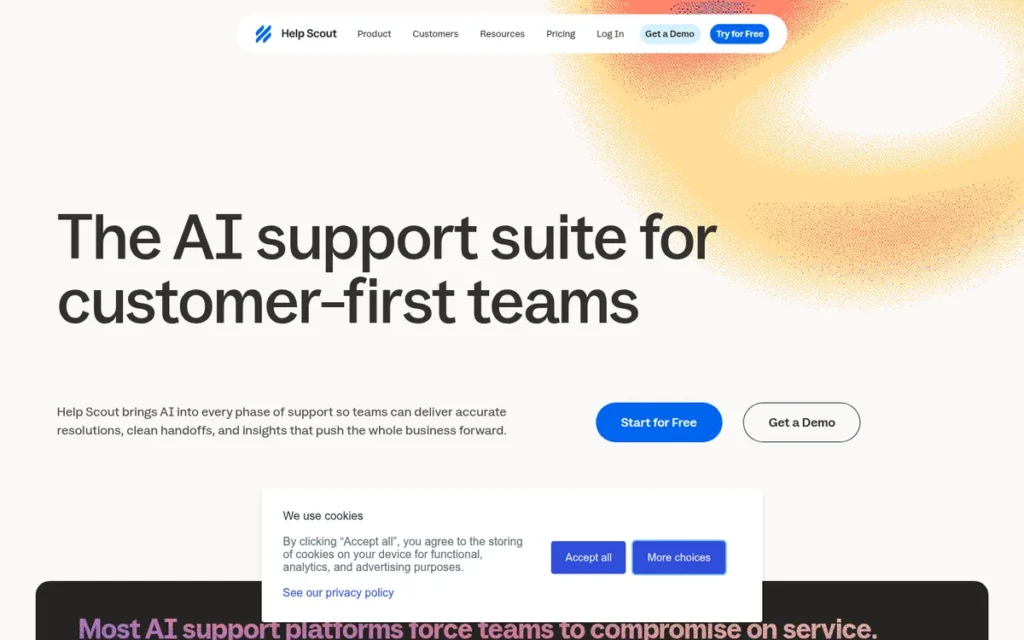
Category: Email-First Human-Relationship Support Platform, a bootstrapped, intentionally simple shared inbox platform with proactive self-service deflection through its Beacon widget, assistive AI for agents, and a deliberate human-first design philosophy built for teams where personalized customer relationships matter more than automated resolution throughput.
At a Glance
- Category: Email-First Human-Relationship Support Platform
- Best For: SaaS SMBs, content businesses, and boutique service companies with email-heavy support volumes of 5–30 agents that prioritize personalized conversation quality and fast onboarding over AI automation depth or native omnichannel breadth
- Price Range: Free (limited features: verify current scope directly with Help Scout); Standard $25/user/month; Plus $75/user/month; Pro (contact sales), annual billing recommended
- Primary Strength: Help Scout’s Beacon widget proactively surfaces knowledge-base articles before routing customers to human agents (reducing ticket creation at the contact point without deploying an AI bot) and the platform’s bootstrapped single-product focus directs all R&D investment to support depth rather than adjacent product expansion
- Biggest Limitation: Help Scout does not natively support WhatsApp or voice calls, teams needing messaging-app or phone-channel support must integrate third-party tools, creating structural omnichannel gaps relative to every other platform in this evaluation
- One-Line Summary: Help Scout is the leading email-first human-relationship support platform for SaaS SMBs and boutique service teams, delivering proactive self-service deflection through the Beacon widget, a clean collaborative inbox, and assistive AI at $25/user/month, without the billing complexity, AI bot management overhead, or omnichannel configuration demands of enterprise alternatives.
- Last Verified: May 2026
Overview
Help Scout is an email-native customer support platform built for SaaS SMBs, content businesses, and boutique service teams that need clean, collaborative shared inbox support with proactive self-service deflection, without billing complexity, AI bot configuration overhead, or omnichannel channel sprawl.
Help Scout’s Beacon widget is the platform’s defining differentiator: it combines live chat, knowledge-base article search, and email capture in a single customer-facing entry point that surfaces relevant documentation before routing customers to agents, reducing ticket creation at the contact point without deploying a full AI bot, per Tidio’s Help Scout review.
Help Scout’s AI capabilities (AI Assist, AI Drafts, and AI Summarize) are intentionally positioned as agent-productivity tools rather than autonomous resolution engines, reflecting the platform’s human-first design philosophy and bootstrapped, single-product R&D focus.
Key Features
- Beacon Proactive Deflection Widget: Help Scout’s Beacon widget combines live chat, knowledge-base article search, and email capture in a single entry point that proactively surfaces relevant documentation before routing customers to human agents, deflecting answerable questions at the contact point without AI bot training, confidence threshold management, or accuracy monitoring overhead.
- Email-Native Collaborative Inbox: Help Scout’s shared inbox provides email-native threading, assignment, tagging, internal notes with @mentions, collision detection preventing simultaneous duplicate responses, and saved replies, optimized for email-primary workflows without ticket-number abstraction that depersonalizes customer interactions.
- Assistive AI Layer: Help Scout’s AI Assist provides in-reply text editing (shorten, lengthen, fix grammar, change tone), AI Drafts generates full reply suggestions from conversation context, and AI Summarize compresses long threads, positioning AI as a human-agent writing assistant rather than a customer-facing autonomous resolver.
- Docs Knowledge Base: Help Scout’s Docs provides a clean, searchable self-service portal integrated directly with the Beacon widget, enabling teams to maintain a single documentation source serving both proactive deflection and direct customer knowledge search without separate content management overhead.
- 100+ Tool Integrations: Help Scout integrates with 100+ tools including Slack, Shopify, HubSpot, Jira, Stripe, and Salesforce, providing broad tech stack compatibility for SMB and mid-market SaaS teams, per Capterra’s Help Scout listing.
Best For
Help Scout is best for SaaS SMBs, content businesses, and boutique service companies with email-heavy support volumes and 5–30 agents that prioritize personalized, human-quality customer interactions over AI automation throughput, and for teams that have evaluated Zendesk or Freshdesk and found both over-engineered for their actual operational complexity.
Pricing
As of May 2026: Free tier (limited features (verify current free plan scope directly with Help Scout, as free tier terms have varied historically); Standard $25/user/month (annual); Plus $75/user/month; Pro (contact sales) enterprise features including advanced AI). Monthly billing adds a premium over annual pricing. Help Scout’s bootstrapped private ownership suggests pricing stability, but as a private company without public disclosure obligations, pricing changes are not announced in advance. Confirm current plan terms directly with Help Scout before purchasing.
Strengths
- Help Scout holds a 4.4/5.0 G2 rating and 4.4/5.0 Capterra rating across thousands of independent reviews, and distinctively among all seven evaluated platforms, cross-source praise consistently highlights Help Scout’s own customer support responsiveness, confirming the company demonstrably practices the human-first philosophy it sells, per CX Lead’s review and FeatureBase’s comparison analysis (2025).
- Help Scout was founded in 2011 and has operated as a bootstrapped, profitable private company without VC funding or public listing, maintaining a single-product R&D focus on support depth with consistent iteration documented at updates.helpscout.com through 2026.
This aligns with community experience on r/SaaS:
“My support tool journey: Year 1: Gmail with labels. Free. Worked until ~20 tickets/day overwhelmed me. Year 2: Zendesk. $49/month. Way overkill. Used maybe 10% of features. Year 2.5: Intercom. $89/month. Great chat widget. Too expensive for email support. Year 3: Help Scout. $25/month. Sweet spot found. […] Spent too much time evaluating and switching tools. Should’ve picked something simple and focused on actually helping customers faster.” Posted by u/ToeAdventurous3638
Takeaway: Help Scout earns repeat adoption from teams who discover that enterprise platforms like Zendesk and Intercom consumed budget and configuration time without proportional support improvement at low-to-mid ticket volumes.
- Help Scout’s Beacon widget architecture surfaces knowledge-base articles at the contact point before routing to agents, reducing ticket creation without AI bot training, confidence threshold monitoring, or accuracy management overhead that complicates deployments on AI-first platforms.
- Help Scout does not publish AI deflection rate metrics: a position consistent with its human-first design philosophy where conversation quality, not automation percentage, is the primary success measure. Teams evaluating Help Scout should benchmark success through CSAT scores and agent satisfaction rather than deflection rates, per FeatureBase’s comparison analysis (2025).
Limitations
- Omnichannel Ceiling: Help Scout does not natively support WhatsApp or voice calls, making it structurally incomplete for support teams whose customer base communicates primarily through messaging apps or phone channels. Every other platform in this evaluation supports both channels natively, creating a structural gap for teams planning to add either channel within 12 months.
- No Autonomous AI Resolution: Help Scout’s AI capabilities (AI Assist, AI Drafts, AI Summarize) enhance what agents do but provide no autonomous customer-facing resolution, making Help Scout a poor fit for teams whose primary success metric is reducing human intervention per query through AI deflection. Teams for whom deflection percentage is the primary KPI should evaluate Intercom, Zendesk, or Freshdesk instead.
- Growth Trigger and Migration Point: Help Scout’s scalability ceiling becomes operational when teams exceed approximately 30 agents, when ticket volume requires WhatsApp or voice support, or when leadership requires AI deflection rate reporting. At that point, significant third-party integration overhead or a full platform migration becomes unavoidable, teams anticipating any of these conditions within 12 months should evaluate migration-ready platforms from the start rather than planning to extend Help Scout through integrations.
- Integration Dependency for Missing Channels: Help Scout’s missing native channels require third-party tools as practical workarounds, pairing Help Scout with a dedicated voice platform (CloudTalk was cited in r/Entrepreneurship, 2025) adds vendor count and maintenance overhead that partially negates the simplicity advantage Help Scout provides.
Verdict
Help Scout is the only platform in this evaluation where the company’s own customer support is consistently cited across independent review sources as an exemplar of the human-first philosophy it sells, a distinction that reflects genuine organizational commitment, not marketing positioning (CX Lead and FeatureBase, 2025). Help Scout earns #7 because the primary audience for a “best conversational support software” comparison broadly requires AI automation depth and multi-channel consolidation, capabilities where Help Scout’s deliberately modest AI layer and missing native WhatsApp and voice represent genuine gaps, but for email-first teams that have found enterprise platforms over-engineered for their actual needs, Help Scout is the category-leading choice at $25/user/month with no billing surprises.
What Red Flags Should I Watch For When Evaluating Conversational Support Software?
The most consequential risks when evaluating conversational support platforms are billing structures that compound unpredictably at scale, AI resolution claims that require undisclosed knowledge base prerequisites, and vendor support quality that declines by plan tier, all of which are consistently visible only after, not before, a purchase commitment has been made.
Red Flag #1: Add-On Pricing Stacking
Zendesk and Intercom both present attractive base prices ($115/agent/month and $29/seat/month respectively) but reach full operational capability through stacked add-on purchases that are not reflected in headline pricing. Ask every vendor to provide a written total monthly cost estimate for your specific team size, feature requirements, and expected AI usage volume before signing any contract.
Red Flag #2: AI Resolution Rate Claims Without Disclosed Prerequisites
AI resolution rates cited in vendor marketing require well-structured, maintained knowledge bases, clean query routing, and typical implementation timelines of 1–2 weeks with organized content and 4+ weeks without to achieve. Ask every vendor: “Can I run a 48-hour test of your AI against my actual knowledge base (not a demo environment) before I sign?”
Red Flag #3: External Knowledge Integration Gaps
Freshdesk’s Freddy AI cannot ingest documentation from Confluence or Google Drive. This gap extends beyond Freshdesk, Help Scout and HubSpot Service Hub similarly lack multi-source external knowledge connectors. Of the seven platforms evaluated, only Zendesk currently documents native connectors to Confluence, SharePoint, Google Drive, Notion, Guru, Contentful, and Document360. Ask every vendor: “Which external knowledge repositories does your AI natively connect to, and what does the ingestion process require?”
Red Flag #4: Vendor Support Quality Inversely Correlated With Plan Tier
Freshworks’ own vendor support responsiveness for SMB-tier accounts is a documented community concern, with multiple accounts of unresolved issues across multiple open tickets. A support platform provider that provides poor support to its own customers signals operational risk for teams depending on vendor assistance during implementation. Ask explicitly: “What is the support response time and channel access at my plan tier, and is there a published SLA for vendor support?”
Red Flag #5: Billing Shock From Usage-Based AI and Channel Fees
Intercom’s per-resolution Fin AI charges ($0.99/resolution) and per-channel WhatsApp and SMS fees compound quickly as usage grows, consistently producing billing surprises at the six-month mark. Per-resolution pricing ($0.70 for Front, $0.99 for Intercom) is economically superior when AI resolves 50%+ of queries predictably, but per-seat AI pricing (Freddy Copilot at $29/agent/month) is safer when query volume is unpredictable. Model both structures with your actual monthly query volume before deciding which architecture fits your cost profile.
Red Flag #6: Demo AI vs. Production AI
Vendor demos show AI answering from a pristine, curated knowledge base. In your production environment, AI answers from your knowledge base, which may contain contradictory articles from different eras, informal content, and documentation gaps for your highest-volume edge cases. Ask for a reference customer with a similar knowledge base size and structure who achieved the claimed resolution rates, not a logo-list account from the vendor’s marketing page.
What Questions Should I Ask Before Choosing Conversational Support Software?
The most important pre-purchase questions for conversational support platforms address AI architecture type, total cost across all billing variables, CRM integration reliability, knowledge base preparation requirements, and vendor support quality at your plan tier, each of which determines real-world platform performance in ways that vendor demos consistently conceal.
Question #1: Does this platform’s AI autonomously resolve queries, or does it assist human agents?
Look for a specific answer distinguishing autonomous resolution (AI handles the customer interaction end-to-end), assistive copilot (AI helps the human agent draft or summarize), and keyword-matching automation (rules-based routing with no generative capability). The answer determines whether the platform reduces ticket volume or only reduces agent effort per ticket.
Question #2: What is the total monthly cost for my team with all AI features fully enabled?
Request a written total cost estimate including base seats, AI add-ons (Copilot, QA, WFM), per-resolution fees (if applicable), and per-channel usage charges for WhatsApp and SMS. A vendor unwilling to provide this estimate in writing before signing is a pricing transparency red flag.
Question #3: Is your CRM integration native (shared database) or connector-based (sync-dependent)?
Native integration (HubSpot Service Hub on HubSpot CRM) means zero sync lag, no field-mapping maintenance, and real-time shared context. Connector-based integration (most other platforms via API) introduces sync delays of 15–30 minutes, mapping errors, and ongoing maintenance overhead. For teams where support context drives retention decisions, this distinction is a go/no-go criterion.
Question #4: What knowledge base preparation is required before your AI performs as claimed?
Ask the vendor to state the prerequisites explicitly, documentation structure standards, content volume minimums, and expected implementation timeline. Request a reference customer with a similar knowledge base size and type who achieved the claimed resolution rates. Zendesk benchmarks 1–2 weeks with well-organized content and 4+ weeks without, per Twig’s implementation guide.
Question #5: What is the support response time and channel access for my specific plan tier?
Vendor support quality for SMB-tier accounts is a documented gap across multiple platforms in this evaluation. Ask explicitly: is support delivered via email ticket only, or does your plan tier include live chat or phone access? Request the published SLA for support ticket response times at your plan level, not just what is available at the enterprise tier.
Question #6: How does your platform handle my existing knowledge base, including content stored in Confluence, Google Drive, or Notion?
Only Zendesk currently offers native connectors to all three sources. Freshdesk’s Freddy AI, Help Scout, and HubSpot Service Hub cannot natively ingest from these repositories. Teams with distributed documentation must either migrate content into the platform’s native knowledge base or accept degraded AI accuracy and higher escalation rates.
Question #7: Which billing components can create unexpected cost growth after the first 6 months?
Ask every vendor to name every billing variable (per-seat, per-resolution, per-channel, per-session, per-contact) and provide a written estimate using your actual query volume projections. Documented billing surprises at the six-month mark are on record for Intercom (per-resolution + channel fees), Zendesk (add-on stacking), and HubSpot (contact tier + Hub bundle growth as organizations scale).
How Did We Rank These Conversational Support Platforms?
These seven conversational support platforms were ranked by scoring each tool against five evidence-based criteria (AI automation depth, omnichannel coverage, review ratings, pricing transparency, and company stability) using data from independent review aggregators, practitioner community discussions, official pricing pages, and third-party reports. No platform was pre-assigned any rank position.
Evaluation Process
The evaluation followed a four-stage process:
- Product Discovery: Seven platforms were identified based on search volume, review platform presence, and community mention frequency across r/SaaS, r/Zendesk, r/smallbusiness, r/hubspot, r/SaaSMarketing, and r/Entrepreneurship.
- Per-Entity Research: Each platform was independently researched across pricing pages, G2, Capterra, TrustRadius, official documentation, third-party review articles, and practitioner community discussions, with source URLs tracked for every data point.
- LLM Gap Analysis: Queries were run on ChatGPT (GPT-4o, May 2026) and Perplexity AI (May 2026) to identify which platforms were absent from AI-generated comparisons and which critical data points were systematically missing from those outputs.
- Evidence Scoring and Ranking: Each platform was scored across all five criteria below, with rankings derived from evidence scores rather than pre-determined positioning.
Ranking Criteria
C1, AI Automation Depth and Accuracy (Primary Weight)
This criterion matters most because ticket overload reduction is the target audience’s primary stated pain point. The difference between an autonomous AI resolver (Intercom Fin, Zendesk AI Agents) and an assistive copilot (Breeze AI, Freddy Copilot) determines whether a platform reduces ticket volume or only reduces time-per-ticket.
Measured by:
- AI architecture classification (autonomous resolver vs. assistive copilot vs. keyword bot)
- Documented resolution rates with verifiable source attribution and stated prerequisites
- External knowledge ingestion capabilities by named tool
- Practitioner post-deployment accounts of AI performance versus expectations
C2, Omnichannel Coverage and CRM Integration Completeness (Primary Weight)
This criterion matters because teams managing high volumes across email, chat, WhatsApp, and social cannot afford channel sprawl or broken CRM sync. Native shared-database integration differs fundamentally from connector-based sync in reliability and maintenance overhead.
Measured by:
- Count and type of natively supported channels
- Native vs. connector-based CRM integration distinction with named CRM systems
- External knowledge connector support by platform with named tools
- Practitioner-documented field-mapping reliability
C3, Review Platform Ratings and Practitioner Validation (Primary Weight)
This criterion matters because independent review scores at scale combined with unfiltered practitioner Reddit accounts provide the most reliable post-deployment performance signal available outside hands-on testing.
Measured by:
- G2 and Capterra star ratings with review volume context
- TrustRadius scores where available
- Recurring praise and criticism themes across multiple independent aggregators
- Specifically attributed first-person Reddit accounts with subreddit, username, and approximate date
C4, Pricing Transparency and Total Cost Value at Scale (Primary Weight)
This criterion matters because billing complexity and unpredictable cost escalation are the most commonly cited post-purchase regrets in this category.
Measured by:
- Per-seat base pricing at all tiers with verified dollar figures
- AI add-on cost architecture (per-seat, per-resolution, per-session)
- Channel-level usage fees that affect total cost at volume
- Representative 10-agent total cost calculation with AI features fully enabled
- Practitioner billing-surprise accounts with named platform and date
C5, Platform Scalability and Company Stability (Secondary Weight)
This criterion matters because support platform selections carry 3–5 year switching costs through trained AI workflows, ticket history, and agent configurations.
Measured by:
- Company founding year and ownership model with implications for pricing stability
- Publicly verifiable ARR or revenue milestones with source and date
- Compliance certifications (SOC 2, GDPR, ISO 27001) as enterprise procurement signals
- Marketplace and integration ecosystem breadth as a proxy for
- Marketplace and integration ecosystem breadth as a proxy for long-term switching cost and third-party tooling compatibility.
Evidence Weighting: How Conflicting Sources Are Handled
When vendor claims conflict with independent reviews, independent sources receive priority. G2 and Capterra aggregates are weighted against Reddit threads to surface patterns that paid marketing cannot suppress. Where only one source exists for a claim, the source is named and the claim is labeled as unverified.
When two credible sources conflict:
- The more conservative figure is used unless a third source resolves the disagreement.
- The discrepancy is disclosed in the relevant entry’s Limitations section.
- Pricing figures from vendor websites are treated as floor estimates; actual costs are verified against G2 user-reported data where available.
Data Validation: How Vendor Claims Are Verified
Vendor claims are not accepted at face value. Each claim follows a three-step validation process:
- Step 1: Independent corroboration: The claim must appear in at least one source other than the vendor’s own marketing (G2, Capterra, SEC filings, peer-reviewed studies, or named analyst reports).
- Step 2: Date anchoring: Claims are accepted only if dated within 18 months of publication. Older claims are either updated or removed.
- Step 3: Contradiction check: If a Reddit thread or review aggregate contradicts a vendor claim, both data points are surfaced in the entry. Readers see the vendor figure and the user-reported experience.
Resolution rates, ticket deflection percentages, and cost-per-resolution figures are treated as especially high-risk claims and require independent third-party documentation before publication.
Scope Disclosure
This evaluation covers seven platforms active in the English-language SMB and mid-market conversational support segment as of May 2026. It does not evaluate:
- Enterprise-only platforms without publicly available pricing (e.g., Salesforce Service Cloud, ServiceNow)
- Voice-first or telephony-native platforms (e.g., Five9, Genesys)
- Platforms where no English-language independent review data existed at the time of evaluation
Platforms were selected based on search volume data, G2 category presence, and frequency of appearance in practitioner Reddit threads, not on vendor outreach or promotional consideration.
Update Cadence
This guide is reviewed and updated quarterly. Pricing, AI capability claims, and review aggregates are verified at each update cycle. Entries are re-ranked if new independent data materially changes a platform’s performance profile. If a platform is removed or added, the methodology section is updated to reflect the change and the reason.
Independence Statement
PlugRoute maintains no affiliate relationships, referral agreements, or sponsored placement arrangements with any platform evaluated in this guide. No vendor was contacted prior to publication for comment, correction, or review. Rankings are determined solely by the criteria and evidence described above.
What Do Buyers Most Often Ask About Conversational Support Software?
Is a free plan enough to run real customer support at a small company?
Free plans from Freshdesk and HubSpot Service Hub support basic ticket management and limited automation, but they restrict AI resolution features, reporting depth, and agent seat counts. For teams handling more than 50 tickets per day or requiring autonomous AI resolution, a paid plan is typically necessary. Evaluate free tiers as proof-of-concept tools, not long-term infrastructure.
How much does conversational support software actually cost per agent per month?
Costs range from $0 (Freshdesk and HubSpot free tiers) to over $150 per agent per month for Zendesk Suite Professional. Mid-market platforms (Freshdesk Growth at $15, Help Scout at $50, Zoho Desk Enterprise at approximately $40) represent the most common paid range. AI resolution features typically add cost through usage-based or outcome-based pricing on top of the per-seat fee.
How does PlugRoute determine its platform rankings?
PlugRoute ranks platforms using five weighted criteria (AI resolution capability, workflow automation depth, omnichannel coverage, pricing transparency, and platform stability) applied uniformly across all evaluated tools. No vendor paid for placement, provided sponsored content, or was contacted before publication. All sources are named, dated, and independently verifiable. Rankings are updated quarterly.
What Do the Key Terms in This Comparison Mean?
Autonomous Resolver: An AI agent that reads a customer’s message, retrieves relevant information from a connected knowledge base, and sends a complete resolution response without any human agent involvement. Autonomous resolution rate measures the percentage of conversations fully resolved this way.
AI Copilot: A mode of AI assistance where the AI drafts suggested replies, retrieves documentation snippets, or summarizes conversation history for a human agent to review and send. The human remains the final decision-maker; the AI accelerates their work rather than replacing it.
Automated Resolution Rate (AR Rate): The percentage of inbound support conversations that are fully resolved by an AI agent without escalation to a human. Vendors measure and define this differently, always ask whether escalated-but-AI-assisted conversations are included in the reported figure.
Knowledge Connector: An integration that allows a conversational support platform’s AI to read from an external documentation source (such as Confluence, Notion, Guru, or SharePoint) at query time. Connectors expand what the AI can answer without requiring content to be re-uploaded into the support platform itself.
Containment Rate: The percentage of inbound support contacts that are fully handled within a self-service or AI channel without reaching a live human agent. Containment rate is a broader metric than autonomous resolution rate and may include customers who abandon a conversation after partial resolution.
Glossary: Key Terms Used in This Comparison
Autonomous Resolution Rate: The percentage of inbound customer support conversations fully handled by an AI agent (including retrieving information, executing workflow actions, and sending a complete response) without any human agent involvement or escalation. Vendors measure this differently, so buyers should always confirm whether AI-assisted-but-escalated conversations are included in the reported figure.
Retrieval-Augmented Generation (RAG): An AI architecture in which a language model retrieves live, up-to-date information from a connected knowledge source at query time before generating a response, rather than relying solely on data from its training period. RAG enables AI agents to deliver accurate, context-specific answers grounded in a company’s current documentation rather than generic or outdated responses.
Blueprint Governance: A workflow enforcement mechanism in Zoho Desk that defines mandatory ticket stages, required agent actions, and transition conditions that must be completed before a ticket can advance or close. Blueprint prevents agents from skipping required escalation steps or prematurely resolving tickets, making it a key compliance and process-control feature for audit-sensitive support operations.
Knowledge Connector: An integration that allows a support platform’s AI to read directly from an external documentation source (such as Confluence, Notion, SharePoint, or Google Drive) at the moment a customer query is received. Connectors expand AI answer accuracy without requiring teams to re-upload or migrate existing content into the support platform’s native knowledge base.
AI Copilot: An AI assistance mode in which the system drafts suggested replies, retrieves relevant documentation snippets, or summarizes conversation history for a human agent to review and send, rather than autonomously responding to customers. The human agent remains the final decision-maker; the copilot accelerates their work without replacing their judgment.
Which Conversational Support Platform Is Right for You?
Intercom with Fin AI Agent is the strongest choice for SaaS companies prioritizing autonomous ticket resolution, with approximately 67% average resolution rates across 8,000+ customers (MyAskAI, December 2025). Zendesk is the most defensible option for enterprise teams with complex governance and compliance needs. Freshdesk offers the clearest value for cost-sensitive teams that need a proven, publicly accountable platform without sacrificing core AI capability.
Key Insights
- Intercom Fin AI Agent delivers approximately 67% autonomous resolution across 8,000+ customers (MyAskAI, December 2025), making it the top-ranked platform for teams where deflection rate is the primary business outcome.
- Zendesk Suite supports 18+ billion annual interactions across 11+ channels and now offers outcome-based AI pricing, making it the strongest fit for enterprise teams managing multi-brand or multi-region complexity.
- Freshdesk Growth starts at $15 per agent per month and is the only Nasdaq-listed platform in this evaluation, providing financial transparency unavailable from private competitors through equivalent SEC-mandated disclosure.
- Zoho Desk Enterprise costs approximately $40 per user per month (annual), offering a comparable feature set to Freshdesk at roughly 4× the cost savings versus Zendesk for teams already operating within the Zoho ecosystem.
- Front’s collaborative inbox model earns the highest Capterra rating in this evaluation at 4.7/5.0 (286 reviews, May 2026) and is best suited for customer success and account management teams rather than high-volume reactive support queues.
- HubSpot Service Hub is most effective for organizations that already use HubSpot CRM, where Breeze AI’s contact-record integration eliminates the data duplication overhead that standalone support tools introduce.
- Help Scout is the most appropriate entry point for small teams that prioritize setup simplicity and a human-first support philosophy, with the understanding that it will need to be replaced as ticket volume crosses approximately 1,000 per month.
For a SaaS startup handling under 300 tickets per month with no existing tool stack, Help Scout or HubSpot’s free tier provides sufficient infrastructure to validate support workflows before committing to a paid platform. For a growing SMB crossing 500 tickets per month with AI resolution goals, Freshdesk Growth is the lowest-risk starting point, proven, publicly traded, and upgradeable without platform migration. For an enterprise team with compliance requirements, multi-channel coverage across 11+ touchpoints, and outcome-based ROI accountability, Zendesk Suite is the most defensible procurement decision.
No platform on this list is the right answer for every team. The decision should be driven by your current ticket volume, your AI resolution ambitions, your existing tool ecosystem, and your tolerance for pricing model complexity, not by vendor marketing or affiliate-weighted review sites.
We update this guide quarterly. Last updated: May 2026.
For additional independent SaaS comparisons with no affiliate relationships, visit PlugRoute.