Tidio is the best chatbot software for e-commerce SMBs needing no-code AI support automation. Botpress leads for developer teams building custom autonomous agents. Freshchat is the strongest choice for omnichannel teams managing 10+ communication channels. The right platform depends entirely on your use case, choosing the wrong one costs far more than the subscription fee.
This article covers business chatbot deployment tools, platforms a company uses to build and operate customer-facing or workflow-automating chatbots. It does not review general-purpose AI assistants like ChatGPT, Claude, or Perplexity. The seven platforms evaluated range from 15-minute no-code knowledge bot builders to enterprise-grade NLU platforms, each assessed against six objective criteria aligned to SMB buyer priorities. If you need a general-purpose AI assistant for internal productivity or an IT service management tool, this comparison is not for you.
PlugRoute has no affiliate relationships with any company listed. Rankings are determined entirely by research data and objective evaluation criteria.
TL;DR: Top Picks at a Glance
- Tidio: best no-code AI support automation for e-commerce SMBs on Shopify or WooCommerce
- Botpress: best for developer teams requiring multi-LLM autonomous agents with open-source flexibility
- Freshchat: best for unified omnichannel service across 10+ channels including Apple Business Chat
- HubSpot Chatbot Builder: best for existing HubSpot CRM users at zero marginal cost (AI requires $890/month)
- ManyChat: best for Instagram, Facebook, and WhatsApp comment-to-DM automation and social lead generation
- Dialogflow: best for enterprise engineering teams building multilingual voice + chat agents at scale
- Chatbase: fastest first-chatbot deployment for non-technical solo builders (under 15 minutes, free tier available)
What Are the 6 Types of Chatbot Software, and Which Do You Actually Need?
Chatbot software falls into six functional categories: Customer Support Platforms, Autonomous Agent Builders, Social Automation Platforms, CRM-Native Chatbot Builders, Enterprise NLU Platforms, and No-Code Knowledge Bot Builders. Confusing them is the most common cause of wrong-fit purchases, each solves a fundamentally different problem, and substituting one category for another produces predictably poor results.
The six categories are:
- Customer Support Platforms (Tidio, Freshchat): all-in-one tools combining AI chatbot, live chat, ticketing, and agent tooling for SMB and mid-market service teams
- Autonomous Agent Builders (Botpress): developer-oriented platforms for building LLM-powered agents with custom logic, multi-step reasoning, and API integration
- Social Automation Platforms (ManyChat): no-code tools for building interactive conversation flows on Meta-owned channels (Instagram, Facebook, WhatsApp)
- CRM-Native Chatbot Builders (HubSpot Chatbot Builder): chatbots built into a CRM product, most valuable when you already use that CRM
- Enterprise NLU Platforms (Dialogflow): Google Cloud developer platforms for production-grade multilingual voice and chat agents at enterprise scale
- No-Code Knowledge Bot Builders (Chatbase): entry-level tools that train a custom AI chatbot on uploaded business documents and deploy it in minutes
How Do the Top Chatbot Platforms Compare at a Glance?
The seven chatbot platforms in this evaluation span six distinct categories, three pricing models, and a significant cost difference for AI access at the entry level. The table below captures the most decision-relevant dimensions for SMB buyers comparing tools simultaneously as of April 2026.
| Rank | Company | Category | Best For | One-Line Summary | Key Capabilities | Primary Strength | Key Limitation |
|---|---|---|---|---|---|---|---|
| 1 | Tidio | Customer Support Platform | E-commerce SMBs wanting no-code AI support | 4.7/5.0 Capterra rating; Lyro AI delivers vendor-reported 64–89% ticket resolution with no-code activation on Shopify/WooCommerce | Live chat, Lyro AI, no-code Flows, multichannel inbox, Shopify/WooCommerce integration | Lyro AI trains on business data; activates without coding; highest SMB review confidence in this evaluation | Two-layer pricing: platform subscription plus separate Lyro AI add-on ($32.50/month) |
| 2 | Botpress | Autonomous Agent Builder | Developers building custom AI agents | Open-source platform rated 4.6/5.0 on Capterra; LLMz autonomous engine with multi-LLM routing; active since ~2017 | LLMz engine, multi-LLM routing (GPT-4/Claude/Llama/DeepSeek), 190+ integrations, RAG, SOC 2/GDPR | Multi-LLM routing; open-source with self-hosting; academic methodology pre-print on arXiv | Requires JavaScript and API knowledge for production deployments; not a no-code tool |
| 3 | Freshchat | Omnichannel Messaging Platform | Teams needing 10+ unified channels | Freshworks (NASDAQ: FRSH) omnichannel platform; 10+ channels including Apple Business Chat at $19/agent/month for AI entry | 10+ native channels, Freddy AI Agent, Freddy AI Copilot, Freshworks ecosystem integration | Broadest native channel coverage; NASDAQ-listed vendor stability | Freddy AI handles queries but cannot execute backend actions (order lookups, account updates) |
| 4 | HubSpot Chatbot Builder | CRM-Native Chatbot Builder | Existing HubSpot CRM users | Rated 4.4/5.0 by 12,700+ Capterra users; logs every conversation to CRM in real time; Breeze AI requires $890/month plus usage fees | CRM-native sync, no-code Chatflows, 1,000+ integrations, Breeze AI (Professional tier only) | Native CRM sync; 12,700+ verified reviews; free rule-based tier with no credit card required | AI (Breeze) requires $890/month Marketing Hub Professional plus $0.50/resolved conversation; the largest AI access barrier in this evaluation |
| 5 | ManyChat | Social Automation Platform | Social marketers on Instagram/Facebook/WhatsApp | Rated 4.6/5.0 by 151 Capterra users; vendor-reported case studies show 522% sign-up increases from Instagram automation | Comment-to-DM triggers, Story reply flows, Flow Builder, multi-channel social automation | Only platform with Instagram comment-to-DM triggers and Story reply automation | March 2026 free tier cut to 25 contacts; complete Meta-platform API dependency |
| 6 | Dialogflow | Enterprise NLU Platform | Enterprise teams needing multilingual voice + chat | Google Cloud platform acquired from API.ai in 2016; 95+ languages in ES edition; CX uses Gemini 2.0 Flash models | Gemini 2.0 Flash playbooks (CX), 95+ languages (ES), telephony (Genesys/Avaya), visual state machine | 95+ languages; enterprise telephony integrations; Google Cloud native infrastructure | Developer-only; no no-code path; pay-as-you-go pricing only; ticket-based support |
| 7 | Chatbase | No-Code Knowledge Bot Builder | First-time deployers needing fast setup | Founded February 2023; reported $8M ARR by December 2025; trains custom AI bots on business data in under 15 minutes | Knowledge-base training (PDFs/URLs/docs), multi-LLM selection, AI Actions, 95+ languages, Shopify/HubSpot integration | Under-15-minute setup; multi-LLM selection (GPT/Claude/Llama/DeepSeek) | Only 13 Capterra reviews as of April 2026; lowest independent review validation in this evaluation |
Which Chatbot Platform Should I Choose for My Use Case?
Seven platforms in this evaluation serve distinct use cases. The fastest path to the right tool is matching your primary business channel and technical constraints to the platform built for it. Answer the first row that describes your situation, if multiple rows apply, start with the one closest to your #1 revenue-generating channel.
| Your #1 Priority | Recommended Tool | Why | If This Doesn’t Fit |
|---|---|---|---|
| Already using HubSpot CRM | HubSpot Chatbot Builder | Native CRM sync at zero marginal cost; free rule-based tier with no credit card required | Freshchat Growth ($19/agent/month) or Tidio Growth ($49/month) if AI needed below $890/month |
| Instagram/Facebook/WhatsApp is primary acquisition channel | ManyChat | Only platform with comment-to-DM triggers and Story reply flows for Meta platforms | Tidio (for website chat alongside social automation) |
| Enterprise multilingual support (25–95+ languages) or telephony | Dialogflow | 95+ languages (ES); Gemini 2.0 Flash playbooks (CX); Genesys/Avaya telephony integration | Botpress (for developer teams without Google Cloud dependency) |
| Developer available; custom AI agent required | Botpress | LLMz multi-step reasoning; multi-LLM routing; open-source with self-hosting | Dialogflow (for enterprise-scale NLU with telephony) |
| 10+ unified channels including Apple Business Chat | Freshchat | Broadest native channel coverage in this evaluation | Tidio (for SMB use cases without Apple/Google channel needs) |
| First chatbot, minimal budget, no developer, launch today | Chatbase | Under-15-minute setup; free tier; multi-LLM at entry price | Tidio (if Shopify integration or live chat is needed) |
| E-commerce SMB on Shopify or WooCommerce, no-code AI | Tidio | Highest SMB review confidence; Lyro AI; native Shopify integration | Freshchat (if omnichannel across 10+ channels is a priority) |
1. Tidio: Best Overall for SMB Customer Support Automation
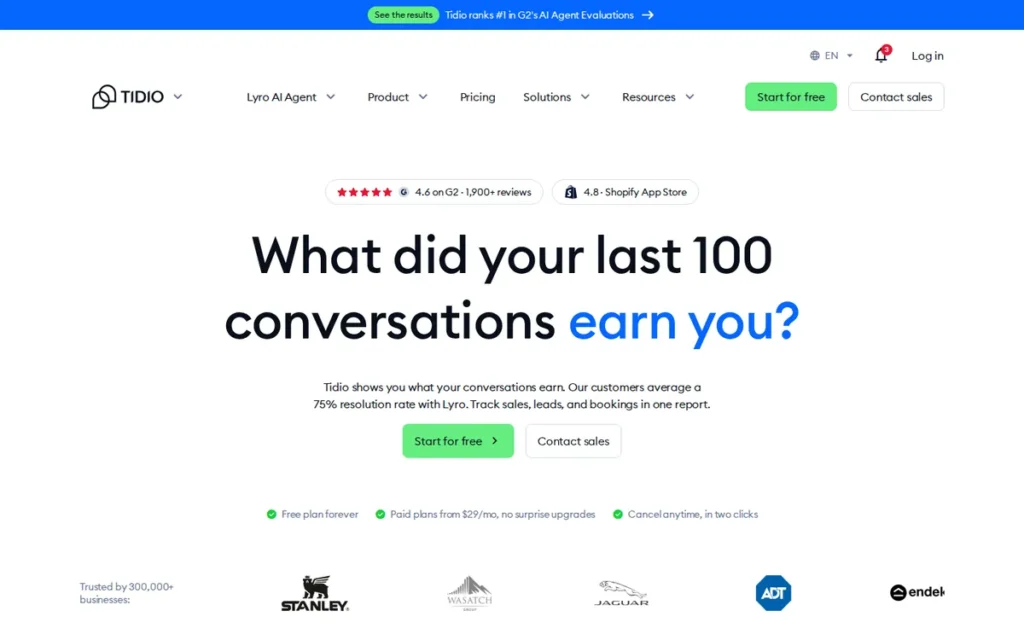
Category: Customer Support Platform, an all-in-one tool combining live chat, AI conversational automation, and ticketing for small-to-mid-sized business customer service.
At a Glance
- Category: Customer Support Platform
- Best For: E-commerce and SMB teams (2–200 people) wanting AI-powered customer support without a developer, especially on Shopify or WooCommerce
- Price Range: Free; Starter $24.17/month; Growth from $49.17/month; Plus from $749/month; Premium custom, billed annually; Lyro AI add-on sold separately at $32.50/month billed annually (April 2026, verify at tidio.com/pricing)
- Primary Strength: Tidio’s Lyro AI trains on a business’s own data and activates without coding, delivering a vendor-reported 64–89% ticket resolution rate in production deployments
- Biggest Limitation: Tidio charges Lyro AI conversations as a separate add-on beyond the 50 free monthly conversations, creating a two-layer cost structure that makes total monthly spend non-obvious at scale
- One-Line Summary: Tidio is an all-in-one customer support platform with a 4.7/5.0 rating on both G2 and Capterra that combines live chat, the Lyro AI conversational agent, and no-code automation, with Lyro delivering a vendor-reported 64–89% ticket resolution rate in production deployments as of April 2026.
- Last Verified: April 2026
Overview
Tidio is an all-in-one customer support platform combining live chat, the Lyro AI conversational agent, and visual no-code Automation Flows, designed for small-to-mid-sized e-commerce and service businesses that need AI-powered support without a development team. Tidio is particularly suited to businesses operating on Shopify or WooCommerce, where its native cart integration and real-time visitor data give support teams immediate context during escalated conversations.
Tidio differentiates itself by separating two distinct automation layers. Tidio’s Lyro AI handles open-ended generative conversations trained on a business’s own data. Tidio’s Automation Flows manage scripted if/then logic for predictable scenarios like checkout abandonment and lead capture, giving non-technical teams control that fully AI-driven chatbots at equivalent price points cannot match.
Key Features
- Lyro AI Knowledge Training: Tidio’s Lyro AI trains directly on a business’s website URLs, PDFs, CSVs, and Zendesk imports to deliver contextually accurate generative responses without requiring prompt engineering or custom development.
- Dual Automation Architecture: Tidio’s Automation Flows provide a visual no-code if/then builder with prebuilt templates for checkout abandonment recovery, lead qualification, FAQ responses during offline hours, and post-purchase surveys, operating independently of the AI layer for fully predictable scripted outcomes.
- Multichannel Unified Inbox: Tidio supports deployment across web live chat, WhatsApp, Instagram Direct, Facebook Messenger, and email ticketing, all unified in a single team inbox with real-time active conversation monitoring across 12 supported languages.
- Smart Actions Workflow Layer: Tidio’s Smart Actions layer enables API-triggered automation including order status lookups, product recommendations, and lead qualification scoring without human agent involvement.
- Native E-Commerce Integrations: Tidio integrates natively with Shopify, WooCommerce, WordPress, and over 100 third-party tools, with real-time visitor tracking and cart data surfaced in the live agent interface during escalated conversations.
Best For
Tidio is best suited for e-commerce businesses running on Shopify or WooCommerce that need to automate repetitive customer inquiries (order status, returns, FAQs) and qualify leads without hiring additional support staff. Tidio works best for teams of 2–50 people where speed of deployment and ease of day-to-day management outweigh the need for deep customization or enterprise analytics.
Pricing
As of April 2026: Free ($0/month, 50 billable conversations, 50 one-time Lyro conversations, 100 Flows visitors/month, max 10 seats); Starter ($24.17/month billed annually, 100 conversations); Growth (from $49.17/month, from 250 conversations); Plus (from $749/month, up to 5,000 Lyro conversations, dedicated success manager, unlimited seats); Premium (custom pricing, unlimited conversations).
Critical disclosure: Lyro AI is sold as a separate add-on at $32.50/month billed annually beyond the conversations included in each tier. This two-layer structure makes total cost non-obvious, verify current pricing at tidio.com/pricing before finalizing any budget.
Strengths
- Tidio reports that Lyro AI delivers a 64–89% ticket resolution rate in production deployments as of April 2026, the most specific performance floor/ceiling range of any platform in this comparison, enabling realistic deployment planning rather than reliance on vendor best-case figures alone. This figure is vendor-reported via Tidio.com and the Capterra listing (April 2026); independent third-party audit was not available in research sources.
- Tidio holds a 4.7/5.0 rating on both G2 (1,532 verified reviews, April 2026) and Capterra, the highest verified review confidence of any chatbot tool in the SMB segment evaluated here (G2 Tidio listing, April 2026; verify Capterra count at capterra.com/p/144040/Tidio-Chat/).
- In head-to-head comparative reviews against Intercom, Zendesk, and Freshdesk, Tidio consistently ranks highest for ease of use and time-to-value, with reviewers citing sub-10-minute activation for core features (Zigpoll Intercom vs. Tidio vs. Zendesk comparison, 2026; Featurebase Tidio vs. Zendesk, 2026).
- Tidio’s architectural separation of rule-based Flows from Lyro AI gives teams fine-grained control (predictable scripted scenarios run independently from generative AI responses) reducing hallucination risk in mission-critical support flows while preserving AI flexibility for open-ended queries.
Limitations
- Two-Layer Pricing: Tidio’s most consequential trade-off is its separated billing structure, the platform subscription and Lyro AI conversations are invoiced separately, meaning a Growth plan subscriber ($49.17/month) still requires the Lyro AI add-on ($32.50/month billed annually) to access meaningful AI resolution capacity beyond 50 free conversations. Multiple independent review analyses cite this as a surprise cost trigger for growing businesses.
- Integration Breadth Gap: Tidio’s ecosystem of 100+ app integrations is significantly narrower than enterprise alternatives like Zendesk (1,500+ integrations), which matters for businesses with complex tool stacks requiring extensive downstream automation.
- Analytics Depth: Tidio’s reporting is consistently rated as basic by reviewers with prior enterprise platform experience, making Tidio a platform many businesses will outgrow as they scale beyond approximately 1,000 monthly conversations or require advanced conversation performance dashboards.
Verdict
Tidio is the strongest overall chatbot platform for non-technical SMB teams seeking AI-powered customer support automation in 2026, earning its #1 ranking through the highest verified review confidence in this comparison (4.7/5.0 across G2 and Capterra), the most specific evidence-backed AI performance range in this evaluation (Lyro: vendor-reported 64–89% ticket resolution), and the fastest no-code activation path for e-commerce use cases.
Buyers should budget explicitly for the Lyro AI add-on cost beyond base plan pricing and plan for platform migration if conversation volumes exceed 1,000/month or if advanced analytics become a business requirement. For e-commerce businesses on Shopify or WooCommerce, Tidio’s combination of native integration, Flows automation, and Lyro AI delivers a deployable support stack that requires no developer involvement.
2. Botpress: Best for Developer Teams and Custom Autonomous AI Agents
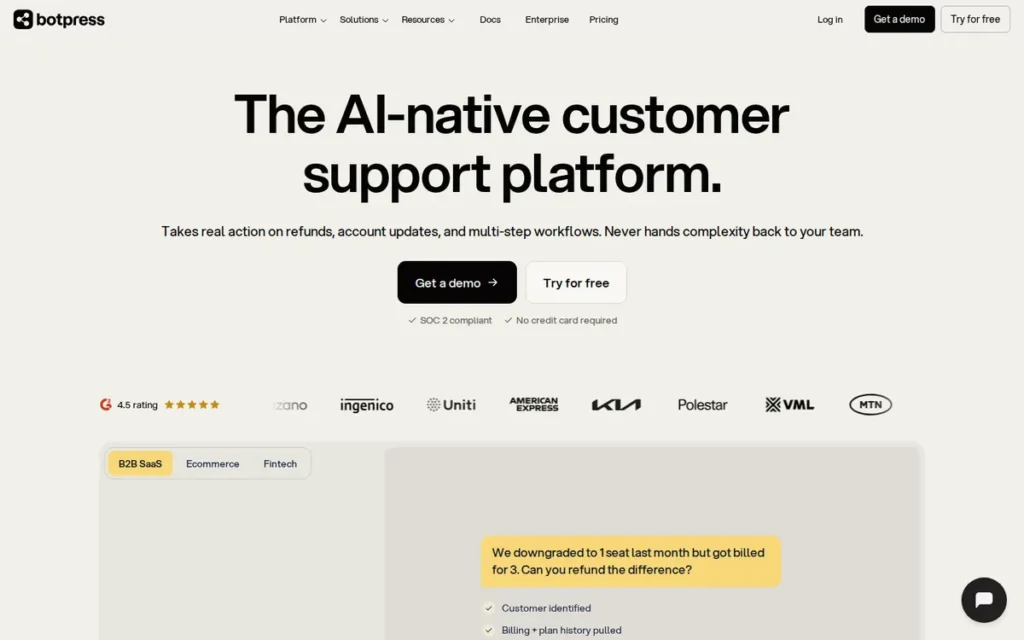
Category: Autonomous Agent Builder, a platform for designing, deploying, and managing LLM-powered conversational agents with both visual flow building and full code extensibility.
At a Glance
- Category: Autonomous Agent Builder
- Best For: Technical teams, developers, and product engineers at SMBs and mid-market companies building custom AI agents, complex multi-step workflows, or chatbots requiring integration with proprietary systems
- Price Range: Free (generous tier); paid tiers starting at approximately $19/user/month (Capterra listing, April 2026); Enterprise custom pricing, verify full current structure at botpress.com/pricing
- Primary Strength: Botpress’s LLMz engine enables autonomous multi-step AI agent behavior (real-time decision-making, session memory, and tool orchestration) across selectable LLM backends (GPT-4, Claude, Llama, DeepSeek) within a single deployment
- Biggest Limitation: Botpress requires JavaScript and API knowledge for production deployments, it is a developer platform with a visual builder, not a genuinely no-code tool for non-technical buyers
- One-Line Summary: Botpress is an open-source conversational AI platform rated 4.6/5.0 on Capterra that enables technical teams to build autonomous AI agents with multi-LLM routing and 190+ integrations, with active open-source and commercial history dating to approximately 2017.
- Last Verified: April 2026
Overview
Botpress is an open-source conversational AI platform for building, deploying, and managing autonomous AI agents, designed for technical teams at small-to-mid-market companies that need LLM-powered agents with full customization control beyond what any visual builder alone can configure.
Botpress combines a drag-and-drop visual flow editor with complete JavaScript and API extensibility, its proprietary LLMz autonomous inference engine, and 190+ pre-built integrations. Botpress occupies the unique middle ground between no-code ease and enterprise-grade flexibility that neither pure no-code tools nor fully custom-coded platforms provide. Botpress has maintained an active open-source GitHub presence since approximately 2017, with its LLMz engine in commercial production for over two years as of April 2026.
Key Features
- LLMz Autonomous Inference Engine: Botpress’s LLMz engine enables autonomous AI agent behavior (including real-time multi-step planning, adaptive learning across conversation sessions, persistent memory management, and tool orchestration) using selectable LLM backends including GPT-4, Claude, Llama 3, and DeepSeek.
- Multi-LLM Routing: Botpress supports routing different queries to different underlying AI models within a single deployment based on cost sensitivity, latency requirements, or task type, a capability not widely available at comparable price points in other platforms in this evaluation as of April 2026.
- RAG via Vector Databases: Botpress provides Retrieval-Augmented Generation through integrated vector database support, enabling chatbots to answer questions grounded in documents, websites, FAQs, and databases with reduced hallucination compared to raw LLM generation.
- 190+ Pre-Built Integrations: Botpress ships with 190+ integrations covering WhatsApp, Slack, Messenger, Salesforce, and Zendesk alongside enterprise compliance certifications including SOC 2, GDPR, RBAC, and SSO.
- Open-Source with Academic Transparency: Botpress’s open-source architecture allows self-hosting for data sovereignty requirements, supported by an active Discord community and a published academic methodology pre-print on arXiv providing technical transparency beyond typical vendor documentation (arXiv:2509.13326).
Best For
Botpress is best suited for development teams, technical product managers, or engineering-adjacent organizations that need to build custom AI agents capable of multi-step autonomous reasoning, complex integration with proprietary APIs, or specialized channel deployments. Botpress requires at least one team member comfortable with JavaScript and API configuration to reach production readiness for advanced use cases.
Pricing
As of April 2026: Botpress offers a free tier described as “generous” across multiple independent reviews. Paid tiers start at approximately $19/user/month per the Capterra listing, a higher figure of $89/month cited in some sources could not be independently confirmed and may refer to a higher-tier or legacy plan. Enterprise pricing is custom.
Verify current pricing directly at botpress.com/pricing before any budget planning: exact free tier conversation limits were not publicly confirmed in available research sources as of April 2026.
Strengths
- Botpress has maintained an active open-source GitHub repository since approximately 2017, with its LLMz autonomous agent engine in commercial production for over two years as of April 2026, the longest-running open-source chatbot platform in this comparison, providing community validation and vendor-independence that proprietary platforms cannot replicate (GitHub: botpress/botpress, April 2026).
- Botpress holds a 4.6/5.0 Capterra rating, with reviewers consistently praising visual editor quality, custom workflow capability, and free tier accessibility as of April 2026, note that some external aggregators show a 4.3–4.5/5.0 range; verify the current score at capterra.com/p/199292/Botpress/ (Capterra Botpress listing, April 2026).
- Botpress published an academic methodology pre-print on its conversational AI architecture on arXiv (arXiv:2509.13326), demonstrating research-level technical transparency that differentiates Botpress from commercial-only platforms that do not disclose methodology (Botpress LLMz documentation, April 2026).
- Botpress’s multi-LLM routing capability: directing queries to GPT-4, Claude, Llama, or DeepSeek based on task type, enables organizations to optimize AI spend and performance simultaneously, a feature not widely available at comparable price points in any other platform in this comparison as of April 2026.
Limitations
- Technical Barrier: Botpress’s most consequential trade-off is the engineering requirement beneath its visual builder, while the drag-and-drop interface is genuinely accessible for basic flows, production deployments requiring advanced logic, custom UI elements, or GDPR-compliant conversation patterns require JavaScript and API familiarity. Botpress is not a no-code solution for non-technical buyers and should not be evaluated as one.
- Documentation Gaps: Documentation quality gaps persist as of April 2026: a consistently cited community complaint, with the Discord community frequently compensating for incomplete official documentation. This dependency may frustrate teams accustomed to enterprise-grade vendor support response times and structured onboarding.
- Cost Escalation Beyond Free Tier: Advanced features and high-volume deployments escalate costs above the free tier, making Botpress best suited to teams with a defined technical use case rather than buyers trialing without clear scope or conversation volume projections.
Verdict
Botpress is the strongest chatbot platform for technical teams that need autonomous AI agent behavior, multi-LLM flexibility, and maximum customization control in 2026, ranking #2 overall through its unique LLMz engine, 190+ integrations, SOC 2/GDPR compliance, and open-source architecture that no other platform in this evaluation provides.
Non-technical buyers should not evaluate Botpress as a no-code option; Botpress is a developer platform that happens to include a visual builder, and production deployment without engineering involvement is not realistic for advanced use cases. For engineering teams building customer-facing agents with complex integration requirements or data sovereignty constraints, Botpress provides enterprise-grade AI capabilities at mid-market price points.
3. Freshchat: Best for Omnichannel Customer Service Teams
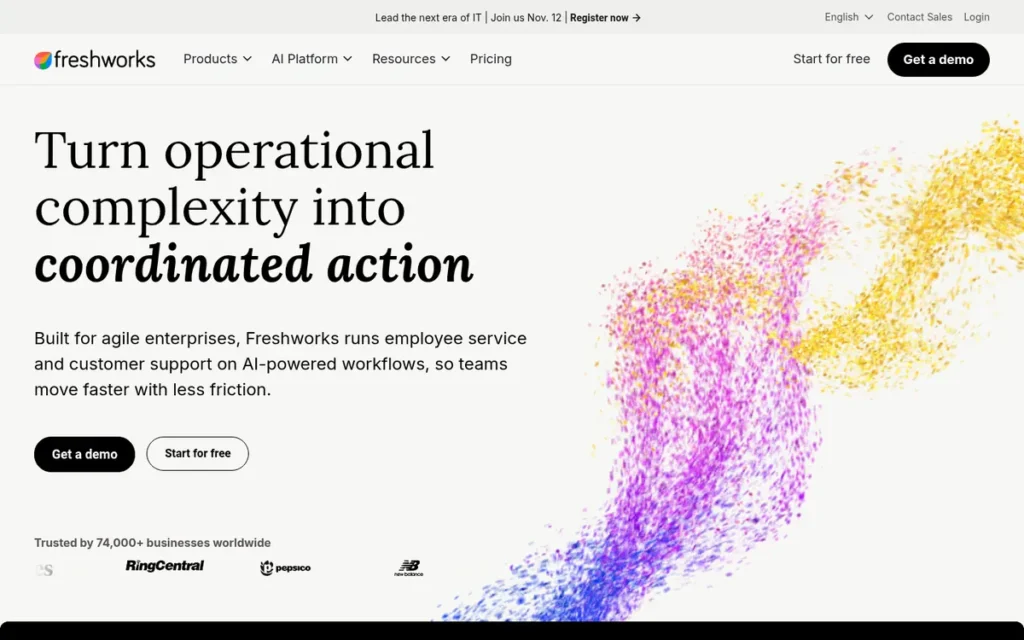
Category: Omnichannel Messaging Platform, a customer communication tool that unifies 10+ channels (web chat, social, SMS, email) in a single shared inbox with AI-powered bot and agent assistance.
At a Glance
- Category: Omnichannel Messaging Platform
- Best For: Customer service teams at SMBs and mid-market companies needing unified messaging across 10+ channels, and organizations already using Freshdesk or Freshservice
- Price Range: Free (up to 10 agents, no AI); Growth $19/agent/month billed annually (500 Freddy AI sessions included); Pro $49/agent/month; Enterprise $79/agent/month (April 2026, verify at freshworks.com/freshchat/pricing)
- Primary Strength: Freshchat natively supports more communication channels than any platform in this comparison (including Apple Business Chat and Google Business Messages) with all conversations unified in a single shared inbox with AI-powered routing
- Biggest Limitation: Freshchat’s Freddy AI Agent primarily handles routine query resolution rather than executing actions in third-party systems such as order lookups or account updates, a meaningful gap for businesses where chatbot-triggered backend operations are a primary automation goal
- One-Line Summary: Freshchat is Freshworks’ omnichannel customer messaging platform (backed by a NASDAQ-listed company (IPO September 22, 2021) serving 60,000+ business customers) that unifies 10+ communication channels with dual-layer AI at $19 per agent per month for entry-level AI access as of April 2026.
- Last Verified: April 2026
Overview
Freshchat is an omnichannel customer messaging and AI chatbot platform by Freshworks (NASDAQ: FRSH, founded 2010), designed for customer service teams managing conversations across more channels than any comparable SMB tool, with AI automation layered throughout for both automated bot resolution and live agent assistance.
Freshchat supports web chat, in-app messaging, email, SMS, WhatsApp, Facebook Messenger, Instagram, Google Business Messages, Apple Business Chat, and LINE, all unified in a single shared inbox. Freshchat ranks above HubSpot Chatbot Builder (#4) in this evaluation because Freshchat makes AI-powered automation accessible at $19/agent/month on the Growth tier, compared to HubSpot’s $890/month minimum for any AI access.
Key Features
- 10+ Channel Unified Inbox: Freshchat’s shared inbox consolidates conversations from 10 channels (including Apple Business Chat and Google Business Messages not natively supported by Tidio, Botpress, ManyChat, or HubSpot) with IntelliAssign routing, SLA tracking, internal agent notes, and collision detection across all supported channels from a single interface.
- Freddy AI Agent: Freshchat’s Freddy AI Agent enables no-code bot building for FAQ automation, lead qualification, multilingual conversation flows, and generative AI-powered response generation, with seamless handoff to live agents including full conversation history transfer.
- Freddy AI Copilot: Freshchat’s Freddy AI Copilot assists human agents in real time with AI-generated reply suggestions, conversation context summaries, and thread summarization, reducing handle time for conversations that require human resolution.
- Native Freshworks Ecosystem Integration: Freshchat integrates natively with the full Freshworks suite (Freshdesk for ticketing, Freshservice for IT service management) as well as Salesforce, Shopify, Slack, Zendesk, and WordPress via open conversation APIs.
- AI-Accessible Entry Pricing: Freshchat’s Growth tier includes 500 Freddy AI sessions per month at $19/agent/month billed annually, making AI-assisted customer service accessible at entry-level pricing compared to platforms that gate all AI behind higher-tier subscriptions.
Best For
Freshchat is best suited for customer service teams at SMBs and mid-market companies receiving inbound contacts across diverse channels, particularly organizations needing Apple Business Chat or Google Business Messages unavailable in other evaluated platforms. Freshchat is also the strongest choice for teams already using Freshdesk or Freshservice who want native cross-product context sharing without custom integration work.
Pricing
As of April 2026: Free ($0/month, up to 10 agents, web chat, email, mobile SDK, basic inbox; no Freddy AI); Growth ($19/agent/month billed annually, social channels, 500 Freddy AI sessions/month, basic analytics, Freshdesk integration); Pro ($49/agent/month annual, live translation, advanced analytics, CSAT surveys); Enterprise ($79/agent/month annual, skill-based routing, user authentication).
Freddy AI sessions beyond the 500 included in Growth are billed pay-as-you-go. Verify current pricing at freshworks.com/freshchat/pricing before finalizing budgets.
Strengths
- Freshworks went public on NASDAQ (ticker: FRSH) on September 22, 2021, and serves 60,000+ business customers across its product suite as of April 2026, providing the most quantifiable vendor stability proof point of any mid-market chatbot platform in this comparison (Freshworks corporate, April 2026).
- Freshchat’s 10+ supported channels include Apple Business Chat and Google Business Messages (not natively supported by Tidio, Botpress, ManyChat, or HubSpot Chatbot Builder) making Freshchat the only platform in this seven-tool evaluation with native support for both Apple and Google ecosystem touchpoints; verify this coverage remains current at freshworks.com/freshchat before purchase (Freshchat product documentation, April 2026).
- Freshchat’s Growth tier at $19/agent/month billed annually includes 500 Freddy AI sessions per month, making AI-powered support automation accessible at entry-level pricing in contrast to HubSpot, which gates all AI features behind its $890/month Professional tier (eesel.ai Freshchat pricing analysis, April 2026).
- G2 qualitative reviews document consistent praise for Freshchat’s multichannel inbox unification, concurrent conversation management, and CSAT metrics dashboard, confirming that Freshchat’s marketed strengths align with reported user experiences. Note: Freshchat’s overall G2 and Capterra star ratings were not independently confirmed in available research as of April 2026, verify current scores at g2.com/products/freshworks-freshchat before finalizing any evaluation (G2 Freshchat reviews, April 2026).
Limitations
- Freddy AI Action-Execution Gap: Freshchat’s most consequential trade-off is the limited action-execution depth of Freddy AI Agent, where platforms like Intercom Fin (Intercom’s AI resolution agent, not evaluated in this comparison) can autonomously execute backend operations such as order lookups and account updates, Freshchat’s Freddy primarily handles routine query resolution and conversation routing rather than triggering back-office processes.
- Advanced Personalization Limits: Freshchat’s contact-history-based conversation branching is less sophisticated than dedicated CRM-native platforms, teams requiring deep behavioral personalization by prior purchase history or CRM data segments should evaluate alternatives before committing.
- Per-Agent Pricing Scaling: Freshchat’s per-agent billing structure scales in step increments that can create budget surprises for rapidly growing support teams adding headcount mid-billing cycle, a less predictable cost model than flat-rate or conversation-based platforms.
Verdict
Freshchat is the strongest chatbot platform for customer service teams that need to unify 10+ communication channels (including Apple Business Chat and Google Business Messages) with AI-assisted automation at an SMB-accessible price point, ranking #3 through unmatched channel breadth, a dual-layer AI architecture serving both automated and human-assisted workflows, and Freshworks’ NASDAQ-listed vendor stability.
Teams already using Freshdesk or Freshservice gain native cross-product context sharing that eliminates integration work entirely. Buyers for whom chatbot-triggered backend actions (refunds, order modifications, subscription changes) are a primary requirement should evaluate Intercom Fin (not in this comparison) or Tidio’s Smart Actions layer before committing to Freshchat.
4. HubSpot Chatbot Builder: Best for HubSpot Ecosystem Users and CRM-Native Chatbot Automation
Category: CRM-Native Chatbot Builder, a chatbot that operates as a fully integrated feature of HubSpot CRM, automatically syncing every conversation to contact records and marketing automation workflows.
At a Glance
- Category: CRM-Native Chatbot Builder
- Best For: Businesses already using or planning to adopt HubSpot CRM: particularly inbound marketing teams running lead qualification, meeting booking, and contact enrichment workflows through chat
- Price Range: Free (rule-based only, no AI, no credit card required); Starter $20/seat/month; Marketing Hub Professional $890/month for 3-seat minimum plus $0.50/resolved conversation (Breeze AI); Service Hub Professional $100/seat/month; Enterprise from $3,600/month (April 2026, verify at hubspot.com/pricing)
- Primary Strength: HubSpot Chatbot Builder automatically logs every conversation to HubSpot CRM contact records in real time and connects to 1,000+ marketplace integrations, providing CRM-native automation depth that no standalone chatbot tool can replicate
- Biggest Limitation: All AI chatbot features (Breeze) require Marketing Hub Professional at $890/month for a 3-seat minimum plus $0.50 per resolved conversation as of April 14, 2026, the largest AI access barrier in this evaluation
- One-Line Summary: HubSpot Chatbot Builder is a CRM-native no-code chatbot included in HubSpot’s free CRM plan, rated 4.4/5.0 by over 12,700 verified Capterra users, that syncs every conversation to contact records in real time, though Breeze AI requires Marketing Hub Professional ($890/month plus usage fees) as of April 2026.
- Last Verified: April 2026
Overview
HubSpot Chatbot Builder is a CRM-native no-code chatbot that operates as an integrated feature within HubSpot’s Conversations suite, designed for inbound marketing and sales teams already using HubSpot CRM who want lead qualification, meeting booking, and support automation with every conversation automatically enriching contact records in real time.
HubSpot Chatbot Builder is fundamentally different from standalone chatbot platforms: HubSpot’s tool is a CRM feature, not an independent product. This makes HubSpot Chatbot Builder the most powerful option for existing HubSpot users and largely irrelevant as a standalone purchase for organizations outside that ecosystem. HubSpot’s free rule-based chatbot delivers genuine value for lead capture; the AI-powered Breeze layer requires Marketing Hub Professional at $890/month minimum for three seats.
Key Features
- Automatic CRM Contact Enrichment: HubSpot Chatbot Builder automatically logs all chatbot conversations to HubSpot CRM contact timelines in real time, enriching contact records with intent signals, conversation history, and collected data, enabling marketing automation and lead scoring without manual data entry.
- No-Code Chatflows Visual Editor: HubSpot’s Chatflows editor provides a visual drag-and-drop flowchart builder with pre-built templates for lead qualification, meeting booking (with HubSpot Calendar sync), support ticket creation, and FAQ automation requiring no coding for core scenarios.
- Breeze AI Agents (Professional Tier Only): HubSpot’s Breeze AI agents generate dynamic chatbot responses grounded in HubSpot CRM data and Knowledge Base content, replacing static rule-based branches with contextually aware AI conversations for contacts with known CRM history, available on Professional tier and above only.
- 1,000+ Marketplace Integrations: HubSpot Chatbot Builder connects to 1,000+ marketplace integrations (including Salesforce, Shopify, Gmail, Slack, and Zoom) enabling chatbot conversations to trigger downstream automation across a business’s full tool stack.
- Free Tier with No Credit Card Required: HubSpot Chatbot Builder is included in the free CRM plan with no credit card required, allowing zero-risk evaluation of CRM-native chatbot functionality and live chat handoffs before any financial commitment.
Best For
HubSpot Chatbot Builder is best suited for businesses already using or planning to adopt HubSpot CRM (particularly inbound marketing teams that qualify leads, book meetings, and route support inquiries through chat) where the zero-cost free tier and native CRM integration eliminate the need for a separate chatbot tool. HubSpot Chatbot Builder works best when the broader Professional tier investment is justifiable across the full HubSpot suite, not just for the chatbot feature alone.
Pricing
As of April 2026: Free CRM ($0, basic rule-based chatbot only, no AI, no credit card required); Starter ($20/seat/month, core conversation flows, live chat handoff, templates, basic automations); Marketing Hub Professional ($890/month for minimum 3 seats billed monthly, full flow customization, Breeze AI agents, advanced automation); Service Hub Professional ($100/seat/month, separate product, also includes Breeze AI access); Enterprise (from $3,600/month for minimum 5 seats).
Critical disclosure, updated April 14, 2026: HubSpot Breeze AI Customer Agent charges $0.50 per resolved conversation (outcome-based pricing, down from $1.00), drawn from a monthly credits pool (Marketing Hub Professional: 3,000 credits/month). This usage cost is charged in addition to the base subscription fee. For SMB buyers, HubSpot’s chatbot is effectively two separate products: a free rule-based FAQ bot and an enterprise AI platform, with nothing in between. Verify full current structure at hubspot.com/pricing.
Strengths
- HubSpot holds a 4.4/5.0 Capterra rating across 12,700+ verified reviews as of April 2026, the highest review volume of any platform in this evaluation, providing the strongest statistical confidence in sustained user satisfaction across a large, diverse customer base (Capterra HubSpot listing, April 2026).
- HubSpot was founded in 2006 and has been publicly traded on NYSE (ticker: HUBS) since its 2014 IPO, the longest-established and most financially transparent vendor in this comparison, providing the highest procurement-grade vendor stability assurance available in this evaluation (HubSpot product page, April 2026).
- HubSpot Chatbot Builder is included in the free CRM with no credit card required: enabling zero-risk evaluation of CRM-native chatbot functionality, lead qualification templates, and live chat handoff quality before any financial commitment (HubSpot product page, April 2026).
- In head-to-head comparisons against Drift, Intercom, and Tidio, HubSpot consistently ranks highest for CRM integration quality and inbound marketing alignment, confirming its marketed strength as the most complete option for teams already operating within the HubSpot ecosystem (Genesys Growth comparison, 2026).
Limitations
- Two-Layer AI Pricing Barrier: HubSpot Chatbot Builder’s most consequential trade-off is its AI access structure, the free and Starter tiers deliver rule-based chatbot flows only, while Breeze AI requires Marketing Hub Professional at $890/month for a 3-seat minimum, plus $0.50 per resolved conversation as of April 14, 2026. For SMB buyers, HubSpot’s chatbot is effectively two separate products: a free rule-based FAQ bot and an enterprise AI platform, with nothing in between.
- Ecosystem Dependency: HubSpot Chatbot Builder is architecturally ecosystem-dependent, non-HubSpot users gain minimal standalone chatbot value that dedicated tools like Tidio or Freshchat cannot match at far lower cost. HubSpot’s tool is a CRM feature, not an independent product, and should not be evaluated as a standalone chatbot purchase.
- Limited Standalone Analytics: Analytics depth for the HubSpot chatbot specifically is rated lower than enterprise competitors like Zendesk and Salesforce by reviewers requiring advanced reporting on conversation performance, routing effectiveness, and AI resolution quality.
Verdict
HubSpot Chatbot Builder is the best chatbot option specifically for existing HubSpot CRM users in 2026, earning its #4 ranking through unmatched CRM-native integration, the strongest vendor stability credentials in this evaluation (NYSE-listed since 2014, founded 2006, 12,700+ verified reviews), and zero-cost rule-based functionality for teams already paying for HubSpot.
For buyers not in the HubSpot ecosystem, the pricing structure makes HubSpot a poor standalone chatbot purchase, Tidio or Freshchat deliver superior AI at far lower entry costs. Buyers should treat HubSpot’s free chatbot as rule-based only and budget for Marketing Hub Professional ($890/month minimum) if generative AI responses are required, accounting for the additional $0.50/resolved-conversation usage fee as of April 2026.
5. ManyChat: Best for Social Media and Meta-Platform Marketing Automation

Category: Social Automation Platform, a no-code tool for building interactive automated conversation flows across Meta-owned social platforms (Instagram, Facebook, WhatsApp) and other messaging channels.
At a Glance
- Category: Social Automation Platform
- Best For: E-commerce brands, content creators, and social media marketers operating primarily through Instagram, Facebook, or WhatsApp who need automated DM campaigns, comment-triggered flows, and lead generation from social posts
- Price Range: Free ($0, 25 active contacts, 2 channels); Essential $14/month (250 contacts); Pro from $15/month (500 contacts) scaling to $8,035/month (2M contacts); Business $69/month (7,500 contacts, unlimited channels), April 2026, following March 2026 restructure
- Primary Strength: ManyChat provides uniquely deep Meta-platform automation including Instagram comment-to-DM triggers, Story reply flows, and Facebook/WhatsApp campaign sequences, capabilities with no functional equivalent in any other platform in this comparison
- Biggest Limitation: ManyChat’s March 2026 pricing restructure reduced the free tier from 1,000 to 25 active contacts with documented community backlash, and all core capabilities depend entirely on Meta’s Instagram, Facebook, and WhatsApp API terms remaining unchanged
- One-Line Summary: ManyChat is a no-code social automation platform rated 4.6/5.0 by 151 Capterra users with vendor-reported case studies showing a 522% increase in event sign-ups (MindValley) and 118% increase in leads (Epic Fab Girl, June–September 2021), though its March 2026 free tier reduction from 1,000 to 25 contacts generated documented community backlash.
- Last Verified: April 2026
Overview
ManyChat is a no-code social media automation platform enabling two-way interactive conversations across Instagram Direct Messages, Facebook Messenger, WhatsApp, SMS, Email, and TikTok, designed for e-commerce brands, content creators, and social media marketers who need to convert social engagement into measurable business outcomes without developer involvement.
ManyChat’s core differentiation is its depth on Meta-owned platforms: ManyChat offers features specifically engineered around Instagram’s automation capabilities (comment-to-DM flows, Story reply triggers, collab post support) that generic chatbot platforms cannot match. ManyChat underwent a significant March 2026 pricing restructure that reduced its free tier from 1,000 to 25 active contacts, generating documented community backlash and switching behavior that prospective buyers must factor into evaluation.
Key Features
- Comment-to-DM Quick Automation: ManyChat’s Quick Automation feature enables automatic DM delivery when users comment on Instagram, Facebook, or WhatsApp posts, converting public social engagement into private conversations for lead capture, offer delivery, and email list building without human intervention (ManyChat Help Center).
- No-Code Visual Flow Builder: ManyChat’s Flow Builder enables branched conversation tree creation triggered by user actions including keyword DMs, comment triggers, Story replies, and button clicks, accessible to non-technical social media managers with no development experience required.
- Multi-Channel Social Automation: ManyChat supports automation across Instagram Direct, Facebook Messenger, WhatsApp, SMS, Email, and TikTok from a single interface with audience segmentation and broadcast capabilities for targeted campaign delivery.
- Smart AI Assistant: ManyChat’s Smart AI Assistant provides intent recognition to route conversations to the most relevant flow, handling ambiguous or unexpected user inputs that rigid keyword-matching flows cannot address.
- E-Commerce and CRM Integrations: ManyChat integrates with Shopify, Zapier, HubSpot, Google Sheets, and major email marketing platforms, enabling chatbot-initiated workflows to connect to e-commerce and CRM tools beyond the messaging channel.
Best For
ManyChat is best suited for e-commerce brands, content creators, and social media marketers whose primary customer acquisition and engagement channels are Instagram, Facebook, or WhatsApp. ManyChat is appropriate specifically for businesses running comment-engagement campaigns, Story-based promotions, or DM-based lead generation sequences that would otherwise require manual response at scale.
Pricing
As of April 2026, following ManyChat’s March 2026 pricing restructure: Free ($0/month, 25 active contacts, 2 channels, ManyChat branding, reduced from 1,000 contacts in legacy plans); Essential ($14/month, 250 contacts, unlimited automations, no branding); Pro (starts at $15/month for 500 contacts, scales to $25/month at 2,500 contacts, $45/month at 5,000 contacts, up to $8,035/month at 2 million contacts); Business ($69/month, 7,500 contacts, unlimited channels, 5 users).
Critical disclosure: The March 2026 free tier reduction from 1,000 to 25 contacts is confirmed by community.manychat.com threads and featurebase.app pricing analysis (March 2026). Review community.manychat.com before committing. Verify current pricing at manychat.com/pricing.
Strengths
- ManyChat’s vendor-reported case studies represent the strongest named performance evidence in this comparison: MindValley achieved a 522% increase in Masterclass sign-ups and 99% reduction in support response time from Instagram automation; OlimpiaHome achieved a 30% increase in leads; content creator Epic Fab Girl achieved a 118% increase in leads versus traditional landing page opt-ins from June–September 2021. All three are vendor-reported case studies from ManyChat.com, independent verification was not available as of April 2026 (ManyChat case study library).
- ManyChat provides comment-to-DM automation, Instagram Story reply triggers, and collab post support (Meta-platform-specific capabilities with no functional equivalent in any other platform in this seven-tool evaluation) making ManyChat the only purpose-built solution for businesses whose primary growth channel is Instagram or Facebook organic content (ManyChat.com, April 2026).
- ManyChat holds a 4.6/5.0 Capterra rating across 151 verified reviews, with reviewers consistently praising flow builder accessibility, template library quality, and measurable lead generation outcomes for social media use cases (Capterra ManyChat listing, April 2026).
- ManyChat’s no-code visual Flow Builder enables setup for basic Instagram comment-to-DM automations in under 30 minutes using pre-built templates, making ManyChat the most accessible entry point for social marketing automation in this comparison for non-technical users.
Limitations
- Meta-Platform Structural Dependency: ManyChat’s most consequential trade-off is complete structural dependence on Meta’s platform ecosystem, all core automation capabilities are built on Instagram, Facebook, and WhatsApp APIs, meaning any change to Meta’s platform policies or API terms can instantly impair ManyChat’s core functionality. Any business whose chatbot strategy depends entirely on a single social platform’s API is one policy update away from a broken automation stack. This external API risk is separate from ManyChat’s own pricing decisions.
- March 2026 Free Tier Reduction: ManyChat’s internal pricing decision in March 2026 (reducing the free tier from 1,000 to 25 active contacts without advance notice) triggered documented community backlash and switching behavior (community.manychat.com, March 2026). This illustrates how ManyChat’s own business decisions can affect users with no recourse.
- Comment-to-DM Trigger Reliability: Third-party testing from a competing platform (ReplyRush, 2025) documents delivery delays and missed triggers for ManyChat’s comment-to-DM flows, with ReplyRush claiming faster and more reliable delivery for this specific use case. Note: ReplyRush is a direct competitor to ManyChat, this benchmark should be independently verified during a trial period rather than treated as definitive (ReplyRush comparison, 2025).
Verdict
ManyChat is the best chatbot platform for Meta-platform social automation in 2026, earning its #5 ranking through the strongest named (vendor-reported) case study evidence in this comparison and Instagram/Facebook DM capabilities (including comment-to-DM triggers and Story reply flows) that no other platform in this evaluation replicates.
ManyChat’s March 2026 free tier reduction, contact-based pricing scaling to $8,035/month at large audience sizes, complete Meta-platform API dependency as a structural business risk, and documented trigger reliability questions mean ManyChat should be evaluated only by buyers whose primary acquisition channel is genuinely Instagram, Facebook, or WhatsApp, not as a general-purpose customer service or website chat solution.
6. Dialogflow: Best for Enterprise and Multilingual Voice + Chat Deployments
Category: Enterprise NLU Platform, a Google Cloud developer platform for building production-grade voice and chat AI agents using state-machine conversation flows and enterprise-scale natural language understanding.
At a Glance
- Category: Enterprise NLU Platform
- Best For: Engineering teams and enterprise IT departments building production-grade multilingual voice + chat agents, especially global organizations requiring 25–95+ language support, telephony integration with Genesys or Avaya, or Google Cloud ecosystem compliance
- Price Range: Pay-as-you-go, no flat subscription; ES: $0.002/text request; CX: $0.007/request or $20 per 100 chat sessions; voice/telephony: $0.06/minute or $45 per 100 voice sessions; free tier for low-volume prototyping (April 2026, verify at cloud.google.com/products/conversational-agents/pricing)
- Primary Strength: Dialogflow supports Gemini 2.0 Flash models for generative playbook sequences in CX as of April 2026, with 95+ language coverage in its ES edition and enterprise telephony integrations with Genesys and Avaya, backed by Google’s NLU research infrastructure
- Biggest Limitation: Dialogflow is a Google Cloud developer platform requiring engineering expertise for even basic deployments (non-technical buyers cannot use Dialogflow productively without significant developer involvement) and its pure pay-as-you-go model provides no flat-rate subscription for predictable budget planning
- One-Line Summary: Dialogflow is Google Cloud’s enterprise conversational AI platform, acquired from API.ai in 2016 and developed for 8+ years on Google’s NLU infrastructure, that supports 95+ languages in its ES edition, uses Gemini 2.0 Flash for generative automation in CX, and has been validated in enterprise production through Google Cloud customer deployments as of April 2026.
- Last Verified: April 2026
Overview
Dialogflow is Google Cloud’s enterprise conversational AI platform for building voice and chat agents, designed for engineering teams at global enterprises and technically sophisticated organizations that require multilingual NLU quality, telephony integration, and production-grade scalability that no SMB-oriented no-code tool can provide.
Dialogflow ships in two editions: Dialogflow ES (standard agents for small-to-medium complexity, 95+ languages, lower cost) and Dialogflow CX (advanced flow-based state machine for highly complex multi-domain deployments, 25+ languages, Gemini 2.0 Flash generative playbooks). Dialogflow originated as API.ai, acquired by Google in 2016, and has been continuously developed within Google’s NLP research infrastructure for 8+ years as of April 2026.
Key Features
- Gemini 2.0 Flash Generative Playbooks (CX): Dialogflow CX supports Gemini 2.0 Flash models (gemini-2.0-flash-001) for generative playbooks, sequences chaining conversation activities with dynamic AI response generation, API call execution, custom calculations, and automatic intent suggestions for continuous improvement. Gemini 2.5 is not natively available in Dialogflow CX as of April 2026; monitor cloud.google.com/dialogflow release notes for updates (Google Developer Community Forum, April 2026).
- 95+ Language Coverage: Dialogflow ES supports 95+ languages with a single agent deployment while Dialogflow CX supports 25+ languages, the broadest multilingual coverage in this comparison, enabling global brands to serve customers in native languages across diverse markets.
- Enterprise Telephony Integration: Dialogflow integrates natively with telephony platforms including Genesys and Avaya, enabling voice + chat agent continuity across enterprise contact center infrastructure, a capability not available in any other platform in this evaluation.
- CX Visual State Machine: Dialogflow CX’s visual flow builder organizes complex conversation architectures as finite state machines with flows, pages, and state handlers, enabling large-scale deployments with multiple conversation domains to be managed at production complexity (dev.to ES vs. CX comparison).
- Google Cloud Native Integration: Dialogflow integrates natively with Google Cloud (Vertex AI, Cloud Run, BigQuery), Google Assistant, WhatsApp Business API, Slack, and Facebook Messenger, enabling enterprise AI workflows to leverage Google’s full ML infrastructure alongside conversational interfaces.
Best For
Dialogflow is best suited for enterprise engineering teams and global organizations building voice + chat agents requiring 25–95+ language support, telephony integration with Genesys or Avaya, Google Cloud compliance requirements, or contact center infrastructure at true enterprise scale. Dialogflow is not appropriate for non-technical SMB buyers, the platform requires engineering expertise for even basic deployments.
Pricing
As of April 2026, Dialogflow uses entirely pay-as-you-go pricing with no flat-rate subscription option:
- ES: Text DetectIntent at $0.002/request; Audio input at $0.0065/15 seconds
- CX: Text requests at $0.007/request (or $20 per 100 chat sessions); Voice/telephony at $0.06/minute (or $45 per 100 voice sessions)
- CX is approximately 2.5–3.5x the per-unit cost of ES
- A free tier is available for low-volume prototyping
Critical disclosure: The absence of a flat-rate subscription option means monthly costs are variable, large-scale deployments can generate unexpectedly high invoices. Verify current pricing at cloud.google.com/products/conversational-agents/pricing before any budget planning.
Strengths
- AirAsia deploys Dialogflow for internal workforce automation tools, crew scheduling automation, safety reporting for ground staff, and HR engagement workflows, as documented in a Google Cloud customer case study (cloud.google.com/customers/airasia, April 2026). Note: AirAsia’s customer-facing AVA AI assistant uses Google AI Studio with Gemini 2.5 Flash, not Dialogflow CX, the validated Dialogflow use case is enterprise internal operations at scale.
- Dialogflow CX supports Gemini 2.0 Flash models for generative playbook automation as of April 2026, enabling AI-driven response sequences with API execution and dynamic calculations built on Google’s own research infrastructure rather than a third-party LLM API (aimultiple.com Dialogflow analysis, April 2026).
- Dialogflow ES supports 95+ languages with a single agent deployment: the broadest multilingual coverage in this comparison, making Dialogflow the default choice for global enterprises requiring consistent multilingual customer service at scale (kommunicate.io Dialogflow comparison, April 2026).
- Google acquired API.ai (now Dialogflow) in 2016 and has invested 8+ years of development backed by Google’s NLP research infrastructure, providing the deepest language understanding architecture and the most assured long-term platform continuity of any vendor in this evaluation (kommunicate.io; Google Cloud documentation, April 2026).
Limitations
- Developer-Only Architecture: Dialogflow’s most consequential trade-off is its requirement for engineering expertise, Dialogflow is a Google Cloud platform requiring API integration knowledge and familiarity with NLU concepts (intents, contexts, state machines in CX) to configure even basic deployments. Non-technical users cannot productively use Dialogflow without significant and ongoing developer involvement, making it entirely inappropriate as a no-code solution for any buyer without dedicated engineering resources.
- Ticket-Based Support Only: Dialogflow’s support model is ticket-based only with no 24/7 live support, a critical gap during production incidents when SLAs are at risk, and a structural disadvantage compared to platforms offering priority or live support channels for enterprise customers.
- Structural Capability Limits: Dialogflow does not support broadcast or proactive messaging, it cannot push messages to user lists or initiate outbound conversations. Dialogflow cannot accommodate custom ML model architectures. Dialogflow raises data sovereignty concerns for organizations requiring on-premise deployment, all data is Google-managed with limited self-hosting options. Open-source alternatives such as Botpress (evaluated in this comparison) offer structural advantages in these areas (technologyrivers.com, April 2026).
Verdict
Dialogflow is the most technically capable chatbot platform in this evaluation for 2026, validated through enterprise Google Cloud customer deployments, Gemini 2.0 Flash generative playbooks, 95+ language coverage, and enterprise telephony integrations that no other platform in this comparison can match, ranking #6 because Dialogflow is engineered for enterprise development teams at global organizations, not non-technical SMB owners.
Buyers evaluating Dialogflow should have at minimum one dedicated developer for implementation, an existing Google Cloud relationship, and tolerance for variable pay-as-you-go pricing at production scale. For organizations meeting those criteria and requiring multilingual voice + chat agents at enterprise complexity, no other platform in this seven-tool comparison provides an equivalent combination of language coverage, telephony integration, and Google Cloud native infrastructure.
7. Chatbase: Best Entry-Level No-Code Chatbot for First Deployments
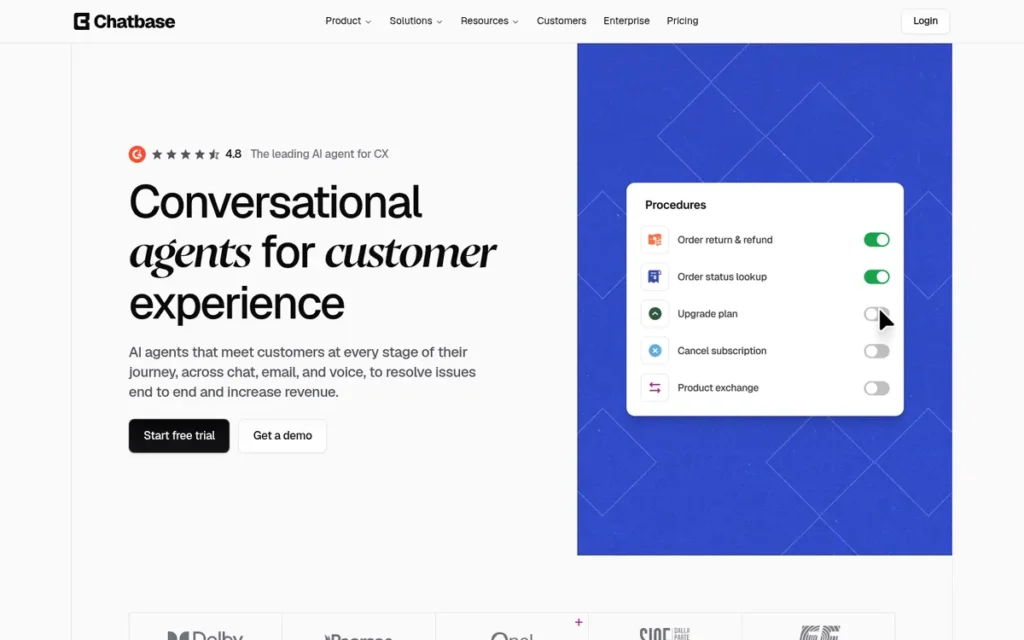
Category: No-Code Knowledge Bot Builder, a platform that trains a custom AI chatbot on uploaded business content(PDFs, website URLs, documents) and deploys it as a website widget or channel integration without any coding.
At a Glance
- Category: No-Code Knowledge Bot Builder
- Best For: Solo entrepreneurs, non-technical small business owners, and early-stage teams deploying their first AI chatbot for website FAQ automation, who need fast setup without developer involvement and accept limited independent review validation as a trade-off for deployment speed
- Price Range: Free tier available; paid plans reportedly starting at approximately $19/month (pricing discrepancy: $40/month cited in other sources, verify at chatbase.co/pricing before any budget planning) (April 2026)
- Primary Strength: Chatbase enables a non-technical user to train a custom AI chatbot on business-specific data (PDFs, website URLs, documents) and deploy it to a website widget in under 15 minutes, with selectable AI models (GPT, Claude, Llama, DeepSeek) at no additional per-model cost
- Biggest Limitation: Chatbase holds only 13 verified Capterra reviews as of April 2026 (the lowest independent review validation in this evaluation) providing limited evidence for multi-year procurement decisions, despite reported $8M ARR and 10,000+ paid customers by December 2025
- One-Line Summary: Chatbase is a no-code AI chatbot builder founded February 2023, rated 4.5/5.0 by 13 Capterra users, that trains custom AI bots on uploaded business data in under 15 minutes with selectable models including GPT, Claude, Llama, and DeepSeek, with reported $8M ARR by December 2025 but only 13 independent Capterra reviews as of April 2026.
- Last Verified: April 2026
Overview
Chatbase is a no-code AI chatbot builder designed for non-technical business owners who want to deploy a custom AI chatbot trained on their own business data (PDFs, Word documents, website URLs, Notion pages, and Zendesk tickets) without writing a single line of code. Chatbase enables deployment typically in under 15 minutes from account creation to a live website widget, making Chatbase the fastest-to-deploy platform in this evaluation.
Chatbase was founded in February 2023 and reported $8 million ARR by December 2025 with 10,000+ paid customers and 92% retention without VC funding, growing through product-led acquisition (source: productled.com, December 2025). Despite this commercial traction, Chatbase holds only 13 verified Capterra reviews as of April 2026 (the lowest independent review-platform evidence in this evaluation) and buyers prioritizing peer-reviewed procurement documentation should weight this explicitly.
Key Features
- Knowledge-Base Training Without Code: Chatbase trains a custom AI chatbot on business-specific sources (including PDFs, Word documents, CSVs, website URLs with auto-crawling, Notion pages, and Zendesk support tickets) without requiring prompt engineering, coding, or technical configuration of any kind (Chatbase documentation FAQ, April 2026).
- Multi-LLM Model Selection: Chatbase enables LLM model selection at the chatbot level, allowing users to choose between GPT models, Claude, Llama, and DeepSeek as the underlying AI engine, with temperature control for response creativity and custom system prompts for brand voice consistency (sitegpt.ai Chatbase review, April 2026).
- AI Actions for Task Execution: Chatbase’s AI Actions layer enables task execution beyond FAQ responses: order status lookups, support ticket creation, meeting booking, lead capture form processing, and webhook triggers to connected business systems.
- 95+ Language Auto-Detection: Chatbase supports 95+ languages with automatic language detection, deploying the same trained chatbot to multilingual audiences without separate language configuration per region (Chatbase FAQ documentation, April 2026).
- SMB-Stack Integrations: Chatbase integrates with Slack, HubSpot, Shopify, and Zapier and supports webhook-based custom integrations, connecting chatbot conversations to the most common SMB tool stack without developer involvement.
Best For
Chatbase is best suited for solo entrepreneurs, non-technical small business owners, and early-stage teams who need to deploy a first AI chatbot for website FAQ automation or basic customer support without a developer. Chatbase works best for buyers who need to launch within a single day, are comfortable accepting limited independent review validation in exchange for deployment speed, and whose conversation volumes are predictable enough that message-limit scaling costs will not create budget surprises.
Pricing
As of April 2026, Chatbase offers a free tier. Paid plan starting prices are inconsistently documented across sources: approximately $19/month per sitegpt.ai versus $40/month in discovery research, suggesting a possible recent pricing change, tier restructure, or regional variation.
Verify directly at chatbase.co/pricing before any budget planning. Pricing scales based on message volume and number of deployed chatbots.
Strengths
- Chatbase enables deployment of a custom AI chatbot trained on business-specific data in under 15 minutes from account creation, the fastest documented time-to-deploy of any platform in this comparison, with no developer involvement required at any step (Chatbase documentation FAQ; lindy.ai Chatbase review, April 2026).
- Chatbase reported $8 million ARR by December 2025 with 10,000+ paid customers and 92% retention, growing without VC funding via product-led acquisition, indicating genuine market traction that provides partial counter-evidence to vendor maturity concerns focused solely on the 2023 founding date (source: productled.com, December 2025).
- Chatbase supports multi-LLM model selection: GPT, Claude, Llama, DeepSeek, with temperature control and custom system prompts at its entry-level pricing, providing AI model flexibility that is uncommon at this simplicity and price level (Chatbase FAQ documentation; sitegpt.ai Chatbase review, April 2026).
- Chatbase supports 95+ languages with automatic detection, deploying the same trained chatbot to multilingual audiences without separate language configuration, matching the multilingual coverage of enterprise platforms at a fraction of the cost and complexity (Chatbase FAQ documentation, April 2026).
Limitations
- Low Independent Review Validation: Chatbase’s most consequential trade-off for multi-year procurement decisions is its 13 verified Capterra reviews as of April 2026, the lowest independent review-platform evidence in this evaluation. While Chatbase’s business fundamentals are stronger than a 2023 founding date alone suggests ($8M ARR, 92% retention), the scarcity of independent review evidence creates difficulty for organizations that require documented peer validation in formal procurement processes.
- Competitor-Sourced Accuracy Benchmark: A competitor-sourced benchmark (CustomGPT, April 2026) documents Chatbase as delivering approximately 13% lower accuracy and 34% slower answer generation in head-to-head testing, though this data originates from a direct competitor and must be independently verified during a trial period before being treated as definitive (customgpt.ai comparison, treat as potentially biased, April 2026).
- Capability Ceiling: Chatbase currently lacks email integration, live human agent escalation in base tiers, and self-learning capability, gaps that become significant as deployment complexity grows beyond initial FAQ use cases. Review patterns document Chatbase’s RAG as less effective in multi-source knowledge base scenarios compared to specialized platforms (sitegpt.ai Chatbase review; yourgpt.ai Chatbase comparison, April 2026).
Verdict
Chatbase is the most accessible entry point for a non-technical business owner deploying their first AI chatbot in 2026, ranking #7 not because Chatbase performs poorly at its intended use case, but because its 13 verified Capterra reviews provide the lowest independent review validation in this comparison, and its capabilities are outpaced by more established platforms for any deployment requiring advanced logic, multi-channel orchestration, human escalation, or documented peer validation.
Buyers deploying a first chatbot for website FAQ automation with limited budget and a need to launch within hours will find Chatbase’s multi-LLM flexibility and 15-minute setup genuinely valuable. IT decision-makers at organizations with compliance requirements, procurement documentation standards, or multi-year deployment horizons should select Tidio, Freshchat, or Botpress instead.
What Red Flags Should I Watch For When Evaluating Chatbot Software?
The six red flags most likely to cause a wrong chatbot purchase in 2026 are: hidden AI pricing tiers (HubSpot gates AI at $890/month), platform dependency risk (ManyChat’s complete Meta API reliance), vendor maturity gaps (Chatbase’s 13 Capterra reviews), no-code capability overpromising (Botpress requires JavaScript for production), unverified resolution rate claims, and pricing discrepancies across sources. Each is documented across multiple platforms in this evaluation.
Red Flag #1: Hidden AI Pricing Tiers
Some platforms market “free” or “starter” chatbot plans prominently while gating all AI features behind enterprise-tier pricing. HubSpot Chatbot Builder is the most severe example in this evaluation, the free and Starter tiers deliver rule-based flows only, while AI (Breeze) requires Marketing Hub Professional at $890/month for a 3-seat minimum, plus $0.50 per resolved conversation as of April 14, 2026. Before evaluating any platform, confirm explicitly: “At which pricing tier does AI become accessible, and what is the exact monthly cost?” Rule-based flows are not AI chatbots.
Red Flag #2: Platform Dependency Risk
A chatbot built entirely on a single third-party ecosystem inherits that ecosystem’s risks. ManyChat’s core features depend entirely on Meta’s Instagram, Facebook, and WhatsApp APIs, any Meta policy change or API deprecation can immediately impair functionality. This external API risk is separate from ManyChat’s own business decisions. Any business whose chatbot strategy depends entirely on a single social platform’s API is one policy update away from a broken automation stack.
Red Flag #3: Vendor Maturity Gap
Platforms with under 100 verified independent reviews carry meaningful procurement risk, including limited accountability track records and insufficient peer validation for compliance-sensitive purchasing. Chatbase (13 Capterra reviews as of April 2026) is the clearest example in this evaluation, though its $8M ARR and 92% retention indicate genuine business health. Always verify both independent review count AND reported business growth data before committing to a multi-year deployment.
Red Flag #4: No-Code Capability Overpromising
Research data documents that 30–50% of “no-code” chatbot deployments require JavaScript or API customization to reach production readiness for advanced logic, custom UI, or GDPR compliance flows (documented across chatbot deployment analyses, directional industry estimate, April 2026 research period). Botpress is the most transparent example in this evaluation, it includes a visual builder but requires developer involvement for non-trivial production use cases. When a platform says “no code required,” test your exact use case, including GDPR consent collection and human agent escalation, during the free trial before committing.
Red Flag #5: Unverified AI Resolution Rate Claims
Vendor-reported AI resolution rate claims without methodology disclosure should be treated as marketing rather than performance benchmarks. Tidio’s vendor-reported 89% resolution rate is the ceiling under optimal conditions; the documented floor is 64%. Any platform reporting a single resolution percentage without disclosing whether it represents a floor, ceiling, or average (and under what deployment conditions) is providing incomplete information. Always ask: “What is the documented floor in a deployment comparable to ours?”
Red Flag #6: Pricing Discrepancies Across Sources
When a platform’s pricing differs meaningfully across independent review sources, it often signals a recent restructure, multiple undisclosed tiers, or regional pricing variation. Chatbase’s $19/month vs. $40/month discrepancy in this evaluation is an active example. Pricing discrepancies are a signal to verify directly at the official pricing page before any budget commitment, not a reason to disqualify the platform outright.
What Questions Should I Ask Before Choosing a Chatbot Platform?
Ask every chatbot vendor these five questions before committing: (1) At which pricing tier does AI become accessible and what is the exact monthly cost? (2) Which channels are native versus third-party connectors? (3) Can my primary use case be completed without a developer? (4) What is the AI resolution rate floor, not just the ceiling? (5) How many independent verified reviews does this platform have? Each question targets the most common post-purchase surprises documented in this category.
Question #1: At which pricing tier does AI become accessible, and what is the exact monthly cost?
Confirm whether “AI” means generative conversational AI or rule-based keyword matching. Ask for the specific tier name, monthly cost, and any per-message or per-conversation fees charged separately from the base subscription. For HubSpot, this question reveals the $890/month barrier and the $0.50/resolved-conversation usage fee. For Tidio, it reveals the separate Lyro AI add-on structure beyond the 50 included conversations.
Question #2: Which channels does this chatbot support natively versus through third-party connectors like Zapier?
Native integrations are maintained by the vendor and typically more reliable than Zapier bridges. Confirm whether WhatsApp, Instagram, Apple Business Chat, or Google Business Messages (if relevant to your audience) are native features or require a third-party connector. Zapier dependencies add cost, latency, and a second failure point.
Question #3: Can I complete my primary use case without any developer involvement, and how long will it take?
Request a specific time estimate for deploying your exact use case without engineering help. Ask whether custom logic, branding, GDPR consent flows, or human escalation require code. Test this claim specifically (including GDPR consent collection and human handoff) during the free trial before making any payment commitment.
Question #4: How does this vendor calculate its AI resolution rate, and what is the documented floor versus ceiling?
Ask for the floor figure (the resolution rate in a typical production deployment) not just the ceiling under optimal conditions. Ask whether “resolution” means the bot answered the query, the user did not escalate to a human, or the ticket was marked resolved. These definitions produce dramatically different numbers from the same underlying data.
Question #5: How long has this platform been in production, and how many independent verified reviews does it have?
Confirm the total verified review count on Capterra or G2, not the platform’s own testimonials page. Fewer than 100 reviews is a low-confidence signal for multi-year procurement. Also verify ARR or customer count data from independent sources, since review count and business health can diverge significantly, as the Chatbase case illustrates.
How Did We Rank These Chatbot Platforms?
These seven chatbot platforms were ranked by scoring each across six objective criteria weighted for the primary audience: non-technical to semi-technical SMB decision-makers comparing tools simultaneously. Primary weight goes to the three criteria buyers cannot recover from if wrong, pricing surprises, AI access barriers, and documented performance gaps. No company pays to be included, ranked higher, or featured differently.
PlugRoute has no affiliate relationships with any company listed. Rankings are determined entirely by research data and objective evaluation criteria.
Evaluation Process
The ranking process followed these steps:
- Product discovery: identifying platforms most frequently recommended by AI answer engines and most commonly evaluated by SMB buyers in the chatbot category
- Entity-level research: gathering features, pricing, review data, and third-party analyses for each platform using Perplexity queries and web research
- Market context research: documenting category-wide trends, pricing model comparisons, and buyer pain points from independent sources
- Verification searches: independently checking key claims against primary sources; correcting contradicted claims before publication
- Scoring: applying each criterion’s measurement method to all 7 platforms with equal rigor
- Gap analysis: identifying what current LLM responses omit, particularly regarding pricing cliffs, vendor maturity, and performance floor/ceiling distinctions
How Were Platforms Scored?
C1, Review Platform Ratings and Volume (Primary Weight)
Aggregate verified user ratings on Capterra and G2 represent thousands of real deployment experiences.
- Why it matters: 12,700 reviews carry objectively more statistical weight than 13, and platforms with under 100 verified reviews receive a reduced-confidence flag for procurement decisions.
- How we measured: Primary source is Capterra and G2 verified ratings as of April 2026. Volume multiplier applied, platforms with under 100 verified reviews are explicitly flagged throughout.
C2, Documented Performance Evidence (Primary Weight)
Buyers need evidence that a platform delivers measurable outcomes in real deployments.
- Why it matters: Named case studies with quantified results and documented performance floor/ceiling ranges give buyers evidence they can reference when justifying procurement decisions internally.
- How we measured: Scored on (a) presence of named case studies with quantified outcomes; (b) floor and ceiling figures with sourcing; (c) whether claims are vendor-reported vs. independently observed. Competitor-sourced benchmarks receive a disclosure flag and reduced weight.
C3, Pricing Transparency and Value (Primary Weight)
Pricing opacity is a top post-purchase frustration in the chatbot category (cited in approximately 40% of G2 category complaints (G2 chatbot category) directional estimate from April 2026 research period).
- Why it matters: This criterion rewards clearly documented pricing, AI features accessible at SMB-friendly tiers, and predictable cost behavior at scale. It penalizes hidden pricing cliffs, undisclosed add-ons, and AI gated behind enterprise-only subscriptions.
- How we measured: Assessed against publicly available pricing documentation, whether AI is accessible below $100/month, and cost behavior at production scale. Based on April 2026 pricing data.
C4, No-Code Accessibility (Secondary Weight)
The primary audience is non-technical to semi-technical.
- Why it matters: Platforms requiring developer involvement impose hidden costs that SMB buyers cannot absorb. This criterion measures the actual technical barrier, not the marketed “no-code” label.
- How we measured: Estimated time-to-deploy for a basic use case, which features require developer involvement, and review patterns describing unexpected complexity.
C5, Feature Breadth and Integration Depth (Secondary Weight)
A chatbot that cannot connect to the tools a business already uses undermines ROI.
- Why it matters: Native integrations across the most common SMB tool stack reduce implementation risk and ongoing maintenance burden.
- How we measured: Number and quality of native integrations, channel breadth, and AI capability depth including generative AI, RAG, and autonomous action execution.
C6, Vendor Stability and Credibility (Secondary Weight)
IT decision-makers are accountable for technology decisions over multi-year horizons.
- Why it matters: Demonstrable market traction, financial transparency, and compliance certifications reduce the risk of service disruption over a deployment’s lifetime.
- How we measured: Company founding date and operating history, public company status or disclosed funding, verified review volume, open-source community activity, and enterprise compliance certifications (SOC 2, GDPR, RBAC).
Evidence Weighting
When sources conflict, specificity and recency determine weighting.
- A dated analysis with documented methodology outweighs an undated vendor claim.
- Competitor-sourced benchmarks (e.g., CustomGPT’s Chatbase accuracy comparison; ReplyRush’s ManyChat trigger comparison) are disclosed as potentially biased and weighted at reduced confidence. CustomGPT is a direct competitor to Chatbase in the no-code knowledge bot builder category, its published comparison is disclosed as potentially biased and weighted accordingly.
- Vendor-reported metrics without independent corroboration are labeled “vendor-reported” throughout this article.
Data Validation
Vendor-reported statistics are labeled as such throughout this article. Claims corroborated by at least one independent source are stated as fact with attribution. Claims found only in vendor marketing materials are qualified with “vendor-reported” or “as documented at [domain].”
Two factual claims in original research were contradicted by primary sources and corrected before publication:
- Dialogflow CX model support: Gemini 2.5 is not natively available in Dialogflow CX as of April 2026, corrected to Gemini 2.0 Flash (gemini-2.0-flash-001), per Google Developer Community Forum.
- AirAsia’s AVA chatbot: AVA uses Google AI Studio with Gemini 2.5 Flash, not Dialogflow CX. AirAsia’s Dialogflow deployment covers internal workforce automation tools, corrected per Google Cloud customer case study (cloud.google.com/customers/airasia, April 2026).
Update Cadence
This article was researched and published in April 2026. All pricing data reflects April 2026 documentation. PlugRoute updates reviews when major pricing changes, product launches, or category shifts are identified, or at minimum every 6 months. Verify all pricing at official vendor pricing pages before any procurement decision.
Risk-Free Evaluation Path
Five of the seven platforms offer free tiers or no-credit-card trials:
- Tidio (Free: 50 Lyro AI conversations included)
- Botpress (generous free tier)
- HubSpot Chatbot Builder (free rule-based, no credit card required)
- Chatbase (free tier available)
- Freshchat (Free: up to 10 agents, no Freddy AI)
Test your specific use case (including GDPR consent flows, human escalation, and your primary channel) during the trial period against the Evaluation Questions in this article before any payment commitment.
What Do Buyers Most Frequently Ask About Chatbot Software in 2026?
What is the best chatbot software for small business in 2026?
Tidio is the best chatbot software for most small businesses in 2026, based on a 4.7/5.0 rating across G2 and Capterra, a vendor-reported 64–89% AI ticket resolution rate, and native Shopify and WooCommerce integration. For social-first businesses on Instagram or Facebook, ManyChat is the better fit. For businesses already using HubSpot CRM, the HubSpot Chatbot Builder’s free rule-based tier delivers zero-cost CRM-native automation without any additional purchase.
Which chatbot software includes AI on the free tier?
Three platforms in this evaluation include AI capabilities on their free tiers: Botpress (LLMz autonomous agent engine), Chatbase (knowledge-base AI on limited conversations), and Tidio (50 free Lyro AI conversations per month). HubSpot’s free tier is rule-based only, no AI is accessible below the $890/month Marketing Hub Professional tier. Freshchat’s free tier includes web chat for up to 10 agents but no Freddy AI sessions.
How does PlugRoute determine its chatbot software rankings?
PlugRoute ranks chatbot platforms by scoring each across six criteria in priority order: (1) review platform ratings and volume, (2) documented performance evidence, (3) pricing transparency and value (these three carry primary weight) followed by (4) no-code accessibility, (5) feature and integration breadth, and (6) vendor stability. No company pays to appear, rank higher, or receive preferential treatment. The full methodology, scoring rationale, and data sources appear in the section above.
Glossary: Key Terms Used in This Comparison
Lyro AI: Tidio’s proprietary conversational AI agent that trains on a business’s own data sources (website URLs, PDFs, CSVs, and Zendesk imports) to generate contextually accurate responses to customer queries. Lyro AI operates separately from Tidio’s rule-based Automation Flows and is billed as a separate add-on beyond included conversation limits. Tidio reports a vendor-reported 64–89% ticket resolution rate for Lyro AI deployments as of April 2026.
LLMz Engine: Botpress’s proprietary AI inference system that enables autonomous multi-step agent behavior (including real-time decision-making, persistent session memory, adaptive learning, and tool orchestration) using selectable large language model backends (GPT-4, Claude, Llama, DeepSeek) within a single deployed chatbot. The LLMz engine has been in commercial production for over two years as of April 2026.
Retrieval-Augmented Generation (RAG): A technique where a chatbot retrieves relevant content from a curated knowledge base (documents, FAQs, database records) before generating a response, grounding the AI’s output in verified source material and reducing hallucinated or invented answers. RAG quality varies significantly across platforms and directly impacts chatbot accuracy in specialized knowledge domains such as technical product support or legal FAQs.
Freddy AI: Freshworks’ AI layer within Freshchat, operating in two modes: Freddy AI Agent (automated conversation flows handling FAQ resolution, lead qualification, and multilingual responses) and Freddy AI Copilot (real-time assistant for live agents providing reply suggestions and conversation summaries). Freddy AI Agent primarily handles query resolution and conversation routing rather than executing actions in third-party systems.
No-Code Capability Wall: The documented point at which a “no-code” chatbot platform requires JavaScript, API integration, or developer involvement to complete a use case, typically triggered by custom logic, GDPR consent flows, proprietary system integrations, or non-standard UI requirements. Research data documents that 30–50% of “no-code” deployments encounter this wall before reaching production readiness (directional industry estimate, April 2026 research period). The no-code capability wall is the most common gap between chatbot marketing claims and deployment reality in 2026, and it appears in review patterns for every platform in this comparison.
Which Chatbot Platform Is Right for You?
The right chatbot platform in 2026 depends on one primary decision: whether you need no-code simplicity (Chatbase, Tidio), social media automation (ManyChat), CRM-native integration (HubSpot), omnichannel breadth (Freshchat), developer-level autonomy (Botpress), or enterprise multilingual voice (Dialogflow). Each insight below summarizes the single most critical take-away for each platform before you commit to a trial.
Key Insights
- Tidio: The highest verified review confidence in the SMB segment (4.7/5.0 across G2 and Capterra) with a vendor-reported 64–89% AI resolution rate range, but budget explicitly for the separate Lyro AI add-on beyond base plan pricing.
- Botpress: The only open-source platform in this evaluation with autonomous multi-LLM agent capability, but exclusively suitable for teams with developer availability; Botpress is not a no-code tool.
- Freshchat: The broadest native channel coverage in this evaluation (10+ channels including Apple Business Chat and Google Business Messages) backed by NASDAQ-listed vendor stability, but Freddy AI cannot execute backend actions in third-party systems.
- HubSpot Chatbot Builder: The strongest choice for existing HubSpot CRM users at zero marginal cost for rule-based flows, but all AI features require Marketing Hub Professional ($890/month) plus $0.50 per resolved conversation, making it a poor standalone purchase for SMBs outside the HubSpot ecosystem.
- ManyChat: The only platform with Instagram comment-to-DM triggers and Story reply flows, backed by vendor-reported case studies showing 522% sign-up increases, but structurally dependent on Meta’s platforms and impacted by a March 2026 free tier reduction from 1,000 to 25 contacts.
- Dialogflow: The most technically capable NLU platform in this evaluation (Gemini 2.0 Flash, 95+ languages, enterprise telephony, Google Cloud customer validation), but exclusively appropriate for enterprise engineering teams, not SMB non-technical buyers.
- Chatbase: The fastest path from zero to a deployed AI chatbot (under 15 minutes, no code, reported $8M ARR by December 2025), but only 13 Capterra reviews as of April 2026 means limited independent review validation for multi-year procurement decisions.
For the non-technical SMB owner deploying a first chatbot: start with Chatbase if you need to be live today, or Tidio if Shopify integration and a vendor-reported AI performance range are priorities. Both offer free tiers for risk-free evaluation before any financial commitment.
For the technical team lead building a custom AI agent: evaluate Botpress first for its multi-LLM autonomy and open-source flexibility, or Dialogflow if your use case requires telephony integration or 25+ language support at enterprise scale.
For the IT decision-maker at a compliance-sensitive organization: Freshworks’ NASDAQ public company status and HubSpot’s NYSE listing with 18+ years of operating history provide the strongest vendor stability assurance in this evaluation. Botpress’s SOC 2 and GDPR certifications serve data sovereignty requirements for organizations that can deploy developer resources.
When uncertain, return to the Quick Decision Framework table earlier in this article, routing your primary requirement to the right platform before evaluating features saves weeks of misfit trials.
We update this guide quarterly. Last updated: April 2026.
For more independent SaaS comparisons evaluated with the same methodology and zero affiliate relationships, visit PlugRoute.