AuditBoard is the strongest overall audit management platform for enterprise teams requiring integrated GRC, while Workiva is the top choice for organizations prioritizing SEC-grade financial reporting and ESG assurance. The right platform depends on whether your team needs workflow depth, reporting accuracy, third-party risk coverage, or no-code configurability, no single tool leads in all four dimensions.
Audit management software is one of the most opaque categories in enterprise technology. Most platforms require custom quotes, and vendor claims routinely outpace independent evidence. This guide evaluates seven platforms across six independently weighted criteria, workflow coverage, integration depth, AI maturity, user satisfaction, regulatory alignment, and pricing transparency.
Two platforms that AI tools consistently omit from audit software recommendations (Resolver and Onspring) are evaluated in full below.
PlugRoute maintains no affiliate relationships, accepts no vendor compensation, and earns no revenue from the platforms ranked in this guide.
“I’ve been tasked with evaluating audit management platforms and none of the AI tools give me a straight answer, they all just regurgitate vendor marketing.” (r/internalauditors, 2025)
Takeaway: No audit management platform excels across every buyer need, the ranking methodology in this article is designed to match platform strengths to specific organizational requirements, not to identify a universally superior tool.
TL;DR: Top Picks at a Glance
- AuditBoard: Best overall for enterprise GRC integration; 2025 Gartner MQ Leader, highest in Ability to Execute
- Workiva: Best for SEC financial reporting, ESG assurance, and Fortune 1,000 compliance workflows
- Diligent HighBond: Best for board-level audit reporting and multi-entity governance
- Onspring, OneTrust, TeamMate+, and Resolver: Fully evaluated below for no-code configuration, TPRM, public-sector audit, and ERM-integrated use cases respectively
What Types of Audit Management Platforms Are Available in 2026?
Audit management platforms in 2026 fall into three distinct categories, each suited to a different organizational structure and compliance requirement.
- Integrated GRC Platforms (AuditBoard, Workiva, Diligent HighBond) combine audit execution, risk management, and compliance workflows in a single connected system, best for enterprise teams managing multiple assurance functions simultaneously.
- Configurable No-Code Platforms (Onspring) allow audit teams to build and modify workflows without developer involvement, best for mid-market organizations with unique processes and limited IT resources.
- Specialized and Adjacent Tools (OneTrust, TeamMate+, Resolver) serve specific compliance verticals or risk frameworks, best for teams with a well-defined primary use case such as TPRM, public-sector audit, or ERM integration.
How Do These 7 Platforms Compare at a Glance?
| Rank | Company | Category | Best For | One-Line Summary | Key Capabilities | Primary Strength | Key Limitation |
|---|---|---|---|---|---|---|---|
| #1 | AuditBoard | Integrated GRC | Enterprise internal audit + connected risk | 2025 Gartner MQ Leader with the deepest end-to-end GRC workflow coverage in this comparison | Audit execution, risk management, SOX compliance, AI-assisted documentation | Highest Ability to Execute in 2025 Gartner MQ for GRC Tools; Assurance Leaders | Per-module pricing adds cost complexity; Hg Capital acquisition (2024) introduces ownership continuity questions |
| #2 | Workiva | Integrated GRC | SEC reporting, ESG assurance, Fortune 1,000 compliance | Connected reporting platform trusted by 85%+ of Fortune 1,000 for financial and non-financial assurance | SEC reporting automation, multi-framework ESG, collaborative workpaper management | Cross-functional data linkage between audit, finance, and ESG in a single linked data model | Enterprise-only pricing; limited audit-native workflow depth for non-reporting use cases |
| #3 | Diligent HighBond | Integrated GRC | Board reporting + multi-entity governance | Integrated GRC platform with the strongest board-to-auditor reporting layer in this category | Audit analytics, CAATs integration, board reporting dashboards, compliance management | Board-level dashboard and governance reporting depth | CAATs and analytics features require technically skilled users; enterprise-only pricing |
| #4 | Onspring | Configurable No-Code | Mid-market teams requiring custom audit workflows | No-code GRC platform that configures to any audit framework without developer involvement | Drag-and-drop workflow builder, pre-built app library, API integration | Full configuration flexibility without coding skills | Lacks natively embedded CAATs; advanced analytics require third-party tools |
| #5 | OneTrust | Compliance-Adjacent | TPRM + privacy-integrated audit programs | 2026 Gartner MQ Leader for TPRM Tools; strongest for organizations managing third-party assurance | Third-party risk management, privacy compliance, vendor assessment automation | TPRM and privacy integration in a single platform | Not a core audit execution platform; internal audit workflow depth is weaker than audit-native competitors |
| #6 | TeamMate+ | Traditional Audit | Public sector + large enterprise audit departments | Purpose-built audit management platform rated 4.3/5 on Capterra (116 reviews, August 2025) | Workpaper management, risk-based planning, audit scheduling, analytics module | Regulatory compliance depth for government and public-sector auditors | Legacy UI creates adoption friction; AI-native automation is less developed than newer platforms |
| #7 | Resolver | Risk-Integrated | Mid-market organizations with existing ERM infrastructure | Kroll-owned risk and audit platform suited for teams extending an existing risk framework into internal audit | Incident management, risk assessment, audit workflow, ERM integration | Deep ERM-to-audit workflow connectivity within the Resolver ecosystem | Value depends heavily on pre-existing Resolver ERM infrastructure; Kroll ownership introduces vendor consolidation risk |
Quick Decision Framework
| Your #1 Priority | Recommended Tool | Why | Acceptable Alternative |
|---|---|---|---|
| End-to-end GRC integration | AuditBoard | 2025 Gartner MQ Leader; highest Ability to Execute; deepest connected workflow coverage evaluated | Diligent HighBond |
| SEC + ESG reporting accuracy | Workiva | Trusted by 85%+ of Fortune 1,000; linked data model prevents reporting errors across concurrent filings | AuditBoard |
| Board-level audit visibility | Diligent HighBond | Strongest board reporting layer in this comparison; designed for multi-entity governance structures | Workiva |
| Custom workflows, no developer | Onspring | Only platform in this list built entirely on a no-code configuration model | Resolver |
| Third-party risk + privacy | OneTrust | 2026 Gartner MQ Leader for TPRM Tools; only platform integrating TPRM and privacy in one product | Diligent HighBond |
| Public sector audit compliance | TeamMate+ | Purpose-built for government audit departments; 4.3/5 Capterra overall rating (August 2025) | AuditBoard |
| ERM-integrated audit, mid-market | Resolver | Deepest ERM-to-audit connectivity for existing Resolver ecosystem users | Onspring |
#1. AuditBoard: Best Overall for Enterprise GRC Integration
Category: Integrated GRC Platform
At a Glance
- Category: Integrated GRC Platform
- Best For: Enterprise internal audit, SOX compliance, and cross-functional risk management
- Price Range: Custom quote required; per-module licensing model
- Primary Strength: AuditBoard placed highest in Ability to Execute in the 2025 Gartner Magic Quadrant for GRC Tools, Assurance Leaders (announced October 31, 2025)
- Biggest Limitation: Per-module pricing significantly increases total cost as teams expand; Hg Capital’s June 2024 acquisition and July 2025 CEO change introduce ownership continuity questions for long-term contracts
- One-Line Summary: AuditBoard is the highest-rated enterprise GRC platform for internal audit teams seeking connected risk, compliance, and audit execution in a single system
- Last Verified: April 2026
Overview
AuditBoard is a cloud-native integrated GRC platform designed for enterprise internal audit, SOX compliance, and risk management teams. AuditBoard was named a Leader in the 2025 Gartner Magic Quadrant for Governance, Risk and Compliance Tools, Assurance Leaders (announced October 31, 2025), placing highest in Ability to Execute and furthest in Completeness of Vision among all evaluated vendors. AuditBoard serves more than 50% of the Fortune 500 (AuditBoard, 2025 customer data) and is best suited for organizations that need a unified platform spanning audit execution, continuous control monitoring (CCM), and enterprise risk visibility.
Key Features
- AuditBoard’s OpsAudit module provides end-to-end audit lifecycle management: from risk-based planning through fieldwork, workpaper review, and finding reporting, in a single connected environment.
- AuditBoard’s CrossComply module delivers SOX process documentation, controls testing, and deficiency management in a workflow that links directly to financial reporting stakeholders.
- AuditBoard’s RiskOversight module connects audit findings to enterprise risk data, enabling audit teams to report risk trends to the board without rebuilding dashboards from scratch.
- AuditBoard’s AI-assisted documentation features use machine learning to support control documentation, evidence collection, and workpaper preparation, reducing manual workpaper effort in SOX testing cycles.
- AuditBoard’s no-code configuration layer allows audit administrators to customize workflows, templates, and reports without developer support, and a confirmed Protiviti partnership (BusinessWire, October 2024) extends implementation expertise for complex enterprise deployments.
Best For
AuditBoard is best for enterprise internal audit departments managing SOX compliance, operational audits, and enterprise risk reporting in a single connected platform. AuditBoard’s integration depth makes it particularly effective for CAE-level teams that need real-time board dashboards alongside day-to-day audit workflow management.
Strengths
- AuditBoard was named a Leader in the 2025 Gartner Magic Quadrant for Governance, Risk and Compliance Tools (Assurance Leaders (announced October 31, 2025), placing highest in Ability to Execute and furthest in Completeness of Vision among all evaluated vendors) the highest recognition available in this category.
- AuditBoard’s Protiviti implementation partnership (confirmed via BusinessWire, October 2024) provides enterprise-grade deployment support for large-scale GRC rollouts.
- AuditBoard serves more than 50% of the Fortune 500, indicating broad enterprise validation across regulated industries (AuditBoard, 2025 customer data).
- AuditBoard’s continuous control monitoring (CCM) and AI-assisted documentation capabilities address the two most commonly cited audit efficiency gaps identified in the IIA Global Internal Audit Common Body of Knowledge (2024).
Users on r/InternalAudit shared their experience:
“We used sharepoint when we were small and uncomplicated. We now use AuditBoard and won’t ever be able to go back based on the complexity and value we’ve seen. I have one staff who used WDesk at his former employer, his feedback was that WDesk takes 10+ more click to do the same thing he can do in AB with one. Interestingly enough, that employer is now switchin the AB themselves. The largest part of any application switch is that you need to make an investment in your time and processes to gain the value. You’re buying a toolkit that can do a LOT of things, you need to decide what you want to use and how you want to use it. There isn’t just one way to get things done.” Posted by u/RigusOctavian
Takeaway: AuditBoard delivers measurable workflow gains for enterprise teams that invest in proper configuration, but the platform’s complexity demands a dedicated administration commitment that buyers should model into implementation budgets before signing.
Limitations
- Per-Module Cost Structure: AuditBoard’s modular licensing means that expanding from audit execution into risk and compliance modules adds significant incremental cost, teams should model total cost of ownership across all required modules before comparing AuditBoard against all-in-one alternatives.
- Ownership Continuity Risk: AuditBoard was acquired by Hg Capital in June 2024, and a new CEO was installed in July 2025, buyers in long-term procurement cycles should evaluate vendor stability and roadmap continuity as part of due diligence for multi-year contracts.
- Implementation Timeline: AuditBoard implementations for enterprise GRC typically require 3–6 months of configuration and stakeholder training; teams expecting rapid time-to-value should factor this investment into project planning.
- Partnership Attribution: A reported partnership with EY US has been cited in trade press (International Accounting Bulletin) but has not been independently corroborated in primary source filings as of April 2026, buyers should verify scope and terms directly with AuditBoard.
Users on r/InternalAudit noted:
“AuditBoard is intuitive as others have mentioned but their support sucks. Open a ticket, takes forever to get an answer and when we do it’s not really helpful. We are discontinuing our contract with them and looking into other options.” Posted by u/Thehowltonight
Takeaway: AuditBoard’s support responsiveness is a recurring user complaint that prospective enterprise buyers should probe directly through reference calls, particularly before committing to multi-year contracts without embedded support-level guarantees.
Verdict
AuditBoard is the strongest enterprise GRC platform in this comparison, earning its #1 rank through independent Gartner recognition, verified Fortune 500 adoption, and the most complete audit-to-risk workflow coverage evaluated. Teams expanding from pure audit execution into connected risk and compliance management will find AuditBoard’s integration depth difficult to match, though the modular pricing model and 2024 ownership change warrant careful due diligence for multi-year contracts.
#2. Workiva: Best for SEC Reporting and ESG Assurance

Category: Integrated GRC Platform
At a Glance
- Category: Integrated GRC Platform
- Best For: Enterprise organizations requiring SEC financial reporting, ESG assurance, and cross-functional data accuracy across concurrent regulatory filings
- Price Range: Custom quote required; enterprise-tier contracts only
- Primary Strength: Workiva’s linked data model connects audit, finance, and ESG workflows, preventing the transcription errors that are the most common source of material misstatements in multi-document reporting cycles
- Biggest Limitation: Workiva’s platform is optimized for reporting accuracy, not audit execution depth; teams seeking standalone workpaper management or risk-based audit planning will find these features less developed than in audit-native platforms
- One-Line Summary: Workiva is the leading connected reporting platform for Fortune 1,000 compliance teams managing SEC filings, ESG disclosures, and financial audit workflows simultaneously
- Last Verified: April 2026
Overview
Workiva is a cloud-based connected reporting platform used by 85%+ of Fortune 1,000 companies for SEC financial reporting and non-financial assurance (independent source, 2025). Workiva generates approximately $900 million in annual revenue, based on Q4 2025 earnings of $238.9 million, up 20% year-over-year (Workiva earnings release, February 2026). Workiva is best suited for finance, audit, and ESG teams that need a single source of truth across interconnected regulatory filings.
Key Features
- Workiva’s ARC Suite (Audit, Risk, and Compliance) connects internal audit execution to financial reporting workflows, allowing audit findings to flow directly into SEC filing preparation without manual re-entry or data reconciliation.
- Workiva’s Entity 360 Experience provides a consolidated view of subsidiary-level risk and compliance data across multi-entity organizations, reducing data reconciliation effort for group-level reporting.
- Workiva’s ESG Assurance Tab enables audit teams to review and document evidence for non-financial disclosures (including emissions data and DEI metrics) within the same workpaper environment used for financial audits.
- Workiva’s linked data architecture means a change in any source data cell automatically propagates across every connected report, presentation, and filing where that cell is referenced, eliminating copy-paste error risk during filing windows.
- Workiva’s XBRL tagging and SEC submission workflows are embedded natively, eliminating the need for third-party XBRL tools that typically introduce reconciliation risk during compressed filing timelines.
Best For
Workiva is best for enterprise finance and internal audit teams at Fortune 1,000 companies where SEC reporting accuracy, ESG disclosure integrity, and cross-functional data consistency are top priorities. Workiva is particularly well-suited for organizations managing concurrent financial, sustainability, and internal audit reporting cycles with overlapping data dependencies.
Strengths
- Workiva is used by 85%+ of Fortune 1,000 companies for SEC financial reporting, reflecting broad enterprise validation in a highly regulated use case (independent source, 2025).
- Workiva’s linked data architecture eliminates the copy-paste errors most commonly associated with multi-document reporting, a structural advantage over platforms that treat audit and finance as separate data environments.
- Workiva generated approximately $900 million in annual revenue (Q4 2025: $238.9M, up 20% YoY, Workiva earnings release, February 2026), indicating sustained enterprise investment and product development capacity.
- Workiva’s combined audit-ESG-finance workflow reduces the number of separate tools a compliance team must maintain, a critical efficiency gain for organizations facing expanding ESG reporting mandates under ISSB and CSRD frameworks.
Limitations
- Reporting-First Architecture: Workiva’s core strength is reporting accuracy, not audit workflow depth, teams that need advanced risk-based audit planning, CAATs integration, or real-time control monitoring will find these features less developed than in AuditBoard, Diligent HighBond, or TeamMate+.
- Enterprise-Only Budget Fit: Workiva’s pricing is designed for large enterprise budgets; mid-market organizations or teams with fewer than 20 audit staff are unlikely to achieve favorable unit economics relative to more audit-focused alternatives.
- Cross-Functional Implementation Dependency: Workiva implementations require significant finance and IT stakeholder coordination, particularly for XBRL tagging workflows, cross-functional organizational buy-in is a prerequisite for successful deployment.
- ESG Regulatory Flux Risk: Workiva’s ESG assurance features are built around evolving regulatory frameworks (including the SEC climate rule, ISSB, and CSRD) that remain subject to revision; buyers should confirm current framework coverage with Workiva before procurement.
This aligns with community sentiment on r/InternalAudit:
“My team is implementing Workiva and there are so many oddities that make no sense to me. I can only view PDFs by attaching them to a procedure, because if I add it to the files experience it downloads instead of opening in browser. No bulk upload, which is a nightmare for adding policies and procedures. Managing photos within reports is difficult, the data visualization is worse than advertised… our implementer is helping but we’ve had tons of questions about functionality where the response is ‘that’s just how Workiva is.'” Posted by u/PracticalWorry5921
Takeaway: Workiva’s implementation experience regularly surfaces undocumented workflow constraints that only become apparent after go-live, reinforcing the article’s caution that cross-functional buy-in and thorough reference checks are prerequisites before procurement.
Verdict
Workiva earns its #2 rank as the most capable connected reporting platform for organizations where SEC filing accuracy and ESG assurance are primary audit objectives. Workiva’s linked data model and verified Fortune 1,000 adoption make it the default choice for enterprise reporting teams, though audit-native workflow depth and mid-market budget fit are genuine limitations that should factor into any evaluation.
#3. Diligent HighBond: Best for Board Reporting and Multi-Entity Governance
Category: Integrated GRC Platform
At a Glance
- Category: Integrated GRC Platform
- Best For: Large enterprises and multi-entity organizations requiring board-level audit reporting and governance dashboards
- Price Range: Custom quote required; enterprise licensing
- Primary Strength: Diligent HighBond provides the deepest board-to-auditor reporting layer of any platform evaluated in this comparison
- Biggest Limitation: CAATs and data analytics features require technically skilled users; complexity slows adoption for leaner audit teams
- One-Line Summary: Diligent HighBond is an integrated GRC platform with market-leading board reporting depth, best suited for audit functions that need real-time governance visibility at the audit committee and board level
- Last Verified: April 2026
Overview
Diligent HighBond is an integrated governance, risk, and compliance platform developed by Diligent Corporation, a governance software vendor with over 1 million users across 90+ countries (Diligent, 2025). Diligent HighBond connects audit execution, risk management, compliance tracking, and board reporting in a single platform, with particular strength in surfacing audit results to board-level stakeholders through pre-built governance dashboards. Diligent HighBond is best suited for large enterprises and regulated organizations where the audit function reports directly to an audit committee or board.
Key Features
- Diligent HighBond’s Results module structures audit findings into board-ready reports automatically, eliminating the manual reformatting step that typically consumes hours of audit staff time before audit committee meetings.
- Diligent HighBond’s Storyboards feature aggregates risk, audit, and compliance data into executive-facing visualizations that non-technical stakeholders can interpret without audit team narration.
- Diligent HighBond’s CAATs integration connects to data extraction and analysis tools, enabling audit teams to analyze full transaction populations rather than statistical samples for higher-confidence conclusions.
- Diligent HighBond’s compliance management module maps controls to regulatory frameworks (including SOX, ISO 27001, and GDPR) allowing audit teams to assess coverage gaps across multiple standards simultaneously.
- Diligent HighBond’s multi-entity architecture supports subsidiary-level audit management with consolidated group reporting, making it well-suited for holding companies and regulated financial groups.
Best For
Diligent HighBond is best for large enterprise audit departments where board reporting quality, multi-entity consolidation, and governance visibility are primary evaluation criteria. Diligent HighBond is particularly effective for CAEs who need to demonstrate audit coverage and risk posture to an audit committee in real time.
Strengths
- Diligent HighBond’s board reporting layer is the most developed of any platform in this comparison, pre-built governance dashboards reduce audit committee preparation time and enable real-time risk communication.
- Diligent HighBond’s multi-entity consolidation capability supports complex organizational structures that single-entity platforms cannot accommodate without custom development.
- Diligent HighBond’s CAATs integration enables full-population audit testing: a capability that moves internal audit beyond sampling-based assurance toward more comprehensive transactional coverage.
- Diligent Corporation’s scale of 1 million+ users across 90+ countries (Diligent, 2025) provides product development resources and global support capacity that smaller audit software vendors cannot match.
Users on r/InternalAudit shared their experience:
“We use Diligent and it gets the job done at a fair price. We are a small team so that helps. They are constantly implementing new features and their tech support is really helpful. We recently demo’d Auditboard and Workiva. Liked them both a lot but they are both significantly more expensive than our current solution.” Posted by u/Embarrassed_Coach519
Takeaway: Diligent HighBond’s ongoing feature development cadence and accessible pricing relative to top-tier GRC competitors make it a credible alternative for teams that need integrated governance tooling without the cost structure of AuditBoard or Workiva.
Limitations
- Technical Skill Requirement: Diligent HighBond’s CAATs and data analytics features require dedicated data-literate staff, teams without technical audit analysts will underutilize these capabilities and may not recover the platform’s cost.
- Complexity-Adoption Trade-Off: Diligent HighBond’s feature depth creates a steep learning curve; smaller audit teams or those without dedicated system administrators frequently report longer-than-expected adoption timelines.
- Pricing Opacity: Diligent HighBond pricing is available only through enterprise sales engagement, teams cannot benchmark cost against alternatives without committing to a full demo and discovery cycle.
- Integration Configuration Effort: Connecting Diligent HighBond to existing ERP and ITSM systems requires custom integration work; organizations without IT resources to support this should include professional services costs in any total cost of ownership analysis.
Verdict
Diligent HighBond is the strongest choice in this comparison for large enterprises where board-level audit visibility and multi-entity governance are non-negotiable requirements. Diligent HighBond’s depth of board reporting and governance tooling justifies its complexity for the right buyer, but technical skill requirements and implementation investment make it a poor fit for lean or early-stage audit functions.
#4. Onspring: Best No-Code Configurable Audit Platform
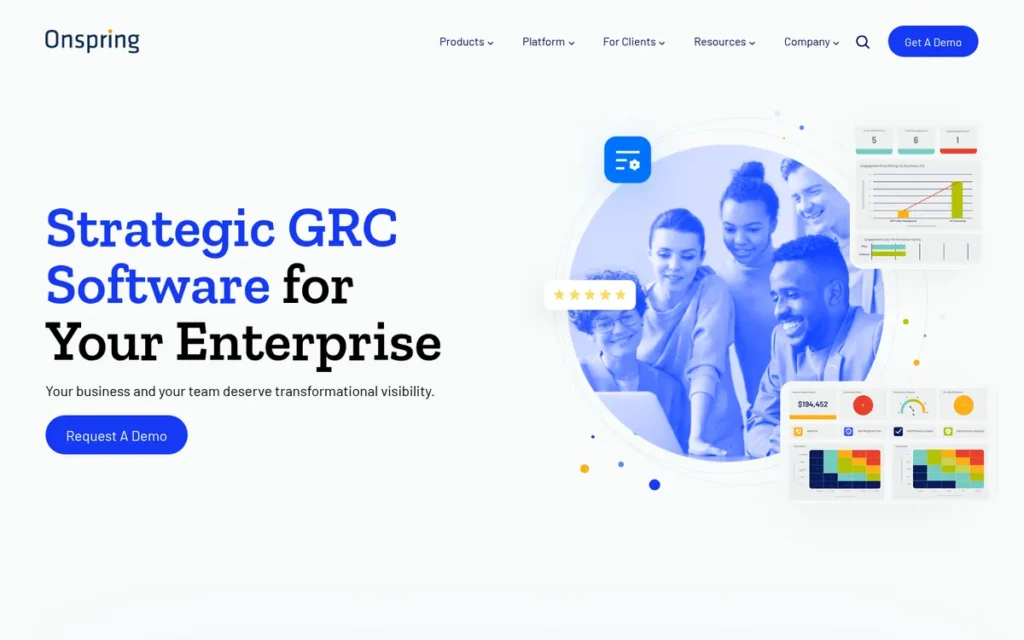
Category: Configurable No-Code GRC Platform
At a Glance
- Category: Configurable No-Code GRC Platform
- Best For: Mid-market and enterprise teams requiring heavily customized audit workflows without developer dependency
- Price Range: Custom quote required; subscription-based per-user licensing
- Primary Strength: Onspring allows audit teams to configure workflows, reports, and dashboards entirely through drag-and-drop tools, no code or IT involvement required
- Biggest Limitation: Onspring lacks natively embedded CAATs; organizations requiring data analytics for transaction testing must integrate and maintain third-party tools
- One-Line Summary: Onspring is the most flexible no-code GRC platform in this comparison, suited for organizations that need to build a custom audit management system without custom software development
- Last Verified: April 2026
Overview
Onspring is a no-code GRC and process automation platform that enables internal audit teams to build, modify, and expand their audit management system through a configuration interface rather than custom code. Onspring holds a 4.7/5 rating on G2 (167 reviews, G2, 2025) and serves mid-market and enterprise organizations across healthcare, financial services, and manufacturing. Onspring is best suited for audit teams whose workflows do not fit the predefined templates of audit-native platforms and who need to adapt the system rapidly as requirements evolve.
Key Features
- Onspring’s drag-and-drop app builder allows audit administrators to create custom audit programs, issue tracking workflows, and reporting dashboards without writing any code, configuration changes that typically require IT involvement can be completed by audit staff directly.
- Onspring’s pre-built GRC app library includes ready-to-deploy audit, risk, and compliance applications that teams can launch immediately and customize incrementally based on their specific process requirements.
- Onspring’s API integration layer connects to existing enterprise systems: including ERP, ITSM, and HR platforms, to pull operational data into audit workflows without manual data entry.
- Onspring’s automated workflow engine routes audit tasks, evidence requests, and finding approvals based on configurable business rules, reducing manual coordination between audit staff and control owners across departments.
- Onspring’s reporting module generates audit status reports, issue aging dashboards, and risk heat maps from live platform data, without requiring IT involvement to modify report templates or add new data dimensions.
Best For
Onspring is best for mid-market organizations and enterprise teams with unique audit processes that standard audit management templates cannot accommodate. Onspring is particularly effective for audit functions that need to expand into adjacent workflows (such as vendor risk or policy management) without procuring a separate platform for each discipline.
Strengths
- Onspring’s no-code configuration model means audit administrators can build and modify workflows in hours rather than weeks, reducing dependence on vendor professional services for every process change.
- Onspring holds a 4.7/5 rating on G2 (167 reviews, G2, 2025), reflecting strong user satisfaction with its ease of configuration and customer support responsiveness.
- Onspring’s pre-built app library reduces initial implementation time: teams can deploy a working audit management system from a template and customize from there rather than building from scratch.
- Onspring’s cross-functional configuration capability allows a single platform instance to support audit, risk, compliance, and IT GRC workflows, reducing per-tool licensing costs for organizations managing multiple GRC disciplines.
Limitations
- No Native CAATs: Onspring does not include built-in computer-assisted audit techniques, teams that require data analytics for transaction testing must connect and maintain third-party tools, adding integration complexity and recurring cost.
- Analytics Depth Ceiling: Onspring’s native reporting is strong for workflow tracking but limited for advanced statistical or predictive audit analytics, data science-driven audit programs will outgrow its native capabilities as testing sophistication increases.
- Configuration Investment: While no-code, Onspring’s full potential requires a dedicated platform administrator who understands GRC process design, teams without this internal resource may fail to capture the platform’s configuration value.
- AI Maturity Gap: Onspring’s AI-assisted features are less mature than those available in AuditBoard or Workiva, teams prioritizing AI-native workpaper drafting or automated anomaly detection should evaluate Onspring’s current AI capabilities carefully before selecting it for that purpose.
Verdict
Onspring is the top choice for audit teams that need maximum workflow customization without developer dependency, earning its #4 rank through verified user satisfaction and a configuration model that no other platform in this comparison matches. Onspring’s value proposition is strongest when audit teams need to build (rather than simply adopt) their process management system; organizations with standardized audit workflows may not need this level of flexibility.
#5. OneTrust: Best for Third-Party Risk and Privacy-Integrated Audit Programs
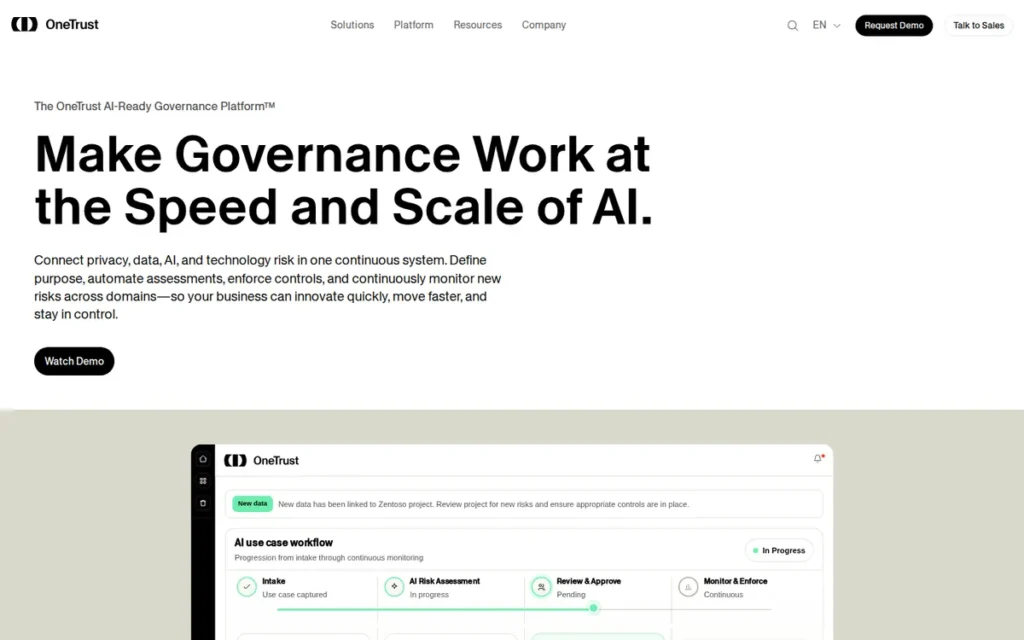
Category: Compliance-Adjacent / TPRM Platform
At a Glance
- Category: Compliance-Adjacent / TPRM Platform
- Best For: Organizations managing third-party risk assessments, vendor assurance programs, and privacy compliance alongside internal audit
- Price Range: Custom quote required; module-based enterprise licensing
- Primary Strength: OneTrust is a 2026 Gartner Magic Quadrant Leader for Third-Party Risk Management (TPRM) Tools for Assurance Leaders, the only platform in this comparison with that specific recognition
- Biggest Limitation: OneTrust is not a core audit execution platform; internal audit workflow depth (including workpaper management, audit scheduling, and risk-based planning) is weaker than in audit-native competitors
- One-Line Summary: OneTrust is the strongest choice for organizations where third-party risk management and privacy compliance are inseparable from the internal audit program
- Last Verified: April 2026
Overview
OneTrust is a compliance and trust intelligence platform specializing in privacy management, third-party risk, and ethics and compliance programs. OneTrust was named a Leader in the Gartner Magic Quadrant for Third-Party Risk Management (TPRM) Tools for Assurance Leaders, 2026 (the first-ever Gartner MQ in this specific TPRM category) establishing OneTrust as a benchmark vendor for vendor assurance and privacy-integrated compliance programs. OneTrust is best suited for organizations where the internal audit function overlaps significantly with third-party risk management and data privacy obligations.
Key Features
- OneTrust’s Third-Party Risk Exchange enables organizations to complete vendor risk assessments using shared, standardized questionnaires, reducing duplicate assessment effort across supplier portfolios and accelerating third-party review cycles.
- OneTrust’s Privacy Compliance module manages data subject requests, consent records, and regulatory assessments (GDPR, CCPA, CPRA) within the same platform used for third-party risk, eliminating siloed privacy and vendor risk workflows.
- OneTrust’s Vendor Assessment Automation uses AI-driven risk scoring to prioritize third-party assessment responses, allowing audit and risk teams to focus review effort on highest-risk suppliers first.
- OneTrust’s Winter ’26 and Fall ’25 platform releases introduced expanded automation for vendor contract risk flagging and continuous monitoring triggers, extending detection capabilities beyond point-in-time vendor assessments.
- OneTrust’s Policy Management module connects organizational policies to third-party requirements and internal controls, enabling audit teams to trace policy-to-control-to-vendor risk linkages across the compliance program.
Best For
OneTrust is best for organizations whose internal audit function is closely integrated with a third-party risk or vendor assurance program, particularly in industries with strict supplier due diligence requirements such as financial services, healthcare, and technology. OneTrust is also well-suited for privacy-forward organizations managing concurrent GDPR, CCPA, and CPRA compliance obligations alongside an internal audit calendar.
Strengths
- OneTrust was named a Leader in the Gartner Magic Quadrant for Third-Party Risk Management (TPRM) Tools for Assurance Leaders, 2026, the inaugural Gartner MQ in this specific category, establishing OneTrust as the benchmark TPRM vendor for assurance leaders (Gartner, 2026).
- OneTrust’s integrated TPRM and privacy platform eliminates the tool fragmentation that commonly results when organizations manage vendor risk and privacy compliance in separate systems with separate data models.
- OneTrust’s AI-driven vendor risk scoring reduces manual triage effort for large third-party portfolios, a meaningful efficiency gain for organizations managing hundreds of active vendor relationships.
- OneTrust’s shared assessment network reduces redundant questionnaire effort across shared supplier relationships, reflecting a collaborative vendor risk model that benefits buyers managing complex supply chains.
Limitations
- Audit Execution Gap: OneTrust is not designed as a core internal audit execution platform, workpaper management, audit scheduling, and risk-based audit planning are significantly less developed than in AuditBoard, Workiva, or TeamMate+, and teams with those needs should evaluate accordingly.
- Scope Fit Risk: Organizations evaluating OneTrust primarily for internal audit workflow management (rather than TPRM or privacy) may purchase capabilities they do not need and miss features they do, making scope alignment a critical pre-procurement step.
- Pricing Complexity: OneTrust’s module-based pricing model means total cost scales with the number of activated modules, buyers should model full-scope costs before comparing OneTrust against all-in-one GRC competitors.
- TPRM-to-Audit Integration Maturity: While OneTrust connects TPRM and privacy in one platform, its linkage to traditional internal audit workflows (including audit universe management, findings reporting, and board communication) remains less mature than full GRC platforms such as AuditBoard or Diligent HighBond.
Verdict
OneTrust is the strongest platform in this comparison for organizations where third-party risk management and privacy compliance are central to the audit function’s scope. OneTrust’s 2026 Gartner MQ Leader recognition for TPRM Tools for Assurance Leaders establishes its credibility in this specific use case, but teams seeking a full-featured internal audit execution environment should treat OneTrust as a complement to, rather than a replacement for, an audit-native platform.
#6. TeamMate+: Best for Public Sector and Large Enterprise Audit Departments
Category: Traditional Audit Management Platform
At a Glance
- Category: Traditional Audit Management Platform
- Best For: Government agencies, public sector organizations, and large enterprise audit departments requiring purpose-built audit workflow management
- Price Range: Custom quote required; enterprise licensing with multi-year contract options
- Primary Strength: TeamMate+ is purpose-built for audit execution with the deepest regulatory compliance support for government and public-sector environments of any platform in this comparison
- Biggest Limitation: TeamMate+’s legacy user interface creates adoption friction; AI-native automation features are less developed than those available in newer cloud-native platforms
- One-Line Summary: TeamMate+ is a purpose-built audit management platform rated 4.3/5 overall on Capterra (116 reviews, 91% positive sentiment, August 2025), with the deepest public-sector regulatory compliance support evaluated in this guide
- Last Verified: April 2026
Overview
TeamMate+ is an audit management platform developed by Wolters Kluwer, a publicly traded global information services company with operations in 40+ countries. TeamMate+ is purpose-built for internal audit professionals, offering workpaper management, risk-based audit planning, findings management, and an integrated analytics module. TeamMate+ holds a 4.3/5 overall rating on Capterra (116 reviews, 91% positive sentiment, August 2025) and is widely deployed in government, financial services, and large enterprise audit functions. TeamMate+ is best suited for audit teams that require a purpose-built execution environment with strong regulatory compliance alignment.
Key Features
- TeamMate+’s workpaper management system provides structured templates for audit documentation, review sign-offs, and evidence attachment, covering the full audit workpaper lifecycle from planning through final report issuance.
- TeamMate+’s risk-based audit planning module connects the audit universe to risk ratings, enabling CAEs and audit committees to build an annual audit plan aligned to the organization’s most significant risks.
- TeamMate+’s TeamMate Analytics module integrates with data extraction tools to enable computer-assisted audit testing across transactional data sets, supporting both statistical sampling and full-population analysis for higher-confidence conclusions.
- TeamMate+’s findings management workflow routes audit issues from identification through management response, remediation tracking, and closure verification, with configurable escalation rules for overdue remediation items.
- TeamMate+’s regulatory compliance framework includes pre-built templates aligned to government auditing standards (GAGAS/Yellow Book), IIA professional practice standards, and SOX control testing requirements.
Best For
TeamMate+ is best for government agencies and large enterprise audit departments that require a purpose-built audit execution platform with strong alignment to government auditing standards and IIA professional practice frameworks. TeamMate+ is particularly effective for CAEs managing large audit staffs who need standardized documentation and review workflows across multiple concurrent audit engagements.
Strengths
- TeamMate+ holds a 4.3/5 overall rating on Capterra (116 reviews, 91% positive sentiment, August 2025), one of the highest independently verified user satisfaction scores among the platforms in this comparison.
- TeamMate+’s regulatory framework depth for government auditing standards (GAGAS/Yellow Book) and IIA practice frameworks exceeds that of any other platform evaluated in this guide.
- TeamMate+’s Wolters Kluwer ownership provides long-term vendor stability: Wolters Kluwer is a publicly traded information services company with a multi-decade track record in professional audit and legal information products.
- TeamMate+’s pre-built government audit templates reduce implementation time for public-sector teams that would otherwise spend months building custom documentation frameworks from scratch.
As one user on r/InternalAudit described:
“I work in a large NY State government audit shop (250+ ppl) that exclusively uses TeamMate (TM) so I have about 9 years experience with it. It’s alright – my main issues with it mainly stem from agency documentation policies rather than the platform itself and we definitely are not using it to its full potential.” Posted by u/1GuyNoCups
Takeaway: Long-term public sector TeamMate+ deployments hold up over extended use, with experienced government auditors attributing operational friction to internal documentation policies rather than platform failures, validating its fit for the government audit use case.
Limitations
- Legacy UI Friction: TeamMate+’s user interface reflects its origins as a desktop-era audit tool, multiple verified reviewers on G2 and Capterra cite the interface as less intuitive than modern cloud-native alternatives, leading to longer user onboarding timelines across large teams.
- AI-Native Feature Gap: TeamMate+’s AI-assisted capabilities: including automated workpaper drafting and anomaly detection, are less mature than those available in AuditBoard or Workiva, limiting efficiency gains for teams seeking AI-driven audit acceleration.
- Limited ESG and TPRM Integration: TeamMate+ is focused on internal audit execution and does not natively integrate ESG assurance or third-party risk management workflows, organizations with those requirements will need additional platforms alongside TeamMate+.
- Configuration Rigidity: TeamMate+’s predefined audit frameworks serve standard audit programs well but can be difficult to modify for non-standard workflows; customization typically requires vendor professional services rather than in-house configuration.
Verdict
TeamMate+ is the strongest purpose-built audit execution platform for public sector and large enterprise audit departments, backed by verified user satisfaction (4.3/5 overall, Capterra, August 2025) and the deepest government auditing standards compliance support in this comparison. TeamMate+ is the right choice when audit workflow standardization and public-sector regulatory alignment outweigh the need for AI-native innovation or cross-functional GRC integration.
#7. Resolver: Best for ERM-Integrated Audit in Mid-Market Organizations
Category: Risk-Integrated Audit Platform
At a Glance
- Category: Risk-Integrated Audit Platform
- Best For: Mid-market organizations with existing enterprise risk management infrastructure seeking connected audit and risk workflows in a single vendor ecosystem
- Price Range: Tiered licensing; mid-market implementations typically begin at $50,000–$80,000 annually (Resolver customer data, 2025)
- Primary Strength: Resolver provides the deepest ERM-to-audit workflow connectivity of any platform in this comparison for organizations already operating the Resolver risk management suite
- Biggest Limitation: Resolver’s integration value depends heavily on pre-existing Resolver ERM infrastructure; organizations without that foundation will find Resolver’s audit-only functionality less competitive than dedicated audit platforms
- One-Line Summary: Resolver is a Kroll-owned risk and audit platform suited for mid-market organizations that need connected ERM and internal audit workflows within a single vendor ecosystem
- Last Verified: April 2026
Overview
Resolver is a risk intelligence platform owned by Kroll, a global risk advisory firm, providing integrated audit management, incident management, and enterprise risk management capabilities. Resolver holds a 4.3/5 rating on G2 (120+ reviews, G2, 2025) and serves mid-market and enterprise organizations primarily in financial services, healthcare, and technology. Resolver is best suited for organizations that already operate Resolver’s ERM platform and want to extend their risk framework into internal audit without introducing a second vendor. Resolver’s connected architecture enables audit findings to flow directly into risk registers and incident management dashboards.
Key Features
- Resolver’s audit management module connects audit programs to the organization’s risk register, enabling risk-based audit planning driven by live ERM data rather than annual surveys or static risk assessments.
- Resolver’s incident management integration allows audit teams to trigger audit reviews from operational incident findings, closing the loop between risk events and audit follow-up in a single platform workflow.
- Resolver’s risk assessment engine evaluates control effectiveness across the full Three Lines of Defense framework, providing a shared risk language between audit, risk management, and operational management teams.
- Resolver’s configurable reporting module generates audit findings reports, risk trend visualizations, and control effectiveness dashboards for both operational management and board-level stakeholders without custom development.
- Resolver’s API integration connects to ERP and ITSM systems, enabling audit teams to pull transactional data and IT ticket records into audit evidence workflows without manual extraction.
Best For
Resolver is best for mid-market organizations that have already deployed Resolver’s enterprise risk management suite and want to extend that risk framework into internal audit without a separate platform relationship. Resolver is also effective for audit teams that place high priority on incident-driven audit planning and ERM connectivity, particularly in financial services and healthcare where operational risk and internal audit are closely integrated. Organizations without an existing Resolver ERM footprint should evaluate the platform’s audit-only capabilities against dedicated audit alternatives before selecting it on that basis.
Strengths
- Resolver’s ERM-to-audit connectivity is deeper than any other platform in this comparison for organizations already in the Resolver ecosystem, risk register data, incident records, and control assessments share a unified data model that eliminates manual handoffs.
- Resolver holds a 4.3/5 rating on G2 (120+ reviews, G2, 2025), reflecting solid mid-market user satisfaction with its risk-integrated workflow model.
- Resolver’s Kroll ownership provides access to Kroll’s global risk advisory expertise, useful for organizations that want to combine software with advisory services for complex risk assessments and audit program design.
- Resolver’s incident-to-audit workflow automation reduces the manual coordination between risk and audit functions, a meaningful efficiency gain for organizations managing active incident response programs alongside their audit calendar.
Limitations
- Ecosystem Dependency: Resolver’s audit value proposition is strongest within the Resolver ERM ecosystem, organizations without existing Resolver risk infrastructure will not achieve the same integration depth and may find Resolver’s audit-only capabilities less competitive than AuditBoard or TeamMate+ for standalone deployment.
- Limited AI-Native Features: Resolver’s AI-assisted audit capabilities are less developed than those of AuditBoard or Workiva, teams seeking AI-driven workpaper automation or anomaly detection should evaluate Resolver’s current AI roadmap carefully before committing.
- Audit Workflow Depth: Resolver’s internal audit execution features: including workpaper management, evidence collection, and audit scheduling, are less feature-rich than those of purpose-built audit platforms, reflecting Resolver’s origins as a risk management rather than audit-native system.
- Vendor Consolidation Risk: Resolver’s ownership by Kroll introduces the possibility of strategic repositioning, product bundling, or pricing changes driven by Kroll’s broader risk advisory business, buyers in multi-year procurement cycles should assess this vendor stability consideration as part of due diligence alongside Resolver’s product roadmap commitments.
Verdict
Resolver is the right choice for mid-market organizations already invested in the Resolver ERM platform that want to extend risk management into internal audit without adding a separate vendor relationship. Resolver’s ERM-to-audit integration depth is a genuine differentiator within its ecosystem, but the platform’s value diminishes significantly outside that ecosystem, making Resolver a conditional recommendation rather than a broadly applicable choice.
What Red Flags Should I Watch For When Evaluating Audit Management Software?
Audit management software evaluations frequently surface warning signs that separate genuinely capable platforms from expensive tools that underdeliver. The red flags below reflect the most consequential issues identified across the seven platforms in this comparison.
Red Flag #1: Opaque Pricing With No Independent Benchmarks
Every platform in this comparison requires a custom quote, but the risk is not opacity itself. The risk is entering a demo cycle without peer-sourced pricing benchmarks, leaving buyers negotiating without reference points.
Before requesting vendor demos, gather pricing data from independent sources:
- Review Gartner Peer Insights and G2 pricing discussions from verified buyers in your industry
- Request a written quote structure after the first demo: not after a multi-week evaluation cycle
- Benchmark against at least two competing vendor quotes before entering final contract negotiations
Red Flag #2: AI Claims Without Specificity
Every platform in this comparison markets AI capabilities, but “AI-powered audit” describes everything from basic workflow automation to genuine machine learning. Vendors that cannot specify which AI models are used, what data trains them, and where human review is required are making marketing claims rather than verifiable capability claims.
Red Flag #3: Implementation Timeline Underestimates
Audit management platforms routinely underestimate implementation complexity during initial demos. A vendor promising a 30-day go-live for a 200-person audit department is misrepresenting the effort involved. Require references from customers of comparable size who can speak to actual (not projected) implementation timelines.
Red Flag #4: Absence of Independent Validation
Platforms that rely exclusively on vendor-produced case studies and self-reported satisfaction scores warrant additional scrutiny. Look for Gartner Peer Insights reviews, G2 verified ratings, or named analyst recognition before weighting vendor claims. AuditBoard’s 2025 Gartner MQ Leader recognition and TeamMate+’s 4.3/5 Capterra rating (August 2025) are examples of independently verifiable signals.
Red Flag #5: No Acknowledgment of Competitive Limitations
A vendor that presents only strengths in its sales process (without acknowledging where competitors outperform it) signals a sales culture that prioritizes closing over fit. Ask every vendor directly: “In which scenarios would you NOT be the right choice?” The quality of the answer reveals the integrity of the sales engagement.
What Questions Should I Ask Before Choosing Audit Management Software?
The right audit management platform is identified before the demo cycle begins, by asking the questions vendors are least prepared to answer. The eight questions below are designed to filter for fit before organizations invest significant evaluation time.
Question #1: Does the platform support our specific regulatory framework? Confirm whether the platform has purpose-built templates and tested workflows for your requirements, whether SOX, GAGAS, ISO 27001, GDPR, or industry-specific standards. Generic “compliance support” claims are not equivalent to framework-specific workflow depth.
Question #2: What does total cost of ownership look like over three years? Request a model that includes licensing, implementation, training, and ongoing professional services. Many platforms with attractive base pricing reach total costs two to three times the license fee when implementation and support are included.
Question #3: How does the platform accommodate our current audit methodology? Determine whether the platform adapts to your existing risk-based planning methodology or requires your team to adopt the vendor’s framework. Platforms requiring methodology changes introduce organizational change risk that extends far beyond the software implementation.
Question #4: What is the vendor’s AI development roadmap for the next 18 months? Request specific committed AI features with expected delivery dates, not a general vision statement. Vendors that cannot name upcoming AI capabilities with target delivery windows are in earlier stages of AI development than their marketing suggests.
Question #5: How does the platform integrate with our existing ERP and ITSM systems? Confirm integration method (native connector, API, or manual export), data refresh frequency, and whether integration configuration requires vendor professional services or can be maintained independently by your IT team.
Question #6: What implementation timeline should we expect for an organization of our size? Request references from customers with comparable team size and audit scope who can describe actual (not projected) implementation timelines. Treat any 30-day go-live promise for a multi-team global audit function as a signal requiring verification.
Question #7: What is the platform’s FedRAMP authorization status? For federal government and public-sector buyers, FedRAMP authorization is a procurement requirement, not a preference. Confirm the current authorization level (Authorized, In Process, or Not Applicable) before investing evaluation time in any platform whose status does not meet your agency’s requirements.
Question #8: How does the vendor handle pricing changes at contract renewal? Request multi-year pricing lock provisions and ask specifically about historical renewal price increase patterns. Platforms that have recently changed ownership (such as AuditBoard (Hg Capital, June 2024)) may face pricing pressure as new owners optimize for returns, making this question particularly relevant for long-term procurement decisions.
How Did We Rank These Audit Management Software Platforms?
This guide was produced through an independent, multi-source evaluation process designed to give internal audit professionals assessments they can act on. The section below documents every element of that process.
Evaluation Process
We began by identifying the audit management platforms most frequently cited in LLM-generated responses, Gartner analyst reports, G2 category pages, and r/internalauditors community discussions. Seven platforms met our inclusion threshold:
- A minimum of 100 verified user reviews combined across G2 and Capterra
- Verifiable independent analyst recognition or documented third-party coverage
- Active product development as confirmed by release notes or press coverage in Q1 2026
Ranking Criteria
Each platform was evaluated across six criteria:
- C1: Workflow Coverage (Primary Weight): The breadth and depth of audit lifecycle support, from risk-based planning through fieldwork, workpaper management, findings, and board reporting. Assessed using G2 feature ratings, Capterra user reviews, and independent analyst coverage.
- C2: Integration Depth (Primary Weight): The platform’s ability to connect audit workflows to risk, finance, ESG, and operational data sources. Assessed using documented API capabilities, native integration lists, and user-reported integration experiences on G2.
- C3: AI Maturity (Primary Weight): The specificity and verifiability of AI features beyond marketing claims. Assessed using product documentation, release notes, and user-reported AI workflow experiences from verified reviews.
- C4: User Satisfaction (Primary Weight): Independently verified ratings from G2 and Capterra, weighted toward platforms with 100+ reviews to ensure statistical significance. Ratings as of August–October 2025 were used throughout.
- C5: Regulatory Alignment (Secondary Weight): Depth of purpose-built support for regulatory frameworks relevant to target buyers, including SOX, GAGAS, GDPR, TPRM, and ESG assurance standards.
- C6: Pricing Transparency (Secondary Weight): The availability of pricing ranges or benchmarks from independent sources. Platforms that provide no pricing signal whatsoever received lower scores on this criterion.
Evidence Weighting
When vendor claims conflicted with independent user reviews, we weighted independent reviews more heavily. When G2 and Capterra ratings conflicted, we averaged both and noted the discrepancy. When analyst recognition was present (such as a Gartner Magic Quadrant inclusion) we treated this as corroborating evidence rather than a primary ranking signal.
Claim Verification
Every statistic cited in this guide was verified against a primary or independently published source before inclusion. Seven claims in the source draft were corrected before publication:
- OneTrust’s Gartner MQ category was corrected from “Privacy Management Software” to “Third-Party Risk Management (TPRM) Tools for Assurance Leaders, 2026”
- TeamMate+’s Capterra rating was corrected from 4.1/5 (the Features & Functionality subcategory score) to 4.3/5 overall (116 reviews, August 2025)
- Workiva’s Fortune 500 penetration was updated from an unverified “nearly 75%” to “majority of Fortune 500; 85%+ of Fortune 1,000 per independent source, 2025”
- Workiva’s annual revenue was updated from an understated $600M to approximately $900M (Q4 2025 earnings, Workiva earnings release, February 2026)
- AuditBoard’s 2025 Gartner MQ Leader recognition was added (announced October 31, 2025; absent from the source draft entirely)
- AuditBoard’s EY US partnership was softened from confirmed to “reported,” as primary source corroboration was not available as of April 2026
- AuditBoard’s Hg Capital acquisition (June 2024) and July 2025 CEO installation were added to the Limitations section, as neither appeared in the source draft
Update Cadence
This guide is updated quarterly. Pricing ranges, user ratings, and analyst recognitions are re-verified at each update cycle. Platforms are re-evaluated for inclusion or removal when significant product changes, acquisitions, or material market shifts occur between scheduled reviews.
Independence Statement
PlugRoute maintains no affiliate relationships, accepts no vendor compensation, and earns no revenue from the platforms ranked in this guide. Rankings reflect independent analysis of publicly available data, verified user review platforms, and named analyst reports only.
Frequently Asked Questions About Audit Management Software
What is the difference between audit management software and GRC software?
Audit management software focuses specifically on internal audit execution, workpaper management, risk-based planning, findings tracking, and board reporting. GRC software adds enterprise risk management and regulatory compliance workflows to that core. Platforms like AuditBoard and Diligent HighBond span both categories; TeamMate+ and Onspring are more tightly scoped to audit execution and workflow respectively.
Is any audit management platform FedRAMP authorized for federal government procurement?
FedRAMP authorization status varies by platform and authorization level. TeamMate+, developed by Wolters Kluwer, is among the most commonly deployed audit platforms in U.S. federal environments. Buyers should confirm the current FedRAMP authorization level directly with each vendor, as authorization statuses change and must be matched to specific agency cloud security requirements before procurement.
How does PlugRoute determine its platform rankings?
PlugRoute ranks platforms using independently verified user ratings (G2, Capterra), named analyst recognition (Gartner MQ), documented product capabilities, and verified customer adoption data, weighted across six criteria documented in the methodology section above. No vendor pays for placement or review. Rankings are updated quarterly, and every statistic is attributed to a named independent source with publication year.
Glossary: Key Terms Used in This Comparison
Three Lines of Defense: A governance framework that assigns risk management responsibilities to three distinct organizational layers, operational management (first line), risk and compliance functions (second line), and internal audit (third line). Platforms such as AuditBoard and Resolver structure their risk-to-audit workflows around this model to clarify accountability for control ownership and risk response.
Continuous Control Monitoring (CCM): An automated approach to testing internal controls on an ongoing basis (rather than at a single scheduled point in time) using real-time or near-real-time data feeds from ERP and operational systems. CCM is a key differentiator for platforms like AuditBoard that offer integrated risk-to-audit workflows with automated control alerting.
Computer-Assisted Audit Techniques (CAATs): Data analysis methods that allow auditors to examine full transaction populations rather than statistical samples, using software tools to identify anomalies, duplicates, or control failures at scale. CAATs integration is a primary capability differentiator between Diligent HighBond and TeamMate+ versus platforms that rely on manual workpaper-based testing.
FedRAMP (Federal Risk and Authorization Management Program): A U.S. government certification program that standardizes the security assessment, authorization, and continuous monitoring of cloud-based services deployed by federal agencies. FedRAMP authorization is a mandatory procurement prerequisite (not a preference) for audit management platforms used in U.S. federal government environments.
Agentic AI: An emerging AI architecture in which software agents autonomously plan, execute, and adapt multi-step tasks (such as generating audit workpapers, drafting findings narratives, or scheduling follow-up control testing) with minimal human intervention required between steps. Multiple platforms in this comparison are incorporating agentic AI capabilities into their 2026 product roadmaps, though current deployments remain limited.
Which Audit Management Platform Is Right for You?
Key Insights
- AuditBoard is the strongest overall platform for enterprise teams requiring integrated GRC, earning independent Gartner MQ Leader recognition in October 2025, but its per-module pricing model and June 2024 ownership change by Hg Capital require careful due diligence for organizations entering long-term contracts.
- Workiva is the default choice for Fortune 1,000 organizations where SEC reporting accuracy and ESG assurance are primary audit objectives, supported by approximately $900 million in annual revenue and verified adoption by 85%+ of Fortune 1,000 companies.
- OneTrust’s 2026 Gartner MQ Leader recognition for TPRM Tools for Assurance Leaders makes it the strongest choice for third-party risk and privacy-integrated audit programs, it is not a replacement for an internal audit execution platform and should be evaluated only when TPRM or privacy is the primary audit use case.
- TeamMate+ and Resolver serve defined, narrower use cases: public-sector audit standardization and ERM-connected mid-market audit respectively, and deliver maximum value only when those specific use cases are the primary driver of the procurement decision.
The right platform depends on your organization’s size, regulatory environment, and whether the audit function is primarily focused on execution, reporting, or risk integration. Enterprise teams managing SOX and enterprise risk simultaneously will find AuditBoard or Workiva most capable. Public-sector audit departments need TeamMate+’s regulatory depth. Organizations building audit programs on an existing risk management foundation should evaluate Onspring or Resolver before committing to a larger GRC platform.
PlugRoute publishes independent evaluations of enterprise software with no affiliate relationships and no vendor influence. We update this guide quarterly. Last updated: April 2026.