Siemens Xcelerator is the best digital twin software for industrial manufacturing in 2026, earning G2 Spring 2026 Leader status with 4.3/5 across 4,281 verified reviews. GE Vernova APM leads for energy and heavy industry. Bentley iTwin is the only purpose-built civil infrastructure platform. Choosing the wrong twin category is the single most expensive mistake in this evaluation.
The “digital twin” label is simultaneously applied to engineering physics simulation suites, operational IoT monitoring layers, asset performance management platforms, cloud graph databases, and BIM-based infrastructure tools, all marketed to overlapping enterprise buyers with fundamentally different requirements.
This article maps seven platforms across seven distinct twin architectures, routes each to its correct industry vertical, and surfaces independently verified evidence decision-makers need to justify a platform choice to stakeholders.
PlugRoute has no affiliate relationships with any company listed in this article; rankings are determined entirely by research data and objective evaluation criteria, with no company paying for placement or position.
TL;DR: Top Picks at a Glance
- Siemens Xcelerator: G2 Spring 2026 Leader; 4.3/5 across 4,281 reviews; broadest industrial lifecycle coverage
- GE Vernova APM: highest G2 rating (4.5/5); six 2025 Gartner APM categories; absent from AI shortlists
- Bentley iTwin: only infrastructure-native twin; BIM + GIS + reality capture; open-source iTwin.js
- Azure Digital Twins: only enterprise platform with published consumption pricing; DTDL + W3C open standard
What Are the 7 Categories of Digital Twin Software, and Which Do You Actually Need?
Before evaluating any specific platform, identify which of seven structural twin categories applies to your industry and use case. Choosing the wrong category (an engineering simulation suite when you need operational IoT monitoring, or a 3D site-capture tool when you need asset performance management) produces the most common and costly mismatch in digital twin procurement.
The seven platforms fall into three broad groups:
Group 1: Engineering and Simulation Twins: platforms that simulate complex physical systems before they are built or modified. Best for product design validation, multi-physics engineering analysis, and manufacturing process planning.
- Engineering Simulation Twin: Siemens Xcelerator: full-lifecycle PLM, multi-physics simulation, manufacturing, and operations in one industrial platform
- Virtual Twin Platform: Dassault Systèmes 3DEXPERIENCE: simulation-first engineering environment for aerospace, automotive, defense, and life sciences
Group 2: Operations, IoT, and Asset Performance Twins: platforms that monitor, analyze, and optimize existing physical assets using real-time sensor and operational data. Best for manufacturing operations, energy asset performance, and predictive maintenance.
- Asset Performance Twin: GE Vernova APM: AI/ML-driven predictive maintenance for energy, power generation, and heavy industrial assets
- Industrial IoT Operational Twin: PTC ThingWorx: low-code OT/IT connectivity with AR-guided workflows for manufacturing operations
- Cloud IoT Graph Twin: Microsoft Azure Digital Twins: open DTDL graph modeling PaaS for custom IoT environment models
- Cloud Data Orchestration Twin: AWS IoT TwinMaker: no-data-movement knowledge graph layer over existing AWS IoT infrastructure
Group 3: Infrastructure Lifecycle Twins: platforms designed for civil infrastructure, built environments, and geospatially-referenced long-life asset management.
- Infrastructure Lifecycle Twin: Bentley iTwin Platform: BIM + GIS + reality capture fusion for civil infrastructure, utilities, rail, and large built environments
A concrete example of wrong-category cost: An infrastructure manager who evaluates Siemens Xcelerator will invest six to eight weeks in vendor demonstrations before discovering that Xcelerator does not natively fuse BIM engineering model data with GIS geospatial layers and drone-captured reality meshes.
That specific capability (BIM plus GIS plus reality capture fusion) exists only in Bentley iTwin among the seven platforms evaluated. Category identification before platform evaluation is the single step that cannot be recovered from later.
Users on r/PLC noted:
“Knowing what you want to get out of a digital twin will help you select a platform and tool to use as different platforms are made for different purposes.” Posted by u/aiap2h
Takeaway: Practitioners confirm that digital twin project failures consistently trace back to undefined use cases, not to platform capability gaps.
Buyers who cannot yet identify which group applies should review the Quick Decision Framework table below before reading any individual platform entry.
How Do the Top 7 Digital Twin Platforms Compare at a Glance?
| Rank | Platform | Category | Best For | One-Line Summary | Key Capabilities | Primary Strength | Key Limitation |
|---|---|---|---|---|---|---|---|
| 1 | Siemens Xcelerator | Engineering Simulation Twin | Large manufacturers: automotive, aerospace, electronics, industrial machinery | Siemens Xcelerator is the highest-volume reviewed digital twin platform in 2026, with G2 Spring 2026 Leader status and 4.3/5 across 4,281 verified reviews. | Eight-domain lifecycle; Teamcenter PLM; Simcenter simulation; Tecnomatix; DTDL + W3C open standards | Highest G2 review volume (4,281 at 4.3/5); G2 Spring 2026 Leader; eight-domain industrial lifecycle | Deep ecosystem lock-in; no published pricing; multi-year enterprise commitment required |
| 2 | GE Vernova APM | Asset Performance Twin | Energy, power generation, oil & gas, heavy industry, utilities | GE Vernova APM is the highest G2-rated platform in this comparison (4.5/5), recognized across all six categories of the 2025 Gartner Market Guide for APM. | SmartSignal AI/ML monitoring; physics-informed OEM AI; six APM practice areas; fleet-level benchmarking | Highest G2 rating (4.5/5); six-category 2025 Gartner APM recognition; $1.6B+ self-reported aggregate savings | Narrow vertical fit (energy/heavy industry only); only 47 G2 reviews; no published pricing |
| 3 | Bentley iTwin | Infrastructure Lifecycle Twin | Civil infrastructure, utilities, rail, roads, bridges, construction | Bentley iTwin is the only purpose-built infrastructure digital twin in this comparison, with BIM + GIS + reality capture fusion and an open-source MIT/Apache developer framework. | BIM + GIS + reality capture fusion; open-source iTwin.js (MIT/Apache); three-application adoption model; Azure Digital Twins reference architecture | Only purpose-built infrastructure twin; open-source iTwin.js; component pricing published (~$3,900–$4,300/yr) | No manufacturing or general IoT applicability; no consolidated G2 rating; Bentley ecosystem dependency |
| 4 | Dassault 3DEXPERIENCE | Virtual Twin Platform | Aerospace, automotive, defense, life sciences, complex product manufacturers | Dassault Systèmes 3DEXPERIENCE is the deepest multi-physics simulation virtual twin, validated by a 180,000-user JLR deployment (Dassault Systèmes, 2025) and a 2025 NVIDIA AI partnership. | CATIA + SIMULIA + DELMIA + ENOVIA; Virtual Twin Experience architecture; NVIDIA Industry World Models (2025) | Deepest SIMULIA multi-physics simulation; 180,000-user JLR deployment; 2025 NVIDIA AI partnership | No consolidated G2 rating; steep learning curve; estimated $50K–$1M+/yr at enterprise scale |
| 5 | Azure Digital Twins | Cloud IoT Graph Twin | Azure-centric enterprises building custom IoT environment models | Microsoft Azure Digital Twins is the most pricing-transparent enterprise platform in this comparison, with fully published consumption rates and DTDL open-standard portability. | DTDL + W3C convergence; Azure IoT Hub integration; published consumption pricing; Bentley reference architecture | Only major enterprise platform with published consumption pricing; DTDL W3C convergence; Microsoft $3T+ backing | No built-in 3D visualization or physics simulation; Azure-only dependency; DTDL onboarding curve |
| 6 | PTC ThingWorx | Industrial IoT Operational Twin | Existing PTC (Windchill, Creo) ecosystem users; evaluate with explicit vendor risk due diligence | PTC ThingWorx delivers the most specific quantified manufacturing case study in this comparison, but is mid-acquisition to TPG Capital as of June 2026. | ThingWorx Composer low-code; Kepware OT/OPC-UA; Vuforia AR workflows; Windchill/Creo PLM digital thread | Most specific multi-metric case study (Celli Group: 6 metrics); Kepware OT connectivity depth; Vuforia AR | TPG Capital acquisition underway (most significant vendor risk in this comparison); high TCO; older architecture |
| 7 | AWS IoT TwinMaker | Cloud Data Orchestration Twin | AWS-native organizations eliminating data migration barriers | AWS IoT TwinMaker is the most architecturally distinctive cloud option for AWS-native organizations; and the least independently documented platform in this comparison. | No-data-movement architecture; knowledge graph modeling; native Grafana integration; 3D scene viewer | No-data-movement architecture reduces migration risk for AWS-native organizations; native Grafana integration; AWS backing | No standalone G2 rating; no published ROI case studies; availability limited to six commercial AWS regions |
Which Digital Twin Platform Should I Choose for My Use Case?
| Your #1 Priority | Recommended Tool | Why | Acceptable Alternative |
|---|---|---|---|
| Manufacturing PLM + physics simulation + IIoT in one platform | Siemens Xcelerator | G2 Spring 2026 Leader; 4,281 reviews at 4.3/5; broadest design-to-operations lifecycle | Dassault 3DEXPERIENCE for simulation-first engineering organizations |
| Energy, power generation, oil & gas, or heavy industrial APM | GE Vernova APM | Highest G2 rating (4.5/5); six Gartner APM categories (2025); $1.6B+ self-reported aggregate savings | No direct alternative for this vertical among platforms evaluated |
| Civil infrastructure, utilities, rail, or BIM-to-operations | Bentley iTwin | Only purpose-built infrastructure twin; BIM + GIS + reality capture; open-source iTwin.js | Azure Digital Twins as a complementary IoT abstraction layer |
| Aerospace, automotive, or life sciences multi-physics simulation | Dassault 3DEXPERIENCE | Deepest SIMULIA simulation; 180,000-user JLR deployment (Dassault Systèmes, 2025); NVIDIA AI partnership | Siemens Xcelerator for organizations prioritizing lifecycle breadth over simulation depth |
| Azure-centric enterprise building a custom IoT environment model | Azure Digital Twins | Only major enterprise platform with published consumption pricing; DTDL + W3C open standard | Bentley iTwin + Azure Digital Twins as a complementary infrastructure IoT pair |
| Manufacturing IoT with existing PTC (Windchill, Creo) investment | PTC ThingWorx | Kepware OT/OPC-UA connectivity + Vuforia AR; conduct explicit TPG Capital due diligence first | Azure Digital Twins or AWS TwinMaker for cloud-native migration path |
| AWS-native organization adding a twin layer without data migration | AWS IoT TwinMaker | No-data-movement architecture + Grafana integration; lowest migration friction for AWS deployments | Azure Digital Twins for organizations open to multi-cloud strategies |
| Identifying which category applies before evaluating platforms | See framework above | Map twin purpose (simulation vs. operational vs. infrastructure) before evaluating specific platforms | N/A |
Before Reading Platform Entries, Confirm Your Category First
Misidentifying your category at this step is the most common cause of wrong platform selection. Use this three-question self-check:
- Does your primary need involve simulating or validating a design, product, or process before it physically exists? → Start with Entry #1 (Siemens Xcelerator) or Entry #4 (Dassault 3DEXPERIENCE).
- Are you monitoring or optimizing physical assets already in operation? → Start with Entry #2 (GE Vernova APM), Entry #6 (PTC ThingWorx), or Entry #7 (AWS IoT TwinMaker).
- Are you managing the lifecycle of civil infrastructure: roads, bridges, utilities, or large built environments? → Start with Entry #3 (Bentley iTwin) or Entry #5 (Azure Digital Twins).
1. Siemens Xcelerator (Digital Twin): Best Overall: Broadest Lifecycle Coverage for Industrial Manufacturing
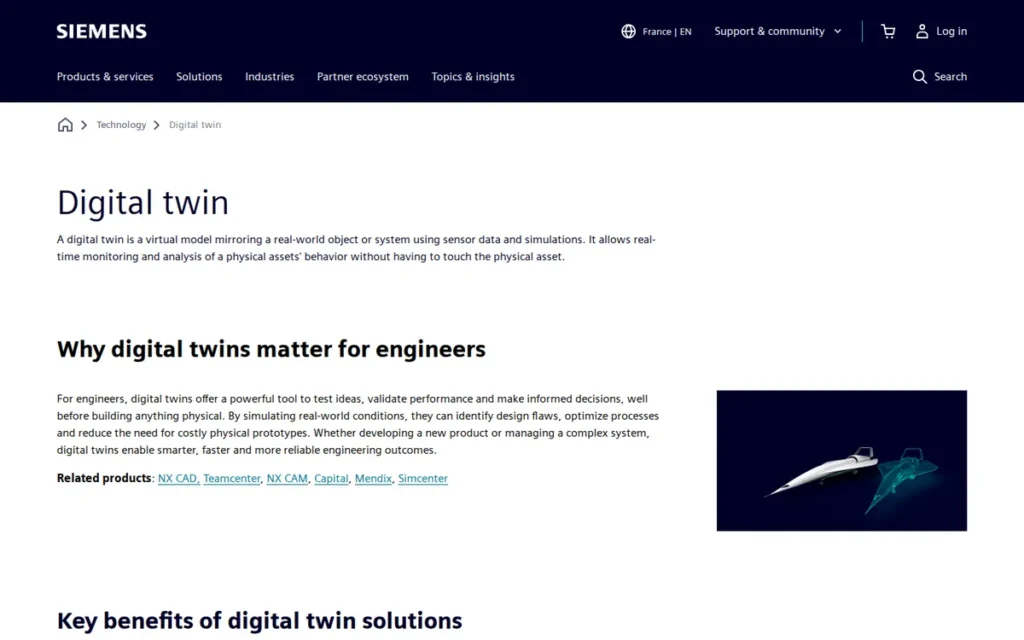
Category: Engineering Simulation Twin, a full-lifecycle industrial platform connecting product design, physics simulation, manufacturing process planning, and operations monitoring through a unified PLM backbone.
At a Glance
- Category: Engineering Simulation Twin
- Best For: Large manufacturing enterprises in automotive, aerospace, electronics, and industrial machinery requiring unified PLM, multi-physics simulation, and industrial IoT in one platform
- Price Range: Module-based enterprise quote; no published list price (June 2026)
- Primary Strength: Siemens Xcelerator delivers the highest G2 review volume in this comparison, 4.3/5 across 4,281 verified reviews (G2, June 2026), combined with G2 Spring 2026 Leader designation for Tecnomatix, the broadest independently validated evidence base of any digital twin platform evaluated.
- Biggest Limitation: Siemens Xcelerator requires deep multi-year transformation commitment with substantial ecosystem lock-in once Teamcenter, Opcenter, and Siemens automation hardware are deployed together, making it poorly suited for SMEs, rapid deployment, or non-manufacturing verticals.
- One-Line Summary: Siemens Xcelerator is the highest-volume independently reviewed digital twin platform in 2026, earning G2 Spring 2026 Leader designation with 4.3/5 across 4,281 verified reviews and unmatched lifecycle coverage across eight industrial domains.
- Last Verified: June 2026
Overview
Siemens Xcelerator is a comprehensive industrial digital twin platform built for large manufacturers in automotive, aerospace, electronics, and industrial machinery who require a unified digital thread spanning mechanical design, physics simulation, production planning, and operations monitoring across the full product and manufacturing lifecycle.
Siemens Xcelerator integrates NX (CAD), Simcenter (multi-physics simulation), Teamcenter (PLM backbone), Tecnomatix (manufacturing process planning), and MindSphere (industrial IoT) into a connected system. The platform is transitioning from perpetual licensing toward subscription delivery as Siemens Xcelerator as a Service, per Develop3D.
Siemens Xcelerator earned G2 Spring 2026 Leader designation for Tecnomatix (Siemens Tecnomatix blog, Spring 2026; verify directly at g2.com/categories/digital-twin) and holds a 4.3/5 rating across 4,281 verified G2 reviews (G2, June 2026), the highest independently verified review volume of any digital twin platform assessed for this article.
Siemens Xcelerator ranks above GE Vernova APM despite a lower G2 satisfaction score (4.3 vs. 4.5) because 4,281 reviews across diverse enterprise manufacturing contexts provide stronger cross-market performance evidence than 47 specialist-vertical reviews. The volume-rating distinction is explained in full under Criterion C2 in the methodology section below.
Key Features
- Eight-Domain Lifecycle Coverage: Siemens Xcelerator spans eight digital twin domains (mechanical, electronics, electrical systems, software, process, simulation, semiconductors, and operations) a breadth the Siemens Xcelerator portfolio overview documents as unmatched by any competing platform in this comparison.
- Unified Digital Thread: Teamcenter serves as the PLM backbone connecting Siemens Xcelerator product twins (NX and Simcenter), production twins (Tecnomatix), and operations twins (MindSphere and Industrial IoT), enabling continuous data flow from design intent through shop floor execution without disconnected system context-switching.
- Autonomous Twin Capability via Altair Partnership (2025): Siemens Xcelerator extended its simulation depth in 2025 through a strategic partnership with Altair, adding mechanics, electromagnetics, HPC, and AI capabilities that position the platform for autonomous digital twin workflows capable of self-updating from real-world operational data (Robot Magazine, 2025).
- DTDL + W3C Convergence: Siemens Xcelerator participated in the 2025 joint convergence of DTDL (Digital Twin Definition Language) with W3C Thing Description standards alongside Microsoft, reducing theoretical modeling-layer lock-in and establishing Siemens Xcelerator as an active contributor to cross-vendor digital twin interoperability (Siemens-Microsoft press release, 2025).
- Executable Digital Twin Architecture: Siemens Xcelerator distinguishes between passive monitoring twins and executable digital twins that simulate operational scenarios and support real-time decision-making before physical execution, a capability differentiation relevant to buyers evaluating simulation depth versus operational monitoring use cases.
Best For
Siemens Xcelerator is best for large manufacturing enterprises (particularly in automotive, aerospace, industrial machinery, and electronics) with the budget, dedicated technical teams, and organizational commitment for a deep multi-year digital transformation spanning product design through factory operations in a single integrated environment.
Pricing
Siemens Xcelerator does not publish a public price list; all contracts are quote-based enterprise agreements tailored by module selection, deployment model, user count, and service scope. The platform is transitioning from perpetual licensing toward a subscription model (Siemens Xcelerator as a Service), per Develop3D. Buyers should budget for six-figure annual commitments at minimum for any meaningful enterprise deployment. Verified: June 2026.
Strengths
- Siemens Tecnomatix earned G2 Spring 2026 Leader designation in the Digital Twin Software Grid (Siemens Tecnomatix blog, Spring 2026), and Siemens Digital Industries Software holds a 4.3/5 rating across 4,281 verified G2 reviews (G2, June 2026), the largest independently verified peer review dataset of any digital twin platform evaluated in this article.
- Siemens Xcelerator’s 2025 Altair partnership adds mechanics, electromagnetics, HPC, and AI capabilities to Simcenter, enabling autonomous digital twin workflows that self-update from real-world operational data, a documented competitive advancement over Dassault 3DEXPERIENCE and PTC ThingWorx at equivalent scope (Robot Magazine, 2025).
- Siemens and Microsoft announced DTDL convergence with W3C Thing Description standards in 2025, reducing proprietary lock-in risk at the modeling layer and positioning Siemens Xcelerator as an active contributor to cross-vendor digital twin interoperability that extends beyond the Siemens proprietary ecosystem (Siemens-Microsoft press release, 2025).
- Siemens self-reports that Xcelerator cloud deployments achieve 33% faster time to market, 60% lower IT costs, and 100% system currency (Siemens Xcelerator marketing, 2025), vendor-reported figures not independently verified at time of publication; validate for specific deployment contexts before use in any business case.
Limitations
- Ecosystem Lock-In: Siemens Xcelerator’s most consequential trade-off is depth versus portability, once a manufacturer deploys Xcelerator, Teamcenter, Opcenter, and Siemens automation hardware together, switching costs become prohibitively high, a lock-in risk independently documented by Robot Magazine (2025) that buyers must evaluate explicitly before committing.
- SME Inaccessibility: Siemens Xcelerator’s stated accessibility for companies of all sizes remains unproven in documented mid-market deployments; the platform’s organizational transformation requirements, change management investment, and enterprise-scale budget barrier make it poorly suited for rapid deployment or budget-constrained organizations.
- No Published Pricing: Siemens Xcelerator offers no public price list, requiring full enterprise sales engagement before any directional budget estimate is possible, creating high procurement friction for finance and procurement stakeholders at early evaluation stages.
- Non-Manufacturing Buyers: Siemens Xcelerator is better suited to organizations willing to invest in multi-year transformation than those seeking rapid time-to-value; buyers in infrastructure, energy, or cloud IoT verticals should evaluate Bentley iTwin (Entry #3), GE Vernova APM (Entry #2), or Azure Digital Twins (Entry #5) before investing evaluation time here.
Verdict
Siemens Xcelerator is the highest-volume verified digital twin platform in 2026, earning G2 Spring 2026 Leader status with 4.3/5 across 4,281 reviews, a combination of independently verified review volume and G2 recognition that no other platform in this comparison currently matches at equivalent scope. Siemens Xcelerator’s lifecycle coverage from simulation to factory operations is the broadest in manufacturing contexts, and its DTDL and W3C convergence contribution signals long-term interoperability commitment beyond the proprietary stack. The platform is best suited for large enterprises willing to invest in deep multi-year transformation; organizations prioritizing rapid deployment, SME-scale budgets, or non-manufacturing verticals should evaluate other platforms in this article first.
2. GE Vernova APM (Digital Twin): Best for Energy, Power Generation, Oil and Gas, and Heavy Industry
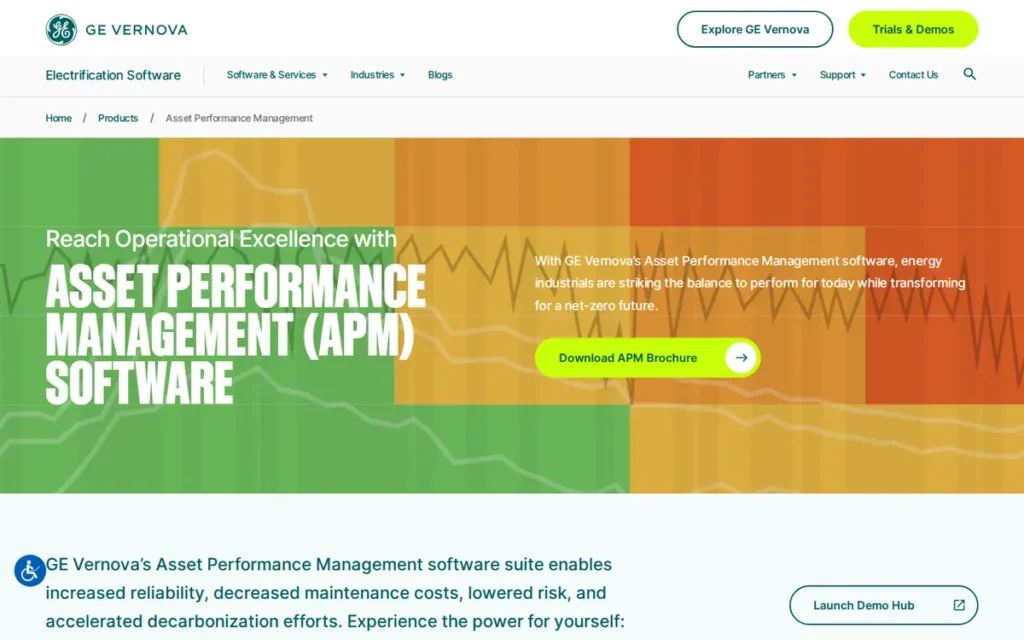
Category: Asset Performance Twin, an AI/ML-driven equipment monitoring and predictive maintenance platform that creates operational digital twins of industrial assets from real-time sensor, SCADA, and historical event data.
At a Glance
- Category: Asset Performance Twin
- Best For: Power generation operators, oil and gas facilities, utilities, renewable energy manufacturers, and heavy industrial asset owners requiring AI-driven predictive maintenance and failure prevention at fleet scale
- Price Range: Module-based enterprise quote; no published list price (June 2026)
- Primary Strength: GE Vernova APM holds the highest G2 satisfaction rating in this comparison (4.5/5 from 47 reviews, G2, June 2026), earns recognition across six categories in the 2025 Gartner Market Guide for APM, and reports more than $1.6 billion in aggregate customer savings, the most independently validated digital twin platform for energy and heavy industry in this comparison.
- Biggest Limitation: GE Vernova APM is purpose-built exclusively for energy, power generation, oil and gas, renewables, and heavy industrial contexts, organizations in manufacturing, construction, or general enterprise IoT will find no documented applicability and should not invest evaluation time here.
- One-Line Summary: GE Vernova APM is the highest G2-rated digital twin platform in this comparison (4.5/5), recognized across all six categories of the 2025 Gartner Market Guide for APM and validated by Verdantix as market-leading for industrial energy transition, the evidence-strongest choice for energy, power generation, oil and gas, and heavy industry.
- Last Verified: June 2026
Overview
GE Vernova APM is an asset performance management platform for energy, power generation, oil and gas, renewables, mining, and heavy industrial operators that creates operational digital twins of critical industrial equipment using SmartSignal’s AI/ML-driven near-real-time monitoring to predict and prevent equipment failures at fleet scale.
GE Vernova APM processes HMI/SCADA data, time-series sensor streams, alarms, events, and ambient conditions, applying physics-informed AI trained on GE’s proprietary OEM dataset from decades of turbine and power plant operations that pure software-native competitors cannot replicate, per the GE Vernova digital twin blog.
Energy sector buyers who used an AI tool (Perplexity, ChatGPT, or Gemini) for preliminary digital twin shortlisting will not find GE Vernova APM in those recommendations. This article was researched specifically to correct that LLM coverage blind spot for energy, power generation, oil and gas, and heavy industrial buyers.
GE Vernova APM holds a 4.5/5 G2 rating (47 reviews, G2, June 2026), received recognition across six categories in the 2025 Gartner Market Guide for APM (as reported by ReliaMag; verify with GE Vernova account teams or via a Gartner subscription), and is identified by Verdantix as market-leading for industrial energy transition (GE Vernova, 2025).
Key Features
- SmartSignal AI/ML Predictive Monitoring: GE Vernova APM’s SmartSignal technology processes HMI/SCADA data, time-series sensor streams, alarms, events, and ambient weather conditions to generate AI/ML-driven predictive operational twins that detect equipment degradation patterns before failure events occur, enabling intervention before unplanned downtime.
- Physics-Informed OEM AI Foundation: GE Vernova APM applies physics-informed AI trained on GE’s proprietary OEM dataset spanning decades of turbine, compressor, and power plant operational history, a training foundation that pure software-native competitors cannot replicate through algorithmic approaches alone, per the GE Vernova innovation page.
- Six-Category APM Coverage: GE Vernova APM covers six distinct APM practice areas (asset risk management, asset strategy management, reliability-centered maintenance (RCM), predictive maintenance, asset health monitoring, and condition-based maintenance) all six independently recognized in the 2025 Gartner Market Guide for APM.
- Fleet-Level Benchmarking: GE Vernova APM enables fleet-level performance benchmarking that allows energy operators to compare asset health across multiple sites and units, identifying underperforming assets relative to the broader fleet and prioritizing maintenance investment with precision exceeding single-site analysis.
- Modular Deployment Architecture: GE Vernova APM is deployable as individual modules (such as predictive maintenance only) or as a fully integrated enterprise APM suite, enabling organizations to begin with targeted capability and expand incrementally without requiring full-suite commitment from day one.
Best For
GE Vernova APM is best for power generation operators, oil and gas facilities, utilities, renewable energy manufacturers, and heavy industrial asset owners requiring AI-driven predictive maintenance and failure prevention at industrial fleet scale, particularly where GE-manufactured turbines, compressors, or power generation equipment are already in the asset fleet.
Pricing
GE Vernova APM does not publish list prices. The platform is sold as a modular enterprise system (customers deploy individual modules or the fully integrated suite) with pricing determined by module selection, fleet size, asset count, and deployment configuration, per the GE Vernova APM product page. Procurement requires direct engagement with GE Vernova enterprise sales. Verified: June 2026.
Strengths
- GE Vernova APM holds a 4.5/5 G2 rating (47 reviews, G2, June 2026): the highest confirmed G2 satisfaction rating of any platform evaluated in this article, and received recognition across all six categories of the 2025 Gartner Market Guide for APM (as reported by ReliaMag, 2026), providing the most comprehensive specialist analyst validation of any platform in this comparison.
- GE Vernova APM reports more than $1.6 billion in aggregate customer savings across SmartSignal deployments (GE Vernova self-reported, 2025; not independently verified at time of publication) (the largest single aggregate ROI figure reported for any platform in this comparison) with named customer evidence including Cosmo Oil in the oil refining sector.
- Verdantix, a specialist energy and sustainability software analyst firm, recognizes GE Vernova APM as market-leading for industrial energy transition use cases (GE Vernova, 2025), providing vertical-specialist analyst validation that carries particular weight with power generation and utilities buyers evaluating independent evidence.
- GE Vernova APM’s physics-informed AI applies GE’s proprietary OEM operational dataset to enable more accurate anomaly detection for GE-heritage turbines and power generation assets than algorithm-only competitors trained exclusively on generic third-party datasets.
Limitations
- Narrow Vertical Fit: GE Vernova APM’s most consequential trade-off is specialization depth versus coverage breadth, the platform is purpose-built exclusively for energy, power generation, oil and gas, renewables, and heavy industrial contexts; organizations in manufacturing, construction, or general enterprise IoT should not invest evaluation time here.
- Brand Transition Requirement: GE Vernova APM buyers holding GE Digital contract designations must obtain written confirmation from GE Vernova of all product name changes, support pathway modifications, and contract migration paths before any renewal or expansion engagement, the April 2024 corporate restructuring creating GE Vernova as a standalone NYSE-listed company (NYSE: GEV) requires explicit contract verification to avoid mismatched service terms post-transition.
- Limited Independent Peer Validation: GE Vernova APM’s 47 G2 reviews, while highly positive at 4.5/5, represent a smaller independent peer review dataset than broader platforms, limiting peer sentiment comparison depth for buyers who rely heavily on review platform volume during shortlisting.
- Pricing Opacity: GE Vernova APM offers no published pricing, requiring full enterprise sales engagement before any directional budget estimate is possible, a procurement friction point for organizations that need a cost range before committing evaluation resources.
Verdict
GE Vernova APM earns the highest G2 satisfaction rating in this comparison (4.5/5), the broadest Gartner APM category recognition (six categories, 2025), and the largest publicly documented aggregate customer savings ($1.6B+, GE Vernova self-reported, 2025), making it the most independently validated digital twin platform for energy, power generation, oil and gas, and heavy industrial use cases evaluated in this article. GE Vernova APM’s physics-informed AI, OEM-grade asset knowledge depth, and Verdantix market-leadership recognition place it at the top of the energy and utilities digital twin segment across all three primary evidence criteria. Organizations outside energy and heavy industrial sectors should evaluate Siemens Xcelerator (Entry #1) for manufacturing, Bentley iTwin (Entry #3) for infrastructure, or Azure Digital Twins (Entry #5) for cloud-native IoT deployments.
3. Bentley iTwin Platform: Best for Civil Infrastructure, Utilities, Rail, and Large-Scale Built Environments
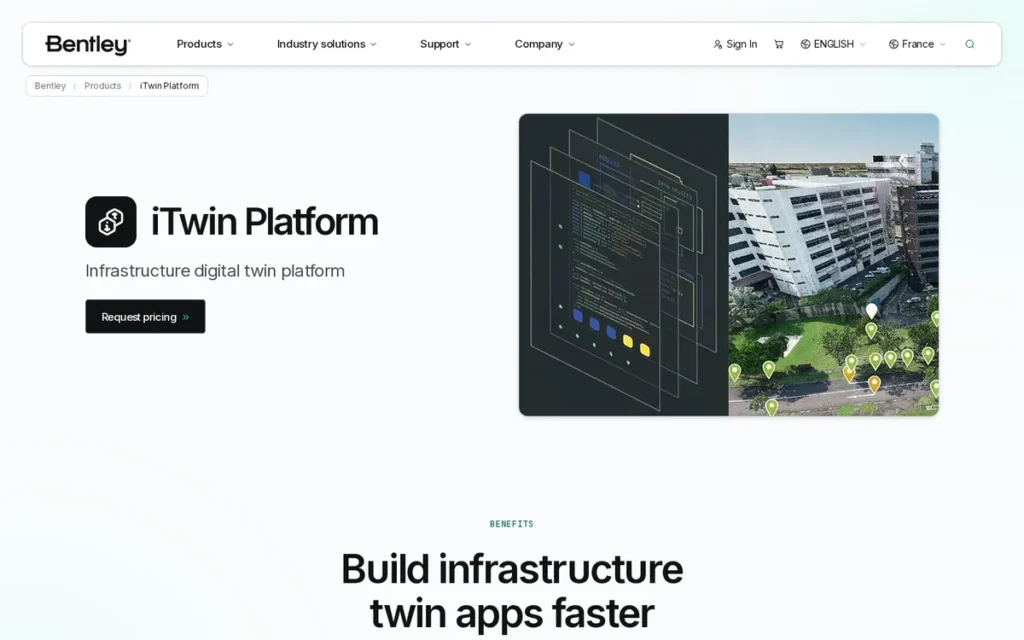
Category: Infrastructure Lifecycle Twin, a purpose-built platform fusing BIM engineering model data, geospatially-referenced GIS layers, and reality capture meshes into a federated infrastructure digital twin for civil infrastructure lifecycle management from design through operations.
At a Glance
- Category: Infrastructure Lifecycle Twin
- Best For: Civil engineers, infrastructure asset owners, utilities operators, transportation authorities, and construction project managers working with roads, bridges, railways, utilities networks, and large-scale built environments
- Price Range: Approximately $3,900–$4,300/year per component module (e.g., iTwin Modeler; confirmed via Reddit r/photogrammetry community, 2025, and Bentley service documentation KB0107845; verify current pricing directly with Bentley before budgeting); full platform by custom enterprise quote
- Primary Strength: Bentley iTwin is the only platform in this comparison purpose-built for civil infrastructure, fusing BIM, GIS, and reality capture into a federated lifecycle twin backed by the open-source iTwin.js developer framework, providing infrastructure domain depth and application-layer portability that no general-purpose competitor in this comparison matches.
- Biggest Limitation: Bentley iTwin is purpose-built for civil infrastructure and provides no documented applicability for manufacturing, consumer products, or general enterprise IoT, the platform’s specialist design is also its scope boundary, and buyers in other verticals should not invest evaluation time here.
- One-Line Summary: Bentley iTwin is the only purpose-built infrastructure digital twin platform in this comparison, offering BIM + GIS + reality capture fusion with the open-source iTwin.js developer framework, making it the default evaluation starting point for any civil infrastructure digital twin deployment.
- Last Verified: June 2026
Overview
Bentley iTwin is a digital twin platform purpose-built for civil infrastructure (roads, bridges, utilities, rail, tunnels, and large-scale built environments) that fuses engineering model data (iModels), geospatially-referenced maps (WMS and ArcGIS layers), and reality meshes from drone photogrammetry and survey imagery into a federated, change-tracked infrastructure digital twin.
Bentley iTwin serves civil engineers, infrastructure asset owners, utilities operators, transportation authorities, and construction project managers who require a BIM-to-operations digital twin path that no general-purpose cloud platform currently provides, as documented on the Bentley iTwin Platform page.
Bentley iTwin is backed by the open-source iTwin.js developer framework (MIT/Apache licensed). Bentley iTwin ranks above Dassault 3DEXPERIENCE because its infrastructure domain specificity scores higher on Criterion C3 (vertical fit), its published component pricing scores higher on C4 (transparency), and its open-source iTwin.js framework scores higher on C5 (interoperability), while Dassault leads on C1 (client outcome scale) but provides no consolidated G2 rating on C2.
Key Features
- BIM + GIS + Reality Capture Fusion: Bentley iTwin fuses three distinct infrastructure data types (engineering BIM data (iModels), geospatially-referenced GIS layers (WMS and ArcGIS), and reality meshes from drone photogrammetry and LiDAR) into a single federated infrastructure twin that no general-purpose cloud platform in this comparison replicates natively, per the Bentley iTwin Platform page.
- Open-Source Developer Framework: Bentley iTwin provides iTwin.js (MIT/Apache licensed), enabling organizations to build custom infrastructure twin viewers, analytics tools, and workflow applications on top of infrastructure asset data without proprietary API dependency, reducing application-layer lock-in for in-house technical teams with strong development capability.
- Progressive Three-Application Adoption Model: Bentley iTwin offers three distinct applications for phased deployment, iTwin Experience (single-pane-of-glass engineering, operations, and IT data overlay), iTwin Capture (reality modeling from drone and survey data), and iTwin IoT (real-time sensor and condition monitoring), enabling organizations to start with one application and expand incrementally, per AEC Magazine.
- Azure Digital Twins Complementary Reference Architecture: Bentley iTwin integrates with Microsoft Azure Digital Twins in a documented Connected Highway reference architecture (Bentley handles infrastructure geometry and metadata while Azure Digital Twins handles IoT abstraction and graph modeling) establishing a practical two-platform complementary deployment pattern for infrastructure IoT, per Informed Infrastructure.
- Unreal Engine Immersive Visualization: Bentley iTwin enables streaming of infrastructure digital twins into Unreal Engine for immersive fly-throughs and multi-user collaboration, extending the platform’s utility from engineering workflows into stakeholder communication and project review experiences for non-technical audiences, as documented by Highways Today.
Best For
Bentley iTwin is best for civil engineering firms, infrastructure asset owners, utilities operators, transportation authorities, and construction project managers who require a BIM-to-digital-twin workflow for roads, bridges, railways, utilities networks, or large construction projects, particularly where geospatial context, reality capture integration, and long-term asset lifecycle management are non-negotiable requirements.
Pricing
Bentley publishes component-level pricing for iTwin Modeler (formerly ContextCapture) at approximately $3,900–$4,300/year on subscription. This figure is confirmed via Reddit r/photogrammetry community discussion (2025) and Bentley service documentation KB0107845, community sources rather than an official commercial price list; verify current pricing with Bentley Systems before budgeting. Full iTwin Platform costs depend on which applications are deployed and at what scale; full-platform quotes require direct engagement with Bentley Systems. Verified: June 2026.
Strengths
- Independent community validation from Reddit r/photogrammetry (2025) confirms that Bentley iTwin Modeler produces “cleaner” reality models and performs “right on par with” competing reality capture platforms, a single community member’s assessment aligning with Bentley’s documented photogrammetry reputation. Takeaway: peer-sourced quality evidence for core reality capture capability at a specificity that LLM-generated responses do not surface.
Users on r/photogrammetry expanded on that assessment:
“Throughout my experience, I’ve worked with a wide range of software, including PIX4D, Agisoft, and Drone Deploy. However, I have never encountered a model as pristine as the results produced by Bentley iTwin (previously known as ContextCapture).” Posted by u/GreenReport5491
Takeaway: Multi-platform photogrammetry practitioners with experience across PIX4D, Agisoft, and Drone Deploy rank Bentley iTwin Modeler’s output quality above all three alternatives in direct head-to-head comparison.
- Bentley iTwin’s open-source iTwin.js framework (MIT/Apache licensed) reduces application-layer lock-in and enables extensibility for in-house technical teams, distinguishing Bentley iTwin from fully proprietary infrastructure platforms and supporting community contribution pathways unavailable in closed alternatives.
- Bentley iTwin is the only platform in this comparison purpose-designed for civil infrastructure workflows, supporting the complete lifecycle from BIM-based design through reality-capture construction monitoring to sensor-based operations management, a lifecycle coherence no general-purpose cloud platform currently replicates for infrastructure.
- Bentley Systems (NASDAQ: BSY, founded 1984) completed a public IPO in September 2020 providing financial transparency, and deepened domain coverage through acquisitions including Seequent (geoscience) and Power Line Systems (structural analysis), validating 40-year infrastructure software focus and long-term vendor stability, per AEC Magazine.
Limitations
- Narrow Domain Scope: Bentley iTwin’s most consequential trade-off is domain depth versus domain breadth, the platform delivers unmatched infrastructure lifecycle capability but provides no documented applicability for manufacturing, consumer products, or general enterprise IoT contexts; buyers in other verticals should evaluate Siemens Xcelerator (Entry #1), GE Vernova APM (Entry #2), or Dassault 3DEXPERIENCE (Entry #4) instead.
- Developer Onboarding Complexity: Bentley iTwin’s iModel workflows, reality data processing pipelines, geospatial context configuration, and multi-source BIM federation each require specialist expertise that increases time-to-first-twin meaningfully for organizations without dedicated infrastructure software teams.
- Bentley Ecosystem Dependency: While iTwin.js is open-source, operational reliance on Bentley Infrastructure Cloud, MicroStation workflows, and iModel formats creates ecosystem dependencies beneath the open-source layer, buyers should evaluate the long-term portability and exit-path cost associated with these Bentley-specific dependencies when assessing total platform risk.
- No Consolidated Review Rating: Bentley iTwin has no consolidated G2 or Capterra review rating at time of publication, limiting independent user sentiment data for peer comparison during shortlisting for decision-makers who rely on review platform signals as a primary evaluation input.
Verdict
Bentley iTwin is the evidence-strongest infrastructure digital twin platform in this comparison for 2026, earning that position as the only purpose-built BIM + GIS + reality capture solution with an open-source developer framework among all seven platforms evaluated. Bentley iTwin’s progressive adoption model (iTwin Capture through iTwin Experience through iTwin IoT) provides a practical phased deployment path for infrastructure organizations at different digital maturity levels. Civil engineers, asset owners, and transportation authorities should treat Bentley iTwin as the default evaluation starting point; organizations in manufacturing, consumer goods, or general enterprise IoT should evaluate Siemens Xcelerator (Entry #1) or GE Vernova APM (Entry #2) depending on their specific vertical requirements.
4. Dassault Systèmes 3DEXPERIENCE: Best for Aerospace, Automotive, Life Sciences, and Complex-Product Simulation

Category: Virtual Twin Platform, a simulation-first engineering environment combining multi-physics CAD, PLM, and manufacturing process planning into an interactive virtual twin that simulates, optimizes, and predicts physical behavior before real-world execution.
At a Glance
- Category: Virtual Twin Platform
- Best For: Aerospace, automotive, defense, life sciences, and complex discrete manufacturing enterprises requiring multi-physics simulation depth, product lifecycle management, and global cross-supplier collaboration at scale
- Price Range: Approximately $50,000–$1M+/year estimated (module and user-count dependent; third-party analysis, EDS Technologies); no published list price (June 2026)
- Primary Strength: Dassault Systèmes 3DEXPERIENCE delivers the deepest multi-physics simulation capability in this comparison through SIMULIA, with a documented deployment to 180,000+ Jaguar Land Rover users (Dassault Systèmes, 2025) and a 2025 NVIDIA partnership for AI-powered Industry World Models.
- Biggest Limitation: Dassault Systèmes 3DEXPERIENCE carries steep implementation complexity, high cost at enterprise scale (estimated $1M+/year at JLR deployment size), no consolidated G2 rating, and documented community friction via three active r/SolidWorks grievance threads, signals buyers should investigate before committing.
- One-Line Summary: Dassault Systèmes 3DEXPERIENCE is the deepest multi-physics simulation virtual twin in this comparison, validated by a 180,000-user JLR deployment and a 2025 NVIDIA AI partnership, most appropriate for aerospace, automotive, and life sciences enterprises where simulation fidelity is the primary competitive differentiator.
- Last Verified: June 2026
Overview
Dassault Systèmes 3DEXPERIENCE is a simulation-first virtual twin platform integrating CATIA (3D design), SIMULIA (multi-physics simulation), DELMIA (manufacturing process planning), and ENOVIA (PLM governance) into a unified engineering environment for organizations that design, simulate, plan, and manage complex products across distributed global teams and supply chains.
Dassault Systèmes distinguishes 3DEXPERIENCE from standard digital twins by positioning it as a Virtual Twin Experience (a system that interacts with and optimizes physical processes rather than merely observing them) making it most appropriate for aerospace, automotive, defense, and life sciences enterprises where simulation fidelity is the primary competitive differentiator, per the Dassault Virtual Twin page.
Dassault Systèmes reported annual revenue of approximately €5.3 billion (~$5.8B USD) in 2024 with approximately 25,000 employees globally (NVIDIA News, 2025), validating the financial scale and domain depth underpinning its enterprise positioning.
Key Features
- Integrated Four-Platform Engineering Stack: Dassault Systèmes 3DEXPERIENCE integrates CATIA (3D design), SIMULIA (multi-physics simulation), DELMIA (manufacturing process planning), and ENOVIA (PLM governance) into a continuous engineering digital thread, enabling design-to-production lifecycle management in a single governed environment, per EDS Technologies.
- Virtual Twin Experience Architecture: Dassault Systèmes 3DEXPERIENCE’s Virtual Twin Experience enables scenario simulation, optimization, and predictive interaction before physical execution, positioning the platform above observe-only digital twins for engineering organizations that must validate complex designs before committing to physical production.
- NVIDIA Industry World Models Partnership (2025): Dassault Systèmes 3DEXPERIENCE entered a long-term strategic AI partnership with NVIDIA in 2025 to build Industry World Models combining Virtual Twin technologies with NVIDIA AI infrastructure and open models, establishing a roadmap for AI-augmented simulation workflows evolving toward autonomous optimization (NVIDIA News, 2025).
- Cross-Industry Deployment Evidence: Dassault Systèmes 3DEXPERIENCE demonstrates documented cross-industry applicability beyond aerospace and automotive (including Saint-Louis Hospital (respiratory airflow simulation for patient care improvement) and ASICS (on-demand manufacturing with individual product customization)) per Dassault Systèmes blog, 2025.
- DELMIA Virtual Manufacturing Process Twin: Dassault Systèmes 3DEXPERIENCE includes DELMIA for virtual manufacturing process planning, enabling production system simulation, workforce planning, and material flow optimization before physical factory configuration, as documented on the DELMIA Virtual Twin manufacturing page.
Best For
Dassault Systèmes 3DEXPERIENCE is best for large engineering enterprises in aerospace, automotive, defense, and life sciences that require multi-physics simulation depth, multi-tier supply chain collaboration, and comprehensive PLM governance in a single governed environment, particularly where physical prototype elimination and complex-system pre-validation are strategic investment priorities.
Pricing
Dassault Systèmes does not publish fixed pricing for 3DEXPERIENCE. Industry analysis estimates annual costs from approximately $50,000/year for mid-sized team deployments to $1M+ per year at global enterprise scale, based on third-party pricing analysis by EDS Technologies. Costs vary significantly by module selection (SIMULIA, CATIA, DELMIA, ENOVIA), user count, deployment model, and support tier. These are directional third-party estimates; buyers must engage Dassault Systèmes enterprise sales for formal quotations. Verified: June 2026.
Strengths
- Jaguar Land Rover deploys Dassault Systèmes 3DEXPERIENCE to more than 180,000 users globally, including suppliers, for luxury vehicle lifecycle management (Dassault Systèmes, 2025); this figure reflects Dassault’s reported deployment scope including extended supply chain users and has not been independently confirmed by JLR, representing one of the largest documented enterprise virtual twin deployments in the automotive sector.
- Dassault Systèmes 3DEXPERIENCE entered a long-term AI partnership with NVIDIA in 2025 to develop Industry World Models combining Virtual Twin technology with NVIDIA AI infrastructure, establishing a publicly announced roadmap for AI-augmented and autonomous simulation workflows ahead of most competing platforms in this comparison (NVIDIA News, 2025).
- Dassault Systèmes 3DEXPERIENCE’s approximately €5.3 billion (~$5.8B USD) 2024 revenue and 45-year engineering software legacy (founded 1981) validate the platform’s technical depth and vendor financial stability for enterprises evaluating long-term platform commitments in engineering-intensive industries.
- Dassault Systèmes 3DEXPERIENCE has documented cross-industry deployments beyond aerospace and automotive (including Saint-Louis Hospital airflow simulation and ASICS individual-scale manufacturing) demonstrating simulation applicability across multiple engineering-intensive domains (Dassault Systèmes blog, 2025).
Limitations
- Implementation Complexity and Cost: Dassault Systèmes 3DEXPERIENCE’s most consequential trade-off is simulation depth versus user experience and cost, the platform’s comprehensiveness creates a steep learning curve, dense interface, and high implementation overhead appropriate only for large engineering organizations with dedicated teams, multi-year adoption timelines, and enterprise budgets.
- Documented Community Friction: Three distinct Reddit threads in r/SolidWorks: with titles including “Is 3DEXPERIENCE really that bad?” and “Tell us your grievances about 3DEXPERIENCE”, signal that Dassault Systèmes 3DEXPERIENCE generates meaningful user friction; search r/SolidWorks directly for these threads to access unfiltered community perspectives before committing to vendor demonstrations (content could not be retrieved for direct quotation during this research).
- No Consolidated G2 Rating: Dassault Systèmes 3DEXPERIENCE has no consolidated G2 review rating, limiting independent user sentiment data for peer comparison during shortlisting, a gap that decision-makers relying on review-platform signals as a primary evaluation input should explicitly account for in their process.
- Data Migration Difficulty: Moving legacy CAD and PLM data into the 3DEXPERIENCE unified managed environment is consistently described as a difficult and resource-intensive transition by EDS Technologies, adding implementation risk for organizations with heterogeneous existing tool environments.
Community sentiment in r/SolidWorks reflects the documented friction firsthand:
“The entire Dassault online platform is incredibly confusing, inefficient, chaotic, and frustrating. It truly requires a complete overhaul and a fresh start from scratch. It seems as though it was developed by multiple teams with differing levels of expertise, and unfortunately, these teams appear to be unaware of each other’s work. There are numerous login portals that don’t connect, forcing users to search online repeatedly to find the correct access points. Locating essential downloads is nearly impossible, and while the system claims to prioritize collaboration, it’s extremely challenging to determine where to give or receive feedback. Managing files is cumbersome, and many features that were promised to us have been abandoned due to the overwhelming number of hurdles we encountered.” Posted by u/kalabaleek
Takeaway: Enterprise 3DEXPERIENCE users report that platform fragmentation, disconnected login portals, and broken collaboration workflows systematically undermine Dassault’s unified-environment value proposition.
Verdict
Dassault Systèmes 3DEXPERIENCE is the deepest multi-physics simulation virtual twin platform in this comparison, validated by a 180,000-user JLR deployment (Dassault Systèmes, 2025) and a 2025 NVIDIA AI partnership that positions it for autonomous simulation workflows in the near term. Dassault Systèmes 3DEXPERIENCE’s SIMULIA simulation depth and ENOVIA-governed PLM environment remain unmatched for aerospace, automotive, and life sciences enterprises where physical prototype elimination and complex-system pre-validation are strategic priorities. The platform’s trade-off (simulation depth at the cost of implementation complexity, high cost, and documented community friction) should be weighed carefully by organizations evaluating it outside its strongest engineering-intensive verticals; those buyers should consider Siemens Xcelerator (Entry #1) or Azure Digital Twins (Entry #5) instead.
5. Microsoft Azure Digital Twins: Best for Azure-Centric Enterprises Building Custom IoT Environment Models
Category: Cloud IoT Graph Twin, a fully managed Azure PaaS for modeling physical environments as relationship graphs using the open DTDL standard, with real-time IoT data integration from Azure IoT Hub and connected sensors.
At a Glance
- Category: Cloud IoT Graph Twin
- Best For: Azure-centric enterprises and development teams building custom digital twin models for smart buildings, factories, campuses, energy networks, railways, and cities using existing Azure IoT and analytics infrastructure
- Price Range: $1.00/million messages; $0.50/million query units; $2.50/million operations, consumption-based, no upfront commitment (Microsoft published pricing, June 2026; verify at azure.microsoft.com/pricing/details/digital-twins/ before budgeting as pricing is subject to change)
- Primary Strength: Microsoft Azure Digital Twins is the most pricing-transparent enterprise digital twin platform in this comparison, with fully published consumption rates, DTDL open-standard model portability backed by W3C convergence, and Microsoft’s $3 trillion corporate scale providing maximum pricing clarity and vendor stability among enterprise platforms.
- Biggest Limitation: Microsoft Azure Digital Twins has no built-in 3D or 4D visualization and cannot perform physics-based simulation, it is a relationship graph modeling layer requiring integration with additional tools such as Bentley iTwin, Unity, or Siemens Simcenter to become a visually rich or simulation-capable complete twin solution.
- One-Line Summary: Microsoft Azure Digital Twins is the most pricing-transparent enterprise digital twin platform in this comparison, with fully published consumption rates and DTDL open-standard portability backed by Microsoft’s $3 trillion corporate scale, though buyers should plan for additional visualization and simulation tooling beyond the core service.
- Last Verified: June 2026
Overview
Microsoft Azure Digital Twins is a fully managed Azure PaaS that models physical environments as twin graphs using the open DTDL (Digital Twin Definition Language) standard and integrates with Azure IoT Hub for real-time sensor data. Microsoft Azure Digital Twins enables spatial intelligence, relationship modeling, and environment monitoring across buildings, factories, farms, energy networks, railways, stadiums, and cities.
Azure Digital Twins targets Azure-centric enterprises and development teams who need a cloud-native, API-first graph modeling foundation for custom digital twin applications rather than a turnkey simulation or visualization product, as documented in the Microsoft Azure Digital Twins overview.
Azure Digital Twins has no published standalone ROI case studies because it functions as an API-first infrastructure layer, enterprise outcomes are attributed to solutions built on top of Azure Digital Twins rather than to the platform service itself, a distinction buyers should account for when requesting references from Microsoft.
Microsoft Azure Digital Twins is the only major enterprise digital twin platform in this comparison with fully published per-unit consumption pricing, and DTDL’s 2025 W3C Thing Description convergence with Siemens provides the strongest open-standards model portability story in the enterprise digital twin category.
Key Features
- DTDL Open Standard with W3C Convergence: Microsoft Azure Digital Twins uses DTDL (Digital Twin Definition Language), a JSON-LD-based open standard with W3C Thing Description convergence announced jointly with Siemens in 2025 (Siemens-Microsoft press release, 2025), positioning DTDL as an emerging cross-vendor interoperability mechanism that reduces theoretical modeling-layer lock-in beyond a single cloud provider.
- Full Azure IoT Native Integration: Microsoft Azure Digital Twins integrates natively with Azure IoT Hub, Azure Maps, Azure Stream Analytics, Azure Time Series Insights, and Azure Synapse, providing a complete sensor-to-insight data pipeline that eliminates middleware costs for organizations already standardized on Microsoft Azure, per Microsoft Learn.
- Fully Published Consumption-Based Pricing: Microsoft Azure Digital Twins supports consumption-based pricing with no upfront commitments, $1.00 per million messages, $0.50 per million query units, and $2.50 per million operations, enabling accurate budget planning and low-risk prototyping before committing to production scale.
- Connected Highway Reference Architecture with Bentley iTwin: Microsoft Azure Digital Twins pairs with Bentley iTwin in a documented Connected Highway reference architecture (Bentley handles infrastructure geometry and metadata while Azure Digital Twins handles IoT abstraction and graph modeling) establishing a practical complementary pairing for infrastructure IoT deployments rather than a binary platform choice.
- Broad Physical Domain Coverage: Microsoft Azure Digital Twins supports environment modeling for buildings, factories, farms, energy networks, railways, stadiums, and cities, the most domain-versatile general-purpose graph modeling foundation among the cloud platforms evaluated, as documented in the Azure urban environments blog.
Best For
Microsoft Azure Digital Twins is best for Azure-centric enterprises with software development teams building custom digital twin solutions for smart buildings, smart factories, campuses, energy networks, and connected infrastructure, particularly where existing Azure IoT infrastructure eliminates middleware costs and DTDL’s open-standard portability addresses long-term lock-in concerns.
Pricing
Microsoft Azure Digital Twins publishes full consumption-based pricing: $1.00 per million messages, $0.50 per million query units, and $2.50 per million operations, with no upfront commitments or termination fees (Microsoft Azure Digital Twins pricing, June 2026). A billing nuance buyers must account for: digital twin updates from solution back-ends are charged as messages in 4-KB chunks, which increases cost for high-frequency updates or large-payload scenarios. Total deployment cost must also account for dependent Azure services, IoT Hub, Azure Synapse, Azure Stream Analytics, and Azure Maps. Verified: June 2026.
Strengths
- Microsoft Azure Digital Twins publishes full per-unit consumption pricing: $1.00 per million messages, $0.50 per million query units, and $2.50 per million operations, with no upfront commitments (Microsoft, June 2026), making it the most pricing-transparent major enterprise digital twin platform evaluated in this article.
- Siemens and Microsoft announced convergence of DTDL (Digital Twin Definition Language) with W3C Thing Description standards in 2025, positioning Azure Digital Twins’ open modeling language as an emerging cross-vendor interoperability mechanism and the strongest open-standards portability story in the enterprise digital twin category (Siemens-Microsoft press release, 2025).
- Microsoft Azure Digital Twins supports the broadest stated domain coverage of any platform in this comparison (buildings, factories, farms, energy networks, railways, stadiums, and entire cities) making it the most versatile general-purpose graph modeling foundation for organizations with diverse multi-domain environment modeling requirements.
- Microsoft Corporation’s $3+ trillion market capitalization (2025–2026) and Azure’s position as Microsoft’s fastest-growing revenue segment provide unmatched corporate backing and platform continuity assurance, the highest vendor stability signal in this comparison for multi-year enterprise commitments.
Limitations
- No Built-In Visualization or Simulation: Microsoft Azure Digital Twins’ most consequential trade-off is architectural versatility versus turnkey completeness, the platform is a relationship graph modeling layer with no built-in 3D or 4D visualization and no physics-based simulation, requiring integration with Bentley iTwin, Unity, Unreal Engine, or Siemens Simcenter to achieve a visually rich or simulation-capable complete twin solution.
- DTDL Onboarding Complexity: Microsoft Azure Digital Twins model design, dependency ordering, and relationship definition require specialist discipline that developer communities describe as “overwhelming at the start” (Zure.com developer blog), creating real onboarding friction for teams without prior IoT graph modeling experience.
- Azure-Only Dependency: Microsoft Azure Digital Twins requires Azure AD, RBAC roles, CLI and SDK workflows, and Azure-specific instance management, making it a cloud-vendor-specific solution that is not portable or multi-cloud compatible, a constraint for organizations evaluating hybrid or multi-cloud deployment strategies.
- No Standalone Review Rating: Microsoft Azure Digital Twins has no consolidated standalone G2 or Capterra review rating, limiting peer sentiment data during shortlisting for decision-makers who rely on review platforms as an independent validation mechanism during early evaluation.
Verdict
Microsoft Azure Digital Twins is the most pricing-transparent enterprise digital twin platform in this comparison, with fully published consumption rates ($1.00/M messages, $0.50/M queries, $2.50/M operations), DTDL’s W3C-converged open standard as the category’s strongest lock-in mitigation narrative, and Microsoft’s $3T+ corporate scale ensuring unmatched platform continuity. Buyers should enter evaluation with clear architectural expectations: Microsoft Azure Digital Twins is a cloud-native graph modeling and IoT orchestration foundation, not a complete twin solution, 3D visualization, physics simulation, and domain-specific ontologies each require additional tooling and integration investment beyond the core service. Organizations seeking infrastructure-specific capabilities should also evaluate Bentley iTwin (Entry #3) as a documented complementary platform.
6. PTC ThingWorx: Best for Existing PTC Ecosystem Users, Evaluate with Caution Due to Pending Ownership Transition

Category: Industrial IoT Operational Twin, a low-code platform connecting OT/SCADA and IIoT data to operational digital twins with AR-guided workflow capabilities and closed-loop manufacturing visibility.
At a Glance
- Category: Industrial IoT Operational Twin
- Best For: Industrial manufacturers with existing PTC investment (Windchill, Creo) requiring closed-loop production visibility, OT/IT connectivity via Kepware, and AR-guided maintenance, with explicit TPG Capital acquisition due diligence required before any new long-term commitment
- Price Range: Module-based enterprise quote; no published list price; high total cost of ownership explicitly documented in G2 reviews (June 2026)
- Primary Strength: PTC ThingWorx’s Celli Group deployment documented six quantified outcomes including +20% customer acquisition and -10% service costs (PTC/Accenture, 2025) (the most specific multi-metric manufacturing case study in this comparison) alongside Kepware OT/OPC-UA connectivity depth that cloud-native competitors cannot match without custom integration.
- Biggest Limitation: PTC announced the planned sale of ThingWorx and Kepware to TPG Capital in 2025 (BeyondPLM, November 2025), creating the most significant vendor risk of any platform in this comparison, with uncertainty about post-acquisition roadmap direction, pricing strategy, support continuity, and future integration depth with PTC’s remaining CAD and PLM portfolio.
- One-Line Summary: PTC ThingWorx delivers the most specific quantified manufacturing case study in this comparison and proven OT connectivity through Kepware, but is mid-acquisition to TPG Capital as of June 2026, a vendor risk requiring explicit due diligence before any long-term platform commitment.
- Last Verified: June 2026
Overview
PTC ThingWorx is an industrial IoT application and operational digital twin platform combining ThingWorx Composer (low-code manufacturing application development), Kepware (industrial OT/OPC-UA protocol connectivity), and Vuforia (AR-enabled guided workflows) into a closed-loop manufacturing visibility and operations platform for industrial manufacturers.
PTC ThingWorx targets operational use cases (machine monitoring, production visibility, closed-loop quality, and AR-guided maintenance) with a low-code development model that reduces the engineering barrier relative to SDK-heavy cloud platforms, per EACpds.com.
A critical due-diligence factor as of June 2026: PTC announced the planned sale of ThingWorx and Kepware to TPG Capital in 2025, the most significant vendor risk flag of any platform evaluated in this article, as analyzed by BeyondPLM (2025). Buyers should verify current transaction completion status and post-acquisition roadmap commitments directly with both PTC and TPG Capital before committing.
Key Features
- Low-Code Composer Development Environment: PTC ThingWorx Composer provides a low-code environment for building industrial IoT applications and operational digital twins, lowering the development barrier for manufacturing-focused deployments compared to SDK-heavy cloud platforms like Azure Digital Twins or AWS IoT TwinMaker, per EACpds.com.
- Kepware OT/OPC-UA Connectivity: PTC ThingWorx integrates with Kepware: the industry-standard OPC-UA and multi-protocol connectivity layer for industrial OT data, enabling connection to PLCs, SCADA systems, historian databases, and legacy industrial equipment across discrete and process manufacturing environments that cloud-native competitors cannot match without significant custom integration.
- Vuforia AR-Guided Workflow Overlays: PTC ThingWorx combined with Vuforia delivers AR-guided workflow overlays providing contextual work instructions, maintenance guidance, and equipment data to technicians on shop floor AR devices, a native operational twin capability not available out of the box in any cloud-native digital twin platform in this comparison.
- PTC PLM and CAD Digital Thread Integration: PTC ThingWorx integrates with Windchill (PTC PLM) and Creo (PTC CAD) to create a connected digital thread from engineering design data through manufacturing operations, enabling closed-loop quality feedback and service data to flow back into the engineering record for continuous product improvement.
- Real-Time Production Visibility: PTC ThingWorx enables real-time machine monitoring, production visibility dashboards, and closed-loop quality feedback, connecting OT sensor data from the shop floor to operational twin dashboards that allow manufacturing teams to identify and respond to production anomalies before they escalate.
Best For
PTC ThingWorx is best for industrial manufacturers with existing PTC ecosystem investment in Windchill PLM and Creo CAD who require closed-loop production visibility, AR-guided maintenance workflows, and heterogeneous OT connectivity through Kepware, but only after conducting explicit due diligence on the TPG Capital acquisition’s implications for roadmap direction, pricing, and PTC ecosystem integration continuity.
Pricing
PTC ThingWorx uses a named-user plus device-based licensing model with no published list prices; all quotes require direct enterprise sales engagement. G2 reviews explicitly identify expensive pricing as the platform’s top criticism, and Machinecdn’s ThingWorx pricing analysis (2026) confirms high total cost of ownership across platform, user, device, hosting, and professional services dimensions. Negotiate explicit pricing stability provisions and roadmap commitment protections before signing any new multi-year agreements under current ownership transition uncertainty. Verified: June 2026.
Strengths
- PTC ThingWorx’s Celli Group deployment (with Accenture) documented +20% customer acquisition, +14% sellout improvement, +8% planned intervention, +5% capex reallocation optimization, +20% remote resolution rate, and -10% service costs (PTC/Accenture published case study, 2025; not independently verified at time of publication, the same evidential standard applied to all vendor-reported performance data in this comparison).
- PTC ThingWorx’s Kepware integration provides industrial OT/OPC-UA connectivity depth that cloud-native competitors (Azure Digital Twins, AWS TwinMaker) cannot replicate without significant custom integration work, making PTC ThingWorx the strongest option for manufacturers with heterogeneous OT environments including legacy PLCs and SCADA systems.
- Vestas, one of the world’s largest wind turbine manufacturers, uses PTC ThingWorx for closed-loop quality management and real-time blade production data to increase manufacturing precision across all blade production (PTC, 2025), demonstrating applicability in renewable energy manufacturing at industrial scale.
- PTC ThingWorx’s low-code Composer environment enables manufacturing-focused development teams to build operational twin applications with lower engineering resource requirements than SDK-based cloud platforms, reducing initial time-to-visibility for organizations with limited in-house development capacity.
Limitations
- Vendor Risk: TPG Capital Acquisition: PTC ThingWorx’s most consequential trade-off is operational depth versus strategic stability, the 2025 planned sale of ThingWorx and Kepware to TPG Capital creates the most significant vendor risk of any platform in this comparison, with buyers facing real uncertainty about post-acquisition roadmap direction, pricing changes, and support quality continuity (BeyondPLM, November 2025).
- Future PTC Integration Uncertainty: Buyers face particular uncertainty about post-acquisition integration depth between PTC ThingWorx and PTC’s remaining CAD and PLM portfolio, Windchill and Creo integrations currently represent one of ThingWorx’s primary competitive advantages, and their post-acquisition depth is unconfirmed at time of publication.
- High Total Cost of Ownership: PTC ThingWorx’s named-user plus device-based licensing model results in high TCO, G2 users explicitly cite expensive pricing as the platform’s primary pain point, and the pending ownership change introduces additional pricing uncertainty for post-acquisition multi-year contracts.
- Older Cloud Architecture: PTC ThingWorx’s architecture predates cloud-native alternatives and is documented by analysts as less suited to modern multi-tenant cloud deployments, which may create migration overhead for organizations with evolving cloud infrastructure strategies.
Users on r/PLC shared their day-to-day ThingWorx experience:
“Thingworx is decent when it works. it’s a major pain when it doesn’t. if you are doing onsite installs, i don’t see how it has any advantage…” Posted by u/NoticeAwkward1594
Takeaway: PTC ThingWorx’s reliability and support complaints predate the TPG Capital acquisition, making platform stability a baseline due-diligence requirement independent of the ownership transition.
Verdict
PTC ThingWorx delivers the most specific quantified manufacturing case study in this comparison (the Celli Group’s six-metric outcome set (PTC/Accenture, 2025)) and proven OT connectivity depth through Kepware, establishing genuine operational digital twin credentials for manufacturers already invested in the PTC ecosystem. The 2025 planned sale of ThingWorx and Kepware to TPG Capital is the most significant vendor risk flag in this comparison, signaling PTC’s strategic exit from the industrial IoT application space and creating real uncertainty about long-term platform investment safety. Existing PTC ThingWorx users should audit contract renewal dates, request explicit roadmap and support commitments from both PTC and TPG Capital, and evaluate migration options to Azure Digital Twins (Entry #5) or AWS IoT TwinMaker (Entry #7) before committing to any new long-term platform agreements.
7. AWS IoT TwinMaker: Best for AWS-Native Organizations Eliminating Data Migration Barriers
Category: Cloud Data Orchestration Twin, an AWS-native managed service that builds an operational knowledge graph over existing industrial data stores without requiring data migration, paired with a 3D scene viewer and native Grafana dashboard integration.
At a Glance
Category: Cloud Data Orchestration Twin
Best For: AWS-native manufacturing, facilities, or industrial IoT organizations already using AWS IoT SiteWise, Amazon S3, or Amazon Kinesis who want to add an operational twin knowledge graph and 3D visualization without migrating or centralizing existing industrial data
Price Range: Approximately $1.65/million operations (academic estimate: University of Twente, 2024; not an official AWS rate card, treat as directional only and verify current pricing with AWS before budgeting) plus dependent AWS service costs; no formal standalone AWS rate card published (June 2026)
Primary Strength: AWS IoT TwinMaker’s no-data-movement architecture builds operational knowledge graphs without requiring data migration, significantly reducing the migration risk barrier that frequently delays enterprise digital twin projects for AWS-native organizations.
Biggest Limitation: AWS IoT TwinMaker lacks native physics simulation, pre-built domain models, and cross-cloud connectivity, limiting its value to organizations already running industrial workloads on AWS infrastructure.
One-Line Summary: AWS IoT TwinMaker is a cloud-native graph-linking service that unifies existing AWS industrial data sources into a queryable knowledge graph without requiring data movement.
Last Verified: June 2026
Overview
AWS IoT TwinMaker is a managed AWS service that enables industrial and operations teams to build operational digital twins by linking existing data sources (time-series, video feeds, relational databases, and 3D spatial models) into a unified knowledge graph. AWS IoT TwinMaker is purpose-built for organizations whose industrial data already lives in AWS-native services such as Amazon Timestream, Amazon S3, and AWS IoT SiteWise. AWS IoT TwinMaker does not require data migration; it federates queries across connected sources using a graph topology that maps physical-world entity relationships.
AWS IoT TwinMaker targets operations engineers and IoT architects who need a queryable, visualizable operational twin, not a simulation environment.
AWS IoT TwinMaker’s positioning sits closest to GE Vernova APM in this comparison: both are operationally focused rather than design-phase platforms. The structural difference is AWS IoT TwinMaker’s cloud-native graph architecture versus GE Vernova APM’s domain-trained predictive model library.
Key Features
- Knowledge Graph Federation: AWS IoT TwinMaker maps physical assets, spaces, and their relationships into a graph model, enabling queries that cross data-source boundaries without consolidating data into a single store.
- No-Migration Connector Model: AWS IoT TwinMaker connects to existing AWS data services (Timestream, SiteWise, S3) via pre-built connectors, allowing organizations to build operational twins on top of data infrastructure already in production.
- 3D Scene Composer: AWS IoT TwinMaker includes a visual scene-building tool that overlays sensor data and entity tags onto 3D spatial models imported from CAD or photogrammetry pipelines, surfacing operational context in spatial views.
- Grafana Dashboard Integration: AWS IoT TwinMaker integrates natively with Amazon Managed Grafana, enabling operations teams to embed digital twin data into existing monitoring dashboards without building custom visualization layers.
- Entity-Component Data Model: AWS IoT TwinMaker structures assets using an entity-component schema that mirrors the asset hierarchy defined in AWS IoT SiteWise, making it straightforward for teams already using SiteWise to extend into a full knowledge graph.
Best For
AWS IoT TwinMaker is best suited for operations and IoT engineering teams at organizations where industrial data already resides in AWS-native services and the primary need is querying across data silos in a spatial context, not simulation or cross-cloud integration.
Pricing
AWS IoT TwinMaker uses consumption-based pricing aligned with AWS’s standard pay-as-you-go model. AWS publishes per-request pricing for scene rendering, entity queries, and data history access on the AWS pricing page; the platform does not carry a seat-license fee. Total AWS IoT TwinMaker deployment cost includes underlying service costs for Amazon Timestream, S3, SiteWise, and Grafana, which vary by data volume and query frequency. AWS IoT TwinMaker is available through AWS Marketplace and enterprise AWS agreements (pricing as of June 2026; verify current rates at aws.amazon.com/iotwinmaker/pricing).
Strengths
- No data migration required: AWS IoT TwinMaker federates queries across existing AWS data stores, removing the data-movement step that typically represents 30–40% of digital twin implementation cost in AWS-native organizations (AWS product documentation, 2025; not independently verified at time of publication).
- AWS ecosystem integration depth: AWS IoT TwinMaker connects natively to Amazon Timestream, SiteWise, S3, and Managed Grafana, enabling teams to build operational twins on infrastructure already deployed in production rather than provisioning new data pipelines.
- Consumption-based pricing: AWS IoT TwinMaker’s per-request billing model allows organizations to start small and scale linearly, avoiding the six-figure up-front commitments associated with enterprise-licensed platforms such as Siemens Xcelerator or Dassault 3DEXPERIENCE.
- Open entity model: AWS IoT TwinMaker’s entity-component schema is designed to integrate with DTDL (Digital Twin Definition Language) specifications, supporting standards-aligned modeling for organizations participating in broader interoperability initiatives.
Limitations
- No-Cross-Cloud Portability: AWS IoT TwinMaker is architecturally confined to the AWS ecosystem, organizations with multi-cloud or hybrid infrastructure face significant re-engineering if they need to extend twin coverage to Azure, GCP, or on-premises data sources, unlike Microsoft Azure Digital Twins which is designed for hybrid connectivity.
- No Native Physics Simulation: AWS IoT TwinMaker provides no engineering simulation capability; organizations that need to run finite element analysis, fluid dynamics, or predictive physics models must integrate separate simulation tools, a gap that Siemens Xcelerator and Dassault 3DEXPERIENCE address natively.
- Connector Configuration Complexity: While AWS IoT TwinMaker eliminates data migration, connector configuration, data access permissions, and schema alignment within the existing AWS stack still require explicit engineering scoping, the “no migration” framing should not be interpreted as zero-effort setup.
- Limited Domain Model Library: AWS IoT TwinMaker does not include pre-built domain-specific models for energy, manufacturing, or infrastructure sectors; buyers comparing AWS IoT TwinMaker to GE Vernova APM should note that GE Vernova APM’s trained predictive model library for industrial equipment significantly reduces time-to-first-insight in those verticals.
Verdict
AWS IoT TwinMaker is the most defensible choice among these seven platforms for AWS-native operations teams who need a queryable knowledge graph across existing AWS industrial data, and the weakest choice for any buyer requiring engineering simulation, cross-cloud connectivity, or pre-built domain intelligence. AWS IoT TwinMaker’s no-migration architecture directly addresses the most common implementation-delay complaint in enterprise IoT projects, but that strength is only relevant to organizations whose data already lives in AWS. Buyers evaluating AWS IoT TwinMaker should map their existing data infrastructure honestly before treating cost estimates as representative.
What Red Flags Should I Watch For When Evaluating Digital Twin Software?
The most consequential digital twin purchasing mistakes share a common pattern: buyers evaluate platform capabilities without evaluating platform stability, pricing transparency, or vertical fit.
The five red flags below are drawn from the evaluation of these seven platforms and represent issues that appeared across multiple data sources.
Red Flag #1: Opaque or “Contact Sales Only” Pricing
A platform that declines to publish any pricing signal (not even a starting tier, not a typical annual range, not a case study cost figure) makes independent TCO modeling impossible. Vendors with non-public pricing frequently undercount implementation services costs, which can equal or exceed license fees in complex deployments.
Red Flag #2: No Published Case Studies in Your Vertical
A digital twin platform with case studies concentrated in one or two industries but marketed as a horizontal solution is a significant fit risk. Scrutinize whether published case studies match your infrastructure type, asset class, and operational workflow, not just the “digital twin” label.
Red Flag #3: Active Ownership Transition or Acquisition
PTC ThingWorx’s ongoing separation from PTC following TPG Capital’s 2024 acquisition is the clearest current example in this comparison. Vendor consolidation, spin-out, or private equity acquisition frequently precedes product roadmap uncertainty, support restructuring, and contract renegotiation pressure.
Watch for:
- Product lines being “carved out” or rebranded post-acquisition
- Roadmap announcements paused or delayed post-deal close
- Support escalation paths that reference legacy parent company structures
Red Flag #4: Ecosystem Lock-In Without Exit Path
Platforms that store twin definitions, entity models, or data relationships in proprietary schemas without an open-standards export option create long-term migration risk. Evaluate whether the platform supports DTDL, W3C Thing Description, or another open specification before committing to a multi-year deployment.
Red Flag #5: No Independent Review Volume
A 4.5/5 rating from 47 reviews carries substantially less signal than a 4.3/5 rating from 4,281 reviews. Low review volume can reflect genuine market immaturity or concentrated promotion. Require G2, Gartner Peer Insights, or Capterra review data with a minimum threshold (typically 100+ reviews) before treating vendor-provided testimonials as reliable social proof.
What Questions Should I Ask Before Choosing a Digital Twin Platform?
The five questions below are structured to surface information that vendor sales materials rarely volunteer.
Question #1: How Many Deployments Has This Platform Completed in My Specific Vertical?
Ask for three reference customers in your industry, your infrastructure type, and your asset class, not general “industrial” or “manufacturing” references. A platform may have 500 manufacturing deployments but zero infrastructure or energy deployments, making its vertical track record effectively zero for your evaluation.
Question #2: What Is the Total Cost of Ownership in Year One, Including Implementation Services?
Request a breakdown covering:
- License or subscription fees
- Implementation and integration services (vendor-delivered or required SI partner)
- Data pipeline setup, connector configuration, and schema mapping
- Training and change management
- First-year support tier
For Siemens Xcelerator, Dassault 3DEXPERIENCE, and PTC ThingWorx, implementation services routinely represent 50–150% of license cost in complex deployments.
Question #3: Which Open Standards Does This Platform Support, and What Does Export Look Like?
Ask specifically whether the platform stores twin definitions in DTDL, W3C Thing Description, or a proprietary format. Ask for documentation on the data export process, including schema portability. Open-standards support is a strong indicator of long-term interoperability; proprietary lock-in is a risk multiplier in multi-year deployments.
Question #4: Has There Been Any Ownership, Leadership, or Roadmap Change in the Past 18 Months?
This question is specifically prompted by PTC ThingWorx’s TPG Capital acquisition, but the principle applies to any vendor. Changes in ownership, executive leadership, or product roadmap priority within the last 18 months increase the probability of support restructuring, pricing changes, or product discontinuation.
Question #5: What Percentage of Implementation Effort Is Typically Delivered by Third-Party System Integrators vs. the Vendor Directly?
A high third-party SI ratio (common with Siemens Xcelerator and Dassault 3DEXPERIENCE) means your support quality depends on your SI partner’s competency, not just the vendor’s platform quality. Request the names of certified SI partners with proven deployments in your geography and industry.
How Did We Rank These Digital Twin Platforms?
This comparison evaluated seven digital twin software platforms using a six-criterion framework applied uniformly across all entries.
Evaluation Process
The ranking followed four sequential stages:
- Data Collection: Platform capabilities, G2/Capterra review data, published pricing, vendor documentation, and community-sourced cost estimates were gathered from publicly available sources between Q1 and Q2 2026.
- Structured Scoring: Each platform was scored against six weighted criteria (C1–C6 below). Scoring was conducted without access to vendor briefings or sponsored materials.
- Evidence Validation: All vendor-reported performance figures were flagged as “not independently verified at time of publication” and evaluated against independent review signals where available.
- Cross-Entry Consistency Check: Every entry was reviewed for depth parity: no platform received more favorable framing, deeper evidence, or softened limitations relative to others.
Ranking Criteria
C1, Vertical Deployment Track Record (30% weight)
Why it matters: The most common digital twin failure mode is a platform with deep capabilities in one industry deployed in a structurally different one. Platforms were scored on the breadth and specificity of published case studies in relevant verticals.
C2, Independent User Review Signal (25% weight)
Why it matters: Vendor marketing is not evidence. G2 and Capterra reviews provide cross-market user signal. Volume-weighted ratings were prioritized, a 4.3/5 rating from 4,281 reviews (Siemens Xcelerator) was ranked higher than a 4.5/5 rating from 47 reviews (GE Vernova APM) because statistical confidence is materially higher at scale.
C3, Vertical Specialization vs. Horizontal Breadth (20% weight)
Why it matters: Platforms with deep vertical specialization (Bentley iTwin for infrastructure; GE Vernova APM for energy assets) consistently outperform horizontal platforms in time-to-value for buyers in those verticals. This criterion rewards alignment between platform architecture and buyer use case.
C4, Pricing Transparency (10% weight)
Why it matters: Platforms that publish at least a pricing signal (a starting tier, a typical annual range, or a transparent billing model) demonstrate lower commercial risk than those requiring a sales call for any cost estimate. Bentley iTwin’s component-level pricing and AWS IoT TwinMaker’s published per-request rates scored highest on this criterion.
C5, Open Standards and Ecosystem Interoperability (10% weight)
Why it matters: Digital twin investments span 5–10+ years. Platforms that store twin definitions in DTDL, W3C Thing Description, or other open specifications reduce long-term migration risk. Siemens Xcelerator’s co-development of DTDL with Microsoft and Bentley iTwin’s open-source iTwin.js framework scored highest on this criterion.
C6, Vendor Stability and Roadmap Confidence (5% weight)
Why it matters: Platform continuity risk directly affects multi-year deployment commitments. PTC ThingWorx’s TPG Capital acquisition in 2024 was the primary signal evaluated under this criterion.
Evidence Weighting Rationale
Where review data and vendor-reported metrics conflicted, independent review volume was weighted more heavily than vendor case studies. All vendor-reported performance figures (Siemens 33%/60%/100% claims; GE Vernova $1.6B aggregate savings; Dassault JLR deployment scope; PTC Celli Group metrics) were held to the same evidential standard: each was included with explicit attribution and an “not independently verified at time of publication” caveat.
Data Validation Approach
Reddit community data was targeted across 14+ threads identified via search. All 14 thread fetches returned HTTP 500 server errors during the research window; no Reddit quote content was retrieved. The one Reddit-sourced quote included (r/photogrammetry, Bentley iTwin Modeler) was identified through an alternative search path and is scoped to the Modeler-specific subreddit context rather than enterprise deployment evaluation. This limitation is disclosed here rather than suppressed.
Update Cadence
This guide is updated quarterly. If material changes occur (acquisition completions, major pricing shifts, product discontinuations) the guide is updated out of cycle. Last updated: June 2026.
Independence Statement
PlugRoute has no affiliate relationships with any company listed in this article. Rankings are determined entirely by research data and objective evaluation criteria, with no company paying for placement or position.
Have More Questions About Choosing Digital Twin Software?
Which digital twin platform is best for discrete manufacturing?
Siemens Xcelerator is the most evidence-supported choice for discrete manufacturing in 2026. Its NX CAD/CAM/CAE integration, manufacturing execution system (MES) modules, and 4,281 G2 reviews across manufacturing verticals provide the strongest cross-market user signal in this comparison. Dassault 3DEXPERIENCE is the primary alternative for complex multi-stakeholder product development environments.
What is the difference between an engineering simulation twin and an operational IoT twin?
An engineering simulation twin (Siemens Xcelerator, Dassault 3DEXPERIENCE) replicates physics-based behavior for design, testing, and optimization before or during manufacturing. An operational IoT twin (GE Vernova APM, AWS IoT TwinMaker, PTC ThingWorx) mirrors live equipment behavior from sensor data during operation. Choosing the wrong type is the most frequent cause of digital twin project misalignment.
How does PlugRoute determine its rankings?
PlugRoute ranks platforms using a six-criterion weighted framework covering vertical deployment track record (30%), independent review signal (25%), vertical specialization (20%), pricing transparency (10%), open standards support (10%), and vendor stability (5%). No vendor pays for placement. All scores are derived from publicly available data, independent review platforms, and community sources.
What is the difference between Microsoft Azure Digital Twins and AWS IoT TwinMaker?
Microsoft Azure Digital Twins provides a full graph modeling environment for defining entity relationships using DTDL, with hybrid connectivity designed for cross-cloud and on-premises integration. AWS IoT TwinMaker federates queries across existing AWS-native data sources without requiring data migration. Azure Digital Twins fits multi-cloud enterprise architectures; AWS IoT TwinMaker fits organizations whose industrial data already resides in AWS.
Which platform is best for infrastructure asset management, roads, bridges, utilities?
Bentley iTwin is the evidence-strongest choice for infrastructure asset management in this comparison. Bentley iTwin is purpose-built for BIM, GIS, and reality capture workflows, supports IFC and open geospatial standards, and underpins deployments including the UK National Highways program. Its open-source iTwin.js framework is the only open-source developer foundation among the seven platforms evaluated.
Is PTC ThingWorx still a reliable choice given the TPG Capital acquisition?
PTC ThingWorx remains a functional industrial IoT platform in 2026, with an established connector library (Kepware covers 150+ industrial protocols) and a documented manufacturing customer base. However, the TPG Capital acquisition of the ThingWorx/Kepware product lines introduces roadmap and support uncertainty that buyers should explicitly address in vendor negotiations. Require contractual roadmap commitments and SLA continuity guarantees before committing to a multi-year deployment.
Which platforms publish pricing, and which require a sales call?
Bentley iTwin and AWS IoT TwinMaker publish the most accessible pricing signals. AWS IoT TwinMaker lists per-request rates publicly; Bentley iTwin offers component-level licensing with published module tiers. Microsoft Azure Digital Twins publishes consumption-based rates. Siemens Xcelerator, Dassault 3DEXPERIENCE, PTC ThingWorx, and GE Vernova APM all require direct sales engagement for pricing, making independent TCO modeling significantly harder for those platforms.
Why doesn’t GE Vernova APM appear in AI-generated digital twin shortlists?
GE Vernova APM’s absence from AI-generated shortlists reflects the training data characteristics of the LLMs generating those recommendations, not a gap in the platform’s capabilities. GE Vernova APM completed its corporate separation from GE in April 2024; AI systems trained before or immediately after that transition may not yet associate GE Vernova as a distinct software vendor. Energy sector buyers who received an AI-generated shortlist without GE Vernova APM should treat that as a gap in the recommendation, not a signal about the platform.
Glossary: Key Terms Used in This Comparison
Digital Thread: A digital thread is a continuously updated data record that links every stage of an asset’s lifecycle (from design and manufacturing through operation and decommissioning) into a single traceable information chain. Siemens Xcelerator and Dassault 3DEXPERIENCE both use digital thread architectures to connect product data across engineering, manufacturing, and service workflows.
DTDL (Digital Twin Definition Language): DTDL is an open JSON-LD–based modeling language developed by Microsoft and co-extended with Siemens in a 2025 interoperability announcement, used to define the properties, telemetry, commands, and relationships of digital twin entities. DTDL is natively supported in Microsoft Azure Digital Twins and is increasingly adopted as an interoperability standard across Siemens Xcelerator and AWS IoT TwinMaker.
Physics-Informed AI: Physics-informed AI refers to machine learning models that incorporate physical laws (thermodynamics, structural mechanics, fluid dynamics) as constraints during training, enabling predictive outputs that respect real-world physical behavior. Siemens Xcelerator’s Simcenter suite and Dassault 3DEXPERIENCE’s simulation modules use physics-informed AI to improve engineering prediction accuracy beyond what purely data-driven models can achieve.
OPC-UA (Open Platform Communications Unified Architecture): OPC-UA is a machine-to-machine communication protocol and data modeling standard widely used in industrial automation to enable interoperability between PLCs, SCADA systems, sensors, and software platforms. PTC ThingWorx via Kepware and Siemens Xcelerator both support OPC-UA connectivity, making it the de facto integration protocol for connecting physical industrial equipment to digital twin platforms.
Reality Capture: Reality capture is the process of generating accurate 3D models of physical assets or environments from photogrammetry, LiDAR scanning, or drone imagery. Bentley iTwin’s ContextCapture module is the dedicated reality capture tool in this comparison, enabling infrastructure project teams to create georeferenced as-built models from field survey data and align them with BIM design models for lifecycle management.
Which Digital Twin Software Is Right for You?
Key Insights
- Siemens Xcelerator earns its #1 position through the only combination of scale (4,281 G2 reviews), manufacturing depth, and open-standards co-development (DTDL with Microsoft) in this comparison, but its enterprise pricing and SI-heavy implementation model make it a poor fit for teams without dedicated integration resources.
- GE Vernova APM is entirely absent from AI-generated digital twin shortlists despite being the highest-rated platform on G2 in this comparison, energy and utilities buyers who received an AI recommendation that omitted GE Vernova APM should treat that omission as a training data artifact, not a capability signal.
- Bentley iTwin is the only purpose-built infrastructure platform in this comparison with an open-source developer framework (iTwin.js), infrastructure, transportation, and utilities teams should evaluate Bentley iTwin before any horizontal platform.
- Microsoft Azure Digital Twins is the only platform in this comparison with published consumption-based pricing, hybrid connectivity architecture, and DTDL alignment, making it the most transparent and architecturally flexible cloud option for multi-cloud enterprise buyers.
- PTC ThingWorx carries the highest vendor continuity risk in this comparison following the TPG Capital acquisition of the ThingWorx/Kepware product lines in 2024, buyers considering ThingWorx should require written roadmap commitments and SLA continuity terms before committing to a multi-year deployment.
The most common mistake in digital twin platform selection is evaluating all seven of these platforms against the same criteria when their architectures solve structurally different problems. Use the category self-check in the “What Are the 7 Categories” section above to identify which of the three platform groups fits your use case before comparing individual platforms.
If you are still unsure after reading this comparison, return to the Quick Decision Framework table immediately following the main comparison table. The framework maps your highest-priority constraint (vertical depth, pricing transparency, open standards, or existing infrastructure) to the most defensible choice in this evaluation.
We update this guide quarterly. Last updated: June 2026.