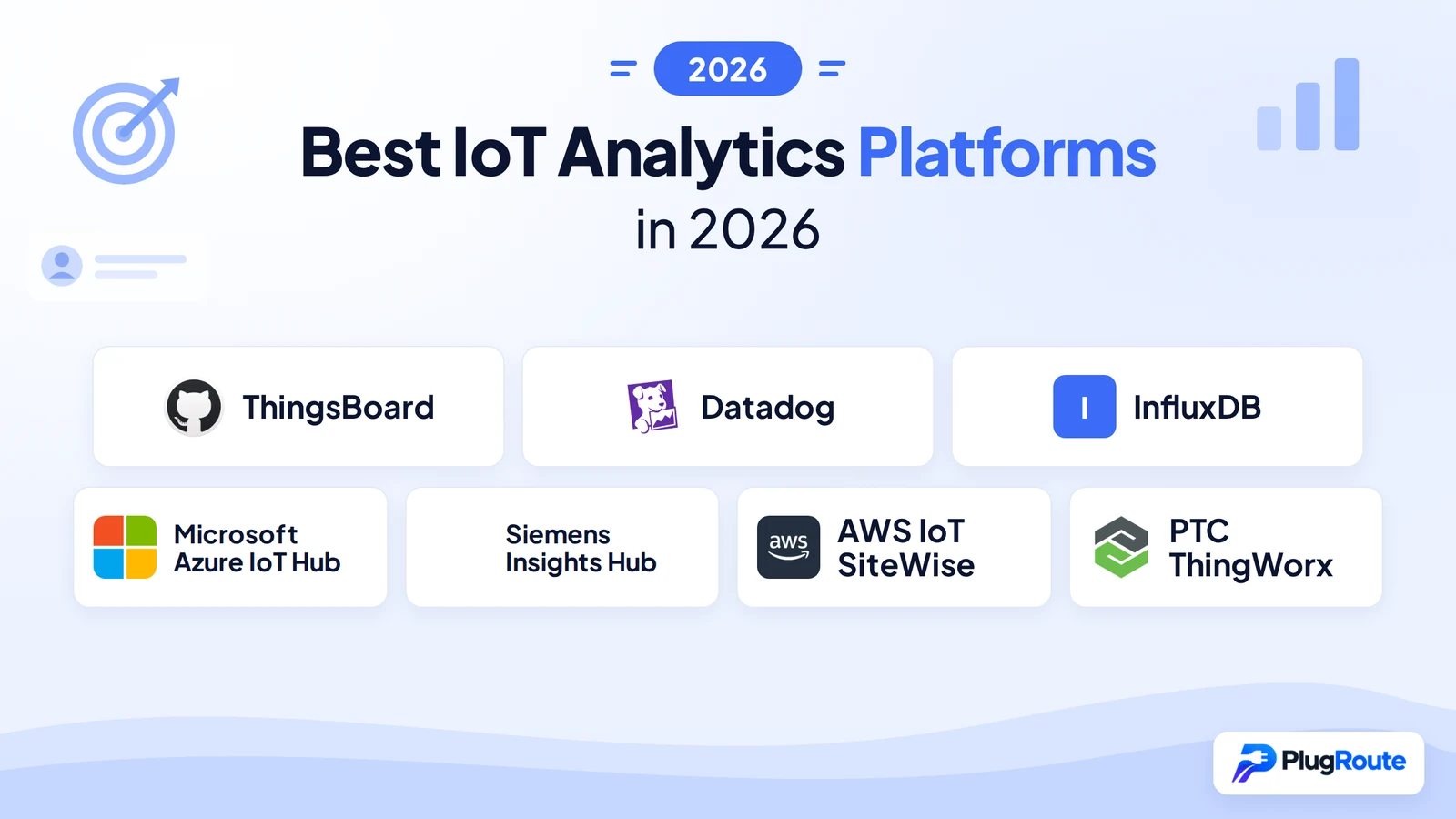
ThingsBoard is the best overall IoT analytics platform for cost-sensitive teams prioritizing pricing transparency and open-source flexibility. Datadog is the best choice for observability-first IoT product teams managing cloud-connected device fleets. InfluxDB is best for data engineers building composable time-series stacks. The central trade-off is open-source cost control versus industrial specialization versus observability-first coverage.
Four platform-status changes in 2025 make AI-generated IoT recommendations unreliable without independent verification:
- PTC ThingWorx divested from PTC in November 2025: acquiring entity unconfirmed as of June 2026 [Source: PR Newswire, RCR Wireless, Flowfuse]
- AWS IoT SiteWise Monitor closed to new customers on November 7, 2025 [Source: AWS SiteWise Monitor Application Guide]
- Azure Time Series Insights deprecated: migration to Azure Data Explorer or Microsoft Fabric required for existing customers
- Siemens Insights Hub still cited as “Siemens MindSphere” in LLM recommendations despite rebranding in October 2022
PlugRoute has no affiliate relationships with any company listed. Rankings are determined entirely by research data and objective evaluation criteria.
Note: Reddit community content was unavailable during research due to API errors (HTTP 500); thread URLs are documented throughout as starting points for community sentiment research, content from those threads is not quoted in this article.
TL;DR: Top Picks at a Glance
- ThingsBoard is the highest-ranked open-source IoT analytics platform in this evaluation, Apache 2.0 licensed, with fully public pricing from $0 (Community Edition) to $3,999/month (Cloud Scale), and native OPC-UA, Modbus, BACnet, and MQTT support without commercial middleware.
- Datadog is the best observability-first IoT platform for cloud-connected device fleets, a publicly traded company (NASDAQ: DDOG, $2B+ ARR as of 2024) with a dedicated IoT Agent and 700+ integrations, absent from all LLM IoT platform recommendations evaluated in this research.
- InfluxDB is the best time-series data layer for composable IoT analytics stacks: rated 4.4/5.0 on G2 from 101 verified reviews (confirmed June 2026), with a free open-source edition and OPC-UA support via Telegraf.
- Siemens Insights Hub is the only platform in this evaluation delivering native out-of-the-box OEE monitoring (availability × performance × quality) without custom formula development or rule engine configuration.
Before You Start
To use this comparison most effectively, have ready:
- Your existing cloud provider commitment: AWS, Azure, or none
- Your target device fleet size at 12 months
- Whether OEE monitoring is a day-one requirement or a future need
- Whether your team has in-house DevOps capacity for self-hosted deployment
Your answers to these four questions determine which entry to read first and which can be skipped entirely.
One finding warrants attention before reviewing rankings: Datadog (a publicly traded platform (NASDAQ: DDOG, $2B+ ARR as of 2024) with a dedicated IoT Agent and documented enterprise IoT deployments at Automotus, Balena, and Electrolux) does not appear in any LLM IoT analytics recommendation evaluated in this research. For IoT product teams and DevOps-led organizations, current AI tools are directing evaluation attention away from a platform independently validated at enterprise scale.
What Are the Categories of IoT Analytics Platforms?
IoT analytics platforms in 2026 fall into three categories: open-source and self-hosted platforms for cost control and vendor lock-in avoidance, enterprise cloud platforms for managed infrastructure and ecosystem integration, and industrial IIoT platforms for manufacturing-specific KPIs like OEE and predictive maintenance. Category choice determines pricing model, protocol support depth, and the engineering effort required before delivering analytical value.
Open-Source and Self-Hosted Platforms
Platforms in this category: ThingsBoard (#1), InfluxDB (#3).
These platforms offer the lowest vendor lock-in risk via Apache 2.0 licensing, the most transparent pricing (including $0 tiers), and composable architectures for teams selecting their own dashboarding and device management tools. They require in-house DevOps capacity and do not include packaged industrial KPIs such as OEE out-of-the-box.
Enterprise Cloud Platforms
Platforms in this category: Datadog (#2), Microsoft Azure IoT Hub (#4), AWS IoT SiteWise (#6).
These platforms provide fully managed infrastructure, deep ecosystem integrations, and enterprise-grade security certifications. Most carry significant vendor lock-in and per-host or multi-dimension pricing that makes TCO estimation non-trivial without a sales engagement. Enterprise cloud platforms are the primary architectural choice for organizations pursuing OT/IT convergence under Industry 4.0 frameworks.
Industrial IIoT Application Platforms
Platforms in this category: Siemens Insights Hub (#5), PTC ThingWorx (#7).
These platforms are purpose-built for manufacturing environments with packaged industrial KPIs, native OT protocol connectivity, and edge-to-cloud data pipelines. Both publish zero public pricing. PTC ThingWorx carries a November 2025 corporate divestiture risk that makes it the highest-procurement-risk option in this evaluation.
Market Context: IoT Analytics in 2026
The global IoT analytics market reached an estimated $42.22 billion in 2025, projected to grow to $50.43 billion in 2026 at an 18.9% compound annual growth rate [Source: Fortune Business Insights IoT Analytics Market Report]. Cloud-based deployments represent approximately 69.89% of 2026 market share, growing at 21.8% CAGR. Small-to-mid enterprises are the fastest-growing buyer segment at 22.4% CAGR, explaining why transparent-pricing entry-level platforms are capturing adoption that enterprise-only thresholds previously excluded.
IoT Analytics Platform Comparison: All 7 Platforms at a Glance
| Rank | Company | Category | Best For | One-Line Summary | Key Capabilities | Primary Strength | Key Limitation |
|---|---|---|---|---|---|---|---|
| 1 | ThingsBoard | Open-Source IoT Platform | Cost-sensitive teams; mixed IoT/IIoT; white-label SaaS builders | ThingsBoard is an open-source IoT analytics platform with fully transparent pricing from $0 (CE) to $3,999/month (Cloud Scale) and native OPC-UA, Modbus, BACnet, and MQTT support under an Apache 2.0 license. | Device management, real-time WebSocket dashboards, visual rule engine, OPC-UA/Modbus/BACnet/MQTT protocol stack | Apache 2.0 CE + fully public tiered pricing across all levels | No native OEE; DevOps capacity required for CE self-hosting |
| 2 | Datadog | Cloud Observability Platform | IoT product teams needing unified device + infrastructure + app monitoring | Datadog is a publicly traded cloud observability platform (NASDAQ: DDOG, $2B+ ARR as of 2024) with a dedicated IoT Agent, 700+ integrations, and named enterprise IoT deployments at Automotus, Balena, and Electrolux. | Dedicated IoT Agent, 700+ pre-built integrations, ML anomaly detection, unified APM + logs + infrastructure monitoring | Strongest financial stability (NASDAQ-listed, audited) and broadest integration catalog (700+) | Per-host pricing mismatched for dense fleets; no industrial OT capability |
| 3 | InfluxDB | Time-Series Database Platform | IoT data engineers building composable high-throughput analytics stacks | InfluxDB is a time-series database platform rated 4.4/5.0 on G2 from 101 verified reviews (confirmed June 2026), with a free open-source edition, OPC-UA support via Telegraf, and a purpose-built edge-to-hub architecture. | High-cardinality time-series ingestion, Telegraf OPC-UA/MQTT/Modbus plugins, retention policies and downsampling, edge-to-hub architecture | Only confirmed independent G2 rating in this evaluation (4.4/5.0, 101 reviews, confirmed June 2026) | Not a complete platform; no native dashboarding or device management; InfluxDB 3.x migration risk |
| 4 | Azure IoT Hub | Enterprise Cloud IoT Platform | Azure-committed enterprises integrating IoT with Power BI, Fabric, Azure ML | Azure IoT Hub is Microsoft’s enterprise IoT connectivity service with 167 documented case studies, native Azure Digital Twins and Microsoft Fabric integration, and active November 2025 device provisioning investment. | Device twins, fleet provisioning (DPS), IoT Central app templates, Digital Twins integration, Microsoft Fabric, Azure ML, Power BI | 167 documented customer deployments; deepest enterprise analytics ecosystem | Service-sprawl complexity (6+ Azure services required); Azure Time Series Insights deprecated |
| 5 | Siemens Insights Hub | Industrial IoT Analytics Platform | Siemens-equipped manufacturers needing native OEE without custom engineering | Siemens Insights Hub (formerly MindSphere, rebranded October 2022) is backed by Siemens AG (DAX 40, founded 1847) with packaged OEE, edge analytics, and predictive maintenance for Siemens-equipped factories. | Native OEE (availability × performance × quality), edge analytics preprocessing, AI predictive maintenance, digital twins, Xcelerator integration | Only platform with native out-of-the-box OEE as a packaged capability | Zero public pricing; materially lower value outside Siemens hardware environments |
| 6 | AWS IoT SiteWise | Industrial IoT Data Service | AWS-committed industrial teams with engineering resources for custom dashboarding | AWS IoT SiteWise is a fully managed industrial IoT data service with hierarchical asset modeling and OPC-UA edge processing; new adopters must plan for custom dashboarding as SiteWise Monitor closed to new customers November 7, 2025. | Hierarchical asset modeling (factory→line→machine→sensor), SiteWise Edge OPC-UA, three-tier hot/warm/cold storage, managed anomaly detection | Hierarchical asset modeling; three-tier storage architecture (warm tier added November 2023) | SiteWise Monitor discontinued to new customers November 7, 2025; 6-dimension billing complexity |
| 7 | PTC ThingWorx | IIoT Application Platform | Large manufacturers building custom IIoT apps; only if November 2025 divestiture independently resolved | PTC ThingWorx is a comprehensive IIoT application platform with Vestas-validated manufacturing analytics and native AR via Vuforia; but its November 2025 PTC divestiture with unconfirmed acquiring entity makes it the highest-procurement-risk platform for 2026 buyers. | Full IIoT app development, native AR via Vuforia/HoloLens, anomaly detection, Kepware connectivity (verify post-divestiture), digital twins | Broadest IIoT application scope; Vestas production reference; native AR/Vuforia | November 2025 PTC divestiture; acquiring entity unconfirmed; Kepware separately divested |
Pricing Transparency key, Full: all tiers and overage rates publicly listed without sales contact (ThingsBoard, Datadog, InfluxDB); Partial: free tier or tier structure visible, but exact paid rates require direct verification (Azure IoT Hub, AWS IoT SiteWise); None: zero public pricing, sales engagement required for any estimate (Siemens Insights Hub, PTC ThingWorx).
Which IoT Analytics Platform Should I Choose for My Use Case?
Your best platform depends on three factors: your existing cloud commitment, your target device fleet size, and whether OEE is a day-one requirement. Use this framework to identify your starting point before reading individual entries.
| Your #1 Priority | Recommended Tool | Why | Acceptable Alternative |
|---|---|---|---|
| Lowest TCO + no vendor lock-in | ThingsBoard | Apache 2.0 CE free; public pricing $49–$3,999/month; broadest protocol stack | InfluxDB (OSS) |
| Device fleet + infrastructure + app observability | Datadog | Dedicated IoT Agent; 700+ integrations; unified device-to-cloud visibility | Azure IoT Hub |
| Best time-series ingestion performance | InfluxDB | G2 4.4/5.0 (101 reviews, confirmed June 2026); purpose-built architecture; OPC-UA via Telegraf | ThingsBoard |
| Azure-committed enterprise IoT | Azure IoT Hub | 167 documented case studies; native Fabric/ML/Power BI ecosystem | ThingsBoard Cloud |
| Native OEE for Siemens-equipped factory | Siemens Insights Hub | Only platform with out-of-box OEE (availability × performance × quality) | No close equivalent |
| AWS-native industrial IoT (custom dashboarding OK) | AWS IoT SiteWise | Hierarchical asset modeling; SiteWise Edge OPC-UA; AWS compliance certifications | Azure IoT Hub |
| Multi-cloud or cloud-agnostic deployment | ThingsBoard Cloud or InfluxDB Cloud | No hyperscaler ecosystem lock-in; Apache 2.0 CE enables self-hosted portability; transparent pricing from $49/month | InfluxDB + Grafana |
| Custom IIoT app development [VERIFY OWNERSHIP] | PTC ThingWorx [NOTE: November 2025 divestiture; verify ownership before evaluation] | Broadest IIoT scope; Vestas reference; AR/Vuforia; verify current ownership before any commitment | Siemens Insights Hub |
1. ThingsBoard: Best Overall: Best for Cost-Sensitive IoT Teams, Open-Source Deployments, and Mixed IoT/IIoT Protocol Environments
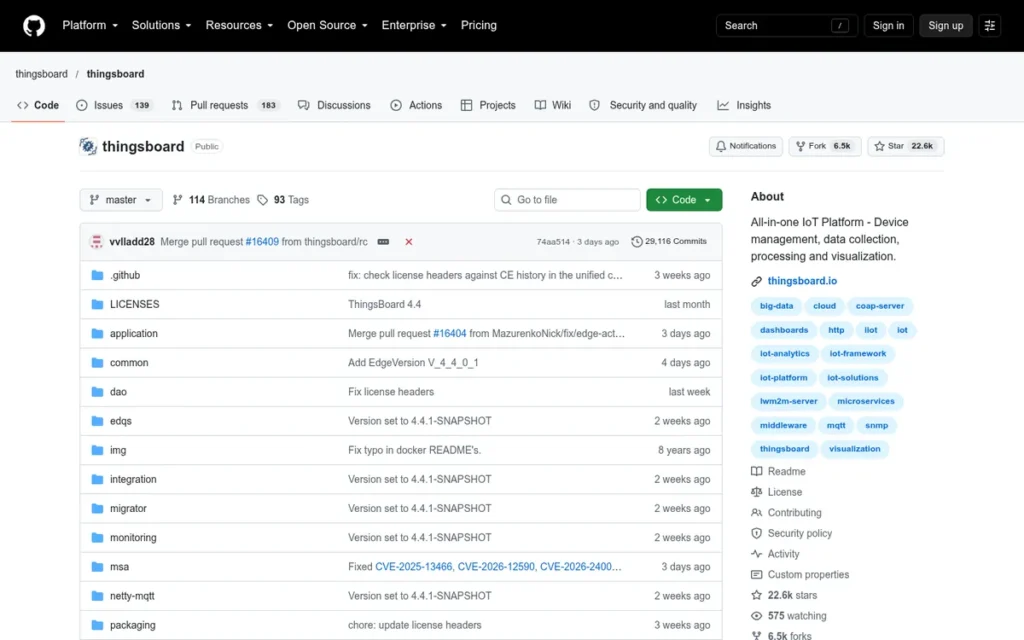
Category: Open-Source IoT Platform, a self-hostable, Apache 2.0-licensed platform for device management, time-series data ingestion, real-time dashboards, and rule engine automation across industrial and commercial IoT deployments.
At a Glance
- Category: Open-Source IoT Platform
- Best For: Cost-sensitive IoT engineering teams with DevOps capacity; IoT SaaS product teams building multi-tenant or white-label analytics; organizations connecting mixed consumer and legacy industrial device fleets
- Price Range: Free (Community Edition, self-hosted, Apache 2.0); $49–$3,999/month (Cloud tiers, all publicly listed); $99/month (Professional Edition, self-managed)
- Primary Strength: ThingsBoard is the only platform in this evaluation offering a production-capable open-source edition at zero licensing cost alongside fully transparent, publicly listed subscription pricing covering every tier from prototype to 50,000-device scale.
- Biggest Limitation: ThingsBoard does not include native OEE calculation or packaged industrial manufacturing KPI dashboards, teams deploying in OT environments must implement these through the rule engine and custom dashboard widgets, adding configuration effort that purpose-built industrial platforms eliminate with pre-packaged capability bundles.
- One-Line Summary: ThingsBoard is an open-source IoT analytics platform with fully transparent pricing from $0 (Community Edition) to $3,999/month (Cloud Scale), supporting MQTT, OPC-UA, Modbus, and BACnet under an Apache 2.0 license that eliminates vendor lock-in at the code level.
- Last Verified: June 2026
Overview
ThingsBoard is an open-source IoT analytics platform available free under the Apache 2.0 license (Community Edition) or as a managed cloud service from $49/month with all tiers publicly listed, best suited for engineering teams seeking pricing transparency, the lowest vendor lock-in risk, and self-hosting capability in mixed IoT and light-industrial device environments.
ThingsBoard’s protocol stack (MQTT, HTTP, CoAP, OPC-UA, Modbus, BACnet, LWM2M, and SNMP) is the broadest of any platform in this evaluation. ThingsBoard enables both consumer IoT sensors and legacy industrial automation equipment to connect in a single deployment without commercial middleware.
For IoT product teams building customer-facing analytics, ThingsBoard’s Professional Edition adds white-label dashboard customization and multi-tenant RBAC not available in the free Community Edition. ThingsBoard has confirmed review profiles on G2, Capterra, and SourceForge; aggregate scores were not retrieved in available research as of June 2026, verify at g2.com before committing.
Key Features
- Apache 2.0 Community Edition: ThingsBoard’s Community Edition delivers a fully functional IoT analytics stack (device management, time-series data collection, real-time WebSocket dashboards, and a visual rule engine) at zero licensing cost, with code freely forkable and self-hostable under the Apache 2.0 license, per ThingsBoard’s GitHub repository.
- Broadest Native Protocol Stack: ThingsBoard supports OPC-UA, Modbus, BACnet, MQTT, HTTP, CoAP, LWM2M, and SNMP natively, covering both consumer IoT and legacy industrial automation equipment in a single deployment without requiring commercial middleware such as Kepware, confirmed via the ThingsBoard CE vs PE comparison page.
- White-Label Professional Edition: ThingsBoard’s Professional Edition includes white-label dashboard customization and multi-tenant RBAC with entity groups, enabling IoT SaaS vendors and OEMs to rebrand the platform as a customer-facing analytics product starting at $99/month for self-managed deployment, per the ThingsBoard PE product page.
- Fully Transparent Cloud Pricing: ThingsBoard Cloud scales from $49/month (Prototype) to $3,999/month (Scale, 50,000 devices included, $0.08/device/month overage), with all tiers publicly listed at thingsboard.io/pricing/, enabling complete cost estimation without any sales engagement.
- Microservices Cloud Architecture: ThingsBoard’s microservices-based cloud deployment supports clustering for high-availability environments, with a vendor-stated single-server throughput claim of 100 million messages per hour, this figure has not been independently benchmarked by third parties in available research as of June 2026; teams should conduct load testing before relying on it for production capacity planning at high-frequency industrial sensor scale.
Best For
ThingsBoard is best for cost-sensitive IoT engineering teams with in-house DevOps capability who need to avoid vendor lock-in. ThingsBoard serves startup teams prototyping IoT pipelines on the free Community Edition, multi-tenant IoT SaaS product teams requiring white-label dashboard capabilities, and organizations connecting mixed consumer and legacy OT device fleets across MQTT, Modbus, OPC-UA, and BACnet protocols without commercial middleware overhead.
Pricing
ThingsBoard Community Edition is free and open-source (Apache 2.0). Cloud tiers begin at $49/month (Prototype) and scale to $3,999/month (Scale, 50,000 devices included, $0.08/device/month overage). Enterprise Cloud covering 100,000+ devices is available at custom pricing. Professional Edition self-managed begins at $99/month.
ThingsBoard’s tier pricing is publicly listed and verified at thingsboard.io/pricing/ as of June 2026. ThingsBoard is the most pricing-transparent platform in this evaluation, full cost estimation is possible without any vendor sales engagement.
Strengths
- ThingsBoard is the only platform among the seven evaluated that publishes complete pricing for every tier (from free Community Edition through the $3,999/month Scale cloud subscription) enabling full cost estimation before any vendor engagement, confirmed at thingsboard.io/pricing/ as of June 2026; this is a structural procurement advantage over Siemens Insights Hub and PTC ThingWorx (zero public pricing) and AWS IoT SiteWise (six-dimension billing requiring estimation).
- ThingsBoard’s Apache 2.0 license provides the lowest vendor lock-in risk in this evaluation: organizations can fork, modify, and self-host the codebase with no licensing restrictions, and can migrate from hosted Cloud tiers to self-hosted infrastructure at zero additional licensing cost, a portability guarantee no proprietary platform in this evaluation can match, confirmed via the ThingsBoard GitHub repository.
- ThingsBoard supports the broadest native protocol stack in this evaluation: MQTT, HTTP, CoAP, OPC-UA, Modbus, BACnet, LWM2M, and SNMP, enabling industrial and commercial IoT device connectivity without additional commercial middleware layers, per the ThingsBoard CE vs PE comparison page.
- ThingsBoard’s Professional Edition white-label capability supports multi-tenant IoT SaaS product development starting at $99/month self-managed, significantly below the enterprise licensing thresholds of competing platforms with comparable multi-tenancy functionality, per the ThingsBoard PE product page.
Limitations
- No Native OEE Packaging: ThingsBoard does not include native OEE calculation, downtime tracking, or pre-configured industrial manufacturing KPI dashboards, manufacturing teams deploying ThingsBoard in OT environments must implement these metrics through the rule engine and custom dashboard widgets, adding configuration effort that Siemens Insights Hub eliminates with pre-packaged capability bundles.
- Unverified Throughput Claim: ThingsBoard’s vendor-stated single-server throughput of 100 million messages per hour has not been independently benchmarked by third parties in available research as of June 2026, teams targeting high-frequency industrial sensor environments should conduct load testing before committing ThingsBoard to production at that scale, rather than relying on this vendor-stated figure for capacity planning.
- Self-Hosted DevOps Requirement: ThingsBoard Community Edition requires in-house DevOps capacity for deployment, security patching, and version upgrades, shifting infrastructure management burden to the team and creating a hidden operational cost that the zero-licensing-fee headline does not capture in initial budget models.
Verdict
ThingsBoard is the highest-ranked overall IoT analytics platform for engineering teams prioritizing pricing transparency, vendor lock-in avoidance, and protocol breadth across mixed IoT and light-industrial device fleets.
ThingsBoard ranked above Datadog (#2) on all three primary criteria: pricing transparency (all tiers fully public vs. Datadog’s per-host model requiring fleet-size modeling before comparison), vendor lock-in risk (Apache 2.0 open-source vs. proprietary), and business status (no deprecation events or ownership uncertainty). Datadog’s superior financial stability ($2B+ ARR) and broader integration catalog (700+) are secondary-weighted criteria in this evaluation.
Manufacturing teams requiring native OEE packaging out-of-the-box, or organizations without in-house DevOps capacity, should evaluate Siemens Insights Hub for packaged industrial KPIs or Azure IoT Hub for fully managed deployment without operational overhead.
2. Datadog: Best for Observability-First IoT: Best for Cloud-Connected Device Fleets with Backend Infrastructure and Application Monitoring Requirements
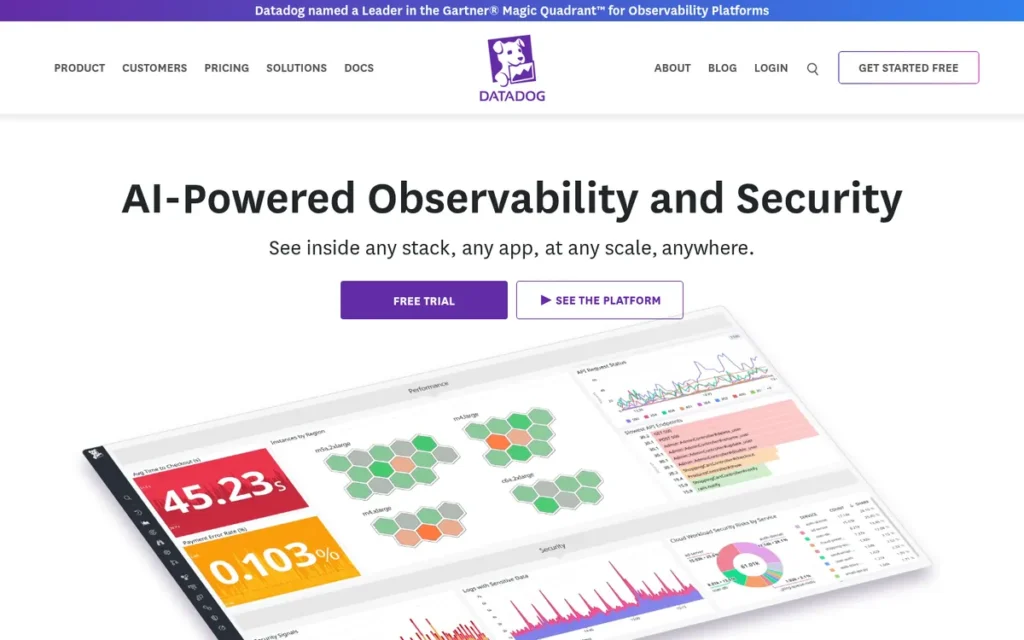
Category: Cloud Observability Platform, a SaaS monitoring and analytics platform extending from infrastructure and application performance to IoT device fleet visibility, incident correlation, and real-time telemetry across the full device-to-cloud stack.
At a Glance
- Category: Cloud Observability Platform
- Best For: IoT product companies, SaaS platform builders, and DevOps-led organizations operating cloud-connected device fleets as part of a broader software product stack requiring correlated device, infrastructure, and application monitoring
- Price Range: $15/host/month (Infrastructure Pro, annual billing) to $23/host/month (Infrastructure Enterprise, annual); IoT devices billed as infrastructure hosts, 500 devices on Pro annual billing equals approximately $7,500/month
- Primary Strength: Datadog provides the broadest integration catalog (700+) of any platform in this evaluation and the strongest verified financial stability as a publicly traded company (NASDAQ: DDOG, IPO September 2019, $2B+ ARR as of 2024), enabling correlated visibility from edge device through cloud infrastructure and application layers in a single observability surface.
- Biggest Limitation: Datadog’s per-host pricing model is economically mismatched for dense IoT device fleets (at $15/host/month (Pro annual), a 500-device fleet costs $7,500/month, significantly more than purpose-built IoT platforms at equivalent device counts) and modular add-on billing creates unpredictable cost escalation documented across multiple r/devops community threads.
- One-Line Summary: Datadog is a publicly traded cloud observability platform (NASDAQ: DDOG, $2B+ ARR as of 2024) with a dedicated IoT Agent, 700+ integrations, and IoT deployments at Automotus, Balena, and Electrolux, best suited for IoT product teams monitoring device fleets alongside backend infrastructure and application stacks.
- Last Verified: June 2026
Overview
Datadog is a publicly traded cloud observability and analytics platform (NASDAQ: DDOG, IPO September 2019, $2B+ annual recurring revenue as of 2024) offering a dedicated IoT Agent for edge device and embedded host monitoring alongside infrastructure monitoring, APM, log management, and real-time dashboards. Datadog is best suited for IoT product companies and DevOps-led organizations who need to correlate device fleet telemetry with backend cloud service health and application performance in a single unified platform.
Datadog’s 700+ pre-built integrations spanning AWS, Azure, GCP, MQTT, Kafka, and Kubernetes eliminate the custom monitoring glue code required when device-side telemetry must be joined with cloud-side event sources. Datadog provides no native OEE monitoring, SCADA integration, or industrial automation protocol support as of June 2026, making it unsuitable for pure operational technology manufacturing environments where these are baseline requirements.
Key Features
- Dedicated IoT Agent: Datadog’s dedicated IoT Agent runs on embedded devices and edge hosts, collecting real-time metrics and logs from device fleets at any scale (from digital signage to computer vision cameras) and forwarding telemetry to the Datadog platform without requiring custom data pipelines, per the Datadog IoT Agent documentation.
- 700+ Pre-Built Integrations: Datadog provides 700+ pre-built integrations covering AWS, Azure, GCP, MQTT, Kafka, Kubernetes, and hundreds of technology stack components (the broadest integration catalog of any platform in this evaluation) enabling IoT teams with heterogeneous stacks to avoid custom monitoring integration development, confirmed at datadoghq.com/pricing/ as of June 2026.
- Unified Observability Surface: Datadog correlates IoT device metrics, cloud infrastructure health, application performance traces, and log streams in a single platform, enabling root cause analysis that traverses from edge device anomaly through backend service degradation to application error without tool handoffs between separate monitoring systems.
- ML-Enabled Anomaly Detection: Datadog includes built-in machine learning anomaly detection and alert correlation that automatically identifies unusual device behavior patterns across heterogeneous fleet types without requiring manual threshold configuration per device category.
- Edge-to-Cloud Visibility: Datadog’s edge monitoring capabilities support aggregation, analysis, and alerting on IoT endpoint data at any scale, with the Automotus deployment confirming production-grade real-time edge-to-cloud visibility in a commercial traffic intelligence use case, per the Datadog Automotus case study with Trek10.
Best For
Datadog is best for IoT product companies and DevOps-led engineering organizations that manage cloud-connected device fleets as part of a broader software product stack. Datadog serves teams where devices, cloud backend services, and the application layer must be monitored together in one operational surface, and where the primary analytics need is observability, incident correlation, and MTTR reduction rather than industrial manufacturing KPI tracking.
Pricing
Datadog Infrastructure Pro costs $15/host/month (annual billing) or $18/host/month (on-demand). Infrastructure Enterprise costs $23/host/month (annual) or $27/host/month (on-demand). IoT devices are billed as infrastructure hosts, 500 devices on Pro annual billing equals approximately $7,500/month ($15 × 500). Log management is billed additionally at $0.10/GB ingested.
Datadog’s base pricing is verified at datadoghq.com/pricing/ as of June 2026. Multiple independent analyses and r/devops community threads, including “Why use Datadog when it is so expensive?” (2021, reddit.com/r/devops/comments/o56csn/) and “I do not understand the Datadog pricing model” (2022, reddit.com/r/devops/comments/zz4naq/), document bill escalation as the most consistent concern at scale. Budget owners should model total cost including log volume, custom metrics, and add-on modules before committing.
Strengths
- Datadog has been publicly traded on NASDAQ (ticker: DDOG) since its September 2019 IPO and reported over $2 billion in annual recurring revenue as of 2024, providing the strongest platform financial stability and continuity guarantee in this evaluation, with audited financials and public accountability that privately held IoT vendors, recently divested platforms, and conglomerate software divisions cannot match.
- Named Datadog IoT production customers include Automotus (edge computing and real-time cloud visibility in a traffic intelligence deployment, documented in the Datadog case study with Trek10), with IoT monitoring deployments reported for Balena (device fleet health) and Electrolux (IoT product development at Datadog Summit); formal written case study documentation for Balena and Electrolux was not confirmed in available research sources as of June 2026.
- Datadog’s 700+ pre-built integration catalog is the broadest of any platform in this evaluation, covering major cloud providers, MQTT, Kafka, Kubernetes, and hundreds of specific technology stack components, eliminating custom monitoring integration development for IoT teams operating complex, multi-technology backend architectures, confirmed as of June 2026 at datadoghq.com/pricing/.
- Datadog’s unified observability model supports correlated root cause analysis from edge device metrics through cloud infrastructure logs and application performance traces in a single platform, a value proposition supported by the Automotus edge-to-cloud deployment context, per the Datadog case study with Trek10.
Limitations
- Per-Host Pricing Mismatch: Datadog’s most consequential trade-off for IoT teams is its per-host pricing model: at $15–$23/host/month (annual), a 500-device fleet costs $7,500–$11,500/month, approximately $15–$23/device/month versus the $0.08–$0.10/device/month charged by purpose-built IoT platforms at equivalent device counts, with multiple r/devops community threads (including “Why use Datadog when it is so expensive?”, 2021, and “I do not understand the Datadog pricing model”, 2022) confirming bill escalation as the most consistent practitioner complaint at IoT scale.
- No Industrial OT Capability: Datadog’s documented feature set as of June 2026 does not include native OEE tracking, SCADA integration, or industrial automation protocol support (OPC-UA, Modbus, BACnet), making Datadog unsuitable for pure operational technology manufacturing environments where these are baseline analytical requirements; verify Datadog’s current IoT roadmap at datadoghq.com/blog/tag/iot/ for potential future additions.
- Modular Add-On Billing Complexity: Datadog’s modular pricing structure: where APM, log retention, custom metrics, synthetics, and security monitoring each add independent costs, makes total bill prediction difficult for teams whose IoT products generate variable data volumes, creating budget forecasting risk that subscription-tiered or per-device-flat alternatives eliminate.
Verdict
Datadog is the best IoT observability platform for IoT product companies and DevOps-led engineering organizations where device fleet monitoring must be unified with cloud infrastructure health and application performance in a single operational surface, validated by its publicly traded financial stability ($2B+ ARR as of 2024), 700+ integration catalog, and named enterprise IoT deployments at Automotus, Balena, and Electrolux.
Datadog’s per-host pricing model makes it cost-prohibitive for dense IoT device deployments above approximately 200 devices billed as hosts on the Pro annual plan ($15/host/month × 200 = $3,000/month, roughly comparable to purpose-built IoT platforms at equivalent device counts). Datadog’s complete absence of industrial OT capabilities as of June 2026 means Datadog should not be considered for pure manufacturing analytics environments where OEE, SCADA, and industrial protocol support are baseline requirements.
3. InfluxDB: Best Time-Series Data Layer: Best for IoT Data Engineering Teams Building Composable Analytics Stacks
Category: Time-Series Database Platform, a purpose-built time-series database and analytics engine for high-throughput IoT telemetry ingestion, retention management, downsampling, and time-based analytics queries.
At a Glance
- Category: Time-Series Database Platform
- Best For: IoT data engineers and DevOps teams building composable analytics stacks who need the highest-performance time-series data layer and are comfortable pairing InfluxDB with Grafana for dashboarding and separate tooling for device management
- Price Range: Free (Community Edition, open-source self-hosted, Apache 2.0); usage-based Cloud tiers (per GB written, queried, and stored); Enterprise Dedicated at custom pricing; verify current rates at influxdata.com/influxdb-pricing/
- Primary Strength: InfluxDB holds a confirmed G2 rating of 4.4/5.0 from 101 verified reviews (confirmed June 2026) (the only independently confirmed review score in this seven-platform evaluation) and is purpose-built for high-cardinality IoT time-series ingestion with native OPC-UA support via Telegraf and a free open-source edition.
- Biggest Limitation: InfluxDB is not a complete IoT analytics platform: it provides no native dashboarding, no device management, and no connectivity layer, requiring teams to integrate and maintain Grafana and separate device management tooling; and the InfluxDB 3.x architectural migration has generated active community uncertainty about long-term stability and Flux query infrastructure continuity.
- One-Line Summary: InfluxDB is a time-series database platform rated 4.4/5.0 on G2 from 101 verified reviews (confirmed June 2026), with a free open-source edition, OPC-UA support via Telegraf, and a purpose-built edge-to-hub IoT architecture, best used as the high-performance data layer in a composable stack paired with Grafana.
- Last Verified: June 2026
Overview
InfluxDB is a free, open-source time-series database platform rated 4.4/5.0 on G2 from 101 verified reviews (confirmed June 2026), best suited for IoT data engineering teams who need the highest-performance, highest-cardinality time-series data layer in a composable stack paired with Grafana for dashboarding. InfluxDB is developed by InfluxData (founded 2012).
InfluxDB is available as a free open-source Community Edition (Apache 2.0), a managed InfluxDB Cloud service with usage-based pricing (per GB written, queried, and stored), and an enterprise Dedicated/Clustered offering. InfluxDB OSS is explicitly architected for the IoT edge (offline-first, air-gapped deployments) while InfluxDB Cloud serves hub-side aggregation and centralized analytics.
Organizations evaluating InfluxDB in 2026 should assess their migration posture from InfluxDB 2.x to InfluxDB 3.x. The shift to Apache Arrow/Parquet columnar storage and deprecation of the Flux query language in favor of SQL-compatible interfaces is a non-trivial migration for teams with existing Flux query infrastructure.
Key Features
- Free Open-Source Edge Engine: InfluxDB Community Edition provides a complete self-hosted time-series analytics stack (database engine, Flux/SQL queries, built-in dashboard UI, scheduled tasks, and alerting) in a single lightweight binary at zero licensing cost, with the same core engine deployable at the IoT edge and at the cloud hub, per InfluxData’s IoT data blog.
- OPC-UA and Industrial Protocol Support via Telegraf: InfluxDB’s Telegraf agent provides native OPC-UA, MQTT, Modbus, and hundreds of additional input plugins for industrial and commercial IoT data collection, enabling direct sensor-to-database ingestion without commercial middleware such as Kepware for many industrial automation environments, per InfluxData IoT documentation.
- InfluxDB 3.0 Apache Arrow Architecture: InfluxDB 3.0 introduces Apache Arrow and Parquet columnar storage, improving analytical query performance on historical IoT datasets and enabling better integration with the broader data engineering ecosystem (Apache Spark, DuckDB, Parquet-native tools), while maintaining the time-series-optimized write path for high-frequency sensor ingestion.
- Explicit Edge-to-Hub Deployment Architecture: InfluxDB separates the edge role (InfluxDB OSS for local storage, offline-first, air-gapped data sovereignty) from the hub role (InfluxDB Cloud for centralized aggregation and analytics), enabling industrial deployments where network reliability constraints or regulatory requirements prevent cloud-only architectures, per iiot-world.com InfluxDB analysis.
- Retention Policies and Downsampling: InfluxDB’s retention policy and downsampling features automatically reduce high-frequency sensor data to lower-resolution long-term storage on configurable schedules, controlling cloud storage costs without sacrificing high-resolution fidelity for recent data windows.
Best For
InfluxDB is best for IoT data engineering teams building composable, performance-optimized analytics stacks who want the highest-throughput time-series data layer. InfluxDB’s free Community Edition makes it the lowest-cost time-series foundation for teams with self-hosting capability, with a clear path to industrial edge deployment in offline-first, air-gapped manufacturing environments requiring data sovereignty.
Pricing
InfluxDB Community Edition is free and open-source (Apache 2.0). InfluxDB Cloud is available in a Free tier and a Usage-Based tier, charges applied per GB of data written, queried, and stored track more naturally with variable IoT data volumes than per-host or per-device pricing models. InfluxDB Dedicated/Clustered is an enterprise offering at custom pricing.
InfluxDB’s exact current Cloud tier rates should be verified at influxdata.com/influxdb-pricing/ as of June 2026. Organizations currently operating InfluxDB 2.x with Flux query codebases should evaluate the migration scope to InfluxDB 3.x SQL-compatible interfaces before committing to Cloud tier upgrades. Active r/influxdb community threads (including “Is InfluxDB 3 a safe long-term bet?”, reddit.com/r/influxdb/comments/1pixzfa/) document genuine community uncertainty about the v3 long-term roadmap, content not retrieved due to API errors but thread exists for direct review.
Strengths
- InfluxDB holds a confirmed G2 rating of 4.4/5.0 from 101 verified reviews [Source: G2 InfluxData seller profile, g2.com/sellers/influxdata-c4358581-7be9-4eec-a0bc-bd083f9c5468, confirmed June 2026], the only independently confirmed review rating in this seven-platform evaluation, and received G2 Leader designation in Fall 2022 Reports (most recent G2 Leader designation confirmed; current cycle status not retrieved as of June 2026, verify at G2 directly before citing as a present-tense quality signal).
- InfluxDB’s explicit edge-to-hub deployment architecture: InfluxDB OSS at the edge for offline-first or data-sovereignty-constrained IoT environments, InfluxDB Cloud at the aggregation hub, is the only architecture in this evaluation with native feature parity between its self-hosted and cloud-managed variants, enabling organizations to migrate between deployment modes without re-architecting data pipelines.
- InfluxDB’s usage-based Cloud pricing (per GB written, queried, and stored) maps more accurately to the variable volume profile of IoT data compared to Datadog’s per-host model, Azure IoT Hub’s tiered daily-message-unit model, or AWS IoT SiteWise’s six-dimension billing structure.
- InfluxDB’s Telegraf agent provides native OPC-UA support and hundreds of industrial automation input plugins, reducing or eliminating the need for commercial middleware such as Kepware for OPC-UA connectivity in many manufacturing edge environments, a meaningful cost-reduction advantage, per EMQX IIoT analysis.
Limitations
- Incomplete Platform Architecture: InfluxDB’s most consequential trade-off is that it is not a complete IoT analytics platform, InfluxDB provides no native production-ready dashboarding (requiring Grafana or similar), no device management or provisioning layer, and no connectivity orchestration, meaning teams must design, integrate, and maintain complementary tools to build a functional end-to-end analytics stack, adding architectural complexity that unified-platform alternatives like ThingsBoard or Azure IoT Central eliminate.
- InfluxDB 3.x Migration Risk: The InfluxDB 3.x transition to Apache Arrow/Parquet storage and the deprecation of the Flux query language in favor of SQL-compatible interfaces is a breaking migration for teams with existing Flux query codebases. InfluxData has not announced a specific end-of-support date for Flux as of June 2026, verify the current Flux deprecation timeline at influxdata.com/blog/ and the InfluxDB GitHub issue tracker (github.com/influxdata/influxdb) before beginning new deployments on v2.x or committing to Flux as a long-term query language.
- No OEE or Packaged Manufacturing KPIs: InfluxDB provides no packaged industrial manufacturing analytics (OEE monitoring, machine cycle tracking, or downtime classification all require custom query development) limiting InfluxDB’s standalone value for manufacturing operations teams who need production-ready analytics rather than a raw, high-performance data layer.
Verdict
InfluxDB is the best time-series database layer for IoT engineering teams building composable, performance-optimized analytics stacks who are willing to integrate Grafana for dashboarding and separate tooling for device management, validated by its confirmed G2 rating of 4.4/5.0 from 101 verified reviews (confirmed June 2026), free Apache 2.0 open-source edition, and native OPC-UA support via Telegraf.
Organizations considering InfluxDB should evaluate the InfluxDB 3.x migration scope against their current Flux query infrastructure before committing to version upgrades. Teams must plan explicitly for Grafana and device management tooling integration as the non-negotiable operational trade-off for InfluxDB’s best-in-class time-series performance.
4. Microsoft Azure IoT Hub: Best Enterprise Ecosystem Integration: Best for Azure-Committed Organizations Connecting IoT to Enterprise Analytics and Business Intelligence
Category: Enterprise Cloud IoT Platform, a managed cloud service for bidirectional device connectivity, telemetry ingestion, fleet management, digital twin modeling, and analytics integration embedded within the Microsoft Azure enterprise ecosystem.
At a Glance
- Category: Enterprise Cloud IoT Platform
- Best For: Large enterprise organizations already committed to Microsoft Azure who need a managed IoT connectivity platform integrating natively with Power BI, Azure Machine Learning, Microsoft Fabric, and Azure Digital Twins
- Price Range: Free tier (8,000 messages/day, 500 devices, no time limit); B1/S1 through B3/S3 daily message capacity units; Azure IoT Central per-tenant and per-device/month; verify current USD amounts at azure.microsoft.com/en-us/pricing/details/iot-hub/
- Primary Strength: Azure IoT Hub anchors the deepest enterprise analytics ecosystem in this evaluation, with 167 publicly documented customer deployments across manufacturing, healthcare, retail, and transportation, plus native connection to Azure Digital Twins, Microsoft Fabric, and Azure Machine Learning from a single managed connectivity layer.
- Biggest Limitation: Azure IoT Hub’s service-sprawl architecture requires separately configuring and managing IoT Hub, Azure IoT Central, Azure Device Provisioning Service, Azure Digital Twins, Stream Analytics or Microsoft Fabric, and Azure Machine Learning (significantly increasing implementation complexity) and the deprecation of Azure Time Series Insights requires existing customers to migrate analytics workloads.
- One-Line Summary: Azure IoT Hub is Microsoft’s enterprise IoT connectivity service with 167 documented customer deployments, native Azure Digital Twins and Microsoft Fabric integration, and active November 2025 device provisioning investment, best for Azure-committed enterprises needing IoT analytics embedded in the Microsoft software ecosystem.
- Last Verified: June 2026
Overview
Azure IoT Hub is Microsoft’s core managed service for bidirectional IoT device connectivity, telemetry ingestion, fleet management, and message routing, best suited for large enterprise organizations already committed to Microsoft Azure who need IoT data integrated natively with Azure Digital Twins, Microsoft Fabric, Azure Machine Learning, and Power BI.
Microsoft has published 167 publicly available IoT case studies as of the IoT-Analytics research dataset used in this evaluation [Source: iot-analytics.com/iot-cloud/; current count may differ, verify at microsoft.com/en-us/customers/search]. Azure IoT Hub is confirmed as the most widely deployed Azure IoT service across manufacturing, healthcare, retail, and transportation.
Organizations evaluating Azure IoT in 2026 should verify migration status for workloads previously built on Azure Time Series Insights, which has been deprecated. Migration to Azure Data Explorer or Microsoft Fabric is required for time-series analytics continuity for any existing customer.
Key Features
- Device Twins and Fleet Provisioning: Azure IoT Hub supports device twins: JSON documents storing device state, configuration, and metadata in the cloud, alongside the Azure Device Provisioning Service for zero-touch fleet provisioning, with Microsoft-backed X.509 certificate management and Azure Device Registry integration added in preview in November 2025, per Microsoft Learn, “What’s New in Azure IoT Hub”.
- Azure IoT Central Application Templates: Azure IoT Central provides pre-built application templates for remote monitoring, predictive maintenance, and connected logistics, reducing the custom application development required to deploy production-ready IoT workflows compared to building directly on the IoT Hub infrastructure layer.
- Enterprise Analytics Ecosystem Integration: Azure IoT Hub integrates natively with Azure Digital Twins for environment modeling, Azure Stream Analytics for real-time processing, Microsoft Fabric for unified data analytics, and Azure Machine Learning for predictive modeling, the most comprehensive enterprise analytics ecosystem in this evaluation, per Microsoft Learn Azure IoT Hub documentation.
- Multi-Destination Message Routing: Azure IoT Hub’s routing engine distributes real-time telemetry to multiple simultaneous endpoints (Azure Event Hubs, Blob Storage, Service Bus, and custom HTTP endpoints) enabling multi-destination data pipelines without custom broker development.
- Bidirectional Cloud-to-Device Messaging: Azure IoT Hub supports remote device configuration, OTA firmware updates, and bidirectional command execution at fleet scale, enabling operations teams to manage distributed device state from a central control plane.
Best For
Azure IoT Hub is best for large enterprise organizations already committed to Microsoft Azure that need a managed IoT platform connecting device telemetry to existing enterprise business intelligence, analytics, and machine learning workflows. Azure IoT Hub serves organizations using Power BI, Azure Machine Learning, Microsoft Fabric, or Dynamics 365 who want to extend IoT data into existing infrastructure without custom ETL development.
Pricing
Azure IoT Hub offers a free tier supporting 8,000 messages/day and 500 device identities with no expiration. Paid tiers are structured as daily message capacity units: B1/S1 handles 400,000 messages/day per unit; B2/S2 handles 6,000,000 messages/day per unit; B3/S3 handles 300,000,000 messages/day per unit. Azure IoT Central is priced per tenant and per device per month.
Azure IoT Hub’s exact USD pricing for paid tiers and Azure IoT Central per-device rates require verification at azure.microsoft.com/en-us/pricing/details/iot-hub/ as of June 2026. The tiered daily-message-capacity model may result in over-provisioning costs for organizations with variable device connectivity patterns.
Strengths
- Microsoft has published 167 publicly available IoT case studies as of the IoT-Analytics research dataset used in this evaluation [Source: iot-analytics.com/iot-cloud/; current count may differ] (the largest verified reference portfolio in this evaluation) spanning manufacturing, healthcare, retail, transportation, and smart city environments, providing the broadest industry-vertical validation of any platform in this review.
- Azure IoT Hub added Microsoft-backed X.509 certificate management and Azure Device Registry integration in preview in November 2025, addressing zero-touch provisioning for large enterprise device fleets at scale and confirming active Microsoft product investment in IoT Hub capabilities, per Microsoft Learn, “What’s New in Azure IoT Hub” (November 2025).
- Azure IoT Hub integrates natively with the deepest enterprise analytics ecosystem in this evaluation (Azure Digital Twins, Microsoft Fabric, Azure Machine Learning, and Power BI) enabling IoT telemetry to feed enterprise reporting and ML workflows without custom ETL pipeline development, per Microsoft Learn documentation.
- Azure IoT Hub’s enterprise security posture: including Microsoft-managed X.509 certificates, Azure Active Directory integration, and Azure Device Provisioning Service for fleet identity management, provides a mature compliance and identity framework for regulated enterprise IoT deployments.
Limitations
- Service-Sprawl Architecture: Azure IoT Hub’s most consequential trade-off is architectural sprawl, assembling a complete IoT analytics solution requires separately configuring and managing at least six Azure services: IoT Hub (device connectivity), IoT Central (application layer), Azure Device Provisioning Service (fleet provisioning), Azure Digital Twins (environment modeling), Stream Analytics or Microsoft Fabric (real-time analytics), and Azure Machine Learning (predictive modeling). This multi-service, multi-billing architecture significantly increases implementation complexity compared to unified-platform alternatives, per hacod.tech enterprise architect IoT comparison.
- Azure Time Series Insights Deprecation: The deprecation of Azure Time Series Insights requires existing customers to migrate analytics workloads to Azure Data Explorer or Microsoft Fabric, adding a migration obligation for any organization that built production analytics on that service and compounding the service-sprawl complexity for teams assessing Azure IoT’s current capability state.
- Deep Ecosystem Lock-In: Azure IoT Hub’s deep coupling to the Azure ecosystem creates substantial switching costs that increase with deployment depth, a relevant consideration for organizations prioritizing multi-cloud flexibility or with uncertain long-term Azure commitment, per Rishabhsoft Azure vs AWS IoT comparison.
Verdict
Azure IoT Hub is the strongest choice for large enterprise organizations already committed to Microsoft Azure who need a managed IoT platform backed by the deepest enterprise analytics ecosystem in this evaluation, connecting 167 documented customer deployments to Azure Digital Twins, Microsoft Fabric, Azure Machine Learning, and Power BI from a unified managed connectivity layer.
Organizations evaluating Azure IoT should plan for multi-service implementation complexity and verify Azure Time Series Insights migration requirements where applicable. The deep Azure ecosystem coupling represents a long-term lock-in trade-off that should be assessed before committing to Azure IoT Hub as a platform foundation for new deployments.
5. Siemens Insights Hub: Best for Native OEE and Predictive Maintenance in Siemens-Equipped Factories
Category: Industrial IoT Analytics Platform, a manufacturing-focused IoT analytics and application platform delivering packaged OEE monitoring, predictive maintenance, digital twin creation, and edge-to-cloud industrial data management for Siemens-equipped factory environments.
At a Glance
- Category: Industrial IoT Analytics Platform
- Best For: Mid-to-large manufacturers operating Siemens SIMATIC PLCs who need production-ready OEE monitoring, predictive maintenance, and digital twin capabilities without custom KPI engineering or formula configuration
- Price Range: Not publicly listed; custom enterprise pricing based on connected asset count, data volume, and capability modules selected (OEE, Asset Health, and Edge Analytics are sold as separate modules); contact Siemens directly or via authorized resellers such as CAD-IT UK (cadituk.com/insightshub/)
- Primary Strength: Siemens Insights Hub is the only platform in this evaluation delivering OEE monitoring (availability × performance × quality) as a named, out-of-the-box packaged capability, eliminating the custom formula development, rule engine configuration, and dashboard widget building that all other platforms in this evaluation require for equivalent manufacturing KPI output.
- Biggest Limitation: Siemens Insights Hub provides zero public pricing information, making early-stage ROI modeling and competitive cost comparison structurally impossible without entering the vendor’s sales process, and delivers materially lower out-of-the-box value for factories not running Siemens SIMATIC hardware.
- One-Line Summary: Siemens Insights Hub (formerly MindSphere, rebranded October 2022) is an industrial IoT analytics platform backed by Siemens AG (DAX 40, founded 1847, €77B+ revenue in 2024) with packaged OEE monitoring, edge analytics, and predictive maintenance for Siemens-equipped manufacturers, but with completely opaque enterprise pricing and limited value outside Siemens hardware environments.
- Last Verified: June 2026
Overview
Siemens Insights Hub is an industrial IoT analytics platform for smart manufacturing backed by Siemens AG (DAX 40, founded 1847, €77 billion+ revenue in 2024 [Source: Siemens AG Annual Report 2024]), delivering native OEE monitoring, AI-driven predictive maintenance, and digital twin creation as packaged capabilities, designed for manufacturers already running Siemens SIMATIC PLCs who need production-ready analytics without custom KPI engineering.
Siemens Insights Hub was rebranded from MindSphere in October 2022 (original platform launched 2016) and is part of the Siemens Xcelerator industrial software portfolio. Siemens Insights Hub is sold through authorized resellers including CAD-IT UK and through direct Siemens enterprise sales, with no public pricing information available on any official platform or partner pricing page.
Buyers encountering “Siemens MindSphere” in LLM recommendations should note that the product has operated under the Insights Hub name since October 2022, a four-year-old rebrand that AI responses continue to cite under the retired name.
Key Features
- Packaged OEE Monitoring: Siemens Insights Hub calculates OEE across availability, performance, and quality metrics as a named capability package, delivering production-ready OEE dashboards without requiring custom formula configuration, rule engine programming, or dashboard widget development that all other platforms in this evaluation require for equivalent manufacturing KPI output, per the Siemens Insights Hub Capability Packages Product Sheet v2.1. (Confirmed via Siemens’ own product sheet; independent user confirmation of zero-configuration OEE deployment in non-Siemens environments was not available in G2 or community research sources as of June 2026.)
- Edge Analytics Module: Siemens Insights Hub’s Edge Analytics module preprocesses high-frequency sensor data (vibration, temperature, CNC machine output) at the edge before cloud ingestion, enabling local anomaly detection and reducing cloud data transfer costs for bandwidth-intensive manufacturing sensor environments, per the Siemens Digital Exchange.
- AI-Driven Predictive Maintenance: Siemens Insights Hub delivers predictive maintenance with anomaly detection using time-series equipment data, identifying deviations from normal operating conditions before equipment failures occur, delivered as a packaged capability without requiring teams to build and train custom ML models.
- Digital Twin Creation: Siemens Insights Hub enables digital twin creation for connected shop floors, linking physical equipment sensor data to engineering models for maintenance simulation, performance optimization, and production line topology visualization.
- Siemens Xcelerator Portfolio Integration: Siemens Insights Hub integrates with the broader Siemens Xcelerator portfolio (including Siemens PLM, MES, and industrial automation systems) providing a unified digital manufacturing stack for organizations pursuing comprehensive Siemens digitalization, per the Siemens Insights Hub US product page.
Best For
Siemens Insights Hub is best for mid-to-large manufacturers operating Siemens SIMATIC PLCs, drives, and industrial automation hardware who need production-ready OEE monitoring, predictive maintenance, and digital twin capabilities as packaged features. Siemens Insights Hub serves organizations where reducing time-to-value on industrial analytics is a higher priority than pricing transparency, cross-vendor protocol neutrality, or avoiding Siemens ecosystem lock-in.
Pricing
Siemens Insights Hub pricing is not publicly listed on any official Siemens website or authorized reseller pricing page as of June 2026. Pricing is fully customized based on connected asset count, data volume, and capability packages selected. Buyers must contact Siemens directly or through authorized resellers such as CAD-IT UK to obtain any pricing information.
No independent estimate range for typical deployments was confirmed from publicly available research sources as of June 2026. Siemens Insights Hub and PTC ThingWorx share the distinction of being the most pricing-opaque platforms in this evaluation, making early-stage ROI modeling structurally impossible without entering each vendor’s sales process.
Strengths
- Siemens Insights Hub is the only platform among the seven evaluated that delivers OEE monitoring (availability × performance × quality) as a named, out-of-the-box packaged capability as of June 2026, eliminating the custom formula development, rule engine configuration, and dashboard widget building that all other platforms require; all other platforms in this evaluation require custom implementation to produce equivalent OEE output. [Source: Siemens Insights Hub Capability Packages Product Sheet v2.1]
- Siemens Insights Hub’s Edge Analytics module enables local preprocessing of high-frequency manufacturing sensor data before cloud transmission (enabling local anomaly detection and controlling data transfer costs in environments with bandwidth-constrained networks or high-velocity sensor streams) confirmed on the Siemens Digital Exchange.
- Siemens AG (DAX 40 listed, founded 1847, €77 billion+ annual revenue in 2024 [Source: Siemens AG Annual Report 2024]) provides platform longevity assurance for Siemens Insights Hub that pure-play IoT analytics vendors, recently divested platforms, and startup-backed alternatives cannot credibly offer, a material vendor risk consideration for manufacturers making multi-year digital transformation investments.
- G2 reviewers who compared Siemens Insights Hub directly against PTC ThingWorx [G2 comparison page, g2.com/compare/siemens-digital-industries-software-insights-hub-vs-thingworx-industrial-iot-platform, verified June 2026] rated Insights Hub as easier to use, easier to set up, and easier to administer, confirming a relative ease-of-use advantage for teams evaluating both major industrial IIoT platforms simultaneously.
Limitations
- Complete Pricing Opacity: Siemens Insights Hub’s most consequential trade-off is complete pricing opacity, Siemens publishes no pricing information, no tier structure, and no per-asset or per-module indicative costs, making early-stage ROI modeling and competitive cost comparison structurally impossible without entering the vendor’s sales process, a significant barrier for procurement teams needing budget justification before formal vendor engagement.
- Siemens Hardware Dependency: Siemens Insights Hub delivers materially lower out-of-the-box value for manufacturers not running Siemens SIMATIC hardware, the MindConnect edge connectivity and packaged capability architecture are optimized for Siemens industrial equipment. For non-Siemens OT environments, connecting third-party PLCs via OPC-UA typically requires the MindConnect IoT2040 gateway configuration rather than the direct connectivity available in Siemens-native deployments, per Siemens Digital Exchange documentation, adding implementation steps not present in Siemens-native environments.
- Sales and Support Friction: One G2 reviewer quote specifically surfaced in the Siemens Insights Hub vs. ThingWorx comparison data states “Extremely poor sales/marketing support”, this reflects one documented reviewer perspective; the full distribution of Siemens Insights Hub reviews and the aggregate satisfaction score were not available in research sources as of June 2026. Verify current user sentiment at g2.com before drawing conclusions about representative experience. This complaint is consistent with buying complex enterprise industrial software through large conglomerate sales channels.
Verdict
Siemens Insights Hub is the best IoT analytics platform for manufacturers operating Siemens-equipped factories who need OEE monitoring, predictive maintenance, and digital twin capabilities as packaged production-ready features without custom engineering, validated by Siemens AG’s €77B+ revenue base (2024), the platform’s 10-year manufacturing deployment track record, and G2 reviewers who rated Siemens Insights Hub easier to deploy than PTC ThingWorx [G2 comparison page, verified June 2026].
An r/PLC thread titled “IIoT/Industry 4.0, attention-hungry money grab or real value?” (reddit.com/r/PLC/comments/hkn4ra/) was found during research but could not be fetched due to API errors, its title reflects genuine practitioner skepticism about IIoT platform ROI worth reviewing directly before committing.
Buyers at manufacturers without Siemens SIMATIC automation infrastructure, organizations requiring any pricing transparency before a sales engagement, or teams needing cross-vendor protocol neutrality should evaluate ThingsBoard for protocol breadth and cost transparency. All LLM references to “Siemens MindSphere” refer to Siemens Insights Hub under its four-year-old retired name.
6. AWS IoT SiteWise: Best for AWS-Committed Industrial IoT Teams with Custom Dashboarding Capability
⚠️ Capability Notice (November 7, 2025): The AWS IoT SiteWise Monitor managed dashboard portal is no longer accepting new customers, confirmed by the AWS SiteWise Monitor Application Guide. All new SiteWise adopters must plan and budget for a third-party dashboarding solution (such as Grafana or Amazon QuickSight) from deployment day one. This capability change is not reflected in LLM-generated AWS IoT SiteWise recommendations as of the research date for this article.
Category: Industrial IoT Data Service, a fully managed AWS cloud service for collecting, organizing, storing, monitoring, and analyzing industrial equipment data using hierarchical asset modeling, OPC-UA edge ingestion, and multi-tier cloud storage.
At a Glance
- Category: Industrial IoT Data Service
- Best For: AWS-committed enterprise organizations deploying industrial IoT analytics who need managed hierarchical asset modeling, OPC-UA edge ingestion, and anomaly detection as fully managed AWS-native services, with engineering resources to build and maintain custom dashboarding solutions independently
- Price Range: Pay-per-use across six billing dimensions: messaging ingestion, data processing, hot storage, warm storage (added November 2023), data export, and SiteWise Edge gateway monthly processing; verify exact USD rates at aws.amazon.com/iot-sitewise/pricing/
- Primary Strength: AWS IoT SiteWise provides hierarchical industrial asset modeling (factory → line → machine → sensor), managed no-expertise-required anomaly detection, OPC-UA edge processing via SiteWise Edge, and a three-tier hot/warm/cold cloud storage architecture, all as fully managed AWS-native services backed by AWS global infrastructure.
- Biggest Limitation: AWS IoT SiteWise Monitor: the built-in managed web portal for operational dashboards, is no longer accepting new customers as of November 7, 2025, requiring every new SiteWise adopter to design and build a custom dashboarding solution from deployment day one, significantly increasing implementation complexity and total cost compared to platforms with integrated dashboarding.
- One-Line Summary: AWS IoT SiteWise is a fully managed industrial IoT data service with hierarchical asset modeling and OPC-UA edge processing for AWS-committed organizations, but new adopters must plan for custom dashboarding from day one, as the SiteWise Monitor portal was closed to new customers on November 7, 2025.
- Last Verified: June 2026
Overview
AWS IoT SiteWise is Amazon Web Services’ fully managed industrial data service for collecting, organizing, storing, and analyzing equipment data at scale using hierarchical asset modeling (factory → production line → machine → sensor), OPC-UA data ingestion via SiteWise Edge, three-tier cloud storage, and managed anomaly detection, best suited for AWS-committed enterprise organizations who need an opinionated, AWS-native industrial data modeling layer without building custom schema or pipeline infrastructure.
Organizations evaluating AWS IoT SiteWise in 2026 must account for a critical capability change: the SiteWise Monitor managed web portal is no longer accepting new customers as of November 7, 2025, confirmed by the AWS SiteWise Monitor Application Guide. New adopters must plan for third-party or custom dashboarding solutions from deployment day one.
AWS IoT SiteWise pricing spans six separate billing dimensions (messaging, data processing, hot storage, warm storage, data export, and Edge gateway monthly charges) making total cost estimation materially more complex than per-device or subscription-tiered alternatives. AWS IoT SiteWise has a verified G2 review profile at g2.com/products/aws-iot-sitewise/reviews; aggregate score and review count were not available in research sources as of June 2026.
Key Features
- Hierarchical Industrial Asset Modeling: AWS IoT SiteWise structures equipment data according to real-world operational relationships (factory → production line → machine → sensor), enabling equipment-centric analytics queries aligned to manufacturing topology without requiring custom data schema design, per the AWS IoT SiteWise product page.
- SiteWise Edge for OPC-UA Processing: AWS IoT SiteWise Edge enables local data collection, storage, processing, and OPC-UA protocol handling on gateways with limited or no internet connectivity, supporting predictive maintenance and low-latency analytics at the plant floor in air-gapped or network-constrained industrial environments, per the AWS IoT SiteWise Concept Overview.
- Three-Tier Storage Architecture: AWS IoT SiteWise implements hot storage for real-time dashboard applications, warm storage for near-S3 cost analytical workloads (added November 2023), and customer-managed cold storage in Amazon S3 for compliance archiving, providing documented cost optimization controls across the industrial data lifecycle, per AWS News on the warm storage announcement.
- Managed Anomaly Detection: AWS IoT SiteWise includes managed anomaly detection for identifying deviations in equipment operating conditions (marketed as requiring no machine learning expertise from operations teams) per the AWS IoT SiteWise features page.
- Full AWS IoT Portfolio Integration: AWS IoT SiteWise integrates natively with IoT Core (device connectivity), IoT Greengrass (edge computing), and IoT Events (event-driven rule processing) within the AWS IoT portfolio, enabling AWS-committed organizations to build end-to-end industrial IoT solutions using AWS-managed services.
Best For
AWS IoT SiteWise is best for AWS-committed enterprise organizations deploying industrial IoT analytics who need hierarchical asset modeling, edge OPC-UA ingestion, and managed anomaly detection as fully managed AWS services. AWS IoT SiteWise specifically serves organizations whose engineering teams have the resources to design and maintain custom dashboarding solutions, since the SiteWise Monitor built-in portal is no longer available to new customers as of November 2025.
Pricing
AWS IoT SiteWise charges across six separate billing dimensions: per-million-message ingestion, data processing, hot storage, warm storage (near-S3 cost, added November 2023), data export charges, and SiteWise Edge Data Processing Pack per-active-gateway per-month. The per-gateway charge is significant in multi-site industrial deployments.
AWS IoT SiteWise’s exact USD pricing should be verified at aws.amazon.com/iot-sitewise/pricing/ as of June 2026. The six-dimension billing model requires careful per-dimension cost estimation, total deployment cost is not a single predictable rate and varies with hot storage volume, edge gateway count, and data export activity. An r/aws community thread titled “What don’t you like about IoT SiteWise?” (reddit.com/r/aws/comments/104985c/) was identified but could not be fetched due to API errors, its existence signals active practitioner critique worth consulting before deployment.
Strengths
- AWS IoT SiteWise introduced a warm storage tier in November 2023 (bridging the cost and access-speed gap between expensive hot storage (real-time queries) and slow, low-cost cold storage in Amazon S3) giving industrial operations teams a three-tier data lifecycle management architecture with cost-optimization controls applicable across multiple data access frequency patterns.
- AWS IoT SiteWise Edge enables OPC-UA protocol processing and local data storage on plant-floor gateways with limited or no internet connectivity, supporting industrial deployments where network reliability constraints or data sovereignty requirements prevent cloud-only architectures, per the AWS IoT SiteWise Concept Overview.
- AWS IoT SiteWise’s managed anomaly detection operates without requiring machine learning expertise from operations teams, providing a practical path to predictive maintenance analytics for manufacturers without dedicated data science resources, per the AWS IoT SiteWise features page.
- AWS IoT SiteWise benefits from full Amazon Web Services organizational backing: including global infrastructure and AWS compliance certifications (verify SiteWise service-level compliance scope at aws.amazon.com/compliance/services-in-scope/), providing regulatory compliance assurance appropriate for large-scale regulated industrial deployments.
Limitations
- SiteWise Monitor Discontinued to New Customers: New SiteWise adopters as of November 7, 2025 must plan for a custom dashboarding solution (Grafana, Amazon QuickSight, or a bespoke application via SiteWise APIs) from deployment day one, confirmed by the AWS SiteWise Monitor Application Guide. AWS may introduce a replacement dashboarding service in future releases, verify current SiteWise feature availability at aws.amazon.com/iot-sitewise/features/ before finalizing a third-party dashboarding architecture. This significantly increases implementation complexity and cost compared to platform-integrated dashboarding alternatives.
- Six-Dimension Billing Complexity: AWS IoT SiteWise’s billing model spanning messaging, data processing, hot storage, warm storage, data export, and Edge gateway monthly charges makes total cost estimation non-trivial and requires detailed per-dimension calculation before TCO can be compared against simpler per-device or subscription-tiered alternatives.
- Deep AWS Ecosystem Lock-In: AWS IoT SiteWise’s opinionated industrial asset model and deep AWS ecosystem coupling create structural switching costs that increase with deployment depth, making AWS IoT SiteWise a high-lock-in architectural commitment for organizations that have not already standardized on AWS infrastructure.
Verdict
AWS IoT SiteWise is a capable industrial IoT data service for AWS-committed enterprise organizations needing hierarchical asset modeling, edge OPC-UA ingestion, and managed anomaly detection as fully managed AWS-native services, but new SiteWise adopters as of November 2025 must budget for custom dashboarding from deployment day one, a material increase in implementation complexity that platform-integrated dashboarding alternatives eliminate.
AWS IoT SiteWise is best evaluated as one component of a broader AWS IoT architecture alongside IoT Core and Greengrass, paired with an explicitly chosen third-party dashboarding solution, not as a turnkey end-to-end analytics platform.
Organizations not already committed to AWS, those prioritizing simpler dashboarding paths, pricing transparency, or lower lock-in risk should evaluate ThingsBoard, InfluxDB + Grafana, or Azure IoT Central before committing to SiteWise.
7. PTC ThingWorx: Most Capable IIoT Application Platform, But Highest Procurement Risk in 2026 Due to November 2025 Corporate Divestiture
⚠️ Critical Editorial Notice: PTC completed the divestiture of both ThingWorx IIoT Platform and Kepware industrial connectivity in November 2025, per PR Newswire, RCR Wireless, and Flowfuse analysis. The acquiring entity’s identity has not been confirmed in available research sources as of June 2026. Buyers must independently verify current ownership, roadmap continuity, support SLA, and Kepware integration status before any commercial evaluation of ThingWorx. This divestiture risk is not reflected in current LLM recommendations, both Perplexity and ChatGPT continue to present ThingWorx as a stable current platform.
Category: IIoT Application Platform, a comprehensive industrial IoT platform integrating device connectivity, real-time analytics, augmented reality workflow tools, and application development in a single environment for building, deploying, and scaling custom industrial IoT applications.
At a Glance
- Category: IIoT Application Platform
- Best For: Large manufacturers building custom IIoT apps: conditional on independently resolving November 2025 divestiture uncertainty before investing any evaluation resources
- Price Range: Not publicly listed; community-derived estimates (machinecdn.com, 2026 analysis based on public practitioner discussions) suggest $50,000–$150,000/year base platform and $100,000–$500,000+/year total deployment, not vendor-confirmed figures; pricing discussions should be directed to the current platform owner (not PTC) post-divestiture
- Primary Strength: PTC ThingWorx offers the broadest IIoT application development capability in this evaluation (integrating device connectivity, real-time analytics, anomaly detection, augmented reality workflow tools via Vuforia, and custom industrial application building) with Vestas, a global wind turbine manufacturer, documented as a production customer for closed-loop quality monitoring in blade manufacturing.
- Biggest Limitation: PTC completed the divestiture of ThingWorx in November 2025, placing the platform under new corporate ownership whose identity has not been confirmed in available research as of June 2026, making it structurally impossible to independently verify post-acquisition roadmap continuity, support SLA, or Kepware connectivity integration stability under separately divested ownership.
- One-Line Summary: PTC ThingWorx is a comprehensive IIoT application platform with Vestas-validated manufacturing analytics and native AR via Vuforia, but its November 2025 PTC divestiture with unconfirmed acquiring entity makes it the highest-procurement-risk platform in this 2026 evaluation.
- Last Verified: June 2026
Overview
PTC ThingWorx is a comprehensive IIoT application platform for building, deploying, and scaling industrial IoT solutions, combining device connectivity, edge-to-cloud data pipelines, real-time analytics with anomaly detection, AR workflow integration via Vuforia, and application development tooling. PTC ThingWorx is historically best suited for large manufacturers and industrial solution integrators building custom IoT applications on industrial data.
PTC completed the divestiture of ThingWorx and the Kepware industrial connectivity business in November 2025, per PR Newswire documentation. The acquiring entity’s identity and post-acquisition roadmap have not been confirmed in available research sources as of June 2026.
Organizations evaluating ThingWorx must independently verify: (1) the new owner’s identity and financial stability; (2) post-divestiture support SLA and roadmap commitments; (3) Kepware–ThingWorx integration continuity under separate corporate ownership; and (4) whether existing license and support terms remain valid under the new owner before any commercial engagement.
Key Features
- Full IIoT Application Development Environment: PTC ThingWorx provides a complete IIoT application development platform (encompassing device connectivity, industrial data modeling, real-time analytics, workflow automation, and UI application building) enabling industrial teams to create custom operational dashboards and IoT applications without a blank-slate development start, per the PTC ThingWorx product page.
- Native AR Workflow Integration via Vuforia: PTC ThingWorx added HoloLens-compatible AR authoring via ThingWorx Studio in ThingWorx 8 (released 2017), enabling maintenance guidance, remote expert assistance, and shop-floor training linked to live equipment data, the only platform in this evaluation with native AR integration capability, per the PTC ThingWorx 8 launch announcement.
- Anomaly Detection and Predictive Maintenance: PTC ThingWorx includes native anomaly detection capabilities added in ThingWorx 8 (2017), enabling identification of equipment operating condition changes before failures occur, integrated alongside AR authoring tooling within a single application development environment.
- Industrial Connectivity via Kepware (Verify Continuity): PTC ThingWorx historically used KEPServerEX/Kepware for standardized industrial protocol connectivity to PLCs, SCADA systems, and OPC-UA/DA devices, but Kepware was separately divested from ThingWorx in November 2025 under independent corporate ownership, potentially affecting future maintenance and commercial terms of this connectivity integration, per PR Newswire.
- Industrial Digital Twin Modeling: PTC ThingWorx supports industrial digital twin creation, enabling manufacturers to create virtual representations of equipment and production line topology linking real-time sensor data to engineering models for maintenance simulation and performance optimization.
Best For
PTC ThingWorx was historically best suited for large manufacturers and industrial solution integrators building custom IIoT applications requiring breadth across connectivity, analytics, AR workflow integration, and application development in one platform. Prospective 2026 evaluators should treat PTC ThingWorx as a conditional recommendation, contingent on independently confirming post-November 2025 ownership identity, roadmap, support SLA, and Kepware integration continuity before investing any evaluation resources.
Pricing
PTC ThingWorx does not publish pricing. Enterprise licensing is quote-based. Community-derived estimates from machinecdn.com (2026 analysis based on public practitioner discussions) suggest base platform licenses in the $50,000–$150,000/year range, with total deployment costs of $100,000–$500,000+/year including users, devices, module selections, and professional services. These are community-derived estimates, not vendor-confirmed figures.
Pricing discussions for new engagements should be directed to the current platform owner (not PTC) following the November 2025 divestiture. Verify the current ownership identity before initiating any pricing conversations. PTC ThingWorx publishes zero public pricing as of June 2026.
Strengths
- Vestas, a global wind turbine manufacturer, is a documented PTC ThingWorx production customer using the platform for real-time closed-loop quality monitoring in blade manufacturing, providing a credible high-stakes enterprise industrial deployment reference, confirmed by the PTC ThingWorx at Vestas resource page, buyers should independently confirm this customer relationship remains active under post-divestiture ownership before citing it in procurement decisions.
- PTC ThingWorx’s 2017 addition of native anomaly detection alongside HoloLens-compatible AR authoring via ThingWorx Studio established PTC ThingWorx as the only platform in this evaluation with native AR integration capability for maintenance guidance, remote expert assistance, and shop-floor workforce training linked to live equipment data, per the PTC ThingWorx 8 launch announcement.
- PTC ThingWorx offers the broadest IIoT application development scope in this evaluation (integrating device connectivity, real-time analytics, anomaly detection, AR workflows, and application building in a single platform) reducing the vendor management overhead and integration complexity of assembling equivalent functionality from multiple point solutions.
- PTC ThingWorx has a G2 comparison profile against Siemens Insights Hub [g2.com/compare/siemens-digital-industries-software-insights-hub-vs-thingworx-industrial-iot-platform, verified June 2026], providing independent user sentiment data; a standalone ThingWorx aggregate G2 score and total review count were not confirmed in available research sources as of June 2026.
Limitations
- Highest Procurement Risk, November 2025 Divestiture: PTC ThingWorx carries the highest accumulated procurement risk of any platform in this evaluation: PTC completed its divestiture of ThingWorx in November 2025 (confirmed by PR Newswire, RCR Wireless, and Flowfuse, three independent sources), and the acquiring entity’s identity has not been confirmed in available research as of June 2026, making it structurally impossible to independently verify new ownership financial stability, post-divestiture support SLA continuity, or whether the Kepware industrial connectivity integration (also separately divested) will maintain the same commercial terms that PTC previously managed as a unified product family.
- Zero Public Pricing: PTC ThingWorx publishes no pricing information, with enterprise deployments estimated at $50,000–$500,000+/year from community analysis (machinecdn.com, 2026) (community-derived estimates, not vendor-confirmed figures) creating a pre-sales evaluation barrier that prevents any ROI modeling before a sales engagement and compounding the divestiture uncertainty for procurement and finance teams.
- Steep Learning Curve and G2-Confirmed Usability Friction: Practitioner feedback across multiple secondary sources consistently identifies PTC ThingWorx’s steepest usability challenges as: a steep learning curve before analytical value is realized, complex integration effort for non-standard industrial devices, and a developer experience that feels less modern than cloud-native rivals, with G2 comparison data [verified June 2026] confirming reviewers rated ThingWorx harder to use, harder to set up, and harder to administer than Siemens Insights Hub.
Verdict
PTC ThingWorx is the most capable IIoT application development platform in this evaluation for large manufacturers requiring integrated connectivity, real-time analytics, AR workflows, and custom application building in a single environment, validated by the Vestas wind turbine manufacturing deployment as a credible enterprise industrial reference at production scale.
PTC ThingWorx is simultaneously the highest-risk platform in this evaluation for 2026 buyers. The November 2025 divestiture from PTC, the separately divested Kepware connectivity dependency, and the unconfirmed acquiring entity collectively create a procurement risk level that makes PTC ThingWorx unsuitable as a first consideration for organizations beginning IIoT platform evaluations.
Organizations must independently verify post-acquisition ownership identity, financial stability, roadmap commitments, and Kepware integration continuity before any commercial commitment to ThingWorx.
What Red Flags Should I Watch For When Evaluating an IoT Analytics Platform?
Five red flags signal IoT analytics platform procurement risk in 2026: no public pricing (Siemens Insights Hub, PTC ThingWorx), deprecated or discontinued core components (AWS SiteWise Monitor, Azure Time Series Insights, InfluxDB Flux), unconfirmed ownership changes (PTC ThingWorx), per-host pricing mismatches for dense fleets (Datadog), and managed dashboard portals discontinued to new customers (AWS SiteWise Monitor).
Red Flag #1: No Public Pricing
A platform with zero published pricing forces buyers into a sales process before they can estimate costs, compare ROI, or build internal business cases. Both Siemens Insights Hub and PTC ThingWorx publish no pricing information whatsoever.
Enterprise ThingWorx deployments have been estimated at $50,000–$500,000+/year by community sources [machinecdn.com, 2026], community-derived estimates, not vendor-confirmed figures. In a market where 69.89% of IoT analytics deployments are cloud-based [Fortune Business Insights, 2026] and SMEs are the fastest-growing buyer segment, requiring a sales engagement before any cost estimate is a structural procurement barrier, not a pricing strategy feature. Treat complete pricing opacity as a first-order risk signal.
Red Flag #2: Deprecated Core Component
When a platform’s core capability layer is deprecated or discontinued and not yet fully replaced, buyers face hidden migration work and capability gaps discovered only after platform commitment.
Three current examples in this evaluation:
- AWS IoT SiteWise Monitor was closed to new customers on November 7, 2025, confirmed by the AWS SiteWise Monitor Application Guide
- Azure Time Series Insights was deprecated: migration to Azure Data Explorer or Microsoft Fabric is required for existing customers
- InfluxDB’s Flux query language is being replaced by SQL-compatible interfaces in InfluxDB 3.x; verify the current Flux deprecation timeline at influxdata.com/blog/ before committing to new Flux-based deployments
Each represents migration work that buyers must budget for explicitly before platform commitment.
Red Flag #3: Recent Ownership Change Without Confirmed Acquiring Entity
A corporate ownership change (where the acquiring entity is not publicly disclosed) signals uncertainty about roadmap continuity, support SLA obligations, and integration partner relationships.
PTC completed the divestiture of ThingWorx and Kepware in November 2025 [PR Newswire, November 2025], but the new owner’s identity has not been confirmed in available research as of June 2026. This specific risk is not reflected in current LLM recommendations, buyers acting on AI tool guidance for ThingWorx would discover this risk only after beginning a vendor sales process, when evaluation resources have already been committed. Never make a multi-year platform commitment before confirming ownership identity, financial stability, and roadmap accountability.
Red Flag #4: Per-Host Pricing Mismatch for Dense Fleets
A monitoring platform priced per host or per server may appear affordable for infrastructure monitoring but becomes disproportionately expensive for dense IoT device fleets.
Datadog charges $15–$23/host/month (annual billing). At that rate, a 500-device fleet costs $7,500–$11,500/month, versus $0.08–$0.10/device/month for purpose-built IoT platforms at equivalent device counts. This mismatch is documented across multiple r/devops community threads [including reddit.com/r/devops/comments/o56csn/, 2021]. Always model pricing at 500, 5,000, and 50,000 devices before committing to any platform.
Red Flag #5: Managed Dashboard Portal Discontinued to New Customers
A platform advertised as including integrated dashboarding may have silently removed that capability for new adopters.
AWS IoT SiteWise Monitor (previously the built-in managed dashboard portal) is no longer accepting new customers as of November 7, 2025, confirmed by the AWS SiteWise Monitor Application Guide. Buyers evaluating SiteWise based on LLM recommendations written before this date will discover the dashboarding gap only after platform commitment. Always verify any described capability in the vendor’s current official documentation, not AI-generated summaries.
What Questions Should I Ask Before Choosing an IoT Analytics Platform?
Five questions separate well-informed IoT platform evaluations from costly commitment mistakes: whether OEE is native or custom-built, what the full pricing model is at 500-to-50,000 devices, who currently owns the platform, whether self-hosting is possible if costs escalate, and which industrial protocols are supported natively without commercial middleware.
Question #1: Does this platform calculate OEE natively, or do we need to build it?
Ask the vendor to demonstrate OEE calculation (availability × performance × quality) as a pre-configured feature, not a capability requiring custom rule engine configuration, formula development, or dashboard widget programming.
In this evaluation, only Siemens Insights Hub delivers OEE as a named, out-of-the-box capability. All other platforms require custom implementation, typically 4–12 weeks of engineering time at mid-market rates, representing $40,000–$120,000 in implementation cost before the first OEE dashboard is operational. For Siemens-equipped plants, Siemens Insights Hub’s packaged OEE eliminates this cost as a first-order evaluation factor. This is a binary decision criterion for manufacturing buyers.
Question #2: What is the full pricing model at 500, 5,000, and 50,000 devices?
Ask vendors to model total cost at three device fleet sizes before committing to any evaluation or pilot.
Per-host pricing (Datadog), per-device Cloud tiers (ThingsBoard), per-message-unit tiers (Azure IoT Hub), and six-dimension usage billing (AWS IoT SiteWise) all scale dramatically differently. Platforms with zero public pricing (Siemens Insights Hub, PTC ThingWorx) cannot be compared without a sales engagement, treat pricing opacity as a scored risk factor, not merely an inconvenience.
Question #3: What is the platform’s current ownership status, and who is responsible for the roadmap?
Verify that the entity you are contracting with is the current platform owner and that support SLA obligations have been formally assumed under any recent ownership change.
For PTC ThingWorx, divested from PTC in November 2025 per PR Newswire, this question cannot be answered from public sources as of June 2026. For InfluxDB, verify InfluxData’s current roadmap commitment by reviewing the InfluxData engineering blog (influxdata.com/blog/) and open GitHub issues for influxdb (github.com/influxdata/influxdb) and telegraf (github.com/influxdata/telegraf), specifically issues tagged with the Flux migration label and any deprecation notices.
Question #4: Can we self-host or migrate off the managed cloud tier if costs escalate?
Platforms with Apache 2.0 open-source editions (ThingsBoard CE, InfluxDB OSS) allow migration to self-hosted infrastructure at zero additional licensing cost, the strongest form of cost escalation protection available.
Think of Apache 2.0 licensing not just as a lower starting cost, but as a cost escalation insurance policy. If ThingsBoard Cloud or InfluxDB Cloud pricing increases, your organization can migrate to self-hosted infrastructure running the same codebase at zero additional licensing cost. No proprietary IoT platform in this evaluation (AWS SiteWise, Azure IoT Hub, Datadog, Siemens Insights Hub, or ThingWorx) offers a comparable migration path without re-engineering data pipelines and application layers.
Question #5: Which industrial protocols (OPC-UA, Modbus, BACnet) are supported natively without additional commercial middleware?
Ask vendors to list specifically which protocols are supported by native agents or plugins included in the platform license, versus protocols requiring separately purchased commercial middleware.
Per-platform protocol support in this evaluation:
- ThingsBoard: OPC-UA, Modbus, and BACnet supported natively without commercial middleware (confirmed: thingsboard.io/ce-vs-pe-diff/)
- InfluxDB: OPC-UA supported natively via Telegraf plugins; MQTT and Modbus also supported via Telegraf (confirmed: influxdata.com/blog/how-influxdb-iot-data/)
- AWS IoT SiteWise: OPC-UA supported via SiteWise Edge gateway; some non-standard industrial device types may require additional gateway configuration
- Siemens Insights Hub: OPC-UA via MindConnect edge gateway; optimized for Siemens SIMATIC hardware; non-Siemens device integration typically requires additional configuration steps per Siemens Digital Exchange documentation
- PTC ThingWorx: historically used Kepware/KEPServerEX for industrial protocol connectivity, verify current integration status and commercial terms with the new owner following the November 2025 divestiture
How Did We Rank These IoT Analytics Platforms?
These seven IoT analytics platforms were ranked using six objective criteria: (1) proven out-of-box capability, (2) pricing transparency and TCO predictability, (3) verified 2025–2026 business status, (4) protocol coverage and integration breadth, (5) vendor lock-in risk, and (6) scalability evidence. Criteria 1–3 are primary-weighted at 1.5×; criteria 4–6 are secondary-weighted at 1×. No platform received preferential treatment, and no affiliate relationship influenced any ranking.
How Was Research Conducted?
Research was conducted using 20 Perplexity AI web research queries covering features, pricing, customer references, and business status for all seven platforms. Reddit API search queries (14 total) returned HTTP 500 errors; thread URLs are documented throughout as community sentiment indicators, but content was not retrieved. All claims are attributed to specific dated sources. Vendor-reported statistics are labeled as such throughout.
What Criteria Were Used to Rank These Platforms?
- C1: Proven Out-of-Box Capability for Target Use Cases (Primary, 1.5×): Whether OEE, real-time dashboarding, predictive maintenance, and protocol connectivity are packaged production-ready features or development starting points. Why it matters: IoT teams consistently report that platforms marketed as “industrial IoT” still require months of custom engineering before delivering analytical value.
- C2: Pricing Transparency and TCO Predictability (Primary, 1.5×): Whether all pricing tiers are publicly listed and whether the pricing model scales predictably with IoT workload growth. Why it matters: Pricing opacity is one of the top-three documented pain points for IoT platform evaluators, buyers cannot compare ROI without cost data.
- C3: Platform Currency and Verified Business Status 2025–2026 (Primary, 1.5×): The most recent material business events, ownership changes, capability deprecations, rebrandings, version migrations. Why it matters: Four significant platform-status changes occurred in 2025 alone; buyers relying on outdated guidance make evaluation decisions on a factually inaccurate foundation.
- C4: Protocol Coverage and Integration Breadth (Secondary, 1×): Named protocols supported natively without commercial middleware. Why it matters: The difference between claimed industrial IoT support and confirmed native OPC-UA/Modbus/BACnet support is a binary purchasing criterion for manufacturing environments.
- C5: Vendor Lock-In Risk (Secondary, 1×): Assessed across four dimensions: license type, query language portability, data format openness, and ecosystem coupling depth. Why it matters: Vendor lock-in before proving ROI is the documented lead pain point for the target audience.
- C6: Scalability and Performance Evidence (Secondary, 1×): Independent benchmarks, named customer deployments at verifiable fleet scales, edge-to-cloud architecture documentation. Why it matters: The inability to scale time-series ingestion without replatforming is a documented pain point for growing IoT deployments.
Vendor lock-in risk (C5) was assessed across four dimensions:
- License type: Apache 2.0 open-source (lowest lock-in: ThingsBoard CE, InfluxDB OSS) vs. proprietary (highest lock-in: AWS SiteWise, Azure IoT Hub, Datadog, Siemens Insights Hub)
- Query language portability: SQL-compatible interfaces (portable) vs. proprietary query languages such as InfluxDB Flux, which is being deprecated in the v3.x migration
- Data format openness: standard export formats (Apache Parquet, CSV, Arrow) vs. vendor-specific schema requiring vendor-side transformation before data can be migrated
- Ecosystem coupling depth: standalone deployment with multi-cloud portability (ThingsBoard, InfluxDB) vs. single-cloud-dependent value (AWS SiteWise within the AWS IoT portfolio, Siemens Insights Hub within the Siemens Xcelerator stack)
How Was Evidence Weighted and Prioritized?
- When review ratings conflict with community sentiment, specificity and recency determine weighting, a detailed 2025 practitioner thread outweighs a generic review from a prior cycle.
- Vendor-stated performance claims (e.g., ThingsBoard’s 100M messages/hour throughput) are labeled as unverified where no independent benchmark exists.
- Named customer references with documented use cases outweigh category-level marketing claims.
- Platform business status events (divestitures, deprecations, rebrandings) are verified only against dated primary sources: press releases, official documentation, and credentialed news coverage.
How Were Claims and Statistics Validated?
- Vendor-reported statistics are labeled as such throughout this article.
- Claims stated as fact are corroborated by at least one independent source: G2 review data, third-party pricing analysis, official documentation, or credentialed news coverage.
- Pricing without a public primary source citation is attributed to secondary analysis and flagged for direct vendor verification.
- The PTC ThingWorx divestiture is documented from three independent sources (PR Newswire, RCR Wireless, Flowfuse) corroborating the same November 2025 event.
How Often Is This Ranking Updated?
This article was last verified in June 2026. Platform pricing, business status, and capability claims are scheduled for re-verification in December 2026. Readers using this article after December 2026 should directly verify: ThingWorx new ownership identity and roadmap; AWS IoT SiteWise Monitor status for new customers; InfluxDB 3.x migration path and Flux support timeline; and all pricing figures for Siemens Insights Hub, PTC ThingWorx, and AWS IoT SiteWise.
Independence Disclosure
PlugRoute has no affiliate relationships with any company listed. Rankings are determined entirely by research data and objective evaluation criteria.
Frequently Asked Questions
Which IoT Analytics Platform Is Best for Small and Mid-Size Manufacturers?
ThingsBoard is the strongest option for small and mid-size manufacturers, its Community Edition is free and open-source (Apache 2.0), Cloud tiers start at $49/month with fully public pricing, and ThingsBoard supports OPC-UA, Modbus, and BACnet natively without commercial middleware. Siemens Insights Hub and PTC ThingWorx target large enterprises and publish no pricing, making them structurally inaccessible to SME procurement without formal sales engagement. Verify at thingsboard.io/pricing/ as of June 2026.
What Is the Difference Between ThingsBoard Community Edition and ThingsBoard Professional Edition?
ThingsBoard Community Edition is the free Apache 2.0 open-source build, including device management, time-series data collection, real-time dashboards, rule engine automation, and MQTT/OPC-UA/Modbus/BACnet support, with no licensing fee for self-hosted deployment. ThingsBoard Professional Edition adds white-label dashboard customization, multi-tenant RBAC with entity groups, advanced reporting, and a scheduler for IoT SaaS product development, starting at $99/month for self-managed deployment, per thingsboard.io/ce-vs-pe-diff/ verified June 2026.
How Does PlugRoute Determine Its IoT Platform Rankings?
PlugRoute ranked these platforms using six objective criteria (out-of-box capability, pricing transparency, verified 2025–2026 business status, protocol coverage, vendor lock-in risk, and scalability evidence) with primary criteria weighted at 1.5× and secondary criteria at 1×. All rankings were determined from verifiable research data, dated primary sources, and confirmed review ratings. No platform paid for placement in this ranking.
What Do These IoT Analytics Terms Mean?
OEE (Overall Equipment Effectiveness): A manufacturing performance metric calculated as the product of Availability (actual vs. planned uptime), Performance (actual vs. theoretical throughput), and Quality (good units vs. total produced). OEE provides a single percentage score for production line efficiency, with 85% widely considered world-class. In this evaluation, only Siemens Insights Hub delivers OEE calculation as a packaged out-of-the-box feature, all other platforms require custom implementation.
Time-Series Database: A database engine optimized for storing, querying, and downsampling data points indexed by timestamp, the natural data structure for IoT sensor telemetry, equipment readings, and device metrics. Time-series databases such as InfluxDB provide write-optimized ingestion and time-based query functions (moving averages, downsampling, retention policies) that general-purpose relational databases handle inefficiently at IoT data volumes. High cardinality, many unique device IDs or metric tag combinations simultaneously, is the key performance challenge for time-series databases at IoT fleet scale.
Digital Twin: A virtual model of a physical asset (a machine, production line, or facility) continuously updated with real-time sensor data, enabling simulation of operating conditions, predictive maintenance scenarios, and performance optimization without physical experimentation. Siemens Insights Hub and PTC ThingWorx support industrial digital twin creation as packaged features within their respective IIoT application platforms.
Edge-to-Cloud Pipeline: An IoT data architecture in which sensor data is partially processed, filtered, or aggregated on edge devices or gateways near the physical equipment before transmission to the cloud for centralized analytics, reducing bandwidth costs, enabling local real-time responses, and supporting air-gapped or connectivity-constrained environments. AWS IoT SiteWise Edge, Siemens Insights Hub Edge Analytics, and InfluxDB OSS all support edge-side processing as documented capabilities.
Vendor Lock-In Risk: The degree to which switching from a platform to an alternative requires re-engineering data pipelines, query infrastructure, application code, or device firmware. ThingsBoard and InfluxDB carry the lowest vendor lock-in risk in this evaluation due to their Apache 2.0 open-source licensing, organizations can migrate between self-hosted and managed cloud deployment at zero additional licensing cost if cloud pricing escalates. No proprietary platform in this evaluation, AWS SiteWise, Azure IoT Hub, Datadog, Siemens Insights Hub, or ThingWorx, offers a comparable migration path without re-engineering the application layer.
Which IoT Analytics Platform Is Right for You?
For IoT engineers evaluating platforms in 2026, the most evidence-supported choices by use case are: ThingsBoard for cost-control and protocol breadth, Datadog for unified cloud observability, InfluxDB for composable time-series stacks, Azure IoT Hub for Microsoft ecosystem teams, and Siemens Insights Hub for native OEE in Siemens-equipped factories.
Key Insights
- ThingsBoard and InfluxDB are the only two platforms in this evaluation with Apache 2.0 open-source licensing, the only licensing model that allows organizations to migrate between self-hosted and managed cloud deployment at zero additional licensing cost if cloud pricing escalates, confirmed at thingsboard.io/pricing/ and github.com/influxdata/influxdb as of June 2026.
- Datadog is absent from all LLM IoT analytics recommendations evaluated in this research, yet has a dedicated IoT Agent, named enterprise IoT deployments at Automotus, Balena, and Electrolux, and the broadest integration catalog (700+) of any platform in this evaluation, representing a significant gap in current AI tool guidance for IoT product teams and DevOps-led organizations.
- PTC ThingWorx was divested from PTC in November 2025 per PR Newswire; the acquiring entity has not been publicly confirmed as of June 2026, verify current ownership before investing any evaluation resources in ThingWorx.
- Siemens Insights Hub is the only platform in this evaluation with native out-of-the-box OEE monitoring (availability × performance × quality) requiring no custom formula development, and LLM recommendations still reference Siemens Insights Hub under the retired “MindSphere” name despite the October 2022 rebrand.
- AWS IoT SiteWise Monitor was closed to new customers on November 7, 2025, confirmed by official AWS documentation, every new SiteWise adopter must budget for custom dashboarding from deployment day one; this change is not reflected in current LLM-generated SiteWise recommendations.
- InfluxDB holds the only confirmed independent G2 rating in this evaluation: 4.4/5.0 from 101 verified reviews (confirmed June 2026), but InfluxDB is not a complete platform; teams must integrate Grafana for dashboarding and separate tooling for device management as non-negotiable architectural trade-offs.
- Both Siemens Insights Hub and PTC ThingWorx publish zero pricing information, making TCO comparison structurally impossible without entering each vendor’s sales process, a …significant procurement barrier for any team that requires budget approval before entering formal vendor RFP cycles.
For IoT teams prioritizing deployment speed and self-hosted control, ThingsBoard Community Edition delivers the broadest protocol coverage at zero license cost, with the caveat that Kubernetes-class ops expertise is required to run it reliably at scale. For organizations that need enterprise SLAs, OpenTelemetry-native integrations, and a single vendor for observability across cloud and edge, Datadog’s IoT Agent tier earns its ranking at #2 despite a pricing model that becomes expensive above 500 hosts.
For manufacturers with OEE as their primary KPI, Siemens Insights Hub is the only platform in this evaluation that calculates OEE natively, but it requires a formal sales engagement before you can assess TCO. For teams already committed to AWS infrastructure, AWS IoT SiteWise remains the strongest cloud-native option, with the explicit caveat that SiteWise Monitor is closed to new customers as of November 7, 2025, and the portal replacement timeline has not been published.
Browse other independently ranked software reviews at PlugRoute.
Last Verified: June 2026. Next scheduled review: December 2026.