The best NLP software in 2026 depends on your deployment model: Hugging Face leads for model selection and custom fine-tuning, spaCy leads for zero-cost production pipelines, and the OpenAI API leads for zero-shot document intelligence. No single tool wins all three simultaneously, the right choice is determined by volume, data residency, and infrastructure investment budget.
Choosing among seven credible NLP tools requires a structured framework. Cloud APIs escalate in cost at production volumes, open-source libraries demand infrastructure investment to productionize, and lifecycle risk is tangible, Amazon Comprehend’s April 2026 feature deprecation is an active example that most NLP comparisons miss entirely. The gap between a research prototype and a deployed pipeline is wider than most vendor documentation acknowledges.
PlugRoute has no affiliate relationships with any company listed in this article, rankings are determined entirely by research data and objective evaluation criteria, and no company paid for inclusion, ranking position, or editorial treatment.
TL;DR: Top Picks at a Glance
- Hugging Face: 2M+ hosted models; strongest for custom fine-tuning and any NLP architecture
- spaCy: Cython-compiled speed at zero licensing cost; best for self-hosted production pipelines
- OpenAI API: 1M-token context window, zero-shot accuracy; best for complex document-level intelligence
- IBM Watson NLU: unique five-dimensional emotion detection; best for regulated-enterprise analytics
What Are the Main Categories of NLP Software Tools?
NLP tools in 2026 fall into three deployment categories: open-source self-hosted libraries (Hugging Face, spaCy, NLTK), LLM-based cloud APIs (OpenAI API), and managed cloud NLP services (Google Cloud Natural Language API, IBM Watson NLU, Amazon Comprehend). Matching your category to your deployment model and budget is the most important step before comparing individual features.
Category 1: Open-Source Libraries (Self-Hosted)
These tools run on your own infrastructure at zero per-token licensing cost. They require engineering investment to deploy and scale.
- Hugging Face (#1): model hub and complete ML workflow platform
- spaCy (#2): production-optimized NLP library
- NLTK (#7): educational NLP library (explicitly not for production)
Category 2: LLM-Based Cloud APIs
These tools perform any NLP task via natural language prompting, no ML model training required. Cost scales directly with token volume.
- OpenAI API (#3): GPT-4.1 and GPT-4o for zero-shot NLP tasks
Category 3: Purpose-Built Managed Cloud NLP APIs
These tools offer pre-built classifiers for specific NLP tasks within major cloud ecosystems. Native cloud integration is the primary advantage over open-source alternatives.
- Google Cloud Natural Language API (#4): GCP-native managed NLP
- IBM Watson Natural Language Understanding (#5): IBM Cloud, regulated enterprise
- Amazon Comprehend (#6): AWS-native managed NLP (with April 2026 deprecation caveats)
How Do the Top NLP Software Tools Compare at a Glance?
The table below summarizes all seven tools across eight dimensions. The One-Line Summary column is designed for direct citation, each entry is a standalone declarative statement about that tool’s positioning in 2026.
| Rank | Tool | Category | Best For | One-Line Summary | Key Capabilities | Primary Strength | Key Limitation |
|---|---|---|---|---|---|---|---|
| #1 | Hugging Face | Platform (Model Hub & ML Infrastructure) | ML engineers needing broadest model selection, fine-tuning, and flexible deployment | Hugging Face is the leading open-source AI platform hosting over 2 million pre-trained models with a unified framework-agnostic API covering the full ML workflow from data to deployment. | 2M+ models; AutoTrain; PEFT/TRL; Inference Endpoints; Spaces | Over 2 million hosted models and datasets; $4.5B institutional validation; NVIDIA/Intel/AWS hardware partnerships | Production serving gap: Hub-to-high-throughput inference requires infrastructure investment or Inference Endpoints pricing evaluation |
| #2 | spaCy | Open-Source Library (Production NLP) | Developers deploying high-throughput NLP pipelines on self-hosted infrastructure at zero per-token cost | spaCy is a free, open-source Python NLP library built for production deployment since 2015, offering Cython-compiled processing speed, 84 pre-trained pipelines across 75+ languages, and transformer-backed models. | Cython speed; 84 pipelines; MIT license; PyTorch/Thinc integration; project system | Cython-compiled speed; MIT license; zero per-token cost; 10-year production track record | Opinionated pipeline architecture limits flexibility for research experimentation |
| #3 | OpenAI API | LLM API (Cloud-Based NLP) | Zero-shot NLP; document-level intelligence without ML expertise or infrastructure | The OpenAI API provides access to GPT-4.1 and GPT-4o for zero-shot NLP tasks including entity extraction, sentiment analysis, and document classification across a 1M-token context window. | 1M-token context; zero-shot NLP; model tiering; structured outputs; Agents SDK | 1M-token context window; GPT-4.1 SWE-bench improvement (21.4 pts over GPT-4o); zero-shot multilingual accuracy | Cloud-only; per-token cost escalates at high volume; no on-premise option |
| #4 | Google Cloud Natural Language API | Managed Cloud NLP (GCP-Native) | GCP-native enterprises needing Knowledge Graph entity enrichment and native BigQuery/Vertex AI integration | Google Cloud Natural Language API is a managed NLP service with a nearly decade-long general availability track record offering Knowledge Graph entity linking, entity-level sentiment analysis, and content classification. | Knowledge Graph entity linking; entity-level sentiment; 1,000+ category classification; GCP integration | Knowledge Graph MID entity linking (unique); nearly 10-year GA track record; qualitatively superior multilingual vs. Comprehend | v2 API in preview status since at least mid-2023 with no confirmed GA as of April 2026; custom model pricing rated “on the higher side” |
| #5 | IBM Watson Natural Language Understanding | Enterprise Cloud NLP (IBM Cloud) | Regulated enterprises requiring emotion detection depth and compliant custom domain models | IBM Watson Natural Language Understanding is an enterprise-grade IBM Cloud NLP service with transparent tiered pricing, five-dimensional emotion detection, semantic role labeling, and Watson Knowledge Studio integration. | Five-dimensional emotion detection; semantic role labeling; Watson Knowledge Studio; concept tagging | Five-dimensional emotion detection (joy, anger, sadness, fear, disgust); unique among managed APIs; most transparent published per-item pricing | 13-language full-feature coverage; custom model training rated “clumsy”; $800/month fixed fee per custom entity model |
| #6 | Amazon Comprehend | Managed Cloud NLP (AWS-Native) | AWS-native teams integrating standard text analytics into existing AWS infrastructure | Amazon Comprehend is a fully managed AWS NLP service offering entity recognition, sentiment analysis, and PII detection; though topic modeling and event detection are no longer available to new customers after April 30, 2026. | Entity recognition; sentiment; PII detection; AutoML classification; S3/Lambda/Kinesis integration | Deepest AWS ecosystem integration (IAM, S3, Lambda, Kinesis, Glue, Connect) | Topic modeling and event detection deprecated for new customers April 30, 2026; accuracy below Google Cloud NLP; pricing opacity |
| #7 | NLTK | Educational Open-Source Library | Students, NLP learners, and academic researchers; explicitly not for production deployment | NLTK is a free, open-source Python NLP library founded at the University of Pennsylvania in 2001, providing interfaces to over 50 linguistic corpora for academic research and NLP education; not recommended for production deployment in 2026. | 50+ corpora; WordNet; Penn Treebank; classical NLP algorithms; free textbook | 50+ corpora (WordNet, Penn Treebank, Brown Corpus); 24-year maintenance track record; free NLTK textbook | Not suitable for production NLP; pure-Python architecture significantly slower than spaCy; no native transformer support |
Which NLP Tool Should I Choose for My Use Case?
The table below maps eight specific user profiles to the best-fit NLP tool based on deployment model, cost constraint, and technical requirements. If your profile appears in multiple rows, read both corresponding tool entries before making a final selection.
| Your #1 Priority | Recommended Tool | Why | Acceptable Alternative |
|---|---|---|---|
| Learning NLP fundamentals | NLTK → then spaCy | NLTK teaches concepts; spaCy is the zero-cost production upgrade path | Hugging Face free tier |
| Prototyping with maximum model choice | Hugging Face | 2M+ models; free tier covers most prototyping workloads | OpenAI API (GPT-4.1-nano) |
| Zero-shot NLP with no labeled data | OpenAI API (GPT-4.1-nano or GPT-4o) | Best accuracy-per-hour-of-setup; no ML training required | Hugging Face zero-shot models |
| AWS-native enterprise text analytics | Amazon Comprehend | Ecosystem integration; verify deprecated features before committing | IBM Watson NLU |
| GCP-native enterprise NLP | Google Cloud Natural Language API | Native BigQuery/Vertex AI integration; superior multilingual vs. Comprehend | Hugging Face on GCP |
| Regulated enterprise (HIPAA/GDPR) | IBM Watson Natural Language Understanding | Transparent pricing; unique emotion detection; Knowledge Studio compliance | spaCy (self-hosted, full data control) |
| High-volume production, own infrastructure | spaCy + Hugging Face model | Zero per-token cost; full data control; production pipeline discipline | Hugging Face fine-tuned model alone |
| Research team needing SOTA accuracy | Hugging Face (fine-tuned transformer) | Access to any published SOTA model; PEFT/TRL for efficient fine-tuning | OpenAI API for zero-shot baseline |
Before continuing: If you identified your profile above, navigate directly to that tool’s entry. If your profile spans two rows (for example, an AWS-native team in a regulated industry) read both the Amazon Comprehend (#6) and IBM Watson NLU (#5) entries before deciding.
1. Hugging Face: Best Overall / Best for Model Selection, Custom NLP, and Fine-Tuned Production Models
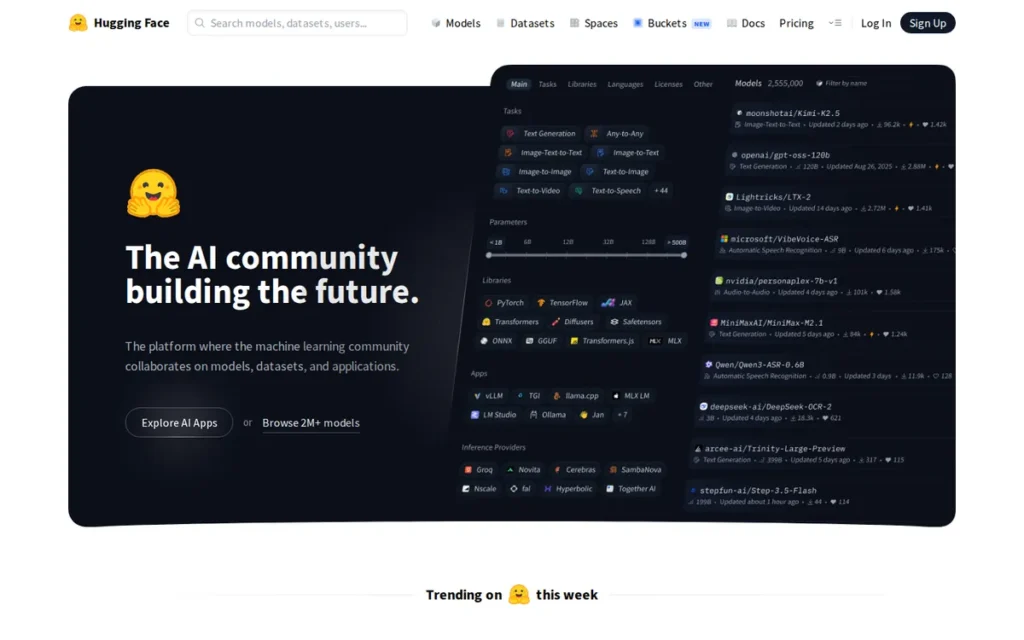
Category: Platform (Model Hub and ML Infrastructure), a complete open-source AI ecosystem providing access to over 2 million pre-trained models, training tools (AutoTrain, PEFT), and managed inference endpoints for any NLP task across PyTorch, TensorFlow, and JAX.
At a Glance
- Category: Platform (Model Hub and ML Infrastructure)
- Best For: ML engineers, data scientists, and enterprise teams needing the broadest selection of pre-trained NLP models, custom fine-tuning tooling, and flexible deployment without framework or vendor lock-in
- Price Range: Free core (Transformers library, Hub access, Datasets); Pro $9/month; Inference Endpoints from ~$0.032/hour (NVIDIA T4 GPU); Enterprise Hub: pricing on request, verify at huggingface.co/pricing
- Primary Strength: Hugging Face hosts over 2 million pre-trained models through a unified, framework-agnostic API, the most comprehensive open-source NLP model resource available to developers and teams in 2026
- Biggest Limitation: Hugging Face’s production serving gap is real: the path from Hub experimentation to high-throughput production inference requires infrastructure investment or Inference Endpoints costs that may be less competitive than specialized providers at very high volume
- One-Line Summary: Hugging Face is the leading open-source AI platform hosting over 2 million pre-trained models with a unified framework-agnostic API covering the full ML workflow from data to deployment, rated best overall NLP platform in 2026 for model selection, fine-tuning, and research.
- Last Verified: April 2026
Overview
Hugging Face is the most widely used open-source AI model hub, hosting over 2 million models and datasets through a unified AutoModel/AutoTokenizer Transformers library interface supporting PyTorch, TensorFlow, and JAX, built for ML engineers, data scientists, and enterprise teams that need the flexibility to benchmark, fine-tune, and deploy any published NLP architecture without framework or vendor lock-in (aiworld.eu, August 2025; TechInsights Q3 2025 report).
Hugging Face is not merely a library, it is a complete ML workflow platform. Hugging Face covers data curation (Datasets), no-code model training (AutoTrain), parameter-efficient fine-tuning (PEFT), reinforcement learning from human feedback (TRL), distributed training (Accelerate), interactive demo deployment (Spaces), and managed production serving (Inference Endpoints).
Hugging Face was founded in 2016 by Clément Delangue, Julien Chaumond, and Thomas Wolf, reached a $4.5 billion valuation in 2023 backed by Salesforce, Google, Amazon, and Nvidia (Contrary Research, 2023–2024), and released BLOOM in July 2022, a community-built open-source multilingual LLM demonstrating the platform’s capacity for coordinated large-scale AI development.
Key Features
- Transformers Library: Hugging Face’s Transformers library provides a unified AutoModel and AutoTokenizer interface supporting 300,000+ pre-trained model configurations across PyTorch, TensorFlow, and JAX, enabling a standardized fine-tune-and-push workflow for any NLP architecture without framework-specific rewrites (Hackceleration review, 2025).
- Hub (Model and Dataset Repository): Hugging Face Hub functions as a Git-based model and dataset repository hosting over 2 million models and datasets, surpassing this milestone in August 2025 with the second million arriving 65% faster than the first, driven by community momentum and proliferation of fine-tuned small models (aiworld.eu, August 2025).
- Inference Endpoints: Hugging Face Inference Endpoints provides serverless and dedicated managed model hosting on NVIDIA T4, A10G, and A100 GPU hardware, reducing the infrastructure gap between local Hub experimentation and production API serving for any Hub-hosted model (Hackceleration review, 2025).
- AutoTrain: Hugging Face AutoTrain enables no-code custom model training for text classification, named entity recognition, summarization, and other NLP tasks by uploading labeled data in the browser, requiring no ML code, pipeline configuration, or algorithm selection.
- PEFT and TRL: Hugging Face’s PEFT (Parameter-Efficient Fine-Tuning) and TRL (Transformer Reinforcement Learning from Human Feedback) libraries enable cost-efficient domain adaptation by fine-tuning a small fraction of model parameters (including support for quantization-aware training for production-ready GGUF and GPTQ model variants) making LLM customization accessible without full-model retraining costs.
Best For
Hugging Face is best for ML engineers, data scientists, and research teams who need access to the full spectrum of NLP models (from lightweight BERT classifiers to 70B-parameter LLMs) and require the flexibility to benchmark, fine-tune, and deploy any published architecture without vendor lock-in. Hugging Face is also the strongest choice for enterprises prototyping NLP solutions on state-of-the-art models before committing to a production serving strategy.
Pricing
Hugging Face operates a freemium open-core model. All pricing verified April 2026 via huggingface.co/pricing:
- Free tier: Transformers library, Hub access (public models and datasets), Datasets library, and basic Inference API, sufficient for prototyping and most research workloads at no cost
- Pro: $9/month for enhanced Hub features and private repositories
- Inference Endpoints: Billed per hour of GPU hardware usage: NVIDIA T4 as lowest entry point; A10G and A100 for higher throughput; verify exact hourly rates at huggingface.co/pricing
- Enterprise Hub: Custom pricing for large organizations: contact Hugging Face for enterprise terms
For very high-volume production inference, specialized providers may offer more competitive per-token pricing for Hugging Face-compatible models (Northflank analysis), evaluate serving costs independently before assuming Inference Endpoints is the lowest-cost production path.
Strengths
- Hugging Face surpassed 2 million hosted models and datasets by August 2025, with the second million arriving 65% faster than the first, the most comprehensive open-source NLP model repository available, spanning every major architecture and task (aiworld.eu, August 2025; TechInsights Q3 2025 report).
- Hugging Face reached a $4.5 billion valuation by 2023, backed by Salesforce (lead investor), Google, Amazon, and Nvidia, the largest institutional investment in any open-source NLP platform, validating its infrastructure-layer strategic role as the AI ecosystem’s model repository (Contrary Research, 2023–2024).
- Hardware acceleration partnerships with NVIDIA TensorRT, Intel Gaudi, and AWS Trainium/Inferentia were confirmed in 2025, enabling production-grade inference throughput via the Optimum library without leaving the Hugging Face ecosystem (Hackceleration review, 2025).
- The BLOOM multilingual LLM: released July 2022 as a community-built open-source multilingual alternative to GPT-3, demonstrated Hugging Face’s capacity to coordinate large-scale collaborative AI development, a structural community advantage no proprietary cloud NLP vendor can replicate (Contrary Research).
Limitations
- Production Serving Gap: Hugging Face’s most consequential tradeoff is the distance between Hub experimentation and high-throughput production inference, requiring either significant infrastructure investment (containerization, autoscaling, production monitoring) or Inference Endpoints costs that developer feedback identifies as less competitive than specialized providers for very high-volume workloads (Northflank blog; MetaCTO competitors analysis, 2024).
- Hub Model Quality Variability: With over 2 million hosted models, quality, bias documentation, and evaluation depth vary enormously across uploads, teams cannot assume Hub-hosted models are production-safe without independent validation, a QA overhead not required when using a curated managed API with vendor-maintained pre-trained models.
- Documentation Gaps at Scale: Hugging Face’s documentation for advanced deployment scenarios (high-throughput serving, multi-model orchestration, production monitoring) has recurring gaps noted in developer feedback; teams should budget for independent infrastructure engineering beyond official documentation for production deployments.
Verdict
Hugging Face is the highest-ranked NLP tool in this 2026 evaluation, no other platform provides comparable breadth of model access, workflow coverage, or community-validated adoption evidence, making it the default choice for any team that needs flexibility in NLP model selection or plans to fine-tune models for domain-specific tasks. The $4.5 billion valuation backed by every major cloud provider reflects institutional recognition of Hugging Face’s infrastructure-layer strategic moat. The primary tradeoff is production serving complexity, teams requiring low-latency, high-throughput inference at scale should plan for additional infrastructure investment or evaluate Inference Endpoints pricing against specialized alternatives. For research, prototyping, custom model development, and model evaluation, Hugging Face earns its #1 ranking through unmatched model diversity and community-verified adoption.
2. spaCy: Best Open-Source Library for Production NLP Pipelines
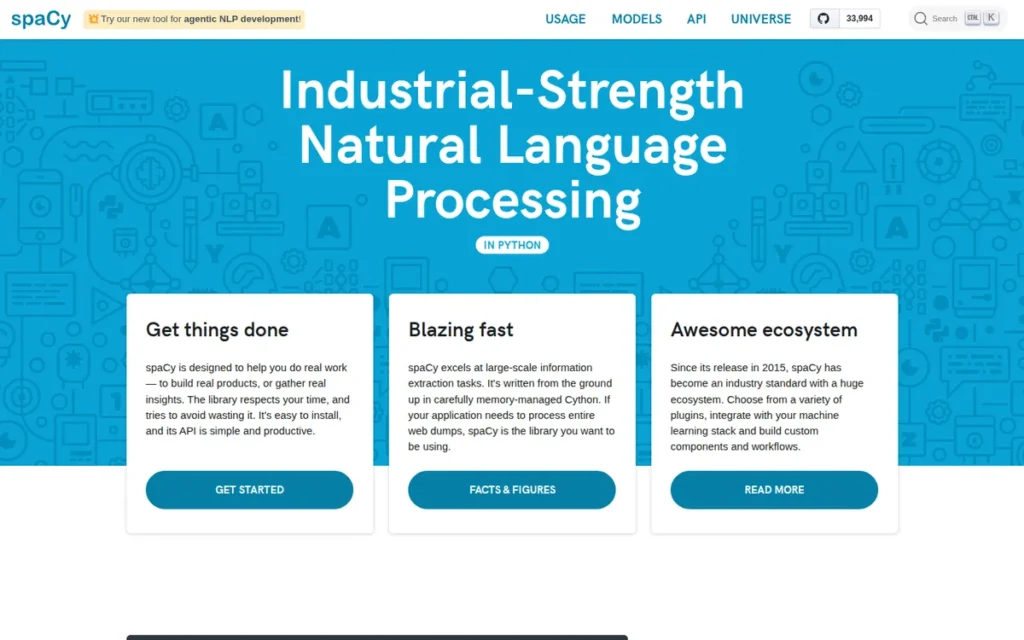
Category: Open-Source Library (Production NLP), a free, Cython-compiled Python NLP library providing tokenization, named entity recognition, dependency parsing, and text classification pipelines deployable on any infrastructure with zero per-token cost.
At a Glance
- Category: Open-Source Library (Production NLP)
- Best For: Developers and data scientists deploying production NLP pipelines requiring high throughput, full infrastructure control, zero per-token cost at scale, and reproducible pipeline versioning across 75+ languages
- Price Range: Free (MIT license, unrestricted commercial use); Prodigy annotation tool and spaCy Enterprise, pricing on request from explosion.ai
- Primary Strength: spaCy’s Cython-compiled core delivers production-grade processing speed for large-scale text pipelines that pure-Python NLP libraries cannot match, at zero marginal cost per token on self-hosted infrastructure
- Biggest Limitation: spaCy’s opinionated pipeline architecture: a production reliability strength, limits architectural flexibility for researchers or teams experimenting with configurations outside the prescribed component design
- One-Line Summary: spaCy is a free, open-source Python NLP library built for production deployment since 2015, offering Cython-compiled processing speed, 84 pre-trained pipelines across 75+ languages, and transformer-backed models, rated best open-source library for production NLP pipelines in 2026.
- Last Verified: April 2026
Overview
spaCy is a production-optimized, open-source Python and Cython NLP library designed for developers and data scientists building deployable text analytics pipelines, providing named entity recognition, POS tagging, dependency parsing, text classification, morphological analysis, entity linking, and sentence segmentation through a structured, component-based pipeline architecture (spaCy official documentation, April 2026).
spaCy’s defining architectural choice is its “opinionated design”, one prescribed, reproducible pipeline approach optimized for deployment consistency rather than research flexibility, explicitly distinguishing it from educational libraries like NLTK and model hubs like Hugging Face.
spaCy was first released in 2015 by Matthew Honnibal (Explosion AI, founded 2016, co-led with Ines Montani) under an MIT license permitting unrestricted commercial use. spaCy v3.8, released May 2025, is the current stable release, confirming active maintenance across a decade of production deployments (PyPI spaCy, April 2026).
Key Features
- Cython-Compiled Core: spaCy’s Cython-compiled data structures and algorithms enable batch text processing via
nlp.pipe()at speeds that significantly outpace pure-Python NLP libraries, making spaCy suitable for large-scale document corpus and web-scale text processing on standard CPU infrastructure (DevOpsSchool NLP comparison, 2025). - 84 Pre-Trained Pipeline Packages: spaCy ships 84 pre-trained pipeline packages across 25+ language configurations (ranging from small CPU-efficient models to transformer-backed large pipelines using BERT-family architectures) giving developers a direct within-framework speed-accuracy tradeoff selector (spaCy Models documentation, April 2026).
- Modular Component Architecture: spaCy implements NER, POS tagging, dependency parsing, morphological analysis, entity linking, sentence segmentation, and text classification as modular, swappable pipeline components, each independently trainable, replaceable, and versionable, with displaCy for pipeline visualization (spaCy.io, April 2026).
- PyTorch Integration via Thinc: spaCy integrates natively with PyTorch via the Thinc deep learning library (maintained by Explosion AI), enabling transformer-backed BERT-family pipelines using any Hugging Face-compatible model while preserving spaCy’s structured, reproducible pipeline architecture (spaCy documentation, April 2026).
- Project System for Reproducible Workflows: spaCy’s project system provides version-controlled NLP workflows with built-in commands for data preprocessing, model training, evaluation, and packaging, bridging the gap between development-environment prototypes and production-ready pipeline artifacts deployable in CI/CD pipelines.
Best For
spaCy is best for developers and data scientists deploying production NLP pipelines that require high throughput on self-hosted infrastructure, full data control, zero marginal per-token cost at high processing volumes, and reproducible pipeline versioning for maintainable systems. spaCy is also the strongest open-source choice for teams processing large document corpora (web-scale text, clinical notes, legal contracts) where cloud API per-unit costs would be prohibitive and where pipeline architecture must remain stable across software versions.
Pricing
spaCy is 100% free under the MIT license with no commercial use restrictions, verified April 2026 via PyPI and spacy.io. spaCy v3.8 (released May 2025) is the current stable release. Compute is the only cost, self-hosted on any infrastructure.
Commercial add-ons from Explosion AI:
- Prodigy: Active-learning annotation tool for creating spaCy training data; one-time perpetual license, pricing not publicly listed as of April 2026. Contact prodi.gy.
- spaCy Enterprise: Enterprise support, tooling, and SLAs: pricing not publicly listed. Contact explosion.ai.
For the vast majority of use cases, the core open-source library at zero cost is the complete product.
Strengths
- spaCy has maintained continuous industry-standard production status since its 2015 launch, a decade of stable, MIT-licensed, production-documented NLP deployments confirmed across multiple independent 2025–2026 sources (DevOpsSchool NLP tools comparison, 2025; spaCy.io, April 2026), the longest production-readiness track record of any open-source NLP library in this evaluation.
- spaCy v3.8, released May 2025, is the current stable release (PyPI, April 2026), confirming active development investment over a 10-year span, a maintenance continuity signal that newer production tools cannot match.
- spaCy’s Cython-compiled core delivers processing speeds significantly faster than pure-Python libraries like NLTK for large-scale text processing, documented in independent 2025 NLP comparisons (DevOpsSchool, 2025; Leyaa AI NLP guide, 2025), making spaCy viable for production workloads where NLTK is not.
- The MIT license permits unrestricted commercial use (PyPI spaCy, April 2026), teams processing millions of documents with spaCy incur zero per-token, per-unit, or per-call licensing cost, making spaCy the most cost-predictable NLP solution for high-volume production workloads compared to any cloud API in this evaluation.
Limitations
- Opinionated Architecture Trade-Off: spaCy enforces a specific component design that optimizes for production reproducibility but explicitly restricts architectural flexibility, developers accustomed to more experimental frameworks find the prescribed pipeline structure limiting when testing novel NLP configurations or combining models outside the supported component system (Tekpon spaCy review; DevOpsSchool, 2025).
- Transformer Infrastructure Overhead: Transformer-based spaCy pipelines require GPU hardware and PyTorch dependencies that increase infrastructure complexity relative to spaCy’s CPU-efficient small model variants, teams expecting plug-and-play transformer accuracy without environment configuration should budget for meaningful setup time.
- Commercial Add-On Pricing Opacity: Commercial add-on pricing for Prodigy and spaCy Enterprise is not publicly listed (explosion.ai), creating uncertainty for teams that require formal support SLAs, enterprise procurement processes typically require documented pricing before budget approval.
Verdict
spaCy is the highest-ranked open-source NLP library in this evaluation and earns its #2 overall position through a combination of production-grade processing speed, a 10-year industry-standard track record, MIT-licensed zero-cost deployment, and active transformer integration that no competing open-source library delivers in a single production-proven package. spaCy’s opinionated design is simultaneously its production strength and its research limitation. For any developer or data scientist deploying structured NLP pipelines at scale on self-hosted infrastructure in 2026, spaCy is the evidence-backed first recommendation, before any cloud API and before any more experimental open-source alternative.
3. OpenAI API: Best for Zero-Shot NLP and Document-Level Intelligence at Scale
Category: LLM API (Cloud-Based NLP via Large Language Models), a cloud-only API delivering NLP tasks via general-purpose LLM reasoning rather than purpose-built classifiers, with no on-premise deployment option and per-token billing.
At a Glance
- Category: LLM API (Cloud-Based NLP via Large Language Models)
- Best For: Developers and product teams needing rapid, zero-shot NLP without ML expertise, especially complex document understanding, long-form content analysis, and agentic document processing workflows
- Price Range: Token-based: from $0.20/1M input tokens (GPT-4.1-nano, verified April 2026 via developers.openai.com); GPT-4o and GPT-4.1 rates vary, verify at openai.com/api/pricing
- Primary Strength: The OpenAI API delivers GPT-4.1’s 1M-token context window and zero-shot NLP accuracy across 100+ languages without requiring model training, infrastructure management, or ML expertise
- Biggest Limitation: The OpenAI API’s cloud-only deployment model and per-token pricing make it significantly more expensive than self-hosted alternatives for high-volume NLP workloads, with no on-premise option for regulated industries requiring data residency
- One-Line Summary: The OpenAI API provides access to GPT-4.1 and GPT-4o for zero-shot NLP tasks including entity extraction, sentiment analysis, and document classification across a 1M-token context window, rated best for zero-shot NLP and document-level intelligence in 2026.
- Last Verified: April 2026
Overview
The OpenAI API is a cloud-hosted LLM API enabling developers and enterprises to perform NLP tasks (entity extraction, sentiment analysis, text classification, summarization, translation, and relation extraction) via GPT-4.1 and GPT-4o, requiring no model training, ML infrastructure, or labeled datasets, and supporting a 1M-token context window for full-document analysis in a single call (OpenAI GPT-4.1 announcement, 2025).
The OpenAI API’s approach to NLP is architecturally distinct from specialized libraries, rather than purpose-built classifiers, it uses general-purpose LLM reasoning via natural language instructions. This enables full-document legal contract analysis or complete research paper summarization in a single call, tasks that traditional NLP libraries cannot handle at comparable quality without multi-call orchestration.
The OpenAI API is cloud-only with per-token pricing that escalates at high processing volumes and no on-premise deployment path. The 2025–2026 direction toward agentic document workflows via the Responses API and Agents SDK (InfoQ OpenAI Dev Day, 2025) positions it increasingly as a document intelligence platform. Enterprise readers should note Azure OpenAI Service provides equivalent model access with HIPAA, SOC 2, and regional deployment options unavailable on the direct API.
Key Features
- 1M-Token Context Window: The OpenAI API’s GPT-4.1 supports a 1M-token context window across all model variants, enabling NLP analysis of entire books, complete legal contracts, or full codebases in a single API call. A 300-page legal contract (~150,000 tokens) can be submitted as a single API call, enabling cross-document queries that traditional chunked pipelines cannot match without orchestration engineering (OpenAI GPT-4.1 announcement, 2025).
- Zero-Shot NLP Performance: The OpenAI API performs entity recognition, sentiment analysis, text classification, summarization, and relation extraction via zero-shot or few-shot natural language prompting, requiring no training data, ML pipeline configuration, or algorithm selection for production-quality NLP results (Kanerika blog, 2025).
- Model Tiering for Cost Routing: The OpenAI API’s model tiering: GPT-4.1-nano ($0.20/1M input tokens), GPT-4.1-mini, GPT-4o, and GPT-4.1, allows routing simple classification tasks to cost-optimized nano models and complex document reasoning to higher-capability models, enabling cost-efficient NLP architecture within a single API (developers.openai.com, April 2026).
- Structured Outputs and Function Calling: The OpenAI API’s structured outputs and function calling capabilities provide schema-validated JSON responses for NLP extraction tasks, partially addressing the unpredictable output format challenge for entity recognition and structured data extraction workflows.
- Agentic Document Processing: The OpenAI API’s Responses API and Agents SDK (2025–2026) enable multi-step document processing pipelines (read, extract, classify, route to action) positioning it as a document intelligence platform beyond single-turn NLP inference (InfoQ OpenAI Dev Day, 2025).
Best For
The OpenAI API is best for developers and product teams needing rapid, production-quality NLP without ML infrastructure overhead, particularly for complex document understanding, zero-shot NLP in under-resourced languages, and agentic document processing pipelines where multi-step reasoning is required. The OpenAI API is not suitable for high-volume cost-sensitive workloads where per-token costs accumulate significantly versus self-hosted alternatives, nor for regulated industries requiring on-premise data residency without an Azure OpenAI Service arrangement.
Pricing
Token-based pricing verified April 2026 via developers.openai.com:
- GPT-4.1-nano: $0.20/1M input tokens, $1.25/1M output tokens (1M token context window, fastest latency tier)
- GPT-4o, GPT-4.1, GPT-4.1-mini: Rates not confirmed in research: verify current rates at openai.com/api/pricing as rates change without advance notice
Cost-saving options:
- Batch API: Typically ~50% reduction for non-real-time workloads
- Prompt caching: Reduces costs for repeated context in high-volume pipelines
Cost modeling note: Processing 10 million tokens of customer reviews at GPT-4o standard rates costs significantly more than a self-hosted spaCy pipeline running at near-zero marginal token cost, model your specific volume requirements before committing to the OpenAI API for high-throughput NLP.
Strengths
- GPT-4.1 achieved 54.6% on SWE-bench Verified versus GPT-4o’s 33.2%: a 21.4-point improvement representing the largest documented single-model accuracy jump in the 2025 LLM benchmark period (OpenAI announcement, 2025; confirmed by independent benchmark trackers including ChatSmith, 2025 and FutureAGI, 2025).
- The OpenAI API has delivered consistent per-token cost reductions across model generations, GPT-4.1-nano at $0.20/1M input tokens (developers.openai.com, April 2026) extends a documented trajectory of declining inference costs, making the API progressively more viable for moderate-volume NLP workloads over time.
- The 1M-token context window in GPT-4.1: confirmed for all GPT-4.1 variants, enables full-document NLP analysis without chunking or multi-call orchestration, a capability unavailable in any NLP library or managed cloud NLP service evaluated here (OpenAI GPT-4.1 announcement, 2025).
- The Responses API and Agents SDK extend the OpenAI API from single-turn NLP calls to multi-step agentic document processing workflows, competing directly with dedicated document intelligence platforms for complex automation use cases (InfoQ OpenAI Dev Day, 2025).
Limitations
- Cost Escalation at Scale: The OpenAI API’s per-token pricing means teams analyzing tens of millions of documents per month face costs orders of magnitude higher than self-hosted spaCy or fine-tuned Hugging Face pipelines, there is no self-hosting option to reduce variable costs as volume grows (Kanerika blog, 2025).
- Cloud-Only Deployment Constraint: The OpenAI API offers no on-premise deployment path, regulated industries with strict data residency requirements cannot use the direct API for sensitive workloads; Azure OpenAI Service partially mitigates this at the cost of Microsoft ecosystem dependency.
- Operational Reliability Risks: Despite structured outputs and function calling, consistent schema enforcement in production NLP extraction pipelines requires non-trivial prompt engineering; knowledge cutoff dates limit recognition of recently emerged named entities; and API versioning changes without advance notice represent operational risks compared to open-source alternatives for teams requiring guaranteed pipeline stability.
Verdict
The OpenAI API ranks third overall, its zero-shot accuracy, 1M-token context window, and near-zero time-to-first-deployment give it the strongest case for complex, context-rich NLP tasks that traditional libraries and managed NLP APIs cannot handle at comparable quality. The ranking reflects a real tradeoff: for high-volume, cost-sensitive, or data-residency-constrained workloads, the per-token pricing and cloud-only model make the OpenAI API inferior to spaCy or Hugging Face fine-tuned models. For rapid prototyping, complex document intelligence, and zero-shot multilingual NLP, the OpenAI API is one of the most accessible paths to production-quality results in 2026, with the explicit caveat that readers must model their specific volume and compliance requirements before committing.
4. Google Cloud Natural Language API: Best Managed Cloud NLP API for GCP-Native Enterprise Teams
Category: Managed Cloud NLP Service (GCP-Native), a serverless, cloud-hosted API providing entity analysis with Knowledge Graph linking, sentiment analysis, syntax parsing, and content classification within the Google Cloud Platform ecosystem, with GA status since November 2016.
At a Glance
- Category: Managed Cloud NLP Service (GCP-Native)
- Best For: Enterprise teams and developers operating within Google Cloud Platform who need production-grade NLP with Knowledge Graph entity enrichment, native BigQuery and Vertex AI integration, and superior multilingual support relative to AWS-native alternatives
- Price Range: Free: first 5,000 units/month per API feature; paid: billed per 1,000 units, exact per-feature rates require verification at cloud.google.com/natural-language/pricing; custom AutoML model pricing rated “on the higher side” by verified G2 users
- Primary Strength: Google Cloud Natural Language API enriches entity detection with Knowledge Graph MID identifiers connecting recognized entities to Wikipedia metadata, a downstream enrichment and disambiguation capability unique among managed cloud NLP APIs in this evaluation
- Biggest Limitation: Google Cloud Natural Language API’s v2 API documentation has been publicly accessible since at least mid-2023 with no confirmed general availability release as of April 2026, a slow iteration signal for enterprise teams planning long-term production commitments
- One-Line Summary: Google Cloud Natural Language API is a managed NLP service with a nearly decade-long general availability track record offering Knowledge Graph entity linking, entity-level sentiment analysis, and content classification, rated best managed cloud NLP API for GCP-native enterprise teams in 2026.
- Last Verified: April 2026
Overview
Google Cloud Natural Language API is a managed, serverless NLP service for enterprise teams and developers operating within Google Cloud Platform, providing entity analysis with Knowledge Graph MID linking, entity-level and document-level sentiment analysis, syntax parsing, 1,000+ category content classification, and text moderation, all via a REST/RPC API requiring no ML model training or infrastructure management (Google Cloud Natural Language documentation, April 2026).
Google Cloud Natural Language API’s architecturally distinct differentiator is Knowledge Graph entity enrichment, detected entities are linked to Wikipedia entries and structured knowledge graph MID identifiers, enabling entity disambiguation and knowledge graph construction beyond raw entity string extraction, a capability unavailable in any other managed cloud NLP API in this evaluation.
Google Cloud Natural Language API reached v1 general availability on November 15, 2016 (Google Cloud release notes, April 2026), nearly a decade of production track record. The v2 API documentation has been publicly accessible since at least mid-2023, though a formal Public Preview announcement date could not be independently confirmed as of April 2026; general availability for v2 has not been confirmed in official Google Cloud release notes (Google Developers Forum, 2023).
Key Features
- Knowledge Graph Entity Linking: Google Cloud Natural Language API enriches entity analysis by connecting detected entities (people, places, events, consumer goods) to Knowledge Graph MID identifiers and Wikipedia entries, providing structured knowledge metadata beyond raw entity strings for downstream enrichment and disambiguation (Google Cloud documentation, April 2026).
- Entity-Level Sentiment Analysis: Google Cloud Natural Language API scores sentiment individually per detected entity within a document, enabling granular opinion mining at the topic level rather than aggregating sentiment across the full document.
- 1,000+ Category Content Classification: Google Cloud Natural Language API classifies documents against a taxonomy of over 1,000 content categories in a single API call, providing structured categorization for news articles, product descriptions, and web content without custom model training.
- Native GCP Ecosystem Integration: Google Cloud Natural Language API integrates natively with BigQuery for large-scale text analytics, Pub/Sub for streaming NLP pipelines, Dataflow for batch processing, and Vertex AI for custom NLP model training, enabling complete pipeline construction within a single cloud environment.
- Text Moderation (v2 API): Google Cloud Natural Language API’s text moderation capability (available in v2 API documentation since at least mid-2023) provides automated detection of harmful and sensitive content categories, extending standard information extraction toward content safety use cases (Google Cloud release notes, April 2026).
Best For
Google Cloud Natural Language API is best for enterprise teams operating within Google Cloud Platform who need production-grade NLP with Knowledge Graph entity enrichment, especially teams building knowledge graphs, semantic search systems, or information extraction pipelines where entity disambiguation and structured Wikipedia metadata are functional requirements. Google Cloud Natural Language API is also the strongest managed NLP choice for GCP-native organizations integrating NLP into existing BigQuery, Dataflow, or Vertex AI workflows without bridging external authentication or incurring cross-cloud data transfer.
Pricing
Pricing verified April 2026 via cloud.google.com/natural-language/pricing:
- Free tier: First 5,000 units per month per API feature (entity analysis, sentiment analysis, syntax analysis, and content classification each counted separately; 1 unit = 1,000 characters or 1 document, whichever is smaller)
- Beyond free tier: Billed per 1,000 units; exact per-feature dollar amounts were not independently confirmed in April 2026 research, verify current rates at cloud.google.com/natural-language/pricing before budgeting
Custom model pricing caveat: A verified G2 user states “the pricing is a bit on the higher side for custom models” (G2 Google Cloud NLP, reviewed April 2026), teams requiring AutoML NLP custom models should calculate training and serving costs separately.
Strengths
- Google Cloud Natural Language API reached general availability in November 2016: a nearly 10-year production track record confirmed in official release notes (cloud.google.com, April 2026), the longest GA track record of any managed cloud NLP API in this evaluation, backed by Google Cloud SLA infrastructure.
- Qualitative comparative analyses rate Google Cloud NLP as having “more sophisticated NLP capabilities with better language support and sentiment analysis” than Amazon Comprehend for English and French tasks, the strongest available accuracy signal among managed cloud NLP APIs, despite the absence of published independent benchmarks (IPSpecialist cloud AI comparison, 2024; MetaCTO Google Cloud competitors analysis, 2024). Performance varies by language, test on representative domain data before finalizing selection.
- The Knowledge Graph MID entity linking feature connects detected entities to Wikipedia entries and structured knowledge graph metadata (Google Cloud documentation, April 2026), a unique enrichment capability not offered by Amazon Comprehend, IBM Watson NLU, or the OpenAI API in standard configurations.
- A verified G2 user confirms “accuracy with less training data is a plus” (G2 Google Cloud NLP, reviewed April 2026), corroborating strong pre-trained model performance for out-of-the-box entity and sentiment analysis without domain-specific training data investment.
Limitations
- v2 API Lifecycle Uncertainty: Google Cloud Natural Language API’s v2 documentation has been publicly accessible since at least mid-2023, but a formal Public Preview announcement date and confirmed general availability release could not be independently verified as of April 2026, an extended preview period that is a meaningful lifecycle signal for enterprise teams planning long-term API commitments (Google Cloud release notes; Google Developers Forum, 2023).
- Custom Model Pricing Premium: Verified G2 users describe custom model pricing as “on the higher side”, teams requiring AutoML NLP custom classification or entity recognition face a meaningful cost premium that limits cost-effectiveness relative to open-source fine-tuned alternatives (G2 Google Cloud NLP, reviewed April 2026).
- Vertex AI Migration Trajectory: Google’s NLP strategy is converging on Vertex AI as the unified platform direction (the standalone Natural Language API may eventually be superseded, similar to how Amazon Comprehend features are migrating to Bedrock) creating long-term dependency risk for teams building deep integration on the current API (Google Cloud blog, 2025).
Verdict
Google Cloud Natural Language API ranks fourth overall, its Knowledge Graph entity enrichment capability, nearly decade-long production track record, and qualitatively superior accuracy and multilingual support relative to Amazon Comprehend earn it the top position among managed cloud NLP APIs for GCP-native enterprise teams. The v2 API’s extended preview status without confirmed GA, custom model pricing premium, and Vertex AI migration trajectory prevent a higher overall ranking. Google Cloud Natural Language API is the evidence-backed recommendation for GCP-native enterprise teams with entity disambiguation or knowledge enrichment requirements, teams operating outside Google Cloud should evaluate whether the switching cost justifies the Knowledge Graph differentiation.
5. IBM Watson Natural Language Understanding: Best for Regulated-Industry Enterprise Analytics Requiring Emotion Detection

Category: Enterprise Cloud NLP Service (IBM Cloud), a managed IBM Cloud NLP API delivering five-dimensional emotion detection, semantic role labeling, entity extraction, and custom domain model training via Watson Knowledge Studio, optimized for regulated-industry enterprise analytics.
At a Glance
- Category: Enterprise Cloud NLP Service (IBM Cloud)
- Best For: Regulated enterprises in healthcare, finance, insurance, and legal requiring emotion detection depth, compliant custom domain models, and IBM Cloud governance
- Price Range: Free: 30,000 items/month; $0.003/item up to 250,000/month; $0.001/item up to 5 million/month; $0.0002/item above 5 million/month, plus $800/month per custom entities-and-relations model and $25/month per custom classification model (verified April 2026, IBM Cloud NLU pricing documentation)
- Primary Strength: IBM Watson Natural Language Understanding delivers five-dimensional emotion detection (joy, anger, sadness, fear, disgust) (a granular sentiment layer unique among managed cloud NLP APIs) enabling CX analytics beyond positive/negative/neutral scoring
- Biggest Limitation: IBM Watson Natural Language Understanding’s custom model training is rated “very clumsy, requires a lot of tweaking” by verified SoftwareAdvice users; custom entities-and-relations models cost $800/month each as a flat fee regardless of usage volume; and 13-language full-feature coverage is narrower than competitors
- One-Line Summary: IBM Watson Natural Language Understanding is an enterprise-grade IBM Cloud NLP service with transparent tiered pricing, five-dimensional emotion detection, semantic role labeling, and Watson Knowledge Studio integration for custom domain model training across 13 fully featured languages, rated best for regulated-industry enterprise NLP analytics in 2026.
- Last Verified: April 2026
Overview
IBM Watson Natural Language Understanding is a managed IBM Cloud NLP service for regulated enterprise teams (particularly in healthcare, finance, and legal) providing entity extraction, five-dimensional emotion detection (joy, anger, sadness, fear, disgust), semantic role labeling, relation detection, concept tagging, five-level content classification, and syntax analysis via a cloud API with publicly documented per-item tiered pricing (IBM Watson NLU product documentation, April 2026).
IBM Watson Natural Language Understanding’s critical enterprise differentiator is Watson Knowledge Studio, a dedicated annotation platform for building custom entity and relation models using domain-specific training data on IBM Cloud infrastructure, enabling proprietary-vocabulary NLP for healthcare, finance, and legal terminology within a compliant environment.
IBM Watson Natural Language Understanding evolved from IBM Watson’s 2011 Jeopardy!-winning AI system, now deeply integrated into the IBM watsonx enterprise AI platform (rebranded 2023–2024), supporting 13 languages with full NLP feature depth, a narrower language count than competitors but with more consistent per-language feature coverage across entity extraction, emotion detection, and semantic role labeling.
Key Features
- Five-Dimensional Emotion Detection: IBM Watson Natural Language Understanding detects five specific emotional dimensions (joy, anger, sadness, fear, and disgust) at document and phrase levels, providing granular sentiment depth for customer experience analytics that exceeds the positive/negative/neutral classification offered by every other managed cloud NLP API in this evaluation (IBM Watson NLU documentation, April 2026).
- Semantic Role Labeling: IBM Watson Natural Language Understanding extracts semantic roles (subject, action, object) from text, enabling structured event parsing for contract analysis, regulatory document review, financial news monitoring, and compliance-driven information extraction pipelines (IBM Watson NLU product page, April 2026).
- Watson Knowledge Studio Integration: IBM Watson Natural Language Understanding integrates with Watson Knowledge Studio (a dedicated annotation platform for building custom entity and relation models using domain-specific training data on IBM Cloud infrastructure) the only managed cloud NLP API in this evaluation with a purpose-built custom annotation tool integrated within the platform (IBM documentation, April 2026).
- Concept Tagging: IBM Watson Natural Language Understanding surfaces high-level themes referenced by implication in text but not explicitly mentioned, enabling thematic analysis of documents where key topics are discussed without using their standard vocabulary.
- Transparent Per-Item Pricing: IBM Watson Natural Language Understanding publishes exact dollar rates at three volume thresholds, $0.003, $0.001, and $0.0002 per item, the most clearly documented per-item pricing of any managed cloud NLP API in this evaluation (IBM Cloud NLU pricing documentation, April 2026).
Best For
IBM Watson Natural Language Understanding is best for regulated enterprises (healthcare organizations processing clinical notes, financial institutions analyzing compliance documents, or insurance companies mining customer communications) that require emotion detection depth, domain-specific custom entity models via Watson Knowledge Studio, and enterprise governance within IBM Cloud. IBM Watson Natural Language Understanding is also well-suited for global enterprises where full NLP feature consistency across 13 languages matters more than breadth of language count alone.
Pricing
Transparent tiered pricing verified April 2026 via IBM Cloud NLU pricing documentation:
- Free tier: 30,000 items/month (1 item = up to 10,000 characters)
- Tier 1: $0.003/item for items 1–250,000/month
- Tier 2: $0.001/item for items 250,001–5,000,000/month
- Tier 3: $0.0002/item for items above 5,000,000/month
Cost modeling example: 1 million items/month ≈ $1,500/month in per-item fees (250,000 × $0.003 + 750,000 × $0.001).
⚠️ CUSTOM MODEL BILLING TRAP: Watson Knowledge Studio-trained models carry mandatory fixed monthly hosting fees:
- Custom entities and relations models: $800/month per model (flat fee, charged regardless of inference volume)
- Custom classification models: $25/month per model
Example: A healthcare NLP team with 4 custom medical entity models (physician names, drugs, procedures, diagnoses) incurs $3,200/month in fixed model fees before any per-item charges, raising a 1M-items/month deployment to approximately $4,950/month total (IBM Cloud NLU pricing documentation, April 2026). Model total cost at scale before selecting Watson NLU for custom entity workloads.
Strengths
- IBM Watson NLU’s per-item pricing tiers are publicly documented at exact dollar rates, $0.003, $0.001, and $0.0002 per item at three volume thresholds (IBM Cloud NLU pricing documentation, April 2026), enabling predictable cost modeling without a pricing calculator or sales conversation for standard item-processing workloads.
- A 2024 Physics Education Research study (Physical Review Physics Education Research, 2024) cited Watson NLU as effective for academic text categorization tasks “when trained properly”, the most recent independent academic publication referencing any managed cloud NLP API in this evaluation period.
- Watson Knowledge Studio integration enables regulated-industry teams to build custom entity and relation models with domain-specific annotation on IBM Cloud infrastructure (IBM Watson NLU documentation, April 2026), the only managed cloud NLP API in this evaluation with a dedicated purpose-built annotation tool for custom model creation.
- IBM’s broader watsonx enterprise AI platform has documented “up to 60% reduction in customer service workload” via enterprise AI deployments (Nexright Watsonx analysis, 2024), the strongest enterprise-scale ROI figure associated with IBM’s AI product family in this evaluation period, though this figure reflects platform-level deployments rather than Watson NLU specifically.
Limitations
- Custom Model Training Complexity: IBM Watson Natural Language Understanding’s custom model setup is described by verified SoftwareAdvice users as “very clumsy, requires a lot of tweaking in order to get off the ground” (SoftwareAdvice, IBM Watson NLU reviews), creating significant time-to-first-production-value friction for teams expecting zero-shot accuracy on domain-specific content without substantial configuration investment.
- Custom Entity Model Fixed-Cost Billing Trap: Watson Knowledge Studio-trained entities-and-relations models cost $800 per model per month as a flat fee regardless of usage, an IBM Cloud pricing structure absent from most simplified summaries that substantially increases total cost of ownership for the regulated-enterprise custom model workloads Watson NLU is designed to serve (IBM Cloud NLU pricing documentation, April 2026).
- Narrow Language Coverage: IBM Watson Natural Language Understanding’s 13-language full-feature coverage is narrower than competitors in language count, while per-language feature depth is a genuine differentiator, global enterprises requiring NLP across 20+ languages will find Watson NLU’s coverage insufficient for all target markets.
- Watsonx Roadmap Uncertainty: IBM’s evolving enterprise AI portfolio strategy under the watsonx rebrand (2023–2024) may create roadmap uncertainty for Watson NLU specifically as IBM consolidates its product family, teams should verify the product’s continued development trajectory before long-term infrastructure commitment.
Verdict
IBM Watson Natural Language Understanding ranks fifth overall, its transparent per-item pricing tiers, unique five-dimensional emotion detection, and Watson Knowledge Studio integration for regulated-industry custom model training earn a clear, defensible positioning advantage for compliance-sensitive enterprise workloads that no other tool in this evaluation addresses as directly. The ranking reflects narrower general applicability: for use cases outside regulated-industry emotion analytics or domain-specific custom entity modeling on IBM Cloud, Watson NLU’s higher setup complexity, $800/month per custom entity model fee, and limited language count reduce competitiveness. For regulated enterprises where emotion depth, governance, and custom model training in a compliant environment are non-negotiable, IBM Watson Natural Language Understanding is the evidence-backed recommendation in 2026.
6. Amazon Comprehend: Best for AWS-Native Teams Requiring Integrated Text Analytics (With Critical Deprecation Caveats for 2026)
Category: Managed Cloud NLP Service (AWS-Native), a fully managed, serverless AWS NLP service providing entity recognition, sentiment analysis, and PII detection via API within the AWS ecosystem.
⚠️ DEPRECATION ALERT, April 30, 2026: Amazon Comprehend’s topic modeling, event detection, and prompt safety classification features are no longer available to new customers after April 30, 2026. Existing customers who have actively used these features within the last 12 months retain continued access with no action required. AWS is migrating these capabilities to Amazon Bedrock Data Automation. Teams evaluating Amazon Comprehend for these workloads must evaluate Amazon Bedrock as an alternative. Source: AWS Comprehend availability change documentation.
At a Glance
- Category: Managed Cloud NLP Service (AWS-Native)
- Best For: AWS-native enterprise teams integrating standard text analytics (entity recognition, sentiment, PII detection, custom classification) into existing AWS infrastructure via IAM-secured API calls, where ecosystem integration value outweighs feature and accuracy limitations
- Price Range: Free: 50,000 units (~5 million characters) per API per month for first 12 months; paid tiers billed per unit per feature, exact rates require AWS Pricing Calculator (not publicly listed at flat rate); custom endpoints billed continuously for uptime, not per call
- Primary Strength: Amazon Comprehend’s native integration with AWS IAM, S3, Lambda, Kinesis, Glue, and Amazon Connect enables zero-configuration NLP pipeline construction within existing AWS infrastructure without external API authentication or data egress from the AWS security perimeter
- Biggest Limitation: As of April 30, 2026, Amazon Comprehend’s topic modeling, event detection, and prompt safety classification features are no longer available to new customers, a significant feature reduction reflecting AWS’s migration of advanced NLP capabilities to Amazon Bedrock Data Automation
- One-Line Summary: Amazon Comprehend is a fully managed AWS NLP service offering entity recognition, sentiment analysis, PII detection, and custom classification via serverless API, though as of April 30, 2026, topic modeling and event detection are no longer available to new customers, reflecting AWS’s migration of advanced NLP capabilities to Amazon Bedrock.
- Last Verified: April 2026
Overview
Amazon Comprehend is a fully managed, serverless AWS NLP service for enterprise teams adding text analytics to existing AWS infrastructure, providing entity recognition, document and phrase-level sentiment analysis, PII identification and redaction, keyphrase extraction, custom classification, and language detection for 100+ languages, requiring no ML expertise or separate infrastructure provisioning (AWS Comprehend features documentation, April 2026).
Critical note for evaluators in 2026: Topic modeling, event detection, and prompt safety classification are no longer available to new Amazon Comprehend customers after April 30, 2026. Existing customers who have actively used these features within the last 12 months retain continued access, this deprecation primarily affects new account evaluations (AWS deprecation notice, April 2026).
Amazon Comprehend’s primary value is ecosystem integration, the same AWS SDK, IAM access control, VPC isolation, and CloudWatch monitoring teams already use for S3, Lambda, and DynamoDB work identically with Comprehend API calls. Amazon Comprehend launched in 2017 and received generative AI enhancements in 2025 (AWS ML blog, 2025).
Key Features
- AWS-Native Serverless NLP: Amazon Comprehend provides entity recognition, sentiment analysis, keyphrase extraction, PII identification and redaction, language detection for 100+ languages, and syntax analysis via the same AWS SDK interface used for S3, Lambda, and DynamoDB, no separate API authentication required (AWS documentation, April 2026).
- AutoML Custom Classification and Entity Recognition: Amazon Comprehend enables domain-adapted NLP models trained by uploading labeled CSV datasets, requiring no ML code, algorithm selection, or training infrastructure configuration beyond standard AWS IAM permissions.
- End-to-End AWS Pipeline Integration: Amazon Comprehend integrates natively with S3 for batch document analysis, Kinesis Data Streams for real-time NLP, Lambda for event-driven text processing, and Amazon Connect for contact center analytics, all within the AWS IAM security perimeter with VPC isolation and CloudWatch monitoring (AWS documentation, April 2026).
- PII Detection and Redaction: Amazon Comprehend automatically identifies names, addresses, SSNs, credit card numbers, and other PII categories with configurable redaction, meeting common data governance requirements without custom rule engineering for AWS-native data pipelines.
⚠️ DEPRECATION ALERT, April 30, 2026: Topic Modeling, Event Detection, and Prompt Safety Classification are no longer available to new Amazon Comprehend customers (existing active users retain continued access). Evaluate Amazon Bedrock Data Automation for these workloads. See AWS deprecation notice.
Best For
Amazon Comprehend is best for AWS-native enterprise teams whose primary NLP requirement is integrating standard text analytics into existing AWS infrastructure, organizations where IAM-based access control, VPC isolation, and zero data egress from AWS represent genuine operational requirements. Amazon Comprehend is not recommended for teams evaluating NLP independently of cloud provider affiliation, for new workloads requiring topic modeling or event detection (deprecated April 30, 2026 for new customers), or for teams where NLP accuracy relative to Google Cloud NLP is the primary evaluation criterion.
Pricing
Pricing verified April 2026 via Tekpon Amazon Comprehend review and AWS documentation:
- Free tier: 50,000 units (~5 million characters) per API endpoint per month for the first 12 months after first use
- Beyond free tier: Per unit, varying by feature: entity recognition, sentiment, PII detection, syntax analysis, and custom classification each billed at separate rates; exact per-unit dollar amounts are not listed at flat rates: use the AWS Pricing Calculator for estimates
⚠️ BILLING TRAP: Custom classifier and custom entity recognizer endpoints are billed continuously for endpoint uptime regardless of inference traffic volume. Teams must actively deactivate or delete endpoints when not in use to avoid unexpected ongoing charges, a documented source of unplanned cost for teams with variable NLP workloads (Tekpon review, April 2026).
Strengths
- Amazon Comprehend launched in 2017 and received generative AI enhancements in 2025 for improved real-time complex text analysis (AWS ML blog, 2025), an 8-year production track record as a fully managed AWS service with enterprise-scale global deployment.
- Amazon Comprehend’s native integration with S3, Lambda, Kinesis, AWS Glue, and Amazon Connect (AWS documentation, April 2026) enables complete end-to-end NLP pipeline construction within the AWS ecosystem, the deepest cloud-native integration of any NLP tool evaluated for organizations already committed to AWS infrastructure.
- Amazon Comprehend’s PII detection and redaction feature automatically identifies and optionally redacts SSNs, credit card numbers, addresses, and other PII categories (AWS documentation, April 2026), a compliance-essential capability out-of-the-box without custom rule engineering.
- Amazon Comprehend’s AutoML custom classification and entity recognition enable domain-adapted NLP models trained from labeled CSV datasets, requiring no ML expertise, lowering the barrier to custom NLP for teams embedded in the AWS ecosystem.
Limitations
- Accelerating Feature Deprecation: Amazon Comprehend’s most consequential limitation in April 2026 is its deprecation trajectory, topic modeling, event detection, and prompt safety classification are no longer available to new customers, fragmenting a once-unified NLP service across multiple AWS platforms; existing active users retain continued access per AWS documentation, April 2026.
- Accuracy Below Alternatives: Multiple independent comparisons rate Amazon Comprehend’s NLP capabilities below Google Cloud Natural Language API for complex English and French tasks (AnalyticsSteps, 2025; Kimola alternatives analysis), and G2 competitor analysis identifies alternatives as preferred for “better quality ongoing product support, feature updates, and roadmaps” (G2 Amazon Comprehend competitors/alternatives page, reviewed April 2026).
- Pricing Opacity and Continuous Billing Risk: Amazon Comprehend’s per-unit pricing varies across features and is not publicly listed at flat rates (requiring the AWS Pricing Calculator for estimates) and custom endpoints incur continuous uptime billing regardless of traffic, generating unplanned costs for teams with variable workloads (Tekpon review, April 2026).
Verdict
Amazon Comprehend ranks sixth overall, in April 2026, Amazon Comprehend is best understood as a narrowing tool: its production case is strongest when AWS ecosystem integration is a hard constraint and weakest when NLP accuracy, feature completeness, or budget predictability are the primary evaluation criteria. The April 30, 2026 topic modeling and event detection deprecation for new customers, documented accuracy limitations relative to Google Cloud NLP, pricing opacity, and continuous endpoint billing create the weakest overall evidence case among production-viable managed NLP APIs. Amazon Comprehend is the evidence-backed recommendation only for teams where AWS ecosystem constraints are non-negotiable and whose NLP requirements fall entirely within the non-deprecated feature set, teams with any flexibility to evaluate beyond AWS should examine Google Cloud NLP, IBM Watson NLU, or open-source alternatives before committing to Comprehend in 2026.
7. NLTK: Best for Learning NLP Fundamentals and Academic Corpus Research, Not Recommended for Production Deployment
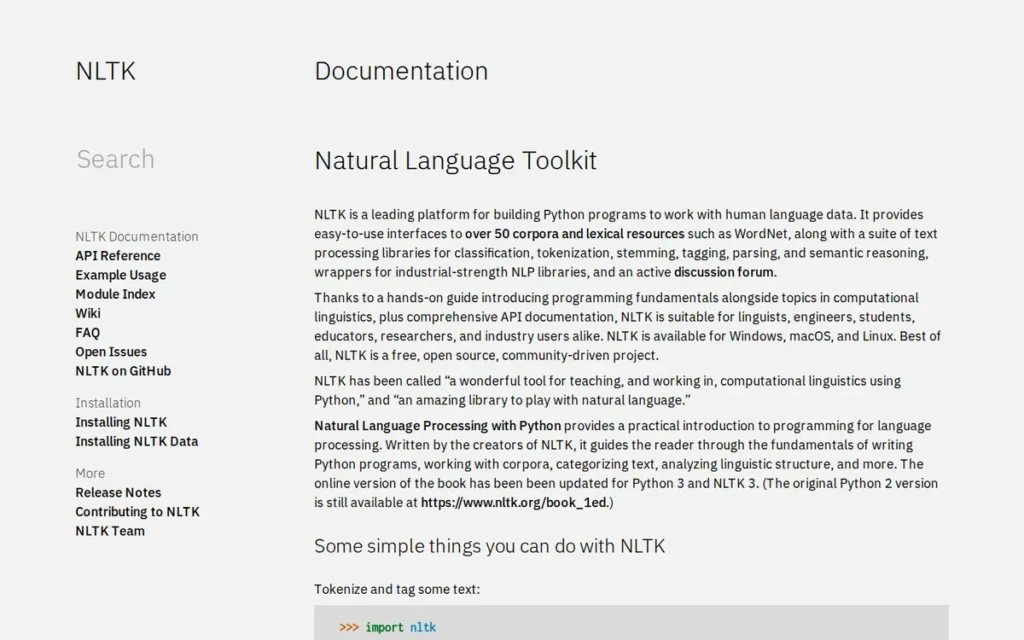
Category: Educational Open-Source Library (Academic/Research NLP), a free Python NLP toolkit providing interfaces to 50+ linguistic corpora and pedagogically clear algorithm implementations for NLP education and academic research. Explicitly not recommended for production deployment in 2026.
At a Glance
- Category: Educational Open-Source Library (Academic/Research NLP)
- Best For: Students, NLP learners, and academic researchers needing a comprehensive educational toolkit with 50+ linguistic corpora, clear algorithm implementations, and rich documentation for coursework and research, not for production applications
- Price Range: Free (Apache 2.0 license, unrestricted commercial use: no paid tiers or enterprise support packages identified)
- Primary Strength: NLTK provides interfaces to over 50 linguistic corpora and lexical resources (including WordNet, Penn Treebank, and Brown Corpus) making it the most comprehensive educational NLP corpus library available for academic research and NLP learning
- Biggest Limitation: NLTK is explicitly not suitable for production NLP deployment in 2026, its pure-Python architecture processes large-scale text significantly slower than Cython-compiled alternatives, it lacks native transformer support, and any prototype built on NLTK requires a complete pipeline rewrite to deploy with spaCy or Hugging Face
- One-Line Summary: NLTK (Natural Language Toolkit) is a free, open-source Python library founded at the University of Pennsylvania in 2001, providing interfaces to over 50 linguistic corpora and comprehensive NLP algorithm implementations for academic research and education, explicitly not recommended for production NLP deployment in 2026.
- Last Verified: April 2026
Overview
NLTK (Natural Language Toolkit) is a free, open-source Python NLP library for students, NLP learners, and academic researchers, providing interfaces to 50+ linguistic corpora, tokenization, stemming, POS tagging, parsing, semantic reasoning, and basic text classification through pedagogically clear Python implementations, with explicit documentation consensus across multiple 2025–2026 sources that NLTK is not suitable for production NLP deployment (DevOpsSchool NLP comparison, 2025; Leyaa AI NLP guide, 2025).
NLTK was built for pedagogical clarity, not computational optimization, every algorithm is implemented to illustrate NLP concepts, making it ideal for learning NLP internals but inadequate for production workloads requiring transformer support, high throughput, or large-scale text processing speed.
NLTK was founded in 2001 by Steven Bird and Edward Loper at the University of Pennsylvania (NLTK official documentation, April 2026), its 24-year continuous maintenance track record, Apache 2.0 license, and free “Natural Language Processing with Python” textbook make it the foundational Python NLP education library, even as production-focused libraries have superseded it for all deployment use cases.
Key Features
- 50+ Corpus and Lexical Resource Interfaces: NLTK provides programmatic interfaces to over 50 corpora and lexical resources (including WordNet (semantic network for sense disambiguation), Penn Treebank (syntactic parse annotations), Brown Corpus (genre-classified text), and Reuters News Corpus) the most comprehensive built-in corpus access collection in any open-source NLP library (NLTK documentation, April 2026).
- Pedagogically Clear Algorithm Implementations: NLTK implements tokenization, sentence segmentation, stemming, lemmatization, POS tagging, chunking, and named entity chunking (via
ne_chunk()) as transparent Python modules written to illustrate NLP concepts rather than optimize execution speed, making algorithm internals inspectable for educational use (GeeksforGeeks NLTK overview, 2025). - Classical NLP Algorithm Suite: NLTK’s pre-trained classifiers, maximum entropy models, and naive Bayes text classifiers cover the algorithmic foundations that preceded the transformer era, providing a complete learning environment for classical probabilistic NLP that remains relevant in academic curricula.
- Multilingual Corpus Research Support: NLTK supports research across 50+ human languages through its corpora and linguistic resources, providing tools for comparative linguistic analysis and multilingual NLP experimentation across language families that production-focused libraries prioritize less comprehensively.
- Free Educational Textbook: NLTK’s freely available “Natural Language Processing with Python” book (nltk.org/book) is cited as the most widely referenced educational NLP resource in academic contexts (GeeksforGeeks, 2025; OpenSourceForU, 2024), extending NLTK’s educational value beyond the library itself.
Best For
NLTK is best for students in university NLP courses, researchers exploring classical NLP algorithms and corpus linguistics, and developers learning NLP fundamentals before adopting production-ready libraries. NLTK is also appropriate for research requiring programmatic access to specific linguistic corpora (WordNet, Penn Treebank, Brown Corpus) not readily available through production-optimized libraries. NLTK is not appropriate for production NLP applications, real-time text processing, any workload requiring transformer-based models, or any system where spaCy or Hugging Face can be used instead.
Pricing
NLTK is 100% free under the Apache 2.0 license with no commercial use restrictions, verified April 2026 via NLTK official documentation and DevOpsSchool NLP comparison, 2025. No paid tiers, enterprise support packages, or commercial derivatives were identified. NLTK runs on any Python 3.x environment without GPU requirements, making it viable for student laptops and basic research servers.
Licensing note: Apache 2.0 includes an explicit patent grant provision preferred by some corporate legal teams over the MIT license for open-source component inclusion. Both MIT (spaCy) and Apache 2.0 (NLTK) permit unrestricted commercial use, the patent grant is the distinguishing factor for organizations with formal IP review requirements.
Strengths
- NLTK was founded in 2001 at the University of Pennsylvania: its 24-year continuous maintenance track record, confirmed via ongoing Python 3/NLTK 3 documentation updates (OpenSourceForU, 2024; DevOpsSchool, 2025), makes NLTK the longest-maintained Python NLP library in this evaluation.
- NLTK provides interfaces to over 50 linguistic corpora: including WordNet, Penn Treebank, Brown Corpus, and Reuters News Corpus, confirmed in NLTK official documentation (April 2026): the largest built-in corpus access collection of any NLP library evaluated, uniquely valuable for corpus linguistics research requiring standardized annotated datasets.
- NLTK’s free “Natural Language Processing with Python” textbook (nltk.org/book, April 2026) is cited as the most widely referenced educational NLP resource in academic contexts (GeeksforGeeks, 2025), a durable educational asset that extends NLTK’s value beyond the library itself.
- The Apache 2.0 license includes explicit patent grant language that some corporate legal teams prefer over the MIT license for open-source component inclusion, a licensing consideration with real enterprise procurement implications for organizations with formal IP review requirements.
Limitations
- Production Unsuitability (Multi-Source Consensus): NLTK is explicitly rated “not suitable for production-grade applications” across multiple independent 2025–2026 sources (DevOpsSchool, 2025), its pure-Python architecture “performs poorly for large-scale processing compared to spaCy” (Leyaa AI, 2025) with speed gaps reaching orders of magnitude for high-volume document corpora.
- No Native Transformer Support: NLTK has no native support for transformer or deep learning models, an architectural incompatibility with the approaches that now dominate production NLP applications, making NLTK unsuitable for any context-aware NLP task requiring modern embeddings or fine-tuned models (Scoop Market US NLP statistics, 2024).
- Prototype-to-Production Architecture Debt: Any developer who builds a text analytics application on NLTK must perform a complete pipeline rewrite (tokenizer, classifier, and inference layer) to migrate to spaCy or Hugging Face for production deployment. A 6-month NLTK-based prototype translates to 2–4 weeks of additional engineering before production launch, an overhead that is entirely avoidable by choosing spaCy or Hugging Face from day one.
Verdict
NLTK ranks seventh in this evaluation, not because it is a poor tool, but because its explicit purpose is NLP education, and this evaluation assesses NLP software against production-deployment criteria where NLTK is measurably and honestly unsuitable in 2026. NLTK is the strongest tool in this evaluation for its intended purpose: a free, comprehensive, pedagogically clear NLP learning environment with access to 50+ linguistic corpora for students and academic researchers. A prototype built on NLTK is not a proof of concept for production, it is a learning exercise that must be fully rewritten before deployment. For any developer or enterprise team evaluating NLP software for production text analytics, NLTK should be referenced for learning and corpus access, never selected for deployment.
What Red Flags Should I Watch For When Evaluating NLP Software?
No managed NLP cloud vendor publishes independently verified accuracy benchmarks for pre-trained models, and at least one tool actively evaluated in 2026 has been depreciating core features mid-procurement cycle. These five red flags surface the risks most likely to cause a failed NLP tool selection.
Red Flag #1: Vendor Publishes No Independent Accuracy Benchmarks
No cloud NLP API reviewed in this 2026 evaluation (Amazon Comprehend, IBM Watson Natural Language Understanding, or Google Cloud Natural Language API) publishes independently verified third-party accuracy benchmarks for its pre-trained models. Any accuracy claims from these vendors are self-reported and unverifiable without running your own tests on representative production data before finalizing selection.
Red Flag #2: Continuous Endpoint Billing Without Uptime Controls
Amazon Comprehend custom classifier and custom entity recognizer endpoints are billed for uptime regardless of inference traffic volume. Teams that deploy a custom endpoint and leave it running at low traffic will encounter unexpected ongoing charges. Any managed cloud NLP API with dedicated endpoint billing (not pay-per-call) requires explicit endpoint lifecycle management to prevent cost accumulation.
Red Flag #3: Deprecated Features in Active Evaluation
If a tool’s documentation includes a deprecation notice for features on your shortlist, the migration timeline directly affects your implementation roadmap. Amazon Comprehend’s April 30, 2026 deprecation of topic modeling and event detection for new customers is a live example that was absent from all three evaluated AI search responses in this research session. Always verify feature availability at the time of evaluation, not at the time of initial research.
Red Flag #4: Prototype-to-Production Architecture Mismatch
If your prototype is built on NLTK and your production target requires high-throughput inference, you face a complete pipeline rewrite before launch. Aligning prototype and production tool choices from day one avoids this technical debt, if you intend to deploy on spaCy, prototype on spaCy; if you intend to use a Hugging Face transformer, prototype with that model, not NLTK approximations.
Red Flag #5: Multilingual Depth Misrepresented as Breadth
“Supports 100+ languages” frequently means language detection support (identifying which language a document is written in) not full NLP feature coverage for entity extraction, sentiment analysis, or dependency parsing. Amazon Comprehend’s “100+ language” claim is detection-level, while IBM Watson NLU’s “13 languages” represents full feature coverage. Verify which specific NLP features are available in your target languages, not just the total language count headline.
What Questions Should I Ask Before Choosing an NLP Tool?
Five questions resolve the majority of NLP tool-selection decisions for developers and enterprise architects evaluating options in 2026. Each question is designed to eliminate categories of tools before detailed feature comparison begins.
Question #1: What Is My Monthly Text Processing Volume at Production Scale?
Volume is the primary cost driver separating cloud APIs from self-hosted solutions. At low volumes (under 100K units/month), cloud API free tiers cover most workloads at zero cost. At high volumes (millions of units/month), per-token or per-item costs can exceed self-hosted infrastructure costs by orders of magnitude.
Estimate your production volume before evaluating pricing, and model costs at these three benchmarks:
- Under 100K units/month: free tiers on all cloud APIs cover most workloads
- 100K–1M units/month: evaluate per-item vs. self-hosted compute cost carefully
- Over 1M units/month: self-hosted spaCy or Hugging Face is almost always cheaper than cloud APIs
Question #2: Does My Deployment Environment Require Data Residency or On-Premise Processing?
Regulated industries (healthcare (HIPAA), finance, insurance, government) frequently cannot send text data to third-party cloud NLP APIs. If on-premise or private cloud deployment is a hard requirement, the viable options narrow to:
- spaCy (self-hosted, MIT license)
- Hugging Face (self-hosted models, full data control)
- NLTK (not for production: for reference only)
OpenAI API, Google Cloud NLP, IBM Watson NLU, and Amazon Comprehend are cloud-only and unsuitable for strict on-premise mandates without vendor-specific enterprise arrangements.
Question #3: Do I Need Custom Models for Domain-Specific Vocabulary, or Will Pre-Trained Models Suffice?
Pre-trained cloud NLP models perform well for general-purpose entity recognition but underperform on domain-specific vocabulary, medical terminology, financial instruments, legal clauses. If custom models are required, evaluate:
- IBM Watson Knowledge Studio (managed, IBM Cloud: $800/month per entity model)
- Amazon Comprehend AutoML (AWS ecosystem, CSV-based training)
- Hugging Face AutoTrain or PEFT (self-hosted, flexible, lower fixed cost)
- spaCy training pipeline (self-hosted, production-optimized)
Question #4: Is My Primary NLP Requirement a Well-Defined Structured Task, or Complex Document Reasoning?
Well-defined structured tasks, NER, POS tagging, sentiment at scale, content classification, are best served by purpose-built NLP tools such as spaCy, Hugging Face fine-tuned models, and managed cloud APIs. Complex document reasoning, extracting nuanced relationships from long-form legal documents, answering questions about large text corpora, is best served by the OpenAI API’s 1M-token context window. Routing tasks to architecturally appropriate tools reduces both cost and error rates.
Question #5: What Is the Product Lifecycle Stability of the Tool Over My Expected Deployment Horizon?
A tool you deploy today must still be supported and feature-complete at renewal. Check for:
- Active deprecation notices (Amazon Comprehend’s April 2026 feature removals)
- Extended preview versions without confirmed GA (Google Cloud NLP v2, accessible since at least mid-2023)
- Vendor consolidation signals (Watson NLU into watsonx, Comprehend features into Bedrock)
- Development velocity indicators (GitHub commit frequency, release cadence, official blog activity)
Before You Finalize, Validation Checklist
Before committing to any NLP tool selection, confirm:
- Have you tested the candidate tool on 100+ samples from your actual production data?
- Have you modeled cost at your 12-month projected production volume, not your current prototype volume?
- Have you verified all features you need are available and not deprecated as of today’s date?
- Have you confirmed your data residency and compliance requirements against the tool’s deployment options?
- Have you checked whether a hybrid architecture: open-source for high-volume tasks plus LLM API for complex tasks, is cheaper than a single-tool solution?
How Did We Rank These NLP Software Tools?
PlugRoute ranked these seven NLP tools by scoring each against six criteria: production readiness, feature breadth, accuracy evidence, pricing transparency, ecosystem integration, and multilingual support depth. Hugging Face ranked first on five of six criteria; spaCy ranked first on production readiness and cost; NLTK ranked last on production criteria by design, it is built for education, not deployment. Every tool received identical editorial depth and structural treatment.
Evaluation Process
The evaluation followed four sequential steps:
- Product Discovery: Seven tools were identified by querying multiple AI search engines for NLP software recommendations, cross-referencing results with category review platforms and developer community discussions.
- Parallel Research: Independent research was conducted for each tool covering core offering, performance evidence, pricing, user reviews, community sentiment, and background credentials, with equal research investment per tool.
- Evidence Compilation: Findings were compiled against six scored criteria. Every claimed statistic was traced to a named source and year before inclusion.
- Rankings Applied: Tools were ranked by their aggregated evidence score across all criteria. No tool received favorable or unfavorable weighting due to market share.
Ranking Criteria
C1, Production Readiness and Deployment Reliability (Primary Weight)
Why it matters: The target audience’s most acute pain point is the gap between a tool that works in a research notebook and one that can serve real traffic at scale.
Measurement:
- Official production-readiness positioning and architecture design intent (production vs. educational vs. experimental)
- Independent community and reviewer consensus on deployment suitability
- Availability of SLAs, support contracts, or enterprise tier offerings
- Documented lifecycle signals: active deprecations, API version status, platform migration trajectories
- Length of general availability track record with confirmed production deployments
C2, Feature Breadth and NLP Task Coverage (Primary Weight)
Why it matters: Feature gaps require supplementary tooling that adds cost and complexity.
Measurement:
- Range of supported NLP tasks (tokenization, NER, POS tagging, dependency parsing, sentiment, emotion detection, text classification, summarization, relation extraction, semantic roles)
- Availability of custom model training
- Pipeline vs. single-task architecture
- Documented task coverage from official feature pages verified at research date
C3, Model Accuracy Evidence and Quality Signals (Primary Weight)
Why it matters: Accuracy determines whether NLP results are reliable enough for downstream decisions.
Measurement:
- Published benchmark scores with named tests and dates where available
- Independent comparative accuracy assessments from third-party analysis
- Verified user review quotes referencing accuracy
- Architectural quality indicators (transformer-backed, SOTA model access, zero-shot capability)
Critical Transparency Disclosure: No cloud NLP API in this evaluation (Amazon Comprehend, IBM Watson Natural Language Understanding, or Google Cloud Natural Language API) publishes independently verified third-party accuracy benchmarks for its pre-trained models. Accuracy assessments for these tools are based on qualitative comparative analysis, verified user reviews, and architectural quality indicators, not measured F1 scores. Readers should run evaluations on representative datasets before finalizing tool selection.
C4, Pricing Transparency and Value at Scale (Secondary Weight)
Why it matters: Cost escalation at production volumes is the most universally cited pain point for cloud NLP tools.
Measurement:
- Whether pricing is publicly documented at specific tier rates (vs. “contact us” or calculator-only access)
- Free tier generosity and realistic production-volume cost modeling
- Per-unit, per-token, or per-item billing model clarity
- Existence of billing traps: continuous endpoint uptime charges, unpublished custom model monthly fees
- Total cost of ownership comparison at 100K, 1M, and 10M units/month where calculable from public data
- License cost for open-source tools (zero marginal cost = maximum score on this dimension)
C5, Ecosystem Integration and Developer Experience (Secondary Weight)
Why it matters: Tools that require bridging external authentication or custom middleware impose real operational costs.
Measurement:
- Native integrations with major platforms confirmed in official documentation (AWS, GCP, Azure, Python pipeline tools)
- Framework compatibility: PyTorch, TensorFlow, JAX
- Availability of SDK, CLI, or REST API for development and production use
- Documented ease-of-integration quality from verified user reviews
- Vendor lock-in risk profile: data portability, API standard adherence, self-hosted fallback availability
- Community ecosystem size: plugins, tutorials, and third-party tooling maturity
C6, Multilingual Support Depth vs. Breadth (Secondary Weight)
Why it matters: Multilingual support is frequently misrepresented, language detection (often 100+ languages) and full NLP feature coverage (significantly fewer) are different capabilities.
Measurement:
- Number of languages with full NLP feature coverage vs. detection-only
- Documentation clarity about which features are available per language
- Quality evidence for major enterprise languages (French, German, Spanish, Japanese, Chinese, Korean)
- Distinction between detection-level and analysis-level language support explicitly flagged
Evidence Weighting
When sources conflict, specificity and recency take precedence over volume. A verified 2025 G2 user quote with specific pricing feedback outweighs a generic 2022 blog post. Vendor-reported statistics are labeled as such throughout this article. Independent third-party citations are preferred and always named with source, year, and URL.
Data Validation
Vendor-reported statistics are labeled as vendor-reported. Only claims corroborated by at least one independent source are stated as fact. Pricing data is dated to April 2026 and readers are directed to live pricing pages for all figures subject to change. Reddit community data was unavailable due to tool connectivity issues during this research session, this limitation is disclosed here and does not affect rankings, which are based on verifiable sources.
Update Cadence
We update this guide quarterly. Last updated: April 2026. Check the article header for the most recent update date before making procurement decisions.
Independence Disclosure
PlugRoute has no affiliate relationships with any company listed in this article. Rankings are determined entirely by research data and objective evaluation criteria, no company paid for inclusion, ranking position, or editorial treatment.
Frequently Asked Questions About NLP Software
What Is the Best NLP Software for Production Deployment in 2026?
The best NLP software for production deployment in 2026 is spaCy for self-hosted structured pipelines and Hugging Face for custom fine-tuned models. spaCy’s Cython-compiled architecture, MIT license, and 10-year track record make it the top open-source choice. Hugging Face adds access to over 2 million models for teams needing transformer-based NLP or maximum model flexibility (DevOpsSchool, 2025; Contrary Research, 2024).
What Happened to Amazon Comprehend’s Topic Modeling Feature?
Amazon Comprehend’s topic modeling, event detection, and prompt safety classification features are no longer available to new customers after April 30, 2026, per AWS’s published availability change notice (AWS documentation). Existing customers who have actively used these features within the last 12 months retain continued access. AWS is migrating these capabilities to Amazon Bedrock Data Automation, verify your customer status directly with AWS before any contract renewal.
How Does PlugRoute Determine Its NLP Software Rankings?
PlugRoute ranks NLP software using six published criteria, production readiness, feature breadth, accuracy evidence, pricing transparency, ecosystem integration, and multilingual support depth. All seven tools receive equal editorial depth and identical structural treatment. Rankings are determined entirely by evidence, no company pays for inclusion or position. Full methodology with source categories and evidence weighting is published in the Methodology section above.
What NLP Terms Should I Know Before Evaluating These Tools?
The five terms below appear throughout this comparison and carry specific technical meanings that affect tool selection decisions. Each definition is written to stand alone as a complete answer to the question it poses.
What Is Named Entity Recognition (NER)?
Named Entity Recognition (NER) is the NLP task of identifying and classifying proper nouns in text (people, organizations, locations, dates, monetary values) into predefined categories. NER is a core capability of every tool in this evaluation and a primary selection criterion for information extraction pipelines. Accuracy on domain-specific entity types (medical terms, financial instruments, legal clauses) varies significantly between pre-trained models and custom-trained models.
What Is a Transformer Architecture in NLP?
A transformer is a deep learning neural network architecture introduced in 2017 that processes entire text sequences in parallel rather than word-by-word, enabling the model to capture long-range contextual relationships. Transformer-based models (BERT, GPT-4, LLaMA) now power the majority of production NLP applications and underpin every modern high-accuracy NLP tool in this evaluation. spaCy supports transformer-backed pipelines via Thinc; Hugging Face hosts transformer models in every major family.
What Is Fine-Tuning in NLP?
Fine-tuning is the process of taking a pre-trained NLP model and continuing its training on a smaller domain-specific dataset to improve performance on a targeted task or vocabulary. Fine-tuning is the primary method for adapting general-purpose models to specialized industries such as healthcare, legal, or finance without training from scratch. Hugging Face PEFT enables fine-tuning by updating only a small fraction of model parameters, reducing compute cost significantly versus full-model retraining.
What Is an Inference Endpoint?
An inference endpoint is a deployed, network-accessible API that accepts input text and returns NLP predictions from a trained model. In cloud NLP contexts, inference endpoints are the production-serving layer between a trained model and an application. Endpoint pricing models vary critically: Hugging Face Inference Endpoints and Google Cloud NLP bill per API call, while Amazon Comprehend custom endpoints bill continuously for uptime regardless of traffic, a distinction with major cost implications for variable-volume workloads.
What Is Zero-Shot Learning in NLP?
Zero-shot learning in NLP refers to a model’s ability to perform a task (classifying text, extracting named entities, answering questions) without any task-specific labeled training examples. The OpenAI API’s GPT-4.1 and GPT-4o operate in zero-shot mode via natural language prompting, enabling production-quality NLP results for tasks that traditional libraries require labeled training data and model training to accomplish. Zero-shot capability is most valuable for tasks where labeled training data is expensive or unavailable.
Glossary: Key Terms Used in This Comparison
Named Entity Recognition (NER): An NLP task that identifies and classifies proper nouns in text (such as people, organizations, locations, and dates) into predefined categories. NER is a core capability evaluated across every tool in this comparison and is a primary selection criterion for information extraction pipelines.
Fine-Tuning: The process of taking a pre-trained NLP model and continuing its training on a smaller, domain-specific dataset to improve performance on a targeted task or vocabulary. It is the primary method for adapting general-purpose models to specialized industries such as healthcare, legal, or finance without training a model from scratch.
Zero-Shot Learning: A model’s ability to perform an NLP task (such as classification, entity extraction, or question answering) without any task-specific labeled training examples. The OpenAI API’s GPT-4.1 operates in zero-shot mode via natural language prompting, enabling production-quality results for tasks that traditional libraries require labeled training data to accomplish.
Inference Endpoint: A deployed, network-accessible API that accepts input text and returns NLP predictions from a trained model, serving as the production layer between a trained model and an application. Pricing models vary critically between providers, some bill per API call while others bill continuously for endpoint uptime regardless of traffic volume.
Transformer Architecture: A deep learning neural network architecture introduced in 2017 that processes entire text sequences in parallel, enabling the model to capture long-range contextual relationships. Transformer-based models such as BERT and GPT-4 now underpin the majority of production NLP applications, including the high-accuracy tools evaluated in this comparison.
Which NLP Software Tool Is Right for You?
For most developers and data scientists in 2026, the decision narrows to Hugging Face for maximum model flexibility or spaCy for zero-cost production pipelines, both are free, production-viable, and eliminate vendor lock-in. Cloud APIs are the right choice only when ecosystem constraints, zero ML expertise, or complex document reasoning without labeled training data are non-negotiable requirements.
Key Insights
- Hugging Face is the best overall NLP platform in 2026: its 2M+ model hub, $4.5B institutional validation, and complete ML workflow ecosystem make it the default choice for any team needing flexibility in model selection or custom fine-tuning (aiworld.eu, August 2025; Contrary Research, 2023–2024).
- spaCy is the best open-source library for production pipeline deployment: its Cython-compiled speed, MIT license, zero per-token cost, and 10-year industry-standard track record make it the first recommendation for self-hosted, high-throughput NLP workloads (DevOpsSchool, 2025).
- The OpenAI API is uniquely suited for complex document intelligence: GPT-4.1’s 1M-token context window and zero-shot accuracy enable full-document NLP analysis that no traditional NLP library or managed API can handle at comparable quality in a single call (OpenAI GPT-4.1 announcement, 2025).
- Amazon Comprehend’s April 2026 deprecations are a material selection risk for new customers: topic modeling and event detection are no longer available; any team currently evaluating Comprehend for these workloads must verify feature availability before committing (AWS documentation).
- IBM Watson NLU’s $800/month per custom entity model fee is the most important pricing variable: teams deploying Watson Knowledge Studio-trained entity models should calculate total cost of ownership before comparing per-item rates alone (IBM Cloud NLU pricing documentation, April 2026).
- NLTK is not a production NLP tool: multiple independent 2025–2026 sources explicitly rate it unsuitable for production deployment; teams prototyping with NLTK should migrate to spaCy or Hugging Face before making any production infrastructure investment (Leyaa AI, 2025).
- No cloud NLP API publishes independent accuracy benchmarks: Amazon Comprehend, IBM Watson NLU, and Google Cloud Natural Language API all lack third-party pre-trained model benchmarks; buyers must test on representative data before finalizing selection.
The hybrid architecture question is increasingly the correct answer for enterprise teams in 2026. Routing simple classification to a zero-cost spaCy pipeline and complex contract analysis to GPT-4.1 is not a compromise, it is an evidence-based cost optimization that matches tool to task at every volume tier.
If you are re-evaluating an existing NLP deployment, check whether Amazon Comprehend’s deprecated feature set affects your current workload before your next AWS contract renewal. If you are building a customer experience analytics pipeline for a regulated industry, IBM Watson Natural Language Understanding’s emotion detection and transparent per-item pricing make it a justified premium over generic managed APIs, provided you budget for the $800/month custom entity model hosting fees.
All pricing data in this article was verified in April 2026. Cloud pricing changes without advance notice, verify all rates at official vendor pricing pages before finalizing any procurement decision. We update this guide quarterly. Last updated: April 2026.
For additional independent software evaluations using the same transparent, zero-affiliate methodology, visit PlugRoute.