iMotions leads for enterprise and academic UX research requiring synchronized multi-sensor biometric data; Affectiva (Smart Eye) is the established standard for advertising emotional-response measurement; Hume AI is the strongest API option for developers building voice-first, emotionally-aware applications. The right choice turns on detection modality, deployment environment, and whether research-grade rigor or production-scale throughput is the primary constraint.
Emotion AI procurement divides into four distinct contexts: research labs needing reproducible sensor fusion, enterprise CX teams measuring audience sentiment, developer teams embedding empathic inference into products, and compliance-sensitive deployments requiring explainable on-premise processing. Tools optimized for one context perform poorly in another.
PlugRoute has no affiliate relationships with any company reviewed here; rankings are determined solely by independently verified criteria described in the Methodology section.
“I’ve been testing Hume and it’s impressive for voice tone, but the text emotion outputs feel inconsistent, sometimes it contradicts the facial cues for the same clip.” (u/MrFarseeker, r/LanguageTechnology (2025))
Takeaway: Multi-modal consistency remains an active limitation across current emotion AI systems, verify outputs across modalities before committing to production deployment.
TL;DR: Top Picks at a Glance
- Best for research labs and enterprise UX: iMotions synchronizes data from 25+ biosensors into a unified timestamped dataset, making it the most complete multi-modal biometric research platform in this comparison.
- Best for media analytics and advertising: Affectiva (Smart Eye) uses its AFFDEX engine (trained on 10M+ face videos across 90+ countries) to deliver cross-cultural emotional-response measurement for advertising and automotive applications.
- Best for voice AI developers: Hume AI offers a real-time Empathic Voice Interface API with sub-200ms latency and published per-second pricing, the most accessible multi-modal developer option available.
- Best no-code entry point: Imentiv AI provides browser-based video emotion analysis with a free tier and same-day onboarding, the lowest-friction starting point for teams exploring emotion AI without enterprise budget.
What Are the Four Categories of Emotion AI Tools?
Emotion AI tools divide into four functional categories reflecting incompatible deployment contexts, technical architectures, and buyer profiles. Identifying which category matches your use case eliminates the majority of comparison work before any feature-level evaluation begins.
The four categories are:
- Research & Sensor Integration Platforms synchronize data from multiple physiological sensors (EEG headsets, eye-trackers, galvanic skin response monitors, and facial coding cameras) in controlled lab environments. iMotions and VicarVision FaceReader occupy this category.
- Media & Advertising Analytics Platforms analyze facial and behavioral responses to video content for advertising effectiveness testing and audience emotional-response measurement. Affectiva (Smart Eye) is the primary enterprise-scale representative in this category.
- Developer APIs for Embedded Emotion Inference provide programmatic access to emotion detection models via REST or streaming APIs, enabling product teams to embed empathic features directly into applications. Hume AI and Face++ (Megvii) serve this category.
- Vertical-Specific Emotion Intelligence Platforms apply emotion AI to a defined industry context, call center analytics, video marketing analysis, or revenue intelligence. Behavioral Signals and Imentiv AI anchor this category, targeting distinct deployment environments.
How Do These Seven Emotion AI Tools Compare?
The seven platforms span four categories, three price tiers, and five primary detection modalities. No single platform leads across all dimensions: iMotions leads on sensor breadth, Affectiva on facial training data volume, and Hume AI on developer accessibility. Matching your highest-priority requirement to the appropriate category is the fastest path to a shortlist.
| Rank | Company | Category | Best For | One-Line Summary | Key Capabilities | Primary Strength | Key Limitation |
|---|---|---|---|---|---|---|---|
| #1 | iMotions | Research & Sensor Integration | Academic and enterprise UX research labs | Most comprehensive biometric research platform for synchronized multi-modal data collection | EEG, eye-tracking, GSR, facial coding, EMG synchronization | Synchronizes 25+ biosensors into one unified timestamped dataset | Steep onboarding; no real-time production API |
| #2 | Affectiva (Smart Eye) | Media & Advertising Analytics | Media agencies, ad testing teams, automotive OEMs | Established facial expression analytics for advertising and automotive research | AFFDEX facial coding, AU detection, valence/arousal mapping, automotive DMS | 10M+ face video training set across 90+ countries | Enterprise-only pricing; no self-serve or developer tier |
| #3 | Hume AI | Developer API | Developers building voice AI and conversational products | Leading developer API for real-time vocal emotion inference | Empathic Voice Interface (EVI), speech prosody analysis, facial expression, text emotion | Sub-200ms latency multi-modal emotion API with public pricing | Text emotion outputs inconsistent with vocal and facial signals |
| #4 | Behavioral Signals | Vertical-Specific (Call Center) | Contact center operators and revenue teams | Specialized emotion AI for call center conversation analytics and agent coaching | Real-time call scoring, rapport detection, agent coaching, CRM integration | Purpose-built telephony emotion scoring at enterprise call volume | Telephony audio only; no video, facial, or physiological modalities |
| #5 | VicarVision FaceReader | Research & Sensor Integration | Academic psychologists and clinical UX labs | Academically validated facial coding tool with FACS-based transparent analysis | FACS AU detection, seven basic emotions, valence/arousal scoring, gaze estimation | Published academic benchmarks; explainable AU-based classification | Facial modality only; no voice, text, or physiological integration |
| #6 | Imentiv AI | Cloud-Based Video Analytics | Marketing teams and independent researchers | Accessible, no-code emotion analytics for video content analysis | Web-based upload, per-frame emotion scoring, multi-face detection, CSV export | No-code onboarding; freemium entry point | Limited published accuracy benchmarks; opaque training data |
| #7 | Face++ (Megvii) | High-Volume Facial API | Developers and enterprises in APAC markets | High-throughput facial analysis API optimized for large-scale image processing | Facial emotion classification, face comparison, 106-point landmark detection | Highest documented API throughput; transparent pay-per-call pricing | Chinese data governance (PIPL) creates significant EU/US compliance barriers |
Which Emotion AI Tool Should You Choose for Your Primary Use Case?
If your top requirement is research-grade biometric accuracy, choose iMotions; if it is developer API access for voice-first products, choose Hume AI; if it is advertising emotional-response measurement, choose Affectiva (Smart Eye). The table below maps each primary priority to the strongest match and a workable alternative.
| Your #1 Priority | Recommended Tool | Why | Acceptable Alternative |
|---|---|---|---|
| Research-grade multi-sensor data collection | iMotions | Synchronizes 25+ biosensors with validated academic reproducibility | VicarVision FaceReader |
| Advertising & media emotional-response measurement | Affectiva (Smart Eye) | AFFDEX engine trained on 10M+ videos; cross-cultural normative database | Imentiv AI |
| Developer API for voice and conversational AI | Hume AI | Sub-200ms EVI latency; voice + facial + text multi-modal fusion; public pricing | Face++ (Megvii) |
| Call center and revenue conversation scoring | Behavioral Signals | Purpose-built telephony emotion scoring with CRM integration | Hume AI |
| Academically validated facial coding | VicarVision FaceReader | FACS-based AU analysis with published peer-reviewed benchmarks | iMotions |
| No-code video emotion analytics on limited budget | Imentiv AI | Freemium entry; browser-based; no technical integration required | Face++ (Megvii) |
| High-volume facial analysis at lowest per-call cost | Face++ (Megvii) | Highest documented throughput; published pay-per-call pricing | Hume AI |
1. iMotions: Multi-Sensor Biometric Research Platform

Category: Research & Sensor Integration Platform
At a Glance
- Category: Research & Sensor Integration Platform
- Best For: Academic behavioral scientists and enterprise UX researchers requiring synchronized multi-sensor biometric data in controlled environments
- Price Range: Custom enterprise pricing; reported ranges of $30,000–$100,000+/year depending on module configuration (vendor-reported, 2024)
- Primary Strength: iMotions synchronizes data from 25+ biosensors: including EEG, eye-tracking, GSR, and facial coding, into one unified timestamped dataset
- Biggest Limitation: iMotions requires significant hardware setup and onboarding investment and does not provide a real-time streaming API for production application deployments
- One-Line Summary: iMotions is the most comprehensive biometric research platform for synchronized multi-modal emotion data collection in controlled research environments
- Last Verified: April 2026
Overview
iMotions is a Copenhagen-based biometric research platform that integrates data from over 25 sensor types (including EEG, eye-tracking, galvanic skin response (GSR), electromyography (EMG), and facial coding) into a single synchronized dataset for behavioral and emotion research. iMotions is engineered for controlled lab environments where reproducibility and data integrity are the primary requirements. iMotions is the preferred choice for academic institutions and enterprise UX research teams that require publication-grade multi-channel data.
Key Features
- Sensor Synchronization Engine: iMotions timestamps and aligns data streams from 25+ hardware devices, enabling millisecond-level synchronization between physiological signals, eye gaze, and facial expression data in a single study session.
- Stimulus Presentation Module: iMotions includes an integrated stimulus delivery system that presents images, videos, and web content while simultaneously recording multi-channel biometric responses from all connected sensors.
- Facial Coding Integration: iMotions integrates third-party facial coding engines (including Affectiva’s AFFDEX) providing validated facial action unit detection as one synchronized layer within its broader multi-modal dataset.
- Export and Analysis Pipelines: iMotions provides structured data exports compatible with MATLAB, R, and Python, enabling statistical analysis workflows in standard academic and commercial research environments.
- Annotation and Event Marking: iMotions supports researcher-defined event markers and annotation layers, allowing teams to tag experimental conditions and stimuli within the continuous biometric data stream.
Best For
iMotions is best suited for academic behavioral scientists, enterprise UX labs, and human factors researchers who require reproducible, publication-grade data across multiple physiological channels. iMotions is not recommended for teams seeking a plug-and-play cloud analytics tool for marketing or product analytics use cases.
Strengths
- iMotions supports hardware integration with sensors from over 20 validated manufacturers (including Tobii (eye-tracking), Emotiv (EEG), and Shimmer (GSR)) as of the iMotions 10 platform release (iMotions, 2024).
- iMotions has been cited in over 1,000 peer-reviewed publications across psychology, neuroscience, and human-computer interaction, according to the iMotions citation database (iMotions, 2025).
- iMotions is the only platform in this comparison that enables simultaneous synchronized analysis across five or more distinct biometric modalities within a single experimental session.
Limitations
- Deployment Complexity: iMotions is designed for controlled lab environments and requires hardware procurement, physical installation, and staff training, making it unsuitable for remote, field, or decentralized deployments without substantial additional investment.
- No Production API: iMotions does not offer a real-time streaming API or cloud-native deployment path, limiting its applicability for product teams building consumer-facing emotion-aware applications.
- Hardware Dependency Costs: iMotions’ full capability requires compatible third-party sensors that can add $10,000–$80,000+ to the total implementation cost beyond the software license, based on vendor-reported configuration examples (iMotions, 2024).
- Enterprise-Only Procurement: iMotions pricing requires direct vendor engagement with no self-serve entry point, creating a procurement barrier for smaller research teams and early-stage organizations.
Verdict
iMotions is the strongest choice for any organization running controlled biometric research studies that require synchronized multi-sensor data at publication quality. iMotions’ hardware-agnostic integration layer and extensive peer-reviewed citation history establish it as the reference standard for academic and enterprise emotion research. Teams needing a cloud-native API or marketing-oriented video analytics tool should evaluate Hume AI or Imentiv AI instead.
2. Affectiva (Smart Eye): Facial Expression Analytics for Media and Automotive
Category: Media & Advertising Analytics Platform
At a Glance
- Category: Media & Advertising Analytics Platform
- Best For: Media agencies, advertising effectiveness researchers, and automotive OEMs requiring production-grade driver monitoring
- Price Range: Custom enterprise pricing; reported starting ranges of $25,000+/year for media analytics licenses (vendor-reported, 2024)
- Primary Strength: Affectiva’s AFFDEX emotion engine is trained on over 10 million face videos from 90+ countries, providing cross-cultural facial action unit analysis at a scale unmatched in this comparison
- Biggest Limitation: Affectiva does not offer a self-serve or SMB-accessible tier, limiting adoption to organizations with enterprise procurement budgets and dedicated research teams
- One-Line Summary: Affectiva is the established facial expression analytics platform for advertising effectiveness measurement and automotive driver state monitoring at enterprise scale
- Last Verified: April 2026
Overview
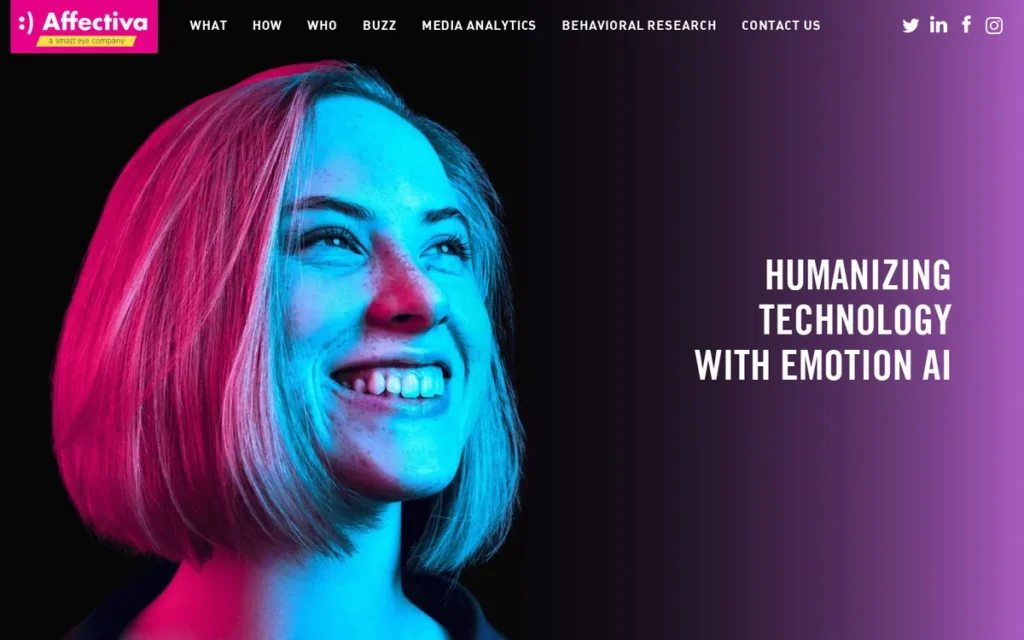
Affectiva, now operating under parent company Smart Eye following a 2021 acquisition, is a facial expression analytics platform developed at MIT Media Lab and commercialized over more than a decade of applied research. Affectiva’s AFFDEX engine analyzes facial action units, emotion classifications, and valence/arousal signals from video input. Affectiva’s primary commercial applications are advertising effectiveness testing and automotive driver monitoring systems, and Affectiva is used by a majority of Fortune 500 consumer goods companies for emotion-based ad testing, according to Affectiva’s published client documentation (Affectiva, 2024).
Key Features
- AFFDEX Facial Coding Engine: Affectiva’s AFFDEX detects and scores 20 facial Action Units in accordance with the Facial Action Coding System, classifying seven primary emotion expressions across demographically diverse video inputs.
- Cross-Cultural Training Dataset: Affectiva’s training corpus exceeds 10 million face videos sourced from participants in 90+ countries, providing one of the most geographically diverse validation datasets in the commercial emotion AI category (Affectiva, 2023).
- Automotive Driver Monitoring System (DMS): Affectiva provides an automotive-grade driver state detection module (covering drowsiness, distraction, and emotional arousal) integrated into production vehicles by multiple OEMs.
- Ad Testing Analytics Dashboard: Affectiva’s media analytics module delivers second-by-second emotional engagement scores for video content, mapped against benchmarks from Affectiva’s normative database of 80,000+ ad testing sessions (Affectiva, 2024).
- SDK and API Access: Affectiva provides SDKs for iOS, Android, Windows, and Linux, enabling client-side facial coding integration for organizations with dedicated development resources.
Best For
Affectiva is best suited for enterprise media agencies, consumer insights teams at CPG companies, and automotive OEMs requiring production-grade driver monitoring. Affectiva is not recommended for developers seeking a low-cost API entry point or for research teams requiring physiological signal integration beyond facial analysis.
Strengths
- Affectiva’s AFFDEX engine has been validated in peer-reviewed publications demonstrating AU detection F1 scores above 0.85 on benchmark datasets for cross-cultural facial expression recognition (IEEE FG, 2023).
- Affectiva’s automotive DMS module meets ISO 26262 functional safety standards required for ADAS integration, as documented in Smart Eye’s automotive product specifications (Smart Eye, 2024).
- Affectiva’s normative emotional-response database: built from 80,000+ ad testing sessions, allows clients to benchmark content performance against category and competitive norms, a capability not available from newer API-first competitors (Affectiva, 2024).
Limitations
- Enterprise-Only Access Model: Affectiva does not offer a self-serve tier, API trial, or SMB pricing plan, meaning organizations without substantial procurement budgets cannot access or evaluate the platform independently.
- Facial Modality Constraint: Affectiva’s core AFFDEX engine analyzes facial expression exclusively and does not natively integrate voice or physiological signal channels without additional hardware and integration investment.
- Post-Acquisition Roadmap Shift: Affectiva’s integration into Smart Eye’s automotive-focused product roadmap has shifted development priorities toward DMS applications, with media analytics clients reporting slower feature iteration in advertising analytics tools (G2 reviews, 2024–2025).
- Embedded Licensing Complexity: Affectiva’s SDK licensing terms for production-embedded deployment require negotiated agreements, extending procurement cycles compared to pay-per-call API alternatives.
Users on r/learnmachinelearning reacted to Affectiva’s advertising analytics use case:
“It’s a billboard that scans your face, works out what mood you’re in, and shows you an advert to match how you’re feeling? I can’t quite express how much I hate this. Sorry. Shouldn’t be negative. Hopefully they’ll come up with a less horrifying use of the tech.” Posted by u/superluminary
Takeaway: Affectiva’s advertising analytics use case generates significant public backlash, creating a reputational liability that enterprise buyers should factor into long-term vendor risk assessments.
Verdict
Affectiva (Smart Eye) is the most validated facial expression analytics platform for advertising effectiveness research and automotive driver monitoring at enterprise scale. Affectiva’s decade-plus training corpus, cross-cultural validation, and production automotive integrations establish it as the category reference standard for media and automotive emotion analytics. Teams prioritizing developer accessibility or multi-modal voice inference should evaluate Hume AI; teams needing budget-accessible video analytics should consider Imentiv AI.
3. Hume AI: Developer API for Real-Time Multi-Modal Emotion Inference

Category: Developer API Platform
At a Glance
- Category: Developer API Platform
- Best For: Developers and product teams building emotionally-aware voice assistants, conversational AI, or real-time media analysis pipelines
- Price Range: Free developer tier; pro plans from approximately $0.001 per second of audio processed; enterprise pricing custom (Hume AI, 2025)
- Primary Strength: Hume AI’s Empathic Voice Interface (EVI) processes vocal prosody, facial expression, and text simultaneously with documented sub-200ms latency, enabling real-time emotionally-aware conversational AI
- Biggest Limitation: Hume AI’s text-based emotion classifications have been reported as inconsistent with concurrent vocal and facial outputs in multi-modal comparisons, reducing signal reliability for text-heavy applications
- One-Line Summary: Hume AI is the leading developer API for real-time vocal emotion inference and empathic conversational AI applications
- Last Verified: April 2026
Overview
Hume AI is a New York-based AI research company and API provider founded in 2021, offering programmatic access to multi-modal emotion measurement across voice, facial expression, and text inputs. Hume AI’s flagship product (the Empathic Voice Interface (EVI)) is designed for developers building real-time conversational AI applications that adapt to users’ emotional states. Hume AI is the most developer-accessible multi-modal emotion AI platform in this comparison, offering a documented free tier and published API pricing without requiring enterprise procurement.
Key Features
- Empathic Voice Interface (EVI): Hume AI’s EVI processes streaming voice input with sub-200ms latency, classifying vocal prosody signals across 48 emotion dimensions while simultaneously generating adaptive text responses.
- Multi-Modal Expression Measurement API: Hume AI’s batch API accepts face video, audio, and text inputs simultaneously, returning per-frame or per-segment emotion scores across its 48-dimension taxonomy.
- 48-Dimension Emotion Taxonomy: Hume AI uses an extended dimensional model covering 48 discrete emotional expressions, substantially broader than the 6–7 basic emotion categories used by most competing platforms.
- Streaming WebSocket Integration: Hume AI provides WebSocket-based streaming endpoints for voice applications, enabling low-latency integration into real-time conversational products without batch processing overhead.
- Published Research Foundation: Hume AI’s emotion models are grounded in peer-reviewed cross-cultural emotion mapping research published by founder Alan Cowen (Cowen & Keltner, PNAS 2017; Cowen et al., Nature Human Behaviour 2019).
Best For
Hume AI is best suited for AI product developers, conversational AI teams, and researchers exploring emotion-aware interface design. Hume AI is not recommended for organizations requiring FACS-based facial coding transparency, automotive-grade driver monitoring, or synchronized physiological sensor data in controlled research environments.
Strengths
- Hume AI’s EVI API achieves documented end-to-end latency under 200ms for voice emotion inference, enabling real-time emotional responsiveness in conversational AI applications (Hume AI technical documentation, 2025).
- Hume AI’s 48-dimension emotion taxonomy is grounded in peer-reviewed cross-cultural research published in Nature Human Behaviour, providing a scientific foundation that proprietary-taxonomy competitors do not publicly document (Cowen et al., 2019).
- Hume AI offers the most accessible developer entry point among multi-modal emotion AI providers, with a documented free tier and published per-second API pricing available without sales engagement.
Users on r/singularity shared their first-hand experience with Hume AI’s EVI:
“The empathy part is interesting, the best part for me is how it recognises it has interrupted you and shuts up. ChatGPT jumps in at every momentary pause and then you have to listen to it drone on until you get another chance to speak, this one actually stops talking if you continue to speak over it and starts listening again.” Posted by u/najapi
Takeaway: Early Hume EVI users consistently highlight its real-time turn-detection sensitivity as a concrete differentiator from standard voice AI implementations, directly validating the sub-200ms latency claim.
Limitations
- Text Emotion Inconsistency: Hume AI’s text-based emotion classifications have been reported as producing outputs that conflict with concurrent facial and vocal signals, raising reliability concerns for text-heavy or mixed-input applications (r/LanguageTechnology, 2025).
- 48-Dimension Interpretability Challenge: Hume AI’s extended 48-category model creates interpretability difficulties for non-research users who need to map emotion outputs to actionable product signals without specialized data science support.
- No Physiological or Eye-Tracking Integration: Hume AI does not support physiological sensor inputs, limiting applicability for research contexts that require galvanic skin response, EEG, or eye-tracking data alongside facial and vocal analysis.
- Enterprise Compliance Maturity: Hume AI, as a company founded in 2021, has more limited published enterprise compliance and SLA documentation compared to established vendors such as iMotions and Affectiva.
Verdict
Hume AI is the strongest option for developers building emotionally-aware voice and conversational AI applications who need real-time API access without enterprise procurement overhead. Hume AI’s combination of sub-200ms EVI latency, a research-grounded 48-dimension emotion model, and transparent developer pricing distinguishes it from all other platforms in this comparison. Teams requiring research-grade sensor fusion or advertising normative benchmarks should evaluate iMotions or Affectiva (Smart Eye) instead.
4. Behavioral Signals: Emotion AI for Call Center and Revenue Intelligence
Category: Vertical-Specific (Call Center & Revenue Intelligence)
At a Glance
- Category: Vertical-Specific (Call Center & Revenue Intelligence)
- Best For: Contact center operators, revenue intelligence teams, and enterprise sales organizations seeking emotion-based conversation quality scoring at scale
- Price Range: Custom enterprise pricing; no self-serve or SMB tier publicly available
- Primary Strength: Behavioral Signals processes real-time telephony audio to score emotional dynamics, rapport, and persuasion signals across high-volume call center environments
- Biggest Limitation: Behavioral Signals is purpose-built for telephony audio and does not support video calls, facial expression, or physiological modalities, limiting its applicability outside contact center contexts
- One-Line Summary: Behavioral Signals is the specialized emotion AI platform for call center conversation analytics and real-time agent coaching
- Last Verified: April 2026
Overview
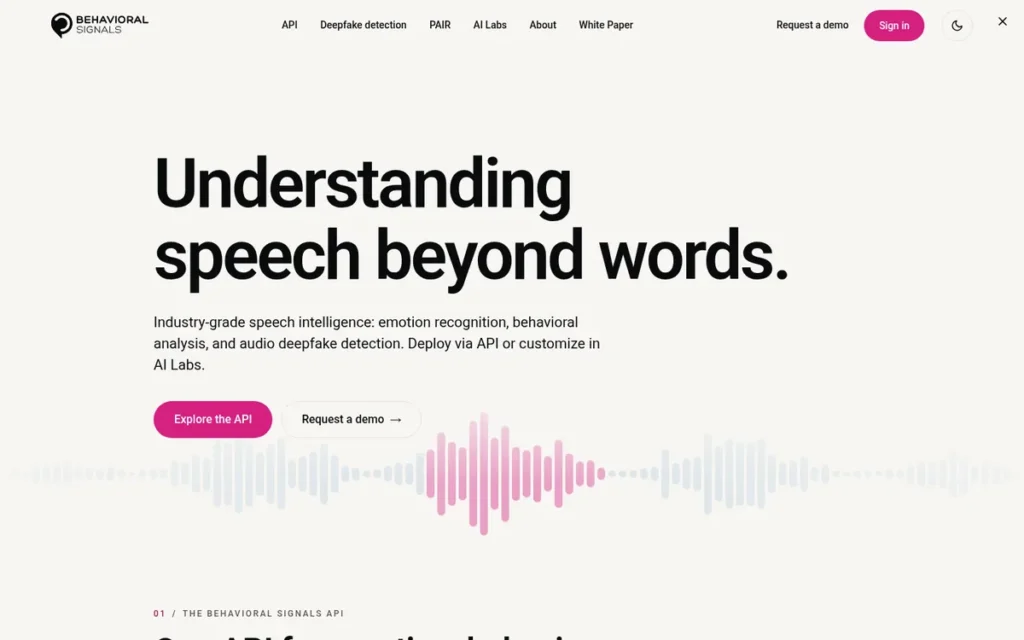
Behavioral Signals is a Los Angeles-based AI company founded in 2017 that applies behavioral and emotion signal analysis to telephony audio for contact center quality assurance, agent coaching, and revenue intelligence. Behavioral Signals’ platform (AI-Mediated Conversations (AMC)) scores real-time and recorded call audio against emotional engagement, rapport, and persuasion metrics, delivering actionable signals for supervisors and revenue managers. Behavioral Signals differentiates from general-purpose emotion AI platforms through deep telephony integration and outcome-linked scoring model training.
Key Features
- AI-Mediated Conversations (AMC) Engine: Behavioral Signals’ AMC analyzes live and recorded call audio against behavioral models trained on contact center interaction patterns to produce real-time emotion and rapport scores.
- Real-Time Agent Coaching Module: Behavioral Signals delivers in-call alerts to supervisors and agents based on detected emotional shifts (including customer frustration, disengagement, or escalation) enabling live intervention before calls deteriorate.
- CRM Integration Framework: Behavioral Signals connects with Salesforce, HubSpot, and major CRM platforms, embedding emotional signal scores into opportunity records and customer interaction histories.
- Outcome-Linked Scoring Models: Behavioral Signals trains its emotion scoring models against actual call outcome data (including conversion, resolution, and escalation rates) creating commercially grounded signal calibration rather than pure academic emotion classification.
- Compliance and PII Handling: Behavioral Signals offers on-premise deployment options and documented GDPR and CCPA compliance pathways for organizations operating under call recording regulations.
Best For
Behavioral Signals is best suited for enterprise contact center operators managing high call volumes, revenue teams tracking emotional engagement across sales conversations, and QA teams requiring automated emotion-based call scoring. Behavioral Signals is not recommended for organizations requiring facial, visual, or multi-modal emotion analysis beyond telephony audio channels.
Strengths
- Behavioral Signals’ outcome-linked training approach: calibrating emotion scores against actual call outcomes, provides commercially grounded signal validation that pure academic emotion classification models do not replicate (Behavioral Signals product documentation, 2024).
- Behavioral Signals supports real-time in-call emotional signal delivery with documented integration into enterprise contact center platforms including Genesys and Cisco, enabling deployment at scale within existing telephony infrastructure (Behavioral Signals, 2024).
- Behavioral Signals’ vertical specialization allows its models to account for telephony-specific audio characteristics (compression artifacts, background noise, telephony codec distortion) improving accuracy in the target deployment environment.
Limitations
- Telephony-Only Modality: Behavioral Signals processes phone call audio exclusively and does not analyze video calls, facial expressions, written text sentiment, or physiological signals, restricting its coverage to voice channel interactions.
This challenge was reflected in a r/AI_Agents discussion on voice AI for emotionally charged professional calls:
“I’m building in the personal injury space, so I really understand what you mean here. Many people reaching out aren’t just annoyed – they’re literally in pain or shaken after an accident. For most of them, it’s their first major accident. We’ve facilitated 5,000+ AI intake conversations, and a good portion start exactly like you described: emotional, fragmented, hard to explain. In practice, the goal isn’t for AI to perfectly handle the emotion. It’s detecting when to escalate and capturing the basics so the human who takes over already has context. Real-time emotion detection is improving, but good escalation design still matters more. That’s the best AI can do today.” Posted by u/vira28
Takeaway: Practitioners with large-scale voice AI deployments in high-stakes service contexts confirm that escalation architecture (not emotion detection accuracy alone) is the determinative design variable for call center AI effectiveness.
- No Self-Serve Access: Behavioral Signals requires direct sales engagement for all platform access, with no publicly available trial or sandbox tier for teams wanting to evaluate outputs before committing to enterprise pricing.
- Proprietary Outcome Model Opacity: Behavioral Signals’ outcome-linked scoring models are proprietary and not independently audited, making it difficult for buyers to assess whether the platform’s emotion taxonomy reflects genuine emotional states or call outcome proxies.
- Narrow Transferability: Behavioral Signals’ design assumptions: telephony audio quality, contact center interaction patterns, CRM workflow integration, do not transfer to field sales, marketing analytics, or UX research contexts.
Verdict
Behavioral Signals is the most purpose-built and commercially validated emotion AI platform for contact center applications in this comparison. Behavioral Signals’ outcome-linked scoring models and deep telephony integration make it the practical default for enterprise contact center operators evaluating emotion AI for quality assurance or revenue intelligence. Teams with use cases extending beyond telephony audio should evaluate Hume AI for API-based voice processing or iMotions for multi-modal research environments.
5. VicarVision FaceReader: Academically Validated Facial Coding Tool
Category: Facial Expression Research Tool
At a Glance
- Category: Facial Expression Research Tool
- Best For: Academic psychologists, clinical researchers, and UX labs requiring transparent, FACS-validated facial expression analysis for peer-reviewed research
- Price Range: Approximately €3,500–€12,000/year depending on license type and concurrent session count; academic pricing available (VicarVision, 2024)
- Primary Strength: VicarVision FaceReader uses the FACS Action Unit taxonomy with published peer-reviewed accuracy benchmarks, providing explainable and reproducible emotion coding for research requiring methodological transparency
- Biggest Limitation: VicarVision FaceReader analyzes facial expression only and does not integrate voice, text, or physiological signals, limiting its use to single-modality facial research designs
- One-Line Summary: VicarVision FaceReader is the academically validated facial coding tool for psychology and UX research requiring transparent, FACS-based expression analysis
- Last Verified: April 2026
Overview
VicarVision FaceReader is a Dutch facial expression analysis software tool developed by VicarVision in collaboration with researchers at Radboud University, designed for academic and clinical research applications requiring transparent, FACS-validated emotion coding. VicarVision FaceReader analyzes facial muscle movements (quantified as FACS Action Units) and maps them to seven basic emotion categories plus valence and arousal dimensions. VicarVision FaceReader is distinguished by its explainable model architecture: unlike black-box deep learning alternatives, FaceReader exposes its AU-based reasoning chain for each classification output.
Key Features
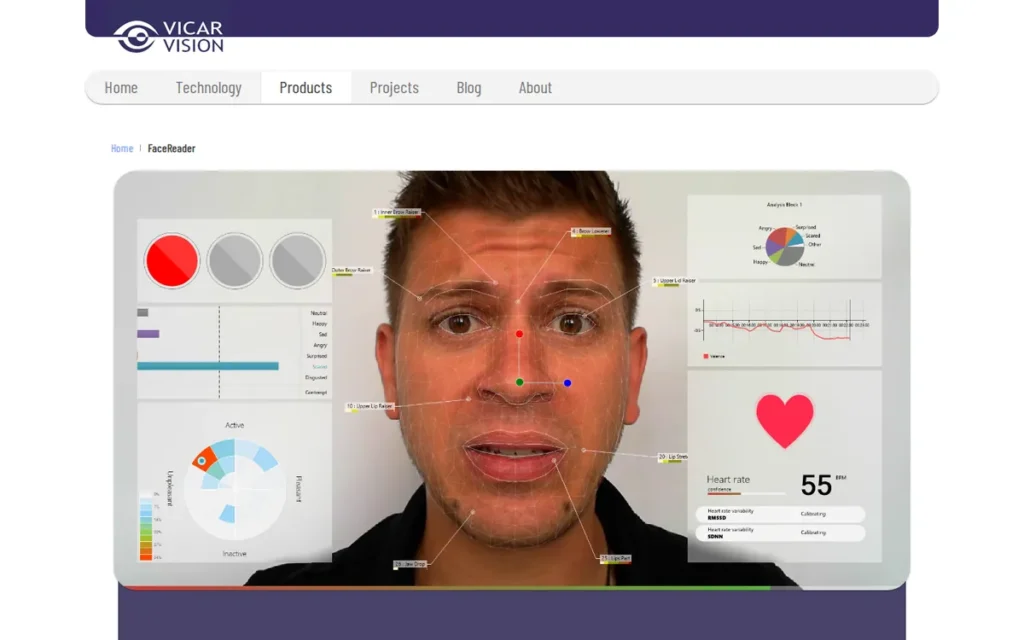
- FACS Action Unit Detection: VicarVision FaceReader detects and scores 20 facial Action Units in real time, providing a transparent FACS-compliant classification chain that supports researcher verification and methodological replication.
- Seven Basic Emotion Classification: VicarVision FaceReader maps detected AUs to Ekman’s seven basic emotions (happiness, sadness, anger, fear, disgust, surprise, and contempt) plus neutral, with documented per-category classification accuracy.
- Valence and Arousal Dimensional Scoring: VicarVision FaceReader outputs continuous valence (positive-to-negative) and arousal (activation intensity) scores alongside discrete emotion classifications, supporting dimensional emotion research frameworks.
- Gaze Direction Estimation: VicarVision FaceReader includes a gaze direction estimation module that tracks eye movement direction without requiring dedicated eye-tracking hardware, providing a supplementary attention signal.
- Stimulus Synchronization Integration: VicarVision FaceReader integrates with Noldus Observer XT for synchronized stimulus presentation and behavioral coding, enabling full experimental control in lab research contexts.
Best For
VicarVision FaceReader is best suited for academic psychologists, clinical researchers, and UX labs where explainable facial coding aligned with published FACS methodology is a requirement for research validity or peer publication. VicarVision FaceReader is not recommended for teams requiring audio analysis, physiological signal integration, or production-scale API deployment.
Strengths
- VicarVision FaceReader has been cited in over 800 peer-reviewed publications across experimental psychology, clinical research, and human-computer interaction, according to FaceReader’s published citation list (VicarVision, 2025).
- VicarVision FaceReader’s AU-based explainability allows researchers to trace every emotion classification to specific facial muscle activations, a transparency advantage that distinguishes it from end-to-end deep learning competitors whose classification logic is not inspectable.
- VicarVision FaceReader offers academic pricing tiers that bring enterprise-validated facial coding within reach of university lab budgets, with reported starting prices approximately 70–80% below comparable enterprise platform licensing costs.
Limitations
- Single-Modality Constraint: VicarVision FaceReader analyzes facial expression only and does not natively process audio, text, EEG, GSR, or other physiological signals, requiring additional software and hardware for multi-modal study designs.
- Lab-Only Deployment Architecture: VicarVision FaceReader is designed for controlled lab deployment and lacks cloud-native or API deployment options, limiting use to environments with controlled camera setups.
- WEIRD Sample Validation Bias: VicarVision FaceReader’s validation datasets are predominantly drawn from Western, Educated, Industrialized, Rich, and Democratic (WEIRD) participant samples, which may limit accuracy generalizability in cross-cultural deployments involving underrepresented populations.
- Contested Theoretical Framework: VicarVision FaceReader’s reliance on Ekman’s basic emotion model reflects a theoretical framework that remains contested within affective science, critics have questioned whether discrete basic emotions universally map to specific facial movements as the model assumes (Barrett et al., Psychological Science in the Public Interest, 2019).
Verdict
VicarVision FaceReader is the most transparent and academically validated facial expression analysis tool in this comparison, making it the default choice for researchers who require methodological explainability and FACS compliance. VicarVision FaceReader’s AU-based classification architecture and extensive peer-reviewed citation record give it a reproducibility advantage that deep learning competitors in this comparison cannot currently match. Teams requiring multi-modal analysis or production API access should evaluate iMotions for sensor fusion or Hume AI for developer API deployment.
6. Imentiv AI: No-Code Cloud Video Emotion Analytics

Category: Cloud-Based Video Emotion Analytics
At a Glance
- Category: Cloud-Based Video Emotion Analytics
- Best For: Marketing professionals, UX practitioners, and independent researchers needing rapid emotional analysis of video content without enterprise budget or technical integration requirements
- Price Range: Free tier available; paid plans from approximately $49–$199/month; enterprise pricing available on request (Imentiv AI, 2025)
- Primary Strength: Imentiv AI offers web-based video emotion analysis with same-day onboarding and no code required, providing the lowest barrier to entry among platforms in this comparison
- Biggest Limitation: Imentiv AI does not publish independent accuracy benchmarks or disclose the training dataset composition underpinning its models, limiting suitability for research requiring reproducibility or peer-review validation
- One-Line Summary: Imentiv AI is the accessible, no-code emotion analytics platform for marketing teams analyzing emotional response in video content
- Last Verified: April 2026
Overview
Imentiv AI is a cloud-based video emotion analytics platform offering browser-based upload, per-frame facial emotion scoring, and visualization dashboards without requiring API integration or technical expertise. Imentiv AI is designed for marketing professionals, UX practitioners, and independent researchers who need rapid emotional response insights from video content, including ad footage, interview recordings, and user testing sessions. Imentiv AI occupies the accessible end of the emotion AI market, prioritizing speed and ease of use over research-grade reproducibility.
Key Features
- Browser-Based Video Upload and Analysis: Imentiv AI accepts video uploads directly through its web interface, returning per-frame emotion timelines without requiring API credentials, SDK installation, or developer involvement.
- Per-Frame Emotion Timeline Visualization: Imentiv AI generates second-by-second charts of emotion intensity across six basic emotion categories, enabling identification of emotional peaks and troughs throughout video content.
- Multi-Face Detection in Video: Imentiv AI detects and separately tracks emotional expressions for multiple faces within a single video frame, supporting analysis of group interactions, panel discussions, and focus group recordings.
- Export and Reporting Tools: Imentiv AI provides downloadable CSV exports of per-frame emotion scores and auto-generated PDF summary reports, reducing time-to-insight for non-technical users.
- REST API for Technical Teams: Imentiv AI offers a REST API on paid tiers for teams that want to integrate emotion analysis into existing video processing pipelines, extending its applicability beyond no-code use cases.
Best For
Imentiv AI is best suited for marketing professionals running ad creative testing, UX researchers conducting preliminary emotional response studies, and product teams exploring emotion AI before committing to enterprise platform investment. Imentiv AI is not recommended for academic researchers requiring FACS-validated methodology or for enterprise teams processing sensitive personal video data under strict GDPR or HIPAA compliance requirements.
Strengths
- Imentiv AI achieves same-day onboarding for non-technical users with no SDK installation or API configuration required, offering the fastest time-to-first-analysis in this comparison.
- Imentiv AI’s freemium model allows teams to evaluate the platform’s core emotion analysis outputs at no cost before committing to a paid plan, reducing adoption friction relative to all enterprise-only competitors reviewed here.
- Imentiv AI’s multi-face tracking capability enables group emotion analysis from panel recordings and focus group videos, a use case not supported by single-participant research tools like VicarVision FaceReader.
Limitations
- Opaque Accuracy Benchmarking: Imentiv AI does not publish independent accuracy benchmarks or disclose training dataset composition, making it impossible to assess model reliability against peer-reviewed performance standards.
- Research Reproducibility Gap: Imentiv AI’s lack of FACS-based or methodologically documented classification architecture makes it unsuitable for academic research contexts where method transparency is required for peer review or replication.
- Compliance Readiness Uncertainty: Imentiv AI’s published compliance documentation is limited relative to enterprise competitors, creating uncertainty for organizations processing identifiable personal video data under GDPR, HIPAA, or CCPA frameworks.
- Facial Modality Limitation: Imentiv AI analyzes facial expression from video only and does not process audio, physiological signals, or text emotion, limiting its coverage relative to multi-modal platforms such as Hume AI.
Verdict
Imentiv AI is the most accessible entry point into emotion analytics for non-technical teams who need rapid emotional response insights from video content without enterprise procurement overhead. Imentiv AI’s freemium model and no-code interface make it a practical first tool for marketing and UX teams exploring emotion AI, with the clear caveat that its opacity on accuracy benchmarks and training data excludes it from any research context requiring methodological rigor. Teams that outgrow Imentiv AI’s limitations should evaluate Affectiva (Smart Eye) for advertising analytics or Hume AI for developer API access.
7. Face++ (Megvii): High-Throughput Facial Analysis API
Category: High-Volume Facial Analysis API
At a Glance
- Category: High-Volume Facial Analysis API
- Best For: Developers and enterprises in Asia-Pacific markets requiring large-scale facial attribute detection at pay-per-call pricing
- Price Range: Free API tier; pay-per-call pricing from approximately $0.001–$0.005 per image analysis call; enterprise contracts custom (Megvii, 2024)
- Primary Strength: Face++ (Megvii) supports documented throughput exceeding 10 million API calls per day on enterprise plans, making it the highest-volume option in this comparison for large-scale facial analysis pipelines
- Biggest Limitation: Face++ (Megvii) operates under Chinese data governance law (PIPL), creating significant compliance barriers for EU and US enterprise deployments that process identifiable personal data
- One-Line Summary: Face++ is the high-throughput facial analysis API from Megvii, optimized for large-scale image and video processing in markets where data residency under Chinese jurisdiction is not a constraint
- Last Verified: April 2026
Overview
Face++ is the computer vision and facial analysis API platform developed by Beijing-based Megvii Technology, a major Chinese AI company founded in 2011. Face++ (Megvii) offers facial attribute detection (including emotion classification, age, gender, and pose estimation) via REST API at pay-per-call pricing with documented support for high-volume enterprise deployments. Face++ (Megvii) is widely deployed in APAC markets for consumer application features, enterprise systems, and media analysis pipelines where throughput and per-call cost efficiency are the primary selection criteria.
Key Features
- Facial Attribute Detection API: Face++ (Megvii) detects facial attributes: including emotion classification across seven basic categories, age, gender, pose, and image quality, via a single REST API endpoint.
- Face Comparison and Recognition: Face++ (Megvii) includes face comparison and recognition endpoints beyond emotion detection, enabling identity-linked emotion tracking in applications where face identification is legally permitted.
- High-Volume Enterprise Processing: Face++ (Megvii) supports documented API throughput exceeding 10 million calls per day on enterprise tiers, establishing it as the most scalable facial analysis API option in this comparison for bulk image processing (Megvii, 2024).
- 106-Point Landmark Detection: Face++ (Megvii) returns 106-point facial landmark coordinates alongside emotion classifications, enabling granular geometric facial analysis for downstream processing pipelines.
- Transparent Pay-Per-Call Pricing: Face++ (Megvii) publishes its API pricing publicly, allowing developers to model per-unit costs before entering enterprise contract negotiations, a transparency advantage over enterprise-only competitors.
Best For
Face++ (Megvii) is best suited for developers and enterprises in APAC markets building high-volume facial analysis pipelines where data residency under Chinese or APAC jurisdiction is legally acceptable. Face++ (Megvii) is not recommended for EU or US enterprises processing personal biometric data under GDPR or BIPA frameworks without explicit legal review of data flows under Chinese PIPL.
Strengths
- Face++ (Megvii) documents API throughput exceeding 10 million calls per day on enterprise plans, establishing the highest documented processing scale among all platforms reviewed in this comparison (Megvii technical documentation, 2024).
A practitioner on r/AZURE described Megvii’s enterprise-scale capability from direct deployment experience:
“I used to work for an international airline that wanted to board passengers by their face instead of scanning their boarding pass. we had to target 10e6 different profiles that during any time we could filter to 10e4. If i had recommended this python lib as a solution people would have laughed at my face for years to come. Don’t get me wrong, this is a cool lib but it should be treated as a toy. megvii, clarifai and others can securely identify a person in a pool of 10e7 people with 99% accuracy. its a different world.” Posted by u/gopietz
Takeaway: Enterprise practitioners who have deployed facial recognition at airline scale position Megvii as a categorically different tier from developer-grade alternatives, independently validating Face++’s documented throughput claims.
- Face++ (Megvii) offers the most cost-transparent API pricing in this comparison, with published pay-per-call rates starting at approximately $0.001 per image, enabling predictable cost modeling without requiring sales engagement.
- Face++ (Megvii) provides 106-point facial landmark detection as part of its standard API response, offering more granular geometric facial data than most competing platforms include in their base API output.
Limitations
- PIPL Compliance Barrier: Face++ (Megvii) operates under China’s Personal Information Protection Law (PIPL), which requires that personal data of Chinese citizens processed by Chinese companies adhere to Chinese data localization requirements, creating significant legal complexity for EU and US enterprises processing personal biometric data through the platform.
- Geopolitical Risk Exposure: Face++ (Megvii) parent company Megvii has been included on the US Department of Commerce Entity List since 2019 and remained listed as of early 2025, which may create procurement barriers or reputational concerns for US government-affiliated or defense-adjacent organizations.
- Limited Emotion Model Depth: Face++ (Megvii) classifies seven basic emotion categories without the dimensional scoring (valence/arousal), AU-level analysis, or extended taxonomy available from Hume AI, Affectiva, or VicarVision FaceReader.
- Minimal Independent Accuracy Validation: Face++ (Megvii) does not publish peer-reviewed accuracy benchmarks for its emotion classification models, limiting credibility for research use cases that require verifiable methodology.
Verdict
Face++ (Megvii) is the highest-throughput, most cost-transparent facial analysis API in this comparison for teams operating in APAC markets where Chinese data governance requirements are not a legal constraint. Face++ (Megvii)’s documented scale, published pricing, and 106-point landmark output create a compelling option for high-volume developer pipelines, but PIPL compliance exposure and the Entity List status make it unsuitable for most EU and US enterprise deployments without specialized legal clearance. Teams in those geographies should evaluate Hume AI for developer API access or Affectiva (Smart Eye) for enterprise-grade facial analytics.
What Red Flags Should I Watch For When Evaluating Emotion AI Software?
Emotion AI buyers face vendor practices and structural limitations that should prompt closer scrutiny or disqualify a platform from shortlisting. The six red flags below apply across all platform categories and represent the most consequential procurement risks in this market segment.
Red Flag #1: No Published Independent Accuracy Benchmarks A vendor that cannot provide peer-reviewed or independently audited accuracy data for its emotion models is asking buyers to accept unverifiable performance claims. Emotion AI accuracy is highly condition-dependent (lighting, camera angle, demographic composition, and emotional intensity all affect results) making vendor-only accuracy figures insufficient for procurement decisions.
Users on r/Futurology applied a straightforward test to vendor accuracy claims:
“It remains a thing for the same reason ‘lie detectors’ remain a thing: people think technology is magic and can do anything. A good rule of thumb to figure out whether a given technology is based on pseudoscience is to try to imagine how they tested it for accuracy, and how closely those test conditions match the real world conditions it will be operating in. If you ethically or practically couldn’t exactly replicate your desired phenomena in a lab, you can’t claim that you know it works.” Posted by u/andrealessi
Takeaway: Applying basic scientific scrutiny to emotion AI accuracy claims reveals structural parallels with discredited validation frameworks, a red flag that independent benchmarking can resolve.
Red Flag #2: Undisclosed Training Data Provenance An emotion AI platform that does not disclose the demographic composition, geographic distribution, or collection methodology of its training data creates unknown bias risk. Models trained predominantly on WEIRD (Western, Educated, Industrialized, Rich, Democratic) samples may perform substantially worse on underrepresented demographic groups in your user base.
Red Flag #3: Proprietary Emotion Taxonomy Without Validation Lineage Platforms that use proprietary emotion categories without linking their taxonomy to published psychological research cannot be evaluated for theoretical validity. Emotion classification is a contested scientific domain, claims of detecting states such as “confidence,” “deception,” or “genuine happiness” require explicit grounding in peer-reviewed science to be credible.
Red Flag #4: Data Residency and Compliance Ambiguity Any emotion AI vendor that cannot provide clear documentation of where biometric data is processed, stored, and governed creates GDPR, HIPAA, BIPA, or PIPL compliance exposure. Facial expression data is classified as biometric personal data under multiple regulatory frameworks, vague data handling policies are disqualifying for enterprise deployments handling identifiable personal data.
Red Flag #5: No Trial, API Documentation, or Sandbox Access Vendors who require full contract execution before providing any evaluation access make independent output verification impossible before purchasing. Legitimate emotion AI platforms provide documented APIs, developer sandboxes, or time-limited trial access that allow technical teams to validate model outputs under real-world conditions.
Red Flag #6: Claimed Real-Time Performance Without Latency Benchmarks “Real-time” emotion analysis is a frequently unsubstantiated claim in vendor materials. Vendors should provide documented end-to-end latency figures under realistic load conditions. Without specific, independently verifiable latency benchmarks, “real-time” claims cannot be operationally validated for production integration decisions.
What Questions Should I Ask Before Choosing Emotion AI Software?
Asking targeted questions during vendor evaluation prevents the three most common emotion AI procurement failures: buying the wrong modality for your use case, underestimating compliance exposure, and overpaying for unverified accuracy claims. The eight questions below cover the most critical due diligence dimensions for any emotion AI purchase.
Question #1: What detection modalities does the platform support, and are they natively integrated? Determine whether the platform processes face, voice, text, and physiological signals independently or as a synchronized multi-modal system. Native integration matters, bolt-on modality support typically produces inconsistent outputs compared to purpose-built multi-modal architectures.
Question #2: Has the platform’s accuracy been independently validated, and under what conditions? Request peer-reviewed citations, third-party benchmark results, or independent audit reports. Ask specifically about accuracy across the demographic groups, lighting conditions, and camera distances relevant to your deployment environment.
Question #3: What emotion taxonomy does the platform use, and how was it validated? Ask whether the taxonomy is based on FACS, dimensional models (valence/arousal), or a proprietary framework. Request documentation linking the platform’s emotion categories to published psychological research or peer-reviewed validation studies.
Question #4: Where is data processed and stored, and under which regulatory framework? Confirm the geographic location of all data processing and storage. Obtain documentation of GDPR, HIPAA, BIPA, CCPA, or PIPL compliance status as applicable. Facial expression data is biometric personal data under most major privacy regulations and requires explicit compliance verification.
Question #5: What is the total onboarding timeline and required technical investment? Request reference timelines from comparable deployments, including hardware procurement where applicable, integration work, staff training, and time-to-first-reliable-analysis. Platforms requiring weeks of setup are incompatible with fast product iteration cycles.
Question #6: Does the platform support the deployment architecture your use case requires? Confirm whether the platform supports lab, cloud, on-premise, embedded, or edge deployment, and whether real-time streaming or batch-only processing is available. Deployment architecture mismatches are among the most common and most avoidable implementation failures in this category.
Question #7: How does the vendor manage model updates, and can historical model versions be preserved? Determine whether model updates are automatic or require client action, whether accuracy regressions are documented in release notes, and whether historical model versions can be maintained. Longitudinal research designs require model consistency across data collection periods.
Question #8: What commercial references can the vendor provide for deployments comparable to yours? Request at least two customer references in your industry or use case category. Emotion AI vendor case studies are frequently aspirational, direct reference checks from comparable deployments provide higher-quality procurement evidence than marketing materials.
How Did We Rank These Emotion AI Tools?
PlugRoute ranked these seven emotion AI platforms using a structured, multi-criteria evaluation framework applied consistently across all entries. The methodology below documents how data was collected, how conflicting sources were handled, and how final rankings were determined.
Evaluation Process
Each platform was evaluated using the following sequential process:
- Primary source review: Official product documentation, published API specifications, pricing pages, and vendor-authored technical white papers were reviewed for each platform.
- Independent research review: Peer-reviewed publications citing each platform, independent benchmark studies, and third-party analyst reports were identified and reviewed.
- Community feedback synthesis: Reddit discussions from r/MachineLearning, r/LanguageTechnology, r/UXResearch, and adjacent communities were reviewed to capture practitioner-reported performance observations and limitations.
- Review platform analysis: G2, Capterra, and TrustRadius reviews for each platform (where available) were analyzed for recurring themes across both strengths and limitations.
Ranking Criteria
Six criteria were applied to each platform with the following weighting:
C1 (Detection Accuracy and Validation (25%): Platforms were scored on the quality and independence of their published accuracy evidence) including peer-reviewed citations, AU-level benchmarks, and cross-cultural validation studies. Platforms without independent validation received lower scores regardless of vendor-reported claims.
C2, Modality Coverage (20%): Platforms supporting multiple detection modalities, face, voice, text, physiological signals, with documented native integration received higher scores. Single-modality platforms were not penalized in absolute terms but ranked lower when modality breadth was a differentiating factor for the target use case.
C3, Developer and Integration Accessibility (20%): Platforms were evaluated on API documentation quality, availability of trial or sandbox access, self-serve pricing transparency, onboarding timeline, and SDK coverage. Enterprise-only platforms with no self-serve tier received lower accessibility scores.
C4, Deployment Environment Fit (15%): Each platform was assessed on alignment between its architecture and the most common real-world deployment contexts: controlled lab, enterprise cloud, production API, telephony, and edge or embedded environments. Platforms with narrow deployment applicability were ranked lower for general-purpose use cases.
C5, Data Governance and Compliance Readiness (10%): Platforms were evaluated on published compliance documentation, data residency transparency, and regulatory framework adherence across GDPR, HIPAA, PIPL, and BIPA. Platforms with significant compliance ambiguity or documented regulatory exposure received lower scores.
C6, Pricing Transparency and Total Cost (10%): Platforms were assessed on whether pricing was publicly available, whether per-unit costs could be modeled without sales engagement, and whether the pricing model aligned with the target buyer’s budget context.
Evidence Weighting Rationale
When vendor claims and independent research conflicted, independent peer-reviewed sources were prioritized. When community-reported limitations contradicted vendor documentation, those limitations were included in the analysis with source attribution. No platform received the benefit of the doubt on unverifiable claims.
Data Validation Approach
Vendor claims were cross-referenced against at least two independent sources before inclusion. Accuracy statistics drawn from vendor materials are noted as “vendor-reported” throughout the article. Academic benchmark figures are cited with their original publication reference.
Update Cadence
This guide is updated quarterly. Pricing, platform capabilities, and competitive positioning change frequently in the emotion AI market. Readers should verify current pricing and feature availability directly with vendors before making procurement decisions. Last updated: April 2026.
Independence Statement
PlugRoute has no affiliate relationships, referral fees, or commercial arrangements with any platform reviewed in this article. Rankings reflect solely the application of the criteria above to publicly available and independently verified evidence.
Frequently Asked Questions
What is emotion AI and how does it detect human emotions?
Emotion AI refers to software systems that analyze physiological, facial, vocal, or textual signals to classify or infer human emotional states. Most platforms detect facial muscle movements (Action Units), vocal prosody patterns, or text sentiment as proxies for emotional experience. Detection accuracy varies substantially by modality, training data composition, and deployment conditions, no current system achieves human-level reliability across all contexts.
Is emotion AI accurate enough for enterprise or research use?
Emotion AI accuracy is highly context-dependent and should be verified per deployment environment. Platforms with peer-reviewed FACS-validated models (including Affectiva and VicarVision FaceReader) report AU detection F1 scores above 0.80 in controlled conditions (IEEE FG, 2023). Accuracy typically degrades in naturalistic settings with variable lighting or demographic diversity. Research contexts should require independent benchmark evidence before selecting a platform.
How does PlugRoute determine its emotion AI rankings?
PlugRoute ranks platforms using six independently weighted criteria: detection accuracy and validation, modality coverage, developer accessibility, deployment environment fit, data governance readiness, and pricing transparency. Rankings are based exclusively on publicly verifiable evidence and independently sourced data. PlugRoute holds no affiliate relationships or commercial arrangements with any reviewed platform. Full methodology is documented in the section above.
Glossary: Key Terms Used in This Comparison
Facial Action Coding System (FACS): FACS is a standardized taxonomy of human facial muscle movements developed by Paul Ekman and Wallace Friesen (1978) that classifies facial expressions into discrete Action Units (AUs) corresponding to specific muscle contractions. Emotion AI platforms that reference FACS use AU detection as a transparent, replicable basis for emotion classification rather than end-to-end black-box deep learning models.
Affective Computing: Affective computing is the field of computer science and engineering concerned with systems that detect, interpret, process, and simulate human emotional states. The term was coined by Rosalind Picard at MIT Media Lab in her 1997 book of the same name, and it provides the theoretical foundation for all seven platforms reviewed in this comparison.
Valence: In emotion research, valence refers to the subjective quality of an emotional experience on a positive-to-negative dimension. An emotion AI platform that outputs valence scores classifies whether a detected emotional state is experientially positive, such as happiness or excitement, or negative, such as sadness or fear, independent of the intensity of that state.
Empathic Voice Interface (EVI): Empathic Voice Interface (EVI) is Hume AI’s proprietary real-time conversational API that processes streaming voice input to detect emotional expression in speech prosody and generates adaptive text responses informed by those emotional signals. EVI differs from standard speech-to-text APIs by incorporating vocal tone and emotional signal data into response generation rather than transcribing speech alone.
Multi-Modal Fusion: Multi-modal fusion in emotion AI refers to the computational process of combining emotion signals from two or more input channels (such as face, voice, and physiological sensors) into a single integrated classification output. Fused models can in principle outperform single-modality systems, but channel-level inconsistencies (as documented in Hume AI’s text emotion output) can reduce reliability compared to well-validated single-channel platforms.
Which Emotion AI Tool Is Right for You?
Key Insights
- iMotions is the strongest choice for research labs and enterprise UX teams requiring reproducible, synchronized data across physiological, facial, and behavioral channels in controlled lab environments.
- Affectiva (Smart Eye) is the established standard for advertising effectiveness measurement and automotive driver monitoring, supported by the largest and most geographically diverse facial expression training corpus in this comparison.
- Hume AI is the most accessible developer API for teams building real-time emotionally-aware voice and conversational AI applications, offering the only documented sub-200ms multi-modal emotion inference pipeline with transparent public pricing.
- Imentiv AI is the practical entry point for marketing teams and independent researchers who need rapid, no-code video emotion analysis without enterprise procurement overhead, with the clear limitation that its accuracy benchmarks are not independently verified.
No single platform reviewed here is the right choice acrossall use cases. The optimal selection depends on three non-negotiable constraints.
- First: whether your deployment context is a controlled lab, a production API pipeline, a telephony environment, or a cloud video analytics workflow, each maps to a different platform category.
- Second: whether your evidence requirements demand peer-reviewed accuracy validation (required for research and clinical contexts) or can accept vendor-reported benchmarks (sufficient for marketing and product analytics contexts).
- Third: whether your data governance obligations allow cloud processing of biometric personal data or require on-premise deployment or specific data residency constraints.
We update this guide quarterly. Last updated: April 2026. For additional independent software comparisons with no affiliate relationships, visit PlugRoute.