Make leads for no-code and mixed-technical teams needing 3,000+ app integrations, rated 4.6/5 across 267+ G2 reviews as of April 2026, Voiceflow for cross-functional conversational AI teams requiring enterprise compliance, and n8n for technical teams needing self-hosted data control at near-zero software cost. The right platform depends primarily on technical skill level, use case type, and whether billing compounds unpredictably at your projected AI workflow volume.
Choosing an AI agent builder in 2026 means navigating four fundamentally different platform types: no-code visual automation builders, collaborative conversational AI designers, open-source developer frameworks, and enterprise ecosystem suites. Most buyer regret traces to one mismatch, selecting a platform based on its marketing ceiling rather than its implementation floor.
Per-operation billing surprises, hidden coding requirements for “no-code” tools, and ecosystem lock-in are the three post-purchase complaints that appear most consistently across G2 and Capterra reviews in this category.
PlugRoute has no affiliate relationships with any company listed. Rankings are determined entirely by research data and objective evaluation criteria.
TL;DR: Top Picks at a Glance
- Make is rated 4.6/5 across 267+ G2 reviews as of April 2026: the most extensively reviewed no-code visual builder for teams connecting 3,000+ apps without writing code.
- Voiceflow is the only ISO 27001 and SOC 2 Type II certified conversational AI platform in this evaluation where non-technical designers have been verified by G2 reviewers to build production agents without code.
- n8n delivers free unlimited self-hosted execution for ~$15/month in server infrastructure, the strongest total cost of ownership option for technical teams needing data sovereignty and zero software licensing cost.
- Microsoft Copilot Studio provides the broadest enterprise compliance in this evaluation (ISO 27001, SOC 2, HIPAA, GDPR, and FedRAMP via Azure) for Microsoft 365-native enterprises requiring regulated-industry AI agents.
What Are the 4 Categories of AI Agent Builder Platforms?
AI agent builder platforms divide into four categories that serve fundamentally different buyers, technical profiles, and deployment requirements. Identifying your category before evaluating individual rankings is the single most effective filter against the platform mismatch that drives the majority of post-purchase regret documented across G2 and Capterra reviews in this category.
Category 1: No-Code Visual Automation Agent Builders Platforms in this category (including Make) use drag-and-drop canvas interfaces to connect apps and build multi-step workflows with AI capabilities, requiring no coding for most production use cases. These platforms best serve operations managers and mixed-technical teams building general-purpose business automation.
Category 2: Collaborative Conversational AI Agent Builders Platforms in this category (including Voiceflow and Botpress) are purpose-built for designing, testing, and deploying AI agents across voice and chat channels. Voiceflow requires no coding for production; Botpress requires JavaScript for production API integrations despite its visual builder.
Category 3: Open-Source Automation and Developer Frameworks Platforms in this category (including n8n (fair-code license, visual-plus-code hybrid), LangChain, and CrewAI (Python or JavaScript only)) give technical teams maximum flexibility, self-hosting control, and custom LLM integration at the lowest total software cost.
Category 4: Enterprise Ecosystem AI Agent Suites Platforms in this category (including Microsoft Copilot Studio) are purpose-built for organizations whose primary infrastructure is already a specific vendor ecosystem, offering unmatched integration depth within that ecosystem alongside Azure-backed enterprise compliance.
Identifying which category matches your team’s technical profile eliminates the most common cause of buyer regret in this market before a single product demo takes place.
How Do the Top AI Agent Builder Platforms Compare at a Glance?
The seven platforms in this evaluation divide across four categories with meaningfully different strengths. Make leads on verified review volume and integration breadth; Voiceflow leads on non-technical accessibility and enterprise compliance; n8n leads on total cost of ownership for technical teams; and Microsoft Copilot Studio leads on regulated-industry compliance for Microsoft-native enterprises. Developer frameworks LangChain and CrewAI require Python or JavaScript and have no visual or no-code interface.
| Rank | Company | Category | Best For | One-Line Summary | Key Capabilities | Primary Strength | Key Limitation |
|---|---|---|---|---|---|---|---|
| 1 | Make | No-Code Visual Automation | Operations and mixed-technical teams needing 3,000+ app integrations | Make is a no-code visual automation agent builder rated 4.6/5 across 267+ G2 reviews that enables mixed-technical teams to build AI-powered workflows connecting 3,000+ apps through a drag-and-drop canvas, with native AI Agents launched in 2026. | 3,000+ app integrations; drag-and-drop Scenario Builder; native AI Agents beta (2026); branching, iterators, aggregators | Highest verified G2 review count in this evaluation; 4.6/5 across 267+ reviews as of April 2026 | Per-operation billing multiplies rapidly in AI-heavy workflows, making total monthly cost difficult to predict |
| 2 | Voiceflow | Collaborative Conversational AI | Cross-functional teams building enterprise voice and chat AI agents | Voiceflow is a collaborative conversational AI agent builder rated approximately 4.4–4.7/5 on G2 that enables cross-functional teams including non-technical designers to build and deploy voice and chat AI agents at enterprise scale, with ISO 27001, SOC 2 Type II, and HIPAA certification as of April 2026. | Real-time collaborative canvas; RAG knowledge base (50–10,000+ sources); omnichannel voice and chat; ISO 27001, SOC 2 Type II, HIPAA | Only enterprise-certified platform in this evaluation verified by G2 reviewers to serve non-technical designers in production | Narrowest integration catalog (~120 connectors); not suitable for general-purpose multi-app automation |
| 3 | n8n | Open-Source Automation Agent Builder | Technical teams needing self-hosted, cost-efficient AI automation | n8n is an open-source, fair-code-licensed automation agent builder with 150,000+ GitHub stars that enables technically capable teams to self-host unlimited AI agent workflows for ~$15/month in infrastructure costs, with native LangChain, local LLM, and RAG pipeline support as of April 2026. | Fair-code self-hosted free tier; 350–400+ native integrations; LangChain, Ollama, and vector store integration; execution-based billing | Only major platform in this evaluation offering self-hosted unlimited executions at zero software licensing cost | Requires genuine developer literacy; unsuitable for non-technical teams without a dedicated technical owner |
| 4 | Microsoft Copilot Studio | Enterprise Ecosystem AI Agent Suite | Large enterprises operating primarily within the Microsoft 365 ecosystem | Microsoft Copilot Studio is an enterprise AI agent suite with ISO 27001, SOC 2, HIPAA, GDPR, and FedRAMP compliance via Azure, 1,400+ Power Platform connectors, and autonomous agent GA since March 31, 2025, purpose-built for Microsoft 365-native organizations. | 1,400+ Power Platform connectors; four agent types; autonomous agents GA March 2025; Azure AI Content Safety; XPIA mitigation | Broadest multi-standard compliance; ISO 27001, SOC 2, HIPAA, GDPR, and FedRAMP via Azure | Copilot Credit consumption billing is the most opaque cost model in this evaluation |
| 5 | Botpress | GPT-Native Conversational AI Builder | Technical-leaning teams building customizable multi-channel chatbots and AI agents | Botpress is a Series-B-funded ($25M, June 2025) GPT-native conversational AI agent builder founded in 2017 with a visual-and-JavaScript hybrid interface, user-controlled LLM API key architecture, broad multilingual NLU, RAG knowledge base, and cloud-plus-self-hosted deployment as of April 2026. | Hybrid visual-and-JavaScript builder; user-controlled LLM API keys; multilingual NLU; multi-channel deployment; self-hosted option | GPT-native since March 2023 with user-controlled API keys preventing Botpress from sharing proprietary data with OpenAI | Dual-cost billing; base tier plus separate AI Spend; makes total monthly cost difficult to predict |
| 6 | LangChain | Developer Orchestration Framework | Python/JavaScript developers building custom, production-grade AI agent applications | LangChain is a $1.25B-valued open-source developer framework (Series B, October 2025) with confirmed enterprise customers including Cisco, Cloudflare, Workday, and Replit, providing modular LLM building blocks, LangGraph for stateful multi-agent orchestration, and LangSmith for production observability as of April 2026. | Modular LLM chains, agents, memory, retrieval; LangGraph stateful multi-agent runtime; LangSmith observability; MIT license; complete LLM provider independence | LangGraph and LangChain generate 90M combined monthly downloads as of October 2025; the strongest framework adoption signal in this evaluation | Zero no-code or visual interface; Python or JavaScript developers only; inaccessible in practice for non-technical buyers |
| 7 | CrewAI | Multi-Agent Orchestration Framework | Python developers prototyping role-based multi-agent AI systems | CrewAI is a MIT-licensed open-source multi-agent orchestration framework founded in 2023 powering 475M+ monthly automations for enterprise customers including PwC, PepsiCo, and the U.S. Department of Defense, with role-based crew architecture and a Flows layer for production orchestration as of April 2026. | Role-based Crew architecture; Flows layer for deterministic production control; MIT license; CrewAI AMP enterprise platform; 50,000+ GitHub stars | Role-based crew architecture powers 475M+ monthly automations for enterprise customers including PwC, PepsiCo, and the U.S. Department of Defense | Opinionated structure constrains non-standard workflows; AMP enterprise pricing is completely undisclosed |
Which AI Agent Builder Should I Choose for My Use Case?
Platform selection reduces to two filters applied in sequence: identify your platform category using the taxonomy above, then match your primary constraint (cost, compliance, technical skill, or integration breadth) to the framework below. Non-technical operations teams should start with Make or Voiceflow; technical teams should evaluate n8n, LangChain, or CrewAI; Microsoft 365-native enterprises should evaluate Microsoft Copilot Studio first.
| Your #1 Priority | Recommended Tool | Why | Acceptable Alternative |
|---|---|---|---|
| Non-technical ops team, many SaaS apps | Make | Highest verified G2 review count (4.6/5, 267+ reviews, April 2026), 3,000+ integrations, visual canvas, no coding required | Voiceflow for conversational AI use cases |
| Cross-functional team building voice/chat AI | Voiceflow | Only enterprise-certified platform verified by G2 reviewers that non-technical users run in production; ISO 27001, SOC 2 Type II, HIPAA | Botpress if JavaScript capability exists and deeper NLU customization is needed |
| Self-hosted control with data sovereignty | n8n | Only major platform with unlimited self-hosted executions at ~$15/month server cost; fair-code license; 150,000+ GitHub stars | LangChain for developer teams needing framework-level control |
| Microsoft 365-native enterprise | Microsoft Copilot Studio | Deepest M365 integration (Teams, SharePoint, Outlook, Dynamics 365); Azure FedRAMP, HIPAA, GDPR compliance | n8n for Microsoft-adjacent workflows without full ecosystem lock-in |
| Python developer, multi-agent prototyping | CrewAI | Role-based crews prototype fastest; MIT license; Flows layer for production control; 475M+ monthly automations (April 2026) | LangChain for granular stateful production control via LangGraph |
| Conversational AI with strict data privacy | Botpress | User-controlled API key architecture prevents Botpress from sending conversation data to OpenAI; self-hosted option available | n8n self-hosted for non-conversational regulated workflows |
| Regulated industry (finance/healthcare), no Microsoft stack | Voiceflow | ISO 27001, SOC 2 Type II, HIPAA; named customers JP Morgan and LVMH per Voiceflow marketing materials (April 2026) | n8n self-hosted for non-conversational regulated workflows |
| SMB team, lowest cost, broadest integrations | Make | Pro tier ~$18.59/month for 150,000 operations; ~60% cheaper than Zapier equivalent per Digidop (2025) | n8n self-hosted if technical capacity exists |
Which Are the 7 Best AI Agent Builder Platforms in 2026?
The seven best AI agent builder platforms in 2026 are Make (no-code automation leader), Voiceflow (enterprise conversational AI leader), n8n (self-hosted cost leader), Microsoft Copilot Studio (enterprise compliance leader), Botpress (GPT-native conversational AI for technical teams), LangChain (developer framework for production-grade applications), and CrewAI (fastest multi-agent prototyping for Python developers). Each platform’s full evidence profile follows.
1. Make: Best for No-Code and Mixed-Technical Teams Needing Broad App Integration
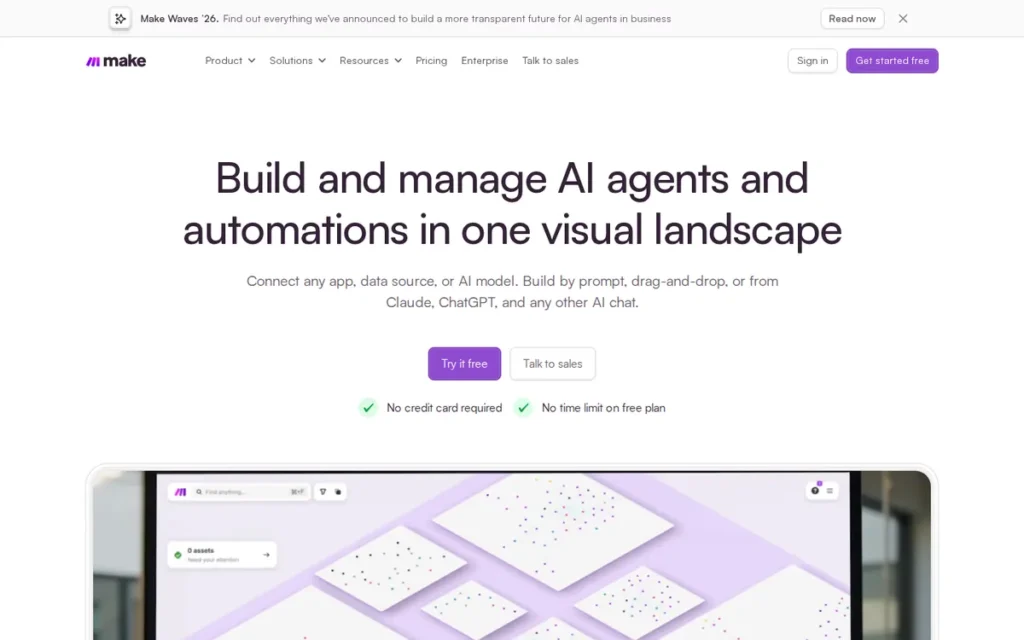
Category: No-Code Visual Automation Agent Builder, a drag-and-drop canvas platform for building multi-step AI-powered workflows that connect apps without writing code, where AI agent capabilities are native to the visual builder interface.
At a Glance
- Category: No-Code Visual Automation Agent Builder
- Best For: Operations managers, marketing teams, and mixed-technical organizations needing to connect 3,000+ apps into AI-powered workflows without dedicated developers
- Price Range: Free (1,000 ops/month) · Core ~$10.59/month · Pro ~$18.59/month · Teams ~$41/month · Enterprise custom (~$500+/month)
- Primary Strength: Make holds the highest verified G2 review count in this comparison, 4.6/5 across 267+ G2 reviews as of April 2026 per marketermilk.com’s platform roundup; Capterra rating varies between the Make and Integromat product listings, verify directly at capterra.com before purchase
- Biggest Limitation: Make’s per-operation billing model causes total monthly costs to multiply unpredictably in AI agent workflows where each LLM call, data transformation, and API request counts as a separate billed operation
- One-Line Summary: Make is a no-code visual automation agent builder rated 4.6/5 across 267+ G2 reviews that enables mixed-technical teams to build AI-powered workflows connecting 3,000+ apps through a drag-and-drop canvas, with native AI Agents launched in 2026.
- Last Verified: April 2026
Overview
Make (formerly Integromat, acquired by Celonis post-2020) is a no-code visual automation agent builder for operations managers, marketing teams, and mixed-technical organizations that need to connect business apps into AI-powered workflows without dedicated software engineers. Make is rated 4.6/5 across 267+ G2 reviews as of April 2026 per marketermilk.com’s platform roundup, the highest verified G2 review count of any no-code automation platform in this comparison.
Make’s Scenario Builder (a drag-and-drop canvas mapping multi-step workflows with branching logic, iterators, aggregators, and error-handling paths) provides a visual programming experience sophisticated enough for complex automation while remaining accessible to non-developers. Make’s 2026 AI Agents feature, launched in advanced beta as a native Scenario Builder component, adds autonomous agent capabilities with step-by-step reasoning transparency and visual execution logs.
Key Features
- Make’s drag-and-drop Scenario Builder canvas supports router branching, iterators, aggregators, parallel execution paths, and inline error handling, enabling complex multi-condition workflow logic without writing code.
- Make’s native AI Agents (advanced beta, 2026) are embedded directly in the Scenario Builder, featuring step-by-step reasoning panels, visual execution logs, shareable and reusable agent components across scenarios, and module tools that convert any app connector into a callable agent action per Make’s AI Agents overview.
- Make connects to 3,000+ apps and offers 30,000+ actions: including direct connectors to OpenAI, Anthropic, and Google AI, providing the broadest native integration catalog of any no-code platform in this evaluation.
- Make’s Pro tier at approximately $18.59/month delivers 150,000 monthly operations, approximately 60% lower cost than Zapier at equivalent workflow complexity per Digidop’s independent comparison analysis (2025).
- Make’s Teams and Enterprise tiers include role-based access control, SSO, shared team scenarios, and audit trails, enabling governance features required by growing organizations without a full enterprise procurement cycle.
Best For
Make is best for operations managers, marketing automation teams, and mixed-technical organizations at the SMB-to-mid-market stage that need to connect dozens of SaaS tools into AI-powered multi-step workflows, prioritize a visual builder over coding, and want the broadest available integration catalog without switching to developer-only platforms.
Pricing
Make’s published pricing tiers as of April 2026: Free ($0, 1,000 ops/month, 2 active scenarios); Core (~$10.59/month, 10,000 ops/month, 10 active scenarios); Pro (~$18.59/month, 150,000 ops/month, unlimited scenarios); Teams (~$41/month, 300,000 ops/month, SSO, RBAC); Enterprise (custom, ~$500+/month, VPC, dedicated support).
A Make scenario with 10 modules processing 1,000 records consumes 10,000 operations per run. AI agent workflows with LLM calls and multi-step logic exhaust operation budgets significantly faster than traditional automation, model your expected monthly volume before selecting a tier. Verify current tiers at make.com/en/pricing before purchase, as Make has updated pricing multiple times.
Strengths
- Make holds the highest verified G2 review count of any platform in this comparison, 4.6/5 across 267+ G2 reviews as of April 2026 per marketermilk.com’s platform roundup, providing statistically meaningful crowd-sourced validation from a large and diverse install base.
- Make’s Pro tier at approximately $18.59/month delivers 150,000 monthly operations, approximately 60% lower cost than Zapier at equivalent workflow complexity per Digidop’s independent comparison analysis (2025), a documented cost advantage that has driven significant SMB migration from Zapier to Make.
- Make’s 2026 AI Agents feature integrates autonomous agent capabilities directly into the Scenario Builder canvas with step-by-step reasoning transparency and visual execution logs per Make’s AI Agents blog (2026), addressing the debugging opacity problem that frustrates users of competing platforms.
- Make’s 3,000+ app integrations and 30,000+ actions catalog provides the broadest native integration coverage of any no-code platform in this evaluation, enabling organizations to connect their full SaaS stack without custom API development.
Limitations
- Per-Operation Billing Multiplication: Make’s most consequential trade-off is its per-operation billing model, which multiplies total monthly cost in AI-heavy workflows in ways that are difficult to predict before deployment, a scenario with 10 modules processing 1,000 records consumes 10,000 operations per run, meaning AI agent workflows with LLM calls and multi-step logic exhaust tier limits significantly faster than traditional automation scenarios.
- No Self-Hosting Option: Make offers cloud-only deployment with no self-hosted path, creating vendor lock-in risk for organizations that later need data sovereignty, on-premises control, or infrastructure independence.
- Enterprise Compliance Gaps: Make’s enterprise compliance certifications: including ISO 27001, SOC 2 Type II, and HIPAA, are not specifically documented in Make’s publicly available materials as of April 2026; buyers in regulated industries must verify compliance status directly with Make’s sales team before committing.
- Acquisition Roadmap Risk: Make’s acquisition by Celonis embeds it within a broader enterprise process automation strategy, SMBs and independent users should monitor whether Make’s product roadmap continues prioritizing their segment or shifts toward enterprise-first feature development.
Verdict
Make is the highest G2-reviewed no-code AI agent builder in this evaluation, rated 4.6/5 across 267+ G2 reviews with the broadest verified integration catalog (3,000+ apps) and native AI Agents with visual reasoning logs as of April 2026. Make’s documented approximately 60% cost advantage over Zapier and genuine no-code Scenario Builder make it the most evidence-backed starting point for operations managers and SMB teams building AI-powered automation. Buyers with high AI workflow volumes, data residency requirements, or regulated-industry compliance mandates should model total monthly operation costs carefully before committing, and should evaluate n8n (rank 3) for self-hosted control or Microsoft Copilot Studio (rank 4) for Azure-backed compliance.
2. Voiceflow: Best for Cross-Functional Teams Building Conversational and Voice AI Agents
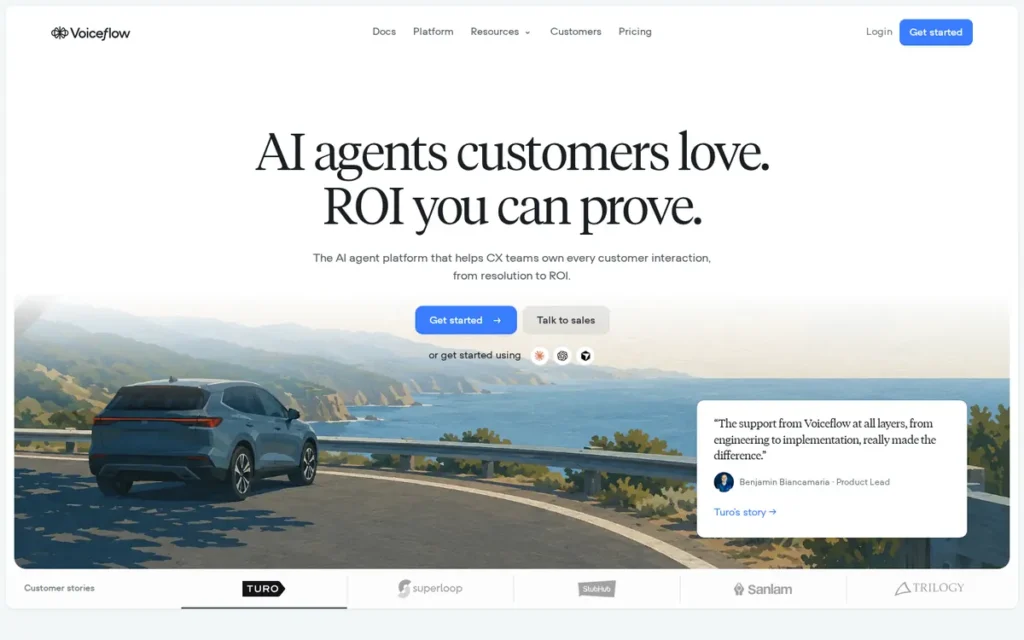
Category: Collaborative Conversational AI Agent Builder, a no-code visual platform designed for cross-functional teams including designers, developers, and compliance officers to co-build, test, and deploy AI agents across voice and chat channels in a shared real-time canvas.
At a Glance
- Category: Collaborative Conversational AI Agent Builder
- Best For: Cross-functional product teams, CX operations teams, and enterprise organizations that need non-technical designers and technical developers to co-build AI agents for voice, chat, and customer-facing channels
- Price Range: Free sandbox available for testing · Paid tiers estimated from ~$99/month (unverified, confirm at voiceflow.com/pricing before budgeting) · Enterprise: custom pricing with SOC 2 Type II, HIPAA, SSO, and dedicated support
- Primary Strength: Voiceflow is the only enterprise-certified platform in this evaluation verified by G2 reviewers to be genuinely usable by non-technical designers in production, per Voiceflow’s own documentation of reviewer sentiment (April 2026); verify independently at g2.com
- Biggest Limitation: Voiceflow’s ~120 native integration catalog is the narrowest of any platform in this evaluation, limiting its utility for general-purpose business automation workflows connecting many SaaS tools
- One-Line Summary: Voiceflow is a collaborative conversational AI agent builder rated approximately 4.4–4.7/5 on G2 that enables cross-functional teams including non-technical designers to build and deploy voice and chat AI agents at enterprise scale, with ISO 27001, SOC 2 Type II, and HIPAA certification and named customer references including JP Morgan and LVMH per Voiceflow’s marketing materials as of April 2026.
- Last Verified: April 2026
Overview
Voiceflow is a no-code collaborative AI agent builder for cross-functional teams, including designers, developers, and compliance officers, that need to build, test, and deploy production-grade conversational AI agents across voice and chat channels without requiring all team members to write code. Voiceflow was founded in 2019 by Braden Ream and Andrew Lawrence per serviceagent.ai’s review, and reports serving over 500,000 teams globally with infrastructure capacity of 300,000 messages per minute at peak per voiceflow.com (April 2026), vendor-reported figures that have not been independently verified in this research cycle.
Voiceflow’s defining distinction from every other platform in this evaluation is its collaborative team design model: a UX designer, a backend developer, and a compliance officer can co-edit the same agent canvas in real time, a workflow architecture no other platform in this comparison replicates. Voiceflow holds ISO 27001 certification, SOC 2 Type II compliance, and HIPAA-compliance options.
Key Features
- Voiceflow’s shared real-time canvas enables cross-functional teams: designers, developers, and compliance officers, to co-build AI agents simultaneously, with shared component libraries, reusable blocks, and role-based editing permissions that prevent unauthorized workflow modifications.
- Voiceflow’s RAG-based knowledge base supports uploading PDFs, text documents, and live URLs to ground AI agent responses, scaling from 50 knowledge sources on starter tiers to 10,000+ sources at enterprise tier per Voiceflow’s Knowledge Base documentation.
- Voiceflow deploys AI agents across voice (phone and IVR with latency under 500ms) and chat (web widget, API) channels from a single agent design, enabling omnichannel deployment without rebuilding agent logic per channel.
- Voiceflow’s enterprise tier provides ISO 27001 certification, SOC 2 Type II compliance, HIPAA-compliance options, PII masking, SSO, and custom knowledge base sizes, enabling regulated-industry deployments across financial services, healthcare, and enterprise customer operations.
- Voiceflow’s production infrastructure supports 300,000 messages per minute at peak per voiceflow.com (April 2026), with named customer references from Voiceflow’s own marketing materials including JP Morgan and LVMH, these references have not been independently confirmed via press releases and should be verified with Voiceflow’s enterprise sales team before citing in procurement decisions.
Best For
Voiceflow is best for enterprise CX teams, product organizations, and regulated-industry operations groups that need non-technical designers and technical developers to collaborate on the same agent canvas (specifically for conversational AI agents across voice IVR, chat, and customer support channels) where cross-functional governance and ISO 27001/SOC 2/HIPAA compliance are requirements.
Pricing
Voiceflow’s pricing is the least transparently published of any platform in this evaluation and requires direct navigation to voiceflow.com/pricing. A free sandbox tier is available for testing. A starting paid tier is estimated at approximately $99/month per secondary sources, this figure is unverified from the official pricing page and must be confirmed directly before budget planning.
Enterprise tier pricing is custom, including SOC 2 Type II, HIPAA, PII masking, SSO, and dedicated support. Voiceflow’s pricing opacity makes comparison shopping against Botpress ($89/month Plus tier, published) significantly harder, this is the most significant pre-purchase information gap in this evaluation.
Strengths
- Voiceflow is the only enterprise-certified platform in this evaluation where non-technical users including designers with zero coding experience have been verified by G2 reviewers to build production-grade AI agents, per Voiceflow’s own documentation of reviewer sentiment (April 2026); verify independently at g2.com before purchase.
- Voiceflow reports production infrastructure serving 500,000+ global teams at 300,000 messages per minute peak throughput per voiceflow.com (April 2026), vendor-reported operational data that signals enterprise-scale readiness, to be verified with Voiceflow directly before citing in procurement decisions.
- Voiceflow holds ISO 27001 certification, SOC 2 Type II compliance, and HIPAA-compliance options (the compliance credential set required for financial services, healthcare, and government deployments) with named customer references from Voiceflow’s own marketing materials including JP Morgan and LVMH as of April 2026.
- Voiceflow’s cross-functional collaborative design model: real-time co-editing by designers, developers, and compliance officers on a shared canvas with shared component libraries, solves a workflow governance problem that no other platform in this comparison explicitly addresses.
Limitations
- Narrowest Integration Catalog: Voiceflow’s most consequential trade-off is its deliberate conversational AI specialization, the platform’s approximately 120 native connectors is the narrowest catalog in this evaluation, limiting utility for organizations needing AI agents integrated into broad general-purpose automation across CRMs, ERPs, marketing tools, and custom APIs compared to Make’s 3,000+ or n8n’s self-hosted API flexibility.
- Cloud-Only Vendor Lock-In: Voiceflow offers no self-hosted deployment option, creating vendor lock-in risk for organizations that later require data residency control, on-premises infrastructure, or the ability to port workflows to another platform.
- Pricing Opacity: Voiceflow’s pricing transparency is the lowest in this evaluation, specific tier prices and message limits require direct navigation or a sales conversation, complicating comparison shopping and early-stage budget planning against competitors with published pricing.
- Conversational AI Specialization Boundary: Voiceflow’s purpose-built conversational AI architecture makes it the wrong platform for internal process automation, data pipelines, or developer-first multi-agent systems, buyers with those use cases should evaluate Make (rank 1), n8n (rank 3), or LangChain (rank 6) instead.
Verdict
Voiceflow is the leading collaborative conversational AI agent builder in this evaluation, rated approximately 4.4–4.7/5 on G2, reporting 500,000+ teams globally at 300,000 messages per minute peak throughput, holding ISO 27001, SOC 2 Type II, and HIPAA certifications, with named customer references including JP Morgan and LVMH per Voiceflow’s marketing materials as of April 2026. Voiceflow’s defining advantage is its genuine non-technical accessibility verified by G2 reviewers, making it the only enterprise-certified platform in this comparison where a UX designer can build a production-grade AI agent without writing code, per Voiceflow’s own documentation of reviewer sentiment. Organizations building conversational AI agents with cross-functional teams should treat Voiceflow as the primary evaluation candidate; organizations needing general-purpose automation across many SaaS tools should evaluate Make (rank 1) or n8n (rank 3) instead.
3. n8n: Best for Technical Teams and Cost-Conscious Organizations Needing Self-Hosted AI Agent Automation
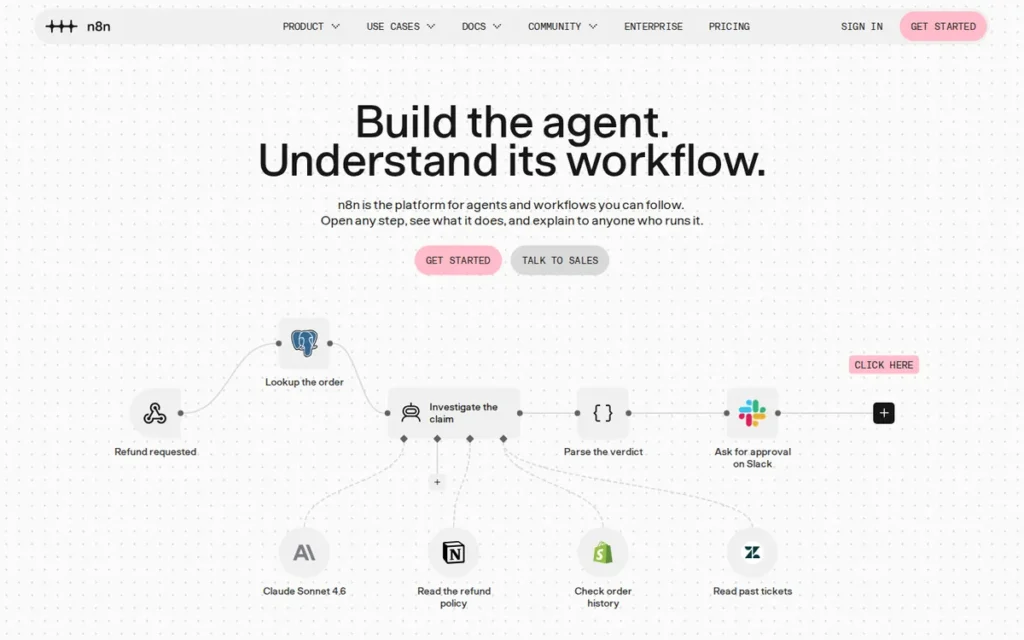
Category: Open-Source Automation Agent Builder, a fair-code licensed, self-hostable workflow automation platform with native AI agent and LLM integration capabilities, offering both cloud-hosted and full on-premises deployment where the organization retains complete infrastructure control.
At a Glance
- Category: Open-Source Automation Agent Builder
- Best For: Technical teams, developers, DevOps engineers, and cost-conscious organizations with infrastructure capacity needing self-hosted AI agent automation with full data sovereignty
- Price Range: Free (self-hosted Community edition, unlimited executions) · Cloud Starter ~€20/month (~$22 USD) · Cloud Pro ~€50/month (~$55 USD) · Business ~€667/month (~$730 USD) · Enterprise custom
- Primary Strength: n8n is the only major automation agent builder in this evaluation offering full self-hosted deployment at zero software cost, with over 150,000 GitHub stars as of October 2025 per the n8n community forum, enabling technically capable teams to run unlimited executions for ~$15/month in server fees
- Biggest Limitation: n8n requires genuine technical literacy for production deployment (documentation assumes developer-level familiarity with APIs, JavaScript, and server infrastructure) making it unsuitable for non-technical teams without a dedicated technical owner
- One-Line Summary: n8n is an open-source, fair-code-licensed automation agent builder with over 150,000 GitHub stars that enables technically capable teams to self-host unlimited AI agent workflows for ~$15/month in infrastructure costs, with native LangChain, local LLM, and RAG pipeline support as of April 2026.
- Last Verified: April 2026
Overview
n8n is a fair-code-licensed, self-hostable workflow automation platform for technical teams, developers, and cost-conscious organizations that need AI agent automation with full data sovereignty, unlimited workflow executions, and the flexibility to integrate custom LLMs, RAG pipelines, and local AI models, available as a cloud-hosted SaaS or deployed entirely on the organization’s own infrastructure at zero software licensing cost as of April 2026. n8n raised a $12M Series A led by Felicis Ventures, providing institutional backing for continued platform and cloud infrastructure development.
n8n’s visual node-based editor supports 350–400+ native integrations and 400+ community-contributed nodes for niche services, with native AI capabilities including:
- LangChain integration for AI chain and agent construction
- Ollama support for local LLM deployment with all data remaining on-premises
- Vector store connections to Pinecone and Weaviate for RAG pipeline construction
- Multi-step agentic reasoning chains for complex decision sequences
n8n’s fair-code license is source-available and freely self-hostable for internal use, but restricts commercial embedding and reselling without a separate commercial license, a legally material distinction from MIT-licensed frameworks (LangChain, CrewAI) that organizations building commercial products must evaluate before deployment.
Key Features
- n8n’s self-hosted Community edition delivers unlimited workflow executions at zero software cost (deployable on a VPS at approximately $15/month) with a documented migration case showing approximately 45% monthly cost reduction for an organization switching from Zapier to n8n Pro per Hackceleration’s comparison analysis.
- n8n’s execution-based pricing model, reformed in 2025, bills full workflow runs as single executions regardless of step count, eliminating the per-task cost multiplication that inflates costs in complex multi-step AI automation on Make and Zapier.
- n8n natively integrates with LangChain for AI chain and agent construction, supports Ollama for local LLM deployment keeping all data on-premises, and connects to vector stores including Pinecone and Weaviate for RAG pipelines.
- n8n’s Business and Enterprise tiers include SSO via SAML and LDAP, role-based access control, audit logging, encrypted credential management, Git-based workflow versioning, and multi-environment dev/prod deployment at approximately $730/month.
- n8n’s GitHub repository has surpassed 150,000 stars as of October 2025 per the n8n community forum, placing n8n among the most-starred self-hosted automation repositories in the developer ecosystem globally.
Best For
n8n is best for technical teams, DevOps engineers, and organizations with existing infrastructure capacity that prioritize data sovereignty, cost efficiency at high workflow volumes, and the ability to integrate local LLMs and custom AI models, particularly in regulated industries such as healthcare, fintech, and legal where on-premises deployment is a compliance requirement rather than a preference.
Pricing
n8n pricing as of April 2026 per n8n’s official pricing page: Self-hosted Community edition (free, unlimited executions, self-managed); Cloud Starter (~€20/month, ~$22 USD, 2,500 executions, forum support); Cloud Pro (~€50/month, ~$55 USD, 10,000–25,000 executions, workflow history, admin roles); Business (~€667/month, ~$730 USD, 40,000–50,000 executions, SSO, Git versioning, queue scaling); Enterprise (custom, unlimited executions, dedicated SLA).
Pricing is denominated in euros, USD-budgeted organizations should account for currency variability. The jump from Cloud Pro (~$55/month) to Business (~$730/month) has no intermediate tier, growing teams between 25,000 and 40,000 monthly executions should plan for this cost cliff.
Strengths
- n8n’s self-hosted Community edition delivers unlimited workflow executions at zero software cost (with server infrastructure estimated at approximately $15/month) documenting approximately 45% monthly cost reduction for a published migration case versus Zapier Pro per Hackceleration’s analysis, representing the strongest total cost of ownership position in this evaluation for technically capable teams as of April 2026.
- n8n’s GitHub repository has surpassed 150,000 stars as of October 2025 per the n8n community forum, placing n8n among the most-starred self-hosted automation repositories globally and providing the strongest community health signal of any self-hosted platform in this evaluation.
- n8n’s 2025 execution-based pricing reform eliminated per-task billing multiplication, a documented cost advantage confirmed by Hackceleration’s migration analysis showing approximately 45% monthly cost reduction for an organization moving from Zapier to n8n Pro at equivalent automation volume.
- n8n’s Business tier includes SSO via SAML and LDAP, role-based access control, audit logging, encrypted credential storage, and Git-based workflow versioning at approximately $730/month, enterprise governance features that comparable enterprise SaaS platforms charge $2,000+/month to provide per n8n’s pricing documentation.
Limitations
- Technical Literacy Requirement: n8n’s most consequential trade-off is its accessibility ceiling, the visual node-based editor provides a graphical interface, but n8n’s documentation assumes developer literacy with APIs, JavaScript, and server infrastructure, making n8n genuinely unsuitable for non-technical teams without a dedicated technical owner per The Digital Project Manager’s review.
- Fair-Code License Restrictions: n8n’s fair-code license is source-available and freely self-hostable for internal use, but is NOT MIT open-source, organizations planning to embed n8n in commercial products or offer it as a service to customers require a separate commercial license; for example, an agency building a white-labeled automation platform charged to clients on a monthly basis requires a paid commercial license from n8n, while the same architecture using MIT-licensed LangChain or CrewAI would require no licensing fee.
- Smaller Native Integration Catalog: n8n’s native integration catalog of 350–400 apps is meaningfully smaller than Make’s 3,000+, requiring community nodes or custom API development for niche services, a gap that increases implementation time for organizations with broad SaaS stacks.
- Business Tier Pricing Cliff: n8n’s cloud Business tier at approximately $730/month represents a steep jump from Cloud Pro at approximately $55/month with no intermediate tier, creating a budget discontinuity for growing teams that exceed 25,000 monthly executions before reaching Business-tier feature requirements.
Verdict
n8n is the best total cost of ownership option for AI agent automation in this evaluation, the only major platform offering self-hosted, unlimited-execution deployment at approximately $15/month in server costs, with over 150,000 GitHub stars as of October 2025 and enterprise governance features including SSO, RBAC, and Git versioning at the Business tier as of April 2026. n8n’s execution-based pricing model, native LangChain integration, local LLM support via Ollama, and RAG pipeline capabilities make it the most cost-efficient and privacy-preserving choice for technically capable teams running high-volume AI workflows. Non-technical teams without a developer or DevOps owner will find n8n’s onboarding investment prohibitive, they should evaluate Make (rank 1) or Voiceflow (rank 2) instead.
4. Microsoft Copilot Studio: Best for Microsoft 365-Native Enterprises Requiring Compliance-Grade AI Agent Deployment
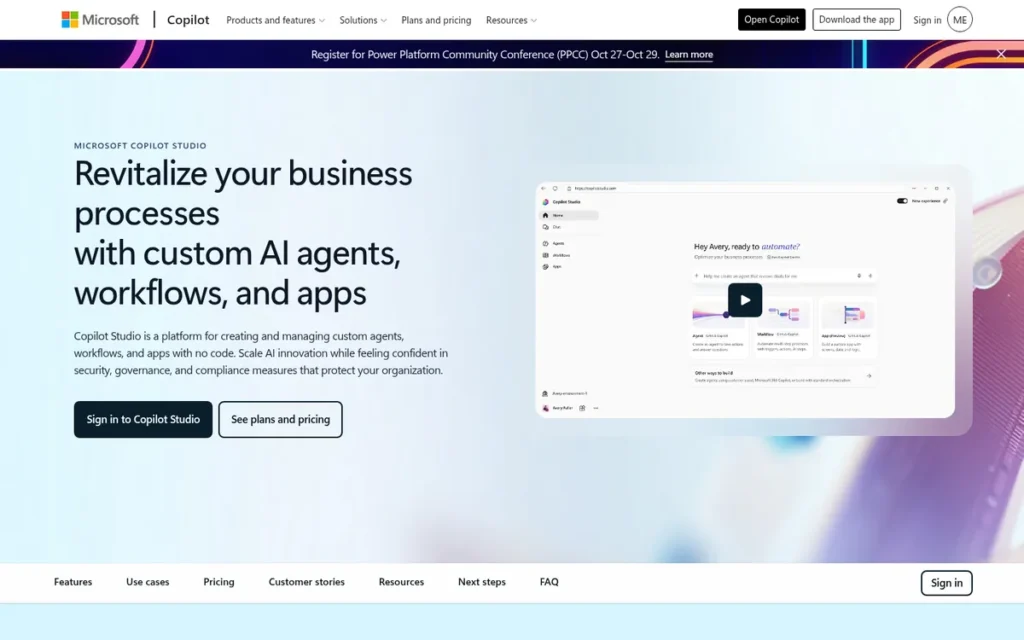
Category: Enterprise Ecosystem AI Agent Suite, a low-code and no-code platform for building AI agents natively integrated with Microsoft 365, Azure, and Power Platform, designed for organizations where Microsoft infrastructure is the primary operational stack.
At a Glance
- Category: Enterprise Ecosystem AI Agent Suite
- Best For: Large enterprise organizations operating primarily within the Microsoft 365 ecosystem (financial services, healthcare, government, and enterprise manufacturing) requiring AI agents integrated with Teams, SharePoint, Outlook, and Dynamics 365 with full Azure compliance coverage
- Price Range: ~$200/month estimated base (secondary sources: confirm at microsoft.com/en-us/microsoft-copilot/microsoft-copilot-studio/pricing) plus Copilot Credits for advanced features; accurate budget modeling requires a Microsoft licensing specialist
- Primary Strength: Microsoft Copilot Studio provides the broadest compliance coverage of any platform in this evaluation (ISO 27001, SOC 2, HIPAA, GDPR, and FedRAMP via Azure) with 1,400+ Power Platform connectors as of April 2026
- Biggest Limitation: Microsoft Copilot Studio’s Copilot Credit consumption model is the most opaque billing structure in this evaluation, enterprise buyers cannot accurately model total monthly cost without a Microsoft licensing specialist
- One-Line Summary: Microsoft Copilot Studio is an enterprise AI agent suite with ISO 27001, SOC 2, HIPAA, GDPR, and FedRAMP compliance via Azure, 1,400+ Power Platform connectors, and autonomous agent capabilities that reached general availability on March 31, 2025, purpose-built for organizations whose primary operational infrastructure is Microsoft 365.
- Last Verified: April 2026
Overview
Microsoft Copilot Studio is a low-code enterprise AI agent suite for large organizations operating within the Microsoft 365 ecosystem, enabling IT teams, business analysts, and low-code developers to build AI agents that automate workflows across Teams, SharePoint, Outlook, Dynamics 365, and 1,400+ Power Platform connectors, with autonomous agent capabilities that reached general availability worldwide on March 31, 2025 per Microsoft’s official What’s New changelog.
Microsoft Copilot Studio evolved from Power Virtual Agents through Microsoft’s 2023–2024 Copilot platform expansion, carrying an established enterprise customer base. Microsoft Copilot Studio’s deepest advantage and its most significant limitation are one and the same: for Microsoft-native enterprises it provides unmatched integration depth and native Azure compliance; for organizations not primarily operating within Microsoft infrastructure, it introduces ecosystem lock-in and licensing complexity that systematically outweighs its capabilities.
Key Features
- Microsoft Copilot Studio supports four distinct agent types: Q&A agents for knowledge retrieval, workflow agents for task automation, autonomous agents for proactive event-triggered actions (GA March 31, 2025), and cross-system agents for ERP and CRM orchestration across Dynamics 365, SAP, and Salesforce, enabling a progression from basic chatbot to fully proactive AI agent per Microsoft’s What’s New documentation.
- Microsoft Copilot Studio connects to 1,400+ data sources via Power Platform connectors (including native Microsoft Graph access to Teams conversations, SharePoint documents, Outlook emails, and calendar data) providing integration depth into Microsoft 365 infrastructure that no competing platform in this evaluation can replicate.
- Microsoft Copilot Studio leverages Azure OpenAI models including GPT-5 as of late 2025, plus XPIA (cross-plugin injection attack) mitigation and Azure AI Content Safety integration, providing AI-specific security controls beyond standard application security per Microsoft’s What’s New changelog.
- Microsoft Copilot Studio’s Azure compliance infrastructure covers ISO 27001, SOC 2 Type II, HIPAA, GDPR, and FedRAMP (the broadest multi-standard compliance coverage of any platform in this evaluation) enabling regulated-industry deployment across financial services, healthcare, and U.S. federal government contexts.
- Microsoft Copilot Studio’s documented 18-month feature release cadence: voice optimization and M365 Copilot publishing (October 2024), autonomous agents GA (March 2025), NLU customization and ROI analytics (June–July 2025), enhanced model flexibility and SharePoint enhancements (November 2025), demonstrates active, sustained platform investment from Microsoft per Microsoft’s official What’s New changelog.
Best For
Microsoft Copilot Studio is best for large enterprises operating primarily within the Microsoft 365 ecosystem (financial services firms, healthcare systems, government agencies, and enterprise manufacturers) that need AI agents natively integrated with Teams, SharePoint, Outlook, and Dynamics 365, require Azure-backed multi-standard compliance, and have existing Microsoft 365 Copilot licensing in place.
Pricing
Microsoft Copilot Studio’s pricing is the most complex and least transparent in this evaluation. Basic agent-building is included within Microsoft 365 Copilot enterprise licensing. Standalone access is estimated at approximately $200/month per tenant based on secondary sources, confirm directly at microsoft.com/en-us/microsoft-copilot/microsoft-copilot-studio/pricing before budget planning.
Advanced features, high-volume deployments, and external API integrations require additional Copilot Credits in prepaid packs consumed at variable rates per message and per capability. Accurate total monthly cost modeling without a Microsoft licensing specialist is not realistic, engage Microsoft’s sales team before committing to any budget projection per HSO’s licensing analysis.
Strengths
- Microsoft Copilot Studio provides the broadest compliance coverage of any platform in this evaluation (ISO 27001, SOC 2, HIPAA, GDPR, and FedRAMP via Azure infrastructure with built-in XPIA mitigation and Azure AI Content Safety integration) making it the only platform in this comparison with documented federal government FedRAMP compliance eligibility as of April 2026 per Microsoft’s compliance documentation.
- Microsoft Copilot Studio’s 1,400+ Power Platform connectors provide native integration depth into Microsoft 365 infrastructure (accessing live Teams conversations, SharePoint documents, Outlook email context, and Dynamics 365 CRM data) that no competing platform in this evaluation can replicate for Microsoft-native enterprise deployments.
- Microsoft Copilot Studio reached autonomous agent general availability worldwide on March 31, 2025 (transitioning from a reactive chatbot platform to a proactive event-driven AI agent suite capable of initiating actions based on triggers without user input) a significant architectural milestone documented in Microsoft’s official What’s New changelog.
- Microsoft Copilot Studio’s Power Virtual Agents lineage provides an established enterprise customer base familiar with the predecessor platform, with named implementation examples including Coca-Cola and Unilever per synthesized research, these should be independently confirmed with Microsoft’s customer success team before citing in procurement decisions.
Limitations
- Billing Opacity and Ecosystem Lock-In: Microsoft Copilot Studio’s most consequential trade-off is its Copilot Credit consumption model (where base access is bundled with Microsoft 365 licensing and advanced features require prepaid credit packs consumed at variable rates per message and per capability) documented as the most difficult billing structure in the AI agent builder category to accurately project before procurement per HSO’s licensing analysis.
- Ecosystem Dependency: Microsoft Copilot Studio’s deep Microsoft 365 integration is both its greatest strength and greatest risk, organizations not already within the Microsoft stack face high entry barriers including forced adoption of Microsoft licensing infrastructure, and face meaningful switching costs if strategic direction later changes.
- Performance Outside the Microsoft Stack: Community feedback from Microsoft-adjacent discussions describes non-Microsoft tool integration as requiring custom JavaScript and producing performance limitations outside the native M365 ecosystem, constraining utility for hybrid-stack organizations with non-Microsoft CRMs, ERPs, or cloud environments.
- Unverified Third-Party Review Scores: G2 and Gartner Peer Insights scores with confirmed review counts for Microsoft Copilot Studio were not independently verified in this research cycle, enterprise buyers should consult Gartner Peer Insights directly for quantified user sentiment before procurement.
Verdict
Microsoft Copilot Studio is the strongest enterprise compliance platform in this evaluation, covering ISO 27001, SOC 2, HIPAA, GDPR, and FedRAMP via Azure, with autonomous agent GA since March 31, 2025 and 1,400+ Power Platform connectors for Microsoft 365-native enterprises as of April 2026. Microsoft Copilot Studio’s correct buyer profile is narrow but clear: large enterprises where Microsoft 365 is the primary operational infrastructure, where Azure-backed multi-standard compliance is a procurement requirement, and where IT teams have existing Microsoft licensing expertise to navigate the Copilot Credit billing model. Organizations outside this profile should evaluate Voiceflow (rank 2) for compliance-grade conversational AI or LangChain (rank 6) for maximum developer control.
5. Botpress: Best for Technical Teams Building Customizable Conversational AI Agents with GPT-Native Architecture
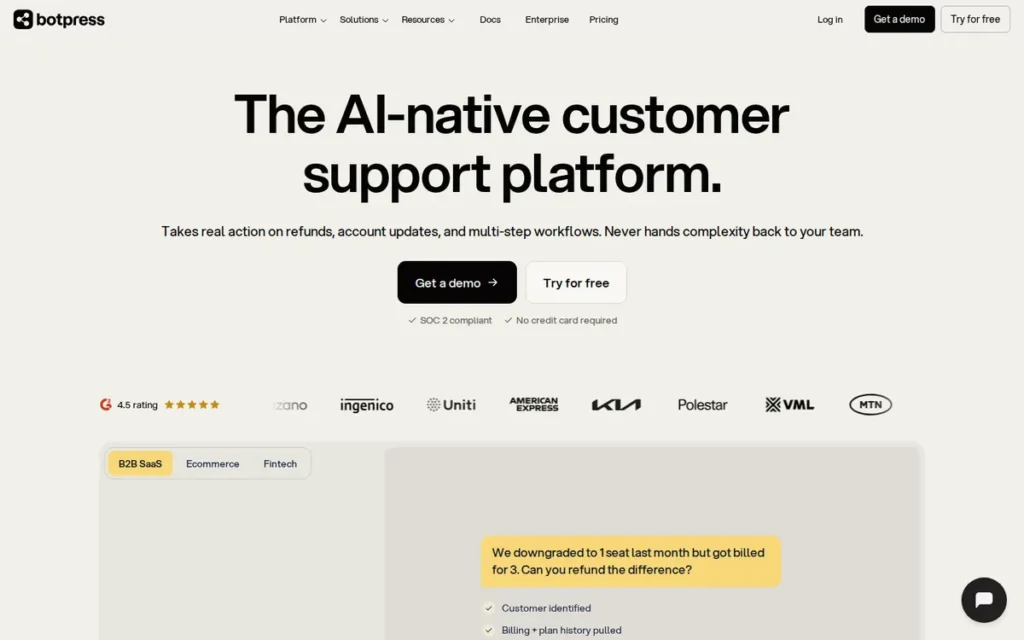
Category: GPT-Native Conversational AI Agent Builder, a hybrid visual-and-code platform for building LLM-powered chatbots and AI agents with a drag-and-drop conversation flow designer, built-in multilingual NLU, RAG knowledge base, and JavaScript extensibility for production API integrations.
At a Glance
- Category: GPT-Native Conversational AI Agent Builder
- Best For: Technical-leaning teams and developers building customizable conversational AI agents across multiple channels (WhatsApp, Telegram, Webchat, Slack) where GPT-native NLU, user-controlled data privacy, and self-hosting capability are requirements
- Price Range: Free ($0, 500 messages/month, 1 bot) · Plus $89/month + AI Spend · Team $495/month + AI Spend · Managed $1,495/month · Enterprise custom (~$2,000+/month). Total monthly cost equals plan fee plus LLM API token usage, model both before budgeting.
- Primary Strength: Botpress has operated a GPT-native conversational AI platform since March 2023 with a user-controlled API key architecture that prevents Botpress from accessing or sharing proprietary conversation data with OpenAI, backed by a $25M Series B closed in June 2025 per The SaaS News
- Biggest Limitation: Botpress’s dual-cost billing: base tier pricing plus a separate AI Spend charge for LLM token consumption, makes total monthly cost difficult to predict, and production agents require JavaScript for API integrations the visual builder alone cannot handle
- One-Line Summary: Botpress is a Series-B-funded ($25M, June 2025) GPT-native conversational AI agent builder founded in 2017 with a visual-and-JavaScript hybrid interface, user-controlled LLM API key architecture, broad multilingual NLU, RAG knowledge base, and cloud-plus-self-hosted deployment as of April 2026.
- Last Verified: April 2026
Overview
Botpress is a GPT-native conversational AI agent builder for technical-leaning teams and developers that need a customizable, multi-channel AI agent platform with built-in multilingual NLU, RAG knowledge base, and the architectural flexibility to self-host or deploy to cloud, without surrendering control of proprietary conversation data to LLM providers as of April 2026. Founded in 2017 by Sylvain Perron in Montreal, Canada, Botpress is the longest-tenured conversational AI platform in this evaluation, having navigated from pre-LLM rule-based chatbot architecture through its March 2023 pivot to a fully GPT-native platform documented by BusinessWire.
Botpress raised a $25M Series B in June 2025, led by Framework Venture Partners with participation from Deloitte Ventures, HubSpot Ventures, Inovia Capital, and Decibel Partners per The SaaS News (June 2025), providing institutional backing that improves platform longevity confidence. Botpress’s hybrid design positions it between no-code visual builders (Voiceflow, Make) and pure developer frameworks (LangChain), serving teams with some technical capability who need more customization than visual-only platforms provide.
Key Features
- Botpress’s visual flow designer provides a drag-and-drop node-based canvas for designing conversation logic (including branching conditions, slot-filling, entity recognition, and multi-turn dialogue management) while JavaScript hooks enable custom API integrations for production deployments that the visual canvas alone cannot handle.
- Botpress’s built-in NLU engine supports intent recognition, entity extraction, and slot-filling across a broad range of major world languages, enabling multilingual conversational AI agents; verify the current supported language list at botpress.com before deployment planning.
- Botpress’s RAG-based knowledge base enables document upload, live data source connection, and GPT-powered retrieval, with user-controlled LLM API keys that explicitly prevent Botpress from sending conversation data to OpenAI per Botpress’s privacy documentation.
- Botpress deploys agents across Webchat, WhatsApp, Facebook Messenger, Telegram, and Slack from a single agent design, enabling multi-channel conversational AI without rebuilding conversation logic per channel.
- Botpress offers both cloud-hosted and fully self-hosted deployment options: enabling organizations with data sovereignty requirements in healthcare, fintech, and legal contexts to run the full Botpress stack on-premises with proprietary data never leaving organizational infrastructure.
Best For
Botpress is best for technical-leaning teams (developers, product engineers, and technically skilled operations staff) building customizable conversational AI agents across multiple channels where user-controlled data privacy, multilingual NLU, and self-hosting capability are requirements, and where the team has JavaScript proficiency for production-grade API integrations.
Pricing
Botpress pricing as of April 2026 per lindy.ai’s pricing analysis and checkthat.ai’s breakdown: Free ($0, 500 messages/month, 1 bot, insufficient for meaningful pre-purchase testing at production volume); Plus ($89/month or ~$79/month annually, 5,000 messages/month, 2 bots); Team ($495/month or ~$445/month annually, 50,000 messages/month, 3 bots); Managed ($1,495/month, 500,000 messages/month); Enterprise (custom, ~$2,000+/month).
Every paid tier adds a separate AI Spend component billed on LLM token usage above the base tier price, total monthly cost equals plan fee plus LLM API token consumption. For AI-heavy agents, AI Spend can significantly exceed the base plan fee. Verify current pricing at botpress.com/pricing.
Strengths
- Botpress has operated a fully GPT-native conversational AI platform since March 2023, documented by a BusinessWire press release with approximately 20,000 beta users during the launch period, with a verified Capterra user citing: “The integration with GPT is highly impressive and seamlessly incorporated into the tool” per sitegpt.ai’s Botpress review.
- Botpress’s user-controlled LLM API key architecture prevents Botpress from sending organizational conversation data to OpenAI, enabling proprietary data protection in cloud deployments and full data sovereignty in self-hosted deployments, a documented privacy design for regulated industries and privacy-sensitive enterprise use cases.
- Botpress raised a $25M Series B in June 2025, led by Framework Venture Partners with participation from Deloitte Ventures, HubSpot Ventures, Inovia Capital, and Decibel Partners per The SaaS News (June 2025), providing institutional backing that extends platform viability runway for enterprise buyers evaluating vendor risk.
- Botpress’s eight-year market track record since founding in 2017 demonstrates platform survival across the pre-LLM era, early ChatGPT integrations, and the current agentic AI paradigm, the longest commercial track record in conversational AI of any platform in this comparison.
Limitations
- Dual-Cost Billing Complexity: Botpress’s most consequential trade-off is its dual billing structure, the base tier price covers message volume but does not include LLM token consumption, which is billed separately as AI Spend on top of all tier prices, making total monthly cost unpredictable without modeling expected token usage per lindy.ai’s pricing analysis.
- JavaScript Required for Production: Botpress’s visual flow designer handles conversation logic, but real-world production agents connecting to external APIs, CRM systems, and data sources require JavaScript, multiple independent review sources characterize Botpress as not suitable for no-code users in practice per aiflowreview.com (2025).
- Restrictive Free Tier: Botpress’s free tier of 500 messages/month is the most restrictive in this evaluation, insufficient for meaningful real-world testing of multi-turn conversations at production volume, effectively requiring buyers to commit to the $89/month Plus tier before adequately evaluating the platform at scale.
- Documentation Gaps and Self-Hosting Burden: Botpress’s documentation requires supplementation from community Discord and YouTube content; self-hosted deployment additionally requires DevOps capability to manage and maintain, a hidden operational cost for teams without existing server management expertise.
Verdict
Botpress is the most tenured GPT-native conversational AI agent builder in this evaluation, founded in 2017, GPT-native since March 2023, backed by a $25M Series B (June 2025, Framework Venture Partners), with user-controlled data privacy architecture, broad multilingual NLU, RAG knowledge base, and cloud-plus-self-hosted deployment as of April 2026. Botpress’s correct buyer profile is technical-leaning teams that need more NLU customization and data control than Voiceflow’s purely visual builder provides, but do not require the full developer programming flexibility of LangChain. Organizations must budget for both the base tier price and the separate AI Spend LLM token cost before committing, and must have JavaScript-capable team members for production API integrations.
6. LangChain: Best for Python and JavaScript Developers Building Custom, Production-Grade AI Agent Applications
Category: Developer Orchestration Framework, an open-source Python and JavaScript framework providing modular building blocks including chains, agents, memory, retrieval, and tools for developers building custom LLM-powered applications and multi-agent systems, with no visual interface and no no-code capability.
At a Glance
- Category: Developer Orchestration Framework
- Best For: Python and JavaScript developers, AI engineers, and engineering-led organizations building custom LLM-powered applications, RAG systems, and stateful multi-agent architectures where maximum flexibility, production observability, and LLM provider independence are requirements
- Price Range: LangChain framework: Free (MIT open-source) · LangSmith Free (1 user, 5,000 traces/month) · LangSmith Plus $39/user/month · LangSmith Enterprise ~$250/user/month. A 5-person AI engineering team on LangSmith Plus equals ~$195/month before LLM API costs.
- Primary Strength: LangChain reached unicorn status with a $125M Series B in October 2025 at a $1.25 billion valuation, with LangChain and LangGraph generating 90 million combined monthly downloads as of October 2025 per LangChain’s Series B announcement
- Biggest Limitation: LangChain has zero no-code or visual interface: it requires Python or JavaScript developers to implement, making it inaccessible in practice for non-technical users, operations managers, and organizations without dedicated AI engineering staff
- One-Line Summary: LangChain is a $1.25B-valued open-source developer framework (Series B, October 2025) with confirmed enterprise customers including Cisco, Cloudflare, Workday, and Replit, providing modular LLM building blocks, LangGraph for stateful multi-agent orchestration, and LangSmith for production observability as of April 2026.
- Last Verified: April 2026
Overview
LangChain is an open-source Python and JavaScript developer framework for AI engineers and engineering-led organizations that need maximum flexibility in building LLM-powered applications, providing modular chains, agents, memory modules, retrieval components, and output parsers that compose into any architecture without visual builder constraints or opinionated platform structure. LangChain reached unicorn status with a $125M Series B in October 2025 led by IVP at a $1.25 billion valuation, with continued backing from Sequoia Capital and Benchmark per Fortune (October 2025).
LangChain’s confirmed enterprise customers per the October 2025 Series B announcement include Cisco, Replit, Clay, Cloudflare, Workday, and ServiceNow. LangChain and LangGraph generate 90 million combined monthly downloads as of October 2025 per the same announcement. LangChain integrates with any major LLM provider and any vector store, providing complete model-layer provider independence that prevents LLM vendor lock-in in long-term enterprise AI infrastructure.
Key Features
- LangChain’s modular building blocks: chains for sequential processing, agents for LLM-driven decision loops, memory modules for conversation and cross-session state, retrieval components for RAG with any vector store, and output parsers, compose into any LLM application architecture without framework-imposed constraints per LangChain’s documentation.
- LangChain’s companion runtime LangGraph provides a graph-based stateful agent runtime, enabling persistent memory across agent steps, streaming execution, human-in-the-loop oversight checkpoints, failure recovery for long-running workflows, and direct control of orchestration primitives unavailable in higher-level frameworks per LangChain’s LangGraph page.
- LangSmith provides production-grade AI agent observability: trace-level debugging of every LLM call, tool invocation, and chain step, performance regression detection, prompt versioning and comparison, and dataset-based evaluation, enabling the auditability and governance controls increasingly required by enterprise compliance teams.
- LangChain integrates with any major LLM provider including OpenAI, Anthropic, Google, Mistral, and local models via Ollama, plus any vector store including Pinecone, Weaviate, Chroma, and PGVector, providing complete model-layer provider independence that prevents LLM vendor lock-in.
- LangChain reached unicorn status in October 2025 with a $125M Series B at a $1.25 billion valuation led by IVP, the strongest single platform-longevity signal of any framework in this evaluation, and a milestone that was absent from AI-generated content on this topic during the evaluation period.
Best For
LangChain is best for engineering-led organizations, AI product teams, and enterprises where Python or JavaScript developers are the primary builders of AI agent systems, particularly for RAG applications, stateful multi-agent architectures, regulated-industry deployments requiring trace-level auditability, and any use case where platform-imposed constraints would prevent required agent behavior.
Pricing
LangChain’s core framework is free and MIT-licensed, LLM API costs are the only direct expense for self-managed deployments. LangSmith pricing as of April 2026 per smith.langchain.com/pricing: Free (1 user, 5,000 traces/month, basic collaboration); Plus ($39/user/month, 50,000 traces, team collaboration, prompt hub); Enterprise (~$250/user/month, unlimited traces, SSO, VPC, air-gapped deployment).
A 5-person AI engineering team using LangSmith Plus equals approximately $195/month before LLM API costs. Per-trace overages at $0.50 per 1,000 traces can compound in high-volume production systems, model expected trace volume before selecting a tier. LangSmith is a common source of total cost of ownership underestimation for teams initially attracted by LangChain’s free-framework positioning.
Strengths
- LangChain’s confirmed enterprise customer base per the October 2025 Series B announcement includes Cisco, Replit, Clay, Cloudflare, Workday, and ServiceNow, demonstrating production deployment across enterprise infrastructure, security, and productivity technology verticals as of April 2026 per Fortune (October 2025).
- LangChain reached unicorn status in October 2025 with a $125M Series B at a $1.25 billion valuation led by IVP (with continued participation from Sequoia Capital and Benchmark) providing platform longevity confidence and financial runway that enterprise architects can reference in long-term AI infrastructure investment decisions.
- LangSmith provides trace-level debugging of every LLM call, tool invocation, and chain step in production AI agents (the most granular observability capability of any platform in this evaluation) directly addressing the AI governance and auditability requirements that compliance teams increasingly impose on enterprise AI agent deployments.
- LangChain and LangGraph generate 90 million combined monthly downloads as of October 2025 per LangChain’s Series B announcement, establishing LangChain as among the most widely adopted frameworks for LLM application and AI agent development globally.
Limitations
- Developer-Only Accessibility: LangChain’s most consequential trade-off is its complete inaccessibility to non-technical buyers, LangChain has no visual interface, no drag-and-drop builder, and no no-code capability, making it inaccessible in practice for operations managers, product owners, or any organization without at least one dedicated Python or JavaScript developer.
- No G2 or Capterra Review Presence: LangChain has no G2 or Capterra review profile, meaning procurement processes that rely on crowdsourced review platforms have no standardized evidence base, reviews exist in developer communities on GitHub and Hacker News, but not in formats accessible to standard enterprise procurement workflows.
- Historical API Instability: Developer community feedback documents historical criticism of excessive boilerplate code and frequent breaking API changes between versions in 2022 and 2023, community sentiment has reportedly improved following LangGraph and LangChain 0.3+ releases, but enterprise teams adopting LangChain today should implement pinned dependency versioning and a dedicated upgrade testing lane before deploying new framework versions to production.
- LangSmith as Separate Cost Layer: LangSmith costs $39 to $250 per user per month in addition to the free core framework, a common and significant total cost of ownership underestimation for teams initially attracted by LangChain’s free-framework positioning, which surfaces consistently in post-purchase reviews.
Verdict
LangChain is the most financially validated AI agent development framework in this evaluation, backed by Sequoia Capital and Benchmark, reaching a $1.25 billion valuation with a $125M Series B in October 2025, generating 90 million combined monthly downloads, and carrying confirmed enterprise deployments at Cisco, Cloudflare, Workday, and Replit as of April 2026. LangChain is the correct choice exclusively for engineering-led organizations with Python or JavaScript developers as the primary builders, it provides capabilities that no visual builder or low-code platform can replicate for complex, stateful, production-grade multi-agent architectures. Developer teams considering CrewAI for multi-agent use cases should evaluate LangGraph directly before selecting CrewAI’s higher-level abstraction, as LangGraph provides the granular production control that CrewAI’s opinionated role-based structure cannot always match.
7. CrewAI: Best for Python Developers Prototyping Multi-Agent AI Systems with a Role-Based Team Architecture
Category: Multi-Agent Orchestration Framework, an open-source Python framework for organizing multiple specialized AI agents into collaborative crews with defined roles, goals, and tasks, supplemented by deterministic Flows for production workflow control, requiring Python development capability with no visual or no-code interface.
At a Glance
- Category: Multi-Agent Orchestration Framework
- Best For: Python developers and AI engineers prototyping multi-agent systems where role-based team collaboration is a natural fit (research pipelines, content generation workflows, analysis-and-reporting teams) and rapid prototyping speed is prioritized over granular low-level production control
- Price Range: CrewAI framework: Free (MIT open-source, unlimited self-hosted) · Hosted free: 50 executions/month (demonstration only (exhausted within hours of moderate usage; not suitable for production) · CrewAI AMP Enterprise: custom pricing (contact sales) not publicly disclosed)
- Primary Strength: CrewAI powers over 475 million agent automations monthly for enterprise customers including PwC, PepsiCo, and the U.S. Department of Defense as of April 2026 per automationatlas.io (2025), with over 50,000 GitHub stars and 100,000+ certified developers
- Biggest Limitation: CrewAI’s opinionated Agent-to-Task-to-Crew structure becomes a constraint for non-standard workflows, and AMP enterprise pricing is completely undisclosed, the largest pricing transparency gap of any platform in this evaluation
- One-Line Summary: CrewAI is a MIT-licensed open-source multi-agent orchestration framework founded in 2023 that powers 475M+ monthly automations for enterprise customers including PwC, PepsiCo, and the U.S. Department of Defense, with role-based crew architecture and a Flows layer for production orchestration as of April 2026.
- Last Verified: April 2026
Overview
CrewAI is an open-source Python framework for Python developers and AI engineers that need to build multi-agent AI systems where multiple specialized agents (each with a defined Role, Goal, and Backstory) collaborate on structured Tasks toward a shared Crew objective, using a role-based team metaphor that makes multi-agent design immediately intuitive for developers familiar with managing human teams. Founded in 2023 by João Moura, CrewAI has grown to power over 475 million agent automations monthly for enterprise customers including PwC, PepsiCo, and the U.S. Department of Defense per automationatlas.io (2025), and has certified over 100,000 developers through its community training programs.
CrewAI’s dual-layer architecture (Crews for autonomous collaborative agent teams; Flows for deterministic, event-driven production orchestration) addresses both rapid prototyping and production reliability requirements within a single MIT-licensed framework. CrewAI competes directly with LangChain’s LangGraph for multi-agent orchestration, positioning itself as the faster prototyping alternative for standard role-division use cases.
Key Features
- CrewAI’s role-based Crew architecture defines each agent with a Role describing what it is, a Goal describing what it optimizes for, and a Backstory providing behavioral context, then assigns Tasks to agents within a Crew pursuing a shared objective, providing a multi-agent design metaphor immediately intuitive for developers familiar with team management per DigitalOcean’s CrewAI explainer.
- CrewAI’s Flows layer provides deterministic, event-driven orchestration alongside the autonomous Crew model, enabling production workflows where specific steps must execute in guaranteed sequence regardless of LLM decision-making, combining agentic flexibility with procedural reliability in one framework.
- CrewAI is MIT-licensed with no commercial embedding restrictions: unlike n8n’s fair-code license, CrewAI can be embedded in commercial products and offered as a service to customers without a separate commercial license agreement.
- CrewAI AMP provides real-time agent step tracing, automated and human-in-the-loop agent training, centralized management, production monitoring, security controls, and automatic serverless scaling, extending the open-source framework into enterprise-grade deployment without requiring teams to build custom MLOps infrastructure.
- CrewAI’s GitHub repository has over 50,000 stars per GitHub (crewAIInc/crewAI, 2025), with the platform operating in the AI agents market growing at a 46.3% CAGR through 2030 per MarketsandMarkets (2026), and the multi-agent architecture subsegment growing at an accelerated rate above the overall market average per Market.us’s multi-agent system market analysis (2025).
Best For
CrewAI is best for Python developers and AI engineers prototyping multi-agent systems where work naturally divides into specialized roles, research plus analysis plus writing pipelines, data collection plus processing plus reporting workflows, or any use case where a team of AI agents with distinct responsibilities produces better results than a single agent, and where rapid prototyping speed is prioritized over granular orchestration control.
Pricing
CrewAI’s open-source framework is free with MIT licensing, self-hosted deployment costs only server infrastructure and LLM API usage from the connected provider. The CrewAI hosted free tier of 50 executions per month will be exhausted within hours of moderate usage, it is a demonstration tier, not a functional production environment.
CrewAI AMP enterprise pricing is completely undisclosed and requires contacting the sales team, organizations requiring enterprise features including monitoring, security, scaling, and SSO cannot budget accurately without a sales conversation. This is the largest pricing transparency gap of any platform in this evaluation. Verify current pricing at crewai.com/pricing and model expected LLM API costs separately before any commitment.
Strengths
- CrewAI powers over 475 million agent automations monthly for enterprise customers including PwC, PepsiCo, and the U.S. Department of Defense as of April 2026 per automationatlas.io (2025), demonstrating production-scale enterprise adoption despite the platform’s 2023 founding date.
- CrewAI’s dual Crews-plus-Flows architecture combines autonomous multi-agent collaboration with deterministic production workflow control in a single MIT-licensed framework, enabling development teams to prototype with Crews and harden production reliability with Flows without switching tools or frameworks mid-project.
- CrewAI’s GitHub repository has over 50,000 stars per GitHub (crewAIInc/crewAI, 2025), and CrewAI has certified over 100,000 developers through community training programs, providing community health signals that accelerate peer support and framework adoption.
- CrewAI is MIT-licensed with no commercial embedding restrictions: organizations can embed CrewAI in commercial products or service offerings without separate licensing fees, unlike n8n’s fair-code license that restricts commercial resale without a paid agreement.
Limitations
- Structural Rigidity for Non-Standard Workflows: CrewAI’s most consequential trade-off is that its opinionated role-based structure becomes a constraint for workflows that do not map naturally onto the Agent-to-Task-to-Crew pattern, complex, non-linear workflows with conditional branching, exception handling, or dynamic task generation feel forced within CrewAI’s architecture, and developer community feedback describes debugging through hidden LangChain abstractions as difficult when standard patterns break down per instinctools.com’s multi-agent comparison.
- Production Non-Determinism: CrewAI’s non-determinism inherent in multi-agent LLM collaboration is amplified in autonomous Crew deployments, compounded decision-making across multiple LLM agents introduces greater output variance than single-agent systems, requiring extensive testing, output validation, and guardrail investment before production deployment.
- No Publicly Available Quantified Case Studies: CrewAI’s enterprise customer base includes PwC, PepsiCo, and the U.S. Department of Defense, but no publicly available case studies include specific ROI metrics such as hours saved, cost reduction percentages, or error rate improvements, buyers requiring quantified ROI benchmarks must request internal data directly from CrewAI’s enterprise team.
- AMP Pricing Opacity: CrewAI AMP enterprise pricing is completely undisclosed publicly, organizations requiring enterprise features including monitoring, security, scaling, and SSO cannot budget accurately without a sales conversation, representing the largest pricing transparency gap in this evaluation per zenml.io’s CrewAI pricing analysis.
Verdict
CrewAI is the fastest multi-agent prototyping framework for Python developers in this evaluation, offering MIT-licensed open-source freedom, a role-based crew architecture that makes multi-agent collaboration intuitively accessible, a Flows layer for production reliability, and verified enterprise deployment powering 475M+ monthly automations for PwC, PepsiCo, and the U.S. Department of Defense as of April 2026. CrewAI earns its place as the leading entry point for developers exploring multi-agent AI architecture, but its completely undisclosed AMP enterprise pricing, absent quantified case study metrics, and production non-determinism challenges prevent it from ranking above more established platforms. Python developers choosing between CrewAI and LangGraph should prototype with CrewAI for speed, then evaluate whether the Crew model’s structural constraints require migrating to LangGraph’s granular stateful control before committing to a production architecture.
What Red Flags Should I Watch For When Evaluating AI Agent Builders?
The four red flags that most consistently predict platform regret in the AI agent builder category are: (1) no-code claims that require coding in production, (2) base pricing that excludes per-operation or per-token billing layers that can multiply total cost 3–5x, (3) deep integration depth within one vendor ecosystem that conceals expensive switching costs, and (4) platform age and longevity risk without public funding evidence. Each is detailed below.
Red Flag #1: The No-Code Claim That Requires Coding in Production
The most common misrepresentation in the AI agent builder market is a platform marketed as “no-code” that requires JavaScript, Python, or API configuration to deploy production-grade agents.
The reliable test: ask a vendor to demo connecting their AI agent to your CRM using a lookup that handles a null field value. If the answer involves code, the platform is not truly no-code for your use case.
Among platforms in this evaluation:
- Make and Voiceflow deliver genuine no-code production capability for their target use cases
- Botpress and n8n require JavaScript or developer literacy for production-grade API integrations despite their visual interfaces
- LangChain and CrewAI require Python or JavaScript at every stage: no no-code path exists at any tier
Red Flag #2: Base Price vs. Total Cost When Billing Multiplies
Multiple platforms in this category use consumption-based billing structures that make total monthly cost significantly higher than the advertised tier price. Four billing structures in this evaluation multiply total monthly cost above the advertised tier price:
- Make: per-operation billing multiplies in AI workflows where each module execution counts as a separate billed operation, a 10-module scenario processing 1,000 records consumes 10,000 operations per run
- Botpress: separate AI Spend layer for LLM token consumption billed on top of every tier price, from Free through Enterprise
- LangSmith: $39–$250 per user per month billed separately from the free LangChain framework
- Microsoft Copilot Studio: Copilot Credit consumption model with variable rates per message and per capability, requires a Microsoft licensing specialist to model accurately
Always ask: “What is my total expected monthly cost at my projected message, execution, or operation volume, including all LLM API fees?”
Red Flag #3: Ecosystem Lock-In Disguised as Deep Integration
Platforms that offer exceptional integration depth within one vendor ecosystem (particularly Microsoft Copilot Studio within the Microsoft 365 stack) create architectural dependencies that are expensive to reverse.
Cloud-only platforms including Make and Voiceflow also create lock-in through proprietary workflow formats. Before committing, ask: “What does migrating away from this platform in three years look like operationally and financially?” Open-source platforms with self-hosting (n8n, LangChain, CrewAI) provide the lowest switching costs of any option in this evaluation.
Red Flag #4: Platform Age and Vendor Longevity Risk
The AI agent builder market includes platforms founded as recently as 2023 (CrewAI) alongside veterans established in 2017 (Botpress). Before committing enterprise workflow investment, verify:
- Funding rounds and named investors: confirmed via press release or Crunchbase, not just vendor marketing
- Founding date and core team continuity signal
- Named enterprise customer references available upon direct request with specifics
- Whether the platform has survived at least one major AI paradigm shift (e.g., pre-LLM chatbot architecture to GPT-native agentic design)
What Questions Should I Ask Before Choosing an AI Agent Builder?
The four questions most critical to ask before committing to any AI agent builder platform are: (1) What minimum technical skill does my team genuinely need for a production deployment, not a demo? (2) What is my real total monthly cost at projected volume including all LLM API fees? (3) Do I need self-hosted deployment for data sovereignty? (4) Is my use case conversational AI or general-purpose automation? Each question below eliminates the most common buyer mistakes in this category.
Question #1: What Is the Minimum Technical Skill My Team Actually Needs to Deploy a Production-Grade Agent?
Evaluate by the minimum skill required to ship, not by the demo capability. Ask a vendor to walk through connecting an agent to your CRM with a custom lookup that handles null field values. If this requires code, non-technical team members cannot own this platform in production without developer support.
The answer determines your entire category filter:
- True no-code for production: Make, Voiceflow
- Coding required for production despite visual builder: n8n, Botpress
- Developer-only framework with no visual interface: LangChain, CrewAI
Question #2: What Is My Expected Monthly Volume, and What Will That Actually Cost?
Calculate your expected workflow volume and map it to the billing unit of each platform being evaluated:
- Make: operations: each module execution in a scenario counts as one billed operation
- n8n: executions: full workflow runs billed as a single unit regardless of step count
- Botpress: messages (base tier) plus AI Spend (LLM tokens billed separately on top)
- Voiceflow: messages per tier: verify current message limits at voiceflow.com/pricing
- LangSmith: traces per user per month: overages at $0.50 per 1,000 traces
- Microsoft Copilot Studio: Copilot Credits: variable consumption rate per message and per capability
Add LLM API token costs to any platform where AI Spend is billed separately. The cheapest advertised tier price is rarely the cheapest total cost at actual production volume.
Question #3: Do I Need Self-Hosted Deployment for Data Sovereignty or Regulatory Compliance?
Organizations in healthcare, financial services, legal, and government often cannot send operational data to third-party cloud services without compliance review. If self-hosting is a requirement, platform choices narrow to:
- n8n: Community edition: free, unlimited executions, self-managed (~$15/month VPS)
- Botpress: self-hosted deployment available across all tiers
- LangChain: fully self-managed open-source framework (MIT licensed)
- CrewAI: fully self-managed open-source framework (MIT licensed)
Make, Voiceflow, and Microsoft Copilot Studio are cloud-only and cannot satisfy strict data residency requirements without additional architectural measures.
Question #4: Is This a Conversational AI Use Case or a General-Purpose Automation Use Case?
Conversational AI agent builders (Voiceflow, Botpress) are optimized for dialogue design, NLU, and multi-channel chat and voice deployment, but have shallow integration catalogs for non-conversational automation. General-purpose automation builders (Make, n8n) connect hundreds to thousands of business apps for multi-step workflow automation, but are not designed for the dialogue management complexity of customer-facing conversational AI.
Choosing the wrong category forces you to compensate for architectural gaps that configuration alone cannot bridge.
How Did We Rank These AI Agent Builder Platforms?
PlugRoute ranked these seven AI agent builder platforms using six criteria applied equally to all evaluated products, with no affiliate relationships influencing any ranking: third-party review ratings and volume, AI-native architecture completeness, pricing transparency and total cost of ownership, accessibility across technical skill levels, enterprise readiness and governance, and integration breadth and deployment flexibility. Review ratings, accessibility, enterprise readiness, and pricing transparency received primary (double) weighting, reflecting the most frequently documented buyer priorities in this category.
How Did We Conduct the Research?
The research process for this article included four parallel workstreams:
- AI search engine querying: Multiple queries were submitted to Perplexity AI and ChatGPT GPT-4o to identify which platforms appear in AI-generated recommendations, what claims are made about each, and where gaps or inaccuracies exist in AI-generated content on this topic.
- Independent web research: We gathered official product documentation, pricing pages, press releases, third-party review platform data (G2, Capterra), and published independent comparison analyses from sources including Digidop, Hackceleration, Fortune, and MarketsandMarkets.
- Community sentiment research: We researched user discussion patterns across developer communities and review platforms. The Reddit research tool experienced consistent connectivity failures during this research cycle, Reddit community data is disclosed as unavailable rather than fabricated or estimated.
- Cross-reference validation: Vendor-reported claims were cross-referenced against independent sources. Unverified claims are flagged as “vendor-reported” or “secondary sources” throughout the article, we do not present unverified figures as confirmed data.
What Are the Six Ranking Criteria?
Criterion 1 (Primary Weight): Third-Party Review Ratings and Volume Verified G2 and Capterra scores with review volume counts provide statistically grounded social proof from actual users. Higher review count means greater confidence in the average score. Platforms without G2 or Capterra profiles scored lower because this criterion measures accessibility to the broad buyer audience, not just developers.
Criterion 2 (Secondary Weight): AI-Native Architecture and Platform Completeness The audience is evaluating whether a platform was purpose-built for AI agent construction or retrofitted AI features onto a pre-existing automation tool. Purpose-built platforms offer deeper agent reasoning, multi-agent support, RAG integration, LLM observability, and agentic workflow control critical for production-grade deployments.
Criterion 3 (Primary Weight): Pricing Transparency and Total Cost of Ownership The most frequently documented post-purchase pain point across review platforms is unexpected billing. Dual-cost billing structures (base subscription plus AI token spend, or per-operation multiplication in AI workflows) systematically cause budget overruns. Platforms with transparent, predictable pricing received higher scores.
Criterion 4 (Primary Weight): Accessibility Across Technical Skill Levels The most common buyer mismatch is selecting a platform marketed as no-code that requires actual coding in production. Platforms that genuinely serve non-technical and mixed-technical teams without hidden coding requirements scored higher, reflecting documented audience priorities for this evaluation.
Criterion 5 (Primary Weight): Enterprise Readiness and Governance IT decision-makers require specific security certifications (SOC 2 Type II, ISO 27001, HIPAA, GDPR, FedRAMP), governance features (SSO, RBAC, audit logging, agent versioning), and vendor longevity signals (funding, founding history, named enterprise customer references) before committing organizational workflow investment to any platform.
Criterion 6 (Secondary Weight): Integration Breadth and Deployment Flexibility Integration count, depth of native connectors versus generic webhooks, and deployment flexibility (cloud, self-hosted, hybrid) determine whether a platform slots into an organization’s infrastructure or requires significant architectural concessions that delay deployment and increase switching costs.
How Were Criteria Weighted?
Review ratings and volume, accessibility, enterprise readiness, and pricing transparency received primary (double) weighting, reflecting documented audience priorities across G2, Capterra, and independent comparison sources. When review platform ratings conflicted with community sentiment, we weighted specificity and recency: a detailed 2025 review with verified specifics outweighs a generic undated mention. Where community data and vendor claims conflicted, we disclosed both and labeled each accordingly.
How Do We Validate Claims?
Vendor-reported statistics are labeled as such throughout this article. Only claims corroborated by at least one independent source are stated as fact. Three factual corrections from the original research draft are documented in this final article:
- n8n GitHub stars: Corrected from ~52,000 to 150,000+ per the n8n community forum (October 2025)
- Botpress funding status: Corrected from “undisclosed” to $25M Series B (June 2025, Framework Venture Partners) per The SaaS News
- LangChain enterprise customers: Updated from unverified Klarna/JP Morgan/Uber to confirmed Cisco/Replit/Cloudflare/Workday/ServiceNow per Fortune (October 2025)
How Often Is This Article Updated?
PlugRoute refreshes comparison articles on a quarterly cadence for rapidly evolving categories such as AI agent builders, or whenever a significant platform pricing, feature, or acquisition change makes existing rankings materially inaccurate. This article was last updated April 2026.
Are These Rankings Truly Independent?
PlugRoute has no affiliate relationships with any company listed. Rankings are determined entirely by research data and objective evaluation criteria.
Frequently Asked Questions
What Is the Best AI Agent Builder for Non-Technical Users in 2026?
Make (rated 4.6/5 across 267+ G2 reviews as of April 2026) is the best AI agent builder for non-technical users needing broad app integration, and Voiceflow is the best for conversational and voice AI use cases where designers must build without writing code. Both platforms offer verified no-code production capability. Botpress and n8n both require JavaScript or developer literacy for production-grade deployments despite their visual interfaces, a critical distinction that marketing materials do not always make clear.
How Much Does AI Agent Builder Software Actually Cost Per Month?
AI agent builder software ranges from $0 (self-hosted n8n) to $2,000+/month (Botpress Enterprise), but the advertised tier price is almost never the true total monthly cost. Make’s $18.59/month Pro tier can reach $200+/month for AI-heavy workflows due to per-operation billing multiplication. Botpress’s base tier excludes a separate AI Spend charge for LLM tokens. LangSmith adds $39–$250 per user per month on top of LangChain’s free framework.
How Does PlugRoute Determine Its Software Platform Rankings?
PlugRoute ranks platforms using six criteria applied equally to all evaluated products with no affiliate relationships influencing any ranking: third-party review ratings and volume, AI-native architecture completeness, pricing transparency and total cost of ownership, accessibility across technical skill levels, enterprise readiness and governance, and integration breadth and deployment flexibility. Review ratings, accessibility, enterprise readiness, and pricing transparency received primary weighting. Every statistic is sourced and dated; where data could not be independently verified, this is disclosed explicitly within the relevant entry.
What Do Key AI Agent Builder Terms Mean?
Five terms in this comparison require precise definition because they are frequently misunderstood and the distinctions are financially and legally material. Misunderstanding any of these terms can lead to platform commitment based on incorrect assumptions about cost, portability, or capability.
Fair-Code License: A source-available licensing model that makes code publicly readable and freely self-hostable for internal use, but restricts commercial embedding and reselling without a separate paid license. n8n uses a fair-code license, which is NOT equivalent to MIT open-source. An agency building a white-labeled automation platform for clients using n8n as the workflow engine requires a paid commercial license from n8n; the same architecture using MIT-licensed LangChain or CrewAI would require no licensing fee to those frameworks.
RAG (Retrieval Augmented Generation): A technique where an AI agent retrieves relevant context from an organizational knowledge base, uploaded documents, URLs, or connected databases, before generating a response, grounding answers in proprietary data rather than relying solely on the LLM’s training data. RAG reduces hallucination in domain-specific deployments and is supported by every platform in this evaluation, from Voiceflow’s 50–10,000+ knowledge source tiers to LangChain’s integration with any vector store.
Multi-Agent Architecture: An AI system design where multiple specialized AI agents (each with distinct capabilities, roles, or data access) collaborate on a shared task by dividing work, exchanging information, and synthesizing outputs. The AI agents market grows at a 46.3% CAGR through 2030 per MarketsandMarkets (2026), with the multi-agent architecture subsegment growing at an accelerated rate above the overall market average per Market.us’s multi-agent system market analysis (2025). CrewAI and LangGraph are purpose-built for multi-agent orchestration in this evaluation.
Copilot Credits: Microsoft’s consumption-based billing unit for Microsoft Copilot Studio advanced features. Copilot Credits are purchased in prepaid packs and consumed at variable rates per message, per capability, and per integration type, making total monthly cost projection difficult without a Microsoft licensing specialist. Copilot Credits represent the most opaque billing structure evaluated in this article and the most frequently cited source of procurement regret for buyers outside the Microsoft-native enterprise profile.
LangGraph: LangChain’s companion graph-based runtime for stateful multi-agent orchestration, providing persistent memory across agent steps, human-in-the-loop oversight checkpoints, streaming execution, and failure recovery for long-running production AI agent workflows. LangChain and LangGraph generate 90 million combined monthly downloads as of October 2025 per LangChain’s Series B announcement, with confirmed enterprise deployments at Cisco, Cloudflare, Workday, and Replit as of April 2026.
Glossary: Key Terms Used in This Comparison
Fair-Code License: A source-available licensing model that makes code publicly readable and freely self-hostable for internal use, but restricts commercial embedding and reselling without a separate paid commercial license. Fair-code is legally distinct from MIT open-source, organizations building white-labeled or commercially resold products on a fair-code-licensed platform such as n8n require a separate paid license, while the same architecture built on MIT-licensed frameworks like LangChain or CrewAI would incur no licensing fee.
RAG (Retrieval Augmented Generation): A technique where an AI agent retrieves relevant context from an organizational knowledge base (such as uploaded documents, live URLs, or connected databases) before generating a response, grounding answers in proprietary data rather than relying solely on the LLM’s training data. RAG reduces hallucination in domain-specific deployments and is supported by every platform in this evaluation, from Voiceflow’s tiered knowledge source limits to LangChain’s integration with any vector store.
Multi-Agent Architecture: An AI system design where multiple specialized AI agents (each with distinct roles, capabilities, or data access) collaborate on a shared task by dividing work, exchanging information, and synthesizing outputs. Platforms such as CrewAI and LangGraph are purpose-built for multi-agent orchestration, and the multi-agent architecture subsegment is growing at an accelerated rate above the overall AI agents market average per Market.us’s multi-agent system market analysis (2025).
Copilot Credits: Microsoft’s consumption-based billing unit for advanced features within Microsoft Copilot Studio, purchased in prepaid packs and consumed at variable rates per message, per capability, and per integration type. Because consumption rates vary by feature and usage pattern, total monthly cost cannot be accurately projected without a Microsoft licensing specialist, making Copilot Credits the most opaque billing structure evaluated in this article.
LangGraph: LangChain’s companion graph-based runtime for stateful multi-agent orchestration, providing persistent memory across agent steps, human-in-the-loop oversight checkpoints, streaming execution, and failure recovery for long-running production AI agent workflows. LangChain and LangGraph generate 90 million combined monthly downloads as of October 2025, with confirmed enterprise deployments at Cisco, Cloudflare, Workday, and Replit as of April 2026.
Which AI Agent Builder Platform Is Right for You?
The right AI agent builder depends primarily on your team’s technical profile and primary use case. Non-technical and mixed-technical teams building multi-app automation should start with Make; cross-functional teams building conversational AI should evaluate Voiceflow; technical teams prioritizing cost and data sovereignty should evaluate n8n. Developer-only teams should choose between LangChain for production control and CrewAI for prototyping speed. Key findings from this evaluation are summarized below.
Key Insights
- Make is the most extensively reviewed no-code platform in this evaluation: 4.6/5 across 267+ G2 reviews as of April 2026, confirming the broadest verified user satisfaction for mixed-technical teams building automation across 3,000+ apps.
- Voiceflow is entirely absent from both LLM responses evaluated despite reporting 500,000+ team deployments, ISO 27001, SOC 2 Type II, and HIPAA certification, the single most consequential platform omission in AI-generated content on this topic.
- n8n’s GitHub repository has surpassed 150,000 stars as of October 2025: not the ~52,000 cited in earlier AI-generated content, placing n8n among the most-starred self-hosted automation repositories globally.
- n8n’s fair-code license is legally distinct from MIT open-source: organizations planning commercial embedding or white-labeling require a separate commercial license, a distinction both LLM responses evaluated on this topic missed entirely.
- LangChain reached unicorn status with a $125M Series B at a $1.25 billion valuation in October 2025, the strongest platform-longevity signal of any framework in this evaluation, and a milestone absent from AI-generated content on this topic during the evaluation period.
- LangChain users must budget for LangSmith separately: $39 to $250 per user per month on top of the free framework, a common and significant total cost of ownership underestimation that surfaces consistently in post-purchase reviews.
- Microsoft Copilot Studio’s Copilot Credit billing model cannot be accurately budgeted without a Microsoft licensing specialist, it is the most opaque cost structure in this evaluation and the most frequently cited source of procurement regret for buyers outside the Microsoft-native enterprise profile.
- The most expensive AI agent builder decision is not choosing the wrong platform: it is choosing a platform based on its marketed ceiling capability rather than its production floor requirement: every “no-code” platform in this evaluation requires either actual coding or a dedicated technical owner to deploy a production-grade agent for at least one core use case.
For non-technical and mixed-technical teams: Start with Make if you need to connect many SaaS tools into multi-step AI workflows, its 3,000+ integrations, visual Scenario Builder, and 4.6/5 rating across 267+ G2 reviews make it the most evidence-backed starting point for the broadest range of no-code use cases. Choose Voiceflow instead if your primary use case is customer-facing voice or chat AI agents where designers and developers need to collaborate without everyone writing code, Voiceflow’s ISO 27001, SOC 2 Type II, and HIPAA credentials make it the evidence-backed enterprise choice for conversational AI.
For technical and enterprise teams: Evaluate n8n if data sovereignty and cost efficiency at scale matter more than time-to-deploy, the self-hosted Community edition eliminates software licensing costs entirely for teams with infrastructure capacity, and 150,000+ GitHub stars confirm strong community health. Choose Microsoft Copilot Studio only if your organization is genuinely Microsoft 365-native and has licensing expertise to navigate the Copilot Credit model. For maximum developer control of production multi-agent systems, evaluate LangChain’s LangGraph, backed by a $1.25B valuation with 90M combined monthly downloads as of October 2025. Use CrewAI to prototype multi-agent architectures quickly, then validate whether the Crew model’s structural constraints require migrating to LangGraph before committing to a production architecture.
We update this guide quarterly. Last updated: April 2026. Explore more independent, evidence-based software platform reviews with zero affiliate relationships at PlugRoute.