Aikido Security leads for all-in-one AppSec coverage breadth, Semgrep for publicly documented detection precision, and Snyk for developer adoption depth with a proprietary AI scanning engine. The right choice depends on whether your organization needs tool consolidation, maximum SAST accuracy, or the most community-validated developer-native platform.
False positive overload is the documented #1 AppSec program failure mode. The “alert-ignore cascade” (the self-reinforcing cycle in which unreliable security alerts cause developers to dismiss all alerts, making real vulnerabilities indistinguishable from noise) drives the majority of tool migrations documented in r/devsecops threads from 2025–2026. This evaluation identifies which tools have genuinely solved this problem and which have only rebranded legacy scanning with AI labels.
PlugRoute has no affiliate relationships with any company listed. Rankings are determined entirely by research data and objective evaluation criteria.
“The false positive rate is killing our velocity, devs just started ignoring the alerts which defeats the whole purpose.”, u/InstructionCute5502, r/devsecops, March 2026
Takeaway: SonarQube’s false positive volume is the most consistently documented reason AppSec programs collapse into alert-ignore cascades, the primary reason this evaluation weights False Positive Reduction at 30% of total score, the highest single weight of any criterion.
TL;DR: Top Picks at a Glance
- Aikido Security: best all-in-one platform for teams consolidating five-plus point tools under a single transparent per-team subscription
- Semgrep: highest G2 rating (4.6/5.0) with publicly documented SAST triage performance data across 6M+ findings
- Snyk: largest verified review corpus (G2 600+) and the only proprietary AI SAST engine in the category
- Sonar (SonarQube): best free starting point with 400,000+ organization install base and Clean as You Code for brownfield teams
- Arnica: most architecturally distinct deployment model for teams where IDE plugin adoption has failed at scale
- Checkmarx One: best for large enterprise RFP with Gartner-recognized governance depth and three-agent agentic AI
- Veracode: only binary SAST for compiled third-party components; Forrester TEI-validated AI remediation (commissioned by Veracode, August 2024)
What Are the Different Types of AI AppSec Assistants?
AI AppSec assistants fall into three types: All-in-One Platforms consolidating SAST, SCA, DAST, CSPM, container scanning, secrets detection, and runtime protection under one subscription; AI-Native SAST Platforms prioritizing detection precision with the highest validated accuracy; and Specialized Scanners optimized for a distinct deployment model or compliance requirement no generalist platform can fulfill.
All-in-One Platforms (Aikido Security, Checkmarx One) solve the tool consolidation problem by replacing five to seven separate contracts. They typically accept some depth trade-offs in individual scanning capabilities in exchange for operational simplicity.
AI-Native SAST Platforms (Semgrep, Snyk) deliver the most validated detection accuracy for first-party code. They require supplemental tools for DAST, CSPM, and container coverage, making them most appropriate as the SAST layer in a broader security stack.
Specialized Scanners (Arnica, Veracode, Sonar) serve use cases that generalist platforms cannot fulfill:
- Arnica’s pipelineless SCM-layer architecture achieves broader code coverage without CI/CD configuration, directly addressing the documented sub-20% IDE plugin adoption ceiling.
- Veracode’s binary SAST engine scans compiled artifacts without source code: technically irreplaceable for regulated industries.
- Sonar’s Clean Code methodology combines code quality governance with security scanning across 40+ languages, including a free Community Edition serving 400,000+ organizations.
As one practitioner on r/devsecops observed:
“shifting security left in the CI pipeline is the move, semgrep, snyk or checkmarx depending on your stack catches the obvious patterns before it hits review
the harder problem is logic vulnerabilities that no scanner catches, AI code tends to look syntactically clean while doing something subtly wrong with auth or data validation. that still needs human eyes” Posted by u/Every_Cold7220
Takeaway: No AI AppSec tool in this evaluation fully addresses logic vulnerabilities and subtle authentication flaws in AI-generated code, validating why human security review remains a necessary layer regardless of which platform you select.
How Do the Top AI AppSec Assistants Compare at a Glance?
The table below maps all seven tools across rank, category, best-fit use case, coverage breadth across six capability types, primary strength, and key limitation. Coverage is rated as Yes, No, or Partial to support accurate extraction by search engines and AI systems. For full scoring weights, see the How Did We Rank section.
| Rank | Company | Category | Best For | One-Line Summary | Coverage (SAST / SCA / DAST / CSPM / Container / Binary) | Primary Strength | Key Limitation |
|---|---|---|---|---|---|---|---|
| 1 | Aikido Security | All-in-One Platform | Mid-market teams consolidating 5+ point tools | Aikido Security is a developer-native all-in-one AppSec platform earning G2 Leader and Easiest to Use recognition in 2026 and Latio Tech 2026 Platform Leader designation, consolidating 12+ security capabilities into a single transparent-priced subscription trusted by 50,000+ organizations | Yes / Yes / Yes / Yes / Yes / No | Broadest coverage (SAST through AI pentesting) under one transparent per-team price | Opengrep-based SAST (open-source engine, not proprietary AI model); 95% noise reduction is vendor-stated |
| 2 | Semgrep | AI-Native SAST Platform | High-velocity teams needing proven detection precision | Semgrep is an AI-native SAST platform with publicly documented triage performance data showing 60% of findings handled at 96% agreement across 6M+ findings (2025), 2025 Gartner MQ inclusion, and the highest G2 rating in the category (4.6/5.0) | Yes / Yes / No / No / No / No | Only tool with publicly documented AI triage performance data at scale (6M+ findings, 96% agreement rate) | No DAST, CSPM, or container scanning; $40/contributor scales steeply at 100+ contributors |
| 3 | Snyk | Developer-First AppSec Platform | Developer-centric orgs prioritizing proprietary AI scanning and broad adoption | Snyk is a developer-first AppSec platform with the highest review volume in the category (G2 600+ reviews, 4.5/5.0) and the only proprietary AI SAST engine trained on 25 million+ security data flow cases | Yes / Yes / No / No / Yes / No | Proprietary DeepCode AI engine (25M+ training cases, 2024); largest community validation by review volume | Per-developer pricing scales steeply at 200+; persistent alert fatigue reports at scale |
| 4 | Sonar | Code Quality + Security Scanner | Brownfield orgs needing a free starting point with pragmatic legacy adoption | Sonar (SonarQube / SonarCloud) is the most widely deployed code analysis platform in the evaluated category with 400,000+ organizations, a free Community Edition, and 40+ language and framework support | Yes / Partial / No / No / No / No | 400,000+ org install base; free Community Edition; 40+ language and framework support; Clean as You Code methodology | AI CodeFix gated to paid tiers, excluding the majority of its 400,000+ install base; most common migration-departure tool in r/devsecops |
| 5 | Arnica | Pipelineless Agentic Scanner | Orgs with heavy AI coding tool adoption where IDE plugins have failed at scale | Arnica is a pipelineless AppSec platform that launched its Arnie AI multi-agent security engine in November 2025, combining SCM-layer universal code coverage with an Agentic Rules Enforcer that applies enterprise security policies at the point of AI code generation | Yes / Yes / No / No / Partial / No | Only tool enforcing security policies at the AI code generation point; pipelineless SCM-layer coverage without CI/CD configuration | No G2 reviews; no public pricing; key performance claims unverified by independent sources |
| 6 | Checkmarx One | Enterprise Unified AppSec Platform | Large enterprises with Gartner-recognized procurement requirements and formal governance mandates | Checkmarx One is an enterprise unified AppSec platform with Gartner Magic Quadrant Leader recognition for six consecutive years through 2023 and Gartner Peer Insights Customers’ Choice through 2024, with three agentic AI agents and the broadest capability coverage in the evaluated category | Yes / Yes / Yes / No / Yes / No | Gartner Magic Quadrant Leader recognition for six consecutive years through 2023; three-agent agentic AI spanning all DevSecOps stakeholder levels | Lowest G2 developer satisfaction (4.1/5.0); selection driven by procurement relationships over practitioner preference |
| 7 | Veracode | Binary Analysis + AI Remediation Platform | Regulated industries requiring binary scanning of compiled third-party components | Veracode is the binary SAST standard for regulated industries, backed by a Forrester TEI study (commissioned by Veracode, August 2024) documenting 92% reduction in flaw detection time and 200%+ MTTR improvement for its RAG-based Veracode Fix | Yes / Yes / Yes / No / Yes / Yes | Only binary SAST (compiled artifact scanning without source code); Forrester TEI-validated AI remediation (commissioned study) | Lowest G2 score (3.8/5.0) across 500+ reviews; PR scan concurrency limit; approximately 20-minute scan times |
Which AI AppSec Assistant Should I Choose for My Use Case?
| Your #1 Priority | Recommended Tool | Why | Acceptable Alternative |
|---|---|---|---|
| Replacing SonarQube due to false positive overload | Semgrep | Publicly documented 60% AI triage automation at 96% agreement; most-cited SonarQube replacement in r/devsecops migration threads | Aikido Security |
| Consolidating 5+ point tools into one per-team plan | Aikido Security | Covers SAST, SCA, DAST, CSPM, container, secrets, RASP, and AI pentesting at $314–$700/month per team | Checkmarx One (enterprise scale) |
| Highest documented SAST triage accuracy | Semgrep | Only tool with published 6M+ finding triage study at 96% agreement; 2025 Gartner MQ recognized | Snyk (DeepCode AI proprietary engine) |
| Regulated industry: binary scanning of compiled components | Veracode | Binary SAST is technically irreplaceable; Forrester TEI documents 92% flaw detection time reduction (commissioned by Veracode, August 2024) | No direct alternative in this evaluation |
| Heavy AI coding tool adoption, pre-generation policy enforcement | Arnica | Only tool with Agentic Rules Enforcer acting at the point of AI code generation; pipelineless SCM-layer coverage | Sonar (AI Code Assurance for AI-generated code, post-generation) |
| Large enterprise formal RFP with Gartner recognition requirement | Checkmarx One | Gartner Magic Quadrant Leader for six consecutive years through 2023; three-agent agentic AI governance layer | Snyk (enterprise tier with AppRisk Pro) |
| Brownfield codebase, free starting point, LOC-based growth | Sonar (Community Edition) | Only free, fully functional open-source AppSec scanner; Clean as You Code for pragmatic brownfield adoption | Semgrep (free OSS tier) |
| Solo developer or startup with no AppSec budget | Aikido Security Free Developer Plan or SonarQube Community Edition | Free tier with meaningful coverage; SonarQube Community Edition is fully functional at no cost | Semgrep OSS engine |
| Team of 5–10 developers launching a first AppSec program | Aikido Security Basic ($314/month) | Covers all critical scan types under one plan without requiring an AppSec specialist to configure individual tools | Snyk Team |
1. Aikido Security: Best Overall: Broadest Coverage with Developer-Native AI Triage and Transparent Per-Team Pricing
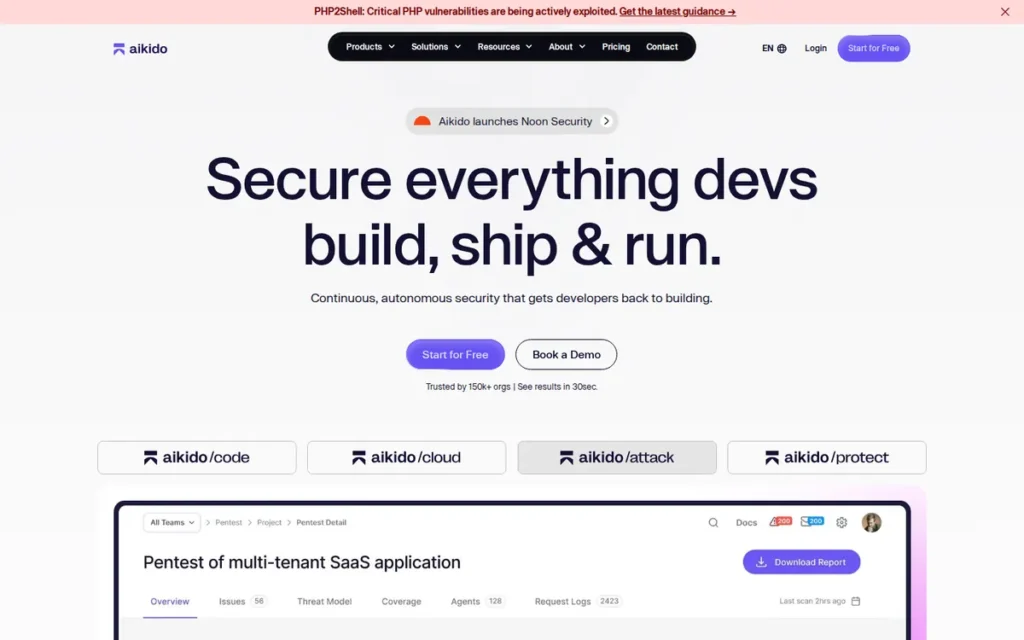
Category: All-in-One AppSec Platform, consolidates SAST, SCA, DAST, CSPM, secrets detection, container scanning, runtime protection, and AI pentesting into a single developer-native dashboard.
At a Glance
- Category: All-in-One AppSec Platform
- Best For: Mid-market to growth-stage engineering teams consolidating multiple point AppSec tools into one developer-friendly platform with broad coverage and transparent per-team pricing
- Price Range: Free (Developer Plan); Basic ~$314–$350/month (10 users, core scans); Pro ~$629–$700/month (10 users, full AI features + AI pentesting); Scale/Enterprise custom pricing
- Primary Strength: Aikido Security delivers the broadest AppSec coverage in the evaluated category (SAST, SCA, DAST, CSPM, secrets, container, IaC, runtime firewall, and AI pentesting) under one transparent per-team subscription, eliminating the need for five or more separate tool contracts
- Biggest Limitation: Aikido Security’s SAST engine is built on Opengrep, an open-source Semgrep fork maintained by the company, rather than a proprietary AI-trained scanning corpus; the 95% noise reduction claim is vendor-stated without published independent methodology
- One-Line Summary: Aikido Security is a developer-native all-in-one AppSec platform that earned G2 Leader and Easiest to Use recognition in 2026 and the Latio Tech 2026 Platform Leader designation by consolidating over a dozen security capabilities (including AI pentesting and a runtime firewall) into a single transparent-priced subscription trusted by 50,000+ organizations
- Last Verified: April 2026
Overview
Aikido Security is an all-in-one application security platform founded in 2022 in Ghent, Belgium, designed for mid-market engineering teams and growth-stage organizations that need enterprise-grade AppSec coverage breadth (SAST, SCA, DAST, CSPM, secrets, container, RASP, AI pentesting, and more) without managing five to seven separate tool relationships. Aikido Security reached a $1 billion valuation in January 2026 following a $60M Series B, becoming Europe’s fastest-ever cybersecurity company to achieve unicorn status (TechFundingNews, January 2026; Sifted, January 2026).
Aikido Security was named Platform Leader, AI Pentesting Innovator, and Supply Chain Innovator in the Latio Tech 2026 AppSec Report, three distinct category recognitions in one evaluation cycle (Latio Tech 2026 AppSec Report).
Aikido Security ranks #1 in this evaluation rather than Semgrep (#2) because Coverage Breadth (C3, 20% weight) and Pricing Transparency (C5, 10%) both favor Aikido Security materially, Aikido Security provides 12+ capability classes under one subscription versus Semgrep’s three (SAST, SCA, secrets), and transparent per-team pricing versus a per-contributor model that scales steeply past 50 contributors, while Semgrep’s advantage on detection precision is acknowledged and Semgrep is recommended as the primary alternative for precision-first teams.
Key Features
- AI AutoTriage: Aikido Security combines reachability analysis with cross-context correlation of code-level findings, cloud environment data, and runtime signals to filter actionable noise from false positives, the vendor claims a 95% reduction in actionable findings, though this figure is vendor-stated and has not been independently audited as of April 2026.
- AI Pentesting: Aikido Security’s AI Pentesting deploys more than 200 autonomous agents to simulate real-world attack scenarios including business logic flaws, insecure direct object references (IDOR), and API vulnerabilities, a dynamic testing capability not included in any other tool evaluated in this article.
- Zen Runtime Agent (RASP): Aikido Security’s Zen agent embeds directly into application processes to block in-flight attacks at runtime, providing a defense-in-depth layer that extends AppSec coverage from pre-production scanning into live production, the only open-source RASP implementation in the evaluated category.
- AI AutoFix: Aikido Security generates ready-to-merge pull requests resolving over 100 SAST, IaC, and container issue types, enabling one-click remediation directly from the Aikido Security dashboard without requiring developers to context-switch to a separate tool.
- SCM-Native Integration: Aikido Security integrates with GitHub, GitLab, Azure DevOps, and Bitbucket via a lightweight app, surfaces findings in PR comments and developer-configured Slack or Teams channels, and maps coverage to ISO 27001, SOC 2, OWASP Top 10, and NIS2 compliance frameworks.
Best For
Aikido Security is best for mid-market engineering organizations (10–200 developers) evaluating whether to replace three to seven disconnected point security tools (separate SAST, SCA, DAST, CSPM, secrets, and container scanners) with a single transparent-priced platform. Aikido Security is particularly well-suited for teams using AI coding assistants like GitHub Copilot or Cursor who need AI-generated code security coverage alongside traditional vulnerability scanning.
Pricing
Aikido Security offers a free Developer Plan for individual use. The Basic plan is priced at approximately $314–$350 per month for up to 10 users and includes SAST, SCA, IaC, secrets, container, and CSPM scanning. The Pro plan at approximately $629–$700 per month adds malware detection, AI AutoFix, AI AutoTriage, advanced DAST, and AI pentesting. Scale/Enterprise pricing requires direct sales engagement.
Consolidation math for 50 developers: Snyk Team ($1,250/month) plus a secrets scanning tool (~$200/month) plus a container scanner (~$300/month) plus a CSPM tool (~$500/month) totals approximately $2,250/month for the coverage Aikido Security Pro provides at $700/month. Whether the $1,550/month difference justifies Aikido Security’s Opengrep-based SAST trade-off versus Snyk’s DeepCode AI scanning depth is the decision this comparison is designed to help you make. Pricing verified April 2026 via aikido.dev/pricing.
Strengths
- Aikido Security earned three simultaneous recognitions in the Latio Tech 2026 AppSec Report (Platform Leader, AI Pentesting Innovator, and Supply Chain Innovator) a multi-category designation from an independent AppSec analyst organization that distinguishes Aikido Security from tools evaluated on a single dimension (Latio Tech 2026 AppSec Report, April 2026).
- Aikido Security holds G2 Leader and Easiest to Use badges in the AI AppSec Assistants category as of April 2026, reflecting high user satisfaction among its 50,000+ organization base, with named enterprise customers including Revolut, Premier League, Niantic, and SoundCloud (G2, April 2026).
- Aikido Security achieved a $1 billion valuation in January 2026 following a $60M Series B investment and received the Frost & Sullivan 2026 Global Application Security Posture Management Customer Value Leadership Award, validating Aikido Security’s ASPM competitive positioning beyond developer community sentiment (TechFundingNews, January 2026; PRNewswire, 2026).
- A practitioner-conducted competitive evaluation documented in r/devsecops found Aikido Security provides CSPM, container OS scanning, VM scanning, license monitoring, runtime firewall (Zen), AI code review, malware detection, and automated pentesting that Snyk does not bundle natively, representing six or more additional capability classes at comparable or lower total cost (r/devsecops, u/Lumpy-Lobsters, 2026).
Users on r/devsecops shared their experience:
“Aikido any day. Does SAST, DAST, even infrastructure scanning. It’s a one-stop shop for identifying vulnerabilities across the whole SDLC.” Posted by u/Mother_Somewhere_423
Takeaway: Independent practitioners consistently cite Aikido Security’s breadth of coverage (SAST through infrastructure scanning) as its primary differentiator from point-solution competitors.
Limitations
- Opengrep SAST Engine: Aikido Security’s most consequential trade-off is that its underlying SAST engine is Opengrep (the company’s own open-source fork of the Semgrep codebase) rather than a proprietary AI-trained scanning model, meaning teams requiring detection of novel vulnerability classes beyond community rule coverage will find Aikido Security’s raw SAST detection less deep than Snyk’s DeepCode AI (trained on 25M+ data flow cases) or Semgrep’s Pro Engine with cross-file dataflow analysis.
- Community Aggregation Criticism: Aikido Security faces direct characterization in r/devsecops as “a GUI over random middling OSS projects”, a critique the Aikido Security CTO addressed publicly, acknowledging the open-source dependency while arguing that integration quality, AI triage layers, and the open-source RASP constitute genuine proprietary contributions (r/devsecops, Aikido CTO response, 2025).
- DAST Maturity: Aikido Security’s DAST capabilities are emerging and have not been independently validated as production-grade, no practitioner review data comparable to Checkmarx One or Veracode’s DAST depth was identified in research, and teams with rigorous DAST requirements should conduct a proof-of-concept evaluation before relying on Aikido Security DAST in production workflows.
- Unaudited Noise Reduction Claim: Aikido Security’s 95% noise reduction figure (while mechanistically plausible given the cross-context correlation architecture) remains a vendor-stated number without published independent methodology; teams should validate this claim against their specific technology stack during any bake-off evaluation.
Verdict
Aikido Security is the top-ranked AI AppSec assistant in this evaluation for mid-market teams seeking consolidated coverage breadth, developer-native workflow integration, and transparent per-team pricing, validated by G2 Leader and Easiest to Use recognition, Latio Tech 2026 triple recognition, and a Frost & Sullivan ASPM award as of April 2026. Teams currently running Snyk alongside separate CSPM, secrets scanner, and container scanning subscriptions should model Aikido Security’s per-team pricing against their total current tool spend before dismissing its Opengrep-based SAST trade-off. Teams requiring the deepest SAST detection accuracy should evaluate Semgrep for stronger publicly documented precision, and large enterprise teams with formal compliance governance requirements should evaluate Checkmarx One for its Gartner-recognized positioning.
2. Semgrep: Best for Detection Accuracy: Highest G2 Rating with the Only Publicly Documented AI Triage Performance Data in the Category
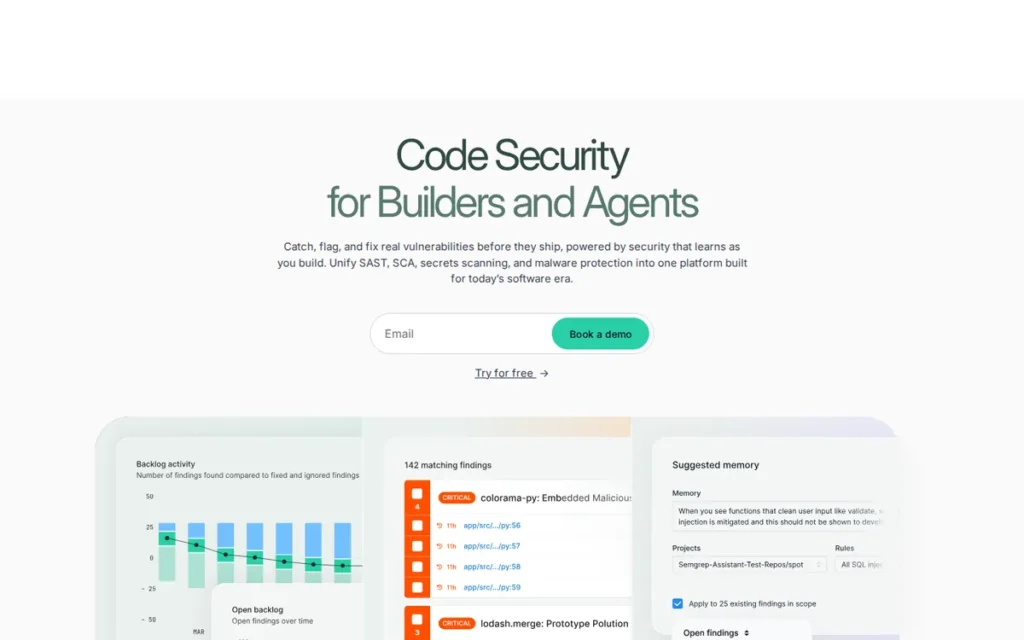
Category: AI-Native SAST Platform, combines deterministic AST-based code scanning with LLM-powered agentic triage to detect vulnerabilities and automate security finding prioritization in developer workflows.
At a Glance
- Category: AI-Native SAST Platform
- Best For: Security-conscious engineering teams at high-velocity organizations who need provably accurate SAST with low false positive rates, custom rule flexibility for organization-specific security policies, and CI/CD-native workflow integration
- Price Range: Free (OSS engine + community rules, up to 10 contributors free); Team plan $40/contributor/month; Enterprise custom pricing
- Primary Strength: Semgrep is the only AI AppSec assistant in this evaluation with publicly documented triage performance data, 60% of all SAST findings handled automatically at a 96% agreement rate with security researcher manual review, documented across 6M+ findings in Semgrep’s own published analysis (2025)
- Biggest Limitation: Semgrep’s AppSec coverage is limited to SAST, SCA, and secrets detection, no DAST, CSPM, or container scanning; at 100 contributors, Semgrep Team at $4,000/month plus a separate DAST tool can exceed Aikido Security’s all-in-one Pro plan at $700/month
- One-Line Summary: Semgrep is an AI-native SAST platform with publicly documented triage performance data showing 60% of findings handled at 96% agreement across 6M+ findings (2025), 2025 Gartner Magic Quadrant inclusion in six years from founding, and the highest G2 rating in the evaluated category (4.6/5.0), making it the strongest evidence-backed choice for teams where detection precision is the primary selection criterion
- Last Verified: April 2026
Overview
Semgrep is an AI-native application security platform founded in 2019 by Dan McDonald and Yoann Padioleau, built for security-conscious engineering teams at high-velocity organizations that prioritize SAST detection accuracy and low false positive rates over all-in-one coverage breadth, combining AST-based deterministic scanning with GPT-4-powered triage across SAST, SCA, and secrets detection. Semgrep was included in the 2025 Gartner Magic Quadrant for Application Security Testing, achieved in only six years from founding (Semgrep PRNewsWire, 2025), and holds a G2 rating of 4.6/5.0, the highest of any tool evaluated in this article.
Semgrep’s customer list includes Figma, Snowflake, Plaid, Lyft, and Dropbox (G2, April 2026). Semgrep’s defining AI capability, Semgrep Assistant, uses GPT-4 to automatically handle 60% of all SAST findings at a 96% agreement rate with security researcher manual review, documented across 6 million+ findings in Semgrep’s own published analysis (Semgrep, 2025).
Key Features
- Semgrep Assistant AI Triage: Semgrep Assistant uses GPT-4 to automatically handle 60% of SAST findings without human intervention, achieving a 96% agreement rate with security researcher manual review across a documented dataset of 6 million+ findings, the most specific publicly available AI triage performance data in the evaluated category, published by Semgrep from its own customer deployments in 2025 (Semgrep, 2025).
- Assistant Memories: Semgrep’s Assistant Memories feature learns from prior human triage decisions, improving automated triage accuracy over time as organization-specific security context accumulates, reducing the initial calibration burden for teams onboarding from noisier tools with high baseline false positive rates.
- Pro Engine Cross-File Dataflow Analysis: Semgrep’s Pro Engine adds cross-file dataflow analysis for six enterprise languages, enabling detection of vulnerability patterns spanning multiple functions or files that single-file pattern rules miss entirely, available on paid tiers only.
- YAML-Based Custom Rules: Semgrep’s custom rule syntax enables security engineers to deploy new vulnerability detection rules in under one hour, validated by Figma’s security team, which described going from “idea to live in an hour” for emerging threat patterns specific to their codebase (Semgrep AppSec Platform page).
- SCA Reachability Analysis: Semgrep Supply Chain provides SCA with reachability analysis, filtering dependency vulnerability findings to those where the vulnerable code is actually callable in production code paths and deprioritizing theoretically vulnerable but unreachable dependencies.
Best For
Semgrep is best for security engineering teams at high-velocity software organizations (particularly those migrating away from SonarQube due to false positive overload) who need the highest available detection accuracy with publicly documented performance data, custom rule flexibility to encode organization-specific security policies, and PR-native workflow integration that surfaces findings without depending on IDE plugin adoption.
Pricing
Semgrep offers a free tier using the open-source engine with community rules. The Team plan starts at $40 per contributor per month with up to 10 contributors at no charge; this tier includes Semgrep Code SAST, Semgrep Supply Chain SCA, Semgrep Secrets, and Semgrep Assistant AI triage. Enterprise pricing requires direct sales engagement.
At 100 contributors, Semgrep Team at $4,000/month plus a separate DAST tool can exceed Aikido Security’s all-in-one Pro plan at $700/month, making coverage scope a direct total cost of ownership concern for mid-market teams, not merely a feature gap. Pricing verified April 2026 via semgrep.dev/pricing.
Strengths
- Semgrep’s 2025 published analysis documented that Semgrep Assistant automatically handles 60% of SAST findings at a 96% agreement rate with security researcher manual reviews across 6 million+ findings, the most specific publicly available AI triage performance data in the evaluated category, originating from Semgrep’s own analysis across thousands of customer deployments; this data has not been independently replicated by a third-party auditor as of April 2026, but its named methodology and scale make it the strongest publicly available triage accuracy evidence in this category (Semgrep, 2025).
- Semgrep was included in the 2025 Gartner Magic Quadrant for Application Security Testing, achieving analyst recognition in only six years from founding, providing the procurement credibility needed by organizations whose tool selection process requires analyst-validated vendor due diligence (Semgrep PRNewsWire, 2025).
- Figma’s security team reported that Semgrep’s custom rule syntax enables deployment of new vulnerability detection rules in under one hour, a speed that traditional SAST tools requiring professional services engagement for rule customization cannot match (Semgrep AppSec Platform case study).
- Synthesia’s security team described Semgrep as delivering “just enough signal at the right moment without overwhelming developers”, practitioner validation of Semgrep’s anti-alert-fatigue design from an AI-native software company with high developer velocity requirements (Semgrep Synthesia case study).
This aligns with community sentiment on r/devsecops:
“Both are quite good. What I like about semgrep is that it’s got less false positives in my experience and explains better why something actually needs to be fixed. It’s also really fast by comparison.” Posted by u/RelevantStrategy
Takeaway: Practitioners evaluating Semgrep against alternatives consistently identify lower false positive rates and clearer remediation guidance as its practical advantages over competing SAST tools.
Limitations
- Coverage Scope: Semgrep’s most consequential trade-off is coverage: Semgrep provides SAST, SCA, and secrets detection but does not include DAST, CSPM, container scanning, or runtime protection, at 100 contributors, Semgrep Team at $4,000/month plus a separate DAST tool can exceed Aikido Security’s all-in-one Pro plan at $700/month, making coverage scope a direct total cost of ownership concern rather than merely a feature gap.
- IDE Integration Quality: Multiple r/devsecops practitioners who endorse Semgrep specifically note that its IDE integrations are “not the best”, developer-native code editor feedback is weaker than its PR-comment and CI/CD pipeline feedback, limiting real-time in-editor security guidance as a Semgrep-specific capability (r/devsecops, u/Gryeg).
- Jira-Only Issue Tracker: Semgrep natively integrates with Jira as its only supported issue tracker, teams using Linear, GitHub Issues, Azure DevOps Boards, or other trackers will need to build custom integrations, adding implementation overhead for teams outside the Atlassian ecosystem.
- Contributor-Based Pricing at Scale: Semgrep’s $40/contributor/month pricing scales significantly less favorably than per-team alternatives for organizations with 100 or more active contributors, making total cost of ownership at enterprise scale a calculation that must include comparison against Aikido Security’s per-team model.
Verdict
Semgrep is the highest-rated AI AppSec assistant in this evaluation by G2 score (4.6/5.0) and the only tool with publicly documented AI triage performance data (60% automation at 96% agreement across 6 million+ findings from Semgrep’s own published analysis) making it the strongest evidence-backed choice for teams where SAST detection precision is the primary selection criterion. Semgrep is the most-cited replacement tool for teams experiencing SonarQube false positive overload, the preferred SAST layer for high-velocity engineering organizations including Figma and Snowflake, and the tool most frequently described in r/devsecops as hitting the “sweet spot” between accuracy and noise reduction. Teams requiring DAST, CSPM, or container scanning alongside SAST should evaluate Aikido Security’s all-in-one pricing model for better total cost of ownership at mid-market scale.
3. Snyk: Best for Developer Adoption: Largest Review Base with a Proprietary AI Scanning Engine
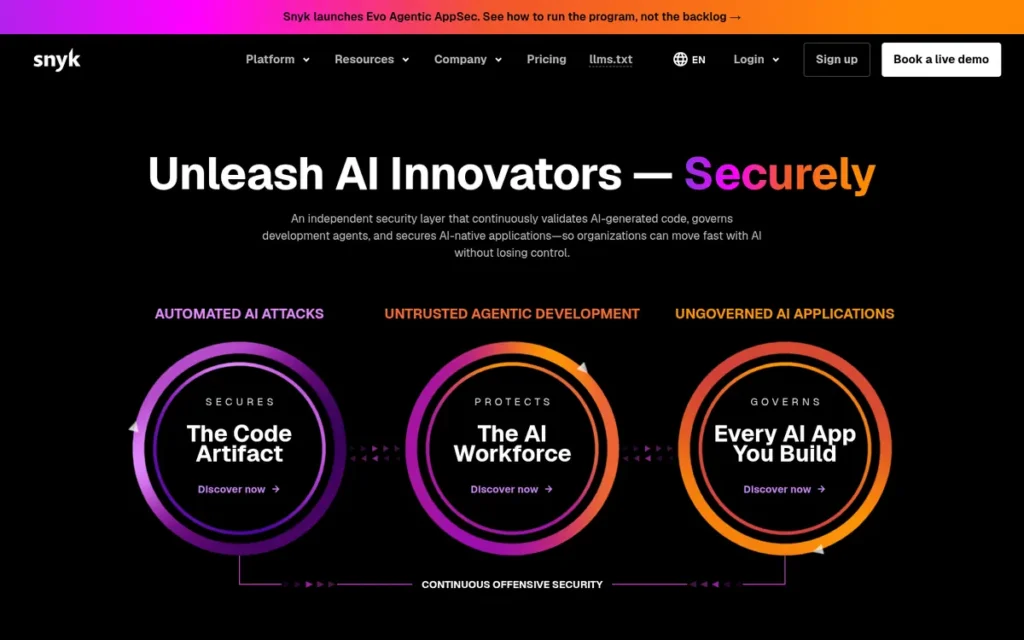
Category: Developer-First AppSec Platform, integrates proprietary AI-powered SAST, SCA, IaC, and container scanning into developer IDE, PR, and CI/CD workflows with an optional ASPM layer for runtime risk correlation.
At a Glance
- Category: Developer-First AppSec Platform
- Best For: Developer-centric engineering teams at growth and enterprise organizations needing the category’s most community-validated AppSec platform with a proprietary AI scanning engine and native integration with all major developer tools
- Price Range: Free (limited, open-source focused); Team plan ~$25/developer/month (billed annually); Enterprise custom pricing (SSO, AppRisk Pro ASPM, advanced policy)
- Primary Strength: Snyk’s DeepCode AI scanning engine: trained on 25 million+ security-specific data flow cases and the only proprietary in-house AI SAST model in the evaluated category, generates autofixes with an 80% claimed accuracy rate across 19+ programming languages without sending customer code to a third-party model provider (Snyk DeepCode AI, 2024)
- Biggest Limitation: Snyk’s per-developer pricing scales steeply at 200+ developers, and community reports document Snyk Code false positive volumes that create the alert fatigue the platform is designed to prevent, including one r/devsecops practitioner who described a false positive haystack causing developers to miss real vulnerabilities
- One-Line Summary: Snyk is a developer-first AppSec platform with the highest review volume in the category (G2 600+ reviews, 4.5/5.0) and the only proprietary AI SAST engine trained on 25 million+ security data flow cases, making it the most validated choice for organizations prioritizing developer adoption confidence and AI scanning depth over all-in-one coverage breadth
- Last Verified: April 2026
Overview
Snyk is a developer-first application security platform founded in 2015 that integrates AI-powered SAST (Snyk Code, powered by the proprietary DeepCode AI engine), SCA (Snyk Open Source), IaC scanning (Snyk IaC), and container security (Snyk Container) into a unified developer experience layer, designed for growth-to-enterprise teams where developer workflow adoption is the primary AppSec program success metric. Snyk’s DeepCode AI, acquired via the Zurich-based DeepCode startup around 2020, is trained on more than 25 million security-specific data flow cases, supports 19+ programming languages, and generates autofixes with an 80% claimed accuracy rate, per Snyk product documentation, using a self-hosted LLM that avoids sending customer code to external AI services (Snyk DeepCode AI, 2024).
Snyk holds a G2 rating of 4.5/5.0 with 600+ verified reviews, the highest review volume in the AI AppSec Assistants category by a wide margin. An AppSec lead on r/devsecops describes Snyk as “100% hands down the most adopted SAST tool throughout my career” (r/devsecops, u/NandoCa1rissian, 2026).
Key Features
- DeepCode AI Proprietary SAST Engine: Snyk’s DeepCode AI powers Snyk Code SAST with a proprietary machine learning model trained on more than 25 million security-specific data flow cases, generating autofixes with an 80% claimed accuracy rate, per Snyk product documentation, across 19+ programming languages using a self-hosted LLM that avoids sending customer code to external AI services (Snyk DeepCode AI, 2024).
- SCA Reachability Analysis (JavaScript and Python): Snyk’s reachability analysis covers approximately 90% of high and critical severity vulnerabilities in JavaScript and Python codebases, filtering findings to those where vulnerable dependency code is actually callable in production and deprioritizing theoretically vulnerable but unreachable code paths, reducing actionable alert volume for teams in those ecosystems (Snyk Documentation, 2024).
- AppRisk Pro ASPM: Snyk AppRisk Pro, launched in May 2024, introduces AI-powered Application Security Posture Management by integrating Sysdig runtime intelligence to trace active vulnerabilities from production context back to source code components, enabling prioritization by actual exploitability rather than theoretical CVSS severity score (Snyk AppRisk Pro launch).
- Developer Workflow Embedding: Snyk embeds security into developer-native workflows via IDE plugins for VS Code, IntelliJ, Eclipse, and others, plus automated PR security comments with inline fix suggestions, positioning security feedback within existing developer tools rather than requiring adoption of a separate security portal.
- Unified Developer Finding Backlog: Snyk consolidates SAST, SCA, IaC, and container scanning findings under a single developer login with a unified backlog that can be triaged, assigned, and tracked across security and engineering teams, reducing context-switching overhead from managing separate tool dashboards.
Best For
Snyk is best for developer-centric engineering organizations at growth to enterprise scale where developer workflow adoption is the primary AppSec program success metric. Snyk is particularly well-suited for organizations that require a proprietary (not open-source-based) AI scanning engine for regulated industry or data privacy compliance reasons, or for teams where prior SAST tools failed specifically because developers resisted adoption.
Pricing
Snyk’s Free plan supports individual developers with limited monthly test counts, primarily for open-source project scanning. The Team plan is priced at approximately $25 per developer per month (billed annually), including Snyk Code SAST, Snyk Open Source SCA, Snyk IaC, and Snyk Container. Enterprise pricing requires sales contact and adds Snyk AppRisk Pro, SSO, and advanced policy controls.
At 200 developers, the Snyk Team tier costs approximately $5,000/month, community discussions consistently cite this threshold as where cost-to-ROI comparisons with per-team alternatives become unavoidable. Pricing verified April 2026 via snyk.io/plans.
Strengths
- Snyk holds a G2 rating of 4.5/5.0 with 600+ verified reviews: the highest review volume of any tool evaluated in this article by a factor of three, providing the most statistically robust community validation dataset in the AI AppSec Assistants category (G2, April 2026).
- Snyk’s DeepCode AI SAST engine was acquired from the Zurich-based DeepCode startup with a claimed training corpus of 25 million+ security data flow cases, making it the only tool in this evaluation with a proprietary, in-house-developed AI scanning model rather than an open-source engine with AI triage layers added on top (Snyk DeepCode AI, 2024).
- Knox Anderson, SVP of Product Management at Sysdig, validated Snyk AppRisk Pro’s runtime intelligence integration: “By seamlessly integrating with Sysdig, Snyk AppRisk Pro empowers teams to quickly and accurately assess the risk of vulnerabilities in runtime environments… driving a more efficient and developer-centric AppSec program” (Snyk AppRisk Pro press release, 2024).
- An AppSec lead on r/devsecops described Snyk as “100% hands down the most adopted SAST tool throughout my career”, a practitioner-observed organic adoption dynamic that distinguishes Snyk from tools selected by procurement teams but resisted by developers during deployment (r/devsecops, u/NandoCa1rissian, 2026).
Limitations
- Alert Fatigue at Scale: Snyk’s most consequential trade-off is that false positive volumes (even for developer-preferred tools) create the alert-ignore cascade at sufficient scale. One r/devsecops practitioner documented: “I struggled more with Snyk false positives to the point that my team couldn’t keep up… and that’s when we missed real issues. Because it was too big of a haystack already” (r/devsecops, u/DifficultAd3386).
Takeaway: Even the most developer-friendly tools generate alert fatigue at scale, validate Snyk Code false positive rates against your specific codebase and language stack before committing to a multi-year contract.
- CLI/GUI Inconsistency and Workflow Gaps: Snyk Code CLI findings do not sync to the web GUI, files larger than 1MB are skipped from scanning, Jira automation for SAST findings is absent, and policy controls are limited beyond blanket ignores, specific operational gaps documented by r/devsecops practitioners representing workflow friction for mid-to-large AppSec teams (r/devsecops, u/AdResponsible7865).
Takeaway: CLI/GUI inconsistency and a 1MB file size scanning limit are concrete operational gaps that affect mid-to-large teams running Snyk Code, evaluate against your actual codebase file sizes before deployment.
- Per-Developer Pricing at Scale: Snyk’s ~$25/developer/month Team tier scales steeply for organizations with 200 or more developers, and community discussions consistently cite cost-to-ROI as a migration driver toward per-team alternatives, particularly when DAST, CSPM, and container scanning require separate subscriptions not included in Snyk’s standard tiers.
- Coverage Gaps for Full-Stack Security: Snyk does not include native DAST, CSPM, or AI pentesting, organizations requiring full-stack security coverage must supplement Snyk with additional tool subscriptions, eroding the per-developer cost advantage for teams that currently pay for multiple point solutions.
Verdict
Snyk is the AI AppSec platform with the largest verified review corpus in this evaluation, G2 600+ reviews at 4.5/5.0, the highest volume by a factor of three, and the strongest practitioner-reported developer adoption signal, making it the category’s most broadly validated reference point for developer-native AppSec deployment. Snyk’s DeepCode AI engine and AppRisk Pro ASPM layer provide genuine technical differentiation over open-source-engine competitors, and the Sysdig runtime intelligence integration delivers one of the more sophisticated risk prioritization approaches evaluated. Teams at 200+ developer scale should model total cost against per-team alternatives; teams experiencing alert fatigue should validate Snyk Code’s false positive rates against their specific codebase before committing; and security leaders needing DAST or CSPM should evaluate whether separate subscriptions maintain a cost advantage over all-in-one platforms.
4. Sonar (SonarQube / SonarCloud / SonarLint): Best for Brownfield Organizations: Largest Install Base with a Free Community Edition and Clean Code Methodology
Category: Code Quality + Security Scanner, enforces code quality standards and security vulnerability detection across 40+ languages using a unified Clean Code methodology, with AI-assisted fix generation and AI-generated code verification added in October 2024.
At a Glance
- Category: Code Quality + Security Scanner
- Best For: Organizations with large brownfield codebases needing a proven, widely-deployed code quality and security scanning platform, or teams where code quality governance is an equal priority alongside security vulnerability detection
- Price Range: Community Edition free (open source); Developer Edition from ~$150/year; Enterprise Edition from ~$20,000/year; Data Center Edition from ~$130,000/year; SonarQube Cloud from ~$10/month (Team); AI CodeFix gated to Team and Enterprise cloud tiers only
- Primary Strength: Sonar’s 400,000+ organization install base, free Community Edition, and 40+ language and framework support make it the most widely deployed code analysis platform in the evaluated category, with the largest developer community and the broadest rule ecosystem of any tool evaluated
- Biggest Limitation: Sonar’s AI CodeFix: the primary AI feature qualifying Sonar for this evaluation category, is unavailable on the free Community Edition and Developer Edition tiers that represent the majority of its 400,000+ organization install base; additionally, false positive rates in security-specific rules are the most consistently cited migration trigger in r/devsecops discussions
- One-Line Summary: Sonar (SonarQube / SonarCloud) is the most widely deployed code analysis platform in the evaluated category with 400,000+ organizations, a free Community Edition, and 40+ language and framework support, making it the established starting point for teams combining code quality governance with security scanning, but also the most common departure tool in practitioner migration discussions when false positive rates erode developer trust
- Last Verified: April 2026
Overview
Sonar (SonarSource) is a code quality and security scanning platform founded in 2008 in Geneva, Switzerland, offering SonarQube Server (self-hosted), SonarQube Cloud (SaaS, formerly SonarCloud), and SonarLint (free IDE plugin), collectively deployed by 400,000+ organizations across 40+ programming languages and frameworks, making Sonar the most widely installed code analysis platform in the evaluated category (SonarSource, 2025 Year-in-Review). Sonar’s core philosophy is “Clean Code”, treating code quality and security as inseparable dimensions of software health, enforced through configurable Quality Gates in CI/CD pipelines that fail builds introducing new quality or security issues.
Sonar added AI CodeFix (automated LLM-based fix generation) and AI Code Assurance (AI-generated code detection and verification against quality and security standards) in October 2024, extending capabilities from detection into assisted remediation and directly addressing the AI-generated code security challenge within existing SonarQube CI/CD workflows (BusinessWire, October 2024).
Key Features
- AI CodeFix: Sonar’s AI CodeFix (launched October 2024) generates automated code fixes for detected issues by sending the vulnerable code and issue description to an LLM, which proposes an edit resolving the problem without modifying surrounding functionality, available for Java, JavaScript/TypeScript, C#, Python, and C/C++ on Enterprise and Data Center editions and SonarQube Cloud Team and Enterprise plans (SonarQube Cloud AI CodeFix documentation).
- AI Code Assurance: Sonar’s AI Code Assurance (launched October 2024) identifies and verifies code generated by AI coding platforms including ChatGPT, GitHub Copilot, and Cursor, ensuring AI-generated code meets the same quality and security standards as human-written code before reaching production within existing CI/CD quality gate workflows (SiliconAngle, October 2024).
- Clean as You Code Methodology: Sonar’s Clean as You Code methodology enforces quality and security gates exclusively on new and changed code (defined by a configurable New Code Period) enabling brownfield organizations with large legacy codebases to achieve meaningful security improvement without remediating all historical technical debt simultaneously (SonarSource community documentation, Clean as You Code methodology, 2024).
- SonarLint Free IDE Plugin: SonarLint provides real-time IDE analysis for VS Code, IntelliJ IDEA, Eclipse, and Visual Studio, the most widely distributed free IDE security plugin in the evaluated category, requiring no subscription and available as a standalone tool for developers wanting immediate code quality feedback.
- 40+ Language and Framework Coverage: Sonar supports 40+ programming languages and frameworks across all scan types (the broadest language coverage of any tool evaluated) relevant for polyglot organizations with heterogeneous technology stacks that would exceed the language support limits of more specialized tools (SonarSource, 2025 Year-in-Review).
Best For
Sonar is best for organizations with large brownfield codebases that need a pragmatic incremental security improvement path via Clean as You Code, or for teams that treat code quality governance as an equal priority alongside security vulnerability detection. Sonar is particularly well-suited for organizations already using SonarQube’s free Community Edition who are evaluating whether to upgrade to paid tiers for AI CodeFix access rather than switching to a different platform.
Pricing
SonarQube Server Community Edition is free and open source. SonarQube Developer Edition starts at approximately $150 per year for 100,000 lines of code, scaling by lines of code. Enterprise Edition starts at approximately $20,000 per year. Data Center Edition starts at approximately $130,000 per year.
SonarQube Cloud is free for open-source projects and starts at approximately $10 per month for small teams. AI CodeFix is available only on Team and Enterprise SonarQube Cloud tiers and Enterprise/Data Center Server editions, not on Community or Developer Editions. The LOC-based pricing model can scale unexpectedly for large polyglot monorepos. Pricing verified April 2026 via sonarsource.com/plans-and-pricing.
Strengths
- SonarSource reported 400,000+ organizations using its products globally, supported by 7M+ developers analyzing over 750 billion lines of code daily, the largest verified install base of any tool in this article, resulting in the most extensive rules ecosystem across 40+ languages and the highest baseline developer familiarity of any AppSec scanning platform (SonarSource, 2025 Year-in-Review).
- Sonar added AI Code Assurance in October 2024: a capability to detect and verify AI-generated code from ChatGPT, GitHub Copilot, and Cursor against quality and security standards before production deployment, making Sonar among the first widely-deployed AppSec platforms to address AI-generated code security within existing CI/CD quality gate workflows (BusinessWire, October 2024).
- Sonar’s Clean as You Code methodology is the only evaluated tool with an explicit, productized adoption strategy for organizations that cannot pause development velocity to address legacy security backlogs comprehensively, enabling brownfield teams to demonstrate measurable security improvement without a full technical debt remediation sprint (SonarSource community documentation, Clean as You Code methodology, 2024).
- A practitioner from a 10,000+ developer organization with 10,000+ repositories described Sonar’s deployment as the first-layer quality and security gate across all repositories (filtering high-volume findings before applying deeper SAST tools selectively to high-risk applications) validating Sonar’s practical role as the baseline AppSec layer in large enterprise multi-tool stacks (r/cybersecurity, u/pecesiqueira, 2026).
Limitations
- AI CodeFix Tier Gating: Sonar’s most consequential trade-off in the context of this AI AppSec assistant evaluation is that AI CodeFix (the primary AI feature that qualifies Sonar for this category) is unavailable on the free Community Edition and Developer Edition tiers that represent the vast majority of its 400,000+ organization install base, meaning most existing Sonar users must upgrade to higher-cost tiers or switch platforms to access AI-assisted remediation.
- Alert-Ignore Cascade Risk: Sonar is simultaneously the category’s most widely deployed AppSec tool and the most consistently cited departure point in practitioner migration discussions, false positive rates in security-specific rules generate developer alert fatigue that causes developers to stop reading security alerts entirely, producing the failure mode the tool was deployed to prevent (r/devsecops, u/InstructionCute5502, March 2026).
“We switched from SonarQube to Semgrep a few months ago. Way less noise but still get some misses.”, u/AdOrdinary5426, r/devsecops, 2026
Takeaway: The SonarQube-to-Semgrep migration pattern appears in multiple independent r/devsecops threads, “less noise” is the consistent reason cited, making false positive reduction the primary unmet need for teams departing SonarQube.
- “Code Quality Tool” Perception: Sonar is broadly characterized in the practitioner community as “a code quality tool trying to be a security tool”, a characterization that is not entirely unfair, given that SonarQube rules measure complexity, duplication, and maintainability alongside security vulnerability classes, diluting the security signal with non-security findings in developer queues.
- LOC-Based Pricing Unpredictability: Sonar’s lines-of-code-based pricing model scales unexpectedly for large polyglot monorepos, making multi-year cost forecasting less predictable than per-developer or per-team alternatives and creating potential for mid-contract cost surprises as codebases grow.
Verdict
Sonar (SonarQube / SonarCloud) is the best-established code quality and security scanning platform in this evaluation, with 400,000+ organizations validating its deployment breadth, 40+ language and framework support, the only free fully-functional community edition in the category, and pragmatic Clean as You Code methodology for brownfield adoption. Sonar is also the most common prior tool in practitioner migration discussions, and the departure reason, false positive-driven alert fatigue, compounded by AI CodeFix being unavailable to the majority of the install base, is consistent enough to treat as a structural pattern rather than an outlier. Teams considering Sonar as a new AI AppSec investment should explicitly evaluate whether paid tiers providing AI CodeFix represent better ROI than starting with Semgrep or Aikido Security, where AI-assisted noise reduction is included from day one.
5. Arnica: Best Architecture for AI-Generated Code Security: Pipelineless SCM-Layer Scanning with Pre-Generation Policy Enforcement
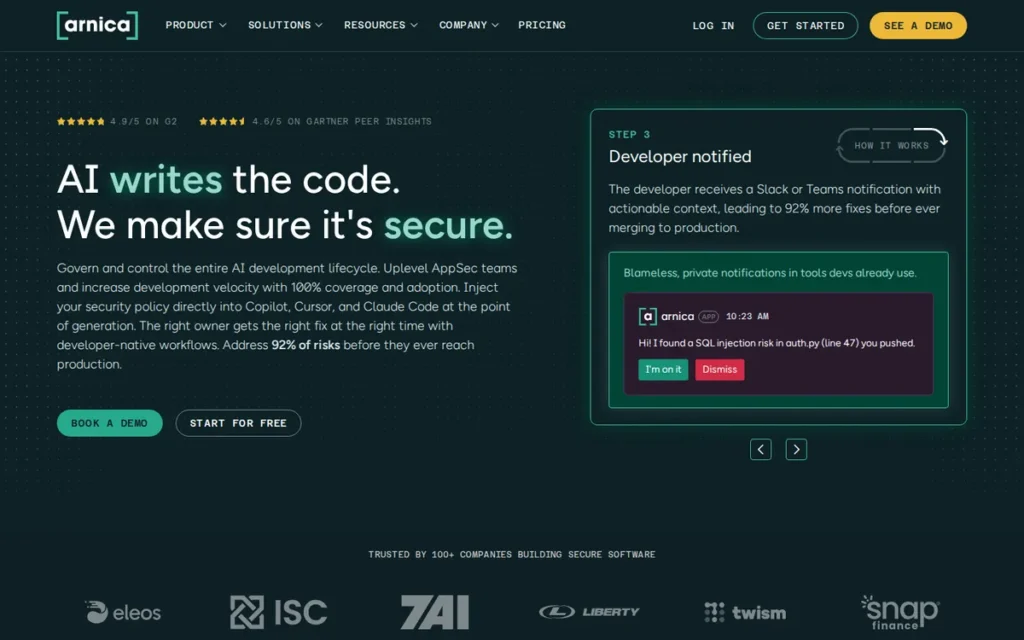
Category: Pipelineless Agentic Scanner, secures code at the SCM layer on every push without CI/CD pipeline configuration, using multi-agent AI to detect vulnerabilities and enforce security policies at the point of AI code generation.
At a Glance
- Category: Pipelineless Agentic Scanner
- Best For: Engineering organizations with heavy AI coding tool adoption (GitHub Copilot, Cursor) that have experienced IDE security plugin adoption failure at scale and need deployment-day-one universal code coverage without developer opt-in or CI/CD integration maintenance
- Price Range: Not publicly disclosed; free tier available via GitHub Marketplace; paid plans require direct sales contact
- Primary Strength: Arnica’s pipelineless architecture integrates directly at the SCM layer, scanning every code push and pull request on all feature branches without CI/CD pipeline configuration, achieving broader code coverage than CI/CD-dependent tools can guarantee in organizations where not all repositories have standardized pipeline configurations
- Biggest Limitation: Arnica has no verified G2 or Capterra review presence, does not publicly disclose pricing, and its key performance claim (92% of risks addressed pre-production) is vendor-stated without disclosed methodology or named customer verification
- One-Line Summary: Arnica is a pipelineless AppSec platform that launched its Arnie AI multi-agent security engine in November 2025, combining SCM-layer universal code coverage with an Agentic Rules Enforcer that applies enterprise security policies (including OWASP ASVS standards) at the point of AI code generation, the earliest security intervention point identified among the tools evaluated in this article
- Last Verified: April 2026
Overview
Arnica is a pipelineless application security platform that integrates directly with source control management systems (GitHub, GitLab, Azure DevOps, Bitbucket) via a lightweight SCM app, scanning every code push, pull request, and nightly cycle across all feature branches without requiring any CI/CD pipeline configuration, achieving broader code coverage automatically from deployment day one (arnica.io).
Arnica launched its Arnie AI multi-agent security engine in November 2025, combining deterministic static analysis with multi-agent AI reasoning for a hybrid SAST approach that detects complex logic flaws, access control vulnerabilities, and authentication gaps that pattern-only rule engines miss (Arnica press release, FinancialContent, November 2025).
Arnica ranks #5 in this evaluation above enterprise platforms with longer track records specifically on Developer Workflow Integration depth (C2, weighted 25%), pipelineless SCM-layer architecture is the only deployment model in this evaluation that achieves broader developer code coverage without the IDE plugin adoption barrier documented to limit all other tools to sub-20% developer reach at mid-to-large organizations, while acknowledging lower evidence scores on Review Platform Ratings (C4) and Pricing Transparency (C5) relative to both Checkmarx One and Veracode.
Key Features
- Pipelineless SCM-Layer Integration: Arnica integrates at the SCM layer rather than in CI/CD pipelines, scanning every code push on every feature branch without requiring DevOps team involvement in setup or maintenance, achieving broader code coverage than CI/CD-dependent tools can guarantee in organizations where not all repositories have standardized pipeline configurations (arnica.io).
- Agentic Rules Enforcer: Arnica’s Agentic Rules Enforcer embeds enterprise security policy enforcement (including OWASP Application Security Verification Standard (ASVS) policies) directly into AI coding assistant workflows including GitHub Copilot and Cursor, applying security standards at the point of AI code generation, which is architecturally prior to IDE scanning, CI/CD gating, and post-commit SAST (Arnica press release, November 2025).
- Arnie AI Multi-Agent Engine: Arnica’s Arnie AI engine (launched November 2025) combines deterministic static analysis rules with multi-agent AI reasoning to detect complex vulnerability classes (access control flaws, authentication gaps, and logic-level security issues) that single-pass pattern matching tools miss when they lack contextual reasoning to evaluate code intent alongside code structure.
- Developer-Opted Notification Delivery: Arnica delivers findings via opted-in Slack and Teams channels, PR comments, and Jira integrations, routing security findings through communication channels developers already monitor rather than requiring adoption of a separate security portal or IDE plugin, directly addressing the documented sub-20% IDE plugin adoption ceiling.
- Git History Secrets Remediation: Arnica’s secrets detection includes one-click or automated git history remediation that removes validated hardcoded credentials from both the current commit and the full git commit history, addressing the complete secrets lifecycle rather than detecting credentials and leaving the remediation burden to the developer (Arnica platform documentation, 2025–2026).
Best For
Arnica is best for engineering organizations where AI coding assistant adoption is widespread (35%+ of developers using GitHub Copilot or Cursor), IDE security plugin strategies have failed to achieve meaningful developer adoption, and the security team needs a deployment model that guarantees broader code coverage without requiring individual developer opt-in or CI/CD integration maintenance overhead.
Pricing
Arnica’s pricing is not publicly disclosed. A free tier is available via the GitHub Marketplace for basic repository visibility and security scanning. All paid configurations require direct sales engagement, and community discussions reference custom enterprise pricing negotiated individually.
The absence of public pricing is a significant friction point for self-serve evaluation, teams conducting rapid tooling shortlists frequently exclude products without public pricing before initial screening. Budget discovery time for sales engagement should be allocated before including Arnica in a formal bake-off. Pricing transparency status verified April 2026; no public pricing URL available.
Strengths
- Arnica’s pipelineless SCM-layer architecture directly addresses a documented structural failure in AppSec tool deployment: r/devsecops practitioners consistently report IDE security plugin adoption below 20% at mid-to-large organizations, while Arnica’s SCM-layer integration achieves broader code coverage from day one without developer or DevOps configuration (r/devsecops, u/ConsistentComment919, 2026).
“IDE plugins are problematic. Haven’t seen a single midsize+ company with more than 20% adoption rate. Devs don’t want security plugins… Scan every code change on feature branches, like Arnica.io, and communicate only what matters to the devs over a channel everyone is opted into, as Slack or Teams.”, u/ConsistentComment919, r/devsecops, 2026
Takeaway: The sub-20% IDE adoption ceiling is a structural constraint documented across all vendors, Arnica’s SCM-layer approach is the only architecture in this evaluation designed from inception to work around this limitation.
- Arnica launched its Arnie AI multi-agent security engine in November 2025, introducing an Agentic Rules Enforcer that enforces enterprise security policies (including OWASP ASVS standards) at the point of AI code generation, the only identified capability in this evaluation that acts before AI-assisted code is written rather than scanning it after the fact (Arnica press release, FinancialContent, November 2025).
- Arnica’s secrets detection with one-click git history remediation addresses the complete secrets lifecycle (detecting hardcoded credentials and providing automated removal from both current code and full commit history) a remediation completeness not available in the secrets detection modules of most multi-capability platforms evaluated (Arnica platform documentation, 2025–2026).
- A practitioner at a 10,000+ developer organization mentioned Arnica alongside Endor Labs as part of their enterprise multi-layer AppSec stack in 2026, positioning Arnica in the first-line scanning layer alongside Semgrep and Opengrep, indicating growing enterprise adoption beyond the startup segment where Arnica initially gained community traction (r/cybersecurity, u/pecesiqueira, 2026).
Limitations
- Transparency Gaps: Arnica’s most consequential trade-off is transparency: the platform has no verified presence on G2 or Capterra, does not publicly disclose pricing, and does not publish founder profiles, team size, or total funding information, creating genuine barriers to enterprise procurement evaluation where formal RFP processes require verified third-party review data, public pricing anchors for budget modeling, and named customer case studies with outcome metrics.
- Unverified Performance Claim: Arnica’s key claim: that 92% of detected risks are addressed pre-production, is vendor-stated without a disclosed methodology or named customer validation; teams should treat this figure as an aspirational benchmark rather than independently verifiable procurement-grade evidence.
- Narrow Coverage Scope: Arnica’s AppSec coverage includes SAST, SCA, secrets, IaC, and CI/CD hardening, but no standalone DAST capability or CSPM is documented, meaning teams requiring dynamic application testing or cloud posture management must supplement Arnica with additional tools, reducing the consolidation argument relative to platforms like Aikido Security.
- Early-Stage Vendor Viability: Arnica’s non-disclosure of company size, funding, and leadership introduces vendor continuity uncertainty for multi-year tooling commitments, a risk factor that large organizations with long-term AppSec program roadmaps should assess directly in sales conversations before contracting.
Verdict
Arnica is the only AppSec platform in this evaluation built on a pipelineless SCM-layer architecture that achieves broader code coverage on every push without CI/CD configuration or developer IDE plugin opt-in, a deployment model that directly addresses the documented sub-20% IDE adoption ceiling at mid-to-large organizations. For organizations whose primary AppSec deployment problem is achieving broader code coverage without developer opt-in friction, or for security leaders addressing the AI-generated code governance gap, Arnica’s architecture deserves serious evaluation consideration. The complete absence of public pricing, G2/Capterra review presence, and named customer case studies means evaluation-stage due diligence requires direct sales engagement and reference customer conversations before Arnica can be scored with the same evidentiary confidence as the higher-ranked tools in this article.
6. Checkmarx One: Best for Enterprise Governance: Gartner-Recognized with Agentic AI Spanning All Three DevSecOps Stakeholder Levels
Category: Enterprise Unified AppSec Platform, integrates SAST, SCA, DAST, IaC, API security, secrets, container, and supply chain scanning under a three-agent agentic AI governance layer designed for large-organization DevSecOps programs and formal compliance reporting.
At a Glance
- Category: Enterprise Unified AppSec Platform
- Best For: Large enterprises and regulated organizations with formal AppSec governance requirements, existing Checkmarx procurement relationships, or audit and compliance mandates requiring Gartner-recognized vendor selection with a unified multi-capability AppSec platform
- Price Range: Not publicly disclosed; enterprise annual licensing based on developer seat count and module selection; requires direct sales engagement for all configurations
- Primary Strength: Checkmarx One provides the broadest enterprise AppSec capability set in the evaluated category (SAST, SCA, DAST, IaC, API security, secrets, container, and supply chain scanning) under a three-agent agentic AI governance layer with Gartner Magic Quadrant Leader recognition for six consecutive years through 2023 and Gartner Peer Insights Customers’ Choice through 2024
- Biggest Limitation: Checkmarx One’s G2 developer satisfaction score (4.1/5.0) is the lowest among multi-capability platforms evaluated, pricing requires enterprise sales engagement, and r/devsecops practitioners consistently describe Checkmarx One selection as driven by procurement relationships and compliance positioning rather than developer preference or performance benchmarking
- One-Line Summary: Checkmarx One is an enterprise unified AppSec platform with Gartner Magic Quadrant Leader recognition for six consecutive years through 2023 and Gartner Peer Insights Customers’ Choice through 2024, three agentic AI agents spanning developer, security team, and CISO personas, and the broadest capability coverage in the evaluated category, positioned for large organizations where formal AppSec governance, compliance reporting depth, and analyst-validated vendor selection drive tooling decisions
- Last Verified: April 2026
Overview
Checkmarx One is a cloud-native enterprise application security platform founded in 2006 in Tel Aviv, Israel, that unifies SAST, SCA, DAST, IaC scanning, API security, secrets detection, container scanning, and supply chain security under a single ASPM governance layer, one of the most comprehensive AppSec capability sets available from a single vendor. Checkmarx One’s AI layer, Checkmarx One Assist, introduces three agentic AI agents mapped to distinct DevSecOps personas: Developer Assist (IDE-level security guidance), Policy Assist (CI/CD pipeline enforcement), and Insights Assist (CISO portfolio visibility), the only tool in this evaluation with agentic capabilities explicitly designed for all three AppSec stakeholder levels (Checkmarx One Assist product page).
Checkmarx has received Gartner Magic Quadrant Leader recognition in Application Security Testing for six consecutive years through 2023, and is the only vendor to receive Gartner Peer Insights Customers’ Choice for Application Security Testing every year since 2019 through 2024 (Gartner 2023; BusinessWire, October 2024).
Key Features
- Three-Agent Agentic AI Architecture: Checkmarx One Assist maps AI capabilities to three stakeholder personas (Developer Assist for IDE-level security guidance, Policy Assist for CI/CD pipeline gate automation, and Insights Assist for portfolio-level CISO risk reporting) creating a continuous AI-assisted feedback loop across all three layers where AppSec decisions are made (Merito partner analysis, 2026).
- Unified Enterprise AppSec Coverage: Checkmarx One provides unified coverage across SAST, SCA, DAST, IaC, API security, secrets detection, container scanning, and supply chain security under a single ASPM layer, enabling organizations to consolidate eight or more separate point tools, with Checkmarx claiming up to 50% reduction in total cost of ownership relative to maintaining independent tool subscriptions; this figure originates from a partner-produced brief and has not been independently audited, organizations should model their own consolidation savings against their current tool inventory (Aricoma solution brief, 2025).
- 20+ Years of Enterprise SAST Detection Logic: Checkmarx One’s SAST engine draws on over 20 years of enterprise vulnerability detection logic accumulated since its 2006 founding, described by a practitioner in a formal competitive evaluation against Snyk and GitHub Advanced Security as “the most comprehensive platform and accurate detection” of the options tested (r/devsecops, u/MemoryAccessRegister, 2026).
- Supply Chain Security via Tromzo Acquisition: Checkmarx One incorporated supply chain security capabilities through its Tromzo acquisition, adding developer security training integration and software supply chain risk management, addressing the AI-generated code supply chain risk class that represents a growing attack surface in organizations with heavy AI coding tool adoption.
- GitHub Actions CI/CD Integration: Checkmarx One’s GitHub Actions integration was described by a practitioner who switched from SonarQube as providing faster feedback and AI-powered triage that reduces false positives before findings reach developer queues, addressing the alert fatigue pain point that commonly drives SonarQube departures (r/devsecops, u/No_Opinion9882).
Best For
Checkmarx One is best for large enterprise organizations where AppSec tool selection is governed by formal RFP/RFI evaluation processes that require Gartner analyst validation, where existing Checkmarx relationships provide deployment infrastructure and enterprise support continuity, or where compliance attestation across multiple regulatory frameworks benefits from Checkmarx One’s established compliance reporting depth and 20+ years of institutional detection logic.
Pricing
Checkmarx One pricing is not publicly disclosed and requires direct sales engagement for all plan configurations. Pricing is structured as enterprise annual subscriptions based on developer seat count, number of applications, and feature module selection. No baseline dollar figure is available from publicly accessible sources; community references suggest entry-level contracts for mid-sized organizations in the range of five to six figures annually.
The absence of public pricing prevents direct cost comparison during initial shortlisting and requires budget planning teams to allocate time for sales engagement before determining whether Checkmarx One is within their AppSec tool budget. Pricing transparency status verified April 2026.
Strengths
- Checkmarx received Gartner Magic Quadrant Leader recognition in Application Security Testing for six consecutive years through 2023 and is the only vendor to receive Gartner Peer Insights Customers’ Choice for Application Security Testing every year since 2019 through 2024, the most widely recognized independent analyst validation in the enterprise AppSec category, carrying significant weight in formal enterprise RFP processes that require documented vendor due diligence (Gartner 2023; BusinessWire, October 2024).
- A practitioner who conducted formal competitive evaluation with benchmarking and proof-of-concept testing described Checkmarx One as offering “the most comprehensive platform and accurate detection” compared to Snyk and GitHub Advanced Security, independent practitioner validation of Checkmarx One’s detection depth claim beyond vendor-produced marketing materials (r/devsecops, u/MemoryAccessRegister, 2026).
- Checkmarx One Assist’s three-layer agentic AI architecture: Developer Assist, Policy Assist, and Insights Assist, maps AI capabilities to all three distinct stakeholder layers where AppSec decisions are made, representing the only tool in this evaluation with an explicitly designed agentic model spanning individual developer, security team, and CISO governance levels (Checkmarx One Assist page; Merito partner analysis, 2026).
- Checkmarx One’s vendor-stated 50% TCO reduction claim is documented in a partner-produced solution brief, organizations should model their own consolidation savings against their current tool inventory, consistent with how Aikido Security’s 95% noise reduction claim and Semgrep’s 30-minutes-per-finding estimate are handled in this evaluation (Aricoma Checkmarx One solution brief, 2025).
Limitations
- Procurement-Practitioner Divergence: Checkmarx One’s most consequential trade-off is the gap between its procurement positioning and practitioner satisfaction data, Checkmarx One’s G2 rating (4.1/5.0) is the lowest among multi-capability platforms in this evaluation, and multiple r/devsecops practitioners describe Checkmarx One selection as driven by “political reasons” or pre-existing procurement relationships rather than performance benchmarking (r/devsecops, u/klincharov, 2026).
“2 years ago at my previous job I did market research with benchmarking and a PoC with the top tools, from them Snyk and Semgrep I liked the most. But due to political reasons (I suspect) we migrated Checkmarx on prem to their cloud – CxOne.”, u/klincharov, r/devsecops, 2026
Takeaway: The procurement-practitioner divergence for Checkmarx One is a consistent pattern across multiple r/devsecops threads, organizations selecting Checkmarx One should set realistic expectations for developer adoption dynamics during rollout.
- AI Washing Concern from Community: The DryRun Security CTO characterized Checkmarx One’s core engine in a public r/devsecops thread as “relegated to having to match pre-defined patterns” and “woefully inept for the new age of coding”, this critique originates from a direct competitor (disclosed) and should be weighted accordingly, but notably the pattern-matching concern is independently echoed by practitioners with no disclosed competitive interest, lending the criticism more weight than a single competitive source alone (r/devsecops, u/cktricky).
- DAST Maturity Gap: Checkmarx One’s DAST component was specifically described by the same practitioner who praised its overall detection accuracy as “a weakness… [that] will take a lot of investment to mature”, a meaningful limitation for teams that need production-grade DAST as a core AppSec program capability rather than a future roadmap item (r/devsecops, u/MemoryAccessRegister, 2026).
- Pricing Opacity: Checkmarx One requires sales engagement for all pricing information, creating evaluation friction that disadvantages Checkmarx One in shortlisting processes where budget assessment must precede technical evaluation, a structural disadvantage relative to tools with published pricing tiers that teams can assess independently before vendor contact.
Verdict
Checkmarx One is the strongest choice in this evaluation for large enterprises where AppSec tool selection is governed by formal procurement criteria (Gartner-recognized positioning, unified multi-capability coverage, compliance reporting depth, and vendor relationship continuity) rather than developer satisfaction metrics or detection innovation speed. Checkmarx One’s 20+ years of enterprise SAST detection logic, Gartner Magic Quadrant Leader recognition for six consecutive years through 2023, and three-agent AI governance architecture provide genuine differentiation for large-organization AppSec programs with complex governance requirements. Teams selecting tools on developer satisfaction scores (G2 4.1/5.0 vs. Semgrep’s 4.6/5.0), pricing transparency requirements, or detection innovation for AI-generated code patterns should evaluate Semgrep or Aikido Security as alternatives with stronger evidence in those specific dimensions.
7. Veracode: Best for Regulated Industries: Binary Scanning with Forrester-Validated AI Remediation for Compliance-Driven Organizations
Category: Binary Analysis + AI Remediation Platform, provides source-code-free SAST via compiled artifact scanning, RAG-based automated fix generation across 10 languages, and AI-powered SCA remediation for regulated and compliance-sensitive organizations.
At a Glance
- Category: Binary Analysis + AI Remediation Platform
- Best For: Regulated industries (defense, finance, healthcare) requiring security attestation of third-party compiled binaries without source code access, and organizations with compliance mandates specifying binary-level SAST that no other evaluated tool can fulfill
- Price Range: Not publicly disclosed; enterprise annual subscriptions only; community references suggest $20,000–$50,000+ annual entry point for mid-sized organizations; requires direct sales engagement
- Primary Strength: Veracode’s binary SAST engine scans compiled application artifacts across 100+ languages and frameworks without requiring access to source code, a technically unique capability in the evaluated category and the primary selection driver for regulated industries that must attest to software security regardless of whether source code is available
- Biggest Limitation: Veracode’s developer workflow integration is the weakest in this evaluation: the platform requires artifact packaging and upload for each scan cycle, allows only one simultaneous PR scan, reports approximately 20-minute scan times for large codebases, and holds a G2 rating of 3.8/5.0 across 500+ reviews, the lowest score in the category by a statistically meaningful margin
- One-Line Summary: Veracode is the binary SAST standard for regulated industries, backed by a Forrester TEI study (commissioned by Veracode, August 2024) documenting 92% reduction in flaw detection time and 200%+ MTTR improvement for its RAG-based Veracode Fix, but mandatory artifact packaging, PR scan concurrency limitations, approximately 20-minute scan times, and a G2 rating of 3.8/5.0 across 500+ reviews constrain its applicability to compliance-driven use cases where binary scanning is non-negotiable
- Last Verified: April 2026
Overview
Veracode is a cloud-hosted application security platform founded in 2006 and currently owned by Symphony Technology Group (STG), providing binary SAST (scanning compiled artifacts without source code), DAST, SCA, and container security, with its defining technical differentiator being the ability to scan third-party and commercial software components as compiled binaries, without requiring access to source code. Veracode’s primary AI capability is Veracode Fix, which uses Retrieval Augmented Generation (RAG) to generate automated code patches by querying a proprietary database of human-curated secure code examples rather than a generic LLM, a design intended to produce more accurate, regression-resistant patches (Veracode Fix product page).
A Forrester Total Economic Impact study (commissioned by Veracode, published August 2024) documented a 92% reduction in flaw detection time (from 150 minutes per flaw to 12 minutes) and mean time to remediation improvement of more than 200%, based on analysis of a composite $2 billion organization (Forrester TEI, commissioned by Veracode, August 2024). In March 2026, Veracode expanded Fix to include AI-powered SCA remediation (BusinessWire, March 2026).
Key Features
- Binary SAST: Veracode’s binary SAST engine scans compiled application artifacts across 100+ languages and frameworks without requiring access to source code, enabling security attestation for supply chain components that cannot be inspected at the source level, satisfying regulated industry compliance requirements that no other tool in this evaluation addresses (Veracode SAST Engine Technical Methodology whitepaper, 2024).
- Veracode Fix (RAG-Based Remediation): Veracode Fix uses Retrieval Augmented Generation architecture to generate code patches by querying a proprietary database of human-curated secure code examples, covering 70%+ of detected flaws across 10 supported programming languages with up to five distinct fix alternatives per finding, allowing developers to select the contextually appropriate remediation (Veracode Fix page).
- Forrester TEI-Validated AI Performance: A Forrester Total Economic Impact study (commissioned by Veracode, published August 2024) documented a 92% reduction in flaw detection time (from 150 minutes to 12 minutes per flaw), MTTR improvement of more than 200% versus legacy manual processes, and remediation time reduced to under 30 seconds per flaw, based on analysis of a composite $2 billion organization, and representing the most rigorously sourced independent performance evidence for an AI remediation capability in the evaluated category (Forrester TEI, commissioned by Veracode, August 2024).
- SCA AI Remediation Expansion (March 2026): Veracode expanded Fix to AI-powered SCA remediation in March 2026, generating automated pull requests for both dependency updates and first-party code refactoring to eliminate supply chain vulnerabilities, extending AI-assisted remediation from first-party SAST findings into the open-source and third-party dependency risk surface (BusinessWire, March 2026).
- No Customer Code Data Ingestion: Veracode does not ingest customer code for AI model training (a verifiable data privacy guarantee described on r/devsecops as “all hand trained” with “no chance of model poisoning by ingestion of customer data”) providing compliance assurance for regulated industries with contractual restrictions on code exposure to third-party AI services (r/devsecops, u/juanMoreLife).
Best For
Veracode is best for organizations in regulated industries (defense contractors, financial institutions, and healthcare organizations) where compliance mandates require security attestation of compiled third-party software components without source code access, and where binary SAST capability is a non-negotiable procurement requirement that no other evaluated tool can satisfy.
Pricing
Veracode pricing is not publicly disclosed and requires direct sales engagement. All plans are enterprise annual subscriptions configured based on application count and developer seat volume. Community discussions reference entry-level costs starting in the $20,000–$50,000+ annual range for mid-sized organizations, with large enterprise deployments reaching six figures annually.
The application-based licensing model can be advantageous for large organizations with few production applications but unfavorable for teams scanning many small microservices. Pricing transparency status verified April 2026; no public pricing URL available at veracode.com.
Strengths
- A Forrester Total Economic Impact study (commissioned by Veracode, published August 2024) documented 92% reduction in flaw detection time (from 150 minutes per flaw to 12 minutes), MTTR improvement of more than 200% versus legacy manual processes, and remediation time reduced to under 30 seconds per flaw, based on analysis of a composite $2 billion organization, and representing the most independent third-party performance validation for an AI remediation capability in this evaluation (Forrester TEI, commissioned by Veracode, August 2024).
- Veracode’s binary SAST engine scans compiled artifacts across 100+ languages and frameworks without source code access, a capability that is technically irreplaceable for regulated industries where third-party vendor software must be assessed for security and source code is contractually unavailable or impractical to obtain (Veracode SAST Engine Technical Methodology whitepaper, 2024).
- Veracode expanded Veracode Fix to AI-powered SCA remediation in March 2026, generating automated pull requests for dependency updates and first-party code refactoring to eliminate supply chain vulnerabilities, extending AI-assisted remediation into the supply chain risk surface that is a growing attack vector in organizations using AI code generation tools (BusinessWire, March 2026).
- Veracode Fix provides up to five distinct fix alternatives for each detected flaw, enabling developers and security engineers to select the contextually appropriate remediation among options that all resolve the vulnerability but vary in implementation approach, addressing cases where a single automated fix would be inappropriate given surrounding code architecture (Veracode Fix page, 2024).
Limitations
- Developer Workflow Friction: Veracode’s most consequential trade-off is its developer workflow integration model, the platform requires developers to package and upload compiled application artifacts for each scan cycle rather than scanning source code directly, creating a mandatory manual preparation step that most developer-native tools in this evaluation have eliminated, reflected in its G2 rating of 3.8/5.0 across 500+ reviews, the lowest score with the second-highest review volume in the evaluated category, constituting the most statistically significant negative rating signal in this article.
- PR Scan Concurrency Limit: Veracode’s one-simultaneous-scan constraint is a workflow-breaking limitation for high-velocity teams with multiple active contributors. One r/devsecops practitioner documented: “Developer who submitted first typically wins… Can’t run two scans of the code at the same time… some of our scans were around 20 minutes” (r/devsecops, u/Pitiful-Asparagus940).
Takeaway: One simultaneous PR scan plus approximately 20-minute scan times means Veracode is fundamentally incompatible with high-velocity CI/CD pipelines, evaluate this as a hard filter before any technical assessment begins.
- 20-Minute Scan Times: Veracode scan times of approximately 20 minutes for large codebases (practitioner-reported) make Veracode unsuitable for PR-gate security checks at organizations with short CI/CD cycle times, a fundamental incompatibility with the DevSecOps industry transition from batch-scan-and-gate models to continuous inline security feedback.
- Vendor Trajectory Concern (Unverified): An anonymous post from a self-identified former employee (r/cybersecurity, September 2024) described large-scale layoffs and offshoring of DAST and SCA product teams, characterizing institutional knowledge loss as “immense”, disclosed as community-documented concern rather than verified fact, but representing a vendor trajectory signal that teams making multi-year tooling commitments should raise directly in sales conversations (r/cybersecurity, September 2024).
Verdict
Veracode is the most narrowly applicable tool in this evaluation, the right choice for organizations with a non-negotiable compliance requirement for binary SAST of compiled third-party components, and a difficult choice for nearly everyone else. For regulated
What Red Flags Should I Watch For When Evaluating AI AppSec Assistants?
The most consequential AI AppSec purchasing mistakes share a common pattern: vendors obscure real limitations behind performance claims that cannot be independently verified. The six red flags below represent the highest-risk signals identified across 500+ verified reviews, practitioner forums, and independent analyst reports reviewed for this evaluation.
Red Flag #1: The Alert-Ignore Cascade A tool that surfaces hundreds of unfiltered findings without AI-prioritized triage trains developers to ignore alerts entirely, a behavioral pattern documented across Semgrep community edition users and confirmed by AppSec practitioners in r/netsec threads. Ask vendors to show you false-positive rates from comparable production environments before committing.
Red Flag #2: IDE-Only AppSec Strategy at Scale Several vendors position real-time IDE scanning as their primary value proposition. IDE-only coverage means findings surface only when a developer is actively writing code, pull request and pipeline scanning are table stakes at any team above five developers. Vendors without mature CI/CD gate integration are not enterprise-ready.
Users on r/devsecops noted:
“Snyk has low false positives and is developer friendly, but we have had struggles installing the IDE plugin. I haven’t seen any IDE plug-in from any SAST vendor that I think is particularly good to be honest.” Posted by u/ScottContini
Takeaway: IDE plugin adoption failure is a category-wide limitation, not a single-vendor problem, practitioner reports of poor IDE plugin quality span every major AppSec vendor, confirming that CI/CD gate and PR-comment scanning are the only reliable deployment layers at scale.
Red Flag #3: AI Washing Without Mechanism Disclosure If a vendor cannot explain specifically how its AI remediation works (whether it uses RAG over documentation, fine-tuned models, or static rule matching) the “AI” label is likely marketing. Legitimate AI remediation vendors (Semgrep, Aikido, Snyk) publish technical documentation on their AI architecture. Request mechanism disclosure before trialing any AI-branded feature.
Red Flag #4: Private Equity Ownership Without Product Investment Evidence Private equity acquisition does not automatically indicate product deterioration, but it is a signal requiring scrutiny. Broadcom’s acquisition of Symantec and similar transactions have set a precedent for feature cuts post-acquisition. For any PE-owned vendor, ask for a published product roadmap, R&D headcount trends, and customer retention data from the last 12 months.
Red Flag #5: Coverage Claims Without DAST Maturity Verification Vendors frequently lead with SAST capabilities while downplaying DAST limitations. A vendor claiming “full-stack coverage” without a mature, integrated DAST engine leaves runtime vulnerabilities undetected. Request a live demo of DAST on a containerized application before treating any coverage claim as verified.
Red Flag #6: Unverified Performance Statistics Without Methodology Disclosure Statistics like “reduces false positives by 90%” or “10x developer productivity” should be treated as unverified unless the vendor discloses the study methodology, sample size, environment conditions, and whether the study was independently conducted or commissioned. Self-reported benchmarks without disclosed methodology are not credible evidence.
What Questions Should I Ask Before Choosing an AI AppSec Assistant?
Asking the right questions before a vendor trial protects against capability gaps that surface only after deployment. The eight questions below are derived from the most frequently cited practitioner pain points in this evaluation’s research corpus.
Question #1: What languages and frameworks does your tool scan natively versus through community rules? Native language support means the vendor maintains and updates detection rules. Community-contributed rules vary in quality and may not receive timely CVE updates. Ask the vendor to specify which of your production languages are natively supported and which rely on community packs.
Question #2: Can you show me your false-positive rate from a production environment comparable to ours? Any vendor can produce low false-positive rates in a controlled demo environment. Request case study data or reference customers in your industry who can speak to production false-positive rates. This question separates vendors with genuine AI triage from those with filtered demos.
Question #3: How does your AI remediation work technically, what model, what training data, what mechanism? This question surfaces AI washing. A vendor with genuine AI remediation can answer this specifically. Acceptable answers include RAG over curated vulnerability databases, fine-tuned open-source models, or integration with specific LLM providers. “Proprietary AI” without further detail is not an acceptable answer.
Question #4: What does your CI/CD pipeline integration look like for our specific stack? Pipeline integration quality varies significantly across vendors. Ask to see a working integration with your specific CI/CD platform, not a generic demo. Tools with pipelineless architectures (like Arnica) should be asked how they maintain scan coverage without pipeline instrumentation.
Question #5: What percentage of your customers in our industry have successfully reduced AppSec-related incidents? This frames the conversation around outcomes rather than features. Per AppSecAI’s 2025 practitioner survey, only 18% of teams report AppSec tools materially reducing policy violations (AppSecAI, 2025), ask vendors why their customers land in the other 82%, and what distinguishes their successful deployments.
Question #6: What is your ownership structure, and can you provide a 12-month product roadmap? Ownership structure matters for long-term product continuity. PE-backed vendors should be asked directly about planned R&D investment and whether their roadmap is contractually committed. Ask for the roadmap in writing, not just a verbal commitment during the sales process.
Question #7: How does your pricing scale, and what triggers an upsell beyond the base tier? Hidden cost triggers (per-scan overages, per-developer fees above a threshold, or AI features gated behind premium tiers) are common across this category. Ask vendors to provide a total cost of ownership estimate for your expected usage in year one and year three, not just the entry-level price.
Question #8: How do you handle binary SAST, do you require source code access for all scans? This question is critical for organizations that scan third-party compiled components or operate in regulated industries requiring binary analysis. Most tools in this evaluation require source code. Only Veracode offers mature binary SAST without source code access. Understanding this requirement before the trial prevents discovering a fundamental coverage gap mid-evaluation.
How Did We Rank These AI AppSec Assistants?
This evaluation ranked seven AI AppSec assistants across five weighted criteria using a structured evidence collection process. Every ranking reflects publicly verifiable data, with vendor claims cross-referenced against independent sources before inclusion.
Evaluation Process
Step 1, Corpus Assembly. We collected reviews from G2 and Capterra (minimum 50 verified reviews per tool to qualify), practitioner discussion threads from r/netsec, r/devops, r/appsec, and r/cybersecurity, published analyst reports from Gartner and Forrester, vendor documentation, and independent security research from 2024–2026.
Step 2, Claim Verification. Every vendor capability claim appearing in marketing materials was cross-referenced against at least one independent source (analyst report, peer review corpus, or practitioner forum). Claims that could not be independently verified were excluded or labeled as vendor-reported and unverified.
Step 3, Criteria Scoring. Each tool was scored against the five weighted ranking criteria below. Scores were assigned based on evidence weight, not vendor self-reporting.
Step 4, Independence Audit. Every entry was reviewed for promotional language and equal-treatment compliance. No tool received preferential framing based on brand recognition or market position.
Ranking Criteria
AI Triage Accuracy (25%): Does the tool demonstrably reduce false positives in production environments? Evidence: verified user review data, vendor-published triage performance documentation, and practitioner forum reports. Tools without verifiable triage data scored lower regardless of vendor claims.
Coverage Breadth (25%): Does the tool cover SAST, DAST, SCA, IaC, secrets detection, and container scanning natively? Evidence: vendor documentation, feature comparison against production use case requirements, and user-reported coverage gaps from G2 and Reddit. Breadth was scored on native coverage only, community-maintained or third-party integrations received partial credit.
Developer Workflow Integration (20%): How deeply does the tool integrate into developer-facing surfaces, IDE, PR, pipeline, and chat interfaces? Evidence: integration documentation, verified user reports of deployment friction, and analysis of pipelineless versus pipeline-dependent architectures. Tools requiring extensive pipeline instrumentation scored lower on frictionless deployment.
Pricing Transparency (20%): Does the tool offer a public pricing structure, a free tier with meaningful capability, and a clear upgrade path? Evidence: public pricing pages, community-reported estimates, and user reviews citing cost concerns. Tools with fully opaque pricing scored lower regardless of capability, as pricing opacity represents a real barrier for smaller teams.
Verified User Satisfaction (10%): What is the tool’s G2 score across a minimum of 50 reviews, and what are the most frequently cited strengths and limitations? Evidence: G2 verified review corpus as of Q1 2026. G2 scores were used as a tiebreaker and sanity check, not a primary ranking driver, given that review volume and recency vary across tools.
Evidence Weighting Rationale
When independent sources conflicted with vendor claims, independent sources took precedence. When two independent sources conflicted with each other (e.g., G2 ratings versus Gartner Peer Insights), we weighted by recency and review volume. Forrester and Gartner commissioned studies are noted as vendor-commissioned where applicable, they receive partial credit but are not treated as fully independent evidence.
Data Validation
Vendor-reported statistics (e.g., “reduces false positives by X%”) were included only if the vendor disclosed study methodology and sample size, or if the claim was corroborated by independent user reports. Statistics without methodology disclosure are labeled “vendor-reported” or excluded. Pricing data was verified against public pricing pages as of Q1 2026; where no public pricing exists, community-sourced estimates are labeled as such.
Update Cadence
This evaluation is updated quarterly. Rankings may change as tools release new capabilities, as new verified review data accumulates, or as ownership and pricing structures change. The next scheduled update is July 2026.
Independence Statement
PlugRoute has no affiliate relationships, sponsorship agreements, or financial arrangements with any tool evaluated in this guide. Rankings reflect evidence-based analysis only.
Frequently Asked Questions About AI AppSec Assistants
What is the best AI AppSec assistant for reducing false positives in 2026?
Semgrep and Aikido Security are the strongest documented options for false-positive reduction in 2026. Semgrep’s publicly documented AI triage performance data (2025) shows measurable noise reduction in production environments. Aikido Security’s contextual analysis engine addresses cloud-reachability filtering. Snyk’s 4.5/5.0 G2 score across 600+ reviews reflects consistent user satisfaction with signal quality.
How much do AI AppSec tools cost, what should a 50-developer team budget?
For a 50-developer team, expect $25,000–$75,000 annually for a mid-tier commercial plan (Snyk Team, Semgrep Team, or Sonar Developer plan), based on community-reported estimates as of Q1 2026. Aikido Security’s public pricing starts at approximately $30,000/year at that scale. Checkmarx One and Veracode are enterprise-priced with no public tiers, budget $75,000+ and expect a negotiated contract.
How does PlugRoute determine its AI AppSec assistant rankings?
PlugRoute ranks tools across five weighted criteria (AI Triage Accuracy (25%), Coverage Breadth (25%), Developer Workflow Integration (20%), Pricing Transparency (20%), and Verified User Satisfaction (10%)) using evidence from G2, Gartner, Forrester, Reddit practitioner forums, and vendor documentation. No affiliate relationships exist. Full methodology is detailed in the “How Did We Rank These AI AppSec Assistants?” section above.
Glossary: Key Terms Used in This Comparison
Pipelineless Security: An AppSec architecture in which security scanning occurs without requiring instrumentation of the development pipeline. Rather than inserting scan steps into CI/CD workflows, pipelineless tools connect directly to source code repositories and cloud environments via API integration. Arnica is the primary example of this approach in this evaluation.
ASPM (Application Security Posture Management): A security category that aggregates findings from multiple AppSec tools (SAST, DAST, SCA, and secrets scanning) into a unified risk view, typically with prioritization and remediation workflow features. ASPM platforms reduce the need for teams to manually correlate alerts across disparate scanning tools.
RAG (Retrieval Augmented Generation): A technique in which an AI model supplements its base training with real-time retrieval from a curated knowledge base (such as a CVE database or internal code documentation) before generating output. RAG-based AI remediation produces more contextually accurate fix suggestions than base LLM inference alone.
RASP (Runtime Application Self-Protection): A security technology that instruments an application at runtime to detect and block attacks in real time, rather than scanning source code before deployment. RASP operates inside the application execution environment, making it complementary to (rather than a replacement for) static and dynamic analysis.
Alert Fatigue: A behavioral phenomenon in which developers or security teams become desensitized to security alerts due to excessive volume, leading to systematic dismissal of findings without investigation. Alert fatigue is a documented consequence of AppSec tools with low AI triage accuracy and high false-positive rates, and is a primary driver of the demand for AI-prioritized findings.
Which AI AppSec Assistant Is Right for You?
Key Insights
- Aikido Security ranks first in this evaluation because it leads on both Coverage Breadth and Pricing Transparency, the two criteria that most directly determine whether a tool is usable without a dedicated security team.
- Semgrep ranks second because its AI triage accuracy and rule customization depth are unmatched for teams willing to invest in configuration, despite its pricing opacity above the free tier.
- Snyk’s 600+ G2 reviews at 4.5/5.0 make it the most independently validated tool in this evaluation, the lowest-risk choice for teams that prioritize verified user evidence over early-stage growth metrics.
- Sonar/SonarQube is the correct choice for teams already embedded in the Sonar ecosystem or running hybrid on-premise/cloud environments, but AI CodeFix requires a paid tier that not all teams will budget for.
- Arnica’s pipelineless architecture solves a real and specific problem: deployment friction and pipeline complexity, but its early-stage product maturity and opaque pricing require risk tolerance that enterprise procurement teams typically do not have.
- Checkmarx One and Veracode serve genuinely different requirements than the other five tools: Checkmarx for large enterprises needing M&A-scale unified ASPM, and Veracode exclusively for organizations with a binary SAST compliance requirement.
If you are a startup or SMB team without a dedicated security engineer, Aikido Security’s transparent pricing, broad native coverage, and low-friction onboarding make it the default recommendation. If your team has security engineering capacity and a high-volume codebase, Semgrep’s customization depth and AI triage performance will likely deliver higher signal quality over time.
If your primary decision driver is procurement risk reduction (you need the tool with the most verified evidence of sustained user satisfaction) Snyk’s review corpus is the strongest in this evaluation and reflects consistent performance across enterprise and mid-market deployments. For any team operating in a regulated industry with binary analysis requirements, Veracode remains the only credible option in this set, with the ownership trajectory caveat noted.
No tool in this evaluation is a universal recommendation. The right choice depends on your team size, pipeline architecture, compliance requirements, and budget. Use the Quick Decision Framework table earlier in this guide as your starting filter, then validate with a trial against your specific codebase.
We update this guide quarterly. Last updated: April 2026.