NICE Actimize is the best AML platform for enterprise banks requiring regulatory-defensible, entity-centric compliance programs. LexisNexis Risk Solutions is best for maximum human-curated sanctions and PEP coverage across 58 languages. ComplyAdvantage is best for fintechs and growing banks needing AI-native rapid API deployment. Matching platform to institution type (not vendor marketing claims) determines real compliance outcomes.
Compliance teams are buried under false positive alerts that exhaust analysts and drive attrition, 74% of organizations report dissatisfaction with their compliance staffing levels, and 63% of firms take months to backfill a single compliance role (r/AMLCompliance, February 2026). FinCEN’s June 2024 proposed rulemaking and the December 2025 residential real estate reporting rule have also expanded AML obligations to previously exempt entity types, widening the compliance universe for every institution evaluating this market.
PlugRoute has no affiliate relationships with any company listed in this review, rankings are determined entirely by research data and objective evaluation criteria.
“Compliance sets thresholds conservatively because missing something is worse than over-alerting. Alert volume grows. Analysts get fatigued and start clearing alerts faster with less scrutiny. Thresholds get tightened further.” (u/whatwilly0ubuild, r/fintech, March 2026)
Takeaway: Compliance practitioners consistently identify false-positive volume and threshold calibration (not feature checklists) as the deciding factors in long-term AML software satisfaction.
TL;DR: Top Picks at a Glance
- NICE Actimize is best for enterprise banks requiring entity-centric, regulatory-defensible AML programs at scale, holding approximately 17% enterprise market share per Verified Market Research 2026.
- LexisNexis Risk Solutions is best for mid-to-large institutions needing world-class human-curated global sanctions and PEP intelligence, the only vendor in this review holding simultaneous Chartis Research (May 2024) and Juniper Research (2024) top AML analyst recognition across 18 evaluated vendors.
- ComplyAdvantage is best for fintechs and growing banks deploying AI-native AML compliance via API, holding G2 Leader status for nine consecutive quarters through December 2025 and offering the only publicly acknowledged Starter Plan entry tier in this review.
- Alessa is best for North American mid-market banks, credit unions, MSBs, and casinos needing BSA/FinCEN and FINTRAC dual-jurisdiction compliance, the only platform in this review with explicit coverage for gaming operators and non-bank regulated entities.
What Are the Main Categories of Anti-Money Laundering Software?
The seven AML platforms reviewed here span six functional categories based on primary architecture and target institution type. No single category serves all institutions, Tier 1 global banks, mid-market regional banks, fintechs, and non-bank regulated entities require fundamentally different platform architectures, data depth, and deployment models to meet their specific regulatory obligations.
Enterprise AML Suite covers NICE Actimize and SymphonyAI Sensa-NetReveal, integrated platforms for Tier 1 global banks requiring multi-module, entity-centric AML programs with agentic AI investigation capabilities and automated SAR filing.
Data-Intelligence AML Suite covers LexisNexis Risk Solutions, a compliance program anchored by proprietary human-curated screening data, combining 5 million structured risk profiles maintained by 450+ researchers across 58 languages with Firco™ payment-level sanctions filtering.
AI-Native AML Platform covers ComplyAdvantage, a platform built from inception on a machine-learning entity graph of 24 million entities, updated with 20,000 inferred facts hourly, designed for fintech and mid-market deployment speed.
Analytics-Led AML Platform covers SAS Anti-Money Laundering, an enterprise analytics suite applying three simultaneous detection layers on SAS Viya for large institutions with existing SAS infrastructure.
Mid-Market AML Suite covers Alessa, a modular platform serving North American banks, credit unions, money services businesses (MSBs), and casinos with BSA/FinCEN and FINTRAC dual-jurisdiction compliance automation. Most AML software comparisons are designed for banks, which means MSBs, gaming operators, and the newly AML-obligated real estate sector are evaluating tools never built for their compliance requirements. The December 2025 residential real estate reporting rule created hundreds of newly AML-obligated entities with no obvious platform shortlist. Of the seven platforms reviewed here, only Alessa was explicitly designed to serve these entity types alongside traditional banks.
API-First AML Screening Platform covers Sanction Scanner, a cloud-native screening API for early-stage fintechs requiring rapid implementation, with mandatory proof-of-concept validation required before production deployment based on 2024 community-documented performance concerns.
A note on AI-generated AML guidance: SymphonyAI Sensa-NetReveal (which claims to serve more than 50% of the world’s top 40 Tier 1 global financial institutions and holds the Celent 2023 Luminary designation) appeared in zero LLM-generated AML software lists reviewed by PlugRoute in April 2026. LLM training data reflects content marketing output, not institutional deployment depth. This article surfaces platforms that AI-generated guidance systematically misses.
Three notable AML platforms outside this seven-platform evaluation deserve acknowledgment for compliance buyers who may encounter them in their market research:
- LSEG World-Check: the practitioner-validated reference standard for pure sanctions screening precision, frequently deployed alongside broader AML case management systems rather than as a standalone solution.
- Verafin: purpose-built for community banks and credit unions with consortium-based transaction intelligence across its network.
- Feedzai: specialized for payment-focused real-time financial crime detection.
Within each category, institutions should verify whether the platform supports cloud-native SaaS deployment, on-premise installation, or a hybrid model, a distinction that determines data residency compliance, total infrastructure cost, and implementation timeline. All seven platforms in this review support cloud deployment; SymphonyAI Sensa-NetReveal and SAS Anti-Money Laundering additionally support on-premise or hybrid configurations for institutions with data residency requirements.
How Do the Top 7 AML Platforms Compare at a Glance?
The seven anti-money laundering platforms reviewed here span six architecture categories, from Tier 1 enterprise suites serving the world’s largest banks to API-first screening tools deployable in days for early-stage fintechs. No single platform leads across all six evaluation criteria; institutional tier, regulatory jurisdiction, and deployment timeline are the three variables that determine the right fit.
| Rank | Platform | Category | Best For | One-Line Summary | Key Capabilities | Primary Strength | Key Limitation |
|---|---|---|---|---|---|---|---|
| 1 | NICE Actimize | Enterprise AML Suite | Enterprise banks and Tier 1 global FIs requiring entity-centric AML programs | NICE Actimize holds approximately 17% enterprise market share per VMR 2026 and delivers Agentic AI investigation tools launched April 2025 that reduce general alert investigation time by 50%+ and SAR filing time by up to 70% via X-Sight AI Narrate (vendor-reported) | Transaction monitoring (SAM), KYC/CDD, SAR automation (STAR/AI Narrate), sanctions screening (WL-X), ActOne case management, AML Essentials SaaS | Entity-centric architecture converging all transaction, CRM, and behavioral signals into a unified customer risk profile | Complex implementation, legacy UX, documented vendor support complaints across practitioner communities |
| 2 | LexisNexis Risk Solutions | Data-Intelligence AML Suite | Mid-to-large FIs and global banks requiring maximum screening data depth across 58 languages | LexisNexis Risk Solutions is the only vendor in this review simultaneously holding the Chartis Category Leader position (May 2024, best-in-class for data and systems integration) and the Juniper Research #1 Established Leader ranking (2024, evaluated across 18 vendors); anchored by WorldCompliance™ (5M+ profiles, 58 languages) and practitioner-validated Firco™ | WorldCompliance™ (5M+ profiles, 30,000+ sources, 58 languages), Firco™ payment screening, RiskNarrative® transaction monitoring, bundled EDD services | Dual Chartis + Juniper top analyst recognition (2024); 5M+ risk profiles maintained by 450+ human researchers | Primarily a data and screening layer; companion case management may be needed for full end-to-end workflow coverage |
| 3 | ComplyAdvantage | AI-Native AML Platform | Fintechs, payment processors, digital banks, and growing mid-market institutions | ComplyAdvantage holds G2 Leader status in Anti-Money Laundering software for nine consecutive quarters through December 2025 and operates a proprietary entity graph of 24 million entities updated with 20,000 inferred facts hourly from 200+ countries | Mesh platform: sanctions, PEP, adverse media, transaction monitoring, KYC/AML workflows; 8M daily NLP articles; Starter Plan | G2 Leader nine consecutive quarters through December 2025; AI-native entity graph with 20,000 inferred facts/hour; only publicly acknowledged Starter Plan entry tier in this review | Entry-tier false positives documented by real users; frequently deployed as a screening layer feeding separate case management |
| 4 | SymphonyAI Sensa-NetReveal | Tier 1 Enterprise AML Platform | Tier 1 global banks, G-SIBs, and systemically important financial institutions | SymphonyAI Sensa-NetReveal holds the Celent 2023 Luminary designation; the highest Celent rating; and claims service to more than 50% of the world’s top 40 Tier 1 global financial institutions across its 20+ year institutional heritage as BAE Systems NetReveal | Transaction monitoring, entity resolution, network analytics, KYC/CDD, name screening, EIM case management, Sensa Copilot (Azure OpenAI) | Celent 2023 Luminary designation; claims 50%+ of world’s Top 40 Tier 1 global banks served; 20+ year NetReveal institutional heritage | No viable entry point for non-Tier-1 institutions; zero public review presence on consumer-facing platforms |
| 5 | SAS Anti-Money Laundering | Analytics-Led AML Platform | Large FIs with existing SAS infrastructure needing behavioral and peer-group anomaly detection | SAS Anti-Money Laundering is the only platform in this review combining rule-based, behavioral, and peer-group statistical detection in three simultaneous analytical layers on SAS Viya; with in-memory analytics reducing scenario tuning from hours to minutes; designed for large institutions where existing SAS infrastructure creates a natural integration pathway | Three-layer detection (rule-based + behavioral + peer-group), network analytics, CDD, CTR automation, FinCEN e-filing, in-memory SAS Viya tuning | Three-layer detection architecture unique in this review; in-memory SAS Viya tuning; SAS Institute 50-year private analytics heritage | Requires existing SAS infrastructure; primary quantitative performance claim not independently audited; absent from practitioner community discussions |
| 6 | Alessa | Mid-Market AML Suite | Mid-market North American banks, credit unions, MSBs, and casinos needing BSA/FINTRAC dual compliance | Alessa, by CaseWare RCM, is the only AML platform in this review explicitly built for MSBs, casinos, and non-bank regulated entities alongside banks; covering BSA/FinCEN and FINTRAC compliance with 70-100% SAR/CTR/LCTR automation rates and native CaseWare audit integration | Transaction monitoring, KYC/CDD, sanctions/PEP/adverse media screening, case management, SAR/CTR/LCTR automation, CaseWare audit integration | Only platform in review explicitly covering MSBs, casinos, and gaming operators; BSA/FINTRAC dual-jurisdiction in a single deployment | No published case studies with quantifiable metrics; no confirmed G2/Capterra rating; limited coverage beyond North American jurisdictions |
| 7 | Sanction Scanner | API-First AML Screening Platform | Early-stage fintechs needing rapid baseline AML screening; mandatory proof-of-concept validation required before production | Sanction Scanner covers 3,000+ global sanctions and watchlist sources across 220+ countries with 15-minute update cycles and days-to-deployment via API; but 2024 community reports document both excessive false positives and missed genuine sanctions matches, requiring mandatory proof-of-concept validation before any production deployment | Sanctions/PEP/adverse media screening (3,000+ sources, 220+ countries), transaction monitoring, no-code rules, KYC/KYB onboarding, SWIFT MT and ISO 20022 integration | Fastest deployment timeline in review (days via API); 15-minute list update cycle; 3,000+ source coverage | 2024 community reports document dual failure: excessive false positives AND missed genuine sanctions matches in real deployments |
Which AML Platform Should I Choose for My Institution?
The right anti-money laundering platform is determined by institutional tier, regulatory jurisdiction, and deployment timeline, not headline features or vendor marketing claims. Tier 1 global banks should prioritize NICE Actimize or SymphonyAI Sensa-NetReveal. Mid-market North American institutions should evaluate LexisNexis Risk Solutions or Alessa. Fintechs and payment processors should start with ComplyAdvantage.
Pricing Reality for AML Buyers: Every platform in this review requires direct vendor engagement for pricing, no exceptions. AML pricing depends on transaction volume, institution size, jurisdiction count, and module selection. Request three-year total cost of ownership projections, module-level cost breakdowns, and renewal price escalation caps from all shortlisted vendors. Treat any vendor who refuses to provide directional budget guidance in an RFP response as a negotiation signal, not a capability feature.
| Your #1 Priority | Recommended Tool | Why | Acceptable Alternative |
|---|---|---|---|
| Exam-defensible enterprise AML at Tier 1 scale | NICE Actimize | Highest combined evidence score across all six criteria; entity-centric architecture; Agentic AI April 2025 | SymphonyAI Sensa-NetReveal (Celent 2023 Luminary; 50%+ Tier 1 heritage) |
| Maximum sanctions, PEP, and adverse media data depth | LexisNexis Risk Solutions | Dual Chartis + Juniper Research top recognition (2024); WorldCompliance™ 5M+ profiles, 450+ researchers, 58 languages | ComplyAdvantage (AI data velocity vs. human curation trade-off) |
| AI-native rapid deployment for fintechs or growing banks | ComplyAdvantage | G2 Leader nine consecutive quarters; 24M entity graph updated 20,000 facts/hour; Starter Plan; API-first | Sanction Scanner (fastest deployment, mandatory proof-of-concept required) |
| Mid-market North American compliance (BSA/FINTRAC) | Alessa | Only platform covering MSBs, casinos, and non-bank entities; dual BSA/FINTRAC in single deployment | ComplyAdvantage (if international screening depth or faster API deployment needed) |
| Behavioral and peer-group statistical detection with existing SAS infrastructure | SAS Anti-Money Laundering | Three-layer detection architecture unique in review; SAS Viya in-memory tuning; 50-year analytics heritage | NICE Actimize (if SAS infrastructure not already deployed) |
| Rapid early-stage fintech baseline screening; proof-of-concept required | Sanction Scanner | Days-to-deployment via API; 3,000+ lists; 15-minute update cycle | ComplyAdvantage (better independently validated; Starter Plan available) |
Navigate directly to your most relevant entries: Tier 1 global banks → entries #1 (NICE Actimize) and #4 (SymphonyAI Sensa-NetReveal). Mid-market North American institutions → entries #2 (LexisNexis Risk Solutions) and #6 (Alessa). Fintechs and payment processors → entries #3 (ComplyAdvantage) and #7 (Sanction Scanner, POC required). Large institutions with existing SAS infrastructure → entry #5 (SAS Anti-Money Laundering).
1. NICE Actimize: Best Overall: Best for Enterprise Banks and Large Financial Institutions Requiring Regulatory-Defensible, Entity-Centric AML Programs

Category: Enterprise AML Suite, an integrated multi-module platform covering transaction monitoring, KYC/CDD, SAR automation, sanctions screening, and case management for large financial institutions through a unified entity-centric architecture.
At a Glance
- Category: Enterprise AML Suite
- Best For: Enterprise banks, Tier 1 global financial institutions, and mid-size institutions deploying AML Essentials SaaS requiring entity-centric risk profiles and multi-module AML programs
- Price Range: Custom enterprise pricing (no public tiers); AML Essentials SaaS available for smaller institutions, direct vendor engagement required for all quotes
- Primary Strength: NICE Actimize delivers entity-centric AML architecture that converges transaction, CRM, and behavioral risk signals into a unified customer risk profile across all business lines
- Biggest Limitation: NICE Actimize is consistently described by compliance practitioners as complex to deploy, slow to implement, and backed by vendor support characterized as difficult, patterns documented across multiple 2024-2025 practitioner community discussions
- One-Line Summary: NICE Actimize holds approximately 17% enterprise market share per Verified Market Research 2026 and delivers Agentic AI investigation tools launched April 2025 that reduce general alert investigation time by 50%+ and SAR filing time by up to 70% via X-Sight AI Narrate (vendor-reported)
- Last Verified: April 2026
Overview
NICE Actimize is the most widely deployed enterprise AML platform, holding approximately 17% enterprise market share among the top documented positions globally per Verified Market Research 2026. NICE Actimize is best suited for Tier 1 and Tier 2 banks requiring a fully integrated, entity-centric compliance program with native modules covering transaction monitoring, Suspicious Activity Report (SAR) filing, and unified customer risk scoring.
NICE Actimize, a business unit of NICE Ltd. (NASDAQ: NICE), integrates transaction monitoring (SAM), Know Your Customer and customer due diligence (KYC/CDD), SAR filing automation (STAR), and real-time sanctions and watchlist screening (WL-X) through a unified ActOne investigation hub built on an entity-centric risk architecture. NICE Actimize launched X-Sight ActOne with Agentic AI capability in April 2025, with vendor-reported investigation time reductions of 50%+ for general alert investigation through the InvestigateAI module, and up to 70% specifically for SAR narrative filing through the separate X-Sight AI Narrate module (Fintech Global, April 2025; NICE press release, April 2025).
Key Features
- Entity-Centric Risk Architecture: NICE Actimize aggregates transaction, CRM, and behavioral data from all business lines into a unified customer risk profile, enabling investigation workflows that operate on holistic risk signals rather than isolated per-transaction alerts that generate siloed, high-volume alert queues.
- Agentic AI InvestigateAI (April 2025): NICE Actimize X-Sight ActOne’s Agentic AI autonomously drafts investigation plans, queries internal and third-party data sources, and generates natural-language investigation summaries, with vendor-reported general investigation time reductions of 50%+ in initial deployments (NICE press release, April 2025).
- X-Sight AI Narrate SAR Automation: NICE Actimize X-Sight AI Narrate auto-populates SAR narrative fields from case data, generates AI-drafted SAR narratives for mandatory analyst human review, and reduces SAR filing time by up to 70% (vendor-reported), addressing the compliance community’s most cited manual workflow burden.
- SAM Transaction Monitoring: NICE Actimize SAM covers wire transfers, deposit activity, credit cards, ACH, debit/ATM transactions, and internal transfers within a single monitoring engine, applying rule-based, behavioral, and predictive analytics simultaneously across all covered transaction types.
- AML Essentials SaaS: NICE Actimize AML Essentials is a cloud-native managed SaaS product adopted by TF Bank (Sweden, 2024) for transaction monitoring, KYC/CDD, and screening, delivering enterprise-grade AML capabilities with lower implementation complexity than the full enterprise module suite (NICE press release, 2024).
Best For
NICE Actimize is best for large banks, Tier 1 global financial institutions, and mid-size institutions deploying AML Essentials SaaS that require a comprehensive, entity-centric AML program with multi-module integration, AI-assisted investigation at scale, automated SAR narrative generation, and regulatory defensibility at institutions examined by the OCC, FCA, BaFin, and equivalent supervisors.
Strengths
- Enterprise Market Penetration: NICE Actimize holds approximately 17% enterprise AML market share per Verified Market Research 2026 (among the highest documented enterprise AML market share positions) reflecting consistent regulatory acceptance across OCC, FCA, and BaFin-supervised institutions representing the most demanding compliance examination environments globally.
- Dual AI Efficiency Gains: NICE Actimize launched X-Sight ActOne InvestigateAI in April 2025 with vendor-reported investigation time reductions of 50%+ for general alert investigation via Agentic AI, and up to 70% specifically for SAR filing time via the X-Sight AI Narrate module, two distinct, architecturally substantiated efficiency gains directly addressing the analyst workload crisis documented across the compliance community (Fintech Global, April 2025).
- SAR Narrative Automation: NICE Actimize STAR and X-Sight AI Narrate provide AI-generated SAR narrative drafts for analyst human review and support direct FinCEN electronic filing, addressing what practitioners describe as writing “essentially the same narrative structure hundreds of times with different names and numbers” (r/fintech, March 2026).
- Dual Market Coverage: NICE Actimize AML Essentials, adopted by TF Bank (Sweden, 2024), demonstrates the platform’s ability to serve both Tier 1 enterprise institutions and smaller regional banks through a managed cloud SaaS model, giving NICE Actimize the broadest addressable institutional market coverage of any enterprise vendor in this review (NICE press release, 2024).
This active evaluation context was reflected in an r/AMLCompliance thread where a compliance manager described their experience piloting multiple platforms simultaneously:
“Looked at NICE Actimize for the automation layer, played around with ComplyAdvantage for screening, and we’re currently testing Sphinx for the alert review and false positive clearing because our L1 queue was just piling up with nobody to work it. Early days but it’s taking some of the pressure off on the obvious dispositions so the 2 analysts we have left can focus on actual investigations instead of writing the same ‘salary increase consistent with promotion’ narrative multiple times a week. Still not a replacement for headcount though” Posted by u/Lifewimmer74, r/AMLCompliance, February 2026
Takeaway: Compliance teams actively trialing NICE Actimize for alert automation cite measurable L1 triage relief, but consistently frame it as a supplement to investigative headcount, not a replacement, validating the platform’s positioning as an analyst-augmentation tool rather than a headcount-elimination solution.
Limitations
- Implementation Complexity and UX Quality: NICE Actimize’s most consequential trade-off is the significant and documented gap between its powerful detection technology and its historical implementation complexity, compliance practitioners consistently describe NICE Actimize as “clunky,” aesthetically dated, and slow to deploy, with a 2025 evaluation committee participant at a mid-market B2B bank explicitly recommending against it after reviewing 10+ vendors, describing it as something that “lives in the past” and “is not worth the hassle in 2025” (u/HazelnutFarmer, r/AMLCompliance, January 2025, 6 upvotes).
- Vendor Support Reputation: NICE Actimize’s technology capability is explicitly separated by practitioners from its vendor relationship quality, “Actimize is legit. NICE is a shitty company though with poor support” (u/EALm4, r/moneylaundering, August 2024, 2 upvotes), making analyst adoption and post-deployment experience material procurement risk factors that must be addressed through contractual SLA commitments before signing.
- Enterprise Procurement Barrier: NICE Actimize’s enterprise procurement process is among the most resource-intensive in this review, requiring formal RFP engagement, experienced implementation partner selection, and extended negotiation timelines that create significant procurement costs beyond the software license itself, costs that institutions without a dedicated procurement function are structurally unprepared to absorb.
Verdict
NICE Actimize is the AML platform compliance examiners encounter most often, which is precisely why its implementation complexity and vendor support limitations cannot be dismissed as minor operational friction by institutions that depend on regulatory acceptance. NICE Actimize earns its #1 ranking through entity-centric architecture integrating five native AML modules (SAM, STAR, WL-X, CDD, and ActOne), the April 2025 Agentic AI launch delivering dual investigation efficiency gains, and AML Essentials SaaS deployment reach that no enterprise competitor matches for institutional breadth. For large financial institutions with the resources to deploy it effectively, explicit support SLAs negotiated in advance, and experienced implementation partners engaged from day one, NICE Actimize delivers the detection depth and regulatory acceptance that has made it the benchmark against which AML examination adequacy is evaluated.
2. LexisNexis Risk Solutions: Best for Data Depth: Best for Mid-to-Large Institutions Requiring Maximum Sanctions, PEP, and Adverse Media Intelligence Across Global Jurisdictions
Category: Data-Intelligence AML Suite, a compliance platform anchored by proprietary human-curated risk data assets covering sanctions, Politically Exposed Persons (PEPs), adverse media, and behavioral identity signals, combined with payment-level screening and transaction monitoring for mid-to-large financial institutions.
At a Glance
- Category: Data-Intelligence AML Suite
- Best For: Mid-to-large financial institutions, global banks, and payment processors requiring the deepest available sanctions, PEP, and adverse media data combined with payment-level Firco™ filtering across multiple high-risk jurisdictions in 58 languages
- Price Range: Custom enterprise pricing via direct inquiry (AML Insight™ line: 1-800-953-2877), no public tiers published
- Primary Strength: LexisNexis Risk Solutions provides WorldCompliance™: 5 million structured risk profiles from 30,000+ sources in 58 languages, maintained by 450+ human researchers, updated 4× daily, among the most extensively documented proprietary screening datasets cited in independent analyst reports in this review
- Biggest Limitation: LexisNexis Risk Solutions is primarily positioned as a data and screening layer, meaning institutions requiring fully integrated investigation workflows may need a companion case management system alongside RiskNarrative®, adding integration complexity and total cost of ownership
- One-Line Summary: LexisNexis Risk Solutions is the only AML vendor in this review simultaneously holding the Chartis Category Leader position (May 2024, best-in-class for data and systems integration) and the Juniper Research #1 Established Leader ranking (2024, evaluated across 18 AML vendors), anchored by WorldCompliance™ (5 million risk profiles, 58 languages) and Firco™ payment screening, which compliance practitioners describe as “trusted by regulators around the world”
- Last Verified: April 2026
Overview
LexisNexis Risk Solutions is best for mid-to-large financial institutions that need world-class, human-curated global sanctions and PEP intelligence integrated into existing compliance infrastructure. LexisNexis Risk Solutions is the only vendor in this review ranked #1 in both the Chartis Research AML Transaction Monitoring evaluation (May 2024) and the Juniper Research AML Systems Competitor Leaderboard (2024, evaluated across 18 AML vendors).
LexisNexis Risk Solutions, a division of RELX Group (LON: REL, NYSE: RELX), combines the WorldCompliance™ screening database of over 5 million structured risk profiles, Firco™ payment-level sanctions filtering, and the RiskNarrative® transaction monitoring platform, together processing approximately 100 billion annual customer and transaction screening requests for financial institutions globally (vendor-reported). LexisNexis Risk Solutions was named a Chartis Category Leader for AML Transaction Monitoring in May 2024, earning best-in-class ratings for data and systems integration, risk typology modeling, and solution packaging (Chartis Research, May 2024). LexisNexis Risk Solutions retained its Juniper Research #1 position in the 2025 report, the only vendor in this review with consecutive annual top recognition from the same independent analyst body (Juniper Research, 2024 and 2025).
Key Features
- WorldCompliance™ Database: LexisNexis Risk Solutions WorldCompliance™ contains over 5 million structured risk profiles (covering sanctions, PEPs, relatives and close associates (RCAs), adverse media, and state-owned enterprise data) sourced from 30,000+ global news outlets maintained by 450+ human researchers across 50+ languages, with sanctions list updates 4× daily (LexisNexis Risk Solutions product documentation, 2025).
- Firco™ Entity Resolution Filter: LexisNexis Risk Solutions Firco™ provides multi-layered payment-level screening optimized for high-volume SWIFT MT and ISO 20022 transaction flows, incorporating advanced fuzzy matching and configurable workflow automation modules specifically recognized by compliance regulators worldwide for OFAC compliance (LexisNexis Compliance Lens product page).
- Bundled Enhanced Due Diligence (EDD) Services: LexisNexis Risk Solutions offers EDD services enabling institutions to submit high-risk entity names and receive human-curated due diligence reports, eliminating a separate EDD vendor relationship and providing human-curated investigation depth unavailable from database-only screening competitors.
- RiskNarrative® Transaction Monitoring: LexisNexis Risk Solutions RiskNarrative® provides rule-based transaction monitoring, alert management, and case management workflows that connect WorldCompliance™ screening outputs directly to investigation processes within a single integrated compliance ecosystem.
- RELX Group Data Infrastructure: LexisNexis Risk Solutions draws structural data advantages from RELX Group’s proprietary partnerships with Dun & Bradstreet and Experian business records, creating a data moat that single-product AML vendors operating without comparable information infrastructure cannot replicate.
Best For
LexisNexis Risk Solutions is best for mid-to-large financial institutions, global banks, and payment processors that require the most extensively documented sanctions and PEP screening database in this review, payment-level Firco™ filtering for high-volume transaction flows, and enriched KYC/KYB data in 58 languages, particularly institutions operating in multiple high-risk jurisdictions where non-English-language adverse media and complex global PEP networks require human-curated data depth.
Strengths
- Dual Independent Analyst Top Recognition: LexisNexis Risk Solutions was simultaneously named a Chartis Category Leader for AML Transaction Monitoring in May 2024, earning best-in-class ratings for data and systems integration, and ranked #1 as the top Established Leader in Juniper Research’s 2024 AML Systems Competitor Leaderboard across 18 vendors, a #1 position retained in the 2025 Juniper Research report (Chartis Research, May 2024; Juniper Research, 2024 and 2025), the only vendor in this review with two concurrent independent analyst top-tier recognitions.
- Human-Curated Database Depth: LexisNexis Risk Solutions WorldCompliance™ is maintained by 450+ human researchers across 50+ languages covering 30,000+ news sources (LexisNexis Risk Solutions product documentation, 2025), a human curation depth that AI-generated screening databases cannot replicate for non-English-language risk profiles, where LLM-based competitors’ training data quality degrades materially outside major Western languages.
- Practitioner-Validated Firco™: LexisNexis Risk Solutions Firco™ is specifically described by compliance practitioners as “one of the best out there, especially for large banks… highly configurable… trusted by regulators around the world” (u/indiaonfire, r/moneylaundering, August 2024, 2 upvotes), providing rare practitioner-validated regulatory acceptance evidence independent of vendor marketing.
- Bundled EDD Advantage: LexisNexis Risk Solutions’ bundled EDD service was specifically praised by practitioners, “they provide you with free of cost EDD services wherein you can submit a name of an entity and they would conduct due diligence on your behalf” (u/Samboosa1, r/moneylaundering, August 2024, 4 upvotes), a differentiated capability that reduces vendor proliferation for complex high-risk customer investigations unavailable from database-only screening competitors.
Limitations
- Data Layer vs. End-to-End Platform: LexisNexis Risk Solutions’ most consequential trade-off is its positioning primarily as a data and screening layer rather than a complete end-to-end investigation platform, institutions requiring fully integrated AML investigation workflows may need a companion case management system alongside RiskNarrative®, adding integration complexity and total cost of ownership that must be factored into procurement decisions before assuming a single-vendor implementation is achievable.
- Sanctions Precision vs. LSEG World-Check: LexisNexis Risk Solutions’ pure sanctions screening was rated specifically as “ok-ish, not great” compared to LSEG World-Check by an experienced practitioner (u/shalom82, r/moneylaundering, August 2024, 10 upvotes), suggesting LexisNexis Risk Solutions’ primary competitive advantage lies in breadth of integrated data assets rather than maximum precision for any single screening function in isolation.
- Multi-Product Pricing Complexity: LexisNexis Risk Solutions’ pricing reflects its significant data infrastructure scale (WorldCompliance™, Firco™, ThreatMetrix, and EDD services each carry separate cost components) making total cost of ownership projections more complex than point-solution AML vendors and requiring careful multi-product scope definition during RFP engagement.
Verdict
LexisNexis Risk Solutions is the AML category’s data-intelligence leader, earning its #2 ranking through the combination of two simultaneous independent analyst top-tier recognitions (Chartis May 2024, Juniper Research 2024), an extensively documented human-curated screening database in WorldCompliance™, and Firco™’s practitioner-validated regulatory acceptance for payment-level OFAC compliance. LexisNexis Risk Solutions is best evaluated as the data-intelligence foundation for institutions that require world-class sanctions, PEP, and adverse media coverage across 58 languages, particularly where non-English-language risk profiles or complex global PEP networks make AI-generated database quality an insufficient safeguard. Institutions choosing between LexisNexis Risk Solutions and AI-native competitors should evaluate whether human-curated data depth in 58 languages outweighs AI-generated data velocity for their specific regulatory jurisdiction and customer risk profile.
3. ComplyAdvantage: Best for AI-Native Compliance: Best for Fintechs, Payment Processors, and Growing Banks Needing Rapid API Deployment with Real-Time Global Risk Intelligence
Category: AI-Native AML Platform, a cloud-native compliance platform built from inception on a proprietary machine-learning entity graph, covering sanctions screening, PEP monitoring, adverse media, and transaction monitoring through a single continuously updated AI architecture.
At a Glance
- Category: AI-Native AML Platform
- Best For: Fintechs, payment processors, digital banks, and growing mid-market institutions needing rapid API-based AML compliance deployment with real-time global risk intelligence across 200+ countries
- Price Range: Starter Plan available for smaller fintechs; enterprise tiers custom-priced, no public dollar amounts disclosed; direct vendor inquiry required for all tiers
- Primary Strength: ComplyAdvantage maintains a proprietary entity intelligence graph of 24 million entities updated with 20,000 inferred facts hourly from 6,000 data points across 3,000+ sources in 200+ countries, real-time data velocity that licensed-data competitors cannot match
- Biggest Limitation: ComplyAdvantage at entry-tier configurations has been reported by real users to produce significant false positives, directly contradicting the vendor’s headline 70-82% false positive reduction claim and suggesting the full reduction requires higher-tier deployments with careful threshold calibration
- One-Line Summary: ComplyAdvantage holds G2 Leader status in Anti-Money Laundering software for nine consecutive quarters through December 2025 and is the only major AML platform in this review with a publicly acknowledged entry-level Starter Plan, operating a proprietary entity graph of 24 million entities updated with 20,000 inferred facts hourly via LLMs re-promptable within 20 minutes to address new financial crime typologies
- Last Verified: April 2026
Overview
ComplyAdvantage is best for fintechs and growth-stage banks that need AI-native AML compliance delivered via API without the integration overhead of legacy platforms. ComplyAdvantage holds G2 Leader status for nine consecutive quarters through December 2025 and is the only platform in this review offering a publicly documented entry-level Starter Plan for smaller institutions.
ComplyAdvantage, founded in 2014 by Charles Delingpole and headquartered in London, operates the Mesh product suite (covering sanctions screening, PEP monitoring, adverse media, real-time transaction monitoring, and automated KYC/AML workflows) built on a proprietary intelligence graph of 24 million entities updated with 20,000 inferred facts hourly from 6,000 data points across 3,000+ sources spanning 200+ countries. ComplyAdvantage is backed by Goldman Sachs, Ontario Teachers’ Pension Plan, Index Ventures, and Balderton Capital (ComplyAdvantage, December 2025). ComplyAdvantage’s adverse media monitoring analyzes 8 million daily articles using NLP structured around FATF financial crime taxonomy, enabling contextual media classification that reduces irrelevant keyword-match false positives common in older screening architectures.
Key Features
- Proprietary Entity Intelligence Graph: ComplyAdvantage’s entity intelligence graph connects 24 million entities updated with 20,000 inferred facts hourly from 6,000 data points across 3,000+ sources in 200+ countries, built and curated in-house without licensed third-party data, enabling LLMs re-promptable within 20 minutes to adapt screening models to newly identified financial crime typologies (ComplyAdvantage platform documentation, 2025).
- Agentic AI Alert Resolution: ComplyAdvantage’s agentic AI layer autonomously resolves up to 85% of routine alerts (vendor-reported), enabling compliance teams to redirect analyst capacity from first-line alert triage to complex investigation, case building, and regulatory relationship management.
- NLP Adverse Media Monitoring: ComplyAdvantage’s adverse media monitoring analyzes 8 million daily articles from curated global sources using NLP structured around FATF financial crime taxonomy, classifying hits contextually rather than by raw keyword matching, reducing irrelevant alerts from articles tangentially mentioning a customer’s name (ComplyAdvantage adverse media product page).
- Mesh Full-Workflow Platform: ComplyAdvantage Mesh covers the complete AML compliance workflow (sanctions, PEPs, adverse media, transaction monitoring, and case management) through a single API-first cloud platform deployable in days rather than months for fintech and mid-market use cases.
- Starter Plan Entry Tier: ComplyAdvantage provides a publicly acknowledged Starter Plan designed for smaller fintechs and growing businesses, making ComplyAdvantage the only major AML vendor in this review with a transparent entry-level product tier; all other vendors in this review require direct sales engagement before any pricing conversation can begin.
Best For
ComplyAdvantage is best for fintechs, payment processors, digital banks, and growing mid-market institutions that need rapid API-based AML compliance deployment, real-time intelligence across 200+ countries, and an accessible entry point, with scalability as their institution grows into higher-volume transaction monitoring and more complex multi-jurisdiction screening requirements.
Strengths
- Nine Consecutive Quarters of G2 Leader Status: ComplyAdvantage holds G2 Leader status in Anti-Money Laundering software for nine consecutive quarters through December 2025 (G2, December 2025), the only enterprise-grade AML platform in this review with sustained, validated consumer-facing review platform leadership, providing an independent user satisfaction signal that enterprise-only competitors who bypass public review platforms entirely cannot offer.
- AI Data Velocity: ComplyAdvantage’s entity intelligence graph is updated with 20,000 inferred facts hourly via in-house LLMs re-promptable within 20 minutes to address newly identified typologies (ComplyAdvantage platform documentation, 2025), a data velocity architecture that licensed-data competitors, constrained by third-party update cycles, structurally cannot replicate.
- Practitioner Recognition for Screening: ComplyAdvantage is confirmed by experienced practitioners as a go-to tool for sanctions and adverse media screening, “when it comes to screening and adverse media… the go-to tools for me are definitely LSEG World-Check and ComplyAdvantage” (u/ccarrerasv9, r/fintech, September 2025), providing practitioner-level validation of its core screening strength independent of vendor marketing.
- Institutional Backer Stability: ComplyAdvantage is backed by Goldman Sachs, Ontario Teachers’ Pension Plan, Index Ventures, and Balderton Capital (ComplyAdvantage, December 2025), institutional and pension fund financial backing that early-stage fintechs evaluating the Starter Plan should weight as a vendor longevity signal.
Limitations
- Entry-Tier False Positive Gap: ComplyAdvantage’s most consequential trade-off is the documented gap between its marketed false positive reduction claims and real-world user experience at entry-tier configurations, a real fintech user reported “I’m using ComplyAdvantage. If you’re on a budget, they’re okay. But be prepared for lots of false positives” (u/gentleseahorse, r/fintech, November 2024, 3 upvotes), directly connecting budget constraints with false positive burden in a way that contradicts the vendor’s headline 70-82% reduction claim.
- Screening Layer vs. End-to-End Platform: Multiple practitioners deploy ComplyAdvantage specifically as a screening data layer feeding into a separate case management system (such as NICE Actimize, Hummingbird, or Unit21) rather than as a standalone end-to-end AML platform (u/WarAndPeace06, r/AMLCompliance, September 2025, 12 upvotes), reflecting that ComplyAdvantage’s data velocity and screening strength does not fully substitute for dedicated case management in complex investigation environments.
- Tier-Specific Performance Transparency Gap: ComplyAdvantage does not publish tier-specific performance benchmarks enabling prospective buyers to validate false positive rates before committing, placing the full validation burden on the buyer rather than demonstrating performance at the intended deployment configuration with documented evidence. Proof-of-concept validation measuring both false positive and false negative rates at the specific deployment configuration is non-negotiable before any production commitment.
An active AML infrastructure investor contextualized exactly why this proof-of-concept requirement applies to AI-native AML platforms broadly on r/fintech:
“The deployment vs hype gap is most visible in AML right now. The pitch is that AI reduces false positives dramatically, which is true in controlled demos. The production reality is that most financial institutions cannot feed clean enough data into these models to get the accuracy the vendor promised. The data infrastructure problem has to be solved before the AI layer delivers. A lot of the ‘AI-native compliance’ companies are quietly becoming data infrastructure companies first.” Posted by u/aalsaad1
Takeaway: AI-native AML vendors’ false positive reduction claims systematically hold in controlled demos but break down in production deployments where data infrastructure quality (not model sophistication) determines realized performance, making ComplyAdvantage’s proof-of-concept requirement a category-wide purchasing standard, not a platform-specific weakness.
Verdict
ComplyAdvantage is the leading AI-native AML platform for fintechs, payment processors, and growing banks requiring real-time global risk intelligence with accessible deployment economics, earning its #3 position through nine consecutive quarters of G2 Leader status, the most rapidly updated proprietary entity graph in this review, and the category’s only publicly acknowledged Starter Plan entry tier. ComplyAdvantage’s entry-tier false positive performance gap (explicitly documented by real users and contradicting headline marketing claims) is the most important buyer consideration, requiring proof-of-concept validation at the intended deployment configuration before production commitment. For institutions that need data velocity, API-first deployment, and scalable screening infrastructure without enterprise implementation timelines, ComplyAdvantage is a well-documented choice among AI-native AML platforms accessible below the enterprise tier.
4. SymphonyAI Sensa-NetReveal: Best for Tier 1 Banks: Best for Systemically Important Global Financial Institutions Requiring the Most Deeply Validated Enterprise AML Infrastructure
Category: Tier 1 Enterprise AML Platform, a generative-AI-augmented financial crime detection platform combining over 20 years of institutional intelligence from BAE Systems NetReveal with modern agentic AI investigator capabilities, designed for the world’s largest and most heavily regulated financial institutions.
At a Glance
- Category: Tier 1 Enterprise AML Platform
- Best For: Tier 1 global banks, G-SIBs (Globally Systemically Important Banks), and systemically important financial institutions requiring the most deeply validated enterprise AML infrastructure with 20+ year institutional heritage and generative AI investigator capabilities
- Price Range: Custom enterprise pricing only: no public tiers; designed for Tier 1 institution RFP procurement processes; direct vendor engagement required
- Primary Strength: SymphonyAI Sensa-NetReveal holds the Celent 2023 Luminary designation (the highest Celent analyst rating) and claims to serve more than 50% of the world’s top 40 Tier 1 global financial institutions across its 20+ year operating history as BAE Systems NetReveal
- Biggest Limitation: SymphonyAI Sensa-NetReveal has no viable entry point for institutions below the Tier 1 global bank tier and maintains zero public review presence on consumer-facing platforms, making independent user validation unavailable outside direct client reference calls from existing Tier 1 bank customers
- One-Line Summary: SymphonyAI Sensa-NetReveal holds the Celent 2023 Luminary designation and is the AML platform with the deepest claimed penetration among the world’s top 40 Tier 1 global financial institutions, combining a 20+ year institutional heritage as BAE Systems NetReveal with the Sensa Copilot generative AI investigator built on Microsoft Azure OpenAI Service, reporting user-trial investigation time reductions up to 70%
- Last Verified: April 2026
Overview
SymphonyAI Sensa-NetReveal is best for Tier 1 banks and global financial institutions requiring network analytics that surface hidden relationships between accounts, entities, and transactions. SymphonyAI Sensa-NetReveal holds the Celent 2023 Luminary designation (the highest Celent analyst recognition) and is deployed across approximately 200 financial institutions in 50+ countries.
SymphonyAI Sensa-NetReveal is a Tier 1 enterprise AML platform combining BAE Systems’ NetReveal financial crime detection technology, acquired by SymphonyAI in July 2022 after 20+ years serving the world’s largest banks, with SymphonyAI’s Sensa generative AI research division. SymphonyAI Sensa-NetReveal covers transaction monitoring, entity resolution, network analytics, customer due diligence, name screening, watchlist management, and financial crime case management through an Enterprise Investigation Management (EIM) hub. The platform is augmented by the Sensa Copilot, a generative AI investigator built on Microsoft Azure OpenAI Service with user-trial-reported investigation time reductions up to 70% (SymphonyAI press release, 2023). SymphonyAI operates as a private company without quarterly earnings pressure, enabling multi-year AI research investment cycles.
Key Features
- Celent 2023 Luminary Recognition: SymphonyAI Sensa-NetReveal received the Celent Luminary rating in the 2023 Celent AML Transaction Monitoring Report (the highest Celent designation, reflecting outstanding technology and a forward-looking innovation track record) the independently confirmed analyst recognition that validates SymphonyAI Sensa-NetReveal’s institutional claims at the world’s most regulated banks (Celent, 2023; PR Newswire, August 2023).
- Enterprise Investigation Management Hub: SymphonyAI Sensa-NetReveal’s EIM hub provides a unified investigation workspace integrating transaction monitoring alerts, entity resolution, network link analysis, name screening matches, and case management workflow, consolidating all financial crime detection signals in a single investigation interface.
- Sensa Copilot Generative AI Investigator: SymphonyAI’s Sensa Copilot: built on Microsoft Azure OpenAI Service, enables compliance analysts to conduct natural-language case queries, receive AI-generated investigation summaries, cross-reference internal and third-party data through a conversational interface, and generate AI-assisted SAR necessity determinations with documented rationale (SymphonyAI press release, 2023).
- Network Analytics and Graph Visualization: SymphonyAI Sensa-NetReveal’s network analytics module applies graph visualization and entity relationship mapping to identify hidden connections between accounts, counterparties, and beneficial owners, enabling detection of structuring and layering patterns that transaction-level monitoring alone cannot surface.
- 20+ Year Detection Model Heritage: SymphonyAI Sensa-NetReveal’s detection models and entity resolution logic have been continuously refined across 20+ years of BAE Systems NetReveal deployments at Tier 1 banks, against the most complex global financial crime typologies including trade-based money laundering and cross-border correspondent banking risk.
Best For
SymphonyAI Sensa-NetReveal is best for Tier 1 global banks, G-SIBs, and systemically important financial institutions that require an AML platform with over two decades of validated institutional deployment, a Celent Luminary-recognized technology architecture, and the regulatory examination track record that comes from serving institutions under continuous OCC, FCA, BaFin, and equivalent supervisory scrutiny.
Strengths
- Celent 2023 Luminary Designation: SymphonyAI Sensa-NetReveal received the Celent Luminary rating in 2023 (the highest recognition Celent awards for AML Transaction Monitoring systems) confirming technology excellence and forward-looking innovation at an institutional tier where public user reviews are structurally unavailable (Celent, 2023; PR Newswire, August 2023).
- Claimed Tier 1 Market Penetration: SymphonyAI Sensa-NetReveal’s vendor-stated market penetration (exceeding 50% of the world’s top 40 Tier 1 global financial institutions) is consistent with independently confirmed service to approximately 200 banks globally, representing institutional validation at the most heavily regulatory-examined tier in the financial system (SymphonyAI blog, 2024).
- Industry-First Generative AI Investigator: SymphonyAI’s Sensa Copilot was launched as the industry’s first generative AI investigator for AML built on Microsoft Azure OpenAI Service, with user-trial-reported investigation time reductions up to 70%, enabling analysts to query investigation contexts in natural language and generate SAR rationale documentation (SymphonyAI press release, 2023).
- Private Company R&D Continuity: SymphonyAI’s private company structure enables multi-year AI research investment cycles not constrained by quarterly earnings reporting, a structural advantage over publicly traded competitors when sustaining long-horizon model development in a regulatory-driven market.
Limitations
- Institutional Inaccessibility: SymphonyAI Sensa-NetReveal’s most consequential trade-off is near-complete inaccessibility to any institution below the Tier 1 global bank tier, regional banks, credit unions, fintechs, and mid-market institutions will find no viable entry point, no public pricing, no consumer-facing review validation, and no Starter Plan equivalent that allows pre-commitment evaluation.
- Zero Independent User Validation on Consumer Platforms: SymphonyAI Sensa-NetReveal maintains essentially zero verified presence on G2, Capterra, or any consumer-facing software review platform, meaning independent user validation outside direct client reference calls from existing Tier 1 bank customers is structurally unavailable, creating a verification dependency that most compliance buyers outside the Tier 1 tier cannot fulfill.
- Vendor-Stated Market Penetration Cannot Be Independently Verified: SymphonyAI Sensa-NetReveal’s vendor-stated penetration exceeding 50% of the world’s Top 40 Tier 1 global financial institutions cannot be independently verified from public sources, because individual bank names are not disclosed for confidentiality reasons. Compliance buyers outside the Tier 1 institutional tier should treat SymphonyAI Sensa-NetReveal as a reference point for understanding enterprise AML architecture depth rather than an active procurement candidate.
Verdict
SymphonyAI Sensa-NetReveal is the AML platform with the deepest claimed institutional validation at the world’s largest banks, its Celent 2023 Luminary designation, 20+ year heritage as BAE Systems NetReveal, and Sensa Copilot generative AI investigator position it as the technology standard for Tier 1 institutions requiring both decades-deep detection model refinement and cutting-edge AI investigation capability. The fact that SymphonyAI Sensa-NetReveal serves the most examined banks in the world yet appeared in zero AI-generated AML software lists reviewed in April 2026 is the clearest demonstration of LLM training-data bias in this category, and one of the primary reasons this independent review exists. For compliance professionals at Tier 1 institutions conducting market evaluations, SymphonyAI Sensa-NetReveal and NICE Actimize represent the two dominant enterprise platforms whose capabilities and relationship models should be directly compared through formal RFP engagement.
5. SAS Anti-Money Laundering: Best for Analytics Depth: Best for Large Institutions with Existing SAS Infrastructure Needing Superior Behavioral and Peer-Group Anomaly Detection
Category: Analytics-Led AML Platform, an AML compliance suite built on the SAS Viya cloud analytics platform, applying behavioral analytics and peer-group statistical modeling alongside rule-based detection for institutions requiring deep anomaly identification beyond what rule-based or single-model AI systems deliver.
At a Glance
- Category: Analytics-Led AML Platform
- Best For: Large financial institutions and enterprises already operating SAS analytics infrastructure for credit risk, market risk, or fraud detection that want to extend a unified high-performance analytics ecosystem to AML compliance with superior behavioral anomaly detection
- Price Range: Custom enterprise pricing only; existing SAS enterprise license holders may access AML modules through expanded agreements, direct engagement required
- Primary Strength: SAS Anti-Money Laundering applies three simultaneous detection layers (rule-based scenarios, behavioral analytics modeling individual transaction history, and peer-group statistical comparison against industry and geographic cohorts) an architecture depth that single-model or rule-first platforms cannot replicate
- Biggest Limitation: SAS Anti-Money Laundering requires existing SAS institutional infrastructure to deliver maximum value, institutions without prior SAS deployments face significantly higher total cost of ownership, integration complexity, and internal capability requirements than purpose-built AML vendors demand
- One-Line Summary: SAS Anti-Money Laundering is the only platform in this review combining rule-based, behavioral, and peer-group statistical detection in three simultaneous analytical layers on SAS Viya (with in-memory analytics reducing scenario tuning from hours to minutes) designed for large institutions where existing SAS infrastructure creates a natural, cost-effective integration pathway
- Last Verified: April 2026
Overview
SAS Anti-Money Laundering is best for data-science-driven compliance teams at large financial institutions that need deep analytical customization and an integrated analytics platform covering AML alongside fraud, credit risk, and market risk. SAS Anti-Money Laundering is deployed across 30+ countries and supports both cloud and on-premise configurations for institutions with data residency requirements.
SAS Anti-Money Laundering, developed by SAS Institute (founded 1976 by Dr. Jim Goodnight, the world’s largest privately held software company at approximately 14,000 employees and $3B+ annual revenue), is an enterprise AML compliance suite deployed on the SAS Viya cloud analytics platform. SAS Anti-Money Laundering covers transaction monitoring across wire, deposit, credit card, debit/ATM, ACH, and internal banking transactions, alongside network analytics, customer due diligence, case management, currency transaction reporting (CTR), and FinCEN e-filing. SAS Anti-Money Laundering’s defining architectural characteristic is its three simultaneous detection layers: rule-based scenarios for known typologies, behavioral analytics modeling each customer’s individual transaction patterns, and peer-based analytics comparing customer behavior against statistical peer groups defined by industry segment and geography, a combination that captures risk signals any single detection method misses.
Key Features
- Three-Layer Detection Architecture: SAS Anti-Money Laundering simultaneously applies rule-based scenario detection for known typologies, behavioral analytics that model each individual customer’s transaction pattern over time, and peer-based analytics comparing customers against statistically defined peer groups by industry and geography, capturing risk signals that any single detection method alone misses (Intel/SAS joint solution brief, verified April 2026).
- Peer-Group Statistical Analytics: SAS Anti-Money Laundering’s peer-based analytics layer detects customers whose transaction behavior is statistically anomalous relative to similar businesses in the same industry and geographic market, surfacing risk signals based on relative behavioral deviation rather than absolute transaction thresholds that sophisticated criminals can learn to stay below.
- In-Memory SAS Viya Analytics: SAS Anti-Money Laundering on SAS Viya uses distributed in-memory high-performance analytics that reduce AML scenario tuning time from hours to minutes (Intel/SAS joint solution brief, verified April 2026), enabling compliance teams to adapt detection models rapidly when FinCEN rulemaking, FATF guidance, or emerging typology advisories require scenario modifications.
- Full Transaction Type Coverage: SAS Anti-Money Laundering covers all major retail and commercial transaction types (wire transfers, deposit activity, credit cards, debit/ATM transactions, ACH, and internal banking transfers) in a single monitoring engine with consistent behavioral baseline modeling across all channels.
- Native SAS Ecosystem Integration: SAS Anti-Money Laundering integrates natively with existing SAS analytics deployments (including SAS credit risk, market risk, and fraud detection) enabling institutions to build unified risk intelligence that connects financial crime signals with broader customer risk profiles in a single analytics environment, lowering total cost of ownership for existing SAS customers.
Best For
SAS Anti-Money Laundering is best for large financial institutions and enterprises that already operate SAS analytics infrastructure for credit risk, market risk, or fraud detection, and want to extend that investment to AML compliance with analytically superior behavioral and peer-group detection that captures complex anomaly patterns rule-based and single-model AI platforms miss in high-volume, sophisticated customer portfolios.
Strengths
- Market Research Detection Rate Reference: Detection rate improvements above the category average for SAS’s entity resolution engine in behavioral analytics scenarios are referenced in a 2026 Verified Market Research AML software market analysis, reflecting the methodological advantage of multi-layer detection architecture over single-method platforms, though this figure has not been independently audited in a published deployment case study and should be validated through institution-specific proof-of-concept (Verified Market Research blog, 2026).
- Peer-Group Analytics Methodology: SAS Anti-Money Laundering’s peer-group statistical analytics layer detects behavioral anomalies relative to industry and geographic cohorts rather than absolute transaction thresholds, a detection methodology that surfaces structured layering activity specifically designed to remain below rule-based threshold triggers (Intel/SAS joint solution brief, verified April 2026).
- Institutional Stability: SAS Institute’s 50-year private company history under founder CEO Dr. Jim Goodnight, with approximately $3B+ annual revenue and no quarterly earnings pressure, has produced the most stable long-term R&D investment profile in this review, supporting multi-decade model development that regulatory environments reward over short-cycle product development.
- Rapid Scenario Tuning: SAS Viya’s in-memory analytics reduce AML scenario tuning time from hours to minutes (Intel/SAS joint solution brief, verified April 2026), providing compliance teams with adaptability when regulatory requirements or new financial crime typologies require scenario modifications on compressed timelines.
Limitations
- Infrastructure Dependency: SAS Anti-Money Laundering’s most consequential trade-off is its institutional dependency requirement, SAS Anti-Money Laundering delivers maximum value specifically to institutions already operating SAS Viya for credit risk, fraud, or market risk analytics, creating a deployment pathway that is natural and cost-effective for existing SAS customers but materially more complex and expensive for institutions without prior SAS infrastructure.
- Limited Independent AML Validation: SAS Anti-Money Laundering has no confirmed AML-specific independent analyst recognitions (no Chartis, Celent, Gartner, or Juniper Research AML reports verified), zero confirmed G2 or Capterra ratings, no publicly available AML case studies with named institutions and measurable outcomes, and near-complete absence from practitioner community discussions in 2024-2026, limiting the independent evidence base for evaluating detection claims outside the SAS product ecosystem.
- Unaudited Primary Performance Claim: SAS Anti-Money Laundering’s primary quantitative performance differentiator references a 2026 Verified Market Research market analysis blog rather than an independently audited deployment case study, meaning compliance buyers cannot rely on this figure as validated institutional evidence without conducting institution-specific proof-of-concept testing to confirm results at their own deployment scale and configuration.
Verdict
SAS Anti-Money Laundering is the analytically most sophisticated platform in this review for institutions where existing SAS infrastructure makes it a natural fit, its three-layer detection architecture combining rule-based, behavioral, and peer-group statistical analytics represents a genuine methodological depth advantage that architecturally simpler competitors cannot replicate. SAS Anti-Money Laundering’s limited independent validation outside the SAS product ecosystem, dependency on existing SAS infrastructure, and absence from practitioner community discussions prevent a higher ranking relative to platforms with stronger independent evidence across the full evaluation criteria set. For compliance leaders at large institutions already operating SAS for risk analytics, SAS Anti-Money Laundering deserves evaluation as the analytically deepest available extension of an existing investment, for all others, the infrastructure prerequisites shift the ROI calculation materially.
6. Alessa: Best for Mid-Market North America: Best for Regional Banks, Credit Unions, MSBs, and Casinos Needing BSA/FinCEN and FINTRAC Compliance Without Enterprise Implementation Complexity
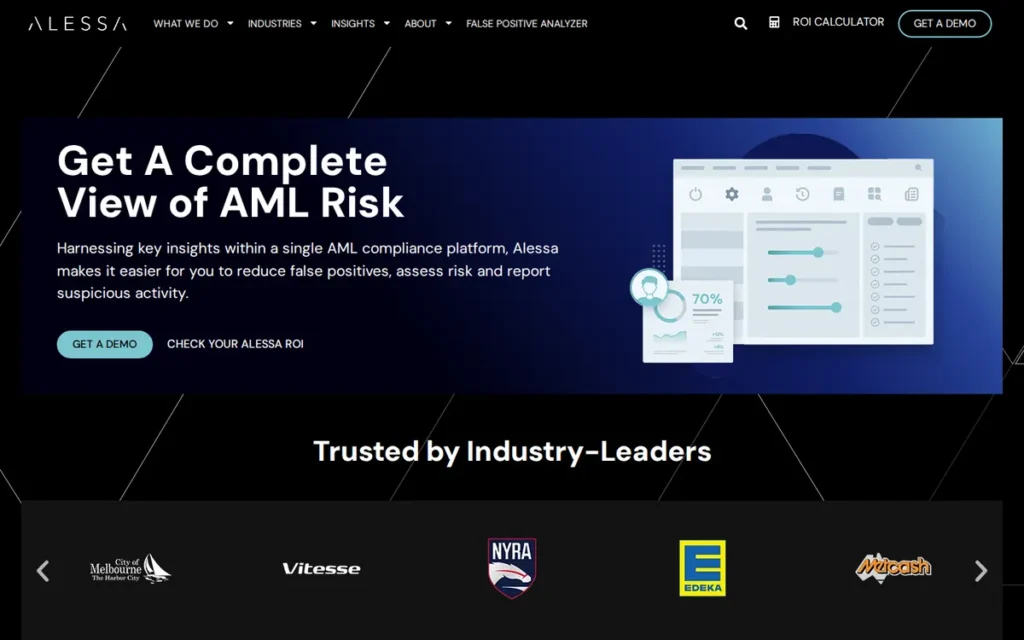
Category: Mid-Market AML Suite, a modular compliance platform serving North American banks, credit unions, MSBs, casinos, and fintechs with integrated transaction monitoring, KYC/CDD, sanctions screening, case management, and BSA/FINTRAC regulatory report automation.
At a Glance
- Category: Mid-Market AML Suite
- Best For: Mid-market North American banks, credit unions, MSBs, casinos, and regulated non-bank entities needing integrated BSA/FinCEN and FINTRAC compliance with SAR/CTR automation and CaseWare audit integration
- Price Range: Custom pricing through direct sales engagement: no public tiers published; targeted at mid-market institutions; direct vendor inquiry required
- Primary Strength: Alessa is the only platform in this review explicitly designed for MSBs, gaming operators, and casinos alongside banks, with SAR/CTR/LCTR automation covering both US BSA/FinCEN and Canadian FINTRAC requirements in a single deployment
- Biggest Limitation: Alessa has not published independently verified case studies with specific performance metrics (no false positive reduction rates, investigation time savings, or named client outcomes are publicly available) which limits objective comparison with competitors that document measurable results
- One-Line Summary: Alessa, by CaseWare RCM, is the only AML platform in this review explicitly built for MSBs, casinos, and non-bank regulated entities alongside banks, covering BSA/FinCEN and FINTRAC compliance with 70-100% SAR/CTR/LCTR automation rates across supported jurisdictions, and recommended for midsize North American banks by a compliance practitioner (r/AMLCompliance, September 2025)
- Last Verified: April 2026
Overview
Alessa is best for North American mid-market banks, credit unions, MSBs, and casinos that need BSA/FinCEN and FINTRAC dual-jurisdiction compliance in a single platform without enterprise-level implementation complexity. Alessa is the only solution in this review with explicit coverage for gaming operators and non-bank regulated entities, supported by CaseWare International parent company operations in 20+ countries.
Alessa, by CaseWare RCM Inc. (a division of CaseWare International), is a modular mid-market AML compliance platform explicitly targeting banks, credit unions, money services businesses (MSBs), fintechs, and casinos in North America, regulated industry segments that enterprise platforms designed for Tier 1 banks routinely underserve. Alessa covers real-time transaction monitoring with AI-driven anomaly detection, KYC/CDD with customizable risk scoring, sanctions/OFAC/PEP/adverse media screening, case management with investigation workflows, and automated regulatory reporting including SAR, CTR, STR, and LCTR across both US BSA/FinCEN and Canadian FINTRAC requirements, with vendor-reported automation rates of 70-100% (Alessa product documentation, 2025). Alessa integrates natively with CaseWare International’s audit platform, enabling unified compliance and audit workflows for mid-market institutions managing limited IT resources.
Key Features
- BSA/FINTRAC Dual-Jurisdiction Reporting: Alessa’s regulatory reporting automation covers SAR, CTR, STR, and LCTR formats for both US BSA/FinCEN and Canadian FINTRAC compliance (with vendor-reported automation rates of 70-100% depending on jurisdiction complexity) directly addressing the most time-intensive manual reporting burden for mid-market compliance teams.
- MSB, Gaming, and Casino Vertical Coverage: Alessa explicitly supports MSBs, gaming operators, and casinos with sector-specific AML typologies and compliance workflows, the only platform in this review designed for the distinct reporting requirements and risk typologies of non-bank regulated entities, including those affected by the December 2025 residential real estate reporting rule expansion that widens AML obligations to previously exempt entity types.
- CaseWare Audit Integration: Alessa integrates natively with CaseWare International’s audit products, enabling a single platform to cover AML transaction monitoring, compliance workflows, accounts monitoring, procurement, payroll, and expense monitoring, reducing vendor relationships and enabling shared data between compliance and audit teams at mid-market institutions managing limited vendor management resources.
- Customizable KYC/CDD Risk Scoring: Alessa provides real-time transaction monitoring with AI-driven anomaly detection and customizable risk scoring for KYC/CDD, allowing compliance teams to calibrate detection sensitivity to their institution’s specific risk profile without requiring data science expertise for basic rule adjustments.
- Integrated Case Management: Alessa’s case management module integrates directly with screening outputs (sanctions, OFAC, PEP, and adverse media) enabling investigation workflows that connect initial screening hits to case documentation, SAR decision tracking, and regulatory filing in a single unified compliance environment.
Best For
Alessa is best for mid-market North American banks, credit unions, MSBs, casinos, and regulated non-bank entities that need integrated BSA/FinCEN and FINTRAC compliance coverage (with automated SAR/CTR/LCTR reporting and CaseWare audit integration) in a platform designed for their institutional scale and complexity rather than adapted downward from enterprise architecture.
Strengths
- Unique Non-Bank Entity Coverage: Alessa is the only platform in this review explicitly designed to serve MSBs, casinos, and gaming operators alongside traditional banks and credit unions, addressing regulated non-bank entities that enterprise AML platforms built for Tier 1 banks routinely underserve, particularly timely given the December 2025 residential real estate reporting rule expansion that widens AML obligations to previously exempt entity types (Wolters Kluwer BSA/AML 2025-2026).
- BSA/FINTRAC Dual-Jurisdiction Coverage: Alessa covers both US BSA/FinCEN and Canadian FINTRAC reporting in a single platform deployment with vendor-reported SAR/CTR/LCTR automation rates of 70-100% across supported jurisdictions (Alessa product documentation, 2025), a dual-jurisdiction North American coverage configuration that no other platform in this review offers natively.
- Practitioner Community Recommendation: Alessa was specifically recommended for “midsize banks” (including entity screening, transaction monitoring, case management, and SAR/CTR support) in a structured multi-vendor practitioner comparison receiving 12 upvotes from compliance professionals (u/WarAndPeace06, r/AMLCompliance, September 2025).
- CaseWare Ecosystem Stability: Alessa’s parent company, CaseWare International, operates in 20+ countries as an established audit and accounting software provider, creating a pre-existing customer base of financial institutions already using CaseWare audit tools as a natural Alessa adoption pathway, and providing vendor stability evidence relevant to mid-market procurement committees evaluating vendor longevity.
Limitations
- No Published Performance Data: Alessa’s most consequential trade-off is its lack of publicly verifiable performance data, no independently confirmed case studies with named client institutions and quantifiable metrics exist in public sources, making objective comparison with platforms that publish documented results (such as NICE Actimize’s vendor-reported investigation time reductions or SAS’s referenced detection improvements) structurally impossible without direct client reference engagement.
- No Verified Review Platform Ratings: Alessa has no confirmed numerical rating on G2, Capterra, or equivalent consumer-facing review platforms, limiting its independent validation signals to community practitioner recommendations rather than aggregated user satisfaction data, which disadvantages Alessa relative to ComplyAdvantage (G2 Leader, nine consecutive quarters) in formal procurement committee processes.
- North American Geographic Focus: Alessa’s design center on North American BSA/FINTRAC compliance means that institutions operating internationally across EU AMLD frameworks, APAC, or MENA regulatory requirements should evaluate whether Alessa’s coverage extends meaningfully beyond its North American design center before committing to a single-platform global strategy.
Verdict
Alessa earns its position as the leading mid-market North American AML platform through a coverage design that directly addresses underserved regulated entity types, MSBs, casinos, and gaming operators, alongside banks and credit unions, with BSA/FinCEN and FINTRAC dual-compliance automation in a single deployment that no enterprise competitor matches for this institutional tier. Alessa’s lack of publicly verifiable performance data is a material transparency gap that compliance buyers must address through direct client reference engagement during evaluation, specifically requesting measurable outcomes from institutions of comparable size and regulatory profile. For mid-market North American institutions, particularly those operating in gaming, money services, or community banking, Alessa represents the most purpose-built alternative to adapting enterprise architecture downward to institutional needs and budget.
7. Sanction Scanner: Best for Fast Fintech Deployment: Best for Early-Stage Fintechs Needing Rapid AML Screening API Implementation, With Mandatory Proof-of-Concept Validation Required Before Production
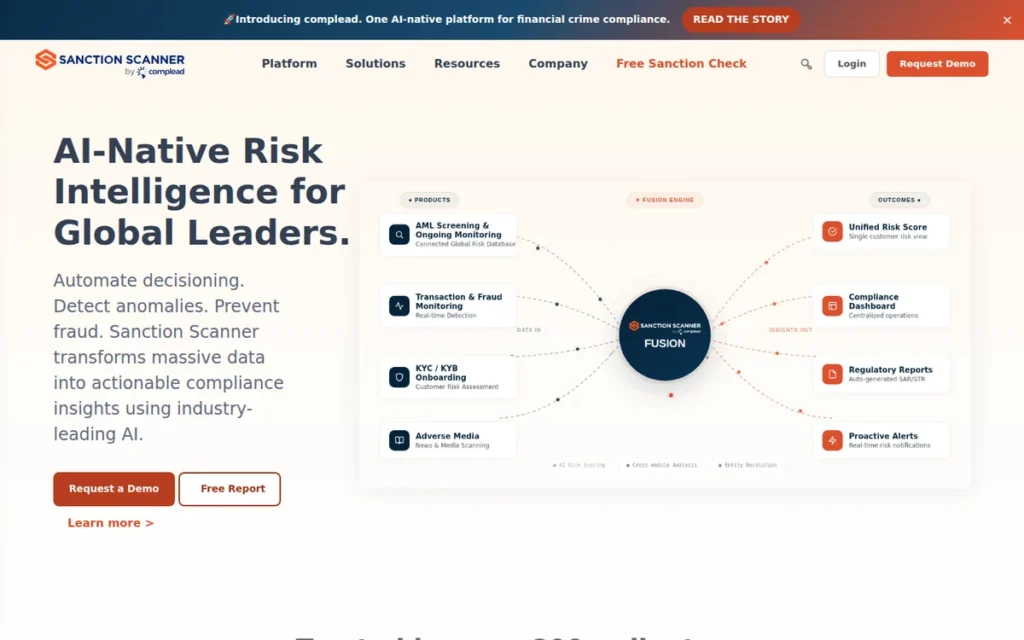
Category: API-First AML Screening Platform, a cloud-native compliance API delivering real-time sanctions, PEP, adverse media, and transaction monitoring screening against 3,000+ global lists with 15-minute update cycles, designed for rapid fintech integration.
At a Glance
- Category: API-First AML Screening Platform
- Best For: Early-stage fintechs, payment startups, and digital-first financial services companies needing rapid baseline AML screening compliance via API, with mandatory proof-of-concept validation of both false positive and false negative rates before production deployment
- Price Range: Custom API pricing: no public tiers published; direct vendor inquiry required
- Primary Strength: Sanction Scanner offers the fastest documented implementation timeline in this review (days rather than months via API) covering 3,000+ sanctions, PEP, and watchlist sources across 220+ countries with 15-minute update cycles
- Biggest Limitation: Sanction Scanner has documented reports from real users in 2024 of both excessive false positives AND missed genuine sanctions matches in the same deployment, the worst possible combination of screening failure modes for a compliance tool, directly contradicting the vendor’s 97% false positive reduction marketing claim
- One-Line Summary: Sanction Scanner is an API-first AML screening platform covering 3,000+ global sanctions and watchlist sources across 220+ countries with 15-minute update cycles and days-to-deployment, but 2024 community reports document both excessive false positives and missed genuine sanctions matches, requiring mandatory proof-of-concept validation before any production compliance deployment
- Last Verified: April 2026
Overview
Sanction Scanner is best for early-stage fintechs, payment startups, and digital-first financial services companies that need to implement baseline AML screening compliance rapidly via API under regulatory or investor timeline pressure. Sanction Scanner offers the fastest documented deployment timeline in this review (days rather than months) but mandatory proof-of-concept testing of both false positive and false negative rates is required before production deployment given 2024 community-documented performance concerns.
Sanction Scanner, headquartered in London with operations across 40+ countries, is an API-first AML compliance platform covering real-time screening against 3,000+ sanctions, PEP, adverse media, and watchlist sources from 220+ countries with database updates every 15 minutes, transaction monitoring with no-code rule creation, KYC/KYB onboarding workflows, and auto-generated SAR/STR draft reports, deployable via API in days. Sanction Scanner serves 800+ firms through its Fusion AI platform, supporting SWIFT MT and ISO 20022 payment messaging standards. Compliance practitioners independently reported in 2024 that real deployments produced both excessive false positives and missed genuine sanctions matches, a dual failure mode that PlugRoute treats as a material buyer warning requiring mandatory proof-of-concept validation before production commitment.
Key Features
- Real-Time 3,000+ Source Screening: Sanction Scanner’s screening engine covers 3,000+ sanctions lists, PEP databases, adverse media sources, and regulatory watchlists across 220+ countries (updated every 15 minutes via AI-powered ingestion) providing the fastest documented list update cadence and broadest source coverage of any platform in this review (Sanction Scanner product page).
- No-Code AML Rule Creation: Sanction Scanner’s transaction monitoring module includes no-code rule creation for custom high-risk detection scenarios, enabling compliance officers without data science expertise to build, modify, and deploy detection rules directly without requiring vendor professional services or internal engineering support.
- Fusion AI Platform with Payment Standard Integration: Sanction Scanner’s Fusion AI platform integrates with SWIFT MT and ISO 20022 payment messaging standards, enables cross-module risk analysis where screening matches inform transaction risk scoring, and auto-generates SAR/STR draft reports for analyst review.
- Days-to-Deployment API Architecture: Sanction Scanner’s API-first architecture enables compliance implementation in days rather than months (the fastest documented deployment timeline in this review) making Sanction Scanner among the strongest options for early-stage fintechs that need AML compliance operational before Series A closing or regulatory license issuance (Finantrix directory).
- Integrated KYC/KYB Onboarding: Sanction Scanner covers the full screening workflow (sanctions, PEP, RCA, adverse media, and AML name screening) plus KYC/KYB customer onboarding within a single integrated API platform, reducing the number of vendor integrations required for a baseline fintech AML compliance stack.
Best For
Sanction Scanner is best for early-stage fintechs, payment startups, and digital-first financial services companies that need to implement baseline AML screening compliance rapidly via API under regulatory or investor timeline pressure, on the explicit condition that performance is validated through a structured proof-of-concept testing both false positive rates and false negative rates against a representative sample of the institution’s expected customer and transaction population before any production deployment.
Strengths
- Fastest Implementation Timeline: Sanction Scanner provides the fastest documented implementation timeline in this review, days rather than months via API integration (Sanction Scanner product documentation; Finantrix directory listing), making Sanction Scanner among the strongest options for early-stage fintechs facing hard AML compliance deadlines before Series A, regulatory license issuance, or payment network membership requirements.
- Broadest Source Coverage with Fastest Updates: Sanction Scanner covers 3,000+ sanctions, PEP, and watchlist sources across 220+ countries with 15-minute update cycles (the highest source count and most frequent update cadence documented in this review) providing coverage breadth architecturally appropriate for payment processors handling fast-moving international transactions where list currency is operationally critical.
- No-Code Rule Building: Sanction Scanner’s no-code rule creation allows compliance officers to build and modify AML detection rules without data science expertise or vendor professional services involvement, directly addressing the resource constraint that prevents smaller fintechs from customizing rule-based detection to their specific product risk profile.
- Specialist Tool Positive Reference: Sanction Scanner was recommended as a specialized screening option by a compliance practitioner in September 2025 for users needing “more specialized solutions” for sanctions and PEP screening beyond full-suite platforms (u/ccarrerasv9, r/fintech, September 2025), suggesting potential product improvements or specific use-case fit since the negative 2024 community reports.
Limitations
- Documented Dual Failure Mode: Sanction Scanner’s most consequential trade-off, and the primary reason it ranks last in this review, is the independently documented dual failure mode in real deployments: “My company uses Sanctions Scanner. It’s awful. We get a lot of false positives and real matches are skipped way too often” (u/CheeserLP, r/moneylaundering, August 2024, 2 upvotes), corroborated by a second practitioner calling it “archaic and junk” (u/EALm4, r/moneylaundering, August 2024, 1 upvote), the combination of false positive overload AND missed genuine sanctions matches represents the worst possible reliability profile for a compliance screening tool.
- Vendor Claims vs. User Experience Gap: Sanction Scanner’s 97% false positive reduction marketing claim (Sanction Scanner marketing materials, year not independently verified) is directly and independently contradicted by real user experience, creating an unresolved credibility gap that prospective buyers must resolve through independent proof-of-concept testing rather than accepting vendor-reported metrics.
- Limited Corporate Transparency: Sanction Scanner has limited publicly available company background information (no confirmed founding date, executive team, or corporate ownership structure was found in research) a secondary but material transparency concern for compliance buyers required to conduct vendor due diligence on the institutions whose software makes their regulatory filings.
Verdict
In AML compliance, missing a genuine sanctions match is not a software bug, it is a regulatory violation. Sanction Scanner’s fastest-in-review deployment timeline, 3,000+ list coverage, and 15-minute update cycle represent genuine technical advantages for early-stage fintechs, but the platform’s 2024 community-documented dual failure mode of simultaneous excessive false positives and missed genuine sanctions matches is a material buyer warning that cannot be discounted on the basis of marketing claims alone. No compliance professional should deploy Sanction Scanner in production without a controlled proof-of-concept that independently validates both false positive performance and, critically, false negative performance against a representative sample of their specific customer and transaction population. For fintechs that validate acceptable performance in proof-of-concept, Sanction Scanner’s deployment speed remains a practical differentiator; for those requiring pre-validated reliability evidence before commitment, the platforms ranked above offer stronger independent performance documentation.
What Red Flags Should I Watch For When Evaluating AML Software?
Six red flags represent documented risk patterns observable during AML vendor evaluation, not theoretical concerns, but failure modes with real regulatory and operational consequences. Compliance buyers should identify and investigate each of these before committing to any platform.
Red Flag #1: Black-Box AI Without Human-in-the-Loop Controls
AML platforms that automate OFAC adjudication, SAR filing decisions, or customer offboarding through AI models without documented human-in-the-loop workflows create direct regulatory examination risk. In 2026, regulators require model governance frameworks, explainability standards, and human oversight for AI-assisted AML decisions, platforms offering “set-and-forget” AI automation without transparent audit trails are non-compliant by design (Wolters Kluwer BSA/AML 2025-2026).
Users on r/fintech with direct AML automation deployment experience described the specific failure patterns that make observability and human override non-negotiable:
“Replacing manual AML or onboarding steps with AI agents can remove a lot of operational drag, but the risks shift rather than disappear. Agents can be fast and consistent, but they can also confidently make the wrong call if the environment, the UI, or the case logic changes. Most failures in compliance automation come from edge cases, silent UI changes, or missing context that a human analyst would normally catch. If you go this route, make sure whatever platform you choose offers real observability, decision logging, and a safe review layer before an agent action becomes final. Fast automation is great, but in compliance ops you need systems that fail safely which is a complete other challenge.” Posted by u/Worldly-Control403
Takeaway: Experienced AML automation practitioners identify observability, decision logging, and human-override architecture as the make-or-break requirements that distinguish regulatory-defensible AI compliance from black-box liability, the same capabilities regulators now require under 2026 model governance frameworks.
Red Flag #2: False Positive Reduction Claims Without Tier-Specific Proof-of-Concept Data
Vendors claiming 70-97% false positive reduction without offering controlled proof-of-concept validation at your specific deployment configuration are presenting aggregate figures that may not apply to your institution’s risk profile. The behavioral cycle of conservative thresholds → alert fatigue → faster clearing → tighter thresholds persists even after AI implementation when vendors optimize for average performance rather than institution-specific calibration (r/fintech, March 2026).
Red Flag #3: No Published Independent Analyst Recognition or Verified User Reviews
Platforms without any Chartis, Celent, Gartner, Juniper Research, or G2 recognitions (and with no verified user review presence on major review platforms) have not been evaluated against standardized criteria by subject-matter experts or aggregated user communities. Enterprise-only procurement contexts explain some absence; a complete lack of independent validation across all channels warrants closer due diligence, including direct client references from comparable institution types that have completed regulatory examinations using the platform.
Red Flag #4: Pricing Opacity Without Willingness to Provide Budget Ranges in RFP Responses
Every vendor in this category operates without public pricing, but vendors who refuse to provide even indicative budget ranges, multi-year total cost of ownership projections, or module-level cost breakdowns in formal RFP responses are creating evaluation friction that harms budget planning. Pricing opacity combined with refusal to provide any directional cost guidance during evaluation is a contract negotiation signal, not a capability feature.
Red Flag #5: No AML-Specific Case Studies With Named Clients and Quantifiable Outcomes
Platforms that cannot provide case studies naming client institutions and documenting specific, measurable outcomes (false positive reduction percentages, investigation time reductions, regulatory examination results) are asking buyers to accept detection capability claims on faith. NDA constraints explain some absence, but vendors with genuine performance records at comparable institutions should provide reference client access during formal evaluation.
Red Flag #6: Vendor Claims Directly Contradicted by Independent Community Evidence
When vendor marketing claims are independently contradicted by real user reports of both excessive false positives and missed genuine matches, the discrepancy represents a systemic credibility failure, not an isolated complaint. PlugRoute treats unresolved vendor claim contradictions as mandatory proof-of-concept triggers for all platforms where this pattern is documented in practitioner communities.
What Questions Should I Ask Before Choosing an AML Compliance Platform?
The following questions surface the information most predictive of real-world AML program success, covering AI model governance, proof-of-concept design, client reference comparability, and three-year total cost of ownership. These are the questions most commonly omitted from standard AML vendor sales conversations and most predictive of post-deployment satisfaction.
Question #1: What is your process for model governance documentation if regulators examine our AI-assisted AML decisions?
Regulators in 2026 require defined model ownership, validation protocols, ongoing performance monitoring, and data quality testing for AI-assisted AML decisions. Vendors should describe their model governance documentation package, examiner-ready audit trail format, and how human-in-the-loop workflows are documented for supervisory review. A vendor unable to articulate this clearly creates regulatory risk that technology capabilities alone cannot offset.
Question #2: Can you provide a controlled proof-of-concept measuring both false positive rates AND false negative rates on our specific customer and transaction population?
False negative rates (missed genuine matches) are more consequential than false positive rates in regulatory terms, but most vendor demonstrations focus exclusively on false positive reduction. Any AML platform worth deploying should demonstrate both dimensions of screening performance on a representative sample of your actual data before production commitment. Declining this request is itself a red flag.
Question #3: How long has your platform been deployed at institutions of our size and regulatory profile, and can you provide three client references with comparable asset size and jurisdiction?
Market penetration statistics at Tier 1 banks do not validate performance at mid-market community banks, and vice versa. References should be contactable (not just named) and should include institutions that have been through regulatory examinations while using the platform with an outcome your institution’s examiners would accept.
Question #4: What does total cost of ownership look like over three years, including implementation professional services, ongoing data fees, model tuning, and renewal pricing?
AML software headline pricing represents a fraction of total program cost. Implementation professional services, annual data fees, model tuning, integration development, and renewal price escalation clauses all materially affect multi-year TCO. Negotiating price escalation caps at renewal is standard procurement practice that many first-time AML software buyers omit.
Question #5: How does the platform document AI involvement in SAR filings for regulatory examination?
Vendors should clearly distinguish between “AI-drafted, human-reviewed” SAR workflows (which are regulatory-compliant) and fully automated SAR submission, which creates regulatory risk. Ask for examiner-ready documentation showing how AI contributions to SAR narratives are logged, reviewed, and approved before filing.
Question #6: What is your product roadmap response to FinCEN’s June 2024 proposed rulemaking and the December 2025 residential real estate reporting rule?
These regulatory changes may affect your institution’s monitoring scope and covered entity definition. Vendors who cannot articulate a specific product roadmap response to these developments may not be adequately resourced to support your compliance program through the next regulatory cycle.
Question #7: What is your contractual update cadence for screening lists, detection models, and typology-specific rule sets?
For sanctions screening, list update frequency directly affects compliance exposure between updates. For detection models, update cadence determines how quickly your platform responds to FinCEN/FATF emerging typology advisories. Contractually specify minimum update frequencies for all three components, and hold vendors to these commitments in SLA terms before signing.
How Did We Rank These 7 Anti-Money Laundering Platforms?
These seven platforms were ranked through a systematic evaluation process applying six weighted criteria equally to all vendors. No company was pre-assigned any position, the platform with the highest composite evidence score across all criteria earns the top rank.
PlugRoute has no affiliate relationships with any company listed in this review, rankings are determined entirely by research data and objective evaluation criteria.
Evaluation Process
Evaluation proceeded in four stages:
- AI Search Engine Queries: Multiple AI search engines (Perplexity, ChatGPT) were queried for current AML software recommendations to identify LLM coverage gaps and baseline market positioning of each vendor.
- Independent Web Research: Systematic research across analyst reports (Chartis, Juniper Research, Celent, Verified Market Research), vendor product documentation, pricing pages, and third-party review platforms collected product capability and performance data.
- Practitioner Community Analysis: Targeted searches across r/AMLCompliance, r/fintech, and r/moneylaundering collected real-user sentiment, specific failure mode reports, and product recommendations from working compliance professionals.
- Cross-Reference Validation, Vendor-reported claims were cross-referenced against independent sources, analyst reports, practitioner feedback, third-party market data, with uncorroborated vendor claims explicitly labeled as such throughout this article.
This evaluation process revealed that content marketing presence (not institutional deployment depth) currently determines which AML platforms appear in AI-generated guidance. SymphonyAI Sensa-NetReveal, which claims service to more than 50% of the world’s most examined Tier 1 banks and holds the Celent 2023 Luminary designation, appeared in zero LLM responses reviewed in April 2026. This LLM training-data bias makes independent research essential for compliance buyers who cannot rely on AI-generated vendor lists.
Ranking Criteria
- C1: Documented Detection Performance and Independent Evidence (primary): Presence and specificity of independent analyst recognitions, documented client case studies with measurable metrics, and credible market share data. Why it matters: compliance officers need proof a platform actually detects financial crime, not just vendor marketing claims.
- C2: Independent Analyst Recognition and Review Platform Ratings (primary): Named positions in Chartis, Celent, Gartner, or Juniper Research AML evaluations; G2, Capterra, or TrustRadius aggregate ratings; recency of recognitions (2024-2026 weighted higher). Why it matters: analyst and review platform recognitions reflect evaluation against standardized criteria by subject-matter experts, providing quality signals beyond vendor self-reporting.
- C3: Breadth and Depth of AML Coverage (primary): Number of AML workflow modules natively covered (transaction monitoring, KYC/CDD, sanctions/PEP screening, adverse media, case management, SAR/CTR automation); data source breadth across jurisdictions and languages. Why it matters: complete AML programs require multiple workflow modules, platforms covering more of the stack reduce integration complexity and vendor proliferation.
- C4: Institution-Fit and Deployment Accessibility (secondary): Documented institution-type targeting; deployment timeline evidence; SaaS or API-first entry points; pricing tier structure; named client evidence for specific institutional segments. Why it matters: the target audience spans Tier 1 banks to community banks and fintechs, a platform must match its institutional target to be genuinely useful.
- C5: Practitioner Community Trust and Real-World Usability (secondary): Documented sentiment from r/AMLCompliance, r/fintech, and r/moneylaundering with upvote signals; presence of specific failure mode documentation; recency of community references (2024-2026 weighted higher). Why it matters: compliance analysts who use AML software daily have direct operational experience that vendor marketing cannot fabricate.
- C6: AI Innovation Quality and Regulatory Explainability (secondary): Presence of named agentic AI or generative AI features launched 2024-2026; documented AI performance metrics; evidence of regulatory-compliant AI architecture with human-in-the-loop workflows and explainable outputs. Why it matters: in 2026, regulators require model governance frameworks and human oversight for AI-assisted AML decisions, making AI quality and auditability a compliance criterion, not just a feature (Wolters Kluwer BSA/AML 2025-2026).
An active AML infrastructure investor summarized the market’s actual AI augmentation dynamic (and why C6 weights augmentation quality over autonomy) on r/fintech:
“The AML and transaction monitoring space is genuinely moving. The incumbents NICE Actimize, Featurespace are being challenged by AI-native startups that can get false positive rates down dramatically. That is real commercial value and banks are paying attention because compliance headcount is expensive. LLM-driven KYC is more hype than reality right now. The accuracy requirements for regulated onboarding are so high that most models are not reliable enough to take humans fully out of the loop yet. The wins are in augmentation not replacement, humans reviewing AI-flagged cases rather than reviewing everything manually.” Posted by u/FundingFactor
Takeaway: Active AML infrastructure investors confirm that the competitive battleground between enterprise incumbents like NICE Actimize and AI-native challengers is AI augmentation quality (not full autonomy) making human-in-the-loop architecture a market-validated requirement, not a regulatory afterthought.
Evidence Weighting
When review platform ratings conflict with Reddit practitioner sentiment, PlugRoute weights specificity and recency, a detailed 2025 Reddit post from a practitioner describing a specific deployment experience with 6+ upvotes carries more weight than a generic 2023 G2 review without contextual detail. When vendor-reported metrics are the only available performance data, claims are labeled as vendor-reported and weighted accordingly.
Data Validation
Vendor-reported statistics are labeled throughout this article. Only claims corroborated by at least one independent source are stated as fact without qualification. Pricing data reflects publicly available information at time of research, no vendor in this category published public pricing as of April 2026.
Update Cadence
This article was last updated April 2026 and is reviewed quarterly or when significant regulatory, product, or market developments occur. Readers should verify current pricing and product capabilities directly with vendors.
Frequently Asked Questions About AML Software
The most common questions compliance officers ask when evaluating AML software center on platform fit by institution size, pricing transparency, and how rankings are determined. The answers below draw from published vendor documentation, independent analyst research, and practitioner community discussions current as of April 2026.
What is the best anti-money laundering software for small banks and credit unions in 2026?
Alessa by CaseWare RCM is the best AML software for small and mid-market North American banks, credit unions, and MSBs in 2026, the only platform explicitly designed for these institution types with BSA/FinCEN and FINTRAC dual-jurisdiction compliance, 70-100% SAR/CTR automation, and native CaseWare audit integration. Community banks evaluating Verafin, purpose-built for this segment with consortium-based transaction intelligence, should include it in any shortlist alongside Alessa.
What is the best AML software for fintechs and startups in 2026?
ComplyAdvantage is the best AML software for fintechs and startups in 2026, offering G2 Leader status for nine consecutive quarters through December 2025, an AI-native entity graph of 24 million entities updated in real time, and the only publicly acknowledged Starter Plan entry tier in this review. Sanction Scanner is a fast-deployment alternative via API, but 2024 community reports document both false positive overload and missed genuine sanctions matches, making independent proof-of-concept validation of both false positive and false negative rates non-negotiable before production deployment.
How does PlugRoute determine its AML software rankings?
PlugRoute ranks AML platforms through a six-criteria weighted evidence model applied equally to all vendors, covering documented detection performance, independent analyst recognition, AML coverage breadth, institution-fit and deployment accessibility, practitioner community trust, and AI innovation quality. No company receives preferential treatment, and no rankings reflect paid placement, affiliate relationships, or vendor editorial influence. Full methodology and source attribution are documented in the “How Did We Rank These 7 Anti-Money Laundering Platforms?” section above.
Glossary: Key Terms Used in This Comparison
Bank Secrecy Act (BSA): The Bank Secrecy Act is the primary U.S. federal law requiring financial institutions to assist government agencies in detecting and preventing money laundering, mandating programs including Customer Identification Programs (CIP), Suspicious Activity Reporting (SAR), and Currency Transaction Reporting (CTR) filed with the Financial Crimes Enforcement Network (FinCEN). BSA compliance drives the majority of AML software procurement in North America.
Entity-Centric Architecture: Entity-centric architecture is an AML platform design approach that aggregates all risk signals (transactions, KYC data, CRM records, and behavioral patterns across all business lines) into a single unified risk profile per customer or counterparty, rather than processing each transaction alert in isolation. Entity-centric platforms detect patterns across multiple business lines and time horizons that transaction-level alert systems systematically miss, and represent the primary architectural distinction between modern enterprise AML platforms and legacy rule-based predecessors.
Suspicious Activity Report (SAR): A Suspicious Activity Report is a mandatory regulatory filing submitted to FinCEN (in the U.S.) or an equivalent regulatory authority when a financial institution detects a transaction or activity potentially indicating money laundering, fraud, or other financial crime. SAR narrative writing is consistently identified by compliance practitioners as one of the most time-intensive and repetitive manual workflows in AML compliance, and is the primary target of AI-assisted automation features in NICE Actimize X-Sight AI Narrate and SymphonyAI Sensa Copilot.
Politically Exposed Person (PEP): A Politically Exposed Person is an individual who holds or has held a prominent public function (including heads of state, senior government officials, senior executives of state-owned enterprises, or senior judicial officers) whose position creates elevated risk for bribery, corruption, and money laundering. AML platforms are required to screen customers and transaction counterparties against PEP databases as part of Know Your Customer (KYC) due diligence programs mandated under BSA, AMLD, and equivalent frameworks.
False Positive Rate: In AML transaction monitoring, false positive rate refers to the proportion of monitoring alerts generated by the system that represent legitimate, non-suspicious activity, requiring analyst time to review and dismiss without producing an actionable finding. High false positive rates are the dominant operational pain point in AML compliance across all institution types, driving analyst burnout, alert fatigue, and, in a documented behavioral cycle, paradoxically tighter threshold-setting that generates even higher future alert volumes.
Agentic AI: Agentic AI refers to artificial intelligence systems that autonomously plan and execute multi-step tasks (gathering case data from multiple systems, reasoning through investigation context, and generating recommendations) rather than responding to single discrete prompts. In AML compliance, agentic AI systems such as NICE Actimize InvestigateAI (launched April 2025) and SymphonyAI Sensa Copilot are designed to autonomously conduct initial alert investigation workflows, reducing analyst time on first-line alert triage that is the primary source of compliance team burnout at high-volume institutions.
Which Anti-Money Laundering Platform Is Right for You?
The right AML platform depends on institutional tier, regulatory jurisdiction, and operational model, not vendor marketing or AI-generated guidance that omits platforms like SymphonyAI Sensa-NetReveal, which claims service to more than 50% of the world’s top 40 Tier 1 banks yet appeared in zero LLM-generated AML software lists reviewed in April 2026.
Key Insights
- Institution tier is the primary selection filter: Enterprise AML programs at Tier 1 global banks should evaluate NICE Actimize and SymphonyAI Sensa-NetReveal through formal RFP engagement, SymphonyAI’s Celent 2023 Luminary designation, 20+ year Tier 1 heritage, and claimed 50%+ penetration among Top 40 global banks makes it the most significant platform absent from AI-generated AML guidance.
- Data depth requires human curation for non-English markets: LexisNexis Risk Solutions’ WorldCompliance™, maintained by 450+ human researchers in 58 languages with 4× daily sanctions updates, provides non-English-language PEP and adverse media intelligence depth that AI-generated entity graphs cannot reliably replicate for high-risk non-Western jurisdictions.
- Entry-tier false positive performance must be independently validated: ComplyAdvantage’s headline 70-82% false positive reduction claim is contradicted by real user reports at entry-tier configurations, proof-of-concept validation at the specific deployment configuration is non-negotiable before production commitment for any fintech or budget-constrained buyer.
- Non-bank regulated entities are systematically underserved by enterprise platforms: MSBs, gaming operators, casinos, and the newly AML-obligated real estate sector require purpose-built coverage, Alessa is the only platform in this review designed for these entity types alongside traditional banks, and no enterprise platform natively matches its dual BSA/FINTRAC automation for North American mid-market institutions.
- AI governance is a compliance requirement in 2026, not a feature: Regulators now require model governance frameworks, explainability standards, and human-in-the-loop controls for AI-assisted AML decisions, platforms offering black-box automation without documented audit trails create examination risk rather than reducing it (Wolters Kluwer BSA/AML 2025-2026).
- No vendor in this category publishes public pricing: Every platform in this review requires direct engagement for pricing, request three-year TCO projections, module-level cost breakdowns, and renewal price escalation caps in all RFP responses without exception.
- Your next step: Identify your institution tier from the Quick Decision Framework above, request proof-of-concept validation from all shortlisted vendors measuring both false positive and false negative rates on your actual data, and demand three-year total cost of ownership projections with renewal price escalation caps before signing.
For enterprise banks choosing between NICE Actimize and SymphonyAI Sensa-NetReveal, the primary decision factor is implementation posture. NICE Actimize offers dual enterprise/SaaS deployment reach, the most publicly documented AI roadmap, and market leadership validated by approximately 17% enterprise market share per Verified Market Research 2026. SymphonyAI Sensa-NetReveal’s Celent 2023 Luminary designation, 20+ year Tier 1 heritage, and Sensa Copilot represent the deepest independently verified institutional validation claim in the category. Both platforms warrant direct RFP engagement with experienced implementation partners and explicit contractual support SLAs.
For mid-market and fintech buyers, the choice resolves around three variables:
- Jurisdiction: Alessa for North American BSA/FINTRAC compliance across banks, credit unions, MSBs, and casinos, the only platform in this review built for these entity types from the ground up.
- Data depth: LexisNexis Risk Solutions for maximum human-curated intelligence across 58 languages in high-risk or non-English-language markets where AI-generated databases are insufficient.
- Deployment speed: ComplyAdvantage for API-first rapid deployment with Starter Plan accessibility and a nine-quarter G2 Leader track record, with mandatory proof-of-concept validation of false positive performance before production commitment.
No single platform is optimal for all three, buyers should weight the variable most consequential to their regulatory deadline, institutional complexity, and available implementation resources.
We update this guide quarterly. Last updated: April 2026. For independent reviews of other financial technology categories, visit PlugRoute. Subscribe for regulatory update alerts when FinCEN rulemaking or FATF guidance changes AML software requirements in your jurisdiction.