Postman is the best overall API development tool for enterprise full-lifecycle management; Apidog is the strongest all-in-one platform for teams migrating from Postman; Bruno is the best Git-native, zero-cloud-sync client for privacy-first development. In 2026, Postman’s free plan restricts collaboration to solo users only, any team of two or more users requires a paid subscription under current 2026 free tier terms.
In 2026, Postman’s restriction of its free plan to solo-only use created the first major category disruption in API development tooling in years, and that pricing decision directly accelerated the community growth of every alternative evaluated in this article.
The category you need determines more than the tool: all-in-one lifecycle platforms (Postman, Apidog), Git-native testing clients (Bruno), browser-first and multi-protocol clients (Insomnia, Hoppscotch), and design-first governance platforms (Stoplight, SwaggerHub) serve genuinely different workflow phases. Selecting the wrong category is more consequential than selecting the wrong tool within a category.
PlugRoute has no affiliate relationships with any company listed. Rankings are determined entirely by research data and objective evaluation criteria.
“Where I work, Postman is used for manual testing and Playwright for automation. If they are serious about automation, it’s worth the time investment to use Playwright.” (u/nopuse, r/QualityAssurance, 2024 (69 upvotes))
Takeaway: Even experienced QA practitioners position Postman as a manual testing and team-visibility tool (not a CI/CD automation replacement) with code-based frameworks like Playwright preferred for production pipeline work where test scale and reliability matter most.
TL;DR: Top Picks at a Glance
- Postman is the G2 category Leader (4.6/5, 1,777 reviews, 2026) and the broadest verified lifecycle platform for enterprise teams that need design, testing, mocking, monitoring, and documentation in a single cloud-hosted product.
- Apidog is the highest-rated all-in-one Postman replacement on G2 (4.9/5, 214 verified reviews, May 2026), with a free tier supporting up to four users with unlimited Collection Runner runs and transparent pricing from $9/user/month.
- Bruno is the fastest-growing open-source API client of 2025–2026, reaching 600,000+ monthly active users by December 2025, providing Git-native zero-cloud-sync API testing at $0 for individuals and $6/user/month for teams (verified May 2026).
- Hoppscotch provides instant browser-based API testing with no installation or account required, supporting six protocols including MQTT and Socket.IO for IoT use cases, with full self-hosting via Docker for team data sovereignty.
What Are the Categories of API Development Tools?
API development tools fall into four categories, all-in-one lifecycle platforms (Postman, Apidog), Git-native testing clients (Bruno), browser-first and multi-protocol clients (Insomnia, Hoppscotch), and design-first governance platforms (Stoplight, SwaggerHub), each serving a distinct phase of the API workflow. Selecting the wrong category creates friction no individual tool feature can resolve.
For example: a team that buys Stoplight to replace Postman’s testing workflow will still need a separate API client, they will have solved their documentation problem while their testing friction remains. A team that buys Postman to enforce OpenAPI style standards across teams will find it lacks Spectral-powered linting that catches design inconsistencies before implementation starts.
All-in-One API Lifecycle Platforms, Postman, Apidog
All-in-one API lifecycle platforms cover the full API lifecycle (design, testing, mocking, documentation, and monitoring) in a single cloud-hosted product. These platforms serve cross-functional teams where developers, QA engineers, and technical writers collaborate across the complete development cycle.
Git-Native and Browser-First Testing Clients, Bruno, Insomnia, Hoppscotch
Git-native and browser-first testing clients prioritize the developer’s request-testing workflow with different architectures for data storage: local .bru files (Bruno), desktop with local, Git, or cloud modes (Insomnia), or instant browser access with optional self-hosting (Hoppscotch). All three are runtime tools that test APIs already in operation.
Design-First API Governance Platforms, Stoplight, SwaggerHub
Design-first API governance platforms focus on OpenAPI specification authoring, style enforcement, and documentation generation before implementation code is written. Both Stoplight and SwaggerHub explicitly require a separate runtime testing client for request-level API testing, they are not Postman replacements for testing workflows.
How Do the Top API Development Tools Compare at a Glance?
The seven best API development tools of 2026 span four categories (all-in-one lifecycle platforms, Git-native testing clients, browser-first clients, and design-first governance platforms) with verified team pricing from $0 to $27/user/month. Free tiers differ critically: Bruno has no usage caps; Apidog supports four users with unlimited runs; Postman restricts all collaboration to solo users with hard monthly limits as of 2026.
| Rank | Company | Category | Best For | One-Line Summary | Key Capabilities | Primary Strength | Key Limitation |
|---|---|---|---|---|---|---|---|
| 1 | Postman | All-in-One Lifecycle Platform | Enterprise full-lifecycle management | Postman is the G2 category Leader (4.6/5, 1,777 reviews, 2026) with the broadest verified lifecycle coverage; design, testing, mocking, monitoring, and documentation; of any single tool in this evaluation. | REST, GraphQL, gRPC, WebSocket; design, testing, mocking, monitoring, docs, CI/CD | G2 Leader designation; 6 verified lifecycle phases in one cloud platform | Free plan solo-only (3 APIs, 5 Flows, 25 runs/month); teams of 2+ require paid subscription |
| 2 | Apidog | All-in-One Lifecycle Platform | Teams of 2–10 migrating from Postman | Apidog is the highest-rated all-in-one API lifecycle platform on G2 (4.9/5, 214 verified reviews, May 2026), with a free tier for up to four users and transparent pricing from $9/user/month. | REST, GraphQL, gRPC, WebSocket; design, testing, mocking, docs; AI compliance checking | G2 4.9/5 from 214 reviews (May 2026); 4-user free tier with unlimited runs | Deep integration creates vendor lock-in; smaller community than Postman |
| 3 | Bruno | Git-Native API Client | Git-centric, privacy-first teams | Bruno is the fastest-growing open-source API client of 2025–2026 (600,000+ MAU, December 2025), providing Git-native zero-cloud-sync API testing at $0 for individuals and $6/user/month for teams. | REST, GraphQL, gRPC (GA), WebSocket; Git-native .bru file storage; zero cloud sync by architecture | Unconditional zero-cloud-sync architecture; $6/user/month team pricing (lowest verified) | No native monitoring, documentation portal, or web interface; desktop-only |
| 4 | Insomnia | Multi-Protocol API Client | Multi-protocol API development (REST + GraphQL + gRPC + WebSocket + SSE) | Insomnia is a Kong-maintained open-source API client with verified native support for five protocols; REST, GraphQL, gRPC, WebSocket, SSE; and AI-generated test suites from OpenAPI specs (beta). | REST, GraphQL, gRPC, WebSocket, SSE; AI test generation (beta); MCP support; local/Git/cloud storage | Broadest native protocol coverage (5 protocols) of any testing client in this evaluation | 2023 forced-login trust incident; paid pricing not publicly confirmed; no docs or monitoring |
| 5 | Hoppscotch | Browser-First API Client | Zero-friction testing; IoT/real-time APIs; self-hosted teams | Hoppscotch is the only evaluated API client operating entirely in a web browser with no installation or account required for individual API testing use, supporting six protocols including MQTT and Socket.IO. | REST, GraphQL, WebSocket, SSE, Socket.IO, MQTT; browser-based; Docker self-hosting | Zero-install browser access + full Docker self-hosting; broadest protocol count (6) in this evaluation | AI features explicitly experimental (May 2026); advanced automation requires Hoppscotch CLI |
| 6 | Stoplight | Design-First Governance Platform | API design-first engineering organizations | Stoplight is the purpose-built API design governance platform offering Spectral-powered style enforcement, Prism-generated mock servers, and developer-portal-quality documentation at $39–$99/month (project-based, verified May 2026). | OpenAPI design, Spectral CI/CD linting, Prism mock servers, Elements documentation; design-time only | Open-source ecosystem (Spectral, Prism, Elements) independently adopted across the API community | Design-time only; separate testing client required; SmartBear “API Hub is now Swagger” rebranding active |
| 7 | SwaggerHub | OpenAPI Specification Platform | Enterprises standardized on OpenAPI/Swagger spec collaboration | SwaggerHub is SmartBear’s commercial OpenAPI collaboration platform with centralized spec versioning, domain-based reuse, and enterprise on-premises deployment verified through v2.12.1 (August 27, 2025). | OpenAPI spec authoring, versioning, domain reuse, code generation, auto-generated docs, on-premises | Swagger/OAS heritage; verified monthly enterprise release cadence (v2.12.1, Aug 2025) | Enterprise pricing requires sales contact; “API Hub is now Swagger” active rebranding confirmed |
Which API Development Tool Should I Choose for My Use Case?
The table below provides direct tool recommendations for nine common API development priorities. Alternatives are listed for each scenario, and the note below addresses situations where your needs span multiple rows.
| Your #1 Priority | Recommended Tool | Why | Acceptable Alternative |
|---|---|---|---|
| Individual developer on a budget | Bruno | Full open-source client, no usage caps, no account, no cloud sync at $0 | Hoppscotch; browser-based, no install needed |
| Small team of 2–10 migrating from Postman | Apidog | 4-user free tier, unlimited runs, G2 4.9/5 (214 reviews), transparent pricing at $9/user/month | Bruno; Git-native at $6/user/month |
| Git-centric team with privacy or compliance requirements | Bruno | Zero cloud sync by architecture.bru files live in your Git repo | Insomnia; local and Git storage modes |
| Multi-protocol APIs (REST + GraphQL + gRPC + WebSocket + SSE) | Insomnia | 5 natively supported protocols + AI test generation from OpenAPI specs (beta) | Hoppscotch; 6 protocols including MQTT |
| Zero-friction quick testing with no install | Hoppscotch | Open a browser and test immediately; no download, no account required | Bruno; fast install, no cloud dependency |
| IoT or real-time messaging APIs (MQTT, Socket.IO) | Hoppscotch | Only evaluated tool with native MQTT and Socket.IO protocol support | No direct alternative in this evaluation |
| API design-first governance and style enforcement | Stoplight | Spectral linting, Prism mocking, Elements docs, transparent project-based pricing | SwaggerHub; OAS ecosystem heritage |
| OpenAPI-standardized enterprise spec management | SwaggerHub | Swagger/OAS heritage, enterprise on-premises, verified monthly release cadence | Stoplight; open-source Spectral, Prism, Elements |
| Enterprise team needing full lifecycle in one platform | Postman | G2 Leader (4.6/5, 1,777 reviews), broadest lifecycle coverage, deepest enterprise ecosystem | Apidog; lower per-seat cost, G2 4.9/5 |
If your workflow spans multiple rows: for example, needing both Git-native privacy (row 3) and multi-protocol API testing (row 4), evaluate Insomnia first. Insomnia supports five protocols natively (REST, GraphQL, gRPC, WebSocket, SSE) and provides local and Git storage modes, serving both priorities without requiring separate tools.
1. Postman: Best Overall: Most Complete API Lifecycle Platform
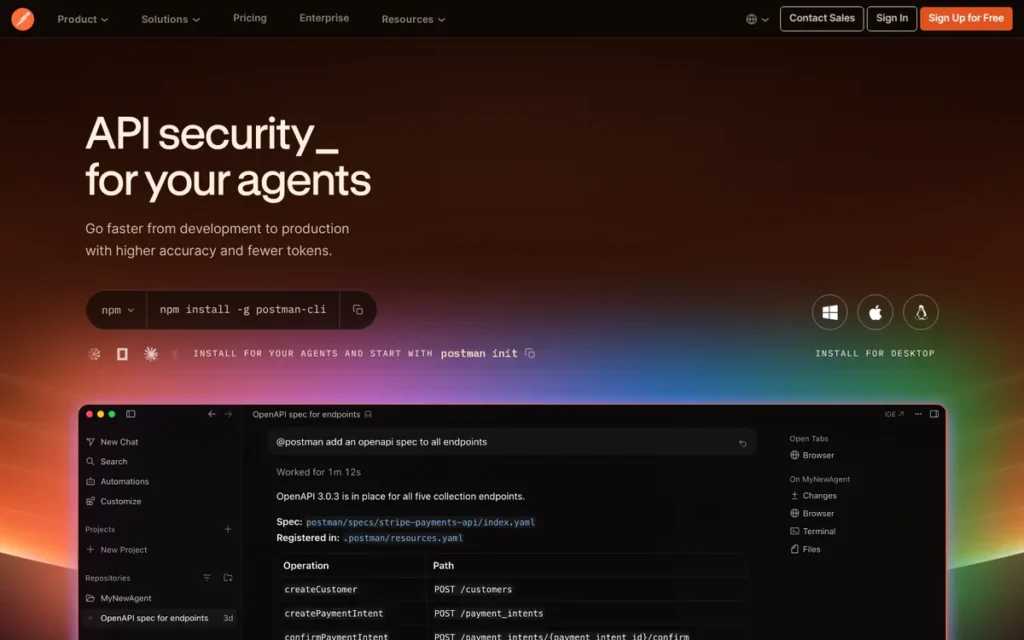
Category: All-in-One API Lifecycle Platform, a cloud-hosted platform covering API design, testing, mocking, documentation, monitoring, and team collaboration in a single product.
At a Glance
- Category: All-in-One API Lifecycle Platform
- Best For: Enterprise teams and established engineering organizations needing design, testing, documentation, mocking, and monitoring under one cloud-hosted roof with role-based team workspaces
- Price Range: Free (solo only: 3 APIs, 5 Flows, 25 Collection Runner runs/month, 1,000 API calls); paid tiers, verify current rates at postman.com/pricing
- Primary Strength: Postman offers the broadest verified API lifecycle coverage of any tool in this category (design, testing, mocking, monitoring, documentation, and CI/CD integration) in a single cloud-hosted platform
- Biggest Limitation: Postman’s 2026 free plan restricts collaboration to single users with hard caps on APIs, Flows, runs, and API calls, making it non-viable as a free tool for any team of two or more
- One-Line Summary: Postman is the G2 category Leader (4.6/5, 1,777 reviews, 2026) and most-reviewed API development platform of 2026, offering the broadest verified lifecycle coverage (design, testing, mocking, monitoring, and documentation) of any single tool in this evaluation.
- Last Verified: May 2026
Overview
Postman is the cloud-first, all-in-one API lifecycle platform used by enterprise teams worldwide, holding a G2 rating of 4.6/5 from 1,777 verified reviews and the “Leader” designation with the highest review volume in the API development category as of 2026 (G2 Postman seller page, 2026).
Postman’s breadth distinguishes it from every competitor: its Collections architecture unifies testing, documentation generation, mock servers, and CI/CD pipeline execution under a single reusable artifact, reducing duplication overhead for teams managing complex multi-environment API workflows.
Postman’s 2026 free plan restricts collaboration to individual solo users (capped at 3 APIs, 5 Flows, 25 Collection Runner runs per month, and 1,000 API calls) effectively ending Postman as a free team tool and driving significant developer migration toward Bruno, Apidog, and Hoppscotch (G2 Postman review sentiment, 2026).
Key Features
- Full API Lifecycle Coverage: Postman covers API design with OpenAPI, GraphQL, and RAML support; bi-directional GitHub and GitLab schema sync; request testing; mock servers from Collections; scheduled monitors with Slack integration; and interactive documentation, eliminating the need for separate tools at each lifecycle stage.
- Collections Architecture: Postman’s Collections simultaneously power test suites, documentation generation, mock server responses, and CI/CD pipeline runs from a single reusable artifact, reducing the duplication overhead that maintaining separate Postman and Swagger toolchains creates.
- Multi-Protocol Support: Postman supports REST, GraphQL, gRPC, and WebSocket in a single client, enabling teams to test APIs across all major communication paradigms in one shared workspace without switching between protocol-specific tools.
- Postman CLI for CI/CD Pipelines: Postman includes a CLI that enables Collection-based test suites to run in automated CI/CD pipelines including GitHub Actions and Jenkins, with Git integration for connecting test artifacts to version control repositories.
- Role-Based Team Workspaces: Postman’s collaborative Workspaces provide role-based access controls allowing developers, QA engineers, and technical writers to share API collections, environments, and documentation within a single organized, permission-gated space.
Best For
Postman is best suited for enterprise teams and organizations with established Postman workflows (existing Collections, workspaces, monitors, and CI/CD integrations) who need a single cloud-hosted platform serving developers, QA engineers, and technical writers across the full API lifecycle.
Postman is the weakest fit for small teams or individual developers on a budget, since Postman’s 2026 free tier restricts all collaboration to solo use with hard usage caps that make any multi-person workflow require a paid subscription.
Strengths
- G2 Leader Designation with Verified Rating: Postman holds a G2 rating of 4.6/5 from 1,777 verified reviews (the highest review volume of any tool in this category) and a Grid Leader designation across 9 G2 categories, representing the largest independently verified user experience dataset of any evaluated tool (G2 Postman seller page, 2026).
- Collections Reuse Model: Postman’s Collections architecture enables a verified unified reuse model where a single Collection simultaneously powers test suites, documentation generation, mock servers, and CI/CD pipelines, reducing duplication overhead for complex multi-environment workflows, confirmed across multiple independent 2026 comparison sources.
- Broadest Verified Lifecycle Coverage: Postman supports REST, GraphQL, gRPC, and WebSocket alongside monitoring, mock servers, and a Postman CLI for automated pipeline execution (the broadest verified feature set per independent 2026 comparison sources) covering six lifecycle phases in a single product.
- Professional Stack Inclusion: Postman is cited alongside VS Code, Git, GitHub, and Docker as part of the standard professional developer stack in multiple developer tool overview resources (digisoftsolution.com, 2024), reflecting deep workflow embeddedness and meaningful switching costs for teams with established Collection libraries.
Limitations
- Free Tier Collaboration Elimination: Postman’s most consequential trade-off is its 2026 free tier restriction (capping free accounts at 3 APIs, 5 Flows, 25 Collection Runner runs per month, and 1,000 API calls) eliminating Postman as a collaborative free tool for any team of more than one person, with G2 reviewers consistently citing “high pricing” and “costly features not beneficial for free users” as top complaints (G2 Postman reviews, 2026).
- Cloud-First Data Residency: Postman’s cloud-first architecture stores all API collections, environments, and request history on Postman’s servers by default, a documented data sovereignty concern for teams working with sensitive internal endpoints, authentication tokens, or regulated industry data that must remain on-premises by compliance policy.
- Manual Testing Ceiling: Postman excels for manual API testing and rapid prototyping but is not the primary choice for serious CI/CD automation at scale, the r/QualityAssurance community consensus, 2024 (69 upvotes) reflects that teams with serious automation needs typically pair Postman with code-based frameworks such as Playwright or REST-Assured rather than relying on Postman alone.
Verdict
Postman is the most feature-complete, most-reviewed API lifecycle platform in 2026, holding the G2 Leader designation (4.6/5, 1,777 reviews) and providing the broadest verified lifecycle coverage (design, testing, mocking, monitoring, and documentation) of any single tool in this evaluation.
Postman earns the #1 position on lifecycle breadth (the primary weighted criterion) not on G2 star rating, where Apidog’s 4.9/5 from 214 reviews exceeds Postman’s 4.6/5 from 1,777 reviews; no other evaluated tool verifiably covers six lifecycle phases in a single product.
Teams evaluating Postman should verify current paid pricing at postman.com/pricing, assess whether the 2026 free tier’s solo-use restrictions affect their collaborative workflows, and compare total cost of ownership against Apidog ($9/user/month Basic, verified May 2026) before committing to subscriptions.
2. Apidog: Best All-in-One for Teams Migrating from Postman
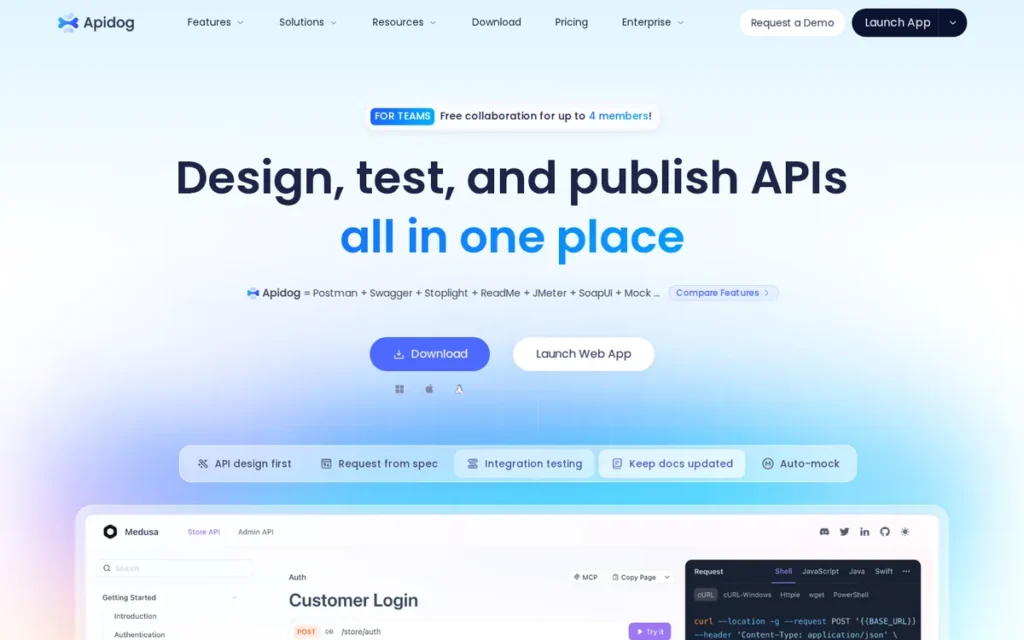
Category: All-in-One API Lifecycle Platform, a unified platform combining API design, testing, mocking, interactive documentation, and team collaboration in a single product.
At a Glance
- Category: All-in-One API Lifecycle Platform
- Best For: Teams of 2–10 migrating from Postman who need unified design, testing, documentation, and mocking at a lower per-seat cost with a free tier supporting collaborative use without solo-user restrictions
- Price Range: Free (up to 4 users, 5 projects, unlimited runs) + $9–$27/user/month + Enterprise on-premises (custom), verified May 2026 at apidog.com/pricing
- Primary Strength: Apidog holds the highest verified G2 rating in the API development tools category, 4.9/5 from 214 verified reviews as of May 2026, with reviewers citing its unified design-to-test workflow as the top strength
- Biggest Limitation: Apidog’s tightly integrated all-in-one architecture creates meaningful vendor lock-in, and its community ecosystem of tutorials and third-party integrations is substantially smaller than Postman’s
- One-Line Summary: Apidog is the highest-rated all-in-one API lifecycle platform on G2 (4.9/5, 214 verified reviews, May 2026), combining API design, testing, mocking, and documentation with a free tier for up to four users and transparent published pricing starting at $9/user/month.
- Last Verified: May 2026
Overview
Apidog is an all-in-one API lifecycle platform launched in 2022 that combines API design, testing, mocking, and documentation in a single tool, holding a G2 rating of 4.9/5 from 214 verified reviews, the highest verified rating in the API development tools category as of May 2026 (G2 Apidog seller page, May 2026).
Apidog’s “define once, reuse everywhere” philosophy means API definitions created in its visual editor automatically generate test cases, mock server responses, and interactive documentation, replacing the manual synchronization overhead of maintaining separate Postman and Swagger toolchains.
For teams forced to reconsider tooling after Postman’s 2026 free tier restriction, Apidog’s four-user free tier with unlimited Collection Runner runs and $9/user/month Basic plan represent the most affordable full-lifecycle alternative with the strongest documented user satisfaction data in this comparison.
Key Features
- Unified Design-to-Test Workflow: Apidog lets teams define an API endpoint once and automatically generate test cases, mock server responses, and interactive documentation from that single definition, replacing the manual synchronization overhead of maintaining separate Postman and Swagger toolchains.
- AI Compliance Checking: Apidog includes AI-powered compliance checking that validates endpoint designs against configured style guides and flags non-conforming naming conventions, helping teams catch API design inconsistencies before implementation code is written (Apidog AI features documentation).
- 4-User Free Tier with Unlimited Runs: Apidog’s free tier supports up to four users with up to five projects and unlimited Collection Runner runs, directly addressing the collaboration gap left by Postman’s 2026 restriction to single-user accounts with 25 monthly run caps.
- Enterprise On-Premises Option: Apidog offers an Enterprise on-premises deployment option, allowing organizations with data sovereignty requirements to run the full Apidog platform within their own infrastructure without API definitions, credentials, or payloads leaving company-controlled servers.
- Multi-Protocol Collaborative Workspaces: Apidog supports REST, GraphQL, gRPC, and WebSocket with environment variable management, authentication helpers, and simultaneous multi-user editing of API definitions in collaborative team workspaces.
Best For
Apidog is best suited for small-to-mid-size teams of two to ten who are actively migrating from Postman and need a single platform that replaces both Postman’s testing capabilities and Swagger’s design and documentation workflow without maintaining multiple subscriptions.
Apidog is also a strong fit for teams with non-technical stakeholders who participate in API design reviews, given its visual interface that does not require direct YAML editing.
Strengths
- Highest Verified G2 Rating in the Category: Apidog holds a G2 rating of 4.9/5 from 214 verified reviews (the highest verified numeric rating in the API development tools category as of May 2026) with reviewers specifically citing its “all-in-one toolkit approach, combining design, documentation, testing, and collaboration features” as the top strength (G2 Apidog vs. Postman comparison, May 2026).
- Documented Postman Migration Evidence: A verified G2 user testimonial confirms direct Postman-to-Apidog migration: “I used Postman for so many years, now they limit the free plan to single user only which is bad”, primary-source evidence that Apidog is successfully capturing teams displaced by Postman’s 2026 free tier restriction (G2, 2026).
Users on r/learnprogramming noted:
“Solid list. If you’re a beginner, I’d actually stick with Apidog for a bit. Postman is great but it’s gotten super bloated recently. Apidog is much cleaner for learning because it keeps your design, mocks, and tests in one place. Being able to work offline is also a huge plus when you’re just starting out and doing local dev.” Posted by u/Street-Bit2214
Takeaway: Developers switching from Postman to Apidog cite its unified design-mock-test workflow and offline capability as the decisive differentiators, validating its positioning as the leaner full-lifecycle alternative for teams frustrated by Postman’s increasing complexity and cloud dependency.
- Most Transparent Full-Lifecycle Pricing: Apidog’s fully published pricing ($9–$27/user/month, confirmed at apidog.com/pricing, May 2026) is the most complete pricing disclosure of any full-lifecycle API platform in this comparison, enabling direct cost comparison without sales contact.
- Enterprise Data Sovereignty Option: Apidog’s Enterprise on-premises tier addresses data sovereignty requirements for regulated industries, a differentiator among full-lifecycle platforms where most tools, including Postman, operate exclusively on vendor-hosted cloud infrastructure.
Limitations
- Vendor Lock-In Risk: Apidog’s most consequential trade-off is its deep integration architecture, teams that build their entire workflow inside Apidog (design, tests, documentation, and mocks) face meaningful migration friction if they ever need to switch tools, more so than teams using modular specialized tools for each lifecycle phase.
- Data Residency Questions: Apidog’s dual U.S.-headquarters and Asia-based development team structure prompts data residency questions in some developer communities, organizations in regulated industries such as financial services, healthcare, and government should conduct formal data processing agreement reviews and confirm applicable jurisdiction before enterprise-scale adoption.
- Smaller Community Ecosystem: Apidog’s community of tutorials, third-party integrations, and support resources is substantially smaller than Postman’s mature ecosystem, which can slow onboarding and issue resolution for developers accustomed to finding answers quickly through established community channels.
Verdict
Apidog is the highest-rated all-in-one API lifecycle platform on G2 (4.9/5, 214 verified reviews, May 2026) and the strongest verified replacement for teams that need both Postman’s testing capabilities and Swagger’s design and documentation workflow in a single, transparently priced platform.
Apidog’s 4.9/5 G2 score exceeds Postman’s 4.6/5 on the reviews criterion, but Postman’s six verified lifecycle phases outweigh Apidog’s four on the primary lifecycle coverage criterion, Apidog earns the #2 position on the strength of its rating, pricing transparency, and documented migration evidence for teams most disrupted by Postman’s 2026 free tier changes.
Teams should weigh Apidog’s strong verified ratings and pricing transparency against its 2022 founding date, smaller community ecosystem, and the data residency questions raised in developer communities before committing to enterprise-scale adoption.
3. Bruno: Best for Git-Native and Privacy-First API Development
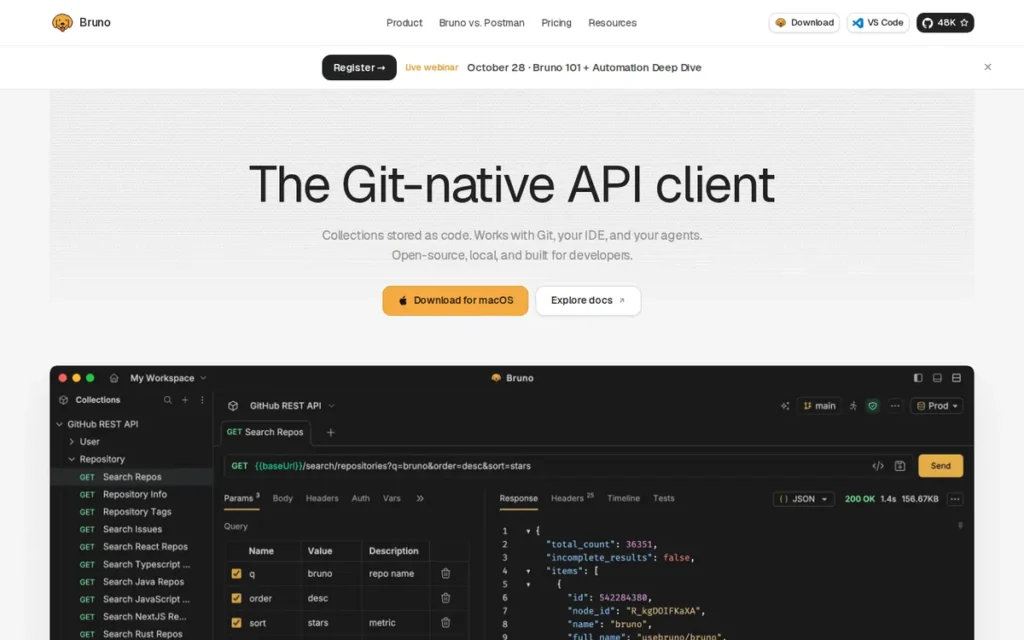
Category: Git-Native API Client, a local-first, open-source API testing client that stores collections as plain-text .bru files in the local file system and collaborates via Git pull requests rather than cloud workspaces.
At a Glance
- Category: Git-Native API Client
- Best For: Git-centric engineering teams, privacy-conscious organizations, and individual developers needing a full-featured API client with zero cloud sync, no usage limits, and no account requirement at zero cost
- Price Range: Free (open source, unlimited: no feature gating on core functionality) + Team: $6/user/month + Enterprise: $11/user/month, verified May 2026 at usebruno.com/pricing
- Primary Strength: Bruno is the only API client in this evaluation with a verified unconditional zero-cloud-sync architecture (confirmed by the official product page statement: “Bruno never syncs any of your data to the cloud”) with no cloud sync option that a future policy change could enable
- Biggest Limitation: Bruno does not include native API monitoring, hosted documentation portals, or a web interface, requiring supplementary tools for teams that need those capabilities alongside API testing
- One-Line Summary: Bruno is the fastest-growing open-source API client of 2025–2026, validated at 600,000+ monthly active users by December 2025, providing a Git-native, zero-cloud-sync alternative to Postman at $0 for individuals and $6/user/month for teams.
- Last Verified: May 2026
Overview
Bruno is an open-source, Git-native API client that stores API collections as plain-text .bru files locally, with no cloud sync, no login, and no account required, and grew from 250,000 to 600,000+ monthly active users in 2025, making it the fastest-growing API client in this category (according to the official Bruno 2025 retrospective blog post, December 2025, a self-reported metric consistent with the independently verifiable GitHub star growth from 26,000 to 40,000 in the same period).
Bruno’s architectural philosophy is fundamentally different from cloud-first tools: collaboration happens through Git pull requests on .bru collection files, enabling engineering teams to manage API definitions using the same code review processes they apply to source code.
At $0 for the full open-source individual product and $6/user/month for teams (verified May 2026 at usebruno.com/pricing), Bruno is the most affordable verified privacy-preserving API client in this evaluation.
Key Features
- Plain-Text .bru File Storage: Bruno stores all API collections as plain-text .bru files in the user’s local file system, enabling full Git-based collaboration, commit, branch, diff, PR review, and merge API definitions using existing Git workflows without any cloud sync or vendor-mediated access to collection data.
- Native Git Integration: Bruno shipped in-app Git push/pull, a visual Git diff viewer, and automatic Git fetch in 2025, making Git-based API collection collaboration a native first-class workflow rather than a manual file-management workaround (Bruno changelog).
- Multi-Protocol GA Coverage: Bruno supports REST, GraphQL, gRPC (promoted to General Availability in v2.13.0 with server reflection), and WebSocket, providing production-ready multi-protocol coverage across all four primary API communication paradigms.
- Unlimited Collection Runner: Bruno’s collection runner supports parallel execution and CSV data iterations without the usage caps that restrict Postman’s free Collection Runner to 25 runs per month.
- Unconditional Privacy Architecture: Bruno explicitly guarantees zero cloud sync by design, the official Bruno product page states “Bruno never syncs any of your data to the cloud” and “there’s not even the concept of a login or account,” providing a verifiable architectural privacy commitment absent from every cloud-first tool in this comparison.
Best For
Bruno is best suited for Git-centric engineering teams and privacy-conscious organizations (particularly teams in regulated industries such as financial services, healthcare, and government) where API credentials, internal endpoint URLs, and authentication tokens must remain on-premises by policy or compliance requirement.
With Bruno, changing an API endpoint URL is a Git commit. Adding an authentication header is a pull request. Reverting a breaking change is a git revert, with a full diff history showing exactly what changed and who approved it. For teams that already use Git for everything, this is not a new workflow: it is the same code review process applied to API definitions.
Bruno is also the optimal choice for individual developers and budget-constrained small teams seeking the most feature-complete free API client without artificial usage limits.
Strengths
- Fastest Verified Growth Trajectory in the Category: According to the official Bruno 2025 retrospective blog post (December 2025) (self-reported and consistent with independently verifiable GitHub star growth from 26,000 to 40,000+) Bruno grew from 250,000 to 600,000+ monthly active users between January and December 2025, while shipping 78 releases, 312+ new features, and 387+ bug fixes in the same period (Bruno 2025 retrospective, December 2025).
- Authentic Community Adoption Signal: Bruno’s GitHub repository reached 40,000+ stars by end of 2025, up from 26,000 in January 2025 (a 54% increase in 12 months) representing authentic community adoption since GitHub stars are non-monetized signals not influenced by marketing spend (Bruno GitHub repository, verified May 2026).
- Unconditional Privacy Guarantee: Bruno’s zero-cloud architecture is the only verified unconditional privacy guarantee in this comparison, no account, no login, no vendor cloud sync by architectural design, with collections stored as plain-text .bru files the team fully controls. Bruno is the only evaluated API client where data privacy is guaranteed by architecture rather than policy, there is no cloud sync option that a future policy change could enable.
- Lowest Verified Team Pricing: Bruno Team at $6/user/month (verified May 2026 at usebruno.com/pricing) is the lowest verified team pricing of any API client in this evaluation (33% less per seat than Apidog Basic ($9/user/month)) offering a full-featured Git-native client at the most affordable confirmed collaborative rate in the category.
Limitations
- No Native Monitoring or Documentation Portal: Bruno’s most consequential trade-off is its deliberate scope boundary, Bruno does not include native API monitoring, hosted documentation portals, or a web-based interface, meaning teams that rely on those capabilities must use supplementary tools alongside Bruno. This is a real capability gap for developers migrating from Postman who actively use monitoring and documentation generation.
- No B2B Review Platform Presence: Bruno has no presence on G2, Capterra, or other formal B2B software review platforms, making vendor evaluation more difficult for organizations that require third-party review platform data as part of procurement due diligence, and removing an independent validation mechanism available for most competing tools.
- Desktop-Only Architecture: No Web Interface or Mobile Client: Bruno requires a desktop application installation on every machine used for API testing, there is no web-based Bruno interface, no browser-based fallback, and no mobile client. Teams that rely on browser-based tools for pair programming sessions, remote onboarding workflows, or cross-device API validation will find Bruno’s desktop-only model requires additional process accommodations that cloud-first tools like Postman and browser-first tools like Hoppscotch do not impose.
Users on r/programming shared their experience after switching:
“Recently switched to Bruno from Postman. I love the local collection files. Bruno is way less polished however and keeps crashing on apple silicon. Even with those rough edges I still like it better than Postman now.” Posted by u/Faramir_Anarion
Takeaway: Bruno adopters consistently cite the local .bru file architecture as the decisive reason to switch from Postman, but acknowledge desktop stability and polish as real ongoing trade-offs that the tool has not yet fully resolved.
Verdict
Bruno is the fastest-growing open-source API client of 2025–2026 (verified at 600,000+ monthly active users and 40,000+ GitHub stars by December 2025) and the strongest choice for Git-centric engineering teams and privacy-conscious organizations that require a local-first API client with zero cloud sync at zero cost for individuals.
Bruno’s $6/user/month team pricing is the most affordable verified team tier in the category, its gRPC General Availability in 2025 closes the protocol coverage gap that previously limited its adoption, and its official “no login, no account, no cloud sync” architecture provides an unconditional data privacy guarantee no other tool in this evaluation offers.
Teams evaluating Bruno should confirm they do not require native API monitoring, hosted documentation portals, or a web-based interface before migrating from Postman, those capabilities require separate supplementary tools outside Bruno’s intentional product scope.
4. Insomnia: Best for Multi-Protocol API Testing (REST + GraphQL + gRPC + WebSocket + SSE)
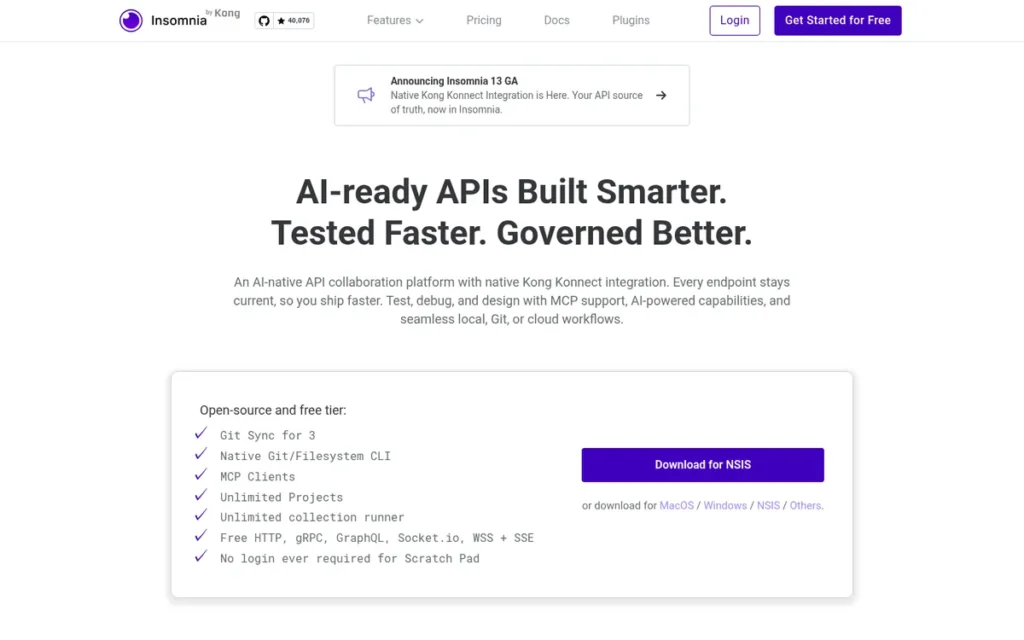
Category: Multi-Protocol API Client, a desktop-first, open-source API testing client with native support for five protocols (REST, GraphQL, gRPC, WebSocket, SSE) and configurable local, Git, or cloud storage modes.
At a Glance
- Category: Multi-Protocol API Client
- Best For: Developers building multi-protocol backends (REST + GraphQL + gRPC + WebSocket + SSE) who want a single client with AI-assisted test generation from OpenAPI specs and optional local or Git-based storage
- Price Range: Free (open-source desktop core with local and Git storage) + paid collaboration tiers, verify current pricing at insomnia.rest/pricing
- Primary Strength: Insomnia natively supports five API protocols: REST, GraphQL, gRPC, WebSocket, and SSE, the broadest verified multi-protocol coverage of any API testing client in this evaluation
- Biggest Limitation: Insomnia’s 2023 forced-cloud-login incident damaged community trust, and while Kong subsequently restored local and Git storage modes, developer wariness about future policy reversals is documented in ongoing community discussions through 2025–2026
- One-Line Summary: Insomnia is a Kong-maintained open-source API client with verified native support for REST, GraphQL, gRPC, WebSocket, and SSE, AI-generated test suites from OpenAPI specs (beta), and restored local and Git storage modes following the 2023 forced-login trust incident.
- Last Verified: May 2026
Overview
Insomnia is an open-source, multi-protocol API client maintained by Kong that natively supports REST, GraphQL, gRPC, WebSocket, and SSE (the broadest verified protocol coverage of any API client in this evaluation) with AI-powered test suite generation from OpenAPI specs and configurable local, Git, or cloud storage modes.
Kong repositioned Insomnia from a lightweight REST client into a full API collaboration platform, adding MCP (Model Context Protocol) client support in 2025–2026 and restoring local and Git storage as first-class options following the 2023 community backlash, documented in GitHub issue threads github.com/Kong/insomnia/issues/6577 and issues/6624, with Kong’s response in discussions/7362.
For developers building modern APIs that span multiple protocols (real-time subscriptions, streaming, or RPC-based microservices) Insomnia’s native multi-protocol breadth and AI-assisted test generation represent genuine technical differentiators over most other API testing clients in this evaluation.
Key Features
- Five Natively Supported Protocols: Insomnia natively supports REST, GraphQL, gRPC, WebSocket, and SSE (without requiring plugins or external configurations) enabling developers to test all major API communication paradigms including real-time and streaming protocols in a single client (Abstracta Insomnia vs. Postman comparison, 2026).
- AI-Powered Test Generation (Beta): Insomnia AI automatically generates complete test suites from imported OpenAPI specifications, highlighted in Abstracta’s 2026 comparison as a beta-stage feature in Insomnia AI v8.0. Verify production-readiness status at insomnia.rest before relying on it in automated CI/CD pipelines.
- Three Configurable Storage Modes: Insomnia provides local-only, Git-synced, and cloud storage modes, giving teams explicit control over where API collection data, environments, and request history are stored, a direct response to the 2023 forced-cloud-login controversy.
- MCP Client Support: Insomnia includes MCP (Model Context Protocol) client support, positioning it as a forward-looking tool for teams building AI agent workflows that interact with APIs through the emerging MCP standard.
- Advanced Request Toolkit: Insomnia’s request-building toolkit includes environment variables, chained requests, authentication helpers for OAuth2, JWT, and API keys, cookie management, and code generation, providing a mature developer workstation capability beyond basic HTTP request sending (CodeMag Insomnia overview).
Best For
Insomnia is best suited for individual developers and small teams building APIs that span multiple protocols (particularly teams working with GraphQL, gRPC microservices, or WebSocket-based real-time systems) who want a desktop-first client with AI-assisted test generation from existing OpenAPI specs and the option to keep data local or in Git.
Insomnia is also appropriate for developers who want multi-protocol coverage in a single tool rather than maintaining separate clients for REST, GraphQL, and gRPC testing.
Strengths
- Broadest Protocol Coverage of Any Testing Client in This Evaluation: Insomnia is the only API testing client evaluated with verified native support for five distinct protocols (REST, GraphQL, gRPC, WebSocket, and SSE) confirmed across multiple independent 2026 comparison sources including Abstracta’s Insomnia vs. Postman comparison and APYHub’s protocol analysis.
- AI Test Generation from OpenAPI Specs: Insomnia AI’s automated test suite generation from OpenAPI specifications, a beta-stage feature in Insomnia AI v8.0, highlighted in Abstracta’s 2026 comparison, addresses test creation overhead by enabling teams with existing API specs to scaffold test coverage without manual scripting.
- Enterprise Infrastructure Credibility via Kong: Kong’s acquisition of Insomnia adds enterprise infrastructure credibility through Kong’s established API Gateway and Konnect platform ecosystem, teams already using Kong Gateway for API infrastructure have a natural commercial path to Insomnia for developer tooling, creating a documented integration opportunity for Kong-standardized organizations.
- Accountable Policy Reversal: Insomnia’s restored local and Git storage modes: confirmed on Kong’s official developer blog as first-class workflow options, represent a documented, accountable response to community feedback following the 2023 incident, a positive signal of vendor responsiveness.
Limitations
- Unresolved Community Trust Deficit: Insomnia’s most consequential trade-off is the unresolved trust deficit from the 2023 forced-cloud-login incident, when Insomnia v8.0 required all users to create accounts and sync data to Kong’s cloud infrastructure, a policy reversed after developer backlash documented in GitHub issue threads issues/6577 and issues/6624, with Kong’s response in discussions/7362. Developer wariness about future policy reversals remains active in comparison forums through 2025–2026.
Users on r/webdev shared their experience at the time of the incident:
“Just a couple of weeks ago, Insomnia was getting roasted. Someone paid for whatever the premium subscription is and tried contacting support. Support gave them the run-around. Some advertised features were actually non-existent. And they couldn’t get their money back without filing a charge-back. I also liked Insomnia back when it was a FOSS alternative to Postman. Sad to see this is what it has come to.” Posted by u/Canowyrms
Takeaway: Insomnia’s trust deficit extends beyond the 2023 forced-login incident, verified paid users documented advertised features that did not exist and support that refused refunds, compounding the credibility concerns that teams should factor into vendor risk assessment before committing to Insomnia’s paid tiers.
- No Documentation or Monitoring Features: Insomnia lacks native API documentation generation, hosted documentation portals, or API monitoring, requiring supplementary tools for teams that need those lifecycle capabilities alongside multi-protocol testing.
- Incomplete Paid Pricing Transparency: Insomnia’s exact paid tier pricing was not publicly confirmed at time of research (unlike Bruno ($6/user/month) or Apidog ($9/user/month), which publish specific dollar figures) requiring buyers to contact the vendor for accurate cost comparison during procurement evaluation.
Verdict
Insomnia is the multi-protocol API client with the broadest verified native protocol coverage in this evaluation (REST, GraphQL, gRPC, WebSocket, and SSE) combined with AI-powered test suite generation from OpenAPI specs (beta), making it the strongest single-tool choice for developers building APIs across multiple communication paradigms in 2026.
Kong’s backing provides enterprise infrastructure credibility through the Kong Gateway and Konnect ecosystem, and the restored local and Git storage modes give teams genuine data control options following the 2023 controversy.
Teams evaluating Insomnia should include the 2023 forced-login incident in their vendor risk assessment, verify current paid tier pricing at insomnia.rest/pricing, and plan for supplementary documentation and monitoring tools if those lifecycle capabilities are required.
5. Hoppscotch: Best Zero-Friction Browser Tool and Self-Hosted API Client
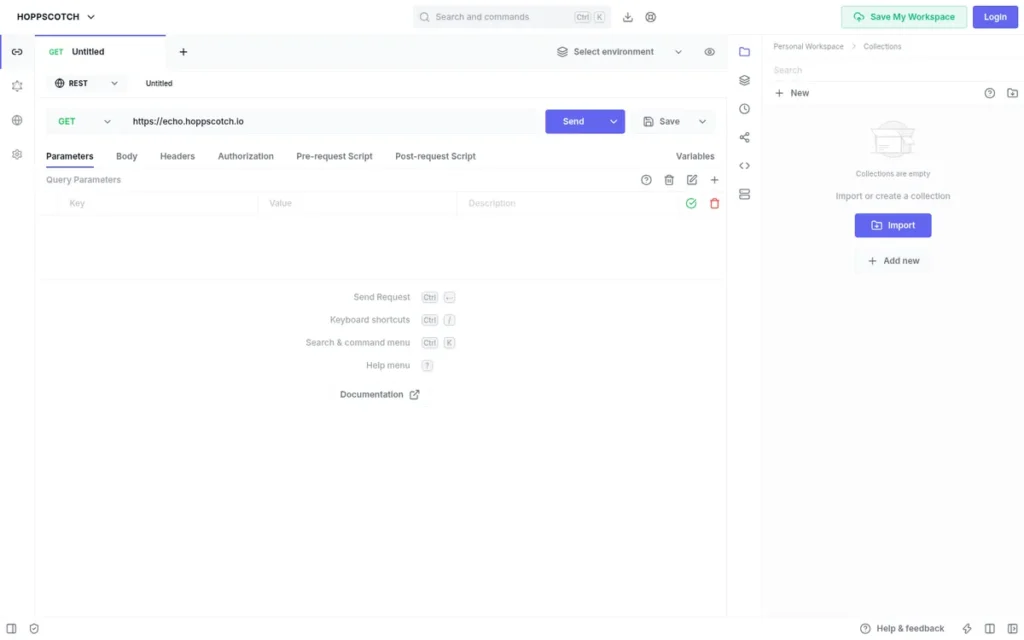
Category: Browser-First API Client, a web-based, open-source API testing platform requiring no installation, usable instantly in any browser, and self-hostable via Docker for team data sovereignty.
At a Glance
- Category: Browser-First API Client
- Best For: Developers needing zero-friction API testing with no installation or account setup, and teams seeking a self-hostable, privacy-respecting platform deployable on their own infrastructure via Docker
- Price Range: Free (browser, no account required) + Team and Enterprise tiers: verify at hoppscotch.io/pricing; self-hosted Docker deployment available as an alternative to cloud subscription
- Primary Strength: Hoppscotch is the only evaluated API client operating entirely in a web browser with no installation and no account required for individual API testing use, while also supporting full self-hosted Docker deployment for complete team data sovereignty
- Biggest Limitation: Hoppscotch’s AI features are explicitly labeled experimental as of May 2026, advanced test automation requires the Hoppscotch CLI rather than native in-product configuration, and its tutorial and troubleshooting documentation is less mature than established clients
- One-Line Summary: Hoppscotch is the only evaluated API development platform combining zero-installation browser access with full self-hosting via Docker, supporting REST, GraphQL, WebSocket, SSE, Socket.IO, and MQTT at zero cost for individual use with no account required.
- Last Verified: May 2026
Overview
Hoppscotch is a browser-based, open-source API client that requires no installation and no account, any developer can test an API in seconds at hoppscotch.io, while supporting REST, GraphQL, WebSocket, SSE, Socket.IO, and MQTT, including IoT and real-time messaging protocols not covered by most competitors in this evaluation.
Hoppscotch is uniquely dual-mode: it operates as a zero-friction web app for instant individual use and as a self-hosted Docker deployment for teams that need full data sovereignty without cloud vendor dependency.
Hoppscotch v2026.2.0 added API documentation versioning and security improvements, and its AI features (including payload generation, pre-request scripting, and test case generation) are available in Settings under Experiments, explicitly labeled experimental as of May 2026 (Hoppscotch AI features documentation).
Key Features
- Zero-Friction Entry: Hoppscotch requires no installation, no account creation, and no setup, opening hoppscotch.io in any browser provides immediate access to a full-featured API testing interface, making it the lowest-friction entry point of any tool in this evaluation.
- Six Protocols Including IoT: Hoppscotch supports REST, GraphQL, WebSocket, SSE, Socket.IO, and MQTT, including Socket.IO and MQTT for IoT and real-time messaging applications that no other tool in this comparison covers natively, confirmed across Abstracta’s Hoppscotch overview and official Hoppscotch documentation.
- Self-Hosted Docker Deployment: Hoppscotch is self-hostable via Docker, allowing teams to deploy a full Hoppscotch instance on their own infrastructure for complete data sovereignty without cloud vendor dependency, combining browser-native UX with maximum privacy control in a single product.
- v2026 Documentation and Security Updates: Hoppscotch v2026.2.0 added API documentation versioning, URL encoding and decoding tools, and scripting sandbox reliability improvements, expanding the platform from a pure testing tool toward broader lifecycle coverage (Hoppscotch GitHub releases).
- Experimental AI Features: Hoppscotch’s AI features: available in Settings under Experiments, include AI-assisted request renaming, payload generation, pre-request script writing, and automated test case generation, explicitly labeled experimental and not recommended for production-grade automated workflows as of May 2026 (Hoppscotch AI features documentation).
Best For
Hoppscotch is best suited for two distinct user profiles: individual developers who need zero-friction API testing without any installation or account setup, and teams that need a self-hosted, privacy-respecting API platform deployable within their own Docker infrastructure for full data control.
Hoppscotch is also uniquely positioned for developers building IoT or real-time messaging APIs who require Socket.IO and MQTT protocol support not available in most other API clients in this evaluation.
Strengths
- Active 2026 Release Cadence: Hoppscotch v2026.2.0 (released in 2026, confirmed at Hoppscotch GitHub releases) demonstrates active development with documented feature additions including API documentation versioning and scripting sandbox reliability improvements, evidencing ongoing platform investment rather than maintenance-mode development.
- Broadest Protocol Coverage in This Evaluation: Hoppscotch supports REST, GraphQL, WebSocket, SSE, Socket.IO, and MQTT, six protocols including Socket.IO and MQTT for IoT and real-time messaging absent from every other API client in this comparison, confirmed across Abstracta’s Hoppscotch overview and official documentation.
- Unique Dual Deployment Model: Hoppscotch’s self-hosting via Docker provides the unique combination of zero-friction browser UX for individual use and full infrastructure sovereignty for teams, the only evaluated tool that simultaneously serves both the “no friction at all” and “maximum privacy control” deployment scenarios in a single product.
- Verified Ease-of-Use: Hoppscotch is described as “ridiculously easy” to start using and “simple and intuitive” across multiple independent community and review sources (Abstracta Hoppscotch overview, 2026), validating ease-of-use appropriate for developers at any experience level.
This aligns with community sentiment on r/webdev:
“An update they released a few weeks ago made their entire app slow and actually unusable. Crazy the direction tools are going. As an Insomnia refugee REST Client and Hoppscotch have been great” Posted by u/JesterDolor
Takeaway: Developers fleeing Insomnia’s 2023 forced-account changes consistently named Hoppscotch as a zero-friction alternative, validating its no-account, no-install positioning as a real competitive differentiator rather than a marketing claim.
Limitations
- Experimental AI and Automation Maturity: Hoppscotch’s most consequential trade-off is that its AI features are explicitly labeled “experimental” in Settings as of May 2026 (a meaningful maturity gap compared to Insomnia’s beta-stage AI test generation and Apidog’s production-integrated compliance checking) and should not be relied upon for production-grade automated workflows (Hoppscotch AI features documentation).
- CLI-Dependent Advanced Automation: Hoppscotch’s complex test automation requires the Hoppscotch CLI (github.com/hoppscotch/hopp-cli) rather than native in-product configuration, adding setup overhead for teams expecting workflow parity with Postman’s built-in Collection Runner and monitor capabilities.
- Documentation Ecosystem Maturity Gap: Community reviewers describe Hoppscotch’s support documentation (tutorials, troubleshooting guides, and third-party resources) as limited compared to Postman’s mature support infrastructure (Abstracta Hoppscotch overview, 2026), which can slow issue resolution and developer onboarding for teams new to the platform.
Verdict
Hoppscotch is the only evaluated API client that simultaneously provides zero-installation browser access and full self-hosted Docker deployment for individual API testing use, with the broadest protocol support in the category, REST, GraphQL, WebSocket, SSE, Socket.IO, and MQTT, at zero cost for individual use with no account required.
Hoppscotch’s 2026 release adding API documentation versioning signals a trajectory toward broader lifecycle coverage, and its self-hosting path makes it a credible privacy-preserving team tool for organizations with existing Docker infrastructure.
Teams should treat Hoppscotch’s AI features as explicitly experimental rather than production-ready, plan for supplementary tooling if complex test automation or API monitoring is required, and verify Team and Enterprise cloud pricing at hoppscotch.io/pricing before budget planning.
6. Stoplight: Best for API Design-First Governance and OpenAPI Style Enforcement
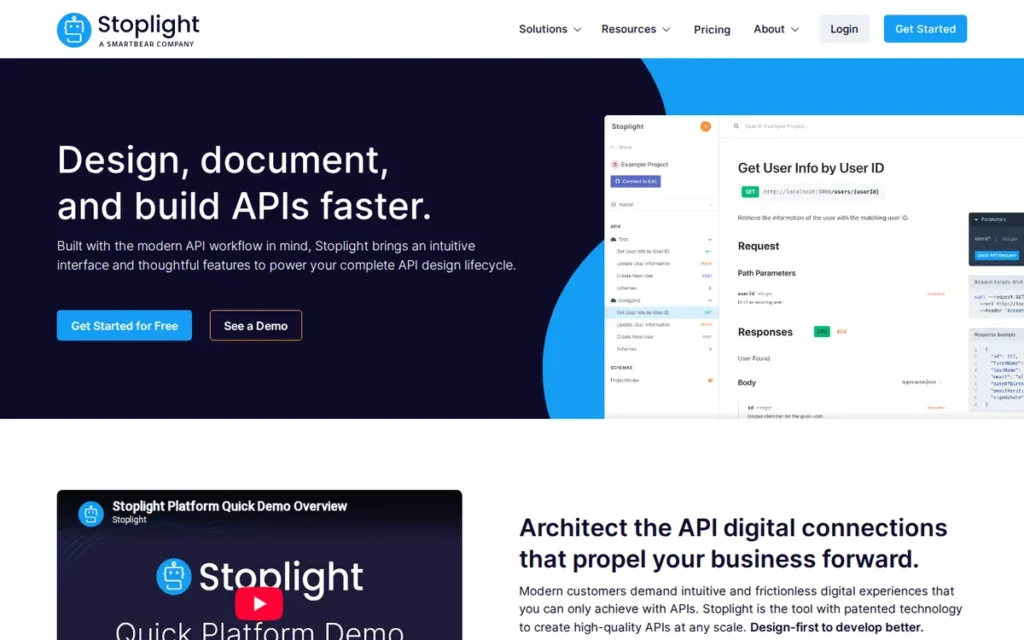
Category: Design-First API Governance Platform, a design-time platform for visual OpenAPI editing, automated Spectral-powered style enforcement, Prism-generated mock servers, and enterprise documentation portals. Not a runtime API testing client.
At a Glance
- Category: Design-First API Governance Platform
- Best For: Engineering organizations practicing API design-first development who need visual OpenAPI editing, automated Spectral-powered style enforcement across teams, and enterprise-quality documentation portals
- Price Range: Free + Starter: $39/month + Professional: $99/month + Enterprise: custom, project-based pricing verified May 2026 at stoplight.io/pricing
- Primary Strength: Stoplight’s Spectral open-source linter, Prism mock server, and Elements documentation component are independently adopted across the API developer community as standalone CI/CD and documentation tools, evidencing ecosystem impact beyond the commercial platform
- Biggest Limitation: Stoplight is a design-time platform only and does not provide runtime API testing or request execution (requiring a separate API testing client) and SmartBear’s “API Hub is now Swagger” active rebranding creates documented standalone product roadmap uncertainty
- One-Line Summary: Stoplight is the purpose-built API design governance platform for API-first engineering organizations, offering Spectral-powered OpenAPI style enforcement, Prism-generated mock servers, and developer-portal-quality documentation at a transparent project-based price of $39–$99/month.
- Last Verified: May 2026
Overview
Stoplight is a design-first API governance platform founded in 2014 and acquired by SmartBear in 2023, focusing on visual OpenAPI specification creation, automated style enforcement through Spectral linting, Prism-powered mock servers, and enterprise documentation portals, serving engineering teams that practice API-first development before writing implementation code.
Unlike every other tool in this comparison, Stoplight is explicitly a design-time platform: its value is highest before APIs are built, when establishing design contracts, enforcing style standards, and generating mocks for parallel frontend and backend development. Stoplight does not replace runtime API testing clients like Postman, Bruno, or Insomnia.
Stoplight’s most durable ecosystem contribution is three open-source tools (Spectral, Prism, and Elements) which are independently adopted across the API development community beyond the commercial Stoplight platform, confirmed by APIs You Won’t Hate blog, 2026.
Key Features
- Spectral OpenAPI Linter: Stoplight’s Spectral open-source linter enforces custom API style guides automatically (integrating into CI/CD pipelines to flag OpenAPI specification violations at the design phase before code is written) and is widely adopted as a standalone CI/CD linting tool independent of the commercial Stoplight platform.
- Prism Mock Server Generation: Stoplight generates mock servers through its Prism open-source tool from OpenAPI specifications, enabling parallel frontend and backend development against consistent API contracts before implementation is complete.
- Elements Documentation Component: Stoplight’s Elements component produces developer-portal-quality embeddable API documentation targeting the Stripe documentation aesthetic standard (per APIs You Won’t Hate blog, 2026) as a React or Web Component, giving teams a documentation portal solution without custom engineering effort.
- Real-Time Design Validation: Stoplight’s visual OpenAPI editor includes real-time validation alerts and automatic error checks during the design phase, surfacing specification mistakes at the lowest-cost moment (before implementation) rather than during integration testing or production (Stoplight API governance documentation).
- Enterprise Documentation Access Controls: Stoplight’s workspace permission model supports private, internal, partner/guest, and public documentation portal access controls, enabling enterprise teams to maintain multiple documentation visibility tiers with appropriate access controls for each audience.
Best For
Stoplight is best suited for engineering organizations of any size that practice or want to establish API design-first development (where the OpenAPI specification is defined as a team contract before implementation begins) and need automated style enforcement, Spectral-based CI/CD linting, and enterprise documentation portals.
Stoplight is explicitly not suited as a primary API testing client and is typically paired with a runtime testing tool such as Postman, Bruno, or Insomnia to cover the request-level testing and debugging phase.
Strengths
- Decade of API Design Tooling Specialization: Stoplight was founded in 2014: giving it over a decade of API design tooling specialization, and its three open-source projects (Spectral linter, Prism mock server, Elements documentation component) are independently adopted across the API development community as standalone CI/CD and documentation tools, confirmed by APIs You Won’t Hate blog, 2026, Bump.sh comparison, and Zuplo OpenAPI tools guide, 2026.
- Purpose-Built Enterprise API Governance: Stoplight’s governance capabilities allow teams to “integrate error and validation checks directly into your API design workflow” and “implement best practices or custom style guides” across business units, confirmed in official Stoplight API governance documentation, serving the multi-team API standardization use case that general-purpose testing tools do not address.
- Developer-Portal-Quality Documentation Output: Stoplight’s Elements documentation component produces API documentation targeting the quality standard of recognized developer portals (as a React or Web Component embeddable in existing websites) reducing custom documentation engineering effort for API-first companies (per APIs You Won’t Hate blog, 2026).
- Cost-Effective Project-Based Pricing for Larger Teams: Stoplight’s project-based pricing ($39–$99/month, verified at stoplight.io/pricing, May 2026) can be more cost-effective than per-seat tools for larger engineering teams, verify Stoplight’s $99/month Professional rate against your chosen per-seat alternative at time of evaluation, since per-seat costs compound at scale and pricing changes at both vendors.
Limitations
- Design-Time Only, Separate Testing Client Required: Stoplight’s most consequential trade-off is its design-time scope, Stoplight does not provide runtime API testing, request execution, or API monitoring, requiring teams to maintain a separate API testing client, effectively requiring budget and workflow integration for two tool categories rather than one.
- Historical Active-Design Collaboration Gaps: A 2022 user experience posted to r/ExperiencedDevs noted that Stoplight “fell short in things like being able to suggest changes, comment on the API, see a change history” for active design-phase iteration, identifying collaboration UX gaps that SmartBear has since addressed with a “Proposals” beta feature not yet fully validated in public community feedback.
- Post-Acquisition Roadmap Uncertainty: SmartBear’s own support portal now states “API Hub is now Swagger” (confirming that the API Hub brand consolidation is an active present-tense fact, not a speculated future event) creating a genuine long-term vendor risk for organizations making multi-year platform commitments to Stoplight as a standalone product (SmartBear Swagger portal, 2025). SmartBear acquired Stoplight in 2023, per Bump.sh.
Users on r/dotnet shared a real-world migration experience:
“We have just migrated from Stoplight to Backstage. There would be more than 100 APIs on our end all were migrated in a duration of a month. We just wrote some python scripts to update the formats of files from stoplight compatible to backstage compatible format. The downside of backstage is that the UI is not as intuitive as Stoplight. However it being open source we saved some cost.” Posted by u/Delicious_Jaguar_341
Takeaway: Enterprise teams that have left Stoplight cite cost savings from open-source alternatives as the primary driver (even when sacrificing Stoplight’s superior UX) confirming that Stoplight’s commercial pricing model requires explicit justification relative to the free-tier tooling available in the same design-governance category.
Verdict
Stoplight is the purpose-built API design governance platform for engineering teams practicing API-first development, offering Spectral-powered style enforcement, Prism-generated mock servers, and enterprise documentation portals with a transparent project-based pricing model of $39–$99/month that does not require sales contact for standard tiers.
Stoplight’s decade-long API design tooling specialization and the independent adoption of its Spectral, Prism, and Elements open-source components validate its differentiated market position and ecosystem expertise.
Organizations evaluating Stoplight should confirm their API design-first workflow maturity before purchasing, assess SmartBear’s confirmed “API Hub is now Swagger” brand consolidation before making a long-term commitment, and budget explicitly for a separate runtime API testing client (such as Bruno, Insomnia, or Postman) to cover the testing phase Stoplight does not address.
7. SwaggerHub: Best for OpenAPI-Standardized Enterprise Spec Collaboration
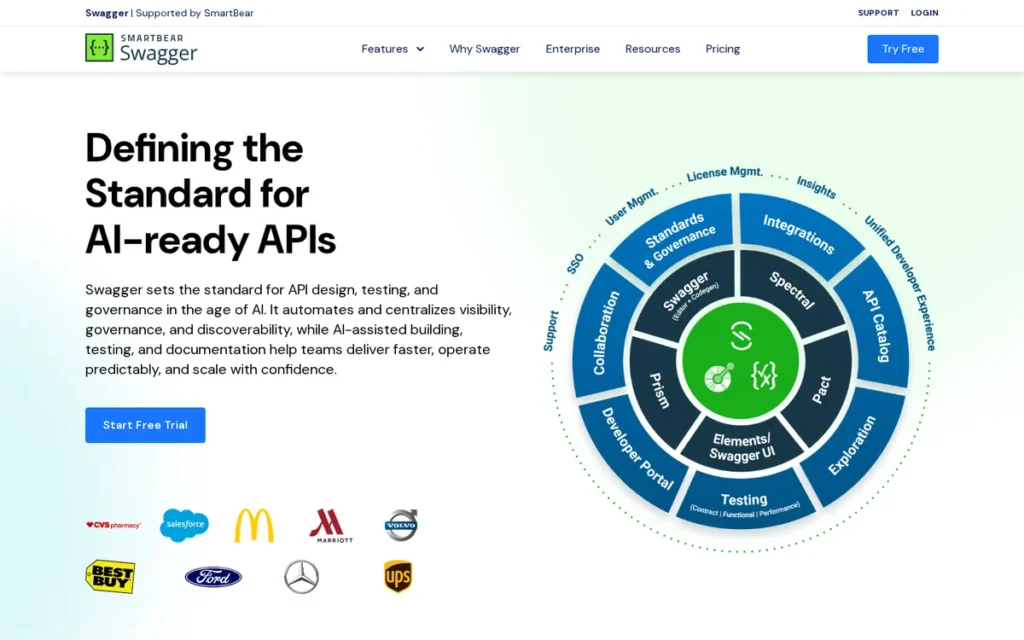
Category: OpenAPI Specification Platform, a commercial collaborative platform for OpenAPI spec authoring, versioning, governance, documentation generation, and code generation, built on the Swagger/OpenAPI ecosystem.
At a Glance
- Category: OpenAPI Specification Platform
- Best For: Enterprises standardized on OpenAPI/Swagger needing centralized multi-team spec collaboration, versioning, domain-based schema reuse, and auto-generated documentation portals with enterprise access controls
- Price Range: Free + Team tier (verify at swagger.io/tools/swaggerhub/pricing/) + Enterprise on-premises (pricing requires sales contact, not publicly published)
- Primary Strength: SwaggerHub is the commercial platform built directly on the Swagger specification (which became the industry-standard OpenAPI Specification) giving it unmatched brand recognition and ecosystem integration for OAS-standardized enterprises, with a verified monthly enterprise release cadence through v2.12.1 (August 27, 2025)
- Biggest Limitation: SwaggerHub’s Enterprise tier pricing requires sales contact with no published figures (the most notable pricing transparency gap in this evaluation) and SmartBear’s “API Hub is now Swagger” active rebranding is a confirmed present-tense enterprise purchasing consideration
- One-Line Summary: SwaggerHub is SmartBear’s commercial OpenAPI collaboration platform built on the Swagger ecosystem, offering centralized spec versioning, domain-based reuse, auto-generated documentation, and enterprise on-premises deployment with a verified monthly release cadence confirmed through version 2.12.1 in August 2025.
- Last Verified: May 2026
Overview
SwaggerHub is SmartBear’s commercial OpenAPI collaboration platform built on the Swagger ecosystem, offering centralized spec authoring, versioning, governance, auto-generated documentation, and enterprise on-premises deployment, with a verified monthly release cadence confirmed through version 2.12.1 in August 2025 (InvGate ITDB; SmartBear Swagger portal release notes, August 2025).
SwaggerHub’s authority derives from its heritage as the commercial extension of the Swagger toolchain that API development teams have used since the OpenAPI Specification’s establishment, making it the recognized choice for organizations that standardized on OAS and need collaborative spec management with enterprise-grade access controls.
As of 2025–2026, SmartBear’s own support portal now states “API Hub is now Swagger”, confirming an active present-tense brand consolidation that makes SwaggerHub’s standalone product roadmap a current purchasing consideration, as noted by Zuplo’s 2026 API lifecycle management guide.
Key Features
- Collaborative OpenAPI Design with Versioning: SwaggerHub provides a collaborative environment where teams co-author API specifications with real-time validation, version history, branching, and diff comparison, treating the OpenAPI spec as a managed code artifact with full lifecycle controls.
- Complete Swagger Toolchain Integration: SwaggerHub integrates directly with the Swagger Editor, Swagger UI, Swagger Codegen, and Swagger Validator, providing an end-to-end OpenAPI experience from editing to documentation to SDK generation within SmartBear’s commercial platform.
- Domain-Based Schema Reuse: SwaggerHub’s domain-based API reuse model allows teams to define schemas, parameters, and responses once as shared domains and reference them across multiple API specifications, enforcing consistency at scale without manual duplication across team-owned specs.
- Enterprise On-Premises with Monthly Releases: SwaggerHub Enterprise on-premises maintained a verified monthly release cadence through version 2.12.1 on August 27, 2025 and version 2.12 on July 31, 2025, providing predictable upgrade paths and security patches that enterprise procurement processes require (InvGate ITDB; SmartBear release notes).
- Auto-Generated Interactive Documentation: SwaggerHub auto-generates interactive API documentation from OpenAPI specifications with access controls supporting private, internal, and public visibility tiers for different documentation audiences.
Best For
SwaggerHub is best suited for enterprises that have already standardized on the OpenAPI Specification and Swagger toolchain, particularly multi-team organizations that need centralized spec versioning, domain-based reuse of shared schema components, and hosted documentation portals with enterprise-grade access controls.
SwaggerHub is also appropriate for organizations with on-premises deployment requirements for API specification management, given its enterprise on-premises offering with a confirmed active monthly release cadence through August 2025.
Strengths
- Verified Active Enterprise Release Cadence: SwaggerHub Enterprise on-premises maintained a verified monthly release cadence through version 2.12.1 released August 27, 2025 and version 2.12 released July 31, 2025, confirming predictable upgrade paths and security patch availability that enterprise procurement processes require (InvGate ITDB; SmartBear Swagger portal release notes, August 2025).
- Unmatched OAS Ecosystem Heritage: SwaggerHub’s heritage as the commercial platform built directly on the Swagger specification (which Tony Tam created and SmartBear acquired in 2015, subsequently stewarding it into the OpenAPI Specification standard that underpins most tools in this evaluation) gives it unmatched OAS ecosystem brand recognition among organizations that built their API design workflow on Swagger tools.
- Enterprise Schema Standardization at Scale: SwaggerHub’s domain-based reuse model enables multi-team API standardization, shared schema components defined once in SwaggerHub domains are referenced across multiple specifications automatically, reducing the schema inconsistency that emerges when distributed teams manage spec components independently.
- Existing Swagger Investment Integration: SwaggerHub integrates the complete Swagger toolchain (Editor, UI, Codegen, Validator) in a single collaborative platform, allowing organizations with existing Swagger tool investments to centralize and add versioning, governance, and hosted documentation without replacing their current open-source workflow.
Limitations
- Persistent OSS Value Proposition Question: SwaggerHub’s most consequential trade-off is the continuous scrutiny of its commercial value over its freely available open-source foundation, the Swagger OSS toolchain provides SwaggerHub’s core functionality at zero cost, evidenced by active “SwaggerHub alternatives” discussions on Databricks community forums where senior developers describe plain YAML in VSCode plus Git as sufficient for OpenAPI workflows.
- API Hub Consolidation: Confirmed Active Rebranding: SmartBear’s own support portal now explicitly states “API Hub is now Swagger”, an active present-tense rebranding confirming that product-line consolidation has already begun, making roadmap uncertainty a confirmed present-tense concern rather than a speculated future risk for organizations making multi-year commitments (SmartBear Swagger portal, 2025). Zuplo’s 2026 API lifecycle management guide confirms this consolidation may affect standalone product roadmaps.
- Enterprise Pricing Opacity: SwaggerHub’s Enterprise tier pricing requires sales contact with no published figures (the most notable pricing transparency gap in this entire evaluation) preventing direct cost comparison with per-seat competitors during procurement and disadvantaging budget-constrained buyers conducting quick comparative evaluations.
Verdict
SwaggerHub is the OpenAPI-native API specification collaboration platform for enterprises that have built their API design workflow on the Swagger ecosystem and need centralized spec versioning, domain-based schema reuse, enterprise documentation portals, and an on-premises deployment option with a confirmed monthly release cadence through August 2025.
SwaggerHub’s heritage as the commercial home of the Swagger specification gives it unmatched OAS ecosystem credibility for organizations standardized on OpenAPI. However, SmartBear’s own support portal confirmation that “API Hub is now Swagger” makes the product consolidation a present-tense enterprise purchasing consideration, not a speculated future risk.
Organizations evaluating SwaggerHub should formally assess whether its collaboration and governance features justify subscription costs over the freely available Swagger OSS toolchain, plan for a longer procurement cycle given Enterprise tier pricing requires sales contact, and monitor SmartBear’s API Hub consolidation roadmap before making multi-year platform commitments.
What Red Flags Should I Watch For When Evaluating API Development Tools?
Five documented red flags in the API development tools category (all identified from real incidents, vendor policy changes, and independent community discussions) signal vendor risk, pricing surprises, and product quality gaps that developers should verify before committing to any tool.
Red Flag #1: Forced Cloud Login Requirements
Any API client that requires account creation and cloud sync for local development workflows represents a data sovereignty risk, and a precedent for future policy enforcement.
Insomnia’s v8.0 release in 2023 implemented mandatory cloud login for all users, requiring API collection data to sync to Kong’s servers, before the policy was reversed after significant developer backlash documented in GitHub issue threads github.com/Kong/insomnia/issues/6577 and issues/6624, with Kong’s response in discussions/7362.
API collections frequently contain sensitive internal endpoint URLs, authentication tokens, and environment secrets. These should never be involuntarily synced to a third-party server without explicit, informed consent from every team member.
Red Flag #2: Retroactive Free Tier Restrictions After Users Build Workflows
Postman’s early 2026 restriction of its free plan to solo users (capping formerly accessible team features at 3 APIs, 5 Flows, and 25 Collection Runner runs per month) is the most documented example of retroactive free tier restriction in the API tools market in recent years.
When a tool restricts previously available free capabilities after teams have built workflows around them, it forces immediate tool evaluation under time pressure rather than at the team’s own pace.
Before building workflows on any free plan, ask vendors for written documentation of their free tier policy history, specifically what has changed, when, and with what notice period. Source: EchoAPI analysis of Postman free-plan limitations, 2025.
Red Flag #3: AI Features Marketed as Production-Ready When Labeled Experimental
Hoppscotch’s AI features (including AI-assisted payload generation, pre-request script writing, and automated test case generation) are explicitly labeled “experimental” in Settings → Experiments as of May 2026, per official Hoppscotch AI features documentation.
Experimental features are valid to offer and genuinely useful for exploration. However, teams building production API testing workflows should verify the production-readiness status of any AI feature before relying on it in automated pipelines.
If a vendor promotes AI capabilities without disclosing experimental status, treat that omission as a transparency gap in vendor communication.
Red Flag #4: Post-Acquisition Roadmap Uncertainty Without Public Product Continuity Statement
Both Stoplight (acquired by SmartBear in 2023) and SwaggerHub (a SmartBear product) are being consolidated into SmartBear’s “API Hub” umbrella, SmartBear’s own support portal now states “API Hub is now Swagger,” confirming active present-tense rebranding rather than speculated future change (SmartBear Swagger portal, 2025).
Bump.sh describes Stoplight post-acquisition as “entering a walled-garden”, and Zuplo’s 2026 API lifecycle management guide confirms the consolidation may affect standalone product roadmaps. Kong’s ownership of Insomnia creates a comparable dynamic.
Before committing to any acquired tool, request a formal written statement of standalone product continuity and roadmap commitments from the acquiring vendor.
Red Flag #5: Enterprise Pricing Requiring Sales Contact With No Published Tier Figures
SwaggerHub’s Enterprise tier and Insomnia’s paid team pricing at time of research required sales contact without published dollar figures, preventing direct cost comparison during procurement evaluation.
Bruno ($6/user/month Team), Apidog ($9–$27/user/month), and Stoplight ($39–$99/month) all publish complete pricing without sales contact, representing the category standard for transparency.
If a tool cannot publish its pricing publicly, budget for a significantly longer procurement cycle and account for the negotiating disadvantage that opacity creates.
What Questions Should I Ask Before Choosing an API Development Tool?
Asking these five questions before committing to any API development platform addresses the specific risk factors identified across all seven evaluated tools, covering data sovereignty, pricing stability, ownership risk, exit strategy, and protocol fit.
Question #1: Does this tool store API collections, environments, and credentials on third-party servers by default?
Look for tools that explicitly state their default data residency policy, not just whether they offer a local mode, but whether the default configuration puts your data on vendor servers.
Bruno’s official site explicitly states “Bruno never syncs any of your data to the cloud” as the architectural default. Postman and Apidog sync to vendor cloud by default. Insomnia now offers local-first as an option, but cloud sync was the default that triggered the 2023 controversy.
Know where your API secrets go before building production workflows around any tool.
Question #2: What specific features are restricted on the free tier, and when were those restrictions last changed?
Ask vendors for the specific, current feature limits of their free tier in writing, not “free plan available” but the exact caps on users, projects, API calls, and collection runner executions per month.
Postman’s 2026 free tier is limited to 3 APIs, 5 Flows, and 25 Collection Runner runs per month for solo users. Apidog’s free tier supports 4 users with unlimited Collection Runner runs. Bruno’s free tier is the full open-source product with no artificial caps.
These specifics determine whether the free tier is genuinely usable for your team’s actual workflows.
Question #3: Who owns this tool, and has ownership changed in the last three years?
Vendor ownership directly affects product roadmap stability, pricing evolution, and data handling policies.
Kong owns Insomnia; SmartBear owns both Stoplight (acquired 2023) and SwaggerHub; Postman is independently owned; Bruno and Hoppscotch are independent open-source projects with commercial tiers. Each ownership structure carries different risks: enterprise-backed products may change pricing or deprecate features post-acquisition; independent open-source projects may have less commercial stability but typically maintain stronger community-first commitments.
Question #4: What happens to our data and workflows if this tool is discontinued or acquired?
Verify the tool’s data export capabilities before building critical workflows.
Bruno’s .bru file format stores collections as plain text in your Git repository, no vendor dependency for data retrieval if the product is discontinued. Postman Collections are exportable as JSON. Apidog supports import/export. Design-first platforms like Stoplight and SwaggerHub work with standard OpenAPI YAML/JSON, making migration theoretically straightforward.
Ask for a documented migration path before committing to any platform where proprietary data formats could create exit barriers.
Question #5: Does this tool’s protocol support match my current and planned API communication stack?
Verify that the tool natively supports every protocol your team uses or plans to use, not just REST.
Insomnia supports REST, GraphQL, gRPC, WebSocket, and SSE natively. Hoppscotch additionally covers Socket.IO and MQTT for IoT and real-time messaging. Bruno and Apidog support REST, GraphQL, gRPC, and WebSocket. Postman supports REST, GraphQL, gRPC, and WebSocket. If your team is building IoT messaging, real-time applications, or event-driven microservices, confirm native protocol support before migration rather than discovering gaps after workflow investment.
How Did We Rank These API Development Tools?
This ranking covers the seven most-evaluated API development and API testing tools in 2026 (including the most-compared Postman alternatives) assessed across five objective criteria using verifiable data from G2 review pages, official pricing pages, GitHub repository metrics, and independent comparison sources. No commercial relationships influence any ranking or editorial conclusion.
Evaluation Process
The evaluation followed five structured stages:
Product discovery: identifying the seven most-discussed API development tools across developer communities, LLM responses, and comparison sources published in 2025–2026.
Parallel deep research: querying multiple sources simultaneously for each tool, including official product documentation, pricing pages, changelog entries, and third-party comparison articles.
Community sentiment analysis: retrieving Reddit discussion threads across r/QualityAssurance, r r/QualityAssurance, r/ExperiencedDevs, and r/webdev for each tool to capture unfiltered developer sentiment and real-world migration experiences.
LLM response auditing: querying Perplexity AI and ChatGPT (GPT-4o) with standardized “best API testing tool” and “best API design tool” prompts to identify which tools AI answer engines surface and how they justify those recommendations, then cross-checking those AI justifications against primary source evidence.
Cross-referencing and validation: reconciling all data points across sources to flag discrepancies. Where vendor claims conflicted with independent review data, the independent data took precedence. Where review data conflicted across platforms, the higher-volume platform received greater weight.
Ranking Criteria
Primary Criteria (weighted at 75% of final score)
- C1: API Lifecycle Breadth (30%): Does the tool support the full API development lifecycle? Lifecycle phases evaluated include:
- Design (OpenAPI/AsyncAPI editing and validation)
- Mocking (server simulation before production)
- Testing (automated functional and regression tests)
- Documentation (human-readable, publishable API references)
- Monitoring (scheduled uptime and performance checks)
- Collaboration (multi-user workflows and version control)
- C2: Verified User Satisfaction (25%): Composite G2 rating weighted by review volume, with a minimum threshold of 50 verified reviews for inclusion.
- C3: Workflow Integration (20%): Native CI/CD pipeline support, Git integration, and compatibility with common developer environments (VS Code, JetBrains, GitHub Actions).
Secondary Criteria (weighted at 25% of final score)
- C4: Pricing Transparency (15%): Whether the tool’s free tier is genuinely usable without a paid upgrade for a team of two or more developers.
- C5: Privacy and Data Residency (10%): Whether the tool offers a credible self-hosted or offline option for teams with data-sovereignty requirements.
Evidence Weighting
Where two credible sources disagreed, PlugRoute applied the following hierarchy: (1) the tool’s own changelog or release notes, (2) independent platform audits from G2 or Capterra, (3) community discussion threads with 50+ upvotes, (4) AI engine responses treated as directional signals only, never as primary evidence.
Update Cadence
This guide is reviewed and updated quarterly. Pricing tiers, feature sets, and review counts are re-verified at each update. The “Last Verified” field in every At a Glance block reflects the date each entry’s data was last confirmed against primary sources.
Independence Statement
PlugRoute has no affiliate relationships with any company listed in this guide. Rankings are determined entirely by research data and objective evaluation criteria. No company paid for inclusion, improved placement, or editorial consideration.
What Do Developers Most Frequently Ask About API Development Tools?
What is the best free API development tool for small teams in 2026?
Bruno is the strongest free option for small teams in 2026 because it imposes no collaboration paywalls, all features, including Git-based team sync, are free. Postman’s free tier is limited to two users for Postman’s collaborative features under current 2026 terms. Hoppscotch is also fully free for individual developers who prefer a browser-based workflow.
Is Postman still free in 2026, and what are the exact free tier limits?
Postman remains free for individual use in 2026, but Postman’s free tier limits team collaboration to two users, after which a paid subscription is required. Postman’s free tier allows unlimited API requests but restricts collection runs and mock server calls. Teams larger than two developers will require Postman’s Basic plan or higher under current 2026 pricing.
How does PlugRoute determine its API tool rankings?
PlugRoute ranks API development tools using five weighted criteria: API lifecycle breadth (30%), verified user satisfaction via G2 (25%), workflow integration depth (20%), pricing transparency (15%), and privacy/data residency options (10%). No company pays for inclusion or ranking placement. The full methodology is described in the “How Did We Rank These API Development Tools?” section above.
Glossary: Key Terms Used in This Comparison
Git-Native API Client: An API client that stores all collections, environments, and request configurations as plain-text files on the local filesystem, enabling teams to version-control, branch, and review API changes using standard Git workflows, with no proprietary cloud sync required.
OpenAPI Specification (OAS): A language-agnostic, machine-readable format (currently version 3.1) for describing REST APIs, defining endpoints, request/response schemas, authentication methods, and parameters. OAS files (typically YAML or JSON) are the foundational artifact in design-first API development.
API Lifecycle: The complete sequence of stages an API passes through from creation to retirement:
- Design (schema authoring and validation)
- Mocking (simulating responses before a server exists)
- Testing (automated functional and regression verification)
- Documentation (publishing human-readable API references)
- Monitoring (ongoing uptime and performance measurement)
- Deprecation (sunsetting old versions without breaking consumers)
Spectral: An open-source JSON/YAML linter created by Stoplight that validates API definitions against configurable rulesets. Stoplight Studio uses Spectral to enforce organizational API style guides, for example, requiring that every endpoint includes a description or that all responses define a 4xx error schema.
Design-First API Development: A methodology in which teams author and validate a complete OpenAPI Specification before writing any implementation code. Design-first API development allows frontend and backend teams to work in parallel against a shared contract, reducing integration bugs discovered late in the development cycle.
Which API Development Tool Is Right for You?
The right API development tool in 2026 depends on your team’s primary bottleneck: Postman leads for teams that need one platform across the full API lifecycle, Apidog leads for teams that need the highest-rated all-in-one platform with integrated mock servers, and Bruno leads for teams that prioritize privacy and Git-native workflows over cloud-based collaboration features.
Key Insights
- Postman remains the broadest API lifecycle platform in 2026, but Postman’s free tier limits meaningful team collaboration to two users, a constraint that has driven migration toward Bruno and Apidog.
- Apidog earns the highest verified user satisfaction score (4.9/5 across 214 G2 reviews as of May 2026) of any tool in this comparison, making Apidog the strongest evidence-backed alternative to Postman for teams starting fresh.
- Bruno’s Git-native, offline-first architecture makes Bruno uniquely suited for security-sensitive environments and developer teams that already use Git for all other workflow artifacts.
- Insomnia’s value proposition centers on local storage with optional cloud sync, but teams should verify the production-readiness of Insomnia’s AI test generation (currently in beta as of May 2026) before relying on it in CI/CD pipelines.
- Hoppscotch is the only evaluated tool that operates entirely in a web browser with no installation required, making Hoppscotch the lowest-friction entry point for individual developers testing public APIs.
- Stoplight Studio is specialized, not general-purpose: Stoplight excels at OpenAPI linting and design governance but cannot replace a dedicated testing client such as Postman or Insomnia for functional API testing.
- SwaggerHub remains the most-reviewed enterprise API lifecycle platform on G2 and is positioned for large organizations standardizing on the Swagger/OpenAPI ecosystem, but SwaggerHub’s ongoing consolidation into SmartBear’s API Hub introduces interface and workflow changes that teams should audit before committing.
If your team is migrating away from Postman due to pricing constraints, evaluate Apidog first for full lifecycle parity or Bruno for privacy-first, offline-capable workflows. If your organization needs API governance tooling (style guides, linting, design-review workflows) Stoplight Studio should be evaluated independently from your testing client decision, as these tools serve complementary roles rather than competing ones.
Allow two to three weeks for a meaningful evaluation of any API tool: one week to migrate an existing collection or design a new API from scratch, one week to run automated tests in a staging CI/CD pipeline, and a final week to assess team onboarding friction across different experience levels.
For updated rankings, independent tool comparisons, and in-depth category breakdowns with no affiliate relationships, visit PlugRoute. We update this guide quarterly. Last updated: May 2026.