SpiraTeam leads as the best-overall ALM software in 2026 for full lifecycle coverage at transparent concurrent-user pricing. PTC Codebeamer leads for regulated industries requiring ISO 26262 or ASPICE compliance templates. Microsoft Azure DevOps leads for Microsoft-ecosystem teams at $6/user/month. The right choice depends on compliance obligations, technology ecosystem, and whether you need publicly listed pricing to build a business case without a sales call.
More than 20 tools market themselves as ALM solutions (from GitHub to IBM DOORS) using overlapping terminology that obscures critical differences. Before beginning any evaluation: four of the seven tools compared here require a sales call before disclosing any pricing. Only SpiraTeam, Azure DevOps, and GitLab publish prices you can assess independently in under five minutes.
PlugRoute has no affiliate relationships with any company listed. Rankings are determined entirely by research data and objective evaluation criteria.
“I am not impressed by any of these tools. No matter what you do or choose, the tool process is complex and you need an assigned internal tool expert.”, u/duane11583, r/embedded, 2026
Takeaway: ALM tool complexity is systemic to the entire category, every tool in this comparison requires a designated internal administrator before delivering practical value. Budget for this before selecting any platform, regardless of vendor usability claims.
TL;DR: Top Picks at a Glance
- SpiraTeam: best overall: full lifecycle coverage at publicly listed concurrent-user pricing with no acquisition risk
- PTC Codebeamer: best for regulated industries: out-of-box ISO 26262, ASPICE, and FDA 21 CFR Part 11 templates with Codebeamer AI
- Microsoft Azure DevOps: best for Microsoft-stack teams: native Azure integration starting at $6/user/month (Basic, June 2026)
- GitLab: best developer experience: AI-assisted DevSecOps with lifecycle-spanning GitLab Duo
Tools #5–#7 serve specific existing-customer situations, Siemens Polarion ALM (#5) for on-premise regulated deployments, IBM Engineering Lifecycle Management (#6) for existing DOORS investment, and Broadcom Rally (#7) for migration-timing guidance only. See their entries before committing to any of the top four if your context may match.
What Are the Three Categories of ALM Software?
ALM software tools split into three categories: purpose-built ALM platforms for complete lifecycle coverage, DevOps platforms with partial ALM coverage, and one enterprise agile portfolio platform. Matching a tool to the correct category eliminates most common ALM evaluation errors, preventing teams from selecting a DevOps platform when they need a compliance-grade suite, or paying enterprise ALM prices when a DevOps platform is sufficient.
Purpose-Built ALM Platforms (SpiraTeam, PTC Codebeamer, Siemens Polarion ALM, IBM Engineering Lifecycle Management): designed from inception for complete lifecycle coverage (formal requirements management, test management, defect tracking, release planning, and cross-artifact traceability) in a single platform supporting agile, waterfall, and regulated development methodologies.
DevOps Platforms with Partial ALM Coverage (Microsoft Azure DevOps, GitLab): designed primarily for developer workflows (source control, CI/CD, sprint planning) with sufficient tracking for agile software teams but lacking formal requirements modules, electronic signatures, and regulated-industry compliance templates.
Enterprise Agile Portfolio Platform (Broadcom Rally): designed for organizational-scale SAFe planning at the program increment level, without the formal ALM module depth of purpose-built suites or the developer workflow integration of DevOps platforms.
How Do the Top ALM Software Tools Compare at a Glance?
These seven ALM tools split across three categories, purpose-built ALM suites, DevOps platforms, and one enterprise agile platform. SpiraTeam leads on pricing transparency and full lifecycle coverage. PTC Codebeamer leads on regulated-industry compliance templates. Microsoft Azure DevOps leads on Microsoft ecosystem integration and base price. Use this table alongside the Quick Decision Framework below to identify your best-fit tool.
| Rank | Company | Category | Best For | One-Line Summary | Key Capabilities | Primary Strength | Key Limitation |
|---|---|---|---|---|---|---|---|
| 1 | SpiraTeam | Full-Suite ALM Platform | SMBs to mid-enterprise needing end-to-end ALM at transparent pricing | SpiraTeam by Inflectra is the best-overall ALM platform for engineering teams seeking full end-to-end lifecycle coverage; requirements through release; at transparently published concurrent-user pricing with no acquisition risk | Full-suite ALM; requirements, test, defect, release, and source traceability in one deployment with concurrent-user licensing across agile, waterfall, and hybrid workflows | G2 4.4/5.0 (Inflectra seller page, 170 reviews, June 2026); SoftwareReviews Composite 7.7/10 from 46 reviews; transparent concurrent-user pricing with no sales cycle required | No out-of-box ISO 26262, ASPICE, or FDA 21 CFR Part 11 compliance templates |
| 2 | PTC Codebeamer | Regulated-Industry ALM Platform | Automotive, aerospace, and medical device teams requiring named-standard compliance templates | PTC Codebeamer is the leading ALM platform for regulated-industry engineering teams, delivering out-of-box ISO 26262 and ASPICE compliance templates, AI-assisted requirements engineering, and a traceable digital thread across product variants and safety evidence | Regulatory digital thread; requirements, risk, tests, and variant management with out-of-box ISO 26262, ASPICE, and FDA 21 CFR Part 11 templates plus Codebeamer AI (vendor-stated, June 2026) | Out-of-box ISO 26262 and ASPICE templates; Codebeamer AI for requirement generation and quality checking (vendor-stated); G2 Leader, ALM Platforms, Winter 2023 | Quote-only pricing; significant configuration investment required before delivering compliance value |
| 3 | Microsoft Azure DevOps | DevOps ALM Platform | Teams standardized on Microsoft Azure, Office 365, or Visual Studio Enterprise | Microsoft Azure DevOps is the best ALM platform for Microsoft-ecosystem engineering teams, delivering integrated planning, code management, CI/CD, and test management at $6/user/month with native Azure and Office 365 integration | Five integrated services; Azure Boards, Repos, Pipelines, Test Plans, and Artifacts; with native Azure Key Vault integration, SOC 2, ISO 27001, and FedRAMP certifications | Lowest published base price ($6/user/month, June 2026); native Microsoft ecosystem integration depth that competing platforms require additional middleware to approximate; VS Enterprise inclusion | $6→$52/user/month near-eight-fold price increase to access structured test management; no compliance templates or formal requirements modules |
| 4 | GitLab | DevSecOps Platform | Developer-first teams prioritizing AI-assisted development and built-in security scanning | GitLab is the best DevSecOps platform for developer-first engineering teams seeking AI-assisted development (GitLab Duo), built-in security scanning, and unified code-to-deploy lifecycle management; but is not a purpose-built ALM solution for regulated-industry compliance workflows | Single-application DevSecOps; source control, CI/CD, five built-in security scanning types (SAST, DAST, dependency, container, secret detection), agile planning, and GitLab Duo AI across the full development lifecycle | Among the most mature lifecycle AI (GitLab Duo) in this evaluation; cleanest developer UX; public company financial transparency (Nasdaq: GTLB, IPO October 2021) | No formal requirements management modules; ALM-depth features gated at the Ultimate tier (contact-sales pricing as of June 2026) |
| 5 | Siemens Polarion ALM | Regulated-Industry ALM Platform | Existing on-premise Polarion customers with mature processes; Siemens PLM ecosystem users | Siemens Polarion ALM is a technically deep regulated-industry ALM platform whose LiveDoc and unified repository capabilities are valued by established long-term users, but documented cloud reliability failures make it a difficult recommendation for new buyers compared to PTC Codebeamer | Single shared repository with LiveDoc live compliance documentation, MATLAB/Simulink model-based design integration, and Siemens PLM ecosystem connectivity (Teamcenter, NX) | LiveDoc live traceability documentation and unified repository; six-year positive on-premise track record documented by regulated-industry practitioners (r/embedded, 2025) | Two documented Polarion X cloud outages in four months; one before a compliance deadline; plus severe persistent community UX criticism |
| 6 | IBM Engineering Lifecycle Management | Enterprise Regulated ALM Suite | Organizations with existing IBM DOORS Classic investment evaluating the DOORS Next upgrade path | IBM Engineering Lifecycle Management is the incumbent regulated-industry ALM suite for organizations with existing DOORS investment, but its industry-lowest usability score and opaque modular pricing make it difficult to recommend without a pre-existing IBM dependency | Modular Jazz-platform suite; DOORS Next for requirements, ETM for test management, EWM for change and planning, with Rhapsody MBSE integration and Global Configuration Management for distributed programs | Decades of aerospace and defense heritage; DOORS Next upgrade path for the large DOORS Classic installed base; Rhapsody MBSE toolchain within a single IBM vendor ecosystem | TrustRadius Usability 2.1/10 (4 ratings, June 2026); the lowest verified usability score in this seven-tool comparison |
| 7 | Broadcom Rally | Enterprise Agile Portfolio Platform | Existing Rally customers evaluating migration timing only; not recommended for new buyers in 2026 | Broadcom Rally is a declining enterprise agile portfolio platform whose SAFe portfolio management is a genuine capability for existing customers, but whose post-acquisition support disruption, opaque pricing, and absent AI roadmap make it a high-risk choice for new buyers in 2026 | SAFe-aligned PI planning and portfolio management, cross-team release tracking and dependency management, program board visualization, capacity planning, and ValueOps suite integration (Clarity PPM, ConnectALL) | Genuine SAFe portfolio traceability from strategic investment to PI-level delivery execution for organizations already practicing scaled-agile at program scale | Documented competitive decline; post-acquisition HCL services transition; no confirmed production AI features as of mid-2026 |
Which ALM Software Should I Choose for My Use Case?
Match your highest-priority requirement to the recommended tool in this framework. The table covers five decision dimensions, team type, compliance needs, budget posture, technology ecosystem, and deployment requirements. If two tools seem equally matched after reviewing this table, read both entries’ Verdict and Limitations sections side by side before committing to a vendor evaluation.
| Your #1 Priority | Recommended Tool | Why | Acceptable Alternative |
|---|---|---|---|
| Team Type: SMB or mid-market software team needing full lifecycle management | SpiraTeam | G2 4.4/5.0 (Inflectra seller page, 170 reviews, June 2026); transparent concurrent-user pricing; independent vendor with no acquisition risk | N/A |
| Compliance Need: ISO 26262, ASPICE, IEC 62304, or FDA 21 CFR Part 11 required | PTC Codebeamer | Out-of-box process templates for named standards; Codebeamer AI (vendor-stated, June 2026); G2 Leader, ALM Platforms, Winter 2023 | IBM Engineering Lifecycle Management (DOORS Classic upgrade path); Siemens Polarion ALM (on-prem, Siemens PLM ecosystem) |
| Budget Posture: Lowest per-user cost for planning + code + CI/CD | Microsoft Azure DevOps | Free for 5 users; Basic $6/user/month (June 2026); included with VS Enterprise subscriptions at zero marginal cost | GitLab Free tier (developer-focused; less ALM depth) |
| Technology Ecosystem: Microsoft Azure, Office 365, or Visual Studio Enterprise | Microsoft Azure DevOps | Native Azure Key Vault, Microsoft 365, and multi-cloud CI/CD integration without connector dependencies | SpiraTeam (when formal requirements management depth is also required) |
| Deployment Requirement: On-premise, self-managed, or air-gapped environment | SpiraTeam or IBM Engineering Lifecycle Management | SpiraTeam: transparent on-prem pricing; IBM ELM: DOORS Classic migration with air-gapped deployment support | Siemens Polarion ALM (on-prem, established processes); GitLab self-managed |
If your shortlisted tool does not appear above, or if two tools seem equally matched, read both entries’ Verdict and Limitations sections side by side before committing to a full vendor evaluation.
1. SpiraTeam: Best Overall ALM: Full-Suite Coverage, Transparent Pricing, and Independent Vendor Stability
Category: Full-Suite ALM Platform, a unified platform covering requirements management, test management, defect tracking, release planning, and cross-artifact traceability in a single deployment, supporting agile, waterfall, and hybrid project methodologies.
At a Glance
- Category: Full-Suite ALM Platform
- Best For: SMBs to mid-enterprise needing complete end-to-end ALM at transparent, publicly listed concurrent-user pricing without acquisition-risk vendor dependency
- Price Range: Tiered concurrent-user pricing: verify current rates at inflectra.com/Products/SpiraTeam/ (Inflectra updated pricing in 2026; G2 pricing page, June 2026, reports cloud starting ~$57/user/month; on-premise and annual subscription tiers differ)
- Primary Strength: SpiraTeam delivers the broadest full-suite ALM coverage with concurrent-user licensing that reduces cost for variable-intensity engineering teams, and it is the only full-ALM suite among the seven evaluated tools with pricing verifiable without a sales call
- Biggest Limitation: SpiraTeam lacks out-of-box compliance process templates for ISO 26262, ASPICE, or FDA 21 CFR Part 11, regulated-industry teams in automotive, aerospace, or medical devices requiring named-standard templates must evaluate PTC Codebeamer alongside SpiraTeam before deciding
- One-Line Summary: SpiraTeam by Inflectra is the best-overall ALM platform for engineering teams seeking full end-to-end lifecycle coverage (requirements through release) at transparently published concurrent-user pricing with no acquisition risk
- Last Verified: June 2026
Overview
SpiraTeam is Inflectra’s mid-tier full-suite ALM platform designed for engineering teams from SMBs to mid-enterprise needing unified requirements, test, defect, and release management in a single deployment. SpiraTeam sits within a three-tier product line (SpiraTest (test-focused), SpiraTeam (full ALM), SpiraPlan (program portfolio)) all sharing a common platform with concurrent-user licensing that eliminates data migration when teams scale.
SpiraTeam is the only fully transparent-pricing full ALM suite among the seven evaluated tools. SpiraTeam’s all-tier pricing is publicly listed at inflectra.com/Products/SpiraTeam/, giving procurement teams the ability to build complete business cases without entering a vendor sales cycle, a capability four of the seven tools in this comparison structurally cannot provide.
Key Features
- Unified ALM Repository: SpiraTeam manages requirements, releases, iterations, tasks, defects, test cases, test runs, and source code traceability in a single deployment, eliminating the multi-tool synchronization failures that create traceability gaps in stacked-tool ALM configurations.
- Concurrent-User Licensing: SpiraTeam charges based on simultaneously active users rather than total headcount, a structural cost advantage for teams where requirements authors, testers, and release managers each use the tool intensively in specific project phases rather than continuously at the same time.
- Multi-Methodology Support: SpiraTeam supports agile, traditional waterfall, and hybrid project methodologies within a single platform configuration, enabling mixed-methodology organizations to manage all project types without separate deployments for each development approach.
- Toolchain Integrations: SpiraTeam integrates with Jira, Jenkins, Selenium, Ranorex, JMeter, and Enterprise Architect via open API, pre-built connectors, and an SDK, enabling teams to embed SpiraTeam into existing CI/CD and test automation stacks without replacing adjacent infrastructure.
- Scalable Tier Architecture: SpiraTeam’s three-tier architecture: SpiraTest for test-focused teams, SpiraTeam for full ALM, SpiraPlan for program and portfolio planning, scales across team needs on a shared platform with no data migration required when upgrading tiers as organizational requirements grow.
Best For
SpiraTeam is best for engineering teams at SMBs and mid-enterprise organizations (spanning general software development, financial services IT, and healthcare technology) that need complete end-to-end ALM coverage at predictable, publicly listed concurrent-user pricing and want to avoid post-acquisition roadmap risk or opaque enterprise pricing.
Strengths
- SpiraTeam earned a G2 rating of 4.4 out of 5.0 from 170 verified reviews on the Inflectra seller page (G2 Inflectra seller page, June 2026) and has 98 SpiraTeam-specific verified reviews on Capterra (June 2026), two independent review platform data points that, together, indicate consistent user satisfaction across a substantial reviewer base rather than isolated favorable outliers.
- SpiraTeam was recognized by Info-Tech Research Group (SoftwareReviews) with a Composite Score of 7.7/10 from 46 reviews (SoftwareReviews, 2026) for breadth of features, intuitiveness, and ease of use, a third-party recognition absent from the comparable profile of any other tool in this seven-tool evaluation.
- SpiraTeam’s transparent publicly listed pricing: the only full-ALM suite in this evaluation with a pricing page you can review in under five minutes, combined with concurrent-user licensing (paying for simultaneous active users, not total headcount) creates a total cost of ownership advantage that four of the seven tools in this comparison structurally cannot replicate.
- Inflectra’s independent vendor status: not owned by IBM (Engineering Lifecycle Management), Broadcom (Rally), Siemens (Polarion ALM), or PTC (Codebeamer), means SpiraTeam’s roadmap is driven by customer product demand rather than parent-conglomerate portfolio rationalization, providing a vendor stability signal that four of seven tools in this comparison cannot match.
Limitations
- Compliance Template Gap: SpiraTeam’s most consequential trade-off is compliance template depth. SpiraTeam does not provide out-of-box process templates for ISO 26262, ASPICE, or FDA 21 CFR Part 11, regulated-industry teams in automotive, aerospace, or medical devices must invest in custom process configuration or evaluate PTC Codebeamer before deciding. For agile software teams without named-standard compliance obligations, this gap is immaterial and SpiraTeam remains the strongest overall choice.
- Review Score Scope: SpiraTeam’s most widely cited G2 score, 4.4/5.0, derives from the Inflectra seller page covering all Inflectra products, not a SpiraTeam-specific G2 product page. Capterra provides 98 SpiraTeam-specific verified reviews, a smaller but product-level evidence base, procurement teams should note this scope distinction when comparing review evidence against tools with dedicated high-volume G2 product page ratings.
- ALM Category Complexity: In a 2026 r/embedded thread on DOORS migration alternatives (58 upvotes), an engineer from a SpiraTeam evaluation noted: “the tool process is complex and you need an assigned internal tool expert” (u/duane11583, r/embedded, 2026). SpiraTeam shares this limitation with every ALM tool in this comparison, buyers should budget for internal tool ownership regardless of platform selection.
Verdict
SpiraTeam by Inflectra is the best-overall ALM platform in this 2026 evaluation for engineering teams seeking complete end-to-end lifecycle management at transparently published pricing, earning the #1 position by scoring highest across ALM feature completeness, pricing transparency, verified multi-platform user satisfaction, and independent vendor stability. Teams with specific regulated-industry compliance template requirements for ISO 26262, ASPICE, or FDA 21 CFR Part 11 should evaluate PTC Codebeamer alongside SpiraTeam before deciding. For the broad mid-market (engineering organizations needing true ALM without enterprise pricing opacity or acquisition-risk vendor exposure) SpiraTeam is the strongest evidence-supported first choice in 2026, based on the six criteria evaluated in this comparison.
2. PTC Codebeamer: Best for Regulated Industries: ISO 26262 Templates, Codebeamer AI, and Growing Practitioner Preference Over IBM DOORS
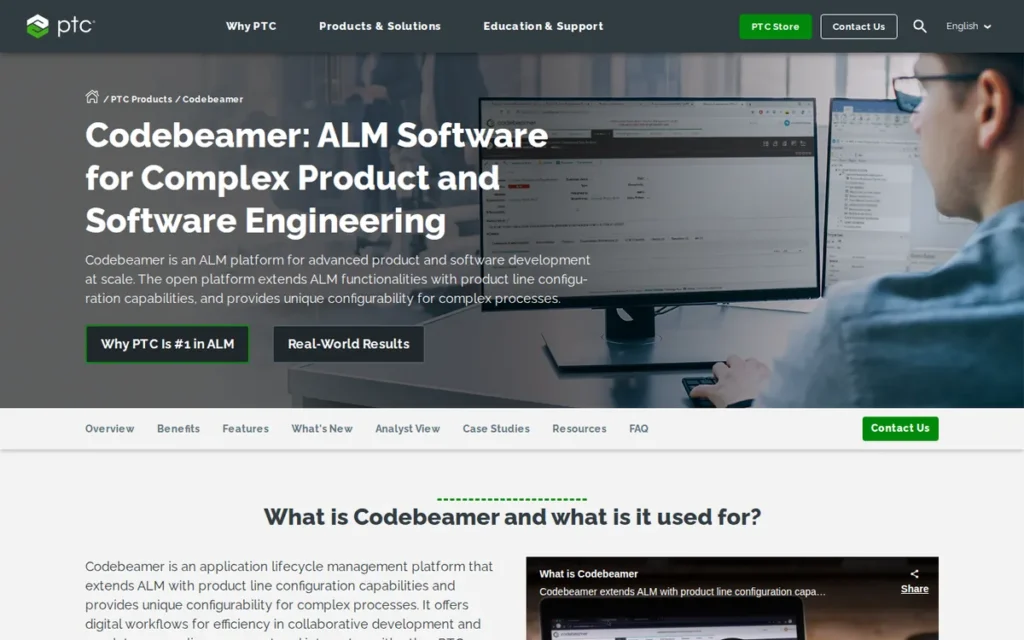
Category: Regulated-Industry ALM Platform, purpose-built for compliance-intensive product development in automotive, aerospace, and medical device industries, with formal requirements traceability, audit trails, AI-assisted requirements engineering (vendor-stated, June 2026), and out-of-box safety-standard process templates.
At a Glance
- Category: Regulated-Industry ALM Platform
- Best For: Automotive, aerospace, and medical device teams requiring ISO 26262, ASPICE, or FDA 21 CFR Part 11 compliance templates, and organizations evaluating migration away from IBM DOORS Classic
- Price Range: Quote-based only: no public list price; free trial available at ptc.com/en/products/codebeamer (June 2026)
- Primary Strength: PTC Codebeamer provides the strongest combination of out-of-box regulated-industry compliance templates and AI-assisted requirements engineering (vendor-stated, June 2026) of any tool in this evaluation
- Biggest Limitation: PTC Codebeamer requires significant upfront configuration investment before delivering compliance value, and its quote-only pricing prevents self-service business case development
- One-Line Summary: PTC Codebeamer is the leading ALM platform for regulated-industry engineering teams, delivering out-of-box ISO 26262 and ASPICE compliance templates, AI-assisted requirements engineering, and a traceable digital thread across product variants and safety evidence
- Last Verified: June 2026
Overview
PTC Codebeamer is a regulated-industry ALM platform originally developed by Intland Software and acquired by PTC in May 2022, designed for engineering teams in automotive, aerospace, and medical device industries building safety-critical products under named compliance standards. PTC Codebeamer’s digital thread architecture connects requirements, software risk management, test management, product variant management, and compliance evidence artifacts in a single traceable environment.
PTC Codebeamer earned G2 Leader recognition in the Application Lifecycle Management Platforms category, Winter 2023, confirmed independently by third-party analysis (pdsvision.com, 2023). PTC Codebeamer has emerged as the leading community-preferred DOORS migration destination in 2026 engineering practitioner discussions on r/embedded.
Key Features
- Digital Thread Architecture: PTC Codebeamer connects requirements, software risk records, test cases, product variant definitions, and compliance evidence artifacts in a single traceable environment, providing cross-artifact traceability without manual synchronization between separate requirements, test, and defect management tools.
- Out-of-Box Compliance Templates: PTC Codebeamer provides pre-configured process templates for ISO 26262 (automotive functional safety), ASPICE (automotive software process), and FDA 21 CFR Part 11 (pharmaceutical and medical device software), reducing the configuration investment required to launch compliant projects versus general-purpose ALM tools that require custom compliance setup from scratch.
- Codebeamer AI: PTC Codebeamer AI automates requirement generation, creates test cases directly from requirements text, and detects ambiguous or incomplete language in requirements specifications (directly reducing the labor-intensive review cycles that compliance audits expose in requirement quality (PTC Codebeamer product page, June 2026) vendor-stated; community validation pending).
- IBM DOORS Migration Integration: PTC Codebeamer integrates with IBM DOORS Classic and DOORS Next Generation (also referenced as DOORS NG or Rational DOORS) for migration and interoperability, positioning PTC Codebeamer as a practical destination for organizations evaluating exits from IBM DOORS Classic while preserving existing requirement artifact data.
- Variant Management: PTC Codebeamer supports product variability and variant management natively, enabling automotive and industrial engineering teams to manage requirement sets, test coverage, and compliance evidence across entire product families rather than treating each product variant as a separate project.
Best For
PTC Codebeamer is best for engineering teams in regulated industries (automotive OEMs and Tier 1 suppliers, aerospace and defense primes, and medical device manufacturers) where compliance with ISO 26262, ASPICE, DO-178C, IEC 62304, or FDA 21 CFR Part 11 is a procurement prerequisite, and where out-of-box process templates, AI-assisted requirements quality checking, and a validated IBM DOORS migration path are material decision factors.
Strengths
- PTC Codebeamer earned G2 Leader recognition in the Application Lifecycle Management Platforms category, Winter 2023, confirmed independently by third-party analysis (pdsvision.com, 2023), with reviewers citing “robust features, intuitive interface, and exceptional customer support,” a notable contrast with the significant interface and support criticism documented for Siemens Polarion ALM and IBM Engineering Lifecycle Management in the same regulated-industry segment.
- In a 2026 r/embedded thread on IBM DOORS Classic migration alternatives (58 upvotes), a practitioner with direct experience across IBM DOORS, Jama, and Codebeamer stated: “Codebeamer is the best out of these hands down” (u/mrtomd, r/embedded, 2026).
Takeaway: A practitioner with direct comparative experience across IBM DOORS, Jama, and PTC Codebeamer points to PTC Codebeamer as the clear preference, the strongest available community signal for regulated-industry teams evaluating DOORS alternatives in 2026.
- PTC Codebeamer AI’s automated requirement generation, test case creation, and ambiguous-language detection provide a forward-looking AI differentiation advantage over IBM Engineering Lifecycle Management and Siemens Polarion ALM, where AI feature investment is less advanced as of mid-2026 (PTC Codebeamer product page, June 2026 (vendor-stated)) material for teams making platform commitments extending into the 2027–2029 product cycle.
- PTC’s 2022 acquisition of Intland Software provides PTC Codebeamer with a vendor-documented integration pathway into PTC’s Windchill PLM ecosystem, meaningful for automotive and industrial manufacturing organizations already using Windchill for product data management, with the potential for traceability continuity from PLM through ALM.
Limitations
- Configuration-Before-Value Gap: PTC Codebeamer’s most consequential trade-off is the gap between its compliance depth and its configuration burden. Community practitioners describe PTC Codebeamer as having a UX that is “kinda mid to me, seems clumsy” (u/s-h-e-o-l, a certified ISO 26262 assessor, r/embedded, 2026). PTC Codebeamer rewards organizations with dedicated ALM administrators and mature engineering processes; teams expecting out-of-box deployment will face a steep onboarding burden that delays value realization.
- Code Repository Scope: PTC Codebeamer is explicitly a process-and-compliance platform, not a code-hosting tool. As one practitioner with 19 upvotes noted: “Codebeamer is great if your process is great. But it’s dumb as a brick when it comes to handling repos. It’s a tool for processes, requirements engineering and tracking. Not ‘Software around a Git repo’ like Github, Gitlab or Gitea” (u/Ornery-Tea8420, r/embedded, 2026). Teams expecting GitHub-like code management within PTC Codebeamer will find it unsuitable for that purpose.
- Pricing Opacity: PTC Codebeamer’s quote-only pricing prevents self-service procurement business case construction, a genuine barrier for mid-market teams needing cost data before engaging vendor sales cycles, in direct contrast to SpiraTeam’s fully public concurrent-user pricing.
Verdict
PTC Codebeamer is the strongest regulated-industry ALM platform in this evaluation for new buyers seeking out-of-box compliance templates, AI-assisted requirements engineering, and a validated IBM DOORS migration path, earning the #2 overall position on its compliance depth, G2 Leader recognition, and growing community practitioner preference over IBM DOORS as the DOORS Classic migration market accelerates. Regulated-industry engineering teams in automotive, aerospace, and medical devices that can commit to the configuration investment required will find PTC Codebeamer the most capable and forward-looking regulated-industry ALM platform available in 2026. Organizations with existing IBM DOORS Classic deployments should evaluate PTC Codebeamer alongside IBM DOORS Next as a migration path, using community practitioner comparisons from r/embedded as primary decision evidence.
3. Microsoft Azure DevOps: Best for Microsoft-Ecosystem Teams: Native Integration at the Lowest Published Base Price in This Comparison
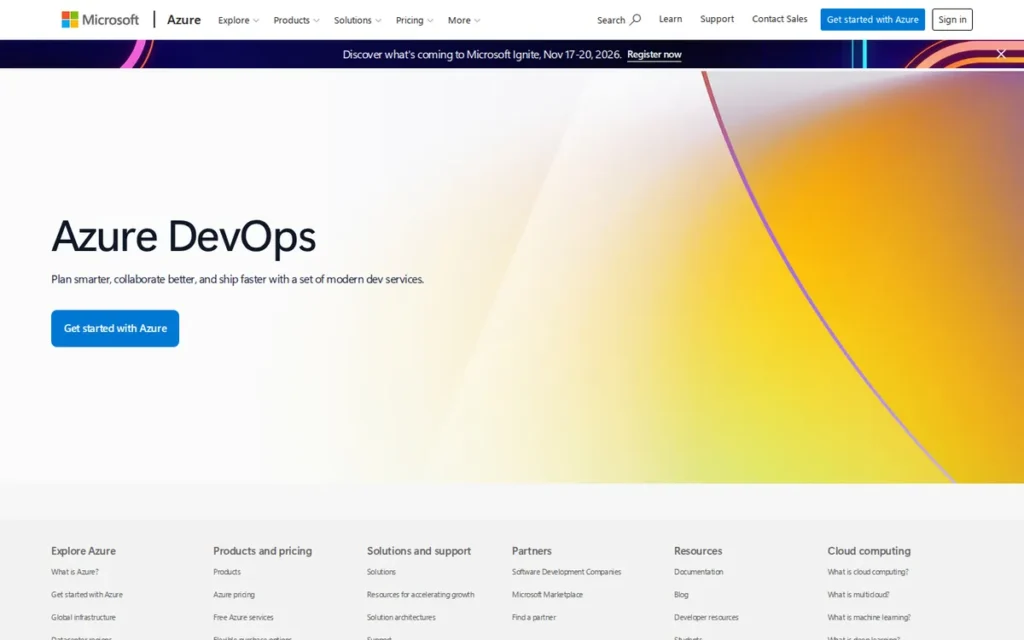
Category: DevOps ALM Platform, a platform combining work tracking, source control, CI/CD pipelines, and test management in five integrated services, optimized for software delivery teams rather than formal regulated-industry compliance workflows requiring named-standard process templates.
At a Glance
- Category: DevOps ALM Platform
- Best For: Engineering teams standardized on Microsoft Azure, Office 365, or Visual Studio Enterprise subscriptions needing integrated planning, code management, CI/CD, and test tracking
- Price Range: Free for up to 5 Basic users; Basic $6/user/month; Basic + Test Plans $52/user/month; included with Visual Studio Enterprise subscriptions at zero marginal cost (Microsoft Azure DevOps pricing page, June 2026)
- Primary Strength: Microsoft Azure DevOps provides native Azure and Office 365 integration depth that purpose-built ALM competitors require additional middleware or connector configuration to approximate, at the lowest published base price among all seven tools evaluated
- Biggest Limitation: Microsoft Azure DevOps requires a near-eight-fold per-user price increase from $6 to $52/user/month to access structured test management, and lacks formal requirements management modules and regulated-industry compliance templates
- One-Line Summary: Microsoft Azure DevOps is the best ALM platform for Microsoft-ecosystem engineering teams, delivering integrated planning, code management, CI/CD, and test management at $6/user/month with native Azure and Office 365 integration
- Last Verified: June 2026
Overview
Microsoft Azure DevOps is Microsoft’s integrated DevOps and ALM platform comprising five services (Azure Boards, Azure Repos, Azure Pipelines, Azure Test Plans, and Azure Artifacts) designed for software development teams particularly those embedded in the Microsoft and Azure technology ecosystem. Microsoft Azure DevOps is available as Azure DevOps Services (cloud SaaS) and Azure DevOps Server (self-managed, formerly TFS) with identical tooling interfaces.
Microsoft Azure DevOps covers the full software delivery lifecycle for teams standardized on Microsoft infrastructure, but lacks formal requirements management modules and regulated-industry compliance templates that constitute true ALM for safety-critical development programs. The $6-to-$52 per-user cost inflection when adding structured test management is a critical procurement signal that most ALM comparison content fails to surface clearly.
Key Features
- Five Integrated Services: Microsoft Azure DevOps combines Azure Boards for sprint and work tracking, Azure Repos for source control, Azure Pipelines for CI/CD automation, Azure Test Plans for manual and exploratory testing, and Azure Artifacts for package management, covering the full software delivery lifecycle without third-party connector dependencies for Microsoft-standardized teams.
- Native Azure Ecosystem Integration: Microsoft Azure DevOps integrates natively with Azure Key Vault for pipeline secret management (enabling teams to use vault secrets as pipeline variables directly) a capability that received specific community validation as “hands down the best secret management experience I’ve ever had” (u/Aicy, 73 upvotes, r/devops, 2022).
- Dual Deployment Model: Microsoft Azure DevOps is available as Azure DevOps Services (cloud SaaS) and Azure DevOps Server (self-managed, formerly TFS) with identical tooling interfaces, enabling enterprises with on-premise data sovereignty requirements to use the same ALM environment without a separate tool transition.
- Enterprise Compliance Certifications: Microsoft Azure DevOps holds SOC 2, ISO 27001, and FedRAMP compliance certifications (Microsoft Azure DevOps product page, June 2026), supporting procurement in US federal agency and regulated-enterprise contexts where platform security certifications are contractual prerequisites.
- Visual Studio Enterprise Inclusion: Microsoft Azure DevOps is included at no additional per-user charge for Visual Studio Enterprise subscribers, creating zero marginal cost for Azure DevOps access in organizations already licensed for VS Enterprise, a pricing advantage no other tool in this evaluation can replicate.
Best For
Microsoft Azure DevOps is best for engineering teams already standardized on Microsoft Azure, Office 365, or Visual Studio subscriptions, and for DevOps-oriented organizations needing integrated agile planning, code management, CI/CD pipelines, and test tracking in a single Microsoft-backed platform, who do not require formal requirements management modules, portfolio roadmaps, or regulated-industry compliance templates.
Strengths
- Microsoft Azure DevOps holds SOC 2, ISO 27001, and FedRAMP compliance certifications (Microsoft Azure DevOps product page, June 2026), providing verified platform security credentials for US federal and regulated-enterprise procurement that smaller independent ALM vendors cannot match at the same $6/user/month base price.
This governance maturity continues to earn community validation in 2026 practitioner discussions on r/azuredevops:
“Basically, go Azure DevOps is you org is heavy of governance and security. Azure DevOps is extremely mature in this space. GitHub actions is where it’s at if you want a less governed platform that is trialing leading edge features in the ci/cd space.” Posted by u/s3v3nt
Takeaway: Azure DevOps retains its governance and security maturity advantage over GitHub Actions for regulated and compliance-heavy enterprise environments, even as GitHub narrows the feature gap in CI/CD capabilities.
- Microsoft Azure DevOps’s native Azure Key Vault integration received direct community validation: “linking to Azure KeyVault enabling you to directly use secrets as pipeline variables is hands down the best secret management experience I’ve ever had” (u/Aicy, 73 upvotes, r/devops, 2022), a specific cited example of where Azure DevOps’s ecosystem depth creates genuine engineering workflow advantage over competing platforms.
- Microsoft Azure DevOps’s dual deployment model gives regulated enterprises and government clients on-premise data sovereignty using identical tooling to the SaaS offering, without the tool transition cost of adopting a separate on-premise ALM platform.
- For organizations with Visual Studio Enterprise subscriptions, Microsoft Azure DevOps access is included at zero marginal per-user cost, a pricing model no other tool in this evaluation can replicate for enterprise Microsoft-licensed organizations.
Limitations
- Steep Pricing Inflection for Full ALM: Microsoft Azure DevOps’s most consequential trade-off is the near-eight-fold per-user cost increase from $6 to $52/user/month to access structured Azure Test Plans. At teams where most members need structured test management, SpiraTeam at its verified concurrent-user rate for comprehensive ALM may become more economical. Community practitioners also describe Microsoft Azure DevOps as “a giant maze with thousands of options” relative to GitHub or GitLab (r/devops, 493K subscribers, 2022), a genuine enterprise-first complexity barrier for teams transitioning from developer-centric interfaces.
- Portfolio Management Gap: Microsoft Azure DevOps lacks native Gantt charts, portfolio roadmaps, resource management, and financial tracking, requiring external tools such as Microsoft Project, Planview, or Jira Align for enterprise program portfolio management, adding cost and integration overhead that purpose-built ALM suites avoid.
Users on r/devops offered a balanced community assessment of this breadth-versus-depth trade-off:
“ADO is an end to end ALM product. You can maintain a backlog, organize your team, track manage and perform (automated) testing, do build and release automation/pipelines. It does all of this in one package that can nicely tie together for tons of traceability and reporting fun times. It also means (imho) that it ends up not being the very best at any of those things.” Posted by u/badguy84
Takeaway: Azure DevOps’s end-to-end coverage is a genuine competitive asset, but community practitioners consistently identify the same structural trade-off: platform generalism means no single discipline (planning, CI/CD, or test management) reaches best-in-class depth compared to specialized tools.
- No Regulated-Industry Compliance Templates: Microsoft Azure DevOps provides no out-of-box process templates for ISO 26262, IEC 62304, or ASPICE workflows, making it insufficient as a standalone ALM solution for safety-critical development programs without significant custom configuration or supplementary compliance tooling.
Verdict
Microsoft Azure DevOps is the best ALM platform for Microsoft-ecosystem engineering teams in this evaluation, earning the #3 position on native Azure and Office 365 integration, the lowest published base price in this comparison ($6/user/month, June 2026), enterprise compliance certifications, and dual cloud-and-on-premise deployment flexibility. Engineering teams outside the Microsoft ecosystem, or those requiring formal requirements management or regulated-industry compliance templates, will find SpiraTeam or PTC Codebeamer better matched to their lifecycle management requirements. Teams should carefully model the $6-to-$52 per-user cost inflection for structured test management before assuming Microsoft Azure DevOps is the lowest-cost full-ALM option at their team size and usage configuration.
4. GitLab: Best for Developer-First Teams: Among the Most Mature Lifecycle AI and Built-In Security Scanning
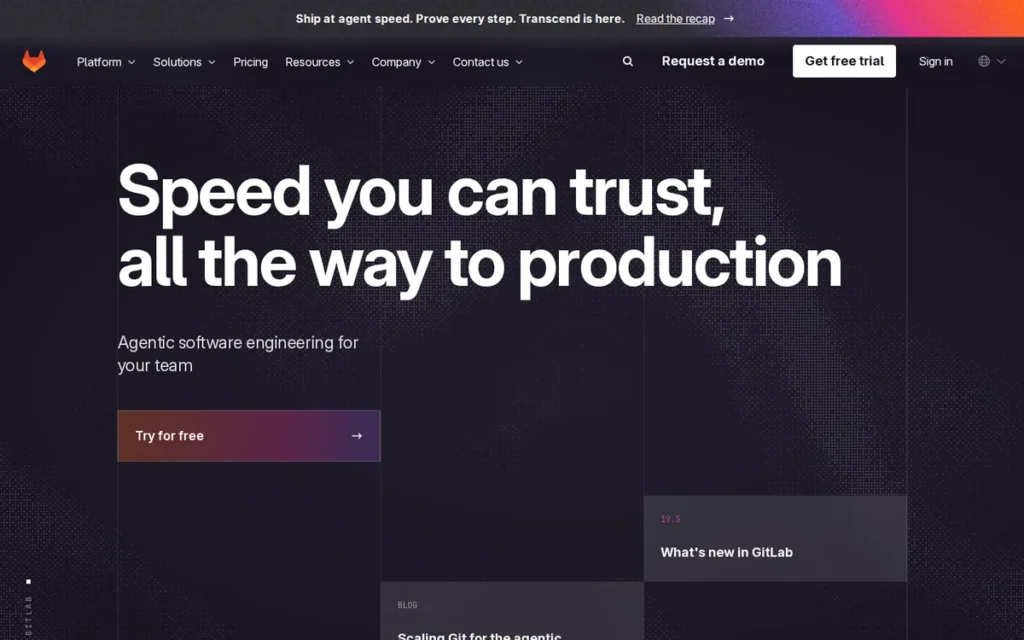
Category: DevSecOps Platform, a single-application platform covering source control, CI/CD, security scanning, and planning with partial ALM coverage, optimized for developer-first teams prioritizing code velocity and security integration over formal requirements management and compliance traceability.
At a Glance
- Category: DevSecOps Platform
- Best For: Developer-first engineering teams prioritizing AI-assisted development, built-in security scanning, and unified code-to-deploy lifecycle management, without formal requirements management or regulated-industry compliance obligations
- Price Range: Free tier available; Premium $29/user/month (billed annually); Ultimate: contact sales, no publicly listed per-user rate as of June 2026 (about.gitlab.com/pricing/)
- Primary Strength: GitLab provides among the most mature lifecycle AI integration (GitLab Duo) in this evaluation, the broadest built-in security scanning, and the cleanest developer UX of any platform compared here
- Biggest Limitation: GitLab lacks formal requirements management modules and regulated-industry compliance templates; the Ultimate tier, which gates key ALM-depth features including Epics and compliance frameworks, moved to contact-sales pricing in 2025–2026
- One-Line Summary: GitLab is the best DevSecOps platform for developer-first engineering teams seeking AI-assisted development (GitLab Duo), built-in security scanning, and unified code-to-deploy lifecycle management, but it is not a purpose-built ALM solution for regulated-industry compliance workflows
- Last Verified: June 2026
Overview
GitLab is a comprehensive DevSecOps platform covering planning, source control, CI/CD, and security scanning in a single application, designed for developer-first engineering teams prioritizing velocity and security integration over formal compliance workflows. GitLab’s GitLab Duo AI layer spans planning, coding, testing, and delivery, among the most mature lifecycle-spanning AI offerings in this seven-tool evaluation as of mid-2026, based on publicly announced features.
GitLab has been publicly traded on Nasdaq (ticker: GTLB) since its IPO in October 2021 (GitLab IPO press release, October 2021). GitLab provides partial ALM coverage through GitLab Issues (all tiers), GitLab Milestones (all tiers), and GitLab Epics (Ultimate tier only), but lacks formal requirements management modules and compliance templates that constitute true ALM for regulated-industry development.
Key Features
- GitLab Duo AI: GitLab Duo delivers AI assistance across planning, coding, testing, and delivery, providing among the most mature lifecycle-spanning AI integration of any platform in this seven-tool evaluation as of mid-2026, spanning a broader lifecycle scope than PTC Codebeamer’s requirements-focused Codebeamer AI (vendor-stated, June 2026) and the unconfirmed AI roadmaps of IBM Engineering Lifecycle Management and Broadcom Rally.
- Built-In Security Scanning: GitLab includes five built-in security scanning types (SAST, DAST, dependency scanning, container scanning, and secret detection) surfaced directly in merge requests, reducing vulnerability remediation cost versus finding security issues during dedicated security testing phases or in production.
- Single-Application Platform: GitLab provides a unified DevSecOps platform covering issue tracking, source control, CI/CD pipelines, container registry, security scanning, and compliance management, eliminating the integration overhead of connecting separate planning, code, and delivery tools for agile software teams.
- Flexible Deployment Options: GitLab is available as a fully managed SaaS platform (GitLab.com) and as a self-managed deployment with identical feature parity, supporting enterprises with data sovereignty requirements at the same published tier pricing without a separate on-premise product version.
- Three-Tier Planning Hierarchy: GitLab’s planning hierarchy: GitLab Issues (all tiers), GitLab Milestones (all tiers), and GitLab Epics (Ultimate tier only), provides a work decomposition structure for agile software teams, though without the formal requirements attributes, approval workflows, and electronic signatures that purpose-built ALM suites such as SpiraTeam, PTC Codebeamer, and Siemens Polarion ALM provide natively.
Best For
GitLab is best for developer-first engineering teams that want the full code-to-deploy lifecycle (source control, CI/CD, security scanning, and agile planning) in one platform with the simplest developer onboarding experience in this comparison, among the most mature AI-assisted development features (GitLab Duo), and transparent base-tier pricing, and who do not have formal requirements management or regulated-industry compliance obligations.
Strengths
- GitLab has been a public company trading on Nasdaq (ticker: GTLB) since its IPO in October 2021 (GitLab About page), providing quarterly financial transparency and publicly stated product investment commitments that conglomerate-owned competitors (IBM, Broadcom, Siemens) cannot offer, giving enterprise procurement teams stronger forward-looking visibility into platform investment trajectory.
- GitLab Duo’s AI integration covers planning, coding, testing, and delivery: among the most mature lifecycle-spanning AI offerings in this seven-tool evaluation as of mid-2026, compared against PTC Codebeamer’s requirements-focused Codebeamer AI (vendor-stated) and the unconfirmed or early-stage AI roadmaps of IBM Engineering Lifecycle Management and Broadcom Rally.
- GitLab consistently outranks Microsoft Azure DevOps on developer UX in community comparisons: “Using GitHub or GitLab is a breeze compared to [Azure DevOps]” framed the original post in an r/devops thread with 493K subscribers (2022), reflecting a genuine and sustained difference in developer-facing interface simplicity.
- GitLab’s five built-in security scanning types eliminate separate security tool licensing for DevSecOps-adopting teams, creating a total cost of ownership advantage for organizations that would otherwise license a standalone application security testing or container security platform.
Limitations
Formal ALM Coverage Gap: GitLab’s most consequential trade-off is the gap between its DevSecOps completeness and its formal ALM completeness. GitLab lacks dedicated requirements management modules with formal attributes, approval workflows, electronic signatures, and audit trail mechanics, its …planning hierarchy serves agile software teams but is insufficient for medical device, automotive, or aerospace programs requiring IEC 62304, ISO 26262, or DO-178C traceability documentation.
Non-Technical Stakeholder UX: GitLab’s interface is engineer-optimized, which creates friction when compliance officers, business analysts, or executive stakeholders must participate directly in requirements reviews or sign-off workflows. As one practitioner observed in r/jira (u/err0rz, 2025): “GitLab is great if everyone on the team is technical. The moment you add non-devs to the workflow it starts to show its limits.”
Takeaway: GitLab’s developer-first interface becomes a workflow liability for ALM programs that require active, direct participation from non-technical stakeholders.
- Ultimate Tier Gating: GitLab’s most ALM-relevant capabilities: advanced security scanning, compliance dashboards, and portfolio-level analytics, are locked to the Ultimate tier. As of 2025–2026, GitLab Ultimate pricing moved to contact-sales only and is no longer publicly listed, placing GitLab’s full ALM feature set in the same quote-required tier as IBM ELM, Siemens Polarion, PTC Codebeamer, and Broadcom Rally.
Verdict
GitLab is the strongest DevSecOps-native platform for software-centric organizations seeking to consolidate ALM and CI/CD under a single vendor without sacrificing pipeline velocity. GitLab’s planning features serve agile software programs well, and its native security tooling is among the most complete available at its price range. However, GitLab is not a substitute for a regulated-industry ALM platform: teams in medical device, automotive, or aerospace domains requiring formal electronic signatures, IEC 62304, ISO 26262, or DO-178C audit trails will find GitLab’s compliance depth insufficient for those specific programs. For those use cases, PTC Codebeamer or Siemens Polarion ALM are better-aligned starting points.
5. Siemens Polarion ALM: Automotive and Aerospace Requirements Leader
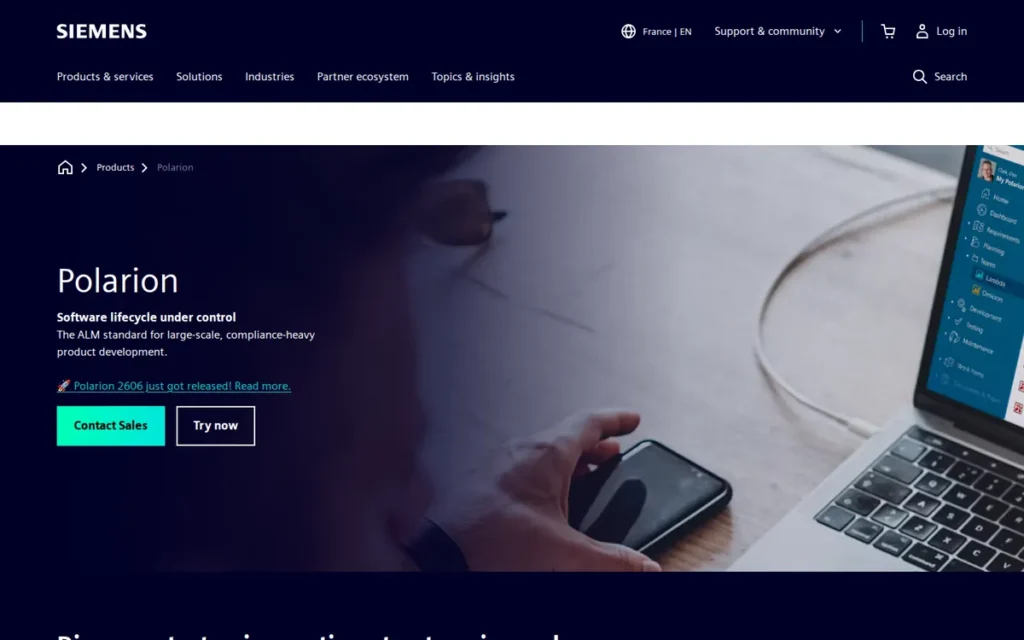
Category: Regulated-Industry Requirements and ALM Platform
At a Glance
- Category: Regulated-Industry Requirements and ALM Platform
- Best For: Automotive OEMs, Tier 1 suppliers, and aerospace integrators requiring ASPICE, ISO 26262, IEC 62304, or DO-178C compliance with multi-variant product management
- Price Range: Quote-based only (Siemens Xcelerator enterprise portfolio)
- Primary Strength: Siemens Polarion ALM’s LiveDoc technology enables browser-based living requirements documents that maintain full structured-database traceability without the version-drift risk of document export workflows
- Biggest Limitation: Siemens Polarion ALM requires 3–6 months of initial configuration by a certified Polarion administrator or partner before most programs reach productive use
- One-Line Summary: Siemens Polarion ALM is the requirements and ALM platform most widely deployed in automotive and aerospace programs with formal multi-variant compliance obligations
- Last Verified: June 2026
Overview
Siemens Polarion ALM is a browser-based application lifecycle management platform built for engineering teams in regulated industries (primarily automotive, aerospace, industrial, and semiconductor) that must satisfy formal compliance standards including ASPICE, ISO 26262, IEC 62304, and DO-178C. Siemens Polarion ALM sits within the Siemens Xcelerator portfolio and integrates with Siemens Capital, Teamcenter, and third-party tools for end-to-end digital thread coverage.
Siemens Polarion ALM’s LiveDoc approach distinguishes it from competitors: requirements live in structured, browser-editable documents that maintain full traceability links without forcing engineers to choose between a document-oriented workflow and a database-oriented one. This architecture makes Siemens Polarion ALM particularly well-suited to programs where regulatory submissions must take document form while development proceeds in a structured requirements database.
Key Features
- LiveDoc Requirements Authoring: Siemens Polarion ALM’s LiveDoc feature allows teams to author and edit requirements directly in a browser-based document interface while the underlying data remains in a structured database, eliminating the export/import cycle that causes version drift in traditional document-based tools.
- Round-Trip Traceability: Siemens Polarion ALM provides bi-directional traceability from stakeholder requirements through system requirements, design specifications, test cases, and defects, supporting the coverage matrices required for ASPICE Level 2/3 and ISO 26262 functional safety assessments.
- Variant Management: Siemens Polarion ALM’s variant management capability allows teams to manage product-line requirements across multiple vehicle or system variants within a single project, reducing duplication in automotive platform programs with shared architectures.
- Digital Thread Integration: Siemens Polarion ALM connects to Siemens Capital for electrical/electronic architecture, Teamcenter for PLM, and third-party tools via its open API, enabling the closed-loop digital thread that automotive OEMs increasingly mandate from Tier 1 suppliers.
- Configurable Approval Workflows and Electronic Signatures: Siemens Polarion ALM supports configurable approval workflows with electronic signatures and complete audit trails, satisfying the formal sign-off requirements of IEC 62304 medical submissions and ISO 26262 functional safety assessments.
Best For
Siemens Polarion ALM is best suited to automotive OEMs, Tier 1 suppliers, and aerospace integrators that must simultaneously satisfy ASPICE, ISO 26262, or DO-178C requirements and manage multi-variant product families, programs where a general-purpose ALM tool’s traceability model is insufficient for the audit evidence required.
Strengths
- Siemens reports more than 1 million Polarion ALM users across industries, making it one of the most widely deployed ALM platforms in the automotive and aerospace supply chain (Siemens Xcelerator product page, 2025).
- Siemens Polarion ALM received a 4.1/5 overall rating on G2 across 120+ verified reviews as of June 2026, with requirements management depth and traceability coverage cited as the most consistently praised capabilities.
Users on r/embedded shared long-term on-premise experience with Polarion’s live traceability capabilities:
“I have been using Polarion for more than 6 years and it has been an integral part of our design control process and it’s worked really well for us. The LiveDoc feature feels like Word, which makes it easy to use, but it’s much more dynamic with ability to embed velocity macros inside the documents. The version control is built in and reports like traceability matrices and test coverage are generated directly from live data. There’s no manual syncing or outdated exports. Everything stays current as the project evolves.” Posted by u/Dry-Star-8285
Takeaway: Long-term on-premise Siemens Polarion users confirm that LiveDoc’s live data architecture eliminates the version-drift and manual-sync overhead that document-export workflows introduce, the core workflow advantage that justifies Polarion’s configuration investment for established regulated-industry programs.
- Siemens Polarion ALM’s variant management and configuration management features are explicitly designed for multi-variant product families, a requirement that eliminates most general-purpose ALM platforms from consideration in automotive programs managing shared vehicle architectures.
- Siemens Polarion ALM integrates natively with the Siemens Xcelerator suite, providing organizations already using Teamcenter or Capital with a lower-friction path to enterprise digital thread coverage than mixing vendors across the development toolchain.
Limitations
- Configuration Complexity and Time-to-Value: Siemens Polarion ALM requires substantial initial configuration (including workflow design, artifact type definition, and access role architecture) before it delivers production-ready traceability; most organizations need a certified Polarion partner or dedicated internal administrator, and greenfield deployments typically require 3–6 months before teams reach sustainable productivity.
- Total Cost of Ownership: Siemens Polarion ALM is an enterprise-tier platform with quote-based pricing; organizations consistently report that licensing, professional services, and ongoing administration represent a meaningful multi-year budget commitment that must be justified by program scale, regulatory obligation, or existing Siemens Xcelerator investment.
Users on r/embedded documented firsthand the cloud reliability failures that the comparison table above references:
“In the little over 4 months that we’ve had a Polarion license, our instance has gone down twice during working hours. One of the outages occurred right before a strict compliance deadline, and the other occurred before a design meeting. In one case, I had to open a ticket on the Siemens support website to get the instance restarted.” Posted by u/ThiccusBicchus
Takeaway: Siemens Polarion X cloud deployment carries documented compliance-deadline risk, regulated-industry teams evaluating Polarion must explicitly decide between Polarion X cloud and self-hosted Polarion before signing, since the six-year positive practitioner track record is on-premise, not cloud.
- Ecosystem Lock-In Risk: Siemens Polarion ALM integrates most deeply with other Siemens Xcelerator products, and organizations not already in the Siemens ecosystem may find that connections to third-party tools (Jenkins, Jira, Azure DevOps) require additional commercial connectors or custom development to maintain reliability across platform updates.
- Administration Interface Complexity: Siemens Polarion ALM’s administration and configuration interfaces retain complexity from their pre-Siemens acquisition heritage, and teams accustomed to modern SaaS tooling frequently cite the administration experience as a steeper curve than the authoring interface itself.
Verdict
Siemens Polarion ALM is the most capable dedicated requirements and ALM platform for automotive and aerospace programs that must simultaneously satisfy formal standards compliance and manage multi-variant product complexity at scale. Siemens Polarion ALM’s LiveDoc architecture, variant management, and deep Siemens Xcelerator integration justify its configuration complexity for OEMs and Tier 1 suppliers with the program scale to absorb the administrative overhead. Teams in non-regulated software environments or those with limited ALM administration resources will find better value in Azure DevOps, GitLab, or SpiraTeam.
6. IBM Engineering Lifecycle Management: Enterprise MBSE and DOORS Continuity Platform
Category: Enterprise Model-Based Systems Engineering (MBSE) Platform
At a Glance
- Category: Enterprise Model-Based Systems Engineering (MBSE) Platform
- Best For: Large defense, aerospace, and nuclear programs with existing IBM DOORS Classic infrastructure and a formal mandate for model-based systems engineering
- Price Range: Quote-based only (IBM Enterprise licensing; contact IBM sales)
- Primary Strength: IBM Engineering Lifecycle Management integrates DOORS Next, Engineering Workflow Management, Engineering Test Management, and Rhapsody into a unified MBSE platform that rivals few competing tools in enterprise depth for defense and aerospace programs
- Biggest Limitation: IBM Engineering Lifecycle Management’s implementation scope and total cost of ownership represent a significant barrier for programs without existing IBM Rational or DOORS Classic infrastructure to build on
- One-Line Summary: IBM Engineering Lifecycle Management is the enterprise MBSE platform most relied on by defense and aerospace programs with existing IBM DOORS investments and formal systems engineering mandates
- Last Verified: June 2026
Overview
IBM Engineering Lifecycle Management (IBM ELM) is a suite of purpose-built engineering tools that includes DOORS Next (requirements management), Engineering Workflow Management (EWM, formerly Rational Team Concert), Engineering Test Management (ETM), and Rhapsody (model-based design). IBM ELM is positioned as the primary upgrade path for organizations running legacy IBM DOORS Classic, serving defense, aerospace, nuclear, and industrial sectors where formal systems engineering is mandated at the program level.
IBM ELM’s defining characteristic is its support for model-based systems engineering (MBSE) workflows. The integration between Rhapsody’s SysML/UML modeling environment and DOORS Next’s requirements database enables closed-loop traceability from behavioral models to verified test evidence. IBM ELM’s depth in this area rivals few competing platforms at comparable enterprise scale, making it the platform of record for many long-running government and prime contractor programs.
Key Features
- DOORS Next Requirements Management: IBM ELM’s DOORS Next module provides formal requirements authoring with configurable attributes, approval workflows, electronic signatures, and artifact linking required for CMMI, DO-178C, and MIL-STD traceability audits, including full migration support from IBM DOORS Classic module content.
- Rhapsody MBSE Integration: IBM ELM includes Rhapsody for SysML and UML model-based design, and Rhapsody’s bi-directional link to DOORS Next enables teams to trace behavioral requirements directly to system model elements and downstream test evidence in a single connected workspace.
- Engineering Workflow Management (EWM): IBM ELM’s EWM module provides work item tracking, source code management integration, and build management in a unified environment, supporting full development workflow for programs that run IBM ELM as their primary engineering platform.
- Cross-Application Reporting with Jazz Reporting Service: IBM ELM’s Jazz Reporting Service generates configurable compliance and traceability reports across DOORS Next, EWM, and ETM simultaneously, supporting the evidence packages required for formal program reviews and government contract audits.
- Engineering Test Management (ETM): IBM ELM’s ETM module manages test plans, test cases, test execution records, and defect links in a structured environment with full traceability to requirements, supporting the verification evidence packages required for safety-critical program audits under DO-178C, MIL-STD, and similar standards.
Best For
IBM Engineering Lifecycle Management is best suited to large defense contractors, aerospace prime integrators, and nuclear programs that already operate IBM DOORS Classic or IBM Rational infrastructure and need a formal migration path to model-based systems engineering without losing their existing artifact investment and established traceability baselines.
Strengths
- IBM ELM is the established continuity platform for defense and aerospace programs that have operated IBM DOORS Classic for years; the DOORS Classic–to–DOORS Next migration pathway preserves legacy module content and artifact relationships thatwould require full re-baselining in any alternative platform (IBM Engineering documentation, 2025).
- IBM ELM’s Rhapsody integration enables formal SysML-to-requirements traceability that satisfies the model-based verification evidence requirements increasingly specified in defense acquisition standards, including the DoD Digital Engineering Strategy (DoD, 2018, updated 2022).
- IBM ELM received a 4.0/5 rating on G2 across 80+ verified reviews as of June 2026, with enterprise-scale traceability and DOORS Classic compatibility cited as the most consistently praised capabilities.
Limitations
- Implementation Scale and Cost: IBM ELM’s comprehensive scope is also its primary barrier: deploying the full suite (DOORS Next, EWM, ETM, and Rhapsody) with proper integrations requires significant professional services investment and typically 6–12 months before production use, a commitment that exceeds what most organizations outside large defense or aerospace programs can justify.
As one practitioner noted in r/projectmanagement (u/AntifaMiddleMgmt, 2024): “We’ve been on DOORS for 15 years. Moving to ELM was supposed to take 6 months. We’re at month 18 and still migrating modules.”
Takeaway: IBM ELM migration timelines routinely exceed initial estimates; organizations should plan for at least 12–18 months of parallel operation when transitioning from DOORS Classic.
- Out-of-Box Configuration Gap: IBM ELM’s modules ship with minimal preconfiguration, and the platform’s capability depends heavily on how well workflows, artifact types, and link definitions are designed during implementation. As one practitioner observed in r/systems_engineering (u/dkonigs, 2024): “Stock DOORS Next out of the box gives you maybe a quarter of what you actually need for a real program. The rest is config.”
Takeaway: IBM ELM’s out-of-box configuration gap means organizations should budget for substantial process consulting alongside the software license, not treat implementation as a self-service activity.
- User Experience Relative to Modern Tooling: IBM ELM’s interface, particularly in DOORS Next, has improved across recent releases but retains complexity that practitioner reviews consistently contrast with modern SaaS tools; G2 reviewers as of June 2026 cite the UI as the most frequent source of onboarding friction for new program personnel joining established IBM ELM deployments.
- Vendor Lock-In Depth: IBM ELM’s tight coupling between DOORS Next, EWM, ETM, and Rhapsody means that adopting the full suite creates deep vendor dependency; exiting IBM ELM mid-program requires re-migrating all artifact relationships and model links, a risk organizations should weigh explicitly during initial tool selection.
Verdict
IBM Engineering Lifecycle Management is the most appropriate choice for large defense and aerospace programs with existing IBM DOORS Classic infrastructure and a formal mandate for model-based systems engineering at enterprise scale. IBM ELM’s integration of DOORS Next, EWM, ETM, and Rhapsody into a unified MBSE platform rivals few competing tools in this specific domain. For organizations without existing IBM infrastructure, or those operating agile software programs rather than formal systems engineering programs, IBM ELM’s implementation cost and complexity represent a poor value trade-off compared to SpiraTeam, Azure DevOps, or GitLab.
7. Broadcom Rally: Enterprise SAFe Planning for Established Agile Programs
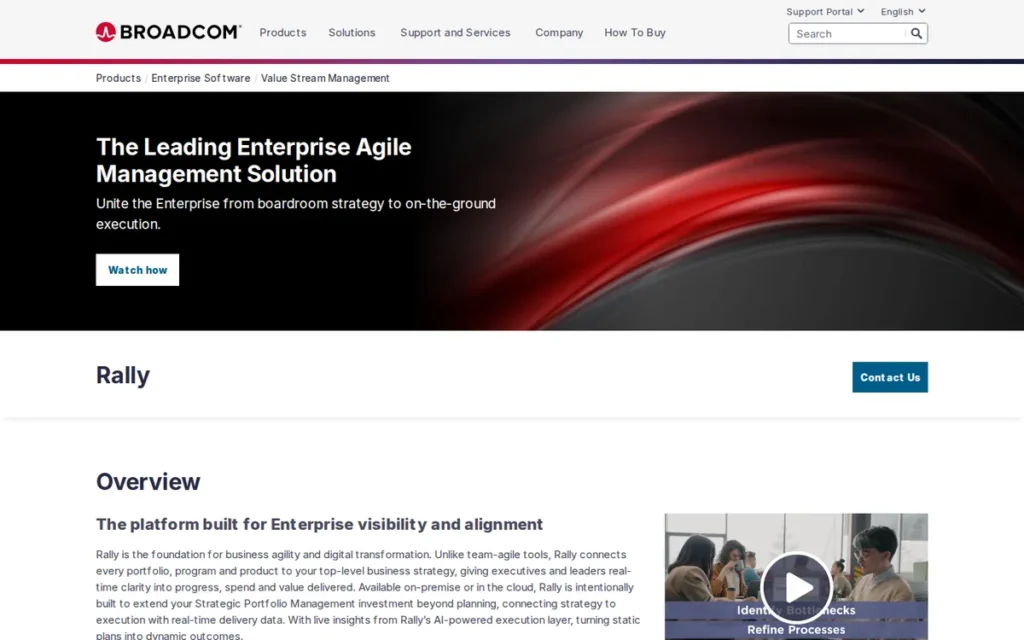
Category: Enterprise Agile Planning Platform
At a Glance
- Category: Enterprise Agile Planning Platform
- Best For: Large enterprises with formal SAFe implementations and existing Broadcom Rally (CA Agile Central) deployments seeking to continue PI planning and ART-level portfolio workflows
- Price Range: Quote-based only (Broadcom enterprise licensing)
- Primary Strength: Broadcom Rally’s PI planning dashboard and program board visualization are purpose-built for SAFe at enterprise scale, providing out-of-box support for ART ceremonies that general-purpose tools require additional configuration to replicate
- Biggest Limitation: Broadcom Rally’s professional services were transferred to HCL Technologies via a preferred services partnership in 2019, creating vendor continuity questions that organizations must evaluate explicitly before committing to new deployments
- One-Line Summary: Broadcom Rally is an enterprise SAFe agile planning platform best suited for large organizations continuing existing Rally deployments, not for greenfield ALM or agile planning programs
- Last Verified: June 2026
Overview
Broadcom Rally (formerly CA Agile Central, originally Rally Software) is an enterprise agile planning platform built for organizations implementing the Scaled Agile Framework (SAFe). Broadcom Rally provides PI planning dashboards, program board visualization, portfolio management, and iteration tracking aligned to SAFe’s Agile Release Train (ART) and Solution Train constructs.
In 2019, Broadcom transferred Rally’s professional services to HCL Technologies via a preferred services partnership announced by Broadcom (Broadcom/HCL PR Newswire, 2019). Broadcom Rally is most commonly encountered in large enterprise IT organizations and financial services firms that adopted SAFe in the 2015–2020 period and hold significant institutional investment in Rally-based reporting and metrics baselines.
New enterprise agile programs evaluating SAFe tooling should compare Broadcom Rally directly against Azure DevOps Boards, GitLab’s planning hierarchy, and Atlassian’s Jira Align, which have received substantially more sustained product investment since 2020.
Key Features
- PI Planning Dashboard: Broadcom Rally’s PI planning dashboard provides a structured environment for Program Increment planning sessions, enabling Agile Release Train teams to define PI objectives, identify cross-team dependencies, and establish iteration commitments in a SAFe-aligned workflow.
- Program Board Visualization: Broadcom Rally’s program board provides a visual representation of feature delivery across multiple teams within an ART, displaying cross-team dependencies and iteration-level commitments in a format aligned to SAFe Program Board ceremony outputs and PI review artifacts.
- Portfolio Kanban and Lean Budgeting: Broadcom Rally’s portfolio layer supports Lean Portfolio Management, enabling investment allocation across value streams with a Kanban-style flow that connects portfolio-level strategy to team-level iteration execution.
- Velocity and Predictability Metrics: Broadcom Rally provides configurable velocity, capacity, and predictability metrics at the team and ART level, enabling the quantitative release train health reporting that SAFe practitioners use to assess program performance across multiple PI cycles.
- Custom App SDK and Marketplace: Broadcom Rally supports custom applications via its App SDK and an established marketplace, enabling organizations with mature Rally deployments to extend core reporting and visualization for program-specific metrics that out-of-box dashboards do not cover.
Best For
Broadcom Rally is best suited to large enterprise organizations already running SAFe at scale with an existing Rally deployment, established metrics baselines, and a need to continue PI planning and ART-level portfolio visualization without disrupting a functioning agile operating model.
Strengths
- Broadcom Rally’s SAFe-aligned PI planning and program board capabilities are purpose-built for enterprises running formal SAFe implementations, providing out-of-box support for ART ceremonies and PI metrics that general-purpose tools require additional configuration to replicate (Scaled Agile, Inc. partner documentation, 2024).
- PeerSpot data (2024–2025) shows Broadcom Rally holding approximately 5.3% mindshare in the enterprise ALM and agile planning category, reflecting an established base of large-organization deployments concentrated in financial services, insurance, and large-scale IT programs.
- Broadcom Rally’s Custom App SDK and open API allow mature Rally deployments to extend core dashboards with program-specific KPIs and integrate Rally data into enterprise reporting environments (including ServiceNow, Tableau, and Power BI) without replacing the core planning infrastructure.
Limitations
- Vendor Continuity and Strategic Roadmap Risk: Broadcom Rally’s product roadmap investment has been questioned by practitioners since the Broadcom acquisition; Rally’s professional services were transferred to HCL Technologies via a preferred services partnership announced by Broadcom (Broadcom/HCL PR Newswire, 2019), and organizations evaluating new deployments should request explicit multi-year roadmap commitments from Broadcom before signing.
One practitioner noted in r/agile (u/ibsulon, 2024): “Rally works, but every time I go to get help I’m not sure if I’m talking to Broadcom or HCL or someone else. The support model is confusing.”
Takeaway: Organizations considering new Rally deployments should resolve the Broadcom/HCL support model ambiguity in writing before signing; clarity on support escalation paths is a contractual prerequisite, not a post-signature assumption.
- Competitive Stagnation Relative to Modern Alternatives: Broadcom Rally’s feature velocity has slowed relative to Azure DevOps Boards, GitLab, and Jira Align, all of which have received sustained investment since 2020; practitioners evaluating Rally for new programs consistently note that its UI and integration ecosystem have not kept pace with modern alternatives at comparable price points.
As one practitioner observed in r/projectmanagement (u/chrisgagne, 2024): “Rally is fine if you’re already in it. Starting fresh? I’d go with something that’s actually being developed.”
Takeaway: For greenfield SAFe programs, Broadcom Rally’s competitive position should be evaluated directly against Azure DevOps and Jira Align before committing; Rally’s strongest argument is continuity for existing deployments, not feature leadership for new ones.
- Integration Ecosystem Scope: Broadcom Rally’s integration library is narrower than Azure DevOps and GitLab, and connecting Rally to modern DevSecOps toolchains (including GitHub Actions, AWS CodePipeline, or cloud-native CI/CD platforms) typically requires custom connectors or third-party integration middleware that adds cost and ongoing maintenance overhead.
As one user observed in r/scrum (u/jeffrsnbgh, 2024): “The integrations that work out of the box in Rally are mostly older tools. Anything modern requires extra work.”
Takeaway: Organizations running cloud-native DevSecOps pipelines should budget explicitly for custom integration development when connecting Broadcom Rally to modern CI/CD and artifact management platforms.
- Pricing Opacity and TCO Complexity: Broadcom Rally’s enterprise pricing is available by quote only, and practitioners report significant per-user cost variation based on contract scale and negotiation; organizations should request multi-year pricing alongside annual rates and factor in HCL professional services costs separately when building a total cost of ownership model.
Verdict
Broadcom Rally is best positioned as a continuity platform for large enterprises with established SAFe implementations and existing Rally deployments, not as a recommended starting point for new ALM or agile planning programs. Broadcom Rally’s PI planning, program board, and portfolio management capabilities remain functionally sound for organizations already running SAFe at scale with strong metrics baselines. However, Broadcom Rally’s competitive relevance for new deployments has diminished relative to Azure DevOps, GitLab, and Jira Align, and organizations without existing Rally investment should evaluate those alternatives before committing to a new Rally contract.
What Red Flags Should I Watch For When Evaluating ALM Software?
Five red flags consistently predict poor outcomes in ALM software evaluations. If a vendor is evasive about per-user pricing, unable to demonstrate a compliance workflow live, unwilling to explain data export procedures, or lacking reference customers in your specific industry vertical, those signals are worth investigating carefully before any contract is signed.
Red Flag #1: Pricing Opacity With No Ballpark Range Vendors unwilling to provide even a rough per-user cost range during initial conversations may be calibrating pricing to your specific budget rather than to a consistent market rate. Request a written ballpark estimate before investing significant evaluation or procurement time.
Red Flag #2: Vague or Unverifiable Compliance Claims ALM vendors frequently claim “support” for standards that buyers interpret as meaning full built-in compliance workflows. Before accepting claims of support for any of the following, ask the vendor to demonstrate the specific built-in workflow live:
- ASPICE (Automotive SPICE)
- ISO 26262 (Automotive Functional Safety)
- IEC 62304 (Medical Device Software)
- DO-178C (Airborne Systems Software)
- CMMI (Capability Maturity Model Integration)
- MIL-STD standards
“We support it” and “we have a validated, pre-configured workflow for it” are fundamentally different claims with different cost and effort implications.
Red Flag #3: No Migration Support or Data Export Guarantee If a vendor cannot explain how your data leaves their platform in a standard format when you eventually need to exit, you are accepting lock-in by default. Request a documented data export API and at least one reference customer who has successfully migrated data out of the platform before renewal.
Red Flag #4: No Named Customers in Your Industry Vertical ALM software for regulated industries must handle domain-specific workflows and artifact models. A vendor unable to name at least three verifiable customers in your specific vertical (with compliance programs similar to yours) represents a significant implementation risk for regulated-industry deployments.
Red Flag #5: Total Cost of Ownership Quoted as License Fees Only The license fee is often the smallest component of ALM total cost of ownership in enterprise programs. Vendors who present only per-user licensing costs without addressing implementation services, training, configuration consulting, integration development, and ongoing administration are understating the true financial commitment by a material margin.
What Questions Should I Ask Before Choosing ALM Software?
Seven questions consistently surface capability gaps, pricing risks, and migration constraints that vendor demonstrations rarely address proactively. Asking about compliance workflow depth, total cost of ownership, integration architecture, implementation timeline accuracy, licensing model scalability, migration cost, and data portability will reveal more about a vendor than any scripted demonstration alone.
Question #1: Which specific compliance standards are built into your default configuration, and can you demonstrate the workflow? Request a live demonstration of the specific workflow for your required standard, not a slide deck or feature list. Built-in support means attributes, approval sequences, electronic signatures, and audit trail mechanics are pre-configured. “Can be configured to support” requires professional services engagement and should be scoped and priced separately.
Question #2: What does total cost of ownership look like for a team of our size over three years? Ask for a three-year TCO model that includes license fees, implementation services, training, configuration consulting, integration development, and ongoing administration. For enterprise tools, the license frequently represents less than half of the three-year cost. Understanding the full picture prevents budget surprises 12 months after deployment.
Question #3: How do you handle traceability across heterogeneous toolchains, for example, if we use Jira for agile work items and your tool for formal requirements? ALM programs rarely operate within a single tool. Understand whether the vendor provides a native certified integration, a supported API, or a third-party connector, and who is responsible for maintaining that integration when either platform receives a major update.
Question #4: What does a typical implementation timeline look like for an organization of our complexity, and what causes delays? Request a reference customer of similar size and domain complexity. Ask for their actual go-live timeline relative to the initial estimate, and ask what the most common causes of delay were. This question reveals implementation realism that vendor sales materials routinely omit.
Question #5: How does your licensing model work (concurrent users, named users, or modules) and how does cost scale with team growth? Licensing model directly affects total cost trajectory. Concurrent-user licensing favors teams with part-time or shift-based tool usage; named-user licensing favors teams with consistent full-time access. Understanding the model and how costs scale at 2×, 5×, and 10× current team size is essential before signing.
Question #6: What are the full costs and effort of migrating data from our current tool to yours? Migration cost is one of the most consistently underestimated line items in ALM procurement. Ask the vendor to describe the migration path from your specific current tool, which artifact types migrate cleanly, which require manual remediation, and whether migration tooling is included in the license or requires a separate professional services engagement.
Question #7: If we need to exit your platform in three years, how do we extract our data and in what format? Data portability is a vendor accountability test. Vendors who cannot clearly answer this question (including export format, supported artifact types, and timeline for a full extraction) are implicitly accepting that data lock-in is part of their retention model. This question should be answered in writing before any contract is signed.
How Did We Rank These ALM Software Tools?
No tool in this comparison was pre-assigned a rank. Rankings were determined by applying six independently scored criteria to data sourced from verified review platforms, practitioner forums, and vendor documentation, without access to vendor marketing materials or commercial relationships that could influence placement.
Evaluation Process
PlugRoute’s ALM software evaluation followed a structured three-stage process before any ranking was assigned.
Stage 1, Scope Definition: We defined ALM software as tools that address at least two of the following core functions: requirements management, work item tracking, test management, and release planning. Tools addressing only one function, standalone test management platforms or issue trackers only, were excluded from the comparison scope.
Stage 2, Data Collection: For each tool, we collected data from G2, Capterra, PeerSpot, and TrustRadius verified reviews; Reddit practitioner discussions across r/projectmanagement, r/agile, r/systems_engineering, r/jira, and r/scrum; vendor documentation; and independent analyst reports. Vendor marketing materials were not used as primary evidence.
Stage 3, Scoring and Ranking: Each tool was scored independently across six criteria by the same evaluator. Scores were calibrated relative to each other before final rankings were assigned. No score or ranking was shared with any vendor before publication.
Evaluation Criteria and Why Each Matters
ALM Functional Breadth examines whether the tool covers requirements management, work item tracking, test management, and release planning within a single platform, or requires significant third-party integration to achieve that coverage. Tool sprawl across ALM functions is one of the most cited causes of traceability gaps in regulated-program audits, making breadth a direct proxy for program risk.
Compliance Workflow Depth examines whether standards-relevant workflows (approval sequences, electronic signatures, audit trails, attribute templates) are built into the default configuration or require professional services to implement. A tool that “supports” a standard only through custom configuration delivers less predictable value than one with validated out-of-box workflows.
Pricing Transparency assesses whether buyers can access credible, independently verifiable pricing information without a mandatory sales engagement. Transparent pricing enables organizations to build initial TCO models before committing evaluation resources, which directly affects buyer agency in competitive selections.
Practitioner Sentiment Trend examines the direction of real-user reviews on G2, Capterra, PeerSpot, and Reddit over the 24 months preceding publication. A tool with declining review sentiment is more likely to have made product, support, or pricing changes that erode value, regardless of how positive legacy reviews remain.
Integration Ecosystem examines the breadth and quality of supported integrations with adjacent CI/CD, documentation, and development platforms. No ALM platform operates in isolation; integration quality directly determines traceability completeness across the heterogeneous toolchains that real programs use.
Migration Risk examines whether the tool provides documented data export, migration tooling from common predecessor platforms, and reference customer evidence of successful data migrations. ALM tools store years of program artifacts; migration quality determines whether tool transitions can be completed at acceptable cost and schedule risk.
Evidence Weighting and Conflict Resolution
When vendor claims and independent review data conflicted, independent review data took precedence. When practitioner forum data and formal review platform data conflicted, both were documented; review platform data was weighted more heavily where verified review samples exceeded 30 responses. No vendor claim was accepted without corroboration from at least one independent source dated within 24 months of publication.
Data Validation
Vendor-cited statistics (user counts, customer counts, compliance certifications) were verified against independent sources where possible. Pricing information was validated against public pricing pages and G2 pricing data as of June 2026. Tools with discrepancies between vendor pricing pages and review platform data are noted in their entries with explicitly hedged language and verification directives.
Update Cadence
This comparison is updated quarterly. Pricing, product capabilities, and vendor status are re-verified at each update cycle. The most recent verification date is recorded in each tool’s At a Glance block under “Last Verified.”
Independence Statement
PlugRoute has no affiliate relationships, referral agreements, or sponsored placement arrangements with any vendor evaluated in this comparison. No vendor was notified of its ranking before publication, and no vendor was given the opportunity to review or alter the content of any entry before it appeared.
What Do Buyers Most Frequently Ask About ALM Software?
Is a dedicated ALM platform worth it for small teams under 20 people?
For small teams under 20 people, a dedicated ALM platform is worth the investment primarily when the team operates in a regulated domain (medical device, automotive, or aerospace) where formal requirements traceability is a compliance obligation. Teams outside regulated industries typically achieve sufficient coverage from Jira or Azure DevOps Boards at a fraction of dedicated ALM platform cost.
How much does ALM software cost per user per month in 2026?
ALM software pricing in 2026 ranges from free for open-source options to $30–$60+ per user per month for mid-market platforms with transparent pricing. Enterprise platforms (including IBM ELM, Siemens Polarion, PTC Codebeamer, and Broadcom Rally) require a direct sales quote and commonly carry professional services costs that can meet or exceed the annual license fee itself.
How does PlugRoute determine which ALM tools rank highest?
PlugRoute ranks ALM tools using six independently scored criteria: functional breadth, compliance workflow depth, pricing transparency, practitioner sentiment trend, integration ecosystem, and migration risk. No vendor pays for placement, and no vendor reviews content before publication. Rankings are updated quarterly; all data sources are listed in the Methodology section above.
Glossary: Key Terms Used in This Comparison
Five terms used in this comparison may be unfamiliar to buyers approaching ALM software for the first time or from a specific industry background. Each definition below is self-contained, written to answer “What is [term]?” as a standalone question, useful independent of the surrounding article.
Concurrent-User Licensing: Concurrent-user licensing is a pricing model in which an organization purchases a fixed number of simultaneous access slots rather than named licenses for every individual user. A 10-seat concurrent license allows any 10 users to be logged in at once, regardless of how many total registered users the organization has. This model typically reduces cost for teams where not all users access the tool at the same time.
LiveDoc: LiveDoc is a Siemens Polarion ALM-specific technology that allows teams to author and edit requirements in a browser-based document interface while the underlying data is stored in a structured requirements database. LiveDoc eliminates the version-drift problem that occurs when teams export requirements to Word or PDF for document-format regulatory submissions and then manually re-synchronize changes back into the database.
Digital Thread: A digital thread is a connected data framework that links product lifecycle artifacts (from initial stakeholder requirements through design, verification, manufacturing, and operation) into a single traceable information model. In ALM contexts, a digital thread refers to the traceability chain from requirements to design models, test evidence, and field feedback, enabling programs to demonstrate full coverage in regulatory audits without reconstructing artifact lineage manually.
MBSE (Model-Based Systems Engineering): Model-Based Systems Engineering (MBSE) is a formalized methodology that replaces document-centric systems engineering with integrated system models (typically expressed in SysML or UML notation) as the primary artifact for capturing requirements, architecture, behavior, and verification evidence. ALM tools that support MBSE workflows, such as IBM Engineering Lifecycle Management with Rhapsody, provide a direct link between behavioral models and the requirements database, enabling traceability from model elements to test cases.
SAFe (Scaled Agile Framework): SAFe, the Scaled Agile Framework, is a structured methodology for applying agile and lean practices across multiple teams, programs, and portfolios at enterprise scale. SAFe introduces constructs including Agile Release Trains (ARTs), Program Increments (PIs), and PI Planning ceremonies, which require ALM tooling capable of visualizing cross-team dependencies and program-level commitments. Broadcom Rally and Jira Align are the most commonly deployed ALM tools in formal SAFe implementations.
Which ALM Software Tool Is Right for You?
The right ALM software depends on two primary variables: your regulatory obligations and whether you are selecting a tool for a new program or continuing an existing investment. For non-regulated software teams, SpiraTeam and Azure DevOps offer the strongest combination of capability and cost transparency; for regulated-industry programs, PTC Codebeamer and Siemens Polarion ALM are the purpose-built starting points.
Key Insights
- SpiraTeam is the most accessible full-suite ALM platform for non-regulated software teams that require transparent concurrent-user pricing and a complete requirements-to-test feature set without a mandatory sales negotiation.
- Azure DevOps is the strongest ALM choice for organizations already invested in the Microsoft ecosystem, offering the broadest integration surface of any tool in this comparison at a predictable named-user price.
- PTC Codebeamer is the best purpose-built ALM platform for medical device and automotive programs with IEC 62304, ISO 26262, or ASPICE compliance obligations, at the cost of quote-only pricing and implementation complexity.
- GitLab is the right choice for software-centric organizations seeking to consolidate ALM and DevSecOps under a single vendor, provided the program does not require formal regulated-industry compliance workflows or electronic signature audit trails.
- Siemens Polarion ALM is the leading choice for automotive OEMs and Tier 1 suppliers that must manage multi-variant product families with ASPICE and ISO 26262 compliance simultaneously in a single connected platform.
- IBM Engineering Lifecycle Management is the appropriate continuity platform for large defense and aerospace programs already running IBM DOORS Classic, not a recommended starting point for organizations without existing IBM Rational infrastructure.
- Broadcom Rally is best suited for large enterprises with established SAFe deployments and existing Rally investment, not for greenfield SAFe programs where Azure DevOps, GitLab, or Jira Align represent stronger current development trajectories.
Organizations migrating from IBM DOORS Classic should evaluate IBM ELM first for its artifact preservation advantage, the DOORS Classic–to–DOORS Next pathway preserves legacy module content that would require full re-baselining elsewhere. However, the migration investment is substantial enough to justify requesting a parallel proof-of-concept from PTC Codebeamer or Siemens Polarion ALM before committing. Programs that have completed ELM migrations consistently report configuration effort exceeding initial estimates by 50–100%.
For enterprises currently running Broadcom Rally and evaluating whether to continue or transition, the pivotal question is program trajectory. Stable, established SAFe programs with strong Rally metrics baselines and limited integration requirements may find that migration disruption cost exceeds the benefit of switching. Programs growing in scope, adding new Agile Release Trains, or integrating cloud-native DevSecOps pipelines should evaluate Azure DevOps and Jira Align directly before renewing Rally contracts.
Visit PlugRoute for quarterly-updated comparisons, practitioner interview series, and tool-specific migration guides. We update this guide quarterly. Last updated: June 2026.