Mabl is the best overall AI software testing tool for agile teams in 2026, backed by AI-native architecture since 2017 and the only GenAI Assertions capability for testing non-deterministic outputs in this comparison. Applitools leads for visual regression accuracy across browsers and devices. Katalon is the strongest choice for mixed-skill teams needing both codeless and scripted workflows. The right choice depends on team skill level, application complexity, and whether teams need self-serve software or a managed QA function.
QA teams are losing sprint velocity to a maintenance crisis: every UI change breaks selector-based tests, forcing engineers to repair scripts instead of finding real bugs. Multiple independent analysts project the AI testing market between $1 billion and $4 billion in 2025, growing at approximately 18% annually, driven by shift-left testing adoption and accelerating CI/CD deployment cycles.
The AI testing category promises self-healing, codeless authoring, and agentic autonomy. Practitioner communities document a consistent gap between demo performance and production reliability for complex applications, particularly at the complexity ceiling where no-code tools break down and require JavaScript workarounds.
PlugRoute has no affiliate relationships, referral agreements, or commercial partnerships with any company featured in this article; rankings are determined entirely by research data, verified review platform ratings, and authentic practitioner community evidence, no vendor compensates this platform for placement or favorable treatment.
TL;DR: Which AI Software Testing Tools Rank Best? (Quick Summary)
- Mabl is an AI-native full-lifecycle test automation platform purpose-built since 2017, covering test creation, execution, auto-healing, and analytics for agile teams, with unique GenAI Assertions for testing AI-powered application outputs.
- Applitools is the category-defining visual AI testing platform, trained on 4 billion+ real app screens over 11+ years to detect layout regressions that no functional test can identify.
- Katalon is the only platform in this comparison offering simultaneous codeless and Groovy/Java scripting across web, mobile, API, and desktop testing in one IDE, with a verified free Community edition.
- QA Wolf is the only fully managed testing service in this comparison, guaranteeing 80% automated end-to-end coverage within 4 months using client-owned Playwright code and a zero-flaky-test SLA, with 182 G2 reviews at 4.8/5.0 [G2, April 2026].
- LambdaTest KaneAI combines natural language GenAI test authoring with the broadest cloud execution infrastructure in this comparison, 3,000+ browser, OS, and device combinations powered by HyperExecute orchestration.
- Tricentis Testim delivers ML Smart Locators analyzing hundreds of DOM attributes simultaneously and is the only tool in this comparison with purpose-built metadata-based AI locators for Salesforce Lightning component testing.
- TestRigor enables fully non-technical test automation through plain English instructions and Vision AI self-healing (with no CSS selectors or XPath required) alongside rare built-in 2FA, email, and file validation support.
What Are the Three Main Categories of AI Software Testing Tools?
AI software testing tools in 2026 fall into three distinct categories based on how they approach test authoring, self-healing, and team accessibility: AI-native automation platforms built from inception with AI as their core infrastructure, specialized expert platforms with category-defining depth in a specific testing domain, and accessibility-first or managed solutions designed for non-technical teams or understaffed QA functions.
Category 1: AI-Native Automation Platforms
AI-native platforms were architected from the ground up with artificial intelligence, not retrofitted tools with AI added later. These platforms support the complete test lifecycle: autonomous creation, intelligent execution, self-healing maintenance, and AI-powered analytics.
- Mabl is AI-native since 2017, offering GenAI Assertions for testing non-deterministic AI outputs and autonomous API test generation alongside full-lifecycle test automation.
- LambdaTest KaneAI provides natural language GenAI test authoring, HyperExecute cloud orchestration, and 3,000+ device coverage, launched in 2024 as LambdaTest’s strategic AI pivot.
Category 2: Specialized Expert Platforms
Specialized platforms deliver category-defining depth in a narrow testing domain. Where their specialty matters most, no generalist platform in this comparison matches their performance.
- Applitools is the visual AI pioneer, trained on 4B+ real app screens over 11+ years, delivering cross-browser and cross-device visual regression accuracy unmatched in this comparison.
- Tricentis Testim provides ML Smart Locators analyzing hundreds of DOM attributes simultaneously and is the only platform in this comparison with metadata-based AI locators for Salesforce Lightning components.
Category 3: Accessibility-First and Managed Solutions
These tools lower the technical barrier to automation through codeless interfaces, dual-mode scripting, plain English NLP, or fully managed delivery.
A critical distinction applies here: codeless test creation means engineers do not need to write code to build initial tests, it does not mean tests remain code-free as complexity grows. Every codeless tool in this comparison reaches scenarios where JavaScript workarounds or scripting expertise become required. The question is not whether you will eventually need code, but how far the codeless model carries your team before that point.
- Katalon provides dual codeless and Groovy/Java scripting across web, mobile, API, and desktop, with a verified free Community edition.
- QA Wolf provides managed Coverage-as-a-Service with a contractual 80% coverage guarantee and client-owned Playwright code.
- TestRigor enables plain English NLP authoring with Vision AI self-healing: built on a Selenium backend, with no coding required for supported scenarios.
How Do the Top AI Software Testing Tools Compare at a Glance?
The seven AI software testing tools in this comparison differ primarily across three dimensions: coding requirement, testing domain depth, and delivery model (self-serve software vs. managed service). Mabl and LambdaTest KaneAI handle the full test lifecycle autonomously. Applitools and Tricentis Testim deliver category-leading depth in a narrow domain. Katalon, QA Wolf, and TestRigor prioritize accessibility or managed delivery over automation depth. The table below surfaces the most critical differentiating factors for each platform.
| Rank | Company | Category | Best For | One-Line Summary | Top 3 Capabilities | Primary Strength | Key Limitation |
|---|---|---|---|---|---|---|---|
| 1 | Mabl | AI-Native Platform | AI-first agile teams testing AI-powered applications | Mabl is the most mature AI-native test automation platform in this comparison, purpose-built with AI since 2017 across creation, execution, self-healing, and analytics. | Autonomous test creation, GenAI Assertions, auto-healing | AI-native architecture since 2017; only platform with GenAI Assertions for testing non-deterministic AI outputs | Struggles with complex dependency chains; no public pricing |
| 2 | Applitools | Specialist Platform | Enterprise visual regression at scale across browsers and devices | Applitools is the category-defining visual AI testing platform, trained on 4 billion+ real app screens over 11+ years to detect layout regressions no functional test can catch. | Visual AI (Eyes), Autonomous no-code site crawl, Ultrafast Test Cloud | 4B+ screen training dataset over 11+ years; only verified public pricing page in this comparison | Per-product pricing stacks quickly; requires SDK integration; developer expertise needed |
| 3 | Katalon | Dual-Mode Platform | Mixed-skill teams needing codeless and scripted testing in one IDE | Katalon is the only platform in this comparison offering simultaneous codeless and Groovy/Java scripting across web, mobile, API, and desktop testing. | Dual-mode scripting, Kai AI assistant, image-based self-healing | Broadest platform coverage with dual codeless-and-code architecture; verified free Community edition | IDE stability issues at scale; paid tier pricing not publicly disclosed |
| 4 | QA Wolf | Managed Service | Engineering teams with no dedicated internal QA function | QA Wolf is the only fully managed AI testing service in this comparison, guaranteeing 80% automated E2E coverage within 4 months with client-owned Playwright code and zero flaky tests. | Multi-agent AI + human review, predictive git analytics, client-owned Playwright | 182 G2 reviews at 4.8/5.0 (April 2026); contractually guaranteed outcomes; human-AI hybrid eliminates false positives | Slowest initial ramp (4 months); highest price point (~$5,000+/month) |
| 5 | LambdaTest KaneAI | AI-Native Platform | Cloud-scale DevOps teams needing GenAI authoring and maximum device breadth | LambdaTest KaneAI combines natural language GenAI test authoring with the broadest cloud execution infrastructure in this comparison; 3,000+ browser, OS, and device combinations. | Natural language authoring, HyperExecute orchestration, 3,000+ device cloud | Broadest device and browser cloud in this comparison; anti-lock-in multi-language code export | Test maintenance and self-healing lifecycle less mature than Mabl or Applitools; launched 2024 |
| 6 | Tricentis Testim | Specialist Platform | Enterprises with Salesforce Lightning environments or regulated industries requiring auditable test decisions | Tricentis Testim delivers ML Smart Locators and purpose-built Salesforce AI testing within the Tricentis enterprise quality ecosystem. | ML Smart Locators, Salesforce metadata locators, ML confidence scoring | Only platform in this comparison with metadata-based AI locators for Salesforce Lightning components | Documented scalability ceiling; enterprise pricing excludes SMBs; post-acquisition support concerns |
| 7 | TestRigor | Plain English NLP Platform | Non-technical QA teams automating simple-to-moderate web and mobile flows | TestRigor enables fully non-technical test automation through plain English instructions and Vision AI self-healing; but operates on a Selenium backend that introduces inherited flakiness at scale. | Plain English NLP authoring, Vision AI self-healing, built-in 2FA/email/file handling | Lowest coding barrier in this comparison; built-in 2FA and email testing rarely offered by competitors | Complex scenarios require JavaScript fallbacks; Selenium backend creates inherited flakiness |
Which AI Testing Tool Should I Choose for My Use Case?
Match your team’s primary testing requirement to the table row below. Each recommendation reflects the criterion most likely to determine whether a release succeeds or fails for that buyer profile. If you are unsure which priority is primary, identify the testing failure that caused your most significant recent release incident: a visual defect points to Applitools; a UI redesign breaking half your test suite points to Mabl or QA Wolf; no tests at all points to Katalon or TestRigor.
| Your #1 Priority | Recommended Tool | Why | Strong Alternative |
|---|---|---|---|
| Full AI lifecycle automation | Mabl | AI-native since 2017; GenAI Assertions; autonomous API testing; most mature auto-healing in this comparison | LambdaTest KaneAI |
| Visual regression at scale | Applitools | 4B+ screen training dataset; unmatched accuracy across browsers and devices in this comparison; Ultrafast Test Cloud | Mabl (Visual Assist) |
| Mixed-skill team flexibility | Katalon | Dual codeless and Groovy/Java in one platform; broadest coverage types; verified free entry tier | Tricentis Testim |
| No internal QA engineers | QA Wolf | Managed service; 80% coverage contractually guaranteed; client owns all Playwright tests; 4.8/5.0 G2 rating | Katalon (self-serve) |
| Maximum browser and device coverage | LambdaTest KaneAI | 3,000+ combos; HyperExecute delivers up to 70% faster execution (vendor-published) than Selenium Grid | Applitools Ultrafast Cloud |
| Salesforce-heavy enterprise | Tricentis Testim | Only metadata-based AI locators for Salesforce Lightning in this comparison | Katalon |
| Non-technical testers, simple flows | TestRigor | Plain English NLP; in-sprint automation for non-coders; built-in 2FA and email testing | Katalon (codeless mode) |
| Technical team, budget-constrained | Playwright + GitHub Copilot | Not a commercial product reviewed here, but the practitioner community’s consistent recommendation for coding teams at zero incremental tool cost | Mabl (free trial) |
How Does Each AI Software Testing Tool Perform in Practice?
In practice, the performance gap between AI testing tools is most visible when UI changes break existing tests (the maintenance test) and when test suites grow past 500 tests (the scalability test). Every tool below is evaluated using dated community evidence from practitioners running these tools in production, not vendor-configured demo environments. The entries below apply equal depth and equal rigor to each platform, with identical structure across all seven.
1. Mabl: Best Overall AI-Native Test Automation
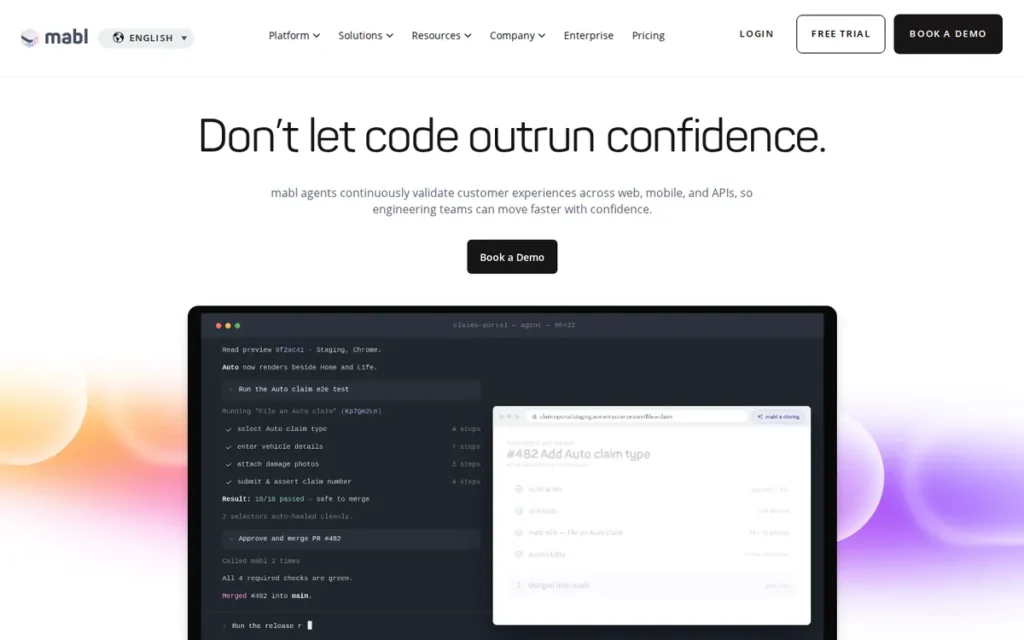
Category: AI-Native Automation Platform, full lifecycle autonomous test creation, execution, self-healing, and analytics, purpose-built with AI since 2017 for agile teams.
At a Glance
- Category: AI-Native Automation Platform
- Best For: Agile teams seeking AI-first full-lifecycle test automation without heavy engineering overhead, and teams testing AI-powered applications that produce non-deterministic outputs
- Price Range: Approximately $499/month (third-party directional estimate, Hashnode AI Testing Tools Comparison, 2026; not verified from Mabl’s pricing page, contact sales for confirmed tiers)
- Primary Strength: Mabl’s AI-native architecture since 2017 and the only GenAI Assertions capability in this comparison for validating non-deterministic AI application outputs
- Biggest Limitation: Complex dependency chains and highly dynamic scenarios exceed Mabl’s low-code capabilities; pricing is completely opaque without a sales conversation
- One-Line Summary: Mabl is the most mature AI-native test automation platform in this comparison, purpose-built with AI since 2017 across every layer of test creation, execution, self-healing, and analytics.
- Last Verified: April 2026
Overview
Mabl is a fully AI-native low-code test automation platform built from the ground up with AI since 2017 (predating the 2020–2023 wave of AI testing products by several years) supporting the complete test lifecycle from autonomous test creation through adaptive maintenance for agile teams that need reliable E2E coverage without heavy engineering overhead.
Mabl’s Test Creation Agent autonomously builds end-to-end tests from natural language input, Visual Assist identifies UI elements by visual appearance rather than DOM attributes, and auto-healing repairs broken tests when interfaces change. Mabl’s GenAI Assertions allow teams to validate AI-generated content using natural language criteria rather than rigid string matching, a capability purpose-built for testing modern AI-powered applications that produce non-deterministic outputs, and the only commercially available solution of its kind in this seven-platform comparison as of April 2026.
Key Features
- Test Creation Agent: Mabl’s autonomous agent builds full end-to-end tests from natural language inputs, eliminating manual step enumeration and accelerating test authoring for agile sprint cycles where test creation typically lags behind feature development.
- GenAI Assertions: Mabl enables teams to validate non-deterministic AI outputs (such as chatbot responses) with natural language criteria like “The response should be polite and address the customer’s shipping question” rather than deterministic string matching that fails by design for AI-generated content (Mabl Blog, AI Testing Tools for Modern Applications, 2026).
- Visual Assist: Mabl’s computer vision technology identifies UI elements by visual appearance rather than DOM attributes, enabling reliable test execution even when AI-driven applications dynamically adjust layouts and defeating the primary cause of locator-based test failures (Mabl Blog, AI Testing Tools for Modern Applications, 2026).
- Autonomous API Test Generation: Mabl extended its agentic capabilities to API testing in June 2025, allowing teams to cover frontend and backend validation within a single AI-orchestrated workflow, reducing the toolchain fragmentation of running separate platforms for UI and API coverage (Mabl Agentic AI Capabilities, June 2025).
- Auto-Healing: Mabl automatically detects and repairs broken locators when UI changes occur, reducing the manual test maintenance overhead that community practitioners consistently cite as the top QA pain point in production deployments.
Best For
Mabl is best suited for agile SaaS teams at growth-stage companies or mid-market enterprises where QA engineers have low-to-moderate coding expertise and need AI-first automation spanning both traditional application testing and AI-powered feature validation. Mabl is the only tool in this comparison explicitly designed for teams building products that incorporate LLMs, chatbots, or recommendation engines where output content varies by design.
Strengths
- Mabl earned inclusion in Gartner’s 2024 Market Guide for AI-Augmented Software Testing Tools (one of 15 platforms recognized in the emerging AI testing category) alongside 6 consecutive AI Breakthrough Awards for innovation in AI test automation, most recent award in 2024 [Gartner Market Guide, February 2024; AI Breakthrough Awards, 2024].
- Mabl’s AI-native architecture since 2017 gives Mabl a multi-year head start in training data accumulation and product maturity compared to competitors that added AI features to existing recording frameworks, a structural advantage reflected in sustained community recognition over nine consecutive years.
- Mabl’s GenAI Assertions represent one of the few commercially available solutions for testing non-deterministic AI application outputs in this comparison as of April 2026, a segment projected to grow rapidly as LLM-powered features become standard across web and mobile applications (Mabl Blog, AI Testing Tools for Modern Applications, 2026).
- Community practitioners specifically confirmed that Mabl’s GenAI Assertions and auto-healing delivered measurable improvements in test coverage speed and CI/CD feedback: “GenAI assertions and auto-healing sped up coverage and feedback” (u/divyeshaegis12, r/QualityAssurance, 2025).
Limitations
- Complexity Ceiling: Mabl’s low-code abstraction struggles with complex test scenarios involving nested dependencies, multi-step state management, or intricate conditional logic, community evaluators note Mabl is “a no go” for complex dependency chains after direct product evaluation (u/The-Munkee-Man, r/softwaretesting).
- Governance Dependency: When non-technical team members create tests in Mabl without naming convention or reusability discipline, the resulting suite accumulates technical debt that Mabl’s AI cannot fully reverse, a documented operational risk on mixed-skill teams where generic CSS class selection instead of unique identifiers creates false identification failures (u/Kori_Rotti, r/softwaretesting).
- Pricing Opacity: Mabl does not publish tier pricing publicly, requiring a sales conversation that adds procurement friction for smaller teams trying to self-qualify before vendor engagement, a friction point that community practitioners consistently cite as a barrier to evaluation.
- Object Identification Gaps: Mabl’s locator strategy occasionally selects generic CSS classes common to multiple elements rather than unique identifiers, creating false identification failures in complex DOM structures that require manual intervention to resolve (u/Kori_Rotti, r/softwaretesting).
Verdict
Mabl is the top-ranked AI software testing tool for agile teams in this comparison for 2026, earning its position through the combination of AI-native architecture, the most mature auto-healing in this review, and GenAI Assertions that are the only commercially available solution in this comparison for testing non-deterministic AI application outputs. Mabl delivers the strongest ROI for teams with structured test scenarios and AI-powered applications who want a single platform handling creation, execution, and maintenance without heavy engineering involvement. Teams with complex dependency chains, intricate branching logic, or highly dynamic scenarios should conduct a production-representative proof-of-concept against their hardest scenarios before committing to Mabl at scale.
2. Applitools: Best for Visual Regression and Cross-Browser AI Testing
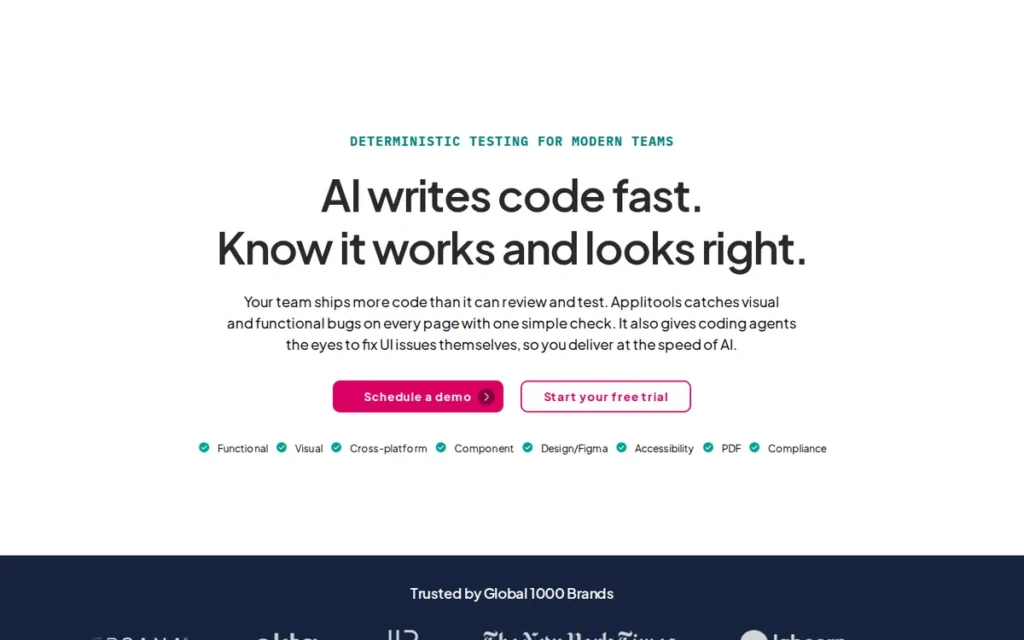
Category: Specialist Visual AI Platform, category-defining visual regression accuracy across browsers, devices, and component libraries, using perceptual AI trained on 4 billion+ real-world app screens over 11+ years.
At a Glance
- Category: Specialist Visual AI Platform
- Best For: Enterprise teams requiring AI-accurate visual regression detection across browsers, devices, and component systems where visual defects cost revenue or violate compliance requirements
- Price Range: Eyes $899/month (50 pages, annual billing); Autonomous $969/month (50 tests); Components $699/month (500 components), verified from Applitools pricing page, April 2026; Enterprise: custom quote required
- Primary Strength: Applitools Visual AI trained on 4 billion+ real app screens over 11+ years (the largest proprietary visual training dataset cited by any vendor in this comparison) delivering near-zero false positives for visual regression
- Biggest Limitation: Per-product pricing stacks quickly for teams needing full-platform capabilities; SDK integration with Selenium, Cypress, or Playwright is required, non-technical teams cannot implement Applitools Eyes without developer involvement
- One-Line Summary: Applitools is the category-founding visual AI testing platform, using a 4 billion+ screen training dataset accumulated over 11+ years to catch layout regressions that no functional assertion-based test can identify.
- Last Verified: April 2026
Overview
Applitools is the pioneering Visual AI testing platform, operating an Intelligent Testing Platform built around three core products: Eyes (visual and functional testing via SDK integration), Autonomous (no-code AI test creation via full-site crawl), and Ultrafast Test Cloud (self-healing execution infrastructure). Applitools’ Visual AI algorithm was trained on over 4 billion real-world app screens accumulated over more than 11 years, the largest proprietary visual training dataset cited by any vendor in this comparison (Applitools Why Visual AI).
Unlike pixel-by-pixel screenshot comparison tools that generate false positives from minor rendering differences, Applitools applies perceptual algorithms that mimic human visual evaluation to detect only meaningful regressions. Applitools serves 400+ enterprise clients across finance, healthcare, and technology sectors and is the only tool in this comparison with a verified public pricing page as of April 2026.
Key Features
- Visual AI (Eyes SDK): Applitools’ core algorithm detects meaningful visual regressions across pages, components, and responsive breakpoints while ignoring irrelevant rendering variations, trained on 4B+ production screens over 11+ years to distinguish what humans consider a real defect from inconsequential rendering variance (Applitools Why Visual AI).
- Autonomous 2.0: Applitools’ no-code agent auto-generates full-page tests by crawling entire websites without test script authoring, detecting HTTP errors, missing pages, and layout regressions simultaneously (extending visual coverage to non-technical team members who cannot write SDK-based tests (Applitools Platform) What’s New, 2026).
- Ultrafast Test Cloud: Applitools executes visual tests across all browsers and devices in one single rendering step rather than sequential execution, dramatically accelerating cross-browser visual verification at scale compared to serial test runs.
- SDK Framework Integrations: Applitools integrates with Selenium, Cypress, Playwright, WebdriverIO, and Appium, allowing visual AI assertions to be embedded into existing test frameworks without migrating tooling or rewriting tests.
- Multi-Level Match Modes: Applitools provides configurable match sensitivity (Strict, Layout, Content, Exact) to calibrate false positive rates for dynamic content areas including ads, personalization, and animation, requiring careful initial setup but enabling reliable detection in applications with mixed stable and dynamic content.
Best For
Applitools is best for enterprise QA teams at financial services, e-commerce, and technology companies where pixel-perfect UI consistency across browsers, devices, and component libraries is a formal release requirement, and where functional tests routinely pass while visual defects reach end users undetected. Applitools is specifically suited for teams that already have Selenium, Cypress, or Playwright infrastructure and want to add a dedicated visual regression layer without replacing their existing functional automation stack.
Strengths
- Peloton reduced visual test maintenance time by 78%, saving approximately 130 hours per month, using Applitools Visual AI, a documented enterprise customer outcome from vendor-published case studies representing the maintenance reduction Applitools delivers for teams with high-volume visual regression requirements [Applitools, 2024].
- Applitools Visual AI delivers near-zero false positives in stable UI environments, with enterprise customer Gannett Media reporting a 99.8% pass rate across tens of thousands of monthly tests, the closest independently citable accuracy figure available, corroborating the vendor’s near-zero false positive claim [Applitools Platform, 2023].
- Community practitioners consistently rate Applitools as the most accurate visual testing tool in real-world production conditions: “100% accurate, can be used by any framework or solution, but is super expensive” (u/2ERIX, r/QualityAssurance); and “Visual AI caught layout regressions that no functional test saw” (u/divyeshaegis12, r/QualityAssurance, 2025).
- Applitools publishes the only verified public pricing page in this seven-platform comparison (confirmed April 2026), enabling teams to self-qualify against budget constraints without a sales engagement, a structural transparency commitment absent from all other tools reviewed here.
Limitations
- Per-Product Pricing Compounding: Applitools structures pricing per product: Eyes ($899/month), Autonomous ($969/month), Components ($699/month) at Starter tiers, meaning teams needing full-platform capabilities face stacked subscription costs approaching $2,500+/month before any enterprise negotiation, a concern community reviewers and SMB buyers cite consistently [Applitools Platform Pricing, April 2026].
- SDK Integration Requirement: Applitools Eyes requires integration with an existing test framework (Selenium, Cypress, Playwright, or Appium), meaning non-technical QA teams cannot independently implement visual testing without developer involvement, limiting deployment to organizations that already have automation engineering capability.
- Functional Test Gap: Applitools does not provide a complete end-to-end functional test automation framework, teams still need a separate tool for functional and API coverage alongside Applitools Eyes, increasing total toolchain cost and integration overhead compared to full-lifecycle platforms in this comparison.
- Configuration Complexity: Applitools’ match level tuning (Strict, Layout, Content, Exact) requires careful initial configuration for applications with dynamic content, animations, or personalization, teams that skip this calibration step experience elevated false positive rates that erode confidence in the test pipeline.
Verdict
Applitools is the strongest evidence-supported choice for visual regression testing in this seven-platform comparison for 2026, with no equivalent tool among those reviewed for catching layout regressions, cross-device rendering defects, and component-level visual bugs that functional tests cannot detect. Applitools ranks second rather than first because its value is domain-specific: Applitools is the strongest tool for teams with a verified visual testing requirement but does not cover the functional automation, API testing, and analytics lifecycle that Mabl provides. Applitools’ 11+ year visual training dataset represents a technical moat that newer entrants cannot quickly replicate, and its per-product premium pricing is justified for enterprises where visual quality is a formal release gate, but teams without a verified visual testing use case, or without existing framework infrastructure, should evaluate whether the cost-to-benefit ratio is defensible compared to lower-priced alternatives.
3. Katalon: Best for Mixed-Skill Teams with Dual Codeless and Code-Based Workflows
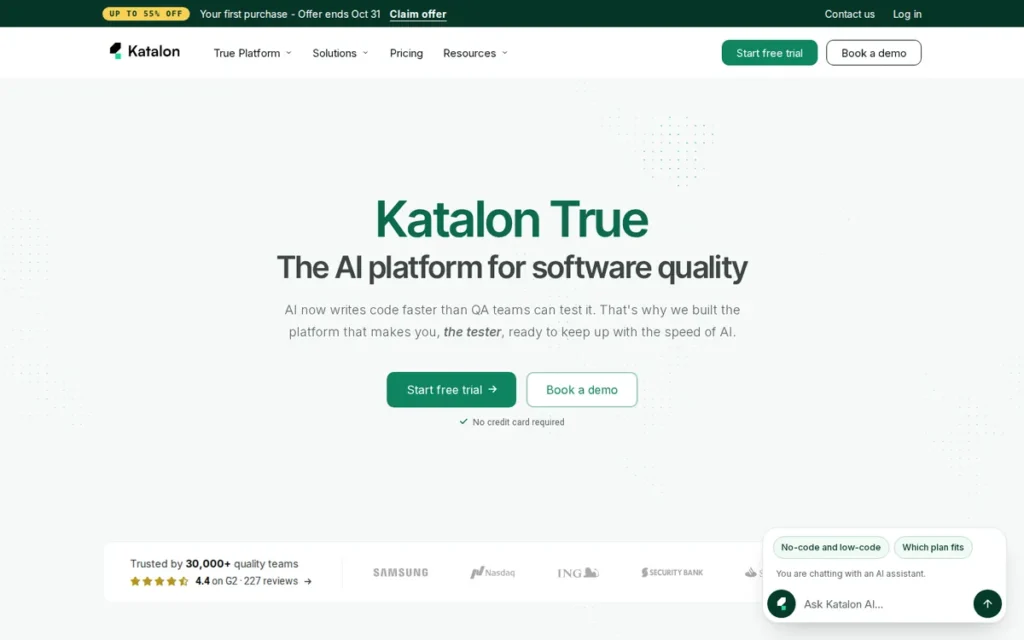
Category: Dual-Mode Automation Platform, simultaneous codeless and Groovy/Java scripting across web, mobile, API, and desktop testing in one IDE, serving both non-technical testers and experienced SDETs without toolchain fragmentation.
At a Glance
- Category: Dual-Mode Automation Platform
- Best For: Mixed-skill QA teams with non-technical testers and experienced automation engineers collaborating on the same test suite across web, mobile, API, and desktop applications
- Price Range: Free Community edition (Katalon Studio) verified April 2026; paid Platform tiers require sales contact, no public dollar amounts available
- Primary Strength: Katalon Platform’s simultaneous codeless and Groovy/Java scripting architecture serving both non-technical testers and SDETs in one environment, the only dual-mode design in this comparison
- Biggest Limitation: IDE stability degradation with large test suites; community-to-platform upgrade pricing is undisclosed; codeless mode has a documented complexity ceiling that eventually requires scripting knowledge
- One-Line Summary: Katalon Platform is the only tool in this comparison that simultaneously supports codeless record-and-playback and Groovy/Java scripting across web, mobile, API, and desktop testing in a single unified IDE.
- Last Verified: April 2026
Overview
Katalon Platform offers a dual-mode testing architecture unique in this comparison: codeless test creation (record-and-playback, drag-and-drop, keyword-driven) and Groovy/Java scripting operate side-by-side in the same IDE, enabling non-technical QA analysts and experienced SDET engineers to collaborate without splitting their testing infrastructure. Katalon Platform covers web, mobile (iOS/Android), API, and desktop application testing in one platform (the broadest coverage range in this comparison) and is the only tool in this review with a verified free Community edition providing meaningful automation capability at zero cost.
Katalon self-reports 1.1 million test cases created yearly across its self-reported 1,500+ active QA team customer base in 160+ countries [Katalon.com, April 2026]. Deloitte recognized Katalon on the Technology Fast 500 for 361% revenue growth, with enterprise clients including Samsung and Nasdaq [Deloitte Technology Fast 500, 2024].
Key Features
- Dual-Mode Architecture: Katalon Platform enables codeless record-and-playback and Groovy/Java scripting in the same IDE, allowing non-technical BAs and experienced automation engineers to work on the same test suite simultaneously without toolchain fragmentation, the defining differentiator confirmed by community practitioners.
- Kai AI Assistant: Katalon’s Kai generates structured test cases covering happy paths, edge cases, and negative scenarios from Jira or Azure DevOps tickets in under 2 minutes (vendor-reported), closing the sprint cycle gap between feature development and automated test authoring (Katalon AI-Powered Testing Platform, 2026).
- Image-Based Self-Healing: Katalon identifies UI elements by visual appearance rather than DOM attributes, automatically repairing broken locators when application structure changes, maintaining test stability through interface redesigns where single-attribute locator tools would fail.
- Broadest Platform Coverage: Katalon covers web, mobile (iOS/Android), API, and desktop testing in one license, reducing the toolchain fragmentation common in organizations testing across multiple application types with separate tools per surface (TTMS AI Tools for Testers, 2026).
- AI Report and Insight: Katalon’s AI failure analysis summarizes test results in plain English, groups failures by root cause, and answers conversational follow-up queries, reducing the manual log analysis overhead on busy sprint teams after each pipeline run.
Best For
Katalon Platform is best for mid-market and enterprise QA teams in technology, insurance, or financial services where the team mix includes non-technical manual testers, BAs, and experienced automation engineers who all need to contribute to the same test suite. Katalon is particularly well-suited for organizations in the early stages of automation adoption, where the free Community edition enables zero-cost evaluation before any budget commitment.
Strengths
- Katalon’s free Community edition (Katalon Studio) is the only verified zero-cost entry point for meaningful AI-augmented test automation in this comparison as of April 2026, enabling teams to build and run real automation before any budget commitment, evidenced by adoption across 160+ countries [Katalon.com, April 2026].
- Katalon’s dual-mode architecture is validated as the defining differentiator by community practitioners: “Useful when you need both scriptless and code-based flows” (u/divyeshaegis12, r/QualityAssurance, 2025), confirming the mixed-skill team value proposition through independent practitioner experience.
- Katalon earned placement on the Deloitte Technology Fast 500 with 361% revenue growth over three years, with enterprise clients including Samsung and Nasdaq, indicating sustained market adoption rather than marketing-stage growth [Deloitte Technology Fast 500, 2024].
- Teams migrating from manual to automation consistently report accessible onboarding with Katalon: “fairly quick/easy to get things going from zero” (u/adamcoolforever, r/QualityAssurance), confirming Katalon’s suitability for organizations at the start of their automation journey.
Limitations
- Coding Requirement at Scale: Katalon’s codeless mode has a documented complexity ceiling, community consensus confirms that meaningful automation depth eventually requires scripting knowledge regardless of accessibility positioning: “There’s really no escaping that” (u/umi-ikem, r/QualityAssurance).
- IDE Stability at Scale: Katalon’s IDE exhibits performance slowdowns and occasional stability issues with large test suites, a recurring pattern in user reviews that creates a practical ceiling for teams scaling past several hundred tests in the community edition.
- Pricing Transparency Gap: The community-to-paid-platform upgrade path is not publicly documented with dollar amounts, creating budget risk when growing teams discover confirmed pricing only during sales engagement, the most consistent practitioner frustration cited across Katalon community discussions.
- AI Capability Gap vs. Specialist Platforms: Katalon’s AI features (Kai, image-based self-healing) are less sophisticated than Mabl’s GenAI Assertions or Applitools’ Visual AI, for example, Katalon’s Kai cannot validate AI-generated content outputs or assert on non-deterministic responses from LLMs or recommendation engines, requiring supplemental tooling for teams building those types of applications.
Verdict
Katalon Platform is the strongest choice for mixed-skill QA teams in 2026, delivering the unique combination of codeless accessibility and full scripting depth in a single platform that no other tool in this comparison replicates. Katalon’s verified free entry tier and broad coverage across web, mobile, API, and desktop make it the most accessible starting point for teams transitioning from manual to automated testing, and the Deloitte Fast 500 recognition confirms genuine enterprise adoption rather than marketing momentum. Teams expecting purely no-code automation at enterprise complexity, or teams requiring cutting-edge AI depth for non-deterministic application testing, should calibrate expectations, Katalon’s strength is versatility across skill levels, not specialization at the AI frontier.
4. QA Wolf: Best Managed Coverage-as-a-Service for Teams Without Internal QA
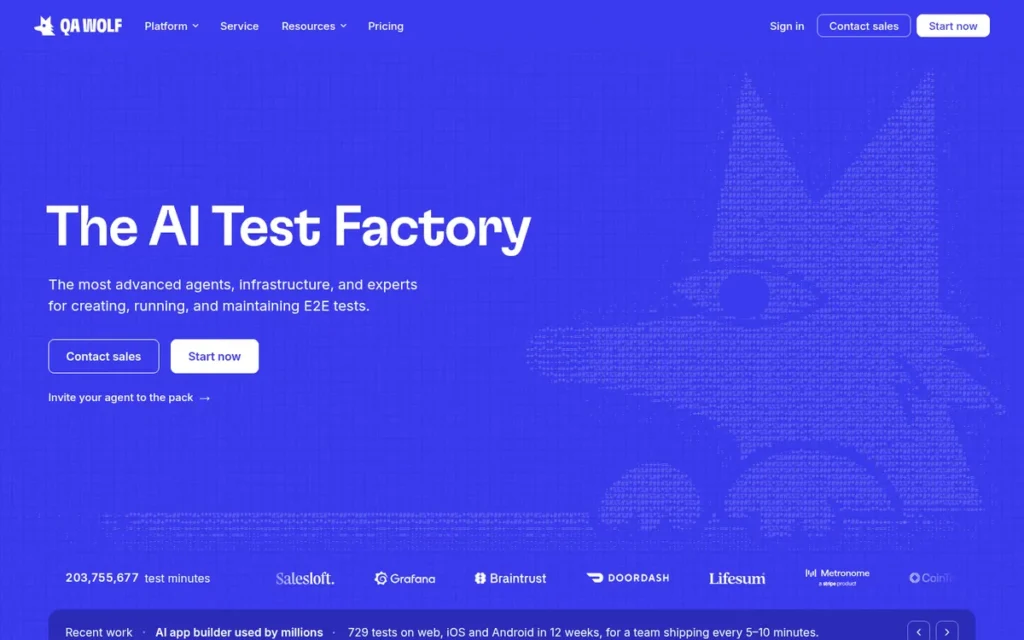
Category: Managed Coverage-as-a-Service, fully outsourced AI-assisted test coverage with dedicated QA engineers and contractually guaranteed outcomes delivered through a human-AI hybrid architecture.
At a Glance
- Category: Managed Coverage-as-a-Service
- Best For: Engineering-led startups and scaleups with no dedicated QA automation function needing guaranteed automated test coverage outcomes, or teams drowning in test maintenance overhead who want to outsource ongoing suite maintenance
- Price Range: Approximately $5,000+/month (third-party directional estimate; contact sales for confirmed pricing; April 2026), compare against $150,000–$200,000 fully loaded annual cost of hiring 1–2 senior QA automation engineers
- Primary Strength: QA Wolf’s human-AI hybrid model guaranteeing 80% E2E coverage in 4 months with client-owned Playwright code, a zero-flaky-test SLA, and 182 G2 reviews at 4.8/5.0 [G2, April 2026]
- Biggest Limitation: Slowest initial ramp to coverage (4 months) in this comparison; highest price point; creates a pace-of-delivery dependency on an external team rather than internal engineering control
- One-Line Summary: QA Wolf is the only fully managed AI testing service in this comparison, guaranteeing 80% automated end-to-end test coverage within 4 months using a human-AI hybrid model that produces client-owned, vendor-free Playwright code with a contractual zero-flaky-test SLA.
- Last Verified: April 2026
Overview
QA Wolf offers Coverage-as-a-Service, a fully managed testing engagement where dedicated QA engineers, supported by multi-agent AI trained on 40 million test runs and 700+ scenario templates [QA Wolf AI Architecture, 2025], build, execute, and maintain a client’s entire end-to-end test suite with a contractual 80% coverage guarantee within 4 months and a zero-flaky-test SLA. QA Wolf is the only solution in this comparison that is a managed service rather than self-serve software, clients are purchasing QA outcomes, not a software license.
QA Wolf produces all tests in open-source Playwright and Appium code that clients own outright and retain if the engagement ends, eliminating the vendor lock-in dynamic that most managed testing relationships create. QA Wolf has earned 182 G2 reviews with a 4.8/5.0 average rating as of April 2026 [G2, April 2026], the highest-rated managed testing service in this comparison.
Key Features
- 80% Coverage Guarantee: QA Wolf contractually commits to achieving 80% automated end-to-end test coverage within 4 months, providing outcome accountability that no self-serve software vendor in this comparison can offer.
- Human-AI Hybrid Architecture: QA Wolf’s Outliner agent develops test plans from product tours and audio captures; a Code Writer agent trained on 40 million test runs generates Playwright code; human engineers review all AI outputs, eliminating the confident-but-wrong failure pattern common in fully autonomous AI testing (QA Wolf AI Architecture, 2025).
- Client-Owned Playwright Code: All tests are written in open-source Playwright and Appium that clients own outright (if a team ends the engagement, all automation assets remain in standard, portable code with zero vendor lock-in (QA Wolf) How It Works).
- Predictive Git Analytics: QA Wolf analyzes recent git commits to identify high-risk code changes, concentrating testing resources on areas most likely to contain regressions rather than running the full suite uniformly on every deploy (TechVox, 2025).
- Unlimited Parallel Execution and 24/7 Maintenance: QA Wolf provides 100% parallel test execution and unlimited test runs at the flat service fee (including surge capacity for major feature launches) while autonomously detecting and repairing broken tests when developers update UI components or refactor code.
Best For
QA Wolf is best for engineering-led startups and scaleups in SaaS, fintech, and e-commerce with no dedicated QA automation function, where the correct economic comparison is QA Wolf versus hiring 1–2 senior QA automation engineers at a combined $150,000–$200,000 annual loaded cost plus tooling and infrastructure. QA Wolf is also well-suited for teams drowning in test maintenance overhead who want to outsource ongoing suite maintenance to a team that handles it continuously.
Strengths
- QA Wolf has earned 182 G2 reviews averaging 4.8/5.0 stars as of April 2026 [G2, April 2026] (among the highest-rated managed testing services on the platform) with community praise specifically for the quality of the embedded QA engineering team, the speed of test ramp-up, and zero-flaky-test delivery.
- QA Wolf’s Code Writer agent is trained on 40 million test runs across 700+ gym scenarios [QA Wolf AI Architecture, 2025] (the largest disclosed AI test generation training dataset in this comparison) contributing to the accuracy and maintainability of the Playwright code produced.
- QA Wolf’s open-source, client-owned Playwright and Appium code provides a genuine anti-lock-in mechanism: teams that end the engagement retain a fully portable test suite that runs on any CI/CD system without QA Wolf proprietary tooling or format dependencies.
- QA Wolf’s git commit-level predictive analytics move from reactive test execution toward risk-based coverage concentration, reducing pipeline execution time while maintaining effective coverage where code changes most frequently introduce bugs, a structural optimization unavailable from any self-serve tool in this comparison.
Limitations
- Time-to-Coverage Lag: The 4-month timeline to 80% coverage is the slowest initial ramp-up in this comparison, teams in pre-launch phases or under immediate release pressure encounter a genuine constraint from the managed model’s delivery cadence: “It’s been slower than we expected to get full coverage… we’re kind of waiting around for progress” (u/shrimpthatfriedrice, r/QualityAssurance, October 2025).
- Highest Price Entry: At approximately $5,000+/month, QA Wolf is 5–10x the subscription cost of self-serve tools in this comparison; teams with existing QA automation engineers may find the managed model duplicates internal capability at premium cost, with no retained licensing value if the engagement ends (u/DiligentMission6851, r/QualityAssurance, October 2025).
- Control Reduction: The managed service model creates a dependency on external team delivery velocity, practitioners report waiting for progress rather than directly controlling test development pace, which conflicts with engineering cultures that prefer internal autonomy over outsourced delivery timelines.
- Narrow Ideal Profile: QA Wolf delivers highest value for teams with zero internal QA function; organizations that already employ QA automation engineers capable of building and maintaining a self-hosted Playwright suite may find the managed model economically redundant rather than complementary.
Verdict
QA Wolf is the best choice for engineering-led teams that need QA coverage outcomes, not QA software, in 2026, backed by 182 G2 reviews at 4.8/5.0, contractually guaranteed deliverables, and client-owned test assets with zero lock-in. QA Wolf’s human-AI hybrid model addresses the most common failure mode of autonomous AI testing, confident but inaccurate test generation, by maintaining human engineering review throughout creation and maintenance. The economic qualifier is critical: QA Wolf’s value proposition becomes favorable when its monthly service cost compares favorably against the fully loaded cost of hiring the QA engineers who would otherwise perform the same function, a calculation that typically favors QA Wolf for companies at Series A scale and above, and typically does not for early-stage startups or teams already running capable automation engineers on a self-hosted Playwright suite.
5. LambdaTest KaneAI: Best for Cloud-Scale Testing Across 3,000+ Browser and Device Combinations
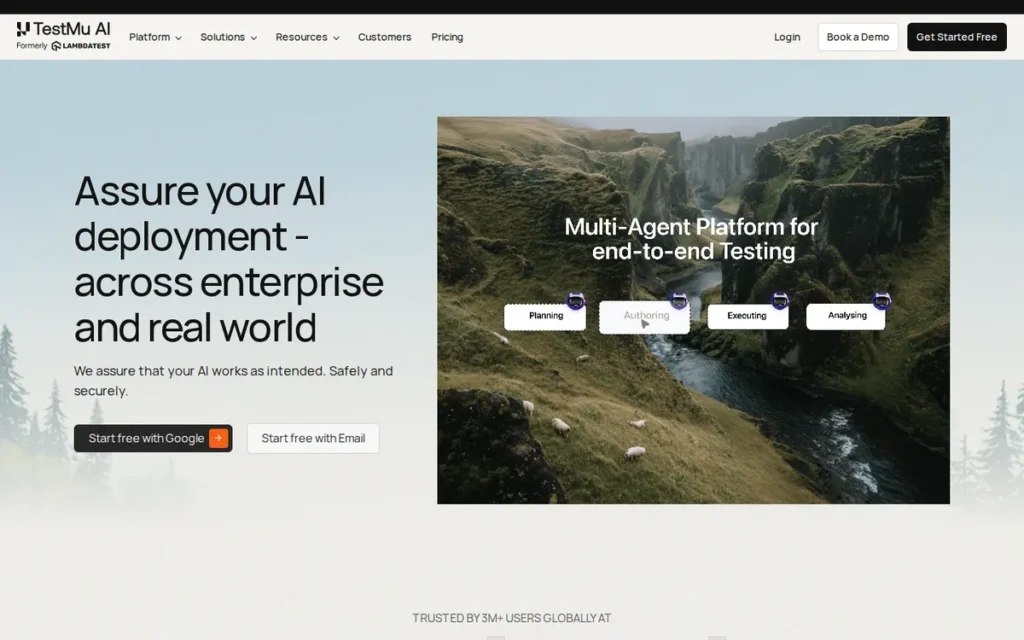
Category: AI-Native Cloud Testing Platform, GenAI natural language test authoring paired with the broadest cloud execution infrastructure in this comparison, including 3,000+ browser, OS, and device combinations.
At a Glance
- Category: AI-Native Cloud Testing Platform
- Best For: Cloud-scale DevOps teams needing GenAI test authoring combined with maximum browser, OS, and device execution breadth across global device markets
- Price Range: Freemium entry tier available at no cost (verified April 2026); enterprise pricing reaches high five to six figures annually per third-party analysis [Bug0 Blog, April 2025], contact sales for team-scale pricing
- Primary Strength: LambdaTest KaneAI’s 3,000+ browser, OS, and device cloud with HyperExecute orchestration delivering up to 70% faster test execution than traditional Selenium Grid (vendor-published benchmark, no third-party confirmation available as of April 2026)
- Biggest Limitation: KaneAI’s test maintenance and self-healing lifecycle is less mature than Mabl or Applitools, as independently identified in competitor analysis as of 2025; KaneAI launched in 2024 with limited isolated review history on major platforms
- One-Line Summary: LambdaTest KaneAI combines natural language GenAI test authoring with the broadest cloud execution infrastructure in this comparison, 3,000+ browser, OS, and device combinations powered by HyperExecute orchestration and anti-lock-in multi-language code export.
- Last Verified: April 2026
Overview
LambdaTest KaneAI is LambdaTest’s GenAI-native testing agent, launched in 2024 as part of LambdaTest’s strategic expansion from cloud test execution infrastructure into full-stack AI test authoring. KaneAI allows teams to create, manage, evolve, and debug tests through natural language commands, users describe test objectives in plain English, and KaneAI translates them into automation code, executes tests on LambdaTest’s cloud, and provides detailed root cause analysis.
LambdaTest’s HyperExecute orchestration engine delivers up to 70% faster test execution compared to traditional Selenium Grid through intelligent test distribution and minimized network latency, a vendor-published figure without available third-party benchmarking as of April 2026 (Dev.to, KaneAI Deep Dive, 2024). LambdaTest’s established cloud infrastructure platform carries 175+ G2 reviews for reliability and multiregion distribution; KaneAI, launched in 2024, does not yet have an isolated review history on major platforms, making independent production validation more limited than for established competitors.
Key Features
- Natural Language Test Creation: LambdaTest KaneAI converts plain English test objectives into automation code and execution steps, eliminating script authoring overhead for teams that describe test goals conversationally rather than programmatically.
- HyperExecute Orchestration: LambdaTest’s HyperExecute engine distributes test execution intelligently across cloud infrastructure, delivering up to 70% faster execution compared to traditional Selenium Grid, a vendor-published figure [Dev.to, 2024], directly accelerating CI/CD deployment velocity for large test suites.
- 3,000+ Device and Browser Coverage: LambdaTest KaneAI executes tests across 3,000+ browser, OS, and device combinations including native Android and iOS real devices, providing the broadest cross-platform execution coverage of any tool in this comparison for global product validation.
- Smart Show-Me Mode: LambdaTest KaneAI converts a tester’s actual browser actions into natural language test instructions in real time, bridging manual exploratory testing and automated test authoring without requiring testers to reconstruct steps from memory after the fact.
- Multi-Language Code Export: LambdaTest KaneAI exports generated tests into all major programming languages and frameworks (Playwright, Selenium, Cypress), providing the most explicit anti-lock-in portability commitment in the GenAI test authoring segment of this comparison.
Best For
LambdaTest KaneAI is best for DevOps-centric teams at cloud-native companies in e-commerce, media, and enterprise SaaS where cross-browser and cross-device coverage breadth is the primary selection criterion, and where natural language test authoring can meaningfully accelerate sprint-level test creation velocity. LambdaTest KaneAI is also suited for teams who want to consolidate GenAI test authoring and cloud execution infrastructure within a single vendor relationship.
Strengths
- LambdaTest’s established cloud testing platform carries 175+ G2 reviews with strong ratings for infrastructure reliability and multiregion distribution, community practitioners who migrated from Sauce Labs cite “properly multiregion” infrastructure and “far less issues” as primary reasons (u/numo16, r/softwaretesting, 2024), providing organizational credibility for the KaneAI authoring layer as it accumulates its own review history.
- LambdaTest KaneAI provides access to 3,000+ browser, OS, and device combinations: the broadest real-device and browser coverage among all platforms in this comparison, recently expanded with native Android and iOS real device support for cross-device compatibility validation across global markets.
- LambdaTest KaneAI’s multi-language code export converts generated tests to standard Playwright, Selenium, Cypress, or other framework code, preserving team automation investment and portability regardless of future vendor decisions, the most explicit anti-lock-in commitment in the GenAI test authoring segment.
- LambdaTest KaneAI’s Smart Show-Me Mode bridges exploratory manual testing and automated test creation by recording live browser sessions and converting them to reusable test instructions, reducing the cognitive overhead of translating observed application behavior into structured test steps.
Limitations
- Immature Maintenance Lifecycle: LambdaTest KaneAI’s self-healing and automated test maintenance capabilities are less developed than Mabl or Applitools, independent competitor analysis from 2025 specifically identifies KaneAI as lacking automated test maintenance capabilities comparable to established platforms, meaning teams on high-change-rate applications may encounter more manual update overhead than the authoring convenience gains can offset (GetPanto KaneAI Alternatives, 2025).
- Limited Isolated Review History: LambdaTest KaneAI launched in 2024 and lacks an isolated review history on G2 or Capterra (the 175+ G2 reviews belong to LambdaTest’s legacy cloud infrastructure business, not KaneAI’s AI authoring capability) making independent production validation more limited than for Mabl (2017) or Applitools (2013).
- Enterprise Pricing Exclusivity: Enterprise pricing reaching high five to six figures annually effectively prices out startups and small agencies despite the freemium entry point, a pattern that limits broad adoption at the fast-growth companies most likely to benefit from rapid test scaling [Bug0 Blog, April 2025].
- Platform Dependency Risk: Because LambdaTest KaneAI is tightly integrated with LambdaTest’s proprietary execution infrastructure (HyperExecute), teams that migrate away from LambdaTest lose the AI orchestration layer, multi-language code export mitigates but does not eliminate this dependency if the execution infrastructure cannot be replicated elsewhere.
Verdict
LambdaTest KaneAI is the best cloud infrastructure choice for AI software testing in 2026 for teams where cross-browser and cross-device execution breadth is the primary selection criterion, pairing the most device-diverse cloud environment in this comparison with GenAI test authoring and HyperExecute execution that delivers meaningful pipeline speed improvements at scale. LambdaTest KaneAI ranks fifth in this comparison due to its 2024 launch date and documented test maintenance lifecycle maturity gap, limitations that are a function of product age likely to narrow as the platform matures, making LambdaTest KaneAI a high-potential platform that teams should validate through the freemium tier against their most complex and most frequently changing scenarios before committing to enterprise pricing.
6. Tricentis Testim: Best for Salesforce and Enterprise ML Locator Testing
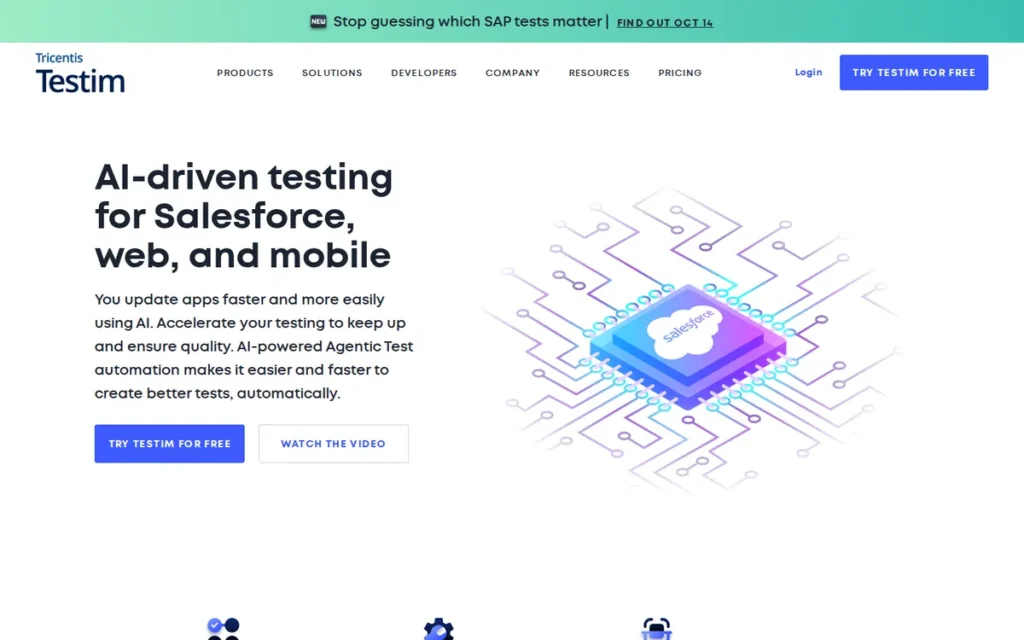
Category: Specialist Enterprise ML Testing Platform, ML-powered Smart Locators for web and mobile, with purpose-built Salesforce AI testing and ML confidence scoring within the Tricentis enterprise quality ecosystem.
At a Glance
- Category: Specialist Enterprise ML Testing Platform
- Best For: Enterprises with Salesforce Lightning environments requiring AI-stable locators that bypass dynamic DOM IDs, or regulated industries needing confidence-scored, auditable test decisions
- Price Range: Free account tier for initial access; Enterprise pricing approximately $30,000–$100,000+/year (third-party directional estimate, Hashnode AI Testing Tools Comparison, 2026; contact sales required for confirmed pricing)
- Primary Strength: Tricentis Testim’s ML Smart Locators analyzing hundreds of DOM attributes simultaneously and the only metadata-based AI locators for Salesforce Lightning components in this seven-platform comparison as of April 2026
- Biggest Limitation: Documented community scalability ceiling at complex test architectures; JavaScript workaround requirements for non-unique DOM elements; post-acquisition pricing escalation concerns
- One-Line Summary: Tricentis Testim delivers ML Smart Locators that analyze hundreds of DOM attributes simultaneously and is the only tool in this comparison with metadata-based AI locators purpose-built for Salesforce Lightning component testing.
- Last Verified: April 2026
Overview
Tricentis Testim is an ML-powered web and mobile test automation platform distinguished by Smart Locators (an algorithm that analyzes hundreds of DOM element attributes simultaneously (position, text, surrounding context, visual fingerprint) rather than relying on a single ID or CSS class) making tests significantly more resilient to UI changes than traditional single-attribute approaches.
Acquired by enterprise testing provider Tricentis on February 9, 2022 [Tricentis press release, February 2022], Testim is now positioned within a broader quality ecosystem alongside Tosca, NeoLoad, and SeaLights, serving enterprise clients including McKesson, Accenture, and Dolby across more than 2,100 organizations. Tricentis Testim’s Salesforce-specific capabilities use component metadata rather than dynamic DOM IDs (directly solving the Lightning component locator problem that defeats all standard automation approaches) making Testim the only tool in this comparison with a purpose-built architectural solution for Salesforce testing.
Key Features
- ML Smart Locators: Tricentis Testim analyzes hundreds of DOM element attributes simultaneously to maintain element identification with high confidence (generating confidence scores that provide audit-grade explainability for regulated enterprise environments where test decisions must be documented (Tricentis Blog) Testim Locator Technologies).
- Salesforce Metadata Locators: Tricentis Testim uses Salesforce component metadata rather than session-specific dynamic DOM IDs to identify Lightning components, directly solving the core Salesforce testing locator problem that no standard automation tool in this comparison handles reliably.
- ML Confidence Score Reporting: Testim surfaces ML confidence scores for all element matching decisions, enabling teams in financial services, healthcare, and insurance to document and audit the AI’s test execution reasoning, a compliance capability absent from most competitors.
- Waldo Mobile ML Technology: Tricentis Testim’s Waldo builds enriched element trees beyond native view hierarchies for Flutter, React Native, and hybrid mobile apps, enabling reliable testing across modern cross-platform mobile frameworks where native accessibility hierarchies do not map cleanly to component-based rendering (Tricentis, Machine Learning Mode for Testim Mobile).
- Copilot Agentic Generation: Testim’s Copilot generates complete end-to-end tests from natural language prompts, integrating with Tricentis quality intelligence dashboards for enterprises standardized on the Tricentis platform alongside Tosca and NeoLoad (Tricentis Blog, QA Trends: AI Agentic Testing, 2026).
Best For
Tricentis Testim is best for large enterprises in financial services or healthcare heavily invested in Salesforce Lightning (where dynamic DOM IDs cause continuous test locator failures under traditional automation) and for regulated industries requiring ML confidence-scored, auditable test decisions. Tricentis Testim is also suited for enterprises already standardized on the Tricentis platform (Tosca, NeoLoad, SeaLights) who need web and mobile test automation with native cross-product quality intelligence integration.
Strengths
- Tricentis Testim’s Salesforce Lightning metadata-based AI locators are the only purpose-built Salesforce Lightning component testing solution in this seven-platform comparison as of April 2026, no other reviewed tool addresses Salesforce’s dynamic DOM ID regeneration through component metadata matching, making Testim the only defensible choice for Salesforce-heavy enterprises evaluating this comparison.
- Testim’s ML confidence score reporting adds explainability absent from every other platform in this comparison, an audit capability supporting compliance requirements in financial services, healthcare, and insurance environments where test decisions must be documented and reviewable.
- For teams with stable UIs and straightforward test scenarios, Testim’s Smart Locators deliver documented maintenance value: “Solid self-healing locators, cut flaky-test maintenance for us” (u/divyeshaegis12, r/QualityAssurance, 2025), confirming the locator approach works in controlled production conditions.
- Tricentis’ established enterprise client portfolio: including McKesson, Accenture, and Dolby, serving over 2,100 enterprise organizations, provides longevity assurance for teams making multi-year platform commitments [Tricentis acquisition press release, February 2022].
Limitations
- Scalability Ceiling: Community evidence documents a consistent pattern: Tricentis Testim performs adequately for smaller organizations with simple recording scenarios but “simply does not scale well” as test complexity and volume increase, teams migrating from Selenium reported more flaky tests, not fewer (u/techlife123, r/QualityAssurance, October 2025).
- JavaScript Workaround Dependency: Non-unique DOM elements frequently require custom JavaScript functions as workarounds, partially defeating the codeless value proposition, practitioners report having “to write custom JS functions for everything” in production environments, contradicting Testim’s core low-maintenance promise (u/Electronic_Bass_8563, r/QualityAssurance).
- Parallel Execution Pricing: Testim’s subscription model limits simultaneous parallel test executions per tier, making large-scale parallel runs prohibitively expensive, community feedback describes it as “super expensive to be able to run at least 5 tests at the same time” at standard tier pricing (u/Electronic_Bass_8563, r/QualityAssurance).
- Post-Acquisition Pricing Escalation: Community discussions document pricing increases and a product focus shift toward the enterprise segment following the Tricentis acquisition in February 2022, with some SMB users reporting reduced support quality and slower issue resolution, a documented trend teams should validate through reference checks with current customers at comparable scale before committing.
Verdict
Tricentis Testim is the right choice for Salesforce-heavy enterprises in this comparison for 2026, delivering the only metadata-based AI locators for Salesforce Lightning component testing and ML Smart Locators with explainable confidence scoring within a governed enterprise ecosystem. Tricentis Testim ranks below LambdaTest KaneAI primarily because KaneAI’s limitations are a function of product maturity likely to improve over time, while Testim’s scalability ceiling is a documented architectural constraint confirmed by multiple independent community accounts over sustained periods. Testim’s value proposition is highly context-specific: organizations with Salesforce Lightning environments or regulated compliance requirements benefit directly from its unique capabilities, while mid-market teams without these requirements face documented scalability and pricing barriers that make competing tools in this comparison more cost-effective choices.
7. TestRigor: Best for Non-Technical Teams Automating Through Plain English
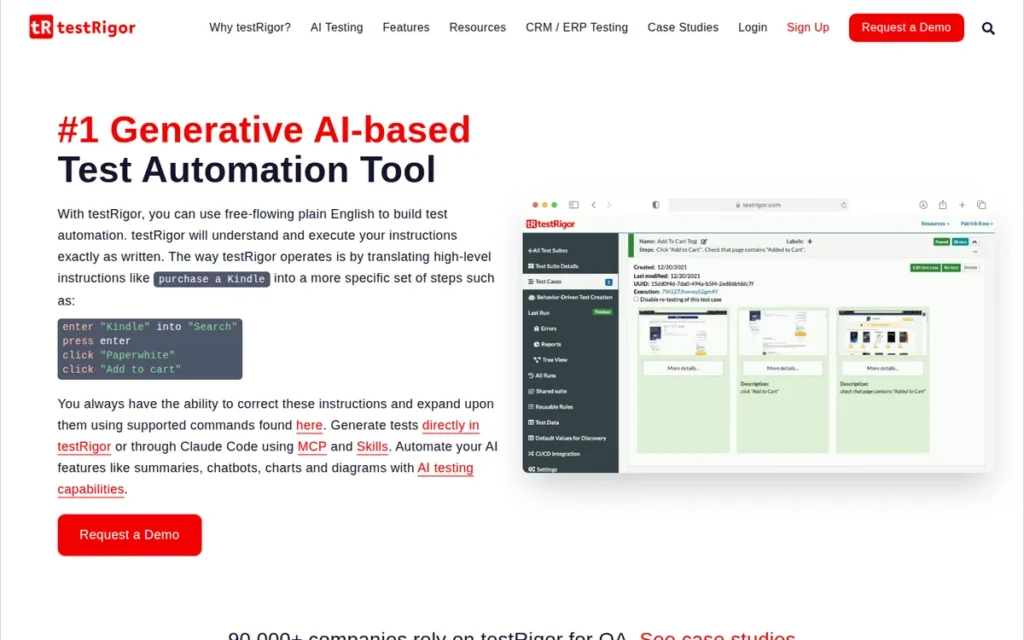
Category: Plain English NLP Testing Platform, no-code test authoring through natural language sentences with Vision AI self-healing, built on a Selenium backend with NLP and Vision AI as the abstraction layer.
At a Glance
- Category: Plain English NLP Testing Platform
- Best For: Non-technical QA teams and manual testers automating simple-to-moderate web and mobile application flows, particularly where built-in 2FA or email validation automation is required and coding expertise is unavailable
- Price Range: Free community tier available (verified April 2026); Business and Enterprise plans require sales contact, no public pricing available; sales process flagged as aggressive by multiple independent community practitioners
- Primary Strength: TestRigor’s plain English NLP authoring enabling non-technical teams to automate in-sprint without writing code, with rare built-in 2FA, email, and file validation testing unavailable in most competing tools
- Biggest Limitation: Complex scenarios require JavaScript fallbacks that non-technical users cannot write; Selenium backend confirmed through community-reported exceptions in production logs, directly contradicting self-healing marketing claims at scale
- One-Line Summary: TestRigor is the most accessible no-code testing platform in this comparison, enabling non-technical QA teams to write and maintain automated tests using plain English sentences with Vision AI self-healing, but it operates on a Selenium backend that introduces inherited flakiness at the same complexity level where plain-English authoring reaches its documented limits.
- Last Verified: April 2026
Overview
TestRigor is a no-code test automation platform where tests are written in plain English sentences describing user actions (“Login, add an item to cart, and checkout”) with TestRigor’s NLP engine and generative AI converting these instructions into executable end-to-end tests for web, mobile, desktop, API, and visual testing. TestRigor was incorporated in 2015 in San Francisco by Artem Golubev (CEO), Enzo Biancato, and Artem Gushcha [Y Combinator; ZoomInfo, April 2026].
TestRigor’s Vision AI identifies page elements by visible text and visual context rather than DOM attributes, designed to enable self-healing tests that adapt to UI framework migrations and redesigns. Community practitioners have confirmed through production experience that TestRigor operates on a Selenium backend, with Selenium exceptions appearing in test logs, a critical architectural disclosure absent from TestRigor’s marketing that directly affects the reliability of its self-healing claims.
TestRigor also provides rare built-in capabilities including two-factor authentication handling (email, SMS, Google Authenticator), email content validation, PDF/CSV/Excel file testing, database access, and OCR for image text extraction, scenarios requiring significant custom infrastructure investment in every other platform in this comparison.
Key Features
- Plain English NLP Authoring: TestRigor converts plain English action descriptions into executable automated tests, eliminating CSS selectors, XPath, and code syntax as barriers to test creation for non-technical team members who know the application but have no automation framework experience.
- Vision AI Self-Healing: TestRigor’s Vision AI identifies elements by visible text and visual context rather than DOM attributes, designed to maintain test validity through UI redesigns and framework migrations (though the underlying Selenium backend creates inherited flakiness limitations that emerge at scale (TestRigor) Generative AI in Software Testing).
- Built-In 2FA Testing: TestRigor natively handles two-factor authentication flows via email, SMS, and Google Authenticator TOTP, a rare capability that most tools require complex custom infrastructure to support, reducing the “cannot be automated” test backlog for authentication-heavy applications.
- Generative AI Test Creation: TestRigor accepts feature documentation, user stories, or PR descriptions as inputs and generates complete test suites, supporting in-sprint automation for agile teams without manual test step enumeration.
- Extended Scenario Coverage: TestRigor handles email content validation with button clicks, PDF/CSV/Excel/Word file validation, database queries, OCR for image text, Chrome extension testing, and multi-tab browser sessions, reducing the scope of scenarios left as permanent manual regression (TestRigor Features).
Best For
TestRigor is best for QA teams at insurance, healthcare, or finance companies with predominantly non-technical manual testers automating stable, form-heavy application flows for the first time, particularly where 2FA, email verification, or file validation are required test scenarios that other platforms in this comparison struggle to automate without custom development investment.
Strengths
- TestRigor enables non-technical manual QA teams to achieve genuine in-sprint automation across stable, form-heavy applications: one practitioner reported “automating in-sprint for about 99% of our tickets” after deploying TestRigor to an insurance application testing team with no prior automation experience (u/TsalagiMountainMan, r/QualityAssurance, October 2025).
“We did testRigor! And we love it. All of our manual QA people are now automating. It seems like the least experience you have with automation, the better. We are at the point that we are automating in-sprint for about 99% of our tickets.” (u/TsalagiMountainMan, r/QualityAssurance, October 2025)
Takeaway: TestRigor delivers highest impact for non-technical manual QA teams automating stable, form-heavy applications, the insurance domain and entirely non-technical team context of this account are essential to interpreting the 99% in-sprint automation outcome.
- TestRigor’s built-in 2FA handling (email, SMS, Google Authenticator TOTP) is the rarest practical capability in this comparison, eliminating significant custom infrastructure overhead for teams whose applications require authentication testing at every release cycle.
- TestRigor’s Vision AI self-healing is designed to address the maintenance burden through DOM-independent element identification, theoretically maintaining test validity through complete framework migrations where selector-based tools would fail universally.
- TestRigor reports tests can be created up to 15x faster than traditional QA engineering approaches, with 200x less maintenance time compared to Selenium-based automation, vendor-published metrics from Y Combinator profile, representing best-case performance under optimal scenario conditions and not independently benchmarked [TestRigor, Y Combinator profile, 2025].
Limitations
- JavaScript Fallback Dependency: For complex web elements or non-standard UI patterns, TestRigor’s plain English instructions fail and require JavaScript workarounds that non-technical users cannot write, a limitation documented by a 25-year automation veteran who reported “not a single person writing automated tests was happy with TestRigor” after 14 months of mandatory production use (u/legolasMightBeADog, r/softwaretesting).
“I’ve used it for 14 months because I had to… It’s the worst test automation tool I’ve used in my 25 years in test automation. Slow, no code review functionality, lots of JavaScript needed, documentation and support is terrible. On some test failures we were getting good old Selenium exceptions in TestRigor logs.” (u/legolasMightBeADog, r/softwaretesting)
Takeaway: In complex production environments with non-standard elements, experienced automation engineers consistently report higher maintenance burden with TestRigor, not lower, the Selenium backend and JavaScript fallback dependency are the root causes identified across multiple independent practitioner accounts.
- Selenium Backend Inheritance: TestRigor’s underlying architecture uses Selenium, confirmed through community practitioners observing Selenium exceptions in TestRigor error logs, meaning large parallel test suites inherit Selenium’s architectural limitations and flakiness characteristics, directly contradicting the platform’s self-healing and maintenance-reduction marketing claims at scale.
- Production Complexity Gap: TestRigor performs well in demos on simple scenarios but “scripts often required customization using JavaScript code when web elements weren’t ‘obvious'” in production environments, the gap between demo performance and production reality is documented across multiple independent evaluations (u/Leopoldo_Caneeny, r/softwaretesting).
- Opaque Pricing with Aggressive Sales Cycle: TestRigor publishes no pricing tiers or indicative ranges, and community accounts describe an aggressive sales process flagged across multiple independent reviews [r/softwaretesting, 2024–2025], creating budget risk when evaluation-invested teams discover pricing only at the contract conversation, after significant time has been spent on evaluation.
Verdict
TestRigor is the most accessible entry point into test automation for non-technical QA teams in this comparison for 2026, delivering genuine in-sprint automation value when applied to simple-to-moderate, stable application flows by users with no automation background. The confirmed Selenium backend is the most consequential undisclosed constraint in this comparison, directly affecting the reliability of self-healing claims at the same complexity level where JavaScript fallbacks become required. TestRigor’s plain English model works best when application UI elements are clearly identifiable and flows are predictable; for dynamic, complex, or framework-heavy applications, the JavaScript fallback requirement and Selenium backend limitations create a different maintenance burden than the tool was designed to eliminate. Teams should run a production-representative proof-of-concept, not a vendor-configured demo, covering their most complex scenarios before committing to a paid plan.
What Red Flags Should I Watch For When Evaluating AI Software Testing Tools?
The most important red flags in AI testing tool evaluation are pricing opacity without directional ranges, demo scenarios that misrepresent your application complexity, “no-code” claims without complexity ceiling disclosures, and ambiguous test ownership terms. Every tool in this comparison exhibited at least one of these signals, identifying them before purchase prevents expensive platform migrations six to twelve months later.
Red Flag #1: No Pricing Range Without a Sales Call
Every tool in this comparison requires a sales conversation for confirmed pricing, this is a category-wide pattern, not a signal in itself. The red flag is when a vendor cannot provide even directional pricing ranges before engaging, since this suggests highly variable, negotiated contracts that price-disadvantage buyers without competitive leverage. Always request a reference pricing range before investing significant evaluation time with a sales team.
Red Flag #2: Demo Scenarios That Don’t Match Your Application Complexity
AI testing tools consistently perform well in demos built on clean, simple UI flows. The red flag is when vendors decline to run a proof-of-concept on your actual application before purchase. A meaningful POC should include at least 20–30 representative scenarios from your production application (including at least 3 with dynamic content or complex state dependencies) and measure false positive rate, self-healing behavior after a deliberate UI change, and test authoring time for a new feature. Community evidence across TestRigor, Tricentis Testim, and LambdaTest KaneAI shows that demo performance consistently overstates production reliability for teams with complex or framework-heavy applications.
Red Flag #3: “No-Code” Claims Without Complexity Ceiling Disclosure
Every “no-code” tool in this comparison has a documented JavaScript fallback requirement for complex scenarios (TestRigor, Tricentis Testim) or a practical scripting ceiling (Katalon, Mabl). The red flag is marketing language presenting codeless capability as unlimited without clearly disclosing the specific scenario types that fall outside the no-code model. Ask the vendor explicitly: “At what point does a test scenario in your platform require JavaScript or custom code?”, and require a specific, documented answer.
Red Flag #4: Ambiguous Test Ownership and Export Terms
For managed services (QA Wolf) and cloud-native tools, test script ownership upon contract termination must be explicitly documented before signing. The red flag is any ambiguity about whether automation assets are portable in standard formats, proprietary test script storage and cloud-only execution models create switching costs that force expensive rebuilds when contract terms change. QA Wolf’s explicit Playwright code ownership in client-signed contracts is the model for what transparent terms look like.
Red Flag #5: Self-Healing Marketed Without Technical Mechanism Specificity
“Self-healing” is the most overloaded marketing term in this category. Meaningful self-healing (Mabl, Applitools, QA Wolf) adapts to UI changes with documented reliability through a verifiable technical mechanism. The red flag is a vendor that cannot explain the underlying approach (DOM multi-attribute ML, Vision AI, human-reviewed code, confidence scoring) or demonstrate self-healing against a realistic changing UI during evaluation. The TestRigor Selenium backend disclosure is the clearest example of why the underlying mechanism matters as much as the marketing claim.
Red Flag #6: “AI-Powered” Without Training Data Disclosure
Applitools trained its Visual AI on 4 billion+ real-world app screens over 11+ years in this comparison, a verifiable technical foundation that provides a benchmark for what meaningful training data disclosure looks like. The red flag is a vendor that cannot explain what data trained their AI models, on what application types, and how recently, because this determines whether the AI will generalize reliably to your specific stack and scenario complexity, or whether “AI-powered” is applied to rule-based heuristics marketed as machine learning.
What Questions Should I Ask Before Choosing an AI Software Testing Tool?
The six questions below surface real-world limitations, pricing ceilings, and portability constraints that vendor demos and marketing materials consistently obscure. Teams that skip these questions during evaluation disproportionately report platform regret within 12 months, typically after investing 3–6 months in tool adoption before discovering the scalability ceiling or maintenance limitations.
Question #1: What specifically happens when your AI fails to identify a UI element?
Require a specific, documented fallback mechanism (confidence threshold, human escalation, manual override) rather than “our AI handles everything.” The answer reveals whether the tool has a production-grade degradation strategy or whether element identification failures produce silent test passes that mask real bugs. This question directly surfaces the Selenium backend issue in TestRigor and the JavaScript workaround dependency in Tricentis Testim.
Question #2: Can we run a proof-of-concept on our actual application before signing a contract?
Any vendor confident in their product’s production performance should agree to a POC on your stack rather than a pre-configured demo environment. Reluctance to allow a real-application POC is a meaningful signal about the gap between demo performance and production reliability. A meaningful POC should measure:
- False positive rate on first run against production UI
- Self-healing behavior after a deliberate UI element change
- Test authoring time for a new feature scenario representative of your complexity
Question #3: Who owns the test scripts, and can we export them in an open format if we leave?
The answer must specify the exact export format (Playwright code, Selenium code, standard JSON), the ownership terms in the signed contract, and any export restrictions or cloud-only storage limitations. Proprietary formats and cloud-only storage are lock-in mechanisms that create significant switching costs if the vendor raises prices, changes terms, or discontinues the product.
Question #4: How does your pricing scale from our current team size to 3x growth?
AI testing tools with per-parallel-execution pricing (Tricentis Testim), per-product pricing (Applitools), or usage-based tiers can produce 3–5x cost increases as teams scale test suites and execution frequency. Understanding the pricing ceiling at your projected growth state is as strategically important as the entry cost during initial evaluation, and is the question most commonly skipped during a purchase cycle.
Question #5: What percentage of your customers have test suites above 1,000 tests, and what challenges do they encounter?
This question surfaces scalability limitations that small-suite pilots and 30-day trials cannot reveal. Tricentis Testim’s community-documented scaling failures, LambdaTest KaneAI’s maintenance maturity constraints, and Katalon IDE stability issues all emerge at scale, ask for reference customers at your target test volume before committing to any platform in this comparison.
Question #6: What does test maintenance look like in the second year of use, after initial test suite build-out is complete?
The 12-month question separates tools that market self-healing from tools that deliver it in sustained production use. Request customer testimonials or case studies specifically about maintenance overhead in year two, when the initial setup enthusiasm has faded and ongoing maintenance becomes the dominant cost driver of the platform relationship, not the initial test creation experience.
How Did We Rank These AI Software Testing Tools?
These seven AI software testing tools were ranked by PlugRoute using a four-phase evidence process: discovery across multiple AI search engines, third-party review platform verification (G2 and Capterra), deep product research from dated public sources, and Reddit community sentiment validation from r/QualityAssurance, r/softwaretesting, and r/AI_Agents. No vendor compensated this platform for placement. The full process is documented below.
How Was the Evaluation Process Structured?
The ranking process proceeded through four sequential phases:
- Discovery Phase: Multiple AI search engines were queried using the article’s core topic and five related search queries to identify the most prominently recommended AI testing tools across the broadest source sample.
- Verification Phase: Each identified tool’s domain, pricing page, G2/Capterra review presence, and product documentation were independently verified against vendor websites and third-party review platforms.
- Deep Research Phase: All seven confirmed products were researched across positioning, key features, performance evidence, pricing, user ratings, and community discussion, with vendor-published statistics explicitly separated from independently corroborated claims.
- Community Validation Phase: Reddit threads across r/QualityAssurance, r/softwaretesting, and r/AI_Agents were searched for each product to surface practitioner-authored production experience that vendor materials do not disclose.
What Criteria Were Used to Rank These Tools?
Each product was evaluated across six criteria:
- Self-Healing Maturity and AI Mechanism Quality: Assessed through documented technical mechanism (DOM multi-attribute ML, Vision AI, confidence scoring, human-reviewed code generation), scale of training data, and independent community practitioner validation. Why it matters: the entire value proposition of AI testing tools is reducing test maintenance, a self-healing mechanism that fails under common conditions delivers less value than its marketing implies.
- Review Platform Ratings and Community Trust: Assessed through verified G2 and Capterra ratings and review volume, G2 Leader designations with recency noted, and aggregated Reddit community sentiment. Why it matters: community posts are self-motivated and specific; review platform data measures aggregate satisfaction at scale.
- Accessibility and Codeless Capability (Calibrated): Assessed through documented technical prerequisites beyond marketing claims, community-reported JavaScript fallback requirements, and availability of free tiers. Why it matters: mixed-skill teams are the market reality, tools that overstate codeless capability create buyer regret.
- Verified Performance Evidence: Assessed through named client case studies with specific metrics, dated third-party analyst recognition, and practitioner confirmation of specific claimed capabilities in community discussions. Why it matters: vendor-published benchmarks are best-case scenarios; community corroboration is the closest available independent validation.
- Testing Surface Breadth (secondary weight): Count and verification of supported testing surfaces (web, mobile, API, desktop, visual, specialized scenarios). Why it matters: toolchain fragmentation multiplies licensing, maintenance, and CI/CD configuration costs.
- Pricing Transparency and Value (secondary weight): Verified public pricing vs. directional estimates, availability of free tiers, community-reported pricing model fairness. Why it matters: pricing opacity creates budget risk; transparent pricing reduces evaluation friction.
Primary criteria (Self-Healing Maturity, Review Trust, Codeless Calibration, Verified Performance) are weighted at 2x relative to secondary criteria (Surface Breadth, Pricing Transparency) in the overall ranking evaluation.
How Is Evidence Weighted When Sources Conflict?
When review platform ratings conflict with community sentiment, specificity and recency of community evidence outweigh generic star ratings. A detailed 2025 Reddit post with documented production failure from a named QA practitioner outweighs a 2023 five-star review with one line of generic praise.
Vendor-published statistics (e.g., “18x faster test authoring,” “200x less maintenance”) are presented with explicit vendor attribution throughout this article and are not treated as independently verified facts. Where vendor claims are corroborated by independent sources, they are noted as such with attribution.
How Is Vendor Data Validated Against Independent Sources?
Vendor-reported metrics are labeled as such throughout this article and are never restated as editorial fact without independent corroboration. Only claims supported by at least one independent third-party source (a community discussion, review platform entry, analyst report, or competitor comparison) are stated as editorial conclusions.
Where data sources conflict, the more conservative interpretation is applied. Specific factual claims are cross-referenced against G2, Capterra, Reddit community discussions, and competitor analysis publications before being included as editorial findings.
How Frequently Is This Comparison Updated?
This article reflects research conducted in April 2026. Pricing, features, and community sentiment in the AI testing category change rapidly, product capabilities are subject to significant change within 6–12 months. Readers evaluating platforms should verify current pricing directly with vendors and check review platform timestamps for recency.
Does PlugRoute Have Any Commercial Relationships With Listed Companies?
PlugRoute has no affiliate relationships, referral agreements, or commercial partnerships with any company featured in this article. No vendor provided compensation, early access, review influence, or consideration of any kind. Rankings are determined solely by the evidence-based methodology documented above.
What Else Do QA Teams Ask About AI Software Testing Tools?
The three questions below address the most common evaluation uncertainties not fully resolved by the tool comparisons above: the architectural difference between AI-native and AI-enhanced platforms, which tool best serves teams with no coding experience, and how this platform’s ranking process ensures independence.
What is the difference between AI-native and AI-enhanced testing tools?
AI-native testing tools are platforms architected from founding with AI as the core infrastructure layer, their locator strategies, resilience mechanisms, and analytics pipelines are all purpose-built for AI, not retrofitted onto legacy frameworks. AI-enhanced tools added AI features to existing record-and-playback or framework-based architectures. In this comparison, Mabl (2017) and LambdaTest KaneAI (2024) are AI-native; Katalon, Tricentis Testim, and TestRigor are AI-enhanced. AI-native tools generally deliver more reliable self-healing because AI is not a retrofit on top of a legacy technical foundation.
Which AI software testing tool is best for a team with no coding experience?
TestRigor and QA Wolf are the strongest options for teams with zero coding experience in this comparison. TestRigor enables plain English test authoring with no code required, though complex scenarios eventually require JavaScript fallbacks that non-technical users cannot write. QA Wolf eliminates technical requirements entirely through its managed service model, where professional QA engineers handle all automation on the client’s behalf. For teams willing to learn minimal automation concepts, Katalon’s codeless mode provides a structured entry point that can progressively grow into scripted test depth.
How does PlugRoute determine its AI software testing tool rankings?
PlugRoute ranks tools through a four-phase process: AI search engine discovery, third-party review platform analysis (G2, Capterra), deep product research from dated public sources, and Reddit community sentiment from r/QualityAssurance and r/softwaretesting. No vendor pays for placement, provides early access, or influences rankings in any way. The full methodology (including criteria weights, evidence hierarchy, and data validation approach) is documented in the ranking section above.
What Do Key AI Testing Terms Mean?
Self-Healing Tests: An AI testing capability where the platform automatically detects and repairs broken test locators when a UI element’s DOM attributes change, without requiring manual test script updates. Self-healing reduces the maintenance overhead that QA teams cite as their top frustration following every application UI change, and is the most universally marketed capability in this product category. The quality of a platform’s self-healing mechanism, its underlying approach, training data, and documented failure conditions, is the primary differentiator between AI testing platforms in 2026.
ML Smart Locators: An AI-powered element identification strategy that analyzes multiple DOM attributes simultaneously (position, text, surrounding context, visual fingerprint) rather than relying on a single CSS selector or XPath expression. ML Smart Locators maintain element identification when individual attributes change, producing significantly more resilient tests than single-attribute approaches, and are the core technology behind Tricentis Testim’s platform architecture for web and Salesforce Lightning testing.
GenAI Assertions: A testing capability that validates AI-generated content using natural language criteria rather than deterministic string matching, for example, asserting that a chatbot response “is polite and addresses the user’s shipping question” rather than matching a rigid expected string. GenAI Assertions are designed for testing non-deterministic AI application outputs where correct responses vary by design, and represent the frontier of AI-native testing capability as of April 2026. Mabl is the only platform in this comparison with a commercially available GenAI Assertions implementation.
Coverage-as-a-Service (CaaS): A managed testing delivery model where a provider contractually delivers specified test coverage outcomes (for example, “80% automated end-to-end coverage within 4 months”) as a service deliverable including engineering labor, execution infrastructure, and ongoing maintenance. Coverage-as-a-Service is categorically distinct from SaaS test automation platforms, which provide software for internal teams to operate independently. QA Wolf is the only CaaS provider in this comparison.
Agentic Testing: An emerging testing paradigm where AI agents autonomously plan, author, execute, analyze, and repair tests with minimal human intervention, beyond AI that simply suggests test steps for humans to approve and execute. Agentic testing represents the 2025–2026 capability frontier in AI test automation, exemplified by Mabl’s Test Creation Agent, Tricentis Testim’s Copilot, and LambdaTest KaneAI’s intelligent test orchestration. Agentic testing is projected to become the baseline capability standard within the next 24 months as platform maturity increases across the category.
Which AI Software Testing Tool Is Right for You?
Key Insights
- Mabl is the best overall AI testing platform for agile teams in this comparison for 2026, earning its top ranking through AI-native architecture since 2017, the most mature auto-healing in this review, and GenAI Assertions that are the only commercially available solution in this comparison for testing non-deterministic AI application outputs.
- Applitools has no equivalent in this comparison for visual regression accuracy: its 4 billion+ screen training dataset and Ultrafast Test Cloud make it the only defensible choice when pixel-perfect UI consistency across browsers and devices is a formal release gate, despite premium per-product pricing that makes it inaccessible to smaller teams without enterprise budgets.
- Katalon Platform is the strongest choice for mixed-skill QA teams, offering the unique combination of codeless accessibility and full Groovy/Java scripting depth in one IDE with a verified free Community edition that eliminates entry cost risk for teams beginning their automation journey.
- QA Wolf is best evaluated as an alternative to hiring QA engineers rather than as a software subscription, its outcome-guaranteed managed service and human-AI hybrid model deliver contractual accountability that no self-serve tool in this comparison can match, with 182 G2 reviews at 4.8/5.0 as of April 2026 validating delivery quality.
The most important finding across all seven platforms: no AI testing tool in 2026 delivers unlimited codeless automation at production complexity. Every tool in this comparison has a documented scenario type where its AI approach requires human intervention, JavaScript workarounds, or supplemental tooling. The category promise is real, the complexity ceiling is universal. Evaluate tools on your hardest scenarios, not your simplest.
For teams where priorities overlap, the incident history filter is the most reliable decision signal: identify the testing failure that caused your most significant release incident in the last 12 months. A visual defect points to Applitools. A UI redesign that broke half your test suite points to Mabl’s self-healing maturity or QA Wolf’s managed maintenance. No tests at all points to Katalon’s free entry tier or TestRigor for simple flows. For DevOps teams with maximum cloud scale needs, LambdaTest KaneAI’s 3,000+ device coverage and HyperExecute speed are the infrastructure-first choice while its authoring and maintenance capabilities continue to mature. Tricentis Testim’s value is firmly context-specific, the correct choice for Salesforce Lightning environments and enterprises on the Tricentis ecosystem, and a harder case outside those specific boundaries.
For teams with strong coding expertise and budget constraints, the practitioner community’s consistent recommendation remains Playwright with GitHub Copilot, a zero-incremental-cost combination not reviewed here as a commercial product, but one that PlugRoute’s commitment to genuine independence requires naming.
We update this guide quarterly. Last updated: April 2026. For independent, affiliate-free comparisons of SaaS tools and enterprise software (ranked by evidence, not by commercial relationships) visit PlugRoute.