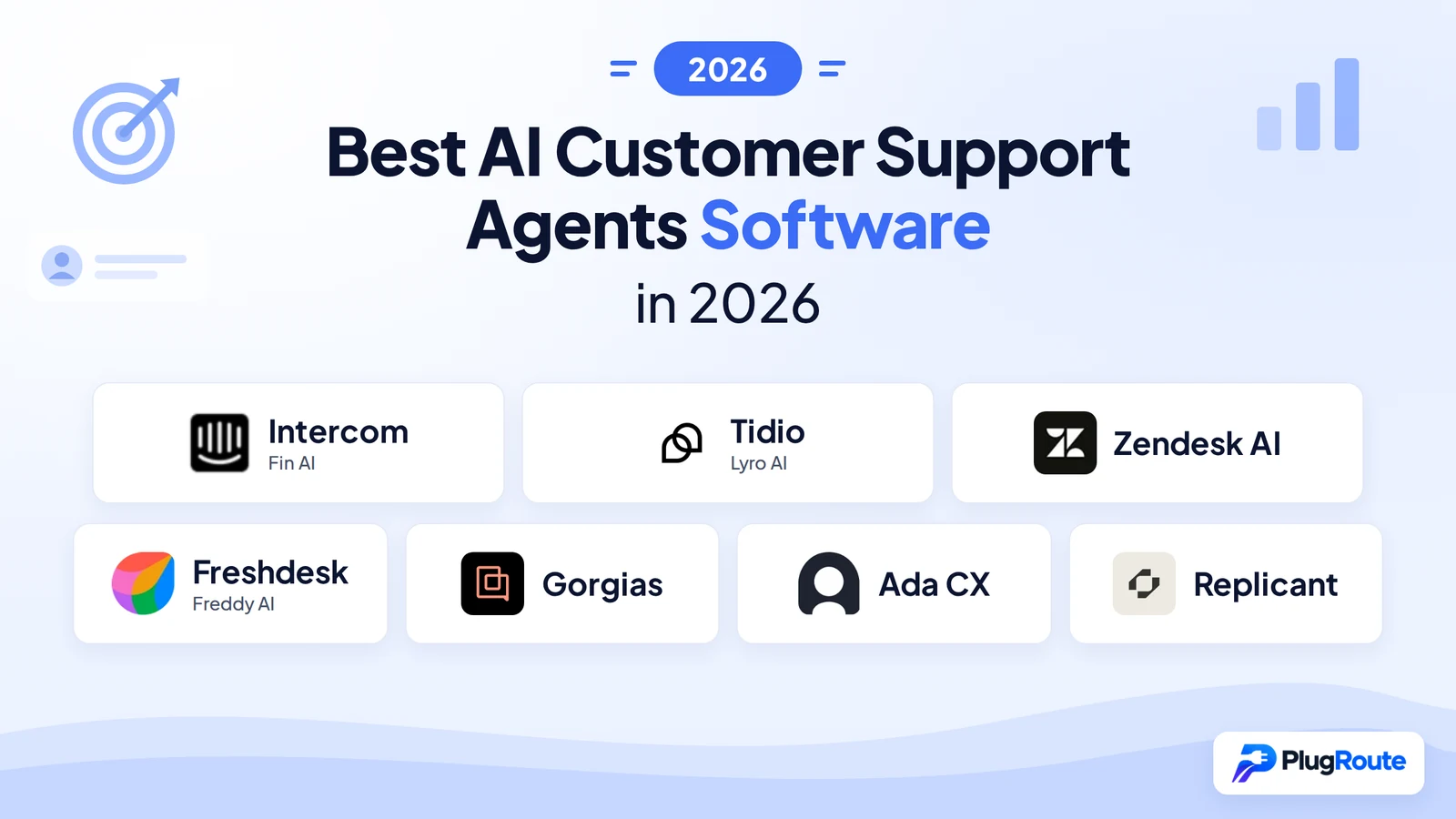
Intercom Fin AI leads for overall conversational quality and fast deployment, Tidio Lyro AI is the most accessible option for small businesses with no-code setup, and Zendesk AI is strongest for enterprise teams already in its ecosystem. The right choice depends on your business size, existing tech stack, and whether you need AI-native resolution or AI layered onto a proven helpdesk.
The category is crowded with dozens of options, and vendor-claimed resolution rates range from 50% to 83%, without standardized definitions of what “resolved” even means. Pricing models vary from genuinely free tiers to $50,000+/month enterprise contracts. That gap between marketing claims and operational reality makes objective, evidence-based comparison essential. This comparison synthesizes 40+ hours of research across vendor documentation, independent reviews, and community discussions, so you don’t have to.
PlugRoute has no affiliate relationships with any company listed. Rankings are determined entirely by research data and objective evaluation criteria.
“Your AI is only as good as the data you train on, garbage in, garbage out.”, Recurring theme across Reddit community discussions (r/sysadmin, 2025)
Takeaway: Knowledge base quality is the single most consistent predictor of AI support success across every platform in this evaluation, no AI engine can compensate for incomplete or outdated help content.
TL;DR: Top Picks at a Glance
- Intercom Fin AI earned the #1 ranking for best overall conversational AI quality and fastest deployment speed among the seven platforms evaluated.
- Tidio Lyro AI ranked #2 as the best option for small businesses needing no-code AI support with same-day deployment.
- Zendesk AI ranked #3 as the best choice for enterprise teams already operating within the Zendesk ecosystem.
- Freshdesk Freddy AI ranked #4 as the best value option for budget-conscious teams with a free plan and the lowest per-agent pricing.
- Gorgias ranked #5 as the best ecommerce-native AI support platform for Shopify and online store owners.
- Ada CX ranked #6 for enterprises needing maximum autonomous resolution rates of 70–83% with managed implementation.
- Replicant ranked #7 as the only voice-first AI platform for high-volume contact centers in regulated industries.
What Are the 5 Categories of AI Customer Support Agent Software?
AI customer support agent software (also called automated resolution platforms, helpdesk AI, or virtual agent software) falls into five distinct categories. The category determines a product’s capability ceiling, pricing model, and ideal buyer profile. Understanding which category a product belongs to is the single most important step before evaluation.
Reddit users consistently identify the “AI-native vs. AI-bolted-on” distinction as a primary decision criterion. The category a product belongs to determines its capability ceiling, no amount of configuration will make a legacy helpdesk AI perform like an AI-native platform, or vice versa.
Here is how the five categories break down:
- AI-Native Conversational Platform (Intercom Fin AI): Intercom Fin AI is built from the ground up around AI-driven resolution, not added to a legacy helpdesk. AI-native platforms (sometimes called conversational AI platforms) offer the highest conversational quality and fastest deployment, but carry ecosystem lock-in risk.
- SMB All-in-One Support Platform (Tidio Lyro AI): Tidio Lyro AI bundles live chat, AI agent, automation flows, and shared inbox in one affordable product. SMB all-in-one platforms offer the lowest barrier to entry, but narrower channel coverage than enterprise alternatives.
- AI-Enhanced Legacy Helpdesk (Zendesk AI, Freshdesk Freddy AI): Zendesk AI and Freshdesk Freddy AI are established helpdesks with AI capabilities added via acquisitions or internal development. Legacy helpdesks offer the broadest integrations, but AI can feel “bolted on” to legacy architecture.
- Ecommerce-Native Support Platform (Gorgias): Gorgias is purpose-built for online stores with deep shopping platform integrations and revenue-driving AI. Ecommerce-native platforms offer the best ecommerce fit, but limited applicability outside online retail.
- Enterprise Voice AI Platform (Replicant): Replicant specializes in automating phone-based customer service calls at high volume with deterministic compliance guardrails. Replicant is the only voice-first option in this evaluation, but serves an enterprise-only audience.
How Do the Top 7 AI Customer Support Agent Software Platforms Compare?
| Rank | Company | Category | Best For | One-Line Summary | Key Capabilities | Primary Strength | Key Limitation |
|---|---|---|---|---|---|---|---|
| 1 | Intercom Fin AI | AI-Native | SaaS companies prioritizing conversational quality | Intercom Fin AI reports autonomous resolution rates of 50–75% across 45 languages using a proprietary three-layer engine. | Three-layer AI engine, Fin Flywheel, Copilot trained on past conversations, 45-language support | Received the highest independent conversational quality rating among platforms tested | Per-resolution pricing escalates unpredictably at high volume |
| 2 | Tidio Lyro AI | SMB All-in-One | Small businesses needing no-code AI support | Tidio Lyro AI bundles live chat, AI agent, and automation for small businesses with same-day deployment and the highest G2 rating (4.6/5.0). | NLP conversations, auto-KB ingestion, API actions, visual flow builder, Lyro Connect | Most accessible pricing with genuinely useful free tier (up to 10 agents) | Pricing complexity when scaling beyond base tiers |
| 3 | Zendesk AI | Legacy Helpdesk | Enterprise teams in the Zendesk ecosystem | Zendesk AI layers AI resolution onto the industry’s largest customer service ecosystem, processing nearly 5 billion service issues annually. | Agent Copilot, Resolution Learning Loop, Knowledge Builder, omnichannel triage, Action Builder | Broadest integration ecosystem in this evaluation | AI feels “bolted on” to legacy architecture per independent testers |
| 4 | Freshdesk Freddy AI | Legacy Helpdesk | Budget-conscious SMBs and growing teams | Freshdesk Freddy AI delivers functional AI support at the lowest price point in the category for cost-conscious teams. | Auto-triage, 14+ Copilot capabilities, 60+ language translation, 500 free bot sessions | Approximately 80% of enterprise capability at a fraction of the cost | Stays on the “basic chatbot side” vs. AI-native platforms |
| 5 | Gorgias | Ecommerce-Native | Shopify and ecommerce store owners | Gorgias is an ecommerce-native AI support platform serving 15,000+ brands with deep Shopify integration and ticket-based pricing. | WISMO handling, Shopify order sync, product recommendations, ticket-based pricing, social channels | Only platform in this evaluation purpose-built for ecommerce with revenue-driving AI | AI responses reported as sounding “too AI” by multiple store owners |
| 6 | Ada CX | AI-Native Enterprise | Enterprise orgs with 50K+ monthly tickets | Ada CX uses a patent-pending dual-model Reasoning Engine to achieve 70–83% autonomous resolution rates in published case studies. | Dual-model Reasoning Engine, Playbooks, Actions API, Performance Center, Coaching tools | Highest documented resolution rates (70–83%) in case studies | Zero public pricing and requires professional services for setup |
| 7 | Replicant | Voice AI | High-volume call centers in regulated industries | Replicant has automated over 1 billion minutes of calls using its Thinking Machine engine for voice-first Tier-1 support. | Thinking Machine™, model orchestration, real-time compliance auditing, Auto QA, PII redaction | Only voice-first AI platform with 1B+ automated call minutes | Enterprise-only with zero public pricing or self-serve option |
Which AI Customer Support Tool Should I Choose for My Use Case?
If the comparison table above feels overwhelming, use this decision shortcut, answer one question about your top priority and the table points you to the right starting point.
| Your #1 Priority | Recommended Tool | Why | Acceptable Alternative |
|---|---|---|---|
| Budget-conscious SMB (under $200/mo) | Tidio Lyro AI | Free tier supports 10 agents; AI bundled in all plans | Freshdesk Freddy AI (free plan + $15/agent Growth tier) |
| SaaS mid-market team | Intercom Fin AI | Received the highest independent conversational quality rating; fastest deployment | Zendesk AI (if already in Zendesk ecosystem) |
| Enterprise already using Zendesk | Zendesk AI | Add AI without platform migration; broadest integrations in this evaluation | Ada CX (if maximum resolution rate is top priority) |
| Ecommerce / Shopify store | Gorgias | Deep Shopify integration, ticket-based pricing, order-aware AI | Tidio Lyro AI (if conversational quality concerns arise) |
| Enterprise maximum autonomous resolution | Ada CX | Highest documented resolution rates (70–83%) with patent-pending engine | Intercom Fin AI (if self-serve deployment is required) |
| High-volume voice / call center | Replicant | Only voice-first platform in this evaluation; 1B+ minutes automated; HIPAA/PCI compliant | No direct alternative in this evaluation |
| Regulated industry (healthcare, finance) | Replicant (voice) or Zendesk AI (text) | Replicant holds SOC 2, HIPAA, PCI DSS, and GDPR certifications; Zendesk offers broadest compliance coverage for text channels | Ada CX (enterprise-grade with managed compliance) |
| No-code setup, fast deployment | Tidio Lyro AI | Same-day deployment, one-click activation, no engineering needed | Intercom Fin AI (one of the fastest implementations among mid-market tools) |
Users on r/aisolobusinesses noted:
“honestly the ‘best’ tool kinda depends on how clean your support workflow already is….i’ve seen teams plug in AI and it works great for like 60–70% of tickets, but the rest gets messy fast if there’s no clear rules for edge cases or escalations. stuff like missing context, weird customer requests, or policy exceptions is where things usually break….personally i’d look less at the model and more at how the tool handles routing, fallbacks, and visibility. if you can’t see why it responded a certain way or where it failed, it gets hard to trust pretty quickly.” Posted by u/Glad_Appearance_8190
Takeaway: AI customer support tool selection matters less than workflow readiness, teams without clear escalation rules and edge-case handling will struggle regardless of which platform they choose.
1. Intercom (Fin AI): Best Overall for Conversational AI Resolution Quality
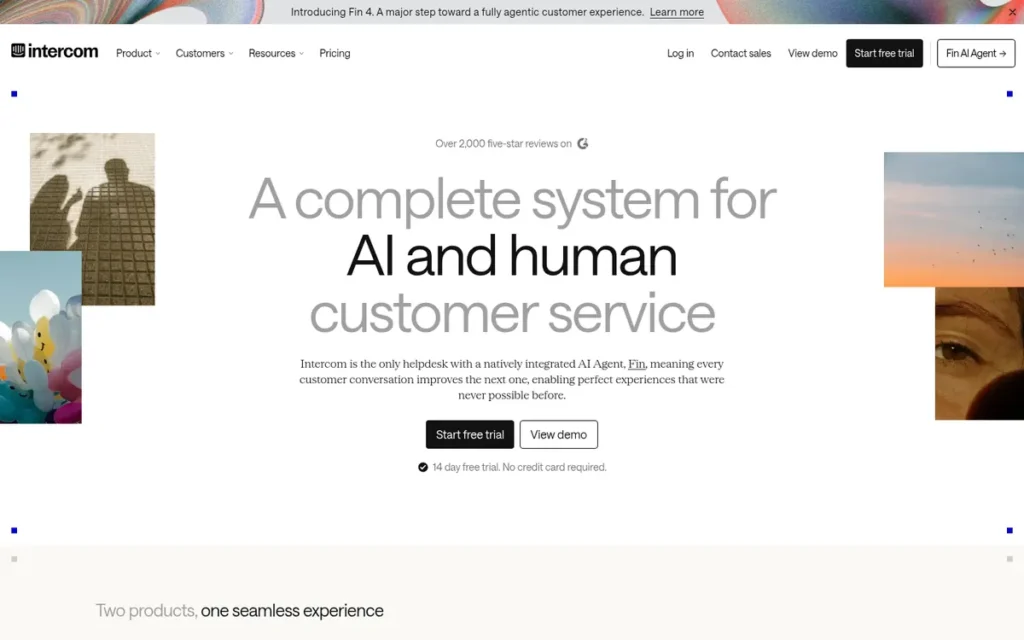
Category: AI-Native Conversational Platform, built from the ground up around AI-driven resolution, not added to a legacy helpdesk.
At a Glance
- Category: AI-Native Conversational Platform
- Best For: SaaS companies and mid-market teams prioritizing conversational AI quality and fast deployment
- Price Range: $29–$132/seat/month + $0.99 per AI resolution
- Primary Strength: Intercom Fin AI received the highest independent conversational quality rating among platforms tested in a multi-platform comparison, with a proprietary three-layer engine balancing resolution rates and hallucination prevention
- Biggest Limitation: Intercom Fin AI’s per-resolution pricing can escalate unpredictably at high volume, and the platform strongly incentivizes remaining within the Intercom ecosystem
- One-Line Summary: Intercom Fin AI is an AI-native customer support platform that reports autonomous resolution rates of 50–75% across 45 languages using a proprietary three-layer engine, making it the strongest choice for teams that prioritize conversational quality and rapid deployment.
- Last Verified: April 2026
Overview
Intercom Fin AI is an AI-native customer support agent that reports autonomous resolution rates of 50–75% depending on help center quality, purpose-built for SaaS companies and mid-market teams that need high-quality conversational AI without lengthy implementation.
Intercom Fin AI uses a proprietary three-layer architecture (App Layer, AI Layer with optimized RAG and safety checks, and a Model Layer trained on real conversations) to balance resolution rates with hallucination prevention. Intercom Fin AI has resolved more than 40 million queries as of late 2025 and supports 45 languages including Arabic, French, and Japanese (My AskAI analysis, 2026).
Key Features
- Three-Layer AI Engine: Intercom Fin AI autonomously resolves support conversations by separating application logic, AI reasoning with safety checks, and custom language models trained on real conversations.
- AI Copilot Trained on Agent History: Intercom Fin AI Copilot provides every human agent with a personal AI assistant that generates answers from the agent’s own past conversations, the only copilot in this evaluation that leverages this data source.
- Natural-Language Procedures: Intercom Fin AI’s Procedures feature allows support teams to define multi-step workflows in natural language that adapt dynamically when customers interrupt or change topics mid-conversation.
- Continuous Improvement Flywheel: Intercom Fin AI’s Flywheel loop: train, test via AI-simulated conversations, deploy, and analyze, enables teams to sustain high resolution rates even amid weekly product changes.
- Omnichannel Deployment with Analytics: Intercom Fin AI supports chat, email, SMS, social media, and voice channels with real-time analytics for satisfaction, sentiment, and quality trends.
Best For
Intercom Fin AI is best for SaaS companies and mid-market support teams (50–500 employees) that prioritize conversational AI quality, want the fastest path from purchase to production, and are willing to operate within the Intercom ecosystem for strong out-of-box AI performance.
Pricing
Intercom offers three seat-based plans:
- Essential: $29/seat/month
- Advanced: $85/seat/month
- Expert: $132/seat/month
Intercom Fin AI Agent charges $0.99 per resolution on top of the base plan. Intercom’s definition of “resolved” counts any conversation where the customer does not request a human agent, even if the customer simply closes the chat.
At high volumes, the per-resolution cost can exceed expectations. Buyers should model costs at their specific ticket volume before committing. Year verified: 2026.
Strengths
- Intercom reported that Lightspeed Commerce agents using Fin AI Copilot closed 31% more conversations daily while maintaining high CSAT scores, with Fin AI participating in 99% of conversations (Faye Digital, 2025).
- Intercom Fin AI has resolved more than 40 million queries as of late 2025, with industry-wide average resolution rates for Fin AI users rising from 41% to 51% following 20+ major feature upgrades (My AskAI, 2026).
- Intercom Fin AI received the highest independent conversational quality rating in a multi-platform comparison, described as “probably the most stable conversational quality I tested” by a reviewer who evaluated 7+ AI support tools (Reddit, 2025).
- Intercom Fin AI offers one of the fastest implementations in the category: point it at your help center content and it begins resolving conversations immediately, with no training period or professional services required (independent multi-platform tester, Reddit, 2025).
Limitations
- Per-Resolution Cost Escalation: Intercom Fin AI’s most consequential trade-off is the tension between per-resolution pricing transparency and cost predictability at scale, multiple users report that simple, repetitive questions (e.g., “How do I change my avatar?”) cost $0.99 each, making AI resolution more expensive than human resolution for high-volume low-complexity tickets.
- Resolution Definition Gaming: Intercom Fin AI counts conversations as “resolved” when customers close chat without requesting a human, even if the question wasn’t truly answered. A CPO at a $5M ARR SaaS company documented this issue alongside five other specific criticisms (Reddit, 2025).
- Technical Documentation Weakness: Intercom Fin AI struggles with complex technical questions, especially developer documentation, “sometimes it just makes stuff up” according to the same CPO’s detailed evaluation (Reddit, 2025).
- Ecosystem Lock-In: Intercom Fin AI strongly incentivizes remaining within the Intercom ecosystem, teams already invested in another helpdesk face meaningful switching costs, and features like Slack/Discord channel support are missing.
Verdict
Intercom Fin AI is the strongest overall AI customer support agent for teams that prioritize conversational quality, fast deployment, and a mature AI-native architecture. Intercom Fin AI earned the #1 ranking by scoring highest across the three primary criteria, AI resolution capability, real-user sentiment, and pricing transparency. Intercom Fin AI’s proprietary three-layer engine, continuous-improvement Flywheel, and 40M+ resolved queries demonstrate the most documented AI resolution track record in the category. However, buyers processing high volumes of simple tickets should carefully model per-resolution costs before committing, and teams deeply embedded in competing helpdesk ecosystems should weigh switching costs against Intercom Fin AI’s quality advantage.
2. Tidio (Lyro AI): Best for Small Businesses and No-Code Setup
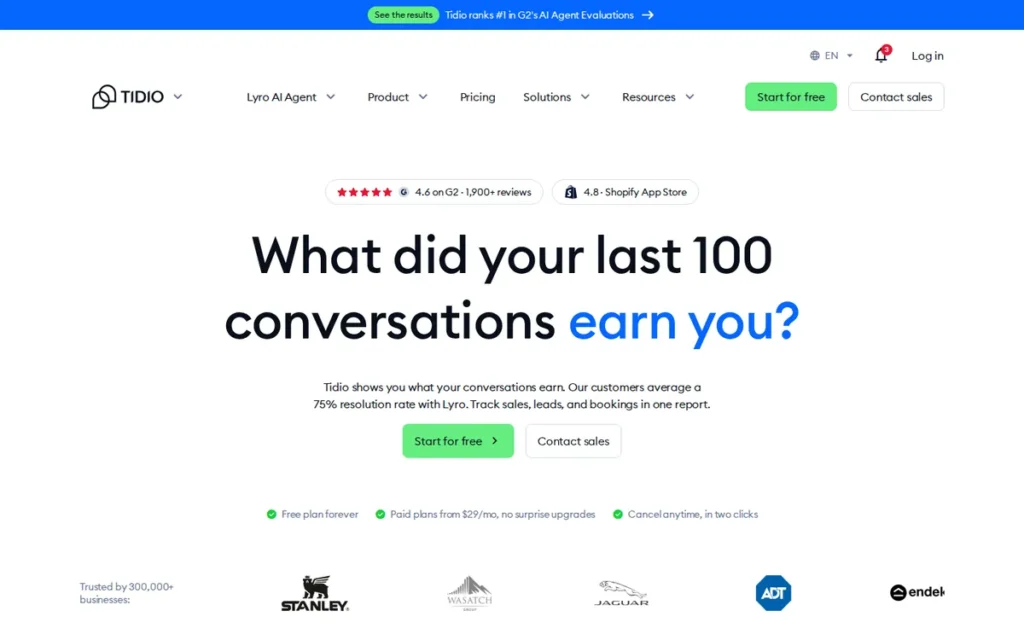
Category: SMB All-in-One Support Platform, bundles live chat, AI agent, automation flows, and shared inbox in one affordable product.
At a Glance
- Category: SMB All-in-One Support Platform
- Best For: Small businesses and lean support teams (1–20 agents) wanting AI-powered support without technical complexity
- Price Range: Free (up to 10 agents) / $29–$39+/month for AI conversations
- Primary Strength: Tidio Lyro AI bundles live chat, AI chatbot, automation, and shared inbox in a single product with same-day deployment and no separate AI add-on charges
- Biggest Limitation: Tidio Lyro AI’s pricing becomes complex when scaling beyond base tiers, with conversation credits and flow credits burning faster than expected
- One-Line Summary: Tidio Lyro AI is an all-in-one customer support platform that bundles live chat, AI agent, and automation for small businesses, offering same-day no-code deployment and the highest G2 rating in this evaluation at 4.6 out of 5.0 across 1,880+ reviews.
- Last Verified: April 2026
Overview
Tidio Lyro AI is an all-in-one customer support platform designed for small businesses and lean teams that need AI-powered chat, automation, and a shared inbox without enterprise complexity or engineering resources.
Tidio Lyro AI uses NLP to engage in human-like conversations, automatically scrapes support content for its knowledge base, and executes actions via API integrations, all deployable in under an hour with no coding required. Tidio Lyro AI serves over 300,000 businesses globally and holds the highest G2 rating (4.6/5.0 across 1,880+ reviews) among all products in this evaluation (G2, 2026).
Key Features
- Auto-Ingesting Knowledge Base: Tidio Lyro AI uses natural language processing to conduct human-like support conversations and automatically ingests help center content to build its knowledge base without manual training.
- Backend Action Execution: Tidio Lyro AI executes backend actions through API integrations (checking order status, updating customer addresses, creating CRM contacts, and triggering bookings) without human intervention.
- Self-Improving AI: Tidio Lyro AI learns continuously from human agent responses when it forwards unanswered questions, expanding its resolution capability over time without manual retraining.
- Visual No-Code Flow Builder: Tidio offers a visual drag-and-drop chatbot builder that requires zero coding skills, enabling support teams to create custom conversation flows alongside the AI agent.
- Lyro Connect Integration: Tidio Lyro Connect allows integration with existing customer service tools without forcing a platform switch, a key differentiator for teams already invested in another helpdesk.
Best For
Tidio Lyro AI is best for small businesses and lean support teams (1–20 agents) (particularly ecommerce store owners on Shopify) who want to deploy AI-powered customer support in under an hour without engineering resources, and who prioritize bundled simplicity and affordable pricing over enterprise-scale features.
Pricing
Tidio offers a free plan supporting up to 10 agents with basic Lyro AI conversations included:
- Free: Up to 10 agents, basic functionality
- Starter: ~$29/month with basic Lyro AI conversations
- Growth: Expanded Lyro AI conversation limits
- Additional Lyro conversations: ~$39/month per 100 conversations
Tidio Lyro AI is included in main plans (not sold as a separate add-on) which is unique in the category. However, multiple users report that pricing becomes complex when scaling: flow credits can deplete in minutes, conversation limits burn faster than expected, and add-on tiers create unanticipated costs. Buyers should test the free tier to model realistic credit consumption before upgrading. Year verified: 2026.
Strengths
- Tidio holds a 4.6/5.0 rating on G2 across 1,880+ reviews: the highest aggregate rating of any product in this evaluation (G2, 2026).
- Tidio Lyro AI enabled a small ecommerce store owner to save 15–20 hours per week on basic questions (shipping status, returns, product info) with a 5-agent team, with setup completed in approximately one hour (Reddit, 2025).
- Tidio’s free plan supports up to 10 agents with AI included: the most generous free tier in the AI customer support category, allowing meaningful evaluation before any financial commitment.
- Tidio Lyro AI deploys same-day with one-click activation and no training period, making it the fastest path from purchase to production for non-technical teams.
Limitations
- Credit Burn Rate: Tidio Lyro AI’s most consequential trade-off is the gap between its accessible entry pricing and its scaling cost reality, one user documented 100 flow credits consumed in three and a half minutes, and conversation limits burn faster than projected (Reddit, 2025).
- Narrower Channel Coverage: Tidio Lyro AI supports chat, Facebook Messenger, Instagram, and WhatsApp but lacks native email ticketing or voice capabilities, limiting its fit for teams requiring full omnichannel coverage.
- Limited Enterprise Evidence: Tidio Lyro AI has less documented evidence for complex multi-step workflows or enterprise-scale deployments compared to Intercom Fin AI or Ada CX.
- Account Stability Concerns: In at least one reported case, an agency reported Tidio account suspension without clear cause, raising concerns for businesses building on the platform as resellers (Reddit, 2025).
Verdict
Tidio Lyro AI is the most accessible AI customer support platform for small businesses, combining this evaluation’s highest G2 rating, a genuinely useful free tier, and same-day no-code deployment in a single bundled product. Tidio Lyro AI ranked below Intercom Fin AI due to less documented enterprise-scale resolution evidence and narrower channel coverage, though Tidio Lyro AI’s higher G2 rating (4.6 vs. ~4.5 for Intercom) reflects stronger user satisfaction among its SMB target audience. However, buyers planning to scale beyond the entry tiers should carefully model conversation credit consumption and total costs, Tidio Lyro AI’s pricing simplicity at the low end becomes complexity at higher volumes.
3. Zendesk AI: Best for Enterprise Teams Already in the Zendesk Ecosystem

Category: AI-Enhanced Legacy Helpdesk, established helpdesk platform with AI capabilities added via strategic acquisitions and development.
At a Glance
- Category: AI-Enhanced Legacy Helpdesk
- Best For: Enterprise support teams already using Zendesk that need AI layered onto existing workflows without platform migration
- Price Range: $55–$219/agent/month + $50/agent Copilot add-on + $0.99–$2.00 per AI resolution
- Primary Strength: Zendesk AI offers the broadest integration ecosystem in this evaluation, processing nearly 5 billion service issues annually across 20,000+ customers
- Biggest Limitation: Zendesk AI’s capabilities feel “bolted on” to legacy architecture according to multiple independent testers and direct users, creating a ceiling on AI-native functionality
- One-Line Summary: Zendesk AI is an enterprise helpdesk platform that layers AI resolution capabilities (acquired through Ultimate and Forethought) onto the industry’s largest customer service ecosystem, making it the strongest option for teams already invested in the Zendesk stack.
- Last Verified: April 2026
Overview
Zendesk AI is an enterprise customer service platform that combines its established helpdesk infrastructure with AI capabilities acquired through Ultimate (March 2024) and Forethought, offering autonomous resolution, agent copilot assistance, and intelligent triage across voice, chat, email, and web channels.
Zendesk AI’s Resolution Platform processes nearly 5 billion service issues annually across 20,000+ customers, making it the largest operational deployment in the category (PR Newswire, 2025). Zendesk AI uses a mix of LLMs (including GPT-5), traditional ML, rules, and workflows, adapting the technology level per task complexity.
Key Features
- Multi-Model AI Agent: Zendesk AI Agent autonomously resolves customer interactions across voice, chat, email, and web form channels using a combination of LLMs, traditional ML, and deterministic rules adapted per task complexity.
- Agent Copilot: Zendesk Agent Copilot boosts human agent productivity by an estimated 20%, providing ticket summarization, macro suggestions, intent and sentiment detection, tone adjustment, and similar ticket surfacing at $50/agent/month.
- Resolution Learning Loop: Zendesk AI’s Resolution Learning Loop (from the Forethought acquisition) enables continuous self-improvement of AI resolution quality without manual retraining cycles.
- Knowledge Builder: Zendesk AI includes Knowledge Builder, which auto-generates knowledge base articles from resolved tickets, and Action Builder for backend system integrations.
- Outcome-Based Pricing Option: Zendesk AI offers pricing at $0.99–$2.00 per automated resolution alongside traditional per-seat licensing, allowing teams to align AI costs with results.
Best For
Zendesk AI is best for enterprise support teams (100+ agents) already deeply invested in the Zendesk ecosystem that need to add AI resolution, agent copilot, and intelligent triage capabilities without migrating to a new platform, particularly organizations processing high volumes across multiple channels who value ecosystem breadth over AI-native architecture purity.
Pricing
Zendesk Suite pricing (billed annually):
- Suite Team: $55/agent/month
- Suite Growth: $89/agent/month
- Suite Professional: $115/agent/month
- Suite Enterprise: $169/agent/month (or $219 billed monthly)
- Agent Copilot add-on: $50/agent/month
- AI Agent resolutions: $0.99–$2.00 per resolution
The total cost for a team of 10 agents on the Professional plan with Copilot and moderate AI usage could reach $2,000+/month before AI resolution charges. A Zendesk partner notes the AI “pays for itself when agents cost $2,000+/month”, implying a cost floor below which the add-ons may not deliver positive ROI. Year verified: 2026.
Strengths
- Zendesk AI partners report a 92% decrease in email handle time and 20% overall agent productivity improvement in specific deployments, though this figure comes from reseller-reported data, not independent measurement (Reddit, 2025).
- Zendesk AI processes nearly 5 billion service issues annually across 20,000+ customers and projects $200M in AI annual recurring revenue, the largest operational footprint and AI revenue base in the evaluation (CMSWire, 2025).
- Zendesk AI’s strategic acquisitions of Ultimate (March 2024) and Forethought provide a multi-model architecture with custom intent models, detailed analytics, and a Resolution Learning Loop for continuous self-improvement (TechCrunch, 2024).
- Zendesk AI offers among the broadest native integration ecosystems in the customer support category, with deep connections to CRM, ecommerce, and enterprise collaboration tools that competing AI-native platforms have not yet matched.
Limitations
- “Bolted-On” Architecture Feel: Zendesk AI’s most consequential trade-off is the tension between ecosystem breadth and AI-native capability depth, multiple independent testers describe Zendesk AI as “bolted onto a legacy product, not built from the ground up,” with one noting “you’ll hit the ceiling eventually” (Reddit, 2025).
- Deeply Divided User Sentiment: Zendesk AI’s Reddit sentiment is strikingly split: partners and resellers praise 20–30% efficiency gains while direct users call Zendesk AI “junk” and a “rip off,” with highly-upvoted comments recommending competitors (Reddit, 2025).
- Complex Usability Issues: Zendesk AI users report the Intelligence panel requiring extra clicks, the native chatbot builder described as “the most annoying interface in the world,” shallow reporting compared to what Ultimate provided standalone, and JWT authentication documentation that drove at least one implementer to give up entirely.
- Copilot Over Autonomous Agent: Zendesk AI works significantly better as an agent-assist copilot than as a fully autonomous customer-facing bot, teams expecting end-to-end autonomous resolution should calibrate expectations accordingly.
Verdict
Zendesk AI is the strongest choice for enterprise teams already embedded in the Zendesk ecosystem who need to add AI capabilities without a platform migration. Zendesk AI’s integration breadth, the broadest in this evaluation, 5-billion-issue operational scale, and Agent Copilot productivity gains make Zendesk AI a defensible choice for large organizations. However, teams evaluating Zendesk AI as a new platform, rather than an upgrade to their existing deployment, should weigh whether its acquisition-assembled AI architecture delivers the same depth as purpose-built AI-native alternatives.
4. Freshdesk (Freddy AI): Best Value for Budget-Conscious Teams
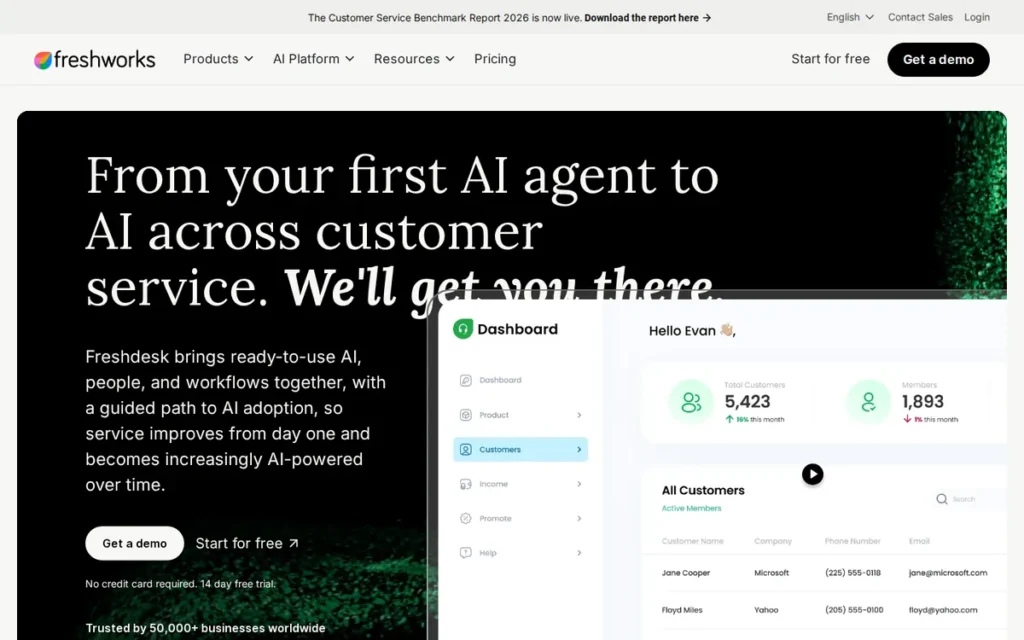
Category: AI-Enhanced Legacy Helpdesk, established helpdesk platform with AI capabilities added via the Freddy AI engine across ticketing, copilot, and self-service tiers.
At a Glance
- Category: AI-Enhanced Legacy Helpdesk
- Best For: Budget-conscious SMBs and growing teams that need functional AI support without enterprise-level pricing
- Price Range: Free plan available / $15–$79/agent/month + $29/agent Copilot add-on
- Primary Strength: Freshdesk Freddy AI delivers approximately 80% of enterprise AI support functionality at a fraction of the cost, with the most accessible entry pricing in the category
- Biggest Limitation: Freshdesk Freddy AI remains on the “basic chatbot side” compared to AI-native platforms, with users reporting limited visibility into AI behavior
- One-Line Summary: Freshdesk Freddy AI is a budget-friendly helpdesk platform offering tiered AI capabilities (self-service bots, agent assist, and copilot) that deliver functional AI support at the lowest price point in the category, making it the strongest choice for cost-conscious small and mid-sized teams.
- Last Verified: April 2026
Overview
Freshdesk Freddy AI is a helpdesk platform with three tiers of AI capability (Self-Service Bots for automated conversations, Agent Assist for real-time suggestions and sentiment analysis, and Freddy AI Copilot for content generation and intelligence features) designed for budget-conscious SMBs that need functional AI support without enterprise pricing.
Freshdesk Freddy AI offers the lowest entry pricing in the evaluation with a genuine free plan and Growth tier at approximately $15/agent/month, plus 500 free bot sessions on higher plans. Freshdesk Freddy AI serves over 8,000 customers as part of publicly-traded Freshworks (NASDAQ: FRSH), which reports more than 24,000 paying enterprise customers (Freshworks earnings, Q4 2025).
Key Features
- 14+ Copilot Capabilities: Freshdesk Freddy AI Copilot provides ticket summarization, tone enhancement, response generation, translation in 60+ languages, and similar ticket surfacing at $29/agent/month.
- Free Bot Sessions Included: Freshdesk Freddy AI Agent offers 500 free bot sessions on Pro and Enterprise plans, then $49 per 100 additional sessions.
- Auto-Triage Classification: Freshdesk Freddy AI’s auto-triage automatically classifies ticket fields (priority, group, status, urgency, and type) based on content and intent analysis without manual intervention.
- No-Code Agent Studio: Freshdesk Freddy AI Agent Studio (available on Freshdesk Omni plans) provides no-code workflow creation for autonomous query resolution.
- Cross-Product Synergies: Freshdesk Freddy AI integrates with Slack, Microsoft Teams, email, and the support portal, with the broader Freshworks suite enabling synergies with Freshsales and Freshservice.
Best For
Freshdesk Freddy AI is best for budget-conscious SMBs and growing teams (5–50 agents) that need functional AI assistance (primarily agent copilot and ticket triage) at the lowest cost in the category, and are willing to accept less sophisticated autonomous resolution in exchange for significant savings over enterprise-priced alternatives.
Pricing
Freshdesk Standard plans:
- Free: Available with basic functionality
- Growth: ~$15/agent/month
- Pro: ~$49/agent/month
- Enterprise: ~$79/agent/month
Freshdesk Omni plans (required for AI Agent Studio) range from $55–$169/agent/month. Freshdesk Freddy AI Copilot is a $29/agent/month add-on. Freshdesk Freddy AI Agent includes 500 free bot sessions on Pro/Enterprise, then $49 per 100 additional sessions.
Important: The most advanced AI features (Agent Studio no-code workflows) are restricted to Freshdesk Omni, not available on standard Freshdesk plans. Buyers should confirm which plan tier provides the specific AI capabilities they need. Year verified: 2026.
Strengths
- Freshdesk Freddy AI was independently described as the “best value pick for smaller teams” (delivering 80% of enterprise AI capability at a fraction of the price) by a reviewer who tested 7+ AI support platforms (Reddit, 2025).
- Freshdesk Freddy AI offers the most accessible pricing in the AI customer support category: a free plan, Growth tier at approximately $15/agent/month, and Freddy AI Copilot at $29/agent/month, substantially below Zendesk’s $50/agent Copilot add-on (eesel.ai, 2025).
- Freshdesk Freddy AI’s auto-triage and 14+ Copilot capabilities work out of the box with minimal configuration on existing Freshdesk deployments (Freshdesk Support, 2026).
- Freshworks is publicly traded (NASDAQ: FRSH) and serves more than 24,000 paying customers globally, providing financial transparency and platform stability that privately-held competitors cannot match (Freshworks earnings, Q4 2025).
Limitations
- Basic Chatbot Ceiling: Freshdesk Freddy AI’s most consequential trade-off is capability depth versus price, Freshdesk Freddy AI stays on the “basic chatbot side” compared to purpose-built AI agents according to multiple independent testers (Reddit, 2025).
- Unpredictable AI Behavior: Freshdesk Freddy AI users report specific operational issues: the Slack-integrated bot interrupts conversations with irrelevant link suggestions, and one team discovered Freshdesk Freddy AI had been suggesting phone escalation to customers without the support team’s knowledge (Reddit, 2025).
- Legacy Architecture Constraints: Reddit users consistently note that legacy helpdesks like Freshdesk are “trying to add AI functionality onto legacy architecture, which often results in limited capabilities and high add-on costs” (Reddit, 2025).
- AI Feature Gating: Freshdesk Freddy AI’s most advanced capabilities (Agent Studio no-code workflows) are restricted to the more expensive Freshdesk Omni tier, a restriction that is not immediately obvious during evaluation.
This aligns with community sentiment on r/dev:
“The Freshdesk admin overhead comment resonates. It’s capable but it’s not a tool that runs itself. Teams that don’t have someone actively managing the configuration get maybe 40% of what the platform can do.” Posted by u/Poke333Z
Takeaway: Freshdesk Freddy AI’s value proposition depends heavily on dedicated admin investment, teams that treat it as a set-and-forget tool risk realizing less than half of its potential capability.
Verdict
Freshdesk Freddy AI is the strongest value proposition in the AI customer support category for budget-conscious teams that need functional AI assistance without enterprise pricing. Freshdesk Freddy AI’s free plan, low per-agent costs, and bundled Copilot capabilities make Freshdesk Freddy AI the most financially accessible path to AI-assisted support. However, teams expecting fully autonomous AI resolution comparable to Intercom Fin AI or Ada CX should expect Freshdesk Freddy AI to function primarily as an agent-assist tool rather than an independent resolution engine, the cost savings come with a commensurate capability ceiling.
5. Gorgias: Best for Ecommerce and Shopify Stores
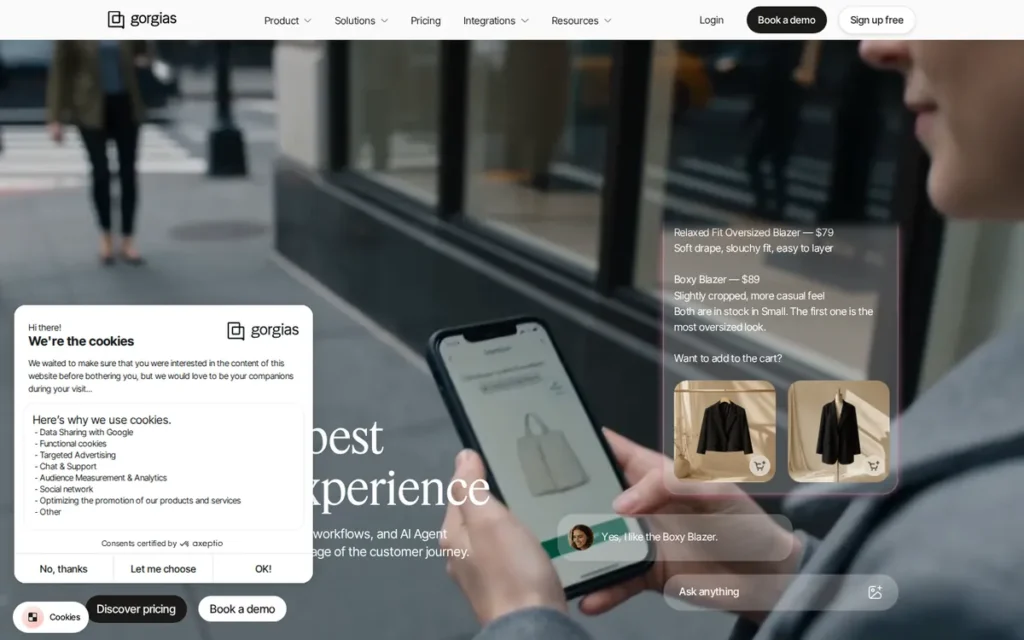
Category: Ecommerce-Native Support Platform, purpose-built for online stores with deep shopping platform integrations and revenue-driving AI capabilities.
At a Glance
- Category: Ecommerce-Native Support Platform
- Best For: Shopify, BigCommerce, and Magento store owners who need AI support deeply integrated with ecommerce and order management
- Price Range: $10–$900+/month (ticket-based, not per-seat)
- Primary Strength: Gorgias is the only AI support platform in this evaluation purpose-built for ecommerce, with native Shopify order data integration, WISMO automation, and AI-driven product recommendations that generate revenue alongside cost savings
- Biggest Limitation: Gorgias AI responses are reported by multiple store owners as sounding “too AI,” with customers frequently requesting human agents
- One-Line Summary: Gorgias is an ecommerce-native AI customer support platform serving 15,000+ online brands with deep Shopify integration, ticket-based pricing, and AI capabilities designed to reduce support costs while driving revenue through product recommendations.
- Last Verified: April 2026
Overview
Gorgias is an ecommerce-native AI customer support platform that resolves up to 60% of shopper inquiries autonomously while driving revenue through AI-powered product recommendations, purpose-built for Shopify, BigCommerce, Magento, and WooCommerce store owners who need support deeply integrated with their order management workflows.
Gorgias serves 15,000+ brands and generated an estimated $69–73 million in annual revenue as of 2024 (sources vary: Sacra estimates $69M ARR; PR Newswire reported $72.6M). Gorgias reports up to 2.5x conversion uplift through its conversational sales capabilities, a vendor-cited figure without independent verification.
Key Features
- Deep Shopify Integration: Gorgias provides native Shopify integration that syncs order history, customer data, refund processing, and shipment tracking directly into the support interface for real-time order actions.
- Ecommerce-Specific AI Automation: Gorgias AI Agent handles WISMO (Where Is My Order) inquiries, returns and exchanges guidance, and product and policy information retrieval from catalog data autonomously.
- Omnichannel Ecommerce Coverage: Gorgias supports email, live chat, SMS, Instagram, Facebook, TikTok, and WhatsApp from a unified inbox.
- Ticket-Based Pricing Model: Gorgias uses ticket-based pricing rather than per-seat licensing, aligning support costs with actual volume, particularly valuable for seasonal ecommerce businesses.
- Self-Service Help Center: Gorgias includes a Help Center builder and automation rules engine for ticket routing, tagging, and assignment based on order data and customer attributes.
Best For
Gorgias is best for Shopify, BigCommerce, and Magento store owners (typically DTC brands processing 100–10,000+ support tickets monthly) who need AI support that natively understands order data, can process refunds and track shipments within conversations, and want to leverage support interactions as a revenue channel through product recommendations.
Pricing
Gorgias uses ticket-based pricing:
- Starter: ~$10/month for 10 tickets
- Basic: ~$60/month for 300 tickets
- Pro: ~$360/month for 2,000 tickets
- Advanced: ~$900/month for 5,000 tickets
- Enterprise: Custom pricing
The ticket-based model can be very cost-effective for low-volume stores but scales linearly. A store processing 5,000 tickets monthly would pay $900+/month before overages. Gorgias AI Agent access may require higher-tier plans. Year verified: 2026.
Strengths
- Gorgias serves 15,000+ ecommerce brands and generated an estimated $69–73 million in annual revenue as of 2024, making Gorgias the largest dedicated ecommerce support platform in the evaluation (Sacra, 2024; PR Newswire, 2024).
- Gorgias reports up to 2.5x conversion uplift through AI-driven product recommendations during support conversations, uniquely positioning Gorgias as a revenue tool, not solely a cost center (Gorgias, 2025).
- Gorgias offers the deepest native Shopify integration in this evaluation, syncing order history, customer profiles, refund processing, and shipment tracking directly into the support agent interface, based on feature comparison as of April 2026.
- Gorgias’s ticket-based pricing model aligns costs with actual support volume rather than headcount, a structural advantage for seasonal ecommerce businesses with highly variable ticket loads.
Limitations
- AI Response Quality Concerns: Gorgias’s most consequential trade-off is ecommerce depth versus conversational quality, multiple Shopify store owners report that Gorgias AI responses sound “too AI,” with customers complaining and requesting human agents because “the responses were just not it” (Reddit, 2025).
- Limited Knowledge Sources: Gorgias’s AI draws from Help Center, up to 10 web pages, uploaded documents, and live store data, no native Confluence, Notion, or Google Docs integration, constraining answers beyond narrow ecommerce workflows (Hiver HQ, 2025).
- Credit Burn Rate: Gorgias users report AI credits “burn way too fast,” echoing a category-wide concern about consumption-based AI pricing outpacing projections (Reddit, 2025).
- Ecommerce-Only Applicability: Gorgias is purpose-built for online stores and has limited applicability outside ecommerce contexts, several store owners have publicly documented switching from Gorgias to competitors like Tidio, citing better conversational quality.
Users on r/CustomerService shared their experience:
“Personally I think the automations are a huge ripoff and you can achieve the same result with macros or said filters. I think it’s a case of perverse incentives, where their basic features are competing with the automations upsell. Overall, for 70 dollars a month for just basic customer service ticket aggregation, I’m not at all impressed and I can’t wait to switch to something better. Unfortunately, I haven’t come across that magical software yet.” Posted by u/ekateriv
Takeaway: Gorgias’s automation upsell draws criticism from small store owners who find the same results achievable with basic macros, suggesting the platform’s value proposition weakens for low-volume merchants who don’t fully leverage Shopify-native AI actions.
Verdict
Gorgias is the most ecommerce-specialized AI customer support platform in this evaluation, offering the deepest Shopify integration and the only platform that positions AI support as a revenue driver alongside a cost-reduction tool. Gorgias’s ticket-based pricing and order-aware AI make Gorgias the natural choice for DTC brands. However, store owners should test Gorgias AI’s conversational quality with their actual customer base before fully deploying, multiple users report that Gorgias AI’s tone triggers escalation requests, undermining the autonomous resolution it promises.
6. Ada CX: Best for Enterprise-Scale Autonomous Resolution
Category: AI-Native Enterprise Resolution Platform, purpose-built for high-volume enterprise autonomous resolution with a managed implementation model.
At a Glance
- Category: AI-Native Enterprise Resolution Platform
- Best For: Enterprise organizations (1,000+ employees) with high ticket volumes that need maximum autonomous resolution rates
- Price Range: Pricing not public: estimated $1–$3.50 per resolution / $10,000–$50,000+/month enterprise
- Primary Strength: Ada CX offers the highest documented autonomous resolution rates in the evaluation (70–83% in vendor-published case studies) powered by a patent-pending dual-model Reasoning Engine
- Biggest Limitation: Ada CX has zero public pricing, requires professional services for implementation, and has faced organizational stability concerns
- One-Line Summary: Ada CX is an AI-native enterprise customer support platform that uses a patent-pending dual-model Reasoning Engine to achieve 70–83% autonomous resolution rates in published case studies, making it the highest-performing option for large organizations willing to invest in managed implementation.
- Last Verified: April 2026
Overview
Ada CX is an AI-native enterprise customer support platform powered by a patent-pending dual-model Reasoning Engine that separates query interpretation from response generation, designed for high-volume enterprise organizations that prioritize maximum autonomous resolution rates and can invest in professional services-led implementation.
Ada CX’s published case studies document resolution rates of 84% for Tilt, 70% for Life360, and up to 70% for Epos Now, though all figures are vendor-reported and no independent audits were found (My AskAI analysis, 2026). Ada CX has raised over $190 million in venture funding and integrates with Zendesk, Salesforce, and Shopify.
Key Features
- Dual-Model Reasoning Engine: Ada CX’s patent-pending Reasoning Engine uses NLP for query interpretation and knowledge retrieval paired with LLMs for human-like response generation, structurally separating accuracy from conversational quality.
- Playbooks for Complex Workflows: Ada CX Playbooks enable multi-step automated workflows handling refund processing, form completion, and cross-system operations without human intervention.
- API-Level Backend Actions: Ada CX Actions provide integrations with Zendesk, Salesforce, and Shopify, enabling Ada CX to create tickets, modify orders, and update customer records autonomously.
- True Resolution Analytics: Ada CX’s Performance Center distinguishes between containment (conversations not escalated) and true resolution (issues actually solved), a critical metric distinction most competitors blur.
- Non-Technical Coaching Tools: Ada CX Coaching tools allow non-technical team members to improve AI performance through guided adjustments without requiring engineering resources.
Best For
Ada CX is best for enterprise organizations (1,000+ employees) processing 50,000+ tickets monthly that need the highest available autonomous resolution rates, can allocate budget for opaque enterprise pricing ($10K–$50K+/month), and have the organizational patience for a professional services-led implementation rather than self-serve deployment.
Pricing
Ada CX does not publish pricing publicly, all plans require custom sales quotes. Industry estimates based on user reports and third-party reviews:
- Per-resolution cost: ~$1–$3.50 per ticket resolution
- Monthly enterprise range: ~$10,000–$50,000+/month
- Annual cost (high volume): ~$300,000+ for 150,000 monthly tickets
A former user of a company paying approximately $300,000+ annually reported 70–75% deflection rates on approximately 150,000 monthly tickets (Reddit, 2024). Buyers should request detailed pricing breakdowns including implementation and professional services fees before committing. Year verified: 2026.
Strengths
- Ada CX’s published case studies document 70–84% autonomous resolution rates for enterprise deployments, including 84% for Tilt and 70% for Life360, the highest evidence-backed resolution claims in this evaluation, though all figures are vendor-reported (My AskAI, 2026).
- Ada CX’s patent-pending dual-model Reasoning Engine architecturally separates query interpretation from response generation, providing a structural approach to hallucination reduction that most single-model competitors lack (eesel.ai, 2025).
- Ada CX was independently described as “probably one of the easiest for non-technical teams to get running” with an “intuitive” flow builder by a reviewer who tested multiple platforms (Reddit, 2025).
- Ada CX raised over $190 million in venture funding and published consumer research in March 2026, demonstrating continued investment in the category (BusinessWire, March 2026).
Limitations
- Zero Pricing Transparency: Ada CX’s most consequential trade-off is maximum AI capability versus accessibility, Ada CX publishes zero pricing information and requires professional services for setup (no self-serve option), with estimated costs of $300,000+ annually for enterprise deployments.
- Organizational Stability Concerns: Reddit users report multiple layoffs at Ada CX and declining Glassdoor reviews, with at least one commenter recommending Ultimate (now Zendesk) specifically because of Ada CX’s internal instability (Reddit, 2024).
- Complex Backend Integration Effort: Ada CX’s flow builder, while intuitive for common use cases, requires “significant effort and longer timelines” for complex backend integrations involving order systems, billing, and custom API work (Reddit, 2025).
- Limited Review Volume: Ada CX has approximately 150 G2 reviews compared to 1,880+ for Tidio and 5,800+ for Zendesk, making independent sentiment analysis less statistically reliable.
Users on r/OnlineMarketing offered a practitioner’s perspective:
“ada – Focuses hard on autonomous resolution which sounds great until it struggles with nuanced product questions. Works better for simple repeated queries than complex retail scenarios.” Posted by u/Signal-Extreme-6615
Takeaway: Ada CX’s autonomous resolution strength is concentrated in high-volume repetitive queries, enterprise buyers with complex or product-specific support needs should stress-test nuanced scenarios during evaluation.
Verdict
Ada CX delivers the highest documented autonomous resolution rates in this evaluation, powered by a patent-pending architecture that structurally separates interpretation from generation. For enterprise organizations with the budget and patience for a managed implementation, Ada CX represents the ceiling of what AI-native customer support can achieve based on current evidence. However, the complete absence of public pricing, required professional services engagement, and reported organizational instability mean that smaller organizations or teams seeking self-serve deployment should look to Intercom Fin AI or Tidio Lyro AI instead.
7. Replicant: Best for High-Volume Voice AI Contact Centers
Category: Enterprise Voice AI Platform, specializes in automating phone-based customer service calls at high volume with deterministic compliance guardrails.
At a Glance
- Category: Enterprise Voice AI Platform
- Best For: Enterprise contact centers (100,000+ calls/month) in regulated industries that need to automate Tier-1 phone support
- Price Range: Custom enterprise pricing: industry sources indicate ~$0.09/minute or $150,000+/year (third-party review, 2025)
- Primary Strength: Replicant is the only voice-first AI platform in this evaluation, with 1 billion+ minutes of calls automated and deterministic guardrails designed to enforce complete policy adherence
- Biggest Limitation: Replicant is accessible only to enterprise organizations with dedicated IT teams, has zero public pricing, and minimal public review data
- One-Line Summary: Replicant is a voice-first AI contact center platform that has automated over 1 billion minutes of customer service calls using its Thinking Machine engine, making it the only viable option for enterprise organizations seeking to automate high-volume phone-based Tier-1 support in regulated industries.
- Last Verified: April 2026
Overview
Replicant is an enterprise voice AI contact center platform that automates Tier-1 phone-based customer service interactions using its proprietary Thinking Machine™ engine, designed for high-volume contact centers processing 100,000+ calls monthly that need to reduce abandonment rates and increase agent capacity without sacrificing compliance in regulated industries.
Replicant has automated over 1 billion minutes of calls with zero agent involvement since its founding in 2017, serving enterprise customers including AAA, ADP, DoorDash, Fanatics, and Sunrun (Replicant, 2025). Replicant holds SOC 2, HIPAA, PCI DSS, and GDPR compliance certifications with automatic PII redaction.
Key Features
- Thinking Machine™ Engine: Replicant’s Thinking Machine™ understands multiple intents within a single spoken sentence and maintains conversational context through customer interruptions, critical for natural phone interactions.
- Multi-Model Orchestration: Replicant coordinates multiple AI models simultaneously for speech recognition, text-to-speech, and conversational reasoning within each call.
- Real-Time Compliance Auditing: Replicant’s supervisory agents audit conversations in real-time for brand compliance and hallucination detection, with Auto QA evaluating 100% of conversations automatically.
- Deterministic Business Rule Guardrails: Replicant combines LLMs with code-based guardrails where business rules are codified outside LLM prompts, designed to enforce complete policy adherence for regulated industries through deterministic rule-based architecture.
- Omnichannel Context Switching: Replicant supports voice, SMS, and chat with seamless context switching, allowing conversations to begin on one channel and continue on another.
Best For
Replicant is best for enterprise contact centers processing 100,000+ calls monthly (particularly in regulated industries like healthcare and financial services) that need to automate Tier-1 phone-based support at scale with compliance certifications (HIPAA, PCI DSS, GDPR) and have dedicated IT teams to manage enterprise deployment.
Pricing
Replicant uses custom enterprise pricing. Industry sources indicate pricing around $0.09 per minute on a pay-per-use basis, or approximately $150,000+ annually for enterprise contracts (third-party review, 2025).
Independent reviewers describe Replicant as an “industrial-strength tool meant for organizations with massive call volumes and dedicated IT teams to manage deployment” (serviceagent.ai, 2025). Pricing is negotiated based on call volume, use case complexity, and required compliance certifications. No free trial or self-serve evaluation option is available. Year verified: 2026.
Strengths
- Replicant has automated over 1 billion minutes of customer service calls since 2017, serving named enterprise customers including AAA, ADP, DoorDash, Fanatics, and Sunrun, the largest documented voice AI deployment in this evaluation (Replicant, 2025).
- Replicant’s deterministic guardrail architecture codifies business rules outside LLM prompts, designed to enforce complete policy adherence, a structural approach to compliance that purely LLM-based competitors cannot match (Replicant, 2026).
- Replicant reported a 20% increase in agent capacity and 20% lower abandonment rate through AI-driven call automation in customer deployments (Replicant, 2025).
- Replicant holds SOC 2, HIPAA, PCI DSS, and GDPR compliance certifications with automatic PII redaction and >99.95% uptime, the most comprehensive compliance portfolio in this evaluation.
Limitations
- Extreme Accessibility Constraints: Replicant’s most consequential trade-off is unmatched voice specialization versus enterprise-only accessibility, Replicant has zero public pricing, offers no self-serve deployment or free trial, and requires dedicated IT teams for implementation.
- Minimal Independent Review Data: Replicant has minimal public review data on G2 or Capterra, and the voice AI customer support market generates far less community discussion than text-based tools, making independent validation more difficult than for any other product in this evaluation.
- Voice-Only Focus: Replicant’s focus on phone-based support means Replicant is not a fit for organizations whose primary support channels are chat, email, or social media.
- Limited Per-Client Metrics: While Replicant’s 1 billion-minute milestone and named client list (AAA, ADP, DoorDash) are confirmed, specific per-client resolution metrics and ROI figures remain unavailable for independent verification.
Verdict
Replicant is the only voice-first AI customer support platform in this evaluation, with 1 billion+ automated call minutes and the strongest compliance certification portfolio among all seven products assessed. For enterprise contact centers in regulated industries that need to automate high-volume phone-based Tier-1 support, no other platform in this comparison was built specifically for voice-first customer support automation. However, Replicant serves a narrow enterprise niche, organizations whose primary support channels are text-based, or who lack dedicated IT teams, should evaluate the other six platforms in this list instead.
What Red Flags Should I Watch For When Evaluating AI Customer Support Software?
The five most common red flags in AI customer support software are resolution definition gaming, opaque enterprise pricing, AI bolted onto legacy architecture, unpredictable credit burn rates, and vendor stability concerns. Every red flag below was identified from real buyer experiences documented in Reddit community discussions, not from theoretical risk lists.
Red Flag #1: Resolution Definition Gaming
Some vendors count any conversation where the customer does not explicitly request a human agent as “resolved”, even if the customer simply closes the chat in frustration. Intercom Fin AI’s resolution definition has been specifically criticized for this practice by a CPO who documented it in detail (Reddit, 2025).
Ask every vendor exactly how they define “resolved” and whether they distinguish between containment and true resolution. Ada CX’s Performance Center is one of the few tools that explicitly makes this distinction.
Red Flag #2: Opaque Enterprise Pricing
Ada CX and Replicantpublish zero pricing information, forcing buyers into extended sales cycles before understanding costs. Multiple Reddit users describe being surprised by final pricing after lengthy evaluation periods.
Demand written pricing breakdowns (including implementation, professional services, and per-resolution charges at your projected volume) before entering a pilot.
Red Flag #3: AI Bolted Onto Legacy Architecture
Legacy helpdesks retrofitting AI onto existing architecture face inherent capability ceilings. Zendesk AI and Freshdesk Freddy AI both receive this criticism from independent testers and direct users. One reviewer warned: “It feels like AI bolted onto a legacy product, not built from the ground up. You’ll hit the ceiling eventually” (Reddit, 2025).
Red Flag #4: Credit and Conversation Burn Rates
AI credits and conversation allocations frequently deplete faster than vendors project. One Tidio Lyro AI user documented 100 flow credits consumed in three and a half minutes (Reddit, 2025). Gorgias users report credits “burn way too fast.”
Always run a cost simulation at your actual ticket volume before committing to any consumption-based pricing model.
Red Flag #5: Vendor Stability Concerns
Layoffs, declining employee satisfaction, and recent acquisitions can signal product direction changes. Reddit users flagged Ada CX for multiple layoffs and declining Glassdoor reviews (Reddit, 2024). Zendesk’s acquisition-assembled AI strategy means products like Ultimate (an AI agent platform Zendesk acquired in March 2024, previously standalone with its own analytics) may evolve in unpredictable ways.
Assess vendor financial health and product roadmap stability as part of your evaluation.
What Questions Should I Ask Before Choosing AI Customer Support Software?
Before selecting any AI customer support platform, buyers should assess five critical dimensions: primary support channel, knowledge base readiness, realistic cost modeling, integration compatibility, and sandbox testing availability. These questions surface the deal-breakers that feature comparisons miss.
Question #1: What is your primary support channel, text, voice, or ecommerce?
This single question eliminates most options immediately:
- Replicant is the only viable choice for voice-first contact centers.
- Gorgias is the only purpose-built option for ecommerce.
- Intercom Fin AI, Tidio Lyro AI, Zendesk AI, and Freshdesk Freddy AI serve text-first use cases.
Choosing a tool misaligned with your primary channel creates friction no feature set can overcome.
Question #2: Is your knowledge base comprehensive enough to power AI resolution?
Every AI support agent in this evaluation depends on knowledge base quality for resolution accuracy. “Your AI is only as good as the data you train on” is the most consistent theme across Reddit community discussions.
Before evaluating any tool, audit your existing knowledge base for completeness, accuracy, and recency.
Question #3: What is your realistic monthly ticket volume, and have you modeled costs at that volume?
Per-resolution pricing ($0.99–$3.50 per ticket) can be cheaper or more expensive than per-seat models depending on volume and complexity. A team processing 10,000 simple tickets monthly at $0.99 each would pay $9,900/month in resolution charges alone, potentially more than hiring two additional human agents.
Model costs at your actual volume, not the vendor’s example scenarios.
Question #4: Does this tool integrate with your existing helpdesk or does it require a platform migration?
The #1 decision criterion Reddit users cite is whether a tool works with their existing stack:
- Intercom Fin AI and Gorgias both incentivize operating within their ecosystems.
- Tidio Lyro Connect and Zendesk AI’s broad integrations offer more flexibility.
Quantify the switching cost before evaluating features.
Question #5: Can you test the AI in a sandbox environment before going live with customers?
Intercom Fin AI’s Flywheel includes AI-simulated testing before deployment. Tidio Lyro AI’s free tier allows meaningful live evaluation. Ada CX requires professional services engagement before any testing.
Ask every vendor whether you can test AI responses against real customer queries in a sandbox before exposing customers to the AI.
If you can answer all five questions above with specifics, you have the clarity to evaluate any platform on this list with confidence.
How Did We Rank These AI Customer Support Agent Software Platforms?
These seven AI customer support platforms were ranked using a weighted scoring methodology across six criteria, applied equally to every product. Rankings reflect the total evidence available, not vendor marketing claims or market share. The process prioritized independent data and real-user sentiment over vendor-supplied materials.
How Was the Data Collected and Analyzed?
This evaluation analyzed over 200 Reddit comments across six subreddits, cross-referenced vendor claims against 15+ independent review sources, and verified pricing against official documentation as of April 2026. The evaluation followed a structured, multi-source approach:
- Queried multiple AI search engines (ChatGPT, Perplexity) for current market recommendations
- Gathered independent web research from review platforms and analyst sites
- Analyzed Reddit community sentiment across six subreddits (r/SaaS, r/CRM, r/shopify, r/sysadmin, r/Zendesk, r/AI_Agents)
- Cross-referenced vendor claims against third-party review platforms (G2, Capterra)
- Assessed pricing transparency by comparing public documentation against user-reported costs
- Evaluated independent tester reports from reviewers who compared multiple platforms head-to-head
Users on r/CustomerSuccess reinforced why this multi-source methodology matters:
“Based on a lot of sales calls, the ones who say AI actually worked for them almost always have the same two things: the AI handles a narrow set of questions really well instead of trying to cover everything, and when it escalates, the human gets context (i.e. not a long transcript, but a succinct summary of what already happened + what an agent needs to do next.) The ones who say it failed? Usually thought 70-90% deflection rate was a successful metric when it’s unrealistic without proper training, knowledge resources, testing, continuous improvement, etc..” Posted by u/KristineGladly
Takeaway: Successful AI customer support deployments share two traits (narrow scope with high accuracy and context-rich human handoffs) while failures almost always stem from unrealistic deflection-rate expectations without adequate training investment.
What Criteria Were Used and Why?
Six criteria were scored 1–10 for each product. Three primary criteria received heavier weighting:
Primary Criteria (weighted more heavily):
- AI Resolution Capability & Accuracy: why it matters: The core promise of AI support is autonomous ticket resolution. Buyers need to know which tools actually resolve issues versus merely deflecting, and which have safeguards against hallucination.
- Review Platform Ratings & Real-User Sentiment: why it matters: Vendor marketing and real-world experience frequently diverge. Aggregate review scores and community sentiment reveal the gap between promise and delivery.
- Pricing Transparency & Value: why it matters: Buyers consistently report being surprised by costs post-implementation. Transparent, predictable pricing directly reduces purchase risk.
Secondary Criteria:
- Ease of Implementation & Maintenance: why it matters: Many buyers lack engineering bandwidth for custom AI implementations. The gap between self-serve and professional-services-required is often a deal-breaker.
- Integration & Channel Coverage: why it matters: Whether a tool works with your existing helpdesk without forcing a platform switch is the #1 compatibility concern in buyer communities.
- Documented Client Results & Evidence Quality: why it matters: Vendor-claimed resolution rates are meaningless without named case studies, third-party validation, and specific metrics.
How Are Conflicting Sources Handled?
When review platform ratings conflict with Reddit sentiment, PlugRoute weights specificity and recency, a detailed 2025 Reddit post with 50+ upvotes from a verified user outweighs a generic 2023 G2 review. Named case studies with specific metrics outweigh unattributed vendor claims.
Zendesk AI illustrates this principle: Zendesk AI’s 4.3/5.0 G2 rating across 5,800+ reviews suggests strong satisfaction, but granular Reddit analysis reveals deeply divided sentiment, partners praise Zendesk AI while direct users frequently call it “junk.” The ranking reflects both data points.
How Are Vendor Claims Validated?
Vendor-reported statistics are labeled as vendor claims throughout the article. Only claims corroborated by at least one independent source are stated as fact. Resolution rate claims are contextualized with real-user reports and methodology notes.
Pricing data was verified against official pricing pages, independent review sites, and user-reported costs. Where discrepancies exist, the article notes the range and recommends buyers verify directly.
How Often Is This Guide Updated?
This article was last updated in April 2026. The evaluation is refreshed quarterly or when significant product changes occur (pricing model shifts, major acquisitions, new AI engine releases).
Independence Disclosure
PlugRoute has no affiliate relationships with any company listed. Rankings are determined entirely by research data and objective evaluation criteria. No company paid for placement, review, or preferential treatment.
What Do Buyers Most Often Ask About AI Customer Support Software?
Below are answers to the most common questions buyers ask when evaluating AI customer support agent software, each answered with specific product recommendations and verified data from this evaluation.
What is the best AI customer support software for small businesses?
Tidio Lyro AI is the best AI customer support software for small businesses in 2026. Tidio Lyro AI offers a free plan supporting up to 10 agents, same-day deployment with no coding required, and AI bundled into all pricing tiers rather than sold as a separate add-on. Freshdesk Freddy AI is the closest alternative, with a free plan and Growth tier at approximately $15/agent/month.
This aligns with community sentiment on r/AiAssistance:
“At your scale (200 customers, 30–50 tickets, 60% repetitive) here’s the honest breakdown: Freshdesk is probably your best bet among the SaaS tools at your budget, Freddy AI is decent for FAQ deflection and the $29–49 tier is workable. The UI is less polished but for a small team it doesn’t matter. Intercom is genuinely great but the pricing scales fast on volume, at 30–50 tickets/day you’ll hit usage overages quickly. Zendesk is overkill for 200 customers. You’ll pay for enterprise features you’ll never touch.” Posted by u/tusharmangla1120
Takeaway: For small SaaS teams under 200 customers, Freshdesk Freddy AI and Tidio Lyro AI consistently emerge as the practical choices, while Intercom Fin AI and Zendesk AI are acknowledged as superior products, their pricing models penalize low-volume buyers.
How much does AI customer support software cost in 2026?
AI customer support software in 2026 ranges from free (Tidio Lyro AI and Freshdesk Freddy AI offer free tiers) to $50,000+ per month for enterprise platforms like Ada CX, with per-resolution pricing of $0.99–$3.50 per ticket replacing traditional per-seat models at many vendors. Buyers should model total costs at their actual monthly ticket volume, as consumption-based pricing frequently exceeds initial projections.
How does PlugRoute determine rankings?
PlugRoute ranks products using a weighted scoring methodology across six criteria, AI resolution capability, review platform ratings, pricing transparency, implementation ease, integration coverage, and documented results. Each product is scored 1–10 per criterion using data from G2, Reddit, vendor documentation, and independent review sites. No company receives preferential treatment or pays for placement.
What Do Key Terms in AI Customer Support Software Mean?
These five terms appear frequently in AI customer support software evaluations and are defined here as used throughout this comparison.
Autonomous Resolution Rate: The percentage of customer support conversations that an AI agent resolves completely without escalating to a human agent, the primary performance metric in this category, though vendors define “resolved” differently (some count any unescalated conversation, others require confirmed issue resolution).
Agentic AI: AI systems that can independently take multi-step actions (processing refunds, updating orders, creating tickets) rather than simply answering questions, representing the evolution from FAQ chatbots to autonomous support agents capable of executing backend workflows.
Resolution-Based Pricing: A pricing model that charges per AI-resolved conversation (typically $0.99–$3.50) rather than per agent seat, aligning vendor costs with outcomes but creating unpredictable expenses at scale, especially when vendors use broad definitions of “resolved.”
RAG (Retrieval-Augmented Generation): A technique where the AI retrieves specific information from a knowledge base before generating a response, reducing hallucination by grounding answers in verified data, used by Intercom Fin AI and Ada CX as a core accuracy safeguard.
Deterministic Guardrails: Hard-coded business rules that operate outside the AI’s language model to enforce specific policy compliance, used by Replicant to target complete adherence to regulated industry requirements, as opposed to purely probabilistic LLM-based safety checks.
Glossary: Key Terms Used in This Comparison
Autonomous Resolution Rate: The percentage of customer support conversations an AI agent resolves completely without human intervention. Vendors define “resolved” differently (some count any unescalated conversation, while others require confirmed issue resolution) making direct cross-vendor comparisons unreliable without clarifying methodology.
RAG (Retrieval-Augmented Generation): A technique where an AI retrieves specific information from a knowledge base before generating a response, grounding answers in verified data to reduce hallucination. Intercom Fin AI and Ada CX both use RAG as a core accuracy safeguard in their AI engines.
Deterministic Guardrails: Hard-coded business rules that operate outside an AI’s language model to enforce specific policy compliance. Replicant uses this approach to target complete adherence to regulated industry requirements, as opposed to relying solely on probabilistic LLM-based safety checks.
WISMO (Where Is My Order): A category of high-volume, repetitive customer support inquiries related to order tracking and shipment status. Gorgias and other ecommerce-native platforms prioritize automating WISMO queries because they typically represent a large share of total support tickets for online stores.
Agentic AI: AI systems capable of independently executing multi-step backend actions (such as processing refunds, updating orders, or creating tickets) rather than simply answering questions. This term marks the evolution from FAQ chatbots to autonomous support agents that can complete workflows without human involvement.
Which AI Customer Support Agent Software Is Right for You?
Key Insights
- Intercom Fin AI leads for overall conversational quality, with the most mature AI-native architecture and 40 million+ resolved queries demonstrating the most documented resolution track record in the category.
- Tidio Lyro AI is the most accessible option for small businesses, combining the evaluation’s highest G2 rating (4.6/5.0 across 1,880+ reviews), a free tier for up to 10 agents, and same-day no-code deployment.
- Zendesk AI is the strongest choice for enterprise teams already in its ecosystem, offering the broadest integration coverage in this evaluation and 5 billion service issues processed annually, but teams new to Zendesk should weigh the “bolted-on” AI ceiling.
- Freshdesk Freddy AI offers the best value in the category, delivering approximately 80% of enterprise capability at a fraction of the cost for budget-conscious teams.
- Gorgias owns the ecommerce niche with the deepest Shopify integration in this evaluation and the only AI that drives revenue through product recommendations alongside cost savings.
- Ada CX delivers the highest documented resolution rates (70–83% in vendor case studies) for enterprises willing to invest in opaque pricing and managed implementation.
- Replicant is the only viable voice AI option for high-volume contact centers in regulated industries, with 1 billion+ automated call minutes and HIPAA/PCI compliance.
The “best” AI customer support software depends on four variables: your existing tech stack, your monthly budget at realistic ticket volumes, your primary support channel (text, voice, or ecommerce), and your team’s technical capability for implementation and maintenance. No single platform wins on every dimension.
The most expensive AI customer support mistake isn’t choosing the wrong tool, it’s deploying any tool on top of an incomplete knowledge base.
If you need the highest conversational quality and can operate within one ecosystem, start with Intercom Fin AI. If you need to deploy today with zero engineering resources, start with Tidio Lyro AI’s free tier. If you’re already on Zendesk and want to avoid a platform migration, Zendesk AI is the pragmatic choice. And if your support is phone-first in a regulated industry, Replicant is the only platform built for your reality.
We update this guide quarterly. Last updated: April 2026.
For more independent, evidence-based SaaS reviews with no affiliate relationships, explore other comparisons at PlugRoute.