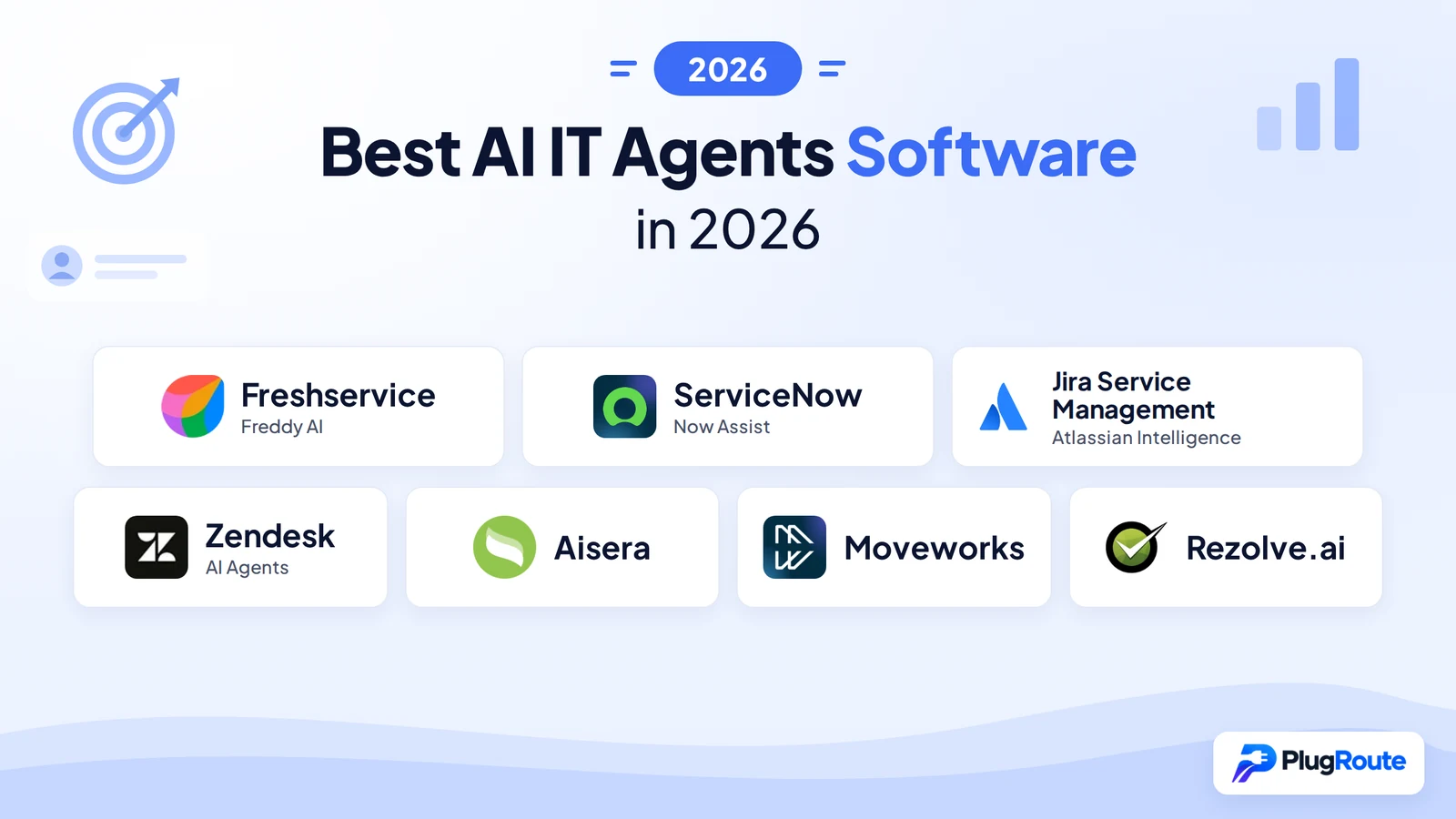
Freshservice Freddy AI is the top-ranked AI IT agent software for mid-market IT teams, while ServiceNow Now Assist leads for large enterprises with mature data governance. The right choice depends on whether your team prioritizes proven results with fast deployment or maximum ITSM depth with long-term scalability.
IT teams are drowning in repetitive helpdesk automation requests (password resets, software provisioning, access management) that consume staff hours better spent on strategic work. Dozens of AI-powered IT service desk AI platforms now promise 70–80% ticket deflection, but their feature sets overlap, pricing is often opaque, and vendor claims rarely come with independently verified evidence.
PlugRoute has no affiliate relationships with any company listed. Rankings are determined entirely by research data and objective evaluation criteria.
“You’ll need good documentation sources for any of them to be helpful, so make sure updating or creating documentation is set as a prerequisite… Even with good documentation, many of them ended up being a mess of inaccurate answers that piss people off.”, r/sysadmin practitioner on AI IT agents
Takeaway: Knowledge base quality is the prerequisite for every AI IT agent platform, no tool compensates for poor documentation, and rushing deployment without it creates user frustration that undermines adoption.
TL;DR: Top Picks at a Glance
- Freshservice Freddy AI ranks #1 as the best overall AI IT agent software for mid-market IT teams, combining the highest G2 rating (4.6/5.0, 1,315 reviews) with named-client evidence including 65% ticket deflection at Five9.
- ServiceNow Now Assist ranks #2 as the deepest enterprise ITSM platform, combining full ITIL coverage with the $2.85 billion Moveworks conversational AI acquisition.
- Jira Service Management ranks #3 as the best value option, offering the only free tier (3 agents) and the most transparent pricing with native DevOps workflow integration.
- Zendesk AI Agents ranks #4 with the only outcome-based AI pricing model ($1.50 per committed resolution), minimizing financial risk for budget-conscious IT teams.
- Aisera ranks #5 as the only platform combining reactive ITSM automation with predictive AIOps for proactive incident prevention.
- Moveworks ranks #6 with the highest employee adoption rates (90–100%) but carries post-acquisition uncertainty following the $2.85B ServiceNow deal.
- Rezolve.ai ranks #7 as a purpose-built Microsoft Teams-native ITSM platform with the highest G2 rating (4.8/5.0, 38 reviews) but limited review volume for statistical confidence.
What Are the Four Categories of AI IT Agent Software?
AI IT agent software falls into four distinct categories: Full-Stack ITSM Platforms, AI-Native IT Assistants, AI Agent + AIOps Platforms, and Messaging-Native ITSM. Each category serves a different buyer need, choosing the wrong category is more costly than choosing the wrong vendor within the right one.
Full-Stack ITSM Platform: Complete IT service management suites with embedded AI for ticket automation, agent assistance, and self-service resolution. These platforms handle the full ITIL lifecycle:
- Freshservice (Freddy AI)
- ServiceNow (Now Assist)
- Jira Service Management (Atlassian Intelligence)
- Zendesk (AI Agents): support-first, with lighter ITSM depth
AI-Native IT Assistant: A conversational AI layer designed to sit on top of existing ITSM platforms, automating employee interactions and front-line IT request resolution through messaging tools:
- Moveworks
AI Agent + AIOps Platform: Combines IT service automation with predictive operations intelligence, offering both reactive ticket resolution and proactive incident prevention:
- Aisera
Messaging-Native ITSM: IT service management built natively inside collaboration tools (Microsoft Teams, Slack), enabling employees to resolve IT issues without leaving their messaging platform:
- Rezolve.ai
The category a platform belongs to matters more than its feature list, an AI-native assistant like Moveworks cannot replace a full-stack ITSM platform, and a messaging-native tool like Rezolve.ai serves a fundamentally different buyer than an enterprise suite like ServiceNow.
How Do the Top 7 AI IT Agent Platforms Compare at a Glance?
| Rank | Company | Category | Best For | One-Line Summary | Key Capabilities | Primary Strength | Key Limitation |
|---|---|---|---|---|---|---|---|
| 1 | Freshservice (Freddy AI) | Full-Stack ITSM | Mid-market IT teams (100–5,000 employees) | Freshservice Freddy AI holds the highest G2 rating (4.6/5.0, 1,315 reviews) with named-client evidence including 65% ticket deflection at Five9. | AI Agent, Copilot, Insights; 600+ integrations; ITIL-aligned | Strongest verified results + highest user ratings combined | AI features gated behind Pro/Enterprise tiers + add-on fee |
| 2 | ServiceNow (Now Assist) | Full-Stack ITSM | Large enterprises (5,000+ employees) | ServiceNow Now Assist is the enterprise ITSM market leader with the deepest ITIL coverage and a $2.85B Moveworks acquisition adding conversational AI. | Three-tier AI architecture; Moveworks integration; full ITIL suite | Deepest ITSM process coverage + largest AI training data | 1–1.5 year implementation; opaque pricing with ~60% AI premium |
| 3 | Jira Service Management | Full-Stack ITSM | DevOps-aligned IT teams | Jira Service Management offers the only free tier and most transparent pricing in the category with native DevOps workflow integration. | Virtual Service Agent; Rovo AI agents; Confluence KB | Only free tier + most transparent pricing | Project management DNA; AI requires $49/agent Premium tier |
| 4 | Zendesk (AI Agents) | Full-Stack ITSM (support-first) | Budget-conscious high-volume IT teams | Zendesk AI Agents is the only platform offering outcome-based AI pricing ($1.50/resolution committed) for low-risk adoption. | Autonomous resolution; Knowledge Builder; copilot | Only outcome-based AI pricing ($1.50/resolution) | Customer support DNA; lacks native ITIL depth |
| 5 | Aisera | AI Agent + AIOps | Enterprises needing proactive + reactive AI | Aisera uniquely combines ITSM automation with predictive AIOps capabilities in a single platform, now part of Automation Anywhere. | System of AI Agents; AIOps; 1,000+ pre-built workflows | Only integrated ITSM + AIOps platform | Limited review presence; opaque pricing; leadership transition |
| 6 | Moveworks | AI-Native Assistant | ServiceNow enterprises wanting conversational AI | Moveworks achieves the highest employee adoption rates (90–100%) but carries post-acquisition uncertainty following the $2.85B ServiceNow deal. | Reasoning Engine; 100+ connectors; Agent Studio | 90–100% employee adoption rates | Not a full ITSM platform; post-acquisition risk |
| 7 | Rezolve.ai | Messaging-Native ITSM | Microsoft Teams-centric organizations | Rezolve.ai is purpose-built as Teams-native ITSM with no-code workflows and the highest G2 rating (4.8/5.0, 38 reviews) but limited review volume. | Sidekick 3.0; SearchIQ; no-code Creator Studio | Purpose-built Teams/Slack-native architecture | Low review volume (38 reviews); opaque pricing; undocumented company background |
Which AI IT Agent Software Should I Choose for My Use Case?
| Your #1 Priority | Recommended Tool | Why | Acceptable Alternative |
|---|---|---|---|
| Small team (1–10 agents), budget-constrained | Jira Service Management (Free/Standard) | Free tier for 3 agents; transparent pricing at $22/agent/month | Freshservice Starter ($19/agent/month, no AI) |
| Mid-market (10–100 agents), proven AI deflection | Freshservice Pro + Freddy AI | Highest G2 rating; named case studies (65% deflection at Five9); weeks-to-deploy | Zendesk Suite Growth + AI resolutions |
| Enterprise, Microsoft-heavy environment | ServiceNow + Moveworks | Deepest ITSM + highest-adoption conversational front-end combined | Rezolve.ai; Teams-native ITSM with no-code workflows (if Teams embedding is paramount) |
| Enterprise, DevOps-aligned team | Jira Service Management (Premium) | Native DevOps-ITSM bridge; Confluence KB; Rovo AI agents | Freshservice Enterprise |
| Budget-conscious, high ticket volume | Zendesk ($1.50/resolution AI) | Pay only for successful AI resolutions; fast deployment | Freshservice (if ITSM depth needed) |
| Proactive + reactive AI operations | ServiceNow or Aisera | Only platforms combining ITSM with predictive AIOps | Neither has a clear substitute |
Most readers: If you have 10–100 agents and need proven results, start with Entry #1 (Freshservice). If you’re enterprise-scale on ServiceNow, start with Entry #2. If budget is your primary constraint, start with Entry #3 (Jira Service Management Free) or Entry #4 (Zendesk pay-per-resolution).
For a 50-agent mid-market IT team, estimated monthly AI-enabled costs are:
- Freshservice Pro + Freddy AI: ~$6,250–$6,500/month
- Jira Service Management Premium: ~$2,450/month
- Zendesk Professional + 500 AI resolutions: ~$6,500–$6,750/month
- ServiceNow: custom pricing (typically $15,000+/month)
These estimates use published 2026 pricing and exclude implementation costs.
Found your row? Read that entry first, then scan the Red Flags section to validate your choice before procurement.
1. Freshservice (Freddy AI): Best Overall: Strongest Combination of Verified Results, User Ratings, and Accessible Deployment
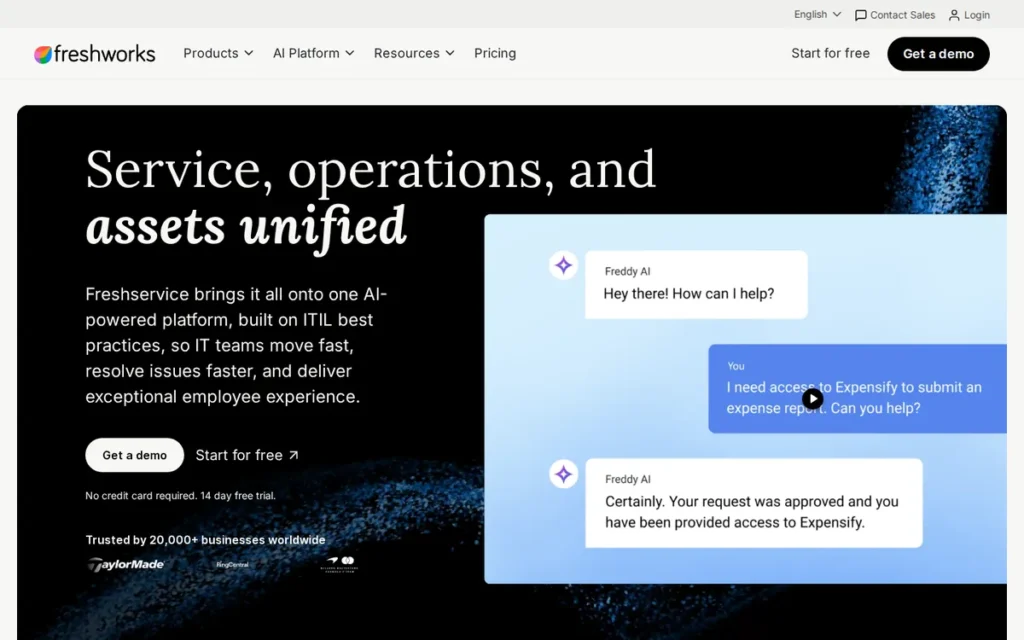
Category: Full-Stack ITSM Platform, a complete IT service management suite with embedded AI capabilities for ticket automation, agent assistance, and self-service resolution.
At a Glance
- Category: Full-Stack ITSM Platform
- Best For: Mid-market IT teams (100–5,000 employees) wanting proven AI without enterprise complexity
- Price Range: $19–$119/agent/month base + $29–$35/agent/month Freddy AI add-on (Pro/Enterprise only)
- Primary Strength: Freshservice delivers the strongest combination of independently verified ticket deflection results and user satisfaction ratings in the AI ITSM category.
- Biggest Limitation: Freshservice gates AI capabilities behind Pro/Enterprise tiers with a separate add-on fee, eroding mid-market pricing advantage at scale.
- One-Line Summary: Freshservice Freddy AI is a mid-market ITSM platform with the highest G2 rating (4.6/5.0, 1,315 reviews), offering AI-powered ticket deflection with named customer results including 65% deflection at Five9.
- Last Verified: April 2026
Overview
Freshservice Freddy AI is a mid-market IT service management platform built by Freshworks that combines ITIL-aligned ITSM processes with a three-layer AI suite (Freddy AI Agent for self-service, Freddy Copilot for agent assistance, and Freddy Insights for analytics) targeting IT teams of 100–5,000 employees who need proven automation without enterprise complexity.
Freshservice supports 600+ out-of-box integrations including Microsoft 365, Active Directory, Slack, and Teams. Freshservice is used by organizations including Honda, Bridgestone, and Five9.
Key Features
- Conversational AI Agent: Freshservice Freddy AI Agent enables self-service via Slack, Microsoft Teams, email, and support portals, handling multi-turn troubleshooting conversations and citing knowledge base sources for transparency.
- Agent Copilot Suite: Freshservice Freddy Copilot provides reply suggestions, ticket summarization, resolution notes generation, similar incident matching, field autofill, and auto-triage to accelerate human agent productivity.
- 600+ Integration Orchestration: Freshservice includes pre-built IT workflow orchestration across 600+ enterprise app integrations, enabling automated provisioning, access management, and multi-step approval chains without custom development.
- AI Analytics Dashboard: Freshservice Freddy Insights surfaces analytics on ticket trends, agent performance, and AI effectiveness, helping IT leaders identify automation opportunities and measure deflection rates.
- Full ITIL Process Coverage: Freshservice supports incident, problem, change, release, and asset management with a native CMDB, providing broader ITSM coverage than support-first competitors.
Best For
Freshservice Freddy AI is best for mid-market IT departments (100–5,000 employees) in industries including financial services, manufacturing, and technology that want a modern, ITIL-aligned ITSM platform with proven AI deflection results and a deployment timeline measured in weeks rather than months or years.
Pricing
Freshservice pricing (2026, billed annually):
- Starter: ~$19/agent/month
- Growth: ~$49/agent/month
- Pro: ~$95/agent/month
- Enterprise: ~$119/agent/month
- Freddy AI Copilot add-on: $29–$35/agent/month (Pro and Enterprise tiers only)
The effective “AI-enabled” starting cost is ~$124–$130/agent/month (Pro + Freddy Copilot), not the headline $19 figure. Annual billing can reduce Freddy AI costs by up to 35% (eesel.ai, 2025).
Freshservice’s AI Agent component uses session-based pricing that can add unpredictability.
Strengths
- Freshservice customer Five9 documented a 65% ticket deflection rate and 200 hours saved per month using Freddy AI, and a large financial services customer reported 80–90% reduction in first response time (from 2–4 hours to 30 seconds) making these the most specific named-client results in this evaluation (Freshworks Evidence Portal, 2025).
- Freshservice holds the highest G2 rating in this evaluation at 4.6/5.0 across 1,315 reviews, with an 85% likelihood-to-recommend score and a Software Advice rating of 4.5/5.0 across 642 reviews (G2, 2026).
- Freshservice deploys in weeks to months rather than the 1–1.5 year timelines reported for enterprise competitors, with Reddit practitioners on r/sysadmin describing setup as “super easy” and recommending Freshservice as the best mid-market ITSM option (Reddit r/sysadmin, 2024).
- Freshservice aggregated customer metrics show 66% average ticket deflection, 41% faster first response time, and 77% decrease in average resolution time across its deployment base (eesel.ai analysis, 2025).
Limitations
- AI Add-On Pricing at Scale: Freshservice gates its most valuable AI capabilities behind Pro or Enterprise tiers with a mandatory $29–$35/agent/month add-on, meaning the effective AI-enabled cost is $124–$130/agent/month, significantly above the headline $19 starting price.
- Session-Based Unpredictability: Freshservice’s AI Agent component uses session-based pricing that adds budget unpredictability, and organizations with 500+ agents should model total AI costs carefully as the per-agent add-on scales linearly.
- Mixed Review Signals: Freshservice’s Trustpilot rating of 3.0/5.0 is notably lower than its G2 score of 4.6, suggesting customer service friction points that professional G2 reviews may underweight (eesel.ai, 2025).
Users on r/sysadmin noted:
“YMMV with FreshService. Was great when we started. Seems like they went whole hog on ‘AI’ and I have not seen any improvements in the product in two years.” Posted by u/tgwill
Takeaway: Freshservice’s aggressive pivot toward AI features has come at the cost of core product improvements, and long-term customers report stagnation outside the AI roadmap.
- Enterprise Ceiling: Freshservice is positioned for mid-market organizations and may lack the depth and customization flexibility that enterprises with 5,000+ employees and complex ITIL requirements demand.
Verdict
Freshservice Freddy AI is the top-ranked AI IT agent platform in this 2026 evaluation for mid-market organizations, combining the highest user ratings in the category with the most credible named-client performance evidence. Freshservice’s ITIL-aligned ITSM depth, weeks-to-deployment timeline, and 600+ integrations make Freshservice the lowest-risk starting point for IT teams deploying AI-powered service management for the first time.
Freshservice’s AI add-on pricing model becomes a cost concern at scale, but for teams of 10–100 agents who need proven results without enterprise complexity, Freshservice delivers the best evidence-to-risk ratio in this evaluation.
2. ServiceNow (Now Assist): Best for Enterprise ITSM: Deepest IT Process Coverage and Largest Training Data Advantage
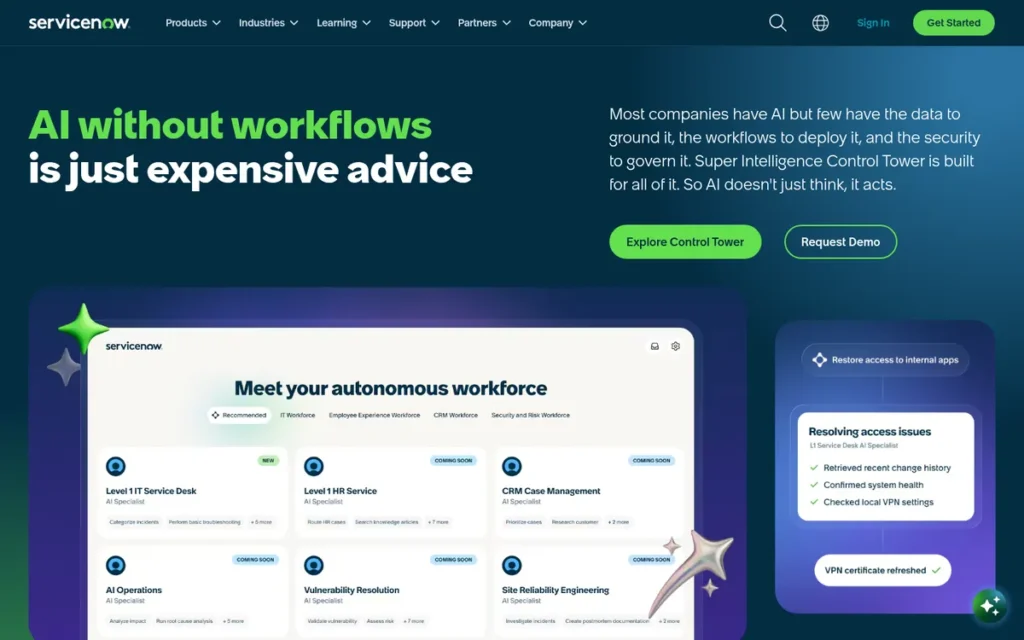
Category: Full-Stack ITSM Platform, a complete IT service management suite with embedded AI capabilities for ticket automation, agent assistance, and self-service resolution.
At a Glance
- Category: Full-Stack ITSM Platform
- Best For: Large enterprises (5,000+ employees) with mature data governance and dedicated ServiceNow teams
- Price Range: Custom enterprise pricing; ITSM Pro Plus required for GenAI; ~60% premium over base ITSM reported
- Primary Strength: ServiceNow Now Assist offers the deepest ITIL-aligned ITSM process coverage of any AI IT agent platform, trained on the largest pool of enterprise IT ticket data.
- Biggest Limitation: ServiceNow Now Assist requires 1–1.5 year implementation, opaque pricing with a ~60% AI premium, and organizational data maturity many enterprises lack.
- One-Line Summary: ServiceNow Now Assist is the enterprise ITSM market leader with the deepest ITIL coverage, a $2.85B Moveworks acquisition adding conversational AI, and a G2 rating of 4.4/5.0 across 1,238 reviews, but demands mature data governance and premium pricing.
- Last Verified: April 2026
Overview
ServiceNow Now Assist is an enterprise-grade generative AI platform embedded natively across the Now Platform’s full ITSM suite, incident, problem, change, asset, and CMDB modules. ServiceNow Now Assist targets large organizations with 5,000+ employees and mature IT operations that need autonomous ticket resolution, predictive failure detection, and AI-assisted workflows at scale.
ServiceNow completed its $2.85 billion acquisition of Moveworks in December 2025, integrating Moveworks’ conversational AI engine to create what ServiceNow calls a “universal AI assistant.” ServiceNow is ranked #1 in IT Management software on G2 (2026) and serves the majority of Fortune 500 companies.
Key Features
- Three-Tier AI Architecture: ServiceNow Now Assist provides Skills for focused GenAI tasks like incident summarization, AI Agents for multi-skill end-to-end resolution, and Agentic AI for autonomous decision-making with built-in human guardrails.
- Intelligent Ticket Automation: ServiceNow Now Assist includes intelligent ticket classification, knowledge base suggestions with one-click resolutions, closure summary drafting, proactive IT failure prediction, and automated routine tasks like password resets.
- Moveworks Conversational Front-End: ServiceNow’s Moveworks integration adds native deployment in Slack, Microsoft Teams, Webex, Google Chat, email, and web portals with natural language processing achieving 90–100% employee adoption rates.
- Dynamic Orchestration: ServiceNow Now Assist supports episodic memory and multilingual capabilities, allowing AI agents to maintain context across multi-step resolution workflows for global enterprises.
- Agent Studio and Marketplace: ServiceNow offers an Agent Studio and AI Agent Marketplace for building custom agents, plus 100+ enterprise connectors for Workday, SAP, Jira, and Salesforce.
Best For
ServiceNow Now Assist is best for large enterprises (5,000+ employees) in regulated industries with clean CMDBs, well-maintained knowledge bases, and dedicated ServiceNow administration teams. ServiceNow is overkill for mid-market teams that lack these prerequisites.
Pricing
ServiceNow uses opaque custom pricing with no publicly disclosed per-user rates. ServiceNow Now Assist is a separate SKU not included in base ITSM licensing.
Key pricing considerations:
- ITSM Pro Plus is the minimum tier required for GenAI features
- A ServiceNow consultant reported on Reddit that list price is “60% extra” over base ITSM pricing (Reddit r/servicenow, 2024)
- Multiple practitioners describe ServiceNow’s pricing model as “tax-code-like”
Strengths
- ServiceNow holds the #1 position in G2’s IT Management category with a 4.4/5.0 rating across 1,238 reviews, confirming broad enterprise adoption and satisfaction (G2, 2026).
- ServiceNow’s $2.85 billion acquisition of Moveworks: the largest in company history, combines the deepest enterprise ITSM backend with the highest-adoption conversational AI front-end (90–100% employee adoption rates) for employee support (Fortune, 2025).
- ServiceNow claims the largest pool of enterprise ITSM training data in the industry, enabling its domain-specific AI models to deliver more accurate auto-classification, routing, and resolution recommendations than competitors with smaller data sets (ServiceNow self-reported claim; not independently verified, ServiceNow community, 2025).
- ServiceNow supports the deepest ITIL process coverage of any evaluated platform: full incident, problem, change, release, asset, CMDB, and service catalog management, with AI embedded natively across all modules.
Limitations
- Data Quality Dependency: ServiceNow Now Assist’s AI produces poor results without a clean CMDB and well-maintained knowledge base, as one r/servicenow user summarized, “If you don’t have a data team or data governance… forget it” (Reddit r/servicenow, 2025).
“It’s not worth the money. It costs AS MUCH if not more than similar AI tools, but does less and still requires configs, while relying on your company’s data that almost definitely has some lazy notes or incomplete CIs.”, r/servicenow practitioner
Takeaway: ServiceNow Now Assist’s value depends entirely on organizational data maturity, without clean data, even premium pricing cannot deliver results.
- Opaque Premium Pricing: ServiceNow’s pricing model with a reported 60% AI premium makes budget planning difficult, and multiple Reddit practitioners describe the cost as disproportionate to the value delivered for organizations without mature data foundations.
- Rigid AI Agent Experience: A top-voted r/servicenow post described ServiceNow Now Assist AI agents as “not at all useful and just plain dumb AI” that feels “more of a strict chatbot” than genuine intelligence, reflecting frustration with current agent rigidity (Reddit r/servicenow, 2025).
Takeaway: ServiceNow Now Assist’s AI agents may feel rigid compared to expectations, especially for organizations accustomed to conversational AI tools, plan for iterative tuning after deployment.
- Extended Implementation Timeline: ServiceNow practitioners consistently report 1–1.5 year implementation timelines, placing ServiceNow firmly in the enterprise-only category for organizations that can absorb multi-year rollouts.
Verdict
ServiceNow Now Assist is the deepest AI IT agent platform available for enterprises with the organizational maturity, budget, and data governance to unlock its full potential. The Moveworks acquisition positions ServiceNow as the only platform combining the deepest ITSM backend with the highest-adoption conversational AI front-end.
ServiceNow’s 1,238 G2 reviews confirm broad enterprise adoption. However, ServiceNow’s value proposition collapses without clean data foundations, and its opaque pricing and multi-year implementation timelines make ServiceNow unsuitable for mid-market teams, Freshservice or Jira Service Management are better fits for those organizations.
3. Jira Service Management (Atlassian Intelligence): Best for DevOps-Aligned IT Teams: Transparent Pricing and the Only Free Tier in the Category
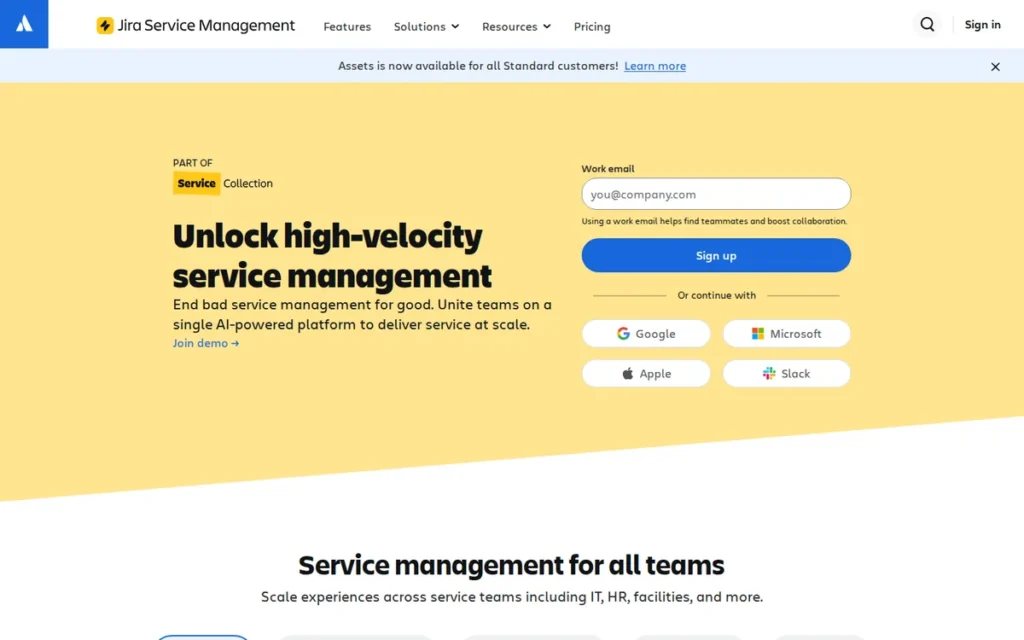
Category: Full-Stack ITSM Platform, a complete IT service management suite with embedded AI capabilities for ticket automation, agent assistance, and self-service resolution.
At a Glance
- Category: Full-Stack ITSM Platform
- Best For: DevOps-aligned IT teams already invested in the Atlassian ecosystem
- Price Range: Free (3 agents), Standard $22/agent/month, Premium $49/agent/month, Enterprise custom
- Primary Strength: Jira Service Management is the only AI IT agent platform offering a free tier, transparent pricing, and a native bridge between IT service requests and development workflows.
- Biggest Limitation: Jira Service Management’s project management DNA means pure ITSM workflows feel less natural, and AI features require the $49/agent Premium tier.
- One-Line Summary: Jira Service Management with Atlassian Intelligence is a DevOps-aligned ITSM platform offering the most transparent pricing (free to $49/agent/month), native Confluence knowledge base deflection, and a unique service-to-development workflow bridge.
- Last Verified: April 2026
Overview
Jira Service Management with Atlassian Intelligence is a DevOps-aligned ITSM platform that combines IT service desk capabilities with AI-powered virtual agents, auto-triage, sentiment analysis, and knowledge base deflection, targeting IT teams who need native integration between service requests and software development workflows.
Jira Service Management supports Rovo AI agents for autonomous task resolution, a Virtual Service Agent for Slack and Help Center self-service, and AI-generated summaries powered by Confluence knowledge bases. Jira Service Management is part of the 300,000+ customer Atlassian ecosystem (Atlassian corporate information, 2025) and offers 5,000+ Marketplace apps for extensibility.
Key Features
- Virtual Service Agent: Jira Service Management’s Virtual Service Agent uses NLP for intent, sentiment, and context analysis in Slack and the Help Center, deflecting repetitive IT requests via AI-generated answers from connected Confluence and JSM knowledge bases.
- Rovo AI Agents: Jira Service Management’s Rovo AI agents (including Service Request Helper) autonomously identify subject matter experts, compose responses from historical requests, and recommend next steps for complex tickets.
- AI-Powered Auto-Triage: Jira Service Management provides predictive issue assignment, bulk actions, and AI-suggested titles, descriptions, and priority levels based on historical ticket data patterns.
- DevOps-ITSM Bridge: Jira Service Management uniquely bridges service requests directly to Jira Software development issues, a capability no other ITSM platform in this evaluation offers natively.
- Knowledge Gap Detection: Jira Service Management includes natural language rule creation and knowledge base gap identification that flags undocumented topics, helping IT teams proactively address documentation deficits.
Best For
Jira Service Management is best for DevOps-aligned IT teams of 1–100 agents already invested in the Atlassian ecosystem (Jira Software, Confluence, Bitbucket) who want transparent pricing and a native development workflow bridge. Jira Service Management is also the strongest option for small IT teams needing a capable free-tier ITSM tool.
Pricing
Jira Service Management pricing (2026, billed annually):
- Free: Up to 3 agents
- Standard: ~$22/agent/month
- Premium: ~$49/agent/month
- Enterprise: Custom pricing
Atlassian Intelligence and AI features (Virtual Service Agent, Rovo, auto-triage) require Premium or Enterprise tiers. The effective “AI-enabled” starting price is $49/agent/month (Atlassian pricing page, 2026).
Strengths
- Jira Service Management is backed by a Forrester Total Economic Impact study reporting reduced time to resolution, improved escalation processes, and enhanced productivity, the only platform in this evaluation with a commissioned analyst study, though the study uses composite organizations rather than named clients with specific metrics (Forrester TEI, 2025).
- Jira Service Management offers the most transparent pricing in this evaluation: a free tier for 3 agents, publicly listed per-agent rates, and clear tier descriptions, allowing IT managers to model costs precisely before committing (Atlassian pricing page, 2026).
- Jira Service Management’s native integration with Jira Software and Confluence means Atlassian ecosystem teams get a built-in knowledge base and development workflow bridge without third-party tools.
- Jira Service Management’s 5,000+ Marketplace apps provide the broadest extensibility of any platform evaluated, allowing teams to customize workflows and add integrations without vendor dependency.
Limitations
- Project Management DNA: Jira Service Management’s origins as an agile project management tool are its most consequential trade-off, as one Reddit practitioner noted, “it’s not born for ticketing but more for agile and issue tracking,” and this DNA shows through in ITSM workflows (Reddit r/sysadmin, 2023).
Takeaway: Jira Service Management works best when IT teams already think in Atlassian workflows, forcing traditional helpdesk processes onto Jira’s project management architecture creates friction.
- AI Feature Gating: Jira Service Management’s AI features require the Premium tier at $49/agent/month, eliminating the cost advantage for teams that need AI capabilities beyond the free or Standard tiers.
- Integration Reliability Concerns: Community feedback flags unreliable Jira Service Management integrations that break with updates, hidden automation costs, and slow performance under high ticket volume (ClearFeed, 2025).
- Ecosystem Dependency: Jira Service Management is the right tool for Atlassian-native teams but a risky choice for organizations that don’t already use Jira Software and Confluence, since Jira Service Management’s primary advantages are ecosystem-driven.
Verdict
This aligns with community sentiment on r/sysadmin:
“I come from using JIRA Service Management and now use ServiceNow in a different agency. JIRA was set up properly, suited to the agency; and therefore it was awesome.. however I hear of many businesses where it’s not setup properly or configured to the business requirements and work methods. On the flip side, I am now in an agency using ServiceNOW and am constantly baffled and confused by it; and generally when I go down the rabbit hole for answers it comes back as ‘It wasn’t ever set up quite correctly for our environment’.. So long story short, both are great when set up properly and configured/tailored for the business.” Posted by u/its_tricky83
Takeaway: Jira Service Management and ServiceNow both deliver strong results when properly configured, the platform matters less than the quality of implementation and alignment to business workflows.
Jira Service Management with Atlassian Intelligence is the best AI IT agent platform for DevOps-aligned IT teams already working within the Atlassian ecosystem, offering the only free tier and the most transparent pricing in the category. Jira Service Management’s unique ability to bridge IT service requests directly into Jira Software development workflows is a genuine differentiator that no competitor matches.
However, Jira Service Management’s project management DNA limits its pure ITSM depth compared to Freshservice or ServiceNow, and organizations not already invested in Atlassian tools will find the ecosystem benefits irrelevant to their needs.
4. Zendesk (AI Agents): Best for Budget-Conscious IT Teams: Unique Pay-Per-Resolution AI Pricing Model

Category: Full-Stack ITSM Platform (support-first), a complete IT service management suite with embedded AI capabilities for ticket automation, agent assistance, and self-service resolution. Zendesk’s ITSM capabilities are less mature than dedicated ITSM platforms; its strength is customer and employee support automation.
At a Glance
- Category: Full-Stack ITSM Platform (support-first)
- Best For: Budget-conscious IT teams wanting low-risk AI adoption through pay-per-resolution pricing
- Price Range: Suite Team ~$55, Growth ~$89, Professional ~$115/agent/month + $1.50/resolution (committed) or $2.00 (pay-as-you-go) + $50/agent Advanced AI add-on
- Primary Strength: Zendesk is the only AI IT agent platform offering outcome-based AI pricing at $1.50 per committed automated resolution, eliminating the risk of paying for unused AI capabilities.
- Biggest Limitation: Zendesk was built for customer support and lacks native ITIL process depth, no native change management, problem management, or CMDB.
- One-Line Summary: Zendesk AI Agents is a support-first platform expanding into internal IT helpdesk with a unique outcome-based AI pricing model ($1.50/resolution committed), fast deployment, and approximately 4.3/5.0 G2 rating, strongest for low-risk AI adoption.
- Last Verified: April 2026
Overview
Zendesk AI Agents is a support automation platform expanding from its customer service roots into internal IT helpdesk use cases, offering autonomous ticket resolution, intelligent triage by intent and sentiment, AI-powered knowledge base answers, and a unique outcome-based pricing model, targeting IT teams that want low-risk AI adoption without fixed per-agent AI fees.
Zendesk supports IT workflows including password resets, software provisioning, service catalogs, and proactive pattern detection. Zendesk serves 100,000+ customers globally and was taken private in 2022 for approximately $10.2 billion (public acquisition records, 2022).
Key Features
- Autonomous Resolution Engine: Zendesk AI Agents resolve up to 80% of common support interactions autonomously, including IT workflows like password resets and software provisioning, using knowledge base content with intelligent triage by intent, language, and sentiment (Zendesk-reported; customer support deployments, Zendesk blog, 2025).
- Knowledge Builder: Zendesk Knowledge Builder auto-creates knowledge base articles from past ticket resolutions, helping IT teams build the documentation foundation that AI agents need to function effectively.
- Outcome-Based AI Pricing: Zendesk offers a unique $1.50-per-committed-resolution pricing model (or $2.00 pay-as-you-go), separate from per-agent seat costs, allowing IT teams to pay only for successful AI-resolved tickets.
- Agent Copilot: Zendesk provides AI-powered copilot features with suggested replies, ticket summaries, and workflow recommendations to accelerate resolution of complex IT issues.
- Proactive Pattern Detection: Zendesk supports identification of recurring IT issues across tickets (e.g., network outages), service catalogs with approval workflows, and IT asset management integration.
Best For
Zendesk AI Agents is best for IT teams with high ticket volumes and unpredictable AI adoption patterns who want to minimize financial risk through pay-per-resolution pricing. Zendesk is also strong for organizations already using Zendesk for customer support that want to extend Zendesk to internal IT helpdesk.
Pricing
Zendesk Suite pricing (2026, per agent/month):
- Suite Team: ~$55
- Suite Growth: ~$89
- Suite Professional: ~$115
- Suite Enterprise: Custom pricing
- AI automated resolution add-on: $1.50/resolution (committed volume) or $2.00/resolution (pay-as-you-go)
- Advanced AI add-on (copilot, custom agents): $50/agent/month
- Free inclusions: 5–15 automated resolutions per agent per month depending on plan tier
At 500 committed AI resolutions/month, the AI cost is ~$750/month regardless of team size. Volume discounts may reduce committed rates below $1.50 at 5,000+ resolutions. Advanced AI features require higher tiers (Zendesk pricing page, 2026; premiumplus.io pricing analysis, 2025).
Strengths
- Zendesk is the only platform in this evaluation offering outcome-based AI pricing at $1.50 per committed automated resolution, IT teams pay for successful AI resolutions rather than committing to per-agent fees regardless of usage (Zendesk AI documentation, 2026).
- Zendesk consistently ranks among the fastest-to-deploy platforms in the ITSM category, with practitioner reports of days-to-weeks timelines and minimal training requirements due to its intuitive interface (Reddit r/sysadmin, 2023).
- Zendesk’s Knowledge Builder auto-creates knowledge base articles from past ticket resolutions, directly addressing the #1 barrier to AI agent success cited by practitioners, poor knowledge base quality.
- Zendesk claims up to 80% autonomous resolution of common interactions and 20% team productivity increase through copilot features, with 60–80% repetitive inquiry reduction reported across deployments (Zendesk blog, 2025; customer support deployments, not IT-specific).
Limitations
- Customer Support DNA: Zendesk was not built for IT service management and lacks native ITIL process depth including change management, problem management, and CMDB capabilities that Freshservice and ServiceNow provide out of the box.
- Unverified IT Performance: Zendesk’s 80% autonomous resolution claim comes from customer support deployments, and no IT-specific case studies with named organizations were found during research, internal IT resolution rates may differ.
- Higher Total Cost Than Headline Suggests: Zendesk’s base seats at $55–$115/agent/month are more expensive than Freshservice and Jira Service Management before AI costs, and the $50/agent/month Advanced AI add-on further increases effective pricing for teams needing copilot and custom agent features.
Users on r/Zendesk shared their experience:
“I left Zendesk last year after our costs for a team of 10 agents was costing us $15,000 a year. We moved to FreshService and pay around $12,000 a year with inventory and project management included. Much better.” Posted by u/daven1985
Takeaway: Zendesk’s per-agent pricing scales unfavorably for mid-size IT teams, and real-world cost comparisons show competitors like Freshservice delivering more ITSM capability for less money.
- ITSM Maturity Gap: Reddit practitioners consistently position Zendesk as “very similar to Freshservice but more expensive” for IT helpdesk use cases, noting Zendesk excels at customer support but feels incomplete as a standalone ITSM tool (Reddit r/sysadmin, 2023).
Takeaway: Zendesk works best when extending an existing customer support deployment to internal IT, rather than serving as a standalone ITSM tool for teams with mature ITIL requirements.
Verdict
Zendesk AI Agents is the best choice for IT teams that want to minimize financial risk when adopting AI through its unique outcome-based pricing model, the only pay-per-resolution option in this evaluation. Zendesk’s fast deployment and intuitive interface make Zendesk the lowest-friction entry point for organizations new to AI-powered IT support.
However, Zendesk’s customer support DNA limits its ITSM depth, and teams with mature requirements around change management, CMDB, and ITIL compliance will find Freshservice or ServiceNow more complete.
5. Aisera: Best for Proactive IT Operations: Only Platform Combining ITSM Automation with Predictive AIOps
Category: AI Agent + AIOps Platform, combines IT service automation with predictive operations intelligence, offering both reactive ticket resolution and proactive incident prevention in a single platform.
At a Glance
- Category: AI Agent + AIOps Platform
- Best For: Large enterprises needing both reactive ITSM automation and proactive incident prevention
- Price Range: Custom enterprise pricing only; no publicly disclosed rates
- Primary Strength: Aisera is the only AI IT agent platform combining reactive ITSM automation with proactive AIOps, predictive incident detection, root-cause analysis, and automated remediation.
- Biggest Limitation: Aisera has limited independent review presence, opaque pricing, a leadership transition following founder Muddu Sudhakar’s departure, and is now part of Automation Anywhere, adding acquisition uncertainty.
- One-Line Summary: Aisera is an enterprise AI agent platform uniquely combining IT service automation with predictive AIOps capabilities, recognized as an IDC MarketScape 2025 Conversational AI Leader, but limited by opaque pricing, leadership transition, and its acquisition by Automation Anywhere.
- Last Verified: April 2026
Overview
Aisera is an enterprise AI agent platform that uniquely combines reactive IT service management automation with proactive AIOps capabilities (including predictive incident detection, root-cause analysis, anomaly detection, and automated remediation) targeting large enterprises that want both ticket resolution and incident prevention in a single system.
Aisera is now part of Automation Anywhere. Aisera founder Muddu Sudhakar departed the CEO role, and former CFO Abhi Maheshwari was appointed Interim CEO (Aisera leadership transition blog, 2025).
Aisera’s AI Service Management framework supports autonomous ticket resolution, a Microsoft Teams-embedded copilot, agent assist, and 1,000+ pre-built AI workflows across 100+ enterprise integrations. Aisera was recognized as an IDC MarketScape 2025 Conversational AI Platform Leader and lists customers including Zoom, McAfee, and Autodesk (Aisera platform overview, 2025).
Key Features
- System of AI Agents: Aisera provides a universal orchestrating agent that coordinates domain-specific agents (IT, HR, Finance, Customer Service) and task agents for end-to-end autonomous workflow execution.
- Predictive AIOps: Aisera’s AIOps module offers predictive incident detection via event correlation, change risk advisory, real-time anomaly detection, and automated remediation, capabilities only shared by ServiceNow among evaluated platforms.
- 1,000+ Pre-Built Workflows: Aisera includes pre-built AI workflows that reduce configuration time for common IT processes like password resets, software provisioning, and access management.
- TRAPS Security Framework: Aisera’s TRAPS framework provides security and auditability guardrails for autonomous agent actions, addressing enterprise concerns about unsupervised AI decision-making.
- Broad Enterprise Integration: Aisera supports 100+ pre-built integrations with ServiceNow, Salesforce, Jira, BMC, Zendesk, and SAP, plus an embedded assistant in Microsoft Teams.
Best For
Aisera is best for large enterprises (5,000+ employees) that need both reactive IT service automation and proactive incident prevention in a single platform, particularly organizations with complex multi-vendor environments spanning ServiceNow, Salesforce, and BMC.
Pricing
Aisera uses completely opaque enterprise pricing with no publicly disclosed per-user or per-ticket rates. No free tier, trial, or published pricing tiers exist. Budget planning requires direct sales engagement (eesel.ai analysis, 2025).
Strengths
- Aisera was recognized as a Conversational AI Platform Leader in the IDC MarketScape: Worldwide General-Purpose Conversational AI Platforms 2025 Vendor Assessment, the only independent analyst recognition in this evaluation beyond Forrester’s Atlassian-commissioned study (IDC MarketScape, 2025).
- Aisera claims 76.1% accuracy and 99.3% success rate in complex IT and FinTech domains with AI processing costs of $0.005 per request, figures validated in an AWS Partner Network environment (AWS Partner Network blog, 2025).
- Aisera is the only platform in this evaluation offering integrated AIOps with predictive incident detection, event correlation, and automated remediation alongside ITSM automation.
- Aisera provides 1,000+ pre-built AI workflows across IT, HR, Finance, and Customer Service, significantly reducing configuration effort for common automation use cases.
Limitations
- Transparency Deficit: Aisera’s most consequential limitation is the absence of broad independent validation, while Aisera holds IDC MarketScape recognition, no verified G2 or Capterra ratings with meaningful review volume exist, and no independently verified named-client case studies with quantified outcomes were found.
- Acquisition and Leadership Transition: Aisera is now part of Automation Anywhere, and founder Muddu Sudhakar’s departure adds uncertainty about product direction, paralleling the platform stability questions raised about Moveworks’ ServiceNow acquisition (Aisera leadership transition blog, 2025).
- Enterprise-Only Positioning: Aisera’s opaque pricing and enterprise-only approach make Aisera inaccessible for small-to-mid-market organizations, a material limitation for the broader audience of this evaluation.
- Due Diligence Requirement: Aisera’s AIOps capability is genuinely differentiated, but buyers should request named reference customers and detailed product roadmap commitments from the Automation Anywhere leadership before committing to a multi-year investment.
Verdict
Aisera is the most technically differentiated platform in this evaluation, offering the only integrated ITSM + AIOps capability that combines reactive ticket resolution with proactive incident prevention. For large enterprises that need predictive operations intelligence alongside IT service automation, Aisera addresses a genuine gap that competitors have not matched.
However, Aisera’s acquisition by Automation Anywhere, the absence of broad public review platform presence, and opaque pricing mean that Aisera requires more due diligence than any other platform on this list.
6. Moveworks: Best Conversational AI Front-End: Highest Employee Adoption Rates but Post-Acquisition Uncertainty
Category: AI-Native IT Assistant, a conversational AI layer designed to sit on top of existing ITSM platforms, automating employee interactions and front-line IT request resolution through messaging tools.
At a Glance
- Category: AI-Native IT Assistant
- Best For: Large enterprises (5,000+ employees) already running ServiceNow that want the highest-adoption conversational AI front-end
- Price Range: Custom enterprise pricing; described as “very expensive”; no publicly disclosed rates
- Primary Strength: Moveworks achieves the highest employee adoption rates (90–100%) of any AI IT assistant, built natively for messaging platforms.
- Biggest Limitation: Moveworks is an AI assistant layer (not full ITSM), its ServiceNow acquisition creates cross-platform uncertainty, and only the vendor can build custom configurations.
- One-Line Summary: Moveworks is a conversational AI assistant acquired by ServiceNow for $2.85 billion in December 2025, achieving 90–100% employee adoption rates but carrying post-acquisition uncertainty and opaque premium pricing.
- Last Verified: April 2026
Overview
Moveworks is an AI-native enterprise assistant platform acquired by ServiceNow for $2.85 billion in December 2025, featuring an agentic Reasoning Engine for natural language understanding, multi-step reasoning, and autonomous IT task resolution, targeting large enterprises that want the highest-adoption conversational front-end for employee self-service across Slack, Microsoft Teams, Webex, and other messaging platforms.
Moveworks focuses on the employee interaction layer rather than full ITSM process management. Moveworks serves enterprise customers including Broadcom, Hearst, and Palo Alto Networks.
Key Features
- Agentic Reasoning Engine: Moveworks performs multi-step reasoning and autonomous task completion, executing complex IT workflows like multi-system provisioning and access management across 100+ enterprise connectors.
- Messaging-Native Deployment: Moveworks supports Slack, Microsoft Teams, Webex, Google Chat, email, and web portals, achieving 90–100% employee adoption rates by meeting users where they work.
- Agent Studio and Marketplace: Moveworks’ Agent Studio and AI Agent Marketplace allow organizations to build and deploy custom agents for IT, HR, Finance, and other functions.
- Enterprise Knowledge Search: Moveworks provides cited answers from connected knowledge bases, documents, and systems rather than generating unsourced responses.
- ServiceNow Backend Integration: Moveworks’ post-acquisition integration with ServiceNow creates the only combined “universal AI assistant” with deep ITSM backend capabilities.
Best For
Moveworks is best for large enterprises (5,000+ employees) already running ServiceNow that want to add the highest-adoption conversational AI front-end. Moveworks is not recommended as a standalone ITSM solution or for organizations running non-ServiceNow ITSM systems due to post-acquisition uncertainty.
Pricing
Moveworks uses opaque custom enterprise pricing with no publicly disclosed rates. A Reddit user attending a SITs conference reported that “one of their clients told us that at the same price they could’ve hired 5 FTEs to get the work done” (Reddit r/servicenow, 2025).
Takeaway: Moveworks’ pricing is premium by design, organizations should compare total cost against equivalent headcount to determine whether the automation ROI justifies the investment.
Post-acquisition, Moveworks pricing may evolve as it merges with ServiceNow’s SKU structure. Moveworks is a supplementary AI layer, organizations must also factor in the cost of their underlying ITSM platform.
Strengths
- Moveworks achieves 90–100% employee rollout adoption rates across most customers: far exceeding typical chatbot adoption rates, credited to Moveworks’ conversational-first design (Everest Group analysis, 2025).
- ServiceNow’s $2.85 billion acquisition: paying >20x 2024 revenue, represents the strongest market validation of any AI IT assistant technology (Fortune, 2025).
- Moveworks cites enterprise deployments at Broadcom, Hearst, Siemens Healthineers, and Palo Alto Networks, with published case studies reporting significant productivity gains including one unnamed enterprise reclaiming 75,000 total hours across global operations (Moveworks customer page, 2025; specific per-client monthly metrics not independently verified).
- Moveworks was built conversationally from the ground up, unlike competitors that bolt chat onto existing ITSM, this architectural difference drives the adoption advantage.
Limitations
- Not a Full ITSM Platform: Moveworks is an AI assistant layer rather than complete ITSM, organizations still need ServiceNow, Jira, or another system underneath for core service management processes.
- Post-Acquisition Cross-Platform Risk: Moveworks’ December 2025 ServiceNow acquisition creates genuine uncertainty about continued support for non-ServiceNow integrations, Reddit evaluators report “their product roadmap just dying” for cross-platform use cases (Reddit r/ChatGPT, 2025).
Takeaway: Organizations not on ServiceNow should get contractual guarantees about continued cross-platform support before committing to Moveworks.
- Vendor Dependency: Moveworks historically required their team to build custom configurations, as one practitioner noted, “if they tell you it can’t be done, you can’t do it” (Reddit r/servicenow, 2025).
Takeaway: Moveworks’ vendor-dependent customization model limits organizational agility, verify whether your team can build, modify, and extend workflows independently.
- Opaque Premium Pricing: Moveworks’ pricing is described as “very expensive” with no public rates, and the $2.85B acquisition at >20x revenue implies premium pricing is structural.
Verdict
Moveworks is the highest-adoption conversational AI front-end for enterprise IT support, with 90–100% employee adoption rates that validate its messaging-native approach and a $2.85 billion ServiceNow acquisition confirming its technology leadership. For ServiceNow-native enterprises, Moveworks transforms the employee IT experience from portal-based ticketing to natural language conversations.
However, Moveworks is not a standalone ITSM platform, its post-acquisition trajectory creates material risk for non-ServiceNow organizations, and Moveworks’ vendor-dependent customization model limits organizational control.
7. Rezolve.ai: Best for Microsoft Teams-Native ITSM: Purpose-Built Messaging Integration with High Ratings but Limited Review Volume
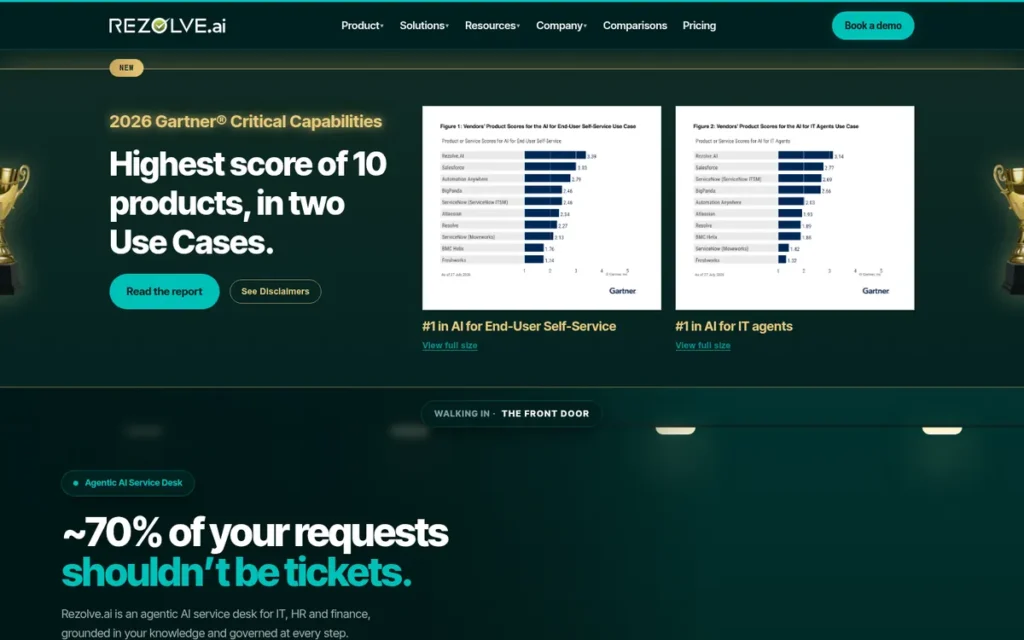
Category: Messaging-Native ITSM, IT service management built natively inside collaboration tools (Microsoft Teams, Slack) rather than traditional web portals.
At a Glance
- Category: Messaging-Native ITSM
- Best For: Microsoft Teams-centric mid-market organizations wanting ITSM embedded in their collaboration tool
- Price Range: Custom enterprise pricing only; no publicly disclosed rates
- Primary Strength: Rezolve.ai was purpose-built as Teams/Slack-native ITSM from the ground up, providing deeper messaging integration than portal-based competitors.
- Biggest Limitation: Rezolve.ai’s 38 G2 reviews provide limited statistical confidence compared to Freshservice (1,315 reviews) or ServiceNow (1,238 reviews), and opaque pricing combined with undocumented company background limits due diligence.
- One-Line Summary: Rezolve.ai is a Microsoft Teams-native ITSM platform with no-code workflow building and agentic AI, holding the highest G2 rating (4.8/5.0, 38 reviews) and Capterra rating (4.8/5.0) in this evaluation but from significantly lower review volume than established competitors.
- Last Verified: April 2026
Overview
Rezolve.ai is an agentic AI-powered ITSM platform built natively inside Microsoft Teams and Slack, automating L1/L2 ticket resolution, incident management, service requests, and SLA management through natural language conversations, targeting mid-market Microsoft-centric organizations that want employees to resolve IT issues without leaving their primary collaboration tool.
Rezolve.ai features Sidekick 3.0 for autonomous resolution, SearchIQ for enterprise knowledge search, and a no-code Creator Studio with drag-and-drop workflow building. Rezolve.ai holds a G2 rating of 4.8/5.0 from 38 reviews and a Capterra rating of 4.8/5.0 (G2, 2026).
Rezolve.ai’s founding year, headquarters, team size, and funding details are not publicly documented, a transparency gap for enterprise buyers.
Key Features
- Teams/Slack-Native Architecture: Rezolve.ai was built Teams/Slack-native from the ground up, embedding full ITSM capabilities (ticketing, approvals, service catalogs, knowledge search) directly within Microsoft Teams conversations.
- Sidekick 3.0 Agentic AI: Rezolve.ai’s Sidekick 3.0 provides autonomous L1/L2 ticket resolution, handling password resets, software provisioning, and basic troubleshooting through conversational interactions.
- No-Code Creator Studio: Rezolve.ai offers a drag-and-drop workflow builder, API builder, and pre-built automation templates for IT teams without developer resources.
- SearchIQ Knowledge Engine: Rezolve.ai’s SearchIQ delivers cited answers from SharePoint, Confluence, and connected knowledge bases within Teams conversations.
- Omnichannel Access: Rezolve.ai supports Teams, Slack, email, web, and mobile with desktop automation capabilities and CMDB features for asset tracking.
Best For
Rezolve.ai is best for Microsoft Teams-centric mid-market organizations that prioritize having ITSM embedded natively in their primary collaboration tool and lack developer resources for custom agent building. Rezolve.ai is not recommended for organizations requiring high-volume review validation or transparent pricing for budget planning.
Pricing
Rezolve.ai does not publicly disclose pricing. Custom enterprise pricing with white-glove onboarding requires direct sales contact (Workativ blog review, 2025). Rezolve.ai’s opaque pricing model contradicts the “accessible” positioning suggested by Rezolve.ai’s no-code approach.
Strengths
- Rezolve.ai holds the highest G2 rating of any evaluated platform at 4.8/5.0 across 38 reviews, with a matching Capterra rating of 4.8/5.0, G2 reviewers report up to 80% adoption rates and 35% ticket deflection in Teams-native deployments (G2, 2026).
- Rezolve.ai is purpose-built as a Teams/Slack-native ITSM platform: not a traditional portal tool with messaging added, representing an architecturally distinct approach to conversational-first IT support (Rezolve.ai product documentation, 2026).
- Rezolve.ai’s no-code Creator Studio with drag-and-drop workflow building addresses the pain point of IT teams lacking developer resources for custom automation (Rezolve.ai product page, 2026).
- Rezolve.ai integrates with SharePoint, Confluence, Active Directory, and major ITSM systems, aligning with Microsoft-centric enterprise environments.
Limitations
- Low Review Volume: Rezolve.ai’s 38 G2 reviews provide limited statistical confidence compared to Freshservice (1,315 reviews) or ServiceNow (1,238 reviews), a high rating from a small sample is less reliable than a slightly lower rating from thousands of deployments.
- Undocumented Company Background: Rezolve.ai’s founding year, headquarters, team size, and funding are not publicly documented, a significant concern for enterprise buyers conducting due diligence.
- Opaque Pricing: Rezolve.ai does not publish pricing, making comparison with transparent alternatives like Jira Service Management or Freshservice impossible without vendor engagement.
- Narrow Focus: Rezolve.ai’s Teams-native architecture is a strength for Microsoft-centric organizations but limits Rezolve.ai’s applicability for organizations that primarily use non-Microsoft collaboration tools or require deep ITIL process coverage beyond messaging-based workflows.
Verdict
Rezolve.ai represents a genuinely differentiated approach to AI IT agent software, purpose-built Teams/Slack-native ITSM with no-code workflow building and the highest individual G2 rating (4.8/5.0) in this evaluation. Rezolve.ai addresses real market needs for conversational-first IT support without requiring developer resources.
However, Rezolve.ai’s low review volume (38 reviews), opaque pricing, and undocumented company background mean that IT managers should validate Rezolve.ai’s capabilities through reference customers and proof-of-concept deployments before committing.
What Red Flags Should I Watch For When Evaluating AI IT Agent Software?
The five red flags to watch for are: opaque pricing that blocks budget planning, deploying AI without clean data foundations, confusing marketing resolution rates with IT-specific results, vendor dependency for customization, and ignoring post-acquisition stability risks. Missing any one of these can turn a promising AI deployment into an expensive failure.
Red Flag #1: Opaque Pricing That Blocks Budget Planning
Four of the seven platforms evaluated, ServiceNow, Moveworks, Aisera, and Rezolve.ai, have completely opaque pricing with no publicly disclosed rates. Opaque pricing prevents IT managers from modeling total cost of ownership, comparing alternatives, or building defensible business cases.
If a vendor won’t share pricing without a sales call, factor that opacity into your risk assessment.
Every platform’s headline price also understates the real AI-enabled cost:
- Freshservice starts at $19 but AI requires ~$124+/agent/month
- Jira Service Management is free but AI needs the $49 Premium tier
- Zendesk starts at $55 but Advanced AIadds $50/agent/month
Always calculate the AI-enabled price, not the base price.
Red Flag #2: Deploying AI Agents Without Clean Data Foundations
Deploying AI IT agents on top of inaccurate CMDBs, outdated knowledge bases, or incomplete ticket histories is the most common cause of failed implementations. Every platform in this evaluation depends on data quality, and no evaluated platform consistently produces good results from poor organizational data.
The three data prerequisites every IT team should audit before purchasing are:
- CMDB with accurate and recently updated configuration items
- Knowledge base with comprehensive, current articles covering top ticket categories
- Ticket history with detailed resolution notes that AI can learn from
As one user on r/SaaS described:
“Been there. The tool matters, but most of the pain usually comes from weak workflows and knowledge setup rather than the platform itself. Before switching, it’s worth fixing routing, automations, and common ticket handling, otherwise the same issues just follow you to the next tool.” Posted by u/Soft-Car-3231
Takeaway: IT teams that migrate to a new AI IT agent platform without first fixing their workflows and knowledge base will reproduce the same failures on more expensive software.
Reddit practitioners consistently identify data quality as the #1 determinant of AI agent success, with one ServiceNow user summarizing: “If you don’t have a data team or data governance… forget it” (Reddit r/servicenow, 2025).
Red Flag #3: Confusing Marketing Resolution Rates with IT-Specific Performance
Vendors commonly claim 70–80% autonomous resolution rates, but these figures often come from customer-facing support deployments (not internal IT) and measure simple FAQs rather than complex ITSM workflows.
Zendesk’s 80% claim, for example, comes from customer support use cases, no IT-specific case studies were found. Always ask whether claimed metrics were measured in internal IT environments with enterprise-grade complexity.
Red Flag #4: Vendor Dependency for Customization
Some platforms require the vendor’s team to build custom configurations rather than offering self-service tools. Moveworks’ model exemplifies this risk, as one practitioner noted, “if they tell you it can’t be done, you can’t do it” (Reddit r/servicenow, 2025).
Takeaway: Verify whether your team can build, modify, and extend workflows independently or whether every change requires a vendor engagement.
Red Flag #5: Ignoring Post-Acquisition and Leadership Stability Risks
Platform stability matters for multi-year IT investments. Moveworks’ December 2025 ServiceNow acquisition raises questions about continued cross-platform support for non-ServiceNow organizations.
Aisera’s acquisition by Automation Anywhere and its leadership transition (founder departure, interim CEO appointment) add similar uncertainty. Always evaluate vendor stability, leadership continuity, and product roadmap commitments before signing contracts.
What Questions Should I Ask Before Choosing AI IT Agent Software?
Before choosing an AI IT agent platform, ask: What percentage of your tickets are repetitive? How clean is your CMDB and knowledge base? Which enterprise ecosystem do you primarily use? What is your realistic timeline and budget? And does the vendor allow self-service customization? These five questions surface deal-breaking mismatches before procurement.
The red flags above tell you what to avoid. The five questions below tell you what to prioritize.
Question #1: What Percentage of Your IT Tickets Are Repetitive and Documentable?
AI IT agents excel at automating repetitive, well-documented requests, password resets, software provisioning, access requests. If your ticket audit reveals that 50%+ of volume is repetitive and documentable, AI agents can deliver meaningful ROI.
If most tickets are complex, one-off issues requiring human judgment, the deflection rates vendors promise will not materialize.
Question #2: How Clean Is Your CMDB and Knowledge Base Today?
Every platform in this evaluation depends on data quality to function. ServiceNow requires the most organizational maturity, practitioners report that ServiceNow Now Assist is ineffective without clean CMDB data and comprehensive knowledge bases.
Freshservice and Zendesk have lower thresholds, but no evaluated platform produces good results from poor data. Audit your documentation state before evaluating vendors.
Quick data readiness check, can your team answer these three questions?
- What percentage of your CMDB configuration items were updated in the last 90 days?
- Does your knowledge base cover the top 20 most-submitted ticket categories?
- Do your ticket notes contain enough detail for a new hire to understand the resolution?
If you answered no to two or more, invest in data quality before evaluating AI platforms.
Question #3: Which Enterprise Ecosystem Does Your Organization Primarily Use?
Ecosystem fit is the primary decision axis for most IT teams:
- Microsoft-heavy organizations → Evaluate Rezolve.ai (Teams-native) or Freshservice (strong Microsoft 365 integration)
- Atlassian-invested teams → Jira Service Management is the natural choice
- ServiceNow shops → ServiceNow Now Assist + Moveworks is the most powerful combination
- Multi-vendor environments → Aisera’s 100+ integrations span ServiceNow, Salesforce, Jira, and BMC
Question #4: What Is Your Realistic Implementation Timeline and Budget?
Implementation timelines vary dramatically across platforms:
- Days to weeks: Zendesk, Jira Service Management
- Weeks to months: Freshservice, Rezolve.ai
- Weeks (vendor-dependent): Moveworks
- 1–1.5 years: ServiceNow
Match your timeline expectations to the platform’s reality, not its marketing. Budget planning should include hidden costs like AI add-on SKUs (Freshservice: $29–$35/agent/month), Advanced AI add-ons (Zendesk: $50/agent/month), implementation services, and knowledge base preparation effort.
Question #5: Does the Vendor Allow Self-Service Customization or Require Vendor Dependency?
Verify whether your team can independently build workflows, modify AI behavior, and extend integrations:
- Freshservice, Jira Service Management, and Rezolve.ai offer no-code/low-code tools for self-service customization
- Moveworks historically requires vendor involvement for custom builds
- ServiceNow supports deep customization but typically requires certified administrators
The level of vendor dependency directly impacts your long-term agility and cost.
How Did We Rank These AI IT Agent Software Platforms?
This AI IT agent software comparison uses weighted scoring across six objective criteria using independent data sources, not vendor relationships, sponsorship, or affiliate revenue. Every platform was evaluated identically using the same criteria, the same evidence standards, and the same editorial rigor.
How Did We Gather and Evaluate the Data?
PlugRoute evaluated each platform through a multi-step process:
- Queried multiple AI search engines (ChatGPT, Perplexity, Claude) to identify market-recommended platforms and current LLM coverage gaps
- Gathered independent web research from G2, Capterra, Software Advice, Trustpilot, Forrester, and IDC MarketScape reports
- Analyzed Reddit community sentiment across r/sysadmin, r/servicenow, r/ChatGPT, and r/jira for unfiltered practitioner experiences
- Cross-referenced vendor claims against third-party review platforms and practitioner reports
- Identified evidence gaps where vendor claims lack independent verification
What Criteria Determined the Rankings?
Primary criteria (weighted 2x because they most directly predict real-world IT service desk success):
- IT-Specific Depth and ITSM Capabilities: why it matters: IT managers need platforms that handle real ITSM workflows (incident, change, CMDB, SLA tracking), not repurposed customer support tools that create manual gaps.
- Verified Performance Evidence: why it matters: vendor claims of “80% deflection” are meaningless without named customers, specific metrics, and third-party validation. IT managers building CFO business cases need credible evidence.
- Review Platform Ratings and Volume: why it matters: aggregated peer reviews on G2 and Capterra represent the closest proxy for broad user satisfaction across diverse deployments.
Secondary criteria (weighted 1x):
- Pricing Transparency and Value: why it matters: four of seven platforms have completely opaque pricing, making budget planning impossible without vendor engagement.
- Ease of Deployment and No-Code Accessibility: why it matters: many IT teams lack dedicated developers or 12-month implementation budgets and need time-to-first-value in weeks.
- Ecosystem Integration Depth: why it matters: a platform that integrates natively with Microsoft Teams and Active Directory serves a fundamentally different buyer than one with third-party connectors.
How Do We Weight Conflicting Evidence?
When review platform ratings conflict with Reddit sentiment, PlugRoute weights specificity and recency, a detailed 2025 Reddit post with 50+ upvotes from a verified practitioner outweighs a generic 2023 G2 review.
When vendor-reported metrics conflict with practitioner experience, practitioner reports receive higher weight because they reflect real-world deployment conditions rather than controlled environments.
How Do We Validate Vendor Claims?
Vendor-reported statistics are labeled as such throughout this article. Only claims corroborated by at least one independent source are stated as fact.
Performance claims that could not be independently verified are noted with qualifiers like “self-reported” or “methodology questioned by community members.”
Update Cadence
This article was last updated in April 2026 and is refreshed quarterly. Pricing, feature sets, and vendor positioning change frequently in this market, readers should verify current details directly with vendors before making procurement decisions.
Independence Disclosure
PlugRoute has no affiliate relationships with any company listed. Rankings are determined entirely by research data and objective evaluation criteria. No vendor paid for inclusion, higher placement, or favorable coverage.
What Else Should I Know About AI IT Agent Software?
What Is the Best AI IT Agent Software for Small IT Teams?
Jira Service Management is the best AI IT agent software for small IT teams because Jira Service Management offers the only free tier in the category (up to 3 agents) with transparent upgrade pricing at $22–$49/agent/month. Small teams already in the Atlassian ecosystem get native Confluence knowledge base integration. Freshservice Starter at $19/agent/month is an alternative, though AI features require the $95+ Pro tier.
How Much Does AI IT Agent Software Cost in 2026?
AI IT agent software costs range from free (Jira Service Management, up to 3 agents) to six-figure annual enterprise contracts (ServiceNow, Moveworks, Aisera). Mid-market pricing with AI features typically runs $50–$165 per agent per month. The most transparent options are Jira Service Management ($22–$49/agent/month), Freshservice ($19–$119/agent/month + $29–$35 AI add-on), and Zendesk ($55–$115/agent/month + $1.50/AI resolution committed + $50/agent Advanced AI).
How Does PlugRoute Determine Rankings?
PlugRoute determines rankings through weighted scoring across six objective criteria, ITSM depth, verified performance evidence, review platform ratings, pricing transparency, deployment ease, and ecosystem integration. Primary criteria are weighted 2x. Evidence comes from G2, Capterra, Forrester, IDC, Reddit practitioner sentiment, and vendor documentation, cross-referenced for accuracy. No company pays for inclusion or placement.
What Do Key AI IT Agent Terms Mean?
These five terms appear frequently in AI IT agent software evaluations and are essential for comparing platforms accurately.
Ticket Deflection: The percentage of IT support requests resolved autonomously by an AI agent without requiring human agent involvement, the primary metric used to measure AI IT agent effectiveness, typically expressed as a percentage of total ticket volume.
CMDB (Configuration Management Database): A centralized database that stores information about IT assets (hardware, software, network components) and their relationships, AI IT agents depend on CMDB accuracy for intelligent ticket routing, asset identification, and automated provisioning.
AIOps (Artificial Intelligence for IT Operations): The application of AI and machine learning to IT operations data for predictive incident detection, root-cause analysis, anomaly detection, and automated remediation, a proactive approach that prevents incidents rather than just resolving them after they occur.
Agentic AI: AI systems that can autonomously plan, reason through multi-step tasks, and execute workflows with minimal human oversight, distinct from traditional chatbots that follow scripted decision trees and require predefined conversation flows.
ITIL (Information Technology Infrastructure Library): A standardized framework of best practices for IT service management that defines processes like incident management, change management, problem management, and service catalog management, platforms described as “ITIL-aligned” support these structured workflows natively.
Glossary: Key Terms Used in This Comparison
Ticket Deflection: The percentage of IT support requests resolved autonomously by an AI agent without requiring human agent involvement, serving as the primary metric for measuring AI IT agent effectiveness.
CMDB (Configuration Management Database): A centralized database storing information about IT assets and their relationships that AI IT agents depend on for intelligent ticket routing, asset identification, and automated provisioning.
AIOps (Artificial Intelligence for IT Operations): The application of AI and machine learning to IT operations data for predictive incident detection, root-cause analysis, and automated remediation, a proactive approach that prevents incidents rather than just resolving them after they occur.
Agentic AI: AI systems capable of autonomously planning, reasoning through multi-step tasks, and executing workflows with minimal human oversight, distinct from traditional chatbots that follow scripted decision trees.
ITIL (Information Technology Infrastructure Library): A standardized framework of best practices for IT service management defining processes like incident, change, and problem management, platforms described as “ITIL-aligned” support these structured workflows natively.
Which AI IT Agent Software Is Right for You?
Key Insights
- Freshservice Freddy AI is the strongest overall recommendation for mid-market IT teams, combining the highest G2 rating (4.6/5.0, 1,315 reviews), the most specific named-client evidence (65% deflection at Five9), and weeks-to-deploy timelines.
- ServiceNow Now Assist leads enterprise ITSM with the deepest ITIL coverage and the Moveworks acquisition, but requires mature data governance, 1+ year implementation, and premium pricing that only large enterprises can justify.
- Jira Service Management offers the best value for Atlassian-invested teams with the only free tier and most transparent pricing in the category, while Zendesk’s $1.50-per-resolution model reduces AI adoption risk for budget-conscious organizations.
- Data quality determines AI agent success more than platform choice: a clean CMDB and comprehensive knowledge base are prerequisites that no amount of vendor AI sophistication can replace.
If your team has fewer than 10 agents and uses Atlassian tools, start with Jira Service Management Free. If you have 10–100 agents and need proven AI deflection, Freshservice Pro + Freddy AI offers the best evidence-to-risk ratio. If you run ServiceNow enterprise-wide with mature data governance, ServiceNow Now Assist + Moveworks is the most capable option available.
The AI IT agent market is consolidating rapidly, ServiceNow’s $2.85B Moveworks acquisition and Aisera’s absorption into Automation Anywhere signal that platform vendors will increasingly absorb point solutions. IT managers should prioritize platforms with strong independent viability, transparent pricing, and documented results over those with compelling demos but unverified claims.
We update this guide quarterly. Last updated: April 2026.
For more independent, evidence-based SaaS comparisons, explore other reviews at PlugRoute.