Siemens Opcenter APS leads for finite capacity shop-floor scheduling, PlanetTogether APS for ERP-agnostic mid-market constraint scheduling, and SAP Integrated Business Planning for SAP-standardized enterprise S&OP. The APS market divides into Finite Schedulers, Supply Chain Orchestrators, IBP Platforms, and SMB ERP/MRP tools, matching tool tier to scheduling need matters more than any individual feature comparison.
Standard ERP and MRP engines assume infinite production capacity, leaving planners unable to model real machine availability, labor limits, and routing constraints. Legacy ERP integration complexity delayed APS adoption in 28% of large enterprises Business Research Insights, 2025. The global APS market grows at a 9.9–11.2% CAGR and is projected to exceed $1 billion in 2025 Market Growth Reports, 2025, yet the top five vendors hold only 46% of market share, leaving buyers to navigate a fragmented landscape without clear guidance.
As one user on r/supplychain described:
“At the moment, we are experiencing a bottleneck in a process that utilizes 20 machines, each requiring an operator. Unfortunately, we only have the budget to staff 20 operators per shift. […] The planner currently allocates new orders based on an 80% utilization rate of the machines. I’m unsure how this figure was determined, as it seems rather arbitrary to me.” Posted by u/mschlindwein
Takeaway: Manufacturers routinely discover that ERP-generated capacity assumptions are arbitrary rather than data-driven, the fundamental planning gap that APS software is specifically designed to close.
PlugRoute has no affiliate relationships with any company listed. Rankings are determined entirely by research data and objective evaluation criteria.
TL;DR: Top Picks at a Glance
- Siemens Opcenter APS leads for finite capacity shop-floor scheduling, holding Capterra 4.5/5 from 163 verified reviews on the legacy SIMATIC IT Preactor APS listing (capterra.com/p/36915/, 2026) and a documented 15% throughput improvement at Springfarm Architectural Mouldings Siemens Opcenter Blog, 2024.
- PlanetTogether APS delivers constraint-based finite capacity scheduling via pre-built connectors for 10+ ERP platforms, with Capterra 4.8/5 from 12 verified reviews (2026) and named deployments at Johnson & Johnson, Knapheide, and New Belgium Brewing.
- SAP Integrated Business Planning provides native SAP S/4HANA integration for SAP’s approximately 440,000+ total ERP customers worldwide (Houlihan Lokey, October 2024), with deployments at Toyota, Procter & Gamble, and Colgate-Palmolive and a 2026 Gartner Magic Quadrant Leader designation.
- MRPeasy is the only evaluated platform with transparent per-user pricing starting at $49/user/month, named Best Overall Manufacturing Software 2025 by Software Advice (MEPCA Engineering Journal, 2025), with a 1–3 month self-service implementation timeline and no implementation fees.
What Are the Five Categories of APS Software for Manufacturing?
The five APS categories differ by architecture, scheduling scope, and target buyer, and choosing the wrong category is the most common and costly APS selection error. Finite Schedulers build machine-level shop-floor schedules; Supply Chain Orchestrators synchronize enterprise-wide demand and supply; Optimization Engines co-optimize production, workforce, and logistics; SMB ERP/MRP tools package scheduling with full ERP for small manufacturers; and IBP Platforms unify cross-functional planning via AI-driven models.
Finite Schedulers (Siemens Opcenter APS #1, PlanetTogether APS #2) are purpose-built constraint-based scheduling engines that model real shop-floor resource limits (machines, labor, tooling, materials, changeovers) to build achievable, sequenced production schedules at the work-center level.
Supply Chain Orchestrators (SAP IBP #3, Kinaxis Maestro #4) synchronize demand, supply, inventory, capacity, and financial planning in continuous enterprise-wide models, prioritizing scenario simulation speed over machine-level scheduling granularity.
Optimization Engine (DELMIA Quintiq #6) applies five distinct optimization algorithms, including a proprietary configuration language, to solve mathematically complex scheduling problems spanning production, workforce, and logistics simultaneously.
SMB ERP/MRP (MRPeasy #5) combines full manufacturing ERP with built-in finite scheduling for manufacturers with up to approximately 200 employees, replacing spreadsheets without enterprise-grade complexity or cost.
IBP Platform (o9 Solutions #7) uses a proprietary Enterprise Knowledge Graph to unify demand, supply, financial, and operational planning in a single AI-powered model, holding Gartner Peer Insights 4.8/5 from 54 verified reviews (2025 Customers’ Choice).
In Practice, the key operational difference: When Machine #3 breaks down for four hours, a Finite Scheduler tells you which specific jobs are delayed, the revised sequence across remaining machines, and the earliest recovery date per affected customer order, in minutes. A Supply Chain Orchestrator tells you how that four-hour disruption ripples into supplier commitments, customer allocations, and inventory positions across the supply network.
Both answers are correct; they address different planning layers. The question is which layer your organization currently lacks.
How Do the Top 7 APS Platforms Compare at a Glance?
These seven platforms cover the full APS spectrum, from a $49/user/month SMB ERP to large-suite enterprise supply chain orchestration. The table below presents each platform’s category, ideal buyer profile, and the single most important strength and limitation for rapid qualification.
| Rank | Company | Category | Best For | One-Line Summary | Key Capabilities | Primary Strength | Key Limitation |
|---|---|---|---|---|---|---|---|
| #1 | Siemens Opcenter APS | Finite Scheduler | Mid-to-large discrete/process manufacturers in Siemens MOM ecosystem | Siemens Opcenter APS is the most evidence-backed finite capacity production scheduler in this evaluation, with Capterra 4.5/5 from 163 reviews on the legacy Preactor listing (2026) and a documented 15% throughput improvement at Springfarm Architectural Mouldings. | Finite capacity scheduling, interactive Gantt visualization, what-if scenarios, BOM-level scheduling, native Siemens MOM/MES/PLM integration | Deepest purpose-built finite scheduling engine; IDC MarketScape Leader (2025); vendor-reported largest worldwide APS installed base | Non-Siemens ERP integration requires third-party implementation partners |
| #2 | PlanetTogether APS | Finite Scheduler | Mid-market manufacturers (200–2,000 employees) adding scheduling to any existing ERP | PlanetTogether APS is the ERP-agnostic finite capacity scheduler with the broadest pre-built ERP connector library (10+ platforms), Capterra 4.8/5 from 12 verified reviews (2026), and named deployments at Johnson & Johnson, Knapheide, and New Belgium Brewing. | ERP-complement architecture, 10+ pre-built connectors, constraint-based scheduling, what-if simulation, high-tech and pharma vertical scheduling | Broadest named pre-built ERP connector library; Capterra 4.8/5; highest confirmed score among dedicated APS tools evaluated | No publicly quantified case study metrics; pricing requires sales engagement |
| #3 | SAP IBP | Supply Chain Orchestrator | Large SAP-standardized enterprises ($500M+) needing cloud-native S&OP | SAP Integrated Business Planning is the Gartner MQ Leader supply chain planning platform for SAP-standardized enterprises, with deployments at Toyota, Procter & Gamble, and Colgate-Palmolive and native S/4HANA integration requiring zero connector build. | Native SAP S/4HANA integration, modular S&OP suite (5 modules), demand sensing, supply planning, HANA in-memory processing, Microsoft Teams add-in | Native S/4HANA integration; strongest enterprise customer references in this evaluation | Limited finite shop-floor scheduling; requires PP/DS or third-party APS for machine-level sequencing |
| #4 | Kinaxis Maestro | Supply Chain Orchestrator | Large enterprises ($500M+) needing fastest concurrent supply chain scenario simulation | Kinaxis Maestro is the Gartner Magic Quadrant Leader 2026; positioned highest on Ability to Execute and furthest on Completeness of Vision (11th consecutive year); with a concurrent planning architecture enabling real-time scenario simulation. | Concurrent in-memory planning, AI agents and data fabric (Q4 2024), composite applications, rapid what-if simulation, certified PlanetTogether APS integration | Highest Gartner MQ positioning in this evaluation; 40-year history; public company (TSX: KXS) | Limited machine-level shop-floor scheduling; 12–36 month implementation for complex deployments |
| #5 | MRPeasy | SMB ERP/MRP | Small manufacturers (up to 200 employees) replacing spreadsheet scheduling | MRPeasy is the only evaluated platform with transparent $49/user/month pricing, named Best Overall Manufacturing Software 2025 by Software Advice (MEPCA Engineering Journal, 2025), with a 1–3 month self-service implementation and no implementation fees. | Finite capacity scheduling, MRP, multi-level BOM, inventory control, drag-and-drop scheduling, ISO 27001 certified | Transparent pricing; Best Overall Manufacturing Software 2025 (Software Advice); fastest time-to-value; highest review count in evaluation | Single-entity financial architecture; not suitable for multi-site or multi-entity operations |
| #6 | DELMIA Quintiq | Optimization Engine | Large enterprises in metals, aerospace, and logistics needing multi-constraint co-optimization | DELMIA Quintiq applies five optimization algorithms including vendor-reported world-record solvers to co-optimize production, workforce, and logistics in a single planning model for complex multi-site enterprises. | Five-algorithm optimization engine, proprietary Quill configuration language, 100%-fit single-model architecture, real-time propagation, cross-domain co-optimization | Five-algorithm optimization depth; broadest co-optimization scope (production + workforce + logistics) in this evaluation | Lowest public review volume; proprietary Quill language requires scarce specialist expertise |
| #7 | o9 Solutions | IBP Platform | Large enterprises seeking AI-native IBP to unify demand, supply, and financial planning | o9 Solutions is an AI-powered IBP platform with Gartner Peer Insights 4.8/5 (54 reviews, 2025 Customers’ Choice; only vendor of 16 to achieve this), a Barilla deployment (BusinessWire, December 2023), and a Microsoft Azure partnership. | Enterprise Knowledge Graph (EKG), AI/ML demand sensing and supply planning, IBP scope, Microsoft Azure integration, composite AI agents (2024) | Gartner Peer Insights 4.8/5 (54 reviews, 2025 Customers’ Choice); G2 4.5/5 (19 reviews); Enterprise Knowledge Graph architecture | Private company with no audited public financial disclosures; limited finite capacity shop-floor scheduling depth |
Which APS Platform Should I Choose for My Use Case?
Your primary selection variable is buyer tier (small manufacturer, mid-market, or enterprise) followed by ERP environment, then whether your core need is shop-floor scheduling or supply chain orchestration. The table below routes buyers to the strongest evidence-backed match for seven common scenarios.
| Your #1 Priority | Recommended Tool | Why | Acceptable Alternative |
|---|---|---|---|
| Small manufacturer (<200 employees, single site) replacing spreadsheet scheduling | MRPeasy (#5) | Transparent $49/user/month, no implementation fees, 1–3 month setup, Best Overall Manufacturing Software 2025 (Software Advice) | PlanetTogether APS (#2) when growth beyond 200 employees is expected |
| Mid-market manufacturer (200–2,000 employees) adding scheduling to any existing ERP | PlanetTogether APS (#2) | 10+ pre-built ERP connectors, Capterra 4.8/5 from 12 reviews, finite scheduling without ERP replacement, certified Kinaxis Technology Partner | Siemens Opcenter APS (#1) for manufacturers in the Siemens MOM ecosystem |
| Enterprise in Siemens MOM/MES ecosystem needing deepest shop-floor scheduling | Siemens Opcenter APS (#1) | Purpose-built finite scheduler, native Siemens MOM integration, documented 15% throughput improvement Siemens Opcenter Blog, 2024 | PlanetTogether APS (#2) for non-Siemens ERP environments |
| Large SAP ERP/S4HANA enterprise needing cloud S&OP and supply planning | SAP IBP (#3) | Native S/4HANA integration, Gartner MQ Leader, Toyota/P&G/Colgate deployments; lowest integration risk for SAP environments | Kinaxis Maestro (#4) for faster concurrent scenario simulation |
| Large enterprise ($500M+) needing fastest concurrent supply chain scenario simulation | Kinaxis Maestro (#4) | Gartner MQ Leader 2026 (highest on both axes, 11th consecutive year), concurrent planning engine, public company (TSX: KXS) | SAP IBP (#3) for SAP-standardized environments |
| Enterprise in metals, aerospace, or logistics needing multi-constraint co-optimization | DELMIA Quintiq (#6) | Five optimization technologies, vendor-reported world-record solvers, co-optimizes production + workforce + logistics | Siemens Opcenter APS (#1) for shop-floor finite scheduling with stronger peer validation |
| Large enterprise seeking AI-native IBP to unify demand, supply, and financial planning | o9 Solutions (#7) with due diligence | Enterprise Knowledge Graph, Gartner Peer Insights Customers’ Choice 2025, Barilla deployment, Microsoft Azure partnership | SAP IBP (#3) for Gartner Leader status and public company financial transparency |
Deciding Between #1 and #2: If your organization operates within the Siemens MOM/MES ecosystem or plans to standardize on Siemens manufacturing software, Siemens Opcenter APS is the natively integrated choice. For any other ERP environment, PlanetTogether APS’s 10+ pre-built connectors provide equivalent finite scheduling depth with substantially lower integration risk.
1. Siemens Opcenter APS: Best Overall: Best for Finite Capacity Shop-Floor Scheduling
Category: Finite Scheduler, purpose-built constraint-based production planning and scheduling software that models real shop-floor resource limits to build achievable, sequenced production schedules at the machine and work-center level.
At a Glance
- Category: Finite Scheduler
- Best For: Mid-to-large discrete and process manufacturers in the Siemens MOM/MES ecosystem needing deepest available shop-floor finite capacity scheduling
- Price Range: Enterprise quote-based; legacy Preactor customers face migration costs (verified June 2026)
- Primary Strength: Siemens Opcenter APS provides the deepest purpose-built finite scheduling engine in this evaluation, with IDC MarketScape Leader recognition (2025) and a vendor-reported largest claimed worldwide APS installed base.
- Biggest Limitation: Siemens Opcenter APS is architecturally optimized for the Siemens Xcelerator MOM ecosystem, requiring third-party implementation partner work for non-Siemens ERP integration that adds project complexity and cost.
- One-Line Summary: Siemens Opcenter APS is the most evidence-backed finite capacity production scheduler in this evaluation, with Capterra 4.5/5 from 163 reviews on the legacy SIMATIC IT Preactor APS listing (capterra.com/p/36915/, 2026) and a documented 15% throughput improvement at Springfarm Architectural Mouldings Siemens Opcenter Blog, 2024.
- Last Verified: June 2026
Overview
Siemens Opcenter APS is a rules-based, finite capacity production planning and scheduling platform (formerly Preactor APS, acquired by Siemens in 2013) designed for mid-to-large discrete and process manufacturers that need to build achievable production schedules by modeling the real constraints of machines, labor, tooling, materials, and routings on the shop floor. Siemens Opcenter APS is part of the broader Opcenter Manufacturing Operations Management portfolio, integrating natively with Siemens MES, QMS, and Teamcenter PLM.
Siemens describes Opcenter APS as having “the largest installed base of any independent production planning and scheduling software in the world” (Siemens Opcenter APS product page, 2026, vendor-reported, not independently verified). Siemens Opcenter APS holds an IDC MarketScape Leader recognition Siemens Opcenter Blog, 2025, providing current-brand independent analyst validation.
The legacy SIMATIC IT Preactor APS listing on Capterra (accumulated under the Preactor brand name before Siemens’ Opcenter APS rebranding) shows 4.5/5 from 163 verified reviews (capterra.com/p/36915/SIMATIC-IT-Preactor-APS/, 2026). The current Opcenter APS-branded Capterra listing shows 4.0/5 from 2 reviews (June 2026), reflecting the ongoing brand transition rather than a change in underlying platform capability.
Key Features
- Finite Capacity Scheduling Engine: Siemens Opcenter APS uses advanced mathematical rules to generate achievable production schedules that account for machine availability, labor, tooling, changeovers, and material readiness simultaneously, replacing the infinite-capacity assumptions that cause standard ERP scheduling to produce unreliable delivery commitments.
- Interactive Gantt Schedule Visualization: Siemens Opcenter APS provides real-time Gantt-style schedule visualization with capacity usage graphs, giving production planners a visual command view of work center loading, bottlenecks, and schedule adherence across multiple shifts and resources.
- What-If Scenario Analysis: Siemens Opcenter APS enables planners to simulate the full-schedule impact of disruptions (machine downtime, rush orders, supplier delays) before committing any change to live production operations, enabling proactive rather than reactive scheduling decisions.
- Native Siemens MOM Ecosystem Integration: Siemens Opcenter APS integrates natively with Siemens Opcenter MES, QMS, and Teamcenter PLM, enabling synchronized production planning, quality event response, and engineering change management within the Siemens Xcelerator stack without third-party connector dependencies.
- BOM-Level Multi-Constraint Scheduling: Siemens Opcenter APS supports bill of materials (BOM) explosion for lower-level component scheduling, coordinating material availability and capacity constraints in a unified view rather than in separate disconnected planning processes.
Best For
Siemens Opcenter APS is best for mid-to-large discrete and process manufacturers (including automotive, consumer goods, and electronics producers) that need the deepest available finite capacity scheduling at the machine and work-center level. Siemens Opcenter APS is especially suited for manufacturers already running Siemens MOM, MES, or Teamcenter PLM, where native integration eliminates the third-party connector complexity that is the most common APS adoption barrier.
Pricing
Siemens Opcenter APS does not publish list pricing. All licensing is quote-based through Siemens and authorized implementation partners. Organizations running legacy Preactor APS licenses should explicitly request migration path and cost information, as legacy Preactor licenses were moved out of active support as part of the Opcenter APS rebranding (Lean Scheduling, 2022), creating upgrade costs that increase total cost of ownership beyond initial licensing figures.
Third-party analysis characterizes Siemens Opcenter APS as carrying “dramatically different price points, implementation timelines, and complexity levels” compared with smaller APS tools (User Solutions, 2026). Request current pricing directly from Siemens or a certified implementation partner in 2026.
Strengths
- Quantified named-customer case study: Siemens Opcenter APS delivered a 15% increase in manufacturing throughput, more than 75% automated scheduling rate, and 5% reduction in setup times at Springfarm Architectural Mouldings, the most specifically quantified named-customer case study publicly available in this APS evaluation Siemens Opcenter Blog, 2024.
- 163 verified reviews under the legacy Preactor APS listing: Siemens Opcenter APS holds Capterra 4.5/5 from 163 verified reviews on the legacy SIMATIC IT Preactor APS listing (capterra.com/p/36915/SIMATIC-IT-Preactor-APS/, 2026), accumulated under the Preactor brand before the Siemens Opcenter APS rebranding. The current Opcenter APS-branded listing shows 4.0/5 from 2 reviews (June 2026), reflecting ongoing brand-level transition rather than a change in customer satisfaction.
- IDC MarketScape Leader recognition: Siemens Opcenter APS holds an IDC MarketScape Leader designation Siemens Opcenter Blog, 2025, providing a current-brand independent analyst validation layer that supplements the legacy Capterra review data.
- Public company financial stability: Siemens Opcenter APS is backed by Siemens AG, publicly traded on Deutsche Börse (SIE), providing financial stability assurance for 5–10 year APS infrastructure investments that private-company APS alternatives cannot offer.
- Active product development: Siemens Opcenter APS released version 2510 in 2025 Siemens Opcenter Blog, 2025, confirming continued platform investment and a regular versioned release cadence meaningful for long-term deployment commitments.
Limitations
- Ecosystem dependency: Siemens Opcenter APS is architecturally optimized for the Siemens Xcelerator MOM ecosystem, manufacturers running SAP, Oracle, Microsoft Dynamics, Infor, or other non-Siemens ERP and MES platforms will require third-party integration work through implementation partners, adding project complexity and cost compared with tools offering pre-built multi-ERP connector libraries such as PlanetTogether APS (#2).
- Enterprise implementation timeline and opaque pricing: Siemens Opcenter APS carries a typical implementation timeline of 6–18 months for enterprise deployments (User Solutions APS buyer guide, 2026), and its quote-based pricing requires a full sales engagement before any budget estimate is available, increasing evaluation risk for organizations without prior Siemens software experience or implementation partner relationships.
- Legacy Preactor migration costs: Siemens Opcenter APS users running legacy Preactor licenses face a forced migration carrying upgrade costs not included in standard initial licensing quotes, a hidden total-cost-of-ownership factor that buyers who did not budget for the transition may encounter mid-project (Lean Scheduling, 2022).
Verdict
Siemens Opcenter APS is the most evidence-backed finite capacity production scheduler in this evaluation, earning the #1 rank through the strongest combination of quantified case study proof (15% throughput improvement at Springfarm Architectural Mouldings, Siemens Opcenter Blog 2024), independent analyst recognition (IDC MarketScape Leader, 2025), 163 verified reviews on the legacy Preactor Capterra listing, and vendor stability (Siemens AG public company backing on Deutsche Börse: SIE). Siemens Opcenter APS is the highest-confidence choice for manufacturers who need machine-level and work-center-level constraint scheduling and who operate within the Siemens MOM ecosystem. Manufacturers with non-Siemens infrastructure who want equivalent finite scheduling depth with lower ERP integration risk should evaluate PlanetTogether APS (#2) for its pre-built multi-ERP connector library and explicitly ERP-complement deployment model.
2. PlanetTogether APS: Best Mid-Market: Best for ERP-Agnostic Constraint Scheduling
Category: Finite Scheduler, purpose-built constraint-based production scheduling software designed to add finite capacity scheduling on top of existing ERP investments without replacing them, via pre-built connectors to 10+ major ERP platforms.
At a Glance
- Category: Finite Scheduler
- Best For: Mid-market manufacturers (200–2,000 employees) adding scheduling to any existing ERP
- Price Range: Quote-based; no public pricing published (verified June 2026)
- Primary Strength: PlanetTogether APS maintains the broadest pre-built ERP connector library of any dedicated APS tool evaluated (covering SAP, Oracle, Dynamics 365, Infor, Kinaxis, NetSuite, Epicor, QAD, AVEVA, and Plex) with Capterra 4.8/5 from 12 verified reviews (2026).
- Biggest Limitation: PlanetTogether APS does not publish pricing, requiring a sales engagement for early cost qualification, and has no publicly quantified throughput or delivery case study metrics available from third-party sources.
- One-Line Summary: PlanetTogether APS is the ERP-agnostic finite capacity scheduler with the broadest documented pre-built ERP connector library (10+ platforms), Capterra 4.8/5 from 12 verified reviews (2026), and named deployments at Johnson & Johnson, Knapheide, and New Belgium Brewing.
- Last Verified: June 2026
Overview
PlanetTogether APS is a dedicated advanced planning and scheduling platform designed explicitly to add constraint-based finite capacity scheduling on top of an organization’s existing ERP (not to replace it) making it the lowest ERP-disruption-risk APS adoption path for mid-market manufacturers already invested in SAP, Oracle, Microsoft Dynamics 365, Infor, NetSuite, or any other major ERP system. PlanetTogether APS ingests live production data from existing ERP, MES, and WMS systems and builds schedules that account for machine capacity, labor, material availability, routing sequences, changeovers, and due dates simultaneously.
PlanetTogether APS holds a Capterra rating of 4.8/5 from 12 verified reviews Capterra, 2026, the highest confirmed Capterra score of any dedicated APS tool in this evaluation. PlanetTogether APS serves manufacturers in pharma and medtech, food and beverage, high-tech, and specialty discrete manufacturing who need scheduling intelligence their ERP alone cannot provide (PlanetTogether APS features page).
Key Features
- ERP-Complement Architecture: PlanetTogether APS explicitly states it “does not replace ERP” (PlanetTogether integrations page, 2026), instead ingesting live ERP data to build constraint-aware production schedules and returning optimized schedules back to the ERP, preserving the existing ERP investment while adding finite scheduling intelligence.
- 10+ Pre-Built ERP Connectors: PlanetTogether APS maintains documented pre-built integration connectors for SAP, Oracle, Microsoft Dynamics 365, Infor, Kinaxis, NetSuite, Epicor, QAD, AVEVA, and Plex MES (PlanetTogether integrations page, 2026), the broadest named pre-built connector inventory of any dedicated APS tool in this evaluation.
- Constraint-Based Finite Scheduling: PlanetTogether APS builds production schedules incorporating labor availability, material readiness, routing sequences, changeover times, and machine capacity simultaneously, producing schedules that reflect actual shop-floor conditions rather than the theoretical infinite-capacity plans generated by standard ERP engines.
- What-If Scenario Simulation: PlanetTogether APS enables production planners to evaluate the full downstream scheduling impact of machine downtime, rush order insertion, or supplier delays before committing any change to the live production schedule (PlanetTogether what-if scenarios page).
- High-Tech Manufacturing Scheduling: PlanetTogether APS provides specialized scheduling for semiconductor, electronics, and precision technology environments, covering equipment qualification constraints, lot genealogy, and clean room capacity management that general-purpose schedulers do not address (PlanetTogether high-tech page).
Best For
PlanetTogether APS is best for mid-market manufacturers typically operating between 200 and 2,000 employees in pharma and medtech, food and beverage, high-tech, and specialty discrete manufacturing who are running any major ERP and need to add finite capacity scheduling without a system replacement project. PlanetTogether APS is particularly effective for organizations where ERP integration anxiety has previously blocked APS adoption, and for those evaluating job sequencing, changeover optimization, and visual scheduling board capabilities on top of their existing ERP data.
Pricing
PlanetTogether APS does not publish pricing. All cost information requires direct consultation with PlanetTogether. Mid-market dedicated APS tools of this type typically fall between SMB cloud ERP pricing (e.g., MRPeasy at $49/user/month) and enterprise supply chain suite pricing, but PlanetTogether APS has not confirmed a public pricing structure.
Budget for ERP integration setup costs in addition to software licensing; the integration scoping process is part of the initial vendor conversation. Request a scoped quote based on number of facilities, ERP platform, integration complexity, and planning user count in 2026.
Strengths
- Capterra 4.8/5, highest confirmed score among dedicated APS tools in this evaluation: PlanetTogether APS holds a Capterra rating of 4.8/5 from 12 verified reviews Capterra, 2026, the highest confirmed Capterra score of any dedicated APS tool evaluated here, with users describing improvements in inventory planning accuracy and customer service compliance performance.
- Certified Kinaxis Technology Partner integration: PlanetTogether APS is a formally certified Kinaxis Technology Partner (Kinaxis partner page, 2026), offering a validated integration with Kinaxis Maestro that enables manufacturers to pair PlanetTogether APS’s shop-floor finite scheduling with Kinaxis’s supply chain orchestration in a certified two-tier technology stack.
- Cross-industry enterprise customer references: PlanetTogether APS has documented deployments at Johnson & Johnson (medical devices), Knapheide (truck equipment manufacturing), and New Belgium Brewing (food and beverage) (Capterra PlanetTogether listing, 2026), demonstrating applicability across regulated, specialty, and consumer manufacturing verticals.
- Direct response to the #1 APS adoption barrier: PlanetTogether APS’s ERP-complement model directly addresses the finding that legacy ERP integration complexity delayed APS adoption in 28% of large enterprises Business Research Insights, 2025, by offering finite scheduling as an additive layer that preserves the existing ERP investment.
Limitations
- Limited publicly quantified case study metrics: PlanetTogether APS’s most consequential gap relative to Siemens Opcenter APS (#1) is the absence of publicly available quantified case study benchmarks, named customers are documented but specific throughput improvement percentages or delivery performance metrics are not available from third-party sources, making internal ROI justification depend on direct customer reference calls rather than publicly verifiable evidence.
- Pricing opacity adds early qualification friction: PlanetTogether APS requires a sales engagement before any cost data is available, creating early-stage budget qualification friction compared with MRPeasy’s transparent per-user pricing model and making total cost of ownership modeling difficult before initiating vendor contact.
- Siemens ecosystem exception: Manufacturers already standardized on Siemens MOM and MES gain native integration through Siemens Opcenter APS (#1) that PlanetTogether APS cannot replicate via pre-built connectors alone, organizations within the Siemens ecosystem should evaluate Opcenter APS first before assessing PlanetTogether APS’s connector approach.
Verdict
PlanetTogether APS is the strongest APS choice for mid-market discrete manufacturers who need to add finite capacity scheduling to an existing ERP without triggering a replacement project, earning its #2 rank by combining purpose-built finite scheduling depth with the broadest pre-built ERP connector library in this evaluation, the highest confirmed Capterra score among dedicated APS tools (4.8/5 from 12 verified reviews, 2026), and a certified Kinaxis Technology Partner integration addressing both scheduling capability gaps and ERP integration anxiety in a single additive deployment model. PlanetTogether APS is the first evaluation candidate for manufacturers running SAP, Oracle, Dynamics 365, Infor, NetSuite, Epicor, or QAD who need finite scheduling without system replacement, particularly in pharma, food/beverage, or high-tech manufacturing. Manufacturers requiring both shop-floor scheduling and enterprise supply chain orchestration should evaluate the certified PlanetTogether APS + Kinaxis Maestro two-tier architecture as a validated alternative to a single-platform selection.
3. SAP Integrated Business Planning (SAP IBP): Best for SAP-Centric Enterprises
Category: Supply Chain Orchestrator, cloud-native S&OP and supply chain planning suite built on SAP HANA in-memory computing, designed to synchronize demand, supply, inventory, and financial planning across large enterprises standardized on SAP ERP or S/4HANA.
At a Glance
- Category: Supply Chain Orchestrator
- Best For: Large enterprises ($500M+) already standardized on SAP ERP or S/4HANA needing cloud-native S&OP and supply planning with zero ERP integration risk
- Price Range: Modular quote-based; each of 5 modules priced independently; cumulative full-suite cost substantially exceeds individual module entry pricing (verified June 2026)
- Primary Strength: SAP Integrated Business Planning provides the most seamless native integration with SAP S/4HANA of any supply chain planning platform, eliminating ERP connector complexity for SAP’s approximately 440,000+ total ERP customers worldwide (Houlihan Lokey, October 2024).
- Biggest Limitation: SAP Integrated Business Planning provides limited finite capacity scheduling at the machine and work-center level, typically requiring pairing with SAP PP/DS or a third-party dedicated APS for shop-floor sequencing.
- One-Line Summary: SAP Integrated Business Planning is the Gartner MQ Leader supply chain planning platform for SAP-standardized enterprises, with deployments at Toyota, Procter & Gamble, and Colgate-Palmolive and native S/4HANA integration requiring zero connector build for existing SAP organizations.
- Last Verified: June 2026
Overview
SAP Integrated Business Planning is a cloud-native supply chain planning suite built specifically for organizations already running SAP ERP, consolidating demand planning, supply planning, inventory optimization, and S&OP on SAP HANA in-memory computing with zero ERP integration complexity for SAP-standardized enterprises. SAP’s total ERP customer base encompasses approximately 440,000+ organizations worldwide (Houlihan Lokey SAP Industry Overview, October 2024), making SAP IBP the lowest-integration-risk planning platform for that captive audience.
SAP Integrated Business Planning is the cloud successor to SAP APO (Advanced Planning and Optimization), serving large enterprises that need to synchronize demand signals, supply commitments, inventory positions, and financial plans in real time. Toyota, Procter & Gamble, and Colgate-Palmolive are among SAP IBP’s publicly referenced deployments (SAP customer reference materials).
SAP Integrated Business Planning holds a Gartner Magic Quadrant Leader position for Supply Chain Planning, a designation it shares with Kinaxis Maestro (#4), where Kinaxis is positioned highest on Ability to Execute and furthest on Completeness of Vision in the 2026 Discrete Industries report.
Key Features
- SAP HANA In-Memory Planning: SAP Integrated Business Planning runs on SAP HANA in-memory computing, enabling real-time supply chain scenario simulation and demand-supply balancing that replace the overnight batch planning cycles of legacy ERP planning engines (Redwood.com SAP IBP glossary, 2025).
- Modular Five-Application S&OP Suite: SAP Integrated Business Planning offers five separately licensed applications (IBP for Demand, IBP for Supply, IBP for Inventory, IBP for S&OP, and the Supply Chain Control Tower) allowing enterprises to adopt planning capabilities incrementally rather than in a single high-risk deployment.
- Native SAP ERP and S/4HANA Integration: SAP Integrated Business Planning connects in real time to SAP ERP and S/4HANA through native data integration, eliminating the API connector build and maintenance costs that third-party APS tools incur when integrating with SAP production orders, routings, and work centers.
- Microsoft Teams Add-In for S&OP Collaboration: SAP Integrated Business Planning includes a Microsoft Teams add-in (SAP IBP product asset, 2024), enabling planners and S&OP participants to access IBP workflows and collaborative planning directly within Microsoft Teams, reducing tool-switching in distributed planning teams.
- Statistical Demand Forecasting and Demand Sensing: SAP Integrated Business Planning provides statistical demand forecasting, demand sensing, and collaborative forecasting workflows, connecting commercial demand signals with manufacturing supply planning in a single shared data model.
Best For
SAP Integrated Business Planning is best for large enterprises (typically $500M+ revenue) already standardized on SAP ERP or S/4HANA who need to consolidate S&OP processes, demand planning, and supply chain visibility in a cloud platform with zero ERP integration risk. SAP Integrated Business Planning is particularly relevant for organizations currently running legacy SAP APO facing end-of-mainstream-maintenance deadlines that create a natural migration decision to the cloud-native successor.
Pricing
SAP Integrated Business Planning does not publish list pricing. Licensing is modular, each IBP application (Demand, Supply, Inventory, S&OP, Control Tower) requires a separate license. Buyers should model cumulative module costs rather than qualifying on individual module entry pricing, which can significantly understate total licensing investment.
Implementation projects for full SAP IBP suites typically require experienced SAP consultants across 6–18+ month timelines (User Solutions APS buyer guide, 2026), materially increasing total cost of ownership beyond software licensing. Contact SAP directly and request module-by-module pricing and total implementation cost estimates for your specific S/4HANA configuration in 2026.
Strengths
- Highest-tier enterprise customer references in this evaluation: SAP Integrated Business Planning serves Toyota, Procter & Gamble, and Colgate-Palmolive (three of the world’s most complex manufacturing supply chains) providing the highest-tier enterprise customer validation of any platform in this evaluation (SAP customer reference materials).
- SAP HANA in-memory speed advantage: SAP Integrated Business Planning provides real-time supply chain visibility and faster scenario simulation than legacy batch-based MRP planning engines, a documented structural speed advantage for organizations currently running overnight-batch ERP planning (Redwood.com, 2025).
- Gartner Magic Quadrant Leader recognition: SAP Integrated Business Planning holds a Gartner Magic Quadrant Leader position for Supply Chain Planning (the most rigorous independent enterprise software evaluation framework) reflecting broad capability coverage and ability to execute at enterprise scale.
- Zero integration risk for SAP-standardized organizations: SAP Integrated Business Planning eliminates the ERP connector build and maintenance that represents the largest hidden cost in deploying third-party APS tools alongside SAP production environments, a structural advantage unique to the 440,000+ total SAP ERP customers worldwide (Houlihan Lokey, October 2024).
Limitations
- Weak finite shop-floor scheduling depth: SAP Integrated Business Planning is architected as a supply chain planning and S&OP platform, not a production scheduler, manufacturers requiring machine-level, work-center-level finite capacity scheduling with Gantt visualization must pair SAP IBP with SAP PP/DS (a separately licensed module) or add a third-party dedicated APS such as PlanetTogether APS (#2), adding integration complexity that IBP’s native S/4HANA connection was designed to avoid.
- High implementation cost and timeline complexity: SAP Integrated Business Planning implementation projects typically require experienced SAP consultants across 6–18+ month timelines (User Solutions APS buyer guide, 2026), with cumulative module licensing costs that regularly exceed initial estimates when organizations discover full S&OP coverage requires multiple separately-licensed IBP modules.
- Significantly lower value outside the SAP ecosystem: SAP Integrated Business Planning’s primary advantage (native S/4HANA integration) provides substantially lower value for non-SAP organizations, making it a weaker proposition against Kinaxis Maestro (#4) or PlanetTogether APS (#2) for manufacturers without existing SAP infrastructure who would need to build the integration rather than inherit it natively.
- Practitioner community debate on complexity-to-value ratio: Reddit discussions at r/SAP and r/SupplyChainEducation actively debate SAP IBP’s real-world implementation complexity relative to its planning value (Reddit r/SAP), prospective buyers should seek peer references from organizations of comparable size and SAP maturity before committing to full deployment.
This aligns with community sentiment on r/supplychain:
“SAP IBP is a like a giant Pivot Table that you pull do your planning tasks. It comes with some default views too. […] The only difference I found in IBP is that it’s very excel heavy as it is built into excel and has a steeper learning curve from the others I have worked with.” Posted by u/Wild-Trade8919
Takeaway: Experienced SAP IBP users consistently frame the platform as an Excel-based pivot-table interface rather than a production scheduling engine, reinforcing its limited fit for shop-floor finite capacity scheduling and confirming the real-world learning curve that practitioners encounter.
Verdict
SAP Integrated Business Planning is the highest-confidence supply chain planning platform for large enterprises already standardized on SAP, earning its #3 rank through unmatched native SAP integration, the strongest enterprise customer references in this evaluation (Toyota, P&G, Colgate-Palmolive), and Gartner Magic Quadrant Leader recognition for Supply Chain Planning. SAP Integrated Business Planning’s ranking reflects supply chain orchestration and S&OP strength rather than shop-floor scheduling depth, organizations requiring machine-level finite capacity scheduling should pair SAP IBP with a dedicated finite scheduler (SAP PP/DS or PlanetTogether APS at #2) rather than relying on IBP alone. Non-SAP organizations evaluating comparable supply chain planning capability should prioritize Kinaxis Maestro (#4) for faster concurrent scenario simulation and more predictable implementation outcomes.
4. Kinaxis Maestro: Best for Enterprise Supply Chain Orchestration Speed
Category: Supply Chain Orchestrator, enterprise concurrent planning platform that continuously synchronizes demand, supply, inventory, capacity, and financial planning in a single shared in-memory model for rapid, organization-wide scenario simulation at enterprise scale.
At a Glance
- Category: Supply Chain Orchestrator
- Best For: Large enterprises ($500M+ revenue) needing fastest concurrent supply chain scenario simulation
- Price Range: Enterprise contract-based; positioned for $500M+ revenue organizations (verified June 2026)
- Primary Strength: Kinaxis Maestro is the Gartner Magic Quadrant Leader 2026 positioned highest on Ability to Execute and furthest on Completeness of Vision among all evaluated vendors (11th consecutive year, Discrete Industries), with a concurrent planning engine delivering the fastest enterprise scenario simulation in this evaluation.
- Biggest Limitation: Kinaxis Maestro provides limited machine-level shop-floor scheduling depth and carries a 12–36 month implementation timeline for complex multi-plant deployments, the highest deployment duration risk in this evaluation.
- One-Line Summary: Kinaxis Maestro is the Gartner Magic Quadrant Leader 2026 for Supply Chain Planning (positioned highest on Ability to Execute and furthest on Completeness of Vision (11th consecutive year, Kinaxis investor release, 2026)) with a concurrent planning architecture enabling real-time scenario simulation for large enterprises ($500M+).
- Last Verified: June 2026
Overview
Kinaxis Maestro is the AI-infused supply chain orchestration platform for large enterprises that need to synchronize demand, supply, inventory, capacity, and financial planning in a single concurrent model, replacing the sequential batch planning cycles that create plan-to-plan latency in traditional ERP and APS environments. Kinaxis Maestro holds the Gartner Magic Quadrant Leader designation for Supply Chain Planning Solutions for Discrete Industries in 2026, positioned highest on Ability to Execute and furthest on Completeness of Vision, for the eleventh consecutive year (Kinaxis investor release, investors.kinaxis.com, 2026).
Kinaxis Maestro evolved from the long-established RapidResponse platform, launched under the Maestro brand in Q4 2024. Kinaxis was founded in 1984 in Ottawa, Canada, and is publicly traded on the Toronto Stock Exchange (TSX: KXS), providing 40+ years of supply chain planning history and audited financial transparency that private-company APS alternatives cannot match.
Key Features
- Concurrent Planning Engine: Kinaxis Maestro keeps demand, supply, inventory, capacity, and financial planning layers synchronized in a single shared in-memory model, replacing sequential batch planning cycles with continuous cross-functional plan updates that propagate immediately across the organization as conditions change.
- AI-Infused Supply Chain Intelligence: Kinaxis Maestro includes AI agents and a proprietary supply chain-specific data fabric introduced with the Maestro platform launch (Q4 2024), enabling automated anomaly detection, intelligent scenario recommendations, and AI-assisted planning decisions beyond manual planner analysis (Kinaxis announcement, 2024).
- Rapid What-If Scenario Simulation: Kinaxis Maestro enables supply chain planners to evaluate the full enterprise impact of demand changes, supplier disruptions, or capacity constraints across the entire supply network in minutes rather than hours or days, identified by SoftwareConnect (2026) as the platform’s most distinctive practical differentiator.
- Certified PlanetTogether APS Technology Partner Integration: Kinaxis Maestro maintains a formally certified Technology Partner integration with PlanetTogether APS (#2) (Kinaxis partner page, 2026), enabling manufacturers to deploy Kinaxis Maestro for supply chain orchestration and PlanetTogether APS for shop-floor finite scheduling in a validated two-tier architecture.
- Composite Planning Applications: Kinaxis Maestro offers configurable composite applications (role-specific planning workspaces combining supply chain signals, inventory positions, demand forecasts, and capacity alerts) allowing planners to surface information relevant to their specific responsibilities without navigating a complex monolithic interface.
Best For
Kinaxis Maestro is best for large enterprises with $500M+ in revenue and 1,000+ employees across discrete and process manufacturing who experience planning latency between demand, supply, and capacity decisions. Kinaxis Maestro is particularly suited for multi-site, multi-product manufacturers currently running sequential batch-based ERP planning who need to collapse plan-to-plan cycle time and run rapid supply chain scenario analysis at enterprise scale.
Pricing
Kinaxis Maestro does not publish pricing. All contracts are negotiated through Kinaxis enterprise sales engagements. Third-party analysis explicitly positions Kinaxis Maestro for organizations with $500M+ revenue (SoftwareConnect, 2026), indicating enterprise-tier annual contract values.
Budget for implementation services in addition to licensing, complex multi-plant Kinaxis deployments typically require 12–36 months and specialized consulting expertise that materially increases total cost of ownership (User Solutions APS buyer guide, 2026). Request pricing and a realistic implementation timeline estimate for your specific environment in 2026.
Strengths
- Gartner Magic Quadrant Leader 2026: highest-positioned vendor in this evaluation: Kinaxis Maestro holds the Gartner Magic Quadrant Leader designation for Supply Chain Planning Solutions for Discrete Industries in 2026, positioned highest on Ability to Execute and furthest on Completeness of Vision among all evaluated vendors, for the eleventh consecutive year (Kinaxis investor release, investors.kinaxis.com, 2026). This is the strongest Gartner MQ positioning in this evaluation, differentiating Kinaxis’s standing from SAP IBP’s co-Leader designation.
- 40-year history and public company financial transparency: Kinaxis was founded in 1984 and is publicly traded on the Toronto Stock Exchange (TSX: KXS), providing four decades of supply chain planning history and audited financial transparency, a critical procurement consideration for manufacturers making 5–10 year platform investments that private-company APS alternatives cannot offer.
- Fastest concurrent scenario simulation in the supply chain planning tier: Kinaxis Maestro’s concurrent planning architecture delivers scenario simulation speed identified by SoftwareConnect (2026) as the platform’s most distinctive practical capability, enabling supply chain planners to evaluate enterprise-wide disruption scenarios in minutes rather than days.
- AI-forward product investment: Kinaxis Maestro launched AI agents and a first-of-kind supply chain-specific data fabric in Q4 2024 (Kinaxis announcement, 2024), demonstrating active platform investment and competitive AI positioning against emerging challengers.
Note on customer references: Kinaxis has not publicly disclosed individual named manufacturing customer companies in the research materials available for this evaluation. Prospective buyers should request named, contactable references in their specific industry vertical directly from Kinaxis during the formal evaluation process, as recommended for all seven platforms in Evaluation Question #3 below.
Limitations
- Limited shop-floor finite scheduling depth: Kinaxis Maestro is architected as a supply chain orchestration platform rather than a production scheduler, it does not deliver the machine-level, work-center-level job sequencing and Gantt-based schedule visualization provided by dedicated finite schedulers Siemens Opcenter APS (#1) and PlanetTogether APS (#2), meaning manufacturers who need both should evaluate the certified Kinaxis + PlanetTogether APS two-tier architecture (Kinaxis partner page, 2026).
- Complex training and steep learning curve: Kinaxis Maestro’s learning curve is confirmed by both SoftwareConnect reviews (2026) and a Reddit r/supplychain thread specifically requesting Maestro training resources (Reddit r/supplychain), signaling that organizations without dedicated supply chain planning teams and specialized implementation partners face meaningful adoption risk.
Users on r/supplychain noted:
“I’m trying to break into Kinaxis RapidResponse and earn the Maestro Author certification, but I’ve hit a major roadblock. Access to the Kinaxis Knowledge Center is limited to employees of partner organizations or licensed customers. Currently, I’m not affiliated with any Kinaxis partners, yet I’m committed to mastering the platform…” Posted by u/ArgueLessThinkMore
Takeaway: Kinaxis Maestro’s training and certification infrastructure is locked behind employer or partner affiliation, creating meaningful adoption barriers that validate the steep learning curve practitioners consistently report when attempting self-directed skill development.
- Enterprise-exclusive positioning and longest implementation timeline: Kinaxis Maestro is definitively positioned for $500M+ revenue enterprises (manufacturers below this threshold will typically find the investment disproportionate relative to mid-market alternatives) and its 12–36 month implementation timeline for complex multi-plant deployments represents the highest deployment duration risk in this evaluation (User Solutions APS buyer guide, 2026).
Verdict
Kinaxis Maestro is the highest-Gartner-validated concurrent planning platform for large enterprises that need real-time planning across demand, supply, inventory, and capacity, earning its #4 rank through Gartner Magic Quadrant Leader 2026 recognition (positioned highest on both evaluation axes, 11th consecutive year), 40 years of platform history, public company financial transparency (TSX: KXS), and the fastest concurrent scenario simulation architecture in the supply chain planning tier of this evaluation. Kinaxis Maestro ranks #4 rather than higher because its shop-floor finite scheduling depth is lower than the dedicated schedulers at #1 and #2, and its 12–36 month implementation timeline carries the highest deployment risk in the evaluation. Manufacturing operations managers at $500M+ enterprises who want both supply chain orchestration and shop-floor scheduling should evaluate the certified Kinaxis Maestro + PlanetTogether APS two-tier architecture as a validated alternative to a single-platform selection.
5. MRPeasy: Best for Small Manufacturers: Transparent SMB Finite Scheduling
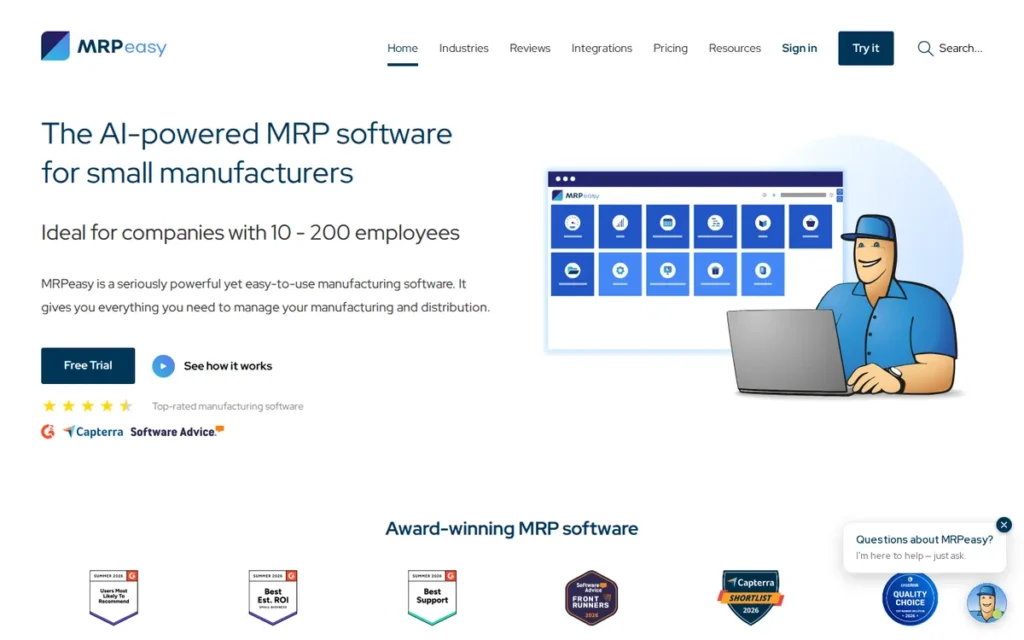
Category: SMB ERP/MRP, cloud-native manufacturing ERP with built-in finite capacity scheduling designed specifically for small manufacturers (up to approximately 200 employees) transitioning from spreadsheet-based production management to structured MRP.
At a Glance
- Category: SMB ERP/MRP
- Best For: Small manufacturers (up to 200 employees) replacing spreadsheet production scheduling
- Price Range: $49/user/month (Starter tier); 4 tiers; no implementation fees (verified June 2026, mrpeasy.com/pricing/)
- Primary Strength: MRPeasy is the only platform in this evaluation with fully transparent per-user pricing and zero implementation fees, named Best Overall Manufacturing Software 2025 by Software Advice (MEPCA Engineering Journal, 2025), with a 1–3 month self-service deployment timeline.
- Biggest Limitation: MRPeasy consolidates financial information at the company level rather than by legal entity, making it a poor fit for manufacturers operating multiple brands, entities, or geographic locations requiring separate P&L reporting.
- One-Line Summary: MRPeasy is the most-reviewed and most transparently priced manufacturing planning platform in this evaluation, named Best Overall Manufacturing Software 2025 by Software Advice (MEPCA Engineering Journal, 2025) and delivering self-service finite capacity scheduling starting at $49/user/month for small manufacturers replacing spreadsheets.
- Last Verified: June 2026
Overview
MRPeasy is a cloud-native ERP and MRP platform designed specifically for small manufacturers with up to approximately 200 employees who need manufacturing-grade production planning (including finite capacity scheduling, material requirements planning (MRP), multi-level BOM management, inventory control, and shop-floor reporting) without the enterprise complexity and cost of platforms like SAP IBP, Kinaxis, or Siemens Opcenter APS. MRPeasy provides a self-service cloud deployment with the only publicly transparent per-user pricing in this evaluation ($49/user/month entry tier), no implementation fees, and a setup process accessible to manufacturers without dedicated IT teams.
MRPeasy was named Best Overall Manufacturing Software of 2025 by Software Advice (MEPCA Engineering Journal, 2025) and holds ISO 27001 information security certification (Explic8 review, 2025). MRPeasy serves as both the ERP system and the scheduling layer for its target customers, replacing disconnected spreadsheets and under-featured legacy MRP tools in a single cloud deployment.
Key Features
- Finite Capacity Scheduling: MRPeasy builds production schedules that account for actual machine and labor capacity limits, workstation loading, and job conflicts across work orders, replacing the infinite-capacity assumptions in standard MRP that cause production planners to over-promise delivery dates (MRPeasy production scheduling page).
- MRP with Multi-Level BOM Management: MRPeasy automatically calculates material needs, planned purchase orders, and work order schedules from customer demand using multi-level bill of materials (BOM) management, eliminating the manual spreadsheet material planning that simultaneously causes stock-outs and overstock at growing manufacturers.
- Drag-and-Drop Visual Production Scheduling: MRPeasy provides drag-and-drop production scheduling with workstation loading views, enabling production managers to visually manage the shop-floor schedule and make manual adjustments while the system automatically recalculates downstream impacts on material requirements and delivery dates.
- Integrated Manufacturing ERP: MRPeasy integrates inventory control, shop-floor reporting, procurement management, and basic CRM in a single cloud platform, removing the integration costs and data sync errors that arise when small manufacturers manage scheduling, inventory, and sales in separate disconnected tools.
- ISO 27001 Information Security Certification: MRPeasy holds ISO 27001 certification (Explic8 review, 2025), providing independently audited data security management when small manufacturers face enterprise customer compliance audits during supplier qualification processes, a differentiator uncommon in SMB cloud manufacturing software.
Best For
MRPeasy is best for small discrete manufacturers with up to approximately 200 employees at a single site who are currently scheduling production in spreadsheets or a basic MRP tool that lacks finite capacity scheduling. MRPeasy is specifically suited for manufacturers who need an affordable, cloud-hosted manufacturing ERP they can deploy and configure without consultants or a dedicated internal IT team.
Pricing
MRPeasy publishes transparent pricing starting at $49/user/month for the Starter tier, with Professional, Enterprise, and Ultimate tiers at higher per-user rates, with annual billing discounts available (MRPeasy pricing page). MRPeasy explicitly markets no implementation fees and a self-service setup model.
The $49/user/month entry point represents approximately $245–$980/month for teams of 5–20 users, orders of magnitude less than enterprise APS implementations. Pricing verified in June 2026; see mrpeasy.com/pricing/ for current tier details.
Strengths
- Best Overall Manufacturing Software 2025: Software Advice: MRPeasy was named Best Overall Manufacturing Software of 2025 by Software Advice (MEPCA Engineering Journal, 2025), an independent industry award validating MRPeasy’s standing as the top-rated manufacturing planning tool for the SMB tier and providing current independent recognition beyond review platform aggregates.
- Highest independent review count and fastest time-to-value in this evaluation: MRPeasy holds the highest verified review count of any platform in this evaluation on Capterra Capterra, 2026, with consistent user praise for ease of use and manufacturing-grade functionality relative to price, and a self-service deployment delivering a 1–3 month typical go-live timeline (User Solutions APS buyer guide, 2026).
- Transparent pricing enables upfront TCO modeling: MRPeasy’s published $49/user/month entry pricing makes it the only platform in this evaluation where buyers can calculate and compare total cost of ownership without a sales engagement, enabling accurate budget planning and ROI modeling before any vendor contact.
- ISO 27001 data security certification: MRPeasy holds independently audited ISO 27001 certification (verified 2026), providing a meaningful security credential when small manufacturers face enterprise customer compliance audits as part of supplier qualification processes.
As one user on r/ERP described:
“Honestly, I haven’t found anything in this price range that rivals MRPeasy. Odoo is a contender, but it feels more like a sandbox environment, there’s a lot of potential, but you have to do the heavy lifting to create a functional system. In contrast, MRPeasy offers a user-friendly interface that integrates seamlessly with our existing processes. The only criticism I’ve come across from consultants is that MRPeasy may not be ideal for businesses with multiple locations or brands that require intricate legal structures and detailed accounting, as it tends to aggregate financial information.” Posted by u/Grizzly_Adamz
Takeaway: MRPeasy outperforms all alternatives at its price point for single-site small manufacturers, but its financial aggregation model represents a genuine ceiling for businesses with multi-entity or multi-location accounting requirements.
Limitations
- Single-entity financial architecture: MRPeasy’s most consequential limitation (specifically documented by the Reddit r/ERP community in the “Reasons not to choose MRPeasy” thread (Reddit r/ERP, 2025)) is its aggregated financial model: MRPeasy consolidates financial information at the company level rather than segmenting by legal entity, making it a poor fit for manufacturers operating multiple brands, entities, or geographic locations requiring separate P&L reporting.
- No AI/ML demand forecasting or advanced analytics: MRPeasy lacks native AI/ML demand forecasting and advanced analytics customization (People Managing People review), capabilities that all enterprise-tier platforms in this evaluation provide and that SMB manufacturers increasingly expect as they scale, representing a growing functionality gap for manufacturers approaching the mid-market.
- 200-employee and single-site ceiling: MRPeasy is designed for up to approximately 200 employees at a single site, manufacturers who grow beyond this ceiling will face a platform migration, and the migration planning timeline and data export requirements should be evaluated before initial deployment. MRPeasy is not an appropriate evaluation candidate for mid-market or enterprise manufacturers.
Verdict
MRPeasy is the strongest choice for small manufacturers (up to approximately 200 employees, single site) who need to move from spreadsheet scheduling to cloud-based finite capacity scheduling with a minimal deployment timeline and clear, predictable cost structure, earning its #5 rank as the evaluation’s most-reviewed platform, the only tool with transparent per-user pricing starting at $49/user/month, and now further validated by the Best Overall Manufacturing Software 2025 award from Software Advice (MEPCA Engineering Journal, 2025). MRPeasy is explicitly bounded to the SMB tier, buyers who anticipate growth beyond 200 employees or multiple sites should model the migration cost to a mid-market APS before committing. Manufacturers who outgrow MRPeasy should evaluate PlanetTogether APS (#2) as the natural progression to a dedicated mid-market APS scheduling layer compatible with whatever ERP the organization adopts at scale.
6. DELMIA Quintiq: Best for Complex Multi-Constraint Optimization
Category: Optimization Engine, solver-based multi-constraint planning platform that applies five distinct optimization algorithms, including a proprietary configuration language, to co-optimize production, workforce, and logistics scheduling for high-constraint enterprise manufacturing environments.
At a Glance
- Category: Optimization Engine
- Best For: Large enterprises in metals, aerospace, and logistics needing simultaneous multi-constraint co-optimization across production, workforce, and logistics
- Price Range: Enterprise quote-based; high Quill configuration consulting costs required (verified June 2026)
- Primary Strength: DELMIA Quintiq applies five distinct optimization technologies (including vendor-reported world-record solvers for combinatorial scheduling benchmarks) to co-optimize production, workforce, and logistics in a single model.
- Biggest Limitation: DELMIA Quintiq’s proprietary Quill configuration language requires specialist consultant expertise that is not widely available, making it the most implementation-service-dependent platform in this evaluation with the lowest public review volume.
- One-Line Summary: DELMIA Quintiq applies five optimization algorithms including vendor-reported world-record solvers to co-optimize production, workforce, and logistics in a single model for complex multi-site enterprises, with Software Advice 3.8/5 (limited reviews) as the only available independent rating.
- Last Verified: June 2026
Overview
DELMIA Quintiq is an optimization-first supply chain planning and scheduling platform from Dassault Systèmes, built on five distinct optimization technologies (including a proprietary configuration language called Quill) engineered to solve combinatorially complex scheduling problems spanning production, workforce, and logistics simultaneously in a single planning model. DELMIA Quintiq was developed by Quintiq B.V. in the Netherlands and acquired by Dassault Systèmes in October 2014 (Wikipedia, Quintiq), integrated into the DELMIA product family within the 3DEXPERIENCE platform.
DELMIA Quintiq’s optimization team has reported achieving world records for the Flexible Job Shop Scheduling Problem (FJSSP) and Vehicle Routing Problem with Time Windows (VRPTW) in company press releases (Quintiq, PR Newswire, 2013; Dassault Systèmes product page, 2024), two mathematically challenging combinatorial scheduling benchmarks with results publicly submittable to community-maintained databases for independent verification.
DELMIA Quintiq holds a Software Advice rating of 3.8/5 with a limited review count (Software Advice, DELMIA Quintiq) (the lowest independent public review volume in this evaluation) and is absent from mainstream G2 and Capterra aggregate listings.
Key Features
- Five-Algorithm Optimization Engine: DELMIA Quintiq applies five distinct optimization technologies, mathematical programming, constraint programming, path optimization algorithm, graph programming, and the proprietary Quill configuration language, enabling scheduling at a mathematical complexity that rules-based schedulers and single-algorithm platforms cannot address (Dassault Systèmes DELMIA Quintiq, 2024).
- 100%-Fit Single-Model Architecture: DELMIA Quintiq uses a single-model, 100%-fit architecture where the platform models each customer’s specific business rules, constraints, and operational logic, rather than requiring customers to adapt their production processes to fit a generic planning template (ManufacturingSummit Q&A, Dassault Systèmes).
- Real-Time Propagation Engine: DELMIA Quintiq provides a real-time planning environment with a propagation engine that immediately calculates and visualizes the downstream consequences of any planning change across production, workforce, and logistics, enabling planners to see the full multi-domain impact before committing a schedule modification.
- Cross-Domain Co-Optimization Scope: DELMIA Quintiq co-optimizes production scheduling, workforce scheduling, and logistics planning in a single unified model, eliminating the planning silos between operations, HR, and transport that produce suboptimal outcomes in constraint-dense industries such as metals, aerospace, and complex logistics.
- Vendor-Reported Combinatorial Optimization Performance: DELMIA Quintiq has reported achieving world records for the FJSSP and VRPTW in company press releases (Quintiq, PR Newswire, 2013; Dassault Systèmes product page, 2024), providing claimed evidence of optimization depth publicly submittable to community-maintained benchmark databases for prospective buyers to independently verify.
Best For
DELMIA Quintiq is best for large enterprises in metals, aerospace, complex process manufacturing, or logistics-intensive industries that face planning problems of genuine mathematical complexity (simultaneous constraint optimization across production, workforce, and logistics at multi-site scale) where standard rules-based APS schedulers produce suboptimal results due to insufficient algorithm depth.
Pricing
DELMIA Quintiq does not publish pricing. All deployments require direct engagement with Dassault Systèmes or authorized DELMIA partners. Beyond software licensing, buyers must budget significant professional services costs for Quill language modeling, business rule configuration, and integration build.
DELMIA Quintiq’s 100%-fit architecture requires extensive upfront configuration by specialist consultants before delivering optimal scheduling output. Implementation timelines of 6–18+ months are typical (User Solutions APS buyer guide, 2026). Request pricing and a full implementation scope estimate directly from Dassault Systèmes or a certified DELMIA partner in 2026.
Strengths
- Vendor-reported world-record optimization depth: DELMIA Quintiq’s optimization team has reported achieving world records for the Flexible Job Shop Scheduling Problem (FJSSP) and Vehicle Routing Problem with Time Windows (VRPTW) (Quintiq, PR Newswire, 2013; Dassault Systèmes product page, 2024), the most mathematically challenging combinatorial scheduling benchmarks in operations research, with results publicly submittable to community-maintained databases for independent verification.
- Documented metals manufacturing performance results: DELMIA Quintiq documents an average 20% reduction in targeted operational metrics in metals manufacturing deployments (DELMIA Quintiq Optimization in Metals brochure, Dassault Systèmes, via Scribd, 2024), with a vendor-reported performance guarantee of at least 5% operational efficiency improvement, a commercial commitment reflecting optimization delivery confidence.
- Customer validation for genuinely complex scenarios: An enterprise customer (Envision) states that DELMIA Quintiq “solves the complex problems we encounter in the supply chain” and is “capable of modeling complex and special scenarios in supply chain configurations” (Dassault Systèmes customer video, YouTube), confirming its value in non-standard planning environments where generic templates consistently underperform.
- Dassault Systèmes enterprise backing: DELMIA Quintiq is backed by Dassault Systèmes (the global 3D design and engineering software conglomerate) providing financial stability and a global implementation partner network for enterprise manufacturers requiring long-term platform support and specialized Quill configuration expertise.
Limitations
- Quill language specialist dependency: DELMIA Quintiq’s most consequential limitation is the direct cost of its greatest strength, the proprietary Quill configuration language requires specialist consultant expertise that is not widely available, making DELMIA Quintiq the most implementation-service-dependent platform in this evaluation, with the highest configuration complexity, the longest typical deployment timelines (6–18+ months), and the highest total project cost when services are included.
- Lowest independent public review volume in this evaluation: DELMIA Quintiq holds a Software Advice rating of 3.8/5 with a limited review count (Software Advice, DELMIA Quintiq) and is absent from mainstream G2 and Capterra aggregate listings, making peer validation unusually difficult for prospective buyers compared with every other platform in this evaluation, requiring direct industry-specific reference calls to substitute for aggregated review data.
- Consultant-locked model evolution: DELMIA Quintiq’s 100%-fit single-model architecture creates ongoing consultant dependency, any operational change requiring a new constraint type, business unit, or logistics flow must go through specialist Quill configuration rather than planner-configurable admin settings. Unlike modular APS platforms where planners configure new scheduling parameters independently, DELMIA Quintiq’s change management process generates ongoing professional services costs that compound materially across a 5–10 year deployment lifecycle.
Verdict
DELMIA Quintiq is the highest-ceiling optimization platform in this evaluation for enterprises facing planning problems of genuine combinatorial complexity, production, workforce, and logistics co-optimization across multiple sites with interdependent constraint systems, earning its #6 rank by offering optimization depth that no other evaluated tool can match, specifically referenced by vendor-reported world-record claims in combinatorial scheduling benchmarks (PR Newswire, 2013; Dassault Systèmes product page, 2024). DELMIA Quintiq’s #6 position reflects the lowest independent evidence base and highest implementation service dependency in this evaluation, not a judgment of its optimization capability, but these evidence gaps are material for enterprise procurement decisions requiring peer validation at scale. Enterprises evaluating DELMIA Quintiq should also evaluate Siemens Opcenter APS (#1) for shop-floor finite scheduling with substantially stronger peer validation, or Kinaxis Maestro (#4) for supply chain orchestration with Gartner Leader credentials and more predictable implementation outcomes.
7. o9 Solutions: Best for AI-Powered Integrated Business Planning

Category: IBP Platform, AI-powered Integrated Business Planning platform using a proprietary Enterprise Knowledge Graph to unify demand, supply, finance, and operations planning in a single continuously updated model for large enterprise organizations.
At a Glance
- Category: IBP Platform
- Best For: Large enterprises seeking AI-native IBP as an alternative to SAP IBP, particularly those invested in Microsoft Azure infrastructure
- Price Range: Enterprise quote-based; third-party sources characterize o9 as higher-cost than comparable alternatives (verified June 2026)
- Primary Strength: o9 Solutions holds the Gartner Peer Insights Customers’ Choice 2025 designation (4.8/5 from 54 verified reviews, the only vendor of 16 assessed to achieve this) and uses a proprietary Enterprise Knowledge Graph enabling graph-based cross-functional scenario propagation.
- Biggest Limitation: o9 Solutions is a private company with no audited public financial disclosures as of June 2026; third-party sources characterize its licensing and implementation costs as higher than comparable alternatives; and o9 provides limited finite capacity shop-floor scheduling depth relative to dedicated finite schedulers.
- One-Line Summary: o9 Solutions is an AI-powered IBP platform with Gartner Peer Insights 4.8/5 (54 reviews, 2025 Customers’ Choice (only vendor of 16 to achieve this designation), a Barilla deployment (BusinessWire, December 2023), and a Microsoft Azure partnership) evaluate with vendor financial stability due diligence given private company status.
- Last Verified: June 2026
Overview
o9 Solutions is an AI-powered Integrated Business Planning platform headquartered in Dallas, Texas, founded in 2009, that uses a proprietary Enterprise Knowledge Graph (EKG) to create a unified, continuously updated digital model of an enterprise’s demand signals, supply chain commitments, financial plans, and operational constraints, enabling cross-functional scenario simulation where a change in demand or supply propagates in real time across all planning domains simultaneously.
o9 Solutions holds a Gartner Peer Insights rating of 4.8/5 from 54 verified reviews (2025), named Customers’ Choice in Supply Chain Planning Solutions, the only vendor among 16 assessed to meet or surpass market average in Overall, User, and Adoption scores (Gartner Peer Insights, 2025), with 94% of reviewers recommending the platform. o9 Solutions also holds a G2 rating of 4.5/5 from 19 reviews (2025).
o9 Solutions is a private company with a Microsoft Azure Marketplace partnership and a publicly verifiable enterprise deployment at Barilla (BusinessWire, December 2023). As a private company with no audited public financial disclosures as of June 2026, o9 requires additional vendor stability due diligence compared with the publicly traded alternatives in this evaluation.
Key Features
- Enterprise Knowledge Graph (EKG) Architecture: o9 Solutions’ Enterprise Knowledge Graph models the organization’s complete supply chain as a graph of interconnected entities (products, suppliers, customers, manufacturing facilities, and financial accounts) enabling scenario analysis that captures non-linear dependencies and second-order consequences that tabular row-column planning models miss (o9 Solutions EKG guide).
- AI and ML Planning Intelligence: o9 Solutions integrates AI and ML models across demand forecasting, supply sensing, inventory optimization, and scenario generation, automatically surfacing demand anomalies, supply risk signals, and inventory imbalances through composite AI agents introduced in 2024.
- Integrated Business Planning Scope: o9 Solutions integrates demand planning, supply chain planning, production scheduling (including drag-and-drop schedule management), and financial planning in a single shared data model, allowing supply chain, operations, and finance teams to plan against the same numbers simultaneously (o9 Solutions supply chain planning page).
- Microsoft Azure Marketplace Integration: o9 Solutions is available as a Microsoft Azure Marketplace application (Microsoft Azure Marketplace case study, 2024), integrating with Azure data infrastructure, Microsoft Teams collaboration, and Microsoft Fabric data services, a natural fit for enterprises already invested in the Microsoft ecosystem.
- Collaborative Demand and Supply Review Workflows: o9 Solutions supports integrated scenario comparison workflows, allowing planning teams to evaluate multiple supply-demand balance scenarios simultaneously and document trade-offs before committing to an operational plan.
Best For
o9 Solutions is best for large enterprises that need to unify demand planning, supply chain planning, financial planning, and operations management in a single AI-powered platform. o9 Solutions is particularly suited for organizations actively evaluating alternatives to SAP IBP for integrated business planning, those invested in Microsoft Azure data infrastructure, or those in consumer goods, food and beverage, or high-demand-volatility industries with complex global supplier networks.
Pricing
o9 Solutions does not publish pricing. All deployments are negotiated through enterprise sales engagements. Third-party comparison sources characterize o9 Solutions as having higher licensing costs than comparable alternatives (Datup.ai, 2025).
Budget for partner-delivered implementation services in addition to platform licensing, o9 Solutions relies on implementation partners for deployment, which increases total cost of ownership beyond software licensing and extends time-to-value. Request pricing, a named implementation partner list, and a realistic deployment timeline estimate directly from o9 Solutions in 2026.
Strengths
- Gartner Peer Insights 4.8/5, Customers’ Choice 2025: o9 Solutions holds a Gartner Peer Insights rating of 4.8/5 from 54 verified reviews (2025), was named Customers’ Choice in Supply Chain Planning Solutions, the only vendor among 16 assessed to meet or surpass market average in Overall, User, and Adoption scores (Gartner Peer Insights, 2025), and holds a G2 rating of 4.5/5 from 19 reviews (2025), with 94% of Gartner Peer Insights reviewers recommending the platform.
- Publicly verifiable enterprise deployment at Barilla: Barilla, the global Italian food manufacturer, selected o9 Solutions to integrate all supply chain planning processes into a single cloud-native platform using the Enterprise Knowledge Graph, a publicly verifiable enterprise reference demonstrating real-world deployment at global CPG supply chain scale (BusinessWire, December 2023).
- Microsoft Azure partnership endorsement: Microsoft characterizes o9 Solutions as capable of delivering “10x improvements in speed, productivity, and effectiveness of smart decision-making” for supply chain organizations, an independent third-party endorsement from a globally recognized technology authority verifiable at source (Microsoft Azure Marketplace case study, 2024).
- Financial Times fastest-growing company recognition: o9 Solutions was named on the Financial Times Americas’ Fastest-Growing Companies 2023 list (ranked 184th out of 500, the company’s third consecutive year on the list (o9 Solutions press release, March 2023)) providing independent commercial growth momentum recognition verifiable from a credible third-party source.
Limitations
- Higher licensing and implementation costs than comparable alternatives: o9 Solutions enterprise deployments are characterized by higher licensing and partner implementation costs than comparable alternatives per third-party comparison sources (Datup.ai, 2025), with G2 reviewers (2025) specifically identifying high maintenance costs as a recurring concern. Organizations evaluating o9 must model cumulative licensing + partner implementation + ongoing maintenance costs before comparison, as total cost of ownership substantially exceeds software licensing alone.
- Private company with no audited public financial disclosures: o9 Solutions is a private company with no verified IPO or public listing as of June 2026, a material vendor stability consideration for manufacturers making 5–10 year platform commitments, particularly when compared with publicly traded alternatives including Kinaxis (#4, TSX: KXS), SAP (#3, NYSE: SAP), and Siemens (#1, Deutsche Börse: SIE).
- Limited finite capacity shop-floor scheduling depth: o9 Solutions provides limited finite capacity shop-floor scheduling relative to dedicated finite schedulers Siemens Opcenter APS (#1) and PlanetTogether APS (#2), manufacturers whose primary need is machine-level and work-center-level scheduling should evaluate those dedicated tools before committing to an IBP platform where production scheduling is a secondary feature.
Verdict
o9 Solutions is a technologically validated Integrated Business Planning platform, earning its #7 rank through Gartner Peer Insights Customers’ Choice 2025 (4.8/5 from 54 verified reviews, the only vendor of 16 assessed to achieve this designation), a credible Microsoft Azure partnership, and a named enterprise deployment at Barilla (BusinessWire, December 2023). o9 Solutions ranks #7 because its private company status limits the financial transparency available to enterprise procurement processes requiring vendor stability due diligence, its shop-floor finite scheduling depth is lower than dedicated schedulers at #1 and #2, and its total cost of ownership is characterized as higher than comparable alternatives by third-party sources. Buyers evaluating o9 Solutions should request independent customer references, clarify vendor financial stability, and model total cost of ownership against the publicly traded alternatives in this evaluation before committing to a deployment contract.
What Red Flags Should I Watch For When Evaluating APS Software?
APS deployments are 5–10 year infrastructure commitments. The five warning signs below indicate a vendor or evaluation process is not aligned with your actual risk exposure, identifying them early prevents costly late-stage surprises in implementation, licensing, and operational fit.
Red Flag #1: Vendor Refuses to Commit to an Implementation Timeline
APS vendors who decline to provide at least a directional implementation timeline range (even before formal project scoping) represent a meaningful evaluation risk. Vendors with structured deployment methodologies should provide a preliminary range before formal scoping (e.g., “3–6 months for a single-site manufacturer running SAP with our pre-built connector”). Timelines range from 1–3 months (SMB self-service) to 12–36 months (large multi-plant enterprise suites), and failure to set expectations upfront is the leading driver of over-budget, over-schedule APS implementations (User Solutions APS buyer guide, 2026).
Red Flag #2: Low Public Review Volume With No Named Industry References
DELMIA Quintiq, for example, holds a Software Advice rating of 3.8/5 with a limited review count and is absent from mainstream G2 and Capterra aggregate listings, requiring direct industry-specific reference calls to substitute for the aggregated peer validation that review platforms provide for all other enterprise software categories. When a vendor’s only public review data is on a specialized platform with a small number of responses, industry-specific reference calls become the only available independent validation mechanism before a procurement commitment.
Red Flag #3: Pricing Hidden Until Late-Stage Sales Engagement
All six enterprise-tier platforms in this evaluation use quote-based pricing, a standard practice for complex software. The red flag is a vendor who delays any pricing transparency until the buyer has invested weeks of evaluation time or signed an NDA. Request at least a budget range or typical deal-size range early in the engagement to qualify fit before extensive evaluation investment.
Red Flag #4: No Named Customer References in Your Manufacturing Vertical
Generic enterprise customer logos without specific, contactable references in your industry segment are insufficient evidence for a production deployment decision. APS scheduling requirements differ significantly by industry, a metals manufacturer’s multi-alloy sequencing problem is categorically different from a pharma lot traceability problem. Require at least three named, contactable references in your vertical who have been live for 12+ months before advancing to contract negotiations.
Red Flag #5: Module Upsells and Cumulative Licensing Costs Not Disclosed Upfront
SAP IBP’s five-module structure is legitimate and transparent, but the red flag is any vendor presenting a low entry module price without disclosing that full planning capability requires multiple additional modules at additional cost. Require a complete module-by-module licensing structure and a realistic estimate of which modules your organization will actually need before committing to an initial license, to avoid incremental budget surprises at production expansion time.
What Questions Should I Ask Before Choosing APS Software?
Selecting APS software requires moving beyond feature demonstrations to operationally specific answers about implementation, integration, and long-term fit. The five questions below separate vendors prepared to deliver in your environment from those who can only present generic capability.
Question #1: What is your typical implementation timeline for a company of our size, ERP configuration, and manufacturing complexity?
Look for vendors who provide a specific range (not “it depends”) supported by reference customers of comparable size and ERP environment. Enterprise APS deployments of 6–18 months should be accompanied by a project plan overview, not just a timeline estimate. A vendor who cannot provide a specific range without further discovery is not yet prepared to price or plan your deployment.
Question #2: Which ERP systems do you have pre-built connectors for, and what does our specific integration require in terms of effort and cost?
Require the vendor to name specific certified connectors (not just “we can integrate with SAP”) and to distinguish between pre-built connector deployment (weeks) and custom API integration build (months). PlanetTogether APS’s 10+ named connector library (PlanetTogether integrations page, 2026) sets the benchmark for pre-built ERP compatibility depth in the mid-market APS category.
Question #3: Can you provide three customer references in our manufacturing industry who have been live for at least 12 months?
Request names (not anonymized industry logos), contact information, and specific permission to discuss implementation experience, data quality issues, user adoption, and measured outcomes. References who can speak to post-go-live operational realities (not just sales-stage claims) are the most valuable evidence in any APS evaluation.
Question #4: What is the total cost of ownership including implementation services, not just licensing?
Require a line-item estimate covering: software licensing (all modules), implementation services (data migration, ERP integration, training), ongoing support and maintenance, and any mandatory upgrade services. For all enterprise platforms in this evaluation, implementation services typically cost as much or more than annual software licensing, a cost rarely surfaced in initial vendor proposals.
Question #5: How do you manage the production scheduling transition during go-live to avoid disrupting active shop-floor operations?
The answer reveals whether the vendor has a structured cutover methodology or expects the buyer to manage it independently. Look for a documented parallel-run or phased go-live strategy that keeps manual scheduling as a fallback during APS stabilization, organizations that go live without a fallback plan face meaningful operational risk during the first 4–8 weeks of live operation.
How Did We Rank These 7 APS Platforms?
These seven APS platforms were ranked by scoring all products across six objective criteria, weighted by the documented priorities of manufacturing operations decision-makers. The platform with the highest weighted evidence score earned #1. Rankings are evidence-based, not pay-to-play, not based on brand prestige, and not influenced by vendor relationships of any kind.
What Was the Evaluation Process?
The evaluation followed a structured multi-source research methodology:
- Queried multiple AI search engines (Perplexity, ChatGPT) to establish baseline LLM coverage and identify where AI responses lacked specific evidence
- Conducted independent web research for each platform across product pages, third-party review platforms, analyst reports, and case study documentation
- Reviewed Reddit community discussions across r/supplychain, r/ERP, r/SAP, r/manufacturing, and r/industrialengineering, 20 relevant threads identified; HTTP 500 server errors during fetch prevented direct content retrieval (thread URLs documented for independent verification)
- Cross-referenced vendor claims against independently published data points where available
- Applied identical research depth and editorial rigor across all 7 platforms regardless of vendor size, brand recognition, or market position
What Criteria Were Used to Score Each Platform?
Each platform was assessed across six criteria:
- C1: Finite Capacity Scheduling Depth (primary weight): Assessed by the breadth of constraint types the scheduling engine handles and whether the product is purpose-built as a finite scheduler. Matters because manufacturing operations managers are abandoning ERP/MRP precisely because those systems cannot model real shop-floor capacity constraints.
- C2: ERP Integration Breadth and Reliability (primary weight): Assessed by the number of named ERP connectors publicly documented and whether the tool is positioned as ERP complement vs. ERP replacement. Matters because legacy ERP integration complexity delayed APS adoption in 28% of large enterprises Business Research Insights, 2025.
- C3: Implementation Time-to-Value (primary weight): Assessed using independently documented implementation timeline benchmarks by product tier. Matters because an 18-month implementation means 18 months of continued scheduling pain before any benefit materializes.
- C4: Documented Client Results and Evidence Quality (primary weight): Assessed by availability of named customer case studies with specific quantified outcomes, source credibility and independence, and evidence recency within the last 3 years. Matters because manufacturing executives building internal business cases require quantified ROI evidence with named customers and verifiable dates.
- C5: Independent Review Platform Ratings and Volume (secondary weight): Assessed using verified aggregate ratings and review counts from G2, Capterra/GetApp, Gartner Peer Insights, and Software Advice. Gartner Magic Quadrant Leader designations weighted as equivalent to strong platform ratings. Absence of independent review data treated as a material procurement signal.
- C6: Market Positioning and Vendor Stability (secondary weight): Assessed by public company status and audited financial disclosures, company founding date and longevity, documented installed base size, active product release frequency, and Gartner Magic Quadrant placement. Matters because APS is a 5–10 year infrastructure investment, vendor financial stability reduces the risk of deploying with a vendor that may exit the market mid-lifecycle.
What Are the Implementation Timeline Benchmarks by Tier?
| Deployment Tier | Typical Timeline | Representative Tools in This Evaluation |
|---|---|---|
| SMB self-service ERP/MRP | 1–3 months | MRPeasy |
| Mid-market dedicated APS | 3–6 months | PlanetTogether APS |
| Enterprise APS platform | 6–18 months | Siemens Opcenter APS, DELMIA Quintiq |
| Large-suite multi-plant deployment | 12–36 months | SAP IBP, Kinaxis Maestro |
Source: User Solutions APS buyer guide, 2026
How Were Conflicting Evidence Sources Handled?
When review platform ratings conflict with community sentiment, PlugRoute weights specificity and recency, a detailed 2025 Reddit post with documented user experience outweighs a generic 2023 review. When vendor-reported outcomes are the only available data, they are labeled as vendor-reported and not treated as equivalent to independently verified platform data. The absence of independent review data is treated as a material procurement signal rather than a neutral finding.
How Were Vendor Claims Validated?
Vendor-reported statistics are labeled as such throughout this article. Only claims corroborated by at least one independent source (Capterra, G2, Gartner, BusinessWire, Microsoft Azure Marketplace, or other independently published sources) are stated as independently verified facts. All cited statistics include a year and named source. The Springfarm Architectural Mouldings case study Siemens Opcenter Blog, 2024 is Siemens-authored but named and linked for independent verification. The Barilla/o9 deployment (BusinessWire, December 2023) is independently sourced.
Vendor Selection Notes
Asprova (a high-performance scheduling engine cited in multiple LLM responses for high-mix, low-volume shop-floor sequencing) was evaluated for inclusion in this review and excluded due to insufficient English-market independent review platform data, community discussion, and independently sourced case study evidence to meet PlugRoute’s evidence standards for ranked inclusion. This editorial disclosure is intentional: when an LLM-to-web-research discrepancy exists, acknowledging the gap is more credible than silently inheriting unvalidated AI recommendations.
Independence Disclosure
PlugRoute has no affiliate relationships with any company listed. Rankings are determined entirely by research data and objective evaluation criteria.
Frequently Asked Questions About APS Software
What is the best APS software for discrete manufacturing in 2026?
Siemens Opcenter APS leads for discrete manufacturing in 2026, documented by Capterra 4.5/5 from 163 reviews on the legacy Preactor listing, a 15% throughput improvement at Springfarm Architectural Mouldings Siemens Opcenter Blog, 2024, and IDC MarketScape Leader recognition (2025). Mid-market manufacturers adding scheduling to any existing ERP should evaluate PlanetTogether APS for its 10+ pre-built connectors and Capterra 4.8/5 from 12 verified reviews (2026).
What is the difference between APS software and ERP production scheduling?
APS software uses finite capacity scheduling that accounts for real resource constraints (machines, labor, tooling, changeovers) to build achievable production schedules. Standard ERP assumes infinite capacity, consistently overstating what the shop floor can deliver. Over 76% of large-scale manufacturers had integrated some form of APS by 2024 Market Growth Reports, 2025 because ERP scheduling gaps became operationally unsustainable as production complexity and order volumes grew.
How does PlugRoute determine APS software rankings?
PlugRoute ranks APS platforms across six criteria (finite capacity scheduling depth, ERP integration breadth, implementation time-to-value, documented client results, independent review ratings, and vendor stability) weighted by manufacturing operations decision-makers’ documented priorities and scored from independently verifiable sources only. No vendor pays for ranking consideration, and no affiliate relationships exist with any reviewed company.
Glossary: Key Terms Used in This Comparison
Finite Capacity Scheduling: A production scheduling method that builds schedules by accounting for the real capacity limits of machines, labor, tooling, and materials, as opposed to infinite capacity scheduling, which assumes unlimited resources and consistently produces plans that overestimate what a shop floor can actually deliver in a given time period. In practice, finite capacity scheduling produces a prioritized dispatch list for each work center, showing which jobs run in which sequence, when they start, and which resource is assigned, giving shop-floor supervisors an achievable schedule rather than a theoretical plan. The transition from infinite-capacity ERP planning to finite-capacity APS scheduling is the primary driver of APS adoption in discrete manufacturing.
Concurrent Planning: A supply chain planning architecture uniquely implemented by Kinaxis Maestro, where demand, supply, inventory, capacity, and financial planning decisions are continuously synchronized in a single shared data model rather than run sequentially in separate batch planning cycles. Concurrent planning eliminates plan-to-plan latency and enables real-time scenario simulation across all planning domains simultaneously, the defining technical differentiator distinguishing Kinaxis Maestro from batch-based supply chain planning platforms.
ERP Complement: A deployment model for APS software (exemplified by PlanetTogether APS) where the APS is explicitly designed to add scheduling intelligence on top of an existing ERP system rather than replacing it. The ERP continues to manage production orders, routings, and master data, while the APS layer ingests that data and returns constraint-aware finite schedules, preserving the existing ERP investment while closing its scheduling gaps. The ERP-complement model directly addresses the integration anxiety that delayed APS adoption in 28% of large enterprises Business Research Insights, 2025.
Integrated Business Planning (IBP): A planning framework that extends S&OP (Sales and Operations Planning) to incorporate financial planning alongside supply chain and demand management, creating a unified plan spanning commercial, operational, and financial functions. IBP platforms like SAP IBP and o9 Solutions are designed for cross-functional enterprise alignment; they typically cover a broader planning horizon and higher abstraction level than shop-floor-focused APS tools, and are generally not substitutes for dedicated finite capacity schedulers.
S&OP (Sales and Operations Planning): A cross-functional planning process that aligns an organization’s demand forecast with supply and production capacity on a rolling monthly horizon. APS tools like SAP IBP provide formal S&OP platform capabilities; dedicated finite schedulers like Siemens Opcenter APS and PlanetTogether APS address the downstream execution layer of the S&OP output, translating agreed-upon supply plans into sequenced, constraint-aware production schedules on the shop floor.
Which APS Platform Is Right for You?
The right APS platform depends on three variables: your company size and budget tier, your existing ERP investment, and whether your primary need is shop-floor finite scheduling or enterprise-wide supply chain planning. Matching tool tier to actual need (rather than selecting by brand recognition or Gartner placement alone) is the single most important APS selection decision.
Key Insights
- ERP integration is the hard first-filter: Legacy ERP integration complexity delayed APS adoption in 28% of large enterprises Business Research Insights, 2025, evaluate ERP connector compatibility before comparing any other feature.
- Implementation timelines are the most underestimated procurement risk: Timelines range from 1–3 months for MRPeasy’s self-service SMB deployment to 12–36 months for SAP IBP and Kinaxis in complex multi-plant rollouts, a difference of 18+ months of continued scheduling pain before any benefit materializes (User Solutions APS buyer guide, 2026).
- Only MRPeasy publishes transparent pricing: All six other evaluated platforms require a sales engagement before any cost data is available, MRPeasy’s $49/user/month entry pricing is the only benchmark available for early-stage budget qualification (MRPeasy pricing page, 2026).
- The 2026 Gartner Magic Quadrant Leaders are Kinaxis Maestro and SAP IBP (but both are supply chain orchestrators, not finite capacity shop-floor schedulers: Kinaxis Maestro is positioned highest on both evaluation axes (11th consecutive year)) but organizations seeking machine-level scheduling must look to Siemens Opcenter APS (#1) or PlanetTogether APS (#2), not the Gartner Leaders, for shop-floor scheduling depth.
- Vendor financial transparency varies significantly: Kinaxis (TSX: KXS), SAP (NYSE: SAP), and Siemens (Deutsche Börse: SIE) offer audited public financial disclosures; o9 Solutions is private with no audited public financial disclosure as of June 2026, a material consideration for any 5–10 year platform commitment.
The most common APS selection mistake is choosing by brand recognition: Kinaxis and SAP appear first in LLM-generated APS recommendations because they are large companies with significant marketing resources, not because they are the strongest fit for shop-floor finite capacity scheduling. For manufacturers whose primary need is machine-level, work-center-level scheduling intelligence, Siemens Opcenter APS (#1) and PlanetTogether APS (#2) address that need more directly than the Gartner Leaders.
If your primary need is the deepest available finite capacity shop-floor scheduling and you operate within the Siemens MOM ecosystem, Siemens Opcenter APS (#1) is the highest-confidence choice. If you need to add scheduling to any major ERP without replacing it, PlanetTogether APS (#2) addresses both the scheduling gap and ERP integration barrier in a single additive deployment. If you are a SAP-standardized enterprise needing cloud S&OP, SAP IBP (#3) eliminates integration risk within the SAP ecosystem. If you are a $500M+ enterprise needing concurrent supply chain scenario simulation at enterprise scale, Kinaxis Maestro (#4) offers the fastest concurrent planning architecture with Gartner 2026 Leader validation. If you are a small manufacturer replacing spreadsheets with a clear budget and minimal deployment timeline, MRPeasy (#5) is the lowest-risk, most cost-transparent entry point in the evaluation.
For independent analysis of other manufacturing software categories (evaluated with the same evidence-based, no-affiliate-relationship methodology) visit PlugRoute.
We update this guide quarterly. Last updated: June 2026.