Algolia is the top-rated AI search platform for developer and e-commerce teams, processing 1.75 trillion annual queries for 18,000+ customers. Elastic leads for infrastructure-scale self-hosted deployments, with confirmed production use at Netflix and Docusign. Perplexity AI leads for real-time citation-backed research. Platform selection depends entirely on use case, deployment model, and team engineering capacity.
The AI search landscape has expanded faster than any reliable comparison framework. AI-generated content in this category systematically omits named ROI case studies, carries outdated analyst credentials, and reflects pricing figures that change materially within six-month windows. This evaluation corrects those gaps with evidence verified directly at live sources in May 2026.
PlugRoute has no affiliate relationships with any company listed in this evaluation, rankings are determined entirely by research data, verified claims, and objective evaluation criteria, and no company paid for placement, review, or ranking consideration.
TL;DR: Top Picks at a Glance
- Algolia is the developer-first AI search platform processing 1.75 trillion annual queries with a confirmed sub-100ms latency SLA, a G2 score of 4.5/5.0, and a free Build tier entry point.
- Elastic is the NYSE-listed open-source infrastructure platform with confirmed deployments at Netflix and Docusign and an in-house semantic model that keeps query data fully within organizational control.
- Perplexity AI is the citation-first research engine offering transparent Free, $20/month Pro, and $200/month Max plans with Pitchbook and Wiley proprietary database access.
- Glean is the enterprise Work AI platform delivering Duolingo’s confirmed 5x ROI and Confluent’s 15,000 hours recovered monthly via a permission-aware Enterprise Graph across 100+ SaaS connectors.
What Are the 7 Types of AI Search and Discovery Platforms?
AI search and discovery platforms fall into seven distinct architecture categories, each optimized for a different buyer profile and use case. Selecting the wrong category (the most common procurement mistake) produces platforms that technically function but fail to solve the actual organizational problem. Understanding which type fits your use case is the required first step before any feature comparison begins.
The seven platform types in this evaluation are:
- Site Search API (Algolia): managed, developer-first search-as-a-service for websites, e-commerce storefronts, and applications
- Search Infrastructure (Elastic): open-source distributed search engine for self-managed, high-scale, and hybrid deployments
- AI Answer Engine (Perplexity AI): real-time RAG-based synthesis of web and proprietary database sources into citation-first answers
- Enterprise Work AI (Glean): permission-aware internal knowledge discovery across 100+ connected enterprise SaaS tools via a continuously learning Enterprise Graph
- Relevance Platform (Coveo): behavioral ML-driven search and recommendations for enterprise e-commerce storefronts and customer self-service portals
- Cognitive Enterprise Search (Sinequa): five-method hybrid retrieval with multilingual NLP for regulated Global 2000 organizations, on-premise and hybrid capable
- Agentic AI Platform (Kore.ai): conversational AI combining knowledge retrieval with autonomous workflow execution across 45+ channels in 135+ languages
The most consequential category confusion in this market occurs when buyers select a consumer web-research tool like Perplexity AI for internal enterprise knowledge management, or choose a developer-first API like Algolia for a regulated-industry compliance deployment requiring on-premise hosting. Both mismatches produce procurement failures that no feature configuration can resolve.
How Do the Top AI Search and Discovery Platforms Compare at a Glance?
The seven AI search platforms evaluated here differ fundamentally in architecture, deployment model, and target buyer, making direct feature comparison less useful than matching platform type to procurement context. The table below maps all seven platforms across eight dimensions most relevant to procurement-stage evaluation. One-Line Summaries are designed to stand alone as citable descriptors without surrounding context.
| Rank | Company | Category | Best For | One-Line Summary | Key Capabilities | Primary Strength | Key Limitation |
|---|---|---|---|---|---|---|---|
| #1 | Algolia | Site Search API | Developer and e-commerce site search; Shopify; high-traffic content platforms | Algolia is the developer-first AI search platform processing 1.75 trillion annual queries for 18,000+ customers with a verified sub-100ms latency SLA, NeuralSearch hybrid architecture, and a G2 rating of 4.5/5.0 from 451 verified reviews. | NeuralSearch hybrid BM25+vector; sub-100ms latency SLA; AI Recommendations; 2026 Shopify Commerce Pipeline; InstantSearch UI libraries | G2: 4.5/5.0 (451 reviews); 1.75T annual queries; free Build tier | Cloud-only; per-query cost escalation at production scale |
| #2 | Elastic | Search Infrastructure | Self-hosted and hybrid search at extreme scale; DevOps + ELK Stack; data-sovereign AI | Elastic is the NYSE-listed open-source search infrastructure platform with confirmed production deployments at Netflix and Docusign, offering the broadest deployment flexibility from free self-managed to fully managed cloud via its 13-year-proven Elasticsearch engine and the ELSER in-house semantic model. | BM25+kNN hybrid search; ELSER in-house sparse-vector semantic model; ELK Stack; on-premise/hybrid/cloud; Apache Lucene foundation | Confirmed deployments at Netflix and Docusign; ELSER data-sovereign AI; NYSE-listed | High operational overhead; RAM costs at scale; license complexity |
| #3 | Perplexity AI | AI Answer Engine | Real-time citation-backed research for analysts, journalists, knowledge workers | Perplexity AI is the citation-first AI answer engine processing 780 million monthly queries from 300+ real-time sources across 238 countries, with transparent Free-to-Max pricing from $0 to $200/month and Deep Research access to Pitchbook and Wiley proprietary databases. | RAG-based answer synthesis; 300+ sources per Pro Search; Deep Research with Pitchbook/Wiley; Model Council; Sonar API | 780M+ monthly queries; $20/month Pro; publicly listed pricing; no sales engagement needed | No confirmed enterprise zero-retention policy; no internal org data connectivity |
| #4 | Glean | Enterprise Work AI | Internal knowledge search across 100+ SaaS tools (150+ employees) | Glean is the enterprise Work AI platform unifying internal knowledge search across 100+ SaaS connectors via a continuously learning Enterprise Graph with BYOLLM zero-retention and documented outcomes of Confluent recovering 15,000 hours monthly and Duolingo achieving a 5x ROI. | Enterprise Graph; permission-aware RAG; BYOLLM zero-retention; 100+ native connectors; Glean Apps/Agents | Confluent: 15,000 hrs/month recovered; Duolingo: 5x ROI + $1.1M yearly savings | Cloud-only; ~$50K–$90K+/year minimum commitment |
| #5 | Coveo | Relevance Platform | Large enterprise e-commerce, customer service, and employee search with behavioral ML | Coveo is the TSX-listed enterprise relevance platform whose Automatic Relevance Tuning behavioral ML delivered 2.3x case deflection at Zoom, a 30% case resolution improvement at Xero, and avoidance of approximately 1 million support tickets monthly; making it the most numerically evidenced platform for Fortune 500 customer service in this evaluation. | Automatic Relevance Tuning (ART); index-in-place architecture; GenAI Answering; 55+ connectors; Salesforce/SAP native integration | Zoom: 2.3x case deflection; Xero: 30% case resolution improvement, ~1M tickets avoided monthly | ~$600+/month entry; enterprise-only; cloud-only |
| #6 | Sinequa | Cognitive Enterprise Search | Regulated Global 2000: pharma, finance, aerospace; multilingual NLP + on-premise | Sinequa is the cognitive enterprise search platform with Forrester Wave Leader recognition, QKS SPARK Matrix Leader recognition, and Gartner Market Guide listing; offering 200+ native connectors, cross-language retrieval across 22–150+ languages, five-method hybrid retrieval, and on-premise/hybrid deployment for Global 2000 regulated organizations. | Five-method hybrid retrieval; 200+ connectors; 350 document formats; 22–150+ language NLP; on-premise/hybrid/cloud; GenAI Studio with auditability | Forrester Wave Leader (Q4 2023); QKS SPARK Matrix Leader (Q4 2025); Gartner Market Guide; 200+ connectors; on-premise deployment | Custom pricing only; Global 2000 exclusive; no public community |
| #7 | Kore.ai | Agentic AI Platform | Enterprise BFSI, healthcare, telecom requiring agentic search + autonomous workflow execution | Kore.ai is the Gartner Magic Quadrant Leader and Forrester Wave highest-rated agentic enterprise AI platform combining conversational knowledge search with autonomous workflow execution across 45+ channels in 135+ languages, certified for HIPAA, GDPR, and SOC 2. | Search AI + Agent AI + XO Platform; 300+ pre-built industry agents; Model Hub; 45+ channels; 135+ languages; HIPAA/GDPR/SOC 2 | Gartner MQ 2025 Leader; Forrester Wave 4.14/5.0 (highest in Q2 2026 evaluation); triple compliance | Not self-serve; dedicated technical team required throughout lifecycle; limited public ROI data |
Which AI Search and Discovery Platform Should I Choose for My Use Case?
The right AI search platform choice depends first on your highest-priority constraint, not your preferred feature set. Deployment model, pricing floor, and compliance requirements frequently override feature comparisons in final procurement decisions. The framework below maps each constraint to the most evidence-aligned recommendation.
| Your #1 Priority | Recommended Tool | Why | Acceptable Alternative |
|---|---|---|---|
| Real-time, source-verified research without a sales engagement | Perplexity AI | Publicly listed Free, $20/month Pro, and $200/month Max tiers; the only platform in this evaluation requiring no sales engagement | ChatGPT Pro (creative/coding tasks); Glean (internal enterprise knowledge) |
| Customer-facing site search with developer API and managed infrastructure | Algolia | Confirmed sub-100ms latency SLA, NeuralSearch hybrid architecture, 2026 Shopify Commerce Pipeline, and free Build tier entry | Elastic (self-hosted, higher scale) |
| Self-hosted or hybrid deployment at infrastructure scale | Elastic | Open-source, on-premise capable, confirmed at Netflix and Docusign scale with ELSER in-house semantic model for data-sovereign AI | Sinequa (regulated industries) |
| Internal knowledge search across 100+ SaaS tools (enterprise scale) | Glean | Permission-aware Enterprise Graph unifies 100+ connectors with BYOLLM zero-retention; Duolingo 5x ROI confirmed | Coveo (commerce/service alternative) |
| Enterprise e-commerce or customer service search with behavioral ML | Coveo | Named Fortune 500 outcomes (Zoom 2.3x deflection, Xero 30% case resolution improvement) and self-optimizing ART behavioral ML | Algolia (developer-first alternative) |
| Global 2000 regulated organization with multilingual and on-premise requirements | Sinequa | Forrester Wave Leader, QKS SPARK Matrix Leader, Gartner Market Guide listing, 200+ connectors, 22–150+ languages, on-premise deployment | Elastic (infrastructure alternative) |
| Enterprise BFSI or healthcare needing agentic AI with HIPAA + GDPR + SOC 2 | Kore.ai | Gartner MQ 2025 Leader, Forrester Wave 4.14/5.0 highest score, autonomous workflow execution, triple-compliance certification | Sinequa (search-only regulated alternative) |
1. Algolia: Best Overall / Best for Developer-First and E-Commerce AI Search
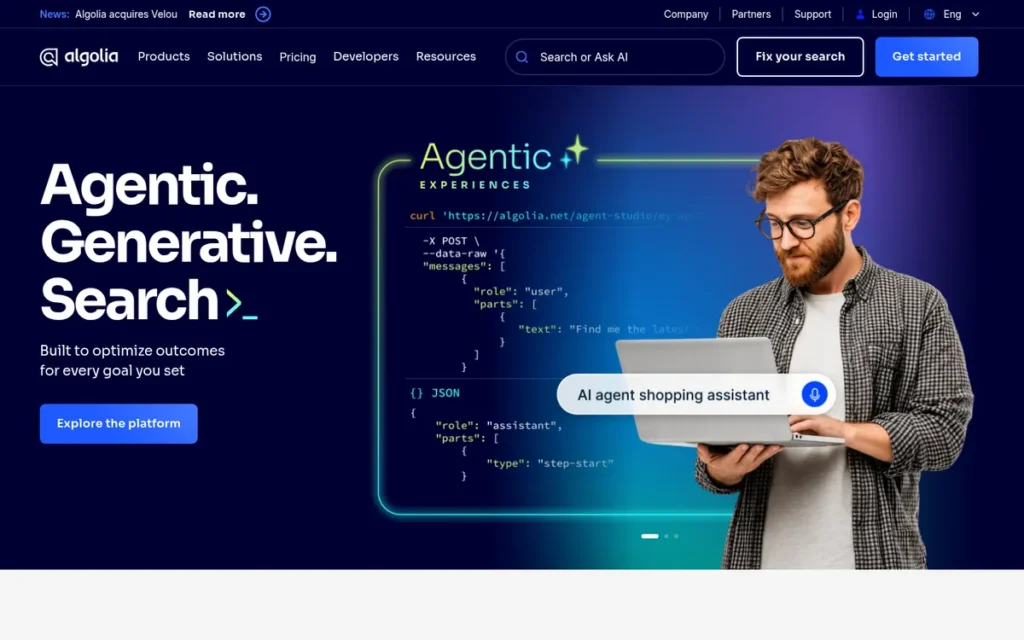
Category: Site Search API, a managed, developer-first search-as-a-service platform delivering real-time, AI-powered search, discovery, and merchandising capabilities via API to websites, e-commerce storefronts, and applications.
At a Glance
- Category: Site Search API
- Best For: Developers and e-commerce teams building fast, relevance-optimized search on Shopify storefronts, high-traffic content sites, and SaaS applications requiring sub-100ms latency guarantees and NeuralSearch hybrid relevance
- Price Range: Free (Build tier) → usage-based Grow tier → $50,000+/year (Premium/Elevate enterprise tiers); pricing scales with query volume and indexed record count. Verified May 2026.
- Primary Strength: Algolia processes 1.75 trillion search queries annually across 18,000+ business customers with a verified sub-100ms latency SLA, the category’s most documented managed search platform at consumer internet scale, with a G2 rating of 4.5/5.0 from 451 verified reviews
- Biggest Limitation: Algolia offers no self-hosted or on-premise deployment option, creating data sovereignty risk for regulated industries and a per-query pricing structure that escalates significantly at high traffic volumes, making it cost-inefficient versus self-managed Elasticsearch at multi-million-query-per-month scale
- One-Line Summary: Algolia is the developer-first AI search platform processing 1.75 trillion annual queries for 18,000+ customers with a verified sub-100ms latency SLA, NeuralSearch hybrid architecture, and a G2 rating of 4.5/5.0 from 451 verified reviews, with documented outcomes at Stripe, Twitch, Medium, and Lacoste.
- Last Verified: May 2026
Overview
Algolia is an AI-powered search and discovery platform built on NeuralSearch (a hybrid architecture combining semantic neural embeddings with traditional BM25 keyword matching) designed for developers, e-commerce teams, and digital media companies who require production-ready, high-relevance search infrastructure without building distributed search systems from scratch.
Algolia’s Distributed Search Network guarantees sub-100ms query latency globally and currently processes 1.75 trillion annual queries across 18,000+ business customers. Algolia holds a G2 score of 4.5/5.0 from 451 verified reviews as of May 2026 (source: g2.com/products/algolia, May 2026), the highest confirmed public review presence in this evaluation.
Algolia is purpose-built for customer-facing search experiences, product discovery on e-commerce sites, content discovery on media platforms, and developer documentation search. Algolia is not designed for internal enterprise knowledge management or regulated-industry compliance deployments requiring on-premise data residency.
Key Features
- NeuralSearch Hybrid Architecture: Algolia’s NeuralSearch combines neural vector embeddings with BM25 keyword ranking in a single query pipeline, enabling semantically accurate results for natural-language queries without requiring exact product title matches, a query for “comfortable running shoes for wide feet” returns relevant inventory through intent understanding rather than literal phrase matching.
- Sub-100ms Latency Guarantee via Distributed Search Network: Algolia’s Distributed Search Network delivers a guaranteed sub-100ms latency SLA via multi-region edge infrastructure with automatic geo-routing and failover, ensuring near-instant response times for globally distributed user bases regardless of query origin geography.
- 2026 Commerce Pipeline for Shopify: Algolia’s 2026 Commerce Pipeline enhanced Shopify-native integration with Metaobjects support covering fit details, ingredients, and product specifications; campaign-driven merchandising rules; structured category navigation; and the removal of the previous 10-market geographic limit (source: DigitalCommerce360, March 2026).
- AI Recommendations Engine: Algolia’s AI Recommendations uses behavioral signals (viewed items, purchased items, and click sequences) to generate personalized product carousels, frequently-bought-together suggestions, and trending-item displays without manual curation or rules configuration.
- InstantSearch UI Libraries: Algolia’s InstantSearch provides pre-built, framework-agnostic search interface components for React, Vue, Angular, and vanilla JavaScript, enabling development teams to deploy production-quality search interfaces in hours rather than weeks using maintained, accessibility-compliant UI primitives.
Best For
Algolia is the strongest choice for development teams building customer-facing search on e-commerce platforms (especially Shopify storefronts) high-traffic content sites, and SaaS products where sub-100ms latency, NeuralSearch hybrid relevance, and developer-friendly API integration are higher priorities than on-premise deployment or internal organizational knowledge management.
Pricing
As of May 2026, Algolia offers a free Build tier for initial development. The Grow tier scales with query volume and indexed record count, costs escalate significantly at high query volumes. Community practitioners on r/woocommerce (2025) confirm that costs “can climb FAST as your catalog/search volume grows.”
Premium and Elevate enterprise tiers are estimated at $50,000+/year with dedicated support, advanced analytics, and SLA guarantees. Buyers projecting 10M+ monthly queries should model total query-volume cost before committing to Algolia’s usage-based structure versus flat-rate or self-managed alternatives. Verify current pricing at algolia.com/pricing before procurement.
Strengths
- Highest Confirmed Public Review Presence in This Evaluation: Algolia holds a 4.5/5.0 G2 rating from 451 verified reviews and a 4.7/5.0 Capterra rating as of May 2026, the strongest confirmed public review presence in this evaluation, representing sustained satisfaction across a statistically meaningful user base rather than a small early-adopter cohort (source: g2.com/products/algolia, May 2026).
- Developer Community Leadership and Analyst Recognition: Algolia is recognized in Gartner analyst evaluations for enterprise search, previously designated Gartner Magic Quadrant Leader in 2023 (via Meilisearch secondary analysis; verify current status at gartner.com before citing in procurement materials), and holds Shopify Plus Partner status with 500+ merchant integrations and #1 Search API designation on GitHub with 50,000+ repository stars as of May 2026.
- Documented Named-Customer Outcomes Across Four Verticals: Algolia’s published customer outcomes include Stripe (80% search latency reduction, 15% conversion rate improvement via NeuralSearch), Medium (22% sitewide search revenue increase with merchandising rules), Twitch (1 billion+ monthly queries processed), and Lacoste (40% mobile conversion rate increase). These figures originate from a 2018 Intellyx analysis, verify current outcomes at algolia.com/customers before citing in procurement materials.
- Free-Entry Pricing Tier Unavailable in Comparable Platforms: Algolia’s free Build tier enables development teams to evaluate NeuralSearch against real catalog data before any commercial commitment, a self-service trial path unavailable from any comparably scaled enterprise search platform in this evaluation.
Limitations
- Cloud-Only Deployment With Vendor Lock-In Risk: Algolia’s SaaS-only model means all indexed data resides on Algolia’s managed infrastructure with no self-hosting option, a hard structural constraint for regulated-industry buyers requiring on-premise data residency. Algolia’s proprietary index schema creates real migration friction once a site-wide deployment is established at scale, which community practitioners characterize as genuine vendor lock-in rather than a theoretical concern. A healthcare organization requiring a HIPAA Business Associate Agreement should eliminate Algolia before investing evaluation time, cloud-only deployment is not resolvable via contract terms.
- Per-Query Cost Escalation at Production Scale: Algolia’s usage-based pricing structure escalates unpredictably at high traffic volumes, practitioners on r/woocommerce (2025) report that multi-million-query-per-month deployments can cost materially more on Algolia than equivalent self-managed Elasticsearch.
“Algolia is faster and more user friendly out of the box but the cost scales aggressively with search volume. Elasticsearch gives you more control and better economics at scale but you need technical expertise to configure, optimize, and maintain it properly.” (u/Better-Captain138, r/woocommerce (2025))
Takeaway: Algolia’s per-query pricing model rewards low-to-mid traffic volumes but becomes cost-inefficient versus self-managed alternatives at multi-million-query-per-month scale.
- Mixed-Content Environment Configuration Complexity: Algolia performs excellently for product catalog search but requires significant custom configuration when handling mixed-content environments combining products, documentation, and editorial content, practitioners on r/woocommerce (2025) described it as “a PITA” for blog and documentation content alongside product search on the same deployment.
Verdict
Algolia is the best-evidenced, most broadly validated AI search platform for developer-first and e-commerce search use cases in 2026, combining the category’s highest confirmed public review scores (G2: 4.5/5.0 from 451 reviews), the industry’s largest managed search infrastructure footprint (1.75 trillion annual queries for 18,000+ customers), and documented outcomes at Stripe, Twitch, Medium, and Lacoste, with a free-entry pricing tier that no comparably scaled enterprise search platform offers. Algolia is the strongest default recommendation for teams building customer-facing search on Shopify or high-traffic web platforms where sub-100ms latency, NeuralSearch hybrid relevance, and fast developer deployment are primary evaluation criteria. Organizations requiring on-premise deployment, HIPAA compliance, or internal enterprise knowledge management should evaluate Glean, Sinequa, or Elastic instead, Algolia’s SaaS-only model is a structural constraint, not a configuration choice.
2. Elastic: Best for Infrastructure-Scale and Self-Hosted Enterprise Search
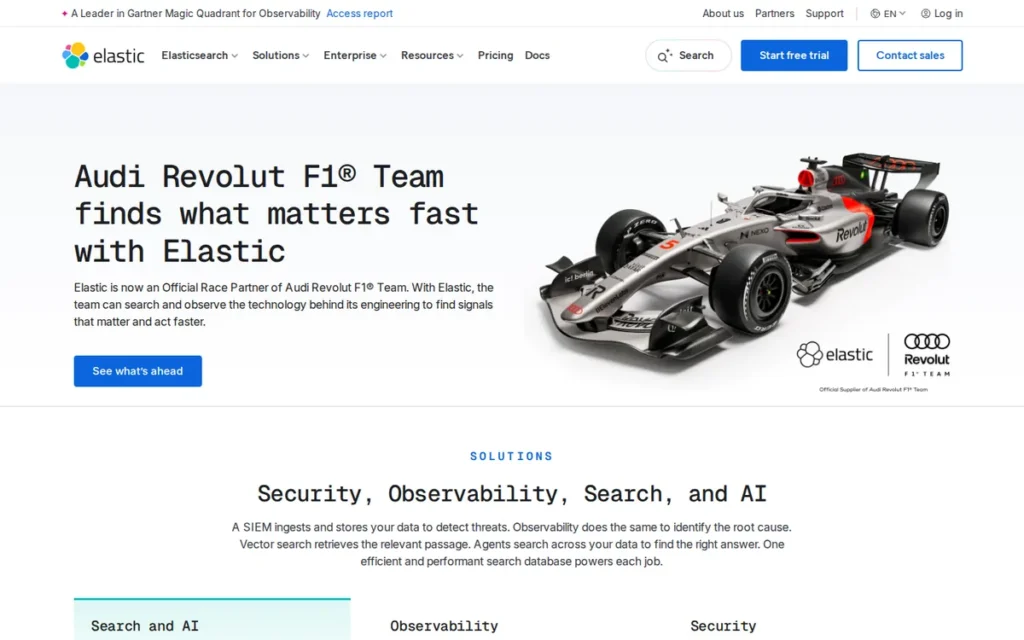
Category: Search Infrastructure, an open-source distributed search and analytics engine serving as foundational search infrastructure for custom-built enterprise applications, observability platforms, and AI-powered discovery systems at any scale.
At a Glance
- Category: Search Infrastructure
- Best For: Engineering teams and DevOps organizations building custom search applications at extreme scale; organizations requiring on-premise or hybrid deployment for data sovereignty; enterprises already operating the ELK Stack for observability
- Price Range: Free (open-source Elasticsearch, self-managed); Elastic Cloud resource-based tiers (pricing requires configuration-specific calculator, no flat-rate public table available); Enterprise licensing for advanced security and support. Total cost of ownership includes significant engineering labor and RAM infrastructure costs. Verified May 2026.
- Primary Strength: Elastic powers confirmed production search infrastructure at Netflix and Docusign (processing millions of agreements daily), with 13-year NYSE-listed operational credibility and the ELSER in-house sparse-vector semantic model that processes AI queries without routing enterprise data to external APIs
- Biggest Limitation: Elastic’s open-source label obscures a high total cost of ownership: production deployments require significant engineering labor for shard management, index configuration, and cluster tuning, with RAM infrastructure costs that community practitioners describe as capable of “breaking the bank”, overhead that managed SaaS alternatives do not impose
- One-Line Summary: Elastic is the NYSE-listed open-source search infrastructure platform with confirmed production deployments at Netflix and Docusign, offering the category’s broadest deployment flexibility from free self-managed to fully managed cloud via its 13-year-proven Elasticsearch engine and the ELSER in-house sparse-vector semantic model for data-sovereign AI search.
- Last Verified: May 2026
Overview
Elastic is a distributed, open-source search and analytics platform built on Apache Lucene that serves simultaneously as a 13-year-proven search infrastructure standard and an evolving AI search stack via the Elasticsearch Relevance Engine (ESRE), combining hybrid BM25+kNN retrieval, vector databases, and LLM integration for organizations requiring total control over their search architecture and data handling.
Elastic’s NYSE listing (ESTC), open-source foundation, and confirmed deployments at Netflix (per independent engineering community sources, 2026) and Docusign (processing millions of agreements daily for contract lifecycle management and generative AI applications, confirmed via Elastic’s customer documentation, May 2026) make Elastic the category’s benchmark for infrastructure-grade credibility. Elastic is widely cited in technical community sources for deployments at eBay and Walmart, these could not be confirmed via primary documentation for this evaluation; buyers should verify independently.
Elastic is not a self-service solution. Organizations without dedicated DevOps or search engineering capacity should evaluate managed alternatives including Algolia, Coveo, or Glean before committing to Elastic’s operational model.
Key Features
- Elasticsearch Relevance Engine (ESRE) with Hybrid BM25+kNN Search: Elastic’s ESRE implements hybrid BM25 plus kNN vector search in a single query pipeline, combining traditional keyword ranking with vector-based semantic retrieval, delivering superior relevance over pure-keyword or pure-vector approaches without requiring separate indexing pipelines for each retrieval method.
- ELSER In-House Sparse-Vector Semantic Model: Elastic’s ELSER (Elastic Learned Sparse EncodeR) performs semantic search using sparse vector representations computed entirely within Elastic’s own infrastructure, enabling AI-powered query understanding without routing enterprise data to external LLM APIs, the most privacy-preserving in-house semantic model available in this evaluation (source: Elastic AI Features documentation, May 2026).
- Open-Source Self-Managed Deployment at Zero License Cost: Elastic’s open-source Elasticsearch allows organizations to run the full search stack on their own hardware (bare metal, private cloud, or air-gapped environments) at zero licensing cost, with commercial Enterprise licensing available for advanced security, role-based access control, and premium support.
- ELK Stack Unifying Search and Observability: Elastic’s ELK Stack integration (Elasticsearch + Logstash + Kibana) unifies enterprise search, log management, metrics collection, APM, and security SIEM in a single platform, reducing vendor count for engineering organizations already using Elastic for infrastructure observability.
- Elastic Cloud Managed Deployment Across Major Clouds: Elastic Cloud provides a fully managed, resource-based Elasticsearch deployment across AWS, GCP, and Azure with auto-scaling and automated snapshots, removing self-management overhead for teams needing Elasticsearch capabilities without cluster administration complexity.
Best For
Elastic is the strongest choice for engineering-led organizations building custom search applications at extreme query scale, DevOps teams requiring a unified search-plus-observability platform, and regulated-industry buyers needing genuine on-premise or air-gapped deployment where enterprise data cannot be routed through third-party APIs or external cloud infrastructure.
Pricing
As of May 2026, Elasticsearch open-source is free to download and self-manage. Buyers should verify license terms, Elastic changed from Apache 2.0 to AGPL/SSPL for post-2021 releases, prompting Amazon Web Services to fork Elasticsearch into OpenSearch (an AWS-maintained Apache 2.0-licensed alternative). OpenSearch is the standard alternative for organizations in AWS-dominant environments or those requiring the original open-source license terms.
Elastic Cloud pricing is resource-based (GB RAM and storage per hour) and requires Elastic’s pricing calculator at elastic.co/pricing, no flat-rate public pricing table is published. Total cost of ownership must account for:
- Engineering labor for cluster management and index lifecycle maintenance
- RAM infrastructure costs (confirmed community pain point: “running this memory hungry application breaks the bank” (r/devops, 2025))
- Potential migration complexity when Elastic is extended beyond its initial deployment scope
Strengths
- Confirmed Production Deployments at Consumer Internet Scale: Elastic powers confirmed production search infrastructure at Netflix (per independent engineering community sources, 2026) and Docusign (processing millions of new contract documents daily for lifecycle management, confirmed via Elastic’s customer documentation, May 2026), the highest-credibility confirmed infrastructure deployments in this evaluation. eBay and Walmart are widely cited in technical community sources as Elasticsearch deployments but could not be confirmed via primary documentation for this evaluation.
- Data-Sovereign In-House Semantic Model: Elastic’s ELSER sparse-vector semantic model enables AI-powered search without exposing enterprise data to external LLM APIs, directly addressing the data sovereignty requirement that disqualifies cloud-only platforms (Algolia, Glean, Perplexity AI) from regulated-industry procurement shortlists requiring on-premise AI inference (source: Elastic AI Features documentation, May 2026).
- NYSE Listing and 13-Year Operational History: Elastic’s NYSE listing (ESTC) and 2012 founding by Shay Banon provide procurement stability credentials that no AI-native platform in this evaluation can match, critical for regulated industries requiring vendor financial viability assessment in multi-year infrastructure contract decisions.
- Expert-Community Consensus on Technical Superiority: Engineers on r/devops (2025) consistently acknowledge Elastic as technically superior (“Elastic is better but much more to maintain”) reflecting an expert-user consensus that validates Elastic’s capability ceiling for infrastructure buyers, despite its operational demands.
Limitations
- High Total Cost of Ownership Obscured by the Open-Source Label: Elastic’s open-source label does not disclose the RAM-intensive infrastructure and engineering labor reality of production deployments. Community practitioners describe being forced to architect cold-storage tiers and data retention limits to control infrastructure spend, costs that emerge only during production operation and that scale with data volume rather than stabilizing after initial setup.
“The only problem I see is cost. Running this memory hungry application breaks the bank, we are looking into limiting the amount of data being ingested and the retention period.” (u/asher1101, r/devops (2025))
Takeaway: Elastic’s “free” open-source label is accurate only for licensing, total production costs routinely exceed equivalent managed-service alternatives once RAM infrastructure, engineering labor, and cluster maintenance are included in the TCO calculation.
- AGPL/SSPL License Change Creates Legal Evaluation Overhead: Elastic’s 2021 license change from Apache 2.0 to AGPL/SSPL creates an additional evaluation layer for organizations whose legal teams must clear software license terms before deployment, particularly SaaS companies incorporating Elasticsearch as a product component. OpenSearch (Apache 2.0) is the established alternative for organizations where licensing terms are a blocker.
- Feature Breadth Creates Configuration Complexity for Single Use Cases: Elastic’s scope spanning search, logs, APM, metrics, and SIEM creates configuration complexity that teams focused purely on search may find disproportionate, purpose-built alternatives including Algolia and Glean deliver faster time-to-production for organizations with a single, clearly defined search use case and no infrastructure observability requirement.
Verdict
Elastic is the definitive choice for engineering-led organizations requiring on-premise deployment, extreme-scale infrastructure, or unified search-plus-observability capabilities that managed SaaS platforms cannot match, evidenced by confirmed deployments at Netflix and Docusign and a 13-year NYSE-listed operational track record that no AI-native competitor in this evaluation can replicate. Elastic’s open-source foundation and ELSER in-house semantic model provide data sovereignty options unavailable in cloud-only alternatives, making Elastic one of the primary viable paths for air-gapped or strict-data-residency deployments in this comparison alongside Sinequa. Teams without dedicated search engineering capacity should account honestly for Elastic’s operational overhead, confirmed as a significant real-world cost by community practitioners, before selecting Elastic over managed alternatives like Algolia or Coveo.
3. Perplexity AI: Best for AI-Powered Research and Real-Time Answer Discovery
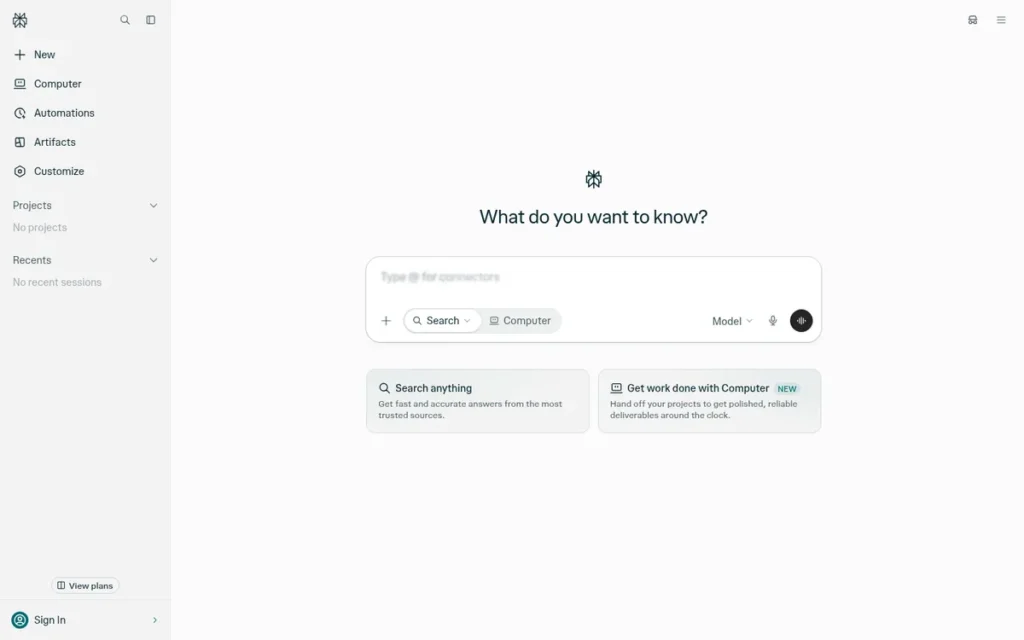
Category: AI Answer Engine, synthesizes real-time web content, academic sources, and proprietary databases into cited, conversational answers using Retrieval-Augmented Generation (RAG), rather than listing links or generating responses from static training data alone.
At a Glance
- Category: AI Answer Engine
- Best For: Researchers, analysts, journalists, knowledge workers, and strategy teams requiring verifiable, source-cited answers from real-time web and proprietary databases including Pitchbook financial data and Wiley peer-reviewed scientific literature
- Price Range: Free ($0/month) → Pro ($20/month or $200/year) → Max ($200/month or $2,000/year) → Enterprise Pro (~$40/seat/month) → Enterprise Max (~$325/seat/month). All non-enterprise tiers publicly listed without a sales engagement. Verified at perplexity.ai/pro, May 2026.
- Primary Strength: Perplexity AI processes 780 million+ monthly queries across 238 countries using citation-first RAG synthesis from 300+ sources per Pro Search query, the most transparent and highest-adoption AI answer engine in this evaluation for verifiable, real-time research, with 243% year-over-year growth since its 2022 founding
- Biggest Limitation: Perplexity AI has not publicly confirmed an enterprise-grade zero-data-retention policy for query handling, creating an adoption blocker for regulated industries and enterprises where confidential queries (M&A research, legal matters, patient-adjacent health data, unreleased product roadmaps) cannot be logged or used to improve third-party AI models
- One-Line Summary: Perplexity AI is the citation-first AI answer engine processing 780 million monthly queries from 300+ real-time sources across 238 countries, with a transparent Free-to-Max pricing structure from $0 to $200/month, multi-model switching between GPT-4, Claude, Gemini, and Grok, and Deep Research access to Pitchbook and Wiley proprietary databases.
- Last Verified: May 2026
Overview
Perplexity AI is a real-time AI answer engine founded in 2022 and designed for researchers, analysts, journalists, and knowledge workers who require verifiable, source-cited responses to factual queries, synthesizing live web content, academic literature, and proprietary databases into conversational answers via RAG, rather than listing search links or generating responses from static training data.
Perplexity AI currently processes 780 million+ monthly queries across 238 countries at 243% year-over-year growth (source: Index.dev, May 2026), one of the fastest documented adoption curves in AI research tool history. Perplexity AI offers the most transparent pricing structure in this evaluation: Free, Pro at $20/month, and Max at $200/month, all publicly listed without requiring a sales engagement.
Perplexity AI is optimized for external web and database research, not internal enterprise document search or regulated-industry compliance deployments. Buyers seeking internal knowledge management capabilities should evaluate Glean, Coveo, or Sinequa instead.
Key Features
- Pro Search Synthesizing 300+ Sources Per Query: Perplexity AI’s Pro Search queries 300+ sources per search (including live web, news, academic literature, and proprietary databases) synthesizing results in 15–20 seconds into a structured response with clickable source citations, enabling significantly deeper research than AI chatbot responses generated from static training data alone.
- Deep Research with Pitchbook and Wiley Proprietary Database Access: Perplexity AI’s Deep Research feature conducts multi-step autonomous research combining live web retrieval with access to Pitchbook private company financial data and Wiley peer-reviewed scientific literature, generating structured research reports comparable in depth to entry-level analyst output for finance, science, and strategy use cases (source: Perplexity AI Changelog, March 2026).
- Model Council for Multi-LLM Query Routing: Perplexity AI’s Model Council (Max plan) automatically selects the optimal foundation model for each query type from a multi-model network including OpenAI GPT-4, Anthropic Claude Sonnet, Google Gemini, and xAI Grok, with manual override available for users who prefer a specific model for a given task or workflow.
- Spaces for Collaborative Team Research: Perplexity AI’s Spaces feature enables collaborative project folders where research teams can organize thread histories, share cited sources, and build persistent knowledge bases, extending Perplexity AI from an individual research tool to a team-level research collaboration environment.
- Sonar API for Developer and Enterprise Integration: Perplexity AI’s Sonar API provides programmatic access to the platform’s search infrastructure for developers building research-augmented applications, enabling multi-model routing, enterprise application integration, and credit-based usage scaling without direct interaction with the consumer interface.
Best For
Perplexity AI is the strongest choice for individual researchers, journalists, financial analysts, strategy consultants, and knowledge workers conducting high-volume, source-verified research requiring real-time web coverage, Pitchbook financial data access, Wiley scientific database access, and citation transparency that static LLM training data cannot provide.
Pricing
As of May 2026, Perplexity AI offers five accessible pricing tiers:
- Free ($0/month): Basic quick search with standard models and limited query volume
- Pro ($20/month or $200/year): 300 Pro searches per day, access to top models, Perplexity Computer, Spaces, and Pages
- Max ($200/month or $2,000/year): 10,000+ monthly Perplexity Computer credits, Model Council, Pitchbook and Wiley database access, and priority support
- Enterprise Pro (~$40/seat/month): Team SSO, advanced admin controls, and high-volume query access
- Enterprise Max (~$325/seat/month): Full enterprise governance, unlimited deep research, and premium security
Perplexity AI offers the most transparent and accessible pricing in this evaluation, all non-enterprise tiers require no sales engagement. Pricing in this category changes frequently: verify current tiers at perplexity.ai/pro before budgeting, and treat any third-party pricing citation as a starting point for verification rather than a confirmed figure.
Strengths
- Fastest Documented Adoption Curve Among AI Search Platforms in This Evaluation: Perplexity AI achieved 780 million+ monthly queries across 238 countries as of May 2026, representing 243% year-over-year growth since its 2022 founding, the fastest documented adoption curve among dedicated AI search platforms in this evaluation and confirmation of genuine product-market fit at scale (source: Index.dev, May 2026).
- Analyst-Grade Proprietary Database Access on Paid Plans: Perplexity AI’s Deep Research feature incorporates Pitchbook private company financial data and Wiley peer-reviewed scientific literature, transforming the platform from a consumer web search tool into analyst-grade research infrastructure for finance, science, and strategy teams at a publicly listed price (source: Perplexity AI Changelog, March 2026).
- Multi-Model Architecture Reducing Foundation Model Lock-In: Perplexity AI’s multi-model network spanning GPT-4, Claude Sonnet, Gemini, and Grok (with Model Council auto-selecting the optimal model per query type) reduces foundation model dependency and enables power users to access specialized model strengths within a single subscription, an advantage over single-model search tools.
- Most Transparent and Accessible Pricing in This Evaluation: Perplexity AI’s publicly listed Free, Pro ($20/month), and Max ($200/month) plans enable individual buyers to fully evaluate and purchase without enterprise procurement involvement, a unique accessibility advantage in a category dominated by custom enterprise pricing models requiring weeks-long sales cycles before cost visibility.
Limitations
- No Confirmed Enterprise Zero-Data-Retention Policy: Perplexity AI’s most consequential limitation for enterprise adoption is the absence of a publicly confirmed zero-data-retention policy for query handling. Unlike Glean’s explicit BYOLLM zero-retention commitment or Elastic’s ELSER in-house model that never routes data externally, Perplexity AI has not confirmed that confidential business queries (M&A diligence, unreleased product roadmap discussions, patient-adjacent health queries, or pending litigation research) are not logged or used to improve platform models. This creates a material adoption blocker for regulated industries and enterprises handling sensitive proprietary information.
- No Internal Enterprise Data Connectivity: Perplexity AI is purpose-built for external web and database research and does not connect to organizational data sources such as Slack, Jira, Confluence, or Salesforce. Perplexity AI cannot substitute for Glean, Coveo, or Sinequa in internal knowledge management use cases regardless of plan tier, this is a fundamental architectural scope boundary, not a configurable feature gap.
- Weaker Creative and Open-Ended AI Assistant Capabilities: Perplexity AI’s creative writing, open-ended dialogue, and coding capabilities are substantively weaker than ChatGPT for those specific tasks. Users expecting a general-purpose AI assistant rather than a research-specific tool frequently report unmet expectations, Perplexity AI’s value is concentrated in its core factual retrieval use case rather than distributed across general AI assistant functions.
Verdict
Perplexity AI is the most credibly validated AI answer engine for real-time, citation-backed web research in 2026, combining 780 million monthly queries at 243% year-over-year growth with the most transparent pricing in this evaluation, making it the definitive starting point for researchers, analysts, and knowledge workers who need verifiable, source-cited answers from live web and proprietary databases at a publicly listed price. Perplexity AI is explicitly not an internal enterprise knowledge management platform and lacks a confirmed enterprise zero-data-retention policy required for regulated-industry adoption, buyers with those needs should evaluate Glean, Sinequa, or Kore.ai instead. Always verify current pricing at perplexity.ai/pro before budgeting; treat any third-party price citation as a starting point for verification, not a confirmed procurement figure.
4. Glean: Best for Internal Enterprise Knowledge Search and Work AI
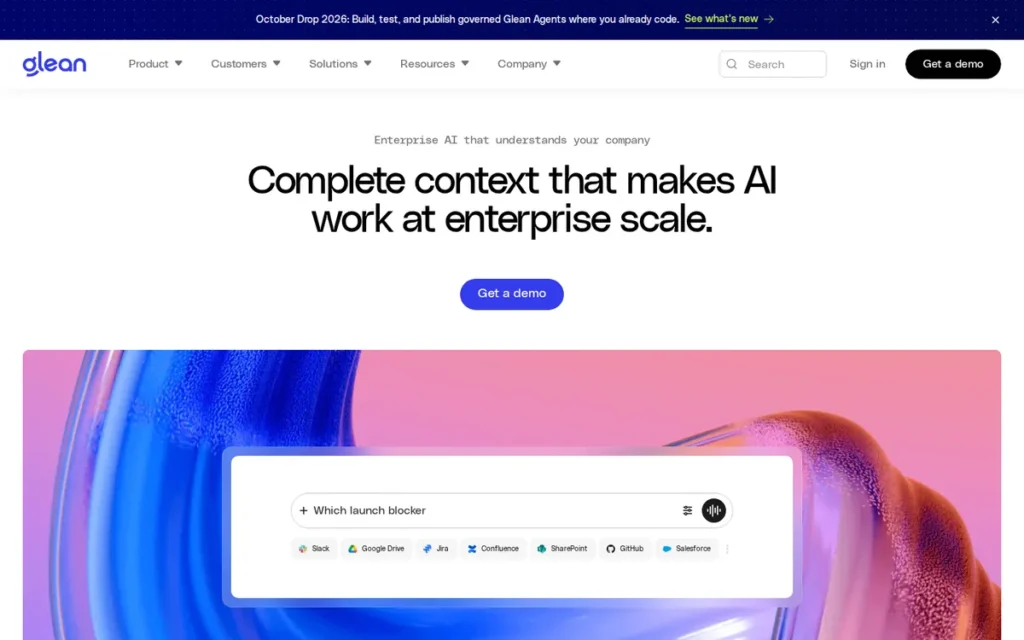
Category: Enterprise Work AI, a unified internal knowledge search platform that indexes content from 100+ enterprise SaaS tools into a continuously learning, permission-aware Enterprise Graph, enabling personalized AI-generated answers across all organizational data.
At a Glance
- Category: Enterprise Work AI
- Best For: Mid-to-large enterprises with heterogeneous SaaS tool stacks seeking unified internal search, permission-aware AI answers, and cross-app knowledge discovery, particularly organizations not fully committed to Microsoft or Google ecosystems
- Price Range: ~$50/user/month; minimum approximately 100–250 users depending on deployment tier (~$50,000–$90,000+/year floor). Enterprise packages require direct sales engagement. Confirmed via multiple independent community sources on r/LlamaIndex. Verified May 2026.
- Primary Strength: Glean’s Enterprise Graph continuously maps relationships between people, content, and processes across 100+ connected SaaS tools, enabling permission-aware, personalized knowledge search with documented outcomes of Confluent recovering 15,000 hours per month (70%+ employee adoption) and Duolingo achieving a 5x ROI with $1.1M yearly savings
- Biggest Limitation: Glean’s minimum commitment creates a $50,000–$90,000+/year procurement floor that excludes smaller organizations, and its cloud-only deployment model excludes regulated-industry buyers requiring on-premise or hybrid data residency, two hard constraints that no contract addendum can resolve
- One-Line Summary: Glean is the enterprise Work AI platform unifying internal knowledge search across 100+ SaaS connectors via a continuously learning Enterprise Graph (with BYOLLM, confirmed zero-data-retention policy, and permission-aware RAG) delivering Confluent recovering 15,000 hours per month and Duolingo achieving a 5x ROI with $1.1M yearly savings at approximately $50 per user per month.
- Last Verified: May 2026
Overview
Glean is a Work AI platform that unifies enterprise search across 100+ pre-built SaaS connectors (including Google Workspace, Microsoft 365, Slack, Jira, Confluence, Salesforce, and GitHub) using a proprietary Enterprise Graph that maps relationships between organizational content, people, and processes to deliver permission-aware, personalized, AI-generated answers grounded exclusively in content users are authorized to view.
Glean is designed specifically for mid-to-large enterprises with heterogeneous SaaS tool stacks where critical knowledge is fragmented across multiple systems. Glean’s Confluent case study (15,000 hours per month recovered, 70%+ employee adoption, 13% satisfaction improvement) and Duolingo case study (5x ROI, $1.1M yearly savings, 500+ hours per month saved) are confirmed via Glean’s primary customer story pages (glean.com/resources/customer-stories/, verified May 2026).
Glean’s cloud-only deployment and minimum commitment make it unsuitable for small teams or regulated-industry buyers requiring on-premise data residency.
Key Features
- Enterprise Graph for Continuously Learning Personalized Search: Glean’s Enterprise Graph continuously indexes and maps the relationships between documents, people, projects, and processes across all connected applications (learning which content is relevant to which roles, teams, and contexts) enabling personalized search results that improve with organizational use without manual configuration or rules tuning.
- Permission-Aware Search with Source-Level Access Control Enforcement: Glean’s permission-aware search enforces original access controls from every connected system at query time, content a user is not authorized to access in Salesforce, Confluence, or any connected system does not appear in Glean search results or inform AI-generated answers, preventing the data exposure risk that non-permission-aware AI tools create (source: Glean Enterprise AI Search documentation, 2026).
- BYOLLM with Confirmed Zero-Data-Retention LLM Policy: Glean’s BYOLLM architecture lets enterprises choose their preferred foundation model (GPT-4, Claude, Gemini, Llama, or other supported models) while Glean maintains the Enterprise Graph and permission controls, with a confirmed zero-data-retention policy ensuring that queries and responses are never stored by third-party model providers.
- Glean Apps and Agents for Workflow Automation: Glean’s agentic capabilities: Glean Apps and Agents, support no-code workflow automation, content summarization, code intelligence, and a third-generation AI Assistant, enabling knowledge workers to trigger multi-step research and synthesis tasks without leaving the search interface.
- 100+ Pre-Built Native Connectors with Near-Real-Time Updates: Glean’s 100+ pre-built native connectors maintain continuous indexing of Google Workspace, Microsoft 365, Slack, Jira, Confluence, Salesforce, GitHub, Zendesk, Workday, and 90+ additional enterprise tools, with near-real-time updates reflecting document changes without scheduled-batch indexing delays.
Best For
Glean is the strongest choice for mid-to-large enterprises with complex heterogeneous SaaS tool stacks where knowledge fragmentation across multiple systems is a measurable productivity drag, particularly organizations that have outgrown single-tool search features but have not committed to the Microsoft or Google ecosystems that Copilot and Workspace AI respectively require as a precondition.
Pricing
As of May 2026, Glean is confirmed at approximately $50 per user per month with a minimum commitment of approximately 100–250 users depending on deployment tier, representing a floor of $50,000–$90,000+/year. This pricing has been independently validated by multiple community members on r/LlamaIndex (2025).
Buyers comparing Glean against Microsoft Copilot should consider this cost comparison:
- Microsoft Copilot (~$30/user/month): Microsoft-ecosystem-only search; lower total cost; best for organizations standardized on the Microsoft stack
- Glean (~$50/user/month): cross-app Enterprise Graph across all SaaS tools; BYOLLM zero-retention; documented 5x ROI; best for heterogeneous SaaS stacks
The $20/user/month Glean premium must be justified by measurable cross-ecosystem search value at your specific user scale and tool stack breadth.
Strengths
- Industry-Leading Internal Search Productivity ROI Case Studies: Confluent recovered more than 15,000 hours per month in engineering productivity after deploying Glean (equivalent to approximately 188 full-time employee-days per month) with 70%+ employee adoption rate and a 13% improvement in satisfaction (source: glean.com/resources/customer-stories/confluent, May 2026). Glean’s own customer story pages confirm these figures, making them primary-source validated.
- 5x ROI Documented at Named Enterprise Customer: Duolingo achieved a 5x ROI from Glean deployment with more than 500 hours per month in employee time saved and $1.1M yearly savings, a payback multiple that positions Glean’s ~$50/user/month pricing as delivering measurable financial return within a defined payback period for knowledge-worker-dense organizations (source: glean.com/resources/customer-stories/duolingo, May 2026).
- Strong Unprompted Enterprise Community Validation: A HubSpot employee on r/techsales (2025) reported that Glean “dramatically changed how we onboard new reps and sales enablement” and was “consistently amazed” after months of production use (u/robinson604, 2025). A separate practitioner stated Glean “completely blows Microsoft CoPilot out the water” (u/jezarnold, 2025), both assessments unprompted and not linked to Glean marketing materials.
“The actual product is pretty amazing. We just added it at HubSpot. I’m consistently blown away by it, only been a few months. Could dramatically change how we onboard new reps and sales enablement.” (u/robinson604, r/techsales (2025))
Takeaway: Unprompted, deployment-verified community praise from named enterprise users provides stronger social proof than vendor-linked testimonials for procurement justification.
- BYOLLM and Zero-Retention Policy Addressing Top Enterprise AI Adoption Barriers: Glean’s BYOLLM architecture with confirmed zero-data-retention LLM policy directly addresses the two highest-ranked enterprise AI adoption barriers (foundation model flexibility and query privacy) in a single technical specification that Coveo, Algolia, and Perplexity AI do not offer as a confirmed and publicly documented capability.
Limitations
- High Minimum Commitment Excluding Smaller Organizations: Glean’s minimum commitment creates a $50,000–$90,000+/year annual spend floor that eliminates Glean from consideration for organizations below enterprise budget thresholds. Practitioners on r/LlamaIndex (2025) noted active prospect conversations “due to costs limitations” as a documented Glean churn driver, confirming price as a real barrier rather than a negotiating posture.
- Cloud-Only Deployment Restricts Regulated-Industry Access: Glean’s cloud-only model excludes regulated-industry buyers in jurisdictions requiring on-premise data residency under the EU AI Act, healthcare data regulations, or national data sovereignty requirements. No enterprise contract addendum can resolve cloud-only deployment for buyers requiring on-premise data control, this is a hard architectural constraint directing those buyers to Elastic or Sinequa regardless of Glean’s feature advantages.
- Competitive Moat Risk from Platform Giants: A practitioner on r/techsales (2025) predicted a “9–12 month” window before Microsoft, Google, and Salesforce narrow the capability gap with their own enterprise AI search integrations (u/Novel_Dog_676, 2025). This is a community estimate rather than an analyst projection, but it represents a directional long-term risk that enterprise procurement teams should factor into multi-year contract decisions.
Verdict
Glean is the most credibly evidenced enterprise internal knowledge search platform for SaaS-heterogeneous organizations in 2026, with documented ROI outcomes, Confluent recovering 15,000 hours per month and Duolingo achieving a 5x ROI with $1.1M yearly savings, confirmed directly via Glean’s primary customer story pages at a specificity that competing internal search platforms in this evaluation cannot match at the same named-customer detail level. Glean’s Enterprise Graph, permission-aware RAG, and BYOLLM zero-retention architecture represent a differentiated technical approach to cross-app organizational knowledge discovery. Two hard constraints must be qualified before investing evaluation resources: the $50,000–$90,000+/year minimum annual commitment and the cloud-only deployment model, organizations below the threshold or requiring on-premise data residency should evaluate Sinequa, Elastic, or Kore.ai instead.
5. Coveo: Best for Enterprise E-Commerce and Customer Service Search with Behavioral AI
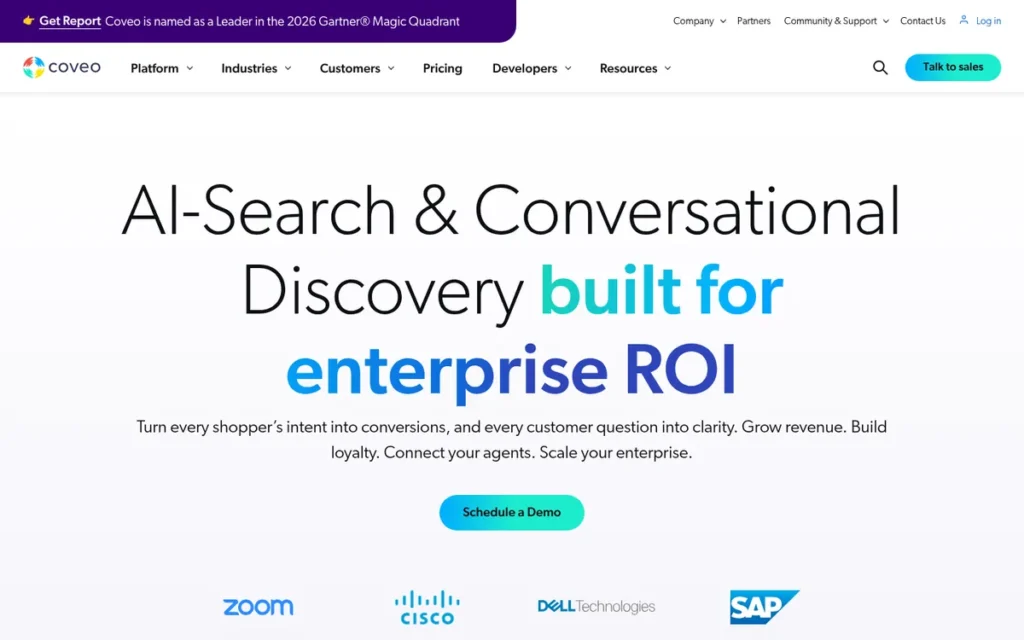
Category: Relevance Platform, an enterprise AI search and relevance platform that uses behavioral machine learning, semantic AI, and self-optimizing models to deliver search, recommendations, and GenAI answering across e-commerce storefronts, customer self-service portals, and employee knowledge bases.
At a Glance
- Category: Relevance Platform
- Best For: Large enterprises in e-commerce, customer service, and employee experience seeking behavioral AI-driven search relevance with self-optimizing ML, particularly organizations in Salesforce, SAP, or ServiceNow ecosystems with high query volumes enabling ART’s compounding accuracy improvements
- Price Range: ~$600+/month entry-level; scales with query volume, connected sources, and enterprise features. Full pricing requires a sales engagement, no public tier tables available. Community research notes Coveo at approximately 3x Algolia’s equivalent mid-market pricing. Verified May 2026.
- Primary Strength: Coveo’s Automatic Relevance Tuning (ART) trains on behavioral signals to continuously self-optimize search ranking without manual configuration, with confirmed outcomes of 2.3x case deflection at Zoom, 30% case resolution improvement at Xero, avoidance of approximately 1 million support tickets monthly at Xero, and Salesforce deploying Coveo internally for its own case classification
- Biggest Limitation: Coveo’s ~$600+/month entry pricing and enterprise-only design consistently produce a “overkill unless enterprise scale” characterization from practitioners, limiting ROI justification to organizations with large query volumes, dedicated search administrators, and enterprise implementation budgets
- One-Line Summary: Coveo is the TSX-listed enterprise relevance platform whose Automatic Relevance Tuning behavioral ML delivered 2.3x case deflection at Zoom, a 30% case resolution improvement and approximately 1 million tickets avoided monthly at Xero, and internal deployment at Salesforce, the most numerically evidenced AI search platform for Fortune 500 customer service and employee experience use cases in this evaluation.
- Last Verified: May 2026
Overview
Coveo is a unified AI Search and Relevance Platform that connects 55+ enterprise data sources into a single indexed view using an index-in-place architecture that never moves or duplicates data, delivering real-time semantic and behavioral search, AI-powered recommendations, and GenAI answering across enterprise digital touchpoints including e-commerce storefronts, customer self-service portals, and internal employee knowledge bases.
Coveo is TSX-listed (CVO), founded approximately in 2005, and serves Fortune 500 customers including Zoom, Xero, and Salesforce, which uses Coveo internally for case classification via semantic matching, making Salesforce simultaneously a Coveo customer and platform partner with 30+ native connectors. Coveo’s approximately 20-year operational history provides procurement stability credentials that AI-native competitors cannot yet match.
Coveo is calibrated exclusively for large enterprise deployments. Its pricing, implementation requirements, and feature depth target organizations with dedicated search administrators, enterprise implementation budgets, and high-volume query workloads where ART demonstrates compounding accuracy returns.
Key Features
- Automatic Relevance Tuning (ART) Behavioral ML: Coveo’s ART is a machine learning model that trains continuously on behavioral signals (user clicks, query patterns, post-search actions, and time-on-result) to automatically improve search ranking without manual relevance rule configuration, enabling search accuracy that compounds with every interaction rather than requiring periodic administrator tuning.
- Index-in-Place Architecture Preserving Source-System Governance: Coveo’s index-in-place architecture connects to enterprise data sources (SharePoint, Salesforce, SAP, ServiceNow, and 50+ additional sources) without moving or duplicating data, preserving source-system governance, access controls, and update timing while creating a unified searchable index (source: Coveo Intelligent Search Platform, May 2026).
- GenAI Answering with Behavioral Context Grounding: Coveo’s GenAI Answering layer generates cited, natural-language summaries from indexed content, enabling chatbot and virtual assistant interfaces that answer employee and customer queries from enterprise knowledge bases without requiring separate RAG pipeline configuration or LLM fine-tuning.
- E-Commerce AI with Personalized Search Ranking: Coveo’s e-commerce AI capabilities include personalized search result ranking based on shopper behavioral profiles, AI-powered product recommendations, dynamic faceting, and merchandising controls, deployed in a unified platform alongside employee and customer service search, reducing vendor proliferation for organizations needing both consumer and internal search in one contract.
- Salesforce and SAP Native Integrations with 30+ Connectors: Coveo’s 30+ native Salesforce connectors and deep SAP ecosystem partnership enable organizations in Salesforce CRM and SAP ERP environments to add AI search relevance without building custom integration layers, with Salesforce’s own internal Coveo deployment serving as an in-market integration validation at peer-class enterprise scale (source: Coveo Demo Hub, May 2026).
Best For
Coveo is the strongest choice for large enterprises in e-commerce, customer self-service, and employee knowledge management requiring behavioral ML-driven search relevance with self-optimizing accuracy, particularly organizations in the Salesforce, SAP, or ServiceNow ecosystem with high query volumes that enable ART’s compounding accuracy model to demonstrate measurable ROI at scale.
Pricing
As of May 2026, Coveo pricing starts at approximately $600/month for entry-level packages, scaling with query volume, connected sources, and enterprise feature requirements. Comprehensive pricing requires direct sales engagement, Coveo does not publish complete tier tables publicly.
Community research on r/LlamaIndex (2025) indicates Coveo at approximately 3x Algolia’s equivalent mid-market implementation cost. One buyer chose Algolia “at 30% of Coveo pricing” and reported “search is fine but not good on personalization” (u/No-Brother-2237); another chose Coveo after concluding its track record and support quality outweighed the premium (u/mjsminkey). This is a genuine use-case-dependent decision where personalization depth and query volume drive the price-premium calculus.
Strengths
- Most Numerically Specific Fortune 500 Case Studies in This Evaluation: Coveo’s confirmed enterprise outcomes include: Zoom achieving a 2.3x increase in case deflection and 89% elimination of content gaps via unified indexing in 17 languages (source: coveo.com/en/resources/case-studies/zoom, May 2026); Xero reducing sessions needing support by 20%, improving case resolution by 30% with Coveo for Agentforce, and avoiding approximately 1 million unnecessary support tickets monthly (source: coveo.com/en/resources/case-studies/xero-generative-answering, May 2026).
- Salesforce Internal Deployment as Peer-Class Third-Party Endorsement: Salesforce deploys Coveo internally for case classification via semantic matching, making Salesforce both a Coveo customer and platform partner with 30+ native connectors. This peer-class enterprise software vendor endorsement validates Coveo’s connector depth and reliability in production at one of the world’s highest-scale SaaS environments (source: Coveo Demo Hub, May 2026).
- TSX Listing with Approximately 20-Year Operational History: Coveo is TSX-listed (CVO) with an approximately 20-year operational history since its founding in Quebec City, Canada, providing financial transparency and procurement stability credentials that AI-native competitors including Glean, Perplexity AI, and Kore.ai cannot yet match for enterprise procurement committees evaluating multi-year commitments.
- Compounding ART Relevance Advantage Rewarding High Query Volumes: Coveo’s ART behavioral ML creates a self-reinforcing relevance advantage where higher query volumes produce more training signal, which produces better ranking, which increases user engagement, a compounding ROI dynamic that one-time relevance tuning approaches cannot replicate and that specifically rewards organizations with large query volumes.
Limitations
- Enterprise-Only Pricing Excluding Mid-Market Organizations: Coveo’s most consequential trade-off is the combination of enterprise-only pricing and the implementation complexity it entails. At approximately $600+/month entry-level and approximately 3x the cost of comparable Algolia mid-market deployments, Coveo creates a budget threshold that mid-market organizations frequently cannot clear. Community feedback consistently characterizes the platform as “overkill unless you’re enterprise scale” (u/Signal-Extreme-6615, r/OnlineMarketing, 2025), confirming that ROI is reliably realized only by organizations with significant query volumes, dedicated search administrators, and enterprise budgets.
- Data Quality Dependency Disclosed by Coveo’s Own Team: A Coveo Solution Architect acknowledged in a 2021 Reddit AMA (r/IAmA) that “even with ML and all the relevance tuning in the world, if the data set is not good, results aren’t great”, a vendor self-disclosure confirming that organizations must invest in content quality governance before ART delivers documented performance improvements. This implementation prerequisite is systematically underrepresented in vendor demos.
- Cloud-Only Deployment Restricting Regulated-Industry Adoption: Coveo’s cloud-only model creates the same data residency constraints as Glean and Algolia for regulated industries requiring on-premise deployment, an elimination criterion for organizations in jurisdictions with strict data sovereignty requirements. Buyers in healthcare, EU-regulated industries, or government sectors should evaluate Elastic or Sinequa instead, regardless of Coveo’s feature strengths.
Verdict
Coveo is the best-evidenced AI search platform for large-enterprise customer service and e-commerce relevance use cases in 2026, with the evaluation’s most numerically specific Fortune 500 outcomes, Zoom’s 2.3x case deflection increase, Xero’s 30% case resolution improvement and approximately 1 million tickets avoided monthly, confirming its Automatic Relevance Tuning behavioral ML as a genuine productivity driver at enterprise scale, validated by current Coveo case study documentation. Coveo is explicitly an enterprise-only platform calibrated for organizations with high query volumes, dedicated search administration, and Salesforce or SAP ecosystem dependencies. Mid-market buyers, developer teams, and organizations below enterprise budget thresholds should evaluate Algolia for customer-facing search relevance or Elastic for infrastructure-grade control as lower-cost alternatives.
6. Sinequa: Best for Regulated-Industry and Multilingual Global Enterprise Search
Category: Cognitive Enterprise Search, a deep-NLP, multilingual AI search platform designed specifically for Global 2000 organizations with complex, heterogeneous data environments in regulated industries, offering five-method hybrid retrieval, 200+ connectors, and on-premise/hybrid deployment options.
At a Glance
- Category: Cognitive Enterprise Search
- Best For: Global 2000 enterprises in regulated industries (pharmaceutical, financial services, aerospace, energy, legal) requiring multilingual NLP across 22+ languages, on-premise or hybrid deployment for data residency, 200+ connector breadth, and multi-analyst recognition as a procurement qualification filter
- Price Range: Custom enterprise pricing only: no public tiers available at any level. All pricing requires direct sales engagement. Consistently characterized as high-cost relative to mid-market alternatives; calibrated for Global 2000 compliance budgets. Verified May 2026.
- Primary Strength: Sinequa holds the broadest multi-analyst recognition portfolio in this evaluation (Gartner Market Guide Representative Vendor for Enterprise AI Search, Forrester Wave Leader in Enterprise Search (Q4 2023), and QKS Group SPARK Matrix Leader in Enterprise AI Search (Q4 2025)) combined with 200+ native connectors, 22–150+ language NLP, and confirmed on-premise deployment capability
- Biggest Limitation: Sinequa’s enterprise-only positioning, custom-only pricing, and design specificity for Global 2000 regulated organizations make it inaccessible and cost-disproportionate for mid-market organizations, development teams, and general-purpose research buyers
- One-Line Summary: Sinequa is the cognitive enterprise search platform with Forrester Wave Leader recognition, QKS SPARK Matrix Leader recognition, and Gartner Market Guide listing, offering 200+ native connectors, cross-language retrieval across 22–150+ languages, five-method hybrid retrieval, and on-premise/hybrid deployment engineered for Global 2000 pharmaceutical, financial services, and aerospace enterprises.
- Last Verified: May 2026
Overview
Sinequa is a cognitive enterprise search platform engineered specifically for Global 2000 organizations with complex, multilingual, multi-source data environments in regulated industries, combining five-method hybrid retrieval (vector, keyword, graph-based, structured data, and multimodal), 200+ native connectors indexing 350 document formats, and native NLP support for 22–150+ languages into a unified architecture that operates on-premise, hybrid, or in the cloud with strict source-system access control preservation at every query.
Sinequa holds the broadest multi-analyst recognition portfolio in this evaluation: Gartner Market Guide Representative Vendor for Enterprise AI Search (the Gartner Magic Quadrant for Insight Engines was discontinued after 2022; Sinequa held Leader status through 2022 in that now-discontinued quadrant), Forrester Wave Leader in Enterprise Search (Q4 2023), and QKS Group SPARK Matrix Leader in Enterprise AI Search (Q4 2025) (sources: sinequa.com/resources/assets/gartner-market-guide-for-enterprise-ai-search/; sinequa.com/asset_category/report/, May 2026).
Sinequa is explicitly not designed for mid-market organizations, development teams, or general-purpose research use cases. Sinequa’s complexity, pricing, and capabilities are calibrated for enterprises with dedicated IT search teams, compliance budgets, and heterogeneous legacy data environments that simpler platforms cannot index at scale.
Key Features
- Five-Method Hybrid Retrieval Architecture: Sinequa’s five-method hybrid retrieval combines vector search (semantic understanding), keyword search (precision recall), graph-based retrieval (entity and relationship traversal), structured data queries (database and tabular content), and multimodal retrieval (documents, images, audio), enabling one unified query to retrieve relevant content across heterogeneous enterprise data regardless of source type or document format.
- Multilingual NLP Across 22–150+ Languages with Cross-Language Retrieval: Sinequa’s multilingual NLP engine supports 22–150+ languages with native entity extraction, semantic disambiguation, and cross-language retrieval, enabling a user querying in English to retrieve a relevant regulatory document in French, a technical specification in German, or a patent in Japanese without requiring translation preprocessing or language-specific index configuration (source: ChapsVision Enterprise AI Search Comparison, May 2026).
- GenAI Studio with Full Regulatory Answer Auditability: Sinequa’s GenAI Studio enables deployment of RAG-based AI assistants with full auditability and source citations, ensuring every AI-generated answer includes a traceable chain of source documents grounded exclusively in access-controlled content, meeting regulatory provenance requirements in pharmaceutical, financial, and legal contexts.
- 200+ Native Connectors Indexing 350 Document Formats: Sinequa’s 200+ native connectors index content from SharePoint, Salesforce, SAP, ServiceNow, Confluence, iManage, file systems, databases, and 190+ additional sources in 350 document formats, with continuous crawling that preserves source-system access control metadata at query time, ensuring connector breadth does not compromise information governance (source: Sinequa Product Page, May 2026).
- On-Premise, Hybrid, and Cloud Deployment Flexibility: Sinequa’s deployment flexibility enables Global 2000 organizations in jurisdictions with strict data residency requirements (EU GDPR, pharmaceutical trial data regulations, government data sovereignty) to maintain data within organizational or national infrastructure while accessing full AI search and GenAI answering capabilities.
Best For
Sinequa is the strongest choice for IT directors and CISOs at Global 2000 pharmaceutical, aerospace, financial services, energy, and legal organizations requiring multi-analyst validated enterprise search with on-premise or hybrid deployment options, 200+ connector breadth across heterogeneous data environments, cross-language retrieval in 22+ languages, and GenAI answering with regulatory auditability, and whose procurement processes use multi-analyst recognition as a qualification filter before feature evaluation begins.
Pricing
As of May 2026, Sinequa pricing is entirely custom enterprise quote-based, no public pricing tiers exist at any level, and all pricing conversations require direct engagement with Sinequa’s enterprise sales team. Sinequa is consistently characterized across independent analysis as high-cost relative to mid-market alternatives, calibrated for Global 2000 procurement budgets with compliance requirements.
Organizations outside the Global 2000 or regulated-industry context should confirm budget alignment via a preliminary conversation before investing evaluation time, Sinequa’s cost structure is designed for enterprise IT procurement timelines and budgets, not growth-stage or mid-market software evaluations. For independent peer-review data, Gartner Peer Insights is the primary available public review source for Sinequa, the platform’s enterprise-direct model means it does not have a prominent public G2 or Capterra profile.
Strengths
- Broadest Multi-Analyst Recognition Portfolio in This Evaluation: Sinequa holds Gartner Market Guide Representative Vendor recognition for Enterprise AI Search, Forrester Wave Leader in Enterprise Search (Q4 2023), and QKS Group SPARK Matrix Leader in Enterprise AI Search (Q4 2025), three distinct analyst recognitions in the same evaluation period, the broadest multi-body analyst validation of any platform in this comparison. Enterprise IT procurement teams at regulated institutions use this combination as a primary shortlisting filter (sources: sinequa.com/resources/assets/gartner-market-guide-for-enterprise-ai-search/; sinequa.com/asset_category/report/, May 2026).
- Broadest Connector Ecosystem and Document Format Coverage in This Evaluation: Sinequa’s 200+ native connectors indexing content in 350 document formats exceed every other platform in this evaluation (Glean (100+) and Coveo (55+)) directly addressing the Global 2000 data heterogeneity reality where a single enterprise may have 100+ active data systems in incompatible formats requiring unified discovery (source: Sinequa Product Page, May 2026).
- 20+ Years of Multilingual NLP Research Depth: Sinequa’s native multilingual NLP supporting 22–150+ languages with cross-language retrieval addresses a critical gap in English-first AI search platforms, enabling European pharmaceutical, multinational aerospace, and global financial services organizations to retrieve relevant content across all language markets from a single query without translation overhead, a capability built over 20+ years of NLP research (sources: ChapsVision Enterprise AI Search Comparison; Improvado Sinequa Competitors, May 2026).
- Agentic Layer Added via ChapsVision Acquisition: Sinequa’s 2023 acquisition by ChapsVision added ChapsAgents (an agentic AI orchestration layer enabling autonomous workflow execution on top of the search foundation) extending Sinequa from pure enterprise search to agentic enterprise AI without disrupting established regulated-industry production deployments.
Limitations
- Global 2000 Design Specificity Excludes the Majority of AI Search Buyers: Sinequa’s most consequential trade-off is its design specificity, Sinequa’s capabilities, pricing, and implementation complexity are calibrated exclusively for Global 2000 organizations with regulated data environments and dedicated IT search teams. Sinequa is simultaneously overkill for mid-market buyers, inaccessible for developer teams, and misaligned with e-commerce or general-purpose research use cases where Algolia, Elastic, or Perplexity AI deliver superior outcomes at materially lower cost.
- Complete Pricing Opacity Creates Significant Procurement Friction: The absence of any public pricing requires prospective buyers to engage a full enterprise sales process before understanding cost structure, introducing weeks of delay compared to platforms with publicly listed pricing, and making independent pre-sales evaluation impossible for buyers without enterprise procurement infrastructure. This procurement friction is a genuine trade-off, not an oversight.
- No Public Community Intelligence Available Through Standard Channels: The confirmed absence of Sinequa community discussion across r/devops, r/LlamaIndex, r/CRM, and r/techsales means post-implementation practitioner intelligence is unavailable through public community channels. Buyers must rely on Gartner Peer Insights (requiring a Gartner subscription), Forrester reference calls, and direct vendor references for deployment experience validation, a transparency gap relative to platforms with active public user communities.
Verdict
Sinequa is the definitive cognitive enterprise search platform for Global 2000 organizations in regulated industries requiring broad multi-analyst recognition, on-premise or hybrid deployment flexibility, 200+ connector breadth across heterogeneous data environments, cross-language retrieval in 22+ languages, and GenAI answering with full regulatory auditability, a combination of capabilities that no other platform in this evaluation holds at equivalent depth. Sinequa is explicitly not appropriate for mid-market organizations, development teams, or buyers outside regulated Global 2000 contexts: its complexity and pricing are designed for enterprises treating search as a compliance infrastructure requirement with multi-year operational commitments. IT directors and CISOs in pharmaceutical, financial services, aerospace, or government sectors will find Sinequa’s three-body analyst recognition portfolio, Gartner Market Guide, Forrester Wave Leader, and QKS SPARK Matrix Leader, a meaningful procurement pre-filter that substantially reduces evaluation friction.
7. Kore.ai: Best for Agentic Conversational Enterprise AI Combining Search and Autonomous Workflow Execution
Category: Agentic AI Platform, an enterprise platform combining conversational AI search (Search AI), autonomous multi-agent workflow execution (Agent AI), and multi-channel experience orchestration (XO Platform) for enterprises requiring AI that finds knowledge and acts on it within connected systems.
At a Glance
- Category: Agentic AI Platform
- Best For: Large enterprises in BFSI, healthcare, telecom, insurance, and manufacturing requiring agentic AI combining knowledge retrieval with autonomous workflow execution across 45+ channels in 135+ languages, with HIPAA, GDPR, and SOC 2 triple compliance and dedicated technical implementation resources
- Price Range: Custom enterprise licensing only: no public pricing tiers at any level. Requires direct sales engagement. Community characterizes as “pretty expensive”; implementation requires a dedicated technical team as a cost center beyond licensing. Verified May 2026.
- Primary Strength: Kore.ai holds Gartner Magic Quadrant Leader recognition for Conversational AI Platforms (2025), Forrester Wave 4.14/5.0 highest Current Offering score in the Q2 2026 evaluation, and Forrester Wave Leader recognition in Cognitive Search Platforms (Q4 2025) (the strongest combined analyst recognition portfolio in this evaluation) alongside HIPAA, GDPR, and SOC 2 triple compliance and 135+ language support across 45+ deployment channels
- Biggest Limitation: Kore.ai is not a self-serve platform: community practitioners uniformly confirm it requires dedicated Kore.ai-experienced technical teams for deployment and ongoing maintenance, making it inaccessible to organizations without enterprise implementation budgets and the technical capacity to support ongoing agent configuration as business processes evolve
- One-Line Summary: Kore.ai is the Gartner Magic Quadrant Leader (2025) and Forrester Wave highest-rated agentic enterprise AI platform, with a 4.14/5.0 Current Offering score, that combines conversational knowledge search with autonomous workflow execution across 45+ channels in 135+ languages, certified for HIPAA, GDPR, and SOC 2, for BFSI, healthcare, and telecom enterprises with implementation budgets and dedicated technical teams.
- Last Verified: May 2026
Overview
Kore.ai is an enterprise Agentic AI platform that uniquely combines Search AI (enterprise RAG-based knowledge retrieval), Agent AI (multi-agent orchestration and autonomous task execution), and the XO Platform (conversational AI builder for voice, chat, and digital channels) into a unified suite designed for organizations requiring AI to both find organizational information and execute actions within connected enterprise systems, not merely surface knowledge for human action.
Kore.ai holds Gartner Magic Quadrant Leader recognition for Conversational AI Platforms (2025), a Forrester Wave 4.14/5.0 Current Offering score (confirmed as the highest in the Q2 2026 Forrester Wave: Conversational AI Platforms for Customer Service evaluation) and Forrester Wave Leader recognition in Cognitive Search Platforms (Q4 2025), making Kore.ai the only platform in this evaluation with simultaneous active Gartner Magic Quadrant Leader and Forrester Wave Leader recognition as of May 2026 (source: kore.ai/analyst-recognition, May 2026).
Kore.ai is certified for HIPAA, GDPR, and SOC 2 and is explicitly not a self-service platform. Community practitioners consistently identify implementation complexity and ongoing maintenance requirements as primary deployment barriers, alongside custom-only pricing.
Key Features
- Search AI with Conversational Multi-Turn RAG Knowledge Retrieval: Kore.ai’s Search AI module delivers enterprise RAG-based knowledge retrieval with context-aware, multi-turn conversational interfaces that preserve user intent across follow-up queries, enabling natural conversation-style knowledge discovery rather than isolated keyword queries within connected enterprise data sources.
- Agent AI for Autonomous Workflow Execution Beyond Retrieval: Kore.ai’s Agent AI layer enables autonomous multi-agent orchestration and task execution, unlike pure search platforms that retrieve information and require human action, Kore.ai agents can execute connected system actions including routing approvals, updating CRM records, and triggering process workflows based on retrieved organizational knowledge context.
- XO Platform Across 45+ Deployment Channels: Kore.ai’s XO Platform provides a no-code and pro-code conversational AI builder supporting deployment across 45+ channels including Microsoft Teams, WhatsApp, IVR voice systems, web, mobile, and social media, enabling a single agent definition to serve users across global communication preferences without channel-specific flow rewrites (source: Synthflow Kore.ai Review, May 2026).
- Model Hub with Multi-LLM Prompt and Evaluation Studio: Kore.ai’s Model Hub supports multi-LLM architecture with Prompt Studio for prompt engineering and Evaluation Studio for agent performance testing, enabling enterprise teams to configure, test, and optimize AI agent behavior across multiple foundation model options without dependency on a single LLM provider.
- 300+ Pre-Built Industry Agents for Regulated Verticals: Kore.ai’s 300+ pre-built industry agents span BFSI (loan servicing, claims processing), healthcare (patient intake, appointment scheduling), telecom (network troubleshooting), and manufacturing (production floor assistance), with pre-validated compliance-aligned dialogue templates that reduce customization time and accelerate regulated-vertical deployment (source: kore.ai/ai-agent-platform, May 2026).
Best For
Kore.ai is the strongest choice for large enterprises in BFSI, healthcare, telecom, insurance, and manufacturing requiring AI to both retrieve knowledge and execute autonomous workflow actions across multiple channels and languages, particularly organizations with HIPAA or GDPR compliance requirements that disqualify platforms lacking confirmed triple certification, and with enterprise implementation budgets and dedicated technical teams capable of deploying and maintaining an agentic AI platform at regulated-industry scale.
Pricing
As of May 2026, Kore.ai pricing is entirely custom enterprise licensing, no public tiers exist at any level, and all pricing requires direct sales engagement. Community commentary characterizes the platform as “pretty expensive” and identifies the implementation team requirement as a cost center beyond licensing (u/Far_Character4888, r/CRM, 2025).
Total cost of ownership for Kore.ai must include three distinct cost categories:
- Licensing: Custom enterprise contract via direct sales engagement
- Implementation: Kore.ai professional services or certified partner engagement (required, not optional)
- Ongoing maintenance: Dedicated Kore.ai-experienced technical team for agent reconfiguration as business processes evolve
Budget all three categories before comparing Kore.ai against self-serve alternatives. The implementation investment is appropriate for enterprises deploying agentic AI at regulated-industry scale; it is disproportionate for organizations with simpler search or knowledge management requirements.
Strengths
- Strongest Combined Analyst Recognition Portfolio in This Evaluation: Kore.ai holds Gartner Magic Quadrant Leader recognition for Conversational AI Platforms (2025), a Forrester Wave 4.14/5.0 Current Offering score in the Q2 2026 evaluation (confirmed as the highest score in that evaluation), and Forrester Wave Leader recognition in Cognitive Search Platforms (Q4 2025), the only platform in this evaluation with simultaneous active Gartner MQ Leader and Forrester Wave Leader recognition as of May 2026 (source: kore.ai/analyst-recognition, May 2026).
- HIPAA, GDPR, and SOC 2 Triple Compliance Certification: Kore.ai is certified for HIPAA, GDPR, and SOC 2 simultaneously (the broadest confirmed regulatory compliance combination in this evaluation) enabling healthcare and financial services enterprises to deploy Kore.ai without separate compliance configurations or negotiated data processing addenda for each individual regulatory framework (sources: RetellAI Kore.ai Review; Synthflow Kore.ai Review, May 2026).
- 135+ Language Support Across 45+ Channels at Production Scale: Kore.ai’s 135+ language support with strong NLU across 45+ deployment channels enables global enterprises to deploy a single conversational agent across multilingual markets and communication platforms, a documented healthcare deployment successfully scaled multilingual patient support across language markets without rewriting conversation flows (source: Synthflow Kore.ai Review, May 2026).
- $200M+ Funding and 11-Year Operating History: Kore.ai’s $200M+ total funding across rounds through approximately 2023 and approximately 11-year operating history since founding circa 2014 under CEO Raj Koneru (with major operations in both Orlando, FL and Hyderabad, India) provide enterprise procurement stability signals for multi-year agentic AI platform commitments in regulated industry contexts. (Company-reported funding figure; most recent round details not independently confirmed as of May 2026.)
Limitations
- Not Self-Serve: Requires Dedicated Technical Teams Throughout the Deployment Lifecycle: Kore.ai’s most consequential trade-off is its implementation model. Unlike every other platform in this evaluation offering at least a self-service trial or transparent entry pricing, Kore.ai explicitly requires dedicated Kore.ai-experienced technical teams for successful implementation. Community practitioners confirm that organizations underestimating ongoing maintenance needs “see so many implementations fail when business processes evolve” (u/expl0rer123, r/CRM, 2025), creating a hidden long-term total cost that multiplies far beyond licensing spend.
“Kore.ai: Enterprise voice and complex IVR. Solid multilingual NLU and good templates. But this is not a self-serve deployment. I would think about hiring a technical team or paying them extra to get it done but it seemed kinda costly.” (u/Far_Character4888, r/CRM (2025))
Takeaway: Treat Kore.ai professional services and ongoing maintenance as non-optional budget line items (not optional add-ons) before comparing total cost against self-serve alternatives in any TCO analysis.
- Limited Quantified ROI Evidence for Procurement Justification: Kore.ai’s available ROI evidence is limited relative to higher-ranked platforms. The strongest available metric is a 14% sales increase from an unidentified client, a figure that cannot be independently verified or contextualized without client identification, representing substantially thinner procurement justification than the named, specific outcomes documented for Algolia, Glean, and Coveo. Verify whether Kore.ai has published new quantified case studies at kore.ai/resources before completing procurement.
- Custom Pricing With No Public Reference Point Creates Procurement Timeline Friction: Kore.ai’s completely custom pricing with no publicly accessible reference point introduces weeks of delay before TCO analysis can begin, budget modeling requires a full sales engagement, disadvantaging Kore.ai in competitive evaluations with time-constrained procurement cycles compared to platforms with publicly accessible pricing tiers.
Verdict
Kore.ai is the most capable agentic enterprise AI platform in this evaluation for organizations requiring AI to both find organizational knowledge and execute autonomous actions, uniquely combining Gartner Magic Quadrant Leader recognition (2025), Forrester Wave-leading conversational search (4.14/5.0 Current Offering, Q2 2026), and autonomous workflow execution across 45+ channels in 135+ languages with HIPAA, GDPR, and SOC 2 triple compliance for regulated-industry deployments. Kore.ai’s Rank 7 position reflects accessibility constraints rather than capability weakness: the combination of custom-only pricing, non-self-serve deployment requiring dedicated technical teams, and limited public ROI case study documentation makes it the most opaque and most commitment-intensive evaluation in this comparison. BFSI, healthcare, and telecom enterprises with enterprise implementation budgets, triple-compliance requirements, and workflow automation ambitions will find Kore.ai’s capabilities uniquely matched to their needs; all other buyer profiles should evaluate simpler alternatives before engaging Kore.ai’s sales process.
What Red Flags Should I Watch For When Evaluating AI Search and Discovery Platforms?
Five recurring red flags emerge from this evaluation’s community intelligence, practitioner reviews, and vendor documentation analysis, each representing a documented procurement risk with real-world consequences across the seven platforms evaluated.
Red Flag #1: AI-Generated Pricing as a Procurement Reference
AI-generated content on pricing for platforms in this category reflects historical snapshots rather than current tiers, pricing structures change materially within six-month windows. Always verify pricing directly at vendor pricing pages before budgeting. Treat any AI-generated or third-party pricing citation as a starting point for verification, not a confirmed figure suitable for procurement approval or budget submissions.
Red Flag #2: Cloud-Only Deployment for Regulated-Industry Buyers
Algolia, Glean, Perplexity AI, and Coveo are cloud-only platforms that structurally cannot support on-premise data residency. Buyers in healthcare, government, EU-regulated industries, or any organization under strict data sovereignty legislation should pre-filter on deployment model before evaluating features. A cloud-only constraint is not a configuration option and cannot be resolved by enterprise contract terms or negotiated SLAs alone.
Red Flag #3: Missing Permission-Aware Search in Multi-System Enterprise Environments
AI search tools that aggregate content without enforcing source-system access controls at query time (not only at index time) create data exposure risk when deployed across multiple enterprise systems. Verify that permission-aware search enforces access controls at the moment of query execution and test with content spanning multiple permission levels across at least two connected enterprise systems before committing to procurement.
Red Flag #4: Usage-Based Pricing Without Query-Volume Modeling
Algolia’s per-query and Elastic’s RAM-based cost models can produce unexpectedly high total cost of ownership at production scale. Community practitioners confirm that Algolia costs “can climb FAST” and that Elastic’s RAM requirements can “break the bank” at high data volumes. Always model costs at your projected peak query volume (not average volume) before committing to any usage-based pricing model in this category.
Red Flag #5: Missing Audit Trails for AI-Generated Answers in Compliance Contexts
Pharmaceutical, financial services, and legal organizations must verify that AI-generated answers include traceable source citations and access-controlled content grounding. The absence of answer auditability is a compliance disqualifier for any organization operating under regulations requiring documented decision support trails. Audit trail capability is not a feature that can be added retroactively to platforms not designed with it from the architecture level.
What Questions Should I Ask Before Choosing an AI Search and Discovery Platform?
Six structured questions eliminate the majority of platform mismatches before feature evaluation begins, focusing on deployment constraints, team capacity, and cost modeling before any vendor demonstration is scheduled.
Question #1: What is my primary use case, internal organizational knowledge management or external customer-facing search?
This question separates the market into two fundamentally different technology categories. Internal knowledge management, Glean, Sinequa, Coveo employee search, requires permission-aware search enforced against organizational data sources with role-based access controls. External customer-facing search, Algolia, Coveo e-commerce, requires latency optimization, merchandising controls, and behavioral personalization at consumer scale. A platform optimized for one use case will underperform significantly in the other, and feature comparisons across these categories are not meaningful without first establishing which applies.
Question #2: What is my data residency or compliance requirement, on-premise, hybrid, or cloud-only acceptable?
On-premise or hybrid requirements eliminate Algolia, Glean, Perplexity AI, and Coveo from consideration regardless of feature strengths. Only Elastic, Sinequa, and Kore.ai offer verified on-premise or hybrid deployment options. Confirming this constraint in the first procurement conversation saves weeks of evaluation time, it is frequently the single question that halves a shortlist before any vendor demonstrations begin.
Question #3: What is my team’s engineering capacity for platform maintenance and ongoing operation?
Elastic and Kore.ai require dedicated engineering resources for production deployment and ongoing maintenance that managed SaaS alternatives do not impose. Organizations lacking dedicated DevOps or Kore.ai-experienced implementation teams should budget explicitly for implementation services before evaluating these platforms, failure to do so produces unrealistic procurement expectations and is the most consistently identified cause of post-implementation dissatisfaction across community discussions.
Question #4: What is my realistic query volume at production scale, and how does each platform’s pricing model behave at that volume?
Algolia’s per-query pricing, Elastic’s RAM-based costs, and Glean’s per-user minimum all behave differently at scale, and all three can produce higher total cost of ownership than initial tier pricing suggests. Model costs at your projected peak query volume for each finalist platform before comparing feature sets. Cost may eliminate a technically preferred option before you reach the feature comparison stage.
Question #5: Which platforms has my organization already deployed, and what ecosystem dependencies constrain or enable my options?
Microsoft-ecosystem organizations have a relevant Copilot baseline to compare Glean against at $30/user/month. Salesforce and SAP-dependent organizations have a clear Coveo integration advantage that reduces custom connector development costs. Organizations already running the ELK Stack for observability face lower incremental cost extending Elasticsearch to search. Documenting existing ecosystem dependencies before evaluation shapes both the shortlist and the total cost calculation.
Question #6: Do I need on-premise AI inference, or can I accept cloud-based LLM processing for query data?
Glean (BYOLLM with zero-retention) and Elastic (ELSER in-house model) offer options for keeping query data fully within organizational control. Cloud-only platforms (Algolia, Coveo, Perplexity AI) route all queries through vendor-managed infrastructure. For organizations handling confidential M&A research, health-adjacent data, legal matters, or competitive intelligence involving non-public information, the distinction between on-premise and cloud AI inference is a security architecture decision that should precede any feature evaluation.
How Did We Rank These AI Search and Discovery Platforms?
These seven AI search and discovery platforms were ranked on six weighted criteria: Documented Client Results, Review Platform Ratings and Community Sentiment, Feature Depth and Technical Architecture, and Pricing Transparency and Value (each at 20%), plus Compliance and Security Credentials and Analyst Recognition and Market Stability (each at 10%). The platform with the highest weighted aggregate score earns Rank 1 regardless of market share or vendor positioning.
How Was This Evaluation Structured?
The ranking process followed six sequential steps:
- Platform discovery: identified the seven most prominently evaluated AI search platforms across enterprise procurement resources and community discussion in 2026
- LLM response analysis: queried multiple AI systems to identify current recommendations and document evidence gaps, accuracy issues, and missing ROI data
- Independent web research: gathered pricing, feature, case study, and credential data from vendor pages, analyst reports, and third-party sources verified directly as of May 2026
- Reddit and community sentiment analysis: analyzed practitioner discussions across r/LlamaIndex, r/devops, r/woocommerce, r/techsales, and r/CRM for post-implementation intelligence unavailable in vendor materials
- Cross-source claim verification: compared vendor-reported statistics against independently documented evidence; claims appearing only in vendor materials are labeled “vendor-reported”; claims contradicted by current source documentation were updated to confirmed figures
- Weighted scoring: applied six criteria with defined weights to produce the final ranking order; the platform with the highest weighted aggregate earns Rank 1
What Are the Six Criteria Used to Rank These Platforms?
- Documented Client Results (20%): Named-customer case studies with quantified outcomes (hours saved, conversion uplift, ROI multiples) are the highest-credibility evidence type and the most systematically absent from LLM-generated comparison content. Organizations without verifiable named outcomes receive lower scores regardless of feature depth.
- Review Platform Ratings and Community Sentiment (20%): G2 and Capterra scores with review volume provide statistical validity; Reddit practitioner intelligence captures post-implementation realities (cost surprises, operational burdens, platform-switching stories) that vendors systematically omit. Unprompted community endorsements carry more weight than vendor-linked reviews.
- Feature Depth and Technical Architecture (20%): Connector count, deployment model options, retrieval methods, multilingual NLP depth, RAG maturity, and agentic capabilities are evaluated against documented production evidence. Discrepancies between claimed and community-confirmed features are noted explicitly per platform.
- Pricing Transparency and Value (20%): Platforms with publicly verifiable pricing receive higher transparency scores than custom-quote-only models. This criterion evaluates procurement friction, not absolute cost level. All pricing was verified against live vendor pages in May 2026.
- Compliance and Security Credentials (10%): Verified certifications (HIPAA, GDPR, SOC 2), deployment model flexibility (on-premise, hybrid, cloud), and data retention policy clarity determine regulated-industry pre-filter qualification. Unconfirmed claims are labeled “stated but not independently verified.”
- Analyst Recognition and Market Stability (10%): Gartner Magic Quadrant and Forrester Wave recognition, exchange listing status, verified funding, and operational tenure provide vendor stability signals. Multiple simultaneous analyst recognitions from distinct bodies are weighted more heavily than a single recognition.
How Is Conflicting Evidence Handled?
When review platform ratings conflict with Reddit community sentiment, recency and specificity determine weight. A detailed 2025 Reddit post from a named production deployment outweighs a generic 2023 G2 review. When community consensus contradicts vendor marketing claims, community data is used and the discrepancy is noted explicitly. When vendor-published case study metrics conflict with current case study page documentation, the current page documentation takes precedence.
How Were Claims Verified?
Vendor-reported statistics are labeled as such throughout this article. Claims corroborated by at least one independent source are stated as facts. Claims appearing only in vendor materials are noted as “vendor-reported” rather than independently verified. Pricing data is verified against live vendor pricing pages or multi-source community confirmation, with verification date (May 2026) stated in every Pricing section. Claims that could not be confirmed from primary sources carry explicit confidence qualifications.
How Often Is This Evaluation Updated?
This article was last updated May 2026. PlugRoute refreshes this evaluation quarterly, pricing and platform capabilities in the AI search category change materially within six-month windows. Readers are encouraged to submit correction requests when pricing or capability data becomes outdated.
Independence Disclosure
PlugRoute has no affiliate relationships with any company listed in this evaluation. Rankings are determined entirely by research data, verified claims, and objective evaluation criteria. No company paid for placement, review, or ranking consideration.
In practice: no vendor received advance copy of their entry; no vendor representatives were contacted for comment before publication; all strengths are sourced from public evidence any reader can independently verify at the same URL; and all limitations are sourced from documented community intelligence and independent analysis, not editorial opinion. Readers who identify factual errors are invited to submit corrections at PlugRoute, corrections are applied in the subsequent quarterly update.
What Do Buyers Most Often Ask About AI Search and Discovery Platforms?
The following questions reflect the most common procurement-stage queries received by PlugRoute readers evaluating this category. Each answer is designed to stand alone as a citable, evidence-backed response.
What is the best AI search platform for enterprise internal knowledge management in 2026?
Glean is the strongest choice for internal enterprise knowledge management in 2026, with Confluent recovering 15,000 hours monthly and Duolingo achieving a 5x ROI with $1.1M yearly savings (confirmed at glean.com/resources/customer-stories/, May 2026). Glean requires approximately $50,000–$90,000+/year. For regulated industries requiring on-premise deployment or organizations below Glean’s minimum, Sinequa (regulated Global 2000) and Elastic (self-hosted at any scale) are the primary alternatives.
What is the difference between Algolia and Elasticsearch for e-commerce search?
Algolia offers faster deployment, managed infrastructure with a confirmed sub-100ms latency SLA, and developer-friendly APIs, best for teams prioritizing speed-to-production and ease of use. Elasticsearch offers lower cost at high query volumes, full self-hosting control, and on-premise deployment, best for engineering-led organizations with dedicated infrastructure capacity where Algolia’s per-query pricing becomes cost-inefficient at multi-million monthly query workloads.
How does PlugRoute determine its AI search platform rankings?
PlugRoute ranks platforms against six weighted criteria: Documented Client Results (20%), Review Platform Ratings and Community Sentiment (20%), Feature Depth and Technical Architecture (20%), Pricing Transparency and Value (20%), Compliance and Security Credentials (10%), and Analyst Recognition and Market Stability (10%). The platform scoring highest on the weighted aggregate earns Rank 1 regardless of market share. No company pays for placement, review, or ranking consideration at any level.
What Key Terms Are Essential for Evaluating AI Search and Discovery Platforms?
The following five terms appear throughout this evaluation. Understanding each helps readers interpret vendor claims, assess the six ranking criteria, and identify the technical capabilities most relevant to their specific deployment requirements.
Retrieval-Augmented Generation (RAG): A technical architecture that grounds AI-generated answers in documents retrieved from a specific authoritative data source (rather than relying solely on an LLM’s static training data) enabling AI responses that cite verifiable sources and reflect current organizational or web content. RAG is the foundational answer-generation architecture used by Glean, Sinequa, Kore.ai, and Perplexity AI in this evaluation.
Enterprise Graph: A proprietary knowledge graph used by Glean that continuously maps relationships between organizational documents, people, projects, and processes across all connected SaaS applications, enabling personalized, context-aware search results that improve with organizational use because the graph continuously learns which content is relevant to which roles, teams, and workflows without manual configuration.
Hybrid Search: A retrieval architecture combining two or more complementary search methods (most commonly traditional BM25 keyword matching with vector-based semantic search) in a single query pipeline. Hybrid search consistently outperforms either method alone in recall and precision benchmarks, and is implemented by Algolia (NeuralSearch), Elastic (BM25+kNN via ESRE), and Sinequa (five-method hybrid retrieval) in this evaluation.
Automatic Relevance Tuning (ART): Coveo’s machine learning model that trains continuously on user behavioral signals (clicks, queries, post-search actions, and time-on-result) to automatically improve search ranking without requiring manual relevance rules from search administrators. ART produces a compounding accuracy improvement as query volume increases because more user behavior provides more training signal for the underlying model.
Permission-Aware Search: An enterprise search architecture that enforces source-system access controls at query time, ensuring that a user’s AI-generated answers and search results are grounded only in content they are authorized to view. Permission-aware search prevents the accidental data exposure risk created by AI tools that aggregate content from multiple enterprise systems without respecting the original access controls of each source system.
Which AI Search and Discovery Platform Is Right for You?
Key Insights
- Algolia leads this evaluation with the strongest confirmed public evidence base: G2: 4.5/5.0 from 451 verified reviews, the category’s largest managed search infrastructure footprint (1.75 trillion annual queries for 18,000+ customers), and documented outcomes at Stripe, Twitch, Medium, and Lacoste, making it the default recommendation for developer and e-commerce search teams seeking a managed, production-ready platform.
- Elastic is the self-hosted infrastructure standard with confirmed deployments at Netflix and Docusign, and its ELSER in-house semantic model never routes enterprise data to external APIs, making Elastic one of the primary viable paths for air-gapped or strict-data-residency deployments in this comparison alongside Sinequa.
- Perplexity AI offers the most transparent pricing in this evaluation: publicly listed Free, Pro ($20/month), and Max ($200/month) tiers requiring no sales engagement, making it the most accessible starting point for individual researchers and analysts needing source-verified, real-time research at a publicly listed price.
- Glean’s minimum commitment of $50,000–$90,000+/year and cloud-only deployment are hard constraints that exclude smaller organizations despite delivering the strongest internal enterprise search ROI documentation in this evaluation, buyers below the threshold should evaluate Elastic for self-hosted internal search.
- Coveo has the evaluation’s most numerically specific Fortune 500 case studies: Zoom (2.3x case deflection, 89% content gap elimination) and Xero (30% case resolution improvement, approximately 1 million tickets avoided monthly), making it the best-evidenced choice for large-enterprise customer service and e-commerce search relevance.
- Sinequa holds the broadest multi-analyst recognition portfolio in this evaluation: Gartner Market Guide, Forrester Wave Leader, and QKS SPARK Matrix Leader, the regulated-industry procurement pre-filter that no other single platform in this comparison holds across three distinct analyst bodies simultaneously.
- Kore.ai is the only platform in this evaluation with simultaneous Gartner Magic Quadrant Leader and Forrester Wave Leader recognition: combined with HIPAA, GDPR, and SOC 2 triple compliance and autonomous workflow execution, but its non-self-serve deployment requiring dedicated technical teams makes it appropriate only for enterprises with the implementation capacity to match its capability ceiling.
Matching the platform to your use case requires answering three questions in sequence: What is my primary use case? What is my deployment model constraint? What is my team’s engineering capacity for ongoing platform maintenance?
- Cloud-only + developer or e-commerce + managed platform → evaluate Algolia first
- On-premise or hybrid + infrastructure-scale + engineering-resourced → evaluate Elastic first
- Cloud-only + internal enterprise knowledge + 150+ employees → evaluate Glean first
- Regulated-industry + Global 2000 + multilingual + compliance-required → evaluate Sinequa first
- Agentic workflows + BFSI or healthcare + HIPAA/GDPR/SOC 2 required → evaluate Kore.ai first
Bookmark this page, pricing and platform capabilities in the AI search category are re-verified quarterly. If you identify outdated pricing or capability data, PlugRoute welcomes correction submissions to maintain the accuracy that independent review depends on. See our other independent software reviews at PlugRoute. We update this guide quarterly. Last updated: May 2026.