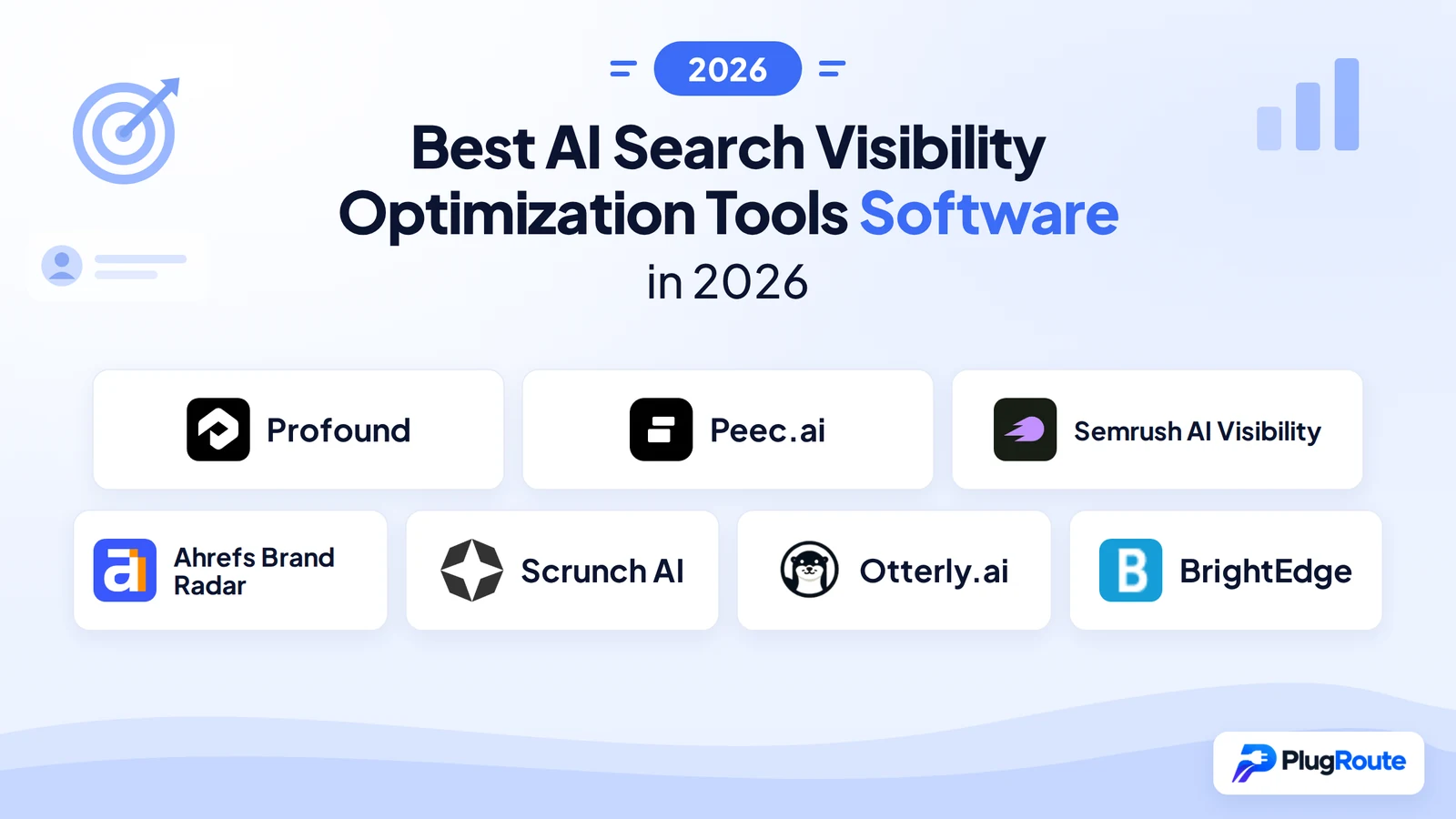
Profound leads for enterprise teams needing real-time monitoring across 10+ AI engines with built-in content optimization at $499/month. Peec.ai delivers the best value for agencies and growing teams, 9+ engine daily tracking with unlimited seats from €75/month (~$82). The right choice depends on whether your priority is monitoring depth, budget, or workflow consolidation with an existing SEO platform.
Brands are being cited and recommended inside AI-generated search responses that produce zero web traffic, zero GA4 events, and zero traditional analytics signals. When ChatGPT recommends your competitor and omits your brand, no existing measurement tool captures that loss.
The AI search visibility tool category exists to close this measurement gap, but tools differ fundamentally in how they monitor, what they track, and whether they help you act on what they find.
PlugRoute has no affiliate relationships with any company listed in this article. Rankings are determined entirely by research data and objective evaluation criteria.
TL;DR: Top Picks at a Glance
- Profound: deepest enterprise GEO monitoring with built-in content optimization and the most verified client outcome evidence
- Peec.ai: best daily multi-engine tracking value with unlimited team seats from €75/month; $21M Series A validates momentum
- Semrush AI Visibility: unified SEO + AI dashboard for existing Semrush subscribers seeking workflow consolidation
- Otterly.ai: most agency-ready monitoring with pre-built Looker Studio reporting and the Brand Visibility Index metric
What Are the Four Categories of AI Search Visibility Optimization Tools?
AI search visibility tools fall into four categories: Monitor (Peec.ai, Otterly.ai, Ahrefs Brand Radar, citation tracking and share of voice only); Monitor + Optimize (Profound, Scrunch AI, monitoring plus content optimization and AI crawler tools); Suite (Semrush, Ahrefs, AI visibility integrated within full SEO platforms); and Enterprise Platform (BrightEdge, fully managed, Fortune 500 only). The category determines both what a tool measures and whether it helps you act on findings.
Monitor tools (Peec.ai, Otterly.ai, Ahrefs Brand Radar) track where your brand stands across AI engines. They are visibility dashboards, not optimization engines, they identify gaps but do not close them.
Monitor + Optimize tools (Profound, Scrunch AI) combine visibility tracking with tools to act on what they find: content generation, gap detection, technical AI crawler optimization, or hallucination auditing.
Suite tools (Semrush, Ahrefs) integrate AI visibility into existing SEO platforms. They eliminate a separate tool subscription but provide shallower GEO-specific depth than purpose-built alternatives.
Enterprise Platform (BrightEdge) delivers fully managed AI and SEO intelligence for Fortune 500 organizations with custom pricing, dedicated account management, and 17 years of proprietary data, structurally inaccessible to agencies and most mid-market teams.
Key capability unlocked by category:
- Monitor: prompt-level citation tracking and share of AI voice measurement
- Monitor + Optimize: content gap detection and AI crawler optimization layered on monitoring
- Suite: traditional keyword rankings and AI visibility in one unified dashboard
- Enterprise Platform: multi-decade historical data enabling AI search trend analysis at the category level
To illustrate why category matters: if an AI engine cites your brand for “best project management software for remote teams” in April, research documents a 40–60% chance a different brand set appears for that same prompt in May. Monthly-snapshot tools miss this entirely; dedicated daily-refresh tools catch it within 24 hours. (Source: discoveredlabs.com, 2026)
How Do the Top 7 AI Search Visibility Tools Compare?
| Rank | Tool | Category | Best For | One-Line Summary | AI Engines Tracked | Update Cadence | Starting Price | Key Limitation |
|---|---|---|---|---|---|---|---|---|
| 1 | Profound | Monitor + Optimize | Enterprise AI-first GEO depth | Profound is the highest-scoring dedicated AI visibility and optimization platform in this independent 2026 evaluation, combining real-time 10+ engine monitoring, agent analytics across 16 reasoning models, and automated content gap detection. | 10+ | Real-time / Daily | $499/month | $499/month entry price; 3-seat Lite cap triggers rapid upgrade pressure |
| 2 | Peec.ai | Monitor | Agencies, teams, budget-conscious marketers | Peec.ai is the best-value dedicated AI monitoring platform in this 2026 evaluation, delivering 9+ engine daily tracking, unlimited seats, and URL-level content classification from €75/month. | 9+ | Daily | €75/month (~$82) | Monitoring only; no content optimization, gap detection, or hallucination detection |
| 3 | Semrush AI Visibility | Suite (Monitor + SEO) | Existing Semrush subscribers | Semrush AI Visibility is the strongest unified SEO + AI tracking platform in 2026 for teams already using Semrush who want one dashboard for both traditional rankings and AI engine visibility. | 9 | Daily (Position Tracking); Weekly (Visibility Overview) | $99/month per domain (AI Visibility Toolkit); $199/month (Semrush One Starter) | Synthetic prompt methodology; weekly Visibility Overview; add-on pricing compounds quickly |
| 4 | Ahrefs Brand Radar | Suite (Monitor + Multi-Channel) | Existing Ahrefs subscribers needing AI + multi-channel | Ahrefs Brand Radar is the only AI visibility tool in this 2026 evaluation that also tracks brand mentions across YouTube, TikTok, and Reddit in one platform. | 5 + YouTube / TikTok / Reddit | Continuous (Google AI Overviews, AI Mode); Monthly (ChatGPT, Gemini, Perplexity, Copilot) | Add-on from $199/month; full access $398–$699/month | Monthly refresh for most AI engines; documented competitor detection gap |
| 5 | Scrunch AI | Monitor + Technical Optimizer | Enterprise brands with AI crawler barriers | Scrunch AI is the most technically differentiated platform in this 2026 evaluation, offering the only CDN-edge AI crawler optimization layer (AXP) and native hallucination detection. | 7 (4 on $250/month Starter plan) | Not publicly documented; verify before purchase | $250/month Starter | AXP confirmed as enterprise-only / limited pilot on $250/month plan as of April 2026 |
| 6 | Otterly.ai | Monitor (Agency-Focused) | Agencies managing SME clients | Otterly.ai is the most agency-ready dedicated AI visibility monitoring platform in this 2026 evaluation, with pre-built Looker Studio reporting and the Brand Visibility Index composite metric. | 6 | Daily | $29/month Lite (15 prompts); $189/month Standard (100 prompts) | No G2/Capterra aggregate scores; no independently verified client outcome data |
| 7 | BrightEdge | Enterprise Platform | Fortune 500 organizations | BrightEdge is the most established enterprise AI search intelligence platform in 2026, with 17-year data depth, the BrightEdge Generative Parser for Google AI Overviews, and fully managed enterprise deployment. | 3 (primarily Google AI Overviews, ChatGPT, Perplexity) | Continuous (Google AI Overviews); not publicly disclosed for ChatGPT/Perplexity | Median ~$4,274/month (~$51,294/year per Vendr, 2026) | Structurally inaccessible to agencies, SMBs, and most mid-market teams |
Which AI Visibility Tool Should I Choose for My Use Case?
Not sure which row applies to your situation? Start with your budget ceiling, it narrows the viable options faster than any feature comparison. Then apply the workflow integration test: if you already pay for Semrush or Ahrefs, start with their add-on tools before considering a standalone subscription.
| Your #1 Priority | Recommended Tool | Why | Acceptable Alternative | Budget Constraint Alternative |
|---|---|---|---|---|
| Agency managing 10+ client brands | Otterly.ai or Peec.ai | Pre-built Looker Studio, BVI metric, unlimited seats, under $200/month | Semrush AI Visibility if already subscribed | Otterly.ai Lite $29/month for initial experimentation only (15 prompts; insufficient for full multi-client use) |
| Enterprise brand, AI-first monitoring depth | Profound | Deepest monitoring methodology, 10+ engines, content optimization, $96M Series C at $1B valuation | Scrunch AI for technical CDN-layer optimization (verify AXP availability first) | Peec.ai Pro (~$218/month) for daily multi-engine monitoring without Profound’s $499/month commitment |
| Already using Semrush daily | Semrush AI Visibility | Zero context-switching, unified SEO+AI dashboard, largest review base | Peec.ai as standalone daily-refresh supplement | Peec.ai Starter (~$82/month) adds daily monitoring depth that Semrush’s weekly Visibility Overview cannot provide |
| Already using Ahrefs | Ahrefs Brand Radar | Multi-channel (AI + YouTube + TikTok + Reddit) in one platform | Peec.ai for daily-refresh supplement for ChatGPT and Perplexity | Peec.ai Starter for daily cadence on the engines Brand Radar refreshes monthly |
| Budget-conscious solo practitioner | Peec.ai Starter | €75/month, 9+ engines, unlimited seats, daily tracking, free trial | Otterly.ai Standard $189/month for GEO audit depth | Otterly.ai Lite $29/month (15 prompts; trial use only) |
| Fortune 500 enterprise | BrightEdge | 17-year historical data, BGP for Google AI Overviews, enterprise SLAs; median $4,274/month | Profound for dedicated GEO depth at ~11% of BrightEdge’s median contract cost | Profound ($499/month) for enterprise-depth GEO monitoring without the $4,000+/month commitment |
| Technical AI crawler optimization | Scrunch AI | Only CDN-edge AXP middleware; hallucination detection; named enterprise customers; verify AXP availability at your contract tier before signing | Profound for monitoring + content without infrastructure layer | Profound ($499/month) for monitoring plus content optimization without the AXP infrastructure commitment |
1. Profound: Best Overall: Best for Enterprise AI Visibility Depth and In-Platform Content Optimization
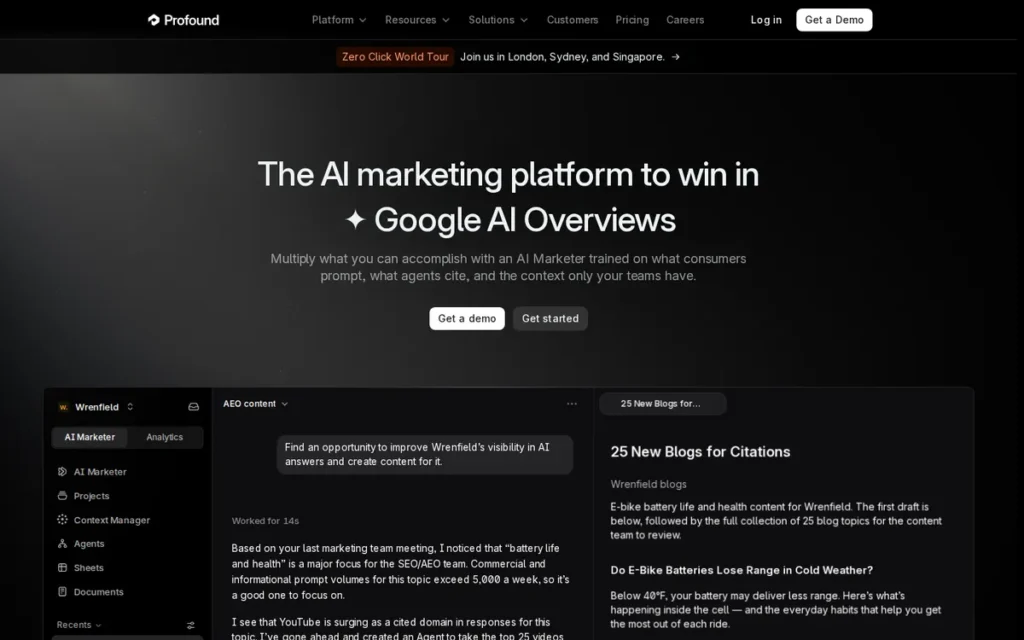
Category: Monitor + Optimize, tracks brand visibility across 10+ AI engines via real-time consumer interface monitoring AND provides content generation, agent analytics across 16 reasoning models, and automated prompt gap detection; not a monitoring-only platform.
At a Glance
- Category: Monitor + Optimize
- Best For: Enterprise brands and mid-market teams needing the deepest available AI visibility data with in-platform content optimization, workflow automation, and vendor stability backed by $96M Series C funding at a $1B valuation
- Price Range: $499/month (Lite/Standard: 3 user seats, 200 unique daily prompts, unlimited domains, unlimited content generation, 2 months historical data); Enterprise: custom pricing via sales. A $99/month ChatGPT-only Starter tier is referenced in some third-party sources but was not confirmed on Profound’s official pricing page as of April 2026, verify directly before budgeting.
- Primary Strength: Profound is the only dedicated GEO platform in this evaluation combining real-time 10+ engine consumer interface monitoring, agent analytics across 16 reasoning models, and automated content gap detection in one integrated product
- Biggest Limitation: Profound’s $499/month entry price is the highest among dedicated GEO tools in this evaluation; the Lite plan’s 3-seat cap and 200-prompt ceiling trigger rapid upgrade pressure for growing teams; G2 users document a steep learning curve for teams new to GEO
- One-Line Summary: Profound is the highest-scoring dedicated AI visibility and optimization platform in this independent 2026 evaluation, combining real-time 10+ engine monitoring, agent analytics across 16 reasoning models, and automated content gap detection at a depth no equivalent dedicated GEO tool currently matches.
- Last Verified: April 2026
Overview
Profound is an enterprise AI visibility and Answer Engine Optimization platform that monitors brand presence, citations, and sentiment across 10+ AI engines (including ChatGPT, Perplexity, Gemini, Claude, Grok, DeepSeek, Meta AI, and Google AI Mode) for SEO teams, content strategists, and brand managers who need end-to-end GEO intelligence rather than periodic monitoring snapshots.
Profound was purpose-built for AEO/GEO rather than retrofitted from a traditional SEO platform, making it structurally different from suite tools like Semrush and Ahrefs that have added AI visibility as a module to existing infrastructure. Profound is the only tool in this evaluation combining real-time consumer interface monitoring, AI crawler agent analytics, automated content gap detection, and in-platform content generation in a single product.
Profound raised $96M in a Series C funding round in February 2025 at a $1B valuation, the largest confirmed funding round of any dedicated GEO monitoring tool in this evaluation, providing vendor stability assurance that early-stage competitors cannot yet match. (Source: tryprofound.com/blog; venture capital press, February 2025)
Key Features
- Real-Time Consumer Interface Monitoring: Profound’s Answer Engine Insights module monitors brand citations, sentiment trends, and contextual framing by querying the live consumer-facing interfaces users actually interact with (not static API samples that may return different results than live AI products) across 10+ AI engines simultaneously.
- Agent Analytics (16 Reasoning Models): Profound tracks which AI crawlers across 16 documented reasoning models are visiting and attributing a brand’s web presence, providing crawler-level attribution data that identifies exactly which AI systems are or are not indexing a brand’s content, a capability with no equivalent in any other evaluated tool. (Source: nicklafferty.com, 2026)
- Conversation Explorer: Profound’s Conversation Explorer surfaces real-time AI search volume on industry topics by analyzing 1M+ daily user prompts, enabling brands to identify high-priority topics where competitor citation rates are outpacing their own before the gap compounds into structural disadvantage.
- Automated Prompt Gap Detection: Profound processes 130M+ real user AI conversations to identify 10–50 missing high-value prompts per month for each tracked brand, replacing manual prompt research with a continuous, data-driven discovery process calibrated to actual user behavior. (Source: nicklafferty.com, 2026)
- Content Intelligence Layer: Profound provides engine-specific optimization guidance including optimal word count, sentence structure recommendations, Flesch Readability targets, and semantic URL slug guidance, with documented research showing semantic URL slugs alone increase AI citations by 11.4%. (Source: nicklafferty.com, 2026)
Best For
Profound is best for enterprise brands, established SEO agencies, and funded mid-market teams that need to understand not just whether they appear in AI responses but how AI systems describe them, which crawlers are indexing them, and what content changes will predictably move citation share numbers in competitive categories like SaaS, ecommerce, or B2B services.
Pricing
Profound’s published Lite/Standard plan is $499/month as of April 2026, covering unlimited domains, unlimited content generation, 3 user seats, 24,000 AI responses analyzed monthly (200 unique daily prompts), 2 months of historical data, and CSV/JSON export. (Source: tryprofound.com/pricing, April 2026)
Enterprise contracts require sales engagement and include SOC 2 Type II compliance, SSO, audit logs, and custom prompt volumes. A $99/month ChatGPT-only Starter tier is referenced in some third-party sources but was not confirmed on Profound’s official pricing page as of April 2026, verify directly before budgeting.
Strengths
- Profound raised $96M Series C in February 2025 at a $1B valuation: the largest confirmed funding round of any dedicated GEO monitoring tool in this evaluation, providing vendor stability assurance that early-stage competitors with €7M–$21M in total funding cannot yet match. (Source: tryprofound.com/blog; venture capital press, February 2025)
- Ramp (accounts payable software) grew AI visibility 7x using Profound’s optimization recommendations, from 3.2% to 22.2%, in two months (December 2024–February 2025), with citation count reaching 300+ in the final month and brand position improving from 19th to 8th. (Source: tryprofound.com/customers/ramp-case-study, April 2026)
- 1840 & Co. (remote staffing) grew from 0% AI visibility to top 5 brand status at 11% AI visibility, competing against category leaders Toptal (initial 74% share) and Upwork (initial 29% share) using Profound’s content intelligence framework. (Source: tryprofound.com/customers/1840-co, April 2026)
- Profound’s real-time consumer interface monitoring across 10+ AI engines captures what actual users see (including RAG contextual framing) providing data quality that synthetic prompt tools and PAA-derived monthly databases structurally cannot replicate. (Source: generatemore.ai, 2026)
Limitations
- Price Barrier: Profound’s $499/month entry price is 2.7x more than Otterly.ai Standard ($189/month), 5.4x more than Peec.ai Starter (~$82/month), and competitive with a full Semrush Business plan that bundles an entire SEO suite, making it the most consequential purchasing barrier in this evaluation.
- Seat and Prompt Ceiling: Profound’s Lite plan caps at 3 user seats and 200 unique daily prompts, meaning agencies managing multiple client brands will hit upgrade triggers quickly, escalating to enterprise custom pricing without published benchmarks.
- Learning Curve: Profound’s verified G2 rating is 4.6/5 (322 verified reviews, G2 Winter 2026 Leader), user criticisms include steep learning curve from extensive features and limited prescriptive guidance for teams new to GEO. Teams without in-house GEO expertise should validate the interface during trial before committing at this price point. (Source: G2 user reviews, Winter 2026)
Verdict
Profound is the highest-scoring dedicated AI search visibility and optimization platform in this evaluation, earning #1 through the strongest combination of monitoring methodology depth, content optimization capability, and independently verified client outcomes in the GEO tool category as of April 2026. No other dedicated GEO platform in this evaluation combines real-time consumer-interface monitoring across 10+ engines with agent analytics tracking 16 reasoning models and in-platform content optimization, the three-criteria combination that determined the #1 ranking. For enterprise teams and funded agencies needing the full stack, Profound is the most defensible choice; teams with tighter budgets or monitoring-only needs should evaluate Peec.ai (#2) or Otterly.ai (#6) at significantly lower price points.
2. Peec.ai: Best Value for Teams: Best Monitoring Depth Per Dollar with Unlimited Seats
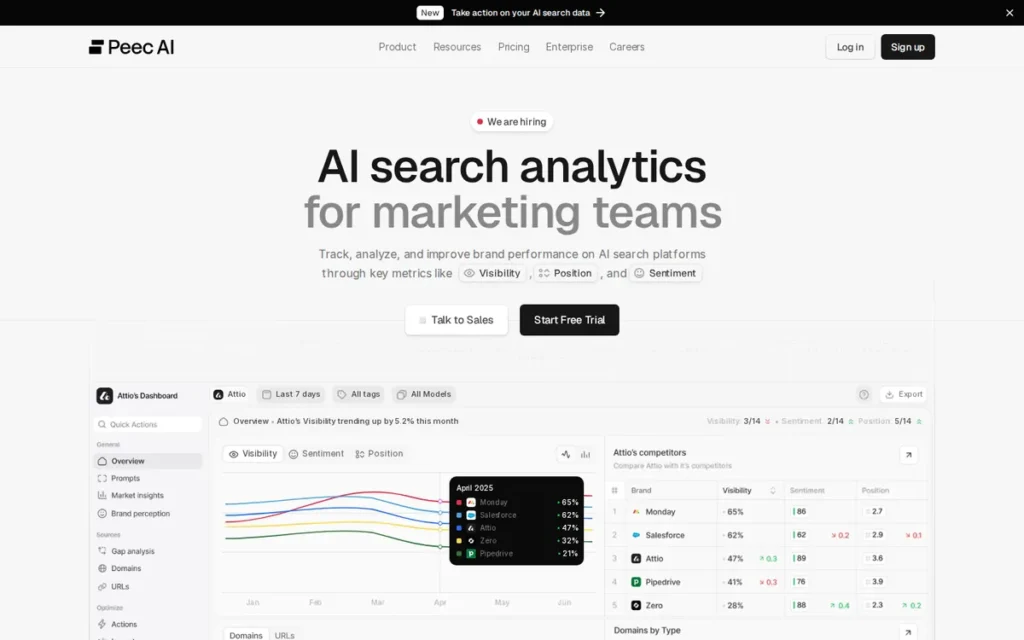
Category: Monitor, dedicated AI search visibility tracking across 9+ engines with competitive benchmarking, sentiment analysis, URL-level content classification, and source attribution; does not include content generation or technical optimization tools.
At a Glance
- Category: Monitor
- Best For: Agencies, growing in-house teams, and cost-conscious marketers needing comprehensive multi-engine daily tracking with unlimited user seats and transparent per-prompt pricing
- Price Range: €75/month Starter (~$82, 25 daily prompts); €199/month Pro (~$218, 100 prompts); €499+/month Enterprise (~$545+, 300+ prompts). Additional AI engines: €20–30/month each. All plans include unlimited team seats. Free trial available. Prices in EUR, verify current exchange rates at point of purchase.
- Primary Strength: Peec.ai offers the lowest verified entry price for 9+ AI engine daily monitoring with unlimited team seats in this evaluation, combining clickstream-based prompt prioritization and URL-level content classification at a price accessible to individual practitioners and small agencies
- Biggest Limitation: Peec.ai is a monitoring-only platform: it tracks and reports AI visibility across 9+ engines but provides no built-in tools to improve that standing through content creation, structural optimization, or hallucination detection
- One-Line Summary: Peec.ai is the best-value dedicated AI search visibility monitoring platform in this 2026 evaluation, combining 9+ engine daily tracking, unlimited team seats, and URL-level content classification at a transparent entry price below $100/month.
- Last Verified: April 2026
Overview
Peec.ai is a dedicated AI search visibility monitoring platform that launched in early 2025 and tracks brand presence, citations, sentiment, and competitive share of voice across 9+ AI engines (including ChatGPT, Perplexity, Google AI Overviews, Claude, Gemini, Microsoft Copilot, DeepSeek, Grok, and Llama) for marketing teams and agencies needing comprehensive multi-engine monitoring at an accessible, transparent price point.
Peec.ai raised $21M in a Series A funding round in November 2025 (led by Singular, confirmed by TechCrunch), following €7M in earlier seed rounds, reaching ARR exceeding $4M within 10 months of launch and a valuation above $100M. Peec.ai serves 1,300+ customers as of November 2025, demonstrating rapid product-market fit in a category where most enterprise solutions start at $499/month or require sales engagement. (Source: TechCrunch, November 2025)
Peec.ai’s strongest differentiators are its unlimited-seat pricing model, URL-level content type classification identifying which formats AI systems preferentially cite, and clickstream-based prompt volume prioritization, analytical capabilities no other dedicated GEO monitoring tool at a comparable price point offers.
Key Features
- Daily Multi-Engine Tracking (9+ Engines): Peec.ai tracks brand visibility as a percentage metric per prompt set across 9+ AI engines simultaneously with a daily refresh cadence, capturing the citation drift patterns that research documents affect 40–60% of cited domains month-to-month. (Source: discoveredlabs.com, 2026)
- URL-Level Content Type Classification: Peec.ai categorizes each URL cited by AI engines into content types (Homepage, Article, Listicle, Comparison, Product, or Profile) enabling content teams to identify which formats AI systems preferentially cite and prioritize production accordingly. (Source: rankability.com, 2026)
- Clickstream-Based Prompt Prioritization: Peec.ai uses clickstream data to estimate real user prompt volume for each tracked query, allowing brands to rank their prompt portfolio by estimated business impact rather than treating all tracked prompts with equal priority, a methodology absent from most competitor platforms. (Source: buriedagency.com, 2026)
- Source Attribution with Owned vs. Competitor Labeling: Peec.ai provides attribution at domain and URL level with owned vs. competitor source labeling, enabling brands to see exactly which third-party sources AI systems trust when answering category queries, including competitor review sites, industry publications, and forum threads.
- Modular AI Engine Architecture: Peec.ai’s Starter plan covers ChatGPT, Perplexity, and Google AI Overviews; teams can add individual engines (Claude, Gemini, DeepSeek, Grok, Llama) at €20–30/month each, paying only for the engines relevant to their specific audience. (Source: peec.ai, April 2026)
Best For
Peec.ai is best for agencies managing multiple client AI visibility accounts where the unlimited seat model eliminates per-user cost escalation, mid-market in-house teams wanting comprehensive engine coverage without Profound’s $499/month commitment, and individual practitioners needing a legitimate daily-tracking monitoring tool below $100/month.
Pricing
Peec.ai pricing as of April 2026 (billed monthly, free trial available): Starter €75/month (~$82) covers 25 daily tracked prompts across ChatGPT, Perplexity, and Google AI Overviews with unlimited team seats and a Looker Studio connector. Pro €199/month (~$218) expands to 100 prompts with Slack support. Enterprise starts at €499/month (~$545) for 300+ prompts with custom add-ons. Each additional AI engine adds €20–30/month. Prices are in EUR, verify current EUR/USD rates and pricing at peec.ai before purchase.
Strengths
- Peec.ai raised $21M Series A in November 2025 (Singular-led, TechCrunch confirmed), with ARR exceeding $4M within 10 months of its early 2025 launch, the fastest independently documented revenue trajectory and the second-largest confirmed funding total of any dedicated GEO tool in this evaluation after Profound’s $96M Series C. (Source: TechCrunch; EU-Startups, November 2025)
- Peec.ai was cited as the top enterprise platform for AI search visibility tracking in a 2026 BusinessCloud evaluation of 14 platforms across criteria including multi-LLM coverage, citation analysis, sentiment tracking, and enterprise reporting, independent verification of the evaluation methodology was not conducted for this report; weight accordingly. (Source: Martech Series, April 2026)
- Peec.ai’s unlimited seat model is a structural pricing advantage for agencies: a 10-person team monitoring 20 client brands accesses the full platform for €75/month vs. per-seat tools requiring 10× seat fees, a difference of potentially thousands of dollars annually at the same base entry price.
- Independent research documents that 40–60% of domains cited by AI engines change month-to-month, citation drift that validates Peec.ai’s daily tracking cadence as a functional requirement rather than a premium feature over monthly-snapshot tools. (Source: discoveredlabs.com, 2026)
Limitations
- Monitoring Only: Peec.ai excels at tracking AI visibility across 9+ engines but provides no built-in tools to improve that standing, specifically: no content creation or gap-fill recommendations, no structural SEO-for-AI auditing, and no hallucination detection. Teams running active GEO improvement programs must maintain separate tools for each of these functions alongside Peec.ai.
- No Third-Party Review Platform Scores: Peec.ai has no verified G2, Capterra, or Trustpilot aggregate scores as of April 2026, expected given its early 2025 launch, buyers must rely on the BusinessCloud ranking, TechCrunch funding coverage, and peer community discussions rather than standard review platform evidence.
- Founding Team Opacity: Peec.ai’s founding team: Marius Meiners, Tobias Siwona, and Daniel Drabo, is documented in funding disclosures but operational background details are not extensively published, which may create friction for enterprise procurement teams conducting standard vendor due diligence. (Source: Silicon Canals, April 2025)
Verdict
Peec.ai is the best-value dedicated AI search visibility monitoring platform in this evaluation, earning #2 through the strongest pricing transparency score, the second-broadest engine coverage at 9+ engines, and the only unlimited-seat pricing model in the category as of April 2026. Peec.ai ranks above Semrush (#3) on the two highest-weighted criteria: monitoring methodology quality (C1, 30% weight, daily dedicated refresh vs. Semrush’s weekly Visibility Overview and synthetic prompt generation) and pricing transparency (C2, 20% weight, published tiered pricing vs. Semrush’s per-domain, per-user, per-prompt add-on layering). Teams requiring in-platform content optimization alongside visibility tracking should evaluate Profound (#1) as the more comprehensive but significantly more expensive alternative.
3. Semrush AI Visibility: Best for Existing Semrush Users: Best Unified SEO + AI Visibility Platform
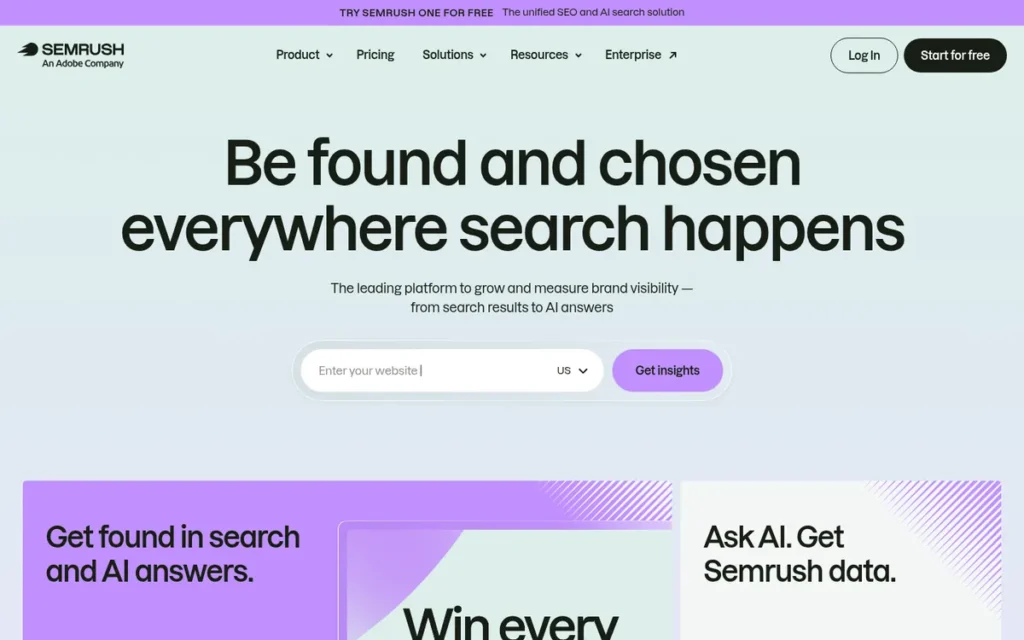
Category: Suite (Monitor + SEO), broad SEO platform with AI visibility features integrated; tracks traditional Google Search rankings and AI engine visibility simultaneously in one dashboard.
At a Glance
- Category: Suite (Monitor + SEO)
- Best For: SEO teams and agencies already subscribed to Semrush who want to add AI visibility tracking without switching platforms or fragmenting reporting across tools
- Price Range: AI Visibility Toolkit: $99/month per domain (25 custom prompts); additional domains $99/month; additional users $99/month; extra prompts $60/month per 50. Semrush One Starter: $199/month (50 tracked prompts, 5+ AI platforms). Base Semrush plans ($139.95–$499.95/month) include limited AI Overviews tracking only. Calculate total cost for your specific configuration before comparing to standalone GEO tools.
- Primary Strength: Semrush AI Visibility is the only tool in this seven-tool evaluation that integrates traditional Google keyword rankings and AI engine visibility in a single unified dashboard without requiring a separate subscription
- Biggest Limitation: Semrush’s AI visibility monitoring uses synthetic prompt generation rather than real user queries, and the Visibility Overview refreshes weekly, meaning brands can go seven days without detecting a significant AI visibility drop in their primary monitoring view
- One-Line Summary: Semrush AI Visibility is the strongest unified SEO + AI search tracking platform in 2026 for teams already using Semrush who want to eliminate a separate GEO tool subscription.
- Last Verified: April 2026
Overview
Semrush AI Visibility is the AI search monitoring and optimization capability within Semrush One and the AI Visibility Toolkit add-on, available to subscribers of the Semrush SEO platform, serving SEO professionals, digital marketing agencies, and enterprise content teams who need AI engine brand tracking integrated with existing keyword research, competitor analysis, and site audit workflows rather than as a standalone product.
Semrush covers 9 AI engines including ChatGPT, Gemini, Google AI Overviews, Google AI Mode, Perplexity, Claude, Copilot, Grok, and DeepSeek, monitored via a database of 100–239 million synthetically generated prompts. (Source: generatemore.ai, 2026)
Semrush’s core differentiator is integration value: as a NYSE-listed company (SEMR, 2021) with 2,200+ G2 reviews and G2 Spring 2026 #1 recognition across 6 SEO categories (per Semrush’s press release), it offers procurement confidence and workflow consolidation that purpose-built GEO startups cannot yet provide.
Key Features
- Unified SEO + AI Dashboard: Semrush’s Position Tracking module runs at a daily refresh cadence, enabling brands to monitor both traditional Google keyword rankings and AI engine prompt rankings simultaneously, the only tool in this seven-tool evaluation surfacing traditional and AI search performance in a single integrated view without a separate subscription. (Source: semrush.com, April 2026)
- Visibility Overview (9 AI Engines): Semrush’s Visibility Overview module provides a weekly-refreshed baseline assessment of brand presence across ChatGPT, Gemini, Google AI Overviews, Google AI Mode, Perplexity, Claude, Copilot, Grok, and DeepSeek, tracking how consistently a brand appears in synthetically generated prompt responses.
- Brand Performance Module: Semrush’s Brand Performance module measures share of AI voice, sentiment trends, and historical visibility data against defined competitor sets, providing executive-reportable metrics that contextualize a brand’s AI search standing relative to its competitive landscape. (Source: almcorp.com, 2026)
- Prompt Research Feature: Semrush’s Prompt Research module provides volume estimates and competitive difficulty scores for AI search prompts, enabling GEO content teams to prioritize which AI search topics justify optimization investment based on potential impact, structurally similar to traditional keyword research methodology.
- Full Platform Integration: Semrush’s AI Visibility Toolkit integrates with the full Semrush platform’s content tools, competitor gap analysis, and backlink audit features, enabling teams to trace AI visibility improvements to specific content and link-building actions within one consolidated workflow.
Best For
Semrush AI Visibility is best for SEO agencies and in-house teams with active Semrush subscriptions who want to add AI visibility tracking without introducing a new vendor relationship, login, or reporting format, specifically, teams where unified SEO+AI dashboard value outweighs the need for the deepest available GEO-specific monitoring depth.
Pricing
Semrush pricing as of April 2026 requires careful parsing before budgeting. Base Semrush plans, Pro $139.95/month, Guru $249.95/month, Business $499.95/month: include limited or basic AI Overviews tracking only.
Full multi-LLM AI visibility monitoring requires either the AI Visibility Toolkit ($99/month per domain, 25 custom prompts) or Semrush One Starter ($199/month, 50 prompts, 5+ platforms). A team tracking 2 domains with 2 users and 75 custom prompts pays: $99 + $99 (domain 2) + $99 (user 2) + $60 (25 extra prompts) = $357/month, before the base Semrush subscription cost. A 7-day free trial is available for the AI Visibility Toolkit. Always calculate your specific configuration cost at semrush.com before comparing Semrush’s headline plan price to standalone GEO tools. (Source: tryprofound.com Semrush toolkit review; semrush.com, April 2026)
Strengths
- Semrush earned G2 Spring 2026 #1 rankings across 6 SEO categories: representing the strongest third-party review platform validation in this evaluation, with over 2,200 G2 reviews and 2,100 Capterra reviews constituting the largest independently verified buyer satisfaction evidence base of any tool assessed. (Source: Semrush press release, Spring 2026)
- Semrush’s NYSE listing (SEMR, 2021) and decade-plus operational history provide procurement-level vendor stability assurance categorically unavailable from startups launched in 2024–2025, a meaningful criterion for enterprise buyers in regulated industries with formal vendor risk management requirements.
- Semrush’s unified dashboard eliminates the reporting fragmentation teams face when using a dedicated GEO tool alongside a separate SEO platform, a consolidation benefit with documented workflow efficiency value for teams currently context-switching between tools.
- Semrush’s 100–239 million prompt database enables AI search topic discovery at a scale that manual research cannot replicate, even if the synthetic generation methodology differs from real-user query monitoring approaches. (Source: generatemore.ai, 2026)
Limitations
- Synthetic Prompt Methodology: Semrush creates AI visibility tracking prompts algorithmically based on domain and location inputs rather than monitoring actual user queries in live AI sessions, a methodological distinction from Profound’s real-time consumer interface approach that independent reviewers characterize as producing “basic” AI crawler insights vs. Profound’s “full” agent analytics. (Source: nicklafferty.com, 2026)
- Add-On Pricing Complexity: Teams adding the AI Visibility Toolkit at $99/month per domain, $99/month per additional user, and $60/month per 50 extra prompts face a compounding cost structure that can reach $300–$500+/month before approaching the feature set of dedicated GEO tools priced at $82–$250/month. This add-on layering is not apparent from the headline plan price and has generated consistent buyer frustration in independent evaluations.
- Weekly Visibility Overview Cadence: Semrush’s Visibility Overview updates weekly, meaning brands can go seven full days without detecting a significant AI visibility drop in their primary monitoring view, while dedicated tools like Peec.ai and Profound refresh daily.
Verdict
Semrush AI Visibility earns #3 as the strongest choice for SEO teams already within the Semrush ecosystem, where integration value (unified traditional and AI search tracking in one platform backed by the largest verified review base in the evaluation) justifies its position above dedicated monitoring-only tools. Teams evaluating Semrush specifically for GEO monitoring depth will find Profound (#1) and Peec.ai (#2) provide stronger dedicated methodology, feature depth, and pricing value for that specific use case. The decision reduces to one question: does eliminating a separate GEO tool subscription justify accepting lower AI monitoring depth than the dedicated category leaders provide?
4. Ahrefs Brand Radar: Best for Cross-Channel Brand Intelligence: Best for Existing Ahrefs Users Needing AI + Multi-Channel Visibility
Category: Suite (Monitor + Multi-Channel), tracks brand visibility across AI engines AND YouTube, TikTok, and Reddit in one platform; part of the full Ahrefs SEO and brand intelligence suite.
At a Glance
- Category: Suite (Monitor + Multi-Channel)
- Best For: SEO professionals and brand managers already using Ahrefs who want AI engine visibility tracking integrated with YouTube, TikTok, and Reddit brand monitoring in one platform
- Price Range: Add-on from $199/month; full multi-platform access with custom prompt volumes: $398–$699/month depending on configuration. Base Ahrefs plans start at $129/month (Lite), Brand Radar not confirmed as included in all tiers. Verify exact tier inclusion at ahrefs.com/brand-radar before budgeting. (Source: ahrefs.com/brand-radar, April 2026)
- Primary Strength: Ahrefs Brand Radar is the only tool in this evaluation that tracks brand mentions across AI engines, YouTube, TikTok, and Reddit simultaneously in one platform, providing a multi-channel brand intelligence view no dedicated GEO monitoring tool currently offers
- Biggest Limitation: Ahrefs Brand Radar refreshes ChatGPT, Gemini, Perplexity, and Copilot data on a monthly cadence, a gap that means brands may miss AI citation shifts for up to 30 days for those engines, while Google AI Overviews and AI Mode update continuously
- One-Line Summary: Ahrefs Brand Radar is the best multi-channel brand intelligence solution in 2026 for existing Ahrefs users needing AI engine visibility integrated with YouTube, TikTok, and Reddit monitoring in a single platform.
- Last Verified: April 2026
Overview
Ahrefs Brand Radar is the AI visibility monitoring and multi-channel brand intelligence feature within the Ahrefs platform, tracking brand mentions and citations across five major AI engines (ChatGPT, Gemini, Perplexity, Microsoft Copilot, and Google AI Overviews including AI Mode) alongside YouTube, TikTok, and Reddit for SEO professionals and brand managers who use Ahrefs as their primary SEO platform.
Ahrefs Brand Radar uses a database of 352M+ total monthly prompts (including 258M+ for AI Overviews), derived from Google’s People Also Ask (PAA) questions and semantically expanded using Ahrefs’ 110 billion keyword database. Update cadence is mixed: Google AI Overviews and AI Mode update continuously, while ChatGPT, Gemini, Perplexity, and Microsoft Copilot refresh on a monthly cycle. (Source: ahrefs.com/blog/brand-radar-methodology, April 2026)
Ahrefs was founded in 2012 by Dmitry Gerasimenko and has operated as a bootstrapped company for over a decade, delivering significant Brand Radar feature expansions in December 2025 including TikTok tracking and expanded AI engine metrics.
Key Features
- AI Visibility Metrics (5 Engines + AI Mode): Ahrefs Brand Radar tracks AI Mentions, AI Citations, AI Share of Voice, and Impressions across ChatGPT, Gemini, Perplexity, Microsoft Copilot, and Google AI Overviews, filterable by domain, URL, and path for granular source attribution analysis. (Source: ahrefs.com/blog/brand-radar-use-cases, 2025)
- YouTube Brand Monitoring: Ahrefs Brand Radar extends brand intelligence to YouTube video titles, descriptions, and transcripts, capturing brand mentions in video content that ranks in Google Search, a surface not offered by dedicated GEO monitoring tools in this evaluation as of April 2026 based on publicly documented feature sets.
- TikTok and Reddit Multi-Channel Tracking: Ahrefs Brand Radar monitors TikTok video content and Reddit threads surfacing in Google results for brand mentions, providing the most complete multi-channel brand visibility picture of any tool evaluated across AI search, video, and community forum surfaces. (Source: ahrefs.com, December 2025)
- PAA-Derived Prompt Database (352M+ Prompts): Ahrefs Brand Radar’s prompt database is derived from Google’s People Also Ask data and semantically expanded using Ahrefs’ 110 billion keyword database, grounding the tracked prompt set in documented real user query behavior rather than algorithmic synthetic generation.
- API Access for Custom Dashboards: Ahrefs Brand Radar provides API access enabling enterprise teams to pull AI visibility metrics into internal reporting systems alongside broader Ahrefs keyword and backlink data. (Source: authoritas.com, 2026)
Best For
Ahrefs Brand Radar is best for SEO consultants and in-house marketers with existing Ahrefs subscriptions who view AI visibility as one component of a broader multi-channel brand monitoring strategy, specifically, teams tracking brand presence across YouTube, TikTok, and Reddit alongside AI engines who want to consolidate those signals in one platform they already use for backlink and keyword research.
Pricing
Ahrefs pricing as of April 2026: Brand Radar is available as an add-on from $199/month, with full multi-platform access ranging from $398–$699/month depending on prompt volume and platform configuration. (Source: ahrefs.com/brand-radar, April 2026)
Base Ahrefs plans start at $129/month (Lite), with Standard, Advanced, and Enterprise tiers above that. The exact Brand Radar tier inclusion is not fully published at the plan level, verify which specific plan includes Brand Radar access at ahrefs.com/brand-radar before subscribing. At the $398–$699/month full-access level, Ahrefs provides backlink analysis, keyword research, site audit, content explorer, and Brand Radar in one subscription.
Strengths
- Ahrefs Brand Radar received a public endorsement from Aleyda Solis, internationally recognized SEO consultant and founder of Orainti, who described it as “one of the easiest and most comprehensive ways to understand AI answers,” a practitioner validation carrying meaningful weight with the agency and consultant audience Ahrefs primarily serves. (Source: ahrefs.com/brand-radar, 2025; note: this endorsement appears on Ahrefs’ own website, any commercial relationship between Ahrefs and the endorser was not confirmed for this evaluation)
- Ahrefs’ December 2025 Brand Radar expansion added TikTok video tracking and expanded AI engine metrics, reflecting active product investment in AI visibility capabilities at the same time the platform is maturing, signaling Brand Radar is a development priority rather than a feature add-on with uncertain roadmap commitment. (Source: ahrefs.com, December 2025)
- Ahrefs’ 12-year bootstrapped operating history: navigating Google Panda (2011), Penguin (2012), BERT (2019), and AI Overviews (2024), provides vendor stability assurance through demonstrated paradigm adaptation that no tool launched in 2024–2025 can structurally offer.
- Ahrefs’ G2 rating of 4.8/5 (1,400+ reviews) and Capterra 4.7/5 (~300 reviews) reflect sustained enterprise and agency buyer satisfaction with the full platform across over a decade of operation. (Source: blastra.io, April 2026)
Limitations
- Monthly Cadence for Most AI Engines: Ahrefs Brand Radar refreshes ChatGPT, Gemini, Perplexity, and Copilot data on a monthly cycle, meaning brands can miss AI citation shifts for up to 30 days for these engines. Research documents 40–60% of cited domains change month-to-month, making Brand Radar inadequate as a primary real-time monitoring tool for brands in competitive AI search categories. (Source: discoveredlabs.com, 2026)
- Documented Competitor Detection Gap: A competitor-sourced comparison Peec.ai, 2026 documented Brand Radar failing to detect known competitors in controlled evaluation scenarios, this finding has not been independently verified by a neutral third party and should be weighted accordingly. Teams should conduct their own controlled tests against a known competitor set during Brand Radar’s trial period before relying on competitive benchmarking outputs for strategy decisions. (Source: peec.ai/comparison, 2026, note: competitor-produced source)
- No Sentiment Analysis or Content Optimization: Ahrefs Brand Radar lacks sentiment analysis, content optimization features, and hallucination detection, placing it in monitoring-only territory alongside Peec.ai and Otterly.ai, but without their daily refresh advantage for AI-specific monitoring of ChatGPT, Gemini, and Perplexity.
Verdict
Ahrefs Brand Radar earns #4 as the most distinctive multi-channel brand intelligence solution in this evaluation, uniquely combining AI engine visibility with YouTube, TikTok, and Reddit brand monitoring in a single platform, a scope no dedicated GEO tool currently replicates. For existing Ahrefs subscribers, Brand Radar is the lowest-friction way to add AI visibility to an established workflow at a price covering the full Ahrefs suite. The monthly cadence for most AI engines is Brand Radar’s most consequential limitation and the primary reason it ranks below daily-refresh dedicated tools for buyers where real-time AI citation monitoring is the primary requirement.
5. Scrunch AI: Best for Technical AI Optimization: Best for Brands Targeting AI Crawler-Level Architecture
Category: Monitor + Technical Optimizer, tracks brand visibility across 7 AI engines (4 on the $250/month Starter plan) AND provides technical AI crawler optimization via a CDN-edge middleware layer (AXP) that restructures content for AI consumption at the infrastructure level; includes hallucination detection.
At a Glance
- Category: Monitor + Technical Optimizer
- Best For: Enterprise technology and DTC brands with diagnosed AI crawler accessibility barriers who need both monitoring and a technical infrastructure-level intervention alongside hallucination detection, not just content strategy or monitoring dashboards
- Price Range: $250/month Starter (350 custom prompts + 1,000 industry prompts; covers 4 AI platforms, not all 7 as marketing materials suggest; per-engine tracking consumes prompt allocation); $500/month Growth; Enterprise: custom pricing. AXP is enterprise-only / limited pilot on the $250/month Starter plan as of April 2026.
- Primary Strength: Scrunch AI is the only platform in this evaluation offering a CDN-edge AI crawler optimization layer (AXP) that reduces file sizes served to AI bots by up to 98%, alongside native hallucination detection as a named first-class monitoring feature
- Biggest Limitation: Scrunch AI’s flagship AXP feature is confirmed as enterprise-only or in limited pilot access on the $250/month Starter plan as of April 2026, paying Starter users may not receive AXP access. Verify current AXP availability directly with Scrunch AI before purchasing.
- One-Line Summary: Scrunch AI is the most technically differentiated AI search visibility platform in this 2026 evaluation, offering the only CDN-edge AI crawler optimization layer (AXP) alongside multi-engine monitoring and native hallucination detection for enterprise brands with identified technical AI indexing barriers.
- Last Verified: April 2026
Overview
Scrunch AI is a multi-LLM AI search visibility and optimization platform that tracks brand presence across 7 AI engines (ChatGPT, Claude, Perplexity, Gemini, Google AI Mode, Google AI Overviews, and Meta AI) for enterprise technology brands, DTC companies, and agencies needing both visibility monitoring and technical AI crawler-level infrastructure optimization, not just content strategy guidance.
Scrunch AI’s flagship differentiator is the Agent Experience Platform (AXP), a middleware layer integrated with Cloudflare, Akamai, and Vercel that creates a machine-readable version of brand content optimized specifically for AI crawler consumption, reducing file sizes served to AI bots by up to 98% while leaving the human-facing site unchanged. (Source: generatemore.ai, 2026)
Scrunch AI was founded in 2024 and documents 500+ enterprise customers including named accounts Lenovo, Skims, Crunchbase, and Penn State. Scrunch AI is the only tool in this evaluation with native hallucination detection as a first-class monitoring feature. The $250/month Starter plan covers 4 AI platforms, 7-engine coverage requires a higher-tier contract. Verify current engine-to-plan mapping with Scrunch AI before purchasing. (Source: G2 pricing page, April 2026)
Key Features
- Agent Experience Platform (AXP): CDN-Edge Middleware: Scrunch AI’s AXP intercepts AI crawler traffic at the CDN edge using integrations with Cloudflare, Akamai, and Vercel, serving a JavaScript-stripped, hierarchically structured version of brand content to AI bots, reducing file sizes by up to 98% for faster AI crawler indexing without modifying the human-facing website. (Source: hub.hubspot.com, 2026)
- Multi-LLM Monitoring (7 Engines, 4 on Starter): Scrunch AI tracks brand presence, citation frequency, share of voice, and competitive benchmarking across ChatGPT, Claude, Perplexity, Gemini, Google AI Mode, Google AI Overviews, and Meta AI, with tracking configurable across topics, customer personas, buyer journey stages, and geographies. (Source: indexly.ai, 2026)
- Native Hallucination Detection: Scrunch AI’s hallucination detection module actively flags instances where AI engines describe a brand’s products, pricing, capabilities, or history inaccurately, distinguishing misrepresentation events from simple brand omission and enabling corrective action before inaccurate AI descriptions compound into persistent brand damage. (Source: farmanrind.com, 2026)
- Page Audit Capability: Scrunch AI’s page audit covers robots.txt configuration, site speed for AI crawlers, content structure quality, schema markup completeness, and hallucination detection findings, a diagnostic checklist aligned with AI indexability rather than traditional Google Lighthouse metrics.
- Persona and Journey-Stage Prompt Tracking: Scrunch AI provides custom prompt tracking organized by topic, customer persona, and buyer journey stage, enabling brands to build prompt portfolios reflecting the full spectrum of AI queries relevant to their acquisition funnel across awareness, consideration, and decision stages.
Best For
Scrunch AI is best for enterprise technology brands (SaaS, hardware, services) and high-profile DTC companies that have evidence of AI crawler accessibility problems (JavaScript-heavy sites, slow AI indexing, or systematic AI citation gaps despite strong traditional SEO performance) and want a technical infrastructure intervention alongside ongoing monitoring and hallucination auditing.
A useful diagnostic: if your brand has strong traditional SEO (consistent Google rankings, solid backlink profile, well-structured content) but poor AI citation rates, the problem may be at the AI crawler access layer, AXP addresses that infrastructure gap. If your brand has AI citation problems because of weak content authority, content optimization tools like Profound’s will be more effective than AXP.
Pricing
Scrunch AI pricing as of April 2026: Starter $250/month includes 350 custom prompts plus 1,000 industry prompts and covers 4 AI platforms: not all 7 featured in platform marketing materials. Growth $500/month doubles custom prompt allocation. Enterprise requires sales engagement and includes API access and RBAC.
Three critical caveats:
- The $250/month Starter plan covers 4 platforms; 7-engine coverage requires a higher-tier contract
- Each additional AI engine tracked consumes from the shared prompt allocation, reducing effective capacity as coverage expands
- AXP is confirmed as enterprise-only or limited pilot on the Starter plan as of April 2026
Verify current per-engine prompt consumption rates and AXP access levels directly with Scrunch AI before finalizing any budget. (Source: G2 pricing page; farmanrind.com, April 2026)
Strengths
- Scrunch AI’s named enterprise customer roster: Lenovo (Fortune 500 hardware), Skims (high-profile DTC brand), Crunchbase (B2B data platform), and Penn State (large institutional domain), provides the most credible public customer evidence of any 2024-founded tool in this evaluation, offering procurement teams brand-name reference checks that tools without public client disclosures cannot provide. (Source: scrunch.com, April 2026)
- Scrunch AI’s AXP reduces file sizes served to AI crawlers by up to 98% by stripping JavaScript and restructuring content hierarchically, directly addressing AI crawler processing budget constraints that cause technically complex websites to receive lower citation rates regardless of content quality, a technical lever no monitoring-only tool can replicate. (Source: llms.unusual.ai, 2026)
- Scrunch AI is the only platform in this evaluation with native hallucination detection as a named, documented first-class monitoring feature as of April 2026, addressing the explicit pain point of brands being misrepresented in AI responses rather than merely omitted from them. (Source: farmanrind.com, 2026)
- Scrunch AI’s 500+ enterprise customers within approximately 12 months of its 2024 founding signals strong early enterprise traction, with CTO co-founder Robert McCloy’s documented engineering background providing technical credibility for the AXP’s infrastructure-level differentiation claims. (Source: tinybird.co, 2026)
Limitations
- AXP Availability Gap: Scrunch AI’s most consequential limitation is the confirmed gap between AXP’s marketing prominence and its deployment status, verified sources confirm AXP is enterprise-only or in limited pilot access on the $250/month Starter plan as of April 2026. Teams paying $250/month who purchased Scrunch AI primarily for AXP capabilities may find the feature unavailable at their contract level. (Source: writesonic.com, 2026; generatemore.ai, 2026; G2 pricing page, April 2026)
- Per-Engine Prompt Consumption: Scrunch AI’s prompt-per-engine mechanism silently reduces effective trackable prompt capacity as coverage expands, with the Starter plan confirmed at 4 platforms rather than the 7 the feature overview implies. Real-world capacity is lower than headline figures suggest, and this mechanic has generated documented user criticism. (Source: farmanrind.com, 2026)
- No Verified Review Platform Aggregate Score: Scrunch AI has a G2 listing but no confirmed aggregate G2 or Capterra score as of April 2026, and the 2024 founding date means third-party review evidence is structurally limited, buyers must rely on named customer references and independent blog evaluations for external validation.
Verdict
Scrunch AI earns #5 as the most technically ambitious platform in this evaluation, offering the only CDN-edge AI crawler optimization layer and native hallucination detection among all seven tools assessed as of April 2026. Scrunch AI ranks above Otterly.ai (#6) despite weaker review evidence because its technical differentiation (AXP, hallucination detection) scores higher on Feature Depth (C3, 20% weight) and its named enterprise customer roster (Lenovo, Skims, Crunchbase) provides stronger Trust Signals (C4, 15% weight) than Otterly.ai’s single unverified testimonial, even accounting for the AXP availability caveat. The critical buyer action: verify AXP deployment status at your specific contract tier before signing any agreement.
6. Otterly.ai: Best for Agencies: Best Dedicated GEO Monitoring Tool for Multi-Client Account Reporting
Category: Monitor (Agency-Focused), dedicated AI visibility monitoring across 6 engines with agency-specific reporting tools including pre-built Looker Studio templates, BVI composite metric, and GEO audit capability; does not include content generation or technical CDN-edge optimization.
At a Glance
- Category: Monitor (Agency-Focused)
- Best For: Digital marketing agencies managing 5–30 SME client brands needing structured multi-client AI visibility reporting with client-communicable composite metrics and pre-built Looker Studio deliverables
- Price Range: Lite $29/month (15 prompts: suitable for individual experimentation only, insufficient for multi-client agency use); Standard $189/month (100 prompts, recommended for professional agency use, includes GEO Audit and CSV exports); Premium $489/month (400 prompts). Annual billing discounts available. Verify current pricing at otterly.ai/pricing before budgeting.
- Primary Strength: Otterly.ai offers the most agency-ready AI visibility monitoring setup in this evaluation, with a pre-built Google Looker Studio dashboard template, white-label compatible reporting, and the Brand Visibility Index composite metric designed specifically for multi-client account management
- Biggest Limitation: Otterly.ai has no verified G2, Capterra, or Trustpilot aggregate score and no independently verified third-party case studies with quantified client outcomes, limiting external validation evidence for standard buyer due diligence
- One-Line Summary: Otterly.ai is the most agency-ready dedicated AI visibility monitoring platform in this 2026 evaluation, combining pre-built Looker Studio reporting, the Brand Visibility Index composite metric, and a 25-factor GEO audit at $189/month (Standard) designed specifically for multi-client agency workflows.
- Last Verified: April 2026
Overview
Otterly.ai is a purpose-built Generative Engine Optimization monitoring platform that tracks brand presence, citations, sentiment, share of AI voice, and competitive benchmarking across six AI engines (ChatGPT, Perplexity, Google AI Overviews, Google AI Mode, Gemini, and Microsoft Copilot) for digital marketing agencies and mid-market brands needing structured multi-client AI visibility reporting with minimal configuration overhead.
Otterly.ai’s strongest differentiators are its pre-built Google Looker Studio dashboard template for agency client reporting, its proprietary Brand Visibility Index (BVI) composite metric combining coverage percentage and average brand position into a single executive-reportable score, and its 25-factor GEO audit capability, all available at a transparent Standard price of $189/month. (Source: generatemore.ai, 2026)
Otterly.ai is bootstrapped and non-VC-funded, a product philosophy the team explicitly attributes to prioritizing data accuracy and monitoring depth over feature velocity. (Source: previsible.io, 2026) This approach has enabled Otterly.ai to ship its full advertised feature set without documented deployment gaps, a meaningful contrast to the AXP availability issues documented for Scrunch AI.
Key Features
- Brand Visibility Index (BVI): Proprietary Composite Metric: Otterly.ai’s BVI combines brand coverage percentage and average brand position in AI responses into a single composite score, providing agencies with a client-communicable “AI search health” number enabling month-over-month performance narrative without requiring clients to interpret raw citation share data.
- Pre-Built Looker Studio Agency Dashboard: Otterly.ai provides a pre-built Google Looker Studio dashboard template for multi-client AI visibility reporting, reducing custom reporting build time for agencies managing 10+ client brands and positioning the tool as white-label compatible for professional client-facing deliverables. (Source: otterly.ai/agencies-ai-search-monitoring, April 2026)
- Daily Automated Prompt Monitoring (6 Engines): Otterly.ai’s daily automated monitoring tracks brand presence, competitor citations, and share of AI voice across all six covered engines with a claimed 99% citation accuracy rate, a self-reported data quality commitment buyers should verify during trial access before committing to a subscription. (Source: otterly.ai, April 2026)
- 25-Factor GEO Audit Module: Otterly.ai’s GEO audit module covers 25+ factors including content structure, schema markup, citation signal quality, and brand authority indicators, providing a structured diagnostic framework for identifying and prioritizing changes most likely to improve BVI scores across tracked client brands.
- Google AI Mode as a Distinct Tracked Engine: Otterly.ai covers Google AI Mode as a separate tracked engine alongside Google AI Overviews, capturing coverage granularity that matters as Google’s AI interfaces diverge in citation behavior, a monitoring differentiation some competitors treating both surfaces as identical will miss.
Best For
Otterly.ai is best for digital marketing agencies managing multiple SME client accounts needing a structured, client-ready AI visibility monitoring workflow, specifically, agencies where the BVI composite metric, pre-built Looker Studio reporting, and white-label compatibility eliminate the manual dashboard-building overhead that other tools require for professional client deliverables.
Pricing
Otterly.ai pricing as of April 2026 (otterly.ai/pricing):
- Lite $29/month: 15 prompts; suitable for individual experimentation with one or two brands at minimal query volume; insufficient for multi-client agency use or meaningful brand tracking across more than 2–3 queries per engine
- Standard $189/month: 100 prompts; the recommended tier for agency and professional use, includes GEO Audit, competitor tracking, and CSV exports
- Premium $489/month: 400 prompts; for high-volume monitoring programs
Annual billing discounts are available. AI systems citing $29/month are referencing the real Lite entry tier, teams evaluating Otterly.ai for agency use should budget for the Standard tier at minimum, as 15 prompts cannot support multi-client monitoring workflows.
Strengths
- Otterly.ai’s pre-built Google Looker Studio dashboard template is the most immediately deployable agency reporting setup in this evaluation, directly reducing per-client configuration overhead for multi-brand agencies, agency practitioners specifically cite it as the differentiating feature driving adoption: “the dashboards help to provide actionable content and PR strategies we can implement with clients.” (Source: otterly.ai/features, 2025, vendor-published testimonial)
- Otterly.ai’s bootstrapped, non-VC-funded development model has enabled the platform to ship its full advertised feature set without documented deployment gaps, a meaningful stability signal for buyers concerned about paying for features that arrive months after purchase, as documented with Scrunch AI’s AXP rollout. (Source: previsible.io, 2026)
- Otterly.ai’s Brand Visibility Index (BVI) provides a single-number AI search health summary that agencies can report month-over-month to clients without requiring raw data interpretation, a reporting UX advantage over tools that output only percentage metrics without composite scoring.
- Otterly.ai’s tracking of Google AI Mode as a distinct engine separate from Google AI Overviews captures meaningful coverage granularity as Google’s AI interfaces diverge in citation behavior, a monitoring differentiation some competitors treating both as a unified surface will miss.
Limitations
- No Third-Party Review Platform Validation: Otterly.ai has no verified G2, Capterra, or Trustpilot aggregate score as of April 2026, and no independently verified third-party case studies with specific quantified outcomes (BVI score improvements, citation share percentage changes, or revenue attribution) are publicly available for buyer due diligence. (Research finding, April 2026)
- Slower Feature Development Velocity: Otterly.ai’s bootstrapped model, while a data quality and stability signal, implies slower feature development velocity relative to funded competitors with $21M–$96M in raised capital, meaning features agencies may request, such as additional AI engine coverage or hallucination detection, may arrive on longer timelines than at VC-backed alternatives.
- Self-Reported Accuracy Claims: Otterly.ai’s 99% citation accuracy claim is self-reported and has not been independently verified by a third party, buyers should validate data quality during trial access against a known citation set before committing to a subscription. (Source: otterly.ai, April 2026)
Verdict
Otterly.ai earns #6 as the most agency-ready AI visibility monitoring tool in this evaluation, with a pre-built Looker Studio integration, BVI composite metric, and white-label reporting setup that no other evaluated tool provides out of the box at a comparable price point. The primary barrier to a higher ranking is the complete absence of third-party review platform evidence and quantified case study outcomes, gaps that limit objective evaluation confidence compared to higher-ranked tools with documented external validation. Agencies that trial Otterly.ai Standard at $189/month and confirm data quality in their specific monitoring context will find it a well-structured, cost-appropriate choice for multi-client AI visibility reporting.
7. BrightEdge: Best for Fortune 500 Enterprises: Best for Organizations Requiring Deep Google AI Overviews Intelligence with 17-Year Historical Data
Category: Enterprise Platform, full enterprise SEO and AI search intelligence suite with dedicated account management, 17-year historical data depth, and fully custom contract pricing; no self-service, agency, or SMB tiers available.
At a Glance
- Category: Enterprise Platform
- Best For: Fortune 500 enterprises with dedicated SEO operations and digital marketing budgets exceeding $50,000/year needing deep Google AI Overviews intelligence with 10-year historical context and enterprise SLA guarantees
- Price Range: Fully custom via sales. Vendr market intelligence documents a median annual contract value of $51,294 (~$4,274/month), with contracts ranging from $30,000–$150,000+ per year. No self-service, no free trial, no SMB or agency tier. Budget at the $4,000–$5,000/month range for realistic planning purposes. (Source: Vendr marketplace intelligence, April 2026)
- Primary Strength: BrightEdge’s Data Cube X (4 billion+ data points with 10 years of historical context) and BrightEdge Generative Parser (BGP) provide the deepest Google AI Overviews pattern analysis and longest-horizon competitive trend data of any tool in this evaluation, a historical depth no tool launched in 2024–2025 can structurally replicate
- Biggest Limitation: BrightEdge’s median $4,274/month contract cost, sales-only access model, and complete absence of self-service tiers make it structurally inaccessible to agencies, small businesses, and most mid-market teams, a deliberate business model choice, not a remediable product limitation
- One-Line Summary: BrightEdge is the most established enterprise AI search intelligence platform in 2026, offering Fortune 500 organizations the deepest Google AI Overviews monitoring via the BrightEdge Generative Parser, 10-year proprietary data context, and AI-driven brand narrative analysis in a fully managed enterprise deployment.
- Last Verified: April 2026
Overview
BrightEdge is an enterprise SEO and AI search visibility platform founded in 2007 by CEO Jim Yu, serving Fortune 500 organizations that need AI search intelligence integrated with a decade of proprietary search data, dedicated account management, and enterprise SLAs, not a self-service tool for individual practitioners, agencies, or growing mid-market teams.
BrightEdge’s AI visibility capabilities center on three proprietary modules: the BrightEdge Generative Parser (BGP), described as the first tool to systematically detect and analyze patterns in Google AI Overviews; Data Cube X, processing 4 billion+ data points with 10 years of historical search context; and AI Catalyst, providing brand narrative language analysis across ChatGPT, Perplexity, and Google AI Overviews. (Source: brightedge.com, April 2026)
BrightEdge’s 17-year continuous operation (spanning Google Panda (2011), Penguin (2012), BERT (2019), mobile-first indexing, and AI Overviews (2024)) provides institutional continuity and enterprise SLA assurance that no startup in this evaluation can match.
Key Features
- BrightEdge Generative Parser (BGP): BrightEdge’s BGP was developed as a dedicated first-mover technology for Google AI Overview pattern analysis, detecting how AI Overview content differs from traditional SERP results, which brands appear most frequently, and how inclusion rates vary by query type and industry vertical. (Source: brightedge.com, April 2026)
- AI Catalyst, Brand Narrative Analysis: BrightEdge’s AI Catalyst tracks the specific language AI engines use when describing a brand, identifying consistent word choices, framing patterns, and descriptive attributes, enabling brands to detect narrative drift or inaccuracy before it compounds into persistent misrepresentation. (Source: brightedge.com, 2025)
- Data Cube X (4B+ Data Points, 10-Year History): BrightEdge’s Data Cube X processes 4 billion+ data points with 10 years of proprietary historical search trend context, enabling enterprise teams to analyze how AI search patterns are evolving against a decade of organic search behavior, a longitudinal analytical depth unavailable from any tool launched in 2024–2025. (Source: authoritas.com, 2026)
- AI Pulse: Real-Time Category Intelligence: BrightEdge’s AI Pulse delivers real-time intelligence on AI search behavior changes at the category level, alerting enterprise teams to shifts in how AI engines are treating an entire industry vertical, enabling proactive strategy adjustments rather than reactive brand-level monitoring responses.
- BrightEdge Copilot: AI Content Recommendations: BrightEdge’s Copilot provides AI-driven content recommendations integrated with traditional SEO signals, enabling enterprise content teams to act on AI visibility data within the same platform managing their broader organic search strategy.
Best For
BrightEdge is best for Fortune 500 enterprises with in-house SEO operations, multi-million-dollar digital marketing budgets, and regulatory or procurement requirements favoring established vendors with decade-plus track records, specifically, organizations where 10-year historical data, dedicated account management, enterprise SLAs, and Google AI Overviews-specific intelligence justify annual contracts exceeding $50,000.
Pricing
BrightEdge pricing as of April 2026 is fully custom, sales-led, and not publicly disclosed. Vendr market intelligence documents a median annual contract value of $51,294 (~$4,274/month), with contracts ranging from $30,000–$150,000+ per year. (Source: Vendr marketplace intelligence, April 2026)
The $3,000/month figure referenced in some discovery sources represents the lower end of the documented range, most BrightEdge deployments cost significantly more at the median. Budget at the $4,000–$5,000/month range for realistic planning purposes. No self-service plans, no free trial, no SMB tier, and no agency tier exist. Enterprise procurement teams should budget for implementation time, dedicated onboarding, and multi-year contract terms in total cost calculations.
Strengths
- BrightEdge’s 17-year continuous operation since 2007 has produced G2 4.8/5 across ~300 reviews and Capterra 4.8/5 across 330+ reviews, reflecting sustained enterprise buyer satisfaction through multiple search algorithm paradigm shifts from Google Panda through AI Overviews, with the G2 and Capterra scores among the highest of any enterprise SEO platform in the category. (Source: blastra.io, April 2026)
- BrightEdge’s Data Cube X processes 4 billion+ data points with 10 years of proprietary historical context, enabling enterprise analytics teams to model AI search trend trajectories against a decade of organic search evolution data, a longitudinal analytical capability that represents a genuinely unique offering no startup in this category can currently match.
- BrightEdge’s BGP was developed as a dedicated first-mover technology for Google AI Overview pattern analysis, with years of continuous refinement representing a depth of Google AI Overview-specific intelligence that reflects sustained specialized development rather than a recently added feature module built under competitive pressure.
- BrightEdge’s Trustpilot score of 4.1/5 is noticeably lower than its G2 and Capterra scores, enterprise procurement teams should request reference calls with current clients in industries comparable to their own before contracting, to understand whether this divergence reflects pricing or support experience relevant to their use case.
Limitations
- Structural Access Barrier: BrightEdge’s median $4,274/month contract cost, sales-only access model, and complete absence of any self-service tier collectively exclude the tool from consideration for agencies, SMBs, freelancers, and most mid-market teams, the majority of this article’s readership. For those audiences, BrightEdge is not a viable option, regardless of product quality.
- Narrowest AI Engine Coverage: BrightEdge’s AI engine coverage: primarily Google AI Overviews, with ChatGPT and Perplexity, is the narrowest in this evaluation at three engines, at a time when the category trend is toward 7–10+ engine coverage across ChatGPT, Claude, Gemini, Grok, DeepSeek, Perplexity, and Meta AI simultaneously.
- No Public AI-Specific Outcome Case Studies: No specific publicly available AI-feature case studies with quantified before-and-after outcomes were found in research for BrightEdge’s AI-specific features, limiting the evidence base for AI-specific ROI claims relative to the platform’s median $4,274/month contract cost. (Research finding, April 2026)
Verdict
BrightEdge earns #7 in this evaluation, ranked last not on product quality grounds but on audience fit: for the majority of readers evaluating AI search visibility tools in 2026, BrightEdge’s median $4,274/month contract cost and sales-only access model place it outside practical consideration. Within its intended Fortune 500 audience, BrightEdge’s 17-year data depth, BGP-powered Google AI Overviews intelligence, and AI Catalyst brand narrative analysis represent institutional advantages that no tool launched in 2024–2025 can replicate. Enterprise procurement teams with appropriate budgets and formal vendor stability requirements should include BrightEdge alongside Profound (#1) to compare feature depth at radically different price points.
What Do AI Systems Currently Recommend for This Category?
AI answer engines actively recommend tools in this category, but their recommendations contain material discrepancies that directly affect buyer decisions. Use AI recommendations as a discovery starting point, not a final evaluation source.
Tools with strong independent corroboration in both LLM responses and independent research include Profound, Semrush, Ahrefs Brand Radar, Peec.ai, Scrunch AI, and BrightEdge, all appear in LLM responses with at least some independent research validation.
Ranking discrepancy documented: ChatGPT ranked Scrunch AI #1 overall in one response. This independent evaluation ranks Scrunch AI #5, with the AXP availability gap (confirmed as enterprise-only on the Starter plan) and the absence of verified aggregate review scores explaining the difference. LLM responses do not disclose AXP’s deployment limitations for Starter plan users.
Pricing note on entry tiers: AI systems citing Otterly.ai at $29/month are referencing the real Lite plan entry tier, this is an accurate price for that specific tier. However, the 15-prompt Lite plan is insufficient for professional agency use. Budget for the Standard tier at $189/month minimum for any meaningful monitoring program. Always verify pricing directly at vendor pricing pages before budgeting.
Tools cited without independent corroboration: ZipTie appeared in a Perplexity response as a top-tier recommendation alongside Semrush and Profound, no verifiable website, documented feature set, or independent review for a tool by this name in this category was found during research conducted April 2026. Dageno AI was similarly cited without corroborating research depth. Verify any tool’s existence and feature status independently before committing to a trial.
What Red Flags Should I Watch For When Evaluating AI Search Visibility Tools?
Four red flags expose procurement risk in AI visibility tools: (1) flagship features marketed as shipped but still in limited pilot (verified for Scrunch AI’s AXP on the Starter plan; (2) pricing requiring multiple add-ons to access core features) verified for Semrush AI Visibility; (3) absence of third-party review platform scores requiring elevated due diligence; and (4) monitoring based on synthetic prompts presented without methodology disclosure. Evaluating any tool against these before purchase significantly reduces procurement regret.
Red Flag #1: Flagship Feature Listed as “Coming Soon” or Enterprise-Only
A tool that markets a core capability as its primary differentiator but has not deployed it to all paying users is selling a roadmap, not a product. Scrunch AI’s Agent Experience Platform (AXP) is confirmed as enterprise-only or in limited pilot access for $250/month Starter plan users as of April 2026, the clearest current example of this red flag in the category. (Source: writesonic.com, 2026; G2 pricing page, April 2026)
Verification test: Ask the vendor for a live demonstration of the flagged feature in a working environment for your domain before signing. If they cannot demonstrate it live at your contract tier, the feature is not fully available to you.
Red Flag #2: Pricing Requires Multiple Add-Ons for Core Features
When the headline plan price does not include the features the buyer actually needs, real cost is unknowable without detailed line-item analysis. Semrush’s base plans ($139.95–$499.95/month) include only limited AI Overviews tracking, full multi-LLM monitoring requires the AI Visibility Toolkit at $99/month per domain plus $99/month per additional user plus $60/month per extra 50 prompts, potentially tripling the apparent entry cost.
Verification test: Request a line-item cost breakdown for your specific configuration (domain count, user count, engine count, and prompt volume) before comparing any platform’s entry price to another tool’s headline price.
Red Flag #3: No Third-Party Review Platform Presence
For newer tools (Peec.ai, Otterly.ai, Scrunch AI), the absence of G2 or Capterra aggregate scores is structurally expected given 2024–2025 launch dates and should not disqualify evaluation. However, it does require elevated due diligence: seek peer community discussions (r/SEO, r/BigSEO, r/digital_marketing), ask the vendor for reference customers willing to speak directly, and weight independent blog evaluations over vendor-produced testimonials.
Red Flag #4: Synthetic Prompts Presented Without Methodology Disclosure
A tool tracking algorithmically generated prompts without disclosing this methodology may cover prompts users are not actually asking while missing emerging conversational queries. Semrush’s AI Visibility Toolkit uses synthetic prompt generation, a legitimate approach, but one that produces materially different monitoring data than real-user query monitoring and requires explicit buyer awareness when comparing coverage claims across tools with different monitoring architectures.
What Questions Should I Ask Before Choosing an AI Search Visibility Tool?
Five questions determine which AI visibility tool fits your situation: which AI engines are your highest-priority targets; what monitoring cadence you need (daily vs. monthly); whether content optimization tools should be built in or managed separately; what the total cost is including all add-ons at your specific configuration; and whether your workflow requires agency-specific features like Looker Studio integration or unlimited seats.
Question #1: Which specific AI engines represent your highest-priority monitoring targets?
Most tools cover ChatGPT and Perplexity reliably. Claude, Gemini, Grok, DeepSeek, Meta AI, and regional AI engines vary significantly across tools. Profound and Peec.ai cover 9–10+ engines; Ahrefs Brand Radar covers 5; Scrunch AI’s Starter plan covers 4; BrightEdge focuses primarily on Google AI Overviews.
Identify which engines your target audience actually uses before treating engine count as a tie-breaker. Verify your priority engines are included in the specific plan tier you’re evaluating, not gated to a higher tier.
Question #2: Do you need daily monitoring, weekly, or is monthly acceptable?
Independent research documents 40–60% of AI-cited domains change month-to-month, meaning monthly snapshot tools miss citation drift events that occur between refresh cycles. (Source: discoveredlabs.com, 2026)
If brand visibility in AI responses is a primary marketing KPI, daily refresh (Peec.ai, Profound, Otterly.ai) is a functional requirement. If AI visibility is a supplementary signal alongside traditional SEO, weekly or monthly cadences (Semrush Visibility Overview, Ahrefs Brand Radar for most engines) may be operationally sufficient.
Question #3: Do you need content optimization tools built in, or will you maintain a separate content workflow?
Monitoring-only tools (Peec.ai, Otterly.ai, Ahrefs Brand Radar) identify visibility gaps but provide no in-platform tools to close them, requiring teams to manage separate content creation, technical audit, and optimization workflows. Teams requiring a single platform to both measure and improve AI visibility should evaluate only Profound and Scrunch AI among the seven tools assessed, with Scrunch AI adding technical AI crawler optimization that content-layer tools cannot replicate.
Question #4: What is your actual total cost, including all required add-ons, at your specific configuration?
Always calculate total cost of ownership, not headline plan pricing:
- Semrush: add AI Visibility Toolkit ($99/month per domain) to base plan; add $99/month per additional user and $60/month per 50 extra prompts
- Peec.ai: add €20–30/month per additional AI engine beyond the base three (ChatGPT, Perplexity, Google AI Overviews)
- Scrunch AI: verify which AI platforms are included at your contract tier; account for per-engine prompt consumption reducing effective capacity as coverage expands
- Ahrefs Brand Radar: confirm Brand Radar inclusion at your plan tier: add-on from $199/month, full access $398–$699/month
Question #5: Does your team profile require agency-specific workflow features?
Agencies managing 10+ client brands have materially different requirements than in-house teams, Looker Studio integration, white-label reporting, unlimited seat models, and multi-client brand management UIs all reduce per-client overhead significantly.
Otterly.ai and Peec.ai both address agency workflow needs with pre-built Looker Studio connectors and unlimited seats. Profound’s 3-seat Lite plan cap creates immediate agency workflow friction. BrightEdge has no agency tier at all. Confirm agency-specific features against the specific plan you are evaluating, not the platform’s general feature list.
How Did We Rank These 7 AI Search Visibility Optimization Tools?
These seven AI search visibility tools were ranked using six weighted criteria: LLM coverage breadth and monitoring methodology quality (30%), pricing transparency and value (20%), feature depth and optimization capability (20%), third-party review platform evidence and trust signals (15%), documented client outcomes with attributed results (10%), and agency and team workflow fit (5%). No tool was pre-assigned to any ranking position; all were scored against identical criteria.
What Research Process Did This Evaluation Follow?
The evaluation for this article included four parallel research streams:
- AI engine query analysis: ChatGPT and Perplexity were queried with the article’s target prompts to document current LLM recommendations, identify coverage gaps, and surface pricing or ranking discrepancies between LLM-cited figures and independently verified data
- Independent web research: Product features, pricing, case studies, and vendor credentials were researched across independent review publications including generatemore.ai, rankability.com, discoveredlabs.com, buriedagency.com, nicklafferty.com, authoritas.com, almcorp.com, ewrdigital.com, farmanrind.com, indexly.ai, writesonic.com, getmint.ai, and blastra.io, with vendor documentation cross-referenced for accuracy
- Review platform evidence: G2, Capterra, and Trustpilot ratings were collected via independent aggregator sources and cross-referenced against primary platform pages where accessible (Source: blastra.io, April 2026)
- Market context and funding research: Market sizing, adoption statistics, and vendor funding data were researched via:
- Dimension Market Research via superlines.io: GEO market sizing
- GoodFirms: SEO and AI search adoption statistics
- eMarketer: GEO adoption data among US marketers
- Gartner: traditional search volume projections
- Previsible: AI search traffic growth data
- TechCrunch and EU-Startups: vendor funding confirmation (Peec.ai Series A)
- Vendr marketplace intelligence: BrightEdge contract value data
- Venture capital press: Profound Series C confirmation
Reddit community sentiment was unavailable for this research session due to tool connectivity failures across all seven product queries. This gap applies equally to all seven tools, no tool received more or less Reddit data than any other. Readers are directed to r/SEO, r/BigSEO, r/digital_marketing, and r/GEO__AI__SEO for peer community discussions using each tool’s name as a search term.
What Six Criteria Determined Each Tool’s Ranking?
C1, LLM Coverage Breadth and Monitoring Methodology Quality (30%, primary): The number of AI engines tracked and the quality of the monitoring methodology directly determines data accuracy, coverage completeness, and update frequency. Independent research documents 40–60% of cited domains change month-to-month, making methodology quality the most consequential differentiator in the category. (Source: discoveredlabs.com, 2026)
C2, Pricing Transparency and Value (20%, primary): Pricing confusion, including hidden add-on requirements, per-engine consumption mechanics, and undisclosed enterprise-only access, is the most consistently documented buyer frustration in this category. Transparent pricing with clear total-cost-of-ownership disclosure is a genuine market differentiator.
C3, Feature Depth and Optimization Capability (20%, primary): Tools that identify visibility problems but provide no in-platform tools to act on them create a monitoring-to-optimization gap. Presence and depth of content optimization, gap detection, technical GEO features, hallucination detection, and workflow automation were assessed for each tool.
C4, Third-Party Review Platform Evidence and Trust Signals (15%, secondary): Verified review platform ratings with meaningful review volume represent the closest available proxy to independent user satisfaction at scale. Named enterprise customers, institutional certifications (SOC 2), analyst recognition, and confirmed funding rounds provide vendor stability validation.
C5, Documented Client Results with Attributed Outcomes (10%, secondary): Specific, named case studies with quantified before-and-after outcomes, citation share percentages, share-of-voice improvements, ranking changes, provide the evidence layer that enables internal tool investment approval. Self-reported platform-wide statistics were not accepted as substitutes for named case study evidence.
C6, Agency and Team Workflow Fit (5%, secondary): Agency owners managing 10+ client brands have distinct tool requirements, Looker Studio integration, white-label reporting, multi-brand management UI, unlimited seat models, that differ materially from in-house team needs.
What Are the Five AI Monitoring Methodologies and How Do They Differ?
Five monitoring methodologies exist across this tool category, producing materially different data quality and update frequency. Understanding which methodology a tool uses is more consequential than comparing feature checklists.
Real-time consumer interface monitoring (Profound): queries live user-facing AI platforms and captures what actual users see, including RAG contextual framing, the highest data quality methodology but the most resource-intensive.
PAA-derived real query databases (Ahrefs Brand Radar): prompts sourced from Google’s People Also Ask data represent documented user question language, but monthly update cadence for most engines limits responsiveness to citation drift.
Synthetic prompt generation (Semrush): prompts created algorithmically from domain and keyword inputs provide broad coverage but track prompts users may not actually be asking in live AI sessions, a legitimate methodology requiring explicit buyer awareness.
CDN-edge AI crawler interception (Scrunch AI): intercepts AI crawler traffic at the infrastructure level, providing technical optimization capability alongside monitoring, the most architecturally distinctive approach in the evaluation, pending full AXP deployment to all paying tiers.
Monitoring-only with reporting integrations (Peec.ai, Otterly.ai): purpose-built monitoring with Looker Studio connectors, daily refresh, and multi-client management, high value for agencies but no in-platform optimization capability.
Independent research documents that 40–60% of domains cited by AI engines in response to a given prompt change from one month to the next, meaning monthly-refresh monitoring tools miss the majority of AI citation shifts before the next data refresh. (Source: discoveredlabs.com, 2026)
How Were Conflicting Sources Resolved?
When review platform ratings conflicted with independent blog assessments, specificity and recency were weighted over volume. A detailed 2026 blog review with documented feature testing outweighs a high-volume 2023 G2 review reflecting the platform before AI features launched.
Vendor-reported statistics are labeled as such throughout. Only claims corroborated by at least one independent source are stated as fact; self-reported vendor claims are explicitly identified as unverified. When a source was produced by a direct competitor (e.g., Peec.ai’s comparison of Ahrefs Brand Radar), this conflict of interest is disclosed within the relevant entry’s limitations section.
When Will This Evaluation Be Reviewed and Updated?
This article reflects research conducted and verified in April 2026. Pricing, feature sets, and review scores in this category change frequently, all pricing data should be independently verified at the vendor’s official pricing page before purchase. This article will be reviewed for updates on a semi-annual basis. Last updated: April 2026.
Independence Disclosure
PlugRoute has no affiliate relationships with any company listed in this article. Rankings are determined entirely by research data and objective evaluation criteria.
Frequently Asked Questions About AI Search Visibility Tools
What is the best AI search visibility tool for a small SEO agency in 2026?
Peec.ai and Otterly.ai are the strongest choices for small SEO agencies in 2026, Peec.ai at €75/month (~$82) for agencies prioritizing the widest engine coverage (9+ engines daily) with unlimited seats, and Otterly.ai Standard at $189/month for agencies where pre-built Looker Studio reporting and the Brand Visibility Index composite metric reduce client deliverable preparation time. Both avoid the $499+/month threshold of enterprise-focused tools. Peec.ai’s $21M Series A (November 2025) further validates its viability as a long-term agency partner.
How much do AI search visibility optimization tools cost in 2026?
AI search visibility tool pricing in 2026 ranges from $29/month (Otterly.ai Lite, 15 prompts, insufficient for professional use) to a median of $4,274/month (BrightEdge enterprise, per Vendr). Key verified tiers: Peec.ai Starter €75/month (~$82); Otterly.ai Standard $189/month; Scrunch AI Starter $250/month; Profound $499/month; Semrush AI Visibility Toolkit from $99/month per domain; Ahrefs Brand Radar add-on from $199/month. Always verify pricing directly at vendor pricing pages, this evaluation found multiple discrepancies between AI-cited prices and independently verified figures. (Sources: verified April 2026)
How does PlugRoute determine its tool rankings?
PlugRoute ranks tools using a six-criterion weighted scoring methodology applied equally to every evaluated product, with no company pre-assigned to any position. Criteria include LLM coverage breadth and monitoring methodology quality (30%), pricing transparency and value (20%), feature depth and optimization capability (20%), third-party review platform evidence and trust signals (15%), documented client results with attributed outcomes (10%), and agency workflow fit (5%). All research sources are disclosed in the Methodology section. PlugRoute has no affiliate relationships with any company listed.
What Key Terms Do You Need to Know to Evaluate AI Visibility Tools?
Generative Engine Optimization (GEO): GEO is the practice of optimizing content and technical web presence to improve a brand’s visibility, citation frequency, and sentiment within AI-generated search responses produced by platforms like ChatGPT, Perplexity, Gemini, and Google AI Overviews, distinct from traditional SEO, which targets ranking in web search results pages rather than AI-generated answer summaries.
Answer Engine Optimization (AEO): AEO is the discipline of structuring content so that AI answer engines extract and present it as a cited or recommended response to user queries, focusing on how content is formatted, how authoritatively it is sourced, and how consistently it answers the specific question patterns AI systems encounter. AEO and GEO are closely related terms used interchangeably in many industry contexts.
Citation Drift: Citation drift refers to the documented phenomenon where 40–60% of web domains cited by AI engines in response to a given prompt change from one month to the next, reflecting dynamic updates to AI training data, RAG retrieval changes, and model version updates. Citation drift is the primary reason daily monitoring cadence is preferred over monthly snapshots for brands in competitive AI search categories. (Source: discoveredlabs.com, 2026)
Agent Experience Platform (AXP): An Agent Experience Platform is a technical middleware layer that intercepts AI crawler traffic at the CDN (Content Delivery Network) edge and delivers a machine-readable, JavaScript-stripped version of web content optimized for AI bot consumption, leaving the human-facing website unchanged. Scrunch AI’s AXP is the only implementation of this architecture among the seven tools evaluated in this article; as of April 2026, it remains in enterprise-only or limited pilot deployment and is not available on the $250/month Starter plan.
Hallucination Detection: In the context of AI search visibility tools, hallucination detection refers to the capability to proactively identify instances where an AI engine has generated inaccurate, fabricated, or misleading descriptions of a brand’s products, pricing, history, or capabilities, as distinct from brand omission, where a brand is simply not mentioned. Scrunch AI is the only tool in this evaluation with hallucination detection as a named, documented first-class feature as of April 2026.
RAG (Retrieval-Augmented Generation): RAG is the technical mechanism by which AI engines like ChatGPT and Perplexity retrieve and inject real-time web content into their responses before generating an answer, the retrieval layer that determines which brands and sources appear in AI-generated content. Being retrievable by the RAG layer directly influences whether a brand is cited in AI-generated responses, making RAG optimization a key lever in GEO strategy.
Share of AI Voice: Share of AI Voice is the percentage of AI-generated responses in a monitored prompt set that mention or recommend a specific brand, expressed as a proportion of all brands mentioned in those responses, the GEO equivalent of Share of Voice in traditional brand tracking. Higher Share of AI Voice indicates greater brand prominence within a given category as perceived by AI engines.
Glossary: Key Terms Used in This Comparison
Generative Engine Optimization (GEO): GEO is the practice of optimizing content and technical web presence to improve a brand’s visibility, citation frequency, and sentiment within AI-generated search responses produced by platforms like ChatGPT, Perplexity, Gemini, and Google AI Overviews. It is distinct from traditional SEO, which targets ranking in web search results pages rather than AI-generated answer summaries.
Citation Drift: Citation drift refers to the documented phenomenon where 40–60% of web domains cited by AI engines in response to a given prompt change from one month to the next, reflecting dynamic updates to AI training data, RAG retrieval changes, and model version updates. It is the primary reason daily monitoring cadence is preferred over monthly snapshots for brands in competitive AI search categories.
Retrieval-Augmented Generation (RAG): RAG is the technical mechanism by which AI engines like ChatGPT and Perplexity retrieve and inject real-time web content into their responses before generating an answer. Being retrievable by the RAG layer directly influences whether a brand is cited in AI-generated responses, making RAG optimization a key lever in GEO strategy.
Share of AI Voice: Share of AI Voice is the percentage of AI-generated responses in a monitored prompt set that mention or recommend a specific brand, expressed as a proportion of all brands mentioned in those responses. It is the GEO equivalent of Share of Voice in traditional brand tracking, with higher scores indicating greater brand prominence within a given category as perceived by AI engines.
Hallucination Detection: In the context of AI search visibility tools, hallucination detection refers to the capability to proactively identify instances where an AI engine has generated inaccurate, fabricated, or misleading descriptions of a brand’s products, pricing, history, or capabilities. It is distinct from brand omission, where a brand is simply not mentioned in an AI-generated response.
Which AI Search Visibility Tool Is Right for You?
For most teams in 2026: Peec.ai (~$82/month) is the best starting point for daily multi-engine monitoring with unlimited seats; Otterly.ai Standard ($189/month) is the strongest agency choice for client-ready Looker Studio reporting; Profound ($499/month) is the most comprehensive dedicated GEO platform for enterprise teams with end-to-end optimization needs. Teams already paying for Semrush or Ahrefs should add those platforms’ AI visibility add-ons before purchasing a standalone GEO tool.
Key Insights
- The fundamental problem this category solves: brands are being cited, recommended, and evaluated inside AI-generated responses that produce zero web traffic, zero GA4 events, and zero Search Console impressions, making traditional analytics completely blind to AI search discovery.
- Profound (#1) delivers the deepest dedicated GEO monitoring and the strongest independently verified client outcomes (Ramp: 7x AI visibility growth; 1840 & Co.: 0% to top 5 brand status), backed by a $96M Series C at $1B valuation, the right choice only for enterprise teams and funded agencies with genuine end-to-end GEO programs at $499/month.
- Peec.ai (#2) offers the best cost-to-coverage ratio at €75/month (~$82) with unlimited seats and 9+ engine daily tracking, the $21M Series A (November 2025) and 1,300+ customers validate faster product-market fit than any other dedicated GEO tool in this evaluation.
- Semrush (#3) and Ahrefs Brand Radar (#4) are strongest for teams already invested in those platforms where integration value outweighs the need for deepest dedicated GEO monitoring; teams without existing subscriptions should evaluate dedicated tools first.
- Scrunch AI (#5) is genuinely differentiated by AXP and hallucination detection, but buyers must confirm AXP is fully available at their specific contract tier before signing, the $250/month Starter plan does not include AXP as of April 2026.
- No tool in this evaluation has published independently audited, peer-reviewed outcome data, treat all case studies as directional evidence of capability, not guaranteed outcomes for your brand or clients.
- LLM-generated pricing for tools in this category requires direct verification: AI systems may cite real entry-tier prices without disclosing that the entry tier is insufficient for professional use, and may recommend tools (ZipTie) with no verifiable independent presence.
If you are starting from zero AI visibility measurement, Peec.ai’s €75/month Starter plan is the lowest-friction entry point with credible daily tracking across 9+ engines and a free trial to validate data quality before commitment. Otterly.ai Standard at $189/month is the stronger choice for agencies needing client-ready reporting from day one, with its pre-built Looker Studio dashboard and BVI composite metric eliminating custom setup overhead.
If budget is not the primary constraint and end-to-end GEO depth is the requirement, Profound’s monitoring methodology (real-time consumer interface monitoring across 10+ engines with agent analytics tracking 16 reasoning models) represents the most defensible investment in the dedicated GEO category for 2026. Profound’s $96M Series C at $1B valuation provides vendor stability assurance that no other dedicated GEO tool can currently match.
AI search visibility monitoring is not a set-and-forget audit, citation drift data shows 40–60% of cited domains change month to month. Start with a free trial and measure one quarter of citation share movement before committing to an annual contract.
We update this guide quarterly. Last updated: April 2026. For independent, affiliate-free comparisons across the GEO/AEO landscape, see PlugRoute’s full methodology documentation and related evaluations in the AI search visibility category.