Portkey AI ranks first for enterprise governance and agentic AI routing, Helicone ranks second for low-latency LLM observability with minimal integration overhead, and Cloudflare AI Gateway ranks third for edge-native prompt security at the lowest managed cost. For teams already operating Cloudflare, Vercel, or Kong infrastructure, ecosystem fit shapes the decision as much as feature depth, and no single tool wins across all deployment contexts.
Managing API keys and rate limits across multiple LLM providers without a unified control layer creates security overhead, unpredictable latency, and budget blind spots that degrade both engineering velocity and user experience. The information environment for this decision is distorted by vendor-published benchmarks lacking independent verification and by AI-generated comparisons that omit three of the seven most-discussed tools in engineering communities entirely.
As one engineer on r/LLM_Gateways summarized the real stakes of the decision:
“If I am choosing a gateway for enterprise though, I honestly care more about boring stuff than latency. Like… what happens when a provider goes down? can I cap spend per team? will I have audit logs when compliance asks? can I actually see where the money is going? The real pain usually isn’t speed. It’s outages and surprise bills. And once multiple teams start shipping LLM features (internal tools, agent workflows, dev stuff, Kavia-type SDLC setups etc), ‘just proxy the calls’ turns into ‘oh we need governance right now.'” Posted by u/Suspicious-Bug-626
Takeaway: Enterprise AI gateway selection is fundamentally a governance problem (outage resilience, per-team spend caps, and audit trail completeness) not a raw latency competition.
PlugRoute has no affiliate relationships with any company listed, rankings are determined entirely by research data and objective evaluation criteria.
TL;DR: Top Picks at a Glance
- Portkey AI: best enterprise governance, guardrails, and confirmed MCP routing for agentic AI workloads
- Helicone: best low-latency observability gateway for developer teams prioritizing speed and simple setup
- Cloudflare AI Gateway: best edge-native prompt security at the lowest managed cost ($5/month)
- LiteLLM: best open-source starting point for maximum LLM provider breadth at zero licensing cost
- Apache APISIX: best for infrastructure teams consolidating API and AI traffic in a single ASF-governed gateway
- Kong AI Gateway: best for organizations already running Kong API infrastructure
- Vercel AI Gateway: best for developer teams already building and deploying on Vercel’s platform
What Are the Categories of AI Gateway Software?
AI gateway software divides into four architectural categories, each making a distinct trade-off between governance depth, performance, deployment flexibility, and configuration overhead. Understanding which category matches your operational context is the first decision in any AI gateway evaluation.
- Managed AI Control Planes: hosted services with built-in governance, observability, and routing logic at the cost of cloud dependency and contact-based enterprise pricing. Portkey AI is the primary example in this evaluation.
- Open-Source Proxies: self-hosted gateways offering maximum provider breadth and zero licensing cost at the cost of DevOps capacity and runtime-specific performance ceilings. LiteLLM and Helicone represent this category.
- Edge Gateways: globally distributed proxies that route traffic through CDN-scale networks, minimizing geographic latency while tightly coupling to the host platform ecosystem. Cloudflare AI Gateway and Vercel AI Gateway occupy this category.
- General-Purpose + AI Extensions: mature API gateway platforms extended with AI-specific plugins, best for teams already operating these gateways for non-AI traffic. Kong AI Gateway and Apache APISIX represent this category.
A fifth architectural consideration emerging in 2026 is MCP (Model Context Protocol) routing. As AI applications increasingly use agentic architectures (where LLMs execute multi-step tool calls rather than single-turn prompts) gateways without MCP support cannot govern or observe these sequences at all. Only Portkey AI and Kong AI Gateway (version 3.10) have confirmed MCP routing support in this evaluation, making MCP status a critical filter for teams deploying or planning agentic AI architectures.
How Do the Top AI Gateway Tools Compare?
The seven evaluated AI gateway tools range from free open-source proxies to $2,400+/month enterprise platforms, spanning four architectural categories with meaningfully different latency profiles, governance depth, and deployment constraints. The table below maps all seven tools across the criteria most consequential for engineering procurement decisions.
| Rank | Company | Category | Best For | One-Line Summary | Primary Strength | Key Limitation | Entry Price (April 2026) |
|---|---|---|---|---|---|---|---|
| 1 | Portkey AI | Managed AI Control Plane | Enterprise governance + agentic AI | Portkey AI is the most governance-complete AI gateway in production, serving 24,000+ organizations across 500B daily tokens with 50+ guardrails, confirmed MCP routing, and access to 1,600+ LLMs. | 50+ AI guardrails + confirmed MCP routing | No self-hosted option; contact-based enterprise pricing | ~10K req/mo free; Enterprise contact-based |
| 2 | Helicone | Open-Source Performance Gateway | Low-latency LLM observability | Helicone is a Rust-based open-source AI gateway delivering typically 1–5ms P95 latency overhead via Cloudflare Workers edge deployment, with two-line integration and purpose-built LLM cost tracking. | Rust + edge architecture; typically 1–5ms P95 overhead | Full observability requires hosted cloud; no built-in guardrails | 100K req/mo free; $79/mo paid |
| 3 | Cloudflare AI Gateway | Edge AI Gateway | Edge security + lowest managed cost | Cloudflare AI Gateway is an edge-native proxy across 330+ global locations with built-in prompt DLP scanning, up to 90% cache latency reduction, and production entry at $5/month. | DLP/PII scanning at under 5ms; $5/mo entry | SaaS-only; response DLP scanning buffers streaming outputs | Free core; $5/mo Workers Paid |
| 4 | LiteLLM | Open-Source Unified LLM Proxy | Broadest provider coverage at zero cost | LiteLLM is a free MIT-licensed open-source AI gateway providing unified OpenAI-compatible access to 100–250 LLM providers with virtual key budget management and observability integrations. | 100–250 LLM provider integrations | Single-instance failure at ~1,000 RPS; Python runtime ceiling | Free (MIT OSS); Enterprise contact-based |
| 5 | Apache APISIX | General-Purpose + AI Gateway | Unified API + AI infrastructure consolidation | Apache APISIX is an ASF top-level open-source API and AI gateway with approximately 18,000 QPS single-core throughput, multi-language plugin support, and enterprise users including WPS Office and Airwallex. | ASF governance; unified API + AI traffic; multi-language plugins | Custom Lua/WASM required for AI-specific observability | Free (Apache 2.0); Enterprise via API7.ai |
| 6 | Kong AI Gateway | Enterprise API + AI Gateway | Organizations already running Kong | Kong AI Gateway extends Kong’s decade-long API management platform with semantic caching, confirmed MCP routing (version 3.10), RAG injection, and PII sanitization for LLM traffic. | Semantic caching + RAG Injector + confirmed MCP (v3.10) | Per-call pricing documented at $2,400+/mo at scale | OSS free; Konnect contact-based (community-reported ~$800–$2,400/mo at scale, 2025) |
| 7 | Vercel AI Gateway | Ecosystem-Native AI Gateway | Teams already on Vercel | Vercel AI Gateway is an ecosystem-native managed gateway that eliminates LLM API key management for Vercel-hosted apps via OIDC authentication, providing Auto Router and spend controls across 100+ models. | Zero key management via OIDC for Vercel-hosted apps | Vercel-only access; incomplete sub-processor documentation | Included with Vercel Pro ($20/user/mo) |
Which AI Gateway Should I Choose for My Use Case?
The right AI gateway depends on your primary constraint, not the longest feature list. The table below maps the most common engineering team contexts to a recommended tool and an acceptable alternative, based on the six-criterion evaluation applied in this review.
| Your #1 Priority | Recommended Tool | Why | Acceptable Alternative |
|---|---|---|---|
| Lowest gateway latency | Helicone | Rust + Cloudflare Workers; typically 1–5ms P95 overhead | Cloudflare AI Gateway (under 5ms, edge-native) |
| Broadest LLM provider coverage | LiteLLM | 100–250 providers, MIT open-source, zero licensing cost | Portkey AI (1,600+ LLMs across 60+ providers) |
| Enterprise governance + guardrails | Portkey AI | 50+ guardrails, RBAC, confirmed MCP routing, 24,000+ orgs | Kong AI Gateway (for existing Kong teams) |
| Agentic AI / MCP routing | Portkey AI | 50+ guardrails + confirmed MCP support as of April 2026 | Kong AI Gateway v3.10 (MCP confirmed, InfoWorld 2025) |
| Lowest-cost managed gateway | Cloudflare AI Gateway | $5/mo production entry; free core features | Helicone (100K req/mo free tier) |
| Self-hosted maximum control | LiteLLM | MIT, full features, zero cost at any scale | Apache APISIX (Apache 2.0, higher single-core throughput) |
| Existing Kong infrastructure | Kong AI Gateway | Natural plugin extension; no new vendor to evaluate | Apache APISIX (if also managing non-AI APIs) |
| Existing Cloudflare infrastructure | Cloudflare AI Gateway | Zero incremental cost for existing customers | Helicone (also Cloudflare Workers-deployed) |
| Existing Vercel infrastructure | Vercel AI Gateway | Zero-key-management OIDC integration | Cloudflare AI Gateway (if expanding beyond Vercel) |
| On-premises data residency | Apache APISIX | Fully on-prem, ASF-governed, free | LiteLLM (self-hosted, MIT licensed) |
| Starting fresh, expect to grow | LiteLLM → migrate to Portkey AI or Helicone | Zero-cost evaluation; well-documented migration path at 500+ RPS | Helicone free tier (avoids future migration) |
1. Portkey AI: Best for Enterprise Governance, Multi-Provider Routing, and Agentic AI Workloads
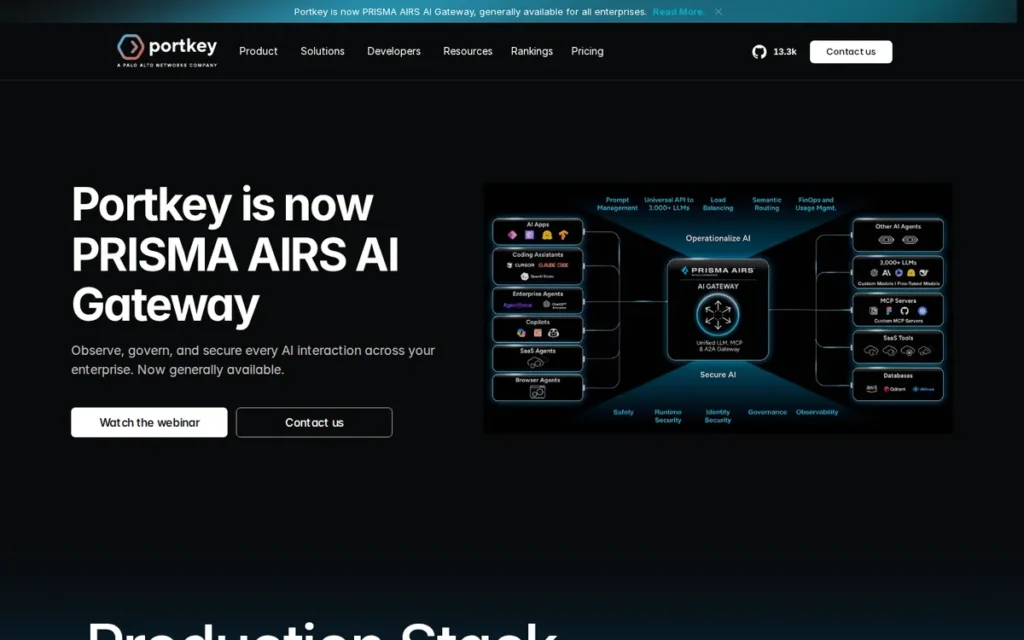
Category: Managed AI Control Plane, a fully hosted gateway providing unified multi-provider LLM access, enterprise governance, and production observability without self-hosting infrastructure.
At a Glance
- Category: Managed AI Control Plane
- Best For: Enterprise engineering teams managing multi-provider LLM deployments with compliance, budget control, and agentic AI governance requirements
- Price Range: Free tier (~10,000 requests/month); Enterprise pricing contact-based, no public dollar amounts as of April 2026
- Primary Strength: Portkey AI delivers the deepest enterprise governance layer in the AI gateway category, with 50+ configurable guardrails, confirmed MCP routing for agentic workloads, and virtual key budget enforcement across 60+ LLM providers
- Biggest Limitation: Portkey AI operates as a cloud-only managed service with no self-hosted or on-premises option (all traffic routes through Portkey’s infrastructure) limiting adoption for organizations with data residency mandates or HIPAA requirements that restrict routing sensitive prompts through third-party cloud services
- One-Line Summary: Portkey AI is the most governance-complete AI gateway in production use as of 2026, serving 24,000+ organizations across 500 billion tokens per day with 50+ guardrails, confirmed MCP routing, and unified access to 1,600+ LLMs
- Last Verified: April 2026
Overview
Portkey AI is a managed AI control plane and gateway that gives engineering teams a single authenticated endpoint for accessing 1,600+ large language models across 60+ providers (including OpenAI, Anthropic, Google, AWS Bedrock, and Azure OpenAI) with production-grade governance, observability, and routing logic included at every tier. Portkey AI is built for mid-to-large engineering organizations that need to centralize LLM API management, enforce per-team budgets, apply content guardrails, and gain full visibility into AI spend and model behavior at production scale. Portkey AI raised a $15 million Series A in February 2026 led by Elevation Capital with participation from Lightspeed, and counts Postman and Snorkel AI among its documented enterprise customers (GlobeNewswire, February 19 2026).
Key Features
- Unified LLM Access with Day-Zero Model Support: Portkey AI provides access to 1,600+ LLMs across 60+ providers through a single unified API endpoint, with automatic day-zero support for newly released models, eliminating manual gateway updates when providers ship new model versions (vendor-reported: Portkey AI product documentation, April 2026).
- Per-Team Virtual Key Budget Enforcement: Portkey AI enforces per-team, per-user, and per-virtual-key budget limits with real-time spend alerts, enabling finance and engineering teams to set and track AI cost attribution at granular levels without building custom billing infrastructure.
- Confirmed MCP Routing for Agentic Workloads: Portkey AI routes MCP (Model Context Protocol) tool calls through the same governance and observability pipeline as direct LLM requests, one of only two evaluated tools with confirmed MCP routing support as of April 2026, alongside Kong AI Gateway version 3.10 (vendor-reported: Portkey AI product documentation, April 2026; Kong MCP confirmed: InfoWorld, 2025).
- 50+ AI Metrics Per Request: Portkey AI captures 50+ AI-specific metrics per request (including token usage, cost per call, latency by provider, error rate, and hallucination signals) with OpenTelemetry compliance for integration into existing enterprise monitoring stacks (vendor-reported: Portkey AI product documentation, April 2026).
- Conditional Routing and Multi-Provider Resilience: Portkey AI’s routing layer supports load balancing, automatic provider fallback, canary deployments, A/B testing across models, and circuit breakers, enabling teams to implement multi-provider resilience without custom routing engineering.
Best For
Portkey AI is best for enterprise engineering teams building or scaling production LLM-powered applications that require multi-team budget governance, compliance-grade guardrails, and visibility into AI spend across multiple providers. Portkey AI is particularly well suited for teams deploying agentic AI architectures that need MCP-level routing and audit logging across complete tool-calling sequences, not just individual prompt/response pairs.
Pricing
Portkey AI offers a free tier at approximately 10,000 requests per month as of April 2026. Paid and enterprise tiers exist but pricing is not publicly listed, procurement teams must contact Portkey sales for contract terms. The company made its basic enterprise gateway available for free in a prior pricing revision, suggesting an enterprise-contract model rather than a tiered SaaS subscription structure. Verify current pricing at portkey.ai/pricing before budgeting.
Strengths
- Portkey AI processed over 500 billion LLM tokens per day across 125 million daily requests and managed over $500,000 in daily AI spend as of its February 2026 Series A announcement, a vendor-reported production-scale figure corroborated by independent press coverage (GlobeNewswire, February 19 2026).
- Portkey AI’s 50+ configurable AI guardrails: covering PII detection, prompt injection defense, safety classification, and output quality monitoring, represent the broadest built-in compliance layer of any evaluated tool, verified against Portkey AI’s April 2026 product documentation (vendor-reported).
- Portkey AI’s confirmed MCP routing support positions it as one of only two gateways in this evaluation with agentic AI governance capability in 2026, where multi-step tool-calling agents require budget enforcement and audit trails across entire call sequences, not just individual requests (vendor-reported: Portkey AI documentation, April 2026).
- Portkey AI’s $15M Series A from Elevation Capital and Lightspeed in February 2026 provides enterprise procurement teams a financial sustainability signal that purely open-source or early-stage alternatives cannot match, and supports SLA-backed enterprise contracts (GlobeNewswire, February 19 2026).
Limitations
Portkey AI’s most consequential trade-off is its cloud-only deployment architecture, all traffic routes through Portkey’s managed infrastructure, limiting adoption for organizations with data residency mandates or HIPAA requirements that restrict routing sensitive prompts through third-party cloud services; teams in regulated environments should verify their specific compliance framework before assuming Portkey AI is excluded, as some frameworks permit managed cloud services with appropriate data processing agreements in place. Portkey AI’s in-path synchronous logging adds measurable per-request latency and limits trace depth compared to asynchronous observability tools like Langfuse, meaning teams building multi-step agentic applications requiring deep trace granularity may need a secondary observability layer alongside Portkey AI. Enterprise pricing is contact-based with no public dollar amounts, creating budget forecast friction for engineering teams that must present vendor cost projections to finance before beginning a vendor evaluation.
Users on r/LLMDevs shared their production experience:
“We went with Portkey in the end. It’s quite buggy but it does a good job of abstracting LLM operations. We route GCP, Azure, AWS, Perplexity, and other vendors through it and now developers just use a very simple mechanism to make llm calls and can specify basically any model they want through the same API.” Posted by u/debauch3ry
Takeaway: Production teams confirm Portkey AI’s multi-vendor routing abstraction delivers real operational value at scale, but acknowledge reliability rough edges that enterprise buyers should pressure-test through a proof-of-concept before committing to a contract.
Verdict
Portkey AI is the most governance-complete AI gateway in production use as of 2026, offering 50+ guardrails, confirmed MCP routing, and unified access to 1,600+ LLMs that no single evaluated competitor matches simultaneously. Engineering teams that need production-scale LLM governance (budget controls, multi-provider routing, compliance guardrails, and observability) in a managed service without self-hosting complexity will find Portkey AI the strongest evaluated option in this review. Teams with on-premises data residency requirements or deep async agent tracing needs should evaluate LiteLLM, Apache APISIX, or Kong AI Gateway as self-hosted alternatives before committing to Portkey AI’s cloud-only architecture.
2. Helicone: Best for High-Performance LLM Observability and Developer Teams Prioritizing Speed
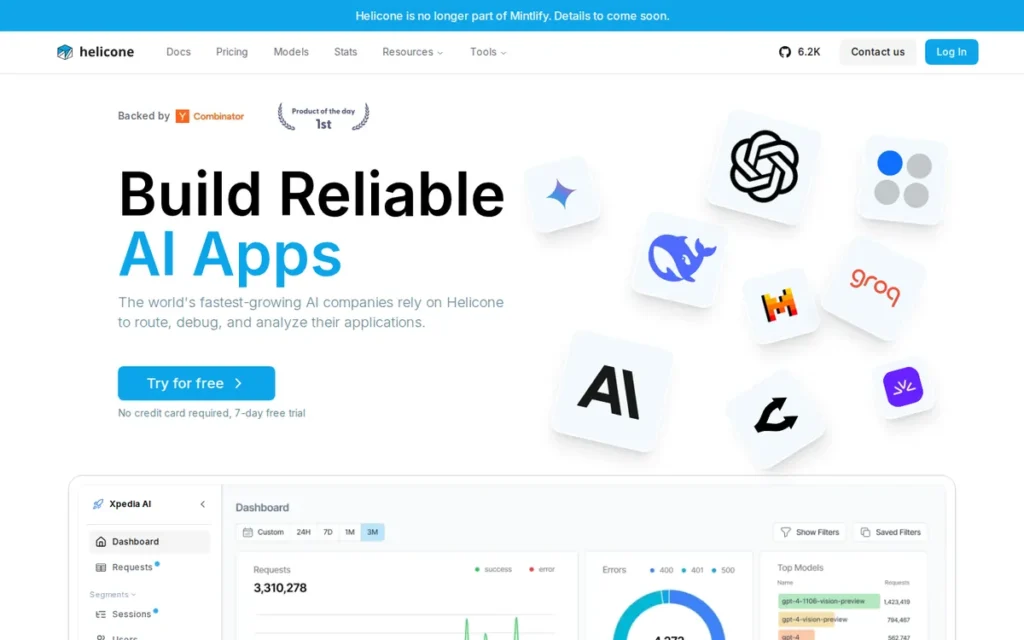
Category: Open-Source Performance Gateway, a Rust-based, high-throughput AI gateway with built-in LLM observability, deployable as a hosted service or self-hosted binary.
At a Glance
- Category: Open-Source Performance Gateway
- Best For: Developer teams and small-to-mid engineering organizations needing production-quality LLM observability with minimal setup overhead and low gateway latency
- Price Range: Free (100,000 requests/month); $79/month paid plans; Enterprise pricing contact-based (as of April 2026)
- Primary Strength: Helicone delivers typically 1–5ms P95 gateway latency overhead via its Rust-based architecture deployed on Cloudflare Workers edge infrastructure, among the lowest-latency evaluated options for real-time LLM applications
- Biggest Limitation: Helicone’s self-hosted binary provides gateway routing but the full observability dashboard stack requires Helicone’s hosted cloud service, teams with strict data residency requirements cannot access the complete feature set in an on-premises configuration
- One-Line Summary: Helicone is a Rust-based, open-source AI gateway delivering typically 1–5ms P95 latency overhead with two-line code integration, purpose-built LLM cost tracking, and semantic caching, having processed over 2 billion requests and 1.7 trillion tokens in production (community-validated: co-founder statement, r/LangChain, 2025)
- Last Verified: April 2026
Overview
Helicone is an open-source AI gateway and LLM observability platform built on Rust (inspired by NGINX’s architecture) that routes traffic to 100+ models across 20+ providers through a single OpenAI-compatible endpoint at https://ai-gateway.helicone.ai, typically adding 1–5ms P95 latency overhead with a two-line integration path for teams already calling LLM APIs directly (independent-blog-reported: dev.to Bifrost vs. Helicone comparison, 2025). Helicone is built for developer teams and engineering organizations that want production-quality LLM request logging, cost tracking, and semantic caching without the configuration overhead of enterprise gateway platforms. Helicone launched as a Y Combinator W23 company and expanded from its origins as an LLM observability tool into a full AI gateway with Rust-based high-performance proxy infrastructure.
Key Features
- Low-Latency Rust + Edge Architecture: Helicone adds typically 1–5ms P95 latency overhead per proxied LLM request via its Rust runtime deployed on Cloudflare Workers edge infrastructure, processing requests at the nearest of 330+ global edge nodes without cold-start penalties (independent-blog-reported: dev.to Bifrost vs. Helicone comparison, 2025; architectural support from Rust runtime eliminating garbage collection pauses and Cloudflare Workers eliminating cold starts).
- PeakEWMA Load Balancing: Helicone implements PeakEWMA (Peak Exponentially Weighted Moving Average) load balancing, routing each LLM request to the provider endpoint with the lowest current moving-average latency (vendor-documented to reduce end-user latency by up to 40% compared to round-robin distribution (vendor-reported: Helicone blog, 2025) no independent benchmark validation found as of April 2026).
- Semantic Caching for Cost Reduction: Helicone’s semantic caching stores LLM responses by semantic similarity rather than exact match, enabling cache hits on paraphrased queries and achieving up to 95% cost savings in workloads with high query similarity such as FAQ systems or knowledge base Q&A (vendor-reported: Helicone documentation, 2025).
- Purpose-Built LLM Observability Dashboard: Helicone captures per-request cost, token usage, latency, model, error rate, and user attribution in a purpose-built LLM observability dashboard, without requiring any additional instrumentation beyond the base URL change.
- 100+ Model Integrations via Single Endpoint: Helicone integrates with 100+ LLM models across OpenAI, Anthropic, Google Gemini, Groq, AWS Bedrock, Azure OpenAI, Mistral, Cohere, and 15+ additional providers through a single
https://ai-gateway.helicone.aiendpoint substitution, among the lowest time-to-integration of any evaluated gateway.
Best For
Helicone is best for developer teams and mid-sized engineering organizations that prioritize low gateway latency and fast observability setup, particularly teams building real-time LLM applications where sub-10ms gateway overhead matters, or teams that need cost tracking and usage visibility with minimal DevOps investment and a generous free tier.
Pricing
Helicone’s free tier includes 100,000 requests per month with zero markup on underlying provider API calls, teams pay exact provider rates plus standard payment processing fees. Paid plans start at $79 per month as of April 2026. Enterprise pricing is contact-based. Helicone’s self-hosted binary is available at no cost for teams that want to run the routing layer without the hosted dashboard. Verify current tier limits and pricing at helicone.ai before budgeting.
Strengths
Helicone’s co-founders reported processing over 2 billion requests and 1.7 trillion tokens in production, per community discussions in 2025–2026 (community-validated: co-founder statement in r/LangChain, 2025, self-reported figures not independently confirmed by third-party sources as of April 2026), corroborated by Helicone’s Y Combinator W23 status and active adoption across LangChain, LiteLLM, and direct integration user bases.
Helicone’s Rust runtime on Cloudflare Workers provides structural latency advantages over Python-based gateways, Rust eliminates garbage collection pauses and enables true multi-threaded request parallelism that Python’s global interpreter lock prevents, making Helicone’s performance advantage over LiteLLM structural rather than configuration-dependent (architectural characteristic confirmed by independent comparative benchmarks: TensorZero, 2025; dev.to Bifrost vs. Helicone, 2025).
Langfuse’s co-founder, a direct competitor in the LLM observability space, publicly acknowledged in a community discussion that “Helicone is a great choice and easy to get started with” for teams preferring a proxy-based approach (community-validated: u/marc-kl, r/LangChain, 2025), an independent competitive endorsement that validates Helicone’s developer experience position.
Helicone’s 100,000 request/month free tier with zero markup on provider API calls represents the most accessible entry point of any evaluated managed AI gateway at production-relevant request volumes, verified against Helicone’s public pricing page (April 2026).
Limitations
Helicone’s most consequential trade-off is the split between its self-hosted gateway binary and its hosted observability stack: teams requiring both high-performance routing and complete observability dashboards in an on-premises or air-gapped environment cannot access the full Helicone feature set without the hosted cloud component, a data residency constraint that blocks adoption in regulated industries with strict prompt data sovereignty requirements. Helicone’s governance depth is materially thinner than enterprise-focused alternatives, Helicone provides no built-in content guardrails, no confirmed MCP routing for agentic workloads as of April 2026, and limited audit logging, meaning teams that outgrow basic observability into compliance-grade governance face a predictable migration to Portkey AI or Kong AI Gateway.
This aligns with community sentiment on r/learnmachinelearning:
“Gateways-first tools (Portkey, nexos) are great for routing, cost control, and multi-model abstraction, but observability often feels secondary. Logging-first tools (Helicone) are simple and transparent, but once you want evals, spans across chains, or deeper prompt-level insights, you hit limits. Lunary sits nicely in the middle, especially if you’re iterating heavily on prompts, but event caps can get tight fast at scale.” Posted by u/Commercial_Taro2829
Takeaway: Helicone’s observability ceiling is a documented production constraint, teams that need span-level agent traces or structured evaluation workflows will outgrow it before reaching enterprise governance requirements.
A documented community friction point is API key configuration discoverability: at least one developer abandoned Helicone during evaluation because the inline key management pattern was not immediately apparent from documentation (community-validated: u/LateWin1975, r/LangChain, 2025).
Verdict
Helicone is among the fastest AI gateways in this evaluation for proxied-request latency, with a structural Rust + edge architecture advantage over Python-based alternatives that no configuration tuning bridges, making it the strongest choice for real-time LLM applications where gateway overhead is a measurable performance constraint. Developer and small-to-mid engineering teams that need production-quality LLM cost tracking and observability with a two-line integration path and a 100,000 request/month free tier will find Helicone among the strongest value options in the managed gateway segment. Enterprise teams with compliance mandates, on-premises requirements, or governance needs beyond basic observability should evaluate Portkey AI or Kong AI Gateway instead.
3. Cloudflare AI Gateway: Best for Edge-Native Security, Global Latency Minimization, and Lowest-Cost Managed Deployment
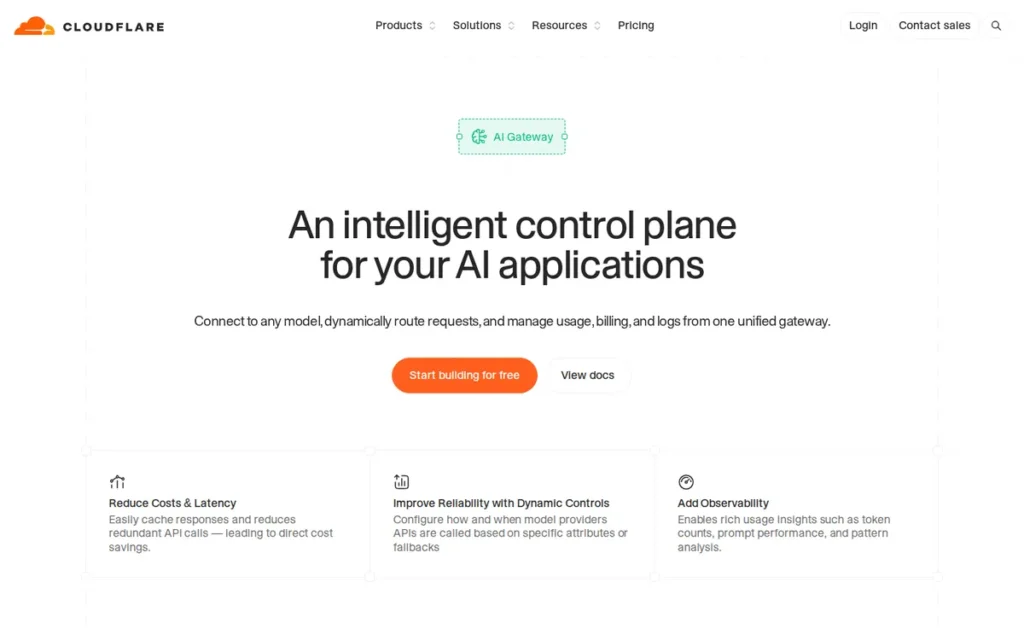
Category: Edge AI Gateway, a globally distributed, managed AI proxy deployed across a CDN-scale edge network, providing routing, caching, observability, and security scanning at the network layer.
At a Glance
- Category: Edge AI Gateway
- Best For: Teams deploying on Cloudflare Workers infrastructure, global user-base applications requiring geographic latency minimization, and security-first organizations needing built-in prompt DLP scanning
- Price Range: Free (core features on Cloudflare Free plan); $5/month (Workers Paid plan for production-scale deployment, as of April 2026)
- Primary Strength: Cloudflare AI Gateway routes LLM API traffic through 330+ global edge nodes with built-in DLP/PII prompt scanning adding under 5ms latency for non-streaming requests, providing the lowest-cost managed AI gateway entry point in the evaluation with natively integrated prompt security
- Biggest Limitation: Cloudflare AI Gateway is a SaaS-only managed service with no self-hosted or on-premises deployment option, and its response DLP scanning buffers complete streaming outputs before client delivery, eliminating incremental token streaming for real-time chat interfaces
- One-Line Summary: Cloudflare AI Gateway is an edge-native managed AI gateway deployed across 330+ global locations that delivers built-in prompt DLP scanning, up to 90% latency reduction via response caching, and unified observability across 350+ models, with a production-scale entry price of $5 per month
- Last Verified: April 2026
Overview
Cloudflare AI Gateway is an edge-native AI proxy built into Cloudflare’s global network (spanning 330+ cities) that intercepts, routes, caches, and monitors LLM API traffic to 20+ providers and 350+ models including OpenAI, Anthropic, Google Gemini, Hugging Face, Groq, and Workers AI, with DLP/PII scanning, rate limiting, and real-time analytics included at no additional per-request charge. Cloudflare AI Gateway is built for engineering teams deploying AI applications on Cloudflare Workers infrastructure, global-user-base applications where geographic routing latency matters, and security teams requiring prompt content inspection before tokens reach any LLM provider. Cloudflare AI Gateway is a product extension of Cloudflare (NASDAQ: NET), a publicly traded network security and CDN company serving 4+ million paying customers.
Key Features
- Edge-Native Routing Across 330+ Locations: Cloudflare AI Gateway terminates LLM API traffic at the nearest of 330+ global edge locations, reducing time-to-first-token for geographically distributed user bases and eliminating the centralized proxy bottleneck that affects single-datacenter gateways.
- Response Caching with Up to 90% Latency Reduction: Cloudflare AI Gateway caches LLM responses with configurable TTL and exact-match cache keys, reducing latency by up to 90% and eliminating provider API costs entirely for repeated queries, maximally effective for FAQ chatbots, knowledge base Q&A, and other high-repetition workloads (vendor-reported: Cloudflare developer documentation, April 2026).
- Integrated DLP/PII Prompt Scanning at Under 5ms: Cloudflare AI Gateway scans every prompt for injection patterns and sensitive data using edge-deployed Workers AI safety classifiers before any token reaches a model provider, adding under 5ms latency for non-streaming and request-only scanning configurations (confirmed: Cloudflare developer documentation; independently analyzed: Digital Applied security analysis, 2025). Note: when response DLP scanning is enabled for streaming (SSE) outputs, the complete response is buffered before evaluation, eliminating incremental token delivery to the client; teams building real-time streaming chat interfaces should configure request-only DLP scanning to preserve streaming behavior (per Cloudflare developer documentation, April 2026).
- Real-Time Analytics with Shadow AI Detection: Cloudflare AI Gateway provides real-time analytics covering request volume, token usage, cost, latency, and error rates across all connected providers, with shadow AI detection that flags unauthorized model access attempts within the organization, added in the AI Week 2025 product update.
- Visual Routing Editor and A/B Testing: Cloudflare AI Gateway’s visual routing editor and A/B testing capability (added in AI Week 2025) allow engineering teams to configure dynamic routing logic, canary model rollouts, and automatic fallback chains without writing routing code.
Best For
Cloudflare AI Gateway is best for teams already deploying applications on Cloudflare Workers who want zero-friction AI gateway adoption within their existing infrastructure trust perimeter, and for security-focused engineering organizations that require built-in prompt DLP scanning without a separate content inspection layer.
Pricing
Cloudflare AI Gateway core features (caching, analytics, rate limiting, observability, and DLP scanning) are free on all Cloudflare plans including the Free tier. Production-scale deployments require the Workers Paid plan at $5 per month as of April 2026, with usage-based fees for Workers invocations beyond the free daily allocation (100,000 requests/day on the free tier). There are no separate per-request Cloudflare AI Gateway fees. For teams already paying for Cloudflare, the incremental cost of adding AI Gateway is effectively zero. Verify current pricing at developers.cloudflare.com/workers/platform/pricing/.
Strengths
- Cloudflare AI Gateway’s DLP/PII scanning, introduced as “Firewall for AI” during AI Week 2025, runs on edge-deployed Workers AI safety classifiers, adding under 5ms of latency for non-streaming and request-only scanning, as confirmed by Cloudflare developer documentation and independently analyzed in Digital Applied’s edge AI security analysis (2025), a natively integrated prompt security capability not available in any other evaluated gateway.
- Cloudflare AI Gateway delivers up to 90% latency reduction for cache-hit scenarios (the highest documented caching benefit in this evaluation for exact-match workloads) confirmed by Cloudflare developer documentation and corroborated in independent comparison guides for FAQ and autocomplete applications (third-party-blog-reported: dev.to Bifrost vs. Cloudflare AI Gateway, 2025).
- Cloudflare (NASDAQ: NET) is the only publicly traded company offering a dedicated AI gateway product in this evaluation, providing enterprise procurement teams with financial transparency, existing SOC 2 certifications for the broader Cloudflare platform, and regulatory accountability that privately held alternatives cannot offer.
- Cloudflare AI Gateway’s $5/month production entry price is the lowest managed AI gateway cost in this evaluation, teams already inside the Cloudflare infrastructure trust perimeter add AI Gateway at effectively zero marginal cost, requiring no new security review, vendor evaluation, or data processing negotiation.
Limitations
Cloudflare AI Gateway’s most consequential constraint is its SaaS-only architecture: Cloudflare AI Gateway has no self-hosted, on-premises, or hybrid deployment option, structurally limiting adoption in regulated environments with data residency requirements, government procurement mandates, or HIPAA-compliant environments that prohibit routing sensitive prompts through third-party cloud infrastructure, a hard blocker that no configuration workaround resolves. Cloudflare AI Gateway is also less integrated for applications not deployed on Cloudflare Workers: non-Workers applications lose the zero-latency edge co-location advantage and the gateway adds a network hop rather than eliminating one. Governance depth trails enterprise-focused alternatives, Cloudflare AI Gateway has no confirmed MCP support for agentic workloads as of April 2026, RBAC is less granular than Portkey AI’s team/key/user hierarchy, and response DLP scanning buffers complete streaming outputs before evaluation, eliminating incremental token delivery for streaming chat interfaces (confirmed: Cloudflare developer documentation, April 2026).
Verdict
Cloudflare AI Gateway offers the lowest entry price ($5/month) of any managed AI gateway in this evaluation, with edge-native DLP scanning, globally distributed routing, and the backing of a publicly traded CDN company, making it the most cost-accessible managed option for teams already on Cloudflare infrastructure. Engineering teams on Cloudflare should treat Cloudflare AI Gateway as the default starting point, the incremental adoption cost is effectively zero for existing customers, and the security and observability capabilities are production-grade from day one. Teams outside the Cloudflare ecosystem, teams building streaming real-time AI chat interfaces who need response-level DLP scanning, and organizations in regulated environments with data residency requirements will need to evaluate alternatives, as the SaaS-only deployment model is a hard architectural constraint.
4. LiteLLM: Best Open-Source Starting Point for Multi-Provider LLM Routing at Zero Licensing Cost
Category: Open-Source Unified LLM Proxy, a Python-based proxy server providing a single OpenAI-compatible API endpoint across 100+ LLM providers, deployable as a self-hosted gateway for centralized team LLM access.
At a Glance
- Category: Open-Source Unified LLM Proxy
- Best For: Engineering teams evaluating multi-provider LLM routing without upfront cost, self-hosting teams needing maximum provider breadth, and organizations building internal AI tooling on a flexible open-source foundation
- Price Range: Free (MIT open-source, unlimited self-hosted); Enterprise pricing not publicly listed, contact-based only (as of April 2026)
- Primary Strength: LiteLLM provides unified access to 100–250 LLM providers through a single OpenAI-compatible API (the broadest provider coverage in this evaluation) with zero licensing cost for self-hosted deployments
- Biggest Limitation: LiteLLM’s single-instance deployment degrades sharply at 500+ RPS and fails entirely at approximately 1,000 requests per second, requiring multi-instance configuration that increases infrastructure cost and operational overhead at production scale
- One-Line Summary: LiteLLM is a free MIT-licensed open-source AI gateway providing unified OpenAI-compatible access to 100–250 LLM providers with virtual key budget management and observability integrations, the broadest provider coverage in the AI gateway category as of 2026
- Last Verified: April 2026
Overview
LiteLLM is a free, open-source Python library and proxy server developed by BerriAI that provides engineering teams a single OpenAI-compatible API endpoint for accessing 100 to 250 LLM providers (including OpenAI, Anthropic, Azure, AWS Bedrock, Google Vertex AI, Hugging Face, Cohere, Mistral, and dozens of specialty and self-hosted models) with load balancing, automatic fallback, virtual key budget enforcement, and observability integrations included at zero licensing cost. LiteLLM is built for teams evaluating multi-provider LLM routing without upfront infrastructure investment, internal AI tooling deployments where self-hosting is preferred over managed services, and engineering organizations that need the broadest possible provider coverage to avoid vendor lock-in during early architectural decisions. LiteLLM is maintained by BerriAI under the MIT license, with the primary maintainer directly engaged in community support channels and documented to resolve reported issues within 24 hours.
Key Features
- 100–250 LLM Provider Normalizations: LiteLLM normalizes API differences across 100–250 LLM providers (including OpenAI, Anthropic, AWS Bedrock, Azure OpenAI, Google Vertex AI, Hugging Face, Cohere, and self-hosted models) into a single OpenAI-compatible format, enabling teams to switch providers or run multi-provider tests without changing application code (corroborated across SlashLLM 2026, Helicone top LLM gateways 2025, and TrueFoudnry 2026 comparison guides).
- Virtual Key Budget Enforcement with Redis-Backed Rate Limiting: LiteLLM’s proxy server mode enforces per-key, per-team, and per-user budget limits with configurable rate limiting via Redis (RPM/TPM), automatic fallback to backup providers on 429 errors or timeouts, and JWT/SSO authentication for centralized team access control.
- Observability Integration Breadth: LiteLLM integrates with Langfuse, Arize Phoenix, LangSmith, MLflow, Helicone, and OpenTelemetry for observability logging, connecting to whichever monitoring tool an engineering team already uses rather than requiring adoption of a proprietary dashboard.
- Baseline Throughput and Performance Profile: LiteLLM handles approximately 350+ requests per second on a single 1 vCPU deployment in baseline configuration (third-party-blog-reported: TrueFoudnry LiteLLM review, 2026); at 500+ RPS, P99 latency degrades sharply, and single-instance deployments fail entirely at approximately 1,000 RPS, requiring multi-instance deployment that multiplies infrastructure cost (independent benchmarks: TensorZero gateway benchmarks, 2025; Bifrost comparison, 2025).
- Admin UI for Operational Management: LiteLLM’s admin UI provides CRUD operations for virtual keys, team budgets, provider configurations, and usage tracking, a graphical management interface for routine operations that does not require direct YAML or environment variable configuration.
Best For
LiteLLM is best for early-to-mid-stage engineering teams that want the broadest possible LLM provider coverage with zero upfront licensing cost, internal AI tooling deployments where self-hosting is preferred over cloud-managed services, and teams starting multi-provider evaluations who expect to evolve their gateway architecture as production requirements become clearer.
Pricing
LiteLLM is entirely free and open-source under the MIT license for self-hosted deployments, the full proxy server feature set carries no feature paywalls between the open-source tier and any paid tier for core gateway capabilities. An enterprise tier with commercial SLAs, custom audit logs, and SSO exists but pricing is not publicly listed and requires contacting BerriAI via a “Request Pricing” form. There are no per-request fees for self-hosted usage. Verify current enterprise pricing at litellm.ai before budgeting for support contracts.
Strengths
- LiteLLM is consistently ranked as the broadest-coverage AI gateway in independent 2025–2026 comparison guides, with 100 to 250 LLM provider integrations depending on counting methodology, independently corroborated across SlashLLM, Helicone, blog.openziti.io, and TrueFoudnry comparison guides published across 2025–2026, making it the only evaluated tool capable of normalizing output across all major providers plus self-hosted and specialty models simultaneously.
- LiteLLM’s MIT open-source license makes the full proxy server feature set: including Redis-backed load balancing, automatic failover, virtual keys with budget caps, JWT authentication, and admin UI, available at zero cost without any feature paywalls, eliminating licensing cost risk for teams scaling self-hosted infrastructure.
- LiteLLM’s observability integration layer: connecting natively to Langfuse, Arize Phoenix, LangSmith, MLflow, Helicone, and OpenTelemetry, enables teams to adopt LiteLLM for routing without abandoning existing monitoring investments, a portability advantage that managed gateways with proprietary dashboards cannot match.
- BerriAI’s maintainer is directly reachable in community channels and documented in Reddit discussions to address reported issues within 24 hours (community-validated: r/LLMDevs, 2024), providing a rapid-response support path for early adopters without an enterprise support contract.
Limitations
LiteLLM’s most consequential trade-off for production engineering teams is its Python runtime performance ceiling: LiteLLM adds approximately 4–15ms of overhead at low-to-moderate request volumes (100–500 RPS on a single instance); at 500+ RPS, P99 latency degrades sharply, and single-instance deployments fail entirely at approximately 1,000 RPS, requiring multi-instance configuration that increases infrastructure cost and operational overhead (independent benchmarks: TensorZero gateway benchmarks, 2025; Bifrost comparison, 2025; LiteLLM official benchmarks, 2025). This performance ceiling is architectural, not configurable: Python’s global interpreter lock prevents true multi-threaded request parallelism, and garbage collection pauses introduce unpredictable latency spikes at scale. LiteLLM also has no enterprise SLAs for self-hosted deployments, no confirmed MCP routing support for agentic AI workloads as of April 2026, limited native guardrails compared to Portkey AI’s 50+ options, and an opaque enterprise pricing model that creates procurement friction for teams requiring cost visibility before engaging sales.
“LiteLLM… 100+ providers but Python performance is a bottleneck. No enterprise SLAs or support.” (u/WideFeature8077, evaluating enterprise AI gateways for a 40K daily user SaaS platform (r/LLM_Gateways, 2026))
Takeaway: At 40K+ daily users, LiteLLM’s single-instance performance ceiling and absence of enterprise SLAs become production blockers requiring either multi-instance investment or migration to a faster runtime.
Verdict
LiteLLM is the default open-source AI gateway for multi-provider LLM routing in 2026, offering the broadest provider coverage in this evaluation at zero licensing cost, making it the right starting choice for teams evaluating provider options, building internal AI tooling, or self-hosting without a managed service budget. Engineering teams that hit production scale with latency-sensitive requirements, compliance mandates, or agentic AI workloads will encounter LiteLLM’s documented performance ceiling and governance limitations, and should treat it as an architectural starting point rather than a long-term production destination for high-traffic applications. The migration path from LiteLLM to an enterprise gateway is well-documented in engineering communities, teams that plan for this transition from the start avoid costly re-architectures.
5. Apache APISIX: Best for Infrastructure Teams Consolidating API and AI Traffic in a Single ASF-Governed Gateway
Category: General-Purpose + AI Gateway, a high-throughput, open-source API gateway with dedicated AI plugin support, enabling unified management of both standard API traffic and LLM provider routing in a single infrastructure layer.
At a Glance
- Category: General-Purpose + AI Gateway
- Best For: Infrastructure and platform engineering teams that already manage API traffic and want to add LLM routing without deploying a separate gateway, and organizations requiring an on-premises, ASF-governed open-source foundation
- Price Range: Free (Apache 2.0 open-source, no licensing fees); Commercial support and enterprise extensions available via API7.ai (contact-based pricing, as of April 2026)
- Primary Strength: Apache APISIX is an Apache Software Foundation top-level project enabling unified management of REST, gRPC, WebSocket, and LLM traffic in a single zero-licensing-cost gateway with multi-language plugin support (Lua, WASM, Go, Python, Java) and approximately 18,000 QPS single-core throughput with plugins enabled
- Biggest Limitation: Apache APISIX requires custom Lua or WASM plugin development to enable AI-specific observability features such as per-request token cost tracking and LLM budget dashboards, creating meaningful implementation overhead for teams whose primary use case is LLM routing rather than broad API management
- One-Line Summary: Apache APISIX is a cloud-native Apache Software Foundation open-source API and AI gateway with approximately 18,000 QPS single-core throughput, multi-language plugin support, and unified management of REST, gRPC, and LLM traffic, with enterprise users including WPS Office and Airwallex
- Last Verified: April 2026
Overview
Apache APISIX is a high-performance, cloud-native open-source API gateway with a dedicated AI plugin suite that enables engineering teams to manage LLM provider routing, semantic caching, prompt decoration, token-based rate limiting, and multi-provider load balancing alongside standard REST, gRPC, and WebSocket traffic, in a single unified gateway without deploying separate AI infrastructure. Apache APISIX is built for platform and infrastructure engineering teams that want to consolidate API and AI traffic management under a single open-source gateway with strong governance, high throughput, and no vendor lock-in. Apache APISIX is an Apache Software Foundation top-level project under the Apache 2.0 license, with commercial support and enterprise extensions available through API7.ai, the company founded by APISIX’s original creators, and documented production deployments at enterprise scale by WPS Office and Airwallex.
Key Features
- AI Plugin Suite for Multi-Provider LLM Routing: Apache APISIX’s AI plugin suite provides unified access to OpenAI, Anthropic (Claude), Azure OpenAI, Google Gemini, DeepSeek, and Mistral through a single API proxy layer, with intelligent routing that selects models by prompt content, for example, routing code generation queries to GPT-4 or DeepSeek and summarization queries to Claude based on semantic classification.
- Single-Core Throughput and Hot-Reload Configuration: Apache APISIX’s published single-core benchmarks show approximately 18,000 QPS with plugins enabled and sub-millisecond average routing latency (vendor-reported: APISIX official benchmark documentation, 2024); multi-core cluster configurations support higher throughput, though no independently verified ceiling was confirmed in research conducted April 2026. Apache APISIX’s etcd-based hot-reload propagates routing rule changes across all cluster nodes in milliseconds without gateway restarts.
- Token-Based Rate Limiting at Granular Levels: Apache APISIX implements token-based rate limiting at route, service, consumer, and parameter levels, enabling per-endpoint or per-user LLM API cost controls as granular as individual usage patterns require, enforced at the gateway layer without application-code changes.
- Multi-Language Plugin Architecture: Apache APISIX supports Lua, WASM, Go, Python, and Java plugins, enabling teams to write custom AI routing logic, observability hooks, and content filters in their existing programming languages without learning Lua, with WASM plugins achieving near-native execution performance.
- RAG Integration for Knowledge Base Injection: Apache APISIX’s AI plugin suite includes RAG integration for injecting retrieval-augmented generation context from configured knowledge bases into LLM prompts at the gateway layer, reducing hallucination risk for knowledge-base-dependent applications without requiring application-level vector search implementation.
Best For
Apache APISIX is best for platform and infrastructure engineering teams that are already operating an API management layer and want to extend it with LLM routing capabilities without deploying a separate gateway, and for organizations in regulated or air-gapped environments that require a fully on-premises, Apache-governed open-source foundation for their AI traffic management.
Pricing
Apache APISIX is entirely free and open-source under the Apache 2.0 license, the complete gateway including all AI plugins is available at zero cost with no licensing fees or feature paywalls. Commercial support, enterprise SLAs, and managed hosting are available through API7.ai (the company founded by APISIX’s creators) at contact-based pricing. The Apache 2.0 license permits commercial use, modification, and distribution without restriction. Verify current API7.ai support pricing at api7.ai for enterprise procurement planning.
Strengths
- Apache APISIX achieved top-level Apache Software Foundation project status in 2022 (a governance milestone requiring demonstrated community diversity, code quality, and transparent release processes) providing open-source sustainability credibility that directly addresses the documented community concern about VC-backed AI gateway projects facing monetization pivots or shutdown risk (community-validated: u/Traditional_Wind_224, r/LLMDevs, 2024).
- Apache APISIX’s published single-core benchmarks show approximately 18,000 QPS with plugins enabled (vendor-reported: APISIX official benchmark documentation, 2024), structurally outperforming Python-based gateways like LiteLLM at high request volumes due to its LuaJIT runtime and etcd-based configuration architecture, an advantage that is architectural in nature rather than benchmark-dependent (architectural characteristic confirmed by multiple API gateway comparison analyses).
- Apache APISIX’s etcd-based hot-reload enables millisecond-level configuration propagation across cluster nodes without gateway restarts (compared to database-dependent architectures requiring queries for route updates) a meaningful operational advantage for AI deployments with frequently changing routing rules or provider endpoint configurations.
- Apache APISIX’s multi-language plugin support (Lua, WASM, Go, Python, Java) enables engineering teams to implement custom AI routing logic in their existing language stack, reducing the specialized knowledge required for gateway customization compared to competitors locked to single runtimes.
Limitations
Apache APISIX’s most consequential trade-off for AI-first teams is its general-purpose architectural design: Apache APISIX does not include built-in AI-specific observability such as per-request token cost dashboards, LLM budget tracking UIs, or hallucination monitoring, capabilities that are table-stakes features on dedicated AI gateways like Portkey AI and Helicone, and requires custom Lua or WASM plugin development to capture AI-specific metrics, creating disproportionate implementation overhead for teams whose primary use case is LLM routing governance. Apache APISIX’s recommended production cluster deployment requires Kubernetes with Helm chart management, a prerequisite infrastructure investment that greenfield AI-only teams must account for before comparing Apache APISIX to Docker-deployable alternatives like LiteLLM or Helicone. Apache APISIX also has no confirmed MCP routing support for agentic AI workloads as of April 2026, and its AI plugin ecosystem covers fewer providers than LiteLLM’s 100–250 integrations, making Apache APISIX the correct choice when unified API + AI infrastructure consolidation is the goal, not when maximum LLM provider breadth or zero-config AI observability is the priority.
Verdict
Apache APISIX is the right AI gateway choice for platform and infrastructure engineering teams that already operate an API management layer and want to add LLM routing as a native extension, not for teams whose only requirement is AI gateway functionality. Apache APISIX’s ASF governance, zero-licensing-cost model, and unified API + AI architecture make it the strongest evaluated option for infrastructure consolidation, particularly in on-premises or regulated environments where managed SaaS gateways are architecturally excluded. Teams starting from zero with LLM routing as their only use case should evaluate Helicone or LiteLLM first, Apache APISIX’s general-purpose design requires custom plugin work to deliver the AI-specific observability that purpose-built gateways provide out of the box.
6. Kong AI Gateway: Best for Organizations Already Running Kong API Infrastructure
Category: Enterprise API + AI Gateway, a mature API management platform extended with AI-specific plugins including semantic routing, semantic caching, RAG injection, prompt decoration, PII sanitization, and confirmed MCP routing support.
At a Glance
- Category: Enterprise API + AI Gateway
- Best For: Large engineering organizations already operating Kong API gateway infrastructure who want to add AI traffic governance without adopting a separate tool, and enterprises requiring confirmed MCP routing alongside mature API management
- Price Range: Kong OSS: Free (Apache 2.0); Kong Konnect and Enterprise: contact-based pricing, community-reported 2025 example: approximately $800–$2,400/month at 500K–2M daily calls (single-source: r/SaaS, 2025; verify at konghq.com/pricing)
- Primary Strength: Kong AI Gateway extends Kong’s decade-long API management platform with AI-specific plugins, semantic caching, RAG injection, PII sanitization, and confirmed MCP routing (version 3.10), enabling organizations already running Kong to add production-grade LLM governance without deploying additional gateway software
- Biggest Limitation: Kong AI Gateway’s per-API-call pricing model at Konnect and Enterprise tiers has been documented to reach $2,400+ per month at 2 million daily calls, a scaling cost structure documented to cause at least one production team to cancel customer-facing feature development based on projected API call volume rather than customer need
- One-Line Summary: Kong AI Gateway extends Kong’s battle-tested API management platform with semantic caching, confirmed MCP routing (version 3.10), RAG injection, and PII sanitization for LLM traffic, the strongest choice for organizations already operating Kong infrastructure who need to add enterprise AI governance without adopting a separate tool
- Last Verified: April 2026
Overview
Kong AI Gateway is a collection of AI-specific plugins layered on top of Kong Gateway (the enterprise API management platform founded in 2015 with over $200 million in total funding) that enables organizations to route, cache, secure, and observe LLM API traffic through the same infrastructure already managing their REST, gRPC, and WebSocket API layers, with plugins covering semantic caching, RAG injection, prompt decoration, PII sanitization, token-based rate limiting, and confirmed MCP routing for agentic AI workloads (version 3.10). Kong AI Gateway is built for large engineering organizations that already operate Kong infrastructure and want to extend existing API governance capabilities to LLM traffic. Kong AI Gateway’s OSS version is available free under Apache 2.0, while advanced enterprise AI features and managed Konnect hosting are available under contact-based commercial pricing.
Key Features
- Semantic Caching with Vector Similarity Search: Kong AI Gateway’s semantic caching uses vector similarity search via Redis or pgvector to store and retrieve LLM responses by semantic similarity rather than exact match, vendor-documented to accelerate GenAI traffic by 3 to 4 times on average and up to 10 times in high-similarity workloads (vendor-reported: Kong documentation; Kong’s internal comparison page claims 859% faster semantic caching than LiteLLM, vendor-produced benchmark, not independently replicated as of April 2026).
- Confirmed MCP Routing in Version 3.10: Kong AI Gateway added MCP (Model Context Protocol) gateway support in version 3.10, enabling organizations to route agentic AI tool calls through Kong’s existing governance, observability, and rate limiting infrastructure (confirmed: InfoWorld, 2025), one of only two evaluated tools with confirmed MCP routing support, alongside Portkey AI.
- RAG Injector Plugin for Automated Context Injection: Kong AI Gateway’s RAG Injector plugin automatically retrieves relevant context from configured knowledge bases and injects it into LLM prompts at the gateway layer, enabling retrieval-augmented generation workflows without requiring application-level implementation of vector search and injection logic.
- AI Compressor for Token Cost Reduction: Kong AI Gateway’s AI Compressor plugin reduces prompt token counts before requests reach LLM providers, lowering token costs for verbose or context-heavy prompts without requiring application code changes, a cost optimization capability not available in other evaluated gateways.
- PII Sanitization and Content Safety Guardrails: Kong AI Gateway’s PII sanitization and content safety guardrails inspect prompts and responses for personally identifiable information and policy violations at the gateway layer, leveraging Kong’s mature plugin ecosystem for configurable content filtering rules.
Best For
Kong AI Gateway is best for large enterprise engineering organizations already operating Kong Gateway infrastructure who want to extend existing API management, RBAC, and observability capabilities to LLM traffic without adopting a separate AI-specific tool, and for enterprises requiring confirmed MCP routing for agentic AI alongside production-grade semantic caching for high-similarity query workloads.
Pricing
Kong Gateway OSS is free under Apache 2.0. Kong Konnect and Kong Enterprise pricing are not publicly listed. A documented production user’s experience from 2025 (r/SaaS) shows approximately $800 per month at 500,000 daily API calls, scaling to approximately $2,400 per month at 2 million daily API calls (single-source: r/SaaS community report, 2025, verify against current pricing at konghq.com/pricing). Current Konnect pricing structure includes approximately $105/month per Gateway Service plus approximately $34.25 per million requests (third-party-blog-reported: TrueFoudnry Kong pricing analysis, 2026), request explicit cost modeling at your anticipated request volume before enterprise commitment.
Strengths
- Kong was founded in 2015, has raised over $200 million in total funding, achieved unicorn valuation, and counts Nasdaq, T-Mobile, and Nokia among its general API management customer base, a decade-long enterprise API gateway track record providing platform stability not available from AI-first gateways entering the market post-2023.
- Kong AI Gateway’s semantic caching is vendor-documented to deliver 3 to 4 times average throughput acceleration for GenAI workloads (up to 10 times in high-similarity environments); Kong’s internal comparison claims 859% faster semantic caching than LiteLLM (vendor-reported: Kong performance comparison page, not independently replicated); the directional caching advantage over Python-based alternatives is architecturally consistent with Kong’s Redis-based vector similarity approach.
- Kong AI Gateway version 3.10’s confirmed MCP routing support (confirmed: InfoWorld, 2025) positions Kong as one of only two tools in this evaluation (alongside Portkey AI) with production-ready agentic AI governance for multi-step tool-calling agents at the gateway layer.
- Kong AI Gateway’s RAG Injector plugin enables automatic context injection from knowledge bases at the gateway layer, reducing hallucination risk and eliminating redundant retrieval implementation across multiple application services, a capability unique to Kong among the seven evaluated tools.
Limitations
Kong AI Gateway’s most consequential trade-off is its per-API-call pricing model at Konnect and Enterprise tiers: a documented production user reported paying approximately $2,400 per month at 2 million daily calls and stated that the billing model caused their team to cancel customer-facing feature development based on projected API call volume rather than customer need (the most direct real-world evidence of a pricing model constraining product decisions found in this evaluation (community-validated: r/SaaS, 2025) single-source; verify current pricing at konghq.com/pricing).
Users on r/SaaS described the full arc of that pricing experience in production:
“I didn’t realize how much Kong’s pricing was affecting our product decisions until we switched. We’re a B2B SaaS and we’ve been using kong as our gateway for about 2 years. Technically it worked great, zero complaints about functionality. […] Year 1: We’re at around 500k API calls per day, kong bill is about $800 per month. Totally fine. Year 2: We hit 2 million calls per day and kong bill is now around $2.4k per month. Still manageable but I’m starting to notice the pattern. Then we had ideas for new features that would increase API calls and we started killing them because of cost. […] We were literally making product decisions based on how many API calls a feature would generate instead of whether our customers wanted or needed it.” Posted by u/avg_jat
Takeaway: Kong’s per-call pricing model demonstrably caused this production team to cancel customer-requested features based on projected API volume, the clearest documented case in this evaluation of infrastructure pricing constraining product decisions rather than customer value.
Kong AI Gateway’s second significant limitation is setup complexity: its plugin ecosystem requires Kubernetes knowledge, Helm chart configuration, and dedicated gateway operations expertise, making it a poor choice for greenfield AI deployments where only LLM routing is required. Kong AI Gateway’s AI feature maturity also lags dedicated AI gateways (the AI plugin suite was added incrementally starting in 2023 and lacks the breadth of Portkey AI’s 50+ guardrails) meaning teams evaluating Kong AI Gateway primarily for AI capabilities rather than API management heritage should weigh whether Kong’s configuration overhead and pricing risk justify the choice over AI-native alternatives.
Verdict
Kong AI Gateway is the correct choice for organizations already running Kong infrastructure who want to extend proven API governance to LLM traffic, adding AI routing, semantic caching, and confirmed MCP routing (version 3.10) as a plugin layer on infrastructure they already operate and trust. For these teams, Kong AI Gateway’s configuration overhead is a sunk cost, and the RAG injection, PII sanitization, and MCP routing features provide genuine AI governance value. Teams considering Kong AI Gateway primarily for LLM routing without existing Kong infrastructure should carefully model the per-call pricing risk at their anticipated production volume, the documented $2,400+/month at scale is a real operational constraint that has been shown to influence engineering decision-making in at least one documented production case.
7. Vercel AI Gateway: Best for Developer Teams Already Building and Deploying on Vercel’s Platform
Category: Ecosystem-Native AI Gateway, a fully managed AI routing layer built into the Vercel deployment platform, accessible only to Vercel-hosted applications, providing LLM provider routing with zero key management overhead within the Vercel ecosystem.
At a Glance
- Category: Ecosystem-Native AI Gateway
- Best For: Teams building AI-powered applications on Vercel’s deployment platform who want integrated LLM routing without managing provider API keys, and developers using Vercel’s AI SDK who want a zero-configuration gateway entry point
- Price Range: Included with Vercel plans (Hobby: free; Pro: $20/user/month; Enterprise: contact-based); no additional per-request AI Gateway fees beyond underlying provider costs (as of April 2026)
- Primary Strength: Vercel AI Gateway eliminates LLM provider API key management entirely for Vercel-hosted applications via OIDC authentication, enabling teams to route traffic to 100+ models across major providers without storing, rotating, or securing any provider credentials in application code
- Biggest Limitation: Vercel AI Gateway is accessible only to applications deployed on Vercel’s platform (teams not using Vercel for hosting cannot use Vercel AI Gateway at all) and sub-processors Groq and xAI were not listed in Vercel’s security portal as of April 2026, creating a data processing agreement gap for regulated-industry compliance
- One-Line Summary: Vercel AI Gateway is an ecosystem-native managed AI gateway that eliminates LLM API key management for Vercel-hosted applications via OIDC authentication, providing automatic model routing, spend tracking, and failover across 100+ models, accessible only within the Vercel deployment platform
- Last Verified: April 2026
Overview
Vercel AI Gateway is a fully managed AI routing layer built natively into the Vercel deployment platform that provides zero-key-management LLM access to approximately 100 models across OpenAI, Anthropic, Google, Mistral, MiniMax, and other providers, through OIDC authentication tied to Vercel deployment identity rather than separately managed provider API keys, with automatic failover, spend controls, and an AI SDK 5-powered Auto Router for intelligent model selection. Vercel AI Gateway is built specifically for teams developing and deploying AI-powered applications on Vercel’s Next.js and frontend infrastructure who want integrated LLM routing without setting up or operating a separate gateway product. Vercel AI Gateway is a product extension of Vercel (founded 2015 by Guillermo Rauch), and its access is strictly limited to applications deployed on the Vercel platform, it is not available to teams with infrastructure hosted elsewhere.
Key Features
- Zero Key Management via OIDC Authentication: Vercel AI Gateway authenticates LLM provider API requests via OIDC tokens tied to Vercel deployment identity, eliminating the need for engineering teams to obtain, store, rotate, or secure provider API keys in environment variables or secrets management systems for Vercel-hosted applications.
- Auto Router with AI SDK 5 for Intelligent Model Selection: Vercel AI Gateway’s Auto Router, powered by AI SDK 5, automatically selects models based on prompt content characteristics, enabling cost and quality optimization without requiring engineering teams to manually configure routing rules, model rankings, or fallback chains.
- Spend Tracking and Programmatic Spend Reports: Vercel AI Gateway enforces per-project, per-team, and per-API-key budget limits with spend alerts, and provides programmatic spend reports via a
getSpendReport()API on Pro and Enterprise plans, enabling AI cost data to be integrated into internal dashboards or financial reporting systems. - Automatic Failover with Per-Provider Timeout Configuration: Vercel AI Gateway activates automatic failover during provider downtime or performance degradation, with per-provider timeout configuration and load balancing across provider endpoints for teams routing to multiple provider instances.
- Caching for Supported Providers: Vercel AI Gateway supports caching for providers that enable it, including Anthropic and MiniMax, with sub-20ms routing latency for non-cached requests (vendor-reported: Vercel AI Gateway documentation, April 2026, not independently benchmarked). A documented community report of 20-second cold-start delays on first serverless invocation indicates performance may vary significantly depending on function warm state (community-validated: r/vercel, 2025, single-source report; verify in your own environment before committing to real-time use cases).
Best For
Vercel AI Gateway is best for developer teams already building and deploying applications on Vercel’s platform, particularly Next.js applications using Vercel’s AI SDK, who want a zero-configuration, zero-key-management LLM routing layer as an entry point to multi-provider AI access, and who understand that the gateway’s value is inseparable from the Vercel deployment ecosystem.
Pricing
Vercel AI Gateway is included in all Vercel plans at no additional per-request AI Gateway cost: Hobby (free), Pro ($20 per user per month), and Enterprise (contact-based). Teams pay underlying LLM provider rates with no Vercel markup. Advanced features including Zero Data Retention providers, custom spend reporting via getSpendReport(), and BYOK for external providers require Pro or Enterprise. For teams not currently on Vercel, evaluate whether the $20 per user per month Pro subscription cost is justified relative to standalone AI gateway alternatives. Verify current plan inclusions at vercel.com/pricing.
Strengths
- Vercel AI Gateway’s OIDC-based zero-key-management architecture eliminates a documented class of API security vulnerabilities (leaked or improperly rotated LLM provider credentials) for Vercel-hosted applications, providing a structural security benefit for teams that have experienced credential management overhead across multiple provider accounts.
- Vercel AI Gateway’s Auto Router feature, powered by AI SDK 5, provides intelligent model selection based on prompt content without requiring engineering teams to configure explicit routing rules, a development velocity advantage for teams that want cost-quality optimization without routing infrastructure investment.
- Vercel AI Gateway is included at no incremental cost in existing Vercel plan pricing, making it a zero-marginal-cost AI gateway option for development teams already paying for Vercel Pro or Enterprise subscriptions.
- A Vercel employee confirmed in a community discussion that input and output data routed through Vercel AI Gateway is not used to train third-party models (community-validated: Vercel employee statement, r/vercel, 2025), a key data privacy signal, though this confirmation should be supplemented with formal data processing agreements for regulated-industry procurement.
Limitations
Vercel AI Gateway’s most consequential constraint is its hard ecosystem boundary: Vercel AI Gateway is accessible only to applications deployed on Vercel’s platform, teams using AWS, GCP, Azure, on-premises infrastructure, or any non-Vercel hosting cannot use Vercel AI Gateway regardless of interest, making it functionally irrelevant for the majority of engineering teams outside the Vercel–Next.js ecosystem. A documented data privacy gap compounds this limitation for enterprise buyers: a community investigation found that sub-processors Groq and xAI, both listed as supported providers, were not included in Vercel’s security portal as of April 2026, meaning formal data processing agreements for those provider routing paths were not available for regulated-industry procurement sign-off (community-validated: r/vercel, 2025, single-source report; verify in your own environment before committing to real-time use cases).
Users on r/vercel surfaced this compliance gap directly in community discussion:
“That’s great to hear! Are there any official documentation around this that you can reference? What agreement do you have with the end providers? Are they also prohibited from training on data that comes from your gateway? Btw, some AI providers, like Groq and xAI, are not listed under your sub-processors.” Posted by u/elitasson
Takeaway: Community users independently identified that Groq and xAI are absent from Vercel’s sub-processor registry, confirming a formal data processing agreement gap that blocks regulated-industry teams from routing through those provider paths via Vercel AI Gateway.
Vercel AI Gateway also has no self-hosted or on-premises deployment option, no confirmed MCP routing for agentic AI workloads as of April 2026, and governance depth materially below enterprise-focused alternatives, with no content guardrails, limited RBAC, and shallow audit logging compared to Portkey AI or Kong AI Gateway.
Verdict
Vercel AI Gateway is a legitimately good choice for a single, clearly defined scenario: teams building AI-powered applications on the Vercel platform who want zero-configuration LLM routing integrated into their existing deployment workflow. For those teams, the OIDC zero-key-management architecture, Auto Router, and zero incremental cost represent genuine developer experience value. For teams outside the Vercel ecosystem (which represents the majority of engineering organizations) Vercel AI Gateway offers no access path, and the documented sub-processor compliance gap means even Vercel-hosted enterprise teams in regulated industries should request complete data processing agreements before routing sensitive prompts through Groq or xAI provider paths.
What Red Flags Should I Watch For When Evaluating AI Gateway Software?
AI gateway evaluation is complicated by vendor-produced benchmarks, opaque pricing structures, and platform lock-in that only becomes apparent after adoption. The red flags below represent the most consequential evaluation pitfalls documented across engineering community discussions in 2025–2026.
Red Flag #1: Uncited Vendor Benchmarks When a gateway’s performance claims cite only the vendor’s own blog (with no independent third-party replication) treat those figures as directional signals rather than engineering specifications. Several widely circulated AI gateway performance numbers originate exclusively from vendor-controlled sources and have not been independently replicated as of April 2026. This review labels every performance figure with its source provenance type; buyers should require the same transparency from vendors during procurement.
Red Flag #2: Opaque Per-Call Pricing at Scale Per-API-call pricing at enterprise tiers has been documented to reach $2,400 per month at 2 million daily API calls in at least one production deployment, and to directly cause feature cancellation decisions based on projected call volume rather than customer value (community-validated: r/SaaS, 2025). Before committing to any gateway with per-call enterprise pricing, request a flat-rate pricing alternative and model costs at 3× your current anticipated volume. Require vendors to provide a written quote at projected scale (not just at current scale) before signing enterprise agreements.
Red Flag #3: Missing Sub-Processor Documentation Managed AI gateways routing prompts through sub-processors without those providers listed in the vendor’s security portal create unresolved data processing agreement gaps for GDPR, HIPAA, and FedRAMP compliance. This is a documented real-world issue: at least one evaluated managed gateway had sub-processors confirmed absent from its security portal as of April 2026. For regulated-industry procurement, require a complete, current sub-processor list and signed data processing agreements for every routing path your application will use.
Red Flag #4: SaaS-Only Deployment for Regulated Industries Any managed-cloud-only AI gateway is structurally excluded from environments with data residency mandates, FedRAMP requirements, or air-gap compliance requirements, regardless of the vendor’s other capabilities. Verify deployment model before beginning any enterprise procurement process. The self-hosted and on-premises options available in this evaluation are:
- LiteLLM: MIT licensed, fully self-hosted
- Apache APISIX: Apache 2.0, on-premises capable
- Kong AI Gateway OSS: Apache 2.0, self-hosted
All three managed gateways evaluated here (Portkey AI, Cloudflare AI Gateway, and Vercel AI Gateway) are SaaS-only with no on-premises deployment path as of April 2026.
What Questions Should I Ask Before Choosing an AI Gateway?
Before committing to an AI gateway, engineering and procurement teams should extract clear answers to each of these questions from vendor documentation, proof-of-concept testing, and direct sales conversations. Each question targets a decision variable commonly glossed over in vendor presentations.
Question #1: What is your documented P99 latency overhead at our expected production request volume? Request the specific test methodology, hardware configuration, and request volume used to generate any latency figures. Ask whether numbers reflect P50, P95, or P99 measurements, these differ significantly at production scale. Conduct your own load tests using your actual prompt distributions and provider mix before committing to any performance-based purchase decision.
Question #2: Which deployment models do you support, and which features are unavailable in non-SaaS configurations? Many AI gateways restrict key features (observability dashboards, guardrails, budget controls) to the hosted cloud tier while offering a self-hosted binary for routing only. Confirm whether your required feature set is fully available in your required deployment model before evaluation proceeds.
Question #3: Do you support MCP routing for agentic AI workloads today? Confirm current support status (not roadmap status) for routing Model Context Protocol tool calls through the governance and observability pipeline. If MCP support is on the roadmap, request a committed delivery date and clarify whether existing agentic workloads receive any governance coverage in the interim.
Question #4: What are your complete sub-processor lists and data processing agreements for all LLM providers you route traffic through? Request the vendor’s current sub-processor documentation and confirm every routing path your application will use is covered by a signed data processing agreement. For GDPR, HIPAA, or FedRAMP compliance, confirm sub-processors appear in the vendor’s security portal, not just in written vendor statements.
Question #5: What is your pricing model structure at 3× and 10× our current anticipated request volume? Model costs at higher-than-current volumes before committing to any gateway with per-call enterprise pricing. Ask specifically whether per-call charges apply to cached responses, retried requests, and internal routing decisions, not only successful model API calls.
Question #6: How does automatic failover work, and what is the measured recovery time when a primary provider experiences a degradation event? Request documented failover behavior from production deployments, not theoretical specifications. Confirm whether failover is automatic or requires manual intervention, and whether the gateway surfaces provider health metrics in real time to operations teams.
How Did We Rank These AI Gateway Tools?
This ranking was produced through a six-criterion weighted evaluation applied equally to all seven tools. No vendor paid for placement, received editorial review prior to publication, or has any commercial relationship with PlugRoute.
Evaluation Process
Research was conducted in April 2026 across seven primary data categories for each of the seven tools:
- Official product documentation and feature pages (April 2026)
- Vendor-announced financial and operational metrics (labeled vendor-reported throughout)
- Independent third-party comparison guides (labeled independent-blog-reported)
- Community discussions on Reddit across r/LLMDevs, r/LLM_Gateways, r/aiHub, r/learnmachinelearning, r/SaaS, r/vercel, and r/LangChain (labeled community-validated)
- Benchmark studies from independent research organizations (labeled independent benchmark)
- Market research data from MarketsandMarkets, Market.us, and 24 Market Reports
- AI answer engine responses (Perplexity, ChatGPT, tested April 2026) to identify coverage gaps for tools missing from AI-generated comparisons
Every performance figure in this article is labeled with one of four source types: vendor-reported, third-party-blog-reported, community-validated, or independently-verified architectural characteristic. No vendor-reported benchmark is treated as equivalent to independently replicated measurements.
Benchmark Provenance Policy
Several performance figures circulating in AI-generated comparison content originate exclusively from vendor blogs and have not been independently replicated. Two specific corrections applied in this review illustrate the policy in practice. Apache APISIX’s own published benchmark documentation shows approximately 18,000 QPS on a single CPU core with plugins enabled, a different figure than those appearing in APISIX-adjacent third-party sources; the 18,000 QPS vendor-documented figure is used here rather than unconfirmed higher figures. Helicone’s independently documented latency overhead is typically 1–5ms P95 via Rust + Cloudflare Workers edge architecture, not “sub-1ms P99” as some vendor materials suggest; the independently-sourced range is used throughout this article.
The Six Ranking Criteria
C1, Production-Scale Performance (Primary Weight) Latency overhead and throughput at production request volumes directly affect user-facing application quality. Measurement: P95 or P99 latency overhead per proxied request; maximum documented throughput; caching effectiveness for repeated queries. Architecture characteristics (language runtime, deployment topology) are treated as supporting evidence for performance claims, not substitutes for benchmark data.
C2, Enterprise Governance and Compliance (Primary Weight) Regulatory obligations, multi-team budget control, and security mandates around PII exposure drive hard deployment requirements. Measurement: RBAC granularity; guardrail count and configurability; DLP scanning capability and latency cost; MCP routing support status; audit log completeness; compliance certifications.
C3, Provider Coverage and Routing Intelligence (Primary Weight) Vendor lock-in to a single LLM provider is the primary stated pain point for the target audience. Measurement: number of supported providers with source attribution; routing logic sophistication; day-zero model support; normalized API format compatibility.
C4, Observability and Cost Control (Primary Weight) Lack of token usage visibility and runaway API spend are the most frequently documented production pain points in community discussions. Measurement: per-request AI metric breadth; spend dashboard quality; budget enforcement granularity; OpenTelemetry integration; production-documented observability scale.
C5, Deployment Flexibility and Ecosystem Independence (Secondary Weight) Regulated industries and data-residency-constrained enterprises cannot route sensitive prompts through third-party cloud services. Measurement: available deployment models; ecosystem lock-in constraints; open-source license and governance model quality.
C6, Total Cost of Ownership and Pricing Transparency (Secondary Weight) Opaque per-call pricing creates budget risk at scale. Measurement: public pricing availability; specific dollar amounts at documented production volumes; pricing model structure and its scaling risk; community-reported real-world costs with source attribution.
Evidence Weighting Rationale
When sources conflict, this article applies the following priority order:
- Independently replicated benchmarks from named third-party research organizations
- Independently-verified architectural characteristics
- Community-validated practitioner reports with documented production context
- Third-party-blog-reported figures with methodology disclosed
- Vendor-reported figures with explicit labeled attribution
Update Cadence
This guide is updated quarterly. If you are reading this more than 90 days after April 2026, pricing, feature availability, and MCP support status should be independently verified at each vendor’s current documentation.
PlugRoute has no affiliate relationships with any company listed, rankings are determined entirely by research data and objective evaluation criteria.
What Is the Best AI Gateway Software for Enterprise Use in 2026?
Portkey AI is the strongest enterprise AI gateway in 2026 for teams requiring multi-provider governance: it delivers 50+ configurable guardrails, confirmed MCP routing for agentic workloads, and unified access to 1,600+ LLMs across 60+ providers, serving 24,000+ organizations processing 500 billion tokens per day as of its February 2026 Series A announcement (vendor-reported: GlobeNewswire, February 19 2026). Teams with on-premises data residency requirements should evaluate LiteLLM or Apache APISIX instead.
Which AI Gateway Software Supports MCP Routing for Agentic AI?
As of April 2026, only two of the seven evaluated gateways have confirmed MCP routing support: Portkey AI (confirmed via product documentation, April 2026) and Kong AI Gateway version 3.10 (confirmed via InfoWorld, 2025). Hel icone, Cloudflare AI Gateway, LiteLLM, Apache APISIX, and Vercel AI Gateway do not support MCP routing as of this review’s verification date. MCP routing is the primary governance gap for teams building multi-step agentic AI architectures.
How Does PlugRoute Determine AI Gateway Rankings?
PlugRoute applies a six-criterion weighted scoring matrix (covering production-scale performance, governance, provider coverage, observability, deployment flexibility, and pricing transparency) equally to all evaluated tools. No company pays for placement or receives editorial review before publication. Every performance figure is labeled with its source provenance type (vendor-reported, independent-blog-reported, community-validated, or independently-verified architectural characteristic), and rankings are updated quarterly.
Glossary: Key Terms Used in This Comparison
AI Gateway: An AI gateway is a software layer that sits between an application and one or more LLM API providers, providing unified routing, observability, rate limiting, cost controls, and governance for large language model API traffic. AI gateways are also referred to in engineering communities as LLM proxies, model routers, and AI API management layers, all describing the same unified control plane function.
MCP (Model Context Protocol): MCP is an open protocol that enables AI applications, particularly agentic systems, to expose tools such as web search, database queries, and API calls to LLMs as callable functions. AI gateways with MCP routing support intercept, govern, and observe these multi-step tool-calling sequences at the network layer, enforcing budget limits and audit trails across entire agentic workflows, not just individual prompt/response pairs.
Semantic Caching: Semantic caching stores LLM responses indexed by semantic similarity rather than exact text match, enabling cache hits when users ask paraphrased versions of the same question. Cloudflare AI Gateway, Helicone, and Kong AI Gateway all offer semantic caching; the technique is most effective for structured Q&A workloads with repeated query patterns and least effective for creative or uniquely generative outputs.
Token Budget: A token budget is a configurable limit on the number of LLM tokens (the units in which providers bill for API usage) that a team, user, application, or virtual key is permitted to consume within a defined time period. AI gateways enforce token budgets at the network layer, interrupting requests that would exceed the configured limit before they incur additional provider API charges.
PeakEWMA: PeakEWMA (Peak Exponentially Weighted Moving Average) is an advanced load balancing algorithm that routes requests to the backend with the lowest current moving-average response latency, dynamically adjusting routing weights as provider performance changes in real time. Helicone uses PeakEWMA for LLM provider routing, vendor-documenting up to 40% latency reduction versus round-robin distribution (vendor-reported: Helicone blog, 2025).
Which AI Gateway Is Right for You?
The AI gateway category bifurcates on a single architectural question: whether governance depth or performance efficiency is your primary production constraint. The key insights below translate the evaluation into direct situational guidance.
Key Insights
- Portkey AI is the only evaluated gateway combining 50+ guardrails, confirmed MCP routing, and unified access to 1,600+ LLMs simultaneously, making it the top evaluated choice for enterprise governance and agentic AI deployments as of April 2026.
- Helicone’s structural Rust + Cloudflare Workers architecture delivers latency advantages over Python-based alternatives that no configuration tuning bridges, the strongest choice when gateway-added latency in real-time LLM applications is the primary bottleneck.
- Cloudflare AI Gateway offers the lowest managed entry price ($5/month) with built-in DLP prompt scanning, the strongest value for teams already inside the Cloudflare infrastructure trust perimeter, where incremental adoption cost is effectively zero.
- LiteLLM provides the broadest provider coverage (100–250 providers) at zero licensing cost, but single-instance deployments fail at approximately 1,000 RPS, making LiteLLM a well-documented starting point rather than a terminal architecture for production AI at scale.
- Apache APISIX is the correct choice for platform teams consolidating API and AI traffic in a single ASF-governed gateway, not for teams whose only requirement is LLM routing with built-in AI-specific observability.
- Kong AI Gateway’s per-call pricing model has been documented to reach $2,400+/month at scale and to constrain product decision-making, teams without existing Kong infrastructure should model costs at 10× current volume before committing.
- Vercel AI Gateway delivers genuine value for exactly one well-defined scenario: teams on Vercel who want zero-config LLM routing integrated into their existing workflow. Outside that scenario, Vercel AI Gateway is inaccessible.
For teams at the beginning of their AI gateway evaluation: start with LiteLLM or Helicone’s free tier to validate provider combinations and observe latency patterns before committing to a managed or enterprise platform. Migrate to Portkey AI, Kong AI Gateway, or another managed alternative when budget governance complexity, compliance requirements, or MCP-level agentic routing become production requirements rather than future concerns.
For teams already at production scale: MCP routing support is the 2026 governance frontier. As agentic AI architectures mature, gateways without MCP routing cannot observe or govern multi-step tool-calling sequences, the fastest-growing category of LLM API usage in engineering communities as of 2026. Portkey AI and Kong AI Gateway v3.10 are the only evaluated options with production-ready agentic AI governance today. Teams planning agentic deployments in the next two quarters should treat MCP support as a hard filter rather than a nice-to-have during vendor evaluation.
We update this guide quarterly. Last updated: April 2026.