Tekion ARC is the best DMS for franchise groups prioritizing cloud-native architecture and open APIs. DealerBuilt LightYear is best for multi-rooftop groups seeking per-user pricing and a single customer file. Dealertrack DMS leads for finance-heavy franchise operations needing the broadest lender network. In 2026, API cost structure and cybersecurity posture (not market share) most reorder this ranking.
Choosing a DMS in 2026 means navigating opaque pricing, hidden integration fees, and the post-CDK-cyberattack reality that your platform can go offline for two weeks. Vendor security posture, API openness, and integration cost compounding now determine true total cost of ownership, not just features and OEM certifications alone.
As one dealer industry professional on r/askcarsales framed the structural challenge:
“The biggest 2 are Reynolds and CDK (I’d guess 85% of major dealers between these 2). There are only 3 reasons people use a certain DMS. Price, feature set, and familiarity. The big 2 are rather identical in functionality (dealerbuilt and dominion may disrupt things a bit once they get more things ironed out). Price is the next big thing (and CDK way undertcuts Reynolds in my experience).” Posted by u/Verethagna-Bahram
Takeaway: When 85% of the major franchise dealer market defaults to familiarity and price as primary DMS selection criteria, any evaluation that doesn’t actively surface open API economics, cybersecurity posture, and integration cost compounding will reproduce the incumbent lock-in this article is designed to help buyers override.
PlugRoute has no affiliate relationships with any company listed in this article. Rankings are determined entirely by research data and objective evaluation criteria, with no compensation from any DMS vendor.
TL;DR: Top Picks at a Glance
- Tekion ARC: Only cloud-native DMS; best for franchise groups replacing CDK or Reynolds stacks with a modern, open-API platform
- DealerBuilt LightYear: Per-user pricing from $1,500/month (publicly cited minimum); best for growing multi-rooftop dealer groups
- Dealertrack DMS: 1,500-plus lender partners; best for F&I-intensive franchise dealerships
- DealerSocket: Native CRM-DMS integration; best for mid-market franchise and independent used-car dealers
- Reynolds ERA-IGNITE: Deepest native end-to-end integration; best for large franchise groups already on Reynolds accepting the highest reported integration cost in the market
- Autosoft FLEX: 200-plus open integrations; best for single-point franchise dealers and independent used-car lots
- CDK Global: Largest North American install base; evaluate only after board-level review of the June 2024 ransomware incident and documented API restrictions
What Are the Different Types of Dealer Management Systems?
Dealer management systems in 2026 fall into three categories: cloud-native platforms built from scratch on modern cloud infrastructure, established enterprise platforms running cloud-hosted versions of legacy code, and SMB open-ecosystem platforms built for smaller dealerships prioritizing affordability and integration flexibility. Cloud-native architecture and API openness are the two dimensions that most differentiate these categories.
Category 1: Cloud-Native DMS platforms are built from scratch on modern cloud infrastructure (not legacy code redeployed on hosted servers) enabling continuous feature updates, open API ecosystems, and zero on-premise hardware dependency. In this evaluation, Tekion ARC is the only platform that qualifies as truly cloud-native.
Category 2: Established Enterprise DMS platforms have decades of franchise dealer penetration, deep OEM certification breadth, and large installation bases, but most run cloud-hosted versions of legacy code rather than native cloud architecture. This category includes CDK Global, Reynolds and Reynolds, Dealertrack DMS, DealerSocket, and DealerBuilt LightYear.
Category 3: SMB and Open-Ecosystem DMS platforms are purpose-built for single-point franchise dealers, small dealer groups (1–3 rooftops), and independent used-car operators, prioritizing affordability, cloud-hosted remote access, and open third-party integrations over enterprise-scale reporting depth. Autosoft FLEX is the primary representative in this evaluation.
The cloud-native vs. cloud-hosted distinction matters most at years 3–4 of a contract. Cloud-hosted platforms require scheduled maintenance windows and dealer-side IT coordination for updates. A cloud-native DMS like Tekion ARC deploys updates continuously across all locations, no dealer action required.
How Do the Top 7 Dealer Management Systems Compare?
The seven platforms below span the full spectrum of the North American DMS market in 2026. One platform (DealerBuilt LightYear) is entirely absent from AI-generated DMS research as of June 2026, making this evaluation’s coverage of it the primary editorial differentiation from AI-sourced content.
| Rank | Company | Category | Best For | One-Line Summary | Key Capabilities | Primary Strength | Key Limitation |
|---|---|---|---|---|---|---|---|
| 1 | Tekion Corp | Cloud-Native AI-Powered DMS | Forward-looking franchise groups replacing CDK or Reynolds stacks | Tekion ARC is the only cloud-native DMS in this evaluation; deployed at Asbury Automotive Group with 52 OEM certifications (dealershipaitools.com, 2024); with 95%+ integrations at no cost | DMS, CRM, digital retailing, service lane, embedded payments on one unified platform | Only truly cloud-native DMS; open APIs where 95%+ of integrations are free, with documented partner savings of $5,570/month (APC, 2024) | Complex migration from deeply embedded legacy DMS; enterprise-only pricing opacity |
| 2 | DealerBuilt LightYear | Enterprise Multi-Rooftop DMS | Multi-rooftop groups (3–20-plus locations) seeking per-user pricing and open APIs | DealerBuilt LightYear is the only enterprise DMS with publicly stated minimum pricing ($1,500–$2,000/month per Auto Remarketing, 2024) and a per-user cost model | Accounting, Sales and F&I, Parts and Service, Payroll, single customer file spanning all rooftops | Only enterprise DMS with published pricing minimums; per-user model that does not compound cost with each rooftop added | Smaller market footprint; OEM certification confirmed for BMW and Ford/Lincoln only as of June 2026 |
| 3 | Dealertrack DMS | Finance-First Cloud DMS | Franchise dealers with high F&I volume and Cox Automotive ecosystem alignment | Dealertrack DMS connects to 1,500-plus lender partners via cloud deployment; acquired by Cox Automotive for approximately $4 billion in 2015 | Sales, F&I, service, parts, accounting; native Cox ecosystem integration (vAuto, VinSolutions, KBB) | Broadest F&I lender connectivity (1,500-plus partners); cloud-deployed with lower learning curve than Reynolds | Progressive Cox ecosystem vendor concentration as additional Cox products are added |
| 4 | DealerSocket (Solera) | Integrated CRM-DMS Platform | Mid-market franchise dealers and independent used-car operators needing native CRM-DMS integration | DealerSocket is an integrated DMS-CRM platform rated 3.8/5 on G2 (75 reviews, 2024), acquired by Solera Holdings in 2021, with a dedicated iDMS product for independent dealers | DMS, CRM, Inventory+, Revenue Radar, DealerFire in single sign-on environment | G2 3.8/5 from 75 verified reviews; highest publicly documented review record of any enterprise DMS in this evaluation | Post-Solera (2021) support quality decline consistently documented in dealer community sources |
| 5 | Reynolds and Reynolds | Legacy Enterprise Integrated DMS | Large franchise groups with existing Reynolds infrastructure accepting the highest reported integration cost in this evaluation | Reynolds ERA-IGNITE is the most natively integrated DMS evaluated; all department transactions post to one accounting database; with RCI vendor certification fees reported at $70,000-plus (DealerRefresh community records, 2024; Reynolds does not publish official fee schedules) | Single-database architecture; PEN F&I integration; Advanced Service module | Deepest native end-to-end dealership integration; described as “most tightly integrated” by DealerRefresh practitioners (2024) | Most restrictive data access controls and highest reported integration cost structure in this evaluation |
| 6 | Autosoft FLEX | Open-Ecosystem SMB DMS | Single-point franchise dealers and independent used-car lots | Autosoft FLEX is a 35-year-established cloud-hosted DMS with 200-plus integrations (per Autosoft documentation, 2024; independently unverified count), rated 3.6/5 on GetApp (22 reviews) | Sales, service, parts, accounting, inventory, F&I in cloud-hosted deployment with 200-plus open partner connections | 200-plus open partner integrations with no API certification fee barriers; 35-year SMB market track record | Feature ceiling for enterprise use cases; not recommended for large dealer groups requiring advanced native reporting |
| 7 | CDK Global | Enterprise Legacy DMS Suite | Large franchise dealer groups with existing CDK infrastructure; only after board-level cybersecurity risk review | CDK Global is the largest North American DMS (~15,000 dealerships); ranked last due to the June 2024 ransomware attack and documented API access restrictions | Six modular suites: Foundations, Fundamentals, Modern Retail, Vehicle Inventory, Fixed Operations, Intelligence | Largest North American DMS install base; deepest OEM franchise connectivity | SECURITY INCIDENT; June 2024 ransomware attack: approximately 15,000 dealerships offline for approximately two weeks; estimated losses $600 million or more in the first two weeks (Anderson Economic Group via IS Partners, 2024), with collective industry estimates exceeding $1 billion (ExtraHop, 2024; PSM Partners, 2024) |
Pricing Note: Six of seven platforms use custom enterprise pricing with no published rates. The sole exception is DealerBuilt LightYear, which publicly discloses minimum monthly pricing of $1,500/month (used-car dealerships) and $2,000/month (new-car dealerships), as cited in Auto Remarketing and CorpayOne (2024). Security note data is current as of June 2026; the absence of documented incidents for other platforms reflects available research and should not be read as a permanent security assurance.
Which DMS Should I Choose for My Dealership Type?
The framework below maps seven dealership profiles to the most appropriate platform based on this evaluation’s six weighted criteria. Use the “Acceptable Alternative” column when the primary recommendation has a limitation that disqualifies it for your specific situation, for example, if DealerBuilt LightYear cannot confirm OEM certification for every brand in your franchise portfolio.
| Your #1 Priority | Recommended Tool | Why | Acceptable Alternative |
|---|---|---|---|
| Cloud-native architecture + open APIs for a franchise group | Tekion ARC | Only truly cloud-native DMS; 95%+ integrations free; validated at Asbury Automotive Group (top-5 U.S. dealer group per Automotive News Dealer 100, 2024) | DealerBuilt LightYear |
| Per-user pricing + single customer file for multi-rooftop group | DealerBuilt LightYear | Only enterprise DMS with publicly stated minimums ($1,500–$2,000/month per Auto Remarketing, 2024); per-user model does not escalate with rooftop count | Tekion ARC |
| Maximum F&I lender reach + Cox Automotive ecosystem alignment | Dealertrack DMS | 1,500-plus lender partners; native Cox ecosystem (vAuto, VinSolutions, KBB, Dealer.com) | DealerSocket |
| Integrated CRM-DMS + independent or BHPH dealer support | DealerSocket | Native CRM-DMS-Inventory+ single sign-on; iDMS purpose-built for independent and Buy-Here-Pay-Here dealers | Dealertrack DMS |
| Deepest native integration for large established franchise group | Reynolds ERA-IGNITE | Tightest native end-to-end integration; PEN F&I; single-database architecture | DealerBuilt LightYear |
| SMB / single-point / independent dealer affordability | Autosoft FLEX | Cloud-hosted; 200-plus open integrations; 35-year SMB market track record | DealerSocket iDMS |
| Large franchise group with existing CDK infrastructure | CDK Global | Largest install base; deepest OEM connectivity; complete board-level cybersecurity review required before any contract decision | Tekion ARC (migration path) |
1. Tekion Corp: Best Overall / Best for Forward-Looking Franchise Dealer Groups
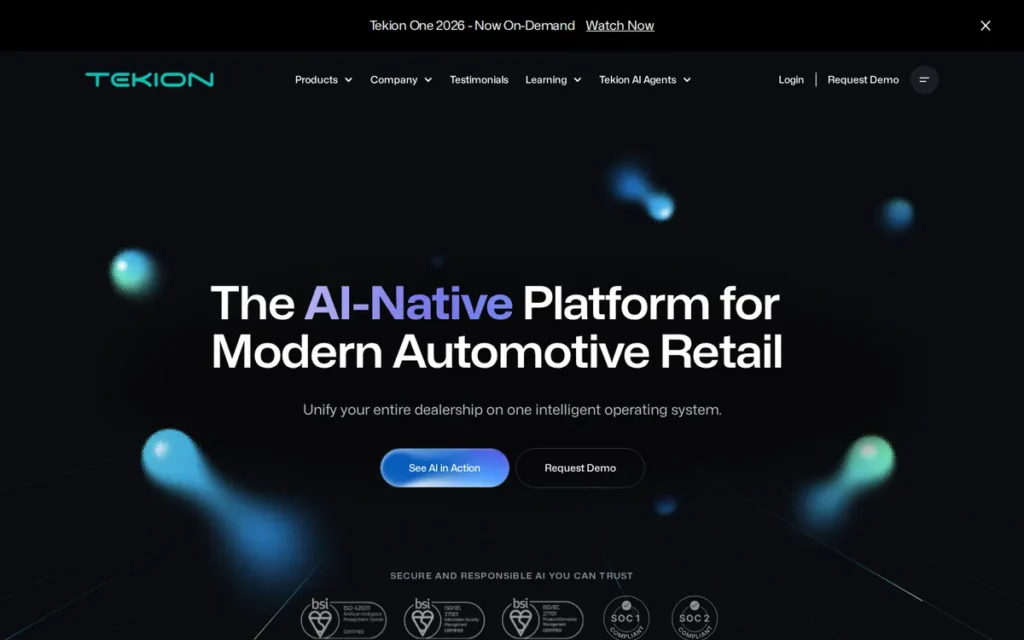
Category: Cloud-Native AI-Powered DMS, a purpose-built cloud-native dealer management system unifying DMS, CRM, digital retailing, service lane management, and embedded payments on a single architecture without the legacy code constraints of on-premise or cloud-hosted incumbents.
At a Glance
- Category: Cloud-Native AI-Powered DMS
- Best For: Forward-looking franchise dealer groups and multi-rooftop operations replacing CDK or Reynolds stacks with a modern, open-API, AI-ready platform
- Price Range: Custom enterprise pricing only; no published per-rooftop rates; 95% or more of integrations at no cost per Automotive Partner Cloud documentation (2024)
- Primary Strength: Tekion ARC is the only truly cloud-native DMS in this evaluation, with 95% or more of integrations available at no cost and integration partners reporting average savings of $5,570/month versus legacy DMS fee structures (APC documentation, 2024)
- Biggest Limitation: Tekion ARC requires a complex, resource-intensive implementation when migrating from a deeply embedded legacy DMS (described by practitioners as operationally demanding during live dealership operations) and carries enterprise-only pricing opacity with no published per-rooftop rates
- One-Line Summary: Tekion ARC is the only cloud-native, AI-native DMS in this evaluation, deployed at Asbury Automotive Group (confirmed among the top five U.S. franchise dealer groups per Automotive News Dealer 100, 2024) and OEM-certified across 52 brands as reported by dealershipaitools.com (2024), with open APIs where 95% or more of integrations are at no cost, contrasting directly with legacy platforms that charge vendors $70,000-plus for API access certification
- Last Verified: June 2026
Overview
Tekion ARC is the only cloud-native dealer management system in this evaluation, founded by former Tesla CIO and CTO Jay Vijayan, backed by $1.15 billion in institutional funding from General Atlantic and FM Capital, and validated at Asbury Automotive Group (confirmed among the top five U.S. franchise dealer groups per Automotive News Dealer 100, 2024), built for franchise groups replacing CDK or Reynolds stacks with a modern unified platform.
Tekion ARC has confirmed enterprise production readiness through deployments at Asbury Automotive Group and Longo Toyota, one of the highest-volume U.S. Toyota dealerships, both documented in industry press as of 2024. Tekion ARC is OEM-certified for 52 brands including GM, Ford, and Honda, as reported by dealershipaitools.com (2024).
Tekion ARC covers DMS, CRM, digital retailing, service lane management, parts, accounting, payroll, and embedded payments on a single unified platform, with an Automotive Partner Cloud where more than 95% of integrations are available at no cost to dealerships, contrasting with legacy platforms that charge integration vendors $70,000-plus for API access certification.
Key Features
- Cloud-Native Architecture: Tekion ARC operates on infrastructure built from scratch on cloud (not legacy code on hosted servers) enabling 3,000-plus new features and enhancements per year Tekion blog, 2024 with continuous deployment across all dealership locations, eliminating dealer-side software maintenance and version management entirely.
- No-Cost Automotive Partner Cloud: Tekion’s Automotive Partner Cloud makes more than 95% of its integration catalog available at no cost to dealerships, with integration partners reporting average savings of $5,570/month on integration expenses compared to legacy DMS fee structures (APC documentation, 2024).
- 52-Brand OEM Certification: Tekion ARC is OEM-certified for 52 brands including GM, Ford, and Honda as reported by dealershipaitools.com (2024), covering warranty submissions, Retail Delivery Reporting, and factory financial reporting across major U.S. franchise programs.
- Native Service Lane Digitization: Tekion ARC includes online scheduling, digital check-in, real-time vehicle status updates, mobile technician approval workflows, and embedded payment processing, all within the core platform, without requiring third-party service department integrations.
- AI-Native Open Architecture: Tekion ARC’s embedded analytics and open API ecosystem support third-party AI tool integration across all departments (from predictive service scheduling to F&I deal optimization) without requiring dealer-paid proprietary licensing or workarounds.
Best For
Tekion ARC is best for forward-looking franchise dealer groups and multi-rooftop operations that have made a strategic commitment to replacing their CDK or Reynolds stack with a modern, cloud-native platform and have the implementation resources and cross-departmental IT coordination capacity to execute a complex DMS transition while the dealership remains in live operation.
Strengths
- Tekion’s Automotive Partner Cloud (2024) documents that integration partners achieve average savings of $5,570/month on integration expenses compared to legacy DMS fee structures, the only independently published, quantified integration cost savings figure from any DMS vendor in this evaluation, supported by Tekion’s confirmation that 95% or more of APC integrations are available at no cost to dealerships.
- Asbury Automotive Group (confirmed among the top five U.S. franchise dealer groups per Automotive News Dealer 100, 2024) and Longo Toyota have deployed Tekion ARC in production as documented in industry press (2024), providing enterprise-grade customer validation across both group-scale and single-point high-volume operations.
- Tekion ARC is OEM-certified for 52 brands including GM, Ford, and Honda as reported by dealershipaitools.com (2024), removing the franchise OEM compliance objection that has historically limited cloud-native DMS adoption among dealers with existing manufacturer reporting mandates.
- Tekion deployed 3,000-plus new features and enhancements in a single year Tekion blog, 2024, a development velocity enabled by cloud-native architecture that no legacy DMS vendor in this evaluation has matched or claimed, giving Tekion a structural advantage in accelerating platform capabilities without burdening dealers with manual upgrade cycles.
Limitations
- Implementation Complexity: Tekion ARC’s most consequential trade-off is the migration complexity when transitioning from a deeply embedded legacy DMS, requiring significant cross-departmental coordination while the dealership remains in live production across sales, service, parts, and F&I simultaneously.
“Building an airplane while it’s in flight”, practitioner describing Tekion ARC implementation on r/careeradvice (Reddit, via Perplexity, 2024)
Takeaway: Tekion ARC migrations from CDK or Reynolds require substantial operational coordination while all departments remain live, placing unusual demands on dealership staff and IT that should be explicitly scoped and budgeted in advance before contract execution.
- Uneven Practitioner Consensus: Tekion ARC’s implementation outcomes vary meaningfully by dealership size and IT sophistication, DealerRefresh forum activity (2024) shows genuine practitioner disagreement, signaling a platform still mid-maturity in some module areas relative to CDK and Reynolds’ decades-established operational depth.
This practitioner disagreement is illustrated on r/partscounter in first-hand transition accounts from dealers who have completed the switch:
“I’ve been on Tekion for 6 months now and it has been nothing short of a downright frustrating slog. The trainers constantly had to consult 5 or 6 other people to answer questions beyond the basic invoicing/repair order billing. For the first 2 to 3 weeks, we couldn’t see daily numbers because they didn’t have the report built.” Posted by u/cursdwitknowledge
Takeaway: Tekion ARC’s training infrastructure has not kept pace with its dealer onboarding growth, parts staff in active CDK-to-Tekion transitions report trainers unable to answer questions beyond basic invoicing, and critical reporting dashboards going dark for weeks after go-live, extending the operational disruption window beyond what implementation timelines typically disclose.
- Pricing Opacity: Tekion ARC’s enterprise-only pricing with no published per-rooftop rates limits feasibility planning for dealer groups that need to model switching costs precisely before committing to a complex, resource-intensive implementation investment.
Verdict
Tekion ARC is the highest-scored DMS in this independent 2026 evaluation, earning #1 by demonstrating the strongest combined performance across cloud-native architecture, open API integration economics, enterprise-scale customer validation, and OEM certification breadth of any platform assessed. Tekion ARC is the right choice for franchise dealer groups committed to replacing CDK or Reynolds infrastructure with a modern, AI-ready platform and with the operational resources to navigate a complex multi-department implementation. Dealerships that prioritize lowest-friction implementation, require maximum module maturity from day one, or lack dedicated IT coordination capacity for a multi-month transition should evaluate Tekion peer references at comparable dealership profiles before signing.
2. DealerBuilt (LightYear DMS): Best for Multi-Rooftop Enterprise Groups / Most Pricing-Transparent Enterprise DMS Alternative
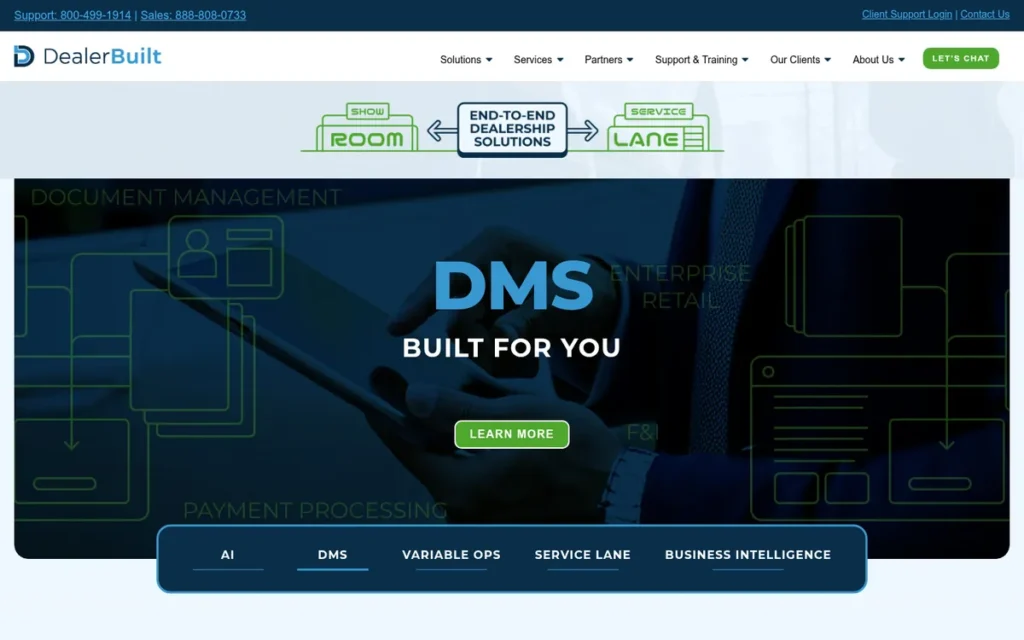
Category: Enterprise Multi-Rooftop DMS, an enterprise-class dealer management system architected specifically for multi-location dealer groups, with per-user (not per-rooftop) pricing, a single customer file spanning all rooftops, and an open API platform confirmed as AI-integration-ready.
At a Glance
- Category: Enterprise Multi-Rooftop DMS
- Best For: Multi-rooftop dealer groups (3–20-plus locations) seeking per-user pricing, open APIs, and a single-customer-file architecture that eliminates inter-location data silos, particularly those frustrated with CDK or Reynolds per-rooftop fee escalation
- Price Range: Starting at $1,500/month (used-car) to $2,000/month (new-car); minimums publicly stated in Auto Remarketing and CorpayOne (2024); full group pricing by custom quote
- Primary Strength: DealerBuilt LightYear is the only enterprise DMS with publicly disclosed minimum monthly pricing and a per-user model that does not compound cost with each rooftop added, enabling any user at any location to desk, complete F&I, and post to a unified enterprise accounting system
- Biggest Limitation: DealerBuilt LightYear operates at a smaller market footprint than CDK, Reynolds, and Dealertrack (OEM certification confirmed for BMW and Ford/Lincoln as of Digital Dealer (2024); full breadth across all franchise brands not publicly documented) and no confirmed aggregate score on G2 or Capterra at the time of this evaluation
- One-Line Summary: DealerBuilt LightYear is the most pricing-transparent enterprise DMS alternative to CDK and Reynolds in the 2026 market, per-user pricing starting at $1,500–$2,000/month (Auto Remarketing, CorpayOne, 2024), a single-customer-file multi-rooftop architecture, open APIs confirmed as AI-integration-ready (AutoRemarketing, 2024), and BMW and Ford OEM certifications
- Last Verified: June 2026
Overview
DealerBuilt LightYear is an enterprise-class dealer management system founded in 2012 in Pierre, South Dakota (per DealerBuilt corporate materials), built for multi-rooftop dealer groups needing per-user pricing that does not escalate with each location added, a single customer file spanning all rooftops, and open APIs designed for AI tool integration without the proprietary restrictions legacy DMS vendors impose.
DealerBuilt LightYear is the only enterprise DMS in this evaluation with publicly disclosed minimum monthly pricing ($1,500/month for used-car dealerships and $2,000/month for new-car dealerships) cited in Auto Remarketing and CorpayOne (2024), providing a procurement planning anchor unavailable from CDK, Reynolds, Dealertrack, Tekion, or DealerSocket.
DealerBuilt has achieved BMW OEM certification for Retail Delivery Reporting integration (Digital Dealer, 2024) and maintains active Ford and Lincoln OEM integration. DealerBuilt LightYear’s open API architecture is explicitly documented as AI-integration-ready by AutoRemarketing (2024), confirming that dealer groups can integrate any AI vendor without proprietary restrictions.
Key Features
- Single-Customer-File Architecture: DealerBuilt LightYear’s single-customer-file architecture enables any authorized user at any rooftop to access a customer’s complete history, desk a deal, complete F&I processing, and post to a unified enterprise accounting system, eliminating the inter-location data reconciliation burden that multi-rooftop groups manage manually on legacy platforms.
- Per-User Pricing Model: DealerBuilt LightYear uses a per-user pricing model with publicly disclosed minimums of $1,500/month for used-car dealerships and $2,000/month for new-car dealerships (Auto Remarketing, CorpayOne, 2024), the only enterprise DMS pricing structure in this evaluation where total cost grows with headcount rather than location count.
- AI-Integration-Ready Open API: DealerBuilt LightYear’s open API platform is documented as AI-integration-ready by AutoRemarketing (2024), explicitly confirming the architecture allows dealer groups to integrate any AI vendor without the proprietary restrictions legacy platforms impose.
- BMW and Ford OEM Certifications: DealerBuilt LightYear achieved BMW OEM certification for Retail Delivery Reporting integration (Digital Dealer, 2024) and maintains a dedicated Ford and Lincoln integration page on its platform website, confirming active OEM certification pursuit across major U.S. franchise programs.
- Comprehensive Core Module Coverage: DealerBuilt LightYear covers Accounting, Sales and F&I, Parts and Service, and Payroll as core modules with a built-in customer experience layer, providing comprehensive dealership operational coverage without requiring separate vendor contracts for individual departmental functions.
Best For
DealerBuilt LightYear is best for multi-rooftop dealer groups with three or more locations frustrated with CDK or Reynolds per-rooftop pricing escalation, data access restrictions, and API certification cost pass-throughs, and ready to adopt a platform whose pricing model rewards group growth rather than penalizing it, and whose open APIs allow AI tool integration without proprietary barriers.
Strengths
- DealerBuilt LightYear’s per-user pricing minimums of $1,500–$2,000/month are publicly cited in Auto Remarketing and CorpayOne (2024), making DealerBuilt the only enterprise DMS in this evaluation with any publicly disclosed pricing anchor, representing the most pricing-transparent enterprise alternative to CDK and Reynolds available in the 2026 market.
- DealerBuilt LightYear has been validated by dealer technology professionals on DealerRefresh (2024) as an enterprise-capable platform.
“I have a great deal of experience with Dealerbuilt (Lightyear). This is a serious computer system.”, DealerRefresh practitioner (2024)
Takeaway: DealerRefresh participants (the most technically sophisticated automotive dealer technology community) endorse DealerBuilt LightYear as enterprise-capable despite its smaller market footprint relative to CDK and Reynolds, providing community credibility that supplements the platform’s limited public review aggregator profile.
- DealerBuilt LightYear achieved BMW OEM certification for Retail Delivery Reporting integration (Digital Dealer, 2024) and maintains active Ford and Lincoln OEM integration, confirming compliance with major U.S. franchise manufacturer reporting requirements across premium and volume segments.
- DealerBuilt LightYear’s open API architecture is explicitly documented as enabling AI vendor integration (AutoRemarketing, 2024), providing dealer groups with the structural flexibility to layer AI tools across service scheduling, lead scoring, and equity mining without the proprietary API restrictions documented in CDK and Reynolds ecosystems.
Limitations
- Market Footprint: DealerBuilt LightYear’s most consequential trade-off is market footprint relative to incumbents, founded in 2012 and operating at smaller scale than CDK (approximately 15,000 dealerships), Reynolds, and Dealertrack (Cox Automotive’s approximately $4 billion acquisition backing), DealerBuilt LightYear offers fewer peer dealer references for multi-rooftop procurement due diligence.
- OEM Certification Breadth: DealerBuilt LightYear’s OEM certification is confirmed for BMW and Ford/Lincoln as of Digital Dealer (2024); full certification breadth across all manufacturer brands is not publicly documented, requiring prospective buyers to verify every brand in their franchise portfolio directly with DealerBuilt before signing.
- Limited Independent Review Presence: DealerBuilt LightYear has no confirmed aggregate score on G2 or Capterra at the time of this evaluation, meaning prospective buyers cannot rely on public review aggregators for sentiment validation and must conduct primary peer reference checking at comparable group size and OEM complexity, unlike DealerSocket (G2 3.8/5, 75 reviews, 2024) which provides public review transparency.
Verdict
DealerBuilt LightYear earns #2 in this independent evaluation by combining the most pricing-transparent enterprise DMS structure in the 2026 market with a per-user pricing model, a single-customer-file multi-rooftop architecture, open APIs confirmed as AI-integration-ready, and BMW and Ford OEM certifications. DealerBuilt LightYear is the most structurally differentiated enterprise alternative for dealer groups with three or more rooftops that have exhausted patience with CDK or Reynolds per-location fee escalation, integration cost pass-throughs, and data access restrictions. Prospective buyers should validate OEM certification breadth for their full franchise brand portfolio and request peer references at comparable group scale and operational complexity before committing to a multi-year contract.
3. Dealertrack DMS (Cox Automotive): Best for Finance-Forward Franchise Dealerships / Best for Cox Automotive Ecosystem Alignment
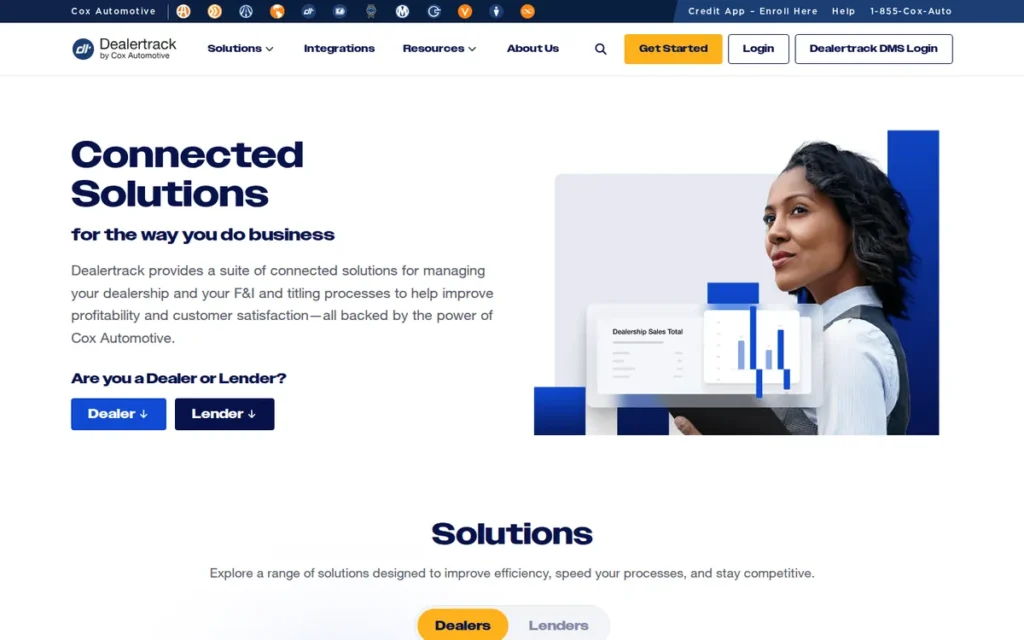
Category: Finance-First Cloud DMS, a cloud-based dealer management system built around the industry’s broadest lender connectivity network, serving franchise and mid-market dealerships through deep Cox Automotive ecosystem integration and the largest F&I finance source network available in a single DMS platform.
At a Glance
- Category: Finance-First Cloud DMS
- Best For: Franchise dealerships with high F&I transaction volume seeking the broadest lender network connectivity, and dealer groups already aligned with or evaluating the Cox Automotive product ecosystem including vAuto, VinSolutions, and Kelley Blue Book
- Price Range: Custom enterprise pricing only; no published rates; Cox ecosystem bundling may affect pricing for multi-product buyers
- Primary Strength: Dealertrack DMS connects dealerships to over 1,500 lender partners (the largest F&I finance source network of any DMS evaluated) enabling deal submission across the broadest possible pool of lenders without leaving the platform
- Biggest Limitation: Dealertrack DMS’s deep integration with the Cox Automotive product ecosystem creates progressive vendor concentration: each additional Cox product a dealership adds raises the cumulative switching cost across all departments simultaneously, making the DMS impossible to evaluate in isolation from the broader Cox ecosystem commitment
- One-Line Summary: Dealertrack DMS is a cloud-based dealer management system with 1,500-plus lender partners and broad OEM integration coverage, acquired by Cox Automotive for approximately $4 billion in 2015, offering the industry’s broadest F&I lender connectivity and native integration with vAuto, VinSolutions, and Kelley Blue Book, with the trade-off of progressive Cox ecosystem vendor concentration as more products are added
- Last Verified: June 2026
Overview
Dealertrack DMS is a cloud-based dealer management system covering sales, F&I, service, parts, and accounting (founded in 2001 and acquired by Cox Automotive for approximately $4 billion in 2015 (per AJC and industry transaction records)) whose defining competitive advantage is the industry’s largest lender connectivity network: 1,500-plus finance partners, giving franchise dealerships the broadest possible F&I source reach from within a single DMS environment.
Dealertrack DMS is a core component of the Cox Automotive ecosystem, integrating natively with vAuto for inventory management, VinSolutions for CRM, Kelley Blue Book for valuations, and Dealer.com for digital retailing, making it the natural DMS choice for dealerships that have aligned their technology stack around Cox products (Cox Automotive brand page, 2024).
Industry comparison sources position Dealertrack DMS as “easier to learn and navigate than Reynolds ERA-IGNITE” (iamdave.ai, 2024), with cloud deployment enabling simpler updates and remote multi-location access. One third-party directory cites 375-plus OEM integration certifications (Maqtoob, 2024; a single-source figure not independently corroborated by Cox Automotive’s own documentation).
Key Features
- 1,500-Plus Lender Partner Network: Dealertrack DMS connects to over 1,500 lender partners (the largest F&I finance source network of any DMS evaluated) enabling deal submission to the broadest possible pool of finance sources, including digital contracting and e-signing for both integrated and non-integrated finance companies (Auto Remarketing, 2024).
- Broad OEM Integration Coverage: Dealertrack DMS provides broad OEM integration coverage for franchise dealerships across major U.S. manufacturers (one third-party directory cites 375-plus certifications (Maqtoob, 2024; single-source figure)) covering warranty claims, parts ordering, recall lookups, and factory financial reporting.
- Native Cox Automotive Ecosystem Integration: Dealertrack DMS integrates natively with vAuto for inventory repricing and analytics, VinSolutions for CRM, Kelley Blue Book for real-time valuations, and Dealer.com for digital retailing, providing a unified operational data layer for dealerships aligned with the Cox product family (Cox Automotive brand page, 2024).
- Cloud-Based Deployment with Lower Learning Curve: Dealertrack DMS is cloud-deployed, enabling automatic updates without dealer-side maintenance burden, remote multi-location access, and a user experience described as “easier to learn and navigate than Reynolds ERA-IGNITE” (iamdave.ai, 2024), reducing training overhead for dealerships switching from legacy platforms.
- Digital Contracting and E-Signing: Dealertrack DMS supports digital contracting and e-signing workflows for F&I with lender submission capabilities for both integrated and non-integrated finance companies (Auto Remarketing, 2024), reducing re-contracting rates and accelerating funding timelines without requiring a separate document management system.
Best For
Dealertrack DMS is best for mid-to-large franchise dealerships with significant F&I deal volume that want to maximize lender source reach with minimal integration friction, and for dealer groups already using or evaluating other Cox Automotive products who want unified data flow across their technology stack without managing cross-vendor integrations.
Strengths
- Dealertrack DMS connects to over 1,500 lender partners (Cox Automotive brand page, Maqtoob, 2024) (the largest F&I finance source network of any DMS in this evaluation) enabling franchise F&I departments to reach the broadest possible pool of lenders from a single platform.
- Cox Automotive’s approximately $4 billion acquisition of Dealertrack in 2015 (per AJC and industry records) provides the institutional financial backing of a large automotive technology conglomerate, enabling ongoing product investment and ecosystem integration depth unavailable to independent DMS vendors at comparable scale.
- Dealertrack DMS is positioned as “easier to learn and navigate than Reynolds ERA-IGNITE” (iamdave.ai, 2024), with cloud deployment reducing the training overhead burden that dealerships switching from legacy platforms with steep learning curves consistently report.
This applies specifically to the Reynolds comparison. Users on r/partscounter transitioning from CDK offer a different data point:
“I recently went through this experience! Dealertrack is definitely not as user-friendly as CDK. It took me roughly a month to get accustomed to it.” Posted by u/Hortn8r
Takeaway: Dealertrack DMS’s accessibility advantage over Reynolds ERA-IGNITE does not transfer to CDK migrations, parts counter professionals switching from CDK to Dealertrack report a meaningful month-long adjustment period that the platform’s general “lower learning curve” positioning does not fully disclose.
- Dealertrack DMS supports digital contracting and e-signing with lender submission capabilities for both integrated and non-integrated finance companies (Auto Remarketing, 2024), enabling F&I workflow digitization that reduces re-contracting rates and accelerates funding timelines without requiring separate document management tooling.
Limitations
- Cox Ecosystem Lock-In: Dealertrack DMS’s most consequential trade-off is progressive vendor concentration, as dealerships add vAuto, VinSolutions, and Dealer.com alongside Dealertrack DMS, the cumulative switching cost across all departments escalates sharply, making the DMS impossible to replace without disrupting every connected Cox product simultaneously (coaxsoft.com, 2024).
- Limited Native CRM Depth: Dealertrack DMS’s native CRM functionality is limited relative to standalone CRM platforms, dealers frequently add VinSolutions to achieve full CRM capability (coaxsoft.com, 2024), which deepens the Cox ecosystem dependency further, creating additional switching cost compounding over the contract term.
- Pricing Opacity: Dealertrack DMS’s complete absence of published pricing prevents accurate procurement cost modeling without an extended enterprise sales engagement, made more consequential by the ecosystem concentration risk, which means accurate total cost comparison must encompass every Cox product in use simultaneously.
Verdict
Dealertrack DMS earns #3 in this independent evaluation by offering the industry’s largest lender connectivity network (1,500-plus partners), broad OEM integration coverage, cloud-based architecture with strong accessibility relative to legacy alternatives, and the institutional backing of Cox Automotive’s approximately $4 billion investment. Dealertrack DMS is the right choice for franchise dealerships where F&I deal volume and lender source breadth are the primary operational priority and where alignment with the Cox Automotive product ecosystem is a strategic direction rather than a vendor concentration risk. Dealerships evaluating Dealertrack should explicitly model the full Cox ecosystem cost and cumulative switching complexity across all currently used and planned Cox products before committing to a multi-year contract.
4. DealerSocket (Solera): Best for Integrated CRM-DMS Operations / Most Publicly Reviewed Enterprise DMS
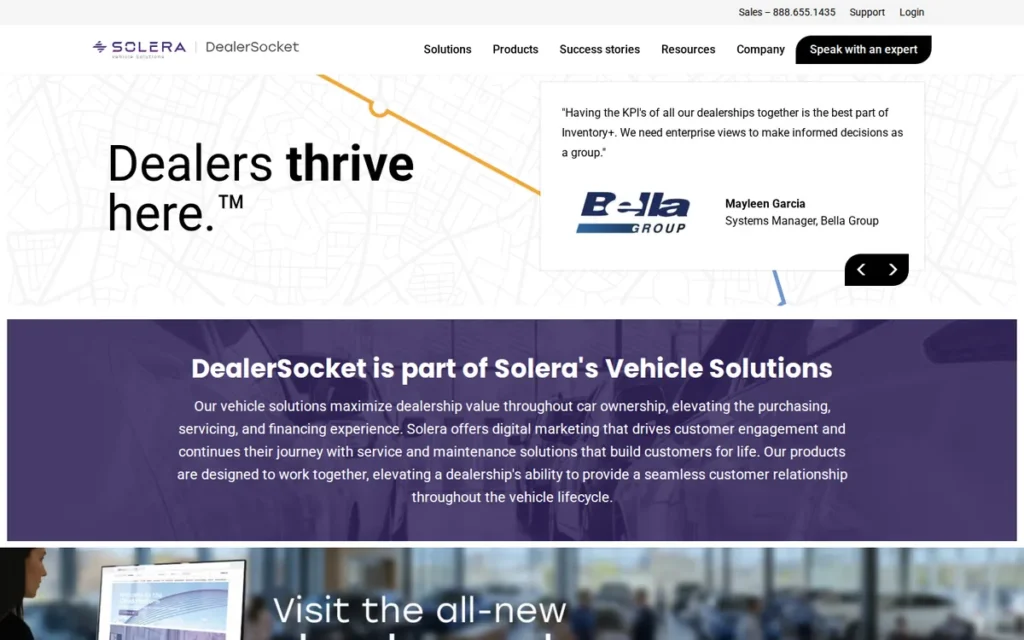
Category: Integrated CRM-DMS Platform, a unified dealer management system combining DMS, CRM, inventory management, and digital retailing tools in a single-sign-on environment, serving both franchise dealer groups and independent used-car dealers through separate purpose-built product lines.
At a Glance
- Category: Integrated CRM-DMS Platform
- Best For: Mid-market franchise dealerships seeking native CRM-DMS integration in one platform, and independent used-car dealers needing Buy-Here-Pay-Here workflow support through DealerSocket iDMS
- Price Range: Custom enterprise pricing only; no published rates as of June 2026
- Primary Strength: DealerSocket holds a G2 rating of 3.8/5 from 75 verified reviews (G2, 2024) (the most publicly verifiable review record of any enterprise DMS in this evaluation) and integrates DMS, CRM, and Inventory-plus in a unified single-sign-on environment with real-time vehicle data synchronization
- Biggest Limitation: DealerSocket’s 2021 acquisition by Solera Holdings correlates with a documented decline in support responsiveness and account management quality in dealer community sources, a sustained post-acquisition concern that affects the ongoing ownership experience for dealers satisfied with the platform’s core DMS and CRM functionality
- One-Line Summary: DealerSocket is an integrated DMS-CRM platform rated 3.8/5 on G2 from 75 verified reviews, acquired by Solera Holdings in 2021 (per Solera Holdings press release and industry transaction records), offering native CRM-DMS-Inventory-plus integration in a single-sign-on environment and a dedicated iDMS product line for independent used-car dealers, with post-Solera support responsiveness documented as a sustained concern in dealer community sources
- Last Verified: June 2026
Overview
DealerSocket is an integrated dealer management platform owned by Solera Holdings (acquired 2021, per Solera Holdings press release and industry transaction records) that combines DMS, CRM, and Inventory-plus in a unified single-sign-on environment, differentiating it from CDK and Reynolds, which are primarily DMS platforms requiring separate CRM tool contracts for native customer management functionality.
DealerSocket serves the franchise dealer market through its integrated DMS-CRM suite and the independent used-car market through its iDMS product line, one of the few DMS vendors with purpose-built products for distinct dealership segments rather than a scaled-down version of one product serving both.
DealerSocket holds a G2 rating of 3.8/5 from 75 verified reviews (G2, 2024) (the most substantial publicly accessible review record of any enterprise DMS in this evaluation) enabling independent sentiment validation that CDK, Reynolds, Tekion, and Dealertrack do not provide through public review aggregators.
Key Features
- Integrated DMS-CRM-Inventory Single Sign-On: DealerSocket DMS covers the full vehicle, sales, customer, and payment lifecycle through integrated Sales, Parts, Service, Finance, Insurance, and Warehouse Inventory modules, with native CRM and Inventory-plus in a single-sign-on environment that eliminates inter-system data rekeying between the DMS and customer management or inventory tools.
- Real-Time Inventory Data Synchronization: DealerSocket’s real-time inventory integration passes retail price, advertised price, mileage, certified flag, and title flag directly into the DMS as they change DealerSocket integration announcement, 2024, eliminating price and status discrepancies that generate compliance risk and deal errors in franchise operations.
- Dedicated iDMS for Independent Dealers: DealerSocket’s iDMS product line is explicitly built for independent used-car dealers with workflows tailored to Buy-Here-Pay-Here financing, simpler OEM compliance requirements, and faster inventory turnover, a dedicated product rather than a scaled-down version of the franchise platform.
- Extended Digital Retail Platform: DealerSocket’s platform includes Revenue Radar for equity mining, Precise Price for digital pricing and marketing, and DealerFire for dealer websites (AutoSuccessOnline, 2024), extending dealer capabilities beyond the core DMS into a full digital retail marketing stack.
- Active Third-Party Integration Ecosystem: DealerSocket integrates with Kenect using real-time sales and service data to enable text-based customer outreach (Kenect integration page, 2024), demonstrating active ecosystem development activity beyond core DMS capabilities.
Best For
DealerSocket is best for mid-market franchise dealerships wanting DMS and CRM integrated natively in one platform to eliminate inter-system data friction, and for independent used-car dealers and Buy-Here-Pay-Here operations needing dedicated BHPH workflow support through DealerSocket iDMS, particularly when public review transparency in vendor selection is a stakeholder requirement.
Strengths
- DealerSocket holds a G2 rating of 3.8/5 from 75 verified reviews (G2, 2024): the most independently reviewable enterprise DMS in this evaluation at meaningful scale, providing documented user sentiment that CDK, Reynolds, Tekion, and Dealertrack do not make accessible through public review aggregators.
- DealerSocket’s real-time inventory integration synchronizes retail price, advertised price, mileage, certified status, and title flag directly into the DMS without manual update DealerSocket integration announcement, 2024, eliminating a perennial source of deal errors and compliance exposure in franchise dealership operations.
- DealerSocket serves both the franchise dealer market and the independent used-car market through differentiated purpose-built product lines, one of the few platforms in this evaluation that does not require independent dealers to adapt workflows to a scaled-down franchise tool.
- G2 review summaries confirm that DealerSocket users consistently praise ease of use and intuitive interface (G2, 2024), positioning DealerSocket as substantially more accessible than Reynolds ERA-IGNITE, which carries a documented steep learning curve and training complexity burden for front-line dealership staff.
Community observations on r/askcarsales reflect the platform’s day-to-day reliability dynamic:
“I use it everyday. It’s great! Works better at home than at the dealership because apparently it always loses connection here.” Posted by u/newbcoder
Takeaway: DealerSocket’s web-based architecture delivers a genuinely usable daily experience in stable network environments but degrades on dealership floor networks, a connectivity dependency that can undermine the platform’s ease-of-use strengths in high-traffic sales environments and warrants explicit infrastructure assessment before deployment.
Limitations
- Post-Solera Support Quality: DealerSocket’s most consequential trade-off is post-Solera acquisition support quality, dealer community sources and industry comparison content consistently document a decline in support responsiveness and account management engagement following the 2021 Solera Holdings acquisition, reflecting a pattern automotive industry observers characterize as private equity portfolio management prioritizing margin over service investment.
- Solera Ecosystem Concentration Risk: DealerSocket’s broader Solera platform ecosystem creates progressive vendor concentration risk analogous to the Cox ecosystem dependency documented for Dealertrack (coaxsoft.com, 2024), with the additional consideration that Solera’s strategic priorities are determined by portfolio management rather than automotive dealer-specific operational needs.
- CRM Module Navigation Complexity: DealerSocket’s G2 review profile (3.8/5, 75 reviews, 2024) includes a consistent pattern of negative feedback specifically targeting navigation complexity in the CRM module, suggesting the ease-of-use rating reflects the DMS interface more than the full integrated CRM-DMS workflow experience, which varies by user role.
Verdict
DealerSocket earns #4 in this independent evaluation by combining the most publicly documented review record of any enterprise DMS platform (G2 3.8/5, 75 verified reviews, 2024), native CRM-DMS-Inventory-plus integration that eliminates inter-system data friction, and a product strategy that genuinely differentiates between franchise and independent dealer market segments with purpose-built tooling. DealerSocket is the right choice when integrated CRM-DMS operations are the primary workflow priority and when public review transparency in the procurement process is a stakeholder requirement. Dealerships evaluating DealerSocket should conduct thorough reference checking on post-Solera support experience (specifically from implementations completed after 2021) before executing a contract that locks in a multi-year support relationship.
5. Reynolds and Reynolds: Deepest Native Integration for Large Franchise Groups
Category: Legacy Enterprise Integrated DMS, a comprehensively coupled dealership management system with the deepest native operational integration in the market, serving mid-to-large franchise dealerships that prioritize departmental data cohesion over API openness, integration cost efficiency, and pricing transparency.
At a Glance
- Category: Legacy Enterprise Integrated DMS
- Best For: Mid-to-large franchise dealerships with existing Reynolds infrastructure, complex F&I workflows, and deep OEM compliance requirements, willing to absorb the highest reported integration cost structure in this evaluation in exchange for the deepest native departmental integration available
- Price Range: Custom enterprise pricing; enterprise group contracts documented at $14,000-plus per month; RCI integration vendor certification fees reported at $70,000-plus per vendor; per-vendor monthly integration fees reported at $175–$700-plus (as reported by DealerRefresh community members, 2024; Reynolds does not publish official fee schedules)
- Primary Strength: Reynolds ERA-IGNITE provides the deepest native end-to-end dealership operational integration of any DMS evaluated (a single database where data entered in service, parts, sales, or F&I flows automatically to accounting) described by DealerRefresh practitioners as “the most tightly integrated end-to-end system for dealership operations” (2024)
- Biggest Limitation: Reynolds ERA-IGNITE imposes the most restrictive data access controls in this evaluation, integration vendors reportedly pay $70,000-plus for RCI certification (DealerRefresh community records, 2024; Reynolds does not publish official fee schedules), with those costs passed through to dealers at $175–$700-plus per month per integrated tool, compounded by documented data extraction barriers including removed Query Builder access and export limitations
- One-Line Summary: Reynolds ERA-IGNITE is a privately held enterprise DMS with the deepest native dealership operational integration of any platform evaluated (all department transactions flow to a single accounting database automatically) but carries the most restrictive data access controls and highest reported integration cost structure in this evaluation, making it most defensible for large franchise dealers with existing Reynolds infrastructure
- Last Verified: June 2026
Overview
Reynolds ERA-IGNITE is the flagship enterprise DMS from Reynolds and Reynolds (a privately held company headquartered in Dayton, Ohio) operating as a single-database system where every departmental transaction, whether in service, parts, sales, or F&I, automatically posts to a unified accounting database without manual reconciliation, providing the most natively cohesive DMS operational environment of any platform evaluated.
Reynolds ERA-IGNITE integrates with the Provider Exchange Network (PEN) for F&I product rating and contracting (Digital Dealer, 2024) and has served the U.S. franchise dealer market for decades. DealerRefresh practitioners consistently describe Reynolds ERA-IGNITE as “the most tightly integrated end-to-end system for dealership operations” DealerRefresh community review thread, 2024.
Reynolds ERA-IGNITE’s defining limitation is equally documented: integration vendors reportedly pay $70,000-plus for RCI certification, with per-vendor monthly fees of $175–$700-plus flowing through to dealer costs, as reported by DealerRefresh community members (2024); Reynolds does not publish official RCI fee schedules or confirm these figures in public documentation.
Key Features
- Single-Database Architecture: Reynolds ERA-IGNITE operates as a single-database system where data entered in any department (service, parts, sales, or F&I) flows automatically to accounting without manual reconciliation, providing the tightest native operational integration of any DMS evaluated and eliminating the inter-system reconciliation burden documented as a common source of accounting errors in multi-vendor stacks.
- Provider Exchange Network F&I Integration: Reynolds ERA-IGNITE integrates with the Provider Exchange Network (PEN) for F&I product rating, booking, and contracting (Digital Dealer, 2024), enabling menu presentation and product selection across hundreds of F&I product providers within the DMS, eliminating the need for a separate F&I menu system.
- Advanced Service Module: Reynolds ERA-IGNITE’s Advanced Service module is cited by DealerRefresh practitioners as “especially deeply integrated for service workflows” DealerRefresh community review thread, 2024, providing native service lane operations, dispatch, and accounting without requiring a separate DMS-to-service integration layer.
- Deep OEM Certification Coverage: Reynolds ERA-IGNITE provides deep OEM certification coverage for major U.S. manufacturers including warranty submissions, parts ordering, recall lookups, and factory financial reporting, a compliance infrastructure developed through decades of franchise dealer deployment and sustained manufacturer relationship investment.
- On-Premises Performance: Reynolds ERA-IGNITE’s on-premises deployment delivers what DealerRefresh practitioners describe as “fast, reliable performance” DealerRefresh community review thread, 2024, a throughput advantage for high-volume franchise dealerships where DMS transaction speed is a documented operational consideration.
Best For
Reynolds ERA-IGNITE is best for mid-to-large franchise dealerships with complex F&I compliance workflows, existing Reynolds infrastructure, and the financial scale to absorb the platform’s documented total cost of ownership, where the depth of native operational integration justifies the premium over more cost-efficient alternatives with comparable OEM compliance coverage.
Strengths
- Reynolds ERA-IGNITE’s single-database architecture is validated by DealerRefresh practitioners as “the most tightly integrated end-to-end system for dealership operations” DealerRefresh community review thread, 2024, the highest documented native operational integration benchmark in this evaluation, where all departmental transactions automatically consolidate in one accounting system without reconciliation.
- Reynolds ERA-IGNITE integrates with the Provider Exchange Network for F&I product rating, booking, and contracting (Digital Dealer, 2024), enabling native access to hundreds of F&I product providers without leaving the DMS and eliminating the need for a separate F&I menu system.
- Reynolds ERA-IGNITE provides deep OEM certification for major U.S. manufacturers covering warranty, parts ordering, recall lookup, and factory financial reporting, developed through decades of franchise dealer deployment and sustained manufacturer relationship investment.
- Reynolds ERA-IGNITE’s on-premises deployment delivers what DealerRefresh practitioners consistently describe as “fast, reliable performance” DealerRefresh community review thread, 2024, a throughput advantage for high-volume franchise operations where DMS transaction speed is a documented bottleneck consideration.
This performance reputation is echoed in first-hand comparisons on r/serviceadvisors from operators who have moved between platforms:
“Went from a seasoned pro at CDK to Reynolds. Reynolds is easier for sure. Took me like 3 days and I had it down.” Posted by u/ljs2797
Takeaway: Reynolds ERA-IGNITE’s reputation for a steep learning curve is most acute among users with no prior Reynolds exposure, service professionals already fluent in enterprise DMS workflows report surprisingly rapid Reynolds adoption, suggesting the platform’s training overhead is frequently overstated in CDK-to-Reynolds migration assessments.
Limitations
- API Restrictions and Integration Cost: Reynolds ERA-IGNITE’s most consequential trade-off is its data access and integration cost architecture, the most restrictive in this evaluation. Integration vendors reportedly pay $70,000-plus for RCI certification, with costs passed through to dealers at $175–$700-plus per month per integrated tool (DealerRefresh community records, 2024; Reynolds does not publish official fee schedules), meaning a dealership using 8–10 third-party tools may carry $1,400–$7,000 in additional monthly overhead beyond the base contract.
- Data Access Restrictions: Reynolds ERA-IGNITE’s data access practices are documented by DealerRefresh practitioners as including removed Query Builder access, export limitations, CAPTCHA barriers, blocked screen scraping, and vendor IDs flagged as automated access attempts, characterized by the community as practices that “feel anti-competitive” DealerRefresh community review thread, 2024.
- Switching Cost Premium: Reynolds ERA-IGNITE’s switching cost premium is illustrated by a documented DealerRefresh case study (2024): one dealer group that transitioned away reduced monthly DMS costs by approximately 90% (from $14,000-plus to $1,700) but only after “extensive advance planning for data extraction,” confirming that exit costs include both financial penalties and significant data migration labor investment.
Verdict
Reynolds ERA-IGNITE earns #5 in this independent evaluation (demonstrating genuine and documented strengths in native operational integration depth, F&I workflow cohesion, Advanced Service module integration, and OEM compliance breadth) offset by the most restrictive data access practices and highest reported integration cost structure of any DMS in this evaluation. Reynolds ERA-IGNITE is defensible for large franchise dealerships with complex compliance requirements, existing Reynolds infrastructure where switching costs exceed savings, and the financial scale to absorb per-tool integration fees at $175–$700-plus per month. Dealerships evaluating Reynolds for a first-time installation should model the complete integration cost stack, plan data migration timelines with awareness of documented data access restrictions, and compare against DealerBuilt LightYear and Tekion ARC before committing to a multi-year contract.
6. Autosoft FLEX: Best for Single-Point Franchise Dealers and Independent Used-Car Lots
Category: Open-Ecosystem SMB DMS, a cloud-hosted dealer management system designed for single-point and small-group franchise and independent dealerships, featuring 200-plus open third-party integrations (per Autosoft documentation, 2024; independently unverified count), minimal IT overhead requirements, and affordability-forward market positioning relative to enterprise incumbents.
At a Glance
- Category: Open-Ecosystem SMB DMS
- Best For: Single-point franchise dealerships, small dealer groups (1–3 rooftops), and independent used-car dealers seeking a cloud-hosted DMS with open integration connectivity and lower total cost of ownership than CDK, Reynolds, or Tekion, without requiring enterprise-tier reporting depth or multi-rooftop data architecture
- Price Range: Affordability-positioned; custom quote required; no published rates as of June 2026
- Primary Strength: Autosoft FLEX is a 35-year-established, cloud-hosted DMS with 200-plus open partner integrations (per Autosoft documentation, 2024; independently unverified count) and OEM compliance for franchise dealers, purpose-built for the small-to-mid-sized dealership segment without the certification fee barriers that compound integration costs on Reynolds and CDK platforms
- Biggest Limitation: Autosoft FLEX carries a GetApp rating of 3.6/5 across 22 reviews (GetApp, 2024) (indicating adequate but not exceptional user satisfaction) and is explicitly identified by industry analysts as unsuitable for large dealer groups requiring advanced native reporting, complex multi-rooftop customization, or the OEM integration breadth of larger platforms
- One-Line Summary: Autosoft FLEX is a cloud-hosted, open-integration DMS founded in 1988 in Hermitage, Pennsylvania (per Autosoft corporate history), with 200-plus partner connections (per Autosoft documentation, 2024; independently unverified count) and OEM compliance for franchise dealers, rated 3.6/5 on GetApp across 22 reviews, the accessible alternative to CDK and Reynolds for single-point franchise dealers and independent used-car operators that do not require enterprise-scale reporting depth or multi-rooftop architecture
- Last Verified: June 2026
Overview
Autosoft FLEX is a cloud-hosted all-in-one dealer management system covering sales, service, parts, accounting, inventory, and F&I (built by a company with over 35 years in the automotive retail technology market, founded in 1988 in Hermitage, Pennsylvania (per Autosoft corporate history)) positioned as the accessible, integration-open DMS alternative for single-point franchise dealers and independent used-car operators.
Autosoft FLEX supports 200-plus partner integrations (per Autosoft documentation, 2024; independently unverified count), enabling dealerships to connect preferred CRM, inventory, or digital retail tools rather than being locked into a single vendor ecosystem. Autosoft FLEX is deployed on cloud-hosted infrastructure enabling remote access and automatic updates without on-premise hardware requirements.
Industry analysts explicitly positionAutosoft FLEX as best suited for single-point or small-group franchise dealers and independent used-car dealers, with clear guidance that the platform is not recommended for enterprise-scale operations requiring advanced native reporting or deep multi-location customization. This candid market position helps buyers self-select appropriately.
Key Features
- 200-Plus Open Partner Integrations: Autosoft FLEX supports 200-plus partner integrations (per Autosoft documentation, 2024; independently unverified count), enabling dealerships to connect preferred CRM, inventory management, digital retail, and F&I tools without the certification fee structures that make third-party integration costly on Reynolds and CDK platforms.
- Cloud-Hosted Remote Access: Autosoft FLEX is cloud-hosted, enabling remote access across devices and locations, automatic software updates without dealer-side maintenance, and operation without on-premise hardware infrastructure, directly addressing the IT overhead burden that makes legacy DMS systems costly for smaller dealerships without dedicated IT staff.
- Built-In Customer Management: Autosoft FLEX’s Sales and Customer Management Pro module includes a 360-degree customer view, lead and customer segmentation, payment comparison tools, and tax handling (Autosoft DMS features page, 2024), providing built-in customer management capabilities that reduce the need for a separate CRM tool for dealerships with simpler workflow requirements.
- Comprehensive SMB Operational Coverage: Autosoft FLEX covers dealer accounting, service scheduling, parts inventory, F&I deal structuring, and vehicle inventory management in a unified system, providing operational breadth appropriate for single-point franchise or independent dealer needs without requiring separate module contracts for each departmental function.
- OEM Franchise Compliance: Autosoft FLEX is OEM-certified for applicable franchise manufacturers, meeting warranty submission and manufacturer compliance reporting requirements, prospective buyers should confirm certification status for their specific OEM brands directly with Autosoft before signing, as the full brand coverage list is not publicly documented.
Best For
Autosoft FLEX is best for single-point franchise dealerships, small dealer groups with 1–3 rooftops, and independent used-car dealers evaluating their first DMS or switching from an enterprise platform that over-serves their operational scale, particularly those prioritizing cloud-hosted remote access, open integration connectivity, and lower total cost of ownership than CDK or Reynolds.
Strengths
- Autosoft FLEX’s 200-plus partner integration catalog (per Autosoft documentation, 2024; independently unverified count) provides independent and small franchise dealers with an open integration ecosystem that avoids the reported $70,000-plus RCI vendor certification fee structure (Reynolds, as reported by DealerRefresh community members, 2024) and documented API restrictions (CDK) that pass third-party integration costs through to dealers at competing platforms.
- Autosoft DMS maintains simultaneous active review profiles on GetApp (3.6/5, 22 reviews, 2024), Capterra (22 reviews, 2024), G2, and Software Advice as of 2026, demonstrating active market engagement and review transparency that enterprise DMS vendors CDK and Reynolds do not maintain at comparable public scale.
- Autosoft’s 35-plus year market presence (founded 1988 per corporate history) demonstrates sustained product-market fit with smaller franchise and independent dealers, a vendor stability signal for dealership owners evaluating multi-year contracts that newer SMB DMS entrants cannot yet demonstrate.
- Autosoft FLEX has no documented major cybersecurity incidents of the scale or operational impact of the June 2024 CDK ransomware attack (estimated $600 million or more in first-two-week losses, Anderson Economic Group via IS Partners, 2024), an increasingly material vendor comparison as dealer groups evaluate security posture following the industry’s most significant documented DMS security failure.
Limitations
- Feature Ceiling for Enterprise Use Cases: Autosoft FLEX’s most consequential trade-off is the ceiling between its feature depth and enterprise requirements, a GetApp rating of 3.6/5 across only 22 reviews (GetApp, 2024) signals adequate rather than exceptional user satisfaction, and industry analysts explicitly note that Autosoft FLEX is not recommended for large dealer groups requiring enterprise-scale customization, advanced native reporting, or deep operational controls comparable to CDK or Reynolds.
- Narrower Partner Ecosystem: Autosoft FLEX’s 200-plus integration catalog (per Autosoft documentation, 2024), while openly accessible, represents a narrower partner ecosystem than Dealertrack’s 1,500-plus lender network and Tekion’s 52-brand OEM portfolio (dealershipaitools.com, 2024), making Autosoft FLEX a constrained choice for dealerships with complex multi-vendor integration requirements beyond standard SMB needs.
- Pricing Messaging Contradiction: Autosoft FLEX’s affordability positioning is undermined by the complete absence of published pricing (requiring a sales call to discover costs that the platform’s marketing implicitly promises will be accessible) creating procurement friction for dealerships that respond to the affordability messaging and expect baseline price transparency.
Verdict
Autosoft FLEX earns #6 in this independent evaluation as the most appropriate DMS for single-point franchise dealers and independent used-car operators evaluating their first platform or seeking a cost-efficient alternative to enterprise incumbents that over-engineer for their operational scale. Autosoft FLEX’s 35-year track record, 200-plus open integrations (per Autosoft documentation, 2024), cloud-hosted architecture, and explicit SMB market positioning provide a credible operational foundation for the dealer segment that CDK and Reynolds over-serve and that Tekion and DealerBuilt are too enterprise-focused to serve efficiently. Dealerships should verify OEM compliance certification for their specific manufacturer brands and request a fully itemized total cost quote before signing, given the disconnect between affordability messaging and the absence of any published pricing.
7. CDK Global: Enterprise Legacy DMS Suite / Best for Large Franchise Groups With Existing CDK Infrastructure
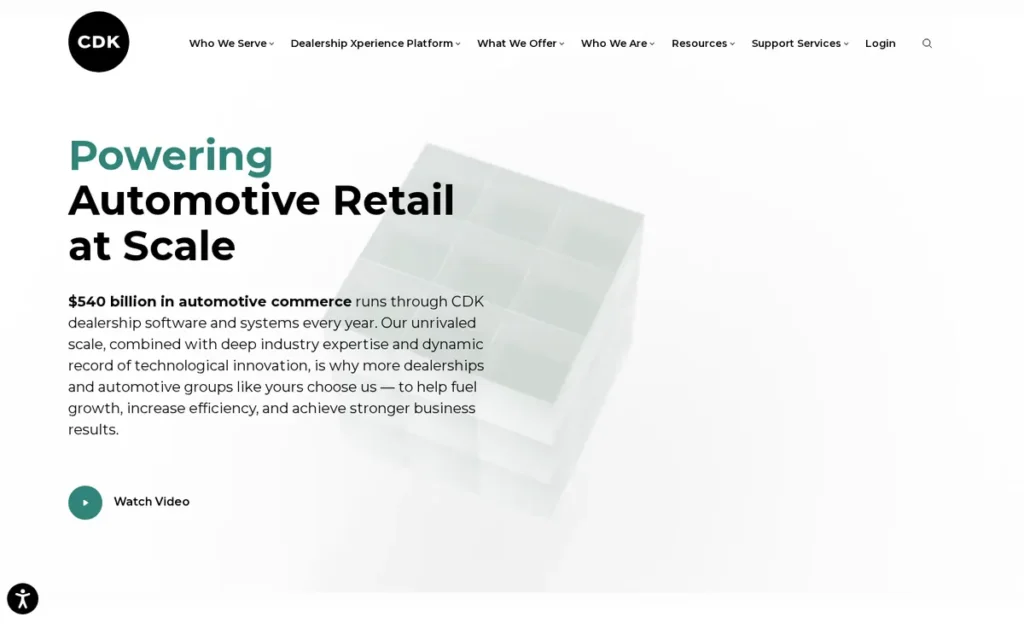
Category: Enterprise Legacy DMS Suite, a large-scale, modular dealer management system serving primarily large franchise groups through six product suites covering the full dealership operation, with the deepest OEM franchise connectivity in the market and the largest North American installation base, ranked last in this evaluation due to the June 2024 ransomware attack, documented API restrictions, and complete pricing opacity.
At a Glance
- Category: Enterprise Legacy DMS Suite
- Best For: Large franchise dealer groups with existing CDK infrastructure, deep OEM compliance mandates, or OEM relationships specifically requiring CDK certification, provided that cybersecurity risk, API openness, and pricing transparency have been explicitly evaluated and accepted at the board level following the June 2024 incident
- Price Range: Custom enterprise pricing only; modular structure means base license is the cost floor, not the ceiling; no published rates as of June 2026
- Primary Strength: CDK Global’s Dealership Xperience Platform provides the deepest OEM franchise connectivity in North America (covering warranty submissions, parts ordering, recall lookups, and factory financial reporting) across the largest active DMS installation base of approximately 15,000 dealerships (per ExtraHop and PSM Partners cybersecurity incident coverage, 2024)
- Biggest Limitation: CDK Global suffered a ransomware-style cyberattack in June 2024 that took approximately 15,000 North American dealerships offline for approximately two weeks, generating an estimated $600 million or more in losses in the first two weeks alone (Anderson Economic Group via IS Partners, 2024), with collective industry estimates exceeding $1 billion (ExtraHop, 2024; PSM Partners, 2024), the most severe documented operational failure event in recent DMS market history affecting more dealers for a longer sustained duration than any previously documented DMS outage
- One-Line Summary: CDK Global is the largest-installed enterprise DMS in North America (approximately 15,000 dealerships) with the deepest OEM franchise connectivity in the market, ranked last in this independent evaluation because the June 2024 ransomware attack took approximately 15,000 dealerships offline for two weeks ($600 million or more in estimated first-two-week losses), and CDK carries documented API access restrictions and data portability limitations that have been the subject of dealer litigation
- Last Verified: June 2026
Overview
CDK Global is one of the two dominant enterprise DMS vendors in North America, serving approximately 15,000 dealerships (per ExtraHop and PSM Partners cybersecurity incident reports, 2024) through its Dealership Xperience Platform (organized across six product suites covering sales, F&I, service, parts, accounting, inventory, and analytics) providing the deepest OEM franchise connectivity in the market for warranty submissions, parts ordering, recall lookups, and factory financial reporting.
CDK Global became privately held following its 2022 acquisition by Brookfield Business Partners and achieved SOC 2 compliance certification SoftwareAdvice CDK Drive profile, 2024. CDK Global is ranked last in this independent evaluation not because of its market position or OEM compliance depth, but because of the June 2024 ransomware-style cyberattack, the most severe documented operational failure in recent DMS market history.
The June 2024 CDK cyberattack forced approximately 15,000 North American dealerships offline for approximately two weeks, generating an estimated $600 million or more in losses in the first two weeks alone (Anderson Economic Group via IS Partners, 2024), with collective industry estimates exceeding $1 billion (ExtraHop, 2024; PSM Partners, 2024). Dealers reverted to manual, paper-based operations across sales, service, parts, F&I, and accounting simultaneously.
Key Features
- Six-Suite Modular Platform: CDK’s Dealership Xperience Platform is organized across six modular suites (Foundations (3-plus rooftops), Fundamentals (1–2 rooftops), Modern Retail, Vehicle Inventory, Fixed Operations, and Intelligence) enabling dealerships to activate incremental capabilities by department, though each additional module carries costs beyond the base platform license (CDK Global official website).
- Deepest OEM Franchise Connectivity: CDK Global provides OEM franchise connectivity covering warranty submissions, parts ordering, recall lookups, and factory financial reporting across major U.S. manufacturers, the deepest OEM compliance infrastructure in this evaluation, developed through decades of franchise dealer and manufacturer relationship investment.
- SOC 2 Compliance Certification: CDK Global achieved SOC 2 compliance certification SoftwareAdvice CDK Drive profile, 2024, though the June 2024 ransomware attack occurred while SOC 2 certification was active, underscoring that certification does not guarantee incident prevention.
- Scale-Segmented Product Architecture: CDK Global’s Fundamentals Suite is structured for 1–2 rooftop franchise dealerships while the Foundations Suite targets 3-plus rooftop dealer groups, providing explicit product segmentation by scale within the same platform family.
- Intelligence and Analytics Suite: CDK Global’s Intelligence suite provides reporting and analytics across dealership departments, the capability that dealer community sources credit as CDK’s strongest native competency, consistent with the r/serviceadvisors community characterization that CDK “was primarily designed as accounting software” (Reddit, via Perplexity, 2024).
Best For
CDK Global is best for large franchise dealer groups with existing CDK infrastructure that makes switching prohibitively costly, OEM compliance mandates specifically requiring CDK certification, and board-level risk frameworks that have explicitly evaluated and accepted the platform’s June 2024 cybersecurity incident history and documented API restriction practices.
Strengths
- CDK Global’s active installation base of approximately 15,000 North American dealerships (per ExtraHop and PSM Partners cybersecurity incident coverage, 2024) represents the largest proven deployment scale of any DMS evaluated, providing the most extensive peer reference pool and the deepest OEM certification relationships built through decades of franchise market penetration.
- CDK Global’s Dealership Xperience Platform provides the deepest OEM franchise connectivity in this evaluation, covering warranty claims, parts ordering, recall lookups, and factory financial reporting across major U.S. manufacturers, a compliance infrastructure that newer platforms are actively replicating but have not yet matched in documented breadth.
- CDK Global achieved SOC 2 compliance certification SoftwareAdvice CDK Drive profile, 2024, meeting a baseline institutional security standard, and has documented post-2024 security investment to supplement incident response and architectural hardening following the ransomware attack.
- CDK Global’s modular six-suite structure enables dealerships to activate platform capabilities incrementally by department and size segment, providing a structured expansion path that reduces the all-at-once implementation risk common in single-suite enterprise DMS deployments.
Limitations
- June 2024 Ransomware Attack: CDK Global’s most consequential limitation: one that must be evaluated at the board level before any CDK contract decision, is the June 2024 ransomware-style cyberattack that took approximately 15,000 North American dealerships offline for approximately two weeks, generating an estimated $600 million or more in losses in the first two weeks alone (Anderson Economic Group via IS Partners, 2024), with collective industry estimates exceeding $1 billion (ExtraHop, 2024; PSM Partners, 2024).
“CDK was primarily designed as accounting software”, r/serviceadvisors community member (Reddit, via Perplexity, 2024)
Takeaway: CDK Global’s dealer community sentiment reflects passive acceptance rather than active endorsement, market share reflects switching-cost inertia and accounting module depth more than broad satisfaction with the full DMS workflow experience across service and front-end sales departments.
- API Restrictions and Data Portability: CDK Global carries documented API access restrictions and data portability limitations, including a lack of open APIs, a rudimentary self-help export tool documented as producing incomplete or unusable output, and litigation-related data access allegations (iamdave.ai, 2024), limiting dealerships’ ability to integrate third-party tools cost-effectively and making data migration away from CDK operationally complex.
- Passive Dealer Acceptance: CDK Global’s r/serviceadvisors dealer community sentiment (Reddit, via Perplexity, 2024) reflects passive acceptance rather than active endorsement (one community member noting CDK “was primarily designed as accounting software”) suggesting CDK’s North American market share reflects switching-cost inertia more than user satisfaction with the full platform.
Verdict
CDK Global ranks #7 in this independent evaluation, not because it lacks market presence or OEM compliance depth, but because it carries the most severe documented operational risk event in recent DMS market history (the June 2024 ransomware attack generating an estimated $600 million or more in first-two-week losses), the most restrictive data access practices relative to its market position, and complete pricing opacity with a modular cost structure that makes total cost of ownership impossible to model without an extended enterprise sales engagement. CDK Global is a defensible choice only for large franchise dealer groups whose existing infrastructure creates prohibitive switching costs, whose OEM compliance requirements specifically mandate CDK certification, and whose risk management framework has explicitly evaluated and accepted the platform’s security posture and data portability limitations in writing. Dealer groups evaluating CDK without prior infrastructure should require written contractual commitments on data portability, business continuity procedures, and full module pricing before signing any multi-year contract.
What Red Flags Should I Watch For When Evaluating a Dealer Management System?
The five most critical DMS evaluation red flags in 2026 are: no written data portability guarantee, API certification fees passed to dealers, no published business continuity plan, multi-year lock-in without performance clauses, and no peer references at comparable dealership scale. The June 2024 CDK ransomware attack transformed each from a procurement formality into a documented operational risk with measurable financial consequences.
Watch for each of these signals in every vendor conversation:
- No written data portability guarantee: vendor must commit in writing to full data export upon contract termination
- API certification fees passed to dealers: integration vendors pay $70,000-plus (Reynolds, as reported by DealerRefresh community, 2024; Reynolds does not publish official fee schedules) and pass those costs through at $175–$700-plus per month per tool
- No published business continuity plan: every department needs a documented manual fallback procedure for a DMS outage scenario
- Multi-year lock-in without performance-based exit provisions: eliminates vendor accountability incentive after signing
- No peer references at comparable dealership size and OEM brand portfolio: platform has not been validated at your specific operational complexity
Red Flag #1: No Written Data Portability Guarantee
If a DMS vendor will not commit in writing to full dealership data export in a usable format upon contract termination, the June 2024 CDK scenario demonstrates why this is an unacceptable planning risk.
CDK’s documented data access restrictions, including a rudimentary self-help export tool producing incomplete or unusable output (iamdave.ai, 2024), show what happens when dealers sign contracts without explicit, contractual data portability guarantees.
Red Flag #2: API Certification Fees Passed to Dealers
If your DMS vendor charges third-party software vendors for API access certification and passes those fees through to dealers at $175–$700-plus per month per tool, your true DMS cost significantly exceeds the base contract value.
Reynolds’ reported $70,000-plus RCI vendor certification fee structure (DealerRefresh community records, 2024; Reynolds does not publish official fee schedules) illustrates how integration costs compound across a typical 8–12 tool dealership tech stack to $1,400–$7,000-plus in monthly overhead beyond the base contract value.
Red Flag #3: No Published Business Continuity Plan
If a DMS vendor cannot provide a documented incident response procedure and manual fallback plan for every department, the CDK two-week outage scenario is a planning risk, not a theoretical one.
Approximately 15,000 CDK-connected dealerships reverted to paper-based manual operations across sales, service, parts, F&I, and accounting simultaneously during the June 2024 attack (ExtraHop, 2024). Every vendor on this list should answer this question specifically and in writing.
Red Flag #4: Multi-Year Lock-In Without Performance Clauses
Contracts with early termination penalties and no performance-based exit provisions eliminate the vendor’s accountability incentive once the contract is signed.
One dealer group switching away from Reynolds documented reducing monthly DMS costs from $14,000-plus to $1,700 (DealerRefresh, 2024), but only after extensive advance planning for data extraction, illustrating that exit costs extend far beyond financial penalties alone.
Red Flag #5: No Peer References at Comparable Scale
Any vendor who cannot provide two to three peer references at your dealership size, OEM brand portfolio, and operational complexity has not validated the platform at your specific risk profile.
DealerBuilt LightYear, for example, carries strong DealerRefresh community endorsement as “a serious computer system” (DealerRefresh, 2024), but enterprise dealer groups with 10-plus rooftops should still require rooftop-count-comparable references before signing.
Red Flag #6: No Post-Incident Security Documentation
Any DMS vendor that cannot document its post-2024 security architecture improvements, incident response procedures, and business continuity testing results has not made cybersecurity a board-level operational priority.
This applies to every vendor in this evaluation (not just CDK) because the June 2024 attack demonstrated that DMS cybersecurity is a shared operational risk across the entire dealer technology sector.
What Questions Should I Ask Before Choosing a Dealer Management System?
Before signing a DMS contract, dealership owners and general managers should ask six core questions covering complete pricing, data portability rights, OEM certification status, integration access costs, cybersecurity response history, and implementation timeline. These six questions surface the total cost, exit rights, compliance gaps, and security posture that vendors rarely disclose voluntarily during a standard sales engagement.
Key question areas to cover with every DMS vendor:
- Complete pricing: base license, required modules, integration fees, implementation, training, and annual escalation provisions
- Data portability rights: written commitment for full data export in a usable format upon contract termination
- OEM certification status: all brands in your franchise portfolio confirmed, not just your primary brand
- Integration access costs: API certification fees that integration vendors pass through to your dealership
- Cybersecurity response history: incident documentation and architectural changes implemented since the June 2024 CDK event
- Implementation timeline: project milestones, go-live approach, and named implementation project manager
Question #1: What is your complete pricing structure, including base license, all modules we need, integration costs, implementation, training, and annual increase provisions?
Base license pricing is only the starting point for every major DMS vendor evaluated in this article. Dealers should request a fully itemized quote covering all required modules, implementation, training, per-vendor integration fees, annual escalation provisions, and early termination penalty amounts before comparing any two vendors on price.
Question #2: What is your data portability policy, and will you provide a written commitment that we can export all dealership data in a usable format if we terminate the contract?
Data portability commitments must be in writing and must specify format, completeness, and timeline. CDK’s documented data access limitations (iamdave.ai, 2024) and Reynolds’ documented export restrictions (DealerRefresh community records, 2024) illustrate the operational consequences of contracts signed without these commitments explicitly stated and contractually binding.
Question #3: Which OEM brands in our franchise portfolio are you currently certified for, and which certifications are in development with expected completion dates?
OEM certification is a non-negotiable requirement for franchise dealerships across warranty, Retail Delivery Reporting, parts ordering, and factory financial submissions. Dealers should verify certification status for every manufacturer brand in their portfolio (not just their primary brand) particularly when evaluating Tekion (52 brands as reported by dealershipaitools.com, 2024) or DealerBuilt (BMW and Ford/Lincoln confirmed; full breadth not publicly documented).
Question #4: What integration access does your API provide to third-party vendors, and are there certification fees that those vendors pass through to dealers?
Reynolds’ reported $70,000-plus RCI vendor certification fee and per-vendor monthly fees of $175–$700-plus (DealerRefresh community records, 2024; Reynolds does not publish official fee schedules) represent the high end of documented integration cost pass-throughs. Tekion’s documented partner savings of $5,570/month (APC page, 2024) represent the low end. Calculate expected total integration cost across your current and planned third-party tool stack before selecting any DMS.
Question #5: What was your incident response approach during the June 2024 DMS industry cybersecurity event, and what architectural or procedural changes have you implemented since?
The June 2024 CDK ransomware attack demonstrated that DMS availability is not guaranteed. Ask every vendor (not just CDK) to document their security architecture, SOC 2 or equivalent certification status, incident response procedures, and business continuity fallback capabilities across every department. Vendors who cannot answer specifically and in writing have not made cybersecurity a board-level priority.
Question #6: What is a realistic implementation timeline, and who is our named implementation project manager from contract signing to go-live?
Enterprise DMS implementations typically require 3–6 months of pre-implementation planning and a 30–90 day live cutover period with parallel operations. Tekion ARC migrations from CDK or Reynolds are documented as operationally demanding across all departments simultaneously. Every DMS vendor should provide a project timeline with a named implementation project manager before contract execution.
How Did We Rank These Dealer Management Systems?
These 7 DMS platforms were scored against six criteria weighted by documented dealer priorities. Security is weighted at 20% (above conventional software review levels) because the June 2024 CDK ransomware attack permanently elevated vendor security posture to a board-level DMS evaluation requirement. API openness is co-weighted highest at 22% because integration fee compounding is the largest hidden cost in DMS total cost of ownership.
The six criteria and their weights:
- API Openness and Integration Cost: 22%
- OEM Certification and Franchise Compliance Coverage: 22%
- Vendor Security and Business Continuity: 20%
- Cloud Architecture and Technical Modernity: 15%
- Market Validation and Customer Evidence: 13%
- Pricing Transparency and Value: 8%
How Was This Evaluation Conducted?
This ranking was produced through a multi-step independent research process:
- Querying multiple AI search engines (Perplexity, ChatGPT, June 2026 versions) to identify current LLM DMS recommendations and information gaps
- Independent web research for each of the 7 platforms covering pricing, features, customer evidence, security records, and integration architecture
- Reddit community sentiment analysis (r/serviceadvisors, r/partscounter, r/askcarsales) surfaced via Perplexity’s web index with citation URLs
- Cross-referencing vendor claims against independent review platforms (G2, Capterra, GetApp, Software Advice)
- DealerRefresh dealer technology practitioner community forum analysis for integration cost data and operational assessments
- Industry publication review (Digital Dealer, Auto Remarketing, AutoSuccessOnline) for OEM certification announcements and vendor news
What Criteria Were Used to Score Each DMS Platform?
API Openness and Integration Cost (22%): Integration costs compound across every third-party tool a dealership contracts with.
The difference between an open-API platform (Tekion at 95%-plus integrations free) and a restricted platform (Reynolds at reportedly $70,000-plus RCI certification plus $175–$700-plus per month per vendor, per DealerRefresh community records, 2024; Reynolds does not publish official fee schedules) can exceed $50,000 annually for a dealership using 8–12 tools.
OEM Certification and Franchise Compliance Coverage (22%): Franchise dealers cannot operate on a DMS not certified by their OEM.
Manufacturer certification is required for warranty claims, Retail Delivery Reporting, factory financial submissions, and parts ordering. This criterion determines which franchise brands a platform can serve without compliance gaps, a non-negotiable filter for any franchise dealer evaluation.
Vendor Security and Business Continuity (20%): Security is weighted at 20% because the June 2024 CDK ransomware attack permanently made vendor security posture a board-level DMS evaluation criterion.
The June 2024 CDK attack generated an estimated $600 million or more in losses in the first two weeks alone (Anderson Economic Group via IS Partners, 2024), with collective estimates exceeding $1 billion (ExtraHop, 2024; PSM Partners, 2024), demonstrating that DMS unavailability affects every department simultaneously.
Cloud Architecture and Technical Modernity (15%): DMS architecture determines IT overhead, update frequency, remote access capability, and long-term scalability.
Cloud-native platforms (Tekion ARC) enable continuous feature deployment and modern API flexibility. Cloud-hosted platforms carry architectural constraints from legacy code. For dealerships signing 3–5 year contracts, where a platform will be architecturally in year 4 matters as much as what it does today.
Market Validation and Customer Evidence (13%): DMS platforms are multi-year operational commitments where a failed implementation affects every department simultaneously.
Verified installations at comparable dealerships, independent review ratings, and enterprise customer wins documented in press reduce procurement risk and provide peer reference pools for due diligence.
Pricing Transparency and Value (8%): DMS pricing opacity prevents fair vendor comparison during procurement and creates total cost of ownership risk after signing.
Even modest transparency (like DealerBuilt LightYear’s publicly cited minimums of $1,500–$2,000/month) significantly improves procurement decision quality relative to complete opacity from every other vendor in this evaluation.
How Were Conflicting or Community-Sourced Claims Weighted?
When review platform ratings conflict with Reddit community sentiment, this evaluation weights specificity and recency.
A detailed 2024 DealerRefresh post from a named practitioner with documented specifics (exact RCI fee amounts, specific data access restriction types) outweighs a generic 2022 G2 review. Reddit community patterns consistent across multiple posts are treated as qualitative signals requiring corroboration, not as statistical data.
How Were Vendor Claims Independently Verified?
Vendor-reported statistics are labeled as such throughout this article. Claims corroborated by at least one independent source are stated as facts.
Integration cost figures (Reynolds RCI fees, per-vendor monthly rates, Tekion partner savings) are sourced from DealerRefresh community records and Tekion’s Automotive Partner Cloud page respectively, not from vendor marketing materials. CDK’s cybersecurity incident impact figures are corroborated across three independent sources (Anderson Economic Group, ExtraHop, PSM Partners, 2024).
How Often Is This Article Updated?
This article was last updated in June 2026 and is refreshed semi-annually or following any major market event such as vendor acquisitions, security incidents, or significant product launches.
Readers should verify pricing and OEM certification details directly with vendors, as these change more frequently than platform architectures or market positioning.
Does PlugRoute Have Affiliate Relationships With Any DMS Vendor?
PlugRoute has no affiliate relationships with any company listed in this article. Rankings are determined entirely by research data and objective evaluation criteria, with no compensation from any DMS vendor.
Frequently Asked Questions About Dealer Management Systems
What is the best dealer management system for a small independent used-car dealership in 2026?
Autosoft FLEX is the best DMS for most small independent used-car dealerships in 2026, cloud-hosted, affordability-positioned, with 200-plus open partner integrations (per Autosoft documentation, 2024) and a 35-year SMB market track record. DealerSocket iDMS is also purpose-built for Buy-Here-Pay-Here operations with dedicated BHPH workflows. Both require a custom price quote.
What happened with the CDK cyberattack in 2024, and should it affect my DMS buying decision?
CDK Global suffered a ransomware-style cyberattack in June 2024 that took approximately 15,000 North American dealerships offline for two weeks, generating an estimated $600 million or more in losses (Anderson Economic Group via IS Partners, 2024). Yes, it should affect your decision: vendor security posture and incident response are now required DMS evaluation dimensions for every vendor, not just CDK.
How does PlugRoute determine its DMS software rankings?
Rankings are determined through the independent methodology described in the “How Did We Rank These Dealer Management Systems?” section above, scoring all 7 platforms across six criteria: API Openness (22%), OEM Compliance (22%), Security (20%), Architecture (15%), Market Validation (13%), and Pricing Transparency (8%). Every claim in this article carries a dated source attribution.
Glossary: Key Terms Used in This Comparison
Cloud-Native DMS: A dealer management system built from scratch on cloud infrastructure (not a legacy codebase redeployed on hosted servers) enabling continuous feature deployment without dealer-side maintenance, modern open API architecture, and zero on-premise hardware dependency. Tekion ARC is the only cloud-native DMS in this evaluation; all other platforms are cloud-hosted (legacy code on hosted servers) or on-premise primary.
RCI Certification (Reynolds Certified Interface): Reynolds and Reynolds’ proprietary API access program requiring third-party software vendors to pay $70,000-plus per certification to connect to the Reynolds ecosystem, a cost reportedly passed through to dealers at $175–$700-plus per month per integrated tool, as documented in DealerRefresh community records (2024); Reynolds does not publish official RCI fee schedules or confirm these figures in public documentation.
OEM Certification / Retail Delivery Reporting (RDR): The manufacturer-approval process by which a DMS is authorized to submit warranty claims, Retail Delivery Reports (confirming vehicle sales to the OEM for warranty start and incentive purposes), factory financial statements, and parts orders through manufacturer systems. A non-certified DMS creates compliance risk, delays incentive payments, and can strain manufacturer relationships, making OEM certification a non-negotiable evaluation filter for franchise dealers.
Dealer Management System (DMS): The core operating platform for an auto dealership that integrates sales, F&I, service, parts, accounting, and inventory management in a single environment. A DMS is the central system every dealership department touches daily; its unavailability (as demonstrated by the June 2024 CDK outage affecting approximately 15,000 dealerships for approximately two weeks) halts all dealership operations simultaneously across every department.
ceDMS (Customer Experience DMS): A platform designation used by DealerBuilt to describe a DMS architecture that places the customer relationship at the center of operational workflows, enabling any user at any rooftop to access a complete customer file, desk a deal, and process F&I without inter-location reconciliation, as opposed to traditional DMS architectures that silo customer data by department or rooftop location.
Which DMS Is Right for My Dealership?
Tekion ARC is best for franchise groups committing to cloud-native infrastructure replacement. DealerBuilt LightYear is the most pricing-transparent enterprise alternative for multi-rooftop groups. Dealertrack DMS leads for F&I lender reach. Autosoft FLEX serves single-point and independent dealers at the right operational scale. The Key Insights below synthesize the most actionable cross-platform findings from this independent 2026 evaluation.
Key Insights
- Tekion ARC is the only truly cloud-native DMS in this evaluation: built from scratch on cloud infrastructure, not legacy code on hosted servers, deployed at Asbury Automotive Group (confirmed top-5 U.S. dealer group per Automotive News Dealer 100, 2024) with 95%-plus integrations at no cost and documented average partner savings of $5,570/month versus legacy fee structures (APC page, 2024).
- DealerBuilt LightYear is the only enterprise DMS with publicly disclosed minimum pricing ($1,500–$2,000/month per Auto Remarketing, CorpayOne, 2024) and a per-user pricing model that does not compound cost with each rooftop added, making it the most pricing-transparent enterprise alternative to CDK and Reynolds in the 2026 market as of this evaluation.
- Dealertrack DMS offers the industry’s largest F&I lender network (1,500-plus partners) and broad OEM integration coverage, with the trade-off of progressive Cox Automotive ecosystem vendor concentration as additional Cox products are added alongside the DMS.
- Reynolds ERA-IGNITE provides the deepest native end-to-end dealership integration of any DMS evaluated, but carries the most restrictive data access controls and highest reported integration cost structure in this evaluation, RCI vendor certification reportedly at $70,000-plus, with per-vendor monthly fees of $175–$700-plus (DealerRefresh community records, 2024; Reynolds does not publish official fee schedules).
- CDK Global’s June 2024 ransomware attack: taking approximately 15,000 dealerships offline for approximately two weeks and generating an estimated $600 million or more in losses (Anderson Economic Group via IS Partners, 2024), permanently elevated cybersecurity to a board-level DMS evaluation criterion that applies to every vendor in this market, not just CDK.
- All 7 platforms evaluated use custom enterprise pricing with no published rates, with the single exception of DealerBuilt LightYear, making accurate side-by-side cost comparison before an active sales engagement structurally impossible for every other vendor in this evaluation.
Consider switching DMS platforms now if:
- Your current DMS contract expires within 12 months
- You paid $175-plus per month per integration tool in the past 12 months (Reynolds or CDK)
- Your dealership was affected by the June 2024 CDK incident
Consider waiting if:
- You are mid-implementation of any other major system
- Fewer than 6 months remain before peak selling season
- OEM certification for your target platform has not yet been confirmed for all brands in your franchise portfolio
If your dealership is a large franchise group with existing CDK or Reynolds infrastructure, the near-term recommendation is to stay on your current platform while building a migration feasibility assessment now. Model total cost of ownership against Tekion ARC (cloud-native architecture, AI readiness) and DealerBuilt LightYear (per-user pricing transparency, open APIs, single customer file), and build a transition timeline that accounts for data portability requirements before your next contract renewal.
If you are a growing multi-rooftop group evaluating a DMS switch, prioritize DealerBuilt LightYear for per-user pricing transparency and single-customer-file architecture, or Tekion ARC for cloud-native architecture and AI readiness. If your primary priority is maximum F&I lender reach, start with Dealertrack DMS. If your dealership is single-point or independent, Autosoft FLEX or DealerSocket iDMS serve that segment with purpose-built workflows and appropriate operational scale.
We update this guide semi-annually and following any major market event. Last updated: June 2026. See our full ranking methodology and other independent software reviews at PlugRoute.