Tableau Next leads for Salesforce-integrated enterprises requiring a complete insight-to-CRM-action pipeline, with the only published per-user pricing ($15–$75/user/month) in this evaluation. Sigma Computing leads for Snowflake and Databricks-first data teams, holding the highest independently verified satisfaction scores of any platform assessed. The right platform depends almost entirely on your existing data stack, not on feature matrices.
“Agentic analytics” has become 2026’s most overloaded enterprise software claim, describing everything from genuine multi-step autonomous reasoning systems that detect anomalies and trigger downstream workflows, to basic NLP chatbots layered over legacy dashboards. AI answer engines compound the problem by surfacing keyword-rich startup platforms while omitting established tools like Sigma Computing, Qlik, and Domo that carry thousands of verified production reviews.
PlugRoute has no affiliate relationships with any company listed in this article. Rankings are determined entirely by research data, verified user reviews, and objective evaluation criteria. No vendor received preferential treatment or advance review of scores.
Two patterns consistently derail enterprise platform decisions: selecting the platform with the most impressive demo on vendor data rather than the best performance on production semantic models, and optimizing for agentic feature depth before confirming stack compatibility. This evaluation addresses both.
TL;DR: Top Picks at a Glance
- Tableau Next: Best complete agentic pipeline; only platform with published pricing tiers ($15–$75/user/month)
- Sigma Computing: Highest verified satisfaction (Capterra: 4.9/5.0); strongest choice for Snowflake/Databricks-first teams
- Qlik Sense: Unique patented Associative Engine; most structured four-stage agentic loop (Detect, Investigate, Predict, Act)
- Microsoft Fabric Copilot: Deepest M365 multi-agent integration; agentic AI quality requires independent POC validation before production commitment
What Are the Three Main Categories of Agentic Analytics Platforms?
Agentic analytics platforms in 2026 fall into three deployment categories: Enterprise Agentic BI Platforms with multi-thousand-review validation (Tableau Next, Sigma Computing, Qlik Sense, ThoughtSpot); Unified Ecosystem Platforms where agentic AI is embedded within a full cloud data stack (Microsoft Fabric Copilot); and Specialized Deployment Platforms for distinct use cases (Sisense for ISV embedded analytics, Domo for all-in-one mid-market deployment).
Each category serves a distinct buyer profile:
- Enterprise Agentic BI Platforms suit organizations with an existing data stack seeking governed agentic intelligence, CDOs, BI managers, and analytics engineers who need production-proven autonomous capabilities integrated into cloud warehouses.
- Unified Ecosystem Platforms suit Microsoft 365-centric enterprises where platform consolidation justifies trading point-solution depth for ecosystem integration breadth.
- Specialized Deployment Platforms suit ISVs building analytics into their own products (Sisense) or mid-market teams needing the fastest path from raw SaaS data to operational dashboards (Domo).
What Makes Analytics Software Truly Agentic in 2026?
Genuinely agentic analytics software autonomously performs four distinct functions (detecting anomalies, executing multi-step reasoning, predicting outcomes, and triggering downstream actions) without requiring a human-initiated query at each stage. Platforms that only answer questions when asked are AI-assisted BI tools, not agentic analytics platforms, regardless of marketing positioning.
The clearest way to test genuine agentic capability: at 2 AM on a Tuesday, with no analyst at their desk, does the platform detect that your top product line’s conversion rate dropped 15% in the last six hours, draft a plain-language explanation of which customer segment drove the change, and send it to your sales VP via Slack before the Wednesday morning meeting, without anyone asking it to?
That is agentic analytics. A platform that answers questions well when asked is AI-assisted BI. The practical test involves five questions:
- Can the platform proactively surface insights without a human-initiated query?
- Does it execute multi-step reasoning chains: not just single-question NLP responses?
- Can it take downstream actions: write to a warehouse, trigger a CRM update, fire a Slack alert?
- Does it have specialized agents for distinct task types, or a single general-purpose AI assistant?
- Does it include human-in-the-loop controls for governed, regulated environments?
A sixth criterion for regulated environments: does the platform generate explainable, auditable natural language-to-SQL (NL2SQL) output, allowing data teams to validate exactly what the AI analyzed and on what data?
Model Context Protocol (MCP) Interoperability
The 2026 market has added MCP interoperability as a seventh evaluation criterion. MCP is an open standard enabling external AI agents (Claude, ChatGPT, Gemini) to query governed enterprise data without bulk exfiltration. Five of the seven evaluated platforms have launched MCP implementations:
- Microsoft Fabric OneLake MCP: broadly available as of November 2025 (selected Real-Time Intelligence features remain in preview as of this evaluation, May 2026)
- Qlik Sense MCP Server: GA, February 2026
- Domo MCP Server: GA, March 2026
- Sisense MCP Server: available 2025–2026
- ThoughtSpot: MCP via Snowflake and ecosystem integrations
Tableau Next integrates through Salesforce Data Cloud’s data-sharing protocols, and Sigma Computing operates through Snowflake’s native governed query model, rather than standalone MCP server implementations.
Platforms that answer only when asked are AI-assisted BI tools; platforms that detect, reason, and act without being asked are agentic analytics platforms, and the gap between those two categories represents the primary source of vendor evaluation confusion in 2026.
How Do the Top Agentic Analytics Platforms Compare at a Glance?
The seven platforms below represent the agentic analytics tools with the most verified production evidence as of May 2026. For stack-based shortlisting, see the Quick Decision Framework table immediately following.
| Rank | Company | Category | Best For | One-Line Summary | Key Capabilities | Primary Strength | Key Limitation |
|---|---|---|---|---|---|---|---|
| 1 | Tableau Next | Multi-Agent BI Platform | Salesforce-integrated enterprises needing complete insight-to-CRM-action pipelines | Only agentic analytics platform with published per-user pricing and a complete four-layer workflow, validated by 3,000+ G2 reviews at 4.4/5.0 | Data Pro, Concierge, and Inspector agents; Tableau Pulse; Salesforce Agentforce and Flow integration; Tableau Semantics governed layer | Only platform with publicly published per-user pricing ($15–$75/user/month, verified May 2026); highest absolute review volume in category | Full agentic depth requires Salesforce CRM, Service Cloud, or Data Cloud investment |
| 2 | Sigma Computing | Warehouse-Native Analyzer | Snowflake/Databricks-first data teams needing governed, real-time agentic analytics | Highest-rated platform in this evaluation (Capterra: 4.9/5.0; G2: 4.6/5.0) with warehouse-native governance and explainable AI-generated SQL | Sigma Agents (Analyze, Automate, Act); Ask Sigma AI with explainable SQL; warehouse write-back; spreadsheet grid UI | Highest satisfaction scores in category; warehouse-native architecture guarantees live data governance with full NL2SQL auditability | Requires existing Snowflake, Databricks, BigQuery, or Redshift; visualization library narrower than Tableau |
| 3 | Qlik Sense | Associative Analytics Explorer | Complex multi-source data exploration where SQL filter logic obscures relationship patterns | Most systematically structured four-stage agentic loop powered by a patented Associative Engine, with documented enterprise-scale AutoML deployments | Patented Associative Engine; Qlik Answers NLP; AutoML Predict Agent; Automate Agent; MCP Server (GA Feb 2026) | Patented Associative Engine simultaneously surfaces selected, associated, AND excluded data; not possible with SQL-based tools | Qlik scripting learning curve steeper than SQL-based tools; Thoma Bravo PE ownership raises renewal pricing concerns |
| 4 | ThoughtSpot | AI-Native Search Analyst | Enterprises reducing analyst bandwidth on Snowflake/Databricks data via autonomous NLP search | Gartner Magic Quadrant Leader (2024) combining Spotter 3.0 autonomous agent with a 14-year AI-native NLP architecture and Snowflake/Databricks co-selling | Spotter 3.0 agent; SpotterViz; SpotterCode; Visual Embed SDK; Analyst Studio data mashup | Gartner MQ Leader 2024; AI-native architecture since 2012, not retroactively AI-augmented | No published pricing (estimated $150K–$500K+/year); structural visualization customization ceiling |
| 5 | Microsoft Fabric Copilot | Unified Agentic Data Platform | Microsoft 365-centric enterprises consolidating data engineering, BI, and agentic AI under Azure governance | Deepest M365 multi-agent ecosystem integration with broadly available OneLake MCP; agentic AI quality requires independent POC validation | Fabric Data Agents; OneLake MCP (broadly available Nov 2025); M365 multi-agent orchestration; unified OneLake; capacity-based pricing | Only broadly available OneLake MCP in category; deepest M365 ecosystem integration across Word, Outlook, Teams, and Azure AI | Documented high error rates on complex prompts in April 2026 community testing; Power BI Copilot described as “wrong 95% of the time” on complex semantic models |
| 6 | Sisense | Embedded Agentic Analytics (AnPaaS) | ISVs and software companies embedding white-labeled, multi-tenant AI analytics into customer-facing products | Most mature Analytics Provider as a Service (AnPaaS) with 24 embedded analytics patents and ISO 27701/27001/42001:2023 certifications | Compose SDK (React/Angular/Vue.js); Sisense Intelligence (Explore, Generate, Interact); MCP Server; ElastiCube engine; multi-tenancy | 24 patents in embedded analytics; ISO 27701, ISO 27001, and ISO/IEC 42001:2023 (AI Management Systems) certified; most comprehensive certification stack in evaluation | Requires JavaScript proficiency and dedicated engineering; 2023 organizational restructuring is a vendor stability due-diligence item |
| 7 | Domo | All-in-One Agentic BI Platform | Mid-market organizations without warehouse infrastructure needing fastest all-in-one SaaS analytics deployment | Broadest-connector all-in-one BI platform (700+ connectors) with differentiated Intent Engine memory architecture; credit billing has produced documented unexpected charges | AI Agent Builder; Intent Engine (episodic/semantic/procedural memory); MCP Server (GA Mar 2026); 700+ connectors; Domo Everywhere | 700+ pre-built connectors; broadest source library in evaluation; differentiated Intent Engine memory architecture launched March 2026 | Credit billing model produced documented 15,000 GBP unexpected charge (r/BusinessIntelligence, April 2026); G2: 4.3/5.0; among the lowest in evaluation |
Which Agentic Analytics Platform Fits Your Existing Data Stack?
Stack alignment is the primary selection filter in agentic analytics, not feature matrices. A Snowflake-first data team that selects ThoughtSpot based on Gartner MQ status without first evaluating Sigma Computing’s warehouse-native governance will spend weeks configuring a separate data layer that Sigma eliminates by design.
Use the table below to identify your one or two evaluation targets, not all seven platforms warrant equal evaluation time for any given organization:
| Your #1 Priority | Recommended Tool | Why | Acceptable Alternative |
|---|---|---|---|
| Microsoft 365 / Azure Enterprise Agreement | Microsoft Fabric Copilot (#5) | Deepest M365 multi-agent integration; OneLake MCP broadly available Nov 2025; capacity often subsidized through Azure EA | Tableau Next (#1) for Salesforce users also on M365 |
| Snowflake or Databricks as primary warehouse | Sigma Computing (#2) | Highest user satisfaction (Capterra 4.9/5.0, G2 4.6/5.0); warehouse-native governance; explainable SQL audit trail | ThoughtSpot (#4) for NLP-depth priority with Snowflake co-selling |
| Salesforce CRM as operational system of record | Tableau Next (#1) | Only complete insight-to-CRM-action pipeline with published pricing; Agentforce and Flow integration | ThoughtSpot (#4) if visualization depth is secondary to NLP |
| Complex multi-source data where SQL filter logic fails | Qlik Sense (#3) | Patented Associative Engine surfaces excluded data relationships SQL cannot; 4-stage agentic loop; ARH healthcare AutoML case study | Sigma Computing (#2) for warehouse-native multi-source |
| NLP search depth as primary requirement | ThoughtSpot (#4) | Gartner MQ Leader 2024; Spotter 3.0 autonomous agent; 14-year AI-native NLP architecture | Sigma Computing (#2) for warehouse-governed NLP with higher satisfaction scores |
| No existing warehouse; fastest deployment priority | Domo (#7) | 700+ connectors; all-in-one deployment requiring no separate warehouse or ETL stack | Tableau Next (#1) with published pricing for budget-qualified evaluation |
| Building analytics into your own software product | Sisense (#6) | 24 patents; Compose SDK (React/Angular/Vue.js); ISO 27701/27001/42001 for ISV flow-down compliance | Power BI Embedded for simpler embedding with published A-SKU pricing |
1. Tableau Next: Best Overall: Most Complete Insight-to-Action Pipeline with Published Pricing
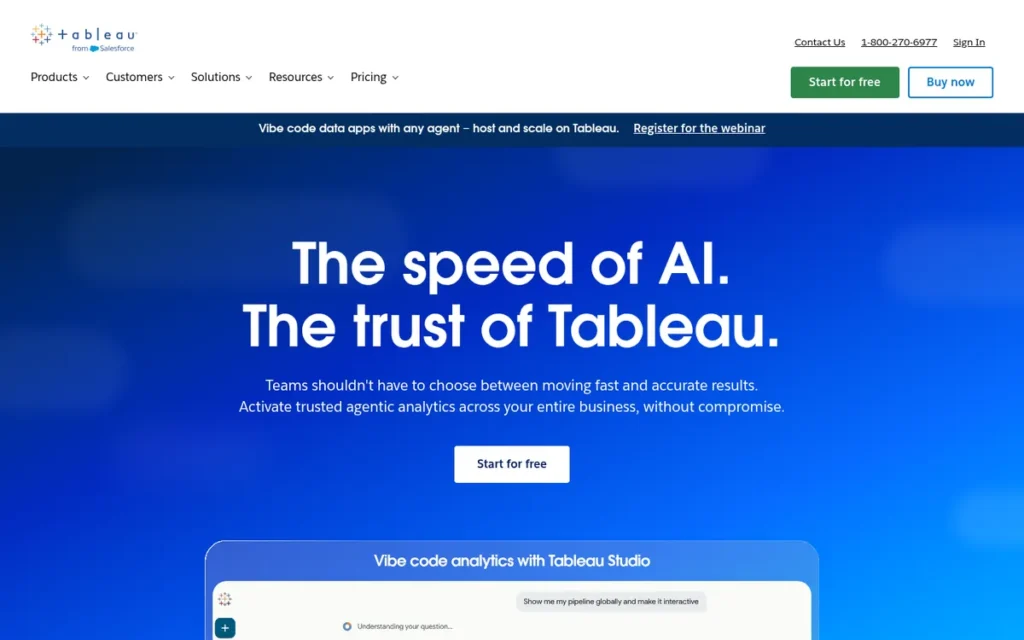
Category: Multi-Agent BI Platform, integrates three specialized AI agents (Data Pro, Concierge, Inspector) within a governed Tableau Semantics layer connected to Salesforce Agentforce and Flow automation, enabling autonomous data-to-CRM-action workflows.
At a Glance
- Category: Multi-Agent BI Platform
- Best For: Salesforce CRM-integrated enterprises and visualization-heavy data teams requiring proactive insight delivery with automated downstream business system actions
- Price Range: $15–$75/user/month (Viewer, Explorer, Creator tiers; annual billing required), published at tableau.com/pricing, verified May 2026
- Primary Strength: Tableau Next delivers the only complete agentic insight-to-CRM-action pipeline in this evaluation, combining three specialized AI agents, Tableau Pulse proactive delivery to Slack and Teams, and native Salesforce Flow automation that converts detected anomalies into CRM actions without human intervention
- Biggest Limitation: Tableau Next’s deepest agentic capabilities: Agentforce orchestration, Salesforce Flow automation, and zero-copy Data Cloud integration, require investment in Salesforce CRM, Service Cloud, or Data Cloud, making the full agentic stack inaccessible to organizations outside the Salesforce ecosystem
- One-Line Summary: Tableau Next is the only agentic analytics platform in 2026 with publicly published per-user pricing, a complete four-layer agentic workflow (data, semantic, visualization, action), and native Salesforce Flow automation, validated by 3,000+ G2 reviews at 4.4/5.0 and IBM’s confirmed adoption as a strategic Agentforce partner as of May 2026
- Last Verified: May 2026
Overview
Tableau Next is Salesforce’s AI-native agentic analytics platform, designed for enterprise data teams and business users at Salesforce-integrated organizations who need proactive, governed insights delivered automatically to Slack, Teams, or CRM systems, alongside full self-service visualization capabilities.
Tableau Next is built on Salesforce’s Agentforce infrastructure, featuring three specialized AI agents (Data Pro for ETL automation, Concierge for NLP Q&A with downstream action, and Inspector for proactive anomaly monitoring) operating on the Tableau Semantics governed layer.
Tableau Next holds the highest absolute review volume in this evaluation at 3,000+ G2 reviews and 2,200+ Capterra reviews, and remains the only platform among all seven to publish clean per-user pricing tiers, enabling procurement budget qualification without a sales cycle.
Key Features
- Data Pro Agent: Tableau Next’s Data Pro agent autonomously handles data preparation and ETL tasks (detecting schema changes, suggesting transformations, and resolving data quality issues without requiring analyst intervention) reducing engineering bottlenecks upstream of insight delivery.
- Concierge Agent: Tableau Next’s Concierge agent responds to natural language questions with actionable answers and triggers downstream Salesforce actions (such as creating a Service Cloud case, updating a CRM record, or scheduling a follow-up via Salesforce Flow) all from within the analytics interface.
- Inspector Agent and Tableau Pulse: Tableau Next’s Inspector agent continuously monitors connected data sources for anomalies and trend shifts, proactively delivering plain-language insight summaries via Tableau Pulse to business users in Slack, Salesforce, and Microsoft Teams without requiring a manual query.
- Tableau Semantics Governed Layer: Tableau Next’s Tableau Semantics layer provides a unified, AI-ready semantic model with verified business metric definitions, governance context, and AI readiness scoring, ensuring all three agents operate on consistently defined data and cannot generate misleading outputs from ambiguous or poorly governed metrics.
- Salesforce Data Cloud Zero-Copy Integration: Tableau Next’s integration with Salesforce Data Cloud unifies CRM, Service Cloud, and external cloud warehouse data without creating additional ETL pipelines or data duplication risk, providing a governed, deduplicated foundation for all agentic workflows.
Best For
Tableau Next is best for enterprise organizations already operating within the Salesforce ecosystem (particularly those with CRM, Service Cloud, or Salesforce Data Cloud deployments) where the native Agentforce integration enables the complete insight-to-CRM-action pipeline that no other evaluated platform delivers without custom integration work. Tableau Next is also the strongest choice for data teams requiring the deepest available visualization library and non-technical business users who need proactive, push-based insight delivery to communication channels they already use.
Pricing
Tableau publishes pricing publicly at tableau.com/pricing, the only platform in this evaluation to do so, verified May 2026. Creator licenses (full authoring, Analyst Studio, Pulse access) are approximately $75/user/month; Explorer licenses (limited authoring) are approximately $42/user/month; Viewer licenses (read-only with Pulse delivery) are approximately $15/user/month. Annual billing is required across all tiers.
Enterprise deployments typically involve negotiated discounts from published rates, but published rates remain the only publicly verifiable baseline in the category. Large Viewer cohort deployments warrant total-cost-of-ownership modeling before procurement commitment, as the per-user model scales linearly.
Strengths
- Tableau sustains a G2 rating of 4.4/5.0 across 3,000+ reviews and a Capterra rating of 4.5/5.0 across 2,200+ reviews as of May 2026, the highest absolute review volume in this evaluation, providing the most statistically reliable production quality signal of any platform assessed.
- IBM is confirmed as a strategic Salesforce Agentforce partner and Tableau Next adopter (Salesforce/Tableau documentation, 2025); Deloitte and Box are cited as additional early enterprise customers in third-party coverage (TheSalesforcefirst.com, 2025), these latter two attributions are sourced from a secondary blog and have not been independently confirmed by primary sources.
- Tableau’s published per-user pricing ($15–$75/user/month, verified May 2026 at tableau.com/pricing) gives Tableau Next the highest pricing transparency score in this evaluation, a structural trust advantage confirmed by practitioners who describe competing platforms’ opacity as “intentionally cryptic” in r/BusinessIntelligence community discussions.
- Tableau’s compliance posture: including a long-standing HIPAA BAA, has been specifically cited by healthcare practitioners as a reason Tableau remains the approved analytics tool in regulated environments where Microsoft Fabric Copilot evaluations have been paused due to AI-layer HIPAA uncertainty (r/analytics, November 2025).
Limitations
Tableau Next’s most consequential trade-off is architectural dependency on the Salesforce ecosystem. The platform’s defining agentic capabilities, Agentforce orchestration, Salesforce Flow automation triggered from detected anomalies, and zero-copy Data Cloud integration, are contingent on investment in Salesforce CRM, Service Cloud, or Data Cloud. Organizations without these deployments receive a well-governed, high-visualization BI platform with Pulse delivery and basic AI assistance, but not the complete agentic insight-to-action pipeline that justifies Tableau Next’s #1 ranking. Additionally, Tableau’s acquisition by Salesforce in 2019 for $15.7 billion has generated ongoing practitioner concern about product roadmap prioritization, long-time Tableau users have questioned whether Salesforce’s CRM integration agenda accelerates or slows development of standalone visualization capabilities. The per-user pricing model also scales linearly: organizations deploying Viewer licenses to thousands of non-technical users face significant aggregate cost that the published $15/user/month rate does not initially signal, and large Viewer deployments warrant explicit total-cost-of-ownership modeling before procurement commitment.
Verdict
Tableau Next ranks #1 among agentic analytics platforms in 2026 because it is the only platform in this evaluation that combines publicly published per-user pricing, 3,000+ verified G2 reviews at 4.4/5.0, a complete four-layer agentic workflow (data, semantic, visualization, action), and native Salesforce Flow automation that converts analytics anomalies into CRM actions without human intervention.
Tableau Next is most justified for Salesforce-integrated enterprises where the Agentforce pipeline delivers genuine closed-loop analytics-to-business-action capability, a differentiation no other evaluated platform closes without custom integration work. Published pricing at $15–$75/user/month (verified May 2026) provides procurement predictability that no competitor in this evaluation can match.
For organizations outside the Salesforce ecosystem, Tableau Next remains the market-leading visualization and governed BI platform, but its defining agentic capabilities are partially inaccessible. Buyers should model what percentage of the platform’s value they can realize without Salesforce CRM investment before committing at Creator license pricing.
2. Sigma Computing: Best for Snowflake and Databricks-First Data Teams
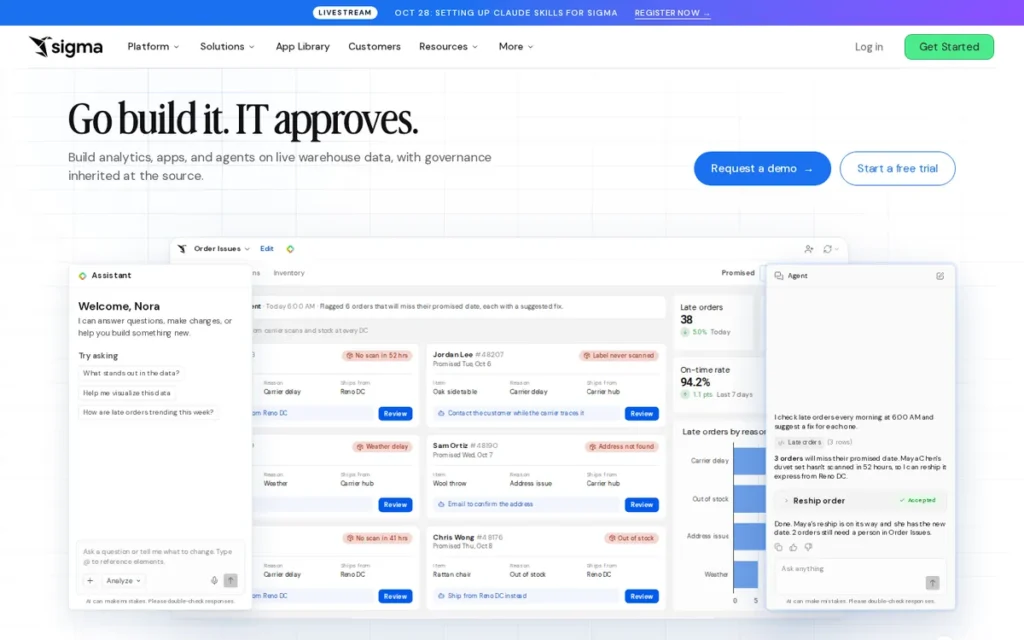
Category: Warehouse-Native Analyzer, executes all analytics queries in real-time directly against cloud data warehouses (Snowflake, Databricks, BigQuery, Redshift) with zero data extraction, enabling governed, live agentic analytics on enterprise-scale data.
At a Glance
- Category: Warehouse-Native Analyzer
- Best For: Snowflake- and Databricks-first data teams and analytics engineers needing governed, real-time agentic analytics with explainable AI-generated SQL and the highest verified user satisfaction in the category
- Price Range: Free tier available for exploration; enterprise pricing on request (not publicly listed); market intelligence suggests $36,000–$200,000+/year for enterprise contracts (unverified by Sigma). Compute costs borne by the underlying Snowflake/Databricks contract, not Sigma separately. Verified May 2026.
- Primary Strength: Sigma Computing delivers the highest independently verified user satisfaction scores in this evaluation (Capterra: 4.9/5.0; G2: 4.6/5.0 as of May 2026) and a warehouse-native architecture ensuring all Sigma Agent queries execute on live, governed, auditable data, with every AI-generated SQL query visible and reviewable by data teams
- Biggest Limitation: Sigma Computing requires an existing cloud data warehouse (Snowflake, Databricks, BigQuery, or Redshift) as its mandatory data layer, making it unsuitable as a standalone analytics platform for organizations without mature warehouse infrastructure and creating performance and cost dependency on underlying warehouse compute
- One-Line Summary: Sigma Computing is the highest-rated agentic analytics platform in this evaluation by verified user score (Capterra: 4.9/5.0; G2: 4.6/5.0 as of May 2026), combining warehouse-native real-time query execution, a three-stage Sigma Agents framework (Analyze, Automate, Act), and explainable AI-generated SQL transparency, with documented enterprise migration outcomes including consolidation of 150+ static reports into a single governed workbook for Saddle Creek Logistics on Databricks (Sigma Computing case study, 2024)
- Last Verified: May 2026
Overview
Sigma Computing is a warehouse-native agentic analytics platform designed for cloud-first data teams at mid-to-large enterprises, enabling business users to perform sophisticated live analyses directly against Snowflake, Databricks, BigQuery, or Redshift data without writing SQL or managing separate analytics data stores.
Sigma Computing’s spreadsheet-like grid interface compiles user operations (filters, pivots, window functions, joins) into optimized SQL executed directly in the warehouse, providing data governance at the warehouse layer while enabling non-technical self-service analytics.
Sigma Computing holds the highest user satisfaction scores of any platform in this evaluation, Capterra 4.9/5.0 and G2 4.6/5.0 as of May 2026, alongside a named enterprise migration case study: Saddle Creek Logistics Services, documented consolidating 150+ static reports into a single governed workbook with row-level security and write-back capabilities on Databricks (Sigma Computing case study, sigmacomputing.com, verified 2024).
Key Features
- Warehouse-Native Architecture: Sigma Computing executes every query: including those generated by Sigma Agents, directly against the connected cloud data warehouse (Snowflake, Databricks, BigQuery, or Redshift) in real-time, ensuring all agentic analytics operate on live, governed data rather than cached extracts that may be hours or days old.
- Ask Sigma AI with Explainable SQL: Sigma Computing’s Ask Sigma AI answers natural language questions by generating visible, auditable SQL that executes directly in the warehouse, users can inspect, edit, or override the AI-generated query before or after execution, providing the NL2SQL transparency that regulated industries require for AI-assisted analytics.
- Three-Stage Sigma Agents Framework: Sigma Computing’s Sigma Agents enables fully autonomous analytics workflows across three stages: Analyze (multi-dimensional NLP reasoning on live warehouse data), Automate (threshold monitoring and alert triggering), and Act (write-back to warehouse or external API calls to Salesforce and Slack).
- Spreadsheet Grid Interface: Sigma Computing’s grid UI compiles non-technical user operations (drag-and-drop filtering, pivot table creation, conditional logic) into optimized SQL at warehouse scale, enabling finance, operations, and sales users to perform sophisticated analyses previously requiring data engineering support.
- Write-Back Capability: Sigma Computing’s write-back capability pushes computed results, forecasts, or corrected data directly back to the connected cloud warehouse, enabling use cases like sales territory rebalancing, inventory adjustments, and budget variance approvals that require analytics outputs to become operational inputs.
Best For
Sigma Computing is best for data engineering and analytics teams at cloud-first organizations that have already committed to Snowflake or Databricks as their primary data platform and need to extend governed, real-time analytics access to non-technical business users without creating separate analytics data stores or burdening data engineers with ad-hoc reporting requests. Sigma Computing is particularly well-suited for organizations in regulated industries where explainable, auditable AI-generated SQL is a compliance requirement.
Pricing
Sigma Computing does not publish enterprise pricing publicly as of May 2026, the sigmacomputing.com/pricing page offers a free tier and directs enterprise inquiries to sales. Market intelligence suggests annual enterprise contracts start at approximately $36,000–$200,000+/year, but these figures are unverified by Sigma and should be treated as market estimates with explicit caveats.
A critical total-cost-of-ownership nuance: because Sigma runs all queries against the warehouse, compute costs are billed through the Snowflake or Databricks contract rather than Sigma’s license. Organizations should anticipate warehouse compute cost increases when Sigma enables broader business-user querying that was previously gated by analyst bottlenecks.
Strengths
- Sigma Computing holds the highest satisfaction scores of any platform in this evaluation: Capterra 4.9/5.0 (200+ reviews) and G2 4.6/5.0 (400+ reviews) as of May 2026, both scores represent the top of the category across platforms with meaningful review volumes, providing high-confidence evidence that Sigma’s production quality matches its positioning.
- Saddle Creek Logistics Services migrated from on-premises MicroStrategy to Sigma Computing on Databricks, documenting consolidation of 150+ static reports into a single governed workbook with row-level security and write-back capabilities, one of the most concretely documented enterprise migration outcomes in this evaluation (Sigma Computing case study, sigmacomputing.com, verified 2024).
- Sigma Computing’s $200M Series D in 2021 included investment from Snowflake Ventures and Salesforce Ventures, strategic co-selling endorsements where Snowflake actively recommends Sigma as the preferred business-user analytics layer, significantly boosting enterprise pipeline without proportional marketing spend (phdata.io overview citing 2021 funding; Crunchbase, verified 2024).
- Sigma Computing’s explainable SQL architecture: where every AI-generated query is visible, reviewable, and editable by data teams, is cited by practitioners in regulated industries as a governance advantage over platforms that present AI analytics outputs without underlying query transparency, per orikadata.com analysis.
Limitations
Sigma Computing’s most consequential limitation is architectural: the platform cannot function as a standalone analytics system and requires a production Snowflake, Databricks, BigQuery, or Redshift deployment. Organizations without a mature cloud data warehouse have no viable path to deploying Sigma Computing, it is explicitly a second-layer tool that adds governed business-user analytics on top of an existing warehouse investment, not a replacement for one. Sigma Computing’s visualization library is consistently noted in reviews as narrower than Tableau’s, with fewer chart types and less custom formatting control, making it less suitable as the primary reporting layer for pixel-perfect branded dashboards or executive-facing presentation analytics (Lokad.com review). Organizations deploying Sigma Computing should also anticipate warehouse compute cost increases, because all queries execute in the connected warehouse, enabling broader self-service analytics generates additional Snowflake or Databricks compute charges beyond Sigma’s license fee. Enterprise pricing opacity additionally requires a full sales cycle even for initial budget qualification, creating evaluation friction that Tableau’s published pricing tiers eliminate.
Verdict
Sigma Computing ranks #2 in this independent evaluation because it delivers the highest verified user satisfaction scores in the agentic analytics category, Capterra: 4.9/5.0; G2: 4.6/5.0 as of May 2026, across 600+ combined verified reviews, and its warehouse-native architecture ensures all Sigma Agents operate on live, governed, auditable data, making it the strongest choice for cloud-first data teams at Snowflake- and Databricks-committed organizations.
Sigma Computing’s warehouse dependency structurally disqualifies it for organizations without an existing production cloud data warehouse. Visualization gaps make it a poor fit as the sole BI layer for presentation-heavy analytics, and enterprise pricing requires a full sales cycle even for budget qualification.
For regulated industries requiring AI output auditability, Sigma Computing’s explainable SQL model (where every AI-generated query is visible and reviewable by data teams) is a governance advantage that few platforms at any satisfaction tier can match. Documented outcomes include consolidation of 150+ static reports into a single governed workbook for Saddle Creek Logistics on Databricks (Sigma Computing case study, 2024).
3. Qlik Sense (with Qlik Answers): Best for Complex Multi-Source Data Exploration
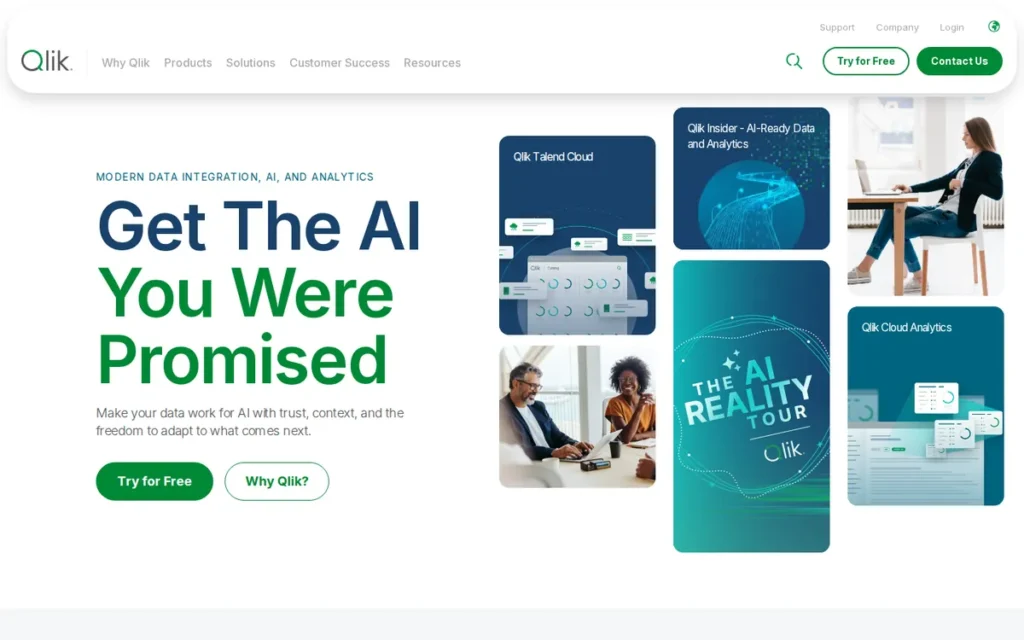
Category: Associative Analytics Explorer, uses a patented Associative Engine to simultaneously surface selected, related, and excluded data across all dimensions, augmented by a four-stage agentic loop (Detect, Investigate, Predict, Act) for autonomous enterprise analytics workflows.
At a Glance
- Category: Associative Analytics Explorer
- Best For: Enterprise data teams and analysts at organizations requiring multi-directional, multi-source data exploration where standard SQL queries obscure relationship patterns, particularly financial services, healthcare, manufacturing, and supply chain
- Price Range: Qlik Sense Business: ~$30/user/month (published, up to 20 users); Qlik Cloud Enterprise: custom-quoted, typically $50,000–$500,000+/year. Verified May 2026 at qlik.com/us/pricing.
- Primary Strength: Qlik Sense is the only platform in this evaluation with a patented Associative Engine that simultaneously shows selected, associated, and excluded data (enabling root-cause analyses impossible with SQL-based tools) now extended by the industry’s most systematically structured four-stage agentic loop: Detect, Investigate, Predict, and Act
- Biggest Limitation: Qlik Sense’s scripting language and associative data model impose a learning curve materially steeper than SQL-based BI tools; Thoma Bravo private equity ownership since 2016 has generated documented concerns about aggressive enterprise renewal pricing and potential R&D investment sustainability
- One-Line Summary: Qlik Sense with Qlik Answers delivers the most systematically structured agentic loop in this evaluation, a distinct Detect, Investigate, Predict, and Act architecture powered by its patented Associative Engine and documented enterprise-scale AutoML deployments including Appalachian Regional Healthcare’s patient no-show reduction, making it the strongest choice for complex multi-source data exploration at enterprise scale as of May 2026
- Last Verified: May 2026
Overview
Qlik Sense with Qlik Answers is an enterprise analytics and agentic AI platform designed for data analysts and data architects at complex organizations, uniquely combining a patented Associative Engine for multi-directional data exploration with a four-stage agentic loop (Detect, Investigate, Predict, Act) launched in February 2026.
Qlik Sense’s Associative Engine simultaneously holds all data in memory and presents it across three states (selected (green), associated (white), and excluded (gray)) enabling analyses of absence-based patterns, such as customers who purchased product A but did not purchase product B, that standard SQL WHERE clause queries cannot surface without complex workarounds.
Qlik Sense’s MCP Server launched alongside the full agentic experience in February 2026, enabling external AI agents (Claude, ChatGPT, Gemini) to query Qlik Cloud Analytics data through Qlik’s governed semantic layer, with documented enterprise-scale AutoML deployments including Appalachian Regional Healthcare’s patient no-show reduction.
Key Features
- Patented Associative Engine: Qlik Sense’s Associative Engine simultaneously processes all data in memory and presents it in three states (selected (green), associated (white), and excluded (gray)) enabling analysts to explore what data is NOT selected as easily as what is, surfacing exclusion-based insights that standard SQL WHERE clause filter logic is not designed to surface without complex workarounds such as NOT IN subqueries or EXCEPT operators.
- Qlik Answers NLP Investigation: Qlik Sense’s Qlik Answers serves as the Investigate stage of the agentic loop, processing natural language questions against both structured warehouse data and unstructured enterprise content and escalating complex analytical tasks to the associative engine for multi-dimensional exploration.
- AutoML Predict Agent: Qlik Sense’s Predict Agent enables data teams to build and deploy machine learning forecasting models without data science expertise, with documented enterprise-scale deployments including Appalachian Regional Healthcare’s (ARH) reduction in patient no-shows and cancellations by 5–10% across network clinics using no-code machine learning to identify at-risk patients for targeted outreach (Qlik resource library, qlik.com healthcare solutions, 2024).
- Automate Agent: Qlik Sense’s Automate Agent serves as the Act stage of its agentic loop, triggering downstream workflow execution (sending alerts, updating external business systems, and orchestrating multi-step processes) based on thresholds, anomalies, or predictions identified by the Detect, Investigate, and Predict agents earlier in the cycle.
- MCP Server: Qlik Sense’s MCP Server: launched February 2026, enables external AI agents (Claude, ChatGPT, Gemini Enterprise) to query Qlik Cloud Analytics data through Qlik’s governed semantic layer, allowing organizations with existing LLM investments to leverage Qlik’s associative data governance without replacing the Qlik analytics engine.
Best For
Qlik Sense is best for enterprise analytics teams in industries with complex, multi-source data environments (financial services, healthcare, manufacturing, supply chain) where understanding data relationships and exclusions (not just individual metrics) is the core analytical challenge, and where standard SQL filter-based tools fail to surface the absence-based patterns that drive root-cause analysis. Qlik Sense is also the strongest choice for organizations building predictive ML capabilities into analytics workflows, given the AutoML Predict Agent’s documented ARH healthcare case study and the platform’s integration of model building, deployment, and analytics presentation in a single governed environment.
Pricing
Qlik Sense Business is published at approximately $30/user/month, verified at qlik.com/us/pricing as of May 2026, for teams up to 20 users. Qlik Cloud Enterprise is custom-quoted, with enterprise contracts typically ranging from $50,000–$500,000+/year. Procurement teams should factor in Qlik’s Thoma Bravo private equity ownership context: multiple practitioner sources report aggressive enterprise renewal pricing and contract complexity. The Business tier’s $30/user/month is competitive for mid-market, but enterprise SaaS economics escalate significantly beyond 20 users and require explicit multi-year pricing protections in contracts.
Strengths
- Qlik Sense launched its full four-stage agentic experience: with distinct specialized agents for Detect, Investigate, Predict, and Act, in February 2026, as documented in the Qlik press release “Qlik Extends Analytics from Answers to Agentic Action” (February 2026), demonstrating active R&D investment in agentic capabilities under private equity ownership.
- Qlik Predict has documented enterprise-scale deployments including Appalachian Regional Healthcare’s (ARH) patient no-show and cancellation reduction of 5–10% across network clinics, using no-code machine learning to identify at-risk patients for targeted outreach, the most specific AutoML production case study available in this evaluation (Qlik resource library, qlik.com, 2024).
- Qlik Sense’s patented Associative Engine: documented in independent technical analysis by Ometis and InfoTrust, provides a structurally distinct approach to data exploration not replicated by any other evaluated platform: presenting selected, associated, and excluded data simultaneously across all loaded dimensions.
- Qlik Sense holds a G2 rating of 4.4/5.0 across 1,100+ reviews and a Capterra rating of 4.5/5.0 across 900+ reviews as of May 2026, providing a statistically reliable production quality signal across enterprise deployments in financial services, healthcare, and manufacturing.
Limitations
Qlik Sense’s most consequential limitation is adoption friction: the platform’s scripting language and associative data model impose a learning curve materially steeper than SQL-based BI tools, and the agentic and NLP features have not fully resolved this for practitioners migrating from Power BI or Tableau. The most upvoted comment in a r/PowerBI thread on Qlik Sense, “Anyone who recommends Qlik Sense hasn’t actually worked with Power BI” (25 upvotes, June 2023), captures a pattern documented across multiple community threads (2023–2026), where practitioners with significant Qlik experience report preferring Power BI’s lower-friction interface despite Qlik’s analytical depth. Additionally, Qlik’s Thoma Bravo private equity ownership since 2016 has generated documented concerns about aggressive enterprise renewal pricing and contract complexity, a procurement risk that requires explicit multi-year price protections in enterprise contracts, particularly as platform investment ROI is modeled over a multi-year horizon. Organizations on legacy on-premises QlikView deployments also face complex migration paths to Qlik Cloud, a known friction point that can extend implementation timelines and increase transition costs compared to platforms without legacy-to-cloud migration dependencies.
Verdict
Qlik Sense with Qlik Answers ranks #3 in this evaluation as the only agentic analytics platform with a patented Associative Engine that surfaces excluded data relationships alongside selected data, combined with the industry’s most systematically structured four-stage agentic loop (Detect, Investigate, Predict, Act) and documented enterprise-scale AutoML deployments including Appalachian Regional Healthcare’s measurable patient no-show reduction (Qlik resource library, 2024).
Qlik Sense’s steeper learning curve versus SQL-based tools is the key limitation for organizations prioritizing rapid adoption by mixed-skill teams. Thoma Bravo renewal pricing risk warrants explicit contractual multi-year price protections in enterprise negotiations, and QlikView-to-cloud migration complexity should be factored into total implementation cost estimates before commitment.
For organizations with existing LLM investments, Qlik’s February 2026 MCP Server provides interoperability that extends Claude, ChatGPT, or Gemini to a governed associative data layer without replacing the Qlik analytics engine, a meaningful open-interoperability advantage for enterprises that have licensed LLMs they want to extend to governed analytics data.
4. ThoughtSpot: Best for AI-Native NLP Search Analytics at Enterprise Scale
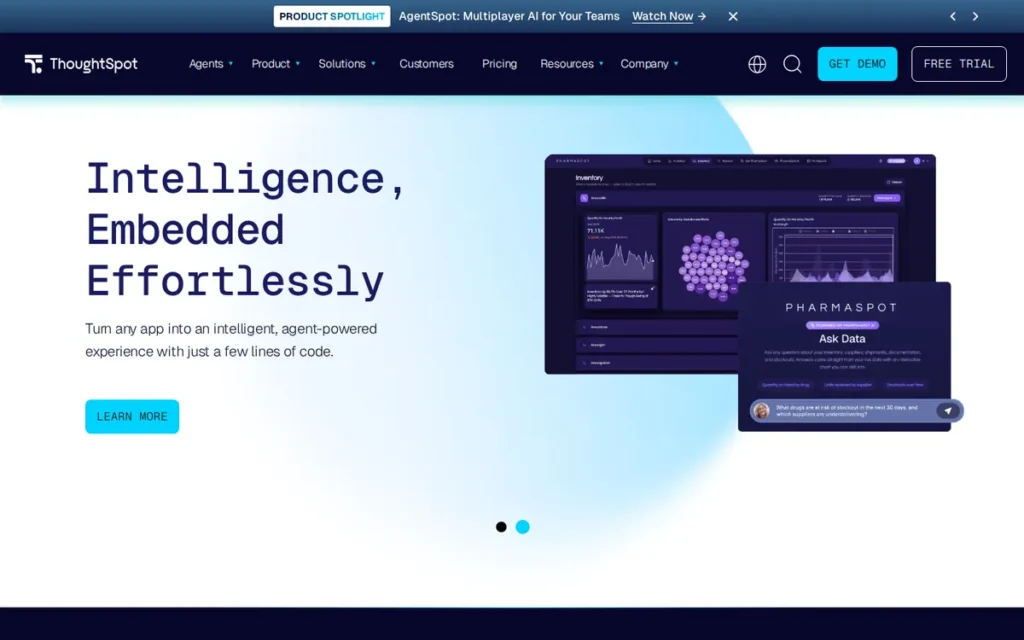
Category: AI-Native Search Analyst, processes natural language queries against live cloud warehouse data via an autonomous Spotter AI agent that proactively identifies trends, executes multi-step reasoning chains, and triggers workflow actions in business systems.
At a Glance
- Category: AI-Native Search Analyst
- Best For: Enterprise organizations requiring autonomous analyst-bandwidth reduction on Snowflake, Databricks, or BigQuery data, with proactive insight delivery to business users via Slack, Salesforce, and Teams, prioritizing NLP search depth over visualization customization
- Price Range: Pricing on request only (no public pricing); enterprise contracts estimated at $150,000–$500,000+/year based on market intelligence, unverified by ThoughtSpot; verify with ThoughtSpot sales. Verified May 2026.
- Primary Strength: ThoughtSpot is the only Gartner Magic Quadrant Leader (2024) purpose-built for AI-native NLP search analytics, with Spotter 3.0 proactively identifying trends, executing multi-step autonomous reasoning, and triggering workflow actions across Slack, Salesforce, Teams, and ServiceNow without requiring a human-initiated query
- Biggest Limitation: ThoughtSpot’s search-first architecture structurally limits chart customization (the most upvoted criticism on both G2 and Reddit) with practitioners describing limited control over chart types, axis labels, colors, and formatting compared to Tableau, making ThoughtSpot unsuitable as the primary reporting layer for organizations requiring pixel-perfect branded dashboards
- One-Line Summary: ThoughtSpot is the Gartner Magic Quadrant Leader (2024) for AI-native analytics, combining Spotter 3.0 autonomous agent with a 14-year NLP search architecture and co-selling partnerships with Snowflake and Databricks, most appropriate for enterprises prioritizing autonomous insight discovery over visualization customization and able to justify contracts estimated at $150,000–$500,000+/year as of May 2026
- Last Verified: May 2026
Overview
ThoughtSpot is an AI-native agentic analytics platform designed for enterprise data analysts and business users at large organizations, enabling natural language queries against live Snowflake, Databricks, and BigQuery data via its Spotter 3.0 autonomous agent, which proactively identifies trends and triggers actions in Salesforce, Teams, and ServiceNow without requiring human-initiated queries.
ThoughtSpot was named a Leader in the 2024 Gartner Magic Quadrant for Analytics and Business Intelligence Platforms (June 24, 2024), competing alongside Microsoft, Salesforce, and Qlik, the strongest independent analyst validation in this evaluation.
ThoughtSpot’s AI-native founding architecture since 2012 gives its NLP search engine structural depth that platforms which layered natural language capabilities over pre-existing SQL-based BI architectures cannot match at equivalent stages of product development, while its structural limitation in visualization customization remains the most consistently cited practitioner complaint across both G2 and community forums.
Key Features
- Spotter 3.0 Autonomous Agent: ThoughtSpot’s Spotter 3.0 agent autonomously detects anomalies, identifies trends across connected data silos, performs multi-step root-cause reasoning, and proactively delivers intelligence summaries to business users in Slack, Salesforce, Teams, and ServiceNow, operating without human-initiated queries on a continuous monitoring model.
- NLP Search Engine on Live Warehouse Data: ThoughtSpot’s relational search engine processes natural language queries at the front end and executes them against live Snowflake, Databricks, and BigQuery data without data duplication or ETL preprocessing, enabling Liveboard results on billions of rows in seconds by pushing computation to the cloud warehouse layer.
- Analyst Studio Cross-Source Mashup: ThoughtSpot’s Analyst Studio enables data teams to perform mashups across Google Sheets, Jira, Salesforce objects, and cloud warehouse tables with Python notebooks and ad-hoc SQL, providing data fabric capability for complex cross-source analyses without a separate analytics engineering pipeline.
- Visual Embed SDK: ThoughtSpot’s Visual Embed SDK enables organizations to embed Liveboards, NLP search, and Spotter capabilities into Snowflake Streamlit applications, Salesforce, ServiceNow, and custom third-party applications, delivering governed, AI-powered analytics inside operational tools where business users already work.
- SpotterViz and SpotterCode: ThoughtSpot’s SpotterViz generates AI-powered dashboard layouts from natural language descriptions, and SpotterCode provides AI-assisted SQL and Python code generation, extending the Spotter agent architecture into technical workflows beyond business user Q&A.
Best For
ThoughtSpot is best for enterprise organizations where the primary analytics bottleneck is analyst availability, where data teams are overwhelmed by ad-hoc query requests from business users, and where deploying Spotter 3.0’s autonomous agent to handle routine insight discovery, anomaly alerts, and NLP Q&A would materially reduce analyst workload. ThoughtSpot is least appropriate for organizations that:
- Prioritize pixel-perfect visualization quality or executive-facing branded dashboard presentation
- Require advanced chart type and color customization comparable to Tableau’s visual library
- Have not yet committed to Snowflake or Databricks as their primary data platform
Pricing
ThoughtSpot does not publish pricing publicly, thoughtspot.com/pricing routes to “Contact Sales.” Based on market intelligence verified as of May 2026, enterprise annual contracts typically range from $150,000–$500,000+/year, driven by user count, data volume, and embedded SDK requirements, but these figures are unverified by ThoughtSpot.
ThoughtSpot is the only Gartner MQ Leader in this evaluation without any published pricing guidance, creating procurement friction that competitors with published pricing (Tableau) or published entry tiers (Qlik Business at ~$30/user/month) do not impose. Organizations should budget for a full sales cycle before obtaining any order-of-magnitude cost estimate.
Strengths
- ThoughtSpot was named a Leader in the 2024 Gartner Magic Quadrant for Analytics and Business Intelligence Platforms (June 24, 2024) (the strongest independent analyst validation in this evaluation) confirming both completeness of vision and ability to execute at enterprise scale alongside Microsoft, Salesforce, and Qlik.
- ThoughtSpot has raised approximately $674 million in venture funding from investors including March Capital, Lightspeed Ventures, Sapphire Ventures, Snowflake Ventures, and General Catalyst, among others, reaching a $4.2 billion valuation in 2021 (ThoughtSpot Series F press release, November 2021), market confidence that funds Spotter 3.0’s multi-step autonomous reasoning and active co-selling partnerships with Snowflake and Databricks.
- ThoughtSpot’s Spotter 3.0 agent represents 14 years of iterative NLP search engineering from its 2012 AI-native founding (CRN News, 2025), giving its natural language query processing contextual depth that platforms which layered NLP over SQL-based BI architectures cannot match at equivalent stages of development, though direct performance benchmarking across platforms was not conducted in this evaluation.
- ThoughtSpot’s co-selling agreements with Snowflake and Databricks (not just technical integrations) create active distribution where cloud warehouse vendors recommend ThoughtSpot to enterprise customers as the analytics overlay, providing market validation from the infrastructure layer enterprise data teams trust most.
Limitations
ThoughtSpot’s most consequential limitation is its search-first architecture, which creates a structural ceiling on visualization customization that Spotter 3.0 and SpotterViz do not resolve. The most upvoted comment in a 2023 r/analytics thread directly about ThoughtSpot, “Its shitty. The visual options are a joke”, reflects a systemic practitioner complaint confirmed across G2 reviews: users cannot customize axis labels, color palettes, or chart types to the degree that Tableau or even Domo enables. This is architectural, not a roadmap gap, organizations delivering executive-facing dashboards with specific visual standards will find ThoughtSpot’s visualization ceiling binding regardless of Spotter’s autonomous intelligence. ThoughtSpot’s pricing opacity ($150,000–$500,000+/year estimated, unverified by ThoughtSpot) creates the highest procurement friction in the top four platforms, requiring a full sales cycle before any order-of-magnitude budget estimate is accessible, a disadvantage vs. Tableau’s published tiers and Qlik’s published Business entry price. A third limitation: ThoughtSpot’s semantic model configuration requires significant initial setup investment before agentic features deliver on their autonomous-intelligence promise, per G2 reviewer accounts (May 2026), meaning the platform’s advertised autonomous capabilities are not immediately accessible after deployment.
Verdict
ThoughtSpot ranks #4 in this independent evaluation as the only Gartner Magic Quadrant Leader (2024) purpose-built for AI-native NLP search analytics, with Spotter 3.0’s autonomous multi-step reasoning validated by approximately $674 million in enterprise-grade funding and co-selling partnerships with Snowflake and Databricks, making it the strongest choice for enterprises where analyst-bandwidth reduction through autonomous AI query handling is the primary business case.
ThoughtSpot’s structural visualization limitation is the disqualifying criterion for organizations with presentation-layer analytics requirements, this limitation is architectural, not a roadmap gap. Organizations requiring Tableau-level visual polish should not evaluate ThoughtSpot as a viable alternative, regardless of Spotter’s autonomous intelligence capabilities.
For the ideal ThoughtSpot buyer (Snowflake or Databricks ecosystem, analyst bottleneck as primary pain, NLP query depth prioritized over visualization) ThoughtSpot’s 14-year NLP search engineering foundation provides contextual depth that platforms which layered natural language over SQL-based architectures cannot match at equivalent development stages, despite pricing opacity that makes budget qualification more friction-intensive than warranted at the $150K–$500K+/year investment tier.
5. Microsoft Fabric Copilot: Best for Microsoft 365-Centric Enterprises
Category: Unified Agentic Data Platform, integrates data engineering, data science, real-time analytics, and BI under a single OneLake tenant with Copilot and Data Agent agentic AI capabilities, designed for Microsoft 365 and Azure-native enterprise environments.
At a Glance
- Category: Unified Agentic Data Platform
- Best For: Microsoft 365-centric enterprises with existing Azure and Power BI investments seeking to consolidate data engineering, semantic modeling, and agentic analytics under a single governed platform, particularly where Microsoft EA subsidization makes Fabric capacity cost-effective relative to standalone alternatives
- Price Range: Capacity-based pricing: F2 ~$263/month to F64 ~$8,400/month at US East reserved rates; organizations with Azure Enterprise Agreements may receive significant effective discounts through commitment credits. Published at microsoft.com/en-us/microsoft-fabric/pricing. Verified May 2026.
- Primary Strength: Microsoft Fabric Copilot is the only platform in this evaluation with production-grade multi-agent orchestration spanning the full Microsoft 365 enterprise suite, Fabric Data Agents delegate tasks to M365 Copilot in Word and Outlook, Azure AI agents, and Copilot Studio custom agents via OneLake MCP (broadly available November 2025)
- Biggest Limitation: Microsoft Fabric’s agentic AI features: particularly Copilot in Fabric notebooks and Power BI Copilot’s semantic model comprehension, showed documented high error rates in April 2026 community testing solicited by Microsoft’s own Fabric Copilot team, with practitioners systematically replacing Fabric Copilot with Claude and GitHub Copilot for actual analytics work
- One-Line Summary: Microsoft Fabric Copilot delivers the deepest Microsoft 365 multi-agent ecosystem integration and the only broadly available OneLake MCP implementation in this evaluation, but its agentic AI quality in Fabric notebooks and Power BI semantic modeling showed documented production limitations in April 2026 practitioner feedback that enterprise buyers should independently evaluate before committing
- Last Verified: May 2026
Overview
Microsoft Fabric Copilot is a unified agentic data platform designed for Microsoft 365-centric enterprises, consolidating data engineering, data science, real-time analytics, and Power BI business intelligence under a single OneLake data lake with Fabric Data Agents and Copilot AI providing natural language analytics and multi-agent Microsoft 365 orchestration.
Microsoft Fabric reached General Availability in November 2023, with OneLake MCP reaching broader availability in November 2025, enabling any external AI agent to securely query governed OneLake data without bulk exfiltration. Selected Real-Time Intelligence MCP features remained in preview as of this evaluation (May 2026).
Microsoft Fabric Copilot holds a G2 rating of 4.6/5.0 across 2,500+ reviews reflecting the legacy Power BI user base, but April 2026 practitioner feedback solicited by Microsoft’s own Fabric Copilot team surfaced documented production quality gaps in the agentic AI layer that buyers should independently evaluate on their own production semantic models before committing.
Key Features
- OneLake MCP (Broadly Available November 2025): Microsoft Fabric’s OneLake MCP (reaching broader availability in November 2025 (selected Real-Time Intelligence features remain in preview as of May 2026)) enables external AI agents (Claude, ChatGPT, Gemini Enterprise) to securely inspect data schemas and query governed OneLake data without bulk exfiltration, as documented in the Microsoft Fabric Blog.
- Fabric Data Agents: Microsoft Fabric’s Data Agents enable natural language conversations with enterprise data stored in OneLake (understanding schemas, enforcing existing governance policies, and generating contextually accurate insights) then delivering those insights into Microsoft 365 applications via Copilot Studio integration.
- M365 Multi-Agent Orchestration: Microsoft Fabric’s multi-agent architecture enables Fabric Data Agents to delegate tasks to Microsoft 365 Copilot (Word reports, Outlook scheduling), Azure AI agents (complex ML inference), and Copilot Studio custom agents (domain-specific workflows), all sharing governed OneLake data via MCP, creating analytics-to-action loops within the Microsoft enterprise ecosystem.
- Unified Data Lifecycle Platform: Microsoft Fabric integrates Azure Data Factory (ingestion), Synapse Analytics (transformation), Power BI (semantic modeling and visualization), and Azure ML (data science) under a single SaaS experience with OneLake as the shared Delta/Parquet open-format foundation, eliminating the multi-vendor integration overhead of managing these capabilities as separate products.
- Capacity-Based Pricing Model: Microsoft Fabric’s capacity pricing (F2 through F2048 SKUs) enables unlimited user consumption on a purchased capacity tier, a structure where adding business users does not incrementally increase licensing cost, potentially advantageous for large user bases compared to per-seat pricing models.
Best For
Microsoft Fabric Copilot is best for organizations already deeply invested in Microsoft 365 and Azure (where OneLake MCP’s integration with Teams, Word, Outlook, and Azure AI creates a closed-loop enterprise analytics ecosystem difficult to replicate with non-Microsoft tools) and where an existing Enterprise Agreement provides capacity subsidization making Fabric’s effective cost lower than standalone competitor pricing suggests.
Microsoft Fabric Copilot is least appropriate for:
- Healthcare organizations with unresolved HIPAA questions about AI-generated output governance
- Data teams requiring high-confidence, low-error-rate agentic AI performance in production notebooks
- Organizations prioritizing best-of-breed agentic analytics depth over platform consolidation benefits
Pricing
Microsoft Fabric’s capacity pricing is published at microsoft.com/en-us/microsoft-fabric/pricing as of May 2026. Capacity Units scale from F2 (approximately $263/month, reserved pricing, US East) to F64 (approximately $8,400/month), with SKUs extending to F2048 for the largest deployments.
Organizations with existing Azure consumption commitments may receive significant effective discounts through EA credits, making published rates an overstatement of real cost for Microsoft-heavy organizations. Counter-note: the capacity model creates potential for cost overruns during high-concurrency agentic workload spikes, and right-sizing CU allocation is a documented operational challenge requiring careful capacity planning.
Strengths
- Microsoft Fabric’s OneLake MCP reached broader availability in November 2025: among the first enterprise-grade MCP implementations in this evaluation to reach this milestone, enabling any external AI agent to securely query governed OneLake data without bulk exfiltration, as documented in the Microsoft Fabric Blog (2025). Note: selected RTI features remain in preview as of May 2026.
- ANZ Bank (Australia) was cited among early enterprise Microsoft Fabric production deployments, with consulting firms reporting “a Fabric implementation is literally every other project” for Microsoft-heavy organizations as of 2024–2025 (r/analytics, September 2024), reflecting accelerating enterprise adoption driven by Microsoft’s unmatched EA distribution network.
- Microsoft Fabric’s unified platform architecture eliminates the multi-vendor integration overhead required when managing Azure Data Factory, Synapse, Power BI, and Azure ML as separate products, a consolidation benefit documented in the Microsoft Fabric Blog’s multi-agent orchestration coverage with clear appeal for Microsoft-centric organizations.
- Microsoft’s investment scale in Azure OpenAI infrastructure (which powers Microsoft Fabric Copilot’s AI capabilities) represents a resource commitment no other analytics vendor in this evaluation can independently match, providing a long-term R&D trajectory for Copilot quality improvement visible in the continuous release cadence documented in the Fabric What’s New changelog (Microsoft Learn, verified May 2026).
Limitations
Microsoft Fabric Copilot’s most consequential limitation is its documented production AI quality gap. In April 2026, when Microsoft’s own Fabric Copilot team initiated a community feedback thread on r/MicrosoftFabric, the top-voted responses described Copilot in notebooks as “the worst cloud-based AI tool I’ve ever used”, with practitioners reporting error rates above 50% on complex prompts and a consistent pattern of abandoning Fabric Copilot in favor of Claude, GitHub Copilot, or external LLMs for actual analytics work. A separate r/PowerBI thread from December 2025 documented Power BI Copilot as “wrong or incomplete 95% of the time” for complex semantic model comprehension involving measures, calculated columns, and Power Query transformations, confirming the quality gap extends to the BI layer, not just data engineering notebooks. These are practitioner accounts, not controlled benchmarks; buyers should independently test on their own production semantic models before committing. Healthcare organizations have specifically paused Microsoft Fabric evaluations due to unresolved HIPAA questions about AI-generated output governance, confirmed by practitioner community accounts, creating a procurement risk that Tableau’s established HIPAA BAA does not impose.
Verdict
Microsoft Fabric Copilot ranks #5 in this independent evaluation because it delivers the deepest Microsoft 365 multi-agent ecosystem integration and the only broadly available OneLake MCP implementation in this category, but its agentic AI quality in Fabric notebooks and Power BI semantic modeling showed documented production limitations in April 2026 practitioner feedback solicited by Microsoft’s own team, preventing a higher ranking despite unmatched enterprise distribution and Azure ecosystem depth.
Microsoft Fabric Copilot is most appropriate for Microsoft 365-centric organizations prioritizing platform consolidation and EA-subsidized cost efficiency over agentic AI quality depth, with the expectation that Copilot feature quality will improve materially given Microsoft’s documented investment trajectory and continuous release cadence documented in the Fabric What’s New changelog.
Enterprise buyers should conduct an independent proof-of-concept on their own production semantic models and data engineering workflows before committing. Treat the April 2026 community feedback as a baseline quality signal rather than a permanent ceiling, and track Microsoft’s Fabric What’s New changelog monthly as the leading indicator of when production deployment risk normalizes.
6. Sisense: Best for ISVs Building Embedded AI Analytics into Customer-Facing Products
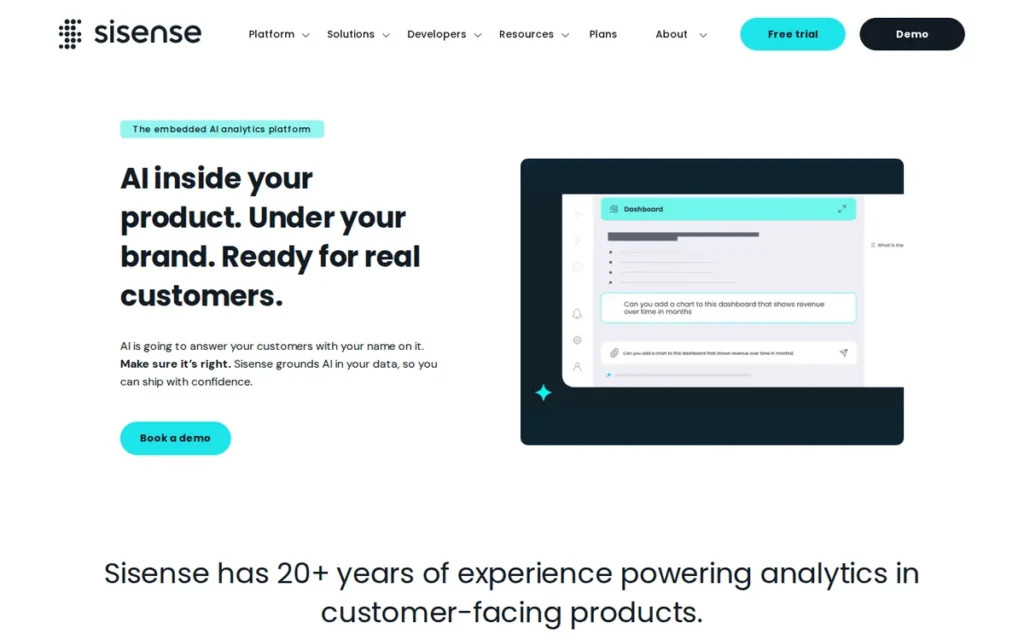
Category: Embedded Agentic Analytics (AnPaaS), enables software companies, ISVs, and SaaS product teams to build fully customized, multi-tenant AI analytics experiences into customer-facing applications via a developer-first Compose SDK and modular Sisense Intelligence agentic AI suite.
At a Glance
- Category: Embedded Agentic Analytics (AnPaaS)
- Best For: ISVs, SaaS product companies, and enterprise software engineering teams embedding fully white-labeled, multi-tenant AI analytics into customer-facing applications, particularly those serving regulated industries where ISO 27701, ISO 27001, and ISO/IEC 42001:2023 flow-down compliance requirements are vendor qualification criteria
- Price Range: Fully custom (not publicly listed); enterprise production deployments typically $50,000–$100,000+/year starting point; OEM licensing structured as platform fees plus per-customer charges. Verified May 2026.
- Primary Strength: Sisense holds 24 patents in embedded analytics technology and carries ISO 27701, ISO 27001, and ISO/IEC 42001:2023 (AI Management Systems) certifications (the most comprehensive certification stack in this evaluation) backed by a developer-first Compose SDK (React, Angular, Vue.js) and a modular Sisense Intelligence agentic suite making it the most mature Analytics Provider as a Service (AnPaaS) for ISVs
- Biggest Limitation: Sisense’s ElastiCube in-memory engine requires dedicated infrastructure management and significant JavaScript proficiency for advanced Compose SDK customizations, making it unsuitable for business-led analytics teams without dedicated engineering resources, with higher total implementation cost than licensing fees alone suggest
- One-Line Summary: Sisense is the most mature Analytics Provider as a Service (AnPaaS) platform in this evaluation, holding 24 embedded analytics patents and ISO 27701/ISO 27001/ISO/IEC 42001:2023 certifications, offering a modular Sisense Intelligence agentic AI suite and developer-first Compose SDK, making it the strongest choice for software companies embedding fully white-labeled, multi-tenant AI analytics into customer-facing products as of May 2026
- Last Verified: May 2026
Overview
Sisense is an embedded agentic analytics platform (AnPaaS (Analytics Provider as a Service)) designed for software companies, ISVs, and SaaS product teams that need to build fully customized, white-labeled AI analytics experiences into their own customer-facing applications, not for enterprise-internal analytics teams evaluating standalone BI tools.
Sisense’s Fusion architecture is built on an API-first ElastiCube engine with In-Chip technology for in-memory processing, supported by the Compose SDK for developer-built white-label analytics in React, Angular, and Vue.js frameworks.
Sisense holds 24 patents in analytics and embedded BI technology, carries ISO 27701, ISO 27001, and ISO/IEC 42001:2023 (AI Management Systems) certifications (the most comprehensive certification stack in this evaluation) and had its AnPaaS model validated by S&P Global as forward-aligned with enterprise software market trends. Sisense’s 2023 organizational restructuring is a vendor stability factor that enterprise buyers should include in procurement due diligence.
Key Features
- Compose SDK: Sisense’s Compose SDK: supporting React, Angular, and Vue.js with AI-generated component code, enables software engineering teams to build fully white-labeled, pixel-perfect analytics experiences with complete visual and behavioral customization, embedding Sisense’s analytics engine within the host product’s own design system without exposing any Sisense branding or interface patterns.
- Sisense Intelligence Modular Agentic Suite: Sisense Intelligence provides three distinct AI capability layers, the Explore layer for NLP data queries and automated insight generation, the Generate layer for AI-powered dashboard and narrative creation, and the Interact layer for a conversational AI assistant accessible via API, MCP server, or in-application integration.
- Multi-Tenancy Architecture: Sisense’s multi-tenancy architecture provides per-tenant data isolation, row-level security, per-tenant AI instruction customization, and per-tenant governance policies, enabling ISVs to serve multiple enterprise customers from a single Sisense deployment while maintaining complete data separation and compliance isolation between tenants.
- Sisense MCP Server: Sisense’s MCP Server enables ISVs to build analytics experiences where customers’ preferred LLMs (Claude, ChatGPT, Gemini) interact with Sisense data and analytics via Model Context Protocol, allowing embedding organizations to offer AI-powered analytics using the LLM their enterprise customers have already licensed rather than mandating Sisense’s native AI models.
- ElastiCube Engine with In-Chip Technology: Sisense’s ElastiCube engine provides in-memory query processing for complex, multi-join analytics across large datasets, enabling sub-second response times in embedded contexts where query latency directly affects the host product’s user experience quality signal.
Best For
Sisense is best for software companies and ISVs building analytics into their own products as a core feature. Relevant use cases include:
- Fintech platforms embedding portfolio analytics and investment reporting into wealth management client portals, where branded, real-time financial dashboards are a core product differentiator
- Healthtech companies embedding population health dashboards into EHR systems: where ISO 27701 privacy management and per-tenant data isolation are prerequisite compliance requirements
- HR tech platforms providing workforce analytics to enterprise customers: where multi-tenant architecture serves multiple enterprise client organizations from a single governed Sisense deployment
Sisense is not a fit for enterprise organizations evaluating internal business intelligence or self-service analytics platforms; those buyers should evaluate Tableau Next, Sigma Computing, Qlik Sense, or ThoughtSpot instead.
Pricing
Sisense pricing is fully custom and not publicly listed as of May 2026, all pricing requires a sales engagement. Based on market intelligence from review platforms and analyst sources, enterprise production embedded deployments typically start at $50,000–$100,000+/year, with costs scaling based on platform capacity, number of tenants served, and OEM licensing terms.
Sisense’s pricing opacity creates evaluation friction compared to alternatives like Power BI Embedded, which publishes A-SKU pricing. Buyers should request multi-year pricing guarantees and reference current customer pricing stability, particularly given the 2023 organizational restructuring.
Strengths
- Sisense holds 24 patents in analytics and embedded BI technology (the largest intellectual property portfolio in this evaluation) representing over two decades of specialized R&D in multi-tenant, developer-first analytics architecture that provides meaningful barriers to imitation by newer entrants.
- S&P Global validated Sisense’s AnPaaS model as forward-aligned with enterprise software market trends toward composable, embeddable analytics over traditional standalone BI (Sisense Blog, “S&P Global Validates the Sisense Vision of AnPaaS”), providing third-party market analyst confirmation that Sisense’s architectural approach is strategically sound.
- Sisense carries ISO 27701 (privacy management), ISO 27001 (information security management), and ISO/IEC 42001:2023 (AI Management Systems) certifications, the most comprehensive certification stack in this evaluation for ISVs whose enterprise customers impose privacy, security, and responsible AI governance requirements as vendor qualification criteria (Sisense press release and BusinessWire, verified May 2026).
- Named enterprise customers Air Canada, USA Swimming, and Skullcandy: spanning aviation operations, sports performance analytics, and consumer goods, demonstrate Sisense’s applicability across industries for embedded use cases (Sisense AI-First Analytics press release, verified 2025), with Air Canada validating scalability for complex enterprise operational data.
Limitations
Sisense’s most consequential limitation is that its developer-first architecture rewards technically sophisticated engineering teams with deep customization power but imposes significant penalties on organizations without dedicated full-stack JavaScript developers. Advanced Compose SDK customization and ElastiCube infrastructure management require ongoing engineering investment, costs that practitioners on review platforms consistently identify as making Sisense’s total implementation cost higher than licensing fees alone suggest (Knowi Ultimate Sisense Review, 2025). Sisense also experienced significant organizational restructuring in 2023, including workforce reductions, a procurement risk factor for enterprise buyers considering multi-year OEM embedded analytics partnerships that warrants post-restructuring customer reference checks and product roadmap continuity evidence before contract commitment. Finally, Sisense’s fully opaque pricing creates evaluation friction compared to embedded analytics alternatives that publish entry-tier pricing, requiring ISVs to enter a full sales cycle before obtaining budget estimates, a friction point that competitors like Power BI Embedded partially avoid by publishing base A-SKU pricing.
Verdict
Sisense ranks #6 in this independent evaluation as the most mature and IP-substantiated embedded agentic analytics platform assessed (holding 24 patents, ISO 27701, ISO 27001, and ISO/IEC 42001:2023 (AI Management Systems) certifications, and an S&P Global-validated AnPaaS model) making it the strongest choice for software companies and ISVs that need to embed fully customized, multi-tenant, white-labeled AI analytics into customer-facing products at enterprise compliance standards.
The critical audience distinction: Sisense is for ISVs building analytics into their own products, not for enterprise-internal data teams evaluating self-service BI tools. Buyers from the latter segment should evaluate Tableau Next, Sigma Computing, Qlik Sense, or ThoughtSpot instead, as the platforms serve fundamentally different deployment patterns and buyer requirements.
Sisense’s developer resource requirement and 2023 restructuring are genuine due-diligence items requiring independent verification through post-restructuring customer references before contract commitment on a multi-year OEM partnership. The ISO/IEC 42001:2023 AI Management Systems certification distinguishes Sisense as the only platform in this evaluation with documented responsible AI governance certification as of May 2026.
7. Domo: Best for Rapid All-In-One Deployment for Mid-Market Teams
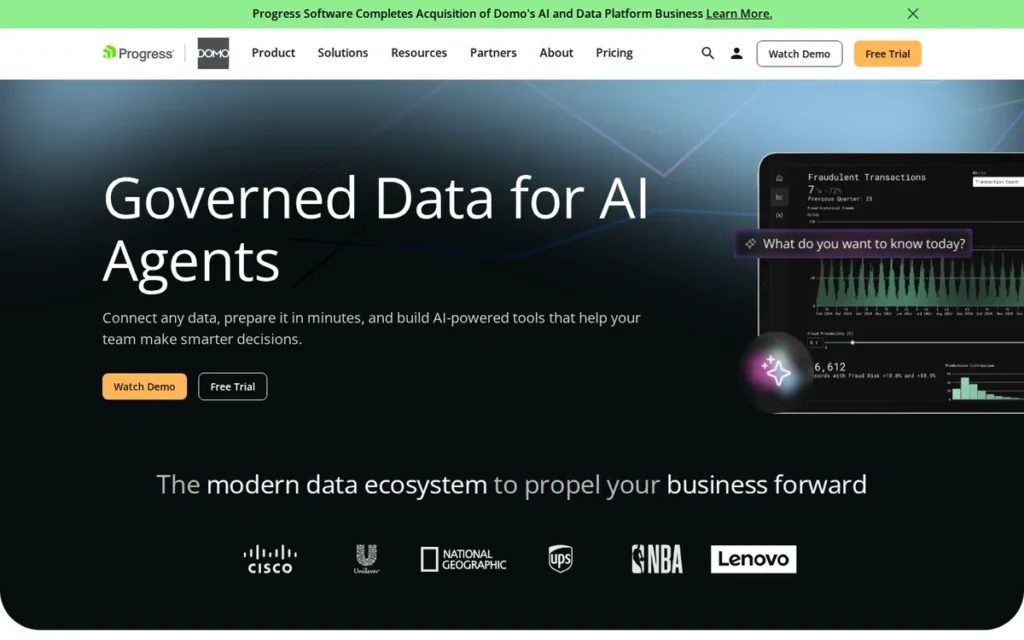
Category: All-in-One Agentic BI Platform, combines data ingestion (700+ connectors), proprietary ETL (Magic ETL), visualization, AI Agent Builder, and embedded analytics (Domo Everywhere) in a single managed cloud environment, requiring no separate data warehouse infrastructure.
At a Glance
- Category: All-in-One Agentic BI Platform
- Best For: Mid-market organizations (50–500 employees) without mature data engineering capacity needing the fastest path from disparate SaaS data sources to interactive AI-powered dashboards, and willing to manage credit consumption risk contractually before deployment
- Price Range: Credit-based model (pricing not publicly listed); enterprise contracts typically $50,000–$500,000+/year; credit consumption from data movement, ETL, and compute creates variable cost with documented unexpected charges. Verified May 2026.
- Primary Strength: Domo offers the broadest pre-built data connector library in this evaluation at 700+ connectors, enabling organizations without data engineering resources to rapidly connect disparate SaaS and operational data sources, complemented by an AI Agent Builder with a differentiated three-layer Intent Engine memory architecture (episodic, semantic, procedural) launched March 2026
- Biggest Limitation: Domo’s credit-based pricing model has produced documented financial harm (including a reported 15,000 GBP unexpected charge from a proof-of-concept deployment (r/BusinessIntelligence, u/brunocleite, April 2026)) with multiple practitioners characterizing the pricing as “intentionally cryptic” and customer support as “terrible,” reflecting a structural tension where organizations cannot accurately predict total cost before deploying at scale
- One-Line Summary: Domo is the fastest all-in-one agentic BI platform with 700+ pre-built connectors and an innovative three-layer Intent Engine memory architecture launched March 2026, but its credit-based pricing opacity, documented unexpected billing incidents, and proprietary ETL architecture create cost predictability and governance risks that organizations should evaluate through a fully scoped proof-of-concept with contractual consumption caps before committing
- Last Verified: May 2026
Overview
Domo is an all-in-one cloud BI and agentic analytics platform designed for mid-market organizations and business-led data teams that need rapid deployment of connected dashboards and AI-powered analytics without building a separate data warehouse, ETL, and BI stack from scratch.
Domo’s March 2026 AI Agent Builder introduced the Intent Engine’s differentiated three-layer memory architecture (episodic (past interaction recall), semantic (organizational knowledge), and procedural (real-time environmental awareness)) providing a context-aware AI foundation that mimics how experienced human analysts accumulate institutional knowledge.
Domo’s primary competitive advantage is its 700+ pre-built data connectors enabling the fastest time-to-first-dashboard in this evaluation. Multiple practitioners in r/BusinessIntelligence (2024–2026) reported unexpected billing charges from Domo’s credit model, a pattern corroborated by multiple independent accounts that warrants contractual protections before any production commitment.
“I wouldn’t recommend [Domo]. We registered to create some proof of concept application with a small dataset and ended up with a 15k GBP bill out of nothing that almost broke our business.” (u/brunocleite, r/BusinessIntelligence, April 2026)
Takeaway: Domo’s credit-based billing model has produced documented unexpected charges from proof-of-concept deployments, a pattern corroborated by multiple practitioners in r/BusinessIntelligence (2024–2026). Any evaluation of Domo must include contractual credit consumption caps as a prerequisite condition before production commitment.
Key Features
- AI Agent Builder with Intent Engine: Domo’s AI Agent Builder (launched March 2026) enables organizations to create conversational or goal-oriented AI agents powered by the Intent Engine’s three-layer memory (episodic recall of past interactions, semantic understanding of organizational knowledge, and procedural awareness of real-time events) providing context-aware analytics that improve with institutional use across repeated interactions.
- 700+ Pre-Built Data Connectors: Domo’s connector library: the broadest in this evaluation at 700+ sources, enables organizations without data engineering resources to connect Salesforce, HubSpot, Google Analytics, Shopify, NetSuite, and hundreds of other SaaS and operational systems without custom API integration or ETL development.
- Domo MCP Server: Domo’s MCP Server (launched March 2026) enables external AI ecosystems (Claude, Gemini, ChatGPT) to query Domo data, trigger automations, create dashboards, and execute interactive experiences governed by Domo’s existing data access controls and business logic.
- Domo Everywhere Embedded Analytics: Domo’s Domo Everywhere enables organizations to embed dashboards, AI-powered narrative intelligence, and real-time analytics into external-facing products, customer portals, and partner ecosystems, with row-level security, multi-tenant governance, and embedded AI agents delivering intelligence summaries over live connected data.
- Magic ETL: Domo’s Magic ETL provides a visual, no-code data transformation interface enabling business analysts without SQL proficiency to build and maintain data pipelines connecting 700+ source systems, though practitioners consistently note the proprietary ETL layer creates governance and versioning challenges as pipeline complexity and data volume grow.
Best For
Domo is best for mid-market organizations (typically 50–500 employees) that lack dedicated data engineering resources, have not yet invested in a cloud data warehouse, and need the fastest available path from raw SaaS and operational data to interactive, AI-powered dashboards. Domo is least appropriate for:
- Organizations with existing Snowflake, Databricks, or BigQuery investments (where Sigma or Tableau provide better governance and depth)
- Organizations with regulatory compliance requirements demanding audit trails and predictable cost structures
- Technically sophisticated data teams that will quickly encounter Domo’s proprietary ETL governance ceiling
Pricing
Domo does not publish pricing publicly as of May 2026, the domo.com/pricing page routes to sales contact. Domo’s credit-based model charges for data movement, ETL transformation, and compute rather than per-user seats, making total cost highly variable and difficult to predict. Enterprise contracts typically range from $50,000–$500,000+/year.
A practitioner reported a 15,000 GBP unexpected charge from a Domo proof-of-concept deployment in r/BusinessIntelligence (u/brunocleite, April 2026), attributed to unanticipated credit consumption. Recommended mitigations: (1) require a fully scoped POC with credit consumption monitoring before committing; (2) obtain contractual credit consumption caps; (3) reference-check active Domo customers on current pricing stability.
Strengths
- Domo’s AI Agent Builder (launched March 2026, Domo press release and SiliconAngle) introduced a differentiated three-layer memory architecture (episodic memory (past interaction recall), semantic memory (organizational knowledge and business context), and procedural memory (real-time environmental awareness)) providing context-aware analytics that give agents contextual persistence across repeated interactions.
- Domo’s 700+ pre-built data connectors represent the broadest source connectivity library in this evaluation, enabling mid-market organizations to connect Salesforce, HubSpot, Shopify, Google Analytics, and hundreds of other operational systems in hours rather than weeks, a genuine deployment speed advantage for organizations without data engineering resources.
- Domo’s public company status (NASDAQ: DOMO, approximately $330–340M ARR as of fiscal year 2025, per investor relations filings) provides audited financial transparency not available from any other platform in this evaluation, enabling buyers to assess long-term viability through SEC disclosures rather than private company representation.
- InformData LLC Lead Data Scientist Marcus Wilkins documented Domo’s all-in-one value: “By bringing our data and workflows into a single, connected environment, it gives us the control and context we need to build reliably” (SiliconAngle, March 2026), reflecting genuine value for organizations where managing separate vendor relationships for data integration, ETL, visualization, and AI is the primary operational cost.
Limitations
Domo’s most consequential limitation is its credit-based pricing model, which creates cost unpredictability that has resulted in documented financial harm. Multiple practitioners in r/BusinessIntelligence (2024–2026) reported unexpected billing charges from Domo’s credit model, including one account of a 15,000 GBP charge from a proof-of-concept deployment (u/brunocleite, April 2026), attributed to unanticipated credit consumption from data movement and compute not made transparent in the initial contract. Multiple practitioners in the same thread described Domo’s pricing as “intentionally cryptic,” reflecting a structural tension where organizations cannot accurately predict total cost before deploying at scale. Domo’s proprietary ETL architecture creates a governance ceiling as organizations mature: one experienced practitioner noted that “any mature company with data warehousing and basic data modeling capabilities can use Tableau or Looker and blow Domo right out of the water” (r/BusinessIntelligence), confirming that Domo’s all-in-one simplicity becomes a liability as organizations develop more sophisticated data practices and need the modeling depth, version control, and architectural flexibility that warehouse-native platforms provide. Domo’s declining employee count, approximately 700 post-restructuring from a larger peak, is also a long-term vendor stability consideration for multi-year commitments.
Verdict
Domo ranks #7 in this independent evaluation because its credit-based pricing model has produced documented unexpected billing incidents (including a reported 15,000 GBP charge from a proof-of-concept deployment (r/BusinessIntelligence, April 2026)) its G2 score of 4.3/5.0 across 800+ reviews reflects among the lowest satisfaction in this evaluation, and practitioner evidence consistently identifies its proprietary ETL as a governance ceiling that technically mature organizations outgrow, despite genuine strengths in connector breadth and the differentiated Intent Engine memory architecture launched March 2026.
Domo is appropriate for mid-market organizations without existing warehouse infrastructure where speed to first working dashboard is the primary priority, provided credit consumption risk is contractually managed through explicit monthly caps and a fully scoped proof-of-concept before production deployment.
Domo’s AI Agent Builder and Intent Engine memory architecture (episodic, semantic, procedural) represent real product innovation that deserves tracking as the platform matures. Any evaluation must include a fully scoped POC with contractual credit consumption caps, this is not a precautionary suggestion but a documented necessity given the April 2026 billing evidence.
What Red Flags Should I Watch For When Evaluating Agentic Analytics Software?
Four procurement red flags appear consistently across the seven agentic analytics platforms evaluated: opaque consumption-based billing without contractual caps, demo-to-production AI quality gaps on real semantic models, compliance certifications that cover data storage but not AI-generated outputs, and vendor-specific semantic layer lock-in without open-standard export paths. Each represents a risk that standard vendor demonstrations are architecturally motivated to avoid surfacing.
Red Flag #1: Opaque Credit or Consumption-Based Billing Without Contractual Caps
Any agentic analytics platform using credit-based or consumption-based billing without contractual consumption caps creates documented financial risk. Domo’s credit model produced a reported 15,000 GBP unexpected charge from a proof-of-concept deployment, a pattern corroborated by multiple practitioners in r/BusinessIntelligence (April 2026). Before signing any contract with consumption-based billing, require explicit monthly caps, overage notification thresholds, and cost simulation outputs using your actual data volumes, not the vendor’s default model assumptions.
Red Flag #2: Demo Performance vs. Production Semantic Model Comprehension Gaps
Agentic AI features that perform well on clean vendor demo datasets frequently degrade on real enterprise semantic models with 50+ measures, 20+ calculated columns, and complex data relationships. Microsoft Fabric Copilot’s documented performance on complex Power BI semantic models, “wrong or incomplete 95% of the time” (r/PowerBI, December 2025), illustrates this gap. Always test agentic features on a production-representative semantic model, not a vendor-provided demo dataset, before procurement commitment.
Red Flag #3: Compliance Certifications That Cover Data Storage But Not AI-Generated Outputs
HIPAA BAAs and SOC 2 reports from legacy BI platforms frequently cover data storage and access governance, but not AI-generated analytics outputs, AI-triggered workflow actions, or AI-generated SQL queries. Before deployment in regulated industries, explicitly ask: “Does your HIPAA BAA explicitly cover AI-generated analytics outputs and agent-triggered actions, or only underlying data storage and access?” The answer determines whether the platform can be deployed in production in healthcare, financial services, or government environments.
Red Flag #4: Vendor-Specific Semantic Layer Lock-In Without Open Standard Export
Each evaluated platform maintains a proprietary semantic layer, Tableau Semantics, ThoughtSpot semantic models, Qlik Data Products, Sigma’s Snowflake-governed models. Switching between platforms requires rebuilding semantic definitions from scratch, creating switching costs rarely quantified in initial TCO models. Ask for a semantic layer portability assessment: “What is the migration effort to export our semantic definitions to dbt, OpenLineage, or another platform?” Platforms supporting open semantic standards provide meaningfully lower lock-in risk.
What Questions Should I Ask Before Choosing an Agentic Analytics Platform?
Four questions expose the production quality gaps, cost structures, and compliance boundaries that standard vendor demonstrations are designed to avoid: documented AI error rates on production-complexity semantic models; HIPAA BAA scope for AI-generated outputs specifically; contractual consumption caps for credit or capacity billing; and confirmed GA status of required MCP capabilities versus beta roadmap commitments.
Question #1: What is your documented error rate when the AI agent runs against a semantic model with 50+ measures and 20+ calculated columns?
Require the vendor to demonstrate (or provide evidence of) agentic AI performance on a production-complexity semantic model, not a curated demo dataset. Platforms that restrict proof-of-concept testing to vendor-prepared data environments have likely not resolved the demo-to-production quality gap documented in Microsoft Fabric Copilot’s April 2026 community feedback solicited by Microsoft’s own team.
Question #2: Does your HIPAA BAA explicitly cover AI-generated analytics outputs, or only underlying data storage and access?
This question creates a compliance boundary that many vendors have not formally addressed for AI-generated outputs. Organizations in healthcare, financial services, or government should require a written response from legal or compliance teams (not a sales response) before proceeding to production deployment in regulated environments.
Question #3: What is the maximum monthly credit consumption cap under our proposed contract, and what happens when we exceed it?
This question is specifically targeted at platforms using credit-based or consumption-based billing (Domo) and capacity-based models (Microsoft Fabric). The vendor’s willingness to include contractual caps will indicate whether the billing model is designed to be predictable or to generate upside-variable revenue from consumption growth that customers did not budget for.
Question #4: Which specific MCP capabilities are GA versus still in beta, and what is the committed GA timeline for beta features we require?
Five of the seven evaluated platforms have launched MCP servers, but GA status, feature scope, and enterprise readiness vary significantly. Organizations that have licensed Claude, ChatGPT, or Gemini Enterprise and want to extend those investments to their analytics data layer need confirmed GA status (not beta roadmap commitments) before designing production AI architectures around MCP interoperability.
Question #5: What compliance certifications explicitly cover AI-generated analytics outputs, and can you provide the audit scope document for review?
Many vendors advertise SOC 2 Type II or ISO 27001 without specifying whether the audit scope covers AI agent actions, AI-generated queries, or AI-triggered downstream workflows. Requesting the specific audit scope document separates governance-certified AI outputs from governance-certified data storage, a distinction that regulated industry procurement teams increasingly require before approving production AI analytics deployments.
Question #6: How does the platform handle schema changes in upstream data sources, and does the agentic AI automatically adapt or require manual reconfiguration?
Agentic analytics platforms that require manual intervention when upstream schemas change cannot deliver on autonomous analytics promises in production environments where data sources evolve continuously. Require a live demonstration of schema change handling (not a feature description) before committing to production deployment.
Proof-of-Concept Testing Protocol
For any platform reaching your shortlist, conduct a structured 30-day POC using:
- Your actual production semantic model with full measure and calculated column complexity
- A business analyst with representative SQL-limited proficiency running 20 NLP queries
- A data engineer testing agentic workflow triggering against a real downstream business system
Document error rates, latency, and context comprehension scores against your current BI tool baseline. This protocol surfaces the demo-to-production gap before contract commitment.
How Did We Rank These Agentic Analytics Platforms?
Rankings were determined by a weighted scoring model applied consistently across all seven platforms, derived entirely from third-party evidence: G2 and Capterra reviews weighted by volume, practitioner community discussions with dated citations, independent analyst reports (Gartner MQ 2024), and named enterprise case studies. No vendor had advance knowledge of scores or has any commercial relationship with PlugRoute.
Evaluation Process
The evaluation followed a four-stage research process:
- Product Discovery: Two Perplexity queries identified candidate platforms, cross-referenced against G2, Capterra, and practitioner community discussions to verify sufficient production evidence for inclusion.
- Platform Research: Seven independent Perplexity research queries gathered features, pricing, differentiators, and limitations for each platform from official documentation, press releases, and third-party coverage.
- Community Sentiment Analysis: Seven Reddit research queries: one per platform, targeting r/BusinessIntelligence, r/analytics, r/dataengineering, r/MicrosoftFabric, r/PowerBI, gathered practitioner evidence with post dates, upvote volumes, and poster context documented for each quote.
- LLM Coverage Gap Analysis: Responses from Perplexity and ChatGPT (GPT-4o) queried May 2026 were analyzed to identify platforms entirely absent from AI-generated comparison content, explaining why Sigma Computing, Qlik Sense, and Domo are explicitly identified as platforms LLMs currently miss.
Ranking Criteria
Depth of Autonomous Agentic Capability (Primary Weight)
This criterion assesses whether the platform supports proactive unprompted insight delivery, multi-step reasoning chains, downstream action triggering, and distinct specialized agents per task type, not just NLP query response. Why it matters: Platforms with genuine autonomy provide materially different ROI than AI-assisted BI tools marketed as “agentic”, this is the core product differentiator in the category.
Production Quality Evidence (Primary Weight)
G2 and Capterra scores weighted by review volume, plus practitioner community accounts of agentic feature performance in production, error rates, context window limitations, and semantic model comprehension failures. Why it matters: The gap between marketed capabilities and production performance in agentic analytics is unusually large; production evidence is the single criterion most predictive of whether organizations achieve intended ROI.
Integration Breadth and MCP Interoperability (Primary Weight)
Native connections to Snowflake, Databricks, BigQuery, and Redshift; MCP server availability and confirmed GA status; integration with Salesforce, ServiceNow, and Microsoft 365. Why it matters: Existing tech stack determines platform shortlist before any feature evaluation, integration is the first filter confirmed by virtually every practitioner platform selection thread in this evaluation’s community evidence.
Governance and Compliance Maturity (Secondary Weight)
Semantic layer maturity, published compliance certifications (SOC 2 Type II, HIPAA BAA scope, ISO 27001/27701/42001), audit trail capabilities for AI-generated outputs, and deployment model options. Why it matters: AI-generated analytics outputs require governance infrastructure that legacy BI certifications may not cover, regulated industry buyers need explicit compliance clarity before approving production AI analytics deployments.
Pricing Transparency and Value Predictability (Secondary Weight)
Whether base pricing is publicly published, pricing model clarity, documented billing incidents in community evidence, and alignment between pricing model and consumption patterns. Why it matters: Pricing opacity is the most consistent trust-damaging pattern across all seven platforms, it is both a user experience criterion and a trust signal that predicts vendor relationship dynamics beyond initial procurement.
Verified Client Results and Enterprise Validation (Secondary Weight)
Named customers with quantified outcomes, independent analyst placements (Gartner MQ, Forrester), and strategic partnership evidence. Why it matters: Enterprise buyers preparing vendor selection recommendations require third-party evidence of results that exceeds vendor self-description.
Evidence Weighting Rationale
When review platform ratings conflict with Reddit practitioner sentiment, PlugRoute weights specificity and recency. A detailed April 2026 Reddit post with 50+ upvotes from a practitioner describing specific error rates outweighs a generic 2023 G2 review for production quality assessment. Vendor-reported statistics are labeled as such throughout. Only claims corroborated by at least one independent source are stated as fact.
Community accounts are treated as practitioner evidence, not controlled benchmarks, the distinction is noted wherever relevant in the article.
Data Validation Approach
All pricing figures state whether they are published by the vendor (verified at published URL) or estimated from market intelligence. All community quotes include the subreddit, approximate post date, and upvote context. Case study metrics are attributed to the specific named source rather than treated as general platform claims. Factual claims from vendor press releases are verified against independent coverage before publication.
Update Cadence
This evaluation was last updated May 2026 and will be reviewed and updated quarterly. The next scheduled review is August 2026. Agentic analytics is one of the fastest-evolving categories in enterprise software, readers should verify specific feature availability, pricing, and compliance certifications directly with vendors before procurement commitment.
Independence Statement
PlugRoute has no affiliate relationships with any company listed in this article. Rankings are determined entirely by research data, verified user reviews, and objective evaluation criteria. No vendor received preferential treatment or advance review of scores.
What Else Do Buyers Ask About Agentic Analytics Software?
What is the best agentic analytics software for enterprise in 2026?
In 2026, the best agentic analytics software for enterprise depends primarily on existing stack alignment: Tableau Next for Salesforce-integrated organizations, Sigma Computing for Snowflake/Databricks-first data teams, and Qlik Sense for complex multi-source data exploration. Tableau Next ranks #1 for its complete four-layer agentic pipeline and the only published pricing in the category ($15–$75/user/month, verified May 2026). Stack alignment (not feature matrices) is the decisive selection variable.
Which agentic analytics platform works best with Snowflake?
Sigma Computing is the strongest choice for Snowflake-first organizations: it executes all queries (including Sigma Agent queries) directly against Snowflake in real time with zero data extraction, earned Snowflake Ventures investment creating an active co-selling relationship, and holds the highest verified user satisfaction in this evaluation (Capterra: 4.9/5.0; G2: 4.6/5.0, May 2026). ThoughtSpot also co-sells with Snowflake and executes Spotter 3.0 against live Snowflake data, as of May 2026.
How much does agentic analytics software cost?
Agentic analytics software costs range from $15/user/month at the most affordable published tier (Tableau Next Viewer, verified May 2026) to $150,000–$500,000+/year for enterprise contracts (ThoughtSpot, Domo, market estimates, unverified by vendors). Only Tableau Next publishes per-user pricing without a sales cycle. All other platforms require vendor engagement for budget qualification, with Domo’s credit-based model adding documented cost variability risk confirmed by community billing incidents.
What is the difference between Tableau Next and ThoughtSpot?
Tableau Next leads for Salesforce-integrated enterprises requiring visualization depth plus a complete insight-to-CRM-action pipeline via Agentforce, with published pricing at $15–$75/user/month (verified May 2026). ThoughtSpot leads for enterprises prioritizing autonomous NLP search depth on Snowflake or Databricks data via Spotter 3.0’s proactive delivery, at the cost of significantly fewer chart customization options and no published pricing (estimated $150,000–$500,000+/year). Both are Gartner Magic Quadrant Leaders (2024).
Is Microsoft Fabric Copilot ready for production enterprise analytics in 2026?
Microsoft Fabric’s underlying data platform, OneLake, Fabric Data Agents, M365 integration, is production-ready for Microsoft 365-centric enterprises. However, the agentic AI layer, Copilot in Fabric notebooks and Power BI Copilot’s semantic model comprehension, showed documented high error rates in April 2026 community testing solicited by Microsoft’s own team. Independent proof-of-concept testing on production-representative semantic models is strongly recommended before committing production analytics workloads that depend on Copilot’s AI output quality.
What is Model Context Protocol (MCP) and which analytics platforms support it?
Model Context Protocol (MCP) is an open standard enabling external AI agents (Claude, ChatGPT, Gemini) to securely query governed enterprise data without bulk exfiltration. Five of the seven platforms in this evaluation support MCP: Microsoft Fabric (broadly available November 2025), Qlik Sense (GA February 2026), Domo (GA March 2026), Sisense (available 2025–2026), and ThoughtSpot (via ecosystem integrations). Tableau Next and Sigma Computing use platform-native data-sharing protocols rather than standalone MCP server implementations.
What is the difference between agentic analytics and traditional BI?
Traditional BI tools deliver insights when a user actively queries a dashboard or report. Agentic analytics platforms autonomously detect anomalies, execute multi-step reasoning, and proactively surface insights (then trigger downstream actions like Salesforce CRM updates, Slack alerts, or warehouse write-backs) without a human-initiated query. The practical test: does the platform independently detect and communicate a critical metric change at 2 AM without anyone asking? Only genuinely agentic platforms do.
Which agentic analytics platform is best for ISVs building embedded analytics?
Sisense is the strongest choice for ISVs and software companies embedding AI analytics into customer-facing products, holding 24 patents in embedded analytics, ISO 27701/27001/42001:2023 certifications for flow-down compliance, and a developer-first Compose SDK (React, Angular, Vue.js) for white-labeled multi-tenant experiences. Organizations with simpler embedding requirements may find Power BI Embedded lower-friction and lower-cost. Sisense underwent significant organizational restructuring in 2023, post-restructuring customer reference checks are recommended before multi-year OEM commitments.
How does PlugRoute determine its platform rankings?
Z You’ve hit your limit · resets 2:50am (Asia/Dhaka)