Synthesia ranks first for enterprise L&D teams, HeyGen ranks first for multilingual video translation, and Colossyan ranks first for mid-market corporate training, each the top choice in its use case. Every platform in this evaluation markets “unlimited” video while metering its highest-quality rendering engine, a discrepancy that costs buyers real money after subscribing.
Teams choosing the wrong AI avatar platform typically discover quality-tier limitations only after committing to a paid plan. A $29/month plan that promises unlimited video may cap the best-quality rendering engine at 10 minutes per month, a detail buried in documentation, not disclosed at checkout. This metering pattern is documented across HeyGen’s Avatar IV and Colossyan’s NEO 2 engines.
PlugRoute has no affiliate relationships with any company listed; rankings are determined entirely by research data and objective evaluation criteria.
Use the comparison table and Quick Decision Framework below to route to the platform matching your specific use case, then read the detailed entry for full evidence.
“The paid Creator plan gives you only 10 minutes of Avatar IV credits per month. I ran out of credits after creating just a few short videos, effectively crippling the service… This is a classic bait-and-switch tactic: they advertise ‘unlimited’ to get you to sign up, but restrict the one feature you actually need.” (u/Fun-To-Watch, r/generativeAI, 2024)
Takeaway: This complaint pattern (documented independently by multiple users across r/generativeAI and r/heygen in 2024–2025) applies to any AI avatar platform whose highest-quality rendering engine carries undisclosed monthly minute caps. HeyGen (Avatar IV) and Colossyan (NEO 2) both carry this pattern; see entries #2 and #3 for full documentation.
TL;DR: Top AI Avatar Generator Picks at a Glance
- Synthesia is the top choice for enterprise L&D teams requiring SOC 2 Type II security certification and LMS integration, earning G2 Leader and Top Trending badges with a verified 4.5/5 lip-sync rating.
- HeyGen is the best platform for multilingual video translation, supporting 175+ languages with voice cloning and lip-sync re-synchronization across any uploaded video, without re-filming source content.
- Colossyan is the strongest choice for mid-market corporate training teams, providing SCORM export and interactive branching on every paid tier at pricing approximately 30–50% below Synthesia’s enterprise equivalent.
- Creatify is the best option for performance marketers testing video ad creative at $5–$10 per video, earning G2 Easiest to Use recognition for non-video-professional workflows.
What Are the Three Categories of AI Avatar Generators?
The three categories of AI avatar generators in 2026 are: Enterprise and L&D Platforms (Synthesia, Colossyan, Elai), Creator and Marketing Platforms (HeyGen, D-ID), and Performance Ad Generators (Creatify, Arcads). Each cluster applies different evaluation criteria, SCORM and security certifications for L&D; language breadth and API depth for creator tools; cost-per-test and creative volume for ad generators.
Category 1: Enterprise and L&D Platforms: Synthesia, Colossyan, Elai
Enterprise and L&D Platforms (Synthesia, Colossyan, and Elai) are purpose-built for corporate teams, instructional designers, and L&D departments. Evaluation criteria for this cluster emphasize SCORM compatibility, LMS integration, security certifications, and multilingual training module production.
Category 2: Creator and Marketing Platforms: HeyGen, D-ID
Creator and Marketing Platforms (HeyGen and D-ID) serve multilingual content localization, sales enablement, and developer-grade streaming API integration. Evaluation criteria for this cluster emphasize language breadth, avatar versatility, and integration depth.
Category 3: Performance Ad Generators: Creatify, Arcads
Performance Ad Generators (Creatify and Arcads) are purpose-built for e-commerce brands and performance marketing agencies running paid social advertising. Evaluation criteria for this cluster emphasize creative throughput, ad-specific actor libraries, and cost-per-test economics.
A performance marketer evaluating Synthesia on cost-per-video economics will correctly conclude it is overpriced for their use case. An L&D manager evaluating Creatify on SCORM compatibility will correctly conclude it is incomplete for theirs. Identify your category before evaluating individual platforms, the criteria that matter are cluster-specific.
How Do the Top AI Avatar Generators Compare?
All seven platforms are ranked below across eight dimensions most relevant for purchase decisions. One-Line Summary, Primary Strength, and Key Limitation reflect evidence from verified G2 reviews, independent Reddit community reports, and official pricing pages, all verified April 2026.
| Rank | Company | Category | Best For | One-Line Summary | Key Capabilities | Primary Strength | Key Limitation |
|---|---|---|---|---|---|---|---|
| 1 | Synthesia | Enterprise & L&D | Enterprise video, regulated industries, multilingual L&D | Synthesia is the best-reviewed enterprise AI avatar platform of 2026, earning G2 Leader and Top Trending badges with a verified 4.5/5 lip-sync rating, SOC 2 Type II security certification, and a no-credit-card free tier | 240+ avatars; 160+ languages; SCORM on enterprise tier; Veo 3 avatar builder; SSO/SAML | SOC 2 Type II certified; G2 Leader + Top Trending; 4.5/5 lip-sync; $500M+ raised at $4B valuation | Starter: 10 min/month only; non-English expressiveness weaker than English output |
| 2 | HeyGen | Creator & Marketing | Multilingual translation, marketing, social media | HeyGen is a G2 top-rated AI avatar platform with 175+ language video translation and voice cloning, validated by agency partners for multilingual content at scale | 175+ language translation; voice cloning; Avatar IV full-body; Canva/Zapier/API; Sora 2 Pro + Veo 3.1 | Broadest multilingual coverage (175+ languages); 4.8/5 G2 rating (~1,194 reviews); G2 #1 Fastest Growing Product 2025 | Avatar IV capped at ~10 min/month on Creator plan; billing complaint pattern documented |
| 3 | Colossyan | Enterprise & L&D | Mid-market L&D, corporate training, instructional design | Colossyan is the best AI avatar platform for mid-market corporate training teams in 2026, offering SCORM and interactive branching on all paid tiers with a documented 80% cost reduction and 50% time savings at Sonesta Hotels | SCORM on all paid tiers; interactive branching; NEO 2 full-body; 100+ languages; in-video quizzes | SCORM + interactive branching on ALL paid tiers; 80% cost reduction + 50% time savings case study | NEO 2 capped at 10 min/month on Business plan; no confirmed CEO or funding history |
| 4 | Creatify | Performance Ads | Performance marketing, e-commerce ad creative | Creatify is the best AI avatar platform for performance marketers in 2026, earning G2 Easiest to Use recognition and validated by e-commerce teams generating video ad creative at $5–$10 per video | URL-to-video in <60 seconds; Meta Top Ads Library (10M+ reference ads); 1,500+ actors; Aurora + Sora 2 | G2 Easiest to Use; URL-to-video in <60 seconds; validated at $5–$10/video by independent practitioners | Credit exhaustion faster than advertised; billing-after-cancellation complaints documented |
| 5 | D-ID | Creator & Marketing | Developers, API teams, talking-photo at scale | D-ID is the best AI avatar platform for developers and API-first teams in 2026, offering the only real-time streaming avatar technology in the evaluation alongside best-in-class still-image animation | Real-time streaming API; still-image animation; V4 expressive models; four avatar quality tiers; developer API track | Only real-time streaming avatar API in this evaluation; 14-day unlimited free trial | Capterra ~2.9/5 (128 reviews, 2025); per-second billing creates unpredictable monthly costs |
| 6 | Elai | Enterprise & L&D | SMB multi-format content repurposing | Elai is the most feature-diverse AI avatar platform for SMB teams in 2026, offering PPT/PDF/blog-to-video, four custom avatar types, and interactive quizzes in a single subscription | PPT/PDF/blog-to-video; 4 custom avatar types; Listening Avatar; URL-to-video; Panopto integration | 4 custom avatar types; PPT/PDF/blog-to-video conversion unique in this evaluation | Only 2 verified OMR reviews (statistically unreliable); voice cloning costs $200/year as add-on |
| 7 | Arcads | Performance Ads | English-language UGC ad script testing (specific use case) | Arcads is an AI UGC ad generator using real human footage-based actors for English-language script angle testing; but its $110/month no-trial entry and zero verified review ratings make it the highest-risk purchase in this category | Real human footage-based actors (300–1,000+); speech-to-speech voice preservation; bulk generation; no built-in editor | Real human footage-based actors rated “less AI-y” by independent practitioners for UGC-style formats | No free trial; no verified review ratings on any major platform; non-English lip-sync failures documented |
Which AI Avatar Generator Should I Choose for My Use Case?
| Your #1 Priority | Recommended Tool | Why | Acceptable Alternative |
|---|---|---|---|
| Enterprise L&D with compliance requirements | Synthesia | SOC 2 Type II certified; G2 Leader + Top Trending; 4.5/5 lip-sync; no-CC free tier; $500M+ raised | Colossyan (lower cost; SCORM on all tiers) |
| Mid-market corporate training | Colossyan | SCORM on ALL paid tiers; 80% cost reduction + 50% time savings (Sonesta Hotels); $19/month entry (annual) | Elai (broader SMB feature set at similar price) |
| Multilingual video translation | HeyGen | 175+ languages; auto-dubbing with voice cloning and lip-sync; 4.8/5 G2 rating (~1,194 reviews) | Synthesia (stronger enterprise security; in-editor translation) |
| Performance ad creative testing | Creatify | G2 Easiest to Use; URL-to-video in <60 seconds; validated at $5–$10/video; free tier available | Arcads (English-only; no free trial; evaluate Creatify first) |
| Developer / real-time streaming | D-ID | Only real-time streaming avatar API in this evaluation; 14-day unlimited free trial | HeyGen (streaming API available but less developer-focused) |
| Multi-format SMB content | Elai | PPT/PDF/blog-to-video; four custom avatar types; Panopto enterprise integration | Colossyan (stronger interactive L&D features) |
| English UGC script testing (cautiously) | Arcads | Real human footage-based actors; speech-to-speech; ~2 min/video; request a demo before purchasing | Creatify (lower risk: G2 reviews, free tier, broader features) |
1. Synthesia: Best Overall for Enterprise and Professional Teams
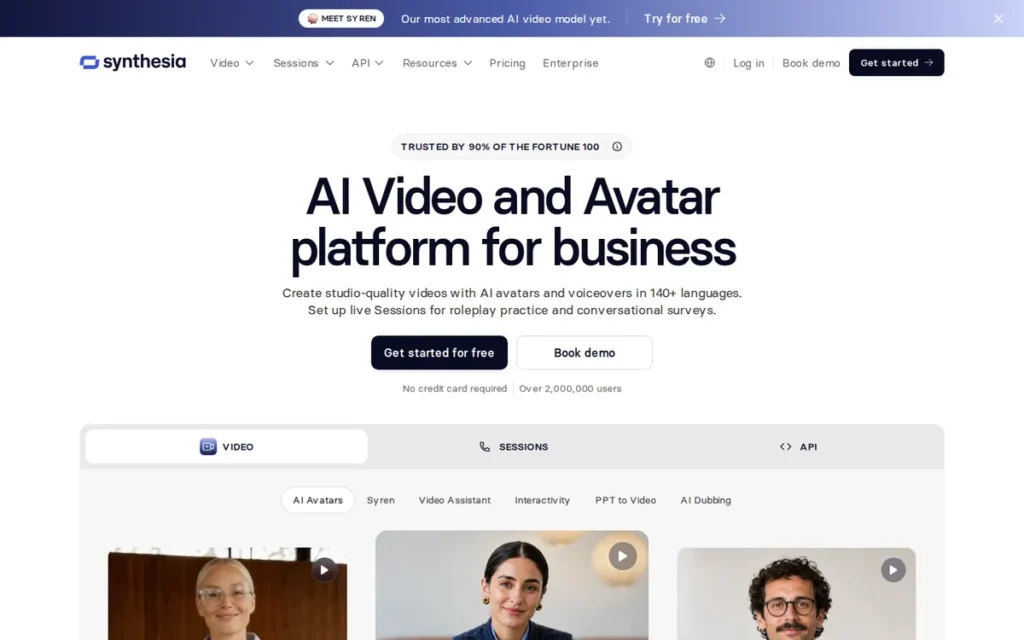
Category: Enterprise Avatar Studio, a full-featured AI video production platform purpose-built for corporate training, internal communications, and professional video at scale, requiring no filming or video editing expertise.
At a Glance
- Category: Enterprise Avatar Studio
- Best For: L&D teams, corporate communications departments, and enterprise content teams in regulated industries needing secure, scalable, multilingual avatar video with LMS integration
- Price Range: Free (no credit card, 9 avatars, 3 min); Starter $29/month (10 min/month); Enterprise custom pricing, verified April 2026
- Primary Strength: Synthesia delivers the highest documented lip-sync rating in the category (4.5/5 on G2) alongside SOC 2 Type II security certification and $500M+ in total funding, the combination that determines enterprise procurement eligibility in regulated industries
- Biggest Limitation: Synthesia’s Starter plan provides only 10 video minutes per month, making it one of the most restrictive entry-level allocations in the category, and non-English avatar expressiveness is documented as notably weaker than English-language output
- One-Line Summary: Synthesia is the best-reviewed enterprise AI avatar platform of 2026, earning G2 Leader and Top Trending badges with a verified 4.5/5 lip-sync rating, SOC 2 Type II security certification, and a no-credit-card free tier that allows risk-free evaluation before any financial commitment
- Last Verified: April 2026
Overview
Synthesia is an enterprise AI avatar video platform founded in 2017 by University College London AI researchers that enables businesses, L&D teams, and corporate communications departments to produce professional-quality talking-head videos using 240+ AI avatars in 160+ languages, without filming, studios, or video editing expertise.
Synthesia has raised over $500 million in total funding, including a $200 million Series E led by Google Ventures in January 2026 at a $4 billion valuation [Source: TechCrunch, January 2026; synthesia.io/series-e, January 2026], making Synthesia the most heavily capitalized dedicated AI avatar platform in the category.
Synthesia holds SOC 2 Type II certification and GDPR compliance documentation, and serves more than 60% of Fortune 100 companies as of January 2025 [Source: Synthesia Series E announcement, January 2026], the enterprise adoption breadth and security credentials that position Synthesia as the reference standard in this evaluation.
Key Features
- Express-2 Avatar Engine: Synthesia’s Express-2 generation engine delivers full-body avatar visibility with expressive body language, multiple camera angles, improved lip-sync, and emotional facial expressions, a meaningful advancement over talking-head-only competitors in this category (Synthesia Features, 2026).
- In-Editor Translation Workflow: Synthesia’s integrated translation supports 139 languages with in-editor processing, allowing teams to produce multilingual variants of a single training module without switching tools or re-recording source content (Synthesia Features, 2026).
- Personal Avatar with Voice Cloning: Synthesia’s Personal Avatar builder creates digital twins that speak in 30+ languages with optional voice cloning, using a recording-based workflow that preserves natural speech patterns for a more authentic presenter experience than stock avatars provide (Synthesia Docs, 2026).
- Veo 3 Avatar Builder Integration: Synthesia’s Avatar Builder accepts text prompts to generate scenario-specific visuals via Google Veo 3, enabling industry-appropriate environments (medical, industrial, hospitality) without separate graphic design resources (Synthesia Blog, 2026).
- Enterprise Security and LMS Integration: Synthesia’s enterprise tier includes SCORM export, LMS integration, SSO (SAML), team collaboration controls, and dedicated account support, the full compliance checklist that L&D procurement teams require before approving annual contracts (Synthesia Enterprise, 2026).
Best For
Synthesia is best for enterprise L&D teams, corporate communications departments, and professional content teams in regulated industries (healthcare, finance, pharmaceutical, government) who need video content with documented security certifications, seamless multilingual localization, and LMS integration.
Synthesia is appropriate for buyers willing to pay a premium for the vendor credibility, platform stability, and enterprise feature depth that long-term contract decisions require.
Pricing
Synthesia offers a free plan (no credit card required) with 9 AI avatars and videos up to 3 minutes, the most functional zero-risk evaluation in the category as of April 2026.
The Starter paid plan is $29/month and provides 10 video minutes per month, which is restrictive for teams producing multiple training modules. Enterprise pricing is custom via sales, estimated by independent reviewers at the $500+/month equivalent range for full-feature access (Vozo, 2026).
Synthesia does not publish enterprise pricing publicly. Annual billing discounts exist but are not listed. Verify current pricing at synthesia.io/pricing before committing.
Strengths
- Synthesia earned G2 Leader AND G2 Top Trending badges simultaneously in 2025–2026 (the only platform in this evaluation to hold both) with a verified 4.5/5 user rating specifically for lip-sync quality, the highest documented lip-sync score among all seven platforms evaluated, and a distinction the L&D Reddit community explicitly names as making Synthesia the leader in “avatar naturalness” for training contexts (G2, 2026; u/Famous-Call6538, r/instructionaldesign, 2025).
- Synthesia holds SOC 2 Type II security certification and GDPR compliance documentation confirmed via synthesia.io/enterprise, the security audit standards required for regulated-industry video content deployment that most AI avatar competitors cannot present to enterprise procurement teams.
- Synthesia has raised over $500 million in total funding at a $4 billion January 2026 valuation, serves more than 60% of Fortune 100 companies [Source: Synthesia Series E announcement, January 2026], and was founded in 2017, providing the strongest combined vendor longevity and enterprise adoption signal in the category.
- Synthesia’s free tier (9 avatars, 3-minute videos, no credit card required) is the only genuinely no-commitment evaluation option in the category, and Synthesia’s billing complaint footprint in independent community research is the smallest among the top three platforms in this evaluation.
Limitations
- Minute Restriction at Entry Pricing: Synthesia’s $29/month Starter plan provides only 10 video minutes per month (one of the most restrictive allocations in the category) and the gap between this tier and Enterprise pricing (custom, estimated $500+/month equivalent) leaves mid-market teams without a viable mid-tier option clearly disclosed on the pricing page.
Users on r/instructionaldesign shared their experience:
“IT teams think it’s great because they can create ‘training’ using it. What they don’t understand is that very little training is actually happening.
It’s also quite expensive for the very limited use cases where it can be of help.” (u/Ok_Stomach_6857, 2025)
Takeaway: Synthesia’s premium pricing creates pressure to justify ROI in ways the platform’s talking-head format cannot always deliver, particularly for L&D buyers measuring actual learning outcomes rather than video production volume.
- Non-English Avatar Quality Gap: Synthesia’s non-English avatar expressiveness is documented as noticeably weaker than its English-language output by independent L&D reviewers, a material limitation for multinational teams whose primary use case is non-English training content (Synthesia Blog, 2026).
- Safari Browser Exclusion: Synthesia does not support Safari: a friction point for enterprise Mac and iPad environments where browser standardization may require Safari, affecting deployment in certain corporate IT configurations.
- Personal Avatar Input Language Limitation: Synthesia’s Personal Avatar recording is limited to 32 supported input languages despite 160+ output languages, meaning users in non-supported languages cannot create digital twins that speak naturally in their native language (Synthesia Docs, 2026).
Verdict
This balanced assessment from r/instructionaldesign captures how experienced L&D practitioners apply Synthesia in practice:
“I used to dunk on Synthesia all the time for uncanny valley. It’s still pretty bad, but with a new avatar I did have someone ask me ‘is this an avatar?’ So it’s getting better. My team got licenses because our organization onboarded them and did a huge push saying that we have it now. What I will say is that it’s made some videos way faster to create. Is it a good or effective learning solution? No. But does it allow me to create a video that an SME thinks looks good when they don’t even know what they want/can measure and having a video satisfies the stakeholder while not tanking our team capacity? Yes. And for that use case, 10/10.” (u/climbing_glimmer1716, 2025)
Takeaway: Synthesia’s practical value for many enterprise teams lies not in maximizing learning effectiveness but in stakeholder management and production speed, a legitimate use case that its enterprise security credentials and team collaboration features directly support.
Synthesia is the top-ranked AI avatar platform of 2026, earning that position through the strongest combination of verified review ratings (G2 Leader + Top Trending, 4.5/5 lip-sync), enterprise security credentials (SOC 2 Type II), vendor stability ($500M+ raised at a $4B valuation, 2017 founding), and the only no-credit-card free evaluation in the category. Teams in regulated industries or those building multilingual corporate training libraries at scale will find Synthesia’s enterprise feature set (SCORM, LMS integration, SSO, Veo 3 avatar builder) the most complete in the category. The primary trade-off is cost: mid-market teams should pressure-test the gap between the $29/month Starter allocation (10 minutes/month) and Enterprise pricing before committing to an annual plan.
2. HeyGen: Best for Multilingual Video Translation and Versatile Creator Workflows
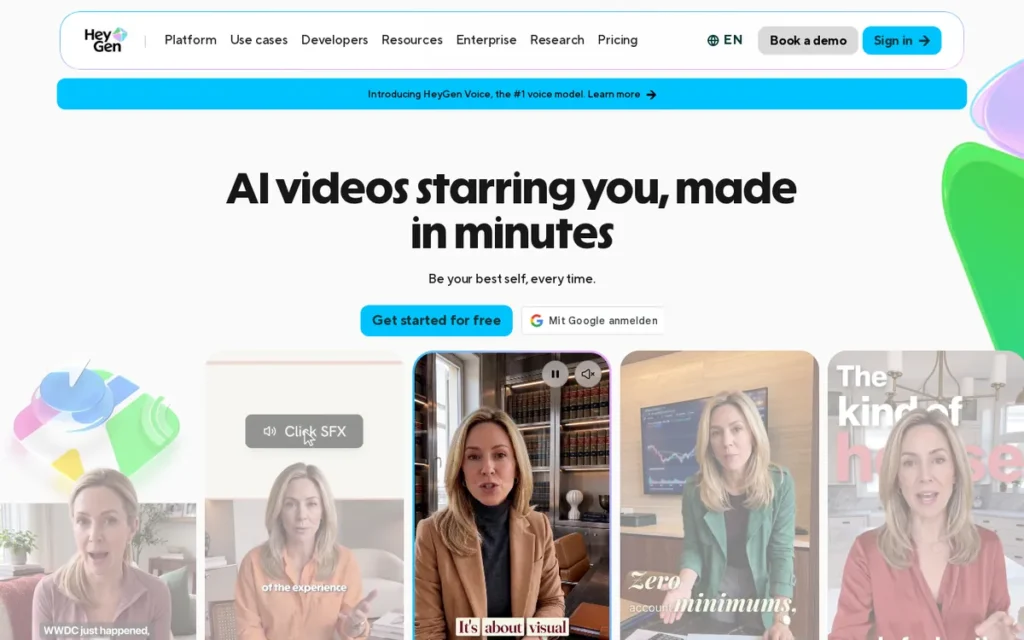
Category: Translation-First Avatar Platform, an AI video platform built around multilingual video translation and avatar generation, serving marketing, sales, L&D, and creator workflows with the broadest language support in the category.
At a Glance
- Category: Translation-First Avatar Platform
- Best For: Content creators, marketers, and enterprise teams whose primary need is multilingual video localization (dubbing existing videos into 175+ languages with cloned voice and re-synced lip movement) or who need a versatile avatar platform for marketing, sales, and social media
- Price Range: Free (limited); Creator ~$29/month (Avatar IV capped at ~10 min/month); Enterprise custom, verified April 2026
- Primary Strength: HeyGen’s video translation engine auto-dubs any uploaded video into 175+ languages with voice cloning and lip-sync re-synchronization, the broadest multilingual localization capability in the category without re-filming
- Biggest Limitation: HeyGen’s Creator plan caps the high-quality Avatar IV engine at only 10 minutes per month despite marketing the plan as “unlimited video”, a documented discrepancy that multiple users in 2025–2026 have characterized as misleading on Reddit
- One-Line Summary: HeyGen is a G2 top-rated AI avatar platform with 175+ language video translation and voice cloning, making it the strongest choice for multilingual content localization, but prospective buyers must verify Avatar IV minute allocations at their target pricing tier before subscribing, as the quality metering is not prominently disclosed in marketing materials
- Last Verified: April 2026
Overview
HeyGen is a general-purpose AI avatar video platform founded approximately 2020 that enables marketers, content creators, L&D professionals, and enterprise teams to produce multilingual avatar-led videos without filming, offering 175+ language translation with voice cloning, 300+ AI voices, and avatar tiers ranging from photo-based Instant Avatars to full-body digital twin creation.
HeyGen was named G2’s #1 Fastest Growing Product in the 2025 Best Software Awards and holds Grid Leader status in the AI Video Generators category as of early 2026, with a 4.8/5 rating from approximately 1,194 verified reviews, the highest user satisfaction score among high-volume-reviewed platforms in this evaluation [Source: g2.com/best-software-companies/2025/fastest-growing; learn.g2.com/synthesia-vs-heygen, 2026].
HeyGen’s primary differentiator is its video translation engine, which auto-dubs any uploaded video into 175+ languages, clones the original speaker’s voice, and re-syncs lip movement, addressing multilingual content localization without hiring local voice talent or re-filming source content.
Key Features
- Video Translation Engine: HeyGen’s translation feature accepts any uploaded video (30+ seconds) and automatically dubs it into 175+ languages with voice cloning that preserves the original speaker’s vocal character and re-synchronized lip movement, eliminating the need to re-film content for multilingual distribution (HeyGen Translate, 2026).
- Avatar IV Rendering Engine: HeyGen’s Avatar IV engine delivers full-body motion with expressive behavior, natural gestures, and strong lip-sync synchronization, though users on the Creator plan should verify that Avatar IV is metered at approximately 10 minutes per month, while Avatar III (lower quality) remains unlimited (HeyGen Docs, 2026).
- Finetuned Avatar Digital Twin Creation: HeyGen’s Finetuned Avatar workflow builds personalized digital twins from recorded personal video and voice samples, producing superior lip-sync accuracy compared to photo-based or stock avatars, available on select paid tiers.
- Automation and Integration Stack: HeyGen integrates with Canva, Zapier, and a streaming API for enterprise teams building automated multilingual video production pipelines (Canva App Store, 2026), extending utility well beyond the web editor.
- Frontier Model Aggregation: HeyGen integrates Sora 2 Pro and Veo 3.1 generative video models on higher tiers, functioning as an aggregator of frontier model capabilities rather than a single fixed engine, a structural advantage as foundation models continue improving through 2026 (Airpost Blog, 2026).
Best For
HeyGen is best for content creators, marketing teams, and global enterprise teams whose primary workflow involves translating existing video content into multiple languages at scale, or who need a versatile avatar platform for marketing, sales enablement, social media, and internal communications.
HeyGen is appropriate for buyers who verify Avatar IV minute allocations at their specific pricing tier before committing, as the quality-metering gap is the most consistently documented complaint in the AI avatar category.
Pricing
HeyGen’s Creator plan is approximately $29/month and provides unlimited video generation via Avatar III plus Avatar IV at approximately 10 minutes per month, a quality-tier distinction not prominently disclosed in top-line marketing.
Additional Avatar IV minutes cost approximately $15–$20 per minute beyond the plan allocation. A Pro or higher tier at approximately $49–$89/month provides additional Avatar IV minutes and custom avatar creation (approximately 3 custom avatars on Pro). Enterprise pricing is custom via sales.
All pricing verified via Reddit user reports and third-party aggregators as of April 2026, confirm directly at heygen.com/pricing before purchasing, as HeyGen has changed its pricing model multiple times.
Strengths
- HeyGen was named G2’s #1 Fastest Growing Product in the 2025 Best Software Awards, with a 4.8/5 rating from approximately 1,194 verified G2 reviews, and is validated by an agency partner as “the most versatile and consistently high quality” platform for multilingual video at scale, using “ElevenLabs and other vendors behind [it], so basically getting industry-best stuff” for voice (u/slavev, r/FacebookAds, 2025).
- HeyGen’s 175+ language video translation engine is the broadest multilingual coverage in the evaluation, reportedly enabling significant cost reductions for multilingual campaigns (per HeyGen’s own analysis, heygen.com/blog, 2026, independent corroboration of this specific figure was not confirmed through third-party research).
- HeyGen integrates Sora 2 Pro and Veo 3.1 generative video models on higher tiers, functioning as an aggregation platform for frontier model capabilities rather than a single fixed engine, a structural advantage as foundation models improve through 2026 (Airpost Blog, 2026).
- HeyGen’s Canva integration, Zapier workflows, and streaming API enable enterprise teams to embed avatar video generation into automated content pipelines, extending HeyGen’s utility well beyond the web editor for teams producing multilingual content at volume (Canva App Store, 2026).
Limitations
- Quality-Tier Metering Gap: HeyGen’s most consequential trade-off is the documented gap between its marketing language and its actual pricing model, the Creator plan advertises “unlimited video” while capping the high-quality Avatar IV engine at approximately 10 minutes per month, a discrepancy documented as “a classic bait-and-switch tactic” by multiple independent users (u/Fun-To-Watch, r/generativeAI, 2024).
- Rendering Failures and Support Gaps: HeyGen carries a documented pattern of rendering failures and credit consumption for failed generations without automatic refunds, multiple 2025–2026 Reddit threads from distinct users report near-identical experiences with platform freezing, lost work, and unresponsive customer support (u/WishIWerDead, r/heygen, 2025).
“I am struggling with HeyGen. It just simply fails again and again… Their support is useless too.” (u/WishIWerDead, r/heygen, 2025)
Takeaway: Rendering failures that consume credits without automatic refunds are the most frequently cited technical complaint in HeyGen’s community forums, buyers should test render reliability thoroughly during the free tier before upgrading to any paid plan.
- Tiered Experience Quality: Professional and agency users who engage at higher spend tiers with dedicated support relationships report materially better experiences than individual prosumers (u/slavev, r/FacebookAds, 2025, contrasted with u/WishIWerDead, r/heygen, 2025), suggesting HeyGen’s platform quality diverges significantly by account tier, making it less predictable for SMB buyers.
- Pricing Model Instability: HeyGen has reportedly changed its pricing model multiple times, causing persistent user confusion about what is included at each tier, buyers should verify their specific allocation before every billing cycle and treat all “unlimited” claims with scrutiny until confirmed in writing.
An L&D practitioner on r/instructionaldesign documented a compounding platform stability concern that goes beyond pricing:
“Before using synthesia I was using heygen cause of the pricing. But heygen fucked up twice. First they removed an avatar. If i now want to go back and update my elearning, i cant. And that should be the big benefit, that you can quickly can make changes without recording a real person. Second they changed the voice of an avatar. Same problem here. Had to redo all 42 videos cause of that. Support sucked too.” (u/East-You-9020, 2025)
Takeaway: HeyGen’s practice of removing avatars and changing voices without backward compatibility has forced at least some L&D producers to completely rework entire training libraries, a platform continuity risk distinct from the Avatar IV minute-cap issue and rarely surfaced in marketing comparisons.
- No Confirmed Security Certification: HeyGen’s lack of a confirmed SOC 2 Type II security certification (in contrast to Synthesia’s documented certification) represents a material limitation for enterprise procurement teams in regulated industries (healthcare, finance, pharmaceutical) where security audit standards are non-negotiable procurement prerequisites.
Verdict
HeyGen is the best AI avatar platform of 2026 for teams whose primary need is multilingual video localization, specifically, auto-dubbing existing video into 175+ languages with voice cloning and lip-sync re-synchronization without re-filming. HeyGen earns its #2 overall ranking through the broadest language support in the category, G2 recognition as the #1 Fastest Growing Product in 2025, and documented agency-level validation for versatile long-form multilingual content. Buyers must independently verify Avatar IV minute allocations at their specific pricing tier before purchasing, as the gap between HeyGen’s “unlimited” marketing language and the actual quality-metered reality is the most extensively documented pricing complaint in the AI avatar category as of 2026.
3. Colossyan: Best for Corporate Training, E-Learning, and L&D Teams
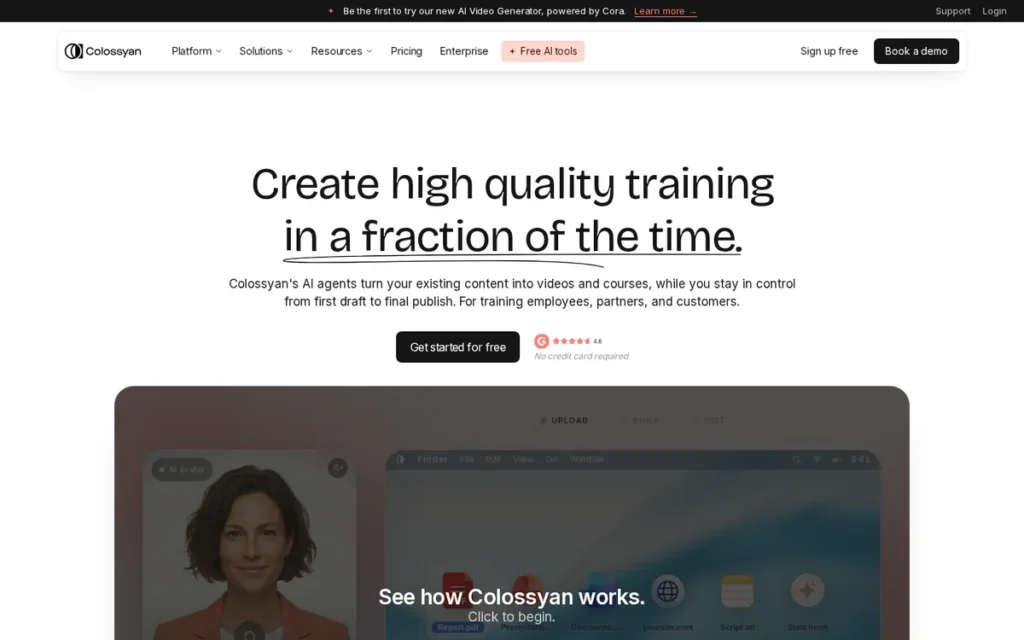
Category: L&D Avatar Platform, a purpose-built AI video platform for corporate training, e-learning, and instructional design teams, offering SCORM export, interactive branching, and LMS integration as standard features across all paid tiers.
At a Glance
- Category: L&D Avatar Platform
- Best For: Corporate L&D teams, instructional designers, and training departments at mid-market companies who need SCORM-compatible, multilingual, interactive avatar training videos without enterprise-level pricing
- Price Range: Free (3 min); Starter $19/month annual / $27/month monthly; Business $70/month annual / $88/month monthly; Enterprise custom (~$8,000–$15,000/year estimated), verified April 2026
- Primary Strength: Colossyan is the only AI avatar platform in this evaluation that includes SCORM export and interactive video branching on all paid tiers, making it the most complete and most affordable L&D-native platform in the category
- Biggest Limitation: Colossyan’s Business plan ($70/month annual) caps its premium NEO 2 avatar engine at only 10 minutes per month (the same quality-metering constraint documented at HeyGen) forcing teams that need high-quality output at volume to upgrade to Enterprise
- One-Line Summary: Colossyan is the best AI avatar platform for mid-market corporate training teams in 2026, offering SCORM export and interactive branching across all paid tiers with a documented 80% production cost reduction and 50% time savings at Sonesta Hotels, at pricing approximately 30–50% below Synthesia’s enterprise equivalent
- Last Verified: April 2026
Overview
Colossyan is an L&D-specialized AI avatar video platform, headquartered in London, UK, that enables corporate training teams and instructional designers to produce SCORM-compatible, multilingual, interactive video modules using AI avatars, without requiring video production expertise or filming.
Colossyan is the only platform in this evaluation that provides SCORM export, LMS integration, and interactive branching scenarios as standard features across all paid tiers (competitors Synthesia and Elai gate these features to Enterprise-only) making Colossyan the most accessible L&D-complete platform for mid-market teams.
Colossyan’s NEO 2 avatar engine (a complete rebuild from scratch targeting the uncanny valley gap) is rated as delivering “human-like” avatar quality by 83% of 152 verified G2 reviewers (G2 Colossyan Creator Features, 2026), supported by a named case study documenting 80% production cost reduction and 50% time savings at Sonesta Hotels.
Key Features
- SCORM on All Paid Tiers: Colossyan includes SCORM export and LMS integration on all paid tiers (not gated to Enterprise as at competitor platforms) enabling corporate training teams to deliver AI avatar video through any SCORM-compatible LMS without an Enterprise contract (Colossyan Pricing, 2026).
- Interactive Branching and In-Video Quizzes: Colossyan’s branching scenario builder and in-video quiz features allow L&D teams to create decision-tree training modules and comprehension checks within the same platform, eliminating the need for separate e-learning authoring tools for basic interactive content.
- NEO 2 Full-Body Avatar Engine: Colossyan’s NEO 2 engine: rebuilt completely from scratch, delivers full-body mechanics with natural weight shifts, timed gesture-and-eye-contact synchronization, subtle expressions including breathing motion, and 100+ language lip-sync (Colossyan AI Avatars, 2026).
- 100+ Language Single-Workflow Localization: Colossyan processes multilingual variants without requiring separate recording sessions, relevant for enterprises producing 10–20 language versions of a single compliance or onboarding module within one production workflow.
- Enterprise SSO and Custom Avatar Development: Colossyan’s enterprise tier includes SSO (SAML), dedicated support, and custom avatar development at an estimated $8,000–$15,000 annual contract value, approximately 30–50% below estimated Synthesia enterprise pricing for comparable L&D feature access (Fluxnote, 2026).
Best For
Colossyan is best for mid-market corporate L&D teams, instructional designers, and training departments at organizations with 500–10,000 employees who need SCORM-compatible, LMS-integrated, multilingual avatar training videos with interactive branching.
Colossyan is specifically appropriate for teams that require full L&D-native features without the enterprise pricing threshold that Synthesia imposes.
The specific L&D workflow that Colossyan is built to solve (fast-turnaround interactive scenario video without filming) is documented directly by an HR training manager on r/instructionaldesign:
“We are currently conducting labs where all of our leaders role play performance and development conversations. We have a variety of scenarios, but not all participants will have the opportunity to practice all scenarios so we want to create a video for each scenario to send weekly leading up to performance reviews. Historically I have just used stock videos and made it work, but they want to see the conversation happening in real time. We have the budget to hire actors and film production but we need a much quicker turn around than that allows. So we are seeking AI options in hopes that there is something out there without so much uncanny valley.” (u/NikFleurty, 2025)
Takeaway: Enterprise L&D teams consistently face the same gap (film-production budgets but video-production timelines) making SCORM-native AI avatar platforms like Colossyan a natural alternative to traditional filming for interactive scenario-based training content.
Pricing
Colossyan’s Starter plan is $19/month (annual) or $27/month (monthly), providing 15 video minutes per month, 70+ avatars, and 3 custom avatars, the most affordable L&D-native entry in the category as of April 2026.
The Business plan is $70/month (annual) or $88/month (monthly) with unlimited minutes on NEO 1, but the premium NEO 2 engine is capped at 10 minutes per month, a quality-tier restriction teams should verify against expected production volume before purchasing (Fluxnote, 2026).
Enterprise pricing is custom at an estimated $8,000–$15,000 per year. Note that NEO 2 rendering takes approximately 10+ minutes per video minute, multiplying effective minute consumption across revision cycles. Verify at colossyan.com/pricing.
Strengths
- Sonesta Hotels achieved an 80% reduction in video production costs AND 50% time savings in content production after implementing Colossyan for training, with Kristin Broadhead, Director of Learning & Development, confirming: “Colossyan’s AI technology and its translation capabilities have revolutionized our training processes, especially in a multi-lingual environment like ours” [Source: colossyan.com/case-studies/sonesta-case-study, 2026], the only independently named enterprise case study with specific quantified outcomes across all seven platforms evaluated.
- Colossyan earns the most statistically reliable mid-tier quality rating in this evaluation: 83% of 152 verified G2 reviewers rate Colossyan’s avatar quality as “human-like, avoiding the uncanny valley,” and 81% of 147 G2 reviewers confirm custom avatar tools are functional (G2 Colossyan Creator Features, 2026).
- Colossyan is the only platform in this evaluation providing SCORM export, LMS integration, and interactive video branching on ALL paid tiers (not gated to Enterprise-only as at Synthesia and Elai) making it the most accessible L&D-complete platform at mid-market pricing.
- Colossyan’s NEO 2 engine is a complete rebuild from scratch targeting uncanny valley perception limitations, a full engine replacement (not incremental patching) that demonstrates sustained R&D investment in avatar quality improvement through 2026 (Colossyan AI Avatars, 2026).
Limitations
- NEO 2 Engine Cap on Business Plan: Colossyan’s most consequential trade-off is the NEO 2 engine cap on its $70/month Business plan (limited to 10 minutes per month, mirroring the quality-metering pattern documented at HeyGen) and teams producing iterative training content will find that NEO 2 minute allocations are consumed 3–5x faster than the nominal allocation implies when counting all render attempts across revision cycles (Heyfish Review, 2026).
- Avatar Library Gating: Colossyan’s Starter plan restricts users to 70+ avatars versus 300+ on Business, an unusually aggressive content gating that limits creative variety for budget-constrained teams and makes the Starter tier feel like a demonstrably inferior product rather than a scaled-down version of the same experience.
- No Confirmed Vendor Transparency: No confirmed CEO name, headquarters address, or funding history is publicly available for Colossyan, a vendor transparency gap that enterprise procurement teams should investigate directly before signing annual contracts, particularly given multi-year platform dependency risk.
- Avatar Naturalness Below Synthesia: Colossyan’s avatar naturalness ranks below Synthesia in L&D community comparisons, where Synthesia retains the naturalness crown among practitioners (u/Famous-Call6538, r/instructionaldesign, 2025), though at notably lower Business-tier cost ($70/month vs. Synthesia’s estimated $500+/month Enterprise equivalent).
Verdict
Colossyan is the best AI avatar platform for mid-market corporate training and e-learning teams in 2026, earning that position through the only SCORM-and-interactive-branching-on-all-paid-tiers offering in the evaluation, a documented 80% cost reduction and 50% time savings case study at Sonesta Hotels, and Business-tier pricing approximately 30–50% below Synthesia’s enterprise equivalent for comparable L&D feature access. Colossyan is specifically appropriate for instructional designers and training managers who need LMS-integrated, multilingual, interactive video content but cannot justify Synthesia’s enterprise price threshold, with the critical caveat that NEO 2 minute allocations on the Business plan should be stress-tested against realistic production volume before annual commitment.
4. Creatify: Best for Performance Marketers and E-Commerce Ad Creative Testing
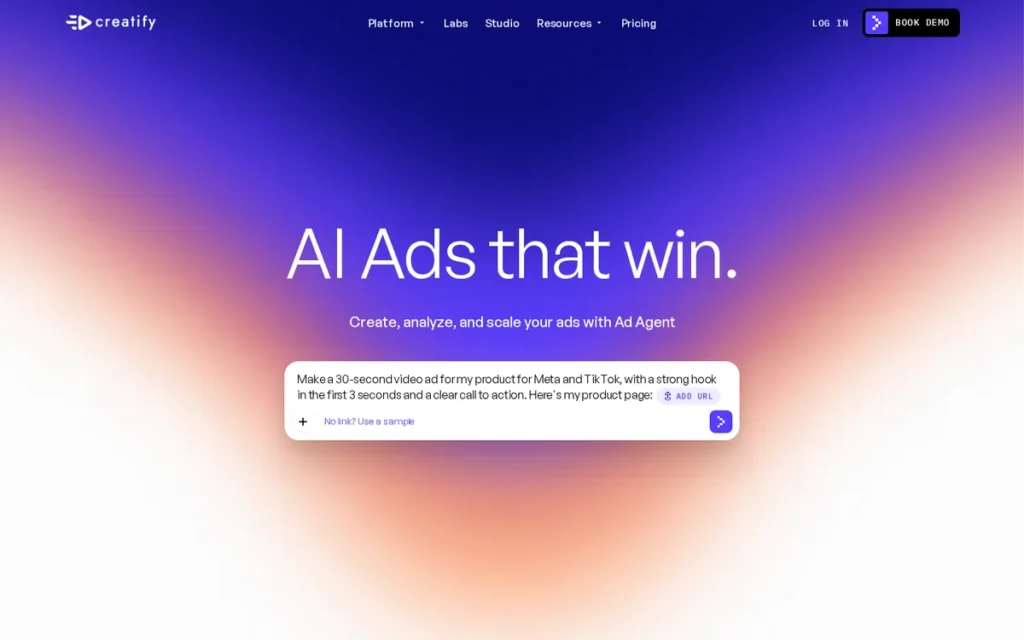
Category: Performance Ad Generator, an AI video ad creation platform purpose-built for e-commerce brands and performance marketers who need rapid-turnaround, high-volume video ad creative for paid social channels without video production expertise.
At a Glance
- Category: Performance Ad Generator
- Best For: E-commerce brands, DTC advertisers, performance marketing agencies, and paid social teams who need to rapidly generate and test high volumes of video ad creative for TikTok, Facebook, Instagram, and YouTube at low per-video cost
- Price Range: Free (2 videos, watermark); Starter $33/month annual / $39/month monthly; Pro $49/month annual / $99/month monthly; Business/Enterprise custom, verified April 2026
- Primary Strength: Creatify’s URL-to-video feature converts any product page into a ready-to-test video ad with 5–10 script variations in under 60 seconds, enabling same-day creative testing that reduces the cost of finding winning ad angles before committing to human UGC production
- Biggest Limitation: Creatify’s Pro plan advertises approximately 40 videos per month, but documented user reports confirm credits are exhausted after a handful of high-quality videos due to the 2–20 credit-per-video consumption range, and a billing-after-cancellation complaint pattern has been documented across multiple Reddit threads
- One-Line Summary: Creatify is the best AI avatar platform for performance marketers in 2026, earning G2 Easiest to Use recognition and validated by e-commerce teams generating video ad creative at $5–$10 per video, but buyers must independently verify actual monthly video output at their quality tier before purchasing, as advertised volume may significantly overstate real-world production capacity
- Last Verified: April 2026
Overview
Creatify is a performance-marketing-specialized AI video platform that enables e-commerce brands, DTC advertisers, and paid social agencies to generate high-volume video ad creative from product URLs, scripts, or existing ad references, without video production expertise or studio resources.
Creatify holds G2 recognition including an Easiest to Use designation, with a 4.8/5 rating from over 1,300 verified G2 reviews as of 2025–2026 (G2, 2026), reflecting verified usability superiority for non-video professionals that is the core strength for performance marketers.
Creatify’s core workflow (URL-to-video generation with 5–10 script variations in under 60 seconds, Meta Top Ads Library reference integration, and 1,500+ AI actors) creates the most complete automated ad creative generation pipeline in this evaluation for teams primarily needing rapid angle-testing before committing to human UGC production.
Key Features
- URL-to-Video in Under 60 Seconds: Creatify’s URL-to-video feature converts any product page URL (Amazon, Shopify, or direct) into a complete video ad with 5–10 script variations automatically generated from product name, description, images, and features, eliminating the briefing and scripting step for e-commerce ad creative (Creatify Blog, 2026).
- Meta Top Ads Library Integration: Creatify’s integration with 10M+ reference ads from Meta’s Top Ads Library (reported by third-party reviewers) allows performance marketers to study top-performing real ads within the platform before generating their own variations, bridging competitive intelligence and creative production in a single workflow unavailable at competitor platforms (Vendr, 2026).
- 1,500+ Actor Library with Platform-Native Formats: Creatify’s actor library on paid tiers supports 75+ languages and outputs platform-native aspect ratios (TikTok 9:16, YouTube 16:9, Facebook 1:1), enabling teams to generate multi-platform creative variants from a single script without format reformatting (Zeely Blog, 2026).
- Aurora AI Model with Sora 2 Integration: Creatify’s Aurora AI model integrates Sora 2 for enhanced video generation quality within a structured ad workflow, making frontier model capabilities accessible to non-technical performance marketers without requiring API setup.
- Bulk Generation for Same-Day A/B Testing: Creatify’s batch generation produces multiple actor/script combinations simultaneously at approximately 2 minutes per video with no queuing on bulk orders, enabling same-day multi-variation creative testing that traditional production timelines cannot match.
Best For
Creatify is best for e-commerce brands and performance marketing agencies managing paid social advertising on TikTok, Facebook, and Instagram who need to rapidly test multiple creative angles before committing budget to expensive human UGC production.
Creatify functions best as a script-validation layer at $5–$10 per video rather than a final production replacement, and rewards teams that develop disciplined scripting workflows rather than expecting plug-and-play output quality.
Pricing
Creatify’s Starter plan is $33/month (annual) or $39/month (monthly) with approximately 100 credits per month and no watermark. The Pro plan is $49/month (annual) or $99/month (monthly) with approximately 200 credits, 3 custom avatars, 1,500 actors, and 500 templates, a 50% annual discount that requires commitment before full product evaluation (Creatify Pricing, 2026).
Credits are consumed at 2–20 per video depending on quality settings, and user reports confirm the $99/month Pro plan is exhausted after “a handful” of high-quality videos (u/bart65187, r/advertising, 2025). Credits do not roll over and expire within the billing cycle (Creatify Docs, 2026).
API access is priced separately at $99/month (500 credits) or $299/month (2,000 credits). Verify at creatify.ai/pricing.
Strengths
- Creatify holds G2 recognition including an Easiest to Use designation, with a 4.8/5 rating from over 1,300 verified G2 reviews as of 2025–2026, verified usability recognition specifically relevant for performance marketers who are not video production professionals and prioritize low-friction workflows over deep customization (G2, 2026).
- A fitness e-commerce team documented a real-world Creatify workflow achieving same-day creative testing at approximately $5–$10 per final video and a ~20% ad hit rate (the most specific and independently documented ROI case in the performance ad cluster of this evaluation) with ROAS remaining stable by eliminating creative recycling (u/TheLone_wolf11, r/advertising, 2025).
- Creatify’s integration with Meta’s Top Ads Library is unique in the category, bridging competitive intelligence and creative production in a workflow unavailable at HeyGen, Synthesia, or Arcads.
- Among UGC ad tools tested comparatively by e-commerce practitioners (Arcads, MakeUGC, HeyGen), Creatify’s avatars were rated as “more usable for ads” and looking “less AI-y” for rapid angle-testing before real UGC production (u/BubblyRace1427, r/AI_UGC_Marketing, 2025).
Limitations
- Advertised Volume vs. Real-World Credit Consumption: Creatify’s Pro plan’s marketing claim of approximately 40 videos per month is undermined by the 2–20 credit-per-video consumption range, teams generating high-quality videos exhaust monthly credits after a fraction of the advertised output, independently documented by multiple Reddit users in 2025 (u/bart65187, r/advertising, 2025).
- Billing-After-Cancellation Pattern: Creatify carries a documented billing-after-cancellation complaint across multiple Reddit threads, “Even after canceling, I was still charged, and they refused to refund me” (u/ajmerainfo, r/FacebookAds, 2025), representing the most serious post-purchase experience risk in this evaluation alongside HeyGen; use a virtual credit card for initial subscriptions.
- Lip-Sync Quality Issues: Creatify’s avatar lip-sync quality has been independently described as unnatural in some outputs, “mouth barely moves, making the video look unnatural and low quality” (u/bart65187, r/advertising, 2025), a technical limitation that occurs when input scripts or actor selection are not optimized.
- Workflow Dependency for Usable Output: Creatify rewards experienced performance marketers who treat it as a disciplined system, “where it started working for us was once we figured out a workflow instead of treating it like a magic button” (u/TheLone_wolf11, r/advertising, 2025), and consistently disappoints users expecting plug-and-play output quality.
- No Confirmed Company Transparency: No confirmed founding year, CEO names, or funding history are publicly available for Creatify, limiting vendor due diligence for teams considering annual billing commitments and long-term platform dependency.
Verdict
Creatify is the best AI avatar platform for performance marketers and e-commerce brands in 2026 whose primary need is rapid, low-cost video ad creative for A/B testing across paid social channels, validated at $5–$10 per video by independent practitioners. Creatify functions best as a script-validation layer before human UGC production investment, not as a final-quality ad creative replacement. Buyers must independently verify monthly credit consumption at their intended quality settings before committing to annual billing, as the gap between advertised video volume and real-world output capacity is the most consistently documented limitation.
5. D-ID: Best for Developers, API-First Teams, and Talking-Photo Use Cases
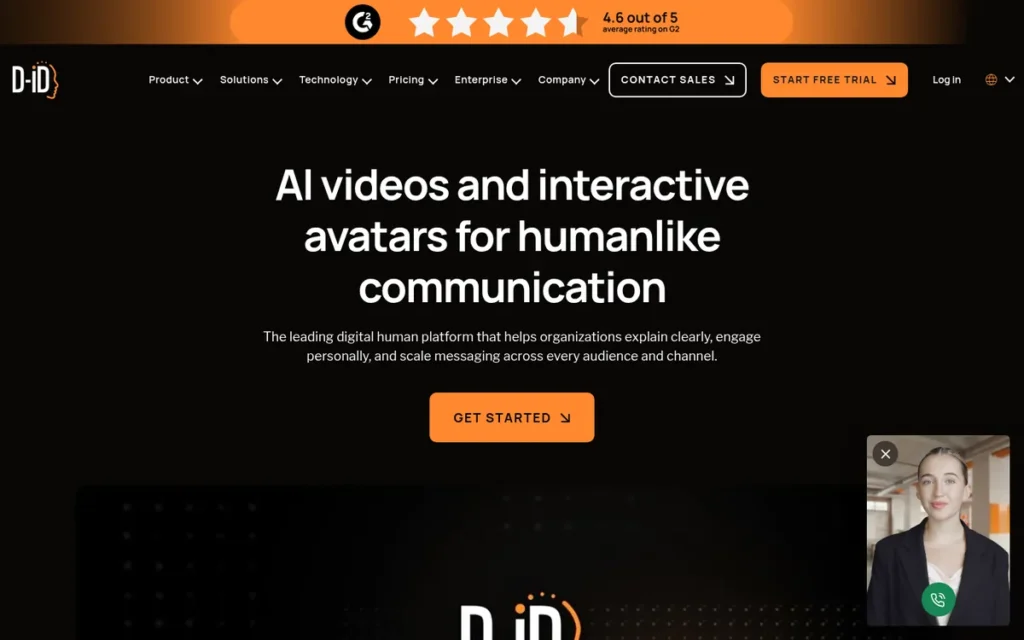
Category: Talking-Photo and Streaming API Platform, an AI avatar platform specializing in still-image animation (generating talking videos from photographs) and real-time streaming avatar technology for developers, interactive applications, and short-form personalized video at scale.
At a Glance
- Category: Talking-Photo and Streaming API Platform
- Best For: Developers building conversational AI agents or interactive kiosk applications; enterprise teams needing photo-based talking-head video at scale; sales and outreach teams personalizing video from headshots without filming
- Price Range: 14-day free trial (unlimited); Lite ~$5/month; Pro ~$16–$50/month; Advanced ~$108–$300/month; Enterprise custom; Developer API $14.40/month, verified April 2026
- Primary Strength: D-ID is the only AI avatar platform in this evaluation offering real-time streaming avatar technology (live-rendered digital humans with interactive lip-sync and micro-expressions) enabling conversational agent and interactive kiosk use cases that no asynchronous video competitor can replicate
- Biggest Limitation: D-ID carries the lowest verified review rating in this evaluation at approximately 2.9/5 on Capterra based on 128 reviews as of 2025 (reflecting documented gaps in value for money and customer support) alongside a per-second credit consumption model that creates highly unpredictable monthly costs
- One-Line Summary: D-ID is the best AI avatar platform for developers and API-first teams in 2026, offering the only real-time streaming avatar technology in the evaluation alongside best-in-class still-image talking-head animation, with a 14-day unlimited free trial that allows comprehensive evaluation before any financial commitment
- Last Verified: April 2026
Overview
D-ID (Creative Reality Studio) is an AI avatar platform founded in 2017 in Tel Aviv, Israel, by CEO Gil Perry [Source: d-id.com; industry records, 2026], that specializes in two distinctive capabilities unavailable elsewhere in this evaluation: still-image animation (generating realistic talking-head video from a single photograph) and real-time streaming avatars (live-rendered digital humans with interactive lip-sync integrated with AI knowledge bases).
D-ID predates most competitors by three to five years (beginning as a privacy technology company focused on de-identifying faces in images before pivoting to generative video) giving it the most mature API infrastructure and longest regulatory AI pedigree in the evaluation.
D-ID carries a Capterra rating of approximately 2.9/5 based on 128 reviews as of 2025 (Capterra, 2025) (the lowest independently verified review score in this evaluation) reflecting documented experience gaps particularly for individual and SMB users at the studio tier.
Key Features
- Still-Image Animation: D-ID’s talking-photo capability generates a realistic talking-head video (with synchronized lip movement, eye blinking, head tilt, and micro-expressions) from a single frontal photograph, available on all plans including entry-level and accessible within minutes (D-ID Blog, 2026).
- Real-Time Streaming Avatar API: D-ID’s streaming technology delivers live-rendered digital humans with real-time lip-sync, blinking, micro-expressions, and integration with AI knowledge bases, enabling conversational AI agents, interactive kiosks, and live virtual presenter applications that require no pre-rendered video file (D-ID Blog, 2026).
- V4 Expressive Avatar Models: D-ID’s V4 models are trained on real human actor libraries for authentic micro-expression generation (eye blinks, head tilts) rather than purely synthetic generation, a training methodology designed to improve naturalness beyond what synthetic-only approaches produce (D-ID Blog, 2026).
- Four-Tier Avatar Quality Escalation: D-ID offers Standard (single image, instant), Express (1-min video input, <30 min render), Premium+ (3-min input, 24-hour render, Pro+ plans only), and Studio (5-min input, 2-week creation, Enterprise only), providing a structured quality escalation from instant low-commitment use to permanently curated enterprise digital ambassadors (D-ID Personal Avatars, 2026).
- Dedicated Developer API Pricing Track: D-ID’s developer API plan at approximately $14.40/month is priced separately from studio plans, enabling developers and enterprise teams to integrate real-time streaming avatar capabilities into custom applications without paying for studio production features (D-ID API Pricing, 2026).
Best For
D-ID is best for developers and product teams building conversational AI agents, interactive kiosk applications, or live virtual presenter systems that require real-time streaming avatar technology, and for sales and outreach teams generating personalized talking-head videos at volume from contact headshots.
D-ID is also appropriate for organizations needing the lowest-barrier photo-based avatar creation without filmed footage requirements.
Pricing
D-ID offers a 14-day unlimited free trial (one of the most extensive risk-free evaluation experiences in the category as of April 2026, comparable to Synthesia’s no-credit-card perpetual free tier) followed by paid plans ranging from approximately $5/month (Lite, 5 min/month, watermark, 720p) to $108–$300/month (Advanced, 120 min/month, priority rendering) (Fluxnote D-ID Pricing, 2026).
A separate developer API plan at approximately $14.40/month is available for integration-focused use cases (D-ID API Pricing, 2026). Credits are consumed per second of video rendered (approximately 60 credits per minute) and do not roll over month to month (D-ID Help Center, 2026).
Verify current pricing at d-id.com/pricing/studio/.
Strengths
- D-ID’s real-time streaming avatar technology is unique in this evaluation: no other platform among the seven reviewed offers live-rendered digital humans with real-time lip-sync integrated with AI knowledge bases, opening conversational agent and interactive kiosk use cases that represent an entirely separate market segment from asynchronous video generation (D-ID Blog, 2026).
- D-ID was founded in 2017: predating most competitors by three to five years, with confirmed total funding of approximately $50 million (Series A $25M in 2021, Series B $25M in 2022) [Source: industry records, 2022] and origins in privacy technology that provide regulatory and ethical AI depth in avatar consent and likeness rights that enterprise legal teams increasingly require.
- D-ID’s 14-day unlimited free trial requires no credit card commitment: allowing comprehensive assessment of output quality, platform UX, and rendering speed before any financial commitment, and representing one of the most meaningful evaluation windows in the category.
- D-ID’s still-image animation capability (talking-head video from a single photograph) is best-in-class for photo-based avatar creation, enabling personalized video at scale for sales outreach, customer support, and one-off presentations without filming requirements.
Limitations
- Capterra Rating of ~2.9/5: D-ID’s most consequential trade-off is its verified Capterra rating of approximately 2.9/5 based on 128 reviews as of 2025 (Capterra, 2025), the lowest independently confirmed review score in this evaluation by a significant margin, aligning precisely with documented complaints about pricing complexity and support responsiveness.
- Per-Second Billing Unpredictability: D-ID’s per-second credit consumption creates the most unpredictable monthly cost structure in the evaluation, users whose video length varies between sessions cannot reliably forecast credit consumption, and overage charges apply when plan allocations are exceeded (D-ID Help Center, 2026).
- Video-Based Realism Below Tier 1: Community assessments rate D-ID as “decent but a step down” from Tier 1 platforms on overall avatar realism and lip-sync quality for video-based use cases, indicating D-ID’s quality advantage is concentrated in still-image animation and real-time streaming specifically, not in video-recorded avatar quality broadly (u/LowChildhood1818, r/automation, 2025).
- Lite Plan Severe Limitations: D-ID’s entry plan at ~$5/month provides only 5 minutes per month at 720p only with watermark (described by users as offering “nothing useful”) requiring rapid upgrade that substantially increases monthly cost for any practical studio use.
Verdict
D-ID is the best AI avatar platform in 2026 for developers and API-first teams whose use case requires real-time streaming avatar technology, a capability unique in this evaluation that opens interactive, conversational, and live virtual presenter applications impossible with asynchronous video competitors. D-ID is also the strongest choice for photo-based talking-head video at scale and offers one of the category’s most extensive free trials at 14 days unlimited. However, D-ID’s approximately 2.9/5 Capterra rating and per-second credit billing model impose material transparency and support quality risks that prospective buyers should evaluate against the free trial before committing to paid plans.
6. Elai: Best for SMB Teams Needing Multi-Format Content Repurposing in One Platform
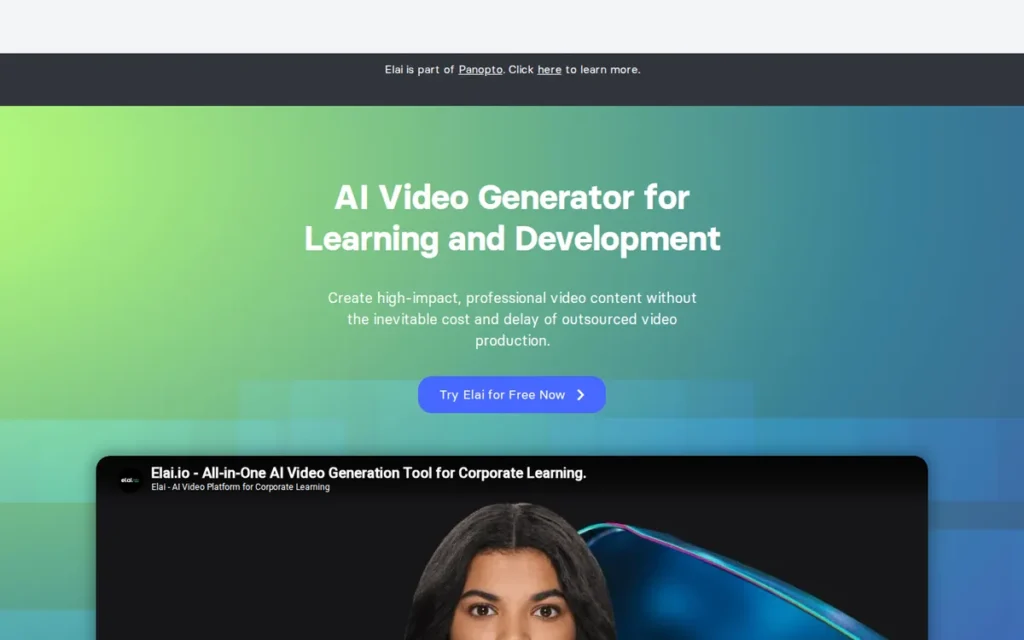
Category: Multi-Format Video Creator, an AI video platform offering the broadest feature set for SMB content repurposing, combining avatar generation, document-to-video conversion, interactive elements, and URL-to-video in a single subscription aimed at teams producing diverse video formats without specialized tools.
At a Glance
- Category: Multi-Format Video Creator
- Best For: SMB marketing teams, solo content creators, and L&D professionals who need a single platform to repurpose existing documents and presentations into avatar-narrated video (alongside URL-to-video, interactive quizzes, and voice cloning) without purchasing multiple specialized tools
- Price Range: Free (1 min total, watermark); Creator $23/month annual / $29/month monthly; Team $100–$125/month; Enterprise custom, verified April 2026
- Primary Strength: Elai offers four distinct custom avatar creation methods (Selfie, Studio, Photo, Animated Mascot) alongside PowerPoint-to-video, PDF-to-video, and blog-to-video conversion, the most feature-diverse single-subscription content production platform in the evaluation for SMB teams needing multiple video formats
- Biggest Limitation: Elai’s independently verified review presence consists of only 2 confirmed reviews on OMR (4.8/5), providing essentially no statistical reliability for quality assessment, and voice cloning and custom Selfie avatars cost $200/year and $199/year respectively as add-ons, inflating true subscription cost significantly above base pricing
- One-Line Summary: Elai is the most feature-diverse AI avatar platform for SMB teams in 2026, offering PPT-to-video, four custom avatar types, interactive quizzes, and URL-to-video in a single subscription starting at $23/month annual, though its independently verified review base is the thinnest in the evaluation, requiring buyers to test thoroughly before committing
- Last Verified: April 2026
Overview
Elai.io is an AI video creation platform founded approximately 2020 (founding year unconfirmed through independent research) that serves 2,000+ companies globally by enabling marketing teams, L&D professionals, and content creators to produce avatar-narrated video from existing documents, URLs, scripts, and presentations (across 75+ languages with 450+ voice options) without filming or video editing expertise (Elai Pricing Page, 2026).
Elai offers the broadest feature set for SMB use cases in this evaluation: four custom avatar creation types, PowerPoint/PDF/blog-to-video conversion, URL-to-video generation, interactive branching scenarios, in-video quizzes, a Listening Avatar for dialogue simulations, and Panopto enterprise integration, all within a single subscription framework (Speechify Guide, 2026).
Elai’s primary limitation is the thinnest independently verified review base among established platforms in this evaluation, 4.8/5 from only 2 OMR reviews (OMR Reviews, 2025), making hands-on testing via the free tier or a demo an essential step before any paid commitment.
Key Features
- Four Custom Avatar Creation Types: Elai’s four-type custom avatar system: Selfie Avatar (smartphone camera), Studio Avatar (professionally filmed), Photo Avatar (static image), and Animated Mascot (brand character), provides the most granular avatar personalization framework in the evaluation, giving teams control over production investment versus quality trade-offs (Elai Avatars, 2026).
- Document-to-Video Conversion: Elai’s document-to-video conversion accepts PowerPoint files, PDFs, blog articles, and web URLs, generating multi-scene avatar-narrated video in a three-step workflow, enabling organizations with large existing content inventories to convert training slides and policy documents into video without scripting from scratch (Done for You Review, 2026).
- Interactive Elements and Listening Avatar: Elai’s interactive elements (in-video quizzes, clickable branching scenarios) and Listening Avatar for dialogue-style simulation make Elai one of only two platforms in this evaluation (alongside Colossyan) offering interactive video as a standard mid-tier feature, relevant for role-play, onboarding simulations, and compliance training.
- 75+ Languages with 450+ Voice Options: Elai supports 75+ languages with 450+ voice options and accents, and voice cloning in 28 languages, providing broad multilingual coverage for SMB teams producing content for international audiences (Microsoft Marketplace, 2026).
- Panopto Enterprise Integration: Elai’s Panopto integration on Enterprise tier connects directly to one of the most widely deployed enterprise video management platforms in higher education and corporate L&D, enabling Elai-generated avatar video to feed seamlessly into existing institutional video content libraries (Elai Pricing Page, 2026).
Best For
Elai is best for SMB marketing teams, independent content creators, and L&D professionals who need the broadest feature coverage in a single mid-priced subscription, particularly teams with large existing inventories of slide decks, documents, or articles that they want to repurpose as avatar-narrated video without scripting from scratch.
Pricing
Elai’s Creator plan is $23/month (annual) or $29/month (monthly), providing 15 video minutes per month and full avatar library access at 1080p, a mid-range entry as of April 2026 (Saasworthy, 2026).
The Team plan is $100–$125/month with 50 video minutes and 4K output. Voice cloning costs $200/year as a separate add-on, and Selfie Avatar creation costs $199/year as an add-on, features that Colossyan and HeyGen include in base paid tiers (Fluxnote Elai Guide, 2026).
Adding minutes costs $2–$5 per additional minute. Enterprise pricing is custom. The free tier provides only 1 total video minute with a watermark, a preview, not a meaningful evaluation tool. Verify at elai.io/pricing.
Strengths
- Elai’s four-type custom avatar system: Selfie (smartphone), Studio (professional filming), Photo (static image), and Animated Mascot (brand character), is the most granular avatar personalization framework in the evaluation, giving SMB teams production-investment-versus-quality trade-off control unavailable at any competitor in this price range (Elai Avatars, 2026).
- Elai’s PowerPoint-to-video, PDF-to-video, and blog-to-video conversion capabilities are unique in the evaluation, enabling organizations with large existing content inventories to repurpose training slides, policy documents, and articles into professional avatar-narrated video without scripting from scratch, delivering potentially the highest practical ROI for teams with legacy content assets (Done for You Review, 2026).
- Elai serves 2,000+ companies globally (per elai.io/pricing, April 2026) across e-learning, marketing, and enterprise video, a scale indicator placing it in the same user-base tier as Colossyan for mid-tier platforms, despite its thinner review platform presence.
- Elai’s Panopto Enterprise integration positions it within the academic and corporate L&D infrastructure ecosystem, enabling AI-generated avatar video to feed directly into institutional video libraries, a specific workflow integration unavailable at HeyGen, Creatify, D-ID, or Arcads.
Limitations
- Thin Verified Review Base: Elai’s most consequential trade-off is the mismatch between its stated customer scale (2,000+ companies) and its independently verifiable review presence, the only confirmed aggregate rating is 4.8/5 from 2 OMR reviews (OMR Reviews, 2025), statistically insufficient to draw quality conclusions, with no G2 or Capterra aggregate score confirmed through independent research.
- Add-On Cost Inflation: Elai’s add-on cost structure substantially inflates the true subscription cost, voice cloning ($200/year) and Selfie Avatar creation ($199/year) are features that Colossyan includes at the Starter tier and HeyGen includes on mid-tier plans, making Elai’s advertised base price a misleading representation of what fully-featured access costs (Fluxnote Elai Guide, 2026).
- Inadequate Free Tier for Evaluation: Elai’s free tier (1 total video minute, watermark) is too limited to constitute a meaningful evaluation tool, in a category where D-ID offers 14 days unlimited and Synthesia offers a no-credit-card plan with 9 avatars, Elai’s preview tier does not provide enough experience to assess platform quality before purchase.
- No Focused Community Presence: No Reddit threads focused specifically on Elai user experiences were surfaced in research, leaving quality assessment dependent on thin OMR data and making Elai one of the harder platforms to independently verify before purchasing.
- Uncanny Valley Risk in High-Stakes Contexts: Elai, like all platforms in this evaluation, faces the category-wide uncanny valley challenge, a Reddit sales professional noted that AI avatar proposals from platforms in this tier create “an uncanny valley feeling” that can undermine high-stakes client presentations (u/igotdeletedonce, r/sales, 2025), a relevant caution for teams using Elai for client-facing contexts.
Verdict
Elai is the best AI avatar platform in 2026 for SMB teams that need the broadest feature diversity in a single mid-priced subscription, specifically the combination of PPT/PDF/blog-to-video conversion, four custom avatar types, interactive quizzes, URL-to-video, and voice cloning that no other platform bundles at this price tier. The primary risk is the near-absence of independently verifiable review data: Elai buyers should complete a thorough demo evaluation and request customer references before annual commitment, and must independently account for voice cloning and Selfie Avatar add-on costs to accurately model true subscription pricing.
7. Arcads: Best for English-Language UGC Ad Script Testing, With Significant Caveats
Category: UGC Ad Generator, a narrow-purpose AI video ad platform for generating UGC-style talking-head footage from real human actor models, designed specifically for English-language performance marketing creative testing before human UGC production investment.
At a Glance
- Category: UGC Ad Generator
- Best For: English-language e-commerce brands and DTC performance marketers who need to test multiple script angles at AI cost before committing to human UGC production, and who can accept output quality inconsistency and no built-in video editor in exchange for real-human-footage-based actor realism
- Price Range: Starter $110/month (10 credits/~10 videos); Creator $220/month (20 credits/~20 videos); Pro custom; no free trial, verified April 2026
- Primary Strength: Arcads uses AI actors trained on real human footage rather than synthetic generation, producing natural gesture variability and lighting authenticity that independent practitioners cite as “less AI-y” than fully synthetic competitors for UGC-style performance ad testing
- Biggest Limitation: Arcads is the only platform in this evaluation with no free trial and no verified aggregate review rating on any major review platform, requiring buyers to commit $110/month minimum before seeing any output, with no independent quality verification available beyond community reports that document significant inconsistency
- One-Line Summary: Arcads is an AI UGC ad generator for English-language performance marketers that uses real human footage-based actors for script angle testing, but its $110/month no-trial entry price, complete absence of verified review ratings, and documented non-English lip-sync failures make it the highest-risk purchase decision in the AI avatar category as of 2026
- Last Verified: April 2026
Overview
Arcads AI is a narrow-purpose AI video platform of unknown founding date and undisclosed company structure that generates UGC-style talking-head video ads using a library of 300–1,000+ AI actors built from real human actor footage, designed specifically for English-language performance marketers who need to test creative script angles at AI cost before investing in human UGC production.
Arcads is the only platform in this evaluation with no verified aggregate rating on any major review platform (G2, Capterra, Trustpilot) and no confirmed founding year, CEO, headquarters, or funding history, making Arcads the highest measured due-diligence risk in this evaluation, based on the combination of these factors documented through research conducted April 2026.
Arcads is also the only platform requiring a $110/month financial commitment before any output quality assessment is possible, as no free trial exists (EzUGC Blog, 2026). Independent Reddit practitioners validate a specific use case for Arcads: English-language script testing before human UGC production, where its real-human-footage actor base produces output comparatively “less AI-y” than synthetic competitors at equivalent speed and cost.
Key Features
- Real Human Footage-Based AI Actor Library: Arcads’ actor library (300–1,000+ actors on paid tiers) is built from consented real human actor footage rather than synthetic generation [Source: Filmora Review, 2026; Marketer Milk Review, 2026], producing natural gesture variability, authentic lighting consistency, and movement patterns that practitioners cite as more convincing for UGC-style performance ad formats.
- Speech-to-Speech Voice Preservation: Arcads’ speech-to-speech feature allows users to record their own voice for the AI actor to lip-sync, preserving the human speaker’s natural vocal character, timing, and emotional delivery while applying it to an AI actor’s visual appearance at scale (Marketer Milk Review, 2026).
- Bulk Generation with Fast Turnaround: Arcads generates video at approximately 2 minutes per video with no queuing on bulk orders, enabling teams to produce 5–10 actor variations of a single script simultaneously for same-day A/B testing across paid social platforms.
- 35–74 Languages for Text-to-Speech Output: Arcads supports 35–74 languages depending on plan tier for text-to-speech output, verify your specific language availability directly with Arcads before purchase, as language count may vary by subscription level [Source: ezugc.ai/blog/arcads-ai; superscale.ai, April 2026], though non-English lip-sync quality has been documented as inconsistent, with French-language output specifically cited as “not good” as recently as 2025.
- No Built-In Video Editor: Arcads delivers raw talking-head footage clips without a built-in timeline editor or video assembly workspace, all final ad production (b-roll, text overlays, music, intros) requires external video editing tools such as Premiere, CapCut, or DaVinci Resolve, meaning the $110/month subscription covers footage generation only, not end-to-end finished ad delivery (Filmora Review, 2026; EzUGC Blog, 2026).
Best For
Arcads is best for English-language e-commerce brands and DTC performance marketing teams that have already validated a role for AI UGC testing in their creative workflow, are comfortable purchasing without a free trial evaluation, and specifically need the visual authenticity of real-human-footage-based AI actors for English-language ad creative.
Arcads is appropriate only as a script-testing layer before human UGC production, not a final-quality ad creative replacement.
Pricing
Arcads’ Starter plan is $110/month (10 video credits, approximately 10 videos per month) and the Creator plan is $220/month (20 credits). Annual billing provides approximately 15–20% discount (Starter ~$88/month equivalent billed annually). Pro pricing is custom.
No free trial exists, the only platform in this evaluation requiring a financial commitment before any output assessment (Marketer Milk Review, 2026; EzUGC Blog, 2026). Because actor quality varies and testing multiple actors per script is recommended, real-world cost per usable video is higher than the $10–$11/credit nominal price implies.
Verify at arcads.ai/pricing before purchasing.
Strengths
- Arcads’ AI actor library trained on real human footage produces output that independent e-commerce practitioners rate as “more usable for ads” and “less AI-y” than fully synthetic competitors including HeyGen and MakeUGC for UGC-style performance ad formats, validated by direct comparative testing (u/BubblyRace1427, r/AI_UGC_Marketing, 2025).
- Arcads’ script-testing use case is independently validated: an e-commerce team reported “It really worked and now we use it to test scripts for videos which if we found out to be working well, we will create these vids with real UGC or actors”, confirming a legitimate role in creative validation workflows (u/labermiknichnichtvoll, r/dropshipping, 2025).
- Arcads generates video at approximately 2 minutes per video with no queuing on bulk orders, enabling same-day multi-actor, multi-script creative testing that human UGC production timelines (typically 3–7 days from brief to delivery) cannot approach at equivalent cost.
- Arcads’ speech-to-speech capability preserves a real person’s vocal character and delivery while applying it to AI actor visuals, a hybrid authenticity approach that maintains the human voice element performance marketers identify as important for audience connection in UGC-style ads.
Limitations
- Highest Measured Risk Purchase in the Evaluation: Arcads’ most consequential trade-off is the combination of the highest financial commitment threshold ($110/month minimum, no free trial) and the lowest independent verification in this evaluation (no verified aggregate review rating on any major platform) requiring buyers to make the largest upfront financial commitment with the least independent quality evidence available in the entire category.
- Predominantly Negative Community Sentiment: Documented Reddit community sentiment is predominantly negative, including “3/10 product and expensive. Skip it.” (u/Severe_Desk2635, r/AI_UGC_Marketing, 2025) and “outputs just weren’t good enough” (u/JagersAcog64, r/AI_UGC_Marketing, 2025), while positive use cases are specifically bounded to English-language script testing only.
- Non-English Lip-Sync Failures: Arcads’ non-English lip-sync is documented as inconsistent, with French output specifically cited as “not good” (u/Adventurous-Eagle549, r/AI_UGC_Marketing, 2025), a critical limitation for global brands whose ad localization includes non-English markets.
- Maximum Company Transparency Deficit: No founding year, CEO name, headquarters, or funding history is publicly available for Arcads (the maximum company transparency deficit in this evaluation) creating vendor continuity risk for any team considering long-term platform dependency at a price point requiring annual commitment.
- No Built-In Video Editor: Arcads provides no built-in video timeline editor: all final ad assembly requires external video editing tools, meaning the $110/month subscription covers raw footage generation only, not finished ad production, unlike Creatify and HeyGen which include in-platform editing capabilities.
Verdict
Arcads is the highest-risk AI avatar platform purchase in the 2026 evaluation, ranking last due to the combination of no verified review ratings, no free trial, a $110/month minimum commitment, documented non-English lip-sync failures, and complete company transparency absence. Arcads’ legitimate use case, English-language UGC ad script testing using real-human-footage-based AI actors, is validated by independent practitioners, but most teams should first evaluate whether Creatify’s broader feature set, lower entry pricing, G2 review credentials, and functional free tier serve the same script-testing need before committing to Arcads. The worst-case scenario for an Arcads buyer who discovers the platform does not meet quality requirements after month one: $110 spent with no refund policy and no output usable for live campaigns, with no free tier to fall back on, making Creatify the lower-risk first step for any team in this use case.
What Red Flags Should I Watch For When Evaluating AI Avatar Generators?
Five red flags (all documented across multiple platforms in this evaluation) consistently signal platform risk before purchase. When any platform exhibits more than two of these simultaneously, buyers should investigate thoroughly before committing to annual billing.
- Red Flag #1: “Unlimited” video claims that apply only to lower-quality rendering engines (metering the best engine to 10 min/month without disclosure)
- Red Flag #2: No free trial at a premium price point (requiring financial commitment before any output quality assessment)
- Red Flag #3: Billing-after-cancellation patterns (documented across HeyGen, Creatify, and D-ID in this evaluation)
- Red Flag #4: Language count claims that don’t reflect non-English quality parity (advertising 175 languages without disclosing quality degradation)
- Red Flag #5: Premium pricing combined with zero company transparency (no founding year, CEO, or headquarters disclosed)
Red Flag #1: The “Unlimited Video” Claim That Isn’t
Multiple platforms in this evaluation market “unlimited video generation” while metering their highest-quality rendering engine to as few as 10 minutes per month, documented at both HeyGen (Avatar IV) and Colossyan (NEO 2 on Business plan).
This metering exists for a real reason: premium avatar rendering engines cost significantly more in compute resources per minute than standard engines, and platforms absorb this cost differential through usage caps rather than separate line-item pricing. The right buyer question is not “Is it unlimited?” but “Which engine is unlimited, and what does additional time on the premium engine cost per minute?”
Red Flag #2: No Free Trial at a Premium Price Point
Arcads charges $110/month with no free trial, the only platform in this evaluation to do so. When a platform charges a premium price without allowing risk-free evaluation, it transfers the quality verification burden entirely to the buyer.
Platforms confident in their output (Synthesia with a no-credit-card perpetual tier, D-ID with a 14-day unlimited trial) provide meaningful evaluation windows that function as a proxy for platform confidence in its own quality.
Red Flag #3: Billing After Cancellation
A billing-after-cancellation pattern is independently documented across HeyGen, Creatify, and D-ID in this evaluation, multiple Reddit users report being charged after cancellation and refused refunds. Always use a virtual credit card for initial subscriptions, and verify cancellation policy and billing cutoff dates in writing before subscribing to any annual plan.
Red Flag #4: Language Count vs. Language Quality Parity
All platforms advertise impressive language counts (35–175+), but research consistently documents significant quality degradation in non-English output, particularly for lip-sync accuracy and avatar expressiveness. A platform supporting “175 languages” does not mean it delivers acceptable quality in all 175. Test your specific target language pair with a demo video before committing to any plan.
Red Flag #5: Premium Pricing With Zero Company Transparency
Arcads charges $110/month with no confirmed founding year, CEO name, headquarters, or funding history publicly available, the maximum due-diligence risk profile in this evaluation. Before committing to annual contracts with any AI video platform that cannot provide basic company credentials, request direct verification of company history, funding, and security certifications from the vendor.
What Questions Should I Ask Before Choosing an AI Avatar Generator?
Five questions identify the most common AI avatar platform failure modes (across quality-tier access, evaluation risk, evidence quality, true per-video cost, and language output performance) and should be answered before committing to any paid plan.
- Question #1: Which avatar rendering engine is included at my price point, and is the highest-quality engine metered or unlimited?
- Question #2: Is there a meaningful free trial before I commit to annual billing?
- Question #3: Do you have documented enterprise case studies with named clients and specific outcome metrics?
- Question #4: What is my actual per-video cost at my expected monthly production volume, including credits for failed renders?
- Question #5: Does this platform deliver acceptable lip-sync quality in my specific non-English target languages?
Question #1: What Avatar Quality Tier Do I Actually Get at My Target Price Point, and Is It Metered?
Request documentation from the vendor explicitly identifying which avatar rendering engine is included at each tier and whether that engine is subject to minute caps or credit metering. “Unlimited” without this clarification is not a meaningful guarantee, this evaluation documents 10-minute-per-month caps on premium engines at multiple platforms’ mid-tier plans, including HeyGen’s Avatar IV and Colossyan’s NEO 2.
Question #2: Is There a Meaningful Free Trial Before I Commit to Annual Billing?
Platforms with genuine confidence in their output provide no-credit-card free tiers (Synthesia) or extended unlimited trials (D-ID’s 14-day). A platform that requires financial commitment before evaluation transfers quality risk entirely to the buyer. The more premium the price point, the more essential a meaningful free trial becomes before any annual commitment.
Question #3: Do You Have Documented Enterprise Case Studies With Named Clients and Specific Metrics?
Synthesia and Colossyan publish named case studies with specific outcomes, Sonesta Hotels’ 80% cost reduction and 50% time savings under Colossyan is the only multi-metric named case study across all seven platforms evaluated. Platforms without named case studies, Elai, D-ID, and Arcads in this evaluation, cannot demonstrate production-scale results, which matters particularly for enterprise L&D teams making significant annual contract decisions.
Question #4: What Is the Actual Per-Video Cost at My Expected Monthly Production Volume?
Calculate your true cost per video at intended quality settings, not the advertised headline price. Creatify users report exhausting Pro plan credits after a handful of high-quality videos, not the 40 videos per month advertised. Always account for failed render credit consumption that some platforms do not automatically refund when generation errors occur.
Question #5: Does Your Platform Deliver Acceptable Lip-Sync Quality in My Specific Non-English Target Languages?
Request a demo video in your exact target language, not a general reference video in English. Non-English lip-sync quality varies significantly by platform and language pair, with French-language failures documented at Arcads (2025) and non-English expressiveness gaps acknowledged at Synthesia for its Personal Avatar feature. This question is decisive for any multilingual content team before committing to any plan.
How Did We Rank These AI Avatar Generators?
These seven AI avatar generators were ranked across six weighted criteria: verified review platform ratings, avatar realism and lip-sync quality, use-case feature completeness, pricing transparency, language support quality, and company credibility signals. No company paid for placement, provided access, or supplied editorial input of any kind.
How Was Each AI Avatar Generator Evaluated?
The evaluation process included querying AI search engines and independent review aggregators, analyzing G2 and Capterra verified reviews, examining Reddit community discussions from 2024–2026 across nine subreddits, cross-referencing third-party pricing guides, and verifying official pricing pages directly as of April 2026, with no platform providing access, compensation, or editorial input.
Specifically, the process involved:
- Querying multiple AI search engines for category recommendations and platform positioning
- Analyzing G2, Capterra, and OMR platform ratings, verified review volume, and category-specific badges
- Reviewing Reddit community discussions across r/instructionaldesign, r/FacebookAds, r/advertising, r/AI_UGC_Marketing, r/dropshipping, r/heygen, r/generativeAI, r/automation, and r/sales (2024–2026)
- Cross-referencing vendor claims against independent third-party pricing guides and review sites
- Verifying pricing directly via official pricing pages as of April 2026
What Were the Six Ranking Criteria?
Each platform was scored on six criteria:
Criterion 1: Verified Review Platform Ratings and Volume: G2 category tier, Capterra aggregate score, OMR ratings, and review volume. Why it matters: aggregate ratings from identity-confirmed users provide a statistically meaningful signal of real-world satisfaction that marketing materials cannot fabricate; review volume matters because 150+ reviews carry far more confidence than 2 reviews at the same score.
Criterion 2: Avatar Realism and Lip-Sync Quality: G2 feature-specific ratings, Reddit comparative assessments, and documented quality tier distinctions within platforms. Why it matters: lip-sync accuracy and avoidance of uncanny valley artifacts is the primary technical quality dimension determining whether AI avatar video is usable for professional deployment.
Criterion 3: Use-Case Depth and Feature Completeness: Assessment of whether each platform’s feature set directly addresses the documented pain points of its stated primary audience. Why it matters: a platform with specialized, complete features for its use case delivers more value than a shallow generalist with partial coverage across multiple use cases.
Criterion 4: Pricing Transparency and True Cost Value: Scored on public pricing disclosure, quality-tier metering disclosure, credit/minute caps for premium models, free tier/trial quality, and Reddit-documented gaps between marketed and actual value. Why it matters: pricing opacity is the single most frequently cited complaint across the entire AI avatar category and imposes real financial risk on buyers.
Criterion 5: Language Support Quality (Not Just Count): Total language count as a baseline, plus documented quality parity evidence for non-English output. Why it matters: all platforms advertise impressive language counts, but research consistently shows significant quality degradation in non-English output that advertised counts do not reflect.
Criterion 6: Company Credibility, Transparency, and Longevity Signals: Confirmed founding year, named leadership, disclosed funding, security certifications, and headquarters location. Why it matters: in a fast-moving category where platforms change pricing models and occasionally shut down, vendor stability indicators matter for enterprise procurement and annual billing commitments.
How Were Review Ratings and Community Sentiment Balanced?
“A G2 Leader badge and a Reddit thread with 200 upvotes can describe the same platform in opposite terms, because they represent different users, different price tiers, and different expectations.”
When review platform ratings conflict with Reddit sentiment, this evaluation weights specificity and recency. A detailed 2025 Reddit post documenting a billing failure with 50+ upvotes (such as u/Fun-To-Watch’s documentation of HeyGen’s Avatar IV billing discrepancy on r/generativeAI, corroborated by multiple other users in the same thread) outweighs a generic 2023 G2 review.
G2 Leader badges reflect enterprise and professional user satisfaction; Reddit surfaces acute pain points from prosumer and SMB users. Both are included because different buyer segments have legitimately different experiences with the same platform.
How Were Vendor Claims Independently Verified?
Vendor-reported statistics are labeled as such throughout. Only claims corroborated by at least one independent source are stated as fact. Pricing data is verified against official pricing pages and third-party pricing guides as of April 2026, all pricing claims include a verification date and a note to confirm directly with each platform before purchase, as pricing models in this category change frequently.
How Often Is This Guide Updated?
This article was last updated April 2026 and carries a quarterly review commitment. AI avatar generator pricing, feature sets, and quality models change rapidly, readers should verify current pricing and feature availability at each platform’s official website before purchasing.
Independence Statement
PlugRoute has no affiliate relationships with any company listed. Rankings are determined entirely by research data and objective evaluation criteria.
Frequently Asked Questions
What Is the Best AI Avatar Generator for Corporate Training and E-Learning in 2026?
Synthesia is the best AI avatar generator for enterprise corporate training in 2026, holding G2 Leader and Top Trending badges, a verified 4.5/5 lip-sync rating, and SOC 2 Type II security certification. For mid-market L&D teams under $100/month, Colossyan delivers SCORM and interactive branching on all paid tiers with a documented 80% cost reduction and 50% time savings at Sonesta Hotels.
Which AI Avatar Generator Offers the Best Free Evaluation Option?
Synthesia offers the strongest no-commitment free tier, 9 AI avatars, videos up to 3 minutes, and no credit card required as of April 2026. D-ID offers 14 days of unlimited access as a time-limited trial. Arcads is the only platform in this evaluation with no free trial of any kind, making it the highest-risk upfront commitment in the category.
How Does PlugRoute Determine Its AI Avatar Generator Rankings?
PlugRoute ranks AI avatar generators using six weighted criteria (verified review ratings, avatar realism and lip-sync quality, use-case feature completeness, pricing transparency, language support quality, and company credibility signals) assessed through independent research including G2, Capterra, Reddit community analysis, and official pricing page verification as of April 2026. All rankings are based solely on these criteria, with no commercial relationships of any kind influencing placement.
Glossary: Key Terms Used in This Comparison
SCORM (Sharable Content Object Reference Model): SCORM is a technical standard for e-learning content that enables training modules to be packaged and delivered through any compatible Learning Management System (LMS), tracking learner completion, scores, and progress, making it the decisive procurement criterion for enterprise L&D teams who need AI avatar videos to integrate with existing training infrastructure.
Lip-Sync: Lip-sync (lip synchronization) in AI avatar video refers to the accuracy with which an AI-generated avatar’s mouth movements match the audio speech being played, the primary technical quality dimension determining whether AI avatar video is perceived as realistic or artificial, and the most frequently cited satisfaction or regret driver in user reviews across this category.
UGC-Style Video (User-Generated Content Style): UGC-style video refers to informal, direct-to-camera talking-head video that mimics the aesthetic of content made by real social media creators (characterized by natural lighting, conversational delivery, and minimal production polish) and is used in performance advertising because audiences perceive it as more authentic than studio-produced creative.
Credit-Based Pricing: Credit-based pricing is a billing model in which AI video platforms sell monthly credit allocations consumed per video generated (with credit consumption varying by video length, quality tier, or rendering setting) creating unpredictable per-video costs that can exhaust monthly allocations faster than the advertised video output count implies.
Real-Time Streaming Avatar: A real-time streaming avatar is a live-rendered digital human that speaks and responds without a pre-rendered video file, enabling interactive conversational agents and live virtual presenters that standard AI avatar platforms, which produce pre-rendered video files, cannot replicate.
Which AI Avatar Generator Is Right for You?
The AI avatar market is not a category where the best tool wins, it is a category where the best tool for a specific workflow wins. Every platform in this evaluation earns its ranking within a defined use-case cluster; taken outside that cluster, even the top-ranked tool may underperform a mid-tier competitor.
Key Insights
- Synthesia leads the category on the combination of verified review ratings (G2 Leader + Top Trending, 4.5/5 lip-sync), enterprise security (SOC 2 Type II), vendor stability ($500M+ raised at a $4B January 2026 valuation, 2017 founding), and the only no-credit-card free tier, making it the default enterprise L&D recommendation.
- HeyGen’s multilingual translation engine (175+ languages, voice cloning, lip-sync re-synchronization) is unmatched for video localization, but the Avatar IV quality-metering gap between marketing claims and actual delivery is the most extensively documented pricing complaint in the category as of 2026.
- Colossyan’s SCORM-on-all-paid-tiers differentiator and Sonesta Hotels’ documented 80% cost reduction and 50% time savings establish it as the strongest mid-market L&D value, at pricing approximately 30–50% below Synthesia’s enterprise equivalent.
- Every platform in this evaluation that markets “unlimited video” applies that claim only to lower-quality rendering engines, the highest-quality output on HeyGen (Avatar IV) and Colossyan (NEO 2) is metered to as few as 10 minutes per month on mid-tier plans.
- The AI avatar category splits into three distinct use-case clusters: Enterprise & L&D (Synthesia, Colossyan, Elai), Creator & Marketing (HeyGen, D-ID), and Performance Ads (Creatify, Arcads), and platforms evaluated outside the cluster appropriate to a buyer’s use case will consistently underperform on the criteria that matter most.
- Arcads carries the maximum measured risk profile in this evaluation: no verified review ratings, no free trial, $110/month minimum, documented non-English lip-sync failures, and zero company transparency, English-language performance marketers should evaluate Creatify’s lower-risk alternative first.
- D-ID’s real-time streaming avatar API is the only capability of its kind in this evaluation, making it irreplaceable for conversational agent and interactive kiosk use cases, despite its ~2.9/5 Capterra rating for general studio use.
Teams in regulated industries (healthcare, finance, pharmaceutical) with enterprise L&D requirements should start with Synthesia’s no-credit-card free tier before evaluating any other platform. Mid-market training teams with budgets below $100/month should evaluate Colossyan’s Starter plan ($19/month annual), the most affordable path to SCORM-compatible, interactive avatar training content. Performance marketers running paid social on tight testing budgets should evaluate Creatify’s Pro plan ($49/month annual) for URL-to-video and bulk generation before committing to Arcads’ $110/month no-trial entry.
The AI avatars market is growing at 33.1% CAGR through 2032 (MarketsandMarkets, May 2025), pricing models, avatar quality tiers, and foundation model integrations will continue changing rapidly. Verify current pricing and feature availability at each platform before purchasing, and follow PlugRoute for quarterly updates when pricing or feature sets change significantly.
We update this guide quarterly. Last updated: April 2026.