10to8 (Sign In Scheduling) is the best overall appointment reminder software for solo practitioners and SMBs, delivering free multi-channel reminders with HIPAA capability. DoctorConnect leads for compliance-critical healthcare practices. NexHealth is the top choice for EHR-integrated dental and medical practices. No single tool wins every dimension: price, compliance, and channel breadth require different solutions.
Healthcare no-show rates range from 10% to 30% by specialty. A practice seeing 30 patients daily at a 20% no-show rate loses $900 per day in recoverable revenue at $150 per visit. Independent research puts realistic multi-channel reminder reductions at 20–50% (Guideflow, 2026), the channel you choose matters as much as the platform you buy.
PlugRoute has no affiliate relationships with any company listed, rankings are determined entirely by research data and objective evaluation criteria.
SMS consistently outperforms email for time-sensitive appointment reminders. Documented email delivery failures in the category’s most widely recognized platform make channel selection as important as software selection.
TL;DR: Top Picks at a Glance
- 10to8 (Sign In Scheduling): Best free multi-channel option; SMS, email, and voice reminders with HIPAA capability at zero cost for up to 100 appointments per month
- DoctorConnect: Best for healthcare practices requiring a vendor-claimed 30-year compliance record, voice reminders, and broad legacy EHR compatibility
- NexHealth: Best for dental and medical practices on modern cloud EHR systems needing real-time confirmation writebacks to the clinical record
- Acuity Scheduling: Best all-in-one for service businesses needing booking, payments, and HIPAA at a publicly disclosed price ($49/month annual)
What Are the 3 Categories of Appointment Reminder Software?
Appointment reminder tools fall into three distinct categories that determine which evaluation criteria matter most for your specific situation.
Reminder-First Overlays layer automated SMS and email outreach on top of your existing calendar without replacing it. This comparison includes one:
- GoReminders
All-in-One Schedulers combine booking, reminders, and payments in a single platform. This comparison includes three:
- 10to8 (Sign In Scheduling)
- Acuity Scheduling
- Calendly
Healthcare Patient Engagement Platforms are purpose-built for clinical workflows with EHR integration, HIPAA compliance, and recall automation. This comparison includes three:
- NexHealth
- DoctorConnect
- NextGen Office
Your category determines your decision framework. Non-healthcare SMBs can evaluate all three categories on price and ease of setup. Healthcare practices must filter first by documented HIPAA compliance before comparing anything else.
The deeper your EHR integration, the greater your integration brittleness risk. Tools with no EHR integration carry zero brittleness risk but provide zero clinical workflow automation. This tradeoff between depth and resilience is a core decision for every healthcare buyer, and one that no tool in this comparison fully eliminates.
How Do the Top 7 Appointment Reminder Tools Compare?
| Rank | Company | Category | Best For | One-Line Summary | Key Capabilities | Primary Strength | Key Limitation |
|---|---|---|---|---|---|---|---|
| 1 | 10to8 (Sign In Scheduling) | All-in-One Scheduler | Solo practitioners and SMBs needing free HIPAA multi-channel reminders | 10to8 is the best-balanced, lowest-cost multi-channel appointment reminder solution of 2026 for solo practitioners | SMS + email + voice; two-way messaging; HIPAA-capable config; Google/Outlook/Zoom sync; 100 appts/month free tier | Only platform combining all three channels, two-way messaging, HIPAA capability, and a 100-appointment/month free tier simultaneously | Ongoing rebrand from “10to8” to “Sign In Scheduling” creates brand recognition gaps and support continuity confusion during onboarding |
| 2 | DoctorConnect | Healthcare Reminder Specialist | Compliance-critical medical, dental, and behavioral health practices with legacy EHR systems | DoctorConnect is the most operationally tenured healthcare reminder platform of 2026, combining a vendor-claimed 30-year HIPAA record with 150+ stated EHR integrations | SMS + email + voice; two-way secure messaging; recall automation; 150+ EHR/PMS integrations (vendor-stated) | Longest claimed compliance track record in this comparison; 30 years of healthcare-exclusive operation (vendor-stated, not independently audited) | Pricing not publicly disclosed; contact-sales required; review volume on third-party platforms not independently confirmed |
| 3 | NexHealth | Healthcare Patient Engagement Platform | Dental and medical practices on modern cloud EHR/PMS systems needing automated confirmation sync | NexHealth is among the most widely adopted modern patient engagement platforms for dental and medical practices, serving a vendor-reported 10,000+ practices | SMS + email; two-way HIPAA texting; EHR writeback on confirmation; recall automation; family messaging | Real-time EHR confirmation writeback eliminates the manual front-desk step when patients respond to reminders | Pricing not publicly disclosed; no voice reminders; integration dependency risk if EHR vendor restricts API access |
| 4 | NextGen Office | EHR-Embedded Reminder System | Practices purchasing the full NextGen EHR and practice management ecosystem only | NextGen Office includes SMS, email, and voice reminders as a native EHR component; appropriate only for practices buying the full NextGen stack at ~$299–$549/provider/month | SMS + email + voice; IVR; self-scheduling; chatbot; ONC-certified HIPAA; recall; wait-list automation | Native EHR embedding; no sync gap, no third-party API dependency, reminder data and clinical records share one database | Near-unanimous physician community criticism of the UI; highest cost in this comparison at ~$299–$549/provider/month |
| 5 | Acuity Scheduling | All-in-One Service Business Scheduler | Service businesses needing booking, payments, intake, and HIPAA at a publicly disclosed price | Acuity Scheduling is the best all-in-one booking and reminder platform of 2026 for service businesses needing integrated payments and HIPAA at a transparent price point | SMS + email reminders; Stripe/Square/PayPal payments; intake forms; HIPAA on Powerhouse tier ($49/month annual); 7-day trial | HIPAA compliance at a publicly disclosed price; confirmed by five independent sources including hipaatimes.com (May 2026) | No voice reminders; bulk cancellation of recurring appointments unavailable as of May 2026; no EHR integration |
| 6 | GoReminders | Reminder-First Overlay | Non-healthcare SMBs with an existing calendar workflow needing reminder automation only | GoReminders is the easiest-to-implement appointment reminder tool of 2026 for non-healthcare small businesses | SMS + email; two-way messaging (add-on); recurring appointment support; customizable templates; multi-calendar sync | GetApp 4.7/5 from 265 reviews and G2 4.8/5 from 290 reviews (both confirmed, May 2026); strongest verified review credentials among reminder-focused tools | No voice reminders; no confirmed HIPAA documentation; pricing not fully publicly disclosed |
| 7 | Calendly | Meeting Scheduler | Non-healthcare enterprise and business teams; not a primary no-show reduction tool | Calendly is the most recognized meeting scheduling platform for enterprise teams in 2026, but community-documented email delivery failures and billing misconduct make it a poor primary no-show reduction tool | SMS + email via Workflows (paid tiers only); 100+ native integrations; enterprise routing; AI lead qualification | 100+ native integrations covering Google, Outlook, Zoom, Salesforce, and major ATS platforms; broadest enterprise integration ecosystem in this comparison | Community-documented recurring email confirmation delivery failures and multiple verified post-cancellation unauthorized billing reports |
Which Appointment Reminder Tool Should I Choose for My Use Case?
| Your #1 Priority | Recommended Tool | Why | Acceptable Alternative |
|---|---|---|---|
| Free plan with all three reminder channels and HIPAA capability | 10to8 (Sign In Scheduling) | Only tool combining 100 appts/month free, SMS + email + voice, two-way messaging, and documented HIPAA-capable configuration at zero cost | None matches all four criteria simultaneously at no cost |
| 30-year compliance record, voice reminders, and legacy EHR coverage | DoctorConnect | Longest vendor-claimed HIPAA track record (1992–2026); all three channels; 150+ stated EHR integrations | NexHealth (for modern cloud EHR) |
| Real-time EHR confirmation writeback for dental or medical practice | NexHealth | Bidirectional EHR sync; patient confirmation automatically updates EHR appointment status; vendor-reported 10,000+ practices | DoctorConnect (for legacy EHR systems) |
| All-in-one booking, payments, and HIPAA at a known price | Acuity Scheduling | HIPAA at $49/month annual (Powerhouse), confirmed by five independent sources; Stripe/Square/PayPal integrated | 10to8 (if payments not needed) |
| Reminder-only overlay with highest verified review scores | GoReminders | GetApp 4.7/5 from 265 reviews; G2 4.8/5 from 290 reviews; easiest setup; 2-week full-feature trial | 10to8 (if voice or HIPAA needed later) |
| Healthcare practice needing EHR sync and voice reminders simultaneously | No single tool covers both | NexHealth (EHR writeback, no voice) or DoctorConnect (voice + integrations, no confirmed writeback); choose based on whether EHR writeback or voice is the higher priority | Evaluate based on your patient demographics and EHR system |
| Enterprise meeting scheduling for non-healthcare teams | Calendly | 100+ integrations; vendor-claimed Fortune 500 adoption; frictionless booking links; but not a reliable no-show reduction tool | Acuity (if payments also needed) |
1. 10to8 (Sign In Scheduling): Best Overall / Best Free Multi-Channel Option for Solo Practitioners and SMBs
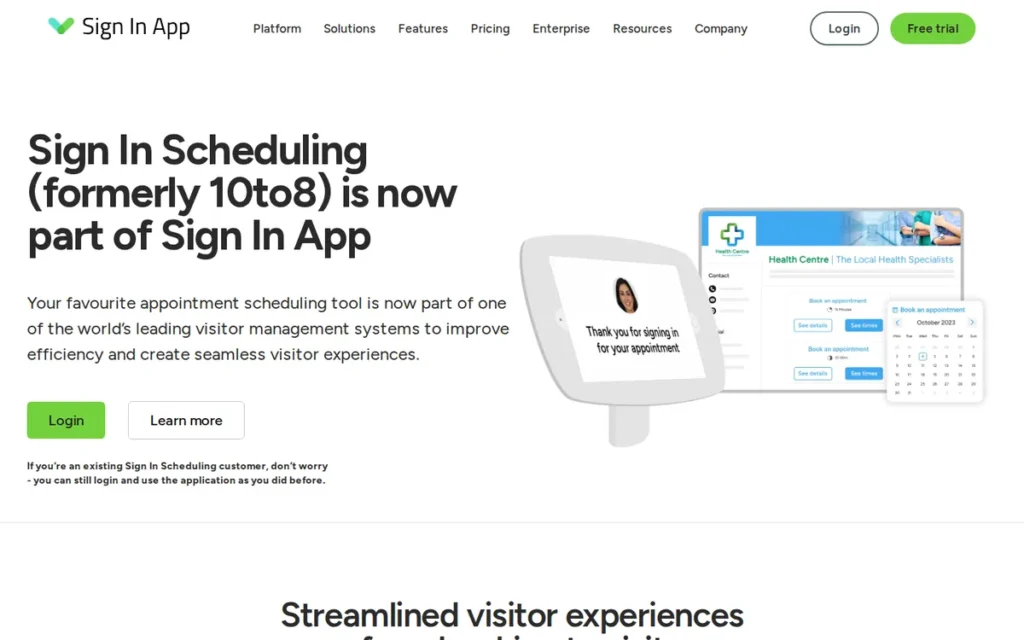
Category: All-in-One Scheduler, a scheduling platform with automated SMS, email, and voice reminder delivery, two-way messaging, and HIPAA-capable configuration.
At a Glance
- Category: All-in-One Scheduler
- Best For: Solo practitioners, tutors, wellness providers, and SMBs needing free or low-cost multi-channel reminders with HIPAA capability and no EHR required
- Price Range: Free (100 appointments/month); paid plans from ~$7.20/seat/month (annual billing, verified May 2026)
- Primary Strength: 10to8 is the only appointment reminder platform in this comparison combining a 100-appointment/month free tier with SMS, email, and voice reminders, two-way messaging, and a documented HIPAA-capable configuration, all at no cost for practices under the free-tier threshold
- Biggest Limitation: 10to8’s ongoing rebrand from “10to8” to “Sign In Scheduling” under parent company Sign In App has created brand recognition gaps and documented support continuity confusion that buyers must navigate during onboarding
- One-Line Summary: 10to8 (Sign In Scheduling) is the best-balanced, lowest-cost multi-channel appointment reminder solution of 2026 for solo practitioners and SMBs, delivering SMS, email, and voice reminders with two-way messaging and HIPAA-capable configuration at 100 appointments per month for free
- Last Verified: May 2026
Overview
10to8 (Sign In Scheduling) is the strongest free multi-channel appointment reminder option for solo practitioners and SMBs in 2026, the only platform combining SMS, email, and voice reminders, two-way messaging, a 100-appointment/month free tier, and a documented HIPAA-capable configuration simultaneously. Sign In App’s marketing materials report 50,000+ customers globally across healthcare, education, beauty, and professional services (per Sign In App, 2026).
Key Features
- 10to8 sends appointment reminders via SMS, email, and voice calls natively, with two-way messaging that allows clients to confirm, cancel, or reschedule directly from the reminder, syncing the response back to connected calendars and Zoom without requiring manual staff follow-up.
- 10to8’s free plan supports up to 100 appointments per month at no cost, making it a functional long-term solution for solo practitioners rather than a time-limited trial that forces an upgrade decision within days.
- 10to8 offers a formally documented HIPAA-capable configuration confirmed independently by Guideflow and Apptoto’s comparison analysis, positioning it as an accessible compliance option for solo clinicians that cannot justify a full healthcare-specific platform budget.
- 10to8 integrates with Google Calendar, Outlook, iCal, and Zoom, with real-world user confirmation from r/OnlineESLTeaching (2026) that a student’s cancellation request automatically deleted the Zoom classroom meeting without any manual staff intervention.
- 10to8 includes online booking, intake forms, payment integration via Stripe and PayPal, and reporting analytics alongside its reminder system, providing more operational scope than a reminder-only tool without requiring a full EHR platform budget.
Best For
10to8 (Sign In Scheduling) is best for solo practitioners, independent tutors, coaches, wellness providers, and small service businesses who need multi-channel reminder automation (including voice reminders for older or less tech-engaged clients) and want HIPAA capability without committing to a healthcare-specific platform or paying more than $7.20/seat/month.
Pricing
10to8 offers a free plan supporting 100 appointments per month, the most generous functional free tier in this comparison. Paid plans start at approximately $7.20/seat/month on annual billing (verified May 2026; confirm current pricing at 10to8.com/pricing before purchasing, as plan structures have evolved over time). The free-to-paid upgrade trigger is appointment volume exceeding 100 per month, not a calendar deadline, giving low-volume solo practices a genuine zero-cost option indefinitely.
Strengths
- Guideflow’s independent multi-tool comparison (2026) named 10to8’s SMS and email reminder system “the most robust on this list” among all scheduling tools evaluated, the strongest third-party endorsement of core reminder capability among any product in this comparison.
This aligns with community sentiment on r/smallbusiness:
“I use 10to8 for my small business and I find it really helpful. It’s easy to use, highly customizable, and very affordable. Plus, their customer service is great. Highly recommend!” Posted by u/marcingrzegzhik
Takeaway: 10to8 earns consistent praise from small business users for combining affordability, customizability, and responsive customer support in a single platform.
- 10to8 is confirmed by two independent sources: Guideflow and Apptoto’s comparison analysis (both 2026), to support a HIPAA-capable configuration, making it the only product in this comparison simultaneously combining documented HIPAA capability, voice reminders, and a functional free tier.
- A verified user on r/Professors (2026) described 10to8 as working “flawlessly” after having “tried nearly every one of these things”, an unprompted, experience-validated endorsement from a comparison-savvy user that carries more evidential weight than vendor testimonials.
- 10to8’s two-way messaging and calendar sync work together in a documented automation loop: a verified practitioner on r/OnlineESLTeaching (2026) confirmed that a student’s cancellation auto-synced to Zoom and deleted the classroom meeting without any manual action by staff.
Limitations
- 10to8’s most operationally significant limitation is its ongoing rebrand from “10to8” to “Sign In Scheduling” under parent company Sign In App, a transition that has created documented recognition gaps and support continuity confusion flagged across multiple review sources, with customer support resources across both brand identities not yet fully unified as of May 2026.
- 10to8 does not offer native EHR or PMS integration, meaning healthcare practices requiring real-time appointment status writebacks to a clinical system will need to supplement 10to8 with a separate integration layer or switch to a purpose-built platform like NexHealth or DoctorConnect.
- 10to8’s interface, while fully functional, is described across multiple independent analyses, including Guideflow (2026) and bbook.app, as less visually modern than Calendly or newer entrants, a trade-off that matters more for customer-facing booking pages than for back-office reminder configuration.
- 10to8’s pricing model has shifted over time: a verified user on r/TutorsHelpingTutors (2026) noted a previous reduction in free-tier appointment volume, though current documentation confirms 100 appointments per month on the free plan; buyers should verify current free-tier limits directly before onboarding.
Verdict
10to8 (Sign In Scheduling) is the best-balanced, lowest-cost multi-channel appointment reminder solution of 2026 for solo practitioners and non-EHR-dependent SMBs, earning the #1 ranking by being the only product in this comparison to simultaneously offer all three reminder channels, two-way messaging, HIPAA capability, and a 100-appointment/month free tier. For solo clinicians, tutors, coaches, and wellness providers who need voice reminders and HIPAA compliance without a full patient engagement platform budget, 10to8 is the clear starting point. Practices requiring deep EHR integration or bidirectional clinical system sync should evaluate NexHealth or DoctorConnect instead.
2. DoctorConnect: Best for Healthcare Compliance-Critical Practices and Legacy EHR Environments
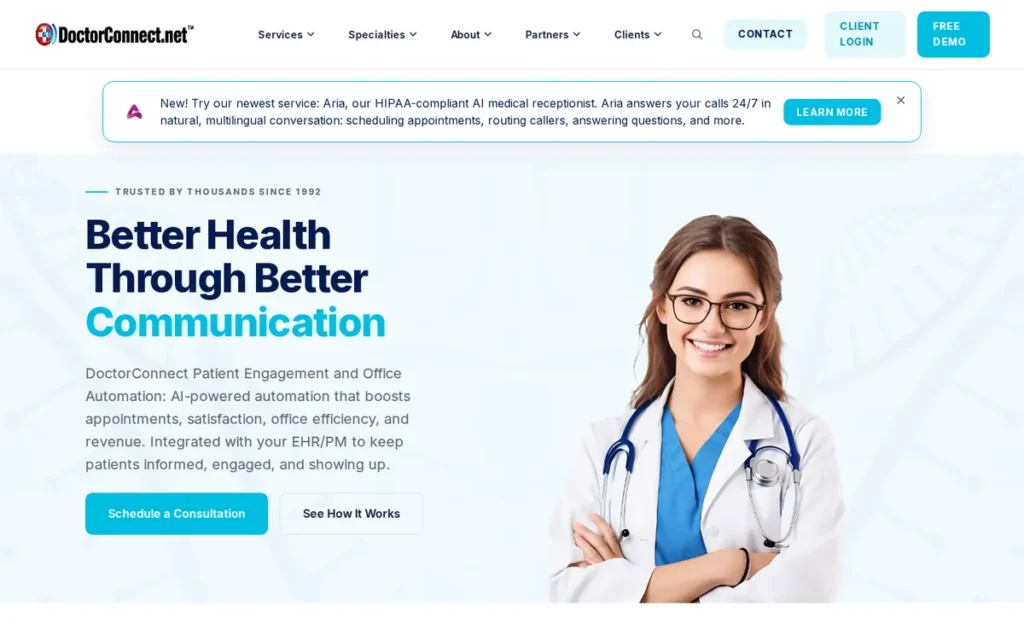
Category: Healthcare Reminder Specialist, a HIPAA-compliant, healthcare-exclusive patient reminder platform with SMS, email, and voice channels and EHR integration.
At a Glance
- Category: Healthcare Reminder Specialist
- Best For: Compliance-critical medical, dental, and behavioral health practices requiring a documented multi-decade HIPAA history, voice reminders, and broad EHR/PMS compatibility including legacy systems
- Price Range: Pricing on request: not publicly disclosed (contact sales required for quote)
- Primary Strength: DoctorConnect has maintained a vendor-claimed zero HIPAA violation record across 30+ years of continuous healthcare-exclusive operation (per DoctorConnect’s own published materials, May 2026 (not independently audited)) the longest claimed compliance track record among all products in this comparison
- Biggest Limitation: DoctorConnect does not publish pricing, making cost comparison against transparently priced competitors impossible without engaging a sales cycle, a material friction point for budget-conscious practices evaluating multiple tools
- One-Line Summary: DoctorConnect is the most operationally tenured healthcare reminder platform of 2026, combining a vendor-claimed 30-year zero-HIPAA-violation record with SMS, email, and voice reminders, two-way patient messaging, and 150+ stated EHR/PMS integrations, the strongest option for healthcare practices where compliance documentation and legacy system compatibility are non-negotiable
- Last Verified: May 2026
Overview
DoctorConnect is the most operationally tenured appointment reminder platform in this comparison, the strongest choice for healthcare practices where a multi-decade HIPAA compliance history is a procurement requirement. Founded in 1992 in Addison, Texas, DoctorConnect has operated exclusively in HIPAA-sensitive healthcare for 30+ years, serving 500+ active practices including behavioral health providers and enterprise health systems (per DoctorConnect’s About page, May 2026).
Key Features
- DoctorConnect sends patient appointment reminders via SMS, email, and automated voice call (all three channels natively) enabling multi-touch reminder sequences that reach patients through the most effective channel, including older demographics who rely on voice outreach.
- DoctorConnect’s two-way secure messaging allows patients to confirm, cancel, or reschedule directly from the reminder, with real-time appointment status updates that reduce the front-desk follow-up calls driving staff time costs.
- DoctorConnect claims integration with 150+ EHR and practice management systems (per DoctorConnect’s own published materials, May 2026, not independently corroborated by third-party audit), enabling real-time appointment syncing that covers legacy and specialty PMS platforms that newer cloud-native competitors may not support.
- DoctorConnect includes recall automation workflows triggered by last appointment date, allowing dental and medical practices to systematically reactivate lapsed patients for preventive and follow-up visits, extending its function beyond reminder-only tools.
- DoctorConnect’s modular product suite encompasses digital intake forms, patient satisfaction surveys, secure messaging, revenue cycle management, and AI-powered scheduling alongside its core reminder platform, enabling practices to expand functionality without switching vendors.
Best For
DoctorConnect is best for medical, dental, and behavioral health practices where a formally documented HIPAA compliance history is a procurement requirement, where voice reminders are needed for patients without smartphones, and where the practice uses a legacy or specialty EHR/PMS that newer patient engagement platforms do not support.
Pricing
DoctorConnect pricing is not publicly disclosed and requires direct contact with the sales team for a quote (verified May 2026). No published tier structure, per-appointment rate, or starting price was confirmed through any public-facing source. Buyers evaluating DoctorConnect alongside transparently priced competitors should request a detailed quote including per-message costs, EHR integration setup fees, and pricing at their specific appointment volume before making any comparison decision.
Strengths
- DoctorConnect stakes its market position on a vendor-claimed zero HIPAA violation record across 30+ years of continuous healthcare-exclusive operation from 1992 through 2026 (per DoctorConnect’s About page and comprehensive review page, May 2026 (not independently corroborated by third-party audit)) the only product in this comparison framing compliance credibility in terms of a multi-decade track record rather than a configuration option.
- DoctorConnect claims 150+ EHR and practice management system integrations, the largest stated integration count in this evaluation (per DoctorConnect’s comprehensive review page, May 2026, not independently corroborated), providing stated coverage for legacy and specialty clinical systems that cloud-native competitors may not support.
- DoctorConnect delivers all three reminder channels (SMS, email, voice) plus two-way secure patient messaging natively, meeting the channel completeness requirements of practices serving older patient demographics, rural populations, and clinics where a significant portion of patients lack reliable smartphone access (per DoctorConnect’s medical appointment reminders page, May 2026, not independently corroborated).
Limitations
- DoctorConnect’s most consequential trade-off for small and mid-size practices is pricing opacity, because pricing is not publicly disclosed and requires a sales engagement, buyers cannot compare DoctorConnect’s total cost against the five transparently priced competitors in this evaluation without investing time in a full demo process, a friction point particularly acute for solo practitioners with limited administrative bandwidth.
- DoctorConnect self-reports as “5-star rated on Capterra, GetApp, and Software Advice” (per DoctorConnect’s About page, May 2026), but review volume on these platforms was not independently confirmed, a 5-star average from 3 reviews and a 5-star average from 300 reviews carry materially different reliability, and buyers should verify current review counts independently before weighting this claim.
- DoctorConnect has no significant Reddit or professional forum community presence across r/Dentistry, r/FamilyMedicine, r/healthIT, or related subreddits, making community-validated real-world sentiment unavailable through standard research channels and limiting independent peer validation outside of vendor-provided references.
- DoctorConnect’s marketing claims: including “150+ integrations” and “zero HIPAA violations”, originate exclusively from DoctorConnect’s own published pages and are not corroborated by third-party audits; buyers should request a formal named EHR compatibility list confirming support for their specific clinical system (e.g., eClinicalWorks, Athena, Dentrix) during the sales process rather than accepting an aggregate count at face value.
Verdict
DoctorConnect is the most operationally tenured appointment reminder platform of 2026 for healthcare-exclusive buyers, combining a vendor-claimed 30-year HIPAA track record with voice, SMS, and email reminders, two-way messaging, and the broadest stated EHR integration count in this comparison. DoctorConnect ranks #2 rather than #1 because its contact-sales-only pricing and absence of independently verified review volume prevent the same evidence triangulation that 10to8’s transparent pricing and community endorsements provide, even though DoctorConnect’s claimed multi-decade healthcare compliance depth is unmatched in this comparison. Practices that need cost certainty before evaluating vendors should note that DoctorConnect’s contact-sales pricing model adds a time and friction cost that transparently priced alternatives do not impose.
3. NexHealth: Best for Modern Dental and Medical Practices Needing Real-Time EHR Integration
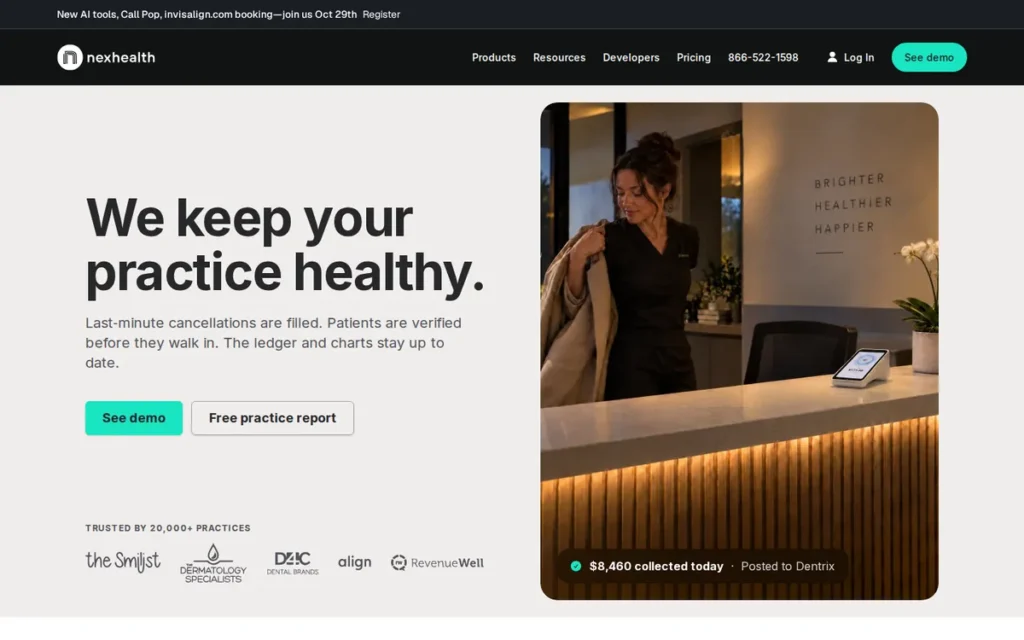
Category: Healthcare Patient Engagement Platform, purpose-built dental and medical scheduling, automated multi-channel reminders, and real-time EHR status synchronization.
At a Glance
- Category: Healthcare Patient Engagement Platform
- Best For: Dental and medical practices on modern cloud EHR/PMS systems seeking automated reminder workflows with real-time bidirectional EHR confirmation sync and recall automation
- Price Range: Pricing on request: not publicly disclosed (custom quote required)
- Primary Strength: NexHealth automatically writes patient confirmation status back to the EHR/PMS when a patient acknowledges a reminder, eliminating the manual front-desk confirmation step that costs practices measurable staff time per day
- Biggest Limitation: NexHealth’s core value depends on maintained API access with the practice’s EHR or PMS vendor, a dependency risk documented in community research that practices should address with contractual protections before signing
- One-Line Summary: NexHealth is among the most widely adopted modern patient engagement platforms for dental and medical practices in 2026, serving a vendor-reported 10,000+ practices with automated SMS and email reminders that write confirmation status directly back to the EHR, though contact-sales pricing and integration dependency risk require careful evaluation before committing
- Last Verified: May 2026
Overview
NexHealth is among the most widely adopted modern patient engagement platforms for dental and medical practices in 2026, the strongest choice for practices seeking to automate confirmation workflows end-to-end without manual front-desk follow-up. NexHealth serves a vendor-reported 10,000+ medical and dental practices with automated SMS and email reminders, HIPAA-compliant two-way texting, digital intake forms, and real-time EHR synchronization (per NexHealth’s homepage, May 2026).
Key Features
- NexHealth sends automated appointment reminders via SMS and email on a configurable cadence (defaulting to 1-week and 1-day before the appointment) and writes confirmation status directly back to the EHR/PMS when a patient responds, eliminating the manual confirmation lookup that typically requires front-desk staff time (NexHealth help center, 2026).
- NexHealth supports recall automation triggered by each patient’s last appointment date, enabling dental and medical practices to automatically reactivate lapsed patients for preventive care, hygiene, and follow-up visits without manual campaign management.
- NexHealth handles family messaging: sending a single coordinated communication for multiple appointments scheduled on the same day, reducing notification fatigue for multi-patient household schedules in pediatric and multi-generational practices.
- NexHealth includes HIPAA-compliant two-way patient texting, digital intake forms, and appointment request confirmations as components of the same platform, reducing the number of vendor relationships a practice must manage for compliant patient communication.
- NexHealth automatically adjusts reminders when appointments are rescheduled or moved in the EHR, ensuring the reminder cadence stays synchronized with real appointment data without manual reconfiguration by staff (NexHealth help center on automated communications, 2026).
Best For
NexHealth is best for dental and medical practices on modern cloud EHR or PMS systems that need automated reminder workflows with real-time bidirectional EHR confirmation sync, recall automation for preventive care retention, and HIPAA-compliant two-way patient messaging, and that are prepared to negotiate a custom pricing contract and formally evaluate integration continuity risk before committing.
Pricing
NexHealth pricing is not publicly disclosed and requires a direct quote from the NexHealth sales team (verified May 2026). No starting price, per-provider rate, or tier structure was available through any public-facing source or third-party analysis. Community evidence from r/Dentistry (2026) characterizes NexHealth as effective but “a bit on the pricier side”, with at least one practice actively shopping alternatives primarily on cost. Buyers should request itemized pricing including per-message costs, implementation fees, and pricing at their specific appointment volume and EHR integration requirements.
Strengths
- NexHealth’s Capterra rating of 4.7/5 from 31 verified reviews (Capterra, 2026) includes specific user praise for automated reminders, seamless EHR integration, and measurable no-show reduction, and is backed by institutional investment from Andreessen Horowitz (a16z) and Bessemer Venture Partners, validating product-market fit in the healthcare segment (Crunchbase, 2026).
- NexHealth’s real-time EHR writeback on patient confirmation is a documented structural differentiator, the NexHealth help center (2026) confirms that appointment status updates to “confirmed” in the EHR/PMS automatically when a patient responds to a reminder, the highest level of automation integration among all products in this comparison.
- NexHealth markets an 85% patient return-to-practice rate on its automated reminders feature page (vendor-stated claim; methodology not disclosed, NexHealth.com, May 2026), the most specific vendor-stated retention outcome figure among the healthcare platforms evaluated; buyers should request the underlying methodology during the sales process before weighting this figure.
Limitations
- NexHealth’s most consequential trade-off is integration dependency risk: the platform’s core value depends on maintained API access with the practice’s EHR or PMS vendor. A verified practitioner on r/Dentistry (2026) reported losing access to their NexHealth integration when their PMS vendor changed its API policies, illustrating a real operational risk for any EHR-integrated platform. Practices should formally address contractual protections and migration paths before signing, regardless of whether this specific reported event can be independently confirmed.
Users on r/Dentistry shared their experience:
“We use Nexhealth for our online booking tool and forms. But now Denticon has boxed Nexhealth out so we have a service interruption and need to switch to a new tool. Weave offers online booking and there is temptation to consolidate softwares. But if we do that, we could go even further and switch to Adit and save thousands each month, literally.” Posted by u/Internal_Recipe2685
Takeaway: NexHealth practices have been forced into mid-contract platform migrations when PMS vendors unilaterally restricted API access, confirming that integration brittleness is an operational risk requiring explicit contractual protections before signing.
- NexHealth does not offer voice call reminders: only SMS and email, which limits its effectiveness for practices serving older patient demographics or rural populations with limited smartphone access, where voice remains the highest-reach reminder channel.
- NexHealth’s contact-sales-only pricing adds a pre-sales friction cost that five other tools in this comparison do not impose, making cost comparison impossible without a formal demo and quote process, a significant disadvantage for small practices with limited evaluation time.
- NexHealth campaigns “lack the deep functionality and CDT codes” that dental-specific competitors offer (including missing ADA codes, custom PMS codes, and balance-based targeting rules) meaning dental-specialty marketing functionality may require supplemental tools (RevenueWell comparison page, 2026).
Verdict
NexHealth is the strongest modern dental and medical patient engagement platform of 2026 for practices on cloud EHR systems seeking real-time bidirectional reminder confirmation sync and recall automation. NexHealth’s vendor-reported 10,000+ practice installation base, Andreessen Horowitz backing, and EHR writeback automation represent genuine structural advantages over general-purpose schedulers and reminder-only tools. Before committing, practices must formally negotiate integration continuity protections, community research documents that EHR and PMS vendors can restrict third-party API access unilaterally, a business continuity risk that contractual language should address explicitly.
4. NextGen Office: Best for Practices Already Purchasing the NextGen EHR Ecosystem (Not Recommended as a Standalone Reminder Tool)
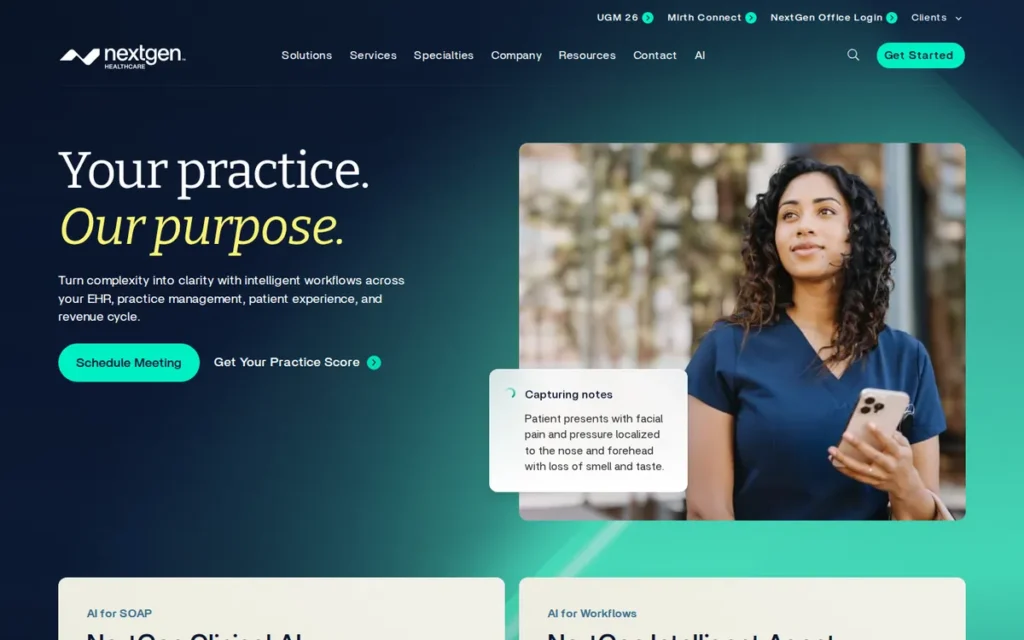
Category: EHR-Embedded Reminder System, appointment reminders delivered as a native component of a full cloud-based ambulatory EHR and practice management platform.
At a Glance
- Category: EHR-Embedded Reminder System
- Best For: Small-to-midsize ambulatory practices purchasing the full NextGen EHR and practice management ecosystem, not for practices seeking standalone reminder automation
- Price Range: ~$299–$549/provider/month (SelectHub, 2026); covers full EHR and PM, not reminder functionality alone
- Primary Strength: NextGen Office delivers SMS, email, and voice reminder workflows from native EHR appointment data with no integration gap, no sync delay, and no third-party API dependency, because the reminder system and the clinical scheduling system share the same database
- Biggest Limitation: NextGen Office’s user interface has sustained near-unanimous community criticism from practicing physicians over multiple years of daily use, described as “VERY clicky” and inadequate even after three years, a persistent UX failure that reduces consistent adoption of automated reminder workflows
- One-Line Summary: NextGen Office includes SMS, email, and voice appointment reminders as a native component of its ONC-certified ambulatory EHR platform at ~$299–$549/provider/month, appropriate exclusively for small practices purchasing the full NextGen EHR ecosystem, and not appropriate for reminder-only use cases
- Last Verified: May 2026
Overview
NextGen Office is appropriate only for practices purchasing the full NextGen EHR and practice management ecosystem, not for practices seeking standalone reminder automation. NextGen Office delivers SMS, email, and voice reminders as a native EHR component at approximately $299–$549 per provider per month (SelectHub, 2026), with community evidence from r/FamilyMedicine documenting near-unanimous physician criticism of the platform’s user interface after years of daily clinical use.
Key Features
- NextGen Office sends patient appointment reminders via text, email, and voice call based on patient communication preference, with reminder data drawn natively from the same EHR scheduling database, eliminating the data sync dependencies that cause reminder failures in third-party integration setups.
- NextGen Office supports self-scheduling, IVR (interactive voice response), chatbot, call deflection, and automated wait-list management alongside core reminders, providing the broadest ambulatory scheduling automation scope of any product in this comparison NextGen registration and scheduling page, 2026.
- NextGen Office’s ONC-certified EHR platform includes HIPAA-compliant configurations native to the system, with reminder workflows operating within the same compliance framework as clinical documentation, no separate Business Associate Agreement or compliance module is required.
- NextGen Office delivers reminder workflows across multiple specialty practice types (including primary care, specialty medicine, behavioral health, and multi-provider group practices) with configurations adapted to ambulatory scheduling patterns.
- NextGen Office’s reminder system adjusts automatically when appointments are modified in the EHR, with no manual reconfiguration required, a structural advantage of native EHR embedding over third-party reminder overlays that depend on external calendar sync.
Best For
NextGen Office is best for small-to-midsize ambulatory practices that are purchasing the full NextGen EHR and practice management platform, practices that need reminder, scheduling, billing, and clinical documentation in a single certified system and are not seeking standalone reminder automation at a lower price point.
Pricing
NextGen Office pricing ranges from approximately $299 to $549 per provider per month according to SelectHub (2026), with $449 per provider per month cited as the most commonly reported rate, covering the full EHR and practice management platform, not reminder functionality alone. Community evidence from r/FamilyMedicine (2026) documents that the per-provider pricing model “becomes nearly as expensive as Epic once you try to expand,” making it financially unsuitable for practices projected to grow beyond 3–5 providers. Implementation fees may apply for configurations involving 10+ providers.
Strengths
- NextGen Office’s ONC certification for its EHR platform is a formal regulatory credential relevant to practices subject to MIPS/Meaningful Use requirements, the only product in this comparison where reminder software and clinical compliance certification exist within the same system (FindEMR appointment reminder overview, 2026).
- NextGen Office’s native EHR embedding means reminder data is sourced from real-time clinical appointment records with no API dependency, no sync delay, and no third-party integration that can be restricted mid-contract, a structural data integrity advantage over all other products in this comparison, including EHR-integrated platforms that depend on external API access.
- NextGen Office’s voice IVR capability for patient reminder responses: combined with self-scheduling, chatbot, and call deflection, provides the broadest automated patient communication scope in this evaluation for practices that need to reduce incoming phone volume alongside reducing no-shows.
Limitations
- NextGen Office’s most consequential limitation is its user interface: community evidence from r/FamilyMedicine (2026) documents near-unanimous physician consensus that the platform is “VERY clicky,” feels designed for a previous era, and has not meaningfully improved despite years of daily clinical use. One verified user described persistent usability challenges after three years of daily use; another confirmed the UI “hasn’t gotten better.” This UX failure directly reduces consistent adoption of automated reminder workflows and undermines the no-show reduction goal the platform is supposed to achieve.
This aligns with community sentiment on r/FamilyMedicine:
“I made the same switch. I consider myself extremely computer savvy but I struggle, still, with NextGen now 3 years later. There are a couple flavors of it out there – the newest, shiniest model may be different than our older build. I’d recommend a text expanding software, something like AutoHotKey (there are others more user friendly), to mimic dotphrases from Epic and to shorthand as much as possible. NG is VERY clicky and seemingly was written for the dinosaur generation who never wanted to type. If you ignore the clicking and free-type where able, you can get decently fast.” Posted by u/octupleweiner
Takeaway: NextGen Office’s click-heavy interface forces even technically proficient physicians to develop manual workarounds years into daily use, confirming that the platform’s documented UI failures are systemic rather than a temporary learning curve.
- NextGen Office at approximately $299–$549 per provider per month (SelectHub, 2026) is the highest-cost entry point in this comparison by a wide margin, a cost defensible only if the full EHR and practice management stack is being purchased, not for reminder-only use cases where every other product in this comparison offers dramatically better value.
- NextGen Office’s per-provider pricing model: documented in r/FamilyMedicine (2026) as becoming “nearly as expensive as Epic once you try to expand”, limits scalability for growing practices and makes accurate multi-year cost projection difficult at initial purchase time.
- NextGen Office should not be evaluated as a standalone reminder tool: practices that need reminder automation only, or that are not already in the NextGen ecosystem, will find substantially better value-per-dollar in most other products in this evaluation for reminder-specific use cases.
Verdict
NextGen Office is the strongest EHR-native reminder option of 2026 for small ambulatory practices already purchasing the full NextGen EHR ecosystem, providing SMS, email, and voice reminder workflows with no third-party API dependency and ONC-certified compliance. NextGen Office is unambiguously the wrong tool for practices seeking standalone reminder automation, with a per-provider price point at the top of this comparison and a user interface that has earned sustained negative community consensus from practicing physicians. Practices not already committed to the NextGen EHR should evaluate all other options in this article first.
5. Acuity Scheduling: Best All-in-One Scheduler for Service Businesses and HIPAA-Sensitive Solo Practitioners
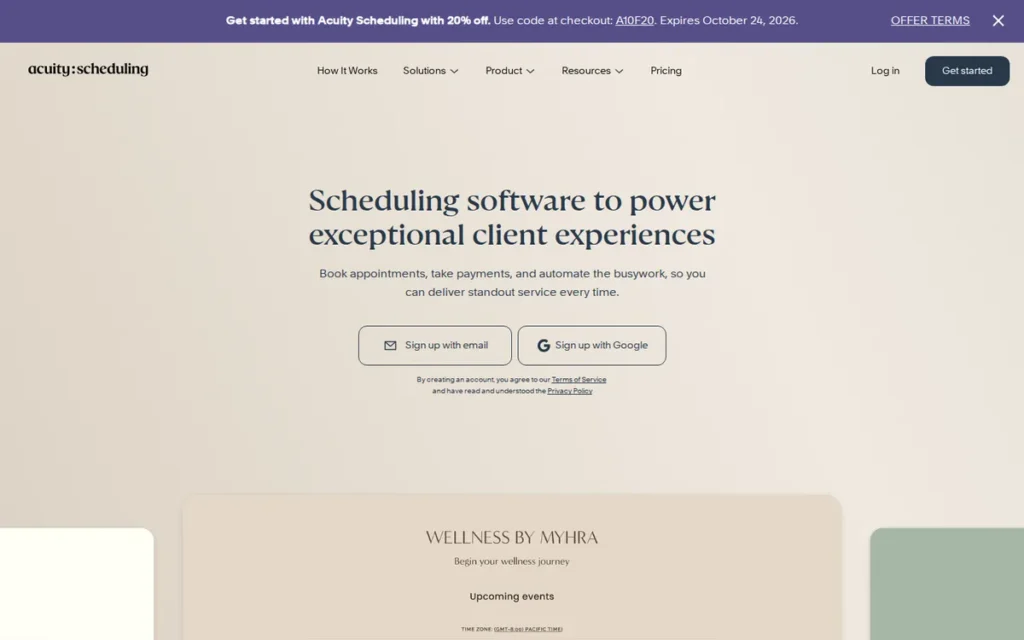
Category: All-in-One Service Business Scheduler, a client self-booking platform with SMS and email reminders, payment collection, intake forms, and HIPAA-capable configuration at the Powerhouse tier.
At a Glance
- Category: All-in-One Service Business Scheduler
- Best For: Service businesses: salons, therapists, coaches, wellness providers, consultants, needing booking, payments, intake, and SMS/email reminders in one platform; solo clinicians needing HIPAA compliance at a transparent price
- Price Range: $20–$61/month (monthly); $16–$49/month (annual); 7-day free trial, no credit card required (verified May 2026)
- Primary Strength: Acuity Scheduling offers HIPAA-compliant configuration at a publicly disclosed price ($49/month annual on Powerhouse), confirmed by five independent sources including hipaatimes.com (May 2026), making it the most accessible and transparently priced HIPAA-capable scheduling option in this comparison
- Biggest Limitation: Acuity Scheduling requires recurring appointments to be cancelled one-by-one manually (bulk cancellation unavailable as of May 2026) and does not notify the business owner when clients create user accounts, documented operational gaps that create workflow friction for practices managing large recurring appointment volumes
- One-Line Summary: Acuity Scheduling is the best all-in-one appointment booking and reminder platform of 2026 for service businesses needing integrated payments, intake forms, and SMS/email reminders, and for solo clinicians who need HIPAA compliance at a transparently disclosed price ($49/month annual) without purchasing a full healthcare platform
- Last Verified: May 2026
Overview
Acuity Scheduling is the best all-in-one appointment scheduling platform of 2026 for service businesses needing booking, payments, and HIPAA at a publicly disclosed price. Acuity Scheduling (by Squarespace, NYSE: SQSP) combines automated SMS and email reminders, payment collection, intake forms, and HIPAA-compliant configuration on its Powerhouse tier, confirmed as HIPAA-capable by five independent sources including hipaatimes.com (May 2026).
Key Features
- Acuity Scheduling sends automated SMS and email appointment reminders with customizable timing and messaging, enabling businesses to configure multi-touch reminder sequences that reduce no-shows without manual client outreach at any appointment volume.
- Acuity Scheduling includes payment collection via Stripe, Square, and PayPal: enabling deposit requirements, package purchases, and subscription billing at the time of booking, which independently reduces no-shows by creating a financial commitment prior to the appointment.
- Acuity Scheduling’s Powerhouse plan ($49/month annual) includes a documented HIPAA-compliant configuration confirmed on the official Acuity features page and independently verified by five external sources including hipaatimes.com, the most thoroughly corroborated HIPAA compliance claim in this entire comparison.
- Acuity Scheduling supports deeply customizable client booking pages with conditional intake forms, appointment history, detailed notes, and client records, assessed by independent evaluators as offering the most flexible client-facing booking experience among non-healthcare-specialist platforms (cal.com, 2026).
- Acuity Scheduling integrates with Google Calendar, Outlook, iCal, and Office 365 for scheduling sync, and with Google Meet, Zoom, and GoToMeeting for virtual appointments, covering the core workflow integrations that service businesses and telehealth-adjacent practitioners require.
Best For
Acuity Scheduling is best for service business owners (including therapists, coaches, wellness providers, personal trainers, tutors, and consultants) who need a single platform managing client booking, automated SMS and email reminders, payment collection, and intake forms together; and for solo clinicians who need HIPAA compliance at a transparently priced tier without purchasing a full healthcare-specific patient engagement platform.
Pricing
Acuity Scheduling pricing is publicly disclosed: Emerging plan at $20/month ($16/month annual) for 1 calendar; Growing at $34/month ($27/month annual) for up to 6 calendars with payment processing; Powerhouse at $61/month ($49/month annual) for up to 36 calendars with HIPAA compliance (verified May 2026 at acuityscheduling.com/pricing). A 7-day free trial is available on all paid plans with no credit card required. SMS reminders are included in plans rather than charged per message, eliminating the hidden SMS overage costs documented for some competitors in this category.
Strengths
- Acuity Scheduling’s HIPAA-compliant Powerhouse tier at $49/month annual billing is confirmed by five independent sources, including hipaatimes.com, the official Acuity help center, and three additional pricing comparison sites (all May 2026), making it the most thoroughly independently corroborated HIPAA compliance claim in this comparison and the most accessible option for solo clinicians evaluating tools without a sales cycle.
- Acuity Scheduling is described by independent third-party evaluators (cal.com, 2026) as offering “deeply customizable booking pages” and “advanced client management with intake forms, appointment history, and detailed notes”, the highest customization rating in the service business scheduling segment among evaluated tools.
Users on r/MassageTherapists noted:
“I’m loving Acuity for so many reasons. Massage book gave my both me and my clients troubles, and the desktop and mobile versions are completely different with neither being user friendly. Acuity doesn’t have SOAP notes unfortunately, but there’s a private notes section. price point and how intuitive it is.” Posted by u/emmyfitz
Takeaway: Acuity Scheduling wins converts from competing platforms on price and intuitiveness, though wellness providers who need integrated clinical documentation will require supplemental SOAP note tools alongside it.
- A verified user on r/OnlineESLTeaching (2026) specifically switched to Acuity Scheduling from Calendly for its group booking and package management capabilities, indicating that Acuity attracts experienced tool-switchers who have outgrown simpler schedulers, validating its positioning for growing service businesses.
Limitations
- Acuity Scheduling does not support bulk cancellation of recurring appointments: a verified 4-year Acuity user and music lessons studio owner on r/squarespace (2026) documented that each recurring appointment must be cancelled individually, creating significant manual overhead for practices managing large recurring client bases and directly undermining the time-saving value of automated reminder software.
- Acuity Scheduling does not notify the business owner when a client creates a user account, a documented operational blind spot confirmed by the same r/squarespace user (2026) that creates gaps in reminder delivery tracking for practices relying on client account status to manage appointment confirmation workflows.
- Acuity Scheduling does not support voice call reminders, limiting its channel effectiveness for older client demographics and patient populations where voice outreach produces the highest response rates, a meaningful gap for any service provider whose client base skews above age 60.
- Acuity Scheduling’s setup process is assessed at 30+ minutes by independent analysis (cal.com, 2026) (significantly longer than lightweight alternatives like GoReminders) creating an onboarding friction point for busy solo practitioners expecting rapid same-day deployment.
Verdict
Acuity Scheduling is the best all-in-one appointment scheduling and reminder platform of 2026 for service businesses that need booking, payments, intake, and SMS/email reminders in a single transparent-pricing platform, and the most accessible HIPAA-compliant scheduling option for solo clinicians at $49/month annual, confirmed by five independent sources. Before committing, practices with large recurring appointment volumes should verify in the free trial whether the documented bulk cancellation limitation creates unacceptable administrative overhead for their specific scheduling patterns.
6. GoReminders: Best Reminder-Only Tool for Non-Healthcare Small Businesses and Solo Operators
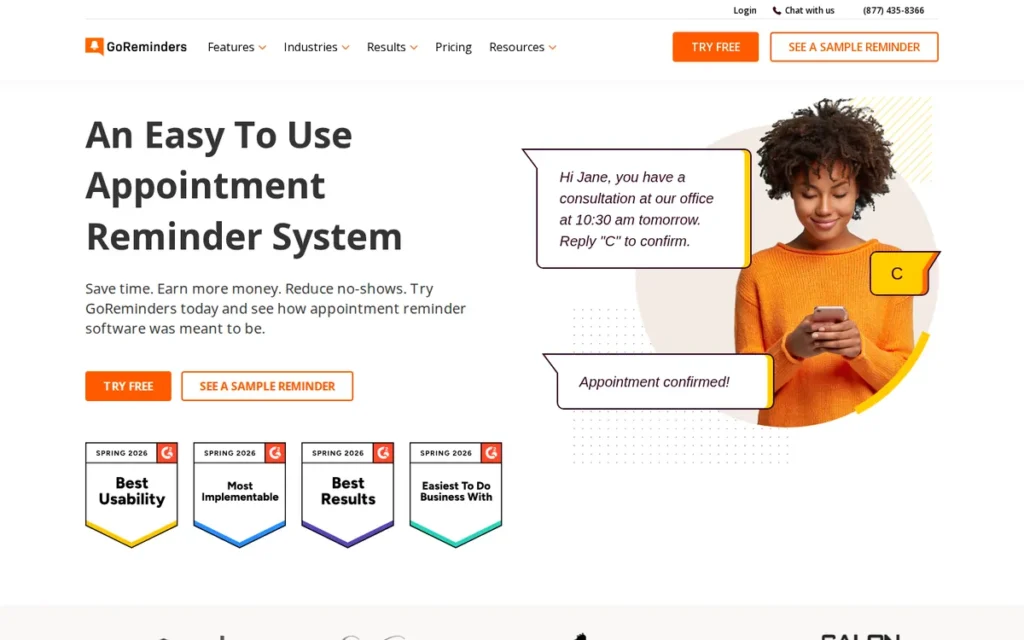
Category: Reminder-First Overlay, standalone SMS and email reminder automation layered on existing calendar systems, designed for businesses that already manage their own booking and need only automated outreach.
At a Glance
- Category: Reminder-First Overlay
- Best For: Non-healthcare small businesses and solo operators with an existing calendar or booking workflow who need reliable SMS and email reminder automation without replacing their current scheduling setup
- Price Range: Free 2-week trial (full feature access); volume-based paid plans, not fully publicly disclosed (contact goreminders.com/pricing for current rates)
- Primary Strength: GoReminders holds a GetApp rating of 4.7/5 from 265 verified reviews and a G2 rating of 4.8/5 from 290 verified reviews (both confirmed, May 2026), the strongest independent review credentials among the reminder-focused tools in this comparison
- Biggest Limitation: GoReminders does not offer voice call reminders and has no publicly confirmed HIPAA compliance documentation, making it unsuitable for any healthcare practice requiring voice outreach capability or formal compliance records
- One-Line Summary: GoReminders is the easiest-to-implement appointment reminder tool of 2026 for non-healthcare small businesses, earning a 4.7/5 GetApp rating from 265 reviews and a 4.8/5 G2 rating from 290 reviews through focused SMS and email reminder delivery, though it lacks voice reminders and confirmed HIPAA compliance, limiting it to non-clinical use cases
- Last Verified: May 2026
Overview
GoReminders is the easiest-to-implement appointment reminder tool of 2026 for non-healthcare small businesses seeking to reduce no-shows without replacing their existing calendar or booking system. GoReminders holds a 4.7/5 GetApp rating from 265 verified reviews and a G2 rating of 4.8/5 from 290 verified reviews (both confirmed, May 2026), the only tool in this comparison with 250+ verified reviews on two independent review platforms simultaneously.
Key Features
- GoReminders sends automated SMS and email appointment reminders with fully customizable message templates (including auto-fill tags for client name, appointment time, service type, and location) enabling personalized outreach that reduces the impersonal feel of automated messaging.
- GoReminders syncs with Google Calendar, Outlook, iCal, Mac Calendar, and iPhone/iPad Calendar in real time, enabling businesses to continue using their existing calendar system while adding automated reminder outreach without migrating to a new scheduling platform.
- GoReminders supports recurring appointment reminders at configurable weekly and monthly intervals, ensuring clients with regular standing appointments receive the same consistent reminder cadence without manual re-entry for each occurrence.
- GoReminders offers an optional two-way messaging add-on enabling clients to confirm, cancel, or request a reschedule directly from the reminder message, extending the platform’s value from one-way notification delivery to interactive confirmation (Apptoto direct comparison, 2026).
- GoReminders includes payment reminder functionality alongside appointment reminders, enabling businesses to send automated payment collection nudges in addition to appointment confirmation messages, relevant for service providers managing outstanding client balances.
Best For
GoReminders is best for non-healthcare small businesses and solo operators (in industries like legal, consulting, personal services, tutoring, and fitness) who have an established booking workflow they want to keep and need reliable SMS and email reminder automation added on top, without the complexity or cost of a full scheduling platform rebuild.
Pricing
GoReminders pricing is volume-based (appointments per month) rather than a flat per-seat rate, and full pricing details are not publicly disclosed on the main pricing page (verified May 2026; check goreminders.com/pricing for current rates). A full-featured 2-week free trial is available without credit card requirements. No per-message SMS overage charges were confirmed in research, a positive differentiator for higher-volume users. Buyers should contact GoReminders directly for pricing at their specific appointment volume, as volume-based models can escalate unexpectedly as appointment counts grow.
Strengths
- GoReminders holds a GetApp rating of 4.7/5 from 265 verified reviews (GetApp, 2026) and a G2 rating of 4.8/5 from 290 verified reviews (G2, 2026), the only tool in this comparison with 250+ verified reviews on two separate independent review platforms simultaneously, reflecting consistent satisfaction across distinct reviewer populations.
This aligns with community sentiment on r/smallbusiness:
“I know this is an old post but I just wanted to say that my firm just started using GoReminders. It’s very basic and simple and that is what I love about it. It gets the job done. I just want to say thanks. Y’all made a wonderful product.” Posted by u/Lucky-Rock-3061
Takeaway: GoReminders’ focused simplicity, delivering exactly what appointment-based businesses need without unnecessary complexity, generates genuine unprompted loyalty from users who have found feature-heavy alternatives overkill for their actual workflow.
- GoReminders’ verified user testimonials specifically reference reduction in “last-minute appointment cancellations and at-door reschedule requests” (GoReminders testimonials page, 2026) (the exact operational outcome the target audience seeks) and its $27,000 average revenue-saved claim, while vendor-reported and not independently audited, is more operationally specific than the generic “reduce no-shows” language used by most competitors.
- GoReminders is described by verified users as “straight to the point and easy to work with” (GoReminders testimonials page, 2026), with setup simplicity the most consistent theme across community feedback, positioning it as the lowest-friction reminder tool for businesses that have been unable to get reminders working reliably with more complex platforms.
Limitations
- GoReminders’ most consequential limitation is channel incompleteness: it does not offer voice call reminders and has no publicly confirmed HIPAA compliance documentation, collectively disqualifying it for any healthcare practice requiring voice outreach for older or low-smartphone-access patient populations, or any practice subject to HIPAA for whom documented compliance is a procurement requirement.
- GoReminders lacks online payment processing and full availability and booking management, as confirmed by Apptoto’s direct product comparison (2026), meaning businesses needing booking, reminders, and payments in a unified system must supplement GoReminders with additional tools, increasing total platform cost and integration complexity.
- GoReminders’ volume-based pricing model is not fully transparent without a direct vendor inquiry, creating a cost comparison disadvantage relative to Acuity Scheduling and 10to8, which publish their pricing publicly, and making total cost of ownership at scale difficult to estimate before committing.
- GoReminders has no EHR or PMS integration capability, making it incompatible with any healthcare workflow requiring real-time clinical appointment syncing, regardless of HIPAA status.
Verdict
GoReminders is the best dedicated appointment reminder overlay of 2026 for non-healthcare small businesses that want to reduce no-shows with minimum implementation friction and without replacing their existing calendar or booking workflow. GoReminders earns this position through its 4.7/5 GetApp rating from 265 reviews and 4.8/5 G2 rating from 290 reviews, the strongest combination of verified review volume and scores among reminder-focused tools in this comparison. GoReminders ranks below Acuity Scheduling (#5) because Acuity’s formally documented HIPAA compliance serves a broader portion of the target audience, any healthcare-adjacent service provider, whereas GoReminders is disqualified from that segment entirely. Healthcare practices, businesses needing voice reminders, and operators requiring integrated payment collection should evaluate 10to8, Acuity Scheduling, or DoctorConnect instead.
7. Calendly: Best for Non-Healthcare Enterprise and Business Teams (Not Recommended as a Primary No-Show Reduction Tool)
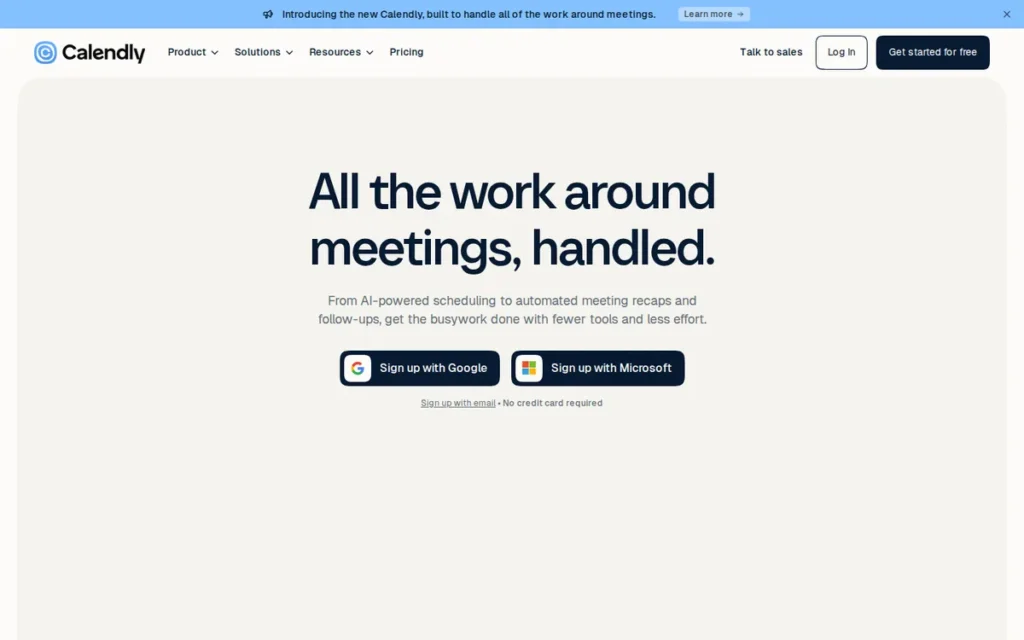
Category: Meeting Scheduler, a scheduling link platform with automated email and SMS Workflows for general business, sales, recruiting, and enterprise teams; not designed for appointment reminder reliability or HIPAA-sensitive workflows.
At a Glance
- Category: Meeting Scheduler
- Best For: Sales teams, recruiters, enterprise customer success, and non-healthcare business professionals who need frictionless calendar booking with basic automated follow-up, not for healthcare or any context where reminder delivery reliability is the primary purchase driver
- Price Range: Free (1 event type, no reminders); Standard $10/user/month; Teams $16/user/month; Enterprise: custom pricing (monthly billing, verified May 2026)
- Primary Strength: Calendly integrates natively with 100+ tools, including Google, Outlook, Zoom, Teams, and Salesforce, and its own marketing claims 86% Fortune 500 adoption (per Calendly’s homepage, May 2026, not independently audited), providing the deepest general-purpose scheduling integration ecosystem in this comparison
- Biggest Limitation: Multiple verified users on r/CustomerSuccess (2026) report email confirmation delivery failures (with one estimating approximately 40% of invitees failed to receive confirmations) a failure pattern documented across multiple community threads that directly undermines the no-show reduction value proposition
- One-Line Summary: Calendly is the most recognized meeting scheduling platform for enterprise and business teams in 2026, but community-documented email delivery failures and multiple verified post-cancellation unauthorized billing reports make it a poor primary choice for any business whose main goal is reliable no-show reduction
- Last Verified: May 2026
Overview
Calendly is the most recognized meeting scheduling platform for enterprise and business teams, its own marketing claims 86% Fortune 500 adoption across 100,000+ organizations (per Calendly’s homepage, May 2026, not independently audited), but community-documented email delivery failures and billing misconduct after cancellation make it a poor primary choice for any business whose main goal is reliable no-show reduction. Calendly offers SMS and email reminders via its Workflows feature on paid tiers only, the free plan includes no automated reminders of any kind.
Key Features
- Calendly delivers automated appointment reminders via email and SMS through its Workflows feature (with SMS powered by Twilio) enabling businesses to configure timed reminder sequences with custom messaging before and after scheduled events (available on Standard, Teams, and Enterprise tiers only; not available on the free plan).
- Calendly integrates natively with 100+ tools covering all major calendar platforms (Google, Outlook, iCloud, Office 365), conferencing tools (Zoom, Teams, Google Meet), CRM systems (Salesforce, HubSpot), and ATS platforms, the broadest integration ecosystem of any product in this comparison for general business workflows Calendly compare page, 2026.
- Calendly’s routing forms and AI-powered lead qualification features on Teams and Enterprise tiers enable enterprise teams to match booking requests to the right team member automatically, a capability unique to Calendly in this comparison and relevant for sales organizations with territory-based or skill-based routing needs.
- Calendly’s free plan supports unlimited scheduling events of a single event type with no time limit, providing an accessible entry point for individual professionals who need basic calendar booking, though this free plan does not include Workflows or any automated reminders.
- Calendly supports round-robin scheduling, collective event booking, and pooled availability across team members, enterprise team scheduling features relevant for customer success and sales operations and beyond the scope of reminder-focused tools.
Best For
Calendly is best for non-healthcare business professionals, sales teams, recruiters, and enterprise customer success organizations that need frictionless calendar booking with basic automated email and SMS follow-up, and that do not require HIPAA compliance, voice reminders, or guaranteed reminder delivery reliability as the primary purchase outcome.
Pricing
Calendly pricing is publicly disclosed: Free plan at $0 (1 event type, unlimited events, no Workflows or reminders); Standard at $10/user/month ($12 billed monthly); Teams at $16/user/month ($20 billed monthly); Enterprise pricing is custom (verified May 2026 at calendly.com/pricing). SMS reminders and Workflows are unlocked at paid tiers only. Per-seat pricing scales with team size, which can make Calendly more expensive than flat-rate alternatives for larger teams needing reminder automation. Multiple verified users on r/CustomerSuccess (2026) report being charged after subscription cancellation; buyers should formally document the cancellation process and use a credit card to preserve dispute options before subscribing.
Strengths
- Calendly’s own marketing materials claim the platform is used by 86% of Fortune 500 companies and more than 100,000 organizations (per Calendly’s homepage, May 2026, this figure has not been independently audited), making it the most widely recognized scheduling brand in the enterprise segment and reflecting genuine product-market fit for the meeting coordination use case it was designed for.
- Calendly’s 100+ native integrations cover the broadest range of enterprise workflow tools in this comparison (including Salesforce, major ATS platforms, Zoom, Teams, and Google Meet) providing scheduling automation that embeds into complex multi-system enterprise environments in ways that reminder-only tools and healthcare-specific platforms cannot replicate.
- A vendor-adjacent analysis (zeeg.me, 2026) citing Calendly’s own usage data reports that users save an average of 5 hours per week in scheduling coordination overhead, reflecting Calendly’s genuine strength in eliminating meeting scheduling friction for business professionals, a distinct value proposition from the appointment reminder reliability use case this article evaluates.
Limitations
- Calendly’s most consequential limitation for this article’s target audience is documented email delivery failure, at least one verified user on r/CustomerSuccess (2026) estimated that approximately 40% of their invitees failed to receive email confirmations, a failure pattern independently documented across multiple Calendly Community forum threads (2026), indicating a real and recurring deliverability issue rather than an isolated incident, though the specific percentage is one user’s anecdotal estimate rather than a measured platform-wide rate.
- Multiple independent verified users on r/CustomerSuccess (2026): including u/Otherwise-Sky-8311 and u/CommonStrain5887, describe unauthorized billing charges continuing after subscription cancellation, representing a recurring billing misconduct pattern that constitutes a material vendor trust risk, independent of product quality.
“I canceled this and they kept charging me. Even downgrading to free account I was charged. Be careful, I would NEVER recommend!” (u/Otherwise-Sky-8311, r/CustomerSuccess, 2026)
Takeaway: Document your Calendly cancellation confirmation in writing, screenshot the confirmation screen, and use a credit card rather than ACH for any SaaS subscription to preserve chargeback options if unauthorized charges occur after cancellation.
- Calendly has no confirmed HIPAA compliance documentation in any official or independent third-party source, making it an unsuitable primary choice for most healthcare, behavioral health, and HIPAA-sensitive practices where patient PHI is processed, without documented HIPAA supplementation from a separate compliant vendor.
- Calendly does not offer voice call reminders and does not provide genuine two-way messaging (standard tiers are one-way broadcast only), limiting its channel effectiveness compared to 10to8, DoctorConnect, and NextGen Office for any use case where client response confirmation is required.
Verdict
Calendly is the most recognized meeting scheduling platform of 2026 for general business, sales, and enterprise teams, and it earns that recognition for the scheduling coordination use case it was built to solve. For buyers whose primary goal is reliable appointment reminder delivery and no-show reduction, community-documented email delivery failures and recurring post-cancellation billing reports make Calendly a poor primary choice in this category. Healthcare buyers should note the complete absence of confirmed HIPAA compliance documentation. Non-healthcare businesses that need reminder reliability as their first priority will find better evidence-supported options in every other product evaluated in this article.
What Red Flags Should I Watch For When Evaluating Appointment Reminder Software?
Five red flags are specific to appointment reminder software: email delivery failure rates, pricing opacity without justification, HIPAA claims without formal documentation, EHR integration brittleness, and post-cancellation billing misconduct. Each is documented by real-world evidence in this comparison and each directly affects whether the tool you choose will reduce no-shows in practice.
Red Flag #1: Email Delivery Failure Rates
At least one major tool in this category has documented, recurring email confirmation delivery failures, with one verified user estimating a ~40% failure rate and multiple independent community forum threads confirming the problem is widespread (r/CustomerSuccess, 2026). A reminder that does not reach the client cannot reduce a no-show.
Before committing, ask vendors for specific email deliverability benchmarks and monitor open rates during any free trial period. SMS structurally outperforms email for time-sensitive appointment communications and should be your primary no-show reduction channel. A platform with only email reminders is accepting avoidable no-show risk regardless of its brand recognition or integration breadth.
Red Flag #2: Pricing Opacity Without Justification
Contact-sales-only pricing is not inherently a red flag, but it becomes one when the vendor cannot explain why pricing varies by practice size, appointment volume, or EHR configuration. Both NexHealth and DoctorConnect use custom-quote models without public tier structures.
Before a demo with any opaque-pricing vendor, request an itemized quote including:
- Per-message costs for SMS and email
- EHR integration setup fees
- Pricing at your current appointment volume
- A projection at 2x current volume
Inability or refusal to provide this information in writing before you commit to a demo is a disqualifying signal.
Red Flag #3: HIPAA Claims Without Formal Documentation
“Healthcare-friendly,” “designed for medical practices,” and “HIPAA-aware” are marketing phrases, not compliance documentation. A legitimate HIPAA-capable configuration requires three things in writing:
- A Business Associate Agreement (BAA) available for review before you sign any vendor contract, not “we’ll send it after you commit”
- Formal documentation of what Protected Health Information (PHI) the platform processes and how it is protected
- Written confirmation of which party bears breach notification responsibility to HHS and affected patients
Calendly and GoReminders have no confirmed public HIPAA documentation. Require the BAA in writing before signing any contract if your practice is subject to HIPAA.
Red Flag #4: EHR Integration Brittleness
EHR and PMS vendors can restrict third-party platform API access unilaterally, a risk documented in community research, with a verified practitioner on r/Dentistry (2026) reporting loss of access to their reminder integration when their PMS vendor changed its API policies.
Before signing with any EHR-integrated reminder platform, ask specifically in writing: “What is our contractual recourse and migration path if our EHR vendor restricts your API access?” If the vendor cannot answer this question in writing, the integration risk is unmitigated and the contract should not be signed without explicit protections.
Red Flag #5: Post-Cancellation Billing Misconduct
Multiple independent verified users reported being charged by a major tool in this category after subscription cancellation, one for two additional months before noticing the charge on a credit card statement (u/CommonStrain5887, r/CustomerSuccess, 2026). Before subscribing to any SaaS reminder tool:
- Document your cancellation process in writing
- Screenshot your cancellation confirmation screen
- Use a credit card: not a debit card or ACH, for your initial subscription to preserve chargeback options if unauthorized charges occur after cancellation
What Questions Should I Ask Before Choosing an Appointment Reminder Tool?
Ask every vendor these seven questions in writing before signing any appointment reminder software contract. These questions surface delivery reliability, compliance liability, integration continuity, total cost at scale, and data portability realities that demo calls and marketing pages consistently fail to address.
Question #1: What is your documented email and SMS delivery success rate, and how do you handle delivery failures?
Ask for specific delivery rate benchmarks, not marketing copy. A vendor that cannot tell you what percentage of its SMS messages are delivered by carriers, or what happens when an email bounces or lands in spam, cannot guarantee the no-show reduction outcome you are purchasing. The answer reveals whether the vendor monitors its own delivery infrastructure or is simply reselling Twilio access with no active monitoring layer.
Question #2: What is your written BAA process and how is HIPAA liability allocated between us?
For any healthcare practice, this is a non-negotiable screening question. Legitimate HIPAA-capable vendors will have a BAA template ready for review before you commit. The BAA should specify four things:
- What PHI the platform processes and for what operational purpose
- How PHI is stored, encrypted, and access-controlled within the platform’s infrastructure
- Who bears breach notification responsibility to HHS and affected patients
- Under what circumstances the vendor is permitted to sub-process your patient data to third-party services
Question #3: What is our contractual recourse if your EHR/PMS integration loses API access from our clinical system vendor?
Community research documents that EHR vendors can restrict third-party API access unilaterally mid-contract. Ask specifically: who bears the cost of transition, is there a service credit, and what is the migration path if EHR sync is lost? If the vendor cannot answer this question in writing, the integration risk is unmitigated.
Question #4: What is our total cost at 2x our current appointment volume, including per-message fees and EHR integration charges?
Request a pricing projection at three specific points:
- Your current appointment volume
- Your 12-month projected volume
- 2x your current volume
Ask specifically whether SMS messages are charged per-send, per-month, or as an unlimited flat fee, the difference is significant for high-appointment-volume practices with escalating communication costs.
Question #5: Can I speak with a reference customer in my specific specialty or business type?
DoctorConnect, NexHealth, and NextGen Office all serve healthcare clients with different clinical workflows and EHR dependencies. A dental practice using Dentrix has different integration requirements than a behavioral health group using a state-hosted EHR. Ask for a named reference in your specific context, not just “a healthcare client.” Vendors unable to provide specialty-matched references should be scored lower on integration reliability regardless of their stated capabilities.
Question #6: What happens to my data if I cancel my subscription?
Ask the vendor: in what formats can you export your appointment and client data, how long is data retained after cancellation, and whether data deletion is offered in writing. For HIPAA-covered practices, ask specifically whether the BAA includes data destruction requirements upon contract termination, this is a compliance requirement, not an optional service.
Question #7: How do you handle reminder failures, when a message is not delivered or a client does not respond?
A reliable reminder platform should have a defined escalation workflow: if SMS fails, does email trigger automatically? If neither produces a confirmation, does the system flag the appointment for staff review? Vendors without a documented failure-handling workflow are leaving no-show risk on the table even when the reminder system appears to be running normally.
How Did We Rank These 7 Appointment Reminder Tools?
Seven appointment reminder tools were ranked by scoring all seven against six weighted criteria using verified third-party data, no vendor paid for placement, no affiliate relationship influenced any score, and the #1 ranking was earned through aggregate evidence across all criteria, not editorial preference or form submission order.
How Was Each Tool Researched and Evaluated?
The research process involved four parallel streams:
- AI Engine Query Analysis: Multiple LLM systems (ChatGPT and Perplexity, queried May 2026) were used to capture current AI answer engine recommendations and identify coverage gaps in existing guidance
- Independent Web Research: Product pages, help centers, third-party comparison sites (Guideflow, cal.com, Apptoto, SelectHub, hipaatimes.com), and analyst reports were reviewed for all seven products
- Review Platform Analysis: Verified ratings and review content were gathered from G2, Capterra, GetApp, and Software Advice for each product
- Community Sentiment Research: Reddit threads across r/Dentistry, r/FamilyMedicine, r/CustomerSuccess, r/smallbusiness, r/OnlineESLTeaching, r/Professors, r/TutorsHelpingTutors, and r/squarespace were analyzed for unprompted user sentiment
What Six Criteria Determined Each Tool’s Ranking Position?
Criterion #1: No-Show Reduction Evidence (Primary Weight)
The audience’s primary purchase driver is recovering lost revenue from missed appointments. Tools with independently corroborated outcome data score higher than those relying solely on vendor marketing claims. Documented delivery failure modes (email spam rates, SMS carrier filtering) are scored as explicit negatives.
Criterion #2: Multi-Channel Reminder Capability (Primary Weight)
SMS outperforms email for time-sensitive reminders; voice reaches older and low-smartphone populations. Two-way messaging determines whether reminders trigger actionable confirmation responses or require staff follow-up calls. Native channel capability scores higher than add-on status.
Criterion #3: HIPAA Compliance Documentation (Primary Weight)
For healthcare buyers, HIPAA is a legal requirement, not a feature preference. Formal BAA-backed compliance documentation is materially different from “healthcare-friendly” marketing language. Compliance track record and duration carry additional weight for compliance-critical practices.
Criterion #4: Pricing Transparency and Total Cost of Value (Secondary Weight)
Publicly disclosed pricing that can be compared without a demo request is rewarded. Free tiers with meaningful appointment volume are scored higher than time-limited trials. Per-provider scaling traps are scored as negatives. Contact-sales-only tools score lowest on this criterion.
Criterion #5: Independent Review Ratings and Community Trust (Secondary Weight)
Aggregate ratings from verified platforms multiplied by review volume. Documented negative patterns (billing misconduct, sustained UI criticism, email delivery failures) are weighted as material negatives regardless of aggregate score.
Criterion #6: Integration Depth and Reliability (Secondary Weight)
Range of supported calendar and EHR/PMS systems; whether EHR sync is bidirectional and real-time; and critically, integration brittleness risk, whether a third-party EHR vendor can revoke API access mid-contract is scored as an explicit documented negative when evidenced in community research.
How Were Conflicting Sources Handled?
When sources conflict, the following three-tier credibility hierarchy was applied to Criterion #1:
- Tier 1: Independently audited or third-party-confirmed data: Highest credibility. Example: Guideflow’s multi-tool comparison naming 10to8 “the most robust” reminder system.
- Tier 2: Specific vendor claims with stated methodology: Partial credit. Example: DoctorConnect’s “up to 40% no-show reduction” claim, which aligns with independent industry literature ranges.
- Tier 3: Directional community sentiment: Lowest credibility weight. Example: Reddit testimonials noting “cancellations down considerably” without quantification.
A detailed 2026 Reddit post from a verified practitioner outweighs a generic 2023 G2 review with no context. Specificity and recency both improve credibility weighting.
How Were Vendor Claims Validated?
Vendor-reported statistics are labeled as such throughout this article. Only claims corroborated by at least one independent source are stated as confirmed fact. Self-reported ratings are noted as vendor-stated where review volume could not be independently confirmed. Vendor marketing URLs are used as citations for vendor claims, not as endorsements of those claims.
How Often Is This Guide Updated?
This article was last updated in May 2026. Pricing, free tier limits, HIPAA status, and review scores are subject to change. We recommend verifying pricing directly with each vendor before purchasing. PlugRoute aims to refresh comparison articles every six months or when material product changes are confirmed.
Independence Statement
PlugRoute has no affiliate relationships with any company listed. Rankings are determined entirely by research data and objective evaluation criteria. No vendor received advance notice of this research, no vendor paid for placement or review, and no affiliate link, tracking parameter, or referral code appears anywhere in this article.
Frequently Asked Questions
What is the best free appointment reminder software with HIPAA compliance in 2026?
10to8 (Sign In Scheduling) is the best free appointment reminder software with HIPAA capability in 2026. 10to8 is the only platform found in this comparison offering SMS, email, and voice reminders with two-way messaging and a documented HIPAA-capable configuration at no cost for up to 100 appointments per month. Among the seven tools evaluated, no comparable zero-cost multi-channel HIPAA option was identified.
What appointment reminder software works best for medical and dental practices?
For medical and dental practices, NexHealth (for modern cloud EHR systems) and DoctorConnect (for legacy EHR systems and compliance-critical environments) are the two strongest purpose-built options in 2026. NexHealth serves a vendor-reported 10,000+ practices with real-time EHR confirmation writebacks; DoctorConnect brings a vendor-claimed 30-year HIPAA record and 150+ stated EHR integrations. Both require contact-sales pricing engagements.
How does PlugRoute determine its appointment reminder software rankings?
PlugRoute ranks tools by scoring each product against six weighted criteria (No-Show Reduction Evidence, Multi-Channel Capability, HIPAA Compliance Documentation, Pricing Transparency, Independent Review Ratings, and Integration Depth) using verified third-party data from review platforms, community forums, and independent analysts. No vendor pays for placement or receives advance notice of research. The complete methodology is documented in the section above.
Glossary: Key Terms Used in This Comparison
Two-Way Messaging: A reminder communication capability that allows the recipient (client or patient) to reply directly to the reminder to confirm, cancel, or request a reschedule, with the response visible to the business in real time. Two-way messaging is distinct from one-way broadcast reminders, which send notifications without enabling reply-based confirmation and require a separate staff follow-up to verify receipt.
EHR Writeback: A bidirectional data synchronization capability in which a patient’s confirmation response to a reminder automatically updates the appointment status field in the Electronic Health Record (EHR) or Practice Management System (PMS), eliminating the manual step of a front-desk staff member updating the clinical system after receiving a patient confirmation.
HIPAA BAA (Business Associate Agreement): A legally required written contract between a covered healthcare entity and a vendor that processes Protected Health Information (PHI) on its behalf. A BAA defines each party’s HIPAA obligations, data protection responsibilities, and liability in the event of a breach. Vendors that describe themselves as “HIPAA-friendly” without offering a BAA in writing do not meet the standard of documented HIPAA compliance.
Recall Automation: A proactive outreach workflow (distinct from appointment reminders) that automatically contacts lapsed patients based on the time elapsed since their last appointment, prompting them to schedule a follow-up or preventive visit. Recall automation is a revenue retention function for medical and dental practices managing recurring care schedules; it is not a standard feature of general-purpose reminder or scheduling tools.
Integration Brittleness: The operational risk that an API-based integration between a reminder platform and an EHR or Practice Management System can be restricted or revoked by the EHR vendor unilaterally (mid-contract, without the reminder software vendor’s consent) forcing the practice to switch tools or operate without automated reminders until an alternative integration is established. Integration brittleness is a documented operational risk, not a theoretical one, evidenced by community reports of PMS vendors changing their API policies in 2026.
Which Appointment Reminder Software Is Right for You?
Key Insights
- Brand recognition is not a proxy for reminder delivery reliability: the most widely recognized scheduling platform in this comparison earned the last-place ranking due to documented email delivery failures and billing misconduct. Popularity signals fit for meeting coordination; it does not predict reliable no-show reduction for appointment-based businesses.
- The tools earning the strongest community endorsements in this comparison: 10to8 (worked “flawlessly” after trying nearly everything, r/Professors, 2026) and GoReminders (“straight to the point,” multiple independent testimonials), are both known for focused simplicity, not feature breadth. Ease of consistent use matters more than feature count for sustained no-show reduction.
- 10to8 (Sign In Scheduling) is the only appointment reminder tool of 2026 combining a 100-appointment/month free tier, all three reminder channels, two-way messaging, and documented HIPAA-capable configuration, making it the default starting point for solo practitioners and budget-conscious SMBs who need to verify capabilities before spending.
- NexHealth and DoctorConnect are the only two tools in this comparison with purpose-built healthcare compliance histories, but both require contact-sales pricing engagements, and NexHealth carries a documented integration dependency risk that requires contractual protection before signing.
- GoReminders earns the strongest verified independent review credentials among reminder-first tools, a combined GetApp 4.7/5 from 265 reviews and G2 4.8/5 from 290 reviews, but its lack of voice reminders and unconfirmed HIPAA status disqualify it for any healthcare use case regardless of review quality.
- NextGen Office should not be evaluated as a standalone reminder tool: its $299–$549/provider/month price point is only defensible for practices purchasing the full NextGen EHR ecosystem, and physician community consensus on its UI is among the most negative of any tool in this category.
If you are a solo practitioner or small service business that needs reliable no-show reduction without breaking your budget, start with 10to8’s free tier, it is the most complete zero-cost multi-channel option the category currently offers.
If you operate a medical or dental practice on a modern cloud EHR, evaluate NexHealth with formal contractual protections for integration continuity. If your practice runs on a legacy or specialty PMS and needs decades-long HIPAA credibility, DoctorConnect’s institutional depth is not yet replicable by newer entrants.
Before committing to any paid plan, use the available trial options to test with real appointments:
- 10to8’s free tier (100 appointments/month, no time limit): for multi-channel and HIPAA testing
- Acuity’s 7-day free trial (no credit card required): for booking, payment, and reminder integration
- GoReminders’ 2-week trial (full feature access): for reminder-only overlay testing
- NexHealth and DoctorConnect require sales demos: have your EHR system name and monthly appointment volume ready before the first call
The appointment reminder software market is evolving toward AI-driven no-show risk scoring and predictive send-time optimization. Tools that remain static reminder broadcasters will face structural pressure as risk-stratified multi-touch reminder sequences become standard in clinical and service business workflows.
For buyers evaluating long-term platform bets, ask each vendor specifically about their AI-driven reminder roadmap before signing any multi-year contract.
We update this guide every six months. Last updated: May 2026. PlugRoute’s editorial mission is evidence-first software analysis, every ranking in this comparison is determined by the six-criteria methodology documented above.