The best cloud infrastructure automation tools in 2026 are OpenTofu (best overall: open governance, 3,900+ providers, native state encryption, zero cost), Pulumi (best for developer-led teams using TypeScript or Python), and Ansible (best for agentless configuration management: 4.7/5.0 on G2). Governance risk is the decisive 2026 differentiator, HashiCorp’s BSL change makes OpenTofu the stronger default over Terraform for most organizations.
Choosing is genuinely difficult: environments span AWS, Azure, GCP, and on-premises systems with no single dominant standard; HashiCorp’s August 2023 BSL change leaves teams uncertain whether Terraform is safe long-term; and state files storing unencrypted secrets create compliance exposure most teams discover only at audit. Provisioners, configurators, Kubernetes orchestrators, and compliance frameworks each solve different problems, conflating them derails IaC programs for months. This guide was last updated June 2026 and is reviewed quarterly.
PlugRoute has no affiliate relationships with any company listed, rankings are determined entirely by research data and objective evaluation criteria.
“We are doing a Bicep to OpenTofu migration now… If you want state file management to manage drift and do GitOps, OpenTofu is the winner. If you want to manage other services like Databricks or Kubernetes or Azure DevOps or other cloud services, OpenTofu is the winner.” (u/shneids, r/devops, 2025)
Takeaway: A practitioner migrating from a native cloud tool (Bicep) to OpenTofu (not from Terraform) confirms multi-cloud provider breadth and GitOps state management as the decisive advantages, evidencing that OpenTofu gains traction as a first-choice provisioner independently of the Terraform migration narrative.
TL;DR: Top Picks at a Glance
- OpenTofu is an MPL 2.0 multi-cloud provisioner with zero licensing cost and native state encryption, best overall for multi-cloud teams requiring open governance and compliance-ready state security.
- Pulumi is a developer-first IaC platform for TypeScript, Python, and Go with first-class built-in secrets encryption, best for engineering teams applying software development practices directly to infrastructure.
- Ansible is the highest-rated agentless configuration management platform in this evaluation (4.7/5.0 G2) with Event-Driven Ansible reactive automation, best deployed as the configuration layer above an IaC provisioner, not as a standalone replacement.
- Crossplane is a CNCF Graduated (October 2025) Kubernetes-native infrastructure control plane for platform engineering teams building Internal Developer Platforms with continuous reconciliation.
What Are the 4 Categories of Cloud Infrastructure Automation Tools?
Cloud infrastructure automation tools divide into four functional categories: Provisioners (OpenTofu, Pulumi, Terraform, CloudFormation) manage the full infrastructure create-update-destroy lifecycle; Configurators (Ansible, Chef) manage software state on existing infrastructure; Orchestrators (Crossplane) provide Kubernetes-native continuous reconciliation; and Compliance Frameworks (Chef InSpec) automate regulatory verification. Identifying which category applies is the most critical disambiguation step before evaluating any specific product.
The 4 categories and which tools belong to each:
Provisioners: Create, update, and destroy cloud resources from declared desired state using a state model that tracks what exists. Tools in this evaluation: OpenTofu, Pulumi, Terraform, AWS CloudFormation. Provisioners implement desired-state configuration with idempotency guarantees, running the same configuration twice produces the same result if state already matches declared configuration.
Configurators: Manage software configuration, application deployment, and operational state on existing infrastructure. Tools in this evaluation: Ansible, Progress Chef (Chef Infra). Configurators do not provision infrastructure; they configure it.
Orchestrators: Kubernetes-native control planes that continuously reconcile external cloud resource state through the Kubernetes API, enabling GitOps-native Internal Developer Platform (IDP) enablement. Tools in this evaluation: Crossplane. Require a Kubernetes cluster as a prerequisite.
Compliance Frameworks: Automated verification of infrastructure against regulatory standards including PCI DSS, HIPAA, and CIS benchmarks. Tools in this evaluation: Progress Chef (Chef InSpec), which also operates as a standalone compliance layer above any other provisioner or configurator.
The most critical implication: Choosing only Ansible and expecting Ansible to replace OpenTofu or Terraform is a documented tool selection error that this taxonomy section exists to prevent. Provisioners and configurators are complementary tools, not competitors. OpenTofu (or Terraform) provisions cloud infrastructure; Ansible configures software on that infrastructure. Using Ansible alone without a provisioner means cloud resource lifecycle management remains unaddressed.
The OpenTofu + Ansible combination is the most commonly cited enterprise IaC stack in DevOps community discussions (r/devops community synthesis, 2024–2025), OpenTofu provisions cloud resources, and Ansible configures software state on those resources.
What About Azure Bicep?
Microsoft Bicep is the Azure-native equivalent of AWS CloudFormation for Azure-only environments. Terraform vs. Bicep and OpenTofu vs. Bicep are among the most active IaC comparison discussions in the DevOps community, yet largely absent from AI-generated recommendations.
Apply the same evaluation axis used for CloudFormation: Bicep provides superior Azure-native integration fidelity with no external state file, zero additional cost, and native Azure Organizations governance, but at the cost of zero multi-cloud transferability.
If your infrastructure is Azure-only with no realistic multi-cloud exposure, Bicep is the correct tool. If Azure is one of multiple cloud providers, evaluate OpenTofu or Pulumi instead. Bicep does not receive a ranked entry in this evaluation because the multi-cloud evaluation criteria that govern this article structurally disqualify AWS-only and Azure-only tools from the primary ranked list.
How Do the Top 7 Cloud Infrastructure Automation Tools Compare?
The seven best cloud infrastructure automation tools in 2026, ranked by weighted score across six criteria, span three functional categories: four provisioners (OpenTofu, Pulumi, Terraform, CloudFormation) that manage infrastructure lifecycle; two configurator/compliance platforms (Ansible, Progress Chef) that configure and verify existing infrastructure; and one Kubernetes-native orchestrator (Crossplane) that continuously reconciles cloud resources.
| Rank | Company | Category | Best For | One-Line Summary | Key Capabilities | Primary Strength | Key Limitation |
|---|---|---|---|---|---|---|---|
| 1 | OpenTofu | Provisioner | Multi-cloud IaC teams requiring open governance and zero cost | OpenTofu is the Linux Foundation–governed MPL 2.0 fork of Terraform delivering 3,900+ providers, native state encryption, and zero licensing cost. | 3,900+ providers; HCL; native AES-GCM state encryption; Linux Foundation governance; full Terraform backward compatibility | MPL 2.0 governance + native state encryption + zero cost; no other provisioner provides all three simultaneously | No first-party managed state service; enterprise features require third-party vendors |
| 2 | Pulumi | Provisioner | Developer-led teams authoring IaC in TypeScript, Python, Go, or .NET | Pulumi is an Apache 2.0 IaC platform for TypeScript/Python/Go infrastructure with first-class secrets encryption, Pulumi Copilot AI, and 120+ providers. | TypeScript/Python/Go/.NET/Java; 120+ providers; first-class secrets encryption; Pulumi Copilot; Automation API; self-hosted or Pulumi Cloud state | First-class secrets encryption in all state by default; most developer-aligned IaC authoring experience in this evaluation | 120+ providers vs. 3,900+; VC-backed licensing risk |
| 3 | Ansible | Configurator | Operations teams managing configuration and deployment across hybrid environments | Ansible is Red Hat’s agentless YAML automation platform rated 4.7/5.0 on G2 for configuration management, event-driven automation, and application deployment. | Agentless SSH/WinRM; YAML playbooks; Event-Driven Ansible; Ansible Lightspeed AI; GPLv3 community + Red Hat AAP | Highest verified G2 rating (4.7/5.0) in this evaluation; zero-agent architecture | No IaC state model; cannot replace provisioners; IBM/Red Hat governance concern |
| 4 | Crossplane | Orchestrator | Kubernetes-native platform engineering teams building Internal Developer Platforms | Crossplane is a CNCF Graduated (October 2025) Apache 2.0 Kubernetes-native control plane managing cloud resources via continuous reconciliation and the Composition API. | Continuous reconciliation; Composition API / XRDs; native Argo CD/Flux CD integration; CNCF Graduated (Oct 2025); Apache 2.0; Upbound commercial support | CNCF Graduated (Oct 2025) + continuous reconciliation + Composition API; unique combination in this evaluation | Kubernetes prerequisite; no plan/diff preview before infrastructure changes apply |
| 5 | Terraform | Provisioner | Enterprises with existing HCL investments and IBM/HashiCorp support contracts | Terraform is HashiCorp/IBM’s BSL-licensed HCL provisioner with 3,000+ providers, IBM enterprise support, and the deepest IaC talent pool in DevOps. | 3,000+ providers; HCL + CDKTF; HCP Terraform managed state; Sentinel policy; Terraform Associate certification; IBM enterprise support | 3,000+ provider ecosystem; deepest DevOps talent pool; only widely-recognized IaC certification program | BSL license (not open source); plaintext state by default; $470/month at 1,000 resources (Standard) |
| 6 | Progress Chef | Configurator + Compliance | Regulated-industry enterprises needing automated PCI DSS or HIPAA compliance | Progress Chef is a 4.5/5.0 G2–rated platform combining Chef Infra, Chef InSpec compliance-as-code, and Chef Automate observability for regulated-industry enterprises. | Chef Infra (Ruby DSL); Chef InSpec (compliance-as-code); Chef Automate (dashboards); Chef Habitat; G2 4.5/5.0; agent-based pull model | Chef InSpec is the only native compliance-as-code framework in this evaluation; PCI DSS, HIPAA, and CIS benchmarks (chef.io, 2024) | Ruby DSL learning barrier; declining community momentum; opaque per-node pricing |
| 7 | AWS CloudFormation | Provisioner | AWS-only enterprises managing multi-account governance via AWS Organizations | AWS CloudFormation is AWS’s native stateless IaC service with zero additional tooling cost, StackSets/Organizations governance, and no external state file; AWS-only scope. | Stateless (no external state); StackSets + AWS Organizations; native drift detection; change sets; AWS CDK integration; zero additional cost | Zero tooling cost + stateless architecture + native AWS Organizations governance for multi-account deployments | AWS-only scope; cannot manage Azure, GCP, SaaS, or any non-AWS infrastructure |
Which Cloud Infrastructure Automation Tool Should I Choose for My Use Case?
The right tool depends on whether your environment spans multiple clouds, whether your team prefers DSL or general-purpose languages, and whether open-source governance is a non-negotiable requirement. If more than one row below matches your situation, prioritize the row matching the highest-weight criterion, multi-cloud breadth (25% weight) is the tiebreaker for most organizations.
| Your #1 Priority | Recommended Tool | Why | Acceptable Alternative |
|---|---|---|---|
| Multi-cloud IaC with open governance and zero cost | OpenTofu | MPL 2.0, 3,900+ providers, native state encryption, Linux Foundation governance; highest overall weighted score | Pulumi (Apache 2.0, 120+ providers) |
| Developer-first IaC in TypeScript, Python, or Go | Pulumi | General-purpose language support, first-class secrets encryption, and Automation API for embedded workflows | OpenTofu + CDKTF for teams already fluent in HCL |
| Agentless configuration management and event-driven automation | Ansible | 4.7/5.0 G2, agentless SSH/WinRM, Event-Driven Ansible; best configurator in this evaluation | Progress Chef (if compliance-as-code is also required) |
| Kubernetes-native platform engineering and IDP enablement | Crossplane | CNCF Graduated (Oct 2025), Composition API, continuous reconciliation, native Argo CD integration | OpenTofu (if Kubernetes not in use) |
| Automated regulatory compliance (PCI DSS, HIPAA, CIS) | Progress Chef | Chef InSpec is the only native compliance-as-code framework in this evaluation | Ansible + standalone compliance scanner |
| Existing Terraform with IBM/HashiCorp support contract | Terraform | IBM enterprise support, 3,000+ providers, most recognized certification program | OpenTofu (drop-in replacement; migration documented as “no pain and no regrets”) |
| AWS-only with multi-account Organizations governance at zero cost | AWS CloudFormation | Zero additional cost, stateless, native StackSets + Organizations integration | OpenTofu (if any multi-cloud exposure exists or is planned) |
1. OpenTofu: Best Overall: Best for Multi-Cloud IaC with Open Governance and Native State Encryption
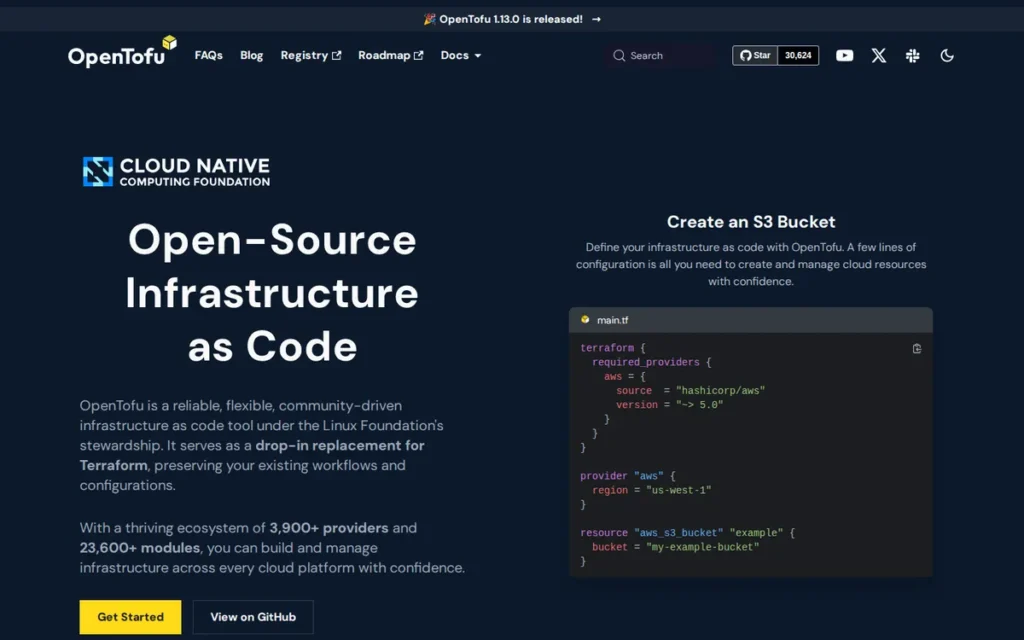
Category: Provisioner, an open-source IaC tool for declaring, deploying, and managing cloud infrastructure across 3,900+ providers using HashiCorp Configuration Language; governed by the Linux Foundation independent of any single vendor.
At a Glance
- Category: Provisioner
- Best For: Multi-cloud DevOps teams with BSL licensing concerns, compliance requirements, and zero tooling budget
- Price Range: Free (MPL 2.0); commercial support via Spacelift, env0, Harness, or Gruntwork (pricing on request)
- Primary Strength: OpenTofu’s MPL 2.0 governance, native state encryption, and zero licensing cost across 3,900+ providers, no other provisioner provides all three simultaneously
- Biggest Limitation: No first-party managed state service; enterprise features require third-party vendors or self-hosted infrastructure
- One-Line Summary: OpenTofu is the Linux Foundation–governed MPL 2.0 fork of Terraform delivering 3,900+ providers, native state encryption, and zero licensing cost with full backward compatibility with all existing Terraform configurations and state files.
- Last Verified: June 2026
Overview
OpenTofu is a fully open-source infrastructure-as-code provisioner governed by the Linux Foundation that is backward-compatible with all HashiCorp Terraform configurations, enabling DevOps teams to provision and manage multi-cloud infrastructure across 3,900+ providers at zero licensing cost.
OpenTofu was created in September 2023 via the OpenTF Manifesto after HashiCorp’s BSL license change, with its first stable release (v1.6.0) published on January 10, 2024, and successive releases through v1.9 as of June 2026 (Linux Foundation, January 2024).
OpenTofu’s plan/apply workflow enables idempotent infrastructure management, teams preview every change before application, and running the same configuration twice produces no additional changes if state already matches desired state.
OpenTofu’s Linux Foundation governance (with the Cloud Native Computing Foundation’s CTO publicly endorsing OpenTofu’s open governance model at its January 2024 launch) ensures no single vendor can impose future licensing restrictions, the precise condition that triggered OpenTofu’s creation.
Key Features
- 3,900+ Provider Ecosystem: OpenTofu supports 3,900+ providers via the OpenTofu Registry, covering AWS, Azure, GCP, Kubernetes, Cloudflare, Datadog, MongoDB Atlas, Snowflake, and virtually every major cloud and SaaS platform, at zero licensing cost. (Note: The OpenTofu Registry indexes additional community-contributed provider variants alongside full Terraform provider protocol compatibility; both tools access the same underlying provider ecosystem, the numerical difference reflects registry counting methodology, not functional capability gaps.) (opentofu.org, June 2026)
- Native Client-Side State Encryption: OpenTofu includes native AES-GCM state encryption with PBKDF2 key derivation and integration with AWS KMS, GCP KMS, and OpenBao, eliminating the external tooling requirement that Terraform imposes to protect sensitive values in state files. Base64 encoding (Terraform’s default) is reversible without a key and provides no security protection; OpenTofu’s native encryption directly addresses this gap (OpenTofu documentation, 2024).
- Full Terraform Backward Compatibility: OpenTofu maintains complete backward compatibility with existing Terraform 1.x configurations, state files, and providers, enabling migration from Terraform with minimal or no code changes, a path practitioners describe as “no pain and no regrets” in documented production reports (r/devops, u/snarkhunter, 2025).
- HCL Language Enhancements Beyond Terraform: OpenTofu introduces capabilities not available in BSL-era Terraform (including loopable import blocks for bulk resource import, provider-defined functions, and earlier variable and locals evaluation) providing concrete technical advantages beyond licensing and governance benefits alone (Spacelift, 2025).
- Linux Foundation Multi-Vendor Governance: OpenTofu is governed by a multi-vendor Technical Steering Committee under the Linux Foundation, with the CNCF CTO publicly endorsing the open governance model at OpenTofu’s January 2024 launch, preventing any single company from controlling the project’s direction, license terms, or roadmap (Linux Foundation, January 2024).
Best For
OpenTofu is best for DevOps and infrastructure engineering teams at mid-to-large organizations with existing Terraform HCL configurations who are evaluating or executing migration due to BSL licensing concerns. OpenTofu is also the correct starting point for teams new to IaC provisioning who require multi-cloud breadth, open governance, and native state security without licensing cost, particularly in regulated industries where plaintext state files create compliance exposure.
Pricing
OpenTofu is free under the Mozilla Public License 2.0 (opentofu.org, June 2026). State management can be self-hosted at no cost using AWS S3, GCP GCS, Azure Blob Storage, or any Terraform-compatible remote backend.
Enterprise support, managed state, GitOps orchestration, and RBAC are available from Spacelift, env0, Harness, Gruntwork, and Scalr, vendor pricing requires direct inquiry. There is no per-resource, per-node, or per-user fee for OpenTofu itself.
Strengths
- Community-validated production migration evidence: OpenTofu’s production-readiness is confirmed by a 73-upvote practitioner recommendation on r/devops and a corroborating production migration report described as “no pain and no regrets”, the strongest community-validated migration evidence of any tool transition in this evaluation (r/devops, u/OogalaBoogala and u/snarkhunter, 2025).
- Only provisioner combining governance + encryption + zero cost simultaneously: OpenTofu is the only provisioner in this evaluation combining MPL 2.0 open governance under the Linux Foundation, native AES-GCM client-side state encryption, and zero licensing cost, directly addressing the three most cited IaC pain points in a single tool (OpenTofu documentation, 2024).
- Structural cost advantage at scale: At 1,000 managed resources, OpenTofu’s tooling cost is $0 versus HCP Terraform Standard’s approximately $470 per month, a cost advantage that scales linearly with environment size (HashiCorp Pricing, June 2026; Spacelift, June 2026).
- Multi-vendor founding coalition confirms long-term sustainability: OpenTofu’s founding coalition included Gruntwork, Spacelift, Harness, env0, and Scalr, competing commercial companies whose joint commitment demonstrates durable multi-vendor investment that single-vendor projects cannot replicate (OpenTofu, 2023).
Limitations
- No First-Party Managed Service: OpenTofu’s most consequential trade-off is the absence of a first-party managed platform, unlike HCP Terraform, no single OpenTofu vendor offers integrated remote state, RBAC, policy-as-code enforcement, and CI/CD run management under one SLA. Organizations must either self-host these capabilities (S3 backend, Atlantis for CI/CD, separate policy tooling) or engage third-party vendors such as Spacelift or env0, adding vendor management overhead that HCP Terraform’s managed experience eliminates.
- Less Mature Learning Ecosystem: OpenTofu’s documentation, certification programs, and formal training infrastructure are less developed than Terraform’s decade-plus institutional ecosystem, creating higher onboarding friction for teams without existing HCL expertise or access to Terraform’s established community training resources.
- Fragmented Commercial Support: OpenTofu’s commercial support options are distributed across multiple ecosystem vendors rather than centralized through a single IBM/HashiCorp-style enterprise relationship, which may create procurement friction for organizations requiring named-vendor SLA accountability.
- HCL Skill Dependency: OpenTofu inherits Terraform’s HCL DSL, which is accessible to infrastructure engineers but represents a learning barrier for software developers who prefer general-purpose languages. Pulumi is the better choice when developer experience in TypeScript or Python is the primary requirement.
Verdict
OpenTofu is the top-ranked cloud infrastructure automation provisioner in this independent evaluation, delivering the strongest combination of multi-cloud provider breadth, open governance, native state encryption, and zero licensing cost of any tool reviewed.
OpenTofu outranks Terraform (despite Terraform’s larger talent pool and IBM enterprise support) because OpenTofu provides equivalent HCL compatibility and 3,900+ providers while eliminating Terraform’s BSL licensing risk, plaintext-state security gap, and per-resource HCP cost escalation, a combination practitioners confirm is achievable with minimal migration friction.
Teams currently running Terraform should treat OpenTofu as the highest-scoring evaluation starting point for any IaC tooling review. Teams new to IaC provisioning should adopt OpenTofu over Terraform unless IBM/HashiCorp enterprise support contracts are a specific, non-negotiable procurement requirement.
2. Pulumi: Best for Developer-Led Infrastructure Teams Using General-Purpose Languages
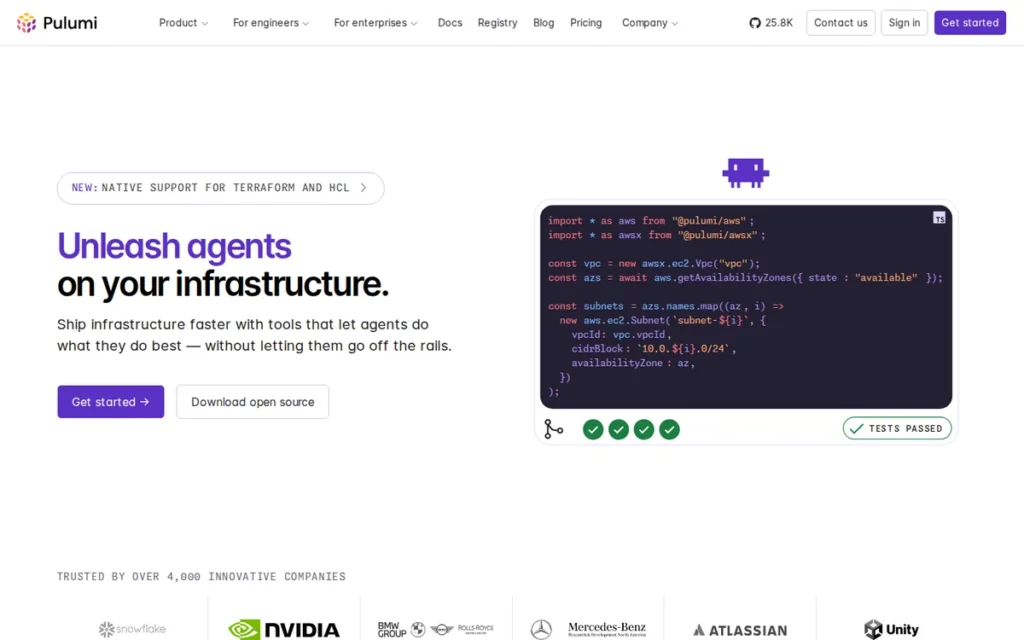
Category: Provisioner, a developer-first IaC platform that uses general-purpose programming languages including TypeScript, Python, Go.NET, and Java to define, deploy, and manage cloud infrastructure across 120+ providers.
At a Glance
- Category: Provisioner
- Best For: Developer-led teams authoring IaC in TypeScript, Python, Go, or .NET
- Price Range: Free CLI (Apache 2.0); Pulumi Cloud Team ~$50/month; Enterprise and Business Critical: custom pricing
- Primary Strength: Pulumi’s general-purpose language IaC with type safety, first-class secrets encryption by default, and AI-assisted Pulumi Copilot authoring
- Biggest Limitation: VC-backed licensing risk; 120+ providers vs. 3,900+; over-engineered for simple configurations
- One-Line Summary: Pulumi is an Apache 2.0 IaC platform for TypeScript/Python/Go infrastructure with first-class secrets encryption, Pulumi Copilot AI, and 120+ providers.
- Last Verified: June 2026
Overview
Pulumi is an open-source infrastructure-as-code platform founded in 2017 by Microsoft programming language veteran Joe Duffy that enables software engineers to define, deploy, and manage cloud infrastructure using TypeScript, Python, Go.NET, and Java, making it the primary choice for engineering organizations applying software development practices directly to infrastructure management.
Pulumi supports 120+ cloud providers under an Apache 2.0 core license and encrypts secrets as a first-class primitive in all state files without requiring external configuration (Pulumi IaC Comparisons, 2024). Named production adopters include Microsoft, Snowflake, Atlassian, Lemonade, and Mercedes-Benz, reflecting Pulumi’s traction among engineering-intensive multi-cloud organizations (Jit.io, 2025).
Key Features
- General-Purpose Language IaC: Pulumi supports TypeScript, Python, Go.NET (C#), and Java as first-class authoring languages, enabling engineers to use type systems, unit test frameworks, package managers (npm, pip, Go modules), and IDE autocomplete for all infrastructure logic, capabilities unavailable in HCL or YAML-only tools (Pulumi GitHub, 2025).
- First-Class Secrets Encryption by Default: Pulumi encrypts all sensitive values in state files by default with per-stack encryption keys, integrating with AWS KMS, Azure Key Vault, GCP KMS, and HashiCorp Vault, ensuring sensitive values including derived secrets remain encrypted at rest and in transit, in direct contrast to Terraform’s documented default of storing sensitive state values as base64 plaintext (Pulumi IaC Comparisons, 2024).
- Pulumi Copilot AI Assistant: Pulumi Copilot is integrated into Pulumi Cloud and VS Code via the @pulumi Chat extension (generating, explaining, debugging, and optimizing infrastructure code through natural language) reducing cloud provider API learning curves and accelerating complex configuration authoring (Pulumi Blog, 2024).
- Pulumi Automation API for Embedded Workflows: The Pulumi Automation API enables infrastructure to be managed programmatically from application code, embedding provisioning, update, and teardown workflows into CI/CD pipelines, SaaS platforms, and operator patterns. No other provisioner in this evaluation provides a first-class SDK-level Automation API designed explicitly for embedding IaC operations into application code.
- Pulumi Cloud Managed State and Governance: Pulumi Cloud provides SaaS-hosted remote state management, RBAC, audit logs, drift detection, policy-as-code via CrossGuard, and CI/CD integrations with GitHub Actions, GitLab CI, Jenkins, and Atlantis, comparable enterprise governance to HCP Terraform for teams preferring managed state over self-hosted backends.
Best For
Pulumi is best for engineering organizations where infrastructure is owned and managed primarily by software developers rather than dedicated operations teams, particularly teams building Internal Developer Platforms with the Automation API, managing complex multi-cloud logic that benefits from real programming language constructs, or embedding infrastructure provisioning into application workflows where HCL’s DSL creates genuine developer friction. If your team manages primarily application code and finds HCL limiting, begin the evaluation with Pulumi rather than OpenTofu.
Pricing
Pulumi’s core CLI is free under Apache 2.0 (verified June 2026). State can be self-hosted at no cost using AWS S3, Azure Blob Storage, GCP GCS, or local storage. Pulumi Cloud Individual tier is free for solo users; Team tier is approximately $50 per month for small teams.
Enterprise and Business Critical tiers require direct inquiry at pulumi.com/pricing. Self-hosted state eliminates Pulumi Cloud dependency entirely, a meaningful escape valve for organizations wary of managed-service vendor lock-in.
Strengths
- Named enterprise adopters confirm production-scale credibility: Named production adoption at Microsoft, Snowflake, Atlassian, Lemonade, and Mercedes-Benz confirms Pulumi’s enterprise production readiness among engineering-intensive organizations with complex multi-cloud infrastructure requirements, a named-adopter signal that community-only tools cannot match (Jit.io, 2025).
- First-class secrets encryption directly addresses Terraform’s documented security gap: Pulumi’s default state encryption addresses the most cited IaC security concern without requiring any additional configuration or external tooling, in direct contrast to Terraform’s documented base64 plaintext default, base64 is reversible without a key and provides no security protection (Pulumi IaC Comparisons, 2024).
- Founder pedigree is directly reflected in product quality: Pulumi founder Joe Duffy’s background as head of Microsoft’s programming language and platform groups is reflected in Pulumi’s type system design, multi-language SDK architecture, and IDE integration, consistently assessed as more polished than competing developer-facing IaC tools in independent comparisons (ComputerWeekly, 2024).
- Automation API is a unique embedded-workflow capability: The Pulumi Automation API enables embedded, programmatic infrastructure management from application code (a first-class SDK-level capability no other provisioner in this evaluation natively provides) making Pulumi uniquely suited for platform engineering teams building self-service infrastructure APIs where CLI-style operations are operationally insufficient.
Users on r/devops shared their experience deploying Pulumi in a Go-based engineering stack:
“We use it with Go. It’s a breath of fresh air as far as being an extensible, imperative option for tooling. It’s been a boon for us fostering the “DevOps-you-build-it-you-run-it” culture while also giving us the ability to have foundational, codified opinions on the “how” it should be built and ran.” Posted by u/btdeviant
Takeaway: Pulumi’s general-purpose language support translates directly into DevOps culture enablement, allowing engineering teams to embed infrastructure ownership into developer workflows without adopting a separate DSL toolchain.
Limitations
- VC Licensing Risk: Pulumi’s most significant trade-off is governance risk from its VC-backed ownership, with $41 million in Series C funding from NEA and Madrona in 2023, bringing total funding to $99 million (Pulumi Series C press release, 2023; GeekWire, 2023), Pulumi faces a documented community concern that investor pressure could trigger a future licensing change analogous to HashiCorp’s August 2023 BSL shift, a risk practitioners explicitly articulate: “Pulumi is a sensible alternative. Apache license so far, but wait till investors start wanting more return…” (r/devops, u/maxlan, 2025).
- Provider Ecosystem Gap: Pulumi’s 120+ provider ecosystem is substantially smaller than OpenTofu and Terraform’s 3,900+, creating real integration gaps for niche SaaS platforms, networking vendors, and legacy system integrations not yet covered by Pulumi’s provider library (Pulumi GitHub, 2025).
- Complexity Overhead for Simple Configurations: Pulumi’s general-purpose language approach adds cognitive overhead for configurations where HCL’s declarative brevity is more appropriate, Pulumi rewards engineering-heavy teams but may be over-engineered for simpler environments or operations-focused teams without programming backgrounds (env0, 2024).
Users on r/devops noted the accessibility gap in practice:
“The main selling point of Pulumi is IaC that’s accessible for the average developer. The reality was, most of the people who this was meant to appeal to still didn’t take much interest in it. It also didn’t actually reduce the barrier to entry. The majority of the learning curve is in the quirks of what you are actually configuring.” Posted by u/seanamos-1
Takeaway: Pulumi’s general-purpose language approach does not eliminate the IaC learning curve in practice, cloud provider complexity remains the dominant barrier, and developer accessibility gains are narrower than the tool’s positioning implies.
- Pulumi Cloud Vendor Dependency: Managed state features including RBAC, audit logs, and drift detection require Pulumi Cloud, creating a vendor relationship that fully self-hosted alternatives such as OpenTofu with an S3 backend avoid entirely.
Verdict
Pulumi is the strongest cloud infrastructure automation provisioner for software engineering teams managing complex multi-cloud infrastructure, earning its second-place ranking through general-purpose language support, first-class state encryption by default, the Automation API for embedded workflows, and AI-assisted authoring that no other provisioner in this evaluation provides.
Pulumi ranks below OpenTofu because its VC-backed governance structure introduces an acknowledged future licensing risk that OpenTofu’s Linux Foundation governance eliminates structurally, and its 120+ provider ecosystem is substantially smaller than OpenTofu’s 3,900+.
For developer-first teams where HCL limitations create real workflow friction and OpenTofu’s governance advantage is not the deciding factor, Pulumi is the recommended provisioner.
3. Ansible: Best for Agentless Configuration Management and Event-Driven Automation
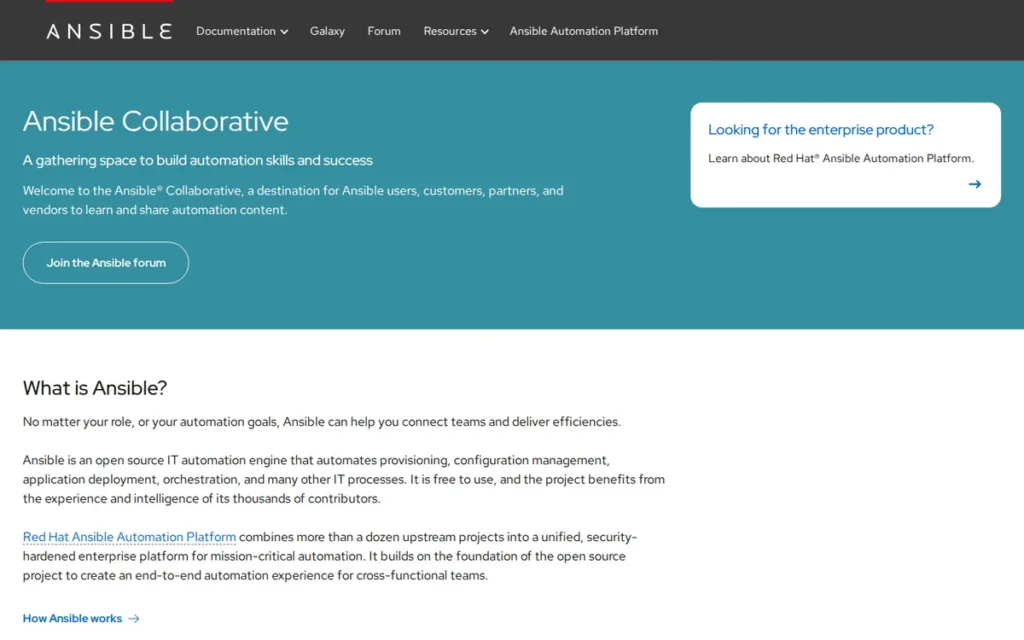
Category: Configurator, an agentless automation engine for configuration management, application deployment, and event-driven orchestration across cloud, hybrid, and on-premises environments; complements IaC provisioners such as OpenTofu and Pulumi rather than replacing them.
At a Glance
- Category: Configurator
- Best For: Operations teams managing configuration across hybrid environments without programming expertise
- Price Range: Free (GPLv3); Red Hat Ansible Automation Platform approximately $13,000–$14,000/year for 100 nodes Standard tier (third-party estimate; official pricing requires Red Hat sales engagement)
- Primary Strength: Ansible’s 4.7/5.0 G2 rating and agentless SSH/WinRM architecture, the most accessible automation platform in this evaluation
- Biggest Limitation: No IaC state model; Ansible cannot reliably manage cloud resource create/update/destroy lifecycle
- One-Line Summary: Ansible is Red Hat’s agentless YAML automation platform rated 4.7/5.0 on G2 for configuration management, event-driven automation, and application deployment across cloud, hybrid, and on-premises environments, best deployed as the configuration layer above an IaC provisioner, not as a standalone IaC replacement.
- Last Verified: June 2026
Overview
Ansible is Red Hat’s open-source agentless automation engine that uses human-readable YAML playbooks to manage configuration management, application deployment, and cloud orchestration without persistent agents on target systems, making it the most accessible infrastructure automation tool in this evaluation for operations teams without deep programming expertise.
Ansible connects to managed nodes via existing SSH (Linux/Unix) or WinRM (Windows), and the commercial Red Hat Ansible Automation Platform extends community Ansible with Event-Driven Ansible for reactive automation, Ansible Lightspeed AI-assisted authoring, a centralized controller, and RBAC. Ansible holds a verified G2 rating of 4.7/5.0, the highest of any tool with a verified score in this evaluation (G2, 2025).
Key Features
- Agentless Architecture via SSH and WinRM: Ansible operates without persistent agents on managed nodes, connecting via SSH or WinRM using existing system access credentials, eliminating installation, upgrade, and maintenance overhead on target infrastructure, with community users specifically citing “no agent needed, bootstrapping simplicity, and use of existing access methods like SSH and sudo” as distinguishing benefits (Ansible Community Forum, 2024).
- YAML Playbook Accessibility: Ansible’s YAML-based playbooks describe automation states and task sequences in human-readable format accessible to operations engineers without programming backgrounds, providing a lower organizational adoption barrier than Ruby DSL tools like Progress Chef, HCL tools like OpenTofu, or general-purpose language tools like Pulumi.
- Event-Driven Ansible for Reactive Automation: Event-Driven Ansible enables reactive self-healing infrastructure automation by listening to cloud events, monitoring alerts, and webhook signals and automatically executing defined playbook responses, extending Ansible from scheduled or manual execution to continuous operational automation without manual intervention (Red Hat, 2024).
- Ansible Lightspeed AI Authoring: Red Hat Ansible Automation Platform includes Ansible Lightspeed, an AI-assisted authoring service that generates, explains, and optimizes playbook content from natural language, reducing YAML authoring burden and accelerating onboarding for teams new to Ansible.
- Configuration Layer in Two-Tool IaC Stacks: Ansible functions as the configuration layer above IaC provisioners (managing software state, application deployment, and configuration drift correction on infrastructure that OpenTofu, Terraform, or Pulumi has provisioned) which is why the OpenTofu + Ansible combination is the most commonly cited enterprise IaC pattern in DevOps community discussions (r/devops community synthesis, 2024–2025).
Best For
Ansible is best for operations and DevOps teams managing existing infrastructure across cloud and on-premises environments who need agentless, YAML-accessible configuration management and automated remediation. Ansible must be paired with a dedicated IaC provisioner such as OpenTofu for infrastructure provisioning rather than attempting to use Ansible as a standalone IaC replacement, using Ansible alone is a documented tool selection error the taxonomy section above exists to prevent.
Pricing
Community Ansible is free under GPLv3 (Red Hat, 2024). Red Hat Ansible Automation Platform uses per-node subscription pricing, approximately $13,000–$14,000 per year for 100 managed nodes Standard tier per G2 pricing snapshot and reseller MSRP data (2025–2026); exact current pricing requires direct Red Hat sales engagement as official pricing varies with volume and support level.
Teams should clearly distinguish between free community Ansible and the substantially more expensive Red Hat AAP: enterprise features including Event-Driven Ansible, the centralized controller, RBAC, and certified content are available only in the commercial platform.
Strengths
- Highest verified G2 rating in this evaluation: Ansible holds a verified G2 rating of 4.7/5.0 (the highest among all tools with a verified score in this evaluation) reflecting consistent practitioner satisfaction with the agentless architecture and YAML accessibility across a large and diverse enterprise reviewer base (G2, 2025).
This community leadership is reflected in practitioners’ day-to-day experience across the open-source ecosystem, as noted on r/devops:
“Ansible is where the industry seems to be these days. I find many projects that provide ansible playbooks to install with, but few to none that provide chef cookbooks.” Posted by u/fengshui
Takeaway: Ansible’s ecosystem dominance is measurable in the near-absence of equivalent Chef coverage across open-source projects, validating its position as the default community configurator for new and greenfield deployments.
- Zero-agent structural operational advantage: Ansible’s agentless architecture provides zero persistent agents on managed nodes (no agent update cycles, no agent security vulnerabilities, no agent downtime) community users specifically citing “no overhead” and “use of existing SSH and sudo access” as distinguishing operational benefits (Ansible Community Forum, 2024).
- Event-Driven Ansible provides reactive self-healing capability: Event-Driven Ansible enables automation triggered by monitoring alerts, webhooks, and ticketing system events, making Ansible one of only two tools in this evaluation alongside Crossplane with native event-driven automation rather than purely scheduled or manually-executed workflows (Red Hat, 2024).
- IBM/Red Hat commercial distribution provides enterprise accountability: Red Hat’s commercial platform provides Ansible with enterprise distribution, a certified content catalog, quarterly updates, and structured support SLAs, a meaningful consideration for enterprises with procurement requirements for vendor-backed support accountability (Intive, 2024).
Limitations
- No IaC State Model: Ansible’s most consequential trade-off is architectural: Ansible lacks the infrastructure state model that IaC provisioners provide, cannot reliably determine whether a cloud resource already exists, and cannot manage the create, update, and destroy lifecycle of cloud resources with provisioner-level fidelity. Ansible is architecturally unsuitable as a standalone replacement for OpenTofu or Terraform and must be deployed as the configuration layer above a dedicated provisioner (DevTune AI, 2025).
- Scale Performance Trade-off: Ansible can experience performance degradation at very large scale due to its SSH-based model initiating new connections per task rather than maintaining persistent channels, an architectural consequence of the agentless model that agent-based tools like Progress Chef avoid at the cost of per-node maintenance overhead.
- AAP Cost Step: Red Hat Ansible Automation Platform at approximately $13,000–$14,000 per year for 100 nodes represents a significant cost step from free community Ansible, creating a total-cost-of-ownership gap that surprises teams adopting the free edition and later requiring enterprise governance features including EDA and the centralized controller (DevTune AI, 2025).
- IBM Governance Concern: Ansible’s IBM/Red Hat lineage generates ongoing community governance concern via the CentOS discontinuation precedent, one comment earning 61 upvotes states: “After centos fiasco I stay away from anything related to IBM” (r/devops, u/bluecat2001, 2025), a documented signal organizations should weigh when making long-term platform commitments.
Verdict
Ansible is the highest-rated configuration management and automation platform in this evaluation, earning its third-place ranking through a verified G2 score of 4.7/5.0, the architecturally unique agentless model, and Event-Driven Ansible reactive automation capabilities that no other configurator in this evaluation matches.
Ansible occupies a fundamentally different functional category from the provisioners ranked above it (Ansible configures and manages software state on existing infrastructure rather than provisioning that infrastructure from scratch) and is most powerfully deployed as the configuration layer in an OpenTofu + Ansible or Terraform + Ansible production stack.
Organizations evaluating Ansible must distinguish clearly between free community Ansible and Red Hat Ansible Automation Platform, as the enterprise governance and EDA features that differentiate the commercial platform carry a cost requiring deliberate budget planning.
4. Crossplane: Best for Kubernetes-Native Platform Engineering and Self-Service Infrastructure
Category: Orchestrator, a Kubernetes-native infrastructure control plane that manages external cloud resources through continuous reconciliation; architecturally distinct from CLI-based IaC provisioners and requires a Kubernetes cluster as a prerequisite.
At a Glance
- Category: Orchestrator
- Best For: Kubernetes-native platform engineering teams building Internal Developer Platforms
- Price Range: Free (Apache 2.0); Upbound commercial managed control plane pricing on request
- Primary Strength: Crossplane’s CNCF Graduated status (October 2025), continuous reconciliation model, and Composition API for self-service infrastructure abstractions
- Biggest Limitation: Kubernetes prerequisite plus no terraform-plan equivalent preview before infrastructure changes apply
- One-Line Summary: Crossplane is a CNCF Graduated (October 2025) Apache 2.0 Kubernetes-native control plane managing cloud resources via continuous reconciliation and enabling self-service infrastructure abstractions via the Composition API.
- Last Verified: June 2026
Overview
Crossplane is an open-source Kubernetes-native infrastructure control plane graduated by the Cloud Native Computing Foundation in October 2025 that enables platform engineering teams to manage external cloud resources through declarative Kubernetes APIs and a continuous reconciliation loop, making it architecturally distinct from every CLI-based IaC provisioner in this evaluation.
This continuous reconciliation loop (a core Kubernetes design pattern applied to external cloud resources) makes Crossplane fundamentally different from CLI-based IaC tools and positions it as a primary enabler of GitOps-native Internal Developer Platforms where developer self-service of cloud infrastructure is the primary organizational goal.
Unlike OpenTofu or Terraform’s plan-apply-destroy workflow, Crossplane perpetually reconciles live cloud resource state against declared desired state, eliminating configuration drift without scheduled re-runs. Crossplane’s Composition API allows platform teams to expose custom higher-level infrastructure abstractions that developer teams provision via simple kubectl manifests without requiring cloud account access or IAM knowledge.
Key Features
- Continuous Reconciliation of Cloud Resources: Crossplane implements a continuous control loop for all managed cloud resources, perpetually comparing live state against Kubernetes-declared desired state and automatically correcting any divergences, eliminating the configuration drift accumulation that requires periodic re-execution of Terraform or Ansible in traditional IaC workflows (Crossplane documentation, 2024).
- Composition API and Composite Resource Definitions: Crossplane’s Composition API enables platform engineering teams to define Composite Resource Definitions (XRDs) (higher-level infrastructure abstractions such as PostgresDatabase or MessageQueue) that developer teams provision via kubectl manifests without needing cloud account access, IAM knowledge, or understanding of underlying resource configurations (Crossplane Blog, 2024).
- Native GitOps Integration via Argo CD and Flux CD: Crossplane integrates natively with Argo CD and Flux CD because all Crossplane resources are declarative Kubernetes manifests storable in Git, enabling a single GitOps pipeline to manage both application Kubernetes resources and the cloud infrastructure those applications depend on from one control plane.
- CNCF Graduated Status (October 2025): Crossplane achieved CNCF Graduation in October 2025 (the highest maturity designation in the CNCF ecosystem, joining projects that have completed CNCF’s full maturity lifecycle including Kubernetes, Prometheus, Envoy, and Argo) providing governance assurance and long-term sustainability guarantees (CNCF official announcement, November 6, 2025).
- Crossplane v2.0 Architectural Improvements: Crossplane v2.0 introduced namespaced resources by default, a simplified Composition model, and improved developer experience, addressing many UX and debugging limitations documented in 1.x community feedback and significantly expanding production operational usability (Crossplane Blog, 2024).
Best For
Crossplane is best for platform engineering teams at Kubernetes-native organizations building Internal Developer Platforms, where enabling developer self-service of policy-compliant cloud infrastructure without direct cloud account access is the explicit goal. Crossplane is also well-suited for organizations that have standardized on Argo CD or Flux CD for application GitOps delivery and want to extend the same control plane and Git-as-source-of-truth model to cloud infrastructure management.
Pricing
Crossplane is free under the Apache 2.0 license (crossplane.io, June 2026). There is no per-node, per-resource, or per-feature charge for the open-source project. Commercial managed control plane hosting and enterprise support are available through Upbound, pricing requires direct inquiry at upbound.io.
The primary cost of running Crossplane is the Kubernetes cluster itself. Organizations without an existing production Kubernetes cluster should factor cluster infrastructure and operational costs into total cost of ownership before comparing Crossplane’s free tooling cost against paid provisioners.
Strengths
- CNCF Graduation confers the highest ecosystem governance credential: Crossplane achieved CNCF Graduation in October 2025 (conferred only after demonstrated production adoption, governance best practices, and sustained community health) placing Crossplane among projects that have completed CNCF’s full maturity lifecycle alongside Kubernetes, Prometheus, Envoy, and Argo (CNCF official announcement, November 6, 2025).
- Continuous reconciliation eliminates drift without manual re-runs: A production Crossplane user documented the core operational benefit directly: “After X months you don’t have to worry that colleagues have made manual changes” (r/devops, 2025), a genuine operational advantage over tools requiring scheduled or manual plan-and-apply cycles for drift detection and correction.
“After X months you don’t have to worry that colleagues have made manual changes.” (r/devops practitioner, 2025)
Takeaway: Continuous reconciliation is Crossplane’s operationally distinct advantage, infrastructure automatically self-corrects, eliminating an entire category of drift-detection overhead that Terraform and Ansible workflows require through manual or scheduled re-runs.
- Composition API is the only purpose-built IDP enablement mechanism in this evaluation: Crossplane’s Composition API creates a clean API boundary between platform teams defining compliant infrastructure and developer teams requesting it via kubectl, a capability that Terraform, Pulumi, and CloudFormation do not natively provide and that directly enables self-service infrastructure at organizational scale.
- Zero licensing cost with independent governance: Crossplane’s zero licensing cost combined with CNCF Graduated governance makes it the strongest open-source value proposition among Kubernetes-native tools, no per-resource fees, no BSL restrictions, no VC licensing risk, and governance controlled by an independent foundation (crossplane.io, June 2026).
Limitations
- Kubernetes Prerequisite and No Plan/Diff Preview: Crossplane’s most consequential trade-off is the combination of a Kubernetes cluster requirement with no terraform-plan-equivalent preview mechanism. Crossplane requires an existing maintained Kubernetes cluster, immediately excluding organizations without Kubernetes expertise. Crossplane provides no mechanism to preview which cloud resources will be created, modified, or deleted before applying a configuration, practitioners have cited this as a production dealbreaker: “Losing control of diffing and application was a dealbreaker for me” (r/kubernetes, u/lulzmachine, 2024).
- Organizational Accessibility Gap: Crossplane’s accessibility is limited to organizations with deep Kubernetes expertise. An enterprise consultant working with Fortune 500 clients described Crossplane as “the future” but “not the present” because “those who understand K8s as a control plane for automation are the exception in the industry, not the rule” (r/devops, u/tadamhicks, 2024).
- Immature Disaster Recovery Tooling: Crossplane’s disaster recovery tooling is less mature than Terraform’s and OpenTofu’s, and the operational implications of XRD and Composition updates on live resources are not always transparent to operators, adding operational risk in change-controlled environments where explicit pre-change reviews are mandatory.
- Workflow Paradigm Shift from Terraform: Teams migrating from Terraform to Crossplane should plan for a significant operational paradigm shift, Crossplane is not a drop-in replacement but a fundamentally different operational model requiring Kubernetes-native expertise, and practitioners report a substantial rethinking of all infrastructure management workflows when making this transition.
Verdict
Crossplane is the highest-scoring Kubernetes-native infrastructure control plane in this evaluation, earning its fourth-place ranking through CNCF Graduation credentials (October 2025), Apache 2.0 open governance, zero licensing cost, and a continuous reconciliation and self-service abstraction model that no CLI-based provisioner in this evaluation provides.
Crossplane is architecturally distinct from Terraform, OpenTofu, and Pulumi (Crossplane is not a drop-in replacement for any of them but a Kubernetes-native control plane for a fundamentally different operational model) and is appropriate for organizations where platform engineering, IDP enablement, and GitOps-native infrastructure management are explicit strategic priorities with Kubernetes already in production.
Organizations without existing Kubernetes infrastructure and expertise, or those requiring terraform-plan-style change previews before production changes, should evaluate OpenTofu as their primary provisioner and revisit Crossplane as a longer-term architectural evolution.
5. Terraform: Best for Established Enterprises with Existing IBM/HashiCorp Support Commitments

Category: Provisioner, a BSL-licensed, HCL-based IaC tool for declarative multi-cloud infrastructure provisioning with 3,000+ providers; functionally equivalent to OpenTofu for most use cases but subject to HashiCorp’s Business Source License rather than an OSI-approved open-source license.
At a Glance
- Category: Provisioner
- Best For: Enterprises with existing HCL investments and IBM/HashiCorp enterprise support contracts
- Price Range: Free CLI (BSL, not open source); HCP Terraform Essentials $0.10/resource/month; Standard $0.47/resource/month ($470/month at 1,000 resources); Premium $0.99/resource/month; legacy free tier discontinued March 31, 2026
- Primary Strength: Terraform’s 3,000+ provider ecosystem, deepest DevOps talent pool, only widely-recognized IaC certification program, and IBM enterprise support infrastructure
- Biggest Limitation: BSL license (not open source); plaintext state by default; $470/month at 1,000 resources (Standard tier)
- One-Line Summary: Terraform is HashiCorp/IBM’s BSL-licensed HCL provisioner with 3,000+ providers, IBM enterprise support, and the deepest IaC talent pool in DevOps, but its BSL license, plaintext-state security posture, and per-resource HCP pricing make OpenTofu the more defensible long-term choice for organizations without existing IBM/HashiCorp support commitments.
- Last Verified: June 2026
Overview
Terraform is HashiCorp’s declarative infrastructure-as-code provisioner, acquired by IBM in April 2024 for approximately $6.4 billion, that uses HashiCorp Configuration Language to provision and manage infrastructure across 3,000+ cloud, SaaS, and networking providers, making it the IaC tool with the deepest DevOps talent pool and the most widely recognized certification program of any tool in this evaluation.
Terraform launched in 2014 and HCL skills appear as required credentials in virtually every enterprise DevOps job posting (r/devops, 2024). However, HashiCorp’s August 2023 switch to the Business Source License ended Terraform’s open-source status.
The March 31, 2026 discontinuation of the HCP Terraform legacy free tier has accelerated community evaluation of OpenTofu as a functionally equivalent and governance-advantaged alternative (Scalr, 2026).
Key Features
- 3,000+ Provider Ecosystem: Terraform’s provider ecosystem spans 3,000+ providers covering AWS, Azure, GCP, Kubernetes, Cloudflare, Datadog, Snowflake, MongoDB Atlas, and virtually every major cloud, SaaS, and networking vendor, enabling single-state management of heterogeneous infrastructure across multiple clouds and services. (Note: The OpenTofu Registry lists 3,900+ providers by indexing additional community-contributed provider variants; both tools access the same underlying Terraform provider protocol ecosystem, the numerical difference reflects registry counting methodology.) (HashiCorp, June 2026)
- Plan/Apply Workflow for No-Surprises Execution: Terraform’s plan/apply workflow generates a human-readable execution plan before any infrastructure change is applied, showing exactly which resources will be created, modified, or destroyed, a no-surprises operational experience that practitioners consistently cite as a core adoption driver and a capability that Crossplane explicitly lacks.
- HCP Terraform Managed Governance Layer: HCP Terraform adds remote state management with locking, team RBAC, Sentinel policy-as-code enforcement, audit logging, cost estimation, and run orchestration, providing a managed governance layer for teams that prefer not to self-host state backends and policy tooling.
- CDKTF General-Purpose Language Support: CDK for Terraform (CDKTF) enables infrastructure definition in TypeScript, Python, Java, C#, and Go, synthesizing to Terraform HCL for deployment, HashiCorp’s answer to Pulumi’s general-purpose language model, providing a developer-oriented authoring pathway within the Terraform ecosystem (IBM Think, 2024).
- HashiCorp Certification Program: Terraform’s HashiCorp Certified: Terraform Associate (003) and Professional certifications provide the only widely-recognized structured IaC credentials in DevOps, creating skills validation standards for hiring, team assessment, and career development that no other tool in this evaluation offers at equivalent scale (HashiCorp Certifications, 2024).
Best For
Terraform is best for established DevOps teams with significant existing Terraform HCL configuration investments that would incur substantial migration costs, organizations with contractual IBM/HashiCorp enterprise support requirements, and procurement-gated enterprises where single-vendor commercial accountability outweighs the governance and security advantages that OpenTofu provides. Teams without these specific constraints should evaluate OpenTofu as the preferred functionally equivalent alternative.
Pricing
Terraform CLI is free under the BSL license, the BSL is not an OSI-approved open-source license (verified June 2026). HCP Terraform tiers:
- Free tier: up to 500 managed resources and 1 concurrent run (legacy free tier discontinued March 31, 2026)
- Essentials: $0.10 per managed resource/month ($100/month at 1,000 resources)
- Standard: $0.47 per managed resource/month ($470/month at 1,000 resources)
- Premium: $0.99/resource/month ($990/month at 1,000 resources)
- Enterprise and Plus: custom pricing
Sources: HashiCorp Pricing, June 2026 and Spacelift, June 2026. Self-managed state backends using AWS S3, GCS, or Azure Blob incur no HCP Terraform charges.
Strengths
- Largest provider ecosystem enables single-state heterogeneous infrastructure management: Terraform’s 3,000+ providers enable single-state wiring of AWS resources, Azure resources, Kubernetes secrets, Cloudflare DNS, Datadog monitors, Snowflake databases, and MongoDB users, a capability practitioners specifically identify as the core multi-cloud IaC value proposition: “Being able to manage resources in different providers in one state and wire them all together is a big benefit” (r/devops, u/carsncode, 2025).
- Deepest DevOps talent pool of any IaC provisioner: Terraform experience is the most demanded IaC skill in DevOps job postings globally (“every single company I’ve talked to is looking for Terraform experience”) reflecting a talent pool depth and hiring pipeline that no other IaC tool in this evaluation can match (r/devops, u/h8theh8ers, 2024).
- IBM enterprise support infrastructure at acquisition-backed scale: IBM’s acquisition of HashiCorp for approximately $6.4 billion in April 2024 provides Terraform with enterprise distribution, commercial support SLAs, and account management at a scale that community-governed OpenTofu and VC-backed Pulumi cannot currently match, meaningful for enterprises with named-vendor support requirements (IBM Think, 2024).
- Only widely-recognized IaC certification program in DevOps: Terraform’s certification ecosystem creates measurable skills validation infrastructure for hiring, team assessment, and career development that no other tool in this evaluation offers at equivalent institutional scale (HashiCorp Certifications, 2024).
Limitations
- BSL License Removes Open-Source Status: Terraform’s most consequential trade-off is its August 2023 BSL change, Terraform is no longer open-source software under any OSI-recognized license, creating legal exposure for companies building Terraform-based services. The migration response is documented: OpenTF Manifesto co-signers including Gruntwork, Spacelift, Harness, env0, and Scalr describe migration to OpenTofu as achievable with minimal friction (OpenTofu, 2023).
- Plaintext State Security Gap: Terraform’s default state file stores sensitive values as base64 plaintext, base64 encoding is reversible without a key and provides no security protection, meaning any party with read access to the state file can decode all values immediately. This documented security gap requires external KMS configuration for compliance, which OpenTofu addresses natively in v1.7 without additional tooling (Infisical, 2024).
- Per-Resource Cost Escalation: HCP Terraform Standard tier at $0.47/resource/month equals $470/month at 1,000 managed resources, per-resource pricing that escalates unpredictably with environment growth and drove large-environment teams toward self-hosted backends or OpenTofu before and after the March 31, 2026 legacy free tier discontinuation (Spacelift, June 2026; Scalr, 2026).
- IBM Governance Concern: Terraform’s IBM acquisition has generated persistent community governance concern via the CentOS discontinuation precedent, a community comment earning 61 upvotes states: “After centos fiasco I stay away from anything related to IBM” (r/devops, u/bluecat2001, 2025), a documented signal organizations should weigh when making long-term platform commitments.
Verdict
Terraform is the IaC provisioner with the deepest ecosystem, the largest talent pool, and the strongest enterprise support infrastructure in this evaluation, but ranks fifth because its BSL license, plaintext-state security posture, per-resource HCP cost escalation, and IBM governance risk represent objective documented disadvantages relative to OpenTofu.
Organizations may reasonably weight IBM/HashiCorp support contracts and talent pool availability differently than this evaluation’s criteria, the weighting reflects the audience’s explicit concern with long-term toolchain risk, not a judgment that Terraform is a poor tool for its stated use cases.
For organizations making new IaC decisions without existing IBM/HashiCorp support commitments, OpenTofu should be evaluated first based on the documented evidence that OpenTofu eliminates Terraform’s principal limitations without functional regression for the majority of Terraform use cases, organizations relying on Terraform Enterprise-specific features or Sentinel policy integrations should verify feature parity before committing to migration.
6. Progress Chef: Best for Regulated-Industry Enterprises with Compliance-as-Code Requirements
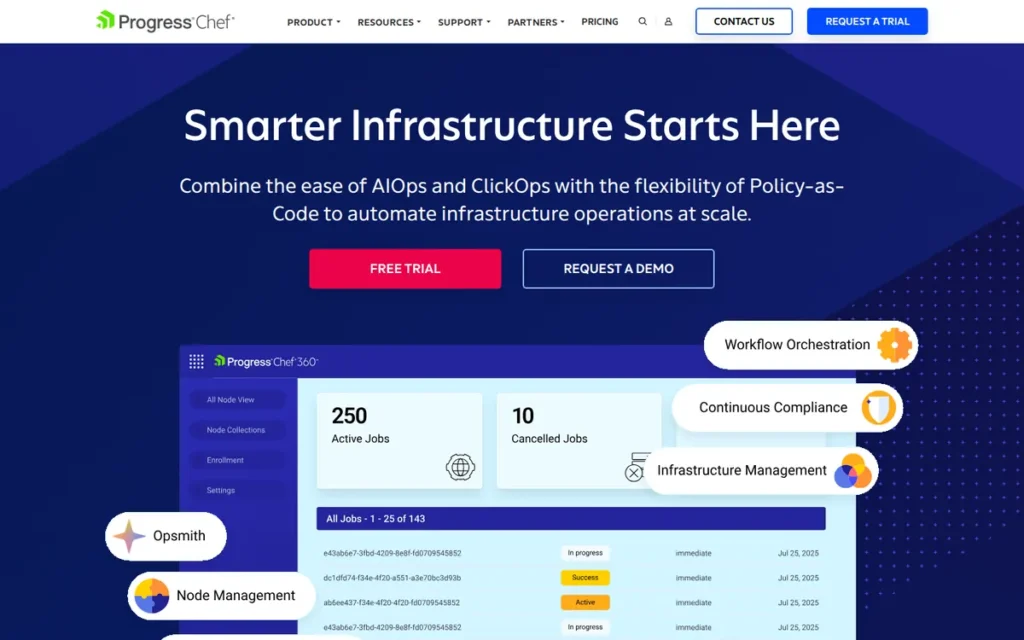
Category: Configurator + Compliance, a multi-component infrastructure automation platform spanning configuration management (Chef Infra), compliance verification (Chef InSpec), application packaging (Chef Habitat), and enterprise observability (Chef Automate); Chef InSpec also operates as a standalone compliance-as-code framework in environments using any other provisioner.
At a Glance
- Category: Configurator + Compliance
- Best For: Regulated-industry enterprises needing automated PCI DSS, HIPAA, or CIS compliance verification
- Price Range: Community: free (Apache 2.0); enterprise platform: per-node subscription (pricing not publicly disclosed; requires Progress Software sales engagement); Chef Automate included with all enterprise subscriptions
- Primary Strength: Chef InSpec as the only native compliance-as-code framework in this evaluation, covering PCI DSS, HIPAA, and CIS benchmarks (chef.io, 2024)
- Biggest Limitation: Ruby DSL learning barrier; declining community momentum; opaque per-node pricing requires sales engagement
- One-Line Summary: Progress Chef is a 4.5/5.0 G2–rated platform combining Chef Infra configuration management, Chef InSpec compliance-as-code, and Chef Automate real-time observability, the most defensible choice for regulated-industry enterprises with existing Chef deployments and mandatory compliance verification requirements.
- Last Verified: June 2026
Overview
Progress Chef is a multi-component infrastructure automation platform developed since 2008 and acquired by Progress Software in 2020 for approximately $220 million that combines Chef Infra for Ruby-based configuration management, Chef InSpec for compliance-as-code verification, Chef Habitat for application packaging, and Chef Automate for enterprise observability.
Progress Chef holds a verified G2 rating of 4.5/5.0 and maintains active production deployments at large financial services, healthcare, and government organizations, the market segment where Progress Chef’s competitive position is most durable (G2, 2025). Chef InSpec functions as a standalone compliance verification framework even in environments using Ansible or Terraform for provisioning, giving Progress Chef a foothold in regulated industries independent of its configuration management market position.
Key Features
- Chef InSpec Compliance-as-Code Framework: Chef InSpec describes, tests, and audits infrastructure security policies and regulatory requirements (including PCI DSS, HIPAA, and CIS Level 1 and 2 benchmarks) in human-readable, machine-parseable language, enabling automated compliance evidence generation that no other tool in this evaluation natively provides without third-party additions (chef.io, 2024).
- Chef Infra Configuration Management: Chef Infra enforces desired configuration state across large node fleets using a Ruby-based DSL for recipes and cookbooks, supporting complex configuration logic including conditionals, data bags, and role hierarchies, with a mature cookbook ecosystem via Chef Supermarket for common enterprise infrastructure patterns.
- Chef Automate Real-Time Compliance Observability: Chef Automate provides real-time dashboards of node compliance status, Chef Infra run history, change tracking, RBAC, and SAML/LDAP integration, giving enterprise operations teams continuous visibility into the compliance posture of every managed node without waiting for audit cycles.
- Chef Habitat Application Lifecycle Automation: Chef Habitat automates application packaging and lifecycle management in a runtime-agnostic format, enabling consistent application delivery across bare metal, virtual machines, containers, and cloud environments without environment-specific packaging modifications.
- Agent-Based Pull Model for Continuous Enforcement: Chef’s agent-based pull model provides continuous configuration enforcement, Chef Infra clients check in to the Chef Server on a configurable interval and automatically apply drift corrections without requiring push execution or manual re-runs, creating a persistent desired-state enforcement loop across large node fleets (chef.io documentation, 2024).
Best For
Progress Chef is best for enterprises in regulated industries (financial services, healthcare, government) with existing Chef infrastructure investments and mandatory compliance verification requirements against PCI DSS, HIPAA, and CIS Level 1 and 2. Organizations without existing Chef expertise considering greenfield configuration management deployments should evaluate Ansible first given its higher G2 rating (4.7/5.0 vs. 4.5/5.0), agentless architecture, and lower onboarding barrier before committing to the Ruby DSL learning investment.
Pricing
Chef Infra community edition is free under Apache 2.0 (chef.io, June 2026). Progress Chef enterprise platform pricing is per-node subscription, exact pricing is not publicly disclosed and requires direct Progress Software sales engagement at chef.io/pricing. Chef Automate is included with every enterprise subscription at no additional charge.
Organizations scoping large-node deployments should obtain pricing quotes early in the evaluation process, given the opacity relative to self-service-priced competitors such as OpenTofu, Pulumi, and HCP Terraform.
Strengths
- Verified 4.5/5.0 G2 rating reflects sustained enterprise satisfaction: Progress Chef holds a verified G2 rating of 4.5/5.0, reflecting sustained user satisfaction among enterprise customers, particularly in regulated industries where Chef InSpec’s compliance-as-code capabilities and Chef Infra’s configuration depth for complex scenarios justify the Ruby DSL investment (G2, 2025).
- Only native compliance-as-code framework in this evaluation: Chef InSpec is the only compliance framework natively integrated into any tool in this evaluation, providing automated audit evidence generation against PCI DSS, HIPAA, and CIS benchmarks, a capability that must be added via separate tooling in every other reviewed tool (chef.io, 2024). Chef InSpec can be evaluated as a standalone compliance layer above any provisioner or configurator, independent of the full Chef platform.
- 18-year mature cookbook ecosystem for complex enterprise scenarios: Progress Chef’s development history since 2008 provides the most mature cookbook ecosystem for complex enterprise configuration scenarios (including legacy system configurations, multi-tier application stacks, and bespoke infrastructure patterns) that newer tools with smaller module libraries cannot replicate at equivalent depth.
- Chef Automate provides continuous compliance posture visibility: Chef Automate’s real-time compliance dashboard enables operations teams to identify out-of-policy systems immediately rather than at the next scheduled audit cycle, a proactive compliance posture that manual or periodic-scan approaches cannot replicate at large node fleet scale.
Limitations
- Ruby DSL and Community Momentum Decline: Progress Chef’s most consequential trade-off is the Ruby DSL requirement combined with declining community adoption momentum. Chef Infra’s Ruby-based recipes demand Ruby familiarity that most DevOps engineers lack, a barrier that drove Ansible’s significant market share gains against Chef from 2015 to 2020 and continues to limit greenfield adoption today. Progress Chef is largely absent from DevOps community discussions in 2024–2026, surfacing primarily in legacy maintenance contexts rather than as a new recommendation, a community silence that itself is a meaningful signal about greenfield growth trajectory.
Community sentiment in 2024 DevOps discussions directly confirms this trajectory on r/devops:
“Forget about Chef. It’s dead, sold to Progress Technologies and is been milked to death by new license restrictions.
We had a big codebase with Chef, most of it already migrated to Ansible. Only projects in ‘maintenance only’ are still on Chef and people feel it’s like punishment to do any changes there.” Posted by u/amarao_san
Takeaway: Progress Chef’s community trajectory has reached a point where production teams treat remaining Chef codebases as technical debt in maintenance mode, directly confirming the article’s assessment that greenfield Chef adoption is difficult to justify in 2026.
- Agent-Based Maintenance Overhead: Chef’s agent-based pull model introduces ongoing per-node maintenance overhead for agent installation, updates, and security patching, overhead that Ansible’s agentless architecture eliminates entirely and that represents a real operational cost at large-scale deployments.
- Pricing Opacity: Progress Chef’s opaque per-node pricing requiring direct sales engagement adds procurement friction absent from self-service-priced competitors, teams must invest sales-cycle time before understanding TCO, a meaningful disadvantage for organizations that need to build business cases from publicly available data.
- Narrow Competitive Positioning: Progress Chef’s strongest case is most compelling for regulated industries with existing Chef investments. Specifically, Chef InSpec compliance-as-code can now be consumed standalone without adopting the full Chef platform, reducing the forcing function for new full-platform adoptions outside of existing Chef environments and making a greenfield full-platform adoption difficult to justify against the simpler Ansible alternative.
Verdict
Progress Chef is the most comprehensive compliance-and-configuration platform in this evaluation, earning its sixth-place ranking through Chef InSpec’s unique compliance-as-code capabilities, a verified G2 rating of 4.5/5.0, and an 18-year enterprise track record in regulated industries where automated compliance verification is mandatory rather than optional.
Progress Chef is definitively the strongest choice for regulated-industry organizations with existing Chef deployments and PCI DSS, HIPAA, or CIS compliance requirements, and Chef InSpec specifically is worth evaluating as a standalone compliance layer above any provisioner or configurator in any regulated environment.
For greenfield configuration management decisions, Ansible’s higher G2 rating, agentless architecture, and more active community momentum make it the preferred starting point, and the decision to adopt Progress Chef for new deployments should be driven primarily by mandatory compliance-as-code requirements and the availability of Ruby expertise within the team.
7. AWS CloudFormation: Best for AWS-Only Enterprises with Multi-Account Governance Requirements
Category: Provisioner, AWS’s native stateless IaC service for provisioning and managing AWS resources using JSON or YAML templates within the AWS control plane; architecturally exclusive to AWS and cannot manage Azure, GCP, or any non-AWS infrastructure.
At a Glance
- Category: Provisioner
- Best For: AWS-only enterprises managing multi-account governance via AWS Organizations
- Price Range: Free (no separate CloudFormation service charge; pay only for provisioned AWS resources); third-party Registry resources ~$0.0009 per handler operation
- Primary Strength: CloudFormation’s zero additional tooling cost, stateless AWS-managed state, and native StackSets/Organizations governance for multi-account deployments
- Biggest Limitation: AWS-only scope; cannot manage Azure, GCP, SaaS, or any non-AWS infrastructure
- One-Line Summary: AWS CloudFormation is AWS’s native stateless IaC service with zero additional tooling cost, StackSets/Organizations governance, and no external state file, the most operationally simple provisioner for AWS-only enterprises, but structurally unsuitable as a primary provisioner for multi-cloud, hybrid, or cloud-agnostic environments.
- Last Verified: June 2026
Overview
AWS CloudFormation is Amazon Web Services’ native infrastructure-as-code service launched on February 25, 2011 that provisions and manages AWS resources using JSON or YAML templates within the AWS control plane, operating without an external state file, without separate tooling cost, and with native IAM, AWS Organizations, and StackSets integration that no third-party IaC tool replicates with equivalent AWS control plane fidelity.
AWS CloudFormation manages resource state internally within AWS’s own systems, eliminating state lock failures, state corruption incidents, and plaintext secrets storage concerns that dominate Terraform and OpenTofu operational discussions. The AWS CDK allows developer teams to define CloudFormation stacks in TypeScript, Python, Java, C#, or Go, abstracting template verbosity while retaining CloudFormation as the underlying deployment engine.
Key Features
- Stateless AWS-Managed Infrastructure State: AWS CloudFormation manages state internally within the AWS control plane with no external state file, no state lock configuration, no S3 backend infrastructure, and no risk of plaintext secrets storage, providing the most operationally simple state model of any provisioner in this evaluation, within the constraint of AWS-only applicability.
- StackSets with AWS Organizations Multi-Account Governance: CloudFormation StackSets with AWS Organizations enables centralized policy-compliant infrastructure deployment across hundreds of AWS accounts and multiple regions from a single management account, a native multi-account governance capability that no third-party IaC tool replicates with equivalent AWS control plane integration (AWS CloudFormation documentation, June 2026).
- Native Drift Detection: CloudFormation drift detection compares live stack resource state against template-defined expected configuration on demand (immediately identifying resources modified outside of CloudFormation) providing native compliance posture verification built directly into the AWS console and CLI without external tooling.
- Change Sets for Pre-Deployment Review: CloudFormation change sets allow teams to preview which resources will be added, modified, or replaced before applying any stack update, providing a terraform-plan-equivalent change review mechanism for AWS-native teams within the native AWS console experience.
- AWS CDK Integration for Developer-Oriented Authoring: The AWS CDK synthesizes CloudFormation templates from TypeScript, Python, Java, C#, or Go application code, enabling developer teams to define AWS infrastructure using familiar languages with IDE support and type checking while CloudFormation handles deployment.
Best For
AWS CloudFormation is best for enterprises fully committed to AWS as their sole or primary cloud provider, managing multi-account AWS Organizations structures with Service Control Policies, where zero additional tooling cost, native IAM-bound access controls, and AWS-native audit trails are mandatory requirements.
AWS CloudFormation is not an appropriate primary provisioner for any organization with multi-cloud exposure, hybrid infrastructure, or realistic future cloud portability requirements, in those scenarios, OpenTofu or Terraform is the correct tool and CloudFormation’s native advantages become structurally irrelevant.
Pricing
AWS CloudFormation has no separate service charge for standard stack operations (AWS CloudFormation Pricing, June 2026). Costs are entirely from the AWS resources CloudFormation provisions: EC2, RDS, S3, Lambda, and so on. Third-party resources registered through the CloudFormation Registry incur approximately $0.0009 per handler operation.
At 1,000 AWS-managed resources, CloudFormation’s tooling cost is $0 versus HCP Terraform Standard’s approximately $470 per month, making it the zero-additional-cost provisioner for AWS-native environments.
Strengths
- Zero additional tooling cost at any scale: AWS CloudFormation incurs no separate service charge at any resource count (at 1,000 managed resources, CloudFormation costs $0 in tooling fees versus HCP Terraform Standard’s approximately $470 per month) making it the most cost-efficient provisioner for AWS-native deployments where no non-AWS resources require management (AWS CloudFormation Pricing, June 2026).
- Stateless architecture eliminates entire state management problem category: CloudFormation’s stateless model eliminates state lock failures, state corruption incidents, and plaintext secrets storage concerns, benefits practitioners cite directly: “not needing state files and fine-grained drift detection” is the documented reason some teams migrate from Terraform to native cloud tools (r/devops, u/arghcisco, 2025).
- Native StackSets + Organizations provides unmatched multi-account governance within AWS: CloudFormation StackSets with AWS Organizations enables compliant infrastructure deployment across an entire AWS Organization with Service Control Policy enforcement built into the AWS control plane, a multi-account governance capability no third-party tool replicates with equivalent fidelity (AWS CloudFormation documentation, June 2026).
- 15-year AWS-native track record with early service coverage: AWS CloudFormation’s production history since February 25, 2011 provides the deepest AWS service coverage of any provisioner, AWS CloudFormation typically receives support for new AWS service releases before Terraform and OpenTofu community providers are updated, a pattern consistently observed in DevOps community discussions (r/devops, r/terraform, multiple threads 2023–2025), though specific lag times vary by service and provider maintainer response speed (AWS CloudFormation documentation, 2026).
Limitations
- AWS-Only Architectural Scope: AWS CloudFormation’s most consequential trade-off is architectural scope, CloudFormation provisions AWS resources only and cannot manage Azure, GCP, Kubernetes on other clouds, SaaS platforms, network devices, or any non-AWS infrastructure. This deliberate design choice makes CloudFormation the strongest provisioner for fully AWS-committed organizations and structurally unsuitable as a primary provisioner for multi-cloud or hybrid environments: “CDKs, crossplane, cf all have some place, but it’s not an industry standard and never will be” (r/devops, 2025).
- Skills Fragmentation and Career Portability Loss: CloudFormation expertise does not transfer to Azure, GCP, or multi-cloud environments, a meaningful long-term consideration for DevOps professionals whose skills must remain marketable across employers and for organizations that may face cloud diversification through acquisitions or regulatory requirements.
- Template Verbosity and Stack Resource Limits: CloudFormation’s JSON/YAML template verbosity (compounded by a 500-resource-per-stack limit requiring nested stack workarounds for larger environments) and historically cryptic error messages during failed-update rollbacks are consistent UX friction points, though CDK abstracts much of this for developer-oriented teams.
- Rollback Performance: CloudFormation’s deployment speeds during rollback events triggered by failed stack updates are cited by practitioners as slower than Terraform equivalents, a pattern documented across multiple r/devops incident response threads and AWS CloudFormation community discussions, though AWS has not published formal rollback timing benchmarks. This creates operational anxiety in time-sensitive incident response scenarios where rapid infrastructure recovery is critical.
Verdict
AWS CloudFormation is the most operationally simple and cost-effective provisioner for AWS-native environments, ranking seventh in this evaluation because its AWS-only architectural scope is a defining strategic limitation for the multi-cloud and hybrid audience this article primarily serves, not because CloudFormation performs poorly within its intended use case.
For AWS-only infrastructure: CloudFormation is the lowest-friction, lowest-cost provisioner available. For any infrastructure spanning multiple providers: CloudFormation is not an appropriate evaluation candidate regardless of its AWS-native strengths.
For organizations 100% committed to AWS with no multi-cloud ambitions, CloudFormation’s zero tooling cost, stateless architecture, StackSets and Organizations governance, and 15-year AWS-native track record make it superior to Terraform or OpenTofu within that constrained scope.
What Red Flags Should I Watch For When Evaluating Cloud Infrastructure Automation Software?
The five most consequential red flags when evaluating cloud infrastructure automation software are: (1) single-vendor control without independent governance, the exact condition that triggered HashiCorp’s BSL shift; (2) per-resource pricing that escalates unpredictably at scale; (3) state files without native encryption for regulated environments; (4) single-tool claims covering both provisioning and configuration management; and (5) no plan/diff preview before infrastructure changes apply.
Red Flag #1: Single-Vendor Control Without Open Governance
Any tool controlled by a single commercial vendor (without Linux Foundation, CNCF, or equivalent independent oversight) carries a proven future licensing change risk demonstrated by HashiCorp’s August 2023 BSL shift.
Before adopting any commercially-backed IaC tool, ask specifically: “Who controls the license, and what governance prevents a future change?” The answer should be an independent foundation, not a company with VC investors or acquisition pressure from a parent corporation.
Red Flag #2: Opaque Per-Node or Per-Resource Pricing That Escalates at Scale
Pricing models requiring sales engagement rather than a self-service pricing page create budget risk for procurement teams. Red Hat Ansible Automation Platform and Progress Chef both require direct sales engagement for pricing. HCP Terraform’s per-resource Standard tier can reach $470/month at 1,000 resources.
Build at-scale cost estimates before committing, not after piloting. For reference:
- OpenTofu: $0 at any resource count
- Crossplane: $0 at any resource count
- AWS CloudFormation: $0 additional tooling cost
- HCP Terraform Standard: $0.47/resource/month ($470/month at 1,000 resources)
- Ansible AAP: approximately $13,000–$14,000/year for 100 nodes
- Progress Chef: pricing not publicly disclosed
Red Flag #3: State Security Claims Without Native Encryption
Any provisioner that stores sensitive values, API keys, passwords, certificates, as plaintext in state files creates compliance exposure in regulated environments. Terraform stores sensitive state values as base64 plaintext by default, base64 is reversible without a key and provides no security protection whatsoever.
Before selecting any provisioner for regulated-industry workloads, ask explicitly: “Does the tool encrypt state values at rest by default, or does it require external KMS configuration?”
Red Flag #4: Single-Tool Claims Covering Both Provisioning and Configuration Management
Any vendor claiming their configuration management tool (Ansible, Chef) also handles IaC provisioning (or that their provisioner (Terraform, OpenTofu) replaces configuration management) deserves careful scrutiny.
These are distinct functional categories with different state models, different architectures, and different operational strengths: Ansible cannot reliably manage the create-update-destroy lifecycle of cloud resources, and Terraform cannot manage software configuration state with Ansible’s fidelity.
Be skeptical of single-tool-for-everything claims that span both functional categories without detailed, use-case-specific qualification.
Red Flag #5: No Plan/Diff Preview in Change-Controlled Environments
Any tool that applies infrastructure changes without a human-reviewable preview step introduces operational risk in regulated or production environments. Crossplane’s continuous reconciliation model lacks a terraform-plan-equivalent preview mechanism.
Change-controlled organizations should verify explicitly that their chosen tool provides a review-before-apply workflow before production adoption, and should classify any tool that does not as requiring compensating controls if selected.
What Questions Should I Ask Before Choosing a Cloud Infrastructure Automation Tool?
The five questions that determine IaC tool fit are: Does your environment span multiple clouds? What is your policy on BSL-licensed software? Do you operate Kubernetes in production? Do you face PCI DSS, HIPAA, or CIS compliance requirements? Do your engineers prefer DSL-based tools or general-purpose programming languages? Each question routes to a different ranked tool in this evaluation.
Question #1: Does our environment span multiple cloud providers now or in the foreseeable future?
If your infrastructure includes any combination of AWS, Azure, GCP, Kubernetes, SaaS platforms, or on-premises systems, you need a multi-cloud provisioner, OpenTofu, Pulumi, or Terraform.
If your environment is exclusively AWS with no realistic multi-cloud exposure, AWS CloudFormation becomes a legitimate primary provisioner at zero additional tooling cost. Do not make a one-cloud assumption your actual operational environment will not honor, acquisitions, regulatory requirements, and vendor diversification decisions regularly disrupt single-cloud assumptions.
Question #2: What is our organization’s policy on BSL-licensed software?
Terraform is no longer open-source software under any OSI-recognized license. If your organization requires OSI-approved open-source tooling in its IaC stack (for compliance, procurement, or legal reasons) Terraform is disqualified and OpenTofu is the correct functionally equivalent choice.
If your organization is comfortable with BSL and has IBM/HashiCorp support contracts, Terraform remains a defensible option. Establish this policy before tool selection, not after discovering the constraint during a procurement review.
Question #3: Do we have existing Kubernetes expertise and a Kubernetes-based platform strategy?
Crossplane is only appropriate for organizations that already operate Kubernetes in production and have the expertise to manage a Kubernetes control plane as their infrastructure management layer.
If your organization does not operate Kubernetes today and has no strategic roadmap to do so, Crossplane is not an appropriate evaluation candidate regardless of its architectural advantages. OpenTofu is the correct default provisioner for non-Kubernetes-native organizations.
Question #4: Are we subject to PCI DSS, HIPAA, or CIS benchmark compliance requirements?
If your organization must demonstrate automated compliance verification against formal regulatory frameworks as part of audit obligations, evaluate Chef InSpec, either as part of Progress Chef or as a standalone compliance layer above your chosen provisioner and configurator.
No other tool in this evaluation provides native compliance-as-code verification capabilities. If Chef’s adoption complexity is prohibitive, plan explicitly for a third-party compliance framework addition to your toolchain.
Question #5: Does our infrastructure team prefer DSL-based tools or general-purpose programming languages?
Operations teams without software development backgrounds will find HCL (OpenTofu/Terraform) and YAML (Ansible) more accessible than TypeScript or Python. Software engineering teams managing complex infrastructure will find Pulumi’s general-purpose languages dramatically more powerful than HCL.
Misaligning tool syntax with team skill profile is one of the most common causes of IaC adoption failure, honest team skills assessment before tool selection prevents significant rework costs later.
How Did We Rank These Cloud Infrastructure Automation Tools?
This evaluation ranked seven cloud infrastructure automation tools using six objective, publicly documented criteria weighted by the primary audience’s requirements: multi-cloud provider breadth (25%), community trust signals (20%), licensing governance (20%), state security (15%), service breadth (10%), and pricing transparency (10%). Every ranking position is arithmetically verifiable from the scores published below.
Readers are encouraged to re-weight these criteria for their own organizational priorities, a team weighting C2 (Review Ratings/Community Trust) at 30% instead of 20% would see Terraform move above Crossplane; a team weighting C3 (Licensing/Governance) at 30% instead of 20% would see the Terraform-OpenTofu gap widen to 1.25 points.
Evaluation Process
The evaluation followed a structured four-step process:
- Discovery: Multiple AI search engines and independent comparison databases were queried to identify the most-evaluated cloud infrastructure automation tools for multi-cloud and hybrid environments in 2026.
- Independent Research: Each tool was researched separately using web research, community sentiment analysis (Reddit r/devops, r/kubernetes, r/terraform), review platform data, vendor documentation, and third-party comparison analyses.
- Cross-Referencing: Vendor-reported statistics were cross-referenced against independent sources. Claims appearing only in vendor documentation are identified as vendor-reported where they appear.
- Scoring and Ranking: Each tool was scored against all six criteria independently, weighted totals were calculated arithmetically, and rank order was determined by weighted total score.
Ranking Criteria
C1: Multi-cloud and hybrid provider breadth (25% weight): The primary audience operates in multi-cloud and hybrid environments; tools with AWS-only or Kubernetes-only scope are structurally disadvantaged for the majority of organizations evaluated. Measured by provider count, documented multi-cloud community use cases, and ability to manage heterogeneous infrastructure in one coherent state or workflow.
C2: Review platform ratings and community trust signals (20% weight): G2 ratings represent aggregated practitioner satisfaction across real production deployments; Reddit community sentiment reflects day-to-day operational reality that marketing materials don’t capture. Measured by verified G2 rating, upvote-weighted Reddit endorsements, and practitioner adoption reports in dated community discussions.
C3: Licensing and governance structure (20% weight): HashiCorp’s August 2023 BSL change made vendor licensing risk a first-class evaluation criterion. Assessed on license type (OSI-approved open source vs. BSL vs. proprietary), governing body independence (Linux Foundation/CNCF vs. single vendor vs. VC-backed), and documented precedent risk signals including the IBM-CentOS community concern.
C4: State security and compliance posture (15% weight): IaC state files frequently contain API keys, passwords, and certificates; the security of these values at rest is a documented compliance concern for regulated industries. Assessed on default state security model (natively encrypted vs. plaintext vs. stateless), native compliance verification capabilities, and external encryption requirement burden.
C5: Service breadth and use-case fit (10% weight): Teams need to know whether a tool handles provisioning only, configuration management only, compliance verification, or combinations. Assessed by primary use cases covered, complementary tool requirements, and breadth of functional components including observability and event-driven automation.
C6: Pricing transparency and total cost of ownership (10% weight): IT infrastructure managers building procurement business cases need specific, verifiable pricing figures. Assessed by publicly verified pricing with at-scale examples, availability of free or self-hosted tier, and pricing transparency assessed as self-service pricing page vs. requires sales engagement.
Scoring Table
All criteria scored on a 1-to-5 scale where 5 represents maximum capability for this audience’s primary use case and 1 represents a structural limitation or disqualifying constraint.
| Tool | C1 Multi-cloud (25%) | C2 Reviews/Trust (20%) | C3 Licensing/Gov (20%) | C4 State Security (15%) | C5 Service Breadth (10%) | C6 Pricing Transparency (10%) | Weighted Score |
|---|---|---|---|---|---|---|---|
| OpenTofu | 5/5 | 4/5 | 5/5 | 5/5 | 4/5 | 5/5 | 4.70 |
| Pulumi | 4/5 | 4/5 | 4/5 | 5/5 | 4/5 | 2/5 | 3.95 |
| Ansible | 4/5 | 5/5 | 3/5 | 3/5 | 4/5 | 3/5 | 3.75 |
| Crossplane | 3/5 | 3/5 | 5/5 | 3/5 | 3/5 | 5/5 | 3.60 |
| Terraform | 5/5 | 4/5 | 2/5 | 2/5 | 5/5 | 3/5 | 3.55 |
| Progress Chef | 3/5 | 4/5 | 3/5 | 4/5 | 5/5 | 2/5 | 3.45 |
| AWS CloudFormation | 1/5 | 3/5 | 2/5 | 4/5 | 3/5 | 5/5 | 2.65 |
The 0.05-point gap between Crossplane (#4, 3.60) and Terraform (#5, 3.55) reflects their different strengths: Crossplane’s Apache 2.0 governance and zero cost earn maximum scores on C3 and C6, while Terraform’s 3,000+ providers and G2 rating earn high marks on C1 and C2, the criteria weighting favors governance and cost over ecosystem size in a 2026 evaluation context where BSL risk is a first-class concern.
Evidence Weighting
When review platform ratings conflict with Reddit community sentiment, recency and specificity take precedence. A detailed 2025 Reddit thread with 50+ upvotes from a practitioner describing a specific production migration outcome outweighs a generic 2023 G2 review when assessing current operational reality.
For example, Crossplane has no G2 rating but earned a C2 score of 3/5 based on Reddit community sentiment analysis, the 73-upvote community endorsement of OpenTofu and the practitioner dealbreaker quote for Crossplane were both weighted more heavily than the absence of formal review platform data. Vendor-reported statistics are cross-referenced against at least one independent source before being stated as established fact.
Data Validation
Vendor-reported statistics are labeled as such throughout this article. Only claims corroborated by at least one independent source are stated as established fact. Pricing figures are dated to the month and year of verification and should be independently confirmed at the time of any purchase decision, as commercial pricing structures change frequently.
Update Cadence
This article was last updated in June 2026. PlugRoute reviews articles in this category quarterly or when major vendor pricing, licensing, or feature changes occur, whichever comes first.
Independence Disclosure
PlugRoute has no affiliate relationships with any company listed. Rankings are determined entirely by research data and objective evaluation criteria.
Frequently Asked Questions About Cloud Infrastructure Automation Tools
What is the best cloud infrastructure automation tool for multi-cloud environments in 2026?
OpenTofu is the top-ranked cloud infrastructure automation tool for multi-cloud environments in 2026, based on a six-criterion weighted evaluation. OpenTofu delivers 3,900+ provider support, MPL 2.0 open governance under the Linux Foundation, native client-side state encryption, and zero licensing cost, the strongest combination for multi-cloud and hybrid environments. Pulumi is the recommended alternative for engineering teams authoring infrastructure in TypeScript, Python, or Go rather than HCL.
Is OpenTofu production-ready as a Terraform replacement?
OpenTofu is production-ready as of its v1.6.0 stable release on January 10, 2024. Production-readiness is confirmed by a 73-upvote practitioner recommendation on r/devops and an independent migration report described as “no pain and no regrets” (r/devops, 2025). OpenTofu maintains full backward compatibility with Terraform 1.x configurations, state files, and providers (enabling migration with minimal or no code changes) and introduces HCL enhancements including native state encryption and loopable import blocks not available in BSL-era Terraform.
How does PlugRoute determine its rankings for cloud infrastructure automation tools?
PlugRoute ranks cloud infrastructure automation tools using a six-criterion weighted scoring model applied equally to every evaluated product, no tool receives preferential treatment. The six criteria are multi-cloud provider breadth (25%), review platform ratings and community trust signals (20%), licensing and governance structure (20%), state security and compliance posture (15%), service breadth and use-case fit (10%), and pricing transparency and total cost of ownership (10%). Every tool’s individual criterion scores and weighted total are published in the methodology scoring table, making the rank order arithmetically verifiable by any reader.
What Key Terms Should I Know When Evaluating Cloud Infrastructure Automation Tools?
The five terms most likely to be unfamiliar to IaC evaluators in this comparison are state file, continuous reconciliation, compliance-as-code, HashiCorp Configuration Language (HCL), and Business Source License (BSL), each appears throughout this article and directly affects tool selection decisions for DevOps engineers and cloud architects evaluating multi-cloud provisioning options.
State File: A state file is a data file maintained by IaC provisioners such as OpenTofu and Terraform that records the current real-world status of all managed cloud resources, tracking what exists, its attributes, and how it maps to declared configuration. State files enable the provisioner to detect drift between declared and live infrastructure. A key security concern is that state files can contain sensitive values such as API keys and passwords; OpenTofu encrypts state natively using AES-GCM, while Terraform stores sensitive values as base64 plaintext by default, base64 is reversible without a key and provides no security protection.
Continuous Reconciliation: Continuous reconciliation is an operational model in which a control plane perpetually compares live resource state against declared desired state and automatically corrects any divergence, without requiring human-initiated re-runs. Crossplane implements continuous reconciliation for cloud resources using the Kubernetes controller pattern, contrasting with Terraform’s and OpenTofu’s on-demand plan/apply execution model. The primary advantage is zero drift accumulation over time; the primary trade-off is the absence of a human-reviewable preview before corrections are applied.
Compliance-as-Code: Compliance-as-code is the practice of expressing infrastructure security policies and regulatory requirements (including PCI DSS, HIPAA, and CIS benchmarks) as machine-parseable code that can be automatically executed, tested, and audited. Chef InSpec is the primary compliance-as-code framework in this evaluation. Compliance-as-code enables automated audit evidence generation from test runs rather than manual inspection, reducing audit cycle time in regulated industries.
HashiCorp Configuration Language (HCL): HashiCorp Configuration Language (HCL) is the domain-specific language used by both Terraform and OpenTofu to declare infrastructure resources in a declarative, human-readable block-based syntax. HCL defines resource types, attributes, and inter-resource dependencies and is designed for infrastructure specialists rather than software developers. HCL is the most widely recognized IaC language in DevOps, reflected in its position as the most commonly required IaC skill in enterprise DevOps job postings globally.
Business Source License (BSL): The Business Source License (BSL) is a source-available software license (not an OSI-approved open-source license) that permits viewing and using source code for most purposes but restricts commercial use by companies offering competing hosted services. HashiCorp applied the BSL to Terraform in August 2023, replacing the prior Mozilla Public License (MPL) 2.0. The BSL change triggered the creation of OpenTofu as a true open-source fork under MPL 2.0. Organizations using Terraform for internal infrastructure management are generally unaffected by the BSL; organizations building Terraform-based platforms or services may face legal exposure.
Glossary: Key Terms Used in This Comparison
State File: A data file maintained by IaC provisioners such as OpenTofu and Terraform that records the current real-world status of all managed cloud resources, tracking what exists, its attributes, and how it maps to declared configuration. State files enable drift detection but can expose sensitive values such as API keys and passwords if not encrypted at rest.
Continuous Reconciliation: An operational model in which a control plane perpetually compares live resource state against declared desired state and automatically corrects any divergence without requiring human-initiated re-runs. Crossplane implements continuous reconciliation for cloud resources using the Kubernetes controller pattern, in contrast to the on-demand plan/apply execution model used by OpenTofu and Terraform.
Compliance-as-Code: The practice of expressing infrastructure security policies and regulatory requirements (including PCI DSS, HIPAA, and CIS benchmarks) as machine-parseable code that can be automatically executed, tested, and audited. Chef InSpec is the primary compliance-as-code framework evaluated in this comparison, enabling automated audit evidence generation in place of manual inspection.
Business Source License (BSL): A source-available software license (not an OSI-approved open-source license) that permits viewing and using source code for most purposes but restricts commercial use by companies offering competing hosted services. HashiCorp applied the BSL to Terraform in August 2023, replacing the prior Mozilla Public License 2.0 and directly triggering the creation of OpenTofu as a true open-source fork.
Internal Developer Platform (IDP): A self-service infrastructure layer built by platform engineering teams that allows developers to provision policy-compliant cloud resources without requiring direct cloud account access or IAM knowledge. Crossplane’s Composition API is the primary IDP-enablement mechanism evaluated in this comparison, exposing higher-level infrastructure abstractions that developers provision via simple Kubernetes manifests.
Which Cloud Infrastructure Automation Tool Is Right for You?
For most organizations in 2026: start with OpenTofu as your provisioner (open governance, 3,900+ providers, zero cost) and Ansible as your configurator (4.7/5.0 G2, agentless, Event-Driven Ansible). If your team authors infrastructure in TypeScript or Python and finds HCL limiting, evaluate Pulumi as your provisioner instead. If you operate Kubernetes and are building an Internal Developer Platform, add Crossplane.
Key Insights
- OpenTofu leads this evaluation by delivering full Terraform HCL compatibility with MPL 2.0 open governance, native state encryption, and zero licensing cost, the highest-scoring provisioner in this evaluation for organizations prioritizing open governance, state security, and multi-cloud breadth.
- Pulumi is the strongest choice for developer-first teams where general-purpose language support, first-class state encryption by default, and the Automation API for embedded workflows outweigh OpenTofu’s governance advantage and justify the smaller 120+ provider ecosystem. If your team manages primarily application code and finds HCL limiting, begin the evaluation with Pulumi rather than OpenTofu.
- Ansible is the top configuration management platform with a 4.7/5.0 G2 rating and Event-Driven Ansible reactive automation, Ansible must be deployed above an IaC provisioner, not as a substitute for one; the OpenTofu + Ansible combination is the most commonly cited enterprise IaC pattern in DevOps community discussions (r/devops community synthesis, 2024–2025).
- Crossplane belongs only in Kubernetes-native organizations building Internal Developer Platforms, Crossplane is architecturally distinct from all other evaluated tools and is not appropriate for organizations without existing Kubernetes production infrastructure and operational expertise.
- Terraform’s BSL license, plaintext-state security gap, and per-resource HCP pricing make OpenTofu the stronger default for new IaC decisions; existing Terraform investments warrant explicit migration evaluation rather than automatic renewal.
- Progress Chef earns its position for regulated industries where Chef InSpec compliance-as-code is a mandatory requirement, and Chef InSpec specifically is worth evaluating as a standalone compliance layer above any provisioner or configurator in any regulated environment.
- AWS CloudFormation is the right provisioner for AWS-only deployments and structurally unsuitable as a primary provisioner for any multi-cloud or hybrid environment, the decision is binary based entirely on whether multi-cloud exposure exists or is planned.
For the multi-cloud architect making a new tooling decision today: start with OpenTofu as your provisioner and evaluate Ansible as your configurator. If your team writes primarily in TypeScript or Python and finds HCL limiting, evaluate Pulumi as an alternative provisioner. If you operate Kubernetes and are building an Internal Developer Platform, add Crossplane to your evaluation alongside OpenTofu.
Migration to Pulumi, Crossplane, or CloudFormation from Terraform requires substantial rework and should be evaluated as a multi-quarter project; OpenTofu migration is the only path documented as requiring minimal code changes. For the existing Terraform user conducting a tooling review: evaluate an OpenTofu migration explicitly, the technical migration is documented as low-friction, and the business case is clear given OpenTofu’s equivalent provider coverage, open governance, native state encryption, and zero licensing cost. Treat renewal of IBM/HashiCorp support contracts as a deliberate decision requiring justification, not an automatic default.
For ongoing independent reviews of cloud infrastructure and SaaS tooling with transparent, evidence-based methodology, visit PlugRoute. We update this guide quarterly. Last updated: June 2026.