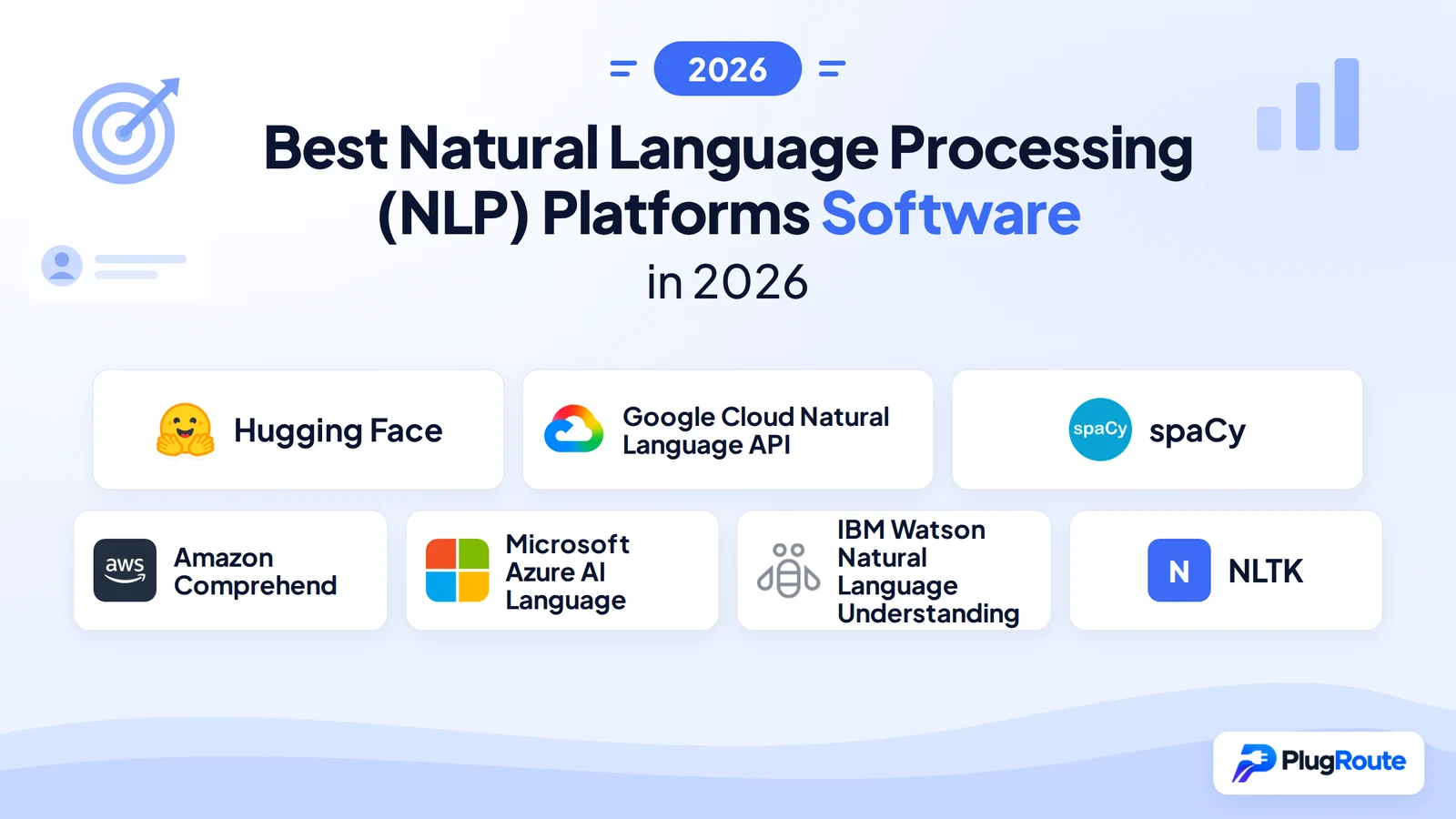
Hugging Face ranks #1 for custom model development with 2.4 million+ pre-trained models, Google Cloud Natural Language API ranks #2 as the most-reviewed managed cloud NLP service with a 4.3/5.0 G2 rating across 97 verified reviews, and spaCy ranks #3 for engineering teams building high-throughput production pipelines at zero inference cost. Open-source platforms offer full customization without per-API fees, but require the DevOps infrastructure that managed cloud APIs absorb at the cost of vendor lock-in.
Choosing an NLP platform without transparent pricing forces cost-model guesswork before any code is written. Confusion about feature overlap between Hugging Face, spaCy, and Google Cloud NLP wastes engineering cycles. Uncertainty about which platform scales from prototype to production without major refactoring is the most common reason NLP evaluations stall after proof-of-concept.
PlugRoute has no affiliate relationships with any company listed. Rankings are determined entirely by research data and objective evaluation criteria.
TL;DR: Top Picks at a Glance
- Hugging Face: largest open-source model hub (2.4M+ models as of early 2026); best for custom transformer fine-tuning at any scale
- Google Cloud Natural Language API: 4.3/5.0 G2 rating across 97 reviews; best for GCP-native pipelines with Knowledge Graph entity enrichment
- spaCy: approximately 8x faster than NLTK; best for production NLP at zero inference cost on self-managed infrastructure
- Amazon Comprehend: documented 41% email pre-sort production outcome (Schuh UK); best for AWS-native serverless NLP pipelines
- Microsoft Azure AI Language: HIPAA BAA eligible, SOC 2 Type 2, ISO 27001; best for compliance-sensitive regulated-industry deployments
- IBM Watson Natural Language Understanding: Concepts (DBpedia mapping) and Semantic Roles depth unavailable in competing APIs; best for advanced semantic analysis on IBM Cloud
- NLTK: 50+ linguistic corpora and VADER sentiment; best for NLP education and research prototyping, not production deployment in 2026
What Are the Four Categories of NLP Platform Tools?
The four NLP platform categories are Cloud Managed APIs (Google Cloud NLP, Amazon Comprehend, Azure AI Language, IBM Watson NLU), Open-Source ML Platforms (Hugging Face), Production NLP Libraries (spaCy), and Research/Educational Libraries (NLTK). Each category represents a different trade-off between infrastructure control, customization depth, and operational overhead, selecting the wrong category is the most common cause of failed NLP platform evaluations.
Cloud Managed NLP APIs require no model training or infrastructure management. Google Cloud Natural Language API, Amazon Comprehend, Microsoft Azure AI Language, and IBM Watson Natural Language Understanding all fall here. These platforms suit teams prioritizing speed-to-production and minimal operational overhead.
Open-Source ML Platforms: Hugging Face, provide a model hub, training libraries, and optional managed hosting. Hugging Face is best for ML engineering teams that need maximum model flexibility and accept the infrastructure management trade-off.
Production NLP Libraries: spaCy, are open-source Python libraries purpose-built for self-managed deployment at scale. spaCy is best for teams optimizing compute cost and throughput at zero inference cost.
Research/Educational NLP Libraries: NLTK, are free tools designed for learning classical NLP algorithms and accessing linguistic corpora. NLTK is not recommended for production NLP deployments in 2026.
One architectural decision simplifies compliance evaluation for regulated industries: if your organization processes Protected Health Information (PHI), only Azure AI Language and IBM Watson NLU in this evaluation hold documented HIPAA BAA eligibility. This is a binary filter, not a preference score, all other platforms require additional compliance configuration review before processing PHI.
How Do the Top 7 NLP Platforms Compare at a Glance?
| Rank | Company | Category | Best For | One-Line Summary | Key Capabilities | Primary Strength | Key Limitation |
|---|---|---|---|---|---|---|---|
| 1 | Hugging Face | Open-Source ML Platform | Custom model development; maximum NLP task coverage | Hugging Face is the largest open-source NLP platform in 2026, hosting 2.4M+ pre-trained models with a production path from free research to SOC 2-compliant enterprise deployment. | Transformers library; 2.4M+ model hub; Inference Endpoints; AutoTrain; Enterprise Hub (SOC 2 Type 2) | Series D $235M at $4.5B valuation (August 2023); investment from Google, Amazon, NVIDIA | DevOps/MLOps burden; uneven Hub model quality across 2.4M public models |
| 2 | Google Cloud Natural Language API | Cloud Managed NLP API | GCP-native multi-modal document intelligence pipelines | Google Cloud Natural Language API is a fully managed cloud NLP service with a 4.3/5.0 G2 rating across 97 reviews and Knowledge Graph-powered entity enrichment. | Knowledge Graph entity analysis; multi-granularity sentiment; syntax analysis; content classification; 5 native GCP integrations | 4.3/5.0 G2 rating, 97 reviews (April 2026); transparent per-character pricing | Limited customization outside AutoML; GCP ecosystem dependency for full value |
| 3 | spaCy | Production NLP Library | High-throughput production NLP at zero inference cost | spaCy is a Cython-based MIT-licensed Python NLP library processing text ~8x faster than NLTK with industrial-strength NER and dependency parsing at zero inference cost. | Tokenization; NER; POS tagging; dependency parsing; text classification; rule-based matching; spacy-transformers | ~8x faster tokenization vs NLTK (DSStream, SeaFlux, ActiveState; 2024–2026); MIT license; zero inference cost | Infrastructure management overhead; ~7 languages with full production models out-of-box |
| 4 | Amazon Comprehend | Cloud Managed NLP API | AWS-native serverless NLP pipelines | Amazon Comprehend is AWS’s fully managed NLP service with nine capability categories and a documented 41% email pre-sort production outcome for UK retailer Schuh. | NER; sentiment; PII detection; Events Detection; toxicity detection; custom entity recognition; custom classification; topic modeling | Schuh UK: 41% customer email pre-sort (Amazon Comprehend Customers Page) | No published clinical accuracy benchmarks; no verified G2 rating; custom endpoint costs accumulate |
| 5 | Microsoft Azure AI Language | Cloud Managed NLP API | Compliance-sensitive regulated-industry deployments | Microsoft Azure AI Language is a unified managed NLP service with documented HIPAA BAA eligibility, SOC 2 Type 2, and ISO 27001 certifications and Docker container on-premises deployment. | Sentiment + Opinion Mining; Custom NER; CLU; Text Analytics for Health; Q&A; summarization; PII/PHI detection; on-premises Docker | HIPAA BAA eligible, SOC 2 Type 2, ISO 27001 (Microsoft Learn, April 2026) | Billing complexity; full strategic value gated behind Azure ecosystem investment |
| 6 | IBM Watson Natural Language Understanding | Cloud Managed NLP API | Semantic depth; regulated industries on IBM Cloud | IBM Watson NLU analyzes text across nine categories including Concepts (DBpedia) and Semantic Roles; capabilities unavailable in competing managed cloud NLP APIs. | Entities; sentiment; Concepts (DBpedia mapping); Semantic Roles; Emotions (5 dimensions); Relations; Categories; Keywords; Syntax | Peer-reviewed accuracy validation (Physical Review Physics Education Research, 2024) | Per-feature billing; IBM watsonx rebrand complexity; declining IBM Cloud market share |
| 7 | NLTK | Research/Educational NLP Library | NLP education; research prototyping; linguistic corpora access | NLTK is a free Apache 2.0-licensed Python NLP library with 50+ corpora, VADER social media sentiment, and WordNet; designed for education, not production. | Tokenization; stemming; POS tagging; parsing; ne_chunk; VADER sentiment; WordNet; 50+ corpora | VADER zero-training social media sentiment; 20+ year educational standard | ~8x slower than spaCy; no transformer support; unsuitable for production in 2026 |
Which NLP Platform Should I Choose for My Use Case?
| Your #1 Priority | Recommended Tool | Why | Acceptable Alternative |
|---|---|---|---|
| Maximum model coverage and custom fine-tuning | Hugging Face | 2.4M+ pre-trained models; full transformer fine-tuning; SOC 2 Enterprise Hub | spaCy + spacy-transformers for production-focused teams |
| Managed API with verified user satisfaction | Google Cloud Natural Language API | 4.3/5.0 G2 rating, 97 reviews; transparent pricing; Knowledge Graph enrichment | Amazon Comprehend for AWS-native teams |
| Zero inference cost, high-throughput production | spaCy | ~8x faster than NLTK; MIT license; zero per-inference API cost at any volume | Hugging Face Inference Endpoints for state-of-the-art accuracy |
| AWS-native serverless NLP pipeline | Amazon Comprehend | Native Lambda/S3/Kinesis integration; Events Detection; AutoML custom models | Google Cloud NLP for non-AWS teams |
| Regulated industry with compliance certifications | Microsoft Azure AI Language | HIPAA BAA eligible, SOC 2 Type 2, ISO 27001; Docker on-premises deployment | IBM Watson NLU for IBM Cloud organizations |
| Semantic depth and domain-specific entity extraction | IBM Watson Natural Language Understanding | Concepts (DBpedia); Semantic Roles; Watson Knowledge Studio no-code training | Azure AI Language for compliance-first teams |
| NLP learning, research, or linguistic corpora access | NLTK | 50+ corpora; VADER sentiment; WordNet; free textbook at nltk.org/book | spaCy for teams ready to build production pipelines |
1. Hugging Face: Best Overall / Best for Custom Model Development and Maximum NLP Task Coverage
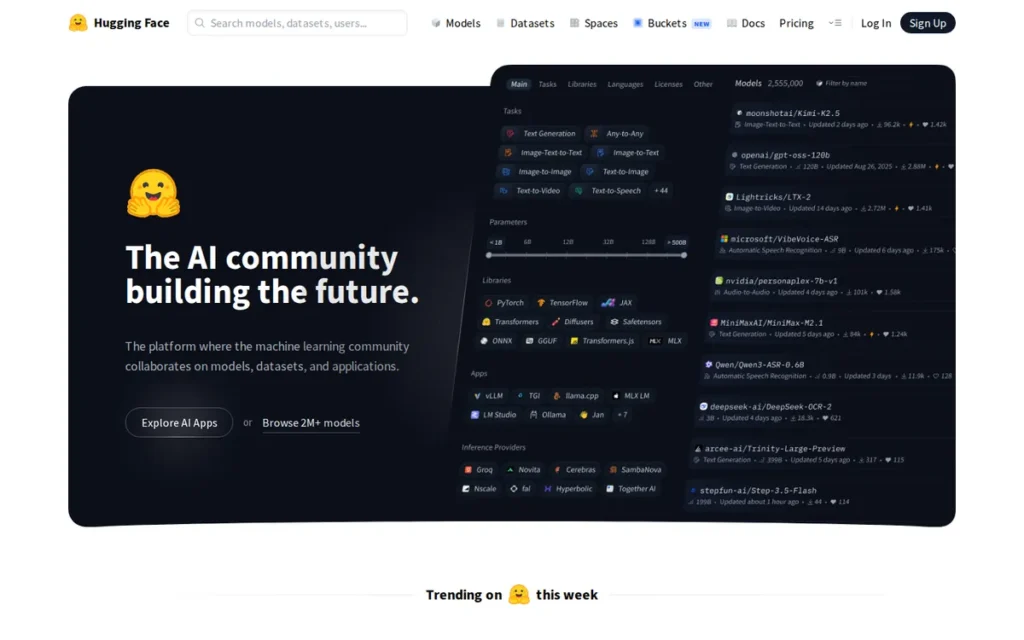
Category: Open-Source ML Platform, a community-driven model hub and ML development framework enabling teams to fine-tune and deploy NLP models at any scale without building model architectures from scratch.
At a Glance
- Category: Open-Source ML Platform
- Best For: ML engineers and data scientists building custom NLP pipelines who need state-of-the-art transformer models and full fine-tuning control
- Price Range: Free (core Transformers library and Model Hub); ~$9/mo Pro; ~$20/user/mo Enterprise Hub; usage-based Inference Endpoints (~$0.06–$0.60+/hr depending on hardware tier, April 2026)
- Primary Strength: Hugging Face hosts 2.4 million+ pre-trained NLP models as of early 2026 (the largest model repository evaluated) enabling teams to fine-tune state-of-the-art transformers on domain-specific data without designing model architectures from scratch.
- Biggest Limitation: Hugging Face requires significant DevOps and MLOps expertise to operate in production, and the 2.4 million public Hub models vary dramatically in documentation quality, training data provenance, and license compliance, requiring organizational model evaluation pipelines before production deployment.
- One-Line Summary: Hugging Face is the largest open-source NLP model platform in 2026, hosting over 2.4 million pre-trained models and providing a production path spanning free research prototyping to SOC 2-compliant enterprise deployment via Inference Endpoints and the Enterprise Hub.
- Last Verified: April 2026
Overview
Hugging Face is the world’s largest open-source ML platform for NLP, hosting 2.4 million+ pre-trained models as of early 2026, built for ML engineers, data scientists, and research teams who need state-of-the-art transformer models (from multilingual named entity recognition to biomedical text mining) without designing architectures from scratch. Hugging Face provides a unified development environment including the Transformers library, Model Hub, Inference Endpoints, AutoTrain, and an Enterprise Hub with SOC 2 Type 2 compliance.
Hugging Face is the only platform in this evaluation that simultaneously serves academic research and enterprise production deployments through the same product ecosystem.
Key Features
- Hugging Face’s Transformers library provides a unified Python API supporting PyTorch, TensorFlow, and JAX for fine-tuning and deploying over 100 pre-trained NLP architectures (including BERT, GPT variants, T5, and RoBERTa) reducing custom model development time from months to days through its pipeline() abstraction.
- Hugging Face’s Model Hub hosts 2.4 million+ pre-trained models as of early 2026, covering every major NLP task from multilingual NER to biomedical text mining, enabling teams to identify fine-tuning starting points across virtually any domain, language, or task category without building from scratch.
- Hugging Face’s Inference Endpoints provide production-grade, auto-scaling model hosting on managed cloud infrastructure, with CPU endpoints from approximately $0.06/hour and GPU endpoints (NVIDIA T4) from approximately $0.60/hour as of April 2026, supporting models up to 10GB+ with dedicated and serverless configurations for different traffic profiles.
- Hugging Face’s AutoTrain enables no-code model training and deployment for text classification, token classification, question answering, summarization, and LLM fine-tuning, making transformer model customization accessible to teams without dedicated ML engineering headcount.
- Hugging Face’s Enterprise Hub adds private model and dataset repositories, SSO, role-based access control, audit logging, and SOC 2 Type 2 compliance at approximately $20/user/month as of April 2026, extending the open-source platform’s security posture to meet enterprise procurement requirements.
Best For
Hugging Face is best for ML engineering teams and data scientists at mid-to-large organizations who need maximum NLP task coverage, full fine-tuning control over transformer models, and a path from free research prototyping to SOC 2-compliant production deployment without switching platforms or rewriting pipeline code.
Pricing
Hugging Face operates a freemium open-core model: the Transformers library, Model Hub, and Datasets library are entirely free and open-source. Pro accounts run approximately $9/month for expanded private storage and early feature access. Enterprise Hub starts at approximately $20/user/month, adding SSO, RBAC, audit logs, and SOC 2 Type 2 compliance.
Inference Endpoints are billed per compute-hour:
- CPU endpoints: from approximately $0.06/hour (April 2026)
- GPU endpoints (NVIDIA T4): from approximately $0.60/hour (April 2026)
- Large GPU instances (A100): significantly higher: verify at huggingface.co/pricing
Dedicated endpoints accumulate costs when idle, serverless endpoint configuration is recommended for low-traffic workloads. Verify current pricing at huggingface.co/pricing. PlugRoute will update this entry when official pricing changes are confirmed, last verified April 2026.
Strengths
- Hugging Face’s Model Hub surpassed 2.1 million models by October 2025 and reached approximately 2.4–2.8 million models across early 2026, reflecting accelerating community contributions that have established Hugging Face as the de facto standard for sharing, discovering, and deploying NLP models across research and production contexts (Hugging Face Model Statistics Blog, October 2025; AOE AI Radar, January 2026).
- Hugging Face raised a $235 million Series D in August 2023 at a $4.5 billion valuation, led by Salesforce Ventures with strategic investment from Google, Amazon, NVIDIA, and Intel (the most financially validated open-source NLP platform in this evaluation) reflecting each major hyperscaler’s recognition of Hugging Face’s foundational infrastructure role (Sacra Research, 2023; TechCrunch, August 2023).
- Hugging Face’s Enterprise Hub holds SOC 2 Type 2 certification and supports private model hosting with SSO and RBAC, enabling organizations to isolate proprietary fine-tuned models from the public Hub and meet enterprise security procurement requirements without self-managing inference infrastructure.
- Hugging Face’s spacy-transformers integration and Datasets library compatibility enable ML teams to combine Hugging Face’s state-of-the-art model accuracy with spaCy’s production pipeline throughput, a documented architectural pattern that leverages both platforms’ strengths without full commitment to either standalone.
Limitations
- Infrastructure Management: Hugging Face’s most consequential trade-off is the gap between research accessibility and production readiness, while the Transformers library and Model Hub are free and powerful, running Hugging Face models in production requires substantial DevOps and MLOps expertise that fully managed cloud APIs eliminate entirely, including infrastructure provisioning, model serving configuration, and auto-scaling management.
- Hub Model Quality Variance: Hugging Face’s 2.4 million public Hub models vary dramatically in documentation quality, training data provenance, and license compliance, organizations deploying Hub models without their own evaluation pipeline risk accuracy failures, security vulnerabilities in multi-tenant inference environments, and inadvertent license violations in production.
- Idle Endpoint Costs: Hugging Face’s dedicated Inference Endpoints accumulate GPU compute costs even when idle, meaning low-traffic production workloads may be more economically served by serverless alternatives or managed cloud APIs, teams must calculate utilization patterns before committing to dedicated endpoint infrastructure.
Verdict
Hugging Face is the most comprehensive NLP development platform among the seven evaluated in 2026, providing ML engineering teams access to 2.4 million+ pre-trained models as of early 2026 and full fine-tuning capability that no competing platform in this evaluation (open-source or commercial) matches in documented model repository scale. Hugging Face earns the #1 overall ranking in this evaluation for the broadest documented model and task coverage, a production infrastructure path via Inference Endpoints and SOC 2-certified Enterprise Hub, and the strongest combination of community adoption evidence and financial validation among the seven platforms reviewed. Teams with sufficient DevOps capacity and a requirement for maximum model selectivity and customization depth will find Hugging Face the strongest-evidenced starting point in the NLP platform landscape in 2026.
2. Google Cloud Natural Language API: Best Managed Cloud NLP API / Best Verified Review Record Among Cloud APIs
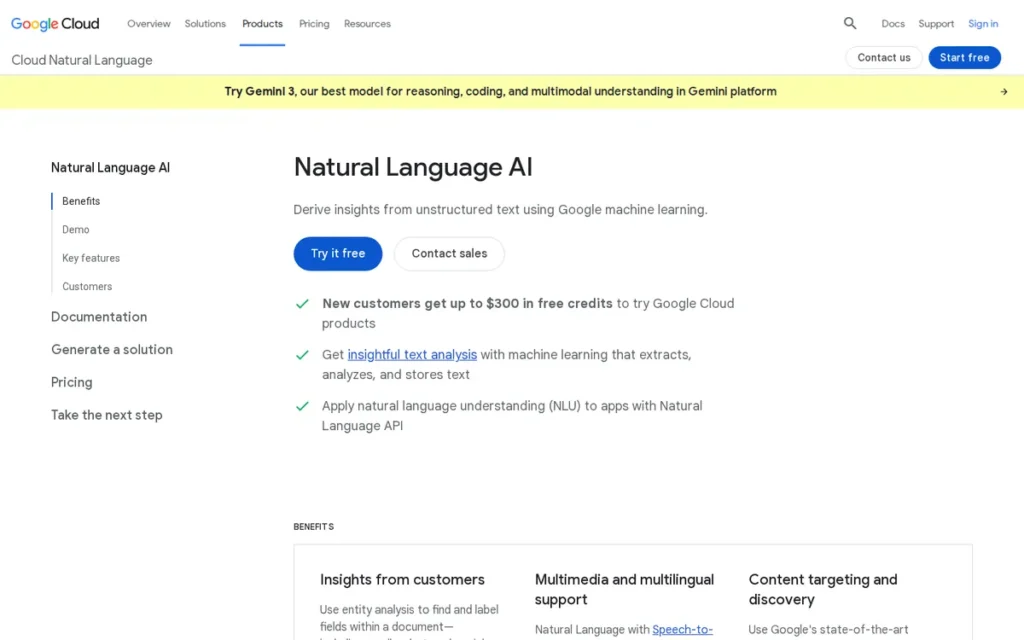
Category: Cloud Managed NLP API, a fully managed, pay-as-you-go text analysis service that processes text via REST API using pre-trained ML models, requiring no model training or infrastructure management from the caller.
At a Glance
- Category: Cloud Managed NLP API
- Best For: Developers and enterprises on Google Cloud Platform who need pre-trained, production-ready NLP with transparent pricing and deep GCP ecosystem integration
- Price Range: Free: first 5,000 units/month; Entity Analysis and Sentiment: $0.001/unit (5K–1M); Entity Sentiment Analysis: $0.002/unit (5K–1M); Content Classification: first 30,000 units/month free, Google Cloud pricing page, April 2026
- Primary Strength: Google Cloud Natural Language API delivers entity analysis enriched with Google’s Knowledge Graph, returning Stable Machine IDs and Wikipedia metadata alongside salience scores, enabling entity reconciliation and graph-based downstream processing not available in competing managed cloud NLP APIs.
- Biggest Limitation: Google Cloud Natural Language API offers limited customization outside AutoML retraining, making it unsuitable for organizations needing domain-specific entity types or classification taxonomies beyond Google’s pre-built feature set.
- One-Line Summary: Google Cloud Natural Language API is a fully managed cloud NLP service holding a 4.3/5.0 G2 rating across 97 reviews (April 2026) that provides Knowledge Graph-powered entity analysis, multi-granularity sentiment scoring, and native integration with BigQuery, Vertex AI, Speech-to-Text, Vision API, and Translation API.
- Last Verified: April 2026
Overview
Google Cloud Natural Language API is a fully managed NLP service for developers and enterprises on Google Cloud Platform who need pre-trained, production-ready text analysis (including entity extraction with Knowledge Graph enrichment, sentiment scoring, syntax parsing, and content classification) without training models or managing inference infrastructure. Google Cloud Natural Language API provides six core capabilities via REST and gRPC, integrates natively with five GCP services, and is the most-reviewed cloud NLP API on G2 in this evaluation with 97 verified reviews at 4.3/5.0 as of April 2026.
Google Cloud Natural Language API’s Knowledge Graph-powered Entity Analysis (returning Stable Machine IDs, geocoding metadata, and Wikipedia links) is its primary technical differentiator from competing managed cloud APIs.
Key Features
- Google Cloud Natural Language API’s Entity Analysis is powered by Google’s Knowledge Graph, returning Stable Machine IDs (MIDs), geocoding metadata, salience scores, and Wikipedia links for every extracted entity, enabling entity reconciliation and knowledge graph construction that competing cloud NLP APIs do not natively support.
- Google Cloud Natural Language API delivers document-level, per-sentence, and entity-level Sentiment Analysis within a single API call (attributing sentiment scores to specific named entities rather than the document as a whole) at standard pricing with no additional charge per granularity level.
- Google Cloud Natural Language API integrates natively with BigQuery (up to 10 tables), Vertex AI for AutoML model training, Speech-to-Text for audio-to-NLP pipelines, Vision API for OCR on scanned documents, and Translation API for cross-language sentiment, enabling complete multi-modal NLP pipelines within Google Cloud infrastructure.
- Google Cloud Natural Language API’s Content Classification assigns text to pre-built hierarchical categories and supports custom categories via AutoML Text, covering brand safety, topic routing, and content moderation without requiring model training expertise.
- Google Cloud Natural Language API’s Syntax Analysis produces tokenization, POS tagging, dependency trees, and morphological analysis, providing the linguistic structure annotations needed for explainable NLP pipelines and downstream structured data extraction workflows.
Best For
Google Cloud Natural Language API is best for development teams and enterprises already operating on Google Cloud Platform who need a managed, transparent-pricing NLP API with entity-level semantic enrichment and deep GCP pipeline integration, particularly teams running document intelligence workflows combining OCR, translation, and analytics within a single Google Cloud data pipeline.
Pricing
Google Cloud Natural Language API uses per-1,000-character billing with volume tiers and a monthly free allowance:
- Entity Analysis and Sentiment Analysis: first 5,000 units/month free; $0.001/unit (5K–1M); $0.0005/unit (1M–5M); $0.00025/unit (5M+)
- Entity Sentiment Analysis: first 5,000 units/month free; $0.002/unit (5K–1M)
- Syntax Analysis: $0.0005/unit (5K–1M)
- Content Classification: first 30,000 units/month free
New GCP accounts receive $300 in free credits. Per-character billing differs from Azure’s per-record model, direct cost comparisons require normalization by average document length. Verify current rates at cloud.google.com/natural-language/pricing. PlugRoute will update this entry when official pricing changes are confirmed, last verified April 2026.
Strengths
- Google Cloud Natural Language API holds a verified 4.3/5.0 G2 rating across 97 reviews as of April 2026 (the highest review volume among all cloud NLP APIs in this evaluation) with users citing entity recognition accuracy, sentiment analysis reliability, and ease of integration as primary strengths (G2, April 2026).
- Glance, a content platform, documented that implementing Google Cloud Natural Language API alongside Gemini, BigQuery, and Vertex AI produced a Content Knowledge Graph resulting in improved search relevance, enhanced personalized content discovery, and increased user engagement, specific percentage improvements were not disclosed, but the case study demonstrates real-world applicability for knowledge graph construction at content scale Google Cloud Customer Blog, 2025.
- Google Cloud Natural Language API provides transparent, published multi-tier pricing with a documented free monthly allowance and volume discounts (the clearest cloud NLP pricing documentation among all managed cloud APIs in this evaluation) enabling cost forecasting before API commitment (Google Cloud Pricing Page, April 2026).
- Google Cloud generated approximately $43 billion in revenue in 2024 (Alphabet Q4 2024 Earnings Report, January 2025), providing the infrastructure financial stability and global region availability that enterprise organizations require for production SLA commitments.
Limitations
- Customization Ceiling: Google Cloud Natural Language API’s most consequential trade-off is customization depth versus operational simplicity, outside AutoML retraining, the API does not allow modification of its pre-trained models, making it unsuitable for organizations needing domain-specific entity types or proprietary classification taxonomies beyond Google’s pre-built categories.
- GCP Ecosystem Dependency: For teams operating primarily on AWS or Azure infrastructure, using Google Cloud Natural Language API introduces cross-cloud data egress costs and separate authentication management that partially eliminate the pricing transparency advantage and add operational complexity not present for native GCP users.
- Confidence Score Availability: Google Cloud Natural Language API does not expose model confidence scores across all feature outputs, making it harder to implement confidence-threshold routing (directing low-confidence outputs to human review) compared to IBM Watson NLU, which provides per-feature confidence scores natively.
Verdict
Google Cloud Natural Language API is the best-verified managed NLP API among the seven platforms evaluated, holding a 4.3/5.0 G2 rating across 97 reviews as of April 2026, the most substantial independent evidence base of any cloud NLP API in this category. Google Cloud Natural Language API earns #2 in this evaluation for its combination of transparent tiered pricing, unique Knowledge Graph entity enrichment, and deep GCP ecosystem integration enabling multi-modal NLP pipelines without third-party connectors. Organizations already operating on GCP, or those prioritizing managed API reliability and transparent pricing over maximum customization depth, will find Google Cloud Natural Language API the most evidence-backed cloud NLP choice available in 2026.
3. spaCy: Best Open-Source Library for Production NLP Pipelines
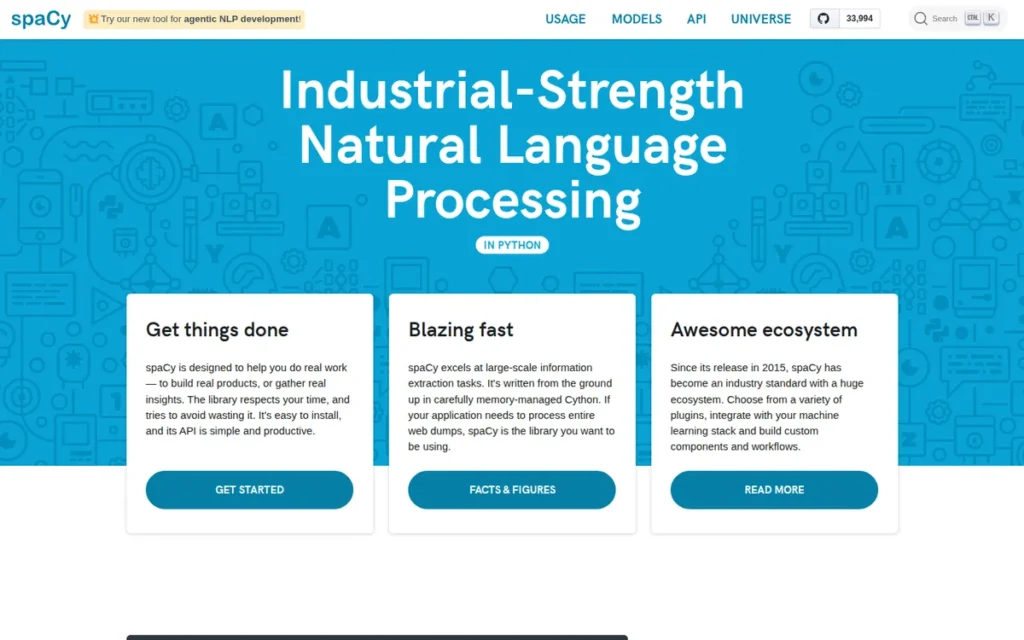
Category: Production NLP Library, an open-source Python library purpose-built for industrial-strength text processing, deployed on self-managed infrastructure with zero per-inference API cost and full pipeline customization.
At a Glance
- Category: Production NLP Library
- Best For: ML engineers and software developers building high-throughput NLP pipelines on self-managed infrastructure who need production-grade performance at zero inference cost
- Price Range: Free (MIT open-source, zero inference cost); Prodigy annotation tool pricing on request at prodi.gy; enterprise support via explosion.ai
- Primary Strength: spaCy processes text approximately 8 times faster than NLTK using comparable tokenizers, with its Cython-based architecture delivering industrial-strength throughput for batch NLP pipelines at zero inference cost under an MIT license.
- Biggest Limitation: spaCy requires ML engineering investment for deployment, model training, and infrastructure management that fully managed cloud APIs eliminate, and its out-of-the-box production-quality language models cover only approximately seven languages without custom training data.
- One-Line Summary: spaCy is an MIT-licensed, production-optimized Python NLP library written in Cython that processes text approximately 8 times faster than NLTK, provides industrial-strength named entity recognition and dependency parsing, and delivers transformer model integration via spacy-transformers at zero inference cost.
- Last Verified: April 2026
Overview
spaCy is a production-grade, MIT-licensed Python NLP library built by Explosion AI for software engineers and data teams who need high-throughput text processing (named entity recognition, dependency parsing, POS tagging, and text classification) at zero inference cost using self-managed infrastructure. spaCy is written in Cython (Python compiled to C), delivering native-speed performance for batch NLP workloads, and integrates with Hugging Face Transformers via the spacy-transformers package to access state-of-the-art model accuracy within a unified pipeline API.
spaCy’s designer-documented purpose is “industrial-strength NLP built for large-scale information extraction tasks,” and independent benchmarks confirm spaCy delivers the highest throughput performance of any open-source NLP library in this evaluation.
Key Features
- spaCy’s Cython-based architecture processes text approximately 8 times faster than NLTK using comparable tokenizers, delivering industrial-strength throughput for batch NLP pipelines that must process millions of documents within fixed infrastructure budgets, a benchmark confirmed independently across DSStream, SeaFlux, and ActiveState comparative reviews (2024–2026).
- spaCy provides a production-ready named entity recognition pipeline supporting custom entity types trained on organization-specific labeled data, and integrates with Hugging Face Transformers via spacy-transformers to access BERT, RoBERTa, and other transformer architectures without leaving the spaCy pipeline API.
- spaCy’s Matcher and PhraseMatcher components enable rule-based pattern matching alongside statistical NLP models, allowing teams to build hybrid pipelines that combine domain-specific rules for high-precision extraction with learned models for generalization, all within a single processing graph with unified annotation objects.
- spaCy’s dependency parse trees and POS tag annotations produce interpretable linguistic structure that supports explainable NLP applications in regulated industries where classification and extraction decisions must be auditable beyond black-box model outputs.
- spaCy’s Universe ecosystem at spacy.io/universe documents third-party integrations and domain-specific extensions (including biomedical NLP models (en_core_sci_sm), legal text analysis, and financial NLP) extending spaCy’s core capabilities to regulated industry use cases with community-validated tooling.
Best For
spaCy is best for ML engineering teams and software developers at mid-to-large organizations who are building high-throughput production NLP pipelines (batch entity extraction, dependency parsing, text classification) and need to eliminate per-inference API costs at scale while retaining access to state-of-the-art transformer model accuracy through the spacy-transformers integration.
Pricing
spaCy’s core library is entirely free under the MIT License, zero licensing fees, zero per-inference costs, zero subscription requirements regardless of processing volume. The primary associated cost is infrastructure: compute, storage, model serving, and DevOps labor for deployment and maintenance.
As a reference point: processing 5 million documents per month, averaging 2,000 characters each, with Google Cloud NLP Sentiment Analysis at $0.0005/unit (1M–5M tier) = $5,000/month. spaCy on a $500/month server with one ML engineer at 20% time = $1,500–2,000/month fully loaded. The economics favor self-hosted spaCy at this volume, verify against your team’s fully-loaded engineering cost. All Google pricing from cloud.google.com/natural-language/pricing, April 2026.
Prodigy, Explosion AI’s active-learning annotation tool, uses a proprietary license with pricing on request at prodi.gy. Enterprise support is available via explosion.ai. All information verified April 2026.
Strengths
- Independent comparative benchmarks across multiple published sources confirm spaCy tokenizes text approximately 8 times faster than NLTK using comparable tokenizers, a performance advantage that translates directly to lower infrastructure costs and faster throughput SLA compliance for high-volume production NLP pipelines (DSStream, 2024; SeaFlux, 2024; ActiveState, 2024).
- spaCy’s MIT license and zero-inference-cost model mean a team processing 100 million NLP inferences per month pays $0 in API costs versus estimated hundreds to thousands of dollars with cloud APIs at equivalent volume, the strongest documented cost-efficiency advantage at production scale among the seven platforms evaluated, with infrastructure TCO as the only remaining cost variable.
- Explosion AI has operated as a bootstrapped company since its founding in 2016: no VC funding, no investor-driven growth pressure, providing a stable, focused roadmap for spaCy and Prodigy that is not subject to strategic pivots or deprecation risks associated with VC-backed or hyperscaler-owned NLP platforms.
- The spaCy Universe ecosystem documents production deployments in healthcare (en_core_sci_sm biomedical model), legal research, and financial analysis, validating spaCy’s industrial-strength positioning across regulated industries with documented real-world adoption beyond generic text processing (spaCy Universe, spacy.io/universe).
Limitations
- Infrastructure Ownership Trade-Off: spaCy’s most consequential trade-off is that eliminating per-inference API fees requires accepting full DevOps and MLOps overhead (model serving infrastructure, deployment pipelines, hardware provisioning, scaling automation, and monitoring) that fully managed cloud APIs eliminate entirely, making self-hosting prohibitive for teams without dedicated ML engineering capacity at moderate processing volumes.
- Language Coverage Constraint: spaCy ships with full production-quality models for only approximately seven languages out-of-the-box; organizations requiring NLP capabilities in Hindi, Arabic, Thai, Swahili, or other languages beyond that set must provide custom training data or accept lower accuracy from the multilingual models.
- Opinionated Single-Path Architecture: spaCy’s deliberately opinionated design (one well-engineered path per NLP task) means teams wanting to experiment with alternative NLP algorithm approaches or novel model architectures must integrate Hugging Face’s Transformers library rather than finding algorithmic flexibility within spaCy alone.
Verdict
spaCy is the strongest open-source Python NLP library for production deployment in 2026, processing text approximately 8 times faster than NLTK and delivering industrial-strength named entity recognition, dependency parsing, and text classification at zero inference cost under an MIT license, confirmed across multiple independent benchmarks (DSStream, SeaFlux, ActiveState, 2024–2026). spaCy earns #3 in this evaluation by combining Cython-based production throughput, state-of-the-art transformer model accuracy via spacy-transformers, and a stable bootstrapped development organization that has maintained focused engineering quality since 2016 without investor-driven feature scope expansion. ML engineering teams with deployment capacity who need reliable, high-throughput NLP at scale without per-inference API fees will find spaCy the optimal production library choice in 2026.
4. Amazon Comprehend: Best for AWS-Native Organizations / Best Managed NLP with Documented Production ROI
Category: Cloud Managed NLP API, a fully managed, pay-as-you-go text analysis service processing text via AWS API using pre-trained and custom ML models, with no model training or infrastructure management required from the caller.
At a Glance
- Category: Cloud Managed NLP API
- Best For: Development teams and enterprises operating on AWS infrastructure who need managed NLP without leaving the AWS ecosystem
- Price Range: Free tier for new AWS accounts; pay-per-100-characters for standard features; Comprehend Medical priced separately at higher per-unit rates; custom model inference billed per endpoint-hour plus per-character, verify current rates at aws.amazon.com/comprehend/pricing
- Primary Strength: Amazon Comprehend provides nine managed NLP capability categories including Events Detection (which extracts structured event graphs from unstructured text) and integrates natively with Lambda, S3, Redshift, and Kinesis for serverless, event-driven NLP pipelines within AWS.
- Biggest Limitation: Amazon Comprehend Medical does not publish accuracy benchmarks on standard clinical NLP evaluation datasets, making pre-purchase accuracy validation the buyer’s responsibility, healthcare organizations should conduct domain-specific accuracy testing before production deployment rather than relying on vendor-reported metrics.
- One-Line Summary: Amazon Comprehend is AWS’s fully managed NLP service providing nine capability categories (including Events Detection and PII redaction) with a documented 41% email pre-sort production outcome for UK retailer Schuh and native integration across the AWS service ecosystem.
- Last Verified: April 2026
Overview
Amazon Comprehend is AWS’s fully managed NLP service for developers and enterprises already operating within the AWS infrastructure stack, providing nine capability categories (from entity recognition to Events Detection and PII redaction) through a pay-per-use API with no model training required for standard features. Amazon Comprehend launched at AWS re:Invent 2017 and integrates natively with Lambda, S3, Redshift, and Kinesis, enabling serverless event-driven NLP pipelines that process documents automatically without dedicated infrastructure.
Amazon Comprehend is the most deeply integrated managed NLP option for AWS-native organizations, with its AutoML Custom Entity Recognition and Custom Classification features extending coverage to domain-specific NLP tasks without ML engineering prerequisites.
Key Features
- Amazon Comprehend’s Events Detection feature extracts structured event graphs: capturing who, what, when, and where, from unstructured text documents, providing semantic relationship mapping that goes beyond standard NER to support knowledge graph construction and agentic AI pipeline inputs not natively available in Google Cloud NLP or Azure AI Language’s standard feature sets.
- Amazon Comprehend’s Custom Entity Recognition uses AutoML to train domain-specific entity models from labeled PDFs, plain text, or Word documents without requiring ML expertise, enabling insurance, legal, healthcare, and financial services teams to build production-ready domain NLP models through a managed interface.
- Amazon Comprehend provides PII detection and redaction across financial account numbers, SSNs, email addresses, phone numbers, and other sensitive data types, supporting compliance automation pipelines for organizations processing customer or patient data under GDPR, CCPA, or HIPAA requirements.
- Amazon Comprehend integrates natively with AWS Lambda, Amazon S3, Amazon Redshift, and Amazon Kinesis, enabling serverless event-driven NLP pipelines that automatically process documents at upload time without dedicated servers, manual orchestration, or cross-cloud data egress costs.
- Amazon Comprehend’s Toxicity Detection identifies harmful content in conversational AI outputs and user-generated text, supporting content moderation pipelines for customer service platforms, social applications, and generative AI output safety checks within the AWS ecosystem.
Best For
Amazon Comprehend is best for development teams and enterprises already operating within the AWS infrastructure stack (using Lambda, S3, and Redshift) who need managed NLP capabilities integrated into serverless event-driven pipelines without cross-cloud data movement, and who prioritize operational simplicity over maximum model customization depth.
Pricing
Amazon Comprehend uses pay-per-100-characters billing with separate rate schedules for each API feature. A free tier is available for new AWS accounts. Custom model training is billed per training job-hour; custom model inference is billed per endpoint-hour plus per-character inference cost, creating ongoing infrastructure costs for organizations operating multiple domain-specific classifiers.
Comprehend Medical carries a separate pricing schedule at higher per-unit rates than standard Comprehend. Exact current per-unit dollar amounts were not confirmed in this research, verify at aws.amazon.com/comprehend/pricing. Organizations processing high volumes should evaluate total cost including endpoint-hour charges for custom models, which accumulate regardless of inference traffic. PlugRoute will update this entry when official pricing changes are confirmed, last verified April 2026.
Strengths
- UK footwear retailer Schuh documented that Amazon Comprehend’s sentiment analysis automatically pre-sorted 41% of all incoming customer emails before reaching the support team, the most specific quantitative production outcome documented among all cloud NLP APIs in this evaluation, demonstrating real-world operational leverage for customer service automation (Amazon Comprehend Customers Page, aws.amazon.com/comprehend/customers/; corroborated by BrainCuber, 2023).
- Amazon Comprehend is part of Amazon Web Services: the world’s largest cloud infrastructure provider by revenue, with approximately 31% global cloud infrastructure market share as of 2025 (Synergy Research Group, 2025), providing 33 geographic regions, a 99.99% SLA commitment, and the deepest native AWS integration ecosystem of any cloud NLP API evaluated.
- Amazon Comprehend’s Events Detection capability extracts structured event graphs from unstructured text in a single API call, providing semantic relationship mapping for knowledge graph construction and agentic AI pipeline inputs, a differentiated capability versus Google Cloud NLP and Azure AI Language’s standard feature sets.
- Amazon Comprehend Custom Entity Recognition reduces the ML expertise barrier for domain-specific NLP: non-ML engineers can train production-ready entity models from labeled documents through a managed AutoML interface, democratizing custom NLP in organizations without dedicated ML engineering headcount.
Limitations
- Clinical Accuracy Transparency: Amazon Comprehend Medical’s most consequential trade-off for healthcare deployments is that it does not publish accuracy benchmarks on standard clinical NLP evaluation datasets, organizations processing clinical text should conduct their own domain-specific accuracy tests against ground-truth datasets before committing to Comprehend Medical for production use, rather than relying on vendor-reported metrics for specialized entity categories.
- Custom Model Cost Escalation: Amazon Comprehend’s per-use billing is documented in comparative reviews as expensive relative to open-source alternatives, and custom model inference adds ongoing endpoint-hour costs that do not exist for standard pre-trained API use, creating a pricing structure that can exceed initial estimates for organizations running multiple domain-specific classifiers simultaneously.
- No Verified Independent Review Rating: No verified G2 or Capterra aggregate rating was confirmed for Amazon Comprehend during this research, limiting the independent user satisfaction evidence base compared to Google Cloud Natural Language API’s 97-review G2 profile, enterprise buyers should consult PeerSpot for IT-specific deployment feedback.
Verdict
Amazon Comprehend is the best-integrated managed NLP service for AWS-native organizations in 2026, providing the most specific quantitative production outcome of any cloud NLP API evaluated, Schuh UK’s documented 41% email pre-sort rate, alongside nine managed capability categories and native Lambda, S3, Redshift, and Kinesis pipeline integration that no competing managed NLP service replicates within AWS (Amazon Comprehend Customers Page). Amazon Comprehend earns #4 in this evaluation for its documented production ROI evidence, Events Detection differentiator, and AWS ecosystem integration depth, with the explicit caveat that Amazon Comprehend Medical’s accuracy on specialized clinical entity categories has not been benchmarked in this evaluation, and healthcare organizations should conduct independent validation before production deployment. Organizations with AWS-native infrastructure and general-purpose NLP requirements will find Comprehend the most operationally efficient managed NLP choice.
5. Microsoft Azure AI Language: Best for Compliance-Sensitive Deployments / Best for Microsoft Azure Ecosystem Organizations
Category: Cloud Managed NLP API, a fully managed, pay-as-you-go unified text analysis service offering pre-configured and customizable NLP features via REST API, with on-premises Docker container deployment available for data residency requirements.
At a Glance
- Category: Cloud Managed NLP API
- Best For: Organizations in the Microsoft Azure ecosystem: particularly healthcare, financial services, and government, that require managed NLP with documented compliance certifications
- Price Range: Free tier: 5,000 text records/month; approximately $2.50 per 1,000 text records for core standard features; specialized features (PII, health text analytics, custom models) priced separately, verify at azure.microsoft.com/en-us/pricing/details/cognitive-services/language/
- Primary Strength: Microsoft Azure AI Language holds documented HIPAA BAA eligibility, SOC 2 Type 2, and ISO 27001 certifications (the strongest compliance posture among all managed cloud NLP APIs evaluated) and provides Docker container on-premises deployment for organizations with data residency requirements.
- Biggest Limitation: Microsoft Azure AI Language’s pay-as-you-go billing is documented to escalate unexpectedly when multiple features are invoked per API call without Cost Management alerts configured, and the service delivers its full strategic value only to organizations already invested in the Azure ecosystem.
- One-Line Summary: Microsoft Azure AI Language is a unified cloud NLP service consolidating sentiment analysis, custom NER, conversational language understanding, and clinical text analytics with documented HIPAA BAA eligibility, SOC 2 Type 2, and ISO 27001 compliance certifications and Docker container on-premises deployment.
- Last Verified: April 2026
Overview
Microsoft Azure AI Language is a unified managed NLP service consolidating sentiment analysis, custom named entity recognition, conversational language understanding, and clinical text analytics into a single API endpoint, designed for organizations in the Microsoft Azure ecosystem that require enterprise compliance certifications including HIPAA BAA eligibility, SOC 2 Type 2, and ISO 27001. Microsoft Azure AI Language evolved from three legacy Azure services, Text Analytics, QnA Maker, and LUIS, consolidating their capabilities into a single authentication model and billing relationship.
Microsoft Azure AI Language is the compliance-first managed NLP API choice in this evaluation, with the most explicitly documented certification stack of any platform reviewed.
Key Features
- Microsoft Azure AI Language’s Conversational Language Understanding (CLU) trains multilingual intent and entity models on labeled examples in one language and deploys across multiple languages without additional training data, reducing annotation costs for global enterprises building multilingual chatbots or intent classification systems.
- Microsoft Azure AI Language’s Text Analytics for Health extracts medical entities (diagnoses, medications, body structures, symptoms, dosages) from unstructured clinical text with built-in PHI detection, under Azure’s HIPAA BAA-eligible architecture for healthcare organizations processing protected health information.
- Microsoft Azure AI Language integrates with Azure OpenAI Service (GPT-4 and later models), enabling organizations to combine traditional NLP capabilities with generative AI within a single Azure deployment and unified billing relationship that competing cloud NLP APIs require cross-vendor stitching to replicate.
- Microsoft Azure AI Language provides Docker container deployment for all core features, enabling on-premises or hybrid-cloud processing of sensitive data that organizational policies prohibit transmitting to external cloud endpoints, a critical capability for healthcare, government, and financial services data residency requirements.
- Microsoft Azure AI Language consolidates three legacy Azure NLP services: Text Analytics, QnA Maker, and LUIS, into a single API endpoint and authentication model, eliminating the three-service connection management overhead that organizations running pre-consolidation Azure NLP pipelines previously maintained.
Best For
Microsoft Azure AI Language is best for enterprises already operating within the Microsoft Azure ecosystem (particularly healthcare, financial services, and government organizations) that require managed NLP with documented HIPAA BAA eligibility, on-premises Docker container deployment for PHI, and deep integration with Azure OpenAI Service, Azure Machine Learning, and Azure Synapse Analytics.
Pricing
Microsoft Azure AI Language offers a free tier of 5,000 text records per month for most standard features. Standard pay-as-you-go pricing is approximately $2.50 per 1,000 text records for core features (sentiment analysis, key phrase extraction, language detection, standard NER). Specialized features including PII detection, Text Analytics for Health, and custom model training carry separate, higher pricing structures.
Azure’s per-text-record billing (1 record = up to 5,120 characters) differs from Google Cloud’s per-character billing, direct cost comparisons require normalization by average document character length.
User reviews document unexpected billing escalation when multiple features are invoked per API call without Azure Cost Management alerts configured, configure Cost Management alerts from the first deployment. Verify current rates at azure.microsoft.com/en-us/pricing/details/cognitive-services/language/. PlugRoute will update this entry when official pricing changes are confirmed, last verified April 2026.
Strengths
- Microsoft Azure AI Language is documented as HIPAA BAA-eligible, SOC 2 Type 2-certified, and ISO 27001-compliant, the most explicitly documented compliance posture among all seven evaluated NLP platforms, making it the default compliance-first choice for healthcare, financial services, and government procurement teams with binary certification gate requirements (Microsoft Learn Documentation, April 2026). Note: HIPAA BAA eligibility requires enabling specific safeguards including RBAC, data encryption, and US-region deployment via the Microsoft Online Services Data Protection Addendum, it does not apply automatically to all deployment configurations (Microsoft Service Trust Portal, April 2026).
- Microsoft Azure AI Language’s Docker container deployment option allows organizations to run NLP processing entirely on-premises or in private cloud environments, enabling regulated industry deployments where PHI, PII, or classified data cannot leave organizational perimeters under any circumstance.
- Microsoft Azure AI Language’s CLU cross-lingual transfer capability: training a single intent model in one language and deploying it across multiple languages without additional labeled data, directly reduces annotation budget requirements for global enterprise chatbot deployments (Microsoft Tech Community, Build 2024).
- Microsoft Azure AI Language’s integration with Azure OpenAI Service enables organizations to build hybrid NLP-plus-generative-AI pipelines within a single Azure deployment, unified security perimeter, and consolidated billing relationship that competing cloud NLP APIs require cross-vendor stitching to replicate.
Limitations
- Ecosystem Dependency: Microsoft Azure AI Language’s most consequential trade-off is ecosystem dependency versus compliance completeness, the platform’s full strategic value requires existing Azure investment, making it materially more expensive and operationally complex for organizations on AWS or Google Cloud where cross-cloud data egress costs and authentication complexity add friction not present for native Azure users.
- Billing Complexity: Documented user criticisms flag unexpected billing escalation when multiple features (NER + sentiment + PII detection) are invoked per API call without Azure Cost Management alerts configured, creating budget predictability challenges for teams building multi-feature NLP pipelines without careful billing monitoring (AppIntent, April 2026).
- Legacy API Migration Overhead: Azure AI Language consolidated three legacy services (Text Analytics, QnA Maker, LUIS), meaning production pipelines built on pre-consolidation APIs require migration to the new unified endpoint, organizations running existing Azure NLP workloads should review Microsoft’s migration guides at learn.microsoft.com/en-us/azure/ai-services/language-service before expanding pipeline scope.
Verdict
Microsoft Azure AI Language is the compliance-first managed NLP choice for 2026, holding the most explicitly documented certification stack, HIPAA BAA eligibility, SOC 2 Type 2, and ISO 27001, of any platform in this evaluation, with on-premises Docker container deployment for organizations that cannot transmit sensitive data to external cloud endpoints (Microsoft Learn Documentation, April 2026). Microsoft Azure AI Language earns #5 in this evaluation through its unified service architecture, CLU cross-lingual model transfer, and Azure OpenAI co-deployment capability, with the clear caveat that its full value is captured only within the Microsoft Azure ecosystem, and that billing complexity requires active cost monitoring from the first deployment. Healthcare, financial services, and government organizations already using Microsoft Azure infrastructure will find Azure AI Language the most compliance-complete managed NLP option in this evaluation.
6. IBM Watson Natural Language Understanding: Best for Semantic Depth and No-Code Domain Customization

Category: Cloud Managed NLP API, an enterprise cloud-based text analysis service providing deep linguistic and semantic feature extraction via REST API, with no-code domain customization through Watson Knowledge Studio.
At a Glance
- Category: Cloud Managed NLP API
- Best For: Enterprise teams in regulated industries: particularly healthcare, finance, and government, on IBM Cloud infrastructure who need deep semantic analysis including Concepts and Semantic Roles extraction with no-code domain model customization
- Price Range: Lite plan (free, limited monthly calls); Standard plan (pay-per-NLU-item, where each feature invoked per call counts as a separate billable NLU item), verify current rates at cloud.ibm.com/catalog/services/natural-language-understanding
- Primary Strength: IBM Watson Natural Language Understanding’s Concepts feature identifies high-level DBpedia knowledge base concepts implied but not explicitly stated in analyzed text, and its Semantic Roles extraction produces structured subject-action-object triples, capabilities unavailable in competing managed cloud NLP APIs.
- Biggest Limitation: IBM Watson Natural Language Understanding’s per-feature billing model charges separately for each NLU feature invoked per API call, making multi-feature extractions significantly more expensive than competing services that charge flat per-record or per-character rates regardless of feature count.
- One-Line Summary: IBM Watson Natural Language Understanding is an enterprise NLP API analyzing text across nine feature categories (including Concepts (DBpedia mapping) and Semantic Roles distinct from competing APIs) with HIPAA-enabled architecture and no-code domain customization via Watson Knowledge Studio, verified April 2026.
- Last Verified: April 2026
Overview
IBM Watson Natural Language Understanding is a cloud-based NLP API for enterprise teams and regulated industry organizations, particularly in healthcare, finance, and government, that require deep linguistic analysis including Concepts and Semantic Roles extraction, domain-specific model training via Watson Knowledge Studio, and HIPAA-enabled data processing. IBM Watson Natural Language Understanding analyzes text across nine feature categories, entities, sentiment, keywords, categories, concepts, semantic roles, emotions, relations, and syntax, with language support spanning more than 20 languages.
IBM Watson Natural Language Understanding is differentiated by its Concepts and Semantic Roles features, which provide a semantic analysis depth not available in any other managed cloud NLP API evaluated.
Key Features
- IBM Watson Natural Language Understanding’s Concepts feature identifies high-level DBpedia knowledge base concepts implied but not explicitly mentioned in analyzed text, enabling advanced topic modeling and content recommendation architectures that move beyond surface-level entity and keyword matching to inferred semantic understanding.
- IBM Watson Natural Language Understanding’s Semantic Roles extraction produces structured subject-action-object triples from analyzed text, supporting event extraction, relationship mining, and knowledge graph construction from unstructured documents, applicable to intelligence analysis, research mining, and enterprise knowledge management applications.
- IBM Watson Natural Language Understanding integrates with Watson Knowledge Studio, a no-code annotation and training interface that allows domain subject matter experts (not ML engineers) to build custom entity and relationship extraction models that deploy directly into the Watson NLU API endpoint without code changes or model serving infrastructure (IBM Cloud Docs, April 2026).
- IBM Watson Natural Language Understanding provides Emotion Analysis across five dimensions (anger, disgust, fear, joy, and sadness) alongside standard sentiment scoring, enabling multi-dimensional affective analysis for customer feedback programs and market research applications requiring emotional nuance beyond positive/negative/neutral.
- IBM Watson Natural Language Understanding is HIPAA-enabled with IBM IAM security integration, supporting enterprise deployments in healthcare and financial services where text processing must comply with protected health information handling requirements under Business Associate Agreement terms with IBM.
Best For
IBM Watson Natural Language Understanding is best for enterprise teams already operating on IBM Cloud infrastructure (particularly in healthcare, financial services, or government) who need advanced semantic analysis beyond standard NER and sentiment, including Concepts-based topic modeling, Semantic Roles event extraction, and no-code domain model customization via Watson Knowledge Studio without ML engineering prerequisites.
Pricing
IBM Watson Natural Language Understanding offers a Lite (free) plan with limited monthly API calls and a Standard pay-as-you-go plan billed per NLU item. One NLU item equals one feature applied to text of up to approximately 10,000 characters, meaning invoking three features (entities + concepts + semantic roles) in a single API call counts as three NLU items.
This per-feature billing model makes multi-feature extraction calls significantly more expensive than competing services billing per text record or per character regardless of feature count. Exact current per-NLU-item dollar amounts were not confirmed in primary research, verify at cloud.ibm.com/catalog/services/natural-language-understanding. Organizations evaluating Watson NLU should build a multi-feature call cost model before committing to production deployment at scale.
Strengths
- A 2024 peer-reviewed study by Campbell, Ansell, and Stelzer in Physical Review Physics Education Research found that IBM Watson Natural Language Understanding matched human grader accuracy on automated short-answer physics response categorization when trained on one-third to one-half of sample responses and filtered to high-confidence outputs, the only academic peer-reviewed performance validation of any platform in this seven-platform evaluation (Physical Review Physics Education Research, 2024).
- IBM Watson Natural Language Understanding’s Concepts feature maps analyzed text to high-level DBpedia knowledge base entries for implied topics not explicitly mentioned, a semantic analysis depth unavailable in Google Cloud NLP, Amazon Comprehend, or Azure AI Language’s standard feature sets, supporting knowledge graph enrichment and content recommendation architectures requiring conceptual rather than surface-level topic understanding.
- IBM Watson Natural Language Understanding is HIPAA-enabled with IBM Cloud IAM security, making it eligible for enterprise deployments in healthcare and financial services processing protected health information, alongside Azure AI Language as the two cloud NLP APIs in this evaluation with documented PHI handling architecture.
- Watson Knowledge Studio’s no-code annotation interface enables domain subject matter experts in healthcare, legal, and financial services to build custom entity and relationship extraction models without ML engineering involvement, reducing the specialized talent barrier for domain-specific NLP that technical AutoML interfaces in competing services do not fully eliminate.
Limitations
- Per-Feature Billing Cost: IBM Watson Natural Language Understanding’s most consequential trade-off is semantic depth versus financial predictability, its per-feature billing model charges separately for each NLU feature invoked per API call, making multi-feature extractions (entities + concepts + semantic roles = three NLU items per call) significantly more expensive than Google Cloud NLP, Amazon Comprehend, or Azure AI Language, which charge flat per-character or per-record rates regardless of feature count.
- watsonx Rebrand Complexity: IBM’s watsonx rebranding in 2023 has created procurement complexity that reduces Watson NLU’s visibility in enterprise evaluation shortlists, buyers must now navigate between Watson NLU (legacy NLP API), watsonx.ai (generative AI platform), and Watson Machine Learning to identify which IBM product matches their NLP requirements (IBM Watson NLU Product Page, April 2026).
- IBM Cloud Market Position: IBM Cloud’s declining market share relative to AWS, Azure, and Google Cloud (IBM does not appear among the top four cloud providers by market share as of 2025 (Synergy Research Group cloud market share data, 2025)) means fewer organizations are building greenfield IBM Cloud infrastructure in 2026, making Watson NLU a constrained choice for teams not already operating on IBM Cloud.
Verdict
IBM Watson Natural Language Understanding is the most semantically deep managed NLP API in this evaluation, providing Concepts analysis and Semantic Roles extraction (capabilities unavailable in competing cloud NLP APIs) alongside Watson Knowledge Studio’s no-code domain customization and HIPAA-enabled architecture validated in peer-reviewed research (Campbell, Ansell, and Stelzer, Physical Review Physics Education Research, 2024). IBM Watson NLU earns #6 for these differentiated semantic capabilities, with the explicit trade-offs that its per-feature billing model makes multi-feature extraction more expensive than competing services, and that IBM’s watsonx rebranding and declining cloud market share create procurement evaluation complexity not present for AWS, Azure, or Google Cloud alternatives. Organizations already on IBM Cloud infrastructure with knowledge graph construction, advanced topic modeling, or domain-specific entity extraction requirements will find Watson NLU a specialist tool without a direct equivalent.
7. NLTK: Best for NLP Education and Linguistic Research
Category: Research/Educational NLP Library (a free Python toolkit for learning classical NLP algorithms, accessing linguistic corpora, and building research prototypes) not designed or recommended for production deployment in 2026.
At a Glance
- Category: Research/Educational NLP Library
- Best For: Students, academic researchers, and data scientists learning classical NLP algorithms or building research prototypes requiring access to linguistic corpora and VADER sentiment analysis
- Price Range: Free (Apache 2.0 open-source, zero cost, no commercial tiers)
- Primary Strength: NLTK provides programmatic access to 50+ linguistic corpora and lexical resources including WordNet’s 155,000-word English semantic network (Princeton WordNet 3.1 Documentation, wordnet.princeton.edu), plus VADER, a lexicon-based sentiment analyzer tuned for social media text that achieves competitive accuracy with zero model training.
- Biggest Limitation: NLTK processes text approximately 8 times slower than spaCy using comparable tokenizers, lacks transformer or neural model support, and is documented across multiple independent sources as unsuitable for production NLP environments requiring state-of-the-art accuracy or high-throughput processing.
- One-Line Summary: NLTK is a free, Apache 2.0-licensed Python NLP library developed at the University of Pennsylvania in 2001, providing 50+ linguistic corpora, classical algorithm implementations, and VADER social media sentiment analysis, best suited for NLP education and research prototyping, not production deployment in 2026.
- Last Verified: April 2026
Overview
NLTK (Natural Language Toolkit) is a free, Apache 2.0-licensed Python library developed at the University of Pennsylvania for students, researchers, and data scientists learning classical NLP algorithms or building research prototypes that require access to linguistic corpora, lexical resources, and transparent algorithmic implementations. NLTK provides over 50 corpora and lexical resources (including Princeton’s WordNet, the Brown Corpus, and the Reuters Corpus) the broadest pre-built corpus access of any library in this evaluation.
NLTK is documented across multiple independent comparative reviews as the correct choice for NLP education and research, and the incorrect choice for production NLP deployments requiring throughput performance, state-of-the-art model accuracy, or infrastructure efficiency.
Key Features
- NLTK provides programmatic access to 50+ linguistic corpora and lexical resources, including Princeton’s WordNet (155,000+ English words with synonym, hypernym, and hyponym relationships; Princeton WordNet 3.1 Documentation, wordnet.princeton.edu), the Brown Corpus, and the Reuters Corpus, enabling ontology-based NLP tasks like word sense disambiguation that neural embedding approaches alone cannot accomplish.
- NLTK’s VADER (Valence Aware Dictionary and sEntiment Reasoner) uses a lexicon-based approach specifically tuned for social media text and short-form content, achieving competitive sentiment accuracy with zero model training, making VADER the most practically production-viable component in the NLTK library for teams needing social or review sentiment scoring without API costs.
- NLTK supports multiple classical stemming algorithms (Porter, Snowball, Lancaster) alongside POS tagging, constituency and dependency parsing, and named entity chunking via ne_chunk, providing comprehensive, pedagogically transparent implementations that make NLTK the standard learning resource in university NLP curricula globally.
- NLTK’s modular architecture allows developers to import only specific components (tokenize, stem, corpus, classify) without loading the full library, and supports programmatic combination with spaCy and Gensim for hybrid NLP workflows in research environments requiring both classical algorithm transparency and modern performance.
- NLTK is accompanied by a free online textbook: Natural Language Processing with Python by Bird, Klein, and Loper, available at nltk.org/book, that has served as the primary NLP curriculum for millions of learners globally, making NLTK the foundational educational resource for data science and NLP engineering training programs worldwide.
Best For
NLTK is best for students and academic researchers learning classical NLP algorithms from transparent implementations, data scientists building research prototypes that need access to WordNet and linguistic corpora, and teams specifically needing VADER’s zero-training social media sentiment analysis, not recommended for any organization building production NLP pipelines in 2026 where throughput, modern accuracy, or infrastructure efficiency are requirements.
Pricing
NLTK is completely free under the Apache 2.0 License with no commercial licensing fees, no subscription tiers, and no usage-based charges. Installation is via PyPI (pip install nltk). Corpora and lexical resources (including VADER, WordNet, and the named entity chunker) must be downloaded separately using nltk.download() during first use.
In containerized or serverless production environments, this download step must be built into the deployment pipeline, corpus files must be pre-bundled into container images, increasing image sizes and adding deployment complexity. This friction is a documented practical constraint for any organization attempting to operationalize NLTK in cloud-native infrastructure. All information verified April 2026.
Strengths
- NLTK’s VADER sentiment analyzer uses a lexicon-based approach specifically tuned for social media and short-form text that achieves competitive accuracy without any model training, making it one of the few NLP components from any evaluated platform that delivers usable results with zero ML infrastructure overhead, and the strongest practical production use case for NLTK in 2026 (NLTK Documentation; multiple independent practitioner comparisons, 2024–2026).
- NLTK provides programmatic access to Princeton’s WordNet: a semantic network of 155,000+ English words with synonym, hypernym, hyponym, and meronym relationships (Princeton WordNet 3.1 Documentation, wordnet.princeton.edu), enabling ontology-based NLP tasks including word sense disambiguation and knowledge graph enrichment that neural embedding approaches alone cannot accomplish.
- NLTK’s free online textbook (Natural Language Processing with Python by Bird, Klein, and Loper, available at nltk.org/book) has been used by millions of learners as the primary NLP curriculum resource globally, meaning NLTK-trained developers represent a large, known-skill pool for organizations hiring NLP practitioners who learned the discipline through structured coursework.
- NLTK’s Apache 2.0 license, completely free access, and modular import design make it a zero-risk entry point for organizations exploring NLP feasibility before infrastructure investment, carrying zero vendor relationship risk and imposing no switching costs when teams graduate to spaCy, Hugging Face, or a managed cloud API for production work.
Limitations
- Production Throughput Disqualifier: NLTK’s most consequential trade-off is pedagogical completeness versus production utility, NLTK processes text approximately 8 times slower than spaCy for equivalent tokenization tasks, lacks support for transformer-based neural models defining state-of-the-art NLP accuracy in 2026, and is documented as unsuitable for production environments requiring state-of-the-art performance across multiple independent reviews (DSStream, 2024; SeaFlux, 2024; ActiveState, 2024).
- Container Deployment Friction: NLTK’s
nltk.download()resource acquisition step introduces deployment friction in containerized or serverless environments where on-demand internet downloads are impractical, requiring corpus files to be pre-bundled into container images, a documented operational constraint for any organization attempting to operationalize NLTK in cloud-native infrastructure. - No Transformer or Neural Model Support: NLTK lacks built-in support for transformer-based neural models (BERT, RoBERTa, T5) that define modern NLP accuracy benchmarks in 2026, organizations needing state-of-the-art entity recognition, classification, or generation capabilities must migrate to Hugging Face Transformers, spaCy with spacy-transformers, or a managed cloud API.
Verdict
In 2026, NLTK is the right first library and the wrong last library, the best way to learn NLP and the wrong tool to deploy it in production. NLTK remains the definitive Python library for learning classical NLP algorithms and accessing linguistic corpora including WordNet, with its VADER sentiment analyzer providing the most accessible production-viable component for social media and short-form text sentiment scoring without model training requirements (NLTK Documentation, 2024–2026). NLTK earns #7 in this evaluation as an accurate reflection of its design purpose: NLTK was built for NLP education and research, not for production engineering, and independent benchmarks confirm it processes text approximately 8 times slower than spaCy while lacking the transformer-based neural model support that defines modern NLP accuracy. Data scientists and ML engineers learning NLP should use NLTK to understand classical algorithms and access linguistic corpora; any production NLP deployment in 2026 should use spaCy for throughput, Hugging Face for state-of-the-art model access, or a managed cloud API for zero-infrastructure operation.
What Red Flags Should I Watch For When Evaluating NLP Platforms?
The four red flags that most consistently predict NLP platform regret are: undisclosed pricing, accuracy claims without benchmark methodology, HIPAA-eligible versus HIPAA-compliant conflation, and pipelines built without abstraction layers. Any one of these flags in a vendor evaluation should trigger additional due diligence before contract commitment.
The four flags to screen for:
- Undisclosed pricing: a vendor lock-in indicator that forces a sales-call gatekeeping step before fit assessment
- Accuracy claims without benchmark methodology: marketing copy rather than measurement without named datasets and comparison baselines
- HIPAA-eligible versus HIPAA-compliant conflation: BAA eligibility requires specific configuration steps that don’t apply automatically
- Cloud API pipelines built without abstraction layers, making future provider migration prohibitively expensive when pricing or terms change
Red Flag #1: No Published Pricing Any NLP platform or vendor that does not publish pricing tiers on its website forces a sales-call gatekeeping step before fit assessment is possible. Treat undisclosed pricing as a high vendor lock-in signal.
If a vendor requires a conversation to reveal basic per-unit cost, expect the same opacity in contract renewal conditions, usage caps, and price escalation terms.
Red Flag #2: Accuracy Claims Without Benchmark Methodology Accuracy percentages presented without named evaluation datasets, model version numbers, and comparison baselines are marketing copy, not measurement.
Request the specific benchmark study (dataset name, model version, evaluation date, and comparison methodology) before accepting any accuracy claim as decision-relevant evidence.
Red Flag #3: HIPAA-Eligible vs. HIPAA-Compliant Conflation HIPAA BAA eligibility means the vendor will sign a Business Associate Agreement under defined service configurations, it does not mean every deployment configuration automatically complies with HIPAA.
For Azure AI Language and IBM Watson NLU (the two HIPAA BAA-eligible platforms in this evaluation) verify BAA availability, required configuration steps (RBAC, data encryption, US-region deployment), and which specific service tiers are included under the BAA before processing any PHI.
Red Flag #4: Vendor Lock-In Without Exit Architecture Cloud NLP API dependencies using proprietary response formats or API-specific parsing logic make future provider switches expensive. Rewriting pipeline parsing code, retraining custom classifiers, and migrating authentication systems all compound over time.
Design pipelines with abstraction layers from the first prototype to preserve optionality when pricing or service terms change.
What Questions Should I Ask Before Choosing an NLP Platform?
The five questions that most reliably separate successful NLP platform selections from costly regrets address: your team’s DevOps capacity for model serving, which cloud infrastructure you’re already committed to, whether you need domain-specific entity types, what compliance certifications are binary procurement gates, and whether you’ve modeled total cost of ownership at your actual monthly document volume.
The five questions to ask before selection:
- What is my team’s DevOps and MLOps capacity for model serving?
- Which cloud infrastructure are we already operating at scale?
- Do we need domain-specific entity types or classification taxonomies?
- What compliance certifications are binary procurement gates for our organization?
- Have we modeled the TCO for both API and self-hosted options at our actual document volume?
Question #1: What Is My Team’s DevOps and MLOps Capacity for Model Serving? Teams without the capacity to deploy, monitor, and scale self-hosted model serving infrastructure will find open-source libraries like spaCy and Hugging Face require significant engineering investment.
Managed cloud APIs (Google Cloud NLP, Amazon Comprehend, Azure AI Language) eliminate this infrastructure overhead entirely. If your team has no dedicated ML engineer available for deployment and monitoring, start with a managed cloud API.
Question #2: Which Cloud Infrastructure Are We Already Operating at Scale? Cloud NLP APIs deliver maximum value within their native ecosystems: Amazon Comprehend within AWS, Azure AI Language within Microsoft Azure, and Google Cloud NLP within GCP.
Cross-cloud data egress costs, authentication overhead, and pipeline complexity increase materially when an NLP API is used outside its native cloud, a hidden TCO factor that billing comparisons alone do not capture.
Question #3: Do We Need Domain-Specific Entity Types or Classification Taxonomies? Pre-trained entity types (person, organization, location, date) are insufficient for medical procedure codes, financial instrument types, or legal clause categories.
Evaluate which platforms support custom model training:
- Hugging Face: full transformer fine-tuning on any domain
- spaCy: custom NER training on labeled data
- Amazon Comprehend: AutoML Custom Entity Recognition from labeled documents
- Azure AI Language: Custom NER and CLU
- IBM Watson NLU: Watson Knowledge Studio no-code training
Note: Hugging Face’s 2.4 million models include options for nearly every domain, but selecting the right one requires an internal evaluation pipeline to assess accuracy, latency, and license compliance before production deployment.
Question #4: What Compliance Certifications Are Binary Procurement Gates for Our Organization? Healthcare organizations processing PHI need HIPAA BAA eligibility, confirmed for Azure AI Language and IBM Watson NLU in this evaluation under specific configuration requirements, not for all deployment configurations by default.
Organizations requiring SOC 2 Type 2 should confirm the specific service tier covered by certification. Open-source libraries (spaCy, NLTK, Hugging Face core) do not provide compliance certifications, Hugging Face’s Enterprise Hub is the only open-source path to SOC 2 coverage in this evaluation.
Question #5: Have We Modeled the TCO for Both API and Self-Hosted Options at Our Actual Document Volume? A useful reference point: processing 5 million documents per month, averaging 2,000 characters each, with Sentiment Analysis only, Google Cloud NLP at $0.0005/unit (1M–5M tier) = $5,000/month. spaCy on a $500/month server with one ML engineer at 20% time = $1,500–2,000/month fully loaded.
The economics favor self-hosted spaCy at this volume, the breakeven depends on your team’s fully-loaded engineering cost. Model this calculation at your actual monthly volume before committing to either approach. All Google pricing from cloud.google.com/natural-language/pricing, April 2026.
How Did We Rank These NLP Platforms?
Rankings in this evaluation were determined by scoring all seven NLP platforms against six objective criteria using verified research data, not editorial judgment or vendor relationships. The platform with the strongest aggregate evidence-based score earns rank one.
Evaluation Process
This evaluation used four research methods:
- Queried AI search engines to identify community-recommended NLP platforms
- Gathered independent web research across official vendor documentation and third-party review sites
- Analyzed independent benchmark studies and peer-reviewed academic research
- Cross-referenced all vendor claims against G2, Capterra, and academic publications before stating as fact
Reddit community sentiment data was unavailable for all seven platforms due to tool connectivity timeouts during research. This limitation affected all products equally and is disclosed transparently.
Ranking Criteria
Feature Breadth and NLP Task Coverage (Primary) measures the range of supported NLP task categories, available pre-trained models, language support breadth, and ecosystem integration depth. Teams need to determine whether a single tool addresses their full range of text processing requirements or whether multiple tools will be required.
Production Readiness and Scalability (Primary) measures managed infrastructure availability, throughput benchmarks, SLA documentation, auto-scaling capabilities, and on-premises deployment options. This criterion directly addresses the target audience’s primary pain point: which platform scales reliably from prototype to production.
Verified Performance Evidence (Primary) measures G2/Capterra ratings with review counts, named quantitative case study outcomes, peer-reviewed benchmark studies, and community adoption metrics. Enterprise architects require independently verifiable evidence (not vendor claims) to justify platform selection to stakeholders.
Pricing Transparency and Value (Secondary) measures published pricing tiers including free tier limits, per-unit costs at multiple volumes, and billing model clarity. Undisclosed or opaque pricing blocks total cost of ownership modeling before commitment.
Customization Depth and Flexibility (Secondary) measures the range of customization options from no-code AutoML to full transformer fine-tuning, and the quality of domain-specific model support.
Compliance and Security Posture (Secondary) measures documented certifications (HIPAA BAA, SOC 2 Type 2, ISO 27001), on-premises deployment availability, and security architecture. Compliance certifications are binary procurement gates for healthcare, financial services, and government organizations representing approximately 23% of the NLP market (Nova One Advisor NLP Market Report, 2025).
Evidence Weighting Rationale
Primary criteria received higher weighting than secondary criteria in all tie-breaking decisions. Within each criterion, specificity and recency governed evidence weighting:
- A named case study with a quantified result outweighs a generic review without context
- A verified G2 rating with 97 reviews outweighs a single third-party site rating without a verified review count
- Peer-reviewed academic findings outweigh vendor-reported claims on equivalent topics
Data Validation Approach
Vendor-reported statistics are labeled as such throughout this article. Only claims corroborated by at least one independent source (a named case study, third-party benchmark, academic study, or review platform with a verified aggregate rating) are stated as fact. Claims that could not be independently verified are presented with uncertainty qualifiers or omitted entirely.
This evidence-based ranking methodology reflects PlugRoute’s objective reviewstandard: every platform claim must be attributed to a named, independently accessible source before being stated as fact.
Update Cadence
This article was last updated in April 2026. Cloud NLP API pricing changes frequently, all pricing figures should be verified at official vendor pricing pages before production budget modeling. This evaluation is refreshed every six months or when a major platform update materially changes a ranking criterion score.
PlugRoute has no affiliate relationships with any company listed. Rankings are determined entirely by research data and objective evaluation criteria.
Frequently Asked Questions About NLP Platforms
What Is the Best NLP Platform for Production Deployment in 2026?
For production teams with ML engineering capacity, Hugging Face ranks #1 with 2.4 million+ pre-trained models and auto-scaling Inference Endpoints. For teams without DevOps resources, Google Cloud Natural Language API is the best-verified managed alternative with a 4.3/5.0 G2 rating across 97 reviews (April 2026). spaCy is the optimal zero-cost open-source production library for high-throughput pipelines where per-inference API fees must be eliminated at scale.
What Is the Difference Between Hugging Face and spaCy for Production NLP?
Hugging Face provides access to 2.4 million+ pre-trained transformer models with full fine-tuning capability and optional managed inference hosting via Inference Endpoints. spaCy is a production-optimized Python library that processes text approximately 8 times faster than NLTK at zero per-inference cost on self-managed infrastructure. Many production teams combine both (using Hugging Face models via spacy-transformers within spaCy’s pipeline) with Hugging Face for model breadth and spaCy for throughput optimization.
How Does PlugRoute Determine NLP Platform Rankings?
PlugRoute ranks NLP platforms by scoring all evaluated products against six objective criteria using verified research data: Feature Breadth and NLP Task Coverage, Production Readiness and Scalability, and Verified Performance Evidence (all primary/higher-weighted), plus Pricing Transparency, Customization Depth, and Compliance Posture (secondary). No affiliate relationships influence rankings. The platform with the strongest aggregate evidence-based score earns rank one.
How Much Do Cloud NLP APIs Cost Per Month at Enterprise Processing Volumes?
Cloud NLP API costs at enterprise volumes vary significantly by billing model. Google Cloud NLP Sentiment Analysis at $0.001/unit (5K–1M units) costs approximately $1,000 per million text units. Amazon Comprehend uses pay-per-100-characters billing with separate rates per feature. Azure AI Language charges approximately $2.50 per 1,000 text records for core features. All figures are from April 2026, verify current rates at each provider’s official pricing page before production budget modeling.
Should I Use Open-Source NLP Libraries or Managed Cloud APIs for My Project?
Choose managed cloud APIs (Google Cloud NLP, Amazon Comprehend, Azure AI Language) if your team lacks DevOps capacity or is processing fewer than 5–10 million documents per month at standard per-unit rates. Choose open-source libraries (Hugging Face, spaCy) if your team has ML engineering capacity, your monthly document volume makes cloud API costs exceed self-hosting TCO, or you need full transformer fine-tuning control unavailable in pre-trained cloud APIs.
Which NLP Platforms Are HIPAA-Eligible for Healthcare Text Analytics?
Microsoft Azure AI Language and IBM Watson Natural Language Understanding are the two platforms in this evaluation with documented HIPAA BAA eligibility under specific configuration requirements (including RBAC, data encryption, and US-region deployment) which must be explicitly enabled before processing PHI. HIPAA BAA eligibility is not automatic for all deployment configurations. spaCy and NLTK are self-hosted and carry no vendor compliance certification. Verify configuration requirements at each vendor’s Service Trust Portal before processing PHI.
What Is the Difference Between Google Cloud Natural Language API and Amazon Comprehend?
Google Cloud Natural Language API is optimized for GCP ecosystem integration and holds the highest verified review rating among managed cloud NLP APIs (4.3/5.0 G2, 97 reviews, April 2026), with Knowledge Graph-powered entity enrichment as its primary differentiator. Amazon Comprehend is optimized for AWS ecosystem integration, provides nine capability categories including Events Detection, and has a documented 41% customer email pre-sort production outcome (Schuh UK). Choose based on your existing cloud infrastructure, for standard NLP tasks, both deliver comparable pre-trained accuracy.
What Do These NLP Platform Terms Mean?
Named Entity Recognition (NER) is the automated identification of proper nouns in text into categories like person, organization, location, and date, a core capability provided by all seven evaluated NLP platforms. Four additional terms are essential for evaluating NLP platform selection: Transformer Model, Inference Endpoint, HIPAA BAA, and Total Cost of Ownership, each defined below as standalone, citable answers.
Named Entity Recognition (NER): Named Entity Recognition is an NLP task that automatically identifies and classifies proper nouns in text into predefined categories such as person names, organizations, locations, dates, and quantities, a foundational capability provided by all seven platforms evaluated, with customizable entity categories available in Hugging Face, spaCy, Amazon Comprehend, Azure AI Language, and IBM Watson NLU.
Transformer Model: A transformer model is a deep learning architecture that uses self-attention mechanisms to process text in parallel, enabling state-of-the-art performance across NLP tasks including named entity recognition, text classification, question answering, and summarization. Hugging Face’s Model Hub hosts 2.4 million+ transformer model variants including BERT, RoBERTa, GPT, and T5; spaCy accesses transformer models via the spacy-transformers package.
Inference Endpoint: An inference endpoint is a deployed, network-accessible model serving instance that accepts input text, runs a trained NLP model, and returns predictions in real time or batch mode. Hugging Face Inference Endpoints are managed, auto-scaling instances billed per compute-hour; spaCy and NLTK models require self-managed inference endpoints on practitioner infrastructure; cloud APIs (Google Cloud NLP, Amazon Comprehend, Azure AI Language, IBM Watson NLU) abstract the inference endpoint entirely from the caller.
HIPAA BAA (Business Associate Agreement): A HIPAA BAA is a contract between a covered healthcare entity and a cloud service vendor establishing that the vendor will handle Protected Health Information in compliance with the Health Insurance Portability and Accountability Act. HIPAA BAA eligibility (confirmed for Azure AI Language and IBM Watson NLU in this evaluation under specific configuration requirements) is a binary procurement requirement for healthcare organizations processing clinical text, not a general-purpose quality signal applicable to all use cases.
Total Cost of Ownership (TCO): In the context of NLP platform selection, Total Cost of Ownership refers to the full cost of running an NLP pipeline over time, including API fees, infrastructure compute costs, DevOps and MLOps engineering labor, model training data labeling costs, and migration costs if platforms change. TCO comparisons between free open-source libraries and paid cloud APIs must account for engineering overhead: open-source tools carry zero API cost but non-zero infrastructure and operational costs that must be explicitly modeled.
Glossary: Key Terms Used in This Comparison
Named Entity Recognition (NER): Named Entity Recognition is an NLP task that automatically identifies and classifies proper nouns in text into predefined categories such as person names, organizations, locations, and dates. It is a foundational capability provided by all seven platforms evaluated, with customizable entity types available in Hugging Face, spaCy, Amazon Comprehend, Azure AI Language, and IBM Watson NLU.
Transformer Model: A transformer model is a deep learning architecture that uses self-attention mechanisms to process text in parallel, enabling state-of-the-art performance across NLP tasks including named entity recognition, text classification, and summarization. Hugging Face’s Model Hub hosts over 2.4 million transformer model variants (including BERT, RoBERTa, GPT, and T5) and spaCy accesses transformer models via the spacy-transformers package.
Inference Endpoint: An inference endpoint is a deployed, network-accessible model serving instance that accepts input text, runs a trained NLP model, and returns predictions in real time or batch mode. Hugging Face Inference Endpoints are managed, auto-scaling instances billed per compute-hour, while cloud APIs such as Google Cloud Natural Language API and Amazon Comprehend abstract the inference endpoint entirely from the caller.
HIPAA BAA (Business Associate Agreement): A HIPAA BAA is a contract between a covered healthcare entity and a cloud service vendor establishing that the vendor will handle Protected Health Information in compliance with the Health Insurance Portability and Accountability Act. In this evaluation, Azure AI Language and IBM Watson NLU are the only two platforms with documented HIPAA BAA eligibility, applicable only under specific configuration requirements, not automatically across all deployment settings.
Total Cost of Ownership (TCO): In NLP platform selection, Total Cost of Ownership refers to the full cost of running an NLP pipeline over time, encompassing API fees, infrastructure compute costs, DevOps and MLOps engineering labor, model training and data labeling costs, and potential migration costs. TCO comparisons between free open-source libraries and paid cloud APIs must explicitly account for engineering overhead, as open-source tools carry zero API cost but non-zero operational costs.
Which NLP Platform Is Right for You?
The right NLP platform depends on three factors: your team’s DevOps capacity (open-source versus managed), your existing cloud infrastructure commitment (AWS, Azure, GCP, or cloud-agnostic), and whether compliance certifications are binary procurement gates. Hugging Face leads for custom model development, Google Cloud NLP leads among verified managed APIs, spaCy leads for zero-cost production throughput, and NLTK is best reserved for education and research prototyping.
Key Insights
- For standard NLP tasks: sentiment analysis, named entity recognition, key phrase extraction, all seven evaluated platforms achieve comparable pre-trained accuracy in 2026; the choice between open-source and managed cloud APIs is therefore an engineering capacity and cost-volume calculation, not an accuracy decision.
- Hugging Face provides unmatched model breadth (2.4M+ pre-trained models as of early 2026) but requires DevOps and MLOps expertise that managed cloud APIs eliminate, teams without dedicated ML engineering headcount should default to a managed cloud API and revisit Hugging Face when engineering capacity scales.
- HIPAA BAA eligibility is a binary procurement gate for healthcare organizations: Azure AI Language and IBM Watson NLU are the two cloud APIs in this evaluation with documented PHI handling architecture under specific configuration requirements, all other platforms require additional compliance review before processing clinical text.
- spaCy’s zero-inference-cost model delivers the strongest production economics at high document volumes, a team processing 100 million inferences per month pays $0 in API costs with spaCy versus estimated hundreds to thousands of dollars with cloud APIs, with infrastructure TCO as the only relevant economic variable.
- Google Cloud Natural Language API is the most evidence-backed managed cloud NLP API by verified review volume, 4.3/5.0 across 97 G2 reviews as of April 2026, providing the most independently validated user satisfaction signal of any cloud API in this evaluation.
- Amazon Comprehend’s documented 41% email pre-sort production outcome (Schuh UK) and native AWS ecosystem integration make it the operationally correct managed NLP choice for AWS-native organizations, while Amazon Comprehend Medical’s accuracy on specialized clinical entity categories has not been benchmarked in this evaluation, requiring independent validation before healthcare production deployment.
- NLTK is the right starting point for NLP education and research, and the wrong choice for any production deployment in 2026 requiring throughput, modern model accuracy, or infrastructure efficiency.
If you need a decision in under two minutes, answer three questions:
- Is your team already on a single cloud provider: AWS, Azure, or GCP? If yes, start with that provider’s native NLP API (Amazon Comprehend, Azure AI Language, or Google Cloud NLP) and skip the open-source evaluation until cloud API costs exceed your self-hosting breakeven.
- Does your team have a dedicated ML engineer for model deployment and monitoring? If no, cloud APIs only.
- Does your organization process Protected Health Information? If yes, Azure AI Language or IBM Watson NLU only, under specific HIPAA BAA configuration.
If you answered no to all three, start with Hugging Face for maximum model breadth or spaCy for production throughput at zero inference cost.
Teams leaning toward open-source should start with a DevOps capacity self-assessment: if your organization can support model serving infrastructure, use the Hugging Face + spaCy combined stack, Hugging Face for model discovery and fine-tuning, spaCy (with spacy-transformers) for production pipeline throughput. If engineering capacity is limited, begin with managed cloud APIs and build toward open-source as the team scales.
Every platform in this evaluation has a migration path: Google Cloud NLP users can graduate to Vertex AI AutoML for custom models; Amazon Comprehend users can add Custom Entity Recognition via AutoML; spaCy users can add transformer accuracy via spacy-transformers without rewriting pipeline code; Hugging Face users can move from public Hub models to Enterprise Hub for compliance. Starting with any platform does not lock you out of upgrading, it locks you into a learning foundation.
Teams leaning toward managed cloud APIs should use ecosystem alignment as the primary selection criterion, AWS teams default to Amazon Comprehend, Azure teams default to Microsoft Azure AI Language, GCP teams default to Google Cloud Natural Language API. For regulated industries, Azure AI Language’s HIPAA BAA eligibility and Docker on-premises deployment make it the compliance-first choice across all three cloud ecosystems, with IBM Watson NLU as the specialist alternative for teams already on IBM Cloud requiring Concepts-based semantic depth or Semantic Roles extraction.
This evaluation was conducted independently by PlugRoute. Read our full evaluation methodology above, or explore our other independent software reviews for additional category comparisons. We update this guide quarterly. Last updated: April 2026.