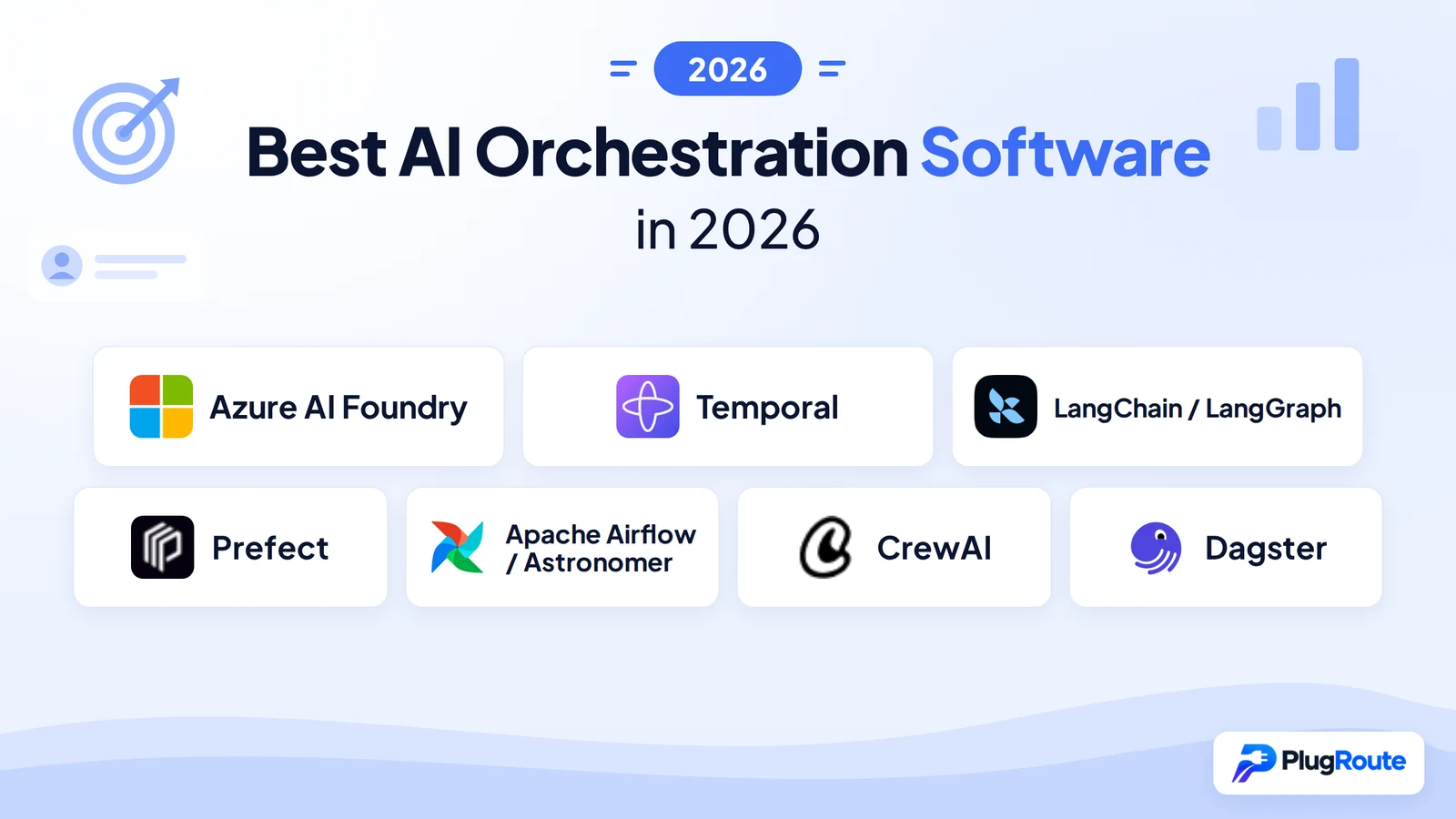
Azure AI Foundry leads for enterprise-scale compliance and Microsoft ecosystem integration; Temporal is the strongest choice for mission-critical long-running workflows and production AI agents; LangChain/LangGraph is the community-validated standard for multi-agent LLM pipelines. The best choice depends on your workload category (AI-agent-native, data-pipeline-centric, or enterprise-platform) not feature lists.
The AI orchestration category spans fundamentally different tool types: multi-agent frameworks, durable execution engines, pipeline schedulers, asset orchestrators, and enterprise AI platforms, each solving a distinct problem. If you have built a proof of concept with one tool and found production deployment unexpectedly complex, or if your new workload type no longer matches your current tool’s category, this article provides the practitioner-sourced evidence to make a defensible re-evaluation before committing further engineering hours.
PlugRoute has no affiliate relationships with any company listed. Rankings are determined entirely by research data and objective evaluation criteria.
“I’m working on LLM powered chatbots in my company and we are struggling because we can do the same thing in X different ways, but more importantly testing complex graph is a mess. LangGraph reminds me of the first TensorFlow… and we all know how that finished.” (u/fabiofumarola, r/LangChain)
Takeaway: LangGraph’s power is real and production-validated, but its ergonomic complexity rewards teams who invest in graph-model fluency and imposes a real learning cost on those who need fast onboarding.
TL;DR: Top Picks at a Glance
- Azure AI Foundry ranks #1 for enterprise compliance and Microsoft ecosystem integration at scale, serving 70,000 organizations and processing 100 trillion tokens per quarter as of April 2026.
- Temporal ranks #2 for mission-critical workflows that must survive infrastructure failures automatically, its server-side durable execution eliminates the need for custom recovery code.
- LangChain/LangGraph ranks #3 as the community-validated production standard for multi-agent LLM pipelines and RAG orchestration, with LangGraph v1.0 GA (October 2025) providing long-term API stability.
- Prefect ranks #4 for Python-native data and AI workflow orchestration, with documented outcomes including a 73% cost reduction at Endpoint and a 63% AWS cost reduction at LiveEO.
What Are the 7 Categories of AI Orchestration Software?
AI orchestration tools fall into three categories: AI-native agent orchestrators (LangGraph, CrewAI) for LLM pipelines and multi-agent workflows; workflow and pipeline engines (Temporal, Prefect, Airflow, Dagster) for durable process execution; and enterprise AI platforms (Azure AI Foundry) for managed, compliant, multi-model AI operations. Matching category to workload is the most consequential evaluation decision.
Category 1, AI-Native Agent Orchestrators
Purpose-built for multi-agent LLM workflows, RAG pipelines, and AI application development. Tools in this evaluation: LangChain/LangGraph (#3) and CrewAI (#6).
Category 2, Workflow and Pipeline Engines
Designed for durable process execution, data pipeline scheduling, and ML workflow coordination. Tools in this evaluation: Temporal (#2), Prefect (#4), Apache Airflow/Astronomer (#5), and Dagster (#7).
Category 3, Enterprise AI Platforms
Managed PaaS that unifies model serving, agent orchestration, RAG, and governance under a single compliance surface. Tool in this evaluation: Azure AI Foundry (#1).
How Do the Top AI Orchestration Tools Compare at a Glance?
| Rank | Company | Category | Best For | One-Line Summary | Key Capabilities | Primary Strength | Key Limitation |
|---|---|---|---|---|---|---|---|
| 1 | Azure AI Foundry | Enterprise AI Platform | Enterprise organizations in Microsoft/Azure ecosystem requiring compliant AI orchestration at scale | Microsoft’s enterprise AI platform serving 70,000 organizations and processing 100 trillion tokens per quarter, with the broadest compliance surface and widest model catalog in this evaluation | 11,000+ model catalog; Model Router; Foundry Local sovereign deployment; Teams agent publishing; Foundry IQ RAG | FedRAMP + SOC 2 Type II + sovereign on-premises Foundry Local | Resources cannot migrate between Azure subscriptions; documentation fragmented by three naming changes |
| 2 | Temporal | Durable Execution Engine | Platform engineers building mission-critical long-running workflows or production AI agents | Durable execution platform with the highest G2 rating in this evaluation (~4.8/5.0), offering automatic workflow state persistence and crash recovery | Server-side durable execution; polyglot SDKs (7 languages); Temporal Nexus cross-namespace; ambient AI agents; SOC 2 Type II | Complete workflow state persistence enforced at the runtime level; automatic replay from event history | Steep distributed systems learning curve; self-hosting requires Cassandra/PostgreSQL + Elasticsearch |
| 3 | LangChain / LangGraph | Agent Orchestrator | ML engineers building production multi-agent LLM systems and RAG pipelines | Most widely adopted open-source framework for production multi-agent LLM orchestration, with LangGraph v1.0 GA (October 2025) used by Klarna, Uber, and LinkedIn | Stateful graph execution; LangSmith observability; 700+ integrations; parallel_run(); Postgres/Redis checkpointing | Prompt-level observability via LangSmith; 700+ native integrations; v1.0 GA production stability | Multiple valid implementation patterns generate practitioner confusion; no standalone SOC 2 Type II for self-hosted deployments |
| 4 | Prefect | Workflow Orchestrator | Data/ML engineers wanting Python-native orchestration with SOC 2 compliance and hybrid execution | Python-native workflow platform with 6M+ monthly PyPI downloads, SOC 2 Type II, and documented 73% cost reduction at Endpoint | @flow/@task decorators; hybrid execution; elastic work pools; Prefect Horizon AI layer; SOC 2 Type II | Hybrid execution keeps data on customer infrastructure; Python-native onboarding; SOC 2 Type II | Worker cold start latency (5–15s) unsuitable for real-time AI agents; smaller integration ecosystem than Airflow |
| 5 | Apache Airflow / Astronomer | Pipeline Scheduler | Data engineering teams with existing Airflow deployments or requiring Microsoft Fabric integration | Industry-standard data pipeline scheduler created at Airbnb in 2014, with native Microsoft Fabric Data Factory integration (January 2026) and 10+ years of production hardening | 90+ providers; event-driven scheduling; DAG versioning; HITL (Airflow 3.0); Fabric native integration | 10+ years production hardening; 90+ providers; Microsoft Fabric native integration (January 2026) | Self-hosting requires 0.5–1 FTE; LLM/AI-native capabilities require custom tooling beyond native DAG model |
| 6 | CrewAI | Multi-Agent Framework | AI developers prototyping multi-agent workflows needing the fastest path from concept to working demo | Fastest multi-agent prototyping framework in this evaluation, with PwC documenting a 10%→70% code-generation accuracy improvement and 40,000+ GitHub stars | Role-based agent orchestration (Crews); Flows for deterministic pipelines; LLM-agnostic; CrewAI Enterprise AMP | Role-based agent model; 40% faster prototyping than graph-based frameworks; LLM-agnostic | Observability blackout; cannot inspect LLM prompts or tool calls natively; tool call loops documented in production |
| 7 | Dagster | Asset Orchestrator | Data engineering teams with dbt-centric modern data stacks needing compliance-grade lineage | Asset-first data orchestration platform with 11,000+ GitHub stars and 400+ contributors, offering the only native dbt model-to-lineage integration in this evaluation | Software-Defined Assets; native dbt model-to-asset mapping; freshness-aware declarative automation; modern data stack integrations | Native dbt model-to-asset lineage; Software-Defined Assets with automatic impact analysis | Months-long adoption curve for assets-first mental model; credit-based pricing lacks public rate transparency |
Which AI Orchestration Tool Should I Choose for My Use Case?
| Your #1 Priority | Recommended Tool | Why | Acceptable Alternative |
|---|---|---|---|
| Enterprise-scale compliance + Microsoft ecosystem | Azure AI Foundry | Only platform in this evaluation with FedRAMP, sovereign on-premises Foundry Local, and Teams agent publishing | Temporal Cloud (for compliance without Microsoft lock-in) |
| Mission-critical workflows that cannot lose state | Temporal | Server-side durable execution provides the strongest runtime-level reliability guarantee in this evaluation; automatic state replay requires no custom recovery code | Azure AI Foundry Durable Agent Orchestration |
| Multi-agent LLM pipelines + RAG + developer control | LangChain/LangGraph | Highest LLM-native capability score; LangGraph v1.0 GA production-stable; LangSmith prompt-level observability | Prefect Horizon (for teams already on Prefect) |
| Python-native data + AI workflows with proven cost efficiency | Prefect | 73% cost reduction at Endpoint; SOC 2 Type II; fastest onboarding among data pipeline tools | Dagster (if dbt-native lineage is primary need) |
| Existing Airflow deployment or Microsoft Fabric integration | Apache Airflow / Astronomer | Migration cost exceeds benefit; Airflow 3.0 closed most competitive gaps; unique Fabric native integration (January 2026) | Prefect (for net-new teams without Airflow investment) |
| Multi-agent prototyping (pre-production) | CrewAI | Fastest time-to-working-agent; plan migration to LangGraph before production commitment | LangChain (for teams comfortable with graph models from day one) |
| dbt-centric modern data stack with compliance-grade lineage | Dagster | Only native dbt model-to-asset lineage in this evaluation | Prefect (if lineage depth is secondary to developer velocity) |
If your organization is already on Airflow 3.0 and Astronomer, stop here, the evidence strongly suggests migration cost exceeds benefit unless your primary new workload is multi-agent LLM pipelines. Read entry #5 to confirm before committing engineering hours to a migration.
1. Azure AI Foundry: Best Overall for Enterprise AI Orchestration at Scale
Category: Enterprise AI Platform, a unified, managed PaaS that consolidates AI model serving, multi-agent workflow orchestration, RAG pipelines, and enterprise governance under a single Azure namespace with full compliance controls.
Azure AI Foundry ranks #1 in this evaluation because it scores the maximum across all three primary criteria, Production Reliability (100 trillion tokens per quarter at 70,000 organizations), LLM/AI-Native Capabilities (11,000+ models, purpose-built Model Router), and Enterprise Compliance (FedRAMP, SOC 2 Type II, sovereign Foundry Local), for the enterprise architect audience this article primarily serves. Developer-experience-centric teams should weight LangGraph (#3) or Prefect (#4) more heavily.
At a Glance
- Category: Enterprise AI Platform
- Best For: Enterprise organizations already embedded in the Microsoft/Azure ecosystem that need compliant, production-scale AI orchestration with native Teams integration and sovereign deployment options
- Price Range: Consumption-based (token costs per model); management layer pricing on request; existing Azure Enterprise Agreements may apply
- Primary Strength: Azure AI Foundry is the only AI orchestration platform in this evaluation combining an 11,000+ model catalog, Foundry Local sovereign on-premises deployment, and direct agent publishing into Microsoft Teams and Microsoft 365.
- Biggest Limitation: Azure AI Foundry resources cannot be migrated between Azure subscriptions, and three naming changes in three years (Cognitive Services → Azure AI Studio → Azure AI Foundry) generate documentation fragmentation that increases developer onboarding friction.
- One-Line Summary: Azure AI Foundry is Microsoft’s enterprise AI orchestration platform serving 70,000 organizations and processing 100 trillion tokens per quarter, offering the broadest compliance surface (FedRAMP, SOC 2 Type II, sovereign on-premises) and the widest model catalog (11,000+ models) of any platform in this evaluation.
- Last Verified: April 2026
Overview
Azure AI Foundry is Microsoft’s unified enterprise AI Platform-as-a-Service, consolidating model deployment, multi-agent workflow building, RAG pipelines via Foundry IQ, and enterprise governance under a single Azure namespace with integrated RBAC, Azure Policy, and networking controls, designed for mid-to-large organizations that need production-scale AI operations, not prototyping environments.
Azure AI Foundry serves 70,000 organizations globally and processes 100 trillion tokens per quarter (Microsoft Build 2025), making it the highest-throughput AI inference platform in this evaluation by a significant margin.
Azure AI Foundry’s closest competitors are Temporal Cloud (strongest on durable execution) and LangChain/LangGraph (strongest on LLM-native developer flexibility), but neither matches Azure AI Foundry’s compliance depth or the unique workflow paths unlocked by Microsoft 365 and Teams integration.
Key Features
- 11,000+ Model Catalog with Automated Model Router: Azure AI Foundry’s model catalog includes models from Anthropic (Claude Opus/Sonnet), OpenAI (GPT-5.2, GPT-Realtime), Meta (Llama 3.3 70B), NVIDIA, xAI, Moonshot AI (Kimi-K2 Thinking with 256K context), and Hugging Face, with a Model Router that automatically selects the optimal model for each task by capability and cost, reducing manual routing engineering (Azure Blog, February 2026).
- Native Teams and Microsoft 365 Agent Publishing: Azure AI Foundry’s Agent Service supports publishing AI agents directly to Microsoft Teams, Microsoft 365 BizChat, or containerized deployments, with access to 1,400+ tools including MCP servers, A2A protocol, Azure AI Search, SharePoint, and Microsoft Fabric, enabling agents to surface in the collaboration tools enterprise employees already use (Microsoft Foundry Docs, 2026).
- Durable Agent Orchestration via Azure Durable Functions: Azure AI Foundry includes Durable Agent Orchestration with native human-in-the-loop patterns, enabling long-running AI agents that persist state across infrastructure events and support structured human approval gates in regulated workflows.
- Foundry Local for Sovereign On-Premises Deployment: Azure AI Foundry offers Foundry Local (sovereign on-premises NVIDIA GPU deployment with APIs that mirror Azure cloud APIs) enabling defense contractors, government agencies, and regulated healthcare organizations to operate AI orchestration entirely within their own infrastructure boundary (Microsoft Foundry Blog, February 2026).
- Foundry IQ Grounded RAG Pipelines: Azure AI Foundry’s Foundry IQ provides grounded search and RAG pipeline orchestration integrated natively with Azure AI Search, SharePoint, and Microsoft Fabric, enabling enterprise-grade retrieval-augmented generation without custom ETL or embedding pipeline engineering.
Best For
Azure AI Foundry is best for enterprise organizations with existing Microsoft/Azure investments, Microsoft 365 or Teams deployments, or regulated industry compliance requirements. Specifically, Azure AI Foundry is the evaluation starting point for organizations where any of the following are hard procurement gates:
- BFSI organizations requiring FedRAMP authorization or HIPAA BAA
- Healthcare organizations requiring GDPR-compliant EU endpoints or sovereign on-premises deployment
- Government agencies where data residency requirements prohibit public cloud processing
Pricing
Azure AI Foundry uses consumption-based pricing, charges are primarily based on tokens consumed per model (each model priced per the Azure AI Services rate card), plus storage and API call costs.
Reserved capacity deployments are available for predictable high-volume workloads at negotiated rates. Management and orchestration layer costs beyond model inference are not publicly itemized; contact Microsoft sales for quotes.
Organizations with existing Azure Enterprise Agreements may receive discounted rates. Pricing structure verified at azure.microsoft.com/en-us/pricing/details/ai-foundry, April 2026; specific per-token rates subject to model updates.
Strengths
- Azure AI Foundry serves 70,000 organizations and processes 100 trillion tokens per quarter (Microsoft Build 2025, verified April 2026), scale evidence exceeding any other platform in this evaluation by multiple orders of magnitude and validating production infrastructure reliability at enterprise load.
- Azure AI Foundry is the only option in this evaluation providing sovereign on-premises NVIDIA GPU deployment with cloud-compatible APIs via Foundry Local, enabling organizations whose data residency requirements prohibit public cloud processing to operate AI orchestration entirely within their own infrastructure boundary (Microsoft Foundry Blog, February 2026).
- Azure AI Foundry’s compliance surface encompasses SOC 2 Type II, FedRAMP, HIPAA, GDPR, and ISO 27001 (the most comprehensive in this evaluation) validated by practitioners in r/Rag describing reliable GDPR-compliant EU endpoint operation (April 2026).
- Microsoft shipped multiple major Azure AI Foundry innovations simultaneously at Microsoft Build 2025 (model router, multi-agent cross-cloud orchestration, Foundry IQ, Foundry Local, and serverless fine-tuning) at a reported cadence of multiple models released every six days (Microsoft PM, r/AZURE AMA, April 2026), a feature velocity no other platform in this evaluation can match.
Limitations
- Vendor Lock-In Depth: Azure AI Foundry resources cannot be migrated between Azure subscriptions, confirmed by community practitioners in r/AZURE (April 2026), creating organizational risk when enterprises need to restructure Azure billing accounts or consolidate subsidiaries. One practitioner stated: “One of the biggest disadvantages, it’s immovable… I’m choosing to rebuild elsewhere. The value simply isn’t there.”
- Documentation Fragmentation: Azure AI Foundry’s three naming changes in three years (from Cognitive Services to Azure AI Studio to Azure AI Foundry) have fragmented the documentation ecosystem, causing developers to encounter deprecated naming in Stack Overflow answers, third-party tutorials, and Microsoft’s own older blog posts. The Microsoft PM in the same r/AZURE thread publicly acknowledged the issue and committed to fixes, but the problem remains active as of April 2026.
- API Proxy Tool-Calling Gaps: Practitioners in r/AZURE report that some models accessible at first-party endpoints do not support tool calling when accessed through Azure AI Foundry’s API proxy layer, a gap with no equivalent in open-source frameworks like LangGraph. Organizations should explicitly test tool-calling compatibility for every model in their intended stack before production commitment.
Verdict
Azure AI Foundry is the highest-ranked AI orchestration platform in this independent evaluation for enterprises already embedded in the Microsoft ecosystem, earning its position through the broadest compliance surface (FedRAMP, SOC 2 Type II, sovereign on-premises Foundry Local), the largest model catalog (11,000+ models with automated Model Router), and the highest documented production throughput (100 trillion tokens per quarter across 70,000 organizations) of any platform in this review.
Azure AI Foundry is most defensible when your organization can answer yes to at least two of the following: you have an existing Azure Enterprise Agreement; you need FedRAMP or sovereign deployment; your agents surface in Microsoft 365 or Teams; or you have a dedicated Azure platform team.
Organizations that are not Microsoft-committed, that prioritize developer flexibility over enterprise governance, or that need LLM-agnostic portability should evaluate Temporal (for production reliability) or LangChain/LangGraph (for AI-native developer control) before Azure AI Foundry.
2. Temporal: Best for Mission-Critical, Long-Running Workflows and Production AI Agents
Category: Durable Execution Engine, a workflow platform that persists complete workflow state server-side, enabling automatic crash recovery and resumption without any custom fault-tolerance code.
Temporal ranks #2 because it earns the highest G2 community rating in this evaluation (~4.8/5.0) and the strongest score on Production Reliability through its server-side durable execution architecture, the only tool in this evaluation where complete workflow state persistence is enforced at the runtime level rather than implemented as application-layer retry logic. Temporal ranks below Azure AI Foundry because its LLM-native agent primitives require explicit Activities wrappers where LangGraph provides built-in agent abstractions, and its compliance surface (SOC 2, HIPAA) does not include FedRAMP or sovereign on-premises deployment.
At a Glance
- Category: Durable Execution Engine
- Best For: Platform engineers and backend architects building mission-critical, long-running workflows or production AI agents that must recover automatically from infrastructure failures, financial services orchestration, multi-day AI agent pipelines, and distributed transaction coordination
- Price Range: Free (open-source self-hosted); Temporal Cloud Scale at $0.25/million Actions; Enterprise and Mission Critical tiers at custom pricing (verified April 2026)
- Primary Strength: Temporal’s server-side durable execution architecture automatically persists and replays complete workflow state after any infrastructure failure, the only tool in this evaluation where complete workflow state persistence is enforced at the runtime level rather than implemented as application-layer retry logic.
- Biggest Limitation: Temporal requires strong distributed systems knowledge to adopt effectively; self-hosting Temporal Server requires Cassandra or PostgreSQL, Elasticsearch for visibility, and dedicated operational engineering, an overhead that can consume 0.5+ FTE at scale.
- One-Line Summary: Temporal is a durable execution platform with the highest G2 rating in this evaluation (~4.8/5.0), offering automatic workflow state persistence and crash recovery that eliminates entire categories of reliability engineering required by every other orchestration tool.
- Last Verified: April 2026
Overview
Temporal is a durable execution platform for orchestrating long-running, fault-tolerant workflows, built by Maxim Fateev and Samar Abbas, the original creators of Uber’s Cadence workflow engine, Temporal persists the complete state of every running workflow on the server side, enabling automatic replay and resumption from the exact point of failure without any custom state management or recovery logic.
Temporal is not a data pipeline scheduler (like Airflow or Dagster), a multi-agent framework (like CrewAI or LangGraph), or a general-purpose AI platform (like Azure AI Foundry), Temporal is a reliability infrastructure layer for workflows where durability and consistency are architectural requirements, not nice-to-haves.
Temporal’s closest competitor in the reliability dimension is Azure AI Foundry’s Durable Agent Orchestration feature, but Temporal provides deeper reliability primitives at lower cost for teams not committed to the Azure ecosystem.
Key Features
- Server-Side Durable Execution with Immutable Event History: Temporal’s durable execution runtime persists every workflow step’s state as an immutable event history on the server, if a worker crashes mid-workflow, Temporal replays the history and continues from the last committed checkpoint without requiring any custom recovery code in the application (Temporal Documentation).
- Polyglot SDKs for Heterogeneous Architectures: Temporal supports SDKs for Go, Java, TypeScript, .NET, PHP, Python, and Ruby, enabling a single Temporal orchestration layer to coordinate workflows where a Python Workflow calls Go Activities and TypeScript Signals without language-specific middleware or serialization glue.
- Temporal Nexus for Cross-Namespace Enterprise Orchestration: Temporal Nexus (GA 2025) enables cross-namespace workflow connections, allowing engineering teams to securely orchestrate workflows across different Temporal namespaces or organizational units without operational coupling, enabling platform teams to manage shared orchestration infrastructure for multiple product teams independently (Temporal Blog, 2025).
- Production AI Agent Capabilities with Durable State: Temporal’s AI agent capabilities include durable ambient agents (24/7 state persistence without external storage), human-in-the-loop workflow pauses via signals and queries, durable LLM tool calls implemented as Activities with automatic retry, large payload support, and streaming responses, all persistent across server restarts and infrastructure failures (Temporal Blog).
- Transparent Per-Action Cloud Pricing with Compliance Included: Temporal Cloud’s Scale tier ($0.25 per million Actions, verified April 2026) includes mTLS encryption, SOC 2 Type II compliance, GDPR and HIPAA eligibility, and 1–90 day event history retention, making Temporal Cloud one of the most cost-transparent enterprise compliance offerings in this evaluation (CheckThat.ai, April 2026).
Best For
Temporal is best for platform engineers and senior backend engineers at organizations where at least one of the following is true: workflows must run reliably for days, weeks, or months without manual intervention; workflow failures carry financial or regulatory consequences; or the team is building production AI agents that must be resumable after infrastructure failure.
Specific use cases include financial services transaction orchestration, healthcare AI pipelines with audit trail requirements, and e-commerce checkout and fulfillment workflows.
Pricing
Temporal offers a free open-source server (MIT license) for self-hosting, with a Developer free tier on Temporal Cloud.
Temporal Cloud Scale tier is priced at $0.25 per million Actions, where an Action is a workflow event (a task execution, signal, timer fire, or activity completion). Enterprise and Mission Critical tiers are custom-priced with 99.99% SLA and SCIM integration.
Important budgeting note: a single workflow with 100 steps consumes 100+ Actions, so per-workflow cost estimation requires event-count modeling before committing. Pricing structure verified via CheckThat.ai, April 2026; verify current rates at temporal.io/pricing.
Strengths
- Core.cz (engineering consultancy, verified case study 2026) documented a change failure rate reduction from 25–30% to 5–10% (a 3–5x improvement), developer satisfaction increase of 40%, infrastructure cost reduction of 20–35%, deployment frequency improvement of 15–30x, and lead time reduction of 10–20x after adopting Temporal, the most comprehensive multi-dimensional ROI case study in this evaluation.
- A practitioner on r/ExperiencedDevs (14 upvotes, verified April 2026) documented 14+ months of zero production disruption on Temporal Cloud for an e-commerce workflow system running since mid-2023, independent, community-sourced reliability evidence that is not a vendor-produced case study.
- Temporal was founded by Maxim Fateev and Samar Abbas: the original creators of Cadence at Uber, where the durable execution model was first designed and battle-tested at scale for ride-matching and payment workflows, giving Temporal a production pedigree that predates the company itself by several years.
- Temporal Cloud holds SOC 2 Type II certification, GDPR compliance, HIPAA eligibility, and enforces mTLS encryption for all workflow communications, meeting the compliance bar for financial services, healthcare, and regulated government deployments without additional configuration.
Limitations
- Distributed Systems Learning Curve: Temporal’s most consequential trade-off is that its power is proportional to its conceptual complexity, Temporal requires developers to understand deterministic workflow execution, event sourcing, and the distinction between Workflows (deterministic orchestration logic) and Activities (non-deterministic side effects like API calls or LLM inference) before writing correct Temporal code. The r/ExperiencedDevs community explicitly acknowledges: “it’s not magic; you’ll still need to wrap your head around its concepts” (65 upvotes, April 2026).
- Self-Hosting Operational Overhead: Self-hosting Temporal Server requires provisioning and maintaining Cassandra or PostgreSQL and Elasticsearch, an operational overhead that can consume 0.5+ FTE at scale before Temporal Cloud becomes the economically rational choice. The $0 license cost does not reflect true total cost of ownership for most production deployments.
- Budget Unpredictability for AI Agent Workloads: Temporal’s per-action pricing on Temporal Cloud can be difficult to estimate for AI agent workflows where LLM tool call frequency is non-deterministic, a workflow that spawns unexpectedly chatty agents will consume significantly more Actions than planned, creating budget overruns unless agent tool-call loops are explicitly bounded in application code.
Verdict
Temporal is the strongest AI orchestration choice in this evaluation for production-critical workflows where infrastructure failures cannot cause data loss or workflow corruption, earning the #2 rank based on the highest G2 rating (~4.8/5.0), the most rigorous production reliability architecture (server-side durable execution), the strongest independent ROI documentation (Core.cz 2026: 3–5x failure rate reduction), and a compliance profile (SOC 2 Type II, HIPAA, GDPR, mTLS) that meets enterprise procurement requirements.
Temporal is not the right default for teams new to distributed systems, for quick multi-agent LLM prototyping (where LangGraph’s agent primitives are more productive), or for data pipeline scheduling (where Airflow or Prefect’s scheduling abstractions are more appropriate).
For any team where “the workflow must complete correctly or not at all” is a hard architectural requirement, Temporal is the only tool in this evaluation that enforces that guarantee at the runtime level.
3. LangChain / LangGraph: Best for Production Multi-Agent LLM Pipelines and RAG Orchestration
Category: Agent Orchestrator, a framework for building stateful, cyclical multi-agent LLM workflows and RAG pipelines, with graph-based execution, server-side state persistence, and native observability via LangSmith.
At a Glance
- Category: Agent Orchestrator
- Best For: ML engineers and AI developers building production multi-agent LLM systems, RAG pipelines, or AI applications that require stateful, non-linear agent workflows with full observability into prompt chains and tool calls
- Price Range: LangChain and LangGraph open-source: free (MIT license); LangSmith: pricing on request (langchain.com/pricing, specific tier amounts not publicly listed as of April 2026)
- Primary Strength: LangChain/LangGraph is the only framework in this evaluation combining purpose-built LLM agent primitives (stateful graph execution, cyclic workflows, automatic retries), 700+ native integrations, and LangSmith’s prompt-chain and tool-call observability in a single coherent ecosystem.
- Biggest Limitation: LangGraph offers multiple valid implementation patterns for the same agent workflow (generating practitioner confusion compared to TensorFlow’s ergonomics per r/LangChain (April 2026)) and LangChain’s compliance story is limited to LangSmith, with no standalone SOC 2 Type II for self-hosted deployments.
- One-Line Summary: LangChain/LangGraph is the most widely adopted open-source framework for production multi-agent LLM orchestration in 2026, with LangGraph v1.0 GA (October 2025) delivering production-stable stateful graph execution used by Klarna, Uber, and LinkedIn.
- Last Verified: April 2026
Overview
LangChain is a composable Python framework for building LLM applications using LCEL (LangChain Expression Language) with 700+ model, retrieval, and tool integrations, and LangGraph, its companion graph-based library released as production-stable v1.0 GA in October 2025, is the purpose-built solution for stateful, cyclical multi-agent workflows with full state persistence via Postgres or Redis checkpointers and observability via LangSmith.
LangChain and LangGraph serve different maturity stages of the same developer journey: LangChain handles rapid prototyping and sequential RAG pipelines, while LangGraph handles production multi-agent systems requiring state, branching, parallelism, crash recovery, and human-in-the-loop interruptions.
LangChain/LangGraph is the most frequently recommended open-source AI orchestration framework by r/AI_Agents, r/LangChain, and r/dataengineering communities in 2026, reflecting both its technical depth and the size of its documentation ecosystem (based on sentiment analysis of high-upvote threads across these communities, April 2026).
Key Features
- Stateful Graph Execution with Cyclical Workflow Support: LangGraph structures multi-agent workflows as directed graphs with nodes (agent actions or LLM calls), edges (conditional transitions), and shared state, enabling cyclic, non-linear workflows where agents revisit tasks, loop for self-correction, and branch based on runtime conditions, capabilities unavailable in linear pipeline tools (TrueFoundry, 2026).
- Server-Side Checkpointing and Time-Travel Debugging: LangGraph’s state persistence via configurable checkpointers (Postgres, Redis) saves complete workflow state at each step, enabling automatic retry from the last checkpoint after failures, time-travel debugging to replay historical states, and human-in-the-loop interruptions that pause and resume workflows without data loss (DigitalApplied, 2026).
- Parallel Task Execution via graph.parallel_run(): LangGraph supports
graph.parallel_run()for concurrent task execution across multiple nodes simultaneously, enabling parallel sub-agent processing for batch workloads and reducing end-to-end latency compared to sequential workflow execution (TrueFoundry, 2026). - LangSmith Prompt-Level Observability: LangSmith provides per-trace inspection of prompt chains, tool call sequences, LLM input/output, and evaluation scores, the only observability solution in this evaluation natively integrated with the orchestration framework at the prompt level rather than the task level (Speakeasy Blog).
- 700+ Native Integrations Across LLM Providers and Vector Stores: LangChain’s integration library encompasses LLM providers (OpenAI, Anthropic, Google, Meta, Mistral, DeepSeek), vector stores (Pinecone, Weaviate, Chroma, pgvector, FAISS), document loaders, and external tool APIs, enabling LLM applications to connect to virtually any data source without custom integration code.
Best For
LangChain/LangGraph is best for ML engineers and AI developers building production multi-agent LLM systems, RAG pipelines, or autonomous AI agents where Python-native development velocity, maximum agent workflow control, and deep LLM observability are higher priorities than enterprise platform governance or sovereign deployment.
Pricing
LangChain’s core Python framework and LangGraph are open-source and free under MIT-compatible licenses with no usage limits for self-hosted deployments.
LangSmith (the observability and evaluation platform) and LangGraph Platform (managed deployment) are LangChain Inc.’s commercial products, pricing is not publicly listed at specific tier amounts and requires contact with LangChain sales.
Self-hosted teams using open-source LangSmith alternatives (Langfuse, Phoenix) can operate the full LangGraph stack at infrastructure cost only ($0 license fees). Pricing page confirmed at langchain.com/pricing as of April 2026; specific tier amounts should be verified directly.
Strengths
- A multinational legal firm implemented LangChain’s LCEL for automated contract review and achieved a 60% reduction in manual review effort through document extraction, classification, and routing pipelines (SparkCo AI Blog, April 2026), one of the few publicly documented production ROI outcomes for LangChain in document-processing workflows.
- LangGraph v1.0 reached General Availability in October 2025 as a production-stable milestone, delivering full checkpointing, retry logic, streaming support, and a no-breaking-changes commitment until v2.0 (LangChain Official, October 2025), directly addressing the historical criticism of frequent breaking changes and enabling enterprise procurement processes that require version stability.
- The practitioner community on r/AI_Agents and r/LangChain has established LangGraph + LangSmith as the dominant recommended production multi-agent stack in 2026, with documented migration patterns from CrewAI to LangGraph as the community-validated production upgrade path, including a 26-upvote comment: “LangGraph is better and is supported more widely across deployment stacks” (r/AI_Agents, April 2026).
- LangChain Inc. is backed by Sequoia Capital and counts Klarna, Uber, and LinkedIn among documented production users of LangGraph for stateful multi-agent systems (as listed on langchain.com/built-with-langgraph, a vendor-managed page; independent production use confirmed in industry press for Klarna and Uber, verified April 2026), enterprise credibility evidence for procurement conversations.
Limitations
- Ergonomic Complexity at Scale: LangGraph’s most consequential trade-off is that it provides multiple valid implementation patterns for the same agent workflow, graph topology, agent node design, edge conditions, checkpointer configuration, and practitioners on r/LangChain have explicitly compared early LangGraph to early TensorFlow: “LangGraph reminds me of the first TensorFlow… and we all know how that finished”, raising the concern that a more ergonomic competitor could displace it as PyTorch displaced TensorFlow.
- Limited Standalone Compliance Posture: LangChain Inc.’s compliance story is bounded by LangSmith’s platform, teams self-hosting LangGraph without LangSmith have no vendor-provided SOC 2 Type II, audit logging, or RBAC, and must assemble their own compliance controls. LangGraph is less competitive than Temporal Cloud or Azure AI Foundry for regulated-industry procurement without LangSmith.
- AgentExecutor Migration Obligation: The AgentExecutor class (used in millions of existing LangChain deployments) is deprecated and in maintenance mode until December 2026 (DigitalApplied, 2026), creating a migration obligation for all production teams currently using it. Teams should migrate to
create_react_agent()or LangGraph’s native agent graph pattern; LangChain’s official migration guide at learn.langchain.com provides the recommended path.
Verdict
LangChain/LangGraph is the #3-ranked tool in this independent evaluation and the strongest choice for ML engineers and AI developers who need maximum control over multi-agent LLM workflows with best-in-class observability, its position is earned by the highest LLM-native capability score in the evaluation, the LangGraph v1.0 GA production milestone (October 2025), enterprise deployment evidence at Klarna, Uber, and LinkedIn, and community consensus that LangGraph is the production standard for stateful multi-agent systems in 2026.
LangChain/LangGraph ranks below Azure AI Foundry and Temporal primarily because its compliance surface (limited to LangSmith) and production durability architecture (application-layer checkpointing rather than server-side durable execution) are weaker for enterprise buyers with strict regulatory requirements.
Organizations with strict compliance or infrastructure-failure requirements should evaluate Azure AI Foundry or Temporal before LangGraph, while organizations prioritizing AI-native developer control should consider LangGraph the first evaluation priority.
4. Prefect: Best for Python-Native Data and AI Workflow Orchestration with Hybrid Execution
Category: Workflow Orchestrator, a Python-native data and AI workflow orchestration platform using decorator-based task definitions with hybrid execution (customer infrastructure) and elastic compute scaling.
At a Glance
- Category: Workflow Orchestrator
- Best For: Data engineers, ML engineers, and platform teams who want Python-native orchestration with proven cost efficiency, SOC 2 Type II compliance, and hybrid execution that keeps sensitive data on customer infrastructure, without Airflow’s Docker complexity
- Price Range: Free tier available; Prefect Cloud plans not publicly listed (contact sales); Prefect Horizon AI layer pricing on request (verified April 2026)
- Primary Strength: Prefect is the only tool in this evaluation combining Python-native decorator orchestration (no DAG definitions, no YAML, runs locally in minutes), a hybrid execution model that keeps sensitive data on customer infrastructure, and SOC 2 Type II certification, delivering compliance without operational complexity.
- Biggest Limitation: Prefect’s agent and worker cold starts of 5–15 seconds make it unsuitable for real-time or latency-sensitive AI agent workloads, and Prefect’s integration ecosystem is smaller than Apache Airflow’s 90+ provider library.
- One-Line Summary: Prefect is a Python-native workflow orchestration platform with over 6 million monthly PyPI downloads, SOC 2 Type II certification, and documented customer outcomes including a 73% cost reduction at Endpoint and a 63% AWS cost reduction with 3x development speed at LiveEO.
- Last Verified: April 2026
Overview
Prefect is a Python-native workflow orchestration platform that defines workflows as standard Python functions annotated with @flow and @task decorators (requiring no DAG structure, no YAML configuration, and no Docker prerequisite) enabling data engineers and ML engineers to run a working workflow locally in minutes and deploy it to cloud infrastructure the same day.
Prefect’s hybrid execution architecture separates the orchestration control plane (managed by Prefect in the cloud) from workflow execution (which runs on the customer’s own infrastructure, including local machines, Kubernetes, or cloud VMs), meaning sensitive data never leaves the customer’s environment.
With over 6 million monthly PyPI downloads as of early 2026 (Prompts.ai, April 2026) and SOC 2 Type II certification, Prefect occupies the best-validated mid-market position in this evaluation: more compliant and operationally simpler than LangGraph for enterprise teams, and more Python-friendly and cost-efficient than Airflow/Astronomer for data engineering teams.
Key Features
- Decorator-Based Orchestration Without Infrastructure Prerequisites: Prefect’s
@flowand@taskPython decorators transform standard Python functions into orchestrated workflows without DAG pre-declarations, scheduler configuration, or Docker setup, developers familiar with Python can deploy their first production flow in the same session they install the package (Atlan, 2026). - Hybrid Execution for Data Sovereignty: Prefect Cloud’s hybrid execution model manages the orchestration control plane in Prefect’s cloud while all workflow code and data runs on the customer’s own servers, Kubernetes clusters, or cloud VMs, ensuring sensitive workflow data never transits Prefect’s systems, a structural data sovereignty guarantee unavailable in most SaaS orchestration platforms (Prefect Official).
- Elastic Work Pools for Cost-Efficient Scaling: Prefect’s elastic work pool model provisions ephemeral compute only when tasks are actively running and terminates it immediately afterward, LiveEO achieved a 63% AWS cost reduction specifically because Prefect eliminated always-on compute that Airflow’s worker architecture required (TalentBlocks, 2026).
- Prefect Horizon AI Orchestration Layer: Prefect Horizon adds an AI orchestration layer including MCP (Model Context Protocol) server support, an AI gateway for multi-model routing, a model and tool registry for centralized AI asset management, and AI-specific observability for LLM workflow tracing, positioning Prefect as a full-stack AI orchestration platform beyond traditional pipeline scheduling (Prefect Official).
- SOC 2 Type II with Enterprise-Grade Access Controls: Prefect Cloud holds SOC 2 Type II certification and supports enterprise security controls including SSO (SAML), RBAC at account, workspace, and object levels, SCIM user provisioning, and audit log retention, meeting the enterprise compliance bar for financial services, healthcare, and government deployments (Prefect Official).
Best For
Prefect is best for data engineering and ML engineering teams where Python fluency is high but DevOps capacity is limited, where compliance (SOC 2 Type II, HIPAA eligibility) is required but Azure/Microsoft ecosystem lock-in is undesirable, and where cost efficiency for bursty or variable compute workloads is a primary operational priority.
Prefect is especially well-suited for teams migrating from Airflow who need a faster developer experience without sacrificing compliance or moving to a managed SaaS that requires sensitive data to leave their infrastructure.
Pricing
Prefect offers a free tier for individuals and small teams with access to core Prefect Cloud orchestration features. Prefect Cloud commercial plans for enterprise and team deployments are not publicly listed at specific dollar amounts, contact Prefect sales for pricing.
Prefect Horizon (AI infrastructure layer) pricing is custom and requires direct engagement. Note: for teams evaluating Prefect specifically as an AI agent orchestration platform via Prefect Horizon, budget discovery for the Horizon-specific AI layer should occur before technical evaluation begins.
Self-hosted Prefect (open-source core) carries no license fees. Community analyses describe Prefect as “affordable relative to Airflow managed services,” but enterprise Horizon-level pricing should be obtained directly. Pricing page confirmed at prefect.io/pricing as of April 2026.
Strengths
- LiveEO (geospatial data company) achieved a 63% AWS cost reduction and tripled development speed after implementing Prefect’s hybrid work pool model, Tony Rahloff (LiveEO) stated: “We were able to triple our development speed with Prefect, resulting in faster development, bug fixes, and product iterations, which also improved our time-to-customer value.” (Prefect Official Blog case study, April 2026).
- Endpoint documented a 73.78% reduction in orchestration invoice costs (rounded to 73% in summary references) while building 78 additional pipelines in one quarter after migrating from Airflow to Prefect Cloud (Prefect Official Blog, April 2026), the most dramatic compound cost-and-performance ROI figure in this evaluation.
- Prefect’s open-source core exceeds 6 million monthly PyPI downloads as of early 2026 (Prompts.ai, April 2026), a developer adoption signal placing Prefect firmly in the top tier of Python data infrastructure tooling.
- Cash App achieved 2x deployment velocity for fraud prevention workflows after migrating to Prefect Cloud with enterprise security features (Prefect Official Customer Results, April 2026), demonstrating compliance capability in high-stakes financial services production environments.
Limitations
- Worker Cold Start Latency: Prefect’s most consequential limitation for AI-specific workloads is agent and worker cold start latency of 5–15 seconds, cited by practitioners in Temporal Community Forums, which makes Prefect unsuitable for real-time or latency-sensitive AI agent applications where sub-second response is required, confining Prefect to batch, scheduled, or near-real-time AI pipelines rather than streaming or interactive agent use cases.
- Smaller Integration Ecosystem Than Airflow: Prefect’s integration ecosystem, while growing, is smaller than Apache Airflow’s 90+ provider library, teams orchestrating less-common data sources, legacy systems, or enterprise SaaS tools not yet in Prefect’s catalog will need to write custom connector code that Airflow’s existing providers handle out of the box.
- Prefect Horizon Maturity: Prefect Horizon’s AI orchestration capabilities, while strategically promising, are newer than LangGraph’s agent primitives, as of April 2026, no independent third-party engineering blog has published a production case study for Prefect Horizon’s AI gateway or MCP server capabilities. Teams evaluating Prefect specifically for multi-agent LLM workflows should compare Horizon’s maturity directly against LangGraph’s production feature set before committing.
Verdict
Prefect is the #4-ranked tool in this independent evaluation and the best-evidenced choice for Python-native data and AI workflow orchestration where both developer velocity and compliance are required, supported by the most specific customer ROI documentation in this evaluation (73% cost reduction at Endpoint, 63% AWS cost reduction at LiveEO, 2x deployment velocity at Cash App), a 4.6/5.0 G2 rating, and SOC 2 Type II certification enabling regulated-industry deployment.
Prefect ranks below LangGraph because its LLM-native agent orchestration capabilities (Prefect Horizon) are newer and less community-validated than LangGraph’s established production multi-agent stack, and below Temporal because it lacks durable server-side execution for mission-critical long-running processes.
For the majority of data engineering and ML engineering teams who need Python-first orchestration without Airflow’s operational overhead, Prefect represents the strongest combined value in this evaluation.
5. Apache Airflow / Astronomer: Best for Enterprise Data Pipeline Orchestration and Teams with Existing Airflow Deployments
Category: Pipeline Scheduler, a DAG-based workflow scheduler for orchestrating complex batch data pipelines, ML training jobs, and AI model deployments with scheduling, dependency management, and 90+ native provider integrations.
At a Glance
- Category: Pipeline Scheduler
- Best For: Data engineering teams at large organizations with existing Airflow deployments, or net-new enterprise data engineering teams where hiring market fit, Microsoft Fabric integration, and 10+ years of production hardening outweigh developer experience concerns
- Price Range: Apache Airflow: free (Apache 2.0 open-source); Astronomer Astro: custom enterprise pricing (contact sales, not publicly listed as of April 2026)
- Primary Strength: Apache Airflow is the most battle-tested data pipeline orchestration tool in this evaluation, with 10+ years of production hardening across BFSI, healthcare, and government, 90+ native provider integrations, and a January 2026 native integration into Microsoft Fabric Data Factory.
- Biggest Limitation: Apache Airflow’s self-hosted deployment requires 0.5–1 dedicated FTE for large production deployments, and its LLM/AI-native capabilities require custom tooling beyond the native DAG model despite Airflow 3.0’s HITL and event-driven scheduling additions.
- One-Line Summary: Apache Airflow is the industry-standard data pipeline scheduler created at Airbnb in 2014, adopted by Microsoft Fabric as a native orchestration integration in January 2026, and rated 4.4/5.0 on G2, with Astronomer’s managed Astro platform rated 4.7/5.0 for teams requiring enterprise support without operational overhead.
- Last Verified: April 2026
Overview
Apache Airflow is an open-source workflow orchestration platform originally created at Airbnb in 2014 by Maxime Beauchemin, now an Apache Software Foundation top-level project, that defines pipelines as DAGs (Directed Acyclic Graphs) written in pure Python with task scheduling, dependency management, and 90+ native provider integrations for AWS, GCP, Azure, Databricks, Snowflake, and major data services, widely recognized as the industry standard for enterprise data pipeline orchestration based on its 4.4/5.0 G2 rating, the 38-upvote r/dataengineering hiring-market comment (April 2026), and Microsoft’s decision to embed it natively in Fabric Data Factory (January 2026).
Astronomer‘s enterprise managed offering (Astro) builds on Airflow’s open-source foundation with managed infrastructure, CI/CD integration, enterprise support, and governance features, rated 4.7/5.0 on G2, significantly above the self-hosted Airflow experience of 4.4/5.0.
Airflow 3.0, released on April 22, 2025, delivered the platform’s most significant upgrade in its history: a fully rewritten React-based UI, event-driven scheduling, DAG versioning, and Human-in-the-Loop support, addressing the most frequent criticisms that had previously driven teams to Prefect and Dagster.
Key Features
- 90+ Native Provider Integrations Across the Enterprise Data Stack: Apache Airflow’s library of Providers covers AWS, GCP, Azure, Databricks, Snowflake, Salesforce, Slack, and major data services, the broadest integration library in this evaluation for traditional data engineering workflows, requiring minimal custom connector code for most enterprise data stacks (Apache Airflow Docs).
- Airflow 3.0 Event-Driven Scheduling (April 2025): Airflow 3.0 introduced event-driven scheduling (enabling DAGs to trigger on data events (file arrivals in S3, messages in Kafka, database row insertions) rather than only on cron schedules) the most-requested feature in Airflow’s history, closing the gap with event-driven competitors (CloudFlight Engineering Blog).
- Microsoft Fabric Native Airflow Jobs Integration (January 2026): Microsoft Fabric Data Factory announced native Apache Airflow Jobs integration in January 2026, enabling Airflow DAGs to orchestrate Microsoft Fabric notebooks, Spark jobs, data pipelines, and dbt/copy jobs, the only tool in this evaluation with a native integration into Microsoft’s flagship enterprise data platform (Microsoft Fabric Blog, January 2026).
- Airflow 3.0 Human-in-the-Loop and DAG Versioning: Airflow 3.0 added HITL support and DAG versioning for audit trails, bringing Apache Airflow closer to AI/LLM workflow orchestration use cases and addressing a gap that previously made newer frameworks more attractive for agentic workflows (Nextlytics Blog, 2025).
- Astronomer Astro Managed Infrastructure: Astronomer’s Astro managed platform provides enterprise-grade Airflow infrastructure including managed deployment, CI/CD pipeline integration, multi-cloud support, enterprise support SLAs, and governance features, rated 4.7/5.0 on G2, significantly higher than self-hosted Airflow’s 4.4/5.0 due to the elimination of operational complexity.
Best For
Apache Airflow is best for data engineering teams at large organizations with existing Airflow deployments where migration cost outweighs the benefit of newer tooling, teams where hiring market fit matters (Airflow proficiency signals strongly to recruiters), and organizations where Microsoft Fabric integration, maximum ecosystem breadth, and the longest production track record are primary evaluation criteria.
Pricing
Apache Airflow is 100% free and open-source (Apache License 2.0) with no usage limits.
Self-hosting costs include infrastructure (typically Kubernetes) and operational engineering time, community analysis suggests 0.5–1 dedicated FTE for large production deployments when factoring scheduler management, worker scaling, database maintenance, and version upgrades.
Astronomer’s Astro managed platform uses custom enterprise pricing not publicly listed; contact Astronomer sales at astronomer.io/pricing. No specific dollar amounts were available in verified public sources as of April 2026.
Strengths
- Microsoft’s decision to embed Apache Airflow Jobs as a native orchestration primitive in Fabric Data Factory (January 2026) rather than building a proprietary replacement constitutes the most significant enterprise endorsement of any orchestration tool in this evaluation cycle, validating Airflow’s position as the baseline enterprise data pipeline standard (Microsoft Fabric Blog).
- Apache Airflow has been in production at global enterprises since 2014: 10+ years of battle-tested reliability for batch ETL, data pipeline scheduling, ML training job orchestration, and AI model deployment across BFSI, healthcare, government, and technology sectors (Apache Airflow Official), a production pedigree no other tool in this evaluation can match in duration.
- A practitioner on r/dataengineering (38 upvotes, April 2026) stated: “If you’re trying to land a job then you should stick with Airflow. The concepts are pretty much all transferable between Airflow, Dagster, and Prefect but a recruiter looking for Airflow experience won’t know that”, validating Airflow’s entrenched hiring market position as a legitimate evaluation criterion.
- Airflow 3.0 (April 22, 2025) delivered event-driven scheduling, DAG versioning, HITL support, and a React-based single-page UI in a single release (Astronomer Blog, 2025), the most substantial feature upgrade in Airflow’s history, directly closing the competitive gaps that previously drove teams toward Prefect and Dagster.
Limitations
- Operational Cost of Self-Hosting: Apache Airflow’s most consequential trade-off is operational overhead, self-hosting at production scale requires 0.5–1 dedicated FTE to manage the scheduler, worker pool, database (Postgres), and version upgrades, costs that are invisible in the $0 license fee but real in engineering hours. Community practitioners in r/dataengineering consistently describe Airflow’s Docker-based local development setup as “frustrating” and “prone to errors on small changes.”
- LLM/AI-Native Capabilities Require Custom Tooling Beyond Native DAG Model: Airflow’s LLM/AI-native capabilities, while meaningfully extended by Airflow 3.0’s HITL and event-driven scheduling, remain fundamentally those of an adapted batch scheduler rather than a purpose-built agent framework, for teams building multi-agent LLM systems or RAG pipelines, Airflow’s DAG model requires significantly more custom tooling than LangGraph or Temporal support natively. Note: Airflow is adequate for batch ML training job scheduling and model deployment orchestration use cases that do not require real-time agent coordination.
- Astronomer TCO Requires Comparison: Astronomer’s managed platform (the primary mitigation for operational complexity) carries custom enterprise pricing that must be compared against Prefect Cloud’s documented cost-reduction outcomes (73% cost reduction at Endpoint) before assuming Astronomer is the cost-optimal managed Airflow choice.
Verdict
Apache Airflow is the #5-ranked tool in this independent evaluation, not because it is declining, but because the evaluation criteria weight LLM/AI-native capabilities and developer experience alongside the reliability and ecosystem dimensions where Apache Airflow genuinely leads.
Airflow is the correct choice for organizations with existing Airflow deployments (where Airflow 3.0 has closed most competitive gaps), for data engineering teams where Airflow hiring market position matters, and for any team requiring the Microsoft Fabric native integration released in January 2026.
Airflow is not the correct first choice for teams starting new AI-agent-first orchestration projects, small teams without DevOps support, or organizations whose primary workload is multi-agent LLM pipelines rather than scheduled batch data pipelines.
6. CrewAI: Best for Rapid Multi-Agent AI Prototyping, With a Defined Migration Path to Production
Category: Multi-Agent Framework, a role-based open-source framework for orchestrating autonomous AI agent teams with human-like roles (Researcher, Writer, Manager) that collaborate on shared tasks through structured delegation.
At a Glance
- Category: Multi-Agent Framework
- Best For: AI developers and product teams prototyping multi-agent LLM workflows who need the fastest path from concept to working demo, with a clear understanding that production deployments requiring real-time response, compliance auditing, or reliability guarantees will need migration to LangGraph or Temporal
- Price Range: Open-source core: free (MIT license, no usage limits); CrewAI Enterprise (AMP): custom pricing (not publicly disclosed as of April 2026)
- Primary Strength: CrewAI’s role-based agent model enables working multi-agent prototypes in approximately 20 lines of Python within one hour, the fastest prototyping path in this evaluation, validated by a 40% speed advantage over graph-based frameworks and PwC’s documented 7x accuracy improvement in code generation.
- Biggest Limitation: CrewAI’s most critical production limitation is an observability blackout: developers cannot inspect the prompts sent to LLMs, the tool calls made by agents, or the reasoning behind agent decisions without third-party integrations, making production debugging, compliance auditing, and regression testing structurally difficult.
- One-Line Summary: CrewAI is the fastest multi-agent prototyping framework in this evaluation, with PwC documenting a 10%→70% code-generation accuracy improvement and 1.4 billion cumulative agentic executions platform-wide, but community practitioners consistently document tool call loops, 10-minute execution times, and observability gaps that require migration to LangGraph or Temporal for production-critical deployments.
- Last Verified: April 2026
Overview
CrewAI is an MIT-licensed open-source multi-agent AI framework centered on role-based agent orchestration, agents are assigned human-like roles (Researcher, Writer, Manager, Analyst) and collaborate as structured teams called Crews with hierarchical task delegation, enabling developers to build working multi-agent workflows in approximately 20 lines of Python within one hour.
CrewAI was founded in 2023 by João Moura and grew to the most widely adopted multi-agent framework within 12 months of release by GitHub stars and PyPI download velocity, reflecting both the timing advantage of early release and the role-based mental model’s accessibility to developers without prior graph-based agent framework experience.
CrewAI’s production reality is more complex than its prototype appeal suggests. Community practitioners on r/AI_Agents document tool call loops, 10-minute agent execution times, and no native observability into LLM prompt chains. A consistent pattern emerges: teams that attempt production deployment with CrewAI are either running it in background jobs with heavy caching, using it only for demos, or migrating to LangGraph, a community-validated lifecycle pattern worth planning around before committing.
Key Features
- Role-Based Agent Orchestration via Crews: CrewAI’s Crews orchestration model assigns human-like roles to AI agents (Researcher, Writer, Manager, Analyst) and coordinates them as structured teams with hierarchical task delegation, a role-based mental model that maps to organizational structures non-technical stakeholders understand, enabling faster cross-functional adoption than graph-based or conversational agent paradigms (Vadim Blog).
- Deterministic Flows Alongside Autonomous Crews: CrewAI’s Flows orchestration model provides a complementary deterministic, event-driven pipeline paradigm using Python decorators for structured, repeatable workflows, enabling teams to combine autonomous Crew-style delegation with deterministic Flow-style control in the same application.
- LLM-Agnostic Model Routing: CrewAI is LLM-agnostic across GPT-4.1, Gemini 2.5 Pro, Claude Opus/Sonnet, DeepSeek, Llama 3.3, Mistral, and any OpenRouter-compatible model, with built-in automatic authentication and error recovery for tool integrations, providing native vendor lock-in prevention at the framework level (LateNode, 2025).
- CrewAI Enterprise (AMP) for Regulated Deployments: CrewAI Enterprise (AMP) adds SOC 2 compliance, RBAC, SSO, audit logging, GDPR/HIPAA compliance features, centralized monitoring, serverless scaling, and native integrations with Salesforce, HubSpot, Slack, Microsoft Teams, and Zendesk, enabling the same open-source framework used in prototyping to be deployed in regulated enterprise environments without rebuilding the agent architecture ([Major Matters, 2026](https://www.majormatters.co/p/crewai -agent-orchestration-review)).
- Fastest Prototyping Path in This Evaluation: CrewAI enables working multi-agent prototypes in approximately 20 lines of Python code, with independent reviews documenting 40% faster prototyping compared to graph-based frameworks (Major Matters, 2026), the fastest time-to-demo path in this evaluation for developers who need to demonstrate multi-agent capability quickly.
Best For
CrewAI is best for AI developers and product teams in the prototyping or proof-of-concept stage who need the fastest path from idea to working demo, and for organizations evaluating CrewAI Enterprise (AMP) where the background-job execution pattern (non-real-time, heavily cached) is acceptable in production.
Teams should build migration path awareness into their architecture decision from day one, real-time, low-latency, or compliance-auditable production deployments will likely require migration to LangGraph or Temporal.
Pricing
CrewAI’s open-source core (MIT license) is completely free with no usage limits for self-hosted deployments. CrewAI Enterprise (AMP) pricing is custom and not publicly disclosed, contact CrewAI sales for enterprise quotes.
Self-hosted open-source CrewAI carries no license costs, though teams requiring enterprise observability will need third-party tooling (Langfuse, Phoenix, or LangSmith) at additional cost. Pricing confirmed as undisclosed at crewai.com/pricing as of April 2026.
Strengths
- PwC used CrewAI to improve code-generation accuracy from 10% to 70%, a 7x improvement, while CrewAI’s platform overall has enabled 1.4 billion cumulative agentic executions (current monthly rate: 450M+) across enterprise users including DocuSign, IBM, and PepsiCo (CrewAI Blog, 2026), the most dramatic documented accuracy improvement in this evaluation.
- CrewAI enables working multi-agent workflows in approximately 20 lines of Python, with independent developer reviews documenting 40% faster prototyping compared to graph-based frameworks (Major Matters, 2026), the fastest validated time-to-first-working-agent path in this evaluation.
- CrewAI’s LLM-agnostic design supports GPT-4.1, Gemini 2.5 Pro, Claude, DeepSeek, Llama, Mistral, and any OpenRouter-compatible model with built-in automatic authentication and error recovery for tool integrations, providing native vendor lock-in prevention at the framework level that LangGraph and Azure AI Foundry do not match without additional abstraction layers.
- CrewAI’s open-source repository has exceeded 40,000 GitHub stars as of early 2026 (CrewAI OSS 1.0 announcement, 2026), the highest star count of any multi-agent framework in this evaluation, reflecting community adoption at a scale no marketing activity alone can produce.
Limitations
- Production Observability Blackout: CrewAI’s most consequential production limitation is a structural observability blackout, developers cannot natively inspect what prompts are sent to LLMs, which tools are called by agents, or why agents make specific decisions. A practitioner on r/AI_Agents (61-upvote thread, April 2026) stated directly: “I don’t even know what’s happening underneath. I don’t know what final prompts are being passed to the LLM.” This makes production debugging, compliance auditing, and regression testing structurally difficult without third-party observability tools.
- Tool Call Loops and Execution Latency: Community practitioners document tool call loops (agents calling the same tool six or more times in sequence without termination), total crew execution times of 10 minutes that preclude real-time use cases, and a 1GB virtual environment size that complicates deployment. A practitioner on r/AI_Agents noted: “CrewAI is painfully slow because of all the abstraction layers and ‘agent communication’ overhead… most startups using CrewAI in production aren’t actually using it for real-time stuff.”
- Community-Validated Migration-Away Pattern: The highest-upvoted community analysis of CrewAI production deployments (r/AI_Agents, April 2026) concludes that most teams are either running it in background jobs with heavy caching, using it only for demos, or “ripping out CrewAI once they realize it doesn’t scale”, a pattern that should inform architecture decisions before committing to CrewAI as a primary production stack.
Verdict
CrewAI is the #6-ranked tool in this independent evaluation, its ranking reflects both its genuine strength (fastest multi-agent prototyping in the evaluation, PwC’s 7x accuracy improvement) and its documented production limitations (observability blackout, tool call loops, community-validated migration-away pattern) that make it unsuitable as a primary production orchestration platform for the enterprise architect and ML engineer audience this article targets.
CrewAI is correctly positioned as the best starting point for multi-agent prototyping and the fastest path to a proof of concept.
Most serious production teams will either constrain CrewAI to background-job patterns or migrate toward LangGraph or Temporal as production requirements crystallize, there is no shame in starting with CrewAI for a week-long proof of concept before evaluating LangGraph for production. The community-validated migration path exists precisely because the prototype-to-production transition is a normal part of architecture evolution, not a failure of planning.
7. Dagster: Best for dbt-Centric Modern Data Stacks with Compliance-Grade Data Lineage
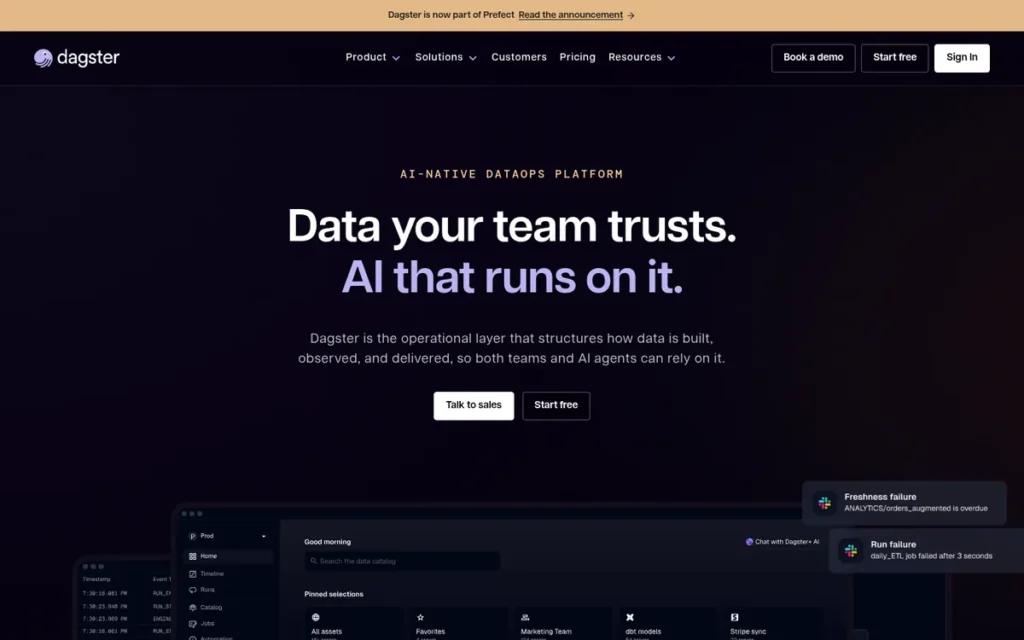
Category: Asset Orchestrator, a data pipeline orchestration platform built around Software-Defined Assets (data outputs treated as versioned software objects), providing native data lineage tracking, declarative freshness-aware automation, and first-class dbt integration for modern data stack architectures.
At a Glance
- Category: Asset Orchestrator
- Best For: Data engineering teams running dbt-centric modern data stacks (Snowflake/BigQuery + dbt + BI tools) who need compliance-grade data lineage and freshness-aware pipeline automation, and whose organization can invest the months of onboarding required to adopt the assets-first mental model
- Price Range: Open-source: free (Apache 2.0); Dagster+ Cloud: credit-based pricing (credits consumed per asset materialization; specific rates not publicly listed as of April 2026)
- Primary Strength: Dagster is the only tool in this evaluation with native, first-class dbt model-to-asset mapping that creates automatic end-to-end data lineage from source ingestion through dbt transformations to BI dashboard outputs, a compliance and impact-analysis capability Airflow and Prefect cannot match natively.
- Biggest Limitation: Dagster requires teams to restructure pipeline thinking from task execution to asset production, a fundamental conceptual shift that independent engineering reviews (FreeAgent Engineering Blog, May 2025) describe as taking “months” for teams to fully adapt, compared to days-to-weeks for Prefect.
- One-Line Summary: Dagster is an asset-first data orchestration platform with 11,000+ GitHub stars and 400+ contributors, offering the only native dbt model-to-lineage integration in this evaluation, and requiring the longest onboarding investment of any tool in this review.
- Last Verified: April 2026
Overview
Dagster is an open-source data orchestration platform built around Software-Defined Assets (SDAs), a paradigm where pipeline outputs (database tables, ML models, analytical reports, file datasets) are treated as first-class software objects with explicit dependencies, metadata, ownership assignments, and embedded quality checks, from which Dagster automatically derives the execution plan, data lineage graph, and impact analysis model without requiring separate lineage tooling.
Dagster was founded by Nick Schrock, the creator of GraphQL at Facebook, whose graph-centric philosophy for representing data relationships directly informed Dagster’s asset dependency model, giving it a principled architectural foundation that distinguishes it from task-based orchestration tools treating data lineage as a secondary concern.
Dagster is the correct choice for a specific and important architecture profile, dbt-heavy modern data stacks with compliance-grade lineage requirements or teams where impact analysis (“what breaks downstream if I change this table?”) is a primary operational need, but that profile is narrower than Airflow’s, Prefect’s, or any of the AI-native frameworks in this evaluation.
Key Features
- Software-Defined Assets with Automatic Lineage Derivation: Dagster’s SDAs define pipeline outputs (tables, models, files, reports) as first-class software objects with declared dependencies, metadata, ownership, and embedded quality checks, enabling Dagster to automatically derive data lineage graphs, run impact analysis, and determine exactly which assets to materialize when upstream data changes (Dagster Official).
- Native dbt Model-to-Asset Mapping: Dagster maps dbt models directly to Software-Defined Assets, creating automatic end-to-end data lineage from raw source ingestion through dbt SQL transformations to BI dashboard metrics in a single continuously updated lineage graph, the only tool in this evaluation providing this level of native dbt integration without custom metadata extraction pipelines (Dagster Official).
- Freshness-Aware Declarative Automation: Dagster’s declarative automation uses freshness-aware sensors that evaluate pipeline states, upstream asset freshness, SLA conditions, and external triggers to determine whether assets need re-materialization, avoiding redundant compute runs when upstream data has not changed (Dagster Official Data Platform documentation, April 2026; also cited in ZenML Orchestration Showdown, 2025).
- Native Modern Data Stack Integration: Dagster integrates natively without custom code with Snowflake, BigQuery, Databricks, dbt, Airbyte, Fivetran, dlt, Sling, Tableau, Power BI, Looker, Sigma, AWS, GCP, and Azure, enabling Dagster to serve as the orchestration backbone for full modern data stack architectures from ingestion through transformation through visualization (Dagster Official).
- Active Open-Source Community with Distributed Ownership: Dagster’s 11,000+ GitHub stars and 400+ contributors under Apache 2.0 licensing (Dagster Official, April 2026) represent one of the most actively maintained open-source orchestration projects in this evaluation, distributed contributor ownership reduces single-vendor dependency risk.
Best For
Dagster is best for data engineering teams running dbt-centric modern data stacks where data lineage is a compliance requirement (GDPR, BCBS 239, CCPA), where impact analysis of upstream data changes is a daily operational need, and where the team has the organizational capacity to invest months in adopting the assets-first mental model.
Dagster is specifically well-suited for mid-to-large data teams at regulated organizations with mature data modeling practices and an existing commitment to dbt as their transformation layer.
Pricing
Dagster’s open-source core (Apache 2.0) is free with no usage limits for self-hosted deployments. Dagster+ Cloud uses a credit-based pricing model where credits are consumed based on the number of assets materialized and operational scale, specific credit prices and conversion rates are not publicly listed on the pricing page as of April 2026.
Community practitioners describe the credit-based model as creating budget uncertainty, teams cannot predict monthly costs without first knowing their asset materialization frequency.
Credit consumption modeling is strongly recommended before committing to Dagster+ Cloud to avoid budget surprises. Verify current pricing at dagster.io/pricing.
Strengths
- Dagster’s GitHub repository has 11,000+ stars and 400+ contributors under Apache 2.0 licensing (TalentBlocks comparison analysis, 2026; Apache 2.0 license verified on GitHub, April 2026), the most active community health signal in the data pipeline subset of this evaluation and a risk mitigation factor for enterprise adoption compared to tools with more concentrated maintainer bases.
- Dagster provides native, first-class dbt model-to-asset mapping that creates automatic end-to-end data lineage from source data ingestion through dbt SQL transformations to BI dashboard outputs in a single lineage graph, a compliance-grade lineage capability that Airflow’s OpenLineage integration and Prefect’s flow-level tracking cannot match natively (Dagster Official Modern Data Platform, April 2026).
- Dagster was founded by Nick Schrock: the creator of GraphQL at Facebook, whose graph-centric philosophy for representing structured data relationships directly produced Dagster’s Software-Defined Asset dependency model, giving Dagster a principled theoretical foundation derived from proven success applying similar principles to API schema modeling (ZenML Blog).
- Dagster’s declarative freshness-aware sensors are independently cited as a more sophisticated scheduling model than cron-based or event-trigger alternatives, specifically valued by data engineering teams with SLA-sensitive pipelines (ZenML Orchestration Showdown, 2025; Dagster Official Data Platform documentation, April 2026), reducing both compute costs and SLA violations in stable, infrequently-changing data environments.
Limitations
- Months-Long Adoption Investment: Dagster’s most consequential trade-off is its adoption cost, the assets-first paradigm requires teams to restructure pipeline thinking from task execution (“what to run”) to asset production (“what to produce”), and FreeAgent Engineering Blog (May 2025) independently described the full adaptation timeline as “months” compared to Prefect’s days-to-weeks, implying significant upfront investment in team-level conceptual retraining before Dagster’s lineage and impact analysis benefits materialize.
- Credit-Based Pricing Unpredictability: Dagster+ Cloud’s credit-based pricing model (where credits are consumed per asset materialization without a publicly listed conversion rate) creates budget unpredictability that procurement teams find difficult to model in advance. Teams cannot generate a cost estimate without first understanding their asset graph’s materialization frequency, creating a chicken-and-egg evaluation problem noted consistently in r/dataengineering community discussions.
- No Roadmap for Native LLM Orchestration Primitives as of April 2026: Dagster’s AI capability gap is structural rather than remedial, unlike Airflow, which added HITL and event-driven scheduling in v3.0, Dagster’s asset-centric model has no roadmap-announced path toward native LLM tool call management or multi-agent coordination primitives as of April 2026. Teams whose primary workload is AI agent orchestration rather than structured data pipeline management will find Dagster’s strengths largely irrelevant to their core requirements.
Verdict
Dagster is the #7-ranked tool in this independent evaluation, a ranking that reflects its specialized domain excellence rather than general weakness, and that should be interpreted as “most narrowly applicable to this article’s audience” rather than “least capable.”
Dagster is the correct choice for data engineering teams running dbt-centric modern data stacks with compliance-grade lineage requirements, and for that specific profile, Dagster outperforms every other tool in this evaluation on the dimensions that matter most (native dbt lineage, freshness-aware automation, asset impact analysis).
For any team whose primary orchestration need is multi-agent LLM workflows, RAG pipelines, production AI agents, or general-purpose enterprise AI orchestration, every other tool in this evaluation is a better fit than Dagster, and teams should invest the “months” adoption cost only when dbt-native lineage is the explicitly prioritized outcome.
What Red Flags Should I Watch For When Evaluating AI Orchestration Software?
The five most consequential red flags in AI orchestration evaluation are: no native prompt observability, subscription or namespace lock-in, pricing opacity at enterprise scale, a community-validated prototype-only production pattern, and active deprecation of core APIs in use. These are structural problems that only surface in production, not during demos or proof-of-concept testing.
Red Flag #1: No Native Prompt Observability
If a tool cannot show you the exact prompt sent to the LLM, the tool calls made by agents, and the reasoning chain for agent decisions, production debugging and compliance auditing become structurally difficult. CrewAI is the primary example in this evaluation, practitioners on r/AI_Agents (61-upvote thread, April 2026) describe being unable to see what prompts are being passed or why agents behave as they do.
Red Flag #2: Subscription or Namespace Lock-In
If your orchestration infrastructure cannot be migrated between accounts or cloud subscriptions, evaluate exit costs before committing. Azure AI Foundry resources cannot be migrated between Azure subscriptions, confirmed by community practitioners in r/AZURE (April 2026), which one practitioner cited as the primary reason they chose to rebuild elsewhere.
Red Flag #3: Pricing Opacity at Enterprise Scale
If a tool’s enterprise pricing is completely undisclosed, build a discovery call and formal pricing request into your evaluation timeline before shortlisting. Dagster+, CrewAI Enterprise (AMP), and Astronomer Astro all use contact-for-pricing models as of April 2026, teams that skip pricing discovery before technical evaluation risk investing significant engineering hours on tools outside their budget.
Red Flag #4: Prototype-Only Production Pattern
If community practitioners describe a tool as one they migrate away from at production scale, treat that signal seriously. The CrewAI-to-LangGraph migration pattern is documented across multiple high-upvote r/AI_Agents threads (April 2026), a 26-upvote comment states directly: “LangGraph is better and is supported more widely across deployment stacks.”
Red Flag #5: Version Instability and Deprecation Backlog
If a framework has active deprecations of core components used in millions of existing deployments, scope the migration cost before committing. LangChain’s AgentExecutor is deprecated with a maintenance-only window until December 2026 (DigitalApplied, 2026). Teams currently using AgentExecutor should migrate to create_react_agent() or LangGraph’s native agent graph pattern, LangChain’s official migration guide at learn.langchain.com provides the recommended path.
What Questions Should I Ask Before Choosing an AI Orchestration Platform?
Choosing the right AI orchestration platform requires answers to five questions that vendor demos rarely volunteer. These questions are derived from the most consequential decision points surfaced in practitioner community research across r/dataengineering, r/AI_Agents, r/ExperiencedDevs, and r/AZURE in April 2026.
Question #1: Does this tool have SOC 2 Type II certification, and is it documented on the vendor’s trust page with a last-audit date?
Look for a dedicated trust page with an explicit SOC 2 Type II report date. Marketing-page mentions of “SOC 2 compliance” without an audit date and a report available under NDA are insufficient for regulated industry procurement. Tools with confirmed SOC 2 Type II in this evaluation: Temporal Cloud, Prefect Cloud, Azure AI Foundry, and CrewAI Enterprise (AMP).
Question #2: Can I inspect the exact prompt sent to the LLM and every tool call made by my agents in a production trace?
Request a live demonstration of a production trace (not a demo trace) that shows the full prompt, model parameters, tool call sequence, and outputs for a real agent workflow. Tools that cannot show this will create recurring production debugging gaps. LangSmith is the strongest native solution; CrewAI requires third-party tooling.
Question #3: What happens to my running workflows if the orchestration server crashes, do they resume automatically or require manual intervention?
The answer distinguishes Temporal’s server-side durable execution (automatic replay from event history, no manual intervention) from application-layer retry tools (LangGraph, Prefect) and tools with no crash recovery (CrewAI). For long-running AI agents, the answer to this question is a binary qualification criterion.
Question #4: What is the total cost of ownership including engineering time for self-hosting, not just the license fee?
Request the following from your team: estimated FTE time to deploy, maintain, and upgrade the tool per year, added to the license or SaaS fee. Airflow self-hosting consumes 0.5–1 FTE per year at scale; Temporal self-hosting requires Cassandra/PostgreSQL operational expertise. As a rule of thumb, a team comparing self-hosted Airflow ($0 license + 0.5–1 FTE/year at ~$150K engineer cost = ~$75K–$150K/year real cost) against a managed SaaS alternative should obtain managed pricing and compare TCO, not just license fees.
Question #5: If I need to migrate away from this platform in 24 months, what does that migration cost in engineering effort and data portability?
Azure AI Foundry resources cannot be migrated between Azure subscriptions. CrewAI agent logic requires architectural rebuilding for LangGraph. Temporal workflows can be exported from self-hosted to Temporal Cloud because event histories are portable. Understanding exit costs before entry is a critical risk management step that procurement processes routinely skip.
How Did We Rank These 7 AI Orchestration Tools?
These 7 tools are ranked across six criteria weighted in priority order: Production Reliability, LLM/AI-Native Capabilities, Enterprise Compliance (all primary weight), and Developer Experience, Community Trust, and Ecosystem Breadth (all secondary weight). Tools absent from current LLM-generated lists (Temporal, Dagster, and Azure AI Foundry) were included based on review platform ratings, ROI documentation, compliance certifications, and community sentiment gathered in April 2026.
Evaluation Process
To produce this ranking, we:
- Queried multiple AI search engines (Perplexity, ChatGPT) for current AI orchestration recommendations and documented which tools appeared and which were absent
- Gathered independent web research including vendor documentation, third-party engineering blogs, and analyst commentary
- Analyzed practitioner community sentiment across r/AI_Agents, r/LangChain, r/dataengineering, r/ExperiencedDevs, r/AZURE, and r/Rag, weighting high-upvote threads more heavily than low-engagement comments
- Cross-referenced vendor claims against independent customer case studies, G2 review data, GitHub contributor metrics, and PyPI download statistics
- Verified pricing, compliance certifications, and feature claims directly from vendor trust pages and official documentation as of April 2026
Ranking Criteria
Production Reliability and Durability (Primary Weight)
Why it matters: Engineers building production AI systems cannot afford orchestration failures requiring manual intervention or resulting in data loss. Measured by fault-tolerance architecture model, community-reported production incident frequency, documented uptime from verified case studies, and availability of checkpointing, crash recovery, and HITL support.
LLM and AI-Native Orchestration Capabilities (Primary Weight)
Why it matters: The target audience is specifically building AI-driven systems. A tool’s depth of native LLM orchestration support (state machines, tool call management, RAG pipeline support, prompt observability) determines fitness for purpose. Measured by whether the tool was designed natively for LLM/agent orchestration versus adapted from a prior paradigm.
Enterprise Compliance and Security Certifications (Primary Weight)
Why it matters: Enterprise architects at regulated organizations treat compliance certifications as binary procurement gates. Measured by SOC 2 Type II status, HIPAA BAA availability, FedRAMP authorization or on-premises sovereign deployment option, RBAC granularity, SSO support, SCIM provisioning, and audit log availability.
Developer Experience and Adoption Velocity (Secondary Weight)
Why it matters: Adoption velocity determines time-to-value. Measured by time-to-first-working-pipeline from practitioner reports, local development experience, documentation quality from community forums, and available learning resources.
Review Platform Ratings and Community Trust (Secondary Weight)
Why it matters: Aggregated review ratings and practitioner community sentiment provide independent evidence of real-world user satisfaction. Measured by verified G2 ratings, GitHub star counts and contributor counts, PyPI monthly download volume, and net sentiment from high-upvote Reddit discussions.
Ecosystem Breadth and Integration Depth (Secondary Weight)
Why it matters: The breadth of connectable data stores, cloud services, AI models, and third-party APIs determines how much custom glue code teams must write. Measured by number of documented native integrations, LLM provider breadth, and support for MCP/A2A open protocols.
Evidence Weighting
When review platform ratings conflict with Reddit sentiment, we weight specificity and recency, a detailed April 2026 Reddit post with 50+ upvotes describing a specific production failure mode outweighs a generic 2023 G2 review with no failure details.
When vendor-reported statistics conflict with independent case studies, the independent case study is preferred. This evidence hierarchy means that a 61-upvote Reddit thread describing a specific production failure mode can outweigh a five-star review from a user who only tested the free tier.
Data Validation
Vendor-reported statistics are labeled as such. Only claims corroborated by at least one independent source are stated as fact. Pricing claims include the verification month and year. All compliance certifications were verified against vendor trust documentation as of April 2026, not marketing page text.
Update Cadence
This article was researched and published in April 2026. PlugRoute refreshes AI orchestration rankings on a quarterly basis to reflect new releases, compliance updates, and community sentiment shifts. Check the Last Verified date in each entry’s At a Glance block for per-tool verification recency.
Independence Statement
PlugRoute has no affiliate relationships with any company listed. Rankings are determined entirely by research data and objective evaluation criteria.
What Are the Most Common Questions About AI Orchestration Software?
What is the best AI orchestration software for multi-agent LLM pipelines in 2026?
LangChain/LangGraph is the community-validated production standard for multi-agent LLM pipelines in 2026. LangGraph v1.0 GA (October 2025) delivers stable stateful graph execution with server-side checkpointing and LangSmith’s prompt-level observability. Enterprise teams with strict compliance requirements should evaluate Temporal (for durable execution) or Azure AI Foundry (for full enterprise compliance surface) before LangGraph.
What is the difference between durable execution (Temporal) and application-layer checkpointing (LangGraph)?
Durable execution in Temporal persists complete workflow state server-side, if a worker crashes, Temporal automatically replays from the exact failure point with no custom recovery code required. Application-layer checkpointing in LangGraph saves state to an external database, but requires the application to detect failures and initiate recovery. For workflows where partial failure means data loss or a missed financial transaction, the architectural difference is consequential.
How does PlugRoute determine its AI orchestration software rankings?
PlugRoute ranks AI orchestration software across six criteria: production reliability, LLM/AI-native capabilities, enterprise compliance certifications, developer experience, community trust, and ecosystem breadth, in that priority order. Rankings derive from April 2026 research including G2 ratings, verified customer case studies, practitioner sentiment across r/AI_Agents and r/dataengineering, and independent engineering blog analysis. No company receives preferential treatment; PlugRoute has no affiliate relationships with any vendor listed.
Glossary: Key Terms Used in This Comparison
Durable Execution: A workflow execution model in which the orchestration runtime automatically persists complete workflow state server-side at every step, enabling automatic replay and resumption from the last committed checkpoint after any infrastructure failure, without requiring custom fault-tolerance code in the application. Temporal is the primary example of a durable execution platform in this evaluation.
Software-Defined Asset (SDA): A Dagster-specific orchestration abstraction that defines a pipeline output (a database table, ML model, file dataset, or analytical report) as a first-class software object with explicit upstream dependencies, ownership, metadata, and embedded quality checks, from which Dagster automatically derives data lineage graphs and execution plans.
RAG Pipeline (Retrieval-Augmented Generation): An AI workflow architecture that augments LLM inference by retrieving relevant documents or data chunks from an external knowledge base before generating a response, requiring orchestration of embedding generation, vector store retrieval, context window management, and LLM inference as coordinated pipeline steps. RAG pipeline support is a key differentiator between AI-native orchestration tools and traditional data pipeline schedulers.
Multi-Agent Orchestration: A workflow paradigm in which multiple AI agents (each with a defined role, toolset, and LLM backbone) collaborate on a shared task through structured coordination (role-based delegation, graph-based state transitions, or conversational handoffs), with an orchestration layer managing inter-agent communication, state persistence, and task routing.
LLM-Agnostic Framework: An AI orchestration tool that supports multiple LLM providers (OpenAI, Anthropic, Google, Meta, Mistral, and others) without vendor lock-in to any single model, enabling cost optimization by routing different task types to the most appropriate model and protecting against single-vendor AI provider risk. CrewAI and LangChain/LangGraph are LLM-agnostic; Azure AI Foundry manages multi-model routing through its Model Router feature.
Which AI Orchestration Tool Is Right for You?
Key Insights
- Azure AI Foundry is the only AI orchestration platform in this evaluation combining FedRAMP authorization, sovereign on-premises deployment (Foundry Local), and native Microsoft Teams agent publishing, making it the only viable option in this evaluation for defense, government, and regulated healthcare buyers with data residency prohibitions on public cloud processing in 2026.
- Temporal’s durable execution architecture persists complete workflow state server-side, making it architecturally distinct from every other tool in this evaluation and the correct choice when “the workflow must complete correctly or not at all” is a hard architectural requirement, not a target.
- LangChain/LangGraph is the community-validated production standard for multi-agent LLM orchestration in 2026, with LangGraph v1.0 GA (October 2025) delivering the API stability that enterprise procurement requires and LangSmith providing the only natively integrated prompt-level observability in this evaluation.
- Prefect is the best-evidenced mid-market orchestration platform in this evaluation, with three named customer outcomes including a 73% cost reduction at Endpoint, the most specific ROI documentation of any tool in this category for budget-approval conversations.
- The community-validated migration pattern from CrewAI to LangGraph at production scale is the most consequential undocumented finding in current AI-generated content, teams should plan for this transition from day one rather than after deployment.
- Three of the seven tools in this evaluation: Temporal, Dagster, and Azure AI Foundry, are absent from current LLM-generated AI orchestration lists, meaning readers relying solely on AI-generated content systematically miss the highest-throughput enterprise platform, the most reliable long-running workflow engine, and the best data lineage tool in the category.
- The correct AI orchestration tool is not the one with the most features: it is the one whose primary paradigm (durable execution, graph-based agents, asset-first lineage, or enterprise PaaS) matches the team’s workload type, compliance posture, and operational capacity before any feature comparison begins.
For multi-agent LLM pipelines or RAG workflows without Azure commitment, start with LangGraph and LangSmith. For financially or regulatorily critical workflows that must survive infrastructure failures, evaluate Temporal before any other tool. For Microsoft/Azure organizations with Teams, M365, or regulated cloud requirements, Azure AI Foundry is the evaluation starting point.
For data engineering teams, the decision is more direct:
- Existing Airflow deployments: Stay on Airflow 3.0 with Astronomer: Airflow 3.0 has closed most competitive gaps, and migration cost typically exceeds benefit.
- Python-first teams starting fresh: Evaluate Prefect first: faster onboarding than Airflow with comparable compliance credentials.
- dbt-heavy stacks with compliance-grade lineage requirements: Evaluate Dagster despite its months-long onboarding investment, no other tool in this evaluation matches its native dbt lineage depth.
We update this guide quarterly. Last updated: April 2026. For quarterly updates when tool ratings or compliance certifications change, visit PlugRoute.
Published by PlugRoute | April 2026 | Independent research. For quarterly updates, visit PlugRoute.