WireMock leads for Java/JVM teams needing fault injection and stateful testing; Apidog is the best all-in-one platform for teams replacing Postman on a budget; and Microcks is the only complete solution for polyglot teams using gRPC, Kafka, or GraphQL alongside REST. No single tool covers every protocol, team size, and budget, your stack and mocking depth requirements determine the right answer.
Backend APIs blocking frontend teams, mocks drifting out of sync with evolving specs, and multi-protocol fragmentation across gRPC and Kafka services are the structural problems API mocking tools exist to solve. Choosing the wrong tool can mean exhausting free-tier feature limits mid-session, maintaining separate mocking tools per protocol, or committing to a library whose development velocity has slowed before your project ships.
PlugRoute has no affiliate relationships with any company listed, rankings are determined entirely by research data and objective evaluation criteria.
TL;DR: Top Picks at a Glance
- WireMock: deepest fault injection and stateful mocking for Java/JVM teams
- Apidog: best free team tier (4 users, unlimited calls) and top Postman migration path
- Microcks: only native multi-protocol coverage: REST, gRPC, GraphQL, Kafka, MQTT (CNCF Incubating, May 2026)
- Mockoon: fastest offline REST setup for individual developers, no account required
- Stoplight Prism: the only tool that validates live API responses against OpenAPI in real time; the essential evaluation for spec-first teams
What Are the Four Categories of API Mocking Tools?
The four categories of API mocking tools are: Standalone Mock Servers (WireMock, Mockoon, MockServer) for deepest per-request control; All-in-One API Lifecycle Platforms (Apidog, Postman) where mocking is one feature among many; Spec-First OpenAPI Mock Servers (Stoplight Prism) for design-first validation and contract enforcement; and Multi-Protocol Service Virtualization Platforms (Microcks) for polyglot microservices teams using gRPC, Kafka, and GraphQL alongside REST. Identifying your category first shortens evaluation time significantly.
Category 1: Standalone Mock Servers simulate HTTP/HTTPS API behavior through programmable stub definitions, fault injection, and stateful scenarios, running as a library, standalone server, or Docker container. This category includes WireMock, Mockoon, and MockServer. These tools offer the deepest per-request control and are the default choice for integration test suites.
Category 2: All-in-One API Lifecycle Platforms unify API design, mock server generation, automated testing, and documentation hosting in a single workspace synchronized to an API specification. This category includes Apidog and Postman. Mocking is one feature among many; the trade-off is that mock depth is secondary to platform breadth.
Category 3: Spec-First OpenAPI Mock Servers generate mock responses directly from OpenAPI specification files. Stoplight Prism also uniquely validates live API traffic against the spec in real time. This category serves teams practicing API-first or design-first development who need both instant mocks and contract enforcement.
Category 4: Multi-Protocol Service Virtualization Platforms mock REST, gRPC, GraphQL, AsyncAPI, and messaging services from a single Kubernetes-native deployment. Microcks is the only tool in this evaluation in this category, making it the required evaluation for any team with non-HTTP API dependencies.
How Do the Top API Mocking Tools Compare at a Glance?
The seven API mocking tools in this evaluation span four categories, with key differentiators around fault injection depth, protocol coverage breadth, free tier model, and organizational stability. WireMock leads on advanced capabilities, Apidog on team value, and Microcks on protocol coverage. The table below provides a quick comparison; use the Quick Decision Framework that follows to identify your best starting point.
Protocol support notation in the Key Capabilities column: N = Native (first-class, in core) | E = Extension required | P = Partial HTTP-level only | X = Unsupported.
| Rank | Company | Category | Best For | One-Line Summary | Key Capabilities | Primary Strength | Key Limitation |
|---|---|---|---|---|---|---|---|
| 1 | WireMock | Standalone Mock Server | Java/JVM integration testing with fault injection | WireMock is an open-source HTTP mock server with 5–6M monthly downloads, the most complete fault injection system, and a full stateful Scenarios API. | REST: N · GraphQL: E · gRPC: E · AsyncAPI/Kafka: X · Stateful Scenarios · Fault Injection · Record/Replay · Spring Boot Module (Dec 2024) | Fault injection depth + stateful Scenarios API | Java-first ergonomics; gRPC/GraphQL require extensions |
| 2 | Apidog | All-in-One API Platform | Teams replacing Postman; spec-first small teams | Apidog is a G2 Leader-rated all-in-one API platform with a 4.9/5.0 score across 213+ reviews, a 4-user free tier with unlimited calls, and Smart Mock AI data generation. | REST: N · GraphQL: N · gRPC: N · AsyncAPI/Kafka: X · Smart Mock AI · Cloud Mock URLs · Mock Scripts · SSO (Enterprise) | Smart Mock AI + 4-user unlimited free tier | No test-to-spec version decoupling in multi-env CI/CD |
| 3 | Microcks | Multi-Protocol Virtualization | Polyglot teams using gRPC, Kafka, GraphQL + REST | Microcks is the only CNCF Incubating open-source platform with native mock support for REST, gRPC, GraphQL, AsyncAPI, Kafka, MQTT, and AMQP. | REST: N · GraphQL: N · gRPC: N · AsyncAPI/Kafka: N · Spec-as-Mock · Contract Testing · Kubernetes Operator · Microcks Hub | Only tool with native coverage across all major protocols | Kubernetes-native; no desktop GUI or hosted SaaS |
| 4 | Mockoon | Local Desktop Mock Server | Individual developers, offline REST mocking | Mockoon is an open-source offline-first REST mock server with 800,000+ downloads (vendor-reported), Faker.js data generation, and a flat-rate $25/month team plan. | REST: N · GraphQL: X · gRPC: X · AsyncAPI: X · Faker.js · CRUD Generation · Proxy/Record · CLI + Docker | Zero-setup offline REST mocking with Faker.js | HTTP/REST only; GraphQL absent per open issue #143 |
| 5 | Stoplight Prism | OpenAPI Mock + Validation Proxy | Spec-first OpenAPI teams preventing mock drift | Stoplight Prism is the only open-source API mock tool with a real-time validation proxy mode that validates both request and response traffic against an OpenAPI spec. | REST: N · GraphQL: X · gRPC: X · AsyncAPI: X · Validation Proxy · Dynamic JSON Schema Generation · OpenAPI v2/v3 · Single-Command Activation | Unique real-time OpenAPI validation proxy mode | Strictly HTTP/OpenAPI; no gRPC, AsyncAPI, or GraphQL |
| 6 | Postman | API Development Platform | Teams fully invested in Postman with simple needs | Postman is an API development platform used by 25 million developers whose mock server returns static example responses only; with no fault injection, no stateful mocking, and the highest estimated per-seat collaboration cost of any evaluated tool. | REST: N · GraphQL: P · gRPC: X · AsyncAPI: X · Collection-Based Mocks · Named Example Targeting · Authenticated Mock URLs | Zero-setup for existing Postman collection users | Static examples only; no fault injection; no stateful mocking |
| 7 | MockServer | HTTP Mock Server + Forward Proxy | Java teams needing dual mock-and-proxy behavior | MockServer is a fully free HTTP mock server and forward proxy with deep OpenAPI v3 integration, though its creator-competitor characterized it as maintenance-mode in December 2024; verify before new projects. | REST: N · GraphQL: P · gRPC: X · AsyncAPI: X · Dual Mock+Proxy · OpenAPI v3 Verification · JS Templating · Testcontainers | Unique dual mock-and-proxy port architecture | Maintenance mode characterization (Dec 2024); verify GitHub cadence before adopting |
Which API Mocking Tool Should I Choose for My Use Case?
If you are an individual developer working in REST only (the most common reader profile) start with Mockoon (offline, free, zero setup) or Apidog (cloud team collaboration, 4-user free tier). For all other contexts, use the table below to find your first-choice recommendation, then read the full entry for depth.
| Your #1 Priority | Recommended Tool | Why | Acceptable Alternative |
|---|---|---|---|
| Java/JVM Spring Boot integration testing | WireMock | Fault injection, stateful Scenarios API, official Spring Boot module (Dec 6, 2024), 5–6M monthly downloads | MockServer (verify maintenance status first) |
| Replace Postman on a budget | Apidog | 4-user free tier with unlimited calls; $18/user Professional vs. estimated $45/seat for Postman | Mockoon Cloud ($25/month flat) |
| gRPC, Kafka, GraphQL, or AsyncAPI mocking | Microcks | Only tool with native multi-protocol coverage in a single deployment | WireMock + gRPC extension (HTTP-level only) |
| Individual developer, offline REST mocking | Mockoon | Desktop app, no account required, Faker.js, zero setup | Stoplight Prism (spec-first only) |
| Spec-first OpenAPI, prevent mock drift | Stoplight Prism | Only tool with real-time request/response validation proxy | Mockoon (local, richer mock scenarios) |
| Already invested in Postman, simple needs | Postman | Zero new tool installation; mock server built into existing workspace | Apidog (better spec-sync and multi-user free tier) |
| Legacy MockServer investment | MockServer | Verify GitHub commit cadence first; dual mock-proxy architecture is unique | WireMock (lower maintenance risk, confirmed active) |
| Starting from scratch, no existing tool investment | Mockoon (REST-only) or Apidog (multi-protocol) | Both start at $0; Mockoon for local offline REST mocking; Apidog for spec-first REST plus gRPC/GraphQL with 4-user free team collaboration | WireMock if Java/JVM is the primary development language |
1. WireMock: Best Overall: Deepest Advanced Mocking for Java/JVM and Polyglot Teams
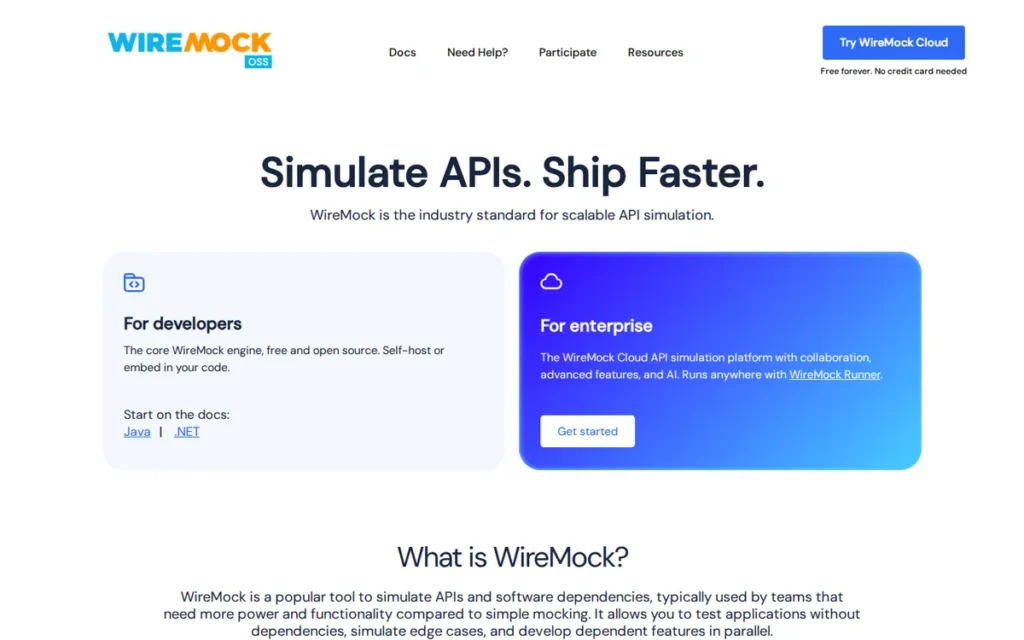
Category: Standalone Mock Server / Service Virtualization, runs a programmable HTTP server that returns predefined or dynamically generated responses, enabling isolated integration testing without live backend dependencies.
At a Glance
- Category: HTTP Mock Server / Service Virtualization
- Best For: Java and JVM-language teams needing fault injection, stateful multi-step API simulation, and Spring Boot or Testcontainers integration in integration test suites
- Price Range: Free (OSS, Apache 2.0, unlimited) + WireMock Cloud (contact for pricing at wiremock.org/cloud)
- Primary Strength: WireMock’s fault injection and stateful Scenarios API: the most complete failure simulation system in the open-source HTTP mocking category
- Biggest Limitation: Java-first ergonomics; Java 9+ JPMS module system conflicts have been reported in projects using the module system with certain transitive dependencies
- One-Line Summary: WireMock is an open-source HTTP mock server and service virtualization library with 5–6 million monthly downloads, production-grade fault injection, a stateful Scenarios API, and a dedicated Spring Boot integration module launched December 6, 2024.
- Last Verified: June 2026
Overview
WireMock is a mature, open-source HTTP mock server and service virtualization library founded in 2011 by Tom Akehurst, designed primarily for Java and JVM-language teams who need realistic integration test environments that simulate third-party API dependencies, failure modes, and stateful multi-request flows. WireMock is backed commercially by WireMock Ltd., which actively funds OSS development, confirmed by Tom Akehurst as “backed by a well-funded company” (r/SpringBoot, December 2024). WireMock ships in two tiers: WireMock OSS (free, Apache 2.0, unlimited) and WireMock Cloud (a commercial SaaS platform for team-scale collaboration and enterprise governance).
Key Features
- Fault Injection via HTTP Stubbing: WireMock’s fault simulation system supports five distinct failure modes (empty responses, malformed chunked encoding, random binary data, connection resets, and configurable fixed or random delays) documented at wiremock.org/docs/simulating-faults/, making WireMock the most complete failure-scenario testing tool among the open-source options in this evaluation.
- Stateful Scenarios API: WireMock’s Scenarios API implements a full state machine that changes stub behavior based on the sequence of prior requests, enabling simulation of multi-step resource lifecycle flows (POST-then-GET-then-DELETE workflows) that static mock tools cannot replicate, documented at wiremock.org/docs/stateful-behaviour/.
- Handlebars Response Templating: WireMock provides a large Handlebars-based response template function library (including request path, header, body, and JSONPath extraction helpers) allowing dynamic, request-aware responses without writing custom server code.
- Record-and-Replay Mode: WireMock’s record-and-replay capability captures real API traffic and automatically converts it into stub definitions, reducing the manual work required to build accurate mock definitions for existing third-party services.
- Official Spring Boot Integration Module: WireMock’s December 6, 2024 Spring Boot module enables annotation-driven configuration of one or more WireMock instances in Spring Boot test suites with automatic URL and port injection as Spring properties, eliminating the longstanding random-port management friction (wiremock.io, December 2024).
Best For
WireMock is best for Java, Kotlin, Groovy, and Scala teams running Spring Boot or Micronaut applications where integration tests must simulate third-party API dependencies, fault conditions, and stateful multi-request flows with production-level behavioral precision. WireMock is also well-suited for QA engineers building shared mock environments in polyglot teams who need a standalone Docker-based HTTP mock server with scripting-level control over response behavior.
Pricing
WireMock OSS is fully free under the Apache 2.0 license with no feature restrictions, the complete standalone server, JUnit library, Docker image, CLI, and extension ecosystem are all available at zero cost. WireMock Cloud is a commercial SaaS product with team collaboration features; exact pricing is not published publicly and requires direct inquiry at wiremock.org/cloud. The free OSS version is sufficient for most individual developer and CI/CD use cases. Pricing data verified June 2026.
Strengths
- Dominant Community Adoption: WireMock achieves 5–6 million monthly downloads: reported across both the official wiremock.org documentation homepage and the GitHub README as of mid-2026, making WireMock the most widely adopted HTTP mocking library in the Java ecosystem and providing the strongest community-scale adoption evidence of any tool in this evaluation.
- Spring Boot Community Validation: WireMock’s December 6, 2024 Spring Boot integration module (announced at wiremock.io) received strong community reception on r/SpringBoot, with members confirming it resolved the longstanding random-port management pain point in Spring Boot integration test suites (u/tomakehurst, r/SpringBoot, December 2024).
Users on r/ExperiencedDevs shared their experience with WireMock’s per-test flexibility:
“wiremock is very light weight. Each testcase can start up its own wiremock under a specific configuration for that unique testcase. It’s literally just a
java -jarcmd and it’s running in like 3 seconds. Or if you write custom transformers then you can start it up once insetup classthen at the beginning of each test, send the testcase name to wiremock and that currently running instance can change its behavior based on the testcase name. It’s a very flexible mocking tool if you have the time to invest in its setup.” Posted by u/throwaway_0x90
Takeaway: WireMock’s per-testcase configurability and sub-five-second startup make it a standout tool for isolated integration tests, though its full flexibility comes with an upfront configuration investment that teams should plan for before adoption.
- Most Complete Fault Injection in Open Source: WireMock’s fault injection API supports five distinct failure modes documented at wiremock.org/docs/simulating-faults/, no other tool in this evaluation matches this depth without requiring additional paid or enterprise libraries.
- Commercial Backing Confirmed by Creator: WireMock is backed by WireMock Ltd., a commercial entity actively funding OSS development (confirmed by creator Tom Akehurst in December 2024 on r/SpringBoot) providing stronger long-term maintenance assurance than community-only open-source projects with no commercial entity behind them (r/SpringBoot, December 2024).
Limitations
- Java-First Ergonomics: WireMock’s most consequential trade-off is its Java-library-first design, while standalone JAR and Docker deployments are available for all language stacks, teams using Python, Go, or Node.js face a steeper configuration curve and less ergonomic client libraries than tools designed for polyglot or JavaScript-first workflows.
- JPMS Module System Conflicts: WireMock has documented Java 9+ module system incompatibilities caused by a transitive dependency conflict with
handlebars.java, requiring workarounds such as using thewiremock-standaloneJAR, not a clean resolution for projects fully committed to JPMS, as reported in r/java, October 2023. - gRPC and GraphQL Require Extensions: WireMock’s gRPC and GraphQL support exist via first-party and third-party extension libraries that are not part of WireMock’s core, teams needing these protocols must evaluate and maintain separate extension dependencies with their own versioning cycles, and WireMock Cloud pricing opacity requires direct vendor inquiry rather than self-service evaluation.
Verdict
WireMock is the most capable open-source HTTP mock server and service virtualization tool available in 2026, with 14+ years of development history, 5–6 million monthly downloads, and WireMock Ltd. actively funding its roadmap. WireMock’s fault injection depth and stateful Scenarios API set a standard that no other open-source tool in this category matches. Teams outside the Java/JVM ecosystem should evaluate the ergonomics trade-off carefully, but for any team using Spring Boot, Testcontainers, or JUnit-based integration testing, WireMock is the default recommendation.
2. Apidog: Best All-in-One Platform: Top Choice for Teams Migrating from Postman
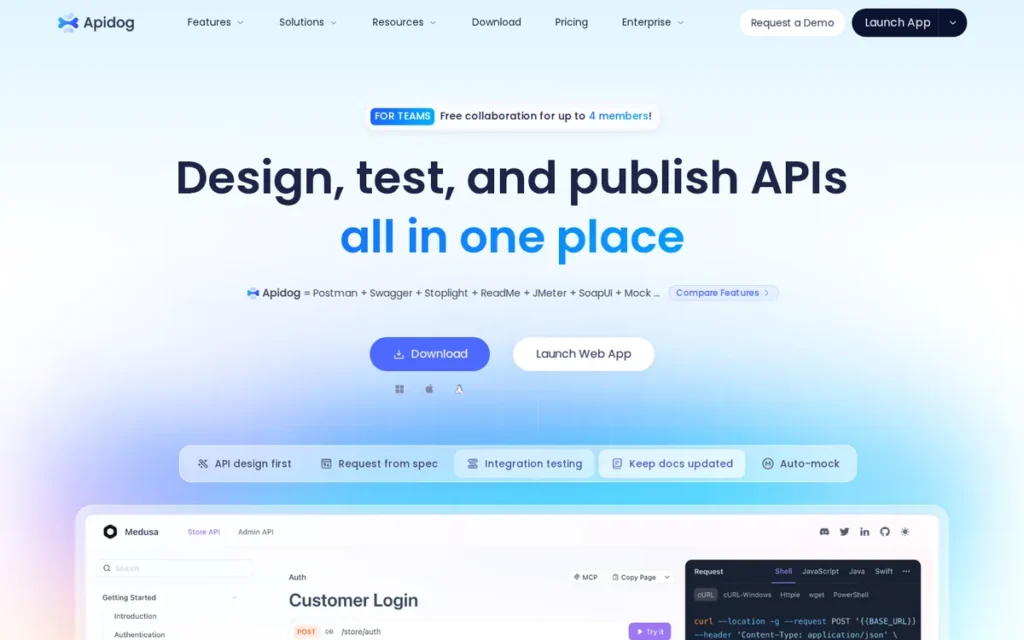
Category: All-in-One API Lifecycle Platform, combines API design, mock server generation, automated testing, and documentation hosting in a single spec-synchronized workspace where changes to the API specification propagate automatically to mocks, tests, and docs.
At a Glance
- Category: All-in-One API Lifecycle Platform
- Best For: Product teams of 2–10 people replacing Postman or consolidating API design and mocking into one workspace, especially spec-first OpenAPI teams sensitive to per-seat pricing
- Price Range: Free (up to 4 users, unlimited mock calls) / Basic $9/user/month / Professional $18/user/month / Enterprise ~$27/user/month (verified June 2026)
- Primary Strength: Apidog’s G2 Leader designation with 4.9/5.0 across 213+ reviews, a 4-user free tier with unlimited calls, and Smart Mock AI data generation, the most generous free team tier in the evaluated category
- Biggest Limitation: No test-to-spec version decoupling; spec changes propagate immediately across all CI pipeline stages simultaneously with no per-environment version targeting
- One-Line Summary: Apidog is a G2 Leader-rated all-in-one API platform with a 4.9/5.0 score across 213+ reviews, offering free team mocking for up to four users with unlimited calls, Smart Mock AI data generation, and support for REST, GraphQL, gRPC, and WebSocket protocols.
- Last Verified: June 2026
Overview
Apidog is a spec-synchronized API lifecycle platform launched in 2022 that combines API design, mock servers, automated testing, and documentation hosting in a single workspace, aimed at product teams who want to replace separate tools like Postman, Swagger Editor, and a standalone mock server with one integrated environment. Apidog holds a G2 Leader designation in the API Mocking Software category with a 4.9/5.0 rating across 213+ reviews as of mid-2026 (G2, June 2026), the highest verified review platform score of any tool in this evaluation. Note: an October 2025 r/dotnet thread featuring Apidog endorsements was flagged by some community members as potentially containing marketing-influenced posts, which should factor into how those endorsement signals are weighted (r/dotnet, October 2025).
Key Features
- Smart Mock AI: Apidog’s Smart Mock mode automatically generates contextually realistic response data by inferring field types from JSON Schema definitions and field names (an
emailfield produces a valid email address, acreated_atfield produces a plausible timestamp) reducing fixture authoring time for standard REST response shapes without manual configuration. - Cloud Mock URLs: Apidog’s Cloud Mock feature generates publicly accessible mock URLs from any API specification without requiring team members to run local servers, enabling frontend developers to begin integration work against shared mock endpoints while backend development is still in progress.
- Multi-Protocol Support in One Workspace: Apidog supports REST/HTTP, GraphQL, gRPC, WebSocket, and SOAP protocols within a single workspace, making it viable for teams working across multiple API paradigms without switching tools.
- Mock Scripts for Dynamic Behavior: Apidog’s Mock Scripts feature enables JavaScript-based conditional response logic (returning different response bodies based on request parameters or simulating authentication failures) providing dynamic mock behavior beyond static example responses.
- Enterprise SSO and Governance: Apidog’s Enterprise tier includes SSO integration (SAML 2.0, LDAP, Okta, OAuth 2.0, OIDC), private cloud mock service, and 5-minute scheduled spec import frequency for keeping mocks synchronized with evolving API definitions in active development pipelines.
Best For
Apidog is best for cross-functional product teams of 2–10 developers who need collaborative API design and mocking in one platform, particularly teams considering migration from Postman who are sensitive to per-seat pricing ($18/user/month Professional versus Postman’s estimated $45/seat/month for comparable collaboration features). Apidog is also well-suited for spec-first OpenAPI development teams who want automatic mock synchronization without managing separate design and mocking tools.
Pricing
Apidog’s free tier supports up to 4 users with unlimited test runs and full access to API design, mocking, and testing features at $0, the only tool in this evaluation combining multi-user free access with zero call-rate constraints. Paid tiers are Basic ($9/user/month), Professional ($18/user/month), and Enterprise (~$27/user/month), all with annual billing and a 14-day free trial. Enterprise adds private cloud mock, SSO, and 5-minute spec sync frequency. Pricing sourced from G2 Apidog profile and apidog.com/pricing, verified June 2026.
Strengths
- Highest G2 Score in the Evaluated Category: G2 designates Apidog a Leader in the API Mocking Software category with a 4.9/5.0 rating across 213+ reviews as of mid-2026 (G2, June 2026), notable for a company founded in 2022 competing against tools with decade-long review histories.
- Most Generous Free Team Tier: Apidog’s free tier uniquely supports up to 4 users with unlimited mock server calls at no cost, a structural advantage over tools with monthly call caps or limited free collaboration features, cited consistently as a migration trigger in developer communities (mockoon.com/compare/postman/, 2024–2025).
- Organic Community Endorsement as Postman Alternative: Developer community members in an October 2025 r/dotnet thread noted that Apidog “handles OpenAPI specs well” and that teams transition “without needing to relearn everything” (u/Able-Resort2540 and u/Proper-Wind4777, r/dotnet, October 2025), note that some users flagged this thread as potentially containing marketing-influenced posts.
- Smart Mock AI Reduces Fixture Work: Apidog’s Smart Mock AI generates semantically appropriate test data from field names automatically, eliminating the manual fixture authoring that developers describe as a significant time sink when maintaining realistic mock responses during active API development.
Limitations
- No Test-to-Spec Version Decoupling: Apidog’s most consequential limitation for multi-environment CI/CD pipelines is that updating an API schema immediately propagates to test expectations across all deployment stages simultaneously, u/ipaterson reported in November 2025 that spec updates hit dev, staging, and production pipeline stages at once with no per-environment version targeting (r/devops, November 2025).
Users on r/devops described this limitation directly from their own workflow:
“For public facing APIs I update Apidog documentation first in a new version, generate zod schemas from the docs, then update the code to match. The data returned from the API passes through zod to ensure compliance. One problem with this approach is that Apidog tests do not correspond to versions. If I update a schema either automated tests immediately expect it of all deployment stages or none do. This can probably be solved by dereferencing the test cases from the endpoints so that they do not remain in sync, but that is more work to maintain. This is a small project, tiny team, and low update frequency. YMMV” Posted by u/ipaterson
Takeaway: Apidog’s immediate schema propagation across all pipeline stages is a documented, real-world workflow constraint (not a theoretical edge case) and teams running multi-stage CI/CD pipelines should verify this behavior against their deployment architecture before committing Apidog as their primary spec-sync tool.
- Limited Organizational Track Record: Apidog was founded in 2022, meaning it lacks the multi-year track record that WireMock (2011) or Postman (2012) provide, enterprise teams making long-term infrastructure commitments should factor this organizational maturity gap into their evaluation.
- Thinner Community Validation for gRPC and WebSocket: Apidog’s gRPC and WebSocket support is documented as available but has thinner community validation depth than its REST mocking capabilities, teams with complex gRPC requirements should verify functionality against their specific use cases before committing Apidog as their primary gRPC mock tool.
Verdict
Apidog is the G2 Leader in API Mocking Software with a 4.9/5.0 rating across 213+ reviews, and its combination of a 4-user free tier with unlimited calls, Smart Mock AI data generation, and cloud-hosted mock URLs makes it the strongest all-in-one option for small-to-medium product teams in 2026. Teams migrating from Postman due to pricing concerns will find the most feature-comparable transition path in Apidog at roughly one-third the estimated per-seat cost. The multi-environment test versioning limitation should be evaluated before committing Apidog to complex CI/CD pipelines, but for teams in standard single-pipeline workflows it is unlikely to be a blocking concern.
3. Microcks: Best Multi-Protocol Coverage: The Only Complete Solution for gRPC, GraphQL, and AsyncAPI Teams
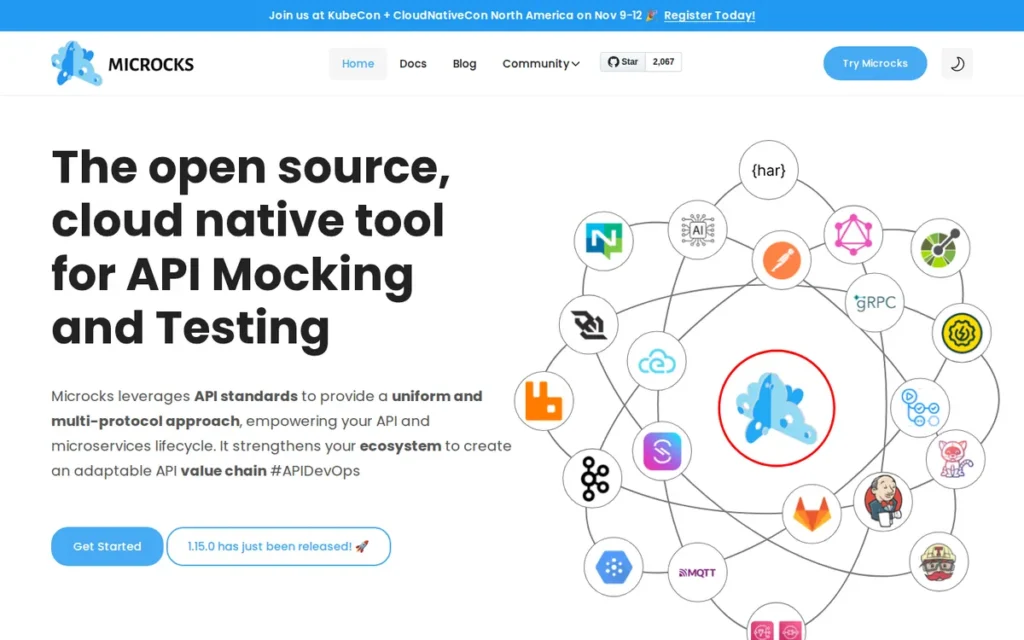
Category: Multi-Protocol Service Virtualization Platform, mocks REST, gRPC, GraphQL, AsyncAPI, and messaging protocol services (Kafka, MQTT, AMQP) from a single Kubernetes-native deployment using existing API specification files as the sole source of truth for both mock behavior and contract test assertions.
At a Glance
- Category: Multi-Protocol Service Virtualization Platform
- Best For: Platform engineers and senior DevOps architects building polyglot and event-driven microservices architectures using gRPC, Kafka, GraphQL, or AsyncAPI alongside REST, particularly teams already running Kubernetes
- Price Range: Free (open-source, Apache 2.0, self-hosted): no commercial paid tier as of June 2026
- Primary Strength: Microcks natively mocks REST, gRPC, GraphQL, AsyncAPI, Kafka, MQTT, and AMQP services from a single platform deployment, eliminating the fragmented multi-tool approach that polyglot microservices teams currently manage
- Biggest Limitation: Kubernetes-native deployment required; no desktop GUI, no cloud-hosted SaaS, and no single-binary download exist
- One-Line Summary: Microcks is the only CNCF Incubating open-source service virtualization platform with native mock support for REST, gRPC, GraphQL, AsyncAPI, and Kafka/MQTT messaging protocols in a single Kubernetes-native deployment.
- Last Verified: June 2026
Overview
Microcks is an open-source, cloud-native service virtualization platform that generates mocks and runs contract tests across REST, gRPC, GraphQL, and event-driven AsyncAPI/messaging protocols from a single Kubernetes-deployable platform, targeted at platform engineering teams building polyglot and event-driven microservices architectures where services communicate across multiple API types. Microcks was elevated from CNCF Sandbox to CNCF Incubating status on May 3, 2026 (CNCF, cncf.io/projects/microcks/, May 2026), a governance milestone signaling growing production adoption, a stronger contributor community, and a defined path toward CNCF Graduated status. The core insight behind Microcks’ architecture: when your OpenAPI spec IS the mock definition, there is no separate mock file to drift out of sync, the spec is the mock, the mock is the spec, and the most common long-term mock maintenance pain point is eliminated by architecture rather than by process discipline.
Key Features
- Spec-as-Mock Ingestion: Microcks ingests OpenAPI specs, AsyncAPI specs, gRPC Protobuf files, GraphQL schemas, Postman collections, and SoapUI projects directly as mock sources, teams import existing API contracts and Microcks generates live mock behavior automatically, structurally preventing the spec drift that accumulates when mock definitions are maintained separately (microcks.io documentation).
- Native Messaging Protocol Simulation: Microcks natively supports Kafka, MQTT, and AMQP messaging protocol simulation, making Microcks the only tool in this evaluation that can mock event-driven and pub/sub API communication patterns without protocol-specific workarounds or supplemental tools.
- Unified Mock and API Contract Testing: Microcks functions as both a mock server and an API contract testing framework, the same imported API specification that generates mock behavior also verifies that real API implementations conform to their declared contracts, eliminating a separate mock-versus-test toolchain split.
- Kubernetes Operator Deployment: Microcks deploys as a Kubernetes Operator, enabling platform engineering teams to manage mock server infrastructure using the same GitOps and infrastructure-as-code workflows they use for application deployments.
- Microcks Hub Community Marketplace: Microcks Hub provides a community marketplace where teams can publish, version-control, and share mock definitions and test suites, enabling reuse of common mocks across projects and reducing duplicate definition work across engineering teams (microcks.io/documentation/guides/integration/microcks-hub/).
Best For
Microcks is best for platform engineers and senior DevOps architects at organizations operating Kubernetes-based microservices platforms where services communicate across multiple protocols (REST, gRPC, GraphQL, and Kafka/AsyncAPI) who need a single governed mock infrastructure rather than separate tools per protocol. Microcks is the only viable single-tool solution for teams with gRPC service dependencies or Kafka consumer simulation requirements.
Pricing
Microcks is fully free under the Apache 2.0 license with no commercial paid tier, no hosted SaaS version, and no per-seat pricing. All costs are infrastructure-only: compute and storage for running Microcks on Kubernetes or Docker Compose. Community support is available via GitHub, Open Collective, and CNCF community channels. No commercial first-party enterprise support SKU was confirmed in research as of June 2026, verify whether commercial support partners exist via microcks.io before making an enterprise commitment.
Strengths
- Unmatched Protocol Coverage: Microcks is the only tool in this evaluation with native mock support across all major API protocol types (REST/OpenAPI, gRPC/Protobuf, GraphQL, AsyncAPI, Kafka, MQTT, and AMQP) confirmed in official microcks.io documentation and GitHub README as of mid-2026, eliminating the multi-tool fragmentation that polyglot microservices teams currently manage.
- CNCF Incubating Governance: Microcks was elevated from CNCF Sandbox to CNCF Incubating status on May 3, 2026 (CNCF, cncf.io/projects/microcks/, May 2026), providing independent governance, IP clarity, and a defined contributor community, a materially stronger organizational stability signal than Sandbox status, signaling growing production adoption and a path toward CNCF Graduated level.
- Peer-Level Recognition Alongside WireMock: Experienced developers in r/ExperiencedDevs casually equated Microcks with WireMock as a peer-tier enterprise integration test solution, u/dublinvillain wrote: “We used something like wiremock / microcks to mock external apis” (r/ExperiencedDevs, 2025), signaling meaningful professional adoption without marketing influence.
The full comment from r/ExperiencedDevs shows the casual, non-promotional context in which Microcks earns mention among senior engineers:
“I had a pipeline that basically did 1. Load seed data in base schema, 2. Perform migrations 3. Test migrations 4. Run integration tests. During ITs we never modified the DB directly, only via api. We never cleaned the DB. This of course meant tests weren’t idempotent which is bad (worked around with naming in the data). But it was surprisingly robust, reasonably quick to run, and easy to onboard. We used something like wiremock / microcks to mock external apis. Fwiw I think your approach is good. I think it’s the most valuable type of testing but I don’t think you can get around maintaining schema data in your test code.” Posted by u/dublinvillain
Takeaway: Senior engineers building production integration pipelines reach for Microcks and WireMock interchangeably as default tools for external API mocking, an organic peer-adoption signal that no marketing campaign can replicate.
- Spec Drift Prevention by Architecture: Microcks uses existing API specification artifacts as the direct source for mock generation, changes to the specification automatically update mock behavior without separate mock definition maintenance, structurally preventing the spec drift problem that accumulates in manual mock tools.
Limitations
- High Operational Complexity: Microcks’ most consequential trade-off is its deployment model, Microcks is a Kubernetes-native platform with no desktop GUI, no cloud-hosted SaaS option, and no simple single-binary download, requiring Docker Compose at minimum and a full Kubernetes Operator deployment for production use, making Microcks inappropriate for individual developers or small teams without existing container orchestration infrastructure.
- Less Explicit Stateful Mocking Than WireMock: Microcks’ stateful mocking uses a Dispatcher model that is less explicitly configurable than WireMock’s Scenarios API, making complex multi-step request sequence simulation less ergonomic for teams accustomed to explicit state machine definitions.
- Limited Fault Injection Capabilities: Microcks lacks first-class documented fault injection (network delays, connection errors, and malformed responses are not prominent platform features) meaning teams that need realistic failure mode simulation should treat Microcks as complementary to WireMock rather than a complete replacement.
- No Commercial Support Option: Microcks has no commercial SaaS or first-party enterprise support tier, meaning all operational burden falls entirely on the adopting team, a significant consideration for enterprise organizations with vendor support requirements or SLA obligations.
Verdict
For teams building polyglot microservices architectures (where a single sprint touches Kafka consumers, gRPC services, and REST APIs simultaneously) Microcks is the only open-source platform with native coverage across all three at zero cost. Microcks’ May 2026 elevation to CNCF Incubating status provides the strongest open-source governance signal of any tool in this evaluation’s middle tier. The Kubernetes-native deployment model and absence of a hosted SaaS option make Microcks the right answer for platform engineering teams with existing container infrastructure and the wrong answer for individual developers needing a quick local mock setup.
4. Mockoon: Best for Local Development: Zero-Friction Offline REST Mocking for Individual Developers
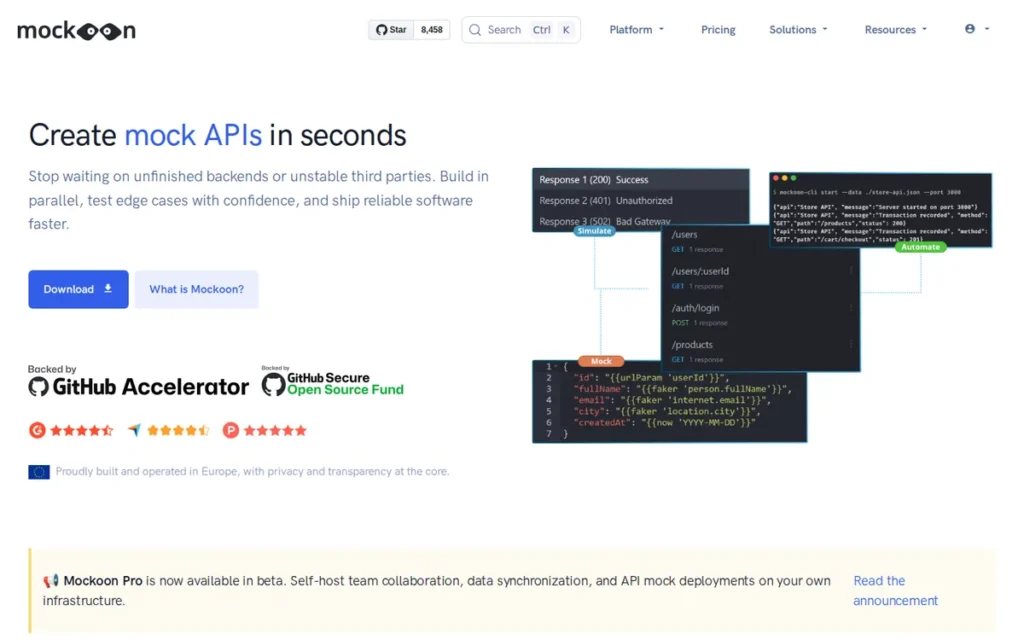
Category: Local Desktop API Mock Server, a downloadable desktop application and CLI that runs HTTP/REST mock servers entirely on the local machine without internet connectivity, cloud accounts, or server infrastructure.
At a Glance
- Category: Local Desktop API Mock Server
- Best For: Individual frontend and backend developers and small teams needing fast, privacy-friendly, offline-first HTTP/REST mock servers without account creation or cloud dependency
- Price Range: Free (OSS, MIT license, desktop + CLI + Docker, unlimited) / Cloud Solo $15/month / Cloud Team $25/month flat-rate, not per-seat (verified June 2026)
- Primary Strength: Mockoon’s zero-setup offline REST mocking: the desktop app requires no account, no internet connection, and no configuration files to create a working mock endpoint
- Biggest Limitation: HTTP/REST only; GraphQL support absent per GitHub issue #143, open for multiple years with no confirmed roadmap date
- One-Line Summary: Mockoon is an open-source, offline-first REST mock server desktop application with 800,000+ downloads (vendor-reported), built-in Faker.js dynamic data generation, and a flat-rate team cloud plan at $25/month, the fastest-setup, most privacy-friendly choice for individual developers and small teams.
- Last Verified: June 2026
Overview
Mockoon is an open-source, offline-first HTTP/REST mock server available as a cross-platform desktop application, CLI, Node.js package, and Docker image, created in 2017 by Guillaume Boddaert and aimed at individual developers and small teams who want local REST mock servers in seconds without internet connectivity, account registration, or configuration files. Mockoon reports surpassing 800,000 downloads since its 2017 launch (mockoon.com/what-is-mockoon/, 2024), confirming substantial community trust in a category where many tools require cloud dependency. Mockoon’s free desktop application and CLI are completely separate from Mockoon Cloud (a paid add-on for team collaboration and shared mock definitions) allowing individual developers to use Mockoon indefinitely at $0 with no feature gates.
Key Features
- Faker.js and Mustache Response Templating: Mockoon generates realistic fake response data using Faker.js and Mustache templating built directly into the response editor, developers embed helpers such as
{{faker 'internet.email'}}in a JSON response body and Mockoon produces a valid, varied email address on every request, eliminating manual fixture creation for standard data types. - Proxy-and-Record Mode: Mockoon’s proxy-and-record mode captures live API traffic from a real backend and automatically converts captured responses into local mock definitions, reducing mock creation time significantly when a backend temporarily exists but needs to be simulated offline.
- Automatic CRUD Endpoint Generation: Mockoon’s automatic CRUD endpoint generation creates a complete set of REST endpoints (GET list, GET single, POST, PUT, PATCH, DELETE) from a single route definition, enabling rapid mock API prototyping for standard resource-oriented REST services.
- Fully Offline Operation: Mockoon runs entirely locally with no network connectivity requirement, the desktop application, CLI, and Docker image all produce mock servers that operate completely offline, making Mockoon suitable for air-gapped development environments or corporate networks with strict outbound traffic policies.
- CI/CD Pipeline Integration: Mockoon’s CLI and official Docker image enable headless, scriptable mock server execution in CI/CD pipelines, the same mock environment file used in local development can be passed directly to the CLI for consistent mock behavior in GitHub Actions, GitLab CI, or Jenkins pipelines.
Best For
Mockoon is best for individual frontend and backend developers who need to create REST mock endpoints quickly during local development without cloud infrastructure, and for small teams of two to five people whose mocking needs are primarily HTTP/REST and who want flat-rate collaboration pricing rather than per-seat costs. Mockoon is particularly well-suited for developers in corporate environments with restricted internet access or strict data privacy requirements.
Pricing
Mockoon’s desktop app, CLI, Node.js package, and Docker image are fully free under the MIT license with no capability restrictions, templating, CRUD generation, proxy-and-record mode, and all local mock features are included at zero cost. Mockoon Cloud adds team collaboration: Cloud Solo is $15/month, Cloud Team is $25/month flat rate (not per-seat), and Cloud Enterprise pricing requires direct contact. Pricing confirmed on G2’s Mockoon pricing page and mockoon.com/pricing/, verified June 2026.
Strengths
- Highest Adoption Among Offline REST Tools: Mockoon reports surpassing 800,000 downloads since its 2017 launch (mockoon.com/what-is-mockoon/, 2024), making Mockoon the most widely adopted offline-first REST mocking desktop application and confirming substantial community trust in a category where free cloud-dependent tools dominate.
- Founder Transparency as a Trust Signal: Mockoon’s creator Guillaume Boddaert (u/255kb) publicly acknowledged product limitations directly in developer forums, in an r/devops thread he stated that “the OpenAPI spec import/export is a challenge and has some limitations” and that GraphQL is not supported (r/devops, 2023), a level of founder transparency that builds community trust and provides honest evaluation signals.
The full comment from r/devops captures both Mockoon’s CI/CD breadth and the creator’s candid acknowledgment of its limits:
“Shameless plug, I built Mockoon which does most of what you describe. It’s an open-source api mocking desktop app with a CLI and Docker image. It can import an OpenAPI spec, proxy to an existing API and record the responses, and run in your CI environment using our CLI wrapped in a Docker image or not. It’s not doing point 1 though. The OpenAPI spec import/export is a challenge and has some limitations as it is hard to come with equivalents for all the features. For example, Mockoon has a rules system or automated CRUD endpoints (similarly to json-server) which have no equivalents in the OpenAPI specification. I know some of our users compared it with Traffic Parrot and chose Mockoon. It’s also frequently paired with Stoplight, which is used for the API design part, as their mocking tool is quite limited (Prism).” Posted by u/255kb
Takeaway: Mockoon’s creator publicly discloses its OpenAPI round-trip limitations in community forums, a candid transparency that simultaneously confirms the tool’s boundaries for spec-first teams and validates it as the right choice for teams whose workflow stays within its REST-and-CLI scope.
- Most Cost-Effective Team Pricing: Mockoon Cloud Team pricing at $25/month flat-rate means a team of five pays $5/person/month, compared to an estimated $45+/seat/month for comparable Postman Professional collaboration features, the most cost-effective hosted collaboration option for small teams in this evaluation.
- Faker.js Integration Reduces Fixture Work: Mockoon’s Faker.js and Mustache integration allows dynamic, realistic mock data generation without writing code, developers embed template helpers directly in JSON response bodies to produce contextually appropriate values, reducing the manual fixture work that makes static example-based mocking brittle over time.
Limitations
- HTTP/REST Protocol Scope Only: Mockoon’s most consequential limitation is its protocol scope, Mockoon supports HTTP/REST mocking only, with no native GraphQL, gRPC, WebSocket, or AsyncAPI support, confirmed by a multi-year open GitHub issue #143 for GraphQL that has no confirmed roadmap date (GitHub issue #143).
- OpenAPI Round-Trip Imperfections: Mockoon’s OpenAPI import-and-export has acknowledged imperfections, the creator stated publicly that round-tripping an OpenAPI spec through Mockoon loses Mockoon-specific features and has translation gaps (r/devops, 2023), making Mockoon unsuitable as the authoritative source of an API specification.
- Solo-Founder Governance Risk: Mockoon’s solo-founder governance model (while sustaining active development for 8+ years) is a long-term risk factor for enterprise teams requiring guaranteed maintenance commitments, as the project’s roadmap and development velocity depend heavily on a single individual.
Verdict
Mockoon is the most accessible open-source REST mock server available in 2026, with 800,000+ downloads (vendor-reported), a zero-setup desktop experience, and Faker.js data generation making it the fastest path from zero to working mock for individual developers and small teams. Mockoon’s flat-rate Cloud Team pricing at $25/month positions it as the most cost-effective hosted collaboration option for small teams in the category. Teams whose APIs are exclusively HTTP/REST will find Mockoon sufficient and excellent; teams working with GraphQL, gRPC, or event-driven protocols will need Mockoon alongside a second tool, a fragmentation cost that should factor into the toolchain decision.
5. Stoplight Prism: Best for Spec-First Development: The Only Tool That Validates Live API Traffic Against OpenAPI in Real Time
Category: OpenAPI Mock Server / Validation Proxy, generates HTTP mock responses from OpenAPI v2/v3 specification files and optionally forwards real traffic to a live API while validating both the incoming request and the outgoing response against the OpenAPI contract in real time.
At a Glance
- Category: OpenAPI Mock Server / Validation Proxy
- Best For: Backend and full-stack teams practicing spec-first or design-first API development with OpenAPI, particularly those using a Stoplight-Spectral-Prism governance toolchain or needing real-time contract validation in CI pipelines
- Price Range: Free (Prism OSS, MIT license, unlimited) / Stoplight platform pricing, verify standalone product availability and current rates at stoplight.io/pricing (June 2026)
- Primary Strength: Stoplight Prism’s unique real-time OpenAPI validation proxy mode, the only tool in this evaluation that validates both request and response traffic against an OpenAPI spec simultaneously
- Biggest Limitation: Strictly HTTP/OpenAPI only: no gRPC, AsyncAPI, GraphQL schema-level mocking, or WebSocket support; commercial Stoplight platform trajectory requires independent verification given acquisition-related community signals
- One-Line Summary: Stoplight Prism is a free, open-source OpenAPI mock server and validation proxy that uniquely validates both request and response traffic against an OpenAPI specification in real-time, making it the only tool in its category that architecturally prevents mock drift without custom middleware.
- Last Verified: June 2026
Overview
Stoplight Prism is a free, open-source HTTP mock server and validation proxy that generates mock behavior directly from OpenAPI v2/v3 specification documents, maintained by Stoplight (acquired by SmartBear in 2023) and aimed at developers practicing spec-first API development who need both fast mock servers and real-time OpenAPI contract validation. Stoplight Prism operates in two primary modes: mock mode, which starts an HTTP server serving responses defined in the OpenAPI spec; and validation proxy mode, which forwards real traffic to a live backend while simultaneously validating both the incoming request and outgoing response against the OpenAPI contract, a capability unique to Prism among the evaluated tools. SmartBear’s non-sunset commitment was publicly confirmed by SmartBear DevRel u/you54f in October 2025: “SmartBear is NOT sunsetting Stoplight. The product remains fully supported and managed as its own offering” (r/dotnet, October 2025).
Key Features
- Real-Time Validation Proxy Mode: Stoplight Prism’s validation proxy mode operates as transparent middleware between the API client and a live backend, simultaneously validating that the incoming request conforms to the OpenAPI spec and that the outgoing response matches the declared schema, catching contract violations in both directions without custom code, documented at docs.stoplight.io.
- Dynamic JSON Schema-Driven Generation: Stoplight Prism’s dynamic content generation mode (activated via the
--dynamicflag) produces varied, schema-compliant response bodies from JSON Schema definitions when no static example is present in the OpenAPI spec, eliminating manual example maintenance during early-stage API development. - Single-Command Activation from Any Spec: Stoplight Prism runs as a CLI tool or Docker container,
prism mock openapi.yaml, making Prism one of the fastest tools in the category to activate from an existing OpenAPI spec, requiring no additional configuration beyond the spec file itself. - OpenAPI v2 and v3 Compatibility: Stoplight Prism supports both OpenAPI v2 (Swagger) and OpenAPI v3 specifications, providing backward compatibility for teams maintaining older API contracts alongside modern v3 definitions.
- OpenAPI Governance Toolchain Integration: Stoplight Prism integrates naturally alongside Spectral (OpenAPI linting) and Redoc (documentation rendering), enabling a complete API governance pipeline (design, lint, mock, and document) driven entirely from OpenAPI specification files, as recommended by u/ppafford in a November 2025 r/devops thread (r/devops, November 2025).
Best For
Stoplight Prism is best for backend and full-stack teams that have adopted spec-first or design-first API development with OpenAPI, particularly teams needing both a fast local mock server for unblocking frontend development and a CI pipeline component that validates whether a deployed API implementation still conforms to its OpenAPI contract. Stoplight Prism is the default recommendation for any team that has experienced spec drift and wants an architectural rather than a procedural solution to the problem.
Pricing
Stoplight Prism is fully free under the MIT license, the CLI, Docker image, and all mocking and validation capabilities are available at zero cost with no call limits, no user limits, and no feature gates. Prism OSS can be used entirely independently of the Stoplight platform. The broader Stoplight platform has commercial paid tiers; exact prices were not confirmed from verified sources in this research cycle. Note: given community discussion about Stoplight’s integration into SmartBear’s API Hub portfolio, verify not only current pricing but also whether the standalone commercial Stoplight platform is still actively sold as a separate product, confirm at stoplight.io/pricing before committing to paid tiers. Pricing data as of June 2026.
Strengths
- Unique Real-Time Contract Validation Capability: Stoplight Prism is the only tool in this evaluation with a built-in validation proxy mode that simultaneously validates incoming API requests and outgoing API responses against an OpenAPI specification in real-time, documented at docs.stoplight.io and not replicated by any other tool in this comparison.
- SmartBear Acquisition Confirmed Non-Sunset: The SmartBear acquisition of Stoplight (2023) was publicly confirmed as non-sunset by SmartBear DevRel u/you54f: “SmartBear is NOT sunsetting Stoplight. The product remains fully supported and managed as its own offering” (r/dotnet, October 2025), directly resolving the community confusion that a 2025 Reddit thread generated.
- Active Adoption in OpenAPI Governance Toolchains: Stoplight Prism receives organic endorsement in spec-first development discussions, u/ppafford recommended Prism as the mock component of a complete OpenAPI toolchain alongside Spectral, Redoc, and openapi-to-postman in a November 2025 r/devops thread (r/devops, November 2025), confirming active professional adoption.
This aligns with community sentiment on r/devops:
“we struggled too, until we integrated docs into our ci/cd pipeline, using stoplight for versioning and automation. no more manual updates, it’s a real time-saver. automating this process really helps keep things in sync.” Posted by u/Background-Mix-9609
Takeaway: Teams that embed Stoplight into CI/CD pipelines report eliminating the manual documentation drift that plagues API teams at scale, validating Stoplight Prism’s positioning as a core component of an automation-first API governance workflow rather than a standalone mock server.
- Dynamic Generation Eliminates Example Maintenance: Stoplight Prism’s dynamic generation mode produces schema-compliant responses from JSON Schema field definitions without manually maintained example files, enabling teams using OpenAPI specs with defined schemas but no static examples to get working mocks without additional authoring effort.
Limitations
- Strict HTTP/OpenAPI Protocol Scope: Stoplight Prism’s most consequential limitation is its protocol scope, Prism is strictly an OpenAPI/HTTP tool with no support for gRPC, AsyncAPI, GraphQL schema-level mocking, WebSocket, or event-driven messaging protocols, requiring teams in multi-protocol environments to pair Prism with Microcks or WireMock for non-REST protocol needs.
- Peer-Characterized as Limited for Rich Mocking: Mockoon’s creator Guillaume Boddaert (u/255kb) characterized Prism as “quite limited” as a mocking tool in an r/devops thread, placing it primarily in the API design phase rather than as a full development-workflow mock server (r/devops, 2023), a credible peer assessment that reflects Prism’s actual design intent: OpenAPI validation over mock scenario richness.
- SmartBear Commercial Product Trajectory Uncertainty: While the SmartBear non-sunset statement was confirmed in October 2025, additional community signals have emerged by mid-2026: a SmartBear community forum thread titled “Is Stoplight dead after SmartBear’s acquisition?” (community.smartbear.com, 2025) and an apisyouwonthate.com newsletter post titled “Goodbye Stoplight” (2025) reflect growing community perception that Stoplight’s commercial standalone product identity is being absorbed into SmartBear’s API Hub. Prism OSS continues receiving GitHub releases, but teams evaluating the commercial Stoplight platform (not just free Prism) should verify current standalone product roadmap status with SmartBear directly before committing to paid tiers.
Verdict
Stoplight Prism is the only open-source API mock server with a built-in validation proxy mode that catches OpenAPI contract drift in real-time, and for teams committed to spec-first development with OpenAPI, Stoplight Prism is an irreplaceable component of the API governance toolchain. Prism’s SmartBear backing provides organizational stability for the OSS layer, its MIT license provides unlimited free use, and its single-command activation makes it one of the fastest tools in the category to get running from an existing spec file. Teams needing rich mocking scenarios (stateful flows, fault injection, GraphQL, gRPC) should pair Prism with WireMock or Microcks rather than expecting Prism to cover those use cases independently.
6. Postman: Best for Postman Ecosystem Teams: Collection-Based Convenience Mocking with Limited Standalone Depth
Category: API Development Platform / Collection-Based Mock Server, the mock server is a convenience feature within a broader API development platform that returns manually saved example responses when requests match a collection-based mock URL, not a standalone mocking solution.
At a Glance
- Category: API Development Platform / Collection-Based Mock Server
- Best For: Teams already fully committed to the Postman ecosystem who need basic convenience mocking for demos or prototyping, with simple request-response needs that do not require stateful behavior or fault injection
- Price Range: Free (verify current mock server policy at postman.com/pricing: previously reported call caps appear updated per Postman’s own documentation as of 2026) / Professional ~$45/seat/month estimated (verify at postman.com/pricing)
- Primary Strength: Zero-setup mock activation for the 25 million developers already using Postman collections, no additional tool installation required
- Biggest Limitation: Static example-only responses: no fault injection, no stateful mocking, no dynamic data generation, the most limited standalone mocking feature set for active development workflows of any tool in this evaluation
- One-Line Summary: Postman is an API development platform used by 25 million developers whose built-in mock server returns static example responses only, with no fault injection, no stateful mocking, and the highest estimated per-seat collaboration cost of any evaluated tool.
- Last Verified: June 2026
Overview
Postman’s mock server is a collection-based API simulation feature embedded within Postman’s broader API development platform, aimed at developers already using Postman for collections, testing, and documentation who need a basic convenience mock server without migrating to a new platform. Postman’s mock server is explicitly not a standalone mocking solution, it is one feature among many in a comprehensive API development workspace, and its mocking depth reflects that positioning. Postman serves 25 million developers and counts Microsoft, Dropbox, PayPal, and Stripe among its named enterprise customers (wiremock.io, 2024), providing the strongest network effect and ecosystem breadth of any company in this evaluation.
Key Features
- One-Click Mock Server from Existing Collections: Postman’s mock server creates a hosted public mock URL directly from any existing Postman collection, teams with saved request and response examples can activate a mock server in two steps without writing configuration files or installing additional software.
- Collection Example-Based Response Serving: Postman’s mock server returns the saved example response that matches the incoming request pattern, enabling teams to demonstrate API behavior using realisticexample data already documented in their Postman workspace.
- Authenticated Mock URL Access: Postman mock servers support authentication via
x-api-keyheaders, allowing teams to restrict mock URL access to authenticated team members rather than making endpoints fully public. - Automatic Mock Updates via Collection Sync: Postman’s mock server integrates with its workspace version control model, mock definitions update automatically when the underlying Postman collection is updated, giving teams consistent mock behavior as a side effect of normal collection maintenance.
- Named Example Targeting: Postman’s
mock response namerequest header allows clients to specify which saved example response to return when multiple examples exist for the same endpoint, useful for switching between success and error response demonstrations without changing the mock server configuration.
Best For
Postman’s mock server is best for teams already fully invested in the Postman ecosystem (with existing collections, team workspaces, and testing workflows built around Postman) who need basic convenience mocking for API demonstrations, early-stage prototyping, or simple request-response simulation that does not require stateful behavior, fault injection, or dynamic data generation. Teams whose mocking needs grow beyond simple example-based responses will need to evaluate dedicated mocking tools.
Pricing
Postman’s free tier mock server capabilities have evolved, previously reported as limited to 1,000 calls per month by third-party sources through 2024, Postman’s own documentation now indicates unlimited mock server usage on all plans. The meaningful constraint for active development teams is Postman’s static-example-only response model, which limits mocking utility regardless of call volume. Professional and Enterprise tiers add additional collaboration features; community members in 2024–2025 developer forums cite the Professional tier at approximately $45/seat/month. Verify current pricing and exact plan features at postman.com/pricing before committing. Pricing data as of June 2026.
“Every company I’ve worked for has baulked at the price of Postman. I’d pay for it if it was a couple of bucks a month, but it’s something $45 per seat per month now, all I want to do is share my collection.” Posted by u/soundman32, r/softwaretesting, 2024
Takeaway: High per-seat pricing is the primary documented trigger for teams evaluating Postman alternatives, a pattern confirmed across multiple 2024–2025 developer community threads. Verify current Postman pricing at postman.com/pricing, as rates may have changed since this 2024 community estimate.
Strengths
- Largest Developer User Base in the Category: Postman serves 25 million developers and counts Microsoft, Dropbox, PayPal, and Stripe among its named enterprise customers (wiremock.io, 2024), providing network effects and ecosystem depth that no other tool in this evaluation can match for teams already operating within Postman’s platform.
- Strongest Financial and Organizational Stability: Postman achieved a $5.6 billion valuation in 2023 following a $225 million Series D in 2021 (wiremock.io, 2024), providing the strongest financial stability of any company in this evaluation and the lowest platform-discontinuation risk for enterprise teams.
- Zero-Setup for Existing Postman Users: For teams already using Postman collections, mock server activation requires zero additional tool installation, zero new workflow adoption, and zero configuration, the mock server is two clicks away from any existing collection with saved examples.
- Team Workspace Collaboration Infrastructure: Postman’s team workspace and collection-sharing model enables collaborative mock definition management across large engineering organizations, mock URLs, example responses, and access controls are all managed in the same interface teams already use for API testing and documentation.
Limitations
- Static Example-Only Response Model: Postman’s most consequential limitation for active development workflows is its static example-based response model, Postman returns only what was manually saved in collection examples, with no stateful mocking (a POST creating a resource that a subsequent GET can retrieve is not natively supported), no fault injection, and no dynamic data generation. The practical consequence: if a backend engineer renames a field on Tuesday, Postman’s mock silently returns the old field name on Wednesday with no built-in mechanism to detect this drift.
- Highest Estimated Per-Seat Cost for Collaboration: Postman’s Professional tier, cited by community members at approximately $45/seat/month (u/soundman32, r/softwaretesting, 2024), is the highest estimated per-user collaboration cost of any tool in this comparison, with community sentiment consistently identifying pricing as the primary driver for evaluating alternatives like Apidog and Mockoon.
- Long-Lived Bugs at Enterprise Scale: A longstanding unresolved request-duplication bug reported since 2018 was cited as a primary migration trigger in an r/webdev thread (r/webdev, November 2024), signaling that at Postman’s organizational scale, niche bugs affecting core workflows can remain unaddressed for years.
Verdict
Postman’s mock server is a convenience feature for the world’s largest API development ecosystem, and for teams already operating within Postman’s platform it offers the fastest zero-setup path to a hosted mock endpoint. Postman is not a capable primary mocking solution for active development teams: the static-only response model, complete absence of fault injection and stateful mocking, and estimated high per-seat collaboration cost place Postman behind every dedicated tool inthis evaluation on the criteria that matter most for realistic API simulation. Teams whose development workflows require anything beyond basic example-based mock responses should evaluate WireMock, Apidog, or Mockoon alongside or instead of Postman’s built-in mock server.
7. MockServer: Best for Specific Hybrid Proxy Use Cases: Verify Maintenance Status Before New Project Adoption
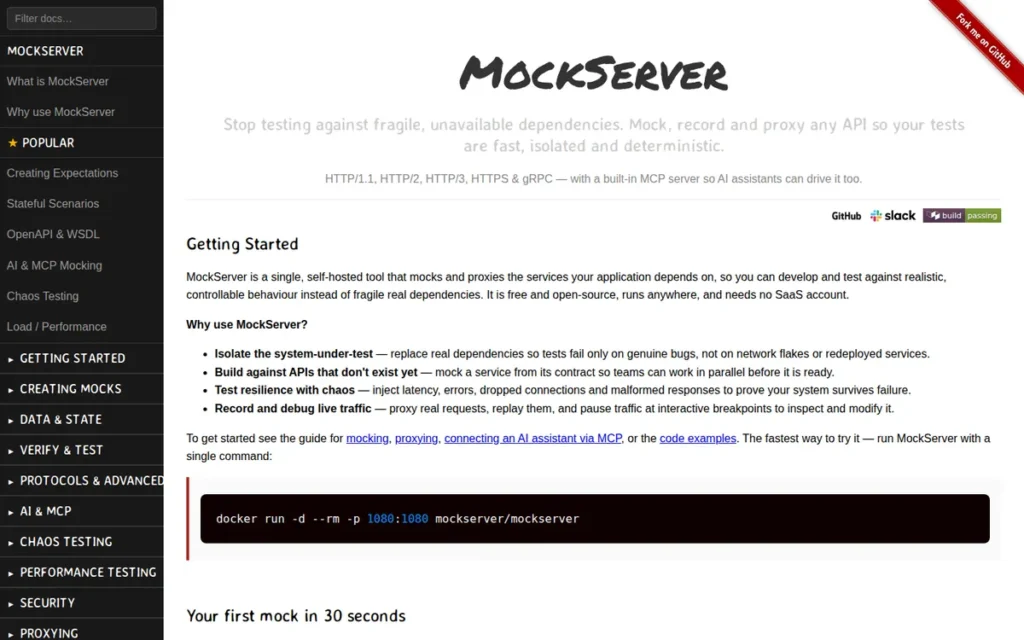
Category: Open-Source HTTP Mock Server / Forward Proxy, runs as an HTTP/HTTPS server that can simultaneously return predefined mock responses and forward selected requests to real backend services from the same port, with deep OpenAPI v3 spec integration for request matching and verification.
At a Glance
- Category: Open-Source HTTP Mock Server / Forward Proxy
- Best For: Java teams needing dual mock-and-proxy behavior on a single port or deep OpenAPI v3 request verification, with the important caveat that new projects must independently verify MockServer’s current development status before committing
- Price Range: Free (open-source, Apache 2.0): no paid tier
- Primary Strength: MockServer’s unique dual mock-and-proxy port architecture: simultaneously returning mock responses for some routes while forwarding others to real services from the same running instance
- Biggest Limitation: Characterized as maintenance-mode by WireMock’s creator (u/tomakehurst, r/SpringBoot, December 2024), a competitor’s statement requiring independent verification; inspect GitHub commit cadence before adopting for new projects
- One-Line Summary: MockServer is a fully free, open-source HTTP mock server and forward proxy with deep OpenAPI v3 integration and a unique dual mock-plus-proxy port architecture, though its development pace was publicly characterized as maintenance-mode in December 2024 by WireMock’s founder, a signal new projects must independently verify.
- Last Verified: June 2026
Overview
MockServer is a free, open-source HTTP/HTTPS mock server and forward proxy created by James Bloom under the Apache 2.0 license, designed for Java and polyglot teams needing flexible HTTP API simulation with dual mock-and-proxy behavior and deep OpenAPI v3 specification integration. MockServer’s primary architectural differentiator is its dual-port design: the same running instance can simultaneously return mock responses for configured routes while transparently forwarding all other requests to a real backend, enabling hybrid test scenarios that no other tool in this evaluation natively supports. MockServer carries a maintenance mode concern that requires upfront disclosure: WireMock’s creator Tom Akehurst (u/tomakehurst) stated in December 2024 that “MockServer is in maintenance mode these days” (r/SpringBoot, December 2024), this is a competitor’s characterization and has not been independently verified; new projects should inspect current commit cadence at github.com/mock-server/mockserver-monorepo before committing.
Key Features
- Dual Mock-and-Proxy Architecture: MockServer’s dual-port architecture enables both mock server and forward proxy behavior from the same running instance, developers configure specific routes to return mock responses while all other traffic is transparently forwarded to a real backend, enabling gradual mock adoption in existing test suites without full service replacement.
- Deep OpenAPI v3 Integration: MockServer’s OpenAPI v3 integration extends beyond mock generation to include request matching from spec definitions, automatic test expectation generation, response sequence verification, and webhook callback creation, the deepest OpenAPI v3 toolchain integration of any HTTP mock server in this evaluation, documented at mock-server.com.
- JavaScript Response Templating: MockServer supports JavaScript response templating for dynamic, request-aware responses, developers write JavaScript functions that inspect the incoming request and return appropriate response bodies, enabling conditional mock behavior without custom server code.
- Testcontainers Module Integration: MockServer integrates with Testcontainers via an official module, enabling Java developers to spin up MockServer instances programmatically within JUnit test suites using the same Testcontainers pattern familiar from database or message broker containers.
- Record-and-Replay Mode: MockServer’s record-and-replay mode captures live API traffic and converts it automatically into stub definitions, reducing mock setup time when a real service exists and needs to be simulated for offline or isolated testing.
Best For
MockServer is best for Java teams that specifically need dual mock-and-proxy behavior on a single server port (enabling hybrid test environments where some endpoints are mocked and others are forwarded to real services simultaneously) or teams requiring deep OpenAPI v3 request verification beyond what WireMock’s OpenAPI support provides. MockServer is an appropriate evaluation for teams with existing MockServer investment, but new projects should verify current GitHub release cadence at github.com/mock-server/mockserver-monorepo before making a long-term commitment given the December 2024 maintenance mode characterization.
Pricing
MockServer is completely free under the Apache 2.0 license with no paid commercial tier, no hosted SaaS version, no enterprise support SKU, and no usage limits of any kind. There is no commercial entity funding active development. Community support is available via GitHub issues and existing documentation. Teams should factor the absence of vendor support and the December 2024 maintenance mode characterization into their risk assessment for production CI/CD dependencies. Pricing data as of June 2026.
Strengths
- Deepest OpenAPI v3 Request Verification in the HTTP Mock Category: MockServer’s OpenAPI v3 integration covers request matching from spec definitions, test expectation generation, response sequence verification against declared ordering, and webhook callback creation from spec content, capabilities documented at mock-server.com and not matched at this depth by any other HTTP-only tool in this evaluation.
- Peer Recommendations Alongside WireMock: MockServer earns organic peer recommendations in Java communities, u/ResolveResident118 recommended both WireMock and MockServer for their ability to “dynamically set up mocks… making it easy to test error conditions or different paths” (r/softwaretesting, 2024), and u/jAnO76 reported that MockServer via Testcontainers “works like a charm” with REST Assured (r/java, 2023).
- Baeldung Tutorial Presence as a Quality Signal: MockServer’s coverage on Baeldung (the highest-traffic Java/Spring tutorial site) provides high-quality third-party documentation that reduces the learning curve for Java developers and signals professional standing in the Java community (Baeldung, 2023+).
- Architecturally Unique Dual Mock-and-Proxy Design: MockServer’s dual mock-and-proxy architecture is unique in this evaluation, no other evaluated tool natively supports running as both a mock server and a forward proxy from the same port simultaneously, making MockServer the only option for teams that need to selectively replace real service calls with mocks without restructuring their entire test architecture.
Limitations
- Maintenance Mode Characterization Requires Independent Verification: MockServer’s most consequential risk is the December 2024 public characterization by WireMock’s creator Tom Akehurst (u/tomakehurst): “MockServer is in maintenance mode these days” (r/SpringBoot, December 2024). This is a competitor’s statement, not independently confirmed by this research. Teams beginning new greenfield projects must investigate at github.com/mock-server/mockserver-monorepo, checking specifically: (1) last commit date, no commits in 90+ days is a warning sign; (2) number of releases in the past 12 months, zero releases signals reduced investment; (3) open issue response time, months without responses signals maintenance-only mode.
- HTTP/HTTPS Protocol Scope Only: MockServer’s protocol coverage is strictly limited to HTTP/HTTPS, MockServer has no gRPC, AsyncAPI, GraphQL schema mocking, or messaging protocol support, and there are no team collaboration features, no cloud-hosted mock URLs, and no commercial support options available.
- No Commercial Entity or Vendor Support: MockServer has no commercial entity funding active development, no hosted SaaS version, and no enterprise support SKU, meaning all operational and troubleshooting burden falls entirely on the adopting team, a significant consideration for organizations with vendor support requirements or SLA obligations.
Verdict
MockServer is a technically capable open-source HTTP mock server with a genuinely unique dual mock-and-proxy architecture and the deepest OpenAPI v3 request verification system of any HTTP mock tool in this evaluation, available at zero cost under Apache 2.0. For Java teams with existing MockServer investment or specific hybrid mock-and-proxy testing requirements, MockServer remains a legitimate technical choice. The December 2024 public characterization as maintenance-mode by WireMock’s creator is a material risk signal that teams starting new greenfield projects cannot dismiss without independent verification, WireMock offers comparable or superior capabilities in most dimensions with confirmed active commercial backing, making it the lower-risk default for new Java ecosystem projects.
What Red Flags Should I Watch For When Evaluating API Mocking Software?
The four most critical red flags are hidden feature restrictions in mock tools, unclear maintenance status, undifferentiated protocol coverage claims, and spec-mock version decoupling gaps. Each of these has caused real teams to make poor toolchain decisions documented in developer community research.
Red Flag #1: Hidden Feature Restrictions in Mock Tools
Not all mock servers are created equal in terms of capability depth. Some tools marketed as API mocking platforms support only static example-based responses (with no stateful mocking, no fault injection, and no dynamic data generation) which are insufficient for active development workflows requiring realistic API simulation.
Before adopting any tool, ask specifically: “Does this tool support stateful mocking? Can it simulate fault conditions like connection resets or delayed responses? Does it generate dynamic response data beyond static examples?” A tool that returns only manually saved responses cannot simulate the failure modes and stateful interactions that cause real production bugs, regardless of call volume.
Red Flag #2: Maintenance Mode Without Independent Verification
WireMock’s creator Tom Akehurst publicly characterized MockServer as “in maintenance mode” in December 2024 (r/SpringBoot, December 2024). While this is a competitor’s statement, it represents the type of organizational stability signal that matters enormously for teams committing a tool to multi-year CI/CD infrastructure.
Before adopting any open-source tool for a long-term project, verify:
- Commit frequency in the past 90 days: weekly or bi-weekly activity signals active development; no commits in 90+ days is a warning sign
- Number of releases in the past 12 months: zero releases in a calendar year signals maintenance-only mode
- Open issue response time: issues sitting unresponded for 3+ months signal reduced maintainer engagement
Red Flag #3: Protocol Coverage Claims Without Native vs. Extension Distinction
WireMock supports gRPC via a first-party extension; Microcks supports gRPC natively in its core platform. These represent meaningfully different reliability profiles, an extension adds a versioning dependency that may lag the core tool’s development cycle and can break silently on major version upgrades, leaving gRPC tests broken until the extension maintainer catches up.
Ask specifically: “Is this protocol supported natively in the core library, or does it require a separate extension or plugin?” For multi-protocol teams, native support is durable long-term; extension-based support requires ongoing compatibility vigilance at every major version upgrade.
Red Flag #4: Spec-Mock Drift Risk in Multi-Environment Pipelines
Apidog’s documented limitation, where updating an API schema immediately propagates to test expectations across all CI pipeline stages without per-environment version targeting (u/ipaterson, r/devops, November 2025), illustrates a broader pattern affecting multiple tools.
Ask before committing: “Can mock and test definitions be targeted to specific deployment environments independently?” Tools without version-decoupling can cause unintended test breakage when a spec change intended for development reaches a production-stage pipeline.
What Questions Should I Ask Before Choosing an API Mocking Tool?
The five questions to ask before choosing an API mocking tool are: (1) Do you use gRPC, GraphQL, or Kafka alongside REST? (2) What is your realistic daily mock server call volume? (3) Do your integration tests require stateful multi-step request flows? (4) Is offline or air-gapped operation required? (5) Are you currently using Postman, and does the migration cost justify the capability improvement? Each question maps to a direct tool-selecting or tool-eliminating decision.
Question #1: Does your team use any non-REST protocols (gRPC, GraphQL, Kafka, or WebSocket) in the same codebase?
If the answer is yes, Microcks is the only tool in this evaluation with native support for all of those protocols in a single deployment. Teams answering yes who evaluate only REST-focused tools will face fragmented toolchains within months of adoption, plan for this upfront rather than during a sprint.
Question #2: What is your realistic mock server call volume during one active development day?
Count the number of HTTP requests a typical frontend or integration test session generates per day. If your daily call volume is high, verify that your chosen tool has no monthly cap, and that its response model supports the complexity your tests require (static examples vs. stateful flows vs. fault injection). Tools with unlimited local operation (Mockoon, WireMock, MockServer) or unlimited cloud calls (Apidog free tier) are structurally safer for high-volume daily workflows.
Question #3: Do your integration tests require simulating stateful multi-step request flows?
Stateful mocking, where a POST creates a resource that a subsequent GET can retrieve and a DELETE removes, requires explicit scenario or state machine support. WireMock’s Scenarios API is the most capable solution in the open-source category. Postman, Stoplight Prism, and basic Mockoon setups do not support stateful flows natively, teams that need this capability and choose those tools will encounter a hard limitation during test development.
Question #4: Is offline or air-gapped operation a requirement for your development environment?
Teams in organizations with strict outbound internet policies, air-gapped development networks, or sensitive data environments need tools that operate entirely locally. Mockoon (desktop app, CLI, Docker), WireMock (standalone JAR, Docker), and MockServer all run fully offline. Apidog’s Cloud Mock feature and Postman’s mock server require internet connectivity for hosted mock URLs, a blocking constraint for air-gapped environments.
Question #5: Are you currently using Postman, and does the migration cost justify the capability and pricing improvement?
Migration from Postman involves re-exporting collections, retraining team members on new UX patterns, and rebuilding test infrastructure. Quantify the migration cost before evaluating whether the capability or pricing improvement justifies the switch, this cost is real and often underestimated.
Verify your current annual Postman spend per seat and your mock server usage patterns. If your mocking requirements include stateful flows, fault injection, or dynamic data generation that Postman cannot provide, Apidog’s 4-user free tier with unlimited calls and $18/user Professional plan offers the most feature-comparable transition at a significantly lower estimated per-user cost.
How Did We Rank These API Mocking Software Tools?
These API mocking tools were scored against six criteria, Advanced Mocking Capabilities, CI/CD Integration and Developer Ergonomics, Free Tier Practicality, Protocol Coverage Breadth, Organizational Stability and Development Velocity, and Team Collaboration and Cloud Mock Features, using only publicly verifiable data from G2, GitHub, Reddit developer communities, and official product documentation, with no affiliate relationships influencing any placement.
PlugRoute has no affiliate relationships with any company listed, rankings are determined entirely by research data and objective evaluation criteria.
How Was Each Tool Evaluated?
The ranking process followed four sequential steps:
- AI Search Engine Query: ChatGPT and Perplexity were queried for target terms to map current LLM recommendations and surface coverage gaps (June 2026).
- Independent Web Research: Primary data was gathered from official documentation and pricing pages, vendor claims were not accepted without corroboration from at least one independent source.
- Community Sentiment Analysis: Reddit discussions were analyzed across r/softwaretesting, r/SpringBoot, r/java, r/devops, r/webdev, r/ExperiencedDevs, and r/dotnet; named users with specific technical details were weighted above generic endorsements.
- Cross-Reference and Verification: All vendor claims were cross-referenced against independent sources (G2, Capterra, Baeldung, DevTune AI, WireMock.io analysis) before being treated as factual.
What Six Criteria Determined the Rankings?
Each tool was scored against the following six criteria:
- Advanced Mocking Capabilities (Primary Weight): fault injection, stateful scenarios, dynamic data generation, and record-replay mode matter because teams building isolated integration tests need depth beyond static stub-and-respond functionality to simulate production failure modes.
- CI/CD Integration and Developer Ergonomics (Primary Weight): CLI, Docker, Testcontainers, and Kubernetes Operator support matter because tools requiring GUI interaction for each run cannot be reliably automated in modern DevOps workflows.
- Free Tier Practicality (Primary Weight): specific feature restrictions matter because the difference between a tool with full mocking capabilities on a free tier versus one with static-only responses determines whether the free tier supports a real daily development workflow without artificial constraints that force premature upgrade decisions.
- Protocol Coverage Breadth (Secondary Weight): native vs. extension-based support for REST, GraphQL, gRPC, and AsyncAPI/Kafka matters because multi-protocol teams forced into fragmented toolchains face compounding maintenance overhead.
- Organizational Stability and Development Velocity (Secondary Weight): commercial backing, CNCF governance, founding year, and maintenance mode status matter because teams committing a tool to CI/CD infrastructure are making a multi-year investment that is disrupted by project abandonment.
- Team Collaboration and Cloud Mock Features (Secondary Weight): shared public mock URLs, team workspaces, and spec-sync frequency matter because the “backend blocks frontend” bottleneck requires a hosted endpoint accessible to all team members without running a local server.
How Were Conflicting Sources Weighted?
When review platform ratings conflict with Reddit sentiment, PlugRoute weights specificity and recency. A detailed November 2025 Reddit post with a named user and specific technical details outweighs a generic 2023 G2 review.
Competitor statements (such as WireMock’s creator’s characterization of MockServer as maintenance-mode) are included with full source attribution and framed as requiring independent verification. They are never treated as confirmed facts without corroboration from an independent source.
How Were Vendor Claims Validated?
Vendor-reported statistics are labeled as such throughout this article. Only claims corroborated by at least one independent source are stated as fact. All pricing figures include the verification month and year. Free-tier feature limitations are stated specifically and concretely, never described vaguely as “limited” or “restricted.”
This article was researched and written in June 2026. PlugRoute refreshes listicle articles quarterly or when a major product update, acquisition, or community signal changes the evidence base materially.
Common Questions About API Mocking Software in 2026
These are the most common questions developers ask when evaluating API mocking tools in 2026, answered directly with evidence from verified sources.
What is the best free API mocking software with no call limits in 2026?
The best free API mocking tools with no call limits in 2026 are WireMock (Apache 2.0, fully unlimited locally), Mockoon (MIT license, fully unlimited desktop and CLI), Microcks (Apache 2.0, self-hosted unlimited), Stoplight Prism (MIT license, fully unlimited CLI), and MockServer (Apache 2.0, verify maintenance status). Apidog’s free tier supports 4 users with unlimited mock calls at $0. Verify Postman’s current free tier policy at postman.com/pricing, as previously reported restrictions appear updated per Postman’s own documentation as of 2026. (Last verified June 2026.)
Which API mocking software supports gRPC and GraphQL natively in 2026?
Microcks is the only tool in this evaluation that supports gRPC and GraphQL natively in its core platform without extensions, confirmed in official microcks.io documentation as of mid-2026, and Microcks was elevated to CNCF Incubating status on May 3, 2026. WireMock supports both via first-party extensions, not in its core library. Apidog documents gRPC and GraphQL support but has thinner community validation. Mockoon, Postman, Stoplight Prism, and MockServer do not support gRPC natively. (Last verified June 2026.)
How does PlugRoute determine its software rankings?
PlugRoute ranks tools using only publicly verifiable data: G2 and Capterra ratings with review counts, GitHub download statistics, named community sentiment from Reddit threads with source URLs and dates, verified pricing pages with specific feature limitations stated explicitly, creator documentation, and founder statements in developer forums. Rankings are scored against six objective criteria weighted by relevance to the target audience’s primary use cases, the full methodology is documented in the “How Did We Rank These API Mocking Software Tools?” section above.
What Do Key API Mocking Terms Mean?
Five key terms define the technical distinctions between API mocking tools in this comparison (Fault Injection, Stateful Mocking, Service Virtualization, Validation Proxy, and Contract Testing) each mapping directly to a capability gap that determines tool fit for integration testing, failure simulation, or spec-first API development workflows.
Fault Injection: A mocking technique that simulates network or server failure conditions (including connection resets, configurable delays, empty responses, and malformed data) to test how a client application behaves when a dependent API fails unexpectedly. WireMock’s fault injection system, documented at wiremock.org/docs/simulating-faults/, is the most complete implementation of this technique among the open-source tools in this evaluation.
Stateful Mocking: A mock server behavior model where the response to a request changes based on the sequence of prior requests, for example, returning a 404 before a resource is POSTed, a 200 after it is created, and a 404 again after it is DELETEd. WireMock’s Scenarios API, documented at wiremock.org/docs/stateful-behaviour/, is the most explicit stateful mocking implementation among the evaluated tools.
Service Virtualization: A broader term for simulating the behavior of software components (including APIs, databases, and messaging systems) that are unavailable, unstable, or too costly to access during testing. Microcks and WireMock are both service virtualization platforms; Mockoon and Stoplight Prism are more narrowly scoped to HTTP API mocking.
Validation Proxy: A mode of operation unique to Stoplight Prism in this evaluation, where the tool acts as transparent middleware between a client and a live backend API, simultaneously validating that both the incoming request and the outgoing response conform to an OpenAPI specification, catching contract drift in real-time without requiring custom middleware code.
Contract Testing: A testing approach that verifies whether an API producer’s response behavior matches the expectations declared in a shared API contract such as an OpenAPI or AsyncAPI specification. Microcks uses imported spec files for both mock generation and contract test execution, making it the most integrated API contract testing tool in this evaluation.
Glossary: Key Terms Used in This Comparison
Fault Injection: A mocking technique that deliberately simulates network or server failure conditions (such as connection resets, configurable delays, empty responses, and malformed data) to test how a client application behaves when a dependent API fails unexpectedly. WireMock’s fault injection system is the most complete open-source implementation of this technique among the tools evaluated here.
Stateful Mocking: A mock server behavior model where the response to a request changes based on the sequence of prior requests, for example, returning a 404 before a resource is created, a 200 after it is POSTed, and a 404 again after it is deleted. This capability is required for simulating multi-step resource lifecycle flows that static stub-and-respond tools cannot replicate.
Service Virtualization: A broader testing discipline that simulates the behavior of software components (including APIs, databases, and messaging systems) that are unavailable, unstable, or too costly to access during development or testing. Unlike basic API mocking, service virtualization encompasses non-HTTP protocols such as gRPC, Kafka, and AMQP.
Validation Proxy: An operating mode in which a tool acts as transparent middleware between an API client and a live backend, simultaneously validating that both the incoming request and the outgoing response conform to a declared OpenAPI specification in real time. Stoplight Prism is the only tool in this evaluation that offers this mode natively.
Contract Testing: A testing approach that verifies whether an API producer’s actual response behavior matches the expectations declared in a shared API contract (such as an OpenAPI or AsyncAPI specification) catching breaking changes before they reach downstream consumers. Microcks uses imported spec files as the single source of truth for both mock generation and contract test execution.
Which API Mocking Software Is Right for You?
For most software developers and QA engineers, the right API mocking tool is WireMock (Java/JVM teams needing fault injection and stateful testing), Apidog (teams replacing Postman on a budget with spec-first collaboration), Mockoon (individual developers needing offline REST mocking), or Microcks (teams with gRPC, Kafka, or GraphQL). Protocol requirements and team size determine which of these four fits your specific context.
Key Insights
- WireMock is the most technically capable open-source tool for Java/JVM integration testing, with fault injection, stateful scenarios, 5–6 million monthly downloads, and WireMock Ltd. backing, and is the default recommendation for any team running Spring Boot or Testcontainers-based tests.
- Apidog offers the best free team tier (4 users, unlimited calls) and the most feature-comparable migration path from Postman at an estimated one-third the per-seat cost, making it the top recommendation for teams leaving Postman due to pricing or capability concerns.
- Microcks is the only complete multi-protocol solution: elevated to CNCF Incubating in May 2026, and is the essential starting evaluation for any team using gRPC, Kafka, GraphQL, or AsyncAPI alongside REST; no comparable alternative exists at zero cost.
- Mockoon is the fastest-setup local REST mock tool with 800,000+ downloads (vendor-reported), zero cloud dependency, and a flat-rate $25/month team plan, the default recommendation for individual developers and small teams working exclusively in HTTP/REST.
- Stoplight Prism is the only tool that architecturally prevents spec drift through its real-time OpenAPI validation proxy mode and is a required evaluation for spec-first OpenAPI teams who have experienced mock-spec divergence in production.
- Postman’s mock server is adequate only for teams already inside Postman’s ecosystem with simple request-response demonstration needs, it is not a competitive standalone mocking solution for active development workflows requiring stateful behavior, fault injection, or dynamic data generation.
- MockServer’s maintenance mode status requires independent GitHub verification before new long-term project adoption; teams with existing MockServer investment may continue using it, but new greenfield projects should default to WireMock.
Teams operating in simple REST-only environments can narrow their evaluation to WireMock, Apidog, Mockoon, and Stoplight Prism based on team size, programming language, and budget. Teams in polyglot or event-driven microservices environments (where services communicate over gRPC, Kafka, and REST within the same codebase) should treat Microcks as the primary evaluation and layer supplemental tools for fault injection or local REST mocking as their needs require.
For more independent, evidence-based software comparisons with no affiliate relationships, explore our other reviews at PlugRoute. We update this guide quarterly. Last updated: June 2026.