📋 Pricing Notice: All pricing data is verified as of May 2026 from vendor pricing pages and community-sourced real-world quotes with named sources. API documentation software pricing changes frequently, verify all figures directly with vendors before making purchasing decisions.
Redocly ranks #1 for OpenAPI governance and docs-as-code teams; SwaggerHub ranks #2 for multi-API portfolio collaboration via its architecturally unique Domains feature; ReadMe ranks #4 as the richest developer portal for API product companies. Governance depth, workflow type (design-first, spec-driven, or compliance-mandated) and verified pricing determine the right fit more than feature count.
The most common failure mode in API documentation tool selection is evaluating features before identifying workflow type. Documentation drift (the growing gap between published documentation and a rapidly evolving API) is the problem all seven platforms address through different architectural approaches. A team practicing API-first design needs a fundamentally different platform than one importing existing specs to render reference pages.
As one practitioner on r/technicalwriting described the documentation challenge firsthand:
“Our team is in documentation hell right now and I’m hoping someone here has found something that actually works. We’ve got internal processes, user guides, and API stuff all scattered across different tools and it’s driving me nuts. Right now we’re using Confluence which feels like fighting with Microsoft Word from 2005 every time I need to format something.” Posted by u/Economy-Mention97
Takeaway: Teams evaluating API documentation platforms are frequently managing fragmented toolchains across multiple incompatible systems, validating this comparison’s focus on workflow type as the primary selection criterion before any feature evaluation begins.
PlugRoute has no affiliate relationships with any company listed. Rankings are determined entirely by research data and objective evaluation criteria.
What Are the Top API Documentation Tools in 2026? (Quick Summary)
- Redocly ranks #1 for OpenAPI governance, multi-spec CLI linting across six specification formats, and CI/CD-integrated documentation pipelines, with self-hosting as a unique differentiator among governance-capable platforms in this comparison.
- SwaggerHub ranks #2 for multi-API portfolio governance via its architecturally unique Domains feature, which provides shared, reusable OpenAPI schema repositories across multiple API descriptions, a capability no other platform in this comparison architecturally replicates.
- ReadMe ranks #4 for the richest developer portal experience: combining interactive API explorers, real-time usage analytics, and onboarding workflows in a single hosted hub, but its $36,000/year enterprise pricing makes it the highest verified cost in the category.
- Mintlify ranks #5 as the most AI-native platform: with a PR-based AI Documentation Agent, MCP server generation, and llms.txt hosting for AI-agent indexing, though its $250–$300/month Pro tier leaves most small teams behind.
What Are the 4 Categories of API Documentation Tools?
API documentation management tools fall into four categories based on architectural philosophy and primary workflow. Understanding which category matches your team’s workflow type is the most critical selection factor, more consequential than any individual feature comparison.
Category 1: Governance-First Platforms treat the OpenAPI specification as the authoritative source for linting, style-guide enforcement, and downstream documentation generation. Redocly, SwaggerHub, and Stoplight belong here. These platforms are strongest for engineering-led teams managing multiple APIs or microservices.
Category 2: Developer Portal Platforms prioritize the end-developer experience of published documentation. ReadMe is the defining example, delivering interactive explorers, usage analytics, onboarding workflows, and changelog management in a single managed hub. These platforms are strongest for API product companies competing on developer experience quality.
Category 3: AI-Native Docs-as-Code Platforms integrate AI as core infrastructure, codebase monitoring, PR-based documentation proposals, MCP server generation, and llms.txt hosting for AI agent accessibility. Mintlify is the defining example. These platforms are strongest for engineering-led teams wanting documentation maintenance embedded directly in software development pipelines.
Category 4: Collaborative Documentation Platforms prioritize cross-functional contributor accessibility, combining WYSIWYG editing with Git-based workflows for mixed technical and non-technical teams. Document360 and GitBook serve this segment, with Document360 adding a compliance certification layer unique in this comparison.
One compliance note applies across all four categories: of the seven platforms in this comparison, only Document360 has a publicly documented SOC 2 Type II certification as of May 2026. If your organization requires SOC 2 Type II before approving any cloud vendor, this fact narrows the field from seven platforms to one before any feature comparison begins.
How Do the Top API Documentation Tools Compare at a Glance?
| Rank | Company | Category | Best For | One-Line Summary | Key Capabilities | Primary Strength | Key Limitation |
|---|---|---|---|---|---|---|---|
| 1 | Redocly | Governance + Renderer | Engineering teams managing OpenAPI portfolios at scale | Redocly is the leading OpenAPI governance platform for engineering teams requiring CLI-based linting, multi-spec validation, and self-hostable rendering. | Multi-spec CLI linting, Reunite collaboration, self-hosting, API monitoring | Broadest multi-spec linting: OpenAPI 3.2/3.1/3.0/2.0, AsyncAPI 3.0/2.6, Arazzo 1.0/1.1 | Zero CSS customization without commercial subscription; scope limited to API documentation only |
| 2 | SwaggerHub | Collaboration + Governance | Multi-API portfolio governance with reusable schema management | SwaggerHub is the OpenAPI collaboration platform built by OpenAPI Initiative co-founders, with a unique Domains feature for reusable schema governance at portfolio scale. | Domains schema reuse, auto-mocking, SwaggerHub CLI, style-guide enforcement | Architecturally unique Domains feature for shared cross-API reusable schema repositories | User interface considered less modern than Redocly, Mintlify, and ReadMe by independent evaluators |
| 3 | Stoplight | Design-First Lifecycle | API design teams building specifications before implementation | Stoplight is the leading design-first API lifecycle platform combining Spectral governance, integrated mock servers, and embeddable Elements documentation components. | Spectral linting, integrated mock servers, Elements web components, visual Studio editor | Design-first workflow generates mock servers, governance checks, and docs simultaneously from one spec | SmartBear acquisition created strategic ambiguity requiring official SmartBear clarification in October 2025 |
| 4 | ReadMe | Developer Portal | API product companies competing on developer experience | ReadMe is the most feature-complete managed developer portal combining interactive API explorers, usage analytics, and onboarding in a single hosted hub. | Interactive explorer, usage analytics, Branch Reviews, Ask AI add-on | Most complete developer portal: explorer, usage analytics, changelogs, and personalization in one platform | CSS gated at $250/month; enterprise pricing documented at $36,000/year for 2 sites |
| 5 | Mintlify | AI-Native Docs-as-Code | Modern SaaS companies wanting AI-automated documentation maintenance | Mintlify is the most AI-native documentation platform; with a Git-native workflow, a PR-based AI agent, MCP server generation, and llms.txt hosting. | AI Documentation Agent, MCP server generation, llms.txt hosting, agent traffic analytics | Only platform with a full AI Documentation Agent that opens PR-based documentation update proposals | Free tier very limited; AI features gated at $250–$300/month; no self-hosting or governance tooling |
| 6 | Document360 | Knowledge Base + API | Regulated-industry enterprises needing compliant unified documentation | Document360 is the only platform in this comparison with a confirmed SOC 2 Type II certification and reported GDPR and HIPAA readiness. | OpenAPI import, Eddy AI, ticket deflector, multi-language localization, RBAC | Only platform with confirmed SOC 2 Type II certification in this comparison set | Knowledge-base architecture limits API governance depth; pricing not publicly listed |
| 7 | GitBook | Collaborative Documentation | Mixed technical/non-technical teams needing a unified documentation platform | GitBook is the most accessible collaborative documentation platform for mixed contributor teams, combining WYSIWYG editing with bidirectional Git sync and a proactive AI knowledge-gap agent. | WYSIWYG editor, bidirectional Git sync, AI knowledge-gap agent, SSO integration | Most accessible contributor UX for non-technical documentation contributors in this comparison | SaaS-only with no self-hosting, no compliance certifications, and no API governance or linting tools |
Which API Documentation Tool Should I Choose for My Use Case?
| Your #1 Priority | Recommended Tool | Why | Acceptable Alternative |
|---|---|---|---|
| OpenAPI Governance and Linting | Redocly | Broadest multi-spec linting; self-hosting available; industry-recognized reference layout | Stoplight (Spectral-based design-first workflow with integrated mock servers) |
| Multi-API Schema Reuse | SwaggerHub | Unique Domains feature prevents schema drift across API portfolios | Redocly (CLI governance with Reunite collaboration layer) |
| Developer Portal Experience | ReadMe | Interactive explorer, usage analytics, and changelogs in one managed hub | Mintlify (AI-native developer experience with superior AI infrastructure) |
| AI-Native Documentation | Mintlify | Only platform with PR-based AI agent, MCP server generation, and llms.txt hosting | ReadMe (Ask AI add-on; less infrastructure-deep) |
| Regulated Industry Compliance | Document360 | Only confirmed SOC 2 Type II in this comparison; reported GDPR and HIPAA readiness | Redocly (Enterprise+ with data residency at significant cost premium) |
| Collaborative Mixed Teams | GitBook | WYSIWYG + Git sync for non-technical contributors | Document360 (enterprise-grade with compliance certifications) |
If you are still unsure after the table above, ask two questions: (1) Does your team write the API specification before or after implementation? If before, start with Stoplight or Redocly. If after, start with ReadMe or SwaggerHub. (2) Is compliance certification a hard procurement requirement? If yes, Document360 is the only confirmed starting point in this comparison.
1. Redocly: Best Overall: OpenAPI Governance and Docs-as-Code Teams
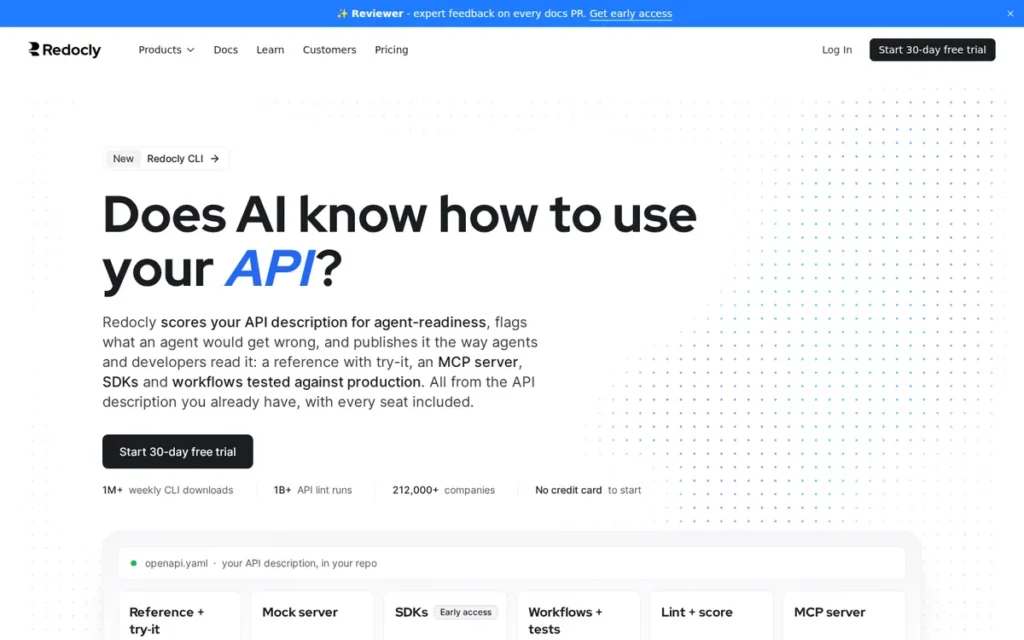
Category: Governance + Renderer, an API documentation platform combining spec-driven reference rendering, CLI-based linting and governance, and a Git-native publishing layer for engineering teams managing OpenAPI at scale.
At a Glance
- Category: Governance + Renderer
- Best For: Engineering teams managing OpenAPI portfolios needing multi-spec linting, style-guide enforcement, and CI/CD pipeline documentation publishing
- Price Range: Free trial (30 days); ~$96/month observed for 2-seat enterprise plan (r/node, u/alik1006, February 2026); Enterprise+ with data residency observed at ~$40,000/year (r/technicalwriting, u/dogboyrox, December 2025); full pricing at redocly.com/calculator
- Primary Strength: Redocly delivers the broadest multi-spec linting in this category, OpenAPI 3.2/3.1/3.0/2.0, AsyncAPI 3.0/2.6, Arazzo 1.0/1.1, combined with self-hosting availability that no other governance-capable platform in this comparison offers.
- Biggest Limitation: Redocly’s free Redoc component offers zero CSS customization without a commercial subscription, a gap practitioners describe as giving “0 flexibility if you don’t use their overkill paid Git-connected solution” (u/Loschcode, r/node, May 2025).
- One-Line Summary: Redocly is the leading OpenAPI governance and documentation platform for engineering teams needing CLI linting, multi-spec validation, and a self-hostable rendering layer, earning its #1 position through the broadest governance coverage and the only self-hosting pathway in this comparison.
- Last Verified: May 2026
Overview
Redocly is an API documentation and governance platform built around the open-source Redoc renderer and Redocly CLI, designed for engineering teams that treat OpenAPI specifications as the authoritative source of truth for both governance and published documentation, making it the strongest choice for API portfolio management at scale. Redocly was founded in 2017 by Adam Altman and Roman Hotsiy, originating as Rebilly’s internal OpenAPI renderer before being open-sourced as Redoc and commercialized following a domain move to redocly.com in March 2022. Redocly’s commercial suite spans six products:
- Redoc: API reference rendering (open-source)
- Revel: external developer portals
- Reef: internal service catalog and governance
- Realm: integrated deployment suite
- Reunite: Git-based collaboration with PR previews and branch reviews
- Respect: API monitoring
Key Features
- Multi-Spec CLI Governance Across Six Formats: Redocly CLI supports linting, validation, bundling, and splitting for OpenAPI 3.2, 3.1, 3.0, 2.0, AsyncAPI 3.0/2.6, and Arazzo 1.0, the widest multi-spec governance coverage of any documentation platform in this comparison, with Arazzo 1.1 support added in the November 2025 update (redocly.com/docs/cli/changelog, verified May 2026).
- Industry-Recognized Three-Column Reference Layout: Redocly’s reference layout, originating from the open-source Redoc project, is described as “the industry standard” for API reference documentation UX by Tom Johnson’s idratherbewriting.com (2025), indicating Redocly sets the visual benchmark that competing platforms measure themselves against.
- Git-Native Collaboration via Reunite: Redocly’s Reunite product enables PR previews, branch reviews, and staged publishing, integrating documentation changes directly into existing engineering review processes without requiring a separate publishing step outside the team’s standard Git workflow.
- Self-Hosted Deployment Option: Redocly supports self-hosted deployments with an Enterprise+ data residency tier for organizations with jurisdiction-specific data storage requirements, documented in community pricing discussions (r/technicalwriting, u/dogboyrox, December 2025).
- Open-Source Migration Safety via Redoc: Redocly’s open-source Redoc component at github.com/Redocly/redoc provides a migration-safe entry point, teams can evaluate rendering quality before committing to the commercial platform, with no vendor lock-in on the renderer itself (verified May 2026).
Best For
Redocly is best for engineering-led teams managing multiple APIs or microservices who require strict OpenAPI style-guide enforcement, CI/CD-integrated documentation publishing, and the option to self-host documentation infrastructure. Redocly is particularly strong for organizations in regulated industries needing data residency control, or teams migrating from Stoplight seeking a governance-equivalent replacement with broader multi-spec linting.
Strengths
- Multi-Spec Linting Breadth Confirmed by GitHub Repository: Redocly CLI supports linting and validation across OpenAPI 3.2, 3.1, 3.0, 2.0, AsyncAPI 3.0/2.6, and Arazzo 1.0, confirmed via the Redocly CLI GitHub repository (May 2026), the widest multi-spec governance coverage of any platform in this comparison set.
- Visual Output Sets the Category Benchmark: Redocly’s three-column reference layout is described as the industry standard for API reference documentation UX by Tom Johnson’s idratherbewriting.com (2025), a widely cited independent technical writing resource, confirming Redocly’s rendering quality is the benchmark competitors measure themselves against.
- Community-Endorsed as Primary Stoplight Migration Path: Community practitioners on r/devops explicitly recommended Redocly when Stoplight’s acquisition raised concerns: “Redocly or SwaggerHub plus Git-based governance will replace Stoplight with minimal friction” (u/Key-Boat-7519, r/devops, October 2025).
- Unique Governance Plus Self-Hosting Combination: Redocly is the only platform in this ranked set combining strong API governance capabilities with a self-hosting deployment pathway, addressing compliance and infrastructure control requirements that block cloud-only tools from regulated-industry procurement regardless of feature quality.
Limitations
- Free-to-Paid Customization Gap: Redocly’s most consequential trade-off is the tension between its open-source Redoc component and its paid commercial platform, the free Redoc renderer offers zero CSS customization without a commercial subscription. A practitioner described this in May 2025 as having “lost their soul and values, giving 0 flexibility if you don’t use their overkill paid Git-connected solution, not even letting you include CSS for some basic-ass documentation generation” (u/Loschcode, r/node). Teams wanting styled, branded output without a commercial commitment will find the gap between free Redoc and paid Redocly frustrating.
- API-Only Scope Requires a Second Platform: Redocly is explicitly characterized as “a niche tool for APIs” by technical writing practitioners (u/EntranceComfortable, r/technicalwriting, 2025), teams needing a general knowledge base or non-technical contributor workflows must pair Redocly with a second documentation platform, increasing total toolchain complexity.
Users on r/technicalwriting confirmed this scope limitation:
“Redocly is API first. I have a lot of experience with it. I would not use it for non-API docs. Generic online help systems (with screenshots, instructions where to click etc.) are a poor fit, or rather, Redocly is a poor fit for that type of documentation. Usually I am always in favor of switching to docs-as-code, but in this specific case, it doesn’t seem to make sense to switch to Redocly. Try a more generic & more appropriate framework for your use case. Maybe Docusaurus? Maybe just a regular SSG like Hugo?” Posted by u/bauk0
Takeaway: Experienced practitioners consistently confirm that Redocly’s value is narrowly scoped to API documentation, making it inadequate as a standalone platform for teams managing mixed technical content alongside conventional online help systems.
- Data Residency Cost Jump: Redocly’s Enterprise+ data residency option was documented at approximately $40,000/year versus approximately $12,000/year for standard Enterprise, a 3x cost increase cited as a major procurement barrier for at least one security-conscious organization (u/dogboyrox, r/technicalwriting, December 2025).
Verdict
Redocly is the highest-ranked API documentation management platform in this comparison, earning its #1 position through the broadest multi-spec linting coverage in the category, an industry-recognized reference layout, and the only self-hosting pathway among governance-capable platforms in this set. Teams managing API portfolios at scale (with style-guide enforcement requirements, CI/CD-integrated documentation pipelines, or data residency mandates) will find Redocly the most complete solution in this category. The primary trade-off is scope: Redocly is purpose-built for API governance and reference rendering, not general technical documentation, and teams with mixed content needs should pair it with a separate knowledge base platform. Redocly’s open-source Redoc renderer and CLI provide migration optionality that fully proprietary platforms cannot match.
2. SwaggerHub: Best for OpenAPI Collaboration and Multi-API Portfolio Governance
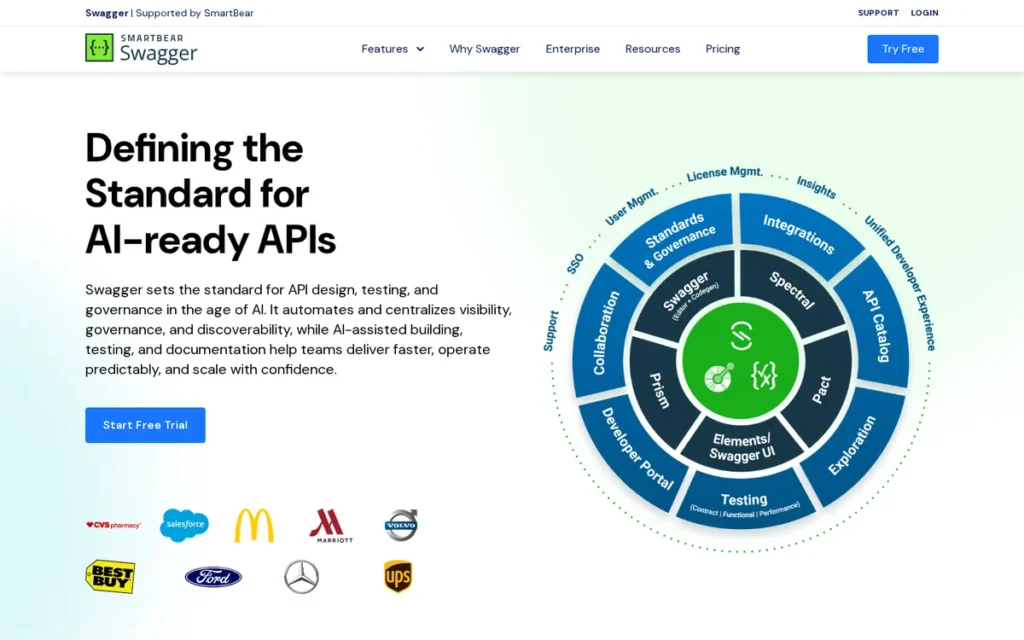
Category: Collaboration + Governance, a hosted OpenAPI design, documentation, and governance platform that centralizes API spec management, team collaboration, and reusable schema governance for organizations managing multi-API portfolios.
At a Glance
- Category: Collaboration + Governance
- Best For: Enterprises managing multi-API portfolios needing Domains-based reusable schema governance, or organizations already invested in the SmartBear API testing ecosystem
- Price Range: Free tier available; paid tier pricing not publicly listed with specific dollar amounts, verify at swagger.io/tools/swaggerhub/ (May 2026)
- Primary Strength: SwaggerHub’s Domains feature provides shared repositories of reusable OpenAPI schemas referenced across multiple API descriptions, preventing schema drift at portfolio scale in a way no other platform in this specific seven-tool comparison architecturally replicates.
- Biggest Limitation: SwaggerHub’s user interface is described by independent evaluators including buildwithfern.com (2025) as less modern than Redocly, Mintlify, and ReadMe, a gap that matters for external-facing API products where documentation aesthetics affect developers’ perception of the underlying API.
- One-Line Summary: SwaggerHub is the OpenAPI collaboration and governance platform with the deepest institutional roots in the API standards ecosystem (built by the team that co-founded the OpenAPI Initiative and maintains the original Swagger tooling) making it the most credible enterprise choice for multi-API portfolio governance.
- Last Verified: May 2026
Overview
SwaggerHub is SmartBear’s commercially hosted OpenAPI design, documentation, and governance platform, integrating Swagger UI, Editor, Codegen, and Validator into a centralized service with team collaboration, API versioning, Domains-based reusable component governance, auto-mocking, style-guide enforcement, and SwaggerHub Explore for interactive testing. SwaggerHub is the documentation platform with the deepest institutional lineage in the OpenAPI ecosystem, built by the organization that maintained the original Swagger open-source tooling and co-founded the OpenAPI Initiative, giving it unmatched credibility for organizations evaluating standards alignment. SwaggerHub is best suited for engineering organizations managing multiple APIs that need a centralized governance layer where schema definitions, parameters, and response models are shared across API descriptions rather than duplicated and allowed to drift.
Key Features
- Architecturally Unique Domains Feature: SwaggerHub’s Domains feature provides shared repositories of reusable OpenAPI schemas, parameters, and response definitions referenced across multiple API descriptions via $ref links, preventing schema duplication and drift across large API portfolios in a way no other platform in this comparison architecturally replicates (idratherbewriting.com, 2025; api-university.com, 2025).
- Automatic Spec-to-Docs Pipeline: SwaggerHub generates interactive API documentation automatically from OpenAPI specifications and delivers it as a hosted public-facing reference page, enabling teams to publish polished documentation directly from their spec without a separate documentation publishing platform.
- Auto-Mocking from Example Responses: SwaggerHub’s auto-mocking capability returns example responses as a live mock server when example values are present in the spec, allowing API consumers to test integrations against documented response shapes before back-end implementation is complete.
- CI/CD-Integrated SwaggerHub CLI: SwaggerHub CLI at github.com/SmartBear/swaggerhub-cli enables CI/CD pipeline integration for automated documentation publishing and spec synchronization, supporting DevOps teams that want documentation updates to flow automatically from spec changes in their deployment pipelines (verified May 2026).
- Style-Guide Governance at Portfolio Scale: SwaggerHub supports style-guide governance at the API description level, enabling organizations to enforce naming conventions, required fields, and schema patterns consistently across all APIs managed in the platform.
Best For
SwaggerHub is best for enterprise engineering organizations already invested in the SmartBear API testing ecosystem (including ReadyAPI and SoapUI) who want unified OpenAPI design, documentation, and governance in a single vendor relationship, and for any organization managing a portfolio of APIs where Domains-based reusable schema governance is an architectural requirement to prevent cross-API schema drift.
Strengths
- OpenAPI Co-Founder Institutional Credibility Confirmed: SmartBear co-founded the OpenAPI Initiative and maintains the original Swagger open-source tooling, giving SwaggerHub unmatched institutional credibility in the API standards ecosystem, verified through SmartBear’s OpenAPI Initiative membership documentation (idratherbewriting.com, May 2026).
- Domains Schema Reuse Architecture Is Unique in This Comparison: SwaggerHub’s Domains feature provides shared repositories of reusable OpenAPI schemas, parameters, and response definitions referenced across multiple API descriptions, confirmed as architecturally unique among the seven platforms in this comparison by both idratherbewriting.com (2025) and api-university.com (2025).
- Active Enterprise Production Adoption Documented: Technical writing practitioners actively use SwaggerHub for API reference documentation in production, “SwaggerHub for API docs” was confirmed as the active configuration for at least one enterprise documentation team in a 27-upvote r/technicalwriting thread (u/cursedcuriosities, July 2025).
- Recognized as Incumbent Market Leader in OpenAPI Tooling: SwaggerHub is characterized as “probably the biggest one out there” among OpenAPI API documentation platforms by an independent community evaluator (u/indorock, r/node, 2026), a characterization consistent with SmartBear’s decades of stewardship over the original Swagger open-source ecosystem and its OAI co-founding role.
Limitations
- Less Modern User Interface: SwaggerHub’s most consequential trade-off is its visual design, buildwithfern.com’s independent 2025 platform comparison describes SwaggerHub’s UI as less modern than newer alternatives including Redocly, Mintlify, and ReadMe, creating a developer experience gap that matters for external-facing API products where documentation aesthetics affect developers’ perception of the underlying API quality. This limitation is absent from all three AI responses analyzed for this comparison.
- No Built-In Data Dictionary: SwaggerHub has no built-in data dictionary or ontology model, its Domains approach to reusable components is a practical workaround for schema governance but not a replacement for dedicated schema registry tooling required by some financial services and healthcare API programs.
- Persistent Spec Synchronization Burden: Keeping specs in sync with evolving codebases remains a documented pain point even for committed SwaggerHub users: “keeping the specs in sync is a challenge, but we have a team working on automating that process” (u/xoanaus, r/technicalwriting, July 2025, 27 upvotes), indicating SwaggerHub’s governance infrastructure does not fully automate the synchronization burden despite strong tooling.
Verdict
SwaggerHub is the most institutionally credible OpenAPI documentation and governance platform in this comparison, earning its #2 position through SmartBear’s co-founding role in the OpenAPI Initiative, the architecturally unique Domains feature for reusable schema governance, and a proven enterprise track record that no newer platform can match. SwaggerHub ranks second rather than first primarily because its user interface is considered less modern by independent evaluators and its community enthusiasm skews toward incumbent enterprise respect rather than active developer advocacy, with Redocly’s broader multi-spec CLI support, more modern rendering experience, and lower observed entry pricing being the deciding margin. Organizations already using SmartBear’s API testing tools, or those with explicit multi-API schema reuse requirements, will find SwaggerHub the most natural fit in this set.
3. Stoplight: Best for Design-First API Lifecycle and Teams Building Specs Before Implementation
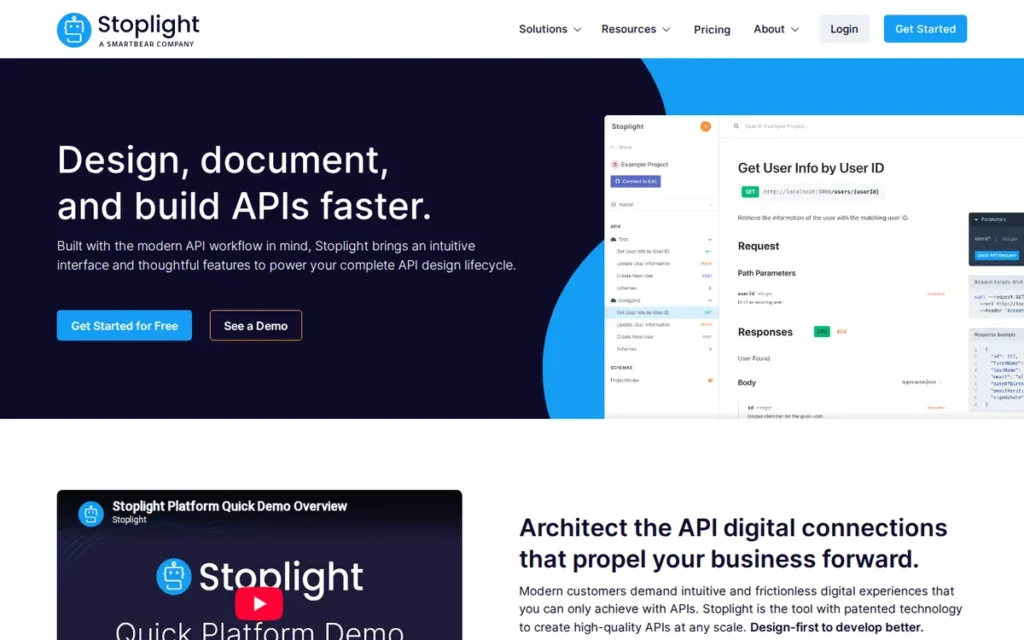
Category: Design-First Lifecycle, an API documentation and governance platform where API specifications are designed before implementation, with mock servers, documentation, and style-guide governance as direct outputs of the design process.
At a Glance
- Category: Design-First Lifecycle
- Best For: API design teams building OpenAPI specifications before implementation, needing integrated mock servers and Spectral-based governance in a single platform
- Price Range: Basic: ~$10/user/month for additional contributors (r/technicalwriting, u/SkirtTricky7266, October 2025); enterprise: contact sales at stoplight.io/pricing (May 2026)
- Primary Strength: Stoplight’s design-first workflow generates mock servers, governance checks, and interactive documentation simultaneously from a single OpenAPI spec (before any implementation code is written) eliminating the need for separate tooling at each lifecycle stage.
- Biggest Limitation: SmartBear’s 2023 acquisition created documented community anxiety requiring an official SmartBear API Evangelist response on Reddit in October 2025, and the ongoing absorption of Stoplight capabilities into API Hub creates strategic ambiguity about the long-term standalone roadmap.
- One-Line Summary: Stoplight is the leading design-first API lifecycle platform (combining Spectral-based OpenAPI governance, integrated mock servers, and open-source Elements documentation components) and remains fully supported under SmartBear ownership per an official SmartBear API Evangelist confirmation in October 2025.
- Last Verified: May 2026
Overview
Stoplight is a design-first API lifecycle platform combining a visual Studio editor for OpenAPI authoring, the open-source Spectral linter for API governance, integrated mock servers for pre-implementation testing, and the open-source Elements web components for embeddable interactive API documentation, designed for teams that create API specifications before writing implementation code. Stoplight was acquired by SmartBear on August 22, 2023, and operates as a standalone product within SmartBear’s API development portfolio alongside SwaggerHub and API Hub, with SmartBear publicly confirming continued investment in October 2025. Stoplight’s design-first philosophy is its fundamental workflow differentiator: rather than generating documentation from existing code, Stoplight users define the API contract before any implementation exists, making Stoplight a pre-implementation governance and testing tool as much as a documentation platform.
Key Features
- Design-First Spec Authoring in Studio: Stoplight’s visual Studio editor enables teams to author OpenAPI specifications before implementation code exists, generating mock servers, documentation, and governance checks simultaneously from the spec rather than retroactively from running code, per Stoplight’s API Design documentation (docs.stoplight.io).
- Open-Source Spectral Linter for Governance: Stoplight’s Spectral linter provides community-standard OpenAPI governance with configurable rule sets, enabling engineering organizations to enforce API design standards, catch breaking changes, and validate specs against custom style guides in CI/CD pipelines.
- Embeddable Elements Web Components: Stoplight Elements is an open-source set of API documentation web components generated from OpenAPI documents, deployable via CDN without a React dependency, enabling teams to embed interactive API explorers into their own websites without vendor lock-in.
- Integrated Pre-Implementation Mock Server: Stoplight’s integrated mock server returns example responses from the OpenAPI spec as live API responses, allowing front-end teams to develop integrations before back-end implementation is complete, directly supporting the design-first workflow.
- Git Integration for Version-Controlled Specs: Stoplight integrates with GitHub, GitLab, and Bitbucket for spec version control, enabling documentation changes to follow the same branch-and-review workflow as code changes within existing engineering pipelines.
Best For
Stoplight is best for engineering teams that practice API-first development (designing API contracts before implementation) and need a single platform for spec authoring, Spectral-based governance, pre-implementation mock servers, and embeddable documentation components. Stoplight is also the natural evaluation path for teams considering migration to SmartBear’s broader API Hub ecosystem as their needs grow beyond standalone Stoplight capabilities.
Strengths
- Elements Praised as Modern Swagger UI Replacement: Stoplight Elements received direct community praise as “modern and supporting more features” compared to default Swagger UI, with CDN-based web component delivery specifically called out as a standout implementation approach (u/rowrowdilo, r/node, April 2025, 16 upvotes), confirming Stoplight’s interactive documentation quality exceeds the community standard for embeddable API reference components.
- SmartBear Officially Confirmed No Sunsetting: SmartBear’s API Evangelist publicly confirmed on Reddit that Stoplight is not being sunset: “Customers can continue to buy, expand, and use Stoplight just like before” (u/you54f, r/devops, October 2025), providing official, source-attributed assurance against the acquisition-related concerns that circulated in developer communities.
- Versioning Automation Cited Alongside Redocly by Active Practitioners: Community practitioners on r/technicalwriting cite Stoplight Studio specifically for versioning automation: “tools like Redocly or Stoplight Studio can help automate versioning and keep everything clean” (u/GetNachoNacho, r/technicalwriting, July 2025), validating Stoplight’s governance credibility in active practitioner evaluations.
- Spectral Available as Standalone Governance Tool: Stoplight’s open-source Spectral linter is available standalone, meaning teams can adopt Spectral for free and migrate to Stoplight’s managed platform when they need the full design-first workflow, without switching governance tooling mid-migration.
Limitations
- Acquisition-Driven Strategic Ambiguity: Stoplight’s most consequential trade-off is SmartBear’s confirmed intent to absorb Stoplight capabilities into API Hub and Swagger products, buyers must evaluate whether to invest in Stoplight as a standalone product or in the integrated SmartBear platform. A 50-upvote r/devops post by u/Distinct-Fun-5965 in October 2025 incorrectly declared Stoplight was shutting down, requiring an official SmartBear API Evangelist response to correct the record (u/you54f, r/devops, October 2025), indicating platform trust has been structurally affected by the acquisition narrative even after official correction.
- Design-First Prerequisite Creates Adoption Barrier: Stoplight’s design-first philosophy creates a workflow change that not all teams can immediately absorb, organizations with existing codebases and no established spec-before-implementation practice face meaningful organizational change management before Stoplight’s governance workflow delivers full value, making the onboarding learning curve steeper than for spec-import tools like ReadMe or SwaggerHub.
- Pricing Transparency Gap: Stoplight does not publish specific dollar amounts for its paid tiers as of May 2026, requiring direct sales contact for enterprise pricing, which extends procurement timelines for organizations with fixed documentation budgets. Verify current tier details at stoplight.io/pricing.
Verdict
Stoplight is the strongest purpose-built design-first API lifecycle platform in this comparison, delivering the Spectral governance standard, integrated mock servers, and the open-source Elements components in a cohesive workflow that no competitor in this set replicates at the same fidelity. Stoplight earns #3 over ReadMe and Mintlify for its governance capabilities and open-source component availability, but ranks below Redocly and SwaggerHub because SmartBear’s acquisition has introduced genuine strategic uncertainty that procurement teams must investigate directly before committing. Teams committed to design-first API development who can absorb that uncertainty will find Stoplight the most capable tool for their specific workflow. Stoplight Elements and Spectral are both open-source, meaning teams can maintain rendering and governance tooling independently of the Stoplight commercial platform if migration becomes necessary.
4. ReadMe: Best for Developer Portal Experience and API Product Companies
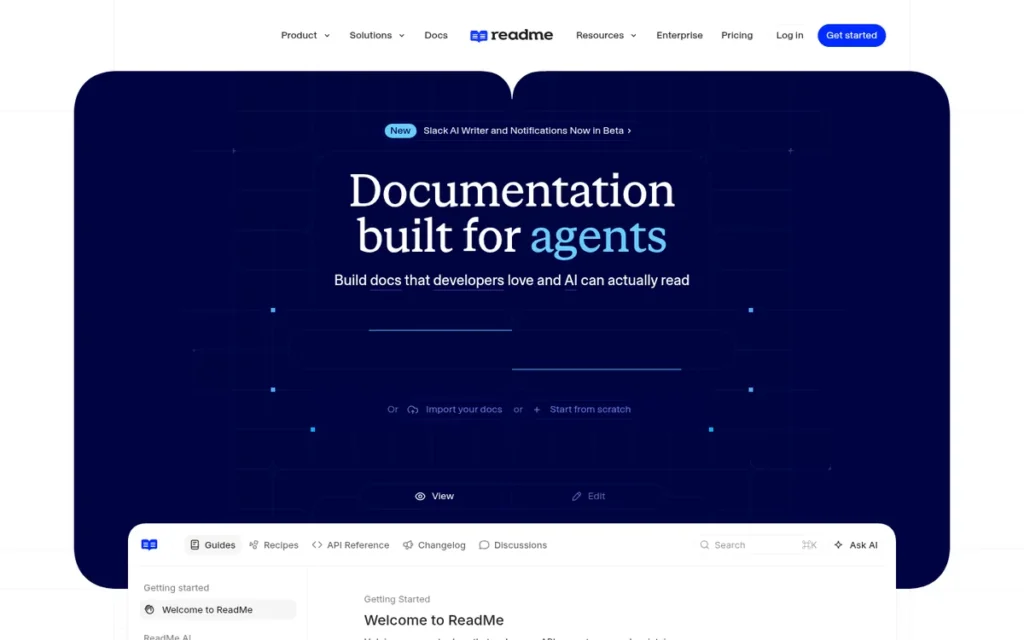
Category: Developer Portal, a managed platform combining interactive API reference documentation, developer onboarding guides, changelogs, usage analytics, and API explorer experiences into a single hosted developer hub.
At a Glance
- Category: Developer Portal
- Best For: API product companies competing on developer experience quality, needing interactive explorers, real-time usage analytics, and onboarding workflows in a single managed platform
- Price Range: Starter: $0/month; Pro: $250/month; Enterprise: custom (documented at $36,000/year for 2 sites with ~15 contributors, u/dogboyrox, r/technicalwriting, December 2025); Ask AI add-on: +$150/month on any plan
- Primary Strength: ReadMe provides the most complete developer portal experience in this comparison, combining an interactive Try It Now API explorer, real-time usage analytics tracking developer behavior by endpoint and API key, onboarding guides, changelog management, and personalized documentation in a single managed platform.
- Biggest Limitation: ReadMe gates CSS customization and branch reviews behind the $250/month Pro tier (a pricing pattern the most-upvoted independent platform evaluation in this research (207 upvotes, r/node) characterized as paying “$400/month for CSS”) and enterprise pricing was documented at $36,000/year for two sites.
- One-Line Summary: ReadMe is the most feature-complete managed developer portal in this comparison (delivering interactive API explorers, real-time usage analytics, and onboarding workflows in a single hosted hub) but documented enterprise pricing of $36,000/year for two sites and CSS gated at $250/month make it the highest verified cost in the category.
- Last Verified: May 2026
Overview
ReadMe is an API documentation and developer-experience platform that combines an interactive API reference explorer, developer portals, onboarding guides, changelogs, and usage analytics in a single hosted managed service, making it the strongest choice for API product companies that need to measure, improve, and personalize the developer onboarding experience at scale. ReadMe supports OpenAPI and Swagger JSON or YAML import, bidirectional sync via its API for automated publishing when new API versions are released, and branch-based documentation reviews with line-by-line diffs. ReadMe joined the OpenAPI Initiative in December 2021 and maintains a public GitHub organization at github.com/readmeio.
Key Features
- Interactive API Explorer: ReadMe’s interactive API explorer allows developers to make live API calls directly from the documentation page, see real responses, and test authentication, reducing time-to-first-API-call without requiring developers to leave the documentation portal or open a separate API client.
- Usage Analytics Dashboard: ReadMe’s analytics dashboard tracks how developers interact with documentation (which endpoints receive the most attention, where users drop off, and which API keys are making real requests) enabling documentation teams to prioritize improvements based on measured developer behavior rather than assumptions.
- Bidirectional Sync API for Automated Publishing: ReadMe’s bidirectional sync API enables automated documentation publishing when new API versions are released, removing the need for manual human intervention on each release cycle and directly addressing documentation drift (verified May 2026).
- Branch Reviews for Staged Documentation Previews: ReadMe’s Branch Reviews feature enables staged documentation previews with line-by-line diffs before merging, creating a review layer for documentation changes analogous to pull request reviews in software development, available on the Pro tier.
- Ask AI Knowledge Assistant Add-On: ReadMe’s Ask AI feature provides an AI-powered knowledge assistant trained on documentation content (available at an additional $150/month on any plan) enabling developers to ask natural-language questions about the API without leaving the documentation portal.
Best For
ReadMe is best for API product companies (particularly those with external developer audiences) that want to treat documentation as a measurable, improvable product experience: teams that need to track developer onboarding metrics, personalize documentation by user role or API key, and manage the full developer journey from onboarding through reference to changelog in a single platform without custom front-end development investment.
Strengths
- Unique Feature Combination Not Replicated by Any Other Platform in This Comparison: ReadMe is the only platform in this comparison combining an interactive API explorer, usage analytics tracking real developer behavior by endpoint and API key, and changelog management in a single managed hub, a feature combination not replicated by any of the other six platforms evaluated using the same criteria in this comparison.
- Automated Version Publishing Directly Addresses Documentation Drift: ReadMe’s bidirectional sync API enables automated publishing of new API reference documentation when a new API version is released, eliminating manual human intervention on each release cycle, verified via docs.readme.com/main/reference/intro-to-the-readme-api (May 2026).
- Confirmed Enterprise Production Satisfaction: An active enterprise practitioner confirmed ReadMe’s interactive developer experience strengths in production: “solid support, the ability to query the API from the explorer is awesome, the recipes are of great use to our customers” (u/DrCoachNDaHouse, r/technicalwriting, December 2025).
- OpenAPI Initiative Membership Confirms Standards Alignment: ReadMe joined the OpenAPI Initiative in December 2021 (openapis.org blog), confirming interoperability commitments relevant to organizations evaluating vendor lock-in risk in the API documentation category.
Limitations
- Aggressive Feature-Gating and Documented High Enterprise Pricing: ReadMe’s most consequential trade-off is the combination of aggressive feature-gating and premium pricing, CSS customization requires the $250/month Pro tier, characterized as “$400/month for CSS” in the most-upvoted independent platform evaluation in this research (u/csswiz, r/node, 207 upvotes), and enterprise pricing was documented at $36,000/year for two sites to a solo technical writer evaluating the platform in December 2025 (u/dogboyrox, r/technicalwriting).
- Pipeline Integration Friction Documented by Active Users: At least one enterprise team actively migrating away from ReadMe cited specific CI/CD friction: “maintenance has been difficult, it doesn’t work well with our pipelines, there is no staging” (u/DalinarOfRoshar, r/technicalwriting, December 2025), suggesting ReadMe’s pipeline integration does not meet all enterprise DevOps workflow requirements.
- No Native API Governance or Linting: ReadMe has no native API governance or linting capabilities, teams with design-governance requirements must add Redocly CLI, Spectral, or a separate tool alongside ReadMe, increasing total toolchain complexity for organizations that need both developer portal experience and spec governance.
Verdict
ReadMe is the strongest developer portal platform in this comparison for API product companies where developer experience is a competitive differentiator, its interactive explorer, usage analytics, and onboarding workflow features are unmatched by any other tool in this set. ReadMe earns #4 rather than a higher ranking because its pricing structure imposes a steep barrier to full-featured access at $250/month for CSS customization and $36,000/year at enterprise scale, and because ReadMe has no native API governance or linting capabilities that governance-focused teams require. Teams building external-facing API products with dedicated documentation budgets will find ReadMe’s developer portal features worth the cost; teams with limited budgets or governance-first requirements will find stronger value in the three tools ranked above it.
5. Mintlify: Best for AI-Native Docs-as-Code and Engineering Teams Building Documentation Infrastructure

Category: AI-Native Docs-as-Code, a Git-integrated documentation platform where AI agents assist with content creation, maintenance, and distribution, treating documentation as code reviewed in pull requests and consumed by both human developers and AI agents.
At a Glance
- Category: AI-Native Docs-as-Code
- Best For: Modern SaaS and API companies with engineering-led documentation workflows wanting AI-assisted maintenance, Git-native publishing, and infrastructure that makes docs accessible to both human developers and AI agents
- Price Range: Hobby: $0/month (limited features); Pro: ~$250–$300/month; Enterprise: $600+/month or contact sales (featurebase.app Mintlify pricing analysis, May 2026)
- Primary Strength: Mintlify is the only platform in this comparison with a full AI Documentation Agent that monitors connected repositories and pull requests, then opens PR-based documentation update proposals for human review, directly addressing documentation drift without requiring manual writer intervention on every code change.
- Biggest Limitation: Mintlify’s strongest features: AI Documentation Agent, MCP server generation, CSS customization, are accessible only at the $250–$300/month Pro tier while the free Hobby tier is described as very limited by multiple independent evaluators. April 2026 community sentiment confirms this pricing gap is driving migration toward open-source alternatives.
- One-Line Summary: Mintlify is the most AI-native API documentation platform in this comparison, combining a Git-native MDX workflow, a PR-based AI Documentation Agent, MCP server generation, and llms.txt hosting, making it the strongest choice for engineering teams wanting documentation maintenance embedded in their software development pipeline.
- Last Verified: May 2026
Overview
Mintlify is a Y Combinator-backed AI-native developer documentation platform designed for modern SaaS and API companies that want documentation infrastructure integrated directly into engineering workflows rather than managed as a separate content process. Mintlify is used by Anthropic for external developer documentation, confirmed by Mintlify’s own documentation on llms.txt implementation (mintlify.com/library, May 2026). Cursor and Coinbase are cited as Mintlify customers by third-party sources (apiscout.dev, 2026) but could not be independently verified in this research cycle. Mintlify’s defining differentiation is the degree to which AI is integrated as core infrastructure:
- Docs-as-code workflow with Git sync, MDX authoring, and PR-based publishing
- Interactive API playground with live request/response testing
- AI Documentation Agent: monitors repos and opens PR-based documentation update proposals
- MCP server generation for AI agent access to documentation content
- llms.txt and llms-full.txt hosting for LLM indexing
- Combined human and AI agent traffic analytics
Key Features
- AI Documentation Agent with PR-Based Proposals: Mintlify’s AI Documentation Agent connects to repositories, pull requests, Slack threads, and file attachments, then opens pull requests with proposed documentation changes when code changes require documentation updates. Mintlify’s agent does not commit directly to main by default; all proposed changes require human review and approval before merging, per Mintlify’s agent documentation (mintlify.com/docs/agent, May 2026).
- MCP Server Generation and llms.txt Infrastructure: Mintlify generates an MCP server from documentation content, hosts llms.txt and llms-full.txt files, and provides AI agent traffic analytics showing which AI agents accessed documentation and what they searched for, making Mintlify documentation natively accessible to AI coding assistants and LLM-powered developer tools (May 2026).
- Git-Sync MDX Docs-as-Code Workflow: Mintlify’s Git-sync MDX workflow integrates documentation into existing engineering pipelines (documentation changes are proposed as pull requests, reviewed in the same workflow as code changes, and published on merge) treating documentation as a first-class engineering artifact rather than a separate content management task.
This aligns with community experience on r/nextjs:
“If a SaaS subscription is in the cards, look no further than Mintlify, I’m thoroughly impressed with it on a recent project. It’s way more than a simple CLI solution to generate docs. It has Github integration to do full CI/CD for your doc site(s). You make a change and commit to Github, it automatically pushes it. Think Vercel for docs, all powered by MDX for simple editing. You can scrape a valid OpenAPI spec, which will populate all your endpoints, but it also makes it really easy to create additional content (e.g. quickstarts, etc) in MDX with pre-built components like cards, code sections, accordions, etc. You can point a custom domain at your doc site as well.” Posted by u/klumikal
Takeaway: Mintlify’s Git-native CI/CD workflow delivers on its “Vercel for docs” positioning in production use, with automatic publishing on commit and OpenAPI spec import eliminating manual documentation publishing steps across a multi-project environment.
- Interactive API Playground: Mintlify provides an interactive API playground embedded in documentation pages, allowing developers to test API endpoints with real requests and see live responses without leaving the documentation portal.
- Combined Human and AI Traffic Analytics: Mintlify’s analytics track page views, search queries, user flows, and AI agent traffic, providing both human-engagement metrics and AI-indexing visibility in a single analytics layer unique to Mintlify among the seven platforms in this comparison.
Best For
Mintlify is best for engineering-led teams at modern SaaS and API companies that treat documentation as a competitive product feature, specifically teams wanting AI-automated documentation maintenance integrated into their pull request workflow, documentation infrastructure that serves both human developers and AI agents programmatically, and polished output quality that reflects the production quality standards of their API product.
Strengths
- Community-Verified Output Quality: Mintlify is described as offering “the best docs quality” and characterized as “like if readme and gitbook had a baby with a nicer UI and better testing interface” by the author of the most-cited independent platform evaluation in this research (u/csswiz, r/node, 207 upvotes), confirming Mintlify’s developer experience quality lead among commercially evaluated platforms.
- Category-Unique PR-Based AI Documentation Agent: Mintlify’s AI Documentation Agent is the only tool in this comparison that proactively monitors connected repositories and pull requests, identifies documentation gaps, and opens PR-based proposals for documentation updates, verified via mintlify.com/docs/agent (May 2026).
- First-Mover AI Agent Infrastructure in This Category: Mintlify provides MCP server generation, llms.txt hosting, and AI agent traffic analytics that no other platform in this comparison offers, positioning Mintlify-hosted documentation for programmatic discoverability by LLM-powered developer tools (mintlify.com/docs/ai-native, May 2026).
Limitations
- Pricing-to-Value Gap Drives Migration to Open-Source Alternatives: Mintlify’s most consequential trade-off is a pricing and positioning misalignment: its strongest features are accessible only at the $250–$300/month Pro tier while the free Hobby tier is described as very limited by multiple independent evaluators. Critics have questioned whether Mintlify’s non-AI value proposition is sufficiently differentiated from a polished template with Git sync at this price point (u/csswiz, r/node, 207 upvotes), a perception that Mintlify’s 2026 AI infrastructure partially addresses but does not resolve for teams that don’t need AI-agent indexing. April 2026 community sentiment confirms this gap is driving migration toward open-source alternatives including Scalar and Fumadocs (u/farhadnawab, r/SideProject, 8 upvotes).
Users on r/SaaS noted:
“the best documentation ive seen recently treats the docs site as a product, not a wiki. that means user research, analytics on what people search for, and actual information architecture. mintlify gives you a nice shell but the content strategy matters 10x more than the framework” Posted by u/curious_dax
Takeaway: Mintlify’s polished interface is a starting point rather than a documentation strategy, teams that treat it as a turnkey solution without investing in content architecture and analytics risk underdelivering on documentation quality regardless of the platform’s AI feature depth.
- No API Governance or Linting: Mintlify has no native API governance or linting capabilities, teams requiring Spectral-style style-guide enforcement must add Redocly CLI or a similar tool alongside Mintlify, increasing toolchain complexity for governance-focused organizations and preventing Mintlify from replacing governance-first platforms at the toolchain level.
- No Self-Hosting for Compliance-Sensitive Organizations: Mintlify offers no self-hosting option as of May 2026, making it a non-starter for organizations with data residency or infrastructure control requirements, a competitive disadvantage versus Redocly and Stoplight, which both offer self-hosted deployment pathways.
Verdict
Mintlify is the most AI-native documentation platform in this comparison, delivering the only PR-based AI documentation agent, MCP server generation, and AI agent traffic analytics of any tool in this ranked set, capabilities representing a genuine infrastructure innovation for engineering teams wanting documentation maintenance embedded in their software development pipeline. Mintlify earns #5 rather than a higher position because its pricing leaves most small teams unable to access its strongest features, it has no governance or linting capabilities, and it offers no self-hosting for compliance-sensitive organizations. Teams at funded SaaS companies where documentation is a product differentiator, engineering culture is strong, and budget constraints are manageable will find Mintlify the most forward-looking platform in this list.
6. Document360: Best for Enterprise Compliance and Unified Knowledge Base Plus API Documentation
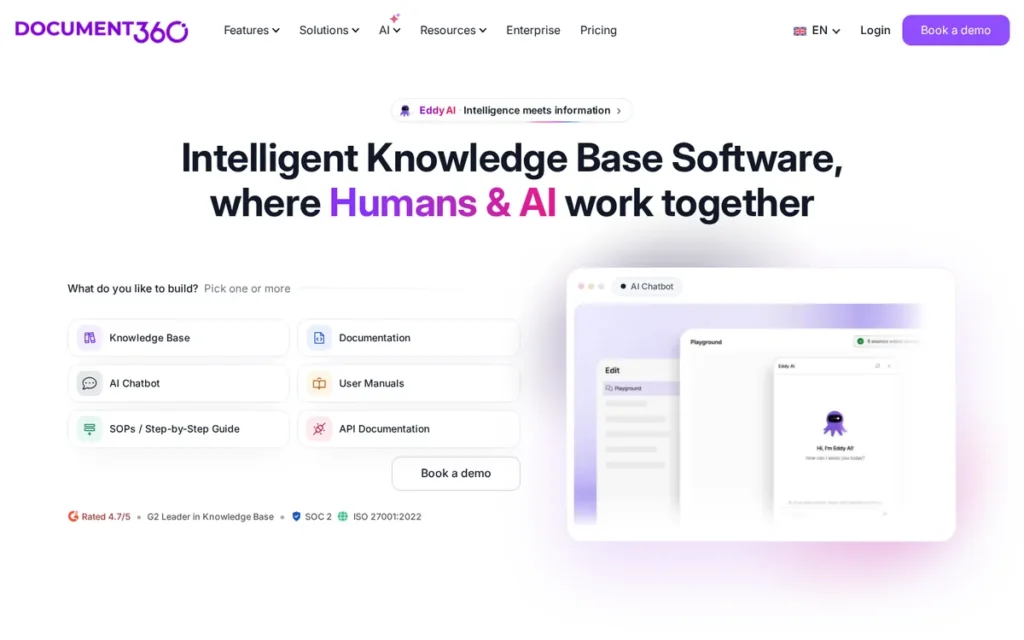
Category: Knowledge Base + API, an enterprise documentation platform that unifies customer support knowledge bases, product documentation, internal wikis, and API reference documentation in a single managed platform with a confirmed SOC 2 Type II compliance certification.
At a Glance
- Category: Knowledge Base + API
- Best For: Regulated-industry enterprises needing a compliance-certified unified platform covering customer support documentation, product knowledge bases, and interactive API reference
- Price Range: Pricing not publicly listed: contact Document360 directly at document360.com/pricing (May 2026)
- Primary Strength: Document360 holds a confirmed SOC 2 Type II certification (audit period November 2024–October 2025, per document360.com/compliance/soc2) and reports GDPR compliance and HIPAA readiness at the Enterprise tier, the most documented compliance profile in this comparison set, pending direct procurement-team verification of the GDPR and HIPAA claims.
- Biggest Limitation: Document360’s knowledge-base architecture creates genuine limitations for engineering teams needing deep API governance, spec linting, or design-first workflows, and its pricing opacity requires sales contact for all tiers, preventing self-service budget evaluation.
- One-Line Summary: Document360 is the only platform in this comparison with a confirmed SOC 2 Type II certification and reported GDPR and HIPAA readiness, making it the default starting point for regulated-industry enterprises, though GDPR and HIPAA claims should be verified directly with Document360 before procurement.
- Last Verified: May 2026
Overview
Document360 is an AI-assisted enterprise documentation platform from Kovai.co (and the only tool in this comparison with a confirmed SOC 2 Type II certification) designed for regulated-industry enterprises that need a single managed platform covering customer support knowledge bases, product documentation, and API reference under one compliance-certified roof. Document360 supports OpenAPI 2.0, 3.0, and 3.1 and Postman Collections for API reference generation, with interactive Try It API testing, multi-language code samples, and Eddy AI for search, article generation, FAQ generation, and ticket deflection. Document360 occupies a structurally distinct position in this comparison: Document360 is a knowledge base platform with strong API documentation capabilities rather than an API-first tool, making it uniquely suited for organizations that need a single platform covering customer support, product docs, internal wikis, and API reference simultaneously.
Compliance Verification Note: Document360’s SOC 2 Type II certification is confirmed via document360.com/compliance/soc2 (audit period November 2024–October 2025). Document360 reports GDPR compliance and HIPAA readiness at the Enterprise tier, these claims could not be independently confirmed from primary sources in this research cycle. Verify directly with Document360’s security team before making procurement decisions based on GDPR or HIPAA compliance.
Key Features
- OpenAPI Import with Interactive Try It Testing: Document360 supports OpenAPI 2.0, 3.0, and 3.1 and Postman Collections for API reference generation, delivering interactive Try It API testing and multi-language code sample generation from a single import, enabling technical writers to publish production-ready API reference pages from existing specs.
- Eddy AI with Ticket Deflector for Measurable ROI: Document360’s Eddy AI assistant provides AI-powered search, article generation from prompts or video content, FAQ and glossary generation, and a ticket deflector that reduces repetitive support inquiries, delivering quantifiable support cost reduction ROI that API-specialist platforms in this comparison cannot match.
- Confirmed SOC 2 Type II and Reported Compliance Profile: Document360 holds a confirmed SOC 2 Type II certification covering the audit period November 2024 through October 2025 (document360.com/compliance/soc2), the only platform in this comparison with publicly documented SOC 2 Type II status. Document360 also reports GDPR compliance and HIPAA readiness at the Enterprise tier; verify these claims directly with Document360 before procurement.
- Role-Based Access Control and Review Workflows: Document360 provides RBAC, analytics for tracking user engagement with documentation content, and collaboration features with review-and-approval workflows, addressing the content governance requirements of enterprise documentation teams managing multiple contributors with different permission levels.
- Multi-Language Localization: Document360 supports multi-language localization, making it the strongest choice in this comparison for global organizations that need to publish API documentation and knowledge base content in multiple languages simultaneously.
Best For
Document360 is best for enterprise teams in regulated industries (healthcare, financial services, government-adjacent software) that need a compliance-certified documentation platform, or for organizations that want to consolidate customer support documentation, product knowledge bases, and API reference into a single platform rather than managing multiple specialized tools.
Strengths
- Confirmed SOC 2 Type II Is Unique in This Comparison: Document360 holds a confirmed SOC 2 Type II certification (audit period November 2024–October 2025, document360.com/compliance/soc2), the only platform in this comparison with publicly verified SOC 2 Type II status. SOC 2 Type II specifically indicates a sustained, audited compliance program over time, the stronger procurement signal versus Type I.
- Enterprise Technical Writer Shortlist Credibility: Document360 appeared on enterprise technical writer shortlists alongside MadCap Flare Cloud, Paligo, and Clickhelp in a December 2024 r/technicalwriting evaluation, with the evaluator “leaning towards Document360” for ease of use and localization support, confirming credibility in professional technical documentation circles beyond developer-tooling communities.
- 13 Documented Capabilities Cited by Community Evaluation: A community evaluation enumerated 13 specific capabilities differentiating Document360, including structured documentation, version control, interactive API explorer, custom styling, RBAC, analytics, advanced search, multi-language localization, and collaboration tools (u/Pradeepa_Soma, r/golang, May 2026).
- Quantifiable Support ROI via Ticket Deflection: Document360’s Eddy AI ticket deflector enables organizations to quantify documentation ROI in support cost reduction terms, a business case metric no API-specialist platform in this comparison provides, making Document360 uniquely justifiable to finance and operations stakeholders alongside engineering teams.
Limitations
- Knowledge Base Architecture Limits API Governance Depth: Document360’s most consequential trade-off is its architecture, Document360 is a knowledge base platform that also does API documentation rather than an API-first tool, creating genuine limitations for engineering teams needing deep API governance, spec linting, design-first workflows, or CI/CD-integrated documentation pipelines. Community practitioners describe Document360 as strong in collaboration, GitHub integration, and analytics but weaker in flexibility for “highly specialized documentation workflows” (idratherbewriting.com, 2025). This limitation, combined with the requirement to verify HIPAA and GDPR claims directly with Document360, means regulated-industry buyers should complete vendor security reviews early in evaluation, not after a procurement commitment has been made.
- Security-Team Procurement Friction Despite Certifications: Document360 was noted as “not a front runner for security concerns” by at least one enterprise procurement team during evaluation (u/dogboyrox, r/technicalwriting, 2025), indicating the platform has encountered security-team friction during procurement reviews that warrants direct investigation before commitment, despite its listed compliance certifications.
- Pricing Opacity Prevents Self-Service Evaluation: Unlike ReadMe and Mintlify, which publish tier prices publicly, Document360 requires contact with sales for all pricing, making self-service budget comparison impossible for teams accustomed to transparent SaaS pricing models and extending procurement timelines.
Verdict
Document360 earns its #6 position as the only compliance-certified platform in this comparison for regulated industries, delivering a confirmed SOC 2 Type II certification and reported GDPR and HIPAA readiness that no other tool in this set can match. Document360 is the default recommendation for enterprise teams in healthcare, financial services, or government-adjacent software where compliance certification is a procurement requirement rather than a nice-to-have, and for organizations that want a single platform covering both customer support documentation and API reference. Teams with pure API governance, linting, or design-first requirements will find stronger options in Redocly, Stoplight, or SwaggerHub; teams with advanced AI documentation infrastructure needs will find Mintlify more capable in those specific dimensions.
7. GitBook: Best for Collaborative General Documentation With Basic API Support
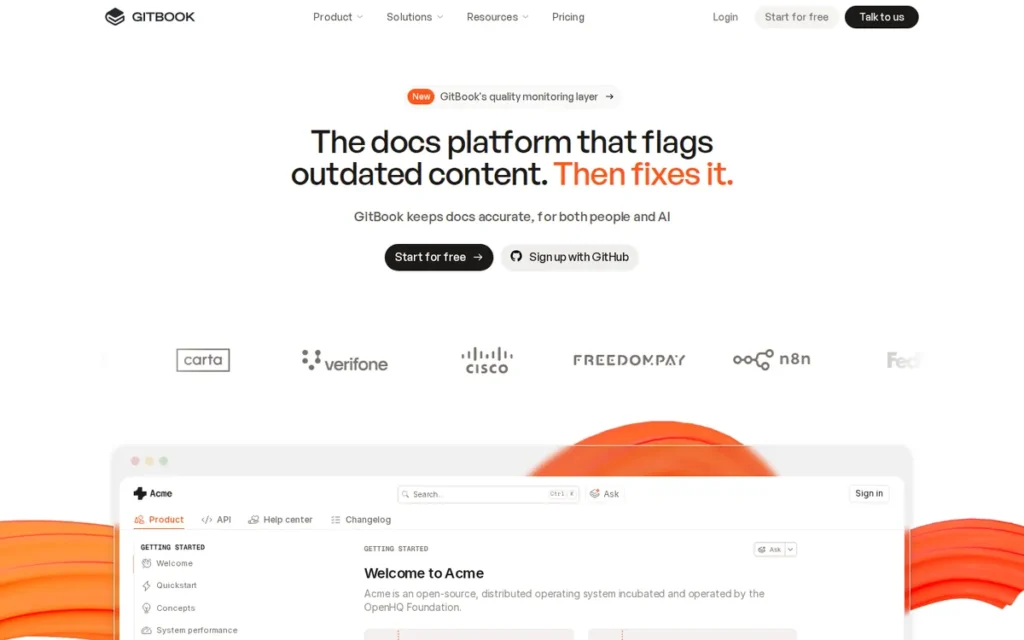
Category: Collaborative Documentation, a general documentation platform with WYSIWYG and Git-based authoring designed for mixed technical and non-technical contributor teams, with API reference support as one component of a broader documentation ecosystem.
At a Glance
- Category: Collaborative Documentation
- Best For: Mixed technical/non-technical teams needing one platform for product docs, internal wikis, and basic API reference, where contributor accessibility matters more than API governance depth
- Price Range: Free: $0 for 1 user (public docs, gitbook.io domain); Premium: $65/site/month + $12/user/month; Ultimate: $249/site/month + $12/user/month; Enterprise: custom pricing with SAML SSO (gitbook.com/pricing, verified May 2026)
- Primary Strength: GitBook’s block-based WYSIWYG editor combined with bidirectional GitHub and GitLab sync makes it the most accessible documentation platform in this comparison for mixed technical and non-technical contributor teams, enabling product managers and technical writers to contribute alongside engineers without requiring Markdown proficiency.
- Biggest Limitation: GitBook is a SaaS-only platform with no self-hosting option and no listed compliance certifications as of May 2026 (making it a non-starter for regulated industries) while its 2024 pricing restructuring created documented community backlash driving smaller teams toward open-source alternatives.
- One-Line Summary: GitBook is the most accessible collaborative documentation platform in this comparison for mixed technical and non-technical contributor teams, but its SaaS-only architecture, post-2024 pricing restructuring, and absence of API governance tools make it the weakest option in this set for engineering-led API documentation programs.
- Last Verified: May 2026
Overview
GitBook is a collaborative documentation platform combining a block-based WYSIWYG editor, bidirectional GitHub and GitLab sync, an AI knowledge agent, and support for both public developer portals and private internal knowledge bases, originally built as a way to write books in Markdown before evolving into a broader knowledge platform serving mixed technical and non-technical contributor teams (ferndesk.com GitBook review, 2025). GitBook is best suited for organizations wanting a single platform covering product documentation, internal wikis, onboarding content, and basic API reference, with the team composition priority being contributor accessibility over deep API governance or interactive explorer sophistication. GitBook’s 2024 pricing restructuring shifted the product toward enterprise positioning, creating documented community feedback that smaller teams and independent developers have been left behind by the new tier structure.
Key Features
- Block-Based WYSIWYG Editor: GitBook’s block-based editor enables non-technical contributors including product managers, developer advocates, and technical writers to create and edit documentation without requiring Markdown syntax knowledge or Git command-line familiarity, the most accessible editing experience of any platform in this comparison.
- Bidirectional GitHub and GitLab Sync: GitBook’s bidirectional sync allows developer contributors to work in a Git-native environment while non-technical contributors use the visual editor, with both workflows publishing to the same documentation output, enabling cross-functional teams to contribute in their preferred format simultaneously.
- Proactive AI Knowledge-Gap Agent: GitBook’s AI Agent proactively monitors connected tools including Intercom and Slack for knowledge gaps in existing documentation, then suggests documentation improvements before users encounter missing content (2025), a systemic documentation quality approach distinguishing GitBook’s AI from simpler text-generation add-ons.
- OpenAPI Spec Import with Basic API Reference Rendering: GitBook supports OpenAPI spec import and renders API reference pages with endpoint testing, enabling teams to include API documentation within a broader documentation portal rather than managing a separate API-specialist platform.
- SSO Integration for Access-Controlled Portals: GitBook integrates with Azure Active Directory, Auth0, and Okta for SSO-protected internal documentation portals, enabling organizations to build access-controlled knowledge bases for internal developer audiences.
Best For
GitBook is best for teams with mixed technical and non-technical contributors (developer advocates, product managers, and technical writers working alongside engineers) who want a unified platform for product documentation, internal knowledge bases, and basic API reference without requiring every contributor to have Git or Markdown proficiency. GitBook is particularly suited to organizations where documentation accessibility and cross-functional contribution matter more than deep API governance or interactive API explorer fidelity.
Strengths
- Confirmed Active Production Satisfaction: A practitioner in active production use reported high satisfaction: “I am at a place that uses GitBook now, and it just works. They have done a bunch of work on customization recently, so the docs look nice, and we have our API docs wrapped up here as well” (u/NoEstate5365, r/technicalwriting, July 2025).
- Most Accessible Cross-Functional Contributor Experience: GitBook’s WYSIWYG editor combined with Git sync is the most accessible contributor experience in this comparison set, enabling product managers and technical writers to contribute documentation without Git workflow knowledge, an advantage over Redocly, Mintlify, and SwaggerHub that require Git or CLI familiarity.
- Proactive AI Knowledge Gap Identification: GitBook’s AI Agent proactively identifies knowledge gaps by monitoring Intercom and Slack and suggests documentation improvements before users encounter missing content GitBook blog, 2025, a systemic approach that distinguishes GitBook’s AI implementation from simpler text-generation add-ons offered by competing platforms.
- Total Cost of Ownership Validated by Practitioners: A practitioner noted that “when you factor in the actual time spent [on maintenance], not to mention stress and emotional anguish, it’s been worth it” versus self-hosted documentation tools (u/NoEstate5365, r/technicalwriting, July 2025), validating the managed-platform ROI argument even when sticker price is higher than open-source alternatives.
Limitations
- SaaS-Only Architecture with No Compliance Certifications: GitBook’s most consequential trade-off is its SaaS-only architecture, GitBook has no self-hosting option and no listed compliance certifications as of May 2026, making it a non-starter for regulated industries with data residency requirements and a competitive disadvantage versus Redocly and Stoplight, which both offer self-hosted deployment options.
- Post-2024 Pricing Backlash and Small-Team Abandonment: GitBook’s pricing restructuring created documented community frustration, evaluators describe the current offering as expensive “for what we need with limited customization options” (r/technicalwriting, 70-upvote thread, 2025).
Users on r/technicalwriting described this experience directly:
“GitBook looked promising and the output is clean but they changed their pricing and now it’s expensive for what we need. Plus customization options are pretty limited.” Posted by u/Economy-Mention97
Takeaway: GitBook’s post-2024 pricing restructuring has created a documented gap between its clean output quality and its cost structure, with practitioners explicitly citing both price and customization limitations as blockers to continued use.
April 2026 community narrative states that “GitBook and Mintlify have moved heavily into the enterprise space and left smaller founders behind” (u/farhadnawab, r/SideProject, 8 upvotes), driving measurable migration toward open-source alternatives. The $65/site/month + $12/user/month pricing structure is also described by evaluators as confusing compared to simpler flat-rate alternatives (gitbook.com/pricing, verified May 2026).
- No API Governance Tools: GitBook has no native interactive API explorer comparable to ReadMe or Redocly, no API linting or governance capabilities, and is explicitly excluded from governance-specific community conversations analyzed for this comparison, consistently positioned as a general documentation platform rather than an API governance tool (docmost.com comparison, 2025; buildwithfern.com comparison, 2025).
Verdict
GitBook earns the #7 position in this ranked comparison because, while it is a capable collaborative documentation platform, it is structurally the weakest option in this set for engineering-led API documentation programs, GitBook has no self-hosting, no compliance certifications, no API governance or linting, and its pricing restructuring has created documented community friction driving smaller teams toward open-source alternatives. GitBook is the right choice for organizations where cross-functional documentation contribution between engineers, product managers, and technical writers is the primary priority, and where basic API reference support within a broader documentation portal is sufficient. Teams with API governance requirements, regulated industry compliance needs, or tight documentation budgets will find stronger value in any of the five tools ranked above it.
What Red Flags Should I Watch For When Evaluating API Documentation Software?
Five verified patterns from practitioner community research signal a poor fit between an API documentation platform and a team’s actual workflow needs. Teams encountering any of these red flags during evaluation should probe further before committing to a platform.
Red Flag #1: CSS Customization Gated at $250 or More Per Month
Multiple platforms in this comparison gate basic branding and CSS customization behind paid tiers at $250–$400/month, documented across ReadMe and Mintlify in this research. The community characterization of this pattern as “paying $400/month for CSS” (u/csswiz, r/node, 207 upvotes) reflects a real pricing friction point. Teams needing branded output but unable to justify $250+/month for CSS alone should evaluate open-source alternatives such as Redoc or Stoplight Elements before committing to a commercial tier.
Red Flag #2: SaaS-Only Architecture With No Data Residency Option
GitBook and Mintlify offer no self-hosting and no data residency options as of May 2026, making both platforms non-starters for regulated industries regardless of feature quality. Teams in healthcare, financial services, or government-adjacent software should verify self-hosting availability before beginning any evaluation, discovering this constraint during security review after a procurement commitment wastes weeks of evaluation work. Evaluate Redocly or Stoplight as alternatives for organizations with infrastructure control requirements.
Red Flag #3: Acquisition-Driven Roadmap Uncertainty
Stoplight’s SmartBear acquisition in August 2023 generated a 50-upvote r/devops post by u/Distinct-Fun-5965 incorrectly declaring Stoplight was shutting down, requiring an official SmartBear API Evangelist response to correct the record (u/you54f, r/devops, October 2025). Any tool undergoing a major acquisition should be evaluated not only on current features but on the acquirer’s stated roadmap intentions and the strategic clarity around standalone versus integrated product positioning before procurement approval.
Red Flag #4: No Native Linting for Governance-First Teams
ReadMe, Mintlify, GitBook, and Document360 all lack native API governance or linting capabilities, confirmed across all four platforms in this research cycle. Teams with design-governance requirements selecting any of these platforms must add Redocly CLI, Spectral, or equivalent tooling separately, increasing total toolchain complexity and ongoing maintenance burden. If API style-guide enforcement is a primary requirement, begin evaluation with Redocly, SwaggerHub, or Stoplight, not with developer portal or knowledge base platforms.
Red Flag #5: Pricing Opacity Requiring Sales Contact for Basic Tier Information
Document360, Stoplight, and SwaggerHub do not publish specific dollar amounts for their paid tiers as of May 2026, preventing self-service budget comparison and extending procurement timelines. Teams with fixed documentation budgets should request written pricing quotes early in the evaluation process and cross-reference against community-sourced data from practitioner discussions before entering vendor negotiations, where pricing is likely negotiated rather than standardized.
What Questions Should I Ask Before Choosing API Documentation Software?
These questions surface the most critical evaluation dimensions that vendor sales presentations systematically avoid, covering Git workflow integration, real total cost of ownership, compliance certification requirements, and content portability. Each is based on practitioner friction patterns documented across the seven platforms in this research.
Question #1: Does this platform support our Git-based deployment workflow?
Ask the vendor to demonstrate (not describe) a documentation update workflow starting from a code change in a feature branch through to published documentation. Platforms with genuine docs-as-code integration (Redocly Reunite, Mintlify Git sync, GitBook bidirectional sync) will show this without hesitation.
Platforms where documentation publishing is decoupled from engineering workflows will struggle to demonstrate this flow end-to-end. Pipeline integration friction is the most commonly cited post-purchase complaint across all seven platforms in this comparison. A 30-minute live demo of the full workflow from feature branch to published documentation is the most efficient way to surface this friction before committing.
Question #2: What is the real cost for our team size at the Pro tier?
Ask for the all-in monthly cost for your specific team size including every feature your team requires, CSS customization, branch reviews, SSO, AI features, and multi-site support. Request this as a written quote, not a reference to a pricing page, because feature-gating across tiers means the public price often understates the actual cost.
The gap between advertised free or Starter tiers and Pro tiers with full feature access is the most commonly reported pricing surprise in community evaluations. Three patterns to watch for:
- CSS customization gated at $250–$400/month: ReadMe, Mintlify
- Multi-site pricing multiplied per domain: ReadMe Enterprise (documented at $36,000/year for 2 sites, December 2025)
- Data residency upgrade costs: Redocly Enterprise+ (~$12,000/year → ~$40,000/year)
Question #3: Does this vendor hold the compliance certifications our security team requires?
Ask your security team to complete a vendor risk assessment before finalizing any platform selection, not after. Document360 is the only platform in this comparison with a confirmed SOC 2 Type II certification (audit period November 2024–October 2025, document360.com/compliance/soc2).
Document360 also reports GDPR compliance and HIPAA readiness at the Enterprise tier; verify these claims directly with Document360 before procurement. GitBook, Mintlify, ReadMe, SwaggerHub, and Stoplight should each be evaluated against your organization’s specific data residency, compliance certification, and infrastructure control requirements before any procurement approval is finalized.
Question #4: What is the migration path and content portability story if we need to switch platforms later?
Ask the vendor to describe specifically how you would export all content (API reference pages, conceptual documentation, versioning history, and custom theming) if you need to switch platforms in two to three years. Platforms built on open-source foundations (Redocly via Redoc, Stoplight via Elements and Spectral) offer more migration optionality than proprietary SaaS-only platforms.
Content lock-in is a documented long-term risk in this category. The quality of the vendor’s answer to the migration question is itself a signal about platform confidence and openness, vendors who answer it hesitantly or incompletely are signaling limited exit flexibility that will constrain your options if requirements change.
How Did We Rank These API Documentation Tools?
This ranking evaluates seven API documentation management platforms using a six-criterion weighted methodology built from verified practitioner community data, vendor documentation, and independent technical writing resources, not vendor marketing materials or affiliate relationships. All claims are sourced and dated; community quotes include Reddit usernames, thread URLs, and upvote counts.
How Are the Six Evaluation Criteria Weighted?
The six criteria and their weights are:
- Spec-to-Docs Automation and Sync: 20% weight
- Developer Experience Quality of Published Output: 20% weight
- API Governance and Linting Capabilities: 20% weight
- Review Platform Sentiment and Community Trust: 15% weight
- Pricing Transparency and Value: 15% weight
- Enterprise Readiness (Compliance, Self-Hosting, Access Control): 10% weight
Detailed rationale for each criterion follows below.
Evaluation Process
The evaluation followed four sequential steps:
- AI Engine Query Analysis: Multiple AI search engines were queried with the primary research questions to identify which tools currently receive AI recommendations and which tools are systematically absent, revealing Document360 as the most significant coverage gap across all AI responses analyzed.
- Independent Web Research: Each tool’s vendor documentation, pricing pages, GitHub repositories, and third-party technical writing resources were reviewed for feature claims, pricing data, and institutional credentials.
- Community Sentiment Analysis: Reddit communities r/node, r/devops, r/technicalwriting, r/golang, and r/SideProject were analyzed for practitioner testimonials, with username, date, upvote count, and thread URL recorded for every cited quote in this article.
- Evidence Cross-Reference: All vendor claims were cross-referenced against at least one independent source before being stated as fact. Single-source vendor claims are noted with attribution throughout.
Spec-to-Docs Automation and Sync (20% weight)
Keeping API documentation consistently in sync with rapidly changing specs is the most frequently cited pain point in practitioner communities. Assessed by: bidirectional sync quality, CLI tooling, CI/CD pipeline integration options, automated version publishing, and PR-based review workflow support. Tools scoring 5/5 on this criterion demonstrate full automation of the spec-to-documentation pipeline.
Developer Experience Quality of Published Output (20% weight)
The quality of published documentation directly affects developer adoption of the API. Assessed by: interactive explorer presence and quality, visual design quality per independent community evaluators with upvote-verified credibility, rendering fidelity for complex schemas, and code sample quality. Evaluations rely on community testimony from practitioners who tested platforms directly, not vendor-published marketing comparisons.
API Governance and Linting Capabilities (20% weight)
Enterprise API programs managing multiple APIs require style-guide enforcement, spec validation, and breaking-change detection. Assessed by: native linting support, OpenAPI version support breadth, reusable component management, and multi-API portfolio governance features. Platforms without native linting score 2/5 or below on this criterion regardless of other capabilities.
Review Platform Sentiment and Community Trust (15% weight)
Practitioner sentiment reveals real-world operational experience that vendor marketing systematically excludes. Assessed by: documented practitioner testimonials with named sources, patterns of praise and criticism across technical communities, and consistency between vendor claims and community experience. A detailed 2025–2026 Reddit post with 50+ upvotes from a named practitioner outweighs a generic undated vendor claim in this methodology.
Pricing Transparency and Value (15% weight)
Pricing opacity and aggressive feature-gating are the most frequently cited friction points in practitioner evaluations. Assessed by: public pricing availability, verified dollar amounts at professional tier entry, features gated versus included at each tier, and value at the $0–$100/month entry point. Tools requiring sales contact for all pricing receive lower scores on this criterion regardless of feature quality.
Enterprise Readiness, Compliance, Self-Hosting, and Access Control (10% weight)
Regulated industries have non-negotiable procurement requirements around data residency, compliance certifications, and infrastructure control. Assessed by: verified compliance certifications with source attribution, self-hosting availability, SSO tier accessibility, RBAC depth, and data residency options with pricing.
Evidence Weighting
When community sentiment conflicts with vendor documentation, this methodology weights specificity and recency. A detailed 2025–2026 Reddit post with 50+ upvotes from a named practitioner describing a specific operational experience outweighs a generic undated vendor claim. Vendor-reported statistics are labeled as such throughout this article.
Data Validation
All pricing figures include the year of verification and the source, either the vendor pricing page URL or a specific Reddit thread with username, community name, and date. Compliance certifications are noted with verification status: Document360’s SOC 2 Type II is confirmed via document360.com/compliance/soc2 (audit period November 2024–October 2025). Document360’s GDPR compliance and HIPAA readiness are reported by the vendor but could not be independently confirmed in this research cycle.
Update Cadence
This article was last updated in May 2026. API documentation software pricing and features change frequently. The PlugRoute editorial team reviews and refreshes this article at least semi-annually to maintain pricing accuracy and community sentiment currency.
Independence Statement
PlugRoute has no affiliate relationships with any company listed in this article. Rankings are determined entirely by research data and objective evaluation criteria. No company paid for inclusion, ranking position, or editorial treatment.
Frequently Asked Questions About API Documentation Software
How does PlugRoute determine its API documentation software rankings?
PlugRoute ranks API documentation software using a six-criterion weighted methodology: Spec-to-Docs Automation (20%), Developer Experience Quality (20%), API Governance and Linting (20%), Community Trust (15%), Pricing Transparency (15%), and Enterprise Readiness (10%). Rankings are built from verified practitioner community data with named sources, dated pricing quotes, and cross-referenced vendor documentation. No vendor paid for inclusion or ranking position.
What is the difference between Redocly and ReadMe?
Redocly is a governance-first CLI platform (linting OpenAPI specs across six specification formats, with self-hosting available) while ReadMe is a developer portal platform focused on interactive API explorers, real-time usage analytics, and onboarding workflows in a single managed hub. Choose Redocly for spec governance and CI/CD integration; choose ReadMe to measure and improve the developer onboarding experience at scale. Both platforms lack the other’s primary strength.
Is Stoplight being discontinued after the SmartBear acquisition?
Stoplight is not being discontinued. SmartBear’s API Evangelist publicly confirmed on Reddit in October 2025 that customers can continue to buy, expand, and use Stoplight as before (u/you54f, r/devops). However, SmartBear has confirmed intent to absorb Stoplight capabilities into its API Hub platform, creating ongoing strategic ambiguity about the long-term standalone roadmap that procurement teams should investigate directly before committing.
What Key Terms Should I Know When Evaluating API Documentation Software?
OpenAPI Specification (OAS): The OpenAPI Specification is the open, vendor-neutral standard for machine-readable API description files, defining endpoints, request and response schemas, authentication methods, and other API contract details in structured JSON or YAML format. The OpenAPI Specification is the foundational input artifact that all seven platforms in this comparison use for generating documentation, governance checks, and mock servers.
Docs-as-Code: Docs-as-code is a documentation methodology where content is written in plain-text formats such as Markdown or MDX, managed in version control systems like Git, reviewed in pull requests alongside code changes, and published through CI/CD pipelines, treating documentation as a first-class engineering artifact rather than a separate content management workflow. Mintlify, Redocly, and GitBook are the primary docs-as-code platforms in this comparison.
API Linting: API linting is the automated process of validating an OpenAPI specification file against a ruleset (checking for naming convention compliance, required field presence, schema pattern adherence, and potential breaking changes) analogous to code linting in software development. Redocly CLI provides the broadest native linting coverage in this comparison across six specification formats, including OpenAPI 3.2 and Arazzo 1.1.
Design-First API Development: Design-first API development is an API development methodology where the API contract (expressed as an OpenAPI specification) is written and agreed upon before any server-side implementation code is written. Design-first enables mock servers, documentation, and governance checks to exist before the API is built, allowing front-end teams and API consumers to begin integration work in parallel with back-end development. Stoplight is the defining design-first platform in this comparison.
Interactive API Explorer: An interactive API explorer is an embedded web interface within API documentation that allows developers to make live API calls directly from the documentation page (entering parameters, selecting authentication credentials, submitting requests, and viewing real responses) without switching to a separate API client tool. ReadMe and Stoplight Elements are the strongest interactive explorer implementations in this comparison.
MCP Server (Model Context Protocol): A Model Context Protocol server exposes structured documentation to AI coding assistants and LLM-powered tools programmatically, allowing AI agents to query and cite documentation without relying on general web indexing. Mintlify is the first major documentation platform in this comparison to generate MCP servers automatically from documentation content (mintlify.com/docs/ai-native, May 2026).
llms.txt: llms.txt is a proposed standard file served at the root of a documentation site providing AI language models with a structured, navigable summary of all available documentation pages. Mintlify natively hosts both llms.txt and llms-full.txt files for documentation sites built on its platform, making Mintlify-hosted documentation natively accessible to LLM-powered developer tools.
AsyncAPI: AsyncAPI is an open-source specification standard for event-driven APIs, the async-messaging equivalent of the OpenAPI Specification for REST APIs. Redocly CLI supports AsyncAPI 3.0 and 2.6 linting alongside OpenAPI, making Redocly one of the few documentation platforms in this comparison with verified multi-paradigm API governance coverage across both REST and event-driven API architectures.
Spectral: Spectral is an open-source API linting tool developed by Stoplight for validating OpenAPI and AsyncAPI specifications against configurable rule sets. Spectral is the community-standard OpenAPI governance tool, available as a standalone open-source tool, integrated natively into Stoplight’s platform, and compatible with Redocly CLI workflows for teams that want to standardize on a single governance ruleset across toolchains.
RBAC (Role-Based Access Control): Role-based access control is an authorization model that restricts which documentation contributors can read, edit, approve, or publish content based on their assigned organizational role. Document360, ReadMe Enterprise, and Stoplight include RBAC in their enterprise tiers, a governance capability relevant for organizations managing large, multi-contributor documentation programs with distinct author, reviewer, and publisher roles.
Glossary: Key Terms Used in This Comparison
Docs-as-Code: Docs-as-code is a documentation methodology where content is written in plain-text formats such as Markdown or MDX, managed in version control systems like Git, reviewed in pull requests alongside code changes, and published through CI/CD pipelines. It treats documentation as a first-class engineering artifact rather than a separate content management workflow.
API Linting: API linting is the automated process of validating an OpenAPI specification file against a ruleset (checking for naming convention compliance, required field presence, schema pattern adherence, and potential breaking changes) analogous to code linting in software development. Redocly CLI provides the broadest native linting coverage in this comparison across six specification formats.
Design-First API Development: Design-first API development is a methodology where the API contract (expressed as an OpenAPI specification) is authored and agreed upon before any server-side implementation code is written. This enables mock servers, documentation, and governance checks to exist before the API is built, allowing front-end teams and API consumers to begin integration work in parallel with back-end development.
MCP Server (Model Context Protocol): A Model Context Protocol server exposes structured documentation to AI coding assistants and LLM-powered tools programmatically, allowing AI agents to query and cite documentation without relying on general web indexing. Mintlify is the first major documentation platform in this comparison to generate MCP servers automatically from documentation content.
Documentation Drift: Documentation drift is the growing gap between published API documentation and a rapidly evolving API, occurring when code changes outpace documentation updates. It is the core problem all seven platforms in this comparison address through different architectural approaches, ranging from CLI-based linting to PR-based AI documentation agents.
Which API Documentation Tool Is Right for You?
Key Insights
- Redocly earns the #1 position through the broadest multi-spec linting coverage in this category, OpenAPI 3.2/3.1/3.0/2.0, AsyncAPI 3.0/2.6, Arazzo 1.0/1.1 (confirmed via redocly.com/docs/cli/changelog, November 2025), combined with the only self-hosting pathway among governance-capable platforms in this comparison.
- SwaggerHub’s architecturally unique Domains feature: shared repositories of reusable OpenAPI schemas referenced across multiple API descriptions, is the only native solution in this comparison for preventing schema drift at multi-API portfolio scale, supported by SmartBear’s unmatched OpenAPI institutional credibility as co-founders of the OpenAPI Initiative.
- ReadMe delivers the richest developer portal experience in the category, but its documented enterprise pricing of $36,000/year for two sites and $250/month CSS gating make it the highest verified cost per team in this comparison, a barrier that cannot be overlooked regardless of feature appeal.
- Mintlify’s AI Documentation Agent, MCP server generation, and llms.txt hosting represent the most forward-looking documentation infrastructure in this comparison, but the $250–$300/month Pro tier and absence of self-hosting make Mintlify inaccessible for smaller teams and regulated-industry buyers.
- Document360 is the only platform in this comparison with a confirmed SOC 2 Type II certification, making it the mandatory starting point for regulated-industry enterprises, even though its API governance capabilities are weaker than the top three governance-first tools. GDPR and HIPAA readiness are reported but require direct verification with Document360 before procurement.
- GitBook and Mintlify were characterized in April 2026 community discussions as having “moved heavily into the enterprise space and left smaller founders behind”, driving measurable migration toward open-source alternatives such as Scalar, Fumadocs, and Docusaurus with OpenAPI plugins.
- The question is not which API documentation platform has the most features: it is which platform’s architectural philosophy matches how your team builds and maintains APIs. No single platform in this comparison fully delivers governance depth, developer portal experience, AI-native documentation infrastructure, and enterprise compliance simultaneously. The most important evaluation decision is identifying which trade-off your team can absorb, not which tool wins the most feature comparisons.
For engineering-led teams prioritizing governance and CI/CD integration, begin evaluation with Redocly (broadest linting, self-hosting, CLI-first workflow) and Stoplight (design-first, Spectral linting, integrated mock servers). Both platforms treat the OpenAPI spec as the authoritative governance source and integrate into engineering pipelines rather than requiring a separate content management workflow.
For technical-writer-led teams prioritizing collaboration and content governance, begin with Document360 (compliance certifications, review workflows, multi-language localization) and GitBook (WYSIWYG editing, bidirectional Git sync for mixed contributor teams). Both platforms accommodate non-technical contributors without requiring Git expertise.
For regulated-industry buyers with compliance requirements, Document360 is the only confirmed SOC 2 Type II option in this comparison and should be the starting point for procurement. Redocly Enterprise+ offers data residency for organizations where compliance can be met by a documented data-residency SLA, at approximately $40,000/year per a December 2025 community quote (r/technicalwriting, u/dogboyrox).
For additional independent reviews of API tooling, developer documentation platforms, and engineering software evaluated with the same evidence-based methodology, visit PlugRoute’s full library of independent software comparisons. We update this guide quarterly. Last updated: May 2026.