The best AI agents for most business teams in 2026 are n8n (production-grade developer and enterprise workflows, verified by Vodafone’s £2.2 million in documented savings), Zapier (broadest no-code integration coverage for non-technical teams), and Relevance AI (highest independently reported client ROI for GTM and sales teams). The critical distinction most comparison lists miss: true autonomous agents and rule-based automation tools are fundamentally different products serving different needs.
Most “best AI agents” lists conflate automation platforms, AI-augmented workflow tools, and genuinely autonomous agents into a single misleading ranking, leaving buyers selecting tools optimized for the wrong use case. The two most consequential buyer errors are confusing per-task billing with per-execution billing (a structural difference that creates order-of-magnitude cost gaps at high automation volume) and deploying research-stage autonomous agents into production reliability roles.
PlugRoute has no affiliate relationships with any company listed in this article; rankings are determined entirely by research data and objective evaluation criteria applied equally to all platforms.
TL;DR: Top Picks at a Glance
- n8n: free unlimited self-hosting; Vodafone £2.2M saved; strongest cost efficiency at scale
- Zapier: 8,000+ integrations; 15-year history; lowest-barrier no-code entry point
- Relevance AI: reported 3,000% client ROI; KPMG, Databricks, Canva as named customers; GTM-first
- Make: ~$9/month Core plan; Reasoning Panel for AI decision auditability; best value no-code
What Are the 4 Categories of AI Agent Tools in 2026?
AI agent tools in 2026 fall into four distinct categories: Platforms (Zapier, n8n, Make), Frameworks (CrewAI), Workforce Builders (Relevance AI, Lindy), and Autonomous Agents (AutoGPT). Selecting the wrong category is the most common source of AI agent adoption failure, and the step that most comparison lists skip entirely.
A Python developer building a complex multi-agent research pipeline needs a Framework. A marketing ops manager automating lead qualification needs a Workforce Builder. The taxonomy below enables accurate self-selection before reading individual entries.
The four categories differ on three dimensions that determine fit:
- Code requirement: Frameworks (CrewAI) require Python; Platforms make it optional (n8n) or unnecessary ( Zapier, Make); Workforce Builders (Relevance AI, Lindy) and Autonomous Agents (AutoGPT) require none or minimal technical setup
- Determinism: Platforms and Frameworks produce more predictable, auditable outputs for structured workflows; Autonomous Agents and AI-native Workforce Builders produce context-sensitive, non-deterministic outputs that vary by run
- Use case fit: Platforms win for integration-heavy business automation; Frameworks win for custom multi-agent logic; Workforce Builders win for role-defined GTM tasks; Autonomous Agents win for open-ended research and exploration
One practical test distinguishes rule-based automation from true AI agents: ask the vendor “what happens if the input to step 3 is ambiguous?” A rule-based automation stops or errors. A true AI agent interprets context, makes a judgment call, and continues. The vendor’s answer reveals the actual architecture.
How Do the 7 Best AI Agents Compare at a Glance?
The seven platforms in this evaluation span all four categories and cover every major buyer segment, from non-technical business teams to enterprise engineering squads. The table below enables direct comparison across eight dimensions before reading individual entries.
| Rank | Company | Category | Best For | One-Line Summary | Key Capabilities | Primary Strength | Key Limitation |
|---|---|---|---|---|---|---|---|
| 1 | n8n | Platform | Developers and enterprises needing production-grade AI agents with data sovereignty | n8n is the highest-ROI AI agent and automation platform for developer and enterprise teams in 2026, combining free unlimited self-hosted deployment with Vodafone’s £2.2 million in verified cost savings and Delivery Hero’s 200+ hours per month recovered | Free unlimited self-hosting; manager-worker multi-agent architecture; execution-based billing | Free unlimited self-hosting + execution-based pricing = most cost-efficient at scale among evaluated platforms | Requires at least one developer or technically capable automation owner |
| 2 | Zapier | Platform | Non-technical business teams automating workflows across a broad app stack without code | Zapier is the most integration-complete no-code AI agent platform for non-technical business teams in 2026, connecting 8,000+ apps with AI Guardrails security launched March 30, 2026 and original market research from 10,000 live AI-powered workflows | 8,000+ integrations; AI Agents; AI Guardrails (PII, toxicity, prompt injection, jailbreak detection) | 8,000+ integrations + 15-year operational history + March 2026 AI Guardrails security | Per-task billing escalates rapidly at high automation volume |
| 3 | Relevance AI | Workforce Builder | Sales, marketing, and GTM teams building no-code AI workforces | Relevance AI is the leading no-code AI workforce platform for GTM teams in 2026, with a reported 3,000% client ROI documented in a MongoDB-published case study and named deployments at KPMG, Databricks, and Canva | Named agents (Bosh, Apla, Lima); 2,000+ integrations; Claude Opus 4.6 + 1M token context | Highest independently reported enterprise client ROI of any no-code platform in this evaluation | GTM-first focus limits cross-functional value; credit-based billing risk |
| 4 | Make | Platform | Visually oriented no-code power users and EU enterprises needing AI transparency | Make is the most cost-accessible visual no-code automation platform for complex multi-step AI workflows in 2026, with a Reasoning Panel for real-time AI decision auditability and a Core plan at ~$9/month | Reasoning Panel; Make Grid; 400+ AI integrations; multi-model routing; GDPR heritage | Real-time AI decision auditability via Reasoning Panel; unmatched by competing no-code platforms at this price point | Steeper learning curve than Zapier; documented early churn without a dedicated automation owner |
| 5 | CrewAI | Framework | Python developers building production multi-agent AI systems | CrewAI is the fastest-adopted open-source Python framework for multi-agent AI orchestration, processing ~450 million agentic workflows per month with documented speed and code-efficiency advantages over LangChain | Crews + Flows dual architecture; open-source Python SDK; CrewAI AMP enterprise; $18M Insight Partners backing | 34% faster and 40–60% less code than LangChain for equivalent multi-agent setups | Python-only; complete access barrier for non-technical operators |
| 6 | Lindy | Workforce Builder | Non-technical teams needing HIPAA compliance and voice agents | Lindy is a no-code AI agent platform that uniquely combines reported SOC 2 and HIPAA compliance with voice agent capabilities in 30+ languages and multi-agent pod coordination | Reported SOC 2 + HIPAA; voice agents (30+ languages); 4,000+ integrations; multi-agent pods | Only no-code AI agent platform in this evaluation with reported SOC 2 + HIPAA compliance | Non-deterministic outputs disqualify Lindy from exactness-required production workflows |
| 7 | AutoGPT | Autonomous Agent | Researchers and developers exploring autonomous AI agent behavior | AutoGPT is the foundational open-source autonomous AI agent with 170,000+ GitHub stars and the deepest community knowledge base in the autonomous agent category, best suited for research, prototyping, and learning rather than reliable production workflow automation | Goal-directed autonomous execution; multi-LLM support (GPT-4, Claude, Groq, Llama); pre-built marketplace; cloud + self-hosted | 170,000+ GitHub stars; largest autonomous agent community knowledge base available | Documented 15–30% failure rate on complex multi-step tasks; community sentiment shifted to production skepticism by 2026 |
Which AI Agent Tool Should I Choose for My Use Case?
The right AI agent platform depends on your technical capacity, compliance requirements, billing tolerance at scale, and functional focus. The framework below maps the seven evaluated platforms to the most common buyer priorities.
| Your #1 Priority | Recommended Tool | Why | Acceptable Alternative |
|---|---|---|---|
| Broadest app integrations, no code | Zapier | 8,000+ integrations; 15-year track record; learn in hours | Make (better value at scale, steeper learning curve) |
| Free unlimited self-hosting + verified enterprise ROI | n8n | Only platform with free unlimited self-hosting AND named enterprise case studies (Vodafone, Delivery Hero) | n8n Cloud ($20/mo, execution-based billing) |
| No-code AI workforce for GTM/sales | Relevance AI | Highest independently reported client ROI; named specialized agents (Bosh, Apla, Lima) | Lindy (simpler UX, reported HIPAA-certified) |
| Visual no-code complexity + AI decision transparency | Make | Reasoning Panel; multi-model routing; ~$9/mo Core plan | n8n (more powerful, requires developer) |
| Python multi-agent framework | CrewAI | Fastest prototyping vs. LangChain; Crews + Flows dual architecture; $18M Insight Partners backed | n8n (visual + code, less Python-heavy) |
| No-code + HIPAA compliance + voice agents | Lindy | Only no-code AI agent platform in this evaluation with reported SOC 2 + HIPAA + voice in 30+ languages | Relevance AI (stronger ROI proof, no HIPAA) |
| Research, exploration, autonomous AI learning | AutoGPT | 170,000+ GitHub stars; foundational autonomous agent paradigm; deepest community docs | CrewAI (more structured multi-agent development) |
| Proof-of-concept before committing | n8n (self-hosted) or Zapier (free tier) | Both offer no-credit-card evaluation; n8n self-hosted allows unlimited workflow runs during evaluation | Make (also has a no-credit-card free tier) |
1. n8n: Best for Developers and Enterprises Requiring Production-Grade AI Agents
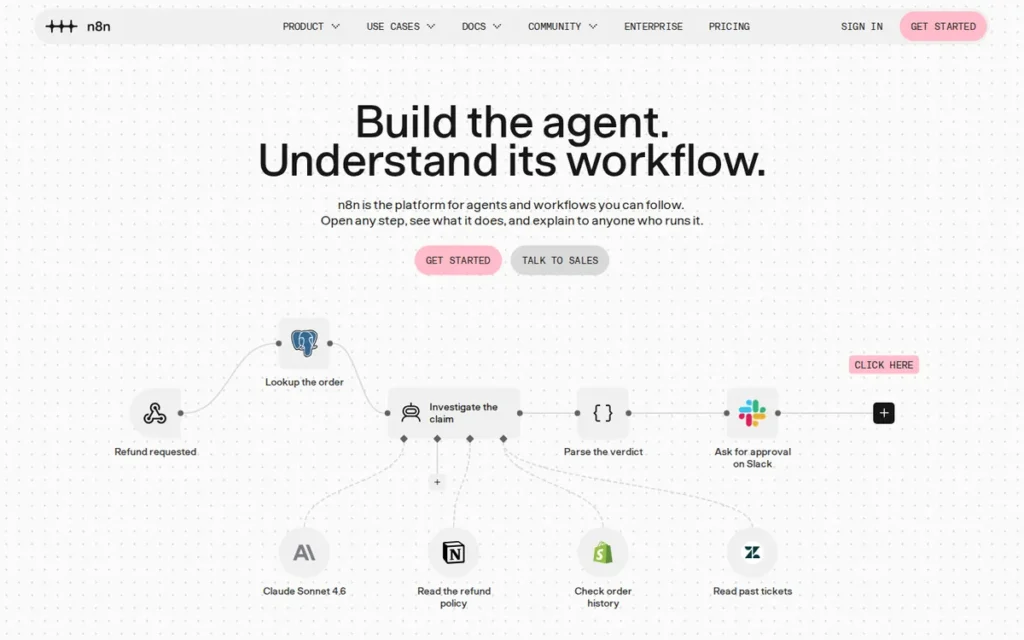
Category: Platform, open-source automation environment where developers build, test, and run AI agent workflows using visual nodes, native JavaScript/Python code, and multi-agent coordination architectures.
At a Glance
- Category: Platform
- Best For: Developers and enterprises needing production-grade AI agents with data sovereignty, execution-based cost efficiency, and verified enterprise ROI
- Price Range: Free (self-hosted, unlimited executions) / $20+/month (cloud, execution-based, verify at n8n.io/pricing, April 2026)
- Primary Strength: n8n delivers independently verified enterprise ROI: including Vodafone’s £2.2 million saved, through an execution-based pricing model that is structurally cheaper than per-task competitors at high automation volume
- Biggest Limitation: n8n requires meaningful technical investment to configure advanced AI agent nodes, multi-agent architectures, and self-hosted infrastructure; teams without a developer or technically capable automation owner face a steep onboarding curve
- One-Line Summary: n8n is the highest-ROI AI agent and automation platform for developer and enterprise teams in 2026, combining free unlimited self-hosted deployment with Vodafone’s £2.2 million in verified cost savings and Delivery Hero’s 200+ hours per month recovered
- Last Verified: April 2026
Overview
n8n is a free, open-source workflow automation platform for developers and enterprises that need production-grade AI agents with data sovereignty, deployable self-hosted at no cost with unlimited executions, or via cloud at $20/month with execution-based billing that is structurally cheaper than per-task competitors at scale. n8n operates on a fair-code license (open for inspection, restricted for commercial redistribution) and has accumulated 70,000+ GitHub stars since its 2019 founding.
n8n’s AI Agent nodes operate in observation-decision-execution-validation loops (not linear trigger-action chains) supporting manager-worker multi-agent coordination, native RAG pipelines, Human-in-the-Loop approvals, and Window Buffer Memory for context retention across workflow steps.
Key Features
- Autonomous AI Agent Nodes: n8n’s AI Agent nodes operate in observation-decision-execution-validation loops (not linear trigger-action chains) enabling genuine multi-step reasoning without per-step human instruction.
- Manager-Worker Multi-Agent Architecture: n8n supports manager-worker multi-agent coordination where a supervising agent delegates tasks to specialized sub-agents, enabling complex AI orchestration without building custom logic from scratch (hatchworks.com, 2026).
- Free Unlimited Self-Hosted Deployment: n8n’s self-hosted version is free with unlimited workflows and executions, giving enterprises complete data sovereignty and eliminating per-task cost accumulation for high-volume automation, the only platform in this evaluation with this combination.
- Active Security Response: n8n released patches addressing a critical remote code execution vulnerability (CVE-2025-68613, flagged by CISA in March 2026, patched in versions 1.120.4 and later) and maintains SOC 2 compliance documentation for enterprise deployments (The Hacker News, March 2026).
- Visual + Code Extensibility: n8n integrates natively with 400–500 applications and supports JavaScript and Python code nodes alongside visual workflow blocks, allowing developers to extend any integration or add custom business logic without leaving the platform (chronexa.io, 2026).
Best For
n8n is best for developers, data engineers, and enterprises that need reliable, auditable AI agent workflows at scale, particularly teams in regulated industries with data sovereignty requirements, or any team where high workflow volume makes per-task billing cost-prohibitive.
Strengths
- Vodafone reported saving approximately £2.2 million in operational costs by deploying n8n for threat intelligence automation, including 5,000 person-days saved and approximately £300,000 per month in continued savings throughout 2025, across 33 reusable workflows (n8n.io case studies, 2025).
- Delivery Hero saved over 200 hours per month in IT operations by automating employee account recovery with n8n, handling 800 monthly lockout requests through a single automated workflow replacing manual IT intervention for Okta and Google Workspace access restoration (n8n.io case studies, 2025).
- n8n has accumulated over 70,000 GitHub stars and more than 5,000 community workflow templates since its 2019 founding as of early 2026, reflecting sustained developer adoption and platform maturity that reduces deprecation risk compared to newer entrants (flowmondo.com, 2026).
- n8n’s active security patching record: including CVE-2025-68613 resolved in versions 1.120.4 and later (CISA advisory, March 2026), confirms enterprise security responsiveness, directly addressing the governance gaps that research identifies as the root cause of 74% of enterprise AI agent project failures (treasuredata.com, 2026; The Hacker News, March 2026).
Limitations
- Technical Access Barrier: n8n’s most consequential trade-off is its access barrier, advanced AI agent capabilities including observation-decision-execution loops, manager-worker architectures, and RAG pipelines require meaningful technical investment from at least one developer or technically capable automation owner; teams without this resource should evaluate Make or Zapier before committing.
- Self-Hosted Security Maintenance: n8n’s self-hosted deployments require teams to actively monitor and apply critical security patches, CVE-2025-68613 (CISA advisory, March 2026) demonstrated that unpatched self-hosted instances carry real enterprise risk, a maintenance burden absent from cloud-managed platforms like Zapier or Make (The Hacker News, March 2026).
- Fair-Code Licensing Restriction: n8n’s fair-code license (not fully open-source) restricts commercial redistribution, which matters specifically for teams building automation services on top of n8n’s infrastructure rather than using n8n for internal deployments (n8n.io, 2026).
Verdict
n8n is the highest-ROI AI agent and automation platform for developer and enterprise teams in 2026, backed by the most specific independently attributed enterprise case studies in this evaluation, Vodafone’s £2.2 million in verified savings and Delivery Hero’s 200+ hours per month recovered, and the only free unlimited self-hosted deployment option in this comparison. n8n’s execution-based pricing model is structurally cheaper than Zapier’s per-task billing at scale, its active security patching record addresses the governance gaps responsible for 74% of enterprise AI agent project failures, and its 70,000+ GitHub stars confirm community maturity that newer platforms cannot match. Teams with at least one technically capable member who need reliable, auditable, cost-efficient AI agent workflows at scale will find n8n’s combination of named enterprise evidence and free unlimited self-hosted deployment the strongest-evidenced option among developer-grade platforms in this evaluation, with the explicit caveat that non-technical teams should evaluate Zapier or Make first.
2. Zapier: Best for Non-Technical Business Teams and Broad Integration Coverage
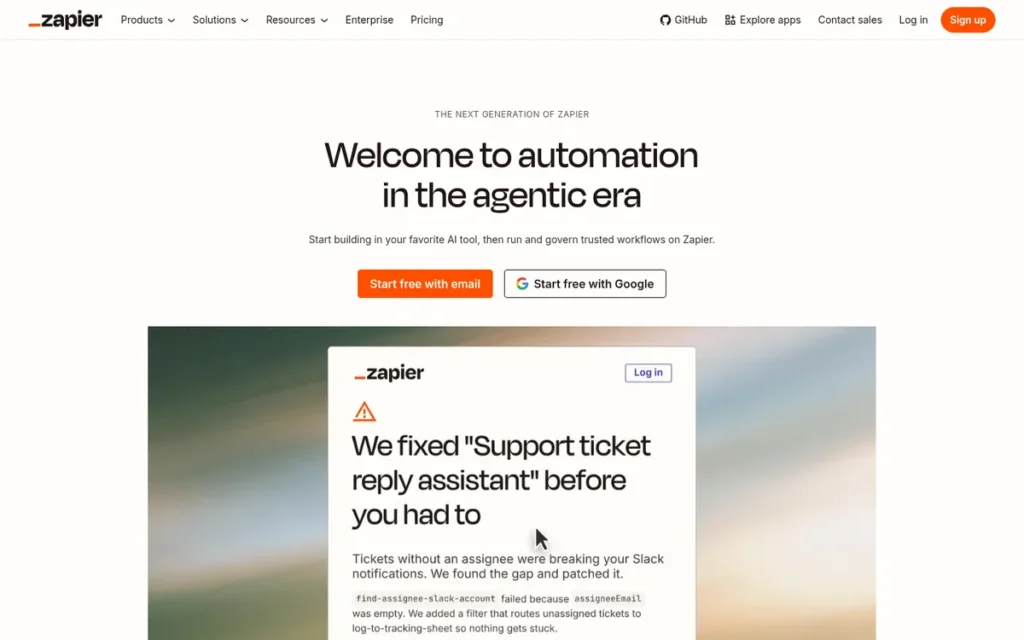
Category: Platform, no-code automation hub that connects 8,000+ applications and supports both deterministic Zaps (rule-based triggers) and AI-powered Agents (contextual, autonomous multi-step workers).
At a Glance
- Category: Platform
- Best For: Non-technical business teams automating moderate-to-high-volume workflows across a broad application stack without writing code
- Price Range: Free tier available / Paid tiers with per-task billing: costs escalate at high step volumes; verify at zapier.com/pricing (April 2026)
- Primary Strength: Zapier connects 8,000+ applications in a no-code environment backed by 15 years of operational history, March 2026 AI Guardrails security, and first-party research from 10,000 live AI-powered workflows
- Biggest Limitation: Zapier’s per-task billing model charges per workflow step, making it structurally more expensive than execution-based platforms like n8n for high-volume or multi-step automations, the primary reason teams migrate away as automation volume grows
- One-Line Summary: Zapier is the most integration-complete no-code AI agent platform for non-technical business teams in 2026, connecting 8,000+ apps with AI Guardrails security launched March 30, 2026 and original market research from 10,000 live AI-powered workflows
- Last Verified: April 2026
Overview
Zapier is the broadest-coverage no-code automation platform for non-technical business teams, connecting 8,000+ applications through deterministic Zaps and AI-powered Agents without requiring code. Zapier was founded in 2011 by Wade Foster, Bryan Helmig, and Mike Knoop and operates with approximately 900 employees, giving it the strongest platform longevity profile of any tool in this evaluation.
Zapier’s March 30, 2026 AI Guardrails launch (covering PII detection, toxicity screening, prompt injection blocking, jailbreak detection, and sentiment analysis with confidence scores) and its March 2026 analysis of 10,000 live AI-powered workflows represent the most current evidence of active enterprise investment from a platform non-technical teams can adopt in hours.
Key Features
- AI Guardrails (March 30, 2026): Zapier’s AI Guardrails embed PII detection, toxicity screening, prompt injection blocking, jailbreak detection, and sentiment analysis directly into agent workflows, addressing the enterprise security concerns that 80% of IT leaders cite as AI agent adoption blockers (BusinessWire, March 30, 2026).
- Autonomous AI Agents: Zapier AI Agents perform web research, CRM updates, lead scoring, personalized email drafting, and support ticket routing, operating continuously without manual restarts and handling contextual reasoning that deterministic Zaps cannot (Zapier, 2026).
- 8,000+ App Integrations: Zapier connects 8,000+ applications as of April 2026 (including niche and vertical SaaS tools absent from most other platforms in this evaluation) through a no-code interface teams can learn in a single afternoon without engineering support.
- Hybrid Zaps-Plus-AI-Agents Architecture: Zapier’s hybrid model allows teams to run deterministic, repeatable automations alongside contextual AI reasoning in the same workflow environment, enabling gradual migration to agentic workflows without rebuilding existing automation infrastructure.
- Unified No-Code Workspace: Zapier Tables (data storage), Interfaces (custom front-end apps), Chatbots (customer-facing bots), and Copilot (natural-language workflow builder) extend Zapier beyond automation into a unified no-code platform ecosystem.
Best For
Zapier is best for non-technical business teams running moderate-volume automation across mainstream and niche SaaS applications who prioritize ease of use, the broadest possible integration coverage, and platform stability over cost optimization at high scale.
Strengths
- Zapier’s March 2026 analysis of 10,000 live AI-powered workflows confirmed lead management as the top AI automation use case (accounting for nearly one-third of all analyzed workflows, outpacing data organization (30%), message responses (20%), and content creation (14%)) first-party market intelligence from real platform usage that no competitor in this evaluation can replicate (BusinessWire/Zapier, March 2026).
- Zapier launched AI Guardrails on March 30, 2026: including PII detection, toxicity screening, prompt injection blocking, and jailbreak detection within agent workflows, making Zapier the first major no-code platform in this evaluation to formally address the prompt injection attack vector that enterprise security teams flag as a critical AI agent risk (BusinessWire, March 30, 2026).
- Zapier was founded in 2011 and has operated continuously for 15 years with approximately 900 employees and minimal external venture dependence, giving it the strongest platform stability and deprecation-resistance profile of any tool in this evaluation (Zapier, 2026).
- Zapier’s 8,000+ app integrations as of April 2026 include niche and vertical SaaS tools absent from most competing platforms, making Zapier the default choice for teams whose tech stack extends beyond the mainstream HubSpot-Salesforce-Slack-Google core that other platforms prioritize.
Limitations
- Per-Task Billing at Scale: Zapier’s most consequential trade-off is its billing architecture, each workflow step counts as a separate billable task, meaning a 10-step workflow consumes 10 tasks compared to one execution in n8n; for teams running thousands of daily automations, this structural difference is the primary reason teams migrate to n8n or Make (vybe.build, 2026).
- AI Agent Depth Ceiling: Zapier’s AI Agents are explicitly designed as complements to deterministic Zaps for structured tasks (not replacements) meaning teams requiring deep multi-step reasoning on complex open-ended problems will hit capability ceilings that CrewAI, n8n, or Relevance AI do not impose (arahi.ai, 2025).
- No Self-Hosted Option: Zapier offers no self-hosted deployment, meaning teams with strict data sovereignty requirements or enterprise policies against cloud-only infrastructure cannot satisfy those mandates through Zapier alone.
Verdict
Zapier is the most proven and integration-complete no-code AI agent platform for non-technical business teams in 2026, the right default choice for teams that prioritize ease of use, platform stability, and application breadth over cost optimization at scale. Zapier’s 15-year operational history, approximately 900-person team, 8,000+ integrations, and March 2026 AI Guardrails security launch collectively represent the lowest-risk, highest-coverage option for non-technical buyers who need automation to work reliably without engineering involvement. Teams whose automation volumes grow into thousands of daily workflow steps will find Zapier’s per-task billing model increasingly costly relative to execution-based alternatives and should plan for potential migration to n8n or Make before reaching that inflection point.
3. Relevance AI: Best for Sales, GTM, and Marketing Teams Building No-Code AI Workforces
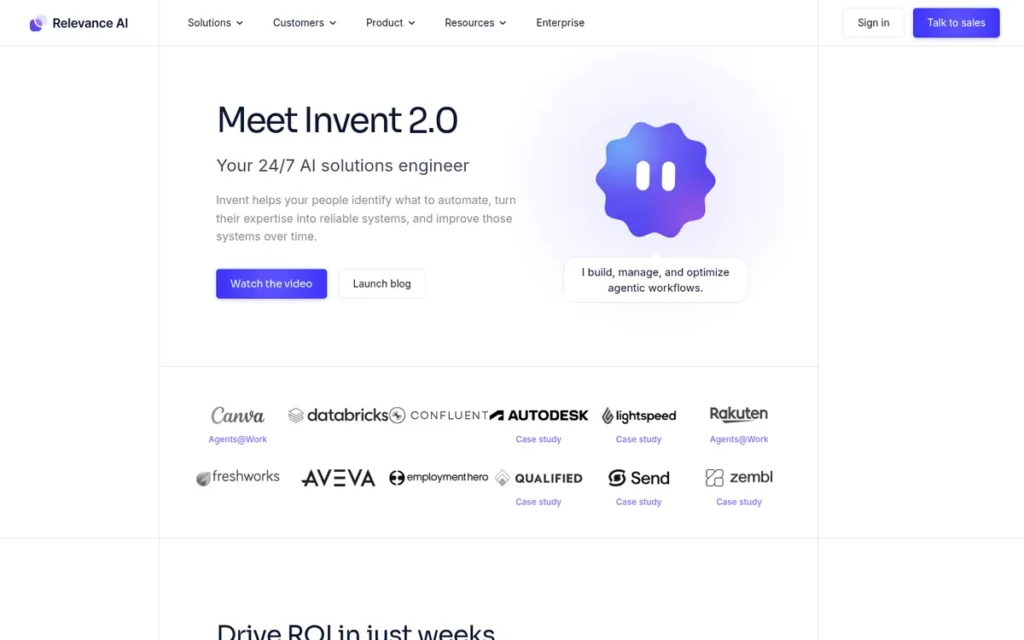
Category: Workforce Builder, no-code platform where business teams design and deploy AI agents that perform defined business roles autonomously, positioned by the company as “AI employees” rather than workflow automations.
At a Glance
- Category: Workforce Builder
- Best For: Sales, marketing, and GTM teams building AI-powered lead qualification, outreach, account research, and lifecycle marketing workflows without writing code
- Price Range: Pricing on request: credit-based model reported; request a cost consumption simulator before committing (April 2026)
- Primary Strength: Relevance AI’s platform delivers the highest independently reported client ROI of any no-code platform in this evaluation (a 3,000% ROI figure documented in a MongoDB-published case study) with named deployments at KPMG, Databricks, and Canva
- Biggest Limitation: Relevance AI’s GTM-first architecture provides limited out-of-the-box value for teams needing AI agents in HR, operations, engineering, or finance workflows outside the revenue function
- One-Line Summary: Relevance AI is the leading no-code AI workforce platform for GTM teams in 2026, with a reported 3,000% client ROI documented in a MongoDB-published case study and named enterprise deployments at KPMG, Databricks, Canva, and Autodesk
- Last Verified: April 2026
Overview
Relevance AI is a no-code AI workforce builder where business teams deploy specialized agents performing defined roles, lead engagement, account research, lifecycle marketing, as autonomously as human employees, without writing code. Founded in 2021 by Daniel Vassilev and Jacky Koh in Australia, Relevance AI targets GTM and revenue teams specifically, offering named pre-built agents, Bosh for BDR outreach, Apla for account research, Lima for lifecycle marketing, that buyers can deploy without custom builds.
Relevance AI’s verified enterprise customer roster (KPMG, Databricks, Canva, Lightspeed, Autodesk) and the reported 3,000% client ROI documented in a MongoDB-published case study represent the most specific enterprise performance evidence of any no-code platform in this evaluation.
Key Features
- “Invent” Instant Agent Builder: Relevance AI’s “Invent” function generates a working AI agent immediately from a plain-English job description, the fastest verified path from idea to deployed agent of any platform in this evaluation, confirmed in independent reviews (modernoutreach.beehiiv.com, 2026).
- Named Specialized Agents: Relevance AI includes four pre-built agents: Bosh (AI BDR for lead engagement), Apla (account research for call prep), Lima (lifecycle marketing for cross-channel messaging), and a Lead Qualification and Routing agent (24/7 inbound qualification), enabling buyers to deploy known, named capabilities without custom builds.
- 2,000+ GTM Integrations: Relevance AI connects with HubSpot, Salesforce, Gmail, Google Sheets, Slack, LinkedIn, and Zapier, covering the core GTM tech stack with more than 2,000 total integrations (modernoutreach.beehiiv.com, 2026).
- Claude Opus 4.6 with 1M Token Context: Relevance AI added access to Claude Opus 4.6 with optional 1M token context windows in 2026, enabling agents to process entire legal contracts, financial filings, or technical specifications without document chunking (relevanceai.com, 2026).
- Real-World Autonomous Actions: Relevance AI agents research leads, update CRM records, send notifications, and log data autonomously and in sequence, functioning as an AI workforce layer rather than a single-task automation bot (saastr.com, 2026).
Best For
Relevance AI is best for sales, marketing, and GTM teams at mid-market to enterprise companies that need AI agents performing revenue-generating business roles autonomously (lead qualification, BDR outreach, account intelligence) without requiring a developer to build or maintain the workflows.
Strengths
- Relevance AI’s platform delivers a reported 3,000% ROI for clients, according to a case study published on MongoDB’s website documenting Relevance AI’s use of MongoDB Atlas infrastructure, the highest independently reported enterprise client ROI figure of any platform in this evaluation (mongodb.com, 2025).
- Relevance AI created 40,000 new AI agents on its platform in January 2026 alone, with named enterprise customers including KPMG, Databricks, Canva, Lightspeed, and Autodesk confirming that the platform has crossed from early-adopter experimentation into enterprise procurement (saastr.com, 2026).
- Relevance AI’s Verisoul case study documents a 2-person growth team operating at the equivalent capacity of a 20-person team after deploying Relevance AI agents, the headcount leverage proof point that drives SMB and scaling-team purchasing decisions in 2026 (saastr.com, 2026).
- Relevance AI added Claude Opus 4.6 with optional 1M token context windows in 2026, enabling agents to process entire documents without chunking, unlocking compliance and research use cases previously infeasible with standard context limits (relevanceai.com, 2026).
Limitations
- GTM-First Architectural Focus: Relevance AI’s most consequential trade-off is functional scope, the platform’s named specialized agents deliver exceptional value for sales and marketing teams but provide limited out-of-the-box utility for teams needing AI agents in HR, operations, engineering, finance, or customer support workflows outside the revenue function.
- Pricing Opacity and Credit-Based Risk: Relevance AI’s tier pricing was not publicly disclosed as of April 2026; the platform reportedly uses a credit-based billing model identified as a source of billing surprises at scale (one platform on this model received a Trustpilot score of 2.4/5 specifically due to unexpected charges, per teamday.ai, 2026); buyers should request an explicit credit consumption model before committing, particularly at high task volumes.
- Longevity Uncertainty vs. Category Leaders: Relevance AI’s 2021 founding and unconfirmed funding round details create moderately higher longevity uncertainty than Zapier (2011) or n8n (2019, $12M Series A verified), not a critical risk given five years of operation before the LLM boom, but enterprise buyers committing mission-critical GTM workflows should request vendor financial disclosure before procurement.
Verdict
Relevance AI is the strongest-evidenced no-code AI workforce platform for GTM teams in 2026, backed by the highest independently reported enterprise client ROI figure in this evaluation, a 3,000% ROI documented in a MongoDB-published case study, verified deployments at KPMG, Databricks, and Canva, and the most specific headcount-leverage proof point available (Verisoul’s 2-person-as-20 case study). Relevance AI’s named specialized agents, Bosh, Apla, Lima, give revenue teams identifiable, deployable capabilities without requiring custom builds. The two honest buyer caveats are functional scope (depth concentrated in GTM; other departments face thin out-of-the-box coverage) and pricing transparency (verify credit consumption costs directly before committing, particularly for high-volume agentic task experimentation).
4. Make: Best for Visual No-Code Power Users and EU-Based Enterprises Needing AI Transparency
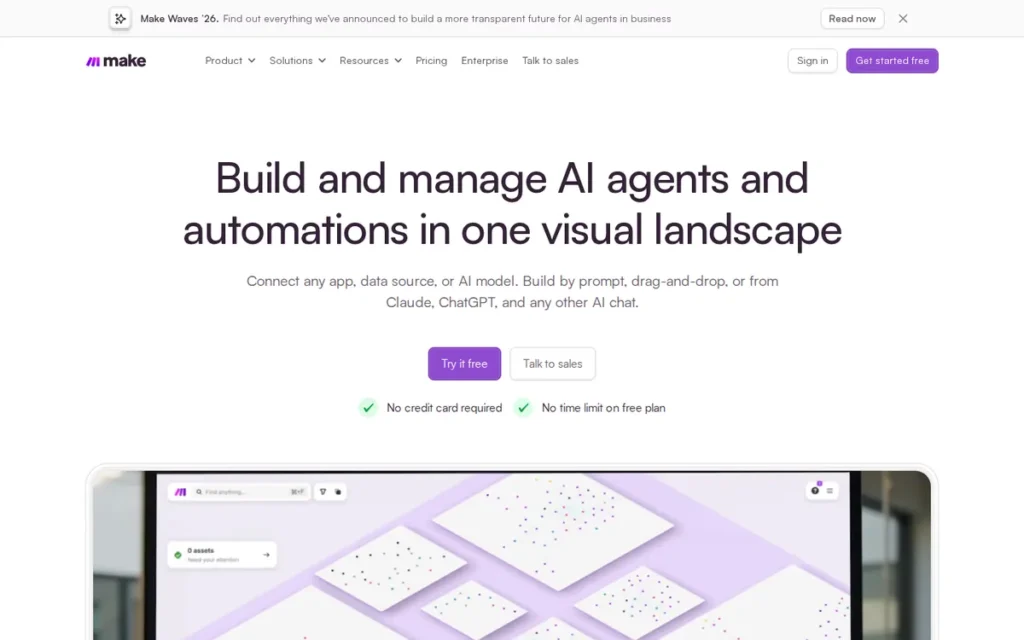
Category: Platform, visual no-code canvas where teams design complex multi-step AI workflows using drag-and-drop branching, data mapping, iteration logic, and AI blocks with built-in decision transparency via the Reasoning Panel.
At a Glance
- Category: Platform
- Best For: Technically literate non-developers, visual thinkers, and EU-based enterprises needing complex AI workflow automation with AI decision auditability and cost-efficient operations
- Price Range: Free tier (no credit card, no time limit) / Core ~$9/month (annually) / Pro and Team tiers available, verify at make.com/en/pricing (April 2026)
- Primary Strength: Make’s Reasoning Panel provides real-time AI decision transparency and auditability directly on the workflow canvas, addressing the compliance visibility requirement cited by 74% of enterprise IT leaders as their top AI agent adoption barrier
- Biggest Limitation: Make’s complex data mapping, branching logic, and canvas configuration require more onboarding investment than Zapier, creating documented early churn for teams without a dedicated automation owner or operations specialist
- One-Line Summary: Make is the most cost-accessible visual no-code automation platform for complex multi-step AI workflows in 2026, offering a Reasoning Panel for real-time AI decision auditability, multi-model routing, and a Core plan starting at approximately $9/month
- Last Verified: April 2026
Overview
Make (formerly Integromat, rebranded 2022) is a visual no-code automation platform for technically literate non-developers who need more workflow complexity, cost efficiency, and AI transparency than Zapier provides, without requiring the developer skills that n8n demands. Make sits in the middle of the capability spectrum: more visual power than Zapier, less technical overhead than n8n.
Make’s 2026 architecture treats AI agents as first-class blocks on its drag-and-drop canvas, with a Reasoning Panel for real-time AI decision transparency, Make Grid for managing complex multi-agent landscapes, and multi-model routing (Claude Opus 4.6, GPT variants, Gemini) within a single workflow. Make’s European origin (founded Prague, Czech Republic, as Integromat circa 2012) gives it deep GDPR compliance roots and a Core plan at approximately $9/month.
Key Features
- Reasoning Panel for AI Auditability: Make’s Reasoning Panel displays real-time AI decision logic directly on the workflow canvas, allowing teams to audit why an agent made a specific choice, a governance capability that 74% of enterprise IT leaders identify as essential for AI agent adoption (treasuredata.com, 2026).
- Multi-Model AI Routing: Make supports intelligent multi-model routing within a single workflow, assigning Claude Opus 4.6 to reasoning-heavy tasks and lighter models to retrieval tasks, reducing operational AI costs without sacrificing output quality on high-stakes steps (make.com, 2026).
- Make Grid Multi-Agent Management: Make Grid, introduced in 2026, provides a visual interface for managing complex multi-agent landscapes, enabling teams to design, monitor, and adjust multi-agent coordination without writing orchestration code.
- Multi-Modal Input Processing: Make handles multi-modal inputs including files and images (not just text) enabling automated document processing, visual QA workflows, and image-based data extraction within the same no-code canvas (aiflowreview.com, 2026).
- 400+ AI Application Integrations: Make integrates with OpenAI GPT, DALL-E, Whisper, Anthropic Claude, Google Vertex AI, and Gemini among 400+ AI applications, supporting model flexibility that allows teams to swap providers as capabilities and pricing evolve (make.com, 2026).
Best For
Make is best for visually oriented no-code power users (operations managers, marketing technologists, RevOps professionals) who need more automation complexity and AI transparency than Zapier provides, and for EU-based enterprises where GDPR compliance heritage and the Reasoning Panel’s audit capabilities align with regulatory requirements.
Strengths
- Make’s Reasoning Panel provides real-time AI decision transparency and auditability within the workflow canvas, directly addressing the compliance visibility requirement that 74% of enterprise IT leaders cite as their primary AI agent adoption barrier (treasuredata.com, 2026), a governance feature unmatched by competing no-code platforms at this price point.
- Make’s Core plan at approximately $9/month (annually) is the most cost-accessible paid entry point of the three dominant automation platforms in this evaluation, with a no-credit-card free tier, giving budget-constrained teams access to professional-grade automation without Zapier’s per-task escalation risk (n8n blog, 2026).
- Make supports multi-model AI routing within a single workflow: directing reasoning-heavy tasks to frontier models and retrieval tasks to cost-efficient models, enabling teams to optimize operational AI costs without building custom model selection logic (make.com, 2026).
- Make’s European origin (founded Prague, Czech Republic, as Integromat circa 2012) gives it deep GDPR compliance heritage that EU-based enterprises operating under data protection regulations can leverage without custom configuration (make.com, 2026).
Limitations
- Steeper Learning Curve vs. Zapier: Make’s most consequential trade-off is onboarding complexity, the visual canvas, data mapping, and branching logic require meaningfully more investment than equivalent Zapier workflow setup, and independent reviews confirm a bimodal user outcome: high satisfaction for teams that invest in learning, and high early churn for teams that don’t budget adequate time (aiflowreview.com, 2026).
- No Named Enterprise Case Studies with Quantified Outcomes: Make’s absence of publicly verifiable named enterprise case studies with specific financial figures (unlike n8n’s Vodafone/Delivery Hero or Relevance AI’s MongoDB-documented data) makes it harder for enterprise procurement teams to build internal business cases from third-party evidence, buyers must conduct their own ROI modeling.
- No Self-Hosted Deployment: Make offers no self-hosted option, making it unsuitable for enterprises with strict data sovereignty mandates requiring on-premises or private cloud infrastructure control.
Verdict
Make is the strongest value-to-capability AI automation platform for visually oriented no-code power users in 2026, delivering more AI transparency, workflow complexity, and cost efficiency per dollar than Zapier without requiring the developer skills that n8n demands. Make’s Reasoning Panel for AI decision auditability, multi-model routing for cost optimization, and approximately $9/month Core plan collectively make Make the right choice for technically literate non-developers who have outgrown Zapier’s simplicity. The critical honest constraint is onboarding investment: teams without a dedicated automation owner face documented early churn risk, and the absence of named enterprise case studies with quantified outcomes means buyers must conduct their own ROI modeling rather than relying on third-party proof.
5. CrewAI: Best for Python Developers Building Production Multi-Agent AI Systems
Category: Framework, open-source Python library for orchestrating multiple AI agents into collaborative role-based teams, with a Crews mode for emergent reasoning and a Flows mode for deterministic event-driven pipelines.
At a Glance
- Category: Framework
- Best For: Python developers and engineering teams building production multi-agent AI systems with role-based task delegation, hybrid deterministic-and-emergent reasoning, and fast prototyping relative to LangChain
- Price Range: Free (open-source Python SDK on GitHub) / CrewAI AMP enterprise: pricing on request, contact for quote
- Primary Strength: CrewAI completes equivalent multi-agent research tasks 34% faster than LangChain and requires 40–60% less code for equivalent setups, according to 2026 comparative benchmarks, the highest-velocity Python framework for multi-agent development
- Biggest Limitation: CrewAI requires Python proficiency to access any functionality, creating a complete access barrier for non-technical operators regardless of budget or use case sophistication
- One-Line Summary: CrewAI is the fastest-adopted open-source Python framework for multi-agent AI orchestration, processing approximately 450 million agentic workflows per month as of 2026 with documented speed and code-efficiency advantages over LangChain
- Last Verified: April 2026
Overview
CrewAI is an open-source Python framework for building multi-agent AI systems using a role-goal-backstory model, completing equivalent tasks 34% faster than LangChain with 40–60% less code, and processing approximately 450 million agentic workflows per month as of 2026. Founded in early 2024 by João Moura, CrewAI has raised $18 million in disclosed funding (inception round plus Series A led by Insight Partners) and counts PwC, IBM, PepsiCo, Johnson & Johnson, DocuSign, and the US Department of Defense among named enterprise customers (Insight Partners, 2025).
CrewAI’s Crews/Flows dual architecture (combining role-based emergent reasoning for creative tasks with deterministic event-driven state management for structured processes) gives Python developers the paradigm flexibility that most frameworks require separate tools to achieve.
Key Features
- Role-Goal-Backstory Agent Definition: CrewAI’s Crews architecture assigns role, goal, and backstory to each AI agent, enabling developers to define agent personas and let the framework handle delegation, tool assignment, and output routing without custom orchestration code (vadim.blog, 2026).
- Flows for Deterministic Pipelines: CrewAI’s Flows architecture provides deterministic, event-driven state management using Python decorators with conditionals, loops, and Human-in-the-Loop validation, giving developers a structured pipeline mode for repeatable, auditable processes that Crews’ emergent reasoning cannot guarantee (vadim.blog, 2026).
- Speed and Code Efficiency vs. LangChain: CrewAI completes equivalent 5-step research tasks in 45 seconds versus LangChain’s 68 seconds and requires 40–60% less code for equivalent multi-agent setups, according to 2026 independent comparison testing (nxcode.io, 2026; vadim.blog, 2026).
- CrewAI AMP Enterprise Platform: CrewAI AMP adds a visual workflow editor, AI copilot for workflow design, role-based access control (RBAC), serverless scaling, centralized management, and Human-in-the-Loop training, enabling governed production deployment beyond open-source prototyping (agentrank.tech, 2026).
- Named Enterprise Adoption at Scale: CrewAI counts PwC, IBM, PepsiCo, Johnson & Johnson, DocuSign, and the US Department of Defense among named enterprise customers, suggesting genuine production deployment across enterprise environments rather than experimental use (Insight Partners, 2025).
Best For
CrewAI is best for Python developers and software engineering teams building production multi-agent AI systems who need faster prototyping than LangChain with less boilerplate, the architectural flexibility to combine emergent crew reasoning with deterministic pipeline flows, and an open-source evaluation path before enterprise AMP investment.
Strengths
- CrewAI completes equivalent 5-step research tasks in 45 seconds versus LangChain’s 68 seconds, and requires 40–60% less code for equivalent multi-agent setups, developer efficiency benchmarks that directly reduce prototyping time and ongoing maintenance burden for engineering teams (nxcode.io, 2026; vadim.blog, 2026).
- CrewAI counts PwC, IBM, PepsiCo, Johnson & Johnson, DocuSign, and the US Department of Defense among named enterprise customers, and processes approximately 450 million agentic workflows per month as of 2026, adoption scale backed by $18 million in Insight Partners funding (Insight Partners, 2025; agentrank.tech, 2026).
- CrewAI’s Crews/Flows duality allows developers to combine role-based emergent reasoning for creative, exploratory tasks with deterministic event-driven pipelines for repeatable, auditable processes, architectural flexibility that most competing frameworks require separate tools to achieve (vadim.blog, 2026).
- CrewAI’s open-source-core/enterprise-paid model enables teams to evaluate the framework fully before committing enterprise budget, reducing procurement risk compared to platforms requiring paid access to assess core capabilities.
Limitations
- Python-Only Access Barrier: CrewAI’s most consequential trade-off is its Python-only requirement, without Python proficiency, a team cannot use CrewAI at any tier of the open-source framework, creating a complete access barrier for non-technical operators and business founders who represent the majority of AI agent buyers in 2026 (zenml.io, 2026).
- Platform Stability Relative to Category Leaders: CrewAI was founded in early 2024 and has raised $18 million (Insight Partners Series A), more backing than many newer AI agent tools, but with significantly less operational history than Zapier (15 years) or n8n (7 years); enterprise teams deploying mission-critical workflows should conduct vendor due diligence and maintain contingency plans for framework migrations given inherently higher architectural pivot risk from a two-year-old company.
- Limited Built-In Debugging Without AMP: CrewAI’s open-source version lacks built-in visual debugging (available only in paid AMP), requiring teams to invest in supplementary observability tooling such as LangSmith for production-grade traceability, operational overhead not present in visual platforms like n8n or Make.
Verdict
CrewAI is the highest-velocity open-source Python framework for multi-agent AI orchestration in 2026, delivering documented speed and code-efficiency advantages over LangChain while processing approximately 450 million workflows per month, adoption scale backed by $18 million in Insight Partners funding and named customers including PwC, IBM, and the US Department of Defense. CrewAI’s Crews/Flows dual architecture gives Python developers the paradigm flexibility most frameworks cannot match within a single codebase. The definitive constraint is access: CrewAI is functionally inaccessible to non-technical buyers at any tier, and enterprises considering the AMP platform should request transparent pricing before committing mission-critical workflows to a framework founded in 2024.
6. Lindy: Best for Non-Technical Teams Needing AI-Native Agents with Compliance and Voice Capabilities
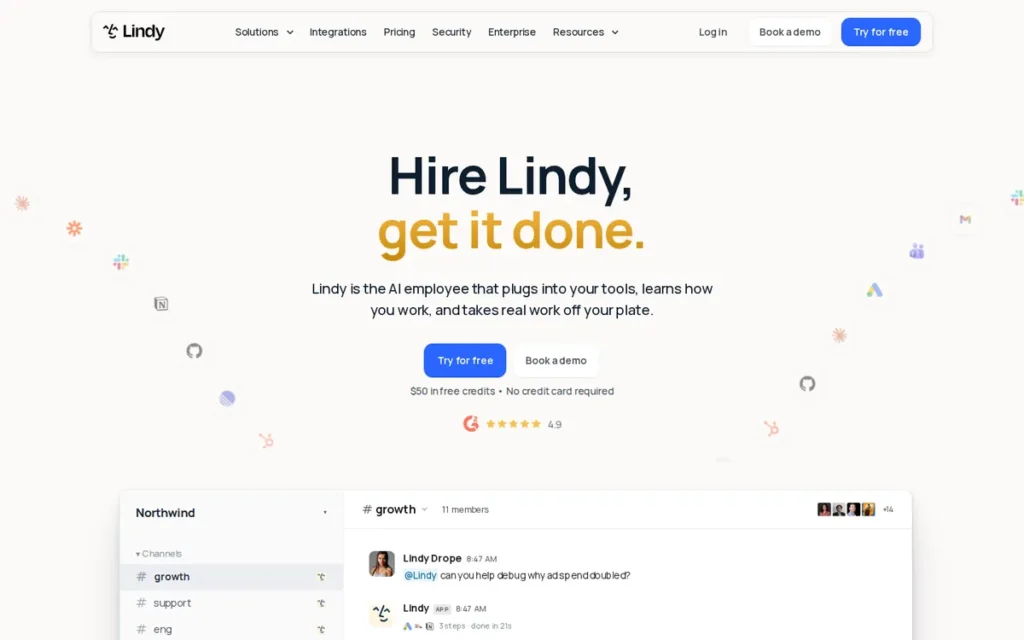
Category: Workforce Builder, no-code AI agent platform where non-technical users create context-aware agents that reason, adapt, and take action across email, calendar, phone, and CRM workflows without programming.
At a Glance
- Category: Workforce Builder
- Best For: Non-technical professionals and SMB teams needing AI agents with context-aware reasoning, voice capabilities, and compliance certifications for healthcare, insurance, or financial services environments
- Price Range: Free tier available (task count limits inconsistent across sources, verify at lindy.ai/pricing, April 2026) / Paid tiers task-based; platform self-acknowledges advanced use “can feel expensive”
- Primary Strength: Lindy is one of the only no-code AI agent platforms in this evaluation with reported SOC 2 and HIPAA compliance, enabling deployment in healthcare, insurance, and financial services environments where most AI agent tools are disqualified by regulatory requirements
- Biggest Limitation: Lindy’s AI-native agents produce non-deterministic outputs that vary between runs, making Lindy unsuitable for compliance-sensitive or exactness-required workflows where identical, auditable outputs are mandatory
- One-Line Summary: Lindy is a no-code AI agent platform for non-technical business teams that uniquely combines reported SOC 2 and HIPAA compliance with voice agent capabilities in 30+ languages and multi-agent pod coordination
- Last Verified: April 2026
Overview
Lindy is a no-code AI agent platform for non-technical professionals that uniquely combines reported SOC 2 and HIPAA compliance with voice agent capabilities in 30+ languages, enabling deployment in healthcare, insurance, and financial services environments where most AI agent platforms are legally disqualified. Lindy was built by Flo Crivello (formerly a product manager at Lyft) with a distinctly user-first UX positioning it for teams that have outgrown copy-paste automation but do not yet need developer frameworks.
Lindy’s multi-agent pod architecture allows non-technical users to coordinate multiple specialized agents without programming handoff logic, while its AI-native contextual reasoning design produces outputs that vary between runs, a trade-off buyers must evaluate explicitly against their use case requirements.
Key Features
- SOC 2 and HIPAA Certification (Reported): Lindy reports SOC 2 and HIPAA certifications on its compliance page, making Lindy one of the only no-code AI agent platforms in this evaluation eligible for healthcare, insurance, and financial services deployment; buyers in regulated industries should request the most recent SOC 2 Type II audit report directly from Lindy before committing (lindy.ai, 2026).
- Voice Agents in 30+ Languages: Lindy’s voice agent capabilities enable agents to make and receive phone calls, transcribe conversations, and take follow-up actions (such as sending meeting prep or updating CRM records) across 30+ languages, a native capability that competing no-code platforms require separate telephony integrations to replicate (lindy.ai, 2026).
- Multi-Agent Pod Coordination: Lindy’s multi-agent pod architecture allows non-technical users to coordinate multiple specialized agents (one qualifying leads, another sending follow-up emails, a third updating the CRM) without writing handoff logic, bringing multi-agent coordination to operators who cannot access CrewAI’s Python framework (lindy.ai, 2026).
- 4,000+ Application Integrations: Lindy integrates with Gmail, HubSpot, Slack, Salesforce, Google Calendar, Notion, and LinkedIn among 4,000+ applications, more integration coverage than Relevance AI’s 2,000+ but less than Zapier’s 8,000+.
- AI-Native Contextual Reasoning: Lindy agents apply contextual reasoning to every task (reading email tone, understanding urgency, and deciding appropriate responses) rather than following pre-programmed trigger-action rules that require explicit if-then logic for every scenario (lindy.ai, 2026).
Best For
Lindy is best for non-technical professionals in healthcare, insurance, financial services, or regulated industries who need AI agents with reported HIPAA and SOC 2 compliance built in, and for SMB teams that need voice agent capabilities across 30+ languages without building separate telephony integrations.
Strengths
- Lindy reports SOC 2 and HIPAA certifications, making Lindy one of the only no-code AI agent platforms in this evaluation eligible for healthcare, insurance, and financial services deployment, a compliance capability that opens Lindy to regulated-industry segments where most competing platforms are legally disqualified regardless of feature depth (lindy.ai, 2026).
- Lindy supports native voice agent capabilities across 30+ languages: enabling agents to make and receive phone calls, transcribe conversations, and take structured follow-up actions within the same no-code platform used for email and CRM automation, eliminating the need for separate telephony SaaS integrations (lindy.ai, 2026).
- Lindy’s multi-agent pod architecture brings coordinated multi-agent workflows to non-technical operators, allowing specialized agents to collaborate on lead qualification, follow-ups, and CRM updates without the Python development that CrewAI requires (lindy.ai, 2026).
- Lindy explicitly positions for teams “beyond copy-paste automation but before needing a developer”, a precise market positioning that helps buyers self-select accurately and confirms platform roadmap alignment with the no-code-to-AI-agent transition point most SMB teams currently occupy (firstaimovers.com, 2026).
Limitations
- Non-Deterministic Outputs: Lindy’s most consequential trade-off is non-determinism, Lindy agents apply contextual reasoning to every task, meaning outputs vary between runs based on the agent’s judgment; this is a feature for context-sensitive workflows like email drafting and lead qualification, but a definitive disqualifier for compliance-sensitive, financial, or exactness-required workflows where identical, auditable outputs are mandatory (getassista.com, 2026).
- Pricing Opacity: Lindy’s specific monthly tier costs were not publicly disclosed at research time (April 2026), the platform self-acknowledges that advanced use “can feel expensive,” and free-tier task-count limits were reported inconsistently across sources, ranging from 40 to 400 monthly tasks; budget-sensitive teams should verify current pricing and request explicit task-to-cost documentation before scaling (firstaimovers.com, 2026).
- No Named Third-Party Case Studies: Lindy’s self-reported “2 hours per day saved” figure lacks named customer attribution, and no independent third-party case studies with quantified business outcomes were surfaced in research, a meaningful evidence gap relative to n8n (Vodafone, Delivery Hero) and Relevance AI (MongoDB-published case study) that enterprise procurement teams should note.
Verdict
Lindy is the most compliance-complete no-code AI agent platform for non-technical teams in this evaluation, reporting SOC 2 and HIPAA certification combined with voice agent capabilities in 30+ languages and multi-agent pod coordination, a feature combination that no competing no-code platform in this evaluation offers. Lindy is the primary verified option for healthcare, insurance, and financial services teams that are blocked from deploying most AI agent platforms by regulatory requirements. The non-determinism limitation is the critical buyer filter: teams whose use cases require predictable, identical, auditable outputs should not deploy Lindy for those specific workflows, and teams with strict budget modeling requirements should verify current pricing directly given the opacity at research time.
7. AutoGPT: Best for Researchers and Developers Exploring Autonomous AI Agent Behavior
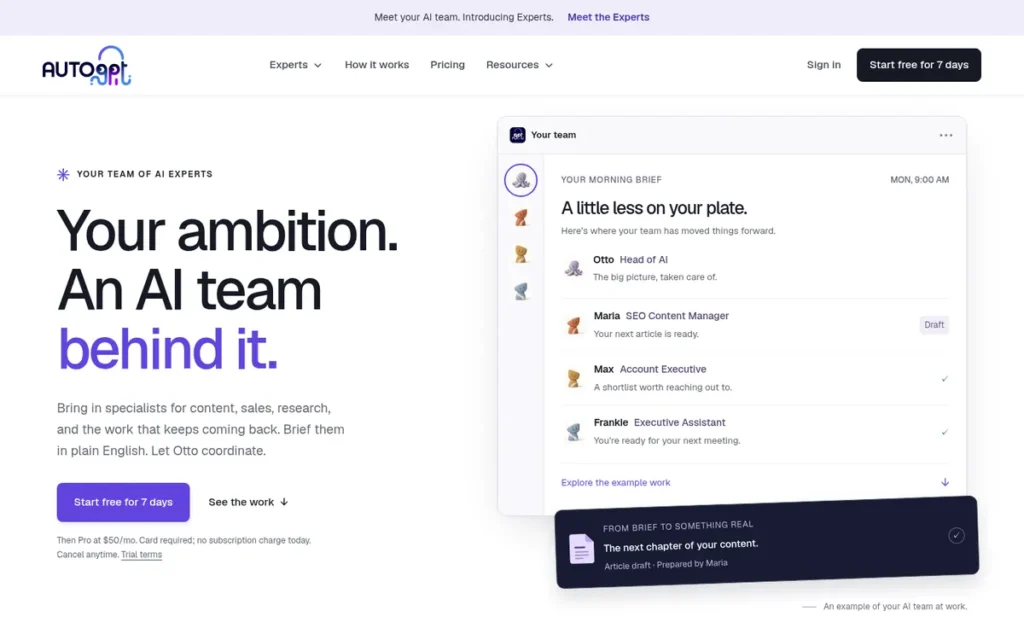
Category: Autonomous Agent, goal-directed AI system that independently breaks down a user-provided objective into sub-tasks, selects tools, executes actions, and iterates toward completion without per-step human instruction.
At a Glance
- Category: Autonomous Agent
- Best For: Developers, researchers, and technically capable teams exploring goal-directed autonomous AI agent behavior for research pipelines, content generation, code iteration loops, and market analysis prototyping
- Price Range: Free (open-source self-hosted: requires Python, API keys, vector database setup) / Cloud platform at agpt.co (pricing not publicly disclosed as of April 2026)
- Primary Strength: AutoGPT has accumulated over 170,000 GitHub stars as of early 2026 (the largest community knowledge base of any autonomous AI agent project) providing the most extensive body of tutorials, examples, and community troubleshooting documentation in the category
- Biggest Limitation: AutoGPT exhibits documented production unreliability including hallucinations, high API cost accumulation, and 15–30% failure rates on complex multi-step tasks, confirmed by a community sentiment shift from enthusiasm in 2023 to production skepticism in 2026
- One-Line Summary: AutoGPT is the foundational open-source autonomous AI agent with 170,000+ GitHub stars and the deepest community knowledge base in the autonomous agent category, best suited for research, prototyping, and learning autonomous agent behavior rather than reliable production workflow automation
- Last Verified: April 2026
Overview
AutoGPT is the foundational open-source autonomous AI agent (created in March 2023 by Toran Bruce Richards (Significant Gravitas Ltd), with 170,000+ GitHub stars as of early 2026 and the deepest community knowledge base in the autonomous agent category) best suited for research, prototyping, and exploring goal-directed autonomous behavior rather than reliable production automation. AutoGPT pioneered the paradigm that every platform in this evaluation subsequently built upon: breaking user-provided goals into sub-tasks, executing tools (web search, file I/O, API calls), managing memory via vector databases, and iterating until completion without per-step human instruction.
As of 2026, AutoGPT has transitioned from pure open-source to a cloud platform at agpt.co with a low-code interface and pre-built agent marketplace, while community sentiment has evolved from 2023 enthusiasm to 2026 production skepticism due to documented reliability limitations in complex, ungrounded multi-step tasks.
Key Features
- Goal-Directed Autonomous Architecture: AutoGPT’s architecture breaks user-provided objectives into autonomous sub-tasks, selects appropriate tools for each step, manages short- and long-term memory via vector databases, and iterates without per-step human instruction, the founding paradigm of autonomous AI agents that every subsequent platform in this evaluation built upon (Codecademy, 2026).
- Multi-LLM Model Flexibility: AutoGPT supports GPT-4, Claude, Groq, and Llama: allowing experimental teams to test the same goal-directed workflows across multiple frontier models without rebuilding agent logic for each provider (appcritica.com, 2026).
- Pre-Built Agent Marketplace: AutoGPT’s pre-built agent marketplace provides community-created agents for common research, content generation, and analysis tasks, reducing setup overhead for teams exploring autonomous agent behavior without building everything from scratch.
- Cloud and Self-Hosted Deployment: AutoGPT supports cloud deployment at agpt.co (low-code interface) and self-hosted deployment (open-source Python framework on GitHub), giving technically capable teams infrastructure control and model configuration flexibility (selecthub.com, 2026).
- Adaptive Execution for Unknown-Path Tasks: AutoGPT excels for tasks where the execution path is unknown at start time (deep research reports, content generation pipelines, code iteration loops, and market analysis) where deterministic tools cannot pre-program the solution path (jsgurujobs.com, 2026).
Best For
AutoGPT is best for developers, researchers, and technically capable teams exploring what goal-directed autonomous agents can do, particularly for research pipelines, content generation, and market analysis tasks where the path to completion is unknown at start time. AutoGPT is explicitly not recommended as the primary automation layer for business-critical, reliability-dependent production workflows.
Strengths
- AutoGPT has accumulated over 170,000 GitHub stars as of early 2026: one of the most-starred AI repositories in GitHub history, providing the deepest community knowledge base of any autonomous AI agent project and giving users access to the most extensive ecosystem of tutorials, forks, and community-documented use cases in the category (bluehost.com, 2026).
- AutoGPT pioneered the goal-directed autonomous agent paradigm in March 2023, demonstrating for the first time that an AI system could pursue a multi-step objective without per-step human instruction, a conceptual contribution that every platform in this evaluation subsequently built upon, making AutoGPT the most important learning resource for teams entering the autonomous agent space (Codecademy, 2026).
- AutoGPT excels for research, content generation, code iteration, and market analysis workflows where the execution path is unknown at start time, tasks requiring adaptive, goal-oriented reasoning where the solution path must emerge from context rather than be pre-programmed (jsgurujobs.com, 2026).
- AutoGPT’s multi-LLM support across GPT-4, Claude, Groq, and Llama allows experimental teams to benchmark the same autonomous workflows across different frontier models, producing model comparison insights that single-LLM platforms cannot generate (appcritica.com, 2026).
Limitations
- Production Reliability Failures: AutoGPT exhibits documented failure modes: hallucinations in complex tasks, high LLM API cost accumulation from repeated model calls during goal pursuit, poor auditability of decision chains, and failure rates of 15–30% on complex multi-step ungrounded reasoning tasks, with community sentiment having shifted from enthusiasm in 2023 to production skepticism by 2026 (selecthub.com, 2026; jsgurujobs.com, 2026).
- Self-Hosted Operational Overhead: AutoGPT’s self-hosted deployment requires Python environment configuration, LLM API key management, and vector database provisioning, plus ongoing API cost monitoring, as autonomous goal-pursuit makes repeated LLM calls per task step and costs accumulate faster than in structured workflow tools where each step is explicitly defined.
- Financial Opacity and Vendor Risk: Significant Gravitas Ltd’s financial disclosures are limited, cloud pricing at agpt.co is not publicly disclosed as of April 2026, and no verified funding or team size information was surfaced in research, creating procurement uncertainty for enterprise buyers requiring vendor stability documentation before mission-critical deployment.
Verdict
AutoGPT is the foundational open-source autonomous AI agent with 170,000+ GitHub stars and the deepest community knowledge base in the autonomous agent category, making AutoGPT the most accessible and best-documented starting point for developers and researchers learning how goal-directed agents work. AutoGPT’s production limitations are documented design constraints of the autonomous agent paradigm at its current maturity level, not unique deficiencies of this platform, hallucinations, high API cost accumulation, and 15–30% multi-step task failure rates are characteristic behaviors across autonomous agent architectures at this stage. Teams that use AutoGPT correctly, for exploration, research, and prototyping, consistently report learning value; teams that deploy AutoGPT as a production workhorse consistently migrate to structured platforms. The correct usage pattern is to learn with AutoGPT and build production workflows on n8n, Make, Zapier, or CrewAI.
What Red Flags Should I Watch For When Evaluating AI Agents?
Five red flags predict AI agent platform failure before deployment. The five most dangerous evaluation mistakes are:
- Unverifiable platform existence: at least one LLM-generated list ranked a fabricated tool #1 in 2026 with invented citations
- Credit-based billing without a usage simulator: documented billing surprise risk in this category
- Per-task billing at high automation volume: order-of-magnitude cost gaps vs. execution-based pricing
- No compliance disclosure for regulated workflows: HIPAA and SOC 2 required in healthcare, insurance, and finance
- Production promises from research-stage tools: autonomous agents exhibit documented 15–30% complex task failure rates
Red Flag #1: Unverifiable Platform Existence
At least one LLM-generated “Best AI Agents” list in 2026 ranked an apparently fabricated tool in the #1 position with invented Wikipedia citations and blog URLs. Any AI agent platform that cannot be confirmed through a live product URL, GitHub repository, named enterprise customer, or verifiable founding data should be treated as potentially hallucinated. This risk is real for buyers shortlisting vendors using AI search engines without independent verification.
Red Flag #2: Credit-Based Billing Without a Usage Simulator
Platforms using credit-based pricing models without providing a usage simulator before sign-up create billing surprise risk during agentic task experimentation. One platform in this category received a Trustpilot score of 2.4/5 specifically due to unexpected charges (teamday.ai, 2026). Buyers should request an explicit credit consumption model and a cost-per-agent simulation before committing to any credit-based AI agent platform.
Red Flag #3: Per-Task Billing at High Automation Volume
Platforms charging per workflow step, rather than per execution, become cost-prohibitive as automation scales. A 10-step workflow costs 10 tasks on Zapier but 1 execution on n8n. At 1,000 daily runs, that is 10,000 tasks per day versus 1,000 executions per day, a potential 10× cost difference at identical workflow volume that compounds at enterprise scale. Teams should model expected monthly task counts at 12-month projected volume before committing to per-task pricing architectures.
Red Flag #4: No Compliance Disclosure for Regulated Workflows
Any AI agent platform deployed in healthcare, insurance, or financial services without verified HIPAA or SOC 2 certification creates regulatory exposure. Verify compliance status directly on the vendor’s compliance documentation page (not marketing copy) and request the most recent SOC 2 Type II audit report before deploying AI agents that handle sensitive patient, financial, or personal data.
Red Flag #5: Production Promises from Research-Stage Tools
Autonomous AI agents exhibit documented failure rates of 15–30% on complex multi-step tasks, with community sentiment having shifted from enthusiasm to skepticism between 2023 and 2026. Teams should explicitly distinguish between platforms validated for production reliability (n8n, Zapier, Make, Relevance AI) and tools best suited for research and prototyping (AutoGPT) before committing automation budget to any platform claiming enterprise-grade autonomous execution without named production case studies.
What Questions Should I Ask Before Choosing an AI Agent Platform?
The most important pre-purchase questions address cost architecture at scale, compliance certification, third-party performance evidence, platform longevity, output determinism, and pricing architecture, six dimensions absent from most AI-generated “best AI agents” lists and the primary variables that determine whether a platform succeeds or fails in production.
Question #1: What Is My Monthly Automation Task Volume at 12 Months, and What Does That Cost on This Platform’s Billing Model?
Ask the vendor for a specific cost estimate at your projected 12-month task volume. The per-task vs. per-execution distinction matters enormously at scale:
- Per-task platform (e.g., Zapier): a 10-step workflow × 1,000 daily runs = 10,000 tasks per day
- Per-execution platform (e.g., n8n cloud): the same workflow × 1,000 daily runs = 1,000 executions per day
- Cost implication: at high volume, execution-based billing is structurally up to 10× cheaper for multi-step workflows
Question #2: Does This Platform Have a Verified SOC 2 or HIPAA Certification I Can Confirm on Their Compliance Page?
For regulated-industry deployment, request the most recent SOC 2 Type II audit report directly from the vendor. Marketing copy claiming “enterprise-grade security” or “bank-level encryption” is not a substitute for a dated third-party audit certification. As of April 2026, Lindy (reported) and n8n (self-hosted with SOC 2 documentation) are the platforms in this evaluation with the clearest compliance documentation for regulated environments.
Question #3: Can the Vendor Provide Named Reference Customers in My Industry with Quantified Outcomes?
Generic testimonials are not acceptable performance evidence for enterprise procurement. Request named companies, specific metrics (cost saved, hours recovered, ROI percentage), and contact references. As of April 2026, only n8n (Vodafone £2.2M, Delivery Hero 200+ hours/month) and Relevance AI (3,000% client ROI in a MongoDB-published case study) provide publicly verifiable, independently sourced evidence at this level among evaluated platforms.
Question #4: What Is the Platform’s Founding Date, and Is Financial Backing Publicly Disclosed?
Gartner predicts 40% of agentic AI projects will be scrapped by 2027 without proper orchestration frameworks (Gartner, 2025), and platform deprecation risk compounds that exposure. In this evaluation, the most financially documented platforms are:
- Zapier: founded 2011, ~900 employees, minimal venture dependence
- n8n: founded 2019, $12M Series A verified
- CrewAI: founded 2024, $18M Insight Partners Series A confirmed
Question #5: Does This Platform Produce Deterministic or Non-Deterministic Outputs, and Does My Use Case Require Predictable, Auditable Results?
AI-native agent platforms (Lindy, AutoGPT) produce context-sensitive outputs that vary between runs. Workflow automation platforms (Zapier Zaps, Make standard modules, n8n deterministic nodes) produce predictable, auditable outputs. Compliance workflows, financial reporting, and regulatory filing tasks require determinism. Lead qualification, email drafting, and research tasks tolerate (or benefit from) contextual variation. Match the platform’s output paradigm to your specific use case requirements before selecting.
Question #6: What Is the Vendor’s Pricing Architecture, and Have I Modeled the Cost at Scale?
Request a written cost estimate at 3× and 10× your current automation volume. Credit-based, per-task, and per-execution billing architectures produce dramatically different costs at scale, and vendor sales cycles rarely surface this proactively. The difference between per-task and per-execution billing can represent an order-of-magnitude cost gap that becomes apparent only after significant workflow volume has been built.
How Did We Rank These 7 AI Agent Platforms?
These 7 platforms were ranked by applying six objective criteria (documented performance evidence, capability breadth, pricing transparency, platform stability, user segment fit, and enterprise compliance) uniformly across every evaluated tool. Rankings reflect research-documented evidence, not vendor self-reports, affiliate relationships, or LLM-generated popularity signals. Every cited claim includes a dated source.
Evaluation Process
The evaluation began with product discovery: PlugRoute queried multiple AI search engines (Perplexity, ChatGPT GPT-4o), gathered independent web research, and cross-referenced LLM responses against verified product data to identify genuine platforms and hallucinated tools.
Seven platforms were selected after verifying each through a four-point existence test:
- Live product URL
- GitHub repository (where applicable)
- At least one named enterprise customer or named founder
- Verifiable founding data
Tools failing these checks were excluded regardless of how frequently they appeared in LLM responses. At least one LLM response queried during research ranked an apparently fabricated tool in the #1 position with invented citations, confirming that hallucination risk in this category is real and directly affects buyers relying on AI search for vendor shortlisting.
The six evaluation criteria were developed specifically to address gaps identified during the LLM coverage analysis phase, particularly the absence of production reliability data, pricing architecture mechanics, compliance certifications, and platform stability signals from all three LLM responses analyzed.
Each platform received a full research cycle including vendor documentation, independent comparison articles, developer community sentiment, and enterprise case study verification. The Reddit research tool experienced consistent connection timeouts during this cycle, all Reddit-specific data was unavailable. Readers researching community sentiment should query platform-specific subreddits directly. No verified G2 or Capterra numerical scores were returned for any of the 7 platforms during this research cycle; readers should check G2.com and Capterra.com directly.
Ranking Criteria
The following six criteria were applied uniformly to every platform. The first three are weighted as primary; the last three as secondary:
- Documented Performance Evidence (Primary): Presence and quality of named enterprise case studies with attributed, quantified outcomes. Why it matters: buyers need proof that a platform delivers measurable business results, not marketing claims. Only independently attributed outcomes (named company + specific figure + named source) received full weight.
- Capability Breadth and Depth (Primary): Multi-agent support, integration breadth, AI model flexibility, memory management, self-hosted options, and verified production use cases. Why it matters: platforms must offer enough depth to serve real production use cases, not just demos.
- Pricing Transparency and Value at Scale (Primary): Public availability of pricing tiers, billing architecture type (per-task, per-execution, credit-based, flat), no-cost tier presence, and documented behavior at scale. Why it matters: the per-task vs. per-execution billing distinction can create order-of-magnitude cost differences at high automation volume.
- Platform Stability and Longevity Signals (Secondary): Founding year, verified funding, team size, product iteration history. Why it matters: deprecation and pivot risk is a primary user pain point in this category, and hallucinated tools appearing in LLM responses have no longevity signals at all.
- User Segment Fit and Specificity (Secondary): How clearly capabilities map to a specific user segment’s needs. Why it matters: generic “best for everyone” positioning scores lowest; clear segment specialization with supporting evidence scores highest.
- Enterprise Compliance and Security Readiness (Secondary): SOC 2 certification, HIPAA eligibility, GDPR alignment, built-in security features, self-hosted deployment availability. Why it matters: 74% of enterprise AI agent projects fail to scale due to governance gaps rather than model quality (treasuredata.com, 2026).
Evidence Weighting
When comparison article ratings conflicted with research-documented sentiment, specificity and recency were weighted over aggregate scores. Named enterprise case studies with specific financial figures outweigh generic customer testimonials. Independent third-party sources outweigh vendor-generated self-reports.
The single most cited weakness of current AI agent comparison content (including AI-generated lists) is the absence of production reliability data. This article treats documented failure rates and community sentiment shifts as first-class evidence, not footnotes.
Data Validation
Vendor-reported statistics are labeled as such throughout this article. Claims corroborated by at least one independent, named source are stated as facts with attribution. The reported 3,000% client ROI figure (Relevance AI, MongoDB-published case study) and the 450M workflows/month figure (CrewAI, agentrank.tech) are sourced from named third-party outlets but have not been independently verified through direct company contact, buyers should validate these figures directly with each vendor.
Update Cadence
This article was last verified in April 2026. AI agent platform pricing, features, and compliance certifications are evolving rapidly, PlugRoute targets quarterly refresh cycles for this category. Significant product changes, new funding rounds, pricing architecture changes, major security launches, trigger out-of-cycle updates outside the quarterly refresh schedule.
Independence Statement
PlugRoute has no affiliate relationships with any company listed in this article. Rankings are determined entirely by research data and objective evaluation criteria applied equally to all platforms.
Frequently Asked Questions About AI Agents in 2026
What Is the Difference Between an AI Agent and a Workflow Automation Tool Like Zapier?
A true AI agent reasons contextually, handles ambiguity, and makes judgment calls between steps, no pre-programmed if-then logic required. A workflow automation tool like Zapier Zaps follows fixed trigger-action rules that execute identically every run. Zapier offers both paradigms: deterministic Zaps for predictable tasks and AI Agents for contextual reasoning within the same platform.
Which AI Agent Platforms Are HIPAA Compliant in 2026?
As of April 2026, Lindy is the only no-code AI agent platform in this evaluation reporting SOC 2 and HIPAA certifications, the primary option for healthcare, insurance, and financial services teams. n8n’s self-hosted deployment can support HIPAA compliance with appropriate infrastructure; consult your compliance team before assuming self-hosted automatically satisfies all requirements. All other evaluated platforms should be verified case-by-case with legal and compliance teams before regulated-industry deployment.
How Does PlugRoute Determine Its Rankings?
PlugRoute applies six objective criteria, documented performance evidence, capability breadth, pricing transparency, platform stability, user segment fit, and enterprise compliance readiness, uniformly to every evaluated platform. Every cited statistic includes a year and named source. Platforms that failed a four-point verification test (live URL, GitHub repository, named customer, founding data) were excluded entirely, protecting against the LLM hallucination risk documented in this article’s methodology section.
What Do Key AI Agent Terms Mean? A Glossary for This Comparison
Per-Task Billing: A pricing model in which each individual step within an automated workflow counts as a separate billable unit. In a 10-step workflow, per-task billing charges for 10 units regardless of workflow complexity. Per-task billing is the most consequential cost variable for teams running high-volume, multi-step automations, Zapier uses this model, and costs escalate significantly at scale compared to execution-based alternatives.
Per-Execution Billing: A pricing model in which an entire workflow run, regardless of the number of steps it contains, counts as a single billable unit. n8n’s cloud plan uses execution-based billing, making multi-step workflows structurally cheaper at scale: a 10-step workflow running 1,000 times costs 1,000 executions on n8n versus 10,000 tasks on a per-task platform, a potential 10× cost difference at identical volume.
Multi-Agent Coordination: An architecture where multiple specialized AI agents collaborate on a shared task (each assigned a distinct role, tool set, or workflow segment) with a coordination layer managing handoffs between them. CrewAI’s Crews architecture, n8n’s manager-worker architecture, Lindy’s pods, and Make’s Make Grid each implement multi-agent coordination under different paradigms and with different technical access requirements.
Non-Deterministic Output: An output that varies between runs because the generating process (typically an LLM) makes context-sensitive judgment calls rather than following a fixed rule. AI-native agent platforms like Lindy and AutoGPT produce non-deterministic outputs by design. For tasks requiring identical, auditable results (financial reporting, regulatory filing, compliance documentation) non-determinism is a disqualifying characteristic.
RAG Pipeline (Retrieval-Augmented Generation): A workflow architecture where an AI agent retrieves relevant information from an external knowledge base (such as Pinecone, Qdrant, or Supabase vector stores, or proprietary document repositories indexed via embedding models) before generating a response, grounding outputs in verifiable source material rather than relying solely on the LLM’s training data. n8n natively supports RAG pipelines within its AI agent nodes, enabling enterprises to build agents that answer questions from proprietary internal documentation rather than hallucinating from general training.
Glossary: Key Terms Used in This Comparison
Per-Task Billing: A pricing model in which each individual step within an automated workflow counts as a separate billable unit, regardless of how many steps the overall workflow contains. This billing architecture becomes significantly more expensive than execution-based alternatives at high automation volume, a 10-step workflow running 1,000 times generates 10,000 billable units rather than 1,000.
Per-Execution Billing: A pricing model in which an entire workflow run counts as a single billable unit regardless of the number of steps it contains. This model is structurally cheaper than per-task billing for multi-step workflows at scale, and is the billing architecture used by n8n’s cloud platform.
Non-Deterministic Output: An output produced by an AI system that varies between runs because the generating process makes context-sensitive judgment calls rather than following fixed rules. Platforms producing non-deterministic outputs are unsuitable for compliance, financial reporting, or regulatory workflows that require identical, auditable results across every run.
RAG Pipeline (Retrieval-Augmented Generation): A workflow architecture in which an AI agent retrieves relevant information from an external knowledge base before generating a response, grounding outputs in verifiable source material rather than relying solely on the LLM’s training data. n8n natively supports RAG pipelines within its AI agent nodes, enabling agents to answer questions from proprietary internal documentation.
Multi-Agent Coordination: An architecture in which multiple specialized AI agents collaborate on a shared task, each assigned a distinct role or workflow segment, with a coordination layer managing handoffs between them. CrewAI’s Crews architecture, n8n’s manager-worker model, Lindy’s pods, and Make’s Make Grid each implement this paradigm under different technical access requirements.
Which AI Agent Is Right for You?
Key Insights
- n8n is the strongest-evidenced AI agent platform for developer and enterprise teams in 2026, backed by named enterprise case studies (Vodafone £2.2M, Delivery Hero 200+ hours/month) and the only free unlimited self-hosted deployment in this evaluation.
- Zapier remains the safest default for non-technical business teams: 15 years of operational history, 8,000+ integrations, and March 2026 AI Guardrails make it the lowest-risk entry point for teams without engineering resources.
- Relevance AI presents the highest independently reported enterprise client ROI of any no-code platform (3,000% in a MongoDB-published case study), but buyers must verify credit-based pricing costs before committing and acknowledge the GTM-first functional scope limitation.
- Make delivers the best value-to-capability ratio for visually oriented no-code power users, with a ~$9/month Core plan, Reasoning Panel for AI auditability, and multi-model routing, at the cost of a steeper learning curve than Zapier.
- CrewAI is the right choice for Python developer teams building multi-agent systems, offering documented speed and code-efficiency advantages over LangChain and $18M in Insight Partners backing, but CrewAI is functionally inaccessible to non-technical buyers at any price point.
- Lindy is the only no-code AI agent platform in this evaluation with reported SOC 2 + HIPAA certification and native voice agent capabilities in 30+ languages, the primary option for regulated-industry teams blocked from most AI agent platforms.
- AutoGPT’s 170,000+ GitHub stars make it the best learning resource for understanding autonomous agent behavior, but its documented 15–30% complex task failure rate disqualifies AutoGPT as a production automation layer for business-critical workflows.
For non-technical buyers, the decision narrows to Zapier versus Make. Choose Zapier if your tech stack includes niche or vertical SaaS tools not covered by competitors, your team has zero tolerance for onboarding complexity, or platform stability is the dominant concern. Choose Make if you run complex multi-step workflows where per-operation economics matter, have a technically literate operations owner who will invest in onboarding, or need AI decision auditability via the Reasoning Panel for compliance purposes. Both Zapier and Make offer no-credit-card free tiers, starting wrong costs hours, not a procurement commitment.
For developer and enterprise buyers, the decision narrows to n8n versus CrewAI. Choose n8n if you need a visual workflow builder with code extensibility, free self-hosted deployment, and independently verified enterprise ROI from named customers. Choose CrewAI if your team is Python-native, you are building custom multi-agent systems requiring Crews/Flows architectural flexibility, and you prioritize the fastest framework prototyping speed relative to LangChain.
For regulated-industry buyers, healthcare, insurance, financial services, Lindy is the verified no-code option with reported HIPAA and SOC 2 certification. For experimental and autonomous agent exploration, AutoGPT provides the deepest community knowledge base, but build production workflows on n8n, Make, Zapier, or CrewAI rather than treating AutoGPT as a production workhorse.
In a market where Gartner predicts 40% of agentic AI projects will be scrapped by 2027 without proper orchestration frameworks (Gartner, 2025), choosing a platform with verified enterprise case studies and transparent governance is not a secondary consideration, it is the primary one.
We update this guide quarterly. Last updated: April 2026.