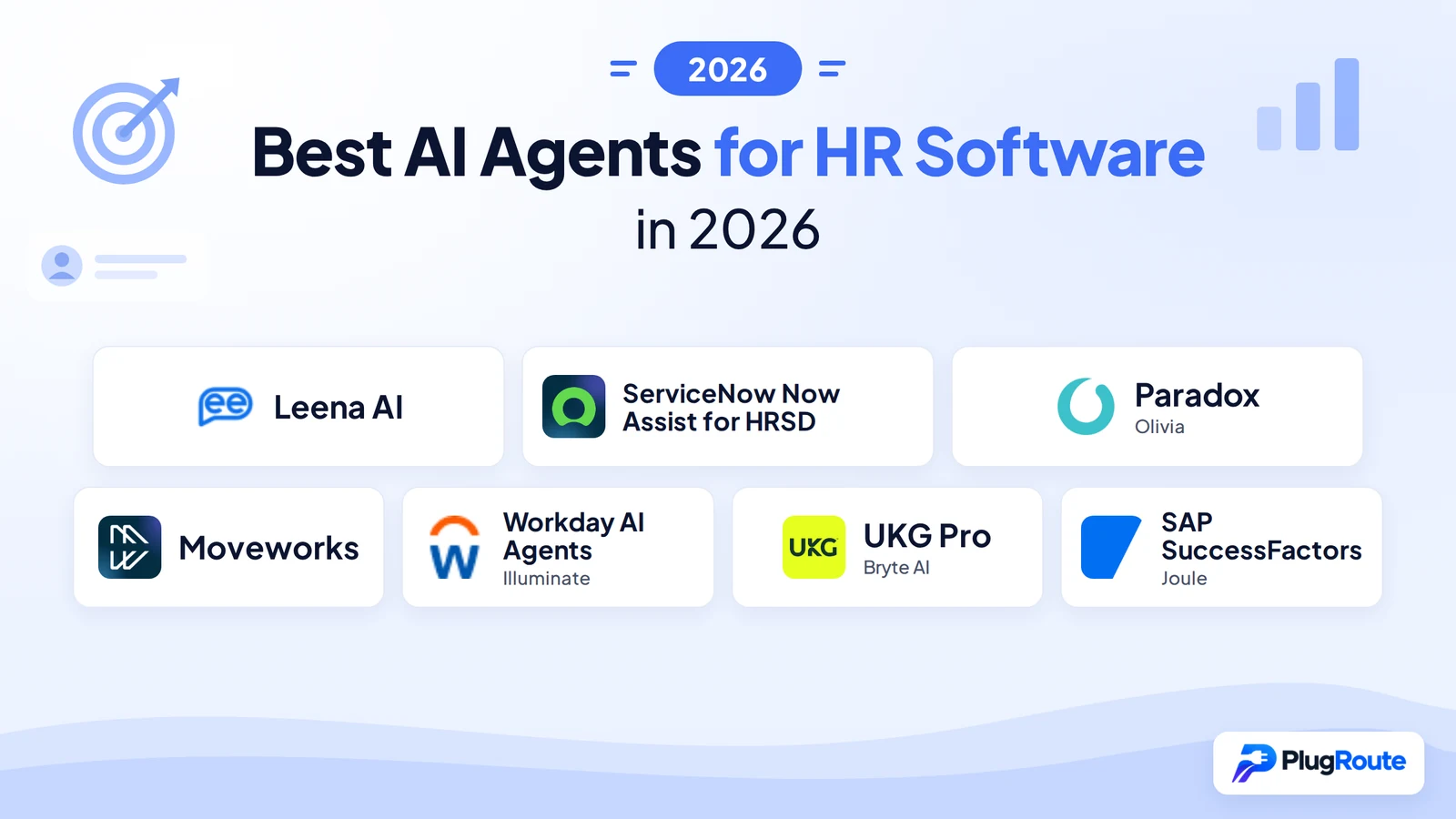
Leena AI is the top-ranked vendor-agnostic AI agent for HR teams running multi-vendor stacks, ServiceNow Now Assist for HRSD leads for enterprise cross-departmental automation, and Paradox (Olivia) delivers the strongest recruiting metrics for high-volume hiring. The biggest risk in this category is the gap between vendor demos and production reality, a gap this evaluation measures with practitioner evidence.
HR teams are overwhelmed by repetitive tickets and fragmented onboarding processes. The rapidly expanding AI agent market makes it harder (not easier) to identify which tools actually deliver measurable results versus which are marketing ahead of their capabilities.
As one HR professional evaluating HRIS options on r/humanresources described:
“Real talk though: have you ever used an HRIS or HR system where there weren’t multiple annoying things and challenges and crazy workarounds you had to build? Like, every HR system I’ve used is painful, just some are MORE painful than others for certain scenarios. I’m at this point just trying to suss out the least bad of not great options” Posted by u/krys_be
Takeaway: HR leaders evaluating AI-powered platforms consistently describe the selection process as choosing the least painful option, not finding a perfect one, reinforcing why practitioner evidence matters more than vendor demos.
PlugRoute has no affiliate relationships with any company listed. Rankings are determined entirely by research data and objective evaluation criteria.
“Leena AI and Moveworks, for example, are more focused on internal IT and HR support, so if that’s a pain point for you, they can genuinely save time… Where I’d be cautious is with anything that promises to ‘replace’ a whole role end to end. The tech isn’t there yet for most knowledge work.” (u/ATKmain, r/ChatGPT (2025))
Takeaway: Practitioners find genuine value in AI agents for narrow HR and IT support tasks, but full role replacement remains beyond current capabilities.
TL;DR: Top Picks at a Glance
- Leena AI ranks #1 as the top vendor-agnostic HR AI agent for organizations running multi-vendor stacks.
- ServiceNow Now Assist for HRSD ranks #2 as the strongest option for enterprise cross-departmental HR service delivery.
- Paradox (Olivia) ranks #3 for high-volume recruiting automation at scale, though Workday completed its acquisition of Paradox in October 2025.
- Moveworks ranks #4 as the top cross-functional employee assistant spanning IT, HR, and finance.
What Are the Main Categories of AI Agents for HR Software?
AI agents for HR software fall into three architectural categories that determine compatibility with your existing stack: vendor-agnostic overlay agents, platform-native HCM agents, and specialized single-function agents. Choosing the right category depends on your tech stack architecture, not just feature lists.
Vendor-Agnostic HR AI Agents connect across multiple HRIS, ERP, and ITSM systems without locking buyers into a single platform. Leena AI and Moveworks fall into this category.
Vendor-agnostic agents are ideal for organizations running multi-vendor stacks such as Workday HCM combined with ServiceNow ITSM and Salesforce.
Platform-Native HCM AI Agents are embedded directly into an existing HCM or service delivery platform, leveraging its proprietary data model for deeper workflow integration.
The following products fall into this category:
- Workday AI Agents (Illuminate)
- ServiceNow Now Assist for HRSD
- SAP SuccessFactors (Joule)
- UKG Pro (Bryte AI)
Platform-native agents are strongest for organizations already invested in these ecosystems.
Specialized HR AI Agents focus on a single HR function with concentrated depth. Paradox (Olivia) (now a Workday subsidiary as of October 2025) is purpose-built exclusively for conversational recruiting automation.
The strategic decision between these categories matters more than individual feature comparisons:
- Multi-vendor stack buyers should evaluate vendor-agnostic agents first.
- Single-platform organizations should start with native AI and supplement where needed.
- High-volume recruiting teams should evaluate specialized agents alongside their general HR AI layer.
How Do the Top AI Agents for HR Software Compare at a Glance?
The seven AI agents evaluated here span vendor-agnostic overlays, platform-native HCM tools, cross-functional assistants, and specialized recruiting automation. The table below summarizes each product’s category, strengths, and key trade-offs for side-by-side comparison.
| Rank | Company | Category | Best For | One-Line Summary | Key Capabilities | Primary Strength | Key Limitation |
|---|---|---|---|---|---|---|---|
| 1 | Leena AI | Vendor-Agnostic HR AI Agent | Multi-vendor stack HR teams needing cross-system automation | Leena AI deploys autonomous AI colleagues across any HRIS stack to deflect routine HR tickets, with reported 1,000+ integrations and sub-25-day deployment. | Ticket deflection; onboarding; case management; self-service; 100+ languages; no-code agent builder | Reported 1,000+ integrations across any HRIS/ERP without platform lock-in | Pricing not publicly disclosed; core claims are vendor-reported without independent verification |
| 2 | ServiceNow Now Assist for HRSD | Enterprise HR Service Delivery Platform | Enterprise orgs already on ServiceNow needing cross-departmental automation | ServiceNow Now Assist for HRSD delivers agentic AI-powered HR case management on the Now Platform with cross-departmental capabilities spanning HR, IT, and facilities. | Case management; onboarding transitions; self-service portal; GenAI summarization; Moveworks integration | Only platform in this evaluation unifying HR, IT, and facilities service delivery on one architecture | Requires existing ServiceNow platform investment |
| 3 | Paradox (Olivia) | AI Recruiting Automation Agent | High-volume frontline employers (retail, QSR, healthcare) | Paradox automates candidate screening, scheduling, and onboarding via SMS and chat for 200+ organizations across 60+ countries; now a Workday subsidiary (October 2025). | Candidate screening; interview scheduling; text-to-apply; FAQ automation; onboarding follow-ups | Vendor-reported scheduling reduced from 5 days to 29 minutes | Recruiting only; acquired by Workday October 2025; candidate-side complaints without human oversight |
| 4 | Moveworks | Cross-Functional Employee AI Assistant | Enterprises needing one AI assistant for IT, HR, finance, and sales | Moveworks unifies enterprise search and task automation across IT, HR, finance, and sales with multi-LLM orchestration. | Cross-functional ticket resolution; enterprise search; Agent Studio; 100+ integrations; 100+ languages | Only product spanning IT, HR, finance, and sales as one employee front door | ServiceNow acquisition ($2.85B) raises cross-platform neutrality concerns |
| 5 | Workday AI Agents (Illuminate) | Platform-Native HCM AI Agent | Organizations already running Workday HCM | Workday AI Agents embed AI for recruiting, onboarding, self-service, and talent management natively into the Workday platform. | Recruiter Agent; Self-Service Agent; Succession Agent; Frontline Agent; unified data model | Deepest native integration with Workday’s unified HR/Finance data | Significant demo-to-reality gap; practitioners report minimal AI in production |
| 6 | UKG Pro (Bryte AI) | Frontline Workforce Management AI | Orgs with large hourly/frontline workforces | UKG Pro (Bryte AI) embeds agentic AI for scheduling, payroll, and turnover prediction powered by 30+ billion annual workforce interactions. | Scheduling optimization; demand forecasting; payroll automation; turnover prediction; Promotion Agent | Largest workforce dataset in this evaluation (30B+ interactions) | No published AI-specific case study results; frontline usability concerns |
| 7 | SAP SuccessFactors (Joule) | Platform-Native HCM AI Copilot | SAP SuccessFactors orgs willing to pilot narrow use cases | SAP SuccessFactors (Joule) offers five specialized HR agents, though practitioner feedback indicates capabilities lag behind marketing. | Performance; career; HR service; payroll; analytics agents; model flexibility; compliance guardrails | Most ambitious agent architecture with five specialized HR agents | Widest demo-to-reality gap; practitioners report repeated pilot rollbacks |
Which AI Agent for HR Software Should I Choose for My Use Case?
The right AI agent depends on your existing tech stack, primary use case, and workforce type. Use the table below to match your top priority to a recommended starting point and an acceptable alternative for comparison.
| Your #1 Priority | Recommended Tool | Why | Acceptable Alternative |
|---|---|---|---|
| Already on Workday | Workday AI Agents (Illuminate) | Deepest native integration; zero data extraction required | Leena AI as a vendor-agnostic supplement for cross-system needs |
| Already on ServiceNow | ServiceNow Now Assist for HRSD | Cross-departmental automation spanning HR, IT, and facilities | Leena AI for HR-specific depth if ITSM is the primary ServiceNow use |
| Already on SAP SuccessFactors | Leena AI (official SAP partner) | Joule is still maturing; Leena AI delivers immediate AI value as an SAP overlay | Monitor SAP Joule maturation for H2 2026+ releases |
| Multi-vendor stack, no platform preference | Leena AI | Reported 1,000+ integrations, vendor-claimed fastest deployment, no lock-in | Moveworks if cross-functional IT+HR+Finance scope is the priority |
| Cross-functional needs (IT + HR + Finance) | Moveworks | Only product designed as an employee front door across all departments | Leena AI if HR-specific depth is more important than IT/Finance scope |
| High-volume frontline recruiting | Paradox (Olivia); now a Workday product | Strongest vendor-reported recruiting metrics; verify standalone availability if not on Workday | Workday Recruiter Agent if already on Workday and volume is moderate |
| Frontline WFM: scheduling, payroll, hourly workers | UKG Pro (Bryte AI) | Largest workforce dataset for scheduling optimization and demand forecasting | Workday Frontline Agent if already on Workday |
1. Leena AI: Best Overall: Vendor-Agnostic HR AI Agent
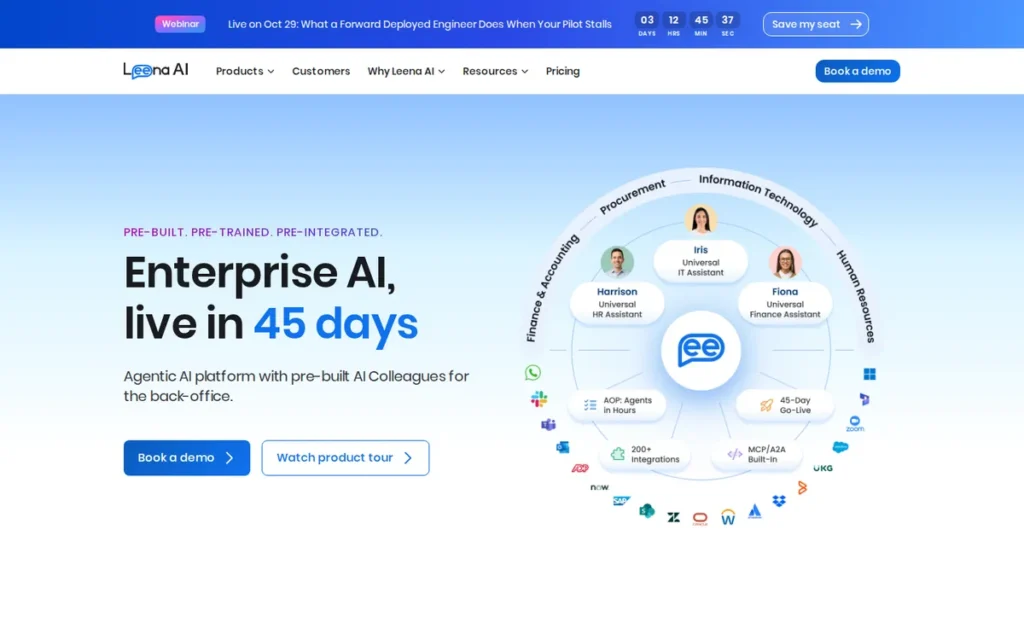
Category: Vendor-Agnostic HR AI Agent, deploys autonomous AI colleagues across any existing HRIS/ERP stack to handle HR queries, onboarding, case management, and employee self-service without platform lock-in.
At a Glance
- Category: Vendor-Agnostic HR AI Agent
- Best For: Mid-size to enterprise HR teams running multi-vendor stacks
- Price Range: Pricing on request (enterprise custom quotes only)
- Primary Strength: Leena AI reports 1,000+ enterprise system integrations: including Workday, SAP, ServiceNow, Slack, and Teams, without platform lock-in.
- Biggest Limitation: Leena AI does not publish pricing, and core quantitative claims (1,000+ integrations, sub-25-day deployment) are vendor-reported without independent verification.
- One-Line Summary: Leena AI is a vendor-agnostic HR AI agent platform that deploys autonomous AI colleagues across any HRIS stack, with vendor-reported 70%+ ticket deflection, 1,000+ integrations, and sub-25-day deployment.
- Last Verified: April 2026
Overview
Leena AI is an agentic AI platform that deploys Autonomous AI Colleagues to handle HR queries, onboarding, offboarding, benefits administration, ticket resolution, and case management for mid-size to enterprise organizations running any combination of HRIS, ERP, and ITSM systems.
Leena AI differentiates from platform-native competitors by operating as a vendor-agnostic overlay, connecting to Workday, SAP, ServiceNow, ADP, and other systems simultaneously. Leena AI’s architecture uses Agent Operating Protocols (AOPs) for compliance-aware, company-specific processes and a central orchestrator for multi-step workflow interpretation.
Key Features
- Autonomous AI Colleagues: Leena AI’s AI Colleagues autonomously resolve HR queries, process onboarding/offboarding tasks, and manage benefits and policy retrieval across 100+ languages.
- AI Colleague Studio: Leena AI provides a no-code/low-code builder with pre-built templates for creating custom HR agents without engineering resources.
- Enterprise Integrations: Leena AI reports 1,000+ enterprise system integrations (including Workday, SAP SuccessFactors, ServiceNow, Slack, Microsoft Teams, and ADP) enabling cross-stack automation (vendor-reported; not independently verified).
- Agent Operating Protocols (AOPs): Leena AI enforces company-specific compliance rules, escalation paths, and governance guardrails on every AI interaction.
- Multi-Modal Processing: Leena AI supports text, voice, images, and documents with proactive nudges and sentiment analysis for escalation triggers.
Best For
Leena AI is best for HR operations teams at mid-size to enterprise organizations that run multi-vendor tech stacks and need a single AI layer spanning ticket resolution, onboarding, policy self-service, and case management. Leena AI is especially suited for teams without dedicated AI engineering resources who need rapid deployment.
Pricing
Leena AI does not publish pricing as of April 2026. All pricing is enterprise custom, requiring direct sales engagement. Leena AI’s pricing page directs to a contact-sales form with no public tiers, per-user rates, or credit-based structures available.
Strengths
- Enterprise Evaluator Validation: A financial services enterprise evaluator compared Leena AI against Moveworks, Copilot Studio, Glean, Crew AI, and Aisera and reported being “particularly impressed with their enterprise app integrations and voice capability”, Reddit, r/ChatGPT (2025).
- Ticket Deflection Claims: Leena AI reports 70%+ deflection of routine HR helpdesk tickets based on a customer testimonial, with real-time resolution for global workforces, Leena AI official site (2026). Godrej reported 96.6% helpful sessions using Leena AI, Leena AI case study (2025).
- Deployment Speed: Leena AI reports deployment in under 25 days with governance included (the fastest vendor-claimed implementation timeline among the products evaluated) Leena AI official site (2026).
- SAP Partnership: Leena AI is listed as an official SAP HR Service Delivery partner, SAP Partner Listing (2026).
Users on r/AI_Agents shared their production experience:
“We have just onboarded Leena.ai to be our Agentic AI for the enterprise. Live with IT and HR for now… going very well on knowledge and actions in ServiceNow and Workday… expanding footprint soon… Idea is get rid of all simple L1 tickets so that turnaround times are near 0… We are a large FS.. time of our people is literally money.” Posted by u/Either-Help-4270
Takeaway: A large financial services enterprise reports Leena AI is delivering immediate value on L1 ticket elimination across ServiceNow and Workday integrations, with plans to expand scope, early production evidence that cross-system automation works in practice.
Limitations
- Pricing Opacity: Leena AI requires direct sales engagement for a quote, which slows initial evaluation and makes it harder for HR leaders to build a preliminary business case for CFO approval, a limitation shared across most products in this category.
- Limited Independent Verification: Leena AI’s core quantitative claims: 1,000+ integrations, sub-25-day deployment, and 70%+ ticket deflection, originate from vendor materials and could not be independently verified during our research. This gap is notable given that independent verification is this evaluation’s primary ranking criterion.
- Review Volume Context: Leena AI holds a G2 rating of 4.6/5.0 based on 150 verified reviews as of early 2026, G2 (2026). Buyers should check review recency and volume directly.
Verdict
Leena AI ranks as the strongest vendor-agnostic AI agent for HR in this 2026 evaluation, combining the broadest reported integration footprint, fastest vendor-claimed deployment timeline, and most accessible customization tools (no-code AI Colleague Studio) with an SAP partner listing. For HR teams running multi-vendor stacks who need a single AI layer across Workday, SAP, ServiceNow, and Slack without lock-in, Leena AI is the most evidence-supported choice in this evaluation. Leena AI’s main weaknesses (pricing opacity and vendor-sourced claims) are common across this category, but buyers should request documented ROI case studies with named clients during the sales process.
2. ServiceNow Now Assist for HRSD: Best for Enterprise HR Service Delivery
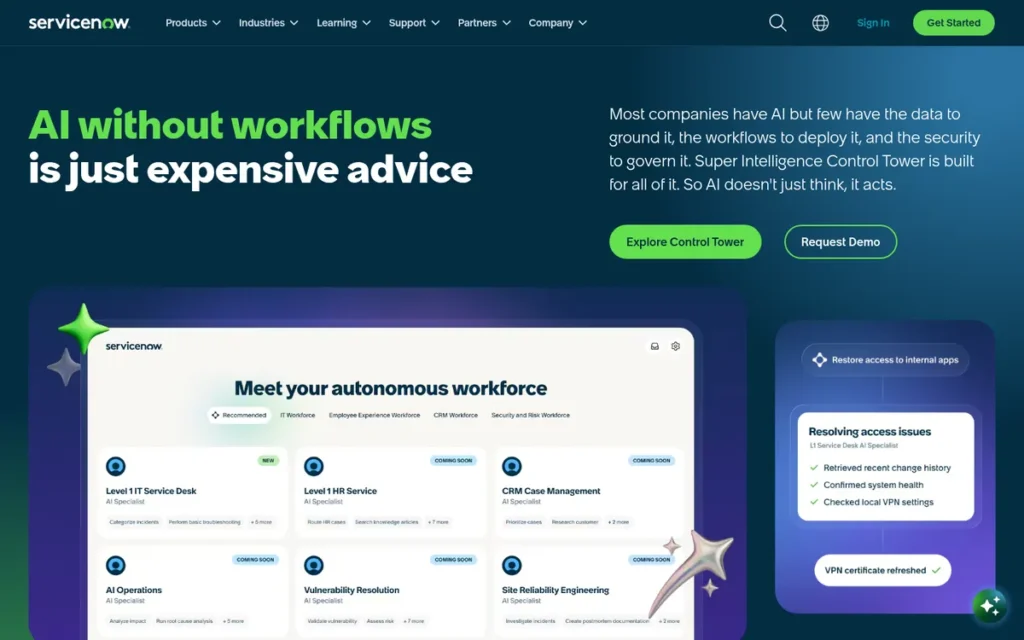
Category: Enterprise HR Service Delivery Platform, centralizes HR case management, employee self-service, and onboarding automation on a unified enterprise platform with cross-departmental workflow capabilities.
At a Glance
- Category: Enterprise HR Service Delivery Platform
- Best For: Enterprise organizations already on ServiceNow needing unified HR, IT, and facilities automation
- Price Range: Pricing on request (subscription-based; HRSD Pro/Enterprise tiers; Now Assist is a separate add-on)
- Primary Strength: ServiceNow Now Assist for HRSD unifies HR, IT, customer service, and facilities management on a single platform, enabling cross-departmental automation no standalone HR AI agent in this evaluation can replicate.
- Biggest Limitation: ServiceNow Now Assist for HRSD requires an existing ServiceNow investment, making it impractical as a standalone HR AI solution.
- One-Line Summary: ServiceNow Now Assist for HRSD delivers agentic AI-powered HR case management, self-service, and onboarding on the Now Platform with cross-departmental capabilities spanning HR, IT, and facilities.
- Last Verified: April 2026
Overview
ServiceNow Now Assist for HRSD is an enterprise HR service delivery platform that combines agentic AI, GenAI-powered case summarization, and automated workflows to handle employee queries, onboarding transitions, and HR case management for large organizations already invested in the ServiceNow ecosystem.
ServiceNow Now Assist for HRSD differentiates by running on the same Now Platform as ITSM and CSM, enabling unified automation across HR, IT, and facilities. ServiceNow further strengthened its AI capabilities through the $2.85 billion acquisition of Moveworks in 2025, adding cross-functional enterprise search and multi-LLM orchestration.
Key Features
- Pre-Defined AI Agents: ServiceNow Now Assist for HRSD automates common HR workflows including case routing, onboarding checklists, and employee self-service with minimal configuration.
- GenAI Case Summarization: ServiceNow Now Assist for HRSD provides real-time case and chat summarization, automated resolution notes, knowledge article generation, and sentiment analysis for HR agents.
- Unified Employee Center: ServiceNow Now Assist for HRSD gives employees a single self-service portal for HR, IT, and facilities requests, reducing ticket volume across departments simultaneously.
- Enterprise Onboarding and Transitions: ServiceNow Now Assist for HRSD coordinates cross-departmental onboarding tasks (HR provisioning, IT access, facilities setup) in a single workflow.
- Moveworks Integration: ServiceNow Now Assist for HRSD incorporates Moveworks’ Agent Studio and enterprise search capabilities following the 2025 acquisition, enabling custom agent building and cross-system automation.
Best For
ServiceNow Now Assist for HRSD is best for enterprise organizations (1,000+ employees) that already run ServiceNow for ITSM or CSM and want to extend the same platform to HR service delivery. ServiceNow Now Assist for HRSD offers cross-departmental automation that would require multiple tools to replicate otherwise.
Pricing
ServiceNow Now Assist for HRSD uses subscription-based pricing customized by instance size and user count as of April 2026. ServiceNow Now Assist for HRSD is available in Pro and Enterprise tiers, with Now Assist GenAI capabilities priced as a separate add-on. No public dollar amounts are available, direct sales engagement is required.
Strengths
- Mid-Size Viability: A Reddit practitioner with extensive ServiceNow HRSD and Microsoft Dynamics experience confirmed deploying HRSD for a government employer of approximately 2,500 employees (demonstrating viability beyond Fortune 500 scale) Reddit, r/humanresources (2024).
- Cross-Departmental Architecture: ServiceNow Now Assist for HRSD is the only product in this evaluation that runs on the same platform as ITSM and CSM, enabling a single onboarding workflow to coordinate HR provisioning, IT access, and facilities setup simultaneously, ServiceNow product documentation (2026).
- Moveworks Acquisition: ServiceNow’s $2.85 billion acquisition of Moveworks added cross-functional AI agent capabilities including multi-LLM orchestration, enterprise search with citations, and Agent Studio for custom agent building, BusinessWire (2025).
- Pre-Built Agents: ServiceNow Now Assist for HRSD’s pre-defined AI Agents are aligned to common HR use cases out of the box, reducing time-to-value versus custom-built agent solutions, ServiceNow AI Agents page (2026).
Limitations
- Platform Dependency: ServiceNow Now Assist for HRSD requires an existing ServiceNow investment to deliver value, making it impractical as a standalone HR AI solution for organizations on different platforms.
- Post-Acquisition Uncertainty: ServiceNow’s Moveworks acquisition strengthens AI capabilities but raises questions about the future of Moveworks’ cross-platform integrations with Workday, Salesforce, and other non-ServiceNow systems, the Moveworks founder has publicly acknowledged this concern on Reddit and committed to continued cross-platform support, but long-term direction remains uncertain.
This concern is echoed by enterprise evaluators on r/servicenow:
“We were looking for a tools and evaluated Moveworks, Leena AI and Aisera. After the acquisition of Moveworks by ServiceNow, I’m worried if the Workday, Salesforce integrations will work or not. ServiceNow still doesn’t connect natively with Workday on their Integration Hub, so I’m assuming that integration has me worried. We did a POC with Aisera and Leena AI… Leena was an overall good experience. Aisera was ok, but their product roadmap seems to be in trouble after Muddu was pushed out..” Posted by u/Either-Help-4270
Takeaway: Enterprise buyers running multi-vendor stacks cite ServiceNow’s lack of native Workday integration as a concrete risk amplified by the Moveworks acquisition, a gap that pushes some evaluators toward vendor-agnostic alternatives.
- Review Isolation Difficulty: No HRSD-specific G2 or Capterra ratings with isolated scores and review counts were available in research, making independent satisfaction benchmarking difficult for the HR module specifically.
- Cost Complexity: ServiceNow Now Assist for HRSD’s multi-tier pricing structure (HRSD tiers plus separate Now Assist add-on) can create cost complexity for procurement teams.
Verdict
ServiceNow Now Assist for HRSD is the strongest choice for enterprise organizations that already run ServiceNow and want AI-powered HR service delivery extending seamlessly across IT, facilities, and customer service workflows. No other product in this evaluation offers genuine cross-departmental automation on a single platform. ServiceNow Now Assist for HRSD’s Moveworks acquisition adds significant AI agent depth, but the platform dependency requirement means it is only viable for organizations already committed to the ServiceNow ecosystem, multi-vendor stack buyers should evaluate Leena AI first.
3. Paradox (Olivia): Best for High-Volume Recruiting Automation
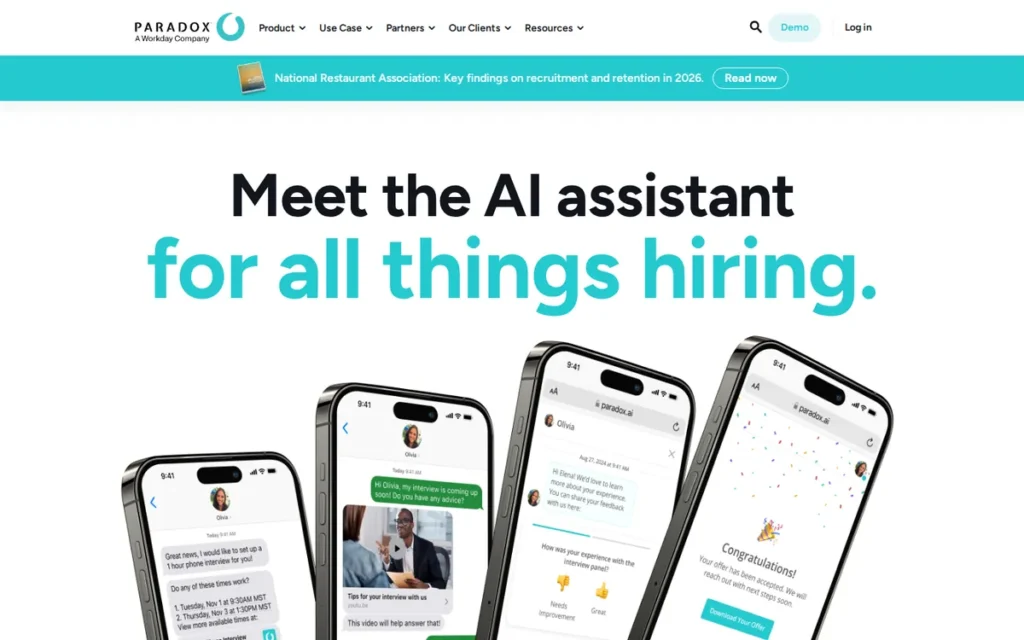
Category: AI Recruiting Automation Agent, a conversational AI assistant that automates candidate screening, interview scheduling, and early-stage hiring workflows via SMS, chat, and messaging platforms.
At a Glance
- Category: AI Recruiting Automation Agent
- Best For: Enterprise and high-volume employers (retail, QSR, healthcare, hospitality)
- Price Range: Pricing on request (enterprise custom; typically layered on existing ATS)
- Primary Strength: Paradox’s Olivia reduces interview scheduling time from 5 days to 29 minutes and reports significant applicant conversion increases across 200+ organizations.
- Biggest Limitation: Workday completed its acquisition of Paradox in October 2025, raising questions about long-term standalone availability for non-Workday buyers; Paradox also focuses exclusively on recruiting.
- One-Line Summary: Paradox automates candidate screening, scheduling, and onboarding via SMS and chat for 200+ organizations across 60+ countries, now offered as the Workday Paradox Candidate Experience Agent following Workday’s October 2025 acquisition.
- Last Verified: April 2026
Overview
Paradox is an AI-powered conversational recruiting platform whose virtual assistant Olivia automates candidate screening, interview scheduling, FAQ answering, document collection, and onboarding follow-ups via SMS, chat, WhatsApp, and career sites for high-volume employers in retail, QSR, healthcare, and hospitality.
Workday completed its acquisition of Paradox in October 2025, Workday Newsroom (2025). Paradox is now offered as the Workday Paradox Candidate Experience Agent, though the platform continues to integrate with non-Workday ATS systems. Buyers should verify long-term standalone availability and integration support for non-Workday systems.
Paradox serves 200+ organizations including McDonald’s, Unilever, FedEx, and General Motors across 60+ countries, Paradox official site (2026).
Key Features
- Automated Screening and Scheduling: Paradox’s Olivia conducts candidate screening using knockout questions, then schedules interviews, reducing the process from 5 days to 29 minutes on average per vendor reporting.
- Multi-Channel Candidate Engagement: Paradox supports text-to-apply, QR code applications, and engagement via SMS, WhatsApp, chat, and career sites in 100+ languages.
- Custom FAQ Responses: Paradox automates 500+ candidate questions per deployment about benefits, location, requirements, and scheduling without recruiter involvement.
- Broad ATS/HRIS Integration: Paradox integrates with Workday, SAP SuccessFactors, ADP Workforce Now, iCIMS, Greenhouse, and Taleo without replacing existing systems.
- Onboarding Automation: Paradox automates onboarding follow-ups, document collection, and employee referral workflows as extensions of its recruiting pipeline.
Best For
Paradox is best for enterprise and high-volume employers (particularly in retail, quick-service restaurants, healthcare, and hospitality) that need to automate frontline and hourly recruiting at scale. Paradox is now a Workday subsidiary, so non-Workday buyers should verify current standalone availability.
Pricing
Paradox does not publish pricing as of April 2026. Paradox uses enterprise custom pricing, typically layered on top of an existing ATS investment. No public per-user or per-hire rates are available.
Strengths
- Vendor-Reported Metrics: Paradox reports significant applicant conversion increases and high candidate satisfaction across 200+ organizations in 60+ countries. Independent sources confirm approximately 85–87% candidate satisfaction and a 58% decrease in time-to-apply (Index.dev, 2025), while Paradox’s own materials cite higher aggregate figures, Paradox official site (2026).
- Scheduling Speed: Paradox’s Olivia reduces interview scheduling from an average of 5 days to 29 minutes per vendor reporting, with automated reminders and follow-ups that reduce candidate no-shows, Paradox official site (2026).
- Practitioner Confirmation: An HR professional at a large healthcare company confirmed on Reddit that Paradox “works well” when properly staffed and monitored, with Olivia functioning as “an auto scheduler that also sends automatic reminders”, Reddit, r/jobs (2024).
- Industry Recognition: Paradox serves approximately 25% of the Fortune 100 and has won HR Tech Awards and Brandon Hall Group Excellence Awards for innovation in conversational recruiting, TheDailyHire (2025).
Limitations
- Workday Acquisition Impact: Workday completed its acquisition of Paradox in October 2025. Paradox is now offered as the Workday Paradox Candidate Experience Agent. Non-Workday buyers should verify standalone availability and long-term integration support for non-Workday ATS platforms.
- Dual-Audience Tension: Paradox’s most consequential operational trade-off is the gap between employer efficiency and candidate experience, while employers report strong hiring metrics, candidate-side Reddit threads reveal recurring complaints about conversational forms perceived as slower than web applications and interviews scheduled that hiring managers don’t know about.
“I’ve noticed when applying to virtually any fast food restaurant… they all use paradox AI which usually results in me immediately being asked to schedule an interview, then when I show up to said interview at the scheduled time, I’m told that my application didn’t show up in the system.” (u/ChainedLemon, r/jobs (2024))
Takeaway: When Paradox schedules interviews without human monitoring at hiring locations, candidates arrive to find no one expecting them, a configuration failure, not a platform failure.
- Configuration Dependency: Paradox works well when properly staffed and monitored but fails when deployed without adequate human oversight, which is common at high-volume, low-touch employers, as an HR professional on Reddit confirmed: “I doubt those companies are paying HR people to work closely with store managers about their staffing needs.”
- Narrow Scope: Paradox focuses exclusively on recruiting and early onboarding: organizations seeking full HR lifecycle automation (service desk, case management, employee self-service) will need a separate tool entirely.
Verdict
Paradox presents the strongest vendor-reported recruiting metrics of any product in this evaluation, with documented scheduling speed improvements and high candidate satisfaction across 200+ organizations. Paradox delivers recruiting efficiency for high-volume employers in retail, healthcare, and hospitality. However, Paradox’s narrow scope (recruiting only), the Workday acquisition (October 2025), and the recurring candidate-experience failures reported without adequate human monitoring mean Paradox is best treated as a specialized complement to a broader HR AI strategy, not a standalone solution.
4. Moveworks: Best for Cross-Functional Employee Support (IT + HR + Finance)
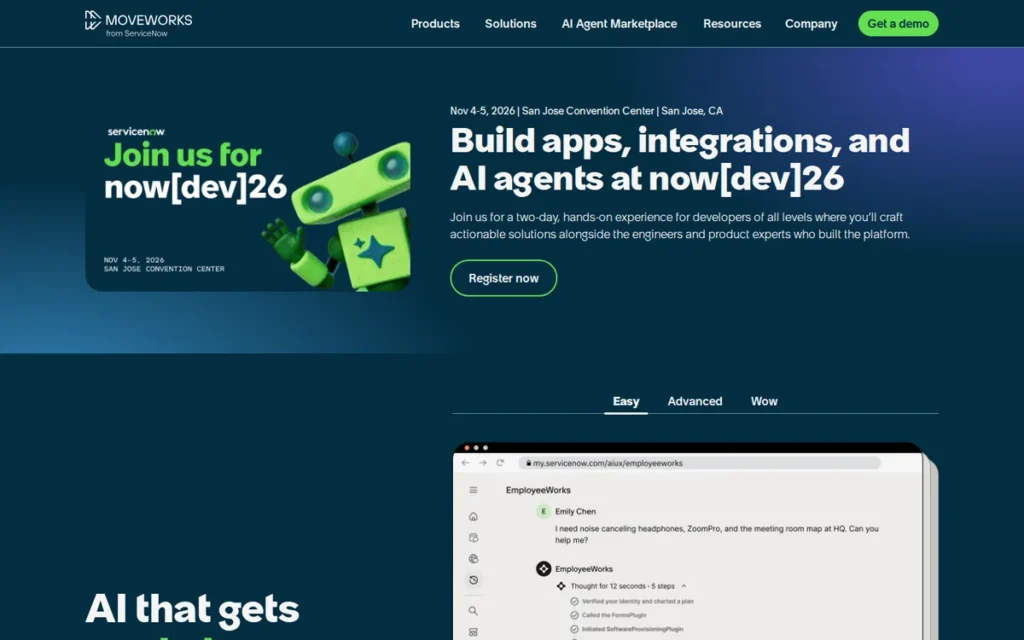
Category: Cross-Functional Employee AI Assistant, unifies enterprise search and task automation across IT, HR, finance, and sales through a single employee-facing interface.
At a Glance
- Category: Cross-Functional Employee AI Assistant
- Best For: Enterprises needing one AI assistant spanning IT, HR, finance, and sales
- Price Range: Pricing on request (enterprise custom; widely regarded as premium pricing)
- Primary Strength: Moveworks is the only product in this evaluation designed as an organization-wide “employee front door” spanning IT, HR, finance, and sales with 100+ system integrations.
- Biggest Limitation: Moveworks’ $2.85 billion ServiceNow acquisition raises concerns about future cross-platform neutrality with Workday, Salesforce, and non-ServiceNow systems.
- One-Line Summary: Moveworks unifies enterprise search and task automation across IT, HR, finance, and sales with multi-LLM orchestration and 100+ system integrations, now a ServiceNow subsidiary following a $2.85 billion acquisition.
- Last Verified: April 2026
Overview
Moveworks is an enterprise AI assistant platform that unifies search and task automation across IT, HR, finance, and sales through omnichannel access via Slack, Microsoft Teams, Webex, Google Chat, email, and embedded web portals.
Moveworks differentiates from HR-specific tools by serving as a single employee-facing interface for all departments, connecting to 100+ enterprise systems including Workday, ServiceNow, Salesforce, and ADP. Moveworks was acquired by ServiceNow for $2.85 billion in 2025, adding its capabilities to the Now Platform while the founder has publicly committed to maintaining cross-platform integrations.
Key Features
- Multi-LLM Reasoning Engine: Moveworks’ Reasoning Engine uses multi-LLM orchestration to autonomously complete multi-step tasks (resolving tickets, processing approvals, and provisioning access) not just answering questions.
- Agent Studio: Moveworks’ low-code Agent Studio enables HR and IT teams to create Scoped Assistants (e.g., Recruiting Assistant, Benefits Assistant) without engineering resources.
- 100+ Enterprise Integrations: Moveworks connects to Workday, ServiceNow, Salesforce, ADP, Slack, Teams, Webex, and Google Chat in a single platform.
- AI Agent Marketplace: Moveworks provides pre-built integrations for common enterprise workflows, accelerating deployment for standard HR, IT, and finance use cases.
- 100+ Language Support: Moveworks operates through omnichannel access: Slack, Teams, email, web portal, and embedded experiences, meeting employees wherever they work.
Best For
Moveworks is best for large enterprises (5,000+ employees) that want a single AI assistant spanning IT, HR, finance, and sales rather than deploying separate AI tools for each department. Moveworks is particularly suited for organizations that prioritize cross-functional ticket resolution and employee self-service.
Pricing
Moveworks does not publish pricing as of April 2026. Enterprise custom quotes are required. A Reddit user reported at a conference that “at the same price they could’ve hired 5 FTEs to get the work done,” suggesting premium-tier positioning, Reddit, r/servicenow (2025).
Strengths
- PeerSpot Presence: Moveworks holds notable mindshare on PeerSpot in the enterprise AI assistant category as of early 2026, though mindshare figures vary by category classification, PeerSpot (2026).
- Fortune 160 Validation: A Fortune 160 company reported on Reddit that Moveworks “works great” and that they “wouldn’t know what their support is like because it works (and works well)”, Reddit, r/servicenow (2025).
- Enterprise Scale: Moveworks reports serving 350+ enterprise customers and supporting over 5 million workers worldwide with autonomous end-to-end task completion across IT, HR, finance, and sales, Moveworks About page (2026).
- Low-Code Agent Building: Moveworks’ Agent Studio and Scoped Assistants allow domain-specific agent deployment without vendor dependency for initial configuration, BusinessWire (2025).
Limitations
- Limited Self-Service Customization: Moveworks’ most consequential trade-off is the tension between turnkey setup and buyer control, as a Reddit user summarized: “The benefit to Moveworks is they build out what you need for you. The downside is only they can build it out for you. So if they tell you it can’t be done, you can’t do it.”
“Moveworks was limiting for my companies needs, support is really bad and their so called reporting tool is garbage.” (u/regalbeagle2019, r/servicenow (2025))
Takeaway: Support quality and reporting depth are recurring pain points for Moveworks customers, though experiences vary significantly by deployment size.
- Support Quality Concerns: Multiple Reddit users report poor support quality, though the Moveworks founder publicly acknowledged this on Reddit and committed to investing in support at “significantly greater scale than at any point in company history.”
- Post-Acquisition Uncertainty: Moveworks’ $2.85 billion ServiceNow acquisition creates uncertainty for organizations using Workday or Salesforce as primary platforms, long-term integration depth may gradually shift toward the ServiceNow ecosystem.
Verdict
Moveworks is the top AI assistant in this evaluation for organizations that need cross-functional employee support spanning IT, HR, finance, and sales from a single platform. Moveworks’ cross-functional breadth is unmatched in this evaluation, but HR-specific depth is narrower than Leena AI’s. The post-acquisition direction under ServiceNow ownership introduces legitimate uncertainty about long-term cross-platform neutrality. Organizations already committed to ServiceNow may benefit most; those on Workday or multi-vendor stacks should evaluate Leena AI or other vendor-agnostic options first.
5. Workday AI Agents (Illuminate): Best for Workday-Native Organizations
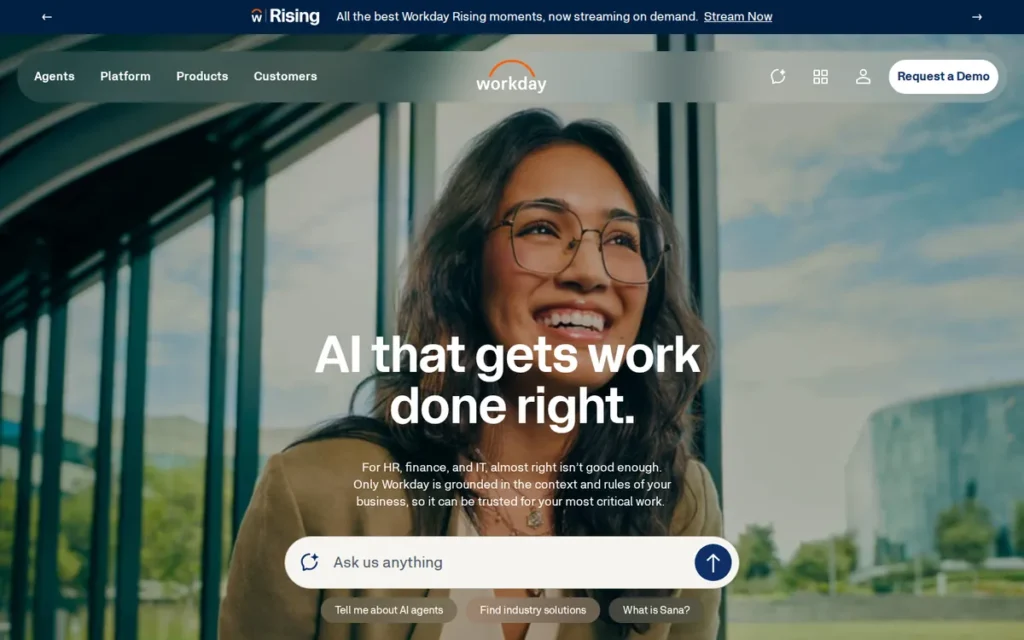
Category: Platform-Native HCM AI Agent, embeds AI automation directly into an existing HCM platform, leveraging its unified data model for recruiting, onboarding, self-service, and talent management workflows.
At a Glance
- Category: Platform-Native HCM AI Agent
- Best For: Organizations already running Workday HCM that want native AI without third-party tools
- Price Range: Integrated into Workday platform (credit-based flex credits; costs scale with usage; pricing on request)
- Primary Strength: Workday AI Agents operate natively within Workday’s unified HR and Finance data model, requiring zero data extraction or syncing.
- Biggest Limitation: Workday AI Agents show a significant gap between demo-stage capabilities and current production functionality per Reddit practitioners.
- One-Line Summary: Workday AI Agents (Illuminate) embed AI for recruiting, onboarding, self-service, and talent management natively into the Workday platform, though current practitioner feedback indicates capabilities lag behind vendor marketing.
- Last Verified: April 2026
Overview
Workday AI Agents (Illuminate) embed AI-powered automation for recruiting, onboarding, employee self-service, talent mobility, and performance management directly into the Workday unified HR and Finance platform, leveraging over a decade of AI development and the company’s proprietary data model.
Workday AI Agents gained additional capabilities through the 2024 acquisition of HiredScore (recruiting AI), the November 2025 acquisition of Sana Labs ($1.1 billion, agentic AI), and the October 2025 acquisition of Paradox (recruiting automation). Reddit practitioner feedback consistently reports a gap between demo-stage promises and current production functionality.
Key Features
- Recruiter Agent: Workday AI Agents’ Recruiter Agent automates sourcing passive candidates, generating outreach, and scheduling interviews via the integrated HiredScore and Paradox acquisitions.
- Self-Service Agent: Workday AI Agents’ Self-Service Agent allows employees to query absence balances, shift management, and compliance information using natural language.
- Succession Agent: Workday AI Agents’ Succession Agent supports talent mobility by matching internal candidates to open roles based on skills and career trajectory.
- Frontline Agent: Workday AI Agents include a Frontline Agent designed for shift-based workers with mobile-first access to scheduling, time-off requests, and shift swaps.
- Unified Data Model: Workday AI Agents leverage the unified Workday data model (no data extraction, transformation, or syncing required) enabling real-time AI actions on live HR and Finance data.
Best For
Workday AI Agents are best for mid-size to enterprise organizations already running Workday HCM that want to add AI automation without introducing a third-party tool. Workday AI Agents are particularly suited for organizations with mature Workday implementations where the unified data model advantage provides the most value.
Pricing
Workday AI Agents use a credit-based (flex credits) pricing system as of April 2026, integrated into the broader Workday platform cost rather than sold as a standalone product. A Reddit user notes that “the credit-based pricing can add up pretty quickly depending on usage, so it seems like you’d need to be more deliberate about how/where you use AI there”, Reddit, r/workday (2024). Exact dollar amounts are not publicly available.
Strengths
- Largest Named Deployment Reference: IBM’s AskHR agent serves 270,000+ employees handling maternity leave, compensation, and verification queries (built on IBM watsonx Orchestrate integrated with the Workday platform) Workday Blog (2026). This is the largest documented HR AI deployment referencing Workday in this evaluation, though the AI capabilities are powered by IBM’s watsonx rather than Workday AI Agents alone.
- Recruiter Capacity: Workday AI Agents’ Recruiter Agent demonstrated a 25% increase in recruiter capacity in early deployments, CIO.com (2025).
- Broadest Review Base: Workday HCM holds a G2 rating of 4.2/5.0 based on 2,806 verified reviews and a Capterra rating of approximately 4.0/5.0 based on 1,648 verified reviews (representing the broadest verified review base in this evaluation) G2 (2026) | Capterra (2026). These ratings reflect the overall HCM platform, not AI agents specifically.
- Zero Data Extraction: Workday AI Agents operate natively on the unified HR/Finance data model with zero data extraction (a structural advantage over overlay tools) Workday AI Agents page (2026).
Limitations
- Demo-to-Reality Gap: Workday AI Agents’ most consequential trade-off is the gap between vendor marketing and current production capabilities, Reddit practitioners report that AI features feel “almost zero” in practice.
“Am I the only person that has seen almost zero AI in workday? Maybe goals, skills and job descriptions but it’s all completely inconsequential in the grand scheme of things.” (u/ajmart23, r/workday (2025))
Takeaway: Workday practitioners report a significant gap between the AI features shown in demos and what is available in their production environments as of 2025.
- Expectations Mismatch: Workday AI Agents suffer from marketing demos creating C-suite expectations that implementation teams cannot deliver, as one practitioner noted: “Workday don’t do a fantastic job of explaining what is available right now vs what might be coming later in these demos.”
- Credit-Based Cost Unpredictability: Workday AI Agents’ flex credits pricing model creates unpredictable costs that scale with usage, requiring deliberate budgeting and prioritization.
- Platform Lock-In: Workday AI Agents only function within the Workday ecosystem, organizations running multi-vendor stacks receive no benefit for workflows that touch non-Workday systems.
Verdict
Workday AI Agents offer the deepest native integration for organizations already invested in Workday HCM, with the broadest HR agent architecture and the largest named-client deployment reference (IBM, 270,000+ employees via watsonx Orchestrate integration). However, current practitioner feedback reveals a significant maturity gap between sales presentations and production reality. Organizations considering Workday AI Agents should request live production demos (not marketing demos), start with narrow use cases like the Recruiter Agent, and supplement with a vendor-agnostic layer for cross-system automation needs.
6. UKG Pro (Bryte AI): Best for Frontline Workforce Management

Category: Frontline Workforce Management AI, embeds predictive AI and autonomous agents into an HCM/WFM platform optimized for scheduling, payroll, and talent management of hourly and frontline workforces.
At a Glance
- Category: Frontline Workforce Management AI
- Best For: Organizations with large frontline/hourly workforces (manufacturing, retail, healthcare, hospitality)
- Price Range: Pricing on request (enterprise custom; modules and company size determine cost)
- Primary Strength: UKG Pro (Bryte AI) is powered by one of the largest workforce datasets in the industry (30+ billion annual interactions and data UKG reports from 20+ million employees) giving its predictive AI a data advantage unmatched by other products in this evaluation.
- Biggest Limitation: UKG Pro (Bryte AI) has not published case studies with quantifiable AI-specific results, and frontline workers report usability struggles.
- One-Line Summary: UKG Pro (Bryte AI) embeds agentic AI for scheduling optimization, payroll automation, turnover prediction, and talent management powered by 30+ billion annual workforce interactions.
- Last Verified: April 2026
Overview
UKG Pro (Bryte AI) is a workforce management and HCM platform that embeds agentic AI, large action models, and predictive analytics to automate scheduling, payroll processing, talent management, and employee self-service for organizations with significant frontline and hourly workforces across manufacturing, retail, healthcare, and hospitality.
UKG Pro (Bryte AI) differentiates through one of the largest workforce datasets in the industry, 30+ billion annual interactions and $700 billion in monthly payroll processing. UKG Pro (Bryte AI) was formed from the 2020 merger of Kronos Incorporated and Ultimate Software, combining 30+ years of workforce management expertise. UKG is recognized as a leader in both the Gartner Magic Quadrant and Forrester Wave (Q4 2025) for workforce management.
Key Features
- Predictive Schedule Optimization: UKG Pro (Bryte AI) analyzes employee availability, skills, demand patterns, and forecasting data to generate optimal shift assignments.
- AI-Powered Payroll Automation: UKG Pro (Bryte AI) automates payroll processing, time tracking, and exception handling with AI-driven anomaly detection and compliance checks.
- Promotion Agent: UKG Pro (Bryte AI) automates fragmented promotion workflows: from candidate identification to approval routing, reducing processing time and mitigating errors.
- Talent Intelligence: UKG Pro (Bryte AI) provides turnover prediction, skills gap analysis, and inclusive job description generation as part of its AI-powered talent management suite.
- Human Checkpoint Governance: UKG Pro (Bryte AI) enforces mandatory human checkpoints on all AI agent actions, ensuring ethical oversight before autonomous decisions are executed.
Best For
UKG Pro (Bryte AI) is best for mid-size to enterprise organizations with large frontline, hourly, or shift-based workforces, particularly in manufacturing, retail, healthcare, and hospitality. UKG Pro (Bryte AI) is especially suited for organizations needing AI-optimized scheduling, demand forecasting, and payroll automation.
Pricing
UKG Pro does not publish pricing as of April 2026. UKG Pro costs are customized based on company size, modules selected, and deployment scope. No public per-user or per-module rates are available.
Strengths
- Largest Workforce Dataset: UKG Pro (Bryte AI) is powered by 30+ billion annual interactions and $700 billion in monthly payroll processing (a data foundation unmatched by other products in this evaluation) UKG Bryte AI page (2026).
- Human Checkpoints: UKG Pro (Bryte AI) enforces mandatory human checkpoints on all AI agent actions, with the first wave of agents targeting compliance and talent management (a governance model designed for regulated industries) UKG Bryte AI page (2026).
- HR Admin Usability: An HR professional on Reddit at a manufacturing/distribution company reported that UKG Pro is “really user friendly” for HR staff, with “mostly everything easily accessible”, Reddit, r/humanresources (2023).
- Industry Recognition: UKG Pro (Bryte AI) combines 30+ years of workforce management expertise from Kronos and Ultimate Software and is recognized as a leader in the Gartner Magic Quadrant and Forrester Wave (Q4 2025), CHIME Central (2026).
Users on r/humanresources noted a consistent pattern, strong for HR admins, but with operational caveats at scale:
“Company of 4,000 employees across the US. We’ve been with UKG for about 5-6 years. It’s very customizable, so the experience may depend on which features you have. Overall pretty user friendly. My biggest complaint is that the mobile app goes down about once a month that impacts our employees who use it to clock in/out.” Posted by u/JustCallMeKV
Takeaway: Long-term UKG Pro customers confirm the platform’s customizability and usability for administrators, but recurring mobile app reliability issues directly undermine the frontline clock-in experience Bryte AI is designed to enhance.
Limitations
- Missing Quantifiable AI Results: UKG Pro (Bryte AI)’s most consequential trade-off is the gap between its powerful workforce dataset and the maturity of its AI features, no publicly available case studies with quantifiable Bryte AI-specific results (deflection rates, cost savings, time reductions) were found during research.
- Frontline Usability Challenge: UKG Pro (Bryte AI) is praised by HR administrators but struggles with frontline adoption, as one Reddit HR professional noted: “I work in a manufacturing/distribution environment and my employees are not tech savvy. They struggle to do anything and everything on it.”
- Mixed Community Sentiment: UKG Pro received negative enough community feedback that one Reddit evaluator updated their post to say “we’re no longer considering UKG since this post,” suggesting real-world experiences vary significantly.
- Early AI Maturity: UKG Pro (Bryte AI) agents are newer market entrants with less production track record than alternatives from Leena AI or ServiceNow.
Verdict
UKG Pro (Bryte AI) is the strongest AI option in this evaluation for organizations whose primary HR challenge is frontline workforce management, scheduling optimization, payroll automation, demand forecasting, and turnover prediction for hourly workers at scale. UKG Pro (Bryte AI)’s 30+ billion interaction dataset provides a predictive advantage unmatched by other products evaluated here. However, Bryte AI features are still early in maturity with no published quantifiable results, and frontline worker usability concerns undermine the core value proposition. Organizations should request production demos with frontline employee testers and evaluate Bryte AI capabilities separately from the established UKG Pro WFM platform.
7. SAP SuccessFactors (Joule): Most Ambitious Architecture, Least Ready for Production
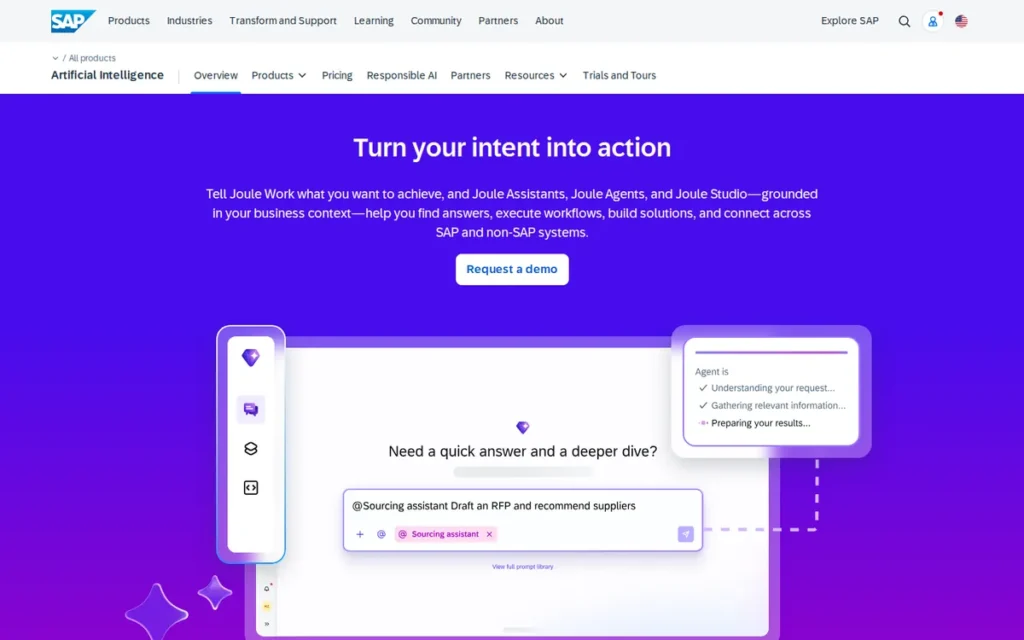
Category: Platform-Native HCM AI Copilot, a generative AI assistant embedded into an enterprise HCM platform that provides natural language access to HR workflows across performance, talent, service, payroll, and analytics.
At a Glance
- Category: Platform-Native HCM AI Copilot
- Best For: Large SAP SuccessFactors enterprises willing to pilot narrow use cases after validating production capabilities
- Price Range: AI units licensing model (customers buy and allocate AI units; pricing on request)
- Primary Strength: SAP SuccessFactors (Joule) offers the most architecturally ambitious agent framework in this evaluation, five specialized HR agents with SAP-reported 2,100 AI skills and embedded compliance guardrails.
- Biggest Limitation: SAP SuccessFactors (Joule) has the widest gap between vendor vision and production reality, practitioners report repeated pilot rollbacks and unreliable outputs.
- One-Line Summary: SAP SuccessFactors (Joule) is a generative AI copilot with five specialized HR agents (generally available Q4 2025 through H1 2026), though practitioner feedback as of early 2026 indicates capabilities significantly lag behind vendor marketing.
- Last Verified: April 2026
Overview
SAP SuccessFactors (Joule) is a generative AI copilot embedded into the SAP SuccessFactors HCM platform, operating through five specialized HR agents (Performance and Goals, Career and Talent Development, HR Service, Payroll, and People Intelligence) to automate recruiting, onboarding, employee queries, performance reviews, career planning, payroll insights, and workforce analytics.
SAP SuccessFactors (Joule) claims that 80% of core HR functionality can be accessed through its natural language and voice interface, with SAP reporting 2,100 AI skills and embedded semantic checks for compliance. SAP SuccessFactors (Joule) agents became generally available from Q4 2025 through May 2026, SAP Insider (2026). However, practitioner feedback as of early 2026 consistently reports that current capabilities fall significantly short of the marketed promise.
Key Features
- Five Specialized HR Agents: SAP SuccessFactors (Joule) provides agents for Performance and Goals, Career and Talent Development, HR Service, Payroll, and People Intelligence, each designed for specific HR workflow clusters.
- Broadest Conversational Coverage: SAP SuccessFactors (Joule) claims 80% of core HR functionality is accessible through natural language text and voice commands, supported by SAP-reported 2,100 AI skills.
- Compliance Guardrails: SAP SuccessFactors (Joule) uses semantic checks and embedded policy guardrails to ensure compliance and contextual accuracy across AI interactions.
- Model Flexibility: SAP SuccessFactors (Joule) allows customers to fine-tune prompts and select target models (including OpenAI, Llama 3, or custom models) through the BTP AI foundation.
- HR Content Generation: SAP SuccessFactors (Joule) automates job description generation, interview question creation, performance review summarization, and career path recommendations.
Best For
SAP SuccessFactors (Joule) is best for large enterprises already heavily invested in the SAP SuccessFactors ecosystem that want to monitor Joule’s maturation and pilot narrow use cases. SAP SuccessFactors (Joule) buyers should validate current production capabilities against vendor demos and accept that significant functionality may still be maturing.
Pricing
SAP SuccessFactors (Joule) uses an AI units licensing model as of April 2026. SAP SuccessFactors (Joule) customers buy AI units and allocate them across use cases, with all AI capabilities routed through the BTP AI foundation for token metering. A Reddit user attending an internal demo described this model but exact dollar amounts are not publicly available, Reddit, r/SAP (2024).
Strengths
- Analyst Endorsement: Industry analyst Josh Bersin endorsed SAP SuccessFactors (Joule) in October 2025, writing that “SAP jumps ahead in AI agents with Joule HCM features”, Josh Bersin blog (October 2025).
- Broadest Architecture: SAP SuccessFactors (Joule) offers the broadest AI agent architecture in this evaluation (five specialized HR agents covering performance, career development, service, payroll, and analytics) SAP official site (2026).
- Compliance Design: SAP SuccessFactors (Joule) includes embedded semantic checks and policy guardrails for compliance (a governance advantage for heavily regulated industries) Zalaris blog (2026).
- Model Flexibility: SAP SuccessFactors (Joule) allows model flexibility, customers can choose between OpenAI, Llama 3, or custom models through the BTP AI foundation, providing more AI infrastructure control than any other platform-native product in this evaluation, Reddit, r/SAP (2024).
Limitations
- Widest Demo-to-Reality Gap: SAP SuccessFactors (Joule) has the widest gap between vendor vision and current production reality of any product in this evaluation, an SAP consultant on Reddit reports “rolling it out quite a lot… and then after the tests rolling it back because of the lack of actual good use cases.” Note: Joule agents became generally available Q4 2025 through May 2026, so some Reddit feedback may reflect pre-GA experience.
“Often times it just doesn’t work (often times it doesn’t understand what we want), or it slows the process down (in comparison to making a few clicks).” (u/SaskuAc3, r/SAP (2025))
Takeaway: SAP consultants report Joule frequently fails to understand queries and can slow workflows compared to manual navigation, a critical concern for tools marketed as productivity enhancers.
- Beta Tester Rejection: SAP SuccessFactors (Joule) beta testers independently describe it as “useless” and “so bad and so slow,” with one abandoning it for ChatGPT and another for Microsoft Copilot, Reddit, r/SAP (2025).
- Agents Still Maturing: A practitioner testing Joule for public cloud reported that Joule base has “so few” functionalities and that “Joule Agents will have more capabilities but they don’t exist yet.” SAP has since made agents generally available (Q4 2025–H1 2026), but early post-GA feedback remains mixed.
- No Published Case Studies: SAP SuccessFactors (Joule) has no named customer case studies with quantifiable Joule-specific results available in public sources.
Verdict
SAP SuccessFactors (Joule) has the most architecturally ambitious AI vision of any HR platform in this evaluation (five specialized agents, SAP-reported 2,100 AI skills, model flexibility, and embedded compliance guardrails) but it is the least production-ready product based on practitioner evidence. The consistent feedback from consultants, beta testers, and implementers is that SAP SuccessFactors (Joule)’s current capabilities do not match its marketing. Organizations already invested in SAP SuccessFactors should monitor Joule’s maturation through H2 2026 releases and consider layering a vendor-agnostic tool like Leena AI or Moveworks for immediate AI impact while Joule matures.
What Red Flags Should I Watch For When Evaluating AI Agents for HR Software?
The five most critical red flags when evaluating AI agents for HR software are demo-stage marketing disguised as production capabilities, unpredictable token-based pricing, AI that slows processes instead of accelerating them, candidate-facing AI deployed without human oversight, and post-acquisition integration promises without contractual guarantees.
Red Flag #1: Demo-Stage Marketing Presented as Production Capabilities
The most common red flag in HR AI evaluation is vendor demos showcasing capabilities not yet available in production. Workday and SAP SuccessFactors both exhibit this pattern. Always request a live production-environment demo and ask specifically which features are generally available versus roadmap-only.
Red Flag #2: Credit-Based or Token-Based Pricing Without Usage Projections
Credit-based and token-based pricing models (used by Workday (flex credits) and SAP (AI units)) create unpredictable costs that scale with usage volume. Demand a total cost of ownership model covering estimated usage, implementation fees, and ongoing customization costs before signing any contract.
Red Flag #3: AI That Slows Processes Instead of Accelerating Them
Any AI agent that increases task completion time compared to manual alternatives is a red flag worth disqualifying a product over. SAP SuccessFactors (Joule) practitioners report exactly this problem. Request comparative time metrics during evaluation to verify net time savings.
Red Flag #4: Candidate-Facing AI Deployed Without Human Oversight
Paradox (Olivia) delivers strong results when properly monitored but generates no-show interviews and scheduling failures when deployed at high-volume, low-touch employers without dedicated HR oversight. Ensure a human monitoring plan is in place before launch for any candidate-facing AI.
Red Flag #5: Post-Acquisition Cross-Platform Promises Without Contractual Commitments
Two major 2025 acquisitions reshape this market: Workday acquired Paradox (October 2025) and ServiceNow acquired Moveworks ($2.85 billion). Both raise legitimate concerns about continued cross-platform integration depth. If cross-platform integration is critical, request contractual commitments, not verbal assurances.
What Questions Should I Ask Before Choosing an AI Agent for HR Software?
The five most important questions when evaluating an AI agent for HR software focus on production readiness, total cost of ownership, current versus roadmap functionality, support quality, and human escalation paths. These questions surface the issues that separate successful deployments from failed ones.
Question #1: Can I see a production-environment demo, not a marketing demo?
The demo-to-reality gap is the single biggest risk in the HR AI agent category. Ask every vendor for access to a sandbox or live production environment, not a curated marketing demo. If sandbox access is unavailable, request references from organizations of similar size and industry that are actively using the product in production today.
Question #2: What is the total cost of ownership including credits/units, implementation, and ongoing customization?
Credit-based and AI-units pricing models can create cost surprises at scale. Request a detailed TCO model that projects costs at your expected usage volume over 12–24 months, including implementation, training, and ongoing customization fees.
Question #3: What specific HR workflows can this tool automate today versus what is on the roadmap?
Vendors frequently present roadmap capabilities alongside generally available features without clear distinction. Request a written list of currently available features versus planned releases, with estimated delivery dates.
Question #4: What is the vendor’s support SLA and escalation process?
Support quality is a top differentiator between successful and failed deployments, Moveworks users report significant variance in support quality. Ask for the support SLA, average response time, and named escalation contacts.
Question #5: How does the AI handle edge cases it cannot resolve, what is the human escalation path?
Every AI agent will encounter queries it cannot resolve. Ask how the system escalates to a human agent, how it preserves context during handoff, and what percentage of queries currently require human intervention.
How Did We Rank These AI Agents for HR Software?
These seven AI agents for HR software were ranked by scoring each product against six weighted criteria (prioritizing real-world practitioner evidence over vendor marketing claims) using dated research from independent review platforms, community forums, vendor documentation, and industry analysts.
Evaluation Process
PlugRoute’s evaluation followed a structured, multi-source process:
- Queried multiple AI search engines (ChatGPT, Perplexity, Claude) to identify the initial product landscape and surface existing recommendation patterns.
- Gathered independent web research from vendor sites, analyst blogs, and industry publications.
- Analyzed Reddit community sentiment across relevant subreddits (r/workday, r/SAP, r/servicenow, r/humanresources, r/ChatGPT, r/jobs, r/recruitinghell).
- Cross-referenced vendor claims against third-party review platforms (G2, Capterra, PeerSpot).
- Documented where vendor marketing diverges from practitioner reality: the most consequential finding in this evaluation.
Ranking Criteria
- Real-World Maturity & Practitioner Evidence (Primary Weight): why it matters: HR leaders need to know what a tool delivers today, not what it promises on a roadmap. The demo-to-reality gap is the #1 risk in this category, making production evidence the most important signal.
- Integration Breadth & Flexibility (Primary Weight): why it matters: Most HR teams run multi-vendor stacks. An AI agent locked to one ecosystem limits value. Reddit enterprise evaluators consistently cite integration compatibility as a non-negotiable starting criterion.
- Feature Depth for HR Use Cases (Primary Weight): why it matters: Tools must cover specific workflows, ticket resolution, onboarding, recruiting, self-service, compliance. Depth across multiple HR domains provides more value than narrow specialization.
- Review Platform Ratings & Community Sentiment (Secondary Weight): why it matters: G2, Capterra, and PeerSpot ratings combined with unfiltered Reddit sentiment provide the most honest signal of real-world satisfaction and common pain points.
- Deployment Accessibility (Secondary Weight): why it matters: Smaller HR teams lack resources to customize AI agents. Deployment speed, no-code configuration, and turnkey readiness determine viability for teams without AI engineers.
- Governance & Compliance Controls (Secondary Weight): why it matters: Compliance teams often hold veto power over AI procurement. Built-in guardrails, certifications (SOC 2 Type II, GDPR, HIPAA), and human-in-the-loop checkpoints are essential in regulated industries.
Evidence Weighting
When review platform ratings conflict with Reddit sentiment, PlugRoute weights specificity and recency. A detailed 2025 Reddit post from a named enterprise practitioner who compared multiple platforms outweighs a generic 2023 G2 review.
When vendor claims conflict with independent sources, independent sources take precedence.
Data Validation
Vendor-reported statistics are labeled as such throughout the article. Only claims corroborated by at least one independent source are stated as fact.
Where independent verification was not available (e.g., Leena AI’s 70%+ deflection rate, Paradox’s conversion metrics), the claim is attributed to the vendor with the limitation noted.
Update Cadence
This article was last updated in April 2026. PlugRoute refreshes rankings quarterly or when significant product changes (acquisitions, major releases, pricing changes) warrant an update.
Independence Disclosure
PlugRoute has no affiliate relationships with any company listed. Rankings are determined entirely by research data and objective evaluation criteria. No vendor paid for placement, higher ranking, or favorable coverage.
What Are the Most Common Questions About AI Agents for HR Software?
What is the best AI agent for HR software for small businesses versus enterprises?
Leena AI offers the fastest vendor-claimed path to value for mid-size organizations with reported sub-25-day deployment and no-code AI Colleague Studio. Paradox is accessible for companies with high-volume hiring regardless of size. Platform-native options (Workday, ServiceNow, SAP, UKG) are primarily enterprise-focused and require existing platform investments.
How much do AI agents for HR software cost in 2026?
AI agents for HR software in 2026 range from credit-based models (Workday flex credits, SAP AI units) to custom enterprise quotes, with no product publishing transparent per-user pricing. Budget-conscious teams should request total cost of ownership models (including implementation, training, and usage-based scaling) from at least three vendors before committing.
How does PlugRoute determine rankings for AI HR tools?
PlugRoute ranks AI agents for HR software using six weighted criteria (prioritizing real-world practitioner evidence, integration breadth, and feature depth) sourced from G2, Capterra, PeerSpot, Reddit community discussions, vendor documentation, and independent analyst reports. Rankings are refreshed quarterly.
What Do the Key Terms in This AI HR Agent Comparison Mean?
Agentic AI: AI systems that can autonomously plan, make decisions, and execute multi-step tasks (such as resolving an HR ticket across multiple backend systems) without requiring human intervention at each step, unlike traditional chatbots that only respond to individual queries.
Ticket Deflection Rate: The percentage of employee support requests (HR queries, IT tickets, benefits questions) that an AI agent resolves automatically without escalation to a human agent, a primary ROI metric for HR AI tools, with top platforms claiming 70%+ deflection.
Vendor-Agnostic Architecture: An AI platform design that integrates across multiple vendors’ systems (e.g., Workday + ServiceNow + Salesforce simultaneously) without requiring the buyer to commit to a single ecosystem, the key architectural distinction between overlay tools like Leena AI and platform-native tools like Workday AI Agents.
Human-in-the-Loop (HITL): A governance model where AI agents must pause and obtain human approval before executing certain high-stakes actions (such as processing promotions, changing payroll data, or making compliance-sensitive decisions) ensuring ethical oversight and auditability.
AI Units / Flex Credits: Consumption-based pricing models used by SAP (AI units) and Workday (flex credits) where customers purchase blocks of AI processing capacity and spend them as employees use AI features, costs scale with usage volume, creating potential budget unpredictability.
Glossary: Key Terms Used in This Comparison
Agentic AI: AI systems that can autonomously plan, make decisions, and execute multi-step tasks (such as resolving an HR ticket across multiple backend systems) without requiring human intervention at each step, unlike traditional chatbots that only respond to individual queries.
Ticket Deflection Rate: The percentage of employee support requests that an AI agent resolves automatically without escalation to a human agent, a primary ROI metric for HR AI tools, with top platforms claiming 70%+ deflection.
Vendor-Agnostic Architecture: An AI platform design that integrates across multiple vendors’ systems (e.g., Workday + ServiceNow + Salesforce simultaneously) without requiring the buyer to commit to a single ecosystem, the key architectural distinction between overlay tools and platform-native tools.
Human-in-the-Loop (HITL): A governance model where AI agents must pause and obtain human approval before executing certain high-stakes actions (such as processing promotions or changing payroll data) ensuring ethical oversight and auditability.
Demo-to-Reality Gap: The discrepancy between AI capabilities shown in vendor marketing demos and what is actually available in production environments, identified in this evaluation as the single biggest risk when selecting HR AI agents.
Which AI Agent for HR Software Is Right for You?
Key Insights
- Leena AI leads this evaluation for vendor-agnostic, multi-stack environments with the broadest reported integration footprint and fastest vendor-claimed deployment.
- ServiceNow Now Assist for HRSD is the strongest choice for cross-departmental enterprise automation spanning HR, IT, and facilities on a single platform.
- Paradox delivers the strongest vendor-reported recruiting metrics but was acquired by Workday in October 2025, verify standalone availability and require dedicated human oversight to avoid candidate-experience failures.
- The demo-to-reality gap is the #1 risk in this category: always demand production-environment demos, not marketing presentations, especially when evaluating Workday and SAP.
- Platform-native AI (Workday, SAP, UKG) is maturing but should be supplemented with vendor-agnostic tools for immediate cross-system impact.
- Two major 2025 acquisitions (Workday–Paradox, ServiceNow–Moveworks) reshape cross-platform integration assumptions, verify contractual commitments for non-native integrations.
If your organization runs a multi-vendor stack and needs immediate AI impact across ticket resolution, onboarding, and self-service, Leena AI offers the lowest-friction path to measurable results based on current evidence. If you are already deeply invested in ServiceNow, extending to HRSD with Now Assist gives you cross-departmental automation no standalone tool in this evaluation can replicate.
If high-volume frontline recruiting is your bottleneck, Paradox delivers the strongest reported hiring metrics, but confirm standalone availability given the October 2025 Workday acquisition. The HR teams seeing the most value from AI agents deploy them for well-defined, repetitive tasks, not for broad promises of transformation.
We update this guide quarterly. Last updated: April 2026. Explore other independent reviews at PlugRoute to stay current as this market evolves.