UiPath Agentic Automation is the best overall AI agent platform for business operations in 2026, offering platform-agnostic orchestration across any enterprise system. Salesforce Agentforce leads for CRM-native automation, while Bardeen AI is the top no-code pick for small teams. The right choice depends on your existing tech stack, budget, and whether you need cross-system flexibility or ecosystem depth.
Most operations leaders share the same frustration: dozens of AI agent platforms, also called intelligent automation or agentic AI platforms, claim to “automate everything,” but each one quietly assumes you’ll rebuild your workflows around its ecosystem. The real question isn’t which platform has the most features, it’s which one fits the systems you already use without locking you in.
PlugRoute has no affiliate relationships with any company in this comparison. Rankings reflect transparent, evidence-based methodology applied equally to every product.
“Traditional RPA tools are expensive as hell and take forever to deploy properly at enterprise scale. The licensing alone will probably cost more than your entire low-code platform budget.” (u/ck-pinkfish, r/rpa)
Takeaway: Enterprise AI agent licensing costs remain the most common dealbreaker, every platform in this comparison faces some version of this pricing criticism.
TL;DR: Top Picks at a Glance
- UiPath Agentic Automation: Best cross-system orchestration for complex enterprise workflows
- Salesforce Agentforce: Best CRM-native AI agents for Salesforce-invested organizations
- Microsoft Copilot Studio: Lowest marginal cost for Microsoft 365 organizations
- Bardeen AI: Best no-code browser automation for small teams at $10/month
What Are the Three Categories of AI Agent Platforms?
AI agent platforms for business operations fall into three categories based on deployment complexity, target user, and ecosystem dependency. Understanding which category fits your organization narrows the field from seven platforms to two or three realistic options.
- Enterprise Platform Agents handle complex, cross-departmental workflows involving multiple systems. UiPath Agentic Automation, Salesforce Agentforce, Microsoft Copilot Studio, and Automation Anywhere fall into this category. Enterprise platform agents (sometimes called AI-powered RPA) require IT involvement and target organizations with 500+ employees.
- Specialized Enterprise Agents go deep on a single business function rather than broad across departments. Kore.ai specializes in enterprise conversational AI for contact centers, voice, and chat automation across regulated industries.
- SMB and Lightweight Agents prioritize no-code access, fast deployment, and affordable entry pricing. Bardeen AI automates browser-based workflows for individuals and small teams. Synthflow AI focuses exclusively on voice agent automation for phone-based customer interactions.
A company running SAP, Salesforce, and Microsoft 365 simultaneously will find that neither Agentforce nor Copilot Studio can orchestrate across all three, only UiPath and Automation Anywhere operate across ecosystem boundaries. This single architectural reality narrows most enterprise buyers to two choices.
How Do the Top AI Agent Platforms Compare at a Glance?
| Rank | Company | Category | Best For | One-Line Summary | Key Capabilities | Primary Strength | Key Limitation |
|---|---|---|---|---|---|---|---|
| 1 | UiPath Agentic Automation | Enterprise Platform | Complex multi-system enterprise workflows | UiPath Agentic Automation combines 7 years of Gartner-recognized RPA leadership with platform-agnostic AI agent orchestration for cross-system enterprise workflows. | Agent Builder, Autopilot, Maestro orchestration, cross-platform RPA + AI | 7 consecutive years #1 in Gartner Magic Quadrant for RPA (2025) | High cost ($8K–$10K/bot/year) and significant ongoing maintenance burden |
| 2 | Salesforce Agentforce | Enterprise Platform | Salesforce-native CRM automation | Salesforce Agentforce deploys autonomous AI agents across sales, service, and operations natively within the Salesforce ecosystem. | Atlas Reasoning Engine, Agent Builder, Data Cloud, Einstein Trust Layer | #1 Best Agentic AI Product on G2 (2026) with advanced reasoning | Deep Salesforce ecosystem lock-in limits value for non-Salesforce organizations |
| 3 | Microsoft Copilot Studio | Enterprise Platform | Microsoft 365-invested organizations | Microsoft Copilot Studio provides low-code AI agent creation with 1,400+ claimed integrations for organizations embedded in the Microsoft ecosystem. | Q&A, Workflow, Autonomous, and Cross-system agents; Power Platform connectors | Included in M365 Copilot licensing with lowest marginal cost for Microsoft shops | Performance degrades significantly outside the Microsoft ecosystem |
| 4 | Kore.ai | Specialized Enterprise | Enterprise contact centers and conversational AI | Kore.ai delivers Gartner-recognized enterprise conversational AI across 35+ voice and digital channels for regulated industries. | DialogGPT, Agent Flows, Advanced RAG, 60+ connectors, on-premises deployment | 4.7/5.0 on G2 (163 reviews) with Gartner MQ Leader status for Conversational AI (2025) | Not self-serve; requires technical team or professional services for deployment |
| 5 | Automation Anywhere | Enterprise Platform | Document-heavy process automation in regulated industries | Automation Anywhere uses its Process Reasoning Engine to deliver goal-driven agentic automation for finance, HR, and compliance workflows. | Process Reasoning Engine, IQ Bot, OpenAI partnership, HIPAA/SOC 2/KYC compliance | 1,500+ live AI agents reported with 1M+ executions in 9 months | Frustrating web-only development environment draws consistent criticism from developers |
| 6 | Bardeen AI | SMB/Lightweight | Individual and small team browser automation | Bardeen AI automates repetitive browser tasks through a Chrome extension with no-code natural language commands. | Magic Box NL commands, web scraping, CRM sync, 100+ app integrations | $10/month Pro plan with no technical skill required; 300,000+ users | No verified G2/Capterra ratings and limited enterprise governance features |
| 7 | Synthflow AI | SMB/Lightweight | SMB voice call automation and appointment scheduling | Synthflow AI deploys human-like voice agents for phone-based customer interactions with no-code setup. | Voice cloning, sub-100ms latency, unlimited parallel calls, Freshworks integration | 4.4/5.0 on G2 with Top Trending status and $29/month entry pricing | Platform instability and hidden usage-based costs erode trust at scale |
Which AI Agent Platform Should I Choose for My Use Case?
The right AI agent platform depends more on your existing tech stack than on any platform’s feature list, choosing ecosystem-aligned tools cuts deployment time and cost by the largest margin.
| Your #1 Priority | Recommended Tool | Why | Acceptable Alternative |
|---|---|---|---|
| Cross-system enterprise automation | UiPath Agentic Automation | Platform-agnostic orchestration across SAP, Salesforce, Oracle, and custom apps | Automation Anywhere |
| Salesforce-native CRM agents | Salesforce Agentforce | Built on Data Cloud with Atlas Reasoning Engine for autonomous CRM workflows | UiPath (if multi-CRM) |
| Microsoft 365 workflow automation | Microsoft Copilot Studio | Included in M365 Copilot licensing; deepest Teams/SharePoint/Dynamics integration | UiPath (if multi-ecosystem) |
| Enterprise contact center AI | Kore.ai | 35+ channels, on-premises deployment, HIPAA-compliant voice/chat AI | Salesforce Agentforce (if Salesforce shop) |
| Document-heavy compliance automation | Automation Anywhere | IQ Bot cognitive document processing with built-in KYC/SOC 2 compliance | UiPath |
| No-code browser task automation (SMB) | Bardeen AI | Chrome extension at $10/month automates web scraping, CRM updates, and data enrichment | Microsoft Copilot Studio (if M365 user) |
| Phone call automation (SMB) | Bardeen AI | Chrome extension at $10/month automates web scraping, CRM updates, and data enrichment | Microsoft Copilot Studio (if M365 user) |
| Phone call automation (SMB) | Synthflow AI | Voice-first AI agents handle calls 24/7 starting at $29/month | Kore.ai (if enterprise-scale) |
Enterprise AI agent deployments typically cost $50,000–$300,000/year for 10–20 bot licenses, while SMB tools range from $10–$450/month. The pricing gap reflects genuine capability differences, not just brand premium.
Read the full entry for your top 2–3 candidates below, then use the Red Flags and Evaluation Questions sections to pressure-test your shortlist before contacting vendors.
1. UiPath Agentic Automation: Best Overall for Cross-System Enterprise Workflows
Category: Enterprise Platform Agent, orchestrates AI agents and RPA bots across any enterprise system.
At a Glance
- Category: Enterprise Platform
- Best For: Complex multi-system workflows spanning SAP, Salesforce, Oracle, and custom apps
- Price Range: Free Community Edition; paid from $25/user/month to $300K+/year enterprise
- Primary Strength: UiPath Agentic Automation holds 7 consecutive years as #1 in Gartner’s Magic Quadrant for RPA with platform-agnostic orchestration.
- Biggest Limitation: UiPath Agentic Automation’s bot licensing ($8K–$10K/year per bot) and ongoing maintenance burden create high total cost of ownership.
- One-Line Summary: UiPath Agentic Automation combines 7 years of Gartner-recognized RPA leadership with platform-agnostic AI agent orchestration for cross-system enterprise workflows.
- Last Verified: April 2026
Overview
UiPath Agentic Automation is a platform-agnostic automation suite for enterprises that need AI agents and RPA bots working together across heterogeneous IT environments, backed by 7 consecutive years as Gartner’s #1 RPA leader. UiPath Agentic Automation is built on three core components:
- Agent Builder: UiPath Agent Builder lets teams create and customize AI agents that handle unstructured decisions alongside traditional RPA bots.
- Autopilot: UiPath Autopilot triggers automations via natural language commands, lowering the technical barrier for business users.
- Maestro Orchestration: UiPath Maestro connects AI agents, RPA robots, and human workers in end-to-end processes with a unified orchestration layer.
UiPath Agentic Automation integrates with AI model partners including:
- OpenAI
- Google Cloud Vertex AI
- Microsoft
- Nvidia
- Snowflake
Best For
UiPath Agentic Automation is best for mid-to-large enterprises with heterogeneous IT environments (particularly in finance, healthcare, and operations) that need to orchestrate automation across SAP, Salesforce, Oracle, and custom legacy systems without locking into a single vendor ecosystem.
Pricing
UiPath pricing as of 2026 includes:
- Community Edition: Free for non-commercial use (1 robot)
- Unified Basic: $25/month per user
- Flex Pro: $420/month (up to 5 unattended robots)
- Enterprise: Custom pricing
- Unattended robot licenses: ~$8,000–$10,000/year per bot
- Attended robot licenses: ~$3,500–$5,000/year per bot
Enterprise deployments with 20 robots can run $87,000–$300,000/year (AIMultiple, 2026). UiPath’s Orchestrator service is included regardless of robot count.
Strengths
- UiPath has been ranked #1 in the Gartner Magic Quadrant for RPA for 7 consecutive years, the longest sustained leadership in the category (NASDAQ Press Release, 2025; u/keek86, r/UiPath, 2025).
- UiPath Agentic Automation’s platform-agnostic architecture works across SAP, Salesforce, Oracle, and custom applications in a single workflow, a critical advantage over ecosystem-locked competitors (Constellation Research, 2025).
- UiPath enables experienced developers to build complex workflows approximately 3x faster than they can in Power Automate, according to practitioner reports (u/leor9t, r/UiPath, 2025).
- UiPath Agentic Automation’s G2 features page shows 84 reviews with strong endorsements across data validation, process integration, batch processing, and autonomous task execution (G2, accessed April 2026).
Limitations
High Licensing Costs: UiPath Agentic Automation’s per-bot pricing at $10K/year creates a threshold where automation must target high-value processes to justify investment. A former UiPath sales rep confirmed: “Robots are just priced really high, 10K per” (u/No_Adhesiveness_5679, r/UiPath, 2025).
Maintenance Burden: UiPath automations require ongoing maintenance as applications, browsers, and APIs change. One long-term user reported: “The amount of O&M we’ve had to do on our UiPath projects has surpassed the amount of new projects we were able to take on” (u/merpderp33, r/rpa, 2025).
Takeaway: Budget 20–30% of initial deployment effort annually for UiPath maintenance, this is the most underestimated cost across all enterprise RPA platforms.
Overkill for Simple Workflows: UiPath Agentic Automation’s power comes with complexity that makes it unnecessary for routine office tasks. As one practitioner noted, “majority of the back-office workflow can probably be done using Power Automate as it’s much cheaper” (u/leor9t, r/UiPath, 2025).
IDE Stability: UiPath users report bugs in the development environment, including issues where copying activities affects the original and workflows slowing down the IDE during complex builds (G2, accessed April 2026).
Verdict
UiPath Agentic Automation is the strongest overall AI agent platform for enterprises that need to automate across multiple, disparate systems without vendor lock-in. UiPath scored highest across integration breadth, feature depth, and real-world sentiment, its platform-agnostic architecture and 7-year Gartner leadership outweighed its pricing and maintenance disadvantages against ecosystem-locked alternatives. However, UiPath Agentic Automation’s premium pricing and maintenance overhead mean it’s best suited for organizations automating high-value processes where the ROI clearly justifies $8K–$10K per bot annually.
2. Salesforce Agentforce: Best for Salesforce-Native CRM Automation
Category: Enterprise Platform Agent, deploys autonomous AI agents across sales, service, and operations within the Salesforce ecosystem.
At a Glance
- Category: Enterprise Platform
- Best For: Organizations already invested in Salesforce needing autonomous CRM agents
- Price Range: $2 per conversation for automated interactions
- Primary Strength: Salesforce Agentforce’s Atlas Reasoning Engine earned the #1 Best Agentic AI Product designation on G2 (2026).
- Biggest Limitation: Salesforce Agentforce provides minimal value outside the Salesforce ecosystem.
- One-Line Summary: Salesforce Agentforce delivers autonomous AI agents with advanced reasoning natively within the Salesforce CRM ecosystem.
- Last Verified: April 2026
Overview
Salesforce Agentforce is Salesforce’s autonomous AI agent platform that creates specialized agents across customer service, sales development, employee support, operations, and analytics, all natively integrated within the Salesforce CRM ecosystem. Salesforce Agentforce operates on three core pillars, data, reasoning, and actions, powered by the Atlas Reasoning Engine.
The Atlas Reasoning Engine uses “System 2” inference-time reasoning with a ReAct (Reasoning and Acting) approach. Salesforce Agentforce agents can autonomously:
- Salesforce Agentforce agents autonomously answer product questions and handle objections during sales and support interactions.
- Salesforce Agentforce agents book meetings and resolve customer cases without human intervention.
- Salesforce Agentforce agents manage orders and troubleshoot technical issues across the customer lifecycle.
- Salesforce Agentforce agents analyze customer surveys and share data insights with sales and operations teams.
Salesforce Agentforce supports third-party integrations via AppExchange and the Model Context Protocol (MCP). The Einstein Trust Layer provides built-in privacy and security guardrails supporting HIPAA and GDPR compliance (Salesforce Platform, 2026).
Best For
Salesforce Agentforce is best for organizations already running Salesforce CRM (particularly SaaS companies, financial services firms, and enterprise sales teams) that want autonomous AI agents handling customer-facing interactions without leaving the Salesforce ecosystem.
Pricing
Salesforce Agentforce uses consumption-based pricing starting at $2 per conversation for automated agent interactions (Salesforce, 2026). This model differs from traditional per-seat SaaS pricing.
Salesforce does not publicly disclose volume discounts, enterprise tier pricing, or Data Cloud costs that may apply alongside the $2/conversation Agentforce fee. Full pricing details require contacting Salesforce sales.
At 5,000 monthly conversations, Salesforce Agentforce costs $10,000/month, comparable to one UiPath unattended bot license for an entire year. The right pricing model depends on whether you’re automating many short interactions or a few complex, multi-step workflows.
Strengths
- Salesforce Agentforce was named #1 Best Agentic AI Product on G2 in 2026, reflecting strong market positioning and user satisfaction (G2, 2026; Salesforce G2 Awards, 2026).
- Salesforce reports that the Atlas Reasoning Engine demonstrated a twofold improvement in response relevance and 33% boost in overall accuracy during initial partner trials, compared to competitor solutions and DIY systems (CEPTES Blog, 2025).
- Salesforce Agentforce’s Agent Builder provides a low-code interface, while Agent Script enables hybrid deterministic + LLM workflows, giving teams flexibility between simple and complex agent designs (Salesforce Engineering Blog, 2025).
- Salesforce Agentforce’s $2/conversation pricing can be cost-effective for low-to-moderate volume customer service operations relative to per-bot alternatives costing $8,000–$10,000/year for comparable automation scope.
Limitations
Ecosystem Lock-In: Salesforce Agentforce requires deep investment in the Salesforce ecosystem to deliver full value. Organizations using non-Salesforce CRMs or heterogeneous tech stacks will find limited benefit from Salesforce Agentforce’s native integration approach.
Scaling Cost Uncertainty: Salesforce Agentforce’s $2/conversation model can escalate significantly for high-interaction businesses. Reddit discussions in the Salesforce community indicate skepticism about whether this model translates to real ROI for smaller organizations.
This aligns with community sentiment on r/salesforce:
“We ran a POC that was cost prohibitive. Easiest way to describe it is putting together a supporting report as part of our execution efforts There were alot of pros though: Building didn’t need anyone with any AI experience, Seamlessly fits into the UI, Time to market was 3 weeks, Decent results. Cons were heavy though – Data Science team was able to build a tool a week behind the SF team that cost $.03/run with higher quality output – Hallucinations were higher with SF – Outputs weren’t as tunable with SF” Posted by u/Measurex2
Takeaway: Salesforce Agentforce’s low-code setup speed is genuine, but teams with in-house data science capabilities consistently find cheaper, higher-quality alternatives outside the Agentforce pricing model.
Limited Independent Verification: Salesforce Agentforce’s performance claims (2x response relevance, 33% accuracy boost) come from Salesforce and partner sources rather than independent third-party verification (CEPTES Blog, 2025).
Setup Complexity: Salesforce Agentforce requires configuration of Data Cloud, trust layers, and agent definitions that can be complex for teams without dedicated Salesforce administrators.
Users on r/salesforce noted:
“The most irritating part of these LLM agents are: inconsistency: It will produce two or more results for the very same input. In this case, you can never test it fully. hallucinations: Wrong answer with full confidence. Control: It works till it doesn’t and when it doesn’t then there is no way to fix it easily.” Posted by u/Loud-Variety85
Takeaway: Salesforce Agentforce’s inconsistency across identical inputs makes exhaustive testing impossible, a critical liability for customer-facing deployments where confidence matters more than speed.
Verdict
Salesforce Agentforce is the strongest AI agent platform for organizations already embedded in the Salesforce ecosystem. Salesforce Agentforce’s Atlas Reasoning Engine and G2 #1 ranking reflect genuine technical leadership in CRM-native autonomous agents. However, Salesforce Agentforce’s value proposition weakens significantly for organizations that don’t use Salesforce as their primary CRM. The $2/conversation model rewards low-volume, high-value interactions but can create unpredictable costs at scale.
3. Microsoft Copilot Studio: Best for Microsoft 365 Organizations
Category: Enterprise Platform Agent, creates AI agents across Microsoft 365, Dynamics 365, and 1,400+ connected systems.
At a Glance
- Category: Enterprise Platform
- Best For: Organizations invested in Microsoft 365 seeking low-code agent creation
- Price Range: Included in M365 Copilot ($30/user/month); advanced features via Copilot Credit packs
- Primary Strength: Microsoft Copilot Studio offers 1,400+ claimed integrations with the lowest marginal cost for organizations already paying for M365 Copilot.
- Biggest Limitation: Microsoft Copilot Studio’s performance degrades significantly outside the Microsoft ecosystem.
- One-Line Summary: Microsoft Copilot Studio provides low-code AI agent creation with the broadest claimed integration surface for organizations invested in Microsoft 365.
- Last Verified: April 2026
Overview
Microsoft Copilot Studio is a low-code platform for building AI agents that automate workflows across Microsoft 365, Dynamics 365, and 1,400+ external systems. Microsoft Copilot Studio supports four distinct agent types designed for different operational needs:
- Q&A Agents: Microsoft Copilot Studio Q&A agents answer questions from knowledge bases including SharePoint, OneNote, and uploaded documents.
- Workflow Agents: Microsoft Copilot Studio Workflow agents execute multi-step business processes with built-in approvals and routing.
- Autonomous Agents: Microsoft Copilot Studio Autonomous agents monitor events and act without human prompting, generally available since March 2025.
- Cross-System Agents: Microsoft Copilot Studio Cross-system agents integrate Dynamics 365, SAP, Salesforce, and custom systems via MCP and Power Platform connectors.
Microsoft Copilot Studio includes built-in ROI analytics, GPT-5 and third-party model support, and enterprise-grade security with data loss prevention enforcement (Microsoft Learn, 2025).
Best For
Microsoft Copilot Studio is best for organizations already paying for Microsoft 365 Copilot licenses (particularly mid-to-large enterprises in professional services, education, and government) that want to automate internal workflows through Teams, SharePoint, and Dynamics 365 without adding new vendors.
Pricing
Microsoft Copilot Studio uses consumption-based pricing via Copilot Credits (HSO Blog, 2025):
- Standard M365 Copilot license ($30/user/month) includes full Copilot Studio access and a “lite builder” for simple agents.
- Advanced capabilities (custom topics, complex flows, external APIs, Power Automate workflows) require prepaid Copilot Credit packs or pay-as-you-go.
- Exact dollar amounts for Credit packs are not publicly detailed by Microsoft.
Based on the $30/user/month M365 Copilot baseline, organizations with 100 users pay $3,000/month before any Copilot Credit consumption for advanced agent features.
Strengths
- Microsoft Copilot Studio is listed as a Leader in G2’s AI Agents for Business Operations category with high satisfaction ratings (G2, accessed April 2026).
- Microsoft Copilot Studio connects to 1,400+ external systems through MCP, Power Platform connectors, and Microsoft Graph, the broadest claimed integration surface in this comparison, per Microsoft documentation (Microsoft Copilot Studio Blog, 2025).
- Microsoft Copilot Studio’s inclusion in existing M365 Copilot licensing creates the lowest marginal cost for organizations already paying $30/user/month for Microsoft 365 Copilot.
- Microsoft Copilot Studio’s enterprise security features include data loss prevention enforcement, governance controls, and built-in agent evaluations added in November 2025 (Microsoft Learn, 2025).
Limitations
- Ecosystem Dependency: Microsoft Copilot Studio performs poorly outside the Microsoft ecosystem. As one Reddit user noted: “It does not play nicely outside of Microsoft tools. If you have an enterprise using SAP, and a mix of enterprise systems from different vendors… then UiPath is streets ahead” (u/I_am_John_Mac, r/UiPath, 2025).
Takeaway: Microsoft Copilot Studio’s strength inside its ecosystem is directly proportional to its weakness outside it.
- Cost Escalation Risk: Microsoft Copilot Studio’s consumption-based Credit model can create unpredictable costs. One automation capability lead warned: “If you want to do enterprise-wide deployments, you might end up paying more for a sole process than the cost of a UiPath unattended license (ca. 10k/year)” (u/hades0505, r/rpa, 2025).
Takeaway: Microsoft Copilot Studio’s low entry cost can be deceptive, model total cost at 3x projected usage before committing.
Opaque Pricing: Microsoft Copilot Studio does not publicly detail exact dollar amounts for Copilot Credit packs, making cost forecasting difficult for budget-conscious teams.
No Named Case Studies: Microsoft Copilot Studio lacks publicly available case studies with named companies and quantified results, making ROI estimation harder than for platforms that publish specific metrics.
Verdict
Microsoft Copilot Studio offers the lowest marginal cost for AI agent deployment among organizations already paying for Microsoft 365 Copilot licenses. Microsoft Copilot Studio’s inclusion in M365 Copilot licensing and 1,400+ claimed integrations make it a natural extension (not a new vendor decision) for Microsoft shops. However, Microsoft Copilot Studio’s value proposition deteriorates rapidly in heterogeneous IT environments. Organizations running SAP, Salesforce, or custom systems alongside Microsoft tools should evaluate UiPath instead.
4. Kore.ai: Best for Enterprise Contact Centers and Conversational AI
Category: Specialized Enterprise Agent, delivers high-volume conversational AI across voice and digital channels.
At a Glance
- Category: Specialized Enterprise
- Best For: Enterprise contact centers in banking, healthcare, and telecom
- Price Range: Custom enterprise pricing; requires sales engagement
- Primary Strength: Kore.ai holds a 4.7/5.0 G2 rating (163 reviews) and was named a Leader in the 2025 Gartner Magic Quadrant for Conversational AI Platforms.
- Biggest Limitation: Kore.ai requires professional services or a technical team for deployment, it is not self-serve.
- One-Line Summary: Kore.ai delivers Gartner-recognized enterprise conversational AI across 35+ voice and digital channels for regulated industries.
- Last Verified: April 2026
Overview
Kore.ai is an enterprise conversational AI platform that enables organizations to build, deploy, and manage AI virtual assistants and process assistants across customer service, HR, IT helpdesk, and contact center operations. Kore.ai’s XO Platform provides a no-code/low-code interface for designing agents that operate across 35+ voice and digital channels including Microsoft Teams, Slack, WhatsApp, SMS, email, and IVR.
Kore.ai’s key capabilities include:
- DialogGPT: Kore.ai DialogGPT autonomously orchestrates multi-turn conversations without manual dialog scripting.
- Agent Flows: Kore.ai Agent Flows combine dialog tasks with Agent Nodes for complex, branching business logic.
- GenAI Framework: Kore.ai’s GenAI Framework supports RAG and Advanced RAG for knowledge-grounded responses.
- 60+ Out-of-the-Box Connectors: Kore.ai integrates with Salesforce, SharePoint, Google Drive, Confluence, CRMs, ERPs, and ticketing tools.
Kore.ai supports cloud, hybrid, and on-premises deployment with GDPR, HIPAA, and SOC 2 compliance (Kore.ai Documentation, 2025).
Best For
Kore.ai is best for enterprise contact centers in banking, healthcare, and telecom, particularly organizations with high-volume voice and chat interactions that require on-premises deployment options and regulatory compliance (HIPAA, GDPR, SOC 2).
Pricing
Kore.ai uses custom enterprise pricing based on usage, scale, and deployment model. No standard per-conversation or per-session rates are publicly available. One Reddit user noted Kore.ai “seemed kinda costly” and recommended budgeting for additional technical team or professional services (u/Far_Character4888, r/CRM, 2025).
Strengths
- Kore.ai holds a 4.7/5.0 rating on G2 with 163 reviews as of early 2026: the highest-rated specialized conversational AI platform in this comparison (G2, accessed April 2026).
- Kore.ai was named a Leader in the 2025 Gartner Magic Quadrant for Conversational AI Platforms, validating Kore.ai’s depth in enterprise NLU and voice AI (Gartner, 2025).
- Kore.ai’s on-premises deployment option is a critical differentiator for regulated industries (banking, healthcare) that cannot send customer data to cloud services.
- Kore.ai supports 35+ channels from a single platform, eliminating the need to maintain separate bots for web chat, phone, SMS, and messaging apps.
Limitations
- Deployment Complexity: Kore.ai is not a self-serve platform. As one Reddit user warned: “This is not a self-serve deployment. I would think about hiring a technical team or paying them extra to get it done” (u/Far_Character4888, r/CRM, 2025).
Takeaway: Kore.ai’s enterprise-grade depth comes at the cost of self-serve simplicity, plan for professional services in your budget.
Usability Friction: Kore.ai’s interface has been described as non-intuitive, with one TrustRadius reviewer noting “all the tools, but they don’t always fit together smoothly”, particularly challenging for non-technical users.
Narrow Focus: Kore.ai specializes in conversational AI for customer/employee interactions, making Kore.ai a poor fit for broader business operations automation like document processing, data reconciliation, or cross-system workflow orchestration.
Opaque Pricing: Kore.ai’s enterprise-only pricing model with no public tiers creates friction in the evaluation process and likely prices out SMBs entirely.
Verdict
Kore.ai is the strongest specialized choice for enterprise conversational AI across regulated industries. Kore.ai’s 4.7/5.0 G2 rating, 2025 Gartner MQ Leader status, on-premises deployment, and 35+ channel support make it the clear specialist choice for banking, healthcare, and telecom contact centers. However, Kore.ai’s deployment complexity and narrow conversational focus mean Kore.ai is not the right platform for organizations seeking broad business operations automation across multiple departments.
5. Automation Anywhere: Best for Document-Heavy Process Automation
Category: Enterprise Platform Agent, applies goal-driven reasoning to automate finance, HR, and compliance workflows.
At a Glance
- Category: Enterprise Platform
- Best For: Finance, HR, and compliance teams automating document-heavy processes
- Price Range: Custom enterprise pricing; Community Edition free for learning
- Primary Strength: Automation Anywhere’s Process Reasoning Engine reports 1,500+ live AI agents deployed, backed by a January 2026 OpenAI partnership.
- Biggest Limitation: Automation Anywhere’s web-only A360 development environment frustrates experienced developers and has driven team attrition.
- One-Line Summary: Automation Anywhere delivers goal-driven agentic process automation with strong document intelligence for regulated enterprise workflows.
- Last Verified: April 2026
Overview
Automation Anywhere is an enterprise agentic process automation platform powered by the Process Reasoning Engine (PRE), which enables goal-driven reasoning by combining historical task execution data with intelligent, deterministic reasoning. Automation Anywhere targets finance, HR, customer service, and compliance workflows where document processing and regulatory adherence are critical.
Automation Anywhere’s platform includes:
- Process Reasoning Engine (PRE): Automation Anywhere’s PRE enables agents to reason autonomously and collaborate with other agents toward business outcomes rather than following scripted steps.
- IQ Bot: Automation Anywhere’s IQ Bot provides cognitive document processing for invoices, contracts, and regulatory filings.
- OpenAI Partnership: Automation Anywhere announced a strategic partnership with OpenAI in January 2026 for enterprise agentic solutions (PR Newswire, January 2026).
Automation Anywhere is compliant with HIPAA, SOC 2, and KYC regulations, with built-in auditing and governance (Automation Anywhere Blog, 2026).
Best For
Automation Anywhere is best for enterprise finance, accounting, and compliance teams (particularly in banking, insurance, and healthcare) that need to automate document-heavy processes like accounts payable triage, KYC reviews, and regulatory reporting with built-in audit trails.
Pricing
Automation Anywhere uses custom enterprise pricing with no public tier breakdowns or per-bot dollar amounts. A Community Edition is available for personal/learning use. Multiple Reddit sources describe Automation Anywhere as “expensive” but generally less costly than UiPath for equivalent functionality.
Strengths
- Automation Anywhere reports 1,500+ live AI agents deployed with over 1 million executions in 9 months, with 70% of documents now using GenAI, a 9x increase (Automation Anywhere Blog, 2026).
- Automation Anywhere reports an 80% reduction in AP triage time, 50% improvement in first-response times for customer service, and 60% faster regulatory reviews for banking KYC processes, though these figures are sourced exclusively from Automation Anywhere’s blog and have not been independently verified (Automation Anywhere Blog, 2026).
- Automation Anywhere holds a 4.4/5.0 rating on G2 (147 enterprise reviews) and is positioned as a leader in cloud-native RPA by IDC and Everest Group (G2, accessed April 2026).
- Automation Anywhere’s January 2026 OpenAI partnership signals access to frontier AI models for enterprise automation use cases (PR Newswire, January 2026).
Limitations
- Frustrating Developer Experience: Automation Anywhere’s web-only A360 platform draws consistent criticism from experienced developers. One developer quit after 8 months, reporting: “You really had to put in twice the effort to get anything done” (u/fat_tyre, r/rpa, 2025). Another RPA professional stated: “Do not pick AA. The tool is unwieldy and unpleasant to work with” (u/pyeeater, r/rpa, 2025).
Takeaway: Automation Anywhere’s developer experience is its most polarizing trait, run a hands-on proof of concept with your actual team before committing.
Vendor-Reported Metrics: Automation Anywhere’s impressive performance claims (80% AP triage reduction, 50% faster response times) are sourced from Automation Anywhere’s own blog. Independent third-party verification of these specific metrics was not available in public sources.
Steep Learning Curve: Automation Anywhere requires significant training investment, with less robust community resources compared to UiPath’s extensive developer ecosystem.
Team Attrition Risk: Multiple Reddit users report teams switching from Automation Anywhere to UiPath after negative experiences with the A360 platform, suggesting retention and hiring challenges for Automation Anywhere-focused automation teams.
Verdict
Automation Anywhere is a strong choice for enterprise teams automating document-intensive, compliance-critical workflows in finance and regulated industries. Automation Anywhere ranks below UiPath and the ecosystem leaders because its most compelling metrics lack independent verification, and consistent developer frustration with the A360 platform creates adoption risk that better-reviewed alternatives avoid. Organizations should run a hands-on proof of concept with their development team before committing to Automation Anywhere.
6. Bardeen AI: Best No-Code Browser Automation for Small Teams
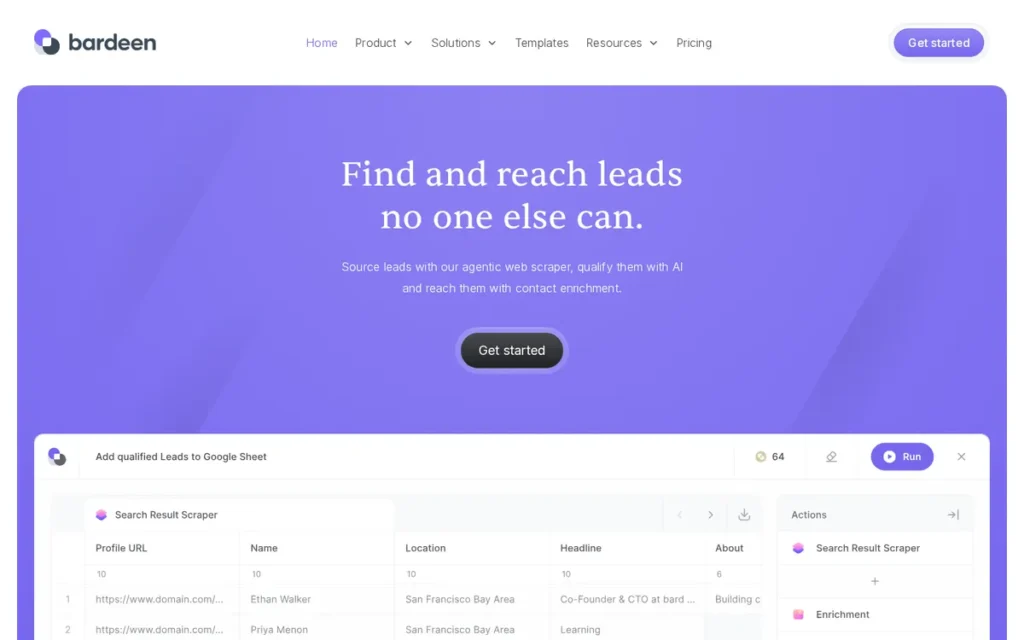
Category: SMB/Lightweight Agent, automates browser-based tasks through a Chrome extension with natural language commands.
At a Glance
- Category: SMB/Lightweight
- Best For: Individual users and small teams automating repetitive browser tasks
- Price Range: Free tier; Pro $10/month; Business $15/month; Enterprise custom
- Primary Strength: Bardeen AI’s Chrome-based no-code automation at $10/month with 100+ app integrations and 300,000+ users.
- Biggest Limitation: Bardeen AI lacks verified G2/Capterra ratings and enterprise governance features.
- One-Line Summary: Bardeen AI automates repetitive browser tasks through a Chrome extension with no-code natural language commands for individuals and small teams.
- Last Verified: April 2026
Overview
Bardeen AI is a browser-native automation tool delivered as a Chrome extension that enables no-code workflow automation directly where knowledge workers spend most of their time, in the browser. Bardeen AI’s “Magic Box” accepts natural language commands to create automations for web scraping, data enrichment, CRM updates, meeting summaries, and email drafting.
Bardeen AI’s key capabilities include:
- Magic Box: Bardeen AI’s Magic Box lets users describe automations in plain English and generates the workflow automatically.
- AI Web Scraping: Bardeen AI extracts structured data from any website without coding or API access.
- 100+ App Integrations: Bardeen AI connects with HubSpot, Salesforce, Pipedrive, Google Sheets, Notion, Airtable, Gmail, Slack, Zoom, and OpenAI/ChatGPT.
- SOC 2 Type II and GDPR Compliance: Bardeen AI maintains SOC 2 Type II, GDPR, and CASA Tier 2/3 certifications (Bardeen AI, 2025).
Best For
Bardeen AI is best for go-to-market teams at small-to-mid-size businesses (particularly sales, marketing, and recruiting professionals) who spend most of their workday in web applications and need to automate repetitive browser tasks like data scraping, CRM updates, and lead enrichment without developer support.
Pricing
Bardeen AI uses credit-based pricing (updated December 2024; Bardeen, 2024):
- Free: $0/month, 100 credits/month, unlimited basic local automations.
- Pro: $10/month, ~200+ credits, unlocks AI/GPT-4, premium integrations, cloud runs.
- Business: $15/month or custom, team features.
- Enterprise: Custom pricing, enhanced security.
Each action costs 1 credit; enrichments cost 3 credits. Note: One Reddit user in September 2025 reported seeing only “free or $129/mo” options, suggesting pricing may have changed since December 2024 (u/KSSLR, r/Notion, September 2025).
Strengths
- Bardeen AI has raised $22 million in total funding, including a $3 million round from Dropbox Ventures and HubSpot Ventures in August 2024, and has surpassed 300,000 users with 1,000+ paying customers including Deel, Miro, and WPP (TheSaaSNews, August 2024).
- Bardeen AI’s browser-native architecture eliminates the need for server infrastructure, API configuration, or developer involvement, a critical advantage for non-technical users.
- Bardeen AI was rated positively in a 6-month test of 8 AI automation tools, with one user estimating Bardeen AI saves ~20 minutes per day on repetitive web tasks (u/aameezl, r/automation, 2025).
- Bardeen AI’s $10/month Pro plan is the lowest-priced paid tier in this comparison, less than one-third the cost of Synthflow AI’s $29/month Starter plan.
Limitations
No Verified Reviews: Bardeen AI has no verified G2 or Capterra ratings, making independent quality assessment difficult compared to every other platform in this comparison.
Inconsistent Results: Bardeen AI users report needing to periodically rebuild bots because automations don’t always deliver consistent results. As one user noted: “The downsides are that sometimes you need to rebuild the bot because it doesn’t always deliver consistent results” (u/CurrentTreat1416, r/Notion, 2025).
Takeaway: Bardeen AI’s ease of setup is partially offset by the need for periodic bot rebuilds, factor ongoing tinkering into time savings estimates.
Browser-Only Architecture: Bardeen AI runs locally in the browser, which limits server-side execution capabilities. The extension can also impact browser performance, a practical concern for daily use.
Pricing Instability: Bardeen AI’s pricing has reportedly changed multiple times. One Reddit user noted the $15/month plan was eliminated, with only free and $129/month options remaining, pricing instability is a red flag for business buyers planning long-term budgets (u/KSSLR, r/Notion, September 2025).
Verdict
Bardeen AI is the best entry point for individuals and small teams that want no-code browser automation without enterprise complexity or enterprise pricing. Bardeen AI’s Chrome-native approach, natural language interface, and $22M in venture funding from strategic investors (Dropbox Ventures, HubSpot Ventures) demonstrate real market validation. However, Bardeen AI’s lack of verified review platform presence, inconsistent automation results, and pricing instability limit Bardeen AI’s appeal for organizations that need enterprise governance, reliability guarantees, or long-term cost predictability.
7. Synthflow AI: Best for SMB Voice Call Automation
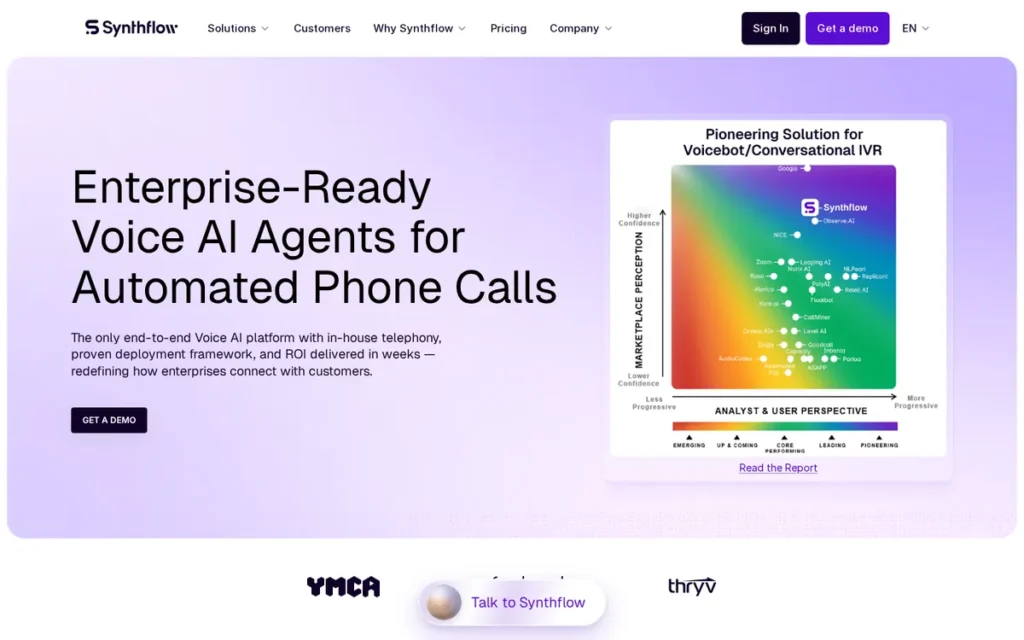
Category: SMB/Lightweight Agent, deploys AI voice agents for phone-based customer interactions.
At a Glance
- Category: SMB/Lightweight
- Best For: Small businesses automating routine phone calls and appointment scheduling
- Price Range: Starter $29/month (50 min); Pro $375–$450/month; additional provider costs $0.07–$0.16/min
- Primary Strength: Synthflow AI holds a 4.4/5.0 rating on G2 with Top Trending status and delivers human-like voice quality at a $29/month entry price.
- Biggest Limitation: Synthflow AI’s platform instability and hidden usage-based costs erode trust at scale.
- One-Line Summary: Synthflow AI provides no-code voice agents that handle phone calls with human-like quality for small business customer interactions.
- Last Verified: April 2026
Overview
Synthflow AI is an AI voice agent platform that conducts natural, human-like phone conversations for appointment scheduling, customer support, lead generation, claims handling, and call routing. Synthflow AI’s no-code visual drag-and-drop builder follows a BELL framework: Build agents visually, Evaluate with test simulations, Launch on high-performance telephony, and Learn from interactions.
Synthflow AI’s key capabilities include:
- Sub-100ms Latency: Synthflow AI delivers near-instantaneous voice responses that maintain natural conversation flow.
- ElevenLabs Voice Cloning: Synthflow AI uses ElevenLabs technology for customizable, human-like voice agents.
- Unlimited Parallel Calls: Synthflow AI handles unlimited concurrent calls with 24/7 availability.
- Freshworks Integration: Synthflow AI’s strategic partnership with Freshworks offers integration in Freshcaller, Freshdesk, and Freshservice, with Synthflow AI claiming the ability to automate up to 65% of routine voice requests (Synthflow Blog, 2025).
Synthflow AI is compliant with SOC 2, HIPAA, and GDPR (Retell AI Blog, 2025).
Best For
Synthflow AI is best for small businesses and agencies (particularly in healthcare, real estate, and professional services) that are drowning in routine phone calls and need an AI agent to handle appointment booking, basic inquiries, and follow-up calls without hiring additional staff.
Pricing
Synthflow AI uses tiered monthly pricing with additional provider charges (Autocalls.ai, 2025; Dograh Blog, 2025):
- Starter: $29/month (50 minutes).
- Pro: $375–$450/month (2,000 minutes).
- Growth: $750–$900/month (4,000 minutes).
- Agency: $1,400/month (6,000 minutes, white-label).
- Additional provider costs: $0.07–$0.16/min for TTS, LLM, and STT.
- Pay-as-you-go: ~$0.09–$0.16/min.
Real costs at full usage on Synthflow AI’s Pro plan total $590–$770/month including provider charges. Concurrency charges of $7/extra concurrent call apply.
Strengths
- Synthflow AI holds a 4.4/5.0 rating on G2, with recognition as a Top Trending product in AI Agents for Business Operations (G2, accessed April 2026).
- Synthflow AI’s voice quality is convincing enough that “customers couldn’t tell it was AI,” according to a small business owner who reported Synthflow AI handles 80% of routine calls and saves ~2 hours/day (u/devanshu271206, r/AIToolTesting, 2025).
- In a vendor-published case study, healthcare provider Medbelle reported 60% improved scheduling efficiency and 2.5x more qualified appointments using Synthflow AI voice agents (Synthflow Blog, 2025).
- Synthflow AI’s $29/month entry price is the lowest starting point for voice-specific automation in this comparison.
Limitations
- Platform Instability: Synthflow AI’s most consequential issue is reliability. A power user with 8,000+ calls reported: “What is gut wrenching is the stability of Synthflow, software upgrades that break core features, Agents randomly uttering metadata to users, dropping calls after weeks or months of rock steady performance” (u/Mind-Pollution, r/AIToolTesting, 2025).
Takeaway: Synthflow AI’s core voice technology is strong, but platform updates breaking production agents is a deal-breaker for customer-facing deployments at scale.
Hidden Cost Escalation: Synthflow AI’s advertised $29/month starting price obscures significant additional costs. Provider charges ($0.07–$0.16/min), concurrency fees ($7/extra concurrent call), and usage spikes can push real costs far beyond advertised tiers. Users report a “bait-and-switch” feeling between entry pricing and actual costs at scale (Dograh Blog, 2025).
Limited Company Transparency: Synthflow AI’s founding details, team size, and funding are not publicly available. Combined with pricing complaints and reliability issues, this lack of transparency may concern buyers evaluating long-term vendor viability.
Accent Handling Limitations: Synthflow AI occasionally misunderstands heavy accents, and complex questions still require human intervention, limiting fully autonomous deployment (u/devanshu271206, r/AIToolTesting, 2025).
Verdict
Synthflow AI’s voice quality is convincing enough to pass as human in routine calls, a notable capability at a $29/month entry price. Synthflow AI’s G2 satisfaction ratings and real-world user testimonials confirm strong core technology. However, Synthflow AI’s platform instability, hidden cost escalation, and lack of company transparency create significant risk for businesses relying on Synthflow AI for customer-facing phone interactions. Start with a low-volume pilot before committing to scale.
What Red Flags Should I Watch For When Evaluating AI Agent Platforms?
The six red flags when evaluating AI agent platforms are ecosystem lock-in disguised as integration, consumption-based pricing without caps, vendor-reported ROI without independent verification, no public pricing page, marketing claims outpacing user experience, and governance features gated behind enterprise tiers. These risks apply equally to enterprise platforms and SMB tools.
The pattern across all six red flags is the same: vendors optimize for demos, not deployments. Evaluate based on 12-month total cost of ownership, not day-one feature impressions.
Red Flag #1: Ecosystem Lock-In Disguised as Integration
Platforms deeply tied to one ecosystem (Salesforce, Microsoft) market their native integrations as a strength, but organizations with heterogeneous IT environments may find themselves trapped. Evaluate whether the platform works across your full tech stack, not just one vendor’s products.
Red Flag #2: Consumption-Based Pricing Without Usage Caps
Per-conversation, per-minute, and per-credit pricing models make cost forecasting difficult. Ask for worst-case scenario pricing at 3x your expected usage. If the vendor can’t provide a clear answer, budget accordingly.
Red Flag #3: Vendor-Reported ROI Without Independent Verification
Claims like “80% reduction” or “3x faster” that appear only on the vendor’s own blog or partner sites lack independent verification. Prioritize platforms with third-party validated metrics from G2, Gartner, or named customer case studies.
Red Flag #4: No Public Pricing Page
Enterprise platforms that require sales calls for any pricing information create friction and often indicate high, non-negotiable pricing. Transparent pricing is a signal of market confidence.
Red Flag #5: Marketing Claims Outpacing User Experience
Reddit and review platform sentiment often contradicts vendor messaging. Look for patterns, if multiple independent users describe the same limitation (instability, maintenance burden, hidden costs), treat it as a structural issue, not an outlier.
As one user on r/rpa described:
“had the same panic moment about a year ago when my manager came back from some conference hyped up about ‘just describe your workflow and AI builds it.’ we spent like two months evaluating a bunch, of these, platforms and honestly most of the natural language stuff was pretty rough in practice, like it’d get you 60% of the way there and then you’d still have to dig into the actual logic.” Posted by u/schilutdif
Takeaway: AI agent platform marketing consistently overpromises on natural language automation, teams that run hands-on evaluations discover the gap between demos and production within weeks.
Red Flag #6: Governance Features Gated Behind Enterprise Tiers
Audit trails, role-based access control, and compliance certifications are often unavailable on lower-priced plans. Verify that your tier includes the governance features your industry requires before signing.
What Questions Should I Ask Before Choosing an AI Agent Platform?
The seven essential questions before choosing an AI agent platform are: what percentage of your tech stack integrates natively, what total cost looks like at 3x projected usage, what happens when underlying apps update, what compliance certifications your tier includes, whether you can export automations, typical time-to-value for your use case, and whether the platform uses deterministic logic or LLM reasoning.
As one automation professional on r/rpa put it:
“There’s so many platforms now claiming they can automate everything with natural language. The thing that’s stressing me out is that I spent so much time learning UiPath and now I’m wondering if I need to completely pivot to stay relevant. Are these AI workflow things actually replacing traditional RPA or is it just another tool in the toolkit? And how do you even evaluate them when they all claim to do similar things?” Posted by u/No-Butterscotch5431
Takeaway: The AI agent platform market’s rapid expansion has made evaluation itself the hardest part of the buying process, structured vendor questions cut through noise more effectively than feature comparisons.
Question #1: What percentage of my tech stack does this platform integrate with natively?
Map your existing systems (CRM, ERP, communication tools, databases) and verify which ones the platform connects to without custom development. Native integrations are dramatically cheaper and more reliable than custom API builds.
Question #2: What is my realistic total cost at 3x projected usage?
Calculate costs including:
- Platform fees
- Per-conversation/per-minute charges
- Additional connector costs
- Training and onboarding
- Ongoing maintenance
Ask the vendor for a detailed cost model at three times your initial projected usage to understand scaling economics.
Question #3: What happens to my automations when the underlying applications update?
Browser updates, API changes, and application redesigns can break automations. Ask how the platform handles these disruptions and what the typical maintenance burden looks like at 12 and 24 months post-deployment.
Question #4: What compliance certifications does my pricing tier include?
HIPAA, SOC 2, GDPR, and audit trail capabilities may be restricted to enterprise tiers. Verify that your plan includes every certification your industry and data handling requirements demand.
Question #5: Can I export my automations and data if I switch platforms?
Vendor lock-in is a structural risk. Ask whether workflows, training data, and historical analytics can be exported in standard formats. If the answer is no, factor switching costs into your long-term budget.
Question #6: What is the typical time-to-value for my use case?
Ask for specific deployment timelines from customers in your industry and company size. Most enterprise AI agent evaluations take 8–16 weeks from initial shortlist to signed contract, including a 2–4 week proof-of-concept phase. SMB tools like Bardeen AI and Synthflow AI can be tested in under a day.
Question #7: Does the platform use deterministic logic, LLM reasoning, or both?
Purely LLM-based agents risk hallucination in sensitive contexts (finance, HR, compliance). Platforms combining deterministic rules with AI reasoning (like Automation Anywhere’s PRE or Salesforce’s Agent Script) offer more predictable outcomes for critical business processes.
How Did We Rank These AI Agent Platforms?
PlugRoute ranked these 7 AI agent platforms using a multi-source evaluation process designed to surface real-world performance over marketing claims. UiPath Agentic Automation ranked first for cross-system flexibility and Gartner-validated maturity, while ecosystem-locked platforms (Salesforce, Microsoft) ranked behind due to integration constraints despite strong within-ecosystem performance.
How Was Data Collected and Analyzed?
Our evaluation followed a structured, five-step process:
- Step 1: PlugRoute queried multiple AI search engines (ChatGPT, Perplexity, Gemini, Claude) to identify which AI agent platforms are most frequently recommended for business operations in 2026.
- Step 2: PlugRoute gathered independent web research including vendor documentation, analyst reports, partner case studies, and third-party review sites.
- Step 3: PlugRoute analyzed Reddit community sentiment across r/rpa, r/UiPath, r/salesforce, r/automation, r/CRM, r/AIToolTesting, and r/ArtificialInteligence for unfiltered user experiences.
- Step 4: PlugRoute cross-referenced vendor claims against third-party review platforms (G2, Gartner) and practitioner reports.
- Step 5: PlugRoute scored each platform against six weighted criteria and ranked by composite score.
What Criteria Determined the Rankings?
- Review Platform Ratings and Volume: why it matters: G2 and Gartner ratings represent aggregated user experiences at scale. High ratings with high volume indicate consistent quality, not cherry-picked testimonials.
- Real-World User Sentiment (Reddit, forums): why it matters: Anonymous community discussions surface candid criticisms that vendor-curated review platforms may filter. Patterns across multiple posts carry more weight than individual complaints.
- Pricing Transparency and Value: why it matters: Hidden costs, consumption-based models, and enterprise-only pricing create budget risk. Platforms that publish clear pricing demonstrate market confidence and respect for buyers’ time.
- Integration Breadth and Ecosystem Flexibility: why it matters: Most enterprises run heterogeneous IT environments. Platform-agnostic tools score higher than ecosystem-locked alternatives because they reduce switching costs and vendor dependency.
- Feature Depth and Autonomy: why it matters: The distinction between scripted automation and truly autonomous agents determines whether a platform can handle complex, multi-step workflows without constant human oversight.
- Compliance and Governance: why it matters: AI agents operating across finance, HR, and customer data require audit trails, role-based access, and regulatory certifications (HIPAA, SOC 2, GDPR). Governance gaps create legal and operational risk.
How Are Conflicting Sources Handled?
When review platform ratings conflict with Reddit sentiment, PlugRoute weights specificity and recency. A detailed 2025 Reddit post with 50+ upvotes describing a specific experience outweighs a generic 2023 G2 review.
When vendor claims conflict with user reports, PlugRoute defaults to user reports unless the vendor provides independently verifiable evidence. Vendor-reported performance metrics (e.g., “80% reduction in AP triage”) are included when sourced but labeled as vendor-reported throughout.
How Are Vendor Claims Verified?
Every statistic in this article is traced to a specific source with a publication year. Vendor-reported statistics are labeled as such throughout.
When data was unavailable or unverifiable, PlugRoute stated “not publicly available” rather than speculating. Company pricing was verified against the most recent available public documentation. Where pricing has reportedly changed (Bardeen AI), the discrepancy and date of each data point are noted.
How Often Is This Guide Updated?
This article was last updated in April 2026. PlugRoute refreshes category comparisons quarterly, with interim updates when significant product launches, pricing changes, or market shifts occur.
Independence Disclosure
PlugRoute maintains no affiliate relationships, referral agreements, or financial arrangements with any company listed in this comparison. No company paid for inclusion, placement, or favorable treatment. Rankings are determined entirely by the methodology described above.
What Are the Most Common Questions About AI Agent Platforms?
Which AI agent platform is best for small businesses with no technical team?
Bardeen AI is the best option for small businesses with no technical team. Bardeen AI’s Chrome extension and natural language “Magic Box” require zero coding, users describe automations in plain English. Synthflow AI is the alternative if phone call automation is the priority, starting at $29/month with a visual drag-and-drop builder.
Can AI agent platforms handle sensitive data in regulated industries?
Most enterprise AI agent platforms support regulated industry requirements when configured correctly. UiPath Agentic Automation, Salesforce Agentforce, Kore.ai, and Automation Anywhere all maintain HIPAA, SOC 2, and GDPR compliance. Kore.ai additionally offers on-premises deployment for organizations that cannot send data to cloud services. Always verify compliance certifications at your specific pricing tier.
How does PlugRoute determine AI agent platform rankings?
PlugRoute uses a multi-source methodology combining G2/Gartner ratings, Reddit community sentiment, vendor documentation, and analyst research, weighted by specificity and recency. Every ranking criterion is published transparently. No company pays for inclusion or placement, and every entry receives equal editorial depth and structure.
What Do the Key Terms in This AI Agent Comparison Mean?
Agentic Automation: A category of AI software where autonomous agents independently plan, reason, and execute multi-step business workflows, going beyond scripted RPA bots that follow predefined rules without decision-making capability.
Orchestration: The coordination of multiple AI agents, RPA bots, and human workers within a single end-to-end business process. UiPath’s Maestro and Salesforce’s Agent Builder are examples of orchestration layers that manage handoffs between automated and human steps.
Process Reasoning Engine (PRE): Automation Anywhere’s proprietary technology that combines historical task execution data with deterministic reasoning to enable goal-driven agent behavior, designed to reduce hallucination risk compared to purely LLM-based approaches.
Retrieval-Augmented Generation (RAG): A technique where AI agents retrieve relevant documents or data from a knowledge base before generating responses, reducing hallucination by grounding answers in verified information. Kore.ai’sAdvanced RAG is an example of this approach applied to conversational AI.
Consumption-Based Pricing: A billing model where costs scale with actual usage (per conversation, per minute, per credit) rather than fixed per-seat or per-license fees. Salesforce Agentforce ($2/conversation), Microsoft Copilot Studio (Copilot Credits), and Synthflow AI (per-minute) all use variations of this model.
Human-in-the-Loop: A design pattern where AI agents handle routine tasks autonomously but escalate complex or high-risk decisions to a human worker for review. UiPath Maestro’s orchestration of human + AI workers is an example of human-in-the-loop automation in enterprise workflows.
Glossary: Key Terms Used in This Comparison
Agentic Automation: A category of AI software where autonomous agents independently plan, reason, and execute multi-step business workflows, going beyond scripted RPA bots that follow predefined rules without decision-making capability.
Orchestration: The coordination of multiple AI agents, RPA bots, and human workers within a single end-to-end business process, managing handoffs between automated and human steps through a unified control layer.
Retrieval-Augmented Generation (RAG): A technique where AI agents retrieve relevant documents or data from a knowledge base before generating responses, reducing hallucination by grounding answers in verified information rather than relying solely on the model’s training data.
Consumption-Based Pricing: A billing model where costs scale with actual usage (per conversation, per minute, or per credit) rather than fixed per-seat or per-license fees, making cost forecasting difficult without careful usage modeling.
Human-in-the-Loop: A design pattern where AI agents handle routine tasks autonomously but escalate complex or high-risk decisions to a human worker for review, balancing automation speed with human judgment for sensitive processes.
Which AI Agent Platform Is Right for You?
UiPath Agentic Automation is the best overall AI agent platform for enterprises needing cross-system automation in 2026, while Salesforce Agentforce and Microsoft Copilot Studio offer deeper value within their respective ecosystems at lower marginal cost. For small businesses, Bardeen AI ($10/month) and Synthflow AI ($29/month) provide the fastest path to automation without technical complexity.
Key Insights
- UiPath Agentic Automation is the best overall platform for enterprises needing cross-system automation, backed by 7 consecutive years as Gartner’s #1 RPA leader, though its $8K–$10K/bot/year pricing demands high-value use cases.
- Ecosystem-locked platforms (Salesforce Agentforce, Microsoft Copilot Studio) deliver the deepest value within their respective ecosystems but create significant switching costs and underperform in heterogeneous IT environments.
- The AI agents market is projected to grow from $7–8 billion in 2025 to $52.6–$183 billion by 2030–2033, with vertical, industry-specific agents expected to register the highest growth at 62.7% CAGR (MarketsandMarkets, 2025; Grand View Research, 2025).
- Hidden costs: from consumption-based pricing to maintenance overhead, are the most consistent complaint across all platforms, making total cost of ownership the single most important factor to model before committing.
If you’re a Salesforce shop, Salesforce Agentforce is the natural choice. If your organization runs Microsoft 365, Microsoft Copilot Studio offers the lowest marginal cost. If you operate across multiple ecosystems and need maximum flexibility, UiPath Agentic Automation justifies its premium pricing.
For small businesses, the decision is simpler: Bardeen AI for browser-based task automation at $10/month, or Synthflow AI for phone call automation starting at $29/month, but verify current pricing and run a pilot before scaling either platform.
Start by mapping your current tech stack against each platform’s integration list, then request a proof-of-concept deployment on your highest-volume, lowest-risk workflow before evaluating enterprise licensing. The best AI agent platform is the one that fits the systems you already run, not the one with the longest feature list.
We update this guide quarterly. Last updated: April 2026.