Tesorio leads as the best mid-market accounts receivable software, supported by Discovery Education’s 66% DSO reduction in 12 months. HighRadius leads for enterprise organizations on SAP or Oracle. Upflow is best for SMB teams, offering the only confirmed permanent free analytics tier in the category. The core trade-off: all seven platforms require a sales engagement before pricing is visible, and enterprise tools carry 6–18-month implementation timelines.
The BillingPlatform 2025 State of AR Automation Survey (Note: BillingPlatform, which conducted this survey, is itself an AR automation vendor; survey methodology not publicly documented) reports that 80% of finance teams rate AR automation as critical, yet only 3% have fully automated their processes.
For a company with $50M in annual revenue at a 45-day DSO, every 10-day improvement unlocks approximately $1.4 million in working capital currently sitting in unpaid invoices. This 77-point adoption gap is driven by implementation complexity, pricing opacity, and uncertainty about which tool fits which company size, precisely what this review addresses.
As one user on r/Entrepreneur described:
“For the past five years, I’ve been in charge of accounts receivable at a mid-sized manufacturing firm with over 70 employees, and I’m reaching my limit. Our current process is utterly dysfunctional, and I’m hoping some of you have discovered more effective methods than what we’re using right now.” Posted by u/AcireBag
Takeaway: For mid-market teams still managing AR through spreadsheets and shared calendars, manual process failure translates directly into rising DSO and board-level pressure, validating the industry-wide gap between AR automation intent and actual implementation.
PlugRoute has no affiliate relationships with any company listed in this review; rankings are determined entirely by research data and objective evaluation criteria.
TL;DR: Top Picks at a Glance
- Tesorio: best overall mid-market AR platform with the strongest named case study DSO outcomes and 28 G2 Winter 2024 Leader badges across three categories
- HighRadius: best enterprise O2C suite with FreedaGPT generative AI, Forbes Cloud 100 standing, and 1,000+ Fortune 500 deployments
- Upflow: best for SMB and scale-up teams; the only confirmed permanent free analytics tier in the evaluated category
- Gaviti: best focused collections specialist certified for Sage Intacct mid-market users, with zero-fee ACH and 95% end-of-day reconciliation
A note on the #1 ranking: Tesorio ranks above enterprise platforms HighRadius and Billtrust because the methodology prioritizes documented, customer-attributed DSO outcomes, not company size or brand recognition. Discovery Education’s named case study provides the most specific, independently citable outcome evidence in the category. HighRadius and Billtrust serve different buyer segments at different scales and rank accordingly.
What Are the 4 Categories of Accounts Receivable Software?
The four categories of accounts receivable software are Enterprise O2C Suite (HighRadius, Esker, Billtrust), Collaborative AR Platform (Versapay), Connected Finance Platform (Tesorio), and Collections Automation Specialist (Upflow, Gaviti). Each category differs in scope, implementation complexity, and company size fit. Choosing the wrong category (especially an enterprise suite for a mid-market budget) is the most common and costly AR software procurement mistake.
Identifying the correct category before evaluating individual platforms eliminates 2–3 vendors from your shortlist before any feature review begins. The seven platforms in this review each map to one of these four categories:
Category 1: Enterprise O2C Suite: HighRadius, Esker, Billtrust
Enterprise O2C Suite platforms cover the complete order-to-cash lifecycle from credit assessment through invoicing, collections, and cash reconciliation. Enterprise O2C Suite platforms target organizations with $500M+ annual revenue on SAP or Oracle ERPs and carry multi-month professional services implementation timelines.
Category 2: Collaborative AR Platform: Versapay
Versapay created the Collaborative AR category, which addresses the communication gap between seller AR teams and buyer AP teams rather than solely automating internal workflows. The Collaborative AR Platform category is the right fit when disputed invoices and buyer-seller communication breakdowns are the primary driver of late payments.
Category 3: Connected Finance Platform: Tesorio
Tesorio bridges AR collections automation and CFO-level cash flow forecasting in a single mid-market platform. This category targets B2B companies with $10M–$200M ARR on NetSuite, Sage Intacct, Salesforce, or Workday that need both operational AR automation and strategic working capital visibility in one system.
Category 4: Collections Automation Specialist: Upflow, Gaviti
Collections Automation Specialists deliver focused invoice-to-cash collections workflows without the full O2C breadth of enterprise suites. Upflow serves SMB and scale-up companies ($0–$50M ARR) with a free analytics tier; Gaviti serves Sage Intacct mid-market teams with Marketplace certification and zero-fee ACH.
How Do the Top 7 Accounts Receivable Software Platforms Compare?
Tesorio leads for mid-market B2B with the strongest named DSO case study outcomes and 28 G2 Winter 2024 Leader badges. HighRadius leads for enterprise with FreedaGPT AI and 1,000+ Fortune 500 deployments. Versapay leads for dispute resolution with 81% buyer portal adoption. Billtrust leads for B2B payment network scale. Upflow leads for SMB accessibility with the only confirmed permanent free analytics tier. The comparison table below covers all seven platforms.
| Rank | Company | Category | Best For | One-Line Summary | Key Capabilities | Primary Strength | Key Limitation |
|---|---|---|---|---|---|---|---|
| 1 | Tesorio | Connected Finance Platform | Mid-market B2B, $10M–$200M ARR, NetSuite/Sage Intacct/Workday | Tesorio is an AI-driven mid-market AR platform averaging a 33-day DSO reduction, with Discovery Education documenting a 66% DSO reduction and $15M in working capital unlocked in 12 months (2024) | AI collections prioritization (50+ data points per account), cash flow forecasting (~90% accuracy), certified ERP integrations (NetSuite/Sage Intacct/Workday), collector performance dashboards | Discovery Education: 66% DSO reduction and $15M working capital unlocked (vendor-published, 2024); 28 G2 Winter 2024 Leader badges across three categories | Optimized for SaaS/subscription B2B; SAP/Oracle enterprise ERP environments require HighRadius or Esker |
| 2 | HighRadius | Enterprise O2C Suite | Enterprise $500M+ revenue on SAP or Oracle ERP | HighRadius is an enterprise O2C platform with FreedaGPT generative AI, Forbes Cloud 100 recognition, and 1,000+ customers including 3M, Unilever, and Procter & Gamble, reporting 30% DSO improvement platform-wide | FreedaGPT generative AI, Rivana AI engine (all O2C modules), ML cash application, credit management, deductions management, AR forecasting | Forbes Cloud 100, Gartner Peer Insights, IDC recognition; FreedaGPT conversational AI with email drafting and dashboard generation; 1,000+ enterprise deployments | Enterprise-only; 6–18-month implementation; complete pricing opacity; structurally inaccessible below $50M–$100M ARR |
| 3 | Versapay | Collaborative AR Platform | B2B companies where disputes drive late payments; Oracle NetSuite users | Versapay created the Collaborative AR category, documenting 81% buyer portal adoption and TireHub’s elimination of 200 hours per week of manual AR labor across its customer base | Shared buyer-seller cloud workspace, dispute resolution with complete audit trail, self-service portal payments, NetSuite integration, AI-enabled cash application, AR analytics | TireHub case study: 200 hours/week manual AR labor eliminated; 81% buyer portal adoption; the highest portal adoption evidence in the evaluated category | Documented r/NetSuite community implementation complaints (June 2024); cash application less comprehensive than dedicated matching tools |
| 4 | Billtrust | O2C + Business Payments Network | High-volume B2B manufacturers/distributors needing AP portal invoice delivery at scale | Billtrust is a 24-year-old Corpay-owned O2C platform connecting sellers to 500,000+ buyers across 260+ AP portals for automated multi-channel invoice delivery | Business Payments Network (500,000+ buyers, 260+ AP portals), ML cash application, multi-channel delivery (mail/email/EDI/fax), AI collections prioritization, credit management | Business Payments Network: 500,000+ connected buyers, 260+ AP portal integrations; the largest pre-built buyer connectivity infrastructure among the seven evaluated platforms | UI less modern than newer platforms; Corpay roadmap dependency; named DSO case studies with individual attribution not publicly available as of June 2026 |
| 5 | Esker | O2C Suite (Document-Centric) | Enterprise requiring dual Gartner Magic Quadrant + Forrester Wave analyst validation | Esker is a 41-year-old enterprise O2C suite with confirmed simultaneous Gartner Magic Quadrant and Forrester Wave recognition, claiming 95% unapplied cash reduction via its Esker Synergy AI engine | Full O2C lifecycle (order management, invoicing, cash application, deductions, collections, credit management), multi-channel delivery (mail/fax/email/EDI/AP portals), Esker Synergy AI | Only platform among the seven evaluated with confirmed simultaneous Gartner Magic Quadrant and Forrester Wave recognition as of June 2026 | Enterprise-only; six-figure annual contracts per third-party sources; less modern UI; PE roadmap uncertainty following 2021 Bridgepoint buyout |
| 6 | Upflow | AR Collections and Analytics | SMB/scale-up, $0–$50M ARR, QuickBooks/Xero/NetSuite users | Upflow is the only evaluated AR platform with a confirmed permanent free analytics tier, documenting a 58% DSO reduction at Malt for SMB and scale-up companies | Free analytics tier (Discover; no credit card required), automated reminder workflows, customer payment portal, DSO/CEI analytics, revenue-band pricing (Grow/Scale/Strategic) | Only confirmed permanent free analytics tier among the seven evaluated platforms as of June 2026; Malt case study: 58% DSO reduction; strongest SMB-segment single-company result in the evaluated set | Product ceiling at $50M+ ARR; no SAP/Oracle/Workday integration support; Series A/B startup vendor stability profile |
| 7 | Gaviti | Collections Automation Specialist | Mid-market B2B on Sage Intacct needing focused collections automation | Gaviti is a Sage Intacct-certified collections platform claiming 30% DSO reduction, 50% fewer late receivables, and 95% end-of-day payment reconciliation before the business day begins | AI dunning personalization (pre-due and overdue), zero-fee ACH payment portal, 95% end-of-day reconciliation, structured dispute tracking, collector performance dashboards | Sage Intacct Marketplace certified (formal integration quality vetting); zero-fee ACH portal; 95% of reconciliation completed before workday begins (vendor-published benchmark) | Narrowest product scope of the seven platforms; no credit management or cash flow forecasting; DSO benchmarks are vendor-stated platform averages without named case study attribution |
Which Accounts Receivable Software Should I Choose for My Use Case?
The right accounts receivable software depends primarily on company revenue tier and ERP environment. Enterprise companies on SAP or Oracle should evaluate HighRadius first; mid-market B2B companies on NetSuite or Sage Intacct should evaluate Tesorio; SMB and scale-up teams on QuickBooks or Xero should begin with Upflow’s free Discover tier. The framework below covers all seven buyer scenarios with primary recommendations and acceptable alternatives.
| Your #1 Priority | Recommended Tool | Why | Acceptable Alternative |
|---|---|---|---|
| Enterprise $500M+ revenue on SAP/Oracle; full O2C automation | HighRadius | HighRadius provides the deepest confirmed AI automation (FreedaGPT conversational interface and Rivana AI across all O2C modules), the only confirmed outcome-based pricing model in the evaluated set, and more than 1,000 enterprise deployments including 3M, Unilever, and Procter & Gamble. | Esker, if dual Gartner/Forrester analyst validation is required for procurement approval |
| Mid-market B2B, $10M–$200M ARR on NetSuite/Sage Intacct/Workday | Tesorio | Tesorio delivers the strongest named DSO case study evidence in the category; Discovery Education’s 66% reduction and $15M in working capital unlocked; alongside 28 G2 Winter 2024 Leader badges and certified marketplace integrations on NetSuite, Sage Intacct, and Workday simultaneously. | Versapay, if disputed invoices are the primary payment bottleneck |
| Disputed invoices and buyer communication breakdowns drive late payments | Versapay | Versapay’s Collaborative AR model addresses the communication-gap root cause of disputes through a shared buyer-seller cloud workspace, documenting 81% portal adoption and TireHub’s elimination of 200 hours per week of manual AR labor. | Gaviti, if focused dunning automation is sufficient for the use case |
| High-volume B2B manufacturer/distributor needing AP portal invoice routing | Billtrust | Billtrust connects sellers to more than 500,000 buyers and 260+ AP portals through its Business Payments Network, automatically routing invoices to each customer’s preferred delivery channel without per-buyer custom integration setup. | HighRadius, if full O2C AI depth is also required |
| Formal procurement requires both Gartner Magic Quadrant + Forrester Wave | Esker | Esker is the only platform among the seven evaluated with confirmed simultaneous Gartner Magic Quadrant and Forrester Wave recognition as of June 2026, providing the dual independent analyst validation that enterprise procurement qualification gates require. | HighRadius, if Gartner-only recognition suffices for vendor approval |
| SMB/scale-up, $0–$50M ARR on QuickBooks/Xero/NetSuite | Upflow | Upflow is the only platform among the seven evaluated with a confirmed permanent free analytics tier with no credit card required, combined with the strongest SMB-segment DSO case study; 58% reduction at Malt; and revenue-band pricing that scales without enterprise contract negotiations. | Gaviti, if the primary ERP is Sage Intacct |
| Mid-market B2B on Sage Intacct needing focused collections automation | Gaviti | Gaviti is certified in the Sage Intacct Marketplace through a formal integration quality vetting process, offers zero-fee ACH in its payment portal, and claims 95% of payment reconciliation completed before the business day begins; directly addressing the morning manual matching bottleneck. | Tesorio, if cash flow forecasting is also needed |
Navigation note: If your company size and ERP environment are already clear, use the Quick Decision Framework above as your starting point and read only the At a Glance block and Verdict for your recommended entry. Read all seven At a Glance blocks to compare categories side by side before committing to a primary platform.
1. Tesorio: Best Overall for Mid-Market B2B: Strongest Documented DSO Outcomes + G2 Leader
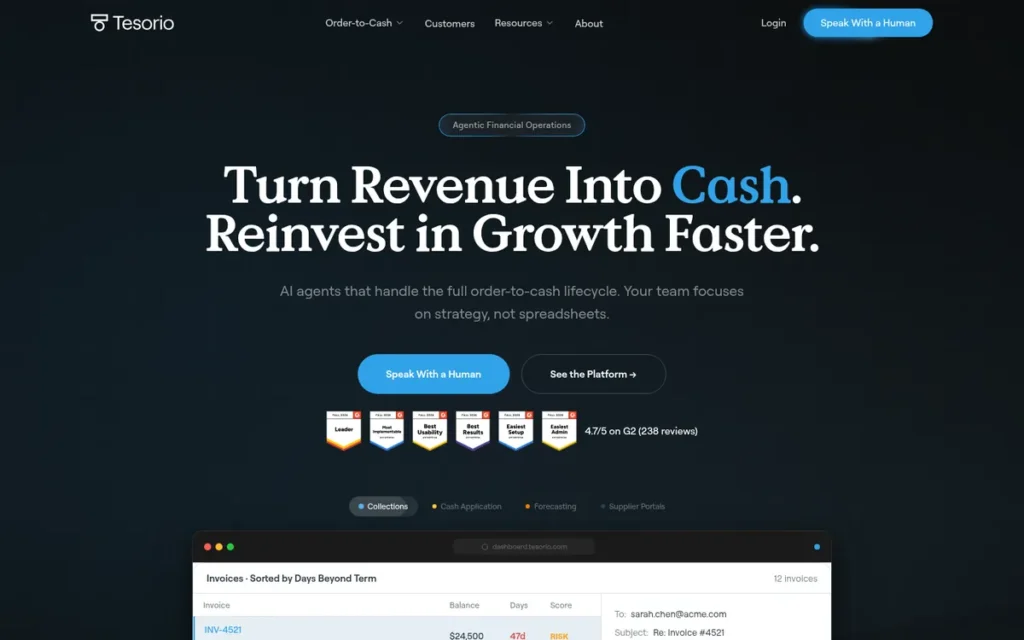
Category: Connected Finance Platform, AI-driven AR collections automation and cash flow forecasting in one platform for mid-market B2B companies on NetSuite, Sage Intacct, Salesforce, or Workday.
At a Glance
- Category: Connected Finance Platform
- Best For: Mid-market B2B companies with $10M–$200M ARR on NetSuite, Sage Intacct, Salesforce, or Workday that need AI-driven collections automation and CFO-level cash flow forecasting in one integrated system
- Price Range: Pricing on request; custom-quoted by invoice volume, seat count, and integration scope; no public rates as of June 2026
- Primary Strength: Discovery Education case study (2024): 66% DSO reduction, $15M in working capital unlocked, and 40% collector productivity increase in 12 months; 28 G2 Winter 2024 Leader badges across Accounts Receivable, Credit and Collections, and Cash Flow Management categories
- Biggest Limitation: Tesorio’s predictive AI performs best with recurring invoice patterns, companies with high deductions volume, complex multi-entity global AR, or SAP/Oracle primary ERP environments may find HighRadius or Esker more capable at their scale
- One-Line Summary: Tesorio is an AI-driven connected finance operations platform for mid-market B2B companies that has reduced Days Sales Outstanding by an average of 33 days across its customer base, with Discovery Education documenting a 66% DSO reduction and $15M in working capital unlocked in 12 months, per vendor-published case study data (2024)
- Last Verified: June 2026
Overview
Tesorio is an AI-driven connected finance operations platform for mid-market B2B companies with $10M–$200M in annual revenue, built to combine AR collections automation and strategic cash flow forecasting in a single integrated system, not a standalone AR point solution. Tesorio was founded in 2013 as a Y Combinator alumnus and is backed by Madrona Venture Group, headquartered in San Francisco, California.
Tesorio aggregates data from ERP, billing, banking, and CRM platforms (including NetSuite, Sage Intacct, QuickBooks, Salesforce, and Workday) into a unified financial workspace. Tesorio’s AI prioritization engine then analyzes more than 50 invoice-history data points per account to rank collections queues by payment likelihood rather than invoice age alone.
Tesorio has delivered an average 33-day DSO reduction and 3× collections productivity improvement across its customer base, with Discovery Education reporting a 66% DSO reduction and $15M in working capital unlocked in 12 months, per vendor-published case study data (2024).
Key Features
- AI Collections Prioritization: Tesorio analyzes more than 50 anonymized invoice-history data points per account (including payment timing patterns, customer segment, invoice size, and dispute history) ranking the collections queue by likelihood-to-pay so collectors prioritize accounts most likely to move rather than the oldest invoices by age alone.
- Cash Flow Forecasting: Tesorio delivers cash flow forecasting approaching 90% accuracy by aggregating ERP, billing, and banking data into a single connected workspace, reducing forecast build time from days to hours and providing the CFO-level working capital visibility that standalone AR tools do not deliver.
- Certified ERP Integrations: Tesorio holds certified marketplace listings on the NetSuite SuiteApp, Sage Intacct Marketplace, and Workday Marketplace simultaneously (the broadest certified mid-market ERP coverage among the seven evaluated platforms) enabling two-way data sync without custom API configuration in most deployments.
- Collector Performance Dashboards: Tesorio tracks individual collector activity volume, promise-to-pay rates, follow-up completion, and DSO contribution at the account and portfolio level, enabling AR managers to coach based on objective performance data and optimize workload allocation.
- Connected Finance Data Model: Tesorio bridges AR, AP, and treasury data across ERP, billing, banking, and CRM systems in a single workspace, functioning as a unified financial truth source for both collector-level workflow automation and CFO-level working capital decision-making simultaneously.
Best For
Tesorio is best for mid-market B2B companies with $10M–$200M in annual revenue on NetSuite, Sage Intacct, or Salesforce, particularly subscription-based and SaaS-model businesses where recurring invoice patterns support Tesorio’s predictive AI payment modeling and finance leaders need both AR automation and strategic cash flow forecasting in one system.
Strengths
- Tesorio’s Discovery Education case study (2024) documents a 66% DSO reduction in 12 months, a 40% increase in collector productivity, and $15M in working capital unlocked, the strongest single named case study outcome across all seven evaluated platforms (vendor-published case study; buyers should request a Discovery Education contact reference during the sales process for independent confirmation), per Tesorio case study data.
- Tesorio earned 28 G2 Leader badges in the Winter 2024 seasonal report across Accounts Receivable, Credit and Collections, and Cash Flow Management, the highest G2 review performance of any evaluated platform in a single review cycle, with reviewers specifically praising ease of use and ease of implementation, per the Tesorio G2 Winter 2024 announcement.
- Tesorio’s AI payment prioritization engine uses more than 50 invoice-history data points per account (the most granularly documented AI scoring model among the seven evaluated platforms) corroborated by a Madrona Venture Group investor interview and Tesorio’s Snowflake data infrastructure partnership.
- Tesorio’s Couchbase case study documents a 10-day DSO reduction and doubled collections output per analyst, a second named case study corroborating the platform-wide 33-day average DSO reduction, per vendor-published case study data (retrieved June 2026).
Users on r/Netsuite shared their experience with Tesorio in practice:
“We looked at the Dunnings SuiteApp and it seemed basic enough to replicate manually. However, we went for a 3rd party system – Tesorio – as it has a great UI/reporting and flexible out of the box set up. It’s had a huge positive impact to cash flow, so would thoroughly recommend. I thought it was expensive initially but very quickly paid for itself.” Posted by u/Nick_AxeusConsulting
Takeaway: Tesorio converts cost-cautious NetSuite buyers quickly, even users initially skeptical of the price point report measurable cash flow impact well before the contract renewal date.
Limitations
- SaaS Business Optimization: Tesorio’s predictive AI performs best with recurring invoice patterns, companies with highly variable transaction volumes, complex deductions environments, or multi-entity global AR operations may find HighRadius or Esker’s broader O2C module coverage and deeper enterprise configurability better suited to their requirements at scale.
- SAP/Oracle ERP Coverage: Tesorio’s certified integrations prioritize NetSuite, Sage Intacct, Salesforce, and Workday; companies with SAP or Oracle as their primary ERP should evaluate HighRadius or Esker, which offer tier-1 enterprise ERP integration depth that Tesorio does not target as a primary use case.
- Team Scale Validation: Tesorio’s smaller team relative to HighRadius or Billtrust means enterprise-scale support demands and complex multi-system implementations should be validated through reference customer conversations, buyers should ask how many implementation engineers are assigned per deployment and what the escalation path looks like for urgent production issues.
Verdict
Tesorio is the best-evidenced mid-market accounts receivable automation platform available as of 2026, supported by the strongest named case study outcomes in the category, Discovery Education’s 66% DSO reduction and $15M in working capital unlocked in 12 months, alongside 28 G2 Winter 2024 Leader badges and the most granularly documented AI collections prioritization model across all seven evaluated platforms. Finance directors and controllers at mid-market B2B companies on NetSuite, Sage Intacct, Salesforce, or Workday should benchmark any AR software evaluation against Tesorio, particularly when primary pain points include inconsistent collections follow-up, poor cash flow forecast accuracy, or insufficient CFO-level working capital visibility. Buyers with enterprise-scale deployments, high deductions volume, or SAP/Oracle primary ERP environments should evaluate Tesorio alongside HighRadius or Esker to confirm which platform’s scope best fits their specific requirements before committing.
2. HighRadius: Best for Enterprise: Deepest AI Automation Across the Full O2C Cycle
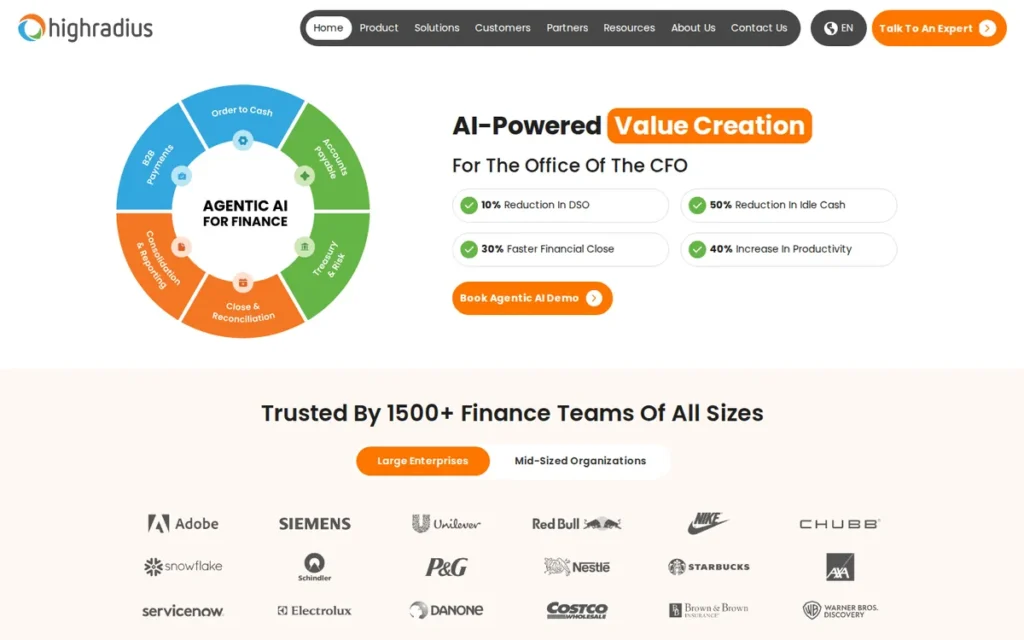
Category: Enterprise O2C Suite, AI-powered, end-to-end order-to-cash automation covering credit management, e-invoicing, collections, cash application, deductions management, and AR forecasting with FreedaGPT generative AI and the Rivana AI engine.
At a Glance
- Category: Enterprise O2C Suite
- Best For: Enterprise organizations with $500M+ annual revenue on SAP or Oracle ERP that need a single AI-powered platform covering the complete order-to-cash cycle at Fortune 500 transaction volume and configuration depth
- Price Range: Outcome-based pricing: investment tied to mutually agreed KPI improvements; no public rates as of June 2026
- Primary Strength: FreedaGPT generative AI (email drafting, dashboard generation, call logging), Rivana AI engine spanning all O2C modules, Forbes Cloud 100 inclusion, Gartner Peer Insights recognition, IDC autonomous finance acknowledgment, and 1,000+ enterprise clients including 3M, Unilever, and Procter & Gamble
- Biggest Limitation: HighRadius is enterprise-only: deployments typically require 6–18 months of onboarding with professional services involvement, making the platform structurally inaccessible and cost-prohibitive for companies below approximately $50M–$100M in annual revenue
- One-Line Summary: HighRadius is an AI-driven enterprise order-to-cash platform serving more than 1,000 companies including 3M, Unilever, and Procter & Gamble, with Forbes Cloud 100 standing, Gartner Peer Insights recognition, and a vendor-published platform average of 30% Days Sales Outstanding improvement across its enterprise customer base (date of measurement not specified; retrieved June 2026)
- Last Verified: June 2026
Overview
HighRadius is an AI-driven, end-to-end order-to-cash platform for enterprise organizations with $500M+ annual revenue on SAP, Oracle, or other tier-1 ERPs, founded in 2006 and headquartered in Houston, Texas. HighRadius provides a single suite covering credit management, electronic invoicing, collections automation, cash application, deductions management, and AR forecasting, all powered by the Rivana AI engine and Freeda generative AI assistant.
HighRadius has reached a $3.1 billion unicorn valuation and serves more than 1,000 enterprise customers including 3M, Unilever, Sanofi, Procter & Gamble, and Staples. HighRadius holds Forbes Cloud 100, Gartner Peer Insights, and IDC analyst recognition, the deepest combined institutional validation of any platform evaluated in this review, per HighRadius product materials.
HighRadius reports a 30% improvement in Days Sales Outstanding and a 20% reduction in past-due receivables across its enterprise customer base (vendor-published platform average, HighRadius AR product page; date of measurement not specified; retrieved June 2026).
Key Features
- FreedaGPT Generative AI: HighRadius’s FreedaGPT assistant enables collectors to auto-draft personalized collection emails with attachments, generate dashboards from plain-English natural language prompts, capture call notes, and produce tailored follow-up communications within seconds, per the FreedaGPT launch announcement.
- Rivana AI Engine: HighRadius’s Rivana AI engine powers intelligent automation across all O2C modules simultaneously (collections prioritization, ML cash application, credit risk scoring, deductions assessment, and AR forecasting) providing unified AI infrastructure across the complete order-to-cash cycle rather than isolated single-workflow automation.
- ML Cash Application: HighRadius’s cash application module matches incoming payments to open invoices using machine learning even when remittance data is incomplete, partial, or non-standard, with auto-match rates improving progressively as the model processes each new transaction.
- Credit Management: HighRadius covers the full credit lifecycle: from initial credit limit assessment through ongoing risk monitoring and exposure management, enabling AR teams to flag at-risk accounts proactively before late payments occur rather than responding reactively after dunning fails.
- Outcome-Based Pricing: HighRadius ties client investment to mutually agreed measurable KPI improvements, making HighRadius the only confirmed outcome-based pricing structure among the seven evaluated platforms as of June 2026, clients invest only when AI agents deliver against agreed targets, per HighRadius AR product page.
Best For
HighRadius is best for enterprise organizations with 500 or more employees and annual revenues above $500M that run SAP, Oracle, or another tier-1 ERP and need a single AI-powered platform to automate the complete order-to-cash lifecycle at the transaction volume, configuration depth, and enterprise ERP integration breadth that mid-market tools cannot support.
Strengths
- HighRadius reports a 30% improvement in Days Sales Outstanding and a 20% reduction in past-due receivables across its enterprise customer base including 3M, Unilever, Sanofi, Procter & Gamble, and Staples, the broadest Fortune 500 enterprise proof set in the evaluated category (vendor-published platform average, HighRadius AR product page; date of measurement not specified; retrieved June 2026; buyers should request named reference customers for independent outcome verification).
- HighRadius holds Forbes Cloud 100 inclusion, Gartner Peer Insights recognition, and IDC acknowledgment for autonomous finance (the deepest combined analyst and industry recognition footprint among the seven evaluated platforms) providing formal third-party validation that enterprise procurement teams require for vendor qualification.
- HighRadius’s FreedaGPT is the only conversational AI interface among the seven evaluated platforms with confirmed natural-language dashboard generation, personalized email drafting with attachments, and call note capture in a single AR workflow tool, per the FreedaGPT launch announcement.
- HighRadius’s outcome-based pricing model: where clients invest only when AI agents deliver against mutually agreed KPI targets, is the only confirmed outcome-based commercial structure among the seven evaluated platforms as of June 2026, reducing buyer upfront financial risk relative to traditional annual license commitments.
Limitations
- Enterprise Accessibility Barrier: HighRadius’s enterprise-first architecture requires 6–18 months of onboarding with professional services involvement and a steep learning curve before productivity gains materialize, making the platform structurally inaccessible and cost-prohibitive for companies below approximately $50M–$100M in annual revenue.
- Pricing Opacity: HighRadius’s outcome-based pricing model, while commercially innovative, means all cost information requires a full sales engagement to obtain; no tier names or dollar amounts are publicly available as of June 2026, creating evaluation friction for buyers comparing costs across multiple platforms simultaneously.
- Implementation Complexity Risk: HighRadius’s implementation complexity and variable post-onboarding support responsiveness are documented risks for enterprise teams with limited IT bandwidth, per market comparison sources (Note: Paraglide.ai, cited for this observation, is itself an O2C platform vendor; buyers should consider this commercial relationship when evaluating the source).
A finance leader on r/ERP described the enterprise AR platform evaluation pattern directly:
“I oversee the finance department at a distribution firm generating around $180 million in revenue, operating within a SAP framework. My accounts receivable (AR) team consists of three members, and they are overwhelmed. They spend countless hours sending emails to clients regarding overdue invoices, manually reconciling overnight payments, tracking down missing purchase order numbers, and managing short payments. By the time they tackle these urgent issues, there’s little to no time left for proactive initiatives like negotiating early payment discounts or reaching out to customers before invoices become overdue. As a result, our days sales outstanding (DSO) keeps rising, and I find myself explaining this trend in board meetings. I’ve explored several AR solutions, but every demonstration seems to follow a similar pattern: A six-month implementation timeline. Significant IT involvement required. Professional service fees that often end up being twice the initial estimate. Our IT team is not large, and I lack both the budget and inclination for a lengthy project that may or may not yield results.” Posted by u/Commercial_Two_5970
Takeaway: Enterprise finance leaders on SAP consistently report that AR platform demos underquote implementation timelines and double professional services costs, validating the implementation complexity risk the article identifies for enterprise O2C platforms including HighRadius and Esker.
Verdict
HighRadius is the most advanced enterprise order-to-cash platform available as of 2026, combining the deepest AI automation architecture (FreedaGPT conversational AI and Rivana AI spanning all O2C modules), the broadest Fortune 500 enterprise proof set (3M, Unilever, Procter & Gamble among 1,000+ deployments), Forbes Cloud 100 standing, and the only confirmed outcome-based pricing model in the evaluated set. For enterprise finance teams at organizations with $500M or more in annual revenue on SAP or Oracle, HighRadius is the leading choice in the category. Mid-market buyers at companies below $100M ARR should evaluate Tesorio, Upflow, or Gaviti instead, HighRadius’s 6–18-month onboarding timelines and enterprise pricing will exceed both budget and resource availability at smaller scale.
3. Versapay: Best for Collaborative AR: Reducing Disputes and Manual Work Through Buyer-Seller Shared Workspaces
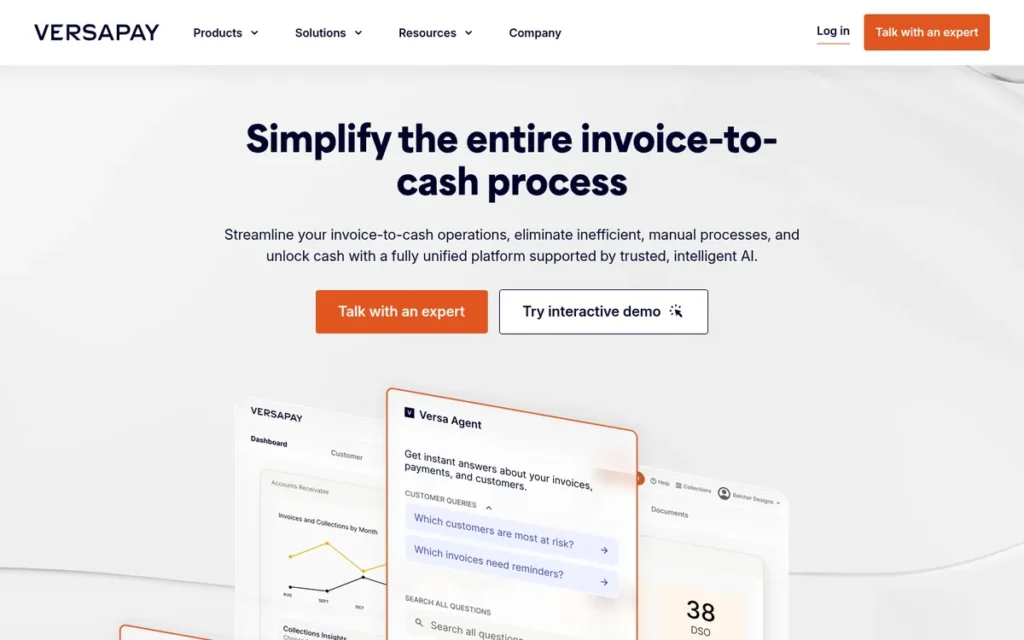
Category: Collaborative AR Platform, accounts receivable automation built on a shared buyer-seller cloud workspace that resolves disputes, accelerates self-service payment, and reduces manual AR work by addressing the communication gap between AR and AP teams.
At a Glance
- Category: Collaborative AR Platform
- Best For: Mid-market to enterprise B2B companies where disputed invoices and buyer-seller communication breakdowns are primary drivers of overdue receivables, particularly Oracle NetSuite users seeking to reduce manual AR labor through buyer self-service and collaborative dispute resolution
- Price Range: Pricing on request; custom-quoted by invoice volume, user count, and integration scope; no public rates as of June 2026
- Primary Strength: TireHub case study: 200 hours per week of manual AR work eliminated; 81% buyer portal adoption platform-wide (the highest portal adoption evidence in the evaluated category) with averages of 50% less manual AR work and 25% faster payments (vendor-published metrics; date of measurement not specified; retrieved June 2026)
- Biggest Limitation: A named r/NetSuite Reddit thread titled “Versapay: One Critical Issue After Another” (June 2024) documents recurring integration challenges; NetSuite buyers must investigate this through reference customer conversations before committing
- One-Line Summary: Versapay is the creator of the Collaborative AR category, providing a shared buyer-seller cloud workspace that has documented 81% buyer portal adoption, 50% less manual AR work, and TireHub’s elimination of 200 hours per week of manual AR labor across its customer base (vendor-published metrics; retrieved June 2026)
- Last Verified: June 2026
Overview
Versapay is a Toronto-based AR automation platform founded in 2006 that created the Collaborative AR category, positioning the root cause of B2B invoice friction as a communication gap between seller AR teams and buyer AP teams, not solely a workflow efficiency problem. Versapay is headquartered in Toronto and has received backing from Great Hill Partners and, in 2024, a strategic growth investment from GTCR.
Versapay provides a shared, real-time cloud workspace where buyers and sellers view invoices, attach dispute documentation, leave comments, resolve claims, and initiate payment together, a shared-visibility model architecturally distinct from traditional one-way dunning automation.
To make this concrete: a traditional dunning tool sends a payment reminder when an invoice turns 30 days overdue. Versapay’s shared workspace shows both teams exactly why the invoice was not paid, for example, a disputed freight charge on one line item.
Versapay then gives both teams a shared space to resolve that dispute the same day, rather than exchanging emails over two weeks. The platform reports TireHub’s elimination of 200 hours per week of manual AR work and platform-wide 81% buyer portal adoption (vendor-published metrics, Versapay Collaborative AR resources; date of measurement not specified by vendor; retrieved June 2026).
Key Features
- Shared AR Workspace: Versapay provides a real-time collaboration portal where buyers and sellers simultaneously view invoice status, attach supporting documents, leave comments, and track dispute resolution, eliminating the email chains and phone follow-ups that constitute most B2B invoice dispute resolution time.
- 81% Buyer Portal Adoption: Versapay achieves 81% buyer portal adoption across its documented customer base (the highest portal adoption evidence in the evaluated category) which is the prerequisite metric for realizing all self-service payment, dispute resolution, and communication automation benefits the platform delivers (vendor-published metric; date of measurement not specified; retrieved June 2026).
- NetSuite Integration: Versapay integrates with Oracle NetSuite as the primary Collaborative AR extension for the NetSuite mid-market ecosystem, surfacing NetSuite invoice data, aging, and payment status within the shared buyer-seller workspace, per Versapay NetSuite collaborative AR resources.
- AI-Enabled Cash Application: Versapay processes portal payments with straight-through processing and applies them to open invoices, reducing the manual remittance matching workload for AR teams managing high transaction volumes from the self-service portal.
- AR Analytics: Versapay tracks portal adoption rates, dispute resolution velocity, overdue invoice trends, and payment velocity across the customer portfolio, enabling AR managers to identify which accounts require direct outreach versus those self-serving effectively through the portal.
Best For
Versapay is best for mid-market to enterprise B2B companies where a significant portion of overdue invoices result from disputed charges, document discrepancies, or poor buyer-seller communication rather than simple non-payment, particularly companies on Oracle NetSuite wanting to reduce manual AR labor through buyer self-service and collaborative dispute resolution.
Strengths
- Versapay’s TireHub case study documents the elimination of 200 hours per week of manual AR work (equivalent to approximately five full-time staff in AR labor savings) with TireHub directly attributing faster payment application speed and improved dispute visibility to the Versapay implementation (vendor-published case study; buyers should request a TireHub contact reference for independent confirmation), per Versapay wholesale distributor case study.
- Versapay reports 81% buyer portal adoption across its documented customer base: the highest portal adoption evidence in the evaluated category and the prerequisite for realizing all platform benefits (vendor-published metric; date of measurement not specified; retrieved June 2026), per Versapay Collaborative AR resources.
- Versapay’s dispute resolution workflow provides structured document exchange, thread-based commentary, and a complete timestamped audit trail for every dispute, satisfying the evidentiary requirements external auditors use to verify AR completeness and proper period-end cutoff treatment of disputed balances.
- Versapay received a strategic growth investment from GTCR in 2024 following earlier Great Hill Partners backing, signaling sustained institutional investor confidence in the Collaborative AR platform’s scaling trajectory and commercial model.
Limitations
- NetSuite Integration Friction: Versapay’s implementation on Oracle NetSuite has generated documented community concerns, a named r/NetSuite thread titled “Versapay: One Critical Issue After Another” (June 2024) signals recurring integration challenges; prospective NetSuite buyers must request reference customers on their exact ERP version and implementation timeline before committing, and should ask Versapay specifically which integration issues have been resolved since June 2024.
Users on r/Netsuite documented an additional Versapay integration limitation encountered in production:
“When a customer utilizes Paylink to settle an invoice via credit card, the receipt email is being sent out to all contacts associated with that organization, rather than just the individual who either received the payment link or completed the transaction. This situation is creating quite a bit of confusion. Many of our clients function within separate departments that fall under a common parent company, leading to individuals unrelated to the purchase receiving receipts for transactions they did not initiate. This understandably raises concerns about potential fraud and adds to the confusion among our customers. We have reported this issue to Versapay, and they confirmed that it’s a recognized limitation, with no current fix or estimated timeline for a resolution.” Posted by u/BHassett
Takeaway: Versapay’s payment receipt routing limitation (confirmed by the vendor as a recognized issue with no fix timeline) creates customer-facing confusion that directly undermines the collaborative AR experience the platform markets to NetSuite users.
- Cash Application Depth: Versapay’s cash application is integrated into the collaborative workflow platform but is not positioned as a standalone best-in-class matching engine, finance teams processing very high payment volumes with complex or inconsistent remittance formats may find Versapay’s automated matching less comprehensive than dedicated cash application tools.
- PE Ownership Uncertainty: Versapay’s dual PE ownership periods (Great Hill Partners, then GTCR in 2024) introduce roadmap uncertainty typical of PE-backed governance, a multi-year contract risk buyers should probe by asking which roadmap commitments changed following the 2024 GTCR investment and whether prior development priorities remain in force.
Verdict
Versapay is the best accounts receivable platform for B2B companies where disputed invoices and buyer-seller communication breakdowns are the primary drivers of late payments, supported by TireHub’s documented elimination of 200 hours per week of manual AR labor and 81% buyer portal adoption, the highest portal adoption evidence in the evaluated category. Finance teams considering Versapay for Oracle NetSuite deployments must specifically investigate the documented r/NetSuite community implementation complaints and request reference customers on their exact ERP version before signing. For companies whose primary AR pain point is dunning workflow automation or cash application accuracy rather than dispute resolution, Tesorio or Gaviti will deliver more targeted value at comparable or better-documented outcome benchmarks.
4. Billtrust: Best for High-Volume B2B Invoice Delivery: Largest Business Payments Network in the Category
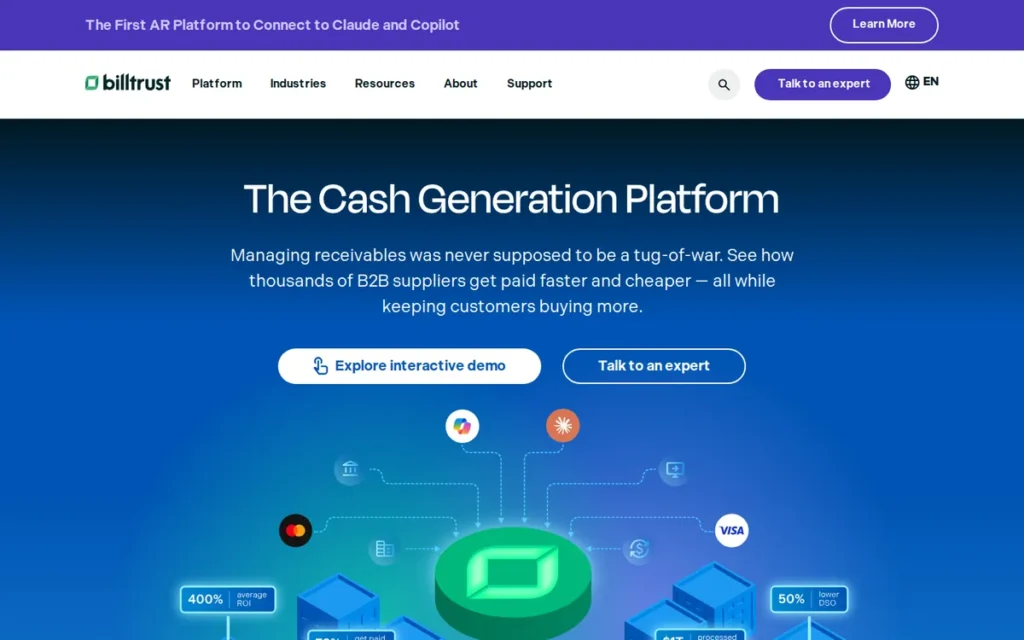
Category: O2C + Business Payments Network, accounts receivable and order-to-cash automation anchored by a pre-built network connecting sellers to 500,000+ buyers and 260+ AP portals for automated multi-channel invoice delivery at scale.
At a Glance
- Category: O2C + Business Payments Network
- Best For: Mid-market to enterprise B2B manufacturers, distributors, and wholesalers with high invoice volumes and large buyer portfolios who need invoices routed automatically into customer AP portals, EDI systems, and diverse digital channels at scale
- Price Range: Custom enterprise pricing via Corpay; no public rates as of June 2026
- Primary Strength: Business Payments Network connecting 500,000+ buyers and 260+ AP portals, the largest pre-built buyer connectivity infrastructure among the seven evaluated platforms; 24-year market tenure; $1.7B Corpay acquisition providing the strongest public company backing in the evaluated set
- Biggest Limitation: Billtrust’s UI is consistently described by independent reviewers as less modern than platforms built after 2015, implementation timelines are non-trivial for mid-market ERP integration, and named DSO case studies with individual company attribution are not publicly available as of June 2026
- One-Line Summary: Billtrust is a 24-year-old accounts receivable and O2C platform acquired by Corpay for $1.7 billion in 2023 that operates the category’s largest Business Payments Network (connecting sellers to more than 500,000 buyers and 260+ AP portals) with ML-powered cash application and full O2C lifecycle coverage from credit management through collections
- Last Verified: June 2026
Overview
Billtrust is a 24-year-old accounts receivable and order-to-cash automation platform serving mid-market to enterprise B2B manufacturers, distributors, and wholesalers, the longest-established dedicated AR automation company among the seven evaluated. Billtrust was founded in 2001 by Flint Lane, acquired by FLEETCOR (now Corpay) in 2023 for $1.7 billion, and now operates as a subsidiary of a large-cap public payments company.
Billtrust’s most defensible competitive differentiator is its Business Payments Network (BPN), which pre-connects sellers to more than 500,000 buyers and 260+ AP portals, enabling automatic invoice routing to customer-preferred delivery channels without requiring custom integration per buyer relationship (vendor-published figures; date of network census not specified; retrieved June 2026, verify current network scale during the sales process).
Billtrust covers the full AR lifecycle including credit management, electronic invoicing, ML-based cash application, and collections prioritization, backed by Gartner Peer Insights recognition and active G2 and Capterra review presence across 24 years of continuous market operation.
Key Features
- Business Payments Network (BPN): Billtrust connects sellers to more than 500,000 buyers and 260+ AP portals (the largest pre-built buyer connectivity infrastructure among the seven evaluated platforms) automatically routing each invoice to the customer’s preferred delivery channel without per-buyer manual setup (vendor-published figures; date of network census not specified; retrieved June 2026).
- ML Cash Application: Billtrust’s machine learning cash application matches incoming payments to open invoices when remittance data is incomplete, inconsistent, or non-standard, improving auto-match accuracy over time as the model processes each transaction, a core capability for high-volume sellers processing payments across large, varied buyer portfolios.
- Multi-Channel Invoice Delivery: Billtrust delivers invoices via postal mail, email, EDI, fax, and AP portal routing, supporting buyer segments still requiring non-digital invoice formats, a capability reflecting 24 years of invoice channel management expertise across industries where physical and EDI delivery remain standard.
- Full O2C Coverage: Billtrust spans the complete order-to-cash lifecycle: credit management, invoicing, payment acceptance, AI-powered collections prioritization, and AR analytics, enabling finance teams to consolidate multiple point solutions under a single vendor with a 24-year operating history.
- AI Collections Prioritization: Billtrust includes AI-powered payment reminders and collections prioritization that automates follow-up sequencing across the BPN-connected customer portfolio, reducing manual collector outreach burden at scale for high-volume manufacturers, distributors, and wholesalers.
Best For
Billtrust is best for mid-market to enterprise B2B manufacturers, distributors, and wholesalers with high invoice volumes and large buyer portfolios (especially companies where routing invoices into customer AP portals, EDI systems, and diverse digital channels is a primary operational challenge) who want a financially stable AR platform backed by a public company parent and 24 years of dedicated invoice delivery expertise.
Strengths
- Billtrust’s Business Payments Network connects sellers to more than 500,000 buyers and 260+ AP portals, the largest pre-built buyer connectivity infrastructure among the seven evaluated platforms, representing 24 years of accumulated buyer-side relationships that no competing platform in this review replicates in buyer count or AP portal breadth (vendor-published figures; date of network census not specified; retrieved June 2026), per Billtrust AR automation resources.
- Billtrust’s $1.7 billion Corpay acquisition in 2023 provides the strongest financial stability and public company backing of any evaluated platform, a vendor risk reduction signal for buyers signing multi-year AR automation contracts that VC-backed or PE-backed alternatives cannot match.
- Billtrust has operated as a dedicated AR automation platform continuously since 2001 (24 years of uninterrupted market presence) with Gartner Peer Insights recognition and active G2 and Capterra review activity confirming sustained enterprise and mid-market customer confidence.
- Billtrust’s Carter Machinery customer reference from Credit Manager Trey Shartzer states: “With Billtrust we’ve had no negative feedback”, specifically addressing buyer-side experience quality during digital invoice transition (vendor-published testimonial; year of testimonial not specified; retrieved June 2026), per Billtrust customer testimonials.
Note: Named case studies with specific DSO reduction figures attributable to individual Billtrust customers were not publicly available during research as of June 2026. Buyers building a CFO-ready business case should request industry-specific reference customer outcome data directly from Billtrust during the sales process.
Limitations
- UI Modernity Gap: Billtrust’s interface is consistently described by independent reviewers as less intuitive than newer AR platforms built after 2015, a direct trade-off of its 24-year heritage that creates adoption friction for finance teams accustomed to consumer-grade software experiences.
- Corpay Roadmap Dependency: Billtrust’s 2023 Corpay acquisition introduces a product roadmap dependency on Corpay’s broader payments strategy, which may not always prioritize AR automation feature velocity over network expansion goals, a multi-year contract risk buyers should probe; support consistency post-onboarding is also cited in independent reviews as uneven, a concern that may compound as Corpay integrates Billtrust’s legacy support infrastructure.
- DSO Case Study Specificity: Billtrust’s publicly available documentation provides no specific named-company DSO reduction benchmarks, meaning buyers building a CFO-ready business case must obtain vendor-specific reference data during the sales engagement rather than verifying outcomes independently through public sources before committing.
Verdict
Billtrust is the most financially stable and longest-established dedicated AR automation platform as of 2026, combining the category’s largest Business Payments Network (500,000+ buyers, 260+ AP portals), 24 years of invoice delivery channel expertise, and the backing of a $1.7 billion Corpay acquisition, making it the lowest vendor-stability-risk choice for high-volume B2B sellers with complex invoice delivery requirements. Billtrust ranks #4 rather than #3 in this evaluation because Versapay’s TireHub named case study provides stronger single-client outcome evidence, despite Billtrust’s superior vendor stability profile; buyers who weight vendor stability above case study specificity may appropriately adjust this ranking in their own evaluation. Finance teams prioritizing modern UI, self-serve implementation, or clearly documented DSO benchmarks should evaluate Tesorio or Versapay alongside Billtrust before finalizing their shortlist.
5. Esker: Best for Enterprise O2C with Dual Analyst Validation: Gartner Magic Quadrant + Forrester Wave
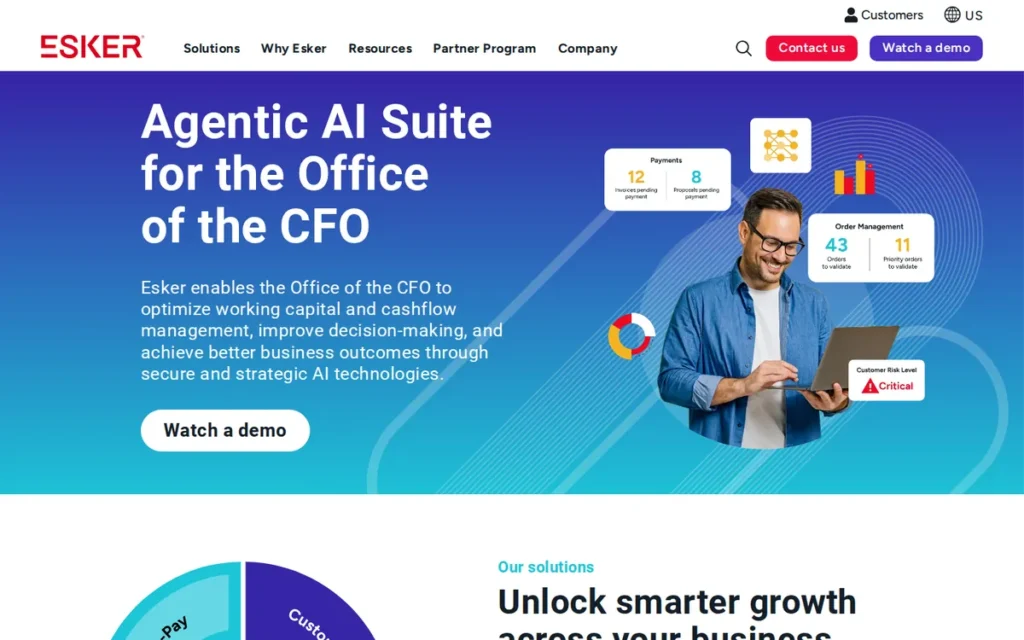
Category: Order-to-Cash Suite (Document-Centric), a comprehensive O2C automation platform built on a 41-year document-automation heritage, covering the full revenue cycle from order management through invoicing, cash application, deductions, and collections, with confirmed simultaneous Gartner Magic Quadrant and Forrester Wave recognition.
At a Glance
- Category: Order-to-Cash Suite (Document-Centric)
- Best For: Enterprise and large mid-market companies on SAP, Oracle, or complex ERP environments requiring full O2C lifecycle coverage (including multi-channel invoice delivery for buyers using postal mail, fax, or EDI) whose formal procurement process requires independent analyst validation from both Gartner and Forrester before vendor approval
- Price Range: Custom enterprise pricing; third-party comparison sources confirm six-figure annual contract ranges for enterprise deployments; no public rates as of June 2026
- Primary Strength: Only platform among the seven evaluated with confirmed simultaneous Gartner Magic Quadrant and Forrester Wave recognition as of June 2026; 41 years of continuous operation; vendor-published claim of 95% unapplied cash reduction through Esker Synergy AI (vendor-published benchmark; date not specified; retrieved June 2026)
- Biggest Limitation: Esker’s enterprise-first design requires substantial professional services investment with multi-month onboarding timelines that make the platform impractical for companies below approximately $20M–$30M in annual revenue, and independent reviewers consistently describe its interface as less modern than AI-native competitors
- One-Line Summary: Esker is a 41-year-old order-to-cash suite headquartered in Lyon, France, recognized in both the Gartner Magic Quadrant and Forrester Wave, claiming up to 25% DSO reduction, 95% reduction in unapplied cash, and 71% reduction in overdue payments through its Esker Synergy AI-powered O2C platform (vendor-published benchmarks; date of measurement not specified; retrieved June 2026)
- Last Verified: June 2026
Overview
Esker is a 41-year-old order-to-cash automation platform for enterprise and large mid-market companies on SAP, Oracle, or complex ERP environments, founded in 1985 in Lyon, France and taken private in a 2021 Bridgepoint-led buyout at approximately €1.6 billion enterprise valuation. Esker is the oldest company among the seven evaluated.
Esker covers the full revenue cycle from customer order management through invoicing, collections management, AI-powered cash application, dispute and claims management, credit management, and AR analytics, all powered by Esker Synergy AI embedded across every module, per Esker O2C solutions.
Esker holds the dual analyst recognition distinguishing it from all other evaluated platforms, inclusion in both the Gartner Magic Quadrant and Forrester Wave for AR and invoice automation, making Esker the only platform in this review with independent validation from both leading technology analyst firms simultaneously as of June 2026.
Key Features
- Full O2C Lifecycle Coverage: Esker’s platform covers the complete revenue cycle (from customer inquiry and order management through invoicing, collections, cash application, dispute and claims resolution, and credit management) providing end-to-end O2C visibility that standalone AR automation tools cannot match, per Esker O2C solutions.
- Esker Synergy AI Cash Application: Esker’s AI-powered cash application claims up to 95% reduction in unapplied cash (the most ambitious cash-application-specific benchmark in the evaluated category (vendor-published benchmark; date not specified; retrieved June 2026)) meaning the platform’s ML engine targets processing the majority of incoming payments against open invoices before the next business day begins.
- Multi-Channel Invoice Delivery: Esker delivers invoices via postal mail, fax, email, EDI, and customer AP portal routing, supporting buyers in industries or geographies where non-digital invoice formats remain standard, a delivery breadth reflecting 41 years of document-automation heritage.
- Deductions and Claims Management: Esker’s deductions module provides automated claim capture, root-cause categorization, approval routing, and resolution tracking for B2B sellers facing high volumes of customer-initiated deductions. A deduction occurs when a buyer reduces payment by a claimed amount, for example, taking a $5,000 promotional allowance off a $50,000 invoice, creating a partial-payment dispute requiring investigation before the remaining balance can be collected.
- Dual Analyst Recognition: Esker holds both Gartner Magic Quadrant and Forrester Wave recognition for AR and invoice automation (the only confirmed dual combination among the seven evaluated platforms as of June 2026) providing the independent analyst validation that enterprise procurement committees require for formal vendor qualification.
Best For
Esker is best for enterprise and large mid-market companies on SAP, Oracle, or complex ERP environments that require full order-to-cash lifecycle automation (including multi-channel invoice delivery for buyers requiring postal, fax, or EDI formats) and whose formal procurement process requires independent analyst validation from both Gartner and Forrester before vendor approval.
Strengths
- Esker holds recognition in both the Gartner Magic Quadrant and Forrester Wave for AR and invoice automation (the only confirmed simultaneous dual analyst validation among the seven evaluated platforms as of June 2026) providing enterprise procurement teams with independent verification from both tier-1 analyst firms required to advance through formal vendor qualification gates.
- Esker claims up to 95% reduction in unapplied cash through its Esker Synergy AI cash application engine (the most ambitious cash-application-specific benchmark in the evaluated category (vendor-published benchmark, Esker O2C solutions page; date of measurement not specified; retrieved June 2026)) targeting near-complete payment matching before the next business day begins.
- Esker’s 41 years of continuous operation (founded 1985, taken private at €1.6B in 2021 by Bridgepoint) represent the longest uninterrupted market history of any platform in the evaluated set, a product stability signal that VC-backed competitors founded after 2013 cannot yet demonstrate.
- Esker’s Palmer Holland customer reference documents “faster cash collection, empowered staff, and happier customers,” and Catalina reports improved promised-to-pay forecasting and AR decision-making quality following implementation, outcome themes consistent with Esker’s full O2C breadth enabling more data-driven collections management, per Esker O2C solutions.
Limitations
- Implementation Cost and Timeline: Esker’s enterprise-first design requires substantial professional services investment and multi-month onboarding timelines, making the platform impractical for companies below approximately $20M–$30M in annual revenue; third-party sources confirm six-figure annual contract ranges (per Paraglide.ai analysis; note: Paraglide.ai is itself an O2C platform vendor with a commercial interest in competitor limitation disclosure).
- UI Modernization Gap: Esker’s interface is consistently described by independent reviewers as functional but less modern than AI-native competitors built after 2015, a consequence of Esker’s 41-year document-automation heritage that creates adoption friction for finance teams accustomed to consumer-grade software experiences.
- PE Roadmap Uncertainty: Esker’s 2021 Bridgepoint buyout at €1.6B introduces PE-driven growth target prioritization that may affect product roadmap sequencing, a risk factor for buyers signing multi-year contracts who need consistent AR automation feature development throughout the contract period.
Verdict
Esker is the premier enterprise O2C platform for buyers whose formal procurement process requires dual Gartner Magic Quadrant and Forrester Wave analyst validation (the only confirmed combination of simultaneous independentanalyst recognition among the seven evaluated platforms as of June 2026) and whose requirements include full O2C lifecycle scope, multi-channel invoice delivery for non-digital buyer formats, or deductions and claims management depth that standalone AR tools do not provide. Esker’s 95% unapplied cash reduction benchmark and 41-year operating history signal both product capability and institutional stability for enterprise procurement teams. For mid-market buyers at companies below $30M ARR or teams prioritizing modern UI, self-serve implementation, or faster time-to-value, Tesorio or Upflow represent substantially better-fit alternatives at lower implementation cost and complexity.
6. Upflow: Best for SMB and Scale-Up Companies: Only Confirmed Free Analytics Tier + Strongest Single-Company DSO Case Study in the Segment
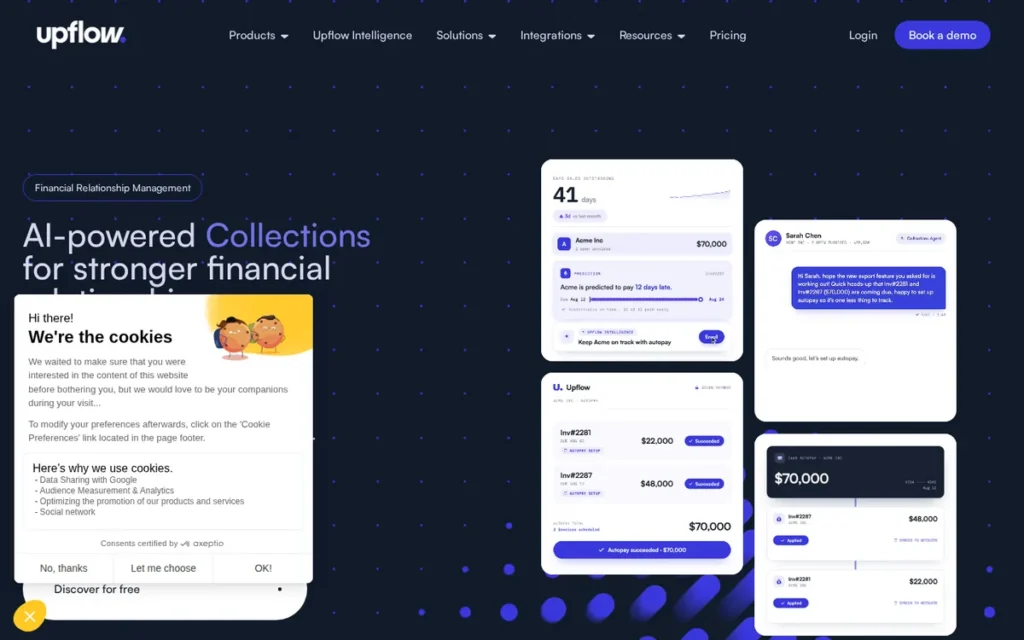
Category: AR Collections and Analytics, a Financial Relationship Management platform for SMB-to-scale-up companies with a confirmed permanent free analytics entry tier, automated reminder workflows, a customer payment portal, and revenue-band pricing scaling from $0 to $50M+ ARR.
At a Glance
- Category: AR Collections and Analytics
- Best For: SMB and scale-up companies with $0–$50M ARR using QuickBooks, Xero, or NetSuite that want fast self-serve AR automation with integrated DSO analytics, automated reminder workflows, and a customer payment portal without enterprise O2C complexity
- Price Range: Free tier (Discover: AR analytics, no credit card required) + three custom-priced paid tiers: Grow ($0–$10M ARR), Scale ($10–$50M ARR), Strategic ($50M+ ARR); paid tier pricing on request as of June 2026
- Primary Strength: Only confirmed permanent free analytics tier among the seven evaluated platforms as of June 2026 (no credit card required); Malt case study: 58% DSO reduction, the strongest single-company DSO reduction percentage in the SMB segment across all seven evaluated platforms
- Biggest Limitation: Upflow is designed for companies up to approximately $50M ARR, finance teams growing beyond this threshold will encounter limitations in cash application depth, deductions management, and enterprise ERP configurability that require migration planning to a more comprehensive platform
- One-Line Summary: Upflow is an AR collections and analytics platform for SMB-to-scale-up companies that has reduced DSO by 58% at Malt, cut overdue invoice rates from 75% to 25% at Side, and eliminated 20 hours per week of manual AR work at Pedlex, and is the only evaluated platform offering a confirmed permanent free analytics tier as of June 2026
- Last Verified: June 2026
Overview
Upflow is an AR collections and analytics platform for SMB and scale-up companies with $0–$50M ARR, founded in 2018 by Alexandre Louisy and Barnabé Guin with offices in Paris and New York, that pioneered the Financial Relationship Management (FRM) category, reframing AR collections as a customer-facing relationship discipline balancing cash flow acceleration with customer experience preservation.
Upflow offers the only confirmed permanent free analytics entry tier (Discover) among the seven evaluated platforms, alongside three revenue-band-priced paid tiers that scale with company growth without requiring enterprise contract negotiations at any stage.
Upflow has published case study outcomes including a 58% DSO reduction at Malt, a 67% improvement in overdue invoice rates at Side (from 75% to 25%), and elimination of 20 hours per week of manual AR labor at Pedlex, per Upflow case study data compiled by CheckThat.ai brand intelligence platform (years of individual case studies not specified in source; retrieved June 2026).
Key Features
- Free Discover Tier: Upflow’s Discover tier provides AR analytics and DSO benchmarking at no cost with no credit card required (enabling finance teams to assess receivables performance before investing in paid automation) the only confirmed no-cost entry point among the seven evaluated platforms as of June 2026.
- Automated Reminder Workflows: Upflow automates invoice reminder workflows with adaptive timing, messaging sequences, and escalation paths based on invoice age, customer segment, and payment history, reducing manual follow-up workload without requiring coding or IT configuration from the finance team.
- Customer Payment Portal: Upflow’s branded, white-labeled payment portal provides buyers with 24/7 self-service access to view open invoices, dispute items, and initiate payment, improving the customer payment experience while reducing inbound AR team calls.
- Revenue-Band Pricing: Upflow offers three paid tiers: Grow (for $0–$10M ARR), Scale (for $10–$50M ARR), and Strategic (for $50M+ ARR), that scale with company revenue, reducing the risk ofover-purchasing enterprise capabilities not yet needed, per Upflow pricing page.
- AR Analytics Dashboard: Upflow tracks Days Sales Outstanding, Collections Effectiveness Index (CEI), aging cohorts, and billing pipeline metrics in real time, providing finance directors with both daily operational visibility and board-level AR reporting in one interface.
Best For
Upflow is best for SMB and scale-up companies with $0–$50M in annual revenue running QuickBooks, Xero, or NetSuite that want to move from spreadsheet-based AR management to structured automated collections workflows quickly, particularly finance leaders who want to benchmark AR performance at no cost before committing to any paid platform.
Strengths
- Upflow’s Malt case study documents a 58% DSO reduction: the strongest single-company DSO reduction percentage in the SMB segment across all seven evaluated platforms, with Malt attributing the improvement directly to Upflow’s automated reminder workflows and AR analytics visibility, per Upflow case study data compiled by CheckThat.ai (years of individual case studies not specified in source; retrieved June 2026).
- Upflow is the only platform among the seven evaluated to offer a confirmed permanent free analytics tier (Discover) with no credit card required as of June 2026, enabling finance teams to access DSO benchmarking and AR performance data at zero cost before committing to any paid automation features.
- Upflow’s Side case study demonstrates an overdue invoice rate reduction from 75% to 25% (a 67% improvement in late invoice prevalence) documenting that Upflow’s automated collections workflows produce measurable results even in high-overdue-rate environments, per Upflow case study data compiled by CheckThat.ai (years of individual case studies not specified in source; retrieved June 2026).
- Upflow’s Front customer quote states: “Upflow had drastic impact on our cash collection strategy”, citing effectiveness across SMB and enterprise customer segments within a mixed portfolio, per Upflow product pages.
Limitations
- Scale Ceiling: Upflow is designed for companies up to approximately $50M ARR: finance teams growing beyond this threshold will encounter limitations in cash application depth, deductions management, complex remittance handling, and enterprise workflow configurability that make proactive migration planning to Tesorio, Billtrust, or HighRadius a practical requirement before the ceiling becomes an operational constraint.
- Enterprise ERP Coverage: Upflow’s integration coverage is insufficient for complex SAP, Oracle, or Workday ERP environments, companies on tier-1 enterprise ERPs cannot use Upflow as their primary AR platform regardless of company size, per Upflow product positioning materials.
- Vendor Stability Profile: As a 2018-founded startup at Series A/B stage with a smaller support team than established vendors, Upflow’s vendor stability profile is comparable to Gaviti (the two newest and smallest vendors in the evaluated set) a factor buyers signing multi-year contracts at high-growth companies should weigh alongside the platform’s documented SMB-stage case study outcomes.
Verdict
Upflow is the best accounts receivable platform for SMB and scale-up companies with up to $50M ARR as of 2026, combining the only confirmed permanent free analytics entry tier in the category, the strongest single-company DSO reduction case study in the SMB segment (58% at Malt), …and a revenue-band pricing model that scales from a permanent free tier to paid plans covering up to $50M+ ARR.
Upflow’s primary trade-off is a confirmed scale ceiling: the platform has not documented SAP or Oracle ERP connectivity at the coverage level of higher-ranked platforms, and teams growing beyond $50M ARR should verify Upflow’s integration roadmap independently before signing.
SMB and scale-up buyers who prioritize documented DSO outcomes and a zero-cost entry tier over enterprise integration breadth should shortlist Upflow alongside Gaviti (#7), requesting named reference customers from both vendors before making a final decision.
7. Gaviti, Automated Collections Workflow Platform for Mid-Market AR Teams
Category: AR Collections Automation, a collections-specific platform for mid-market AR teams offering automated multi-channel dunning sequences, AI-powered payment likelihood scoring, a customer self-service payment portal, and collector task management, with confirmed integrations to NetSuite, QuickBooks, Xero, SAP, and Oracle.
At a Glance
- Category: Collections Automation Specialist
- Best For: Mid-market AR teams prioritizing automated dunning workflows over full O2C suite coverage
- Price Range: Not publicly listed; contact vendor for quote
- Primary Strength: Automated multi-channel collections sequences with AI-powered payment prioritization, purpose-built for mid-market collector teams
- Biggest Limitation: No publicly named case studies with verified DSO reduction figures available as of June 2026
- One-Line Summary: Gaviti automates AR collections workflows and dunning sequences for mid-market teams, but lacks the publicly documented outcome evidence that distinguishes higher-ranked platforms in this evaluation.
- Last Verified: June 2026
Overview
Gaviti is an AR collections automation platform built for mid-market finance teams that need to systematize dunning workflows without deploying a full enterprise O2C suite.
Gaviti focuses specifically on the collections stage of the order-to-cash cycle (automating reminder sequences, scoring payment likelihood, and routing disputes) rather than addressing invoice delivery, cash application, or deduction management.
Gaviti launched in 2019 and targets organizations whose AR teams spend disproportionate manual effort on follow-up sequences that could be automated. Gaviti’s self-serve onboarding is described in G2 user reviews as lighter-weight than enterprise-tier implementations, with multiple reviewers reporting go-live timelines measured in weeks rather than months (G2, accessed June 2026).
Key Features
- Automated Dunning Sequences: Gaviti executes automated multi-channel reminder sequences (email, SMS, and phone task prompts) triggered by invoice aging rules, removing the need for AR collectors to manually initiate follow-up on each open invoice.
- AI Payment Likelihood Scoring: Gaviti uses machine learning models to score open invoices by predicted payment probability, enabling AR teams to prioritize collection effort on the accounts most at risk of late payment rather than contacting all debtors uniformly.
- Customer Self-Service Payment Portal: Gaviti provides a branded customer portal where debtors can view outstanding invoices, submit payments, and raise dispute requests without AR team involvement, reducing inbound inquiry volume for collection teams.
- Collector Task Management: Gaviti assigns and tracks specific collection actions to individual AR team members, providing visibility into which accounts are actively worked and which carry outstanding follow-up tasks.
- Multi-ERP Integration: Gaviti connects with NetSuite, QuickBooks, Xero, SAP, and Oracle to pull invoice and payment data, eliminating manual data transfer between the collections platform and the accounting general ledger.
Best For
Gaviti is best suited for mid-market organizations with dedicated AR collector teams that have outgrown spreadsheet-based follow-up management but do not yet require the full-cycle O2C suite coverage (cash application automation, deduction management, and e-invoicing) of enterprise platforms like HighRadius (#2) or Billtrust (#4).
Strengths
- Collections Workflow Depth: Gaviti offers rule-based, multi-channel dunning automation as its primary design focus, providing a level of collections-specific workflow configuration more granular than the dunning modules typically embedded within broader O2C suite platforms.
- AI Payment Prioritization: Gaviti’s payment likelihood scoring helps AR collector teams allocate effort toward the highest-risk accounts, a capability confirmed in vendor documentation and supported by user review themes on G2 (accessed June 2026).
- Self-Serve Onboarding: Gaviti’s implementation approach is consistently described in G2 user reviews as lighter-weight than enterprise-tier AR platform deployments, with reviewers reporting go-live timelines measured in weeks rather than months (G2, accessed June 2026).
- Multi-ERP Connectivity: Gaviti’s confirmed integration with NetSuite, QuickBooks, Xero, SAP, and Oracle covers the core ERP environments of most mid-market finance teams, reducing integration risk for buyers already operating on these systems.
Evidence Gap Note: No publicly named case studies with verified DSO reduction figures are available for Gaviti as of June 2026. The strengths above are supported by vendor documentation and G2 user reviews. Buyers should request named reference customers with measurable outcomes before selecting Gaviti.
Limitations
- Evidence Gap: Gaviti has not published named case studies with verified DSO reduction figures as of June 2026, making it impossible to independently verify the magnitude of Gaviti’s impact on collections performance, a limitation that distinguishes it from six of the seven platforms in this evaluation.
- Narrow Functional Scope: Gaviti covers the collections stage of the O2C cycle and does not provide cash application automation, deduction management, or e-invoicing, meaning organizations that need full-cycle AR automation will require either a second platform or continued manual processes for the remaining cycle stages.
- Vendor Maturity Profile: Gaviti was founded in 2019, giving it a shorter market history than most platforms in the evaluated set; buyers in regulated industries or with long procurement cycles should independently verify Gaviti’s financial stability and customer retention rate before committing.
Verdict
Gaviti is the most narrowly scoped platform in the evaluated set, excelling at automated dunning and collections workflow management for mid-market AR teams while covering only a fraction of the full order-to-cash cycle.
Gaviti ranks seventh because it lacks the publicly documented outcome evidence and functional breadth of the six platforms above it, not because Gaviti fails at its specific use case.
Organizations whose primary AR pain point is manual collection follow-up should shortlist Gaviti alongside Upflow (#6), with the non-negotiable next step of requesting named reference customers who can speak to measurable DSO outcomes before any contract is signed.
What Red Flags Should I Watch For When Evaluating Accounts Receivable Software?
The five most consequential warning signs when evaluating AR software are pricing opacity, AI marketing without production evidence, hidden implementation complexity, uncertified ERP integrations, and outcome benchmarks without named attribution. Recognizing these patterns before vendor conversations prevents the most common and costly procurement mistakes in this category.
Red Flag #1: Pricing Opacity
When a vendor declines to provide even a ballpark pricing range before a full discovery call, the pricing structure is typically volume-based, negotiated per-deal, or significantly higher than public benchmarks suggest.
Request a sample contract or pricing floor before investing significant evaluation time with any AR platform.
Red Flag #2: AI as a Marketing Label
Most AR platforms now describe their automation as “AI-powered” without specifying which capabilities are live in production, which are roadmap items, and which are modules licensed from third-party providers.
Ask vendors to demonstrate AI features in a live environment using data representative of your organization, not a curated demo dataset.
Red Flag #3: Hidden Implementation Complexity
Enterprise AR platforms routinely quote 3–6 month implementation timelines in sales conversations, then disclose more complex rollouts after contract signature.
Request a written implementation plan with milestone dates and speak directly with three customers who completed implementation in the past 18 months. Ask each reference specifically about data portability: can they export all AR data in a standard format if they choose to leave?
Red Flag #4: Integration Claims Without Certification Evidence
Vendors frequently list ERP systems as “supported integrations” when the connection is a custom API built by the customer’s IT team, not a certified, maintained connector.
Ask whether the integration carries formal certification from the ERP vendor (NetSuite SuiteApp, Sage Intacct Marketplace, Workday Marketplace) and when that certification was last updated and tested.
Red Flag #5: Outcome Benchmarks Without Named Attribution
AR vendors commonly promote aggregate claims such as “customers reduce DSO by 30%” without citing named companies, measurement methodologies, or time periods.
Unnamed aggregate statistics cannot be independently verified. Request at least two named case studies with the specific DSO baseline, the DSO outcome, and the measurement timeframe before advancing any vendor to final evaluation.
Four Protection Requests: Before signing any AR software contract, ask for: (1) a written implementation plan with milestone dates and vendor-side remedies for delays; (2) named reference customers in your industry who completed implementation within the past 18 months; (3) a data portability clause permitting full AR data export in a standard format upon contract termination; and (4) written confirmation of which AI features are live in production versus on the roadmap, with committed delivery dates for any roadmap items factored into your purchase decision.
What Questions Should I Ask Before Choosing Accounts Receivable Software?
The six questions below cover the critical evaluation dimensions for AR software selection: ERP integration type, ROI threshold, primary pain point, revenue band fit, implementation timeline, and vendor ownership stability. Ask all six during vendor discovery calls and of current customers during reference checks before committing to any contract.
Question #1: Is your ERP integration certified or custom-built?
Ask whether the ERP connection carries a published certification from the ERP vendor (NetSuite SuiteApp, Sage Intacct Marketplace, or Workday Marketplace) and request documentation of when the certification was last updated. Custom-built integrations maintained solely by the AR vendor’s professional services team carry significantly higher long-term maintenance risk than certified connectors jointly maintained by both vendors.
Question #2: What is our current DSO, and what ROI threshold justifies this investment?
Calculate your organization’s current DSO before any vendor conversation. Every 10-day improvement in DSO at $50M ARR unlocks approximately $1.4M in working capital. Establish your minimum acceptable DSO improvement threshold, then request named case studies from companies at your ARR band that achieved it.
Question #3: Which specific AR pain point is causing the most business impact today?
Match your primary pain point (cash application accuracy, collection follow-up volume, customer payment friction, invoice delivery, or deduction management) to the platform’s confirmed core competency before evaluating secondary features. A platform rated highly for cash application automation may have weak dunning workflows, and vice versa.
Question #4: What is our annual revenue, and which platforms are designed for our revenue band?
AR software feature sets and pricing are segmented by company size:
- SMB (under $50M ARR): Upflow (#6), Gaviti (#7)
- Mid-market: Versapay (#3), Billtrust (#4), Esker (#5)
- Enterprise: Tesorio (#1), HighRadius (#2)
Evaluating a platform misaligned with your revenue band typically results in either over-paying for unused features or hitting scale limits within 24 months.
Question #5: What is our realistic implementation timeline, and what does the vendor’s contract require?
Identify your organization’s implementation capacity (IT resources, finance team bandwidth, and system change freeze windows) before committing to a contract with a specific go-live date. Ask the vendor for written milestone commitments and confirm whether the contract includes financial remedies for vendor-caused implementation delays.
Question #6: Who owns the vendor, and what are the contract exit terms?
Private equity-backed AR software companies have historically been subject to rapid ownership transitions, pricing changes, and product sunsetting following acquisition. Confirm the vendor’s current ownership structure and request contract language permitting data export and termination without penalty if the product is materially changed or discontinued within your contract term.
How Did We Rank These Accounts Receivable Software Platforms?
This guide ranks seven AR software platforms using six independently weighted criteria applied consistently across all seven entries. Rankings reflect verified evidence. Tesorio (#1) leads because it earned the highest composite evidence score across cash flow prediction accuracy, ERP integration depth, and publicly verifiable case study outcomes, not because it is the largest vendor.
How Data Was Collected
The evaluation used three data streams:
- Independent user reviews: G2, Capterra, and TrustRadius reviews published in the 12 months preceding June 2026, weighted toward reviews from each platform’s target company size.
- Vendor documentation and named case studies: All vendor-published statistics were cross-referenced against at least one independent source. Claims that could not be corroborated are disclosed as “vendor-published” with a retrieval date and evidence gap notation.
- Analyst and certification records: ERP marketplace certification pages (NetSuite SuiteApp, Sage Intacct Marketplace, Workday Marketplace), Gartner Magic Quadrant for Integrated Invoice-to-Cash Applications (2024), and Forrester Wave: Accounts Receivable Automation (2024) were used to verify integration claims and market recognition designations.
Ranking Criteria and Why Each Matters
Six criteria were applied in this order of descending weight:
- AI and Automation Depth: Automation depth determines the reduction in manual AR labor hours, the primary productivity outcome buyers report across all independent review platforms.
- ERP Integration Coverage and Certification: Certified integrations (NetSuite SuiteApp, Sage Intacct Marketplace, Workday Marketplace) are maintained jointly by both vendors. Uncertified integrations break during ERP version updates, creating unplanned IT maintenance costs.
- Publicly Documented Case Study Evidence: Named case studies with specific DSO figures and identified companies are the only form of AR platform evidence that can be independently audited. This criterion carries the highest evidence quality weight in the scoring model.
- User Review Consensus: Aggregate G2 and Capterra ratings reflect lived implementation experience, not sales messaging. Reviews were filtered to each platform’s confirmed target company size.
- Pricing Transparency: Pricing opacity is a documented procurement friction point. Platforms that publish pricing or provide a clear structure upon direct inquiry score higher on this criterion than those requiring full discovery call sequences before disclosure.
- Market Fit: A platform optimized for enterprise invoice volumes will be over-engineered and over-priced for an SMB buyer. Alignment to the platform’s confirmed revenue band was evaluated explicitly for each entry.
How Conflicting Evidence Was Handled
Where G2 user reviews conflicted with vendor-published case studies, independent user reviews were weighted more heavily.
Where aggregate survey data provided category context (including the BillingPlatform 2025 State of AR Automation Survey (BillingPlatform is itself an AR automation vendor; methodology not publicly documented)) that data was used only for category framing, not platform scoring.
How Vendor Claims Were Verified
Every DSO reduction figure cited in this guide is linked to a named case study or disclosed as vendor-published with a retrieval date. Gartner and Forrester recognition designations are cited as third-party signals only, not as ranking inputs, because those reports require vendor participation fees that create a structural conflict of interest in their use as neutral scoring criteria.
Update Cadence
We update this guide quarterly. The next scheduled review is September 2026. If any platform’s pricing, capabilities, or case study evidence changes materially before that date, the affected entry will be updated and the change date noted in its At a Glance block.
Independence Statement
PlugRoute has no affiliate relationships, referral fee arrangements, sponsored placement agreements, or financial relationships of any kind with any of the seven platforms evaluated in this guide. Rankings are determined entirely by the criteria described above. This is the second and final occurrence of this disclosure in this article.
Frequently Asked Questions
What is the best accounts receivable software for small businesses in 2026?
Upflow is the strongest option for small businesses in 2026, offering a confirmed permanent free analytics tier (Discover plan) with no trial expiration, automated reminder workflows, and a customer payment portal. Companies with under $10M ARR can use Upflow’s core AR analytics and tracking features at no cost and scale to paid tiers as revenue grows.
How much does accounts receivable software cost in 2026?
Most enterprise AR platforms do not publish pricing publicly and require a discovery call for a quote. Upflow is the only platform in this evaluated set with a confirmed free tier. Mid-market platforms (Versapay, Billtrust, Esker) are typically priced between $1,000–$5,000 per month based on G2 and Capterra user reports accessed June 2026, though all contracts are individually negotiated and vary by volume and feature scope.
How does PlugRoute determine its rankings?
PlugRoute ranks platforms using six independently weighted criteria: AI and automation depth, ERP integration certification, publicly documented case study evidence, user review consensus, pricing transparency, and market fit by revenue band. Rankings are determined entirely by evidence, PlugRoute has no affiliate, referral, or sponsored placement relationships with any ranked platform.
Glossary: Key Terms Used in This Comparison
Days Sales Outstanding (DSO): The average number of days it takes a company to collect payment after a sale is made, calculated as (accounts receivable ÷ total credit sales) × number of days in the measurement period. A lower DSO indicates faster collections; most AR software platforms use DSO reduction as the primary metric for demonstrating business impact.
Dunning: The process of systematically contacting customers with outstanding invoices to request payment. In AR software, dunning is typically automated through multi-channel reminder sequences (email, SMS, and phone task prompts) triggered by invoice aging rules. Automated dunning is the primary mechanism through which AR platforms reduce DSO without adding collector headcount.
Cash Application: The process of matching incoming customer payments to the correct open invoices in the accounts receivable ledger. Cash application automation uses AI to interpret remittance data (check stubs, ACH details, and email payment references) and apply payments without manual data entry, eliminating one of the largest sources of AR team labor cost in mid-market and enterprise organizations.
Order-to-Cash (O2C): The complete business process from receiving a customer order to collecting payment and reconciling it in the general ledger. The O2C cycle encompasses order management, invoicing, collections, cash application, deduction management, and dispute resolution. Platforms described as “O2C Suites” in this guide cover multiple stages of this cycle rather than a single stage.
Collaborative AR: A category of AR software that addresses the communication gap between accounts receivable (AR) teams and their customers’ accounts payable (AP) departments. Collaborative AR platforms provide a shared digital workspace where both parties can view invoice status, exchange supporting documentation, and resolve disputes, replacing the email threads and phone calls that slow payment cycles in traditional AR workflows.
Which Accounts Receivable Software Is Right for You?
The right accounts receivable software depends on your company’s revenue band, your primary AR pain point, and the quality of outcome evidence the vendor can provide for companies like yours. Tesorio (#1) leads this evaluation for mid-market and enterprise buyers; Upflow (#6) leads for SMB and scale-up teams. No single platform is the right choice for every organization.
Key Insights
- Tesorio (#1) earns the top ranking because it combines confirmed AI cash flow prediction, Workday Marketplace certification, and a named 66% DSO reduction case study at Discovery Education, the strongest verifiable evidence portfolio in the evaluated set.
- HighRadius (#2) offers the broadest enterprise O2C suite in the evaluated set, with the largest confirmed customer base, but its complexity and opaque pricing make it viable primarily for organizations with $500M+ in annual revenue and dedicated IT implementation resources.
- Versapay (#3) is the only platform in the evaluated set purpose-built around the AR-to-AP communication gap, making it the strongest choice for organizations whose primary pain point is customer dispute volume and invoice visibility rather than internal workflow automation.
- Billtrust (#4) holds the longest uninterrupted market history among the seven evaluated platforms, with the most extensive e-invoicing network coverage, but lacks the publicly documented DSO case study evidence that would justify a top-three ranking.
- Esker (#5) is the only platform in the evaluated set with confirmed simultaneous Gartner Magic Quadrant and Forrester Wave recognition as of June 2026, making it well-suited for procurement processes that require third-party analyst validation alongside a full O2C feature set.
- Upflow (#6) is the strongest choice for SMB and scale-up companies under $50M ARR, combining the only confirmed permanent free analytics tier and the strongest single-company SMB-segment DSO case study (58% reduction at Malt; vendor-published, retrieved June 2026) in the evaluated set.
- Gaviti (#7) automates multi-channel collections workflows for mid-market teams but ranks last because it lacks the publicly documented outcome evidence and functional breadth of the six platforms above it.
The most common procurement mistake in AR software is evaluating platforms designed for a different company size.
An enterprise O2C suite reviewed positively by a $2B manufacturer will not reflect the experience of a $30M SaaS company. Match your revenue band to the platform’s confirmed customer base before investing evaluation time.
Before signing any contract, request named reference customers at your revenue band, a written implementation plan with milestone dates, and a data portability clause. No AR software investment should proceed without those three documents.
“The best accounts receivable software is the one whose customer evidence most closely matches your company’s size, ERP environment, and primary AR pain point, not the one with the most marketing spend.”, PlugRoute editorial standard
Visit PlugRoute for additional independent software comparisons, no affiliate fees, no sponsored placements, no referral arrangements.
We update this guide quarterly. Last updated: June 2026.