Ramp is the best overall AP automation platform (4.8/5 on 2,400+ G2 reviews, free tier, zero domestic fees), Tipalti leads for international vendor payments (196 countries, $99/month unlimited users), and Medius tops autonomous invoice processing (96.3% claimed PO touchless rate vs. 23.4% Ardent Partners 2025 market average). ERP stack, invoice volume, and team size determine the right fit, not brand name or LLM consensus.
Manual AP processing costs $12–$40 per invoice compared to approximately $3.25 when fully automated, a 4x-or-more gap (NetSuite, 2025). Finance teams handling 200+ monthly invoices without automation face the steepest ROI differential, compounded by missed early-payment discounts on 2/10 net 30 terms, duplicate payment exposure, and approval bottlenecks that delay month-end close.
PlugRoute has no affiliate relationships with any company listed in this article, rankings are determined entirely by research data and objective evaluation criteria.
“I think Ramp is the best one out there and it’s free.” (r/Accounting)
Takeaway: Among finance professionals on r/Accounting, Ramp’s free entry tier is the primary recommendation driver, zero-cost entry eliminates budget approval cycles and enables immediate adoption, helping explain Ramp’s 45,000+ customer count since its 2019 founding.
TL;DR: Top Picks at a Glance
- Ramp is the highest-rated AP automation platform in this evaluation (4.8/5 on 2,400+ G2 reviews, June 2026), offering a free core AP tier with OCR invoice capture, multi-method payment execution, and zero domestic payment fees, with AI Agents for AP (advanced features on Ramp Plus at ~$15/user/month) launched October 2025.
- Tipalti is the leading AP automation platform for international vendor payments, covering 196 countries in 120 currencies with KPMG-certified financial controls and AI Smart Scan OCR in 145+ languages, starting at $99/month for unlimited users (verified June 2026).
- Medius is the top autonomous AP platform for enterprise exception volume reduction, claiming a 96.3% PO invoice touchless rate versus the 23.4% Ardent Partners 2025 market average, with custom enterprise pricing and multi-phase implementation requirements that should be confirmed before shortlisting.
- Yooz is the only AP automation vendor in this evaluation with formal Oracle Built for NetSuite certification, offering 250+ ERP integrations and Deep Learning trained on 100 million+ real invoices from 100,000+ vendors, the primary choice for complex or niche ERP environments requiring validated integration quality.
- BILL is the most statistically validated AP platform for US-focused SMBs running QuickBooks or Xero, with 2,500+ G2 reviews (the highest dedicated AP review volume in this evaluation at 4.6/5, June 2026), NYSE-listed audited financials ($1.29B FY2024 revenue), and per-seat pricing from $45/user/month.
- AvidXchange is the vertical specialist for real estate, construction, and property management companies, offering native Yardi, MRI Software, AppFolio, and Entrata integrations and a 1.3M+ enrolled supplier network, with active community dissatisfaction signals on r/Netsuite that require structured reference call investigation before committing.
- Coupa is the only enterprise Business Spend Management platform in this evaluation and the choice for procurement-to-pay transformation mandates, despite holding the lowest G2 rating of the seven evaluated platforms (4.4/5 on 1,100+ reviews, June 2026) and Thoma Bravo PE ownership since February 2023.
What Are the 5 Categories of AP Automation Software?
AP automation software divides into five categories based on architecture, depth, and target use case. Understanding which category fits your organization’s primary constraint (ERP stack, invoice volume, global payments, or autonomous processing) is the fastest path to a qualified shortlist.
- Unified Finance Operations Platform: Ramp: AP automation, corporate cards, expense management, procurement, and travel booking in one data model; distinguished from standalone AP tools by its unified spend management architecture that eliminates reconciliation overhead across the entire finance stack.
- End-to-End Global AP Automation: Tipalti: full payables lifecycle from supplier onboarding through 196-country payment execution, automated W-8/W-9/1099 tax compliance, and ERP reconciliation; defined by multi-currency, multi-entity, and cross-border compliance depth that domestic-first AP tools cannot address natively.
- Autonomous AP Automation: Medius: AI-native platform targeting 96%+ touchless PO invoice processing with exception-only human review; defined by touchless processing rate as the primary performance benchmark rather than average time-per-invoice.
- Multi-ERP and Vertical AP Automation: Yooz (250+ integrations, Oracle Built for NetSuite certified) and AvidXchange (265+ integrations, native Yardi, MRI Software, and AppFolio connectivity): both compete on ERP integration breadth and vertical-specific depth for organizations whose primary constraint is ERP environment diversity or industry-specific platform integration.
- Dedicated SMB-to-Enterprise AP: BILL (SMB-to-mid-market, per-seat $45–$79/user/month) and Coupa (Enterprise BSM, Gartner Magic Quadrant Leader for Procurement): representing opposite ends of the dedicated AP-adjacent spectrum, BILL optimizes for US-focused small teams, Coupa for enterprise procurement-to-pay transformation.
How Do the Top 7 AP Automation Tools Compare at a Glance?
Ramp leads on G2 rating (4.8/5, 2,400+ reviews) and pricing accessibility (free tier), Tipalti leads on global payment reach (196 countries, $99/month unlimited users), Medius leads on autonomous processing depth (96.3% claimed PO touchless rate), and Yooz leads on certified ERP breadth (250+ integrations, Oracle Built for NetSuite certified). The table below compares all seven platforms across eight decision-relevant dimensions.
| Rank | Company | Category | Best For | One-Line Summary | Key Capabilities | Primary Strength | Key Limitation |
|---|---|---|---|---|---|---|---|
| 1 | Ramp | Unified Finance Operations | Modern SMB/mid-market; free AP + AI agents | Highest-rated AP platform (4.8/5, 2,400+ reviews), free core tier, zero domestic fees, Agents for AP Oct 2025 | AI-powered OCR, Agents for AP (Ramp Plus), multi-method payments to 185+ countries, corporate cards, unified spend | Highest independently verified G2 satisfaction score in category at highest review volume | Advanced Agents for AP features require Ramp Plus (~$15/user/month), not free tier |
| 2 | Tipalti | End-to-End Global AP | Mid-market with international vendor networks | 196-country payments, KPMG-certified controls, unlimited users from $99/month (June 2026) | AI Smart Scan OCR (145+ languages), 196-country payments, KPMG controls, automated tax compliance, ERP sync | Broadest global payment reach (196 countries) with the only KPMG-certified controls in this evaluation | 6–12 week complex deployments; VAT/GST gaps in certain ERP integrations |
| 3 | Medius | Autonomous AP | Enterprise teams maximizing touchless processing | 96.3% claimed PO touchless rate vs. 23.4% Ardent Partners 2025 market average; 1.4-day cycle | Autonomous AI, unified PDF/e-invoice/EDI capture, proactive fraud detection, ERP-agnostic architecture | Highest claimed PO invoice touchless rate in this evaluation (96.3% vs. 23.4% market average) | No public pricing; multi-phase implementation; Marlin Equity PE-owned since 2017 |
| 4 | Yooz | Multi-ERP AI-Powered AP | Diverse or niche ERP environments; NetSuite users | 250+ ERP integrations, Oracle Built for NetSuite certified, Deep Learning on 100M+ real invoices (June 2026) | 250+ ERP integrations, Built for NetSuite certification, omnichannel invoice capture, ML duplicate detection | Only Oracle Built for NetSuite–certified AP vendor among the seven platforms evaluated | OCR accuracy variability on complex invoice layouts; pricing requires sales contact |
| 5 | BILL | SMB-to-Mid-Market AP | US SMBs with QuickBooks or Xero; domestic vendors | 2,500+ G2 reviews at 4.6/5; 8M+ business network; NYSE-listed ($1.29B FY2024 revenue) | AI OCR, 8M+ payment network, deep QBO/Xero/NetSuite sync, 130+ country payments, NYSE-listed | Highest G2 review volume of any dedicated AP platform in this evaluation (2,500+ reviews) | Per-seat pricing creates cost-scaling exposure at 5+ users in approval workflows |
| 6 | AvidXchange | Mid-Market AP and Payment | Real estate, construction, property management | 265+ ERP integrations, 1.3M+ enrolled supplier network, native Yardi/MRI/AppFolio integrations (June 2026) | Native property management integrations, AvidPay 1.3M+ network, 265+ ERP connections, AvidBuy procurement | Only evaluated vendor with native Yardi, MRI Software, AppFolio, and Entrata integrations | Active r/Netsuite “Replacement for AvidXchange” thread; no public pricing |
| 7 | Coupa | Enterprise BSM | Large enterprises needing procurement-to-pay | Gartner MQ Leader Procurement; $6T+ Community Intelligence; lowest G2 in evaluation (4.4/5, 1,100+ reviews) | Procurement-to-pay, $6T+ Community Intelligence, supplier risk scoring, guided buying, AP automation module | Only enterprise BSM platform with Gartner Magic Quadrant Leader in Procurement credential | Lowest G2 rating in evaluation (4.4/5 on 1,100+ reviews); AP module gaps vs. dedicated tools |
Which AP Automation Tool Should I Choose for My Use Case?
For most modern SMB and mid-market finance teams, Ramp’s free entry tier and 4.8/5 G2 rating make it the safest starting evaluation. Companies paying vendors in 10+ countries should prioritize Tipalti. Real estate and construction organizations should start with AvidXchange. Enterprise procurement-to-pay mandates point to Coupa despite its lowest-in-evaluation G2 rating.
| Your #1 Priority | Recommended Tool | Why | Key Caveat | Acceptable Alternative |
|---|---|---|---|---|
| Highest rating + zero starting cost | Ramp | 4.8/5 on 2,400+ G2 reviews; free tier with OCR, approvals, and payments; zero domestic ACH and check fees | Advanced Agents for AP features (auto-coding, approval recommendations) require Ramp Plus (~$15/user/month); not the free tier | Tipalti ($99/month unlimited users) |
| International vendor payments (10+ countries) | Tipalti | 196 countries, 120 currencies, KPMG-certified controls, AI Smart Scan in 145+ languages | 6–12 week complex deployment; verify full module cost including Mass Payments before committing | Ramp (185+ countries, zero domestic fees) |
| Maximum touchless invoice processing | Medius | 96.3% claimed PO touchless rate vs. 23.4% Ardent Partners 2025 market average | No public pricing; multi-phase implementation before headline rates achieved; request ballpark ACV range in first sales call | Ramp Agents for AP (Ramp Plus, launched October 2025) |
| Diverse or niche ERP environments | Yooz | 250+ integrations; only formal Oracle Built for NetSuite certification in this evaluation | Validate OCR accuracy on your actual invoice formats in a structured pilot before committing to full deployment | AvidXchange (265+ integrations) |
| QuickBooks/Xero + US vendor network | BILL | 8M+ business network; deep QBO/Xero sync since 2006; NYSE-audited financials ($1.29B FY2024) | Per-seat pricing at 5+ users exceeds Tipalti’s $99/month unlimited-user model; model your full approver count first | Ramp (free tier, zero domestic fees) |
| Real estate / construction / property management | AvidXchange | Native Yardi, MRI Software, AppFolio, Entrata; 1.3M+ enrolled suppliers on day one | Run structured reference calls probing the active r/Netsuite “Replacement for AvidXchange” community signals before signing | BILL (for smaller property operations) |
| Enterprise procurement-to-pay mandate | Coupa | Gartner Magic Quadrant Leader; $6T+ Community Intelligence; full BSM scope | Lowest G2 rating in this evaluation (4.4/5, 1,100+ reviews); negotiate multi-year pricing caps given Thoma Bravo PE ownership since February 2023 | Medius (deepest standalone AP automation at enterprise scale) |
| Large approver pool (10+ users), mid-market | Tipalti | $99/month unlimited users vs. BILL Corporate at $790/month for 10 users | Actual annual spend can be materially higher than $99/month with add-on modules; request fully scoped quote | Ramp Plus (~$15/user/month) |
| Same-quarter go-live | Ramp | No required multi-phase implementation; free tier eliminates internal procurement approval cycle | Advanced autonomous features require Ramp Plus; confirm tier requirements match your use case before go-live planning | BILL Essentials ($45/user/month, established SMB deployment path) |
| Fewer than 50 invoices/month, 1–2 AP users | Your accounting software’s built-in AP features | Dedicated AP automation delivers strongest ROI at 50+ invoices/month; below this threshold, implementation overhead often exceeds time savings | Test Ramp’s free tier first to validate ROI before committing to any paid platform | Ramp free tier (zero-cost pilot) |
1. Ramp: Best Overall: Highest-Rated AP Automation with Free Entry Tier and AI Agents
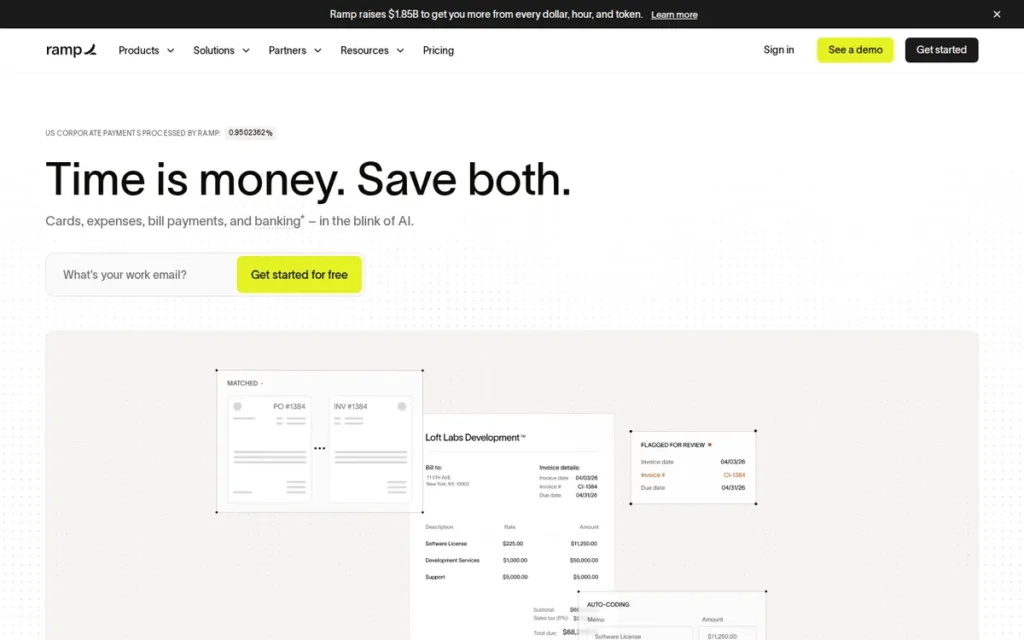
Category: Unified Finance Operations Platform, combines AP automation, corporate cards, expense management, procurement, and travel booking in a single data model; distinguished from standalone AP tools by its unified spend management architecture that eliminates reconciliation overhead across the entire finance stack, with AI agents handling invoice processing autonomously on Ramp Plus.
At a Glance
- Category: Unified Finance Operations Platform
- Best For: Modern SMB and mid-market finance teams wanting the highest-rated AP automation with a free entry point, zero domestic payment fees, and a unified spend platform, particularly teams managing or evaluating corporate cards alongside AP workflows
- Price Range: Free (core AP: OCR, approvals, multi-method payments) | ~$15/user/month (Ramp Plus (includes advanced Agents for AP) | Custom (Ramp Enterprise)) verified June 2026
- Primary Strength: Ramp holds the highest G2 rating in the AP automation category (4.8/5 on 2,400+ reviews, June 2026) and is the only vendor among the seven evaluated in this comparison offering full OCR invoice capture, multi-step approval routing, and multi-method payment execution at zero subscription cost with zero domestic ACH and check fees
- Biggest Limitation: Ramp’s autonomous Agents for AP capabilities: specifically auto-coding and approval workflow recommendations, require Ramp Plus (~$15/user/month) rather than the free tier, and Ramp’s AP module lacks the specialized depth of dedicated platforms for multi-entity enterprise workflows or vertical-specific AP requirements
- One-Line Summary: Ramp is the highest-rated AP automation platform in this evaluation (4.8/5 on 2,400+ G2 reviews, June 2026), offering free core AP automation with zero domestic payment fees and AI Agents for AP (advanced features on Ramp Plus, launched October 2025) that autonomously handle invoice coding, fraud detection, approval summaries, and payment execution
- Last Verified: June 2026
Overview
Ramp is a unified financial operations platform founded in 2019 that combines accounts payable automation, corporate cards, expense management, procurement, and travel booking in a single product, serving over 45,000 businesses, with a 4.8/5 G2 rating across 2,400+ reviews as of June 2026, the highest independently verified satisfaction score in the AP automation category.
Ramp’s Bill Pay product handles the complete AP workflow from AI-powered invoice capture to multi-method payment execution via ACH, check, card, and wire to 185+ countries in 120 currencies. Ramp’s October 2025 Agents for AP launch introduced four AI agents, autonomous invoice coding, duplicate and fraud detection, approval workflow summaries, and card-based payment execution. Auto-coding and approval recommendations are available on Ramp Plus (~$15/user/month), not the free tier.
Ramp’s free tier (OCR capture, approval routing, and multi-method payments at zero cost) is the most accessible AP automation entry point among the seven evaluated platforms, reflected in Ramp’s 45,000+ customer count and $100B+ annual purchase volume despite being founded only in 2019.
Key Features
- Agents for AP (October 2025, Ramp Plus): Ramp’s four specialized AI agents autonomously handle invoice coding, fraud detection, approval workflow summaries, and card-based payment execution, with early Ramp Plus users reporting $1M+ in flagged fraudulent invoices within 90 days and a 90% acceptance rate on 90,000 AI-generated approval recommendations, while Ramp reports AP teams processing 10x the invoice volume without adding headcount (PR Newswire, October 2025).
- Zero-Fee Multi-Method Bill Pay: Ramp Bill Pay supports payment execution via ACH, check, corporate card, and international wire to 185+ countries in 120 currencies, with zero fees on domestic ACH and check transactions, eliminating per-transaction costs that compound materially at high invoice volume on competing platforms (Ramp, June 2026).
- Free Core AP Automation: Ramp’s free plan includes AI-powered OCR invoice capture at header and line-item level, multi-step approval routing, vendor onboarding, tax management, and mobile bill approvals, making Ramp the only vendor among the seven evaluated in this comparison where core AP automation, including payment execution, is available at zero subscription cost as of June 2026.
- ERP Integration with Bidirectional Sync: Ramp integrates with 10 major ERPs: including NetSuite, QuickBooks Online, Xero, Sage, and Microsoft Dynamics, with an r/Netsuite community user describing Ramp’s NetSuite integration as “smoother and more intuitive with fewer obtuse sync errors” than BILL.com’s equivalent integration in a direct head-to-head comparison (r/Netsuite, 2025).
- Unified Data Model Across All Spend: Ramp connects AP invoices, corporate card transactions, employee expenses, vendor payments, and travel bookings in one platform, eliminating the reconciliation overhead and data discrepancies that arise when AP software, expense tools, and card programs operate as separate systems requiring periodic sync.
Best For
Ramp is best for modern SMB and mid-market finance teams (particularly those processing 1–500 monthly invoices) that want the highest-rated AP automation in the category at the lowest possible entry cost and that benefit from unifying AP automation with corporate card spend management, expense reporting, and travel in a single platform rather than maintaining separate tools for each finance function.
Strengths
- Ramp holds a 4.8/5 rating across 2,400+ G2 reviews as of June 2026: the highest independently verified satisfaction score in the AP automation category, earning G2’s #1 designation for Easiest Accounts Payable Software and inclusion in Forbes Fintech 50, providing the most statistically robust positive signal in this evaluation.
- Ramp’s October 2025 Agents for AP launch (Ramp Plus) introduced four AI agents for autonomous invoice coding, fraud and duplicate detection, approval summaries, and card payment execution, the most recent and most architecturally specific AI investment among all seven evaluated platforms, with Ramp reporting 2.4x faster AP processing and up to 50% error rate reduction versus legacy software (Ramp, 2025).
- Ramp’s free AP automation tier is the only no-cost entry point among the seven evaluated vendors, enabling immediate adoption without procurement or budget approval cycles, reflected in Ramp’s 45,000+ customer count at $100B+ annual purchase volume, achieved in six years since founding (PR Newswire, 2025).
- Ramp’s zero domestic ACH and check payment fee structure eliminates per-transaction costs that compound materially at high invoice volume, at 500 monthly ACH payments where competing platforms charge per-transaction fees, Ramp’s zero-fee structure can represent $250–$500/month in direct payment savings beyond subscription cost (Ramp pricing page, June 2026).
Limitations
- AP Specialization Depth: The capability gap that will disqualify Ramp for some buyers is AP specialization depth, Ramp’s accounts payable module does not match platforms like Tipalti (196-country global payments, KPMG certification), Medius (96.3% claimed touchless processing), or AvidXchange (native Yardi and MRI Software integration) for specialized enterprise or vertical-specific requirements in real estate, construction, or healthcare.
- Agents for AP Tier Gating: Ramp’s autonomous invoice coding and approval recommendation agents require Ramp Plus at approximately $15/user/month, teams evaluating Ramp specifically for its October 2025 Agents for AP capabilities should model costs at Ramp Plus pricing for all users in the invoice coding and approval workflow, not at the free tier, to avoid discovering this cost post-commitment.
- Enterprise Multi-Entity Boundaries: Ramp’s current AP feature set encounters limits for organizations with multi-entity consolidation needs, 1,000+ monthly invoices with complex PO matching, or specialized industry workflows, making parallel evaluation of Tipalti or Medius advisable for teams approaching that complexity threshold.
- US-Centric Card Benefits: Ramp’s corporate card ecosystem is US-centric in its rebate and card benefits structure, a limitation for companies with substantial international employee expense needs beyond international wire payments for vendor invoices.
Verdict
Ramp is the highest-rated accounts payable automation platform in this evaluation as of June 2026, 4.8/5 on 2,400+ independent G2 reviews, and the only vendor among the seven evaluated offering free core AP automation with zero domestic payment fees simultaneously. No other evaluated vendor achieves a 4.8/5 G2 rating at 2,400+ review volume AND a free core AP tier simultaneously; these two primary-criterion leads produce Ramp’s widest composite score margin over the #2-ranked alternative. Teams needing full autonomous Agents for AP should model costs at Ramp Plus; teams with multi-entity enterprise complexity or specialized vertical workflows should evaluate Tipalti or Medius alongside Ramp before committing.
2. Tipalti: Best for Global Payments and Compliance: End-to-End AP for International Vendor Networks at Unlimited-User Pricing
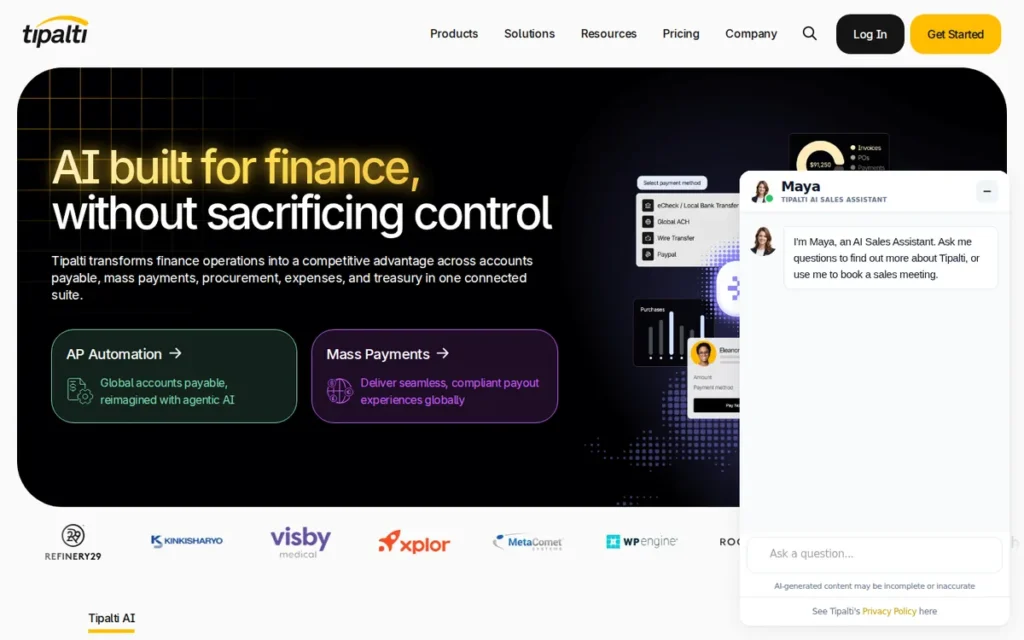
Category: End-to-End Global AP Automation, covers the complete payables lifecycle from supplier onboarding and multi-language invoice capture through cross-border payment execution in 196 countries, automated tax compliance, and ERP reconciliation in a single platform with KPMG-certified internal controls.
At a Glance
- Category: End-to-End Global AP Automation
- Best For: Mid-market and scaling companies with international vendor payment complexity (particularly those running NetSuite, Sage Intacct, or SAP) needing a single platform for cross-border payments, automated W-8/W-9/1099 tax compliance, and multi-language invoice capture starting at $99/month for unlimited users
- Price Range: AP module from $99/month (unlimited users) | Mass Payments from $249/month (unlimited users) | Enterprise custom, verified June 2026. Actual annual spend is materially higher for multi-module or high-volume configurations.
- Primary Strength: Tipalti provides end-to-end AP automation with 196-country, 120-currency payment reach, AI Smart Scan OCR in 145+ languages, and KPMG-certified financial controls, the most comprehensive global payment and compliance infrastructure in the mid-market AP automation category
- Biggest Limitation: Tipalti’s implementation timeline for complex multi-entity deployments runs 6–12 weeks, add-on module pricing can substantially exceed the $99/month entry price, and VAT/GST handling is incomplete across certain ERP integrations, creating manual workarounds for European operations or VAT-registered entities
- One-Line Summary: Tipalti is an end-to-end accounts payable automation platform with 196-country payment reach, AI Smart Scan OCR in 145+ languages, and KPMG-certified internal controls, serving mid-market companies with international vendor networks starting at $99/month for unlimited users (verified June 2026)
- Last Verified: June 2026
Overview
Tipalti is an end-to-end accounts payable automation platform founded in 2010 that serves mid-market and scaling companies needing to automate the full payables lifecycle, from supplier onboarding and AI-powered invoice capture in 145+ languages to cross-border payment execution in 196 countries and 120 currencies, automated tax form management (W-8/W-9/1099), and bidirectional ERP reconciliation.
Tipalti is rated 4.7/5 across 1,200+ G2 reviews (June 2026), holds Oracle’s NetSuite Growth Partner of the Year 2024 recognition, and operates an unlimited-user pricing model starting at $99/month for its AP module, removing the per-seat cost escalation that affects growing AP teams on competitor platforms. The KPMG-certified internal financial controls provide compliance infrastructure for finance teams operating under SOX requirements, cross-border regulatory oversight, or formal audit mandates.
Tipalti’s AI Smart Scan OCR extracts invoice data at header and line-item level across 145+ languages, making Tipalti the primary consideration for companies whose vendor bases span non-English-speaking markets where standard OCR accuracy degrades on foreign-language invoice formats.
Key Features
- AI Smart Scan OCR in 145+ Languages: Tipalti’s AI Smart Scan extracts invoice data at header and line-item level across 145+ languages, integrated with AI-driven fraud detection and duplicate payment prevention that flags supplier bank detail changes and anomalous payment patterns before payment execution (Tipalti, June 2026).
- 196-Country Global Payment Network: Tipalti executes vendor payments to 196 countries in 120 currencies through local bank transfers, ACH, wire, and card, with automated bidirectional reconciliation syncing payment data back to connected ERPs including NetSuite, Sage Intacct, and SAP (Tipalti, June 2026).
- Automated Cross-Border Tax Compliance: Tipalti automates W-8, W-9, and 1099 form collection from the supplier self-onboarding portal, reducing the manual tax document collection burden that scales linearly with international vendor count and becomes significant overhead in global AP operations.
- KPMG-Certified Internal Controls: Tipalti holds KPMG-certified financial controls (a Big Four-audited compliance certification providing audit-grade assurance for finance teams operating under SOX, GAAP, or regulatory oversight requirements) a differentiator no other evaluated platform in this comparison can claim.
- Unlimited-User Pricing from $99/Month: Tipalti’s unlimited-user pricing model removes per-seat cost exposure for teams where 10–30 employees touch invoice approval workflows, at 10 users, Tipalti’s $99/month versus BILL Corporate’s $790/month represents a structural pricing advantage that should be explicitly modeled before selecting a platform (Tipalti pricing page, June 2026).
Best For
Tipalti is best for mid-market and growth-stage companies with 50–500+ active vendors spanning multiple countries (particularly those running NetSuite, Sage Intacct, or SAP) that need a single platform for invoice capture, multi-entity approval workflows, cross-border payment execution, and automated tax compliance without per-seat pricing that escalates as approver pools grow.
Strengths
- Tipalti holds Oracle’s NetSuite Growth Partner of the Year 2024 recognition and was named NetSuite SuiteApp of the Year in 2019, dual Oracle-awarded validations of integration quality for the largest mid-market ERP ecosystem, third-party differentiation that no other evaluated competitor in this comparison has earned (Tipalti, June 2026).
- Tipalti’s KPMG-certified internal financial controls are a Big Four-audited compliance marker that distinguishes Tipalti from all other evaluated vendors, companies operating under SOX requirements, public company reporting mandates, or regulatory audits can cite this certification as documented evidence within their AP control framework.
- Tipalti’s payment network covers 196 countries and 120 currencies: the broadest cross-border payment reach in this evaluation, making Tipalti the default consideration for companies paying international contractors, vendors, or affiliates who need AP automation that handles cross-border compliance without a separate international payment tool (Tipalti, June 2026).
- Tipalti’s pricing page estimates customers save an average of $31,000 per month from AP automation, a figure Tipalti labels as a platform-data-derived estimate rather than a per-customer audited result (Tipalti pricing page, June 2026); finance teams should request a use-case-specific ROI estimate before presenting this figure to leadership.
Limitations
- Implementation Timeline: Where Tipalti loses deals it otherwise deserves is implementation timing, complex multi-entity deployments with custom workflow configurations and international supplier onboarding typically require 6–12 weeks, meaning Tipalti delivers meaningful ROI later than rapid-deployment alternatives like Ramp and is not appropriate for teams needing AP automation live within the same quarter.
- Workflow-Specific Gaps: Tipalti does not support adding bills to a scheduled payment order mid-process, creating a manual workaround for AP teams with time-sensitive payment adjustments, and VAT/GST handling is incomplete across certain ERP integrations, relevant for European subsidiaries or VAT-registered entities where tax automation would otherwise replace manual recalculation (Software Connect, 2025).
Users on r/Accounting documented this workflow friction firsthand:
“Tipalti is clunky and it takes too many clicks. Tipalti’s overall syncs with NetSuite are slow. For 3-way matching, you need to click around a lot and the PO takes 20 seconds to load.” Posted by u/TraditionalJoke8420
Takeaway: Tipalti’s multi-step click workflow and slow NetSuite sync are its most consistently reported real-world friction points, directly corroborating the platform’s documented configuration gaps and ERP sync latency limitations.
- Add-On Pricing Opacity: Tipalti’s $99/month AP module entry price understates actual annual spend for organizations requiring the Mass Payments module, additional entities, or enterprise feature tiers, finance teams should request a fully scoped quote inclusive of all required modules before presenting a cost comparison to leadership.
Verdict
Tipalti is the strongest accounts payable automation platform for mid-market companies with international vendor networks, delivering 196-country payment reach, AI Smart Scan in 145+ languages, and KPMG-certified financial controls within an unlimited-user pricing model starting at $99/month, a combination no other evaluated platform provides. Tipalti ranks above Medius (#3) on overall composite scoring primarily because its 4.7/5 G2 rating on 1,200+ reviews carries greater statistical weight under the review-volume multiplier than Medius’s 4.6/5 on approximately 400 reviews, and Tipalti’s published pricing enables self-serve business case construction that Medius’s complete pricing opacity prevents. Teams needing AP automation live within 90 days should factor the 6–12 week complex-deployment window into go-live planning before committing.
3. Medius: Best for Touchless and Autonomous Invoice Processing: Enterprise-Grade AI-Native AP with 96.3% Claimed PO Touchless Rate

Category: Autonomous AP Automation, AI-native platform designed to process the majority of invoices without human intervention by routing only genuine exceptions to reviewers, using machine learning-based intelligent coding, 3-way PO matching, and proactive fraud detection to achieve claimed 96.3% touchless rates for PO invoices.
At a Glance
- Category: Autonomous AP Automation
- Best For: Mid-enterprise and enterprise AP teams whose primary objective is maximizing touchless invoice processing rate and minimizing exception handling volume, particularly organizations receiving invoices in mixed formats (PDF, e-invoice, EDI) from diverse vendor bases in multi-ERP environments
- Price Range: Custom pricing via sales consultation only: no public rates as of June 2026; no range estimates from any third-party source; Marlin Equity PE ownership since 2017 correlates with enterprise-tier ACV expectations rather than mid-market starting points
- Primary Strength: Medius claims a 96.3% touchless processing rate for PO invoices, cited directly against the Ardent Partners 2025 AP Technology Benchmark average of 23.4% for PO invoices, among the most specifically externally benchmarked automation performance claims among the seven evaluated platforms as of June 2026
- Biggest Limitation: Medius requires a multi-phase implementation covering planning, configuration, testing, training, and ongoing optimization before delivering full touchless processing rates, and publishes no pricing at any tier, forcing buyers into a full sales cycle before confirming budget feasibility
- One-Line Summary: Medius is an AI-native autonomous accounts payable platform claiming a 96.3% PO invoice touchless rate (vs. the 23.4% Ardent Partners 2025 market average) and a 1.4-day average invoice cycle time, the leading platform for enterprises prioritizing maximum AP automation depth, with custom pricing and multi-phase implementation requirements
- Last Verified: June 2026
Overview
Medius is an AI-native autonomous accounts payable automation platform founded in 2001 in Sweden and owned by Marlin Equity Partners since 2017, serving mid-enterprise and enterprise organizations that prioritize maximizing touchless invoice processing rates, claiming 96.3% touchless performance for PO invoices versus the 23.4% Ardent Partners 2025 AP Technology Benchmark industry average for PO invoices.
Medius Capture extracts invoice data at header and line-item level across PDF, e-invoice, and EDI formats with 99% claimed accuracy in a single unified pipeline. Medius separately claims a 99.5% touchless rate for non-PO invoices versus the Ardent Partners 2025 average of 49.2% for non-PO invoices (vendor-published, June 2026), suggesting platform-wide autonomous capability across both PO and non-PO invoice categories. Note: the Ardent Partners 2025 benchmark cites 32.6% as the overall all-invoice average; Medius’s cited figures reflect PO-invoice and non-PO-invoice-specific segments.
Medius holds 4.6/5 on G2 and 4.7/5 on Capterra across approximately 400 reviews (reflecting its focused enterprise customer profile rather than lower satisfaction) and operates on fully custom pricing with no public rates disclosed at any tier.
Key Features
- 96.3% Claimed PO Invoice Touchless Rate: Medius’s AI-driven autonomous AP claims 96.3% touchless processing for PO invoices, with machine learning routing only genuine exceptions to human reviewers, reducing exception queue volume from approximately 766 to 37 invoices per 1,000 processed. For a team processing 2,000 monthly invoices, this difference represents approximately 394 fewer manual exception resolutions per month versus the Ardent Partners 2025 market average of 23.4% (Medius, June 2026).
- Format-Agnostic Unified Capture Pipeline: Medius Capture processes invoices in PDF, structured e-invoice, and EDI formats within a single unified pipeline at 99% claimed accuracy at header and line-item level, eliminating separate capture workflows for different invoice types that add operational complexity in organizations with diverse vendor invoice format environments (Medius, June 2026).
- Proactive Fraud Detection: Medius’s fraud detection layer monitors for supplier bank detail change anomalies and flags suspicious payment requests before execution, targeting the Business Email Compromise (BEC) attack vector with a pre-payment surveillance layer rather than a post-execution audit control.
- 1.4-Day Average Invoice Cycle: Medius reports an average invoice processing time of 1.4 days (Medius, June 2026), enabling early-payment discount capture on 2/10 net 30 vendor terms that manual AP cycles averaging 10–20+ days cannot achieve, delivering a direct CFO-measurable impact on working capital.
- ERP-Agnostic Architecture: Medius integrates with diverse enterprise ERP environments without platform-specific adaptation, making Medius viable for organizations running multiple ERPs simultaneously or planning ERP migrations during or after AP automation deployment, without requiring custom connector development for each system.
Best For
Medius is best for mid-enterprise and enterprise organizations where AP exception rate is the primary operational bottleneck (specifically, organizations currently resolving 20%+ of invoices manually due to coding errors, matching failures, or approval delays) that can commit to a multi-phase implementation process and enterprise-level budget to unlock the platform’s claimed maximum touchless processing capabilities.
Strengths
- Medius claims a 96.3% touchless processing rate for PO invoices, cited directly against the Ardent Partners 2025 AP Technology Benchmark average of 23.4% for PO invoices, among the most specifically externally benchmarked automation performance claims in this evaluation, directly quantifying exception volume reduction from approximately 766 to 37 per 1,000 invoices at claimed performance levels (Medius, June 2026).
- Medius Capture achieves 99% claimed data extraction accuracy across PDF, e-invoice, and EDI invoice formats at header and line-item level within a single unified processing pipeline, eliminating separate capture workflows and manual format-conversion steps that add processing time and error rate in multi-format vendor environments (Medius, June 2026).
- Medius’s own implementation guidance explicitly acknowledges that deployment requires “planning, configuration, testing, training, and ongoing optimization” (Medius blog, June 2026), vendor candor about implementation complexity that allows AP buyers to set accurate multi-phase project timelines rather than discovering extended requirements post-commitment during a go-live sprint.
- Medius’s proactive fraud detection monitors supplier bank detail changes and anomalous payment patterns before payment execution, targeting the BEC fraud attack vector with a surveillance layer that operates pre-payment, aligning with board-level AP fraud risk management priorities that are increasingly driven by finance leadership rather than IT.
Limitations
- Multi-Phase Implementation Required: Medius’s steepest evaluation barrier is the combination of implementation complexity and pricing opacity, Medius requires a multi-phase implementation before delivering its headline 96.3% touchless rate, making Medius inappropriate for organizations needing AP automation live within 60–90 days and demanding internal IT resources or implementation partners that lighter-weight alternatives like Ramp do not require.
- Complete Pricing Opacity: Medius publishes no pricing at any tier: not starting prices, not ranges, not indicative estimates, creating a discovery barrier that forces finance managers into a full sales cycle before confirming budget feasibility, a friction cost that Ramp (free), Tipalti ($99/month published), and BILL ($45–$79/user published) do not impose. Request a ballpark annual contract value range in the first sales contact as a condition of continuing evaluation.
- Smaller Review Base: Medius’s G2 review base of approximately 400 reviews limits the statistical reliability of its satisfaction score relative to Ramp (2,400+) and BILL (2,500+), making its 4.6/5 rating directionally positive but less defensible as standalone evidence in an internal vendor selection process requiring comparative data.
- PE Ownership Risk: Medius’s Marlin Equity PE ownership since 2017 introduces enterprise SaaS risks (including margin optimization focus, enterprise-tier pricing pressure, and potential reduced investment in lower-ACV accounts) that buyers should probe specifically in reference calls with customers of similar size and contract vintage.
Verdict
Medius is the top-ranked AP automation platform for enterprise exception volume reduction, claiming a 96.3% touchless processing rate for PO invoices versus the 23.4% Ardent Partners 2025 market average, reducing manual exception handling from approximately 766 to 37 invoices per 1,000 processed at claimed performance levels. Finance teams evaluating Medius should enter discovery with two specific questions: first, request independent verification or named customer evidence for the 96.3% touchless claim, as it is vendor-published against a third-party benchmark but has not been independently audited; second, request a ballpark annual contract range in the first call to confirm budget compatibility before committing to the full evaluation cycle. Medius earns its #3 ranking through unmatched AP automation depth, but its pricing opacity, multi-phase implementation requirement, and PE ownership make it a platform requiring more rigorous due diligence than the more transparent alternatives ranked above it.
4. Yooz: Best for ERP Integration Breadth and Multi-Stack Environments: 250+ Integrations with Oracle Built for NetSuite Certification
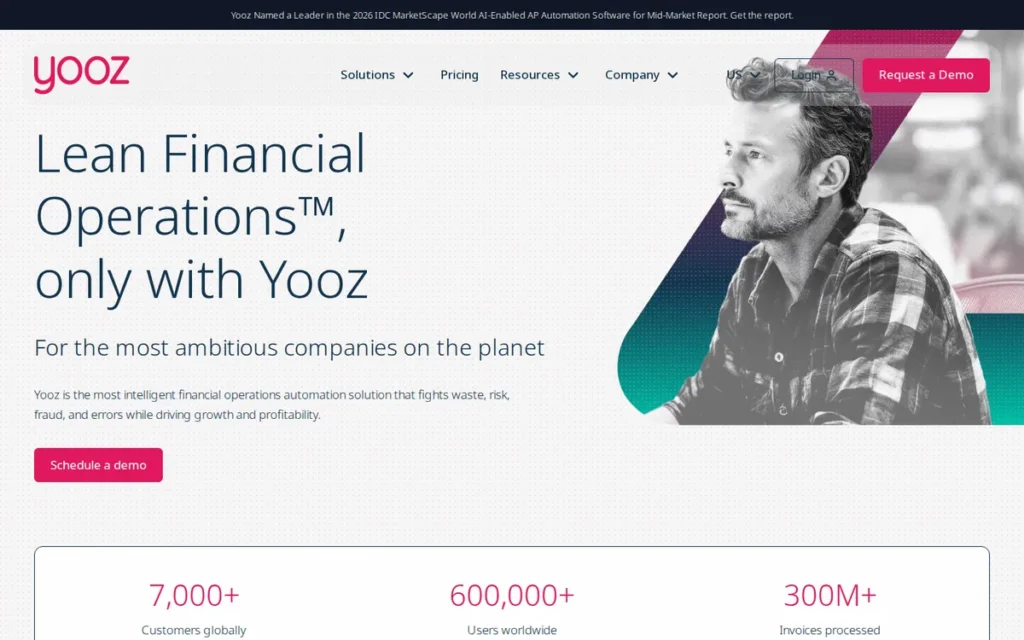
Category: Multi-ERP AI-Powered AP Automation, Deep Learning invoice capture platform with 250+ ERP integrations and Oracle Built for NetSuite certification, designed for organizations with diverse, complex, or evolving accounting system environments where ERP integration breadth and certification quality are primary evaluation criteria.
At a Glance
- Category: Multi-ERP AI-Powered AP Automation
- Best For: SMB-to-mid-market organizations running NetSuite (with formal Oracle certification assurance), Infor, or niche ERPs requiring validated integration rather than self-reported compatibility, particularly companies with diverse vendor invoice formats or European operations where structured e-invoice processing standards are mandatory
- Price Range: Pricing page exists at yooz.com/pricing but specific tier amounts are not publicly indexed as of June 2026, contact required; per-invoice or module-based model expected based on mid-market AP vendor norms
- Primary Strength: Yooz is the only evaluated AP automation vendor with formal Oracle Built for NetSuite certification and 250+ ERP integrations, powered by a Deep Learning model trained on 100 million+ real invoices from 100,000+ vendors across 30+ countries (June 2026)
- Biggest Limitation: Yooz reviewers on G2 and Capterra specifically cite OCR accuracy variability on complex or non-standard invoice layouts and a notable configuration learning curve for initial workflow setup, requiring pilot validation on actual vendor invoice samples before full deployment commitment
- One-Line Summary: Yooz is an AI-powered accounts payable automation platform with 250+ ERP integrations, Oracle Built for NetSuite certification, and a Deep Learning model trained on over 100 million real invoices from 100,000+ vendors, the primary option for organizations with complex multi-ERP environments, diverse invoice formats, or mandatory structured e-invoice processing requirements (June 2026)
- Last Verified: June 2026
Overview
Yooz is an AI and Deep Learning-powered cloud AP automation platform founded in 2009 in France, serving SMB-to-mid-market organizations that need AP automation with the broadest formally certified ERP integration coverage in this evaluation (250+ integrations, Oracle Built for NetSuite certification) and AI trained on the largest disclosed real-world invoice dataset in the category.
Yooz has analyzed over 100 million invoices from 100,000+ vendors across 30+ countries as of June 2026 (Yooz, June 2026), giving its Deep Learning models a training base substantially larger than most newer AP vendors can claim, improving generalization on edge-case invoice formats, multi-vendor OCR variance, and non-standard layouts.
Yooz handles omnichannel invoice capture (email, mobile, portal, paper scanning, EDI, and structured e-invoices), 2-way and 3-way PO matching, configurable approval routing, payment automation, and document archiving, with 16+ years of European operation providing stronger EDI and structured e-invoice processing depth than US-native competitors, and a 4.5/5 G2 rating across approximately 350 reviews (June 2026).
Key Features
- 100M+ Invoice Deep Learning Dataset: Yooz’s Deep Learning AI has processed 100 million+ invoices from 100,000+ vendors across 30+ countries as of June 2026 (Yooz, June 2026), the largest disclosed real-world training dataset in this evaluation, improving generalization on non-standard, edge-case, and multi-language invoice formats that smaller training datasets fail to handle reliably.
- 250+ ERP Integrations: Yooz integrates with 250+ ERP and accounting systems: including Oracle NetSuite, SAP, Microsoft Dynamics, Sage, Infor, QuickBooks, and Xero, providing coverage for organizations running niche, legacy, or hybrid ERP environments that other evaluated AP vendors do not support natively without custom integration development (Yooz, June 2026).
- Oracle Built for NetSuite Certification: Yooz holds Oracle’s Built for NetSuite certification, which requires passing a formal Oracle review process for functionality, security, and integration quality standards, meaning Oracle’s support SLA may extend to the connector after NetSuite platform updates, unlike uncertified API connections where the AP vendor’s engineering team bears sole responsibility for patch timing (Innovia, June 2026).
- Omnichannel Invoice Capture: Yooz processes invoices from all major input channels (email attachments, mobile capture, supplier portal uploads, paper scanning, EDI, and structured e-invoice formats) in a single platform without requiring separate capture tools for different vendor submission methods, enabling a unified invoice processing queue regardless of how vendors submit invoices.
- ML-Powered Duplicate Detection: Yooz’s duplicate detection engine uses machine learning trained on its 100M+ invoice dataset to identify exact and near-duplicate invoices across vendors, amounts, and document formats, including invoices with minor layout variations or different vendor reference numbers that rules-based duplicate detection systems miss.
Best For
Yooz is best for SMB and mid-market organizations running NetSuite (where Built for NetSuite certification provides Oracle-validated integration assurance unavailable from other evaluated vendors), running niche or legacy ERPs where Yooz’s 250+ integration breadth eliminates custom connector development, or managing European supplier networks and EDI processing requirements where Yooz’s 16+ years of European operation provides proven capability depth.
Strengths
- Yooz is the only AP automation platform in this evaluation holding Oracle’s Built for NetSuite certification, a formal third-party validation requiring Oracle review of integration functionality, security, and quality standards that the self-reported “integrates with NetSuite” claims from other evaluated vendors do not provide, reducing ERP integration risk for the largest mid-market ERP buyer segment (Yooz, June 2026).
- Yooz’s Deep Learning model has processed 100 million+ invoices from 100,000+ vendors across 30+ countries as of June 2026 (Yooz, June 2026), the largest disclosed real-world training dataset in this evaluation, providing a structural AI quality advantage on non-standard invoice formats and reducing capture errors on the edge-case layouts that smaller training datasets fail to handle.
- Yooz’s 16+ years of operation in Europe (founded 2009, France) give it the most mature structured e-invoice and EDI processing capabilities among evaluated vendors, relevant for US companies with European subsidiaries in countries where e-invoicing mandates are already in effect or planned, requiring certified e-invoice format compliance.
- Yooz’s G2 product listing cites up to 80% reduction in AP processing costs for organizations transitioning from fully manual, paper-based workflows (G2, vendor-provided, June 2026), a ceiling-case estimate most applicable to organizations starting from zero automation; finance teams should request Yooz-provided ROI estimates benchmarked against their current per-invoice processing cost and actual format mix.
Limitations
- OCR Accuracy Variability on Complex Formats: The practical constraint Yooz buyers most often encounter post-implementation is OCR accuracy on non-standard invoice layouts, reviewers on G2 and Capterra specifically document accuracy variability on complex or unusual invoice formats (Vantazo, 2025), meaning Yooz performs strongest on common invoice types and may require manual correction on invoices with non-standard table structures, multi-page PO references, or handwritten annotations. Finance teams with high proportions of non-standard formats should validate Yooz’s capture accuracy on their actual vendor invoice sample in a structured pilot before full deployment.
- Configuration Learning Curve and Reporting Depth: Yooz reviewers identify a notable learning curve for initial approval routing and workflow setup, invoice upload process friction noted by multiple reviewers, and limited advanced reporting and analytics depth compared to platforms like Coupa or Medius, limiting its suitability for AP teams whose CFOs require detailed exception analysis or spend pattern visibility beyond invoice processing metrics (Stampli, 2025).
- Pricing Opacity: Yooz maintains a pricing page but specific tier pricing is not publicly indexed as of June 2026, a discovery barrier comparable in friction to Medius and AvidXchange and a disadvantage relative to Ramp and BILL, which publish full pricing tiers publicly, forcing buyers into a sales conversation before budget feasibility can be confirmed.
Verdict
Yooz is the strongest AP automation option for organizations whose primary constraint is ERP environment diversity or formal NetSuite integration assurance, offering 250+ ERP integrations, Oracle Built for NetSuite certification, and Deep Learning AI trained on 100M+ real invoices, a credential combination unique in this evaluation and particularly valuable for organizations running niche ERPs or NetSuite with Oracle-validated integration quality requirements. Yooz is entirely absent from LLM-generated AP automation listicles despite this market position, making it the most underrepresented option in AI-generated AP automation research and a critical inclusion for any independent evaluation claiming comprehensive coverage. Finance teams evaluating Yooz should run a structured pilot with their actual vendor invoice sample to validate OCR accuracy on their specific formats before committing to full deployment, the reviewer-documented accuracy variability on complex invoice layouts is a due-diligence step, not a disqualifier.
5. BILL: Best for SMB and QuickBooks/Xero Users: The Largest AP Network with Publicly Audited Financials
Category: SMB-to-Mid-Market AP Automation, cloud-based accounts payable platform with the largest G2 review volume in the category and the highest-volume business payment network, optimized for domestic US workflows with deep QuickBooks, Xero, and NetSuite integration and per-seat pricing that reflects its single-user to small-team SMB origin.
At a Glance
- Category: SMB-to-Mid-Market AP Automation
- Best For: US-based SMBs and mid-market companies running QuickBooks Online or Xero (with 1–4 AP team members and primarily domestic vendor payment needs) whose existing vendor base has meaningful overlap with the BILL network, enabling faster first-payment execution without individual supplier enrollment delays
- Price Range: Essentials: $45/user/month | Team: $55/user/month | Corporate: $79/user/month | Enterprise: custom, billed annually; verified June 2026. At 5 users Corporate = $395/month vs. Tipalti’s $99/month unlimited-user model.
- Primary Strength: BILL has the highest G2 review volume of any dedicated AP automation platform in this evaluation (2,500+ reviews at 4.6/5, June 2026), an 8M+ business payment network accelerating first-payment execution for enrolled vendors, and is the only evaluated platform with NYSE-listed publicly audited SEC financials reporting $1.29B in FY2024 revenue
- Biggest Limitation: BILL’s per-seat pricing creates cost-scaling exposure that makes it more expensive than Tipalti’s unlimited-user $99/month or Ramp’s free tier for AP teams with 5+ users in approval workflows, and documented ACH hold times can prevent early-payment discount capture on time-sensitive vendor payment terms
- One-Line Summary: BILL is a cloud-based accounts payable automation platform with 2,500+ G2 reviews at 4.6/5, an 8M+ business payment network, and NYSE-listed audited financials (FY2024 revenue $1.29B), serving US-focused SMBs and mid-market companies running QuickBooks, Xero, or NetSuite with per-seat pricing from $45/user/month (June 2026)
- Last Verified: June 2026
Overview
BILL (formerly Bill.com) is a publicly traded cloud-based accounts payable and accounts receivable automation platform founded in 2006 and traded on the NYSE (ticker: BILL) with $1.29B in publicly reported FY2024 revenue, the only AP automation company in this evaluation with SEC-filing financial statements providing audited transparency into platform financial health. FY2025 results are now available at investor.bill.com.
BILL serves the SMB-to-mid-market segment with AI-powered invoice capture (99% claimed OCR accuracy at line-item level), customizable multi-step approval workflows, and payment execution via ACH, check, wire, virtual card, and international wire to 130+ countries, networked within an 8M+ business community where invoices between enrolled companies move faster than traditional email-to-payment workflows.
BILL’s deepest strengths are its QuickBooks Online and Xero integration (the most widely battle-tested in the SMB segment since BILL’s 2006 founding as a companion to these accounting systems) and its 4.6/5 G2 rating across 2,500+ reviews (June 2026), the highest review volume of any dedicated AP automation platform in this evaluation.
Key Features
- AI-Powered Invoice Capture: BILL’s AI-powered invoice capture claims 99% OCR accuracy at header and line-item level, with a digital inbox centralizing invoice receipt from email, supplier upload, and manual entry into a single review queue connected to multi-step configurable approval workflows with mobile access.
- 8M+ Business Payment Network: BILL’s 8M+ business payment network enables vendors already enrolled on the platform to receive invoices and payments without individual payment setup, creating a first-payment speed advantage for AP teams whose existing vendor bases overlap with the BILL network versus platforms requiring full vendor onboarding from scratch (Brex, 2025).
- 130+ Country Payment Execution: BILL executes payments via ACH, check, wire transfer, virtual card, and international wire to 130+ countries, covering the payment method breadth required by most US-centric SMB and mid-market AP teams, though narrower than Tipalti (196 countries) and Ramp (185+ countries) for teams with complex international vendor networks.
- Deep QuickBooks, Xero, and NetSuite Integration: BILL’s bidirectional sync with QuickBooks Online, Xero, and NetSuite connects invoice data, vendor records, payment records, and GL coding directly to the accounting system of record, with Forrester Wave inclusion providing independent analyst validation of BILL’s category-level integration quality beyond self-reported compatibility claims.
- NYSE-Listed Financial Transparency: BILL’s public-company status (NYSE: BILL, $1.29B FY2024 revenue) provides SEC-filing financial transparency enabling CFOs to assess platform financial stability through publicly audited annual reports, a due-diligence resource unavailable from private-company competitors including Tipalti, Medius, Yooz, and Ramp.
Best For
BILL is best for US-based SMBs and mid-market companies with 1–4 AP team members, primarily domestic vendor payment needs, and existing accounting workflows built on QuickBooks Online or Xero, particularly organizations whose existing vendor bases are likely already enrolled in the BILL network, reducing supplier onboarding overhead and enabling faster initial payment execution from day one.
Strengths
- BILL holds a 4.6/5 rating across 2,500+ G2 reviews as of June 2026: the highest review volume of any dedicated AP automation platform in this evaluation, providing the most statistically reliable satisfaction baseline and reflecting over 15 years of SMB-to-mid-market customer accumulation.
- BILL’s 8M+ business payment network enables vendors already on the platform to receive payments without individual enrollment setup, a meaningful day-one speed advantage for AP teams whose existing vendor base overlaps with the BILL network, reducing the supplier onboarding backlog that delays post-implementation value at platforms requiring full vendor onboarding from scratch.
- BILL is an NYSE-listed company (ticker: BILL) with $1.29B in publicly reported FY2024 revenue and Forrester Wave recognition in the AP automation category, providing dual validation through financial transparency (SEC-audited) and independent analyst endorsement that no private competitor in this evaluation can replicate.
- BILL’s deep QuickBooks Online and Xero integration is the most battle-tested in the SMB segment, bidirectional sync validated by BILL’s foundational positioning as a companion tool to these accounting systems since 2006, the longest integration partnership timeline among evaluated platforms.
Limitations
- Per-Seat Pricing Scalability: The ceiling BILL hits as companies scale past mid-market is pricing architecture, BILL’s per-seat model exceeds Tipalti’s unlimited-user $99/month at 3+ Corporate-tier users and Ramp’s free tier at any user count. At 10 Corporate-tier users, BILL costs $790/month versus Tipalti’s $99/month and Ramp’s free tier for the same headcount, a calculation that often changes the shortlist entirely for mid-market teams with 5+ people in AP approval workflows.
- ACH Hold Time Limitation: Documented ACH hold times on outgoing BILL payments can prevent early-payment discount capture on 2/10 net 30 vendor terms, a specific operational constraint for AP teams where discount capture is a primary value driver, and a recurring frustration in reviewer data across G2 and Capterra (Brex, 2025).
- ERP Sync Quality Signals: Reddit community data from r/Netsuite includes a direct user comparison describing BILL as creating “obtuse sync errors” versus Ramp in NetSuite integration (r/Netsuite, 2025), an authentic peer signal that ERP sync quality has documented edge cases requiring manual cleanup that erode automation benefit.
This community sentiment extended to the broader r/Accounting community when evaluating BILL against alternatives:
“There are superior alternatives like Ramp.com and Airbase. If bill.com truly held the leading position, they wouldn’t be promoting giveaways of Blackstone grills on LinkedIn simply for participating in a product demonstration.” Posted by u/Electrical-Role1270
Takeaway: Finance professionals on r/Accounting increasingly route BILL evaluations toward zero-cost competitors like Ramp, signaling that BILL’s value proposition has weakened as free-tier alternatives match its core AP automation functionality at lower total cost.
- Narrower Global Payment Reach: BILL’s international payment capability at 130+ countries is narrower than both Tipalti (196 countries) and Ramp (185+ countries), limiting BILL’s applicability for companies with complex international vendor networks beyond occasional cross-border wire transfers.
Verdict
BILL is among the most statistically validated AP automation platforms for US-focused SMBs and mid-market companies in this evaluation, with 2,500+ G2 reviews providing the highest review volume of any dedicated AP platform compared here, $1.29B in publicly audited FY2024 revenue, and an 8M+ business network providing genuine first-payment speed advantages for teams whose vendors are already enrolled. Finance teams should model per-seat cost at their actual user count before assuming BILL is the value choice, at 10 Corporate-tier users, BILL costs $790/month versus Tipalti’s $99/month and Ramp’s free tier for the same headcount, a calculation that often changes the shortlist for mid-market teams with 5+ approvers. The ACH hold time limitation should be validated against early-payment discount capture requirements before committing.
6. AvidXchange: Best for Real Estate, Construction, and Property Management: 265+ ERP Integrations with Yardi, MRI, and AppFolio Native Connectivity
Category: Mid-Market AP and Payment Automation, invoice capture and electronic payment platform with 265+ ERP integrations, a 1.3M+ supplier network, and purpose-built vertical depth in real estate, construction, and property management through native Yardi, MRI Software, AppFolio, and Entrata integrations; designed for organizations processing 200+ monthly B2B vendor payments.
At a Glance
- Category: Mid-Market AP and Payment Automation
- Best For: Mid-market real estate, construction, HOA management, and property management companies (specifically those using Yardi, MRI Software, AppFolio, or Entrata) that process 200+ monthly invoices and need electronic payment to an existing supplier base without individual vendor enrollment delays on day one
- Price Range: Custom pricing via sales consultation only: no public rates (verified June 2026); pricing customized by invoice volume, payment volume, entity count, and required ERP integrations
- Primary Strength: AvidXchange is the only AP automation platform in this evaluation with native pre-built integrations for Yardi, MRI Software, AppFolio, Entrata, Buildium, and Condo Manager, combined with a 1.3M+ enrolled supplier network enabling electronic payment to most existing vendors without individual enrollment on day one
- Biggest Limitation: AvidXchange generates active community dissatisfaction signals including a “Replacement for AvidXchange” thread in r/Netsuite (indicating a meaningful subset of customers experiencing implementation failures, ERP sync issues, or customer support breakdowns) combined with complete pricing opacity that prevents self-serve business case construction
- One-Line Summary: AvidXchange is a mid-market AP and payment automation platform with 265+ ERP integrations, a 1.3M+ enrolled supplier network, and the only native integrations for major property management platforms (Yardi, MRI Software, AppFolio, Entrata, Buildium), the primary AP automation choice for real estate, construction, and property management companies processing 200+ monthly invoices (June 2026)
- Last Verified: June 2026
Overview
AvidXchange is a mid-market accounts payable automation and electronic payment platform founded in 2000 (the oldest vendor in this evaluation at 26 years) processing high-volume B2B vendor payments through a 1.3M+ enrolled supplier network connected to 265+ ERP and accounting systems, with purpose-built vertical depth in real estate, construction, and property management through native integrations with Yardi, MRI Software, AppFolio, Entrata, Buildium, and Condo Manager.
AvidXchange went public in October 2021 (NYSE: AVDX), providing SEC-filing financial transparency comparable to BILL. AvidXchange is explicitly positioned for organizations processing 200+ monthly vendor payments, the scale threshold defining its ideal customer as the high-volume mid-market company where manual invoice keying creates the most acute operational pain.
AvidXchange does not publish public pricing, and an active r/Netsuite “Replacement for AvidXchange” thread is a documented community signal that should be investigated specifically in vendor reference calls before signing a contract.
Key Features
- Native Property Management Platform Integrations: AvidXchange provides native pre-built integrations for Yardi, MRI Software, AppFolio, Entrata, Buildium, and Condo Manager (the property management platforms used by the majority of real estate and construction mid-market companies) eliminating months of custom integration development that generic AP tools impose on these verticals (AvidXchange, June 2026).
- 1.3M+ Enrolled Supplier Network (AvidPay): AvidXchange’s AvidPay electronic payment network includes 1.3M+ enrolled suppliers as of June 2026 (QuickPayable, 2025), enabling electronic payment delivery on day one for vendors already in the network, without the individual supplier enrollment backlog that delays post-implementation value at platforms requiring full vendor onboarding before electronic payments begin.
- AvidInvoice AP Automation Module: AvidXchange’s AvidInvoice module combines OCR-based invoice capture with configurable multi-step approval workflows and 3-way PO matching, designed for mid-market AP teams processing 200–5,000+ monthly invoices across multiple cost centers, properties, or entities.
- 265+ ERP Integrations: AvidXchange’s 265+ ERP integrations cover NetSuite, Microsoft Dynamics GP, Sage Intacct, and QuickBooks, with a 2026 press release confirming active investment in expanding NetSuite, Dynamics GP, and Sage Intacct connectors post-IPO, signaling continued ERP integration commitment (AvidXchange, June 2026).
- AvidBuy Procurement Module: AvidXchange’s AvidBuy module extends AP automation upstream into purchase order management, enabling the payables process to begin at the purchase requisition stage rather than at invoice receipt, reducing non-PO invoice volume and improving upstream spend control for organizations ready to address procurement alongside payables.
Best For
AvidXchange is best for mid-market real estate, property management, construction, and HOA companies (specifically those using Yardi, MRI Software, AppFolio, or Entrata as their primary property management platform) that process 200+ monthly vendor payments and need electronic payment delivery to their existing supplier base without a lengthy individual vendor enrollment process on day one.
Strengths
- AvidXchange holds the longest market tenure in this evaluation: founded 2000, 26 years in operation, giving it the most deeply established supplier payment network (1.3M+ enrolled), the most mature vertical integration ecosystem for real estate and construction, and the broadest organizational knowledge of mid-market AP workflow complexity.
- AvidXchange’s 2026 press release confirms active expansion of integrations for Microsoft Dynamics GP, NetSuite, and Sage Intacct, signaling continued product investment in ERP connectivity post-IPO that reduces long-term switching risk for AP teams planning or executing ERP migrations (AvidXchange, June 2026).
- AvidXchange’s AvidPay network of 1.3M+ enrolled suppliers enables electronic payment on day one for vendors already in the network, eliminating the supplier enrollment backlog that delays post-implementation value at competing platforms where all vendors must be individually onboarded before receiving electronic payments.
- AvidXchange is NYSE-listed (AVDX, IPO October 2021), providing publicly audited financial statements that allow finance teams evaluating multi-year AP platform commitments to assess vendor financial stability through SEC documentation rather than relying solely on vendor-provided metrics.
Limitations
- Active Community Dissatisfaction Signals: The friction point appearing most frequently in AvidXchange customer feedback is implementation and ongoing support quality, an active “Replacement for AvidXchange” thread in r/Netsuite indicates a meaningful subset of customers experiencing implementation failures, ERP sync issues, or support breakdowns significant enough to seek alternative platforms. A separate r/Scams thread referencing AvidXchange’s supplier payment network was identified during research; its specific content was unavailable due to server errors and its claims have not been independently verified, finance teams should raise fraud prevention controls and supplier bank detail change detection directly with AvidXchange in reference calls rather than drawing conclusions from an unverified thread title alone.
A firsthand account in r/Accounting captured the supplier pressure dynamic directly:
“They constantly harrassed subcontractors and told them my company required them to use avidpay (not true) so they could get a cut of payments. Avoid using Avid.” Posted by u/Rough-Ad-5106
Takeaway: AvidXchange’s AvidPay network generates documented supplier pressure complaints in the accounting community, a pattern that reference call due diligence should probe directly on fraud controls and vendor communication practices before contract signing.
- Limited Value Outside Core Verticals: For organizations outside real estate, construction, and property management, AvidXchange’s differentiated value is minimal, its pricing opacity, community dissatisfaction signals, and US-focused payment capabilities make it a weaker overall choice than higher-ranked alternatives with stronger cross-criteria performance.
- Complete Pricing Opacity: AvidXchange’s lack of public pricing prevents self-serve business case construction, requiring a full sales cycle before budget feasibility can be confirmed, a friction cost that disadvantages AvidXchange relative to Ramp and BILL in initial evaluation stages.
- US-Focused Payment Network: AvidXchange’s payment capabilities are primarily US-centric, making AvidXchange unsuitable as a primary AP automation platform for organizations with material cross-border vendor payment volumes requiring multi-currency execution and global payment rail diversity.
Verdict
AvidXchange is the primary AP automation platform for mid-market real estate, construction, and property management companies, a vertical positioning backed by native integrations with Yardi, MRI Software, AppFolio, Entrata, Buildium, and Condo Manager that no other evaluated vendor provides, combined with a 1.3M+ supplier network enabling electronic payment to most existing vendors on day one. Finance teams outside these verticals evaluating AvidXchange based on its ERP integration breadth (265+) should weight the active r/Netsuite “Replacement for AvidXchange” community signal heavily during reference call due diligence, probing specifically on implementation timeline experience, ERP sync reliability, and customer support responsiveness for payment exceptions. AvidXchange’s public-company status (NYSE: AVDX) provides financial stability assurance, its vertical-specialist positioning delivers highest value specifically for real estate and construction buyers.
7. Coupa: Best for Enterprise Procurement-to-Pay Transformation: Gartner Magic Quadrant Leader with $6T+ Community Intelligence Spend Data
Category: Enterprise Business Spend Management (BSM), full procurement-to-pay platform spanning guided buying, sourcing, contract management, AP automation, supplier risk scoring, and expense management in a single data model, with Community Intelligence analytics benchmarking $6T+ in documented enterprise spend; AP automation is one module within this broader BSM scope rather than the platform’s primary specialization.
At a Glance
- Category: Enterprise Business Spend Management (BSM)
- Best For: Large enterprises and upper-mid-market organizations needing AP automation as one component of a broader procurement-to-pay transformation (where upstream procurement policy enforcement would prevent the invoice exceptions that AP-only tools process after the fact) and that can justify Gartner Magic Quadrant Leader enterprise pricing
- Price Range: Custom enterprise pricing only: no public rates at any tier (verified June 2026); third-party competitive analysis characterizes Coupa as “expensive relative to mid-market AP automation platforms with higher total cost of ownership” (Tipalti, 2025). Thoma Bravo PE ownership since February 2023 introduces pricing escalation risk in renewal negotiations.
- Primary Strength: Coupa is a Gartner Magic Quadrant Leader for Procurement with $6T+ in Community Intelligence spend data enabling real-time benchmarking against anonymized peer transactions, a spend analytics and procurement control capability that no standalone AP automation tool in this evaluation provides, validated by independent analyst evaluation with direct customer references
- Biggest Limitation: Coupa holds the lowest G2 rating in this evaluation (4.4/5 on 1,100+ reviews, June 2026) (a statistically reliable signal of genuine user frustration at scale) with recurring criticism for AP automation module gaps requiring additional modules for full payables automation, multi-month implementation complexity, high pricing, and Thoma Bravo PE acquisition risks since February 2023
- One-Line Summary: Coupa is an enterprise Business Spend Management platform and Gartner Magic Quadrant Leader for Procurement with $6T+ Community Intelligence analytics, the only evaluated tool for organizations needing procurement-to-pay transformation rather than standalone invoice processing, with the lowest G2 rating in this comparison (4.4/5 on 1,100+ reviews, June 2026) and custom enterprise pricing under Thoma Bravo PE ownership since February 2023
- Last Verified: June 2026
Overview
Coupa is an enterprise Business Spend Management (BSM) platform founded in 2006, taken private in a Thoma Bravo acquisition completed February 28, 2023, at approximately $8 billion ($81.00/share), providing guided procurement, sourcing, contract management, AP automation, supplier risk management, travel and expense, and payment workflows within a single data model serving large enterprises needing AP automation embedded within broader spend controls.
Coupa holds Gartner Magic Quadrant Leader status for Procurement, a credential requiring independent analyst evaluation with direct customer reference access. Coupa’s Community Intelligence platform draws on $6T+ in documented spend data to provide benchmarking and AI-guided buying guidance that standalone AP tools cannot replicate (as described in Tipalti competitive analysis, 2025, and corroborated by Vic.ai Coupa integration guide, 2025).
Coupa holds a 4.4/5 rating across 1,100+ G2 reviews as of June 2026 (the lowest of the seven evaluated platforms) with recurring criticisms centering on implementation complexity, AP automation module gaps, high pricing, and end-user UX friction that the 1,100+ review volume makes statistically significant rather than anecdotal.
Key Features
- $6T+ Community Intelligence Analytics: Coupa’s Community Intelligence platform aggregates $6T+ in spend data across its enterprise customer base to provide real-time benchmarking, AI-guided supplier recommendations, and anomaly detection against anonymized peer transactions, a competitive intelligence capability with no equivalent in any standalone AP automation platform in this evaluation (Tipalti competitive analysis, 2025; Vic.ai Coupa integration guide, 2025).
- Upstream Procurement Controls: Coupa’s guided buying module enforces preferred supplier routing, spend policy compliance, and pre-approved catalog purchasing at the point of purchase decision, preventing non-PO invoices and unapproved vendor spending before invoices reach the AP queue, addressing a root cause of AP exception volume rather than automating exception management after the fact.
- Full BSM Platform Scope: Coupa’s AP automation module handles invoice capture, validation, 3-way PO matching, configurable approval routing, and payment execution within the same platform as procurement, contract management, and expense, maintaining a single vendor record, approval hierarchy, and spend data model across the entire procurement-to-pay cycle.
- Supplier Risk Management: Coupa’s supplier risk management module scores vendor financial health, ESG exposure, and supply chain risk in real time within the same platform as AP workflows, enabling finance teams to connect payment decisions to supplier risk assessments without switching between separate monitoring and payment execution tools.
- Gartner Magic Quadrant Leader Status: Coupa holds Gartner Magic Quadrant Leader status in Procurement (a designation requiring Gartner analysts to directly interview customer references and validate completeness of vision and ability to execute) providing the most rigorous third-party enterprise software validation available and qualifying Coupa for Fortune 500 evaluation processes requiring documented Gartner credentials.
Best For
Coupa is best for large enterprises and upper-mid-market organizations that need AP automation as one component of a broader procurement-to-pay transformation mandate, specifically, organizations where a significant portion of AP exception volume originates from unapproved purchases, preferred supplier violations, or contract non-compliance that upstream procurement controls would eliminate, and where total investment in a full BSM platform is justified by enterprise-scale spend under management.
Strengths
- Coupa holds Gartner Magic Quadrant Leader status in Procurement (most recent cycle as of June 2026), a credential requiring independent analyst evaluation with direct customer references, qualifying Coupa for Fortune 500 procurement tool assessments and board-level vendor selection processes that require documented Gartner credentials.
- Coupa Community Intelligence aggregates $6T+ in documented customer spend data to provide AI-guided benchmarking against anonymized peer transactions, enabling enterprise procurement teams to compare supplier pricing and terms against thousands of similar transactions in the network, a spend analytics capability that no standalone AP automation tool in this evaluation provides.
- Coupa’s upstream procurement controls: guided buying, preferred supplier routing, spend policy enforcement, and pre-approved catalog purchasing, prevent the non-PO invoice exceptions and unapproved vendor spend that standalone AP tools must process after the fact, addressing exception volume at its source rather than automating downstream exception management.
- Coupa’s full BSM platform scope operates on a single data model across procurement, sourcing, contracts, AP, T&E, supplier risk, and payment, eliminating the synchronization overhead between separate procurement, AP, expense, and analytics tools that creates data discrepancies and reconciliation work in multi-tool enterprise finance stacks.
Limitations
- Coupa creates a structural mismatch for buyers seeking AP-specific automation depth: Coupa’s AP module does not match the invoice processing automation depth of dedicated AP tools, third-party review sources confirm Coupa requires additional modules for full payables automation (Stampli, 2025), meaning buyers purchasing Coupa specifically for AP invoice processing will receive less automation depth than Medius (96.3% claimed touchless), Tipalti (end-to-end global AP), or Ramp (Agents for AP) provide as dedicated AP solutions.
- Lowest G2 Rating in Evaluation: Coupa’s 4.4/5 G2 rating across 1,100+ reviews is the lowest of all seven evaluated platforms at statistically significant volume, recurring criticisms center on multi-month implementation complexity requiring heavy IT resources, end-user UX friction in buying interfaces (surfaced in a “Coupa is trash” thread in an employee community forum reflecting daily-use frustration beyond finance team satisfaction), and an AP module requiring additional Coupa modules for complete payables coverage.
- Thoma Bravo PE Acquisition Pricing Risk: The Thoma Bravo acquisition completed February 28, 2023 (approximately $8B, taken from NYSE) introduces PE ownership risks for buyers making 3–5 year platform commitments, post-acquisition enterprise SaaS vendors under PE ownership typically execute margin optimization programs within 18–36 months of closing, including list price increases, support cost reduction, and tightened renewal terms that contract terms should address explicitly.
- Multi-Month Implementation Complexity: Coupa requires heavy IT and cross-functional involvement during implementation, a multi-month process that limits Coupa’s suitability for organizations needing AP automation live within the same fiscal quarter and creates resource demands beyond what dedicated AP tools require.
A mid-market procurement evaluator on r/procurement documented the pricing and scoping friction directly:
“They quoted a six-month implementation period, and the contract value would have made it significantly our most expensive software investment. To be candid, much of what we saw in the demo included features that wouldn’t be applicable to us. The account executive detailed workflows designed for global procurement teams overseeing thousands of vendors across several regions, which made me reflect on our simpler day-to-day operations. By the third demo, I began inquiring about pricing for the essential features, only to discover that the platform doesn’t really allow for unbundling.” Posted by u/Complete_Yam_9387
Takeaway: Coupa’s bundled enterprise pricing structure and six-month implementation expectation consistently disqualify it for organizations under 500 employees, a pattern that explains how Gartner Leader credentials coexist with the lowest G2 satisfaction rating in this evaluation.
Verdict
Coupa is the only evaluated AP automation platform positioned as an enterprise Business Spend Management system rather than a standalone payables tool, earning its Gartner Magic Quadrant Leader designation through procurement-to-pay scope and $6T+ in Community Intelligence analytics that no dedicated AP vendor in this comparison matches. Finance teams evaluating Coupa specifically for AP invoice processing depth should weigh its 4.4/5 G2 rating across 1,100+ reviews, the lowest and statistically most reliable dissatisfaction signal in this comparison, against dedicated AP platforms that score significantly higher on AP-specific automation depth. All buyers should enter Coupa contract negotiations with explicit provisions addressing multi-year pricing caps, support SLA guarantees with financial remedies, and notification requirements for product retirement, given the vendor’s Thoma Bravo acquisition completed February 2023.
What Red Flags Should I Watch For When Evaluating AP Automation Software?
Five red flags signal AP automation buying risk: pricing opacity blocking business case construction; active vendor replacement threads in professional finance forums; PE ownership without negotiated pricing protections; OCR accuracy claims not validated on your actual invoice formats; and ERP compatibility claims without integration type disclosure. Each pattern is documented across evaluated platforms and identifiable during standard due diligence before vendor selection.
Red Flag #1: Pricing Opacity That Blocks Business Case Construction
Four of seven evaluated platforms in this comparison require custom quotes with no self-serve pricing discovery.
When a vendor cannot provide any public pricing (not even a starting price or illustrative range) finance teams are forced into a full sales cycle before confirming budget feasibility.
Finance teams should request a ballpark annual contract value range in the first vendor contact as a condition of continuing evaluation. This separates budget-compatible conversations from premature full evaluations, and surfaces mismatches before significant time investment is made.
Red Flag #2: Active Community Replacement Threads in Professional AP Forums
Reddit communities including r/Netsuite, r/Accounting, and r/Bookkeeping provide authentic signals of real-world AP platform satisfaction, people posting there have no incentive to be charitable to vendors.
An active “Replacement for [Vendor]” thread in r/Netsuite is a materially different signal from a single negative review, it indicates a pattern of dissatisfaction significant enough to drive community-level alternative searching.
AvidXchange has an active replacement thread that prospective buyers should raise directly in reference calls. This research also surfaced a “Coupa is trash” thread in an employee community forum, community signals that affiliate-compensated review platforms have economic incentive to suppress. The absence of equivalent replacement threads for Ramp, Tipalti, Medius, and Yooz is itself a comparative signal, though lower brand recognition means fewer community discussions of any kind for some of these platforms.
Red Flag #3: PE Ownership Without Contractual Price and Support Protections
Coupa was acquired by Thoma Bravo, completed February 28, 2023, at approximately $8 billion ($81.00/share). Medius has been owned by Marlin Equity Partners since 2017.
PE-owned enterprise SaaS vendors typically execute margin optimization programs within 18–36 months of acquisition, including list price increases, tightened renewal discount floors, and support cost reduction.
Finance teams signing multi-year contracts with PE-owned AP platforms in 2026 should negotiate and document multi-year pricing caps, support SLA guarantees with financial remedies, and notification requirements for feature retirement, treating these as non-negotiable contract terms rather than optional concessions.
Red Flag #4: OCR Accuracy Claims Without Format-Specific Pilot Validation
Aggregate OCR accuracy statistics (“99% accuracy,” “captures fields on all invoice types”) are measured against a vendor’s benchmark dataset, not a company’s actual vendor invoice formats.
Yooz reviewers specifically document OCR accuracy variability on complex or non-standard invoice layouts.
Any AP platform claiming high capture accuracy should be validated with a structured pilot using a representative sample of actual vendor invoices (including the most complex, non-standard, and multi-page invoice types in the AP team’s existing volume) before full deployment commitment.
Red Flag #5: ERP Compatibility Claims Without Integration Type Disclosure
“Integrates with NetSuite” can mean three structurally different things, and ongoing maintenance burden, sync error frequency, and support availability differ materially by type:
- Certified native connector (e.g., Oracle Built for NetSuite: Yooz): Oracle-reviewed quality assurance; Oracle’s support SLA may extend to the connector after NetSuite platform updates
- Direct API bidirectional sync (e.g., Tipalti’s NetSuite integration): vendor-built; quality varies by engineering investment and update cadence; solely the AP vendor’s responsibility to patch after ERP updates
- Middleware connector (e.g., via Boomi, MuleSoft, or Zapier): introduces a third dependency; highest sync error risk; maintenance responsibility split between three parties
Ask every AP vendor: “What is the specific integration architecture?” and “What is the resolution process and SLA when an ERP sync failure occurs?”
What Questions Should I Ask Before Choosing AP Automation Software?
Ask six questions before signing any AP automation contract, each targets a documented buying risk across the evaluated platforms: invoice volume by format type, ERP integration architecture, international payment coverage, per-seat pricing exposure at your actual user count, go-live timeline in writing, and PE ownership status with pricing protections.
Question #1: What Is Your Monthly Invoice Volume by Format Type (PDF, EDI, Paper, E-Invoice)?
Format mix determines which AP platform’s capture capabilities will perform best on actual volume.
Medius excels at multi-format unified pipelines (PDF + EDI + e-invoice in one workflow). Yooz has the largest invoice training dataset (100M+) for edge-case formats. Ramp’s OCR handles standard formats reliably at zero cost.
Knowing format distribution by volume percentage lets buyers demand format-specific accuracy data from vendors rather than accepting aggregate accuracy statistics that may not reflect actual invoice composition.
Question #2: What ERP Are You Running, and What Specific Integration Type Does the Vendor Offer?
Ask vendors to specify the integration architecture, native certified connector, direct API bidirectional sync, or middleware.
Then ask for the expected sync error resolution time and support SLA. An r/Netsuite user directly compared Ramp to BILL on this criterion, describing Ramp as “smoother and more intuitive with fewer obtuse sync errors” (r/Netsuite, 2025), demonstrating that real-world integration quality varies materially from vendor demo claims.
Question #3: What Percentage of Your Vendor Invoices Are International, and in Which Countries?
International invoice volume determines which vendors are viable.
Tipalti (196 countries, 120 currencies, KPMG controls) is purpose-built for high international vendor complexity. Ramp (185+ countries, zero domestic fees) handles mixed domestic-international needs. BILL (130+ countries) covers occasional international wires but is not purpose-built for multi-currency compliance at scale.
Document your international vendor count by country before starting vendor demos to make this a disqualifying criterion rather than a post-contract surprise.
Question #4: How Many People Regularly Touch the AP Approval Workflow, and Does the Vendor’s Pricing Model Penalize That Number?
Per-seat pricing creates hidden cost exposure as approver pools grow.
At 10 Corporate-tier users, BILL costs $790/month, versus Tipalti’s $99/month and Ramp’s free tier for the same headcount.
Document every person who touches invoice review, coding approval, manager approval, and controller sign-off, then model total per-seat cost at each vendor’s current published price list before comparing against unlimited-user alternatives. This single calculation often changes the shortlist entirely.
Question #5: What Is Your Required Go-Live Timeline, and Has the Vendor Provided a Written Implementation Estimate?
Complex AP automation deployments can require 6–12 weeks (Tipalti) or multi-phase planning, configuration, testing, and training (Medius) before delivering headline performance metrics.
Request implementation timeline estimates in writing (inclusive of configuration, data migration, ERP integration testing, supplier onboarding, and user training phases) before signing a contract.
Any “same quarter” go-live promise made verbally in a demo should be confirmed as binding implementation scope in the contract.
Question #6: Has the Vendor Disclosed PE Ownership Status, and Have You Negotiated Multi-Year Pricing Protections?
Coupa (Thoma Bravo, February 2023) and Medius (Marlin Equity, 2017) are both PE-owned.
PE-backed SaaS vendors typically execute margin optimization programs within 18–36 months of acquisition. Finance teams evaluating Coupa in 2026 are evaluating a vendor now 3+ years into Thoma Bravo ownership.
Request and negotiate multi-year pricing caps and support SLA guarantees with financial remedies before signing any multi-year contract with a PE-owned AP platform.
How Did We Rank These 7 Accounts Payable Automation Tools?
Rankings use a weighted composite score across six criteria: G2 rating weighted by review volume (primary), AP automation AI depth (primary), pricing transparency at scale (primary), ERP integration breadth (secondary), global payment reach (secondary), and documented client results (secondary). Ramp leads all three primary criteria simultaneously; Coupa ranks last on pricing transparency and holds the lowest G2 rating in this comparison.
Evaluation Process
The research process for this evaluation included four parallel tracks.
AI engine query analysis: Perplexity AI and ChatGPT (OpenAI) were queried with five target AP automation search prompts. This identified which tools LLMs currently recommend, which are absent (Yooz was entirely missing from AI-generated responses despite its credentials), and which critical data points LLMs systematically omit, including Ramp’s October 2025 Agents for AP launch, Medius’s 96.3% touchless claim versus correct market average, and AvidXchange’s community replacement thread.
Independent web research: Product pages, pricing pages, third-party review platforms (G2, Capterra, TrustRadius), analyst reports (Gartner, Forrester Wave, Ardent Partners 2025), and vendor press releases were collected for all seven platforms. Every factual claim was traced to a primary or secondary source before inclusion.
Reddit community sentiment analysis: Threads in r/Accounting, r/Netsuite, r/procurement, r/Bookkeeping, and related communities were analyzed for authentic user sentiment. Threads with specific implementation details, direct vendor comparisons, and post-go-live experience reports were prioritized over general brand sentiment.
Vendor claim validation: Every vendor performance claim was cross-referenced against at least one independent source. Vendor-only claims are labeled as such throughout this article and discounted 20% in scoring versus third-party or independently verified data. Pricing data is verified from publicly available pages where accessible; pricing opacity is disclosed explicitly for each affected vendor.
Ranking Criteria
C1, G2/Capterra Rating and Review Volume (Primary): High-volume ratings on independent platforms are statistically reliable signals of real-world satisfaction. Ratings are weighted by review volume: under 500 reviews = 0.8x multiplier; 500–1,000 = 0.9x; 1,000–2,000 = 1.0x; 2,000+ = 1.1x. This is why Ramp (4.8/5 × 1.1x for 2,400+ reviews) substantially outscores Medius (4.6/5 × 0.8x for ~400 reviews) on this criterion despite the smaller absolute rating gap.
C2, AP Automation Depth and AI Capability (Primary): Touchless invoice processing rate is the primary metric separating true AP automation from digitized manual workflows. Assessed on: claimed touchless rate with source attribution quality; launched AI features (not roadmap items); fraud detection methodology; and exception routing intelligence.
C3, Pricing Transparency and Value at Scale (Primary): Per-seat versus unlimited-user models create substantially different total cost of ownership at the 5–20 approver range typical of mid-market AP teams. Platforms with free tiers and zero transaction fees receive highest scores. Complete pricing opacity with no public range is penalized.
C4, ERP Integration Quality and Breadth (Secondary): Assessed on raw integration count, certification type for primary ERP platforms (Built for NetSuite, SAP-certified, uncertified API), bidirectional versus one-way sync, documented sync error frequency from review platforms and Reddit community signals, and active investment in expanding integrations per press releases within 12 months of research date.
C5, Global Payment Reach and Rail Diversity (Secondary): Assessed on country coverage for payment execution, currency count, and payment rail types supported:
- Country coverage: Tipalti 196; Ramp 185+; BILL 130+; Yooz 30+ countries
- Currency count: Tipalti and Ramp both 120 currencies
- Cross-border tax compliance: automated W-8, W-9, 1099 (Tipalti) vs. ERP-dependent (Medius, Coupa, AvidXchange)
C6, Documented Client Results with Evidence Quality (Secondary): Evidence quality graded: independent analyst data > named case studies > vendor-reported aggregates > unattributed claims. Recency preference: 2024–2026 sourced data.
Evidence Weighting
When review platform ratings conflict with Reddit community sentiment, specificity and recency are prioritized.
A detailed 2025 Reddit post with operational specifics from a named-platform user outweighs a generic 2023 G2 review. The r/Netsuite direct BILL versus Ramp ERP sync quality comparison is treated as high-confidence evidence because it comes from a user with firsthand experience of both platforms on the specific pain point that matters most to AP buyers, real-world ERP sync reliability.
Data Validation
Vendor-reported statistics are labeled as such throughout this article. Only claims corroborated by at least one independent source are stated as fact without qualification. The critical PE acquirer correction for Coupa (Thoma Bravo, not Advent International) was verified against the PR Newswire primary source confirming the February 28, 2023, acquisition at $81.00/share. Ramp’s Agents for AP tier requirements were verified against the October 2025 product announcement confirming auto-coding and approval recommendations as Ramp Plus features.
Update Cadence
This guide is updated quarterly or when material product or pricing changes are publicly announced by evaluated vendors. Last updated: June 2026.
Independence Statement
PlugRoute has no affiliate relationships with any company listed in this article, rankings are determined entirely by research data and objective evaluation criteria.
Frequently Asked Questions About AP Automation Software
What is the best accounts payable automation software for small businesses in 2026?
Ramp is the best AP automation software for small businesses in 2026, 4.8/5 G2 rating on 2,400+ reviews, free core AP tier with OCR invoice capture, approval routing, and multi-method payments at zero domestic fees. For teams running QuickBooks or Xero with established domestic vendor networks, BILL ($45/user/month) provides the deepest SMB accounting software integration history since 2006 as the strongest paid alternative.
Which AP automation software integrates best with NetSuite?
Yooz holds the only formal Oracle Built for NetSuite certification in this evaluation, a third-party-validated integration quality marker that self-reported “integrates with NetSuite” claims do not provide. Tipalti earned Oracle’s NetSuite Growth Partner of the Year 2024 recognition for sustained integration quality. Ramp is validated by r/Netsuite community members as “smoother and more intuitive with fewer obtuse sync errors” than BILL.com in direct user-to-user comparisons (r/Netsuite, 2025).
How does PlugRoute determine its AP automation software rankings?
Rankings use a weighted composite score across six criteria: G2 rating weighted by review volume (primary), AP automation AI depth (primary), pricing transparency at scale (primary), ERP integration breadth (secondary), global payment reach (secondary), and documented client results with evidence quality grading (secondary). Every claim is independently sourced. For full methodology documentation, visit plugroute.com/about.
Glossary: Key Terms Used in This Comparison
Touchless Invoice Processing Rate: The percentage of invoices processed without any human intervention from receipt to payment approval, routing only genuine exceptions to human reviewers. Medius claims a 96.3% touchless rate for PO invoices versus the Ardent Partners 2025 market average of 23.4% for PO invoices; a higher rate means fewer manually resolved exceptions and lower AP operational cost per invoice processed.
Three-Way PO Matching: An automated AP control that verifies an invoice against both the original purchase order and the warehouse goods receipt before approving payment, confirming that quantity ordered, quantity received, and quantity invoiced all align within defined tolerances. Three-way matching is the primary automated safeguard against paying for undelivered goods.
Business Email Compromise (BEC): A fraud attack in which a malicious actor impersonates a vendor and requests a change to payment bank details before a scheduled AP payment, the most financially damaging AP fraud vector for mid-market and enterprise organizations. Medius and Ramp both include pre-payment supplier bank detail change detection as a documented AI fraud prevention control.
Built for NetSuite Certification: An Oracle-administered formal certification program that validates an integration partner’s NetSuite connectivity meets Oracle’s standards for functionality, security, and integration quality. Yooz is the only AP automation vendor in this evaluation holding Built for NetSuite certification; other vendors offering NetSuite connectivity do so via self-reported API compatibility without formal Oracle review.
Accounts Payable Cadence: The structured sequence of invoice receipt, data capture, GL coding, approval routing, and payment execution that defines an AP team’s workflow cycle time. AP automation tools improve cadence by eliminating manual steps at each stage; Medius reports an average cycle time of 1.4 days versus the 10–20+ day manual average, enabling early-payment discount capture on time-sensitive vendor terms.
Which AP Automation Tool Is Right for You?
For most modern SMB and mid-market finance teams, Ramp’s free entry tier and 4.8/5 G2 rating make it the safest starting evaluation. Companies paying vendors in 10+ countries should prioritize Tipalti. Real estate and construction organizations should start with AvidXchange. Enterprise procurement-to-pay mandates point to Coupa despite its lowest-in-evaluation G2 rating.
Key Insights
- Ramp is the highest-rated AP automation platform in the category (4.8/5 on 2,400+ G2 reviews, June 2026), the only vendor in this evaluation with a free core AP tier including OCR, approvals, and payments, and the only platform with zero domestic ACH and check fees, making it the default starting evaluation for modern SMB and mid-market teams. Advanced autonomous Agents for AP features require Ramp Plus (~$15/user/month).
- Tipalti is the leading AP platform for mid-market companies with international vendor networks, 196-country payment reach, KPMG-certified controls, and unlimited-user pricing from $99/month make it the most complete global AP solution at its price point, with no other evaluated vendor matching all three attributes simultaneously.
- Medius is the top choice for enterprises prioritizing autonomous touchless invoice processing, claiming 96.3% PO touchless rates versus the 23.4% Ardent Partners 2025 market average, buyers should request independent verification of the touchless claim and a ballpark contract range in the first sales call before committing to the full evaluation cycle.
- Yooz is the broadest-certified multi-ERP AP automation platform: 250+ integrations, the only Oracle Built for NetSuite certification among evaluated vendors, and Deep Learning trained on 100M+ real invoices, the strongest choice for niche or diverse ERP environments and the most underrepresented option in AI-generated AP automation research.
- BILL is the most statistically validated AP choice for US-focused SMBs running QuickBooks or Xero, with 2,500+ G2 reviews (the highest volume in the category), an 8M+ business payment network, and NYSE-listed audited financials at $1.29B FY2024 revenue, but per-seat pricing at 5+ users makes it materially more expensive than Tipalti and Ramp at mid-market team sizes.
- AvidXchange is the vertical specialist for real estate, construction, and property management companies, with native Yardi, MRI Software, AppFolio, and Entrata integrations and a 1.3M+ supplier network that no other evaluated vendor provides, but active community dissatisfaction signals in r/Netsuite require rigorous reference call due diligence before committing.
- Coupa is the only enterprise Business Spend Management platform in this evaluation and the choice for organizations running a procurement-to-pay transformation mandate, but its 4.4/5 G2 rating (the lowest in this comparison at 1,100+ statistically significant reviews) and February 2023 Thoma Bravo PE acquisition require careful contractual protections on pricing, support SLAs, and feature continuity.
The five variables that should drive AP automation selection are invoice volume, ERP environment, payment geography, team size, and deployment timeline, not brand recognition or LLM consensus.
If your company pays vendors in 10+ countries, start with Tipalti. If you process under 500 invoices monthly and want zero-cost entry with a unified finance platform, start with Ramp. If you are in real estate or property management, AvidXchange’s vertical integrations likely justify its pricing, but run structured reference calls first. For enterprises requiring procurement-to-pay breadth with analyst-validated credentials, Coupa’s Gartner recognition is the entry point for that evaluation.
We update this guide quarterly. Last updated: June 2026. For independent reviews of other business software categories, explore PlugRoute, all rankings are produced under the same zero-affiliate editorial standard applied here.