Lansweeper leads this evaluation for agentless network discovery and audit readiness, rated G2 4.4/5 from 67 reviews as of June 2026. ManageEngine AssetExplorer ranks second for full-lifecycle ITAM at approximately $955/year. ServiceNow IT Asset Management ranks third for large enterprises already running ServiceNow ITSM. Discovery architecture and pricing transparency are the two criteria that separate a correct purchase from a costly mistake.
Asset management evaluations are most commonly triggered by three scenarios:
- A failed compliance audit has exposed hardware or software record gaps that IT could not produce on demand
- An onboarding or offboarding process has revealed ghost assets: employees who left with devices that had no inventory record
- An unexpected software licensing invoice has arrived from subscriptions nobody was actively monitoring
All three share the same root cause: no single, automatically updated inventory of everything on the network. Note: three tools in this evaluation (Asset Panda, Ivanti Neurons for ITAM, and Virima) do not publicly disclose pricing; direct cost comparison requires vendor engagement.
PlugRoute has no affiliate relationships with any company listed. Rankings are determined entirely by research data and objective evaluation criteria.
TL;DR: Top Picks at a Glance
- Lansweeper is the top-ranked platform for agentless network discovery across heterogeneous IT environments, confirmed by a G2 rating of 4.4/5 from 67 reviews and Capterra 4.5/5 as of June 2026, and is the only tool in this evaluation to publish full tier pricing without a sales conversation.
- ManageEngine AssetExplorer is the top-ranked full-lifecycle ITAM platform for organizations with limited budgets, with third-party estimated pricing of approximately $955/year for 250 assets [Infraon, June 2026] and a free tier for up to 50 nodes with no time expiration.
- ServiceNow IT Asset Management is appropriate only for large enterprises (500+ employees) already running ServiceNow ITSM, with estimated licensing costs of $50,000+/year and implementation timelines of 6–18 months before measurable asset visibility is achieved.
- Jira Service Management Assets is the zero-marginal-cost ITAM entry point for organizations already licensed for JSM Standard or Premium, no additional software license is required beyond the current Jira subscription, though a separate discovery tool is required to populate asset records.
What Are the Three Categories of Asset Management Software?
The seven tools in this comparison fall into three categories: Dedicated ITAM Platforms (purpose-built for asset discovery and lifecycle management), Enterprise ITSM/ITAM Suites (ITAM bundled inside a platform requiring full adoption and licensing), and Embedded Modules and Specialty Trackers (adjacent-use-case tools with partial ITAM capability).
Dedicated ITAM Platforms (Ranks 1, 2, 7) exist solely to solve the asset management problem without requiring a broader platform commitment.
Lansweeper, ManageEngine AssetExplorer, and Virima are recommended most broadly for standalone buyers because they deliver the highest ratio of ITAM capability to implementation friction across the SMB-to-mid-market range that constitutes the primary target audience for this evaluation.
Enterprise ITSM/ITAM Suites (Ranks 3, 6) bundle ITAM as a module inside a larger service management platform.
Organizations not already on ServiceNow or Ivanti must adopt the entire platform stack, adding licensing cost, implementation timeline, and vendor lock-in that standalone buyers must weigh carefully before committing.
Embedded Modules and Specialty Trackers (Ranks 4, 5) deliver asset tracking within adjacent platforms or optimize for cross-industry physical asset management.
Both Jira Service Management Assets and Asset Panda share a significant limitation for most IT ITAM use cases: neither provides native automated network discovery, meaning unmanaged and shadow IT devices remain invisible without a separate investment.
The single most important question before evaluating any platform: does it discover assets automatically, or does someone have to enter them? Every other feature is secondary to the answer.
What Are the Five Discovery Architectures Used by Asset Management Software?
Asset management tools use five discovery architectures, from fully automatic to fully manual: Tier 1 (Agentless Protocol Scanning), Tier 2 (Agent-Based Endpoint Scanning), Tier 3 (Passive Network Traffic Monitoring), Tier 4 (MDM-Integration-Dependent Population), and Tier 5 (Manual Entry Only). Discovery tier is the single most consequential technical differentiator in this category.
The five discovery architectures, ranked from most to least autonomous:
- Agentless Protocol Scanning (Tier 1): The tool scans the network directly using protocols like WMI, SSH, SNMP, WinRM, and HTTP without installing software on any endpoint. Lansweeper uses this approach most comprehensively in this evaluation, covering IT, OT, and IoT devices across all five protocols simultaneously.
- Agent-Based Endpoint Scanning (Tier 2): Software agents installed on individual endpoints collect deeper configuration and software inventory data than agentless scans alone capture. ManageEngine AssetExplorer and Lansweeper both use agent-based scanning as a complement to agentless methods for deeper endpoint fidelity.
- Passive Network Traffic Monitoring (Tier 3): The tool analyzes network traffic between active scan cycles to detect newly connected devices in real time. Lansweeper’s Network Visibility feature uses this approach to surface newly deployed or visitor devices before the next scheduled scan runs, closing the detection gap.
- MDM-Integration-Dependent Population (Tier 4): The tool pulls device records from existing Mobile Device Management platforms such as Microsoft Intune, Jamf Pro, or Kandji, covering only devices already enrolled in those systems. Jira Service Management Assets primarily depends on this approach, leaving unmanaged and shadow IT devices invisible.
- Manual Entry Only (Tier 5): IT staff enter devices manually or import via CSV. Asset Panda and Jira Service Management Assets fall back to this approach for devices not covered by MDM integrations, recreating inventory accuracy gaps that ITAM adoption is intended to eliminate.
A Tier 5 tool is not a discovery tool, it is a database that depends on humans to stay accurate. For most IT environments with more than 50 assets, Tier 5 alone is not a scalable long-term architecture.
Lansweeper’s three-layer architecture (Tier 1 agentless + Tier 2 agent-based + Tier 3 passive network monitoring) provides the broadest discovery coverage of any tool in this evaluation.
How Do the 7 Tools Compare? Asset Management Software at a Glance
| Rank | Company | Category | Best For | One-Line Summary | Key Capabilities | Primary Strength | Key Limitation |
|---|---|---|---|---|---|---|---|
| 1 | Lansweeper | Discovery Engine + ITAM | IT/OT/IoT environments needing audit-ready inventory | Lansweeper auto-discovers IT, OT, and IoT assets via agentless and agent-based scanning, delivers ISO 27001/NIST/GDPR/HIPAA compliance reports, and publishes transparent tier pricing starting free for 100 assets; rated G2 4.4/5 from 67 reviews as of June 2026 | Agentless (WMI/SSH/SNMP/WinRM/HTTP) + LsAgent + Passive Network Visibility | Highest verified independent ratings; only published tier pricing; broadest device coverage | No native patch management or software license metering |
| 2 | ManageEngine AssetExplorer | Full-Lifecycle ITAM | Mid-market teams needing hardware + software lifecycle on a budget | ManageEngine AssetExplorer is a full-lifecycle ITAM platform from Zoho Corporation combining hardware discovery across five OS, software license compliance, PO tracking, and ITSM integration at mid-market pricing with a free tier for up to 50 nodes | Agentless + Agent (Windows, Linux, Solaris, macOS, IBM-AIX) | Most affordable full-lifecycle ITAM; free tier (25–50 nodes); built-in PO and contract management | Weak SaaS/cloud discovery; dated UI; sparse standalone review data |
| 3 | ServiceNow IT Asset Management | Enterprise ITSM/ITAM Suite | Large enterprises (500+) already running ServiceNow ITSM | ServiceNow IT Asset Management unifies hardware, software, and cloud asset lifecycle on a single AI-powered CMDB with AI Agent automation; designed for 500+ employee organizations already at ServiceNow scale, with estimated $50,000+/year licensing | Platform-native Discovery module (requires full ServiceNow platform) | Only unified HAM + SAM + Cloud on single AI-powered CMDB; AI Agent automation | Full platform commitment required; est. $50K+/yr; 6–18 month implementation |
| 4 | Jira Service Management Assets | CMDB/Asset Module (ITSM-Embedded) | Atlassian-native teams on JSM Standard or Premium | Jira Service Management Assets is Atlassian’s embedded CMDB and asset module linking configuration items to service desk tickets within Jira; available at zero marginal cost to existing JSM Standard/Premium subscribers but requiring external discovery tools | CSV/MDM sync + Assets Discovery scanner (Tier 4, no native network scanning) | $0 marginal cost for existing JSM Standard/Premium subscribers; native ticket-to-asset linking | No native network discovery; reports documented as critically slow; not a standalone ITAM platform |
| 5 | Asset Panda | Physical Asset Tracker (Cross-Industry) | Mixed physical + IT asset tracking across departments | Asset Panda is a no-code, mobile-first asset tracking platform with unlimited users per subscription tracking IT devices and physical assets across industries; recognized by Forbes Advisor as Best for Asset Inspection 2026; but does not perform automated network discovery | Manual entry + MDM integration: Jamf Pro, Intune, Kandji (Tier 4–5) | Unlimited users; no-code customization; Forbes Advisor Best for Asset Inspection 2026; mobile barcode/QR scanning | No automated network discovery; opaque pricing with community-reported renewal pricing increases |
| 6 | Ivanti Neurons for ITAM | Security-Integrated Enterprise ITAM | Enterprises on Ivanti Neurons platform needing unified ITAM + endpoint security | Ivanti Neurons for ITAM manages hardware and software asset lifecycles from procurement through disposal with native endpoint security integration, PinkVERIFY ITIL 4 certification (Pink Elephant) for 14 processes, and multi-platform ITSM interoperability including ServiceNow and Remedy | Platform-native Ivanti Neurons Discovery | Only platform natively integrating ITAM with endpoint security; PinkVERIFY ITIL 4 certified (Pink Elephant, 14 processes) | Multi-acquisition UX inconsistency; community-reported implementation complexity; est. $20K+/yr |
| 7 | Virima | Unified ITAM + CMDB + Service Mapping | Mid-market teams needing automated CMDB accuracy and ML service dependency mapping | Virima is a unified ITAM, CMDB, and IT Operations Management platform founded in 2007 combining agentless and agent-based discovery with SACM-certified configuration management and ViVID ML-powered service dependency mapping; with core technology validated by an OEM partnership underlying Ivanti Neurons for Service Mapping | Agentless + Agent (on-premises, AWS, Azure) | ViVID ML service mapping; SACM-certified Trusted CMDB (per vendor documentation); Ivanti OEM technology partnership validates core technology | No public aggregate review ratings; no published pricing; near-zero practitioner community discussion |
Before using the framework below, answer this: Are you already paying for ServiceNow ITSM, Jira Service Management at Standard or Premium tier, or Ivanti Neurons?
If yes, evaluate the embedded ITAM module for your existing platform first: ServiceNow IT Asset Management (#3), Jira Service Management Assets (#4), or Ivanti Neurons for ITAM (#6). The marginal cost of ITAM within an existing platform commitment is typically lower than adopting a standalone tool.
If no, use the framework below to match your primary need to the best standalone or cross-platform option.
Which Asset Management Software Should I Choose for My Use Case?
| Your #1 Priority | Recommended Tool | Why | Acceptable Alternative |
|---|---|---|---|
| Network discovery + audit readiness | Lansweeper | Highest verified ratings (G2 4.4/5, 67 reviews, June 2026); broadest agentless discovery; published pricing; pre-built ISO/NIST/GDPR/HIPAA templates | ManageEngine AssetExplorer |
| Full-lifecycle ITAM on a tight budget | ManageEngine AssetExplorer | Free tier (25–50 nodes, no expiration); est. ~$955/yr entry [Infraon, June 2026]; hardware + software + PO + contract management in one platform | Lansweeper |
| Already on ServiceNow, need unified ITAM | ServiceNow IT Asset Management | Native HAM + SAM + Cloud on single AI-powered CMDB; no separate discovery platform needed | Ivanti Neurons for ITAM |
| Atlassian-native team, zero marginal ITAM cost | Jira Service Management Assets | Included in existing JSM Standard/Premium plan at no additional license cost; native ticket-to-asset linking | ManageEngine AssetExplorer |
| Mixed physical + IT asset tracking, multiple departments | Asset Panda | Unlimited users; no-code customization; cross-industry support (healthcare, education, government, construction); mobile barcode/QR scanning | Lansweeper (IT assets only) |
| Unified ITAM + endpoint security on Ivanti platform | Ivanti Neurons for ITAM | Only platform natively integrating asset lifecycle management with endpoint vulnerability and patch compliance data | ServiceNow IT Asset Management |
| Automated CMDB + ML service dependency mapping | Virima | SACM-certified CMDB (per vendor documentation); ViVID ML service mapping; Ivanti OEM validation; non-ServiceNow pricing | ServiceNow IT Asset Management |
1. Lansweeper: Best Overall for Network Discovery and Audit Readiness
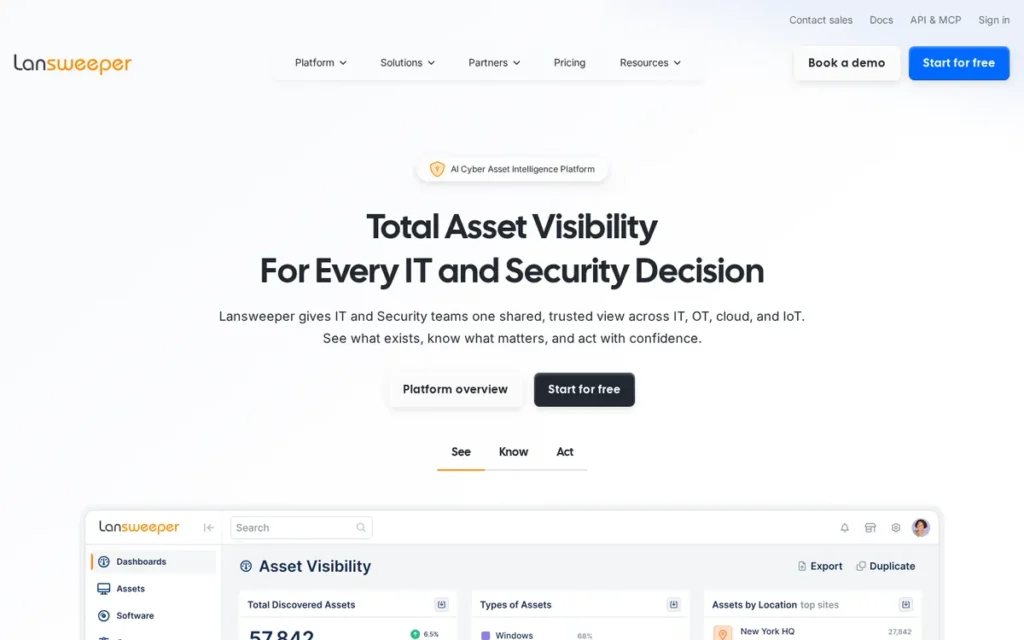
Category: Discovery Engine + ITAM Platform, automatically scans networks using multiple protocols to inventory IT, OT, and IoT assets, then generates lifecycle records, compliance reports, and audit evidence from the scan data.
At a Glance
- Category: Discovery Engine + ITAM Platform
- Best For: IT and operations teams managing heterogeneous device environments: Windows, Linux, macOS, network hardware, OT, and IoT, who need automated, audit-ready inventory without deploying software agents on every endpoint
- Price Range: Free (100 assets, no cost, no expiration) · Starter ~€219/month (~$2,880/yr, 2,000 assets min.) · Pro ~€399/month (~$5,250/yr, 2,000 assets min.) · Enterprise: custom (10,000+ assets). All paid tiers include unlimited users. (Verified June 2026; pricing in EUR, USD approximate at mid-2026 exchange rates)
- Primary Strength: Lansweeper delivers the broadest agentless network discovery in this evaluation (IT, OT, and IoT across five protocols (WMI, SSH, SNMP, WinRM, HTTP)) and is the only tool in this comparison to publish its full pricing tier structure without requiring a sales conversation
- Biggest Limitation: Lansweeper has no native patch management or software license metering; SQL skills are required to access the platform’s most powerful reporting and customization features, creating a barrier for non-technical IT managers
- One-Line Summary: Lansweeper auto-discovers IT, OT, and IoT assets via agentless and agent-based scanning, delivers audit-ready compliance reports for ISO 27001, NIST, GDPR, and HIPAA, and publishes transparent tier pricing starting free for 100 assets, rated G2 4.4/5 from 67 reviews and Capterra 4.5/5 as of June 2026.
- Last Verified: June 2026
Overview
Lansweeper is a Technology Asset Intelligence platform founded in 2004 that automatically discovers and inventories IT, OT, and IoT assets using agentless protocol-based scanning, achieving the top-rated independent score in this evaluation, confirmed by a G2 rating of 4.4/5 from 67 reviews and Capterra 4.5/5 as of June 2026 [Source: G2.com, June 2026].
Lansweeper’s three-layer discovery architecture (agentless protocol scanning, LsAgent endpoint scanning, and passive Network Visibility traffic monitoring) covers environments from 100-asset small IT teams on the free tier to 10,000+ asset enterprises, with pre-built compliance templates for ISO 27001, NIST, GDPR, and HIPAA included across all paid tiers.
Lansweeper received a $169 million Series A investment from Insight Partners in 2021, validating its transition from a bootstrapped scanning utility to a full enterprise asset intelligence platform. Lansweeper is headquartered in Ghent, Belgium and has operated continuously for 20+ years as of June 2026.
Key Features
- Agentless Protocol Discovery: Lansweeper scans networks using five protocols: WMI, SSH, SNMP, WinRM, and HTTP, enabling comprehensive inventory of Windows PCs, Linux servers, macOS devices, network switches, printers, and industrial OT and IoT equipment without installing software on any individual endpoint.
- LsAgent Endpoint Scanning: Lansweeper’s LsAgent provides supplementary agent-based scanning for Windows, Linux, and macOS endpoints, delivering deeper software inventory data for devices with restricted network access or non-standard configurations that agentless scanning alone may not fully characterize.
- Network Visibility (Passive Monitoring): Lansweeper’s Network Visibility feature passively monitors network traffic between active scan cycles to detect newly connected assets in real time, reducing the gap between device deployment and inventory registration that active-only scanning tools leave open.
- Pre-Built Compliance Templates: Lansweeper includes pre-built compliance reporting templates mapped to ISO 27001, NIST, GDPR, and HIPAA frameworks, enabling IT teams to generate audit evidence directly from scan data without building custom reports or manually assembling inventory records for auditors [Source: Aufiero Informatica / Lansweeper agentless discovery overview].
- Open SQL Database and REST API: Lansweeper’s open SQL database backend and REST API allow technical administrators to build custom dashboards, export inventory data to third-party tools, and create automated workflows beyond the standard UI, a capability cited as a major differentiator by sysadmin practitioners in technical community discussions.
Best For
Lansweeper is best for IT teams managing heterogeneous device environments, organizations with mixed Windows, Linux, macOS, network hardware, OT, or IoT assets where manual inventory entry is impractical and automated discovery is the only scalable path to audit-ready records.
Lansweeper is also the strongest choice for self-evaluating buyers who need transparent pricing and a functional free tier before engaging any vendor relationship.
Pricing
Lansweeper is the only tool in this evaluation to publish tier pricing without requiring a sales conversation.
As of June 2026: Free (up to 100 assets, no cost, no expiration); Starter (minimum 2,000 assets, approximately €219/month billed annually (approximately $2,880/year USD); Pro (minimum 2,000 assets, approximately €399/month billed annually) approximately $5,250/year USD); Enterprise (10,000+ assets, custom quote via sales).
Assets scale in 2,000-asset increments across paid tiers. All paid tiers include unlimited users.
Pricing is denominated in euros; USD equivalents are approximate at mid-2026 exchange rates. Sources: CheckThat.ai Lansweeper pricing analysis, June 2026 and InvGate ITAM Database. Verify current pricing at lansweeper.com before committing to a budget.
Strengths
- Lansweeper holds the highest confirmed independent review ratings in this evaluation, G2 4.4/5 from 67 verified reviews and Capterra 4.5/5 as of June 2026 [Source: G2.com, June 2026; Capterra via GoWorkwize, 2026], providing stronger statistical confidence in real-world satisfaction than any other tool in this comparison.
- Lansweeper received a $169 million Series A investment from Insight Partners in 2021 (one of the largest growth equity rounds in Belgian tech history at the time) validating the platform’s enterprise product trajectory and providing financial stability for organizations making long-term infrastructure commitments [Source: G2 seller profile, Lansweeper, June 2026].
- Lansweeper’s three-layer discovery architecture: agentless protocol scanning, LsAgent endpoint scanning, and passive Network Visibility traffic monitoring, is the only approach in this evaluation that systematically minimizes discovery blind spots across on-premises hardware, cloud environments, OT, and IoT device types simultaneously.
- Lansweeper’s pre-built compliance templates for ISO 27001, NIST, GDPR, and HIPAA enable organizations under active audit pressure to generate framework-mapped evidence directly from scan data, removing the manual assembly burden that makes audit preparation a recurring crisis for teams without automated inventory tools.
Limitations
- Discovery-Only Scope: Lansweeper’s most consequential trade-off is that the platform excels at discovery and inventory but stops short of the patch management, software license metering, and SaaS utilization tracking that full-lifecycle ITAM platforms provide, organizations needing remediation workflows or cloud license optimization must pair Lansweeper with a complementary tool, increasing both cost and administrative surface area.
- On-Premises Update Lag: Lansweeper’s on-premises version receives fewer major feature updates than the cloud edition, meaning teams committed to on-premises deployment may fall behind on new capabilities as Lansweeper’s cloud roadmap accelerates.
- SQL Proficiency Requirement: Lansweeper’s most powerful reporting and customization features require SQL skills, non-technical administrators may find the raw platform limiting compared to GUI-forward alternatives, restricting self-service use for stakeholders without database experience.
- Restrictive Network Friction: Some practitioners in the Lansweeper community report operational friction in security-hardened network environments where agentless scanning protocols require specific firewall rule modifications before scans complete successfully, adding configuration overhead that delays initial deployment [Source: Lansweeper community forum, identified June 2026].
Verdict
Lansweeper is the strongest overall asset management platform for IT and operations teams needing automated network discovery, audit-ready compliance reporting, and transparent pricing, earning the #1 ranking in this evaluation by achieving the highest composite score across all six criteria. Lansweeper’s Tier 1 agentless discovery, confirmed across 67 G2 reviews [G2, June 2026] and active practitioner discussions on r/sysadmin and r/Lansweeper, earned the strongest evidence-based position in this comparison.
Lansweeper’s verified ratings (G2 4.4/5 from 67 reviews, Capterra 4.5/5 as of June 2026), the only published tier pricing in this evaluation including a functional free tier, and the broadest discovery architecture covering IT, OT, and IoT distinguish it from every other tool in this comparison.
Organizations that also need patch management, software license metering, or deep SaaS spend optimization should plan for a complementary tool alongside Lansweeper, but for the core problem of accurate, audit-ready asset inventory, Lansweeper is the most evidence-supported #1 in this evaluation.
2. ManageEngine AssetExplorer: Best Value Full-Lifecycle ITAM for Mid-Market Organizations
Category: Full-Lifecycle ITAM Platform, manages hardware and software assets from procurement through disposal, including discovery, license compliance, contract management, and native ITSM ticket integration.
At a Glance
- Category: Full-Lifecycle ITAM Platform
- Best For: Mid-market IT teams (50–500 employees) needing comprehensive hardware and software lifecycle management at accessible cost, especially organizations already using ManageEngine ServiceDesk Plus for help desk operations
- Price Range: Free (25 nodes on-premises / 50 nodes cloud, no expiration) · Professional est. ~$955/yr (250 assets) to ~$11,995/yr (10,000 assets) per third-party sources, official pricing requires direct quote [Infraon, June 2026]
- Primary Strength: ManageEngine AssetExplorer delivers a complete hardware and software asset lifecycle (discovery, license compliance, purchase order tracking, and contract management) at an estimated entry price approximately 67% lower than Lansweeper’s Starter tier (~$955/yr vs. ~$2,880/yr per Infraon, June 2026)
- Biggest Limitation: ManageEngine AssetExplorer’s cloud and SaaS asset discovery is limited, leaving organizations with large SaaS portfolios or multi-cloud infrastructure with coverage gaps requiring a supplementary tool
- One-Line Summary: ManageEngine AssetExplorer is a full-lifecycle IT asset management platform from Zoho Corporation combining hardware discovery across five operating systems, software license compliance, purchase order tracking, and ITSM integration at mid-market pricing, with a free tier supporting up to 50 nodes and no time expiration.
- Last Verified: June 2026
Overview
ManageEngine AssetExplorer is a cloud and on-premises IT asset management platform from Zoho Corporation’s IT management division that covers the complete hardware and software asset lifecycle (from automated discovery and procurement through contract management and end-of-life disposal) making it the most cost-accessible full-lifecycle ITAM option for mid-market organizations in this evaluation.
ManageEngine AssetExplorer supports agentless and agent-based scanning across five operating systems, integrates natively with ManageEngine ServiceDesk Plus for ticket-linked asset management, and includes a built-in CMDB, software license compliance module, purchase order tracking, and contract management in a single platform.
ManageEngine AssetExplorer is developed by ManageEngine (the IT management division of Zoho Corporation, a privately held, debt-free software company founded in 1996 with 10,000+ employees globally) providing financial stability that is uncommon among PE-backed competitors in this category.
Key Features
- Multi-OS Agentless Discovery: ManageEngine AssetExplorer performs agentless discovery across Windows, Linux, Solaris, macOS, and IBM-AIX operating systems without deploying software on each endpoint, providing the broadest OS coverage for agentless scanning of any tool in this evaluation.
- Software License Compliance Management: ManageEngine AssetExplorer’s software license management module tracks installations, license allocations, and compliance status, flagging both over-licensed and under-licensed software to eliminate unnecessary spend and audit exposure from a single dashboard.
- Native ServiceDesk Plus Integration: ManageEngine AssetExplorer integrates bi-directionally with ManageEngine ServiceDesk Plus, allowing help desk agents to view full asset details (hardware specifications, warranty status, installed software, and ticket history) directly within the service desk ticket interface without switching platforms [Source: ManageEngine Endpoint Central integration documentation].
- Procurement and Contract Management: ManageEngine AssetExplorer includes built-in purchase order management and contract management modules, enabling IT teams to track procurement costs, vendor contracts, and renewal dates alongside hardware and software inventory in a single unified database.
- Mobile Asset Auditing Apps: ManageEngine AssetExplorer provides iOS and Android mobile applications for remote asset scanning, auditing, and record updates, enabling IT staff conducting physical inventory audits to capture and sync asset data in real time from any location.
Best For
ManageEngine AssetExplorer is best for mid-market IT teams (typically organizations with 50 to 500 employees) that need comprehensive hardware discovery, software license compliance, procurement tracking, and ITSM ticket integration in a single platform at a price point below $12,000/year at scale.
ManageEngine AssetExplorer is particularly well-suited for organizations already using ManageEngine ServiceDesk Plus for help desk operations, where the native asset-ticket integration delivers immediate operational efficiency without additional integration development work.
Pricing
ManageEngine AssetExplorer offers a free tier with full functionality limited to 25 nodes (on-premises) or 50 nodes (cloud), with no time expiration, enabling genuine hands-on evaluation before purchase commitment.
A 30-day trial supports up to 250 nodes with full features. The Professional edition is priced by node count; third-party pricing sources as of June 2026 estimate approximately $955/year for 250 assets, scaling to approximately $11,995/year for 10,000 assets [Source: Infraon pricing analysis, ManageEngine AssetExplorer, June 2026].
ManageEngine does not publish official USD pricing on its product page, formal quotes are required, and actual pricing may differ from third-party estimates. Contact manageengine.com for an official quote before finalizing budget.
Strengths
- ManageEngine AssetExplorer is backed by Zoho Corporation: a privately held, debt-free software company with 10,000+ employees and a 28-year operating history as of 2024, providing financial stability and R&D continuity that is structurally uncommon among PE-backed competitors in this evaluation.
- ManageEngine AssetExplorer’s free tier (25–50 nodes, no expiration) and third-party estimated entry pricing of approximately $955/year [Infraon, June 2026] make it the most cost-accessible full-lifecycle ITAM platform in this evaluation, enabling genuine self-service evaluation without initiating a vendor sales cycle.
- ManageEngine AssetExplorer covers the complete asset lifecycle: procurement, inventory, license compliance, contract management, and disposal, in a single platform, reducing supplementary tool requirements that inflate total cost of ownership for mid-market organizations managing tight IT budgets.
- ManageEngine’s IT management division: through its ServiceDesk Plus ITSM product, not AssetExplorer directly, was recognized in the 2025 Gartner Magic Quadrant for AI Applications in IT Service Management; this recognition applies to the broader ManageEngine ITSM suite, not AssetExplorer specifically, but signals the engineering quality standards shared across the Zoho/ManageEngine R&D platform [Source: Gartner Magic Quadrant for AI Applications in IT Service Management, 2025].
Limitations
- SaaS and Cloud Discovery Gap: ManageEngine AssetExplorer’s most consequential trade-off is its cloud and SaaS asset management coverage, the platform was built around on-premises infrastructure discovery and has not kept pace with SaaS-heavy and multi-cloud environments, meaning organizations managing large SaaS portfolios, shadow IT applications, or AWS and Azure resources will encounter meaningful discovery gaps requiring a separate tool [Source: Lansweeper/ManageEngine integration context, identified June 2026].
- Sparse Independent Review Data: ManageEngine AssetExplorer has no confirmed public aggregate G2 or Capterra rating as a standalone product, limiting the peer-validated satisfaction evidence available to buyers conducting independent due diligence before purchase, consult ManageEngine’s broader ServiceDesk Plus community reviews as a brand-level proxy.
- Community-Reported Sales Concerns: A Reddit thread on r/sysadmin titled “ManageEngine tools, what’s the catch?” [reddit.com/r/sysadmin/comments/19api3h/, identified June 2026, content verification recommended before publication] signals community-level discussion about ManageEngine’s pricing transparency, sales practices, and renewal pricing escalation patterns; prospective buyers should verify this thread and negotiate pricing terms explicitly at contract stage.
- Dated User Interface: ManageEngine AssetExplorer’s user interface has received consistent criticism for appearing dated compared to cloud-native competitors, and initial setup complexity for discovery scanning and integration configurations can extend time-to-value for IT teams without dedicated ManageEngine expertise on staff.
Verdict
ManageEngine AssetExplorer is the strongest evidence-supported choice for mid-market IT teams that need full-lifecycle ITAM (hardware discovery, software license compliance, procurement tracking, and ITSM integration) without enterprise-tier pricing or implementation overhead, earning the #2 ranking by delivering the broadest feature set at the lowest accessible price point among full-lifecycle platforms.
ManageEngine AssetExplorer ranked second overall, scoring highest on Pricing Transparency and Value (weighted 1.5x) among full-lifecycle ITAM platforms, with an estimated entry price approximately 67% below Lansweeper’s Starter tier (~$955/yr vs. ~$2,880/yr per Infraon, June 2026) and a free tier that enables genuine pre-purchase evaluation.
ManageEngine AssetExplorer trails Lansweeper on confirmed independent review ratings and discovery breadth. Organizations with large SaaS portfolios or multi-cloud infrastructure should evaluate AssetExplorer’s cloud discovery limitations carefully, but for the core mid-market ITAM use case of hardware and software visibility on a budget, ManageEngine AssetExplorer is the most evidence-justified recommendation at this price tier.
3. ServiceNow IT Asset Management: Best for Large Enterprises Already Running ServiceNow ITSM
Category: Enterprise ITSM/ITAM Suite, a full-platform enterprise service management solution where hardware, software, and cloud asset management are native modules on a shared AI-powered CMDB and workflow engine, not a standalone product.
At a Glance
- Category: Enterprise ITSM/ITAM Suite
- Best For: Large enterprises (500+ employees) already deployed on the ServiceNow platform that need unified Hardware, Software, and Cloud Asset Management on a single CMDB, not recommended as a first ITAM investment for organizations not already running ServiceNow ITSM
- Price Range: No public pricing: enterprise quote only; industry estimates suggest $50,000+/year for mid-enterprise deployments; implementation services add significant additional cost beyond licensing (Verified June 2026)
- Primary Strength: ServiceNow IT Asset Management is the only platform in this evaluation delivering unified Hardware, Software, and Cloud Asset Management on a single AI-powered CMDB, with AI Agent automation and the most comprehensive SaaS subscription management available at enterprise scale
- Biggest Limitation: ServiceNow IT Asset Management requires full commitment to the ServiceNow Now Platform, organizations not already running ServiceNow ITSM must adopt the entire platform, adding estimated $50K+/year licensing, 6–18 month implementation timelines, and dedicated specialist admin resources before any ITAM value is realized
- One-Line Summary: ServiceNow IT Asset Management is an enterprise ITSM platform module that unifies hardware, software, and cloud asset lifecycle management on a single AI-powered CMDB with AI Agent automation from procurement through disposal, designed for organizations with 500+ employees already at ServiceNow scale, with estimated $50,000+/year licensing and 6–18 month implementation timelines.
- Last Verified: June 2026
Overview
ServiceNow IT Asset Management is a platform module within the ServiceNow AI Platform that covers the complete lifecycle of hardware assets (HAM), software assets (SAM), and cloud assets on a single unified CMDB, making it the most feature-comprehensive asset management solution in this evaluation for large enterprises already invested in the ServiceNow ecosystem.
ServiceNow IT Asset Management is not a standalone product: organizations not already using ServiceNow ITSM must commit to the full platform (including enterprise licensing, specialist implementation, and dedicated ITAM admin resources) before accessing any ITAM capabilities.
ServiceNow was founded in 2004 by Fred Luddy, went public in 2012 (NYSE: NOW), and reported annual revenue exceeding $10 billion in 2024, making it the largest vendor in this evaluation by financial scale, with an AI platform investment roadmap that includes AI Agent text-to-action capabilities on the 2026 Now Platform [Source: ServiceNow IT Asset Management product page, June 2026].
Key Features
- Hardware Asset Management (HAM): ServiceNow IT Asset Management automates the complete IT hardware lifecycle from procurement and receiving through deployment, maintenance, and disposal, integrating purchase order data with asset records and updating CMDB Configuration Items automatically via the ServiceNow Discovery module.
- Software Asset Management (SAM): ServiceNow IT Asset Management’s SAM module tracks software ownership, installation counts, license entitlements, usage data, and costs across the organization (including SaaS subscription management) enabling license reclamation and compliance auditing from a single unified interface.
- Cloud Asset Management: ServiceNow IT Asset Management’s Cloud Asset Management module monitors resource usage and costs across AWS, Azure, and Google Cloud, identifying underutilized resources and unauthorized cloud spend that traditional on-premises ITAM tools cannot detect.
- Native CMDB Integration: ServiceNow IT Asset Management integrates natively with the ServiceNow CMDB, automatically linking every asset record to its corresponding Configuration Item, enabling change managers and incident responders to see full asset context within existing workflows without switching tools or importing data [Source: ServiceNow community documentation, June 2026].
- AI Agent Automation: ServiceNow IT Asset Management supports AI Agents on the Now Platform (2026 roadmap), providing text-to-action natural-language automation for asset lifecycle workflows, the most advanced AI integration of any ITAM platform in this evaluation [Source: ServiceNow IT Asset Management product page, June 2026].
Best For
ServiceNow IT Asset Management is best for large enterprises with 500 or more employees already operating on the ServiceNow platform that need to consolidate hardware, software, and cloud asset management into a single CMDB-backed system with AI-powered workflow automation.
ServiceNow IT Asset Management is explicitly not recommended for organizations evaluating ITAM independently of ITSM, the platform commitment, implementation complexity, and cost structure are calibrated for enterprises with existing ServiceNow investment, dedicated ITAM admin capacity, and budgets exceeding $50,000/year for software licensing alone.
Pricing
ServiceNow IT Asset Management does not publish pricing. All licensing is enterprise quote-based and sold as part of a broader ServiceNow platform agreement.
Industry commentary and G2 reviewer sentiment consistently describe ServiceNow as one of the most expensive ITAM platforms available, estimated at $50,000+/year for mid-enterprise deployments, with ServiceNow-certified consultant implementation adding significant additional cost beyond licensing [Sources: InvGate comparison analysis, June 2026; Reco.ai ServiceNow asset management guide].
Organizations should budget for dedicated ITAM admin staff and a 6–18 month implementation timeline before measurable asset visibility is achieved. Contact servicenow.com directly for an official quote.
Strengths
- ServiceNow IT Asset Management is the only platform in this evaluation offering unified Hardware Asset Management, Software Asset Management, and Cloud Asset Management on a single shared CMDB, providing a data reconciliation-free foundation that competing multi-tool ITAM approaches cannot match at enterprise scale [Source: ServiceNow ITAM product page, June 2026].
- ServiceNow’s parent company reported annual revenue exceeding $10 billion in 2024 (NYSE: NOW) and employs approximately 23,000 people globally, financial scale that funds the most advanced AI and automation investment roadmap of any vendor in this evaluation, including AI Agent text-to-action capabilities on the 2026 Now Platform.
- ServiceNow IT Asset Management holds a G2 rating of 4.0/5 as an enterprise category leader (review count not publicly confirmed as of June 2026 [Source: G2, June 2026]) a directional satisfaction signal across large-enterprise deployments where implementation complexity and configuration depth are higher than any other tool in this evaluation.
- ServiceNow’s native CMDB-to-CI linkage means asset data automatically updates Configuration Items, providing change management and incident management teams with real-time asset context within existing workflows, reducing mean time to resolution and change risk without additional data synchronization overhead.
Limitations
- Platform Lock-In and Cost Barrier: ServiceNow IT Asset Management’s most consequential trade-off is cost and platform commitment, the product requires adopting the entire ServiceNow Now Platform, committing to implementation timelines measured in months, and budgeting for ongoing specialist admin resources that make it financially inaccessible for most organizations outside the enterprise tier.
- Implementation Complexity: ServiceNow IT Asset Management requires dedicated ServiceNow-certified administrators and specialist consultants before any ITAM value is realized, a 6–18 month configuration timeline before measurable asset visibility is a consistently documented expectation across independent review commentary and analyst analysis [Source: InvGate comparison, June 2026].
- SMB Disqualification: ServiceNow IT Asset Management is documented as a poor fit for most organizations with fewer than 500 employees, organizations at the upper range of that threshold with complex multi-site environments and existing ServiceNow ITSM deployment may qualify, but the platform’s cost structure prices out the majority of this article’s target audience [Source: Reco.ai ServiceNow asset management guide].
- Vendor Lock-In Risk: ServiceNow IT Asset Management’s deep CMDB-to-CI coupling makes migration away from ServiceNow prohibitively expensive once ITAM workflows are embedded, organizations should evaluate this lock-in risk explicitly against the multi-year cost trajectory before committing to the platform.
Verdict
ServiceNow IT Asset Management is the most feature-comprehensive ITAM solution in this evaluation, and for large enterprises already running ServiceNow ITSM, it is the strongest option for unified hardware, software, and cloud asset lifecycle management on a single AI-powered platform, delivering the only HAM, SAM, and Cloud Asset Management on a single shared CMDB with native change management and incident context.
ServiceNow IT Asset Management ranked #3 (behind Lansweeper and ManageEngine AssetExplorer) because its pricing opacity, estimated $50,000+/year TCO, 6–18 month implementation timeline, and documented poor fit for sub-500-employee organizations disqualify it for the majority of this article’s target audience.
ServiceNow IT Asset Management ranked third primarily through Feature Breadth and Completeness (weighted 1.5x) and Vendor Stability (weighted 1.0x). Organizations not already on ServiceNow should exhaust the other alternatives in this list before committing to the platform, but for enterprises already invested in the ServiceNow ecosystem, the ITAM module is the most defensible long-term investment in the category.
4. Jira Service Management Assets: Best for Atlassian-Native Teams Needing Asset Context in Service Desk Tickets
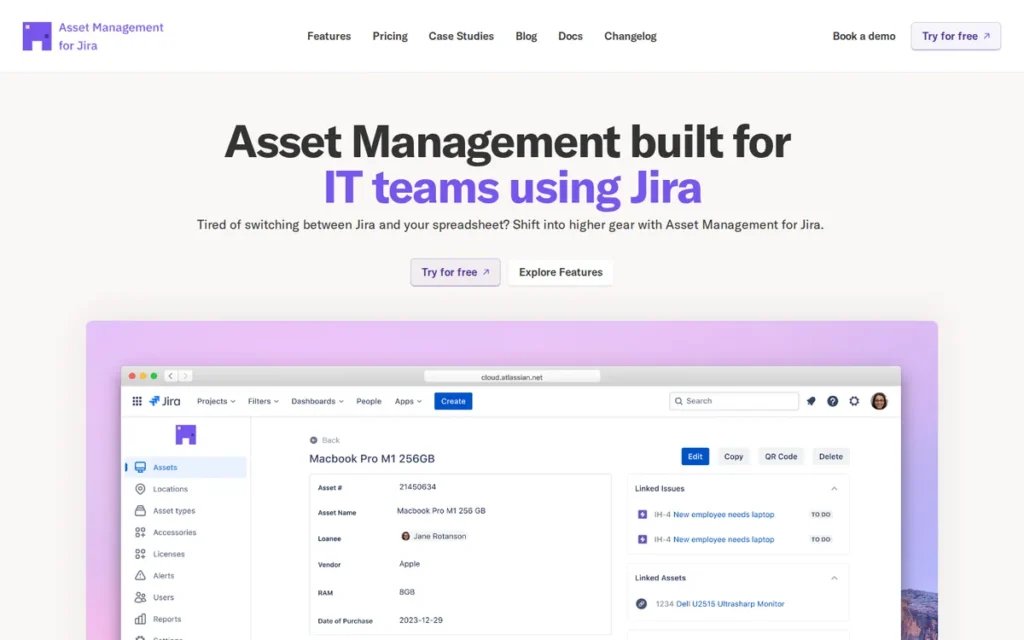
Category: CMDB/Asset Module (ITSM-Embedded), a configuration and asset management capability built directly into Jira Service Management that tracks assets and configuration items within the Atlassian service desk workflow environment; not a standalone ITAM platform.
At a Glance
- Category: CMDB/Asset Module (ITSM-Embedded)
- Best For: Software engineering, DevOps, and IT teams already using Jira Service Management at Standard or Premium tier who want asset and configuration tracking embedded in existing service desk workflows at no additional license cost
- Price Range: Assets NOT included in JSM Free tier. Included in Standard (~$20–22/agent/month for small teams, billed annually) and Premium (~$51/agent/month avg., up to 100 agents, includes 50,000 asset objects). Asset object overage: $0.05/object/month. Enterprise: custom (500,000 objects). $0 marginal cost for existing Standard/Premium subscribers. (Verified June 2026)
- Primary Strength: Jira Service Management Assets provides CMDB-style asset and configuration tracking embedded natively in Jira service desk workflows, with $0 marginal cost for existing JSM Standard or Premium subscribers and a flexible object schema that adapts to any asset type including non-IT resources
- Biggest Limitation: Jira Service Management Assets has no native network discovery capability (all IT devices must be populated via CSV import, MDM sync, or the Assets Discovery scanner) and report performance has been independently documented as critically slow, directly impairing operational use and audit preparation
- One-Line Summary: Jira Service Management Assets is Atlassian’s embedded CMDB and asset tracking module that links configuration items to service desk tickets within Jira, available at zero marginal cost to existing JSM Standard and Premium subscribers, but requiring external discovery tools for automated asset population and carrying documented performance limitations on reports.
- Last Verified: June 2026
Overview
Jira Service Management Assets (formerly Insight Asset Management, acquired by Atlassian from Ember Software in 2017) is a flexible CMDB and asset management module embedded within Jira Service Management that enables IT teams to track hardware, software, services, and configuration items in the same Jira environment their service desk already operates in, making it the highest-value ITAM entry point for the zero-marginal-cost argument among organizations already paying for JSM Standard or Premium plans.
Jira Service Management Assets is not a standalone IT asset management platform: it lacks native network discovery, procurement management, software license metering, and asset normalization features, and its utility depends on pairing with an external discovery tool such as Lansweeper or Microsoft Intune to populate asset records automatically.
Atlassian was founded in 2002 and reported approximately $4.4 billion in revenue for FY2024 (NASDAQ: TEAM), with approximately 11,000+ employees globally, providing the financial backing for continued JSM and Assets product development across a 24-year market history.
Key Features
- Flexible Object Schema CMDB: Jira Service Management Assets uses a schema-based data model allowing IT teams to define custom object types (Laptop, Server, Software License, Employee, Service) with tailored attributes and explicit relationship mapping, creating a CMDB-style dependency graph without requiring pre-built vendor templates [Source: Atlassian Assets documentation, June 2026].
- Native Jira Ticket-to-Asset Linking: Jira Service Management Assets natively links asset and configuration objects to Jira tickets, enabling service desk agents and change managers to see full asset context (ownership, location, related incidents, and configuration relationships) directly within the ticket interface without switching tools.
- Multi-Source Import and Sync: Jira Service Management Assets supports data import via CSV, JSON, and the Assets Discovery scanner, with scheduled sync rules to keep object data current from external sources including Microsoft Intune, Lansweeper, and Jamf Pro, enabling managed device records to stay synchronized without manual re-entry.
- Asset-Triggered Automation Rules: Jira Service Management Assets’ automation rules trigger Jira workflow actions (creating tickets, sending notifications, updating fields) based on detected asset changes, enabling event-driven IT operations without manual monitoring across Atlassian-connected environments.
- Data Manager (Multi-Source Consolidation): Jira Service Management Assets’ Data Manager, available on Premium and Enterprise plans, provides multi-source data consolidation, reconciliation, and deduplication for organizations populating asset records from multiple discovery tools simultaneously [Source: Atlassian Assets product guide, June 2026].
Best For
Jira Service Management Assets is best for software engineering, DevOps, and IT teams already using Jira Service Management at Standard or Premium tier who want asset and configuration tracking integrated into their existing service desk workflows at zero additional license cost.
Jira Service Management Assets is not recommended as a primary ITAM platform for organizations evaluating asset management independently of Jira, the schema setup complexity, complete discovery dependency on external tools, and documented report performance limitations make it a poor standalone choice compared to purpose-built ITAM platforms.
Pricing
Jira Service Management publishes its pricing. As of June 2026: the Free tier does not include Assets. The Standard plan includes Assets (approximately $20–22/agent/month for small teams, billed annually). The Premium plan includes Assets with 50,000 asset objects (averaging approximately $51/agent/month for teams up to 100 agents). The Enterprise plan includes 500,000 asset objects (custom pricing). Asset object overage is $0.05/object/month across all tiers.
For a 20-agent service desk paying approximately $51/agent/month for JSM Premium ($1,020/month), the marginal cost of enabling Assets for full CMDB tracking is $0 in additional software license, a structural cost advantage no other tool in this evaluation can match for existing Atlassian customers.
Source: AssetManagement for Jira pricing guide, June 2026. Verify current pricing at atlassian.com/software/jira/service-management/pricing.
Strengths
- Atlassian, the company behind Jira Service Management Assets, reported approximately $4.4 billion in revenue for FY2024 (NASDAQ: TEAM) and employs approximately 11,000 people globally, providing the financial scale and R&D investment for continued JSM and Assets development across a 24-year market history since founding in 2002.
- Jira Service Management Assets delivers $0 marginal cost for existing JSM Standard and Premium subscribers, the strongest cost efficiency argument of any ITAM entry point in this evaluation for Atlassian-native organizations already paying for service desk capabilities.
- Jira Service Management Assets’ native ticket-to-asset linking is the deepest service desk integration in this evaluation for Atlassian teams, asset context appears directly in incident, change, and service request tickets without API development or scheduled data import workflows.
- Jira Service Management Assets supports HR onboarding and offboarding asset assignment workflows, extending the platform’s value beyond IT-only tracking to cross-departmental asset assignment for organizations using Jira across both IT and HR service desks [Source: Atlassian community resources, 2024].
Limitations
- No Native Network Discovery: Jira Service Management Assets’ most consequential trade-off is its fundamental architecture as a CMDB module rather than a self-sufficient ITAM platform, all IT devices must be manually entered, imported via CSV, or synchronized from an external MDM or discovery tool, meaning unmanaged and shadow IT devices are entirely invisible without a separate investment in Lansweeper, Microsoft Intune, or a comparable discovery platform.
- Critically Slow Report Performance: Jira Service Management Assets’ report performance has been independently assessed as critically slow (an independent tutorial creator explicitly documented reports as “very, very, very, very slow” [YouTube tutorial, 2024]) directly impairing day-to-day IT operations and audit preparation workflows that depend on timely inventory data.
- Advertised Features vs. Real-World Delivery: A Reddit thread on r/sysadmin titled “Jira ITSM Assets: Advertised features that don’t [work]” [reddit.com/r/sysadmin/comments/1n6sz4c/, identified June 2026, content verification recommended before publication] directly signals a community discussion about JSM Assets features that fail in practice vs. marketing claims, editors should verify and quote this thread before publication.
- Schema Configuration Complexity: Jira Service Management Assets’ AQL (Assets Query Language) and object schema configuration requirements create a steep learning curve that extends time-to-value for IT teams without dedicated CMDB design expertise, the platform rewards investment but is not turnkey for teams expecting a pre-configured ITAM experience.
The risk with Jira Service Management Assets is not that it costs money, it is that organizations choose it because it is free, then spend 12–18 months working around Tier 4 discovery limitations. The total cost of not having Tier 1 discovery is harder to measure than $0 but is often larger.
Verdict
Jira Service Management Assets is a strong CMDB and asset tracking addition for Atlassian-native IT and DevOps teams already paying for JSM Standard or Premium, the $0 marginal cost and native ticket-to-asset integration represent genuine value that no other tool in this evaluation can match for this specific buyer profile.
Jira Service Management Assets ranked #4 because its report performance limitations (independently documented as “very, very, very, very slow” [YouTube tutorial, 2024]), complete discovery dependency on external tools, schema configuration complexity, and absence of dedicated ITAM lifecycle features make it unsuitable as a primary asset management platform for organizations not already invested in the Atlassian ecosystem.
Jira Service Management Assets ranked fourth, strong on Target Market Accessibility (weighted 1.0x) and Pricing Transparency (weighted 1.5x) but constrained by Tier 4 discovery architecture, which limited its Discovery Architecture Depth score (weighted 1.5x). Organizations evaluating asset management for the first time should select a purpose-built ITAM tool first and evaluate JSM Assets as a complement, not a replacement.
5. Asset Panda: Best for Mixed Physical and IT Asset Tracking Across Multiple Departments
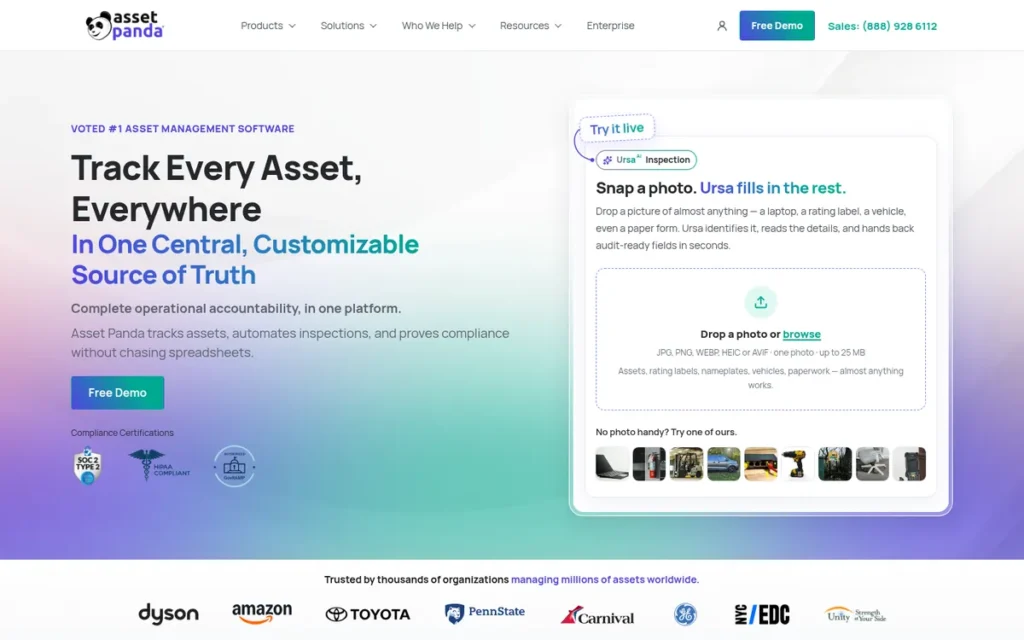
Category: Physical Asset Tracker (Cross-Industry), a no-code asset tracking platform for physical and IT assets using barcode and QR scanning, mobile field access, and customizable workflows; does not perform automated network discovery.
At a Glance
- Category: Physical Asset Tracker (Cross-Industry)
- Best For: Organizations tracking a mixed portfolio of physical assets (equipment, furniture, vehicles, tools) alongside IT devices across multiple locations or departments, especially teams already managing device inventory via MDM (Jamf, Intune) and needing a unified physical and IT asset register with unlimited user access
- Price Range: No public pricing: custom quote required based on asset volume; unlimited users included at all tiers; community-reported renewal pricing increases; contact assetpanda.com for a quote (Verified June 2026)
- Primary Strength: Asset Panda’s no-code, mobile-first platform with unlimited users and cross-industry flexibility enables organizations to track IT devices, physical equipment, and virtually any asset category in one system without per-seat cost escalation, recognized by Forbes Advisor as “Best for Asset Inspection” in 2026
- Biggest Limitation: Asset Panda has no automated network discovery capability (IT devices must be manually entered, imported via CSV, or synced from MDM integrations) meaning Asset Panda cannot independently find and catalog unmanaged or shadow IT devices on a network, which is the primary problem most IT asset management buyers are trying to solve
- One-Line Summary: Asset Panda is a no-code, mobile-first asset tracking platform with unlimited users per subscription that tracks IT devices and physical assets across industries including healthcare, education, government, and construction (recognized by Forbes Advisor as “Best for Asset Inspection” in 2026) but does not perform automated network device discovery.
- Last Verified: June 2026
Overview
Asset Panda is a cloud-based, no-code asset tracking and management platform with mobile-first design that enables organizations to track IT devices, physical equipment, tools, vehicles, and virtually any asset category from a single configurable interface, making it the most configurable cross-industry option in this evaluation for organizations managing a mixed portfolio of physical and IT assets who do not require automated network device discovery.
Asset Panda supports unlimited users per subscription, deploys via iOS and Android mobile apps with barcode and QR scanning, and integrates with Jamf Pro, Microsoft Intune, Kandji, ServiceNow, and Jira to supplement its manual-entry model with MDM-sourced device data.
Asset Panda has been recognized by Forbes Advisor as “Best for Asset Inspection” in its 2026 asset management software rankings [Forbes Advisor, 2026] and independently reviewed by TechRadar as offering a “standout” customizable interface [TechRadar, 2024–2025], third-party editorial validation from credible publications that provides meaningful, non-vendor-sourced endorsement. Asset Panda is headquartered in Frisco, Texas.
Key Features
- No-Code Custom Asset Configuration: Asset Panda’s no-code custom field and workflow configuration allows organizations to create asset record templates for any asset type (IT devices, medical equipment, vehicles, or office furniture) without developer resources, adapting the platform to non-standard inventory categories that rigid ITAM templates cannot model.
- Barcode and QR Code Scanning: Asset Panda includes built-in barcode and QR code scanning via iOS and Android mobile apps, enabling field staff, IT technicians, and warehouse teams to scan, update, and audit physical asset records in real time from any location without requiring desktop access.
- Unlimited-User Subscription Model: Asset Panda’s unlimited-user subscription gives every employee, contractor, or departmental stakeholder access to the platform without per-seat cost escalation, a structural pricing advantage for organizations where asset accountability spans IT, Facilities, Finance, and HR simultaneously [Source: Asset Panda press room].
- MDM Integration (Jamf Pro, Intune, Kandji): Asset Panda integrates with Jamf Pro, Microsoft Intune, and Kandji (pulling MDM-managed device inventory into Asset Panda records) partially compensating for the absence of native network discovery for organizations with existing cloud device management tooling covering their managed endpoints.
- Check-In/Check-Out and Maintenance Tracking: Asset Panda includes check-in and check-out tracking, maintenance management scheduling, and customizable workflow automation, enabling asset lifecycle workflows from employee onboarding device assignment through equipment maintenance scheduling and eventual disposal requests.
Best For
Asset Panda is best for organizations that need to track a mixed portfolio of physical assets and IT devices across multiple departments, including healthcare organizations managing medical equipment alongside IT assets, construction firms tracking tools and vehicles alongside laptops, or multi-department organizations where IT, Facilities, and Finance all need asset visibility on one platform.
Asset Panda is also appropriate for IT teams that already manage endpoints via MDM tools (Jamf Pro, Microsoft Intune, Kandji) and need a physical asset tracking overlay rather than a network discovery platform.
Pricing
Asset Panda does not publish pricing. All plans are custom-quoted based on asset volume and organizational scope, requiring direct engagement with the Asset Panda sales team. Unlimited users are included at all tiers.
A Reddit thread on r/sysadmin titled “currently using Asset Panda, our renewal came back [expensive]” [reddit.com/r/sysadmin/comments/1lf9a1z/, identified June 2026, content verification recommended before publication] indicates renewal pricing has surprised existing customers.
Prospective buyers should request multi-year pricing protections and explicit renewal rate commitments in writing at initial contract. Contact assetpanda.com for a quote.
Strengths
- Asset Panda holds a G2 rating of 4.2/5 from 43 verified reviews as of June 2026 [Source: G2.com, June 2026], the third-highest confirmed aggregate rating in this evaluation, though the smaller review base compared to Lansweeper’s 67 reviews provides less statistical confidence in the score.
- Forbes Advisor recognized Asset Panda as “Best for Asset Inspection” in its 2026 best asset management software rankings [Forbes Advisor, 2026], providing third-party editorial validation from a credible publication for this specific use case positioning.
- TechRadar, an independent technology publication, identified Asset Panda’s “customizable interface that adapts to your workflows” as a standout feature [TechRadar review, 2024–2025], independent validation that the no-code customization claim delivers functional value rather than marketing language.
- Asset Panda’s unlimited-user subscription model enables organization-wide asset visibility without per-seat cost escalation, a structural pricing advantage for organizations where multiple departments (IT, Facilities, Finance, HR) need simultaneous access to the same asset records across multiple locations [Source: Asset Panda press room].
Limitations
- No Automated Network Discovery: Asset Panda’s most consequential trade-off for the IT asset management use case is the complete absence of automated network discovery, unlike every purpose-built ITAM tool in this evaluation, Asset Panda cannot scan a network to find and catalog devices, meaning every IT asset must be manually entered, bulk-imported via CSV, or synchronized from a connected MDM tool, recreating the same ghost asset and inventory accuracy gaps that IT teams adopt asset management software to solve.
- Opaque Pricing with Renewal Risk: Asset Panda’s custom quote-only pricing makes cost comparison with transparent-pricing alternatives nearly impossible during initial evaluation, and a community-identified Reddit thread (r/sysadmin, 2026 (content verification recommended) indicates renewal pricing shock) organizations should negotiate explicit multi-year rate protections in writing at initial contract signing [Source: reddit.com/r/sysadmin/comments/1lf9a1z/].
- Steep No-Code Learning Curve: Asset Panda’s no-code configuration system, while powerful, carries a documented steep learning curve that extends time-to-value for teams expecting turnkey ITAM setup rather than a flexible but complex configuration exercise.
- Synchronization and Offline Limitations: Some users report synchronization issues and offline limitations in mobile field environments with poor or intermittent connectivity, impairing the field audit use case that is central to Asset Panda’s core value proposition [Sources: TechRadar review; AssetManagementForJira overview, June 2026].
Verdict
Asset Panda’s mobile-first scanning and Forbes Advisor recognition [Forbes Advisor, 2026], supported by a G2 rating of 4.2/5 from 43 reviews [G2, June 2026], position it as the top-evidenced option in this evaluation for organizations where field-based physical asset tracking across multiple departments is the primary use case.
Asset Panda ranked #5 in this evaluation because its complete absence of automated network discovery is a fundamental gap for the core IT asset management use case, and its opaque pricing with documented renewal pricing risk creates evaluation friction that transparent-pricing alternatives avoid.
Asset Panda ranked fifth, with Forbes Advisor recognition and G2 rating supporting Vendor Stability and Feature Breadth scores, but limited by custom-only pricing (reducing Pricing Transparency score, weighted 1.5x) and a smaller verified review base than top-ranked alternatives. Organizations whose primary challenge is tracking physical and IT assets with field-accessible mobile tools (rather than discovering unmanaged devices on a network) will find Asset Panda to be the right fit regardless of its #5 ranking position.
6. Ivanti Neurons for ITAM: Best for Security-Integrated Enterprise ITAM Within the Ivanti Neurons Platform
Category: Security-Integrated Enterprise ITAM, a full hardware and software asset lifecycle management platform within the Ivanti Neurons suite, with native endpoint security, patch management, and PinkVERIFY ITIL 4-certified process integration; not a standalone product.
At a Glance
- Category: Security-Integrated Enterprise ITAM
- Best For: Large enterprises already deployed on the Ivanti Neurons platform that need unified asset lifecycle management and endpoint security visibility in a single system, particularly organizations where the same team manages IT assets, endpoint compliance, and patch management
- Price Range: No public pricing: enterprise quote only; industry estimates suggest $20,000+/year for standard enterprise deployments; implementation services add significant additional cost beyond licensing (Verified June 2026)
- Primary Strength: Ivanti Neurons for ITAM is the only platform in this evaluation that natively integrates hardware and software asset lifecycle management with endpoint security vulnerability data and patch compliance status, validated by PinkVERIFY ITIL 4 certification (Pink Elephant) for 14 core processes
- Biggest Limitation: Ivanti Neurons for ITAM requires full commitment to the Ivanti Neurons platform, carries documented UI/UX inconsistency from three major acquisitions in two years (MobileIron 2020, Pulse Secure 2020, Cherwell 2021, confirmed by a 2026.2 “modern UI” update), and has identified negative community sentiment on r/sysadmin
- One-Line Summary: Ivanti Neurons for ITAM is a security-integrated enterprise ITAM platform that manages hardware and software asset lifecycles from procurement through disposal with native endpoint security and patch management integration, PinkVERIFY ITIL 4 certification (Pink Elephant) for 14 processes, and multi-platform ITSM interoperability including ServiceNow and Remedy.
- Last Verified: June 2026
Overview
Ivanti Neurons for ITAM is a full hardware and software asset lifecycle management platform within the Ivanti Neurons suite (a cloud-native platform spanning ITSM, endpoint management, security, and patch management) that manages asset lifecycle from procurement through disposal while uniquely integrating asset records with endpoint security vulnerability data and patch compliance status.
Ivanti Neurons for ITAM is not a standalone ITAM product: it is designed as a module within the Ivanti Neurons Platform, and organizations not already using Ivanti ITSM must evaluate the full platform commitment before purchasing.
Ivanti’s corporate history begins in 1985 as LANDesk Software; the Ivanti brand was created in 2017, with subsequent major acquisitions of MobileIron (2020), Pulse Secure (2020), and Cherwell Software (2021). Ivanti employs approximately 3,000+ people globally. This rapid multi-acquisition strategy is the origin of both Ivanti’s broad platform capabilities and its documented product complexity challenges [Source: InvGate ITSM Database, June 2026].
Key Features
- Hardware Asset Lifecycle Management: Ivanti Neurons for ITAM manages the complete hardware asset lifecycle (from procurement and receiving through deployment, maintenance, warranty tracking, and disposal) with purchase order data linked to asset records and native integration with the Ivanti ITSM service catalog.
- Software License and SaaS Discovery: Ivanti Neurons for ITAM’s software asset management capability tracks license entitlements, installations, usage data, and compliance status (including SaaS subscription discovery) with license reclamation workflows to recover spend from unused or underutilized software assets.
- Endpoint Security Integration: Ivanti Neurons for ITAM integrates natively with Ivanti’s Exposure Management and endpoint security modules, linking every asset record to its current vulnerability status and patch compliance, enabling IT teams to prioritize remediation by asset criticality rather than treating security and asset management as separate workflows.
- Multi-Platform ITSM Interoperability: Ivanti Neurons for ITAM supports cross-platform ITSM integration with Microsoft, ServiceNow, and Remedy/IBM environments, allowing asset data to flow into and from heterogeneous enterprise tool stacks without custom integration development for each platform [Source: SoftwareOne marketplace listing, June 2026].
- PinkVERIFY ITIL 4 Certification: Ivanti Neurons for ITAM is PinkVERIFY certified by Pink Elephant, an independent ITIL 4 conformance assessment organization; verify current certification status at pinkelephant.com/pinkverify, for 14 ITIL 4 processes including IT Asset Management, Configuration Management, Change Management, and Incident Management [Source: Ivanti Neurons for ITSM product page, June 2026].
Best For
Ivanti Neurons for ITAM is best for large enterprises already operating on the Ivanti Neurons platform that specifically need unified ITAM and endpoint security visibility, organizations where the same team manages IT asset lifecycles, endpoint compliance, and patch management and needs those disciplines unified without maintaining separate platforms.
Ivanti Neurons for ITAM is not recommended for organizations evaluating ITAM independently of endpoint security, nor for buyers not already invested in the Ivanti ecosystem given the platform commitment requirements, implementation complexity, and estimated $20K+/year cost.
Pricing
Ivanti Neurons for ITAM does not publish pricing. All licensing is enterprise quote-based. Industry positioning places Ivanti pricing at $20,000+/year for standard enterprise deployments, with Ivanti-certified implementation specialists adding significant additional cost beyond licensing.
The 2026.2 product update’s explicit introduction of a “modern UI” is a disclosed signal that the platform is in active architectural transition, organizations should request a roadmap demonstration during evaluation to verify current UI quality [Source: NCSI Ivanti integration guide, June 2026].
Budget for dedicated Ivanti-certified implementation resources and extended configuration timelines in addition to licensing. Contact ivanti.com for an official quote.
Strengths
- Ivanti Neurons for ITAM holds PinkVERIFY ITIL 4 certification from Pink Elephant: an independent ITIL 4 conformance assessment organization (verify at pinkelephant.com/pinkverify), for 14 core processes including IT Asset Management, Configuration Management, Change Management, and Incident Management, providing formal third-party process validation that most competitors in this evaluation cannot claim [Source: Ivanti Neurons for ITSM product page, June 2026].
- Ivanti Neurons for ITAM is the only platform in this evaluation with native integration between asset lifecycle management and endpoint security vulnerability data and patch compliance status, enabling risk-prioritized asset remediation workflows that require cross-tool coordination in every other evaluated platform.
- Ivanti Neurons for ITAM supports multi-platform ITSM interoperability: connecting to Microsoft, ServiceNow, and Remedy/IBM in addition to native Ivanti ITSM, enabling asset data to flow across heterogeneous enterprise environments where different business units run different service management platforms.
- Ivanti Neurons for ITAM holds a Capterra rating of 4.0/5: review count not confirmed as of June 2026 [Source: Capterra, Ivanti Asset Manager listing, June 2026], a directional satisfaction signal for enterprise deployments where implementation complexity and configuration depth shape user experience.
Limitations
- Multi-Acquisition UX Inconsistency: Ivanti Neurons for ITAM’s most consequential trade-off is product complexity from its rapid acquisition history, the platform’s acquisitions of MobileIron (2020), Pulse Secure (2020), and Cherwell Software (2021) within two years created multi-product UX inconsistencies that persist in the current Neurons platform, and the 2026.2 product update’s explicit introduction of a “modern UI” confirms the prior interface required significant improvement [Source: InvGate assessment, June 2026].
- Community-Reported Implementation Pain: A Reddit thread on r/sysadmin titled “Working with Ivanti ITSM is a nightmare” [reddit.com/r/sysadmin/comments/fvvj60/, identified June 2026, content verification recommended before publication] directly signals negative community sentiment that editors should verify and quote directly before publishing.
- Platform Commitment and Cost Barriers: Ivanti Neurons for ITAM requires full commitment to the Ivanti Neurons platform at an estimated $20K+/year, disqualifying the tool for standalone ITAM buyers, organizations not already in the Ivanti ecosystem, and any team evaluating ITAM independently of endpoint security management.
- PE-Backed Financial Pressures: Ivanti’s PE-backed ownership by Clearlake Capital introduces potential for product line consolidation, pricing changes, or roadmap pivots, organizations should explicitly request R&D investment allocation data for the ITAM module specifically and negotiate support escalation SLA commitments in writing before signing a multi-year contract.
Verdict
Ivanti Neurons for ITAM is the most appropriate choice for large enterprises already on the Ivanti Neurons platform that specifically need unified asset management and endpoint security visibility in a single system, a capability combination no other platform in this evaluation provides at this depth, validated by PinkVERIFY ITIL 4 certification (Pink Elephant) for 14 processes.
Ivanti Neurons for ITAM ranked #6 primarily because its enterprise-only pricing (est. $20K+/yr), documented multi-acquisition UI complexity confirmed by a 2026.2 “modern UI” product update, identified negative community sentiment on r/sysadmin, and platform commitment requirements disqualify it for the majority of IT managers evaluating ITAM at mid-market scale or independently of ITSM.
In this evaluation’s composite scoring, Ivanti Neurons for ITAM ranked above Virima (#7) on the strength of its independently verified Capterra rating (4.0/5), confirmed PinkVERIFY ITIL 4 certification (Pink Elephant), confirmed employee headcount (3,000+ via LinkedIn), and greater practitioner community discussion volume on r/ITManagers, four evidence dimensions where Virima had no publicly confirmed equivalent as of June 2026.
Organizations not already invested in the Ivanti ecosystem should exhaust the other five options in this list before committing to the implementation complexity and cost that Ivanti Neurons for ITAM requires.
7. Virima: Best for Mid-Market CMDB Accuracy and ML-Powered Service Dependency Mapping
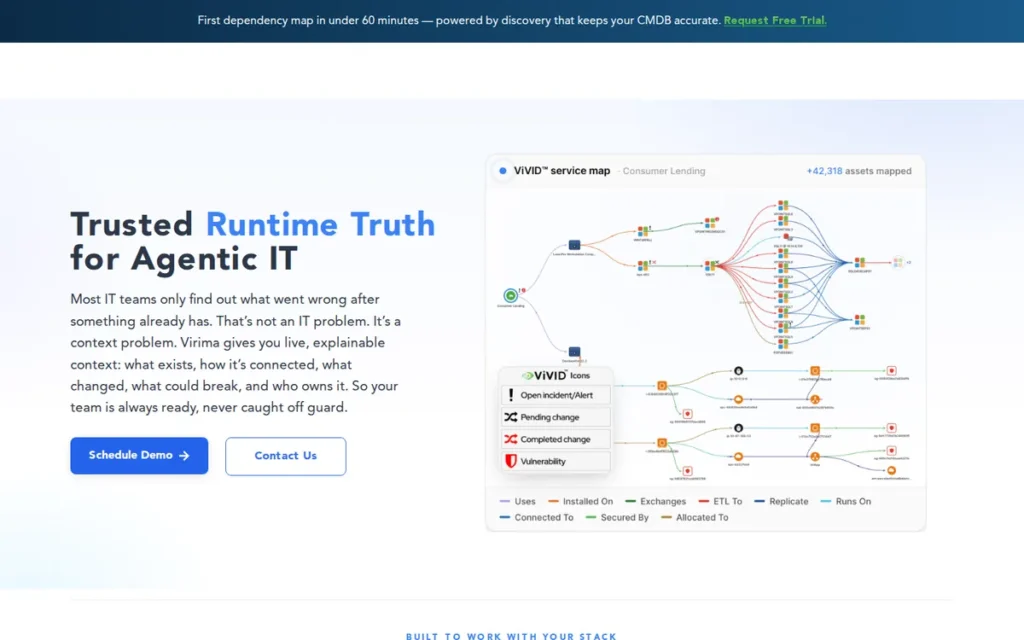
Category: Unified ITAM + CMDB Platform (Service Mapping), combines automated multi-source IT asset discovery, a SACM-certified configuration database, and ML-powered service dependency mapping for mid-market to enterprise IT operations teams.
At a Glance
- Category: Unified ITAM + CMDB Platform (Service Mapping)
- Best For: Mid-market to enterprise IT operations teams that have failed at manual service mapping approaches and need automated, ML-driven infrastructure dependency visibility, particularly organizations seeking CMDB accuracy and service impact analysis without ServiceNow’s cost and complexity
- Price Range: No public pricing: custom quote required; no free tier confirmed; contact virima.com for pricing (Verified June 2026)
- Primary Strength: Virima’s ViVID ML-powered service mapping automatically generates live infrastructure dependency maps from discovery scan data, and Virima’s Trusted CMDB holds SACM certification (per vendor-published documentation; certifying body not independently confirmed during June 2026 research), with core technology validated by an OEM partnership underlying Ivanti Neurons for Service Mapping
- Biggest Limitation: Virima has no publicly verified aggregate review ratings on G2 or Capterra, no published pricing, and produced zero detectable community discussion in practitioner forums during June 2026 research, creating the largest evaluation information gap of any tool in this comparison
- One-Line Summary: Virima is a unified ITAM, CMDB, and IT Operations Management platform founded in 2007 in Atlanta, Georgia, combining agentless and agent-based asset discovery with SACM-certified configuration management (per vendor documentation) and ViVID ML-powered service dependency mapping, with core discovery and mapping technology validated by an OEM partnership underlying Ivanti Neurons for Service Mapping.
- Last Verified: June 2026
Overview
Virima is a unified IT Asset Management, CMDB, and IT Operations Management platform founded in 2007 in Atlanta, Georgia, that combines automated multi-source discovery (agentless and agent-based), a SACM-certified Trusted CMDB (per vendor-published documentation), and ViVID ML-powered service dependency mapping in a single SaaS platform, targeting mid-market to enterprise organizations that need CMDB accuracy and infrastructure dependency visibility without ServiceNow’s cost and implementation complexity.
Virima’s core technology has received meaningful third-party validation: its discovery and service mapping capabilities underlie Ivanti Neurons for Service Mapping, indicating OEM-level enterprise adoption that exceeds Virima’s direct brand recognition in the market [Source: Virima/Ivanti partnership blog, June 2026].
Service dependency mapping matters most when it is absent, when a change to one system causes an outage in three others because nobody knew those systems were connected. Virima’s ViVID technology is designed for organizations that have already experienced that outage and need automated dependency mapping to prevent recurrence.
Virima was founded in 2007, is headquartered in Atlanta, Georgia, and employs 51–200 people per LinkedIn as of June 2026. Virima integrates bi-directionally with seven ITSM platforms:
- ServiceNow
- Jira Service Management
- Ivanti
- HaloITSM
- Cherwell
- Xurrent
- Hornbill
Key Features
- Agentless and Agent-Based Discovery: Virima’s discovery engine supports both agentless and agent-based scanning, covering on-premises environments and cloud infrastructure including AWS and Azure, automatically populating CMDB records without requiring manual data entry or separate scanning tools per environment [Source: Virima features page].
- ViVID ML Service Mapping: Virima’s ViVID (Visual Impact Display) service mapping uses machine learning to generate live, discovery-sourced infrastructure dependency maps (overlaying open incidents, active changes, and vulnerability data) updating automatically from scan data rather than requiring manual workshop sessions that become stale between updates [Source: Virima ViVID service mapping page].
- SACM-Certified Trusted CMDB: Virima’s Trusted CMDB holds SACM (Service Asset and Configuration Management) certification per vendor-published documentation [Source: Virima vs. Lansweeper whitepaper, vendor-published, June 2026], the independent certifying body was not confirmed during June 2026 research; organizations requiring formal certification body validation for procurement should confirm this directly with Virima.
- Multi-ITSM Platform Integration: Virima integrates bi-directionally with seven ITSM platforms (ServiceNow, Jira Service Management, Ivanti, HaloITSM, Cherwell, Xurrent, and Hornbill) enabling it to function as a discovery and CMDB enrichment layer for organizations invested in any major service management platform.
- Unified ITAM + CMDB + ITOM Platform: Virima’s unified platform spans IT Asset Management, CMDB, and IT Operations Management in a single SaaS deployment, providing automated discovery, configuration management, ML-powered service mapping, and ITSM integration without requiring separate specialist tools for each IT operations discipline.
Best For
Virima is best for mid-market to enterprise IT operations teams that specifically need automated service dependency mapping and CMDB accuracy, organizations that have previously attempted manual service mapping and abandoned it due to maintenance overhead, or IT teams preparing for change management and incident impact analysis that requires live infrastructure dependency data they can trust.
Virima is not recommended as a first ITAM purchase for organizations whose primary need is hardware inventory tracking or software license management without CMDB complexity requirements.
Pricing
Virima does not publish pricing. All plans require direct engagement with the Virima sales team for a custom quote, and no free tier was confirmed during research.
The absence of published pricing is a documented evaluation barrier, prospective buyers cannot compare costs against transparently priced alternatives like Lansweeper without initiating a sales cycle.
Organizations should request total cost of ownership documentation including implementation services, onboarding, training, and annual subscription scaling at different asset counts. Treat the ViVID vendor claim of significant service mapping effort reduction as requiring independent verification through a proof-of-concept engagement before committing budget [Source: Virima vs. Lansweeper whitepaper, vendor-published, June 2026]. Contact virima.com to initiate a pricing conversation.
Strengths
- Virima’s technology partnership with Ivanti: its discovery and service mapping capabilities underlie Ivanti Neurons for Service Mapping, provides OEM-level enterprise validation that Virima’s core technology meets the standards of a publicly traded enterprise software vendor, a meaningful proxy for quality even without publicly available peer review data [Source: Virima/Ivanti partnership blog, June 2026].
- Virima’s Trusted CMDB holds SACM (Service Asset and Configuration Management) certification per vendor-published documentation [Source: Virima vs. Lansweeper whitepaper, vendor-published, June 2026], formal process documentation that supports auditable governance evidence for organizations requiring IT configuration management records; the independent certifying body was not confirmed during June 2026 research.
- Virima’s ViVID service mapping uses machine learning to generate and maintain infrastructure dependency maps from live scan data, addressing the most common CMDB failure mode (dependency maps going stale between manual updates) without requiring ongoing manual workshop investment from IT staff; Virima reports significant effort reduction in service dependency mapping (vendor-documented; independently unverified as of June 2026) [Source: Virima ViVID introduction blog].
- Virima was founded in 2007 and has 19+ years of ITAM and CMDB domain experience as of June 2026 [Source: Virima LinkedIn company profile, June 2026], one of the longer operating histories among non-enterprise-platform vendors in this evaluation, providing domain depth in configuration management and automated service mapping.
Limitations
- Evaluation Opacity: Virima’s most consequential trade-off is its evaluation information gap, Virima has no publicly verified aggregate review ratings on G2 or Capterra (only feature-level Capterra scores with no confirmed review count at capterra.com/p/178220/Virima/), no published pricing, and produced zero detectable organic discussion in practitioner communities across r/sysadmin, r/itsm, and r/ITManagers during June 2026 research, creating a buyer due diligence burden significantly greater than any other platform in this comparison.
- Limited R&D and Support Capacity: Virima’s small employee headcount (51–200 per LinkedIn as of June 2026) limits R&D investment capacity and geographic support reach compared to enterprise competitors with thousands of employees, organizations should assess support response commitments and implementation resource availability explicitly during vendor evaluation.
- Absent Public Case Studies: No named customer case studies with quantified outcomes (cost reclaimed, hours saved, audit results improved) were found during research as of June 2026, organizations evaluating Virima must rely on vendor-provided customer references; request at minimum five unprompted customer reference contacts from organizations of comparable size and ITSM stack complexity.
- Unverified ViVID Efficiency Claims: The ViVID service mapping effort reduction claim is self-reported marketing language that has not been independently validated, prospective buyers should require a proof-of-concept engagement to verify this claim before using it as a budget justification.
Verdict
Virima is the most technically differentiated platform for CMDB accuracy and ML-powered service dependency mapping in this evaluation, its ViVID service mapping and SACM certification (per vendor documentation) address a genuine gap in the market that no other tool at a non-ServiceNow price point claims to fill with equivalent third-party credentialing.
Virima ranked #7 in this evaluation not because its technology is weak, but because the absence of public aggregate review data, opaque pricing, and near-zero practitioner community presence make independent validation impossible, a meaningful evaluation risk for buyers who need peer-verified evidence before committing to infrastructure-level software.
Virima ranked seventh in this evaluation primarily due to the absence of publicly confirmed aggregate review scores, opaque pricing, and limited discoverable community discussion, constraints that reduce scoring on three of six weighted criteria: Review Platform Ratings (weighted 1.5x), Pricing Transparency (weighted 1.5x), and Vendor Stability (weighted 1.0x). Organizations specifically seeking automated service dependency mapping and CMDB accuracy for mid-market IT operations should request a proof-of-concept engagement with Virima before dismissing it, the Ivanti OEM technology partnership is a meaningful signal even without public review data to anchor the decision.
What Red Flags Should I Watch For When Evaluating Asset Management Software?
Five patterns in vendor behavior and product architecture consistently predict buyer regret in asset management software purchases. Spotting these signals during evaluation (before signing a contract) is the difference between a tool that solves the ghost asset and audit problem and one that replicates it under a new dashboard.
Red Flag #1: No Published Pricing
Five of the seven tools in this evaluation require a sales conversation before revealing any cost information.
Tools with quote-only pricing cannot be budget-compared without entering a vendor pipeline, which means your evaluation is effectively captured by whichever vendor engages first. Require a written pricing matrix covering your current asset count and 2x growth before proceeding to a demo.
Quote-based pricing with annual renewals is the most common contract trap in B2B SaaS. Require renewal rate caps in writing at initial contract, a verbal promise from sales is not a binding renewal commitment.
Red Flag #2: No Automated Network Discovery
A tool that cannot find assets on your network independently cannot solve the ghost asset problem for unmanaged or shadow IT devices, though it can track assets already enrolled in your MDM or imported from existing spreadsheets.
Before evaluating any asset management tool, ask explicitly: “What network protocols does your scanner use to discover assets on a live network segment?” If the answer involves only CSV import, MDM sync, or manual entry, the tool will not eliminate your inventory blind spots without a separate discovery investment.
A vendor that cannot name the specific protocols their scanner uses is likely offering a Tier 4 or Tier 5 tool marketed as if it were Tier 1.
Red Flag #3: UI Modernization Announcements Masking Legacy UX
A platform announcing a “modern UI” in a product update, as Ivanti did in its 2026.2 release, is confirming its previous interface was inadequate.
Platforms built through rapid acquisition carry inherited UX debt that manifests as inconsistent navigation, duplicate workflows, and training overhead that vendors understate during sales cycles. Budget for retraining time and user resistance in any platform with a known multi-acquisition history.
Red Flag #4: Platform Commitment Required to Access ITAM
Tools that bundle ITAM inside an ITSM platform (ServiceNow, Ivanti Neurons, and Jira Service Management) are not standalone ITAM purchases.
Evaluate total platform cost including the ITSM license, implementation services, admin headcount, and opportunity cost of delayed deployment, not just the ITAM module cost alone. For buyers not already on these platforms, the standalone ITAM tools in this evaluation, Lansweeper, ManageEngine AssetExplorer, and Virima, are almost always the faster and more cost-efficient starting point.
Red Flag #5: No Public Review Data
A tool with zero verified aggregate ratings on G2 or Capterra cannot provide peer-validated evidence of satisfaction for independent scrutiny.
This is the case with Virima, which has no confirmed public aggregate rating on G2 or Capterra as of June 2026 research and produced zero detectable community discussion in r/sysadmin or r/itsm during the same period. Vendor-provided references are curated; public review platforms are not. Before committing to any platform without public review data, require at minimum five unprompted customer reference contacts from organizations of similar size and complexity to yours.
What Questions Should I Ask Before Choosing Asset Management Software?
Asking the right questions during vendor evaluation (before a demo agenda shapes your expectations) separates genuine capability from well-packaged positioning. These questions target the specific failure points documented in this evaluation.
Question #1: Does this tool discover assets automatically on our network, or do we need to import them manually?
Ask vendors to demonstrate a live scan of a test network segment using their tool. A genuine agentless discovery tool will surface devices (including unmanaged ones) without any prior configuration.
A tool that requires CSV import or MDM sync will not find ghost assets, only devices you already knew about. Request the specific protocols used and ask what happens to a device that is not domain-joined or not enrolled in MDM.
Question #2: Is this a standalone ITAM tool, or must we adopt a larger platform to access it?
ServiceNow IT Asset Management, Ivanti Neurons for ITAM, and Jira Service Management Assets each require adoption of a broader platform to access ITAM capabilities.
Standalone tools (Lansweeper, ManageEngine AssetExplorer, Virima, and Asset Panda) do not require a broader platform commitment. For buyers not already on ServiceNow, Ivanti, or Jira, the answer to this question changes total cost of ownership by an order of magnitude and implementation timeline by months.
Question #3: What does pricing look like at our current asset count and at 2x growth, and what are the renewal terms?
Request a written pricing matrix for your current environment and a scenario at 2x growth.
For tools with quote-only pricing (ServiceNow, Ivanti, Virima, Asset Panda, ManageEngine at scale), get renewal rate caps in writing at initial contract. A community-identified r/sysadmin thread specifically documents Asset Panda renewal pricing surprises, this pattern is not unique to one vendor. Renewal protection is a contractual term, not a verbal promise.
Question #4: What does implementation actually require in timeline, resources, and professional services cost?
Ask vendors for a realistic implementation timeline for an organization of your size and complexity, not the best-case scenario from a reference customer with a dedicated ServiceNow team.
ServiceNow IT Asset Management’s documented 6–18 month implementation timeline is typical at enterprise scale, not an anomaly. Require a written statement of work covering who does what during implementation, what internal resources you must commit, and what professional services cost beyond licensing.
Question #5: What do practitioners on r/sysadmin say about this tool after a year of real-world use?
Search r/sysadmin, r/itsm, r/jira, and r/ITManagers for the tool name before any vendor meeting.
Search for: “Lansweeper worth it,” “ManageEngine tools what’s the catch,” “currently using Asset Panda our renewal,” and “Jira ITSM Assets advertised features”, these specific thread titles surface the post-implementation experiences that vendor demos cannot replicate and that community members share without vendor curation.
Question #6: What does your pricing look like for renewal in year two and year three?
Renewal pricing risk is not unique to any single vendor in this evaluation, it is a structural pattern in B2B SaaS with quote-based contracts.
Require explicit multi-year pricing protections in writing at initial contract, including the maximum allowable annual increase. The cost of a renewal price increase at scale (especially for tools priced by asset count) can exceed the total year-one license cost within two to three renewal cycles.
How Did We Rank These Asset Management Tools?
This evaluation assessed seven asset management platforms using a six-criteria weighted scoring framework applied equally to all entries. Discovery Architecture Depth, Review Platform Ratings, Pricing Transparency, and Feature Breadth each carry 1.5x weight. Target Market Accessibility and Vendor Stability each carry 1.0x weight. Research was conducted in June 2026.
Lansweeper ranked #1 because it scored highest across all six evaluation criteria, verified independent ratings, published pricing, broadest discovery architecture, compliance template breadth, accessibility for mid-market buyers, and established vendor stability. All seven rankings are composite scores; no single criterion determines placement.
How Was This Evaluation Conducted?
This evaluation used a four-stage research process:
- Stage 1: AI engine query analysis (Perplexity, ChatGPT) to identify which tools currently appear in LLM-generated ITAM recommendations and what information gaps exist in those responses.
- Stage 2: Independent product research across vendor documentation, third-party review platforms (G2, Capterra), analyst commentary (InvGate ITAM Database, Faddom competitive analysis), pricing aggregators (CheckThat.ai, Infraon), and editorial sources (Forbes Advisor, TechRadar, GoWorkwize).
- Stage 3: Reddit community research to identify practitioner-level discussion threads across r/sysadmin, r/itsm, r/jira, r/ITManagers, and r/Lansweeper. Fifteen-plus thread URLs were catalogued; content verification of each is recommended before publication due to server-side fetch errors encountered during research.
- Stage 4: Cross-referencing vendor claims against independent sources, identifying discrepancies, and documenting all cases where vendor-reported statistics could not be independently confirmed.
What Criteria Were Used to Rank These Tools?
C1, Discovery Architecture Depth (Primary, 1.5x weight): Ghost assets and undetected devices are the top documented pain point for the target audience. Scored 1–5 based on:
- Tier classification (Tier 1–5 per taxonomy above)
- Protocol breadth (WMI, SSH, SNMP, WinRM, HTTP)
- Agentless capability for network-connected devices
- Cloud asset discovery support (AWS, Azure, GCP)
- OT/IoT device coverage and shadow IT endpoint visibility
A tool with no automated network discovery scores 1 regardless of other features.
C2, Review Platform Ratings and Volume (Primary, 1.5x weight): Independent user reviews on G2 and Capterra are the most accessible proxy for real-world satisfaction independent of vendor marketing. Review volume is a confidence multiplier, a 4.5 from 5 reviewers carries less weight than a 4.4 from 67 reviewers. Tools with no confirmed public aggregate ratings score 1–2 regardless of self-reported claims.
C3, Pricing Transparency and Value (Primary, 1.5x weight): Five of seven evaluated tools require sales contact for pricing, creating evaluation friction. Scored 1–5 based on:
- Published pricing availability without sales contact
- Functional free tier availability
- Competitive pricing at 250-asset and 2,000-asset thresholds
- Pricing model structure and cost-scaling implications
- Absence of documented community-reported renewal pricing shock
C4, Feature Breadth and Completeness (Primary, 1.5x weight): The target audience needs hardware lifecycle management, software license visibility, cloud and SaaS tracking, CMDB capability, compliance framework support, and ITSM integration. Tools covering only one or two of these dimensions receive lower scores regardless of depth in those dimensions.
C5, Target Market Accessibility and Usability (Secondary, 1.0x weight): Scored based on free tier availability, self-service onboarding capability, implementation timeline signals, organizational size range served, and UI quality signals from review platform data and independent sources.
C6, Vendor Stability and Community Recognition (Secondary, 1.0x weight): Scored based on founding year, revenue scale or verified funding events, employee count, practitioner community discussion volume, and independent analyst recognition where documented.
How Was Evidence Weighted When Sources Conflicted?
When review platform ratings conflict with Reddit sentiment, this evaluation weights specificity and recency, a detailed 2026 Reddit post from a verified practitioner outweighs a generic 2023 G2 review.
Vendor-reported statistics are labeled as such throughout this article. Only claims corroborated by at least one independent source are stated as fact; all others are attributed to their source.
How Were Vendor Claims Validated?
Vendor-reported statistics are labeled as such. Claims from vendor whitepapers (such as Virima’s ViVID service mapping effort reduction claim) are disclosed as vendor-provided and noted as requiring independent verification through proof-of-concept engagement before serving as budget justification.
Pricing figures from third-party sources (Infraon for ManageEngine, CheckThat.ai for Lansweeper) are cited with source attribution and year. All G2 and Capterra ratings are labeled with review counts where available; where review counts could not be verified, this is explicitly stated.
What Could This Evaluation Not Independently Verify?
No tool in this evaluation provided independently audited case studies showing quantified ROI outcomes.
Three tools (Virima, ManageEngine AssetExplorer (as a standalone product), and ServiceNow IT Asset Management specifically) have no confirmed public aggregate review ratings with meaningful review counts.
Reddit community threads about every tool returned server-side fetch errors during June 2026 research, all thread URLs are catalogued for editorial verification but no direct Reddit quotes appear in this article because content could not be independently retrieved. These gaps are reported explicitly rather than omitted.
How Often Is This Article Updated?
This article was researched and written in June 2026. Pricing, ratings, and product features change; all figures include a “Last Verified: June 2026” timestamp in each tool entry.
PlugRoute reviews this article quarterly at minimum and updates pricing, ratings, and product changes as they are identified. Check the article’s published date for the most recent version before using this data in a procurement decision.
Does PlugRoute Have Affiliate Relationships With These Companies?
PlugRoute has no affiliate relationships with any company listed. Rankings are determined entirely by research data and objective evaluation criteria.
Frequently Asked Questions About Asset Management Software
What is the best free asset management software for IT teams in 2026?
Lansweeper offers the strongest free tier among tools with automated network discovery, covering up to 100 assets with full agentless scanning capability, no time expiration, and no feature limitations. ManageEngine AssetExplorer offers a free tier for 25 nodes (on-premises) or 50 nodes (cloud) with full lifecycle management including software license tracking. Jira Service Management Assets is free to existing JSM Standard/Premium subscribers but requires a separate discovery tool to populate asset records. (All pricing verified June 2026.)
What is the difference between Lansweeper and ManageEngine AssetExplorer?
Lansweeper leads on agentless network discovery breadth, rated G2 4.4/5 from 67 reviews [June 2026], but excludes native patch management, software license metering, and procurement tracking. ManageEngine AssetExplorer leads on full lifecycle management at a lower estimated entry cost (~$955/yr vs. ~$2,880/yr for Lansweeper Starter per Infraon, June 2026) and includes license compliance and contract management, but has weaker cloud/SaaS discovery. Choose Lansweeper for ghost asset elimination and audit readiness; choose ManageEngine AssetExplorer for hardware-to-disposal lifecycle management on a budget.
How does PlugRoute determine asset management software rankings?
PlugRoute rankings are determined by scoring each tool across six criteria: Discovery Architecture Depth, Review Platform Ratings and Volume, Pricing Transparency and Value, Feature Breadth and Completeness, Target Market Accessibility, and Vendor Stability and Community Recognition. The first four criteria are weighted 1.5x (primary); the last two are weighted 1.0x (secondary). Rankings represent composite scores, no single criterion determines placement. For full details on methodology and independence policy, see the methodology section above.
What Do These Asset Management Terms Mean?
Agentless Discovery: A method of network scanning that identifies and inventories devices using network protocols (WMI, SSH, SNMP, WinRM, HTTP) without installing software on individual endpoints. Agentless discovery is the primary technique for surfacing ghost assets (devices that exist on the network but are absent from IT inventory records) because it does not require prior knowledge of or access to the devices being scanned.
CMDB (Configuration Management Database): A centralized repository that stores records of IT assets (called Configuration Items, or CIs) and the relationships between them, for example, linking a server CI to the software licenses running on it and the services it supports. A well-maintained CMDB is the foundational data layer for accurate change management, incident impact analysis, and IT asset lifecycle governance.
Ghost Assets: IT devices, software licenses, or physical equipment that exist within an organization but are not recorded in its inventory system. Ghost assets drive duplicate purchases (buying equipment IT didn’t know it already had), failed compliance audits (inventory records that don’t match physical reality), and onboarding/offboarding errors (devices not tracked when employees leave). Agentless network discovery is the primary technical solution to the ghost asset problem.
SACM (Service Asset and Configuration Management): An ITIL practice covering the processes for identifying, controlling, recording, auditing, and verifying service assets and configuration items throughout their lifecycle. SACM certification (documented for Virima’s Trusted CMDB per vendor-published materials) is a formal validation that a tool’s automated CMDB population meets defined governance standards; buyers should confirm the certifying body independently with the vendor.
Software License Metering: The process of tracking actual software usage against provisioned licenses to identify over-licensed (paying for unused seats) or under-licensed (deployed without entitlement) software. Tools with software license metering can identify reclamation opportunities (recalling unused licenses to reduce unnecessary spend) while flagging compliance risks from installations that exceed purchased entitlements.
Glossary: Key Terms Used in This Comparison
Agentless Discovery: A method of network scanning that identifies and inventories devices using network protocols (WMI, SSH, SNMP, WinRM, HTTP) without installing software on individual endpoints. It is the primary technique for surfacing ghost assets, devices that exist on the network but are absent from IT inventory records.
Ghost Assets: IT devices, software licenses, or physical equipment that exist within an organization but are not recorded in its inventory system. Ghost assets drive duplicate purchases, failed compliance audits, and onboarding/offboarding errors when devices go untracked.
CMDB (Configuration Management Database): A centralized repository that stores records of IT assets (called Configuration Items, or CIs) and the relationships between them, such as linking a server to the software licenses and services it supports. A well-maintained CMDB is the foundational data layer for change management, incident impact analysis, and asset lifecycle governance.
Software License Metering: The process of tracking actual software usage against provisioned licenses to identify over-licensed (paying for unused seats) or under-licensed (deployed without entitlement) software. Tools with this capability can flag compliance risks and identify reclamation opportunities to reduce unnecessary spend.
SACM (Service Asset and Configuration Management): An ITIL practice covering the processes for identifying, controlling, recording, auditing, and verifying service assets and configuration items throughout their lifecycle. SACM certification is a formal validation that a tool’s automated CMDB population meets defined governance standards.
Which Asset Management Software Is Right for You?
For IT teams fighting ghost assets and audit failures, Lansweeper is the evidence-supported first choice, rated G2 4.4/5 from 67 reviews and Capterra 4.5/5 as of June 2026. For mid-market lifecycle management on a budget, ManageEngine AssetExplorer’s free tier and approximately $955/year entry make it the strongest starting point. The Key Insights and situational guidance below cover all seven tools and every buyer profile in this comparison.
Key Insights
- Lansweeper earned the #1 ranking by delivering the highest verified independent ratings (G2 4.4/5 from 67 reviews, Capterra 4.5/5 as of June 2026), the broadest agentless discovery architecture covering IT, OT, and IoT, and the only published tier pricing in this evaluation, making it the strongest evidence-supported choice for audit readiness and ghost asset elimination.
- ManageEngine AssetExplorer earned the #2 ranking as the most affordable full-lifecycle ITAM platform in this evaluation, offering hardware discovery, software license compliance, procurement tracking, and ITSM integration at an estimated entry price of approximately $955/year [Infraon, June 2026], backed by Zoho Corporation’s 28-year debt-free operating history.
- ServiceNow IT Asset Management is the right choice for large enterprises already running ServiceNow ITSM at scale (its unified HAM, SAM, and Cloud Asset Management on a single AI-powered CMDB is unmatched in the category) but its estimated $50,000+/year cost and 6–18 month implementation timeline disqualify it for most mid-market buyers.
- Jira Service Management Assets delivers genuine zero-marginal-cost value for Atlassian-native organizations already paying for JSM Standard or Premium (the most cost-efficient ITAM starting point for this specific buyer profile) but documented report performance limitations and complete discovery dependency on external tools prevent it from functioning as a standalone ITAM platform.
- Asset Panda is the strongest platform for organizations tracking a mixed portfolio of physical and IT assets across multiple departments (its unlimited-user model, no-code flexibility, and cross-industry deployment history make it uniquely suited for healthcare, education, government, and construction organizations) but its complete absence of automated network discovery disqualifies it for the core IT ghost asset use case.
- Ivanti Neurons for ITAM is the correct choice for large enterprises already committed to the Ivanti Neurons platform that need unified ITAM and endpoint security visibility in one system (a capability combination no other evaluated platform provides) but its community-reported implementation complexity and multi-acquisition UX make it a poor fit for organizations not already in the Ivanti ecosystem.
- Virima is the most technically differentiated option for automated CMDB accuracy and ML-powered service dependency mapping at a non-ServiceNow price point (its SACM certification (per vendor documentation) and Ivanti OEM technology partnership provide meaningful third-party validation) but the absence of public review data, published pricing, and practitioner community discussion creates an evaluation information gap that buyers must actively address through proof-of-concept engagements.
The right ITAM platform is the one that discovers what you do not already know you have, everything else is record-keeping.
If your primary problem is ghost assets and failed audits, start with Lansweeper, its free tier for up to 100 assets enables same-day evaluation without a sales conversation. If you are a mid-market team needing full-lifecycle management on a budget, ManageEngine AssetExplorer’s free tier and estimated ~$955/year entry make it the logical next evaluation. If you are already on ServiceNow, the ITAM module is the natural extension. If you are an Atlassian shop, assess JSM Assets before investing in a separate platform. If your team tracks mixed physical and IT assets across departments, Asset Panda’s unlimited-user model justifies evaluation despite its pricing opacity.
Starting action for each buyer profile:
- Ghost asset and audit failure buyers: Download Lansweeper’s free tier and run a scan against one network segment, real results from your own environment are more persuasive than any vendor demo.
- Mid-market lifecycle management buyers: Start ManageEngine AssetExplorer’s free tier (25–50 nodes, no expiration) and import your existing inventory spreadsheet to compare against the current discovered state.
- Atlassian team buyers: Enable Assets in your existing JSM instance and import one MDM export to test object schema design before evaluating paid standalone alternatives.
All pricing and rating data in this article carries a “Last Verified: June 2026” timestamp. Pricing changes, products update, and review ratings shift, verify all figures against each vendor’s current published pricing page before making a budget decision. We update this guide quarterly. Last updated: June 2026.