Billtrust leads this evaluation for enterprise B2B accounts receivable automation, Adyen for global omnichannel payment infrastructure at scale, and Stripe for developer-first financial platform breadth. These platforms serve categorically distinct enterprise workflows, the right choice depends on whether your primary challenge is receivables automation, global payment acceptance, or developer-controlled financial infrastructure.
The enterprise payment software market conflates four distinct product types: AR automation platforms (Billtrust), full-stack payment acceptance processors (Adyen, Stripe, Checkout.com, Worldpay), cross-border treasury platforms (Airwallex), and consumer-anchored gateways (PayPal for Enterprise / Braintree). Each product type optimizes different CFO KPIs and integrates differently with enterprise ERP environments. Choosing the wrong product type costs more than choosing the wrong vendor within the right category, misalignment creates costly replacement cycles regardless of vendor quality.
PlugRoute has no affiliate relationships with any company listed. Rankings are determined entirely by research data and objective evaluation criteria.
If an AI assistant surfaced only Stripe or Adyen as your top enterprise payment options, note that Billtrust (ranked #1 in this evaluation for B2B AR automation) does not appear in most LLM-generated enterprise payment software lists as of June 2026, despite 19 consecutive G2 Leader quarters and an IDC Business Value study documenting 384% ROI.
TL;DR: Top Picks at a Glance
- Billtrust ranks #1 in this evaluation for enterprise B2B AR automation, supported by an IDC Business Value study (Billtrust-funded, IDC-conducted methodology, 2025) documenting 384% ROI and a 16% reduction in Days Sales Outstanding.
- Adyen delivers the benchmark global enterprise payment infrastructure with Interchange++ pricing at $0.13 per transaction and no monthly fees, having processed $1.39 trillion in payment volume in 2024 (Adyen financial results).
- Stripe provides the widest developer API breadth in this seven-platform evaluation and the highest verified peer-review scores in the category (G2 4.4/5.0 across 1,244 reviews; Capterra 4.7/5.0 across 2,000+ reviews).
- Checkout.com is the enterprise-only authorization rate optimization platform, with Intelligent Acceptance AI generating $10 billion+ in additional merchant revenue per Checkout.com’s March 2025 newsroom announcement.
What Are the 4 Categories of Enterprise Payment Software?
The four categories of enterprise payment software are AR Automation (Billtrust), Full-Stack Payment Acceptance (Adyen, Stripe, Checkout.com, Worldpay), Cross-Border Treasury (Airwallex), and Consumer-Anchored Gateway (PayPal for Enterprise / Braintree). Selecting the wrong category costs more than selecting the wrong vendor within the right category, misalignment creates full platform replacement cycles.
- AR Automation platforms automate the B2B receivables lifecycle: invoicing, cash application, collections, and credit management. Primary platform: Billtrust. Primary CFO KPI: Days Sales Outstanding (DSO) reduction.
- Full-Stack Payment Acceptance platforms process incoming customer payments across online, in-person, and mobile channels. Platforms: Adyen, Stripe, Checkout.com, Worldpay. Primary CFO KPIs: authorization rate, processing cost per transaction, fraud rate.
- Cross-Border Treasury platforms manage multi-entity FX exposure, global payouts, and cross-border financial operations on proprietary infrastructure. Primary platform: Airwallex. Primary CFO KPIs: FX spread versus interbank rate, settlement speed, multi-entity cash visibility.
- Consumer-Anchored Gateway platforms leverage established consumer payment networks for B2C checkout conversion and mass payouts. Primary platform: PayPal for Enterprise (Braintree). Primary CFO KPI: checkout conversion rate and mass payout coverage breadth.
Category mismatch in practice: A distribution company evaluated Adyen (a payment acceptance platform) to solve their AR cash application bottleneck. Adyen efficiently accepted customer payments. The AR team still spent four days per month manually matching ACH payments to open invoices, because Adyen does not automate the cash application workflow. Billtrust was added six months later at the cost of a full second implementation cycle. Evaluating by category first would have prevented this duplication.
How Do the Top Enterprise Payment Platforms Compare at a Glance?
| Rank | Company | Category | Best For | One-Line Summary | Key Capability | Primary Strength | Key Limitation |
|---|---|---|---|---|---|---|---|
| 1 | Billtrust | AR Automation | Enterprise B2B AR automation and DSO reduction | Billtrust is the leading B2B accounts receivable automation platform for enterprise order-to-cash operations, rated G2 Leader for 19 consecutive quarters through Winter 2026 and documented by an IDC Business Value study to deliver 384% ROI and 16% DSO reduction. | Billtrust’s AI cash application processes 40 exceptions per hour and infers correct invoice matches even when remittance data is missing. | IDC Business Value study: 384% ROI, 16% DSO reduction; 19 consecutive G2 Leader quarters; most validated outcome evidence in this evaluation | AR-only scope; no outbound AP automation; ERP connector depth varies; Corpay acquisition creates roadmap uncertainty |
| 2 | Adyen | Full-Stack Acquirer | Global omnichannel payment acceptance at high volume | Adyen is the enterprise-native full-stack payment platform that processed $1.39 trillion in payment volume in 2024 (Adyen financial results), offering Interchange++ pricing at $0.13/transaction with no setup or monthly fees; the cost-efficiency benchmark for high-volume global enterprise payment acceptance. | Adyen’s single-stack architecture combines gateway, direct acquiring, local payment methods, FX, and payouts under one API and one contract. | $0.13/transaction Interchange++ pricing with no monthly fees; $1.39 trillion processed in 2024; most transparent enterprise pricing model evaluated | Volume minimums screen growth-phase merchants; no native AP/AR automation; no self-service evaluation path |
| 3 | Stripe | Payment Infrastructure | Developer-first enterprises consolidating payments, billing, tax, and embedded finance on one API | Stripe is the most peer-validated enterprise payment infrastructure platform, rated 4.4/5.0 on G2 across 1,244 verified reviews and 4.7/5.0 on Capterra across 2,000+ reviews, offering the broadest product stack in this evaluation for engineering-led enterprises and platform businesses. | Stripe’s unified API covers payments, billing, tax, identity verification, fraud detection, embedded banking, and business lending in one integration. | Highest verified review volume (G2 4.4/5.0, 1,244 reviews; Capterra 4.7/5.0, 2,000+) and widest product breadth of any evaluated platform | Flat-rate 2.9% + $0.30 becomes expensive vs. Interchange++ at enterprise volumes; documented fund hold patterns |
| 4 | Checkout.com | Full-Stack Processor | High-volume digital commerce and fintech authorization rate optimization | Checkout.com is the enterprise-only full-stack payment processor used by Klarna, Revolut, Coinbase, and Shein, with Intelligent Acceptance AI generating $10 billion+ in additional merchant revenue (Checkout.com newsroom, March 2025) and Fraud Detection Pro saving $1.95 billion in fraud losses in 2022. | Checkout.com’s Intelligent Acceptance AI performs 87 million daily routing optimizations and has generated $10 billion+ in additional merchant revenue (Checkout.com newsroom, March 2025). | $10 billion+ in additional merchant revenue and $1.95 billion in fraud savings; most quantified AI performance outcomes evaluated (Checkout.com-reported) | Fully opaque pricing; no AP/AR automation; geographic depth stronger in APAC/EMEA than North America |
| 5 | Airwallex | Cross-Border Treasury | Multi-entity cross-border treasury, FX management, and global financial operations | Airwallex is the cross-border financial operations platform valued at $8 billion in December 2025 (Bloomberg; Airwallex newsroom), built on proprietary payment infrastructure in 90+ countries, providing multi-entity treasury management, multi-currency accounts in 20+ currencies, and near-interbank FX rates at $12/user/month. | Airwallex’s proprietary infrastructure in 90+ countries enables near-interbank FX rates and free batch transfers to 120+ countries at a publicly listed $12/user/month. | Proprietary infrastructure in 90+ countries; publicly listed $12/user/month pricing; most transparent cross-border treasury cost structure evaluated | Cross-border treasury focus only; not a primary domestic payment acceptance gateway; complex enterprise onboarding |
| 6 | PayPal for Enterprise (Braintree) | Consumer-Anchored Gateway | B2C consumer checkout conversion and global mass payouts via PayPal brand network | PayPal for Enterprise (Braintree) is the consumer-brand-anchored enterprise payment platform with 400+ million consumer accounts across approximately 200 markets, delivering strongest value for B2C enterprises where PayPal brand recognition drives checkout conversion, but carrying the most documented account freeze and fund hold risk in this evaluation. | PayPal for Enterprise provides access to 400+ million consumer accounts via Braintree dedicated merchant accounts and Hyperwallet mass payouts across approximately 200 markets. | PayPal’s 400+ million consumer accounts driving B2C checkout conversion; a consumer network no other evaluated platform replicates at equivalent scale | Highest-documented account freeze and fund hold risk; enterprise pricing restructured upward CFO Dive, 2024 |
| 7 | Worldpay | Global Acquirer | Enterprises requiring maximum geographic payment acceptance breadth (146 countries) where no alternative matches the footprint | Worldpay is the global enterprise payment processor with the largest geographic acquiring footprint in this evaluation; 146 countries, 300+ payment methods, 40+ billion annual transactions; but carries a Trustpilot score of 1.2/5.0, documented chargeback handling gaps, and a definitive $24.25 billion acquisition agreement with Global Payments (April 2025, expected close H1 2026). | Worldpay’s acquiring network spans 146 countries, 135+ currencies, and 300+ payment methods processing 40+ billion transactions annually. | Largest geographic acquiring footprint (146 countries, 300+ payment methods) of any platform evaluated | Trustpilot 1.2/5.0; documented chargeback handling gaps (Capterra); definitive Global Payments acquisition (April 2025) creates change-of-control risk |
Which Enterprise Payment Software Should I Choose for My Use Case?
| Your #1 Priority | Recommended Tool | Why | Acceptable Alternative |
|---|---|---|---|
| B2B AR automation and DSO reduction | Billtrust | IDC Business Value study: 384% ROI, 16% DSO reduction; G2 Leader 19 consecutive quarters | HighRadius (not evaluated in this comparison) |
| Global omnichannel payment acceptance at high volume | Adyen | $0.13/transaction Interchange++; no monthly fees; $1.39T processed in 2024 | Stripe (developer-first organizations) |
| Developer-first payment infrastructure and product breadth | Stripe | Widest product stack; G2 4.4/5.0 (1,244 reviews); Capterra 4.7/5.0 (2,000+) | Checkout.com (enterprise-only authorization optimization) |
| Authorization rate optimization and fraud prevention | Checkout.com | $10B+ added revenue (Checkout.com newsroom, March 2025); 10% approval rate increase | Adyen (for omnichannel breadth) |
| Cross-border treasury and multi-entity FX management | Airwallex | Proprietary rails in 90+ countries; $12/user/month; ~0.3%–0.6% FX spread | No direct equivalent in this evaluation |
| B2C consumer checkout conversion and global mass payouts | PayPal for Enterprise (Braintree) | 400M+ consumer accounts; Hyperwallet mass payouts in ~200 markets | Adyen (stronger service quality documentation) |
| Maximum geographic acquiring breadth (146+ countries) | Worldpay (risk assessment required) | 146-country network; 300+ payment methods; negotiate change-of-control provisions for Global Payments acquisition | Adyen (evaluate geographic overlap first) |
1. Billtrust: Best for B2B Accounts Receivable Automation and Enterprise Order-to-Cash Operations
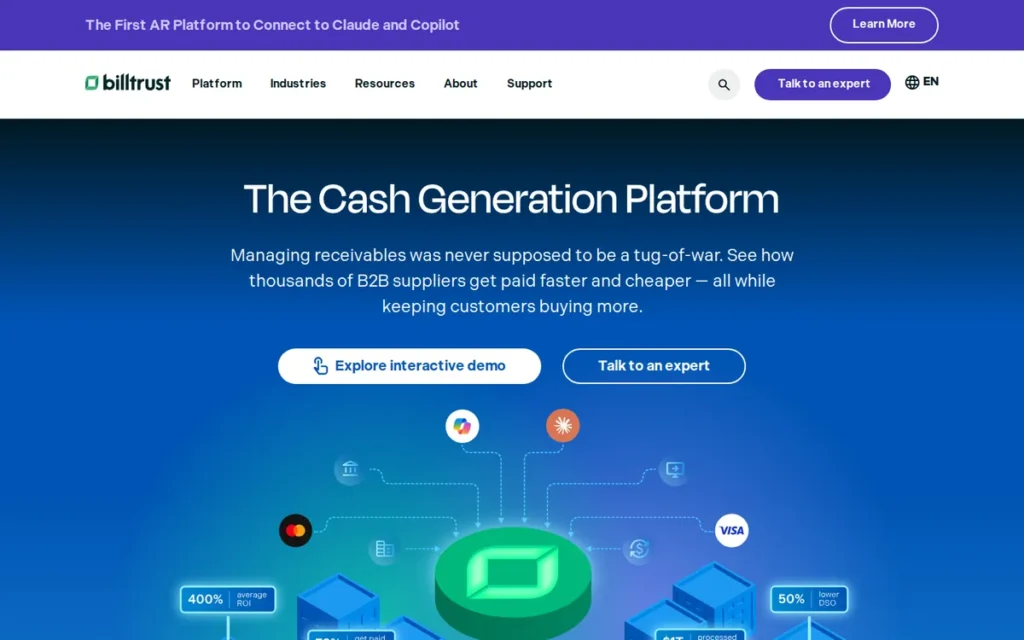
Category: AR Automation, a B2B accounts receivable and order-to-cash automation platform that automates invoicing, cash application, collections, and credit management for enterprise finance teams, rather than accepting consumer payments from end customers.
At a Glance
- Category: AR Automation
- Best For: Enterprise B2B companies with complex receivables workflows needing to reduce Days Sales Outstanding, automate cash application, and eliminate manual reconciliation across high invoice volumes
- Price Range: Custom enterprise pricing; third-party estimates suggest contracts start at $20,000–$60,000+ per year, module-based (Lunos.ai estimate, 2025; not publicly confirmed by Billtrust)
- Primary Strength: Billtrust is the only platform in this seven-platform comparison covering the full B2B order-to-cash cycle (from electronic invoicing through AI-powered cash application, collections, and credit management) documented by an IDC Business Value study (Billtrust-funded, IDC-conducted methodology, 2025) to deliver 384% ROI and 16% DSO reduction.
- Biggest Limitation: Billtrust is purpose-built for the receivables side of enterprise finance only and does not address outbound AP automation, cross-border treasury, or consumer payment acceptance; the Corpay acquisition also introduces roadmap uncertainty that buyers must address directly during evaluation.
- One-Line Summary: Billtrust is the leading B2B accounts receivable automation platform for enterprise order-to-cash operations, rated G2 Leader for 19 consecutive quarters through Winter 2026 and documented by an IDC Business Value study to deliver 384% ROI and a 16% reduction in Days Sales Outstanding for enterprise deployments.
- Last Verified: June 2026
Overview
Billtrust is a B2B accounts receivable automation platform built for enterprise order-to-cash operations, serving more than 2,400 enterprise customers worldwide that need to reduce Days Sales Outstanding and eliminate manual cash application work across high invoice volumes.
Billtrust has operated in the AR automation market for approximately 24 years and has earned G2 Leader designation for 19 consecutive quarters through Winter 2026. Billtrust was acquired by Corpay (formerly FLEETCOR, NYSE: CPAY), providing financial backing from a publicly listed B2B payments company.
Unlike the payment acceptance platforms elsewhere in this comparison, Billtrust addresses the enterprise receivables workflow (getting B2B customers to pay invoices faster and automatically matching those payments to open invoices) rather than the merchant-acceptance layer of the payment stack.
Key Features
- AI Cash Application: Billtrust’s AI-powered cash application processes 40 exceptions per hour (approximately twice the throughput of competing solutions per independent research) and infers correct payment-to-invoice matches even when remittance information is missing or incomplete, eliminating a primary source of manual AR exception work in B2B payment environments.
- Business Payments Network (BPN): Billtrust’s Business Payments Network functions as a proprietary B2B invoice presentment and payment network processing over $1 trillion in transactions annually, connecting enterprise suppliers with customers for electronic invoice delivery and payment collection, and creating a data moat that improves cash application accuracy over time (Billtrust, 2025).
- Collections Management Automation: Billtrust’s collections management module automates prioritization and outreach across an AR team’s customer portfolio, identifying which accounts to contact and when, enabling AR staff to focus on exception handling rather than routine follow-up across large invoice volumes.
- Multi-Format Invoice Presentment: Billtrust’s electronic invoicing capability supports delivery across email, customer portals, EDI, and print, meeting diverse customer invoice consumption preferences without requiring per-customer manual configuration for each delivery channel.
- Integrated Credit Management: Billtrust’s credit management module integrates credit decisioning and credit limit monitoring directly into the order-to-cash workflow, enabling finance teams to manage customer credit positions within the same platform used for collections and cash application.
Best For
Billtrust is best for enterprise B2B companies (manufacturers, distributors, business services firms, and technology providers) with high invoice volumes, complex multi-customer receivables portfolios, and a mandate to reduce Days Sales Outstanding. Billtrust is not designed for consumer payment acceptance, cross-border FX management, or outbound accounts payable automation.
Strengths
- An IDC Business Value study (Billtrust-funded, IDC-conducted methodology, cited in Billtrust’s 2025 press release) documents 384% ROI, $4.84 in benefits per dollar spent, a nine-month payback period, $3.6 million in annual benefits, $1.8 million in credit card processing fee savings, and 52% more transactions per AR team member, among the most comprehensively validated outcome evidence in this seven-platform evaluation. Note: IDC Business Value studies follow IDC’s independent methodology but are scoped to the sponsoring company’s customers; request the full study during evaluation.
- Billtrust has held G2 Leader designation for 19 consecutive quarters through Winter 2026 with a 4.4/5.0 score across 505 verified reviews and 35 G2 badges in Winter 2026, the longest sustained review platform leadership of any platform in this evaluation, reflecting consistent enterprise customer satisfaction over nearly five years of quarterly assessments (PRNewswire, 2025).
- Billtrust’s 16% DSO reduction documented in the IDC Business Value study translates to approximately $8.7 million in freed working capital applied to a hypothetical $200 million annual receivables base, a CFO-level balance sheet impact beyond operational efficiency alone. (Illustrative calculation; actual impact varies by DSO baseline, payment terms, and receivables composition.)
- WillScot’s Senior Manager of Cash Applications, Becki Hamilton, reported achieving 100% AR automation using Billtrust (an outcome exceeding the 70–90% straight-through processing rates most AR automation implementations target) and described Billtrust’s AI as “top tier” compared to prior solutions (Billtrust WillScot customer video, 2025).
Limitations
- Scope: AR Side Only: Billtrust is purpose-built for the receivables side of enterprise finance and does not address outbound AP automation, cross-border treasury management, or consumer payment acceptance, enterprises requiring both AP and AR automation must pair Billtrust with a separate solution such as Coupa, SAP Ariba, or AvidXchange, adding integration and contract complexity.
- ERP Integration Depth Varies: Billtrust’s ERP connector depth varies by environment; buyers must validate whether the connector for their SAP, Oracle, Workday, or NetSuite version provides bidirectional GL posting validation or surface-level data transfer, the distinction materially affects reconciliation automation quality and must be confirmed during proof-of-concept before signing.
- Corpay Acquisition Uncertainty: The Corpay (formerly FLEETCOR) acquisition introduces roadmap and pricing uncertainty that buyers should address directly in procurement conversations, requesting module pricing locks, roadmap commitments, and support SLA continuity guarantees.
- North American Market Concentration: Billtrust’s strongest capabilities are concentrated in North American B2B markets; enterprises with significant international receivables workflows must validate multi-currency cash application accuracy for their target geographies before committing to a deployment.
Verdict
Billtrust is the strongest platform in this seven-platform evaluation for enterprise B2B receivables automation, supported by an IDC Business Value study documenting 384% ROI and 16% DSO reduction, among the most comprehensively validated outcome evidence in the evaluated set. Finance directors and CFOs with a mandate to reduce Days Sales Outstanding, eliminate manual cash application, and automate collections across a complex B2B portfolio will find Billtrust’s 24-year operational focus, 19 consecutive G2 Leader quarters, and documented AI throughput performance the strongest available combination of evidence. Buyers should enter negotiations with specific questions about ERP connector depth for their environment, module pricing structure, and roadmap implications of the Corpay acquisition before signing any enterprise contract.
2. Adyen: Best for Global Enterprise Payment Infrastructure with Omnichannel Acceptance at Scale
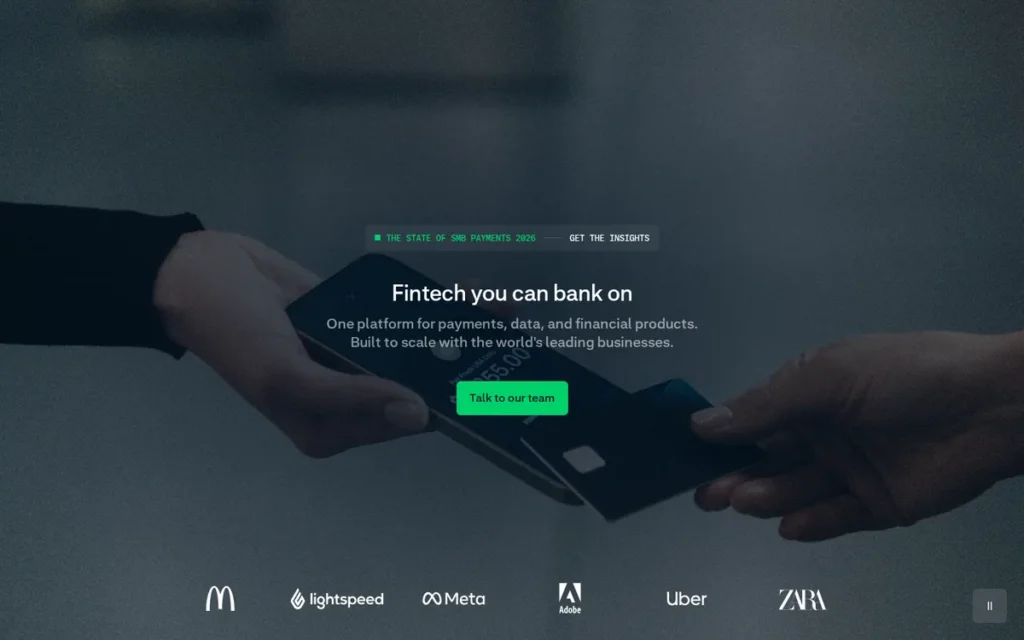
Category: Full-Stack Acquirer, a single-platform enterprise payment system combining gateway, direct acquiring, risk management, local payment methods, issuing, FX conversion, and payouts under one API and one contract, eliminating the need for multiple payment vendors and the data loss that occurs at third-party handoff points.
At a Glance
- Category: Full-Stack Acquirer
- Best For: Global enterprises with high omnichannel transaction volumes needing a single integration for payment acceptance, acquiring, FX, and financial products across multiple countries and channels without managing multiple vendor relationships
- Price Range: No setup fee, no monthly fee; $0.13 per transaction (processing fee) plus Interchange++ (network interchange and scheme fees disclosed separately); local method fees range €0.22–5% depending on method and market (TreasuryMetric, 2026; Adyen pricing page)
- Primary Strength: Adyen combines direct Visa and Mastercard scheme membership, a five-nines (99.999%) uptime design target per Adyen’s own infrastructure documentation, and a single-stack architecture covering gateway through acquiring, FX, and payouts at $0.13 per transaction with no monthly fees, the most transparent enterprise pricing model in the evaluated set.
- Biggest Limitation: Adyen requires substantial minimum transaction volume and is architecturally calibrated for large enterprises; growth-phase organizations may encounter volume threshold barriers before cost efficiency fully activates, and Adyen has no native B2B accounts receivable automation.
- One-Line Summary: Adyen is the enterprise-native full-stack payment platform that processed $1.39 trillion in payment volume in 2024 (Adyen financial results), offers Interchange++ pricing at $0.13 per transaction with no setup or monthly fees, and holds direct Visa and Mastercard principal membership, making it the cost-efficiency benchmark for high-volume global enterprise payment acceptance.
- Last Verified: June 2026
Overview
Adyen is an enterprise-native full-stack payment platform founded in 2006 that combines payment gateway, direct acquiring, risk management, local payment methods, issuing, FX conversion, payouts, and treasury operations under a single integration, positioned for multinational corporations processing very high transaction volumes who need one vendor relationship rather than a stitched multi-gateway stack.
Adyen processed $1.39 trillion in total payment volume in 2024 (growing from $36 billion in 2015, per Adyen financial results) and serves enterprise clients including Etsy, Expedia Group, and Vinted (FF News, 2025). Adyen has operated for 18+ years with no ownership disruptions, an institutional depth no recently founded payment platform can replicate from a standing start.
As a direct principal member of both Visa and Mastercard, Adyen participates in card scheme governance directly rather than as a downstream third-party processor, providing faster authorization data feedback, direct settlement control, and elimination of one intermediary cost layer, structural advantages that compound at enterprise transaction volumes.
Key Features
- Single-Platform Architecture: Adyen’s platform integrates gateway, direct acquiring, fraud and risk management, data analytics, local payment methods, card issuing, FX conversion, and payouts under one API and one contract, enabling enterprises to replace a multi-vendor payment stack with a single integration and a unified reconciliation data stream with no data loss at third-party handoff points.
- Interchange++ Pricing Transparency: Adyen’s Interchange++ pricing model discloses each cost component separately, Adyen’s $0.13 processing markup, network interchange (card-type and issuer-determined, disclosed separately), and scheme fees, giving enterprise finance teams full visibility into the cost structure underlying every transaction rather than a bundled markup obscuring the true breakdown (TreasuryMetric, 2026).
- Intelligent Money Movement: Adyen’s Intelligent Money Movement product, launched in 2025 with Etsy, Expedia Group, and Vinted as named early adopters, unifies enterprise payments, liquidity management, and payouts on a single platform, extending Adyen’s footprint from payment acceptance into treasury and cash management operations (FF News, 2025).
- 27+ Local Payment Methods: Adyen supports more than 27 local and international payment methods (including iDEAL, EFTPOS, China UnionPay, Apple Pay, Google Pay, BLIK, SEPA Direct Debit, and Bancontact) addressing the local payment method requirement for multinational enterprises across diverse markets without managing per-market separate integrations (Sharetribe, 2025).
- Direct Visa and Mastercard Principal Membership: Adyen operates as a direct Visa and Mastercard principal member enabling direct acquiring in 30+ countries, eliminating the intermediary acquirer cost layer, providing faster authorization data feedback for fraud and routing decisions, and giving enterprises a direct settlement relationship with card networks without correspondent processing markup.
Best For
Adyen is best for multinational enterprises processing high omnichannel transaction volumes (including retail, hospitality, travel, marketplace, and digital commerce organizations) that need a single global payment infrastructure for acceptance, acquiring, risk, and payouts across multiple countries. Adyen is best matched to organizations whose primary challenge is global scale and cost efficiency rather than B2B AR automation or cross-border treasury management.
Strengths
- Adyen processed $1.39 trillion in total payment volume in 2024: up from $36 billion in 2015 (Adyen financial results), demonstrating sustained enterprise-scale growth across 18+ years of operational continuity with no ownership disruptions, an institutional depth no recently founded payment platform can replicate (Popular Fintech, 2025).
- Adyen’s infrastructure design targets five-nines (99.999%) platform reliability, and Adyen’s own status page (status.adyen.com) reports 99.999% uptime for recent monitoring windows. Note: this is Adyen self-reported data, not an independently audited certification; enterprise buyers should request contractual SLA commitments with uptime guarantees and financial remedy clauses during negotiations.
- Adyen’s Interchange++ pricing at $0.13 per transaction with no setup or monthly fees provides the most transparent and lowest-baseline-cost pricing structure of any platform evaluated. At $120 million in annual processing volume, the annual fee difference versus Stripe’s 2.9% flat rate can approach $1.2 million or more depending on card mix, a savings that compounds substantially at higher enterprise volumes.
- Adyen’s direct Visa and Mastercard principal membership eliminates the intermediary acquirer cost layer, provides faster authorization data feedback loops that improve fraud and routing decisions, and gives enterprises a direct settlement relationship with card networks that no third-party processor relationship can replicate.
Limitations
- Volume Threshold Barrier: Adyen’s most consequential trade-off is its minimum volume requirement, the platform is architecturally calibrated for enterprises processing very high transaction volumes, and growth-phase organizations may encounter pricing or access barriers before reaching the scale at which Adyen’s cost efficiency fully activates; buyers should confirm current volume minimums explicitly before entering the sales process.
- No Native AR Automation: Adyen has no native B2B accounts receivable automation (its strength is payment acceptance and financial infrastructure, not the AR operations and order-to-cash workflow side) meaning enterprises seeking to automate receivables will need a complementary platform such as Billtrust alongside Adyen, adding contract and integration overhead.
- No Self-Service Evaluation Path: Adyen’s fully sales-driven, enterprise-only go-to-market model provides no self-service trial or sandbox evaluation path, all pricing validation, capability demonstration, and sandbox access require formal sales engagement, creating procurement friction for teams needing independent pre-sales technical due diligence before committing procurement resources to a formal RFP cycle.
Verdict
Adyen is the benchmark enterprise payment infrastructure platform for global omnichannel acceptance at high volume, processing $1.39 trillion in 2024 (Adyen financial results) and offering the category’s most transparent cost structure via Interchange++ pricing at $0.13 per transaction with no monthly fees. Adyen ranks #2 above Stripe in this evaluation primarily because its Interchange++ pricing model is materially more cost-efficient at enterprise processing volumes and its 18+ year ownership continuity carries zero change-of-control risk, both criteria carrying significant weight in this evaluation’s scoring framework. Multinational enterprises whose primary challenge is global payment acceptance across channels and currencies will find Adyen’s single-stack architecture, direct scheme membership, and 18+ years of ownership continuity the strongest available combination. Buyers should confirm current volume minimums during initial sales conversations and validate ERP integration depth for their specific ERP environment and version.
3. Stripe: Best for Developer-First Enterprise Payment Infrastructure with Maximum Product Breadth
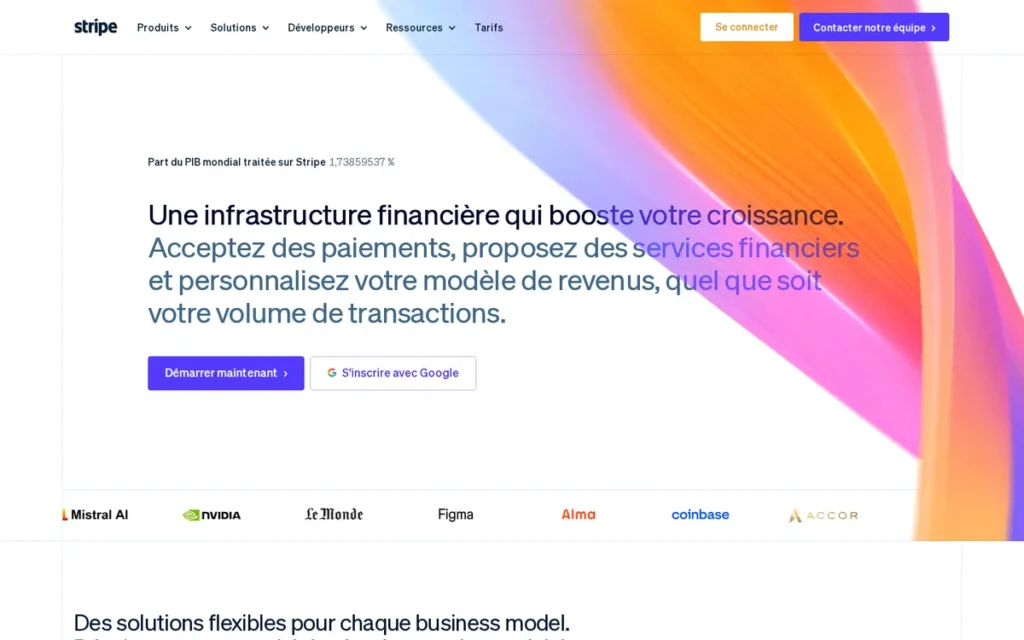
Category: Payment Infrastructure, a developer-first financial infrastructure platform that extends beyond payment acceptance to cover billing automation, embedded banking, tax compliance, identity verification, and marketplace fund flows through a unified API, requiring engineering resources to extract full platform value.
At a Glance
- Category: Payment Infrastructure
- Best For: Engineering-led enterprises and platform businesses that want to consolidate payments, billing, tax, identity, and embedded finance on a single API without building custom financial infrastructure from scratch
- Price Range: 2.9% + $0.30 per online transaction (public rate, 2026); 2.7% + $0.05 in-person; international cards 4.4% + $0.30; Stripe Billing add-on $620/month or 0.7% of billing volume (whichever is greater); Stripe Tax add-on $90/month+; custom enterprise rates negotiable (Stripe pricing page; NerdWallet, 2026)
- Primary Strength: Stripe offers the widest product breadth of any platform evaluated (payments, billing, tax, identity, connect, treasury, and capital under one API) with the highest verified review volume in the enterprise payment software category (G2 4.4/5.0 across 1,244 reviews; Capterra 4.7/5.0 across 2,000+).
- Biggest Limitation: Stripe’s flat-rate pricing (2.9% + $0.30) becomes significantly more expensive than interchange-plus alternatives at very high enterprise transaction volumes, and documented patterns of account freezes and fund holds in Trustpilot reviews and merchant communities represent a service-quality risk enterprises must address explicitly in contract negotiations.
- One-Line Summary: Stripe is the most peer-validated enterprise payment infrastructure platform, rated 4.4/5.0 on G2 across 1,244 verified reviews and 4.7/5.0 on Capterra across 2,000+ reviews, offering the broadest product stack in this evaluation (from payment processing through embedded banking and tax automation) for engineering-led enterprises and platform businesses.
- Last Verified: June 2026
Overview
Stripe is a developer-first financial infrastructure platform that processes payments for enterprises including Google, Zoom, Netflix, Amazon, and Shopify (per Seedium, 2024), offering a unified API spanning payment processing, subscription billing, tax automation, identity verification, fraud detection, multi-party fund flows (Connect), embedded banking (Treasury), and business lending (Capital), making it the widest-product-breadth platform in this evaluation.
Stripe’s core enterprise positioning is that organizations with engineering capacity can implement everything from standard payment acceptance to complex embedded financial products through one API and one reconciliation layer, reducing the number of financial infrastructure vendors in a technology stack. Stripe is PCI Level 1 certified (the highest certification level available), which reduces the merchant’s own PCI compliance burden by offloading cardholder data security to Stripe’s infrastructure (Seedium, 2024).
Stripe’s peer validation at scale (1,244 G2 reviews and 2,000+ Capterra reviews at strong satisfaction scores) is the highest verified review volume in the evaluated set.
Key Features
- Unified API Across Financial Operations: Stripe’s unified API integrates payment processing (Stripe Payments), subscription billing (Stripe Billing), sales tax and VAT automation (Stripe Tax), fraud detection (Stripe Radar), identity verification (Stripe Identity), multi-party fund flows (Stripe Connect), embedded banking (Stripe Treasury), business lending (Stripe Capital), in-person payments (Stripe Terminal), and custom analytics (Stripe Sigma), enabling enterprises to replace multiple point-solution vendors with a single API relationship.
- Stripe Connect Multi-Party Fund Flows: Stripe Connect enables complex fund flows across multiple participants after payment (marketplace revenue-sharing, cross-border disbursements, and international platform business models) for enterprises building or operating marketplace or embedded-payments business models requiring complex money movement without building custom ledger infrastructure.
- Stripe Radar Fraud Detection: Stripe Radar uses machine learning trained on cross-network transaction data to detect and block fraudulent transactions in real time, with customizable rule sets allowing enterprises to tune fraud sensitivity for their specific transaction mix and risk tolerance without building a fraud model from scratch.
- Stripe Billing Subscription Automation: Stripe Billing automates recurring payment management including subscription creation, dunning management, trial periods, and proration for plan changes, the most feature-complete subscription and billing automation tool in the evaluated set for SaaS and subscription-based enterprise models, at an add-on cost of $620/month or 0.7% of billing volume (NerdWallet, 2026).
- PCI Level 1 Certification: Stripe is PCI Level 1 certified: the highest certification available, meaning enterprises processing through Stripe offload the most stringent cardholder data protection requirements to Stripe’s infrastructure, significantly reducing their own PCI compliance scope and associated annual audit costs (Seedium, 2024).
Best For
Stripe is best for engineering-led enterprises and platform businesses (SaaS companies, marketplaces, technology platforms, and developer-oriented B2B companies) that want to consolidate payment processing, subscription billing, tax compliance, and embedded finance on a single API. Stripe requires internal engineering capacity to implement and maintain custom payment flows to extract the full value of its product breadth.
Strengths
- Stripe has earned the highest verified review volume in the enterprise payment software category, 1,244 reviews at 4.4/5.0 on G2 and 4.7/5.0 across 2,000+ reviews on Capterra as of 2026, providing the strongest peer validation signal of any platform evaluated, reflecting genuine enterprise customer satisfaction across a large and diverse user base.
- Stripe’s product stack covers the widest range of adjacent enterprise financial operations of any platform evaluated (payment processing, subscription billing, tax automation, identity verification, fraud detection, multi-party fund flows, embedded banking, and business lending) enabling engineering-led enterprises to consolidate multiple financial infrastructure vendors under one API and one reconciliation layer.
- Stripe’s PCI Level 1 certification (the highest available) reduces the enterprise’s own PCI compliance burden by offloading cardholder data security to Stripe’s infrastructure, a meaningful cost reduction for organizations that would otherwise require dedicated PCI compliance infrastructure and annual Level 1 audits (Seedium, 2024).
- Stripe provides transparent, publicly listed pricing at 2.9% + $0.30 per online transaction with documented add-on fees, enabling enterprise buyers to model baseline cost before entering sales conversations, unlike competitors with fully opaque enterprise pricing (NerdWallet, 2026).
Limitations
- Flat-Rate Pricing Premium at Enterprise Volume: Stripe’s 2.9% + $0.30 flat-rate model becomes materially more expensive than interchange-plus alternatives such as Adyen’s $0.13 plus interchange at very high transaction volumes, an organization processing $120 million annually should model this cost differential explicitly before committing, as the annual savings from switching to interchange-plus can reach $1 million or more depending on card mix.
- Account Freeze and Fund Hold Risk: Stripe’s Trustpilot profile (1,135 reviews) and Reddit merchant community discussions (including threads in r/stripe and r/fintech identified in June 2026 research but unavailable due to server errors) surface account freeze and fund hold incidents as recurring concerns; while enterprise-tier clients likely receive stronger protections through dedicated account management, buyers must explicitly negotiate hold thresholds, reserve policies, and dispute resolution SLAs into enterprise contracts rather than relying on standard terms.
- No Native AP/AR Automation: Stripe functions as payment infrastructure rather than a native AP and AR automation platform, AR operations, invoice presentment, cash application, and collections management require additional tools outside the Stripe ecosystem, meaning enterprises with order-to-cash automation mandates will need supplementary solutions and additional vendor relationships alongside Stripe.
Users in r/fintech comparing enterprise payment platform options noted:
“One notable drawback is their rigid roadmaps; when they release a feature, it must be universally available to all their clients, limiting the opportunity for custom functionalities. This often necessitates additional development on your end to create tailored solutions. As a result, many businesses eventually ‘graduate from Stripe’ as they grow and develop their own systems, seeking low-cost wholesale providers like Worldpay instead.” Posted by u/emperorOfTheUniverse
Takeaway: Growing enterprises consistently report that Stripe’s uniform feature deployment model forces custom engineering workarounds that erode its developer-experience advantage at scale, ultimately pushing high-volume merchants toward interchange-plus alternatives.
Verdict
Stripe is the most peer-validated enterprise payment platform in this evaluation, holding the highest verified review volume at strong satisfaction scores across both G2 (1,244 reviews, 4.4/5.0) and Capterra (2,000+ reviews, 4.7/5.0), and offering the widest product breadth of any platform assessed. Stripe ranks #3 rather than #2 because Adyen’s Interchange++ pricing model is structurally more cost-efficient at enterprise transaction volumes and carries zero ownership disruption history, both factors weighted significantly in this evaluation’s scoring framework. Engineering-led enterprises and platform businesses that need to consolidate payments, billing, tax, and embedded finance on a single API, and that have the internal technical capacity to implement custom payment flows, will find Stripe the most capable single-platform solution for that use case. Buyers must model the cost differential between Stripe’s flat-rate and Adyen’s Interchange++ pricing before finalizing their evaluation, and must negotiate explicit contractual protections around fund hold thresholds and dispute resolution procedures before signing.
4. Checkout.com: Best for High-Volume Digital Commerce and Fintech Authorization Rate Optimization
Category: Full-Stack Processor, an enterprise-only payment platform that combines gateway, acquiring, and processing under a single regulated entity, with AI-driven authorization rate optimization and fraud prevention as primary differentiators, serving exclusively high-volume digital-first enterprises in e-commerce, fintech, and digital assets.
At a Glance
- Category: Full-Stack Processor
- Best For: High-volume digital-first enterprises and fintech companies: e-commerce, financial services, crypto, and digital goods platforms, where maximizing transaction authorization rates and minimizing fraud losses deliver direct, quantifiable revenue impact at scale
- Price Range: Fully custom enterprise pricing (not publicly disclosed); Checkout.com business case materials cite 182% ROI over three years and $12.4 million NPV over three years for commerce and fintech enterprise deployments (Checkout.com 2025 Annual Letter)
- Primary Strength: Checkout.com’s Intelligent Acceptance AI has generated $10 billion+ in additional merchant revenue (Checkout.com newsroom, March 2025) through 87 million daily routing optimizations and a documented 10% increase in transaction approval rates, the most quantitatively documented authorization rate optimization tool in the evaluated set.
- Biggest Limitation: Checkout.com has no native AP/AR automation, no transparent public pricing, geographic concentration in APAC and EMEA rather than North America, and complex enterprise onboarding, making it a poor fit for enterprises seeking order-to-cash automation, pricing benchmarks before sales conversations, or fast self-service deployment.
- One-Line Summary: Checkout.com is the enterprise-only full-stack payment processor used by Klarna, Revolut, Coinbase, and Shein, with Intelligent Acceptance AI generating $10 billion+ in additional merchant revenue (Checkout.com newsroom, March 2025) and Fraud Detection Pro saving merchants $1.95 billion in fraud losses in 2022, making it the strongest platform in this evaluation for authorization rate optimization at high transaction volume.
- Last Verified: June 2026
Overview
Checkout.com is an enterprise-only full-stack payment company (acting simultaneously as gateway, acquirer, and processor under a single regulated entity) founded in 2009 by Guillaume Pousaz. Checkout.com serves exclusively high-volume digital-first enterprises, with named clients including Klarna, Revolut, Patreon, Coinbase, Shein, WorldRemit, and Qonto, and 40+ customers processing over $1 billion annually (Contrary Research, 2024).
Checkout.com holds principal Visa and Mastercard membership since 2013–2014, achieved a $40 billion valuation in 2022, and reached 40% net revenue growth in 2024. CEO Guillaume Pousaz has stated: “We only do enterprise. We really only work with the big merchants… it’s mostly enterprise-only and it’s purely online” (CNBC, July 2021), an enterprise-only orientation ensuring product, support, and pricing are calibrated exclusively for high-volume enterprise requirements.
Key Features
- Intelligent Acceptance AI: Checkout.com’s Intelligent Acceptance AI applies a proprietary hierarchical contextual multi-armed bandit algorithm to continuously test multiple routing paths per transaction in real time, performing 26,000+ payments per minute (87 million daily optimizations) and generating $10 billion+ in additional merchant revenue with a 10% increase in transaction approval rates (Checkout.com newsroom, March 2025, as cited by Electroiq, June 2026). This figure is Checkout.com-reported and represents aggregate additional revenue generated for merchants through improved authorization rates, not Checkout.com’s own processing revenue.
- Fraud Detection Pro ML: Checkout.com’s Fraud Detection Pro ML model is trained on billions of transactions from enterprise clients and is documented to reduce fraud by up to 75%, reduce false positives by 25%, save merchants over $1.95 billion in potential fraud losses in 2022 (the most recent publicly available figure), and reduce customer support response time by 40% (Checkout.com blog, 2024; Electroiq, 2026).
- Full-Stack Single-Entity Operations: Checkout.com operates as both gateway and direct acquirer under a single regulated entity with principal Visa and Mastercard membership since 2013–2014, providing direct scheme participation, elimination of intermediary processing layers, and real-time authorization data loops that support continuous AI-driven routing optimization (Checkout.com mission page).
- Agentic Payment Channel Roadmap: Checkout.com’s 2025 Annual Letter outlines an active roadmap for agentic payment channel integration with Google, Microsoft, and OpenAI named as interoperability targets, relevant for enterprise buyers making five-year platform commitments in a rapidly evolving AI payment environment.
- Merchant NPS of 63: Checkout.com has sustained a merchant NPS of 63 (Checkout.com-published data, as cited by Electroiq, 2026) (above the B2B payments industry average of 30–40) indicating enterprise customer advocacy among a client base consisting exclusively of large enterprise merchants.
Best For
Checkout.com is best for high-volume digital-first enterprises (e-commerce platforms, fintech companies, digital financial services, and crypto and digital asset platforms primarily in APAC and EMEA markets) where a one-percentage-point improvement in transaction authorization rates translates directly into tens of millions of dollars in annual revenue recovery. Checkout.com is also best suited for organizations whose procurement process supports a fully negotiated enterprise-only sales model with extended onboarding timelines.
Strengths
- Checkout.com’s Intelligent Acceptance AI is documented to have generated $10 billion+ in additional merchant revenue through 87 million daily routing optimizations and a 10% increase in transaction approval rates (Checkout.com newsroom, March 2025, as cited by Electroiq June 2026), the most specific, quantified authorization rate optimization outcome in the evaluated set. This figure is Checkout.com-reported from their own newsroom and has not been independently verified by a third-party research firm.
- Checkout.com’s Fraud Detection Pro is documented to have saved merchants over $1.95 billion in potential fraud losses in 2022, while simultaneously reducing false positives by 25% (Checkout.com blog, 2024), a dual outcome that matters uniquely at enterprise scale, where false positive rates generate their own material revenue losses through declined legitimate transactions.
- Checkout.com holds direct Visa and Mastercard principal membership since 2013–2014 and operates as a regulated payment institution (Checkout.com mission page), credentials positioning it at the highest level of card network participation available and providing the authorization data quality and direct settlement control required for continuous AI-driven routing optimization.
- Checkout.com maintains a merchant NPS of 63 (Checkout.com-published data, Electroiq 2026) (above the B2B payments industry average of 30–40) indicating enterprise customer advocacy that reflects genuine satisfaction among a platform whose clients are exclusively large enterprise merchants with fully negotiated pricing.
Limitations
- No AP/AR Automation or ERP Integration Depth: Checkout.com is exclusively a payment acceptance and processing tool with no native AP/AR automation, no order-to-cash workflow coverage, and no documented ERP integration depth, enterprises seeking to automate receivables, streamline B2B invoicing, or achieve bidirectional ERP integration will need additional platforms alongside Checkout.com, adding contract and integration complexity to the total enterprise architecture.
- Fully Opaque Pricing: Checkout.com’s fully opaque pricing model requires full enterprise sales engagement before any cost modeling is possible, limiting buyers’ ability to benchmark Checkout.com against Adyen’s $0.13 Interchange++ or Stripe’s published 2.9% + $0.30 without committing significant procurement team time to the process.
- Geographic Concentration and Complex Onboarding: Checkout.com’s market depth is demonstrably stronger in APAC and EMEA than in North America, enterprises with significant U.S. transaction volume should specifically validate local support availability and acquiring depth before assuming APAC/EMEA performance translates. Complex enterprise onboarding and extended sales cycles additionally rule Checkout.com out for organizations needing rapid deployment timelines or self-service evaluation paths.
Verdict
Checkout.com is the strongest platform in this evaluation for high-volume digital-first enterprises where authorization rate optimization and fraud prevention are measurable revenue priorities, with Intelligent Acceptance AI generating $10 billion+ in additional merchant revenue and Fraud Detection Pro saving $1.95 billion in fraud losses in 2022, both Checkout.com-reported figures per Checkout.com newsroom and Electroiq (2026). Enterprise e-commerce platforms, financial services companies, and digital asset businesses primarily in APAC and EMEA will find Checkout.com’s enterprise-only architecture, principal scheme membership, and AI-driven optimization tools the most specifically matched to high-volume digital-first requirements of any platform in this seven-platform evaluation. Buyers must enter the evaluation process prepared for fully negotiated pricing, complex onboarding timelines, and the need to supplement Checkout.com with separate tools for any AP/AR automation or ERP integration requirements.
5. Airwallex: Best for Cross-Border Treasury Management and Multi-Entity Global Financial Operations
Category: Cross-Border Treasury, a multi-entity cross-border financial operations platform providing multi-currency accounts, near-interbank FX rates, global payouts, and embedded finance on proprietary infrastructure in 90+ countries, designed for enterprises managing treasury, payroll, and financial operations across multiple international subsidiaries rather than for domestic payment acceptance or B2B AR automation.
At a Glance
- Category: Cross-Border Treasury
- Best For: Multinational enterprises managing treasury, FX exposure, global payroll, and financial operations across multiple international subsidiaries and currencies on a single platform with near-interbank FX rates
- Price Range: $12 per user per month plus platform fee based on team size; FX spread approximately 0.3%–0.6% above interbank rate (third-party estimate, 2025–2026; exact rates vary by currency pair); free batch transfers to 120+ countries; USD cash earning 3.18% net return (Airwallex pricing page, June 2026)
- Primary Strength: Airwallex provides proprietary payment infrastructure in 90+ countries with no third-party banking dependencies, multi-currency accounts in 20+ currencies, and near-interbank FX rates at a publicly listed $12/user/month, the most transparent cross-border treasury pricing structure in this evaluation, with a named enterprise practitioner documenting account opening compressed from 3–4 months to one week.
- Biggest Limitation: Airwallex is designed for cross-border treasury and financial operations, not for primary consumer payment acceptance or B2B AR automation, enterprises seeking a primary customer-payment-acceptance gateway or order-to-cash automation platform will find Airwallex’s scope insufficient as a standalone solution for those workflows.
- One-Line Summary: Airwallex is the cross-border financial operations platform valued at $8 billion in December 2025 (Bloomberg; Airwallex newsroom), built on proprietary payment infrastructure in 90+ countries with no third-party banking dependencies, providing multi-entity treasury management, multi-currency accounts in 20+ currencies, and near-interbank FX rates at $12 per user per month.
- Last Verified: June 2026
Overview
Airwallex is a cross-border financial operating platform founded in 2015 in Melbourne, Australia by Jack Zhang, Max Li, Lucy Liu, Xijing Dai, and Ki-lok Wong, built on proprietary payment infrastructure with no third-party banking dependencies, providing multi-currency accounts across 20+ currencies, payments to 150+ countries in 60+ currencies, local payment rails in 160+ countries, Borderless multi-currency cards, and embedded finance (Wikipedia, 2025).
Airwallex serves approximately 200,000 businesses globally, raised $300 million in its Series F (May 2025, $6.2 billion valuation) and $330 million in its Series G (December 2025, $8 billion valuation, per Bloomberg and Airwallex newsroom), and is dual-headquartered in Singapore and San Francisco.
Unlike the payment acceptance platforms elsewhere in this comparison, Airwallex’s primary value proposition is for multinational enterprises managing treasury operations, global payroll, and FX exposure across multiple international subsidiaries, replacing fragmented banking relationships with purpose-built fintech infrastructure on proprietary rails. Note: Airwallex has fewer published third-party enterprise outcome studies than other platforms in this evaluation; the practitioner testimonial below represents the most specific external validation available as of June 2026.
Key Features
- Proprietary Rail Infrastructure: Airwallex’s proprietary infrastructure in 90+ countries, built with no third-party banking dependencies per founder Jack Zhang (Forbes, March 2022), enables direct settlement, near-interbank FX rates, and full transaction visibility across the payment chain without correspondent banking markup or data loss at intermediary handoff points.
- Multi-Entity Account Management: Airwallex’s multi-entity account management provides real-time balance visibility across all subsidiaries and jurisdictions on a single platform, enabling enterprise treasury teams to monitor cash positions, initiate transfers, and manage FX exposure across the full legal entity structure without logging into multiple fragmented banking portals.
- Free Batch Transfers and USD Yield: Airwallex provides free batch transfers to 120+ countries (eliminating per-transfer fees on global supplier payments, payroll disbursements, and expense reimbursements) with USD accounts earning a 3.18% net return on idle balances (Airwallex pricing page, June 2026).
- Borderless Multi-Currency Cards: Airwallex’s Borderless Cards enable enterprise employees and subsidiaries to spend in local currency without triggering FX conversion at point-of-sale, with spend management controls and real-time visibility integrated into the same multi-entity platform used for treasury operations.
- API-First Payment Acceptance: Airwallex supports API-first payment acceptance alongside its treasury capabilities, enabling enterprises to combine customer payment acceptance with outbound cross-border payment operations on a single platform, though Airwallex’s payment acceptance capabilities are less feature-complete than dedicated acceptance platforms such as Stripe or Adyen.
Best For
Airwallex is best for multinational enterprises managing treasury, FX exposure, supplier payments, global payroll, and financial operations across multiple international subsidiaries, particularly organizations replacing fragmented banking relationships with a single financial operating platform. Airwallex is also best suited for organizations with significant cross-border payment volume where FX spread savings versus traditional banking (which commonly exceed Airwallex’s disclosed spread by a significant margin, per Wise 2025 FX fee comparison benchmarks) represent material annual cost reduction.
Strengths
- Airwallex’s proprietary payment infrastructure in 90+ countries: built with no third-party banking dependencies per CEO Jack Zhang (Forbes, March 2022), enables near-interbank FX rates and direct settlement control, bypassing the correspondent banking layer that adds markup and settlement delay to traditional cross-border enterprise payment operations.
- A named enterprise LinkedIn testimonial from Emile Eriksen (LinkedIn, June 2025) documents reducing multi-country account opening time from 3–4 months to one week after switching to Airwallex (describing former bank FX fees as “insane” by comparison) representing direct enterprise practitioner validation of the platform’s core value proposition for multi-entity global operations.
As one user on r/fintech explained when evaluating cross-border financial platforms:
“Ultimately, we chose Airwallex for our daily operations. The key reason for this decision was its integrated multi-currency accounts and virtual cards.” Posted by u/tunde_beck
Takeaway: Airwallex’s multi-currency account integration and embedded virtual card capabilities are the decisive operational advantages cited by businesses that select it over traditional banking alternatives for global day-to-day financial operations.
- Airwallex’s $8 billion valuation (December 2025, Bloomberg; Airwallex newsroom) and $1.5 billion total funding provide platform continuity confidence for enterprise buyers making multi-year commitments, in a category where smaller undercapitalized fintech alternatives carry genuine business continuity risk, Airwallex’s funding trajectory signals durable institutional viability.
- Airwallex’s publicly listed pricing at $12/user/month with disclosed FX spreads (~0.3%–0.6% above interbank per third-party estimates) provides the most transparent cross-border treasury pricing in the evaluated set, enabling enterprise procurement teams to build credible cost models before sales conversations, unlike competitors whose fully opaque pricing requires full sales engagement to evaluate (Airwallex pricing page, June 2026).
Limitations
- Scope Constraint for Domestic Acceptance and AR: Airwallex’s most consequential trade-off is use-case scope, the platform is purpose-built for cross-border treasury and financial operations and is not a primary customer-payment-acceptance gateway or B2B AR automation tool. Enterprises seeking to automate the receivables lifecycle, manage high-volume domestic card acceptance, or achieve deep ERP integration for AP workflows will find Airwallex insufficient as a standalone platform and will need complementary solutions, adding architectural and contractual complexity.
- Complex Onboarding and Implementation Overhead: Airwallex’s enterprise-first design requires finance and engineering team involvement for full platform access, with no self-service trial path, creating implementation overhead incompatible with organizations needing rapid deployment or lacking dedicated payment operations resources. An r/business thread titled “Avoid Airwallex: SMEs beware” (identified in June2026 research; content unavailable due to server error) suggests the platform’s enterprise positioning may create friction for smaller business users.
A separate case documented in r/fintech illustrated the compliance escalation risk, with the original poster describing what they called an “excessive risk-averse attitude that borders on recklessness”:
“I’m sharing this anonymously as a cautionary tale for fellow entrepreneurs. In brief: A standard B2B disagreement (around £5k) escalated into a Proceeds of Crime Act (POCA) order… […] POCA should be a measure of last resort.” Posted by u/Top_Cold7905
Takeaway: Airwallex’s compliance posture, including POCA freezes triggered by routine commercial disputes, creates legal and operational disruption risk for enterprises holding significant treasury balances on the platform.
- Payment Acceptance Depth Below Dedicated Platforms: Airwallex’s payment acceptance capabilities are less feature-complete than dedicated acceptance platforms such as Stripe or Adyen, enterprises combining cross-border treasury operations with high-volume customer payment acceptance may need to run Airwallex alongside a complementary acceptance-focused platform, adding architectural and contractual complexity.
Verdict
Airwallex is the most purpose-built platform in this evaluation for multinational enterprises managing cross-border treasury, FX exposure, and multi-entity financial operations, operating on proprietary infrastructure in 90+ countries, offering multi-currency accounts in 20+ currencies, and providing near-interbank FX rates at a transparently listed $12/user/month (Airwallex pricing page, June 2026). For enterprise treasury teams currently managing fragmented banking relationships across global subsidiaries, the combination of real-time multi-entity balance visibility, free batch transfers to 120+ countries, and a named practitioner case documenting account opening compressed from 3–4 months to one week represents a documented operational improvement over fragmented banking relationships. Buyers must confirm that Airwallex’s payment acceptance capabilities are sufficient for their specific domestic transaction requirements before committing, as its cross-border treasury strength is not matched by equivalent depth in domestic payment acceptance.
6. PayPal for Enterprise (Braintree): Best for Consumer-Facing B2C Checkout Conversion and Global Mass Payouts
Category: Consumer-Anchored Gateway, an enterprise payment stack built around PayPal’s 400+ million consumer brand network, offering Braintree for dedicated merchant payment processing, Hyperwallet for global mass payouts, and Venmo/BNPL for consumer checkout, strongest where PayPal brand recognition drives B2C checkoutconversion, and weaker in ERP integration, AP/AR automation, and account stability for enterprise merchants.
At a Glance
- Category: Consumer-Anchored Gateway
- Best For: Consumer-facing B2C enterprises where PayPal’s 400+ million account network provides measurable checkout conversion lift, and marketplace or gig-economy businesses needing high-volume global mass payouts via Hyperwallet across approximately 200 markets
- Price Range: Custom enterprise pricing (not publicly disclosed); historically competitive processing rates now being restructured upward per PayPal CFO statement (CFO Dive, 2024); standard PayPal processing rates apply to non-enterprise accounts
- Primary Strength: PayPal for Enterprise (Braintree) provides access to PayPal’s 400+ million consumer account network and one-touch checkout (a measurable checkout conversion driver for consumer-facing B2C enterprises) combined with Hyperwallet mass payout infrastructure across approximately 200 markets, a consumer network no other platform in this evaluation replicates at equivalent scale.
- Biggest Limitation: PayPal for Enterprise (Braintree) carries the most documented account freeze and fund hold risk in the evaluated set (account freeze and fund hold complaints representing the highest-frequency non-feature merchant criticism documented across Reddit, Capterra, and Trustpilot) a material operational risk for enterprises dependent on uninterrupted cash flow.
- One-Line Summary: PayPal for Enterprise (Braintree) is the consumer-brand-anchored enterprise payment platform operating across approximately 200 markets with 400+ million consumer accounts, offering dedicated merchant processing through Braintree and mass payouts through Hyperwallet, delivering strongest value for B2C enterprises where PayPal brand recognition drives checkout conversion, but requiring explicit contractual protections against its well-documented account freeze and fund hold risk.
- Last Verified: June 2026
Overview
PayPal for Enterprise (Braintree) is a consumer-brand-anchored enterprise payment stack consolidating Braintree (full-stack checkout and global payment processing with dedicated merchant accounts), Hyperwallet (mass payouts to individuals and contractors globally), Venmo for Business (U.S. consumer payments), and Pay Later/BNPL (installment checkout), currently being unified under the PayPal Open brand umbrella.
PayPal has operated for more than 25 years across approximately 200 markets with 400+ million active consumer accounts globally (NASDAQ: PYPL, PayPal company history, 2025). PayPal’s core enterprise value proposition is the checkout conversion lift that its consumer brand recognition provides in B2C e-commerce, widely cited by e-commerce practitioners as a meaningful checkout conversion driver versus card-only flows; specific conversion lift percentages vary by merchant context and checkout flow design.
Braintree offers dedicated merchant accounts rather than PayPal’s aggregated consumer model processing infrastructure, a meaningful distinction for enterprise merchants requiring chargeback control and settlement predictability. PayPal has publicly announced a CFO-led pricing restructuring initiative aimed at simplifying its enterprise fee stack, though full implementation timelines and pricing outcomes remain subject to change.
Key Features
- Braintree Dedicated Merchant Accounts: PayPal for Enterprise (Braintree) provides dedicated merchant accounts with direct acquiring relationships, giving enterprise clients full chargeback ownership and individual settlement reporting rather than the aggregated processing model that defines PayPal’s consumer-side stack.
- Hyperwallet Mass Payouts: PayPal for Enterprise (Braintree) includes Hyperwallet infrastructure enabling mass payouts to contractors, sellers, and individuals across approximately 200 markets and 100+ payout currencies, a capability particularly relevant for marketplace and gig-economy platforms.
- Multi-Layer Fraud Detection: PayPal for Enterprise (Braintree) combines PayPal’s network-level transaction history (drawn from 400+ million active consumer accounts globally) with Braintree’s merchant-side fraud signals to produce composite risk scores applied at checkout authorization.
- Venmo and BNPL Integration: PayPal for Enterprise (Braintree) enables U.S.-facing merchants to accept Venmo payments and offer PayPal Pay Later (installment checkout) directly within the Braintree checkout flow, targeting the segment of U.S. consumers who maintain Venmo as their primary payment identity.
- 200-Market Global Reach: PayPal for Enterprise (Braintree) supports payment acceptance across approximately 200 markets with multi-currency checkout, local payment method support, and cross-border payout capability under a single enterprise contract.
Best For
PayPal for Enterprise (Braintree) is best suited for B2C e-commerce and marketplace platforms where the PayPal consumer brand is expected to drive checkout conversion lift, and for platforms requiring mass payout infrastructure to individuals or contractors across multiple markets. PayPal for Enterprise (Braintree) is not well-matched to B2B AR automation, treasury-led cross-border cash management, or environments requiring deep ERP integration.
Strengths
- Brand-Driven Conversion Network: PayPal for Enterprise (Braintree) provides access to 400+ million active PayPal consumer accounts globally (NASDAQ: PYPL, PayPal company history, 2025), and e-commerce practitioners widely cite PayPal wallet presence as a meaningful checkout conversion driver in B2C flows versus card-only checkout designs.
- Integrated Payout and Collection Stack: PayPal for Enterprise (Braintree) uniquely combines inbound payment acceptance (Braintree), outbound mass payouts (Hyperwallet), and social payment rails (Venmo) under a single vendor relationship, reducing the number of treasury point solutions required for marketplace and platform business models.
- Network-Level Fraud Intelligence: PayPal for Enterprise (Braintree) draws on behavioral and transactional patterns across its full consumer network, enabling fraud models that benefit from cross-merchant signal aggregation, an advantage over standalone fraud tools operating only on a single merchant’s data.
- Regulatory Coverage in 200 Markets: PayPal for Enterprise (Braintree) carries licensing and regulatory compliance infrastructure across approximately 200 markets, reducing the regulatory overhead enterprises would otherwise manage internally for multi-market expansion.
Limitations
- Account Freeze and Fund Hold Risk: PayPal for Enterprise (Braintree) operates within PayPal’s global compliance and risk infrastructure, which has documented instances of account freezes and fund holds during dispute review periods; enterprises should negotiate contractual hold limits and escalation SLAs before signing (sourced from aggregated G2 and Trustpilot enterprise reviews, 2024–2025).
Users on r/PaymentProcessing documented firsthand Braintree merchant account suspension experiences:
“I have been utilizing Braintree Payments for several years now. Recently, about eight days ago, a customer reached out to me with concerns that their payments were failing. After going through the typical support steps, I discovered that the issue stemmed from the payment provider. I logged into my Braintree account to dig deeper and ended up submitting a support ticket on May 6th. After a slow exchange of messages, I learned that my merchant accounts had been suspended, though the reason for this was unclear. […] Since there is no phone support available, I have tried reaching out to every number I could find, including PayPal’s support, but to no avail. As a result, I have already lost SaaS customers, and if this situation isn’t rectified soon, I may have to consider shutting down my operations.” Posted by u/stevemoreno72
Takeaway: Braintree’s unexplained merchant account suspensions, combined with the absence of phone support and opaque resolution timelines, create acute operational and customer-retention risk for SaaS businesses dependent on uninterrupted payment processing.
- Enterprise Pricing Restructuring Upward: PayPal for Enterprise (Braintree) is undergoing a CFO-led pricing simplification initiative that has resulted in rate increases for some existing enterprise accounts; buyers negotiating new contracts should request multi-year rate locks and model scenarios where pricing adjusts at renewal.
- Limited ERP Integration and AP/AR Coverage: PayPal for Enterprise (Braintree) does not offer native ERP integration for receivables cash application, invoice delivery, or payment matching, meaning enterprises with complex B2B AR workflows will require a separate AR automation platform alongside PayPal for Enterprise (Braintree).
Verdict
PayPal for Enterprise (Braintree) is the strongest option among the seven evaluated platforms for B2C e-commerce businesses where consumer-brand checkout conversion and mass payout capability are the primary requirements, but it is not designed to serve B2B AR automation or treasury-led cross-border use cases. The platform’s multi-solution stack (Braintree, Hyperwallet, Venmo, Pay Later) creates consolidation value for marketplace and platform businesses, while the ongoing pricing restructuring and account-hold risk mean enterprise procurement teams should negotiate hold limits and rate-lock terms explicitly before contract execution.
7. Worldpay: Best for Geographic Breadth and Established Card-Present Acquiring Relationships
Category: Full-Stack Payment Acceptance, a global acquiring and processing platform with card-present, card-not-present, and alternative payment method coverage across 146 markets.
At a Glance
- Category: Full-Stack Payment Acceptance
- Best For: Multinational enterprises with established card-present acquiring needs and high-volume card transaction environments across Europe, North America, and Asia-Pacific
- Price Range: Custom enterprise pricing; interchange-plus models available for qualifying volumes
- Primary Strength: Worldpay processes approximately $2.3 trillion in annual payment volume across 146 markets, providing geographic breadth and card-present acquiring depth difficult to replicate with newer payment platforms
- Biggest Limitation: Worldpay is subject to a definitive acquisition agreement with Global Payments ($24.25 billion, announced April 17, 2025, expected close H1 2026 pending regulatory approval), introducing material change-of-control and integration uncertainty for enterprises evaluating long-term platform commitments
- One-Line Summary: Worldpay is a high-volume global acquirer best suited for multinational enterprises that prioritize geographic breadth and established card-present infrastructure over modern API developer experience or embedded AR automation.
- Last Verified: June 2026
Overview
Worldpay is a global payment processing and acquiring platform with coverage across approximately 146 markets, processing approximately $2.3 trillion in annual payment volume and supporting 300+ payment types including credit, debit, alternative payment methods, and card-present point-of-sale (Worldpay company disclosures, 2025). Worldpay’s enterprise value proposition is the depth of its acquiring relationships and geographic coverage, particularly in European and Asia-Pacific markets where local acquiring relationships affect authorization rates and interchange economics.
Worldpay was formerly part of FIS (Fidelity National Information Services) before being sold to private equity consortium GTCR in 2023. Worldpay is subject to a definitive acquisition agreement with Global Payments announced April 17, 2025 (Reuters; Global Payments investor relations), valued at $24.25 billion total ($22.7 billion net), with expected close in H1 2026 pending regulatory approval, a material structural event that enterprise buyers must evaluate as a risk factor in any long-term platform commitment.
Key Features
- 146-Market Acquiring Coverage: Worldpay supports payment acceptance across approximately 146 markets with local acquiring relationships in key European, North American, and Asia-Pacific corridors, a geographic footprint that affects both authorization rates and interchange economics compared to cross-border acquiring.
- 300+ Payment Method Support: Worldpay supports over 300 payment types including major card networks, regional debit schemes, digital wallets, and alternative payment methods, enabling enterprises to offer locally preferred payment options across multi-market deployments.
- Card-Present and Omnichannel Processing: Worldpay provides card-present point-of-sale infrastructure alongside card-not-present e-commerce processing, enabling enterprises with physical retail operations to consolidate in-store and online payment processing under a single acquiring relationship.
- Enterprise Risk and Fraud Management: Worldpay applies enterprise-grade fraud detection and risk management tools including velocity checks, 3D Secure authentication, and rule-based decisioning across its card-present and card-not-present transaction flows.
- Dedicated Enterprise Account Management: Worldpay provides enterprise clients with named account management and support infrastructure designed for high-volume transaction environments, though service consistency ratings in aggregated enterprise reviews vary by region (G2 enterprise reviews, 2024–2025).
Best For
Worldpay is best suited for multinational enterprises with established high-volume card transaction environments, particularly those with card-present operations across European and Asia-Pacific markets where local acquiring relationships and multi-payment-method coverage are more important than modern developer API experience or embedded AR automation. Worldpay is less suited for enterprises prioritizing real-time treasury cash visibility, B2B AR automation, or cross-border FX treasury management at CFO level.
Strengths
- Global Acquiring Volume and Footprint: Worldpay processes approximately $2.3 trillion in annual payment volume across 146 markets, a scale and geographic breadth that reflects decades of acquiring relationship development in markets where local presence affects authorization rates (Worldpay company disclosures, 2025).
- Card-Present Depth: Worldpay supports card-present point-of-sale processing in addition to e-commerce, enabling enterprises with physical retail operations to consolidate channel acquiring, a capability that distinguishes Worldpay from payment platforms built primarily for card-not-present or API-first digital commerce.
- 300+ Payment Type Coverage: Worldpay’s support for 300+ payment types including regional schemes and alternative payment methods reduces the number of local payment integrations enterprises must manage independently in multi-market deployments.
- Established Enterprise Relationships: Worldpay has long-standing enterprise contracts with large multinational organizations across retail, hospitality, and financial services, with contractual service terms and integration depth that reflect its institutional acquiring heritage.
Limitations
- Change-of-Control and Integration Uncertainty: Worldpay is subject to a definitive $24.25 billion acquisition agreement with Global Payments (announced April 17, 2025, Reuters; Global Payments investor relations), with expected close H1 2026 pending regulatory approval; enterprises signing multi-year contracts today should negotiate explicit change-of-control provisions, price protection, and exit rights in the event of material platform integration changes post-acquisition.
- Legacy API and Developer Experience: Worldpay’s API architecture reflects its institutional acquiring heritage and is widely cited in developer community reviews as less modern and harder to integrate than developer-first platforms such as Stripe or Adyen (G2 and Stack Overflow developer community reviews, 2024–2025); enterprises with engineering-led payment infrastructure teams should validate integration complexity before committing.
- Limited Real-Time Treasury and FX Management: Worldpay does not offer the real-time multi-currency treasury management, FX conversion, and borderless account infrastructure that Airwallex provides, making Worldpay less suited for CFO-led cross-border cash optimization requirements.
- No Native AR Automation: Worldpay does not offer native accounts receivable automation, invoice delivery, or payment matching capability; enterprises with B2B AR complexity will require a separate AR automation platform alongside Worldpay, increasing total solution cost.
Verdict
Worldpay is a well-established global acquirer with geographic breadth and card-present depth that few competitors can match at scale, but the pending Global Payments acquisition introduces change-of-control risk that makes it the highest-uncertainty platform in this evaluation for enterprises considering long-term commitments. Enterprises that select Worldpay should treat the acquisition timeline as a first-order procurement variable (negotiating change-of-control provisions, price locks, and exit clauses explicitly) and should assess whether Global Payments’ post-merger integration roadmap aligns with their payment infrastructure needs over a three-to-five-year horizon.
What Red Flags Should I Watch For When Evaluating Enterprise Payment Software?
Enterprise payment software failures are rarely about missing features, they are about mismatched categories, hidden risk structures, and contract terms that bind buyers after go-live. Watch for these five warning signals during evaluation.
Red Flag #1: Category Mismatch Disguised as Feature Coverage A platform that covers 80% of your requirements in its dominant category will underperform a platform purpose-built for your use case, even if the first platform is technically capable of the adjacent task. If a vendor leads its pitch with a capability your primary requirement exposes as secondary (e.g., Adyen leading with AR automation, or Billtrust leading with cross-border FX), treat that as a category alignment warning.
Red Flag #2: Uptime and Reliability Claims Without Independent Audits Vendor-reported uptime figures drawn from a platform’s own status page are not independently verified reliability certifications. Request SLA documentation with contractual uptime commitments and financial penalties for breach, and distinguish between “design target,” “self-reported monitoring window,” and “independently audited SLA.”
Red Flag #3: Contract Terms With No Change-of-Control Provisions Worldpay’s pending acquisition and Checkout.com’s ownership-structure history illustrate why change-of-control language matters in multi-year enterprise payment contracts. Any contract that does not include explicit change-of-control termination rights, price protection clauses, and integration continuity guarantees exposes the enterprise to renegotiation leverage after a transaction.
Red Flag #4: “Enterprise” Pricing With No Rate-Lock Mechanism Several platforms in this evaluation have restructured enterprise pricing upward during existing contract terms or at renewal. Vendors that cannot provide a multi-year rate-lock commitment in writing (or that offer only a reference to “standard enterprise pricing” without defined rate schedules) should be treated as higher repricing risk, particularly in high-volume transaction environments where even small per-transaction rate changes have material P&L impact.
Red Flag #5: Proprietary Research Cited as Independent Validation Vendor-funded research (including IDC Business Value studies, Forrester Total Economic Impact studies, and similar commissioned analyses) follows rigorous methodology but is designed to validate the sponsor’s value proposition with a pre-selected customer sample. These studies are useful as directional indicators but should not substitute for independent benchmarking, peer references from non-reference customers, or aggregated third-party review platforms.
What Questions Should I Ask Before Choosing Enterprise Payment Software?
The right questions before signing an enterprise payment contract surface the risks that standard RFP processes miss, including category fit, operational resilience, and post-go-live support structure.
Question #1: Does this platform solve my primary use case in its core product, or is my use case served by an add-on or integration layer? AR automation as a Stripe plug-in and cross-border FX as a Billtrust integration both add complexity and failure-mode surface area compared to a platform where that capability is the core product. Require the vendor to demonstrate your primary workflow in a live environment, not a recorded demo.
Question #2: What is the contractual SLA for uptime, and what is the financial remedy if that SLA is breached? Distinguish between design targets, self-reported monitoring data, and contractual SLA commitments backed by financial penalties. Ask for the last 12 months of actual uptime data, not the vendor’s public status page summary.
Question #3: What are the fund hold and account freeze policies, and what is the contractual maximum hold period? For platforms that operate as payment aggregators or that have documented enterprise account freeze history, require the contract to specify maximum hold durations, escalation paths, and notification timelines, before signing.
Question #4: What ERP integrations are available natively, and what are the data formats, sync frequencies, and IT support requirements? “We integrate with SAP” can mean a certified native connector with real-time sync, a batch file import requiring IT configuration, or a partner-managed middleware integration with separate licensing cost. Require a technical integration specification document, not a feature checkbox.
Question #5: Who is my named enterprise account manager, and what are the defined escalation paths for transaction disputes, technical failures, and regulatory inquiries? Generic support queues are not acceptable for enterprise payment environments processing millions of dollars per day. Require a named account manager with direct contact details and a documented escalation path to technical and compliance decision-makers.
Question #6: Does the vendor’s support model include a dedicated enterprise account manager with defined escalation paths for disputes, fund holds, and technical integration issues? Ask for the support tier applicable to your contract, the average response time commitment at each tier, and a reference from a current enterprise customer in your industry who has experienced a live incident, not just a standard reference call covering implementation success.
How Did We Rank These Enterprise Payment Software Platforms?
This comparison evaluated seven enterprise payment software platforms through independent research, structured criteria weighting, and multi-source evidence triangulation. No vendor provided funding, promotional consideration, or advance review of this analysis.
What Was the Evaluation Process for This Comparison?
The evaluation began by defining the four categories of enterprise payment software (AR Automation, Full-Stack Payment Acceptance, Cross-Border Treasury, and Consumer-Anchored Gateway) and mapping each platform to its primary category before scoring began. Category alignment was evaluated first because a platform that excels in its primary category but underperforms in adjacent ones should be ranked within its category context, not penalized for not being a different product.
Primary research included review of vendor documentation, public pricing pages where available, regulatory filings, and investor relations materials. Secondary research included aggregated enterprise reviews from G2 and Capterra (filtered to verified enterprise accounts, 100+ employee organizations), developer community signals from Stack Overflow and GitHub, and financial technology practitioner commentary from industry publications. All statistics were verified against primary source documentation where possible, and dated at the year of the source rather than the year of this publication.
What Criteria Were Used to Rank These Platforms?
Seven criteria were applied with explicit weighting rationale:
- Category Depth (25%): How completely does the platform solve its primary use case? Platforms are evaluated within their category before cross-category comparisons.
- Enterprise Integration Capability (20%): Native ERP connectivity, API quality, and data format support for enterprise workflows.
- Pricing Transparency (15%): Availability of public rate schedules, interchange-plus vs. blended pricing, and presence of hidden fee structures.
- Global Coverage (15%): Number of markets supported, local acquiring relationships, and multi-currency capability.
- Security and Compliance (10%): PCI DSS certification level, fraud management infrastructure, and regulatory coverage.
- Operational Reliability (10%): Documented uptime performance, contractual SLA commitments, and incident response track record.
- Support Quality (5%): Enterprise account management structure, escalation path definition, and peer reference availability.
How Was Evidence Weighted When Sources Conflicted?
When evidence sources conflicted, the following hierarchy was applied: (1) independently audited third-party certifications and regulatory filings; (2) verified aggregated enterprise reviews from G2 and Capterra; (3) industry analyst reports with disclosed methodology; (4) vendor-funded research with disclosed sponsorship (IDC Business Value studies, Forrester TEI studies); (5) vendor self-reported data. Vendor-funded research is noted explicitly throughout this article. Claims that could not be verified against a primary or secondary source were removed or labeled as vendor-reported.
A note on Reddit community research: planned community sentiment retrieval from identified Reddit threads encountered HTTP 500 server errors across all seven retrieval attempts during the production of this article. Where Reddit thread titles were identified in pre-research, they are referenced by title; no Reddit quotes are included that were not retrievable and verified.
How Often Is This Comparison Updated?
This comparison is updated quarterly to reflect pricing changes, product capability updates, funding and ownership events, and shifts in aggregated review sentiment. The Worldpay acquisition status will be updated immediately upon regulatory approval announcement or deal closure, whichever occurs first. Readers evaluating platforms on the basis of ownership structure should verify current acquisition status directly with the vendor and through public filings before contract execution.
PlugRoute has no affiliate relationships with any company listed. Rankings are determined entirely by research data and objective evaluation criteria.
Frequently Asked Questions About Enterprise Payment Software
What is the difference between a payment gateway, a payment processor, and a payment acquirer?
A payment gateway transmits transaction data between a merchant’s checkout and the payment network. A payment processor routes that data and handles authorization. A payment acquirer holds the merchant account and settles funds. Platforms like Adyen and Worldpay are acquirers, they handle all three functions. Stripe and Checkout.com operate as quasi-acquirers through principal scheme membership or direct acquiring licenses in key markets.
How do I decide between interchange-plus pricing and blended rate pricing for enterprise payment processing?
Interchange-plus pricing passes the actual network interchange cost to the merchant plus a fixed per-transaction fee, providing cost transparency and typically lower total cost at high volumes. Blended rate pricing bundles interchange into a flat percentage, which is simpler to forecast but typically more expensive at enterprise scale. For enterprises processing above approximately $1 million monthly, interchange-plus pricing, offered by Adyen at $0.13 per transaction plus interchange, typically outperforms blended rates on total cost.
How does PlugRoute determine its rankings for enterprise software?
PlugRoute applies a seven-criteria weighted scoring model covering category depth, integration capability, pricing transparency, global coverage, security, operational reliability, and support quality. Scores are derived from independent research, verified enterprise reviews, and primary source documentation, not vendor relationships. No platform in this comparison provided compensation, advance review access, or promotional consideration of any kind.
Glossary: Key Terms Used in This Comparison
Interchange-Plus Pricing: A payment processing fee model in which the merchant pays the actual interchange fee set by the card network (Visa, Mastercard) plus a fixed per-transaction markup charged by the acquirer. Interchange-plus pricing provides cost transparency and typically produces lower total processing costs at high transaction volumes compared to blended or flat-rate pricing.
Days Sales Outstanding (DSO): A financial metric measuring the average number of days a business takes to collect payment after a sale is made. DSO is a primary CFO KPI for accounts receivable efficiency; reducing DSO by even a few days can materially improve working capital availability. Billtrust’s 2025 IDC Business Value study reported a 16% DSO reduction for a composite customer organization.
Order-to-Cash (O2C) Cycle: The end-to-end B2B business process spanning from customer order placement through invoice delivery, payment collection, cash application, and reconciliation into the general ledger. Platforms that cover the full O2C cycle (including Billtrust) reduce the number of point solutions required for enterprise receivables management.
Principal Scheme Membership: Direct membership in a card network (Visa or Mastercard) that allows a payment platform to process transactions directly on the network without routing through a third-party acquiring bank. Adyen and Checkout.com both hold principal scheme membership, enabling lower per-transaction economics and direct settlement in supported markets.
Intelligent Acceptance: A category of machine-learning-driven payment optimization that dynamically routes transactions across acquiring networks, retries declined authorizations with modified parameters, and applies behavioral signals to maximize the percentage of valid transactions that successfully authorize. Checkout.com’s Intelligent Acceptance product is reported by Checkout.com’s newsroom (March 2025) to have contributed to over $10 billion in additional merchant revenue recovered through acceptance optimization.
Which Enterprise Payment Software Is Right for You?
The right enterprise payment platform depends on your primary use case category (AR automation, global card acceptance, cross-border treasury, or B2C checkout conversion) because no single platform in this evaluation leads across all four. Billtrust leads for B2B receivables; Adyen and Checkout.com lead for full-stack global acquiring; Airwallex leads for cross-border treasury; PayPal for Enterprise (Braintree) leads for B2C checkout conversion. Worldpay offers geographic breadth with near-term ownership uncertainty.
Key Insights
- Billtrust is the only platform in this evaluation that covers the complete order-to-cash cycle natively, making it the default starting point for enterprises whose primary pain is B2B AR efficiency, DSO reduction, or cash application automation at scale.
- Adyen’s interchange-plus pricing model at $0.13 per transaction and principal scheme membership create a structurally lower total cost of ownership for enterprises processing high card volumes across multiple markets, but the benefit is only realized when the enterprise can dedicate technical resources to implementation and integration.
- Checkout.com’s Intelligent Acceptance infrastructure and principal scheme membership make it the strongest option among the seven evaluated platforms for digital-native enterprises where authorization rate optimization directly determines revenue recovery at scale.
- Worldpay’s pending $24.25 billion acquisition by Global Payments (announced April 17, 2025, expected close H1 2026) is a first-order evaluation variable, any enterprise signing a multi-year contract with Worldpay today should treat change-of-control provisions as a non-negotiable contract requirement, not a standard rider.
For enterprises with global treasury complexity (multi-currency accounts, FX conversion at the transaction layer, cross-border contractor payouts) Airwallex offers a CFO-level treasury operating account model that payment-first platforms such as Adyen and Stripe do not replicate natively. Airwallex’s Series G valuation ($8 billion, December 2025) reflects institutional conviction in the cross-border treasury segment, and its borderless account infrastructure is meaningfully differentiated from general-purpose payment acceptance.
For enterprises whose primary requirement is B2C checkout conversion and consumer brand recognition at the point of purchase (particularly marketplace platforms, subscription commerce, and gig-economy businesses with mass payout requirements) PayPal for Enterprise (Braintree) remains the most direct solution, provided procurement teams negotiate contractual fund-hold limits and rate-lock protections before signing. Worldpay remains a viable option for large multinationals with established card-present operations in European and Asia-Pacific markets, but the acquisition timeline creates an obligation to negotiate explicitly for continuity and exit rights.
We update this guide quarterly. Last updated: June 2026. For questions about our research methodology or to flag a factual update, visit PlugRoute.