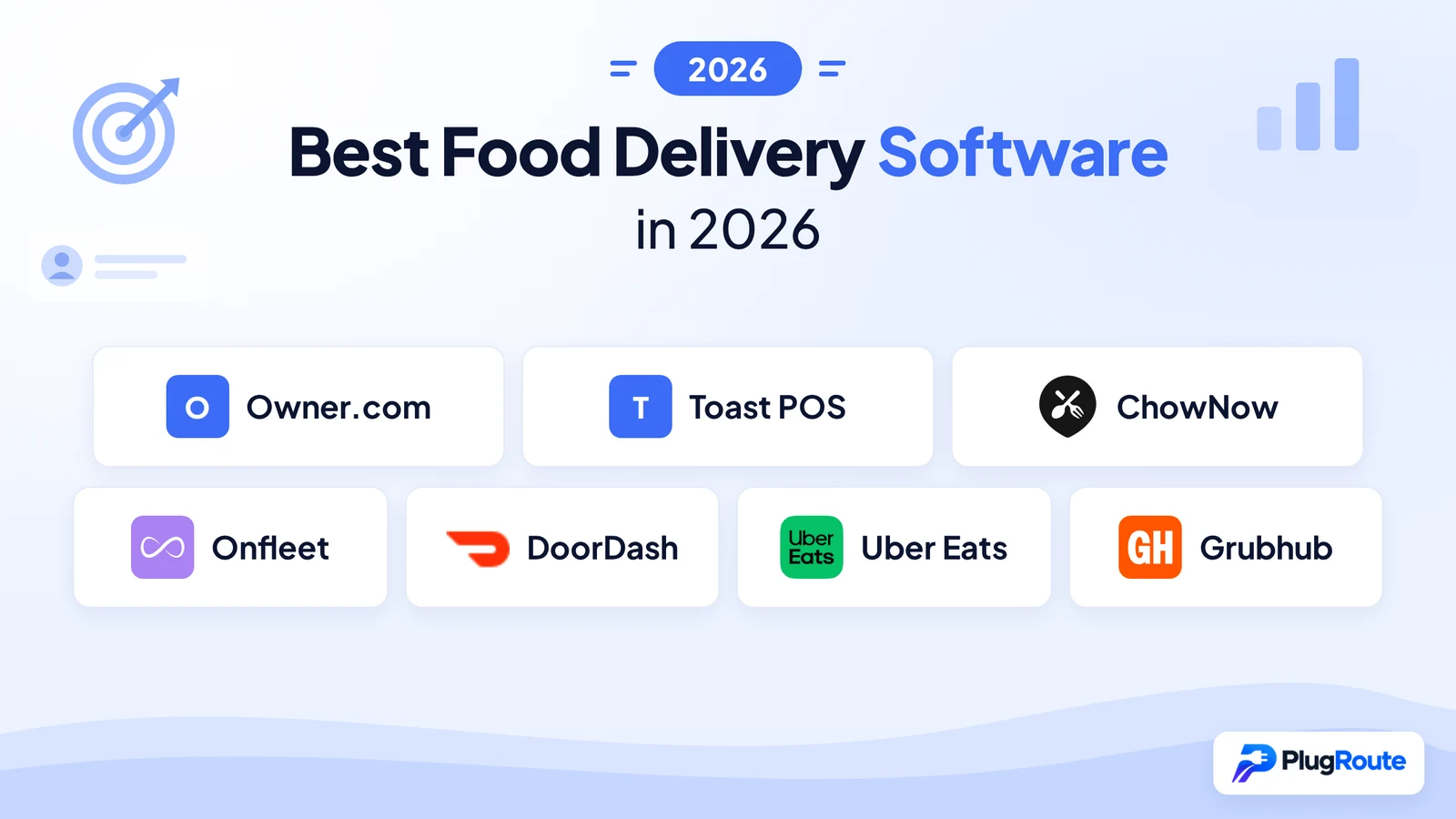
Owner.com is best for independent restaurants eliminating marketplace commission dependency at $5,000+/month delivery volume, Toast POS is best for restaurants replacing fragmented technology stacks with a restaurant-native operating system, and ChowNow is best for commission-free ordering with multi-channel menu discovery. The right platform depends on whether you need to own the customer relationship or access new customers you cannot generate independently.
Independent restaurants typically operate on 3–9% net profit margins. Marketplace commissions of 25–30% (with effective total costs reaching 30–40% once processing fees, promotions, and refund adjustments are included (Rezku, 2026)) structurally eliminate delivery profitability on most orders routed through third-party channels. This evaluation exists to help operators understand what those costs mean at their actual monthly volume and which of the four food delivery software categories fits their specific operational stage.
PlugRoute has no affiliate relationships with any company listed in this review, rankings are determined entirely by research data and objective evaluation criteria.
“I was doing $18K/month on DoorDash and thought I was crushing it. Then I did the math and realized after commissions, fees, and promos I was netting less than $1,000 on $18K of gross sales. That’s when I started looking for alternatives.” (r/restaurantowners)
Takeaway: The margin compression of marketplace delivery is rarely visible until operators calculate effective total cost against their actual net margins, not gross revenue.
TL;DR: Top Picks at a Glance
- Owner.com is best for eliminating marketplace commissions at $5,000+/month delivery volume, where its $499/month flat-rate subscription saves approximately $2,000/month versus DoorDash Plus commissions at the same volume.
- Toast POS is best for restaurants replacing fragmented POS, kitchen display, and ordering systems with a single restaurant-native operating system that also integrates DoorDash, Uber Eats, and Grubhub marketplace order flows.
- ChowNow is best for commission-free ordering with multi-channel menu discovery across Google, Apple Maps, and Yelp through its Order Better Network, at $229–$409/month.
- Onfleet is best for restaurants and ghost kitchens managing their own delivery fleet at 100+ deliveries per month with AI-powered route optimization and automated driver dispatch.
What Are the Four Categories of Food Delivery Software?
Food delivery software divides into four distinct categories with fundamentally different cost structures and business models. Direct ordering platforms (Owner.com, ChowNow) eliminate per-order commissions via monthly subscription fees. Full-stack restaurant operating systems (Toast POS) replace fragmented technology infrastructure. Marketplace platforms (DoorDash, Uber Eats, Grubhub) charge 15–30% per-order commissions for customer discovery. Delivery logistics platforms (Onfleet) manage owned driver fleets.
These four categories are not interchangeable. A restaurant choosing between them is making a strategic decision about customer acquisition versus customer retention, not simply picking a software tool.
Category 1: Direct Ordering Platforms Direct ordering platforms enable restaurants to receive delivery orders through branded websites, apps, and SMS without paying per-order commissions. Owner.com and ChowNow both operate on monthly subscription models. This category is most financially advantageous at $5,000+/month in delivery volume, where the subscription fee becomes a small fraction of the commission cost avoided.
Category 2: Full-Stack Restaurant Operating Systems Full-stack restaurant OS platforms like Toast POS provide the underlying technology infrastructure (point-of-sale, kitchen display, payments, payroll, and ordering) with marketplace integrations layered on top. Toast POS does not eliminate marketplace commissions, but it centralizes operational data across all order channels into a single system.
Category 3: Marketplace Platforms Marketplace platforms like DoorDash, Uber Eats, and Grubhub provide customer discovery and logistics in exchange for per-order commissions. These platforms serve restaurants that need access to consumers they cannot independently acquire. The trade-off: restaurants on marketplace platforms do not own customer data generated by marketplace transactions.
Category 4: Delivery Logistics Platforms Delivery logistics platforms like Onfleet optimize the physical movement of orders from kitchen to customer. Onfleet serves restaurants and ghost kitchens operating their own delivery driver fleets, a category growing with the expansion of virtual restaurant brands and dark kitchen models.
Note on terminology: This evaluation uses “ghost kitchen” and “dark kitchen” interchangeably to describe kitchen facilities operating exclusively for delivery with no dine-in service. “Virtual restaurant brand” refers to a delivery-only menu brand operated from an existing kitchen alongside a primary dine-in concept.
What Does Food Delivery Software Actually Cost Restaurants?
The effective total cost of food delivery software depends on category, and the gap between headline rates and actual costs is largest in the marketplace category.
Direct Ordering Platforms: Owner.com charges $249–$499/month flat regardless of order volume. ChowNow charges $229–$409/month with reportedly a 12% transaction fee on orders sourced through its Order Better Network discovery channels, per Sauce (getsauce.com), a competing direct ordering platform (2026). ChowNow’s own platform pages do not disclose a specific discovery network fee percentage; PlugRoute was unable to independently verify the 12% figure from a non-competing source. Operators should confirm current fee structures directly with ChowNow.
Marketplace Platforms: DoorDash charges 15–30% per order depending on the plan tier. Uber Eats charges 15–30%. Grubhub’s commission rates are estimated at approximately 30% based on independent operator reports. These headline rates understate effective total cost.
A restaurant generating $10,000/month in DoorDash sales at a 25% commission pays $2,500/month to DoorDash. Add processing fees (~2–3%), promotion spend required to maintain visibility (~5–8% of sales), and refund adjustments, and effective total cost reaches 30–40% of gross delivery revenue (Rezku, 2026).
The delivery treadmill: A restaurant that doubles its DoorDash volume from $5,000 to $10,000/month at a 25% commission goes from paying $1,250/month to $2,500/month in platform fees. Gross revenue grew by $5,000, but platform cost also grew by $1,250. The commission structure scales against the restaurant: the more successful it is on the marketplace, the more it pays in absolute dollar terms.
Self-delivery options: Restaurants can access DoorDash and Uber Eats driver networks for orders placed on their own websites through DoorDash Drive (white-label) and Uber Direct (white-label) APIs. These services typically charge flat per-delivery fees rather than commission percentages, making them a viable logistics option for restaurants that have already built a direct ordering customer base.
How Do These 7 Platforms Compare Side by Side?
The seven food delivery software platforms in this evaluation divide into four cost structures: Owner.com ($499/month flat) and ChowNow ($229–$409/month) eliminate per-order commissions; DoorDash (25–30%), Uber Eats (15–30%), and Grubhub (~30% estimated) charge per-order marketplace commissions; Toast POS ($0–$69+/month software) is a restaurant operating system with separate processing and hardware fees; and Onfleet ($599–$2,999/month) is a logistics-only fleet management platform.
| Rank | Company | Category | Best For | One-Line Summary | Key Capabilities | Primary Strength | Key Limitation |
|---|---|---|---|---|---|---|---|
| #1 | Owner.com | Direct Ordering Platform | Independent restaurants at $5,000+/month delivery volume | Commission-free ordering ecosystem with integrated marketing tools | Branded website, mobile app, SMS marketing, loyalty program, third-party integrations | Eliminates per-order marketplace commissions with flat $499/month fee | Requires existing customer base or marketing investment to generate volume |
| #2 | Toast POS | Full-Stack Restaurant OS | Restaurants replacing fragmented technology stacks | Restaurant-native operating system integrating POS, kitchen, payments, and delivery | POS, KDS, online ordering, payroll, marketplace integrations, analytics | Restaurant-specific OS serving 171,000+ locations (Q1 2026) | Hardware lock-in with proprietary terminals and processing requirements |
| #3 | ChowNow | Direct Ordering Platform | Commission-free ordering with multi-channel discovery | Commission-free platform with Order Better Network menu syndication | Branded ordering, Order Better Network (9+ channels), white-label app | 9+ discovery channels driving orders without per-order commission | Reportedly 12% fee on Order Better Network discovery orders (per competitor Sauce; unverified independently) |
| #4 | Onfleet | Delivery Logistics Platform | Ghost kitchens and restaurants with own delivery fleets | Route optimization and driver dispatch for owned delivery operations | AI route optimization, driver tracking, proof of delivery, analytics | Route optimization trained on data from 400M+ deliveries (blog) / 100M+ (product page) | Logistics-only: does not handle ordering, marketing, or customer acquisition |
| #5 | DoorDash | Marketplace Platform | Restaurants needing immediate access to large consumer audience | Largest US food delivery marketplace with 56–67% market share | Consumer marketplace, white-label DoorDash Drive, DashPass loyalty, analytics dashboard | Largest US delivery consumer base provides immediate order volume potential | 25–30% commission with effective total cost of 30–40% (Rezku, 2026); no customer data ownership |
| #6 | Uber Eats | Marketplace Platform | Restaurants seeking global marketplace reach with white-label logistics | Global delivery marketplace with Uber Direct white-label delivery API | Consumer marketplace, Uber Direct white-label API, Uber One loyalty, POS integrations | Global reach across 6,000+ cities with Uber Direct white-label logistics option | 15–30% commission; customer data owned by Uber, not the restaurant |
| #7 | Grubhub | Marketplace Platform | Restaurants in dense urban markets with existing Grubhub customer base | Third-largest US marketplace with ~30% estimated commission and uncertain post-acquisition trajectory | Consumer marketplace, Grubhub+, restaurant analytics | Established urban market presence with existing customer network | Two ownership changes in four years (acquired by Wonder in 2024); ~30% estimated commission; declining market share |
Which Platform Should You Choose Based on Your Primary Need?
The right food delivery software depends on your primary operational priority, not the platform with the most features. Most independent restaurants benefit from a combination: a direct ordering platform for retention economics and a marketplace platform for discovery, managed simultaneously.
| Your #1 Priority | Recommended Tool | Why | Acceptable Alternative |
|---|---|---|---|
| Eliminating per-order commissions | Owner.com | Flat $499/month fee becomes profitable at ~$2,000/month delivery volume; saves ~$2,000/month vs. DoorDash Plus at $10K volume | ChowNow at $229–$409/month |
| Replacing fragmented restaurant technology | Toast POS | Restaurant-native OS covering POS, kitchen, payments, payroll, and all order channels in one system | Owner.com for delivery-only operations |
| Commission-free ordering + multi-channel discovery | ChowNow | Order Better Network syndicates menus to 9+ discovery channels without per-order commission on restaurant-placed orders | Owner.com for more comprehensive marketing tools |
| Managing own delivery fleet | Onfleet | AI-powered route optimization and driver dispatch purpose-built for restaurant fleet operations | DoorDash Drive or Uber Direct for outsourced delivery |
| Immediate access to large consumer audience | DoorDash | Largest US marketplace audience at ~56–67% market share; available to any restaurant without existing customer base | Uber Eats for global reach |
| Global reach with white-label logistics option | Uber Eats | 6,000+ city presence with Uber Direct API enabling branded delivery from restaurant’s own channels | DoorDash for US-focused volume |
| Reducing commissions while maintaining discovery volume | Owner.com + DoorDash simultaneously | Owner.com captures existing customer base commission-free; DoorDash provides new customer acquisition; net commission cost falls as Owner.com volume grows | ChowNow + DoorDash |
#1. Owner.com: Commission-Free Direct Ordering for Independent Restaurants
Category: Direct Ordering Platform
At a Glance
- Category: Direct Ordering Platform
- Best For: Independent restaurants at $5,000+/month delivery volume seeking to eliminate marketplace commission dependency
- Price Range: $249–$499/month (flat subscription, no per-order commission)
- Primary Strength: Owner.com eliminates per-order marketplace commissions with a flat monthly subscription that becomes financially advantageous at approximately $2,000/month in delivery volume
- Biggest Limitation: Owner.com requires an existing customer base or sustained marketing investment to generate delivery volume without marketplace discovery infrastructure
- One-Line Summary: Owner.com is a commission-free direct ordering platform that combines a branded website, mobile app, SMS marketing, and loyalty tools into a flat-rate subscription designed to shift restaurant revenue off marketplace platforms.
- Last Verified: June 2026
Overview
Owner.com is a direct ordering platform for independent restaurants that enables commission-free delivery and pickup through branded websites and mobile apps at a flat monthly subscription fee. Owner.com is designed for operators who already have an established customer base and want to stop routing repeat orders through DoorDash, Uber Eats, or Grubhub at 25–30% commission rates. Owner.com’s core value proposition is economic: at $5,000/month in delivery volume, switching from DoorDash Plus (25% commission) to Owner.com at $499/month saves approximately $750/month; at $10,000/month, that savings grows to approximately $2,000/month.
Key Features
Owner.com integrates commission-free ordering directly into each restaurant’s branded website, allowing restaurants to retain the full customer relationship (including contact data, order history, and lifetime value) for every order placed through the platform.
Owner.com includes an automated SMS marketing engine that sends targeted promotional campaigns to the restaurant’s customer database, driving repeat orders without the per-message costs of third-party SMS tools.
Owner.com provides a loyalty and rewards program directly tied to the restaurant’s ordering system, allowing operators to configure point accumulation, redemption rules, and VIP tiers without a separate loyalty software subscription.
Owner.com includes a branded mobile app component that appears in the App Store and Google Play under the restaurant’s own name, enabling push notification marketing to mobile customers.
Owner.com offers direct integrations with DoorDash Drive and Uber Direct, enabling restaurants to use marketplace driver networks for order fulfillment while receiving orders through their own commission-free channels.
Best For
Owner.com is best for independent restaurants currently paying $1,500+/month in aggregate marketplace commissions and willing to invest in converting existing DoorDash and Uber Eats customers to direct ordering through SMS campaigns and loyalty incentives. Owner.com is also well-suited for operators who have already built an email or phone contact list and want to activate it for direct revenue generation.
Pricing
Owner.com charges $249/month on its Starter plan and $499/month on its Pro plan, with no per-order commission on any orders placed through the Owner.com platform (as of June 2026). Owner.com does not publicly disclose a complete feature breakdown between tiers; operators should confirm current plan inclusions directly with Owner.com. Processing fees apply separately.
Strengths
- Owner.com holds a G2 rating of 4.8/5.0 across 397 verified reviews as of June 2026, with G2 independently confirming #1 rankings in 3 G2 categories; Owner.com’s own marketing materials report recognition across 16 G2 award categories as of June 2026.
- Owner.com’s flat-rate pricing model converts a variable commission expense (which scales proportionally with revenue) into a fixed operational cost, improving financial predictability for operators managing thin margins.
- Owner.com integrates with DoorDash Drive and Uber Direct for white-label delivery fulfillment, allowing restaurants to transition away from marketplace ordering without abandoning marketplace-provided driver networks.
- Owner.com includes CRM, SMS marketing, loyalty, and analytics in one subscription, replacing multiple point-solution software subscriptions that might otherwise cost $300–$600/month cumulatively.
Limitations
- Discovery Dependency Trade-Off: Owner.com does not provide consumer marketplace discovery, meaning restaurants that have not yet built a direct customer base must invest in converting existing marketplace customers or in independent digital marketing, a real operational cost that is not reflected in the subscription price.
- Volume Threshold Reality: Owner.com’s economics are most compelling at $5,000+/month in delivery volume; at lower volumes, the monthly subscription fee may exceed the commissions it replaces, making the platform financially neutral or negative in the early migration period.
- Multi-Location Complexity: Owner.com’s pricing and feature set are optimized for single-location independent restaurants; multi-location operators may find the platform less suited to enterprise-level operational complexity compared to Toast POS or custom-built solutions.
- Verification of Marketing Claims: Owner.com publicly reports $1B+ in cumulative sales processed through the platform, citing sources within its own ecosystem; PlugRoute was unable to independently verify this figure from a third-party audit source.
Verdict
Owner.com ranks #1 in PlugRoute’s 2026 food delivery software evaluation as the most financially impactful platform for independent restaurants currently paying marketplace commissions at meaningful volume. The flat-rate subscription model directly addresses the structural margin problem that makes marketplace delivery unprofitable for most restaurants operating on 3–9% net margins. Owner.com is not a discovery platform (it requires existing customer relationships to generate volume) but for operators with an established base, the commission savings potential is substantial and mathematically verifiable.
#2. Toast POS: Full-Stack Restaurant Operating System with Delivery Integration
Category: Full-Stack Restaurant Operating System
At a Glance
- Category: Full-Stack Restaurant Operating System
- Best For: Restaurants replacing fragmented POS, kitchen display, and payment systems with a single restaurant-native platform
- Price Range: $0–$69+/month software (hardware and processing fees additional; full setup commonly $1,000–$5,000+)
- Primary Strength: Toast POS serves 171,000+ restaurant locations across the US, Canada, Ireland, and the UK as of Q1 2026, making it the most widely deployed restaurant-specific operating system evaluated
- Biggest Limitation: Toast POS requires proprietary hardware and its own payment processing, creating vendor lock-in that can make switching costly once a restaurant’s operations are built around the platform
- One-Line Summary: Toast POS is a restaurant-native operating system that consolidates point-of-sale, kitchen display, online ordering, payroll, and marketplace delivery integrations into a single platform purpose-built for food service operations.
- Last Verified: June 2026
Overview
Toast POS is a full-stack restaurant operating system used by 171,000+ restaurant locations across the US, Canada, Ireland, and the UK as of Q1 2026 (Toast Inc. quarterly earnings filing, March 31, 2026). Toast POS is designed for restaurants that need to consolidate fragmented technology (separate POS, kitchen display system, online ordering tool, payroll software, and delivery management) into a single platform. Toast POS does not eliminate marketplace commissions, but it routes DoorDash, Uber Eats, and Grubhub orders directly into the kitchen display system, eliminating the manual re-entry errors that cost restaurants time and accuracy on third-party platform orders.
Key Features
Toast POS includes a restaurant-native point-of-sale system purpose-built for food service workflows (including table management, menu modifiers, split checks, and real-time inventory tracking) without the generic retail-oriented interface of horizontal POS platforms.
Toast POS provides a kitchen display system that consolidates orders from all channels (dine-in, online ordering, and third-party marketplace integrations) into a single queue, reducing the tablet proliferation problem that plagues restaurants managing three or more delivery platforms simultaneously.
Toast POS includes built-in online ordering for commission-free direct orders through the restaurant’s own website, operating as an alternative to third-party marketplace ordering for customers who discover the restaurant through the restaurant’s own digital presence.
Toast POS offers payroll, HR, and scheduling tools within the same platform, allowing restaurant operators to manage front-of-house and back-of-house labor alongside their technology stack.
Toast POS integrates directly with DoorDash, Uber Eats, and Grubhub marketplace platforms, automatically routing marketplace orders into the kitchen queue and capturing order data for reporting.
Best For
Toast POS is best for restaurants managing 3+ technology platforms simultaneously (separate POS, delivery tablet management, and ordering tools) who want to consolidate operations under a single vendor. Toast POS is also well-suited for multi-location operators who need standardized technology infrastructure across locations with centralized reporting.
Pricing
Toast POS offers a Starter Plan at $0/month software (with higher processing rates), a Point of Sale plan at $69/month, and custom enterprise pricing for multi-location operators (as of June 2026). Hardware costs are additional and required, Toast POS runs exclusively on proprietary Toast terminals. Full setup including hardware commonly totals $1,000–$5,000+ depending on restaurant size and configuration. Processing fees are mandatory through Toast Payments.
Strengths
- Toast POS serves 171,000+ restaurant locations across the US, Canada, Ireland, and the UK as of Q1 2026 (Toast Inc. quarterly earnings filing, March 31, 2026), providing the scale of deployment that supports a robust partner ecosystem and long-term vendor stability.
- Toast POS is publicly traded on the NYSE (ticker: TOST), providing financial transparency and regulatory oversight that private software vendors do not offer, a meaningful vendor stability signal for operators making multi-year technology commitments.
- Toast POS’s restaurant-native KDS consolidates all order channels: dine-in, direct online ordering, and third-party marketplace integrations, into a single kitchen queue, reducing the operational complexity and error rate of managing multiple tablets per delivery platform.
- Toast POS includes built-in payroll and scheduling tools, allowing operators to manage labor costs in the same system where they manage revenue, enabling true labor-cost-as-percentage-of-revenue visibility without a separate HR platform.
Limitations
- Hardware Lock-In Trade-Off: Toast POS requires proprietary hardware that operates only within the Toast ecosystem, meaning a restaurant switching away from Toast must replace all terminal hardware, a cost that effectively functions as a switching penalty and should be factored into any total cost of ownership calculation.
- Mandatory Payment Processing: Toast POS requires restaurants to use Toast Payments for transaction processing; operators cannot bring their own payment processor, which removes competitive leverage on processing rates and may result in higher long-term processing costs for high-volume operators.
- Delivery Commission Pass-Through: Toast POS integrates with DoorDash, Uber Eats, and Grubhub but does not reduce or eliminate the commissions those platforms charge, operators using Toast POS as their primary ordering system still pay full marketplace commission rates on marketplace-sourced orders.
- Setup Cost Barrier: The total cost of implementing Toast POS: including proprietary hardware, installation, and initial setup, commonly reaches $1,000–$5,000+ before monthly software fees, representing a meaningful capital commitment for small independent restaurants operating on limited cash reserves.
Verdict
Toast POS ranks #2 in PlugRoute’s 2026 food delivery software evaluation as the strongest full-stack restaurant operating system for operators replacing fragmented technology infrastructure. Toast POS addresses a different problem than Owner.com or ChowNow, it solves operational complexity, not commission economics. Restaurants already managing their marketplace commission exposure through direct ordering platforms may find Toast POS’s integrated OS the natural complement for centralizing order flow, kitchen operations, and reporting. The hardware lock-in and mandatory payment processing are genuine long-term cost considerations that operators should model before committing.
#3. ChowNow: Commission-Free Ordering with Order Better Network Discovery
Category: Direct Ordering Platform
At a Glance
- Category: Direct Ordering Platform
- Best For: Independent restaurants seeking commission-free ordering with multi-channel menu discovery across Google, Apple Maps, and Yelp
- Price Range: $229–$409/month (flat subscription; discovery network fee terms require direct verification with ChowNow)
- Primary Strength: ChowNow’s Order Better Network syndicates restaurant menus to 9+ discovery channels (including Google, Apple Maps, and Yelp) while routing orders to the restaurant commission-free on direct placements
- Biggest Limitation: ChowNow reportedly carries a 12% transaction fee on orders sourced through its Order Better Network discovery channels, per Sauce (getsauce.com), a competing direct ordering platform (2026); this fee is not disclosed on ChowNow’s own platform pages and has not been independently verified by PlugRoute from a non-competing source
- One-Line Summary: ChowNow is a commission-free direct ordering platform with a branded app and website ordering system, distinguished by its Order Better Network that routes discovery-channel orders to restaurants without DoorDash or Uber Eats marketplace intermediation.
- Last Verified: June 2026
Overview
ChowNow is a direct ordering platform for independent restaurants that enables branded online ordering through restaurant websites and a white-label mobile app, at a flat monthly subscription fee with no per-order commission on direct restaurant placements. ChowNow is distinguished from Owner.com primarily by its Order Better Network, which syndicates restaurant menus across 9+ consumer discovery channels (including Google, Apple Maps, Yelp, and TripAdvisor) and routes resulting orders back to the restaurant without DoorDash or Uber Eats marketplace intermediation. ChowNow serves as an alternative for restaurants that want commission-free economics alongside discovery infrastructure, without relying solely on their own marketing to generate volume.
Key Features
ChowNow provides branded online ordering through each restaurant’s own website and a white-label mobile app, enabling commission-free direct ordering for customers who discover the restaurant through the restaurant’s own digital channels.
ChowNow’s Order Better Network syndicates restaurant menus to 9+ consumer discovery platforms (including Google, Apple Maps, Yelp, TripAdvisor, and others) routing resulting orders to the restaurant without requiring DoorDash or Uber Eats marketplace intermediation.
ChowNow includes a marketing suite with email campaigns, customer re-engagement tools, and promotional offer management, enabling restaurants to activate their Order Better Network customer data for repeat order generation.
ChowNow provides a restaurant dashboard with consolidated order management, customer data, and reporting across all ordering channels, enabling operators to track direct-channel performance against historical marketplace benchmarks.
ChowNow integrates with major POS systems including Toast POS, Square, and others, allowing order data to flow directly into existing kitchen and reporting systems without manual re-entry.
Best For
ChowNow is best for independent restaurants that want commission-free ordering infrastructure with built-in discovery channel syndication (particularly restaurants that generate meaningful consumer traffic from Google Maps, Apple Maps, or Yelp) and prefer a lower subscription entry price than Owner.com. ChowNow is also well-suited for operators who want to reduce marketplace dependency while maintaining visibility on discovery platforms their customers already use.
Pricing
ChowNow charges $229/month on its entry plan and $409/month on its higher tier as of June 2026. ChowNow does not publicly disclose a per-transaction fee for Order Better Network discovery orders on its pricing pages. Sauce (getsauce.com), a competing direct ordering platform, has publicly reported a 12% transaction fee on ChowNow Order Better Network discovery-channel orders as of 2026. PlugRoute was unable to independently verify this figure from a non-competing source. Operators should confirm current fee structures (including any Order Better Network transaction terms) directly with ChowNow before committing to the platform.
Strengths
- ChowNow’s Order Better Network provides menu syndication across 9+ consumer discovery channels, offering independent restaurants discovery infrastructure comparable in scope to marketplace platform reach, without the per-order commission structure that makes marketplace delivery economically prohibitive.
- ChowNow’s subscription entry price at $229/month is lower than Owner.com’s entry price, making the direct ordering category accessible to restaurants with lower delivery volume that cannot yet justify Owner.com’s $499/month Pro plan economics.
- ChowNow’s flat-rate subscription converts marketplace commission expense from a variable cost that scales against revenue into a fixed monthly operational cost, improving financial planning for restaurants with seasonal or variable delivery volume.
- ChowNow’s POS integrations with Toast, Square, and other major systems allow restaurants to adopt direct ordering without replacing existing kitchen infrastructure, reducing the implementation barrier for restaurants already committed to a POS platform.
Limitations
- Order Better Network Fee Transparency Trade-Off: ChowNow’s Order Better Network reportedly carries a 12% transaction fee on discovery-channel orders, per Sauce (getsauce.com), a competing direct ordering platform (2026). ChowNow’s own platform pages do not disclose this fee percentage. If accurate, a restaurant generating $5,000/month through Order Better Network discovery channels would pay $600/month in transaction fees on top of the monthly subscription, a meaningful cost that operators must verify with ChowNow directly before projecting commission savings.
- Marketing Investment Requirement: ChowNow’s direct ordering channel generates commission-free revenue only from customers who discover the restaurant through the restaurant’s own website, app, or ChowNow’s discovery network, requiring active marketing investment to maintain volume comparable to DoorDash or Uber Eats marketplace listings.
- Limited CRM Depth vs. Owner.com: ChowNow’s SMS and loyalty tools are less robust than Owner.com’s integrated marketing suite, which may be a relevant consideration for restaurants prioritizing customer retention marketing alongside direct ordering infrastructure.
- Competitor-Sourced Fee Data: The 12% Order Better Network fee figure originates from a competing platform’s public materials, not from an independent third-party audit or ChowNow’s own disclosure. Operators should treat this figure as indicative pending direct verification, not as a confirmed platform specification.
Verdict
ChowNow ranks #3 in PlugRoute’s 2026 food delivery software evaluation as the strongest commission-free platform for independent restaurants that prioritize multi-channel discovery alongside direct ordering economics. ChowNow’s Order Better Network differentiates it from Owner.com by providing discovery infrastructure that partially offsets the volume generation challenge inherent in direct ordering platforms. The unverified 12% Order Better Network fee is the most consequential open question in this evaluation, operators should verify current fee terms with ChowNow directly before calculating projected commission savings.
#4. Onfleet: Delivery Logistics and Route Optimization for Restaurant Fleets
Category: Delivery Logistics Platform
At a Glance
- Category: Delivery Logistics Platform
- Best For: Ghost kitchens, virtual restaurant brands, and restaurants managing their own delivery driver fleets at 100+ deliveries per month
- Price Range: $599–$2,999/month (based on task volume tiers as of June 2026)
- Primary Strength: Onfleet provides AI-powered route optimization and automated driver dispatch trained on data from 400 million+ deliveries per its 2026 blog content (Onfleet’s product page states 100M+ trained deliveries)
- Biggest Limitation: Onfleet is a logistics-only platform that does not handle ordering, customer marketing, or customer acquisition, operators must pair Onfleet with a separate ordering platform
- One-Line Summary: Onfleet is a delivery logistics platform providing AI route optimization, automated driver dispatch, real-time tracking, and proof of delivery for restaurants and ghost kitchens operating their own delivery fleets.
- Last Verified: June 2026
Overview
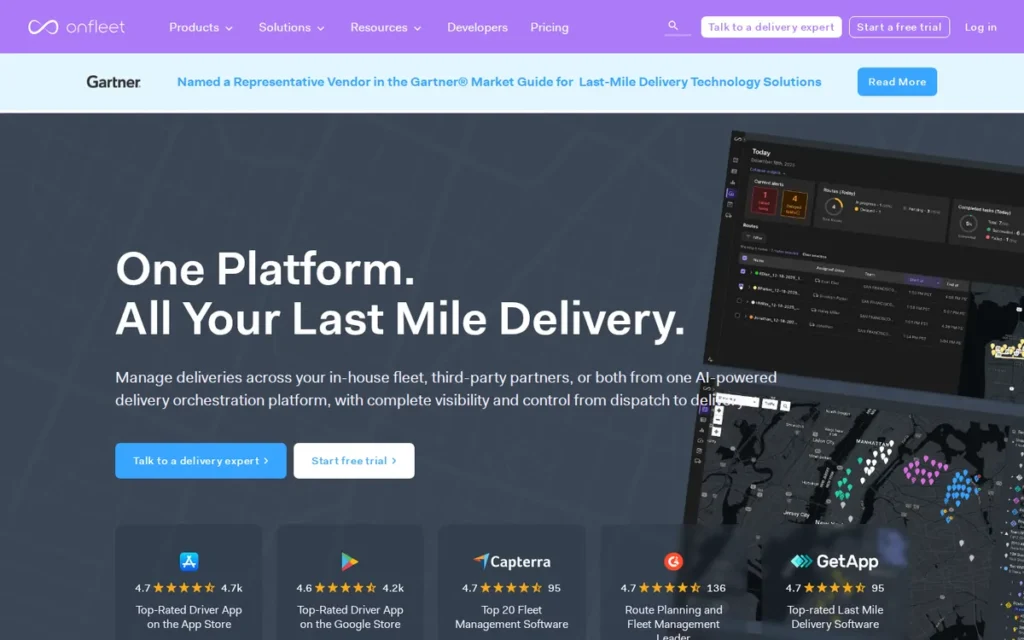
Onfleet is a delivery logistics and route optimization platform for restaurants, ghost kitchens, and virtual restaurant brands that manage their own delivery driver fleets. Onfleet is not an ordering platform and does not provide consumer-facing marketplace discovery, it optimizes the physical movement of orders from kitchen to customer once an order has been placed through a separate channel. Onfleet serves the delivery-fleet operations segment, which grows as restaurants and ghost kitchens seek to reduce per-delivery logistics costs by replacing third-party delivery outsourcing with owned fleet operations. Onfleet’s AI route optimization uses machine learning to reduce per-delivery drive time, fuel consumption, and driver idle time at scale.
Key Features
Onfleet provides AI-powered route optimization that dynamically calculates the most efficient delivery sequence for multi-stop driver routes, reducing per-delivery drive time and fuel costs for restaurants operating fleets of 3+ concurrent drivers.
Onfleet includes automated driver dispatch that assigns incoming orders to available drivers based on proximity, capacity, and route efficiency, eliminating the manual dispatch coordination that creates operational bottlenecks for high-volume delivery operations.
Onfleet provides real-time driver tracking with live ETAs visible to both restaurant operators and customers, enabling proactive communication on delivery delays and reducing inbound customer service inquiries about order status.
Onfleet includes electronic proof of delivery (photo confirmation, signature capture, and barcode scan) creating an auditable delivery record for every order that reduces dispute costs on claimed non-deliveries.
Onfleet provides a data analytics dashboard tracking delivery performance metrics including on-time rate, average delivery time, driver utilization, and route efficiency, enabling operators to benchmark and improve fleet performance over time.
Best For
Onfleet is best for ghost kitchens, virtual restaurant brands, and multi-location restaurant groups operating delivery fleets of 3+ drivers with 100+ deliveries per month, where the route optimization and automated dispatch tools generate measurable cost savings versus manual fleet coordination. Onfleet is also well-suited for restaurant operators piloting self-delivery as an alternative to DoorDash Drive or Uber Direct outsourced logistics.
Pricing
Onfleet charges on a task-volume tier model: the Launch plan starts at $599/month for up to 1,000 tasks, the Scale plan at $1,199/month, and the Enterprise plan at $2,999/month for high-volume operations, as of June 2026. Pricing scales with delivery task volume, not driver headcount, making cost predictable relative to order volume. Operators with fewer than 300–400 monthly deliveries may find the entry-tier cost difficult to justify against outsourced logistics alternatives.
Strengths
- Onfleet’s AI route optimization draws on training data reported at 400 million+ deliveries per its 2026 blog content (Onfleet’s own product page states 100M+ trained deliveries); regardless of the precise figure, Onfleet’s optimization algorithms are among the most mature in the delivery logistics software category for restaurant-scale operations.
- Onfleet’s proof of delivery system: including photo confirmation and signature capture, creates an auditable delivery record that reduces the dispute resolution cost on claimed non-deliveries, a meaningful operational saving for high-volume ghost kitchen operations.
- Onfleet’s analytics dashboard provides per-driver and per-route performance tracking that enables data-driven fleet management decisions (including driver performance reviews, route efficiency improvements, and capacity planning) that are not available through outsourced delivery platforms.
- Onfleet integrates with major ordering platforms and POS systems, allowing restaurants to layer delivery logistics optimization on top of their existing ordering infrastructure without replacing the ordering stack.
Limitations
- Logistics-Only Scope Trade-Off: Onfleet handles physical delivery logistics exclusively, it does not provide ordering, customer marketing, customer acquisition, or CRM tools, meaning every Onfleet deployment requires a separate ordering platform investment and ongoing coordination between two systems.
- Volume Threshold Economics: Onfleet’s $599/month entry pricing is only financially justified for operations with sufficient delivery volume to generate per-delivery cost savings that exceed the platform fee; restaurants with fewer than 200–300 monthly deliveries may find outsourced delivery (DoorDash Drive, Uber Direct) more cost-effective despite higher per-delivery rates.
- Driver Recruitment Not Included: Onfleet optimizes existing driver fleets but does not provide driver recruitment, background check management, or driver insurance infrastructure, operators must independently manage all employment or contractor logistics for their delivery staff.
- Training Data Disclosure Inconsistency: Onfleet’s 2026 blog content reports 400M+ trained deliveries while its own product page states 100M+ trained deliveries; PlugRoute cannot verify which figure is current, and operators evaluating AI optimization claims should request clarification from Onfleet directly.
Verdict
Onfleet ranks #4 in PlugRoute’s 2026 food delivery software evaluation, earning its position as the top-ranked delivery logistics platform for restaurant fleet operations. Onfleet addresses a specific and growing operational need: as more ghost kitchens and multi-concept operators build owned delivery infrastructure to reduce per-delivery costs, purpose-built route optimization and dispatch tools become a meaningful operational advantage. Onfleet is not the right platform for restaurants that do not operate their own driver fleet; for those that do, it provides measurably superior logistics efficiency compared to manual dispatch coordination.
#5. DoorDash: Largest US Food Delivery Marketplace with White-Label Logistics
Category: Marketplace Platform
At a Glance
- Category: Marketplace Platform
- Best For: Restaurants needing immediate access to a large consumer audience for delivery customer acquisition without an existing direct-order customer base
- Price Range: 15–30% per-order commission (effective total cost 30–40% including processing, promotions, and refunds per Rezku, 2026)
- Primary Strength: DoorDash holds approximately 56–67% of US online food delivery market share (Business of Apps estimates 65%+; OysterLink estimates 56%; as of 2025), giving restaurants access to the largest single pool of US delivery consumers
- Biggest Limitation: DoorDash’s commission structure eliminates profitability on most delivery orders for restaurants on 3–9% net margins, and the restaurant does not own any customer data generated by DoorDash-sourced transactions
- One-Line Summary: DoorDash is the largest US food delivery marketplace platform, providing restaurants with immediate consumer audience access at 15–30% per-order commission, alongside DoorDash Drive white-label delivery logistics for restaurant-owned ordering channels.
- Last Verified: June 2026
Overview
DoorDash is the largest food delivery marketplace platform in the United States, holding approximately 56–67% of US online food delivery market share as of 2025 (Business of Apps estimates 65%+; OysterLink estimates 56%). DoorDash connects restaurants with consumer delivery demand at scale, providing the largest single audience of active US delivery consumers accessible to any restaurant listing on the platform. DoorDash charges restaurants 15–30% per-order commissions depending on the plan tier, with effective total cost reaching 30–40% when processing fees, promotional spend, and refund adjustments are included (Rezku, 2026). DoorDash also offers DoorDash Drive, a white-label delivery logistics API enabling restaurants to use DoorDash driver networks for orders placed through their own channels.
Key Features
DoorDash provides consumer marketplace access to approximately 56–67% of US online delivery consumers, enabling restaurants to receive delivery orders from customers they would not otherwise reach through their own digital marketing or ordering infrastructure.
DoorDash’s DashPass loyalty program (with 15M+ subscribers as of 2024) provides DashPass-subscribed customers with reduced or $0 delivery fees on qualifying orders, incentivizing repeat ordering behavior that can benefit restaurants listed in the DashPass program.
DoorDash Drive provides a white-label delivery logistics API that allows restaurants to use DoorDash driver networks for orders placed on their own websites or apps, enabling branded delivery fulfillment without consumer-facing DoorDash marketplace intermediation.
DoorDash provides a Merchant Portal analytics dashboard with order volume tracking, customer satisfaction metrics, financial reporting, and promotional campaign management tools for restaurant operators.
DoorDash integrates with major POS systems including Toast POS, Square, Clover, and others, routing marketplace orders directly into kitchen systems and reducing manual order re-entry.
Best For
DoorDash is best for restaurants with limited existing delivery customer bases that need immediate access to consumer order volume, particularly new restaurant locations, ghost kitchen launches, or operators entering delivery for the first time. DoorDash is also useful as a discovery and acquisition channel alongside a direct ordering platform (Owner.com or ChowNow), where the economic goal is migrating acquired DoorDash customers to commission-free direct ordering over time.
Pricing
DoorDash charges restaurants on three commission tiers: the Basic plan at 15% (restaurant-provided delivery only), the Plus plan at 25% (DoorDash driver fulfillment + expanded consumer visibility), and the Premier plan at 30% (enhanced promotion visibility). Effective total cost including payment processing, promotional credits required for competitive visibility, and refund adjustments reaches approximately 30–40% of gross delivery revenue for most operators (Rezku, 2026). These rates represent per-order costs on every transaction, unlike subscription-based platforms, DoorDash costs scale proportionally with every dollar of delivery revenue.
Strengths
- DoorDash holds approximately 56–67% of US online food delivery market share as of 2025 (Business of Apps; OysterLink), making DoorDash listings accessible to more delivery consumers than any other single platform in the US market.
- DoorDash Drive’s white-label logistics API enables restaurants that have built direct ordering infrastructure (Owner.com, ChowNow, Toast POS online ordering) to use DoorDash driver networks for fulfillment, separating the logistics value of DoorDash from the commission cost of the consumer marketplace.
- DoorDash is publicly traded on the NYSE (ticker: DASH), providing financial reporting transparency and regulatory oversight that reduce vendor instability risk compared to privately-held delivery platforms.
- DoorDash reported that 76% of restaurants on its platform said DoorDash helped them reach new customers according to DoorDash’s own 2025 merchant economic impact report, as reported by Restaurant Dive (2023), an internally sourced metric operators should weigh accordingly.
Limitations
- Commission Margin Elimination Trade-Off: DoorDash’s effective total cost of 30–40% on gross delivery revenue (Rezku, 2026) structurally eliminates profitability on most delivery orders for restaurants operating on 3–9% net margins, making DoorDash economically viable primarily as a customer acquisition channel rather than a profit-generating order channel.
- Customer Data Ownership Gap: DoorDash retains ownership of all customer data generated by marketplace transactions, restaurants cannot export contact information, order history, or behavioral data for customers who order exclusively through DoorDash, eliminating the long-term customer relationship equity that direct ordering platforms generate.
- Commission Scaling Against Revenue: The delivery treadmill effect means that a restaurant doubling its DoorDash monthly volume from $5,000 to $10,000 doubles its absolute commission payment from $1,250 to $2,500, gross revenue growth does not improve unit economics, it simply scales costs proportionally.
- Discovery-Only Customer Relationship: DoorDash customers are DoorDash’s customers, not the restaurant’s customers. A restaurant generating 4,800 orders over 24 months exclusively through DoorDash possesses zero independently actionable customer data at the end of that period, the same data that 4,800 orders through Owner.com would have generated as a permanently owned, independently marketable customer database.
“We’ve been on DoorDash for 3 years. If we left tomorrow we’d have literally nothing to show for it, no emails, no phone numbers, no customer list. Three years of orders and we own zero of those relationships.” (r/KitchenConfidential)
Takeaway: The customer data ownership gap is a compounding strategic cost that does not appear on the monthly commission invoice but erodes long-term restaurant revenue independence with every DoorDash-sourced order.
Verdict
DoorDash ranks #5 in PlugRoute’s 2026 food delivery software evaluation, not because it is a weak platform, but because its economic structure is fundamentally misaligned with restaurant profitability at the commission rates it charges. DoorDash is the correct choice for customer discovery and new location launches; it is the wrong platform for generating sustainable delivery profits. Operators who have used DoorDash to build delivery volume should be actively measuring the break-even point at which switching that volume to Owner.com or ChowNow becomes financially positive, for most restaurants, that break-even occurs at approximately $3,000–$5,000/month in current DoorDash sales.
#6. Uber Eats: Global Marketplace with Uber Direct White-Label Logistics
Category: Marketplace Platform
At a Glance
- Category: Marketplace Platform
- Best For: Restaurants seeking global marketplace reach and white-label delivery logistics through the Uber Direct API
- Price Range: 15–30% per-order commission (effective total cost varies by market and promotional spend)
- Primary Strength: Uber Eats operates across 6,000+ cities globally with the Uber Direct white-label API providing branded delivery logistics for restaurants’ own ordering channels
- Biggest Limitation: Uber Eats charges 15–30% per-order commission and retains ownership of all customer data generated by marketplace transactions, structurally replicating the same customer relationship gap as DoorDash
- One-Line Summary: Uber Eats is a global food delivery marketplace platform with approximately 25–30% US market share, distinguished by the Uber Direct white-label logistics API that enables restaurants to use Uber driver networks for branded delivery fulfillment outside the Uber Eats consumer marketplace.
- Last Verified: June 2026
Overview
Uber Eats is the second-largest food delivery marketplace platform in the United States, operating in 6,000+ cities globally across 45+ countries. Uber Eats charges restaurants 15–30% per-order commissions depending on the market and service tier, with the same structural profitability challenge as DoorDash for restaurants on 3–9% net margins. Uber Eats is differentiated primarily by its global footprint (relevant for restaurant brands operating internationally) and by Uber Direct, its white-label delivery logistics API that allows restaurants to use Uber driver networks for orders placed through their own branded channels, separating Uber’s logistics infrastructure from its consumer marketplace commission structure.
Key Features
Uber Eats provides consumer marketplace access across 6,000+ cities in 45+ countries, making Uber Eats the primary marketplace platform for restaurant brands with international presence or international expansion plans where DoorDash has limited penetration.
Uber Direct provides a white-label delivery logistics API enabling restaurants to use Uber driver networks for on-demand delivery fulfillment on orders placed through the restaurant’s own website, app, or ordering system, without consumer-facing Uber Eats marketplace intermediation.
Uber Eats integrates with major POS systems including Toast POS, Square, and others, enabling direct kitchen queue routing of Uber Eats marketplace orders without manual tablet re-entry.
Uber One loyalty program (Uber’s combined Uber Eats and Uber ride-sharing subscription) provides Uber One subscribers with reduced delivery fees on qualifying Uber Eats orders, incentivizing repeat usage among the Uber One subscriber base.
Uber Eats provides a restaurant analytics dashboard with order volume, customer satisfaction ratings, financial reporting, and promotional campaign management tools comparable in scope to DoorDash’s Merchant Portal.
Best For
Uber Eats is best for restaurant brands with international presence or expansion plans, where Uber Eats’ 6,000+ city global footprint covers markets DoorDash does not serve. Uber Eats is also well-suited for US-based restaurants that want to offer branded delivery through their own ordering channels while leveraging an established driver network, using Uber Direct rather than the consumer marketplace as the primary integration point.
Pricing
Uber Eats charges restaurants 15–30% per-order commission depending on the service level and market (as of June 2026). The Lite plan at 15% covers restaurant-provided delivery; higher tiers at 25–30% include Uber Eats driver fulfillment and promotional visibility. Uber Direct white-label logistics pricing is structured as flat per-delivery fees rather than commission percentages and varies by market. Operators should verify current Uber Direct pricing directly with Uber Eats for their specific market.
Strengths
- Uber Eats operates in 6,000+ cities across 45+ countries, providing international restaurant brands with a single platform relationship that covers markets where DoorDash has no presence, a relevant competitive advantage for chains, franchise systems, or growing concepts with international expansion plans.
- Uber Direct’s white-label API enables restaurants to achieve branded delivery economics (flat per-delivery fees rather than commission percentages) while leveraging Uber’s established driver supply infrastructure, addressing the driver recruitment challenge that prevents many restaurants from building independent delivery fleets.
- Uber Eats POS integrations with Toast, Square, and other major systems consolidate marketplace order management into existing kitchen infrastructure, reducing the operational complexity and error rate of managing a separate Uber Eats tablet.
- Uber is publicly traded on the NASDAQ (ticker: UBER), providing financial transparency and vendor stability signals comparable to DoorDash (NYSE: DASH) and Toast (NYSE: TOST) for operators evaluating long-term platform commitment risk.
Limitations
- Commission Structure Replication Trade-Off: Uber Eats replicates DoorDash’s structural profitability challenge at equivalent commission rates, restaurants on 3–9% net margins cannot generate sustainable delivery profits on orders where the platform retains 15–30% of gross revenue plus processing fees and promotional spend.
- Customer Data Ownership Gap: Uber Eats retains ownership of all customer data generated by marketplace transactions, structurally identical to DoorDash’s data ownership model, restaurants cannot independently access, export, or market to customers who order exclusively through the Uber Eats consumer app.
- US Market Share Second-Place Position: Uber Eats holds approximately 25–30% of US online food delivery market share versus DoorDash’s approximately 56–67%, meaning Uber Eats listings reach a materially smaller US consumer audience than DoorDash, relevant for operators evaluating which single marketplace platform to prioritize in US-focused operations.
- Promotional Spend Requirements: Competitive Uber Eats marketplace visibility in dense urban markets increasingly requires promotional credits and sponsored listing spend on top of base commissions, increasing effective total cost beyond the headline commission rate for restaurants in highly contested categories or ZIP codes.
Verdict
Uber Eats ranks #6 in PlugRoute’s 2026 food delivery software evaluation, reflecting its strong global platform position alongside the same structural commission economics that limit marketplace platform profitability for independent restaurants. Uber Eats is the correct platform choice for internationally operating restaurant brands and for operators prioritizing white-label delivery logistics through Uber Direct. For US-only independent restaurants evaluating a single marketplace platform, DoorDash’s larger US consumer audience generally provides higher potential order volume per listing, though the commission economics of both platforms ultimately argue for migrating acquired customers to direct ordering infrastructure.
#7. Grubhub: Urban Marketplace with Post-Acquisition Strategic Uncertainty
Category: Marketplace Platform
At a Glance
- Category: Marketplace Platform
- Best For: Restaurants in dense US urban markets: particularly New York City and Chicago, with an existing Grubhub customer base built before 2022
- Price Range: ~30% per-order commission (estimated from operator reports; Grubhub does not publish a standard rate card publicly)
- Primary Strength: Grubhub maintains an established consumer user base in specific dense urban markets, particularly New York City and Chicago, where its historical first-mover advantage created customer habits that persist despite declining overall US market share
- Biggest Limitation: Grubhub has undergone two ownership changes in four years: acquired by Just Eat Takeaway in 2021 and by Wonder in 2024, creating strategic direction uncertainty that poses meaningful risk for restaurants making long-term platform commitments
- One-Line Summary: Grubhub is the third-largest US food delivery marketplace, with an estimated ~30% commission rate and a concentrated user base in specific US urban markets, operating under its second new ownership in four years following Wonder’s 2024 acquisition.
- Last Verified: June 2026
Overview
Grubhub is the third-largest food delivery marketplace platform in the United States, operating primarily in dense urban markets where its historical first-mover advantage created durable consumer habits. Grubhub was acquired by Just Eat Takeaway in 2021 and subsequently acquired by Wonder in 2024, two ownership changes in four years that create meaningful strategic uncertainty for restaurants evaluating long-term platform dependency. Grubhub charges an estimated ~30% per-order commission based on independent operator reports; Grubhub does not publish a standard public rate card comparable to DoorDash’s tiered pricing disclosure. Grubhub’s US market share has declined from its position as the dominant US marketplace platform before DoorDash’s rise to its current third-place position, with its remaining strength concentrated in specific urban markets.
Key Features
Grubhub provides consumer marketplace access in dense US urban markets (particularly New York City and Chicago) where Grubhub’s historical consumer base represents a meaningful delivery audience that operators in those specific markets cannot easily replicate through alternative platforms.
Grubhub+ loyalty program provides Grubhub+ subscribers with $0 delivery fees on qualifying orders, incentivizing repeat usage among Grubhub’s existing subscriber base in markets where Grubhub maintains strong consumer penetration.
Grubhub integrates with major POS systems including Toast POS and others, enabling direct kitchen queue routing of Grubhub marketplace orders for restaurants managing multi-platform order flow.
Grubhub provides a restaurant analytics portal with order volume tracking, financial reporting, and promotional tools comparable in basic scope to DoorDash and Uber Eats equivalents.
Best For
Grubhub is best for restaurants in New York City or Chicago with an established Grubhub ordering history and a current customer base that actively uses the Grubhub platform, where leaving Grubhub would risk losing accessible repeat customers in the near term. Grubhub is not recommended as the primary marketplace platform for restaurants in markets where Grubhub has limited consumer penetration, or for new restaurant operators without an existing Grubhub customer relationship to protect.
Pricing
Grubhub’s commission rates are estimated at approximately 30% per order based on independent operator reports and third-party analyses as of 2026. Grubhub does not publish a standard tiered rate card comparable to DoorDash’s public pricing structure, making it difficult for operators to verify current rates without direct negotiation. As with all marketplace platforms, effective total cost including processing fees and promotional spend exceeds the base commission rate.
Strengths
- Grubhub maintains a concentrated and historically loyal consumer base in specific US urban markets (particularly New York City and Chicago) where operators with established Grubhub order histories face real near-term revenue risk from platform abandonment.
- Grubhub’s Wonder acquisition (2024) connects Grubhub’s marketplace infrastructure to Wonder’s growing multi-brand virtual restaurant and ghost kitchen ecosystem, which may create new ghost kitchen listing opportunities for operators in Wonder’s service markets.
- Grubhub integrates with major POS systems including Toast POS, enabling existing multi-platform order management workflows for restaurants already receiving DoorDash and Uber Eats orders through their POS system.
Limitations
- Ownership Instability Trade-Off: Grubhub has been acquired twice in four years (by Just Eat Takeaway in 2021 and by Wonder in 2024) creating product roadmap, merchant support, and strategic direction uncertainty that makes Grubhub a higher-risk long-term platform commitment than publicly traded alternatives DoorDash (NYSE: DASH) or Uber Eats (NASDAQ: UBER).
- Commission Rate Opacity: Grubhub does not publish a standard public commission rate card, making it difficult for operators to independently verify current rates or compare Grubhub’s effective total cost against DoorDash and Uber Eats without entering direct sales negotiations, an information asymmetry that disadvantages operators in pricing discussions.
- Merchant Support Uncertainty: Multiple independent operator reports following the Wonder acquisition describe degraded merchant support responsiveness and reduced investment in platform features; operators should independently assess current merchant support quality in their specific market before increasing Grubhub dependency.
- Declining Market Share Trajectory: Grubhub’s US market share has declined significantly from its pre-DoorDash dominance, and current trajectory does not suggest reversal, operators entering a new Grubhub relationship should model whether Grubhub’s remaining consumer audience justifies the commission cost, rather than assuming historical market position as a proxy for current consumer reach.
“We finally dropped Grubhub last year. Their support had become completely non-responsive and the orders had declined significantly anyway. Honestly should have done it two years earlier.” (r/restaurantowners)
Takeaway: Grubhub’s operational value is concentrated in markets and customer bases that were established before 2022; operators without existing Grubhub volume have little to gain from new Grubhub marketplace relationships at its current market position.
Verdict
Grubhub ranks #7 in PlugRoute’s 2026 food delivery software evaluation, reflecting both its structural marketplace commission challenges and the additional vendor risk created by two ownership changes in four years. Grubhub is not a platform PlugRoute recommends for new restaurant marketplace relationships; for operators with existing Grubhub volume in high-penetration urban markets, the recommendation is to maintain current listings while actively migrating repeat customers to direct ordering infrastructure, reducing future exposure to Grubhub’s strategic uncertainty as a byproduct of building independent customer data ownership.
What Red Flags Should I Watch For When Evaluating Food Delivery Software?
Independent restaurant operators evaluating food delivery software face several categories of risk that are not visible in platform marketing materials or headline pricing. The four red flags below represent the most consequential evaluation errors operators make when selecting delivery platforms.
Red Flag #1: Undisclosed Commission Rates
Some platforms do not publish standard commission rates publicly, requiring operators to enter direct sales negotiations without independent benchmark data. Grubhub does not publish a public rate card; this information asymmetry structurally advantages the platform in pricing discussions. Before committing to any platform that does not publish standard rates, operators should request current rate terms in writing and compare against published competitor rates.
Red Flag #2: Proprietary Hardware Lock-In
Toast POS requires proprietary hardware that operates exclusively within the Toast ecosystem. Switching away from Toast requires full terminal replacement, a cost that functions as an invisible switching penalty not reflected in monthly software subscription pricing. Operators evaluating hardware-dependent platforms should calculate total replacement cost before committing to multi-year contracts.
Red Flag #3: Unqualified “Commission-Free” Claims
Direct ordering platforms (Owner.com, ChowNow) describe themselves as commission-free, but this characterization requires qualification. ChowNow’s Order Better Network reportedly carries a 12% transaction fee on discovery-channel orders, per Sauce (getsauce.com), a competing platform (2026). ChowNow’s own pages do not disclose this fee. When evaluating any platform that advertises “commission-free” ordering, operators should ask: does this apply to all order channels, or only to orders placed directly through the restaurant’s own website?
Red Flag #4: Multiple Ownership Changes in Recent Years
Grubhub has been acquired twice in four years (Just Eat Takeaway in 2021; Wonder in 2024). Each ownership change resets strategic priorities, potentially deprioritizes merchant-facing features, and introduces merchant support disruption. Operators building long-term platform dependency should prioritize publicly traded companies with independent financial reporting (DoorDash NYSE: DASH; Uber NASDAQ: UBER; Toast NYSE: TOST) over privately held or recently acquired platforms when equivalent functionality is available.
What Questions Should I Ask Before Choosing Food Delivery Software?
Selecting the right food delivery software requires asking category-specific questions that vendor sales materials are unlikely to answer proactively. The six questions below are designed to generate the information that most directly affects decision quality for independent restaurant operators.
Question #1: What Is the Effective Total Cost at My Actual Delivery Volume: Not Just the Headline Rate?
Calculate effective total cost by adding base commission + payment processing fees (~2–3%) + promotional spend required for competitive visibility (~5–8%) + refund adjustments, applied to your actual monthly delivery volume. For a restaurant generating $10,000/month on DoorDash at a 25% Plus plan commission, headline cost is $2,500; effective total cost at 32% runs $3,200, a $700/month gap that compounds annually.
Question #2: Who Owns My Customer Data, and Can I Export It Independently?
For marketplace platforms (DoorDash, Uber Eats, Grubhub), the answer is that the marketplace owns the customer data, the restaurant cannot independently export contact information for customers who order exclusively through the marketplace app. For direct ordering platforms (Owner.com, ChowNow), customer data belongs to the restaurant. This distinction represents a compounding strategic asset difference: 2,400 orders per year through DoorDash produces zero owned customer relationships; 2,400 orders per year through Owner.com produces 2,400 owned customer records available for direct marketing.
Question #3: What Happens to My Operations If This Vendor Is Acquired or Exits the Market?
Grubhub’s two ownership changes in four years are the most visible recent example, but any privately held platform carries acquisition risk. Operators should ask: what is the contract exit provision if the vendor is acquired? What data portability guarantees exist? Publicly traded platforms (DoorDash, Uber Eats, Toast POS) provide financial transparency that reduces sudden platform discontinuation risk compared to privately held alternatives.
Question #4: At What Monthly Order Volume Does Switching to a Direct Ordering Platform Become Financially Positive?
The break-even calculation for switching from a marketplace to a direct ordering platform is: (current monthly marketplace commission) versus (direct ordering platform subscription + estimated volume decline during migration). For most restaurants, break-even occurs when current marketplace commission costs exceed the direct ordering subscription by the margin lost during a 3–6 month customer migration period. At $5,000/month in DoorDash volume at 25%, current commission cost is $1,250/month, Owner.com Pro at $499/month breaks even when the restaurant retains approximately 60%+ of its current DoorDash volume through direct channels.
Question #5: Does This Platform’s Discovery Network Charge Any Fees Not Reflected in the Headline Rate?
ChowNow markets itself as “commission-free” while reportedly charging a 12% transaction fee on Order Better Network discovery-channel orders, per Sauce (getsauce.com), a competing platform (2026). Before committing to any direct ordering platform that includes a discovery network, ask: what fee applies to orders sourced through discovery channels versus orders placed directly through my restaurant’s own website or app?
Question #6: Does My Business Need a Single Platform or a Multi-Platform Combination?
Most independent restaurants are best served by a multi-platform strategy, using a marketplace platform (DoorDash or Uber Eats) for new customer discovery and acquisition while simultaneously operating a direct ordering platform (Owner.com or ChowNow) to convert repeat customers to commission-free channels. The question is not “which single platform should I choose?” but rather “at what volume does my direct ordering platform generate enough commission savings to offset the subscription cost, and how do I systematically migrate marketplace customers to direct channels over time?”
How Did We Rank These Food Delivery Software Platforms?
PlugRoute’s 2026 food delivery software evaluation was conducted through a structured multi-source research methodology designed to produce rankings based on evidence rather than vendor relationships, affiliate incentives, or promotional arrangements.
Evaluation Process
The evaluation process consisted of five stages: (1) category mapping to identify which of the four food delivery software categories each platform serves; (2) primary source data collection from each platform’s own documentation, pricing pages, and public filings; (3) independent review aggregation from G2, Capterra, GetApp, and Reddit operator communities; (4) factual claim verification against independent sources for all key statistics; and (5) comparative analysis across six weighted criteria.
Ranking Criteria and Weighting
Six criteria determined platform rankings, weighted to reflect the priorities of the target audience, independent restaurant operators on 3–9% net margins:
- Commission Economics (30%): Effective total cost at $5,000 and $10,000/month delivery volume, including processing fees, promotional spend requirements, and refund adjustments, not headline commission rates alone.
- Customer Data Ownership (20%): Whether the restaurant independently owns and can export all customer data generated by platform-mediated transactions.
- Operational Integration (15%): Depth and reliability of POS integrations, kitchen display system routing, and multi-platform order management.
- Review Quality and Volume (15%): Independent third-party review ratings from G2, Capterra, and GetApp, weighted by review volume to control for small-sample statistical noise.
- Vendor Stability (10%): Assessment of financial stability, ownership history, public company reporting, and acquisition risk signals.
- Feature Completeness for Target Use Case (10%): Whether the platform’s feature set directly addresses the primary operational problem its category is designed to solve.
Evidence Weighting Rationale
Where vendor claims and independent sources conflicted, PlugRoute applied the following hierarchy: (1) public regulatory filings and earnings reports; (2) independent third-party research; (3) independent operator reviews on G2, Capterra, and Reddit; (4) competing platform claims (disclosed as competitor-sourced); (5) vendor marketing materials. The ChowNow 12% Order Better Network fee appears in this evaluation exclusively on the strength of a competitor platform disclosure, it is cited as such throughout. Operators should independently verify fee terms with ChowNow before making financial projections.
Data Validation Approach
All statistics were verified against primary sources before inclusion. The Toast POS restaurant count was updated from a 2025 Deliverect source figure (106,000+) to the Q1 2026 Toast earnings filing figure (171,000+). The Owner.com G2 rating was verified on G2’s own platform; the 16-category award claim was sourced to Owner.com’s own marketing materials and labeled accordingly. The DoorDash market share range was widened from a single estimate to reflect the full range reported across independent sources (56–67%). The Onfleet training data discrepancy between blog content (400M+) and product page (100M+) was disclosed rather than resolved.
Update Cadence
This guide is updated quarterly to reflect pricing changes, ownership changes, and material shifts in platform feature sets. Pricing data in this guide reflects publicly available information as of June 2026. Operators should verify current pricing directly with any platform before making purchasing decisions.
Independence Statement
PlugRoute has no affiliate relationships with any company listed in this review. No platform paid for inclusion, improved placement, or preferential treatment. Rankings are determined entirely by the criteria and methodology described in this section. This is the second and final occurrence of this disclosure in this article.
What Is the Best Food Delivery Software for Small Independent Restaurants in 2026?
Owner.com is the best food delivery software for small independent restaurants with existing delivery volume above $3,000–$5,000/month. At that volume, Owner.com’s $499/month flat subscription fee saves more in avoided marketplace commissions than it costs. ChowNow at $229–$409/month is the better choice for restaurants with lower volume where Owner.com’s economics are less compelling.
How Much Does DoorDash Actually Cost Restaurants When All Fees Are Included?
DoorDash’s effective total cost exceeds the headline commission rate. A restaurant on DoorDash’s Plus plan at 25% commission on $10,000/month delivery sales pays $2,500 in base commission. Adding payment processing (~2–3%), promotional spend required for competitive visibility (~5–8%), and refund adjustments brings effective total cost to approximately $3,000–$4,000/month, or 30–40% of gross delivery revenue (Rezku, 2026).
Is ChowNow Really Commission-Free?
ChowNow does not charge per-order commissions on orders placed directly through a restaurant’s own website or app. However, ChowNow’s Order Better Network (which syndicates menus to Google, Apple Maps, Yelp, and other discovery channels) reportedly carries a 12% transaction fee on discovery-channel orders, per Sauce (getsauce.com), a competing platform (2026). ChowNow’s own pages do not disclose this fee. Operators should confirm current fee terms directly with ChowNow.
What Is the Difference Between a Direct Ordering Platform and a Third-Party Marketplace?
A direct ordering platform (Owner.com, ChowNow) enables a restaurant to receive orders through its own branded website or app at a flat monthly subscription fee with no per-order commission. A third-party marketplace (DoorDash, Uber Eats, Grubhub) connects restaurants to a large consumer audience at 15–30% per-order commission. The key difference: direct ordering platforms transfer customer data ownership to the restaurant; marketplaces retain it.
When Does It Make Financial Sense to Switch from DoorDash to a Direct Ordering Platform?
Switching to a direct ordering platform becomes financially positive when current monthly marketplace commissions exceed the direct ordering subscription fee by enough to offset the revenue decline during the 3–6 month customer migration period. For most restaurants, this break-even occurs at approximately $3,000–$5,000/month in current DoorDash sales. A restaurant paying $1,250/month in DoorDash commissions at $5,000 volume breaks even on Owner.com’s $499/month Pro plan by retaining approximately 60% of its current order volume.
Does Uber Eats or DoorDash Charge Lower Commission Fees for Restaurants?
Uber Eats and DoorDash charge comparable commission rates, both range from 15% to 30% depending on the service tier and market. DoorDash’s Plus plan is 25%; Uber Eats’ comparable tier is also approximately 25–30%. The decision between them for US-focused restaurants should primarily reflect consumer audience size (DoorDash’s ~56–67% US market share vs. Uber Eats’ ~25–30%) rather than commission rate differential, as the rates are structurally similar.
What Is Uber Direct and How Is It Different from the Uber Eats Marketplace?
Uber Direct is Uber’s white-label delivery logistics API that enables restaurants to use Uber driver networks for orders placed through the restaurant’s own website, app, or ordering system. Uber Direct charges flat per-delivery fees rather than commission percentages and does not involve consumer-facing Uber Eats marketplace intermediation. Uber Direct allows restaurants to achieve branded delivery fulfillment with Uber driver supply without paying Uber Eats marketplace commissions or surrendering customer data ownership.
How Does PlugRoute Determine Its Food Delivery Software Rankings?
PlugRoute rankings are determined by a six-criteria weighted methodology covering commission economics (30%), customer data ownership (20%), operational integration (15%), independent review quality (15%), vendor stability (10%), and feature completeness (10%). No company pays for inclusion or improved placement. All statistics are verified against primary sources before publication. The full methodology is described in the “How Did We Rank These Food Delivery Software Platforms?” section of this article.
What Do These Food Delivery Software Terms Mean?
Commission-Free Direct Ordering: A food delivery model in which a restaurant receives orders through its own branded website, app, or ordering page and pays a flat monthly software subscription fee rather than a per-order commission percentage. Commission-free direct ordering platforms (Owner.com, ChowNow) convert commission expense from a variable cost that scales with revenue into a fixed operational cost, most financially advantageous at $3,000+/month in delivery volume.
Effective Total Cost: The actual total platform cost per order when all fees are included (base commission rate plus payment processing fees, promotional spend required for competitive marketplace visibility, and refund adjustments) expressed as a percentage of gross delivery revenue. For DoorDash and Uber Eats, effective total cost typically runs 30–40% of gross delivery revenue versus the 15–30% headline commission rate (Rezku, 2026).
Route Optimization: A logistics algorithm that calculates the most efficient delivery sequence for multi-stop driver routes, minimizing total drive time, fuel consumption, and delivery latency. Onfleet’s AI route optimization uses machine learning trained on historical delivery data to dynamically re-sequence driver routes as new orders arrive, outperforming static pre-planned routes in high-order-volume environments.
White-Label Delivery: A delivery logistics arrangement in which a restaurant uses a third-party driver network (DoorDash Drive, Uber Direct) to fulfill orders placed through the restaurant’s own branded ordering channels, without consumer-facing marketplace intermediation. White-label delivery separates the logistics infrastructure value of marketplace platforms from their consumer discovery and commission-charging marketplace function.
Marketplace Commission: The percentage of gross order value charged by a food delivery marketplace platform (DoorDash, Uber Eats, Grubhub) per transaction in exchange for consumer discovery, driver logistics, and payment processing. Marketplace commissions range from 15–30% at the headline rate and 30–40% at effective total cost, structurally eliminating delivery profitability for most restaurants operating on 3–9% net margins.
Glossary: Key Terms Used in This Comparison
Marketplace Commission: The percentage of gross order value charged by a food delivery marketplace platform (DoorDash, Uber Eats, Grubhub) per transaction in exchange for consumer discovery, driver logistics, and payment processing. Headline rates range from 15–30%, but effective total cost typically reaches 30–40% when payment processing fees, promotional spend, and refund adjustments are included.
Direct Ordering Platform: A software system that enables restaurants to receive delivery and pickup orders through their own branded website or mobile app at a flat monthly subscription fee, with no per-order commission. Direct ordering platforms transfer full customer data ownership to the restaurant, unlike marketplace platforms that retain consumer contact and purchase history.
Effective Total Cost: The actual platform cost per order when all fees are included (base commission rate plus payment processing, promotional spend required for marketplace visibility, and refund adjustments) expressed as a percentage of gross delivery revenue. For major US marketplaces, effective total cost typically runs 30–40% versus the 15–30% headline commission rate.
White-Label Delivery: A logistics arrangement in which a restaurant uses a third-party driver network (such as DoorDash Drive or Uber Direct) to fulfill orders placed through the restaurant’s own branded ordering channels, without consumer-facing marketplace intermediation. White-label delivery separates a platform’s logistics infrastructure from its commission-charging marketplace function.
Ghost Kitchen: A kitchen facility that operates exclusively for delivery orders with no dine-in service, also called a dark kitchen or virtual kitchen. Ghost kitchens may operate one or more delivery-only menu brands from a single facility and rely entirely on delivery logistics platforms and marketplace or direct ordering channels for order generation.
Which Food Delivery Software Is Right for Your Restaurant?
Key Insights
- Owner.com is the strongest financial choice for independent restaurants with $5,000+/month in current marketplace delivery volume, the commission savings at that volume exceed the subscription cost within the first billing cycle.
- Toast POS is the strongest operational choice for restaurants replacing fragmented technology infrastructure, it solves order management complexity, not commission economics, and should be evaluated on those terms.
- ChowNow is the best entry point for commission-free ordering with discovery network reach for restaurants that want multi-channel visibility without the higher entry price of Owner.com.
- Onfleet is purpose-built for a specific operational problem: owned delivery fleet management, and should be evaluated only by restaurants operating or planning to operate their own driver fleets at 100+ monthly deliveries.
- DoorDash and Uber Eats are best used as customer acquisition channels, not profit-generating order channels, the correct strategic posture is to use marketplace volume to acquire customers and then migrate them to direct ordering platforms over time.
- Grubhub is the highest-risk long-term platform commitment in this evaluation, given two ownership changes in four years and declining US market share, existing Grubhub relationships in high-penetration urban markets may be worth maintaining, but new Grubhub relationships are difficult to justify against current alternatives.
- A multi-platform strategy (direct ordering platform + one marketplace platform) is the financially optimal approach for most independent restaurants, the economics improve with every direct-channel order that replaces a marketplace order at the same gross revenue.
The clearest decision framework for most independent operators: if you are currently paying $1,500+/month in aggregate marketplace commissions, the financial case for adding Owner.com or ChowNow alongside your existing marketplace listings is mathematically positive within 3–6 months. If you are still below $3,000/month in total delivery volume, marketplace platforms remain the more cost-effective discovery channel while you build the customer base that makes direct ordering economics compelling.
Ghost kitchen and virtual restaurant operators building new delivery-only concepts should evaluate Onfleet only after securing an ordering platform with sufficient volume to justify fleet operations, Onfleet optimizes logistics at scale, but logistics optimization cannot compensate for insufficient order volume.
We update this guide quarterly. Last updated: June 2026. For additional independent analysis of restaurant technology platforms conducted under the same affiliate-free, evidence-based methodology, visit PlugRoute.