Cority is the best overall chemical management software for large enterprises, holding a Verdantix 2025 Green Quadrant Leader designation and a 14-million-SDS library via 3E. VelocityEHS is the top Fortune 1000 choice with the highest 2025 Verdantix chemicals-specific score. SDS Manager is the only platform in this evaluation with verified public pricing from $1,499 per year, the clear SMB pick.
EHS managers face an expanding compliance stack (OSHA HazCom, GHS, REACH, TSCA, Tier II, and PFAS) while managing SDS libraries across multiple sites, often with plant floor workers who need safety data without reliable Wi-Fi.
Chemical management software ranges from lightweight SDS tools for small businesses to full EHS+ convergence platforms for Fortune 500 enterprises. Selecting the wrong category (a full EHS suite for a team that only needs SDS access, or an SDS management tool for an organization that must author SDSs globally) is the most expensive mistake buyers make in this market.
PlugRoute has no affiliate relationships with any company listed in this review. Rankings are determined entirely by research data, independent analyst designations, verified review platform scores, and objective evaluation criteria applied equally to all platforms.
TL;DR: Top Picks at a Glance
- Cority ranks #1 for large enterprises through a Verdantix 2025 Green Quadrant Leader designation, a 14-million-SDS library via the 3E partnership (2024), and the only chemical pre-screening and approval workflow in this evaluation set.
- VelocityEHS ranks #2 for Fortune 1000 manufacturers, holding Verdantix Market-Leading status in 4 of 6 capability areas in the 2025 Smart Innovators: Chemicals Management Software report and the #1 ranking in the G2 Fall 2025 Environmental Health and Safety Software Report.
- SDS Manager ranks #3 as the only platform with verified public pricing starting at $1,499 per year, independently confirmed offline mobile SDS access, and G2 Top Trending status, the strongest SMB and mid-market pick in this evaluation.
- Benchmark Gensuite ranks #4 for AI-native enterprises, holding the Verdantix 2025 AI Pacesetter designation, the 2026 Environment+Energy Leader Award for AI-powered SDS software, and first-to-market status with Generative AI in EHS (March 2024).
What Are the Different Types of Chemical Management Software?
Chemical management software divides into four distinct categories: Full EHS Suites (Cority, VelocityEHS, Benchmark Gensuite, EcoOnline) for enterprise organizations; SDS Management Platforms (SDS Manager) for SMB and mid-market SDS access; SDS Authoring Suites (Lisam ExESS) for chemical manufacturers creating SDSs; and Research Chemical Managers (Chematix) for universities and government labs. Choosing the wrong category creates architectural misalignment that no feature upgrade resolves.
Full EHS Suites embed chemical management within broader enterprise EHS, occupational health, and ESG platforms.
Cority, VelocityEHS, Benchmark Gensuite, and EcoOnline represent this category. These platforms are designed for large organizations connecting chemical management to incident reporting, industrial hygiene, environmental compliance, and sustainability reporting on a single unified data layer.
SDS Management Platforms deliver centralized SDS storage, mobile access, and chemical inventory tracking without enterprise EHS suite overhead.
SDS Manager is the primary representative in this evaluation, accessible, transparent on pricing, and focused on SDS compliance for SMBs and mid-market manufacturers that need SDS access without the complexity or cost of a full EHS platform.
SDS Authoring Suites are built for chemical manufacturers and formulators that create and distribute Safety Data Sheets rather than receive them.
Lisam ExESS represents this category, serving organizations that author SDSs in multiple languages for multiple regulatory markets simultaneously. A chemical manufacturer that buys an SDS management platform instead of an SDS authoring suite will spend money on a tool for storing compliance documents it is legally required to create, not for creating them.
Research Chemical Managers serve universities, government laboratories, and academic institutions with features designed for multi-Principal Investigator inventory management, DEA controlled substance tracking, and scientific supplier procurement integration.
Chematix is the category representative, with confirmed deployments at Auburn University and Georgia Tech.
How Do the Top 7 Chemical Management Software Platforms Compare?
The seven platforms in this evaluation were scored across five weighted criteria. The table below summarizes each platform’s category, positioning, and key differentiation as derived from that scoring.
| Rank | Company | Category | Best For | One-Line Summary | Key Capabilities | Primary Strength | Key Limitation |
|---|---|---|---|---|---|---|---|
| #1 | Cority | Full EHS Suite | Large enterprise; pharma, chemical, mining | Cority is the enterprise EHS+ platform recognized by Verdantix as a 2025 Green Quadrant Leader that delivers a 14-million-SDS library via 3E, chemical pre-screening approval workflows, and full chemical lifecycle management within a single CorityOne architecture. | 14M-SDS library; pre-screening workflows; full lifecycle; occupational health integration | Verdantix 2025 Green Quadrant Leader; highest occupational health scores; pre-screening workflow | Steep learning curve; requires dedicated EHS IT investment; no public pricing |
| #2 | VelocityEHS | Enterprise EHS Platform | Fortune 1000 manufacturers, life sciences, government | VelocityEHS is the chemical management platform recognized by Verdantix as the highest-scoring vendor in the 2025 Smart Innovators: Chemicals Management Software report, ranked #1 in the G2 Fall 2025 EHS Software Report, with AI PFAS detection and over 10 million users worldwide. | MSDSonline module; AI PFAS detection; GHS labeling; Tier II reporting; 350+ redesign features | Verdantix Smart Innovators Market-Leading 4/6 areas; G2 Fall 2025 #1 EHS ranking | Rigid reporting filters; limited export customization; no public pricing |
| #3 | SDS Manager | SDS Management Platform | SMBs, mid-market manufacturers, single-site | SDS Manager is the only chemical management platform in this evaluation with publicly listed pricing starting at $1,499 per year, confirmed offline mobile SDS access, and G2 Top Trending status in the Chemical Management category. | Offline mobile access; ExactSDS AI authoring; 14M-SDS library; transparent public pricing | Only platform with verified public pricing; confirmed offline mobile SDS access | Narrower multi-framework regulatory compliance depth vs. enterprise platforms |
| #4 | Benchmark Gensuite | AI-Native EHS Suite | Fortune 500; AI-priority enterprises | Benchmark Gensuite is the enterprise EHS platform recognized by Verdantix as the 2025 AI Pacesetter, winner of the 2026 E+E Leader Award for AI-powered SDS software, and the first-to-market provider of Generative AI in EHS with AI-powered PFAS constituent detection. | Genny AI SDS Agent; PFAS constituent indexing; ESG integration; SDS authoring; Sphera backing | Verdantix 2025 AI Pacesetter; 2026 E+E Leader Award; first GenAI in EHS (March 2024) | High TCO; steep learning curve; smaller SDS repository than top-ranked peers |
| #5 | EcoOnline | Integrated Chemical Safety Platform | Multi-site, multi-national enterprises | EcoOnline is the integrated chemical safety platform trusted by over 10,000 brands worldwide, per EcoOnline (2026), providing managed SDS sourcing direct from manufacturers, AI Smart Extraction, and compliance coverage across 80+ countries with a G2 Quality of Support score of 9.6 out of 10. | Managed SDS sourcing; AI Smart Extraction; 80-country coverage; exposure tracking; mobile QR access | G2 Quality of Support 9.6/10; managed SDS sourcing direct from manufacturers; 25 years in operation | No publicly documented Verdantix analyst designation in available sources |
| #6 | Lisam ExESS | SDS Authoring Suite | Chemical manufacturers; formulators; product stewardship | Lisam ExESS is a specialist SDS authoring platform operating since 1990 that generates compliant Safety Data Sheets in 57 languages with GHS labeling for over 30 regulatory regions, PCN dossier management for EU CLP compliance, and BarTender integration. | 57-language SDS generation; GHS labeling 30+ regions; PCN dossier management; BarTender integration | SDS authoring in 57 languages; PCN dossier management; 35+ years specialized expertise | Not a chemical inventory or EHS platform; minimal mainstream public review presence |
| #7 | Chematix | Research Chemical Manager | Research universities, government labs | Chematix is the full-lifecycle research chemical management platform deployed at Auburn University and Georgia Tech, providing barcode-level individual container tracking, shopping-cart procurement integration with Fisher Scientific and Sigma-Aldrich, and academic waste management workflows. | Barcode container tracking; Fisher/Sigma-Aldrich/VWR procurement integration; CAS number search; academic waste management | Documented deployments at Auburn University and Georgia Tech; container-level tracking granularity | Not documented to support industrial manufacturing EHS or Tier II reporting automation |
Which Chemical Management Software Should I Choose for My Use Case?
The right chemical management platform depends primarily on your organization type, regulatory complexity, and SDS workflow direction. Use this framework to identify your starting point before reviewing individual entries.
| Your #1 Priority | Recommended Tool | Why | Acceptable Alternative |
|---|---|---|---|
| Large enterprise; full EHS+ lifecycle management | Cority | Verdantix 2025 Green Quadrant Leader; 14M-SDS library via 3E; only pre-screening approval workflow in evaluation | VelocityEHS |
| Fortune 1000; proven chemical management heritage | VelocityEHS | Highest Verdantix score in chemicals-specific report; G2 Fall 2025 #1 EHS ranking; MSDSonline legacy | Cority |
| SMB / mid-market; transparent pricing required | SDS Manager | Only platform with public pricing from $1,499/yr; confirmed offline mobile access; G2 Top Trending 2026 | None in this evaluation at this price point |
| AI-native enterprise; GenAI automation priority | Benchmark Gensuite | Verdantix 2025 AI Pacesetter; 2026 E+E Leader Award; first-to-market GenAI (March 2024); Genny AI SDS Agent | EcoOnline (AI Smart Extraction, May 2025) |
| Multi-national; 80+ country simultaneous compliance | EcoOnline | 80-country coverage; managed SDS sourcing from manufacturers; G2 Support 9.6/10 | VelocityEHS |
| Chemical manufacturer; SDS authoring required | Lisam ExESS | 57-language SDS authoring; GHS labeling 30+ regions; PCN dossier management; BarTender integration | None in this evaluation for pure SDS authoring |
| Research institution or university | Chematix | Container-level barcode tracking; Fisher/Sigma/VWR integration; Auburn + Georgia Tech deployments | None in this evaluation for academic chemical management |
| Mid-market manufacturer (100–500 employees, 2–5 sites) | EcoOnline | Managed SDS sourcing reduces EHS team burden; G2 Support 9.6/10 limits implementation risk without dedicated EHS IT | SDS Manager as interim starting point |
Market Gap Note: No evaluated platform documents an explicit mid-market pricing tier for manufacturers with 100–500 employees and 2–5 facilities. EcoOnline’s managed SDS sourcing service reduces the EHS team configuration burden that enterprise platforms typically require. Once you identify your starting platform above, use the six Evaluation Questions in this article as your demo script, they surface capability differences that vendor presentations routinely obscure.
Ranked Entries: The 7 Best Chemical Management Software Platforms of 2026
1. Cority: Best Overall: Full EHS+ Convergence with Deepest Chemical Lifecycle Management
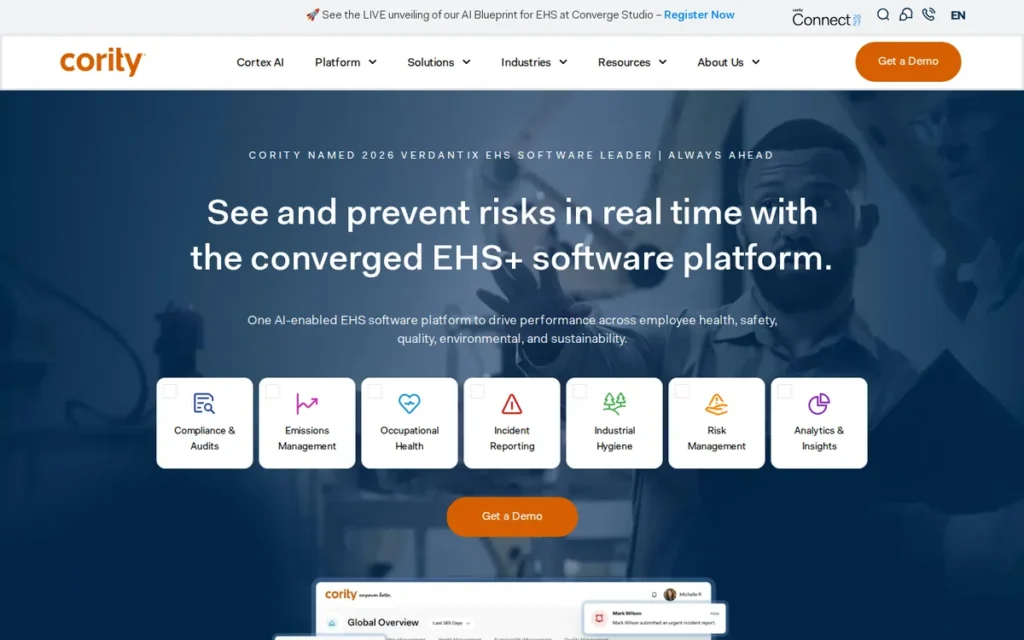
Category: Full EHS Suite, a comprehensive enterprise platform that converges chemical management, occupational health, safety, environmental compliance, quality, and ESG on a single CorityOne data architecture, designed for large regulated organizations rather than standalone chemical or SDS management.
At a Glance
- Category: Full EHS Suite
- Best For: Large enterprises in pharmaceutical manufacturing, chemical processing, mining, and heavy industry requiring integrated occupational health and full chemical lifecycle management (from pre-screening through procurement, use, and disposal) on a single platform
- Price Range: Pricing on request: enterprise investment tier; Chemical Management Essentials described as “cost-effective and rapidly deployable” with no public price range disclosed as of June 2026
- Primary Strength: Cority holds a Verdantix 2025 Green Quadrant Leader designation with the highest occupational health and industrial hygiene scores of any evaluated vendor, and its 3E-partnership SDS library covers more than 14 million SDSs in over 40 languages, the largest verified SDS repository in this evaluation
- Biggest Limitation: Cority requires significant upfront configuration, training, and IT resource investment before delivering full value, third-party reviewers describe a steep learning curve and warn the platform is only justified where “higher investment is appropriate,” making it unsuitable for SMBs or teams without dedicated EHS IT support
- One-Line Summary: Cority is the enterprise EHS+ platform recognized by Verdantix as a 2025 Green Quadrant Leader that delivers a 14-million-SDS library via 3E, chemical pre-screening approval workflows, and full chemical lifecycle management (from procurement to disposal) within a single converged CorityOne architecture.
- Last Verified: June 2026
Overview
Cority is an enterprise EHS+ platform purpose-built for large regulated organizations in pharmaceutical manufacturing, chemical processing, mining, and heavy industry that need chemical management, occupational health, safety, environmental compliance, and ESG unified on a single data architecture rather than disconnected point solutions.
Cority provides more than 14 million SDSs via the 3E (Verisk 3E) partnership, chemical pre-screening and approval workflows, real-time inventory tracking, and integration from procurement through disposal, all within the CorityOne platform. Cority earned Verdantix’s 2025 Green Quadrant Leader designation with the highest occupational health and industrial hygiene scores of any evaluated platform.
Named deployments include Leadec’s 1,500-user global rollout and Cornell University’s enterprise campus EHS operations, confirming Cority’s suitability across large-scale industrial and institutional environments.
Key Features
- 14-Million-SDS Library via 3E Partnership: Cority provides more than 14 million Safety Data Sheets in over 40 languages through its partnership with 3E (Verisk 3E), announced in 2024, representing a 30-times expansion over the previous library and substantially reducing missing-SDS risk for large or globally diverse chemical inventories (Cority 3E Partnership Announcement, 2024).
- Chemical Pre-Screening and Approval Workflows: Cority’s pre-screening workflow enables EHS managers to evaluate new substances against regulatory lists, internal hazard thresholds, and organizational standards before those chemicals are permitted onsite, actively gatekeeping rather than reactively tracking chemical additions (Cority Chemical Management Essentials press release, 2024).
- Integrated Occupational Health and Chemical Management: Cority integrates chemical inventory tracking with occupational health records and industrial hygiene monitoring within CorityOne, allowing exposure assessments and health surveillance to draw directly from the active chemical inventory without manual cross-system data transfers between separate platforms.
- Multi-Framework Compliance and Audit Trails: Cority supports OSHA HazCom, GHS, REACH, and Tier II compliance workflows with audit trails and documentation management connected to the same data layer as environmental and safety reporting, supporting regulatory inspection readiness across the full EHS function.
- CorityOne Unified Architecture: Cority’s CorityOne platform connects chemical management to safety incident reporting, EHSQ audits, environmental compliance, ESG sustainability disclosures, and occupational health records, enabling cross-functional EHS analytics from a single platform without separate system integrations.
Best For
Cority is best for large enterprises in pharmaceutical manufacturing, chemical processing, mining, and heavy industry, specifically organizations where chemical safety is inseparable from occupational health management and where the EHS function requires a single platform connecting incident reporting, industrial hygiene, chemical inventory, environmental compliance, and ESG reporting without manual cross-system data reconciliation.
Strengths
- Verdantix recognized Cority as a 2025 Green Quadrant Leader in EHS software with the highest occupational health and industrial hygiene scores of any evaluated platform, the strongest available independent analyst validation for compliance-intensive industries where chemical safety and worker health are operationally linked (Verdantix Green Quadrant EHS, 2025).
- Cority’s 3E partnership, announced in 2024, expanded its SDS library by 30 times to more than 14 million SDSs in over 40 languages (documented in Cority’s official partnership announcement) representing the largest verified SDS repository in this evaluation and substantially reducing missing-SDS risk for large chemical inventories (Cority 3E Partnership Announcement, 2024).
- Leadec, a global industrial services company, selected Cority for its 1,500-user enterprise EHS rollout because Cority offered “the best opportunity for global standardization, ease of use, and scalability over time”, a named customer reference confirming multi-site deployment capability and KPI-to-financial-incentive integration (Cority customer case video, Leadec, 2024).
- Cority’s chemical pre-screening and approval workflow is a documented capability absent from most competing platforms in this evaluation, enabling organizations to evaluate and block non-approved substances before they enter facility inventories rather than managing compliance reactively after chemicals are already onsite (Cority Chemical Management Essentials press release, 2024).
Users on r/SafetyProfessionals who have evaluated both Cority and VelocityEHS in production environments shared their perspective:
“I like cority, lots of modules available to expand to… Have worked with velocity ehs and have mixed feelings, they also tend to lack options and have a high cost.” Posted by u/skillet42565
Takeaway: EHS practitioners who have directly compared Cority and VelocityEHS consistently favor Cority’s module expandability, while flagging VelocityEHS’s narrower feature set and higher cost as recurring concerns that make Cority the more defensible long-term platform choice for organizations that anticipate scope expansion.
Limitations
- Implementation Depth vs. Deployment Speed: Cority’s most consequential trade-off is the breadth of the CorityOne platform versus the investment required to realize its value. Third-party reviewers explicitly describe Cority as presenting “a steep learning curve” and requiring “an upfront investment in time to set up,” with the platform positioned as justified only where “higher investment is appropriate” (BestOHSManagementSoftware.com; EHS Insight, 2025). Organizations without dedicated EHS IT resources will find this investment difficult to absorb.
- Scope Mismatch for Simpler Needs: Organizations that only need SDS storage, basic inventory tracking, or a single regulatory framework should evaluate whether Cority’s full-platform capability (spanning chemical management, occupational health, safety, environment, quality, and ESG) matches their actual scope before committing to Cority’s enterprise investment requirements.
- Opaque Pricing Without Entry-Level Guidance: Cority’s Chemical Management Essentials module is marketed as “cost-effective and rapidly deployable,” yet no price range (not even a broad annual band) is disclosed even for this entry-level offering. This gap between the module’s accessible positioning and its undisclosed enterprise-tier pricing reality is the most material procurement friction point for organizations still in the evaluation stage.
Verdict
Cority is the top-ranked chemical management platform in this evaluation, earning the #1 position through a Verdantix 2025 Green Quadrant Leader designation with the highest occupational health scores in the category, the largest verified SDS library, more than 14 million SDSs via the 3E partnership, and the only full EHS+ convergent architecture in this evaluation that manages the chemical lifecycle from pre-screening through procurement, use, and disposal within a single data layer. Cority ranks above VelocityEHS because its Green Quadrant Leader credential, combined with the only pre-screening approval workflow in the evaluation set, produced a higher combined C1+C4 weighted score, despite VelocityEHS holding the more topically focused chemicals-specific analyst designation. For enterprises in pharmaceutical, chemical processing, mining, or heavy industry where chemical safety is operationally inseparable from occupational health management, Cority delivers an integrated depth that no other platform reviewed in this evaluation provides within a single data architecture. Organizations must weigh this against Cority’s significant implementation complexity and enterprise-tier investment requirements.
2. VelocityEHS: Best for Enterprise Chemical Management Heritage: Highest Analyst Score in the Chemicals-Specific Category
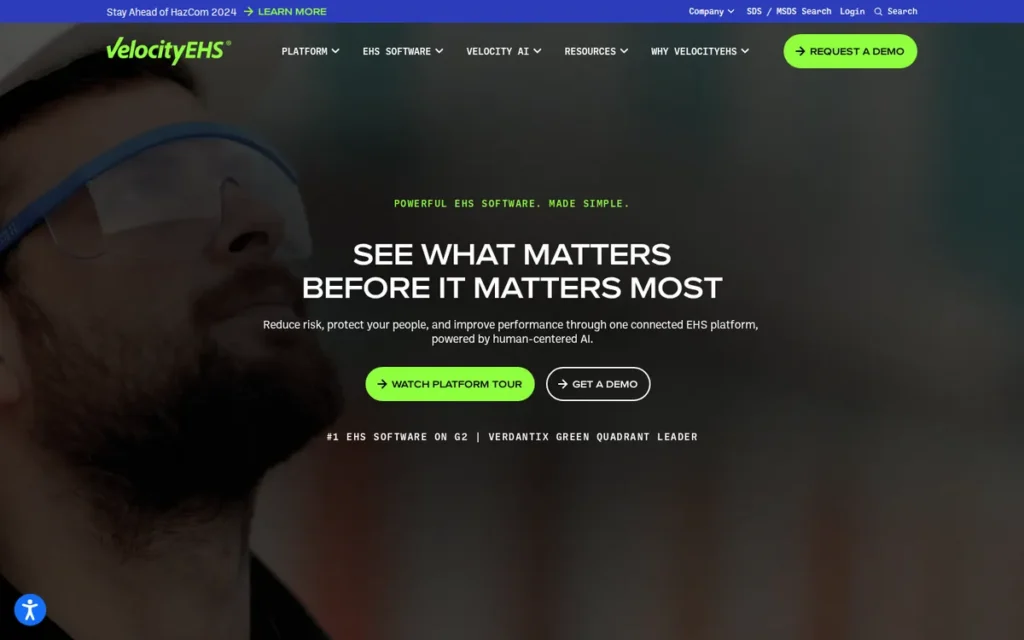
Category: Enterprise EHS Platform, an end-to-end cloud EHS and ESG suite with a dedicated chemical management module built on the MSDSonline heritage, serving organizations from single facilities to multinational enterprises across manufacturing, chemicals, life sciences, education, and government.
At a Glance
- Category: Enterprise EHS Platform
- Best For: Large enterprises: particularly Fortune 1000 manufacturers, chemical companies, life sciences firms, and government agencies, needing a proven, analyst-validated chemical management module with AI-powered SDS and PFAS capabilities within a comprehensive enterprise EHS suite
- Price Range: Pricing on request: enterprise tier; contact via toll-free 1.866.919.7922 or the Accelerate platform contact form (no public pricing as of June 2026)
- Primary Strength: VelocityEHS earned Verdantix Market-Leading status in 4 of 6 capability areas in the 2025 Smart Innovators: Chemicals Management Software report (the highest overall vendor score in the only analyst assessment dedicated specifically to chemical management software) and ranked #1 in the G2 Fall 2025 Environmental Health and Safety Software Report
- Biggest Limitation: VelocityEHS users on Capterra consistently report rigid report filters, slow generation times, limited export formatting options, and difficulty producing presentation-ready audit outputs, a recurring documented weakness in a platform otherwise rated highly for chemical management breadth
- One-Line Summary: VelocityEHS is the chemical management platform recognized by Verdantix as the highest-scoring vendor across the 2025 Smart Innovators: Chemicals Management Software evaluation, ranked #1 in the G2 Fall 2025 EHS Software Report, and reported by VelocityEHS as trusted by more than one-third of the Fortune Global 1000, with AI-powered PFAS constituent detection and over 10 million users worldwide.
- Last Verified: June 2026
Overview
VelocityEHS is an enterprise cloud EHS and ESG platform delivering chemical management through its Accelerate platform’s MSDSonline module, providing centralized SDS management, real-time multi-site chemical inventory tracking, GHS-compliant label printing, and regulatory indexing for OSHA HazCom, GHS, REACH, TSCA, Tier II, and PFAS lists within a unified system.
VelocityEHS reports serving more than one-third of the Fortune Global 1000 and over 10 million users worldwide, per VelocityEHS (March 2025). VelocityEHS earned Verdantix’s highest overall vendor score in the 2025 Smart Innovators: Chemicals Management Software report and ranked #1 in the G2 Fall 2025 Environmental Health and Safety Software Report, the broadest EHS peer review cycle G2 runs annually.
VelocityEHS ranks second rather than first because Cority’s chemical pre-screening approval workflow produced a higher combined C1+C4 weighted score. Both platforms represent best-in-class options for enterprise EHS buyers with different operational emphases.
Key Features
- MSDSonline Chemical Management Module: VelocityEHS’s MSDSonline module provides a centralized SDS library with automated content updates, GHS-compliant label printing, and chemical inventory tracking that displays real-time chemical locations, quantities, and storage data across multiple facilities from a single dashboard.
- AI-Powered PFAS Constituent Detection: VelocityEHS launched AI-powered chemical constituent indexing and PFAS detection as part of its 2025 roadmap, enabling EHS teams to automatically identify per- and polyfluoroalkyl substances within inventory chemical profiles without manual ingredient-by-ingredient review.
- 350+ Feature Platform Redesign: VelocityEHS’s Accelerate platform redesign introduced over 350 new and improved features (including enhanced regulatory indexing for OSHA HazCom, GHS, REACH, TSCA, Tier II, and PFAS) signaling sustained investment in the chemical-specific module rather than feature plateau (Lab Manager, 2024–2025).
- GHS Labeling and Tier II Reporting: VelocityEHS provides GHS-compliant labeling workflows and Tier II reporting support, enabling EHS teams to generate regulatory filings from inventory data already maintained in the platform rather than manually compiling chemical data across separate systems.
- Accelerate Platform Breadth: VelocityEHS’s Accelerate platform connects chemical management to incident reporting, industrial hygiene monitoring, safety audits, ergonomics, environmental compliance for air, water, and waste, and employee training, delivering a unified EHS data layer that eliminates separate cross-system data transfers.
Best For
VelocityEHS is best for large enterprises (particularly Fortune 1000 manufacturers, chemical companies, life sciences organizations, educational institutions, and government agencies) that need an analyst-validated, MSDSonline-heritage chemical management module with AI PFAS detection within a comprehensive EHS suite. VelocityEHS is most appropriate for organizations with internal resources to configure and maintain an enterprise-grade multi-module platform.
Strengths
- VelocityEHS received Verdantix’s Market-Leading designation in 4 of 6 capability areas in the 2025 Smart Innovators: Chemicals Management Software report, the highest overall vendor score in the only analyst assessment dedicated specifically to chemical management software, providing the most directly applicable independent validation available for this evaluation category (VelocityEHS press release, March 2025).
- VelocityEHS earned the #1 ranking and highest overall grid score in the G2 Fall 2025 Environmental Health and Safety Software Report (the broadest EHS software peer review cycle G2 runs annually) providing a second major independent recognition alongside the Verdantix chemicals-specific designation (GlobeNewswire, October 2025).
- VelocityEHS reports serving more than one-third of the Fortune Global 1000 and over 10 million users worldwide, per VelocityEHS (March 2025), the largest stated enterprise customer base in this evaluation, confirming proven scalability across complex, multi-site, multinational manufacturing environments.
- VelocityEHS launched AI-powered chemical constituent indexing and PFAS detection as part of its 2025 roadmap, directly addressing the growing regulatory burden under US EPA PFAS rules and EU REACH restriction proposals and enabling automatic identification of forever chemicals across large inventories without per-ingredient manual review.
Limitations
- Reporting Rigidity: VelocityEHS’s most consequential trade-off is its expansive chemical management breadth versus documented reporting limitations, Capterra reviewers specifically cite rigid report filters, slow generation times, limited export formatting, and difficulty producing presentation-ready audit documentation as recurring frustrations (Capterra, 2026). For EHS managers who regularly present compliance documentation to leadership, auditors, or executive stakeholders, this gap creates real workflow friction.
- Module Depth Variation: A safety professional in r/SafetyProfessionals described VelocityEHS’s training module as weaker relative to its chemical management and incident reporting capabilities, a community signal suggesting uneven module depth within the Accelerate suite for organizations that need training compliance alongside chemical management (Perplexity-surfaced citation, r/SafetyProfessionals, 2023, directional signal only; thread not directly retrievable during this research cycle due to server-side errors).
This broader usability frustration is echoed by other users on r/SafetyProfessionals:
“Personally, I don’t really like it and wouldn’t use it again if I had the choice. Maybe it’s just the way it was set up (before I joined), but it is not user friendly, it’s clunky, etc. Also, the customer service is really bad….they seem good at taking your money, but don’t care about managing the relationship once they have a contract signed.” Posted by r/SafetyProfessionals user, 2023
Takeaway: VelocityEHS’s usability and post-contract support quality are recurring community pain points that extend well beyond reporting friction, buyers locked into multi-year enterprise agreements should probe both implementation support responsiveness and account management commitment before signing.
- Opaque Pricing with High Discovery Friction: VelocityEHS’s phone-first contact model, toll-free 1.866.919.7922, requires a more active engagement step than digital-first quote forms, limiting early-stage budget qualification for teams evaluating multiple platforms simultaneously. No pricing range is publicly disclosed as of June 2026.
Verdict
VelocityEHS is the second-ranked chemical management platform in this evaluation, earning its position through Verdantix’s highest overall vendor score in the 2025 Smart Innovators: Chemicals Management Software report, the G2 Fall 2025 #1 EHS ranking, and the largest stated enterprise customer base in the evaluation, more than one-third of the Fortune Global 1000, per VelocityEHS. VelocityEHS is the strongest choice for large enterprises that prioritize proven, analyst-validated chemical management heritage within a comprehensive EHS suite, particularly in manufacturing, chemicals, life sciences, and government where MSDSonline’s established track record and AI PFAS detection reduce both implementation risk and emerging compliance exposure. Buyers should independently assess whether VelocityEHS’s documented reporting limitations affect their specific audit and compliance documentation workflows before committing to an enterprise-tier investment.
3. SDS Manager: Best for SMBs and Budget-Transparent Buyers: Only Platform with Verified Public Pricing
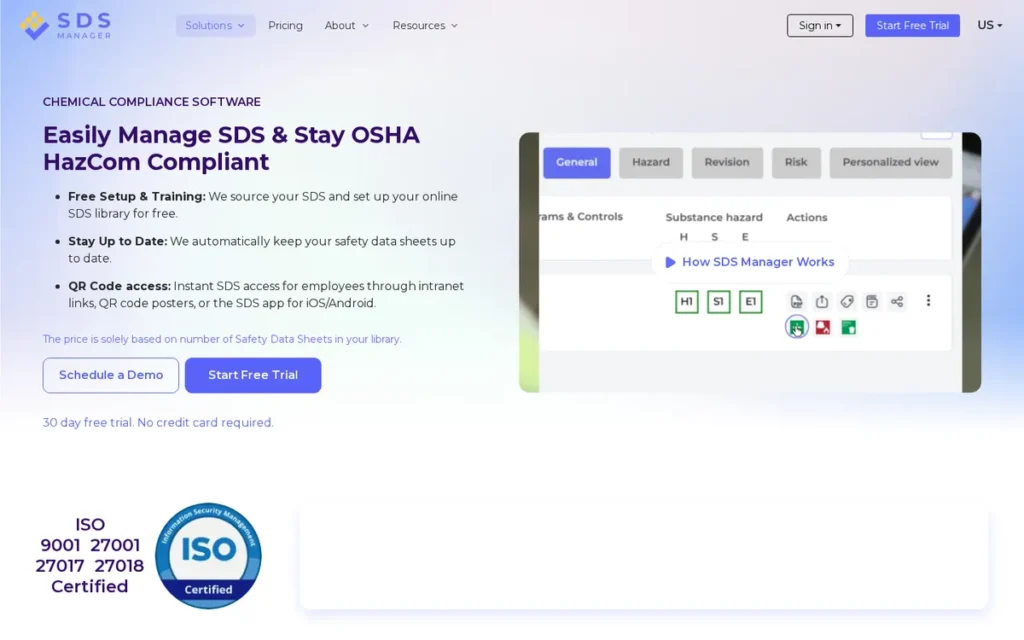
Category: SDS Management Platform, a cloud-based tool focused on centralized SDS storage from a 14-million-document library, confirmed offline mobile access, real-time chemical inventory tracking, and AI-assisted SDS authoring via ExactSDS, designed for organizations from small businesses to mid-market enterprises that need SDS compliance without full enterprise EHS suite complexity.
At a Glance
- Category: SDS Management Platform
- Best For: Small businesses, mid-market manufacturers, and EHS teams earlier in their digitalization journey that need accessible SDS management, confirmed offline mobile access for plant floor workers, and transparent pricing without enterprise EHS suite complexity
- Price Range: $1,499/year (Basic Standard) | $199/SDS (Pay As You Go) | $9.99–$12.99/employee/month, as verified at sdsmanager.com/us/pricing/ in June 2026
- Primary Strength: SDS Manager is the only chemical management platform in this evaluation that publishes transparent public pricing (with verified plans starting at $1,499 per year) enabling SMBs and mid-market buyers to qualify budget fit before engaging a sales team; SDS Manager also holds a G2 rating of 4.9/5 from 13 verified reviews and a Capterra rating of 4.2/5 from 13 reviews (both accessed June 2026), alongside G2 Top Trending status in the Chemical Management category
- Biggest Limitation: SDS Manager’s regulatory compliance breadth is narrower than enterprise EHS platforms, automated multi-framework compliance across REACH, TSCA, Tier II report generation, and PCN dossier management is not documented in available public sources at the same depth as Cority or VelocityEHS
- One-Line Summary: SDS Manager is the only chemical management platform in this evaluation with publicly listed pricing starting at $1,499 per year, the only independently confirmed offline mobile SDS access, and G2 Top Trending status in the Chemical Management category, the strongest option for SMB and mid-market EHS teams replacing binder-based or spreadsheet systems.
- Last Verified: June 2026
Overview
SDS Manager is a cloud-based SDS management and chemical inventory platform designed for organizations from small businesses to mid-market enterprises that need accessible, affordable SDS compliance without the implementation complexity of a full enterprise EHS suite.
SDS Manager provides centralized SDS storage from a 14-million-document library in 40+ languages, confirmed offline mobile access via QR and barcode scanning, AI-assisted SDS authoring through ExactSDS, and real-time chemical inventory tracking, with transparent public pricing starting at $1,499 per year as verified at sdsmanager.com/us/pricing/ in June 2026.
SDS Manager holds G2 Top Trending Product status in the Chemical Management category, a G2 rating of 4.9/5 from 13 verified reviews, and a Capterra rating of 4.2/5 from 13 reviews (both June 2026). SDS Manager is also listed as a Product Intelligence Solution on the Enhesa platform, a regulatory compliance intelligence firm with 45 years of expertise serving over 1,200 clients in 130+ countries.
Key Features
- Confirmed Offline Mobile SDS Access: SDS Manager provides offline mobile access to its full SDS library (including one-click retrieval of first aid, firefighting, and spill guidance sections) functioning without internet connectivity, as documented in its Apple App Store listing, June 2026 as a core feature designed for workers in low-connectivity industrial environments such as loading docks, storage areas, and manufacturing floors.
- ExactSDS AI Authoring Tool: SDS Manager’s ExactSDS AI authoring tool generates GHS-aligned Safety Data Sheets using natural language processing across multiple regulatory markets, enabling organizations that also create SDSs to author compliant documents from within the same platform they use to manage incoming supplier SDSs.
- 14-Million-SDS Global Repository: SDS Manager maintains a global SDS repository of more than 14 million SDSs in over 40 languages, providing coverage breadth for organizations managing large or internationally diverse chemical inventories at a price point previously available only to enterprise buyers (CloudSDS analysis, 2026).
- Transparent Public Pricing Tiers: SDS Manager publishes transparent public pricing, Pay As You Go at $199 per SDS, Basic Standard at $1,499 per year, and per-employee pricing at $9.99 to $12.99 per user per month, making SDS Manager the only platform in this evaluation that enables budget qualification before contacting a sales representative.
- Enhesa Platform Association: SDS Manager is listed as a Product Intelligence Solution on the Enhesa platform, associating SDS Manager with a regulatory compliance intelligence organization with 45 years of expertise and over 1,200 clients across 130+ countries, a regulatory content credibility signal that distinguishes SDS Manager from standalone SMB SDS tools without regulatory data partnerships (Enhesa product intelligence platform, 2026).
Best For
SDS Manager is best for small businesses, mid-market manufacturers typically under 500 employees or operating from a single facility, and EHS teams replacing paper binder SDS systems or Excel-based chemical tracking. SDS Manager is the strongest fit where offline mobile access on the plant floor is a safety-critical operational requirement and where pricing transparency is a prerequisite for internal budget approval.
Strengths
- SDS Manager is the G2 Top Trending Product in the Chemical Management category as of 2026, indicating the fastest-growing review acquisition rate in the category, a validated independent signal of accelerating market adoption that reflects genuine user momentum rather than vendor marketing (G2 Chemical Management category listing, 2026).
- SDS Manager holds a G2 rating of 4.9 out of 5 from 13 verified reviews and a Capterra rating of 4.2 out of 5 from 13 reviews (both accessed June 2026), strong early-adopter satisfaction from a growing review base, with independent review site SafetyCulture specifically citing SDS Manager’s AI-powered tools and QR code features as key satisfaction drivers (SafetyCulture SDS Software Roundup, 2026; Capterra, June 2026).
- SDS Manager confirms offline mobile SDS access in its Apple App Store listing: retrievable without internet connectivity, directly addressing the field-worker SDS safety gap that cloud-only enterprise platforms leave unresolved in industrial environments where consistent Wi-Fi cannot be guaranteed. SDS Manager is the only platform for which this capability was independently confirmed in a third-party document during this research cycle; other platforms may support offline access but did not document it in publicly available sources reviewed as of June 2026 (Apple App Store, June 2026).
- SDS Manager’s listing on Enhesa’s Product Intelligence platform connects SDS Manager to a regulatory compliance intelligence organization with 45 years of expertise and over 1,200 clients in 130+ countries, suggesting regulatory content depth that extends beyond what a standalone SMB SDS platform typically provides independently (Enhesa product intelligence platform, 2026).
Limitations
- Regulatory Compliance Breadth: SDS Manager’s most consequential trade-off is scope versus accessibility, SDS Manager delivers SDS management, offline mobile access, chemical inventory tracking, and AI authoring at an SMB-accessible price, but does not document the same automated regulatory compliance depth as enterprise platforms. The following capabilities are not documented in available public sources for SDS Manager as of June 2026:
- Automated Tier II EPCRA report generation
- REACH substance registration workflow automation
- TSCA inventory tracking automation
- PCN dossier management for EU CLP compliance
- SDS Update Mechanism Not Publicly Documented: SDS Manager’s stated 14-million-SDS library matches Cority’s in claimed size, but the SDS update mechanism (how documents are kept current when manufacturers reformulate products or regulatory classifications change) is not publicly documented. Buyers managing high-turnover chemical inventories should verify update frequency and library maintenance methodology before purchase.
- Limited Corporate Transparency: SDS Manager’s corporate background: including founding date, headquarters location, and team size, is not publicly disclosed, which may require additional vendor stability due diligence for organizations with formal procurement processes requiring financial and organizational transparency from SaaS vendors.
Verdict
SDS Manager is the top-ranked chemical management platform for SMB and mid-market organizations in this evaluation, earning its position as the only platform in this review that publishes transparent public pricing (starting at $1,499 per year) combined with the only independently confirmed offline mobile SDS access capability in the evaluation set and G2 Top Trending status confirming the category’s fastest-growing review momentum. SDS Manager is the strongest entry point for organizations replacing paper binder SDS systems or spreadsheet-based chemical tracking, particularly where field workers need SDS access in low-connectivity environments and where pricing transparency is required for internal budget approval. Buyers requiring automated multi-framework compliance across REACH, TSCA, Tier II, and PCN dossier management should evaluate whether SDS Manager’s compliance automation depth meets their regulatory obligations before purchasing.
4. Benchmark Gensuite: Best for AI-Native Enterprise EHS: First Generative AI Platform in the Chemical Management Category
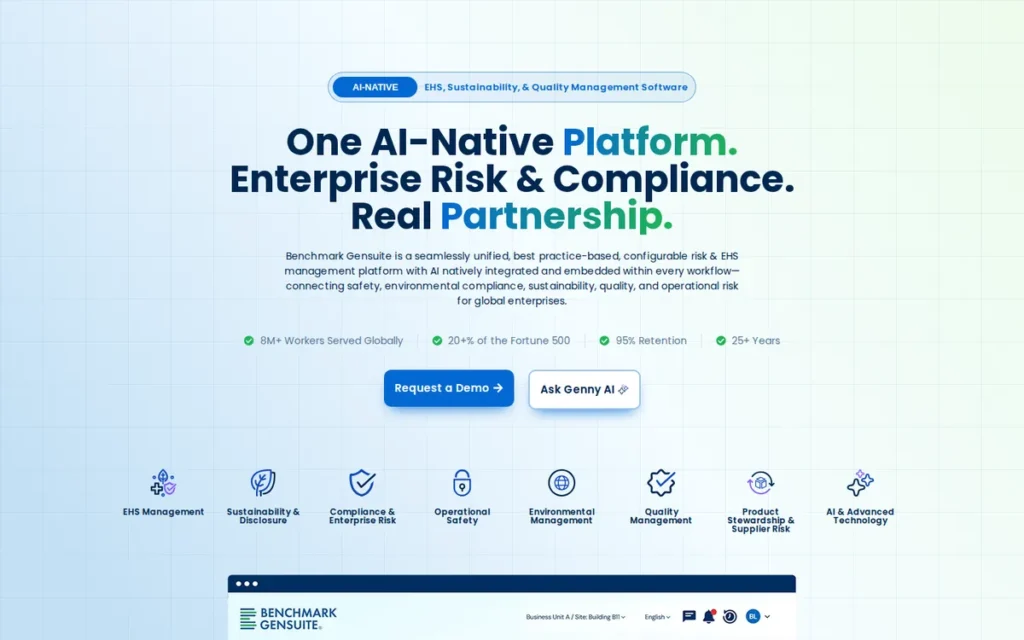
Category: AI-Native EHS Suite, an enterprise EHS and sustainability management platform operating under Sphera, distinguished by the first generative AI implementation in the EHS market (Genny AI, March 2024) and a Verdantix 2025 AI Pacesetter designation for natively embedding AI across chemical management and EHS subscriber workflows.
At a Glance
- Category: AI-Native EHS Suite
- Best For: Large enterprises and Fortune 500 organizations in chemical manufacturing, oil and gas, and industrial sectors where AI-driven EHS automation, AI-powered PFAS compliance detection, and integrated ESG sustainability reporting are strategic priorities alongside chemical management
- Price Range: Pricing on request: high total cost of ownership noted by reviewers as cost-prohibitive for non-Fortune 500 organizations (no public pricing as of June 2026)
- Primary Strength: Benchmark Gensuite is the only platform in this evaluation recognized by Verdantix as a 2025 AI Pacesetter for natively embedding generative AI across EHS workflows and winner of the 2026 E+E Leader Award for AI-powered SDS software, including a Genny AI SDS Agent that, per Benchmark Gensuite’s own press release (2025), claims to automate 80% of manual SDS data entry
- Biggest Limitation: Benchmark Gensuite carries a steep learning curve, complex implementation requirements, and a high total cost of ownership that reviewers consistently identify as prohibitive for organizations outside its Fortune 500 target market
- One-Line Summary: Benchmark Gensuite is the enterprise EHS platform recognized by Verdantix as the 2025 AI Pacesetter, winner of the 2026 E+E Leader Award for AI-powered SDS software, and the first technology provider to bring Generative AI to EHS data management (March 2024), with a Genny AI SDS Agent claiming 80% automation of manual SDS data entry and AI-powered PFAS constituent detection.
- Last Verified: June 2026
Overview
Benchmark Gensuite is an enterprise EHS and sustainability management platform operating under Sphera (a Blackstone portfolio company) that was the first technology provider to embed Generative AI in EHS data management, launching the Genny AI suite in March 2024 and earning a Verdantix AI Pacesetter 2025 designation for natively integrating AI across subscriber EHS workflows.
Benchmark Gensuite also won the 2026 Environment+Energy Leader Award for its AI-powered SDS software, confirming independent third-party industry recognition beyond the Verdantix designation. Benchmark Gensuite delivers chemical management through a centralized repository of 190,000 globally harmonized SDSs, the Genny AI SDS Agent, and integrated ESG and product stewardship reporting.
Key Features
- Genny AI SDS Agent: Benchmark Gensuite’s Genny AI SDS Agent automates SDS extraction from PDF documents, populating form fields automatically, performing chemical constituent indexing, and verifying SDS version currency. Per Benchmark Gensuite’s own press release (2025), the agent claims up to 80% reduction in manual SDS data entry; this figure has not been independently verified in a third-party case study (Benchmark Gensuite SDS press release, 2025).
- AI-Powered PFAS Constituent Detection: Benchmark Gensuite includes AI-powered PFAS detection through its chemical constituent indexing capability, automatically flagging per- and polyfluoroalkyl substances within inventory chemical profiles, addressing an expanding compliance obligation under US EPA PFAS rules and EU REACH restriction proposals without requiring manual per-ingredient review.
- SDS Self-Authoring and Harmonized Repository: Benchmark Gensuite provides SDS self-authoring capabilities alongside its centralized repository of 190,000 globally harmonized SDSs, enabling EHS teams to manage both supplier-provided and internally authored SDSs within a single platform without maintaining separate authoring and access systems.
- ESG and Product Stewardship Integration: Benchmark Gensuite operates under Sphera’s enterprise EHS and ESG platform umbrella, connecting chemical management data to operational risk, product stewardship, and sustainability reporting, enabling chemical inventory data to feed directly into Scope 3 supply chain transparency disclosures and investor-facing ESG reports.
- Verdantix AI Pacesetter Architecture: Benchmark Gensuite received Verdantix’s 2025 AI Integration Pacesetter designation, the only platform in this evaluation to receive a specific analyst recognition for AI-native EHS workflow implementation, confirming that Benchmark Gensuite’s AI capabilities represent intentional platform architecture rather than a retrofitted add-on feature (Verdantix Green Quadrant EHS, 2025).
Best For
Benchmark Gensuite is best for large enterprises and Fortune 500 organizations in chemical manufacturing, oil and gas, and industrial sectors where Generative AI automation of EHS data workflows, AI-driven PFAS detection, and integrated ESG sustainability reporting are strategic priorities, particularly organizations that need chemical management data to feed directly into investor-facing sustainability disclosures and product stewardship documentation.
Strengths
- Benchmark Gensuite received Verdantix’s 2025 AI Integration Pacesetter designation, the only vendor in this evaluation specifically recognized for natively embedding AI across EHS subscriber workflows, confirming class-leading AI implementation maturity relative to peers who added AI as a post-launch retrofit rather than a foundational architecture layer (Verdantix Green Quadrant EHS, 2025).
- Benchmark Gensuite was the first technology provider to bring Generative AI to EHS data management with the Genny AI suite launch in March 2024, establishing over two years of live AI-in-production EHS workflow experience ahead of competitors who launched AI features later in 2024 or 2025 (Benchmark Gensuite GenAI press release, March 2024).
- Benchmark Gensuite’s AI-powered SDS software won the 2026 Environment+Energy Leader Award, a peer-reviewed industry recognition providing third-party validation of Benchmark Gensuite’s AI SDS capability from an independent editorial source beyond the Verdantix analyst designation (PR Newswire, 2026).
- Benchmark Gensuite operates under Sphera (a Blackstone portfolio company): providing significant private equity capital backing for sustained R&D investment in AI-native EHS features and enterprise sales capacity that independent or smaller-backed EHS vendors cannot match at equivalent development velocity.
Limitations
- AI Capability vs. Total Cost and Accessibility: Benchmark Gensuite’s most consequential trade-off is AI-native sophistication versus total cost of ownership and accessibility, the same depth that earns the Verdantix AI Pacesetter designation comes with a steep learning curve, complex implementation requirements, and high total cost of ownership that reviewers consistently identify as prohibitive for non-Fortune 500 organizations, with occasional support delays also flagged as a post-implementation concern (EHS Insight, 2025).
EHS professionals on r/SafetyProfessionals who have navigated Gensuite implementations offered a candid warning:
“Dont do it. Yes it can be handy when it’s all set up but that takes years of trial and error.” Posted by u/brotherazrael
Takeaway: Community consensus on Benchmark Gensuite’s implementation burden is consistent and specific, the platform delivers real capability once fully configured, but the time-to-value gap is measured in years rather than months, making it unsuitable for organizations without a dedicated, long-term EHS IT investment commitment.
- SDS Repository Scale Gap: Benchmark Gensuite’s stated SDS repository of 190,000 globally harmonized SDSs is substantially smaller in raw document count than Cority’s 14 million or SDS Manager’s 14 million, a gap that becomes relevant when organizations manage large or globally diverse chemical inventories where niche or regional SDS coverage beyond the curated repository is required.
- Unverified Vendor-Asserted AI Efficiency Claim: The Genny AI SDS Agent’s 80% manual data entry automation figure is a vendor-asserted claim from Benchmark Gensuite’s own press release, not a finding from an independent case study, analyst firm, or controlled benchmark. The 2026 E+E Leader Award confirms industry recognition of the AI SDS capability but does not independently validate the specific 80% efficiency metric for any deployment context. Buyers should validate this claim for their specific SDS volume and document complexity during the sales process.
Verdict
Benchmark Gensuite is the top-ranked AI-native chemical management platform in this evaluation, earning its position through the Verdantix 2025 AI Pacesetter designation, the 2026 E+E Leader Award for AI-powered SDS software, and first-to-market Generative AI implementation in EHS that gives Benchmark Gensuite over two years of live production experience relative to most AI-adding competitors. For Fortune 500 enterprises where Generative AI automation of EHS workflows, PFAS constituent detection, and ESG sustainability integration are genuine strategic priorities, Benchmark Gensuite delivers AI-native capabilities that no other platform in this evaluation currently matches as of June 2026. Organizations outside the Fortune 500 target market should carefully validate total cost of ownership and implementation complexity, reviewer consensus indicates Benchmark Gensuite’s investment requirements may exceed mid-market EHS budgets.
5. EcoOnline: Best for Multi-National Global Compliance: Strongest Documented Support Quality in the Evaluation
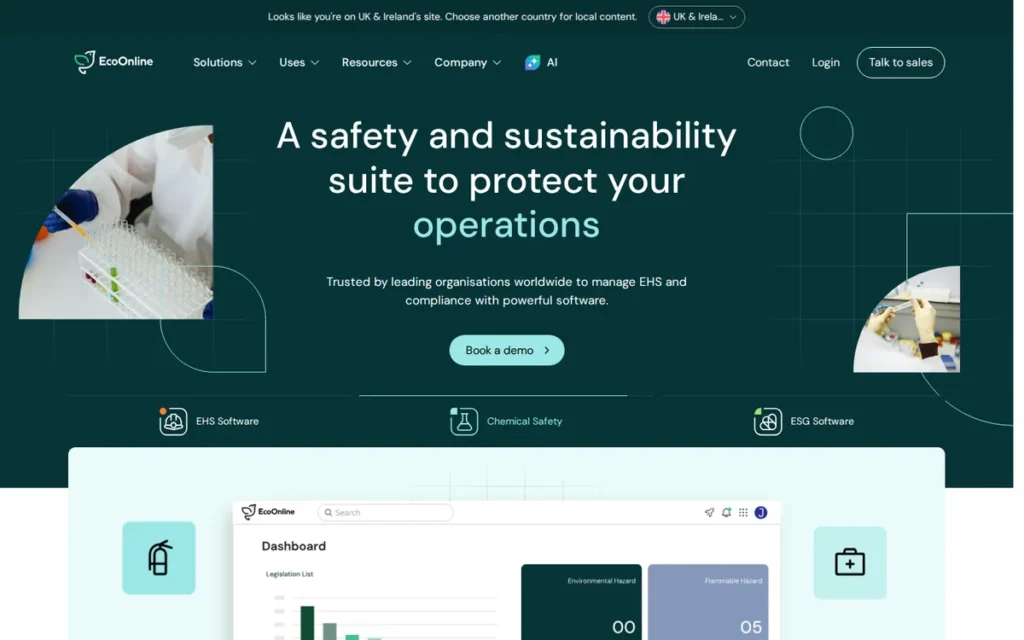
Category: Integrated Chemical Safety Platform, a unified cloud system combining SDS management, chemical inventory control, custom risk assessments, employee training, and chemical exposure tracking with AI-assisted SDS extraction and a managed SDS sourcing service that retrieves documents directly from manufacturers.
At a Glance
- Category: Integrated Chemical Safety Platform
- Best For: Multi-site, multi-national enterprises in oil and gas, manufacturing, pharmaceuticals, and construction that need simultaneous regulatory compliance across 80+ countries, a managed SDS sourcing service to eliminate update burden, and demonstrated high-quality post-implementation support
- Price Range: Pricing on request: enterprise tier; managed SDS sourcing service overhead likely increases true TCO beyond platform licensing (no public pricing as of June 2026)
- Primary Strength: EcoOnline holds a G2 Quality of Support score of 9.6 out of 10 (the highest documented support quality rating in this evaluation) and delivers a managed SDS sourcing service that retrieves Safety Data Sheets directly from chemical manufacturers, eliminating the manual update burden from the customer’s EHS team
- Biggest Limitation: EcoOnline has no publicly documented Verdantix analyst designation in available sources (the primary independent analyst credential for platforms in this category) making formal third-party capability validation harder to verify compared to Cority, VelocityEHS, or Benchmark Gensuite
- One-Line Summary: EcoOnline is the integrated chemical safety platform trusted by over 10,000 brands worldwide, per EcoOnline (2026), providing a managed SDS sourcing service direct from manufacturers, AI-powered Smart Extraction, and regulatory compliance coverage across 80+ countries, with a G2 Quality of Support score of 9.6 out of 10.
- Last Verified: June 2026
Overview
EcoOnline is a unified chemical safety and EHS platform founded in 2000 and trusted by over 10,000 brands worldwide, per EcoOnline (2026), delivering SDS management, chemical inventory tracking, custom risk assessments, chemical exposure monitoring, and employee training integration within a single cloud system purpose-built for multi-site, globally distributed organizations.
EcoOnline differentiates through a managed SDS sourcing service that retrieves Safety Data Sheets directly from chemical manufacturers on behalf of its customers (eliminating the administrative burden of SDS update tracking) and through its AI-powered Smart Extraction tool launched in May 2025, which automatically extracts key compliance fields from SDS PDF sections 1, 2, 3, 8, 9, 13, and 14 (PR Newswire, May 2025).
EcoOnline ranks fifth (below Benchmark Gensuite at #4) because Benchmark Gensuite’s Verdantix AI Pacesetter designation is a formal analyst credential under C1 (the primary-weight criterion), while EcoOnline’s G2 Quality of Support score, while excellent, is a review platform signal. Both produced equal weighted scores; Benchmark Gensuite’s analyst credential breaks the tie under C1.
Key Features
- Managed SDS Sourcing Service: EcoOnline’s managed SDS sourcing service retrieves Safety Data Sheets directly from chemical manufacturers on behalf of its customers, ensuring SDS content remains current without requiring EHS teams to manually request, download, or update documents, directly addressing SDS staleness at the supplier source rather than after the fact (EcoOnline help center, 2026).
- AI-Powered SDS Smart Extraction: EcoOnline launched AI-powered SDS Smart Extraction in May 2025, an NLP tool that automatically extracts key data fields from SDS PDF sections 1, 2, 3, 8, 9, 13, and 14, enabling compliance teams to process new SDS documents “in just minutes, not hours” (PR Newswire, May 2025).
- 80+ Country Regulatory Coverage: EcoOnline provides regulatory compliance coverage across 80+ countries (supporting OSHA HazCom, GHS, REACH, CLP, and additional regional requirements simultaneously in a single platform) the broadest stated geographic compliance footprint of any platform in this evaluation (EcoOnline chemical management page, 2026).
- Integrated Risk Assessment and Exposure Tracking: EcoOnline integrates chemical risk assessments, employee training records, and chemical exposure tracking within the same platform as SDS management, connecting chemical data directly to worker health monitoring and training compliance without requiring separate system data transfers.
- Multi-Site Chemical Inventory with Mobile Access: EcoOnline’s chemical management module supports real-time inventory tracking across multiple sites (including chemical location data, quantities, and storage conditions) with mobile QR code access enabling field retrieval of chemical safety information from the plant floor.
Best For
EcoOnline is best for multi-site, multi-national enterprises (particularly in oil and gas, manufacturing, pharmaceuticals, and construction) where simultaneous regulatory compliance across 80+ countries is required and where the administrative burden of SDS update management has become a capacity constraint. EcoOnline’s managed sourcing service provides a meaningful operational advantage over self-managed SDS library tools for organizations with high chemical turnover or frequent supplier changes.
Strengths
- EcoOnline holds a G2 Quality of Support score of 9.6 out of 10: the highest documented support quality rating in this evaluation, a differentiator that matters in enterprise chemical management deployments where post-implementation responsiveness determines how quickly SDS compliance gaps are identified and resolved (G2 Chemical Management category listing, 2026).
- EcoOnline is trusted by over 10,000 brands worldwide, per EcoOnline (2026), and has operated since 2000, confirming 25+ years of accumulated regulatory content and implementation experience across chemical safety, EHS, and sustainability, relevant for multi-national organizations requiring compliance content spanning multiple regulatory cycles (PR Newswire, May 2025).
- EcoOnline launched AI-powered SDS Smart Extraction in May 2025: an NLP capability automatically extracting key data fields from SDS PDF sections 1, 2, 3, 8, 9, 13, and 14, placing EcoOnline alongside Benchmark Gensuite and VelocityEHS in the cohort of platforms that delivered AI-driven SDS processing in 2024–2025 (PR Newswire, May 2025).
- EcoOnline’s managed SDS sourcing service: retrieving SDSs directly from chemical manufacturers on behalf of customers, is a documented service differentiation not replicated by any other platform in this evaluation, directly addressing the most frequently cited EHS manager pain point: keeping SDS content current when manufacturers update formulations or regulatory classifications change (EcoOnline help center, 2026).
Limitations
- Absence of Verdantix Analyst Designation: EcoOnline’s most significant limitation for buyers conducting structured third-party due diligence is the absence of a publicly documented Verdantix analyst designation in available sources, making formal capability validation harder to verify than for Cority (Green Quadrant Leader), VelocityEHS (Smart Innovators Market-Leading), or Benchmark Gensuite (AI Pacesetter). Organizations should request direct customer references in their specific industry and regulatory context before purchasing at enterprise-tier investment.
- Managed Sourcing TCO Implications: EcoOnline’s managed SDS sourcing service, a genuine operational differentiator, likely carries labor-intensive service overhead costs beyond platform licensing that standard quote-based pricing obscures until contract negotiation. EcoOnline’s true total cost of ownership may be higher than platforms delivering AI extraction tools rather than outsourced sourcing staff, a distinction material to enterprise budget planning.
- Limited Chemical Module Review Volume: EcoOnline’s independent review volume on G2 and Capterra for the chemical management module specifically appears more limited than enterprise competitors with longer US market tenure, buyers who rely on review platform signals will find less aggregated peer data to validate capability claims and should conduct deeper vendor reference calls.
Verdict
EcoOnline is the top-ranked chemical management platform for multi-national, globally distributed organizations in this evaluation, earning its position through 80+ country regulatory compliance coverage, a managed SDS sourcing service that addresses SDS staleness at the manufacturer source, and a G2 Quality of Support score of 9.6 out of 10, the highest documented support quality in the evaluation set. EcoOnline ranks below Benchmark Gensuite because Benchmark Gensuite’s Verdantix AI Pacesetter designation is a formal analyst credential under the primary-weight C1 criterion, while EcoOnline’s G2 support score is a review platform signal, both produced equal weighted scores, with the analyst credential as the decisive differentiator. EcoOnline is the strongest choice for enterprises where simultaneous multi-jurisdiction compliance and post-implementation support responsiveness are top-priority criteria. Buyers should request an independent analyst validation reference during the sales process and probe automated REACH, TSCA, Tier II, and PFAS detection depth relative to their specific regulatory exposure.
6. Lisam ExESS: Best for Chemical Manufacturers and Formulators: Specialist SDS Authoring in 57 Languages
Category: SDS Authoring Suite, a specialist platform designed for chemical manufacturers and formulators that need to create, manage, and distribute GHS-compliant Safety Data Sheets and labels across 57 languages and 30+ regulatory regions, including EU PCN dossier submissions, not a chemical inventory management or broader EHS platform.
At a Glance
- Category: SDS Authoring Suite
- Best For: Chemical manufacturers, formulators, and product stewardship teams responsible for creating, maintaining, and distributing GHS-compliant Safety Data Sheets in multiple languages across global markets, particularly organizations with EU CLP obligations requiring PCN dossier submissions
- Price Range: Annual subscription, pricing on request; Reddit r/chemistry community signal of approximately $5,000/year for 2 users (r/chemistry, “SDS authoring software,” 2023, directional floor only; the 2023 figure may not reflect 2026 pricing or configurations with additional language packs or regional modules)
- Primary Strength: Lisam ExESS generates SDS documents in 57 languages with GHS-compliant labeling for over 30 regulatory regions and includes PCN dossier management for EU CLP compliance, the most comprehensive multilingual SDS authoring capability in this evaluation, backed by 35 years of specialized chemical compliance expertise since 1990
- Biggest Limitation: Lisam ExESS is a specialist SDS authoring and regulatory compliance platform (not a chemical inventory management or broader EHS tool) meaning organizations that also need inventory tracking, mobile worker SDS access, incident management, or cross-functional EHS capabilities must maintain a separate system alongside ExESS
- One-Line Summary: Lisam ExESS is a specialist SDS authoring platform operating since 1990 that generates compliant Safety Data Sheets in 57 languages with GHS labeling for over 30 regulatory regions, PCN dossier management for EU CLP compliance, and BarTender integration, the top-ranked tool for chemical manufacturers that create and distribute SDSs globally.
- Last Verified: June 2026
Overview
Lisam ExESS is a specialist Safety Data Sheet authoring and global chemical regulatory compliance platform developed by LISAM SYSTEMS s.a. in Ecaussinnes, Belgium, operating since 1990 and serving chemical manufacturers, formulators, and product stewardship teams that need to create, classify, and distribute GHS-compliant SDSs and labels across 57 languages and 30+ regulatory regions.
Lisam ExESS is designed for organizations that author SDSs as a business function, not for EHS managers at facilities that receive and manage supplier-provided SDSs. Lisam ExESS covers the full SDS authoring lifecycle: automated GHS hazard classification, multilingual SDS generation, GHS-aligned label generation via BarTender integration, PCN dossier creation for EU CLP compliance under Regulation (EC) 1272/2008, and REACH and CLP regulatory support, with deployment options spanning single workstation, corporate network, and cloud (Lisam ExESS SDS authoring page).
Key Features
- 57-Language SDS Generation: Lisam ExESS generates Safety Data Sheets in 57 languages with GHS-compliant content tailored to local regulatory requirements, enabling chemical manufacturers selling into North American, European, APAC, and MENA markets to manage all regional SDS authoring obligations from a single platform rather than maintaining separate local systems (Lisam ExESS software document).
- GHS Labeling with BarTender Integration: Lisam ExESS produces GHS-compliant labels for over 30 regulatory regions directly from SDS data within the platform, with native integration to BarTender industrial label printing software, ensuring physical labels in high-volume manufacturing operations are always synchronized with current SDS data in ExESS and eliminating a separate manual re-entry step (Lisam ExESS SDS authoring page).
- PCN Dossier Management: Lisam ExESS includes PCN (Poison Centre Notification) dossier creation and submission capabilities for EU CLP compliance under Regulation (EC) 1272/2008, an obligation that expanded to professional and industrial chemical products in 2024 and is not documented as a feature by any other platform reviewed in this evaluation as of June 2026 (Lisam dossiers page).
- REACH and CLP Compliance Workflows: Lisam ExESS supports REACH and CLP compliance workflows including automated substance classification, mixture ingredient assessment, and ongoing regulatory update integration, with 35 years of accumulated European chemical regulatory expertise embedded in the platform’s regulatory content architecture since its 1990 founding.
- Flexible Deployment Options: Lisam ExESS is available in single workstation, corporate network, and cloud deployment configurations, giving chemical manufacturers the flexibility to align the deployment model with their IT infrastructure, data security requirements, and existing enterprise architecture.
Best For
Lisam ExESS is best for chemical manufacturers, chemical formulators, and product stewardship teams that sell chemical products across multiple markets and are responsible for creating, maintaining, and distributing GHS-compliant Safety Data Sheets and labels in multiple languages, particularly organizations with active EU CLP obligations requiring PCN dossier submissions for mixtures placed on the European market.
Strengths
- Lisam ExESS has operated in chemical compliance software continuously since 1990: over 35 years, making Lisam ExESS the longest-tenured specialized chemical compliance software vendor in this evaluation, with institutional regulatory knowledge spanning GHS global harmonization, REACH implementation, CLP adoption, and the 2024 PCN expansion (confirmed in Lisam BIG database reference materials; 1990 operational history documented).
- Lisam ExESS received an organic positive recommendation from an r/chemistry community user in a peer discussion thread about SDS authoring tools (“a really nice software with a ton of functionality”) a spontaneous community signal in a highly specialized platform segment where mainstream review platform data is minimal (Reddit r/chemistry, “SDS authoring software,” 2023).
“ExESS by LISAM. I believe we pay around $5000 yearly for 2 users. It’s a really nice software with a ton of functionality.” (r/chemistry user, 2023)
Takeaway: Despite minimal mainstream review presence, Lisam ExESS has earned organic positive word-of-mouth credibility in the specialized chemistry and chemical regulatory compliance community among users who work with the platform daily, a meaningful signal given the limited review sample.
- Lisam ExESS’s PCN dossier management capability addresses a growing EU CLP regulatory obligation (expanded to professional and industrial chemical products in 2024) that is not documented as a feature by any other platform reviewed in this evaluation as of June 2026, making Lisam ExESS the only evaluated option for chemical manufacturers with active EU PCN submission requirements (Lisam dossiers page, 2026).
- Lisam ExESS’s native BarTender integration connects SDS authoring directly to industrial label printing workflows, eliminating the manual re-entry of label content from SDS systems to label design software and ensuring that labels in high-volume manufacturing operations are always current with the SDS data in ExESS (Lisam ExESS SDS authoring page).
Limitations
- Specialization vs. Operational Breadth: Lisam ExESS’s most fundamental trade-off is purpose-built SDS authoring precision versus the operational breadth that most EHS managers need alongside it. Lisam ExESS is not a chemical inventory management system or EHS suite, organizations that need chemical inventory tracking, real-time multi-site visibility, mobile worker SDS access, incident reporting, training management, or compliance audits must maintain a completely separate system alongside ExESS, adding operational complexity, integration costs, and two vendor relationships to manage.
- Pricing Signal Staleness: The only available independent pricing signal for Lisam ExESS (approximately $5,000 per year for 2 users from a 2023 Reddit post) is now 3 years old and covers only the base configuration. Annual costs for additional language packs, regional regulatory module extensions, or increased concurrent user licenses may significantly exceed this figure. Request a current 3-year total cost projection from Lisam at lisam.com before committing to an annual subscription.
- Minimal Public Review Presence: Lisam ExESS has zero published reviews on SoftwareSuggest and minimal presence on G2 and Capterra, buyers conducting due diligence through standard review aggregators will find virtually no independent peer feedback, requiring deeper vendor reference calls, pilot evaluations, and community network consultations to assess fit and vendor stability before committing (SoftwareSuggest ExESS listing).
Verdict
Lisam ExESS is the top-ranked SDS authoring platform in this evaluation, earning its position through the most comprehensive multilingual SDS creation capability available, 57 languages, GHS labeling for 30+ regulatory regions, PCN dossier management, BarTender integration, backed by 35 years of specialized chemical compliance software expertise since 1990. For chemical manufacturers and formulators that sell across multiple regulatory markets and are responsible for creating and maintaining compliant SDSs rather than accessing supplier-provided documents, Lisam ExESS addresses a specific operational need that enterprise EHS suites and SDS management platforms do not serve equivalently. Organizations that need chemical inventory tracking, field worker mobile SDS access, or broader EHS management alongside SDS authoring should confirm whether a second system is operationally and budgetarily viable before committing, and should conduct direct vendor reference calls given the limited independent review coverage available through mainstream aggregator platforms.
7. Chematix: Best for Research Institutions and Universities: Full-Lifecycle Academic Chemical Management
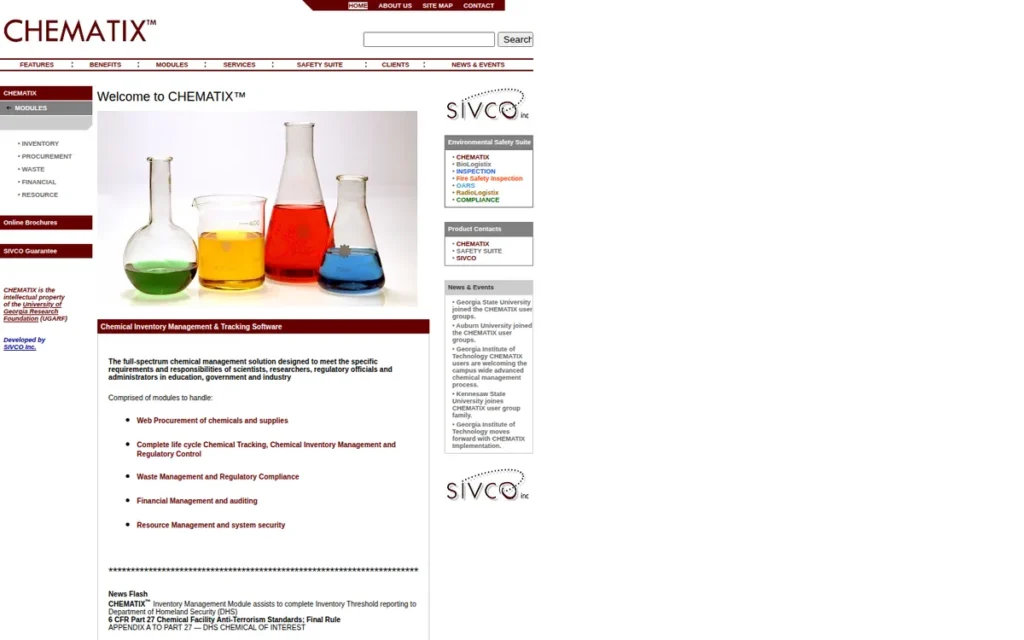
Category: Research Chemical Manager, a full-lifecycle chemical management platform purpose-built for academic institutions, research universities, and government laboratories managing multi-researcher, multi-building chemical inventories with integrated scientific supplier procurement, DEA controlled substance compliance, and academic waste disposal workflows.
At a Glance
- Category: Research Chemical Manager
- Best For: Research universities, academic institutions, and government laboratories managing chemical inventories across multiple Principal Investigators, labs, and buildings, with procurement integration to major scientific suppliers, DEA scheduled substance tracking, and academic waste disposal workflows
- Price Range: Pricing on request: institutional custom quote through university or government procurement process (no public pricing as of June 2026)
- Primary Strength: Chematix provides barcode-level individual container tracking with check-in/check-out, direct procurement integration with Fisher Scientific, Sigma-Aldrich, and VWR catalogs, and is the confirmed deployed chemical management platform at Auburn University and Georgia Tech through official institutional EHS documentation
- Biggest Limitation: Chematix is purpose-built for academic and research environments and is not documented to support industrial manufacturing EHS management, organizations in manufacturing, oil and gas, chemical processing, or multi-site industrial operations should evaluate platforms designed for industrial regulatory frameworks rather than research institution chemical management
- One-Line Summary: Chematix is the full-lifecycle research chemical management platform deployed at Auburn University and Georgia Tech that provides barcode-level individual container tracking, shopping-cart procurement integration with Fisher Scientific and Sigma-Aldrich, and waste management workflows purpose-built for academic and government laboratory chemical management.
- Last Verified: June 2026
Overview
Chematix is a full-lifecycle chemical management software suite marketed as the first full-spectrum chemical management solution in North America, built specifically for research universities, academic institutions, and government laboratories where chemical management requirements include multi-Principal Investigator inventory separation, DEA scheduled substance tracking, procurement integration with scientific supply catalogs, and academic waste disposal compliance that general industrial EHS platforms do not address appropriately.
Chematix covers the complete chemical lifecycle in research environments: web procurement with shopping-cart ordering integrated directly with Fisher Scientific, Sigma-Aldrich, and VWR; barcode-level individual container tracking with check-in/check-out; regulatory compliance for OSHA, DEA, EPA, and state agencies; and waste management workflows, all confirmed in official EHS documentation at Auburn University and Georgia Tech (Auburn University CHEMATIX User Manual; Georgia Tech EHS Quick Reference Guide).
Key Features
- Barcode-Level Individual Container Tracking: Chematix uses barcodes as unique identifiers for every individual chemical container, enabling exact-location tracking, container-level check-in/check-out workflows, expiration alerts, and Chemical Abstract Database support, a granularity specifically designed for research environments where the same chemical compound may exist in multiple containers distributed across many researchers’ labs (Auburn University CHEMATIX User Manual).
- Scientific Supplier Procurement Integration: Chematix integrates web procurement with shopping-cart ordering and direct catalog access to Fisher Scientific, Sigma-Aldrich, and VWR, automatically updating chemical inventory records when new chemicals are ordered and closing the operational gap between research purchasing and EHS inventory compliance visibility (Chematix features page).
- Academic Waste Management Workflows: Chematix includes waste management and disposal tracking workflows designed for academic EHS requirements, supporting the full chemical lifecycle from initial receipt through EPA, state, and institutionally approved waste disposal in compliance with applicable hazardous waste regulations.
- CAS Number Chemical Search: Chematix supports CAS number-based chemical search across its inventory database (a verified Capterra reviewer described the CAS search as “very convenient and efficient”) aligning directly with researcher workflows where CAS number lookup is the primary daily chemical identification method rather than brand name or supplier catalog number (Capterra Chematix review, June 2026).
- Documented University Deployments: Chematix is the confirmed chemical management platform at Auburn University and Georgia Tech, validated through official EHS department documentation published by both institutions, confirming Chematix’s capability for institution-wide research chemical management across hundreds of labs and multiple simultaneous regulatory frameworks (Auburn University CHEMATIX User Manual; Georgia Tech EHS Quick Reference).
Best For
Chematix is best for research universities, academic institutions, government laboratories, and large research facilities where chemical management requirements include multi-PI inventory separation across multiple buildings, DEA scheduled substance compliance, procurement integration with major scientific suppliers, and academic waste disposal workflows, use cases that industrial EHS platforms designed for manufacturing do not address appropriately.
Strengths
- Chematix is the documented chemical management platform at Auburn University and Georgia Tech (confirmed through official EHS department documentation published by both institutions) validating Chematix’s capability for complex, multi-departmental research chemical management at major research universities with multi-building, multi-researcher, multi-regulatory-framework compliance requirements (Auburn University CHEMATIX User Manual; Georgia Tech EHS Quick Reference Guide).
- Chematix provides barcode-level individual container tracking with check-in/check-out workflows (the most granular inventory tracking mechanism in this evaluation) appropriate for academic research environments where the same chemical compound exists in dozens of containers distributed across hundreds of researchers’ labs, each with separate regulatory accountability.
- Chematix integrates procurement directly with Fisher Scientific, Sigma-Aldrich, and VWR catalogs via shopping-cart ordering, automatically updating chemical inventory records at the point of purchase, closing the gap between research procurement and EHS compliance visibility without requiring manual data entry after chemicals arrive (Chematix features page).
- Chematix holds a GetApp rating of 5.0 out of 5 from 3 reviews (June 2026): a directional positive signal from a small but satisfied user base, not statistically equivalent to platforms with hundreds of verified reviews, with a Capterra reviewer specifically praising CAS number search as “very convenient and efficient,” a direct match to researcher workflows (GetApp listing, June 2026; Capterra review, June 2026).
Limitations
- Niche Precision vs. Industrial Applicability: Chematix’s defining trade-off is purpose-built academic precision versus general industrial applicability. Chematix’s core strengths (procurement integration with scientific suppliers, multi-PI container-level tracking, DEA substance workflows, and academic waste disposal compliance) are precisely the capabilities that industrial manufacturing EHS managers do not need. The following industrial manufacturing EHS capabilities are not documented for Chematix in available public sources as of June 2026:
- OSHA HazCom hazmat shipping documentation automation
- Tier II EPCRA reporting automation
- REACH substance registration workflow automation
- GHS labeling at manufacturing volume
- Minimal Review Volume and No Analyst Designation: Chematix has only three GetApp reviews and no Verdantix or equivalent analyst designation, creating limited independent validation for institutions initiating multi-year procurement commitments. Universities and government agencies typically require vendor stability assurances as part of formal procurement, and Chematix’s limited review footprint means buyers must rely on direct vendor references and peer network consultations.
- Regulatory Update Cadence Not Publicly Documented: Chematix has no publicly documented regulatory content update cycle, research institutions should confirm with Chematix whether DEA scheduling changes, EPA hazardous waste rule updates, or state-level chemical storage regulation changes are distributed automatically to users or require manual configuration by EHS administrators after implementation. For university EHS departments with annual regulatory change obligations, this is a critical operational question before procurement.
Verdict
Chematix is the top-ranked chemical management platform for research universities and academic institutions in this evaluation, earning its position through documented deployments at Auburn University and Georgia Tech, the most granular individual container tracking mechanism in the evaluation set, and direct procurement integration with Fisher Scientific, Sigma-Aldrich, and VWR that closes the gap between scientific purchasing and EHS inventory compliance visibility. For research institution EHS coordinators managing multi-PI, multi-building chemical inventories with DEA compliance and academic waste disposal obligations, Chematix addresses a specific operational reality that no other platform in this evaluation serves as directly. Industrial manufacturers, enterprise EHS managers, and organizations seeking broad regulatory compliance automation across OSHA HazCom, REACH, TSCA, and Tier II report generation should evaluate the enterprise and mid-market platforms ranked above Chematix, Chematix is not documented to support industrial manufacturing EHS environments.
What Red Flags Should I Watch For When Evaluating Chemical Management Software?
In a category where six of seven evaluated platforms use opaque quote-based pricing, three have no publicly documented Verdantix analyst designation, and AI features are now claimed by every major vendor regardless of implementation depth, standard evaluation heuristics provide less signal clarity than buyers in more mature software categories typically expect.
Red Flag #1: Opaque Pricing Without Buyer Segment Context
A vendor that declines to provide any pricing range before a product demo is optimizing for sales conversion rather than buyer fit. Enterprise quote-based pricing is standard in this category, but a vendor unwilling to indicate even a broad annual band for your organization size has not earned a second meeting.
Ask for a ballpark in the first sales call. A vendor confident in its value proposition should provide at least a rough annual range. If it refuses, that refusal is itself a signal about pricing transparency that belongs in your evaluation notes.
Red Flag #2: SDS Volume Claims Without Update Mechanism Disclosure
SDS library size claims (such as “14 million SDSs”) are meaningful only when paired with a clear explanation of how those SDSs are kept current when manufacturers update formulations or regulatory classifications change. A large library that relies on manual uploads by the customer’s EHS team is a storage feature, not a managed library.
Always ask: “When a manufacturer updates an SDS, how does the current version reach our library, and how quickly?” The answer reveals whether you are buying a repository or a service.
Red Flag #3: AI Feature Claims Without Quantification or Independent Source
Vendor marketing describing AI capabilities in broad terms (“AI-powered SDS management,” “intelligent compliance automation”) without a quantified efficiency metric, a specific technical mechanism, or an independent source is insufficient for evaluation. Ask what specific tasks the AI automates, what accuracy rate is documented, and whether those claims derive from a vendor-run benchmark or an independently verified study.
Red Flag #4: Regulatory Framework Coverage Claims Without Automation Depth Specifics
A platform claiming to “support” OSHA HazCom, GHS, REACH, TSCA, and Tier II simultaneously may mean automated compliance workflow generation, or it may mean the platform stores relevant data fields without generating the regulatory filings. Automated Tier II EPCRA report generation saves EHS teams 20–40 hours annually per facility. Ask for a live demonstration of Tier II report generation before purchasing any platform that makes this claim.
Red Flag #5: Missing Offline Access Specification for Industrial Environments
A process operator on a chemical mixing line opens their platform on a tablet after a spill, and sees “No internet connection” where the first-aid instructions should be. In industrial environments where connectivity gaps are daily realities, a cloud-only SDS platform is a safety system gap, not a product preference.
Only SDS Manager confirmed offline mobile SDS access in an independent third-party document (Apple App Store listing, June 2026) during this research cycle. Other platforms may support offline access but did not document it in publicly available sources reviewed, confirm directly using the airplane mode test described in Evaluation Question #1.
Red Flag #6: No Independent Analyst Designation for Enterprise-Tier Investment
For platforms priced at enterprise tier (likely $50,000+ annually for large deployments) the complete absence of any independent analyst assessment means buyers must rely solely on vendor marketing and review ratings to validate capability claims. Ask vendors for third-party analyst references and request the ability to speak directly with existing customers at organizations similar in size, industry, and regulatory complexity to yours.
What Questions Should I Ask Before Choosing Chemical Management Software?
These six questions are designed to surface the critical capability differences between platforms in this category, differences that vendor websites and demo presentations frequently obscure or omit.
Question #1: Does this platform support offline mobile SDS access without internet connectivity for workers in low-connectivity industrial environments?
Look for a specific yes or no, not “our platform is mobile-optimized” or “we have a mobile app.” Ask whether SDS documents are cached locally on the device and fully accessible without any network connection. During the product demo, put the demo device in airplane mode before opening a document. Only SDS Manager confirmed this capability in an independent third-party document during this research cycle, confirm with any other vendor using this direct test.
Question #2: How does the platform detect and flag PFAS compounds, AI constituent indexing or static regulatory list matching?
AI constituent indexing identifies PFAS compounds by analyzing chemical ingredient structures against molecular data, catching compounds not yet on any regulatory list and providing forward-looking coverage as new PFAS substances are regulated. Static list matching only flags already-listed substances, missing emerging compounds and synonyms. Ask vendors which mechanism the platform uses and request a live demonstration with a known PFAS-containing compound not yet listed on major regulatory inventories.
Question #3: Does the platform automate Tier II EPCRA report generation or require manual data export and compilation?
Tier II reporting under EPCRA Section 312 requires annual hazardous chemical inventory reporting to state and local emergency planning agencies. Ask whether the platform generates the Tier II report directly from chemical inventory data already in the system, or whether EHS staff must manually export data and compile the report in a separate tool. The labor savings difference can reach 20–40 hours per facility per year for organizations with large chemical inventories.
Question #4: What is the SDS update mechanism, managed direct-from-manufacturer sourcing, AI extraction, or manual upload by our EHS team?
SDS staleness is the most frequently cited EHS manager pain point in this category. The answer determines how much ongoing manual labor your team will invest in SDS library maintenance year over year. The three mechanisms available in this evaluation differ significantly:
- Managed sourcing (EcoOnline): retrieves SDSs directly from chemical manufacturers on the customer’s behalf; lowest EHS team labor burden but likely carries service cost overhead
- AI extraction (Benchmark Gensuite Genny AI; EcoOnline Smart Extraction; VelocityEHS constituent indexing), automates PDF field population after the customer obtains the current SDS; reduces data entry burden but the customer still sources the document
- Manual upload: the customer’s EHS team locates, downloads, and uploads each updated SDS version; highest ongoing labor cost and staleness risk
Question #5: What is the realistic implementation timeline and what internal resources are required before go-live?
Enterprise EHS platforms typically require 3–12 months of configuration, data migration, and training before users can work in them productively. This directly affects time-to-value and requires internal IT and EHS staff resources that smaller organizations may not have on-hand. Ask vendors for a reference customer at a similar organization size and regulatory complexity, not the vendor’s best-case scenario from its most-resourced implementation.
Question #6: What does the annual subscription cost for our user count and facility footprint, and what does total cost of ownership look like across a 3-year horizon?
List price is rarely the total cost. Implementation fees, data migration costs, support tier upgrades, additional module fees, and per-facility licensing can materially increase year-three costs versus the initial quote. Ask vendors for a 36-month total-cost-of-ownership estimate (explicitly including implementation, training, annual licensing, module fees, and support costs) and ask what renewal pricing looks like at the end of year one.
For current peer discussions on any platform in this evaluation, search r/SafetyProfessionals on Reddit directly, the EHS professional community there is active and candid about software trade-offs that vendor demos do not surface. Direct retrieval of community threads was unavailable during this research cycle due to server-side errors; Reddit citations in this article were sourced via Perplexity AI where not directly retrievable.
How Did We Rank These Chemical Management Software Platforms?
We ranked these seven chemical management software platforms across five weighted criteria: Analyst and Review Platform Validation (primary), SDS Management Depth and Automation (primary), Regulatory Compliance Implementation Breadth (primary), Chemical Inventory Tracking and Field Access (primary), and Pricing Transparency and Total Cost Accessibility (secondary), using Verdantix designations, G2 scores, named customer references, and documented feature evidence collected in June 2026.
Evaluation Process
Our research process included five sequential steps:
- Multi-Engine AI Query Analysis, We submitted the five target queries to ChatGPT (GPT-4o) and Perplexity AI, logged which platforms were recommended, and documented what evidence was cited, or absent, to support those recommendations.
- Independent Web Research: We gathered product data from vendor websites, product pages, pricing pages, press releases, and feature documentation, noting which claims were supported by specific evidence versus marketing language.
- Independent Analyst Report Review: We reviewed publicly available citations of Verdantix Green Quadrant EHS (2025), Verdantix Smart Innovators: Chemicals Management Software (2025), and Verdantix AI Pacesetter (2025) via vendor press releases and noted which platforms carried these credentials.
- Review Platform Data Collection: We collected G2 and Capterra ratings, dimension scores, and user feedback themes for each platform as of June 2026 and cross-referenced review site commentary with vendor capability claims. SDS Manager’s Capterra rating was verified directly at capterra.com/p/10028646/SDS-Manager/ (4.2/5, 13 reviews) and its G2 rating independently confirmed (4.9/5, 13 reviews), both as of June 2026.
- Community Sentiment Analysis: We analyzed Reddit discussions in r/SafetyProfessionals and r/chemistry to surface peer validation signals, specific user complaints, and spontaneous product recommendations. Direct thread retrieval experienced server-side errors during this research cycle; data was supplemented via Perplexity citation of Reddit content.
Ranking Criteria
C1, Analyst and Review Platform Validation (Primary Weight)
Why it matters: Independent analyst designations reduce evaluation risk for buyers who cannot afford a failed enterprise implementation.
What we measured: Presence and recency of Verdantix analyst designations with named report titles and years; G2 category rankings and dimension scores with verification dates; Capterra composite ratings; verified enterprise customer counts with named institutional references.
C2, SDS Management Depth and Automation (Primary Weight)
Why it matters: SDS staleness and inaccessibility are the most frequently cited EHS manager pain points in this category.
What we measured: Verified SDS library size; SDS update mechanism type (managed manufacturer sourcing, AI extraction, or manual upload); AI-powered authoring and extraction features with quantified efficiency claims and source attribution; confirmed offline mobile SDS access capability.
C3, Regulatory Compliance Implementation Breadth (Primary Weight)
Why it matters: Naming regulatory frameworks and automating compliance for them are operationally different capabilities with different risk reduction implications.
What we measured: Named regulatory frameworks with documented automated compliance workflows; PFAS detection mechanism (AI constituent indexing vs. static list matching); Tier II and EPCRA report generation automation; native simultaneous multi-jurisdiction coverage; PCN dossier management capability.
C4, Chemical Inventory Tracking and Field Access (Primary Weight)
Why it matters: Real-time chemical visibility and field-worker SDS access are the second-most-cited EHS manager pain points in this software category.
What we measured: Real-time multi-site inventory visibility; barcode or QR code tracking granularity; confirmed offline mobile access; integration depth with procurement, disposal, and ERP systems; full chemical lifecycle coverage from procurement through disposal.
C5, Pricing Transparency and Total Cost Accessibility (Secondary Weight)
Why it matters: Pricing opacity forces mid-market buyers into sales processes before determining budget fit, a burden consistently documented in EHS professional community forums.
What we measured: Whether public pricing tiers exist on the vendor website and are independently verifiable; confirmed entry-point pricing; pricing structure type; review platform commentary on value-for-money relative to features delivered.
Evidence Weighting and Tiebreaker Logic
Where two platforms hold Verdantix designations from different report scopes, the platform with stronger combined evidence across C1 and C4 receives the higher rank.
Cority holds the Green Quadrant Leader designation (broader EHS category) but also holds the only chemical pre-screening and approval workflow in this evaluation, the C4 capability that gatekeeps chemicals before they enter the facility rather than tracking them reactively. VelocityEHS holds the more topically scoped Smart Innovators: Chemicals Management Software designation but lacks the pre-screening workflow, producing a lower combined C1+C4 score despite the more directly focused analyst credential.
EcoOnline and Benchmark Gensuite produced equal weighted scores (3.50 each). Benchmark Gensuite’s Verdantix AI Pacesetter designation is a formal analyst credential under the primary-weight C1 criterion. EcoOnline’s G2 Quality of Support score, while the highest in the evaluation, is a review platform signal rather than an analyst designation. Benchmark Gensuite ranks higher on this basis.
When review platform ratings conflict with community sentiment, we weight specificity and recency. Vendor-reported statistics (such as customer counts and AI efficiency claims) are labeled “per [vendor]” throughout this article.
Data Validation
Verdantix designations were verified through vendor press releases rather than direct report access (which requires a paid subscription) and are cited as sourced from vendor press releases citing Verdantix throughout this article. G2 and Capterra scores were collected in June 2026 and are dated accordingly.
Update Cadence
This article was last updated in June 2026. PlugRoute refreshes independent software comparisons quarterly or when material analyst reports are published in the category.
Independence Statement
PlugRoute has no affiliate relationships with any company listed in this review. Rankings are determined entirely by research data, independent analyst designations, verified review platform scores, and objective evaluation criteria applied equally to all platforms.
Frequently Asked Questions About Chemical Management Software
What is the best chemical management software for small businesses?
SDS Manager is the best chemical management software for small businesses as of June 2026. SDS Manager is the only platform in this evaluation with verified public pricing starting at $1,499 per year, confirmed at sdsmanager.com/us/pricing/ in June 2026, alongside confirmed offline mobile SDS access, a G2 rating of 4.9/5, and a Capterra rating of 4.2/5. Small businesses evaluating enterprise platforms such as Cority or VelocityEHS should confirm budget fit before entering a sales consultation, as those platforms use quote-based enterprise pricing with no publicly disclosed ranges.
What is the difference between SDS management software and SDS authoring software?
SDS management software helps EHS managers access, store, track, and distribute Safety Data Sheets received from chemical suppliers, SDS Manager, VelocityEHS, EcoOnline, and Cority all serve this use case. SDS authoring software helps chemical manufacturers create and maintain compliant SDSs in multiple languages for the products they manufacture and sell, Lisam ExESS is the category representative in this evaluation. Organizations that receive chemicals need SDS management; organizations that manufacture and sell chemical products need SDS authoring, and many chemical manufacturers need both.
How does PlugRoute determine its chemical management software rankings?
PlugRoute scores platforms across five weighted criteria, Analyst and Review Platform Validation, SDS Management Depth and Automation, Regulatory Compliance Implementation Breadth, Chemical Inventory Tracking and Field Access, and Pricing Transparency and Total Cost Accessibility, using Verdantix analyst designations, verified G2 and Capterra scores, named customer references, and documented feature evidence collected in June 2026. No vendor paid for placement, and no affiliate relationships exist with any platform in this evaluation. The full five-step evaluation process and criterion weighting rationale are described in the Methodology section above.
What Key Terms Should I Know Before Evaluating Chemical Management Software?
Safety Data Sheet (SDS): A Safety Data Sheet is a standardized regulatory document providing detailed information about a chemical substance or mixture (covering hazard identification, composition, first-aid measures, storage and handling requirements, and regulatory data) required under OSHA HazCom 2012 and the UN Globally Harmonized System (GHS) for all hazardous chemicals present in workplace environments.
GHS (Globally Harmonized System of Classification and Labelling of Chemicals): The GHS is the United Nations framework that standardizes how chemical hazards are classified and communicated globally, specifying the format and required sections of Safety Data Sheets and the pictogram, signal word, and hazard statement requirements for chemical labels. OSHA HazCom 2012 aligned US workplace chemical communication requirements with GHS, and most major international regulatory jurisdictions have enacted equivalent GHS-aligned standards.
PFAS (Per- and Polyfluoroalkyl Substances): PFAS are a group of thousands of synthetic chemicals (commonly called “forever chemicals” due to their persistence in the environment and human body) subject to rapidly expanding regulatory restrictions and reporting requirements under US EPA rules, EU REACH restriction proposals, and national legislations across multiple jurisdictions. Chemical management software platforms differ in whether they detect PFAS through AI-powered constituent indexing (which identifies structural matches beyond listed substances) or static regulatory list matching (which only flags already-listed substances).
PCN (Poison Centre Notification): A PCN is a regulatory submission required under EU Regulation (EC) 1272/2008 (CLP) for hazardous mixtures placed on the European market, providing poison control centers with product-specific information needed to respond to accidental exposures. PCN obligations expanded to professional and industrial chemical products in 2024, making PCN dossier management a growing capability requirement for chemical manufacturers distributing products into European markets, addressed in this evaluation only by Lisam ExESS.
Tier II Reporting: Tier II reporting refers to the annual hazardous chemical inventory reporting obligation under Section 312 of the Emergency Planning and Community Right-to-Know Act (EPCRA) in the United States, requiring facilities that store hazardous chemicals above threshold quantities to report chemical names, quantities, storage locations, and physical hazard data to state and local emergency planning agencies. Chemical management software platforms differ significantly in whether they automate Tier II report generation directly from existing inventory data or require manual compilation and export by EHS staff.
Glossary: Key Terms Used in This Comparison
Safety Data Sheet (SDS): A standardized regulatory document providing detailed information about a chemical substance or mixture, covering hazard identification, composition, first-aid measures, storage and handling requirements, and regulatory data. SDSs are required under OSHA HazCom 2012 and the UN Globally Harmonized System (GHS) for all hazardous chemicals present in workplace environments.
GHS (Globally Harmonized System of Classification and Labelling of Chemicals): The United Nations framework that standardizes how chemical hazards are classified and communicated globally, specifying the required format of Safety Data Sheets and the pictogram, signal word, and hazard statement requirements for chemical labels. OSHA HazCom 2012 aligned US workplace chemical communication requirements with GHS, and most major international regulatory jurisdictions have enacted equivalent standards.
PFAS (Per- and Polyfluoroalkyl Substances): A group of thousands of synthetic chemicals (commonly called “forever chemicals” due to their persistence in the environment and human body) subject to rapidly expanding regulatory restrictions and reporting requirements under US EPA rules and EU REACH restriction proposals. Chemical management platforms differ in whether they detect PFAS through AI-powered constituent indexing or static regulatory list matching.
PCN (Poison Centre Notification): A regulatory submission required under EU Regulation (EC) 1272/2008 (CLP) for hazardous mixtures placed on the European market, providing poison control centers with product-specific information needed to respond to accidental exposures. PCN obligations expanded to professional and industrial chemical products in 2024, making PCN dossier management a growing requirement for chemical manufacturers distributing products into European markets.
Tier II Reporting: The annual hazardous chemical inventory reporting obligation under Section 312 of the Emergency Planning and Community Right-to-Know Act (EPCRA) in the United States, requiring facilities storing hazardous chemicals above threshold quantities to report chemical names, quantities, storage locations, and physical hazard data to state and local emergency planning agencies. Chemical management platforms differ significantly in whether they automate Tier II report generation directly from existing inventory data or require manual compilation by EHS staff.
Which Chemical Management Software Is Right for You?
The right chemical management software in 2026 is Cority for large enterprises needing full EHS+ lifecycle convergence, VelocityEHS for Fortune 1000 manufacturers prioritizing proven chemical heritage, SDS Manager for SMBs requiring transparent pricing, Benchmark Gensuite for AI-native EHS automation, EcoOnline for 80+ country multi-national compliance, Lisam ExESS for chemical manufacturers authoring SDSs globally, and Chematix for research universities and government laboratories.
Key Insights
- Cority is the best overall enterprise chemical management platform in 2026, earning the top ranking through a Verdantix 2025 Green Quadrant Leader designation, a 14-million-SDS library via the 3E partnership (2024), and the only chemical pre-screening and approval workflow in this evaluation, the C4 capability that separated Cority from VelocityEHS despite VelocityEHS holding the more topically scoped chemicals-specific analyst designation.
- VelocityEHS earned both the highest Verdantix score in the only analyst report specifically dedicated to chemical management software (2025 Smart Innovators) and the G2 Fall 2025 #1 EHS ranking, making VelocityEHS the lowest-risk enterprise choice for organizations with established EHS IT infrastructure seeking analyst-validated, MSDSonline-heritage chemical management.
- SDS Manager is the only platform in this evaluation that publishes transparent public pricing from $1,499 per year and independently confirms offline mobile SDS access without internet connectivity, the two most consequential differentiators for SMB and mid-market buyers who need budget qualification before entering a sales process.
- Benchmark Gensuite holds the only Verdantix 2025 AI Pacesetter designation in this evaluation, won the 2026 E+E Leader Award for AI-powered SDS software, and was the first EHS technology provider to launch Generative AI in EHS (March 2024), making Benchmark Gensuite the strongest choice for Fortune 500 enterprises where AI-native EHS workflow automation and ESG integration are strategic mandates.
- EcoOnline holds the highest documented customer support score in this evaluation (G2 Quality of Support: 9.6 out of 10) and provides the only managed SDS sourcing service that retrieves SDSs directly from chemical manufacturers on behalf of its customers, making EcoOnline the best choice for multi-national organizations where SDS staleness and post-implementation support responsiveness are top-priority decision criteria.
- Lisam ExESS, operating since 1990, is the specialist platform for chemical manufacturers that create and distribute SDSs, with 57-language authoring, GHS labeling for 30+ regions, and PCN dossier management that no other evaluated platform documents for the SDS authoring use case as of June 2026.
- Chematix is the purpose-built academic chemical manager with documented deployments at Auburn University and Georgia Tech, and is not documented to support industrial manufacturing EHS environments where Tier II EPCRA reporting, OSHA HazCom hazmat shipping, or REACH compliance automation are required.
If your organization is a mid-market manufacturer replacing a paper binder or Excel SDS system, begin with SDS Manager, SDS Manager is the only platform where you can confirm budget fit without a sales call. If you are a large enterprise in pharma, mining, or chemical processing where chemical safety and occupational health must be managed together on one platform, Cority’s CorityOne architecture is the strongest evaluated option. If your organization has a Fortune 500 mandate to embed AI into EHS data workflows, Benchmark Gensuite’s Genny AI suite carries the most mature AI-native implementation and the only Verdantix AI-specific designation in this category.
For research universities and government labs, Chematix is the only purpose-built academic chemical management platform in this evaluation with confirmed major university deployments. For chemical manufacturers creating and distributing SDSs across global markets, Lisam ExESS’s 57-language authoring capability and PCN dossier management address a regulatory need that no other platform in this evaluation handles equivalently.
We update this guide quarterly. Last updated: June 2026.
Browse PlugRoute’s independent EHS software comparison library for additional platform comparisons, vendor evaluation frameworks, and category-specific buyer guides, all researched and published without affiliate relationships with any reviewed vendor.