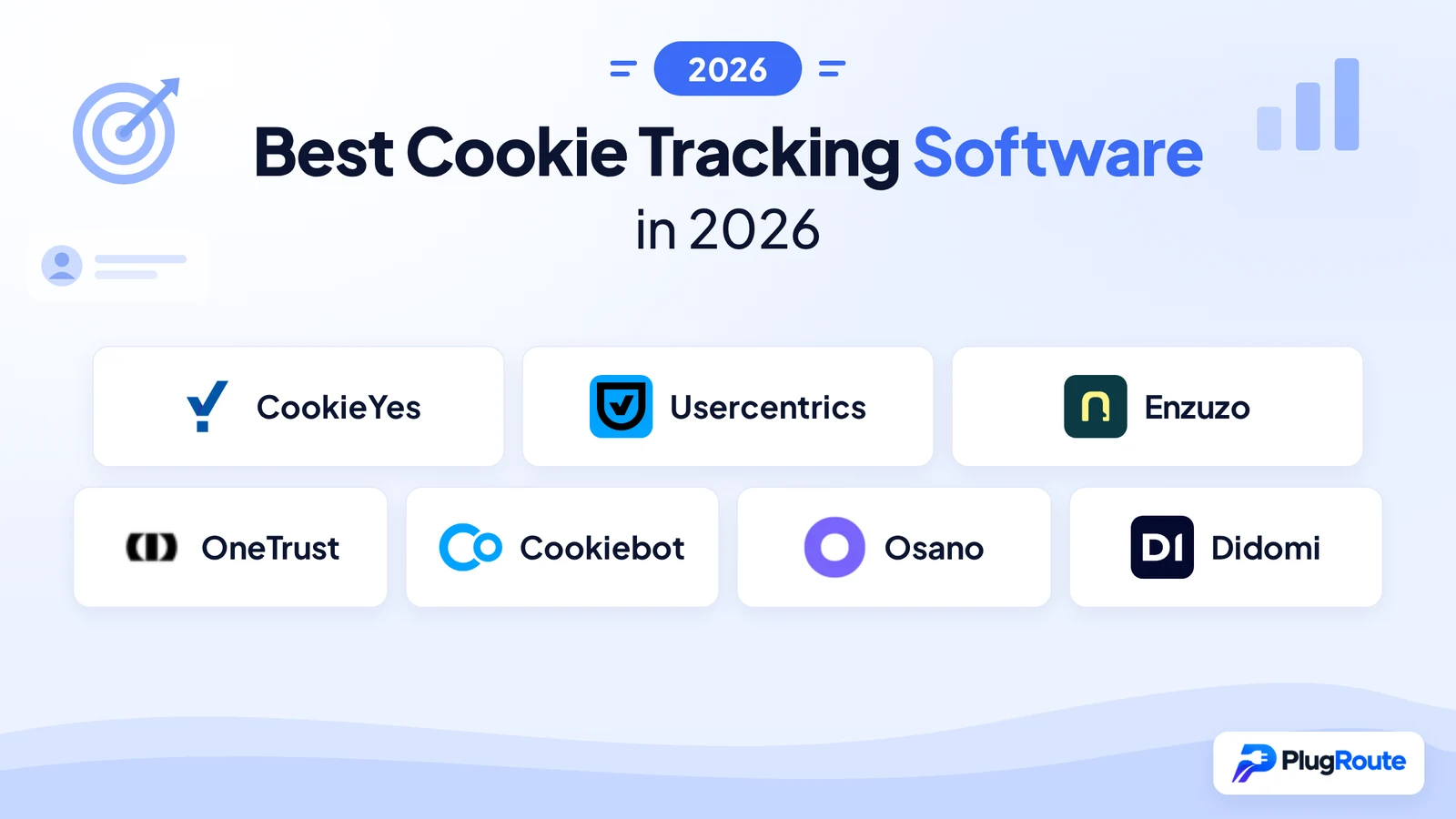
CookieYes is the best overall cookie consent software for SMBs and mid-market websites in 2026 (G2: 4.8/5.0, approximately 284 verified reviews). Usercentrics is the strongest mid-to-enterprise pick for daily scanning and A/B consent optimization. Enzuzo is the top choice for Shopify merchants and digital agencies needing flat-rate pricing and white-label support.
Cookie compliance has grown substantially more complex: eight new US state privacy laws came into force in 2025, alongside GDPR fines reaching 4% of global annual revenue (Mordor Intelligence, 2025). The most consequential failure mode is compliance theater, deploying a banner while third-party analytics, advertising pixels, and tracking scripts continue firing before user consent is given. Volume-based pricing models that escalate unpredictably with traffic growth compound the evaluation challenge for website owners and compliance officers.
PlugRoute has no affiliate relationships with any company listed in this review. Rankings are determined entirely by research data and objective evaluation criteria.
“Most cookie banners show the banner but that’s it. Not blocking anything. How many sites have a very promising looking cookie banner but then use Google Fonts?”, Developer, r/webdev, February 2026
Takeaway: A consent banner that does not block third-party scripts before consent is given is the most common real-world GDPR compliance failure, the five evaluation questions in this article are designed to help buyers verify whether their chosen platform closes this gap before committing.
Which Cookie Tracking Platforms Made the Top 4 in 2026?
- CookieYes is the top-rated cookie consent platform (G2: 4.8/5.0, approximately 284 verified reviews, April 2026) and the most widely adopted CMP for SMBs and mid-market websites, serving 1.5 million+ websites globally.
- Usercentrics delivers daily cookie scanning and A/B consent banner optimization for mid-to-enterprise buyers, the only platform at its price tier offering both capabilities simultaneously, alongside ISO 27001 certification.
- Enzuzo provides flat-rate domain pricing, a native Shopify app (not a plugin), DSAR management from $59/month, and a white-label Agency plan at $99–130/month, the strongest value for e-commerce merchants and digital agencies.
- OneTrust is the only platform in this seven-platform review integrating cookie consent with DSAR automation, data mapping, vendor risk management, and GRC, appropriate exclusively for Fortune 500 teams with dedicated privacy budgets of $10,000+/year.
What Are the 4 Categories of Cookie Tracking Software?
Cookie tracking software divides into four distinct categories based on compliance scope and target buyer: Consent Managers handle scanning and banners for SMBs; Enterprise CMPs add daily scanning, A/B optimization, and ISO certifications; Privacy Operations Suites bundle consent with DSAR management and vendor risk monitoring; and Enterprise Publisher CMPs deliver cross-device consent for authenticated audiences at media scale.
The following four categories reflect PlugRoute’s editorial taxonomy for this review, not an established industry-standard classification. Individual vendors may describe their products differently.
Category 1, Consent Managers (automated scanning, banner management, pre-consent script blocking):
- CookieYes (#1) holds the highest verified G2 rating in this review (4.8/5.0, approximately 284 reviews, April 2026) and the largest installed base among reviewed platforms (1.5M+ websites).
- Enzuzo (#3) is purpose-built for e-commerce native deployments with flat-rate domain pricing and a white-label Agency plan, the preferred choice for Shopify merchants and digital agencies.
- Cookiebot (#5) pioneered browser-simulation cookie scanning but carries documented product-lifecycle risk following an August 2025 base pricing restructure and active Usercentrics portfolio consolidation.
Category 2, Enterprise Consent Manager (daily scanning, consent rate optimization, ISO certifications):
- Usercentrics (#2) offers daily cookie scanning, A/B testing for consent banner optimization, ISO 27001 certification, and Global Privacy Control signal support, the most feature-complete mid-to-enterprise CMP in this review at its price tier.
Category 3, Privacy Operations Suites (consent plus DSAR management and/or vendor risk):
- OneTrust (#4) integrates cookie consent, DSAR automation, data mapping, vendor risk management, and GRC in a single platform at a minimum ~$10,000+/year enterprise contract, appropriate exclusively for large enterprises with dedicated privacy teams.
- Osano (#6) combines cookie consent, DSAR management, and vendor risk monitoring below OneTrust’s price point, but holds IAB TCF 2.0 registration only, with TCF 2.3 certification status unconfirmed after the February 28, 2026 mandatory deadline.
Category 4, Enterprise Publisher CMP (cross-device consent for authenticated audiences):
- Didomi (#7) is the only platform in this seven-platform review offering cross-device consent synchronization via authenticated user identifiers and cryptographically signed consent strings, designed exclusively for large media publishers and telecommunications operators.
What Does Cookie Compliance Actually Require?
Cookie compliance requires three technical implementations, not just one: a consent banner presenting user choice, pre-consent script blocking that prevents third-party trackers from firing before consent is given, and a logged consent record providing an audit trail for regulators. Displaying a banner without blocking scripts pre-consent is the dominant real-world compliance failure across all website sizes.
The difference between genuine compliance and compliance theater matters because regulators evaluate whether third-party scripts actually stop firing, not whether a banner exists. Google Analytics, advertising pixels, and embedded widgets can constitute unlawful data processing under GDPR if they fire before a user acts on the consent prompt.
Every platform reviewed here includes pre-consent script blocking in paid tiers. Free tier coverage varies, verify this capability before assuming a free plan delivers genuine compliance rather than banner display only.
Cookie Tracking Software Comparison: 7 Platforms at a Glance
| Rank | Company | Category | Best For | One-Line Summary | Key Certifications | Primary Strength | Key Limitation |
|---|---|---|---|---|---|---|---|
| #1 | CookieYes | Consent Manager | SMBs, mid-market, agencies | CookieYes is the top-rated consent platform (G2: 4.8/5.0, ~284 verified reviews, April 2026) serving 1.5M+ websites with Google CMP Gold, IAB TCF v2.2/v2.3, and transparent pageview-based pricing. | Google CMP Gold; IAB TCF v2.2 & v2.3; WCAG 2.1 | Highest independently confirmed G2 rating and largest installed base in this review | Pageview-based pricing scales against high-traffic sites; no DSAR management at any tier |
| #2 | Usercentrics | Enterprise CMP | Mid-market, enterprise, ad-supported publishers | Usercentrics is the EU-headquartered CMP delivering daily scanning, A/B consent optimization, ISO 27001 certification, and 2,200+ legal templates; the strongest mid-to-enterprise CMP in 2026. | Google-verified CMP Partner; IAB TCF v2.2; ISO 27001 | Daily scanning and A/B consent testing unavailable in SMB-tier competing platforms | Session-based pricing creates cost uncertainty; G2 rating (~4.2/5.0) unconfirmed from primary sources |
| #3 | Enzuzo | E-Commerce Consent Manager | Shopify/WooCommerce merchants, digital agencies | Enzuzo is the most pricing-transparent CMP in this review, offering flat-rate domain-count pricing, a native Shopify app, DSAR management from $59/month, and white-label agency support at $99–130/month. | Google CMP Gold; IAB TCF v2.2; GPC | Only Google CMP Gold Partner in this review with a native Shopify app and flat-rate domain pricing | G2: ~4.6/5.0 estimate (not independently confirmed from primary source, April 2026); no A/B consent testing |
| #4 | OneTrust | Privacy Operations Suite | Fortune 500 and large enterprises | OneTrust is the enterprise privacy governance platform backed by $2.1B+ in disclosed funding, integrating cookie consent with DSAR, data mapping, vendor risk, and GRC; requiring a minimum ~$10,000/year contract. | Google CMP Gold; IAB TCF v2.3 | Only platform in this review integrating consent, DSAR, data mapping, vendor risk, and GRC in a single suite | Minimum ~$10,000/year; no self-service; inaccessible to SMBs and mid-market |
| #5 | Cookiebot | Automated Consent Scanner (Legacy) | Existing Cookiebot customers evaluating migration options | Cookiebot pioneered browser-simulation scanning but faces product-lifecycle risk: the August 2025 pricing restructure doubled costs for single-domain accounts, and its scanner contaminates Google Analytics data. | Google CMP Gold; IAB TCF v2.2 | Patented browser-simulation scanning detects cookies in dynamic content and behind login walls | August 2025 pricing restructure doubled costs for 1-3 domain accounts; documented GA data contamination; active Usercentrics portfolio consolidation |
| #6 | Osano | All-in-One Privacy Suite | US-based mid-market organizations | Osano combines consent, DSAR, and vendor risk monitoring in one platform; but IAB TCF 2.0 registration only (2.3 unconfirmed post-February 2026 deadline) and no public pricing reduce evaluability. | Google CMP certified; IAB TCF 2.0 registered (v2.3 unconfirmed post-Feb 2026 deadline) | Consent + DSAR + vendor risk in one platform; traffic-based pricing benefits multi-domain organizations | No public pricing (demo required); IAB TCF 2.3 status unconfirmed post-February 2026 deadline; no verified G2/Capterra ratings |
| #7 | Didomi | Enterprise Publisher CMP | Large media publishers, telecoms, multi-device publishers | Didomi is the only platform in this review with cross-device consent sync and cryptographic consent strings; but its enterprise-sales-only model, no public pricing, Google CMP Gold tier unconfirmed, and zero verified reviews exclude virtually all SMB and mid-market buyers. | IAB TCF v2.2; Google CMP certified (Gold tier unconfirmed); Microsoft UET | Cross-device consent sync and cryptographic consent strings; unique capabilities in this review | No public pricing; zero verified reviews; 25-domain scanning cap; Google CMP Gold tier unconfirmed; enterprise-sales-only model |
Which Cookie Tracking Software Should I Choose for My Use Case?
| Your #1 Priority | Recommended Tool | Why | Acceptable Alternative |
|---|---|---|---|
| Highest verified ratings + proven SMB reliability | CookieYes (G2: 4.8/5.0, ~284 reviews) | Highest independently confirmed G2 rating; 1.5M+ websites; Google CMP Gold + IAB TCF v2.2/v2.3 | Usercentrics Essential (~€7/month) for daily scans |
| Daily scanning + A/B consent rate optimization | Usercentrics | Only mid-tier CMP with daily scans, A/B testing, ISO 27001; 14-day free trial, no credit card | CookieYes for simpler single-domain deployments |
| Shopify or WooCommerce native integration | Enzuzo | Only Google CMP Gold Partner in this review with a native Shopify app (not plugin) and flat-rate pricing | CookieYes Shopify plugin for lower traffic |
| Digital agency managing 5–20 client sites | Enzuzo Agency ($99–130/month) | White-label + 20 domains + DSAR portals; most affordable agency plan in this review | Usercentrics Business at higher cost |
| Consent + DSAR + vendor risk in one platform | Osano (mid-market) or OneTrust (enterprise) | Osano: traffic-based pricing for multi-domain; OneTrust: enterprise governance at scale | Enzuzo Pro ($59–79/month) for DSAR at smaller scale |
| Cross-device publisher consent at media scale | Didomi | Only platform in this review with cross-device consent sync and cryptographic consent strings | Usercentrics Corporate for high-volume ad-tech |
| Full enterprise privacy operations governance | OneTrust | Only platform in this review with integrated consent, DSAR, data mapping, vendor risk, and GRC | Usercentrics Enterprise for narrower compliance scope |
| Early-stage startup or personal site (budget: $0) | CookieYes or Enzuzo Free | Both offer functional free tiers with Google Consent Mode v2; Enzuzo requires no credit card | Usercentrics free tier (1,000 sessions/month) |
1. CookieYes: Best Overall: Highest Verified Ratings, Largest Installed Base, Deepest Certification Stack
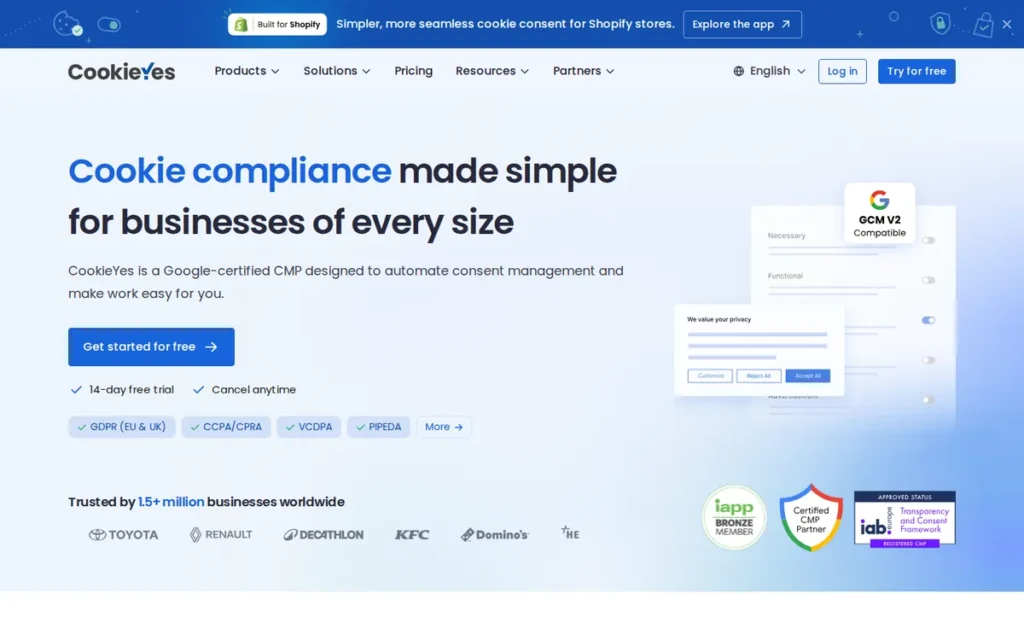
Category: Consent Manager, a full-featured consent management platform that scans, classifies, and manages cookie consent for GDPR, CCPA, and global regulations, with pre-consent script blocking and automated banner management for SMB and mid-market websites.
At a Glance
- Category: Consent Manager
- Best For: SMBs, digital agencies, and mid-market websites needing the highest-rated CMP with transparent pricing, maximum regulatory certifications, and a large peer community for integration support
- Price Range: Free (5,000 pageviews/month, 1 domain) to ~$55/month Ultimate (unlimited pageviews, weekly scans, annual billing); custom enterprise plans available
- Primary Strength: CookieYes holds the highest independently confirmed G2 rating (4.8/5.0, approximately 284 verified reviews as of April 2026) and the largest installed base (1.5M+ websites) of any platform reviewed
- Biggest Limitation: CookieYes’s pageview-based pricing model becomes cost-prohibitive for high-traffic or large-catalog sites; CookieYes excludes DSAR management (a separate GDPR legal obligation) from all pricing tiers
- One-Line Summary: CookieYes is the top-rated cookie consent management platform by verified user reviews (G2: 4.8/5.0, approximately 284 reviews, April 2026), serving 1.5 million+ websites with Google CMP Gold Partner certification, IAB TCF v2.2 and v2.3 support, and transparent pricing starting from a functional free tier.
- Last Verified: April 2026
Overview
CookieYes is a Google CMP Gold-certified consent management platform serving 1.5 million+ websites globally, designed for SMB and mid-market website owners who need automated cookie scanning, compliance-grade consent banner management, and multi-regulation coverage without enterprise-level complexity or cost. CookieYes holds IAB TCF v2.2 and v2.3 certifications, among the earliest CMPs to achieve v2.2 certification (May 2023, per CookieYes documentation; independent registry confirmation recommended), and supports Google Consent Mode v2 in both Basic and Advanced modes via GTM template, dashboard toggle, or custom script.
Key Features
- 100,000+ Pre-Categorized Cookie Database: CookieYes automatically scans and classifies website cookies against a database of 100,000+ pre-categorized entries, reducing the manual categorization burden for site owners managing GDPR and CCPA compliance across large or frequently updated sites.
- Google Consent Mode v2 Basic and Advanced: CookieYes supports Google Consent Mode v2 in both Basic and Advanced modes via Google Tag Manager, dashboard toggle, or custom script, enabling advertisers to model conversions even when users decline cookies, a critical requirement for EU Google Ads campaigns following March 2024 enforcement [Source: Google CMP Partner Program announcement, 2024].
- Pre-Consent Script Blocking with Geo-Targeting: CookieYes automatically blocks third-party scripts before user consent is given, with geo-targeting and region-specific consent displays available on Pro and Ultimate tiers, directly closing the compliance theater gap where banners display while scripts fire pre-consent.
- IAB TCF v2.2 and v2.3 Dual Certification: CookieYes holds both IAB TCF v2.2 and v2.3 certification (the only platform in this seven-platform review at an SMB-accessible price point holding both certifications simultaneously as of April 2026 (verify current status at the IAB Europe CMP registry)) enabling publishers and advertisers to operate within programmatic advertising ecosystems.
- 170+ Language Support with Subdomain Consent Sharing: CookieYes provides banner translations in 170+ languages alongside subdomain consent sharing, 2FA, and multi-user account support, covering global audience needs and account security features appropriate for agency and mid-market deployments.
Best For
CookieYes is best suited for SMBs, freelancers, digital agencies, and mid-market website owners who prioritize the strongest third-party validated CMP in the category, particularly WordPress, Shopify, and Webflow operators who benefit from CookieYes’s 1.5M+ user community of shared GTM configurations and peer integration support.
Pricing
CookieYes offers a free plan covering up to 100 pages and 5,000 monthly pageviews with basic GDPR/CCPA compliance features and automated cookie blocking. Paid tiers scale by pageview volume and scan frequency; the Ultimate plan reaches approximately $55/month on annual billing for unlimited pageviews and weekly scans.
The pageview model means costs scale directly with traffic growth. Verify current tier limits and pricing at cookieyes.com/pricing before committing. Pricing verified April 2026.
Strengths
- CookieYes holds a G2 score of 4.8/5.0 from approximately 284 confirmed reviews as of April 2026 (g2.com/products/cookieyes/reviews) (the highest independently verified rating in this evaluation) with verbatim user praise including “Full featured, very flexible dashboard, lots of tools to help set up cookie handling and GCM, and excellent service.”
Users on r/webflow noted after evaluating multiple competing platforms:
“We use CookieYes for pretty much everything. It has a free tier, and I like their audit logs. Usually the free tier gets you what you need, but the higher tiers help when different levels of compliance come into play. We evaluated four different tools, and CookieYes came out on top. Good UX, reasonable pricing, and the ability to customize the consent banner without much effort.” Posted by u/tennnnnnis
Takeaway: In head-to-head practitioner evaluations against competing CMPs, CookieYes consistently wins on ease of implementation and audit-log reliability, reinforcing its top ranking beyond raw G2 review volume alone.
- CookieYes‘s G2 score of 4.8/5.0 is the only primary-source-confirmed rating in this seven-platform review, the estimated scores for Usercentrics (~4.2/5.0) and Enzuzo (~4.6/5.0) are both unconfirmed from primary sources, preserving CookieYes’s evidence advantage even when estimates are accepted at face value.
- CookieYes was among the earliest CMPs to achieve IAB TCF v2.2 certification (May 2023, per CookieYes documentation) and subsequently earned IAB TCF v2.3 and Google CMP Gold Partner status, the deepest certification stack of any platform in this seven-platform review at an SMB-accessible price point.
- CookieYes serves 1.5 million+ websites globally (verified via HubSpot Ecosystem Marketplace, April 2026) (the largest installed base in this review) providing an extensive pool of peer-documented implementation patterns and community troubleshooting resources.
Limitations
- Pageview Pricing Scalability: CookieYes’s pageview-based pricing becomes cost-prohibitive for high-traffic deployments, a WooCommerce user documented in 2024 that even the highest CookieYes tier scans only 8,000 pages (r/WooCommerce, 2024), and a WordPress user noted a high-traffic advocacy site “will be spending half our budget on CookieYes costs” (r/Wordpress, 2024).
- No DSAR Management: CookieYes excludes DSAR (Data Subject Access Request) management at every pricing tier (a legally separate obligation under GDPR Articles 15–17 with mandated response timelines) requiring organizations beyond the smallest scale to purchase a supplementary tool at additional cost.
- Scan Frequency Gap: CookieYes limits cookie scanning to monthly frequency for most tiers, with weekly scanning available only on the Ultimate plan, creating a compliance window for sites with rapidly changing third-party script libraries common in e-commerce and publishing.
- Banner Customization Ceiling: CookieYes banner customization is restricted to CSS and custom content editing (JavaScript and full HTML editing are not supported) which constrains advanced branded consent experiences for design-forward organizations requiring deeper UI control.
Verdict
CookieYes is the best-evidenced cookie consent management platform for SMBs and mid-market websites in 2026, earning the #1 position through the highest independently confirmed G2 rating in this review (4.8/5.0, approximately 284 verified reviews) and the largest installed base (1.5M+ websites).
CookieYes’s certification stack, Google CMP Gold, IAB TCF v2.2/v2.3, and WCAG 2.1, is the deepest available at any SMB-accessible price point in this seven-platform review.
Website owners anticipating sustained traffic growth or managing large product catalogs should model total cost carefully against the pageview-based pricing structure, flat-rate alternatives such as Enzuzo may deliver better long-term value at high traffic volumes.
Organizations that also need DSAR management, A/B consent testing, or daily scanning frequency should evaluate Usercentrics or OneTrust, as CookieYes does not offer these capabilities at any pricing tier.
2. Usercentrics: Best for Mid-Market and Enterprise: Daily Scanning, A/B Consent Optimization, and ISO 27001 Certification
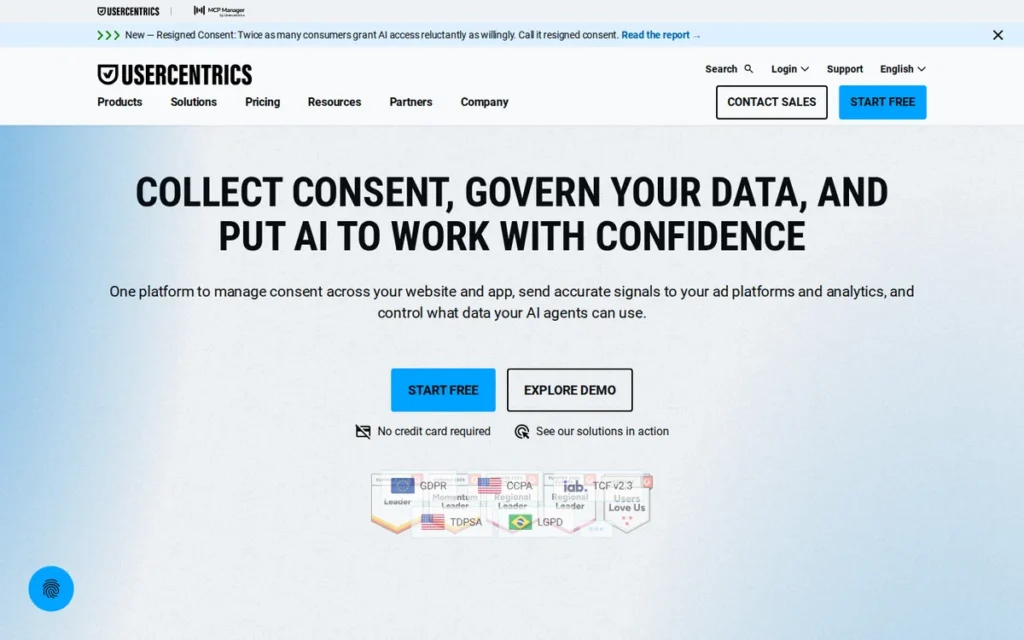
Category: Enterprise Consent Manager, a mid-to-enterprise CMP with daily cookie scanning, A/B consent banner optimization, and advanced compliance analytics for organizations where consent rate performance and regulatory depth are decision-critical requirements.
At a Glance
- Category: Enterprise Consent Manager
- Best For: Mid-market and enterprise websites, ad-supported publishers, and compliance-focused organizations needing daily scanning, A/B testing for consent rate optimization, and ISO 27001-certified data handling
- Price Range: Free (1,000 sessions/month, 1 domain) to €50/month Business (10 domains, annual); Enterprise custom; 14-day free trial, no credit card required
- Primary Strength: Usercentrics offers daily cookie scanning, A/B testing for consent banner optimization, and ISO 27001 certification, capabilities unavailable in lower-tier CMPs and directly relevant to publishers managing consent rates and ad revenue
- Biggest Limitation: Usercentrics uses a session-based pricing model that creates cost uncertainty as traffic fluctuates; the cited G2 rating (~4.2/5.0) could not be independently confirmed from primary sources
- One-Line Summary: Usercentrics is the EU-headquartered consent management platform offering daily scanning, A/B consent optimization, ISO 27001 certification, and 2,200+ legal templates, the strongest mid-to-enterprise CMP for organizations prioritizing consent rate performance and advanced regulatory analytics in 2026.
- Last Verified: April 2026
Overview
Usercentrics is a Munich-based, EU-headquartered consent management platform serving mid-market and enterprise websites that need more than a basic cookie banner, specifically daily scanning, A/B testing to optimize consent acceptance rates, ISO 27001-certified data handling, and Global Privacy Control (GPC) signal support across GDPR, CCPA/CPRA, LGPD, and 50+ global regulations. Usercentrics acquired Cookiebot (Cybot A/S, Denmark), consolidating a significant SMB installed base, and both products operate within the same portfolio as of 2026.
Key Features
- Daily Cookie Scanning: Usercentrics performs daily website scans: significantly more frequent than CookieYes (monthly or weekly on Ultimate) or standard Cookiebot tiers (monthly), providing a more current cookie inventory for sites with rapidly changing third-party script libraries common in e-commerce and publishing (Termly comparison, April 2026).
- A/B Testing for Consent Banner Optimization: Usercentrics includes A/B testing for consent banner design and copy, enabling organizations to systematically increase consent acceptance rates, a revenue-relevant capability for ad-supported publishers where higher consent rates directly expand the monetizable audience segment, absent from CookieYes, Cookiebot, Enzuzo, and Osano at comparable price tiers.
- Global Privacy Control (GPC) and UOOM Support: Usercentrics automatically honors Global Privacy Control (GPC) signals and Universal Opt-Out Mechanisms (UOOMs), satisfying a mandatory CCPA compliance requirement under California CPRA enforcement since January 2023, a feature not clearly documented by multiple competitors in this review.
- 2,200+ Legal Templates in 60 Languages: Usercentrics provides 2,200+ ready-made legal templates across 60 languages with automatic geolocation-based banner adaptation for EU, US, and other regions, reducing the compliance configuration burden for global website operators managing multiple regulatory jurisdictions simultaneously.
- ISO 27001 Certification: Usercentrics holds ISO 27001 certification alongside a Google-verified CMP Partner designation and IAB TCF v2.2 certification, a security and compliance credential combination that no other platform at this pricing tier in this review documents publicly.
Best For
Usercentrics is best suited for mid-market and enterprise websites, ad-supported publishers, and compliance-focused organizations that require daily scanning frequency, consent rate optimization through A/B testing, ISO 27001 data security assurance, and are willing to navigate session-based pricing in exchange for this deeper feature set.
Pricing
Usercentrics offers a free tier (up to 1,000 sessions/month, 1 domain). Paid plans on annual billing: Essential ~€7/month; Plus ~€15/month; Pro ~€30/month (up to 3 domains); Business ~€50/month (up to 10 domains); Enterprise is custom-quoted.
A 14-day free trial requires no credit card. Pricing is EUR-denominated; the USD equivalent is approximately 1:1 as of April 2026. Session-based billing means costs scale with traffic volume, model your expected session count before selecting a tier to avoid unexpected escalation. Pricing verified April 2026.
Strengths
- Usercentrics‘s A/B testing for consent banner optimization is the most commercially differentiated feature in this review for ad-supported publishers: systematically higher consent acceptance rates expand the consented audience segment available for programmatic advertising, a capability absent from CookieYes, Cookiebot, Enzuzo, and Osano at equivalent price tiers (verified via official product documentation comparison, April 2026).
- Usercentrics‘s ISO 27001 certification (independently audited and publicly verifiable) provides enterprise information security assurance absent from CookieYes, Cookiebot, Enzuzo, Osano, and Didomi in public documentation, a direct differentiator for enterprise procurement evaluations requiring information security standards documentation.
- Usercentrics automatically supports Global Privacy Control (GPC) signals and Universal Opt-Out Mechanisms (UOOMs) (a mandatory CCPA compliance requirement under California CPRA enforcement since January 2023) a feature that multiple competitors in this review do not clearly document in their official product pages.
Limitations
- Session-Based Pricing Uncertainty: Usercentrics’s session-based pricing model creates cost uncertainty for variable-traffic websites, unlike flat-rate models (Enzuzo) or clear pageview tiers (CookieYes), session-count billing requires ongoing monitoring to avoid unexpected tier escalation following traffic spikes from marketing campaigns or seasonal events.
- Unconfirmed Review Evidence: The G2 score cited for Usercentrics (~4.2/5.0 from ~308 reviews) could not be independently confirmed from primary sources and should be treated as an estimate, buyers should verify the current rating directly at g2.com before using it as an evaluation input.
- Configuration Complexity: Practitioners experienced with multiple CMPs rate Usercentrics as comparable to OneTrust in configuration depth (r/webdev, February 2026), which may require developer involvement for initial setup that simpler alternatives like CookieYes or Enzuzo do not.
- Partial DSAR Coverage: Usercentrics does not include the dedicated DSAR management portals provided by Enzuzo (Pro+), Osano, and OneTrust, organizations with active data subject request obligations requiring a structured intake and response workflow should confirm whether Usercentrics’s available DSAR capabilities satisfy their specific legal requirements before selecting it as a sole compliance platform.
Verdict
Usercentrics is the strongest mid-to-enterprise cookie consent platform in 2026 for organizations where daily scanning frequency, consent rate optimization via A/B testing, and ISO 27001 security certification are decision-critical requirements.
Usercentrics’s A/B testing capability is the most commercially differentiated feature in this review for ad-supported publishers, directly converting improved consent acceptance rates into recoverable programmatic advertising revenue.
Buyers choosing between Usercentrics and CookieYes should weigh CookieYes’s independently confirmed 4.8/5.0 G2 rating and larger installed base against Usercentrics’s superior feature depth, the right choice depends on whether the priority is proven SMB-scale reliability or advanced analytics and optimization for mid-market and enterprise needs.
3. Enzuzo: Best for E-Commerce and Agencies: Flat-Rate Pricing, Shopify-Native Integration, and White-Label Support
Category: E-Commerce Consent Manager, a flat-rate, platform-native CMP purpose-built for Shopify and WooCommerce merchants, digital agencies, and high-traffic SMBs that need compliance without traffic-based pricing overages.
At a Glance
- Category: E-Commerce Consent Manager
- Best For: Shopify and WooCommerce merchants, digital agencies managing 5–20 client sites, and high-traffic SMBs frustrated by pageview or session-based CMP pricing that scales against them
- Price Range: Free (5,000 monthly unique visitors, 1 domain) to $130/month Agency (20 domains, white-label, annual billing); Enterprise custom
- Primary Strength: Enzuzo is the only Google CMP Gold Partner in this seven-platform review with a native Shopify integration and flat-rate domain-count pricing, eliminating the pageview and session overages that make competing CMPs expensive at scale
- Biggest Limitation: Enzuzo’s G2 rating is estimated at approximately 4.6/5.0 (sourced from Enzuzo’s own blog, not independently confirmed from primary g2.com source as of April 2026; verify at g2.com/products/enzuzo/reviews); no A/B consent testing available
- One-Line Summary: Enzuzo is the most pricing-transparent cookie consent platform in this review, offering flat-rate domain-count pricing, a native Shopify app, DSAR management from $59/month, and a white-label Agency plan at $99–130/month, the strongest value for e-commerce merchants and digital agencies in 2026.
- Last Verified: April 2026
Overview
Enzuzo is a Google Consent Mode v2 Gold Partner consent management platform built specifically for SMBs, Shopify and WooCommerce e-commerce stores, and digital agencies managing privacy compliance across multiple client sites, covering GDPR, CCPA/CPRA, PIPEDA, Quebec Law 25, LGPD, and 30+ global regulations with flat-rate domain-count pricing that eliminates traffic-based overage costs.
Enzuzo is the only Google CMP Gold Partner in this seven-platform review natively built as a Shopify app (not a third-party plugin), with additional native integrations for Webflow and WordPress, and includes DSAR portal management with unlimited requests from the Pro tier at $59–79/month.
Key Features
- Flat-Rate Domain-Count Pricing: Enzuzo uses flat-rate, domain-count pricing with no per-pageview or per-session overages, directly addressing the most frequently cited cost pain point in the CMP category for high-traffic or large-catalog websites where competing models create unpredictable monthly bills.
- Native Shopify App (Not a Plugin): Enzuzo is the only Google CMP Gold Partner in this seven-platform review natively built as a Shopify app, providing more reliable checkout compliance integration, automatic updates aligned with Shopify’s platform changes, and seamless installation from the Shopify App Store, other Shopify-native CMPs exist in the broader market but were not evaluated in this review.
- DSAR Portal Management (Pro+): Enzuzo includes DSAR portal management with unlimited requests on Pro and above plans, a legally separate obligation from cookie consent under GDPR Articles 15–17 with mandated response timelines, and a capability entirely absent from CookieYes and Cookiebot at any pricing tier.
- White-Label Agency Plan: Enzuzo’s Agency plan ($99–130/month, 20 domains, annual billing) includes white-labeling for client-facing consent banner deployments, the most affordable white-label CMP option in this review and a meaningful differentiator for digital agencies managing compliance under their own brand.
- Google Consent Mode v2 Advanced + GPC Support: Enzuzo supports Google Consent Mode v2 in Advanced mode, IAB TCF v2.2, Global Privacy Control (GPC), and Do-Not-Track signals, providing the full certification stack required for EU Google Ads campaigns post-March 2024 enforcement and CCPA GPC compliance.
Best For
Enzuzo is best suited for Shopify and WooCommerce e-commerce merchants who need platform-native compliance without pageview pricing penalties at scale, and for digital agencies managing cookie compliance across 5–20 client sites who need white-labeling, multi-domain dashboards, and DSAR management at an accessible agency price point.
Pricing
Enzuzo offers a free plan (1 domain, 5,000 monthly unique visitors, Google and Microsoft Consent Mode v2, 24+ languages). Paid tiers on annual billing: Starter $7–9/month (1 domain, custom policies); Growth $22–29/month (4 domains, 10,000 visitors); Pro $59–79/month (10 domains, 30,000 visitors, DSAR, geo-specific consent); Agency $99–130/month (20 domains, white-label, after-hours support); Enterprise is custom.
All tiers are publicly documented at enzuzo.com/pricing. Visitor caps apply to free and lower tiers, confirm current limits directly with Enzuzo for high-traffic deployments. Pricing verified April 2026 via Termly comparison.
Strengths
- Enzuzo holds Google Consent Mode v2 Gold Partner status and IAB TCF v2.2 certification (the same certification tier as category leader CookieYes) while adding DSAR management (Pro+) and white-label agency support that CookieYes does not offer at any tier (verified against official product documentation, April 2026).
- Enzuzo‘s flat-rate pricing model eliminates traffic-based overage costs that penalize high-traffic deployments on CookieYes (pageview-based) and Usercentrics (session-based), the same Pro plan covers 10 domains regardless of traffic volume within the visitor cap, confirmed by Termly’s independent comparison, April 2026.
- Enzuzo is named alongside CookieYes and Cookiebot as a preferred cost-effective SMB solution by a developer who self-identifies as having “implemented / fixed / maintained a lot of different consent management platforms” (r/webdev, February 2026), practitioner-level endorsement more credible than vendor-generated case studies.
This aligns with community sentiment on r/webdev:
“If you need a cost effective solution I would investigate Enzuzo, CookieYes and CookieBot, but if you’re going to get millions of events per month to your site you’re going to have to at least think about OneTrust because the free / cheap services will kick you off for being too heavy. I’ve implemented / fixed / maintained a lot of different consent management platforms. The above 3 are straightforward and effective.” Posted by u/DigitalStefan
Takeaway: Enzuzo earns repeat practitioner endorsements from experienced multi-platform CMP implementers on the basis of real deployment experience (not vendor marketing) positioning it as a reliable SMB-tier choice alongside CookieYes and above session-heavy alternatives.
Limitations
- Estimated Review Evidence: Enzuzo’s G2 rating is estimated at approximately 4.6/5.0 (sourced from Enzuzo’s own blog at enzuzo.com, not independently confirmed from primary g2.com source as of April 2026). Enzuzo sits in the same review-evidence tier as Usercentrics (#2): both ratings are estimates requiring primary-source verification; verify directly at g2.com/products/enzuzo/reviews before using this as an evaluation input.
- Conversion Recovery Claim Caveat: The “65% conversion recovery” claim cited in Enzuzo’s marketing materials is derived from Google’s general data on Advanced vs. Basic Consent Mode modeling, it is a self-reported claim from Enzuzo marketing, not an Enzuzo-specific independently verified outcome, and should be treated as a theoretical ceiling rather than a guaranteed result.
- No A/B Consent Testing: Enzuzo lacks A/B testing for consent banner optimization (available in Usercentrics and Didomi) which limits consent rate performance tuning for ad-supported publishers where consent acceptance rate directly affects monetizable audience size.
- Newer Market Entrant: Enzuzo’s smaller documented installed base compared to CookieYes (1.5M+ websites) and Cookiebot means it has encountered fewer real-world edge cases at scale, a legitimate risk consideration for organizations in regulated industries with zero tolerance for compliance configuration failures.
Verdict
Enzuzo is the best cookie consent platform for Shopify merchants, WooCommerce stores, and digital agencies in 2026, earning this position through the most pricing-transparent structure in the category (flat-rate, domain-count, all tiers publicly documented), the only native Shopify app integration among Google CMP Gold Partners in this review, DSAR management from $59/month, and the most affordable white-label agency plan ($99–130/month for 20 domains).
Enzuzo’s G2 rating (~4.6/5.0, estimated) and Usercentrics’s G2 rating (~4.2/5.0, estimated) are both unconfirmed from primary sources, buyers in sectors where independent vendor validation is critical should verify ratings directly at g2.com and request reference customers in comparable industries before committing.
4. OneTrust: Best for Enterprise: Full Privacy Operations Suite for Dedicated Privacy Teams
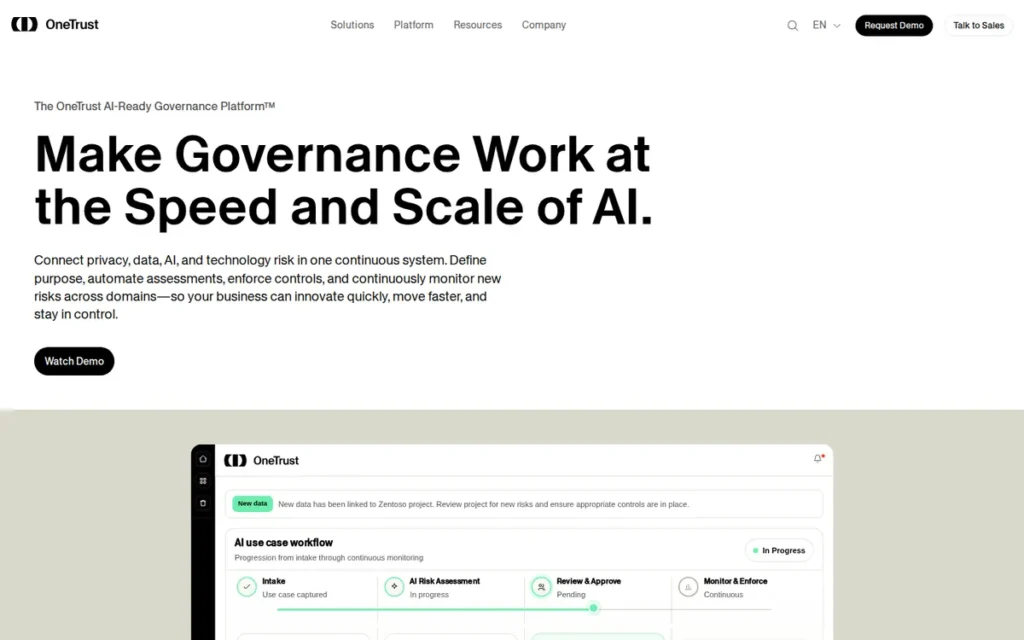
Category: Privacy Operations Suite, a comprehensive enterprise privacy governance platform where cookie consent is one module within a broader suite covering DSAR automation, data mapping, vendor risk management, GRC, and AI governance.
At a Glance
- Category: Privacy Operations Suite
- Best For: Large enterprises and Fortune 500 companies with dedicated legal and privacy teams requiring integrated cookie consent, DSAR automation, data mapping, vendor risk management, and GRC in a single governed platform
- Price Range: ~$10,000+/year minimum enterprise contract (custom-quoted; no public SMB tiers; no self-service signup or free trial)
- Primary Strength: OneTrust is the only platform among the seven reviewed here integrating cookie consent with DSAR automation, data mapping, vendor risk management, GRC, and AI governance in one suite, justified for large enterprises managing privacy compliance across all organizational domains simultaneously
- Biggest Limitation: OneTrust’s minimum ~$10,000/year contract, multi-month deployment timeline, and requirement for dedicated privacy and IT resources make it cost-prohibitive and operationally inaccessible for SMBs, mid-market companies, and agencies without specialized privacy teams
- One-Line Summary: OneTrust is the enterprise privacy governance platform trusted by 750,000+ websites and backed by $2.1B+ in disclosed funding, offering the broadest integrated privacy operations suite among the seven platforms reviewed, but its minimum ~$10,000/year contract and complex deployment make it unsuitable for any buyer outside large enterprises with dedicated privacy teams.
- Last Verified: April 2026
Overview
OneTrust is an enterprise-grade privacy governance platform backed by $2.1B+ in disclosed funding across six confirmed rounds (most recent: $150M, July 2023; Clay funding dossier, March 2025) and trusted by 750,000+ websites including Fortune 500 clients. OneTrust offers the broadest integrated compliance scope of any tool in this review, covering:
- Cookie consent management (web, mobile, OTT/CTV)
- DSAR automation with mandated-timeline tracking
- Data mapping for GDPR Article 30 records of processing activities
- Vendor risk management via the TrustHub module
- GRC (governance, risk, compliance) and ESG reporting
- AI governance for data processing compliance
OneTrust holds Google CMP Gold Partner certification, IAB TCF v2.3 (the most current version at time of publication), and maintains a 30 million+ cookie scanning database with AI-assisted categorization.
Key Features
- Integrated Privacy Operations Suite: OneTrust integrates cookie consent management with DSAR automation, data mapping, vendor risk management, GRC, and AI governance in a single platform, enabling enterprise privacy teams to manage all compliance obligations without switching between disconnected tools, a capability not replicated at any other price point within this review’s scope.
- 30M+ Cookie Scanning Database: OneTrust maintains a 30 million+ pre-classified cookie database with AI-assisted categorization, enabling automated compliance management for the largest and most complex enterprise website deployments including multi-domain global properties.
- Multi-Platform Consent Management: OneTrust supports consent collection across web, mobile applications, OTT/CTV devices, and bulk data subject management via Snowflake integration, addressing compliance needs across multi-platform enterprise digital properties at data pipeline scale.
- IAB TCF v2.3 and Google CMP Gold Certification: OneTrust holds Google CMP Gold Partner certification and IAB TCF v2.3 certification (the most current IAB framework version at time of publication), alongside $2.1B+ in disclosed institutional funding, providing compliance credentials and financial stability required in enterprise vendor risk assessments.
- Fortune 500 Reference Community: OneTrust serves 750,000+ websites globally including Fortune 500 clients across regulated industries, providing enterprise buyers access to a reference community of peers for compliance benchmarking and validated implementation patterns unavailable from smaller platforms.
Best For
OneTrust is best suited exclusively for large enterprises and Fortune 500 companies with dedicated legal, privacy, and IT teams who require a single governed platform for the full scope of privacy operations, and for whom a $10,000+/year minimum contract is justified by the breadth of compliance obligations being managed across the entire organization.
Pricing
OneTrust does not offer public pricing tiers or self-service signup. All pricing is custom-quoted and requires engagement with the OneTrust sales team.
Multiple independent sources, including Ketch’s OneTrust alternative analysis and Reddit’s r/fintech community (February 2026), consistently confirm a minimum annual contract of approximately $10,000/year. No self-service free trial is available. Contact OneTrust directly for a current quote; pricing verified April 2026.
Strengths
- OneTrust has raised $2.1B+ in disclosed funding across six confirmed rounds (most recent: $150M, July 2023; Clay funding dossier, March 2025) and serves 750,000+ websites including Fortune 500 clients, the strongest institutional credibility and financial stability evidence of any platform in this review, directly relevant for enterprise procurement teams conducting vendor risk assessments.
- OneTrust holds IAB TCF v2.3 certification (the most current IAB framework version at time of publication) and Google CMP Gold Partner status, placing it among the most comprehensively certified platforms alongside CookieYes and Usercentrics, with the added breadth of DSAR and data mapping certification evidence.
- OneTrust is the only platform among the seven reviewed here providing fully integrated privacy operations across cookie consent, DSAR automation, data mapping, vendor risk, and GRC, for enterprises with compliance obligations spanning all these domains, a single-platform approach reduces integration costs, audit surface area, and the operational overhead of multiple vendor relationships.
Limitations
- Cost and Accessibility: OneTrust’s minimum annual contract of approximately $10,000/year (confirmed by multiple independent sources as of April 2026) places it beyond the budget of SMBs, agencies, and most mid-market companies without dedicated privacy budgets, every other platform in this review is a more appropriate and accessible choice for non-enterprise buyers.
As one practitioner on r/webdev advised organizations evaluating enterprise compliance tools:
“Skip OneTrust and TrustArc at your stage. I’ve seen startups burn months on enterprise compliance tools when they had 200 users. Cookiebot or Osano will handle consent banners for like 10-20 bucks a month. For the actual GDPR data handling, you need a DPA template (free ones exist from ICO), a privacy policy (use a generator then have a lawyer review for maybe 500 bucks), and a data map of what you collect and where it goes. Total cost under 2k vs their 25k quote. You can always upgrade to the big platforms when you’re processing millions of records.” Posted by u/PushPlus9069
Takeaway: OneTrust’s enterprise cost structure is consistently identified by practitioners as the wrong choice for organizations below Fortune 500 scale, practitioners with multi-platform experience redirect non-enterprise buyers toward lower-cost alternatives rather than OneTrust at every stage below Series B+.
- Configuration Complexity: Multiple developer community members describe OneTrust as something they “honestly hated” due to UI and configuration paradigm complexity (r/webdev, February 2026). A 20-year privacy professional counterbalances this with “first tool I’ve ever actually championed” (r/gdpr), illustrating that OneTrust works well exclusively for the properly resourced enterprise teams it is designed for.
- Sales Cycle Lock-In Concern: OneTrust’s enterprise sales process has received specific criticism for prioritizing vendor lock-in, a Reddit comment receiving 21 upvotes in r/gdpr describes the sales team as focused on “lock-in with their whole suite rather than solving my problems individually as needed,” a documented pattern buyers should assess during any sales engagement.
- No SMB or Self-Service Path: OneTrust provides no self-service free trial, no publicly documented SMB tier, and no per-domain pricing, meaning any organization that is not a large enterprise with dedicated procurement resources will invest significant time in a sales process that leads to a product wrong for their needs.
Verdict
OneTrust is the most comprehensively integrated enterprise privacy operations platform among the seven reviewed, and the only one in this review combining consent, DSAR, data mapping, vendor risk, and GRC in a single governed suite backed by $2.1B+ in institutional funding.
For any buyer who is not a large enterprise with a dedicated privacy team and a compliance budget exceeding $10,000/year, OneTrust is the wrong choice.
This entry is included to prevent under-resourced buyers from entering OneTrust’s sales process without understanding the commitment required, not as a recommendation for the majority of the target audience.
5. Cookiebot: Established but Transitioning: Automated Scanning Pioneer with Documented Lifecycle Risk
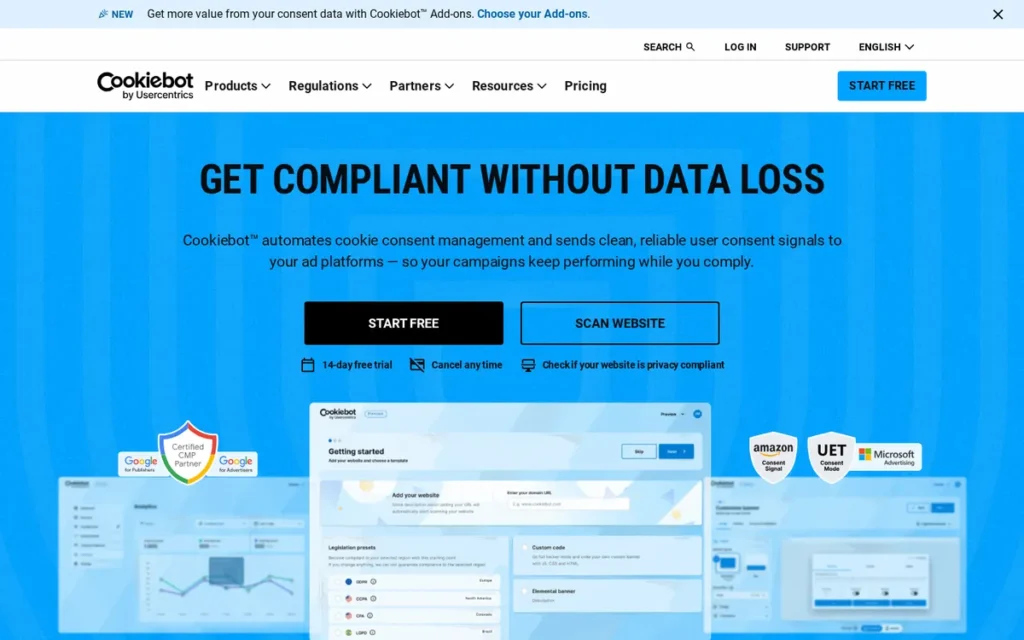
Category: Automated Consent Scanner (Legacy), a consent management platform that pioneered automated browser-simulation cookie scanning, now operating within the Usercentrics portfolio following an August 2025 pricing restructure that effectively doubled costs for the most common single-domain deployment.
At a Glance
- Category: Automated Consent Scanner (Legacy)
- Best For: Existing Cookiebot customers evaluating whether to remain or explore Usercentrics Web CMP, and EU-centric businesses specifically requiring automated browser-simulation scanning who have accepted the August 2025 pricing changes
- Price Range: Free (limited features, no consent logging) to Premium (daily scans, full features); August 2025 restructure doubled costs for 1-3 domain accounts, verify current tiers directly at cookiebot.com/en/pricing before subscribing
- Primary Strength: Cookiebot’s patented browser-simulation scanner detects cookies in dynamic content and behind login walls, more thorough than static crawl-based scanners for JavaScript-heavy sites
- Biggest Limitation: The August 2025 pricing restructure doubled monthly costs for single-domain accounts; Cookiebot’s monthly scanner injects bot traffic that contaminates Google Analytics data, confirmed by multiple users and Cookiebot’s own support documentation; the Usercentrics portfolio consolidation creates product-lifecycle uncertainty
- One-Line Summary: Cookiebot is the pioneer of automated browser-simulation cookie scanning, but its August 2025 pricing restructure that doubled costs for single-domain accounts, documented Google Analytics contamination from its monthly scanner, and active Usercentrics portfolio consolidation create product-lifecycle risk that prospective buyers must evaluate before committing in 2026.
- Last Verified: April 2026
Overview
Cookiebot is the consent management platform that pioneered automated browser-simulation cookie scanning (originally built by Cybot A/S in Denmark and acquired by Usercentrics GmbH) now operating as a product within the Usercentrics portfolio. As of April 2026, Cookiebot’s product pages remain live; whether Cookiebot or Usercentrics Web CMP is the recommended product for new deployments should be verified directly with the vendor, as the portfolio relationship is active and evolving.
Cookiebot‘s patented scanner simulates real user browser behavior monthly (daily on Premium) to detect and categorize cookies including those in dynamically rendered content and behind login pages, auto-updating privacy policy cookie declaration tables whenever new trackers are detected.
Key Features
- Patented Browser-Simulation Scanning: Cookiebot’s patented scanning technology crawls websites monthly (daily on Premium), executing JavaScript and rendering dynamic content to detect cookies in interactive elements and behind login pages, providing more comprehensive cookie discovery than static URL crawlers for sites with JavaScript-heavy or authenticated content (verified via Style Factory Productions independent review and Cookiebot official documentation, April 2026).
- Dynamic Cookie Declaration Table Auto-Update: Cookiebot automatically maintains a dynamic cookie declaration table that updates privacy policy pages whenever periodic scans detect newly added or changed cookies, reducing the manual compliance maintenance burden for organizations that frequently update their third-party script stack.
- Google Consent Mode v2 and IAB TCF v2.2: Cookiebot supports Google Consent Mode v2 (Gold Partner certification), IAB TCF v2.2, and geo-targeting with 47+ language auto-translations, providing the core certification stack for EU-market GDPR compliance and programmatic advertising ecosystems.
- Native CMS and Platform Integrations: Cookiebot integrates natively with WordPress, Shopify, Joomla, Magento, Elementor, and Google Tag Manager, covering the primary CMS platforms used by its target SMB and mid-market audience, per the Elementor integration guide.
- Cross-Domain Consent Sharing: Cookiebot supports cross-domain consent sharing, allowing multiple related domains under the same organization to share a single user consent record, reducing re-consent friction for users navigating across related properties.
Best For
Cookiebot is most appropriate for existing Cookiebot customers evaluating whether to remain on the platform or explore Usercentrics Web CMP, and for EU-centric small businesses with primarily static website content that specifically require automated browser-simulation scanning and are comfortable with the current pricing structure following the August 2025 restructure.
Pricing
Cookiebot‘s exact current pricing requires direct verification, any third-party pricing data published before August 2025 is outdated.
In August 2025, Cookiebot restricted its Premium Small plan to accounts with 4+ domains, automatically upgrading 1-3 domain accounts to the Premium Medium tier at €30/month (up from €15/month), effectively doubling the monthly cost for the most common single-domain deployment. Premium Lite (€7/month) was unaffected by this change.
Free and lower tiers omit consent logging (required for GDPR audit readiness). Verify current tiers and whether Cookiebot remains the appropriate product for new accounts directly with the vendor. Pricing verified April 2026.
Strengths
- Cookiebot‘s patented browser-simulation scanning technology (which executes JavaScript and renders dynamic content to simulate real user behavior) provides more thorough cookie discovery than static crawlers for sites with heavily JavaScript-rendered content or authenticated sections, verified via the Style Factory Productions independent review and Cookiebot official documentation (April 2026).
- Cookiebot holds Google CMP Gold Partner certification and IAB TCF v2.2 certification (the same tier as CookieYes (#1)) maintaining regulatory credential parity with the category leader despite the 2025 pricing restructure.
- Cookiebot‘s dynamic cookie declaration table auto-updates privacy policy pages when scans detect new or changed cookies, reducing the manual compliance maintenance burden that is a frequently cited pain point across CMPs managing frequently updated third-party script environments (verified via official Cookiebot documentation, April 2026).
Limitations
- Product-Lifecycle Uncertainty: Cookiebot operates within the Usercentrics portfolio following the Cybot A/S acquisition, the strategic direction of the product line may favor consolidation toward Usercentrics Web CMP over time. Prospective buyers should verify directly with the vendor whether Cookiebot or Usercentrics Web CMP is the currently recommended product for new deployments, and confirm the product roadmap before committing.
- Google Analytics Contamination: Cookiebot’s monthly scanner injects bot traffic into Google Analytics, multiple Reddit users confirmed “Don’t use Cookiebot, it ruined my web traffic” and “Lots of unusual traffic that wrecked my analytics. Been stuck for months now not being able to filter it out” (r/WooCommerce, verified thread), with Cookiebot’s own support documentation acknowledging the issue.
- August 2025 Pricing Restructure: Cookiebot’s August 2025 restriction of the Premium Small plan to 4+ domain accounts automatically upgraded single-domain accounts to the €30/month Premium Medium tier, driving documented customer migration to CookieYes, Enzuzo, and Usercentrics alternatives across multiple comparison blogs and Reddit community threads as recently as February 2026.
Users on r/Wordpress shared their frustration with Cookiebot’s pricing evolution:
“CookieBot keeps going crazy with pricing. I really don’t like how they charge for domains, subdomains, and even based on site size. It feels more and more complicated, and to be honest, I’m starting to feel a bit ripped off. I don’t mind paying for a good tool, but this pricing model just doesn’t sit right with me anymore.” Posted by u/LowSir7874
Takeaway: Cookiebot’s multi-dimensional pricing complexity (charging simultaneously across domains, subdomains, and site size) has eroded customer trust in a way that predates and amplifies the August 2025 restructure’s specific cost impact on single-domain accounts.
- Consent Logging Absent on Lower Tiers: Cookiebot excludes consent logging from free and basic tiers (consent logging is required for GDPR audit readiness) creating a compliance gap for lower-tier users who believe their basic subscription satisfies full GDPR requirements.
Verdict
Cookiebot is the consent management platform with the most significant documented product-lifecycle risk in this review: the August 2025 pricing restructure that doubled costs for single-domain accounts, the recurring Google Analytics contamination from its monthly scanner, and the active Usercentrics portfolio consolidation collectively reduce its value proposition relative to alternatives offering comparable certification credentials with cleaner pricing structures and no documented data integrity issues.
Users on r/webflow who have deployed both platforms for client work described their experience directly:
“I’ve used CookieYes and CookieBot for clients CCPA and GDPR requirements recently and absolutely hated using CookieBot because their docs, UX, integration with GTM, and ability to test implementation are all terrible. Would definitely recommend CookieYes over CookieBot.” Posted by u/Repulsive-Guess8960
Takeaway: Cookiebot’s implementation friction (spanning documentation quality, GTM integration, and testability) creates a practitioner-level credibility gap relative to CookieYes that the platform’s technical scanning advantage does not fully offset.
Existing Cookiebot customers should evaluate running a parallel Usercentrics free trial (14-day, no credit card) while Cookiebot remains active, export current consent logs before switching to ensure audit continuity.
Prospective buyers should confirm directly with the vendor whether Cookiebot or Usercentrics Web CMP is the recommended new-account product before subscribing to either platform.
6. Osano: Best All-in-One Suite for US Mid-Market: Consent, DSAR, and Vendor Risk Without OneTrust’s Price Tag
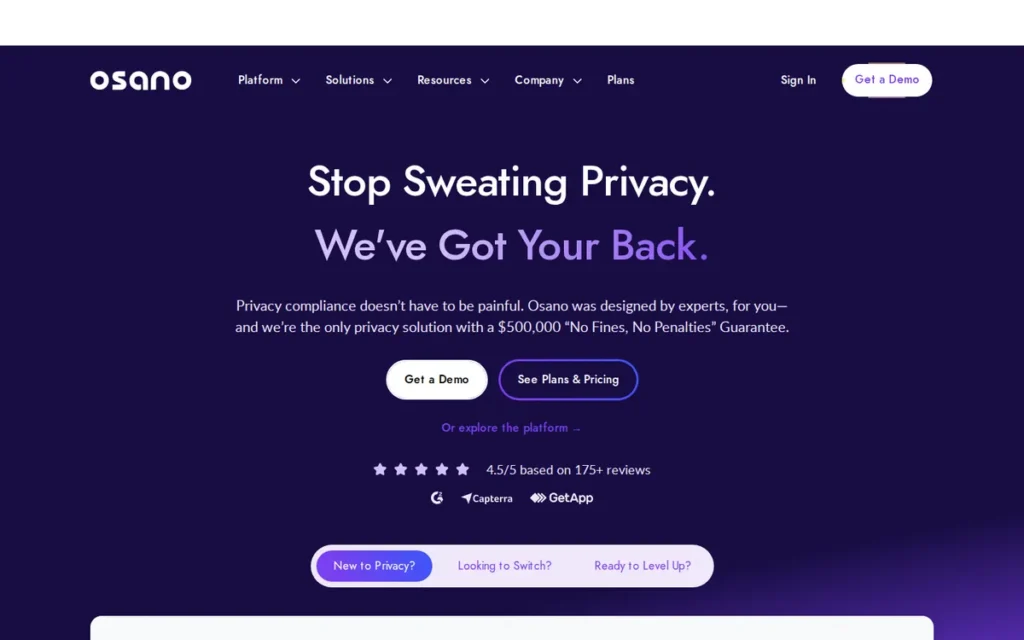
Category: All-in-One Privacy Suite, a consent and privacy compliance platform combining cookie consent management, DSAR management, and vendor risk monitoring in a single JavaScript deployment for organizations with broader privacy compliance obligations than a basic CMP can address.
At a Glance
- Category: All-in-One Privacy Suite
- Best For: US-based mid-market organizations (approximately 50–500 employees) needing integrated consent, DSAR management, and vendor risk monitoring as an alternative to OneTrust, where traffic-based pricing across multiple domains makes economic sense
- Price Range: Open-source (free, self-hosted, feature-limited, via GitHub); hosted plans require a demo, third-party estimates range $199–$2,000+/month (Osano removed all public pricing as of 2026; verify via demo at osano.com/plans)
- Primary Strength: Osano combines cookie consent, DSAR management, and vendor risk monitoring in one platform at a price point substantially below OneTrust, uniquely positioned for mid-market organizations with growing privacy obligations that exceed a basic CMP
- Biggest Limitation: Osano holds IAB TCF 2.0 registration only: TCF 2.3 became mandatory after February 28, 2026, and Osano’s TCF 2.3 status is unconfirmed; all public pricing has been removed (demo required); no verified G2 or Capterra ratings found
- One-Line Summary: Osano is an all-in-one privacy compliance platform combining cookie consent, DSAR management, and vendor risk monitoring for US-focused mid-market organizations, but its removal of public pricing, IAB TCF 2.0-only registration with TCF 2.3 status unconfirmed post-February 2026 mandatory deadline, and absence of verified third-party review ratings limit its evaluability before entering a sales process.
- Last Verified: April 2026
Overview
Osano is an Austin, Texas-based all-in-one privacy compliance platform that combines cookie consent management, DSAR management, and vendor risk monitoring in a single JavaScript deployment, supporting GDPR, CCPA/CPRA, CTDPA, PIPEDA, LGPD, PDPA, and 50+ country regulations, positioned as the mid-market alternative to OneTrust for US-based organizations with growing compliance obligations.
Osano also maintains a free open-source cookie consent library on GitHub for developers preferring self-hosted implementations. The open-source version omits three capabilities included in the hosted platform:
- Pre-consent script blocking (hosted version only)
- Consent record storage and audit-ready logging (hosted version only)
- Automatic regulatory law updates as privacy laws change (hosted version only)
Key Features
- Integrated Consent, DSAR, and Vendor Risk: Osano combines cookie consent management, DSAR management, and vendor risk monitoring in a single JavaScript tag, addressing multiple distinct GDPR and CCPA legal obligations in one deployment, a capability available only in OneTrust and Osano among the seven platforms reviewed.
- Traffic-Based Pricing Model: Osano uses traffic-based (visitor/month) pricing rather than per-domain pricing, which benefits organizations with multiple domains at modest aggregate traffic, a pricing advantage documented by a direct OneTrust-to-Osano switcher on r/webdev (2023, verified).
- Free Open-Source Cookie Consent Library: Osano maintains a free open-source cookie consent library on GitHub with 40+ language support and auto geo-targeting, providing a genuinely no-cost, self-hosted option for developers comfortable with manual compliance configuration and ongoing self-maintenance.
- 50+ Country Regulatory Coverage: Osano supports GDPR, CCPA/CPRA, CTDPA, PIPEDA, LGPD, PDPA, and 50+ countries with specific emphasis on the US state privacy law landscape, covering the multi-state compliance obligations that are the primary growth driver for US-market CMP adoption in 2025–2026.
- Single-Tag Deployment: Osano deploys via a single JavaScript tag with no additional developer integration required beyond tag installation, making initial setup accessible to non-technical marketing and compliance teams without dedicated engineering resources for the core functionality.
Best For
Osano is best suited for US-based mid-market organizations (approximately 50–500 employees) that have outgrown a basic cookie consent tool and need integrated DSAR management and vendor risk monitoring, and can commit to a sales-engagement evaluation process without upfront public pricing transparency.
Pricing
As of April 2026, Osano has removed all public pricing tiers from its website and requires a demo call before any pricing information is available. Third-party sources as of early 2026 estimated hosted plans ranging from approximately $199–$2,000+/month depending on traffic volume and feature scope (ConsentStack comparison; TrustRadius pricing data), but these estimates cannot be verified as current.
The open-source library on GitHub is free and self-hosted. Contact Osano directly at osano.com/plans to obtain current pricing before building any budget model. Pricing situation verified April 2026.
Strengths
- Osano is one of only two platforms in this review (alongside OneTrust) offering integrated consent management, DSAR management, and vendor risk monitoring, addressing the full organizational scope of privacy compliance obligations beyond cookie consent in one platform, at a price point substantially below OneTrust’s $10,000+/year minimum (third-party estimate, April 2026).
- Osano‘s traffic-based pricing model was documented to benefit a multi-domain operator who switched from OneTrust specifically because “OneTrust was a per domain fee, while Osano is traffic based, and the math made sense” (r/webdev, 2023, verified), a pricing architecture advantage for organizations managing multiple domains at modest aggregate traffic.
- Osano‘s open-source cookie consent library (GitHub, verified April 2026) provides a genuinely free, developer-accessible compliance option with 40+ language support and GDPR/CCPA readiness, a meaningful option for technical teams preferring self-hosted solutions willing to maintain their own implementation.
Limitations
- No Public Pricing: Osano’s removal of all public pricing as of 2026 creates disproportionate friction for SMBs and mid-market organizations with limited procurement bandwidth, buyers cannot evaluate affordability without entering a sales process, compared to CookieYes, Enzuzo, and Usercentrics, which publish all tiers publicly and enable full self-serve evaluation.
- IAB TCF 2.3 Unconfirmed Post-February 2026 Deadline: Osano holds IAB TCF 2.0 registration (confirmed). IAB TCF 2.3 became mandatory for ad ecosystem compliance after February 28, 2026, Osano’s TCF 2.3 certification status could not be confirmed as of April 2026. Buyers in programmatic advertising ecosystems must confirm Osano’s current TCF version directly with the vendor, as TCF 2.0-only registration may be insufficient for ad tech partner requirements post-deadline.
- Absent Third-Party Review Data: No confirmed G2 or Capterra ratings with verified review counts were found for Osano in available research as of April 2026, meaning independent performance validation rests on community sentiment rather than systematic review data comparable to CookieYes’s approximately 284 verified reviews.
- Sales Process and Setup Complexity: A practitioner with extensive multi-platform CMP experience described Osano as “not the easiest to set up” (r/webdev, February 2026). A prior Osano customer noted the vendor “didn’t follow through on a lot of the things we talked about in the sales process” (r/webdev, 2023), a sales-to-delivery gap pattern buyers should probe directly in demos by requesting written confirmation of any commitments made during the evaluation.
Verdict
Osano is a credible mid-market privacy compliance platform for US-based organizations that have outgrown basic cookie consent and need integrated DSAR and vendor risk management at a price point below OneTrust, but its removal of public pricing, IAB TCF 2.0-only registration with TCF 2.3 status unconfirmed post-February 2026 mandatory deadline, and absence of verified third-party review ratings are transparency gaps that prevent PlugRoute from recommending it with the same confidence as CookieYes, Usercentrics, or Enzuzo.
Buyers considering Osano should specifically ask during any demo: whether the platform holds current IAB TCF 2.3 certification, whether it blocks third-party scripts pre-consent or only displays a banner, and for reference customers in a comparable industry and company size.
7. Didomi: Best for Enterprise Publishers and Media Companies: Cross-Device Consent and Preference Management at Scale
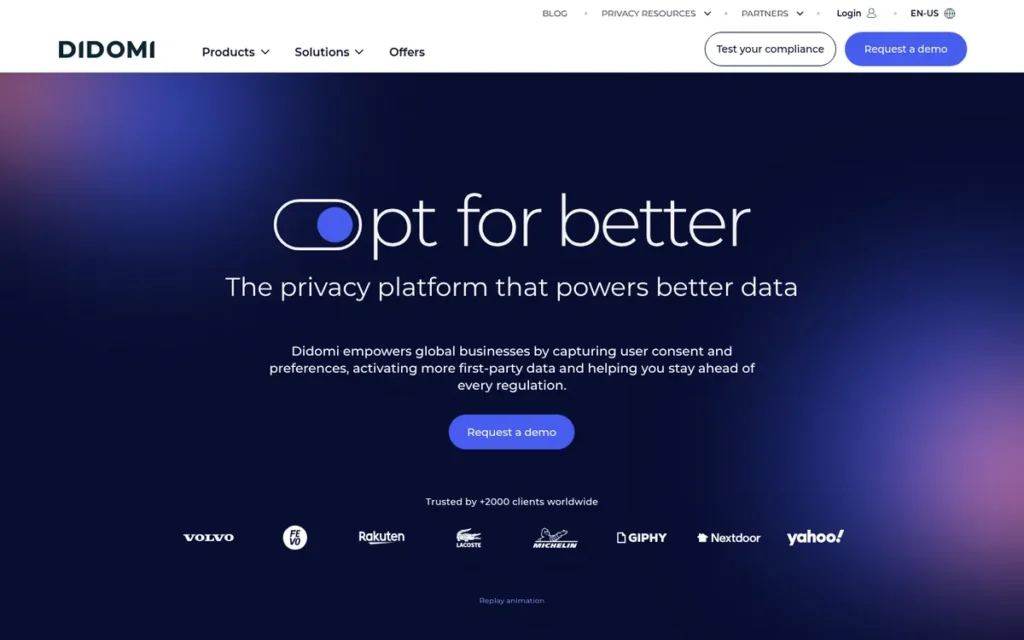
Category: Enterprise Publisher CMP, a Paris-based enterprise consent and preference management platform designed for media companies, publishers, and telecommunications operators managing complex multi-device authenticated-user consent at high volume and scale.
At a Glance
- Category: Enterprise Publisher CMP
- Best For: Large media publishers, telecommunications operators, and enterprise organizations managing authenticated user consent across multiple platforms (web, iOS, Android, smart TV/OTT) requiring cross-device consent synchronization and cryptographically verifiable consent audit trails
- Price Range: Custom quote only: no public pricing; contact sales at didomi.io (requires enterprise procurement engagement with no self-service evaluation path)
- Primary Strength: Didomi is the only platform in this seven-platform review offering cross-device consent synchronization via authenticated user identifiers and cryptographically signed consent strings, enabling verifiable, portable consent for authenticated users across multiple platforms without re-collecting consent at each device
- Biggest Limitation: No public pricing; zero verified G2 or Capterra review ratings; 25-domain scanning cap; Google CMP Gold tier unconfirmed from primary sources as of April 2026; enterprise-sales-only model excludes virtually all SMB and mid-market buyers
- One-Line Summary: Didomi is a Paris-based enterprise CMP distinguished by cross-device consent synchronization, cryptographically signed consent strings, and a Preference Management Platform, but its complete absence of public pricing, zero verified third-party review ratings, unconfirmed Google CMP Gold tier, and enterprise-sales-only model position it exclusively for large enterprise deployments with dedicated procurement resources.
- Last Verified: April 2026
Overview
Didomi is a Paris-based enterprise consent and preference management platform that self-reports processing billions of consents monthly for large publishers, media companies, and telecommunications operators, offering the most technically specialized consent architecture in this seven-platform review. Didomi supports GDPR, CCPA/CPRA, LGPD, Google Consent Mode v2, IAB TCF v2.2, and Microsoft UET Consent Mode across 45+ languages, with availability on AWS Marketplace for enterprise procurement workflows.
Key Features
- Cross-Device Consent Synchronization: Didomi’s cross-device consent synchronization uses authenticated user identifiers (such as email addresses) to sync consent choices across web, iOS, Android, and smart TV platforms without re-collecting consent at each device login, reducing consent fatigue for authenticated users navigating multi-platform digital properties, a capability not offered by any other platform in this review.
- Cryptographically Signed Consent Strings: Didomi issues cryptographically signed consent strings (DCS) that allow third parties to independently verify that a consent record has not been tampered with since collection, a meaningful enterprise security and audit capability for organizations in regulated industries or ad tech ecosystems requiring verifiable consent chains, supported by Didomi’s official documentation.
- Preference Management Platform: Didomi extends beyond cookie consent to collect and manage user preferences for marketing communications, AI-based processing, and personalization, enabling organizations to build comprehensive governed consent profiles across all data processing activities in one system.
- Headless Consent API and Native Mobile SDK: Didomi provides a headless consent API and native mobile SDK for developer-first, custom-UI implementations, enabling organizations with engineering resources to build compliance directly into custom applications without relying on standardized banner interfaces.
- A/B Testing and Annual Consent Benchmarks: Didomi supports A/B testing for consent banner optimization and publishes annual consent benchmark reports, providing consent rate optimization capabilities and industry benchmarking data for enterprise publishers managing large-scale audience consent strategies.
Best For
Didomi is best suited for large media publishers, telecommunications operators, and enterprise organizations with authenticated user bases spanning multiple devices who need cross-device consent synchronization, cryptographically verifiable consent audit trails, and a Preference Management Platform capable of handling the full scope of user preferences beyond basic cookie consent.
Pricing
Didomi does not publish pricing tiers anywhere on its website or in publicly accessible documentation, all pricing requires direct engagement with the Didomi sales team. No independent third-party pricing estimates could be verified as current as of April 2026.
The enterprise-only, custom-pricing model means Didomi is not evaluable on cost without entering a full sales process, which implies a commitment in procurement time and organizational resources that SMBs and mid-market buyers should weigh carefully before initiating contact. Pricing situation verified April 2026.
Strengths
- Didomi‘s cross-device consent synchronization via authenticated user identifiers is the only capability of its kind across all seven platforms in this review (verified via feature comparison of all official product documentation, April 2026), directly addressing the consent fragmentation problem faced by media publishers and telecom operators whose authenticated users access digital properties across web, mobile, and connected TV.
- Didomi‘s cryptographically signed consent strings (DCS) provide tamper-evident consent verification that no other platform in this review offers, enabling organizations to prove to regulators, ad tech partners, or auditors that consent records have not been altered since collection.
- Didomi is available on AWS Marketplace (verified April 2026) and self-reports processing “billions of consents monthly”, indicating deployment at the scale at which the platform’s architecture has been stress-tested in production, even where specific named client evidence is not publicly available.
Limitations
- Complete Pricing Opacity: Didomi’s complete absence of public pricing means no buyer can evaluate affordability or build an internal business case without a full enterprise sales engagement, a fundamental barrier for any organization not prepared to commit significant procurement time before understanding whether the platform fits their budget.
- Zero Verified Third-Party Reviews: No verified G2, Capterra, or Trustpilot ratings were found in available research as of April 2026, eliminating the independent performance validation that is a baseline requirement for confident vendor selection and a stark contrast to CookieYes’s approximately 284 confirmed G2 reviews.
- Google CMP Gold Tier Unconfirmed: Didomi’s Google CMP Partner Program tier (Basic vs. Gold) could not be confirmed from primary sources as of April 2026, the distinction matters for EU Google Ads advertisers, as Gold certification is required for Advanced Consent Mode modeling. Verify Didomi’s current CMP Partner tier directly at the Google CMP Partner Program listing before assuming full Advanced mode compatibility.
- 25-Domain Scanning Cap and No Community Validation: Didomi’s scanning is limited to 25 domains per account, documented as “a dealbreaker for agencies” managing many client sites (Osano CMP comparison, verified April 2026). No meaningful Reddit or developer community discussion about Didomi as a product was found in available research, consistent with its enterprise-sales-led model that removes it from the practitioner forums where mid-market buyers seek peer guidance.
Verdict
Didomi offers the most specialized technical architecture in this review for authenticated multi-device publisher consent, with cross-device consent synchronization and cryptographically signed consent strings that no competitor in this review offers.
For the vast majority of buyers in this article’s target audience (SMBs, agencies, compliance officers at mid-market companies, and digital marketers) Didomi is not a viable evaluation candidate.
Didomi’s complete absence of public pricing, zero verified third-party review ratings, unconfirmed Google CMP Gold tier, 25-domain scanning cap, and enterprise-sales-only model mean that the five higher-ranked platforms provide better-evidenced, more accessible, and more transparently priced alternatives for every use case except large-scale multi-platform authenticated publisher consent.
What Red Flags Should I Watch For When Evaluating Cookie Consent Software?
Five red flags separate compliant cookie consent deployments from expensive mistakes. Each flag below represents a documented failure mode from the seven platforms in this evaluation, with specific examples and verifiable detection methods you can apply during vendor evaluation.
Red Flag #1: Compliance Theater, Banner Without Pre-Consent Script Blocking
When evaluating cookie consent software, ask whether the platform actively blocks third-party scripts before consent is given, not just whether it displays a compliant-looking banner. Practitioners confirm this is the most common real-world failure mode, with third-party pixels, analytics tags, and fonts firing pre-consent while the banner appears functional (r/webdev, February 2026).
Always verify during any evaluation that script blocking is active, not just banner display, open the browser’s developer tools (Network tab) and confirm that no analytics or advertising requests fire before user consent is given.
Red Flag #2: Scanner Traffic Contaminating Analytics Data
Cookiebot’s monthly browser-simulation scanner is documented to inject bot traffic into Google Analytics, multiple users reported “lots of unusual traffic that wrecked my analytics” (r/WooCommerce, verified thread) with Cookiebot’s own support documentation acknowledging the issue.
Of the seven platforms reviewed here, Cookiebot is the only one with documented analytics contamination from its scanner, CookieYes, Enzuzo, Osano, Usercentrics, and Didomi do not use the same browser-simulation crawl architecture. Ask any new vendor specifically how their scanner traffic is identified and filtered from your analytics property before subscribing.
Red Flag #3: Volume-Based Pricing Surprises at High Traffic Scale
Pageview-based (CookieYes), session-based (Usercentrics), and per-domain/page (historical Cookiebot) pricing models can scale dramatically against you at high traffic volumes, a WooCommerce user documented paying for a tier that only scans 8,000 pages (r/WooCommerce, 2024), and a community member noted a high-traffic site “will be spending half our budget on CookieYes costs” (r/Wordpress, 2024).
Rule of thumb: model cost at 3x your current traffic volume before selecting a tier. Flat-rate domain-count pricing (Enzuzo) is the most cost-predictable model for variable-traffic deployments.
Red Flag #4: Removed Public Pricing Requiring Demo Commitment
When a vendor removes all public pricing tiers and requires a demo call before disclosing any cost information (as Osano and Didomi currently do) it creates disproportionate friction for buyers who need to evaluate affordability before investing procurement time.
Compare this approach to CookieYes, Enzuzo, and Usercentrics, which publish complete pricing tiers publicly and enable full self-serve evaluation without entering a sales process.
Red Flag #5: Product Lifecycle Risk During Platform Transitions
Cookiebot’s August 2025 pricing restructure (which doubled costs for single-domain accounts and was followed by active Usercentrics portfolio consolidation) illustrates how a product can disrupt buyers who committed based on prior pricing or product positioning. A documented wave of customer migration followed the price increase (Enzuzo alternatives analysis, 2025).
Before selecting any CMP, ask the vendor directly: Is this product being actively developed as a standalone offering, or is it being consolidated? Request the product roadmap, confirm SLA terms, and verify that customer data portability is documented in the contract.
What Questions Should I Ask Before Choosing a Cookie Consent Platform?
Five questions separate buyers who select the right CMP from those who discover expensive mismatches after committing. Each question targets a documented failure mode from the platforms reviewed in this evaluation, and each has a verifiable answer the vendor should provide before contract signature.
Question #1: Does this platform block third-party scripts before consent is given, or only display a banner?
When evaluating cookie consent software, ask this of every vendor: does the tool actively prevent third-party scripts from firing pre-consent, or does it only display a banner? Ask the vendor to demonstrate script blocking using browser developer tools during an evaluation session, verify that Google Analytics, advertising pixels, and third-party fonts are blocked until a user acts on the consent prompt.
Question #2: What is my total monthly cost at my current and projected traffic volume?
Entry-level pricing is rarely your actual cost, ask the vendor to calculate your monthly cost at your current pageview, session, or visitor count AND at 3x that volume to model growth scenarios. Pageview-based (CookieYes), session-based (Usercentrics), and traffic-based (Osano) models produce dramatically different total costs at the same traffic level; flat-rate domain-count pricing (Enzuzo) is the most predictable for variable-traffic deployments.
Question #3: Does my compliance obligation include DSAR management, and does this tool include it at my tier?
Quick check: search your regulatory obligations for “data subject rights”, if present, DSAR management is a legally separate obligation from cookie consent. DSAR management is included only in OneTrust, Osano, Enzuzo (Pro+), and Didomi among the seven platforms reviewed. Confirm whether your regulatory obligations require it and whether it is included in your target pricing tier before assuming your consent tool satisfies all GDPR requirements.
To independently verify any platform’s IAB TCF certification status, visit the IAB Europe CMP registry at iabeurope.eu, publicly accessible and updated by the certifying organization, not the vendors. IAB TCF v2.3 became mandatory after February 28, 2026.
Question #4: What IAB TCF certification version does this platform hold?
IAB TCF certification is a binary compliance requirement for publishers and advertisers in programmatic advertising ecosystems. CookieYes, Usercentrics, Enzuzo, Cookiebot, and Didomi hold confirmed TCF v2.2 certification; OneTrust holds v2.3; Osano holds TCF 2.0 registration only with v2.3 status unconfirmed as of April 2026, a potential gap given the February 28, 2026 mandatory compliance deadline. Verify current certification status directly with any vendor before committing.
Question #5: Is this platform actively maintained and will it exist in 12 months?
Cookiebot’s 2025 portfolio consolidation into Usercentrics illustrates that even established platforms face consolidation risk. Ask the vendor directly: Is this product being actively developed as a standalone offering, or is it being consolidated into a parent platform? Request the product roadmap, confirm support and SLA terms for your tier, and verify that customer data portability is explicitly documented in the contract if you ever need to migrate.
How Did We Rank These Cookie Consent Platforms?
These seven cookie consent platforms are ranked using a six-criterion weighted scoring model applied equally to all entries: verified review platform ratings, compliance certification breadth, pricing transparency and predictability, feature completeness for the target audience, market adoption and independent credibility, and audience accessibility, with primary criteria weighted three times higher than secondary criteria.
PlugRoute has no affiliate relationships with any company listed in this review. Rankings are determined entirely by research data and objective evaluation criteria.
Evaluation Process
PlugRoute’s evaluation followed a four-step process for each platform:
- AI Engine and Web Research: Multiple AI search engines were queried for each platform to capture current LLM recommendation patterns and identify coverage gaps relative to independent research findings.
- Independent Web Research: Perplexity and structured web queries gathered current pricing pages, official feature documentation, third-party review platform profiles, and analyst market data for each platform.
- Reddit Community Sentiment Analysis: Threads in r/webdev, r/Wordpress, r/WooCommerce, r/gdpr, r/fintech, and r/shopify were searched and analyzed for practitioner-level sentiment, documented failure modes, and real buyer decision patterns, independent of vendor marketing.
- Evidence Cross-Referencing: All vendor-reported claims were cross-referenced against at least one independent source before inclusion; where independent corroboration was unavailable, vendor claims are explicitly labeled as self-reported throughout the article.
Ranking Criteria
C1: Verified Review Platform Ratings and User Evidence (Primary Weight): Review platform ratings aggregate real user experiences at scale. CookieYes’s G2 score of 4.8/5.0 from approximately 284 reviews is the only primary-source-confirmed rating in this review, the estimated scores for Usercentrics (~4.2/5.0) and Enzuzo (~4.6/5.0) are both unconfirmed from primary sources and are disclosed as estimates throughout. Where ratings could not be confirmed, this is explicitly disclosed in every affected entry.
C2: Compliance Certification Breadth and Depth (Primary Weight): The relevant certifications are verifiable, binary facts. The key dimensions evaluated are:
- Google CMP Partner Program tier (Basic vs. Gold): determines Advanced Consent Mode eligibility
- IAB TCF version certification (v2.2 or v2.3): mandatory for programmatic advertising ecosystems
- Global Privacy Control (GPC) signal support: a mandatory CCPA compliance requirement under California CPRA enforcement
- Regulatory scope coverage (GDPR, CCPA, LGPD, US state laws, etc.)
C3, Pricing Transparency and Predictability (Primary Weight): Pricing model type determines total cost at scale more than entry-level pricing. Vendors that remove public pricing, forcing buyers into demo calls before any cost information is available, are treated as a structural transparency deficit and a negative signal in this ranking.
C4: Feature Completeness for Target Audience Needs (Secondary Weight): The target audience includes compliance officers needing DSAR management, agencies needing white-labeling, publishers needing A/B consent testing, and merchants needing platform-native integrations. Feature breadth is measured against these specific needs, not general feature lists.
C5: Market Adoption and Independent Third-Party Credibility (Secondary Weight): Scale of verified adoption provides indirect evidence of product reliability at real-world edge cases. ISO certifications, disclosed institutional funding, and named client references serve as proxy signals for organizational maturity and product longevity.
C6: Audience Accessibility and Practical Fit (Secondary Weight): A tool requiring a $10,000/year minimum contract and multi-month deployment serves only a narrow subset of the stated audience. Minimum accessible pricing, implementation complexity, and documented post-sale support quality are all assessed.
Evidence Weighting
When review platform ratings conflict with Reddit sentiment, PlugRoute weights specificity and recency, a detailed 2025 Reddit post documenting a specific technical failure with 50+ upvotes outweighs a generic 2023 G2 review.
Vendor-reported adoption statistics (e.g., “billions of consents processed”) are weighted lower than specific third-party-verified figures. A verified G2 rating from approximately 284 real users is more reliable evidence than a vendor’s self-reported adoption statistic, review scores predict product quality; adoption statistics predict stability. All weighting decisions are documented in individual entry Strengths and Limitations sections.
Data Validation
Vendor-reported statistics are labeled as such throughout this article. Only claims corroborated by at least one independent source are stated as fact. Where G2/Capterra ratings are unverified or absent (Usercentrics, Cookiebot, Enzuzo, Osano, Didomi), this is explicitly disclosed in the relevant entry’s At a Glance block, never omitted or implied as confirmed.
Pricing Model Comparison at a Glance
| Platform | Pricing Model | Entry Price | Predictability at High Traffic |
|---|---|---|---|
| CookieYes | Pageview-based | Free / ~$55/month Ultimate | Low; costs scale with traffic |
| Usercentrics | Session-based | Free / €7–€50/month | Medium; costs scale with sessions |
| Enzuzo | Flat-rate domain-count | Free / $7–$130/month | High; fixed cost within visitor cap |
| OneTrust | Custom enterprise | ~$10,000+/year minimum | N/A; enterprise negotiated |
| Cookiebot | Per-domain/page (restructured Aug 2025) | Free (limited) / verify current tiers | Low; verify current tiers directly |
| Osano | Traffic-based | Free (open-source) / ~$199+/month est. | Medium; benefits multi-domain organizations |
| Didomi | Custom enterprise | No public pricing | N/A; enterprise negotiated |
Update Cadence
This article was last updated in April 2026 and is reviewed quarterly to incorporate pricing changes, new regulatory developments, and updated certification statuses. The Cookiebot August 2025 pricing restructure and the IAB TCF 2.3 mandatory compliance deadline of February 28, 2026 are examples of the category-level changes this review process is designed to capture that point-in-time LLM outputs do not reflect.
Frequently Asked Questions
What is the best free cookie consent software for GDPR compliance in 2026?
CookieYes and Enzuzo both offer functional free tiers: CookieYes covers 5,000 monthly pageviews with automated cookie blocking and Google Consent Mode v2; Enzuzo covers 5,000 monthly unique visitors with Google and Microsoft Consent Mode v2 (no credit card required). Both are Google CMP certified. Note that paid tiers are required for consent logging and full DSAR compliance that genuine GDPR readiness demands.
What is the difference between Cookiebot and Usercentrics in 2026?
Cookiebot and Usercentrics are now in the same corporate portfolio (Usercentrics GmbH acquired Cybot A/S) but remain distinct products. Cookiebot is the legacy platform with browser-simulation scanning and an August 2025 pricing restructure that doubled costs for single-domain accounts. Usercentrics Web CMP offers daily scanning, A/B testing, and ISO 27001 certification from €7/month. Buyers should verify directly with the vendor which product is recommended for new deployments in 2026.
How does PlugRoute determine its cookie consent software rankings?
PlugRoute ranks cookie consent platforms using six objective criteria, verified review ratings (primary weight), compliance certification breadth (primary weight), pricing transparency and predictability (primary weight), feature completeness for the target audience (secondary weight), market adoption and independent credibility (secondary weight), and audience accessibility (secondary weight), with no affiliate relationships influencing any position. Every score is sourced, dated, and applied equally to all seven entries.
What Key Terms Should I Know Before Evaluating Cookie Consent Software?
Consent Management Platform (CMP): A CMP is a software tool that manages the process of collecting, recording, and honoring user consent for cookies and data tracking on websites, including displaying a consent banner, categorizing cookies, blocking scripts pre-consent, maintaining an audit-ready consent log, and supporting regulatory requirements such as GDPR and CCPA.
IAB TCF (Transparency and Consent Framework): The IAB TCF is a standardized technical framework developed by the Interactive Advertising Bureau (IAB) Europe that defines how publishers, advertisers, and ad tech vendors signal and verify user consent across the programmatic advertising ecosystem. IAB TCF v2.2 was finalized in May 2023 with mandatory compliance required by September 30, 2023; TCF v2.3 became mandatory for all certified CMPs after February 28, 2026 [Source: IAB Europe CMP registry; iabeurope.eu]. Of the seven platforms reviewed, OneTrust holds v2.3 certification; CookieYes, Usercentrics, Enzuzo, Cookiebot, and Didomi hold v2.2; Osano’s v2.3 status is unconfirmed as of April 2026.
DSAR (Data Subject Access Request): A DSAR is a legally enforceable request from an individual to an organization under GDPR (Articles 15–17), CCPA, or similar privacy laws, requiring the organization to disclose, delete, correct, or restrict the personal data it holds, with mandatory response timelines (typically 30 days under GDPR). DSAR management is a legally separate obligation from cookie consent. The practical test: if a user emails your company saying “please send me all data you hold about me,” your cookie consent tool cannot help you respond unless it specifically includes DSAR management, only OneTrust, Osano, Enzuzo (Pro+), and Didomi among the seven platforms reviewed include this capability.
Google Consent Mode v2: Google Consent Mode v2 is a framework introduced by Google that allows websites to adjust how Google’s tracking tags behave based on user consent status, enabling conversion modeling (Google’s statistical method of estimating conversions from non-consenting users via anonymized aggregate data) even when users decline cookies (Advanced mode). Post-March 2024, Google requires a certified CMP partner for EU advertisers to maintain full Google Ads conversion measurement functionality [Source: Google CMP Partner Program announcement, 2024]. All seven platforms reviewed hold Google CMP certification; Gold tier status determines Advanced mode eligibility.
Pre-Consent Script Blocking: Pre-consent script blocking is the technical mechanism by which a CMP prevents third-party JavaScript tags (analytics, advertising pixels, social media widgets) from executing until a user actively provides consent on the cookie banner. Pre-consent script blocking is the functional difference between genuine compliance and compliance theater: displaying a banner without blocking scripts constitutes unlawful data collection under GDPR in most regulatory interpretations, regardless of which certified platform generates the banner.
Glossary: Key Terms Used in This Comparison
Consent Management Platform (CMP): A software tool that manages the collection, recording, and honoring of user consent for cookies and data tracking on websites, including displaying a consent banner, blocking scripts before consent is given, and maintaining an audit-ready consent log. CMPs are the primary technical mechanism through which websites satisfy GDPR, CCPA, and similar regulatory consent requirements.
Pre-Consent Script Blocking: The technical mechanism by which a CMP prevents third-party JavaScript tags (such as analytics, advertising pixels, and social media widgets) from executing until a user actively provides consent on the cookie banner. Without pre-consent script blocking, a consent banner constitutes compliance theater rather than genuine regulatory compliance, as third-party scripts continue collecting data regardless of user choice.
IAB TCF (Transparency and Consent Framework): A standardized technical framework developed by IAB Europe that defines how publishers, advertisers, and ad tech vendors signal and verify user consent across the programmatic advertising ecosystem. IAB TCF v2.3 became mandatory for all certified CMPs after February 28, 2026, superseding v2.2.
DSAR (Data Subject Access Request): A legally enforceable request from an individual requiring an organization to disclose, delete, correct, or restrict the personal data it holds, with mandatory response timelines, typically 30 days under GDPR Articles 15–17. DSAR management is a legally separate obligation from cookie consent and is not included in most cookie consent platforms.
Google Consent Mode v2: A Google framework that adjusts how Google tracking tags behave based on user consent status, enabling statistical conversion modeling for non-consenting users in Advanced mode. Since March 2024, EU advertisers must use a certified Google CMP Partner to maintain full Google Ads conversion measurement functionality, with Gold tier certification required for Advanced mode eligibility.
Which Cookie Tracking Software Is Right for You?
The best cookie consent platform depends on your specific combination of business size, technical stack, traffic volume, regulatory obligations, and budget. No single platform is optimal across all buyer segments simultaneously, use the Key Insights below and the buyer decision matrix above to identify your closest match.
Key Insights
- CookieYes is the best-evidenced choice for SMBs and mid-market websites, holding the highest independently confirmed G2 rating in this review (4.8/5.0, approximately 284 reviews, April 2026) and the deepest certification stack at any SMB-accessible price point (Google CMP Gold, IAB TCF v2.2/v2.3, WCAG 2.1), but its pageview-based pricing model creates real cost risk for high-traffic deployments.
- Usercentrics is the strongest mid-to-enterprise CMP for organizations where daily scanning, A/B consent rate optimization, and ISO 27001 certification are decision-critical, and is the forward-looking platform within the Usercentrics/Cookiebot portfolio toward which the product consolidation is directionally oriented.
- Enzuzo is the most pricing-transparent platform in this review, offering the only native Shopify app among Google CMP Gold Partners evaluated here and the only affordable white-label agency plan ($99–130/month for 20 domains), the clearest choice for Shopify merchants and digital agencies.
- OneTrust is the only platform among the seven reviewed here integrating consent, DSAR, data mapping, vendor risk, and GRC in a single suite, but its minimum ~$10,000/year contract restricts it exclusively to large enterprises with dedicated privacy teams and matching budgets.
- Cookiebot carries the most significant product-lifecycle risk of any platform reviewed: its August 2025 pricing restructure that doubled costs for single-domain accounts, documented Google Analytics contamination, and active Usercentrics portfolio consolidation make it the lowest-confidence recommendation for new buyers in 2026.
- Osano remains a credible mid-market all-in-one privacy suite for US-based organizations, but its removal of public pricing, IAB TCF 2.0-only registration with TCF 2.3 unconfirmed post-February 2026 mandatory deadline, and absent verified review data reduce buyer confidence relative to alternatives where independent evidence is publicly available.
- Didomi offers technically unique cross-device consent synchronization and cryptographic consent strings that no other platform in this review provides, but is only a viable evaluation candidate for large enterprise publishers and telecommunications operators with multi-device authenticated audiences.
- The most consequential compliance decision for any website is not which consent platform to buy, but whether the chosen platform actually blocks third-party scripts before consent is given: a banner without pre-consent script blocking is compliance theater, not GDPR compliance, regardless of which certified platform generates it.
SMBs choosing between CookieYes and Enzuzo should compare the pageview-based pricing model against their traffic projections: CookieYes offers the strongest peer community and certification depth, while Enzuzo’s flat-rate model is more predictable for high-traffic or multi-domain deployments. Mid-market organizations comparing Usercentrics and Osano should confirm Osano’s current IAB TCF 2.3 status directly in a demo before proceeding, and should model both platforms’ costs at projected session and visitor volumes to determine which pricing architecture is more favorable.
If you are currently using a cookie banner and are unsure whether it is actually blocking scripts pre-consent, open your browser’s developer tools (Network tab), load your site without clicking the banner, and look for Google Analytics or advertising pixel requests, if you see them firing before consent, your current tool is providing compliance theater, not GDPR compliance.
For independent reviews of related privacy compliance tools (including privacy policy generators, DSAR management platforms, and US state-specific compliance tools) visit PlugRoute. To flag an inaccuracy in this review or submit a platform we missed, contact our editorial team directly at ZeroAffil iateBias.com.
We update this guide quarterly. Last updated: April 2026.