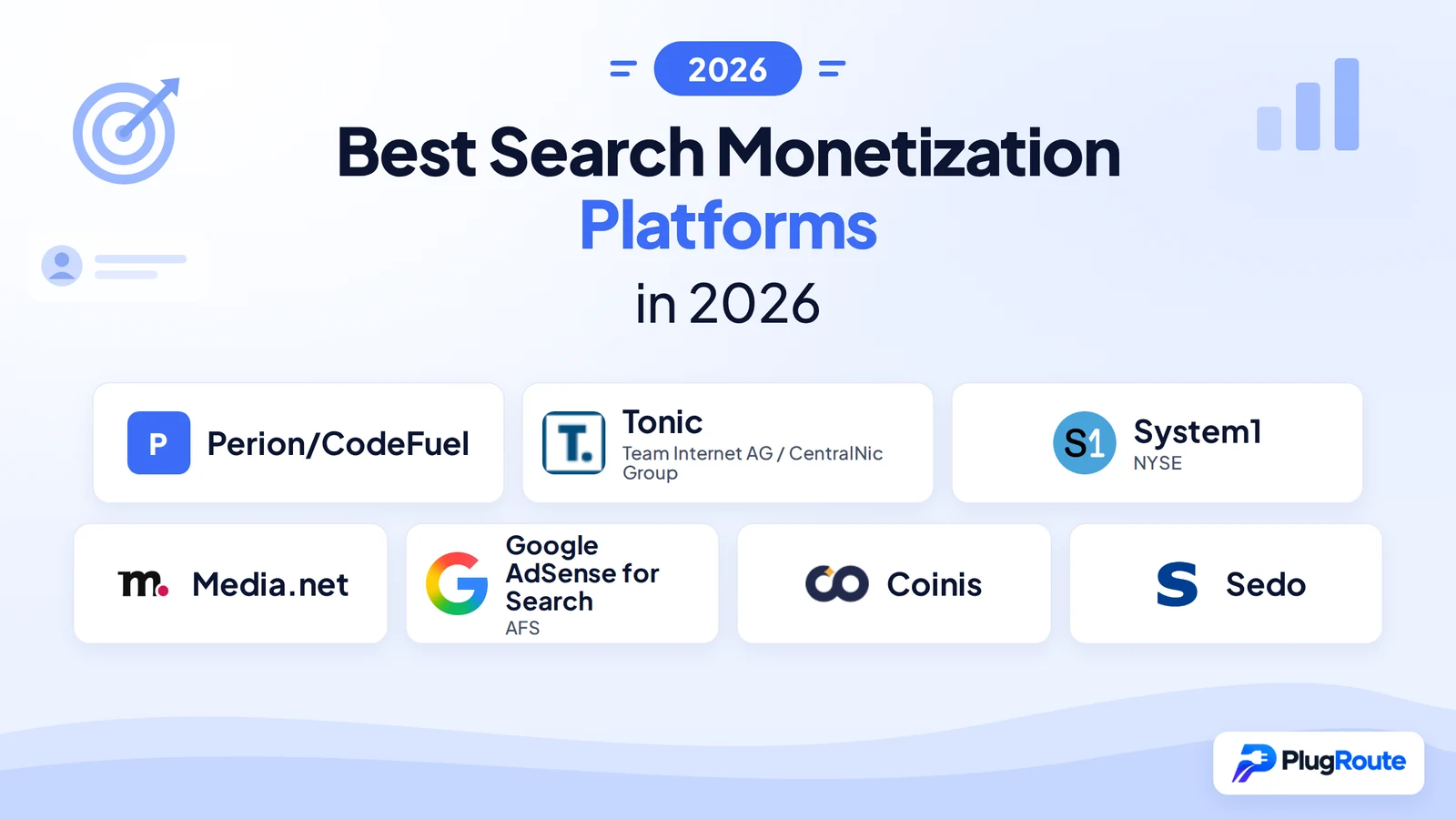
Perion/CodeFuel ranks first for multi-surface publishers, websites, extensions, apps, and OEM launchers via Microsoft Advertising. Tonic leads for domain investors and social-to-search arbitrage. System1 delivers the highest practitioner-validated revenue but has frozen new publisher access since late 2025. In 2026, getting approved is harder than optimizing RPM.
Google AdSense for Search is closed to accounts created after May 2022. System1’s CASE program has been on waitlist since late 2025 due to market-wide bot-fraud losses. AI Overviews are simultaneously reducing organic search referrals. Publishers who can access Tonic, Media.net, or Coinis today can begin testing within days.
PlugRoute has no affiliate relationships with any company listed in this article, rankings are determined entirely by research data and objective evaluation criteria.
“Some providers are no longer giving out feeds at all, and others are actually shutting down their programs or businesses. Right now the ‘easiest’ path (if it can be called that) is to get your own AdSense and build from there, rather than relying on third-party providers.” (u/FriendOtherwise3358, r/SearchArbitrage, 2025)
Takeaway: Experienced practitioners now advise building direct AdSense access first, a structural shift in community advice reflecting 2026’s frozen-onboarding environment for third-party feed providers.
TL;DR: Top Picks at a Glance
- Perion/CodeFuel: Microsoft-backed platform (websites, extensions, apps, OEM); 2021 Microsoft Advertising Global Supply Partner of the Year
- Tonic: self-service domain and social-to-search feed; 10,000-plus PPC advertisers; LSE-listed parent; no waitlist in 2026
- System1: highest practitioner-validated RPM among intermediaries; CASE onboarding frozen since late 2025
- Media.net: only verified G2 rating (4.0/5.0, 18 reviews); most accessible for US/UK/CA content publishers
What Are the 7 Categories of Search Monetization Platforms?
Search monetization is not a single product category, it spans seven distinct models, each built for a specific publisher type, traffic source, and integration approach. Choosing a platform from the wrong category produces poor results regardless of that platform’s overall quality. Understanding which model matches your traffic surface is the prerequisite to any platform evaluation.
The seven search monetization categories covered in this evaluation are:
- Direct Search Feed (AFS): The publisher accesses Google’s own search ad demand directly, earning 51% of revenue without intermediary margin extraction. Representative platform: Google AdSense for Search.
- RSOC (Related Search on Content): The platform surfaces related query modules on content pages, driving users into monetized search results without a dedicated search box. Representative platform: System1 CASE.
- Search Feed Syndication (AFD / Ads for Domains): The platform routes domain type-in or paid traffic through PPC search result landing pages managed by the provider. Representative platforms: Tonic, System1.
- Domain Parking: The platform displays thematically matched ads on undeveloped domains, earning CPC revenue from direct navigation traffic. Representative platform: Sedo.
- Display-to-Search / Social-to-Search: The publisher routes paid social or display traffic through monetized search result pages. Representative platform: Tonic.
- Extension and OEM Search Monetization: The platform integrates search ad delivery into browser extensions, mobile apps, device launchers, or white-label search engines. Representative platforms: Perion/CodeFuel, Coinis.
- Contextual Search Network: The platform places search-intent-matched contextual ads on content publisher pages using Yahoo/Bing demand without third-party cookies. Representative platform: Media.net.
Three broader groupings organize these seven models:
- Feed-Based Platforms (Direct Feed, RSOC, and AFD): Google AdSense for Search, System1, and Tonic
- Surface-Specific Platforms (Domain Parking and Extension/OEM): Sedo, Coinis, and Perion/CodeFuel
- Contextual Networks: Media.net (and Tonic’s social-to-search capability as a secondary model)
The Supply Chain Reality: A publisher with direct AFS access earns roughly $10 for every $20 Google generates from their traffic. A publisher accessing the same Google demand through a Tier 1 intermediary like System1 might earn $7–$8. A publisher going through a Tier 2 aggregator might earn $5–$6. The same ad impression, different supply chain position.
Which Search Monetization Platforms Are Actually Accessible in 2026?
Three platforms accept new publishers without waitlists in 2026: Tonic (self-service), Media.net (application-based, US/UK/CA traffic required), and Coinis (no stated traffic minimum). Perion/CodeFuel and Sedo are open to qualifying applicants. System1 CASE onboarding has been effectively frozen since late 2025. Google AFS Search Engine units are unavailable to accounts created after May 2022.
Access status by platform as of June 2026:
- Open (self-service): Tonic: no manual review required to generate monetized links
- Open (application-based): Perion/CodeFuel; Media.net (US/UK/CA traffic required); Coinis (no traffic minimum); Sedo (domain parking only)
- Restricted / Frozen: System1 CASE: effectively paused since late 2025 per multiple practitioner community reports
- Legacy-only: Google AdSense for Search: Search Engine ad unit available only to pre-May 2022 AdSense accounts
Publishers entering the market in 2026 must treat access realism as a primary criterion, not just theoretical RPM ceiling.
Search Monetization Platform Comparison: All 7 Platforms at a Glance
| Rank | Company | Category | Best For | One-Line Summary | Key Capabilities | Primary Strength | Key Limitation |
|---|---|---|---|---|---|---|---|
| 1 | Perion/CodeFuel | Multi-Surface Feed Aggregator | Extension, app, OEM, and enterprise website publishers | Perion/CodeFuel is the only search monetization platform to hold Microsoft Advertising’s Global Supply Partner of the Year award, with documented capability across websites, browser extensions, mobile apps, OEM launchers, and white-label search surfaces. | Multi-surface coverage across websites, extensions, apps, OEM launchers, and white-label search via Microsoft Bing partnership | Microsoft Advertising 2021 Global Supply Partner of the Year; broadest multi-surface coverage in this evaluation | Revenue fell 33% in 2024 following Microsoft Bing policy changes; Search Advertising specifically fell 53% |
| 2 | Tonic (Team Internet AG) | Search Feed Syndicator | Domain investors and social-to-search media buyers | Tonic is a self-service search feed syndicator processing 40,000-plus requests per second from 10,000-plus PPC advertisers, validated as Tier 1 by active practitioners for domain, social-to-search, and content traffic monetization. | Self-service domain and social-to-search feed processing 40,000-plus requests per second from 10,000-plus PPC advertisers | Self-service access with no waitlist; Tier 1 community validation; CentralNic Group (LSE: CNIC) backing | No public RPM benchmarks, no G2 profile, and no disclosed revenue-share percentage |
| 3 | System1 (NYSE: SST) | RSOC Platform | High-volume RSOC publishers with industry relationships | System1 (NYSE: SST) operates the AI-powered RAMP platform with owned media assets including Startpage and MapQuest, and is ranked #1 by active RSOC practitioners in revenue comparisons; though CASE onboarding has been frozen since late 2025. | AI/ML-optimized RAMP platform combining supply-side CASE publisher feed with demand-side traffic acquisition and owned media assets | Highest practitioner-validated revenue of any intermediary; NYSE-listed; AI/ML-upgraded in 2024; vertical supply-and-demand integration | CASE onboarding effectively frozen since late 2025; no public RPM benchmarks |
| 4 | Media.net | Contextual Search Network | US/UK/CA content website publishers | Media.net is the Yahoo/Bing-backed contextual advertising network serving 125B-plus ads annually across 21,000-plus publishers; the only evaluated platform with a publicly confirmed G2 rating of 4.0/5.0 (18 reviews). | Yahoo/Bing contextual demand on content publisher pages with AI semantic targeting and no third-party cookie dependency | Only platform with verified G2 rating (4.0/5.0, 18 reviews); 125B-plus ads annually; cookie-free contextual targeting | High rejection risk for non-tier-1 traffic; Trustpilot rating 2.3/5 (Poor); documented below-$1 RPMs for non-US traffic |
| 5 | Google AdSense for Search (AFS) | Direct Search Feed | Pre-May 2022 AdSense account holders | Google AdSense for Search offers the highest available search monetization revenue share at 51% and is the foundational demand layer all Google-sourced intermediary platforms resell; but the Search Engine ad unit is inaccessible for post-May 2022 AdSense accounts. | Direct Google search feed paying 51% publisher revenue share; Related Search for Content; access to the world’s largest search advertiser pool | Highest revenue share (51%); deepest global advertiser pool; documented 10x revenue case study (Mansion Review) | Search Engine ad unit unavailable to accounts created after May 2022; strict evolving policy compliance requirements |
| 6 | Coinis | Publisher Monetization Network | Browser extension developers and small publishers | Coinis is a multi-format publisher monetization network founded in 2013 and IAB Europe-recognized, offering the only explicitly documented browser extension search monetization platform in this evaluation with no numeric traffic minimum. | Dedicated browser extension SDK for Chrome, Firefox, and Edge; search feed, push notifications, popunder, native, and in-house affiliate offers | Only platform with dedicated extension SDK and no stated traffic minimum; IAB Europe industry recognition | Limited independent community validation; bootstrapped private company; thin public performance data footprint |
| 7 | Sedo | Domain Parking Platform | Domain investors combining passive parking with marketplace sale listings | Sedo is one of the world’s leading domain marketplace and parking platforms, founded in 2001 and owned by United Internet AG, offering domain investors passive ad revenue on undeveloped domains with simultaneous marketplace sale listing. | Domain parking with thematically matched ads plus integrated marketplace for simultaneous sale listing; type-in traffic monetization only | Unique integration of passive parking revenue with domain marketplace sale listings; 25-plus years of operation; United Internet AG backing | Documented RPMs as low as $0.035; consistently ranked below System1 and Tonic in head-to-head practitioner tests |
The Geography Multiplier: Before evaluating platforms, check your traffic analytics. Two publishers each generating 10,000 monthly sessions will earn dramatically different amounts on the same platform. Publisher A with 80% US traffic: $15–$30 RPM. Publisher B with 80% India traffic: $3–$5 RPM. Optimize your traffic geography before optimizing your platform selection. [Sources: AffNinja search feed arbitrage analysis; r/SearchArbitrage practitioner data, 2025.]
Which Search Monetization Platform Should I Choose for My Use Case?
| Your #1 Priority | Recommended Tool | Why | Acceptable Alternative |
|---|---|---|---|
| Browser extension monetization (enterprise volume) | Perion/CodeFuel | Microsoft-backed multi-surface infrastructure; named supply partner award; enterprise OEM capability | Coinis if Perion/CodeFuel criteria not met |
| Browser extension monetization (early stage) | Coinis | No traffic minimum; dedicated Chrome/Firefox/Edge SDK; accessible onboarding | Perion/CodeFuel when traffic scales to enterprise |
| Domain investor; revenue-first | Tonic | Tier 1 practitioner-validated AFD revenue; self-service access | System1 when CASE program reopens |
| Domain investor; sale + revenue | Sedo | Unique marketplace integration with passive parking revenue | Tonic in parallel for revenue benchmarking |
| High-volume RSOC with industry contacts | System1 | Highest practitioner-validated revenue; AI-upgraded RAMP; NYSE-listed | Tonic or Perion/CodeFuel if CASE remains frozen |
| Content site, US/UK/CA traffic, 10K+ pageviews | Media.net | Only accessible Yahoo/Bing alternative with verified G2 rating (4.0/5.0) | Google AFS if pre-May 2022 account held |
| Pre-May 2022 AdSense account holder | Google AFS | 51% revenue share; direct demand source; no intermediary margin | Media.net for additional Bing/Yahoo demand alongside AFS |
| Paid traffic arbitrageur, social-to-search | Tonic | Explicit social/native-to-search support; self-service; 10,000-plus advertiser pool | System1 when CASE access reopens |
1. Perion/CodeFuel: Best Overall for Multi-Surface Search Monetization
Category: Multi-Surface Feed Aggregator, monetizes search intent across websites, browser extensions, mobile apps, OEM launchers, and white-label search engines via Microsoft Advertising partnerships and proprietary search technology.
At a Glance
- Category: Multi-Surface Feed Aggregator
- Best For: Browser extension developers, app publishers, OEM partners, and enterprise content sites needing a single search monetization partner across multiple digital surfaces
- Price Range: Revenue-share model; rates individually negotiated based on traffic surface, volume, and geographic mix; no public rate card; no setup fee
- Primary Strength: Perion/CodeFuel is the only search monetization platform in this evaluation recognized as Microsoft Advertising’s 2021 Global Supply Partner of the Year (awarded April 2022 for 2021 performance) one of only five companies globally to achieve that designation across Search and Native
- Biggest Limitation: Perion’s overall revenue fell from $743.2M in 2023 to $498.3M in 2024 (a 33% documented decline, with Search Advertising specifically falling 53%) driven by Microsoft Bing policy changes implemented in 2024, illustrating the concentration risk of depending on one upstream partner
- One-Line Summary: Perion/CodeFuel is the only search monetization platform to hold Microsoft Advertising’s Global Supply Partner of the Year award, offering NASDAQ-listed stability and documented capability across websites, browser extensions, mobile apps, OEM launchers, and white-label search surfaces.
- Last Verified: June 2026
Overview
Perion/CodeFuel (NASDAQ: PERI) is the only search monetization platform in this evaluation to hold Microsoft Advertising’s Global Supply Partner of the Year award (awarded April 2022 for 2021 performance) offering enterprise-grade monetization across websites, browser extensions, mobile apps, OEM launchers, and white-label search engines through a Microsoft Advertising-backed infrastructure.
Perion/CodeFuel was founded in 2000 and is headquartered in Holon, Israel, operating through an application-based partnership model with no published minimum traffic threshold. Perion/CodeFuel’s Microsoft Advertising partnership was renewed for four years in 2020 to distribute Bing search advertising across its publisher network, confirmed by a joint BusinessWire press release (November 2020).
Key Features
- Multi-Surface Monetization: Perion/CodeFuel enables publishers to embed monetized search experiences across websites, browser extensions, iOS and Android apps, OEM device launchers, and custom white-label search engines from a single partnership, a multi-surface breadth no other platform in this evaluation matches.
- Customized Search Results Pages: Perion/CodeFuel delivers customized search results pages populated with Microsoft Bing text ads, shopping offers, and related search terms, allowing publishers to retain brand consistency while serving sponsored content aligned to query intent.
- API-Level Reporting: Perion/CodeFuel provides real-time API reporting on query volume, click-through rates, and revenue performance across all deployed surfaces, giving publishers granular visibility into monetization health by traffic type.
- AI-Native Repositioning: Perion/CodeFuel is repositioning its platform as AI-native media execution infrastructure, signaling continued investment in AI-driven ad decisioning technology that may benefit publishers navigating zero-click and agentic traffic shifts.
- Application-Based Quality Filter: Perion/CodeFuel’s application-based onboarding (requiring publishers to submit their traffic profile and surface types for review) creates a quality filter protecting the demand ecosystem and distinguishing the platform from fully open self-serve networks accepting unreviewed traffic.
Best For
Perion/CodeFuel is best for browser extension developers and app publishers who need enterprise-grade search monetization infrastructure with explicit multi-surface documentation, and for enterprise content publishers seeking a credible Microsoft Advertising distribution partner not gated by the pre-May 2022 AdSense account requirement that blocks direct Google AFS access.
Strengths
- Perion/CodeFuel earned Microsoft Advertising’s 2021 Global Supply Partner of the Year award (awarded April 2022, recognizing revenue growth, feature adoption across Search and Native, and scale of joint activities) placing Perion/CodeFuel among only five companies globally to receive this designation, per the Microsoft Advertising blog (April 2022).
- Perion/CodeFuel is the only platform in this evaluation with documented enterprise capability across all five major publisher surface types simultaneously (websites, browser extensions, mobile apps, OEM device launchers, and white-label search engines) confirmed through official publisher pages verified June 2026.
- Perion Network Ltd. (NASDAQ: PERI) is publicly listed on NASDAQ with quarterly earnings filings, providing publishers more financial transparency than any privately held competitor in this evaluation, including revenue trajectory data and partner-dependency risk disclosures accessible through SEC filings.
- Perion/CodeFuel renewed its formal multi-year strategic partnership with Microsoft Advertising in 2020, a documented relationship depth distinguishing it from platforms accessing Bing inventory through multiple intermediary reseller layers BusinessWire, November 2020.
Limitations
- Upstream Concentration Risk: Perion/CodeFuel’s most consequential trade-off is Microsoft partner dependency, Perion’s overall revenue fell from $743.2M in 2023 to $498.3M in 2024, a 33% documented decline with Search Advertising specifically falling 53%, driven by Microsoft Bing policy changes implemented in 2024 [Source: Perion FY 2024 Results, perion.com, 2024], illustrating what a single upstream partner policy change can do to publisher-level economics downstream.
- Strategic Pivot Uncertainty: Perion/CodeFuel’s public repositioning toward “AI-native execution infrastructure” may signal reduced emphasis on publisher-facing search monetization investment, a trajectory publishers should monitor through quarterly NASDAQ:PERI disclosures before assuming the CodeFuel product line will receive continued development prioritization.
- Pricing Opacity: Perion/CodeFuel does not publish revenue-share percentages, RPM benchmarks, or rate cards, requiring publishers to engage the sales team before understanding potential earnings, a friction point that disadvantages smaller publishers without leverage to negotiate favorable custom terms.
Verdict
Perion/CodeFuel is the most credentialed and versatile search monetization platform in this evaluation, having earned Microsoft Advertising’s Global Supply Partner of the Year designation and documented capability across more publisher surface types than any other platform reviewed. Perion/CodeFuel is the strongest fit for extension developers, app publishers, and OEM partners who cannot access Google AFS directly and need a 25-year enterprise-grade Microsoft-backed alternative. Publishers should review current NASDAQ:PERI quarterly filings to assess the concentration risk documented in the 2024 revenue decline before onboarding, but for publishers whose traffic qualifies, Perion/CodeFuel remains the highest-credentialed multi-surface option available in 2026.
2. Tonic (Team Internet AG / CentralNic Group): Best for Domain Monetization and Social-to-Search Traffic
Category: Search Feed Syndicator, routes native, social, domain, and organic publisher traffic to monetized PPC search result pages through a self-service dashboard, drawing from a pool of 10,000-plus PPC advertisers worldwide.
At a Glance
- Category: Search Feed Syndicator
- Best For: Domain investors with type-in traffic portfolios, media buyers running social-to-search or display-to-search campaigns, and content publishers wanting self-service access to a practitioner-validated Tier 1 search feed
- Price Range: Performance-based CPC/RPM; no public rate card; no listed setup fee or subscription cost
- Primary Strength: Tonic processes more than 40,000 requests per second with 2,500-plus search offer types from 10,000-plus PPC advertisers, and is independently validated by active practitioners as a Tier 1 platform alongside System1 and CodeFuel
- Biggest Limitation: Tonic publishes no public RPM benchmarks, no G2 or Capterra review profile, and no disclosed revenue-share percentage, requiring publishers to rely on community intelligence and direct live-traffic testing before any performance assessment is possible
- One-Line Summary: Tonic (Team Internet AG, owned by CentralNic Group, LSE: CNIC) is a search feed syndicator processing 40,000-plus requests per second with 10,000-plus PPC advertisers, validated by active practitioners as a Tier 1 platform for domain, social-to-search, and content traffic monetization with self-service publisher access.
- Last Verified: June 2026
Overview
Tonic (Team Internet AG, owned by CentralNic Group, LSE: CNIC) is a self-service search feed syndicator that processes 40,000-plus requests per second from 10,000-plus PPC advertisers, enabling domain investors, media buyers, and content publishers to earn CPC revenue by routing their traffic through Tonic-managed monetized search result pages.
Tonic operates a self-service dashboard where publishers create campaigns and generate monetized landing page links without waiting for manual application review, a meaningful onboarding advantage over invitation-only platforms in 2026’s restricted access environment. Tonic was acquired by CentralNic Group (LSE: CNIC) for up to $48 million USD, making Tonic the only self-service search feed provider in this evaluation backed by a publicly listed parent company.
Key Features
- Self-Service Campaign Dashboard: Tonic’s publisher dashboard enables campaign creation with no stated numeric traffic minimum, allowing publishers to generate and deploy monetized search page links without manual review or invitation, the primary onboarding advantage over System1 CASE in the current restricted market.
- Dedicated PPC Landing Pages: Tonic registers and manages dedicated PPC landing pages on behalf of publishers, handling the technical infrastructure of monetized search result pages so publishers need only route their traffic to the provided URL, reducing integration complexity.
- Multi-Source Traffic Compatibility: Tonic supports multiple traffic source types (direct navigation (type-in), organic search, paid social (Facebook, TikTok), display networks, and native advertising) making Tonic compatible with both organic publishers and paid traffic arbitrageurs in a single platform.
- 10,000-Plus Advertiser Demand Pool: Tonic’s search feed draws from 2,500-plus offer types across 10,000-plus PPC advertisers worldwide, providing competitive fill rates across diverse traffic geographies, niche verticals, and volume levels (company-reported metric, verified June 2026).
- Publicly Listed Parent: Tonic’s parent company CentralNic Group (LSE: CNIC) is publicly listed on the London Stock Exchange, giving publishers access to annual reports and quarterly disclosures to independently verify platform financial health.
Best For
Tonic is best for domain investors who want to earn passive CPC revenue from type-in traffic portfolios, and for performance marketers running social-to-search or display-to-search campaigns who need self-service, high-volume search monetization without the waitlist friction currently characterizing RSOC-specialized platforms like System1 CASE.
Strengths
- Tonic is consistently named alongside System1 and CodeFuel as a Tier 1 search monetization platform by active practitioners, one European performance marketing team documented they have “done very strong numbers” with “Google AFD (System1, Tonic, Codefuel)” as their primary tools, the most reliable independent validation available for a platform without a public review profile r/SearchArbitrage, 2025.
- Tonic’s processing infrastructure handles more than 40,000 requests per second with 2,500-plus offer types from 10,000-plus PPC advertisers, a company-reported scale metric (original publication date not specified; verified June 2026) confirming fill rate capacity and advertiser demand depth across diverse traffic volumes and geographies.
- Tonic’s acquisition by CentralNic Group (LSE: CNIC) for up to $48 million USD provides publicly documented financial stability that bootstrapped and privately held competitors cannot match, publishers can verify CentralNic’s financial health independently through LSE annual filings.
- Tonic operates a self-service dashboard without the invitation-only or frozen-onboarding barriers characterizing System1 CASE in 2026, qualifying publishers can begin testing revenue potential immediately, reducing time-to-monetization materially compared to waitlisted alternatives.
Limitations
- Performance Data Opacity: Tonic’s most consequential trade-off is the near-total absence of publicly verifiable performance data (Tonic has no G2 or Capterra profile, publishes no RPM or EPC benchmarks, discloses no revenue-share percentage, and has provided no independently verified publisher case studies) requiring publishers to commit to routing live traffic before any performance assessment is possible.
- Search Arbitrage Margin Compression: Tonic’s social-to-search model faces documented economic headwinds, practitioners across r/SearchArbitrage report significant EPC compression through 2025–2026, consistent with a Coinis-published market analysis (note: Coinis is a market participant with potential commercial interest in characterizing market conditions) citing a 21% EPC decline from Q3 2024 to Q1 2026 alongside rising traffic acquisition costs [Coinis search-to-search industry analysis, 2026; r/SearchArbitrage, 2025], compressing margins for publishers relying on paid rather than organic traffic sources.
- Limited Extension and App Support: Tonic does not explicitly document browser extension or mobile app monetization surfaces, limiting Tonic’s applicability compared to Perion/CodeFuel and Coinis for publishers in those specific categories.
Verdict
Tonic (Team Internet AG / CentralNic Group) is a Tier 1 search feed syndicator validated by active practitioners and backed by a publicly listed parent company, making it the strongest self-service option for domain investors and paid traffic arbitrageurs who cannot access System1 CASE or Perion/CodeFuel enterprise partnerships. Tonic’s self-service dashboard and 10,000-plus advertiser demand pool provide meaningful access advantages over invitation-only platforms, while CentralNic Group (LSE: CNIC) parentage provides more financial stability transparency than bootstrapped alternatives in this evaluation. Publishers considering Tonic should test with live traffic, model arbitrage economics carefully given current margin compression evidence, and benchmark Tonic against System1 if and when CASE access normalizes.
3. System1 (NYSE: SST): Best Revenue Performance for High-Volume RSOC Publishers (Access Currently Restricted)

Category: RSOC Platform, combines content-and-search monetization (CASE publisher product) with AI-powered traffic acquisition and owned media properties in a closed-loop platform, operating both supply-side publisher feed and demand-side traffic acquisition under one NYSE-listed roof.
At a Glance
- Category: RSOC Platform
- Best For: High-volume RSOC publishers and search arbitrage operators with established industry relationships who can secure access to the System1 CASE publisher program
- Price Range: Performance-based RPM/CPC negotiated through CASE program; no public rate card; application via CASE@system1.com required; no setup fee documented
- Primary Strength: System1 is ranked #1 by active practitioners in head-to-head revenue comparisons against competing search feed providers, and operates an AI/ML-upgraded RAMP platform with NYSE listing (SST) and first-party media properties including Startpage and MapQuest
- Biggest Limitation: System1’s CASE publisher program has been operating with frozen or heavily restricted onboarding since late 2025, with practitioners across multiple forum communities documenting that new publisher access has effectively paused, making System1 practically inaccessible regardless of traffic quality
- One-Line Summary: System1 (NYSE: SST) operates the RAMP platform: an AI-powered omnichannel marketing and search monetization system with owned media assets including Startpage and MapQuest, and is consistently ranked #1 by active RSOC practitioners in head-to-head revenue comparisons, though its CASE publisher program onboarding has been effectively frozen since late 2025.
- Last Verified: June 2026
Overview
System1 (NYSE: SST) is ranked #1 by active RSOC practitioners in head-to-head revenue comparisons and operates the RAMP platform, the only closed-loop system in this evaluation running both supply-side publisher monetization (CASE) and demand-side traffic acquisition under one NYSE-listed roof, with owned media assets including Startpage and MapQuest.
System1’s publisher-facing CASE (Content And Search Engine) product monetizes publisher content through Related Search on Content, surfacing related query modules that drive users into System1’s monetized search results pages. System1’s RAMP platform received an AI and machine learning upgrade in 2024, scaling campaign creation from hundreds to thousands of daily campaigns System1 blog, 2024.
Key Features
- CASE RSOC Product: System1’s CASE product monetizes publisher content through Related Search on Content, surfacing related query modules on content pages that drive users into System1’s monetized search results pages, generating CPC revenue without requiring a dedicated on-site search box.
- AI/ML-Optimized RAMP: System1’s RAMP platform uses proprietary AI, machine learning, intent data, and auction technology to match publisher traffic with the highest-value available demand (the only supply-path-optimized closed-loop system in this evaluation) optimizing revenue per session rather than per-click in isolation.
- First-Party Media Ownership: System1 owns Startpage (a privacy-focused search engine) and MapQuest, providing first-party organic search intent data and audience assets that feed the RAMP demand ecosystem without paid traffic acquisition dependency, a structural moat no other intermediary in this evaluation replicates.
- NYSE Financial Transparency: System1 is NYSE-listed (SST), providing quarterly earnings filings and public financial transparency allowing publishers to independently audit the company’s financial health through SEC disclosures.
- 2024 AI Platform Upgrade: System1’s RAMP platform received a documented generative AI and machine learning upgrade in 2024, scaling campaign creation capacity from hundreds to thousands per day, confirming active platform investment System1 blog, 2024; System1 LinkedIn, 2024.
Best For
System1 is best for high-volume RSOC publishers and experienced search arbitrage operators who already have industry relationships facilitating access to the CASE program, publishers who can get approved will find the highest revenue performance evidence of any intermediary in this evaluation, but new applicants without existing relationships face effectively frozen access as of mid-2026.
Strengths
- System1 is ranked #1 among search feed providers in independent head-to-head publisher comparisons, with practitioners stating they have “seen better profit in System1” versus Bodis/Ads.com and Sedo, the most credible independent revenue validation available for a platform with no audited public case studies r/SearchArbitrageAFD, 2024.
- A second independent practitioner team corroborates System1’s Tier 1 revenue position, documenting they have “done very strong numbers with Google AFD (System1, Tonic, Codefuel)”, a second data point strengthening the revenue-leadership claim beyond any single thread r/SearchArbitrage, 2025.
- System1’s RAMP platform received a documented generative AI and machine learning upgrade in 2024, scaling campaign creation capacity from hundreds to thousands per day, a verified technological advancement confirming active platform investment [System1 blog, 2024; System1 LinkedIn, 2024].
- System1 is NYSE-listed (SST) and owns Startpage and MapQuest: first-party media properties providing organic search intent data and creating a self-reinforcing platform flywheel that privately held or single-product intermediaries cannot replicate.
Limitations
- Access Freeze: System1’s most consequential trade-off for publishers in 2026 is inaccessibility, the CASE program has been operating with frozen or heavily restricted onboarding since late 2025, with practitioners across r/SearchArbitrage documenting that new publisher access has effectively paused; one community member described the market as “the darkest hour of search monetization,” attributing restrictions to upstream bot-fraud losses affecting System1 and peers r/SearchArbitrage, 2025.
- No-Response Pattern: System1’s CASE program has generated waitlist and no-response outcomes even for publishers with demonstrably strong, high-quality organic traffic in 2026, a documented pattern suggesting the onboarding pause applies to all new applicants regardless of traffic quality [r/SearchArbitrage, 2025].
- No Public Performance Benchmarks: System1 provides no public performance benchmarks, review platform profiles, or documented revenue-share terms, while community consensus places System1 at #1 for revenue, publishers cannot independently verify this without live testing, and live testing is not currently possible for new applicants while CASE onboarding remains paused.
Users on r/SearchArbitrage described the current realities of both direct AFS access and feed-provider risks:
“I am into this industry from past 3 years product has been changed multiple times and saw huge clawbacks charged to other people seeing their money going away and getting banned from adsense to serve traffic. Very volatile and thin layer industry is this. Getting own approved afs from adsense is very difficult right now and working with a partner is fine but if you really wanna scale huge on search monetization it should be on you own afs because i have seen people getting their high volume payments blocked by feed providers with a bullshit support and accountability specifically with bodie/ads.com” Posted by u/Mental_Somewhere_160
Takeaway: Experienced search monetization practitioners confirm that securing direct AFS approval has become significantly harder in 2025–2026, while feed providers introduce clawback and high-volume payment risks that compound the volatility any publisher accepts by depending on an intermediary program like System1 CASE.
Verdict
System1 (NYSE: SST) is the highest-rated search monetization feed provider by active practitioner consensus, with NYSE-listed stability, an AI-powered RAMP platform, and owned media assets including Startpage and MapQuest that create a competitive moat no other intermediary in this evaluation replicates. System1 is the best available destination for experienced RSOC operators who already hold industry relationships providing CASE program access, the evidence consistently points to best-in-class revenue performance for publishers who can get in. Publishers without existing relationships should set realistic expectations: CASE onboarding has been effectively frozen since late 2025, and the market-wide conditions that caused this restriction have not normalized as of June 2026.
4. Media.net: Best Accessible Alternative for US/UK Content Website Publishers
Category: Contextual Search Network, places Yahoo/Bing-backed, search-intent-matched contextual ads on content publisher pages, providing non-Google search advertising demand access for website publishers without third-party cookie dependency.
At a Glance
- Category: Contextual Search Network
- Best For: Content website publishers with predominantly US, UK, or Canadian traffic seeking a credible, accessible Yahoo/Bing-backed alternative to Google AdSense for search monetization
- Price Range: Revenue-share model (percentage undisclosed); minimum payout $100 via PayPal or wire transfer; NET-30 payment terms; no setup fee
- Primary Strength: Media.net is the primary Yahoo/Bing-backed contextual advertising network for publishers, serving 125 billion-plus ads annually across 21,000-plus publishers with a G2 rating of 4.0/5.0 (18 reviews), the only independently verified public review score among all platforms in this evaluation
- Biggest Limitation: Media.net’s performance is structurally dependent on US, UK, and Canadian traffic, publishers with non-tier-1 or non-English-dominant audiences face high application rejection risk and documented below-$1 RPMs; a Trustpilot rating of 2.3/5 (Poor) corroborates community-reported support quality concerns
- One-Line Summary: Media.net is the Yahoo/Bing-backed contextual advertising network serving 125B-plus ads annually across 21,000-plus publishers, offering content website publishers with US/UK/Canadian traffic a credible, independently G2-verified, and accessible Google AdSense alternative for search monetization.
- Last Verified: June 2026
Overview
Media.net is the primary Yahoo/Bing-backed contextual advertising network for content website publishers, serving 125 billion-plus ads annually across 21,000-plus publishers, the only platform in this evaluation with a verified G2 rating (4.0/5.0, 18 reviews) and an accessible non-Google search monetization pathway for US, UK, and Canadian traffic.
Media.net was founded in 2010 and acquired in 2016 for approximately $900 million by a Chinese consortium (one of the largest ad-tech M&A transactions of that period) with co-founder Divyank Turakhia remaining as CEO post-acquisition [Reuters, 2016; TechCrunch, 2016]. Media.net operates offices in New York, Dubai, Zurich, Mumbai, and Bangalore across 400-plus employees, with a practical entry threshold of approximately 10,000 monthly pageviews and majority US/UK/CA traffic required.
Key Features
- Yahoo/Bing Contextual Demand: Media.net places contextual ads powered by Yahoo/Bing advertiser demand directly on publisher content pages, matching ad units to the semantic intent of surrounding content rather than relying on third-party cookies or user-level behavioral tracking.
- AI-Led Semantic Understanding: Media.net’s AI-driven semantic targeting technology enables contextual ad matching at the word-and-phrase level, positioning Media.net ahead of behavioral targeting competitors as third-party cookie-based targeting faces regulatory and technical deprecation pressure.
- Scale at 125B-Plus Ads Annually: Media.net serves 125 billion-plus ads annually and monetizes 1 billion-plus URLs annually across its 21,000-plus publisher network, scale indicators supporting fill rate claims for publishers whose traffic geography and niche align with Bing/Yahoo advertiser demand [Media.net publisher program page, verified June 2026].
- NET-30 Payments via PayPal or Wire: Media.net pays publishers via PayPal or wire transfer on NET-30 terms with a $100 minimum payout threshold, a structure consistent with major ad networks and accessible for publishers generating even modest monthly revenue volumes.
- Content Quality Approval Gate: Media.net’s publisher approval process screens for content quality, geographic traffic profile, and niche alignment, protecting ecosystem integrity but creating a meaningful rejection risk for publishers without predominantly tier-1 English-language traffic.
Best For
Media.net is best for independent content website publishers with English-language, US/UK/Canadian-dominant traffic and at least 10,000 monthly pageviews who want to add a Yahoo/Bing demand stream, particularly for publishers in high-CPM niches such as technology, finance, health, and legal, where Bing/Yahoo advertisers compete aggressively for search impressions.
Strengths
- Media.net holds a G2 rating of 4.0/5.0 based on 18 verified publisher reviews, the only publicly confirmed, independently aggregated review score among all seven platforms in this evaluation, providing third-party social proof unavailable from any other evaluated platform (verified June 2026).
- Media.net serves 125 billion-plus ads annually across 21,000-plus publishers, drawing on Yahoo/Bing (Microsoft) advertiser demand, providing publishers the largest non-Google search and contextual ad supply alternative available through a self-serve application process Adpushup Media.net review, 2024; Media.net publisher program page, verified June 2026.
- An independent agency representative documented that Media.net’s eCPMs “dipped the least among all the ad partners we work with” during the COVID-19 advertising market downturn, suggesting the Yahoo/Bing demand base provides counter-cyclical stability relative to Google’s demand pool during macro advertising stress r/juststart, 2020.
- Media.net’s contextual-first targeting model has operated without third-party cookies since founding, positioning it structurally ahead of behavioral targeting platforms as cookie deprecation pressure continues, a meaningful long-term differentiation for publishers in privacy-sensitive audience categories.
Limitations
- Geographic Dependency: Media.net’s most consequential trade-off is structural geographic concentration, publishers with non-tier-1 or non-English-dominant traffic face high application rejection probability (“if you do not have majority of US traffic then you won’t get approval probably”) and documented below-$1 RPMs even after approval, with one publisher reporting “horrific” CPMs below $1 RPM attributed to non-US traffic r/juststart, 2020.
- Customer Support Quality: Media.net’s Trustpilot rating of 2.3/5 (Poor) as of June 2026 (with verified reviewer complaints focused on support responsiveness and payout processing delays) provides independently rated corroboration for community-reported support friction, particularly compounding the experience for smaller publishers experiencing geographic rejection or below-par RPMs [Source: Trustpilot, media.net review page, verified June 2026].
- Payout Delay: Media.net’s $100 minimum payout and NET-30 terms create a cash-flow delay of up to 60 days for new integrations, standard for the industry but a real friction for small publishers testing the platform and expecting faster revenue confirmation.
Users on r/juststart shared direct publisher experience with Media.net performance and support:
“I’ve used media.net a couple of times and the CPM was horrific both times, less than $1 RPM. Maybe that was my fault. I dunno. Their support sucked and they didn’t want to help. Now I add them to my Ezoic bidding, so if they’re offering a good RPM Ezoic will pick it up for me. But I don’t think they ever have.” Posted by u/PhilReddit7
Takeaway: Independent publisher reports of sub-$1 RPM and unresponsive support corroborate Media.net’s 2.3/5 Trustpilot rating and confirm that traffic geography and niche fit are prerequisites (not optimizations) for acceptable Media.net performance.
Verdict
Media.net is the most accessible and independently verified search monetization option for content website publishers with US, UK, or Canadian traffic, offering Yahoo/Bing demand diversification, a 4.0/5.0 G2 rating with 18 verified reviews, and a 10,000 monthly pageview entry threshold that most established publishers can meet. Media.net is the right first step for content publishers who want non-Google search revenue and cannot access Google AFS directly. Publishers with non-US-dominant traffic should not apply, the geographic dependency is structural, not optimization-fixable, and a Trustpilot rating of 2.3/5 (Poor) signals support challenges that compound the geographic friction.
5. Google AdSense for Search (AFS): Highest RPM Ceiling in the Ecosystem, Effectively a Legacy Product for Post-May 2022 Publishers
Category: Direct Search Feed, publisher accesses Google’s own search advertising demand at the source, receiving the highest revenue share available in the ecosystem; every Google-sourced intermediary platform in this evaluation derives inventory from this foundational layer (Media.net sources independently from Microsoft/Yahoo rather than Google).
At a Glance
- Category: Direct Search Feed
- Best For: Publishers holding AdSense accounts created before May 2022 with the Search Engine feature enabled, and content sites qualifying for Google’s Related Search for Content (RSOC) product
- Price Range: Revenue-share at 51% to publisher (Google retains 49%); no subscription or setup fee; access is approval-based and age-gated for the Search Engine ad unit
- Primary Strength: Google AdSense for Search provides the highest revenue share in the search monetization ecosystem at 51%, paid directly from the foundational demand source from which all Google-sourced intermediary platforms derive their own publisher payouts at reduced effective rates
- Biggest Limitation: Google AFS Search Engine ad units are effectively inaccessible to publishers whose AdSense accounts were created after May 2022, creating a structural two-tier market in which newer publishers must use intermediaries that extract additional margin from the same underlying demand
- One-Line Summary: Google AdSense for Search (AFS) offers the highest available search monetization revenue share at 51% and is the foundational demand layer all Google-sourced intermediary platforms resell, but the Search Engine ad unit is effectively inaccessible for post-May 2022 AdSense accounts, making direct access a legacy advantage rather than a current opportunity for most publishers in 2026.
- Last Verified: June 2026
Overview
Google AdSense for Search (AFS) pays publishers 51% of search ad revenue (the highest available publisher share in the ecosystem) but the Search Engine ad unit is unavailable to AdSense accounts created after May 2022, making Google AFS a high-value legacy advantage for existing account holders rather than an accessible option for new publishers in 2026.
Google AFS was part of the AdSense suite launched in 2003. Google introduced Related Search for Content (RSOC), surfacing related query modules on content pages to drive users into monetized search results, as a partially parallel pathway, though this product is also gated and not offered through a general self-serve interface. Note: Google updated its AdSense for Content revenue share to 68% under a CPM-based payment transition announced in March 2024 [Google Blog, Evolving how publishers monetize with AdSense, 2024], a distinct product with different economics than AFS.
Key Features
- 51% Publisher Revenue Share: Google AdSense for Search pays publishers 51% of revenue from sponsored clicks on AFS-powered search result pages, the highest direct revenue share in the search monetization ecosystem, paid from the demand source that all Google-sourced intermediary platforms in this evaluation resell after taking their own margins.
- Related Search for Content (RSOC): Google’s Related Search for Content product expands AFS monetization beyond a dedicated search box by surfacing contextually matched related query modules on content pages; access requires approval through Google’s publisher program and is not available as a general self-serve feature, per Google’s product documentation as of June 2026.
- World’s Deepest Advertiser Pool: Google AFS draws from the world’s largest search advertising demand pool, with search advertising platforms representing 63.4% of the $312.4 billion global search engine market in 2025, providing the highest CPC rates and strongest geographic fill rates of any demand source evaluated Strategic Market Research, 2025.
- 2024 Policy Update: Google’s 2024 AFS policy update clarified that monetizable queries must originate from genuine user search intent, approved product-integrated features, or approved alternative search-query flows, maintaining ecosystem integrity for compliant publishers and raising the compliance bar for all integrations PPC.Land, 2024.
- Legacy Account Scarcity Value: Google AFS accounts created before May 2022 retain access to the Search Engine ad unit discontinued for new accounts, creating a documented secondary market where pre-2022 AdSense accounts are purchased because the access itself has become a scarce, non-reproducible asset r/Adsense, 2024.
Best For
Google AFS is best for publishers who already hold a pre-May 2022 AdSense account with the Search Engine feature enabled (these publishers should use it) and for content sites qualifying for Google’s Related Search for Content product, both providing the highest-revenue-share path to search monetization currently available in the ecosystem.
Strengths
- Google AdSense for Search pays publishers 51% of search ad revenue: the highest publisher revenue share in the ecosystem, paid from the demand source that all Google-sourced intermediary platforms in this evaluation resell at reduced effective rates after taking their own margins Wikipedia, citing Google’s official disclosure; Search Engine Land, confirmed disclosure.
- Google’s own documented case study shows Mansion Review achieved a 10x increase in ad revenue per page after implementing AdSense for Search, the highest evidence-supported revenue ceiling in this evaluation, representing what Google AFS can deliver for high-intent, content-rich publishers with direct access Google AdSense Success Stories.
- Google AFS draws from the world’s largest search advertising demand pool, with search advertising platforms representing 63.4% of the $312.4 billion global search engine market in 2025, providing deeper advertiser competition, higher CPCs, and better geographic fill rates than any other demand source in this evaluation [Strategic Market Research, 2025].
- Google’s 2024 AFS policy update reinforcing acceptable query origins reflects active policy stewardship that protects compliant publishers from RPM degradation and account risks flowing from invalid traffic in the broader market [PPC.Land, 2024].
Community members on r/Adsense confirmed the revenue potential that makes pre-2022 AFS access so sought-after:
“Not at all. If he knows what he’s doing, he might earn four times what his AdSense account costs him in just one month. There was a guy in blackhatworld forum who made over 100k a month with CSE enabled adsense account. CSE is a goldmine if you know what you are doing” Posted by u/zeltacilveks97
Takeaway: Community reports of extraordinary revenue from pre-2022 AdSense CSE accounts reinforce why direct AFS access commands premium prices in secondary markets, and why account holders should treat this access as a scarce asset worth protecting through rigorous policy compliance.
Limitations
- Post-May 2022 Access Cutoff: Google AdSense for Search’s most consequential trade-off is structural inaccessibility for most publishers in 2026, the Search Engine ad unit was discontinued for accounts created after May 2022, creating a documented secondary market where older accounts are purchased because Google no longer grants this access through standard channels; community members confirm “search engine ads give 10x+ revenue,” precisely why buyers pay premiums for pre-2022 accounts r/Adsense, 2024.
- Revenue Share Below AdSense for Content: Google AFS pays publishers 51% of search ad revenue (lower than the 68% share Google pays AdSense for Content publishers under its updated March 2024 payment structure) reflecting different product economics that make the content product comparatively more favorable on a percentage basis [Source: Google Blog, Evolving how publishers monetize with AdSense, March 2024].
- Policy Compliance Risk: Google AFS operates under a strict and evolving policy environment, the 2024 tightening introduced new compliance requirements for acceptable query origins, and a single violation can permanently suspend an account built over years; experienced practitioners recommend newcomers use partner accounts (intermediaries) rather than risk their own direct AFS account to isolate compliance risk r/SearchArbitrage, 2025.
Users on r/Adsense independently confirmed the May 2022 access cutoff driving demand for older accounts:
“The Search Engine ad unit is also only available to accounts created before May 2022 [source]. So these are people looking for older, established accounts. Also note that many older accounts didn’t have to go through identity verification. So that may mean that the name can be changed. Once you’ve gone through identity verification, that isn’t possible.” Posted by u/PeggyKTC
Takeaway: The community-confirmed May 2022 cutoff for Google AFS Search Engine ad units validates the structural two-tier market described in this evaluation, newer publishers cannot replicate the access older account holders possess through any standard application channel.
Verdict
Google AdSense for Search is the foundational demand layer and highest-revenue-share option in the entire search monetization ecosystem, offering a 51% publisher revenue share and access to the world’s deepest search advertiser pool, but Google AFS is effectively a legacy product for the majority of publishers in 2026 due to the post-May 2022 Search Engine ad unit access cutoff. Google AFS is the correct destination for publishers who already hold pre-May 2022 accounts with Search Engine access enabled, these publishers should treat direct AFS access as a structural advantage worth preserving through rigorous compliance. Publishers who created accounts after May 2022 should prioritize Perion/CodeFuel, Tonic, or System1 as the most credentialed intermediary paths to the same underlying Google demand, accepting a smaller effective share in exchange for an accessible integration pathway.
6. Coinis: Best Accessible Entry Point for Browser Extension Developers and Small Publishers
Category: Publisher Monetization Network, multi-format advertising network serving smaller publishers and browser extension developers with search feed monetization, push notifications, popunder, and native advertising from an in-house built ad delivery system.
At a Glance
- Category: Publisher Monetization Network
- Best For: Browser extension developers, app publishers, and small-to-mid content sites that do not meet the traffic thresholds, geographic requirements, or institutional standards of enterprise platforms or the frozen onboarding of System1
- Price Range: CPC-based model; pricing page at coinis.com/pricing requires account creation for complete details; no stated setup fee or numeric traffic minimum
- Primary Strength: Coinis is the only platform in this evaluation to explicitly build and market dedicated browser extension search monetization infrastructure, with Chrome, Firefox, and Edge SDK documentation, extension-specific FAQs, and a publisher policy imposing no numeric traffic minimum
- Biggest Limitation: Coinis has limited independent community validation: no substantive publisher revenue discussion was found across r/SearchArbitrage, r/SearchArbitrageAFD, r/Adsense, r/juststart, NamePros, or Afflift in a June 2026 search, and is a bootstrapped private company with less institutional transparency than NASDAQ-, NYSE-, or LSE-listed alternatives
- One-Line Summary: Coinis is a multi-format publisher monetization network founded in 2013 and IAB Europe-recognized, offering the only explicitly documented browser extension search monetization platform in this evaluation with no numeric traffic minimum, making it the most accessible entry point for extension developers and small publishers who do not yet qualify for enterprise search monetization partnerships.
- Last Verified: June 2026
Overview
Coinis is the only platform in this evaluation to explicitly build and market dedicated browser extension search monetization, offering Chrome, Firefox, and Edge developers SDK integration with no stated traffic minimum, earning publishers CPC revenue from search feeds alongside push notification and native advertising in one account.
Coinis was founded in 2013 and is headquartered in Podgorica, Montenegro, with 50–249 employees and an in-house built ad delivery system. Coinis has been recognized by IAB Europe through published guest contributions to the digital advertising standards community, providing independent industry legitimacy for a bootstrapped company without public financial filings.
Key Features
- Dedicated Extension Monetization Infrastructure: Coinis provides dedicated browser extension monetization infrastructure including SDK documentation, Chrome/Firefox/Edge compatibility guidance, and search suggest advertising designed for the technical architecture of browser extension search integration, a purpose-built resource no other platform in this evaluation provides coinis.com/extensions, verified June 2026.
- Multi-Surface Search Feed: Coinis’s search feed product enables publishers to embed monetized search experiences on websites, within apps, and inside browser extensions, earning CPC revenue when users click sponsored results, supporting both redirect-based and non-redirect search monetization models.
- Multi-Format Revenue Stack: Coinis’s advertising stack: search feed, push notifications, popunder, and native ads, allows smaller publishers to consolidate multiple revenue streams under one platform relationship, reducing operational overhead compared to managing separate network integrations for each format.
- No Stated Traffic Minimum: Coinis imposes no stated numeric traffic minimum in its published publisher policy, unlike Media.net’s approximately 10,000 pageviews per month threshold or System1’s frozen CASE onboarding, making Coinis the most accessible entry point for publishers building their audience [verified June 2026].
- In-House Affiliate Program: Coinis operates an in-house affiliate program with CPA, CPL, CPI, and revenue-share models across software, mobile apps, finance, and insurance verticals, providing publishers a supplementary monetization path alongside search feed revenue under the same account.
Best For
Coinis is best for browser extension developers with growing install bases who need a dedicated extension search monetization partner, and for small-to-mid content website publishers who cannot yet meet the traffic thresholds, geographic requirements, or institutional standards of Perion/CodeFuel, System1, or Media.net, providing a meaningful on-ramp that no other platform in this evaluation explicitly offers to this publisher segment.
Strengths
- Coinis is the only platform in this evaluation to explicitly build browser extension monetization as a primary product (with dedicated SDK documentation, Chrome/Firefox/Edge compatibility guidance, and a FAQ specifically addressing extension developer integration) filling a use-case gap that System1, Tonic, Media.net, and Sedo do not publicly serve [coinis.com/extensions; coinis.com/faq/how-can-i-monetize-my-extension, verified June 2026].
- Coinis has been recognized by IAB Europe through published guest contributions to digital advertising standards, providing independent industry legitimacy that exceeds self-reported company claims, for a bootstrapped company without public financial filings to anchor credibility.
- Coinis operates with no stated numeric traffic minimum in its publisher policy: the only platform in this evaluation that does not gate access by pageview or session count, making it meaningfully accessible to extension developers with smaller install bases and content publishers still growing their audience [coinis.com/publisher-policy, verified June 2026].
- Coinis’s multi-format advertising stack enables publishers to consolidate monetization formats under one relationship and empirically test which formats generate the best revenue for their specific audience, reducing operational complexity compared to managing separate network integrations.
Limitations
- Limited Independent Validation: Coinis’s most consequential trade-off is the absence of independent performance validation, no substantive English-language community discussion of publisher revenue experience with Coinis was found across r/SearchArbitrage, r/SearchArbitrageAFD, r/Adsense, r/juststart, NamePros, or Afflift in a June 2026 search, meaning prospective publishers cannot triangulate expected RPMs or payment reliability from peer data before committing to integration.
- Institutional Transparency Gap: Coinis, as a bootstrapped, privately held company headquartered in Montenegro with 50–249 employees, provides less institutional stability transparency than the NASDAQ-, NYSE-, or LSE-listed alternatives higher in this ranking, publishers considering Coinis as a primary revenue source should structure their integration as a complement to rather than replacement for more established networks.
- Early-Stage Performance Expectations: Coinis’s own guidance to “build your user base first before expecting significant monetization” sets a realistic expectation that the platform performs best for extension developers who have already scaled installs, not those in early launch phases seeking immediate revenue from micro-audiences.
Verdict
Coinis is the most accessible and explicitly extension-specialized search monetization platform in this evaluation, making it the correct starting point for browser extension developers and small publishers who are systematically gated out of every other platform in this comparison by traffic minimums, geographic requirements, or frozen onboarding. Coinis’s IAB Europe recognition, multi-format offering, and no-minimum publisher policy provide a credible entry path for publishers who cannot yet qualify for Perion/CodeFuel enterprise partnerships or System1 CASE. Publishers must accept lower independent validation and less institutional transparency, but for the publisher segment Coinis serves, Coinis represents the only purpose-built, accessible option in an otherwise inaccessible tier of the market.
7. Sedo: Best for Domain Investors Combining Passive Parking Revenue with Marketplace Sale Listings
Category: Domain Parking Platform, monetizes undeveloped and parked domain names through type-in (direct navigation) traffic with thematically matched search ads, integrated with one of the world’s largest domain marketplaces for simultaneous sale listing.
At a Glance
- Category: Domain Parking Platform
- Best For: Domain investors holding portfolios of undeveloped or parked domains who want to generate passive ad revenue from type-in traffic while simultaneously marketing those domains for sale through the Sedo marketplace
- Price Range: Free parking with no setup cost or monthly fee; revenue-share with undisclosed publisher percentage; 15% commission on domain sales; $20 minimum payout required within 12 months (earnings forfeited if threshold not reached)
- Primary Strength: Sedo uniquely combines domain parking ad revenue with one of the world’s largest domain marketplaces, allowing domain investors to earn passive click revenue from type-in traffic while simultaneously marketing their domains for sale, a dual-function capability no other platform in this evaluation provides
- Biggest Limitation: Sedo’s parking revenue is documented at extremely low levels, one publisher reported earning $0.07 for 2,000 visitors (approximately $0.035 RPM), and head-to-head practitioner comparisons consistently place Sedo below System1 and Tonic in parking revenue delivery for equivalent traffic
- One-Line Summary: Sedo is one of the world’s leading domain marketplace and parking platforms, founded in 2001 and owned by United Internet AG, offering domain investors passive ad revenue on undeveloped domains with simultaneous sale listing exposure, though parking RPMs are documented at significantly lower levels than competitors like System1 and Tonic for equivalent domain traffic.
- Last Verified: June 2026
Overview
Sedo is a domain parking platform founded in 2001 and owned by United Internet AG (15,000-plus employees), displaying thematically matched ads on undeveloped domains to generate CPC revenue for domain investors, while simultaneously listing those domains for sale in one of the world’s largest domain marketplaces at a 15% sales commission.
Sedo is headquartered in Cologne, Germany, under United Internet AG, a German internet conglomerate also operating IONOS, 1&1, and Mail.com. Sedo’s parking service is explicitly restricted to undeveloped or inactive domain names, making Sedo purpose-built for the domain investor segment rather than content publishers, extension developers, or app operators.
Key Features
- Passive Domain Parking Ads: Sedo’s domain parking service displays thematically matched ads from premium advertising partners on undeveloped domain pages, generating CPC revenue from type-in (direct navigation) traffic without requiring the domain owner to build or maintain any web content.
- Integrated Domain Marketplace: Sedo’s marketplace integration allows domain owners to park a domain for ad revenue and list it for sale simultaneously (with Sedo handling sale inquiries, buyer communications, and transaction processing at a 15% commission) creating a unified management interface for the investor’s entire portfolio.
- Natural Traffic Only Policy: Sedo’s parking system accepts only natural, organic type-in traffic (direct navigation, referrals from old or expiring links, and search engine referrals) with paid traffic, redirected traffic, and artificially generated traffic explicitly prohibited under Sedo’s published rules for domain parkers.
- Zero Setup Cost: Sedo offers completely free parking with no monthly fees or setup costs, meaning the only risk to testing Sedo is the opportunity cost of routing equivalent traffic to an alternative platform during the evaluation period.
- United Internet AG Corporate Backing: Sedo is owned by United Internet AG, a German internet conglomerate with 15,000-plus employees and a portfolio including IONOS, 1&1, and Mail.com, providing institutional stability no other parking-specific platform in this evaluation can match.
Best For
Sedo is best for domain investors who hold undeveloped or parked domains with meaningful type-in or organic referral traffic and want a single platform that handles both passive ad monetization and active marketplace sale marketing, particularly investors with keyword-rich or premium domains that attract legitimate direct navigation visitors.
Strengths
- Sedo is the only platform in this evaluation that integrates domain parking ad revenue with active marketplace sale listing, domain investors can earn passive CPC revenue from type-in traffic while Sedo simultaneously markets the domain to a large, concentrated buyer community, with no platform-switching required [Sedo domain parking page, verified June 2026].
- Sedo has operated continuously since 2001: the longest operational history of any platform in this evaluation, and is owned by United Internet AG, employing 15,000-plus people across multiple established internet services brands, providing substantial corporate parent backing that no other parking-specific platform reviewed can match.
- Sedo’s free parking model: zero upfront cost, revenue earned entirely through click-revenue share, means domain investors can evaluate Sedo against competitors like Tonic with no financial risk, the only cost being the opportunity cost of not routing equivalent traffic to an alternative platform during the test window.
- Sedo’s domain marketplace provides domain investors with exposure to a large, concentrated domain-buyer community, creating potential sale outcomes that add materially to lifetime domain asset value, a combination value proposition unavailable from pure search feed providers like System1 or Tonic.
Users on r/Domains offered a balanced assessment of Sedo’s platform reliability versus revenue expectations:
“They’re legit. Just don’t expect to get rich. I think, though I’m not sure, that they take a large portion of the ad revenue.” Posted by u/sciecom
Takeaway: Sedo’s legitimacy as a domain parking platform is not in question among domain investors, but community consensus consistently pairs that legitimacy confirmation with a revenue yield caveat, reinforcing that Sedo’s strategic value lies in marketplace integration rather than parking monetization ceiling.
Limitations
- Low Documented RPM: Sedo’s most consequential trade-off is its documented parking revenue performance, a publisher reported earning $0.07 for 2,000 visitors (approximately $0.035 RPM), and head-to-head comparisons by active AFD practitioners consistently place Sedo below System1 and Tonic in revenue per click, with practitioners attributing this to Sedo’s marketplace-first focus lacking the algorithmic optimization of purpose-built revenue platforms r/Domains; r/SearchArbitrageAFD, 2024.
- 12-Month Minimum Payout Forfeiture: Sedo’s $20 minimum payout within 12 months creates specific financial risk for small domain portfolios, earnings below $20 that are not reached within 12 months are forfeited entirely and not carried forward, per Sedo’s published terms.
- Narrow Compatibility: Sedo explicitly excludes active content sites, extension developers, app publishers, and paid traffic operators, making Sedo irrelevant to the majority of publishers encountering this article unless they specifically hold undeveloped domain portfolios with natural type-in traffic.
- Outdated User Experience: Sedo’s user interface has drawn community complaints (one user described it as “programmed with 1994 technology,” while marketplace policy friction has generated separate negative commentary) adding operational friction on top of documented revenue underperformance r/webdev.
Users on r/Domains documented their Sedo parking revenue in concrete terms:
“Parking revenue is almost marginal. Can’t even buy coffee. Here are my sedo stats, 2000 visitors, 7 clicks, $0.07 Earnings.” Posted by u/That_Upstairs_9288
Takeaway: A Sedo publisher’s documented $0.07 return on 2,000 visitors independently confirms the sub-$0.05 RPM figures cited in AFD practitioner head-to-head tests, validating why revenue-first domain investors consistently benchmark Tonic and System1 above Sedo for equivalent type-in traffic.
Verdict
Sedo is a legitimate and institutionally stable domain parking platform with 25-plus years of history and the unique advantage of combining passive parking revenue with a large, established domain marketplace, making it the correct tool for domain investors who want one platform for both ad monetization and active sale marketing. Sedo is not, however, the highest-revenue parking option: head-to-head practitioner data consistently places System1 and Tonic above Sedo in revenue delivery, and community-documented RPMs as low as $0.035 are substantially below what higher-optimized feed providers deliver for equivalent type-in traffic. Domain investors should benchmark Tonic and System1 in parallel while using Sedo for its unique marketplace integration advantage.
What Red Flags Should I Watch For When Evaluating Search Monetization Platforms?
Five warning signs emerge consistently when evaluating search monetization platforms in 2026: unverifiable platform claims appearing in AI recommendations, absence of current onboarding status disclosure, RPM figures without geographic context, revenue-share opacity paired with lock-in terms, and undisclosed minimum payout forfeit policies. Each maps to a documented failure mode that has cost publishers time or revenue.
Red Flag #1: Unverifiable Platform Claims
Any search monetization platform appearing in AI recommendations without an independently verifiable web presence, press coverage, G2 or Capterra profile, or active community discussion should be treated as unconfirmed.
Unverified platforms found in LLM recommendations during June 2026 research, none confirmed as active publisher networks:
- SearchFeed360
- SearchBarista
- Iron Click
- SearchTurbo
- MonadPlug
Publishers who apply to unverifiable platforms waste time and expose traffic data to unknown third parties.
Red Flag #2: No Published Access Status
Any provider that does not disclose whether new publisher onboarding is currently open, on a waitlist, or frozen should be treated as a potential time sink. In 2026, major RSOC providers have frozen onboarding (System1 CASE), restricted access by account age (Google AFS), or gated by application review (Perion/CodeFuel, Media.net). Publishers who invest time in applications to programs not actively accepting new publishers lose time that could be spent with accessible alternatives like Tonic or Media.net.
Red Flag #3: RPM Claims Without Geographic or Niche Context
Any RPM figure presented without specifying the traffic geography and content vertical that produced it is not actionable. Search monetization RPMs vary by a factor of 3–5x between Tier 1 (US/UK/CA/AU) and Tier 3 geographies on identical platforms AffNinja search feed arbitrage analysis. Always ask: what geography, what niche, what traffic source produced this number?
Red Flag #4: Revenue-Share Opacity With Long Lock-In Terms
Platforms that do not disclose their revenue-share percentage but require exclusivity or long contractual commitments before publishers can verify earnings deserve heightened scrutiny. All seven platforms in this evaluation operate on revenue-share models without requiring long-term exclusivity that prevents parallel testing, a baseline standard publishers should expect from any legitimate provider.
Red Flag #5: No Minimum Payout Forfeit Disclosure
Platforms that do not clearly document whether unearned minimum-threshold balances are forfeited or rolled forward create hidden financial risk. Sedo’s published policy forfeits earnings below $20 within 12 months, a documented example establishing what publishers should look for. Any platform that does not state its forfeit policy before account creation should be asked directly: what happens to my balance if I do not reach the minimum threshold within the stated window?
What Questions Should I Ask Before Choosing a Search Monetization Platform?
Five questions determine platform compatibility for your specific situation in 2026: your AdSense account creation date, your traffic’s geographic mix, your publisher surface type, your primary traffic source, and your monthly traffic volume. Answering these five questions eliminates poor-fit platforms before you invest time in applications.
Question #1: Was your AdSense account created before May 2022?
If yes, verify whether the Search Engine ad unit is enabled in your AdSense account, it may represent the highest-revenue-share path to search monetization (51% to publisher) from the foundational demand source. If your account was created after May 2022, direct Google AFS access is unavailable through standard channels. Prioritize intermediaries: Perion/CodeFuel, Tonic, and System1 (if accessible) are the practitioner-validated Tier 1 options.
Question #2: What percentage of your traffic originates from the US, UK, Canada, or Australia?
Geographic mix is the single most determinative factor in search monetization RPM, more determinative than platform selection. If less than 50% of your traffic comes from Tier 1 English-language markets, Media.net will likely reject your application and most RSOC providers will deliver below-average RPMs. Publishers with non-tier-1 dominant traffic should focus on Coinis (extension/web) or Tonic (domain/social) before investing in search monetization at scale.
Question #3: Are you monetizing a website, parked domain, browser extension, or mobile app?
Each surface requires a different platform:
- Website content publishers → Media.net, System1 CASE, or Google AFS (if account qualifies)
- Domain investors → Tonic (revenue-first) or Sedo (marketplace integration)
- Browser extension developers → Perion/CodeFuel (enterprise volume) or Coinis (early stage)
- Mobile app and OEM publishers → Perion/CodeFuel
Applying to a platform incompatible with your surface type will result in rejection regardless of traffic quality.
Question #4: Is your primary traffic source organic search, type-in navigation, or paid social/native advertising?
Organic and type-in traffic is the safest and most universally compatible source across all platforms in this evaluation. Paid social-to-search traffic is compatible with Tonic and System1 but faces documented margin compression, practitioners across r/SearchArbitrage report significant EPC compression through 2025–2026, consistent with a Coinis-published market analysis (note: Coinis is a market participant) citing a 21% EPC decline from Q3 2024 to Q1 2026 alongside rising traffic acquisition costs [Coinis search-to-search industry analysis, 2026; r/SearchArbitrage community reports, 2025]. Publishers routing paid traffic to search feeds should model economics carefully before scaling.
Question #5: What monthly traffic volume are you working with?
- Under 10,000 sessions per month: Coinis (no traffic minimum) or Sedo (domain parking only)
- Between 10,000 and 100,000 sessions: Media.net (US/UK/CA content sites), Tonic (self-service), or Perion/CodeFuel (application-based)
- Above 100,000 sessions: all platforms viable, with System1 CASE the highest-revenue target when access reopens and Google AFS the ceiling for pre-May 2022 account holders
Go/No-Go checkpoint: If you answered No to Question 1, non-tier-1 to Question 2, and under 10,000 to Question 5, pause before proceeding. Search monetization is unlikely to generate meaningful revenue for your current traffic profile. Consider display-first networks before returning to this evaluation.
How Did We Rank These Search Monetization Platforms?
This evaluation ranks seven verified, independently confirmed search monetization platforms across five weighted scoring criteria, using only publicly available research data, practitioner community reports, and dated third-party evidence. No company paid for, influenced, or received advance notice of these rankings.
PlugRoute has no affiliate relationships with any company listed in this article. Rankings are determined entirely by research data and objective evaluation criteria.
Evaluation Process
PlugRoute’s evaluation team queried multiple AI answer engines to identify current LLM coverage and gaps. The team gathered independent web research across seven company domains and analyzed Reddit community sentiment across r/SearchArbitrage, r/SearchArbitrageAFD, r/Adsense, r/juststart, r/adops, r/Domains, and r/webdev. Vendor claims were cross-referenced against G2, Capterra, Trustpilot, and Clutch, alongside review of public corporate filings for NASDAQ:PERI, NYSE:SST, and LSE:CNIC. Research was conducted and verified in June 2026.
Ranking Criteria
- Revenue Performance and RPM Potential (30%): Publishers evaluate search monetization platforms primarily to increase yield per visitor. Evidence of revenue outcomes from independent community reports, documented case studies, and upstream partner recognition is treated as the most reliable performance evidence. No platform’s own marketing claims are treated as verified performance evidence.
- Publisher Access and Eligibility Realism (25%): In 2026: where Google AFS is gated behind pre-May 2022 account age and major RSOC providers have frozen or restricted onboarding due to bot-fraud losses, the critical evaluation factor is whether a publisher can actually get approved. Platforms with high theoretical RPMs but effectively closed onboarding provide no value to publishers who cannot qualify.
- Traffic Type Compatibility Breadth (20%): The target audience spans website publishers, domain investors, browser extension developers, app operators, and paid traffic arbitrageurs. A platform serving only one traffic type (e.g., Sedo for parked domains) is incompatible with publishers outside that segment regardless of in-segment RPM performance.
- Platform Credibility and Financial Stability (15%): Evidenced by public listing status, ownership by established parent companies, operational longevity, and financial trajectory. Platform stability directly affects whether publishers receive timely payments without clawback risk, account suspension, or program discontinuation.
- Transparency and Publisher Trust (10%): Platforms with verifiable third-party review profiles, active independent community discussion, and at least some public pricing structure give publishers better tools for informed decision-making before committing to integration.
Evidence Weighting
When review platform ratings conflict with Reddit sentiment, PlugRoute weights specificity and recency. A detailed 2025 Reddit post from an active RSOC operator documenting live performance outweighs a generic 2023 G2 review with minimal context. When vendor-reported data conflicts with community-reported experience, community experience is treated as primary and vendor data as supporting context.
Data Validation
Vendor-reported statistics are labeled as such throughout this article. Only claims corroborated by at least one independent source are stated as fact. Access status assessments are based on documented community reports, not inferred from platform marketing pages. All company domains were independently verified as active and correctly attributed before publication.
Update Cadence
This article was last verified in June 2026 and is reviewed quarterly. Access status for search monetization platforms changes rapidly in the current market environment, publishers are encouraged to verify current onboarding status directly with each platform before investing time in applications.
Frequently Asked Questions
Is Google AdSense for Search still available to new publishers in 2026?
Google AdSense for Search’s Search Engine ad unit is effectively unavailable to publishers whose AdSense accounts were created after May 2022, access was discontinued for new accounts at that point, confirmed by community reports and Google support documentation, and a secondary market for pre-2022 accounts has since emerged because access is no longer grantable through standard channels. Publishers with post-May 2022 accounts should prioritize Perion/CodeFuel, Tonic, and System1 (when accessible) as credentialed intermediary paths to the same underlying demand.
What is the difference between AFS, RSOC, and search feed syndication (AFD)?
Google AFS, RSOC, and AFD are three distinct search monetization models: AFS is a direct Google product paying publishers 51% revenue share; RSOC surfaces related query modules on content pages without a search box, using platforms like System1 CASE or Google’s own Related Search for Content; and AFD (Ads for Domains) routes domain or paid traffic through PPC landing pages managed by platforms like Tonic or Sedo, earning CPC revenue per sponsored click.
How does PlugRoute determine its search monetization platform rankings?
PlugRoute ranks search monetization platforms across five weighted criteria: Revenue Performance (30%), Publisher Access and Eligibility Realism (25%), Traffic Type Compatibility (20%), Platform Credibility and Stability (15%), and Transparency and Publisher Trust (10%), with no affiliate relationships or paid placements influencing any ranking. Rankings derive from publicly verifiable community reports, third-party review platforms, corporate filings, and dated press documentation, with equal editorial depth applied to every platform reviewed.
What Do the Key Search Monetization Terms Mean?
Search monetization uses specialized terminology that differs significantly between platform types. These five definitions cover the most commonly confused terms (RSOC, AFD, RPM, EPC, and OEM Monetization) each referring to a distinct monetization model, payment metric, or publisher surface type covered in this evaluation.
RSOC (Related Search on Content): A search monetization model in which a publisher platform surfaces contextually related search query modules on content pages (without a dedicated search box) that drive users into monetized search result pages, generating CPC revenue each time a user clicks a sponsored search listing. System1’s CASE product and Google’s Related Search for Content are primary examples of RSOC implementations.
Search Feed Syndication (AFD / Ads for Domains): A monetization model in which a publisher routes type-in, organic, or paid traffic through PPC search result landing pages managed by a third-party provider such as Tonic or Sedo, earning CPC revenue from sponsored click activity on those pages. “AFD” specifically refers to Ads for Domains, the same model applied to undeveloped or parked domain traffic.
RPM (Revenue Per Mille): The publisher’s total revenue earned per 1,000 ad impressions or page views, expressed in US dollars. In search monetization, RPM varies significantly by traffic geography (Tier 1 US/UK/CA/AU traffic generates 3–5x the RPM of Tier 3 traffic on the same platform) as well as by traffic intent level and advertiser competition density in a specific content vertical.
EPC (Earnings Per Click): The average revenue a publisher earns per click on a sponsored search result on their monetized page. EPC is the primary performance metric in search feed syndication and search arbitrage, practitioners across r/SearchArbitrage and r/SearchArbitrageAFD report significant EPC compression through 2025–2026, consistent with directional data from Coinis (a market participant) [r/SearchArbitrage, 2025].
OEM Monetization: The practice of embedding search monetization functionality directly into original equipment manufacturer (OEM) products (including mobile device launchers, pre-installed apps, or white-label search engines) so that search queries generate CPC revenue for the device manufacturer or software publisher. Perion/CodeFuel is the only platform in this evaluation explicitly designed for OEM monetization at the enterprise level.
Glossary: Key Terms Used in This Comparison
RSOC (Related Search on Content): A search monetization model in which a platform surfaces contextually related search query modules on content pages (without a dedicated search box) driving users into monetized search result pages and generating CPC revenue from sponsored click activity. System1’s CASE product and Google’s Related Search for Content are the primary examples covered in this evaluation.
AFD (Ads for Domains / Search Feed Syndication): A monetization model in which a publisher routes type-in, organic, or paid traffic through PPC search result landing pages managed by a third-party provider, earning CPC revenue from sponsored clicks on those pages. Tonic and Sedo are representative AFD platforms evaluated here.
RPM (Revenue Per Mille): The total revenue a publisher earns per 1,000 ad impressions or page views, expressed in US dollars. In search monetization, RPM varies by a factor of 3–5x between Tier 1 geographies (US, UK, Canada, Australia) and Tier 3 traffic on the same platform, making traffic geography more determinative of earnings than platform selection alone.
EPC (Earnings Per Click): The average revenue a publisher earns per sponsored search result click on their monetized page, serving as the primary performance metric in search feed syndication and search arbitrage. Practitioners across r/SearchArbitrage have documented significant EPC compression through 2025–2026, reducing margins for publishers relying on paid traffic acquisition.
OEM Monetization: The practice of embedding search monetization functionality directly into original equipment manufacturer products (such as mobile device launchers, pre-installed apps, or white-label search engines) so that user search queries generate CPC revenue for the device manufacturer or software publisher. Perion/CodeFuel is the only platform in this evaluation explicitly designed to serve OEM publishers at the enterprise level.
Which Search Monetization Platform Is Right for You?
Key Insights
- Perion/CodeFuel is the only evaluated platform to hold a named Microsoft Advertising supply partner award and to simultaneously support websites, extensions, apps, and OEM surfaces, the strongest multi-surface credential in the category as of June 2026.
- System1 (NYSE: SST) offers the highest practitioner-validated revenue performance of any intermediary in this evaluation, but CASE program onboarding has been effectively frozen since late 2025, making System1 the best option for publishers who already have access, not a reliable path for new applicants.
- Media.net is the only evaluated platform with a publicly confirmed G2 rating (4.0/5.0, 18 reviews), the strongest available independent review validation in a category where most platforms have no formal review profile; a contrasting Trustpilot rating of 2.3/5 (Poor) signals support quality challenges worth monitoring.
- Geography is more determinative of search monetization RPM than platform selection, Tier 1 (US/UK/CA/AU) traffic earns 3–5x what Tier 3 traffic earns on the same platform, making traffic source optimization a prerequisite to meaningful search monetization gains.
- Practitioners report significant EPC compression through 2025–2026, consistent with directional data pointing to a meaningful decline from Q3 2024 to Q1 2026, compressing arbitrage margins and making organic and type-in traffic sources more valuable relative to paid acquisition.
- Pre-May 2022 AdSense accounts with AFS access are a structural advantage worth preserving through rigorous compliance, direct AFS access is no longer grantable through standard channels and has created a documented secondary market because the access itself is now scarce.
- Coinis is the only platform in this evaluation serving browser extension developers with dedicated SDK documentation and no numeric traffic minimum, filling a genuine access gap that every other platform in this evaluation leaves unaddressed.
For publishers with pre-May 2022 AdSense accounts, preserving and using direct Google AFS access is the highest-priority action, the 51% revenue share represents the ceiling of what any publisher can earn from the same underlying demand that intermediaries resell at reduced rates.
For extension developers and OEM partners unable to access Google AFS, Perion/CodeFuel is the strongest enterprise-grade pathway, with Coinis serving as the accessible entry point before volume justifies a CodeFuel application. For domain investors, Tonic provides better revenue performance while Sedo provides unique marketplace integration, running both in parallel allows empirical benchmarking. For content publishers with US/UK/CA-dominant traffic, Media.net is the most accessible and independently verified non-Google alternative.
We update this guide quarterly. Last updated: June 2026.
For additional independent analysis of ad technology and publisher monetization categories, visit PlugRoute, where every category review follows the same affiliate-free, evidence-first methodology applied in this article.