RevenueCat is the best subscription app monetization platform in 2026, used by 115,000+ apps including ChatGPT and Notion. Adapty leads for paywall optimization. Google AdMob is the standard entry point for ad-supported apps requiring 50,000+ daily active users in Tier-1 markets. The right platform depends on monetization model, audience geography, and traffic scale, not feature comparison alone.
Developers evaluating monetization platforms regularly encounter a gap between marketing promises and community reality. Advertised eCPM ranges assume Tier-1 US traffic; geographic eCPM gaps of 10–50x between US and non-US audiences can make ad monetization economically nonviable for a substantial share of developers, a reality no platform marketing page discloses.
PlugRoute has no affiliate relationships with any company listed in this article, rankings are determined entirely by research data, community-validated benchmarks, and objective evaluation criteria.
“Pure AdMob revenue on a utility app needs hundreds of thousands of monthly active users to hit $500 a month. That’s not realistic for most solo devs.” (r/GooglePlayDeveloper, 2026)
Takeaway: Google AdMob requires hundreds of thousands of monthly active users before generating $500/month for most developers, a threshold the majority of solo developers do not reach organically, making subscription infrastructure the more viable primary revenue model for most early-stage apps regardless of which ad network is evaluated.
TL;DR: Top Picks at a Glance
- RevenueCat: subscription infrastructure standard; 115,000+ apps including ChatGPT and Notion; SOC2 certified; transparent 1% MTR fee above $2,500 free tier
- Google AdMob: largest ad network entry point; requires 50,000+ DAU and Tier-1 audiences for viable income; G2 Category Leader 2026
- Adapty: no-code paywall A/B testing specialist; 30+ variants without app releases; matches RevenueCat’s $2,500 MRR free tier
- AppLovin MAX: dominant iOS gaming mediation at 40% market share; carries documented account termination risk and reported SEC scrutiny (October 2025, Bloomberg/Reuters)
- Google Ad Manager: enterprise publisher ad server for large publishers with direct-sold advertising teams; inappropriate without a dedicated ad operations function
- Unity LevelPlay: native ad monetization for Unity engine game developers; 13% iOS gaming market share; carries documented trust concerns from the 2023 runtime fee crisis
- Meta Audience Network: supplemental US-market demand source only; G2 rating 3.9/5 (164 reviews, June 2026); documented payment withholding risk; not recommended as a primary platform
What Are the Two Categories of App Monetization Platforms?
App monetization platforms divide into two categories: ad-based platforms, which generate developer revenue from advertiser CPMs at no direct cost to users, and subscription management platforms, which generate recurring revenue directly from users via in-app purchases. Ad-based platforms require approximately 50,000+ daily active users for meaningful income; subscription platforms can generate revenue with 100+ paying subscribers.
Ad-Based Platforms generate revenue from advertiser CPMs with no direct developer fees. Three sub-categories exist within this group:
- Ad Networks (Google AdMob, Meta Audience Network): Connect publishers to advertiser buying pools, providing direct access to each network’s programmatic demand without a separate mediation layer.
- Ad Mediation Platforms (AppLovin MAX, Unity LevelPlay): Aggregate demand from multiple ad networks into a unified real-time auction, maximizing eCPM through simultaneous competition among demand sources.
- Publisher Ad Servers (Google Ad Manager): Traffic direct-sold advertising campaigns alongside programmatic demand for publishers with in-house advertising sales teams managing multi-format inventory.
Ad-based platforms require substantial traffic (typically 50,000+ daily active users in Tier-1 markets) before generating meaningful income. Geographic eCPM gaps of 10–50x between US and non-US audiences are documented per Tenjin (2026).
A language-learning app with 70% Indian users faces this concretely: 100,000 DAU at documented near-zero Indian eCPM generates less monthly ad revenue than 200 paying subscribers at $5/month on RevenueCat’s zero-cost free tier. This is a structural audience-match problem that no ad platform can solve, and that no ad platform marketing page will disclose.
Subscription Management Platforms generate developer revenue directly from users through recurring in-app purchases. These platforms charge developer fees and can generate meaningful revenue even below 10,000 daily active users, provided users are willing to pay for the app’s value.
- RevenueCat (Rank #1): Subscription infrastructure standard: cross-platform billing reliability, SOC2 certified, used by 115,000+ apps.
- Adapty (Rank #3): Paywall conversion specialist: no-code builder, 30+ A/B test variants, iteration without app releases.
Subscriptions are the fastest-growing monetization model at 16.22% CAGR through 2031 (Mordor Intelligence Mobile Application Market Report, 2025). 82% of non-gaming apps already use subscriptions in some form.
How Do the Top App Monetization Platforms Compare at a Glance?
Seven app monetization platforms lead the 2026 market across subscription infrastructure and ad-based categories. Trust levels range from High for RevenueCat and Adapty to Documented Concerns for AppLovin MAX and Meta Audience Network. Minimum viable scale ranges from zero (for subscription platforms with free tiers) to 100,000+ daily active users for AppLovin MAX’s AI optimization to reach full effect.
| Rank | Company | Category | Best For | One-Line Summary | Key Capabilities | Primary Strength | Key Limitation | Trust Level |
|---|---|---|---|---|---|---|---|---|
| 1 | RevenueCat | Subscription Infrastructure | Cross-platform subscription apps at any stage | RevenueCat is the subscription management standard for mobile apps, used by 115,000+ apps including ChatGPT and Notion, with SOC2 certification and a disclosed 1% MTR fee. | Cross-platform billing; paywall A/B testing; 40+ integrations | Transparent 1% MTR fee; SOC2 certified; zero documented enforcement incidents | 1% MTR fee becomes material at $1M+ ARR | High |
| 2 | Google AdMob | Ad Network | First-time ad monetization; 50K+ DAU, Tier-1 audiences | Google AdMob is the world’s largest mobile ad network, holding a 24% share of mobile gaming ad monetization in 2025, and is the standard entry point for app advertising. | Six ad formats; Authorized Buyers demand pool; Firebase integration | Largest programmatic demand pool; G2 Category Leader 2026 | Opaque revenue share; account suspension without meaningful appeal | Moderate |
| 3 | Adapty | Paywall Optimization | Subscription teams needing no-code paywall iteration | Adapty is the paywall conversion optimization specialist, offering 30+ A/B test variants deployable without new app releases, used by 20,000+ apps as of 2026. | No-code paywall builder; 30+ A/B variants; LTV predictions | 30+ paywall variants without app releases; free to $2,500 MRR | No native web/Stripe support; narrower ecosystem than RevenueCat | High |
| 4 | AppLovin MAX | Ad Mediation | Gaming apps with 100K+ DAU seeking iOS eCPM optimization | AppLovin MAX is the dominant iOS gaming ad mediation platform, holding approximately 40% of iOS mobile gaming ad monetization in 2025, with reported SEC scrutiny disclosed October 2025. | AXON AI in-app bidding; 20+ demand partners; rewarded video optimization | 40% iOS gaming market share; $1.842B Q1 2026 revenue | Reported SEC scrutiny (October 2025); account termination without communication | Documented Concerns |
| 5 | Google Ad Manager | Publisher Ad Server | Large publishers with in-house direct-sold advertising sales teams | Google Ad Manager is Google’s enterprise publisher ad server, unifying direct-sold campaigns and programmatic demand, appropriate only for publishers with significant direct advertising sales. | Direct-deal trafficking; MCM for publisher networks; multi-inventory management | Only platform with direct-deal trafficking + programmatic in one interface | Wrong tool without a direct sales team; DOJ antitrust case ongoing 2026 | Moderate |
| 6 | Unity LevelPlay | Game Ad Platform | Unity engine game developers prioritizing workflow integration | Unity LevelPlay is the native ad monetization platform for Unity-built games, holding 13% iOS gaming ad monetization share in 2025, with significant trust concerns from the 2023 runtime fee crisis. | 25+ network mediation; Unity Editor integration; offerwall formats | Native Unity Editor integration; ~25% top-grossing game market share | Permanent trust deficit from 2023 runtime fee crisis; waterfall support phaseout | Moderate |
| 7 | Meta Audience Network | Demand-Side Ad Network | Supplemental US-market demand source via mediation only | Meta Audience Network is a supplemental demand source with documented payment withholding risks and structural iOS limitations since Apple’s 2021 ATT framework; G2 rating 3.9/5 (June 2026). | US-market rewarded video; 3.2B MAU targeting; playable ads | Strong US-market eCPMs from Meta’s advertiser marketplace | Documented payment withholding ($4K–$40K); 3-appeal limit; near-zero non-US fill | Documented Concerns |
Which App Monetization Platform Should I Choose for My Use Case?
The right platform depends on monetization model first, then traffic scale and audience geography. Subscription app developers at any stage should evaluate RevenueCat or Adapty before any ad platform. Ad-supported apps need 50,000+ daily active users in Tier-1 markets before generating meaningful income from any of the five ad platforms in this evaluation.
| Your Developer Profile | Recommended Platform | Why | Acceptable Alternative |
|---|---|---|---|
| Indie developer, under 10K DAU, any model | RevenueCat (free tier) | Ad monetization below 50K DAU generates negligible income; RevenueCat’s free tier covers subscription infrastructure to $2,500 MTR at zero cost | Adapty (matching free tier) |
| Subscription app, any stage or scale | RevenueCat | Industry standard; SOC2 certified; 115,000+ apps; zero documented enforcement incidents; transparent 1% fee | Adapty for paywall-optimization focus |
| Subscription app focused on paywall CRO | Adapty | 30+ A/B test variants without app releases; free to $2,500 MRR; product-team friendly | RevenueCat Paywalls V2 |
| Gaming app, 50K–500K DAU, iOS-primary | AppLovin MAX | 40% iOS gaming market share is inaccessible without MAX; requires dedicated ad ops to manage account risk | AdMob mediation |
| Unity-built game developer | Unity LevelPlay | Native Unity Editor integration; lowest SDK friction for Unity-first developers | AppLovin MAX |
| Hybrid app combining ads and subscriptions | RevenueCat (subscriptions) + Google AdMob (ads), simultaneously | Both offer free tiers; running both creates a revenue fallback if either account is suspended, with zero-cost entry below $2,500 MTR | Adapty + AdMob |
| App with majority non-US or non-Tier-1 audience | RevenueCat or Adapty (subscription) | Ad monetization is documented near-zero eCPM for South Asian and SE Asian audiences; subscription outperforms regardless of DAU | Either subscription platform |
| Large publisher with direct ad sales team | Google Ad Manager | Only platform with direct-deal trafficking + programmatic in one interface; AdMob is correct for developers without a sales team | Google AdMob (if no direct sales team) |
Pricing note: Both RevenueCat and Adapty offer identical $2,500 free tiers. Above that threshold, RevenueCat discloses approximately 1% MTR; Adapty’s paid tier amounts are not publicly confirmed, contact Adapty for current pricing before committing above the free tier. For apps below $2,500 MRR, both platforms are zero-cost.
The full entries below provide the evidence behind each recommendation. If you identified your platform above, read its full entry and then verify the applicable Red Flags before integrating, each entry’s Limitations section and the Red Flags section are designed to be read together.
1. RevenueCat: Best Overall: Subscription Infrastructure Standard for Mobile Apps
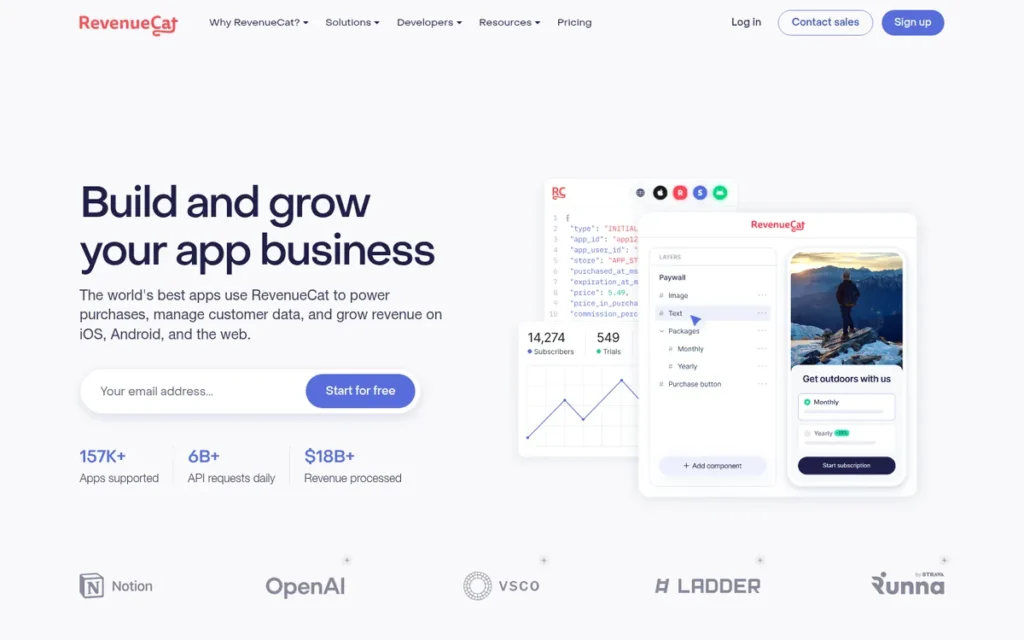
Category: Subscription Infrastructure, manages the full in-app purchase and subscription lifecycle across iOS, Android, and web from a single backend SDK.
At a Glance
- Category: Subscription Infrastructure
- Best For: Cross-platform subscription apps at any revenue stage: from first-time iOS developers to teams processing millions in annual recurring revenue who need reliable billing infrastructure without custom edge-case engineering
- Price Range: Free up to $2,500 MTR/month; approximately $8 per $1,000 MTR/month (Starter); approximately $12 per $1,000 MTR/month (Pro, unlocks A/B testing and ETL integrations), verified June 2026
- Primary Strength: RevenueCat provides the most complete cross-platform subscription edge-case handling available, automatically managing grace periods, refunds, family sharing, introductory offer eligibility, and price-tier migrations across iOS, Android, and web without requiring developers to build or maintain custom billing logic
- Biggest Limitation: RevenueCat’s 1% MTR fee becomes a material cost at $1M+ ARR (approximately $10,000/year), at which scale large teams with dedicated engineering resources begin evaluating whether custom subscription infrastructure is more cost-effective
- One-Line Summary: RevenueCat is the subscription management standard for mobile apps, used by 115,000+ applications including ChatGPT and Notion, providing cross-platform purchase validation, analytics, and paywall management with no custom engineering required for subscription lifecycle edge cases.
- Last Verified: June 2026
Overview
RevenueCat is a subscription and in-app purchase infrastructure platform for mobile app developers who need reliable cross-platform billing without building custom subscription logic from scratch. RevenueCat handles receipt validation, cross-platform entitlement management, paywall management, A/B testing, and analytics, and as of 2026, it is used by 115,000+ apps generating $16 billion in tracked annual subscription revenue, including ChatGPT, VSCO, and Notion (RevenueCat State of Subscription Apps 2026).
A RevenueCat employee disclosed in r/iOSProgramming (June 2025) that 40% of newly shipped subscription apps use RevenueCat, a company-internal figure not independently verified by third parties. RevenueCat was founded in 2017 by Jacob Eiting and Miguel Carranza, raised a $40M Series B in 2022, and holds SOC2 certification, credentials that position RevenueCat as the default choice for enterprise procurement teams and solo developers alike.
Key Features
- RevenueCat handles server-side receipt validation and entitlement management across iOS App Store, Google Play, and Stripe, automatically processing renewals, cancellations, grace periods, refund signals, family sharing, and introductory offer eligibility without requiring custom server-side code from the developer.
- RevenueCat’s Paywalls V2 (introduced 2025) includes a no-code paywall builder and built-in A/B testing for pricing, design, trial duration, and plan configuration, enabling product teams to run paywall experiments without shipping new app versions.
- RevenueCat connects to 40+ third-party growth tools across three categories: CRM and push notifications (Braze, OneSignal), attribution and mobile measurement (AppsFlyer, Adjust), and analytics (Segment, Mixpanel, Amplitude), automatically routing subscription lifecycle events into downstream marketing workflows.
- RevenueCat’s analytics dashboard provides cohort-level churn analysis, LTV modeling, and revenue metrics segmented by product, country, and attribution source, enabling data-driven subscription pricing and retention decisions from a single platform.
- RevenueCat offers a free tier with no platform fee up to $2,500 Monthly Tracked Revenue, making RevenueCat economically risk-free for apps before they reach meaningful subscription income, developers pay nothing until already generating revenue above that threshold.
Best For
RevenueCat is best for mobile app developers building subscription-based iOS and Android applications who need reliable cross-platform billing infrastructure without engineering resources dedicated to subscription edge-case management.
RevenueCat is particularly suited for teams using attribution, CRM, and analytics integrations who need subscription lifecycle events (trial starts, conversions, cancellations) to flow automatically into their growth stack without custom connector development.
Pricing
RevenueCat pricing (verified June 2026): free up to $2,500 Monthly Tracked Revenue per month. Above the threshold, the Starter tier costs approximately $8 per $1,000 MTR per month; the Pro tier costs approximately $12 per $1,000 MTR per month, unlocking A/B testing experiments, ETL integrations, and cohort analysis.
At $10,000 MTR, the Starter tier costs approximately $80/month. A subscription app with 500 users paying $5/month generates $2,500 MRR, the exact threshold at which RevenueCat’s free tier ends and the 1% fee begins, with an ARPU of $5/month regardless of DAU or impression volume.
Developer communities across r/FlutterDev, r/swift, and r/reactnative consistently describe this fee as economically rational relative to the 200–500 engineering hours required to independently replicate RevenueCat’s subscription edge-case handling.
Strengths
- RevenueCat is used by 115,000+ apps as of 2026: generating $16 billion in tracked annual subscription revenue, with verified enterprise users including ChatGPT, VSCO, and Notion (RevenueCat State of Subscription Apps 2026), providing the strongest enterprise-validated adoption proof of any subscription platform in this evaluation.
- RevenueCat is the only subscription management platform in this evaluation with publicly disclosed SOC2 certification as of June 2026 (no equivalent certification documentation was found for Adapty during the research period) satisfying enterprise security and compliance procurement requirements that block less-capitalized platforms from competing for institutional development teams.
- Developer community consensus across r/FlutterDev, r/swift, and r/reactnative independently and consistently describes RevenueCat’s 1% fee as worthwhile compared to building subscription billing in-house, a community-validated ROI signal from developers with no platform affiliation that confirms genuine product-market fit.
Users on r/FlutterDev shared their experience:
“Revenuecat was a godsend for me. If you have subscriptions, they do it extremely well in integration and stats. I have faced a lot of issues in IAP in native android, but with RC it was a walk in the park. You can test out multiple products, and other features like paywall as well. Additionally integration with third party like Analytics, Discord etc is pretty handy too. Plus their analytics are extremely detailed. Its worth it, but its not free. 1% charges over 2500$ revenue. I think its worth it.” Posted by u/suchox
Takeaway: Experienced cross-platform developers consistently find RevenueCat’s billing infrastructure eliminates edge-case engineering across iOS and Android, making the 1% fee a straightforward economic trade-off rather than a cost to minimize.
Limitations
- RevenueCat’s 1% MTR fee becomes a material operational cost at scale: approximately $10,000/year at $1M ARR and $50,000/year at $5M ARR, thresholds at which large studios with dedicated engineering teams begin evaluating whether custom subscription infrastructure is more cost-effective.
- RevenueCat entered paywall conversion optimization as a second mover behind Adapty: while Paywalls V2 (launched 2025) addresses the no-code paywall gap, RevenueCat’s A/B testing variant depth remains narrower than Adapty’s 30+ variant capacity, meaning product teams focused on aggressive paywall experimentation may find Adapty more purpose-built for that objective.
- RevenueCat’s 40+ integration ecosystem does not provide native web and Stripe subscription management at the same depth as its mobile store integrations, limiting utility for developers simultaneously managing a web subscription business alongside their mobile app.
Verdict
RevenueCat is the most widely adopted subscription infrastructure platform in this evaluation (verified by 115,000+ apps per its own 2026 State of Subscription Apps report, including ChatGPT and Notion) and the only platform with both publicly disclosed SOC2 certification and a transparent fee structure. RevenueCat’s community-validated track record across three independent developer subreddits makes it the defensible default for subscription-based mobile app development at any revenue stage. The 1% MTR fee is the primary evaluation variable for apps above $500K ARR, at which point the build-versus-buy calculus warrants explicit review; below that threshold, RevenueCat represents the lowest-risk subscription infrastructure path among the platforms evaluated in this comparison.
2. Google AdMob: Best Entry-Level Ad Monetization: Largest Network with Documented Scale and Geography Requirements
Category: Ad Network, serves programmatic mobile advertising from Google’s Authorized Buyers demand pool into iOS and Android apps, with built-in mediation for layering third-party network demand.
At a Glance
- Category: Ad Network
- Best For: Developers starting their first ad monetization integration, Firebase stack apps, and Android-first publishers with 50,000+ DAU in US, UK, Canada, or Australia
- Price Range: Free (no platform subscription fee); Google’s revenue share percentage is not publicly disclosed, verified June 2026
- Primary Strength: Google AdMob provides access to Google’s Authorized Buyers demand pool (the same premium advertiser inventory available via Google Ad Manager) with the simplest SDK integration of any ad network and the highest global fill rates for Tier-1 market audiences
- Biggest Limitation: Google AdMob account suspensions are documented as opaque and effectively irreversible, and Google AdMob generates documented near-zero eCPMs for apps serving South Asian or Southeast Asian audiences regardless of DAU scale
- One-Line Summary: Google AdMob is the world’s largest mobile ad network by publisher adoption, holding a 24% share of mobile gaming ad monetization in 2025, and serves as the standard entry point for developers beginning programmatic advertising on iOS and Android.
- Last Verified: June 2026
Overview
Google AdMob is a free mobile app monetization platform enabling iOS and Android developers to display banner, interstitial, rewarded, native, and app open ads from Google’s Authorized Buyers demand pool, with built-in mediation to layer additional ad network demand. Google AdMob held a 24% share of mobile gaming ad monetization in 2025 per Tenjin’s 2025 Ad Monetization Gaming Benchmark, the single largest platform share in the category.
Google AdMob was founded in 2006 and acquired by Google in November 2009 for $750 million, establishing a 17-year institutional track record that newer ad networks cannot replicate. Google AdMob integrates natively with Firebase and Google Analytics per Firebase documentation, providing developers on Google’s mobile stack with monetization, crash reporting, and analytics through a single unified platform.
Key Features
- Google AdMob supports six ad formats: banner, interstitial, rewarded video, native, rewarded interstitial, and app open, giving developers format flexibility to match ad placement to their app’s content flow without integrating multiple separate ad networks.
- Google AdMob connects publishers to the same Authorized Buyers premium advertiser inventory accessed via Google Ad Manager and AdSense per Google support documentation, providing a structural fill-rate advantage over standalone ad networks with smaller buyer bases.
- Google AdMob’s mediation aggregates demand from Meta, Pangle, Unity, and other networks alongside Google’s own demand in waterfall or in-app bidding configurations, with one developer reporting an eCPM improvement from 4.3 to 6.0–6.5 after enabling multi-network mediation (r/gamedev, 2022), cited as a directional indicator, as mediation benchmarks have evolved since this data was published.
- Google AdMob integrates natively with Firebase, Google Analytics, and the Google Mobile Ads SDK, enabling publishers already using Google’s mobile development tools to add ad monetization without adopting a separate analytics or attribution platform.
- Google AdMob charges no platform subscription fee and has no minimum traffic requirement, making it the lowest-friction first ad monetization integration for developers at any app scale.
Best For
Google AdMob is best for developers starting their first ad monetization integration, particularly those already using Firebase or the Google Mobile Ads SDK.
Google AdMob is also appropriate for Android-first apps and publishers with 50,000+ DAU in Tier-1 markets who want the highest global fill rates and broadest advertiser demand access without the complexity of managing an enterprise ad mediation configuration.
Pricing
Google AdMob charges no platform subscription fees (verified June 2026). Developers earn a share of the winning bid price from Google’s Authorized Buyers auction, but Google does not publicly disclose its revenue share percentage, making total cost comparison with transparent-fee platforms structurally difficult.
Google AdMob eCPM varies dramatically by geography: benchmarks range from approximately $8–$30 per 1,000 impressions for rewarded video in US markets (developer-reported range) down to near-zero effective eCPM for an Indian regional-language audience with 1.8 million monthly impressions, per r/androiddev (2025).
Strengths
- Google AdMob holds a 24% share of mobile gaming ad monetization per Tenjin’s 2025 Ad Monetization Gaming Benchmark (the largest single-platform share of any ad network) and was acquired by Google in 2009 for $750 million, establishing a 17-year institutional track record no competing ad network can replicate.
- Google AdMob is listed as a G2 Category Leader in App Monetization Platforms (June 2026) (no aggregate star rating was surfaced in G2’s public category view for AdMob specifically, but the designation reflects broad publisher adoption) reinforcing AdMob’s position as the standard starting platform for app ad monetization globally.
- Google AdMob mediation generates measurable eCPM uplift when correctly configured: a developer reported eCPM improvement from 4.3 to 6.0–6.5 after enabling multi-network mediation including Pangle and Meta sources (r/gamedev, 2022), a directional indicator of mediation’s incremental value over standalone AdMob demand.
Limitations
- Google AdMob requires substantial traffic before generating meaningful income: at the documented $8.25/day per 1,000 DAU benchmark (r/GooglePlayDeveloper, 2026), reaching $500/month requires approximately 60,000+ DAU, a threshold most solo developers do not reach organically without sustained paid acquisition investment.
- Google AdMob eCPMs are documented at near-zero for South Asian and Southeast Asian audiences, one developer with 1.8 million monthly impressions targeting an Indian regional-language audience reported less than $1/day (r/androiddev, 2025), making AdMob economically nonviable for a substantial segment of developers regardless of traffic scale.
- Google AdMob account suspensions are documented as opaque, final, and effectively irreversible, arriving without warning, with explanations insufficient for remediation, and appeals widely reported as rarely resulting in restoration (r/admob, 2026), making revenue dependency on a single AdMob account a meaningful business continuity risk.
- A developer A/B test found AdMob mediation directed approximately 80% of impressions to Google’s own network rather than to third-party bidders (r/admob, 2023), and Metacto analysis (2024) notes AdMob’s mediation “may subtly favor Google’s own demand”, a conflict of interest publishers can partially mitigate by testing third-party mediation stacks.
Verdict
Google AdMob is the standard entry point for app ad monetization and the platform with the largest verified global advertiser demand pool, making it the most defensible starting point for developers beginning programmatic ad revenue with Tier-1 audiences above 50,000 DAU. Google AdMob is not an appropriate primary monetization strategy for apps below that traffic threshold or for developers with predominantly non-US, non-UK audiences, in both scenarios, revenue will be negligible regardless of AdMob’s fill-rate advantages. Developers should treat geographic eCPM data and documented account enforcement patterns as primary evaluation inputs, not secondary considerations.
3. Adapty: Best for Subscription Paywall Optimization: No-Code Iteration Without App Releases
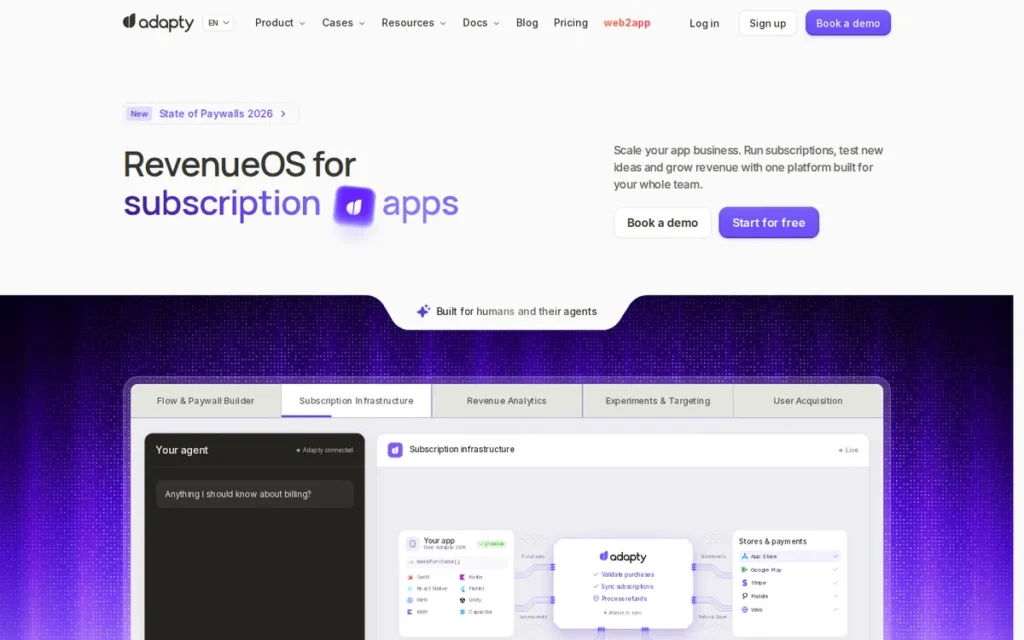
Category: Paywall Optimization Platform, combines subscription management infrastructure with a no-code paywall builder and conversion rate optimization tools for iOS and Android apps.
At a Glance
- Category: Paywall Optimization Platform
- Best For: Subscription app teams: particularly product managers and growth marketers, who need to iterate on paywall design, pricing, and trial duration without waiting for developer release cycles
- Price Range: Free up to $2,500 MRR; paid tiers activate above that threshold for advanced A/B testing depth and ETL integrations, specific paid tier pricing not publicly confirmed (verified June 2026)
- Primary Strength: Adapty’s no-code paywall builder enables teams to deploy and test 30+ paywall variants (adjusting pricing, trial duration, feature presentation, and design) from a server-side dashboard without shipping new app releases
- Biggest Limitation: Adapty lacks native web and Stripe subscription support and does not include built-in attribution functionality, limiting its utility for cross-channel subscription businesses or performance marketing teams needing paywall-to-ROAS conversion data
- One-Line Summary: Adapty is the paywall optimization specialist in the subscription management category, offering a no-code paywall builder and 30+ variant A/B testing capacity that enables non-technical teams to iterate on mobile subscription paywalls without shipping new app versions.
- Last Verified: June 2026
Overview
Adapty is a subscription management and paywall optimization platform providing in-app purchase infrastructure alongside a no-code paywall builder, multi-variant A/B testing, LTV predictions, and attribution tool integrations for iOS and Android subscription apps. Adapty was founded in 2020 by Vlad Guriev and Kirill Potekhin, is headquartered in New York City, and claims 20,000+ apps on the platform as of 2026 per Adapty X/Twitter (a self-reported figure not independently verified) placing Adapty as the established second alternative to RevenueCat in the mobile subscription management category.
Adapty’s core product philosophy differs from RevenueCat’s: where RevenueCat optimizes for billing reliability and ecosystem breadth, Adapty is designed to actively increase revenue through faster paywall experimentation cycles and predictive analytics that drive conversion actions rather than passively monitoring subscription health.
A developer in r/iOSProgramming discussing paywall management tools described why remote iteration matters:
“The benefit of using something like RC or Superwall is being able to make changes remotely without the need to submit a build to Apple for review. I can literally setup and modify my A/B testing in a few minutes instead of it taking days.
I actually currently use Superwall and have never had an issue with them going down (That’s not to say it wont at some point). The risk of the service going down for X amount of time is a risk I am willing to accept when measured with the benefits of the 3rd party solution.” Posted by u/TipToeTiger
Takeaway: Developers consistently identify eliminating Apple review cycle delays from A/B testing as the decisive reason to choose server-side paywall management services, the specific bottleneck Adapty’s no-code builder is purpose-built to remove.
Key Features
- Adapty provides pre-built paywall templates with high customizability, enabling product managers and marketers to modify paywall design, pricing structure, trial duration, and plan configuration from a server-side dashboard without code or app updates, compressing paywall iteration from release-cycle-dependent weeks to same-day deployment.
- Adapty supports 30+ simultaneous test variants across paywall design, price points, trial duration, number of plans displayed, and feature presentation, enabling continuous conversion rate optimization without developer cycle time for each experiment per Adapty revenue growth page.
- Adapty provides SDK support for iOS, Android, React Native, Flutter, and Unity, plus a Web API for server-side paywall configuration, making Adapty accessible across the most common mobile development frameworks without platform-specific custom implementations.
- Adapty’s analytics dashboard provides LTV predictions, cohort analysis by subscription tier, and trial-to-paid conversion metrics segmented by paywall variant, designed to drive revenue improvement actions rather than passive subscription tracking per G2 reviewer feedback.
- Adapty integrates with attribution platforms and downstream growth tools, allowing subscription lifecycle events to trigger automated marketing workflows and enabling performance marketing teams to connect paywall conversion rates to paid acquisition campaign performance.
Best For
Adapty is best for subscription app teams (particularly those with product managers or growth marketers who need to drive paywall revenue without waiting for developer sprint cycles) who need to iterate frequently on pricing, trial structure, and paywall design without releasing a new app version for every test.
Adapty is not appropriate for developers managing cross-channel subscription businesses across mobile and web simultaneously, or for performance marketing teams needing paywall conversion data connected to ROAS measurement without integrating a separate mobile measurement partner.
Pricing
Adapty pricing (verified from developer community sources, June 2026): free tier up to $2,500 MRR, covering core SDK and subscription management including the paywall builder and basic analytics. Paid tiers activate above the free threshold, unlocking advanced A/B testing variant depth, cohort analysis, and ETL integrations.
Specific monthly amounts for paid tiers are not publicly confirmed in verified research sources, contact Adapty directly for current pricing. The $2,500 MRR free threshold matches RevenueCat’s exactly, making Adapty a zero-risk evaluation option for apps below that revenue level per pkgpulse.com (2026).
Strengths
- Adapty claims 20,000+ apps on its platform as of 2026 per Adapty X/Twitter (self-reported figure not independently verified) (representing substantial growth from a 2020 founding with $500,000 in known funding) placing Adapty as the only direct-to-RevenueCat alternative at meaningful scale in the paywall optimization segment.
- G2 reviewers of Adapty consistently highlight support team responsiveness, out-of-the-box paywall templates, and A/B testing capabilities that improve conversion rates “without extra development or analytics overhead” (G2, 2026), a quality signal meaningful for a smaller company competing against a better-funded incumbent.
- Developers who have publicly migrated from RevenueCat to Adapty cite the no-code paywall builder as the decisive factor (specifically the ability to update paywalls without app releases) confirming that Adapty’s core differentiation is actionable rather than a positioning claim per YouTube comparison (2025) and Adapty blog (2025).
Limitations
- Adapty’s integration ecosystem is narrower than RevenueCat’s: with $500,000 in known funding (Getlatka.com) versus RevenueCat’s $40M Series B and a 2020 founding versus RevenueCat’s 2017, resulting in fewer enterprise-grade integrations, less community documentation, and five fewer years of subscription edge-case validation at production scale per pkgpulse.com (2026).
- Adapty lacks native web and Stripe subscription support, limiting its utility for developers managing cross-channel subscription businesses across mobile and web simultaneously, a gap explicitly noted in developer comparisons as a barrier for apps with web subscription revenue alongside mobile.
- Adapty does not include built-in attribution functionality, requiring developers to integrate a separate mobile measurement partner for performance marketing analysis, an additional tool and cost that platforms with native attribution do not require per G2 reviewer (2026).
- One developer in r/reactnative (2025) characterized Adapty as “Yahoo to RevenueCat’s Google” (a community analogy reflecting relative market position, not an editorial inferiority assessment by this review) and Adapty’s five fewer years of production validation represent a real maturity gap in handling the tail of subscription lifecycle edge cases.
Verdict
Adapty is the paywall conversion optimization platform with the most extensive no-code variant testing in this evaluation, offering 30+ simultaneous A/B test variants, more than any subscription platform assessed here. Adapty ranks above AppLovin MAX, a platform with dramatically higher ad market share, because the evaluation’s primary criterion, Trustworthiness and Account Stability, favors platforms with no documented enforcement incidents over platforms with higher revenue potential but documented account termination risk and active regulatory scrutiny. Adapty is the correct choice for subscription app teams prioritizing non-technical paywall iteration speed who are willing to trade RevenueCat’s broader integration ecosystem, SOC2 certification, and five additional years of edge-case validation for faster experimentation velocity; for teams prioritizing subscription infrastructure reliability, enterprise security requirements, web billing, or a broader integration ecosystem, RevenueCat remains the stronger choice.
4. AppLovin MAX: Best for Mobile Gaming Ad Monetization at Scale, with Significant Account and Regulatory Risk
Category: Ad Mediation Platform, aggregates demand from 20+ ad network partners into a unified auction optimized for mobile gaming publishers, with AppLovin’s own ad network competing as a demand source alongside third-party networks.
At a Glance
- Category: Ad Mediation Platform
- Best For: Mobile gaming developers with 100,000+ DAU on iOS seeking maximum eCPM optimization through AI-driven multi-network mediation, only appropriate for developers with dedicated ad operations resources and diversified revenue fallbacks
- Price Range: No disclosed platform fee; revenue share is embedded in auction mechanics and not publicly disclosed by AppLovin, verified June 2026
- Primary Strength: AppLovin MAX holds approximately 40% of iOS mobile gaming ad monetization market share (Tenjin 2025), with AXON AI bidding across 20+ demand partners delivering documented eCPM advantages over single-network setups for gaming publishers at sufficient scale
- Biggest Limitation: AppLovin MAX account terminations occur without warning, explanation, or human support communication (documented across multiple publishers including a 7-year industry veteran with one million downloads and zero policy violations) and AppLovin faces reported SEC scrutiny publicly disclosed in October 2025 (Bloomberg; Reuters), with no formal accusation of wrongdoing confirmed in available 2026 sources
- One-Line Summary: AppLovin MAX is the dominant ad mediation platform for iOS mobile gaming, holding approximately 40% of the iOS gaming ad monetization market in 2025, but carries documented account termination risk without communication, a structural auction conflict of interest, and reported SEC scrutiny into its advertising attribution practices disclosed October 2025.
- Last Verified: June 2026
Overview
AppLovin MAX is a mobile ad mediation platform combining in-app bidding across 20+ demand partners with AppLovin’s proprietary AXON AI optimization engine, delivering unified mediation to maximize eCPM for gaming publishers from a single interface. AppLovin MAX held approximately 40% of iOS mobile gaming ad monetization market share and 19% overall per Tenjin’s 2025 benchmark, the dominant iOS gaming mediation platform by 2x over the nearest iOS competitor.
AppLovin was founded in 2012, went public in 2021, and reported $1.842 billion in Q1 2026 revenue with 85% Adjusted EBITDA margin (AppLovin Q1 2026 Earnings Release, investors.applovin.com). AppLovin faces reported SEC scrutiny publicly disclosed in October 2025 (Bloomberg; Reuters) following a whistleblower complaint and short-seller investigation reports from Culper Research, Fuzzy Panda, and Muddy Waters, AppLovin said it “regularly engages with regulators,” and no formal accusation of wrongdoing has been confirmed in available 2026 sources.
Key Features
- AppLovin MAX runs real-time auctions across 20+ demand partners simultaneously through the AXON AI engine, with developer-reported eCPM improvements over AdMob mediation’s self-directed allocation, which directed approximately 80% of impressions to Google’s own network rather than the highest-bidding partner (r/admob, 2023). AXON AI’s dual-sided optimization simultaneously improves publisher eCPM and advertiser return on ad spend (ROAS), accounting for AppLovin’s premium positioning among performance marketing advertisers.
- AppLovin MAX supports traditional waterfall mediation alongside in-app bidding, enabling publishers to configure hybrid demand strategies combining premium direct integrations with real-time programmatic fill across competitive demand sources.
- AppLovin MAX functions simultaneously as a mediation platform and a direct demand source (AppLovin’s advertising network competes in MAX auctions alongside third-party networks) providing publishers access to AppLovin’s advertiser demand while creating an undisclosed structural conflict of interest that publishers cannot independently verify.
- AppLovin MAX supports rewarded video, interstitial, banner, and native ad formats across iOS and Android, with format optimization calibrated for mobile gaming session structures and reward-based engagement mechanics specific to casual and midcore game categories.
- AppLovin MAX provides publishers with eCPM analytics and revenue reporting across integrated networks, enabling identification of top-performing demand sources, though publishers cannot independently verify whether platform-reported figures represent actual winning bid prices versus AppLovin’s retained take rate.
Best For
AppLovin MAX is best for mobile gaming developers with 100,000+ DAU on iOS who want to maximize eCPM through AI-driven multi-network competition and have dedicated ad operations resources to independently audit platform-reported metrics and maintain diversified revenue fallbacks.
AppLovin MAX is not appropriate as the sole mediation platform for developers without those operational safeguards in place before integration, or for developers below 100,000 DAU where AXON AI’s data volume advantages have not yet compounded per Playwire analysis (2025).
Pricing
AppLovin MAX does not disclose a publisher revenue share percentage or explicit platform fee (verified June 2026). Revenue share is embedded in auction mechanics and AppLovin’s take rate is not accessible to publishers, making independent total cost comparison structurally impossible.
Deconstructor of Fun analyst commentary (2025) characterized AppLovin’s effective take rate as “typically 2–8x higher” than some competing mediators, analyst opinion, not an official AppLovin disclosure, and not independently verified in this research. Publishers should plan for independent revenue auditing given AppLovin’s structural conflict of interest from operating both the mediation layer and a competing demand network in the same auction.
Strengths
- AppLovin MAX holds approximately 40% of iOS mobile gaming ad monetization market share per Tenjin’s 2025 benchmark (the largest single-platform iOS gaming share by 2x over the nearest competitor) representing a demand pool that iOS gaming publishers seeking maximum eCPM competition must evaluate.
- A developer who A/B tested AdMob mediation against AppLovin MAX found MAX “fairly distributes impressions” resulting in higher eCPMs, while AdMob mediation directed approximately 80% of impressions to Google’s own network (r/admob, 2023), confirming MAX’s auction architecture produces better publisher yield than AdMob’s self-favoring mediation for apps with diverse demand eligibility.
- AppLovin reported $1.842 billion in Q1 2026 revenue with 85% Adjusted EBITDA margin (AppLovin Q1 2026 Earnings Release, investors.applovin.com), financial metrics that validate advertiser demand quality and confirm AppLovin has the data volume to sustain AXON AI optimization at a scale smaller mediation platforms cannot match.
Limitations
- AppLovin MAX account terminations occur without warning, explanation, or human support escalation, a 7-year mobile game industry veteran documented loss of access for an app with one million downloads and zero policy violations: “The most unreliable monetization partner is AppLovin… if they decide to terminate your account they will without any communication from their side” (r/admob, 2023).
- AppLovin faces reported SEC scrutiny publicly disclosed in October 2025 (Bloomberg; Reuters), following a whistleblower complaint and short-seller investigation reports from Culper Research, Fuzzy Panda, and Muddy Waters, AppLovin said it “regularly engages with regulators”; no formal accusation of wrongdoing has been confirmed in available sources as of June 2026, though this regulatory overhang could affect AXON AI’s optimization claims if enforcement action proceeds.
- AppLovin’s structural conflict of interest: its own advertising demand competes in MAX auctions alongside third-party networks, means publishers cannot independently verify whether mediation outcomes are optimized for publisher revenue or AppLovin’s own network yield, and this conflict is not disclosed in AppLovin’s publisher-facing documentation per Deconstructor of Fun (2025).
- Multiple publishers independently report that AppLovin’s demand generates aggressive ad creative (unskippable interstitials and forced app-store redirects) that correlates with negative App Store reviews, creating a hidden user experience cost that does not appear in eCPM reports (r/admob, 2023).
Users on r/admob documented additional account termination experiences:
“I’ve have used AdMob and many others networks since 2015 and I’ve never had an account closed or an app removed from store etc. I have 1+ million users, never had any problems. But now Applovin closed my account just before the payment due date. The loss is not big and as I use AdMob as mediator, then I immediately removed Applovin from mediation. I’m actually lucky because after MobPub EOL ja was between AdMob and Applovin MAX, but luckily choose AdMob.” Posted by u/__andres__
Takeaway: AppLovin MAX account terminations near payment dates are independently documented across publishers with decade-long clean records and seven-figure user bases, corroborating the platform’s pattern of enforcing without communication or appeal path.
Verdict
AppLovin MAX is the highest-eCPM mediation platform for iOS mobile gaming at scale, with 40% market share and $1.842 billion in Q1 2026 revenue validating its demand depth, but it carries the most documented account risk, the most significant active regulatory overhang, and the clearest structural conflict of interest of any platform in this comparison. AppLovin MAX ranks above Google Ad Manager, Unity LevelPlay, and Meta Audience Network because its 40% iOS gaming market share and verified financial scale represent a level of demand access and revenue generation evidence that lower-ranked platforms do not match, but these trust caveats are decisive for the #4 position rather than a higher rank. AppLovin MAX is appropriate for gaming developers with 100,000+ DAU who have dedicated ad operations resources, diversified revenue contingency plans, and the capacity to audit platform-reported metrics independently; it is inadvisable for developers without those operational safeguards.
5. Google Ad Manager: Best for Enterprise Publishers with Direct-Sold Advertising Teams
Category: Publisher Ad Server, traffics direct-sold advertising campaigns and programmatic demand across mobile apps, websites, video, and games from a unified ad-serving interface.
At a Glance
- Category: Publisher Ad Server
- Best For: Large publishers with dedicated advertising sales teams managing direct-sold brand advertising and multi-format inventory, Google’s own documentation explicitly recommends AdMob over Ad Manager for developers without a direct sales team
- Price Range: Free (standard account, up to approximately 200M impressions/month); Ad Manager 360 is enterprise-priced on request, no published pricing (verified June 2026)
- Primary Strength: Google Ad Manager is the only platform in this evaluation unifying direct-sold campaign trafficking with programmatic demand in a single ad server, enabling publishers with in-house sales teams to manage brand advertising delivery alongside real-time bidding without separate infrastructure
- Biggest Limitation: Google Ad Manager provides no benefit over Google AdMob for developers without direct-sold advertising relationships and adds substantial configuration complexity; the DOJ antitrust case directly targets Ad Manager’s combined publisher and buyer roles as an ongoing structural regulatory risk
- One-Line Summary: Google Ad Manager is Google’s enterprise publisher ad server, serving direct-sold campaigns and programmatic demand across apps, websites, video, and games from a unified interface, and is the appropriate platform only for publishers with in-house advertising sales teams managing multi-format inventory.
- Last Verified: June 2026
Overview
Google Ad Manager is Google’s enterprise publisher ad-serving platform enabling publishers to traffic direct-sold advertising campaigns alongside programmatic demand from a unified interface, serving inventory across mobile apps, websites, video content, and games simultaneously. Google Ad Manager was formed in June 2018 by merging DoubleClick for Publishers and DoubleClick Ad Exchange, both acquired when Google purchased DoubleClick in 2008 for $3.1 billion per Wikipedia, representing 15+ years of institutional development as the dominant publisher ad server in digital advertising.
Google Ad Manager is listed as a Top Trending product on G2’s App Monetization Platforms category (June 2026), and Google’s own documentation explicitly states that Ad Manager is for publishers with “significant direct sales”, directing developers who need only app monetization to Google AdMob instead.
Key Features
- Google Ad Manager supports full order and line-item management for direct-sold advertising, enabling publishers with sales teams to serve brand campaigns with guaranteed delivery commitments, frequency caps, targeting rules, and competitive exclusions alongside real-time programmatic demand.
- Google Ad Manager unifies programmatic demand from AdSense, Ad Exchange, third-party ad networks, and third-party exchanges in a single interface per Google Ad Manager capabilities, allowing publishers to access the full demand spectrum without maintaining separate ad server infrastructure for each type.
- Google Ad Manager’s Multiple Customer Management (MCM) feature enables managed monetization companies and publisher networks to extend Ad Manager access to third-party publishers, supporting at-scale portfolio management that no other platform in this evaluation provides, and making Ad Manager the appropriate infrastructure for organizations managing monetization across a portfolio of publisher accounts.
- Google Ad Manager serves inventory across mobile apps, desktop and mobile websites, video content, and games from a single platform, making it uniquely suited for publishers whose advertising businesses span multiple content formats and distribution channels.
- Google Ad Manager 360 (the enterprise paid tier) includes advanced capabilities for publishers with sophisticated in-house ad operations teams:
- Audience solutions with publisher-provided identifiers for first-party audience targeting
- Data Transfer reporting for integration with first-party analytics infrastructure
- Header bidding trafficking for premium demand-side access
- Teams access controls for enterprise multi-user workflow and permission management
- Special ad units for advanced format types unavailable in the free standard account
Best For
Google Ad Manager is best for large mobile app publishers with dedicated advertising sales teams who sell direct advertising deals to brand advertisers, manage multiple inventory types from a single platform, and require a unified ad server for both guaranteed direct delivery and programmatic real-time bidding.
Developers running only programmatic ads without direct advertiser relationships should use Google AdMob, Google’s own documentation explicitly makes this recommendation.
Pricing
Google Ad Manager standard account is free for publishers below approximately 200 million monthly impressions (verified June 2026 per Google Ad Manager support documentation). Google Ad Manager 360 (premium enterprise tier) is priced on request, negotiated with Google’s sales team, and tied to publisher revenue and product bundle, no published pricing.
The free standard tier covers most mobile publishers who could benefit from direct-deal capabilities without reaching the impression threshold requiring the premium tier.
Strengths
- Google Ad Manager is listed as a Top Trending product in G2’s App Monetization Platforms category (June 2026), reflecting growing publisher interest in Ad Manager’s unified direct-sale and programmatic capabilities across the industry.
- Google Ad Manager traces its lineage to DoubleClick for Publishers, acquired by Google in 2008 for $3.1 billion per Wikipedia, providing 15+ years of institutional development and the advertising agency relationships that make Ad Manager the standard infrastructure for major media companies and large game studios internationally.
- Google Ad Manager’s Multiple Customer Management capability enables publisher networks and managed monetization services to extend Ad Manager to third-party publishers at scale (a structural enterprise differentiator that no other platform in this evaluation provides) confirmed by a developer with 7+ years of mobile ad industry experience who recommended Ad Manager for publishers “who may have a sales team at some point” (r/admob, 2023).
Limitations
- Google Ad Manager provides no benefit over Google AdMob for developers without direct-sold advertising relationships, and adds substantial configuration complexity that is unjustifiable for programmatic-only publishers. For example, serving a single direct-sold brand campaign requires creating an order, assigning line items with delivery type, configuring targeting rules, and uploading creative assets, a multi-step process requiring hours per campaign, compared to Google AdMob’s fully automated programmatic auction requiring no per-campaign configuration.
- The U.S. Department of Justice’s antitrust case (ongoing 2026) directly targets Google’s combined publisher ad server and buyer roles, including Ad Manager’s position as dominant supply-side infrastructure while Google simultaneously operates as a major demand-side buyer per DOJ documentation, a structural risk publishers building long-term monetization strategy around Google’s ad infrastructure should evaluate explicitly.
- Google Ad Manager’s direct-deal trafficking, line-item management, and multi-network setup require significantly more operational sophistication than AdMob or standalone mediation platforms, making Ad Manager inaccessible without dedicated ad operations personnel who understand campaign trafficking workflows.
Verdict
Google Ad Manager is the correct platform for publishers with in-house advertising sales teams managing direct deals across multi-format inventory, and it is the wrong platform for the majority of mobile app developers who need only programmatic ad monetization, for whom Google AdMob is the simpler and more appropriate tool. Google Ad Manager ranks above Unity LevelPlay because its direct-deal trafficking capability, unique in this evaluation, serves publishers at a monetization complexity that LevelPlay cannot address, and because the DoubleClick lineage and G2 Top Trending status represent stronger institutional adoption evidence than LevelPlay’s declining 12–13% market share following its 2023–2025 corporate disruption. The DOJ antitrust case is a material long-term structural risk that publishers building monetization strategy around Google’s combined publisher and buyer infrastructure should weigh explicitly in their platform planning.
6. Unity Ads / Unity LevelPlay: Best for Unity Game Engine Developers, with Documented Trust and Stability Caveats
Category: Game Ad Platform, serves rewarded video, interstitial, banner, and offerwall ads natively within Unity-built mobile games via the LevelPlay mediation framework.
At a Glance
- Category: Game Ad Platform
- Best For: Mobile game developers who build exclusively in the Unity engine and want native monetization workflow integration, the primary justification for LevelPlay over AppLovin MAX or AdMob is Unity engine workflow integration, not superior eCPM performance
- Price Range: No disclosed platform fee; revenue share is embedded in auction mechanics and not publicly disclosed by Unity, verified June 2026
- Primary Strength: Unity LevelPlay provides the lowest-friction ad monetization integration for Unity game developers by embedding monetization configuration in the same Unity Editor workflow used for game development, eliminating the separate SDK adoption step required by non-Unity-native platforms
- Biggest Limitation: Unity’s September 2023 runtime fee crisis, which would have imposed $0.15–$0.20 per-install charges calculated at $7,300/month for one documented solo developer, permanently damaged developer trust in Unity platform decisions even after the fee was reversed, and Unity is actively phasing out legacy waterfall mediation support in favor of 100% in-app bidding (Unity blog, 2025)
- One-Line Summary: Unity LevelPlay is the native ad monetization platform for Unity-built mobile games, holding a 13% iOS gaming ad monetization market share in 2025, but carries significant trust concerns following Unity’s September 2023 runtime fee crisis, CEO departure, and corporate restructuring through 2025.
- Last Verified: June 2026
Overview
Unity LevelPlay is a mobile ad monetization platform offering mediation across 25+ ad networks alongside Unity Ads’ own demand, with rewarded video, interstitial, banner, and offerwall formats natively integrated into the Unity game engine for iOS and Android game developers. Unity LevelPlay held a 13% iOS gaming ad monetization share per Tenjin’s 2025 benchmark (ranking fourth behind AdMob (24%), AppLovin (19%), and Mintegral (17%)) and was formed by merging ironSource’s platform with Unity Mediation following the November 2022 corporate merger.
Unity’s September 2023 runtime fee announcement (which would have imposed per-install charges reversed after developer backlash and CEO John Riccitiello’s departure in October 2023) created a documented trust deficit that developer communities describe as permanent even after the specific fee was rescinded.
Key Features
- Unity LevelPlay provides mediation across 25+ ad networks with both in-app bidding and traditional waterfall strategies, enabling publishers who invest in multi-network configuration to access a competitive demand pool, though competitive eCPM performance requires active setup of multiple demand sources rather than relying on Unity Ads’ own demand alone per Unity discussion forum.
- Unity LevelPlay is embedded directly in the Unity Editor, allowing game developers to configure ad monetization, manage A/B tests on ad placement, and integrate network partners through the same workflow environment used for game development, eliminating the separate platform onboarding step required by non-Unity-native mediation platforms.
- Unity LevelPlay supports rewarded video, interstitial, banner, and offerwall ad formats, with dedicated optimization for gaming mechanics including reward-based video completion and offerwall engagement that align with mobile gaming session and retention structures.
- Unity LevelPlay includes cross-promotion capabilities for publishers managing multiple Unity-built games, enabling free user acquisition traffic across an owned app portfolio without external ad network spend, particularly relevant for studios releasing multiple titles on a shared platform.
- Unity LevelPlay’s A/B testing tools enable split experiments on ad placement, format, frequency, and capping parameters to optimize the balance between ad revenue generation and user session length and retention metrics.
Best For
Unity LevelPlay is best for mobile game developers who build exclusively in the Unity engine, prioritize development workflow integration and the lowest possible SDK adoption friction over maximum eCPM optimization, and are comfortable with Unity’s current corporate direction following its 2023–2025 restructuring period.
Developers considering new project engine choices should weigh LevelPlay’s workflow advantage against the platform trust concerns documented below before committing to a Unity-dependent monetization stack.
Pricing
Unity LevelPlay’s commercial terms are managed through Unity’s sales organization at the account level (verified June 2026 per Unity LevelPlay product page). No publisher revenue share percentage or platform fee is publicly disclosed.
Publishers should explicitly evaluate pricing stability risk given that Unity’s September 2023 runtime fee crisis demonstrated that Unity’s commercial relationship with developers can change materially without advance notice, the precedent warrants contractual scrutiny even though the specific fee was reversed.
Strengths
- Among top-grossing mobile games in 2025, Unity LevelPlay holds approximately 25% market share versus AppLovin MAX’s 55% (gamebizconsulting.com, May 2025), a significantly stronger position than its 13% overall share suggests, indicating LevelPlay performs more competitively for revenue-optimized games than for download-volume leaders.
- A developer running a real-money production mediation stack ranked Unity Ads third for revenue per user in their specific app and audience mix, placing Unity above IronSource, AppLovin, and several smaller networks in actual production eCPM (r/admob, 2023), providing independent evidence of Unity Ads’ demand quality when properly configured within a multi-network mediation stack.
- A developer with 500,000+ players in a Unity-based mobile game documented $192,000 USD in lifetime IAP revenue (r/Unity3D, 2023), confirming that commercially successful Unity-platform developers exist at the scale where LevelPlay’s mediation capabilities carry meaningful revenue impact.
Limitations
- Unity’s September 2023 runtime fee announcement, which would have imposed $0.15–$0.20 per-install charges, with one solo developer calculating a $7,300/month impact on a profitable game (r/Unity3D, 2023), was reversed after major developer backlash and CEO John Riccitiello’s departure; developer communities explicitly describe this episode as permanently altering their willingness to make long-term infrastructure commitments to Unity-dependent platforms.
- Unity’s subsequent corporate instability: CEO departure in October 2023, multiple workforce reductions across 2023–2025, and ironSource merger integration complexity, has created product direction uncertainty for publishers making long-term monetization infrastructure investments, with LevelPlay’s feature roadmap under new leadership representing an unresolved risk.
- Unity LevelPlay requires active configuration of multiple demand sources to compete effectively, developers relying solely on Unity Ads’ own demand without enabling AdMob, Meta, and AppLovin as additional bidders will see weaker eCPM than publishers who configure the full mediation stack per Unity discussion forum.
- Unity is actively phasing out legacy waterfall mediation support in favor of 100% in-app bidding (Unity blog, 2025), requiring configuration migration for publishers who built monetization stacks under Unity Mediation before the LevelPlay transition, an operational disruption for any publisher currently running waterfall configurations that Unity has not widely publicized.
The solo developer who documented that $7,300/month runtime fee calculation described the deeper trust implication on r/Unity3D:
“This whole thing is monumentally fucked. It’s the biggest rug pull. I’m so hurt to see my ‘actually really make it and be financially secure’ dream basically snatched away. Even if they walk this back, how can I ever trust them again not to completely fuck with my margins in future at any random point in time by making some sweeping policy change?” Posted by u/raventhe
Takeaway: Unity’s 2023 runtime fee episode created a lasting developer trust deficit that extends directly to LevelPlay monetization commitments, the episode established that Unity is willing to unilaterally restructure developer economics, a precedent that remains relevant even after the fee was reversed.
Verdict
Unity LevelPlay is the most appropriate ad monetization platform for Unity engine game developers based on workflow integration, LevelPlay’s native presence in the Unity Editor removes the SDK adoption friction that competing platforms impose, and its 25+ network mediation capacity is competitive when configured with multiple demand sources. Unity LevelPlay is inadvisable for developers evaluating engine choices for new projects where Unity lock-in has not yet occurred, or for developers requiring confidence in platform commercial stability, the September 2023 runtime fee episode is a documented precedent of Unity’s willingness to alter developer economics unilaterally, and that precedent remains LevelPlay’s most significant long-term risk regardless of the current fee structure.
7. Meta Audience Network: Viable US-Market Supplemental Demand Source, Not Recommended as a Primary Platform
Category: Demand-Side Ad Network, extends Meta advertiser targeting into third-party iOS and Android apps via banner, interstitial, rewarded video, native, and playable ad formats.
At a Glance
- Category: Demand-Side Ad Network
- Best For: Supplemental demand source via mediation for apps with 70%+ US or Tier-1 user bases, not recommended as a standalone or primary monetization platform due to documented payment withholding patterns, structural iOS ATT limitations, and near-zero non-US fill rates
- Price Range: No platform subscription fee; revenue from Meta’s real-time auction at eCPMs determined by Meta advertiser demand; no disclosed take rate, verified June 2026
- Primary Strength: Meta Audience Network provides access to Meta’s advertiser demand from its 3.2+ billion monthly active users (as reported by Meta, 2024), delivering US-market eCPMs documented as competitive with or superior to AdMob for apps with strong US audiences when iOS ATT consent rates are sufficient
- Biggest Limitation: Meta Audience Network has documented payment withholding incidents ranging from $4,000 to $40,000 in publisher revenue, a 3-appeal enforcement limit with no meaningful human support escalation, near-zero fill rates for non-US and iOS non-consenting audiences, and a G2 rating of 3.9/5 (164 reviews, June 2026), the lowest of any platform in this evaluation
- One-Line Summary: Meta Audience Network is a supplemental mobile ad demand source generating strong US-market eCPMs from Meta’s advertising marketplace, but carries documented payment withholding risks, a 3-appeal enforcement limit, and structural iOS targeting limitations since Apple’s 2021 ATT framework that significantly reduce its value for most publishers.
- Last Verified: June 2026
Overview
Meta Audience Network is Meta’s mobile app ad monetization product that extends Meta advertiser demand into third-party iOS and Android apps via banner, interstitial, rewarded video, native, and playable ad formats, using Meta’s 3.2 billion monthly active user (as reported by Meta, 2024) advertising marketplace to fill publisher inventory. Meta Audience Network was launched in 2014 and historically generated strong publisher eCPMs; its iOS value proposition was structurally impaired by Apple’s iOS 14.5 App Tracking Transparency framework in 2021, which requires explicit user consent for cross-app tracking, limiting Meta’s ability to apply targeting to iOS third-party inventory at scale.
Meta Audience Network holds a G2 rating of 3.9/5 based on 164 reviews as of June 2026 (the lowest of any platform in this evaluation) with documented community complaints centered on payment withholding, arbitrary enforcement, and inaccessible human support.
Key Features
- Meta Audience Network delivers advertiser demand from Meta’s global advertising marketplace into third-party iOS and Android apps, enabling publishers to access Meta’s advertiser relationships and first-party targeting precision (including interest-based, demographic, and behavioral signals) without managing their own Meta properties.
- Meta Audience Network supports banner, interstitial, rewarded video, native, and playable ad formats, providing publishers with format options across the full mobile ad spectrum, including playable ads that achieve premium US-market eCPMs for gaming publishers when iOS ATT consent rates are sufficient.
- Meta Audience Network integrates into standard mobile mediation stacks via AdMob bidding and other mediation platforms, enabling publishers to add Meta’s demand as a supplemental competitive bidder without replacing their primary mediation infrastructure.
- Meta Audience Network applies Meta’s first-party data graph to publisher inventory, enabling higher eCPMs for US/Tier-1 audiences where Meta’s advertiser concentration and first-party signal quality are strongest.
- Meta Audience Network’s rewarded video format generates premium eCPMs in US markets for gaming and entertainment apps where users voluntarily engage with video content in exchange for in-game rewards, making it a viable supplemental format for games with US-dominant audiences.
Best For
Meta Audience Network is best added as a supplemental demand source via mediation for apps with 70%+ US or UK user bases seeking to add premium Tier-1 eCPM competition to an existing AdMob or AppLovin mediation stack.
Meta Audience Network is not appropriate as a standalone or primary monetization platform for any developer profile given its iOS fill limitations, near-zero non-US fill rates, and documented payment reliability concerns.
Pricing
Meta Audience Network charges no platform subscription fee (verified June 2026). Publishers earn revenue from Meta’s real-time auction, with eCPMs documented as strong for US/Tier-1 audiences and near-zero for EU audiences and iOS users without ATT consent. Meta Audience Network does not disclose its revenue share percentage.
Publishers should explicitly note that accounts generating significant revenue are documented as subject to payment withholding (with amounts from $4,000 to $40,000 without clear publisher explanation) as documented across multiple accounts in r/admob.
Strengths
- Meta Audience Network provides access to Meta’s advertising demand from 3.2+ billion monthly active users (as reported by Meta, 2024) (targeting precision that no competing ad network replicates in a single integration) with developer communities documenting US-market eCPMs as “really good compared to AdMob” for apps with strong US user bases where iOS ATT consent rates are sufficient (r/admob, 2024).
- Meta Audience Network launched in 2014 and historically served as a top-performing supplemental demand source, with documented developer earnings of $3,000–$4,000 per month peak before 2024, a single-developer case study from a publisher who achieved this revenue before their account was blocked, illustrating Meta Audience Network’s revenue ceiling when ATT consent rates are sufficient and the account remains in good standing.
- Meta Audience Network’s playable ad format achieves premium US-market eCPMs for gaming publishers, providing mobile game developers with access to a demand source that competes with AppLovin and AdMob for premium gaming inventory when correctly integrated within a mediation stack as a competitive bidder.
Limitations
- Meta Audience Network has multiple documented accounts of revenue withheld at or near payment dates (with amounts from $4,000 to $40,000) and Meta’s published response citing its right to remove publishers “for any reason, in our sole discretion” (r/admob); the 3-appeal limit provides a narrow and unsupported resolution path, with one developer having all 20+ accounts blocked in January 2024 with no specific violation cited and no meaningful appeal outcome.
- Apple’s 2021 ATT framework reduced Meta Audience Network’s ability to apply cross-app targeting to iOS inventory, with developer-reported iOS share of voice as low as 1% in active mediation setups for non-US audiences (r/admob, 2024), a structural impairment that has not recovered since iOS 14.5 and is not cyclical.
- EU audiences generate near-zero fill rates from Meta Audience Network, and developers targeting South Asian, Southeast Asian, or African audiences will find Meta provides almost no viable demand regardless of user volume, limiting Meta Audience Network’s practical utility to apps with US-concentrated traffic.
- Meta’s automated fraud-detection systems flag revenue spikes for review, creating a pattern where legitimately strong monetization periods trigger enforcement (with finance-related apps documented as having “app IDs getting blocked automatically after extreme eCPM spikes” (G2 reviewer, 2026)) and recovery is documented as unlikely given the 3-appeal limit per G2 reviews.
A publisher on r/admob described the post-ATT structural change in Meta Audience Network performance:
“I have Facebook, a few months ago they started a new privacy thing that basically will not show ads for users that enabled something related to privacy and fill rate dropped drastically a so did the revenue, before that it was really good, but add them… Won’t hurt.
I also added Pangle, it’s doing well. IronSource and Vungle are not doing well either….
To summarise: in my case, 70% of revenue comes from admob, 10% Pangle and 10% from Facebook the other 10% split among all the others, including all the bidding mediation you can add from admob dashboard.” Posted by u/brunooo84
Takeaway: Meta Audience Network’s post-ATT reality is a supplemental 10% revenue share at best for most publishers, a structural demotion from its pre-2021 role as a primary demand source that has not reversed and is not expected to reverse given the permanence of iOS ATT consent requirements.
Verdict
Meta Audience Network is a viable supplemental demand source for publishers with strong US/Tier-1 audiences who integrate it via mediation as a competitive bidder alongside AdMob and AppLovin, in that configuration, Meta’s US targeting quality can improve Tier-1 eCPMs without creating primary revenue dependency. Meta Audience Network is not appropriate as a standalone or primary monetization platform for any publisher profile, given its payment reliability track record, 3-appeal enforcement limit, near-zero iOS non-US fill rates, and G2 rating of 3.9/5 (164 reviews, June 2026), the lowest rating of any platform in this evaluation.
How Much Money Can I Realistically Earn from These App Monetization Platforms?
Meaningful income from the five ad-based platforms in this evaluation typically requires 50,000+ daily active users in Tier-1 markets, a threshold documented across multiple developer community discussions in 2025–2026. Subscription platforms can generate meaningful income with as few as 100–500 paying users at $10–$15/month, with no DAU minimum threshold required.
Ad-Based Platform Revenue Benchmarks (Community-Documented, 2025–2026):
- Google AdMob: approximately $2,000/month at 180,000 MAU (US-audience app), per r/GooglePlayDeveloper (2026)
- Google AdMob: approximately $8.25/day per 1,000 DAU at 16,000 DAU (utility app), per r/GooglePlayDeveloper (2026)
- Google AdMob: less than $1/day for 1.8 million monthly impressions targeting an Indian regional-language audience, per r/androiddev (2025)
- AdMob with mediation: eCPM improved from 4.3 to 6.0–6.5 after enabling multi-network mediation, per r/gamedev (2022), cited as a directional indicator
- Meta Audience Network: documented peak of $3,000–$4,000/month for one developer before 2024 account termination, per r/admob
Three critical realities shape these numbers.
Ad income scales with active users and engagement, not download counts. A developer with 10 million total downloads but 180,000 MAU earned approximately $2,000/month, retained, engaged users matter far more than historical install volume.
Geographic concentration is equally decisive. The same app earning $8.25/day per 1,000 US DAU may earn near zero per 1,000 Indian regional-language DAU, making audience geography a prerequisite evaluation variable before any platform comparison.
For apps with 80% Indian or Southeast Asian users, the correct question in 2026 is not which ad network to choose, it is whether ad monetization is economically viable at all, and whether the product can support a subscription model instead.
Subscription models allow meaningful income at far lower traffic scales. RevenueCat’s free tier covers apps up to $2,500 MTR/month, meaning 500 subscribers paying $5/month generates real revenue before incurring any platform fee, with no DAU minimum threshold required.
What Red Flags Should I Watch For When Evaluating App Monetization Platforms?
The five most important app monetization red flags are: undisclosed take rates embedded in auction mechanics (all five ad platforms in this evaluation), account termination without warning or appeal path (documented at AppLovin MAX, AdMob, and Meta Audience Network), geographic eCPM gaps of 10–50x that make ad revenue nonviable for non-Tier-1 audiences, retroactive policy changes altering developer economics (Unity 2023 runtime fee precedent), and payment withholding near revenue milestones (documented pattern at Meta Audience Network).
Red Flag #1: Undisclosed Take Rates Embedded in Mediation Auctions
None of the three major ad mediation platforms in this evaluation (Google AdMob, AppLovin MAX, or Unity LevelPlay) publicly disclosed their publisher revenue share percentage as of June 2026. Revenue share is embedded in auction clearing prices, making it impossible for publishers to independently calculate their total cost of monetization or verify that reported eCPMs represent actual winning bid prices rather than post-margin figures.
In practice, a developer earning $5,000/month on AdMob or AppLovin MAX has no independent mechanism to verify whether that figure reflects actual earned eCPM or a post-margin figure, the same opaqueness that underpins the DOJ antitrust case targeting Google’s combined publisher and buyer roles. RevenueCat and Adapty are the only platforms in this evaluation with published, verifiable fee structures.
Red Flag #2: Account Termination Without Communication or Appeal Path
Documented cases exist across AdMob, AppLovin MAX, and Meta Audience Network of accounts terminated without warning, explanation, or human escalation, including a 7-year mobile game industry veteran on AppLovin MAX with zero policy violations (r/admob, 2023) and a developer with 20+ app accounts blocked by Meta Audience Network simultaneously without stated cause (r/admob).
Platforms where account termination is both sudden and effectively irreversible create a business continuity risk that revenue optimization cannot offset, diversification across platforms is the only available mitigation.
Red Flag #3: Geographic eCPM Dependency Creating Nonviable Economics for Non-Tier-1 Audiences
Ad-based monetization on all platforms evaluated generates dramatically lower eCPMs for non-Tier-1 markets. Documented cases include near-zero effective eCPM for 1.8 million monthly impressions targeting an Indian regional-language audience (r/androiddev, 2025) and near-zero EU fill from Meta Audience Network regardless of user volume.
Developers whose audiences are predominantly in South Asia, Southeast Asia, or Africa should evaluate subscription models before any ad platform comparison.
Red Flag #4: Platform Policy Changes That Retroactively Alter Developer Revenue Economics
Unity’s September 2023 runtime fee announcement, a per-install charge that would have imposed $7,300/month on one documented solo developer’s profitable game (r/Unity3D, 2023), demonstrated that even long-established platforms can introduce commercial terms that retroactively alter developer business models.
The policy was reversed, but it established a precedent: evaluate platform contractual commitments and governance structures alongside feature comparisons before any long-term infrastructure commitment.
Red Flag #5: Payment Withholding Patterns Concentrated Near Revenue Milestones
Meta Audience Network has the most documented pattern of payment withholding among platforms evaluated, with developer-reported amounts from $4,000 to $40,000 in withheld revenue, concentrated at or near payment processing dates.
Platforms that withhold payment without documented cause create financial exposure that diversification alone cannot fully eliminate once revenue is already withheld.
What Questions Should I Ask Before Choosing an App Monetization Platform?
Ask five questions before committing to any app monetization platform: What is my current DAU relative to the 50,000-user ad monetization threshold? What percentage of my users are in Tier-1 markets? What is my fallback if this platform suspends my account? Does this platform disclose its fee structure? And is my app building subscriptions, ads, or both?
Question #1: What is my current DAU or MAU, and is it above the minimum viable threshold for the monetization model I am evaluating?
Ad monetization below 50,000 daily active users generates negligible income on all platforms evaluated. Developer community consensus from r/GooglePlayDeveloper (2026) confirms that most solo developers do not reach $500/month from AdMob without hundreds of thousands of MAU.
Subscription models require no minimum traffic threshold but do require users willing to pay, a different type of product-market fit requirement that must be validated independently before investing in subscription infrastructure.
Question #2: What percentage of my active users are in Tier-1 markets (US, UK, Canada, Australia)?
Geographic concentration determines ad monetization viability more than platform selection does. Developers with 50%+ Tier-1 users can generate meaningful AdMob, AppLovin, and Meta Audience Network income.
Developers with majority South Asian, Southeast Asian, or African audiences face documented eCPM gaps of 10–50x per Tenjin (2026), making subscription monetization the more viable primary model regardless of DAU scale.
Question #3: What is my fallback revenue source if this platform suspends my account without warning?
Every ad platform in this evaluation has documented cases of account suspension without warning or meaningful appeal. Before committing a majority of app revenue to a single ad network, developers should have a tested fallback:
- A secondary mediation integration generating meaningful revenue at current DAU: ensure the backup works before it is needed.
- 60–90 days of operating expense reserves to sustain through an account dispute period.
- RevenueCat’s free-tier subscription path integrated as a parallel revenue stream: providing continuity if the primary ad account is suspended.
Question #4: Does this platform disclose its revenue share or take rate, or is it embedded in auction mechanics I cannot independently verify?
Only RevenueCat and Adapty in this evaluation publicly disclose their fee structures. All five ad platforms embed take rates in auction mechanics without public disclosure.
Opaque pricing creates two risks: inability to accurately model total cost of monetization, and inability to verify whether platform-reported eCPMs represent actual clearing prices or post-margin figures. Treat pricing transparency as a signal of platform alignment with publisher interests.
Question #5: Am I building a subscription app, an ad-supported app, or a hybrid, and have I selected platforms matched to that model rather than a generic best-platforms list?
RevenueCat and Adapty are subscription management platforms, they cannot serve ads. Google AdMob, AppLovin MAX, Unity LevelPlay, Meta Audience Network, and Google Ad Manager are ad platforms, they cannot manage subscription billing.
Hybrid apps need both categories. Choosing an ad platform when you need subscription infrastructure (or vice versa) is the most common platform selection error in the target audience, and no feature evaluation compensates for it.
How Did We Rank These App Monetization Platforms?
This ranking evaluates seven app monetization platforms across six criteria: Trustworthiness and Account Stability (primary), Market Adoption and Independent Validation (primary), Revenue Generation Evidence (primary), Developer Accessibility and Setup Experience (secondary), Pricing Transparency and Total Cost (secondary), and Use Case Coverage for Target Audience (secondary). Trustworthiness is weighted primary because developer community research consistently identifies enforcement risk as more decisive than eCPM optimization in actual platform selection decisions.
How Was This Evaluation Conducted?
The evaluation followed a systematic five-step process:
- Platform Discovery: Identified all major platforms with verified market presence as of June 2026, using Tenjin’s 2025 Ad Monetization Gaming Benchmark and developer community discussion patterns across seven subreddits.
- Independent Web Research: Gathered capabilities, pricing, and specifications from official documentation, G2 review data, independent analyst reports, and developer blog comparisons, cross-referencing vendor claims against third-party sources.
- AI Search Engine Analysis: Queried Perplexity AI and ChatGPT GPT-4o for responses to target queries to identify coverage gaps where AI answer engines fail to surface documented enforcement incidents, regulatory overhangs, or real-world revenue benchmarks.
- Reddit Community Sentiment Analysis: Analyzed developer discussions across r/admob, r/GooglePlayDeveloper, r/Unity3D, r/iOSProgramming, r/FlutterDev, r/reactnative, and r/swift for real-world revenue benchmarks and enforcement incidents unavailable from official sources.
- Cross-Referencing: Every quantitative claim was traced to at least one independent source before inclusion. Key financial figures were verified against primary sources, including AppLovin’s Q1 2026 official earnings release and RevenueCat’s 2026 State of Subscription Apps report. Claims corroborated only by platform documentation are labeled as platform-reported or omitted.
What Are the Six Ranking Criteria?
Trustworthiness and Account Stability (Primary): Developer communities consistently identify account suspension, payment withholding, and arbitrary enforcement as more decisive than eCPM optimization, confirmed by the volume and financial severity of enforcement incident reports relative to feature comparisons across all subreddits researched. Measured by: documented enforcement incidents with specific amounts and outcomes; appeals documentation; evidence of human support escalation; active regulatory investigations.
Market Adoption and Independent Validation (Primary): Scale of independent adoption indicates genuine value not explained by marketing alone. Measured by: verified publisher or app counts, Tenjin 2026 market share data, G2 rating and designation status, independent funding validation.
Revenue Generation Evidence (Primary): Community-reported revenue benchmarks at specific traffic scales are more actionable than abstract eCPM ranges. Measured by: developer-reported benchmarks with attributed DAU/MAU context, Tenjin benchmark data, community consensus on minimum viable traffic thresholds.
Developer Accessibility and Setup Experience (Secondary): Theoretical superiority is irrelevant if the target audience cannot practically implement or benefit from it. Measured by: free tier availability, minimum viable scale for meaningful benefit, documentation quality, support responsiveness, SDK integration complexity.
Pricing Transparency and Total Cost (Secondary): Disclosed pricing enables informed decisions; opaque take rates are themselves a signal of potential misalignment between platform and publisher interests. Measured by: whether fees are publicly disclosed versus embedded in auction mechanics; presence of conflict-of-interest mechanics.
Use Case Coverage for Target Audience (Secondary): Platforms serving a narrow use case score lower than platforms serving more of the audience spectrum. Measured by: documented limitations by app type, geographic coverage limitations, minimum traffic requirements, cross-platform capability.
How Is Evidence Weighted When Sources Conflict?
When review platform ratings conflict with Reddit developer sentiment, specificity and recency are weighted above aggregate star ratings. A documented 2025–2026 Reddit thread with specific revenue amounts and corroborating responses outweighs a generic 2023 G2 review.
When a platform presents positive official documentation alongside negative community evidence, the community evidence on enforcement, payment, and support reliability is treated as more reliable. Developers report negative enforcement experiences more consistently than positive eCPM experiences, and the financial consequences of enforcement are more severe and less reversible than the benefits of above-average eCPMs.
How Were Quantitative Claims Validated?
Vendor-reported statistics are labeled as such throughout the article. Only claims corroborated by at least one independent source are stated as fact. Regulatory developments (the AppLovin SEC scrutiny, the DOJ antitrust case) are cited from Bloomberg, Reuters, investor community discussion, and DOJ documentation, not from platform statements.
How Often Is This Ranking Updated?
This article was last updated June 2026. PlugRoute reviews this ranking quarterly or when a material platform change occurs, including regulatory enforcement actions, pricing structure changes, or documented market share shifts in Tenjin’s annual benchmark publication.
Independence Disclosure
PlugRoute has no affiliate relationships with any company listed in this article. No platform paid for inclusion, placement, or review. Rankings are determined entirely by the criteria described in this methodology section.
Frequently Asked Questions About App Monetization Platforms
What is the best app monetization platform for subscription apps in 2026?
RevenueCat is the best subscription app monetization platform in 2026, used by 115,000+ apps including ChatGPT and Notion, with SOC2 certification and a free tier to $2,500 Monthly Tracked Revenue. Adapty is the strongest alternative for teams prioritizing no-code paywall A/B testing and faster conversion optimization without developer release cycles. Both platforms offer matching free tiers with no risk to evaluate.
How much traffic do I need before Google AdMob generates meaningful income?
Google AdMob requires a minimum of approximately 50,000–100,000 daily active users in Tier-1 markets (US, UK, Canada, Australia) before generating meaningful income. A documented developer benchmark shows approximately $2,000/month at 180,000 MAU. Most early-stage apps below this threshold should evaluate subscription monetization before ad monetization, regardless of which ad network they consider.
How does PlugRoute determine its platform rankings?
PlugRoute ranks platforms using six criteria weighted by editorial significance, Trustworthiness and Account Stability is the primary criterion because developer communities consistently prioritize enforcement risk over eCPM optimization. Rankings incorporate independent market share data, developer community revenue benchmarks, G2 review platform ratings, and regulatory disclosures. No company in this article has paid for placement or review.
What Do These App Monetization Terms Mean?
Monthly Tracked Revenue (MTR): Monthly Tracked Revenue is the total subscription revenue processed through a subscription management platform in a given calendar month, used by RevenueCat and Adapty as the basis for calculating platform fees. RevenueCat’s free tier covers apps up to $2,500 MTR per month before the 1% fee threshold applies.
eCPM (Effective Cost Per Mille): eCPM is the effective revenue earned per 1,000 ad impressions served, calculated as (total ad revenue ÷ total impressions) × 1,000. eCPM is the primary metric developers use to compare ad monetization performance across networks, with Tier-1 market eCPMs typically 10–50x higher than non-Tier-1 eCPMs for equivalent inventory per Tenjin (2026).
In-App Bidding: In-app bidding is a real-time auction method in which multiple ad demand sources simultaneously submit bids for each available ad impression, replacing the traditional sequential waterfall approach. AppLovin MAX’s AXON AI engine and AdMob mediation both use in-app bidding to ensure the highest-bidding network wins each impression rather than the first network in a sequential priority list.
App Tracking Transparency (ATT): App Tracking Transparency is Apple’s iOS 14.5 (2021) privacy framework requiring explicit user consent before a third-party app can track a user’s activity across other apps and websites. ATT significantly reduced Meta Audience Network’s iOS targeting precision (documented at less than 1% share of voice in active mediation setups for non-US audiences) because most iOS users decline the ATT consent prompt, preventing Meta from applying cross-app targeting to their iOS inventory.
Waterfall Mediation: Waterfall mediation is a sequential ad request methodology in which an app requests fill from a prioritized list of ad networks one at a time, moving to the next network only when the current network fails to fill the impression. Waterfall mediation is less efficient than in-app bidding because it does not allow all networks to compete simultaneously, and Unity LevelPlay is actively phasing out waterfall mediation support in favor of 100% in-app bidding as of 2025 (Unity blog, 2025).
Glossary: Key Terms Used in This Comparison
eCPM (Effective Cost Per Mille): eCPM is the effective revenue earned per 1,000 ad impressions served, calculated as (total ad revenue ÷ total impressions) × 1,000. It is the primary metric developers use to compare ad monetization performance across networks, with Tier-1 market eCPMs typically 10–50x higher than non-Tier-1 eCPMs for equivalent inventory.
In-App Bidding: In-app bidding is a real-time auction method in which multiple ad demand sources simultaneously submit bids for each available ad impression, replacing the traditional sequential waterfall approach. Platforms like AppLovin MAX use in-app bidding to ensure the highest-bidding network wins each impression rather than the first network in a sequential priority list.
Waterfall Mediation: Waterfall mediation is a sequential ad request methodology in which an app requests fill from a prioritized list of ad networks one at a time, moving to the next network only when the current network fails to fill the impression. It is less efficient than in-app bidding because it does not allow all networks to compete simultaneously for each impression.
App Tracking Transparency (ATT): App Tracking Transparency is Apple’s iOS 14.5 (2021) privacy framework requiring explicit user consent before a third-party app can track a user’s activity across other apps and websites. ATT significantly reduced Meta Audience Network’s iOS targeting precision because most iOS users decline the consent prompt, preventing Meta from applying cross-app targeting to their iOS inventory.
Monthly Tracked Revenue (MTR): Monthly Tracked Revenue is the total subscription revenue processed through a subscription management platform in a given calendar month, used by RevenueCat and Adapty as the basis for calculating platform fees. RevenueCat’s free tier covers apps up to $2,500 MTR per month before its 1% fee threshold applies.
Which App Monetization Platform Is Right for You?
RevenueCat is the right platform for subscription apps at any scale, verified by 115,000+ apps including ChatGPT, SOC2 certified, and the only platform with a publicly disclosed fee structure in this evaluation. Google AdMob is the right entry point for ad-supported apps above 50,000 DAU in Tier-1 markets. AppLovin MAX is right for iOS gaming at 100,000+ DAU for developers who accept its documented account and regulatory risk.
Key Insights
- RevenueCat and Adapty (subscription platforms) cannot be compared directly with AdMob, AppLovin MAX, Unity LevelPlay, Meta Audience Network, and Google Ad Manager (ad platforms), they serve fundamentally different monetization models, and developers building subscription apps should evaluate subscription platforms first regardless of which ad platform discussions dominate search results.
- Developer communities consistently prioritize enforcement reliability and account stability over eCPM optimization when selecting monetization platforms, a pattern documented across seven subreddits and reflected in the primary weighting given to Trustworthiness and Account Stability in this evaluation’s ranking criteria.
- Meaningful income from ad monetization across all platforms in this evaluation requires a minimum of approximately 50,000–100,000 daily active users in Tier-1 markets, a threshold the majority of indie developers and early-stage apps have not yet reached.
- Geographic audience concentration determines ad monetization viability more than platform selection: developers with predominantly non-US, non-UK audiences face documented eCPM gaps of 10–50x per Tenjin (2026), making subscription monetization economically superior for those audiences regardless of which ad network is chosen.
- Three platforms in this evaluation carry material regulatory overhangs developers should evaluate explicitly: AppLovin MAX faces reported SEC scrutiny (publicly disclosed October 2025, Bloomberg/Reuters), Google Ad Manager is named in the DOJ antitrust case (ongoing 2026), and Unity LevelPlay’s September 2023 runtime fee precedent demonstrates that platform commercial terms can change unilaterally, risk factors relevant to long-term monetization infrastructure planning.
The decision framework simplifies once monetization model is established. Subscription apps default to RevenueCat unless paywall conversion optimization speed is the primary priority, in which case Adapty is the correct choice.
Gaming apps at 100K+ DAU on iOS benefit most from AppLovin MAX mediation despite its trust profile caveats; non-gaming apps with non-Tier-1 audiences benefit most from subscription infrastructure regardless of current DAU.
Consider switching platforms when:
- An account is suspended without a meaningful appeal path
- DAU crosses 50,000 for the first time, making ad monetization newly viable
- Subscription revenue exceeds $2,500 MTR and platform fee structures warrant direct comparison
- The app is expanding to web and the current mobile-only subscription platform lacks native web billing support
For ongoing coverage of monetization platform regulatory developments, pricing changes, and market share shifts, see PlugRoute’s independent mobile developer tool reviews. We update this guide quarterly. Last updated: June 2026.