StackAdapt leads cross-channel advertising in 2026 as the top-rated programmatic DSP, holding simultaneous G2 #1 rankings in four distinct programmatic categories. Google Marketing Platform is the enterprise standard for Google-ecosystem teams needing unified Floodlight attribution across search, display, and CTV. AdRoll is the most accessible mid-market ecommerce option, with 140,000+ brands served and a confirmed free tier. No single platform leads every segment, channel mix, monthly ad spend, and existing technology stack determine the right fit.
Managing paid campaigns across multiple channels simultaneously (programmatic display, CTV, paid search, paid social, and retail media) means juggling disconnected platforms, duplicated effort, and attribution gaps that make it impossible to know which channels actually drive revenue. The April 2025 dissolution of Marin Software, still recommended by AI search engines as an active platform in mid-2026, illustrates why vendor stability and category currency matter as much as platform capability.
PlugRoute has no affiliate relationships with any company listed; rankings are determined entirely by research data and objective evaluation criteria.
TL;DR: Top Picks at a Glance
- StackAdapt is the top-rated programmatic DSP for CTV and cross-channel programmatic consolidation, holding simultaneous G2 #1 rankings in four adjacent categories as of March 2026.
- Google Marketing Platform is the enterprise standard for unified search and programmatic attribution through its Floodlight measurement system across DV360, SA360, and CM360.
- AdRoll is the most accessible cross-channel retargeting platform for mid-market ecommerce teams, with a confirmed free tier and native integrations across Shopify, Klaviyo, WooCommerce, and HubSpot.
- Smartly.io is the enterprise social automation platform for brands spending $100,000 or more per month in paid social, with AI Studio creative production generating 1.9 million assets across 260+ customers (vendor-reported, Smartly.io, 2026).
What Are the 4 Types of Cross-Channel Advertising Software?
Cross-channel advertising software divides into four functionally distinct platform types (programmatic DSPs, enterprise advertising suites, social automation platforms, and retail media platforms) and choosing the wrong type is as costly as choosing the wrong vendor, since each type serves a specific channel mix and buyer profile the others cannot fully replicate.
The six entries in this evaluation each belong to a distinct category:
- Programmatic DSPs: self-serve platforms for open-exchange buying across CTV, display, native, audio, and in-game inventory (example in this evaluation: StackAdapt #1)
- Enterprise Advertising Suites: integrated search, programmatic, and ad serving ecosystems with shared measurement layers for large organizations (example: Google Marketing Platform #2)
- Cross-Channel Retargeting Platforms: ecommerce-focused lifecycle management combining display, social, and email retargeting with CRM integrations (example: AdRoll #3)
- Social Automation Platforms: AI-driven creative production and cross-platform social campaign management for high-volume social advertisers (example: Smartly.io #4)
- Retail Media Platforms: unified management across 100+ retail media networks alongside search and social channels (example: Skai #5)
- Conditional Enterprise DSPs: full-stack DSPs whose core value depends on co-deployment with specific enterprise analytics infrastructure (example: Adobe Advertising #6)
| Platform Type | Primary Channels | Best For | Platform in This Evaluation |
|---|---|---|---|
| Programmatic DSP | CTV, display, native, audio, video, in-game, DOOH | Mid-market to enterprise programmatic consolidation | StackAdapt (#1) |
| Enterprise Advertising Suite | Search + programmatic display/CTV + ad serving | Enterprise teams in the Google ecosystem | Google Marketing Platform (#2) |
| Cross-Channel Retargeting | Display retargeting, paid social, email, lifecycle | Mid-market ecommerce lifecycle management | AdRoll (#3) |
| Social Automation Platform | Meta, TikTok, Pinterest, Snapchat, YouTube | Enterprise brands at $100K+/month in paid social | Smartly.io (#4) |
| Retail Media Platform | 100+ retail networks, search, social, app | CPG and grocery brands managing Amazon, Walmart, Target | Skai (#5) |
| Conditional Enterprise DSP | DSP, search, social, CTV (requires Adobe Analytics) | Enterprises already on Adobe Experience Cloud | Adobe Advertising (#6) |
Buyers needing open-exchange programmatic buying across CTV should evaluate StackAdapt or Google DV360 first. Buyers managing Amazon, Walmart, or Target retail media alongside traditional channels should evaluate Skai. Buyers building a first ecommerce cross-channel stack with Shopify or Klaviyo should evaluate AdRoll.
⚠️ EDITORIAL NOTICE: Marin Software Is Dissolved, Remove It From Your Evaluation List
As of June 2026, multiple AI search engines (including Perplexity and ChatGPT) continue to recommend Marin Software as an active cross-channel advertising platform. This recommendation is factually incorrect.
On April 10, 2025, Marin Software (NASDAQ: MRIN) announced a Plan of Dissolution (BusinessWire, April 2025). Marin Software is no longer an active commercial product. Buyers acting on AI engine recommendations will waste procurement cycles evaluating a company that no longer exists.
The r/PPC community (268,000 members) reacted to the dissolution with “Good riddance. Troublesome software,” “Surprised they lasted this long,” and “Marin always felt extremely underwhelming”, confirming the platform had lost practitioner confidence years before formal closure (r/PPC, April 2025).
Former Marin users who primarily managed paid search should evaluate Skai. Former Marin users managing cross-channel programmatic campaigns should evaluate StackAdapt. The root causes of Marin’s decline (native platform automation eliminating third-party bid management value) are documented in the Methodology section below.
How Do the Top Cross-Channel Advertising Platforms Compare at a Glance?
The six cross-channel advertising platforms in this 2026 evaluation span four distinct categories: StackAdapt (#1, G2 4.8/5.0, programmatic DSP), Google Marketing Platform (#2, enterprise suite with Floodlight de-duplicated attribution), AdRoll (#3, G2 4.3/5.0, ecommerce retargeting), Smartly.io (#4, enterprise social automation), Skai (#5, retail media specialist with 100+ networks), and Adobe Advertising (#6, approximately 3.7/5.0 G2 rating, third-party cited, conditional on Adobe Analytics deployment).
| Rank | Company | Category | Best For | One-Line Summary | Key Capabilities | Primary Strength | Key Limitation |
|---|---|---|---|---|---|---|---|
| #1 | StackAdapt | Programmatic DSP | Mid-market to enterprise programmatic consolidation (CTV, display, native, audio, in-game) | StackAdapt is the highest-rated cross-channel programmatic DSP in 2026, holding G2 #1 in four adjacent categories with native support for nine programmatic channels and an AI Video Builder for in-platform CTV creative generation launched in 2026. | StackAdapt supports 9 programmatic channels natively including CTV, in-game, and DOOH. AI Video Builder generates standard and dynamic CTV and video ads in-platform without external creative production (launched 2026). StackAdapt’s Universal Pixel attribution integrates Acxiom and Bombora third-party audience data across all campaign types. | G2 #1 simultaneously in cross-channel advertising, CTV, digital audio, and demand-side platform (March 2026); the broadest verified category leadership of any platform among the six evaluated | StackAdapt does not natively support search channel management (Google Ads, Microsoft Ads), requiring a separate search tool for teams with significant paid search budgets |
| #2 | Google Marketing Platform | Enterprise Advertising Suite | Enterprise teams in the Google ecosystem needing de-duplicated Floodlight attribution across search, programmatic, and CTV | Google Marketing Platform is an enterprise advertising suite combining DV360, SA360, and CM360 in a unified Floodlight measurement ecosystem; the industry standard for large advertisers needing de-duplicated cross-channel attribution across search, programmatic display, and CTV. | Google Marketing Platform’s Floodlight system provides de-duplicated attribution across search (SA360), programmatic (DV360), and ad serving (CM360). SA360 includes Vertex AI LTV modeling and intraday bidding beyond standard Google Ads. DV360 provides access to premium PMP and programmatic guaranteed inventory not available in standard Google Ads campaigns. | Only platform among the six evaluated with a native shared measurement data layer across search management, programmatic buying, and ad serving; enabling de-duplicated conversion attribution unavailable when using separate tools | Reseller-only licensing adds cost markup and procurement complexity; full value requires all three GMP products plus specialist headcount across multiple roles |
| #3 | AdRoll | Cross-Channel Retargeting | Mid-market ecommerce brands with Shopify, Klaviyo, WooCommerce, or HubSpot stacks | AdRoll is a cross-channel retargeting and lifecycle advertising platform owned by NextRoll Inc., serving 140,000+ brands over 17+ years (vendor-reported, AdRoll homepage, June 2026), with native integrations across Shopify, Klaviyo, WooCommerce, HubSpot, and Salesforce. | AdRoll provides LTV-based lifecycle audience segmentation for browse abandonment, cart recovery, cross-sell, and post-purchase targeting. AdRoll integrates natively with 18+ ecommerce and CRM platforms including Shopify, Klaviyo, WooCommerce, HubSpot, and Salesforce. AdRoll offers a confirmed free tier for no-cost evaluation entry. | Largest confirmed customer base among the six evaluated platforms (vendor-reported 140,000+ brands, 17+ years operating) and the only platform with a confirmed free tier as of June 2026 | AdRoll’s cross-channel scope is retargeting-centric; limited full-funnel open-exchange programmatic prospecting compared to StackAdapt or Google DV360 |
| #4 | Smartly.io | Social Automation Platform | Fortune 100/500 brands spending $100K+/month in paid social across Meta, TikTok, Pinterest, and Snapchat | Smartly.io is an enterprise AI advertising platform acquired for approximately $400 million (community-reported via r/PPC, 2021; acquirer not publicly confirmed), serving Fortune 100/500 brands including Daniel Wellington and WPP with AI-generated creative at scale and campaign management across Meta, TikTok, Pinterest, Snapchat, and YouTube. | Smartly.io’s AI Studio generated 1.9 million creative assets across 260+ customers at 30x faster production speed (vendor-reported, Smartly.io, 2026). Predictive Budget Allocation dynamically reallocates budgets across Meta, TikTok, Pinterest, Snapchat, Amazon, and Google, reporting an average 11% uplift (vendor-reported). Smartly.io’s Intelligence suite predicts ad fatigue and flags underperforming creatives before conversion rates decline. | AI Studio creative automation at confirmed enterprise scale; the most documented aggregate creative production output statistic among the six evaluated platforms (vendor-reported, Smartly.io, 2026) | Reported $4,000–$5,000/month minimum billed against total ad spend (not only spend through Smartly) makes it cost-prohibitive for advertisers spending less than approximately $100,000/month in paid social |
| #5 | Skai | Retail Media Platform | Enterprise CPG, grocery, and retail brands managing 100+ retail media networks alongside paid search and social | Skai is a 20-year-old enterprise retail media platform backed by Sequoia Capital and Bain Capital Ventures, serving PepsiCo, Sanofi, and Estée Lauder across 100+ retail media networks including Amazon, Walmart, and Target (Kevel self-reported, November 2025), with Celeste AI and MCP-based agentic workflow capabilities. | Skai provides connectivity to 100+ retail media networks via its Kevel strategic partnership (Kevel self-reported, November 2025), enabling unified management of Amazon, Walmart, Target, Instacart, and Kroger. Skai’s Celeste AI and Model Context Protocol (MCP) support custom AI agent workflows for automated media planning. Skai charges a flat annual rate based on program size rather than a percentage of media spend. | Broadest confirmed retail media network coverage among the six evaluated platforms (100+ networks via Kevel partnership, Kevel self-reported, November 2025), with 20-year operating history and six-firm institutional investor backing | Skai’s programmatic display and CTV capabilities are narrower than purpose-built DSPs such as StackAdapt or DV360; G2 rating and review volume could not be confirmed in current research as of June 2026 |
| #6 | Adobe Advertising | Conditional Enterprise DSP | Enterprises already deployed on Adobe Experience Cloud with Adobe Analytics and Audience Manager | Adobe Advertising is an enterprise cross-channel DSP built on the 2016 TubeMogul acquisition (~$540M), carrying an approximately 3.7/5.0 G2 rating (third-party cited, MediaPlanningTool.com; a separate reference cited ~4.3/5.0; verify current rating at g2.com before committing) and a conditional value proposition requiring Adobe Analytics co-deployment. | Adobe Advertising’s closed-loop integration with Adobe Analytics connects ad exposure data directly to on-site analytics without a third-party data bridge; available only to enterprises already using Adobe Analytics. Adobe Advertising connects to Adobe Audience Manager, Real-Time CDP, and Target for first-party audience activation. Adobe Advertising covers DSP, search, social and commerce, CTV, display, video, and audio from a unified interface. | Closed-loop post-impression attribution for enterprises with Adobe Analytics already deployed; the one differentiation practitioners with multi-platform experience consistently confirm as legitimate | Approximately 3.7/5.0 G2 rating (third-party cited; verify at g2.com); value conditional on Adobe Analytics; practitioners explicitly recommend alternatives for non-Adobe buyers (“avoid Adobe like the plague,” r/PPC, January 2026) |
Which Cross-Channel Advertising Platform Should I Choose for My Use Case?
The right cross-channel advertising platform depends primarily on your channel mix, monthly ad spend, and existing technology stack, not on review ratings in isolation. Use this framework to identify the right category of platform before evaluating individual tools, as choosing the wrong platform type is as costly as choosing the wrong vendor.
| Your #1 Priority | Recommended Tool | Why | Minimum Viable Spend | Acceptable Alternative |
|---|---|---|---|---|
| Programmatic + CTV consolidation with AI optimization | StackAdapt | G2 #1 in four programmatic categories; self-serve; no reseller dependency | No confirmed minimum; mid-market viable; verify with sales | Google DV360 (if already in the GMP ecosystem) |
| Unified attribution across search + display + video | Google Marketing Platform | Unique Floodlight de-duplicated measurement across SA360 + DV360 + CM360 | SA360 fee ROI-positive directionally at $50,000+/month in search (practitioner-confirmed, r/PPC, January 2026) | StackAdapt (for programmatic-only coverage without search) |
| Mid-market ecommerce retargeting + lifecycle management | AdRoll | 140,000+ brands served (vendor-reported); free tier; Shopify/Klaviyo/WooCommerce/HubSpot integrations | Free tier available; viable at any spend level | Smartly.io (only if paid social spend exceeds $100K/month) |
| Enterprise paid social creative automation at scale | Smartly.io | AI Studio: 1.9M assets, 27% lift, 30x faster production (vendor-reported, Smartly.io, 2026); Fortune 100/500 validated | $100,000+/month in paid social recommended by practitioners (r/PPC, 2021) | StackAdapt (for programmatic channels alongside social) |
| Retail media across Amazon, Walmart, Target + 100 additional networks | Skai | 100+ retail media networks (Kevel self-reported, November 2025); Sequoia-backed; PepsiCo, Sanofi, WPP validated | Enterprise flat annual contract; no confirmed minimum; sales engagement required | Google Marketing Platform (for Amazon-lite + Google-first strategies) |
| Adobe Experience Cloud already deployed + need closed-loop attribution | Adobe Advertising | Closed-loop Analytics integration unavailable from independent DSPs | Enterprise; model combined product costs (DSP + Analytics + Audience Manager) before evaluating | StackAdapt or GMP (recommended if Adobe Analytics is not yet deployed) |
Hybrid stack note: Most enterprise teams run cross-channel platforms in combination rather than as single-stack replacements. Common patterns from practitioner communities:
- StackAdapt (programmatic/CTV) + Google SA360 (search) + native social platforms for mid-to-enterprise buyers
- Skai (retail media + paid search) + StackAdapt (programmatic display) for CPG and commerce-first brands
- Google Marketing Platform full stack for teams fully invested in the Google ecosystem
- AdRoll (retargeting) + native paid social for mid-market teams below enterprise minimums
No single evaluated platform provides equal depth across all channels simultaneously, knowing this prevents buyers from over-engineering RFP requirements around a platform that cannot exist.
1. StackAdapt: Best Overall: #1 Rated Programmatic DSP for Cross-Channel Advertising
Category: Programmatic DSP, self-serve AI-powered demand-side platform for omnichannel programmatic advertising across CTV, display, native, video, audio, in-game, DOOH, email, and direct mail.
At a Glance
- Category: Programmatic DSP
- Best For: Mid-market to enterprise advertisers and agencies consolidating programmatic campaigns across CTV, display, native, audio, and in-game channels without managed-service dependency
- Price Range: Pricing on request: no public pricing listed; contact StackAdapt sales for current rates. Budget separately for third-party data overlays (Acxiom, Bombora) beyond platform and media costs (as of June 2026)
- Primary Strength: StackAdapt holds simultaneous G2 #1 rankings in Cross-Channel Advertising Software, Connected TV Advertising Platforms, Digital Audio Advertising Software, and Best Demand-Side Platform as of March 2026, the broadest verified category leadership of any platform among the six evaluated
- Biggest Limitation: StackAdapt does not natively support search channel management (Google Ads, Microsoft Ads), making it a programmatic complement rather than a complete single-stack replacement for teams with significant paid search budgets
- One-Line Summary: StackAdapt is the highest-rated cross-channel programmatic DSP in 2026, holding G2 #1 rankings in four adjacent categories (cross-channel advertising, CTV, audio, and demand-side platform) with native support for nine programmatic channels and an AI Video Builder for in-platform CTV creative generation launched in 2026.
- Last Verified: June 2026
Overview
StackAdapt is an AI-powered self-serve programmatic demand-side platform (DSP) headquartered in Toronto, Canada, that enables mid-market to enterprise advertisers and agencies to plan, activate, and measure campaigns across CTV, digital video, native, display, audio, in-game, DOOH, email, and direct mail from a single unified interface.
StackAdapt differentiates from legacy managed-service DSPs by bundling AI-driven optimization, audience targeting via third-party data partners Acxiom and Bombora, and real-time cross-channel attribution through the Universal Pixel, all in a fully self-serve environment that eliminates reseller dependency.
StackAdapt’s 2026 product roadmap includes the AI Video Builder for in-platform CTV creative generation and expanded programmatic direct mail capabilities, reflecting StackAdapt’s positioning as an AI-first consolidation platform for teams reducing fragmented programmatic stacks (StackAdapt, 2026).
Summit Partners, StackAdapt’s confirmed institutional backer, describes StackAdapt as “a leading self-serve programmatic advertising platform used by brands and agencies worldwide”, validating a dual-audience go-to-market strategy across direct-brand and agency client segments (Summit Partners, 2026).
Key Features
- Nine Programmatic Channels: StackAdapt supports CTV, digital video, native, display, audio, in-game, DOOH, email, and direct mail from a single self-serve interface, the broadest programmatic channel set of any platform among the six evaluated, requiring no separate managed-service engagement or reseller relationship.
- AI Video Builder: StackAdapt’s AI Video Builder, launched in 2026, enables advertisers to generate standard and dynamic video and CTV ads directly within the platform, eliminating the need for separate creative production pipelines for programmatic video campaigns (StackAdapt, 2026).
- Universal Pixel Cross-Channel Attribution: StackAdapt’s cross-channel attribution combines ad exposure data, external engagement signals, and conversion tracking via the Universal Pixel to reconstruct full conversion paths across programmatic channels for multi-touch reporting.
- Third-Party Audience Targeting via Acxiom and Bombora: StackAdapt integrates audience data from Acxiom and Bombora, enabling targeting by demographics, location, industry, job function, and job title for both consumer and B2B strategies across programmatic inventory (Kuno Creative, 2026).
- Unified Planning-to-Measurement Dashboard: StackAdapt consolidates planning, activation, and measurement in a single dashboard, enabling teams to manage omnichannel campaigns without switching between separate buying, trafficking, and reporting tools.
Best For
StackAdapt is best for mid-market to enterprise advertisers and agencies that need a self-serve programmatic platform to consolidate CTV, display, native, audio, and in-game buying into a single AI-optimized interface, particularly teams managing significant programmatic budgets across open exchange and direct inventory who require cross-channel attribution without the reseller complexity, ecosystem lock-in, or specialist headcount requirements of Google Marketing Platform.
Pricing
StackAdapt does not publish a public pricing table as of June 2026. No verified minimum ad spend is confirmed from official sources. Third-party data integrations (Acxiom, Bombora) incur additional costs beyond platform fees and media spend. Prospective buyers must contact StackAdapt sales directly for current rates. Budget for three cost components (platform fee, media spend, and data layer) when forecasting total cost of ownership.
Strengths
- Broadest Verified Category Leadership: StackAdapt holds simultaneous G2 #1 rankings in Cross-Channel Advertising Software, Connected TV Advertising Platforms, Digital Audio Advertising Software, and Best Demand-Side Platform as of March 2026, no other platform in this evaluation holds more than one simultaneous G2 #1 category designation (StackAdapt G2 ranking announcement, March 2026).
- StackAdapt’s Own Market Research: Top Marketers 4X More Likely to Consolidate Tech and Use AI: StackAdapt’s 2026 Programmatic Advertising Report (StackAdapt-commissioned research distributed via BusinessWire) found that top marketers are 4X more likely to consolidate tech and use AI than lagging peers, confirming the platform’s consolidation thesis is aligned with documented market behavior (BusinessWire, January 2026).
- Documented Client Performance: A public StackAdapt case study attributes 1,000,000+ clicks and 103% year-over-year revenue growth to the Influur campaign (vendor-reported, StackAdapt case study, 2026), the most specific quantified client performance figure available in public sources for any platform in this evaluation.
- Institutional Backing Confirmed: Summit Partners, StackAdapt’s confirmed institutional backer, publicly describes StackAdapt as “a leading self-serve programmatic advertising platform used by brands and agencies worldwide”, validating dual go-to-market traction across both direct-brand and agency client segments (Summit Partners, 2026).
This mid-market positioning is confirmed by experienced independent practitioners on r/programmatic:
“I really like the stackadapt team. I’m activating over 100k with them right now and they’ve been way more helpful than the TTD teams. Tbh TTD IS the best platform in my humble opinion. I’ve been a sr trader at startups, agencies and now my own company. Important to mention that your best platform always depends on your current needs/goals. You also need $100k a month to get on TTD. So if your budgets aren’t that thick, choozle, basis, Goodway group, and mediamath are alternatives. Stackadapt is my number 1 at the moment.” Posted by u/Philthy-P
Takeaway: Senior programmatic traders with multi-DSP experience consistently rank StackAdapt as the top self-serve platform for teams whose budgets fall below The Trade Desk’s $100,000/month minimum, a practitioner-validated mid-market positioning that matches StackAdapt’s stated target audience.
Limitations
- Search Channel Exclusion: StackAdapt does not natively support Google Ads or Microsoft Ads campaign management, meaning teams with substantial paid search budgets must maintain a separate search management tool alongside StackAdapt, the platform functions as a programmatic complement rather than a complete single-stack replacement for mixed search-and-programmatic buyers.
- Whitelist Brand Safety Trade-Off: StackAdapt’s whitelist-based brand safety controls limit available inventory when enabled, creating a real reach-versus-safety trade-off for teams prioritizing verified publisher lists over maximum programmatic reach (Kuno Creative, 2026).
- Pricing Opacity: StackAdapt’s absence of public pricing: with no verified minimum spend and sales engagement required before budget qualification, adds friction to preliminary cost modeling for teams conducting early-stage evaluation before an RFP process.
- Limited Independent Community Sentiment Data: StackAdapt’s agency and enterprise user base generates fewer public practitioner discussions in r/PPC compared to longer-established competitors, buyers cannot rely on community-sourced sentiment for due diligence to the same degree as for GMP, Adobe Advertising, or AdRoll, making direct reference-checking with current StackAdapt customers more important than for other evaluated platforms.
The limited public practitioner data that does exist occasionally reflects a ceiling at the enterprise end of the market, as noted on r/programmatic:
“Adding to the other comments, but holdcos typically will only use Tier 1 DSP’s. I’ve seen StackAdapt get a few test budgets here and there, but it never sticks (once clients realize the performance isn’t great, and there are less features, less transparency) it doesn’t make sense to use them long term.” Posted by u/thinkerthought
Takeaway: StackAdapt’s ceiling in enterprise and holdco environments is a documented practitioner concern, its validated segment is mid-market, and teams requiring Tier 1 DSP feature depth and full pricing transparency should evaluate The Trade Desk or DV360 instead.
Verdict
StackAdapt is the best-evidenced cross-channel programmatic DSP in 2026, holding a breadth of simultaneous peer review category leadership (G2 #1 in cross-channel advertising, CTV, audio, and demand-side platform as of G2’s March 2026 report period) that no other platform in this evaluation matched across four adjacent categories. StackAdapt is the strongest choice for mid-market to enterprise advertisers consolidating programmatic buying across CTV, display, native, audio, and in-game channels who need AI optimization and self-serve control without managed-service dependency. Teams with significant paid search budgets should evaluate StackAdapt as a programmatic layer alongside a dedicated search management tool rather than as a complete replacement for the full media stack.
2. Google Marketing Platform (DV360 / SA360 / CM360): Best for Enterprise Teams in the Google Ecosystem
Category: Enterprise Advertising Suite, integrated platform combining programmatic DSP (Display & Video 360), cross-engine search management (Search Ads 360), and ad serving/unified attribution (Campaign Manager 360) in a shared Floodlight measurement ecosystem.
At a Glance
- Category: Enterprise Advertising Suite
- Best For: Enterprise advertisers and agency groups managing large-scale campaigns across Google search, programmatic display, video, and CTV who need unified Floodlight-based cross-channel attribution and are prepared to invest in GMP Certified Partner relationships and the specialist headcount required for full DV360+SA360+CM360 deployment
- Price Range: SA360: approximately 2–4% of monthly media spend via GMP Certified Partner resellers, negotiable to approximately 1% at high enterprise volumes (practitioner-confirmed, r/PPC, January 2026). DV360: percentage of media spend, higher than SA360. CM360: CPM-based with additional fees for rich media and video. No public pricing (as of June 2026)
- Primary Strength: Google Marketing Platform’s Floodlight measurement system enables de-duplicated cross-channel attribution across search (SA360), programmatic display and video (DV360), and ad serving (CM360), a measurement integration no independent DSP among the six evaluated can replicate natively
- Biggest Limitation: Google Marketing Platform is not purchasable directly from Google for most advertisers and requires licensing through GMP Certified Partner resellers who add markup; full value extraction requires specialist headcount across multiple roles that most mid-market teams do not maintain
- One-Line Summary: Google Marketing Platform is an enterprise advertising suite combining Display & Video 360, Search Ads 360, and Campaign Manager 360 in a unified Floodlight measurement ecosystem, the industry standard for large advertisers needing de-duplicated cross-channel attribution across search, programmatic display, and CTV, accessed through GMP Certified Partner resellers.
- Last Verified: June 2026
Overview
Google Marketing Platform (GMP) is an enterprise advertising and analytics suite developed by Google that combines Display & Video 360 (DV360) for programmatic buying across display, video, CTV, audio, and native; Search Ads 360 (SA360) for cross-engine search campaign management; and Campaign Manager 360 (CM360) for ad serving, trafficking, and Floodlight-based cross-channel attribution.
All three GMP products share a unified Floodlight measurement layer that enables de-duplicated conversion reporting not possible when using separate tools from different vendors, the defining measurement advantage that justifies GMP’s enterprise cost structure.
Google Marketing Platform is built on the DoubleClick Digital Marketing infrastructure Google acquired for approximately $3.1 billion in 2007, providing 20+ years of inventory access and measurement heritage (as documented at the 2018 GMP launch; current integration count not independently confirmed in 2026 research) (Google GMP launch blog, 2018).
Google Marketing Platform is licensed through GMP Certified Partners (reseller agencies) rather than directly from Google for the majority of advertisers, making reseller relationship quality and markup structure meaningful variables in total platform cost and support experience.
Key Features
- Floodlight De-Duplicated Attribution: Google Marketing Platform’s Campaign Manager 360 provides a shared Floodlight measurement layer across all three GMP products, enabling de-duplicated conversion reporting across search (SA360), programmatic display and video (DV360), and ad serving (CM360), a measurement integration unavailable when using separate DSP, search, and ad server tools from different vendors.
- DV360 Premium Inventory Access: Google Marketing Platform’s Display & Video 360 provides access to premium marketplace inventory (PMP and programmatic guaranteed), superior reporting, custom bidding algorithms, and more creative formats than standard Google Ads display campaigns, advantages practitioners describe as “a no-brainer to choose DV360 over Google Ads despite the platform fee” (u/goodgoaj, r/PPC, 2024).
- SA360 Advanced Search Optimization: Google Marketing Platform’s Search Ads 360 provides intraday bidding, Automated Tag-based Bidding (ATB), Value-Based Bidding with custom variables via CM360, and Google Vertex AI integration for customer lifetime value modeling, capabilities that exceed what standard Google Ads campaigns provide for enterprise-scale search programs (Algocentric.ca, 2024).
- Vertex AI LTV Modeling via SA360: Google Marketing Platform’s Search Ads 360 enables offline CRM data upload and Google Vertex AI integration for lifetime value modeling, allowing enterprise teams to optimize search bids toward actual customer revenue and long-term value rather than last-click conversion proxies.
- Cross-Channel Architectural Integration: Google Marketing Platform connects DV360, SA360, and CM360 through shared Floodlight tags and unified audience management, enabling de-duplicated campaign measurement across search, display, video, and CTV without requiring custom data engineering between tools.
Best For
Google Marketing Platform is best for enterprise advertisers and agency groups managing multi-million-dollar annual budgets who are already using Google Ads or Google Analytics as their primary search and measurement infrastructure, and who have (or can hire) the specialist headcount (dedicated campaign operations, data science, tagging, and audience management roles) required to deploy and extract value from the full DV360+SA360+CM360 stack.
Pricing
Google Marketing Platform does not publish list pricing publicly as of June 2026. SA360 pricing through GMP Certified Partner resellers is approximately 2–4% of monthly media spend, negotiable to approximately 1% at very high enterprise volumes (practitioner-confirmed, r/PPC, January 2026, treat as directional, not exact). DV360 pricing is also a percentage of media spend, described as “significantly higher” than SA360 by reseller guidance. CM360 is CPM-based with additional fees for rich media and video. Total cost of ownership must account for reseller markup, all three platform fees, and specialist headcount costs. Obtain quotes from multiple GMP Certified Partners before committing, as rates vary by reseller (Algocentric.ca, 2024).
Strengths
- Industry-Standard Cross-Channel Measurement: Google Marketing Platform’s Floodlight measurement system, built on DoubleClick’s 20+ years of ad serving infrastructure, provides de-duplicated cross-channel attribution across search, programmatic, and ad serving, the only platform among the six evaluated with a native shared measurement data layer across all three functions. Note: Google Ads carries a 4.6/5.0 G2 rating and GA4 a 4.5/5.0 G2 rating, these reflect individual products, not the integrated DV360+SA360+CM360 suite experience (Google GMP launch documentation, 2018).
- DV360 Display Advantage Confirmed by Practitioners: Google Marketing Platform’s DV360 provides access to premium PMP and programmatic guaranteed inventory, less ad fraud, more creative formats, and better CM360 integration versus standard Google Ads display, advantages confirmed by experienced r/PPC practitioners who describe DV360 as “a no-brainer to choose over Google Ads despite the platform fee” for enterprise display and video programs (u/goodgoaj, r/PPC, 2024).
- SA360 Advanced Bidding Capabilities: Google Marketing Platform’s Search Ads 360 provides documented search optimization advantages over standard Google Ads (including intraday bidding, Vertex AI LTV modeling, and offline CRM data upload) relevant for enterprise advertisers optimizing bids to actual customer lifetime value rather than conversion counts (Algocentric.ca, 2024).
- Deepest Institutional Infrastructure: Google Marketing Platform is backed by Alphabet (NASDAQ: GOOGL) and incorporates the DoubleClick acquisition (approximately $3.1 billion, 2007), the longest operational heritage and most institutionally established infrastructure of any platform evaluated.
Limitations
- Reseller-Only Access Model: Google Marketing Platform is not purchasable directly from Google for most advertisers and must be licensed through GMP Certified Partner resellers who add variable markup and support quality, one practitioner noted SA360 was used “as a handy way to get 20% more fees out of clients” at agencies where the tool was licensed but underutilized (u/potatodrinker, r/PPC, 2023–2024).
- Ecosystem Lock-In Dependency: Google Marketing Platform’s Floodlight measurement advantage is only unlocked when using DV360, SA360, and CM360 together. A concrete example: a team using DV360 without CM360 cannot de-duplicate conversions across search and display, leading to double-counted conversions and misallocated budgets. One r/PPC practitioner stated that “most advertisers don’t get enough benefit from them to outweigh the costs” unless fully committed to the surrounding ecosystem (u/TrumpisaRussianCuck, r/PPC, January 2026).
“SA360 is the industry standard if you do decide to go down the ad tech route… The biggest downside with these tools is the lag between platforms launching something and the tool fully supporting it.” (u/TrumpisaRussianCuck, r/PPC, January 2026)
Takeaway: Third-party cross-channel platforms structurally lag native publisher interfaces by weeks to months on new ad features, a category-wide limitation buyers must weigh against the consolidation benefits these platforms provide.
- SA360 New Feature Lag: Google Marketing Platform’s SA360 has historically lagged behind native Google Ads in supporting new bidding features, new options like Max Conversion bidding arrived in standard Google Ads months before SA360 supported them, a structural disadvantage for advertisers who rely on the latest Google Ads features (u/potatodrinker, r/PPC, 2023–2024).
- Specialist Headcount Requirement: Google Marketing Platform requires dedicated specialist roles (campaign operations, data science, tagging, and audience management) for full implementation, limiting its practical utility for mid-market teams that cannot maintain these specialized positions in-house (InfoTrust GMP implementation guide, retrieved June 2026).
Verdict
Google Marketing Platform ranks below StackAdapt in this evaluation because its reseller-only access model, ecosystem lock-in dependency, specialist headcount requirements, and narrower verified peer review category breadth create barriers that StackAdapt’s self-serve model and simultaneous four-category G2 leadership do not. Google Marketing Platform is the industry’s most comprehensive enterprise advertising suite for teams already operating within the Google ecosystem, delivering uniquely de-duplicated cross-channel attribution through its Floodlight system across search (SA360), programmatic display and video (DV360), and ad serving (CM360), a measurement integration no independent DSP in this evaluation can natively replicate. Google Marketing Platform is not the right choice for teams without existing Google Analytics infrastructure, sufficient specialist headcount, or enterprise ad spend levels that justify reseller fees, for those buyers, StackAdapt provides comparable programmatic capabilities with self-serve access and no reseller dependency.
3. AdRoll: Best for Mid-Market Ecommerce: Cross-Channel Retargeting with Lifecycle Audience Management

Category: Cross-Channel Retargeting Platform, ecommerce-focused advertising platform with lifecycle audience segmentation, display and paid social retargeting, and native integrations across the ecommerce and CRM stack.
At a Glance
- Category: Cross-Channel Retargeting Platform
- Best For: Mid-market ecommerce brands and DTC advertisers spending $5K–$100K/month on paid advertising who need retargeting, lifecycle audience segmentation, and cross-channel attribution integrated with their existing Shopify, Klaviyo, WooCommerce, HubSpot, or Salesforce stack
- Price Range: Free tier available. Paid plans available: exact monthly costs require verification at adroll.com/pricing as of June 2026. AdRoll has historically used variable pricing based on ad spend thresholds; contact AdRoll directly or visit adroll.com/pricing for current rates
- Primary Strength: AdRoll has served 140,000+ brands over 17+ years (vendor-reported, AdRoll homepage, June 2026) and provides the most accessible entry point in this category (including a confirmed free tier) alongside the strongest ecommerce-specific integration ecosystem among the six evaluated platforms
- Biggest Limitation: AdRoll’s cross-channel coverage is concentrated in retargeting and lifecycle re-engagement rather than full-funnel open-exchange programmatic prospecting, the platform does not provide DSP capabilities for net-new audience acquisition at scale comparable to StackAdapt or Google DV360
- One-Line Summary: AdRoll is a cross-channel retargeting and lifecycle advertising platform owned by NextRoll Inc. that has served 140,000+ brands over 17+ years (vendor-reported, AdRoll homepage, June 2026), with native integrations across Shopify, Klaviyo, WooCommerce, HubSpot, and Salesforce and LTV-based audience segmentation for lifecycle-stage campaigns across display, paid social, and email.
- Last Verified: June 2026
Overview
AdRoll, owned by NextRoll Inc., is a cross-channel advertising platform founded approximately in 2007 that has served 140,000+ brands over 17+ years (vendor-reported, AdRoll homepage, June 2026), specializing in retargeting, display, paid social (Facebook, Instagram, TikTok, Pinterest), email, and cross-channel attribution with particular strength in ecommerce lifecycle audience management.
AdRoll enables advertisers to build audience segments based on pages viewed, social engagement, funnel stage, customer type, estimated customer lifetime value, and new versus repeat customer status, and to serve differentiated ads to each segment across display, social, and email channels from a single interface.
AdRoll ranks above Smartly.io in this evaluation because AdRoll’s 4.3/5.0 G2 rating is directly confirmed versus Smartly’s third-party-cited figure, its 140,000+ brand customer base and 17-year operating track record represent the broadest verified real-world adoption in this evaluation, and its accessible pricing (including a free tier) serves the majority of the mid-market target audience that Smartly’s $100,000+/month minimum excludes entirely.
Key Features
- Lifecycle-Based Retargeting: AdRoll’s JavaScript pixel and lifecycle audience segmentation serve differentiated ads by funnel stage (browse abandonment, cart recovery, cross-sell, and post-purchase) across display, social, and email channels simultaneously from a single campaign interface (AdRoll retargeting documentation).
- LTV-Based Audience Segmentation: AdRoll’s audience targeting enables segmentation by estimated customer lifetime value and new versus repeat customer status, allowing ecommerce teams to allocate acquisition budgets toward high-LTV prospects and retention budgets toward existing customers within a single platform (AdRoll audience segmentation page).
- Strongest Ecommerce-Specific Integration Ecosystem in This Evaluation: AdRoll’s cross-channel attribution integrates natively with Shopify, Klaviyo, WooCommerce, Salesforce, HubSpot, GA4, Amazon Ads, LinkedIn, TikTok, Pinterest, and Mailchimp, enabling attribution models that account for email, organic, and paid touchpoints without custom data engineering (AdRoll, 2026).
- Paid Social and Display Management in One Interface: AdRoll natively manages paid social advertising across Facebook, Instagram, TikTok, and Pinterest alongside display retargeting, enabling mid-market advertisers to consolidate social and display without separate platform subscriptions.
- Confirmed Free Tier: AdRoll offers a confirmed free tier alongside paid plans as of June 2026, making AdRoll the only platform among the six evaluated with a no-cost entry point; verify current availability at adroll.com/pricing as terms are subject to change.
Best For
AdRoll is best for mid-market ecommerce brands, DTC advertisers, and performance marketing teams spending $5K–$100K/month on paid advertising who need retargeting, lifecycle audience segmentation, and cross-channel attribution integrated directly with their Shopify, Klaviyo, WooCommerce, or HubSpot stack, without the enterprise minimum commitments of Smartly.io, the reseller complexity of Google Marketing Platform, or the search-channel exclusion of StackAdapt.
Pricing
AdRoll offers a confirmed free tier alongside paid plans as of June 2026. Exact current monthly pricing tiers require verification at adroll.com/pricing, as published rates were not confirmed in research. AdRoll has historically used variable pricing based on ad spend thresholds in some configurations. Note that Shopify, Klaviyo, HubSpot, and Salesforce integrations carry separate subscription costs outside AdRoll’s fee structure. Contact AdRoll directly or visit adroll.com/pricing for current rates.
Strengths
- Largest Confirmed Customer Base Among the Six Evaluated Platforms: AdRoll has operated for 17+ years (founded approximately 2007) and serves 140,000+ brands as of June 2026 (vendor-reported, AdRoll homepage, June 2026), the largest verified customer base of any platform in this evaluation, representing the most extensive real-world adoption proof across the category.
- Strongest Ecommerce-Specific Integration Ecosystem in This Evaluation: AdRoll’s verified native connections to Shopify, Klaviyo, WooCommerce, Salesforce, HubSpot, GA4, Amazon Ads, LinkedIn, TikTok, Pinterest, and Mailchimp enable attribution that accounts for email-influenced conversions alongside paid ad conversions without custom data pipelines, a significant operational advantage for ecommerce teams managing multi-tool stacks (AdRoll, 2026).
- Native Lifecycle Audience Management: AdRoll’s LTV-based audience segmentation and funnel-stage targeting (browse abandonment through post-purchase) are natively built into the platform, enabling ecommerce teams to run acquisition, retention, and re-engagement campaigns simultaneously from a single interface without the separate DSP and email platform coordination that most lifecycle programs require.
- Ease-of-Use Validated by G2 Users: G2 users most frequently praise AdRoll’s ease of use, easy setup, and customer support, three dimensions that directly reduce time-to-value for mid-market teams that cannot dedicate specialist implementation resources during onboarding (G2 cross-channel advertising category data, 2026).
Limitations
- Programmatic Scope Ceiling: AdRoll is optimized for retargeting and lifecycle re-engagement rather than full-funnel net-new audience prospecting at programmatic scale, advertisers needing top-of-funnel open-exchange buying across CTV, in-game, DOOH, or audio will find AdRoll’s prospecting capabilities narrower than StackAdapt or Google DV360.
- Attribution Precision Gap: AdRoll’s cross-channel attribution, while integrating 18+ platforms, is noted across practitioner community discussions in r/PPC and ecommerce forums as less precise compared with enterprise attribution stacks (2024–2026), a meaningful gap for teams requiring certified cross-channel measurement accuracy across high-volume campaigns.
This attribution concern is independently documented in practitioner community discussions, as one user noted on r/PPC:
“I didn’t have a good experience with Adroll. Most of the ‘conversions’ I managed to get from it was view-through conversions meaning, whoever converted on the site just seen the ad before converted, so the actual influence is uncertain.” Posted by u/ernosem
Takeaway: AdRoll’s default reliance on view-through attribution inflates reported conversion counts, a documented r/PPC concern that requires independent validation against GA4, Northbeam, or Triple Whale before using AdRoll’s reported figures to drive budget allocation decisions.
- Cookie Deprecation Exposure: AdRoll’s pixel-based retargeting architecture is structurally exposed to browser privacy restrictions and third-party cookie deprecation, a trajectory that could reduce retargeting reach over time for advertisers heavily dependent on cookie-based audience matching.
- Reporting Limitations at Paid Tier: G2 users most frequently criticize AdRoll for limited features, reporting limitations, and cost relative to feature depth at the paid tier, a cost-value concern worth evaluating at your specific spend level before committing to a paid plan (G2 cross-channel advertising category data, 2026).
Verdict
AdRoll is the strongest cross-channel advertising option for mid-market ecommerce brands that need retargeting, lifecycle audience management, and ecommerce stack integration (Shopify, Klaviyo, WooCommerce) in an accessible platform with a 17-year operating track record and 140,000+ brand validation (vendor-reported, AdRoll homepage, June 2026). AdRoll is not the right choice for enterprise teams that need top-of-funnel programmatic buying across CTV, in-game, or DOOH at scale, for those buyers, StackAdapt provides the programmatic depth that AdRoll does not offer. Mid-market ecommerce teams building a full-funnel advertising stack should evaluate AdRoll for retargeting and lifecycle management alongside a separate prospecting channel for net-new audience acquisition.
4. Smartly.io: Best for Enterprise Social Advertising: AI Creative Automation at Fortune 100/500 Scale
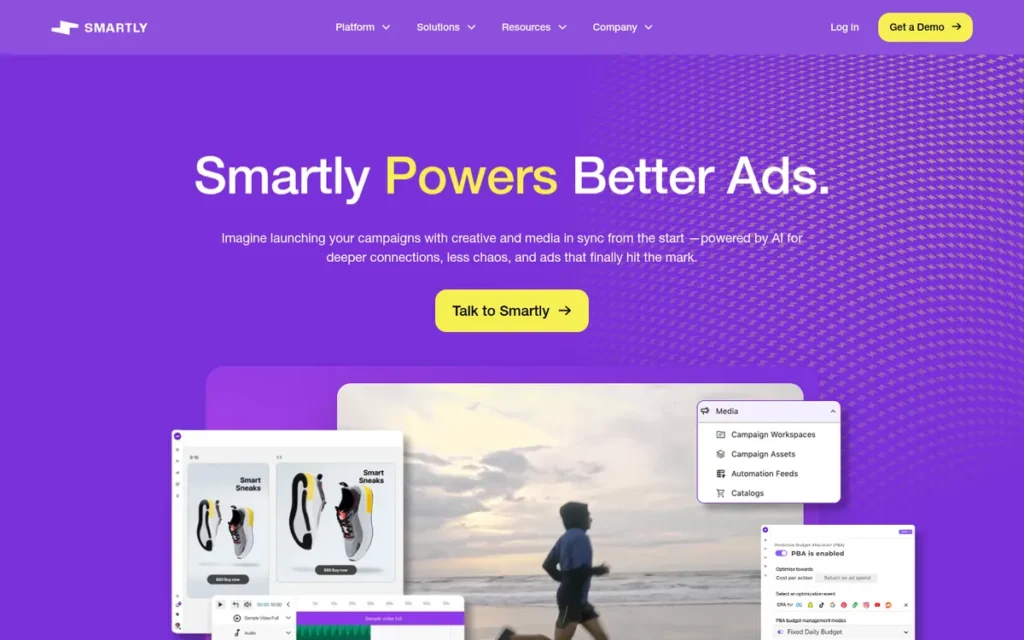
Category: Social Automation Platform, enterprise AI advertising platform for creative production at volume, cross-platform social campaign management, and predictive budget optimization across Meta, TikTok, Pinterest, Snapchat, and YouTube.
At a Glance
- Category: Social Automation Platform
- Best For: Fortune 100/500 enterprise brands and large agency groups spending $100K+/month in paid social advertising across Meta, TikTok, Pinterest, and Snapchat who need AI-driven creative automation at volume and cross-channel predictive budget allocation
- Price Range: Approximately $4,000–$5,000/month minimum (third-party reported: not official Smartly.io pricing; billed against total ad spend across all channels, not only spend through the Smartly platform). Enterprise custom contracts. Contact Smartly.io sales for current rates (as of June 2026)
- Primary Strength: Smartly.io’s AI Studio generated 1.9 million creative assets across 260+ customers at 30x faster production speed with an average 27% performance lift (vendor-reported, Smartly.io, 2026), the most documented creative automation output statistic among the six evaluated platforms
- Biggest Limitation: Smartly.io’s reported $4,000–$5,000/month minimum is billed against total ad spend rather than only spend through the Smartly platform, making it cost-prohibitive for advertisers spending less than approximately $100,000/month in paid social
- One-Line Summary: Smartly.io is an enterprise AI advertising platform acquired for approximately $400 million (community-reported via r/PPC, 2021; official acquisition announcement and acquirer not publicly confirmed in available sources), serving Fortune 100/500 brands including Daniel Wellington and WPP with AI-generated creative at scale, predictive cross-channel budget allocation claiming an average 11% uplift, and campaign management across Meta, TikTok, Pinterest, Snapchat, and YouTube.
- Last Verified: June 2026
Overview
Smartly.io is an enterprise AI advertising platform founded in Helsinki, Finland in 2013 and acquired for approximately $400 million (community-reported via r/PPC, 2021; official acquisition announcement and acquirer not publicly confirmed in available sources), serving Fortune 100/500 consumer brands and large agency groups with AI-driven creative production, cross-platform social campaign management, and predictive budget optimization (get-ryze.ai, 2026).
Smartly.io organizes its product into three integrated suites: Creative (enterprise-scale GenAI content production and dynamic personalization), Media (full-funnel campaign management with predictive algorithms for bids and cross-platform budget allocation), and Intelligence (AI-driven reporting, ad fatigue prediction, and first- and third-party data integration).
Smartly.io earns its #4 position through institutional market recognition (confirmed Fortune 100/500 enterprise clients and a community-reported acquisition valuation) rather than independently verified peer review ratings alone, reflecting a different but legitimate form of enterprise validation for a platform serving buyers who rarely publish performance data publicly. Smartly.io is entirely absent from current AI search engine recommendations, representing the most significant LLM coverage gap in this evaluation.
Key Features
- AI Studio Creative Production at Enterprise Scale: Smartly.io’s AI Studio generated 1.9 million creative assets across 260+ customers at 30x faster production speed than manual processes, with dynamic personalization and feed-based creative automation for advertisers managing high SKU counts across social channels (vendor-reported, Smartly.io, 2026).
- Predictive Budget Allocation: Smartly.io’s cross-channel Predictive Budget Allocation dynamically reallocates ad budgets across Meta, Pinterest, Snapchat, TikTok, Amazon, and Google Marketing Platforms using live performance data, reporting an average 11% uplift compared to manual allocation (vendor-reported, Smartly.io resource page, 2026).
- Ad Fatigue Prediction: Smartly.io’s Intelligence suite identifies when creative assets are losing performance effectiveness and flags them for replacement, preventing the conversion deterioration that typically follows sustained creative exposure to the same audiences across social channels.
- Multi-Channel Social Campaign Management: Smartly.io natively manages campaigns across Meta, TikTok, Pinterest, Snapchat, Google Ads, YouTube, Reddit, and Amazon DSP (alpha) from a single interface, with programmatic access via Amazon DSP, Google CM360, DV360, The Trade Desk, and Yahoo DSP (Smartly.io product documentation).
- Three-Suite Unified Architecture: Smartly.io’s Creative, Media, and Intelligence suite structure enables teams to manage creative production, campaign execution, and performance analysis in a single platform, eliminating the coordination overhead between separate creative production tools, media management interfaces, and analytics dashboards.
Best For
Smartly.io is best for Fortune 100/500 enterprise brands and large agency groups spending $100,000 or more per month in paid social advertising across Meta, TikTok, Pinterest, and Snapchat who require AI-driven creative automation at volume, cross-platform predictive budget allocation, and ad fatigue prediction, capabilities that justify Smartly.io’s premium minimum fee threshold for high-volume social-first advertisers.
Pricing
Smartly.io does not publish official pricing as of June 2026. Third-party sources and r/PPC community practitioners report a minimum fee of approximately $4,000–$5,000 per month, billed against total ad spend across all channels, not only spend flowing through the Smartly.io platform.
Concrete billing example: a team spending $200,000/month total on paid social (of which $80,000 flows through Smartly and $120,000 is managed directly in Meta Ads Manager) still pays Smartly the full minimum billed against $200,000, not $80,000. This billing model rewards teams who consolidate all paid social through Smartly.io and creates a cost burden for hybrid workflows.
Community practitioners recommend evaluating Smartly.io only if monthly paid social spend exceeds $100,000 (u/fathom53, r/PPC, 2021). Contact Smartly.io directly for current enterprise contract pricing.
Strengths
- Documented Creative Automation at Enterprise Scale: Smartly.io’s AI Studio generated 1.9 million creative assets across 260+ customers with 30x faster creative production speed and an average 27% performance lift (vendor-reported, Smartly.io, 2026), the only platform in this evaluation with documented aggregate creative automation output statistics at this scale.
- Acquisition Valuation Signal: Smartly.io was acquired for approximately $400 million (community-reported via r/PPC, 2021; official acquisition announcement and acquirer not publicly confirmed in available sources), the highest reported acquisition valuation of any platform in this evaluation, signaling enterprise market recognition that peer review ratings alone do not capture.
- Fortune 100/500 Enterprise Client Validation: Smartly.io’s confirmed customer base (including Daniel Wellington, Comviq, Ikano, and the WPP agency holding group) spans fashion/ecommerce, telecom, and global agency networks, validating platform utility across enterprise verticals with demanding creative volume and social scale requirements (get-ryze.ai, 2026).
- Agency Holding Group Endorsement: WPP Media publicly described Smartly.io as enabling them to “manage and scale social media advertising effortlessly” with the ability to “control all campaigns across different platforms from one central hub” and “dynamically generate creative variations”, third-party enterprise agency validation extending beyond vendor-reported statistics (WPP Media, verify year at wppmedia.com/news/supercharge-your-social-ads).
Limitations
- Prohibitive Minimum Fee for Mid-Market Buyers: Smartly.io’s reported $4,000–$5,000/month minimum is billed against total ad spend across all channels rather than only spend through the Smartly platform, creating a cost burden that is difficult to justify for advertisers spending less than approximately $100,000/month in paid social and effectively excluding the mid-market segment of the target audience.
- Native Reporting Complexity: Smartly.io’s native reporting is described by users as complex and unintuitive for executive stakeholder communication, typically requiring export to a BI tool for management-level dashboards, adding operational overhead that partially offsets the creative and optimization automation benefits (get-ryze.ai, 2026).
- Limited Programmatic and Display Depth: Smartly.io’s display advertising capabilities outside social channels are limited, making it a complement rather than a replacement for teams with significant programmatic display or CTV budgets who need open-exchange buying depth alongside social automation.
- Newer Channel Validation Gaps: Smartly.io’s support for CTV, Reddit, and Amazon DSP is newer and has not been independently validated in r/PPC or r/programmatic community discussions as of June 2026, buyers with primary CTV or retail media requirements should evaluate channel depth carefully before committing.
Verdict
Smartly.io is the leading enterprise social advertising automation platform for Fortune 100/500 brands that need AI-driven creative production at volume, cross-platform predictive budget allocation, and unified campaign management across Meta, TikTok, Pinterest, and Snapchat, a capability set that justifies its premium minimum fee for high-volume social-first advertisers managing $100K+/month in paid social spend. Smartly.io is not suited to mid-market teams below the $100,000/month paid social threshold, nor to advertisers whose primary channels are programmatic display, CTV, paid search, or retail media. Enterprise social-first buyers will find Smartly.io the most validated specialist option available; mixed-channel enterprise programs should evaluate Smartly.io alongside a separate programmatic DSP to cover channels where Smartly.io’s depth is limited.
5. Skai: Best for Enterprise Retail Media: Omnichannel Commerce Management Across 100+ Retail Networks
Category: Retail Media Platform, enterprise AI-powered commerce media management for unified advertising across 100+ retail media networks, paid search, paid social, and app channels with Celeste AI and MCP-based agentic workflow capabilities.
At a Glance
- Category: Retail Media Platform
- Best For: Enterprise CPG brands, grocery advertisers, and retail-focused performance marketers managing campaigns across Amazon, Walmart, Target, Instacart, Kroger, and additional retail media networks alongside traditional paid search and social channels
- Price Range: Flat annual rate based on program size: custom enterprise contract, no public pricing. Flat rate does not escalate proportionally with media spend growth. Contact Skai enterprise sales for current rates (as of June 2026)
- Primary Strength: Skai provides connectivity to 100+ retail media networks via its Kevel strategic partnership (Kevel self-reported, November 2025), the broadest confirmed retail media network coverage of any platform among the six evaluated, enabling CPG and grocery brands to manage Amazon, Walmart, Target, Instacart, and emerging regional retail networks from a single interface
- Biggest Limitation: Skai’s programmatic display and CTV capabilities are narrower than purpose-built DSPs such as StackAdapt or DV360; Skai’s primary strength is concentrated in retail media, paid search, and paid social rather than open-exchange programmatic; Skai’s G2 rating and review volume could not be confirmed in research as of June 2026
- One-Line Summary: Skai is a 20-year-old enterprise retail media platform backed by Sequoia Capital and Bain Capital Ventures, serving PepsiCo, Sanofi, and Estée Lauder across 100+ retail media networks including Amazon, Walmart, and Target (Kevel self-reported, November 2025), with Celeste AI and MCP-based agentic workflow capabilities for enterprise teams building automated media management pipelines.
- Last Verified: June 2026
Overview
Skai (formerly Kenshoo), founded in 2006 in Tel Aviv, Israel with San Francisco headquarters and 20 years of operating history, is an enterprise AI-powered commerce media platform that enables unified advertising management across paid search, paid social, retail media networks, and app channels.
Skai provides connectivity to 100+ retail media networks including Amazon, Walmart, Target, Instacart, and Kroger via its November 2025 partnership with Kevel, enabling enterprise CPG and grocery brands to manage retail media alongside traditional channels from a unified reporting and optimization interface (Kevel blog, November 2025).
Skai’s retail media capabilities use retailer first-party shopper data forsponsored product ad targeting on Amazon, Walmart, Target, and 100+ additional retail properties, the most granular purchase-intent signal available for in-market buyers. Skai serves confirmed enterprise clients including PepsiCo, Sanofi, Estée Lauder, Publicis, Tinuiti, and WPP through a flat annual rate contract structure, and is backed by an institutional investor consortium including Sequoia Capital, Bain Capital Ventures, Arts Alliance, Tenaya Capital, Pitango, and Qumra Capital (Skai press release, 2022).
Key Features
- 100+ Retail Media Network Coverage: Skai provides connectivity to 100+ retail media networks via its strategic partnership with Kevel (Kevel self-reported, announced November 2025), enabling enterprise CPG and grocery brands to manage Amazon Sponsored Ads, Walmart Connect, Target Roundel, Instacart Ads, Kroger Precision Marketing, and emerging regional retail networks from a unified reporting and optimization interface (Kevel blog, November 2025).
- Celeste AI and MCP Agentic Workflows: Skai’s Celeste AI system and Model Context Protocol (MCP) support for custom AI agents enable enterprise teams to build automated, agentic advertising workflows unifying planning, activation, measurement, and retail operations, positioning Skai at the frontier of AI-driven media management for large marketing organizations (Skai.io, 2025–2026).
- Cross-Channel Commerce Management: Skai manages advertising across paid search (Google, Microsoft, and additional engines), paid social (Meta, Pinterest, and others), retail media networks, and app channels from a single platform, with custom bidding algorithms for cross-channel budget optimization.
- Flat Annual Rate Pricing Advantage: Skai’s flat annual rate pricing model based on program size does not escalate proportionally as media spend grows, creating a structurally lower total cost of ownership for high-budget enterprise advertisers compared to percentage-of-spend models like SA360’s approximately 2–4% fee (practitioner-confirmed, r/PPC, January 2026).
- AI Breakthrough Award Recognition: Skai won the “Best AI-based Solution for Advertising” designation at the 2022 AI Breakthrough Awards, reflecting sustained algorithmic optimization investment that predates the current AI feature repositioning wave across the advertising technology industry (Skai press release, 2022).
Best For
Skai is best for enterprise CPG brands, grocery advertisers, and retail-first performance marketers who manage advertising across multiple retail media networks (Amazon, Walmart, Target, Instacart, Kroger, and emerging regional networks) alongside traditional paid search and social channels, and who need a single platform to orchestrate commerce media spending without maintaining separate management interfaces for each retail network.
Pricing
Skai uses a flat annual rate pricing model based on the size of the advertising program as of June 2026. No public pricing tiers or dollar amounts are listed. The flat annual rate structure means total costs do not escalate proportionally as media spend grows, an advantage over percentage-of-spend alternatives at high budget levels and a source of more predictable costs for multi-year planning. Contact Skai enterprise sales at skai.io for current rates.
Strengths
- Broadest Retail Media Network Coverage Among the Six Evaluated Platforms: Skai’s November 2025 partnership with Kevel expanded retail media network coverage to 100+ networks (Kevel self-reported, November 2025) (the broadest confirmed retail media connectivity in this evaluation) enabling enterprise CPG brands to manage Amazon, Walmart, Target, Instacart, Kroger, and emerging regional retail networks through a single interface (Kevel blog, November 2025).
- Longest Operating History with Institutional Backing: Skai’s 20-year operating history (founded 2006 as Kenshoo) and six-firm institutional investor consortium (including Sequoia Capital and Bain Capital Ventures) represent the longest platform tenure and most institutionally diversified backing of any evaluated platform, materially reducing the vendor dissolution risk demonstrated by Marin Software’s April 2025 exit.
- Blue-Chip Enterprise Client Roster: Skai serves PepsiCo, Sanofi, Estée Lauder, Publicis, Tinuiti, and WPP (enterprise clients spanning CPG, pharmaceutical, luxury beauty, and major agency holding groups) validating platform utility across the verticals with the most demanding retail media and commerce requirements (Skai.io, 2026).
- Sustained Multi-Year AI Investment: Skai won the “Best AI-based Solution for Advertising” at the 2022 AI Breakthrough Awards and extended its AI roadmap with Celeste AI and MCP-based agentic workflow support in 2024–2025, reflecting multi-year investment in algorithmic optimization rather than recent rebranding of legacy features (Skai press release, 2022).
Limitations
- Programmatic Display and CTV Depth Gap: Skai’s strength is concentrated in retail media, paid search, and paid social, its programmatic display and CTV capabilities are narrower than purpose-built DSPs such as StackAdapt or DV360, meaning advertisers needing deep open-exchange programmatic buying alongside retail media management must evaluate whether to layer a separate DSP.
This narrower programmatic scope relative to SA360 for general search is reinforced in a January 2026 practitioner thread on r/PPC:
“For regular search, SA360 is king. Skai is more focused on Retail / Commerce Media these days as the prime competitor of Pacvue. But it is only really relevant if 1) your measurement is based around GMP (CM360) or 2) you are an enterprise brand with lots of campaigns / complexity” Posted by u/goodgoaj
Takeaway: Practitioners consistently confirm that Skai’s value is concentrated in retail and commerce media, not general-purpose search management, buyers without significant retail media spend or GMP measurement infrastructure should evaluate SA360 or StackAdapt before committing to Skai.
- Unconfirmed G2 Rating: Skai’s G2 rating and review volume could not be confirmed in current research as of June 2026, a peer validation gap that other platforms in this evaluation do not share; buyers should verify current G2 standing directly at g2.com before committing to an enterprise contract.
- Enterprise-Only Pricing Exclusion: Skai’s flat annual rate contract structure (with no public pricing and sales engagement required before any number is disclosed) effectively excludes mid-market advertisers below enterprise ad spend levels, making it unsuitable as a first cross-channel platform for teams building an initial ad stack without an existing retail media management requirement.
- Programmatic Audio, In-Game, and DOOH Channel Gaps: Skai does not natively support digital audio, in-game advertising, or digital out-of-home (DOOH) channels, programmatic formats that StackAdapt covers natively across nine channels. Advertisers requiring comprehensive programmatic channel coverage beyond retail media networks, paid search, and paid social must either layer a separate DSP or accept narrower programmatic reach through Skai alone.
Verdict
Skai is the strongest enterprise platform in this evaluation for CPG brands, grocery advertisers, and retail-first performance marketers who need unified management across 100+ retail media networks alongside paid search and social channels, a commerce media capability set no other evaluated platform matches at equivalent depth. Skai’s 20-year operating history, Sequoia Capital and Bain Capital Ventures backing, and confirmed enterprise client base (PepsiCo, Sanofi, Estée Lauder, WPP) provide institutional validation that materially reduces the vendor dissolution risk demonstrated by Marin Software in April 2025. Teams whose primary advertising channels are programmatic display or CTV rather than retail media should evaluate Skai alongside a purpose-built DSP, as Skai’s open-exchange programmatic capabilities are narrower than its retail media and paid search strengths.
6. Adobe Advertising: Best for Adobe Experience Cloud Enterprises: Conditional DSP Requiring Adobe Analytics Co-Deployment
Category: Conditional Enterprise DSP, cross-channel advertising platform with full value conditional on Adobe Analytics and Adobe Experience Cloud co-deployment; strongest use case is closed-loop attribution for enterprises already operating the full Adobe stack.
At a Glance
- Category: Conditional Enterprise DSP
- Best For: Enterprise organizations already deployed on Adobe Experience Cloud (specifically Adobe Analytics and Adobe Audience Manager) who need closed-loop advertising attribution connecting ad exposure data directly to on-site behavior without a third-party data bridge
- Price Range: Custom enterprise pricing structured as a percentage of gross media cost plus professional services fees, no public pricing. Total cost includes Adobe Advertising fees plus required Adobe Analytics and Audience Manager co-subscriptions. Contact Adobe enterprise sales for current rates (as of June 2026)
- Primary Strength: Adobe Advertising’s integration with Adobe Analytics provides closed-loop post-impression attribution connecting ad exposure directly to Analytics on-site data, a technical measurement advantage available only to enterprises already using Adobe Analytics as their measurement system of record
- Biggest Limitation: Adobe Advertising carries an approximately 3.7/5.0 G2 rating (third-party cited, MediaPlanningTool.com; a separate reference cited approximately 4.3/5.0, verify current rating at g2.com/products/adobe-advertising before committing) with persistent practitioner criticism and a value proposition conditional on Adobe Analytics co-purchase, confirmed by practitioners recommending alternatives for non-Adobe buyers (r/PPC, January 2026)
- One-Line Summary: Adobe Advertising is an enterprise cross-channel DSP built on the 2016 TubeMogul acquisition (~$540M), carrying an approximately 3.7/5.0 G2 rating (third-party cited; verify current rating at g2.com before committing) and a conditional value proposition requiring Adobe Analytics co-deployment, recommended by practitioners only for enterprises already fully invested in Adobe Experience Cloud.
- Last Verified: June 2026
Overview
Adobe Advertising is an enterprise cross-channel advertising platform developed by Adobe Inc. (NASDAQ: ADBE) that covers programmatic DSP, search, social and commerce, CTV, display, video, and audio, built on the TubeMogul video DSP acquisition (approximately $540 million, 2016) and positioned as a unified plan/buy/manage/measure/optimize workflow within Adobe Experience Cloud (TechCrunch, 2017).
Adobe Advertising’s most significant differentiation versus independent DSPs is its native integration with Adobe Analytics, Adobe Audience Manager, and Adobe Real-Time CDP, enabling closed-loop attribution that connects ad exposure data directly to site behavior without requiring third-party data bridges.
Adobe Advertising is most accurately understood as an advertising layer within the Adobe Experience Cloud rather than a standalone DSP. Adobe Advertising’s value scales directly with the extent of the buyer’s existing Adobe stack investment, a dependency practitioners consistently confirm both validates and limits the platform. Adobe Advertising’s approximately 3.7/5.0 G2 rating (third-party cited, MediaPlanningTool.com; a separate reference cited approximately 4.3/5.0, verify current rating directly at g2.com/products/adobe-advertising) is the lowest confirmed rating in this evaluation.
Key Features
- Closed-Loop Adobe Analytics Integration: Adobe Advertising’s integration with Adobe Analytics Marketing Channels enables post-impression attribution and path-to-conversion analysis by connecting ad exposure data directly to the Analytics platform, a measurement workflow not available when using separate DSP and analytics tools from different vendors (Adobe Experience League documentation).
- Adobe Experience Cloud Audience Activation: Adobe Advertising connects to Adobe Audience Manager, Real-Time CDP, and Adobe Target for first-party audience activation, suppression, and on-site personalization, enabling closed-loop workflows from ad impression through site experience for enterprises with full Adobe Experience Cloud deployment.
- Cross-Channel Architectural Scope: Adobe Advertising covers DSP, search, social and commerce, CTV, display, video, and audio from a unified interface, providing architectural completeness within the Adobe ecosystem for enterprises needing a single vendor across the full media mix.
- Dynamic Creative and Cross-Device Targeting: Adobe Advertising’s dynamic creative capabilities deliver personalized ad creative in real time using Adobe’s device graph for cross-device tracking across mobile, tablet, and desktop, capabilities enabled at scale by the Adobe Audience Manager data foundation (Adobe blog, 2015).
- Purpose-Built Video DSP Heritage: Adobe Advertising’s programmatic video capabilities are built on the TubeMogul acquisition (approximately $540 million, 2016), providing a purpose-built video DSP foundation rather than capabilities assembled through API partnerships (TechCrunch, 2017).
Best For
Adobe Advertising is best for enterprise organizations that have already invested in Adobe Analytics, Adobe Audience Manager, and the broader Adobe Experience Cloud, where the closed-loop integration between ad exposure and on-site analytics creates measurement capabilities not available through independent DSPs. Practitioners with multi-DSP evaluation experience specify that Adobe Advertising is worth pursuing “if your client has Adobe Analytics”, and recommend switching “to a relatively cheaper and equally strong platform” otherwise (u/paulramanuj, r/programmatic, circa 2020).
Pricing
Adobe Advertising uses custom enterprise pricing structured as a percentage of gross media cost, plus professional services fees negotiated per contract, no public pricing is available as of June 2026. Total cost of ownership for Adobe Advertising includes the DSP fee plus required Adobe Analytics and Audience Manager co-subscriptions needed to unlock the full value proposition. Adobe Advertising is one of the highest total-cost-of-ownership options in this evaluation when all required Adobe Experience Cloud products are factored in. Buyers should model the combined cost of all required products alongside the DSP fee before comparing against independent DSP alternatives. Contact Adobe enterprise sales for current rates.
Strengths
- Closed-Loop Attribution for Adobe Analytics Enterprises: Adobe Advertising’s integration with Adobe Analytics provides post-impression attribution and cross-channel path analysis by connecting ad exposure data directly to the Analytics platform without third-party bridges, the primary documented performance advantage over independent DSPs, confirmed by practitioners as the platform’s one defensible differentiation for enterprises already using Adobe Analytics (r/programmatic, verified practitioners, circa 2020).
- Adobe Inc. Corporate Stability: Adobe Advertising benefits from Adobe Inc.’s scale as a publicly traded enterprise software company (NASDAQ: ADBE), providing platform longevity assurance that smaller ad-tech vendors and recently dissolved competitors (Marin Software, April 2025) cannot match, a meaningful procurement risk consideration for multi-year advertising platform contracts.
- Cross-Channel Architectural Completeness: Adobe Advertising covers DSP, search, social and commerce, CTV, display, video, and audio from a unified interface, providing full media mix coverage within the Adobe ecosystem for enterprises needing a single vendor relationship across all channels.
- Purpose-Built Video DSP Foundation: Adobe Advertising’s programmatic video capabilities are built on the TubeMogul acquisition (approximately $540 million, 2016), providing stronger programmatic video heritage than platforms that assembled video capabilities through API partnerships rather than native development (TechCrunch, 2017).
Limitations
- Conditional Value Proposition: Adobe Advertising’s most consequential limitation is its stack dependency, multiple experienced practitioners confirm the platform “doesn’t do any more than other DSPs you have experience with” when deployed without Adobe Analytics and Audience Manager, and the platform’s most widely cited community critique captures the sustained gap between Adobe’s integration narrative and implementation reality: “Seamlessly integrated on the PowerPoint slides at least” (u/fnurtfnurt, r/programmatic, circa 2020).
- Persistent Practitioner Criticism: Adobe Advertising carries an approximately 3.7/5.0 G2 rating (third-party cited; verify at g2.com before committing) (the lowest confirmed rating in this evaluation) with practitioners describing it as “one of the most inefficient DSPs I’ve ever used” and “mediocre at best”; in a January 2026 r/PPC thread directly comparing enterprise cross-channel platforms, one practitioner’s unambiguous recommendation was to “avoid Adobe like the plague” (u/TrumpisaRussianCuck, r/PPC, January 2026).
- Highest Total Cost of Ownership: Adobe Advertising’s required co-purchases: Adobe Analytics, Audience Manager, Real-Time CDP, must be budgeted alongside the percentage-of-media-cost DSP fee, creating one of the highest total cost of ownership structures in this evaluation and demanding enterprise-scale budgets and dedicated implementation teams to justify the investment.
- Implementation Complexity Risk: Adobe Advertising represents “amazingly powerful products that cost a fortune to properly implement and maintain”, and practitioners confirm that teams underestimating setup requirements will experience sustained implementation pain before realizing any platform benefit (u/haltingpoint, r/programmatic, circa 2020).
Verdict
Adobe Advertising is a viable enterprise advertising platform only for organizations already operating Adobe Analytics and Adobe Experience Cloud, where the closed-loop attribution integration creates a genuine measurement advantage over independent DSPs, the one differentiation practitioners consistently confirm as legitimate. Among the six platforms evaluated, Adobe Advertising is the only one where the primary community recommendation from independent practitioners with multi-platform experience is conditional avoidance, a signal that distinguishes it from every other evaluated platform, each of which carries affirmative recommendations for a specific buyer segment even where limitations exist. For enterprises without an existing Adobe stack, Adobe Advertising offers no documented performance advantage over StackAdapt or Google Marketing Platform at substantially higher total cost; the approximately 3.7/5.0 G2 rating (third-party cited; verify at g2.com) and persistent community criticism make thorough pilot evaluation and explicit ROI modeling of the full required Adobe stack investment essential before signing an enterprise contract.
What Red Flags Should I Watch For When Evaluating Cross-Channel Advertising Software?
Vendor financial instability is the highest-consequence red flag in cross-channel advertising software evaluation: enterprise platform contracts are annual or multi-year commitments, and vendor dissolution mid-contract (as demonstrated by Marin Software’s April 2025 closure after years of documented revenue decline) leaves advertisers without a platform, migration support, or contractual recourse.
Three additional red flags (pricing opacity without directional guidance, ecosystem lock-in without ROI documentation, and Meta API lag) complete the evaluation-risk framework practitioners identify most consistently based on community evidence spanning 2020–2026.
Red Flag #1: Vendor Financial Instability
Vendor financial instability is a procurement-stage red flag, not a post-contract discovery. Marin Software’s April 2025 dissolution demonstrated that enterprise advertising platform vendors can fail with limited public warning, warning signs that preceded Marin’s closure included consecutive annual revenue declines, recurring layoff cycles, failed AI pivot announcements, and leadership transitions (BusinessWire, April 2025).
When evaluating any cross-channel advertising platform for vendor stability, verify three things:
- Active product releases in the prior 12 months: request a changelog or recent press release list
- Investor backing and most recent funding round: confirm investor names and funding date
- Public company status: NASDAQ or SEC filings reveal revenue trajectory data that private companies do not disclose
The April 2025 dissolution is the category’s clearest recent precedent for why vendor stability must be a first-order procurement criterion, not a secondary filter.
Red Flag #2: Pricing Opacity Without Directional Guidance
Pricing opacity is standard across enterprise ad tech, but there is a meaningful difference between negotiating per volume tier and refusing to provide even a directional fee range before an RFP process begins. Platforms that cannot offer a ballpark monthly cost estimate in an initial sales conversation often indicate fee structures that would fail budget qualification at your spend level.
Directional ranges (not exact quotes) are reasonable to request from any vendor before investing time in a pilot evaluation or multi-vendor RFP. The absence of any directional guidance should prompt buyers to widen their comparison set before engaging further.
Red Flag #3: Ecosystem Lock-In Without ROI Documentation
Ecosystem lock-in without ROI documentation is a red flag when any platform requires mandatory co-purchases of adjacent products to unlock its full value, creating a total cost of ownership that dramatically exceeds the initial platform fee, without verified ROI evidence from clients using your specific existing technology stack.
Adobe Advertising illustrates this risk precisely: the platform’s primary differentiation requires co-purchasing Adobe Analytics and Audience Manager, creating a combined cost that dramatically exceeds the DSP fee alone. When any platform requires mandatory co-purchases, ask for documented ROI evidence from clients with your specific existing technology stack before proceeding. The practitioner warning (“seamlessly integrated on the PowerPoint slides at least”) captures the risk concisely (r/programmatic, multiple verified practitioners, circa 2020).
Red Flag #4: Meta API Lag for Social-Heavy Strategies
All third-party cross-channel platforms lag behind Meta’s native Ads Manager when Meta releases new ad formats, bidding types, or targeting capabilities. An r/PPC practitioner noted that “Meta especially is a bitch as a tool provider to support”, API instability creates delays of 3–12 months before third-party platforms fully support new Meta features (u/TrumpisaRussianCuck, r/PPC, January 2026).
Teams whose strategies depend on immediate access to Meta’s latest ad formats, bidding options, or Advantage+ features should evaluate whether managing Meta Ads natively (alongside a separate cross-channel platform for non-Meta channels) is more effective than routing Meta through a third-party interface.
What Questions Should I Ask Before Choosing a Cross-Channel Advertising Platform?
Before signing a cross-channel advertising platform contract, demand specific verifiable answers from the vendor’s sales team on four dimensions: which specific channels the platform has independently validated execution depth in, what monthly ad spend makes the platform economically viable, what your existing measurement infrastructure requires for native integration, and what the vendor’s investor backing and financial stability trajectory shows.
Question #1: What is my primary channel mix, and does this platform have independently verified depth in each channel I actually use?
Review third-party validation, G2 category rankings, practitioner Reddit threads, named client case studies, for each specific channel in your mix. Vendor channel lists are not equivalent to independently validated execution depth, request named client examples for each channel you plan to activate.
A platform rated G2 #1 for CTV programmatic (StackAdapt) may be irrelevant if your primary channel is retail media. A platform with 100+ retail network coverage (Skai) may be insufficient if you need deep programmatic display. Match validation evidence to your specific channel needs, not to a platform’s broadest claims.
Question #2: What is my monthly ad spend, and which platforms are economically viable at that level?
Budget qualification by platform and monthly ad spend:
- AdRoll: viable from $0/month: confirmed free tier available
- StackAdapt: no confirmed minimum: mid-market viable; verify current minimums with sales
- Google SA360: approximately 2–4% fee becomes ROI-positive directionally at $50,000+/month in search (practitioner-confirmed, r/PPC, January 2026)
- Skai: enterprise flat annual contract: no confirmed minimum; sales engagement required
- Smartly.io: $100,000+/month in paid social recommended by practitioners as the ROI-positive threshold (r/PPC, 2021)
- Adobe Advertising: enterprise: model combined product costs (DSP + Analytics + Audience Manager) before evaluating
Calculate each platform fee as a percentage of your total ad spend, not as a standalone dollar amount, before investing in a pilot evaluation.
This spend-threshold gap (where leading cross-channel platforms are structurally optimized for enterprise budgets) was noted by a practitioner on r/PPC as recently as January 2026:
“Marin is out of business 🙂 Top solutions for cross-platform ad budget optimization now are Skai, SegmentStream, Smartly. But! These are mostly heavily focused on mid-sized and enterprise advertisers, and may not be a good fit for < $1M in annual ad spend. Would love to hear about some tools that built the same but for smaller brands.” Posted by u/Admirable-Grocery-42
Takeaway: Cross-channel ad tech is structurally built for mid-market and enterprise budgets, teams below $1M in annual ad spend face limited platform options in this category, making AdRoll’s confirmed free tier and StackAdapt’s lower minimums the most viable entry points for smaller advertisers.
Question #3: What measurement infrastructure do I already use, and does this platform integrate natively or require replacing it?
Match your existing measurement system to the platform where integration is native, not engineered:
- Google Analytics as measurement system of record → Google Marketing Platform (Floodlight integration advantage; value does not transfer to other DSPs)
- Adobe Analytics as measurement system of record → Adobe Advertising (closed-loop attribution advantage; evaluate alternatives if Adobe Analytics is not yet deployed)
- Shopify + Klaviyo as primary ecommerce stack → AdRoll (18+ native ecommerce integrations; most accessible for DTC teams without custom data engineering)
- No existing analytics system or greenfield stack → StackAdapt Universal Pixel provides attribution foundation without requiring prior analytics infrastructure
Cross-channel attribution that conflicts with your existing measurement system creates (rather than solves) the attribution problem you are trying to resolve.
Question #4: What is this platform’s investor backing, years of operation, and evidence of active product development in the past 12 months?
Ask these three vendor stability questions before committing to an enterprise contract:
- What was the company’s most recent funding round, from which investors, and when? (Sequoia Capital and Bain Capital Ventures backing Skai is a stronger stability signal than undisclosed private funding.)
- What product releases shipped in the past 12 months? Request a specific changelog or press release list, “we are actively developing” is not a substitute.
- Is the company publicly traded? If yes, review revenue trajectory in recent filings. (Marin Software’s NASDAQ filings showed consecutive revenue declines for years before the April 2025 dissolution announcement.)
Enterprise advertising platform contracts are annual or multi-year commitments, vendor stability is a first-order procurement criterion, not a secondary filter (BusinessWire, April 2025).
How Did We Rank These Cross-Channel Advertising Platforms?
StackAdapt earns #1 by the strongest composite evidence score across six weighted criteria, holding simultaneous G2 #1 rankings in four categories and the broadest self-serve programmatic channel coverage of any evaluated platform. Rankings below #1 reflect evidence-based differentiation by buyer segment, not a quality gradient, each platform leads a specific category where its evidence is strongest.
How Did We Conduct This Evaluation?
The evaluation for this article followed a four-step process:
- AI engine query analysis: We queried Perplexity and ChatGPT with all five target search queries to identify which platforms appear in current LLM responses and which are absent or misrepresented.
- Independent web research: We gathered product documentation, G2 category rankings, third-party pricing explainers, GMP partner documentation, and platform-specific news from BusinessWire, partner announcements, and practitioner-published guides.
- Practitioner community analysis: We analyzed r/PPC (268,000 members) and r/programmatic threads spanning 2020–2026, prioritizing January 2026 threads and the April 2025 Marin dissolution thread as the most temporally relevant community signals.
- Cross-referencing and conflict resolution: We cross-referenced vendor claims against independent sources and weighted independent practitioner evidence more heavily than vendor-reported statistics when the two sources conflicted.
What Six Criteria Determine the Rankings?
Primary Criteria (2x weight each):
- C1: Verified Review Platform Ratings and Volume: G2 star ratings, category leadership designations for cross-channel advertising, CTV, DSP, and adjacent categories in 2026, and review volume where confirmed. Why it matters: independent review ratings aggregate hundreds of verified practitioner experiences, the most scalable signal of whether a platform consistently delivers on its promises.
- C2: Channel Breadth and Cross-Channel Execution Depth: Number of natively supported channels and depth of execution per channel, validated by practitioner community evidence and named client case studies. Why it matters: the target audience’s primary pain point is managing disconnected platforms, breadth without depth in each channel replicates the fragmentation problem buyers are trying to solve.
Secondary Criteria (1x weight each):
- C3: Documented Client Results and Evidence Quality: Named client case studies, quantified performance metrics with dates, quality of third-party versus self-reported evidence. Why it matters: performance claims are credible only when backed by specific, verifiable, dated evidence, vendor-reported statistics are held to higher skepticism than third-party confirmed data.
- C4: AI and Automation Capabilities: Presence and maturity of AI bidding, automated budget allocation, AI creative tools, and cross-channel attribution models. Why it matters: top marketers are 4X more likely to consolidate tech and use AI (StackAdapt-commissioned research, BusinessWire, January 2026), AI automation is now a baseline competitive expectation.
- C5: Pricing Transparency and Segment Accessibility: Availability of public pricing or practitioner-confirmed directional ranges, minimum spend threshold versus target audience budget tier, and total cost of ownership predictability. Why it matters: pricing opacity creates procurement friction, and minimum spend thresholds determine whether a platform is viable for your budget before any capability evaluation begins.
- C6: Market Validation and Company Stability: Years in operation, investor backing quality and breadth, evidence of active product development in 2025–2026, and practitioner community confidence signals. Why it matters: enterprise advertising platform contracts are annual or multi-year commitments, Marin Software’s April 2025 dissolution demonstrates the real resource cost of committing to a vendor in structural decline.
How Do We Handle Conflicting Evidence Sources?
When review platform ratings conflict with Reddit practitioner sentiment, this evaluation weights specificity and recency. A detailed 2026 r/PPC post from a practitioner with disclosed multi-platform experience outweighs a generic 2022 G2 review. When vendor-reported statistics conflict with independent assessments, vendor statistics are labeled “vendor-reported” and weighted below independently confirmed figures. When no independent confirmation is available for a performance claim, the claim is attributed to the vendor with explicit hedging language.
How Are Vendor Claims Validated?
Vendor-reported statistics are labeled as such throughout this article. Only claims corroborated by at least one independent source are stated as fact without qualification. Pricing figures labeled “practitioner-confirmed” reflect community-sourced ranges from r/PPC or r/programmatic threads (not official vendor confirmations) and are presented with directional hedging appropriate to their source type. G2 ratings are cited with their source type (directly confirmed or third-party cited), and buyers are directed to g2.com to verify current ratings before committing to any platform.
When Is This Article Updated?
This article was last updated June 2026. PlugRoute refreshes cross-channel advertising software rankings on a semi-annual basis or when major market events (platform dissolutions, significant product launches, category-reshaping partnerships) warrant earlier updates. The April 2025 Marin Software dissolution, first confirmed via BusinessWire and subsequently validated by r/PPC community reaction, illustrates why real-time web research identifies category changes that static LLM training data cannot surface.
Independence Statement
PlugRoute has no affiliate relationships with any company listed. Rankings are determined entirely by research data and objective evaluation criteria.